Ansen Electronics Co 0790TXA PIR Sensor User Manual 0784 5 eng im

Ansen Electronics Co PIR Sensor 0784 5 eng im

User Manual

InstructionsDriveway PatrolCongratulations on purchasing the Driveway Patrol! Your set comes with a volume controlled Chime Unit and a Passive Infra-Red (PIR) Sensor. Both are battery operated. The Driveway Patrol system is simple to install and requires no wiring.Installing the Batteries: 1. The chime requires three C-size batteries (not included). To install the chime unit’s batteries, slide off    compartment cover in direction of arrow and then install the receiver’s batteries. Be sure to observe    correct polarity (+ and -) as marked inside the battery compartment. 2. The PIR sensor requires a 9V battery. To install the PIR sensor’s battery, unscrew the back cover of    the sensor and insert the battery. Be sure to observe correct polarity (+ and -) as marked on the battery    compartment.Operation:1.  Your Driveway Patrol Receiver Chime Unit has 3 settings (Hi or Lo Volume and Off). To switch the unit    ON, select Hi or Lo Volume Settings.2. Hang the PIR (Passive Infra Red) Sensor Unit at the entrance of your driveway (such as on a mailbox,    on a tree or on a ground stake). You may also place the PIR Sensor on your garage, near the front    entrance or rear door. Any movement nearby will transmit a signal to the Receiver Chime Unit triggering    it to signal the chime.3.  Please ensure to place the PIR Sensor at least three feet high above the ground.4. Receiver must be used indoors.Important Note:A) Whenever installing the PIR sensor the first time, the red LED on the PIR sensor will be on for about 60    seconds and the chime unit will sound for about 60 seconds in order to stabilize the units first.B) In some applications the motion detector may be too sensitive, resulting in false alerts. To remedy this    situation, put masking tape or labels on each side of the sensor window. Start on the sides and add an    equal length of masking tape or labels to each side. Test the detector and add more covering if needed.    Keep the band as narrow as 1/8” wide or wider depending on individual situation. Some trial and error    may be required to find the optimal width.Specifications:Transmission Range; 400 feet (open area)    Receiver: 3 X 1.5V “C-size” battery, not includedTransmission frequency; 434MHz      Transmitter: 1 X 9V battery, not includedPIR sensor range: 40˚ X 30 feet      FCC Part 15 complianceBattery Caution:1. Do not mix alkaline, standard (carbon-zinc), or rechargeable (nickel-cadmium) batteries.2. Non-rechargeable batteries are not to be recharged.3. Never mix old and new batteries.4. Make sure batteries are inserted with correct polarity.5. Exhausted or dead batteries are to be removed from the unit.
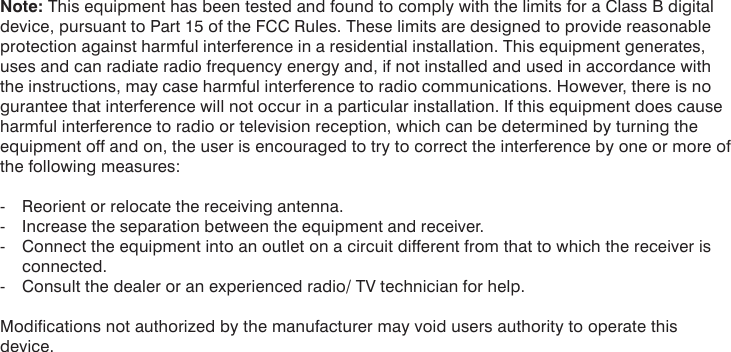
4Note: This equipment has been tested and found to comply with the limits for a Class B digitaldevice, pursuant to Part 15 of the FCC Rules. These limits are designed to provide reasonableprotection against harmful interference in a residential installation. This equipment generates,uses and can radiate radio frequency energy and, if not installed and used in accordance withthe instructions, may case harmful interference to radio communications. However, there is nogurantee that interference will not occur in a particular installation. If this equipment does causeharmful interference to radio or television reception, which can be determined by turning theequipment off and on, the user is encouraged to try to correct the interference by one or more ofthe following measures:- Reorient or relocate the receiving antenna.- Increase the separation between the equipment and receiver.- Connect the equipment into an outlet on a circuit different from that to which the receiver isconnected.- Consult the dealer or an experienced radio/ TV technician for help.Modifications not authorized by the manufacturer may void users authority to operate thisdevice.ANSEN ELECTRONICS CO.0784-5

Navigation menu