Avantech Mobile CT6628 GSM 900/1800/1900 Mobile Phone User Manual Philips9 9s
Avantech Mobile GSM 900/1800/1900 Mobile Phone Philips9 9s
User Manual
Discover Your Phone
Philips continuously strives to improve its products.
Therefore, Philips reserves the rights to revise this user
guide or withdraw it at any time without prior notice.
Philips provides this user guide "as is" and does not
accept, except as required by applicable law, liability
for any error, omission or discrepancy between this
user guide and the product described. The device is
meant to be connected to GSM/GPRS networks.
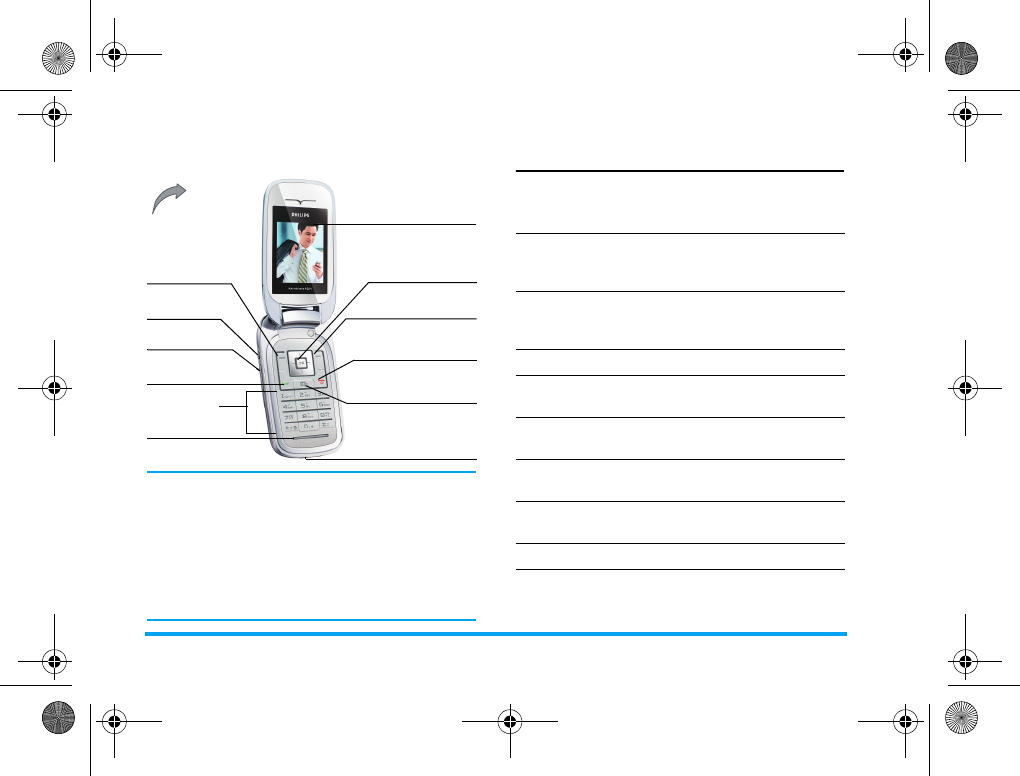
How to...
A
lphanumeric
keypad
Microphone
262k OLED
main screen
Pick up key
Hang up, cancel
and on/off key
Back of the phone:
camera lens
Charger /headset
connector
Left softkey
Right softkey
Navigation and
,
keys
Volume keys
Voice memo key
Camera key
Switch the phone
On/Off
Long press
)
.
Enter your PIN code
Enter your PIN code using
the keypad and press
,
or
L
to confirm.
Make a call
Enter the phone number on
the keypad and press
(
to
dial.
End a call
Press
)
.
Answer a call
Press
(
when your phone
rings.
Reject a call
Press
)
when your phone
rings.
Activate/deactivate
the loudspeaker
Long press
(
during a call.
Activate the
Silent mode
Long press
6
.
Access
QuickCall
Press
+
in idle mode.
Access the
Names list
Press
-
in idle mode.
Philips9@9s_00_DiscoverYourPhone.fm Page 0 Friday, June 23, 2006 4:50 PM
1
Softkeys
The left and right soft keys
<
and
>
located at the top
of the keypad allow you to select the corresponding
options that appear on the screen immediately above
them, including during calls. The functions associated
with these keys will vary according to the current
context.
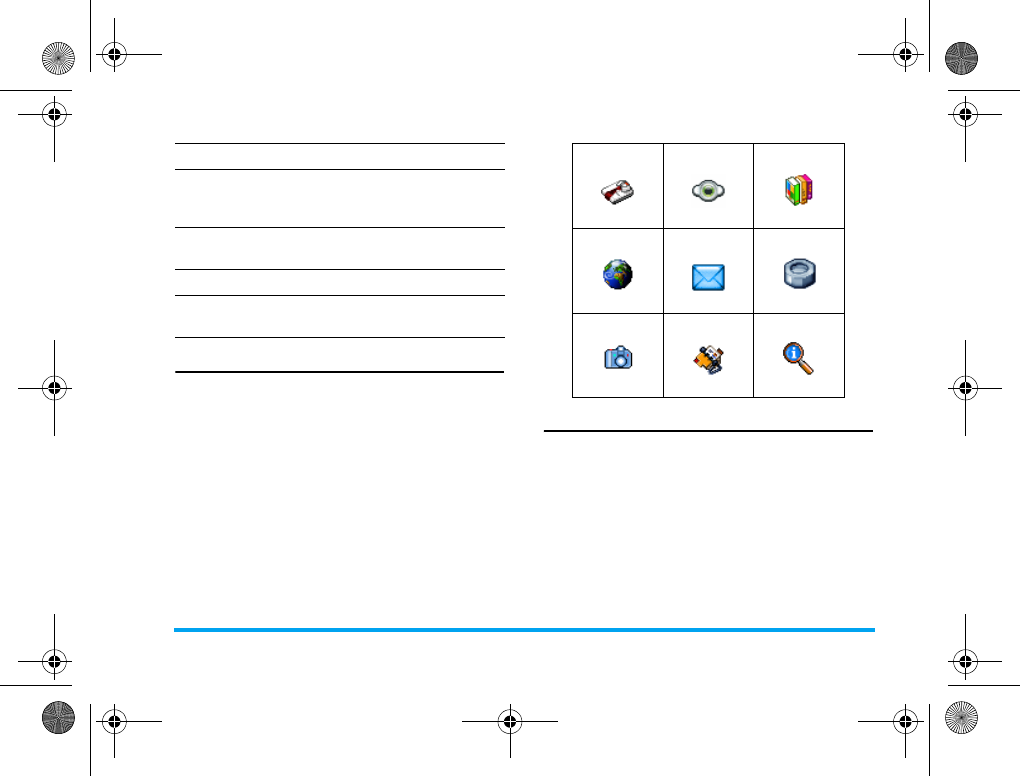
Main Menu
The Main Menu gives you access to all the different
features of your mobile phone presented in the form
of a grid. The table above summarises the
arrangement of the
Main Menu
, the meanings of the
various icons found there, and the page in this manual
where more detailed information concerning the
subject can be found.
Access the
Names list
Press
-
in idle mode.
Access the
Call list
Press
(
in idle mode. The
Call list
displays all calls
missed, dialled and received.
Access the
Main Menu
Press
,
or
L
Menu
in idle
mode.
Go to previous menu
Press
R
Back
when available.
Quickly return
to idle Press
)
.
Extras Media Album
Entertainment
page 14 page 19 page 23
Op. Services Messages Settings
page 26 page 29 page 42
Camera Address Book Call Info
page 52 page 57 page 61
Philips9@9s.book Page 1 Wednesday, May 31, 2006 7:34 PM
2
Press
,
to access the
Main Menu
when in idle mode,
then use the central navigation key which directions
are represented in the present guide with the
+
,
-
,
<
or
>
signs to browse the icons and lists. When navigating
in a list, a scroll bar located on the right hand side of
the screen shows your current position in the list.
Within lists, press
,
to access the options related to
the selected item, press select
R
Back
to go back one
level.
How to use this manual
The current manual is structured as follows:
Discover
your phone
The current section presents an
overview of your mobile phone and
information on the most commonly
used features.
Chapter 1:
Getting
started
Information on how to set up your
mobile phone for the first time:
installation of the SIM card, battery,
etc.
Chapter 2:
Calling
Information on how to make and
receive calls.
Chapter 3:
Text entry
Information on how to enter text
using the numeric keypad.
Chapters 4
to 12
These chapters treat each element of
the
Main Menu
one at a time.
Other
sections
After Chapter 12 appear the sections
for Icons & Symbols, Precautions, By-
packed accessories, SAR information
(if available at publication, otherwise
included as a separate document), and
finally the Limited Warranty.
Philips9@9s.book Page 2 Wednesday, May 31, 2006 7:34 PM

3
Table of contents
1. Getting Started ............................................5
Inserting the SIM card ......................................5
Switching on the phone ...................................6
Charging the battery ........................................7
Setting Hotkeys .................................................7
2. Calling ................................................................8
Make a call ..........................................................8
Answer and end a call ......................................8
Adjust the earpiece volume ............................8
Call handsfree ....................................................8
Options during a call ........................................9
Quick call ......................................................... 10
Handling multiple calls .................................. 10
3. Text Entry ................................................... 12
T9® text input ................................................ 12
Basic text input ............................................... 13
4. Extras .............................................................. 14
Calculator ........................................................ 14
Money converter ........................................... 14
Organiser ......................................................... 14
World clock .................................................... 15
Sound recording ............................................. 16
Alarm clock ..................................................... 17
Infrared ............................................................. 17
Auto Switch On / Off ................................... 18
5. Media Album ............................................. 19
Memory status ................................................ 19
Sound album ................................................... 19
Picture album .................................................. 20
TV slideshow .................................................. 21
6. Entertainment ........................................... 23
Countdown ..................................................... 23
Brick game ....................................................... 23
Java .................................................................... 23
Dictionary ........................................................ 25
Stopwatch ........................................................ 25
7. Op. Services ............................................... 26
Op. Services + ................................................ 26
WAP ................................................................. 26
8. Messages ....................................................... 29
Settings ............................................................. 29
Create message .............................................. 33
Inbox ................................................................. 36
Outbox ............................................................. 40
Philips9@9s.book Page 3 Wednesday, May 31, 2006 7:34 PM
4
9. Settings .......................................................... 42
Time and date ................................................. 42
Autonomy ........................................................ 42
Security ............................................................. 43
Profiles .............................................................. 45
Sounds .............................................................. 46
Display .............................................................. 47
Network .......................................................... 48
Shortcuts .......................................................... 49
Language ........................................................... 51
10. Camera ....................................................... 52
How to... .......................................................... 52
Camera menu ................................................. 54
Help ................................................................... 56
11. Address Book ......................................... 57
Copy to phone ............................................... 57
Select contacts ................................................ 57
Delete all .......................................................... 57
Quick call ......................................................... 57
Address book .................................................. 57
Adding a contact ............................................ 59
Service Numbers ............................................ 60
Status ................................................................ 60
12. Call Info ...................................................... 61
Call times ......................................................... 61
Settings ............................................................. 62
Call list .............................................................. 63
Icons & symbols ............................................ 64
Precautions ....................................................... 65
Troubleshooting ........................................... 69
By-packed Accessories ............................. 71
Trademark Declaration ............................ 72
Limited warranty .......................................... 73
Philips9@9s.book Page 4 Wednesday, May 31, 2006 7:34 PM
Getting Started 5
1. Getting Started
Please read the safety instructions in the "Precautions"
section before use.
To use your phone, you must insert a valid SIM card
supplied by a GSM operator or retailer. The SIM card
contains your subscription information, your mobile
telephone number, and a memory in which you can
store phone numbers and messages. (see “Address
Book” on page 57)
Inserting the SIM card
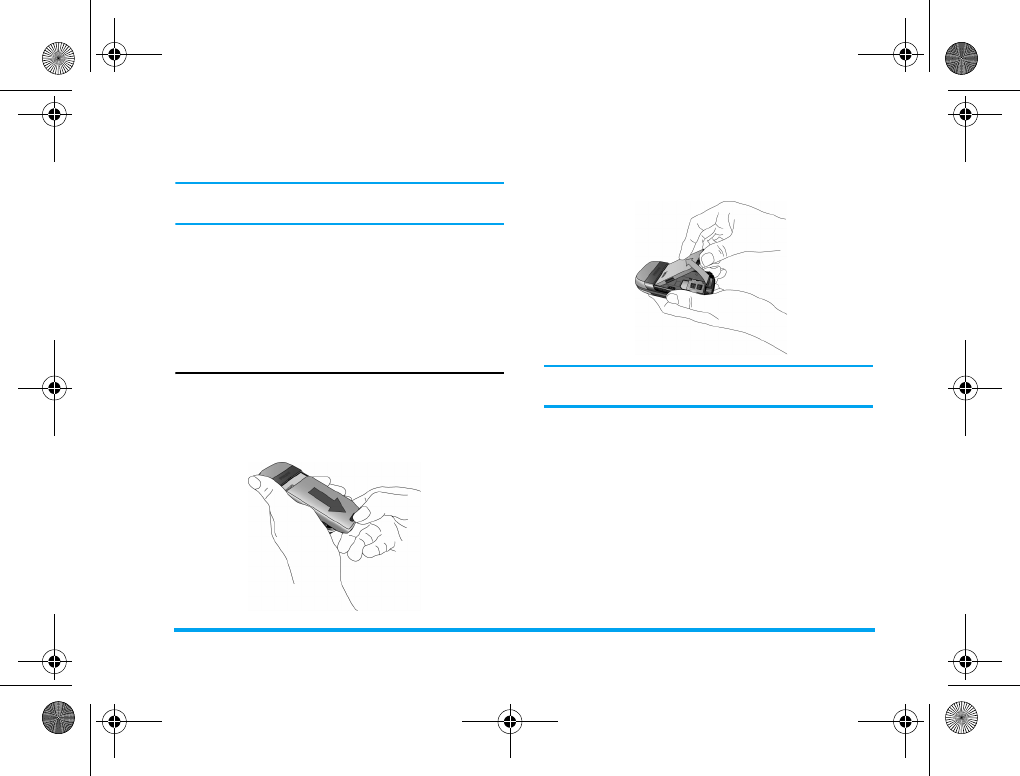
Remove the back cover
To insert the SIM card, you must first remove the
back cover. Press down the latch and slide the cover
downwards as shown below.
Remove the battery
To remove the battery, pull the battery up from the
bottom left corner.
You may lose all your personal settings if you remove
the battery when the phone is switched on.
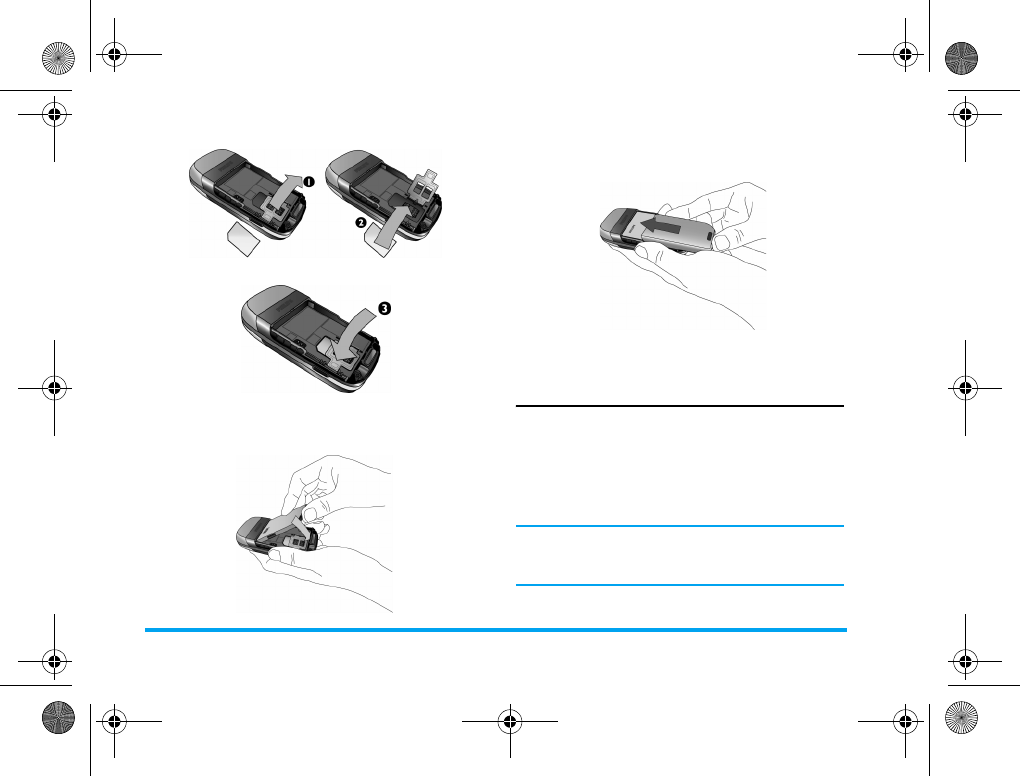
Insert the SIM card
Unlock the SIM card holder and then lift it up on its
hinge (1). Place it in the space provided (2). Make
sure that the clipped corner of the card is in the correct
corner and that the gold contacts are facing down.
Then close the cardholder into the locked position.
Philips9@9s.book Page 5 Wednesday, May 31, 2006 7:34 PM
6 Getting Started
Slide the battery into its slot, metallic connectors
facing downwards, until it stops. Then lock it by
pushing it downwards.
Replace the back cover by sliding it down into its
slots, until it stops.
Remove the protective film covering the screen and
the camera lens before using the phone.
Switching on the phone
To switch on the phone, long-press the
)
key. Enter
the PIN code if required. A PIN code is a 4- to 8-digit
secret code for your SIM card. It is preconfigured and
communicated to you by your operator or retailer. For
more information on PIN codes, see “Security” on
page 43.
If you enter an incorrect PIN code three times, your
SIM card will be blocked. To unblock it, you must
request the PUK code from your operator.
Philips9@9s.book Page 6 Wednesday, May 31, 2006 7:34 PM
Getting Started 7
When you switch on your mobile phone with your
new SIM for the first time, you will be asked to
customize your phone. This function will help you to
set the following parameters:
Charging the battery
Your phone is powered by a rechargeable battery. A
new battery is partially charged and a sound alert will
warn you when the battery reaches low, if the battery
alert is
On
. (see “Sounds alerts” on page 47)
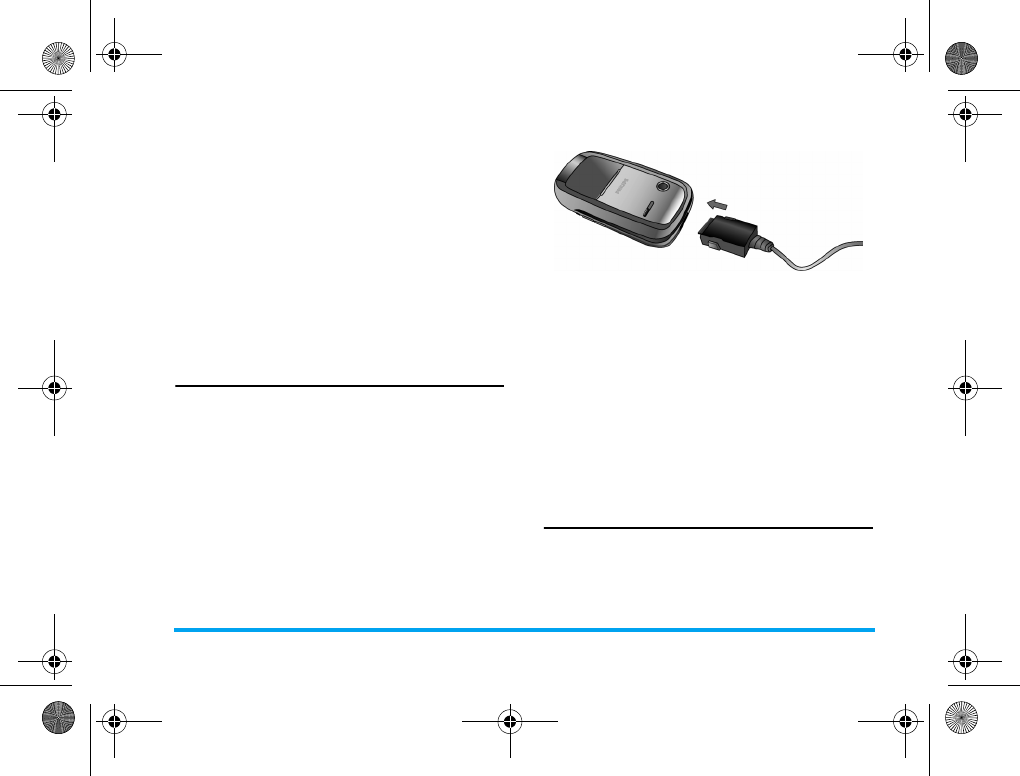
Once the battery and battery cover are back in place
you can charge the phone. Plug in the connector as
shown below. Then plug the other end into a main
AC power socket.
The battery symbol indicates the state of charge. During
charging, the charge indicators will scroll; it takes around
2.5 hours to fully recharge your mobile phone. When all
the scroll bars are steady the battery is fully charged. You
can then disconnect the charger.
Depending on the network and condition of use, talk time
goes up to 8.5 hours and stand-by time up to 30 days.
Keeping the charger plugged to the mobile when the
battery is fully charged will not damage the battery.
The only way to turn off the charger is to unplug it,
so use an easily accessible AC power socket. You can
connect the charger to an IT supply (Belgium only).
Setting Hotkeys
You can configure the numeric keys 2 to 9 to access
your favourite features simply by long-pressing on the
numeric key. A number of hotkey shortcuts are pre-
configured. For more information, see “Shortcuts” on
page 49
Summer time
Set time
Set date
Melody for incoming calls
Wallpaper
Address Book
Philips9@9s.book Page 7 Wednesday, May 31, 2006 7:34 PM
8 Calling
2. Calling
Make a call
From the idle screen
1. In idle mode, enter the phone number using the
keypad. To correct an error, press
R
<C
.
2. Press
(
to dial.
3. Press
)
or
R
End call
to hang up.
For an international call, long press
*
to enter the
"+" sign for the international prefix.
Using the phonebook
1. Press
-
in idle mode.
2. Select a contact in the list. If you are using the
onboard phonebook and the selected contact
features more than one number, the number
identified as the default will automatically be
selected. To select a different number, press
<
or
>
(see “Address Book” on page 57 for more
information).
3. Press
(
: the selected number is dialled.
4. Press
)
or
R
End call
to hang up.
Answer and end a call
When receiving a call, the number of the caller may be
displayed, depending on whether or not the person
calling has chosen to display his or her ID. If the
number is stored in the selected phonebook, then the
corresponding name is displayed instead of the
number.
•Answer the call: press
(
.
•Reject the call: press
)
. If you have activated
Call
forward
(see page 62), the call is diverted to a
number or voice mail.
•Mute the ringer: press
R
Silent
(this only switches
the sound off without rejecting/accepting the call).
•Hang up: press
)
.
The phone will not ring if in
Silent
mode .
If you have selected
Any Key Answer
, you can accept a
call by pressing any key except
)
(see “Call forward”
on page 62).
Adjust the earpiece volume
During a call, press the volume keys on the left side of
the phone to increase or decrease the volume.
Call handsfree
For your own comfort and safety, ensure you move the
phone away from your ear when calling handsfree,
especially when increasing the volume.
Philips9@9s.book Page 8 Wednesday, May 31, 2006 7:34 PM
Calling 9
1. In idle mode, enter the phone number using the
keypad or select a contact in the phonebook.
2. Press
(
then
L
Handsfree
.
If you are already on the phone, long press
(
to switch
to handsfree mode and back.
Options during a call
During a call, press
,
or
L
Options
to access the
following options.
Activate h/free
This option allows you to use your mobile phone’s
handsfree option.
Mute / Unmute
Allows you to mute or unmute the microphone so
that your caller cannot hear you.
Record dialogue
In most countries, recording telephone conversations is
subject to legislation. We advise you to notify the caller
if you intend to record your conversation and only do
so if they agree.
To record a conversation during a call, select
Record
dialogue
and press
,
. Press
,
again or
L
Save
to end
the recording: an edit window allows you to assign a
name to the recording, which is then available in
Media Album
>
Sound album
>
Recordings
, and also in
Extras
>
Sound recording
.
Depending on memory capacity (see “Memory status”
on page 19), the number and length of recordings will
vary.
If you select
Mute
and then
Record dialogue
, only the
caller’s voice is recorded.
Notepad
Allows you to note down a number. You can then
store it in the phonebook, call it, or send a message to
this number.
Other options during a call
Press
L
Options
to be able to perform the following
tasks while a call is ongoing: you can access and
consult the
Name List
or
Call list
, hang up by selecting
End call
, change the
Equalizer
settings, send or read
SMS
,
or consult and manage events of the
Organizer
.
Philips9@9s_02_Calling.fm Page 9 Thursday, June 1, 2006 9:32 AM
10 Calling
Quick call
To access the
Quick call
feature, press
+
when in idle
mode. It allows you to set your four most frequently
dialled numbers. You can then quickly call one of
them by selecting the corresponding icon or picture
on the screen.
This feature is also available from the main menu, in
Settings
>
Shortcuts
>
Quick call
.
Setting a Quick call contact
1. In idle mode, press
+
to access the
Quick call
screen. Select a thumbnail to configure and press
,
or
L
Set
.
2. Select a name in the contacts list, and press
,
again to access the
Picture album
and select a
picture. Proceed the same way for each
thumbnail.
Calling a Quick call contact
To make a call, press
+
when in idle mode, then select
the thumbnail of your choice and press
,
.
To reconfigure a thumbnail, select it and press
,
to
Replace
the name and/or picture.
If a picture is already associated with a contact, it is
displayed in the
Quick call
screen. Changing the picture
in one of the menus will also update it in the other.
Handling multiple calls
The ability to handle two or more calls at one time
and to make conference calls is dependent on your
operator and/or subscription.
Making a second call
You can make a second call during an active call or
with a call on hold. While on the phone, dial a
number (or select a contact in the phonebook) and
press
,
. The first call is put on hold (the number is
displayed on the bottom of the screen) and the second
number is dialled. You can then press
,
to access the
options among which are:
•
Switch calls
to toggle between calls (you can also
press
<
or
>
to switch calls).
•
Transfer
to connect the two calls. You are
disconnected when the transfer is completed.
•
Conference
to introduce the caller into a conference call.
Philips9@9s.book Page 10 Wednesday, May 31, 2006 7:34 PM
Calling 11
Answering a second call
When you receive a second call while being already in
communication, the phone emits a beep alert and the
screen displays
Call waiting
. You can then:
To receive a second call, you must have deactivated the
Call forward
for voice calls (see page 62) and activated
the
Call waiting
(see page 62).
Answering a third call
If you are in a call and have one call on hold, you can also
receive a third call. To do so, you must either end one of
the calls or introduce the new caller to a conference.
This service is limited to two current communications
(one active and one on hold).
Conference call
Subscription dependent.
A conference call is activated by making several
outgoing calls or from a multiple call context. It
allows you to speak with up to five people at the same
time.
1. Make a first call with someone, then a second
one (see above).
2. Press
,
or
Options
and select
Conference
. Repeat
the process until five members are connected.
3. Select
Remove party
to disconnect a member of
the conference, or select
Private call
to have a
private call with this member only (other
members are put on hold).
4. Press
)
to disconnect all calls at once.
If there is an incoming call during the conference call
and there are less than five members, you can accept
this new call and add this member to the
Conference
call (if five members are already connected, you can
answer the call, but not add it to the conference).
Press
,
To answer the call (the first one is
put on hold).
Press
)
To reject the call.
Press
,
or
L
Options
To open the options list. You can
select
End call
to end the current
call, then answer the incoming call.
Press
)
To reject the call.
Press
,
or
L
Options
To open the options list. You can
select
Accept
to answer the
incoming call, or
End call
to end the
current call, then answer the
incoming call.
Philips9@9s.book Page 11 Wednesday, May 31, 2006 7:34 PM
12 Text Entry
3. Text Entry
Text can be entered in editing screens in two different
ways: by using T9® Predictive Text Input or basic text
input. The techniques for using these two methods
are discussed below.
T9® text input
T9® Predictive Text Input is an
intelligent editing mode for entering text
on a mobile phone. It allows you to enter
text more quickly by anticipating the
word you want to enter based on the
keys you have pushed. You press once on the key
corresponding to each letter needed to spell a word
and T9® suggests a word based on your keystrokes. If
several words are available, the first word in the list is
displayed and highlighted. Press
+
/
-
or
L
to browse
the list and press
,
to insert the word.
How to use it?
Letters and symbols represented by each key are as
follows:
Example: how to enter the word "home":
1. Press
4 6 6 3
. The screen displays the first
word of a list:
Good
.
2. Press
+
or
L
to scroll and select
Home
.
3. Press
,
or
>
to confirm selection of the word
Home
.
Dictionary
If the word you want to enter is not in the T9®
dictionary, you can add it to the database. Press
L
1>2>3
to scroll to the bottom of the list until you
reach the entry represented by a series of highlighted
underscores (_ _ _ _ _).
2
to
9
To key in letters.
L
or
+
/
-
To browse the list of candidate words.
Tegic Euro. Pat.
App. 0842463
>
1
,
Press any of the three keys to insert the
selected word followed by a space.
L
Short press to backspace, long press to
clear all text.
0
To shift letter case: Standard, lower or
UPPERCASE letters.
#
To view the table of symbols and
punctuation. Then press
L
>>
or
<
and
>
to browse the 3 available tables.
*
To shift mode from T9® to basic text
input to numeric.
Philips9@9s.book Page 12 Wednesday, May 31, 2006 7:34 PM
Text Entry 13
Press
R
Spell
to open a basic text editing screen. Enter
the new word without spaces using the methods
described below and press
L
OK
when done. You are
then returned to the message you were composing and
the new word is inserted.
Language
You can switch input language while writing a
message by long-pressing the
#
key. The available
languages will depend on where you purchased your
mobile phone.
Basic text input
Press
*
to switch from T9® to basic text input. This
method requires multiple key presses to reach the
desired character: the letter "h" is the second letter on
the 4 key, so you must press it twice to enter "h".
Short press
R
Cancel
to clear one entry, long press to
clear all text.
Example: how to enter the word "home":
Press
4
,
4
(
G
H
I
)
6
,
6
,
6
(
MN
O),
6
(M
NO
),
3
,
3
(
D
E
F
). Press
,
when the message is
completed.
Letters, numbers and symbols are located on each key
as described opposite.
Short press Long press
1
space 1. , @ / : ; " ’ ! ¡ ? ¿ # + - *
= % < > ( ) & £ $ ¥ 1
2
a b c 2 à ä å æ ç 2
3
d e f 3 é è ∆ Φ3
4
g h i 4 Γ ì 4
5
j k l 5 Λ5
6
m n o 6 ñ ò ö 6
7
p q r s 7 β Π Θ Σ7
8
t u v 8 ü ù 8
9
w x y z 9 ø Ω Ξ Ψ9
0
To shift letter case: Standard,
lower or UPPERCASE letters. 0
#
To open symbols and
punctuation mode. Then press
L
>>
or
<
and
>
to browse the
3 available tables.
Changes the
language
used for text
edition
*
To shift mode: T9®, basic or
numeric. Also shifts
mode
Philips9@9s.book Page 13 Wednesday, May 31, 2006 7:34 PM
14 Extras
4. Extras
This menu contains features and options designed to
help you keep you organised and informed while on
the move.
Calculator
Your phone has a built-in calculator that you
can use to perform basic calculations.
Numbers are entered with the keypad and
operators with the navigation keys as
indicated in the table below:
An icon at the top of the screen indicates which
navigation keys to use for entering operators.
Press and hold
0
to get the decimal point.
The result of the calculator is indicative. The
calculation accuracy is 2 decimal places. The result is
then truncated after the 2nd decimal digit for the next
operation.
Money converter
This menu allows you to convert a sum from
one currency into another using the exchange
rate of your choice. You can convert from
Local
to
Foreign
or vice versa. Enter a rate in the
Exchange rate
field and an amount in either the
Local
or
Foreign
fields: the sum is calculated automatically.
Organiser
This menu allows to create, store and manage
events in your organiser. When the organiser
alert is
On
(see “Sounds alerts” on page 47), a
beep alerts you when an event is due.
The organiser shares the mobile memory capacity with
other features (phonebook, picture album, sound,
etc.). To check the memory available in your phone,
select
Media Album > Memory status.
Creating a new event
1. In
Events
, select
<New>
, then the type of event to
create (
Holiday
,
Meeting
,
To Do
).
2. Enter the starting and ending date and time of the
event and name it (e.g. "Meeting with Smith").
3. Set a reminder and a frequency: alerts will be
triggered at the chosen time.
Addition
Press
>
or the
*
key.
Subtraction
Press
<
or the
*
key twice.
Multiplication
Press
+
or the
*
key 3 times.
Division
Press
-
or the
*
key 4 times.
Equals
Press
,
or
#
.
Philips9@9s.book Page 14 Wednesday, May 31, 2006 7:34 PM
Extras 15
The reminder only applies to
Meeting
and
To Do
events.
It will be updated when changing time zones (see
“World clock” below).
Deleting old events
This menu allows you to delete past events. Enter the
starting date (past or future) from which all previous
events will be deleted and press
,
twice to delete all
events preceding this date.
To delete all events set in your organiser, enter a
starting date several years ahead (e.g. 31st of
December 2010) to make sure all events preceding this
date are deleted at once.
Managing events
Select an event in the list and press
,
or
L
Options
to
access the options described below.
Changing a repeating event modifies all instances of
this event.
Events views
Events stored in your organiser can be displayed in
Day view
,
Week view
and
Month view
. Select a view
format and press
,
, then use
<
or
>
to display the
previous or next day, week or month.
World clock
This menu allows you to set and display both
the local time and the time in the foreign time
zone of your choice. Note that if you choose
to display the local and foreign time on your home
screen, the image you selected as your wallpaper will
no longer be displayed there, but will be replaced with
the standard World clock wallpaper.
Local settings
Delete
To delete the selected event.
Change
To change the selected event.
Send by
infrared
To transmit the selected event to
another infrared-compatible device.
Change
sound
To change the sound associated with
the alarm type of the selected event.
Set time
Allows you to set the time by
pressing the appropriate keys.
Local zone
Move
+
or
-
to select the time
zone corresponding to your area.
Summer time
Allows you to set summer time
option
On
or
Off
for the local
time zone.
Philips9@9s.book Page 15 Wednesday, May 31, 2006 7:34 PM
16 Extras
World clock
Activate this option if you want to display both the
local time and the time of another time zone on the
idle screen. Press
+
or
-
to set the option
On
or
Off
.
When
On
, you can display the zone of your choice via
the menu
Switch local / foreign
.
This feature is not available when the option
No clock
is selected in “Set date” on page 42.
Switch local / foreign
To display local to foreign zone and vice-versa.
Foreign settings
Alarms, reminders, programmed events are time zone
independent! If you set an alarm or an event at
9:00 AM in time zone A, it will still ring or be due at
9:00 AM if you change to time zone B.
Sound recording
This menu allows you to make recordings of
up to 12 minutes in length, depending on the
memory status (see “Memory status” on
page 19).
Select
<New>
to begin the recording. When you are
finished, press
L
Save
to stop recording. You can then
either enter a name for the new sound file or accept
the default name proposed by pressing
,
. You then
return to the list of
Sound recordings
and the new
recording is displayed in the list.
When you select a sound file, it is played
automatically in a loop. Press
,
to access the options.
You can
Play recording
,
Rename
or
Delete
it, set
as ringer
or
As SMS/MMS ringer
.
A flashing warning sign indicates that your recording
will soon reach the maximum authorized length. If
you do not stop recording, a red envelope icon informs
you that your recording is too long to be sent via MMS.
Foreign
zone
Move
+
or
-
to select the time zone of
your choice.
Daylight
saving
Allows you to set the daylight saving
option
On
or
Off
for a foreign time zone.
Philips9@9s.book Page 16 Wednesday, May 31, 2006 7:34 PM
Extras 17
Alarm clock
Our mobile phone has a built-in alarm clock
with a snooze feature. You can set up to three
separate alarms and choose whether or not
the alarm should repeat. To set an alarm, follow the
steps below:
1. Select an alarm and set it
On
.
2. Then enter the time and press
,
.
3. Then select the frequency:
Once
,
daily
,
On
weekdays
.
4. Finally, select the type of alarm: the
Buzzer
or a
melody from the sounds album and press
,
.
Repeat above steps to set other alarms.
The alarm clock will ring even if your mobile phone is
switched off and/or the ringer volume is set to
Silent
.
When the alarm rings, press any key to stop it (except
if the snooze mode is on, see below).
Snooze mode
This menu allows you to set the snooze mode
On
or
Off
. When the alarm rings and the snooze mode is
On
:
• press any key (except
R
Stop
) to stop the ringing
temporarily. The alarm will ring again around 7
minutes later.
• press
R
Stop
to stop the ringing and the alarm
repetition.
The snooze mode is automatically deactivated after 9
alarm repetitions.
The snooze mode setting applies to all the alarms you
have set.
Infrared
Your mobile phone allows you to connect to
a variety of external devices via infrared. This
menu provides you with more features to set
up the connection with these external
devices.
Infrared
Your mobile phone has an infrared port that allows
you to send or receive data to or from other infrared-
compliant devices (e.g. another mobile phone, a
computer, a PDA, etc.) through a wireless link.
Files that are copyright protected cannot be sent.
When connecting with a PC, make sure you have
activated its infrared option.
Position of devices
Before transmitting data between two devices, they
must be correctly positioned in relation to one
another. Make sure that:
Philips9@9s.book Page 17 Wednesday, May 31, 2006 7:34 PM
18 Extras
• the infrared ports are facing each other,
• they are at a less than 50 cm away from each other.
• nothing obstructs the infrared beam.
Sending data
To send data via infrared from your mobile phone, you
must first select the item to be sent: when selecting a
picture, a sound, a name or an event, a sub-menu then
gives you access to the
Send
via infrared option.
As soon as your phone finds another infrared
compliant device to communicate with, the sending
automatically takes place. Messages are displayed on
the screen for you to follow the process.
Sending is cancelled if your phone cannot find another
device before the time out is reached, if the infrared
link is broken, or if you cancel the process.
Receiving data
When you select
Receive
your phone is ready to receive
an item via infrared and waits for the another infrared
device to send it. As with sending data, messages are
displayed on the screen and allow you to follow the
process.
Receiving is cancelled if your phone isn’t contacted by
another device before the time out is reached, if the
infrared link is broken, if the size of the file sent is too
large or if you cancel the process.
Saving the data
A message will appear to inform you that you have
received a file. Press
,
to access the options described
below.
Auto Switch On / Off
These two separate menus allow you to set your
mobile phone to switch itself on or off at pre-set times.
This lets you extend your phone’s battery life (e.g.
during the night), not be disturbed at given times and
have your phone switch back on automatically.
To set
Auto switch on
, select the option and press
,
.
Select
On
and press
,
. Enter the time at which you
want your mobile phone to switch itself on and press
,
. Select the desired frequency from
Once
,
daily
, or
On
weekdays
and press
,
. A message appears to confirm
activation.
Save
To save the data, eventually rename the
file.
Show
To display the details of the data you
have received.
Discard
To ignore the data received.
Philips9@9s.book Page 18 Wednesday, May 31, 2006 7:34 PM
Media Album 19
5. Media Album
Memory status
This menu allows you to display the
percentage of memory available in your
phone. Various features share the memory
capacity: pictures, sounds, recorded memos and voice
tags for voice commands, stored messages, phonebook
and organiser entries, games, etc.
Press
,
to check the memory status. The display
shows you the percentage of memory free and the
phone’s total memory in Kilobytes (Kb). Press
,
again to check the detailed list of memory used by
each feature.
Your mobile phone is supplied with many sounds and
pictures. You can only delete sounds or pictures which
are not protected, e.g. to free memory space for your
own sounds and pictures.
If the
List full
message appears when saving a new item
you must delete an item to be able to create or add a
new one.
Sound album
This menu allows you to manage the sound
files stored in your mobile phone. The
options are:
Once in a list, you can then select a sound file and
press
,
to access the menu options listed below.
View all
To access all your sound files in a
single list.
Own melodies
To access your downloaded sound
files.
Protected
melodies
To access the list of copyright
protected sample sounds.
Protected melodies cannot be sent
nor deleted.
Recordings
To access the list of sound
recordings.
Send by...
To send the selected sound file via
E!mail
(see page 31), via
Infrared
(see
page 17) or
MMS
(see page 39).
Note that sound files from
Recordings
folder cannot be sent via MMS.
Philips9@9s.book Page 19 Wednesday, May 31, 2006 7:34 PM
20 Media Album
Picture album
This menu allows you to display and modify
the images stored in your mobile phone. The
options are described below.
Pictures must be of the correct size and in the format
for your mobile phone to store and display them
correctly.
Inside the folders, images are displayed as a text list.
Select an image and press
>
to view the image. Pressing
,
gives you access to the menu options listed below.
As ringtone
To set the selected sound as
ringer.
As SMS/MMS
ringer
To set the selected sound as the
Messages ringer
. This option must be
activated in the menu
Settings
>
Sounds
(see page 46).
Rename
To
Rename
the selected sound file.
Delete /
Delete all
To
Delete
the selected sound file or
all files at once.
View all
To access all your image files in a
single list.
My photos
To access the photos taken with the
phone’s built-in camera.
My images
To access the images you have
received on your phone.
Prot. images
To access the list of protected sample
images.
Protected pictures cannot be sent nor
deleted.
Icons
To access the list of icons you have
downloaded.
Send by...
To send the selected file via
E!mail
(see
page 31), via
Infrared
(see page 17) or
MMS
(see page 39). Note that you
cannot send pictures that are
protected by copyright.
Set as
wallpaper
To set the selected picture as
wallpaper.
Modify
Use this menu to access the following
options:
Philips9@9s.book Page 20 Wednesday, May 31, 2006 7:34 PM
Media Album 21
TV slideshow
This menu allows you to display the pictures
listed in the
Picture album
(automatically in a
slideshow or manually one-by-one) on the
main internal screen of your phone and/or on a TV
screen via the TV Link accessory.
TV Link may not supplied with your product. In this
case, you must purchase it separately.
Manual
This menu allows you to display the pictures
manually. Browse the list of pictures by pressing
+
or
-
. Press
>
to activate the graphical full-screen display
and send it to the TV, press
<
to go back to the list.
•Add text To add text to the selected picture.
Enter your text in the editing screen
and press
,
. Use the navigation keys
to move the text on the screen: short
press to move the text 1 pixel at a
time, long press for 5 pixels.
Press
R
Back
to go back to the text
editor, or
L
OK
to validate and go to
the next option.
•Add
frame
or icon
To add a frame or an icon to the
selected picture.
•Eraser To
Undo
the last modification made
on the picture, or to
Reset
, i.e. cancel
all changes at once. Press
R
Back
to
cancel or
L
OK
to validate.
•Send To send the selected picture via
infrared, E-mail or MMS.
•Save To save the picture with all the
changes you have applied.
Rotate
Use this option to rotate the selected
image of
-90 degrees
,
+90 degrees
or
+180 degrees
.
View
To display the selected file.
Properties
To display its properties (size, format,
resolution, etc.).
Rename
To
Rename
the selected image.
Delete /
Delete all
To
Delete
the selected file or all files at
once.
Pictures in the
Protected images
folder
cannot be sent nor deleted.
Philips9@9s.book Page 21 Wednesday, May 31, 2006 7:34 PM
22 Media Album
When a picture is selected, press
,
or
L
Select
to open
the rotation options (90° or 180°).
Automatic
This menu allows you to display the pictures
automatically in a slideshow.
1. Select the time value that will be applied
between each picture of the slideshow (10, 15 or
20 seconds) and press
,
or
L
Select
.
2. In the list that appears, select the pictures of your
choice by pressing
<
or
>
. Choose
(Un)Check all
to
select or deselect all pictures at once.
3. Press
,
to start the slideshow and
R
to stop it.
In both modes, the last selection made is
automatically saved and can be played several times in
a row, even when you quit the TV Slideshow menu.
Philips9@9s.book Page 22 Wednesday, May 31, 2006 7:34 PM
Entertainment 23
6. Entertainment
Western Horoscope, Lunar Calendar and Chinese
Festival features are available only in the Chinese
language menu (see page 23). Your phone may or may
not have the Chinese Language menu depending on
where the phone was purchased.
Countdown
When you enter
Countdown
menu, the screen
countdown with a start time as 00:00:0. Enter
the Countdown menu and enter the
countdown time in HH:MM:SS format.
1. Press
L
Start
to start the countdown.
2. Press
L
Stop
to stop the countdown timer and
press
R
Back
to exit.
3. At the end of the countdown, the phone will
emit an alarm. When you exit the countdown,
this function will be deactivated.
Brick game
The goal of this game is to destroy bricks by
hitting them with a ball. Destroying all bricks
give you access to the next level.
Keys used are the following:
Java
Your mobile phone features a Java run-time
environment, which allows you to run Java
applications, such as games downloaded on
the network.
The first time you launch Java, a message appears to
alert you that the installation and configuration of
Java will take several moments. This is a one-time
occurrence.
Settings
Once Java has been installed, you may then proceed
with configuration.
4
and
6
To move the racket left or right.
*
and
#
To start the game by throwing the
ball left or right.
0
To pause the game up to 2 min.
(after which the screen returns to
idle mode and the game is lost).
Philips9@9s.book Page 23 Wednesday, May 31, 2006 7:34 PM
24 Entertainment
Auto launch
Allows you to set the automatic launch of Java
On
or
Off
. When
On
, a Java application will be automatically
launched immediately following installation.
Network access
Network
This menu gives you access to operator-specific
settings, including DNS and proxy addresses. When
available, all items of this menu are pre-configured, so
that you shouldn’t have to change them.
Java applications
1. The first time you select this menu, press
L
OK
for initialization to start. This will take several
minutes.
2. Back to the JAVA window, you can either:
- press
,
to access the content of the
Default
folder
, then press
L
Menu
and
Select
to play the
listed games,
- or press
L
Menu
, to access the options allowing
you to create and manage new folders.
3. Select
Install
to install on your mobile phone the
JAVA games you have downloaded: you must
always proceed with installation first, to be able
to play a game.
4. Press
Exit
to quit the Java application, or press
L
Menu
to access the list of available options.
Your mobile phone may display messages about
"MIDlets". MIDlets are JAVA applications or games.
Bearer
To select the type of network used when
launching a connection and to configure
the corresponding settings.
•
GSM
or
GPRS
: your mobile will only
use the GSM or the GPRS network
for e-mail connections.
•
GPRS first
: your mobile will first try to
connect to the GPRS network, then to
the GSM network if the GPRS
network isn’t available.
Selecting the above option requires you to have both
GSM and GPRS settings configured. See page 48 for
details.
DNS
address
Allows you to enter the DNS address of
the external data network you want to
connect to.
Network
account
Allows you to select one of the data
profiles you have defined in
Settings
>
Network
>
Access settings
(see page 48).
Philips9@9s.book Page 24 Wednesday, May 31, 2006 7:34 PM
Entertainment 25
Stopwatch
When you enter Stopwatch menu, the screen
will display Stopwatch with a start time as
00:00:0.
Press
L
Start
or
,
to start the Stopwatch timer. The
soft keys will become
Start
/
Stop
and
Reset
.
Press
R
Reset
to reset the Stopwatch. Then
R
Back
to
exit.
Philips9@9s_06_Entertainment.fm Page 25 Thursday, June 1, 2006 6:23 PM
26 Op. Services
7. Op. Services
This menu contains the services and features provided
by your operator. Consequently, the menus described
below may vary or may not be available, depending on
your subscription. Contact your network operator for
more details.
The services provided may involve making a phone
call or sending a SMS for which you may be charged.
Op. Services +
This menu option is reserved for operator-
specific services. Please contact your operator
for more information about these options.
WAP
This menu allows you to access services
supplied with your network, such as news,
sports, weather, etc.
If your phone was pre-configured, it isn’t necessary for
you to change the settings described in this section.
With some operators, settings can be set remotely.
To launch a WAP session, select
Operator
>
WAP
>
Homepage.
Your mobile phone connects to the network
according to the
Access settings
you have defined in the
menu
Settings
>
Network
(see page48). In case of a
connection error, the screen displays "Go to menu":
press
,
or
L
Options
to access the WAP options (see
page 28).
Homepage
This is the link to the first WAP site you access when
launching a WAP session. In most cases, this menu
item is preconfigured and will connect to your
operator’s WAP homepage. To change this default
homepage see “Options” on page 28.
Use
+
or
-
To browse the on-line pages.
Press
,
or
L
Select
To select a highlighted item.
Press
R
Back
To return to the previous page.
Press
)
or select
Options
>
Exit
To end the WAP session.
Philips9@9s.book Page 26 Wednesday, May 31, 2006 7:34 PM
Op. Services 27
Bookmarks
This menu allows you to store your favourite WAP
site addresses, rename them and access them quickly
from the list.
Press
L
Options
while browsing, then select
Bookmarks
:
the name and URL fields will be automatically filled
in with the information of the page you are browsing.
Select
Add bookmark
and start entering the new name
for the edit screen to appear. Press
,
, then proceed
the same way to enter the URL address.
The
Manage bookmarks
menu allows you to
Delete
or
Edit
the selected bookmark.
Go to URL
This menu allows you to enter a WAP site address and
to connect directly when selecting it (a quick way to
access WAP addresses without saving them as
bookmarks).
All the addresses you enter in this menu and connect
to at least once, will appear in a list. Select one of the
items and press
,
to reconnect to the corresponding
page, without having to re-enter its complete address.
Settings
In order to access WAP sites, you must first configure
a WAP connection profile.
Select profile
To select one of the available profiles, then define the
connection settings for each of them.
All connection settings described below apply to the
selected profile.
Browser options
To activate or deactivate the downloading of images
attached to WAP pages.
Selecting
Off
will speed up the global downloading
time of the pages browsed.
Rename profile
To rename the currently selected profile (start
entering the new name for the edit screen to appear).
Cache
To empty an area of the phone’s memory where the
pages browsed during a WAP session are stored.
Network
•
Homepage
: to change the homepage name and
address (start entering the new name for the edit
screen to appear).
•
Network access
allows you to select one of the data
profiles you have defined in
Settings
>
Access settings
(see page 48).
Philips9@9s.book Page 27 Wednesday, May 31, 2006 7:34 PM
28 Op. Services
•
Bearer
allows you to select the type of network used
by the selected profile when launching a connection
(see page 42).
•
Proxy address
and
Proxy port
allow you to define a
gateway address and port number to be used when
launching a WAP connection using the selected
profile.
•
Security
: to display the list of installed security
Certificates
(then display its details or delete it), the
Session info
or the
Current certificate
.
Push inbox
This menu allows you to read and manage messages
automatically sent to you by the network and / or by
your operator.
In some cases, a red "@" sign will be displayed on the
screen to inform you that you have received a new push
message. Press
,
or
L
Read
to read it or
R
Back
to go
back to idle.
Push messages include URL links for quick access to
the corresponding WAP services: a single click on the
link will connect to the WAP site for browsing or
downloading multimedia files into your handset.
If your push inbox is full, a message will advise you to
delete some messages in
WAP
>
Push Inbox
.
Options
While browsing, press
L
Options
to access:
Homepage
To access the default homepage.
Back
To go back to the previously browsed
page.
Forward
To go to the next browsed page.
Refresh
To reload the currently browsed page
from its original server.
Set as
homepage
To save the currently browsed WAP
page as the default homepage.
Save as...
To save images embedded in the
pages that are displayed in the
Picture
album
.
Exit
To end a WAP session.
Bookmarks
Go to URL
Settings
Push inbox
See page 27 for description of these
options.
Philips9@9s.book Page 28 Wednesday, May 31, 2006 7:34 PM

Messages 29
8. Messages
Settings
My dictionary
This feature allows you to enrich the T9 dictionary
used for writing messages. For detailed information
on entering with T9, please see “T9® text input” on
page 12). Select
<New>
to create and store a new
word, or
<Delete all >
to erase the content of the
dictionary at once.
SMS
Reply path
When
On
, this option allows you to
transmit the number of your SMS
message centre together with the
message. The recipient can then
reply using your own SMS centre
and not theirs. This speeds up the
rate of transmission. This feature is
subscription dependent.
Delivery
report
When
On
, this option will inform
you via SMS whether your own SMS
was received or not. This feature is
subscription dependent.
Auto save
SMS
When
On
, this option will
automatically save messages sent in
the
Archive
menu.
SMS center
To select your default SMS centre.
If
not available on your SIM card, you
must enter your SMS centre number
.
Signature
When
On
, allows you to add a
signature at the end of your message.
You can
Edit
,
Change
or
Save
the
signature.
Validity
period
To select the length of time your
messages are to be stored in the SMS
centre. This is useful when the
recipient is not connected to the
network (and thus cannot receive
your message immediately). This
feature is subscription dependent.
Philips9@9s.book Page 29 Wednesday, May 31, 2006 7:34 PM
30 Messages
MMS
This menu allows you to
Activate
,
Modify
or
Rename
one
of the available MMS profiles. Your mobile phone
may have been pre-configured. To change the
settings, choose an MMS profile in the list and select
Modify
to access the settings described below.
Application settings
Retrieval
mode
Allows you to choose from:
•
Manual
: you connect manually to
the server by selecting a
notification in the
Inbox
, selecting
Read
to download, then
Play
.
•
Automatic
: new MMS are directly
placed in the
Inbox
. Select the
MMS and press
>
to play it.
This mode is deactivated when
roaming.
Validity period
To select how long your MMS will
be stored on the server, from
1 hour
to
1 week
(maximum). This is useful
when the recipient is not connected
to the network (and thus cannot
receive your message immediately).
Read report
This option can be set
On
or
Off
and
informs you (via an SMS) when the
status of the MMS you have sent has
changed, i.e. if it was read or deleted.
Delivery
report
This option can be set
On
or
Off
and
informs you (via an SMS) of the
status of delivery, e.g. if your MMS
was received or rejected.
Auto save
This option can be set
On
or
Off
and
allows you to automatically save the
messages sent in the
Outbox
menu.
Slide duration
Allows you to select the duration
between each slide of the MMS.
Hide identity
To
Always hide
or
Never hide
your
identity (i.e., your phone number) to
the recipients of your MMS.
Restr.
advertis.
To set the option
On
or
Off
. When
On
, you will receive less
advertisement messages sent by the
network.
Philips9@9s.book Page 30 Wednesday, May 31, 2006 7:34 PM
Messages 31
Network settings
E-Mail
This menu allows you to
Activate
,
Modify or Rename
one
of the available email profiles. Your mobile phone
may have been pre-configured. To change the
settings, choose an Email profile in the list and select
Modify
to access the settings decribed below.
If one of the accounts has been pre-configured, it may
be locked, in which case it cannot be renamed.
Network access
Before you can consult your e-mails, you first need to
configure your connection to the internet.
GSM Settings
When you use a GSM connection to connect to the
internet, your mobile phone dials a number provided
by your operator and the data is sent and received over
this connection, somewhat like a dial-up internet
connection from a PC. The GSM connection
parameters are described in the table below.
Network
access
To choose a connection profile from
the ones you have set (see “Access
settings” on page 48).
Bearer
To select the type of network used
when launching a connection:
GSM
,
GPRS
or
GPRS first
.
MMS center
To enter the MMS address of the
server you will connect to.
Gateway
address
Gateway port
To enter the IP and Port numbers of
the server’s gateway.
Phone No.
This is the number your mobile phone
dials to establish a connection. First
choose
ISDN No.
(Integrated Service
Digital Network) or
Analogue No.
(depending on your network operator)
and then enter the
Phone number
provided by your operator,
Login &
Password
The login and password provided by
your GSM network operator to access
this service.
Auto
disconnect
Enter an inactivity time-out value after
which the phone will automatically
end the call (if a connection was in
progress). The value must be over 30
seconds.
Philips9@9s.book Page 31 Wednesday, May 31, 2006 7:34 PM
32 Messages
GPRS settings
If using GSM is like a dial-up internet connection, a
GPRS connection would be the equivalent of
broadband. GPRS (or Global Packet Radio Service) is
a protocol for sending data rapidly using a radio
signal.
To configure a GPRS connection, you may need to
provide a a user name and password, although some
GPRS connections function without them. You will
need to provide the
APN
(or Access Point Name).
Bearer
This menu option allows you to choose which how to
establish an internet connection.
•
GSM
: your mobile will only use the GSM network
for e-mail connections.
•
GPRS
: your mobile will only use the GPRS network
for e-mail connections.
•
GPRS first
: your mobile will first try to connect to
the GPRS network. If no GPRS network is
available, then it will try with the GSM network.
For these features to work, you must first have entered
the corresponding settings.
E!mail server
To configure the settings needed to connect to your e-
mail service.
You must obtain the POP3 and SMTP addresses from
your e-mail service provider.
If you wish to use a GPRS connection to access your e-
mail, you may need to use the SMTP server of your
mobile service provider to send e-mails.
Password
The password to access your e-mail
account.
E-mail
address
Your e-mail address.
SMTP
address
The Simple Mail Transport Protocol
(SMTP) address. This is the server for
your outgoing mail and is usually in a
format like
smtp.yourmail.com
.
POP3
address
The Post Office Protocol (POP)
address. This is the server for your
incoming mail and is usually in a
format like
pop3.yourmail.com
.
Login
The login (or user name) to access
your e-mail account.
Philips9@9s.book Page 32 Wednesday, May 31, 2006 7:34 PM
Messages 33
Advanced
Broadcast SMS
This menu allows you to manage the reception of
SMS broadcasts regularly transmitted to all
subscribers on the network. It gives you access to the
following options:
Create message
New E-mail
If not included in your mobile phone contract, you
will need to subscribe to an e-mail service in order to
send and receive e-mails. In this case, all parameters
are communicated to you by your operator.
This menu allows you to send e-mails to one or several
recipients at a time, including with an attachment
such as a JPEG picture. Once received, your messages
can be forwarded and the attachments visualised with
the appropriate software.
POP3 Port
The port number on the POP3
server. This is usually port 110.
SMTP port
The port number on the SMTP
server. This is usually port 25.
DNS address
The IP address of your Domain
Name Server.
SMTP
authent.
SMTP authentication is usually set to
Off
. Contact your provider for more
information.
District Code
To select the type of messages you
want to be permanently displayed on
the idle screen (in this case, enter the
type in both
District code
and
Topics
menus).
Reception
To set the reception of cell broadcast
messages
On
or
Off
.
Topics
To define the type of messages you
want to receive. To configure a topic,
select
<New>
, enter the code provided
by the operator, and, if desired,
associate a name. You can also select
an existing topic in the list, which you
can rename, change its code or delete.
You can enter up to 15 different
topics in the list. To obtain the codes
corresponding to the different topics,
contact your operator.
Philips9@9s.book Page 33 Wednesday, May 31, 2006 7:34 PM
34 Messages
If you exit the
Create message > New Email
menu before
sending your e-mail or if you cancel the sending while
it takes place, the e-mail content is deleted without
being stored.
You can only attach one picture (JPEG, GIF or BMP)
or one sound at a time. If you accept an incoming call
while writing an e-mail, the menu is closed and the
phone goes back to idle when you hang up.
New SMS
To compose and send an SMS, follow the steps
detailed below:
1. Select
Create message
>
New SMS
then enter text
then send SMS then enter phone number or
name from contact list and press
L
Select
or
,
.
2. Select name from contact list then
Send SMS
then
enter text then press
,
to access the next
options :
You can send up to two attachments of two different
types together with your SMS. Images and pictures
are exclusive: if you first select an animation and then
Add
contacts
To select the recipient(s) of your e-mail,
provided that you have entered e-mail
addresses for contacts saved in your
phone phonebook (see “Address Book”
on page 57).
After you have added contacts, select one
of them and press
,
to
Change
the e-mail
address,
Remove
it from the list.
If you select a contact from the SIM
phonebook, an edit window will allow
you to enter an e-mail address.
Create
email
Allows you to design your message.
Enter the subject and text, then press
,
to access the next option:
•
Add sound
or
Add graphic
to attach a
sound or a picture to your e-mail,
•
Send now
to send it to the selected
recipient(s),
•
Modify
to redesign your e-mail.
Save
To store the current message and its
attachments in the
Archive
menu.
Send now
To send the current message.
Add sound
To attach a melody.
Add graphic
To attach an image or an animation.
Input
language
To change the language for typing.
Philips9@9s.book Page 34 Wednesday, May 31, 2006 7:34 PM
Messages 35
an image, only the image will be taken into account
and vice-versa.
Once you have selected one of the above options press
,
and you could send to the contact you have
selected or add recipient.
Copyright protected pictures and sounds cannot be
sent by SMS.
New MMS
When you select
New MMS
, you are first asked to enter
the contact to whom you wish to send the MMS. You
can select one or more existing contacts, enter a new
mobile phone number or a new email address.
Next you will be asked to
Create MMS
. In the MMS
creation screen, five icons allow you to add a
Picture
,
add
Text
, add
Sound
,
Send
the message or access the
MMS options
. Use
+
or
-
to move from one option to
the next and press
,
or
L
to access the menu.
1. Design your message: add a Picture, a Text and/
or a Sound. Press > to create more slides.
2. The last icon on the left handside lets you access
the
MMS options
(see below).
3. Select
Send
to send the MMS to the selected
recipient(s).
Pictures are chosen from the
Picture album
. Copyright
protected pictures cannot be sent via MMS. Sounds
can be chosen from the
Sound Album
melodies.
The following options are available when creating
new MMS messages:
Add slide
To create a new slide and add it to
your slide show. Press
<
or
>
to
browse slides once you have created
several.
Edit subject
To edit and change or enter the
subject of your message.
Next slide /
Previous slide
To move to the next/previous slide.
Note that this option only appears
if the MMS contains more than one
slide.
Delete slide
To delete the selected page (if there
is more than one in the message).
Save
as draft
To save your message as a draft that
you can edit, complete and send
later on.
Philips9@9s.book Page 35 Wednesday, May 31, 2006 7:34 PM

36 Messages
Once your message is completed, select
Send now
and
press
,
. A progress bar allows you to follow the
sending of your message, press
L
Cancel
if you wish to
cancel the sending. If you saved the MMS as a draft,
it will be available in the
Drafts
menu. If you have sent
the MMS, it is available in the
Outbox
when you have
activated the
Auto save
options (see below).
Inbox
E-mail
This menu allows you to connect to your mailbox and
download the e-mail headers (sender and subject
lines) from the server. You may then choose to retrieve
the corresponding e-mails.
1. Select
Open mailbox
: your phone automatically
connects to the e-mail server and downloads the
list of e-mail headers if any (five at a time).
2. If
Next
(or
Previous
) appears at the end (or
beginning) of the list, other e-mail headers are
pending: select one of the available options and
press
,
to retrieve them.
3. Select a header, and press
,
to display the
Details
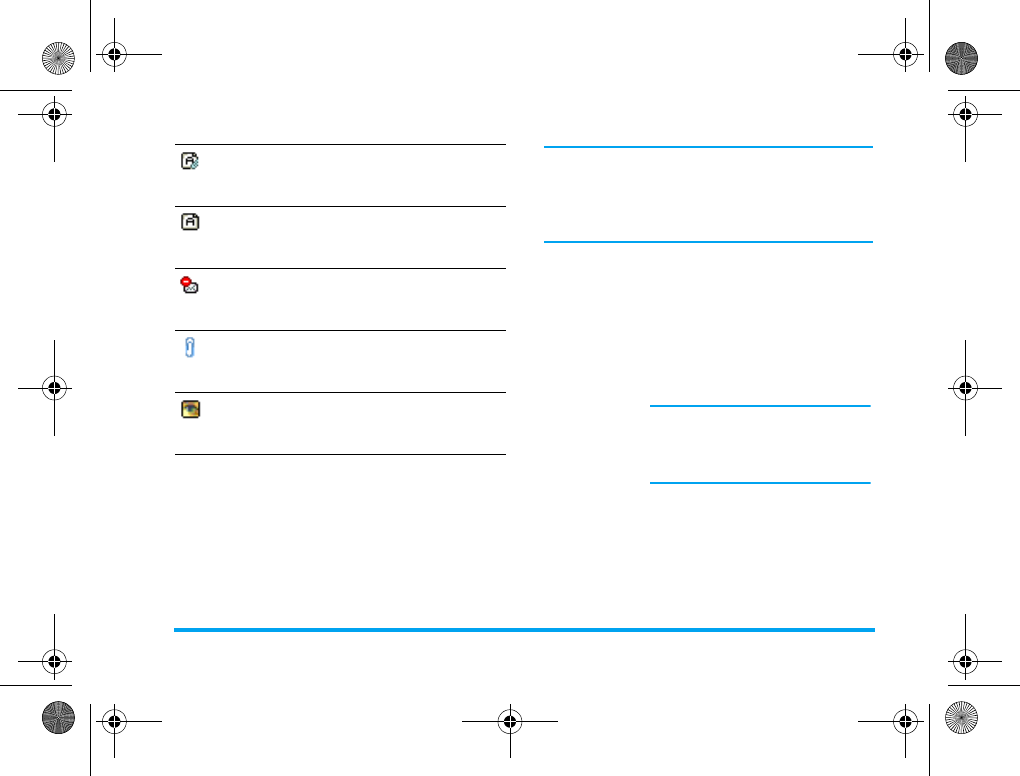
. The following status icons may appear to
each header:
4. If there is no icon next to the header, you can
press
,
and select
Get mail
to download the
e-mail. Repeat this operation to download each
e-mail corresponding to each selected header.
If the e-mail you have received contains attachments
(an image, a text file, or another e-mail), they are
identified by a specific icon:
Save
as template
To save your message as a template,
that you can use as a basis for other
MMS (e.g. "Happy birthday" type
of message.
Preview MMS
To preview the slide show you have
created.
Slide duration
To change the value of slide
duration set in
Settings
>
Application
settings
, and to set a delay between
each slide. The e-mail size is too large (over 50 Kb), it
cannot be downloaded.
The e-mail is marked to be deleted (see
page 37).
Contains the details of the e-mail header
(date and time, sender’s e-mail address,
etc.), press
,
to display these details.
Philips9@9s.book Page 36 Wednesday, May 31, 2006 7:34 PM
Messages 37
You must download and save a picture before you can
view it in the
Picture album
. If there isn’t enough
memory to store the new picture, you must delete
other items (images, sounds, messages, etc.) to free up
memory to save the new picture.
An image file may not be accepted by your mobile
phone if it isn’t in the correct format. Images must be
in JPEG, BMP or GIF format.
The optimal image size is 128 x 160 pixels (the
dimensions of the screen). If you are transferring
images from your home computer, you can use an
image editing program to create images of the correct
size.
5. Select an e-mail header and press
,
to access the
following options:
The text of the e-mail itself can be viewed as
an attachment, press
,
to read it (no
advanced options in this case).
A text file (text only, ".txt" format) is
attached to the e-mail, press
,
to read it
(no advanced options in this case).
The application needed to manage this
attachment isn’t available in your phone, or
the e-mail is too large to be uploaded.
Another e-mail is attached to the one you
received. Up to five e-mails can be attached,
although there will be no advanced options.
A picture is attached to this e-mail. Select it
in the list and press
,
twice to store it in
your phone (you can rename it if you wish).
Add to contacts
To add the sender’s e-mail address
to your phonebook, even when you
haven’t yet downloaded his e-mail.
Select
<New>
to create a new
contact, or a name in the list to add
or change the e-mail address.
You must have selected the phone
phonebook in this case; this menu
item will NOT appear if you
selected the SIM phonebook.
Delete
To mark the e-mail to be deleted
(select this option again to unmark
it). When you exit the E-mail menu,
you will be asked to confirm
deletion of the selected item(s) from
the e-mail server.
Philips9@9s.book Page 37 Wednesday, May 31, 2006 7:34 PM
38 Messages
SMS
This menu allows you to read SMS messages you have
received. The messages are displayed in a list. At the
end of the list, the
<Delete All>
item allows you to
delete all the messages at once. Deleting old messages
is useful to free memory space in order to receive new
messages.
When a message is displayed, press
,
or
L
Options
to
access the menu options listed below.
Reply
To reply to the sender (whose
address will be automatically added
to the list). Proceed as described in
“Inbox” on page 36.
Forward
To forward the downloaded e-mail
to someone else. Proceed as
described in “Inbox” on page 36.
Delete
To delete the selected message.
Edit SMS
To edit, modify and resend the
SMS to someone.
Reply by SMS
To reply to the sender.
Move to phone
To store messages in the phone
memory. You can then consult them
in
Messages
>
SMS
>
Archive
. Moving
a message to the archive deletes it
from the
SMS Inbox
list.
Forward to
To forward the selected message.
Note that attachments cannot be
forwarded.
Call handsfree
To call the sender of the message
handsfree.
Call back
To call the sender of the message
(operator-dependent).
Store number
To save the number of the sender if
it is attached to the message.
Extracted No.
To extract a number included in the
message itself, if this number is
included in double quotes (several
numbers can be included and
extracted). This menu is only
visible if there is a number to
extract.
Philips9@9s.book Page 38 Wednesday, May 31, 2006 7:34 PM
Messages 39
MMS
If someone sends you an MMS, an icon and a sound
alert will inform. If the sender of the message has
asked for a
Read
report
, a prompt will ask you to send
it or not. Once the MMS is downloaded, it is available
in the
Inbox
.
If the size of the MMS to download is bigger than the
memory available in your phone, you must free
memory by deleting data (picture, sounds, etc.).
Your MMS inbox lists all the
Read
and
Unread MMS,
Notifications
,
Delivery
and
Read
report
. To read a
message, select it and press
>
. Press
,
or
L
Options
to
access the following options:
Once you have opened an MMS, press
L
Options
to
access the following:
Store melody
To save the melody that was sent
with the SMS. This menu is only
visible if there is a melody to
extract.
Store graphic
To save the graphic and/or
animation that was sent together
with the SMS. This menu is only
visible if there is an image to
extract.
SMS Inbox
Sorting
SMS messages that have been read
are automatically moved to the
phone memory and sorted by time
and date.
SMS messages that have not been
read are kept on SIM memory and
sorted according to the SIM order.
Play message
To switch back to automatic mode:
the MMS is then played as a
continuous slide show.
Forward
To forward the selected MMS to
someone else.
MMS details
To display the details of the
selected message (size, date, etc.).
Delete
To delete the selected MMS.
Play message
To switch back to automatic
mode: the MMS is then played as a
continuous slide show.
Philips9@9s.book Page 39 Wednesday, May 31, 2006 7:34 PM

40 Messages
Do NOT delete notifications before you have retrieved
the MMS, or you will not be able to retrieve the MMS.
Notifications are automatically deleted once you have
received the full MMS.
Drafts
Lists all messages saved as drafts, or automatically
saved if you quit the MMS menu before saving or
sending your MMS. You can
Play
,
Edit
,
Send
,
view
Details
and
Delete
drafts.
Templates
Lists all messages saved as templates. You can
Play
,
Edit
and
Delete
them.
MMS
Lists all messages saved as templates. You can
Play
,
Edit
and
Delete
them.
SMS
Lists all messages that are pre-configured, such as “I’m
waiting for you” or “Please call me back”. Selecting
them directly from this menu prevents you from
typing them from scratch.
Outbox
MMS outbox
Lists the messages you have
Sent
or created but
Not sent
yet. You can
Play
,
Delete
or view the
Details
of all these
messages,
Send
or
Forward
them to someone.
Messages you have saved can only be sent from the
Draft
or
Outbox
folders. You can NOT recover an item
(whether message, notification or report) that you
have deleted. Press
R
Back
to cancel deletion.
SMS outbox
Lists the messages that were saved, whether they were
sent or not. You can
Delete
or
forward
any of the
Next / previous
slide
To move to the next or previous
slide. You can also press
<
or
>
when
viewing the MMS in manual
mode. Note that this option only
appears if the MMS contains more
than one slide.
Save picture
To detach the picture of the
current slide and save it in the
Picture album
.
Save sound
To detach the sound of the current
slide (if a sound is attached) and
save it in the
Sound album
.
Close
To close the MMS and go back to
the list of options.
Philips9@9s.book Page 40 Wednesday, May 31, 2006 7:34 PM
Messages 41
messages listed in this folder,
or Edit
the selected
message to send it to someone else. At the end of the
list, the
<Delete all>
items you to delete all the messages
at once. Deleting old messages is useful to free
memory space in order to receive new messages.
Philips9@9s.book Page 41 Wednesday, May 31, 2006 7:34 PM
42 Settings
9. Settings
This menu allows you to change the settings related to
each available option (sounds, time and date, security,
etc.) and to customise your phone.
Time and date
Set time
Allows you to set the time using the keypad or
with the navigation keys.
You should select your
Time zone
and activate
Daylight
saving
(if appropriate) before setting the time.
Set date
Allows you to set the date by pressing the appropriate
numeric keys or the navigation keys.
Local zone
Allows you to select your current time zone. When
you enter the menu, you are presented with a map of
the world that which you can navigate with the up and
down navigation keys. Each time zone is identified
according to its position relative to Greenwich Mean
Time (GMT) and by the main cities within that time
zone.
Summer time
Allows you to set the Summer time option
On
or
Off
(in summer time) or
Off
(in winter time). If daylight
saving is
On
and you set the time to 12:00, it will
automatically switch to 11:00 when turning the
option to
Off
.
Autonomy
This menu gives you access to:
Deactivating most of the functions in the
Autonomy
menu increases battery life.
Light Sensor
The light sensor is a feature that enables the handset
to optimize the consumption of power using ambient
light.
The following summarizes the functions of the light
sensor:
• In a bright or sunny environment, the screen is set
at the maximum power level and the backlight of
the keypad is set to off.
• In a dark environment, the screen is set at less than
the maximum power level, while the backlight of
the keypad is set to on.
Philips9@9s.book Page 42 Wednesday, May 31, 2006 7:34 PM
Settings 43
When you switch on the power of the phone or open
the clamshell, the keypad backlight is on, and the
screen is powered at the maximum level.
You can activate or de-activate the light sensor.
Backlight
Allows you to choose from different backlight
durations.
External LED
The handset has an external LED, you can activate or
de-activate it.When on, by default the light will blink,
it will indicate that the phone is on. It also lights up
when one of the following event occurs :
•The alarm rings.
• There is a new SMS, a new MMS, a new organizer
event, a new voice mail, or a missed call.
• There is an incoming call.
• A SMS, MMS, organizer event, voice mail, or
missed call has not been read.
• The battery is low (red light).
Security
This menu allows you access the features
relating to the security of your mobile phone
and the data you store there.
Change codes
Allows you to change your
PIN
and
PIN 2
codes, as well
as the call Barring code. Depending on your SIM
card, some features or options may require a PIN2
secret code given to you by your operator.
If you enter a wrong PIN2 code 3 times, your SIM
card is blocked. To unblock it, request the PUK2 code
from your operator or retailer. If you enter an
incorrect PUK code 10 times in a row, the SIM card
will be blocked and unusable. If this happens, contact
your operator or retailer.
PIN protection
This allows you to set the PIN protection
On
or
Off
.
When
On
, you will be asked to enter your PIN code
when switching your phone on.
You cannot change your PIN code if this option is
Off
.
Public names
Allows you to manage a specific names list called
Public
Names
list, and restrict calls to this list via the
Call
restriction
option.
This feature is subscription dependent and requires a
PIN2 code (see page 47).
Philips9@9s.book Page 43 Wednesday, May 31, 2006 7:34 PM
44 Settings
Call barring
Allows you to limit the use of your phone to specific
calls. This can be applied to
Incoming calls
(
All calls
or
When roaming
) and/or to
Outgoing calls
(
All calls
,
International calls
and
Intl. Exc. Home
). In both cases,
the
Cancel
option applies to all calls at once. The
Status option allows you to know whether a type of
call is barred or not.
This feature is network dependent and requires a
specific call barring password supplied by your service
provider.
Information privacy
Allows you to protect, with a code of your choice,
your
Messages
,
Contacts
or
Call info
and prevent them
from being read by someone else using your phone.
Firewall
This menu allows you reject all calls and SMS received
from the people you include in the blacklist.
Settings
Select this menu item and press
L
Select
to access the
options described below.
Public names
Allows you to consult, edit and
modify your
Public Names
list via a
PIN2 code.
Call restriction
Allows you to restrict the calls to the
Public names list when
Public only
is
selected.
This feature is subscription
dependent and requires a PIN2
code (see page 47). This option
might also apply to WAP and
e-mail connections over GPRS.
Notification
To select the way you want to be
notified of a rejected call or SMS: with
a
Status icon
displayed in idle screen or
an
Icon feedback
. You can also choose
No notification
.
Activation
Allows you to set the firewall option
On
or
Off
. When
On
, your mobile
phone will reject all calls and SMS
received from the people listed in the
blacklist. Rejected calls appear in the
Call list
and rejected SMS in the
Spam
SMS Box
.
Philips9@9s.book Page 44 Wednesday, May 31, 2006 7:34 PM
Settings 45
Blacklist
This menu displays the list of contacts whose calls and
SMS will be rejected. Select
<New>
to add a name and
the corresponding number to the list, then choose
whether you want to reject
SMS
and/or
Calls
coming
from this person.
Select a name in the list and press
,
or
L
Select
to
Change
the related information or
Delete
it. Select
Details
to display the blacklist details.
You can add a name to the blacklist directly from the
phonebook
, the
Calls list
and the
SMS Inbox
: select a
contact, a call or a message in the relevant list, press
L
Options
and simply select
Add to the blacklist
. The related
number will be added to the blacklist.
Profiles
A profile is a group of predefined settings that
allow you to quickly adapt your phone to
your environment. Selecting
Meeting
, for
example, will set your ringer volume to silent, activate
the vibrating alert and deactivate the key tones (the
other items are set according to your
Personal
settings).
When your meeting is over, selecting
Personal
will
reactivate all your usual settings. The details of each
profile are displayed when selecting a profile.
You can also associate a hotkey with a profile (e.g.,
long press key
3
to activate
Outdoors
). Long pressing
the same key deactivates it and returns you to your
Personal
settings. For more information, see “Hotkeys”
on page 49.
The information that appears in the Personal field
will depend on how your mobile phone has been
configured.
Autonomy
Vibra alert
Off
Ringtone
Silent
Backlight
Eco
Keytones
Off
Headset
Vibra alert
On
Ringtone
Medium
Backlight
10 sec
Key tones
Off
Animation
On
Philips9@9s.book Page 45 Wednesday, May 31, 2006 7:34 PM
46 Settings
Sounds
Silent
When this mode is
On
, all alerts are deactivated and
the vibra alert is active.
The
Silent
mode also applies to key tones.
Ringer volume
This option allows you to adjust the volume
of your ringer. Press
+
or
-
to adjust the
volume of your ringer from
Silent
to
Increasing
.
Ringtone
Allows you to select a ringer tone. The list also
includes recorded sounds and melodies you saved.
Scroll through the list and wait to hear the selected
melody being played.
There is a set of embedded MP3 ringers listed in the
phone.
• Enjoy MP3 ringtones simply by downloading your
favourite music files using the Mobile Phone Tools
software (CD Rom included in the box).
• Use the USB data cable to transfer them to your
phone and personalize a ringtone of your choice. If
the download is successful, the file is stored in the
Own melodies
folder (file size dependent).
• You can also share your files via MMS or IRDA.
Car, Outdoors
Vibra alert
Personal
setting
Ringtone
High
Backlight
10 sec
Key tones
Off
Meeting
Vibra alert
Personal
setting
Ringtone
Off
Backlight
10 sec
Key tones
Off
Silence
Vibra alert
On
Ringtone
Off
Backlight
Personal
setting
Key tones
Off
Philips9@9s.book Page 46 Wednesday, May 31, 2006 7:34 PM
Settings 47
You cannot receive any MP3 ringers from other
handsets.
Messages ringer
Allows you to set
On
or
Off
an alert for each time you
receive a new message. When
On
, you can select the
alert of your choice from the ringers list.
Vibra alert
Allows you to set the vibra alert
On
or
Off
when
receiving a call, when an event set in the organiser is
due, when you receive a message and when the alarm
rings.
The vibra alert is always
Off
when you connect the
charger or the Cigarette Lighter Adapter.
Key tones
Allows you to switch the key tones
On
or
Off
.
Auto switch on & off sound
Allows you to set
On
or
Off
the sounds of your mobile
phone when you switch it on or off.
Equalizer
This option allows you to choose from different audio
settings. It is only available while a call is in progress.
Scroll through the list and wait a few seconds to hear
the difference.
Sounds alerts
Allows you to set alert sounds for the following items:
•
Organizer
: when an event programmed in your
organiser is due,
•
Missed call
, when you missed an incoming call,
•
Battery alert
: when the battery is running low and
requires charging,
•
Minute alert
for a beep alert that sounds every
minute during a call to help you manage the
duration of your call (the beep cannot be heard by
the caller).
Select or deselect the item(s) of your choice by
pressing
<
or
>
.
This menu only allows you to set the alert sounds
On
or
Off
, NOT the alerts themselves. E.g. setting the
Organiser
alert
Off
will not prevent your phone from
displaying the
Reminder
screen (if you programmed
one), but the corresponding sound will not be played.
Display
This menu allows you to configure how the
menus are displayed on screen.
Philips9@9s.book Page 47 Wednesday, May 31, 2006 7:34 PM
48 Settings
Backlight
Backlight is activated when receiving incoming calls
or messages, browsing menus, etc. Select one of the
available values.
Network
Contact your phone operator to have full
information about GPRS availability over its
network and for an appropriate subscription.
You might also need to configure your phone with the
GPRS settings supplied by your operator, by using the
menus described in this section. Then select the bearer
(GSM or GPRS) in the menus of each application to
be used (e.g. WAP, MMS, e-mail, etc.).
Access settings
This menu allows you to create different data profiles
that can be used for connecting to various services: for
example, when using WAP or when sending MMS,
the selected profile will be used to connect to the
GSM or GPRS network.
Options described below are operator and/or
subscription dependent. Error messages during
connections are mainly due to incorrect parameters:
contact your operator before first use, in order to have
the appropriate settings, which you may receive by
SMS in some cases. Some pre-configured profiles
might be locked, preventing re-programming and
renaming.
Select an item in the list and press
,
to access the
following options:
Change name
To rename the selected profile.
Show
To display all parameters of the
selected profile.
GSM Settings
To change the GSM settings:
•
Login
&
Password
,
•
Phone number
needed to establish
the connection and provided by
your operator (
ISDN
or
Analogue
),
•
Inactivity time
, a value of over 30
seconds after which the phone
disconnects automatically (if a
connection was in progress).
GPRS settings
To change the GPRS settings:
•
Login
,
Password
,
Inactivity
time
•the
APN
menu allows you to
enter the address of the external
data network you want to
connect to, a text string used to
establish the connection.
Philips9@9s.book Page 48 Wednesday, May 31, 2006 7:34 PM
Settings 49
GPRS connect
This menu allows you to define how your mobile
phone connects to the GPRS service.
Register again
Provides you with a list of the networks available in
the area when the
Manual
mode is selected. Select the
network you want to register with and press
,
to
confirm.
Preferred list
Allows you to build a network list in order of
preference. Once defined, the phone will try to
register on the network, according to your
preferences.
Shortcuts
This feature allows you to configure shortcuts
to the features and options you access most
frequently.
Hotkeys
Allows you to set up direct access to a specific function
or a contact by linking it to a key. A long press on the
key in idle mode will then automatically activate the
function or call the associated number.
A number of Hotkeys have been preconfigured, e.g.
6
for Silence, but you can reprogram them (keys from
2
to
9
only). The following keys are locked:
Depending on your service provider, other hotkeys
may be predefined and locked.
1. In the list, select a key from
2
to
9
and press
,
. If the key was already programmed, select
Change
.
2. Browse the list to select the function you wish to
associate with this key and press
,
or
L
Select
.
3. To use a hotkey, press and hold the programmed
key when in idle mode.
Always on
Your phone automatically connects
to the GPRS service (if available).
This option allows quicker access
to GPRS features, but increases
energy consumption.
For data calls
Your phone will connect to the
GPRS service only when required.
This option reduces energy
consumption, but increases the
connection delay.
1
Call voice mailbox.
*
Dial international call.
Philips9@9s.book Page 49 Wednesday, May 31, 2006 7:34 PM
50 Settings
Voice command
Allows you to set up a direct access to a specific
function by linking it to a voice tag.
You can associate a voice command to most functions
supported by the hotkeys.
1. Select
<New>
, then browse the list to select a
function and press
,
or
L
Select
.
2. When
Press
,
and speak
appears, record your
voice tag. Make sure you are in a quiet
environment, choose a short and simple word
and clearly pronounce it.
3. The next menu gives you access to
Delete
,
Play
,
function
and
Change sound
options. Press
R
Back
to
create another voice tag.
To use the voice command, press and hold
,
when
in idle mode, then say the recorded voice tag.
To reprogram a voice command: select it, press
L
OK
and select
Change function
. This will bring you to the
list of available functions.
Voice dial
Allows you to set a voice tag that will dial the default
number for the corresponding contact simply by
saying the voice tag. To set up voice dial, proceed as
follows:
1. Select
<New>
, then a contact in the list, then
press
,
or
L
Options
.
When the phonebook in phone is selected, choose the
number of your choice in the list that is displayed.
2. When
Add voice tag?
appears, follow the
instructions displayed on the screen.
To use the voice dial, press and hold
,
when in idle
mode, then say the voice tag corresponding to the
number you want to dial.
Up to 15 voice tags can be defined and shared between
voice dial and voice command. Recorded voice tags are
available in their respective menu and can be deleted,
played or changed.
Quick Call
This feature allows you to set your four preferred or
most frequently dialled numbers. You can then
quickly call one of them by selecting the
corresponding icon or picture on the screen, thereby
removing the need to enter and browse the
Contacts
list. See “Quick call” on page 10 for details.
Philips9@9s.book Page 50 Wednesday, May 31, 2006 7:34 PM
Settings 51
Language
This menu allows you to select a language for
all menu texts. Use
+
or
-
to browse the list
and select a language by pressing
,
or
L
Select
.
Philips9@9s.book Page 51 Wednesday, May 31, 2006 7:34 PM
52 Camera
10. Camera
Your mobile phone features a built-in digital camera.
You can take pictures, store them in your phone or
transfer them to your PC via
Infrared
, use them as
wallpaper or send them to your friends via
MMS
or
Email
. This chapter describes in detail how to use the
camera.
How to...
This section describes how to perform the most
common operations with your camera.
Activate the camera
To activate the camera mode, simply press
R
Camera
:
the camera application is automatically launched.
After a period of inactivity, the camera automatically
exits.
When the camera is active, the preview screen is
displayed. Note that the lens is preset and focus-free.
The table below details the operations of the various
keys in camera mode.
Take a picture
1. Frame your picture and press
,
to take the
picture.
2. Once the picture is taken, a view screen is
displayed. Press to ignore the picture,
,
to
save it or press to access the following
options (see “Camera menu” below for details).
+
-
Zoom in / out.
<
>
Increase / decrease exposure
compensation.
,
Take a picture.
)
or Exit
Camera
mode and return to
home screen.
0
Activate/deactivate the self-timer.
*
Activate/deactivate the burst mode.
#
Toggle through the image
resolutions.
L
Access the
Options
menu.
R
Return to previous screen.
Philips9@9s.book Page 52 Wednesday, May 31, 2006 7:34 PM
Camera 53
If there is no action before the view screen time-out,
the picture is automatically saved.
Pictures are named with the date of the shot, e.g.
"0410_154157.jpg" for a picture taken on October 4,
at 15: 41:57.
The number of pictures you can save varies according
to the settings: the higher the resolution, the bigger
the file size. A message will warn you if there isn’t
enough memory left. In this case, you must delete data
before storing a new picture.
Using the self-timer
1. In
Camera
mode, press
0
.
2. Adjust your picture, and press
,
to start the
countdown of 10 seconds (this value cannot be
changed).
Press
L
to stop the timer and go back to preview mode.
3. A sound is played three seconds before the picture
is taken, then again when it’s actually shot.
MMS Foto talk
This feature allows you to send a picture via MMS
and to add a sound recording to it. The picture can be
selected from the
Picture album
or can be a picture you
have just taken with the camera.
1. Take a picture, then press
Menu
, or select a
picture from the
Picture Album
, then press
,
or
L
Options
. In both cases, select
Send by...
>
MMS
.
2. When the
Add sound?
message appears, press
L
Yes
to start recording. Then press
L
Save
to stop
and save your recording, or
R
Cancel
.
3. Select a contact in the list that appears and then
go to the MMS creation screen. Press
L
Send
to
send your message, or modify it as you want
before sending it (see “New MMS” on page 35
for more information.
Store
To save the picture in your personal
photos folder using the default
numbering (you can then rename it from
the folder itself).
Send by...
To send the picture by MMS, E-mail or
Infrared.
Modify
To save the picture and modify it (see
“Picture album” on page 20).
Discard
To ignore the picture and go back to
preview mode.
Philips9@9s.book Page 53 Wednesday, May 31, 2006 7:34 PM
54 Camera
Camera menu
This section describes in detail the
Camera
menu
options.
My photos
When you take a picture and save it, the file is stored
in your
My photos
folder. When you open the menu,
your photos are displayed as thumbnails. Use the up
and down navigation keys to move through the list.
To view the image full-screen, press
,
. Use the up
and down navigation keys to move through the list of
images. Press
L
Options
to access the following:
Slide show
Selecting this option will launch a slide show of the
contents of the
My photos
folder. During the slide
show, each photo will be displayed briefly on the
screen. Press any key to end the slide show and return
to the previous screen.
Continuous shoot
Activating this menu option allows you to take a
"burst" of 9 photos with one press of the button. Note
that to use this mode, the resolution must be set to
Wallpaper
(for more information, see “Settings” on
page 55).
View
To display the picture in full screen.
Send by...
Use this menu to transfer an image to
another device. The options are:
MMS
,
Email
and
Infrared.
Set as
wallpaper
To set the selected photo as the image
to be displayed in the background of
your screen.
Modify
This option launches the image editing
program. See “Picture album” on
page 20 for details.
Properties
Choosing this option displays the
following properties of the selected
image:
Name
,
Size
(in Kb),
Resolution
and
Format
.
Rotate
This option allows you to rotate an
image; The options are:
- 90 degrees
,
+ 90 degrees, + 180 degrees
. Changes are
automatically applied.
Rename
Use this option to rename an image file.
Delete /
Delete all
Use this option to delete some or all the
files in your
My photos
folder.
Philips9@9s.book Page 54 Wednesday, May 31, 2006 7:34 PM
Camera 55
When the camera is finished processing the images,
they are displayed on screen as thumbnails. You may
then press
L
Options
to access the options described
below.
When you save or delete an image from the group, it
is removed from the thumbnail view and stored in the
My photos
folder.
Picture orientation
This feature allows you to choose how photos are
displayed in your photo album so that they can be
viewed correctly. The options are:
Landscape
&
Portrait
.
Frames
This feature allows you to take photos with decorative
frames. The
Standard frames
folder contains frames
that were loaded on your mobile phone when you
purchased it.
Color mode
The
Colour mode
feature allows you to apply a number
of different visual effects to your images. The options
are:
None
,
Embossed
,
Black & White
,
Negative
,
Sepia
,
Digital
,
Edge
and
Edge 2
.
Night mode
When activated, this feature allows you to take
pictures in low-light situations.
Self-Timer
This feature allows you to take a time-delayed picture
so that you can get into the frame as well. To use the
Self-Timer
, select
On
in this menu, return to the view-
finder mode, frame your picture, and then press
,
.
Brightness
Use this menu option to adjust the exposure
compensation of your mobile phone’s screen.
Settings
Save
To save the selected image.
Save all
To save all the images in the group.
Send by...
To send the selected image by MMS,
Email, or Infrared.
Delete
To delete the selected image.
Delete all
To delete all the images in the group.
Resolution
Use this menu option to choose the size
of the photos you take. The options are:
• 1.3Mpix (1280 x 1024)
• VGA (640 x 480)
• Medium (320 x 240)
• Wallpaper (128 x 160)
Please note that the higher the
resolution, the larger the file size.
Philips9@9s.book Page 55 Wednesday, May 31, 2006 7:34 PM
56 Camera
Help
This menu option provides you with on-screen help
in taking pictures with your mobile phone.
Picture
quality
This menu allows you to adjust the
quality of the pictures taken with your
camera:
Low
,
Medium
,
High
.
The lower the quality, the smaller will
be the resulting image files, thereby
allowing you to store more photos on
your mobile phone.
Default
settings
To reset all camera settings to their
default values. A warning message
appears:
Do you really want to reset all
parameters?
Choose
Yes
or
No
.
Philips9@9s.book Page 56 Wednesday, May 31, 2006 7:34 PM
Address Book 57
11. Address Book
Contacts are stored in one of the two available
phonebooks: in your SIM card (number of entries
depending on capacity) or in your phone (up to 999
names). When entering new names, they will only be
added to the phonebook you have selected.
Copy to phone
This option will copy the content of your SIM card
into your phone. If you cancelled or aborted the
automatic copy of your SIM phonebook when you
first switch on your phone, you can do it manually
with this option.
Selecting this option twice will duplicate all the
names.
Select contacts
This menu allows you to select the phonebook to use,
either
In SIM
or
In phone
. Press
+
or
-
to select a
phonebook, then press
L
Select
or
,
. Contacts added
to the selected phonebook can then be copied into the
other, via the
Copy to SIM
or
Copy to phone
options.
Your mobile phone only manages one phonebook at a
time and will ignore the information relative to the
other one, e.g. if "Smith" is present in both
phonebooks and if you delete it in the phone, it
remains unchanged in the SIM.
Delete all
To delete all contacts at once. This option only
applies to the onboard phonebook, not to the SIM
phonebook.
Quick call
To access the
Quickcall
features, which allows you to set
your four most frequently dialled numbers. See
“Quick call” on page 10.
Address book
This menu allows you to search for a name, then edit
and manage the related information (telephone
numbers, and e-mail addresses, etc.). It gives you to
access to the same fields as when selecting a name
from the home screen.
Philips9@9s.book Page 57 Wednesday, May 31, 2006 7:34 PM
58 Address Book
The number of the selected contact will appear in a
highlighted line, at the bottom of the screen. To
search for a given name:
In the SIM phonebook
Choose a contact in your SIM phonebook and press
,
or
Options
to access the following options:
In the onboard phonebook
Choose a contact of your phone phonebook. When
the selected name features several numbers or fields
(see below), simply press
<
or
>
to go from a field to
another (the information of the selected field will
appear, highlighted in the bottom of the screen).
Press
,
or
Options
to access the following options:
Select
<Show>
to access the list of numbers or fields
saved for this contact. Select
<New>
to create a new
field or select one of the number and press
,
to access
a second set of the options.
Change
,
Call
,
Send SMS
,
Send
MMS
and
Delete
are the same options as the ones listed
above. You will find in addition:
1
to
9
and
#
Press the key for the letter
that you want to go to in the
list (e.g. press
0
twice to
access the letter “U”).
The first record starting with
this letter is selected in the
list.
#
or
<Search...>
Press this key or select this
option, then enter the first
letters of the name you are
searching, and press
,
to go
directly to that name.
Change Send MMS Copy to phone
Details Voice dial Delete
Call Add to Blacklist Send SMS
Change name Select melody Send by
Show Send SMS Delete
Call Send MMS Add to Blacklist
Select picture
Change
To change the number of the selected
field.
Show
To display the details of the selected
field.
Philips9@9s.book Page 58 Wednesday, May 31, 2006 7:34 PM
Address Book 59
Alphanumeric fields (note and e-mail) can only be
changed or deleted.
Personalizing your contacts
Contacts stored in the phone phonebook can be
personalised with a picture and/or a sound, so that
when the person calls, the picture and/or sound
associated with his name will be displayed/played.
This function is only available when you select the
onboard phonebook.
Own numbers
The
Own numbers
item that appears in the contacts list
allows you to store your own phone number. We
advise that you enter your mobile number as well as
any other relevant information.
Although all its fields can be empty, the
Own numbers
item cannot be deleted.
Emergency number
The emergency number will call the emergency
services number in your country. In most cases, you
can call this number even if you haven’t yet inserted a
SIM card or entered your PIN.
In Europe the standard emergency number is 112, in
the UK it is 999.
Adding a contact
To the SIM phonebook
1. Select
Add a contact
in the list, then press
L
Select
or
,
.
2. Enter the name and and press
,
.
Copy to
SIM card
To copy a contact of your phone
phonebook into the SIM phonebook
(it is then always updated when
switching phonebooks or when using
another phone).
Voice dial
To set a voice tag that will call the
contact when pronounced (see
page 50).
Make
default
The first number you enter becomes
the default number which is
automatically dialled when pressing
,
.
This option allows you to set another
default number.
Change
type
To change or to define the field type of
the selected number.
Philips9@9s.book Page 59 Wednesday, May 31, 2006 7:34 PM
60 Address Book
3. Enter the relevant number, then select the type
of number allocated to the name (
Phone
,
Fax
or
Data
) and press
,
to store this name in your
phonebook.
A number is limited to 40 digits, depending on your
SIM card. Entering international prefix, country and
area codes allows you to dial a number from any
location.
In the phone phonebook
1. Select
Add a contact
in the list, then press
L
Select
or
,
.
2. Enter the last, then first name (up to 20 latin
characters); one of the two fields can be empty,
but not both.
3. Then select the number type or field type.
Numeric fields can hold up to 40 digits and one
"+" sign and alphanumeric fields (e-mail and
note) feature up to 50 latin characters. Each
contact can feature a maximum of 5 numeric
fields (e.g. 2 mobile numbers, 3 work numbers,
an e-mail address and a text note).
4. Enter the relevant number or text and press
,
.
5. To personalise this contact, See “Personalizing
your contacts” on page 59).
Service Numbers
Subscription and operator-dependent.
This menu allows you to call various voice servers
including consumer services, get some information,
subscribe to mailing lists, etc. The services available
may vary according to your subscription.
Status
Select this menu to display the total number of
contacts you have saved in each phonebook, out of the
total number available.
Philips9@9s.book Page 60 Wednesday, May 31, 2006 7:34 PM
Call Info 61
12. Call Info
The menus described in this section are used for
managing how your mobile phone handles calls and
their related costs.
Call times
This menu allows you to track the cost and
duration of your calls. Most options
mentioned below are subscription dependent.
Data counters
The GPRS counter allows you to monitor the amount
of data received via GPRS sessions. This feature is
subscription and network dependent. It gives you
access to the following options:
Call counters
This feature is used for keeping track of your
incoming and outgoing GSM calls.
PC session
This option will display the last
connection session or transfer
volume of your PC transmission.
Mobile session
This option will display the last
connection session or transfer
volume of your mobile phone (e.g.
after a WAP connection over
GPRS).
The call counters managed by your mobile phone
might differ from the ones used by your operator. You
should therefore consider the call counters displayed
on the screen as informative items, but NOT as the
actual charge rate basis.
Last call info
To display the duration and/or cost
of your last call.
Total duration
To
Show
or
Reset
the time duration
of
Outgoing
or
Incoming
calls.
Philips9@9s.book Page 61 Wednesday, May 31, 2006 7:34 PM
62 Call Info
Settings
This menu allows you to set all the options related to
calling: call forwarding, call waiting, etc.
Info at call end
To set
On
or
Off
the systematic display of the length
and/or cost of each call when hanging up.
Any key answer
When
On
, this options allows you to accept a call by
pressing any key, except
)
(used to reject a call).
Call waiting
Caller ID
To
Show
or
Hide
your identity (i.e., your phone
number) to your correspondent. The
Status
will
inform you on which option is activated.
Call forward
To divert incoming calls to your mailbox or to a
number (whether in your contacts or not) and applies
to:
Data calls
,
Voice calls
and
Fax calls
.
Total cost
To display the accumulated cost
and to set the counter to zero (may
be protected by PIN/PIN2 codes).
•
Show
how much has been spent
based on the
Charge rate
.
•
Reset
the current total cost.
•
Show balance
to check the
remaining credit (based on the
Cost limit
).
•
Cost limit off
•
Cost limit
to enter the cost limit
used in the
Show balance
menu.
•
Charge rate
to set the rate per unit.
First enter the currency used
(3 characters maximum), then
enter the cost per unit.
With GSM
call
Applies to
All calls
,
Voice calls
,
Fax calls
and
Data calls
. When this option is
active, you hear a beep if someone tries
to call you while already on a call.
Select the
Status
option to find out
whether the GSM call waiting is active
or not.
With GPRS
call
Allows you to set
On
or
Off
the call
waiting for voice incoming calls while
a GPRS connection is ongoing.
Philips9@9s.book Page 62 Wednesday, May 31, 2006 7:34 PM
Call Info 63
Before activating this option, you must enter your
voice mailbox number (see next section). This feature
is subscription dependent, and different from the call
transfer, which takes place when one/several calls are
in progress.
Mailboxes
To enter your voice mailbox numbers (if not available
on your SIM card).
In some cases, you might have to enter two numbers:
one to listen to your mailbox, the other one to forward
calls. Contact your operator for more information.
Auto redial
When
On,
if the person you are calling is busy, your
phone will automatically redial the number until a
successful connection is made or until the maximum
number of attempts is reached (10). The phone beeps
at the beginning of each attempt and emits a special
beep if the connection is successful. The time between
redials increases with each attempt.
Call list
This menu provides you with the list of outgoing and
incoming calls, attempts at auto redialling and call
details. The different types of calls - calls made, calls
missed and calls received - are represented by different
icons. They are displayed in chronological order with the
most recent on top. If the correspondent is listed stored
in your contacts, the corresponding name is displayed.
Reset
To reset the whole list at once and delete all listed calls.
Call list
Select a number in the list, and press
(
to redial the
number or press
,
or
L
Options
to access the options:
Details
,
Call
or
Call handsfree
this correspondent,
Send
SMS
,
Send MMS
,
Delete
the selected call or
Store
the
associated number (if not already in your
phonebook).
Unconditional
Will divert all the incoming calls. If
you select this option, you will not
receive any calls until you
deactivate it.
Conditional
Allows you to choose when you
want to divert incoming calls:
If no
reply
,
If not reachable
or
If busy
. Each
option can be set independently.
Status
Will display the status of all call
forwarding.
Philips9@9s.book Page 63 Wednesday, May 31, 2006 7:34 PM
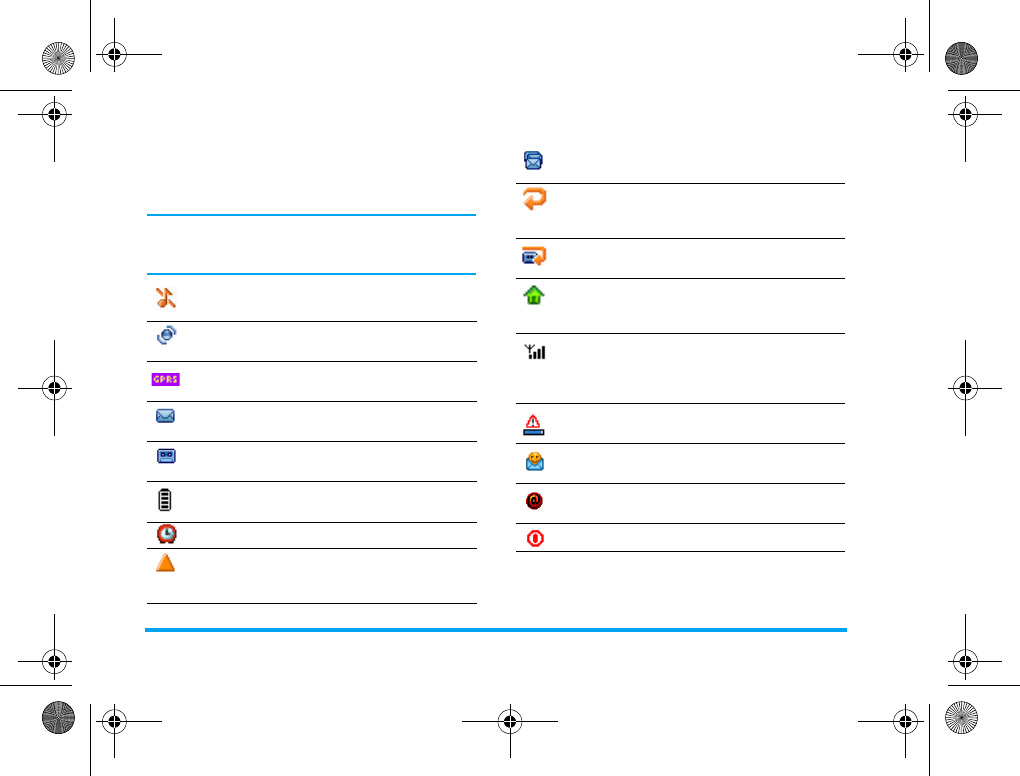
64 Icons & symbols
Icons & symbols
In idle mode, several symbols can be displayed
simultaneously on the main screen.
If the network symbol isn’t displayed, the network is
not currently available. You may be in a bad reception
area, moving to a different location may help.
Silent
- Your phone will not ring when
receiving a call.
Vibra
- Your phone will vibrate when receiving
a call.
GPRS attach
- Your phone is connected to the
GPRS network.
SMS message
- You have received a new
message.
Voice mail
- You have received a new voice
mail.
Battery
- The bars indicate the battery level
(4 bars = full, 1 bar = low).
Alarm clock
activated.
Roaming
- Displayed when your phone is
registered to a network other than your own
(especially when you’re abroad).
SMS full
- Memory for messages is full. Delete
old messages to receive new ones.
Call Forward Unconditional to number
- All
your incoming voice calls are being forwarded
to a number other than voice mail.
Call Forward to voice mailbox
- All your calls
are being forwarded to voice mail.
Home zone
- A zone designated by your
network operator. Subscription dependent,
contact your service provider for details.
GSM Network
: your phone is connected to a
GSM network.
Reception quality
:
the more bars are shown
the better the reception is.
Memory full
- The phone’s memory is full.
Delete items to store new ones.
MMS message
- You have received a new
multimedia message.
Wap message
- You have received a message
in the wap push inbox.
Auto switch on/off
- option is set to
On
.
Philips9@9s_Icons&Symbols.fm Page 64 Thursday, June 1, 2006 9:34 AM
65
Precautions
Radio Waves
Your cellular mobile phone is a low power
radio transmitter and receiver. When it is
operating, it sends and receives radio waves.
The radio waves carry your voice or data
signal to a base station that is connected to the
telephone network. The network controls the power
at which the phone transmits.
• Your phone transmits/receives radio waves in the
GSM frequency (900 / 1800 /1900 MHz).
• The GSM network controls transmission power
(0.01 to 2 watts).
• Your phone complies with all relevant safety
standards.
•The CE mark on your phone shows compliancy
with European electromagnetic compatibility (Ref.
89/336/EEC) and low voltage directives (Ref. 73/
23/EEC).
For body worn operation, this phone has been tested
and meets FCC RF exposure guidelines when used
with an accessory that contains no metal and that
positions the handset a minimum of 1.5cm from the
body. Use of other accessories may not ensure
compliance with FCC RF exposure guidelines. Your
cellular mobile phone is your responsibility. To avoid
damage to yourself, to others or to the phone itself,
read and follow all the safety instructions and make
them known to anyone borrowing your phone.
Furthermore to prevent unauthorised use of your
phone:
Keep your phone in a safe place and keep it
out of small children's reach.
Avoid writing down your PIN code. Try to
remember it instead.
Switch off the phone and remove the battery if you are
going to leave it unused for a long time.
Change your PIN code after purchasing the phone
and to activate call restriction options.
The design of your phone complies with all
applicable laws and regulations. However
your phone may cause interference with
other electronic devices. Consequently you
should follow all local recommendations and
regulations when using your cellular phone both at
home and when away. Regulations on the use of
cellular phones in vehicles and aircraft are
particularly stringent.
Public concern has been focused for some time on the
possible health risks for users of cellular phones. The
current research on radio wave technology, including
Philips9@9s.book Page 65 Wednesday, May 31, 2006 7:34 PM
66
the GSM technology, has been reviewed and safety
standards have been drawn up to ensure protection
from exposure to radio wave energy. Your cellular
telephone complies with all applicable safety
standards and the Radio Equipment and
Telecommunications Terminal Equipment Directive
1999/5/EC.
Always switch off your phone...
Inadequately protected or sensitive electronic
equipment may be affected by radio energy. This
interference can lead to accidents.
Before boarding an aircraft and/or when
packing the phone in your luggage: the use
of mobile phones in an aircraft may be
dangerous for the operation of the aircraft, disrupt the
mobile phones network and may be illegal.
In hospitals, clinics, other health care
centres and anywhere else where you may be
in the close vicinity of medic
al equ
ipment.
In areas with a potentially explosive
atmosphere (e.g. petrol stations and also
areas where the air contains dust particles,
such as metal powders).
In a vehicle transporting flammable products (even if
the vehicle is parked) or a vehicle powered by liquefied
petroleum gas (LPG), check first that the vehicle
complies with the applicable safety rules.
In areas where you are requested to turn off radio
transmitting devices, such as quarries or other areas
where blasting operations are in progress.
Check with the vehicle manufacturer that
electronic equipment used in your vehicle
will not be affected by radio energy.
Pacemakers
If you have a pacemaker:
• Always keep the phone more than 15 cm from your
pacemaker when the phone is switched on, in order
to avoid potential interference.
• Do not carry the phone in a breastpocket.
• Use the ear opposite to the pacemaker to minimise
the potential interference.
• Switch off your phone if you suspect that
interference is taking place.
Hearing aids
If you are a user of a hearing aid, consult your
physician and hearing aid manufacturer to learn
Philips9@9s.book Page 66 Wednesday, May 31, 2006 7:34 PM
67
whether your particular device is susceptible to
cellular phone interference.
Improved performance
In order to improve the performance of your phone,
reduce radio energy emission, reduce battery
consumption and ensure safe operation adhere to the
following guidelines:
For the optimal and satisfactory operation of
the phone you are recommended to use the
phone in the normal operating position
(when not using in hands-free mode or with
a hands-free accessory).
• Do not expose your phone to extreme
temperatures.
• Treat the phone with care. Any misuse will void the
International Guarantee.
• Do not immerse the phone in any liquid; if your
phone is damp, switch it off, remove the battery
and let them dry for 24hrs before using them again.
• To clean the phone, wipe it with a soft cloth.
• Placing and receiving calls consumes the same
amount of battery energy. However, the mobile
consumes less energy in idle screen when kept in
the same place. When in idle screen and while you
are moving, your phone consumes energy to
transmit updated location information to the
network. Setting the backlight for a shorter period
of time as well as avoiding unnecessary navigating
in the menus will also help to save the battery’s
energy for longer phoning and stand-by
performances.
Battery information
• Your phone is powered by a rechargeable battery.
• Use specified charger only.
• Do not incinerate.
• Do not deform or open the battery.
• Do not allow metal objects (such as keys in your
pocket) to short circuit the battery contacts.
•Avoid exposure to excessive heat (>60°C or
140° F), moisture or caustic environments.
You should only use Philips Authentic
Accessories, as the use of any other
accessories may damage your phone and will
make all guarantees for your Philips phone
null and void.
Make sure damaged parts are replaced immediately by
a qualified technician and that they are replaced with
genuine Philips replacement parts.
Philips9@9s.book Page 67 Wednesday, May 31, 2006 7:34 PM
68
Your mobile phone and your car
Studies have shown that speaking on the
telephone while driving lowers your
concentration, which can be dangerous.
Adhere to the following guidelines:
• Give your full attention to driving. Pull off the road
and park before using the phone.
• Respect the local regulations in countries where you
drive and use your GSM phone.
• If you want to use your phone in a vehicle, install
the hands-free car kit which is designed for that
purpose.
• Ensure that your phone and car kit do not block any
air bags or other security devices fitted in your car.
The use of an alarm system to operate a vehicle's light
or horn to indicate incoming phone calls is prohibited
on public roads in some countries. Check local
regulations.
EN 60950 Norm
In hot weather or after prolonged exposure to the sun
(e.g., behind a window or a windscreen), the temperature
of your phone's casing might increase, especially when
featuring a metallic finish. Be very careful in this case
when picking up your phone and also avoid using it with
an ambient temperature over 40° C.
Environmental care
Remember to observe the local regulations
regarding the disposal of the packaging
materials, exhausted batteries and old phone
and please promote their recycling.
Philips has marked the battery and packaging with
standard symbols designed to promote the recycling
and appropriate disposal of your eventual waste.
The battery should not be disposed of
with general household waste.
The labelled packaging material is
recyclable.
A financial contribution has been made
to the associated national packaging
recovery and recycling system.
The plastic material is recyclable (also
identifies the type of plastic).
Philips9@9s.book Page 68 Wednesday, May 31, 2006 7:34 PM
69
Troubleshooting
The phone does not switch on
Remove/reinstall the battery. Then charge the phone
until the battery icon stops scrolling. Unplug from
charger and try to switch the mobile on.
The display shows BLOCKED when you
switch on
Somebody tried to use your phone but didn’t know
the PIN code nor the unblocking code (PUK).
Contact your service provider.
The display shows IMSI failure
This problem is related to your subscription. Contact
your operator.
Your phone doesn’t return to the idle
screen
Long press the hangup key or switch off the phone,
check that the SIM card and the battery are installed
correctly and switch it on again.
The network symbol is not displayed
The network connection is lost. Either you are in a
radio shadow (in a tunnel or between tall buildings) or
you are outside the network coverage area. Try from
another place, try to reconnect to the network
(especially when abroad), check that the antenna is in
place if your mobile has an external antenna, or
contact your network operator for assistance/
information.
The display doesn’t respond (or the
display responds slowly) to key presses
The display responds more slowly at very low
temperatures. This is normal and does not affect the
operation of the phone. Take the phone to a warmer
place and try again. In other cases please contact your
phone supplier.
Your battery seems to over heat
You might be using a charger that was not intended
for your phone. Make sure you always use the Philips
authentic accessory shipped with your phone.
Your phone doesn’t display the phone
numbers of incoming calls
This feature is network and subscription dependent.
If the network doesn’t send the caller’s number, the
phone will display
Call 1
or
Withheld
instead. Contact
your operator for detailed information on this subject.
You can’t send text messages
Some networks don’t allow message exchanges with
other networks. First check that you entered the
number of your SMS centre, or contact your operator
for detailed information on this subject.
Philips9@9s.book Page 69 Wednesday, May 31, 2006 7:34 PM
70
You can’t receive and/or store pictures
A picture may not be accepted by your mobile phone
if it is too large, if its name is too long, or if it doesn’t
have the correct file format.
You have the feeling that you miss some
calls
Check your call divert options.
During battery charge, the battery icon
shows no bar and the outline is flashing
Only charge the battery in an environment where the
temperature does not go below 0°C (32°F) or above
50°C (113°F).
In other cases please contact your phone supplier.
The display shows SIM failure
Check that the SIM card has been inserted in the right
position. If the problem remains, your SIM card may
be damaged. Contact your operator.
When attempting to use a feature in the
menu, the mobile displays NOT
ALLOWED
Some features are network dependent. They are only
available, therefore, if the network or your
subscription supports them. Contact your operator
for detailed information on this subject.
The display shows INSERT YOUR SIM
CARD
Check that the SIM card has been inserted in the right
position. If the problem remains, your SIM card
might be damaged. Contact your operator.
The autonomy of your phone seems lower
that indicated in the user guide
The autonomy is linked to your settings (e.g., ringer
volume, backlight duration) and the features you use.
To increase the autonomy, and whenever possible,
you must deactivate features you do not use.
Your phone doesn’t work well in your car
A car contains many metallic parts that absorb
electromagnetic waves which can affect the phone’s
performances. A car kit is available to provide you
with an external antenna and enables you to make and
receive phone calls without handling the handset.
Check with local authorities if you are allowed to use
the phone whilst driving.
Your phone is not charging
If your battery is completely flat, it might take several
minutes of pre-charge (up to 5 minutes in some cases)
before the charging icon is displayed on the screen.
Philips9@9s.book Page 70 Wednesday, May 31, 2006 7:34 PM
71
By-packed Accessories
Some accessories, such as a battery and a charger, are
included as standard in the package of your mobile
phone. Additional accessories may also be provided or
sold separately. Package contents may therefore vary.
To maximise the performance of your Philips mobile
phone and not to void the warranty, always purchase
Philips Authentic Accessories that are specially
designed for use with your phone. Philips Consumer
Electronics cannot be held liable for any damage due
to use with non authorised accessories.
Charger
Charges your battery in any AC outlet. Small enough
to carry in a briefcase/handbag.
Data connect kit
Provides easy data connection to your Philips mobile
phone. The USB cable enables high speed
communication between your phone and your
computer. The provided software allows you to
download pictures and melodies and to synchronise
your contacts and appointments.
Using the phone as a modem
You can use your mobile phone together with a PC or
a PDA, e.g. to connect to the internet or to send faxes,
via Infrared.
To fully benefit from the services available via infrared
(sending and receiving SMS, e-mails and faxes,
uploading pictures and sound files to your phone,
phonebook synchronisation, GPRS Wizard, etc.), you
must install the Philips Mobile Phone Tools Light
software on your PC. This software is available on
Internet: connect to www.club-philips.com and
register your mobile to access the avilable content,
inlcuding Mobile Phone Tools.
The software is not compatible with Apple Macintosh
computers. It only supports Windows 98 SE, ME, XP
and 2000 (Service Pack 3 and up mandatory in this
case).
Specific software modules for Lotus Notes, Lotus
Organizer and Microsoft Outlook are designed to
allow synchronisation of your Philips mobile phone
with these applications (refer to their respective user
guides for detailed information).
Philips9@9s.book Page 71 Wednesday, May 31, 2006 7:34 PM
72
Trademark Declaration
JAVA is a trademark of Sun
Microsystems, Inc.
T9® is a trademark of Tegic
Communications Inc.
Tegic Euro. Pat.
App. 0842463
Philips9@9s.book Page 72 Wednesday, May 31, 2006 7:34 PM
73
Limited warranty
1. What Does This Limited Warranty Cover?
Philips warrants to the original retail purchaser
(“Consumer” or “You”) that this Philips cellular
product and all accessories originally provided by
Philips in the sales package (“Product”) are free
from defects in materials, design and
workmanship under normal use in accordance
with the operating instructions and pursuant to
the following terms and conditions. This limited
warranty extends only to the Consumer for
Products purchased and used in the original
country of purchase. The limited warranty is
valid only in Philips’ intended country of sales of
the product.
2. How Long is The Limited Warranty Period?
The limited warranty period for the Product
extends for ONE (1) YEAR from the date of
purchase of the Product, documented by valid
proof of purchase. The limited warranty for
original Philips rechargeable battery extends for
six (6) months from the date of purchase.
3. What Will Philips Do if The Product is Not Free
From Material Defects in Materials and
Workmanship During The Limited Warranty
Period?
During the limited warranty period, Philips or its
authorized service representative will, at its
option either repair or replace, without charge for
parts or labour, a materially defective Product
with new or refurbished parts or Product and
return such repaired or replaced Product to the
Consumer in working condition. Philips will
retain defective parts, modules or equipment.
Repaired or replaced Product will be covered by
this limited warranty for the balance of the
original limited warranty period or ninety (90)
days from the date of repair or replacement
whichever is longer. Repair or replacement of
Product, at Philips’ option is your exclusive
remedy.
4. What is Not Covered By This Limited Warranty?
This limited warranty does not cover::
a) Product that has been subjected to misuse,
accident, shipping or other physical damage,
improper installation, abnormal operation
handling, neglect, inundation, fire, water or
other liquid intrusion; or
Philips9@9s.book Page 73 Wednesday, May 31, 2006 7:34 PM
74
b) Product that has been damaged due to
repair, alteration, or modification by anyone
not authorized by Philips; or
c) Product that has reception or operation
problems caused by signal conditions,
network reliability or cable or antenna
systems; or
d) Product defects or problems caused by uses
with non-Philips products or accessories; or
e) Product which warranty/quality stickers,
product serial number or electronic serial
number has been removed, altered or
rendered illegible; or
f) Product purchased, used, serviced, or
shipped for repair from outside the original
country of purchase, or used for commercial
or institutional purposes (including but not
limited to Products used for rental
purposes); or
g) Product returned without valid proof of
purchase or which proof of purchase has
been altered or is illegible.
h) Normal wear and tear or Force Majeure.
5. How Do You Get Warranty Service?
a) Return the Product to an authorized service
center of Philips. You may contact the local
Philips office for the location of the nearest
authorized service center.
b) The SIM card must be removed from the
Product before it is given to Philips. Philips
assumes no liability for damaged or loss of
the SIM card or the data contained therein.
c) If the Product failure is not covered by this
limited warranty, or this limited warranty is
inapplicable, void or invalid due to any
terms and conditions stated herein, the
Consumer will be charged for the cost of
repair or replacement of the Product and all
other related cost incurred in repairing or
replacing the Product.
d) IMPORTANT - you are required to return
the Product together with a valid proof of
purchase which must identify the point of
purchase, date of purchase, Product model
and Product serial number clearly.
6. Other Limitation: This Warranty is The Entire
Agreement.
EXCEPT FOR THE EXPRESS
WARRANTIES SET FORTH ABOVE AND
THOSE IMPLIED BY LAW AND WHICH
CANNOT BE EXCLUDED OR MODIFIED
BY AGREEMENT, PHILIPS PROVIDES NO
OTHER WARRANTY WHETHER EXPRESS
OR IMPLIED (WHETHER BY STATUTE,
UNDER THE OPERATION OF LAW OR
OTHERWISE) AND SPECIALLY DISCLAIMS
Philips9@9s.book Page 74 Wednesday, May 31, 2006 7:34 PM
75
ANY WARRANTY OF SATISFACTORY
QUALITY MERCHANTABILITY OR
FITNESS FOR A PARTICULAR PURPOSE.
PHILIPS’ TOTAL LIABILITY FOR
DAMAGES RELATING TO OR ARISING
OUT OF THE PURCHASE OR USE OF THE
PRODUCT, REGARDLESS OF THE TYPE
OR CAUSE OF SUCH DAMAGE OR THE
FORM OR CHARACTERISATION OF THE
CLAIM ASSERTED (E.G. CONTRACT OR
TOPIT), SHALL NOT EXCEED THE
ORIGINAL PURCHASE PRICE PAID FOR
THE PRODUCT.
HOWEVER IN NO EVENT SHALL PHILIPS
BE LIABLE FOR ANY PUNITIVE, SPECIAL,
INCIDENTAL, INDIRECT OR
CONSEQUENTIAL DAMAGES (INCLUDING
BUT NOT LIMITED TO THE LOSS OF
USE, LOSS OF TIME, INCONVENIENCE,
COMMERIAL LOSS, LOST PROFITS, LOST
BUSINESS OPPORTUNITIES, COST OF
SUBSTITUTION OF GOODS OR
SERVICES, INVESTMENTS, DAMAGE TO
GOODWILL OR REPUTATION, OR LOSS
OF DATA AND CLAIMS BY THIRD
PARTIES) RESULTING FROM PURCHASE
OR USE OF THE PRODUCT, TO THE
FULLEST EXTENT ALLOWED BY LAW,
WHETHER OR NOT PHILIPS HAS BEEN
ADVISED OF THE POSSIBILTY OF SUCH
DAMAGES. THESE LIMITATIONS SHALL
APPLY NOTWITHSTANDING THE
FAILURE OF THE ESSENTIAL PURPOSE
OF ANY LIMITED REMEDY.
This limited warranty represents the complete
and exclusive agreement between the Consumer
and Philips with respect to this cellular Product
and it supercedes all prior agreements between
the parties, oral or written, and all other
communications between the parties relating to
the subject matter of this limited warranty. No
carrier, retailer, agent, dealer, employee, thereof,
or employee of Philips is authorized to make
modifications to this limited warranty and you
should not rely on any such representation.
This limited warranty does not affect the
Consumer’s statutory rights under applicable
national laws in force.
Philips9@9s.book Page 75 Wednesday, May 31, 2006 7:34 PM