Beijing InHand Networks Technology IR6X5 Industrial Cellular Router User Manual

Beijing InHand Networks Technology Co., Ltd. Industrial Cellular Router Users Manual

Users Manual

              User  Manual        InHand Networks   www.inhandnetworks.com  Version: v1.1 October 2016  Industrial Cellular RouterIR615
1  Disclaimers   The content in this manual is subject to change without notice. This manual is only used as the guidance. InHand makes every effort to provide accurate information in this manual, but InHand does  not  guarantee  that  there  is  no  error  in  the  manual.  All  statements,  information  and recommendations in this manual do not constitute any expressed or implied warranty.  Trademarks and Copyright   INHAND,  InHand  and  the  InHand  logo  are  trademarks  of  InHand  Networks.  The  trademarks  of other companies, product logos and trade names in the manual are possessed by their respective owners. ©  2016 InHand Networks. All rights reserved.  Technical Support For technical support, please contact:   Tel:    +1 (703) 348-2988 (USA) E-mail:    support@inhandneworks.com
2  Preface This user manual will guide you on installing and configuring InHand IR6XX-S industrial router.   Audience   This manual is for:    Network Planner    Field technical support    Network administrators   Conventions This manual uses the following conventions:   Conventions Indication <> Content in angle brackets “<>” indicates a button name. For example, the <OK> button. “” “” indicates a window name or menu name. For example, the pop-up window “New User.” >> A multi-level menu is separated by the double brackets “>>.” For example, the multi-level menu File >> New >>Folder indicates the menu item [Folder] under the sub-menu [New], which is under the menu [File].   Means reader be careful. Improper action may result in loss of data or device damage.  Notes contain detailed descriptions and helpful suggestions.
3  Contents PREFACE .................................................................................................................................................... 2 AUDIENCE ................................................................................................................................................ 2 CONVENTIONS .......................................................................................................................................... 2 CONTENTS ................................................................................................................................................ 1 I. INROUTER6XX-S INTRODUCTION .............................................................................................................. 1 1.1 Overview .................................................................................................................................... 1 1.2 Packing List ................................................................................................................................. 1 1.2.1 Applicable to IR611-S series ................................................................................................................ 1 1.2.2 Applicable to IR615-S series ................................................................................................................ 2 1.3 Panel Introduction ...................................................................................................................... 2 1.3.1 Applicable to IR611-S Series ................................................................................................................ 2 1.3.2 Applicable to IR6X5-S Series ................................................................................................................ 3 1. 4 Introductions to Status LED ....................................................................................................... 3 1.4.1 Applicable to IR611-S series ................................................................................................................ 3 1.4.2 Applicable to IR615-S series ................................................................................................................ 4 II.  INSTALLATION ..................................................................................................................................... 4 2.1 Installation of Device .................................................................................................................. 5 2.2 Installation of SIM/UIM Card...................................................................................................... 6 2.3 Installation of Antenna ............................................................................................................... 6 2.4 Installation of Protective Grounding .......................................................................................... 6 2.5 Installation of Power Supply ....................................................................................................... 6 2.6 Login Router ............................................................................................................................... 7 III. WEB CONFIGURATION ........................................................................................................................... 8 3. 1 System ....................................................................................................................................... 8 3.1.1 Basic Setup .......................................................................................................................................... 8 3.1.2 System Time ........................................................................................................................................ 8 3.1.3 Serial Port ............................................................................................................................................ 9
4  3.1.4 Admin Access .................................................................................................................................... 10 3.1.5 System Log ........................................................................................................................................ 11 3.1.6 Configuration Management .............................................................................................................. 12 3.1.7 Task Schedule .................................................................................................................................... 13 3.1.8 System Upgrading ............................................................................................................................. 13 3.1.9 Reboot ............................................................................................................................................... 13 3.1.10 Logout ............................................................................................................................................. 14 3. 2 Network ................................................................................................................................... 15 3.2.1 Dialup/Cellular Connection ............................................................................................................... 15 3.2.2 WAN (Only Applicable to IR615-S Series) .......................................................................................... 16 3.2.3 Link Backup ....................................................................................................................................... 19 3.2.4 LAN .................................................................................................................................................... 19 3.2.5 Switch of WLAN Mode ...................................................................................................................... 20 3.2.6 WLAN Client (AP Mode) .................................................................................................................... 20 3.2.7 WLAN Client (STA Mode) ................................................................................................................... 21 3.2.8 DNS.................................................................................................................................................... 22 3.2.9 Dynamic Domain Name..................................................................................................................... 22 3.2.10 Static Route ..................................................................................................................................... 23 3.3 Service ...................................................................................................................................... 24 3.3.1 DHCP service ..................................................................................................................................... 24 3.3.2 DNS Relay .......................................................................................................................................... 25 3.3.3 VRRP: Virtual Router Redundancy Protocol ...................................................................................... 26 3.3.4 Device Manager ................................................................................................................................ 27 3.3.5 DTU ................................................................................................................................................... 28 3.3.6 SMS ................................................................................................................................................... 29 3.4 Firewall ..................................................................................................................................... 29 3.4.1 Basic Setup ........................................................................................................................................ 30 3.4.2 Access Control (ACL) .......................................................................................................................... 30 3.4.3 Filtering ............................................................................................................................................. 31 3.4.4 Port Mapping .................................................................................................................................... 31
5  3.4.5 Virtual IP Mapping............................................................................................................................. 32 3.4.6 DMZ ................................................................................................................................................... 32 3.4.7 MAC-IP Binding ................................................................................................................................. 33 3.5 QoS ........................................................................................................................................... 33 3.5.1 Bandwidth Control ............................................................................................................................ 33 3.5.2 IP Bandwidth Limit ............................................................................................................................ 34 3.6 VPN ........................................................................................................................................... 34 3.6.1 IPSec Settings .................................................................................................................................... 35 3.6.2 IPSec Tunnels ..................................................................................................................................... 36 3.6.3 GRE Tunnels ....................................................................................................................................... 38 3.6.4 L2TP Client ......................................................................................................................................... 40 3.6.5 PPTP Client ........................................................................................................................................ 42 3.6.6 OpenVPN ........................................................................................................................................... 42 3.6.7 OpenVPN Advanced .......................................................................................................................... 44 3.6.8 Certificate Management ................................................................................................................... 44 3.7 Tools ......................................................................................................................................... 45 3.7.1PING Detection ................................................................................................................................... 45 3.7.2Traceroute .......................................................................................................................................... 45 3.7.3 Link Speed Test .................................................................................................................................. 46 3.8 Status ........................................................................................................................................ 46 3.8.1 System ............................................................................................................................................... 46 3.8.2 Modem .............................................................................................................................................. 46 3.8.3 Network Connections ........................................................................................................................ 47 3.8.4 Route Table........................................................................................................................................ 47 3.8.5 Device List ......................................................................................................................................... 47 3.8.6 Log ..................................................................................................................................................... 47 APPENDIX A FAQ ..................................................................................................................................... 48 APPENDIX B INSTRUCTION OF COMMAND LINE .................................................................................... 50
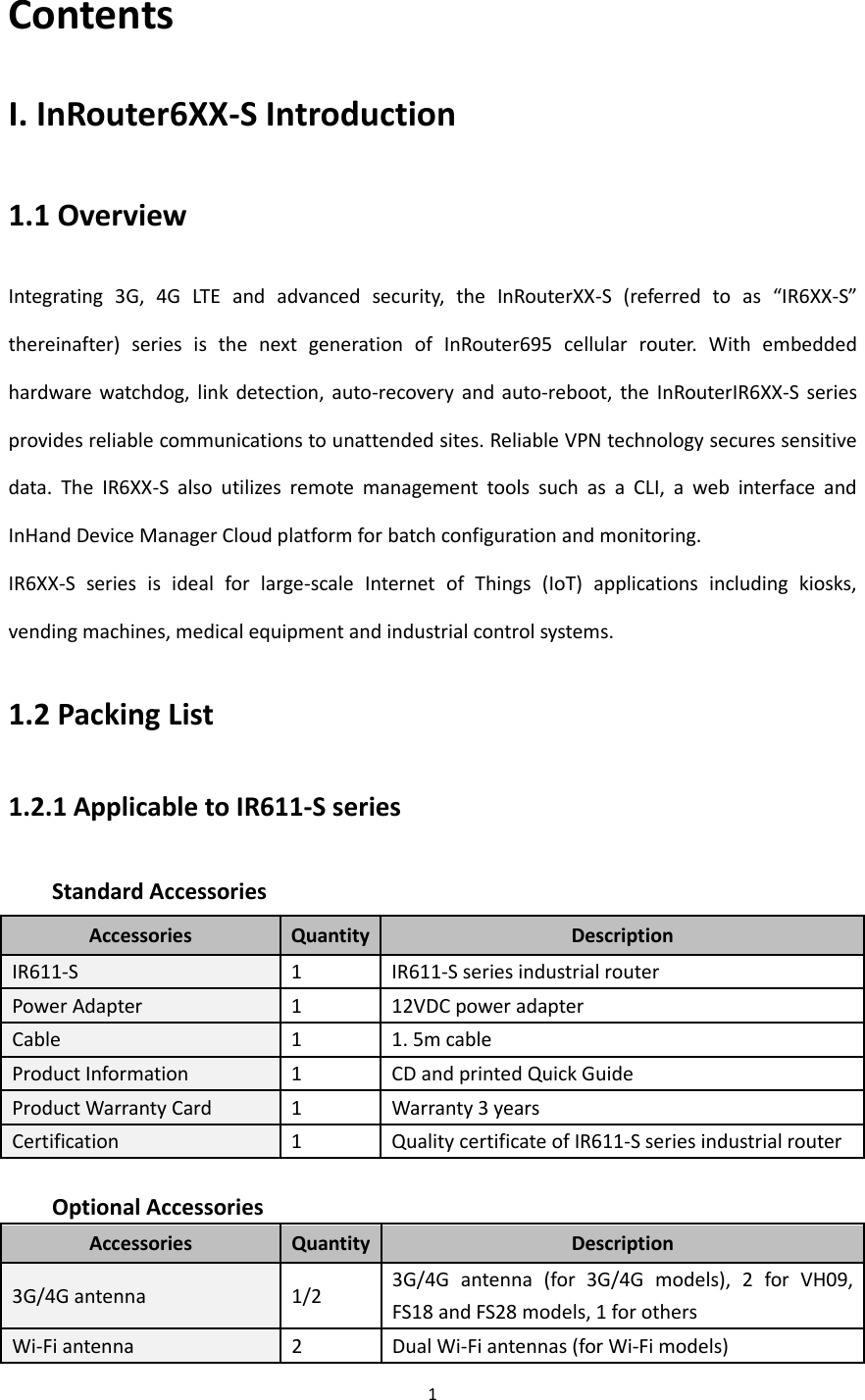
1  Contents I. InRouter6XX-S Introduction 1.1 Overview Integrating  3G,  4G  LTE  and  advanced  security,  the  InRouterXX-S  (referred  to  as  “IR6XX-S” thereinafter)  series  is  the  next  generation  of  InRouter695  cellular  router.  With  embedded hardware watchdog,  link  detection,  auto-recovery  and  auto-reboot, the  InRouterIR6XX-S  series provides reliable communications to unattended sites. Reliable VPN technology secures sensitive data.  The  IR6XX-S  also  utilizes  remote  management  tools  such  as  a  CLI,  a  web  interface  and InHand Device Manager Cloud platform for batch configuration and monitoring. IR6XX-S  series  is  ideal  for  large-scale  Internet  of  Things  (IoT)  applications  including  kiosks, vending machines, medical equipment and industrial control systems. 1.2 Packing List 1.2.1 Applicable to IR611-S series   Standard Accessories Accessories Quantity Description IR611-S 1 IR611-S series industrial router   Power Adapter 1 12VDC power adapter Cable 1 1. 5m cable Product Information 1 CD and printed Quick Guide   Product Warranty Card 1 Warranty 3 years Certification 1 Quality certificate of IR611-S series industrial router  Optional Accessories Accessories Quantity Description 3G/4G antenna 1/2 3G/4G  antenna  (for  3G/4G  models),  2  for  VH09, FS18 and FS28 models, 1 for others Wi-Fi antenna 2 Dual Wi-Fi antennas (for Wi-Fi models)
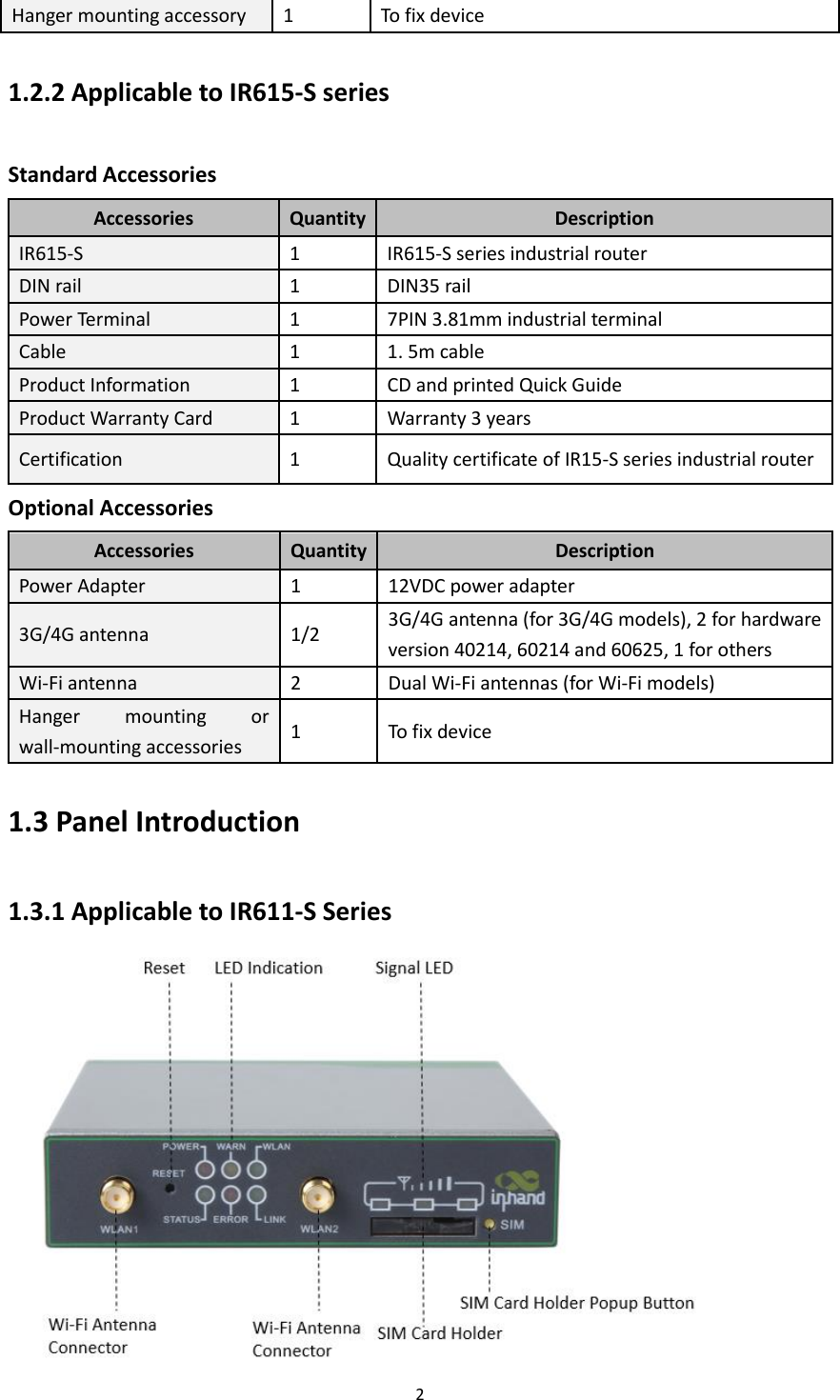
2  Hanger mounting accessory 1 To fix device 1.2.2 Applicable to IR615-S series Standard Accessories Accessories Quantity Description IR615-S 1 IR615-S series industrial router DIN rail   1 DIN35 rail Power Terminal 1 7PIN 3.81mm industrial terminal   Cable 1 1. 5m cable Product Information 1 CD and printed Quick Guide Product Warranty Card 1 Warranty 3 years Certification 1 Quality certificate of IR15-S series industrial router Optional Accessories Accessories Quantity Description Power Adapter 1 12VDC power adapter 3G/4G antenna 1/2 3G/4G antenna (for 3G/4G models), 2 for hardware version 40214, 60214 and 60625, 1 for others Wi-Fi antenna 2 Dual Wi-Fi antennas (for Wi-Fi models) Hanger  mounting  or wall-mounting accessories 1 To fix device 1.3 Panel Introduction 1.3.1 Applicable to IR611-S Series
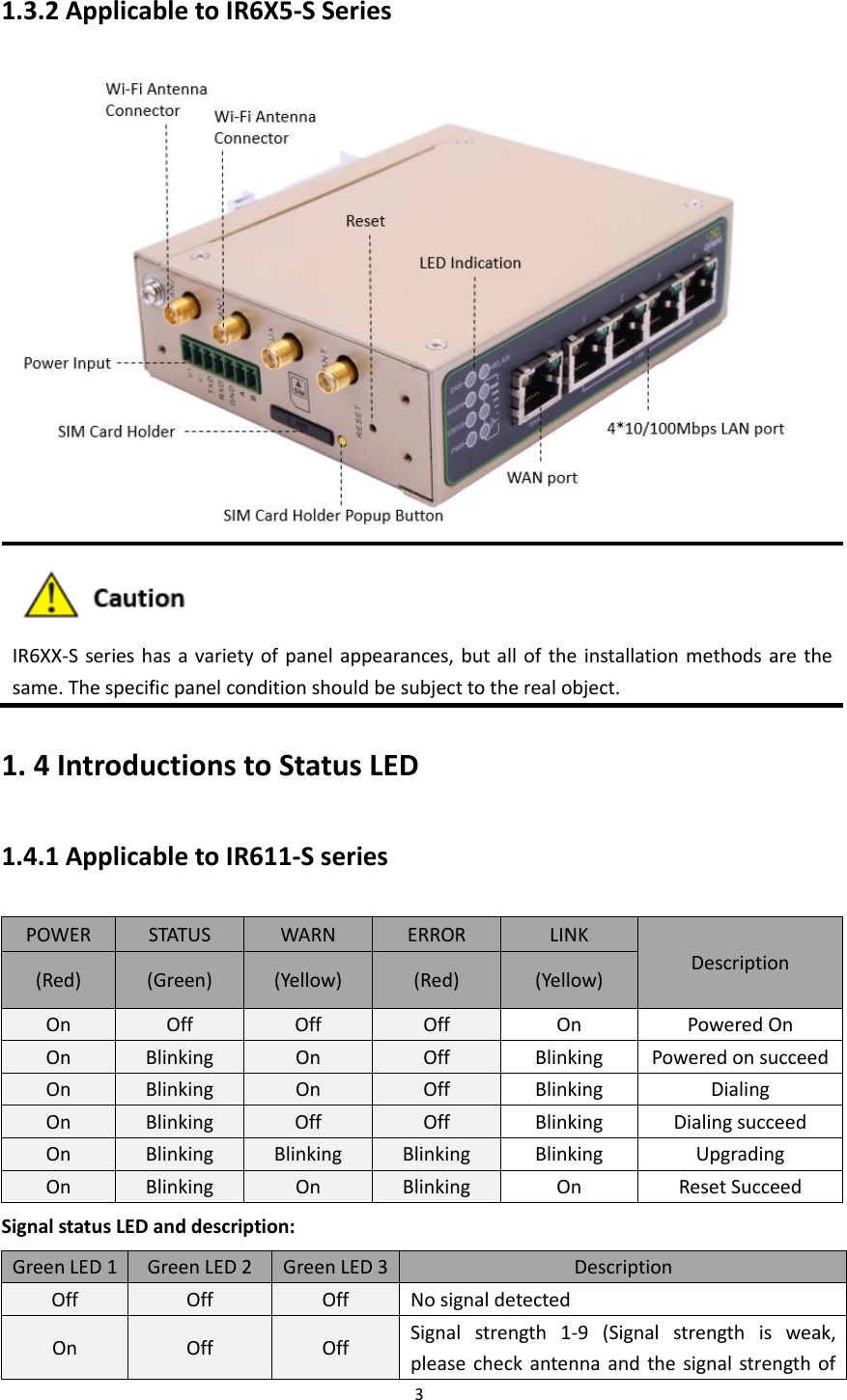
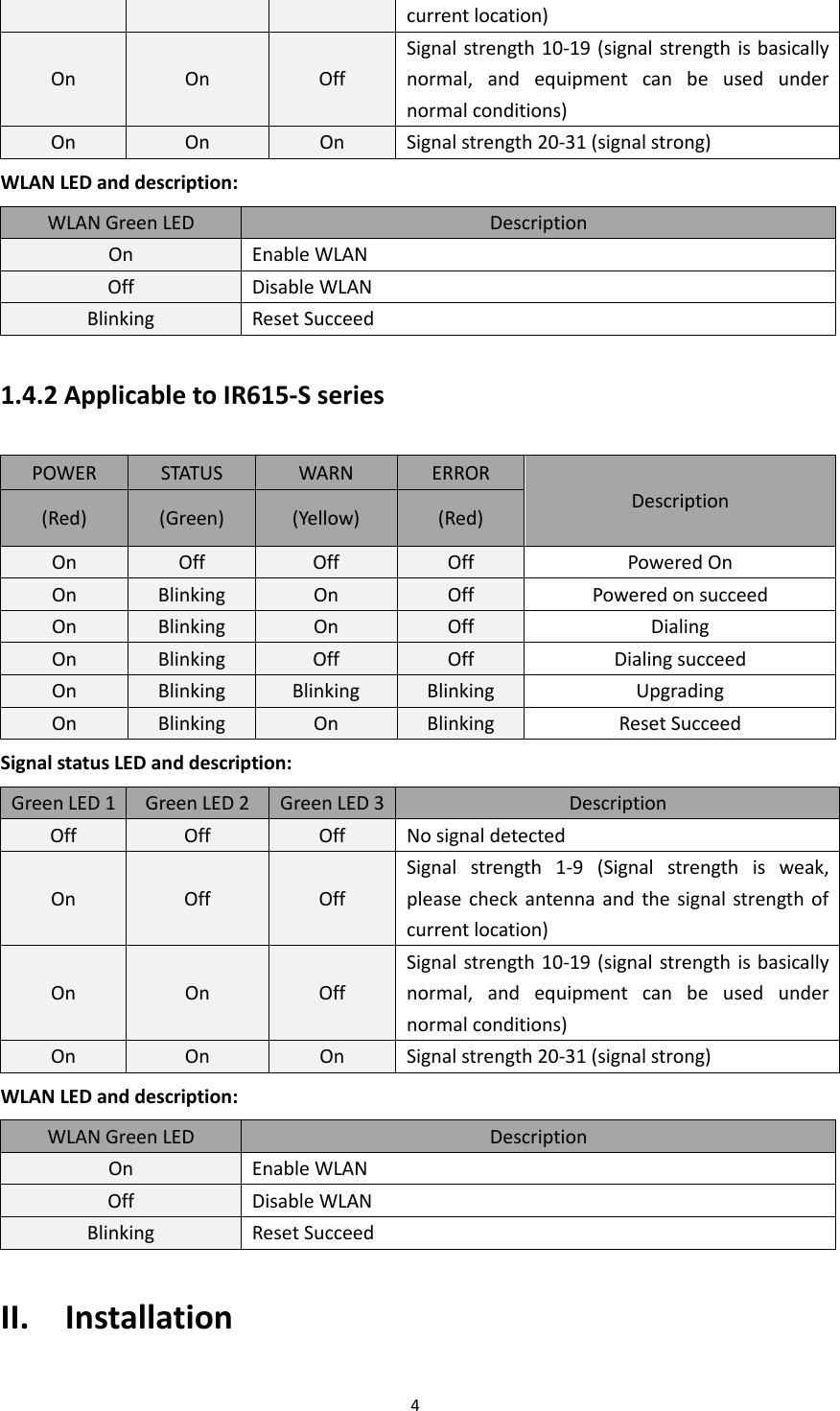
3  1.3.2 Applicable to IR6X5-S Series                            IR6XX-S series has a variety of panel appearances, but all of  the installation methods are the same. The specific panel condition should be subject to the real object. 1. 4 Introductions to Status LED 1.4.1 Applicable to IR611-S series POWER STATUS WARN ERROR LINK Description (Red) (Green) (Yellow) (Red) (Yellow) On Off Off Off On Powered On On Blinking On Off Blinking Powered on succeed On Blinking On Off Blinking Dialing On Blinking Off Off Blinking Dialing succeed On Blinking Blinking Blinking Blinking Upgrading On Blinking On Blinking On Reset Succeed Signal status LED and description: Green LED 1 Green LED 2 Green LED 3 Description Off Off Off No signal detected On Off Off Signal  strength  1-9  (Signal  strength  is  weak, please check antenna and  the signal  strength of
4  current location) On On Off Signal strength 10-19 (signal strength is basically normal,  and  equipment  can  be  used  under normal conditions) On On On Signal strength 20-31 (signal strong) WLAN LED and description: WLAN Green LED Description On Enable WLAN Off Disable WLAN Blinking Reset Succeed 1.4.2 Applicable to IR615-S series POWER STATUS WARN ERROR Description (Red) (Green) (Yellow) (Red) On Off Off Off Powered On On Blinking On Off Powered on succeed On Blinking On Off Dialing On Blinking Off Off Dialing succeed On Blinking Blinking Blinking Upgrading On Blinking On Blinking Reset Succeed Signal status LED and description: Green LED 1 Green LED 2 Green LED 3 Description Off Off Off No signal detected On Off Off Signal  strength  1-9  (Signal  strength  is  weak, please check antenna and  the signal  strength of current location) On On Off Signal strength 10-19 (signal strength is basically normal,  and  equipment  can  be  used  under normal conditions) On On On Signal strength 20-31 (signal strong) WLAN LED and description: WLAN Green LED Description On Enable WLAN Off Disable WLAN Blinking Reset Succeed II.    Installation
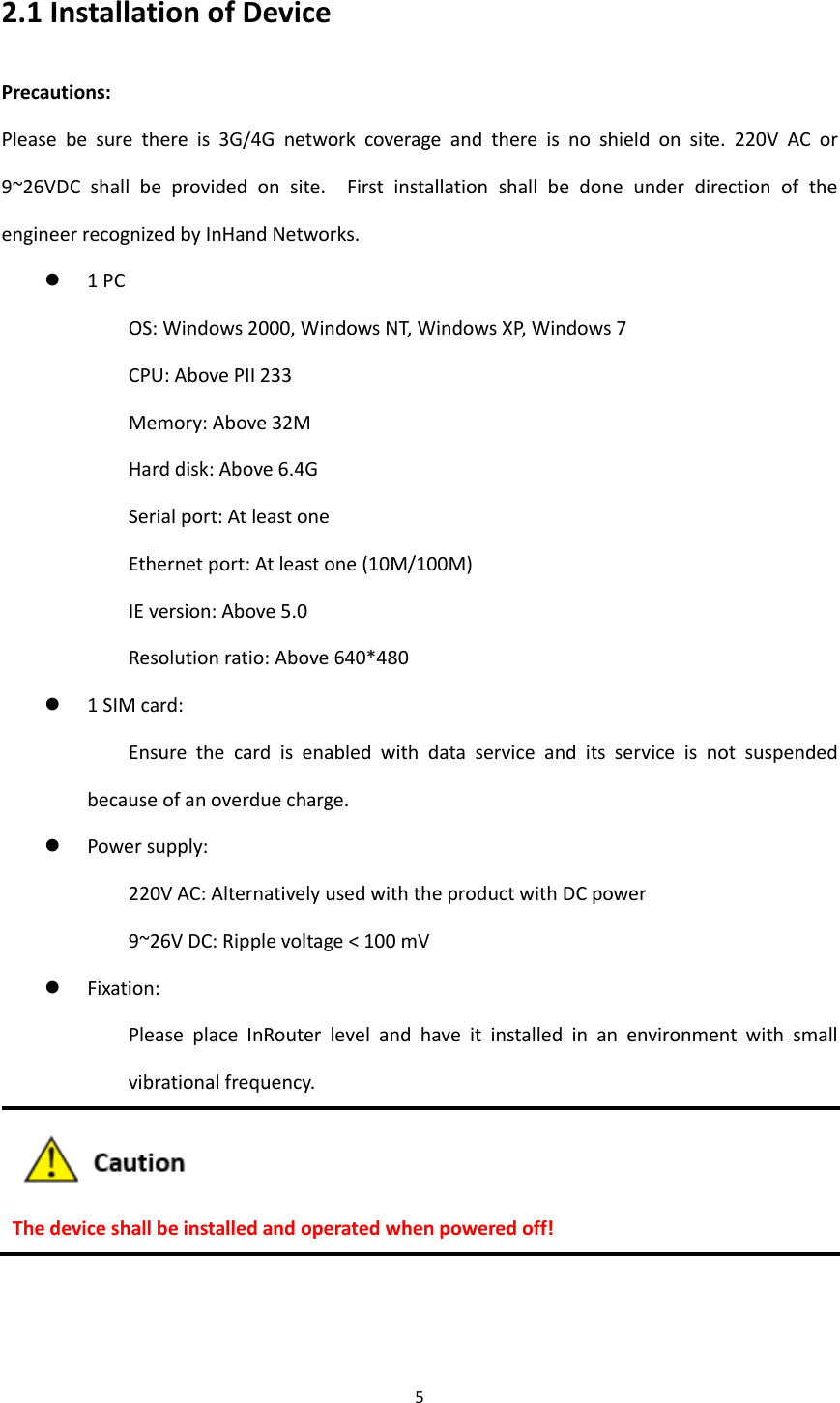
5  2.1 Installation of Device Precautions: Please  be  sure  there  is  3G/4G  network  coverage  and  there  is  no  shield  on  site.  220V  AC  or 9~26VDC  shall  be  provided  on  site.    First  installation  shall  be  done  under  direction  of  the engineer recognized by InHand Networks.    1 PC OS: Windows 2000, Windows NT, Windows XP, Windows 7 CPU: Above PII 233   Memory: Above 32M Hard disk: Above 6.4G Serial port: At least one   Ethernet port: At least one (10M/100M) IE version: Above 5.0 Resolution ratio: Above 640*480  1 SIM card:   Ensure  the  card  is  enabled  with  data  service  and  its  service  is  not  suspended because of an overdue charge.    Power supply:   220V AC: Alternatively used with the product with DC power   9~26V DC: Ripple voltage < 100 mV  Fixation:   Please  place  InRouter  level  and  have  it  installed  in  an  environment  with  small vibrational frequency.  The device shall be installed and operated when powered off!
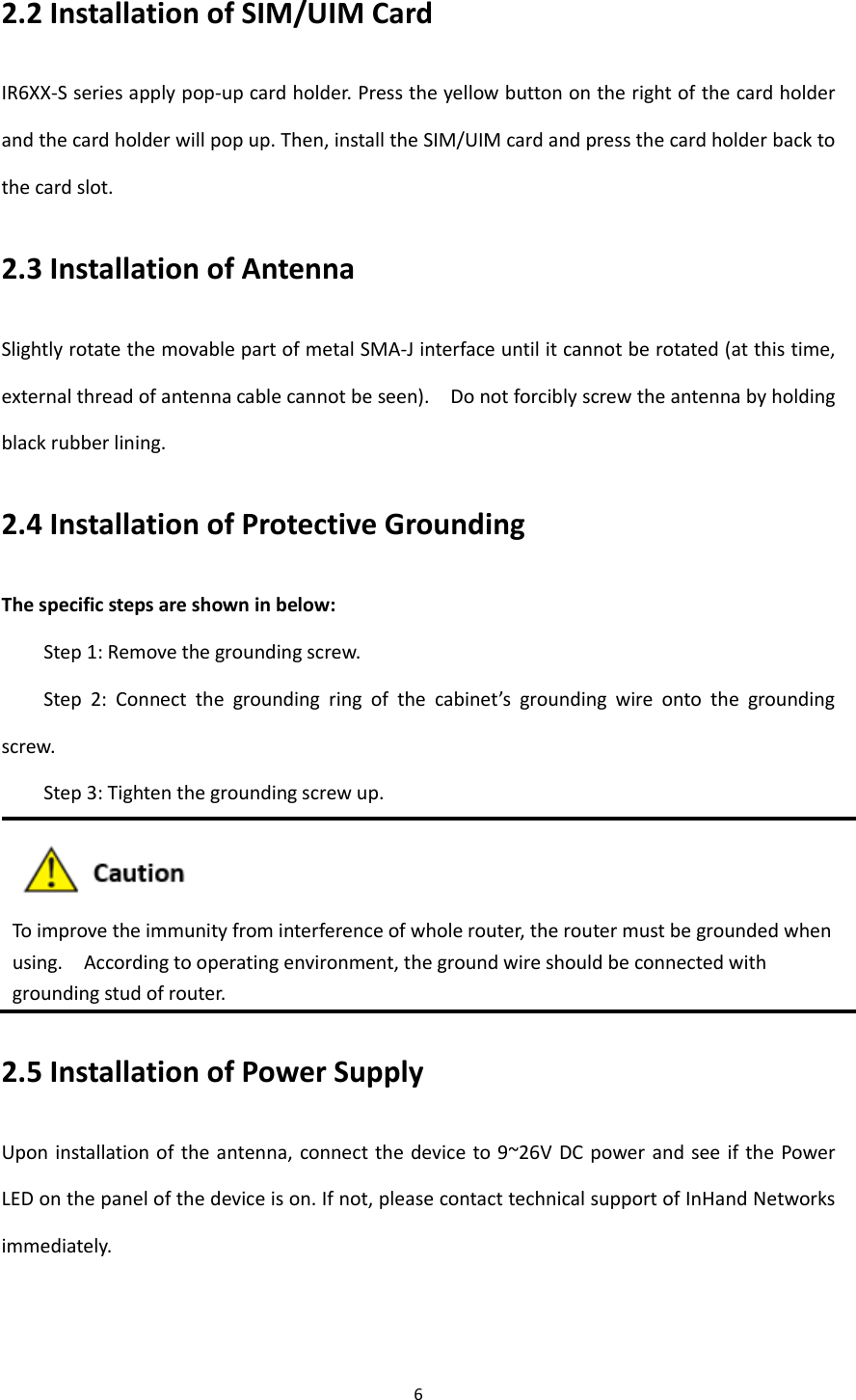
6  2.2 Installation of SIM/UIM Card IR6XX-S series apply pop-up card holder. Press the yellow button on the right of the card holder and the card holder will pop up. Then, install the SIM/UIM card and press the card holder back to the card slot. 2.3 Installation of Antenna   Slightly rotate the movable part of metal SMA-J interface until it cannot be rotated (at this time, external thread of antenna cable cannot be seen).    Do not forcibly screw the antenna by holding black rubber lining. 2.4 Installation of Protective Grounding The specific steps are shown in below: Step 1: Remove the grounding screw. Step  2:  Connect  the  grounding  ring  of  the  cabinet’s  grounding  wire  onto  the  grounding screw. Step 3: Tighten the grounding screw up.  To improve the immunity from interference of whole router, the router must be grounded when using.    According to operating environment, the ground wire should be connected with grounding stud of router. 2.5 Installation of Power Supply Upon installation of  the antenna, connect the device to 9~26V DC  power and see if the  Power LED on the panel of the device is on. If not, please contact technical support of InHand Networks immediately.
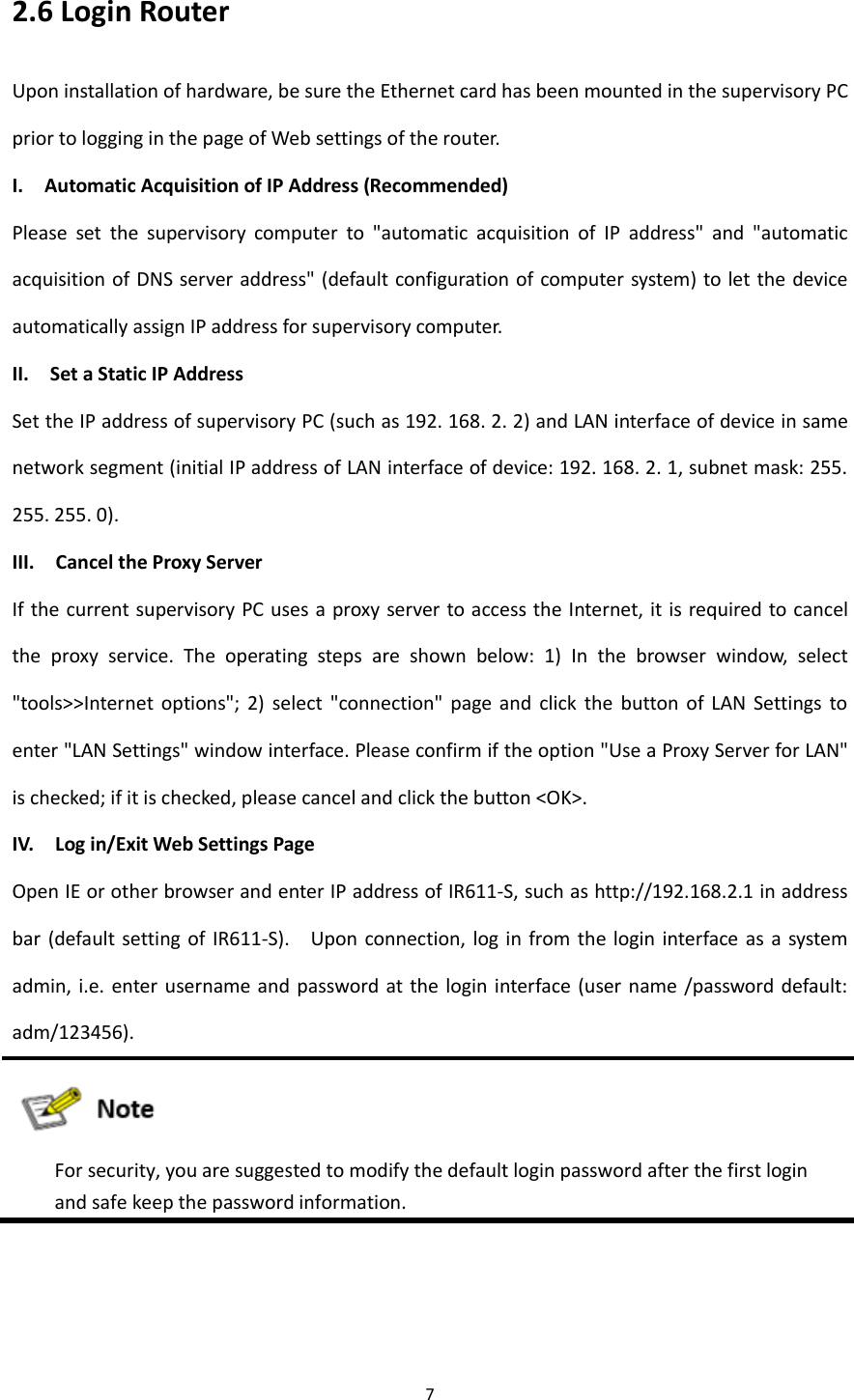
7  2.6 Login Router Upon installation of hardware, be sure the Ethernet card has been mounted in the supervisory PC prior to logging in the page of Web settings of the router.   I.    Automatic Acquisition of IP Address (Recommended) Please  set  the  supervisory  computer  to  "automatic  acquisition  of  IP  address"  and  "automatic acquisition of DNS server address" (default configuration of computer system) to let the device automatically assign IP address for supervisory computer. II.    Set a Static IP Address Set the IP address of supervisory PC (such as 192. 168. 2. 2) and LAN interface of device in same network segment (initial IP address of LAN interface of device: 192. 168. 2. 1, subnet mask: 255. 255. 255. 0). III.    Cancel the Proxy Server If the current supervisory PC uses a proxy server to access the Internet, it is required to cancel the  proxy  service.  The  operating  steps  are  shown  below:  1)  In  the  browser  window,  select "tools>>Internet  options";  2)  select  "connection"  page  and  click  the  button  of  LAN  Settings  to enter "LAN Settings" window interface. Please confirm if the option "Use a Proxy Server for LAN" is checked; if it is checked, please cancel and click the button <OK>. IV.    Log in/Exit Web Settings Page Open IE or other browser and enter IP address of IR611-S, such as http://192.168.2.1 in address bar  (default  setting  of IR611-S).    Upon  connection, log  in from the  login interface as  a  system admin, i.e. enter username and password at the login interface (user name  /password default: adm/123456).    For security, you are suggested to modify the default login password after the first login and safe keep the password information.
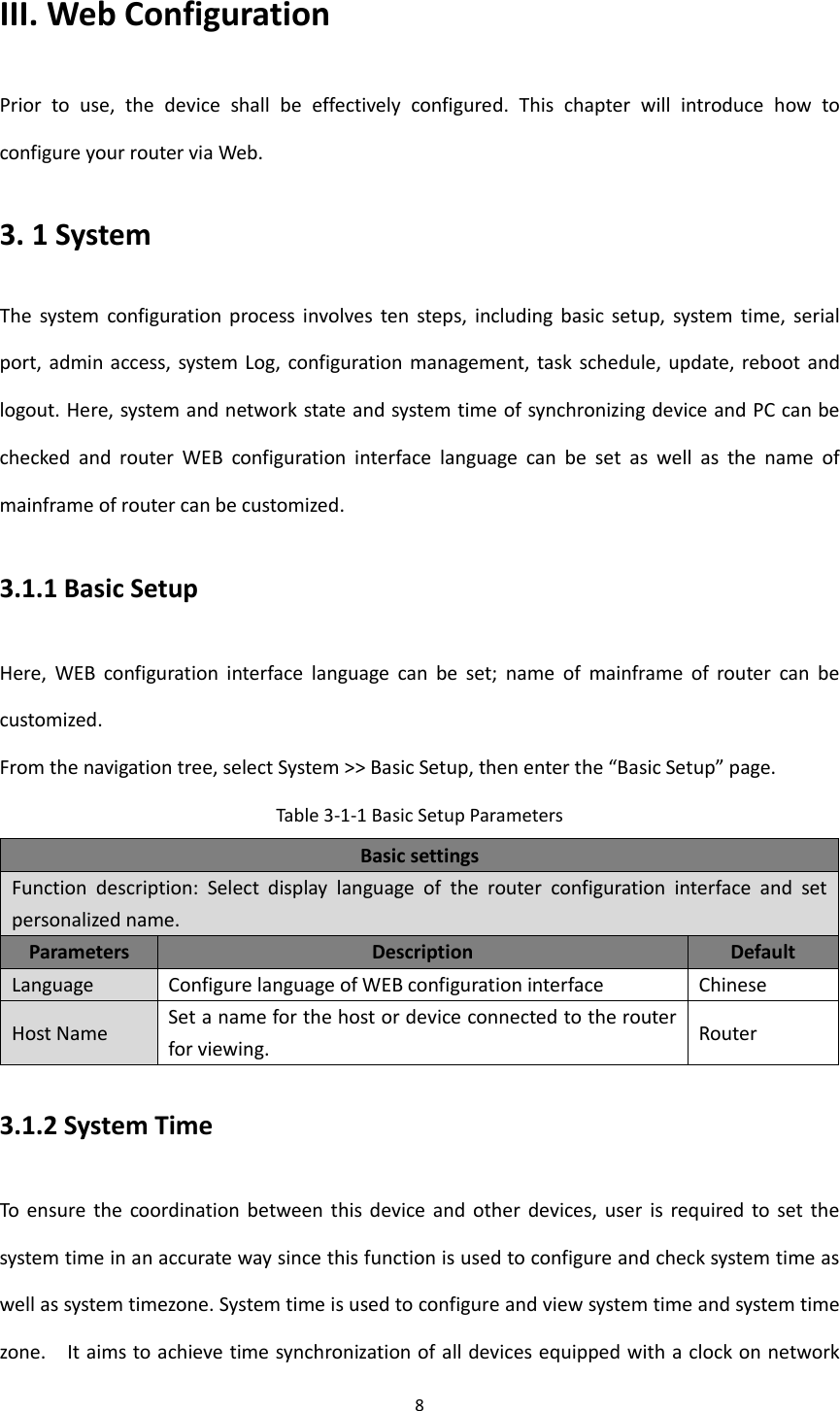
8  III. Web Configuration Prior  to  use,  the  device  shall  be  effectively  configured.  This  chapter  will  introduce  how  to configure your router via Web.   3. 1 System The  system  configuration  process  involves  ten  steps,  including  basic  setup,  system  time,  serial port, admin  access, system Log,  configuration management, task schedule, update, reboot and logout. Here, system and network state and system time of synchronizing device and PC can be checked  and  router  WEB  configuration  interface  language  can  be  set  as  well  as  the  name  of mainframe of router can be customized. 3.1.1 Basic Setup Here,  WEB  configuration  interface  language  can  be  set;  name  of  mainframe  of  router  can  be customized.   From the navigation tree, select System >> Basic Setup, then enter the “Basic Setup” page. Table 3-1-1 Basic Setup Parameters   Basic settings Function  description:  Select  display  language  of  the  router  configuration  interface  and  set personalized name.   Parameters Description Default Language Configure language of WEB configuration interface Chinese Host Name Set a name for the host or device connected to the router for viewing.   Router 3.1.2 System Time To  ensure  the  coordination  between this device  and  other  devices,  user  is  required to  set  the system time in an accurate way since this function is used to configure and check system time as well as system timezone. System time is used to configure and view system time and system time zone.    It aims to achieve time synchronization of all devices equipped with a clock on network
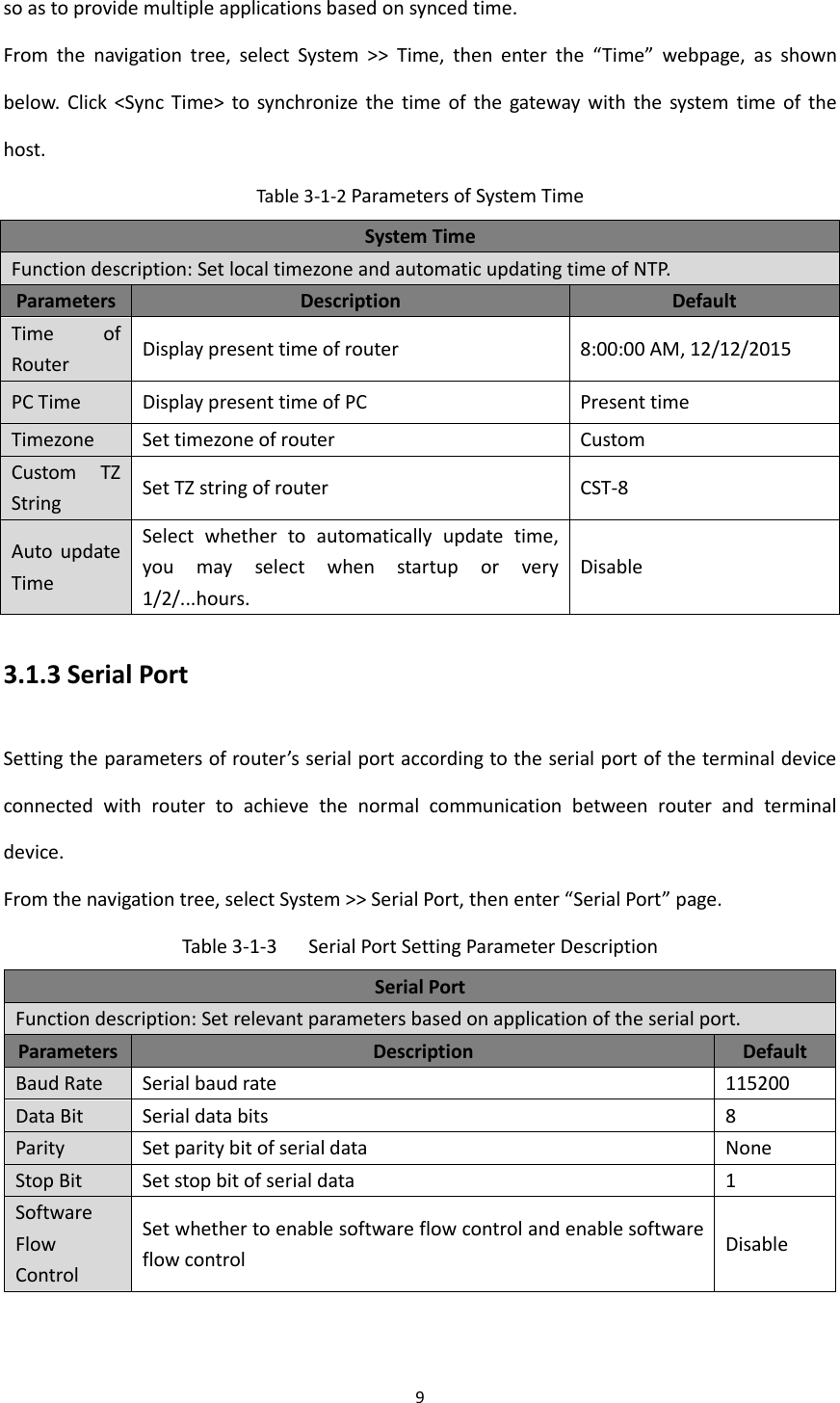
9  so as to provide multiple applications based on synced time. From  the  navigation  tree,  select  System  >>  Time,  then  enter  the  “Time”  webpage,  as  shown below.  Click  <Sync  Time>  to  synchronize  the time of  the  gateway  with  the  system  time  of  the host. Table 3-1-2 Parameters of System Time System Time Function description: Set local timezone and automatic updating time of NTP.   Parameters Description Default Time  of Router Display present time of router 8:00:00 AM, 12/12/2015 PC Time Display present time of PC Present time   Timezone Set timezone of router Custom Custom  TZ String Set TZ string of router CST-8 Auto  update Time Select  whether  to  automatically  update  time, you  may  select  when  startup  or  very   1/2/...hours.   Disable   3.1.3 Serial Port Setting the parameters of router’s serial port according to the serial port of the terminal device connected  with  router  to  achieve  the  normal  communication  between  router  and  terminal device. From the navigation tree, select System >> Serial Port, then enter “Serial Port” page.   Table 3-1-3  Serial Port Setting Parameter Description Serial Port Function description: Set relevant parameters based on application of the serial port.   Parameters Description Default Baud Rate Serial baud rate 115200 Data Bit Serial data bits 8 Parity Set parity bit of serial data None Stop Bit Set stop bit of serial data 1 Software Flow Control Set whether to enable software flow control and enable software flow control   Disable
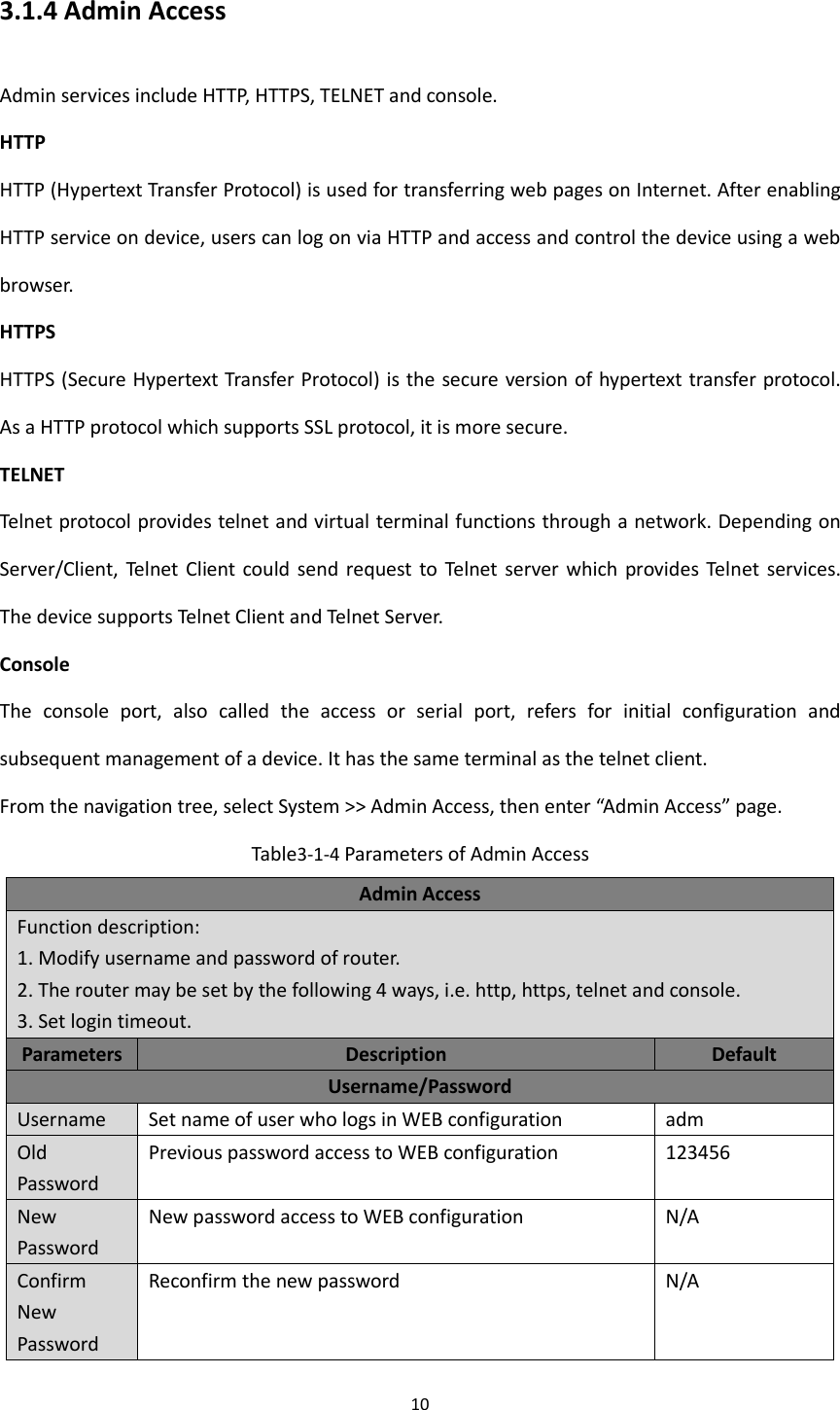
10  3.1.4 Admin Access Admin services include HTTP, HTTPS, TELNET and console.   HTTP HTTP (Hypertext Transfer Protocol) is used for transferring web pages on Internet. After enabling HTTP service on device, users can log on via HTTP and access and control the device using a web browser. HTTPS HTTPS (Secure Hypertext Transfer Protocol) is the secure version of hypertext transfer protocol. As a HTTP protocol which supports SSL protocol, it is more secure.   TELNET Telnet protocol provides telnet and virtual terminal functions through a network. Depending on Server/Client,  Telnet  Client could  send request to  Telnet server  which  provides Telnet  services. The device supports Telnet Client and Telnet Server. Console The  console  port,  also  called  the  access  or  serial  port,  refers  for  initial  configuration  and subsequent management of a device. It has the same terminal as the telnet client. From the navigation tree, select System >> Admin Access, then enter “Admin Access” page. Table3-1-4 Parameters of Admin Access Admin Access Function description:   1. Modify username and password of router.   2. The router may be set by the following 4 ways, i.e. http, https, telnet and console.   3. Set login timeout.   Parameters Description Default Username/Password Username Set name of user who logs in WEB configuration adm Old Password Previous password access to WEB configuration   123456 New Password New password access to WEB configuration N/A Confirm New Password Reconfirm the new password   N/A
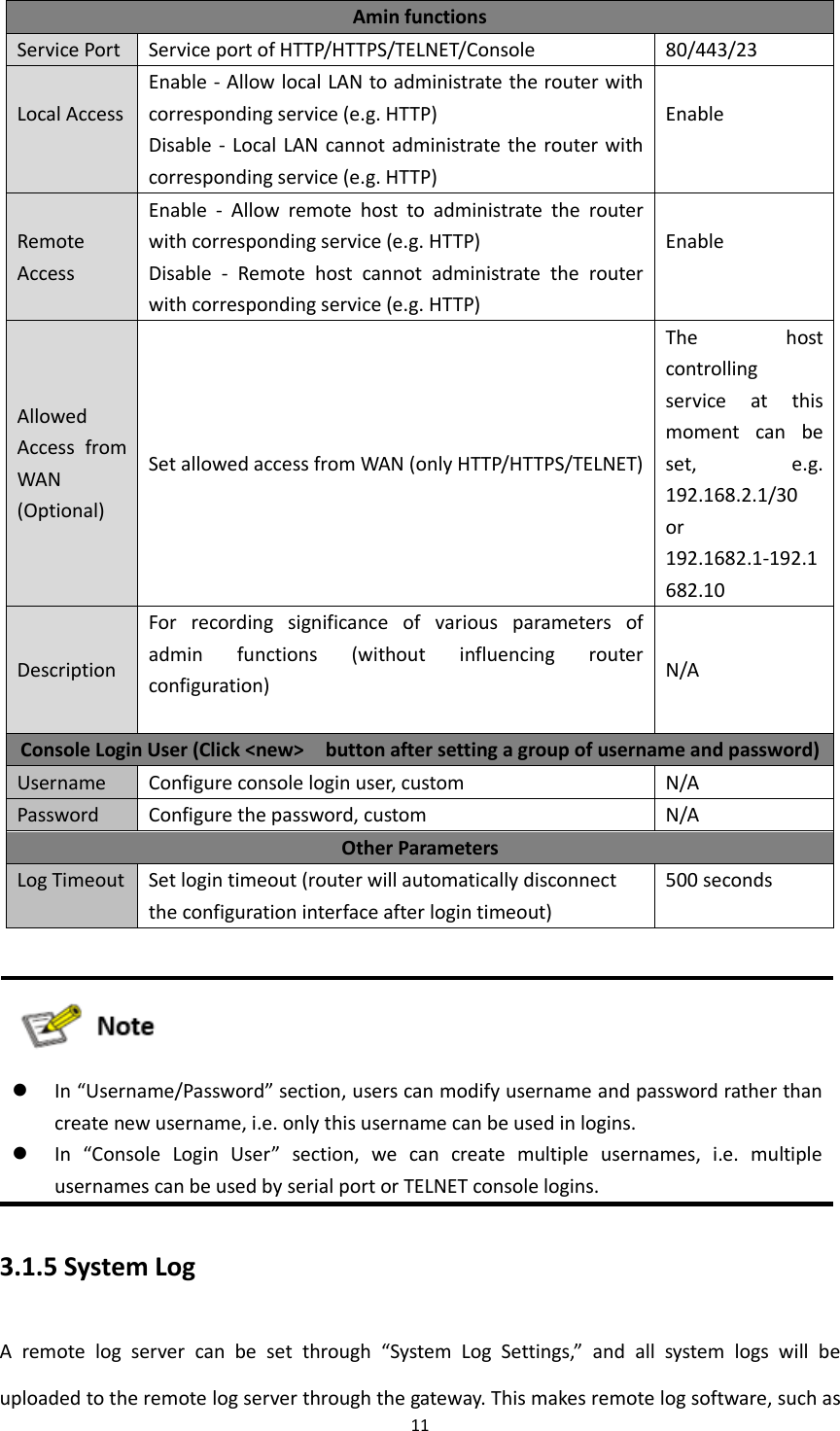
11  Amin functions   Service Port Service port of HTTP/HTTPS/TELNET/Console 80/443/23  Local Access Enable - Allow local LAN to administrate the router with corresponding service (e.g. HTTP) Disable -  Local LAN cannot administrate the  router with corresponding service (e.g. HTTP)  Enable  Remote Access Enable  -  Allow  remote  host  to  administrate  the  router with corresponding service (e.g. HTTP) Disable  -  Remote  host  cannot  administrate  the  router with corresponding service (e.g. HTTP)  Enable  Allowed Access  from WAN (Optional) Set allowed access from WAN (only HTTP/HTTPS/TELNET) The  host controlling service  at  this moment  can  be set,  e.g. 192.168.2.1/30 or 192.1682.1-192.1682.10 Description For  recording  significance  of  various  parameters  of admin  functions  (without  influencing  router configuration)  N/A Console Login User (Click <new>    button after setting a group of username and password) Username Configure console login user, custom   N/A Password Configure the password, custom   N/A Other Parameters Log Timeout Set login timeout (router will automatically disconnect the configuration interface after login timeout)   500 seconds      In “Username/Password” section, users can modify username and password rather than create new username, i.e. only this username can be used in logins.    In  “Console  Login  User”  section,  we  can  create  multiple  usernames,  i.e.  multiple usernames can be used by serial port or TELNET console logins.   3.1.5 System Log A  remote  log  server  can  be  set  through  “System  Log  Settings,”  and  all  system  logs  will  be uploaded to the remote log server through the gateway. This makes remote log software, such as
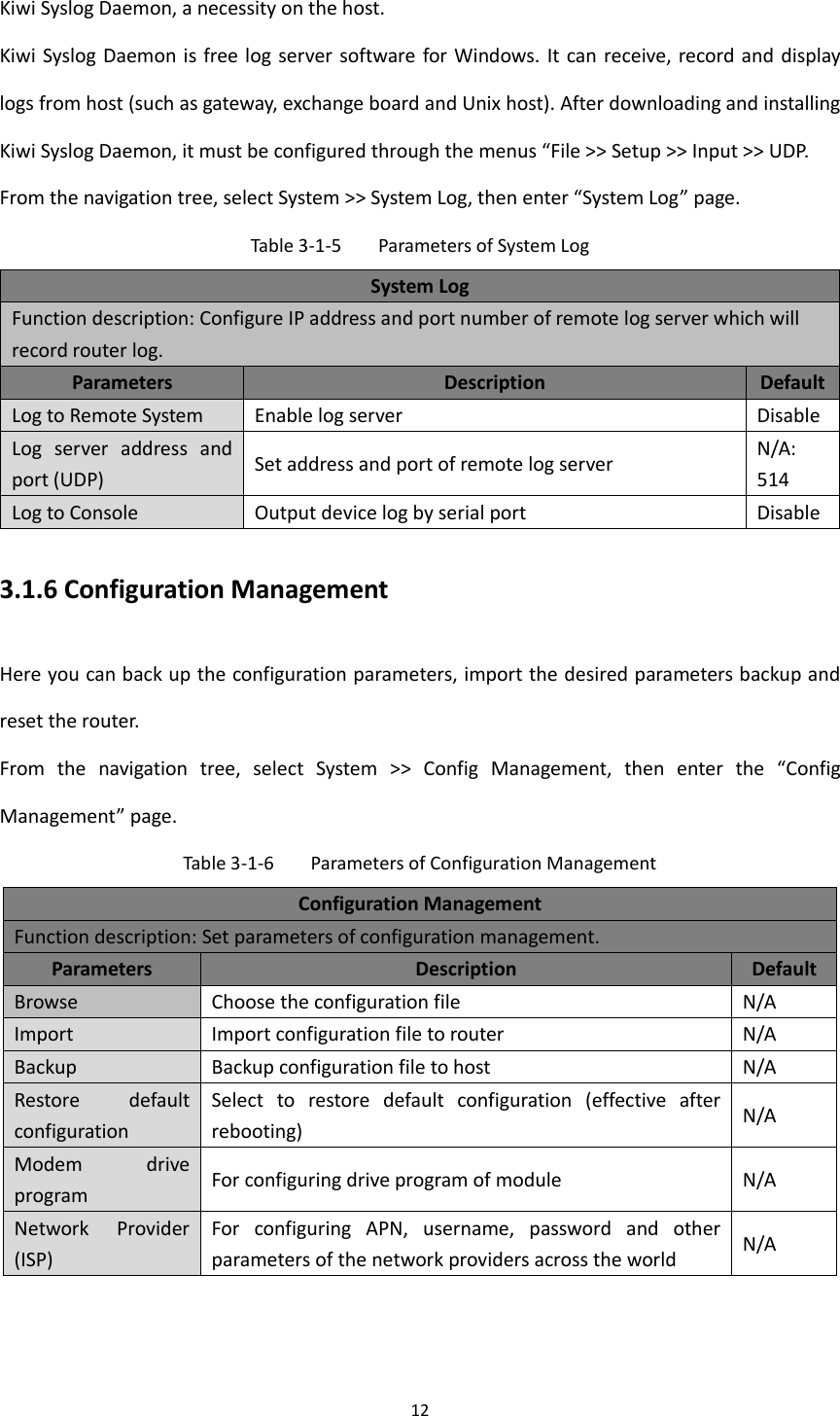
12  Kiwi Syslog Daemon, a necessity on the host. Kiwi Syslog Daemon is free log server software for Windows. It can receive, record and display logs from host (such as gateway, exchange board and Unix host). After downloading and installing Kiwi Syslog Daemon, it must be configured through the menus “File >> Setup >> Input >> UDP. From the navigation tree, select System >> System Log, then enter “System Log” page. Table 3-1-5  Parameters of System Log System Log Function description: Configure IP address and port number of remote log server which will record router log.   Parameters Description Default Log to Remote System Enable log server Disable Log  server  address  and port (UDP) Set address and port of remote log server   N/A: 514 Log to Console Output device log by serial port   Disable 3.1.6 Configuration Management Here you can back up the configuration parameters, import the desired parameters backup and reset the router. From  the  navigation  tree,  select  System  >>  Config  Management,  then  enter  the  “Config Management” page. Table 3-1-6  Parameters of Configuration Management Configuration Management Function description: Set parameters of configuration management. Parameters Description Default Browse Choose the configuration file N/A Import Import configuration file to router N/A Backup Backup configuration file to host N/A Restore  default configuration Select  to  restore  default  configuration  (effective  after rebooting) N/A Modem  drive program For configuring drive program of module N/A Network  Provider (ISP) For  configuring  APN,  username,  password  and  other parameters of the network providers across the world   N/A
13   Validity and order of imported configurations should be ensured. The good configs will later be serially executed in order after system reboot. If the configuration files didn’t be arranged according to effective order, the system won’t enter the desired state.  In  order  not  to  affect  the  operation  of  the  current  system,  when  performing  an  import configuration and restore default configuration, users need to restart the device to make the new configuration to take effect. 3.1.7 Task Schedule After this function is enabled, the device will restart as the scheduled time.   From the navigation tree, select System >> Task Schedule, then enter “Task Schedule” page. 3.1.8 System Upgrading The  upgrading  process  can  be  divided  into  two  steps.  In  the  first  step,  upgrading  files  will  be written in backup firmware zone, e.g. , the process in the section of System Upgrading; in second step: files in backup firmware zone will be copied to main firmware zone, which should be carried out during system restart. During software upgrading, any operation on web page is not allowed, otherwise software upgrading may be interrupted. From the navigation tree, select System >> Upgrade, then enter the “Upgrade” page. To upgrade the system, firstly, click <Browse> choose the upgrade file, secondly, click <Upgrade> and then click <OK> to begin upgrade; thirdly, upgrade firmware succeed, and click <Reboot> to restart the device.   3.1.9 Reboot Please save the configurations before reboot, otherwise the configurations that are not saved will
14  be lost after reboot. To reboot the system, please click the System>>Reboot, then click <OK>.   3.1.10 Logout To logout, click System >> Logout, and then click <OK>.
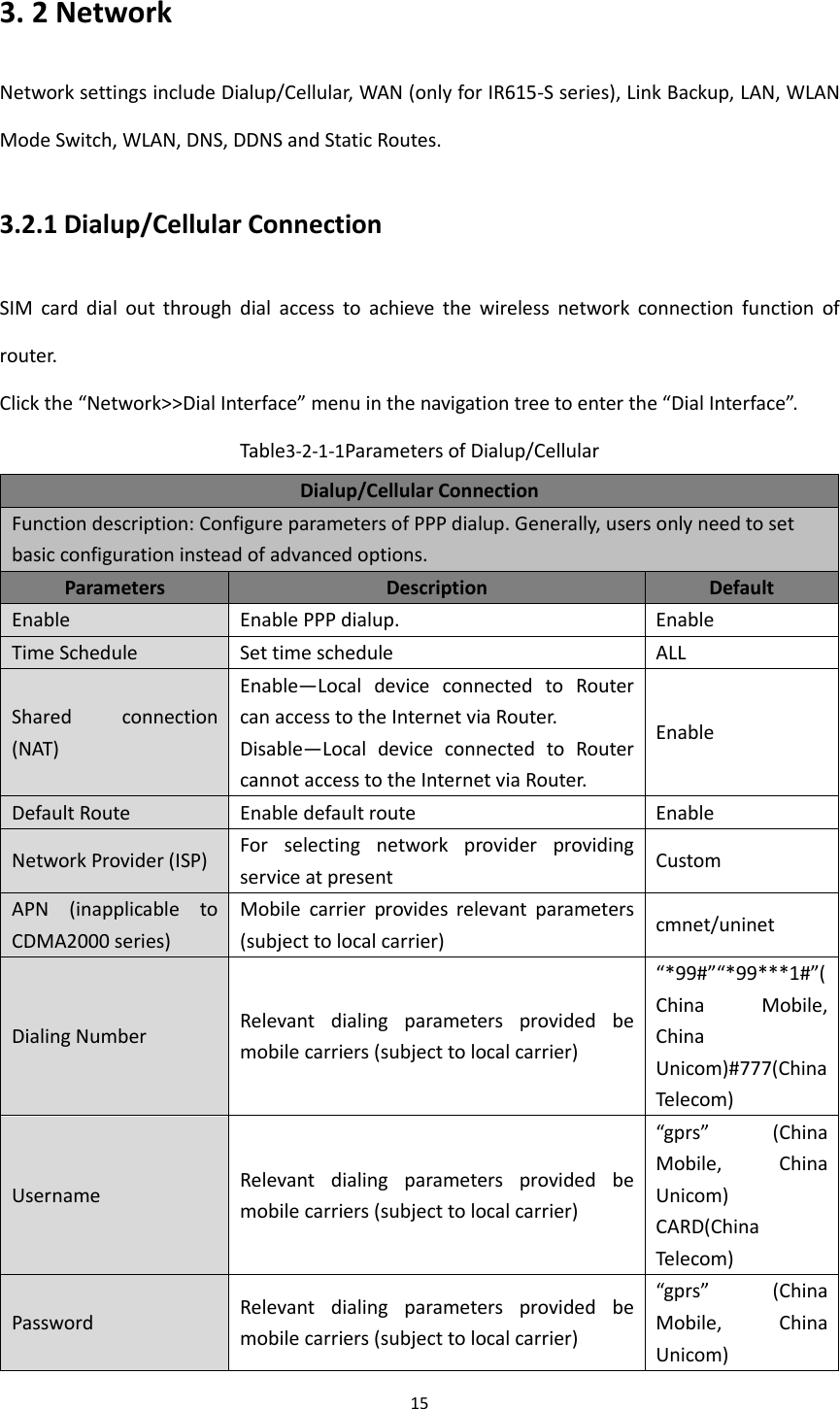
15  3. 2 Network Network settings include Dialup/Cellular, WAN (only for IR615-S series), Link Backup, LAN, WLAN Mode Switch, WLAN, DNS, DDNS and Static Routes.   3.2.1 Dialup/Cellular Connection SIM  card  dial  out  through  dial  access  to  achieve  the  wireless  network  connection  function  of router. Click the “Network>>Dial Interface” menu in the navigation tree to enter the “Dial Interface”. Table3-2-1-1Parameters of Dialup/Cellular Dialup/Cellular Connection Function description: Configure parameters of PPP dialup. Generally, users only need to set basic configuration instead of advanced options.   Parameters Description Default Enable Enable PPP dialup. Enable Time Schedule Set time schedule ALL Shared  connection (NAT) Enable—Local  device  connected  to  Router can access to the Internet via Router.   Disable—Local  device  connected  to  Router cannot access to the Internet via Router. Enable Default Route Enable default route Enable Network Provider (ISP) For  selecting  network  provider  providing service at present Custom APN  (inapplicable  to CDMA2000 series) Mobile  carrier  provides  relevant  parameters (subject to local carrier) cmnet/uninet Dialing Number Relevant  dialing  parameters  provided  be mobile carriers (subject to local carrier) “*99#”“*99***1#”(China  Mobile, China Unicom)#777(China Telecom) Username Relevant  dialing  parameters  provided  be mobile carriers (subject to local carrier) “gprs”  (China Mobile,  China Unicom) CARD(China Telecom) Password Relevant  dialing  parameters  provided  be mobile carriers (subject to local carrier) “gprs”  (China Mobile,  China Unicom)
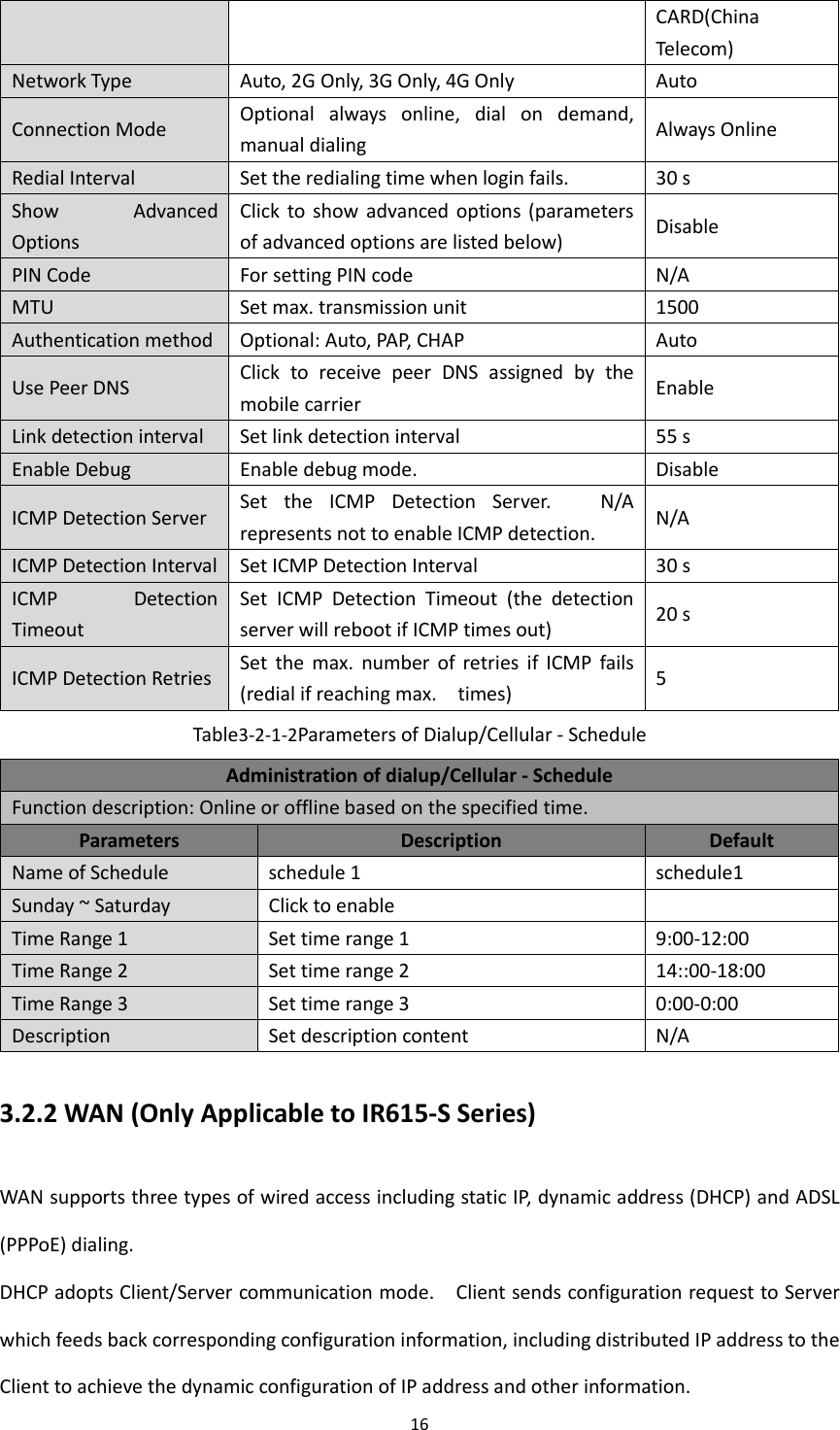
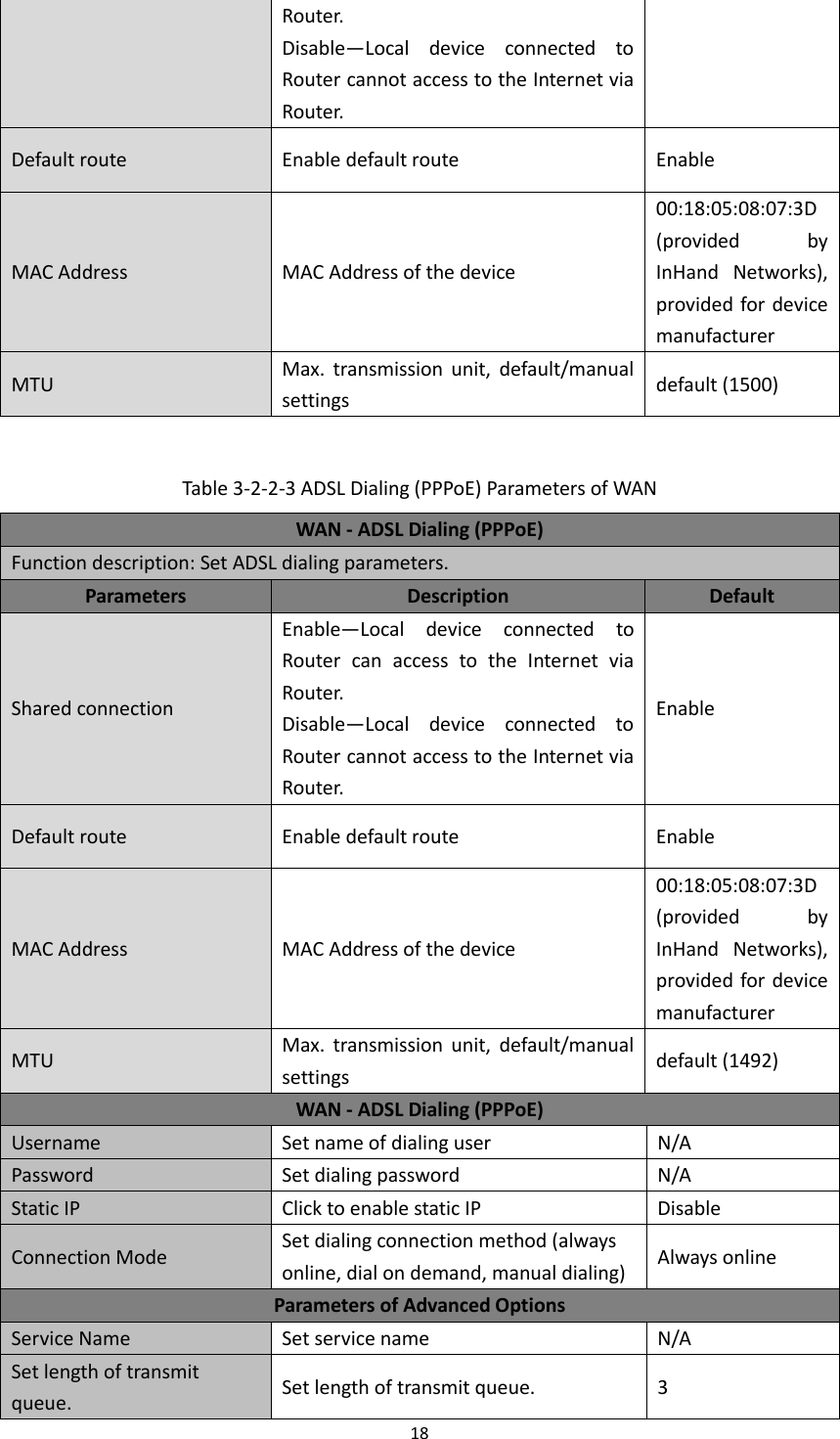
16  CARD(China Telecom) Network Type Auto, 2G Only, 3G Only, 4G Only Auto Connection Mode Optional  always  online,  dial  on  demand, manual dialing Always Online Redial Interval Set the redialing time when login fails. 30 s Show  Advanced Options Click  to show  advanced options  (parameters of advanced options are listed below) Disable PIN Code For setting PIN code N/A MTU Set max. transmission unit 1500 Authentication method Optional: Auto, PAP, CHAP Auto Use Peer DNS Click  to  receive  peer  DNS  assigned  by  the mobile carrier Enable Link detection interval Set link detection interval 55 s Enable Debug Enable debug mode. Disable ICMP Detection Server Set  the  ICMP  Detection  Server.      N/A represents not to enable ICMP detection. N/A ICMP Detection Interval Set ICMP Detection Interval 30 s ICMP  Detection Timeout Set  ICMP  Detection  Timeout  (the  detection server will reboot if ICMP times out) 20 s ICMP Detection Retries Set  the  max.  number  of  retries  if  ICMP  fails (redial if reaching max.    times) 5 Table3-2-1-2Parameters of Dialup/Cellular - Schedule Administration of dialup/Cellular - Schedule Function description: Online or offline based on the specified time.   Parameters Description Default Name of Schedule   schedule 1 schedule1 Sunday ~ Saturday   Click to enable  Time Range 1 Set time range 1 9:00-12:00 Time Range 2 Set time range 2 14::00-18:00 Time Range 3 Set time range 3 0:00-0:00 Description Set description content   N/A 3.2.2 WAN (Only Applicable to IR615-S Series) WAN supports three types of wired access including static IP, dynamic address (DHCP) and ADSL (PPPoE) dialing. DHCP adopts Client/Server communication mode.    Client sends configuration request to Server which feeds back corresponding configuration information, including distributed IP address to the Client to achieve the dynamic configuration of IP address and other information.
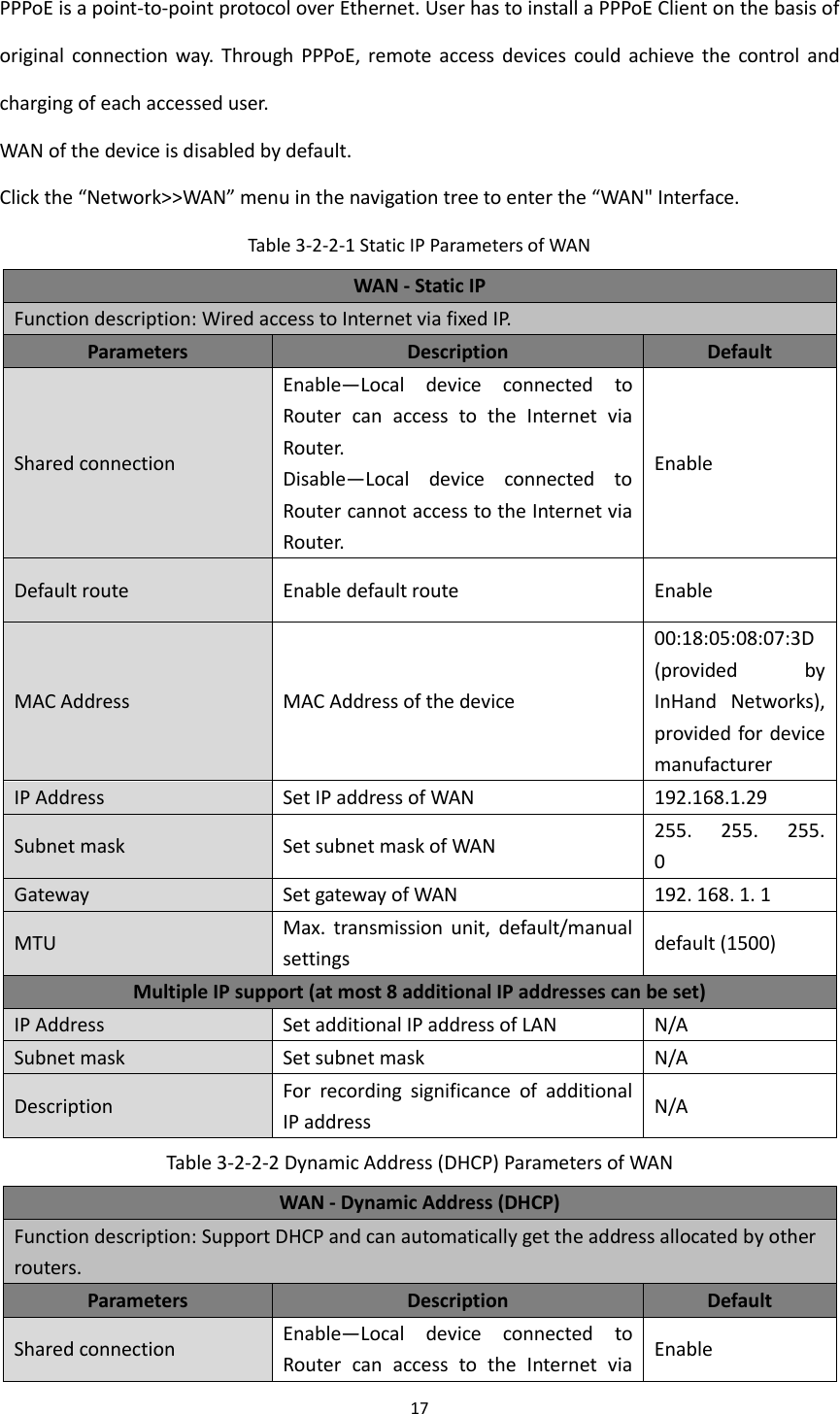
17  PPPoE is a point-to-point protocol over Ethernet. User has to install a PPPoE Client on the basis of original  connection  way.  Through PPPoE,  remote  access  devices  could  achieve  the  control  and charging of each accessed user. WAN of the device is disabled by default.   Click the “Network>>WAN” menu in the navigation tree to enter the “WAN" Interface. Table 3-2-2-1 Static IP Parameters of WAN WAN - Static IP Function description: Wired access to Internet via fixed IP.   Parameters Description Default Shared connection   Enable—Local  device  connected  to Router  can  access  to  the  Internet  via Router. Disable—Local  device  connected  to Router cannot access to the Internet via Router. Enable Default route Enable default route Enable MAC Address MAC Address of the device 00:18:05:08:07:3D (provided  by InHand  Networks), provided for device manufacturer   IP Address Set IP address of WAN 192.168.1.29 Subnet mask Set subnet mask of WAN 255.    255.    255.   0 Gateway Set gateway of WAN 192. 168. 1. 1 MTU Max.  transmission  unit,  default/manual settings default (1500) Multiple IP support (at most 8 additional IP addresses can be set) IP Address Set additional IP address of LAN N/A Subnet mask Set subnet mask N/A Description For  recording  significance  of  additional IP address N/A Table 3-2-2-2 Dynamic Address (DHCP) Parameters of WAN WAN - Dynamic Address (DHCP)   Function description: Support DHCP and can automatically get the address allocated by other routers.   Parameters Description Default Shared connection Enable—Local  device  connected  to Router  can  access  to  the  Internet  via Enable
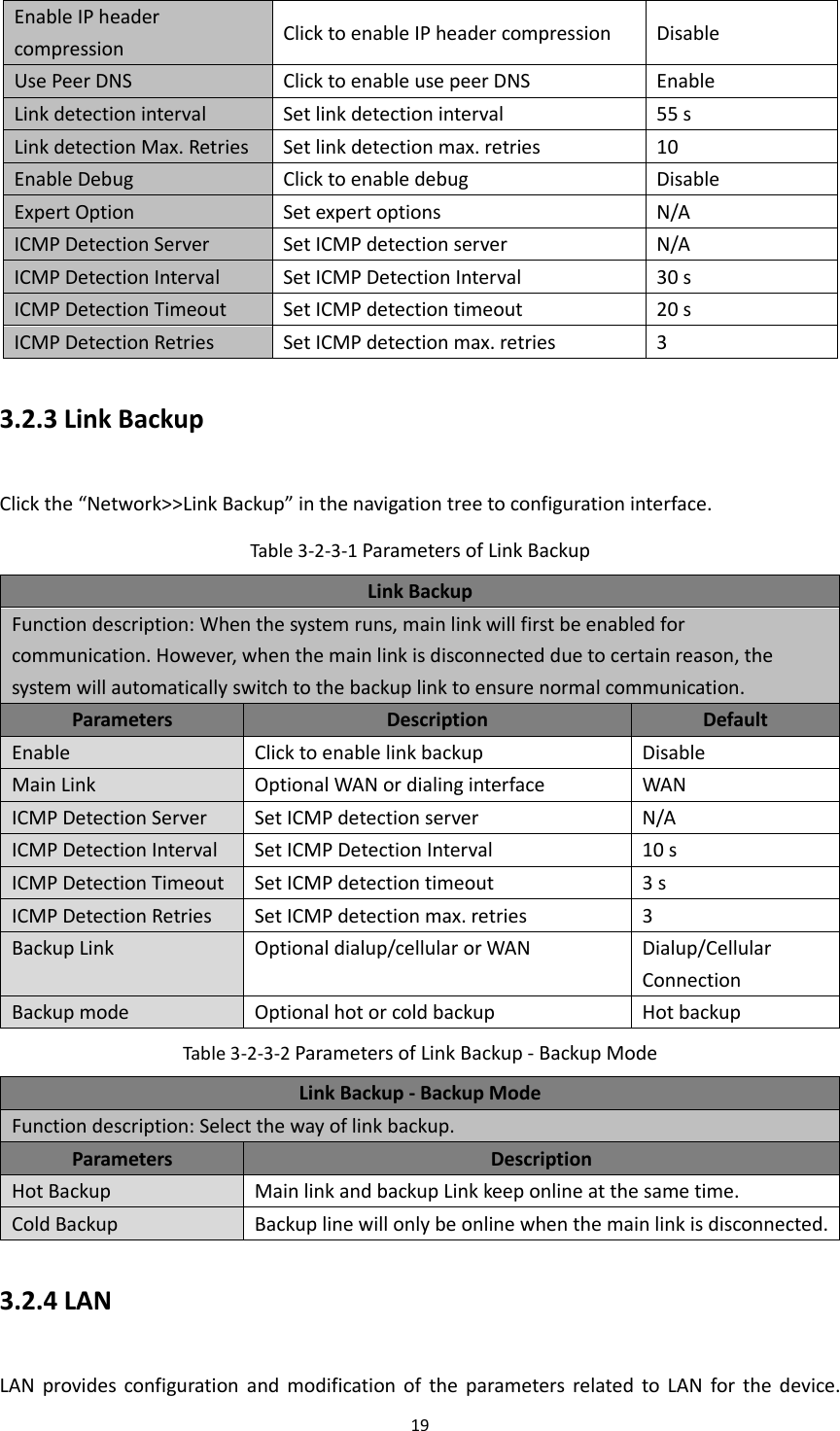
18  Router. Disable—Local  device  connected  to Router cannot access to the Internet via Router. Default route Enable default route Enable MAC Address MAC Address of the device 00:18:05:08:07:3D (provided  by InHand  Networks), provided for device manufacturer MTU Max.  transmission  unit,  default/manual settings default (1500)  Table 3-2-2-3 ADSL Dialing (PPPoE) Parameters of WAN WAN - ADSL Dialing (PPPoE)   Function description: Set ADSL dialing parameters.   Parameters Description Default Shared connection Enable—Local  device  connected  to Router  can  access  to  the  Internet  via Router. Disable—Local  device  connected  to Router cannot access to the Internet via Router. Enable Default route Enable default route Enable MAC Address MAC Address of the device 00:18:05:08:07:3D (provided  by InHand  Networks), provided for device manufacturer MTU Max.  transmission  unit,  default/manual settings default (1492) WAN - ADSL Dialing (PPPoE) Username Set name of dialing user   N/A Password Set dialing password N/A Static IP Click to enable static IP Disable Connection Mode Set dialing connection method (always online, dial on demand, manual dialing) Always online Parameters of Advanced Options   Service Name Set service name N/A Set length of transmit queue. Set length of transmit queue. 3
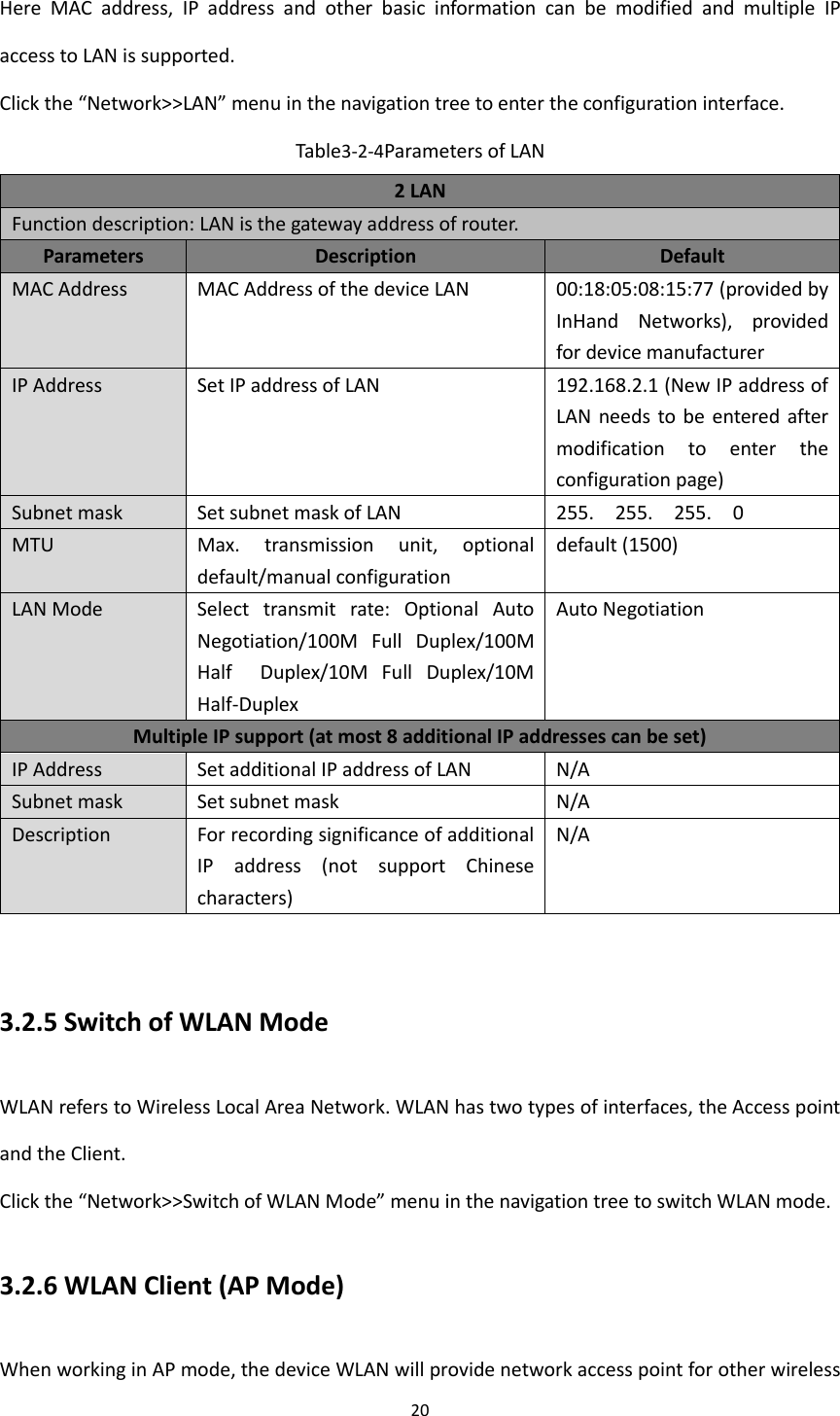
19  Enable IP header compression Click to enable IP header compression Disable Use Peer DNS Click to enable use peer DNS Enable Link detection interval Set link detection interval 55 s Link detection Max. Retries Set link detection max. retries 10 Enable Debug Click to enable debug   Disable Expert Option Set expert options N/A ICMP Detection Server Set ICMP detection server N/A ICMP Detection Interval Set ICMP Detection Interval 30 s ICMP Detection Timeout Set ICMP detection timeout 20 s ICMP Detection Retries Set ICMP detection max. retries 3 3.2.3 Link Backup Click the “Network>>Link Backup” in the navigation tree to configuration interface. Table 3-2-3-1 Parameters of Link Backup Link Backup Function description: When the system runs, main link will first be enabled for communication. However, when the main link is disconnected due to certain reason, the system will automatically switch to the backup link to ensure normal communication.   Parameters Description Default Enable Click to enable link backup Disable Main Link Optional WAN or dialing interface   WAN ICMP Detection Server Set ICMP detection server N/A ICMP Detection Interval Set ICMP Detection Interval 10 s ICMP Detection Timeout Set ICMP detection timeout 3 s ICMP Detection Retries Set ICMP detection max. retries 3 Backup Link Optional dialup/cellular or WAN Dialup/Cellular Connection Backup mode Optional hot or cold backup Hot backup Table 3-2-3-2 Parameters of Link Backup - Backup Mode Link Backup - Backup Mode Function description: Select the way of link backup. Parameters Description Hot Backup Main link and backup Link keep online at the same time. Cold Backup Backup line will only be online when the main link is disconnected.   3.2.4 LAN   LAN  provides  configuration  and  modification  of  the  parameters  related  to  LAN  for  the  device.
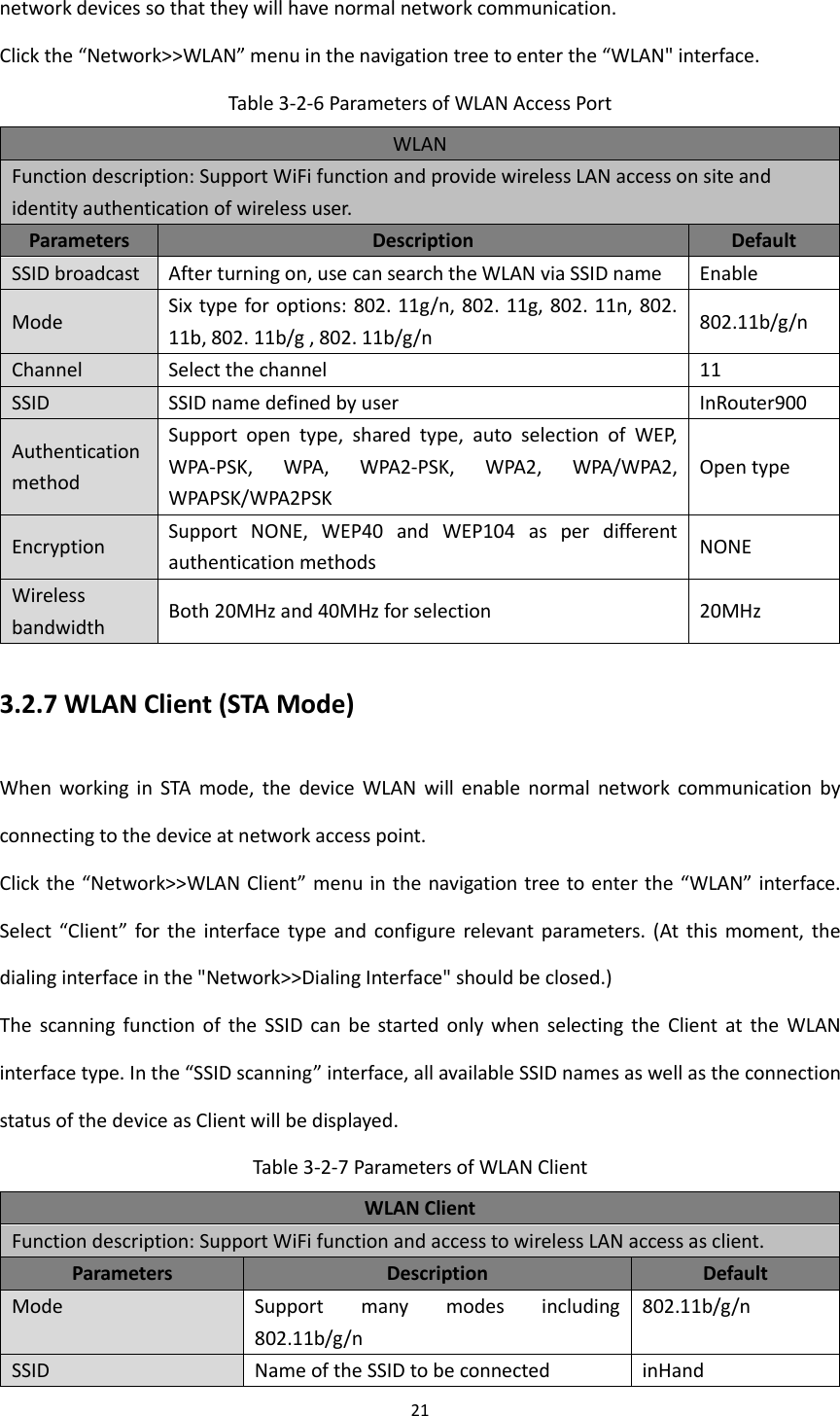
20  Here  MAC  address,  IP  address  and  other  basic  information  can  be  modified  and  multiple  IP access to LAN is supported.   Click the “Network>>LAN” menu in the navigation tree to enter the configuration interface. Table3-2-4Parameters of LAN 2 LAN Function description: LAN is the gateway address of router.   Parameters Description Default MAC Address MAC Address of the device LAN 00:18:05:08:15:77 (provided by InHand  Networks),  provided for device manufacturer IP Address Set IP address of LAN 192.168.2.1 (New IP address of LAN  needs to be entered after modification  to  enter  the configuration page) Subnet mask Set subnet mask of LAN 255.    255.    255.    0 MTU Max.  transmission  unit,  optional default/manual configuration default (1500) LAN Mode Select  transmit  rate:  Optional  Auto Negotiation/100M  Full  Duplex/100M Half    Duplex/10M  Full  Duplex/10M Half-Duplex Auto Negotiation Multiple IP support (at most 8 additional IP addresses can be set) IP Address Set additional IP address of LAN N/A Subnet mask Set subnet mask N/A Description For recording significance of additional IP  address  (not  support  Chinese characters)   N/A  3.2.5 Switch of WLAN Mode   WLAN refers to Wireless Local Area Network. WLAN has two types of interfaces, the Access point and the Client. Click the “Network>>Switch of WLAN Mode” menu in the navigation tree to switch WLAN mode. 3.2.6 WLAN Client (AP Mode) When working in AP mode, the device WLAN will provide network access point for other wireless
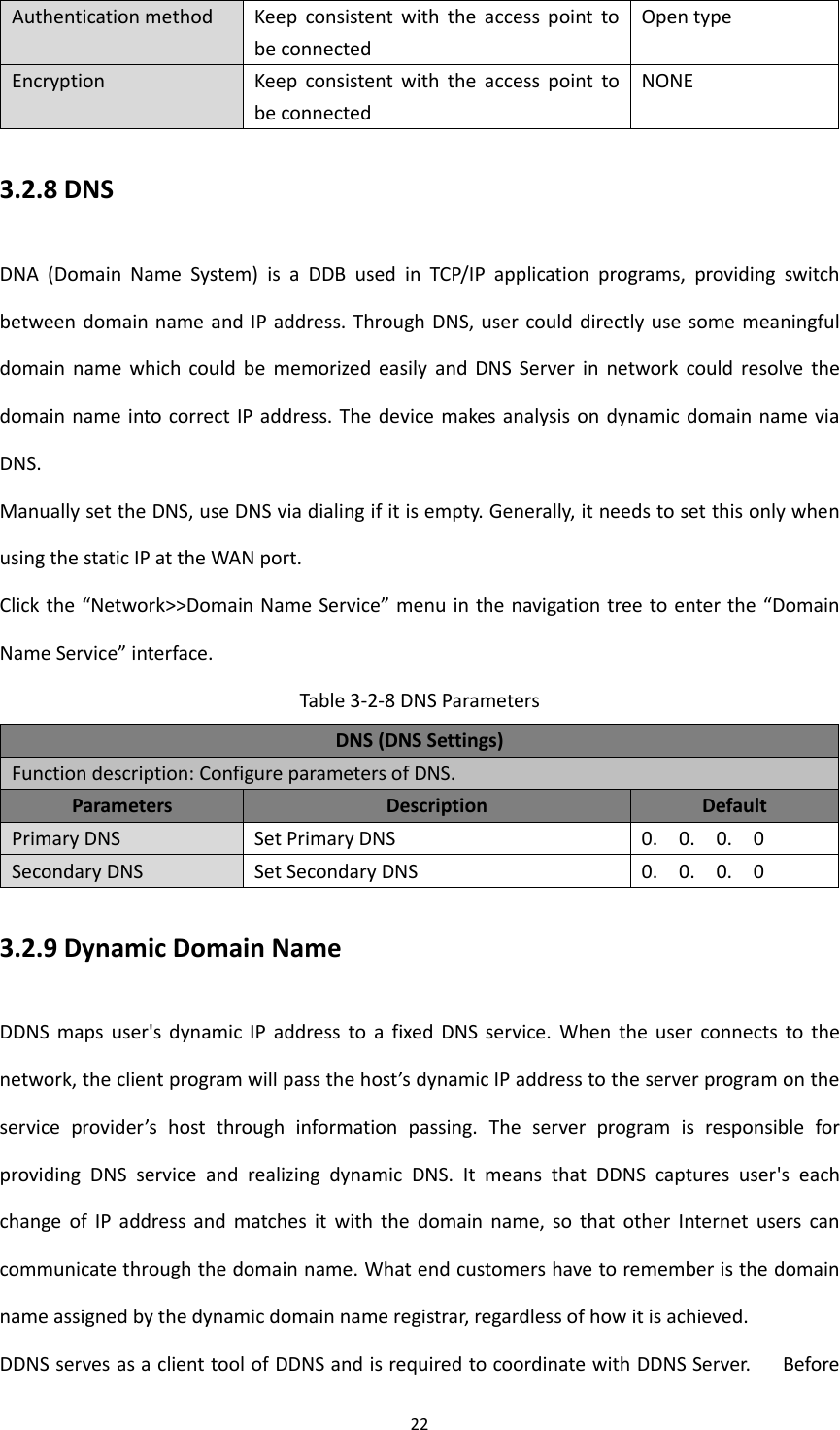
21  network devices so that they will have normal network communication.   Click the “Network>>WLAN” menu in the navigation tree to enter the “WLAN" interface. Table 3-2-6 Parameters of WLAN Access Port WLAN   Function description: Support WiFi function and provide wireless LAN access on site and identity authentication of wireless user.   Parameters Description Default SSID broadcast After turning on, use can search the WLAN via SSID name Enable Mode Six type for options: 802. 11g/n, 802. 11g, 802. 11n, 802. 11b, 802. 11b/g , 802. 11b/g/n 802.11b/g/n Channel Select the channel 11 SSID SSID name defined by user InRouter900 Authentication method Support  open  type,  shared  type,  auto  selection  of  WEP, WPA-PSK,  WPA,  WPA2-PSK,  WPA2,  WPA/WPA2, WPAPSK/WPA2PSK Open type Encryption Support  NONE,  WEP40  and  WEP104  as  per  different authentication methods NONE Wireless bandwidth Both 20MHz and 40MHz for selection 20MHz 3.2.7 WLAN Client (STA Mode) When  working  in  STA  mode,  the  device  WLAN  will  enable  normal  network  communication  by connecting to the device at network access point. Click the “Network>>WLAN Client” menu in the navigation tree to enter the “WLAN” interface.   Select  “Client”  for  the  interface type and  configure  relevant  parameters.  (At  this  moment,  the dialing interface in the "Network>>Dialing Interface" should be closed.) The  scanning  function  of  the  SSID  can  be  started  only  when  selecting  the  Client  at  the  WLAN interface type. In the “SSID scanning” interface, all available SSID names as well as the connection status of the device as Client will be displayed. Table 3-2-7 Parameters of WLAN Client   WLAN Client   Function description: Support WiFi function and access to wireless LAN access as client. Parameters Description Default Mode Support  many  modes  including 802.11b/g/n     802.11b/g/n SSID Name of the SSID to be connected inHand
22  Authentication method Keep  consistent  with  the  access  point  to be connected Open type Encryption Keep  consistent  with  the  access  point  to be connected NONE 3.2.8 DNS DNA  (Domain  Name  System)  is  a  DDB  used  in  TCP/IP  application  programs,  providing  switch between domain name and IP address. Through DNS, user could directly use some meaningful domain  name  which  could  be  memorized easily  and  DNS  Server  in  network  could  resolve  the domain name into correct IP address. The  device makes analysis on dynamic domain name via DNS. Manually set the DNS, use DNS via dialing if it is empty. Generally, it needs to set this only when using the static IP at the WAN port. Click the “Network>>Domain Name Service” menu in the navigation tree to enter the “Domain Name Service” interface.   Table 3-2-8 DNS Parameters DNS (DNS Settings) Function description: Configure parameters of DNS. Parameters Description Default Primary DNS Set Primary DNS 0.    0.    0.    0 Secondary DNS Set Secondary DNS 0.    0.    0.    0 3.2.9 Dynamic Domain Name DDNS  maps  user's  dynamic  IP  address  to  a  fixed DNS service.  When  the  user  connects  to  the network, the client program will pass the host’s dynamic IP address to the server program on the service  provider’s  host  through  information  passing.  The  server  program  is  responsible  for providing  DNS  service  and  realizing  dynamic  DNS.  It  means  that  DDNS  captures  user's  each change  of  IP  address  and  matches  it  with  the  domain  name,  so  that  other  Internet  users  can communicate through the domain name. What end customers have to remember is the domain name assigned by the dynamic domain name registrar, regardless of how it is achieved. DDNS serves as a client tool of DDNS and is required to coordinate with DDNS Server.      Before
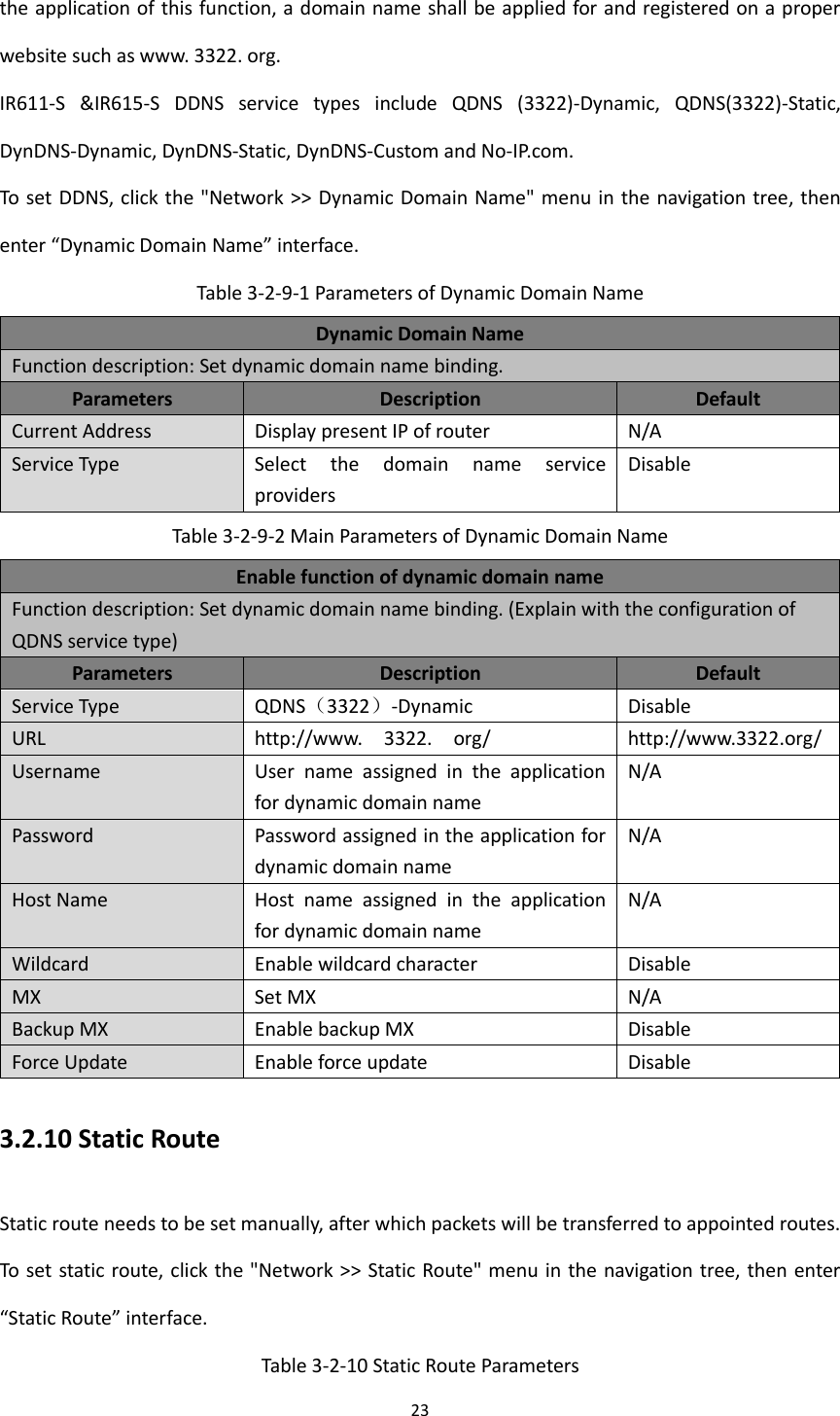
23  the application of this function, a domain name shall be applied for and registered on a proper website such as www. 3322. org.   IR611-S  &IR615-S  DDNS  service  types  include  QDNS  (3322)-Dynamic,  QDNS(3322)-Static, DynDNS-Dynamic, DynDNS-Static, DynDNS-Custom and No-IP.com.   To set DDNS, click the "Network >> Dynamic Domain Name" menu in the navigation tree, then enter “Dynamic Domain Name” interface. Table 3-2-9-1 Parameters of Dynamic Domain Name Dynamic Domain Name Function description: Set dynamic domain name binding. Parameters Description Default Current Address Display present IP of router N/A Service Type Select  the  domain  name  service providers Disable Table 3-2-9-2 Main Parameters of Dynamic Domain Name Enable function of dynamic domain name   Function description: Set dynamic domain name binding. (Explain with the configuration of QDNS service type) Parameters Description Default Service Type QDNS(3322)-Dynamic Disable URL http://www.    3322.    org/ http://www.3322.org/ Username User  name  assigned  in  the  application for dynamic domain name N/A Password Password assigned in the application for dynamic domain name N/A Host Name Host  name  assigned  in  the  application for dynamic domain name N/A Wildcard Enable wildcard character Disable MX Set MX N/A Backup MX Enable backup MX Disable Force Update Enable force update Disable 3.2.10 Static Route Static route needs to be set manually, after which packets will be transferred to appointed routes. To set static route, click the "Network >> Static Route" menu in the navigation tree, then enter “Static Route” interface. Table 3-2-10 Static Route Parameters
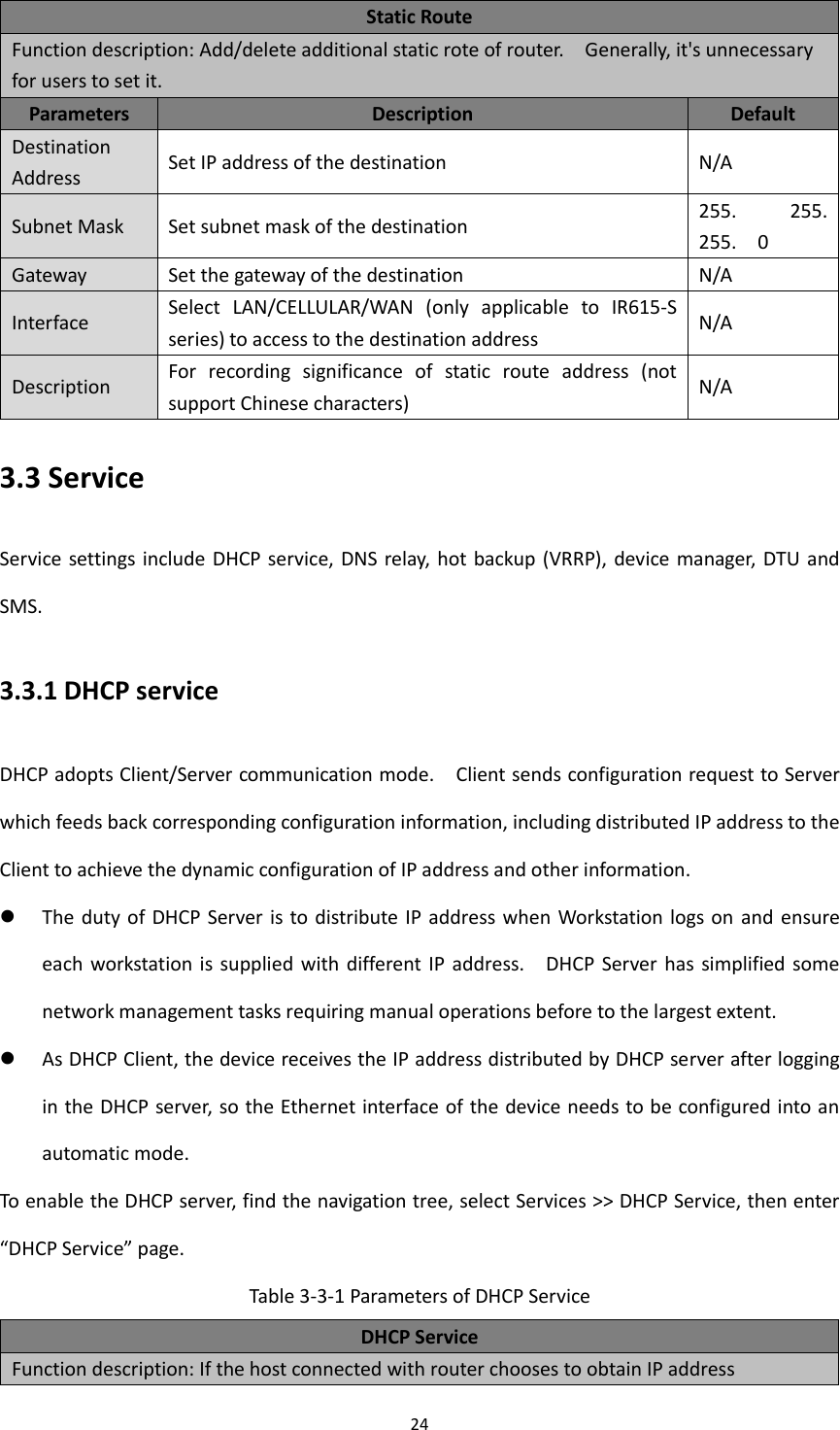
24  Static Route Function description: Add/delete additional static rote of router.    Generally, it's unnecessary for users to set it.   Parameters Description Default Destination Address Set IP address of the destination N/A Subnet Mask Set subnet mask of the destination 255.    255.   255.    0 Gateway Set the gateway of the destination N/A Interface Select  LAN/CELLULAR/WAN  (only  applicable  to  IR615-S series) to access to the destination address N/A Description For  recording  significance  of  static  route  address  (not support Chinese characters) N/A 3.3 Service Service settings include DHCP service, DNS relay, hot  backup (VRRP), device manager, DTU and SMS. 3.3.1 DHCP service DHCP adopts Client/Server communication mode.    Client sends configuration request to Server which feeds back corresponding configuration information, including distributed IP address to the Client to achieve the dynamic configuration of IP address and other information.  The duty of DHCP Server is to distribute IP address when Workstation logs on and ensure each workstation  is supplied  with  different IP address.    DHCP  Server has simplified some network management tasks requiring manual operations before to the largest extent.  As DHCP Client, the device receives the IP address distributed by DHCP server after logging in the DHCP server, so the Ethernet interface of the device needs to be configured into an automatic mode. To enable the DHCP server, find the navigation tree, select Services >> DHCP Service, then enter “DHCP Service” page. Table 3-3-1 Parameters of DHCP Service DHCP Service Function description: If the host connected with router chooses to obtain IP address
25  automatically, then such service must be activated. Static designation of DHCH allocation could help certain host to obtain specified IP address. Parameters Description Default Enable DHCP Enable DHCP service and dynamically allocate IP address   Enable IP Pool Starting Address Set starting IP address of dynamic allocation 192.    168.   2.    2 IP Pool Ending Address Set ending IP address of dynamic allocation 192.    168.   2.    100 Lease Set lease of IP allocated dynamically   60 minutes DNS Set DNS Server   192.    168.   2.    1 Windows Name Server Set windows name server. N/A Static designation of DHCH allocation (at most 20 DHCPs designated statically can be set) MAC Address Set  a  statically  specified  DHCP’s  MAC  address (different from other MACs to avoid confliction) N/A IP Address Set a statically specified IP address   192.    168.   2.    2 Host Set the hostname. N/A 3.3.2 DNS Relay The device, as a DNS Agent, relays DNS request and response message between DNS Client and DNS Server to carry out domain name resolution in lieu of DNS Client. From navigation tree, select "Network >>DNS Relay" menu, then enter “DNS Relay” page. Table 3-3-2 DNS Transfer Parameters DNS Relay service Function  description:  If  the  host  connected  with  router  chooses  to  obtain  DNS  address automatically, then such service must be activated. Parameters Description Default Enable  DNS  Relay service Click to enable DNS service Enable  (DNS  will  be available when DHCP service is enabled.) Designate [IP address <=> domain name] pair (20 IP address    <=> domain name pairs can be designated) IP Address Set  IP  address  of  designated  IP  address  <=> domain name   N/A Host Domain Name N/A Description For  recording  significance  of  IP  address  <=> domain name N/A
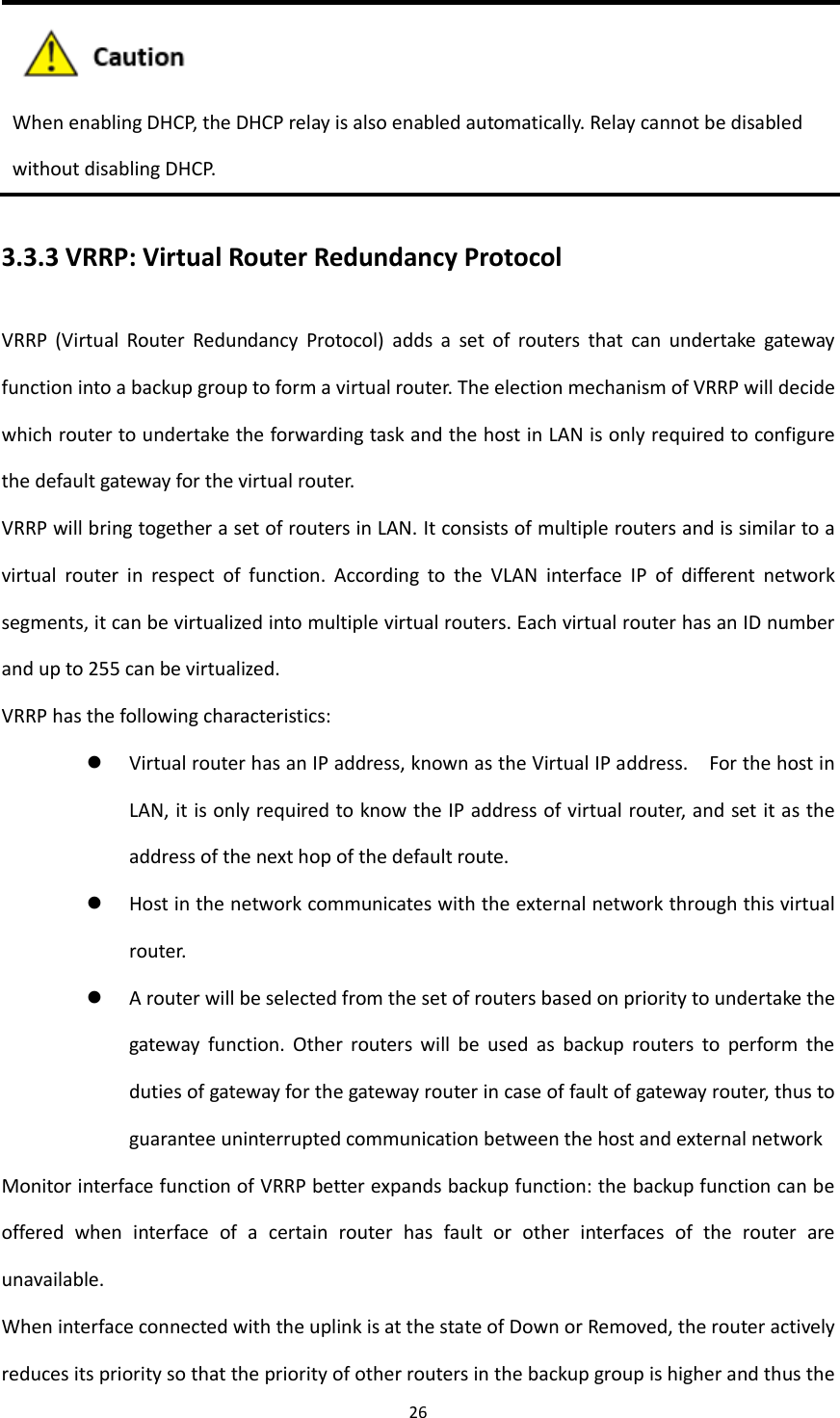
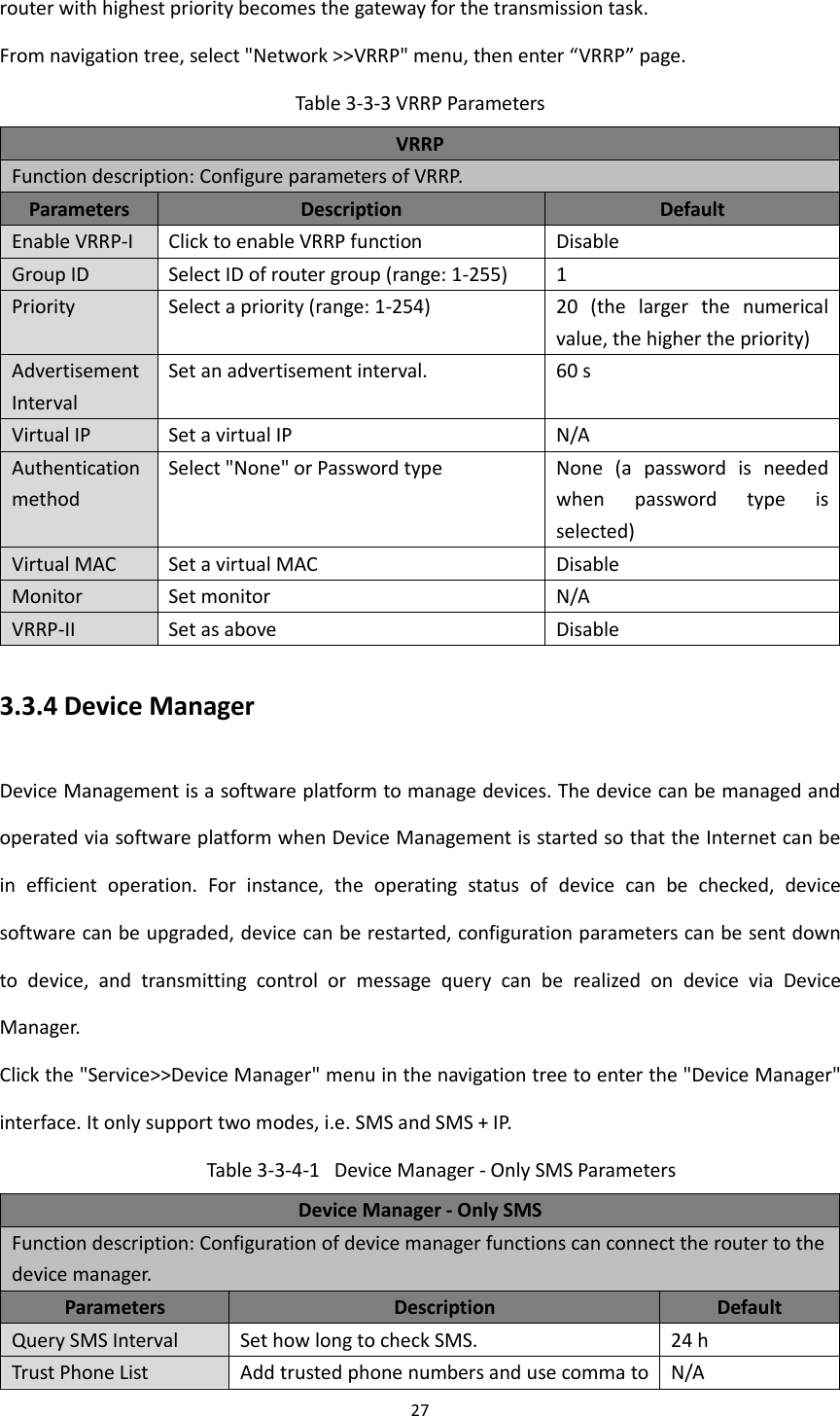
26   When enabling DHCP, the DHCP relay is also enabled automatically. Relay cannot be disabled   without disabling DHCP. 3.3.3 VRRP: Virtual Router Redundancy Protocol VRRP  (Virtual  Router  Redundancy  Protocol)  adds  a  set  of  routers  that  can  undertake  gateway function into a backup group to form a virtual router. The election mechanism of VRRP will decide which router to undertake the forwarding task and the host in LAN is only required to configure the default gateway for the virtual router. VRRP will bring together a set of routers in LAN. It consists of multiple routers and is similar to a virtual  router  in  respect  of  function.  According  to  the  VLAN  interface  IP  of  different  network segments, it can be virtualized into multiple virtual routers. Each virtual router has an ID number and up to 255 can be virtualized. VRRP has the following characteristics:  Virtual router has an IP address, known as the Virtual IP address.    For the host in LAN, it is only required to know the IP address of virtual router, and set it as the address of the next hop of the default route.  Host in the network communicates with the external network through this virtual router.  A router will be selected from the set of routers based on priority to undertake the gateway  function.  Other  routers  will  be  used  as  backup  routers  to  perform  the duties of gateway for the gateway router in case of fault of gateway router, thus to guarantee uninterrupted communication between the host and external network Monitor interface function of VRRP better expands backup function: the backup function can be offered  when  interface  of  a  certain  router  has  fault  or  other  interfaces  of  the  router  are unavailable. When interface connected with the uplink is at the state of Down or Removed, the router actively reduces its priority so that the priority of other routers in the backup group is higher and thus the
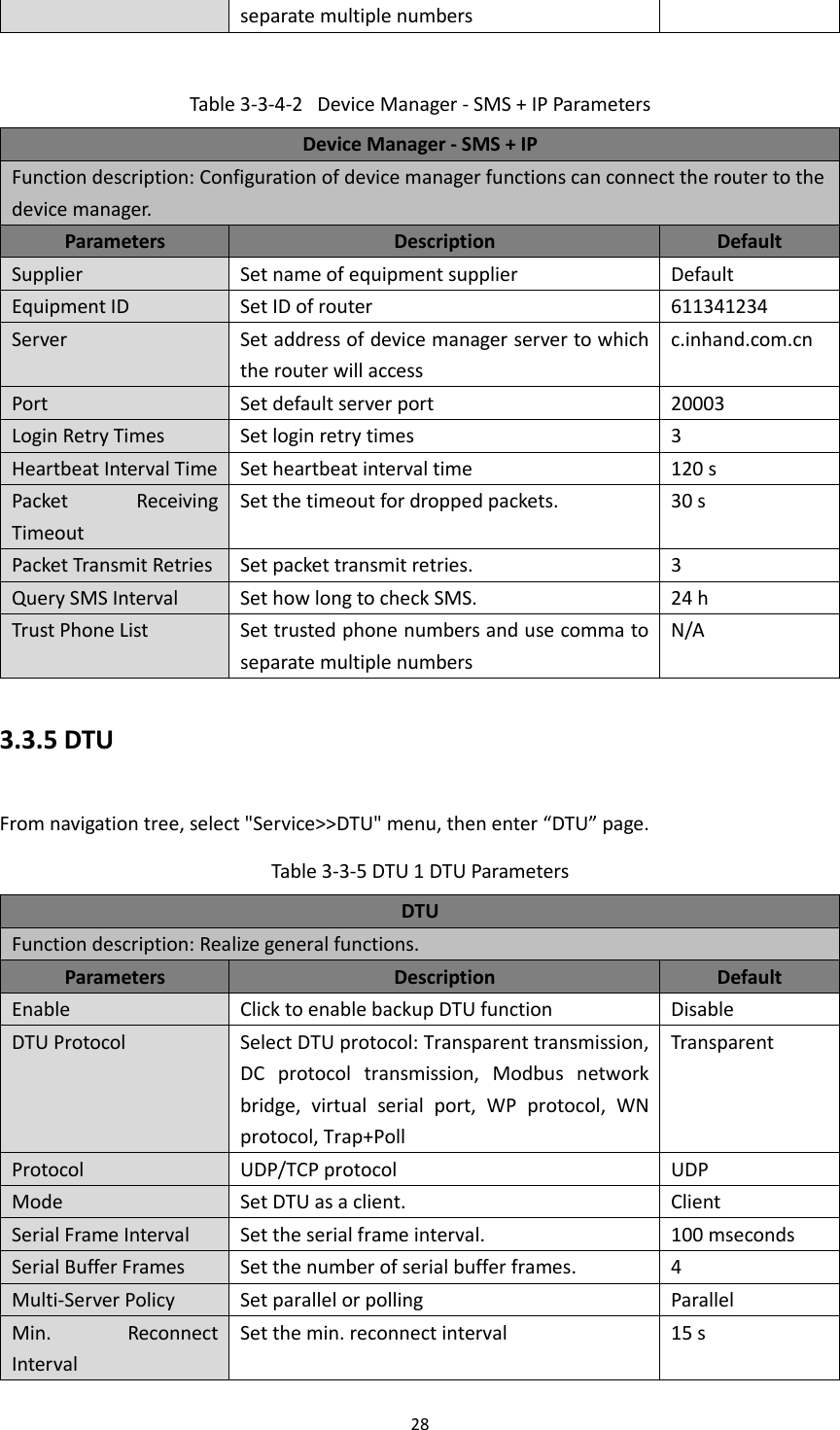
27  router with highest priority becomes the gateway for the transmission task. From navigation tree, select "Network >>VRRP" menu, then enter “VRRP” page.   Table 3-3-3 VRRP Parameters VRRP Function description: Configure parameters of VRRP. Parameters Description Default Enable VRRP-I Click to enable VRRP function   Disable Group ID Select ID of router group (range: 1-255) 1 Priority Select a priority (range: 1-254) 20  (the  larger  the  numerical value, the higher the priority) Advertisement Interval Set an advertisement interval. 60 s Virtual IP Set a virtual IP N/A Authentication method Select "None" or Password type None  (a  password  is  needed when  password  type  is selected) Virtual MAC Set a virtual MAC Disable Monitor Set monitor N/A VRRP-II Set as above Disable 3.3.4 Device Manager Device Management is a software platform to manage devices. The device can be managed and operated via software platform when Device Management is started so that the Internet can be in  efficient  operation.  For  instance,  the  operating  status  of  device  can  be  checked,  device software can be upgraded, device can be restarted, configuration parameters can be sent down to  device,  and  transmitting  control  or  message  query  can  be  realized  on  device  via  Device Manager. Click the "Service>>Device Manager" menu in the navigation tree to enter the "Device Manager" interface. It only support two modes, i.e. SMS and SMS + IP.     Table 3-3-4-1  Device Manager - Only SMS Parameters   Device Manager - Only SMS Function description: Configuration of device manager functions can connect the router to the device manager. Parameters Description Default Query SMS Interval Set how long to check SMS. 24 h Trust Phone List Add trusted phone numbers and use comma to N/A
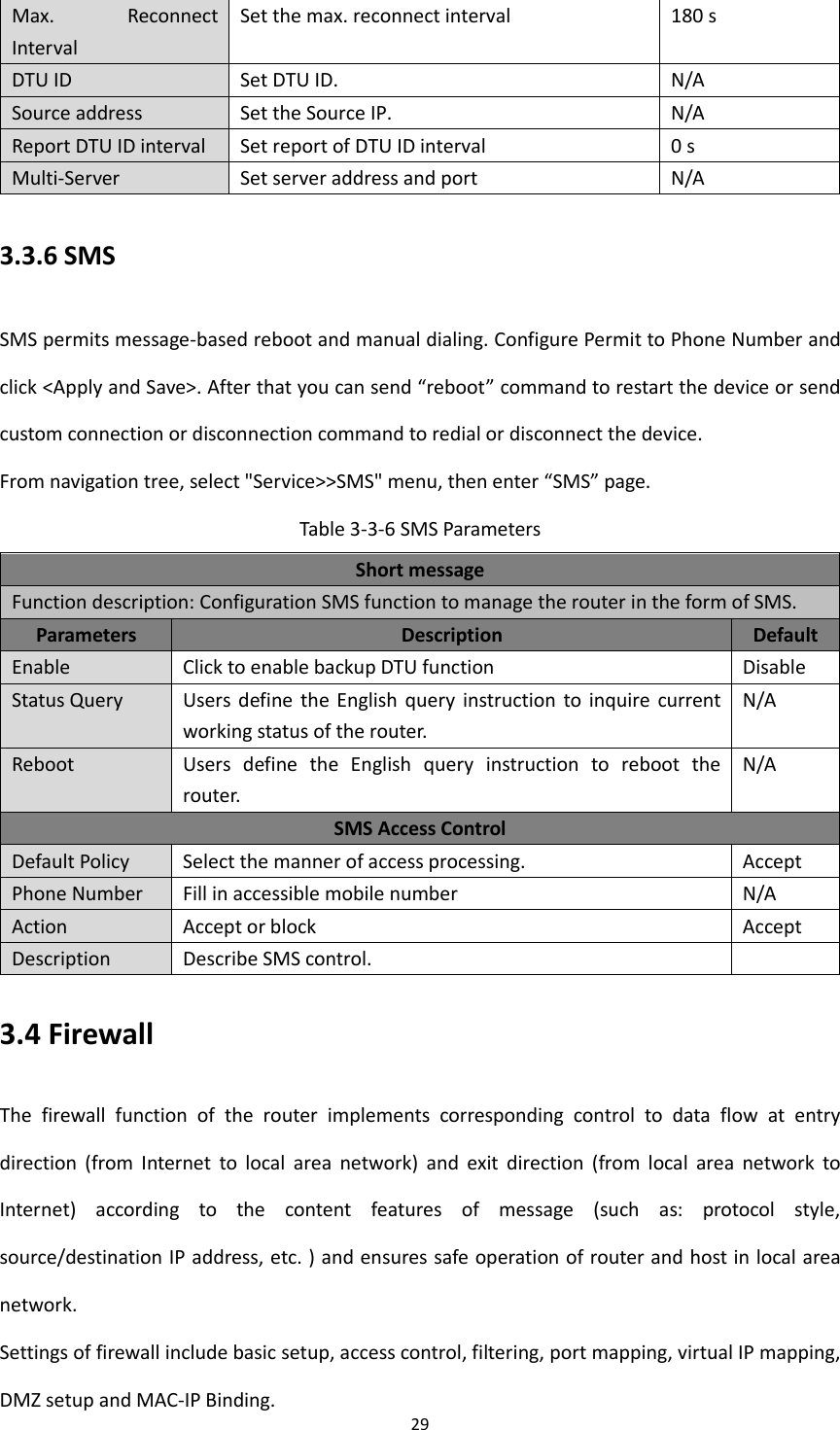
28  separate multiple numbers  Table 3-3-4-2  Device Manager - SMS + IP Parameters Device Manager - SMS + IP Function description: Configuration of device manager functions can connect the router to the device manager. Parameters Description Default Supplier Set name of equipment supplier Default   Equipment ID Set ID of router 611341234 Server   Set address of device manager server to which the router will access   c.inhand.com.cn Port Set default server port 20003 Login Retry Times Set login retry times 3 Heartbeat Interval Time Set heartbeat interval time 120 s Packet  Receiving Timeout Set the timeout for dropped packets. 30 s Packet Transmit Retries Set packet transmit retries. 3 Query SMS Interval Set how long to check SMS. 24 h Trust Phone List Set trusted phone numbers and use comma to separate multiple numbers N/A 3.3.5 DTU From navigation tree, select "Service>>DTU" menu, then enter “DTU” page. Table 3-3-5 DTU 1 DTU Parameters   DTU Function description: Realize general functions. Parameters Description Default Enable Click to enable backup DTU function Disable DTU Protocol Select DTU protocol: Transparent transmission, DC  protocol  transmission,  Modbus  network bridge,  virtual  serial  port,  WP  protocol,  WN protocol, Trap+Poll Transparent Protocol UDP/TCP protocol UDP Mode Set DTU as a client. Client Serial Frame Interval Set the serial frame interval. 100 mseconds Serial Buffer Frames Set the number of serial buffer frames. 4 Multi-Server Policy Set parallel or polling Parallel Min.    Reconnect Interval Set the min. reconnect interval 15 s
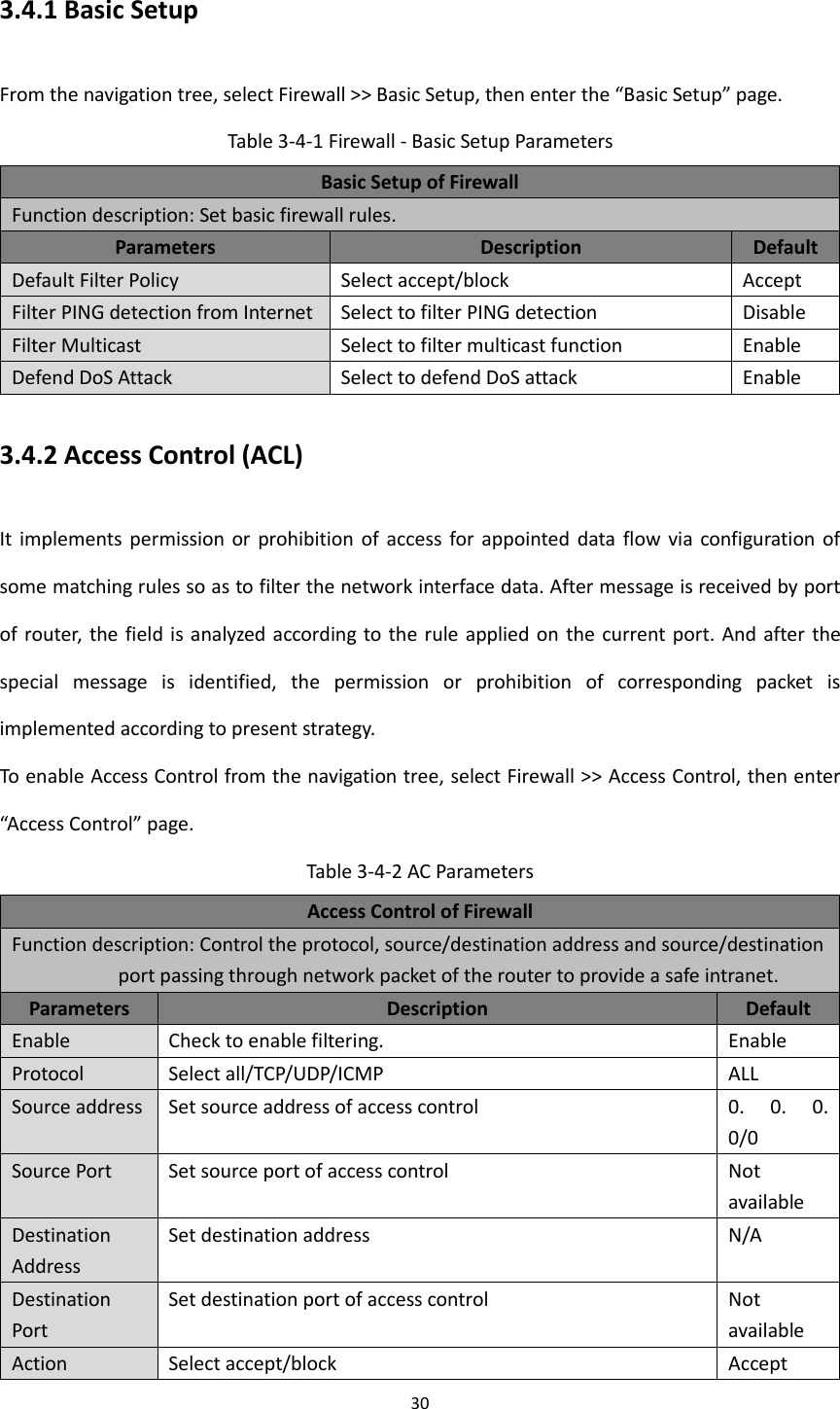
29  Max.    Reconnect Interval Set the max. reconnect interval 180 s DTU ID Set DTU ID. N/A Source address Set the Source IP. N/A Report DTU ID interval   Set report of DTU ID interval   0 s Multi-Server Set server address and port N/A 3.3.6 SMS SMS permits message-based reboot and manual dialing. Configure Permit to Phone Number and click <Apply and Save>. After that you can send “reboot” command to restart the device or send custom connection or disconnection command to redial or disconnect the device.   From navigation tree, select "Service>>SMS" menu, then enter “SMS” page.   Table 3-3-6 SMS Parameters   Short message Function description: Configuration SMS function to manage the router in the form of SMS. Parameters Description Default Enable Click to enable backup DTU function Disable Status Query Users define  the  English query  instruction to  inquire  current working status of the router.   N/A Reboot Users  define  the  English  query  instruction  to  reboot  the router. N/A SMS Access Control Default Policy Select the manner of access processing.   Accept Phone Number Fill in accessible mobile number N/A Action Accept or block Accept Description Describe SMS control.    3.4 Firewall The  firewall  function  of  the  router  implements  corresponding  control  to  data  flow  at  entry direction  (from  Internet  to  local  area  network)  and  exit  direction  (from  local  area  network  to Internet)  according  to  the  content  features  of  message  (such  as:  protocol  style, source/destination IP address, etc. ) and ensures safe operation of router and host in local area network. Settings of firewall include basic setup, access control, filtering, port mapping, virtual IP mapping, DMZ setup and MAC-IP Binding.
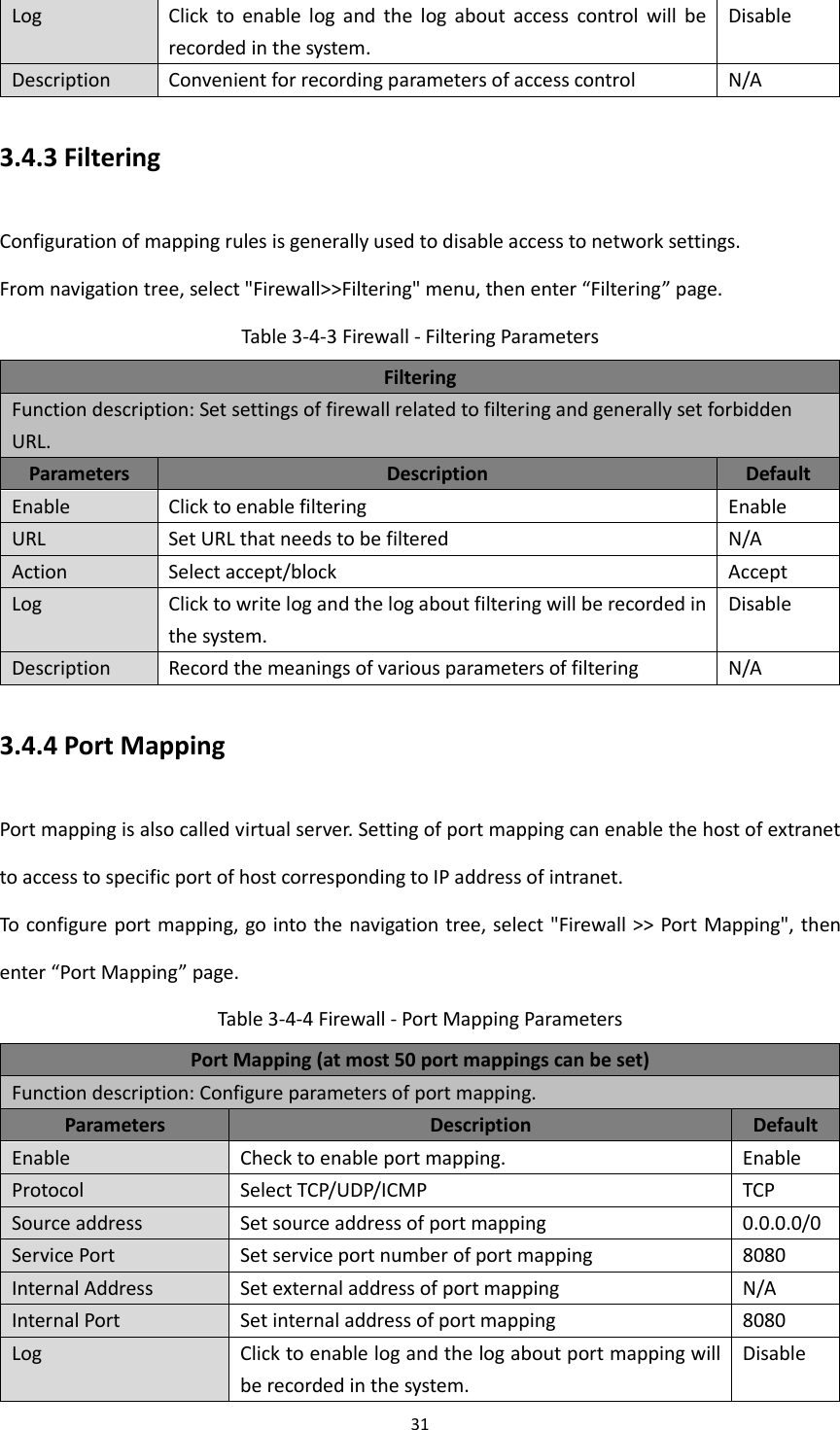
30  3.4.1 Basic Setup From the navigation tree, select Firewall >> Basic Setup, then enter the “Basic Setup” page. Table 3-4-1 Firewall - Basic Setup Parameters Basic Setup of Firewall   Function description: Set basic firewall rules. Parameters Description Default Default Filter Policy Select accept/block   Accept Filter PING detection from Internet Select to filter PING detection Disable Filter Multicast Select to filter multicast function Enable Defend DoS Attack Select to defend DoS attack Enable 3.4.2 Access Control (ACL) It  implements  permission or prohibition  of  access  for appointed data  flow via  configuration  of some matching rules so as to filter the network interface data. After message is received by port of router, the field  is analyzed  according to the  rule applied on  the current port. And after the special  message  is  identified,  the  permission  or  prohibition  of  corresponding  packet  is implemented according to present strategy. To enable Access Control from the navigation tree, select Firewall >> Access Control, then enter “Access Control” page. Table 3-4-2 AC Parameters Access Control of Firewall Function description: Control the protocol, source/destination address and source/destination port passing through network packet of the router to provide a safe intranet.   Parameters Description Default Enable Check to enable filtering. Enable Protocol Select all/TCP/UDP/ICMP ALL Source address Set source address of access control   0.    0.    0.   0/0 Source Port Set source port of access control Not available   Destination Address Set destination address N/A Destination Port Set destination port of access control Not available Action Select accept/block Accept
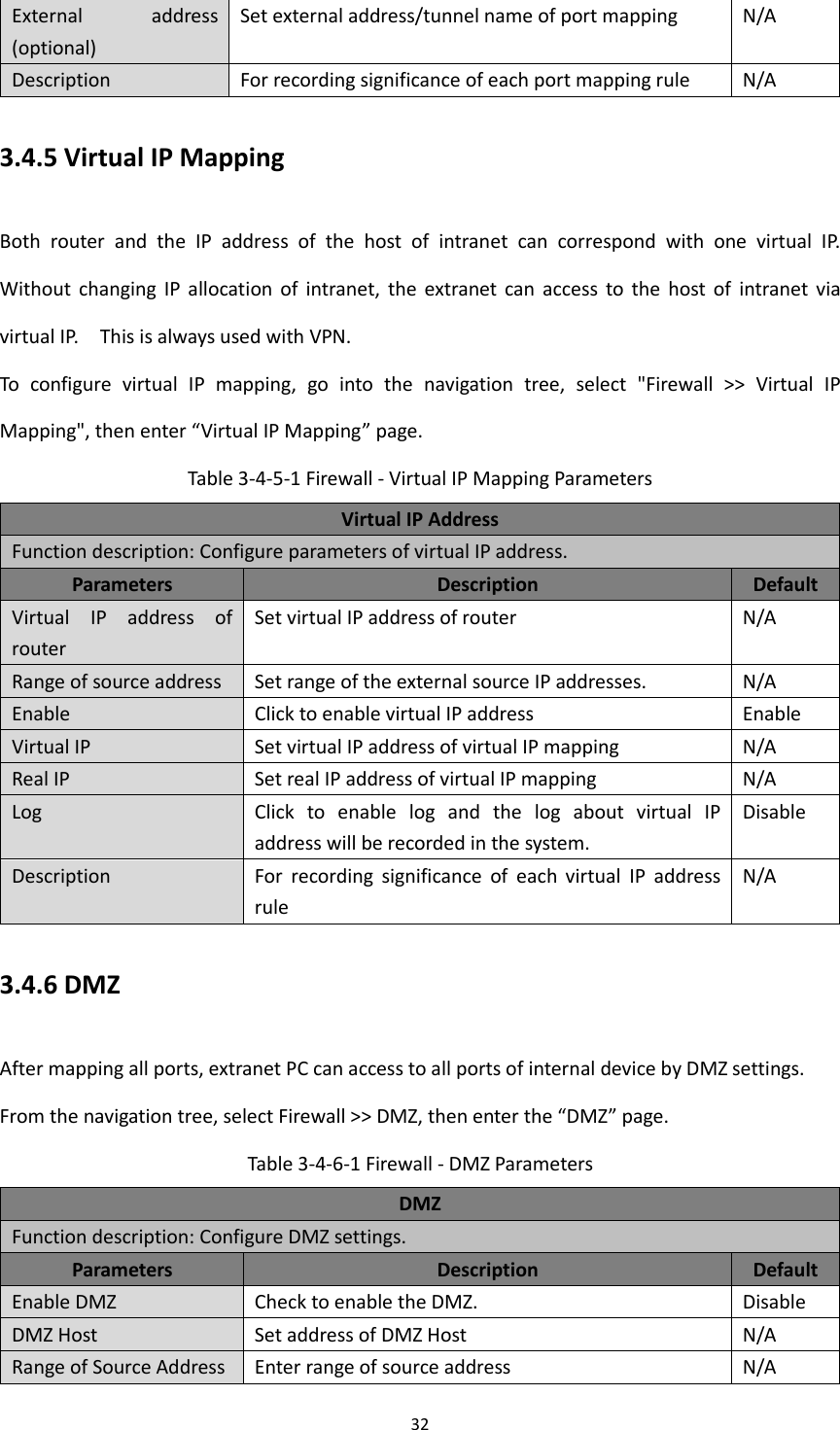
31  Log Click  to  enable  log  and  the  log  about  access  control  will  be recorded in the system.   Disable Description Convenient for recording parameters of access control N/A 3.4.3 Filtering Configuration of mapping rules is generally used to disable access to network settings.   From navigation tree, select "Firewall>>Filtering" menu, then enter “Filtering” page.   Table 3-4-3 Firewall - Filtering Parameters Filtering Function description: Set settings of firewall related to filtering and generally set forbidden URL.   Parameters Description Default Enable Click to enable filtering Enable URL Set URL that needs to be filtered N/A Action Select accept/block Accept Log Click to write log and the log about filtering will be recorded in the system. Disable Description Record the meanings of various parameters of filtering N/A 3.4.4 Port Mapping Port mapping is also called virtual server. Setting of port mapping can enable the host of extranet to access to specific port of host corresponding to IP address of intranet.   To configure port mapping, go into the navigation tree, select "Firewall >> Port Mapping", then enter “Port Mapping” page. Table 3-4-4 Firewall - Port Mapping Parameters   Port Mapping (at most 50 port mappings can be set) Function description: Configure parameters of port mapping. Parameters Description Default Enable Check to enable port mapping. Enable Protocol Select TCP/UDP/ICMP TCP Source address Set source address of port mapping 0.0.0.0/0 Service Port Set service port number of port mapping 8080 Internal Address Set external address of port mapping N/A Internal Port Set internal address of port mapping 8080 Log Click to enable log and the log about port mapping will be recorded in the system. Disable
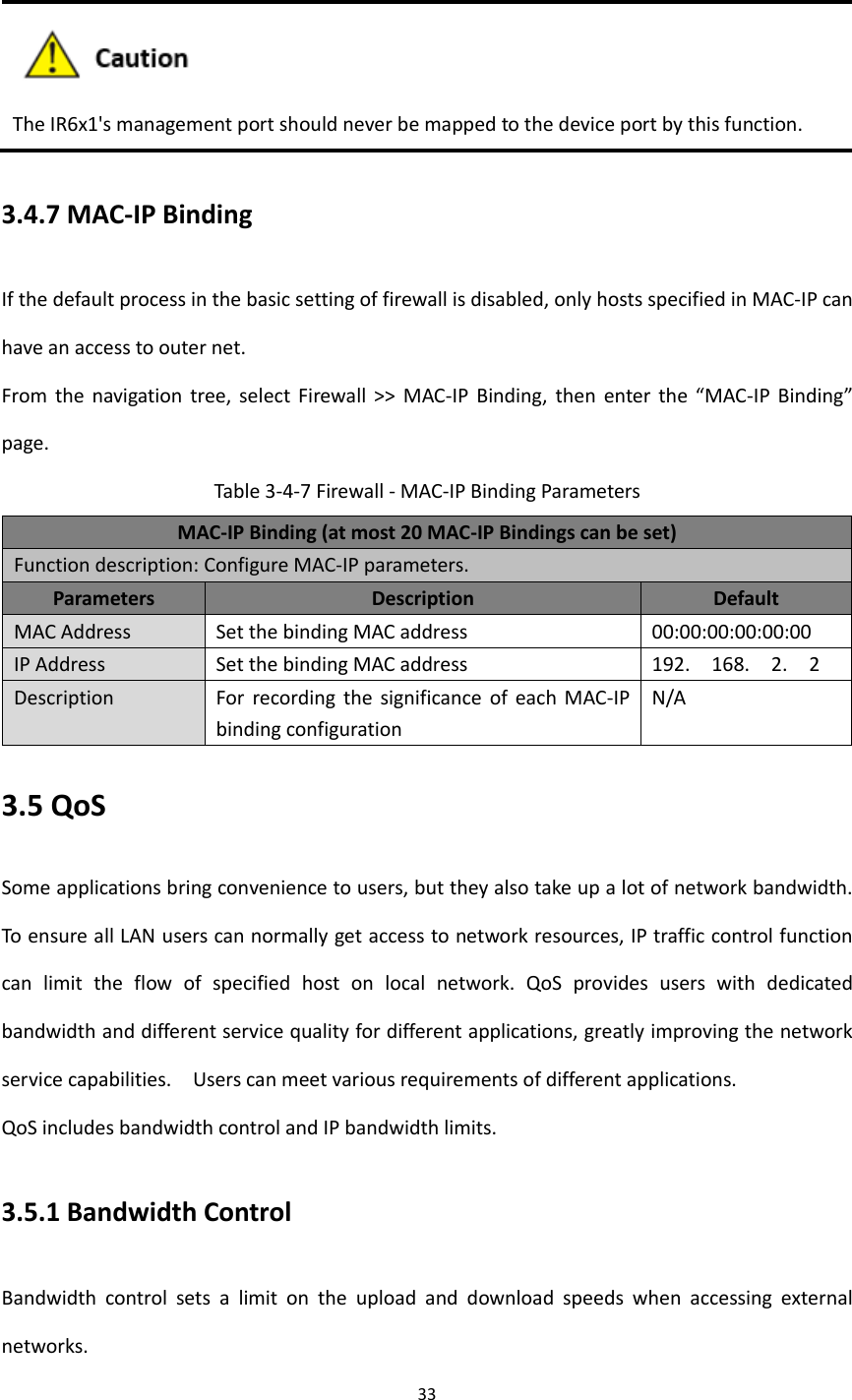
32  External  address (optional) Set external address/tunnel name of port mapping N/A Description For recording significance of each port mapping rule N/A 3.4.5 Virtual IP Mapping Both  router  and  the  IP  address  of  the  host  of  intranet  can  correspond  with  one  virtual  IP.   Without  changing  IP  allocation  of  intranet,  the  extranet  can  access  to  the  host  of  intranet  via virtual IP.    This is always used with VPN. To  configure  virtual  IP  mapping,  go  into  the  navigation  tree,  select  "Firewall  >>  Virtual  IP Mapping", then enter “Virtual IP Mapping” page.   Table 3-4-5-1 Firewall - Virtual IP Mapping Parameters   Virtual IP Address Function description: Configure parameters of virtual IP address. Parameters Description Default Virtual  IP  address  of router Set virtual IP address of router N/A Range of source address Set range of the external source IP addresses. N/A Enable Click to enable virtual IP address Enable Virtual IP   Set virtual IP address of virtual IP mapping N/A Real IP Set real IP address of virtual IP mapping N/A Log Click  to  enable  log  and  the  log  about  virtual  IP address will be recorded in the system. Disable Description For  recording  significance  of  each  virtual  IP  address rule N/A 3.4.6 DMZ   After mapping all ports, extranet PC can access to all ports of internal device by DMZ settings.   From the navigation tree, select Firewall >> DMZ, then enter the “DMZ” page. Table 3-4-6-1 Firewall - DMZ Parameters DMZ   Function description: Configure DMZ settings. Parameters Description Default Enable DMZ Check to enable the DMZ. Disable DMZ Host Set address of DMZ Host N/A Range of Source Address Enter range of source address N/A
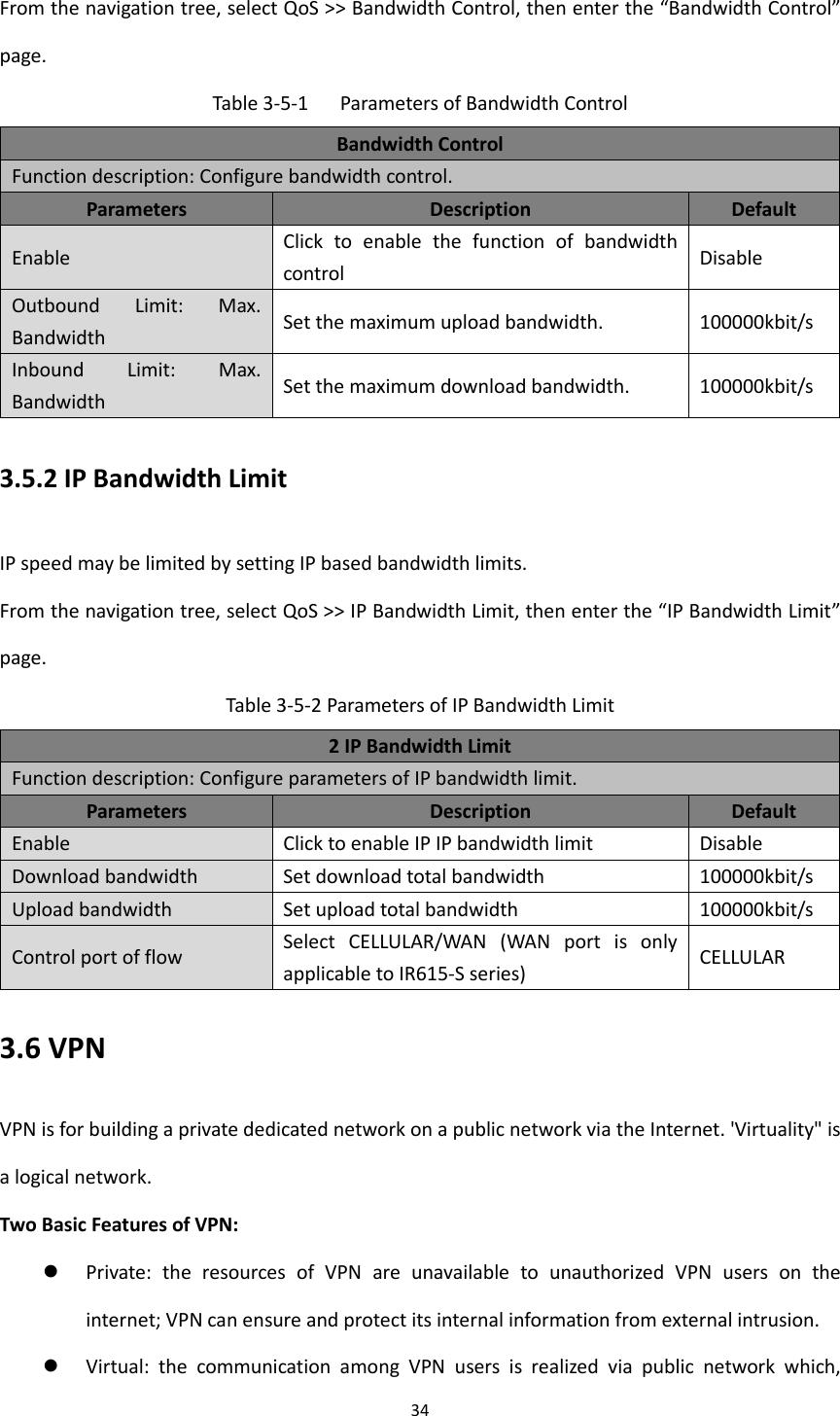
33    The IR6x1's management port should never be mapped to the device port by this function. 3.4.7 MAC-IP Binding If the default process in the basic setting of firewall is disabled, only hosts specified in MAC-IP can have an access to outer net. From  the  navigation  tree,  select  Firewall  >>  MAC-IP  Binding,  then  enter  the  “MAC-IP  Binding” page. Table 3-4-7 Firewall - MAC-IP Binding Parameters MAC-IP Binding (at most 20 MAC-IP Bindings can be set) Function description: Configure MAC-IP parameters. Parameters Description Default MAC Address Set the binding MAC address 00:00:00:00:00:00 IP Address Set the binding MAC address 192.    168.    2.    2 Description For  recording  the  significance  of  each  MAC-IP binding configuration N/A 3.5 QoS Some applications bring convenience to users, but they also take up a lot of network bandwidth. To ensure all LAN users can normally get access to network resources, IP traffic control function can  limit  the  flow  of  specified  host  on  local  network.  QoS  provides  users  with  dedicated bandwidth and different service quality for different applications, greatly improving the network service capabilities.    Users can meet various requirements of different applications. QoS includes bandwidth control and IP bandwidth limits. 3.5.1 Bandwidth Control Bandwidth  control  sets  a  limit  on  the  upload  and  download  speeds  when  accessing  external networks.
34  From the navigation tree, select QoS >> Bandwidth Control, then enter the “Bandwidth Control” page. Table 3-5-1  Parameters of Bandwidth Control Bandwidth Control Function description: Configure bandwidth control. Parameters Description Default Enable Click  to  enable  the  function  of  bandwidth control Disable Outbound  Limit:  Max. Bandwidth Set the maximum upload bandwidth. 100000kbit/s Inbound  Limit:  Max. Bandwidth Set the maximum download bandwidth. 100000kbit/s 3.5.2 IP Bandwidth Limit IP speed may be limited by setting IP based bandwidth limits.   From the navigation tree, select QoS >> IP Bandwidth Limit, then enter the “IP Bandwidth Limit” page.   Table 3-5-2 Parameters of IP Bandwidth Limit 2 IP Bandwidth Limit Function description: Configure parameters of IP bandwidth limit. Parameters Description Default Enable Click to enable IP IP bandwidth limit Disable Download bandwidth Set download total bandwidth 100000kbit/s Upload bandwidth Set upload total bandwidth 100000kbit/s Control port of flow Select  CELLULAR/WAN  (WAN  port  is  only applicable to IR615-S series)   CELLULAR 3.6 VPN VPN is for building a private dedicated network on a public network via the Internet. 'Virtuality" is a logical network. Two Basic Features of VPN:  Private:  the  resources  of  VPN  are  unavailable  to  unauthorized  VPN  users  on  the internet; VPN can ensure and protect its internal information from external intrusion.  Virtual:  the  communication  among  VPN  users  is  realized  via  public  network  which,
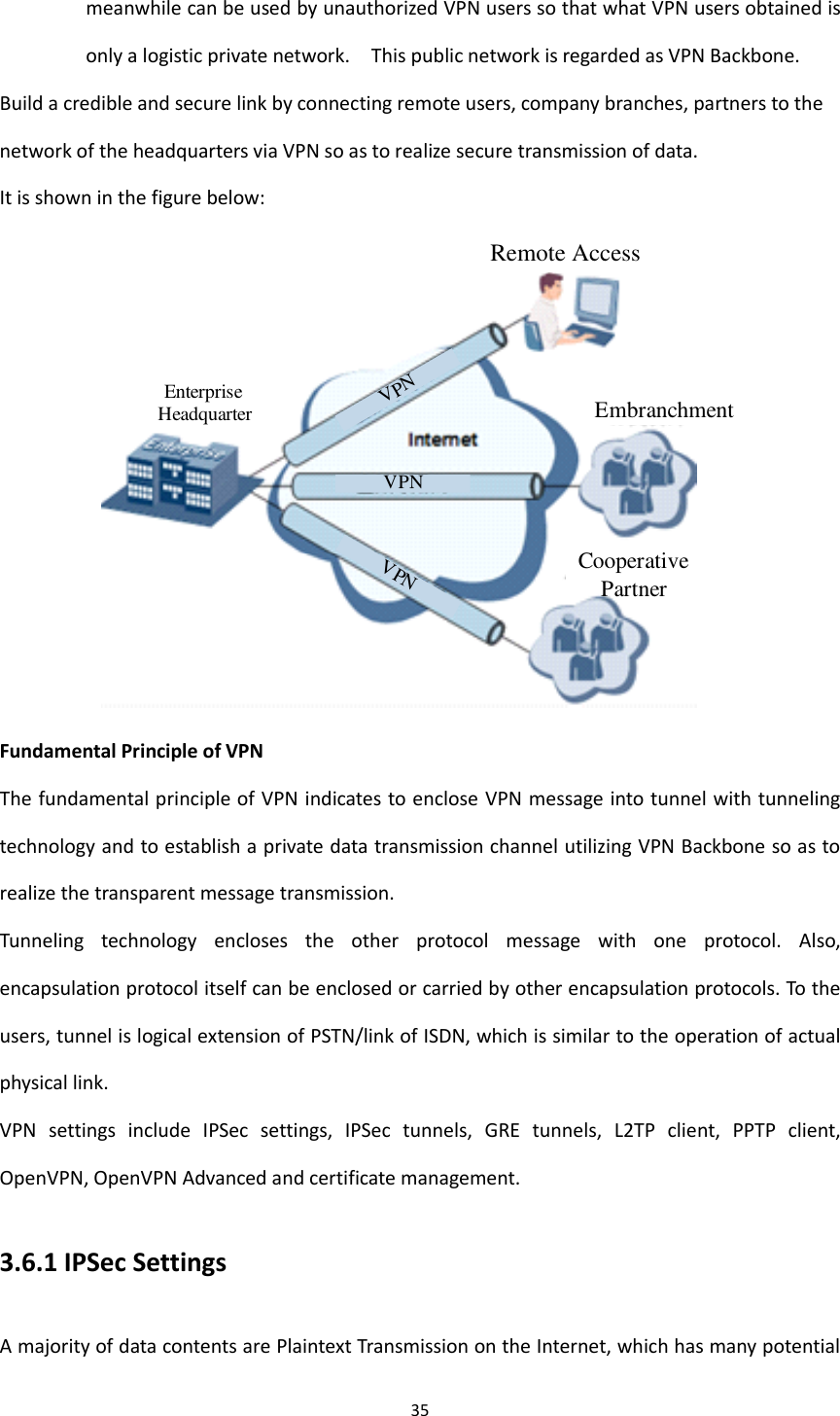
35  meanwhile can be used by unauthorized VPN users so that what VPN users obtained is only a logistic private network.    This public network is regarded as VPN Backbone. Build a credible and secure link by connecting remote users, company branches, partners to the network of the headquarters via VPN so as to realize secure transmission of data.   It is shown in the figure below: Enterprise Headquarter EmbranchmentCooperative PartnerVPNVPNVPNRemote Access Fundamental Principle of VPN The fundamental principle of VPN indicates to enclose VPN message into tunnel with tunneling technology and to establish a private data transmission channel utilizing VPN Backbone so as to realize the transparent message transmission. Tunneling  technology  encloses  the  other  protocol  message  with  one  protocol.  Also, encapsulation protocol itself can be enclosed or carried by other encapsulation protocols. To the users, tunnel is logical extension of PSTN/link of ISDN, which is similar to the operation of actual physical link. VPN  settings  include  IPSec  settings,  IPSec  tunnels,  GRE  tunnels,  L2TP  client,  PPTP  client, OpenVPN, OpenVPN Advanced and certificate management.   3.6.1 IPSec Settings A majority of data contents are Plaintext Transmission on the Internet, which has many potential
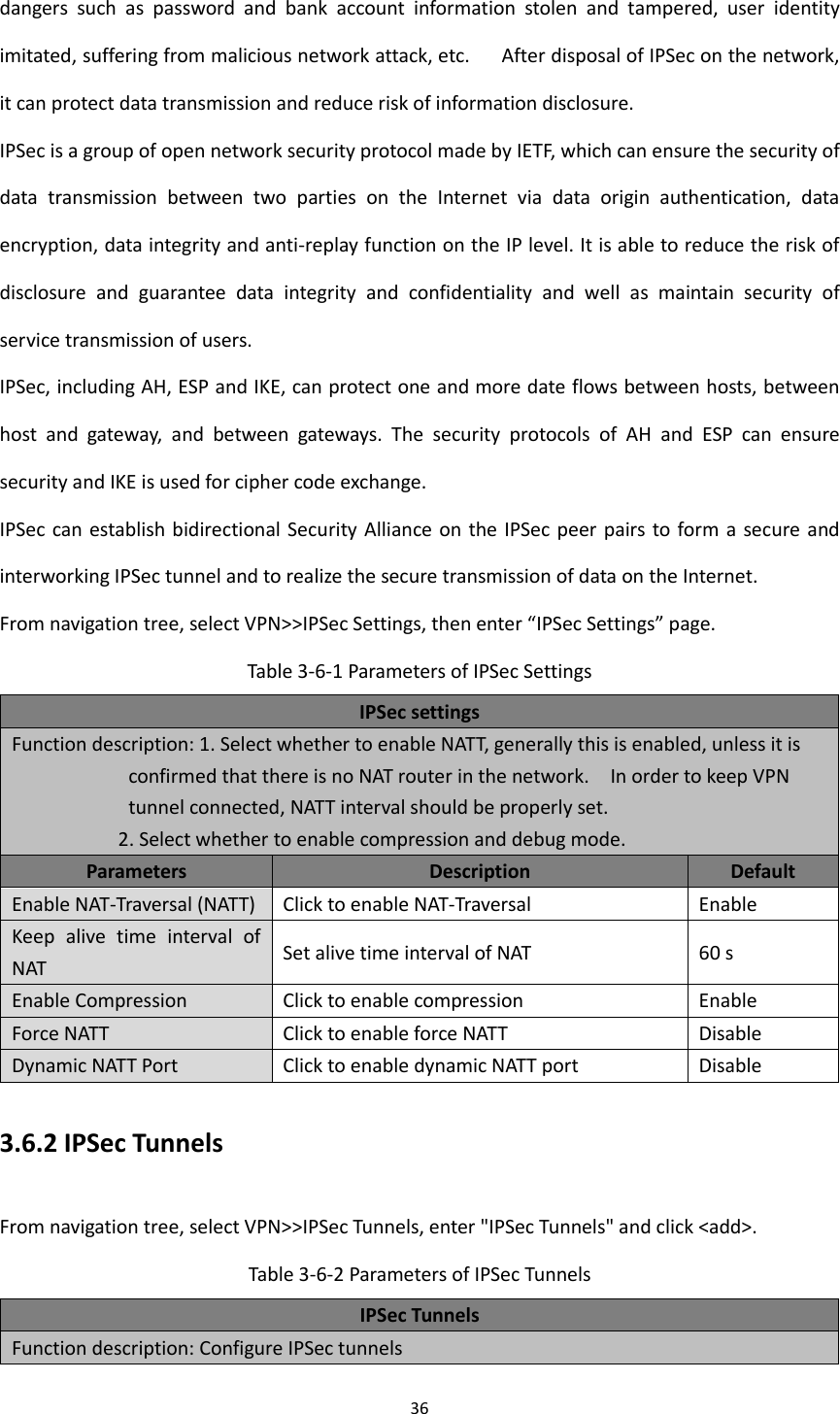
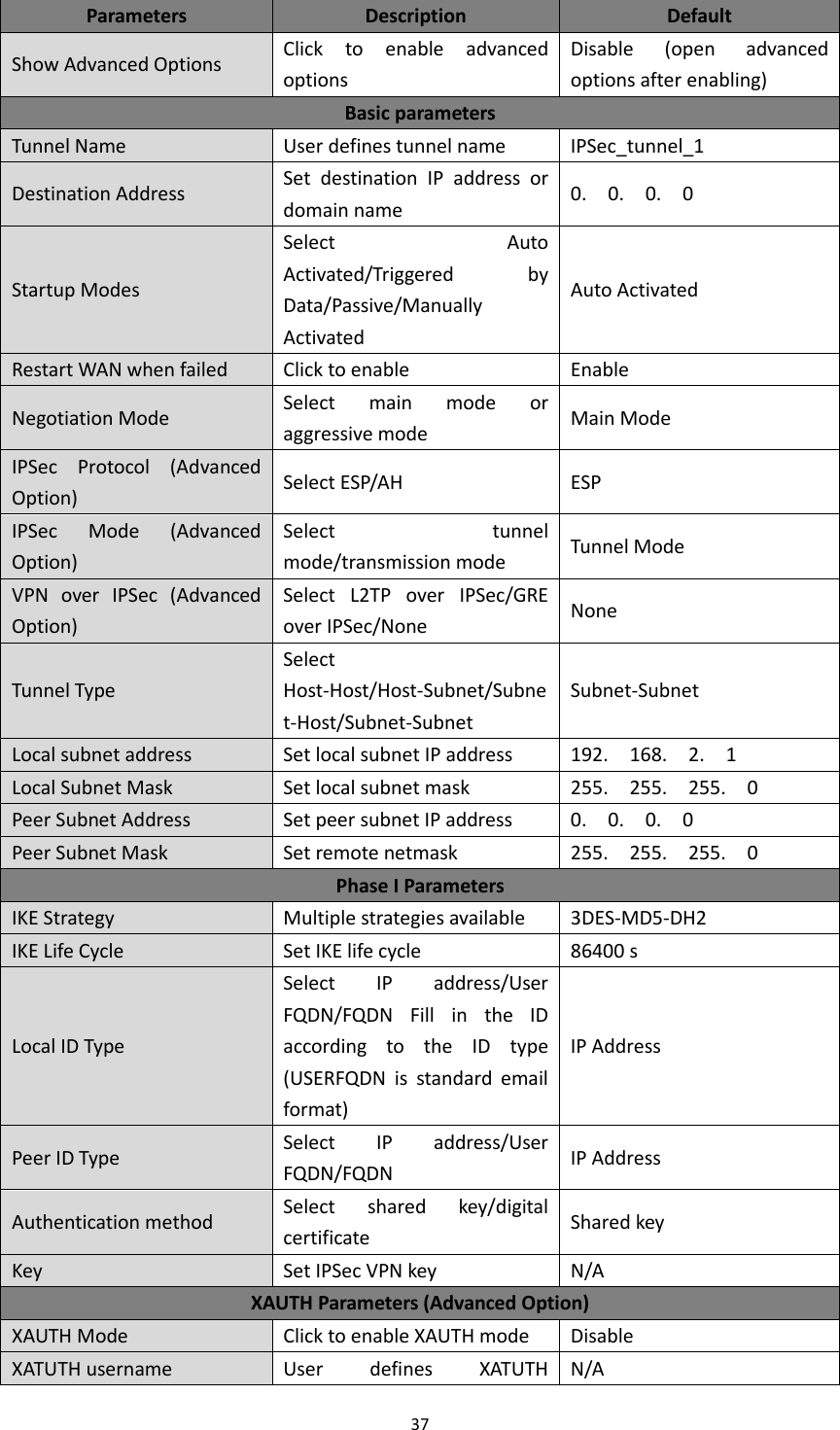
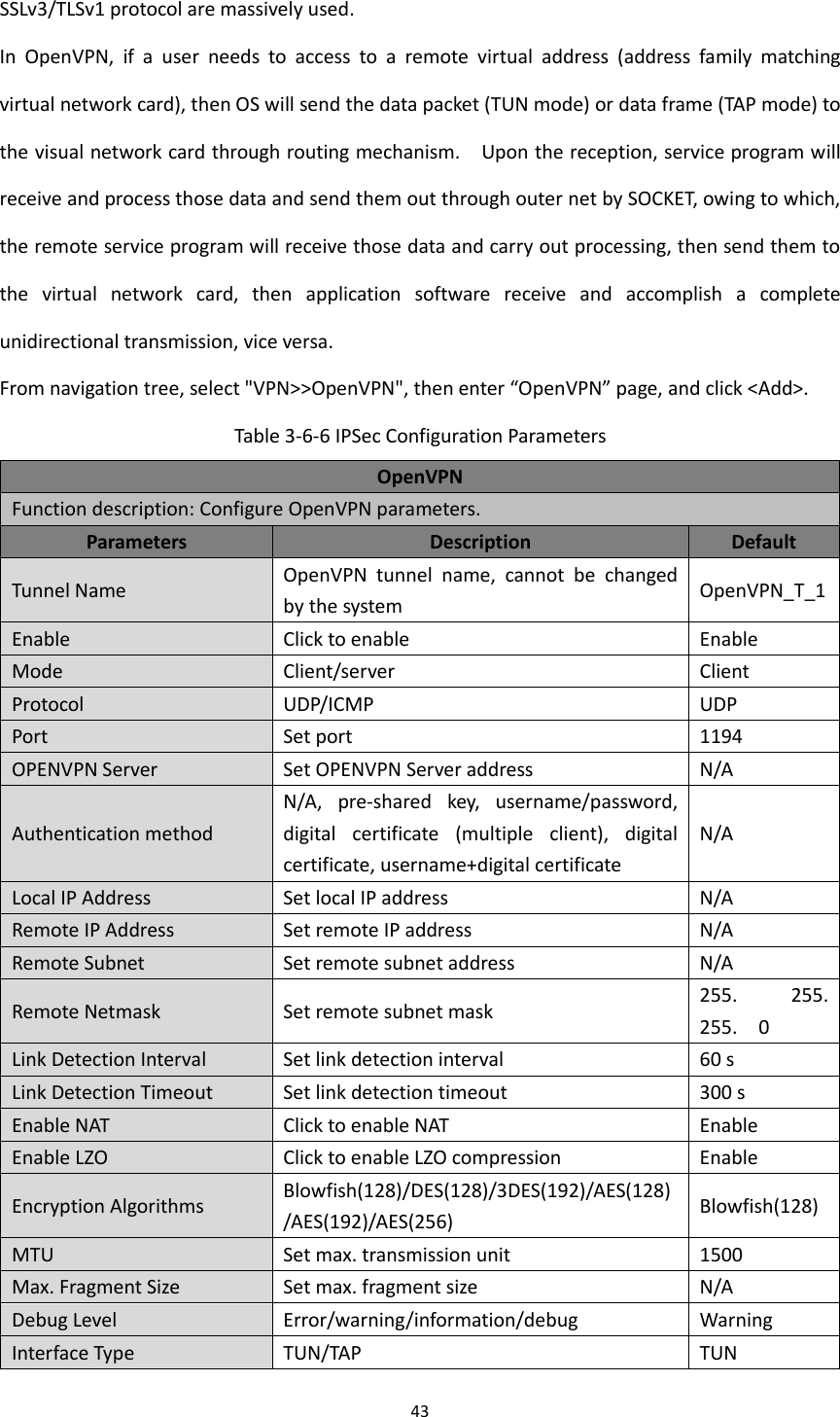
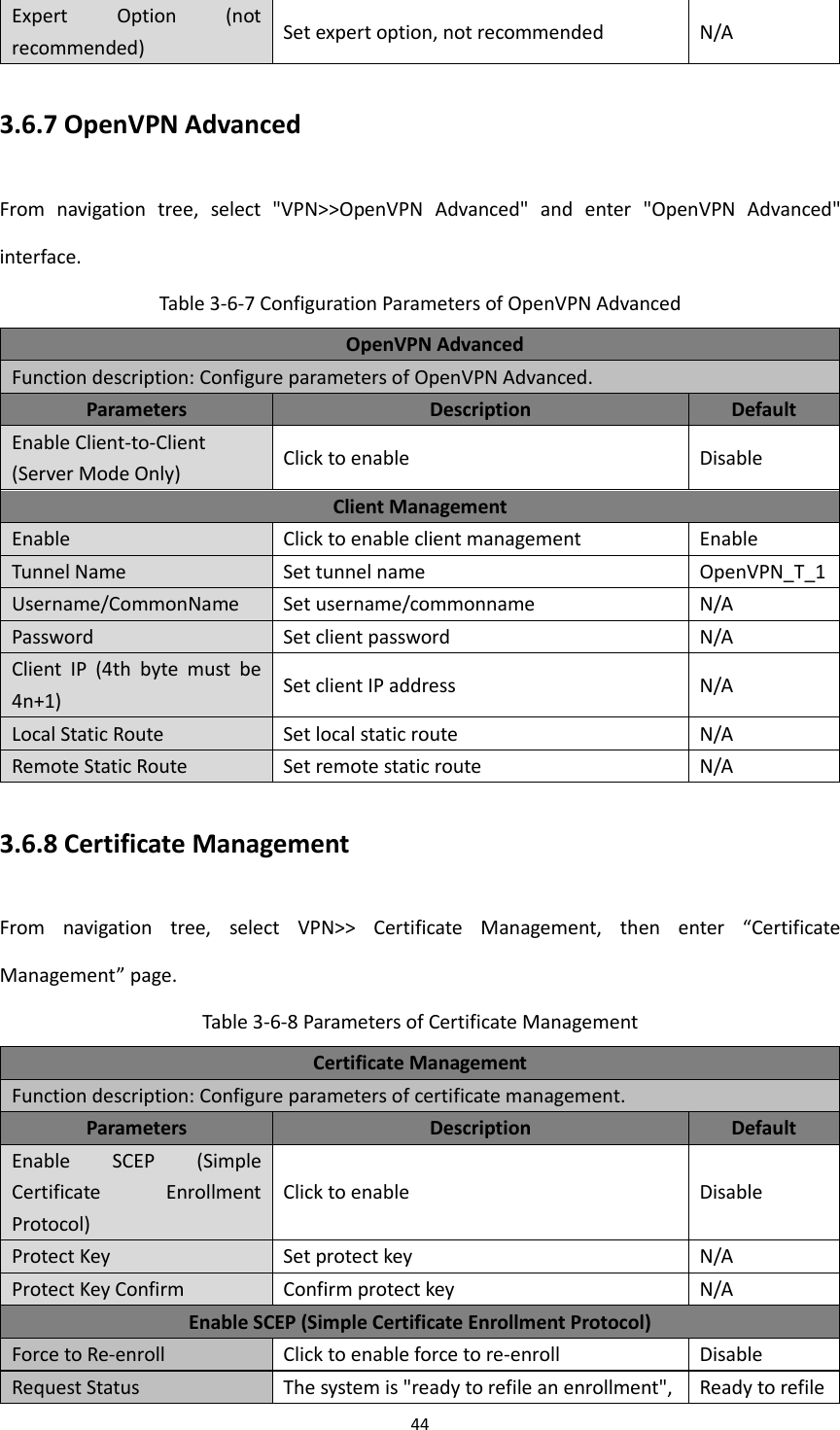
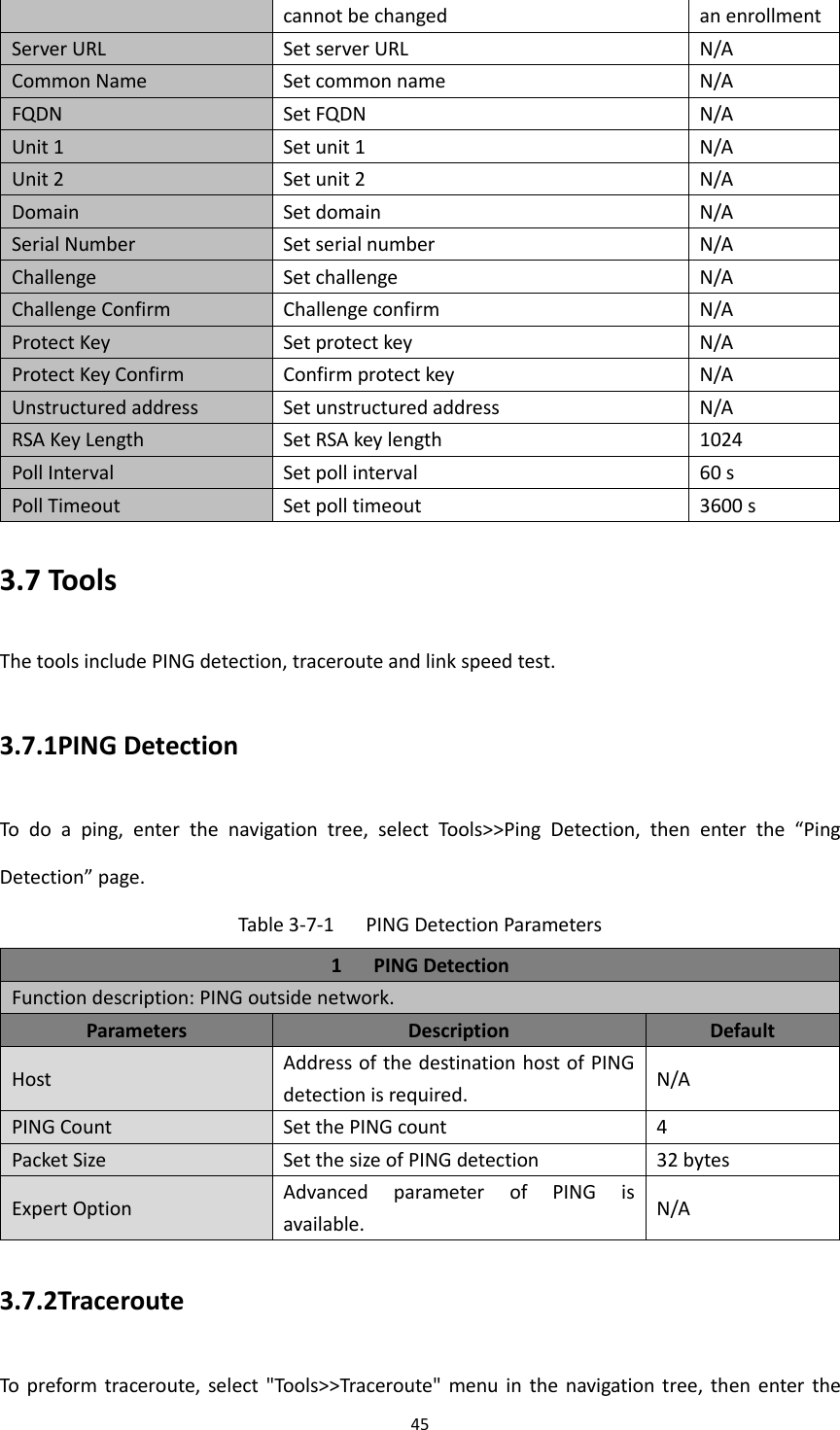
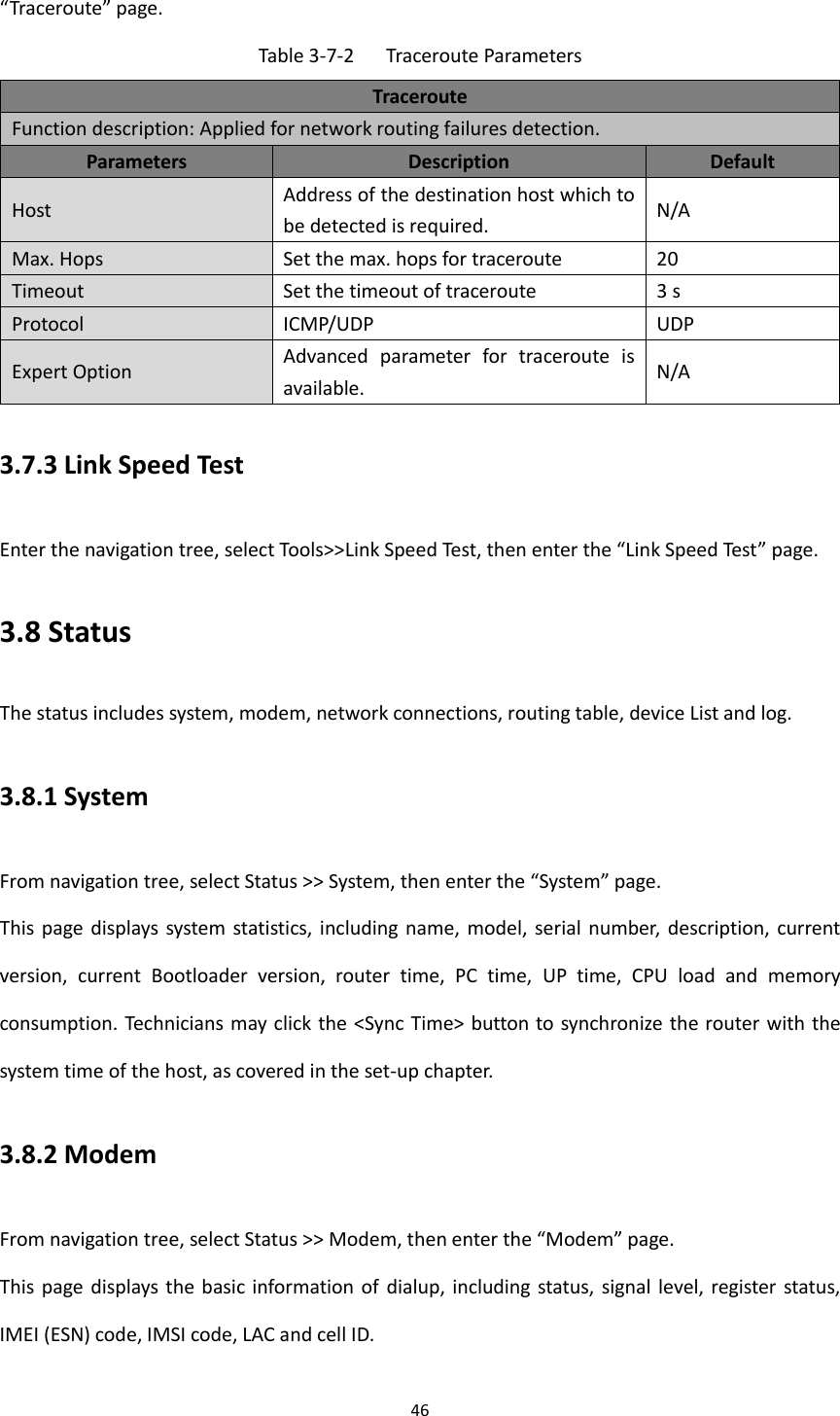
36  dangers  such  as  password  and  bank  account  information  stolen  and  tampered,  user  identity imitated, suffering from malicious network attack, etc.      After disposal of IPSec on the network, it can protect data transmission and reduce risk of information disclosure. IPSec is a group of open network security protocol made by IETF, which can ensure the security of data  transmission  between  two  parties  on  the  Internet  via  data  origin  authentication,  data encryption, data integrity and anti-replay function on the IP level. It is able to reduce the risk of disclosure  and  guarantee  data  integrity  and  confidentiality  and  well  as  maintain  security  of service transmission of users. IPSec, including AH, ESP and IKE, can protect one and more date flows between hosts, between host  and  gateway,  and  between  gateways.  The  security  protocols  of  AH  and  ESP  can  ensure security and IKE is used for cipher code exchange. IPSec can establish bidirectional Security Alliance on the IPSec peer  pairs to form a  secure and interworking IPSec tunnel and to realize the secure transmission of data on the Internet. From navigation tree, select VPN>>IPSec Settings, then enter “IPSec Settings” page. Table 3-6-1 Parameters of IPSec Settings   IPSec settings Function description: 1. Select whether to enable NATT, generally this is enabled, unless it is confirmed that there is no NAT router in the network.    In order to keep VPN tunnel connected, NATT interval should be properly set.                       2. Select whether to enable compression and debug mode. Parameters Description Default Enable NAT-Traversal (NATT) Click to enable NAT-Traversal Enable Keep  alive  time  interval  of NAT Set alive time interval of NAT 60 s Enable Compression Click to enable compression Enable Force NATT Click to enable force NATT Disable Dynamic NATT Port Click to enable dynamic NATT port Disable 3.6.2 IPSec Tunnels From navigation tree, select VPN>>IPSec Tunnels, enter "IPSec Tunnels" and click <add>. Table 3-6-2 Parameters of IPSec Tunnels   IPSec Tunnels Function description: Configure IPSec tunnels
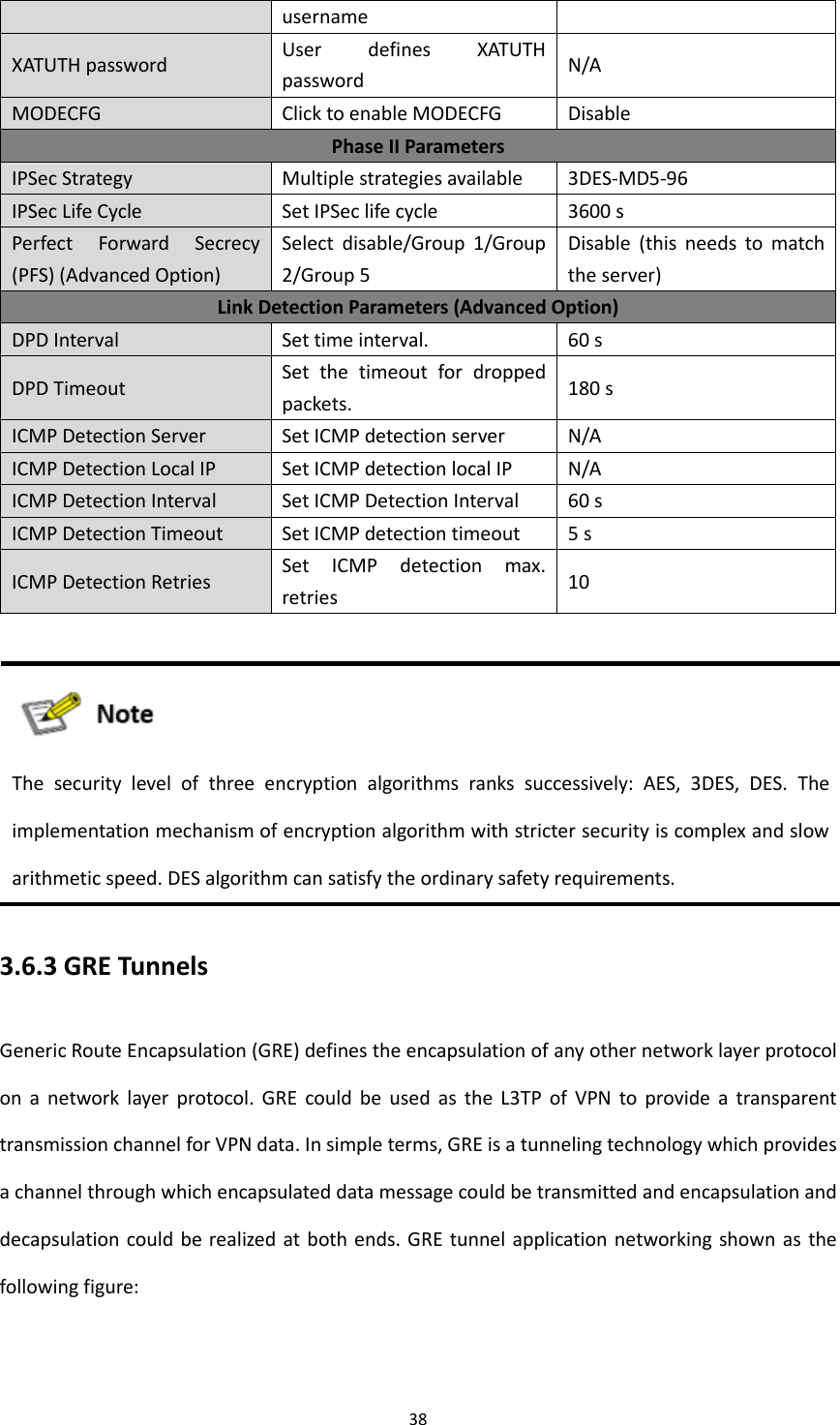
37  Parameters Description Default Show Advanced Options Click  to  enable  advanced options Disable  (open  advanced options after enabling) Basic parameters Tunnel Name User defines tunnel name IPSec_tunnel_1 Destination Address Set  destination  IP  address  or domain name 0.    0.    0.    0 Startup Modes Select  Auto Activated/Triggered  by Data/Passive/Manually Activated Auto Activated Restart WAN when failed Click to enable Enable Negotiation Mode Select  main  mode  or aggressive mode Main Mode IPSec  Protocol  (Advanced Option) Select ESP/AH ESP IPSec  Mode  (Advanced Option) Select  tunnel mode/transmission mode Tunnel Mode VPN  over  IPSec  (Advanced Option) Select  L2TP  over  IPSec/GRE over IPSec/None None Tunnel Type Select Host-Host/Host-Subnet/Subnet-Host/Subnet-Subnet Subnet-Subnet Local subnet address Set local subnet IP address 192.    168.    2.    1 Local Subnet Mask Set local subnet mask 255.    255.    255.    0 Peer Subnet Address Set peer subnet IP address 0.    0.    0.    0 Peer Subnet Mask Set remote netmask 255.    255.    255.    0 Phase I Parameters IKE Strategy Multiple strategies available   3DES-MD5-DH2 IKE Life Cycle Set IKE life cycle 86400 s Local ID Type Select  IP  address/User FQDN/FQDN  Fill  in  the  ID according  to  the  ID  type (USERFQDN  is  standard  email format) IP Address Peer ID Type Select  IP  address/User FQDN/FQDN IP Address Authentication method Select  shared  key/digital certificate Shared key Key Set IPSec VPN key N/A XAUTH Parameters (Advanced Option) XAUTH Mode Click to enable XAUTH mode Disable XATUTH username User  defines  XATUTH N/A
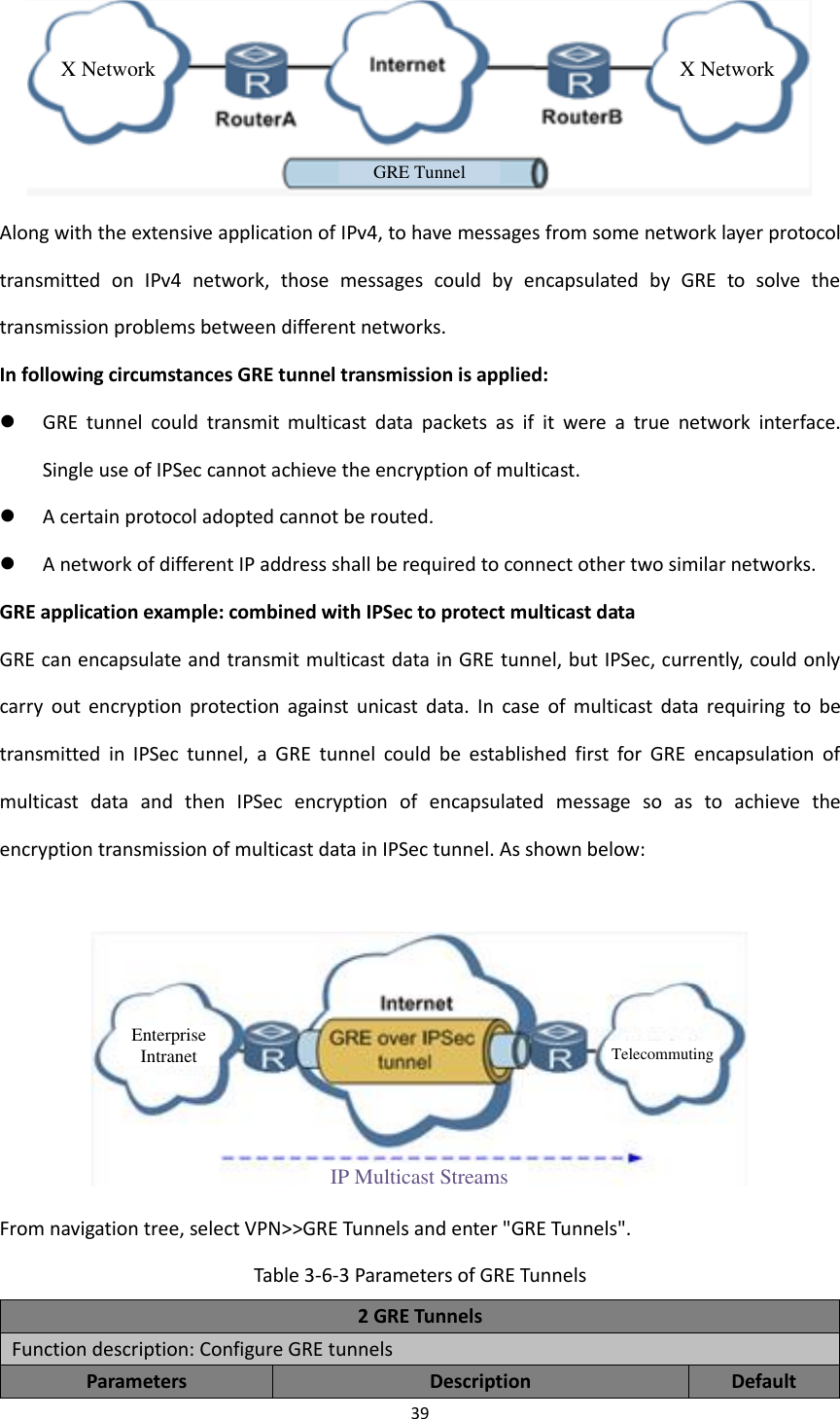
38  username XATUTH password User  defines  XATUTH password N/A MODECFG Click to enable MODECFG Disable Phase II Parameters IPSec Strategy Multiple strategies available 3DES-MD5-96 IPSec Life Cycle Set IPSec life cycle 3600 s Perfect  Forward  Secrecy (PFS) (Advanced Option) Select  disable/Group  1/Group 2/Group 5 Disable  (this  needs  to  match the server) Link Detection Parameters (Advanced Option) DPD Interval Set time interval. 60 s DPD Timeout Set  the  timeout  for  dropped packets. 180 s ICMP Detection Server Set ICMP detection server N/A ICMP Detection Local IP Set ICMP detection local IP N/A ICMP Detection Interval Set ICMP Detection Interval 60 s ICMP Detection Timeout Set ICMP detection timeout 5 s ICMP Detection Retries Set  ICMP  detection  max. retries 10   The  security  level  of  three  encryption  algorithms  ranks  successively:  AES,  3DES,  DES.  The implementation mechanism of encryption algorithm with stricter security is complex and slow arithmetic speed. DES algorithm can satisfy the ordinary safety requirements. 3.6.3 GRE Tunnels Generic Route Encapsulation (GRE) defines the encapsulation of any other network layer protocol on  a  network  layer  protocol.  GRE  could  be  used  as  the  L3TP  of  VPN  to  provide  a  transparent transmission channel for VPN data. In simple terms, GRE is a tunneling technology which provides a channel through which encapsulated data message could be transmitted and encapsulation and decapsulation could be realized at both ends. GRE tunnel application networking shown as the following figure:
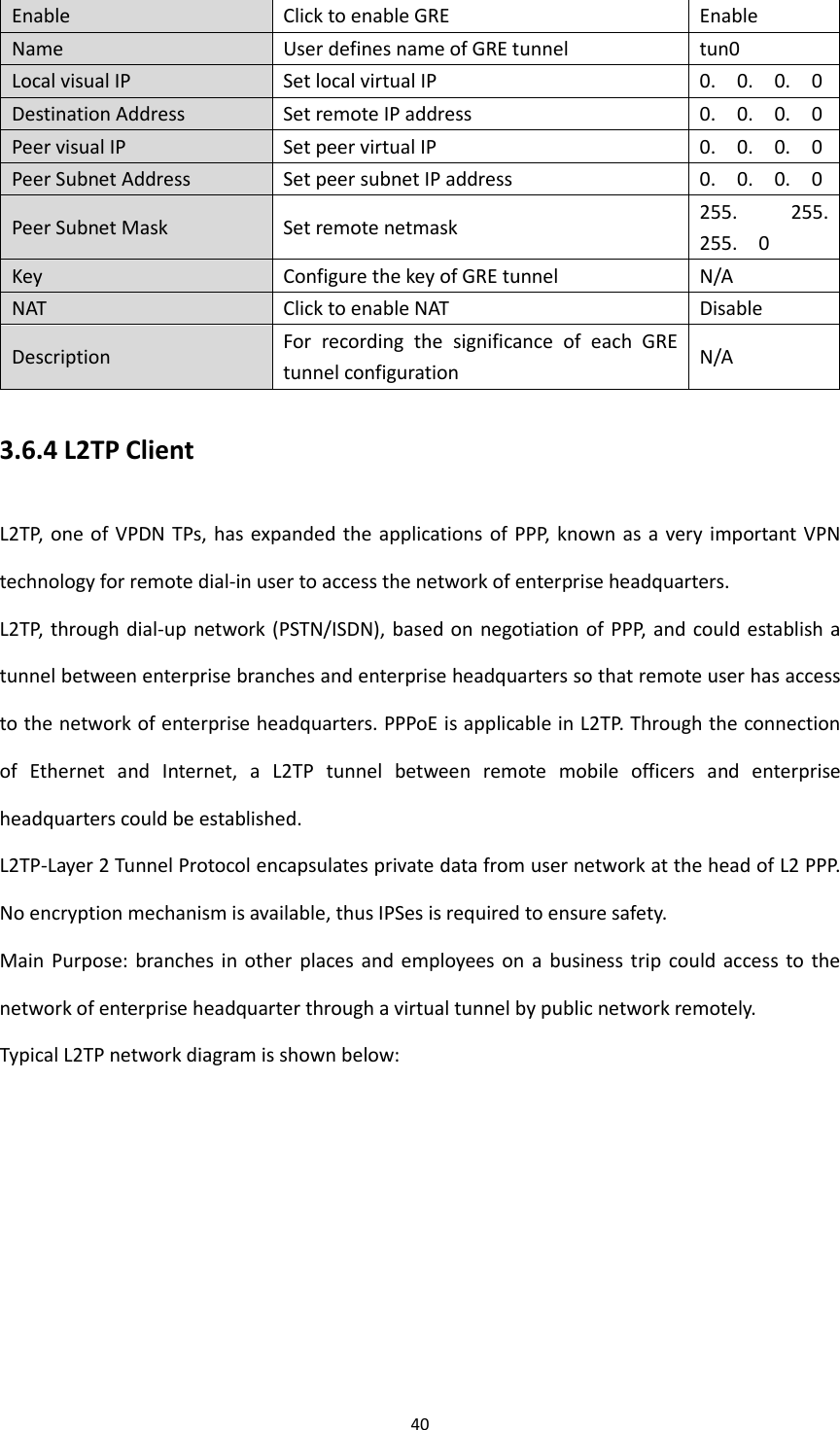
39  X Network X NetworkGRE Tunnel Along with the extensive application of IPv4, to have messages from some network layer protocol transmitted  on  IPv4  network,  those  messages  could  by  encapsulated  by  GRE  to  solve  the transmission problems between different networks. In following circumstances GRE tunnel transmission is applied:  GRE  tunnel  could  transmit  multicast  data  packets  as  if  it  were  a  true  network  interface.   Single use of IPSec cannot achieve the encryption of multicast.  A certain protocol adopted cannot be routed.  A network of different IP address shall be required to connect other two similar networks. GRE application example: combined with IPSec to protect multicast data GRE can encapsulate and transmit multicast data in GRE tunnel, but IPSec, currently, could only carry  out  encryption  protection  against  unicast  data.  In  case  of  multicast  data  requiring  to  be transmitted  in  IPSec  tunnel,  a  GRE  tunnel  could  be  established  first  for  GRE  encapsulation  of multicast  data  and  then  IPSec  encryption  of  encapsulated  message  so  as  to  achieve  the encryption transmission of multicast data in IPSec tunnel. As shown below:  Enterprise Intranet TelecommutingIP Multicast Streams From navigation tree, select VPN>>GRE Tunnels and enter "GRE Tunnels". Table 3-6-3 Parameters of GRE Tunnels 2 GRE Tunnels Function description: Configure GRE tunnels Parameters Description Default
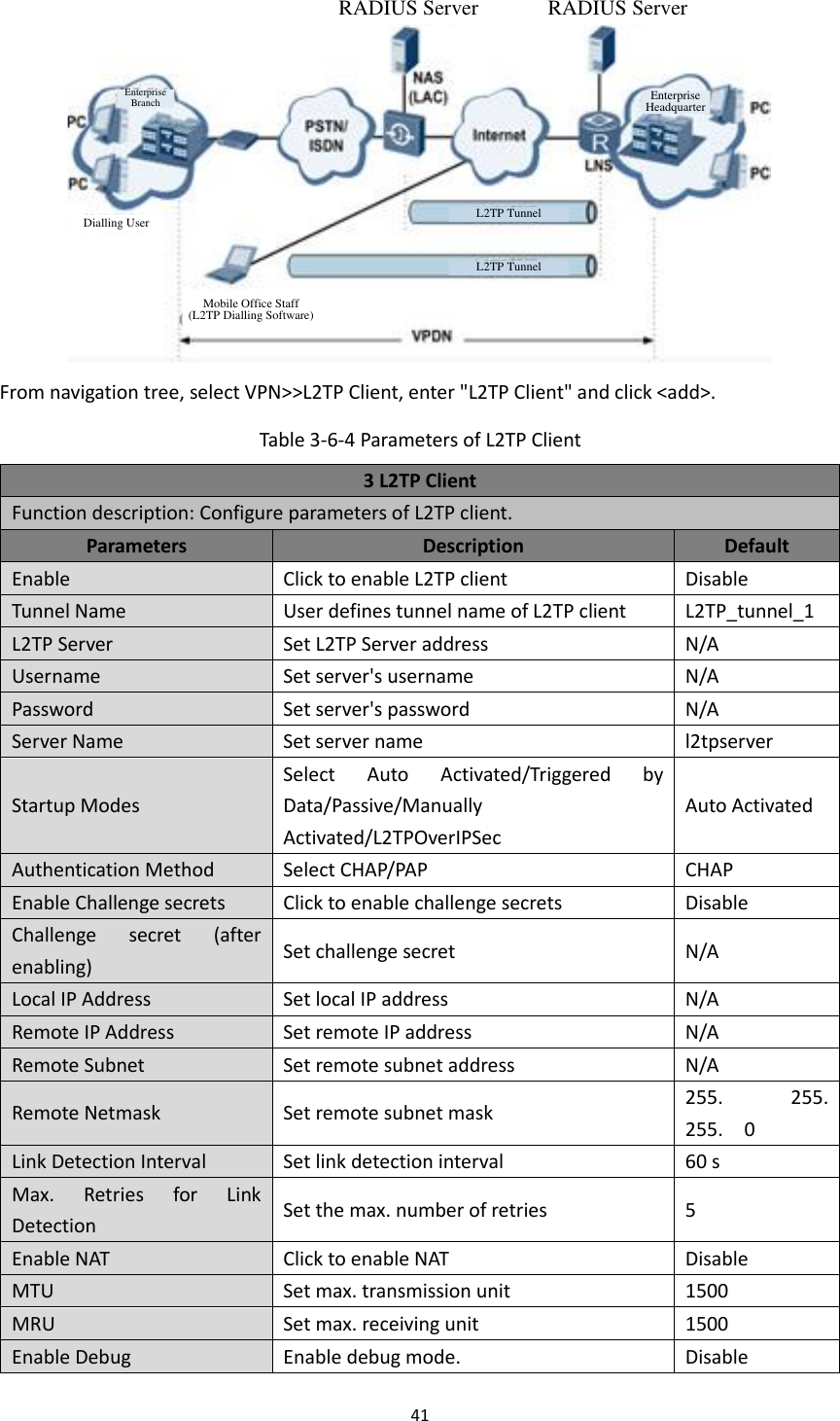
40  Enable Click to enable GRE Enable Name User defines name of GRE tunnel   tun0 Local visual IP   Set local virtual IP 0.    0.    0.    0 Destination Address Set remote IP address 0.    0.    0.    0 Peer visual IP Set peer virtual IP 0.    0.    0.    0 Peer Subnet Address Set peer subnet IP address 0.    0.    0.    0 Peer Subnet Mask Set remote netmask 255.    255.   255.    0 Key Configure the key of GRE tunnel N/A NAT Click to enable NAT Disable Description For  recording  the  significance  of  each  GRE tunnel configuration N/A 3.6.4 L2TP Client L2TP,  one of  VPDN TPs, has expanded the  applications  of PPP,  known as a very important VPN technology for remote dial-in user to access the network of enterprise headquarters. L2TP,  through dial-up network (PSTN/ISDN), based on  negotiation of  PPP, and could  establish a tunnel between enterprise branches and enterprise headquarters so that remote user has access to the network of enterprise headquarters. PPPoE is applicable in L2TP. Through the connection of  Ethernet  and  Internet,  a  L2TP  tunnel  between  remote  mobile  officers  and  enterprise headquarters could be established. L2TP-Layer 2 Tunnel Protocol encapsulates private data from user network at the head of L2 PPP. No encryption mechanism is available, thus IPSes is required to ensure safety. Main  Purpose:  branches  in other places  and  employees on  a business  trip  could  access  to  the network of enterprise headquarter through a virtual tunnel by public network remotely. Typical L2TP network diagram is shown below:
41  RADIUS Server RADIUS ServerEnterprise BranchDialling UserEnterprise HeadquarterMobile Office Staff (L2TP Dialling Software)L2TP TunnelL2TP Tunnel From navigation tree, select VPN>>L2TP Client, enter "L2TP Client" and click <add>. Table 3-6-4 Parameters of L2TP Client 3 L2TP Client Function description: Configure parameters of L2TP client. Parameters Description Default Enable Click to enable L2TP client Disable Tunnel Name User defines tunnel name of L2TP client L2TP_tunnel_1 L2TP Server Set L2TP Server address N/A Username Set server's username N/A Password Set server's password N/A Server Name Set server name l2tpserver Startup Modes Select  Auto  Activated/Triggered  by Data/Passive/Manually Activated/L2TPOverIPSec Auto Activated Authentication Method Select CHAP/PAP CHAP Enable Challenge secrets Click to enable challenge secrets Disable Challenge  secret  (after enabling) Set challenge secret N/A Local IP Address Set local IP address N/A Remote IP Address Set remote IP address N/A Remote Subnet Set remote subnet address N/A Remote Netmask Set remote subnet mask 255.    255.   255.    0 Link Detection Interval Set link detection interval 60 s Max.  Retries  for  Link Detection Set the max. number of retries 5 Enable NAT Click to enable NAT Disable MTU Set max. transmission unit 1500 MRU Set max. receiving unit 1500 Enable Debug Enable debug mode. Disable
42  Expert  Option  (not recommended) Set expert option, not recommended N/A 3.6.5 PPTP Client From navigation tree, select VPN>>PPTP Client, enter "PPTP Client" and click <add>. Table 3-6-5 Parameters of PPTP Client 4 PPTP Client Function description: Configure parameters of PPTP client. Parameters Description Default Enable Click to enable PPTP client Disable Tunnel Name User defines tunnel name PPTP_tunnel_1 PPTP Server Set PPTP Server address N/A Username Set username of PPTP server   N/A Password Set password of PPTP server   N/A Startup Modes Select  Auto  Activated/Triggered  by Data/Passive/Manually Activated Auto Activated Authentication method Select   Auto/CHAP/PAP/MS-CHAPv1/MS-CHAPv2 Auto Local IP Address Set local IP address N/A Remote IP Address Set remote IP address N/A Remote Subnet Set remote subnet address N/A Remote Netmask Set remote subnet mask 255.    255.   255.    0 Link Detection Interval Set link detection interval 60 s Max.  Retries  for  Link Detection Set the max. number of retries 5 Enable NAT Click to enable NAT Disable Enable MPPE Click to enable MPPE Disable Enable MPPC Click to enable MPPC Disable MTU Set max. transmission unit 1500 MRU Set max. receiving unit   1500 Enable Debug Enable debug mode. Disable Set  expert  option  (not recommended) Set expert option, not recommended N/A 3.6.6 OpenVPN Single point participating in the  establishment of  VPN is  allowed to carry out ID  verification by preset private key, third-party certificate or username/password. OpenSSL encryption library and
43  SSLv3/TLSv1 protocol are massively used. In  OpenVPN,  if  a  user  needs  to  access  to  a  remote  virtual  address  (address  family  matching virtual network card), then OS will send the data packet (TUN mode) or data frame (TAP mode) to the visual network card through routing mechanism.    Upon the reception, service program will receive and process those data and send them out through outer net by SOCKET, owing to which, the remote service program will receive those data and carry out processing, then send them to the  virtual  network  card,  then  application  software  receive  and  accomplish  a  complete unidirectional transmission, vice versa. From navigation tree, select "VPN>>OpenVPN", then enter “OpenVPN” page, and click <Add>. Table 3-6-6 IPSec Configuration Parameters OpenVPN Function description: Configure OpenVPN parameters.   Parameters Description Default Tunnel Name OpenVPN  tunnel  name,  cannot  be  changed by the system OpenVPN_T_1 Enable Click to enable Enable Mode Client/server Client Protocol UDP/ICMP UDP Port Set port 1194 OPENVPN Server Set OPENVPN Server address N/A Authentication method N/A,  pre-shared  key,  username/password, digital  certificate  (multiple  client),  digital certificate, username+digital certificate N/A Local IP Address Set local IP address N/A Remote IP Address Set remote IP address N/A Remote Subnet Set remote subnet address N/A Remote Netmask Set remote subnet mask 255.    255.   255.    0 Link Detection Interval Set link detection interval 60 s Link Detection Timeout Set link detection timeout 300 s Enable NAT Click to enable NAT Enable Enable LZO Click to enable LZO compression Enable Encryption Algorithms Blowfish(128)/DES(128)/3DES(192)/AES(128) /AES(192)/AES(256) Blowfish(128) MTU Set max. transmission unit 1500 Max. Fragment Size Set max. fragment size N/A Debug Level Error/warning/information/debug Warning Interface Type TUN/TAP TUN
44  Expert  Option  (not recommended) Set expert option, not recommended N/A 3.6.7 OpenVPN Advanced From  navigation  tree,  select  "VPN>>OpenVPN  Advanced"  and  enter  "OpenVPN  Advanced" interface. Table 3-6-7 Configuration Parameters of OpenVPN Advanced    OpenVPN Advanced   Function description: Configure parameters of OpenVPN Advanced. Parameters Description Default Enable Client-to-Client (Server Mode Only) Click to enable Disable Client Management Enable Click to enable client management Enable Tunnel Name Set tunnel name OpenVPN_T_1 Username/CommonName Set username/commonname N/A Password Set client password N/A Client  IP  (4th  byte  must  be 4n+1) Set client IP address N/A Local Static Route Set local static route N/A Remote Static Route Set remote static route N/A 3.6.8 Certificate Management From  navigation  tree,  select  VPN>>  Certificate  Management,  then  enter  “Certificate Management” page. Table 3-6-8 Parameters of Certificate Management Certificate Management Function description: Configure parameters of certificate management. Parameters Description Default Enable  SCEP  (Simple Certificate  Enrollment Protocol) Click to enable Disable Protect Key Set protect key N/A Protect Key Confirm Confirm protect key   N/A Enable SCEP (Simple Certificate Enrollment Protocol) Force to Re-enroll Click to enable force to re-enroll Disable Request Status The system is "ready to refile an enrollment", Ready to refile
45  cannot be changed an enrollment Server URL Set server URL N/A Common Name Set common name N/A FQDN Set FQDN N/A Unit 1 Set unit 1 N/A Unit 2 Set unit 2 N/A Domain Set domain N/A Serial Number Set serial number N/A Challenge Set challenge N/A Challenge Confirm Challenge confirm N/A Protect Key Set protect key N/A Protect Key Confirm Confirm protect key N/A Unstructured address Set unstructured address N/A RSA Key Length Set RSA key length 1024 Poll Interval Set poll interval 60 s Poll Timeout Set poll timeout 3600 s 3.7 Tools The tools include PING detection, traceroute and link speed test.   3.7.1PING Detection To  do  a  ping,  enter  the  navigation  tree,  select  Tools>>Ping  Detection,  then  enter  the  “Ping Detection” page.   Table 3-7-1  PING Detection Parameters   1   PING Detection Function description: PING outside network. Parameters Description Default Host Address of the destination host of PING detection is required. N/A PING Count Set the PING count 4 Packet Size Set the size of PING detection 32 bytes Expert Option Advanced  parameter  of  PING  is available. N/A 3.7.2Traceroute To  preform traceroute,  select  "Tools>>Traceroute"  menu in the  navigation  tree, then enter  the
46  “Traceroute” page. Table 3-7-2  Traceroute Parameters Traceroute Function description: Applied for network routing failures detection. Parameters Description Default Host Address of the destination host which to be detected is required. N/A Max. Hops Set the max. hops for traceroute 20 Timeout Set the timeout of traceroute 3 s Protocol ICMP/UDP UDP Expert Option Advanced  parameter  for  traceroute  is available. N/A 3.7.3 Link Speed Test Enter the navigation tree, select Tools>>Link Speed Test, then enter the “Link Speed Test” page. 3.8 Status The status includes system, modem, network connections, routing table, device List and log. 3.8.1 System From navigation tree, select Status >> System, then enter the “System” page. This page  displays system statistics,  including name,  model,  serial number,  description, current version,  current  Bootloader  version,  router  time,  PC  time,  UP  time,  CPU  load  and  memory consumption. Technicians may click the <Sync Time> button to synchronize the router with the system time of the host, as covered in the set-up chapter. 3.8.2 Modem From navigation tree, select Status >> Modem, then enter the “Modem” page.   This page  displays the basic information of  dialup, including status, signal  level, register  status, IMEI (ESN) code, IMSI code, LAC and cell ID.
47  3.8.3 Network Connections From navigation tree, select Status >> Network Connections, then enter “Network Connections” page to see the connections status. This page shows the basis information of dialup and LAN. Dialup includes connection type, IP address, netmask, gateway, DNS, MTU, status and connection time.   LAN includes MAC address, IP address, netmask, gateway, MTU and DNS. 3.8.4 Route Table From navigation tree, select Status >> Route Table, then enter “Route Table” page to see router status. This  page  displays  the  active  route  table,  including  destination,  netmask,  gateway,  metric  and interface.   3.8.5 Device List From navigation tree,  select  Status >>  Device List, then  enter  “Device List”  page  to inquire the device list. This  page displays  the  device list,  including interface, MAC  address, IP address,  host  and  lease (click MAC address to link to IEEE to inquire validity of the address).   3.8.6 Log From navigation tree, select Status >> Log, then enter “Log” page. This page displays  the logs, including select to see  the number of  log lines  (20/50/....../all), log level (information, debug and warning), time, module and content.    Clear log, download log file, download system diagnosis record (refresh rate of this page is 5/10/…... 1min by default)
48  Appendix A FAQ 1. InRouter is powered on, but can't access Internet through it?   Please first check:    Whether the InRouter is inserted with a SIM card.  Whether the SIM card is enabled with data service, whether the service of the SIM card is suspended because of an overdue charge.    Whether the dialup parameters, e.g.      APN, dialup number, username and password are correctly configured.  Whether  the  IP Address of  your computer is  the same  subnet with  InRouter  and  the gateway address is InRouter LAN address.  ; 2. InRouter is powered on, have a ping to detect InRouter from your PC and find packet loss? Please check if the network crossover cable is in good condition. 3. Forget the setting after revising IP address and can't configure InRouter? Method 1: connect InRouter with serial cable, configure it through console port. Method  2:  Within  5  seconds  after  InRouter  is  powered  on,  press  and  hold  the  Restore button until the ERROR LED flashes, then release the button and the ERROR LED should  goes  off,  press  and  hold  the  button  again  until  the  ERROR  LED  blinks  6 times, the InRouter is now restored to factory default settings.   You may configure it now. 4. After InRouter is powered on, it frequently auto restarts. Why does this happen? First check:    Whether the module works normally.  Whether the InRouter is inserted with a SIM card.  Whether the SIM card is enabled with data service, whether the service of the SIM card is suspended because of an overdue charge.  Whether  the  dialup  parameters,  e.g.      APN,  dialup  number,  username  and password are correctly configured.  Whether the signal is normal.  Whether the power supply voltage is normal. 5. Why does upgrading the firmware of my InRouter always fail? Examination:    When  upgrading  locally,  check  if  the  local  PC  and  InRouter  are  in  the  same  network segment.  When upgrading remotely, please first make sure the InRouter can access Internet. 6. After InRouter establishes VPN with the VPN server, your PC under InRouter can connect to the
49  server, but the center can't connect to your PC under InRouter?   Please make sure the firewall of your computer is disabled. 7. After InRouter establishes VPN with the VPN server, your PC under InRouter can't connect to the server ping?     Please make sure “Shared Connection” on “Network=>WAN” or “Network=>Dialup” is enabled in the configuration of InRouter.   8. InRouter is powered on, but the Power LED is not on?  Check if the protective tube is burn out.  Check the power supply voltage range and if the positive and negative electrodes are correctly connected. 9. InRouter is powered on, but the Network LED is not on when connected to PC?  When the PC and InRouter are connected with a network cable, please check whether a network crossover cable is used.  Check if the network cable is in good condition.  Please set the network card of the PC to 10/100M and full duplex. 10. InRouter is powered on, when connected with PC, the Network LED is normal but can't have a ping detection to the InRouter?  Check if the IP Address of the PC and InRouter are in the same subnet and the gateway address is InRouter LAN address. 11. InRouter is powered on, but can't configure through the web interface?  Whether  the  IP Address of  your computer  is  the same subnet  with InRouter  and the gateway address is InRouter LAN address.  Check the firewall settings of the PC used to configure InRouter, whether this function is shielded by the firewall.    Please check whether your  IE  has  any  third-party  plugin (e.g. 3721  and  IEMate).  It is recommended to configure after unloading the plugin.   12. The InRouter dialup always fails, I can't find out why? Please restore InRouter to factory default settings and configure the parameters again. 13. How to restore InRouter to factory default settings? The method to restore InRouter to factory default settings:         1.      Press and hold the Restore button, power on InRouter; 2.      Release the button until after the STATUS LED flashes and the ERROR LED is on; 3.      After the button is released, the ERROR LED will go off, within 30s press and hold the Restore button again until the ERROR LED flashes; 4.      Release  the  button,  the  system  is  now  successfully  restored  to  factory  default
50  settings.  Appendix B Instruction of Command Line 1Help Command  Help command can be obtained after entering help or “?” into console, “?” can be entered at any time during the process of command input to obtain the current command or help from command parameters, and command or parameters can be automatically complemented in case of only command or command parameter.         1.1 Help [Command] Help [<cmd>] [Function] Get help from command. [View] All views [Parameter] <cmd>  command name [Example]  Enter:     help Get the list of all current available command.  enter: help show Display all the parameters of show command and using instructions thereof. 2View Switchover Command 2.1Enable [Command] Enable [15 [<password>]] [Function] Switchover to privileged user level. [View] Ordinary user view. [Parameter]15     User right limit level, only supports right limit 15 (super users) at current. <password>  Password corresponded to privileged user limit level, hint of password
51  inputting will be given in case of no entering. [Example] Enter exit in ordinary user view:   enable 123456 Switchover to super users and the password 123456. 2.2 Disable [Command] Disable [Function] Exit the privileged user level. [View] Super user view, configure view [Parameter] No [Example] Enter in super user view: disable Return to ordinary user view. 2. 3 End and ! [Command] End or ! [Function] Exit the current view and return to the last view. [View] Configure view. [Parameter] No [Example] Enter in configured view:   end Return to super user view. 2. 4 Exit [Command] Exit [Function] Exit the current view and return to the last view (exit console in case that it is ordinary user) [View] All views [Parameter] No [Example]
52   Enter in configured view: exit Return to super user view.  enter exit in ordinary user view: exit Exit console. 3 Check system state command 3. 1 Show version [Command] Show version [Function] Display the type and version of software of router [View] All views [Parameter] No [Example] Enter: show version Display the following information: Type                                  : display the current factory type of equipment Serial number                    : display the current factory serial number of equipment Description                        : www.inhand.com.cn Current version                  : display the current version of equipment Current version of Bootloader: display the current version of equipment 3. 2 Show system [Command] Show system [Function] Display the information of router system [View] All views [Parameter] No [Example] Enter: show system Display the following information:
53  Example: 00:00:38 up 0 min, load average:      0.00, 0.00, 0.00 3. 3 show clock [Command] Show clock [Function] Display the system time of router [View] All views [Parameter] No [Example] Enter: show clock Display the following information: For example Sat Jan 1 00:01:28 UTC 2000 3. 4 Show modem [Command] Show modem [Function] Display the MODEM state of router [View] All views [Parameter] No [Example] Enter: show modem Display the following information: Modem type state manufacturer Product name signal level register state IMSI number Network Type 3. 5 Show log [Command] Show log [lines <n>]
54  [Function] Display the log of router system and display the latest 100 logs in default. [View] All views [Parameter]     Lines <n> limits the log numbers displayed, wherein, n indicates the latest n logs in case that it is positive integer and indicates the earliest n logs in case that it is negative integer and indicates all the logs in case that it is 0. [Example] Enter: show log Display the latest 100 log records. 3. 6 Show users [Command] Show users [Function] Display the user list of router. [View] All views [Parameter] No [Example] Enter: show users Displayed user list of system is as follows:   User: ------------------------------------------------- * adm           ------ Wherein, user marked with * is super user. 3. 7 Show startup-config [Command] Show startup-config [Function] Display the starting device of router. [View] Super user view and configuration view [Parameter] No [Example]
55  Enter: show startup-config Display the starting configuration of system. 3. 8 Show running-config [Command] Show running-config [Function] Display the operational configuration of router [View] Super user view and configuration view [Parameter] No [Example] Enter: show startup-config Display the operational configuration of system. 4 Check Network Status Command   4. 1 Show interface [Command] Show interface [Function] Display the information of port state of router [View] All views [Parameter] No [Example] Enter: show interface Display the state of all ports. 4.    2 Show ip [Command] Show ip [Function] Display the information of port state of router [View] All views [Parameter] No [Example] Enter: Show ip
56  Display system ip status 4.    3 Show route [Command] Show route [Function] Display the routing list of router [View] All views [Parameter] No [Example] enter: show route Display the routing list of system 4.    4 Show arp [Command] Show arp [Function] Display the ARP list of router [View] All views [Parameter] No [Example] Enter: show arp Display the ARP list of system 5 Internet Testing Command Router has provided ping , telnet and traceroute for Internet testing. 5. 1 Ping [Command] Ping <hostname> [count <n>] [size <n>] [source <ip>] [Function] Apply ICMP testing for appointed mainframe. [View] All views [Parameter] <hostname> tests the address or domain name of mainframe. count <n> testing times size <n> tests the size of data package (byte) source <ip> IP address of appointed testing
57  [Example] Enter: ping www.g.cn Test www. g. cn and display the testing results 5. 2 Telnet [Command] Telnet <hostname> [<port>] [source <ip>] [Function] Telnet logs in the appointed mainframe [View] All views [Parameter] <hostname> in need of the address or domain name of mainframe logged in. <port>telnet port source <ip> appoints the IP address of telnet logged in. [Example] Enter: telnet 192.168.2.2 telnet logs in 192. 168. 2. 2 5. 3 Traceroute [Command] Traceroute <hostname> [maxhops <n>] [timeout <n>] [Function] Test the acting routing of appointed mainframe. [View] All views [Parameter] <hostname> tests the address or domain name of mainframe. maxhops <n> tests the maximum routing jumps timeout <n> timeout of each jumping testing (sec) [Example] Enter: traceroute www.g.cn Apply the routing of www. g. cn and display the testing results. 6 Configuration Command In super user view, router can use configure command to switch it over configure view for
58  management. Some  setting  command  can  support  no  and  default,  wherein,  no  indicates  the  setting  of canceling  some  parameter  and  default  indicates  the  recovery  of  default  setting  of  some parameter. 6. 1 Configure [Command] Configure terminal [Function] Switchover to configuration view and input the equipment at the terminal end. [View] Super user view [Parameter] No [Example] Enter in super user view: configure terminal Switchover to configuration view. 6. 2 Hostname [Command] Hostname [<hostname>] default hostname [Function] Display or set the mainframe name of router. [View] Configure view. [Parameter] <hostname> new mainframe name [Example]  Enter in configured view: hostname Display the mainframe name of router.  Enter in configured view: hostname MyRouter Set the mainframe name of router MyRouter.  Enter in configured view: defaulthostname Recover the mainframe name of router to the factory setting. 6.    3 Clock timezone
59  [Command] Clock timezone <timezone><n> default clock timezone [Function] Set the time zone information of the router. [View] Configure view. [Parameter] <timezone> timezone name, 3 capitalized English letters <n> time zone deviation value, -12~+12 [Example]  Enter in configured view: clock timezone CST -8 The time zone of IG601is east eighth area and the name is CST (China's standard time).  Enter in configured view: default clock timezone Recover the timezone of router to the factory setting. 6. 4 Clock set [Command] Clock set <YEAR/MONTH/DAY> [<HH:MM:SS>] [Function] Set the date and time of router. [View] Configure view. [Parameter] <YEAR/MONTH/DAY> date, format: Y-M-D <HH:MM:SS > time, format: H-M-S [Example] Enter in configured view: clock set 2009-10-5 10:01:02 The time of router set is 10:01:02 of Oct.    5th, 2009 morning. 6. 5 Ntp server [Command] ntp server <hostname> no ntp server default ntp server
60  [Function] Set the customer end of Internet time server [View] Configure view. [Parameter] <hostname> address or domain name of mainframe of time server [Example]  Enter in configured view: ntp server pool.ntp.org Set the address of Internet time server pool. ntp. org.  Enter in configured view: no ntp server Disable the router to get system time via network.    Enter in configured view: default ntp server Recover the network time server of router to the factory setting. 6.    6 Config export [Command] Config export [Function] Export config [View] Configure view. [Parameter] No [Example] Enter in configured view: config export The current config. is exported. 6.    7 Config import [Command] Config import [Function] Import config [View] Configure view. [Parameter] No [Example] Enter in configured view: config import
61  The config. is imported. 7 System Management Command 7. 1 Reboot [Command] Reboot [Function] System restarts. [View] Super user view and configuration view [Parameter] No [Example] Enter in super user view: reboot System restarts. 7.    2 Enable username [Command] Enable password [<name>] [Function] Modify the username of super user. [View] Configure view. [Parameter] <name> new super user username [Example] Enter in configured view: enable username admin The username of super user is changed to admin. 7.    3 Enable password [Command] Enable password [<password>] [Function] Modify the password of super user. [View] Configure view. [Parameter] <password> new super user password [Example]  Enter in configured view: enable password
62  Enter password according to the hint. 7.    4 Username [Command] Username <name> [password [<password>]] no username <name> default username [Function] Set user name, password [View] Configure view. [Parameter] No [Example]  Enter in configured view: username abc password 123 Add an ordinary user, the name is abc and the password is 123.  Enter in configured view: no username abc Delete the ordinary user with the name of abc.  Enter in configured view: default username Delete all the ordinary users.
FCCwarning:Any Changes or modifications not expressly approved by the party responsible for compliance could void the user's authority to operate the equipment.    This device complies with part 15 of the FCC Rules. Operation is subject to the following two conditions: (1) This device may not cause harmful interference, and (2) this device must accept any interference received, including   interference that may cause undesired operation.     Note:This equipment has been tested and found to comply with the limits for a Class A digital device, pursuant to part 15 of the FCC Rules. These limits are designed to provide reasonable protection against harmful interference when the equipment is operated in a commercial environment. This equipment generates, uses, and can radiate radio frequency energy and, if not installed and used in accordance with the instruction manual, may cause harmful interference to radio communications. Operation of this equipment in a residential area is likely to cause harmful interference in which case the user will be required to correct the interference at his own expense. FCC Radiation Exposure Statement    This equipment complies with FCC radiation exposure limits set forth for an uncontrolled environment .This equipment should be installed and operated with minimum distance 40cm between the radiator& your body.     This transmitter must not be co-located or operating in conjunction with any other antenna or transmitter. 

Navigation menu