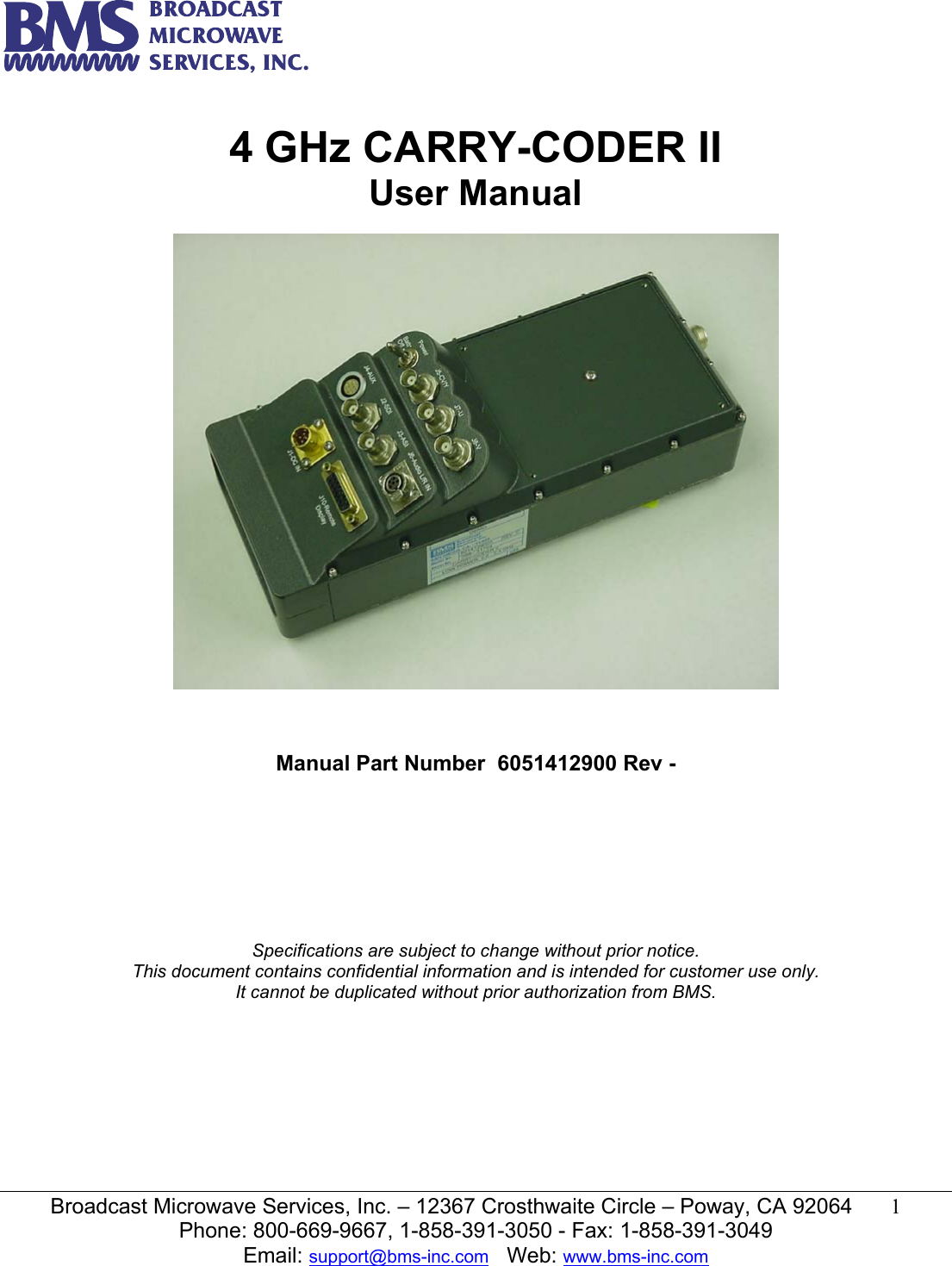
Broadcast Microwave Services CCII-4H Carry-Coder II with Power Amplifier User Manual

Broadcast Microwave Services Inc Carry-Coder II with Power Amplifier

User manual

  Broadcast Microwave Services, Inc. – 12367 Crosthwaite Circle – Poway, CA 92064  1  Phone: 800-669-9667, 1-858-391-3050 - Fax: 1-858-391-3049 Email: support@bms-inc.com   Web: www.bms-inc.com   4 GHz CARRY-CODER II User Manual      Manual Part Number  6051412900 Rev -         Specifications are subject to change without prior notice. This document contains confidential information and is intended for customer use only. It cannot be duplicated without prior authorization from BMS.
  Broadcast Microwave Services, Inc. – 12367 Crosthwaite Circle – Poway, CA 92064  2  Phone: 800-669-9667, 1-858-391-3050 - Fax: 1-858-391-3049 Email: support@bms-inc.com   Web: www.bms-inc.com
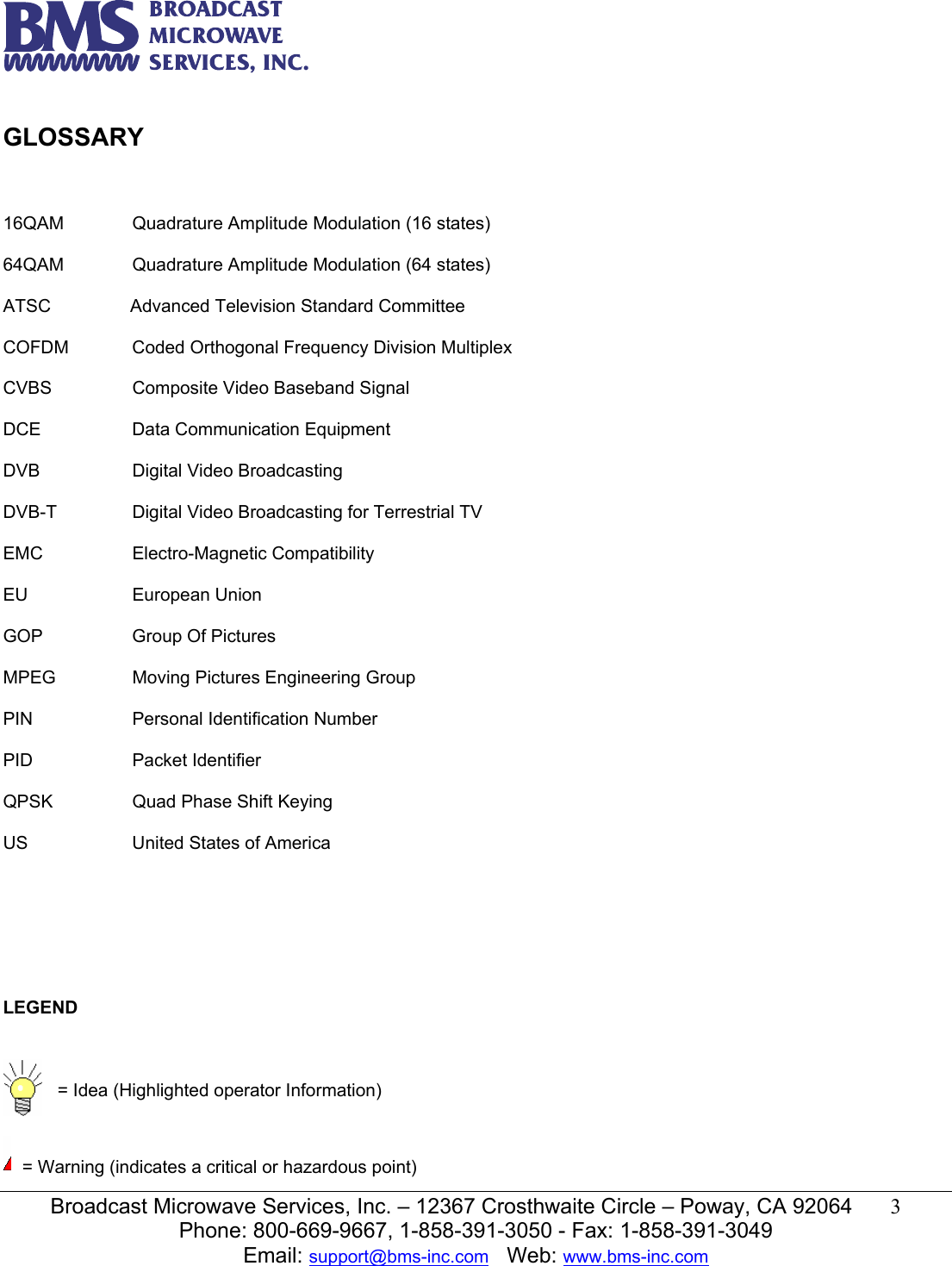
  Broadcast Microwave Services, Inc. – 12367 Crosthwaite Circle – Poway, CA 92064  3  Phone: 800-669-9667, 1-858-391-3050 - Fax: 1-858-391-3049 Email: support@bms-inc.com   Web: www.bms-inc.com   GLOSSARY    16QAM   Quadrature Amplitude Modulation (16 states)  64QAM   Quadrature Amplitude Modulation (64 states)  ATSC    Advanced Television Standard Committee    COFDM  Coded Orthogonal Frequency Division Multiplex  CVBS    Composite Video Baseband Signal  DCE    Data Communication Equipment  DVB   Digital Video Broadcasting  DVB-T    Digital Video Broadcasting for Terrestrial TV  EMC   Electro-Magnetic Compatibility  EU   European Union  GOP    Group Of Pictures  MPEG    Moving Pictures Engineering Group  PIN    Personal Identification Number  PID   Packet Identifier  QPSK    Quad Phase Shift Keying  US    United States of America        LEGEND     = Idea (Highlighted operator Information)     = Warning (indicates a critical or hazardous point)
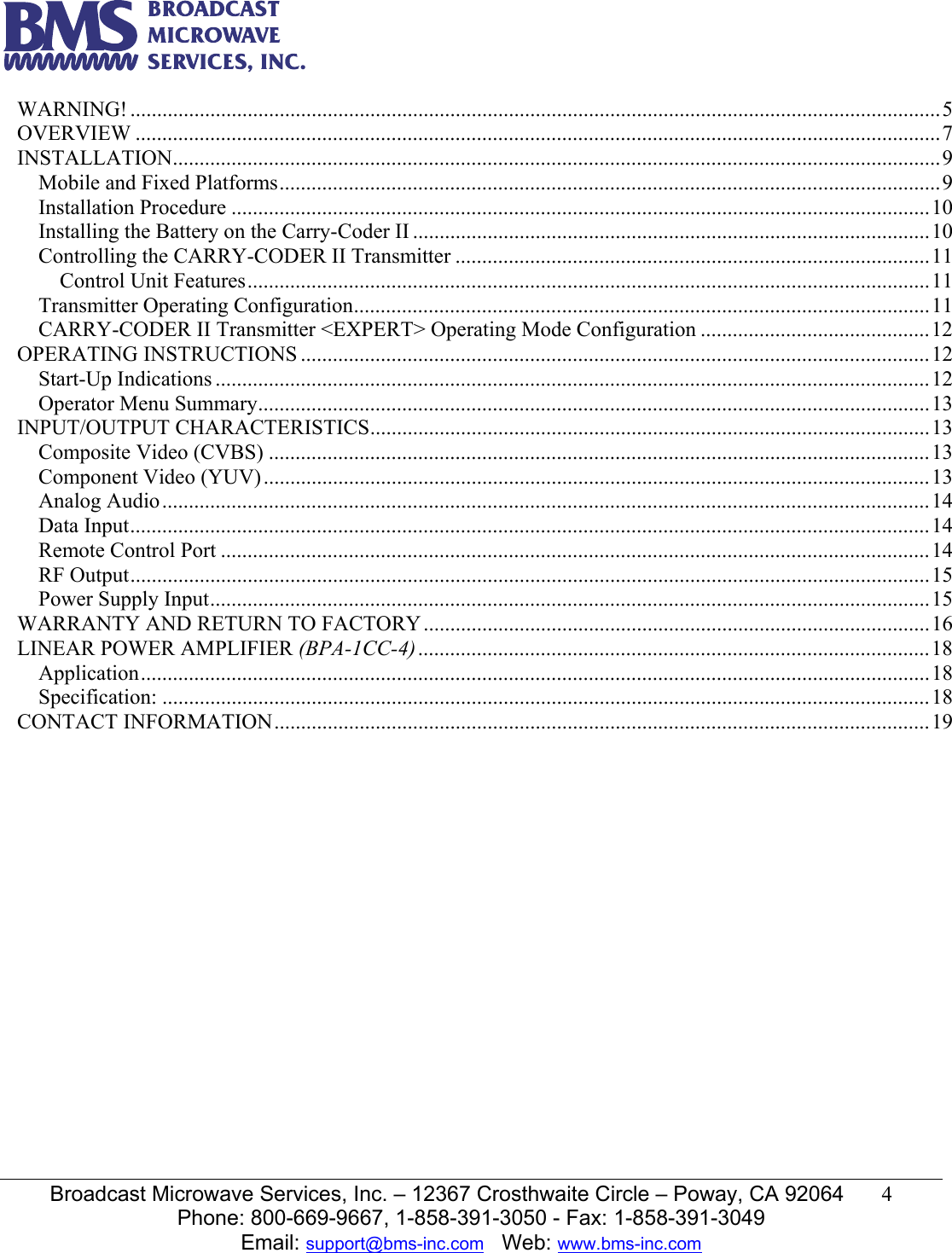
  Broadcast Microwave Services, Inc. – 12367 Crosthwaite Circle – Poway, CA 92064  4  Phone: 800-669-9667, 1-858-391-3050 - Fax: 1-858-391-3049 Email: support@bms-inc.com   Web: www.bms-inc.com  WARNING! ........................................................................................................................................................5OVERVIEW .......................................................................................................................................................7INSTALLATION................................................................................................................................................9Mobile and Fixed Platforms............................................................................................................................9Installation Procedure ...................................................................................................................................10Installing the Battery on the Carry-Coder II .................................................................................................10Controlling the CARRY-CODER II Transmitter .........................................................................................11Control Unit Features................................................................................................................................11Transmitter Operating Configuration............................................................................................................11CARRY-CODER II Transmitter <EXPERT> Operating Mode Configuration ...........................................12OPERATING INSTRUCTIONS ......................................................................................................................12Start-Up Indications ......................................................................................................................................12Operator Menu Summary..............................................................................................................................13INPUT/OUTPUT CHARACTERISTICS.........................................................................................................13Composite Video (CVBS) ............................................................................................................................13Component Video (YUV).............................................................................................................................13Analog Audio................................................................................................................................................14Data Input......................................................................................................................................................14Remote Control Port .....................................................................................................................................14RF Output......................................................................................................................................................15Power Supply Input.......................................................................................................................................15WARRANTY AND RETURN TO FACTORY...............................................................................................16LINEAR POWER AMPLIFIER (BPA-1CC-4)................................................................................................18Application....................................................................................................................................................18Specification: ................................................................................................................................................18CONTACT INFORMATION...........................................................................................................................19
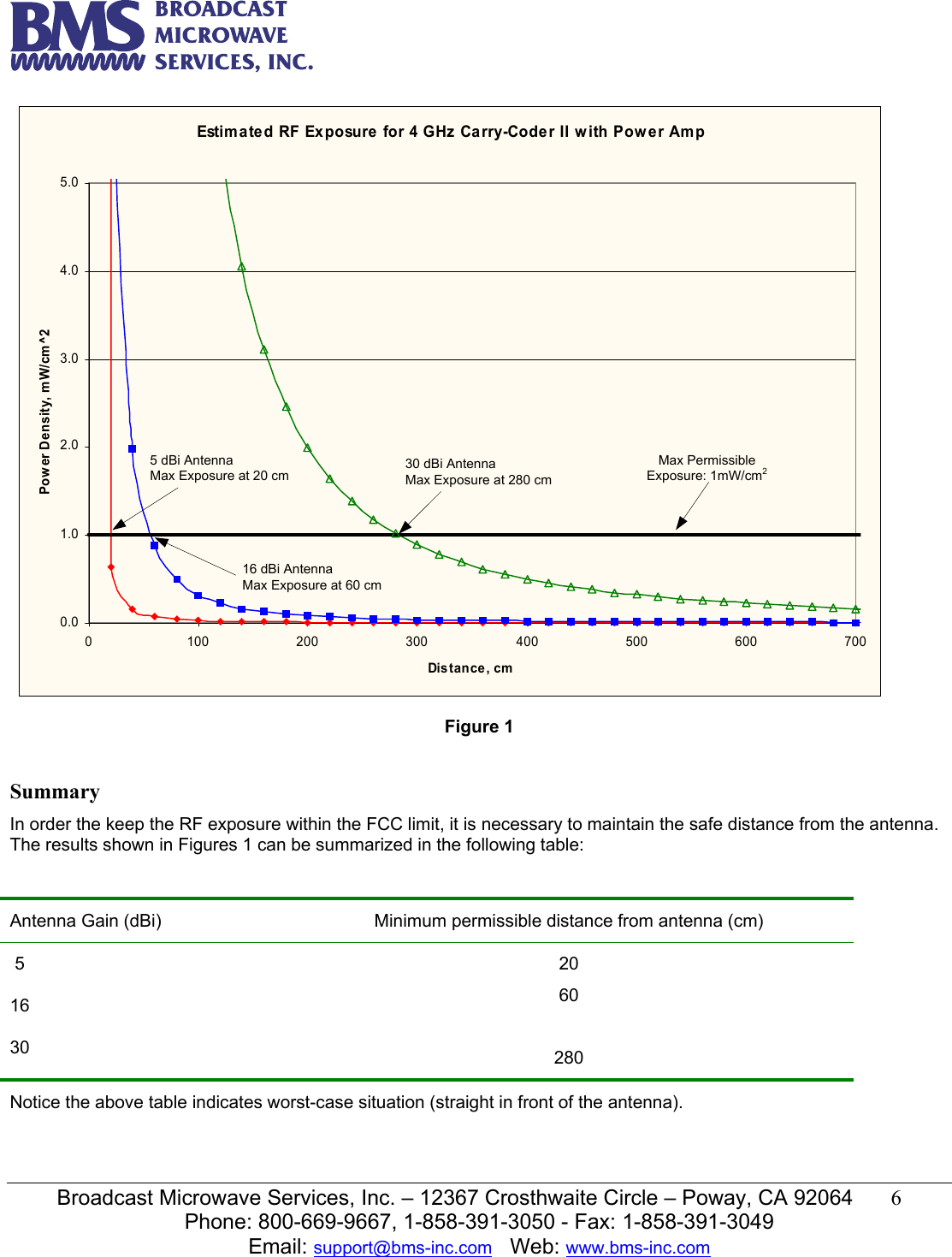
  Broadcast Microwave Services, Inc. – 12367 Crosthwaite Circle – Poway, CA 92064  5  Phone: 800-669-9667, 1-858-391-3050 - Fax: 1-858-391-3049 Email: support@bms-inc.com   Web: www.bms-inc.com        WARNING! RF RADIATION EXPOSURE HAZARD  This warning is provided by Broadcast Microwave Services (BMS) Inc. for safety purpose. The following information help to reduce the risk of RF exposure hazard.    FCC Limit of RF Exposure According to Federal Communication Commission (FCC), the Maximum Permissible Exposure (MPE) for FR radiation has been set to 1.0 mW/cm2 for the 4 GHz Carry-Coder II with 1Watt Power Amp equipment (OET Bulletin 65).  The 4 GHz Carry-Coder II with Power Amp is a non-broadcast transmitter and without an antenna it will not create RF exposure (power density) exceeding the 1.0 W/cm2 FCC limit. However a high-gain antenna such as a parabolic dish will greatly enhance the 4 GHz Carry-Coder II output power density beyond the MPE limit of 1.0 mW/cm2.  In this situation a minimum distance from the antenna needs to be calculated in order to keep the MPE always below the safety limit. The calculation has been done for 4 GHz Carry-Coder II with Power Amp based on the formula mentioned in OET Bulletin 56. The calculations have been done for different commonly used antenna in the Public Safety/ Law enforcement applications.  Figure 1 shows the plot of the minimum exposure distance for 5dBi, 16dBi, and 30dBi antennas. The 4 GHz Carry-Coder II with Power Amp transmits the maximum power of 1Watt. The minimum exposure distances are found from the cross points of the exposure graphs (for various antennas) with the line of maximum permissible exposure (i.e. 1 W/cm2). Notice that the numbers in Figure 1 predict the worse case scenario, which is straight in front of the antenna (exposing to the antenna main-lobe). Obviously the side-lobe exposures are well below these numbers as the radiation intensity dramatically reduces on the side lobes.
  Broadcast Microwave Services, Inc. – 12367 Crosthwaite Circle – Poway, CA 92064  6  Phone: 800-669-9667, 1-858-391-3050 - Fax: 1-858-391-3049 Email: support@bms-inc.com   Web: www.bms-inc.com  Estimated RF Exposure for 4 GHz Carry-Coder II with Power Amp0.01.02.03.04.05.00 100 200 300 400 500 600 700Distance , cmPower Density, mW/cm^2Max Permissible Exposure: 1mW/cm230 dBi AntennaMax Exposure at 280 cm5 dBi AntennaMax Exposure at 20 cm16 dBi AntennaMax Exposure at 60 cm Figure 1  Summary In order the keep the RF exposure within the FCC limit, it is necessary to maintain the safe distance from the antenna. The results shown in Figures 1 can be summarized in the following table:  Antenna Gain (dBi)  Minimum permissible distance from antenna (cm)  5 16 30 20 60  280 Notice the above table indicates worst-case situation (straight in front of the antenna).
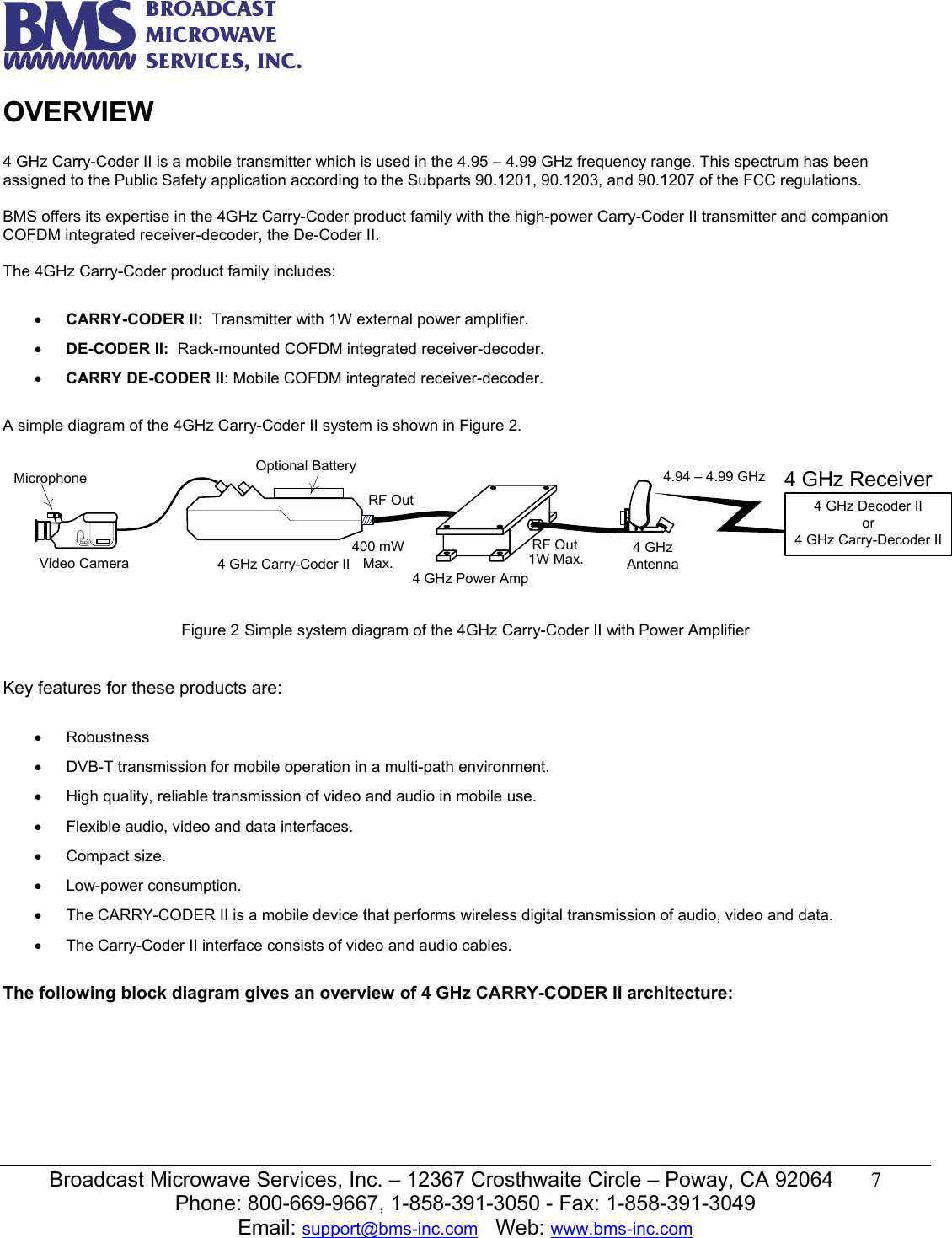
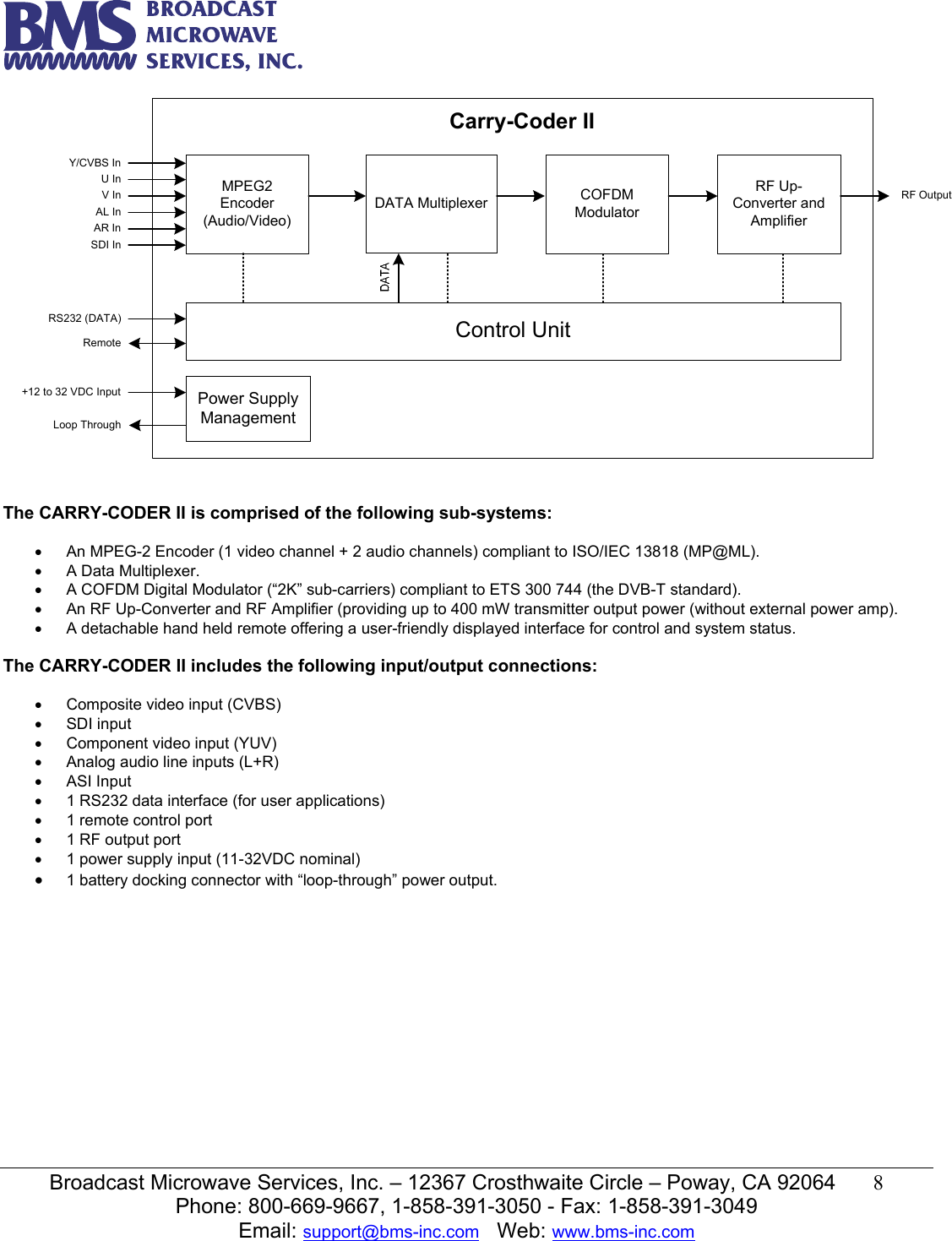
  Broadcast Microwave Services, Inc. – 12367 Crosthwaite Circle – Poway, CA 92064  7  Phone: 800-669-9667, 1-858-391-3050 - Fax: 1-858-391-3049 Email: support@bms-inc.com   Web: www.bms-inc.com  OVERVIEW  4 GHz Carry-Coder II is a mobile transmitter which is used in the 4.95 – 4.99 GHz frequency range. This spectrum has been assigned to the Public Safety application according to the Subparts 90.1201, 90.1203, and 90.1207 of the FCC regulations.  BMS offers its expertise in the 4GHz Carry-Coder product family with the high-power Carry-Coder II transmitter and companion COFDM integrated receiver-decoder, the De-Coder II.  The 4GHz Carry-Coder product family includes:  • CARRY-CODER II:  Transmitter with 1W external power amplifier. • DE-CODER II:  Rack-mounted COFDM integrated receiver-decoder. • CARRY DE-CODER II: Mobile COFDM integrated receiver-decoder.  A simple diagram of the 4GHz Carry-Coder II system is shown in Figure 2.  4 GHz ReceiverMicrophoneVideo Camera4 GHz Power AmpRF OutRF Out1W Max.Optional Battery4 GHz Carry-Coder II4 GHz Antenna4.94 – 4.99 GHz4 GHz Decoder IIor4 GHz Carry-Decoder II400 mW Max. Figure 2 Simple system diagram of the 4GHz Carry-Coder II with Power Amplifier   Key features for these products are:  • Robustness  •  DVB-T transmission for mobile operation in a multi-path environment. •  High quality, reliable transmission of video and audio in mobile use. •  Flexible audio, video and data interfaces. • Compact size. • Low-power consumption. •  The CARRY-CODER II is a mobile device that performs wireless digital transmission of audio, video and data. •  The Carry-Coder II interface consists of video and audio cables.  The following block diagram gives an overview of 4 GHz CARRY-CODER II architecture:
  Broadcast Microwave Services, Inc. – 12367 Crosthwaite Circle – Poway, CA 92064  8  Phone: 800-669-9667, 1-858-391-3050 - Fax: 1-858-391-3049 Email: support@bms-inc.com   Web: www.bms-inc.com  MPEG2 Encoder(Audio/Video)DATA Multiplexer COFDM ModulatorControl UnitRF Up-Converter and AmplifierPower Supply Management+12 to 32 VDC InputLoop ThroughRemoteRS232 (DATA)RF OutputCarry-Coder IIY/CVBS InU InV InAL InAR InSDI In  The CARRY-CODER II is comprised of the following sub-systems:  •  An MPEG-2 Encoder (1 video channel + 2 audio channels) compliant to ISO/IEC 13818 (MP@ML). •  A Data Multiplexer. •  A COFDM Digital Modulator (“2K” sub-carriers) compliant to ETS 300 744 (the DVB-T standard). •  An RF Up-Converter and RF Amplifier (providing up to 400 mW transmitter output power (without external power amp). •  A detachable hand held remote offering a user-friendly displayed interface for control and system status.  The CARRY-CODER II includes the following input/output connections:  •  Composite video input (CVBS) • SDI input •  Component video input (YUV) •  Analog audio line inputs (L+R) • ASI Input •  1 RS232 data interface (for user applications) •  1 remote control port •  1 RF output port •  1 power supply input (11-32VDC nominal) • 1 battery docking connector with “loop-through” power output.
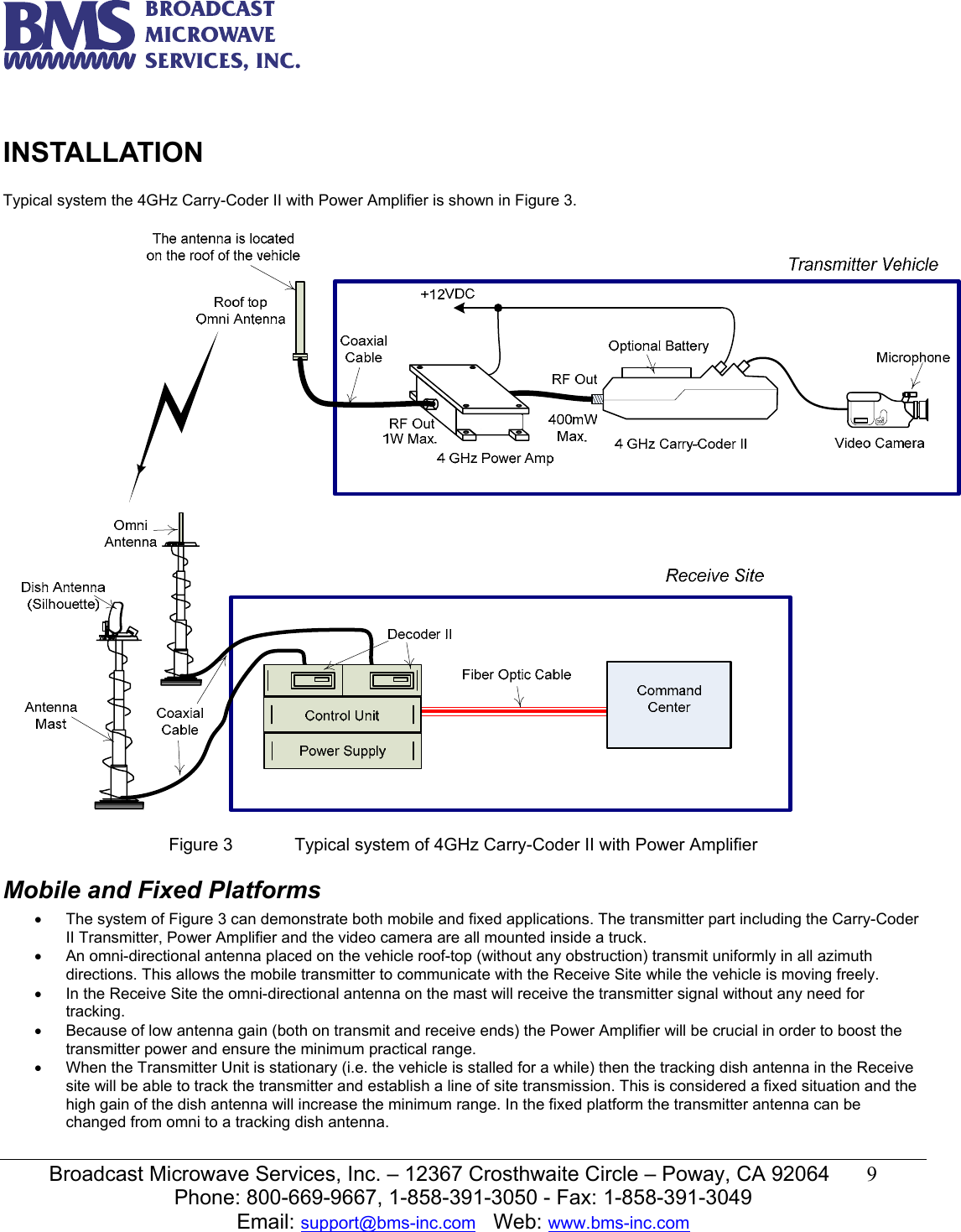
  Broadcast Microwave Services, Inc. – 12367 Crosthwaite Circle – Poway, CA 92064  9  Phone: 800-669-9667, 1-858-391-3050 - Fax: 1-858-391-3049 Email: support@bms-inc.com   Web: www.bms-inc.com   INSTALLATION   Typical system the 4GHz Carry-Coder II with Power Amplifier is shown in Figure 3.    Figure 3  Typical system of 4GHz Carry-Coder II with Power Amplifier  Mobile and Fixed Platforms •  The system of Figure 3 can demonstrate both mobile and fixed applications. The transmitter part including the Carry-Coder II Transmitter, Power Amplifier and the video camera are all mounted inside a truck.  •  An omni-directional antenna placed on the vehicle roof-top (without any obstruction) transmit uniformly in all azimuth directions. This allows the mobile transmitter to communicate with the Receive Site while the vehicle is moving freely. •  In the Receive Site the omni-directional antenna on the mast will receive the transmitter signal without any need for tracking. •  Because of low antenna gain (both on transmit and receive ends) the Power Amplifier will be crucial in order to boost the transmitter power and ensure the minimum practical range. •  When the Transmitter Unit is stationary (i.e. the vehicle is stalled for a while) then the tracking dish antenna in the Receive site will be able to track the transmitter and establish a line of site transmission. This is considered a fixed situation and the high gain of the dish antenna will increase the minimum range. In the fixed platform the transmitter antenna can be changed from omni to a tracking dish antenna.
  Broadcast Microwave Services, Inc. – 12367 Crosthwaite Circle – Poway, CA 92064  10  Phone: 800-669-9667, 1-858-391-3050 - Fax: 1-858-391-3049 Email: support@bms-inc.com   Web: www.bms-inc.com  •  Regardless of the mobile and fixed applications the installation procedure for transmitter site will be similar as explained in the following section:     Installation Procedure The 4GHz Carry-Coder II with Power Amplifier can be installed inside a vehicle such as a truck. The symbolic diagram of the installation is given in Figure 3. The installation procedure is as follows:  1.  Install the omni-directional antenna on the vehicle roof-top using the brackets and instructions that are supplied in the accessory kit. 2.   Secure the Carry-Coder II transmitter and the Power Amplifier inside the truck. The two units may be one or 2 feet apart.  3.   To ensure sufficient ventilation, at least 3” clearance is recommended from each side of the units. •  Using N-type coaxial cable (about 3 feet long) connect the output of the Carry-Coder II transmitter to the input of the Power Amplifier. •  Using Coaxial cable and N to SMA adaptor, connect the output of the Power Amplifier to the SMA input port of the omni antenna. •   Using the special power cords connect the Transmitter and the Power Amplifier to the 12V DC voltage.  •  Connect the interface cables from the camera to the appropriate CARRY-CODER II connector(s). •  Using the supplied Remote Control Display, set the Transmitter frequency, power, modulation scheme …etc. as will be explained in the next section.    Installing the Battery on the Carry-Coder II  The Carry-Coder II can be run by its own battery as well. The procedure for battery installation is as follows:  •  Slide the battery in to the receptacle located underneath the CCII until it locks into place •  Connect the power cable coming from the battery connector socket to the CARRY-CODER II. •  Switch on the power for the camera and the CARRY-CODER II.
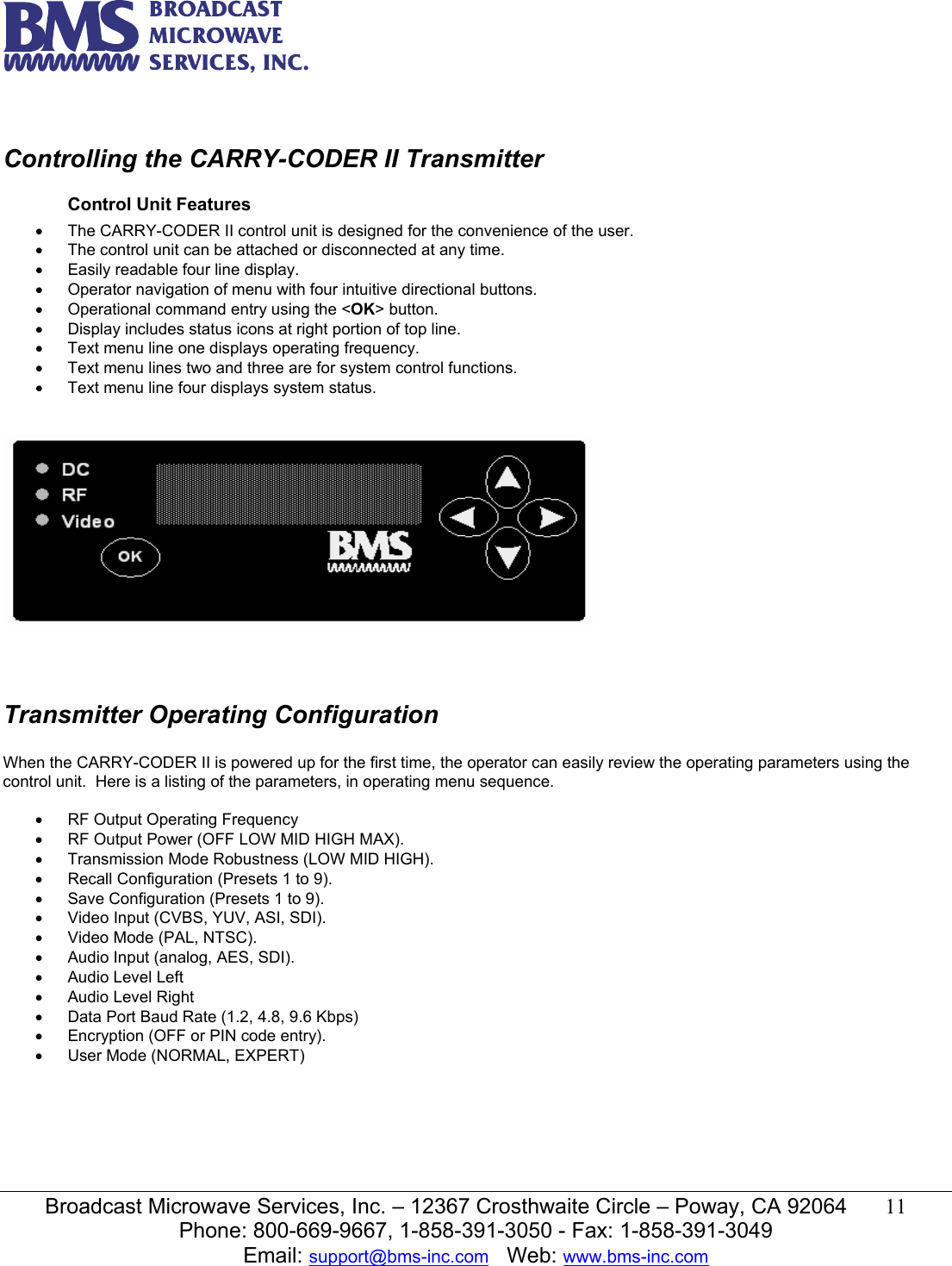
  Broadcast Microwave Services, Inc. – 12367 Crosthwaite Circle – Poway, CA 92064  11  Phone: 800-669-9667, 1-858-391-3050 - Fax: 1-858-391-3049 Email: support@bms-inc.com   Web: www.bms-inc.com   Controlling the CARRY-CODER II Transmitter Control Unit Features •  The CARRY-CODER II control unit is designed for the convenience of the user. •  The control unit can be attached or disconnected at any time. •  Easily readable four line display. •  Operator navigation of menu with four intuitive directional buttons. •  Operational command entry using the <OK> button. •  Display includes status icons at right portion of top line. •  Text menu line one displays operating frequency. •  Text menu lines two and three are for system control functions. •  Text menu line four displays system status.       Transmitter Operating Configuration  When the CARRY-CODER II is powered up for the first time, the operator can easily review the operating parameters using the control unit.  Here is a listing of the parameters, in operating menu sequence.  •  RF Output Operating Frequency  •  RF Output Power (OFF LOW MID HIGH MAX). •  Transmission Mode Robustness (LOW MID HIGH). •  Recall Configuration (Presets 1 to 9). •  Save Configuration (Presets 1 to 9). •  Video Input (CVBS, YUV, ASI, SDI). •  Video Mode (PAL, NTSC). •  Audio Input (analog, AES, SDI). •  Audio Level Left •  Audio Level Right •  Data Port Baud Rate (1.2, 4.8, 9.6 Kbps)  •  Encryption (OFF or PIN code entry). •  User Mode (NORMAL, EXPERT)
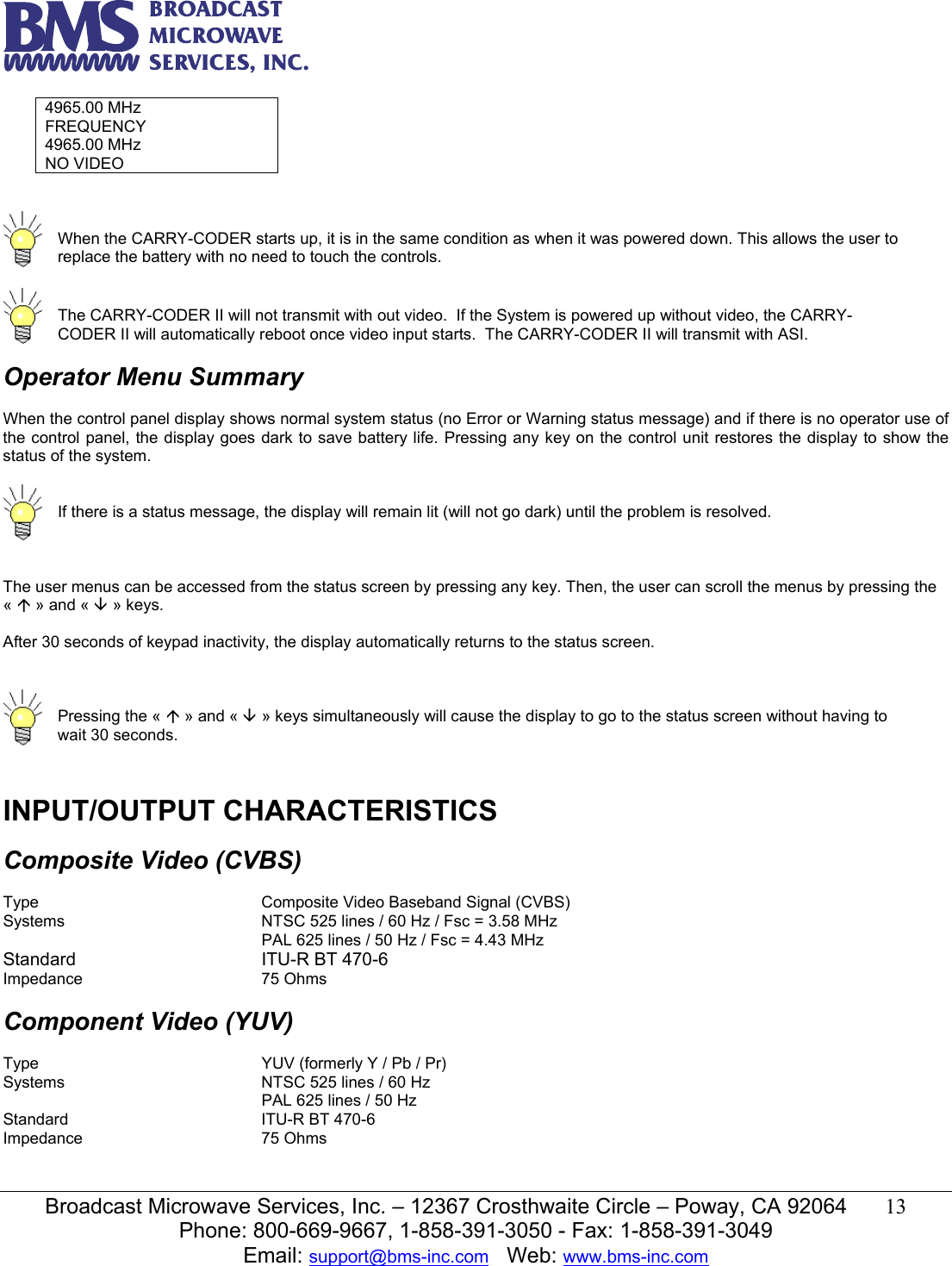
  Broadcast Microwave Services, Inc. – 12367 Crosthwaite Circle – Poway, CA 92064  12  Phone: 800-669-9667, 1-858-391-3050 - Fax: 1-858-391-3049 Email: support@bms-inc.com   Web: www.bms-inc.com  CARRY-CODER II Transmitter <EXPERT> Operating Mode Configuration  NOTE: Most users will operate the system in <NORMAL> mode.  The <EXPERT> mode provides user control of certain DVB-T parameter settings.  Here is a listing of those parameters in operating menu sequence:  •  Resolution (1/1, 3/4,  2/3, 1/2)  •  GOP Structure (I, IP, IBP, IBBP, 422IBBP) •  GOP Length (6, 12, 18, 24) •  Constellation (QPSK, 16QAM, 64QAM) • Guard Interval (1/32, 1/16, 1/8, 1/4) •  Code Rate (1/2, 2/3, 3/4, 5/6, 7/8)      Certain operating parameters are used on a repeated basis. These settings should be stored in memory as Configuration Presets 2 through 9.  This provides fast restoration of parameter settings that are used most often.   A good backup plan is to maintain commonly used parameter settings (i.e., high robustness and maximum power) in a known configuration preset memory. If a problem occurs that won’t go away, a known good parameter setting can be recalled from memory. This should help to resolve a problem. Another method is to adjust each parameter one by one, beginning with changing the operating frequency, to ensure that the link is not being affected by another signal on your selected operating frequency.   The <DEFAULT> option in the RECALL CONFIGURATION Menu will set all the parameters of the CCII to the factory defaults.  OPERATING INSTRUCTIONS  Start-Up Indications  The CARRY-CODER starts with display showing the status of the system.   During system initialization, the CARRY-CODER II goes through self-test of its MPEG-2 encoder, COFDM modulator and RF sections. System initialization 10 seconds and will display as follows:  BMS Inc.  4 GHz CarryCoder 2 Freq Agile 4940-4990 MHz Software Ver. 2.01 Resetting  /  At the completion of the initialization process, the display should look like this:  4965.00 MHz FREQUENCY 4990.00 MHz   If the self-test finds that a sub-system does not respond correctly, a status message is displayed on the fourth line of the display.  For example, if the camera is not sending video to the transmitter, the display will include the appropriate message:
  Broadcast Microwave Services, Inc. – 12367 Crosthwaite Circle – Poway, CA 92064  13  Phone: 800-669-9667, 1-858-391-3050 - Fax: 1-858-391-3049 Email: support@bms-inc.com   Web: www.bms-inc.com  4965.00 MHz FREQUENCY 4965.00 MHz NO VIDEO     When the CARRY-CODER starts up, it is in the same condition as when it was powered down. This allows the user to replace the battery with no need to touch the controls.    The CARRY-CODER II will not transmit with out video.  If the System is powered up without video, the CARRY-CODER II will automatically reboot once video input starts.  The CARRY-CODER II will transmit with ASI.  Operator Menu Summary  When the control panel display shows normal system status (no Error or Warning status message) and if there is no operator use of the control panel, the display goes dark to save battery life. Pressing any key on the control unit restores the display to show the status of the system.    If there is a status message, the display will remain lit (will not go dark) until the problem is resolved.   The user menus can be accessed from the status screen by pressing any key. Then, the user can scroll the menus by pressing the « Ç » and « È » keys.  After 30 seconds of keypad inactivity, the display automatically returns to the status screen.     Pressing the « Ç » and « È » keys simultaneously will cause the display to go to the status screen without having to wait 30 seconds.   INPUT/OUTPUT CHARACTERISTICS  Composite Video (CVBS)  Type    Composite Video Baseband Signal (CVBS) Systems       NTSC 525 lines / 60 Hz / Fsc = 3.58 MHz         PAL 625 lines / 50 Hz / Fsc = 4.43 MHz Standard   ITU-R BT 470-6 Impedance   75 Ohms  Component Video (YUV)  Type        YUV (formerly Y / Pb / Pr) Systems       NTSC 525 lines / 60 Hz         PAL 625 lines / 50 Hz Standard   ITU-R BT 470-6 Impedance   75 Ohms
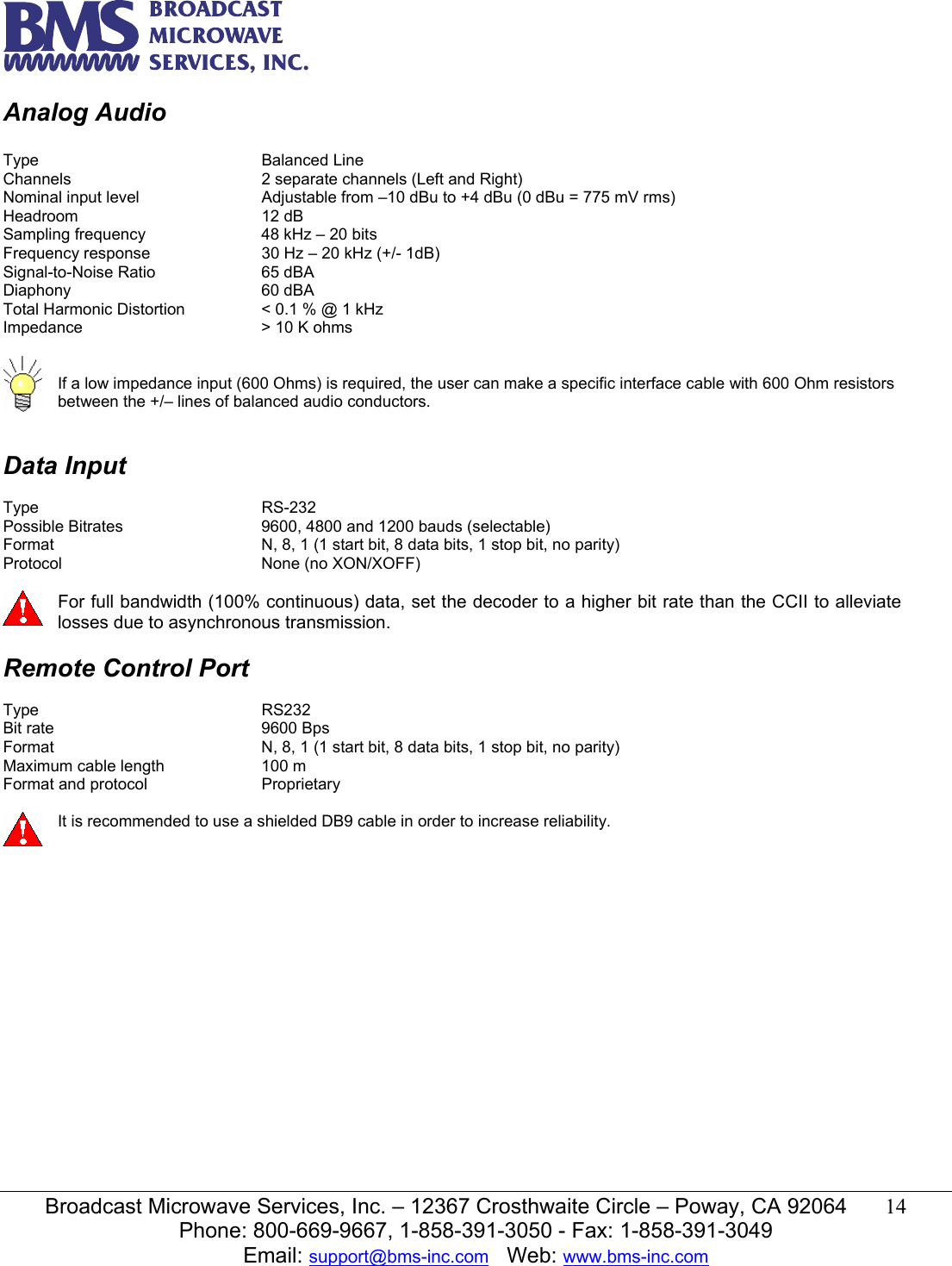
  Broadcast Microwave Services, Inc. – 12367 Crosthwaite Circle – Poway, CA 92064  14  Phone: 800-669-9667, 1-858-391-3050 - Fax: 1-858-391-3049 Email: support@bms-inc.com   Web: www.bms-inc.com  Analog Audio  Type    Balanced Line Channels      2 separate channels (Left and Right) Nominal input level    Adjustable from –10 dBu to +4 dBu (0 dBu = 775 mV rms) Headroom   12 dB  Sampling frequency    48 kHz – 20 bits Frequency response    30 Hz – 20 kHz (+/- 1dB) Signal-to-Noise Ratio    65 dBA Diaphony   60 dBA Total Harmonic Distortion    < 0.1 % @ 1 kHz Impedance      > 10 K ohms    If a low impedance input (600 Ohms) is required, the user can make a specific interface cable with 600 Ohm resistors between the +/– lines of balanced audio conductors.   Data Input  Type    RS-232 Possible Bitrates      9600, 4800 and 1200 bauds (selectable) Format        N, 8, 1 (1 start bit, 8 data bits, 1 stop bit, no parity) Protocol    None (no XON/XOFF)   For full bandwidth (100% continuous) data, set the decoder to a higher bit rate than the CCII to alleviate losses due to asynchronous transmission.  Remote Control Port  Type    RS232 Bit rate    9600 Bps Format        N, 8, 1 (1 start bit, 8 data bits, 1 stop bit, no parity) Maximum cable length    100 m Format and protocol    Proprietary   It is recommended to use a shielded DB9 cable in order to increase reliability.
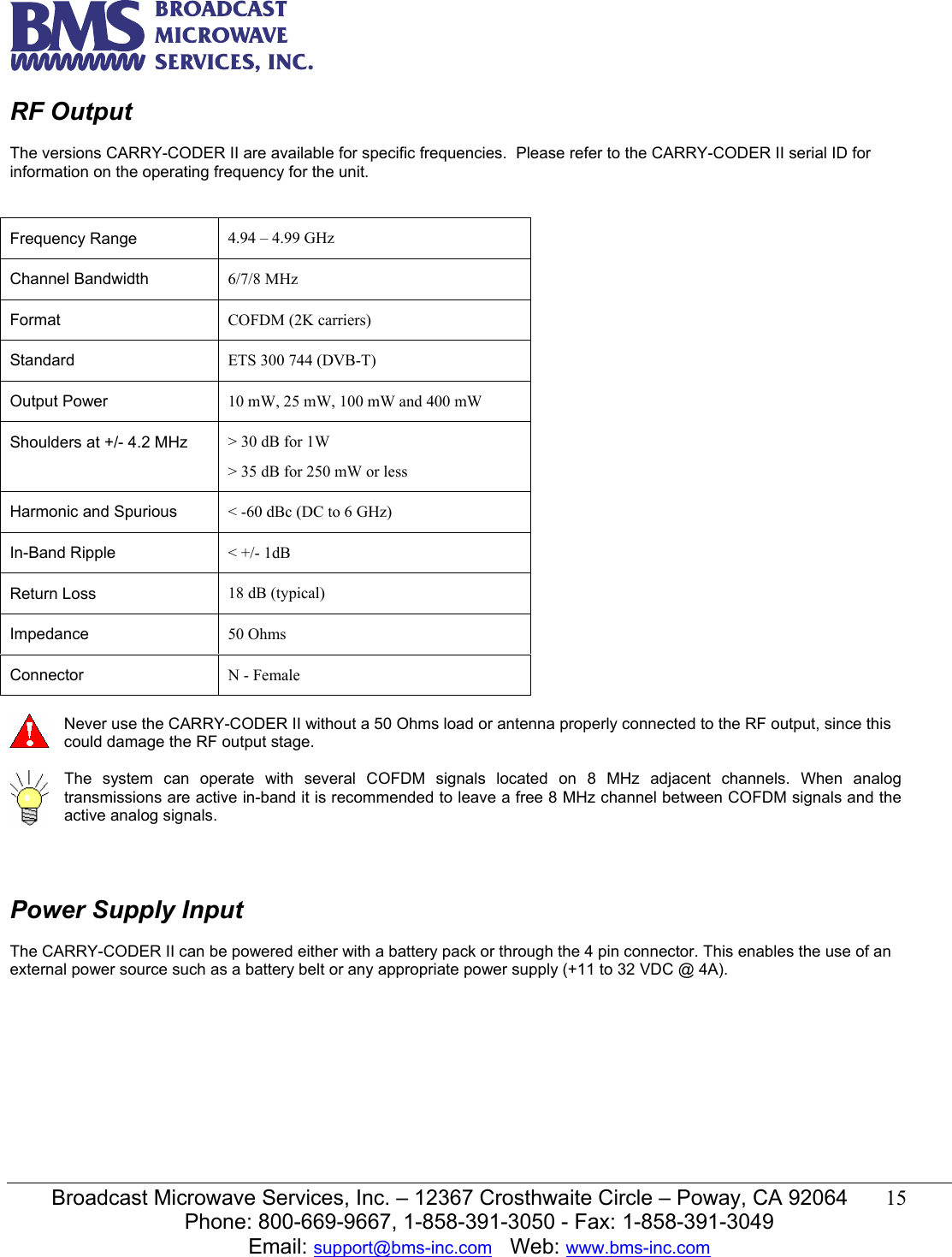
  Broadcast Microwave Services, Inc. – 12367 Crosthwaite Circle – Poway, CA 92064  15  Phone: 800-669-9667, 1-858-391-3050 - Fax: 1-858-391-3049 Email: support@bms-inc.com   Web: www.bms-inc.com  RF Output  The versions CARRY-CODER II are available for specific frequencies.  Please refer to the CARRY-CODER II serial ID for information on the operating frequency for the unit.             Never use the CARRY-CODER II without a 50 Ohms load or antenna properly connected to the RF output, since this could damage the RF output stage.   The system can operate with several COFDM signals located on 8 MHz adjacent channels. When analog transmissions are active in-band it is recommended to leave a free 8 MHz channel between COFDM signals and the active analog signals.    Power Supply Input  The CARRY-CODER II can be powered either with a battery pack or through the 4 pin connector. This enables the use of an external power source such as a battery belt or any appropriate power supply (+11 to 32 VDC @ 4A).    Frequency Range   4.94 – 4.99 GHz Channel Bandwidth  6/7/8 MHz Format   COFDM (2K carriers) Standard  ETS 300 744 (DVB-T) Output Power  10 mW, 25 mW, 100 mW and 400 mW Shoulders at +/- 4.2 MHz  > 30 dB for 1W > 35 dB for 250 mW or less Harmonic and Spurious  < -60 dBc (DC to 6 GHz) In-Band Ripple  < +/- 1dB Return Loss  18 dB (typical) Impedance  50 Ohms Connector  N - Female
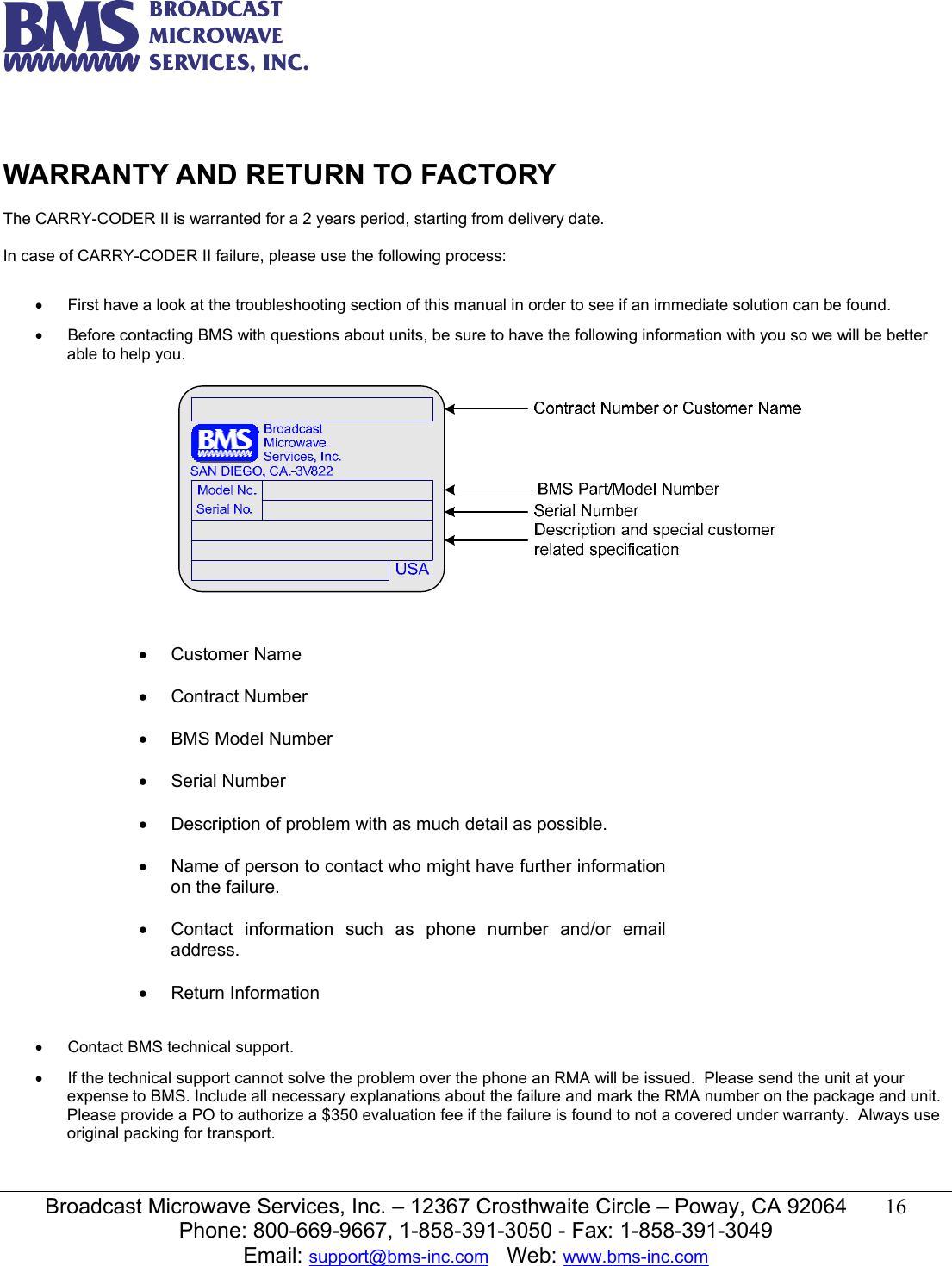
  Broadcast Microwave Services, Inc. – 12367 Crosthwaite Circle – Poway, CA 92064  16  Phone: 800-669-9667, 1-858-391-3050 - Fax: 1-858-391-3049 Email: support@bms-inc.com   Web: www.bms-inc.com   WARRANTY AND RETURN TO FACTORY  The CARRY-CODER II is warranted for a 2 years period, starting from delivery date.  In case of CARRY-CODER II failure, please use the following process:  •  First have a look at the troubleshooting section of this manual in order to see if an immediate solution can be found. •  Before contacting BMS with questions about units, be sure to have the following information with you so we will be better able to help you.                •  Contact BMS technical support. •  If the technical support cannot solve the problem over the phone an RMA will be issued.  Please send the unit at your expense to BMS. Include all necessary explanations about the failure and mark the RMA number on the package and unit. Please provide a PO to authorize a $350 evaluation fee if the failure is found to not a covered under warranty.  Always use original packing for transport. • Customer Name  • Contract Number  •  BMS Model Number  • Serial Number  •  Description of problem with as much detail as possible.  •  Name of person to contact who might have further information on the failure.  •  Contact information such as phone number and/or email address.  • Return Information
  Broadcast Microwave Services, Inc. – 12367 Crosthwaite Circle – Poway, CA 92064  17  Phone: 800-669-9667, 1-858-391-3050 - Fax: 1-858-391-3049 Email: support@bms-inc.com   Web: www.bms-inc.com  •  Warranty position will be established upon receipt of inoperative equipment.  If equipment is confirmed defective and is the responsibility of BMS, repair action will be initiated immediately at no expense to the customer.  When the malfunction is determined to be the responsibility of the user, BMS will provide a quote to repair.  Work to repair the unit will be initiated after confirmation with the user’s buying authority. •  BMS will send back the unit at its expense via UPS ground.   There are no user serviceable parts inside the CARRY-CODER. Opening the device without prior authorization from BMS will cause the warranty loss.
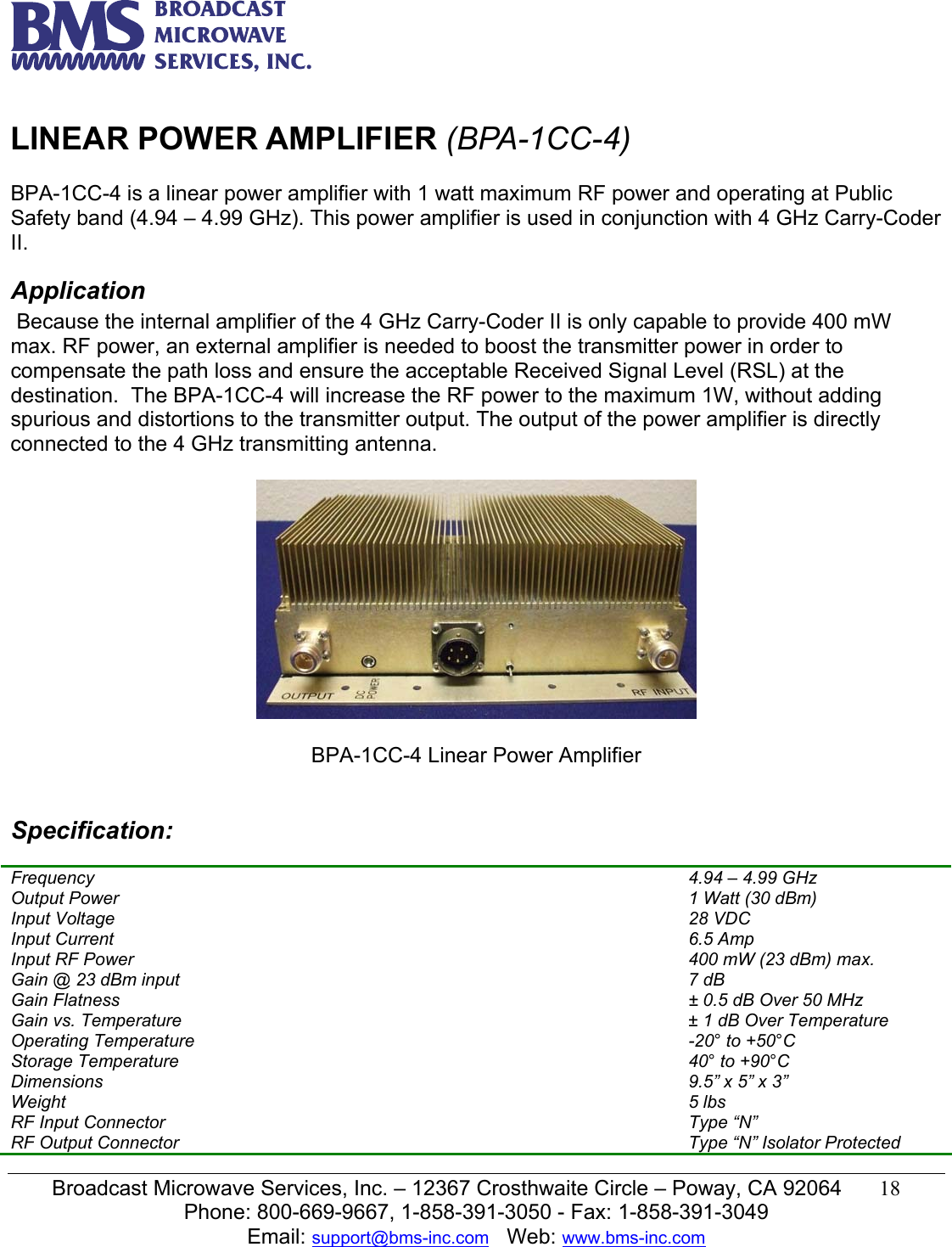
  Broadcast Microwave Services, Inc. – 12367 Crosthwaite Circle – Poway, CA 92064  18  Phone: 800-669-9667, 1-858-391-3050 - Fax: 1-858-391-3049 Email: support@bms-inc.com   Web: www.bms-inc.com   LINEAR POWER AMPLIFIER (BPA-1CC-4)  BPA-1CC-4 is a linear power amplifier with 1 watt maximum RF power and operating at Public Safety band (4.94 – 4.99 GHz). This power amplifier is used in conjunction with 4 GHz Carry-Coder II. Application  Because the internal amplifier of the 4 GHz Carry-Coder II is only capable to provide 400 mW max. RF power, an external amplifier is needed to boost the transmitter power in order to compensate the path loss and ensure the acceptable Received Signal Level (RSL) at the destination.  The BPA-1CC-4 will increase the RF power to the maximum 1W, without adding spurious and distortions to the transmitter output. The output of the power amplifier is directly connected to the 4 GHz transmitting antenna.     BPA-1CC-4 Linear Power Amplifier   Specification: Ch Frequency  4.94 – 4.99 GHz Output Power  1 Watt (30 dBm) Input Voltage  28 VDC  Input Current  6.5 Amp Input RF Power  400 mW (23 dBm) max. Gain @ 23 dBm input  7 dB Gain Flatness  ± 0.5 dB Over 50 MHz Gain vs. Temperature  ± 1 dB Over Temperature Operating Temperature  -20° to +50°C Storage Temperature  40° to +90°C Dimensions  9.5” x 5” x 3” Weight  5 lbs RF Input Connector  Type “N”  RF Output Connector  Type “N” Isolator Protected
  Broadcast Microwave Services, Inc. – 12367 Crosthwaite Circle – Poway, CA 92064  19  Phone: 800-669-9667, 1-858-391-3050 - Fax: 1-858-391-3049 Email: support@bms-inc.com   Web: www.bms-inc.com   CONTACT INFORMATION             Broadcast Microwave Services, Inc.  Phone: 1.858.391.3050   Fax: 1.858.391.3049 Shipping address:  12367 Crosthwaite Circle Dock 10 Poway, CA  92064   Website:  http://www.bms-inc.com   Email:  support@bms-inc.com sales@bms-inc.com

Navigation menu