Carol Electronics Co CAROL880 DIGITAL WIRELESS MICROPHONE User Manual

Taiwan Carol Electronics Co Ltd DIGITAL WIRELESS MICROPHONE

User manual

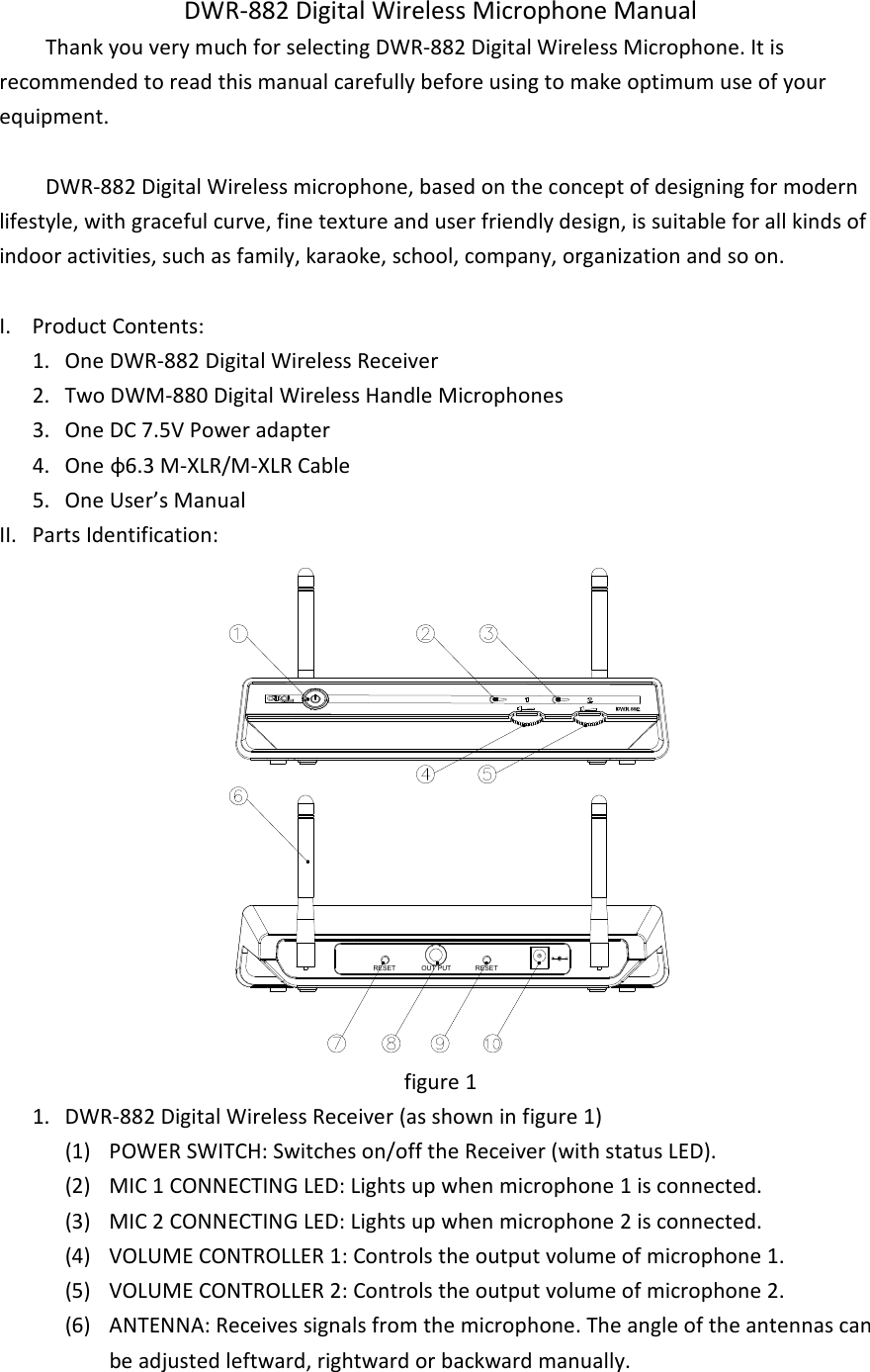
DWR-882 Digital Wireless Microphone Manual           Thank you very much for selecting DWR-882 Digital Wireless Microphone. It is recommended to read this manual carefully before using to make optimum use of your equipment.            DWR-882 Digital Wireless microphone, based on the concept of designing for modern lifestyle, with graceful curve, fine texture and user friendly design, is suitable for all kinds of indoor activities, such as family, karaoke, school, company, organization and so on.    I.  Product Contents: 1.  One DWR-882 Digital Wireless Receiver   2.  Two DWM-880 Digital Wireless Handle Microphones 3.  One DC 7.5V Power adapter 4.  One φ6.3 M-XLR/M-XLR Cable 5.  One User’s Manual   II.  Parts Identification: OUT PUT RESETRESET figure 1 1.  DWR-882 Digital Wireless Receiver (as shown in figure 1) (1)  POWER SWITCH: Switches on/off the Receiver (with status LED). (2)  MIC 1 CONNECTING LED: Lights up when microphone 1 is connected. (3)  MIC 2 CONNECTING LED: Lights up when microphone 2 is connected. (4)  VOLUME CONTROLLER 1: Controls the output volume of microphone 1. (5)  VOLUME CONTROLLER 2: Controls the output volume of microphone 2. (6)  ANTENNA: Receives signals from the microphone. The angle of the antennas can be adjusted leftward, rightward or backward manually.
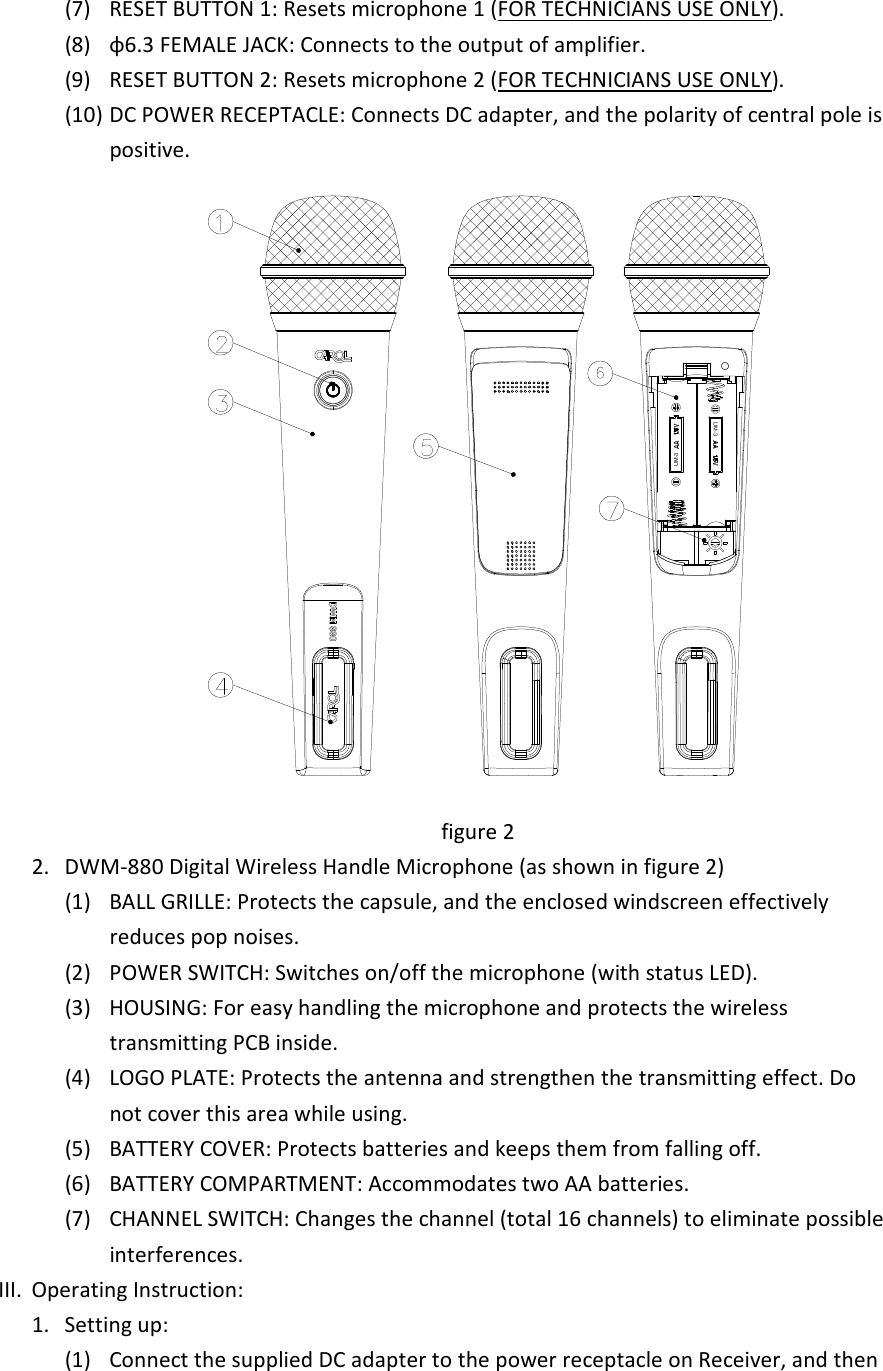
(7)  RESET BUTTON 1: Resets microphone 1 (FOR TECHNICIANS USE ONLY).   (8)  φ6.3 FEMALE JACK: Connects to the output of amplifier. (9)  RESET BUTTON 2: Resets microphone 2 (FOR TECHNICIANS USE ONLY). (10) DC POWER RECEPTACLE: Connects DC adapter, and the polarity of central pole is positive.   UM-3UM-3 figure 2 2.  DWM-880 Digital Wireless Handle Microphone (as shown in figure 2) (1)  BALL GRILLE: Protects the capsule, and the enclosed windscreen effectively reduces pop noises. (2)  POWER SWITCH: Switches on/off the microphone (with status LED). (3)  HOUSING: For easy handling the microphone and protects the wireless transmitting PCB inside.   (4)  LOGO PLATE: Protects the antenna and strengthen the transmitting effect. Do not cover this area while using. (5)  BATTERY COVER: Protects batteries and keeps them from falling off. (6)  BATTERY COMPARTMENT: Accommodates two AA batteries. (7)  CHANNEL SWITCH: Changes the channel (total 16 channels) to eliminate possible interferences.   III.  Operating Instruction: 1.  Setting up: (1)  Connect the supplied DC adapter to the power receptacle on Receiver, and then
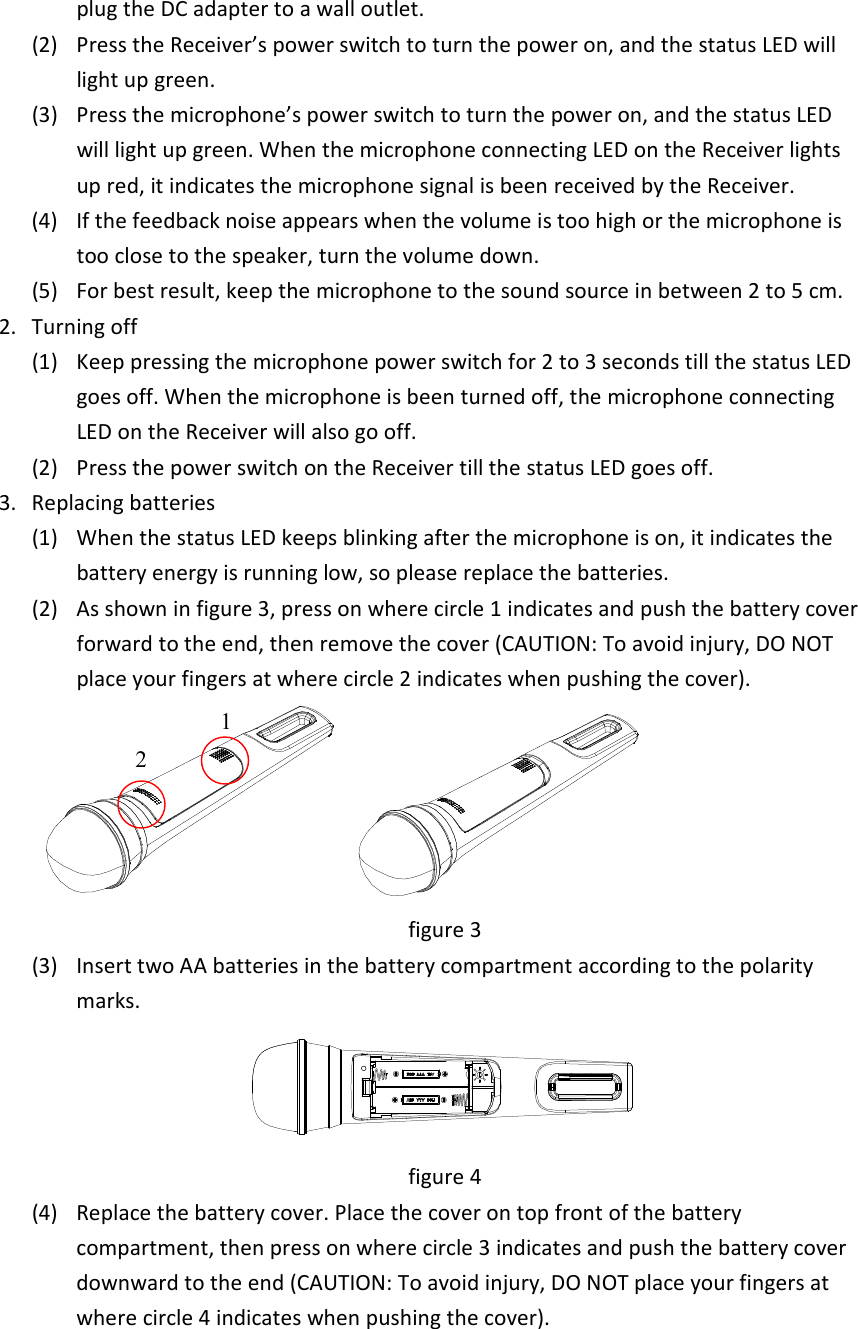
plug the DC adapter to a wall outlet. (2)  Press the Receiver’s power switch to turn the power on, and the status LED will light up green. (3)  Press the microphone’s power switch to turn the power on, and the status LED will light up green. When the microphone connecting LED on the Receiver lights up red, it indicates the microphone signal is been received by the Receiver. (4)  If the feedback noise appears when the volume is too high or the microphone is too close to the speaker, turn the volume down.   (5)  For best result, keep the microphone to the sound source in between 2 to 5 cm.   2.  Turning off (1)  Keep pressing the microphone power switch for 2 to 3 seconds till the status LED goes off. When the microphone is been turned off, the microphone connecting LED on the Receiver will also go off. (2)  Press the power switch on the Receiver till the status LED goes off. 3.  Replacing batteries   (1)  When the status LED keeps blinking after the microphone is on, it indicates the battery energy is running low, so please replace the batteries.   (2)  As shown in figure 3, press on where circle 1 indicates and push the battery cover forward to the end, then remove the cover (CAUTION: To avoid injury, DO NOT place your fingers at where circle 2 indicates when pushing the cover).  figure 3 (3)  Insert two AA batteries in the battery compartment according to the polarity marks.  figure 4 (4)  Replace the battery cover. Place the cover on top front of the battery compartment, then press on where circle 3 indicates and push the battery cover downward to the end (CAUTION: To avoid injury, DO NOT place your fingers at where circle 4 indicates when pushing the cover). 1 2
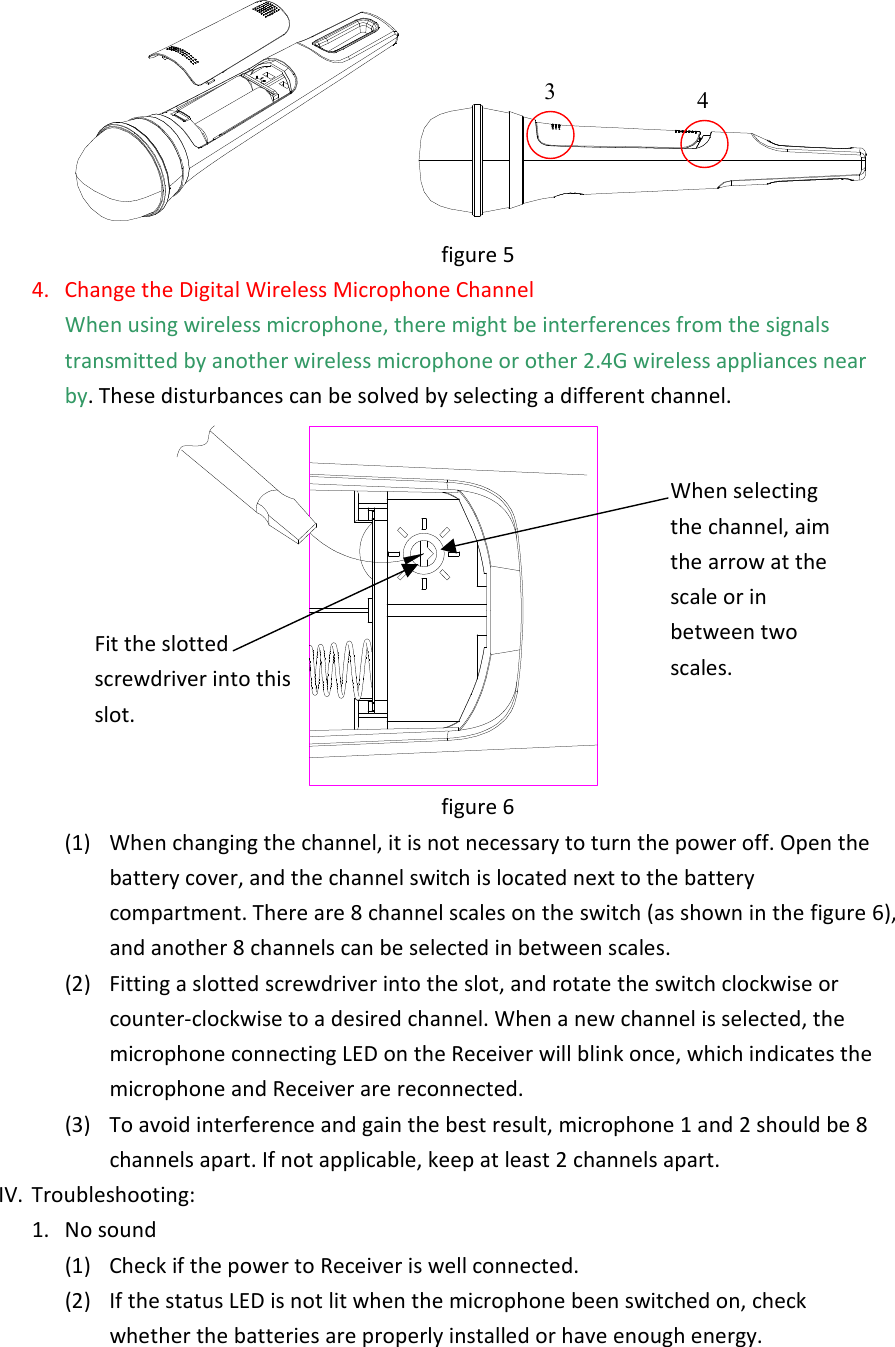
 figure 5 4.  Change the Digital Wireless Microphone Channel   When using wireless microphone, there might be interferences from the signals transmitted by another wireless microphone or other 2.4G wireless appliances near by. These disturbances can be solved by selecting a different channel.    figure 6 (1)  When changing the channel, it is not necessary to turn the power off. Open the battery cover, and the channel switch is located next to the battery compartment. There are 8 channel scales on the switch (as shown in the figure 6), and another 8 channels can be selected in between scales. (2)  Fitting a slotted screwdriver into the slot, and rotate the switch clockwise or counter-clockwise to a desired channel. When a new channel is selected, the microphone connecting LED on the Receiver will blink once, which indicates the microphone and Receiver are reconnected.   (3)  To avoid interference and gain the best result, microphone 1 and 2 should be 8 channels apart. If not applicable, keep at least 2 channels apart. IV.  Troubleshooting:   1.  No sound (1)  Check if the power to Receiver is well connected. (2)  If the status LED is not lit when the microphone been switched on, check whether the batteries are properly installed or have enough energy.   3 4 Fit the slotted screwdriver into this slot. When selecting the channel, aim the arrow at the scale or in between two scales.
(3)  The transmitting range is 20 meters, so keep the microphone within the effective range, or the output audio might be inconsistent. V.  Specification:  1.  Digital Wireless Receiver             Model          : DWR-882             Power Consumption    : 1.5W             Receiving Sensitivity    : -78dBm             Volume Adjusting Range  : 0dB~12dB             Output Jack       : φ6.3 Stereo Female Jack             Output Lever                  : 100mV             Dimension        : 284(L) × 157(W) × 211(H) mm             Weight         : 1.5Kg   2.  Digital Wireless Handle Microphone             Model          : DWM-880             Carrier Frequency    : 2.404~2.476 GHz             Transmitting Power    : 4.5dBm             Capsule        : Dynamic             Polar Pattern      : Super-Cardioid             Impedance        : 600Ω             Frequency Response    : 80Hz~12,000Hz             Power Supply      : Two AA batteries             Battery Life                   : Approx. 26 hours             Dimension        : φ55 × 260(L) mm             Weight               : 180 g (W/O Batteries) 3.  Power Adapter             Input            : AC 100/240V ~ 50/60Hz 0.4A             Output         : DC 7.5V/1A 7.5W VI.  Precautions: 1.  Do not exposure the product to rain, water or heavy humidity environment.   2.  Avoid falling, or hitting by external force. 3.  Do not place under the direct sunlight or the high temperature environment. 4.  Do not use the power adapter for other electronic devices as it might damage the electric circuit.   5.  Avoid approaching the TV set, computer, or electric devices with CRT monitor.   6.  While using the wireless microphone, keep the Receiver away from any interference sources such as computer or communication equipment.   7.  If not in use for a long period of time, remove the batteries and the power adapter, and store them separately.   8.  When the status LED keeps blinking after the microphone is on, it indicates the
battery energy is running low, so please replace the batteries.     VII. Caution 1.  The changes or modifications not expressly approved by the party responsible for compliance could void the user’s authority to operate the equipment. 2.  To comply with the FCC RF exposure compliance requirements, this device and its antenna must not co-located or operating to conjunction with any other antenna or transmitter. 3.  This device complies with Part 15 of the FCC Rules. Operation is subject to the following two conditions: (1) this device may not cause harmful interference, and (2) this device must accept any interference received, including interference that may cause undesired operation.

Navigation menu