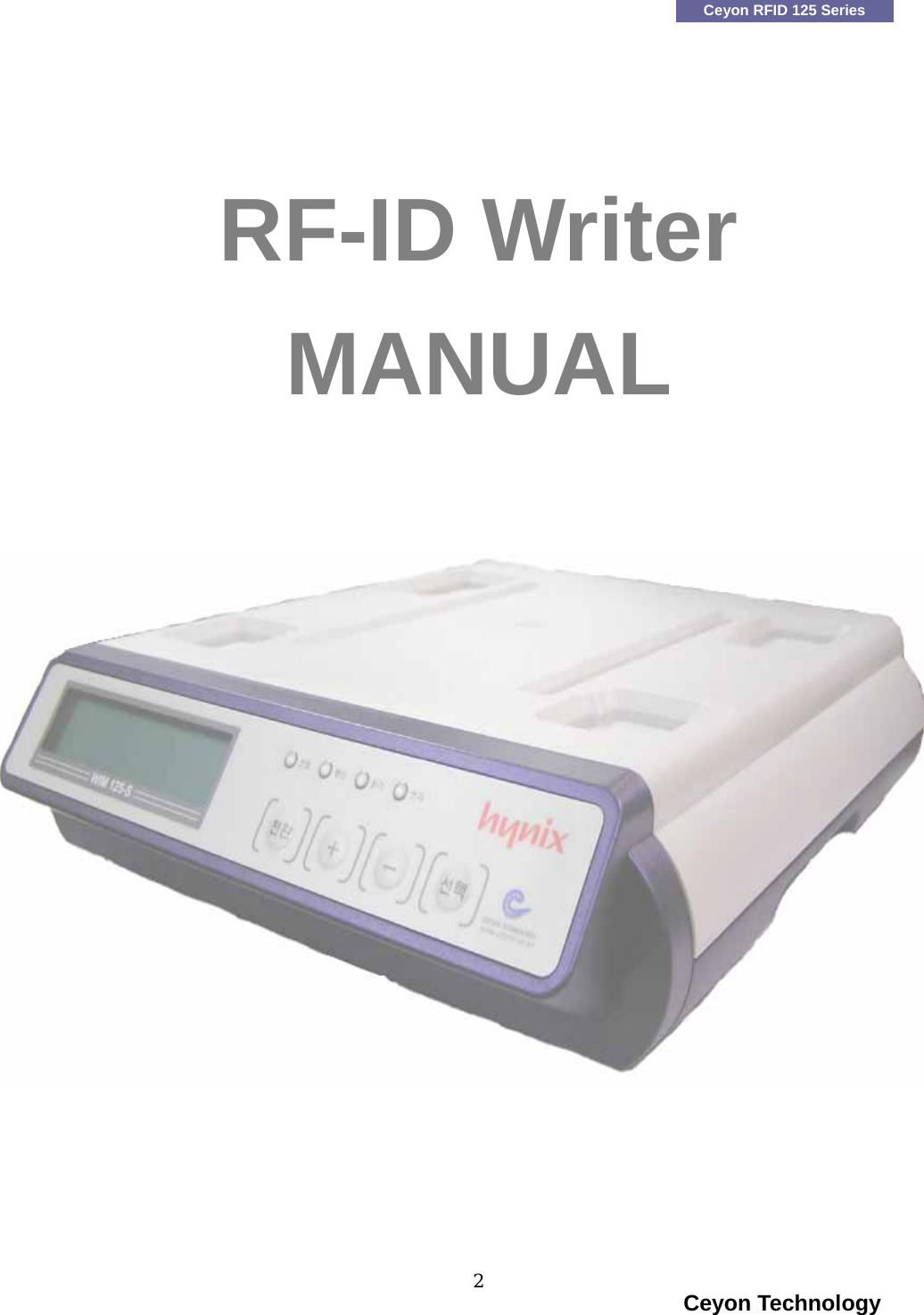
Ceyon Technology WIM125-S RFID Reader/Writer User Manual

Ceyon Technology Co., Ltd. RFID Reader/Writer

Users Manual

   FCC ID : UDCWIM125-S    HYUNDAI CALIBRATION & CERTIFICATION TECHNOLOGIES CO., LTD. SAN 136-1, AMI-RI, BUBAL-EUP, ICHEON-SI, KYOUNGKI-DO, 467-701, KOREA TEL:+82 31 639 8517    FAX:+82 31 639 8525    www.hct.co.kr Report No. : HCT-F06-1007                                                     1/1    ATTACHMENT E.   - USER’S MANUAL -
   Ceyon RFID 125 Series RF-ID Writer MANUAL                                                                     Ceyon Technology 2
   Ceyon RFID 125 Series Contents  RF-ID Writer MANUAL ........................................................................................................... 2 1. WIM125 Series................................................................................................................. 5 1.1. Specifications................................................................................................................. 5 1.1.1. Product specifications............................................................................................... 5 1.1.2. Environment Specifications ...................................................................................... 5 1.2. Name................................................................................................................................6 1.2.1. WIM125-S Rear Side................................................................................................ 6 1.2.2. WIM125-S Upper Part .............................................................................................. 6 1.3. Installation method ........................................................................................................ 7 1.3.1. Method to install WIM125-S ..................................................................................... 7 1.3.2. Precautions in installing WIM125 Series .................................................................. 7 1.4. Power Connection.......................................................................................................... 7 1.4.1. If power is properly input .......................................................................................... 7 1.4.2. If power is improperly input....................................................................................... 7 1.4.3. Check following points:............................................................................................. 8 1.5. Antenna Connection...................................................................................................... 8 1.6. Connection of Communication Lines .......................................................................... 8 1.7. Connection of Keyboard................................................................................................ 8 1.8. Menu................................................................................................................................9 1.8.1. Menu Tree................................................................................................................. 9 1.8.2. Read Operation (Read Mode) ................................................................................ 10 1.8.3. Write Operation(Write Mode).................................................................................. 10 1.8.4. Configuration Mode .................................................................................................11 1.9. Host Communication................................................................................................... 14 1.10. Checking Points of Unit............................................................................................... 14 1.10.1. Power Application................................................................................................... 14 1.10.2. ID Read/Write ......................................................................................................... 14 1.11. Problems and Troubleshooting .................................................................................. 15 1.11.1. Problems related with power supply....................................................................... 15 1.11.2. Problems related with network access................................................................... 15 1.11.3. Problems related with operation............................................................................. 15 Attachment........................................................................................................................... 17                                                                    Ceyon Technology 3
   Ceyon RFID 125 Series Attachment 1: Communication with the Host ................................................................... 18 1. Reader Operation........................................................................................................... 18 1.1. RF mode........................................................................................................................ 18 1.1.1. Verbose mode......................................................................................................... 18 1.1.2. Continuous mode ................................................................................................... 18 1.2. Event report mode........................................................................................................ 18 1.2.1. First talk mode(FT) ................................................................................................. 18 1.2.2. Listen & talk mode(LT)............................................................................................ 18 2. Frame.............................................................................................................................. 18 2.1. Command Frame(Host to Reader).............................................................................. 18 2.2. Response Frame(Reader to Host) .............................................................................. 19 3. Command ....................................................................................................................... 20 4. Frame Communication................................................................................................... 24 4.1. READ Command Format (08h/2nh command).......................................................... 24 4.2. WRITE Command Format (10h/18h/3nh command) ................................................. 24 Attachment 2: Device Check list ........................................................................................ 25                                                                                   Ceyon Technology 4
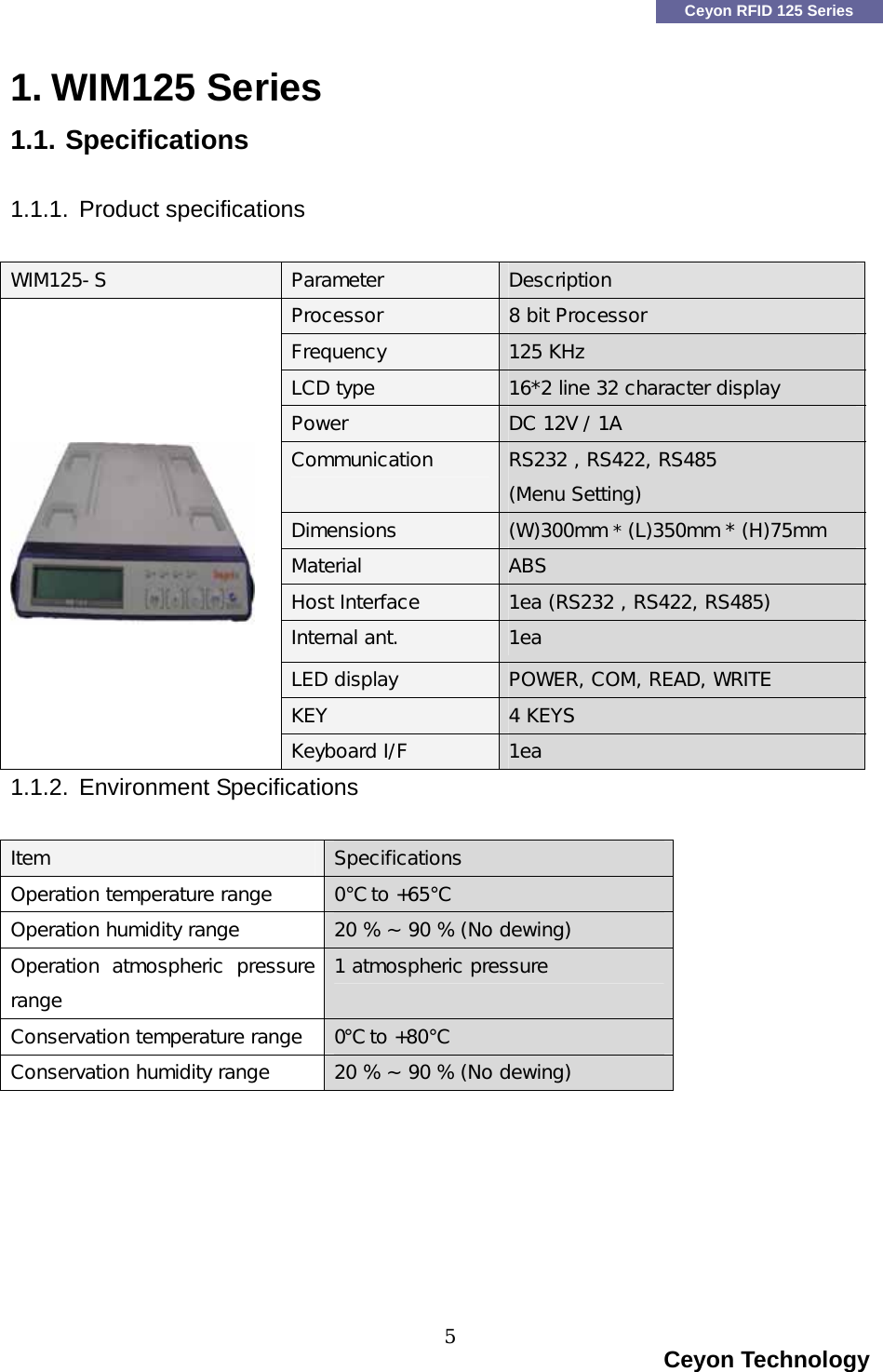
   Ceyon RFID 125 Series 1. WIM125 Series 1.1. Specifications  1.1.1. Product specifications  WIM125-S Parameter  Description Processor  8 bit Processor Frequency  125 KHz LCD type  16*2 line 32 character display Power  DC 12V / 1A Communication   RS232 , RS422, RS485 (Menu Setting) Dimensions  (W)300mm * (L)350mm * (H)75mm Material  ABS Host Interface  1ea (RS232 , RS422, RS485) Internal ant.   1ea LED display  POWER, COM, READ, WRITE KEY  4 KEYS  Keyboard I/F  1ea 1.1.2. Environment Specifications  Item  Specifications Operation temperature range  0℃ to +65℃ Operation humidity range  20 % ~ 90 % (No dewing) Operation  atmospheric  pressure range 1 atmospheric pressure  Conservation temperature range  0℃ to +80℃ Conservation humidity range  20 % ~ 90 % (No dewing)                                                                         Ceyon Technology 5
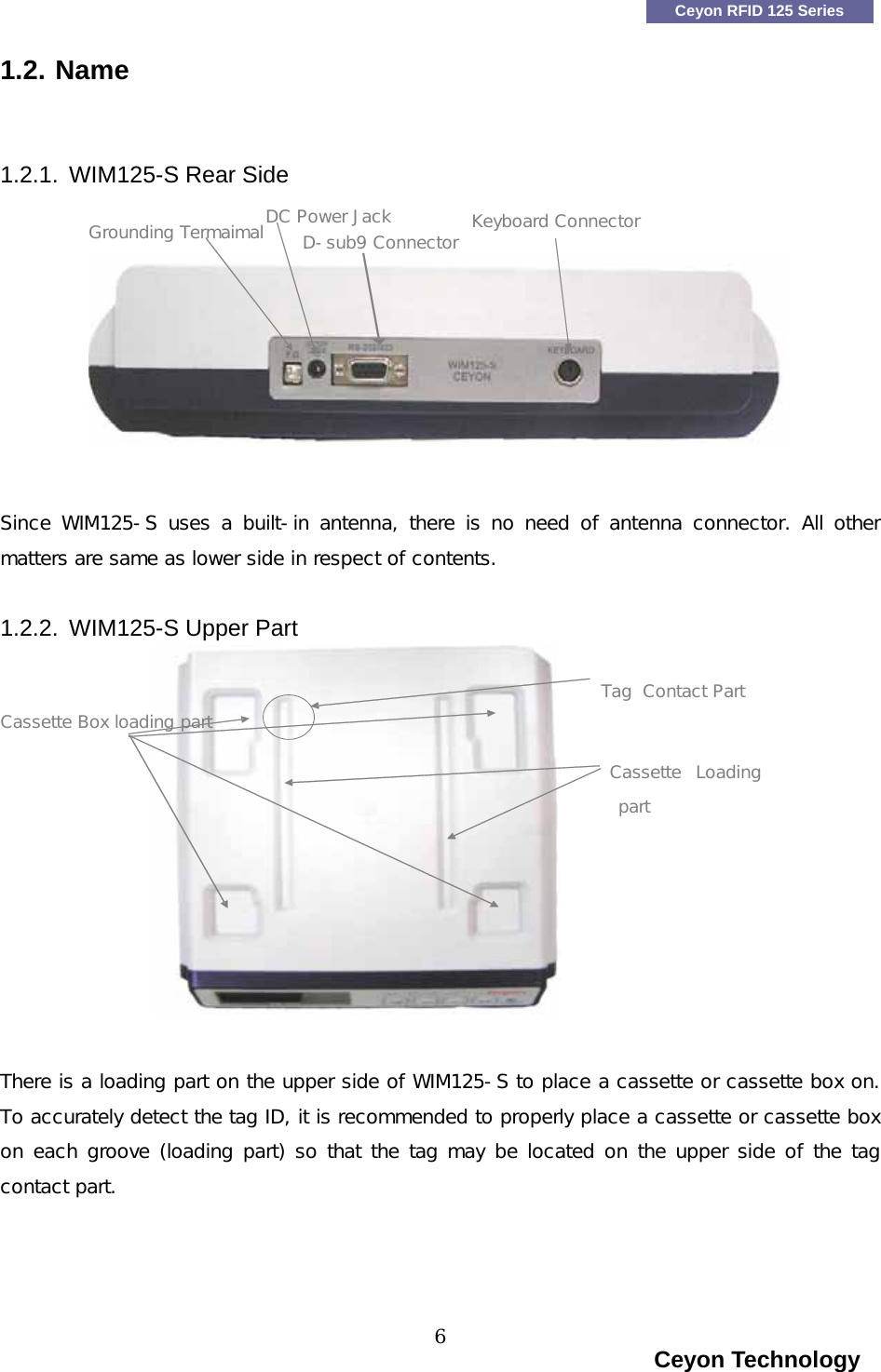
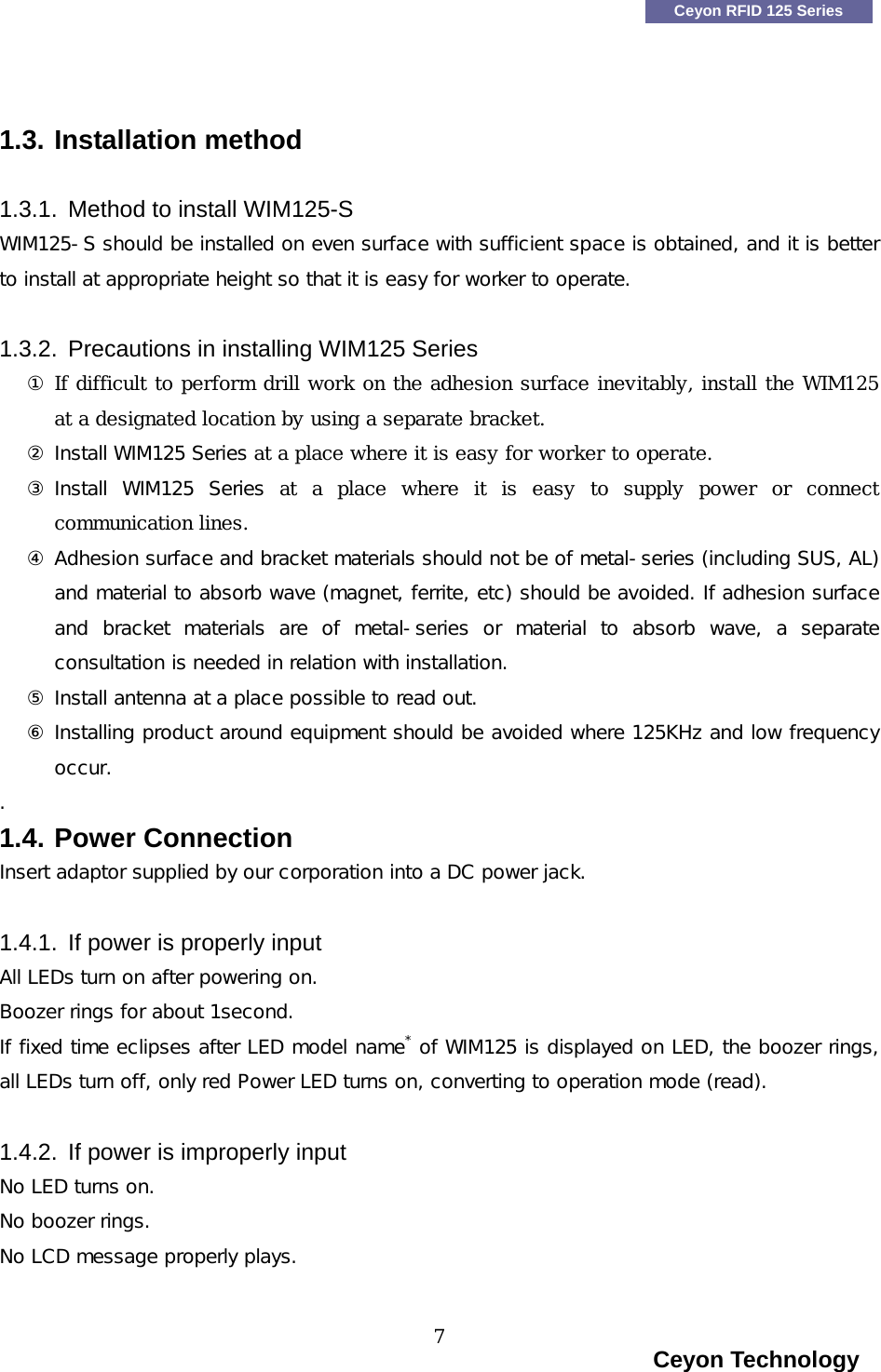
   Ceyon RFID 125 Series 1.2. Name   1.2.1. WIM125-S Rear Side DC Power Jack Keyboard Connector                                                                   Ceyon Technology 6 Grounding T Since  WIM125-S uses  a built-in  antenna,  there is  no need  of  antenna  connector.  All  other matters are same as lower side in respect of contents.  1.2.2. WIM125-S Upper Part   There is a loading part on the upper side of WIM125-S to place a cassette or cassette box on. To accurately detect the tag ID, it is recommended to properly place a cassette or cassette box on each groove (loading part) so that the tag may be located on the upper side of the tag contact part.     D-sub9 Connectorermaimal Cassette Box loadingpart artContact PTagCassette  Loading part
   Ceyon RFID 125 Series   1.3. Installation method  1.3.1.  Method to install WIM125-S WIM125-S should be installed on even surface with sufficient space is obtained, and it is better to install at appropriate height so that it is easy for worker to operate.  1.3.2.  Precautions in installing WIM125 Series ① If difficult to perform drill work on the adhesion surface inevitably, install the WIM125 at a designated location by using a separate bracket. ② Install WIM125 Series at a place where it is easy for worker to operate. ③ Install  WIM125  Series at a place where it is easy to supply power or connect communication lines. ④ Adhesion surface and bracket materials should not be of metal-series (including SUS, AL) and material to absorb wave (magnet, ferrite, etc) should be avoided. If adhesion surface and  bracket  materials  are  of  metal-series  or  material  to  absorb wave, a separate consultation is needed in relation with installation. ⑤ Install antenna at a place possible to read out. ⑥ Installing product around equipment should be avoided where 125KHz and low frequency occur. . 1.4. Power Connection Insert adaptor supplied by our corporation into a DC power jack.   1.4.1.  If power is properly input   All LEDs turn on after powering on. Boozer rings for about 1second.  If fixed time eclipses after LED model name* of WIM125 is displayed on LED, the boozer rings, all LEDs turn off, only red Power LED turns on, converting to operation mode (read).   1.4.2.  If power is improperly input   No LED turns on. No boozer rings.  No LCD message properly plays.                                                                      Ceyon Technology 7
   Ceyon RFID 125 Series 1.4.3.  Check following points: For improper operation, check power adaptor.  Check input power is about DC15V in no load condition. Check  power  polarity  of  adapter  is  proper.  (For  adapter  other  than  that  provided  by  our corporation) 1.5. Antenna Connection  Antenna terminal is composed of a 6-pin miniature DIN jack and length of antenna cables is 2M. In some cases, a flat cable adaptor PCB provided by our corporation may be used for extension of a flat cable. Maximum 3.5m of flat cable can be used in mixed use of 1.5m. Arbitrary cutting or  modification  of  cables  provided  by  our  corporation  should  not be used. Since reading distance may largely differ depending  on size  antenna and  tag,  other types  of  antenna are variously  prepared.  Consult  technical  staff  of  our  corporation  considering  purpose  and environment to use.   1.6. Connection of Communication Lines Communication line connection between WIM125 Series and HOST is explained. Since detailed specification is same as REM125 Series, refer to REM125 Manua.   1.7. Connection of Keyboard WIM125 Series enables to easily input tag ID by using a keyboard. All general keyboards used in a computer are supported. It is possible to use only if simply connecting them to the keyboard connector. ID input using characters, numbers and symbol keys on the keyboard is allowed. No direction keys (→,←,↑,↓), edit keys (Insert, Delete, Home, End, PageUp, PageDown) and several special function keys are not used. Convenient short keys may be used if using the keyboard as follow:  ‘F1’: Performs reading operation in the Read Mode.  Perform reading operation after converting from Write Mode to Read Mode. ‘F2’: Converts from Read Mode to Write Mode. In this case, if there is an ID read in the Read Mode, the cursor is located at the last character of the ID. ‘F3’: Converts from Read Mode to Write Mode, erases all IDs of the tag. Convert to the Read Mode after inputting ‘0’ into the tag. Erases all characters input in the Write Mode and then moves the cursor to the original position.                                                                     Ceyon Technology 8
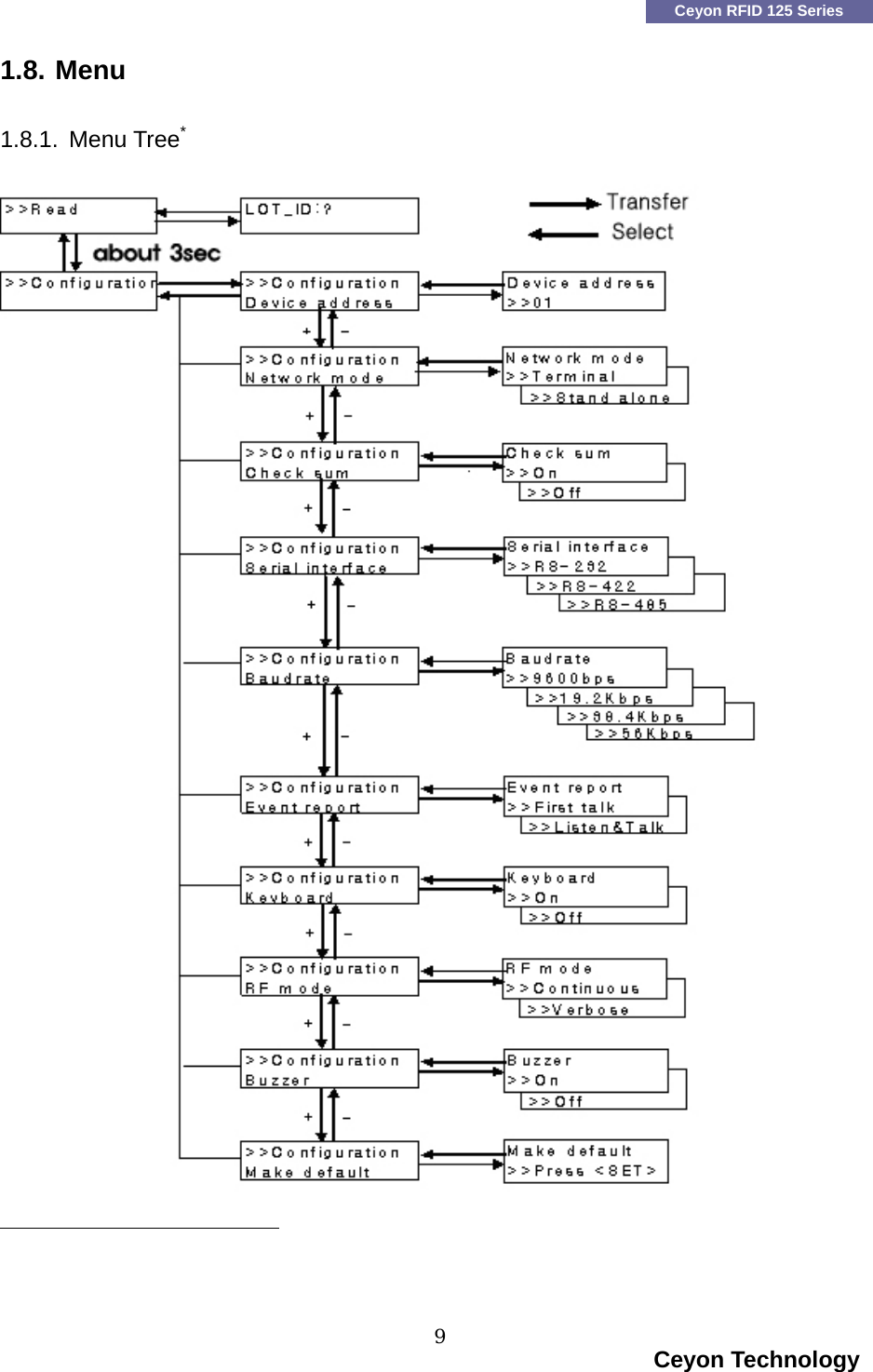
   Ceyon RFID 125 Series 1.8. Menu  1.8.1. Menu Tree*                                                                                                                     Ceyon Technology 9
   Ceyon RFID 125 Series 1.8.2. Read Operation (Read Mode) “>>Read” is displayed on the LCD window. Read mode is a mode firstly entering after applying power, and is set to Continuous (RF mode) and First talk (Event report) in shipment out of factory. Tag ID is detected together with boozer sound when tag approaches to the antenna and is displayed on LCD (for about 5 seconds and ID is transmitted to the host at the same time. Maximum character numbers are 11 characters displayed on LCD.  1.8.2.1.  Method to re-detect same Tag ID   If tag falls within the recognition scope of antenna in basic mode, it performs ID detection only once, and if the same tag continues to fall within the recognition scope of antenna, it performs detection no longer. In this case, following methods are used when desire to detect ID of the same tag: Separate tag from antenna by sufficient distance (about 30cm) and then approach it to antenna again after waiting for about 1 second. Enable to detect ID by pressing the F1 key when the keyboard is adhered.   Read operation continues to perform when tag exists within distance of recognizing antenna if activating RTC by using a CRTC∗(Command of Reset Tag in Continuous mode) in the host in connection with the host.  1.8.3. Write Operation(Write Mode) Write Mode is displayed as “LOT_ID :” on the LCD window and the cursor flickers. This is a mode to input ID into the Tag and can be entered by using a F2 key on the keyboard. This mode can be converted to Read Mode by pressing ‘Conversion’ key for about 3 seconds or pressing the F1 key on the keyboard.  1.8.3.1. ID Entry For ID, up to 1 ~ 23**characters can be entered. In this case, there should be no space between characters. If reaching to maximum character numbers of entry, entry is done no                                              ∗ If referring to annexed protocol, detailed descriptions for CRTC mode is provided. In addition to them, refer to protocol for both RF mode and Event report mode related with reading.** Only LOT_ID up to 11 characters can be entered when entering with the keyboard, and in order to all 23 characters, CTW commands should be used in the HOST. For further details, refer to annexed protocol.                                                                     Ceyon Technology 10
   Ceyon RFID 125 Series longer and boozer sound informs status that it is impossible to enter whenever pressing the key. If pressing ‘Enter’ key on the keyboard in order to complete entry, write operation is performed. Standby status of entry remains in the Write Mode. If Write Mode is completed, boozer sound rings triple time shortly and the Write Mode is converted to Read Mode. 1.8.4. Configuration Mode * This mode is displayed as “>>Configuration” on the LCD window. This is mode to change various settings of the unit and can be entered  by  pressing  the ‘Conversion’ key for more than 3 seconds. For detailed setting items, refer to the Menu Tree.  1.8.4.1. Boozer sound Boozer sound rings whenever changing each of settings and respective meaning is as follow: Short Beep triple time: Means completed setting or OK. Short Beep once: Means that setting values change.  1.8.4.2. Key operation Respective key performs following operation when changing settings by using a key: FUNC (conversion): Moves to previous menu or upper menu after canceling without selecting setting values.  SET (Select): Moves upper menu or lower menu after selecting setting values. INC (+)/DEC(-): Change items.  Automatically return to Read Mode if not pressing the key for 10 seconds after the final key entry.  1.8.4.3. Addressing  Always designate  and use address  of the unit  if executing multi communication except  for point to point. Up to No 1 ~ 16 can be entered. In shipment, address is set to No. ‘1’.     Since communication with the host is not done in changing unit number, do not change the unit number unless there is sufficient understanding about use of the unit.                                                                                                                          Ceyon Technology 11
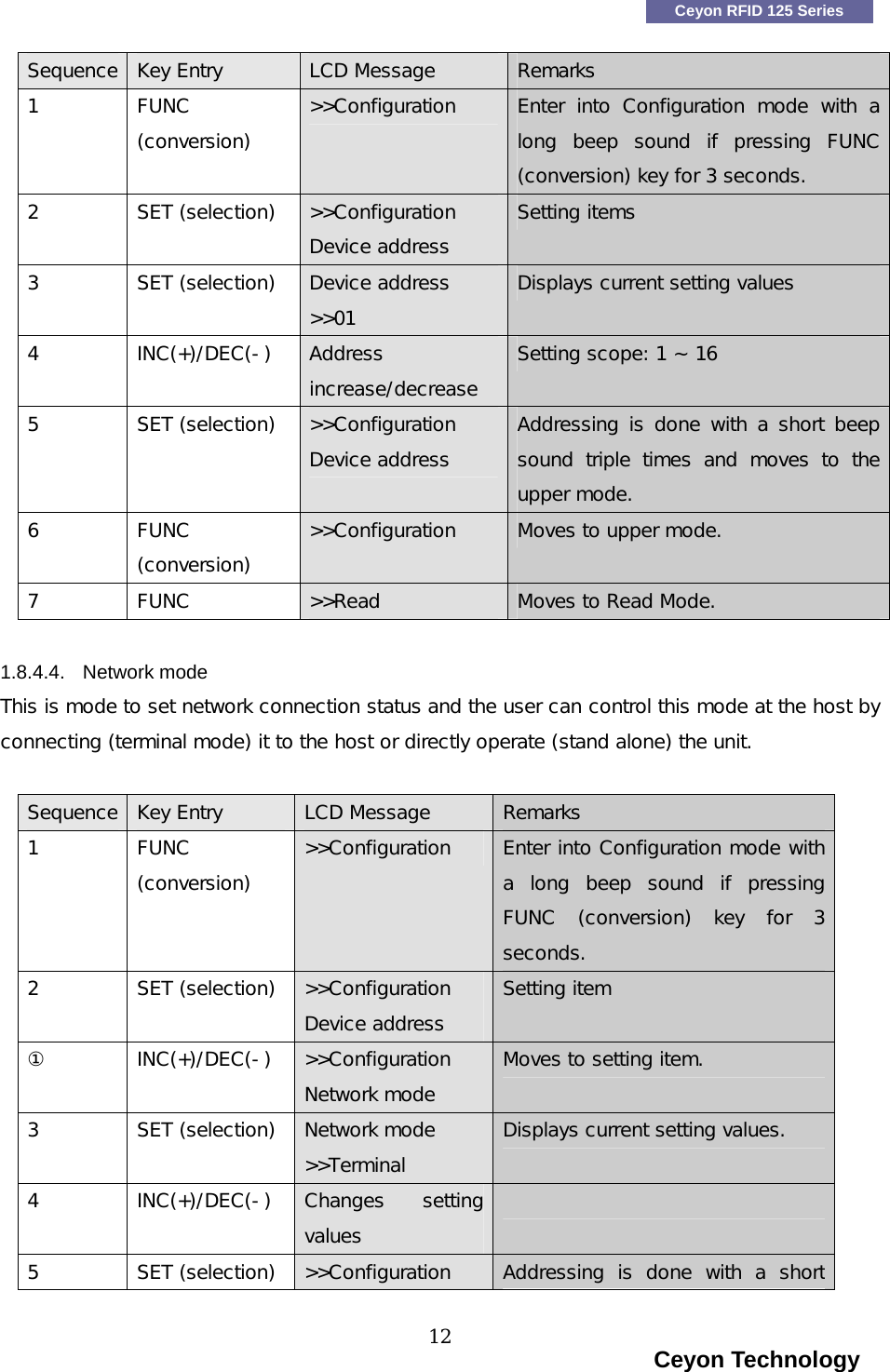
   Ceyon RFID 125 Series Sequence  Key Entry   LCD Message   Remarks 1  FUNC (conversion)  >>Configuration  Enter  into  Configuration  mode  with  a long  beep  sound  if  pressing  FUNC (conversion) key for 3 seconds. 2  SET (selection)   >>Configuration Device address  Setting items  3  SET (selection)  Device address >>01 Displays current setting values 4  INC(+)/DEC(-)    Address increase/decrease Setting scope: 1 ~ 16 5  SET (selection)  >>Configuration Device address  Addressing is done with  a short beep sound triple times and moves to the upper mode. 6  FUNC (conversion) >>Configuration  Moves to upper mode. 7  FUNC  >>Read  Moves to Read Mode.  1.8.4.4. Network mode This is mode to set network connection status and the user can control this mode at the host by connecting (terminal mode) it to the host or directly operate (stand alone) the unit.    Sequence  Key Entry   LCD Message   Remarks 1  FUNC (conversion) >>Configuration  Enter into Configuration mode with a long beep sound if pressing FUNC  (conversion)  key  for  3 seconds. 2  SET (selection)   >>Configuration Device address  Setting item ①  INC(+)/DEC(-)   >>Configuration Network mode Moves to setting item. 3  SET (selection)   Network mode >>Terminal Displays current setting values. 4  INC(+)/DEC(-)    Changes  setting values  5  SET (selection)  >>Configuration  Addressing  is  done  with  a  short                                                                    Ceyon Technology 12
   Ceyon RFID 125 Series Network mode   beep sound triple times and moves to the upper mode. 6  FUNC (conversion) >>Configuration  Moves to upper mode. 7  FUNC  >>Read  Moves to Read Mode.  1.8.4.5. Checksum setting User  can  insert  or  delete  checksum  information  to  detect  fault  operartion  when  translating detected tag ID to the host. Menu setting is same as network mode setting.   You  can  add  or  remove  2  bytes  of  checksum  information  to  detect  error  of  data  when transmitting ID detected from the host. As for method to setup menu, you can set it in the same manner as network mode setting method.  1.8.4.6.  Serial interface setting This is item to set physical communication covenants connected to the host, and supports RS-232, RS-422 and RS-485.  1.8.4.7. Baud rate setting You can set communication speed when communicating to the host, and this mode supports 9600bps, 19.2Kbps, 38.4Kbps and 56Kbps. . 1.8.4.8. Event report setting This is item to setup method to transmit tag ID read in the Read Mode to the host and for further details, refer to annexed protocol.   1.8.4.9. Keyboard setting You can set to on when using the keyboard, and if there is no keyboard, set to Off.  There is no need of changing this keyboard setting when using it as terminal mode since it is not affected by On/Off setting.  1.8.4.10. RF mode setting This mode is to set RF operation for Read Mode and for further details that refer to annexed protocol. 1.8.4.11. Buzzer setting This  is  mode  used  when  turning  on  or  off  boozer  sound  generated  in  detection  Tag  ID  or                                                                    Ceyon Technology 13
   Ceyon RFID 125 Series performance of ID writing. In this case, key operation boozer sound also rings in the Off status.   1.8.4.12. Factory setting This is mode used when restoring to setting value in shipment of factory. Setting is changed to the first setting value of each menu.  1.9. Host Communication WIM125 Series communicates with the host by using same protocol as REM125 Series and you can perform transmission/receipt of ID, setting, etc of the unit at the host. For further details, refer to annexed protocol.   1.10.  Checking Points of Unit To check normal operation of the unit, refer to following items:  1.10.1. Power Application ①  Do All LEDs turn on and boozer sound rings when power is applied, and is model name of product displayed on LCD? ②  Do all LEDs except for power LED turn off after about 1 second from power application and is “>>Read” displayed on the LCD? ③  For WIM125, does the red LED turn on in the antenna installed outside?  1.10.2. ID Read/Write ①  Is a proper ID on the LCD together with boozer sound when placing a tag within recognition distance? Does the Read LED turn on and continue for about 5 seconds (For WIM125, does the yellow LED turn on the antenna installed outside? ②  When continuously placing same tag within recognition distance of the antenna, does it detect ID no longer after reading it once? (However, RTC mode must be disabled) ③  Is up to 11 characters of ID displayed on LCD? ④  Is read operation performed when pressing the F1 key of the keyboard? ⑤  Is it converted to Write Mode when pressing F2 of the keyboard? ⑥  For Write Mode, is ID read in Read Mode displayed? Does the cursor locate at the last character? ⑦  Is up to 11 characters on the keyboard? ⑧  Is entered ID when pressing the Enter key of the keyboard? Is  entered  ID  properly displayed after converting it to Read Mode?  ⑨  Are all entered characters erased when pressing the F3 key of the keyboard in the Write                                                                    Ceyon Technology 14
   Ceyon RFID 125 Series Mode? Does the cursor locate at the first? ⑩  Are all previous ID erased when pressing the F3 key of the keyboard in the Read Mode? Is ‘0’ entered?   Refer to the annexed unit check list for detailed checking points that operate needs other than above checking points.  1.11.  Problems and Troubleshooting  Problems to likely occur by type and are suggested and methods to solve them are introduced.  1.11.1. Problems related with power supply Q1. No LED turns on when connecting power connector. A1. Check following points if such problems occur: Check output of adaptor, a power supply unit comes out (DC12V / 1A) Remove a DC power jack and then connect and restart it after about 10 seconds.  1.11.2. Problems related with network access Q1. No host and WIM125 are connected. A1. Check following points if such problems occur: Check connection status of various cables connecting host and unit, etc once again. Also check exclusive cables are connected. Check operation status both host and machine.  Q2 No WIM125 and antenna are connected. A2. Check following points if such problems occur: Check  connection  status  of  various  cables  connecting  both  WIM125  and  antenna  once again. Also check exclusive cables are connected. Check operation status both 2WIM125 and antenna.  1.11.3. Problems related with operation Q1. No operation is done. A1. Check communication lines of the unit is properly connected. Check power is properly supplied.                                                                     Ceyon Technology 15
   Ceyon RFID 125 Series Q2. No operation even after communication and power lines are entirely connected. A2. Check exclusive cables provided are used.  Check addressing is properly set.     Supply power again.     Check they are in regulated command format.   Q3. Error occurs even though tag is located within valid distance for reading. A3. Supply power again. Check operation mode.     If they are tags that error occurred during write operation, perform proper writing operation once again.  Q4. Writing fail or Verify fail occurs.  A4. Supply power again. Check proper reading is performed.     Check that distance between tag and antenna is appropriate.  If problems are not solved in above methods, consult Ceyon Technology Co., Ltd. (+82-31-267-1163) after immediately removing cables from the power input port.                                                                        Ceyon Technology 16
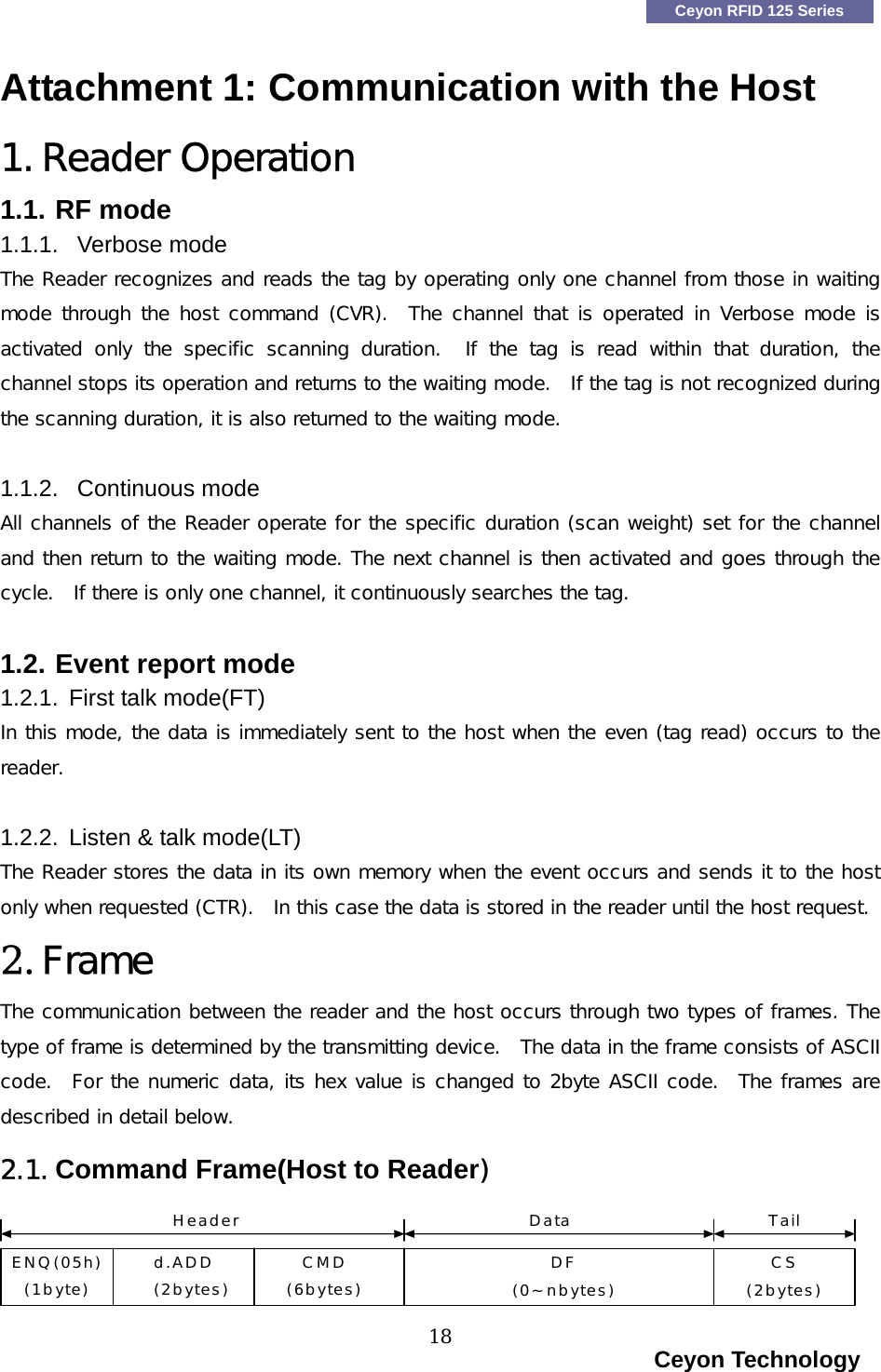
   Ceyon RFID 125 Series Attachment                                                                    Ceyon Technology 17
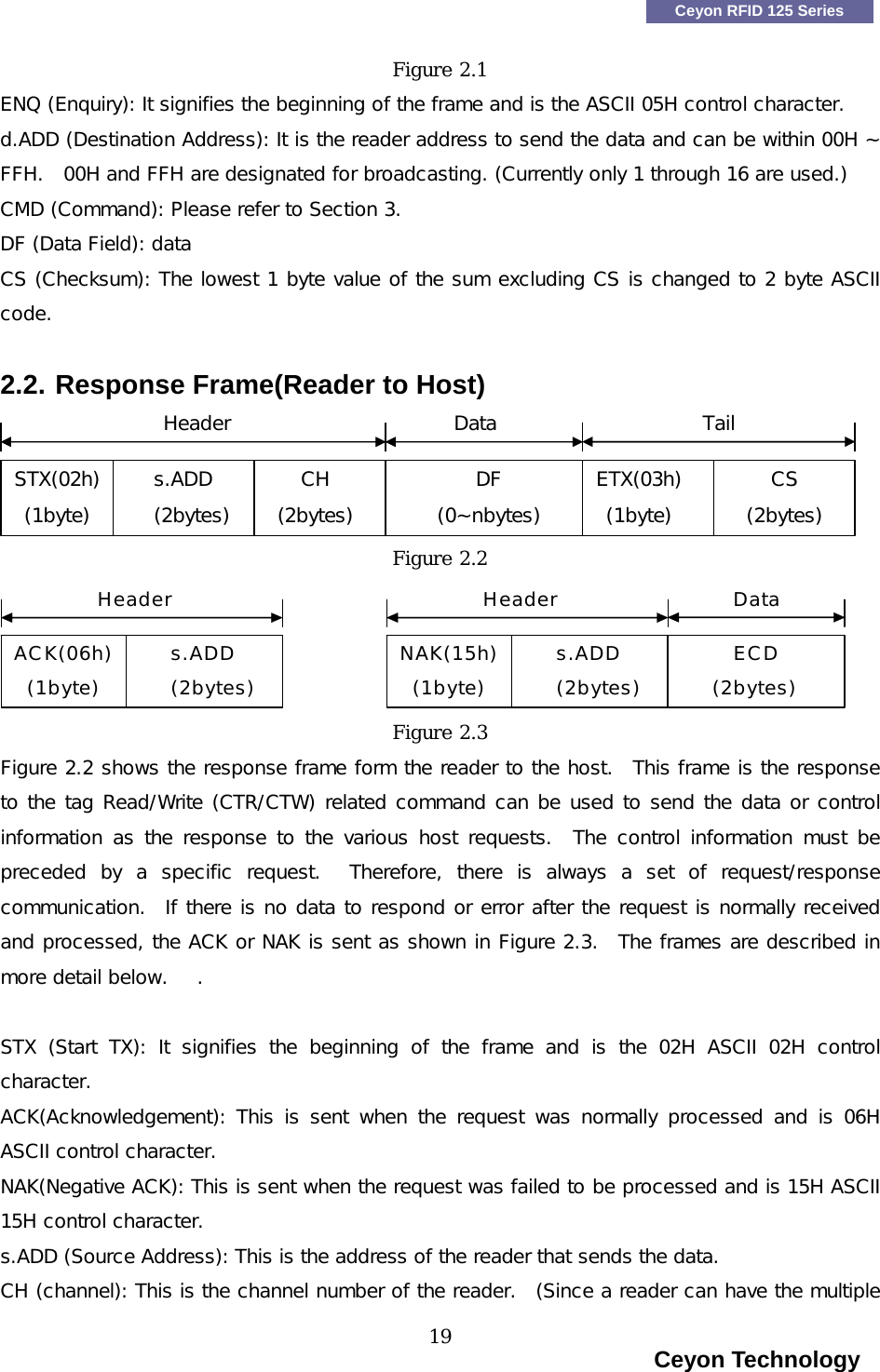
   Ceyon RFID 125 Series Attachment 1: Communication with the Host 1. Reader Operation 1.1. RF mode 1.1.1. Verbose mode The Reader recognizes and reads the tag by operating only one channel from those in waiting mode through the host command (CVR).   The channel  that is operated in  Verbose mode  is activated only the specific scanning duration.  If the tag is read  within  that  duration,  the channel stops its operation and returns to the waiting mode.  If the tag is not recognized during the scanning duration, it is also returned to the waiting mode.     1.1.2. Continuous mode All channels of the Reader operate for the specific duration (scan weight) set for the channel and then return to the waiting mode. The next channel is then activated and goes through the cycle.  If there is only one channel, it continuously searches the tag.   1.2. Event report mode 1.2.1.  First talk mode(FT) In this mode, the data is immediately sent to the host when the even (tag read) occurs to the reader.    1.2.2.  Listen & talk mode(LT) The Reader stores the data in its own memory when the event occurs and sends it to the host only when requested (CTR).  In this case the data is stored in the reader until the host request.  2. Frame The communication between the reader and the host occurs through two types of frames. The type of frame is determined by the transmitting device.  The data in the frame consists of ASCII code.  For the numeric data, its hex value is changed to 2byte ASCII code.  The frames are described in detail below.    2.1. Command Frame(Host to Reader) ENQ(05h)(1byte)d.ADD(2bytes)CMD(6bytes)DF(0~nbytes)CS(2bytes)Header Data Tail                                                                    Ceyon Technology 18
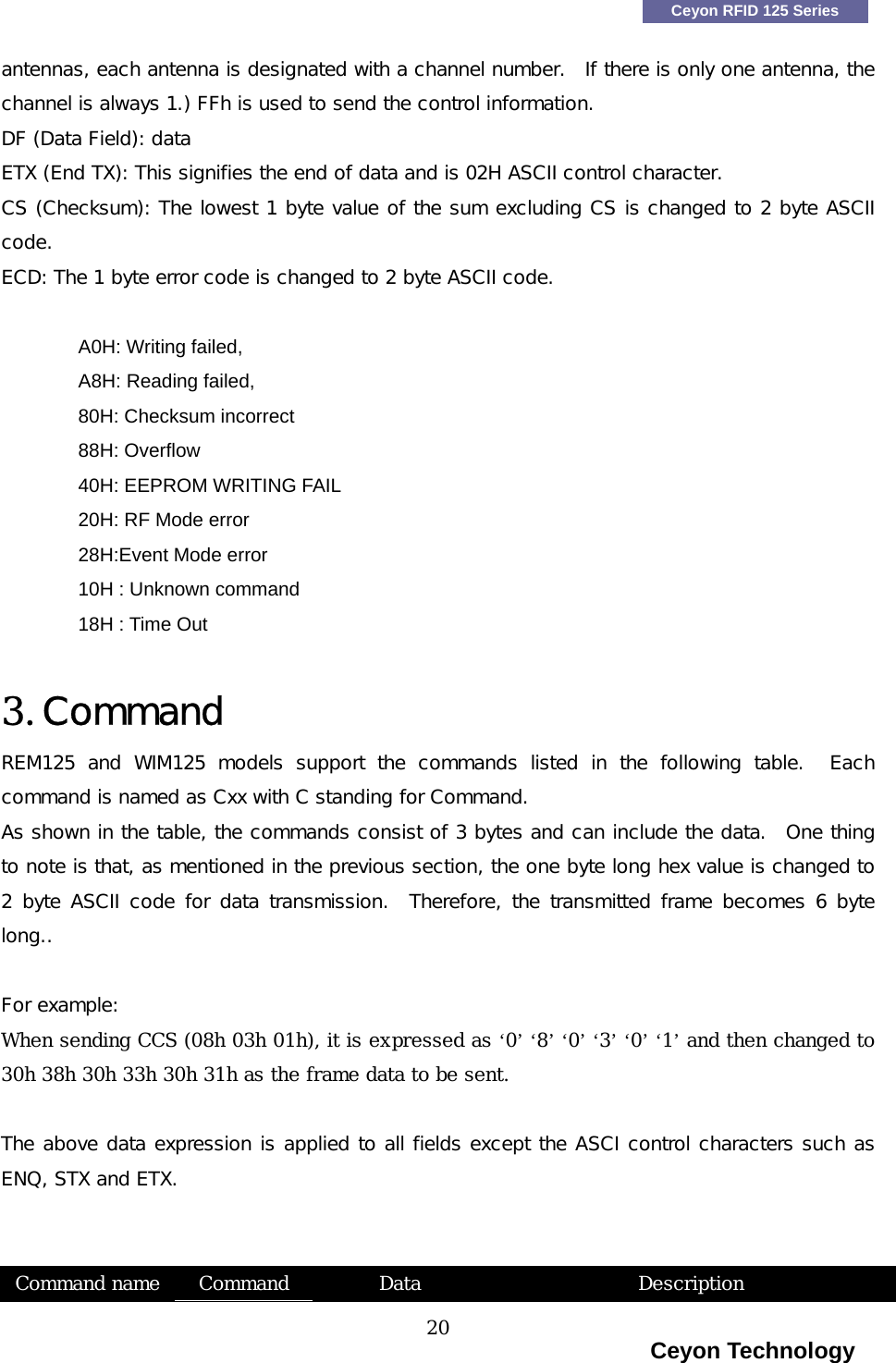
   Ceyon RFID 125 Series Figure 2.1 ENQ (Enquiry): It signifies the beginning of the frame and is the ASCII 05H control character. d.ADD (Destination Address): It is the reader address to send the data and can be within 00H ~ FFH.  00H and FFH are designated for broadcasting. (Currently only 1 through 16 are used.) CMD (Command): Please refer to Section 3. DF (Data Field): data CS (Checksum): The lowest 1 byte value of the sum excluding CS is changed to 2 byte ASCII code.  2.2. Response Frame(Reader to Host) STX(02h)(1byte)s.ADD(2bytes)ETX(03h)(1byte)DF(0~nbytes)CS(2bytes)Header Data TailCH(2bytes)  Figure 2.2 ACK(06h)(1byte)s.ADD(2bytes)HeaderNAK(15h)(1byte)s.ADD(2bytes)HeaderECD(2bytes)Data Figure 2.3 Figure 2.2 shows the response frame form the reader to the host.  This frame is the response to the tag Read/Write (CTR/CTW) related command can be used to send the data or control information as the response to the various host requests.  The control  information must  be preceded  by  a  specific  request.    Therefore,  there  is  always  a  set  of  request/response communication.  If there is no data to respond or error after the request is normally received and processed, the ACK or NAK is sent as shown in Figure 2.3.  The frames are described in more detail below.   .   STX  (Start  TX):  It  signifies  the  beginning  of  the  frame  and  is  the  02H  ASCII  02H  control character. ACK(Acknowledgement): This is sent when the request was normally  processed  and  is 06H ASCII control character. NAK(Negative ACK): This is sent when the request was failed to be processed and is 15H ASCII 15H control character. s.ADD (Source Address): This is the address of the reader that sends the data.  CH (channel): This is the channel number of the reader.  (Since a reader can have the multiple                                                                    Ceyon Technology 19
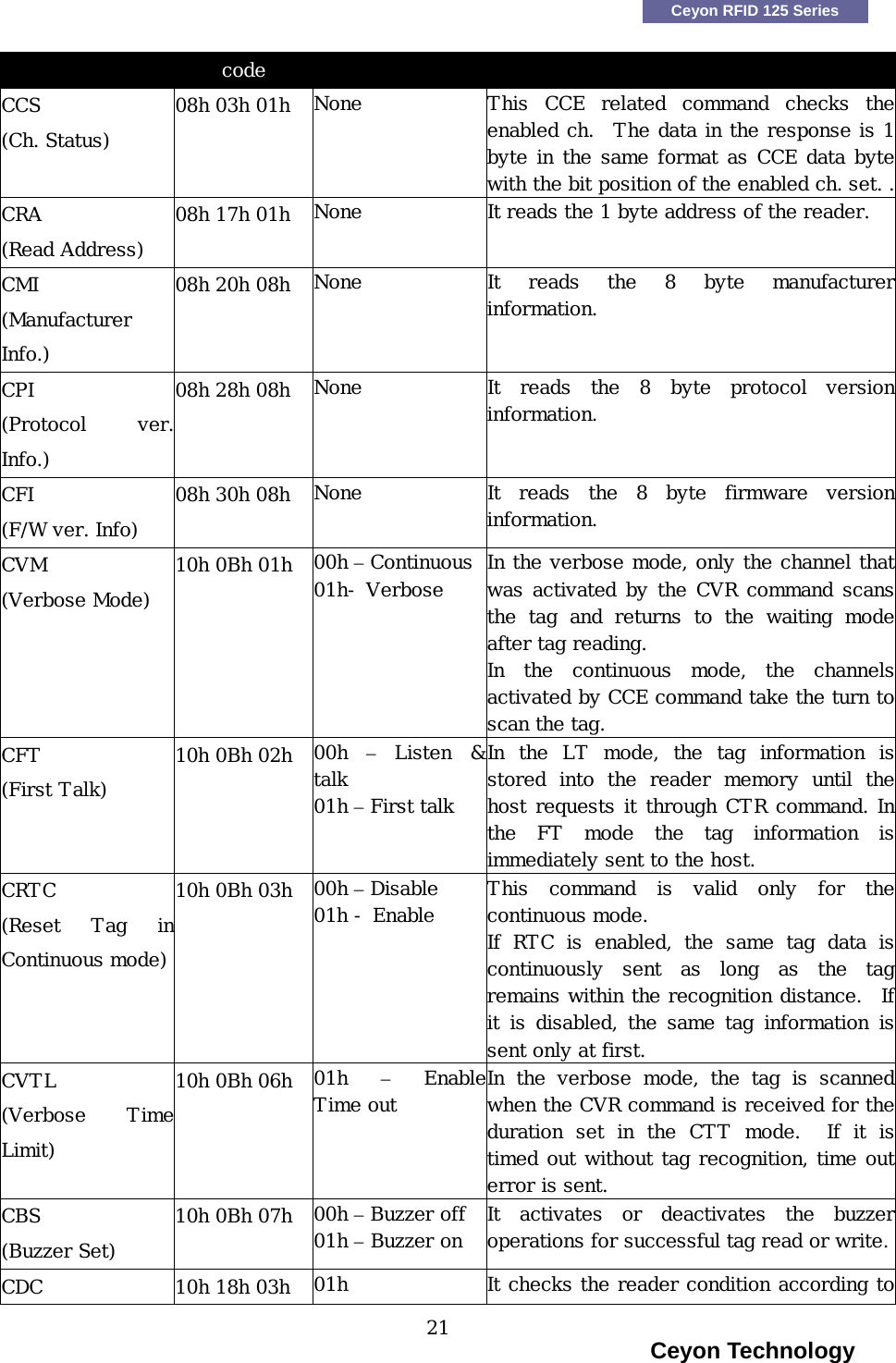
   Ceyon RFID 125 Series antennas, each antenna is designated with a channel number.  If there is only one antenna, the channel is always 1.) FFh is used to send the control information. DF (Data Field): data ETX (End TX): This signifies the end of data and is 02H ASCII control character. CS (Checksum): The lowest 1 byte value of the sum excluding CS is changed to 2 byte ASCII code. ECD: The 1 byte error code is changed to 2 byte ASCII code.  A0H: Writing failed,            A8H: Reading failed,     80H: Checksum incorrect           88H: Overflow 40H: EEPROM WRITING FAIL   20H: RF Mode error 28H:Event Mode error 10H : Unknown command               18H : Time Out  3. Command REM125 and WIM125 models support the commands listed in the following  table.    Each command is named as Cxx with C standing for Command. As shown in the table, the commands consist of 3 bytes and can include the data.  One thing to note is that, as mentioned in the previous section, the one byte long hex value is changed to 2 byte ASCII code for data transmission.  Therefore, the transmitted  frame  becomes  6 byte long..  For example:  When sending CCS (08h 03h 01h), it is expressed as ‘0’ ‘8’ ‘0’ ‘3’ ‘0’ ‘1’ and then changed to  30h 38h 30h 33h 30h 31h as the frame data to be sent.      The above data expression is applied to all fields except the ASCI control characters such as ENQ, STX and ETX.    Command name  Command  Data  Description                                                                    Ceyon Technology 20
   Ceyon RFID 125 Series code CCS (Ch. Status) 08h 03h 01h  None  This  CCE  related  command  checks  the enabled ch.  The data in the response is 1byte in the same format as CCE data byte with the bit position of the enabled ch. set. .CRA (Read Address) 08h 17h 01h  None  It reads the 1 byte address of the reader. CMI (Manufacturer Info.) 08h 20h 08h  None  It  reads  the  8  byte  manufacturer information. CPI (Protocol  ver.Info.) 08h 28h 08h  None  It  reads  the  8  byte  protocol  version information.  CFI (F/W ver. Info) 08h 30h 08h  None  It  reads  the  8  byte  firmware  version information.  CVM (Verbose Mode) 10h 0Bh 01h   00h – Continuous01h- Verbose In the verbose mode, only the channel that was activated by the CVR command scans the  tag  and  returns  to  the  waiting  mode after tag reading.   In the continuous mode, the channels activated by CCE command take the turn to scan the tag. CFT (First Talk) 10h 0Bh 02h  00h  –Listen  &talk   In the LT mode, the tag information is stored  into  the  reader  memory  until  the host requests it through CTR command. In the  FT  mode  the  tag  information  is immediately sent to the host.   01h – First talk CRTC (Reset  Tag  inContinuous mode) 10h 0Bh 03h  00h – Disable 01h - Enable  This command is valid only for the continuous mode.  If RTC is enabled, the same tag data iscontinuously sent as long as the tag remains within the recognition distance.   If it is disabled, the same tag information is sent only at first.     CVTL (Verbose  TimeLimit) 10h 0Bh 06h  01h  –EnableTime out   In the verbose mode, the tag is scanned when the CVR command is received for the duration  set  in  the  CTT  mode.    If  it  is timed out without tag recognition, time out error is sent. CBS (Buzzer Set) 10h 0Bh 07h  00h – Buzzer off 01h – Buzzer on It  activates  or  deactivates  the  buzzer operations for successful tag read or write.CDC  10h 18h 03h  01h  It checks the reader condition according to                                                                    Ceyon Technology 21
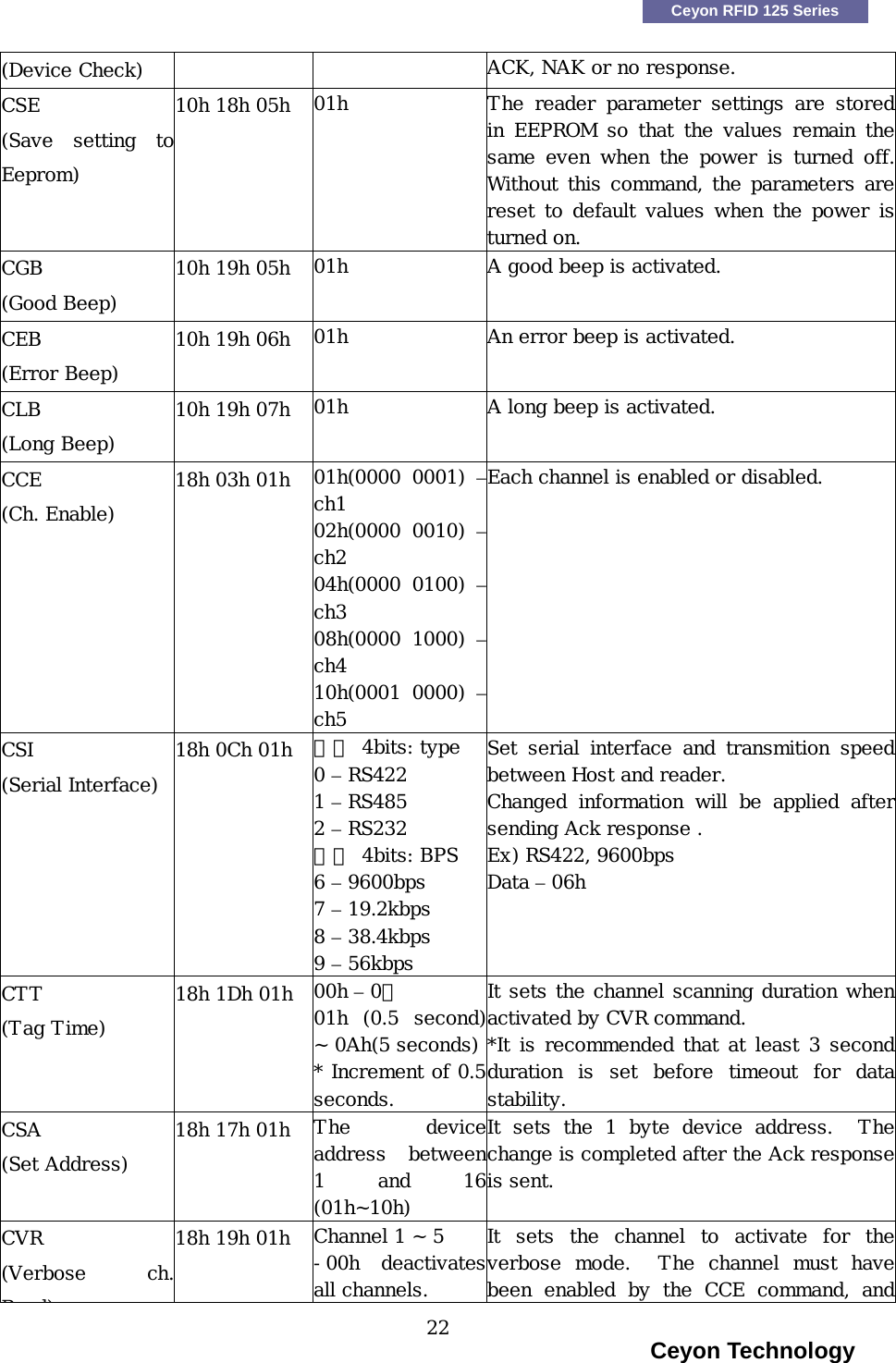
   Ceyon RFID 125 Series                                                                    Ceyon Technology 22(Device Check) ACK, NAK or no response.  CSE (Save  setting  toEeprom) 10h 18h 05h  01h  The  reader  parameter  settings  are  stored in  EEPROM  so  that  the  values  remain  the same even when the power is turned off. Without  this command, the parameters are reset  to default  values  when the  power  is turned on.  CGB (Good Beep) 10h 19h 05h  01h  A good beep is activated. CEB (Error Beep) 10h 19h 06h  01h  An error beep is activated. CLB (Long Beep) 10h 19h 07h  01h  A long beep is activated. CCE (Ch. Enable) 18h 03h 01h  01h(0000  0001) –ch1 02h(0000  0010) –ch2 04h(0000  0100) –ch3 08h(0000  1000) –ch4 10h(0001  0000) –ch5 Each channel is enabled or disabled. CSI (Serial Interface) 18h 0Ch 01h  상위 4bits: type 0 – RS422 1 – RS485 2 – RS232 하위 4bits: BPS 6 – 9600bps 7 – 19.2kbps 8 – 38.4kbps 9 – 56kbps Set serial interface and transmition speed between Host and reader. Changed  information  will  be  applied  aftersending Ack response . Ex) RS422, 9600bps Data – 06h CTT (Tag Time) 18h 1Dh 01h  00h – 0초 01h  (0.5  second)~ 0Ah(5 seconds)  It sets the channel scanning duration when activated by CVR command.  * Increment of 0.5seconds.  *It is recommended that at least 3 second duration  is  set  before  timeout  for  data stability.  CSA (Set Address) 18h 17h 01h  The  deviceaddress  between1  and  16(01h~10h)    It  sets  the  1  byte  device  address.    The change is completed after the Ack response is sent. CVR (Verbose  ch.Rd)18h 19h 01h  Channel 1 ~ 5 -00h  deactivatesall channels.  It  sets  the  channel  to  activate  for  the verbose  mode.    The  channel  must  have been  enabled  by  the  CCE  command,  and
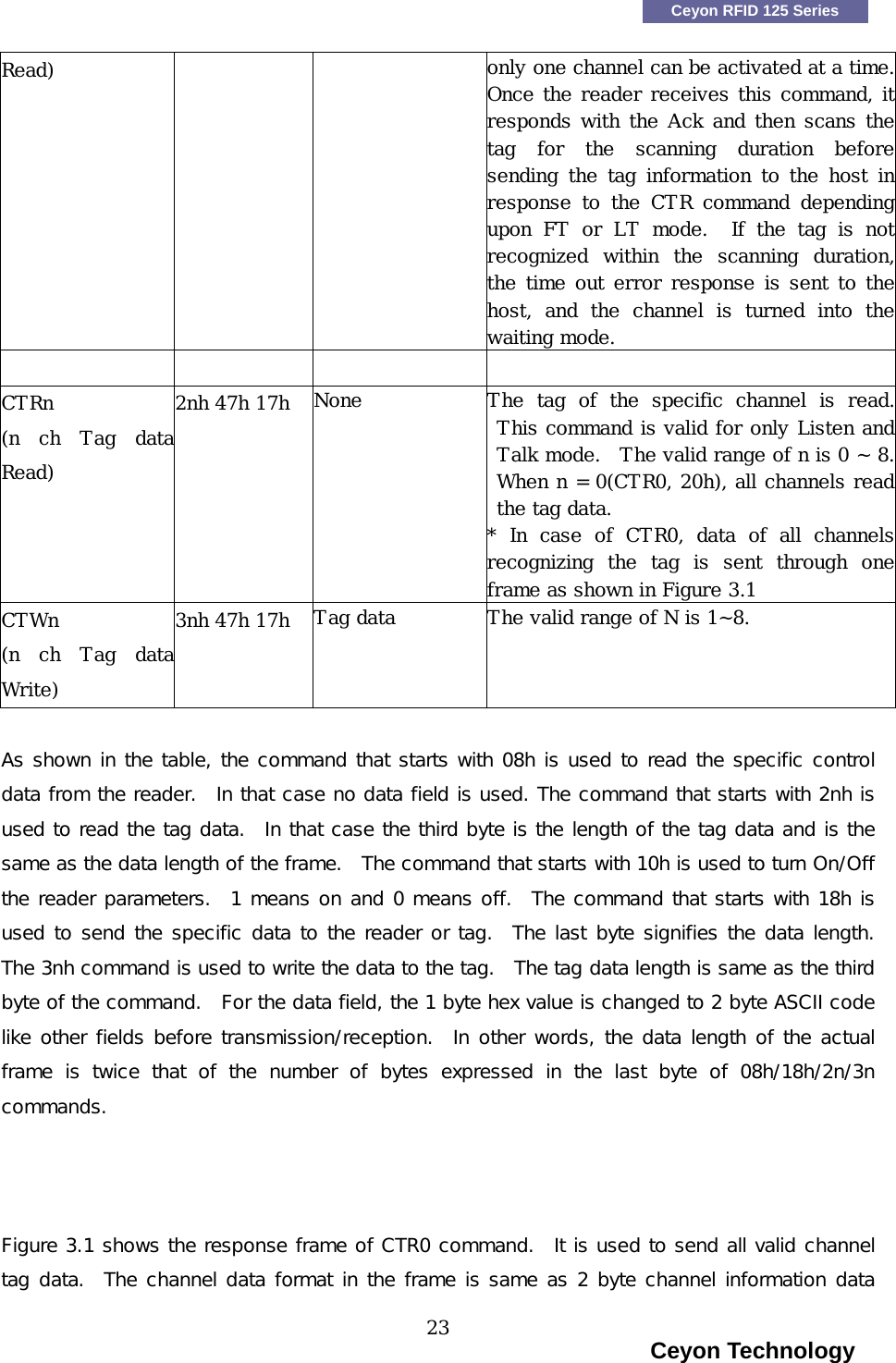
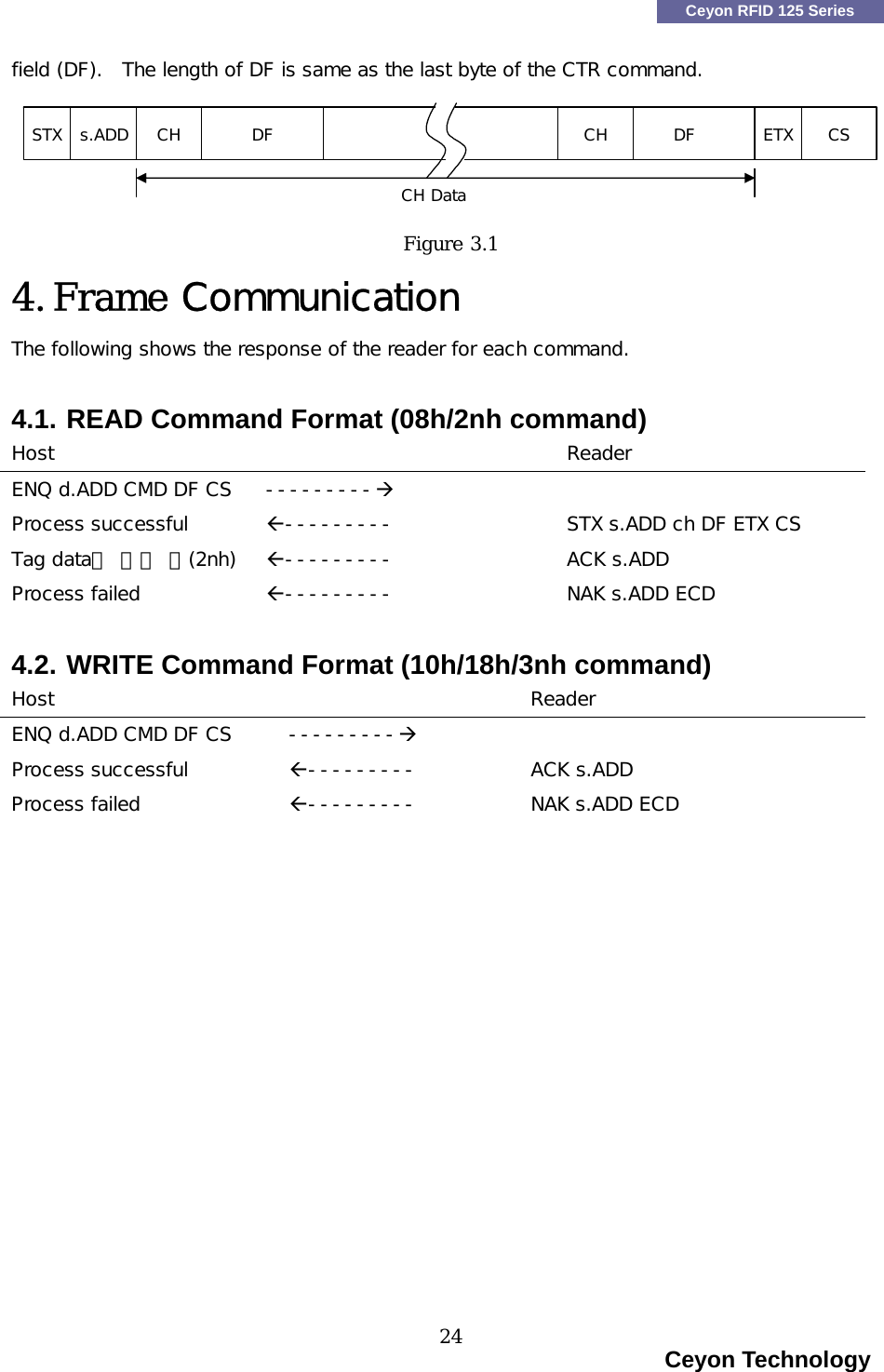
   Ceyon RFID 125 Series Read) only one channel can be activated at a time. Once the reader receives this command, itresponds with the Ack and then scans the tag  for  the  scanning  duration  before sending  the  tag  information  to  the  host  in response  to  the  CTR  command  depending upon FT or LT mode.  If the tag is not recognized  within  the  scanning  duration, the time out error response is sent to the host,  and  the  channel  is  turned  into  the waiting mode.       CTRn (n  ch  Tag  dataRead) 2nh 47h 17h  None  The  tag  of  the  specific  channel  is  read. This command is valid for only Listen and Talk mode.  The valid range of n is 0 ~ 8. When n = 0(CTR0, 20h), all channels read the tag data.   * In case of CTR0, data of all channels recognizing  the  tag  is  sent  through  one frame as shown in Figure 3.1 CTWn (n  ch  Tag  dataWrite) 3nh 47h 17h  Tag data  The valid range of N is 1~8.  As shown in the table, the command that starts with 08h is used to read the specific control data from the reader.  In that case no data field is used. The command that starts with 2nh is used to read the tag data.  In that case the third byte is the length of the tag data and is the same as the data length of the frame.  The command that starts with 10h is used to turn On/Off the reader parameters.  1 means on and 0 means off.  The command that starts with 18h is used to send the specific data to the reader or tag.  The last byte signifies the data length.  The 3nh command is used to write the data to the tag.  The tag data length is same as the third byte of the command.  For the data field, the 1 byte hex value is changed to 2 byte ASCII code like other fields before transmission/reception.  In other words, the data length of the actual frame is twice that of the number of bytes expressed in the last  byte  of  08h/18h/2n/3n commands.     Figure 3.1 shows the response frame of CTR0 command.  It is used to send all valid channel tag data.  The channel data format in the frame is same as 2 byte channel information data                                                                    Ceyon Technology 23
   Ceyon RFID 125 Series field (DF).  The length of DF is same as the last byte of the CTR command.  CH DataSTX s.ADD ETXDF CSCH CH DF Figure 3.1  4. Frame Communication The following shows the response of the reader for each command.  4.1. READ Command Format (08h/2nh command) Host    Reader ENQ d.ADD CMD DF CS  ---------Æ  Process successful  Å---------  STX s.ADD ch DF ETX CS Tag data가 없을 때(2nh)  Å---------  ACK s.ADD Process failed  Å---------  NAK s.ADD ECD  4.2. WRITE Command Format (10h/18h/3nh command) Host    Reader ENQ d.ADD CMD DF CS   ---------Æ  Process successful  Å---------  ACK s.ADD Process failed  Å---------  NAK s.ADD ECD                                                                     Ceyon Technology 24
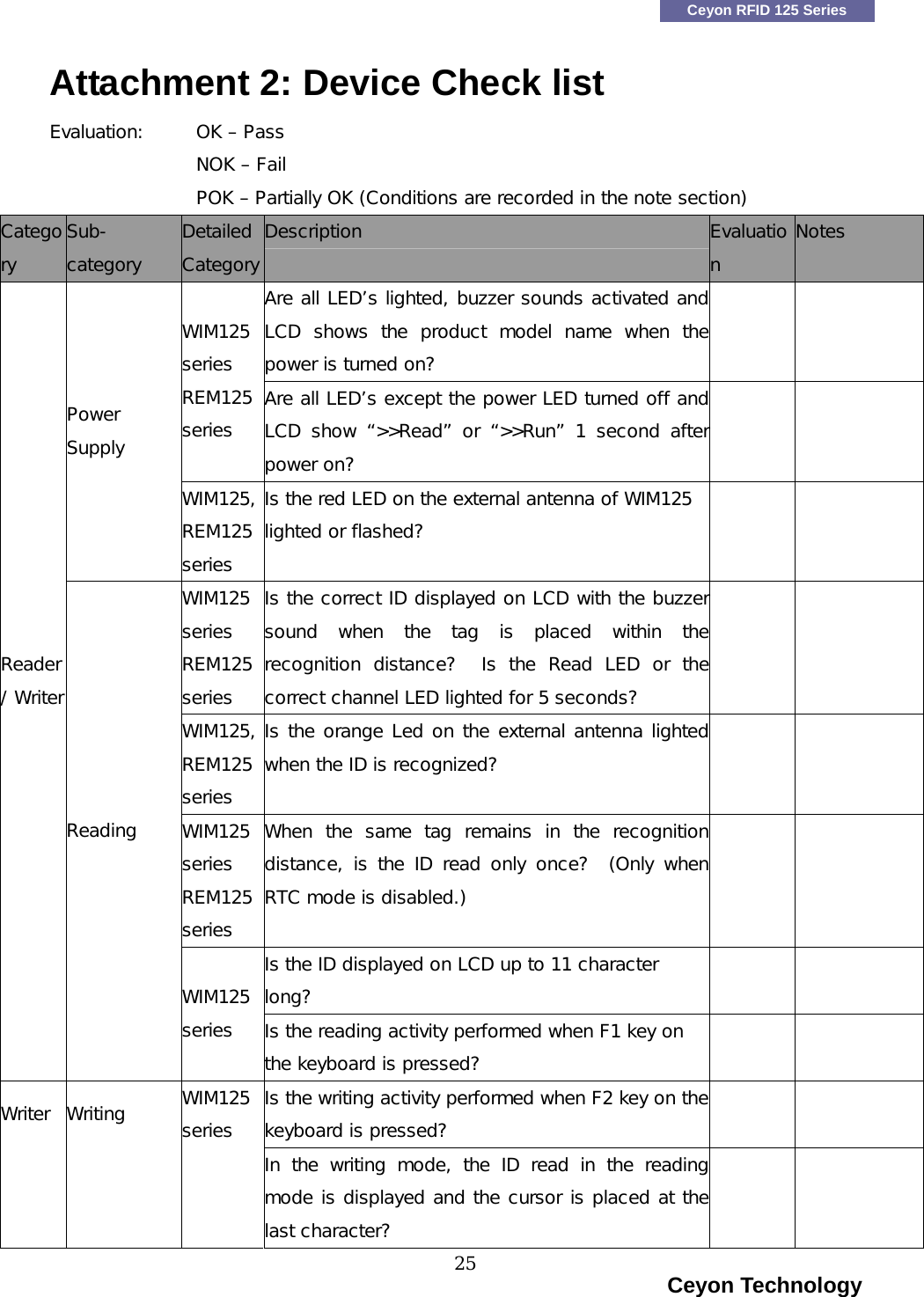
   Ceyon RFID 125 Series Attachment 2: Device Check list   Evaluation:  OK – Pass          NOK – Fail          POK – Partially OK (Conditions are recorded in the note section) Category Sub-category Detailed Category Description  Evaluation Notes Are all LED’s lighted, buzzer sounds activated andLCD  shows  the  product  model  name  when  the power is turned on?    WIM125 series REM125 series Are all LED’s except the power LED turned off andLCD  show  “>>Read”  or  “>>Run” 1  second  after power on?    Power Supply WIM125, REM125 series Is the red LED on the external antenna of WIM125 lighted or flashed?   WIM125 series REM125 series Is the correct ID displayed on LCD with the buzzersound when the tag is placed within therecognition  distance?    Is  the  Read  LED  or  the correct channel LED lighted for 5 seconds?    WIM125, REM125 series Is the orange Led on the external antenna lightedwhen the ID is recognized?    WIM125 series REM125 series When  the  same  tag  remains  in the  recognitiondistance, is the ID read only once?  (Only when RTC mode is disabled.)     Is the ID displayed on LCD up to 11 character long?   Reader/ Writer Reading WIM125 series  Is the reading activity performed when F1 key on the keyboard is pressed?   Is the writing activity performed when F2 key on thekeyboard is pressed?    Writer  Writing  WIM125 series In the writing mode, the ID read in the readingmode is displayed and the cursor is placed at thelast character?                                                                       Ceyon Technology 25
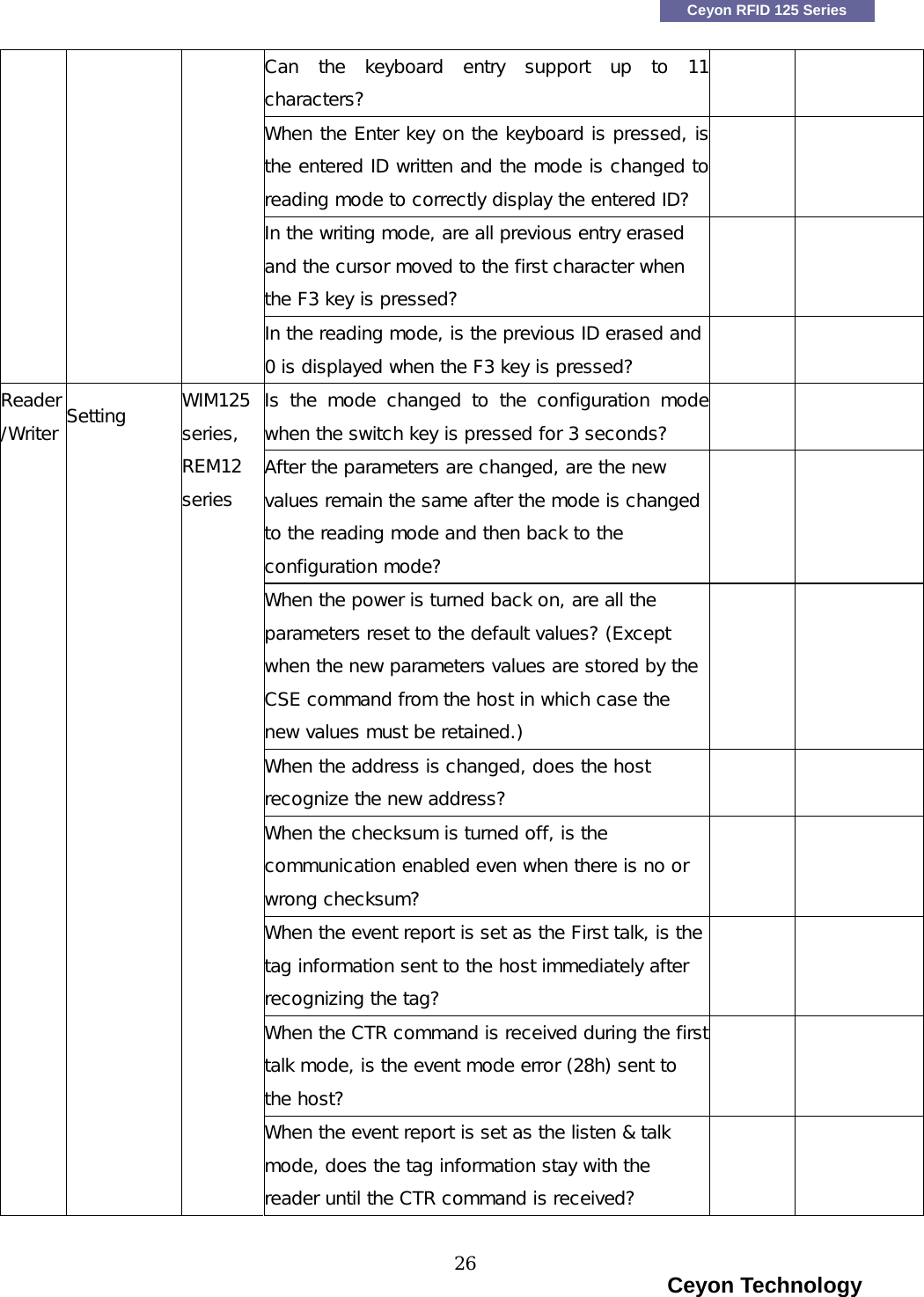
   Ceyon RFID 125 Series Can  the  keyboard  entry  support  up  to  11characters?   When the Enter key on the keyboard is pressed, isthe entered ID written and the mode is changed to reading mode to correctly display the entered ID?   In the writing mode, are all previous entry erased and the cursor moved to the first character when the F3 key is pressed?        In the reading mode, is the previous ID erased and 0 is displayed when the F3 key is pressed?   Is  the  mode  changed  to  the  configuration  modewhen the switch key is pressed for 3 seconds?   After the parameters are changed, are the new values remain the same after the mode is changed to the reading mode and then back to the configuration mode?   When the power is turned back on, are all the parameters reset to the default values? (Except when the new parameters values are stored by the CSE command from the host in which case the new values must be retained.)   When the address is changed, does the host recognize the new address?   When the checksum is turned off, is the communication enabled even when there is no or wrong checksum?   When the event report is set as the First talk, is the tag information sent to the host immediately after recognizing the tag?   When the CTR command is received during the firsttalk mode, is the event mode error (28h) sent to the host?    Reader/Writer Setting  WIM125 series,  REM12 series When the event report is set as the listen & talk mode, does the tag information stay with the reader until the CTR command is received?                                                                      Ceyon Technology 26
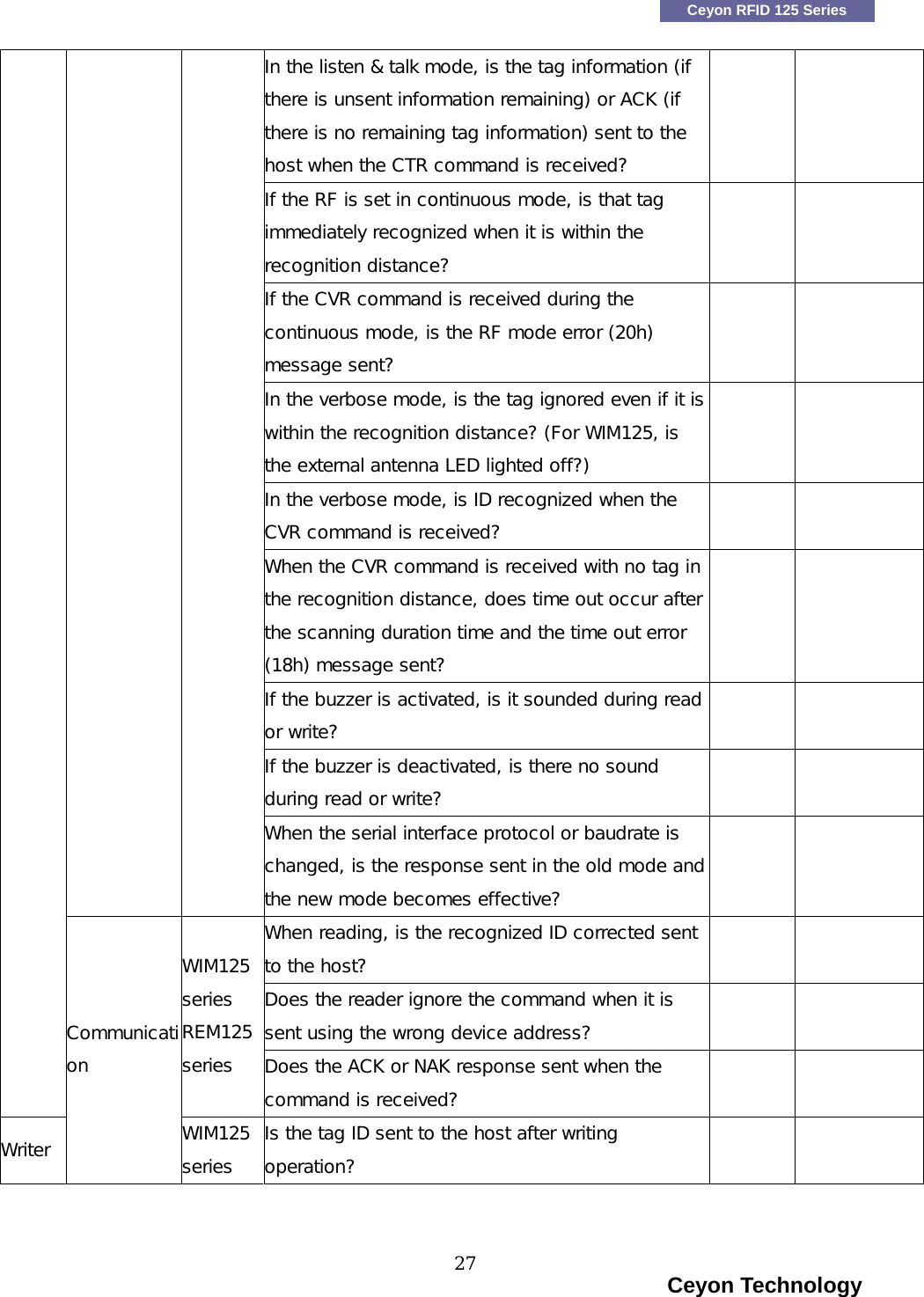
   Ceyon RFID 125 Series In the listen & talk mode, is the tag information (if there is unsent information remaining) or ACK (if there is no remaining tag information) sent to the host when the CTR command is received?   If the RF is set in continuous mode, is that tag immediately recognized when it is within the recognition distance?   If the CVR command is received during the continuous mode, is the RF mode error (20h) message sent?   In the verbose mode, is the tag ignored even if it is within the recognition distance? (For WIM125, is the external antenna LED lighted off?)   In the verbose mode, is ID recognized when the CVR command is received?   When the CVR command is received with no tag in the recognition distance, does time out occur after the scanning duration time and the time out error (18h) message sent?   If the buzzer is activated, is it sounded during read or write?   If the buzzer is deactivated, is there no sound during read or write?      When the serial interface protocol or baudrate is changed, is the response sent in the old mode and the new mode becomes effective?   When reading, is the recognized ID corrected sent to the host?   Does the reader ignore the command when it is sent using the wrong device address?   WIM125 series REM125 series  Does the ACK or NAK response sent when the command is received?   Writer Communication WIM125 series Is the tag ID sent to the host after writing operation?                                                                        Ceyon Technology 27

Navigation menu