Communications MARKII-CII-DMD Power Amplifier User Manual MARKII Kit Instruction Sheet

Communications International Inc. Power Amplifier MARKII Kit Instruction Sheet

Manual

 Rev 2.0  6/6/04   If you have determined that the White module (U2 (STM901-30) driving the Final PA has failed…  MARKII kit contains the following: 1 1ea  PA assembly board 2 1ea   Aluminum Spacer w/ four holes 3 4ea  3/16 #4/40 screws (for Q2 on MARK II) 4 2ea  ½” #4 metric torq screws (for fastening Mark II Board & Spacer) 5 1ea  FCC Label for placement on exterior of PA housing   Please see B3521R3A.pdf or 19D902757G5 Mastr III PA schematic for the proper installation of this replacement module.  The fan kit 188D6127G1 assembly supplied from MA/Com is required for this module for warranty to be valid. The PA will exceed heat tolerance & fail without this fan kit.  Disconnect ALL power & control cable from the Mastr III Power Supply  Remove U2 (STM901-30) from Power Amplifier Board A1…being careful to not damage the lands on the remaining board.   Disconnect P101 from J101. (the small gold connector from the BNC input from the MIII exciter) This aids in the installation of the MARK II module.  Apply heat sink compound “sparingly” to the bottom of the Aluminum Spacer Plate of the MARKII RF board. It has been proven that less is better with regards to heat sink compound. Apply only a slight amount, but sufficient to cover the surface.  Align spacer plate so both holes in the circuit board of the MARK II module align for mounting. Slowly screw down each side until snug (No more than 1ft/lbs torque).  Place spacer & Module into position where the U2 (STM901-30) module was previously.  Mount assembly using the 4 ea. #4-40 screws.  Secure all screws snug (No more than 1ft/lbs torque).  Insert the module under the small hard-line coax P 101 into position & mount using all 4 screws.  Be certain no excessive heat sink compound is across any connections  Solder the 5 connections from the MARK II module to the pins on the Power Amp using proper RF practice. Stripped Cat5 cable lead cut to about 400 mils can be used to make your leads.   Use the following U2 pin connections with the MARKKII PA.
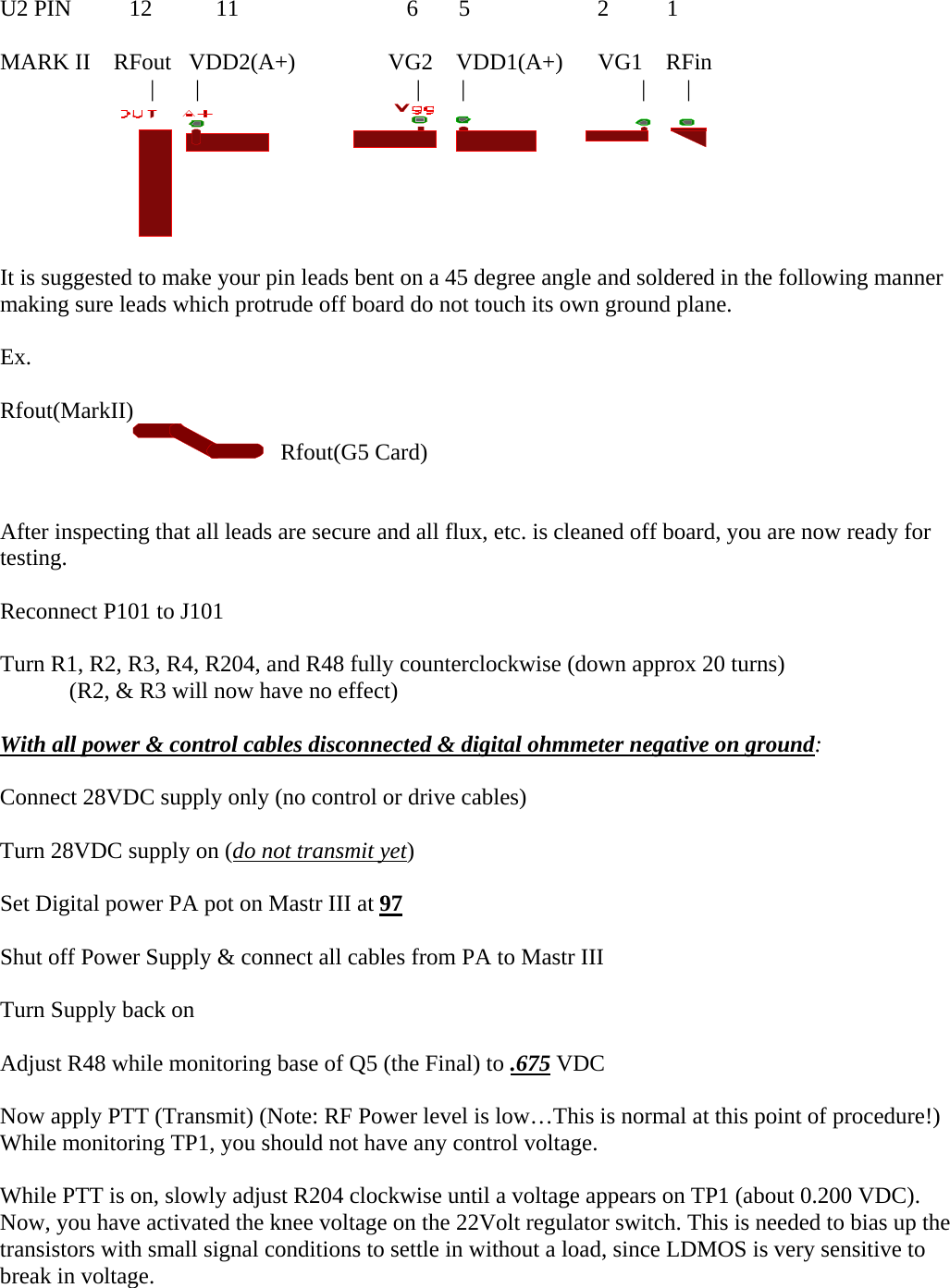
U2 PIN          12           11                             6       5                      2          1  MARK II    RFout   VDD2(A+)                VG2    VDD1(A+)      VG1    RFin                           |       |       |       |         |       |                   It is suggested to make your pin leads bent on a 45 degree angle and soldered in the following manner making sure leads which protrude off board do not touch its own ground plane.  Ex.  Rfout(MarkII)                            Rfout(G5 Card)   After inspecting that all leads are secure and all flux, etc. is cleaned off board, you are now ready for testing.  Reconnect P101 to J101  Turn R1, R2, R3, R4, R204, and R48 fully counterclockwise (down approx 20 turns) (R2, & R3 will now have no effect)  With all power & control cables disconnected & digital ohmmeter negative on ground:  Connect 28VDC supply only (no control or drive cables)  Turn 28VDC supply on (do not transmit yet)   Set Digital power PA pot on Mastr III at 97   Shut off Power Supply & connect all cables from PA to Mastr III  Turn Supply back on  Adjust R48 while monitoring base of Q5 (the Final) to .675 VDC   Now apply PTT (Transmit) (Note: RF Power level is low…This is normal at this point of procedure!) While monitoring TP1, you should not have any control voltage.  While PTT is on, slowly adjust R204 clockwise until a voltage appears on TP1 (about 0.200 VDC). Now, you have activated the knee voltage on the 22Volt regulator switch. This is needed to bias up the transistors with small signal conditions to settle in without a load, since LDMOS is very sensitive to break in voltage.
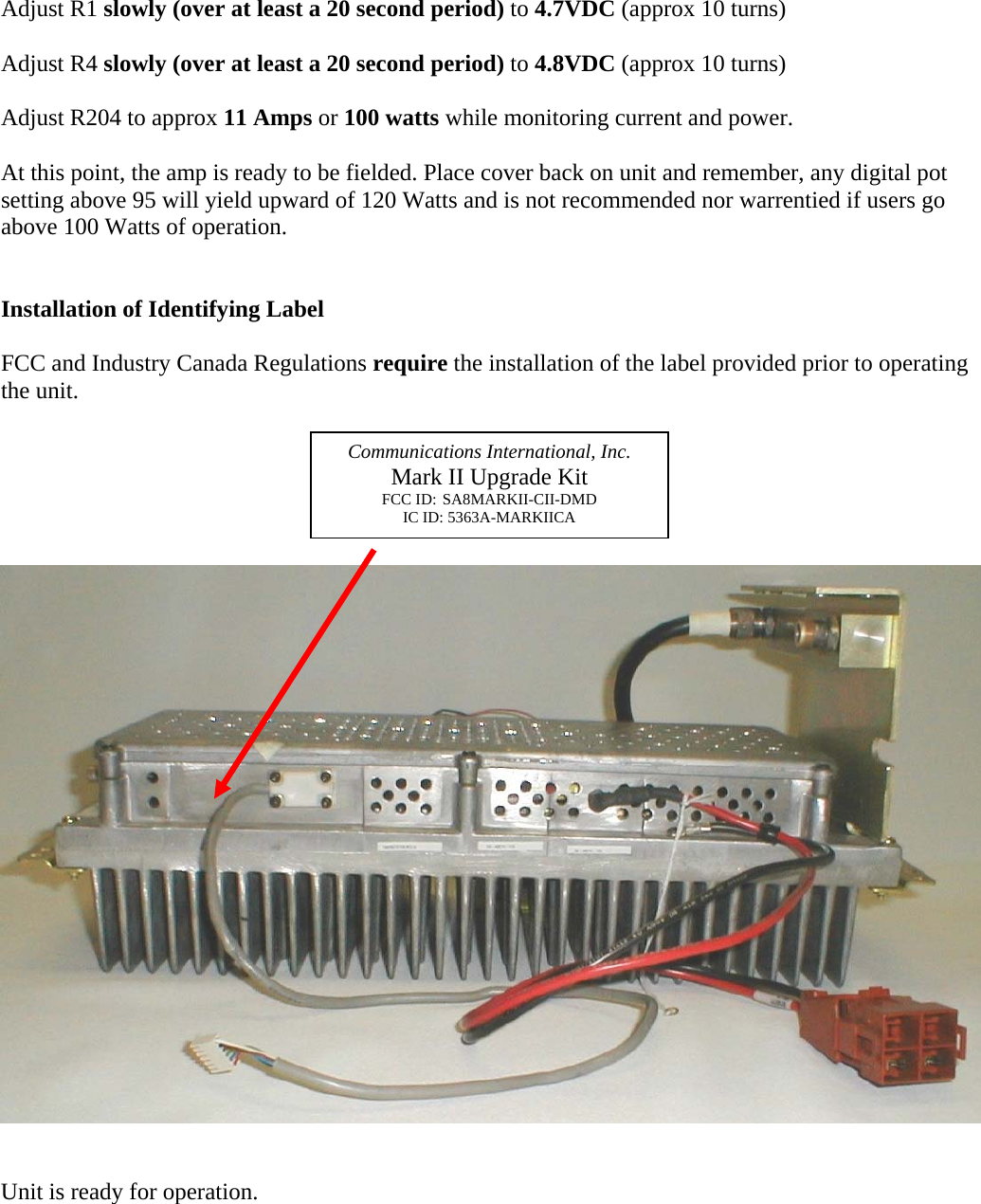
Adjust R1 slowly (over at least a 20 second period) to 4.7VDC (approx 10 turns)  Adjust R4 slowly (over at least a 20 second period) to 4.8VDC (approx 10 turns)  Adjust R204 to approx 11 Amps or 100 watts while monitoring current and power.  At this point, the amp is ready to be fielded. Place cover back on unit and remember, any digital pot setting above 95 will yield upward of 120 Watts and is not recommended nor warrentied if users go above 100 Watts of operation.   Installation of Identifying Label  FCC and Industry Canada Regulations require the installation of the label provided prior to operating the unit.       Unit is ready for operation.   Communications International, Inc. Mark II Upgrade Kit FCC ID: SA8MARKII-CII-DMD IC ID: 5363A-MARKIICA
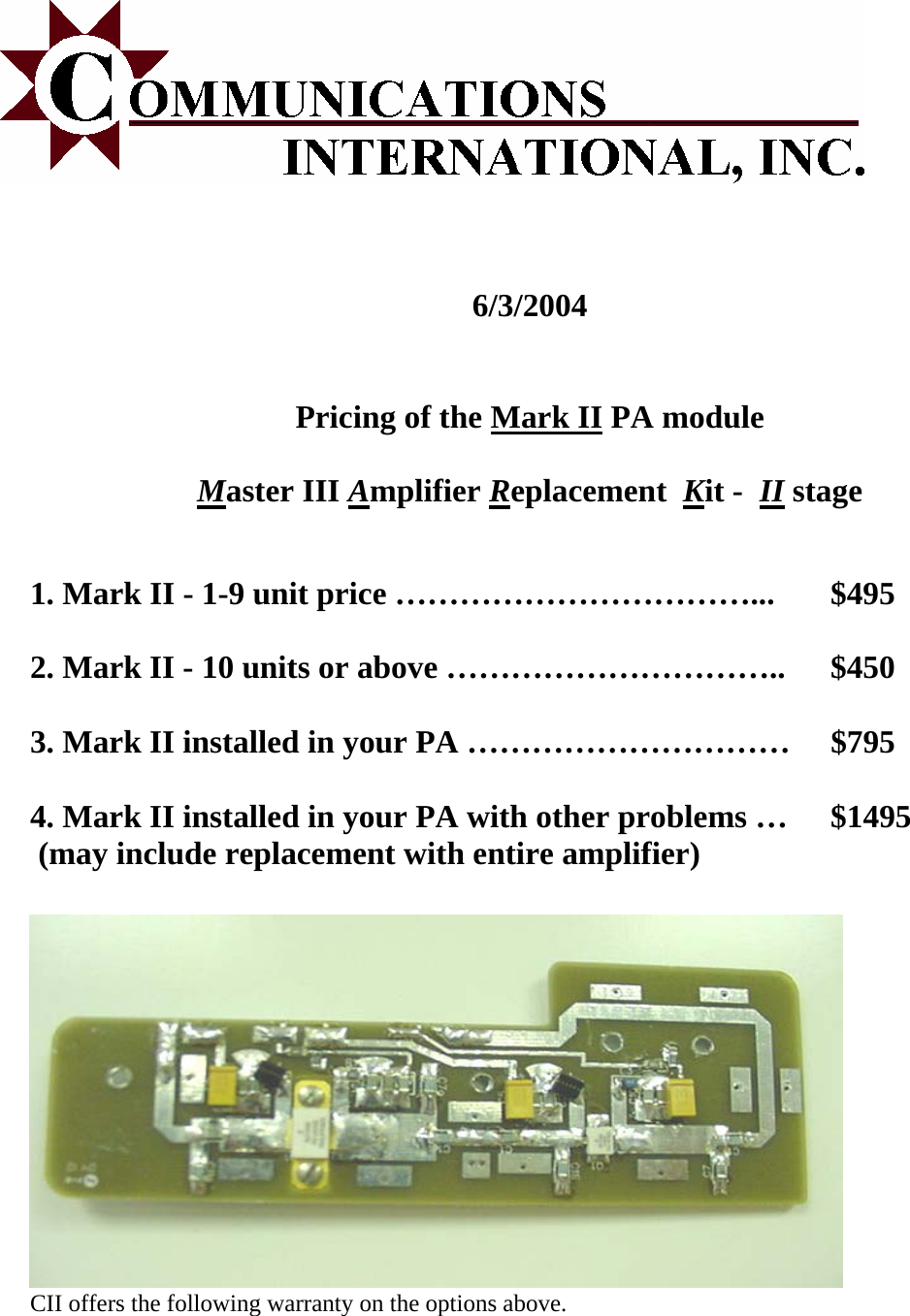
   6/3/2004   Pricing of the Mark II PA module  Master III Amplifier Replacement  Kit -  II stage   1. Mark II - 1-9 unit price ……………………………...  $495  2. Mark II - 10 units or above …………………………..  $450  3. Mark II installed in your PA …………………………  $795  4. Mark II installed in your PA with other problems …  $1495  (may include replacement with entire amplifier)           Warranty Information:  CII offers the following warranty on the options above.
Option 1,2:   90 day warranty on parts and materials only.  Each module sold from CII has been inspected, tested and burned in to produce 100 Watts before leaving the factory. CII only recommends this option to experienced communication houses who have the proper resources and experienced personnel to perform installation and test.  However, if our module fails to operate during a customer installation, CII will request the customer ship back the MARK-II PA board for diagnostics to determine the problem and recommend a fix on a case by case basis.    Option 3:  90 day warranty parts and labor.  Shipping responsibility of customer.  Option 4:  90 day warranty parts and labor.  Shipping responsibility of customer.     This Mark II Upgrade Kit complies with Part 90 of the FCC Rules and Regulations and Spectrum Management and Telecommunications Policy RSS-119 of Industry Canada.   FCC ID: SA8MARKII-CII-DMD  IC ID: 5363A-MARKIICA  WARNING! Changes or modifications not expressly approved by the manufacture could void the user's authority to operate the equipment.

Navigation menu