Craftsman 358350481 User Manual CHAINSAW Manuals And Guides L0212108
CRAFTSMAN Chainsaw, Gas Manual L0212108 CRAFTSMAN Chainsaw, Gas Owner's Manual, CRAFTSMAN Chainsaw, Gas installation guides
User Manual: Craftsman 358350481 358350481 CRAFTSMAN CHAINSAW - Manuals and Guides View the owners manual for your CRAFTSMAN CHAINSAW #358350481. Home:Lawn & Garden Parts:Craftsman Parts:Craftsman CHAINSAW Manual
Open the PDF directly: View PDF  .
.
Page Count: 47
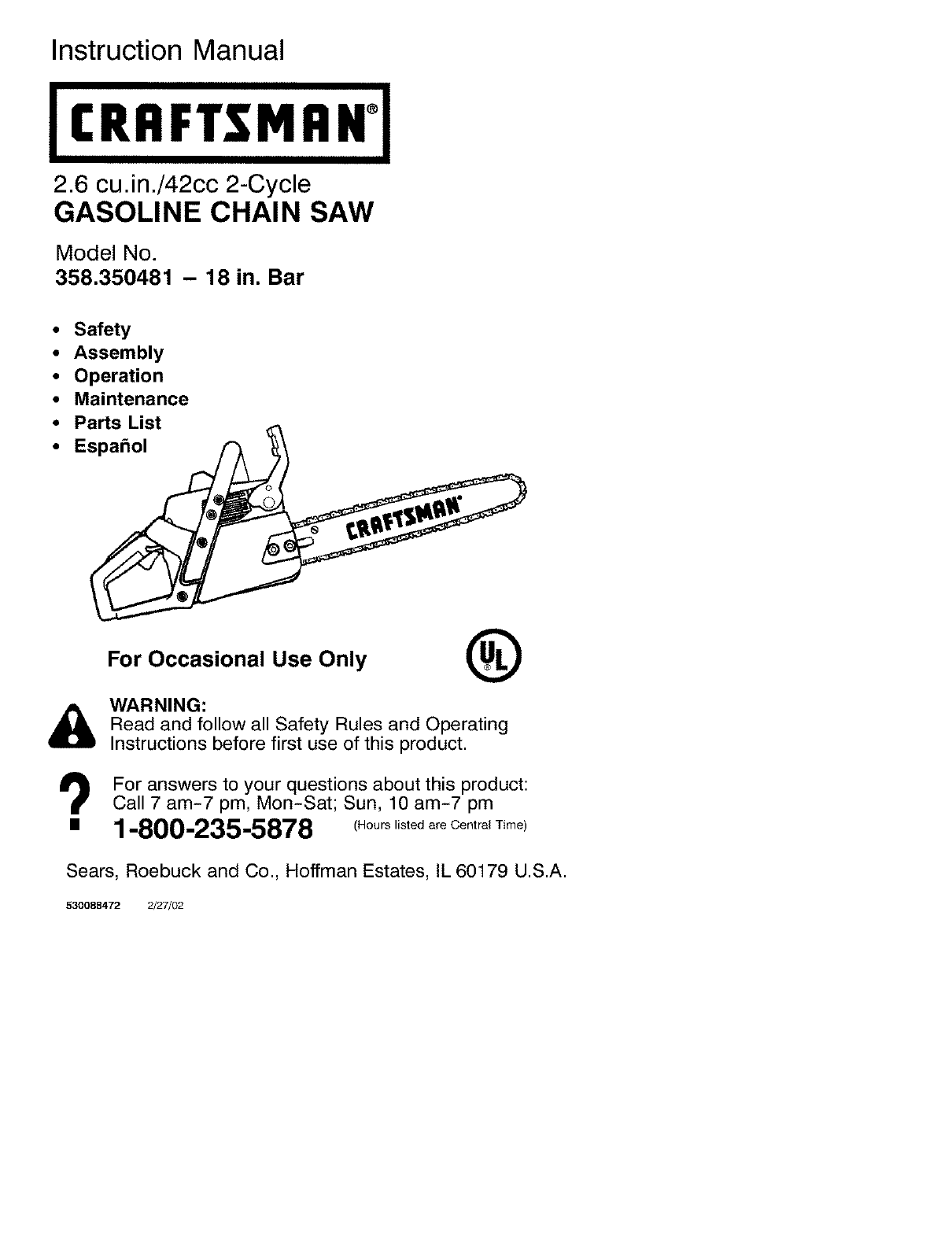
Instruction Manual
2.6 cu.in./42cc 2-Cycle
GASOLINE CHAIN SAW
Model No.
358.350481 - 18 in. Bar
• Safety
•Assembly
•Operation
•Maintenance
• Parts List
•Espahol
&
For Occasional Use Only
WARNING:
Read and follow all Safety Rules and Operating
Instructions before first use of this product.
_1_ For answers to your questions about this product:
Call 7 am-7 pm, Mon-Sat; Sun, 10 am-7 pm
•1-800-235-5878 (Hours listed are Centra, Time)
Sears, Roebuck and Co., Hoffman Estates, IL 60179 U.S.A.
530088472 2/27/02
Warranty 2 Storage 19
Safety Rules 2 Troubleshooting Table 20
Assembly 6 Emissions Statement 21
Operation 7 Parts List 23
Maintenance 14 Spanish 26
Service and Adjustments 17 Parts & Ordering Back Cover
FULL ONE YEAR WARRANTY ON CRAFTSMAN ®GAS CHAIN SAW
For one year from the date of purchase, when this Craftsman Gas Chain Saw is
maintained, lubricated and tuned up according to the instruction manual, Sears
will repair, free of charge, any defect in material or workmanship.
This warranty excludes the bar, chain, spark plug and air filter, which are
expendable parts and become worn during normal use.
If this Gas Chain Saw is used for commercial or rental purposes, this warranty
applies for 30 days from the date of purchase.
WARRANTY SERVICE IS AVAILABLE BY RETURNING THIS CHAIN SAW TO THE
NEAREST SEARS STORE OR SERVICE CENTER IN THE UNITED STATES.
This warranty gives you specific legal rights, and you may also have other rights
which vary from state to state.
Sears, Roebuck and Co., D/817 WA, Hoffman Estates, IL 60179
WARNING: Always disconnect
spark plug wire when making repairs ex-
cept for carburetor adjustments. Be-
cause a chain saw is a high-speed
woodcutting tool, special safety precau-
tions must be observed to reduce risk of
accidents. Careless or improper use of
this tool can cause serious injury.
PLAN AHEAD
•Restrict the use of your saw to adult
users who understand and can follow
the safety rules, precautions, and op-
erating instructions found in this
manual.
Hearing _ Safety Hat
Protection "_1",_--- Eye
Snug Protection
Fitting _ Heavy Duty
Clothing _'_oves
S_fety _/_i,!i J Safety Chaps
mqm
• Wear protective gear. Always use
steel4oed safety footwear with non-
slip soles; snug-fitting clothing;
heavy-duty, non-slip gloves; eye pro-
tection such as non-fogging, vented
goggles or face screen; an approved
safety hard hat; and sound barriers
(ear plugs or mufflers) to protect your
hearing. Regular users should have
hearing checked regularly as chain
saw noise can damage hearing.
• Secure hair above shoulder length. Do
not wear loose clothing or jewelry; they
can get caught in moving parts.
• Keep all parts of your body away
from the chain when the engine is
running.
• Keep children, bystanders, and ani-
mals at least 30 feet (10 meters)
away from the work area when start-
ing and using the saw.
• Do not handle or operate a chain saw
when you are fatigued, ill, or upset, or
if you have taken alcohol, drugs, or
medication. You must be in good
physical condition and mentally alert. If
you have any condition that might be
aggravated by strenuous work, check
with doctor before operating.
• Do not start cutting until you have a
clear work area, secure footing, and
especially if you are felling a tree, a
retreat path.
2
OPERATE YOUR SAW SAFELY
•DO not operate with one hand. Seri-
ous injury to the operator, helpers, or
bystanders may result from one-
handed operation. A chain saw is in-
tended for two-handed use.
• Operate the chain saw only in a well-
ventilated outdoor area.
• Do not operate saw from a ladder or
in a tree.
• Make sure the chain will not make
contact with any object while starting
the engine. Never try to start the saw
when the guide bar is in a cut.
• Do not put pressure on the saw, es-
pecially at the end of the cut. Doing
so can cause you to lose control
when the cut is completed.
• Stop engine before setting saw down.
• Hand carry saw only when engine is
stopped. Carry with muffler away
from body; guide bar & chain project-
ing behind you; guide bar preferably
covered with a scabbard.
• Do not operate a chain saw that is
damaged, improperly adjusted, or not
completely and securely assembled.
Always replace bar, chain, hand
guard, chain brake, or other parts im-
mediately if they become damaged,
broken, or are otherwise removed.
MAINTAIN YOUR SAW IN GOOD
WORKING ORDER
• Have all chain saw service per-
formed by a qualified service dealer
except the items listed in the MAINTE-
NANCE section of this manual.
• Make certain the saw chain stops
moving when the throttle trigger is
released. For correction, refer to
CARBURETOR ADJUSTMENTS.
• Keep the handles dry, clean, and
free from oil or fuel mixture.
• Keep caps and fasteners securely
tightened.
• Nonconforming replacement compo-
nents or the removal of safety devices
may cause damage to the unit and
possible injury to the operator or by-
standers. Use only Craftsman acces-
sories and replacement parts as rec-
ommended. Never modify your saw.
• Maintain chain saw with care.
• Keep unit sharp and clean for better
and safer performance.
• Follow instructions for lubricating and
changing accessories.
• Check for damaged parts. Before fur-
ther use of the chain saw, a guard or
other part that is damaged should be
carefully checked to determine that it
will operate properly and perform its
intended function. Check for alignment
of moving parts, binding of moving
parts, breakage of parts, mounting and
any other conditions that may affect its
operation. A guard or other part that is
damaged should be properly repaired
or replaced by a Sears Service Center
unless otherwise indicated elsewhere
in the instruction manual.
• When not in use, chain saws should
be stored in a dry, high or locked-up
place out of the reach of children.
• When storing saw, use a scabbard or
carrying case.
HANDLE FUEL WITH CAUTION
• Do not smoke while handling fuel or
while operating the saw.
• Eliminate all sources of sparks or
flame in areas where fuel is mixed or
poured.
• Mix and pour fuel in an outdoor area
and use an approved, marked con-
tainer for all fuel purposes. Wipe up
all fuel spills before starting saw.
• Move at least 10 feet (3 meters) from
fueling site before starting.
• Turn the engine oft and let saw cool
in a non-combustible area, not on
dry leaves, straw, paper, etc. Slowly
remove fuel cap and refuel unit.
• Store the unit and fuel in a cool, dry
well ventilated space where fuel va-
pors cannot reach sparks or open
flames from water heaters, electric
motors or switches, furnaces, etc.
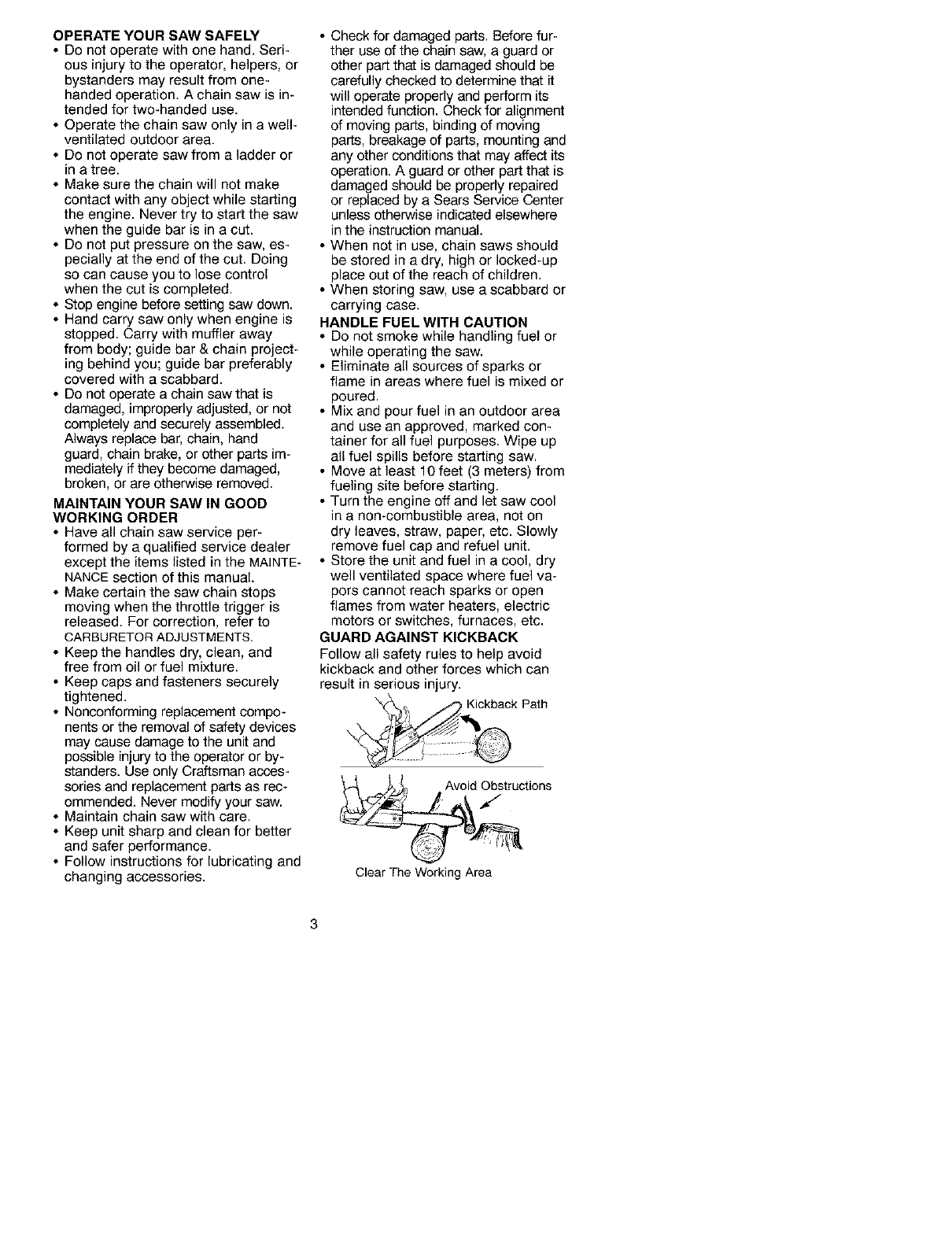
GUARD AGAINST KICKBACK
Follow all safety rules to help avoid
kickback and other forces which can
result in serious injury.
_k Path
Clear The Working Area
QWARNING:Avoidkickbackwhich
canresultinseriousinjury.Kickback
isthebackward,upwardorsuddenfor-
wardmotionoftheguidebaroccurring
whenthesawchainneartheuppertip
oftheguidebarcontactsanyobject
suchasalogorbranch,orwhenthe
woodclosesinandpinchesthe saw
chain in the cut. Contacting a foreign
object in the wood can also result in
loss of chain saw control.
•Rotational Kickback can occur
when the moving chain contacts an
object at the upper tip of the guide
bar. This contact can cause the
chain to dig into the object, which
stops the chain for an instant. The
result is a lightning fast, reverse
reaction which kicks the guide bar up
and back toward the operator.
• Pinch-Kickback can occur when the
the wood closes in and pinches the
moving saw chain in the cut along
the top of the guide bar and the saw
chain is suddenly stopped. This sud-
den stopping of the chain results in a
reversal of the chain force used to
cut wood and causes the saw to
move in the opposite direction of the
chain rotation. The saw is driven
straight back toward the operator.
•Pull-In can occur when the moving
chain contacts a foreign object in the
wood in the cut along the bottom of
the guide bar and the saw chain is
suddenly stopped. This sudden stop-
ping pulls the saw forward and away
from the operator and could easily
cause the operator to lose control of
the saw.
REDUCE THE CHANCE OF
KICKBACK
• Recognize that kickback can happen.
With a basic understanding of kick-
back, you can reduce the element of
surprise which contributes to acci-
dents.
• Never let the moving chain contact
any object at the tip of the guide bar.
• Keep working area free from obstruc-
tions such as other trees, branches,
rocks, fences, stumps, etc. Eliminate
or avoid any obstruction that your
saw chain could hit while cutting.
• When cutting a branch, do not let the
guide bar contact another branch or
other objects around it.
• Keep saw chain sharp and properly
tensioned. A loose or dull chain can
increase the chance of kickback.
Follow manufacturer's chain sharp-
ening and maintenance instructions.
Check tension at regular intervals,
but never with engine running. Make
sure chain brake nuts are securely
tightened.
• Begin and continue cutting at full
speed. If the chain is moving at a
slower speed, there is greater
chance of kickback occurring.
• Use extreme caution when reenter-
ing a cut.
• Do not attempt cuts starting with the
tip of the bar (plunge cuts).
• Watch for shifting logs or other forces
that could close a cut and pinch or
fall into chain.
• Use the specified Reduced-Kickback
Guide Bar and Low-Kickback Chain.
Avoid Pinch-Kickback:
• Be extremely aware of situations or
obstructions that can cause material
to pinch the top of or otherwise stop
the chain.
• Do not cut more than one log at a
time.
• Do not twist saw as bar is withdrawn
from an undercut when bucking.
Avoid Pull-In:
• Always begin cutting with the engine
at full speed and the saw housing
against wood.
• Use wedges made of plastic or
wood. Never use metal to hold the
cut open.
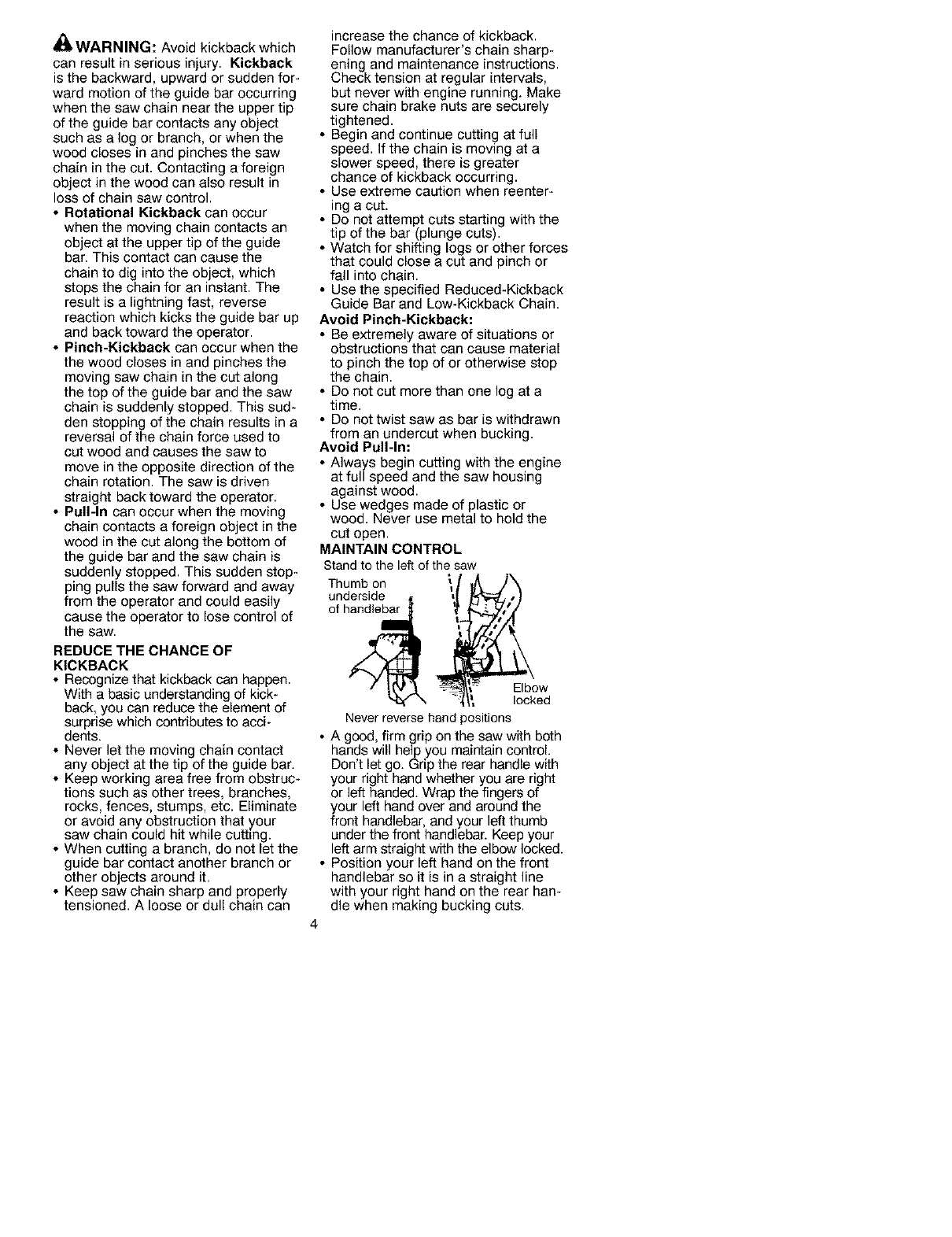
MAINTAIN CONTROL
Stand to the left of the saw
Thumb on 'il
underside
_#II
Elbow
locked
Never reverse hand ]ositions
• A good, firm grip on the saw with both
hands will help you maintain control.
Don't let go. Grip the rear handle with
your right hand whether you are right
or left handed. Wrap the fingers of
your left hand over and around the
front handlebar, and your left thumb
under the front handlebar. Keep your
left arm straight with the elbow locked.
• Position your left hand on the front
handlebar so it is in a straight line
with your right hand on the rear han-
dle when making bucking cuts.
4
Standslightlytotheleftsideofthe
sawtokeepyourbodyfrombeingin
adirectlinewiththecuttingchain.
• Standwithyourweightevenlybal-
ancedonbothfeet.
• Donotoverreach.Youcouldbe
drawnorthrownoffbalanceandlose
control.
• Donotcutaboveshoulderheight.It
isdifficulttomaintaincontrolofsaw
aboveshoulderheight.
KICKBACKSAFETYFEATURES
_IbWARNING:Thefollowingfeatures
areincludedonyoursawtohelpreduce
hazardofkickback;however,suchfea-
tureswillnottotallyeliminatethisdanger.
Donotrelyonlyonsafetydevices.Fol-
lowallsafetyrulestohelpavoidkick-
backandotherforceswhichcanresult
_nsenous_nlury.
• FrontHandGuard:designedtore-
ducethechanceofyourlefthand
contactingthechainifyourhand
slipsoffthefronthandlebar.
• Positionoffrontandrearhandlebars:
designedwithdistancebetween
handlesand"in-line"witheachother.
Thespreadand"in-line"positionof
thehandsprovidedbythisdesign
worktogethertogivebalanceand
resistanceincontrollingthepivotof
thesawbacktowardtheoperatorif
kickbackoccurs.
• Reduced-KickbackGuideBar:de-
signedwithasmallradiustipwhich
reducesthesizeofthekickback
dangerzoneonthebartip.Thistype
barhasbeendemonstratedtosignif-
icantlyreducethenumberandseri-
ousnessofkickbackswhentestedin
accordancewithANSIB175.1.
"_ SmallRadius
TipGuideBar
• Low-KickbackChain:hasmetkick-
backperformancerequirementswhen
testedonarepresentativesampleof
chainsawsbelow3.8cubicinch
displacementspecifiedinANSI
B175.1.
Low-Kickback Chain
Contoured Depth Gauge
__ longated Guard Link
deflects kickback
force and allows
wood to gradually
ride into Cutter
CHAIN BRAKE
• Chain Brake: designed to stop the
chain in the event of kickback.
oWARNINL_: WE DO NOT REP-
RESENT AND YOU SHOULD NOT AS-
SUME THAT THE CHAIN BRAKE WILL
PROTECT YOU INTHE EVENT OF A
KICKBACK. Kickback is a lightning fast
action which throws the bar and rotat-
ing chain back and up toward the op-
erator. Kickback can be caused by al-
lowing contact of the bar tip in the
danger zone with any hard object.
Kickback can also be caused by
pinching the saw chain along the top
of the guide bar. This action may push
the guide bar rapidly back toward the
operator. Either of these events may
cause you to lose control of the saw
which could result in serious injury or
even death. DO NOT RELY UPONANY
OF THE DEVICES BUILT INTOYOUR
SAW. YOU SHOULD USE THE SAW
PROPERLY AND CAREFULLY TO AVOID
KICKBACK. Reduced-kickback guide
bars and low-kickback saw chains re-
duce the chance and magnitude of
kickback and are recommended. Your
saw has a low kickback chain and bar
as original equipment. Repairs on a
chain brake should be made by an au-
thorized Sears Service Center. Take
your unit to the place of purchase or to
your nearest Sears Service Center.
• Tip contact in some cases may cause
a lightning fast reverse REACTION,
kicking guide bar up and back toward
operator.
• Pinching the saw chain along the top
of the guide bar may push the guide
bar rapidly back toward the operator.
• Either of these reactions may cause
you to lose control of the saw which
could result in serious injury. Do not
rely exclusively upon safety devices
built into your saw.
SAFETY NOTICE: Exposure to vibra-
tions through prolonged use of gaso-
line powered hand tools could cause
blood vessel or nerve damage in the
fingers, hands, and oints of people
prone to circulation disorders or
abnormal swelling. Prolonged use in
cold weather has been linked to blood
vessel damage in otherwise healthy
people. If symptoms occur such as
numbness, pain, loss of strength,
change in skin color or texture, or loss
of feeling in the fingers, hands, or
joints, discontinue the use of this tool
and seek medical attention. An anti-vi-
bration system does not guarantee the
avoidance of these problems. Users
who operate power tools on a continu-
al and regular basis must closely
monitor their physical condition and
the condition of this tool.
CHAIN BRAKE: If this saw is to be
used for commercial logging, a chain
brake is required and shall not be re-
moved or otherwise disabled to com-
ply with Federal OSHA Regulations for
Commercial Logging.
SPARK ARRESTING SCREEN: Your
saw is equipped with a temperature
limiting muffler and spark arresting
screen which meets the requirements
of California Codes 4442 and 4443. All
U.S. forest land and the states of Cali-
fornia, Idaho, Maine, Minnesota, New
Jersey, Oregon, and Washington re-
quire by law that many internal com-
bustion engines be equipped with a
spark arresting screen. If you operate
a chain saw in a state or locale where
such regulations exist, you are legally
responsible for maintaining the operat-
ing condition of these parts. Failure to
do so is a violation of the law. Refer to
Customer Responsibilities chart in the
MAINTENANCE section.
STANDARDS: This chain saw is listed
by Underwriters Laboratories, Inc. in
accordance with American National
Standards for Gasoline-Powered
Chain Saws Safety Requirements
(ANSI B175.1-2000).
_I!_WARNING: Before using chain
saw, ensure all fasteners are secure.
CARTON CONTENTS
Check carton contents against the fol-
lowing list.
Model 358.350481
•Chain Saw (fully assembled)
• Bar tool
• 2-cycle engine oil
• Carrying case
Examine parts for damage. Do not use
damaged parts.
If you need assistance or find that
parts are missing or damaged, please
call 1-800-235-5878.
NOTE: It is normal to hear the fuel filter
rattle in an empty fuel tank.
Your unit has been factory tested and
the carburetor precisely adjusted. As a
result you may smell gasoline or find a
drop of oil/fuel residue on the muffler
when you unpack the unit.
ASSEMBLY
Your saw is fully assembled; no
assembly is necessary.

KNOW YOUR SAW
READ THIS INSTRUCTION MANUAL AND SAFETY RULES BEFORE OPERATING YOUR
CHAIN SAW. Compare the illustrations with your unit to familiarize yourself with the
location of the various controls and adjustments. Save this manual for future ref-
erence.
Chain
Adjustment Tool
(Bar Tool)
Front Hand Guard
Chain MuffIer
2
Bar Oil Fill Cap _$1
Housin_
Front Handle
_'_ Starter Rope
,/ ON/STOP
p/_, Switch
_4/_ Primer
--t'_c_.._ Bulb
£r Fuel Mix Fill Cap
Throttle
Rear Lockout
Handle
Cylinder Cover
Chain
Direction
of Travei
Throttle Choke/ Chain
Trigger Fast Idle Brake
Lever
Chain Brake Nuts Guide Bar
Chain
Catcher Sprocket
Hole
ON/STOP SWITCH
The ON/STOP SWITCH is used to stop
the engine.
THRO'n'LE TRIGGER
The THROTTLE TRIGGER controls en-
gine speed.
THRO'FrLE LOCKOUT
The THROTTLE LOCKOUT must be
pressed before you can squeeze the
throttle trigger. This feature prevents you
from accidentally squeezing the trigger.
CHOKE/FAST IDLE LEVER
The choke and fast idle are set by pull-
ing the CHOKE/FAST IDLE LEVER out
fully for cold or refueled starting. The
choke provides additional fuel to the
engine during cold starting.
PRIMER BULB
The PRIMER BULB circulates fuel to the
carburetor to provide quicker starting.
CHAIN BRAKE
The CHAIN BRAKE is a device de-
signed to stop the chain if kickback oc-
curs. The chain brake activates auto-
matically in the event of kickback. The
chain brake activates manually if the
front hand guard is pushed forward.
The chain brake is disengaged by pull-
ing the front hand guard back toward
the front handle as far as possible.
CHAIN TENSION
It is normal for a new chain to stretch
during first 30 minutes of operation. You
should check your chain tension fre-
quently. See CHAIN TENSION under the
SERVICEAND ADJUSTMENTSsection.
•_IbWARNING:Mufflerisveryhot
duringandafteruse.Donottouchthe
mufflerorallowcombustiblematerial
suchasdrygrassorfueltodoso.
BEFORESTARTING ENGINE
• _IbWARNING: Be sure to read the
fuel handling information in the safety
rules section of this manual before you
begin. If you do not understand the
fuel handling information do not at-
tempt to fuel your unit. Seek help from
someone that does understand the in-
formation or call the customer assis-
tance help line at 1-800-235-5878.
GUIDE BAR AND CHAIN OIL
The bar and chain require lubrication.
The chain oiler provides continuous
lubrication to the chain and guide bar.
Be sure to fill the bar oil tank when you
fill the fuel tank (Capacity = 6.8 fl. oz.).
Lack of oil will quickly ruin the bar and
chain. Too little oil will cause overheat-
ing shown by smoke coming from the
chain and/or discoloration of the bar.
For maximum guide bar and chain life,
we recommend you use Craftsman
chain saw bar oil. If Craftsman bar oil
is not available, you may use a good
grade SAE 30 oil until you are able to
obtain Craftsman brand. The oil output
is automatically metered during opera-
tion. Your saw will use approximately
one tank of bar oil for every tank of fuel
mix. Always fill the bar oil tank when
you fill the fuel tank.
FUELING ENGINE
_IkWARNING: Remove fuel cap
slowly when refueling.
This engine is certified to operate on
unleaded gasoline. Before operation,
gasoline must be mixed with a good
quality synthetic 2-cycle air-cooled en-
gine oil. We recommend Craftsman
brand synthetic oil. Mix gasoline and
oil at a ratio of 40:1. A 40:1 ratio is ob-
tained by mixing 3.2 ounces of oil with
1 gallon of unleaded gasoline. In-
cluded with this saw is a 3.2 ounce
container of oil. Pour the entire con-
tents of this container into 1 gallon of
gasoline to achieve the proper fuel
mixture.
DO NOT USE automotive oil or boat oil.
These oils will cause engine damage.
When mixing fuel follow the instructions
printed on the oil containen
Once oil is added to the gasoline,
shake container momentarily to assure
that the fuel is thoroughly mixed. Al-
ways read and follow the safety rules
relating to fuel before fueling your unit.
IMPORTANT
Experience indicates that alcohol
blended fuels (called gasohol or using
ethanol or methanol) can attract mois-
ture which leads to separation and
formation of acids during storage. Acidic
gas can damage the fuel system of an
engine while in storage. To avoid engine
problems, the fuel system should be
emptied before storage for 30 days or
longer. Drain the gas tank, start the en-
gine and let it run until the fuel lines and
carburetor are empty. Use fresh fuel
next season. See STORAGE instructions
for additional information.
Never use engine or carburetor clean-
er products in the fuel tank or perma-
nent damage may occur.
See the STORAGE section for addition-
al information.
CHAIN BRAKE
Ensure chain brake is disengaged by
pulling the front hand guard back to-
ward the front handle as far as pos-
sible. The chain brake must be disen-
gaged before cutting with the saw.
_!_WARNING: The chain must not
move when the engine runs at idle
speed. If the chain moves at idle
speed, refer to CARBURETOR ADJUST-
MENT within this manual. Avoid con-
tact with the muffler. A hot muffler can
cause serious burns.
STOPPING YOUR ENGINE
• Move ON/STOP switch to the STOP
position.
ON/STOP SWITCH
ON
STARTING POSITION
• To start the engine, hold the saw
firmly on the ground as illustrated.
Make sure the chain is free to turn
without contacting any object.
Starter Rope Handle
Right Foot Throuch Rear Handle
IMPORTANT POINTS TO REMEMBER
When pulling the starter rope, do not
use the full extent of the rope as this
can cause the rope to break. Do not
let starter rope snap back. Hold the
handle and let the rope rewind slowly.
For cold weather starting, start the unit
at FULL CHOKE; allow the engine to
warm up before squeezing the throttle
trigger.
NOTE: Do not cut material with the
choke/fast idle lever at the FULL
CHOKE position.
STARTING A COLD ENGINE (or a
warm engine after running out of
fuel)
NOTE: In the following steps, when
the choke/fast idle lever is pulled out to
the full extent, the correct throttle set-
ting for starting is set automatically.
1. Move ON/STOP switch to the ON
position.
2. Pull choke/fast idle lever out to the
full extent.
3. Slowly press primer bulb 6 times.
4. Pull the starter rope quickly with
your right hand 5 times. Then, pro-
ceed to the next step.
NOTE: If the engine sounds as if it is
trying to start before the 5th pull, stop
pulling and immediately proceed to the
next step.
5. Push the choke/fast idle lever in
completely (to the OFF CHOKE
position).
6. Pull the starter rope quickly with your
right hand until the engine starts.
7. Allow the engine to run for approxi-
mately 5 seconds. Then, squeeze
and release throttle trigger to allow
engine to return to idle speed.
._ ON/STOP /_/
Choke/Fast Idle
Lever
CHOKE/FAST IDLE LEVER
= (SIDE VIEW)
Chok I_
Fast Idle Lever OFF FULL
STARTING A WARM ENGINE
1. Move ON/STOP switch to the ON
position.
2. Pull the choke/fast idle lever out to
the full extent, then push the lever
back in completely (to the OFF
CHOKE position).
3. Slowly press primer bulb 6 times.
4. Pull the starter rope quickly with your
right hand until the engine starts.
5. Squeeze and release throttle trig_
ger, allowing engine to idle.
DIFFICULT STARTING (or starting a
flooded engine)
The engine may be flooded if it has not
started after 10 pulls.
Flooded engines can be cleared of ex-
cess fuel by following the warm engine
starting procedure listed above. Insure
the ON/STOPswitch is in the ON position.
Starting could require many pulls de-
pending on how badly the unit is
flooded. If engine still fails to start, refer
to the TROUBLESHOOTING TABLE or
call 1-800-235-5878.
CHAIN BRAKE
_h, WARNING: If the brake band is
worn too thin it may break when the
chain brake is triggered. With a broken
brake band, the chain brake will not
stop the chain. The chain brake must
be replaced if any part is worn to less
than 0.020 inch (0.5 ram) thick. Re-
pairs on a chain brake should be made
by your Sears Service Center. Take
your unit to the place of purchase or to
the nearest Sears Service Center.
• This saw is equipped with a chain
brake. The brake is designed to stop
the chain if kickback occurs.
• The inertia-activated chain brake is
activated if the front hand guard is
pushed forward, either manually (by
hand) or automatically (by sudden
movement).
• If the brake is already activated, it is
disengaged by pulling the front hand
guard back toward the front handle
as far as possible.
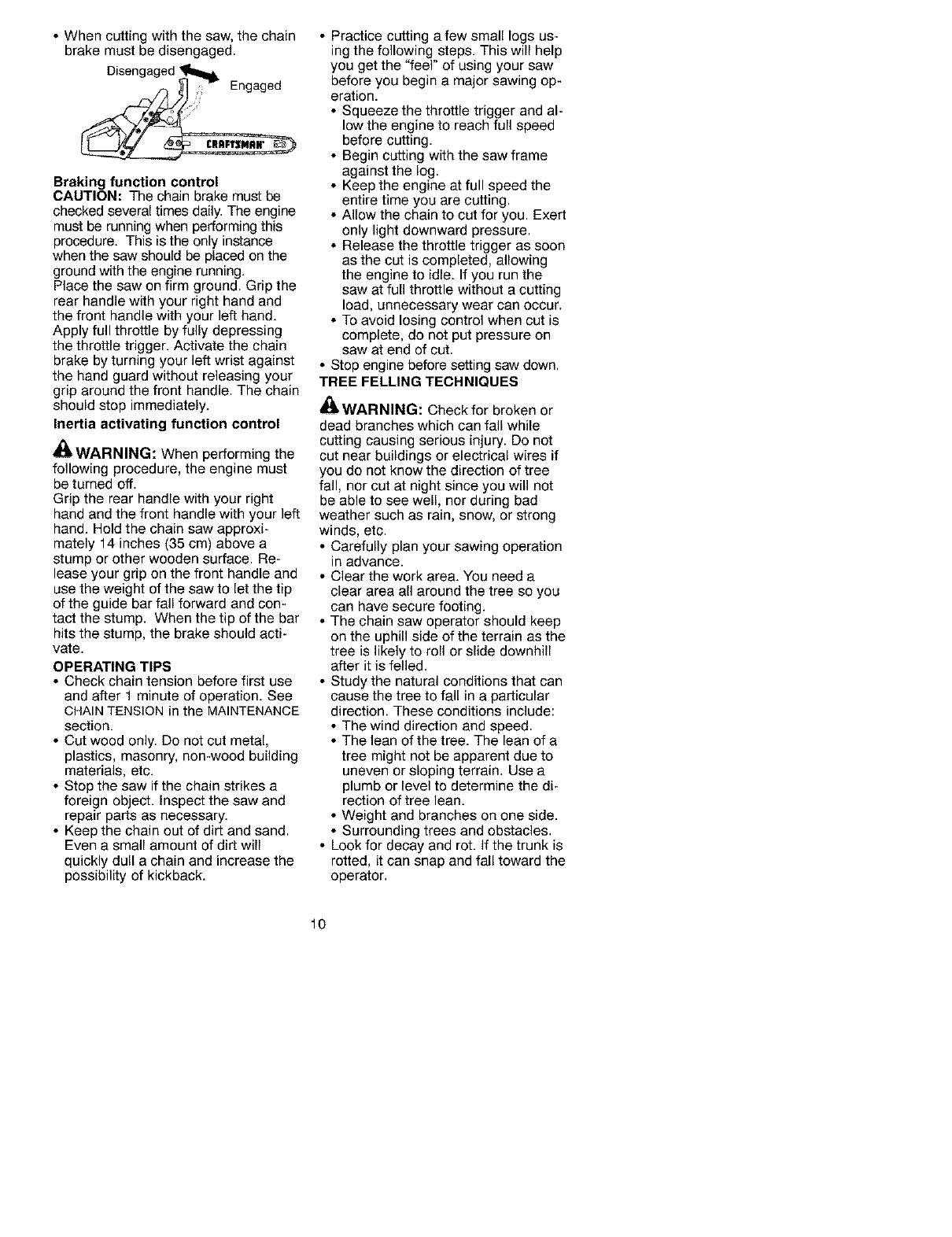
• Whencuttingwiththesaw,thechain
brakemustbedisengaged.
Disengaged
Braking function control
CAUTION: The chain brake must be
checked several times daily. The engine
must be running when performing this
procedure. This is the only instance
when the saw should be placed on the
ground with the engine running.
Place the saw on firm ground. Grip the
rear handle with your right hand and
the front handle with your left hand.
Apply full throttle by fully depressing
the throttle trigger. Activate the chain
brake by turning your left wrist against
the hand guard without releasing your
grip around the front handle. The chain
should stop immediately.
Inertia activating function control
_IbWARNING: When performing the
following procedure, the engine must
be turned off.
Grip the rear handle with your right
hand and the front handle with your left
hand. Hold the chain saw approxi-
mately 14 inches (35 cm) above a
stump or other wooden surface. Re-
lease your grip on the front handle and
use the weight of the saw to let the tip
of the guide bar fall forward and con-
tact the stump. When the tip of the bar
hits the stump, the brake should acti-
vate.
OPERATING TIPS
• Check chain tension before first use
and after 1 minute of operation. See
CHAIN TENSION in the MAINTENANCE
section.
• Cut wood only. Do not cut metal,
plastics, masonry, non-wood building
materials, etc.
• Stop the saw if the chain strikes a
foreign object. Inspect the saw and
repair parts as necessary.
• Keep the chain out of dirt and sand.
Even a small amount of dirt will
quickly dull a chain and increase the
possibility of kickback.
• Practice cutting a few small logs us-
ing the following steps. This will help
you get the "feel" of using your saw
before you begin a major sawing op-
eration.
• Squeeze the throttle trigger and al-
low the engine to reach full speed
before cutting.
• Begin cutting with the saw frame
against the log.
• Keep the engine at full speed the
entire time you are cutting.
• Allow the chain to cut for you. Exert
only light downward pressure.
• Release the throttle trigger as soon
as the cut is completed, allowing
the engine to idle. If you run the
saw at full throttle without a cutting
load, unnecessary wear can occur.
• To avoid losing control when cut is
complete, do not put pressure on
saw at end of cut.
• Stop engine before setting saw down.
TREE FELLING TECHNIQUES
zl, _
_LWARNING: Check for broken or
dead branches which can fall while
cutting causing serious injury. Do not
cut near buildings or electrical wires if
you do not know the direction of tree
fall, nor cut at night since you will not
be able to see well, nor during bad
weather such as rain, snow, or strong
winds, etc.
• Carefully plan your sawing operation
in advance.
• Clear the work area. You need a
clear area all around the tree so you
can have secure footing.
• The chain saw operator should keep
on the uphill side of the terrain as the
tree is likely to roll or slide downhill
after it is felled.
• Study the natural conditions that can
cause the tree to fall in a particular
direction. These conditions include:
• The wind direction and speed.
• The lean of the tree. The lean of a
tree might not be apparent due to
uneven or sloping terrain. Use a
plumb or level to determine the di-
rection of tree lean.
• Weight and branches on one side.
• Surrounding trees and obstacles.
• Look for decay and rot. If the trunk is
rotted, it can snap and fall toward the
operator.
10
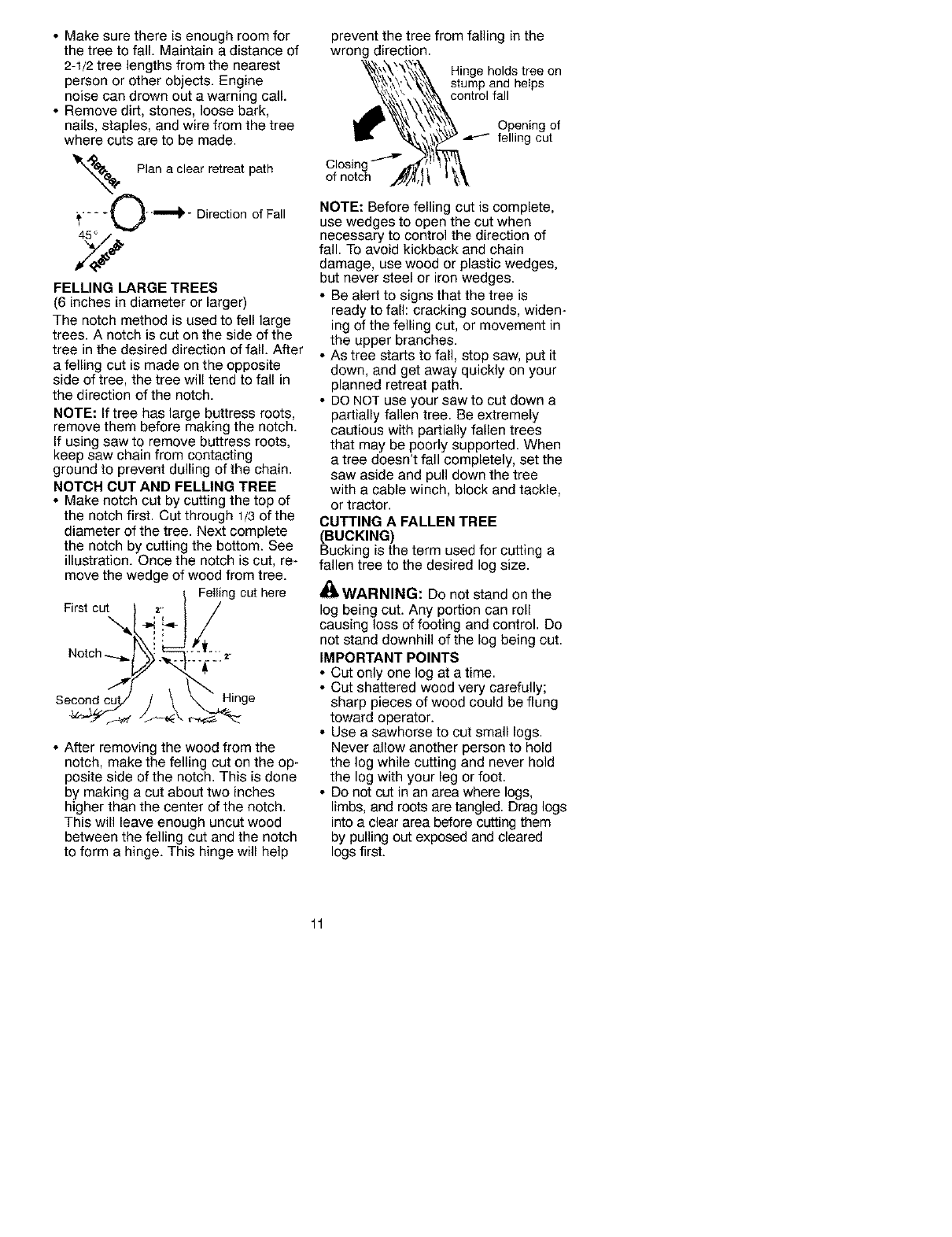
• Make sure there is enough room for
the tree to fall. Maintain a distance of
2-1/2 tree lengths from the nearest
person or other objects. Engine
noise can drown out a warning call.
• Remove dirt, stones, loose bark,
nails, staples, and wire from the tree
where cuts are to be made.
Plan a clear retreat path
.... £)--""""_- Direction of Fall
/÷#"
FELLING LARGE TREES
(6 inches in diameter or larger)
The notch method is used to fell large
trees. A notch is cut on the side of the
tree in the desired direction of fall After
a felling cut is made on the opposite
side of tree, the tree will tend to fall in
the direction of the notch.
NOTE: If tree has large buttress roots,
remove them before making the notch.
If using saw to remove buttress roots,
keep saw chain from contacting
ground to prevent dulling of the chain.
NOTCH CUT AND FELLING TREE
• Make notch cut by cutting the top of
the notch first. Cut through 1/3 of the
diameter of the tree. Next complete
the notch by cutting the bottom. See
illustration. Once the notch is cut, re-
move the wedge of wood from tree.
Felling cut here
First cut_'_"i_-
Notch -.._.._ .__.
• After removing the wood from the
notch, make the felling cut on the op-
posite side of the notch. This is done
by making a cut about two inches
higher than the center of the notch.
This will leave enough uncut wood
between the felling cut and the notch
to form a hinge. This hinge will help
prevent the tree from falling in the
wrong direction.
Hinge holds tree on
stump and heips
control fall
Closing
of notch
Opening of
felling cut
NOTE: Before felling cut is complete,
use wedges to open the cut when
necessary to control the direction of
fall. To avoid kickback and chain
damage, use wood or plastic wedges,
but never steel or iron wedges.
• Be alert to signs that the tree is
ready to fall: cracking sounds, widen-
ing of the felling cut, or movement in
the upper branches.
• As tree starts to fall, stop saw, put it
down, and get away quickly on your
planned retreat path.
• DO NOT use your saw to cut down a
partially fallen tree. Be extremely
cautious with partially fallen trees
that may be poorly supported. When
atree doesn't fall completely, set the
saw aside and pull down the tree
with a cable winch, block and tackle,
or tractor.
CUTTING A FALLEN TREE
(BUCKING)
Bucking is the term used for cutting a
fallen tree to the desired log size.
_IlbWARNING: Do not stand on the
log being cut. Any portion can roll
causing loss of footing and control. Do
not stand downhill of the log being cut.
IMPORTANT POINTS
• Cut only one log at a time.
• Cut shattered wood very carefully;
sharp pieces of wood could be flung
toward operator.
• Use a sawhorse to cut small logs.
Never allow another person to hold
the log while cutting and never hold
the log with your leg or foot.
• Do not cut in an area where logs,
limbs, and roots are tangled. Drag logs
into a clear area before cutting them
by pulling out exposed and cleared
logs first.
11
BUCKING TECHNIQUES
_I_WARNING: If saw becomes
pinched or hung in a log, don't try to
force it out. You can lose control of the
saw resulting in injury and/or damage
to the saw. Stop the saw, drive a
wedge of plastic or wood into the cut
until the saw can be removed easily. Re-
start saw and carefully reenter the cut.
Do not use a metal wedge. Do not at-
tempt to restart your saw when it is
pinched or hung in a log.
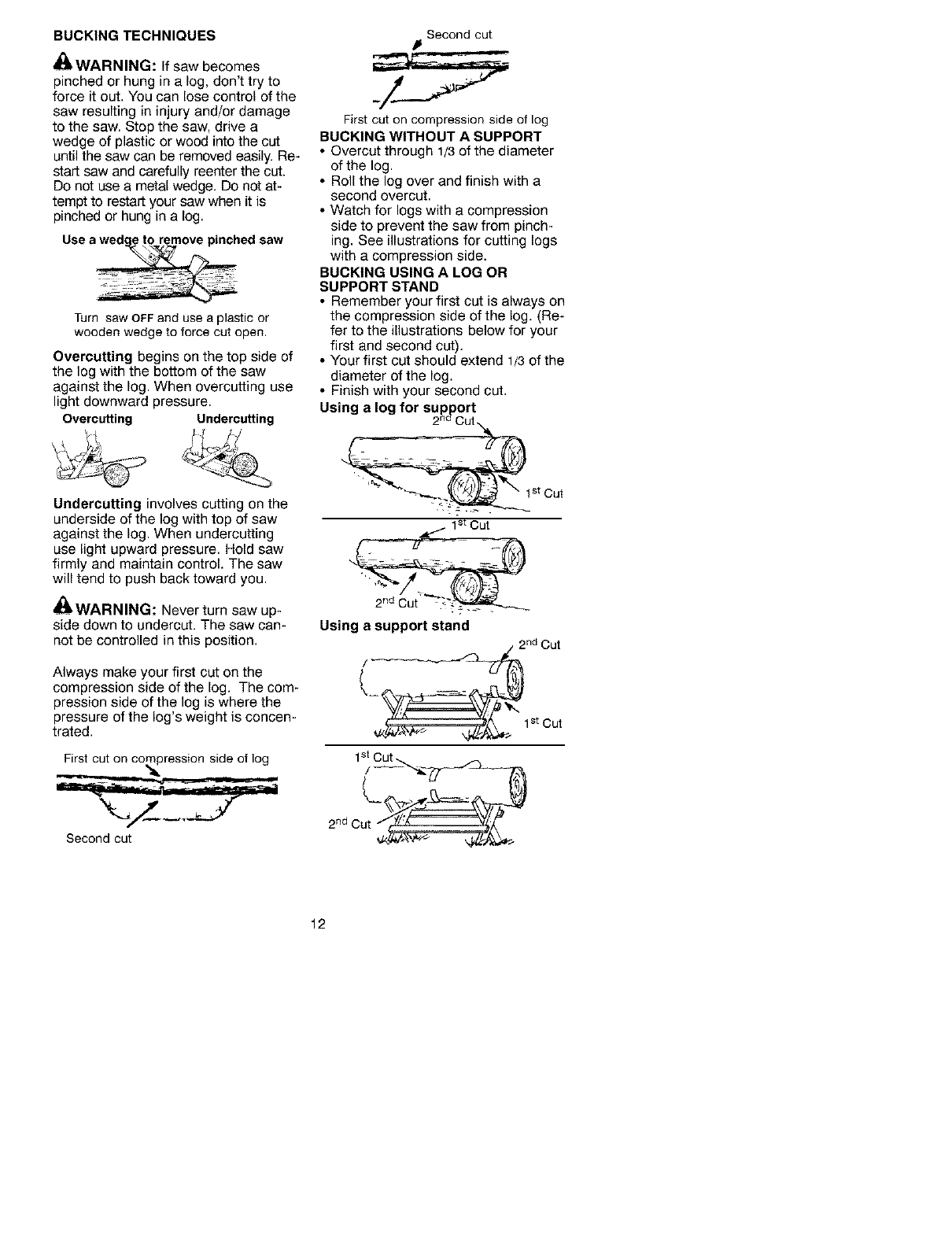
Use a wedge to remove pinched saw
\
×\_
Turn saw OFF and use a plastic or
wooden wedge to force cut open.
Overcutting begins on the top side of
the log with the bottom of the saw
against the log. When overcutting use
light downward pressure.
Overcutting Undercutting
Undercutting involves cutting on the
underside of the log with top of saw
against the log. When undercutting
use light upward pressure. Hold saw
firmly and maintain control. The saw
will tend to push back toward you.
41¢I_WARNING: Never turn saw up-
side down to undercut. The saw can-
not be controlled in this position.
Always make your first cut on the
compression side of the log. The com-
pression side of the log is where the
pressure of the log's weight is concen-
trated.
First cut on co_ression side of log
Second cut
Second cut
First cut on compression side of log
BUCKING WITHOUT A SUPPORT
•Overcut through 1/3 of the diameter
of the log.
• Roll the log over and finish with a
second overcut.
• Watch for logs with a compression
side to prevent the saw from pinch-
ing. See illustrations for cutting logs
with a compression side.
BUCKING USING A LOG OR
SUPPORT STAND
• Remember your first cut is always on
the compression side of the log. (Re-
fer to the illustrations below for your
first and second cut).
• Your first cut should extend 1/3 of the
diameter of the log.
• Finish with your second cut.
Using a log for support
2 na Cut
_st Cul
1s_Cut
Using a support stand
/_ 2 nd Cut
L ts, out
2nd Cut __
12
LIMBING AND PRUNING
€;II),WARNING: Be alert for and
guard against kickback. Do not allow
the moving chain to contact any other
branches or objects at the nose of the
guide bar when limbing or pruning. Al-
lowing such contact can result in seri-
ous injury.
_ISWARNING: Never climb into a
tree to limb or prune. Do not stand on
ladders, platforms, a log, or in any po-
sition which can cause you to lose
your balance or control of the saw.
IMPORTANT POINTS
• Watch out for springpoles.
Springpoles are small size limbs
which can whip toward you, or pull
you off balance. Use extreme cau-
tion when cutting small size limbs.
• Be alert for springback from any
branches that are bent or under
pressure. Avoid being struck by the
branch or the saw when the tension
in the wood fibers is released.
• Frequently clear branches out of the
way to avoid tripping over them.
LIMBING
• Limb a tree only after it is cut down.
• Leave the larger limbs underneath
the felled tree to support the tree as
you work.
• Start at the base of the felled tree
and work toward the top, cutting
branches and limbs. Remove small
limbs with one cut.
• Keep the tree between you and the
chain.
• Remove larger branches with the
cutting techniques described in
BUCKING WITHOUT A SUPPORT.
• Always use an overcut to cut small
and freely hanging limbs. Undercut-
ting could cause limbs to fall and
pinch the saw.
PRUNING
_I_WARNING: Limit pruning to limbs
shoulder height or below. Do not cut if
branches are higher than your shoul-
der. Get a professional to do the job.
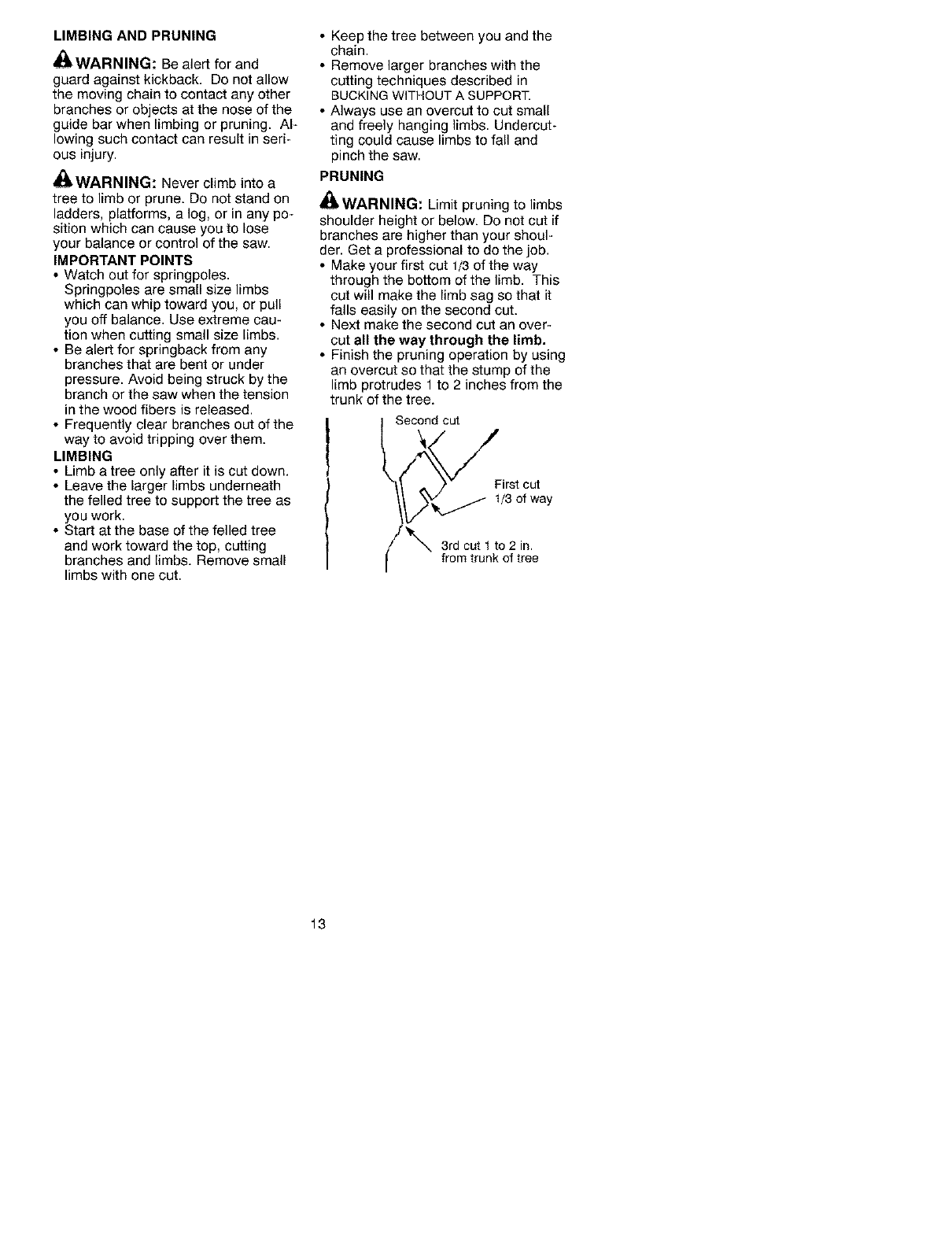
• Make your first cut 1/3 of the way
through the bottom of the limb. This
cut will make the limb sag so that it
falls easily on the second cut.
• Next make the second cut an over-
cut all the way through the limb.
• Finish the pruning operation by using
an overcut so that the stump of the
limb protrudes 1 to 2 inches from the
trunk of the tree.
Second cut
_ ard cut 1 to 2in,
from trunk of tree
13
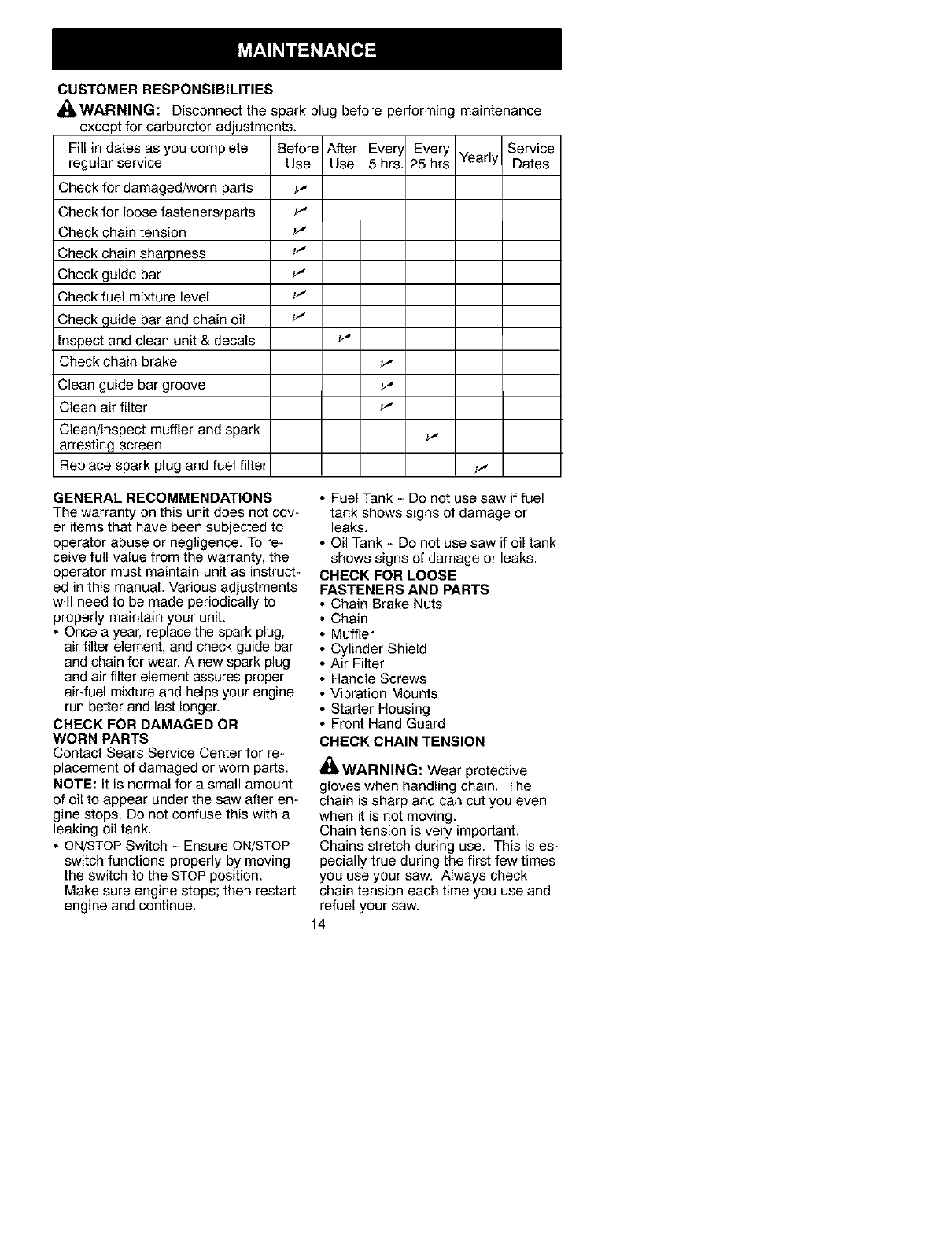
CUSTOMER RESPONSIBILITIES
_kWARNING: Disconnect the spark plug before performing maintenance
except for carburetor adjustments.
Fill in dates as you complete Before
regular service Use
Check for damaged/worn parts
Check for loose fasteners/parts
Check chain tension
Check chain sharpness _'
Check guide bar _'
Check fuel mixture level _"
Check guide bar and chain oil _'
Inspect and clean unit & decals
Check chain brake
Clean guide bar groove
Clean air filter
Clean/inspect muffler and spark
arresting screen
Replace spark plug and fuel filter
After Every Every Service
Use 5 hrs. 25 hrs. Yearly Dates
GENERAL RECOMMENDATIONS
The warranty on this unit does not cov-
er items that have been subjected to
operator abuse or negligence. To re-
ceive full value from the warranty, the
operator must maintain unit as instruct-
ed in this manual. Various adjustments
will need to be made periodically to
properly maintain your unit.
• Once a year, replace the spark plug,
air filter element, and check guide par
and chain for wear. A new spark plug
and air filter element assures proper
air-fuel mixture and helps your engine
run better and last longer.
CHECK FOR DAMAGED OR
WORN PARTS
Contact Sears Service Center for re-
placement of damaged or worn parts.
NOTE: It is normal for a small amount
of oil to appear under the saw after en-
gine stops. Do not confuse this with a
leaking oil tank.
• ON/STOP Switch - Ensure ON/STOP
switch functions properly by moving
the switch to the STOP position.
Make sure engine stops; then restart
engine and continue.
• Fuel Tank - Do not use saw if fuel
tank shows signs of damage or
leaks.
• Oil Tank - Do not use saw if oil tank
shows signs of damage or leaks.
CHECK FOR LOOSE
FASTENERS AND PARTS
• Chain Brake Nuts
• Chain
• Muffler
• Cylinder Shield
• Air Filter
• Handle Screws
• Vibration Mounts
• Starter Housing
• Front Hand Guard
CHECK CHAIN TENSION
_II, WARNING: Wear protective
gloves when handling chain. The
chain is sharp and can cut you even
when it is not moving.
Chain tension is very important.
Chains stretch during use. This is es-
pecially true during the first few times
you use your saw. Always check
chain tension each time you use and
refuel your saw.
14
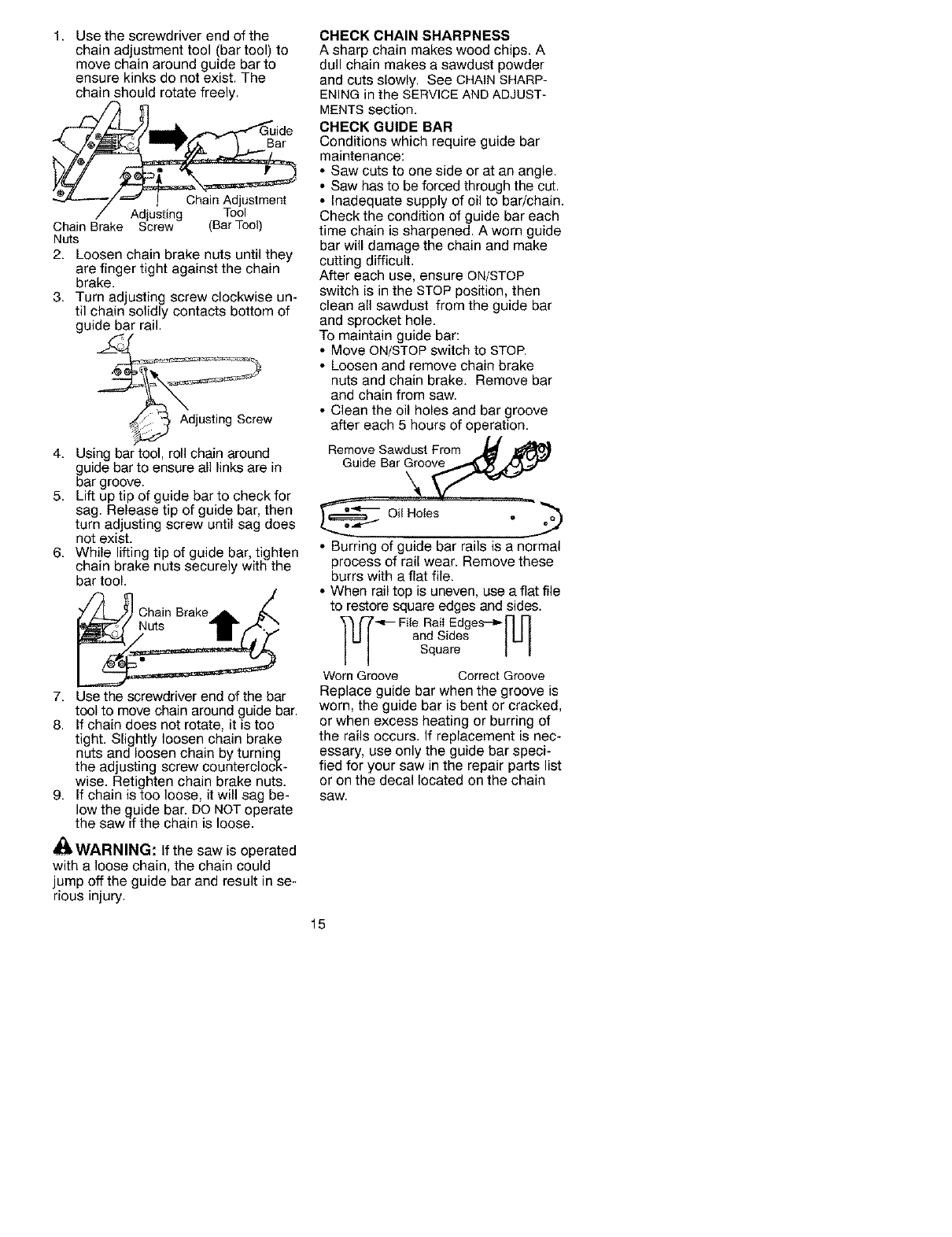
1. Usethescrewdriverendofthe
chainadjustmenttool(bartool)to
movechainaroundguidebarto
ensurekinksdonotexist.The
chainshouldrotatefreely.
Bar
Chain Adjustment
Adjusting Tool
Chain Brake Screw (Bar Tool)
Nuts
2. Loosen chain brake nuts until they
are finger tight against the chain
brake.
3. Turn adjusting screw clockwise un-
til chain solidly contacts bottom of
guide bar rail.
__ Adjusting Screw
4. Using bar tool, roll chain around
guide bar to ensure all links are in
bar groove.
5. Lift up tip of guide bar to check for
sag. Release tip of guide bar, then
turn adjusting screw until sag does
not exist.
6. While lifting tip of guide bar, tighten
chain brake nuts securely with the
bar tool.
Chain Brake
Nuts
7. Use the screwdriver end of the bar
tool to move chain around guide bar.
8. If chain does not rotate, it is too
tight. Slightly loosen chain brake
nuts and loosen chain by turning
the adjusting screw counterclock-
wise. Retighten chain brake nuts.
9. If chain is too loose, it will sag be-
low the guide bar. DO NOT operate
the sawif the chain is loose.
_I_WARNING: If the saw is operated
with aloose chain, the chain could
jump off the guide bar and result in se-
rious injury.
CHECK CHAIN SHARPNESS
A sharp chain makes wood chips. A
dull chain makes a sawdust powder
and cuts slowly. See CHAIN SHARP-
ENING in the SERVICE AND ADJUST-
MENTS section.
CHECK GUIDE BAR
Conditions which require guide bar
maintenance:
• Saw cuts to one side or at an angle.
• Saw has to be forced through the cut.
• Inadequate supply of oil to bar/chain.
Check the condition of guide bar each
time chain is sharpened. A worn guide
bar will damage the chain and make
cutting difficult.
After each use, ensure ON/STOP
switch is in the STOP position, then
clean all sawdust from the guide bar
and sprocket hole.
To maintain guide bar:
• Move ON/STOP switch to STOP.
• Loosen and remove chain brake
nuts and chain brake. Remove bar
and chain from saw.
• Clean the oil holes and bar groove
after each 5 hours of operation.
Re_°Vc'_SBaaWdUStoFr°m_k_o__,,_
Oil Hotes o °J
• Burring of guide bar rails is a normal
process of rail wear. Remove these
burrs with a flat file.
• When rail top is uneven, use aflat file
to restore square edges and sides.
_L_ File Rail Edges_r] [1
and Sides I U
Square I I
Worn Groove Correct Groove
Replace guide bar when the groove is
worn, the guide bar is bent or cracked,
or when excess heating or burring of
the rails occurs. If replacement is nec-
essary, use only the guide bar speci-
fied for your saw in the repair parts list
or on the decal located on the chain
saw.
15
CHECK FUEL MIXTURE LEVEL
• See FUELING ENGINE under the OP-
ERATION section.
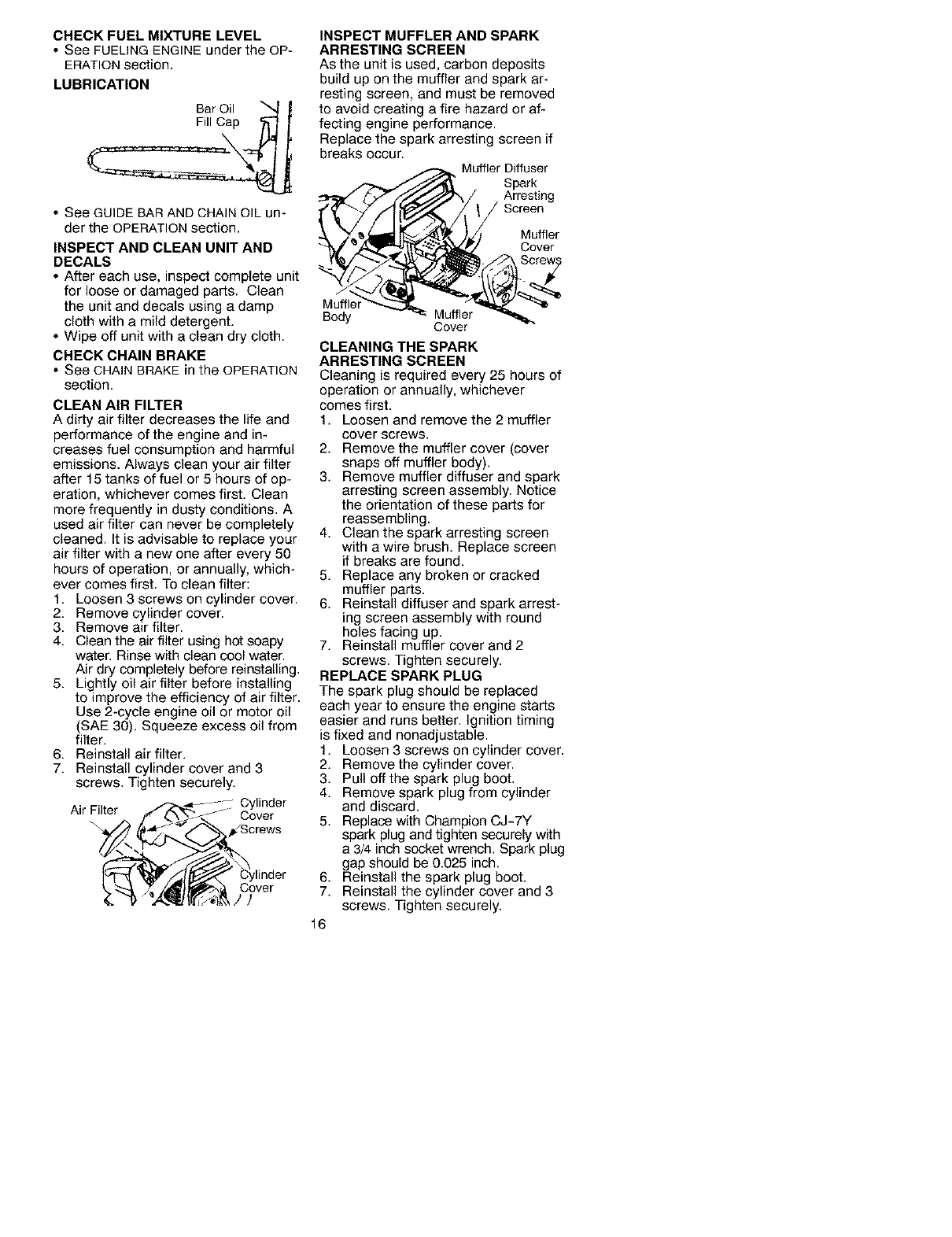
LUBRICATION
Bar Oil _
_Fill _
• See GUIDE BAR AND CHAIN OIL un-
der the OPERATION section.
INSPECT AND CLEAN UNIT AND
DECALS
• After each use, inspect complete unit
for loose or damaged parts. Clean
the unit and decals using a damp
cloth with a mild detergent.
• Wipe off unit with a clean dry cloth.
CHECK CHAIN BRAKE
• See CHAIN BRAKE in the OPERATION
section.
CLEAN AIR FILTER
A dirty air filter decreases the life and
performance of the engine and in-
creases fuel consumption and harmful
emissions. Always clean your air filter
after 15 tanks of fuel or 5 hours of op-
eration, whichever comes first. Clean
more frequently in dusty conditions. A
used air filter can never be completely
cleaned. It is advisable to replace your
air filter with a new one after every 50
hours of operation, or annually, which-
ever comes first. To clean filter:
1. Loosen 3 screws on cylinder cover.
2. Remove cylinder cover.
3. Remove air filter.
4. Clean the air filter using hot soapy
water. Rinse with clean cool water.
Air dry completely before reinstalling.
5. Lightly oil air filter before installing
to improve the efficiency of air filter.
Use 2-cycle engine oil or motor oil
(SAE 30). Squeeze excess oil from
filter.
6. Reinstall air filter.
7. Reinstall cylinder cover and 3
screws. Tighten securely.
Cylinder
Air Filter Cover
linder
_/C_)ver
INSPECT MUFFLER AND SPARK
ARRESTING SCREEN
As the unit is used, carbon deposits
build up on the muffler and spark ar-
resting screen, and must be removed
to avoid creating a fire hazard or af-
fecting engine performance.
Replace the spark arresting screen if
breaks occur.
Body
Muffler Diffuser
_'_ Spark
_t'/t',,_ /Arresting
_/I '/ Screen
__'_-/_._)_// Muffler
_',7,_d_/ Cover
•Screw
Cover
CLEANING THE SPARK
ARRESTING SCREEN
Cleaning is required every 25 hours of
operation or annually, whichever
comes first.
1. Loosen and remove the 2 muffler
cover screws.
2. Remove the muffler cover (cover
snaps off muffler body).
3. Remove muffler diffuser and spark
arresting screen assembly. Notice
the orientation of these parts for
reassembling.
4. Clean the spark arresting screen
with a wire brush. Replace screen
if breaks are found.
5. Replace any broken or cracked
muffler parts.
6. Reinstall diffuser and spark arrest-
ing screen assembly with round
holes facing up.
7. Reinstall muffler cover and 2
screws. Tighten securely.
REPLACE SPARK PLUG
The spark plug should be replaced
each year to ensure the engine starts
easier and runs better. Ignition timing
is fixed and nonadjustable.
1. Loosen 3 screws on cylinder cover.
2. Remove the cylinder cover.
3. Pull off the spark plug boot.
4. Remove spark plug from cylinder
and discard.
5. Replace with Champion CJ-7Y
spark plug and tighten securely with
a 3/4 inch socket wrench. Spark plug
gap should be 0.025 inch.
6. Reinstall the spark plug boot.
7. Reinstall the cylinder cover and 3
screws. Tighten securely.
16
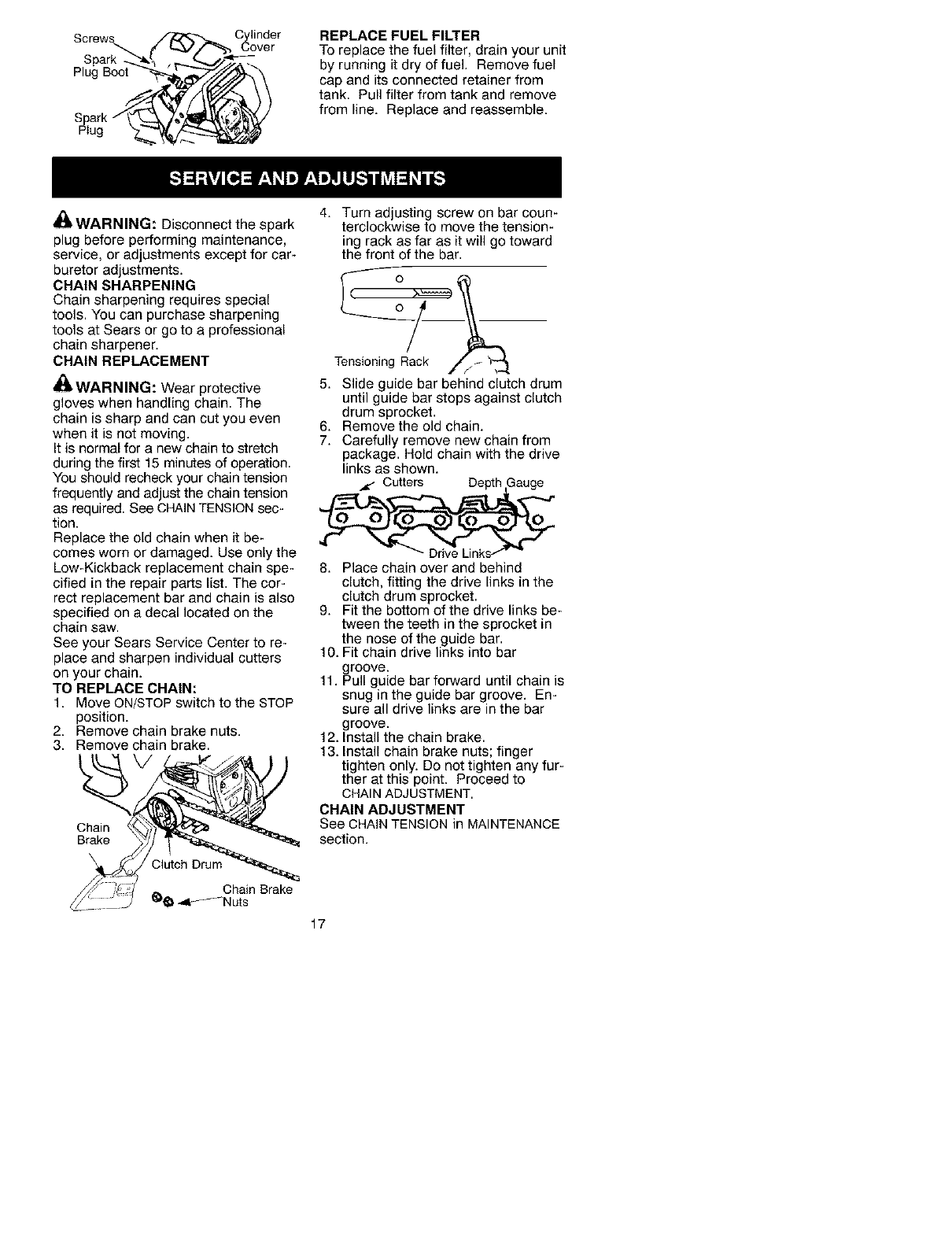
Cylinder
ver
REPLACE FUEL FILTER
TO replace the fuel filter, drain your unit
by running it dry of fuel. Remove fuel
cap and its connected retainer from
tank. Pull filter from tank and remove
from line. Replace and reassemble.
4111bWARNING: Disconnect the spark
plug before performing maintenance,
service, or adjustments except for car-
buretor adjustments.
CHAIN SHARPENING
Chain sharpening requires special
tools. You can purchase sharpening
tools at Sears or go to a professional
chain sharpener.
CHAIN REPLACEMENT
_WARNING: Wear protective
gloves when handling chain. The
chain is sharp and can cut you even
when it is not moving.
It is normal for a new chain to stretch
during the first 15 minutes of operation.
You should recheck your chain tension
frequently and adjust the chain tension
as required. See CHAIN TENSION sec-
tion.
Replace the old chain when it be-
comes worn or damaged. Use only the
Low-Kickback replacement chain spe-
cified in the repair parts list. The cor-
rect replacement bar and chain is also
specified on a decal located on the
chain saw.
See your Sears Service Center to re-
place and sharpen individual cutters
on your chain.
TO REPLACE CHAIN:
1. Move ON/STOP switch to the STOP
position.
2. Remove chain brake nuts.
3. Remove chain brake.
Chain
Brake
'\ Clutch Drum
4. Turn adjusting screw on bar coun-
terclockwise to move the tension-
ing rack as far as it will go toward
the front of the bar.
Tensioning Rack //_ '_
5. Slide guide bar behind clutch drum
until guide bar stops against clutch
drum sprocket.
6. Remove the old chain.
7. Carefully remove new chain from
package. Hold chain with the drive
links as shown.
8. Place chain over and behind
clutch, fitting the drive links in the
clutch drum sprocket.
9. Fit the bottom of the drive links be-
tween the teeth in the sprocket in
the nose of the guide bar.
10. Fit chain drive links into bar
roove.
11. Pull guide bar forward until chain is
snug in the guide bar groove. En-
sure all drive links are in the bar
groove.
12. Install the chain brake.
13. Install chain brake nuts; finger
tighten only. Do not tighten any fur-
ther at this point. Proceed to
CHAIN ADJUSTMENT.
CHAIN ADJUSTMENT
See CHAIN TENSION in MAINTENANCE
section.
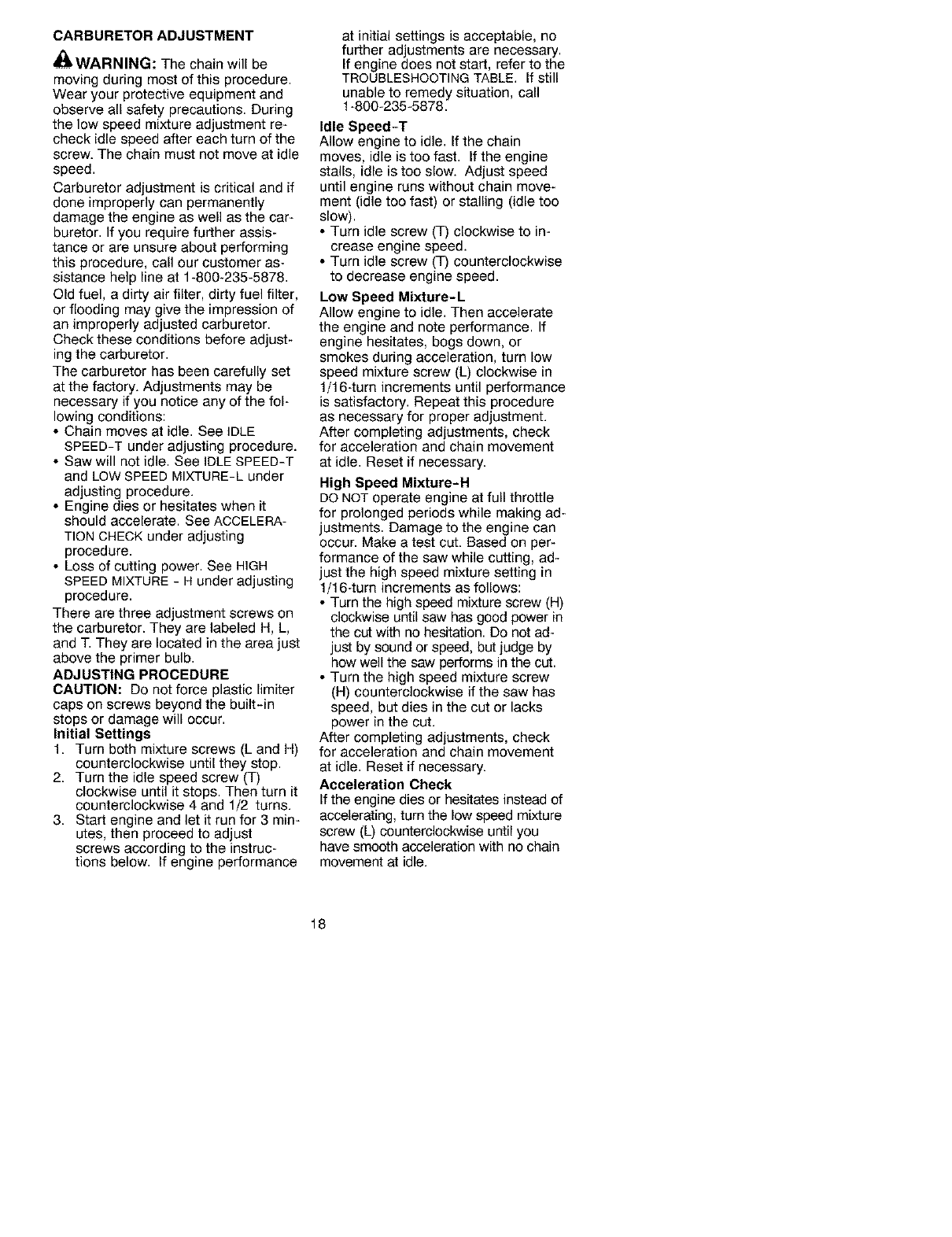
CARBURETOR ADJUSTMENT
OWARNING: The chain will be
moving during most of this procedure.
Wear your protective equipment and
observe all safety precautions. During
the low speed mixture adjustment re-
check idle speed after each turn of the
screw. The chain must not move at idle
speed.
Carburetor adjustment is critical and if
done improperly can permanently
damage the engine as well as the car-
buretor. If you require further assis-
tance or are unsure about performing
this procedure, call our customer as-
sistance help line at 1-800-235-5878.
Old fuel, a dirty air filter, dirty fuel filter,
or flooding may give the impression of
an improperly adjusted carburetor.
Check these conditions before adjust-
ing the carburetor.
The carburetor has been carefully set
at the factory. Adjustments may be
necessary if you notice any of the fol-
lowing conditions:
• Chain moves at idle. See IDLE
SPEED-T under adjusting procedure.
• Saw will not idle. See IDLE SPEED-T
and LOW SPEED MIXTURE-L under
adjusting procedure.
• Engine dies or hesitates when it
should accelerate. See ACCELERA-
TION CHECK under adjusting
procedure.
• Loss of cutting power. See HIGH
SPEED MIXTURE - H under adjusting
procedure.
There are three adjustment screws on
the carburetor. They are labeled H, L,
and T. They are located in the area just
above the primer bulb.
ADJUSTING PROCEDURE
CAUTION: Do not force plastic limiter
caps on screws beyond the built-in
stops or damage will occur.
Initial Settings
1. Turn both mixture screws (L and H)
counterclockwise until they stop.
2. Turn the idle speed screw (T)
clockwise until it stops. Then turn it
counterclockwise 4 and 1/2 turns.
3. Start engine and let it run for 3 min-
utes, then proceed to adjust
screws according to the instruc-
tions below. If engine performance
at initial settings is acceptable, no
further adjustments are necessary.
If engine does not start, refer to the
TROUBLESHOOTING TABLE. If still
unable to remedy situation, call
1-800-235-5878.
Idle Speed-T
Allow engine to idle. If the chain
moves, idle is too fast. If the engine
stalls, idle is too slow. Adjust speed
until engine runs without chain move-
ment (idle too fast) or stalling (idle too
slow).
• Turn idle screw (T) clockwise to in-
crease engine speed.
• Turn idle screw (T) counterclockwise
to decrease engine speed.
Low Speed Mixture-L
Allow engine to idle. Then accelerate
the engine and note performance. If
engine hesitates, bogs down, or
smokes during acceleration, turn low
speed mixture screw (L) clockwise in
1/164urn increments until performance
is satisfactory. Repeat this procedure
as necessary for proper adjustment.
After completing adjustments, check
for acceleration and chain movement
at idle. Reset if necessary.
High Speed Mixture-H
DO NOT operate engine at full throttle
for prolonged periods while making ad-
justments. Damage to the engine can
occur. Make a test cut. Based on per-
formance of the saw while cutting, ad-
just the high speed mixture setting in
1/164urn increments as follows:
• Turn the high speed mixture screw (H)
clockwise until saw has good power in
the cut with no hesitation. Do not ad-
just by sound or speed, but judge by
how well the saw performs in the cut.
• Turn the high speed mixture screw
(H) counterclockwise if the saw has
speed, but dies in the cut or lacks
power in the cut.
After completing adjustments, check
for acceleration and chain movement
at idle. Reset if necessary.
Acceleration Cheek
If the engine dies or hesitates instead of
accelerating, turn the low speed mixture
screw (L) counterclockwise until you
have smooth acceleration with no chain
movement at idle.
18

dClbWARNING: Perform the following
steps after each use:
•Allow the engine to cool, and secure
the unit before storing or transport-
ing.
• Store chain saw and fuel in a well
ventilated area where fuel vapors
cannot reach sparks or open flames
from water heaters, electric motors or
switches, furnaces, etc.
• Store chain saw with all guards in
place and position chain saw so that
any sharp object cannot accidentally
cause injury.
• Store chain saw well out of the reach
of children.
SEASONAL STORAGE
Prepare your unit for storage at the
end of the season or if it will not be
used for 30 days or more.
If your chain saw is to be stored for a
period of time:
• Clean saw thoroughly before stor-
age.
• Store in a clean dry area.
• Lightly oil external metal surfaces
and guide bar.
• Oil the chain and wrap it in heavy pa-
per or cloth.
FUEL SYSTEM
Under Fueling Engine in the Operating
Section of this manual, see message
labeled IMPORTANT regarding the
use of gasohol in your chain saw.
Fuel stabilizer is an acceptable alter-
native in minimizing the formation of
fuel gum deposits during storage. Add
stabilizer to the gasoline in the fuel
tank or fuel storage container. Follow
the mix instructions found on stabilizer
containers. Run engine at least 5 min-
utes after adding stabilizer.
Craftsman 40:1,2-cycle engine oil (air
cooled) is especially blended with fuel
stabilizer. If you do not use this Sears
oil, you can add a fuel stabilizer to your
fuel tank.
ENGINE
• Remove spark plug and pour 1 tea-
spoon of 40:1,2-cycle engine oil (air
cooled) through the spark plug open-
ing. Slowly pull the starter rope 8 to
10 times to distribute oil.
• Replace spark plug with new one of
recommended type and heat range.
• Clean air filter.
• Check entire unit for loose screws,
nuts, and bolts. Replace any dam-
aged, broken, or worn parts.
• At the beginning of the next season,
use only fresh fuel having the proper
gasoline to oil ratio.
OTHER
• Do not store gasoline from one sea-
son to another.
• Replace your gasoline can if it starts
to rust.
19
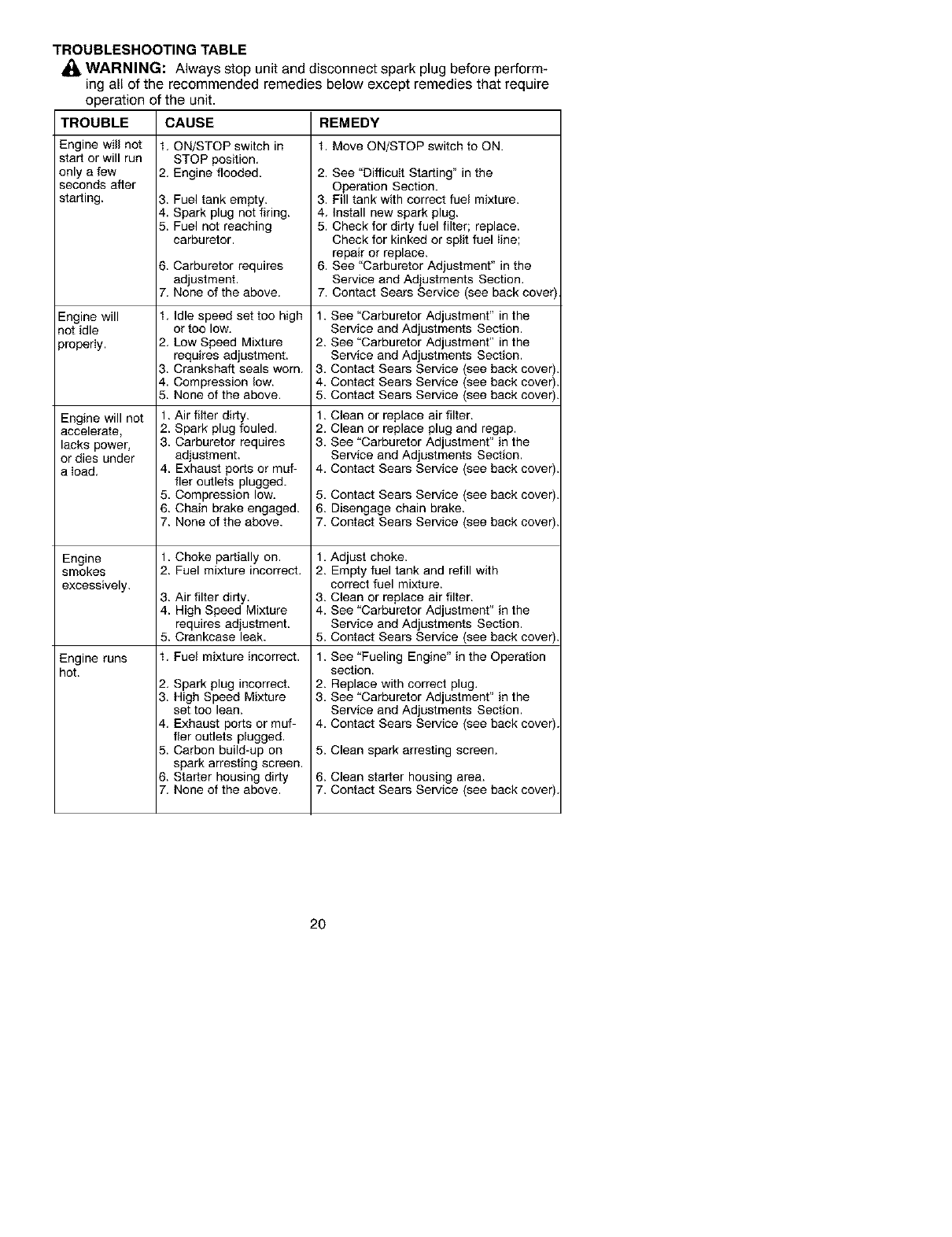
TROUBLESHOOTING TABLE
WARNING: Always stop unit and disconnect spark plug before perform-
ing all of the recommended remedies below except remedies that require
operation of the unit.
TROUBLE CAUSE REMEDY
1, Move ON/STOP switch to ON.
Engine will not
start or will run
only a few
seconds after
starting.
Engine will
not idle
_roperly.
Engine will not
accelerate_
lacks power,
or dies under
a load.
Engine
smokes
excessively.
Engine runs
hot.
1. ON/STOP switch in
STOP position.
2. Engine flooded.
3. Fuel tank empty.
4 Spark plug not firing.
5. Fuel not reaching
carburetor.
6. Carburetor requires
adjustment.
7. None of the above.
1. Idle speed set too high
or too low.
2. Low Speed Mixture
requires adjustment.
3. Crankshaft seals worn.
4 Compression low.
5. None of the above.
1. Air filter dirty.
2. Spark plug fouled.
3. Carburetor requires
adjustment.
4. Exhaust ports or muf-
fler outlets plugged.
5. Compression low.
6. Chain brake engaged.
7. None of the above.
1. Choke partially on.
2. Fuel mixture incorrect.
3. Air filter dirty.
4. High Speed Mixture
requires adjustment.
5. Crankcase leak.
1. Fuel mixture incorrect.
2. Spark plug incorrect.
3. High Speed Mixture
set too lean.
4. Exhaust ports or muf-
fler outlets plugged.
5. Carbon build-up on
spark arresting screen.
6. Starter housing dirty
7. None of the above.
2. See "Difficult Starting" in the
Operation Section.
3. Fill tank with correct fuel mixture.
4, Install new spark plug.
5. Check for dirty fuel filter; replace.
Check for kinked or split fuel line;
repair or replace.
6. See "Carburetor Adjustment" in the
Service and Adjustments Section.
7. Contact Sears Service (see back cover
1. See "Carburetor Adjustment" in the
Service and Adjustments Section.
2. See "Carburetor Adjustment" in the
Service and Adjustments Section.
3. Contact Sears Service (see back cover)
4. Contact Sears Service (see back cover)
5. Contact Sears Service (see back cover)
1. Clean or replace air filter.
2. Clean or replace plug and regap.
3. See "Carburetor Adjustment" in the
Service and Adjustments Section.
4. Contact Sears Service (see back cover)
5. Contact Sears Service (see back cover)
6. Disengage chain brake.
7. Contact Sears Service (see back cover)
1. Adjust choke.
2. Empty fuel tank and refill with
correct fuel mixture.
3. Clean or replace air filter.
4. See "Carburetor Adjustment" in the
Service and Adjustments Section.
5. Contact Sears Service (see back cover)
1. See "Fueling Engine" in the Operation
section.
2. Replace with correct plug.
3. See "Carburetor Adjustment" in the
Service and Adjustments Section.
4. Contact Sears Service (see back cover)
5. Clean spark arresting screen.
6. Clean starter housing area.
7. Contact Sears Service (see back cover)
20
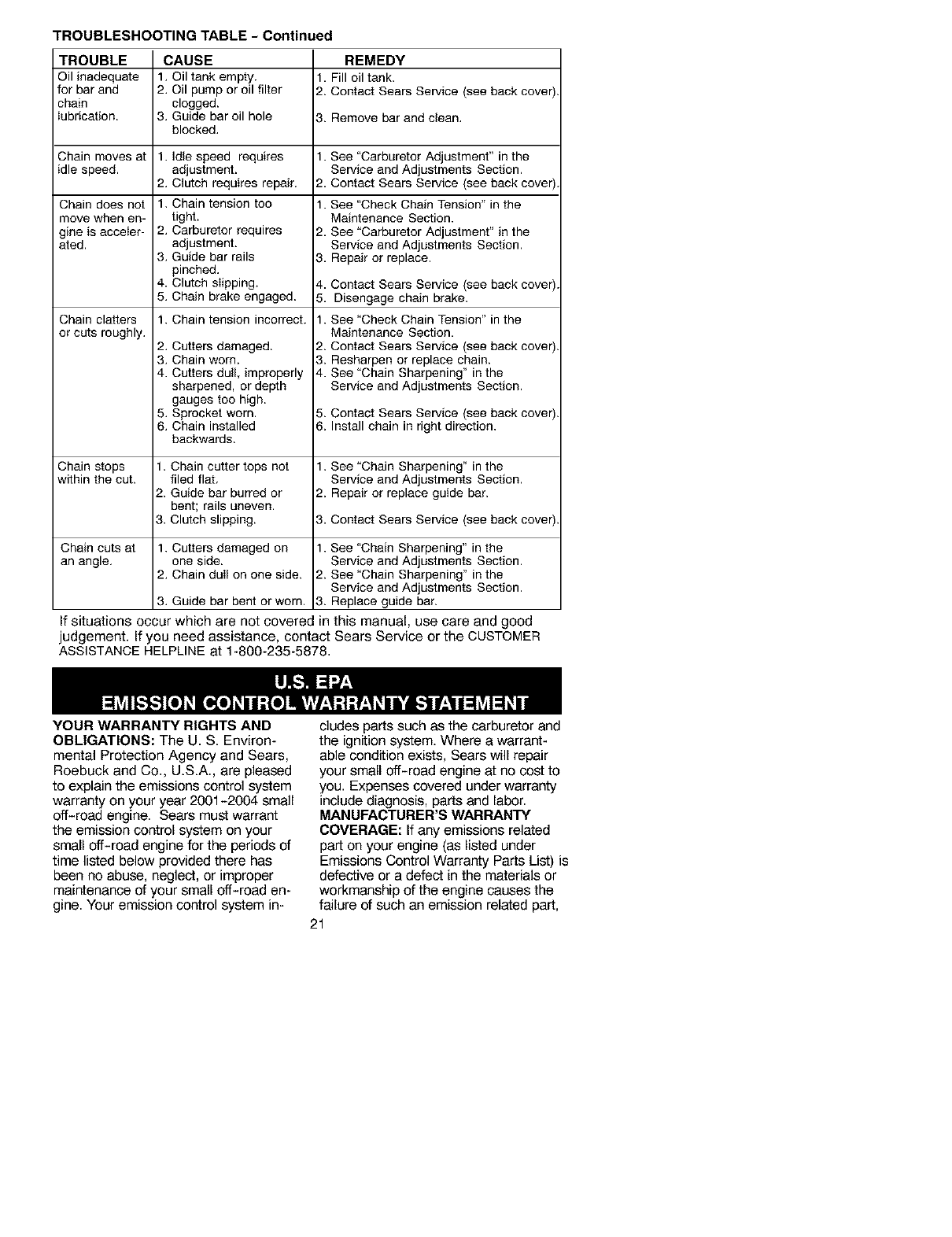
TROUBLESHOOTING TABLE -Continued
TROUBLE
Oil inadequate
for bar and
chain
lubrication.
CAUSE
1. Oil tank empty.
2. Oil pump or oil filter
clogged.
3. Guide bar oil hole
blocked,
REMEDY
1. Fill oil tank.
_. Contact Sears Service (see back cover)
3. Remove bar and clean.
Chain moves at 1. Idle speed requires 1. See "Carburetor Adjustment" in the
idle speed, adjustment. Service and Adjustments Section.
2. Clutch requires repair. 2. Contact Sears Service (see back cover)
Chain does not 1. Chain tension too 1. See "Check Chain Tension" in the
move when en- tight. Maintenance Section.
gine is acceler- 2. Carburetor requires _. See "Carburetor Adjustment" in the
ated. adjustment. Service and Adjustments Section.
3. Guide bar rails 3. Repair or replace.
pinched.
4. Clutch slipping. 4. Contact Sears Service (see back cover)
5. Chain brake engaged. 5. Disengage chain brake.
Chain clatters 1. Chain tension incorrect.
or cuts roughly. 2. Cutters damaged.
3. Chain worn.
4. Cutters dull, improperly
sharpened, or depth
gauges too high.
5. Sprocket worn.
6. Chain installed
backwards.
1. See "Check Chain Tension" in the
Maintenance Section.
2. Contact Sears Service (see back cover)
3. Resharpen or replace chain.
4. See "Chain Sharpening" in the
Service and Adjustments Section.
_. Contact Sears Service (see back cover)
3. Install chain in right direction.
Chain stops 1. Chain cutter tops not 1. See "Chain Sharpening" in the
within the cut. filed flat. Service and Adjustments Section.
2. Guide bar burred or 2. Repair or replace guide bar.
bent; rails uneven.
3. Clutch slipping. 3. Contact Sears Service (see back cover)
Chain cuts at 1. Cutters damaged on 1. See "Chain Sharpening" in the
an angle, one side. Service and Adjustments Section.
2. Chain dull on one side. 2. See "Chain Sharpening" in the
Service and Adjustments Section.
3. Guide bar bent or worn. 3. Replace guide bar.
If situations Occur which are not covered in this manual, use care and good
judgement. If you need assistance, contact Sears Service or the CUSTOMER
ASSISTANCE HELPLINE at 1-800-235-5878.
YOUR WARRANTY RIGHTS AND
OBLIGATIONS: The U. S. Environ-
mental Protection Agency and Sears,
Roebuck and Co., U.S.A., are pleased
to explain the emissions control system
warranty on your year 2001-2004 small
off-road engine. Sears must warrant
the emission control system on your
small off-road engine for the periods of
time listed below provided there has
been no abuse, neglect, or improper
maintenance of your small off-road en-
gine. Your emission control system in-
dudes parts such as the carburetor and
the ignition system. Where a warrant-
able condition exists, Sears will repair
your small off-road engine at no cost to
you. Expenses covered under warranty
include diagnosis, parts and labor.
MANUFACTURER'S WARRANTY
COVERAGE: If any emissions related
part on your engine (as listed under
Emissions Control Warranty Parts List) is
defective or a defect in the materials or
workmanship of the engine causes the
failure of such an emission related part,
21
thepartwillberepairedorreplacedby
Sears.OWNER'SWARRANTY RE-
SPONSIBILITIES: As the small off-road
engine owner, you are responsible for
the performance of the required mainte-
nance listed in your instruction manual.
Sears recommends that you retain all
receipts covering maintenance on your
small off-road engine, but Sears cannot
deny warranty solely for the lack of re-
ceipts or for your failure to ensure the
performance of all scheduled mainte-
nance. As the small off-road engine
owner, you should be aware that Sears
may deny you warranty coverage if your
small off-road engine or a part of it has
failed due to abuse, neglect, improper
maintenance, unapproved modifications,
or the use of parts not made or ap-
proved by the original equipment
manufacturer. You are responsible for
presenting your small off-road engine to
a Sears authorized repair center as
soon as a problem exists. Warranty re-
pairs should be completed in a reason-
able amount of time, not to exceed 30
days. If you have any questions regard-
ing your warranty rights and responsibili-
ties, you should contact your nearest
authorized service center or call Sears
at 1-800-469-4663. WARRANTY
COMMENCEMENT DATE: The warran-
ty period begins on the date the small
off-road engine is purchased. LENGTH
OF COVERAGE: This warranty shall be
for a period of two years from the initial
date of purchase. WHAT IS COV-
ERED: REPAIR OR REPLACEMENT
OF PARTS. Repair or replacement of
any warranted part will be performed at
no charge to the owner at an approved
Sears servicing center. If you have any
questions regarding your warranty rights
and responsibilities, you should contact
your nearest authorized service center
or call Sears at 1-800-469-4663.
WARRANTY PERIOD: Any warranted
part which is not scheduled for replace-
ment as required maintenance, or which
is scheduled only for re_qularinspection
to the effect of "repair or replace as nec-
essary" shall be warranted for 2 years.
Any warranted part which is scheduled
for replacement as required mainte-
nance shall be warranted for the period
of time up to the first scheduled replace-
ment point for that part. DIAGNOSIS:
The owner shall not be charged for
diagnostic labor which leads to the de-
termination that a warranted part is de-
fective if the diagnostic work is per-
formed at an approved Sears servicing
center. CONSEQUENTIAL DAMAGES:
Sears may be liable for damages to oth-
er engine components caused by the
failure of a warranted part still under
warranty. WHAT IS NOT COVERED:
All failures caused by abuse, neglect, or
improper maintenance are not covered.
ADD-ON OR MODIFIED PARTS: The
use of add-on or modified parts can be
grounds for disallowing a warranty claim.
Sears is not liable to cover failures of
warranted parts caused by the use of
add-on or modified parts. HOW TO
FILE A CLAIM: If you have any ques-
tions regarding your warranty rights and
responsibilities, you should contact your
nearest authorized service center or call
Sears at 1-800-469-4663. WHERE TO
GET WARRANTY SERVICE: Warranty
services or repairs shall be provided at
all Sears service centers. Call
1-800-469-4663. MAINTENANCE,
REPLACEMENT AND REPAIR OF
EMISSION RELATED PARTS: Any
Sears approved replacement part used
in the performance of any warranty
maintenance or repair on emission re-
lated parts will be provided without
charge to the owner if the part is under
warranty. EMISSION CONTROL WAR-
RANTY PARTS LIST: Carburetor, Igni-
tion System: Spark Plug (covered up to
maintenance schedule), Ignition Module.
MAINTENANCE STATEMENT: The
owner is responsible for the berfor-
manse of all required maintenance as
defined in the instruction manual.
This engine is certified to be emissions compliant for the following use:
[] Moderate (50 hours)
[] Intermediate (125 hours)
[] Extended (300 hours)
22
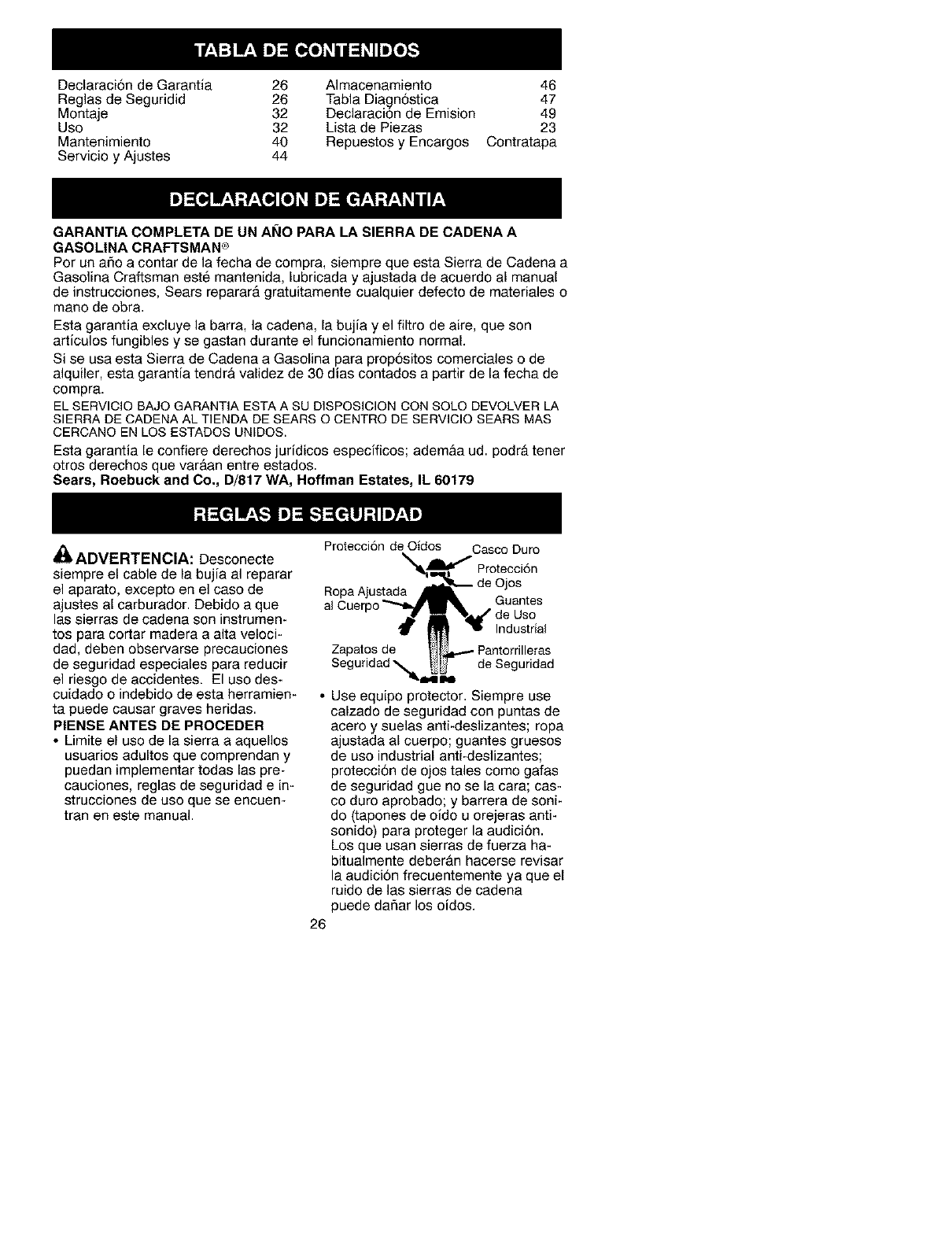
Declaraci6ndeGarantia 26 AImacenamiento 46
ReglasdeSeguridid 26 TablaDiagn6stica 47
Montaje 32 DeclaraciondeEmision 49
Uso 32 ListadePiezas 23
Mantenimiento 40 Repuestosy EncargosContratapa
ServicioyAjustes 44
GARANTIA COMPLETA DE UN ANO PARA LA SIERRA DE CADENA A
GASOLINA CRAFTSMAN ®
Per un aSo a contar de la fecha de compra, siempre que esta Sierra de Cadena a
Gasolina Craftsman est6 mantenida, lubricada y ajustada de acuerdo al manual
de instrucciones, Sears reparar& gratuitamente cualquier defecto de materiales o
mane de obra.
Esta garantia excluye la barra, la cadena, la bujia y el filtro de aire, que son
articulos fungibles y se gastan durante el funcionamiento normal.
Si se usa esta Sierra de Cadena a Gasolina para prop6sitos comerciales o de
alquiler, esta garantia tendr& validez de 30 dias contados a partir de la fecha de
compra.
EL SERVICIO BAJO GARANTIA ESTAA SU DISPOSICION CON SOLO DEVOLVER LA
SIERRA DE CADENA AL TIENDA DE SEARS O CENTRO DE SERVICIO SEARS MAS
CERCANO EN LOS ESTADOS UNIDOS.
Esta garantia le confiere derechos juridicos especfficos; adem&a ud. podr& tener
otros derechos que var&an entre estados.
Sears, Roebuck and Co., D/817 WA, Hoffman Estates, IL 60179
_lk ADVERTENCIA: Desconecte
siempre el cable de la bujia al reparar
el aparato, excepto en el caso de
ajustes al carburador. Debido a que
las sierras de cadena son instrumen-
tos para cortar madera a alta veloci-
dad, deben observarse precauciones
de seguridad especiales para reducir
el riesgo de accidentes. El uso des-
cuidado o indebido de esta herramien-
ta puede causar graves heridas.
PIENSE ANTES DE PROCEDER
• Limite el use de la sierra a aquellos
usuarios adultos que comprendan y
puedan implementar todas las pre-
cauciones, reglas de seguridad e in-
strucciones de use que se encuen-
tran en este manual.
26
Proteccion de Oidos Casco Duro
Protecci6n
Ropa Ajustada Guantes
• de Uso
Industrial
Zapatos de
Seguridad _ de Seguridad
Use equipo protector. Siempre use
calzado de seguridad con puntas de
acero y suelas anti-deslizantes; ropa
ajustada al cuerpo; guantes gruesos
de uso industrial anti-deslizantes;
protecci6n de ojos tales como gafas
de seguridad gue no se la cara; cas-
co duro aprobado; y barrera de soni-
do (tapones de oido u orejeras anti-
sonido) para proteger la audici6n.
Los que usan sierras de fuerza ha-
bitualmente deberan hacerse revisar
la audici6n frecuentemente ya que el
ruido de las sierras de cadena
puede daSar los oidos.
•Mantenga el cabello por encima del
nivel de los hombros. No desgaste
la ropa suelta o joyeria; pueden en-
redarse en las piezas m6viles.
• Mantenga todas las partes de cuer-
po alejadas de la cadena siempre
que el motor est_ en funcionamiento.
• Mantenga a los niSos, espectadores
y animales a una distancia minima
de 10 metros (30 pies) del &rea de
trabajo o cuando est& haciendo ar-
rancar el motor.
• No levante ni opere lae sierras de
cadena cuando est& fatigado, enfer-
mo, ansioso o si ha tornado alcohol,
drogas o remedios. Es inprescindible
que ud. est& en buenas condiciones
fisicas y alerta mentalmente. Si ud.
sufre de cualquier condici6n que
pueda empeorar con el trabajo ar-
duo, ases6rese con su medico.
• No ponga en marcha la sierra sin
tener un &rea de trabajo despejada,
una superficie estable para parase y,
si est& derrubando &rboles, un cami-
no predeterminado de retroceso.
USE LA SIERRA OBSERVANDO TO-
DOS LOS PROCEDIMIENTOS DE
SEGURIDAD
• Mantenga las dos manes en las man-
ijas siempre que el aparato este en
marcha. El uso del aparato con una
sola mano puede causar graves heri-
das al usuario, a los asistentes o a los
especadores. Las sierras de cadena
est&n diseSadas para que se las use
con las dos manos en todo momento.
• Haga use de la sierra de cadena t_ni-
camente en lugares exteriores bien
ventilados.
• No haga uso de la sierra desde las
escaleras port&tiles ni los &rboles.
• Aseg_rese de que la cadena no vaya
a hacer contacto con ning_n objeto
antes de poner en marcha el motor.
Nunca intente hacer arrancar la sierra
con la barra guia dentro de un corte.
• No aplique presi6n a la sierra al final
de los cortes. Aplicar presi6n puede
hacer uue pierda el control al com-
pletarse el corte.
• Pare el motor antes de apoyar la
sierra en ning6n lade.
• Cuando traslade la sierra en la
mano, h&galo _nicamente con el mo-
tor parado. Llevela con el silenciador
apartado del cuerpo y la barra y ca-
dena hacia atr&s, con la barra de
preferencia cubierta per una funda.
• No ponga en funcionamiento la sier-
ra de cadena si est& daSada, incor-
rectamente ajustada, o si no est& ar-
mada completa y seguramente.
Siempre cambie el barre, cadena,
protector de mano, freno de cadena,
o el otras piezas immediatamente si
da_ado, rote, o se sale per cualquier
motivo.
MANTENGA LA SIERRA EN BUE-
NAS CONDICIONES DE FUNClONA-
MIENTO
• Lleve la sierra de cadena a un pro-
veedor de servicio autorizado para
que haga todo servicio menos aquel-
los procedimientos listados en la
secci6n de mantenimiento de este
manual.
• AsegQrese de que la cadena se de-
tenga por complete cuando se suelta
el gatillo. Para hacer correcciones,
vea los AJUSTES AL CARBURADOR.
• Mantenga las manijas secas, limpias
y libres de aceite o de mezcla de
combustible.
• Mantenga las tapas y los fijadores
bien fijos.
• Componentes de repuesto que no
concuerden con las piezas originales
o la remoci6n de dispositivos de segu-
ridad podria causar daSos al aparato y
accidentes al usuario o a especta-
dores. Use exclusivamente los acce-
sorios y repuestos Craftsman recom-
endados. Nunca modifique la sierra.
• Mantenga su sierra de cadena con
cuidado.
• Mantenga la herramienta afilada y
limpia para mejor funcionamiento y
mayor seguridad.
• Siga todas las instrucciones para lu-
bricaci6n y cambio de accesorios.
• Desconecte la sierra de cadena del
recurso de energfa cuando no se en-
cuentre en uso, antes de efectuar
servicio, y al cambiar accesorios,
come Io es la cadena de la sierra y
el protector.
• Inspeccione todas las piezas por si
hubiera daSos. Antes de continuar
con el use del aparato; el protector u
otra pieza que se encuentre daSada
deber& ser inspeccionada cuidado-
samente para determinar si pueden
usarse de forma apropiada y para
vierificar si puede efectuar el funcio-
namiento para el cueal fue diseSada.
Inspeccione el alineamiento de las
piezas movibles, piezas movibles
27
queseencuentrenatascadas,la
rupturedepiezas,monturay cualqu-
ierotracondici6nquepuedaafectar
elusodelaparato.Elprotectorocu-
alquierotrapiezaqueseencuentre
dafiadadeber&serreparadaapro-
piadamenteodeber&serreemplaza-
daporunCentrodeServicioSears,
anoserqueseindiquedeotrafor-
maenestemanualdeinstrucciones.
• AInoencontrarseenuso,lassierras
decadenadeber&nalmacenarseen
unlugarseco,enunlugaraltoobajo
Ilave,fueradelalcancedelosniSos.
• AIalmacenarlasierra,useunafun-
daounestuchedecarga.
MANEJE EL COMBUSTIBLE CON
EXTREMO CUIDADO
• No fume mientras trabaja con el
combustible ni cuando est& hacien-
do uso de la sierra.
• Elimine todas las posibles fuentes de
chispas o llamas en las &reas donde
se mezcla o vierte el combustible.
• Mezcle y vierta el combustible afuera
y use siempre recipiente aprobado
pare combustibles y marcado como
tel. Limpie todos los derrames de
combustible antes de poner el apa-
rato en marcha.
• Al_jese a por Io menos 3 metros (10
pies) del lugar de abastecimiento
antes de poner el mtor en marcha.
• Apaque el motor y deje que la sierra
se enfrie en un lugar libre de substan-
cias combustibes y no sobre hojas se-
cas, paja, palel, etc. Retire la tape len-
tamente y reabastezca el aparato.
• Guarde el aparato y el combustible
en un espacio fresco, seco y bien
ventilado donde los vapores del
combustible no puedan entrar en
contacto con dchispas ni llamas
abiertas provenientes de termotan-
gues, motores o interruptores electri-
cos, calefactores centrales, etc.
PROTEJASE CONTRA t.AS
RECULADAS
Ud. debe seguir todas las precau-
clones e instrucciones de seguridad
pare ayudar e evitar las reculadas y
las dem&s fuerzas que pueden causer
graves heridas.
,Evite las obstrucciones
Despeje el Area de Trabaio
_IkADVERTENCIA: Evite reculada
le pueden causer graves heridas. Re-
culada es el movimiento hacia el
frente, hacia atr&s o r&pidamente ha-
cia adelante, esto puede ocurrir cuan-
do la punta de la barra guia de la sier-
ra de cadena entre en contacto con
cualquier objeto como puede ser otra
rama o tronco, o cuando la madera se
cierra y atasca mientras se hace el
corte. El entrar en contacto con algQn
objeto extrafio ala madera le puede
causer al usuario la perdida del control
de la sierra de cadena.
• La Reculada Rotacional puede
acontecer cuando la cadena en mo-
vimiento entre en contacto con elgin
objeto en la parte superior de la pun-
ta de la barra guia puede causer que
la cadena entre al material y se de-
tenga por un instante. El resultado
es una reacci6n inverse, a velocidad
de rel&mpago, que hace recular la
barra guia hacia arriba y hacia atr&s
hacia el usuario.
• La Reculada por Atasco acontecen
cuando la madera se cierra y atasca
la cadena en movimiento en el corte
a Io largo de la parte superior de la
barra guia y la cadena se detiene re-
pentinamente. Esta detenci6n re-
pentina de la cadena tiene como re-
sultado una inversi6n de la fuerza de
la cadena usada pare cortar madera
y cause que la sierra se mueva en
sentido opuesto al de la rotaci6n de
la cadena. La sierra directamente
hacia atr&s en direcci6n al usuario.
• La Reculada por Impulsion puede
acontecer cuando la cadena en mo-
vimiento entre en contacto con elgin
objeto extrafio ala madera en el
corte a Io largo de la parte inferior de
la barra guia y la cadena se detiene
repentinamente. Esta detenci6n re-
pentina de la cadena tire de la sierra
adelante y lejos del usuario y podria
hacer f&cilmente al usuario perder el
control de la sierra.
28
REDUZCA LAS PROBABILIDADES
DE RECULADA
• Est_ consciente de la posibilidad de
reculada. Teniendo una buena com-
prensi6n b&sica de la reculada, ud.
podr& reducir el elemento de sorpre-
sa que contribuye a los accidentes.
• Nunca permita que la cadena en mo-
vimiento toque ning6n ob eto en la
punta de la barra guia.
• Mantenga el area de trabajo libre de
obstrucciones como por ejemplo
otros arboles, ramas, piedras, cer-
cas, tocones, etc. Elimine o evite
toda obstrucci6nes comp por ejem-
plo otros _.rboles, ramas, piedras,
cercas, tocones, etc. Elimine o evite
toda obstrucci6n que la cadena pue-
da tocar mientras esta cortando.
• AI cortar una rama, no deje la barra
guia entrar en contacto con otra
rama o otros objetos alrededor.
• Mantenga la sierra afilada y con la
tensi6n correcta. Las cadenas con
poco file o flo asincrementan la proba-
b dad de recu ada. S ga as nstruc-
clones del fabricante para afilar y efec-
tuar mantenimiento de la cadena.
Verifique la tensi6n a intervalos regu-
lares con el motor parado, nunca en
marcha. Aseg_rese de que las tuer-
cas de la freno de cadena est_npara-
do, nunca en marcha. Aseg_rese de
que las tuercas de la freno de cadena
esten ejustadas firmemente.
• Empiece y efectQe la totalidad de
cada corte con el acelerador a fon-
do. Si la cadena se esta moviendo a
una velocidad menor que la m&xima,
hay m&s probabilidad de que la sier-
ra recule.
• Use cuidado extremo al entrar de
nuevo en un corte ya empezado.
• No intente hacer cortes empezando
con la punta de la barra (cortes de
taladro).
• Tenga cuidado con troncos que se
desplazan y con las dem&s fuerzas
que podrian cerrar un corte y apretar
la cadena o bien caer sobre ella.
• Use la barra Guia Reducidora de
Reculadas y la Cadena Minimizado-
ra de Reculadas recomendadas
para su sierra.
Evite la Reculada por Presion:
• Mantengase siempre al tanto de
toda situaci6n u obstrucci6n que
pueda apretar la cadena en la parte
superior de la barra o detener la ca-
dena de cualquier forma.
• No corte m&s que un tronco a la vez.
• AI seccionar troncos con corte as-
cendiente, no tuerza la sierra al sa-
car la barra del corte.
Evite la Impulsion:
• Empiece los cortes siempre con el
motor acelerado a fondo y la caja de
la sierra apoyada en la madera.
• Use cu_as de pl&stico o de madera,
no de metal, para mantener abierto
el corte.
MANTENGA EL CONTROL
Parese hacia la izquierda de la sierra.
Nunca invierta
Ia posici6n d_
Ias manos
I
Codo rigido
Nunca invie_tala posiclon de las manos
• Sostenga fuertemente la sierra con las
dos manos mientras este en marcha
el motor y no afloje. Sostener firme-
mente puede neutralizar las reculadas
y ayudarle a mantener el control de la
sierra. Sostenga la manija delantera
con la mano izquierda, colocando el
pulgar debajo de la manija y rodeando
la manija con los dedos. Mantenga la
mano derecha envolviendo totalmente
la manija trasera, sea ud. derecho o
zurdo. Mantenga el brazo izquierdo
totalmente extendido con el codo fijo.
• Coloque la mano izquierda en la man-
i a delantera, de modo que quede en
I nea recta con la mano derecha en la
manija trasera, cuando est_ haciendo
cortes de seccionamiento. Nunca in-
vierta la posici6n de las manos para
ningQn tipo de corte.
• P_.rese con el peso distribuido igual-
mente entre los dos pies.
• No se extienda excesivamente, la
sierra puede impulsarlo o empujarlo
y ud. puede perder el quililibrio y el
control de la sierra.
• No corte arriba del nivel de los hom-
bros, puedsto que torna dificil man-
tener el control de la sierra.
DISPOSITIVOS DE SEGURIDAD
CONTRA I.AS RECULADAS
ADVERTENCIA: Los siguientes
dispositivos han sido incluidos en la
sierra para ayudar a reducir el riesgo
de reculadas; sin embargo, tales im-
plementos no pueden eliminar total-
29
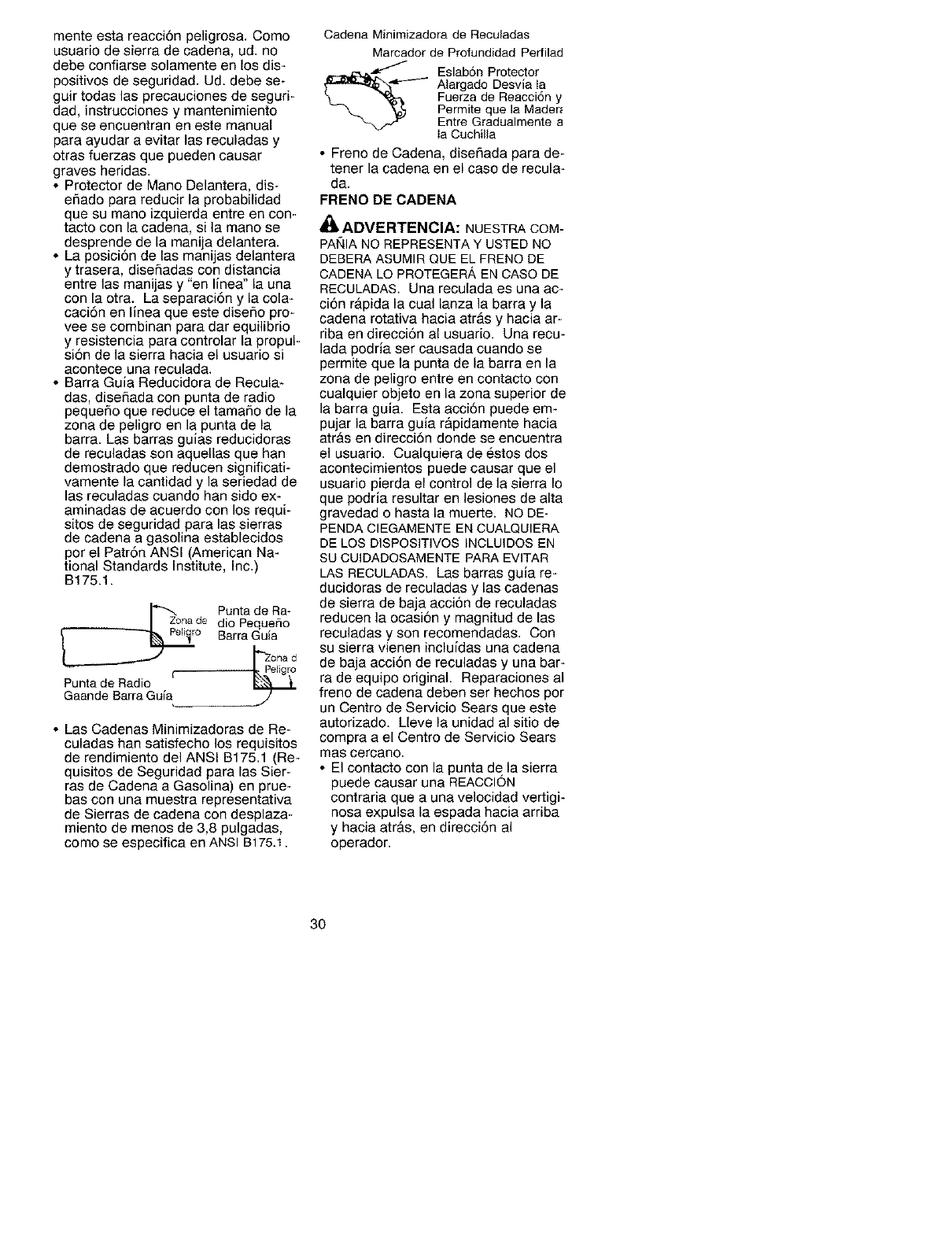
mente esta reacci6n peligrosa. Come
usuario de sierra de cadena, ud. no
debe confiarse solamente en los dis-
positivos de seguridad. Ud. debe se-
guir todas las precauciones de seguri-
dad, instrucciones y mantenimiento
que se encuentran en este manual
para ayudar a evitar las reculadas y
otras fuerzas que pueden causar
graves heridas.
• Protector de Mano Delantera, dis-
efiado para reducir la probabilidad
que su mano izquierda entre en con-
tacto con la cadena, si la mano se
desprende de la manija delantera.
• La posici6n de las manijas delantera
y trasera, disefiadas con distancia
entre las manijas y "en linea" la una
con la otra. La separaci6n y la cola-
caci6n en linea que este diseSo pro-
vee se combinan para dar equilibrio
y resistencia para controlar la propul-
si6n de la sierra hacia el usuario si
acontece una reculada.
• Barra Guia Reducidora de Recula-
das, disefiada con punta de radio
pequefio que reduce el tamaSo de la
zona de peligro en la punta de la
barra. Las barras guias reducidoras
de reculadas son aquellas que han
demostrado que reducen significati-
vamente la cantidad y la seriedad de
las reculadas cuando han sido ex-
aminadas de acuerdo con los requi-
sitos de seguridad para las sierras
de cadena a gasolina establecidos
pot el Patr6n ANSI (American Na-
tional Standards Institute, Inc.)
B175.1.
I_Zo Punta de Ra-
na de dio Peque_o
o Barra Gui_
Zor_a d
¢
Punta de Radio
Gaande Barra Guia
• Las Cadenas Minimizadoras de Re-
culadas hart satisfecho los requisitos
de rendimiento del ANSI B175.1 (Re-
quisitos de Seguridad para las Sier-
ras de Cadena a Gasolina) en prue-
bas con una muestra representativa
de Sierras de cadena con desplaza-
miento de menos de 3,8 pulgadas,
como se especifica en ANSI B175.1.
Cadena Minimizadora de Reculadas
Marcador de Profundidad Perfilad
_ Eslab6n Protector
Alargado Desvia Ia
Fuerza de Reacci6n y
Permite que la Mader_
Entre Gradualmente a
Ia Cuchilla
• Freno de Cadena, diseSada para de-
tener la cadena en el caso de recula-
da.
FRENO DE CADENA
_IbADVERTENClA: NUESTRA COM-
PAi_IIANO REPRESENTA Y USTED NO
DEBERA ASUMIR QUE EL FRENO DE
CADENA LO PROTEGER/_ EN CASO DE
RECULADAS. Una reculada es una ac-
ci6n r&pida la cual lanza la barra y la
cadena rotativa hacia atr&s y hacia ar-
riba en direcci6n al usuario. Una recu-
lada podria ser causada cuando se
permite que la punta de la barra en la
zona de peligro entre en contacto con
cualquier objeto en la zona superior de
la barra guia. Esta acci6n puede em-
pujar la barra guia r&pidamente hacia
atr&s en direcci6n donde se encuentra
el usuario. Cualquiera de _stos dos
acontecimientos puede causar que el
usuario pierda el control de la sierra Io
que podria resultar en lesiones de alta
gravedad o hasta la muerte. NO DE-
PENDA ClEGAMENTE EN CUALQUIERA
DE LOS DISPOSITIVOS INCLUIDOS EN
SU CUIDADOSAMENTE PARA EVlTAR
LAS RECULADAS. Las barras guia re-
ducidoras de reculadas y las cadenas
de sierra de baja acci6n de reculadas
reducen la ocasi6n y magnitud de las
reculadas y son recomendadas. Con
su sierra vienen incluidas una cadena
de baja acci6n de reculadas y una bar-
ra de equipo original. Reparaciones al
freno de cadena deben ser hechos por
un Centre de Servicio Sears que este
autorizado. Lleve la unidad al sitio de
compra a el Centro de Servicio Sears
mas cercano.
• El contacto con la punta de la sierra
puede causar una REACClON
contraria que a una velocidad vertigi-
nosa expulsa la espada hacia arriba
y hacia atr&s, en direcci6n al
operador.
3O
• Si la cadena queda atrapada per la
parte superior de la espada, _sta
puede rebotar bruscamente hacia el
operador.
• Cualquiera de estas dos reacciones
puede provocar la p_rdida del con-
trol de la motosierra y causar una
grave lesi6n. No confie exclusiva-
mente en los dispositivos de seguri-
dad que incorpora su sierra.
AVISO DE SEGURIDAD: El estar ex-
puesto alas vibraciones a trav_s del
use prolongado de herramientas de
fuerza a gasolina puede causar daSos
a los vasos sanguineos o a los nervios
de los dedos, las manos y las coyuntu-
ras en aquellas personas que tienen
propensidad a los trastornos de la cir-
culaci6n o a las hinchazones anor-
males. El uso prolongado en tiempo
frio ha sido asociado con daSos a los
vasos sanguineos de personas que
por otra parte se encuentran en per-
fecto estado de salud. Si ocurren
sintomas tales como el entumecimien-
to, el dolor, la falta de fuerza, los cam-
bios, en el color o la textura de la piel o
falta de sentido en los dedos, las man-
os o las muSecas, deje de usar la
m&quina inmediatamente y procure
atenci6n m_dica. Los sistemas de
anti-vibraci6n no garantizan que se
eviten tales problemas. Los usuarios
que hacen uso continuo y prolongan-
do de las herramientas de fuerza de-
ben fiscalizar atentamente su estado
fisico y el estado del aparato.
FRENO DE CADENA: Si esta sierra
ha de usarse para el tumbado comer-
cial de &rboles, un freno de cadena se
requiere y no ser& quitado ni ser& lisia-
do de otra manera conformarse con
las Regulaciones Federales del OSHA
para el tumbado comercial de &rboles.
REJILLA ANTICHISPA: Su sierra
viene equipada con silenciador limita-
dor de temperatura y con rejilla anti-
chispa que cumple los requisites de
los C6digos de California 4442 y 4443.
Todas las tierras forestadas federales,
m&s los estados de California, Idaho,
Maine, Minnesota, Nueva Jersey,
Washington y Oreg6n, requieren per
ley que muchos motores de combus-
tiSn interna est_n equipados con rejilla
antichispa. Si usted usa una sierra de
cadena en un estado y otra Iocalidad
donde existen tales reglamentos,
usted tiene la responsabilidad juridica
de mantener estas piezas en correcto
estado de funcionameinto. De Io con-
trario, estar_, en infracci6n de la ley.
Refiera a la carta de RESPONSABILIDA-
DES DEL USUARIO en la secci6n del
MANTENIMIENTO.
PADRONES: Este sierra de cadena
consta en la lista de Underwriters Lab-
oratories, Inc. de acuerdo a los Requi-
sites Nacionales de Seguridad Esta-
dounidenses para Sierras de Cadena
a Gasolina (ANSI B175.1-2000).
31
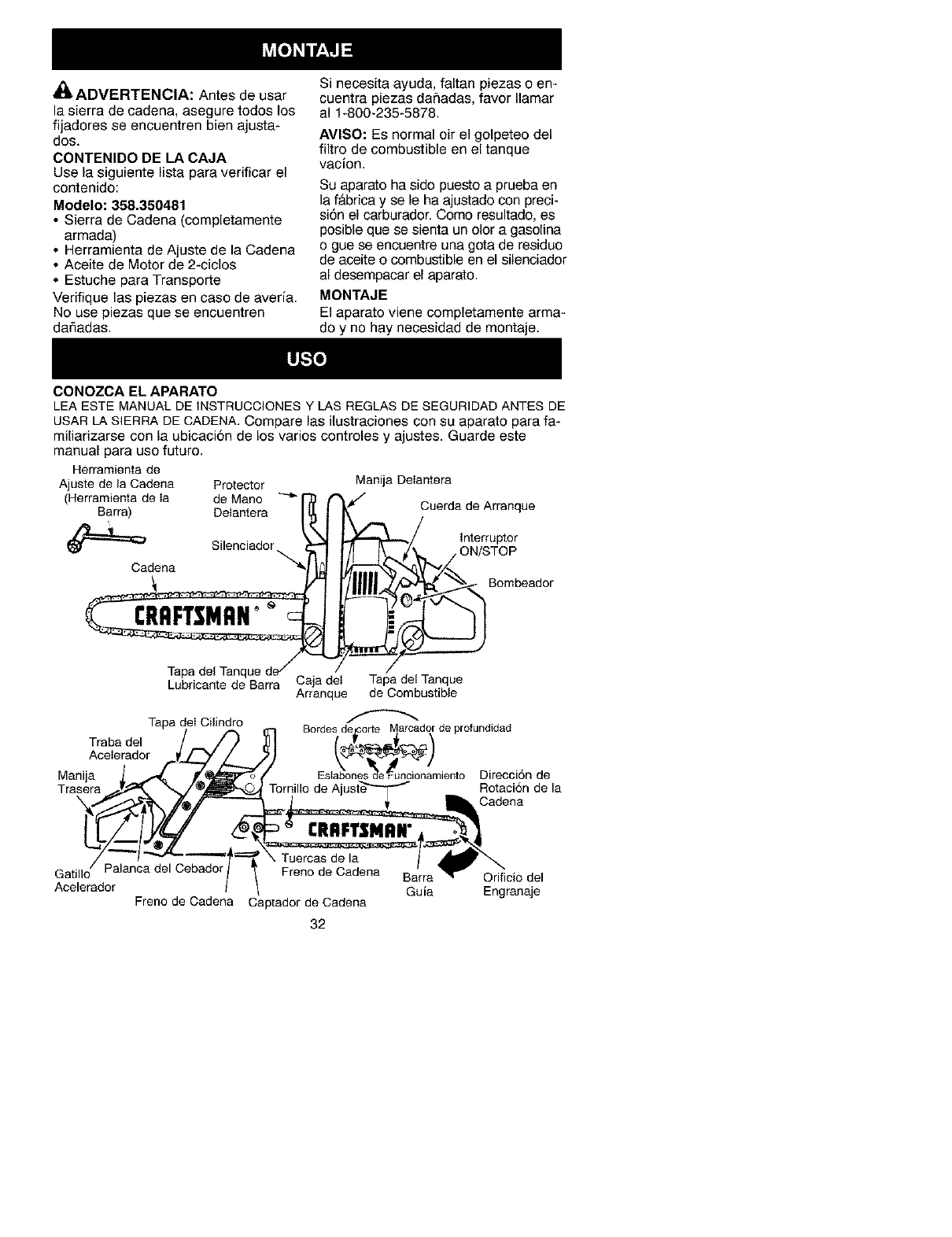
•_ILADVERTENCIA:Antesdeusar
lasierradecadena,aseguretodoslos
fijadoresseencuentrenbienajusta*
dos.
CONTENIDODELACAJA
Uselasiguientelistaparaverificarel
contenido:
Modelo: 358.350481
• Sierra de Cadena (completamente
armada)
• Herramienta de Ajuste de la Cadena
• Aceite de Motor de 2-ciclos
• Estuche para Transporte
Verifique las piezas en caso de averia.
No use piezas que se enouentren
daSadas.
CONOZCA EL APARATO
Si necesita ayuda, faltan piezas o en-
cuentra piezas daSadas, favor Ilamar
al 1-800-235-5878.
AVISO: Es normal oir el golpeteo del
filtro de combustible en el tanque
vacion
Su aparato ha sido puesto a prueba en
la f&brica y se le ha ajustado con preci-
si6n el carburadon Come resultado, es
posible que se sienta un olor a gasolina
o gue se encuentre una gota de residuo
de aceite o combustible en el silenciador
al desempacar el aparato
MONTAJE
El aparato viene completamente arma-
do y no hay necesidad de montaje.
LEA ESTE MANUAL DE INSTRUCCIONES Y LAS REGLAS DE SEGURIDAD ANTES DE
USAR LA SIERRA DE CADENA. Compare las ilustraciones con su aparato para fa*
miliarizarse con la ubicaci6n de los varios controles y ajustes. Guarde este
manual para uso futuro.
Herramienta de
Ajuste de la Cadena Protector Manija Delantera
(HerramientaBarra)de Ia deDelanteraMano"-_ _,-/.,. iCuerdade Arranque
Interruptor
Silenciador _. N/STOP
Cadena __._ Bombeador
Xo o eiX o oed/
Lubricante de Barra Caja deI Tapa del Tanque
Arranque de Combustible
Tapa deI Cilindro
Traba del
Acelerador
Manija
mrasera
\
Bordes de#orte Marcador de profundidad
Est_(k_c_!miento" Direccidn de
Rotaci6n de la
Cadena
CRAFTSMAN•
Tuercas de la
Gatillo Palanca del Cebador Freno de Cadena
Acelerador
Freno de Cadena Captador de Cadena
Orificio del
Engranaje
32
EN/'rOPE INTERRUPTOR
El EN/TOPE (ON/OFF)INTERRUPTORest&
acostumbrado a detener la m&quina.
GATILLO DE ACELERADOR
El GATILLO DEACELERADOR controla
velocidad de m&quina.
TRABA DEL ACELERADOR
Es necesario apretar primero la TRABA
DEL ACELERADOR para poder accionar
el acelerador. Este dispositivo pre-
viene el acionamiento accidental del
acelerador.
PALANCA DEL CEBADOR/MARCHA
INACTIVA RAPIDA
El cebador y la marcha inactiva r_.pida
son fijadas tirando la PALANCADEL CE-
BADOR/MARCHAINACTIVARAPIDA com-
pletamente para arrancar la unidad en
frio o reaprovisionado de combustible.
La palanca del cebador provee combus-
tible adicional al motor al arrancar fifo.
BOMBEADOR
El BOMBEADORcircula combustible al
carburador.
FRENO DE CADENA
El FRENO DECADENA est& diseSado
para detener la cadena en caso de re-
culada. El freno de cadena se activa
autom_.ticamente en caso de reculadas.
El freno de cadena se activa manual-
mente si empujan al protector de mano
delantero adelante. Para desactivar el
freno de cadena, tire Io m&s posible del
protector de mano delantero hacia la
manija delantera.
TENSION DE LA CADENA
Es normal que las cadenas nuevas se
estiren durante los primeros 30 minutos
de uso. Deber& verificarse la tensi6n de
la cadena frecuentemente. Yea TEN-
SION DE LA CADENA en la secci6n de
SERVlCIOY AJUSTES.
,I_ADVERTENCIA: El silenciador
es extremadamente caliente durante
el uso y despues de usar el aparato.
No toque el silenciador ni permita que
el material combustible tal como gaso-
lina o hierba seca hagan contacto.
ANTES DE PONER EL MOTOR EN
MARCHA:
,I_ ADVERTENCIA: Lea toda la in-
formaci6n sobre el manejo del com-
bustible en la secci6n de reglas de se-
guridad de este manual antes de
empezar. Si no comprende la informa-
ci6n sobre el manejo del combustible,
no intente abastecer su aparato. Pro-
cure ayuda de alguien que comprenda
la informaci6n o Ilame al telefono de
ayuda al consumidor al
1-800-235-5878.
ACEITE PARA BARRA Y LA CADENA
La barra y la cadena requieren lubrica-
ci6n. El libricador de la cadena provee
lubricaci6n continua a la cadena y a la
barra guia No se olvide de Ilenar el tan-
que de aceite para barra siempre que
Ilene el tanque de combustible (Capaci-
dad =6,8 ft. oz.). La falta de aceite arrui-
nar& la barra y la cadena r&pidamente.
El uso de demasiado poco aceite cau-
sara exceso de calentamiento que sera
detectable por el humo proveniente de
la cadena y/o por la descoloraci6n de la
barra. Para obtener la m&xima prolon-
gaci6n de la vida de la bara y la cade-
na, recomendamos que use el aceite
para barras de sierra de cadena Crafts-
man. Si el aceite Craftsman no esta dis-
pondible, puede usarse un aceite SAE
30 de buena calidad hasta obtener el
aceite marcha Craftsman. La cantidad
de lubricaci6n es medida autom&tica-
mente durante el funcionamiento de la
sierra. La sierra usar_ mas o menos un
tanque de aceite para la barra por cada
tanque de combustible. Siempre Ilene el
tanque de aceite de la barra cuando
Ilene el tanque de combustible.
ABASTECIMIENTO DEL MOTOR
,_ADVERTENCIA: Remueva la
tapa del tanque de combustible lenta-
mente al reabastecer combustible.
Este motor est,. habilitado para funcio-
nar con gasolina sin plomo. Antes de
comenzar con el uso, se deber& mez-
clar la gasolina con un aceite de sint_ti-
co de buena calidad para motores de 2
tiempos enfriados a aire. Recomenda-
mos el aceite de sint_tico de la marca
Craftsman. Mezcle la gasolina con el
aceite en la proporci6n de 40:1. Se ob-
tiene una proporci6n de 40:1 mezclando
3,2 onzas de aceite con cada gal6n de
gasolina sin plomo. Se incluye con
esta sierra un recipiente de 3,2 onzas
de aceite. Adiera el contenido entero de
este recipiente en 1 gal6n de gasolina
para alcanzar la mezcla apropiada del
combustible.
33
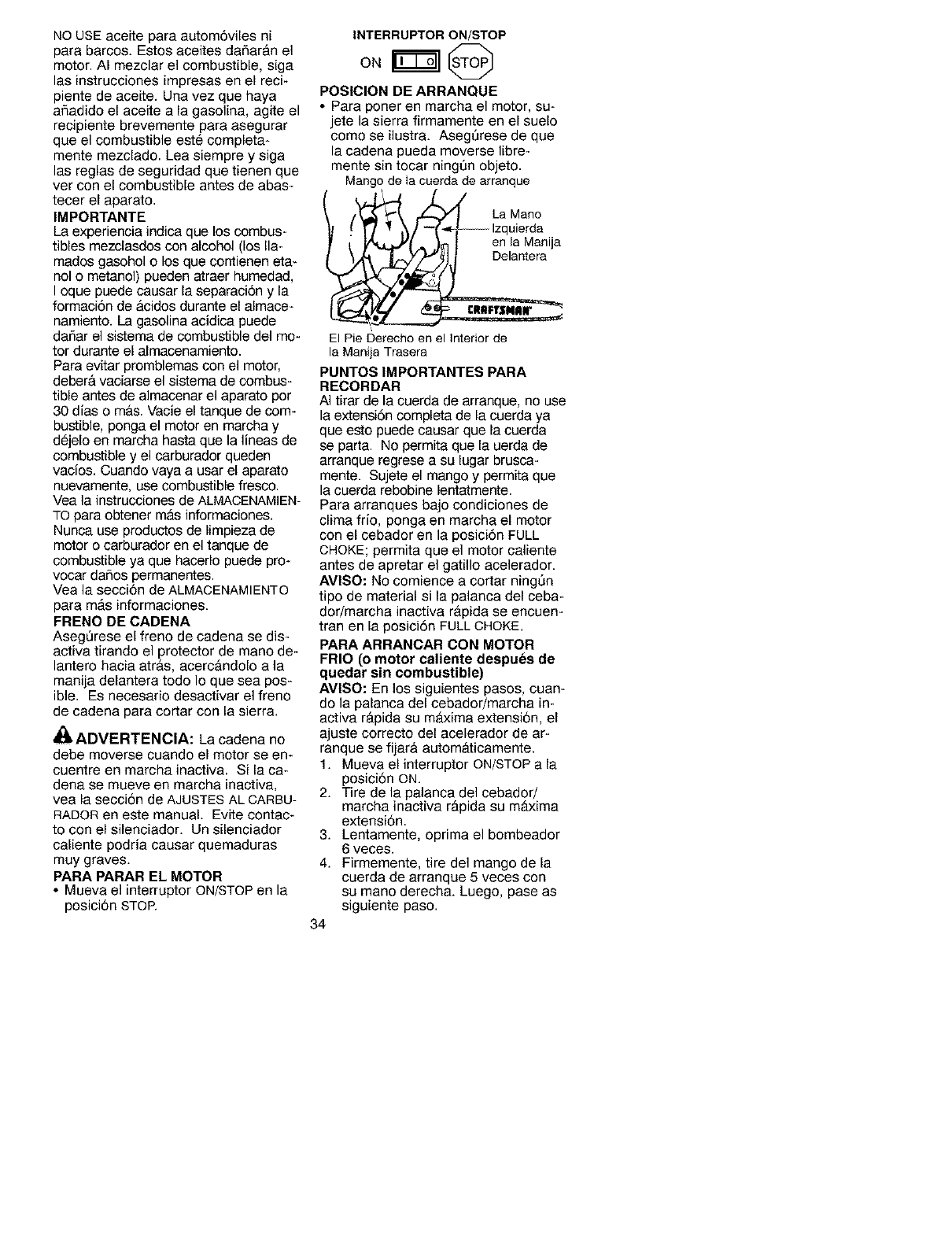
NO USE aceite para autom6viles ni
para barcos. Estos aceites da[_ar&n el
motor. AI mezclar el combustible, siga
las instrucciones impresas en el reci-
piente de aceite. Una vez que haya
afiadido el aceite a la gasolina, agite el
recipiente brevemente para asegurar
que el combustible este completa-
mente mezclado. Lea siempre y siga
las reglas de seguridad que tienen que
ver con el combustible antes de abas-
tecer el aparato.
IMPORTANTE
La experiencia indica que los combus-
tibles mezclasdos con alcohol (los Ila-
mados gasohol o los que contienen eta-
nolo metanol) pueden atraer humedad,
I oque puede causar la separaci6n y la
formaci6n de &cidos durante el almace-
namiento. La gasolina acidica puede
dafiar el sistema de combustible del mo-
tor durante el almacenamiento.
Para evitar promblemas con el motor,
debera vaciarse el sistema de combus-
tible antes de almacenar el aparato por
30 dias o mas. Vacie el tanque de com-
bustible, ponga el motor en marcha y
d_jelo en marcha hasta que la lineas de
combustible y el carburador queden
vacios. Cuando vaya a usar el aparato
nuevamente, use combustible fresco.
Vea la instrucoiones de ALMACENAMIEN-
TO para obtener m&s informaciones.
Nunca use productos de limpieza de
motor o carburador en el tanque de
combustible ya que hacerlo puede pro-
vocar daflos permanentes.
Yea la secci6n de ALMACENAMIENTO
para m&s informaciones.
FRENO DE OADENA
AsegQrese el freno de cadena se dis-
activa tirando el protector de mane de-
lantero hacia atras, acercandolo a la
manija delantera todo Io que sea pos-
ible. Es necesario desactivar el freno
de cadena para cortar con la sierra.
d_!_ADVERTENClA: La cadena no
debe moverse cuando el motor se en-
cuentre en marcha inactiva. Si la ca-
dena se mueve en marcha inactiva,
vea la secci6n de AJUSTES AL CARBU-
RADOR en este manual. Evite contac-
to con el silenciador. Un silenciador
caliente podria causar quemaduras
muy graves.
PARA PARAR EL MOTOR
• Mueva el interruptor ON/STOP en la
posici6n STOP.
INTERRUPTOR ON/STOP
o.
POSIClON DE ARRANQUE
• Para poner en marcha el motor, su-
jete la sierra firmamente en el suelo
come se ilustra. AsegQrese de que
la cadena pueda moverse libre-
mente sin tocar ningQn objeto.
Mango de Ia cuerda de arranque
1 I en la Manija
, = CRAFTSNAIf "
El Pie Derecho en el Interior de
la Manija Trasera
PUNTOS IMPORTANTES PARA
RECORDAR
AI tirar de la cuerda de arranque, no use
la extensi6n completa de la cuerda ya
que esto puede causar que la cuerda
se parta. No permita que la uerda de
arranque regrese a su lugar brusca-
mente. Sujete el mango y permita que
la cuerda rebobine lentatmente.
Para arranques bajo condiciones de
clima frio, ponga en marcha el motor
con el cebador en la posici6n FULL
CHOKE; permita que el motor caliente
antes de apretar el gatillo acelerador.
AVISO: No comience a cortar ningQn
tipo de material si la palanca del ceba-
dor/marcha inactiva r&pida se encuen-
tran en la posici6n FULL CHOKE.
PARA ARRANOAR CON MOTOR
FRIO (o motor caliente despues de
quedar sin combustible)
AVISO: En los siguientes pasos, cuan-
do la palanca del cebador/marcha in-
activa r&pida su m_lxima extensi6n, el
ajuste correcto del acelerador de ar-
ranque se fijar& autom&ticamente.
1. Mueva el interrupter ON/STOP a la
posici6n ON.
2. Tire de la palanca del cebador/
marcha inactiva r&pida su m_lxima
extensi6n.
3. Lentamente, oprima el bombeador
6 veces.
4. Firmemente, tire del mango de la
cuerda de arranque 5 veces con
su mane derecha. Luego, pase as
siguiente paso.
34
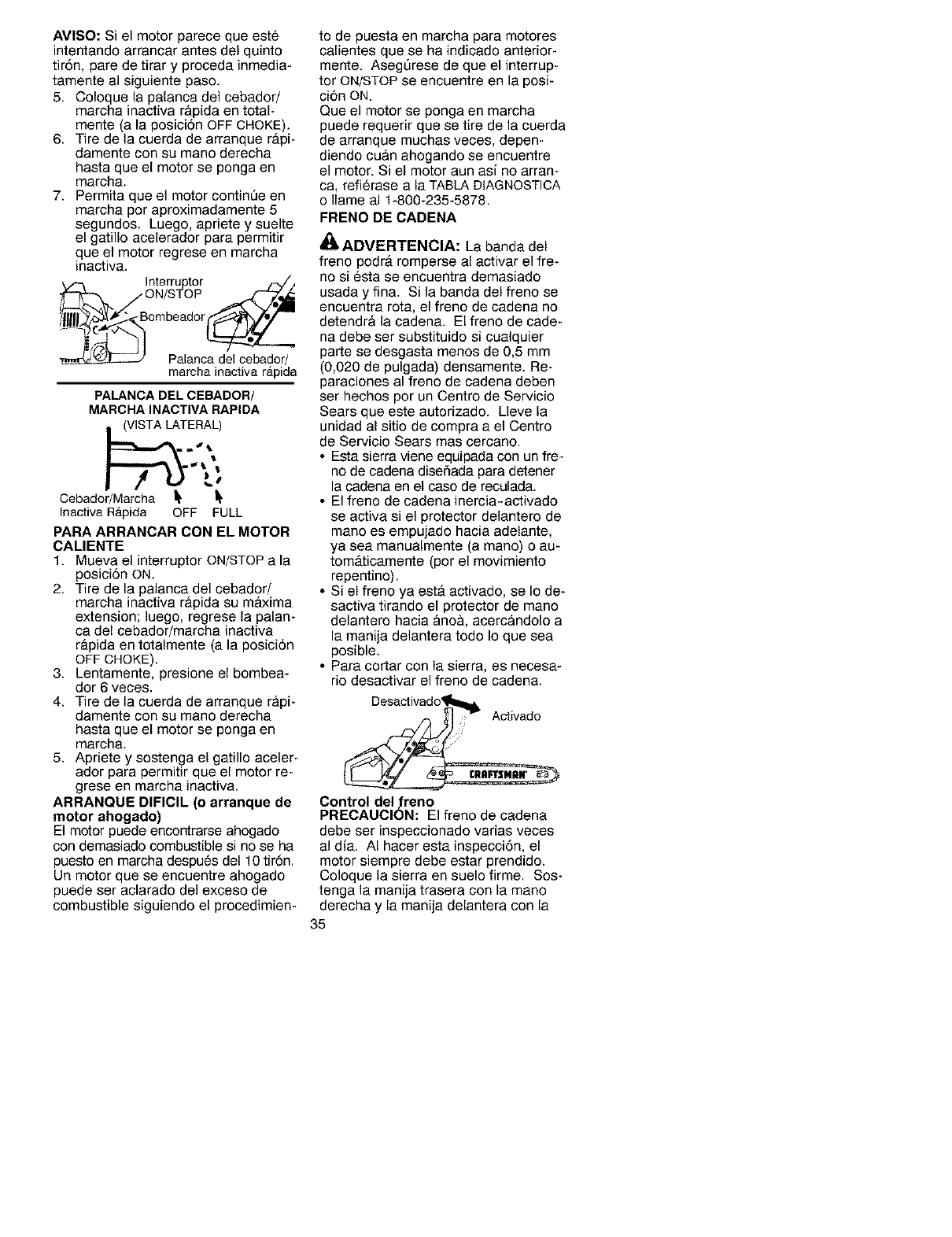
AVISO:Sielmotorparecequeeste
intentandoarrancarantesdelquinto
tir6n,paredetiraryprocedainmedia-
tamentealsiguientepaso.
5. Coloquelapalancadelcebador/
marchainactivar&pidaentotal-
mente(alaposici6nOFFCHOKE).
6. Tiredelacuerdadearranquer&pi-
damenteconsumanederecha
hastaqueelmotorsepongaen
marcha.
7. Permitaqueelmotorcontinueen
marchaporaproximadamente5
segundos.Luego,aprieteysuelte
elgatilloaceleradorparapermitir
queelmotorregreseenmarcha
inactiva.
_._t Interrupt°r /_/
oN/stop
_H'_°mbead°r _
Palanca del cebador/
marcha inactiva r#=pida
PALANCADEL CEBADOR/
MARCHA INACTIVA RAPIDA
(VISTALATERAL)
Cebador/Marcha It It
Inactiva R&pida OFF FULL
PARA ARRANCAR CON EL MOTOR
CALIENTE
1. Mueva el interrupter ON/STOP a la
posici6n ON.
2. Tire de la palanca del cebador/
marcha inactiva r_pida su m_lxima
extension; luego, regrese la palan-
ca del cebador/marcha inactiva
r_pida en totalmente (a la posici6n
OFF CHOKE).
3. Lentamente, presione el bombea-
dor 6 veces.
4. Tire de la cuerda de arranque r_.pi-
damente con su mane derecha
hasta que el motor se ponga en
march&
5. Apriete y sostenga el gatillo aceler-
ador para permitir que el motor re-
grese en marcha inactiva.
ARRANQUE DIFICIL (o arranque de
motor ahogado)
El motor puede encontrarse ahogado
con demasiado combustible si no se ha
puesto en marcha despues del 10 tir6n.
Un motor que se encuentre ahogado
puede ser aclarado de] exceso de
combustible siguiendo el procedimien-
to de puesta en marcha para motores
calientes que se ha indicado anterior-
mente. Aseg6rese de que el interrup-
tor ON/STOP se encuentre en la posi-
ci6n ON.
Que el motor se ponga en marcha
puede requerir que se tire de la cuerda
de arranque muchas veces, depen-
diendo cuan ahogando se encuentre
el motor. Si el motor aun asi no arran-
ca, refierase a la TABLA DIAGNOSTICA
OIlame al 1_800-235-5878.
FRENO DE CADENA
4_ADVERTENCIA: La banda del
freno podr& romperse al activar el fie-
no si esta se encuentra demasiado
usada y fina. Si la banda del freno se
enouentra rota, el freno de cadena no
detendr& la cadena. El freno de cade-
na debe ser substituido si cualquier
parte se desgasta menos de 0,5 mm
(0,020 de pulgada) densamente. Re-
paraciones al freno de cadena deben
ser hechos por un Centre de Servicio
Sears que este autorizado. Lleve la
unidad al sitio de compra a el Centro
de Servicio Sears mas cercano.
•Esta sierra viene equipada con un fie-
no de cadena diseSada para detener
la cadena en el case de reculada.
• El freno de cadena inercia-activado
se activa si el protector delantero de
mano es empujado hacia adelante,
ya sea manualmente (a mano) o au-
tom&ticamente (por el movimiento
repentino).
• Si el freno ya est& activado, se Io de-
sactiva tirando el protector de mano
delantero hacia &noa, acercandolo a
la manija delantera todo Io que sea
posible.
• Para cortar con la sierra, es necesa-
rio desactivar el freno de cadena.
Desactivado
Control del ,freno
PRECAUClON: El freno de cadena
debe ser inspeccionado varias veces
al dia. AI hacer esta inspecci6n, el
motor siempre debe estar prendido.
Coloque la sierra en suelo firme. Sos-
tenga la manija trasera con la mano
derecha y la manija delantera con la
35
manoizquierda.Apliquealaveloci-
dadm&ximapresionandoelgatillodel
acelerador.Activeelfrenodecadena
dandovueltaasumufiecaizquierda
contraelprotectordemanedelantera
sinsoltarlamanijadelantera.Laca-
denadebepararinmediatamente.
Control del funcionamiento activa-
do por inercia
_IkADVERTENCIA: Cuando Ileve a
cabo el procedimiento siguiente, el
motor deber& estar apagado.
Sostenga la manija trasera con la
rnano derecha y la manija delantera
con la mane izquierda. Sujete la sierra
unos 35 cm (14 pulgadas) por encima
de un toc6n u otro superficie de mad-
era. Libere la empufiadura del mango
delantero y que la punta de la barra
guia caiga hacia adelanta y pueda en-
trar en contacto con el tocon. Cuando
la punta de la barra golpee el tocon, el
freno debe activarse.
SUGERENClAS PARA EL USO COR-
RECTO DEL APARATO
• Verifique la tensi6n de la cadena
antes del primer uso y despu_s de
un minuto de funcionamiento. Vea
TENSION DE LA CADENA en la sec-
ci6n de MANTENIMEINTO.
• Corte madera t_nicamente. No corte
metal, pl&stico, ladrillos, cemento,
otros materiales de construcci6n que
no sean de madera, etc.
• Pare la sierra si la cadena toca cual-
quier objeto ajeno. Inspeccione la
sierra y repare las piezas seg6n la
necesidad.
• Mantenga la cadena fuera de la are-
na y la tierra. La menor cantidad de
tierra desafila rapidamente las cade-
nas e incrementa la posibilidad de
reculadas.
• Corte various troncos pequefios come
practica. Usando la siguiente tecnica,
para acostumbrarse al manejo de la
sierra, antes de empezar un proyecto
de grandes dimensiones.
• Acelere el motor al m&ximo antes
de empezar a cortar apretando el
gatillo acelerador a fondo.
• Empiece el corte con el bastidor de
la sierra apoyada contra el tronco.
• Mantenga el motor con acelerador
a fondo constantemente mientras
corta.
• Deje que la cadena haga todo el tra-
bajo de cortar; no use m&s que una
muy ligera presi6n hacia abajo.
• Suelte el gatillo acelerador inme-
diatamente al terminar de cortar,
dejando que el motor funcione a
marcha lenta. Si mantiene la sierra
en marcha con acelerador a fondo
sin estar cortando, puede causar
desgaste innecesario.
• Para no perder el control cuando
se haya completado el corte, no le
ponga presi6n a la sierra al final
del corte.
• Pare el motor antes de apoyar la
sierra al finalizar un corte.
TECNICAS PARA TUMBAR
ARBOLES
41_ADVERTENCIA: Vea que no
haya ramas rotas o muertas que
podrian caerle encima mientras corta,
causando heridas graves. No corte
cerca de edificios ni cables electricos
si no sabe la direcci6n de tumbado del
&rbol, ne de noche ya que no podr&
ver bien, ni durante mal tiempo como
Iluvia, nieve, o vientos fuertes, etc. Si
el &rbol hace contacto con alg6n cable
de linea de servicio p_blico, la com-
pafia de servicio pQblico debera ser
notificada de inmediato.
• Planifique la operaci6n de corte cui-
dadosamente per adelantado.
• Despeje al &tea de trabajo. Ud. pre-
cisa un area despejada en todo el
contorno de &rbol donde pueda pisar
con firmeza entodo momento.
• El usuario de la sierra de cadena
debera permanecer del lado cuesta
arriba del terreno ya que es probable
que el arbol rodillo o se deslice cues-
ta abajo despu_s de caer.
• Estudie las condiciones naturales
que puedan causar que el arbol cai-
ga en una direcci6n determinada.
Entre las condiciones naturales que
pueden causar que el arbol caiga en
una direcci6n determinada, se en-
cuentran:
• La direcci6n y la velocidad del
viento.
• El angulo de inclinaci6n del
&rbol. El &ngulo de los arboles a
veces no se nota debido al de-
clive del terreno o a terreno des-
parejo. Use plana o cordel de
36
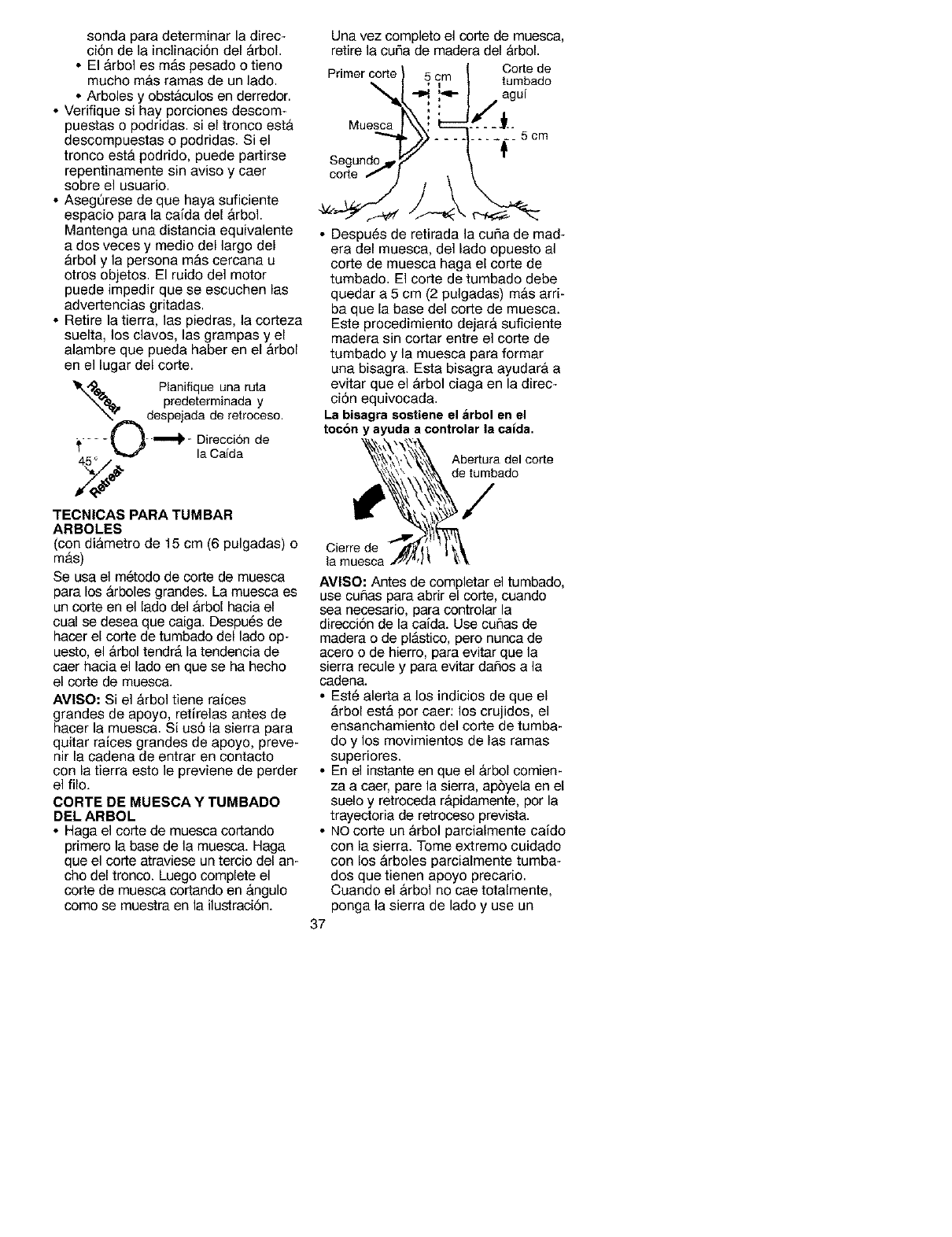
sonda para determinar la direc-
ciSn de la inclinaciSn del &rbol.
• El &rbol es m&s pesado o tieno
mucho m&s ramas de un lade.
• Arboles y obst&culos en derredor.
• Verifique si hay porciones descom-
puestas o podridas, si el tronco est&
descompuestas o podridas. Si el
tronco est& podrido, puede partirse
repentinamente sin aviso y caer
sobre el usuario.
• AsegQrese de que haya suficiente
espacio para la caida del &rbol.
Mantenga una distancia equivalente
a dos veces y medio del largo del
&rbol y la persona m&s cercana u
otros objetos. El ruido del motor
puede impedir que se escuchen las
advertencias gritadas.
• Retire la tierra, las piedras, la corteza
suelta, los clavos, las grampas y el
alambre que pueda haber en el &rbol
en el lugar del corte.
_t_, Planifique una ruta
predeterminada y
despejada de retroceso.
;_.... ( _--""""_- Direccion de
" _ la Caida
TECNICAS PARA TUMBAR
ARBOLES
(con di&metro de 15 cm (6 pulgadas) o
m_.s)
Se usa el metodo de corte de muesca
para los arboles grandes. La muesca es
un corte en el lade del arbol hacia el
coal se desea que caiga. Despu_s de
hacer el corte de tumbado del lado op-
uesto, el arbol tendr& la tendencia de
caer hacia el lade en que se ha hecho
el corte de muesca.
AVISO: Si el arbol tiene raices
grandes de apoyo, retirelas antes de
hacer la muesca. Si us5 la sierra para
quitar raices grandes de apoyo, preve-
nir la cadena de entrar en contacto
con la tierra esto le previene de perder
el filo.
CORTE DE MUESCA Y TUMBADO
DEL ARBOL
• Haga el corte de muesca cortando
primero la base de la muesca. Haga
que el corte atraviese un tercio del an-
cho del tronco. Luego complete el
corte de muesca cortando en angulo
come se muestra en la ilustraci6n.
Una vez completo el corte de muesca,
retire la cuSa de madera del &rbol.
Primer corte,,_ _5cmi"9- I aguitC_'_teade
Muesc..._hi __._'.-i.
se uo ,
• Despu6s de retirada la cuba de mad-
era del muesca, del lado opuesto al
corte de muesca haga el corte de
tumbado. El corte de tumbado debe
quedar a 5 cm (2 pulgadas) m&s arri-
ba que la base del corte de muesca.
Este procedimiento dejar& suficiente
madera sin cortar entre el corte de
tumbado y la muesca para formar
una bisagra. Esta bisagra ayudar& a
evitar que el &rbol ciaga en la direc-
ci6n equivocada.
La bisagra sostiene el arbol en el
tocon y ayuda a controlar la caida.
Abertura del corte
de tumbado
Cierre de
la muesca
AVISO: Antes de completar el tumbado,
use cuSas para abrir el corte, cuando
sea necesario, para controlar la
direcci6n de la caida. Use cuSas de
madera o de pl&stico, pero nunca de
acero o de hierro, para evitar que la
sierra recule y para evitar dafios a la
cadena.
• Est_ alerta a los indicios de que el
&rbol est_ por caer: los crujidos, el
ensanchamiento del corte de tumba-
do y los movimientos de las ramas
superiores.
• En el instante en que el &rbol comien-
za a caer, pare la sierra, apSyela en el
suelo y retroceda rapidamente, por la
trayectoria de retroceso prevista.
• NO corte un arbol parcialmente caido
con la sierra. Tome extremo cuidado
con los arboles parcialmente tumba-
dos que tienen apoyo precario.
Cuando el arbol no cae totalmente,
ponga la sierra de lade y use un
37
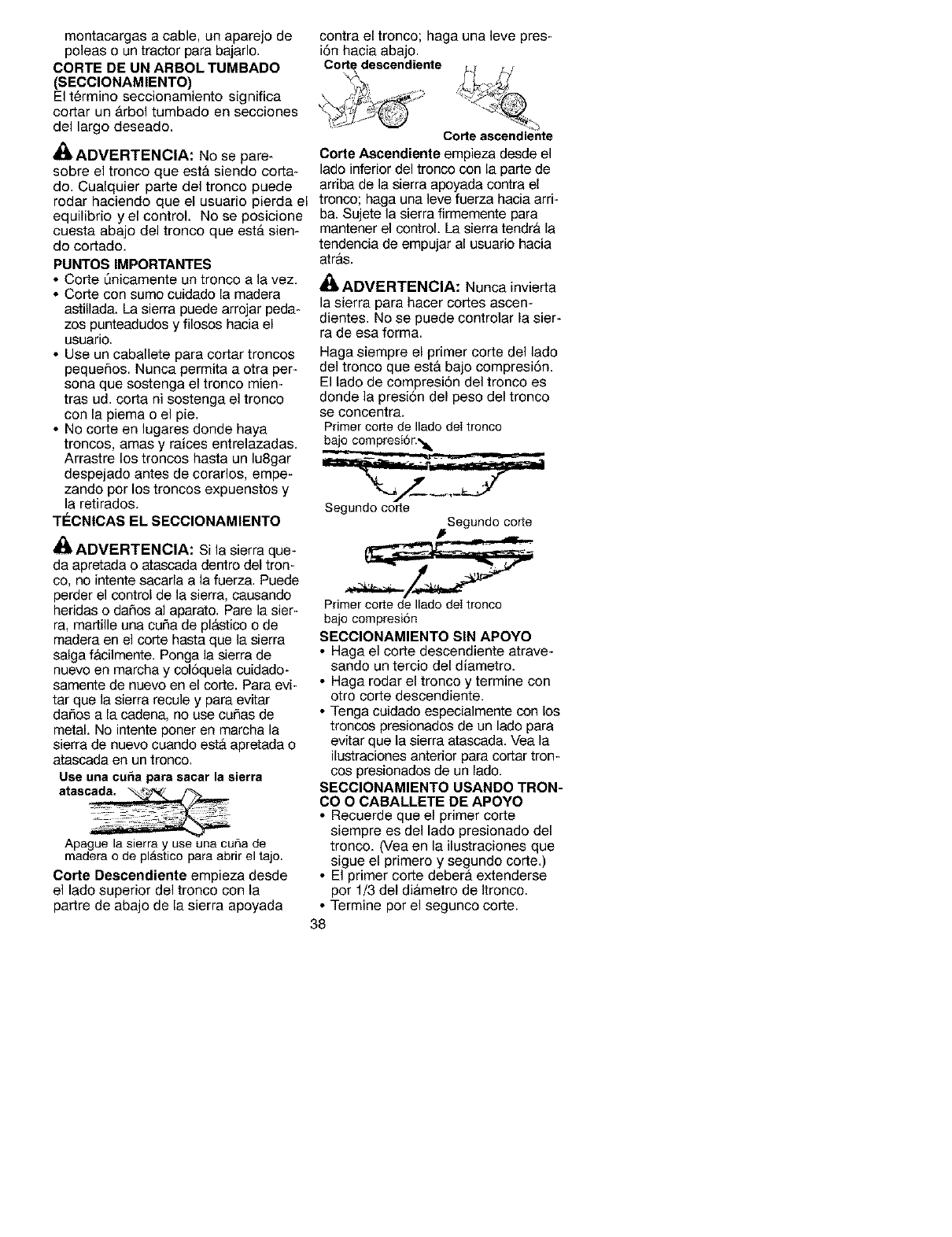
montacargasacable,unaparejode
poleasountractorparabajarlo.
CORTEDEI.INARBOLTUMBADO
(SECClONAMIENTO)
Elterminoseccionamientosignifica
cortarun&rboltumbadoensecciones
dellargodeseado.
_IkADVERTENCIA:Nosepare_
sobreeltroncoqueest&siendocorta-
do.Cualquierpartedeltroncopuede
rodarhaciendoqueelusuariopierdael
equilibrioyelcontrol.Noseposicione
cuestaabajodeltroncoqueest&siem
docortado.
PUNTOS IMPORTANTES
• Corte _nicamente un tronco a la vez.
• Corte con sumo cuidado la madera
astillada. La sierra puede arrojar peda-
zos punteadudos y filosos hacia el
usuario.
• Use un caballete para cortar troncos
peque_os. Nunca permita a otra per-
sona que sostenga el tronco mien-
tras ud. corta ni sostenga el tronco
con la piema o el pie.
• No corte en lugares donde haya
troncos, amas y raices entrelazadas.
Arrastre los troncos hasta un lu8gar
despejado antes de corarlos, empe-
zando per los troncos expuenstos y
la retirados.
TleCNICAS EL SECClONAMIENTO
zl, _
I_,ADVERTENCIA: Si la sierra que-
da apretada o atascada dentro del tron-
co, no intente sacarla a la fuerza. Puede
perder el control de la sierra, causando
heridas o daSos al aparato. Pare la sier-
ra, martille una cuSa de pl&stico o de
madera en el corte hasta que la sierra
salga f&cilmente. Ponga la sierra de
nuevo en marcha y col6quela cuidado-
samente de nuevo en el corte. Para evi-
tar que la sierra recule y para evitar
daSos a la cadena, no use cuSas de
metal. No intente poner en marcha la
sierra de nuevo cuando est& apretada o
atascada en un tronco.
Use una curia para sacar la sierra
Apague la sierra y use una curia de
madera o de plAstico para abrir el tajo
Corte Deecendiente empieza desde
el lade superior del tronco con la
partre de abajo de la sierra apoyada
contra el tronco; haga una leve pres-
i6n hacia abajo.
co ,.
%,
Corte ascendiente
Corte Ascendiente empieza desde el
lado inferior del tronco con la parte de
arriba de la sierra apoyada contra el
tronco; haga una leve fuerza hacia arri-
ba. Sujete la sierra flrmemente para
mantener el control. La sierra tendr& la
tendencia de empujar al usuario hacia
atr&s.
,_!_ ADVERTENCIA: Nunca invierta
la sierra para hacer cortes ascen-
dientes. No se puede controlar la sier-
ra de esa forma.
Haga siempre el primer corte del lade
del tronco que est& bajo compresi6n.
El lado de compresi6n del tronco es
donde la presi6n del peso del tronco
se concentra.
Primer corte de Ilado deI tronco
bajo compresi6r,,_
Segundo co_e Segundo co_e
Primer corte de Ilado deI tronco
bajo compresi6n
SECCIONAMIENTO SIN APOYO
• Haga el corte descendiente atrave-
sando un tercio del diametro.
• Haga rodar el tronco y termine con
otro corte descendiente.
• Tenga cuidado especialmente con los
troncos presionados de un lado para
evitar que la sierra atascada. Vea la
ilustraciones anterior para cortar tron-
cos presionados de un lade.
SEOOIONAMIENTO USANDO TRON-
CO O CABALLETE DE APOYO
• Recuerde que el primer corte
siempre es del lado presionado del
tronco. (Vea en la ilustraciones que
sigue el primero y segundo corte.)
• El primer corte deber& extenderse
por 1/3 del di&metro de Itronco.
• Termine por el segunco corte.
38
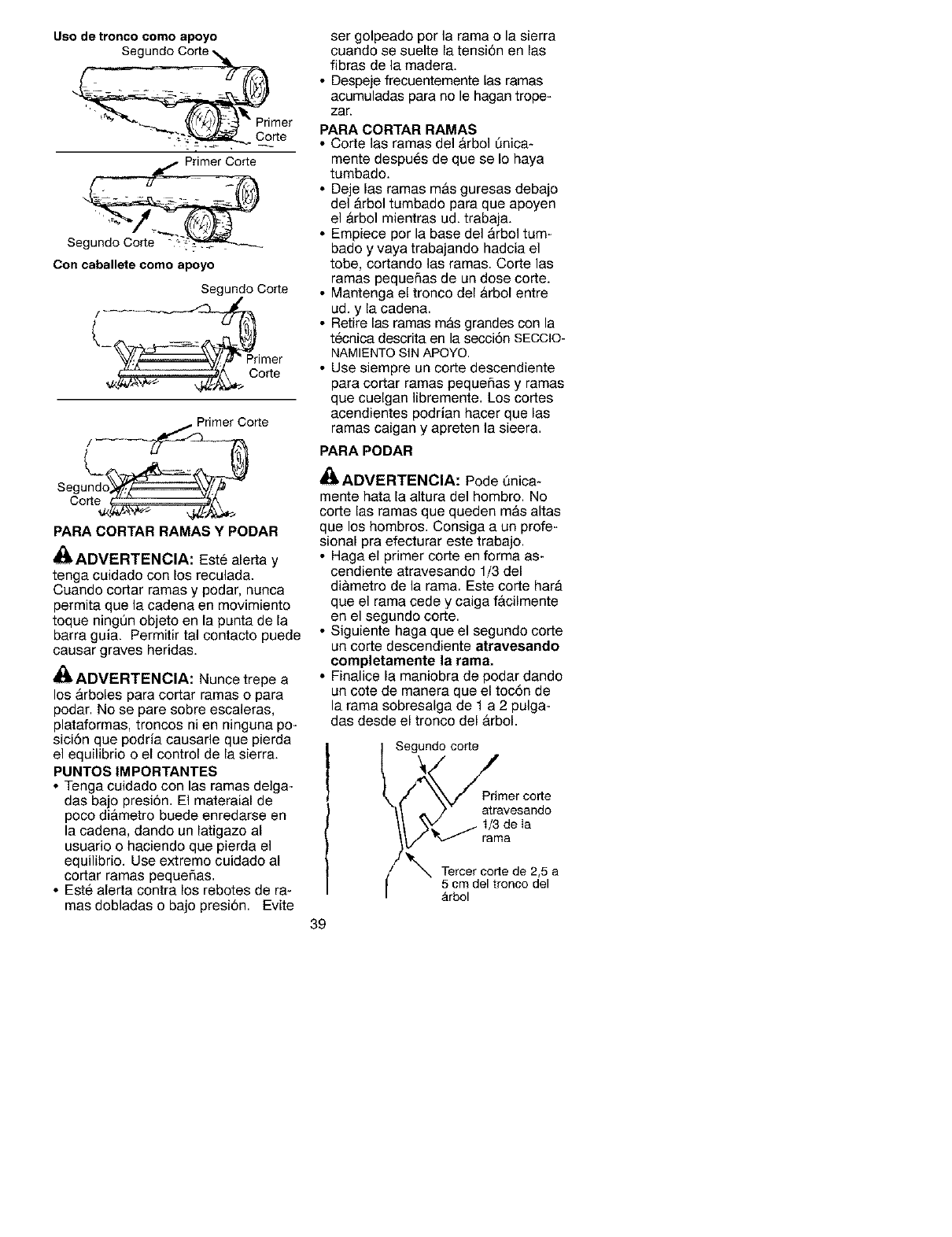
Uso de tronco como apoyo
Segundo Corte,
Corte
Se_. ''_* Primer Corte
Con caballete como apoyo
Segundo Corte
Primer
tCorte
f-- Primer Corte
Segundo__
PARA CORTAR RAMAS Y PODAR
zl, _
_ADVERTENCIA: Este alerta y
tenga cuidado con los reculada.
Cuando cortar ramas y podar, nunca
permita que la cadena en movimiento
toque ning_n objeto en la punta de la
barra guia. Permitir tal contacto puede
causar graves heridas.
_IkADVERTENClA: Nunce trepe a
los &rboles para cortar ramas o para
podar. No se pare sobre escaleras,
plataformas, troncos ni en ninguna po-
sici6n que podria causarle que pierda
el equilibrio o el control de la sierra.
PUNTOS IMPORTANTES
• Tenga cuidado con las ramas delga-
das bajo presi6n. El materaial de
poco di&metro buede enredarse en
la cadena, dando un latigazo al
usuario o haciendo que pierda el
equilibrio. Use extremo cuidado al
cortar ramas pequefias.
• Est_ alerta contra los rebotes de ra-
mas dobladas o bajo presi6n. Evite
ser golpeado por la rama o la sierra
cuando se suelte la tensi6n en las
fibras de la madera.
• Despeje frecuentemente las ramas
acumuladas para no le hagan trope-
zar.
PARA CORTAR RAMAS
• Corte las ramas del &rbol _nica-
mente despu_s de que se Io haya
tumbado.
• Deje las ramas m&s guresas debajo
del &rbol tumbado para que apoyen
el _.rbol mientras ud. trabaja.
• Empiece per la base del &rbol turn-
bade y vaya trabajando hadcia el
tobe, cortando las ramas. Corte las
ramas pequefias de un dose corte.
• Mantenga el tronco del &rbol entre
ud. y la cadena.
• Retire las ramas m&s grandes con la
tecnica descrita en la secci6n SECClO-
NAMIENTOSIN APOYO.
• Use siempre un corte descendiente
para cortar ramas pequefias y ramas
que cuelgan libremente. Los cortes
acendientes podrian hacer que las
ramas caigan y apreten la sieera.
PARAPODAR
4_!_ADVERTENCIA: Pode _nica-
mente hata la altura del hombro. No
corte las ramas que queden m&s altas
que los hombres. Consiga a un profe-
sional pra efecturar este trabajo.
• Haga el primer corte en forma as-
cendiente atravesando 1/3 del
di&metro de la rama. Este corte har&
que el rama cede y caiga f&cilmente
en el segundo corte.
• Siguiente haga que el segundo corte
un corte descendiente atravesando
completamente la rama.
• Finalice la maniobra de podar dando
un cote de manera que el toc6n de
la rama sobresalga de 1 a 2 pulga-
das desde el tronco del &rbol.
Segundo corte
_,._...---_ ra/3a
Tercer corte de 2,5 a
5 cm del tronco del
arbol
39
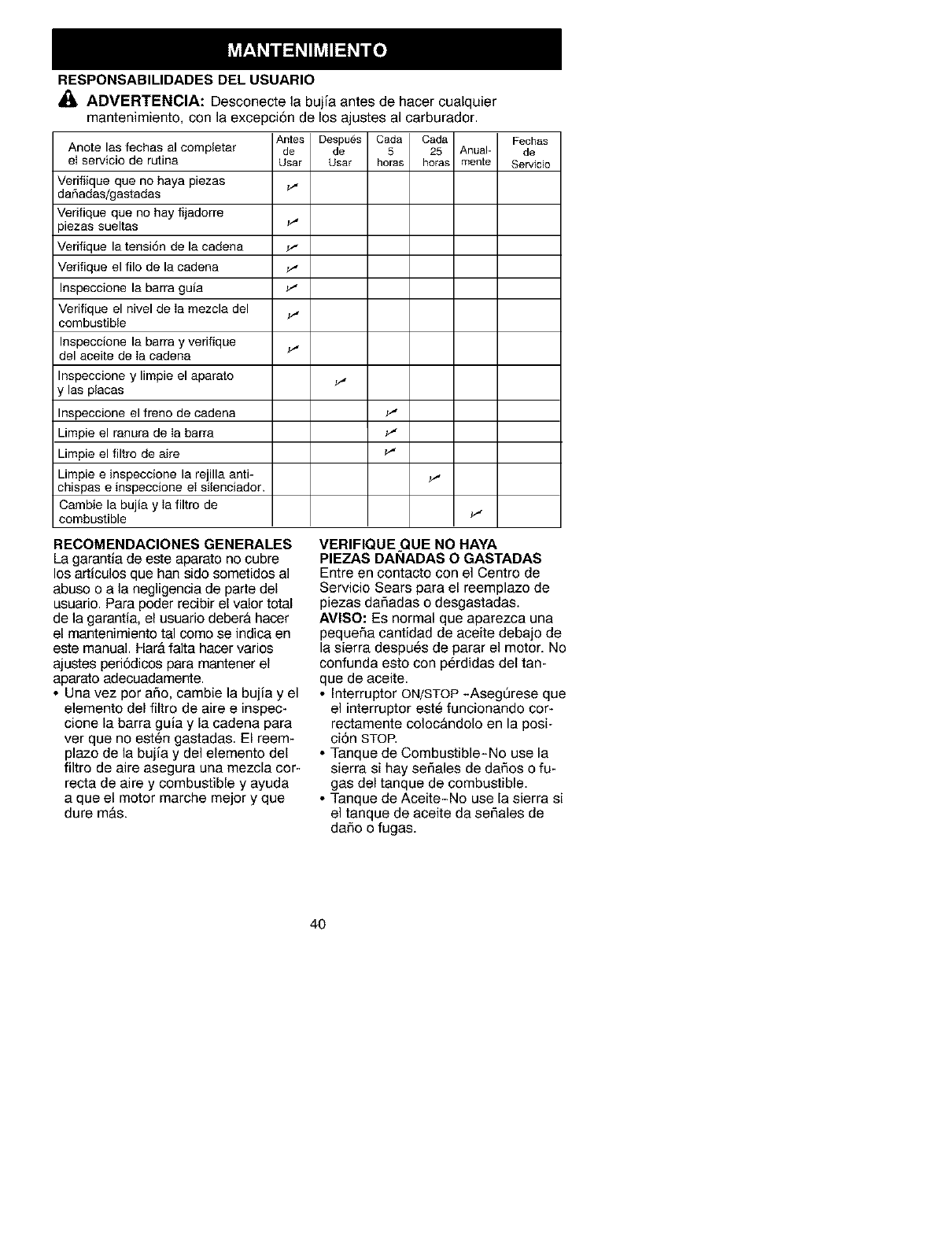
RESPONSABILIDADES DEL USUARIO
ADVERTENCIA: Desconecte la bujfa antes de hacer cualquier
mantenimiento, con la excepci6n de los ajustes al carburador.
Antes Despu_s Cada Cada Fechas
Anote las fechas al completar de de 5 25 Anual- de
ei servicio de rutina Usar Usar horas horas mente Servicio
Verifiique que no haya piezas _.
daSadas/gastadas
Verifique que no hay fijadorre
3iezas sueltas it"
Verifique la tensi6n de la cadena ,/"
Verifique el filo de la cadena ,/.
Inspeccione la barra guia w"
Verifique el nivel de ia mezcla del
combustible
Inspeccione la barra y verifique ,I
del aceite de ia cadena
Inspeccione y limpie el aparato w"
y las placas
Inspeccione el freno de cadena w"
Limpie el ranura de ia barra _"
Limpie el filtro de aire ,_"
Limpie e inspeccione la rejilla anti- w"
chispas einspeccione ei silenciador.
Cambie la bujia y ia filtro de
combustible _"
RECOMENDACIONES GENERALES
La garantia de este aparato no cubre
los articulos que hart side sometidos al
abuso o a la negligencia de parte del
usuario. Para poder recibir el valor total
de la garantia, el usuario deber& hacer
el mantenimiento tal como se indica en
este manual. Har& falta hacer varies
ajustes peri(_licos para mantener el
aparato adecuadamente.
• Una vez por a5o, cambie la bujfa y el
elemento del filtro de aire e inspec-
clone la barra guia y la cadena para
ver que no esten gastadas. El reem-
plazo de la bujfa y del elemento del
filtro de aire asegura una mezcla cor-
recta de aire y combustible y ayuda
a que el motor marche mejor y que
dure m&s.
VERIFIQUE QUE NO HAYA
PIEZAS DANADAS OGASTADAS
Entre en contasto con el Centro de
Servicio Sears para el reemplazo de
piezas daSadas o desgastadas.
AMISO: Es normal que aparezca una
pequefia cantidad de aceite debajo de
la sierra despues de parar el motor. No
confunda esto con p_rdidas del tan-
que de aceite.
• Interruptor ON/STOP -AsegQrese que
el interrupter este funcionando cor-
rectamente colocandolo en la posi-
ci6n STOP.
• Tanque de Combustible-No use la
sierra si hay seSales de daSos o fu-
gas del tanque de combustible.
• Tanque de Aceite-No use la sierra si
el tanque de aceite da seF_ales de
daSo o fugas.
40
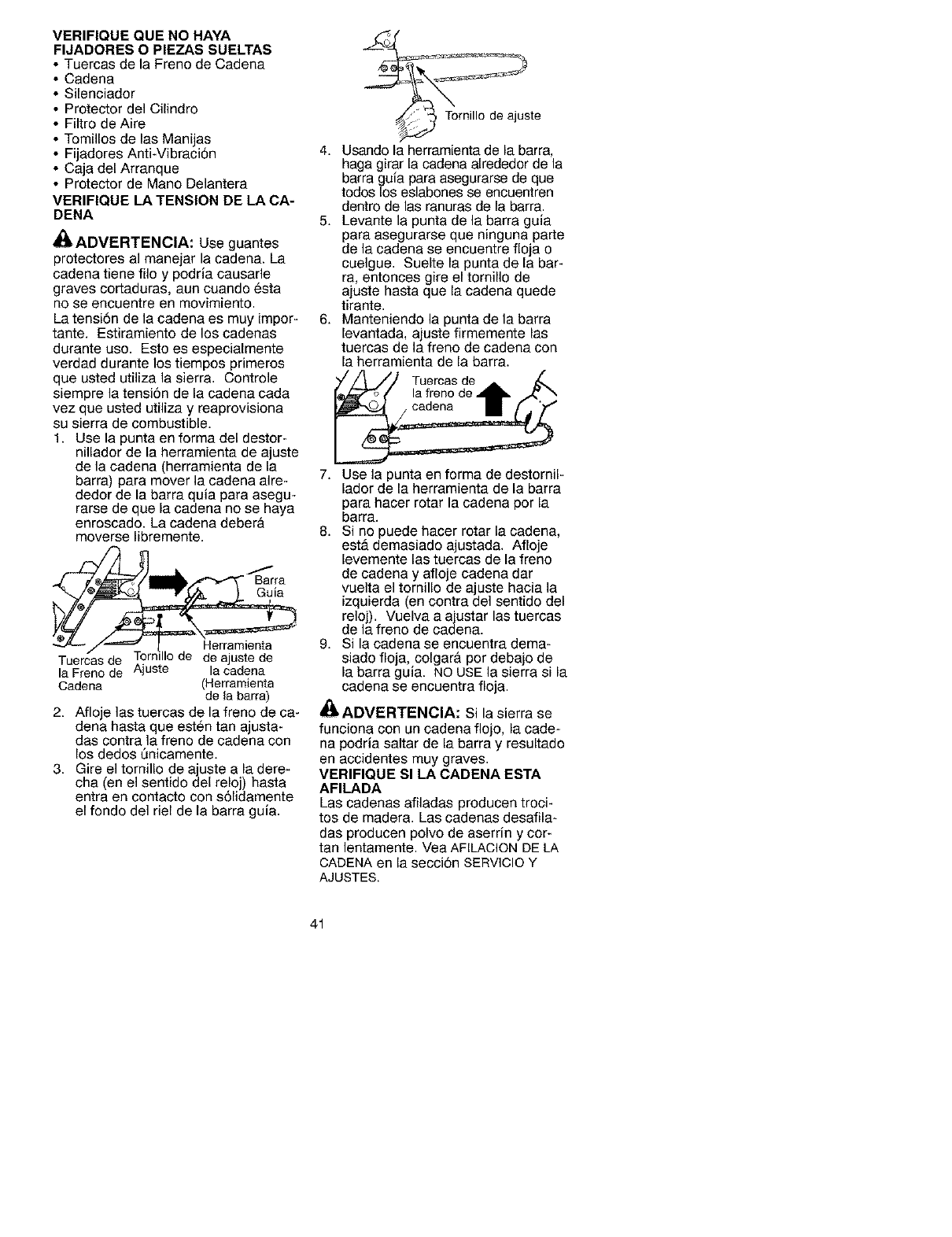
VERIFIQUE QUE NO HAYA
FIJADORES O PIEZAS SUELTAS
Tuercas de la Freno de Cadena
Cadena
Silenciador
Protector del Cilindro
Filtro de Aire
Tomillos de las Manijas
Fijadores AntiWibraci6n
Caja del Arranque
Protector de Mano Delantera
VERIFIQUE LA TENSION DE LA CA-
DENA
ADVERTENCIA: Use guantes
protectores al manejar la cadena. La
cadena tiene filo y podria causarle
graves cortaduras, aun cuando _sta
no se encuentre en movimiento.
La tensi6n de la cadena es muy impor-
tante. Estiramiento de los cadenas
durante uso. Esto es especialmente
verdad durante los tiempos primeros
que usted utiliza la sierra. Controle
siempre la tensi6n de la cadena cada
vez que usted utiliza y reaprovisiona
su sierra de combustible.
1. Use la punta en forma del destor-
nillador de la herramienta de ajuste
de la cadena (herramienta de la
barra) para mover la cadena alre-
dedor de la barra quia para asegu-
rarse de que la cadena no se haya
enroscado. La cadena deber&
moverse libremente.
la Freno de Ajuste la cadena
Cadena (Herramienta
de la barra)
2. Afloje las tuercas de la freno de ca-
dena hasta que esten tan ajusta-
das contra la freno de cadena con
los dedos t_nicamente.
3. Gire el tornillo de a uste a la dere-
cha (ene sent do de re o) hasta
entra en contacto con s61idamente
el fondo del riel de la barra guia.
4.
5.
6.
_T?ste
Usando la herramienta de la barra,
haga girar la cadena alrededor de la
barra guia para asegurarse de que
todos los eslabones se encuentren
dentro de las ranuras de la barra.
Levante la punta de la barra guia
para asegurarse que ninguna parte
de la cadena se encuentre floja o
cuelgue. Suelte la punta de la bar-
ra, entonces gire el tornillo de
ajuste hasta que la cadena quede
tirante.
Manteniendo la punta de la barra
levantada, ajuste firmemente las
tuercas de la freno de cadena con
la herramienta de la barra.
Tuercas de
o la freno de
7. Use la punta en forma de destornil-
lador de la herramienta de la barra
para hacer rotar la cadena por la
barra.
8. Si no puede hacer rotar la cadena,
est& demasiado ajustada. Afioje
levemente las tuercas de la freno
de cadena y afioje cadena dar
vuelta el tomillo de ajuste hacia la
izquierda (en contra del sentido del
relo). Vuelva a ajustar las tuercas
de a freno de cadena.
9. Si la cadena se encuentra dema*
siado floja,,colgar& por debajo de
la barra guJa. NO USE la sierra si la
cadena se encuentra floja.
_IkADVERTENOIA: Si la sierra se
funciona con un cadena flojo, la cade-
na podria saltar de la barra y resultado
en accidentes muy graves.
VERIFIQUE SI LA CADENA ESTA
AFILADA
Las cadenas afiladas producen troci_
tos de madera. Las cadenas desafila-
das producen polvo de aserrin y cor-
tan lentamente. Vea AFILACION DE LA
CADENA en la secci6n SERVIClO Y
AJUSTES.
41
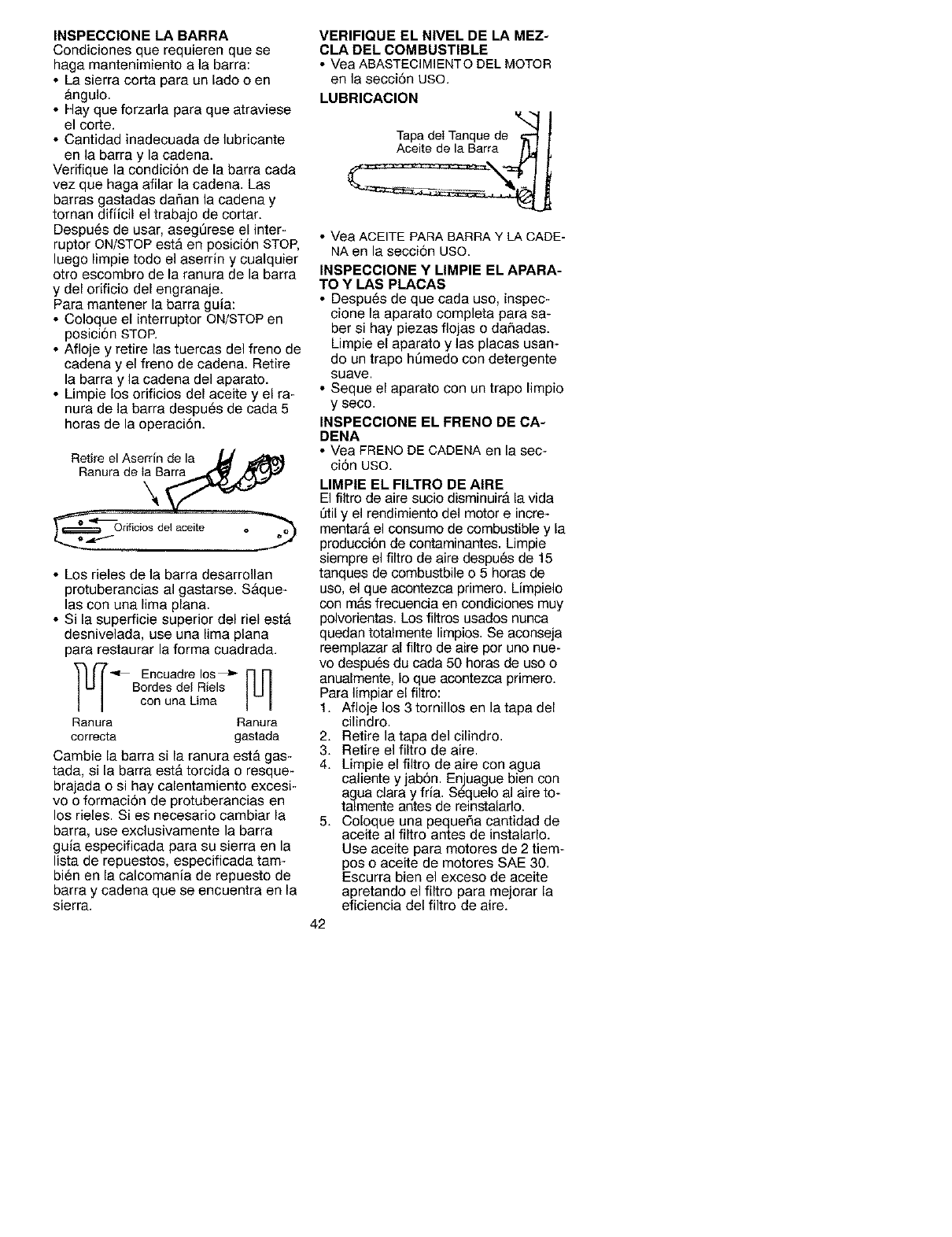
INSPECCIONE LA BARRA
Condiciones que requieren que se
haga mantenimiento a la barra:
•La sierra corta para un lado o en
_ngulo.
• Hay que forzarla para que atraviese
el corte.
• Cantidad inadecuada de lubricante
en la barra y la cadena.
Verifique la condici6n de la barra cada
vez que haga afilar la cadena. Las
barras gastadas dafian la cadena y
tornan difffcil el trabajo de cortar.
Despu_s de usar, asegQrese el inter-
ruptor ON/STOP est& en posici6n STOP,
luego limpie todo el aserrin y cualquier
otro escombro de la ranura de la barra
y del orificio del engranaje.
Para mantener la barra guia:
• Coloque el interrupter ON/STOP en
posici6n STOR
• Afloje y retire las tuercas del freno de
cadena y el freno de cadena. Retire
la barra y la cadena del aparato.
• Limpie los orificios del aceite y el ra-
nura de la barra despu_s de cada 5
horas de la operaci6n.
Retire el Aserrin de la
Ranura__de Ia__Barra
Orificios del aceite o o
• Los rieles de la barra desarrollan
protuberancias al gastarse. Saque-
las con una lima plana.
• Si la superficie superior del riel est&
desnivelada, use una lima plana
para restaurar la forma cuadrada.
_ Encuadre los _- _J_
Bordes del Riels
con u_a Lima
manura aanura
correcta gastada
Cambie la barra si la ranura est_ gas-
tada, si la barra est_ torcida o resque-
brajada o si hay calentamiento excesi-
vo o formaci6n de protuberancias en
los rieles. Si es necesario cambiar la
barra, use exclusivamente la barra
guia especificada para su sierra en la
lista de repuestos, especificada tam-
bien en la calcomanfa de repuesto de
barra y cadena que se encuentra en la
sierra.
VERIFIQUE EL NIVEL DE LA MEZ-
CLA DEL COMBUSTIBLE
• Vea ABASTECIMIENTO DEL MOTOR
en la secci6n USO.
LUBRICAClON
Tato e' 'e an a"ede
• Yea ACEITE PARA BARRA Y LA CADE-
NA en la secci6n uso.
INSPECClONE Y LIMPIE EL APARA-
TO Y LAS PLACAS
• Despu_s de que cada uso, inspec-
cione la aparato completa para sa-
ber si hay piezas flojas o dafladas.
Limpie el aparato y las placas usan-
do un trapo h0medo con detergente
suave.
• Seque el aparato con un trapo limpio
y seco.
INSPECClONE EL FRENO DE CA-
DENA
• Yea FRENO DE CADENA en la sec-
ci6n uso.
LIMPIE EL FILTRO BE AIRE
El filtro de aire sucio disminuir_ la vida
_til y el rendimiento del motor e incre-
mentar& el consumo de combustible y la
producci6n de contaminantes. Limpie
siempre el filtro de aire despues de 15
tanques de combustbile o 5 horas de
uso, el que acontezca primero. Limpielo
con m&s frecuencia en condiciones muy
polvorientas. Los filtros usados nunca
quedan totalmente limpios. Se aconseja
reemplazar al flltro de aire por uno nue-
vo despues du cada 50 horas de uso o
anualmente, Io que acontezca primero.
Para limpiar el filtro:
1. Afloje los 3 tornillos en la tapa del
cilindro.
2. Retire la tapa del cilindro.
3. Retire el filtro de aire.
4. Limpie el filtro de aire con agua
caliente y ab6n. Enjuague bien con
agua clara y fria. S6quelo al aire to-
talmente antes de reinstalarlo.
5. Coloque una pequefla cantidad de
aceite al filtro antes de instalarlo.
Use aceite para motores de 2 tiem-
pos o aceite de motores SAE 30.
Escurra bien el exceso de aceite
apretando el filtro para mejorar la
eficiencia del filtro de aire.
42
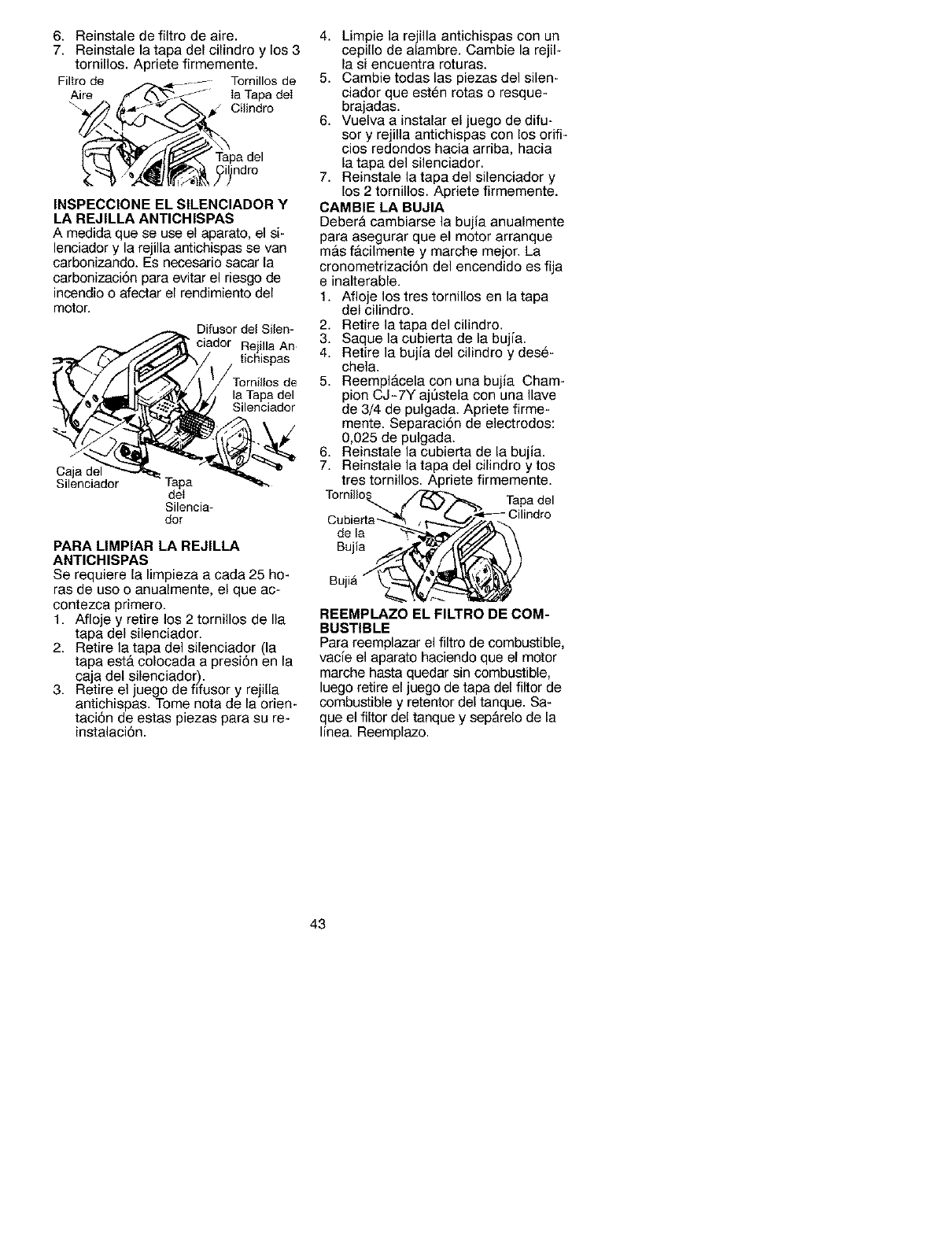
6. Reinstaledefiltrodeaire.
7. Reinstalelatapadelcilindroylos3
tornillos.Aprietefirmemente.
Filtrode /.>,_.__.,=_--- Tomillos de
Aire _ _-_" Ia Tapa deI
_'!ndr°
INSPECCIONE EL SILENCIADOR Y
LA REJILLA ANTICHISPAS
A medida que se use el aparato, el si-
lenciador y la rejilla antichispas se van
carbonizando. Es necesario sacar la
carbonizaci6n para evitar el riesgo de
incendio o afectar el rendimiento del
motor.
cD_s°r dsIillS_eA_
:_ _'_'_'_'_!_ Silenciador
deI
Silencia-
dor
PARA LIMPIAR LA REJILLA
ANTICHISPAS
Se requiere la limpieza a cada 25 ho-
ras de use o anualmente, el que ac-
contezca primero.
1. Afloje y retire los 2 tornillos de Ila
tapa del silenciador.
2. Retire la tapa del silenciador (la
tapa est& colocada a presi6n en la
ca adel silenciador).
3. Retree uegodeffusoryre a
antichispas. Tome nota de la often-
taci6n de estas piezas para su re-
instalaci6n.
4. Limpie la rejilla antichispas con un
cepillo de alambre. Cambie la rejil-
la si encuentra roturas.
5. Cambie todas las piezas del silen-
ciador que est_n rotas o resque-
brajadas.
6. Vuelva a instalar el juego de difu-
sor y rejilla antichispas con los orifi-
cios redondos hacia arriba, hacia
la tapa del silenciador.
7. Reinstale la tapa del silenciador y
los 2 tornillos. Apriete firmemente.
CAMBIE LA BUJIA
Debera cambiarse la bujia anualmente
para asegurar que el motor arranque
m&s f&cilmente y marche mejor. La
cronometrizaci6n del encendido es fija
e inalterable.
1. Aflo e los tres tornillos en la tapa
de c ndro.
2. Retire la tapa del cilindro.
3. Saque la cubierta de la bujia.
4. Retire la bujia del cilindro y dese-
chela.
5. Reempl&cela con una bujia Cham-
pion CJ-7Y aj_stela con una Ilave
de 3/4 de pulgada. Apriete firme-
mente. Separaci6n de electrodos:
0,025 de pulgada.
6. Reinstale la cubierta de la bujia.
7. Reinstale la tapa del cilindro y tos
tres tornillos. Apriete firmemente.
de la _ &_,,,_/_'_. Cilindro
REEMPLAZO EL FILTRO DE COM-
BUSTIBLE
Para reemplazar el filtro de combustible,
vacie el aparato haeiendo que el motor
marche hasta quedar sin combustible,
luego retire el juego de tapa del filtor de
combustible y retentor del tanque. Sa-
que el filtor del tanque y sep&relo de la
linea. Reemplazo.
43
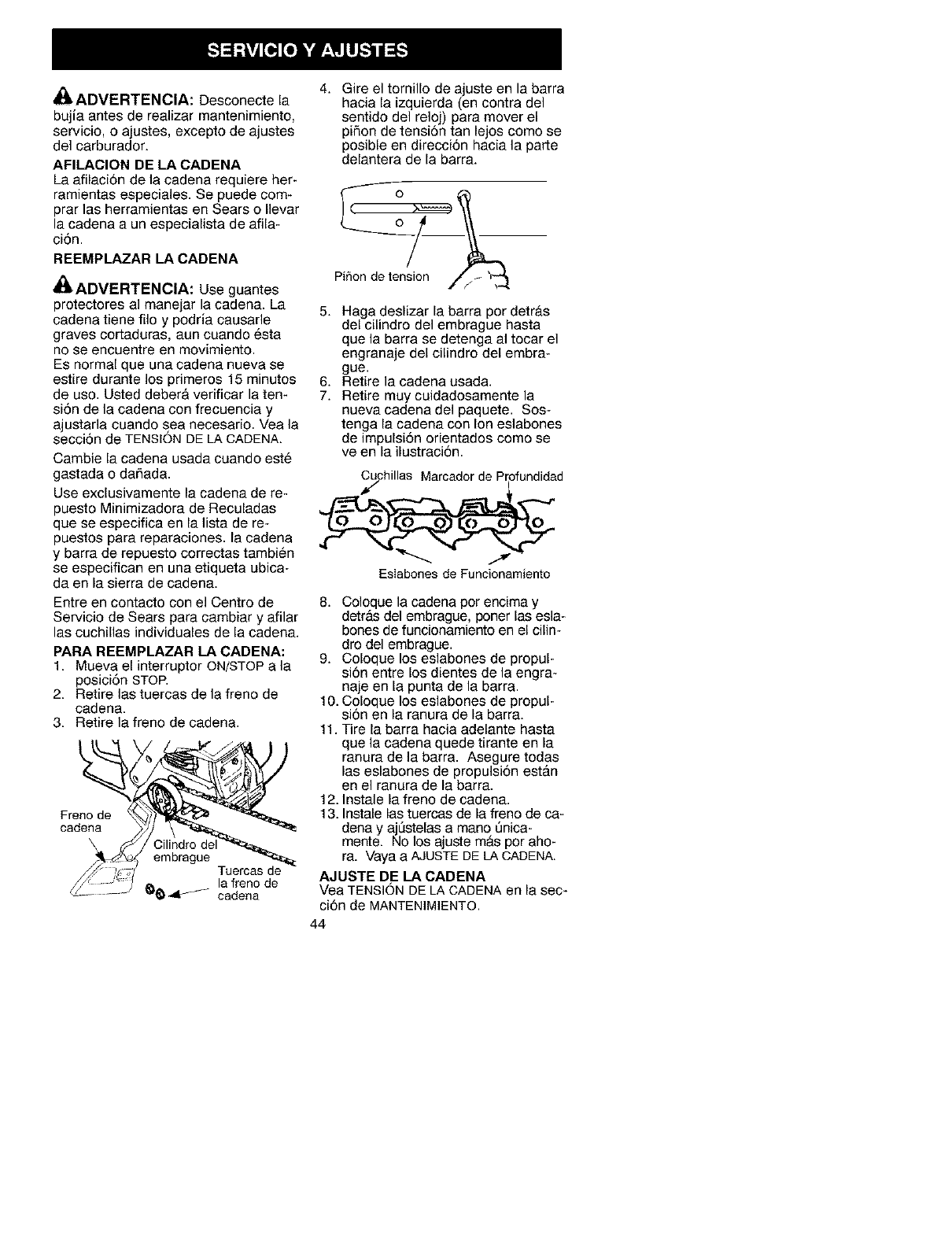
ADVERTENClA: Desconecte la
bujia antes de realizar mantenimiento,
servicio, o ajustes, excepto de ajustes
del carburador.
AFILACION DE LA CADENA
La afilaciSn de la cadena requiere her-
ramientas especiales. Se puede com-
prar las herramientas en Sears o Ilevar
la cadena a un especialista de afila-
ci6n.
REEMPLAZAR LA CADENA
ADVERTENCIA: Use guantes
protectores al manejar la cadena. La
cadena tiene file y podria causarle
graves cortaduras, aun cuando _sta
no se encuentre en movimiento.
Es normal que una cadena nueva se
estire durante los primeros 15 minutes
de use. Usted deber& verificar la ten-
si6n de la cadena con frecuencia y
ajustarla cuando sea necesario. Vea la
secci6n de TENSION DE LA CADENA.
Cambie la cadena usada cuando est_
gastada o daSada.
Use exclusivamente la cadena de re-
puesto Minimizadora de Reculadas
que se especifica en la ]ista de re-
puestos para reparaciones, la cadena
y barra de repuesto correctas tambien
se especifican en una etiqueta ubica-
da en la sierra de cadena.
Entre en contacto con el Centre de
Servicio de Sears para cambiar y afilar
las cuchillas individuales de la cadena.
PARA REEMPLAZAR LA CADENA:
1. Mueva el interrupter ON/STOP a la
posici6n STOP.
2. Retire las tuercas de la freno de
cadena.
3. Retire la freno de cadena.
Freno de
cadena
embrague Tuercas de
la freno de
_ "d_-_'_t cadena
4. Gire el tornillo de ajuste en la barra
hacia la izquierda (en contra del
sentido del reloj) para mover el
piSon de tensi6n tan lejos como se
posible en direcci6n hacia la parte
delantera de la barra.
Piton de tension _'/_ '_t
5. Haga deslizar la barra per detr&s
del cilindro del embrague hasta
que la barra se detenga al tocar el
engranaje del cilindro del embra-
gue.
6. Retire la cadena usada.
7. Retire muy cuidadosamente la
nueva cadena del paquete. Sos-
tenga la cadena con Ion eslabones
de impulsi6n orientados como se
ve en la ilustraci6n.
_._chillas Marcador de Plofundidad
Eslabones de Funcionamiento
8. Coloque la cadena per encima y
detr&s del embrague, poner las esla-
bones de funcionamiento en el cilin-
dro del embrague.
9. Coloque los eslabones de propul-
si6n entre los dientes de la engra-
naje en la punta de la barra.
10. Coloque los eslabones de propul-
si6n en la ranura de la barra.
11. Tire la barra hacia adelante hasta
que la cadena quede tirante en la
ranura de la barra. Asegure todas
las eslabones de propulsi6n est&n
en el ranura de la barra.
12. Instale la freno de cadena.
13. Instale las tuercas de la freno de ca-
dena y aj_stelas a mano Qnica-
mente. No los ajuste m&s por aho-
ra. Vaya a AJUSTE DE LA CADENA.
AJUSTE DE LA CADENA
Yea TENSION DE LA CADENA en la sec-
ci6n de MANTENIMIENTO.
44
AJUSTE AL CARBURADOR
_I_ADVERTENCIA: La cadena es-
tar_. en movimiento durante la mayor
parte de este prodecimiento. Use el
equipo protector y observe todad las
precauciones de seguridad. En el ajuste
de la mezcla de bajas revoluciones veri-
fique la marcha lenta despu_s de cada
ajuste. La cadena no debe moverse con
el motor en marcha lenta.
El ajuste del carburador es de primor-
dial importancia. Si se Io hace incor-
rectamente, puede daflar tanto el mo-
tor como el carbrador permanente-
mente. Si necesita mas ayuda o no
est& seguro de c6mo hacer el procedi-
miento, Ilame a nuestro telefono de ay-
uda al consumidor, al 1-800-235-5878.
El combustible vencido, el filtro de aire
sucio, el filtro de combustible sucio o el
motor ahogado pueden dar la impresi6n
de carburaci6n desajustada. Verifique
estas condiciones antes de hacer cual-
quier ajuste.
El carburador ha sido ajustado cuidado-
samente en la f&brica. Posiblemente se
hagan necesarios ajustes si se nota cu-
alquiera de las siguientes condiciones:
• La cadena se mueve con el motor
en marcha lenta. Vea MARCHA LEN-
TA "T" bajo prodecimiento de ajuste.
• La sierra no anda a amrcha lenta.
Yea MARCHA LENTA "T" y MEZCLA DE
BAJAS REVOLUCIONES "L".
• El motor se para o se ahoga cuando
debe acelerar. Vea MEZCLA DE AL-
TAS REVOLUCIONES "H" bajo el pro-
cedimiento de ajuste.
• Baja de potencia de corte. Vea MEZ-
CLA DE ALTAS REVOLUCIONES "H"
bajo el procedimiento de ajuste.
Hay tres tornillos de ajuste en el car-
burador. Estan marcados con "H", "L" y
"T". Estan ubucados arriba del bomb-
eador.
PROCEDIMIENTO DE AJUSTE
PRECAUCION: AI hacer ajustes no
fuerce las tapas limitadores de pl&stico
m&s alia de los retenedores o puede
haber daSos.
Proeedimiento Inieial
1. Gire el tornillos de mezcla ("L" y "H")
a la izquierda (en contra de sentido
del reloj) hasta que se pare.
2. Gire el tornillo de marcha lenta ("T")
a la derecha (en el sentido del reloj)
hasta que se detenga. Seguida-
3,
mente, girelo hacia la izquierda 4
vueltas y media.
Ponga el motor en marcha y d_jelo
en marcha per 3 minutes. Luego,
proceda a ajustar los tornillos de
acuerdo a las instrucciones indicas
en la siguiente secci6n. Si el funcio-
namiento del motor es aceptable
con las posiciones anteriores, no
har& falta hacer m&s ajustes. Si el
motor no arranca, vea la TABLA
DIAGNOSTICA. Si aQn es incapaz
remediar la situaci6n, Ilamada
1-800-235-5878.
Marcha Lenta "T"
Deje que el motor trabaje en marcha
lenta. Si la cadena se mueve, la mar-
cha lenta es demasiado. Si el motor
se para, la marcha lenta es demasiado
lenta. Ajuste las revoluciones hasta
que el motor se mantenga en marcha
sin que la cadena se mueva (la mar-
cha lenta es demasiado) o que el mo-
tor se ahogue (la marcha lenta es de-
masiado lenta).
• Gire el tornillo de la marcha lenta "T"
a la derecha (en el sentido del reloj)
para aumentar las revoluciones del
motor.
• Gire el tornillo de la marcha lenta "T'
a la izquierda (en contra del sentido
del reloj) para bajar las revoluciones.
Mezcla para Bajas Revoluciones "L"
Deje el motor en marcha lenta. Luego
acelere el motor y siente el funciona-
miento. Si el motor trata de parar, no
acelera bien o larba humo al acelerar,
gire el tornillo de la mezcla para bajas
revolucionies "L" a la derecha (en el
sentido del reloj) en incrementos de
1/16 de vuelta hasta obtener un funcio-
namiento satisfactorio. Repita este pro-
cedimiento las veces que sea necesario
para obtener un rendimiento satisfacto-
rio. Despues de completar estos
ajustes, verffique la aceleraci6n y el mo-
vimiento de la cadena en marcha lenta.
Ajuste nuevamente si es necesario.
Mezcla para Altas Revoluciones "H"
NO HAGA funcionar el motor con el
acelerador a rondo por mucho tiempo
al hacer los ajustes ya que puede
dafiar el motor. Haga un corte de prue-
ba. Basado en el funcionamiento de la
sierra durante el corte, ajuste el tornillo
para la mezcla de altas revoluciones
por incrementos de s61o 1/16 de vuel-
ta, come se detalla a continuaci6n:
45
• Gireeltornillodelamezclaparaal-
tasrevoluciones"H"aladerecha(en
elsentidodelreloj)hastaquelasierra
tengabuenapotenciaalcortarsin
hesitaciones.Nohagalosajustespor
elsonidoniperlasrevoluciones,sine
perelbuenfuncionamientoalcortar.
• Gireeltornillodelamezclaparaaltas
revoluciones"H"alaizquierda(en
contradelsentidodelreloj)silasier-
ratienerevolucionesaltaspetese
paraolefaltapotenciaalcortar.
Despu_sdecompletarlosajustes,
verifiquelaaceleraci6ny elmovimien-
todelacadenaenmarchalenta.
Ajustenuevamentesiesnecesario.
VerificationdelaAceleracion
Sielmotorseparaohesitaenvezde
acelerar,gireeltornillodelamezcla
parabajasrevoluciones"L"parabajas
revolucionesalaizquierda(encontra
delsentidodelreloj)conseguirunaacel-
eraci6nparejasinmovimientodelaca*
denaenmarchalent&
_I,ADVERTENCIA: Realice los si-
guientes pasos despu_s de cada uso:
• Deje que el motor se enfrie y fije
bien el aparato antes de guardarlo o
de transportarlo.
• Guarde la sierra y el combustible en
unlocal bien ventilado donde los va-
pores de combustible no puedan en-
trar en contacto con shispas ni lla-
mas abiertas provenientes de los
termotanques, los motores o inter-
ruptores electricos, calefactores cen-
trales, etc.
• Guarde el aparato con redes los pro-
tectores en su lugar y coloque el apa-
rato de mode que las piezas filosas no
puedan causar heridas por accidente.
• Guarde el aparato bien fuera del al-
cance de los niflos.
Prepare el aparato para guardarlo al
final de la temporada o si no se Io va a
usar pot m&s de 30 dias o m&s.
ESTACIONAL ALMACENAJ E
Prepare el aparato para guardarlo al
final de la temporada o si no se Io va a
usar por m&s de 30 dias o m&s.
Siva a guardar el aparato durante un
periodo largo:
• Limpie la sierra a conciencia antes
del almacenaje.
• Almacene en un lugar limpio y seco.
• Aplique una pequefia cantidad de
aceite a las superficies externas
met&licas y a la barra guia.
• Lubrique la cadena y envu_lvala en
papel grueso o tel&
SISTEMA DE COMBUSTIBLE
Vea el mensaje marcado IMPOR-
TANTE, que se reflere al use de com-
bustibles con mezcla de alcohol en su
aparato, en la secci6n de USO, bajo
ABASTECIMIENTO DEL MOTOR. LOSes-
tabilizadores de combustible son una
alternativa aceptable para minimizar la
formaci6n de depSsitos de goma du-
rante el almacenamiento. Afiada estabi-
lizador a la gasolina en el tanque de
combustible o en el recipiente de alma*
cenado de combustible. Siga las instruc-
clones de mezcla que se encuentran en
los envases de estabilizador. Ponga el
motor en marcha y d_jelo en marcha
unos 5 minutos despu_s de ponerle es-
tabilizador.
El aceite Craftsman 40:1 para motores
de 2 tiempos (enfriados a aire) viene
mezclado con estabilizador de com-
bustible. Si no usa enste aceite de
Sears, entonces puede afiadir un esta-
bilizador al tanque de conmbustible.
MOTOR
• Retire la bujia y vierta una cuchara-
da de las de t_ de adceite 40:1 para
motores de 2 tiempos (enfriados a
aire) por la abertura para la bujia. Tire-
nee lentamente de la soga de arran-
que 8 a 10 veces para distribuir el
aceite.
• Reemplace la bujfa con otra del tipo
y de la gama de calor recomenda-
dos.
• Limpie el filtro de aire.
• Examine rode el aparato para verifi-
car que no haya tornillos, tuercas ni
pernos sueltos. Cambie dotas las
piezas dafiadas, quebradas o gasta*
das.
• AI principio de la pr6xima temporada,
use exclusivamente combustible
nuevo con la proporci6n correcta de
gasolina a adeite.
OTRO
• NO guarde gasolina de unatempora-
da a la pr6xima.
• Cambie el recipiente de gasolina si
se empieza a oxidar.
46
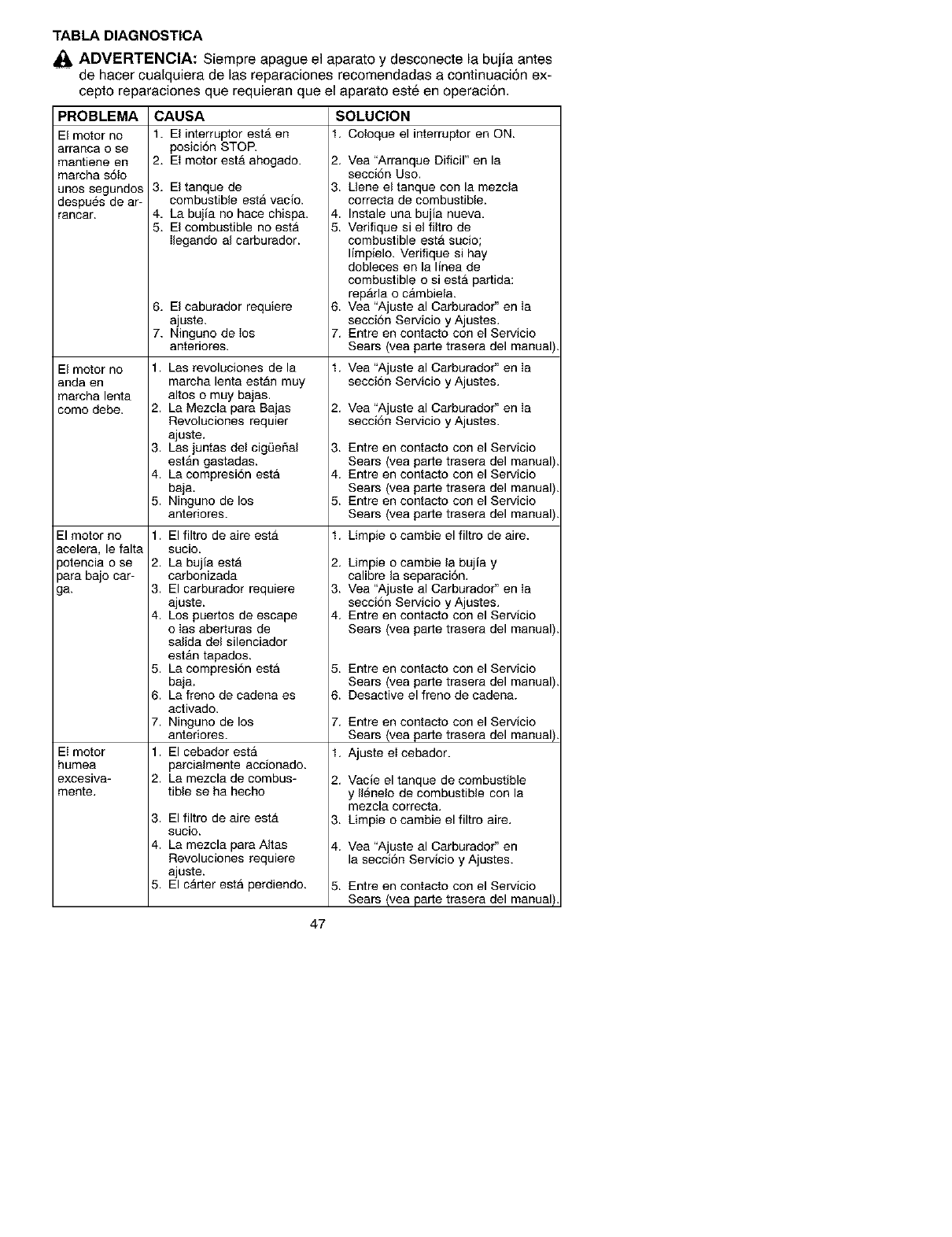
TABLA DIAGNOSTICA
il_ ADVERTENCIA: Siempre apague el aparato y desconecte la bujia antes
de hacer cualquiera de las reparaciones recomendadas a continuaci6n ex-
cepto reparaciones que requieran que el aparato est_ en operaci6n.
PROBLEMA
El motor no
arranca o se
mantiene en
marcha s6!o
unos segundos
despues de ar-
rancar.
El motor no
anda en
marcha lenta
como debe.
El motor no
acelera, le falta
]otencia o se
para bajo car-
ga.
EI motor
humea
excesiva-
mente.
CAUSA
1. El interruptor est_ en
posici6n STOP.
2. Ei motor est_ ahogado.
3. El tanque de
combustible esta vacio.
4. La bujia no hace chispa.
5. El combustible no esta
Ilegando al carburador.
6. El caburador requiere
ajuste.
7. Ninguno de los
anteriores.
1. Las revoluciones de la
marcha lenta estAn muy
altos o muy bajas.
2. La Mezcla para Bajas
Revoluciones requier
ajuste.
3. Las juntas del cigL)e_al
estAn gastadas.
4. La compresi6n esta
baia.
5. Ninguno de los
anteriores.
1. El filtro de aire estA
sucio.
2. La bujia est_
carbonizada
3. El carburador requiere
ajus_e.
4. Los puertos de escape
o Ias aberturas de
salida del silenciador
estAn tapados.
5. La compresi6n esta
baja.
6. La freno de cadena es
activado.
7. Ninguno de los
anteriores.
1. El cebador esta
parcialmente accionado.
2. La mezcla de combus-
tible se ha hecho
3. El filtro de aire estA
sucio.
4. La mezcla para Altas
Revoluciones requiere
ajuste.
5. El carter esta perdiendo.
SOLUCION
1. Co!oque el interruptor en ON.
2. Vea "Arranque Dificil" en la
secci6n Uso.
3. Llene el tanque con la mezcla
correcta de combustible.
4. Instale una bujia nueva.
5. Verifique si el filtro de
combustible esta sucio;
limpielo. Verifique si hay
dobleces en la linea de
combustible o si esta partida:
repArla o cambiela.
6. Vea "Ajuste al Carburador" en Ia
secci6n Servicio y Ajustes.
7. Entre en contacto con el Servicio
Sears (vea parte trasera del manual)
1. Vea "Ajuste al Carburador" en Ia
secci6n Servicio y Ajustes.
2. Vea "Ajuste al Carburador" en Ia
secci6n Servicio y Ajustes.
3, Entre en contacto con el Servicio
Sears (vea parte trasera del manual)
4. Entre en contacto con el Servicio
Sears (vea parte trasera del manual)
5. Entre en contacto con el Servicio
Sears (vea parte trasera del manual)
1. Limpie o cambie el filtro de aire.
2. Limpie o cambie la bujia y
calibre la separaci6n.
3. Vea "Ajuste al Carburador" en Ia
secci6n Servicio y Ajustes.
4. Entre en contacto con el Servicio
Sears (vea parte trasera del manual)
5, Entre en contacto con el Servicio
Sears (yea parte trasera del manual)
6. Desactive el freno de cadena.
7. Entre en contacto con el Servicio
Sears (vea parte trasera del manual)
1. Ajuste el cebador.
2. Vacie el tanque de combustible
y Ilenelo de combustible con la
mezcla correcta.
3. Limpie o cambie el filtro aire.
4. Yea "Ajuste al Carburador" en
la secci6n Servicio y Ajustes.
5, Entre en contacto con el Servicio
Sears (vea parte trasera del manual)
47
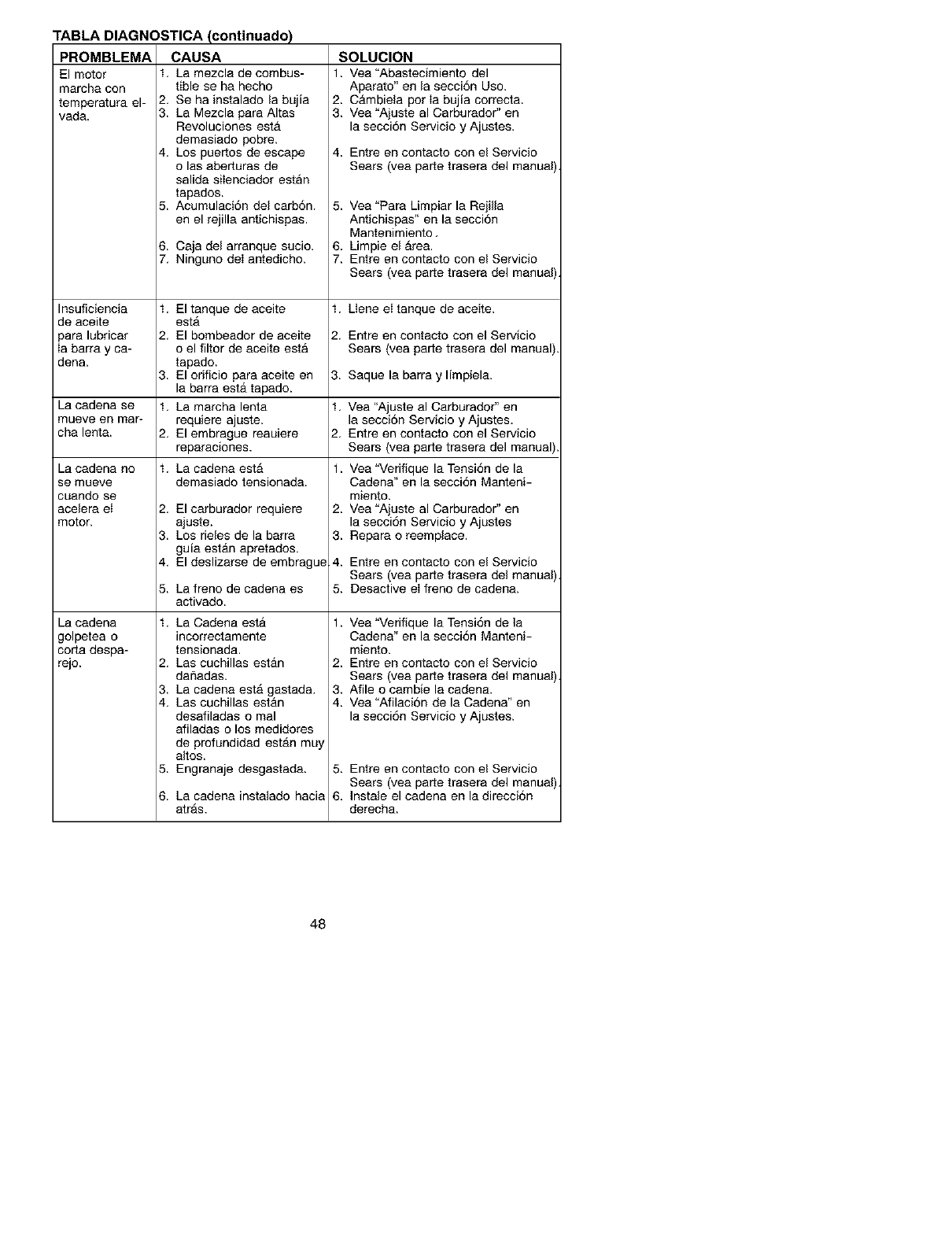
TABLA DIAGNOSTICA (continuado)
PROMBLEMA CAUSA
El motor 1. La mezcla de combus-
marcha con tible se ha hecho
temperatura el- 2. Se ha instalado la bujia
vada. 3. La Mezcla para Altas
Revoluciones estA
demasiado pobre.
4. Los puertos de escape
o las aberturas de
salida siIenciador estan
tapados.
5. AcumulaciAn del carb6n.
en el rejilla antichispas.
6. Caja del arranque sucio.
7, Ninguno dei antedicho.
SOLUCION
1. Vea"Abastecimiento del
Aparato" en la secci6n Uso.
2. CAmbiela por Ia bujia correcta.
3. Vea "Ajuste al Carburador" en
la secci6n Servicio y Ajustes.
4. Entre en contacto con el Servicio
Sears (vea parte trasera del manual
5. Yea "Para Limpiar la Rejilla
Antichispas" en la secci6n
Mantenimiento,
6. Limpie el Area.
7. Entre en contacto con el Servicio
Sears (vea parte trasera del manual
Insuficiencia 1. El tanque de aceite 1. Llene el tanque de aceite.
de aceite estA
para lubricar 2. El bombeador de aceite 2. Entre en contacto con el Servicio
Ia barra y ca- o el filtor de aceite esta Sears (yea parte trasera del manual)
dena. tapado.
3. El orificio para aceite en 3. Saque la barra y limpiela.
la barra estA tapado.
La cadena se 1. La marcha lenta 1. Vea "Ajuste al Carburador" en
mueve en mar- requiere ajuste, la secciAn Servicio y Ajustes.
cha lenta. 2. El embrague reauiere 2. Entre en contacto con el Servicio
reparaciones. Sears (vea parte trasera del manual)
1. La cadena est#_
demasiado tensionada.
2. El carburador requiere
ajuste.
3. Los rieles de la barra
guia estAn apretados.
4. El deslizarse de embrague
5. La freno de cadena es
activado.
1. La Cadena estA
incorrectamente
tensionada.
2. Las cuchillas estAn
dafiadas.
3. La cadena esta gastada.
4. Las cuchillas estAn
desafiladas o mal
afiladas o los medidores
de profundidad estan muy
altos.
5. Engranaje desgastada.
La cadena no
semueve
cuando se
aceleraeI
motor.
La cadena
golpetea o
co_a despa-
6. La cadena instalado hacia
atrAs.
1. Yea "Verifique la Tensi6n de la
Cadena" en la secci6n Manteni-
miento.
2. Vea "Ajuste al Carburador" en
la secci6n Servicio y Ajustes
3. Repara o reemplace.
4. Entre en contacto con el Servicio
Sears (vea parte trasera del manual
5. Desactive el freno de cadena.
1. Yea "Verifique la Tensi6n de la
Cadena" en la secci6n Manteni-
miento.
2. Entre en contacto con el Servicio
Sears (vea parte trasera del manual
3. Afile o cambie la cadena.
4. Vea "Afilacion de la Cadena" en
la secci6n Servicio y Ajustes.
5. Entre en contacto con el Servicio
Sears (vea parte trasera del manual
6. Instale el cadena en la direcciAn
derecha.
48
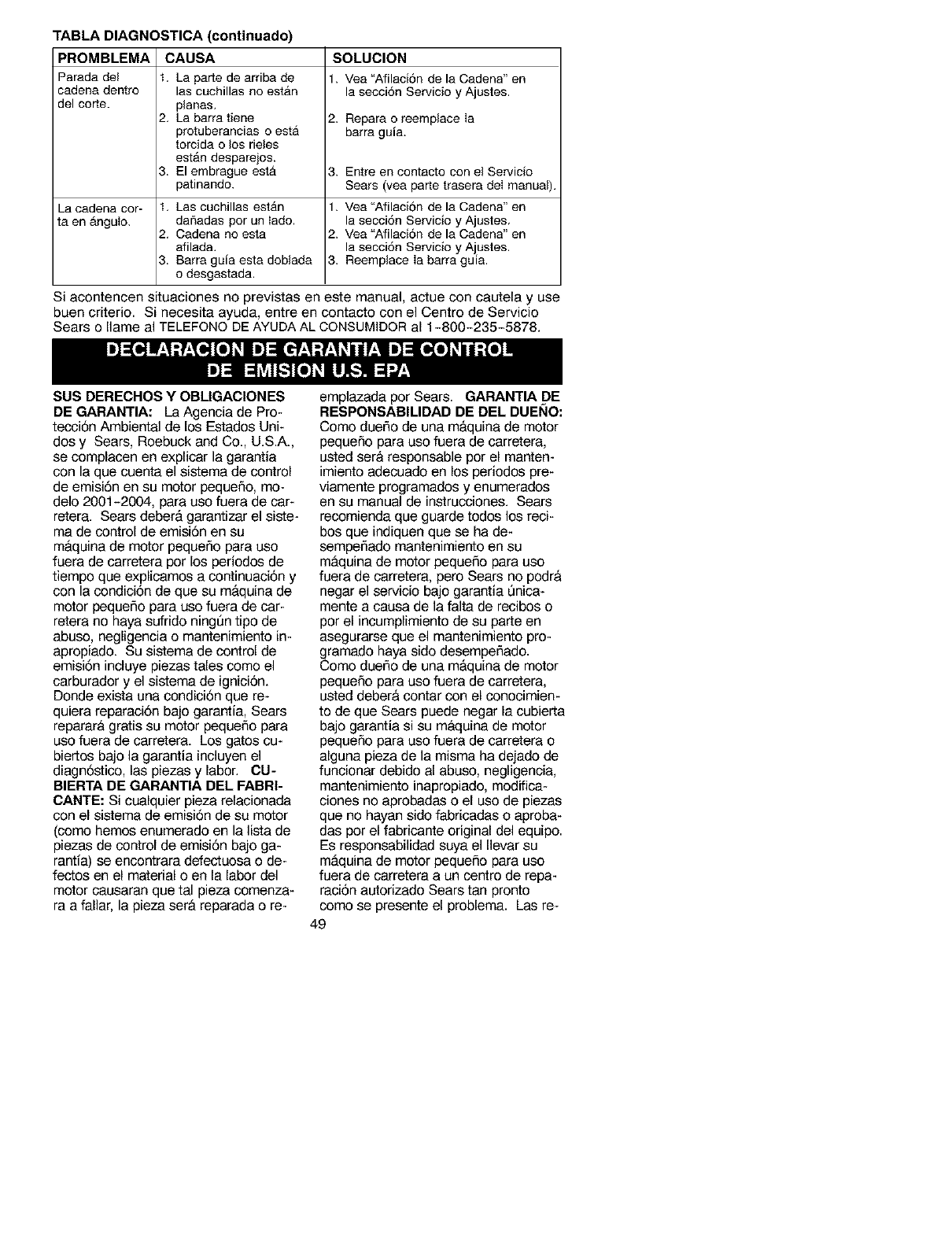
TABLA DIAGNOSTICA (continuado)
CAUSAPROMBLEMA
Parada del
cadena dentro
del corte.
La cadena cor-
ta en AnguIo.
1, La parte de arriba de
las cuchillas no est#_n
planas.
2. La barra tiene
protuberancias o esta
torcida o los rieles
estAn desparejos.
3. El embrague est#_ 3.
patinando.
1. Las cuchillas est#_n 1.
da_adas por un Iado.
2. Cadena no esta 2.
afilada.
3. Barra guia esta doblada 3.
o desgastada.
SOLUCION
1. Yea "Afilacion de la Cadena" en
la secci6n Servicio y Ajustes.
2. Repara o reemplace Ia
barra guia.
Entre en contacto con el Servicio
Sears (vea parte trasera deI manual).
Vea "Afilacion de la Cadena" en
la secci6n Servicio y Ajustes.
Vea "Afilacion de la Cadena" en
la secci6n Servicio y Ajustes.
Reemplace Ia barra guia.
Si acontencen situaciones no previstas en este manual, actue con cautela y use
buen criterio. Si necesita ayuda, entre en contacto con el Centro de Servicio
Sears o Ilame al TELEFONO DE AYUDA AL CONSUMIDOR al 1-800-235-5878.
SUS DERECHOS Y OBUGACIONES
DE GARANTIA: La Agencia de Pro-
tecci6n Ambiental de los Estados Uni-
dos y Sears, Roebuck and Co., U.S.A.,
se complacen en explicar la garantia
con la que cuenta el sistema de control
de emisi6n en su motor pequeSo, mo-
delo 2001-2004, para uso fuera de car-
retera. Sears deber& garantizar el siste-
ma de control de emisi6n en su
m&quina de motor pequeSo para uso
fuera de carretera por los periodos de
tiempo que explicamos a continuaci6n y
con la condici6n de que su maquina de
motor pequeSo para uso fuera de car-
retera no haya sufrido ning_n tipo de
abuso, negligencia o mantenimiento in-
apropiado. Su sistema de control de
emisi6n incluye piezas tales como el
carburador y el sistema de ignici6n.
Donde exista una condici6n que re-
quiera reparaci6n bajo garantia, Sears
reparara gratis su motor pequeSo para
uso fuera de carretera. Los gatos cu-
biertos bajo la garantia incluyen el
diagn6stico, las piezas y labor. CU-
BIERTA DE GARANTIA DEL FABRI-
CANTE: Si cualquier pieza relacionada
con el sistema de emisi6n de su motor
(como hemos enumerado en la lista de
piezas de control de emisi6n bajo ga-
rantia) se encontrara defectuosa o de-
fectos en el material o en la labor del
motor causaran que tal pieza comenza-
ra a fallar, la pieza ser& reparada o re-
emplazada por Sears. GARANTIA DE
RESPONSABILIDAD DE DEL DUENO:
Como dueSo de una maquina de motor
pequeSo para uso fuera de carretera,
usted sera responsable por el manten-
imiento adecuado en los periodos pre-
viamente programados y enumerados
en su manual de instrucoiones. Sears
recomienda que guarde todos los reci-
bos que indiquen que se ha de-
sempeSado mantenimiento en su
m&quina de motor pequeSo para uso
fuera de carretera, pero Sears no podra
negar el servicio bajo garantia Qnica-
mente a causa de la falta de recibos o
por el incumplimiento de su parte en
asegurarse que el mantenimiento pro-
gramado haya sido desempeSado.
Como dueSo de una maquina de motor
pequeSo para uso fuera de carretera,
usted debera contar con el conocimien-
to de que Sears puede negar la cubierta
bajo garantia si su maquina de motor
pequeSo para uso fuera de carretera o
alguna pieza de la misma ha dejado de
funcionar debido al abuso, negligencia,
mantenimiento inapropiado, modifica-
clones no aprobadas o el uso de piezas
que no hayan sido fabricadas o aproba-
das por el fabricante original del equipo.
Es responsabilidad suya el Ilevar su
m&quina de motor pequeSo para uso
fuera de carretera a un centro de repa-
raci6n autorizado Sears tan pronto
como se presente el problem& Las re-
49
paracionesbajogarantiadeber&nser
completadasenunperiododetiempo
razonable,quenoexcedalos30dias.
Sicuentaustedconalgunapreguntaen
relaci6nasusderechosyresbonsabili-
dadesdegarantia,usteddeber&com-
unicarseconsudistribuidorautorizado
delserviciom&scercanooIlamara
Searsal1-800-469-4663.FECHA
DEL COMIENZA DE LA GARANTIA:
El periodo de garantia comienza en la
fecha de compra de la m&quina de mo-
tor pequefio para uso fuera de carretera.
DURAClON DE LA GARANTIA: Esta
garantia cuenta con un periodo de dura-
ci6n de dos aSos comenzando en la fe-
cha inicial de compra. QUE CUBRE LA
GARANTIA: REPARAClON O REEM-
PLAZO DE PIEZAS, La reparaci6n oel
reemplazo de cualquier pieza garantiza-
da seran desempeSados y ofrecidos al
dueSo sin costo alguno en un distribui-
dor autorizado del servicio Sears. Si
cuenta usted con alguna pregunta en
relaci6n a sus derechos y resbonsabili-
dades de garantia, usted deber& com-
unicarse con su distribuidor autorizado
del servicio m&s cercano o Ilamar a
Sears al 1-800-469-4663. PERIODO
DE GARANTIA: Cualquier pieza garan-
tizada que no est_ programada para ser
reemplazada come parte del mantenimi-
ento requerido, o que est_ programada
_nicamente para inspecci6n regular
para efectos de "reparaci6n o reemplazo
si fuera necesario" debera garantizarse
por un periodo de dos aSos. Cualquier
pieza garantizada que est_ programada
para set reemplazada come parte del
mantenimiento requerido debera estar
garantizada por el periodo de tiempo
que comienza en la fecha de compra
inicial hasta la fecha del primer reempla-
zo programado para dicha pieza. DIAG-
NOSTICO: No se deber& cobrar al
dueSo ningQn tipo de cargos por la labor
de diagn6stico la cual determine que
una pieza garantizada se encuentra de-
fectuosa si el trabajo de diagn6stico ha
sido desempeSado por un distribuidor
autorizado del servicio Sears. DANOS
POR CONSECUECIA: Sears podr& ser
resbonsable de daSos ocurridos a otras
piezas del motor causados por la falla
de una pieza garantizada que se en-
cuentre bajo el periodo de garantia.
QUE NO CUBRE LA GARANTIA: To-
das las fallas causadas bor el abuse,
negligencia o mantenimiento inapropia-
do no est_n cubiertas. PIEZAS ANADI-
DAS O MODIFICADAS: El uso de pie-
zas aSadidas o la modificaci6n de
piezas podr_.n servir como base para
que se anule la reclamaci6n de ga-
rantia. La garantia de Sears no se re-
sponsabiliza por el mal funcionamiento
debido al uso de piezas a_adidas o de
piezas modificadas. COMO ENTA-
BLAR UNA RECLAMACION: Si cuenta
usted con alguna pregunta relacionada
con sus derechos y resbonsabilidades
de garantia, usted debera entrar en con-
tacto con su distribuidor autorizado del
servicio Sears m&s cercano o Ilamar a
Sears al 1-800-469-4663. DONDE
OBTENER SERVICIO DE GARANTIA:
Servicio oreparaciones bajo garantia
deber&n ser provistas en todos los distri-
buidors autorizado del servicio Sears.
Por favor comuniquese al
1-800-469-4663. MANTENIMIENTO,
REEMPLAZO Y REPARAClON DE
PIEZAS RELACIONADAS CON LA
EMISION: Cualquier pieza de repuesto
Sears aprobada y utilizada en el de-
sempeSo de cualquier servicio de man-
tenimiento o servicio de reparaci6n bajo
garantia de piezas relacionadas con la
emisi6n sera provisto sin costo alguno al
dueSo si la pieza se encuentra bajo ga-
rantia. LISTA SE PIEZAS DE CON-
TROL DE EMISION GARANTIZADAS:
Carburador, Sistema de Ignici6n: Bujia
(cubierta hasta la fecha de mantenimi-
ento pregramada), M6dulo de Ignici6n.
DECLARAClON DE MANTENIMIEN-
TO: El due_o es responsable de adqui-
rir todo el mantenimiento requerido
come Io define en el manual de instruc-
clones.
Se certifica este motor para satisfacer los requisites de emisi6n para los uso
siguientes:
[] Moderado (50 horas)
[] Intermedio (125 horas)
[] Extendido (300 horas)
5O
