Cropmark WKP-803 LMP NexGen Keypad User Manual

Cropmark AG LMP NexGen Keypad

User Manual

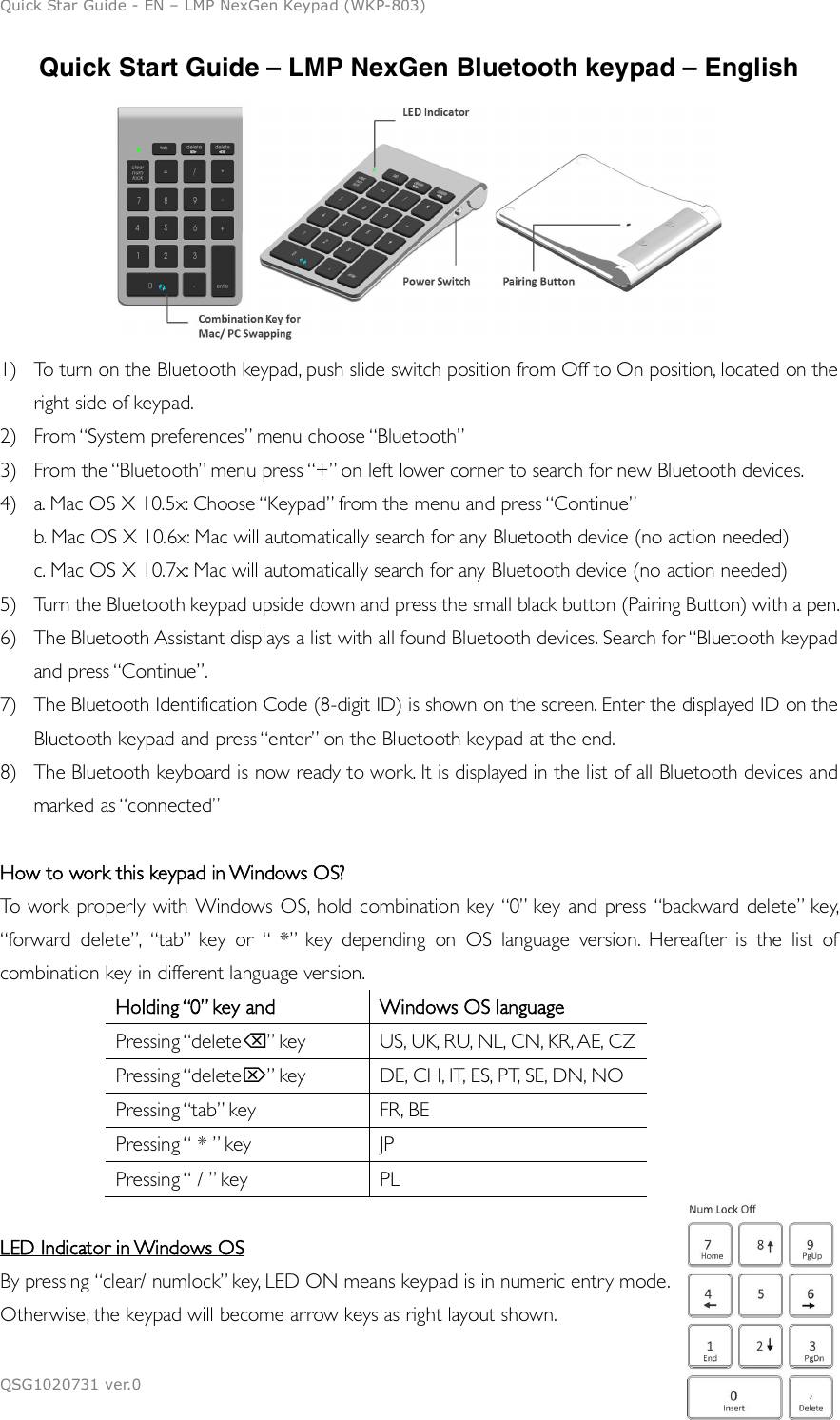
Quick Star Guide - EN – LMP NexGen Keypad (WKP-803) QSG1020731 ver.0 Quick Start Guide – LMP NexGen Bluetooth keypad – English  1) To turn on the Bluetooth keypad, push slide switch position from Off to On position, located on the right side of keypad. 2) From “System preferences” menu choose “Bluetooth” 3) From the “Bluetooth” menu press “+” on left lower corner to search for new Bluetooth devices. 4) a. Mac OS X 10.5x: Choose “Keypad” from the menu and press “Continue” b. Mac OS X 10.6x: Mac will automatically search for any Bluetooth device (no action needed) c. Mac OS X 10.7x: Mac will automatically search for any Bluetooth device (no action needed) 5) Turn the Bluetooth keypad upside down and press the small black button (Pairing Button) with a pen.   6) The Bluetooth Assistant displays a list with all found Bluetooth devices. Search for “Bluetooth keypad and press “Continue”. 7) The Bluetooth Identification Code (8-digit ID) is shown on the screen. Enter the displayed ID on the Bluetooth keypad and press “enter” on the Bluetooth keypad at the end. 8) The Bluetooth keyboard is now ready to work. It is displayed in the list of all Bluetooth devices and marked as “connected”  How to work this keypad in Windows OS? To work properly with Windows OS, hold combination key “0” key and press “backward delete” key, “forward  delete”,  “tab”  key  or  “  *”  key  depending  on  OS  language  version.  Hereafter  is  the  list  of combination key in different language version. Holding “0” key and    Windows OS language Pressing “delete” key  US, UK, RU, NL, CN, KR, AE, CZ Pressing “delete” key  DE, CH, IT, ES, PT, SE, DN, NO  Pressing “tab” key  FR, BE Pressing “ * ” key  JP Pressing “ / ” key  PL  LED Indicator in Windows OS By pressing “clear/ numlock” key, LED ON means keypad is in numeric entry mode. Otherwise, the keypad will become arrow keys as right layout shown.
Federal Communication Commission Interference Statement  This equipment has been tested and found to comply with the limits for a Class B digital device, pursuant to Part 15 of the FCC Rules. These limits are designed to provide reasonable protection against harmful interference in a residential installation. This equipment generates, uses and can radiate radio frequency energy and, if not installed and used in accordance with the instructions, may cause harmful interference to radio communications. However, there is no guarantee that interference will not occur in a particular installation. If this equipment does cause harmful interference to radio or television reception, which can be determined by turning the equipment off and on, the user is encouraged to try to correct the interference by one of the following measures: . Reorient or relocate the receiving antenna. . Increase the separation between the equipment and receiver. . Connect the equipment into an outlet on a circuit different from that to which the receiver is connected. . Consult the dealer or an experienced radio/TV technician for help.  FCC Caution: To assure continued compliance, any changes or modifications not expressly approved by the party responsible for compliance could void the user's authority to operate this equipment. (Example - use only shielded interface cables when connecting to computer or peripheral devices).  FCC Radiation Exposure Statement  This equipment complies with FCC RF radiation exposure limits set forth for an uncontrolled environment.  This transmitter must not be co-located or operating in conjunction with any other antenna or transmitter.   This device complies with Part 15 of the FCC Rules. Operation is subject to the following two conditions: (1) This device may not cause harmful interference, and (2) This device must accept any interference received, including interference that may cause undesired operation.

Navigation menu