Current 100286 Zigbee Drapery Track User Manual

Current Products Corp. Zigbee Drapery Track

User Manual

1DRAPERY TRACKInstallation Manual and User Guide
2TABLE OF CONTENTSDiagramList of PartsWall Mount Drapery Track Installation and Connecting the MotorsCeiling Mount Drapery Track Installation and Connecting the MotorsInstall the Facia (Optional)Start UpOptional Programming Steps for the Track Drapery    Change Positions on the Track Drapery (Single)    Change Positions on the Track Drapery (Dual)     Enable or Disable Smart Assist    Pair the Remote Control    Grouping Multiple Drapery Together    Switch the Open and Close Positions    Change the Frequency    Swap the Open and Close Directions on a Single Drapery    Swap the Open and Close Directions on a Dual Drapery    Switch Motor Response Controls for a Dual Drapery    Master Reset the DraperyConnect and Integrate the Drapery Track    Pair or Unpair a Remote Control    Connect the Bridge & App    Integrate with Amazon Echo- 434 FM    Integrate with Amazon Echo Plus- Zigbee with Current Products Corp Bridge    Integrate with Amazon Echo Plus- Zigbee Native HubTroubleshootingUsing the Drapery Track    Using the TAU for Operation    Using Smart Assist    Using the Remote Control- Single Drapery    Using the Remote Control- Dual Drapery    Using the Light & Temperature Sensors on the Control HousingSafety and Warning Statements
3
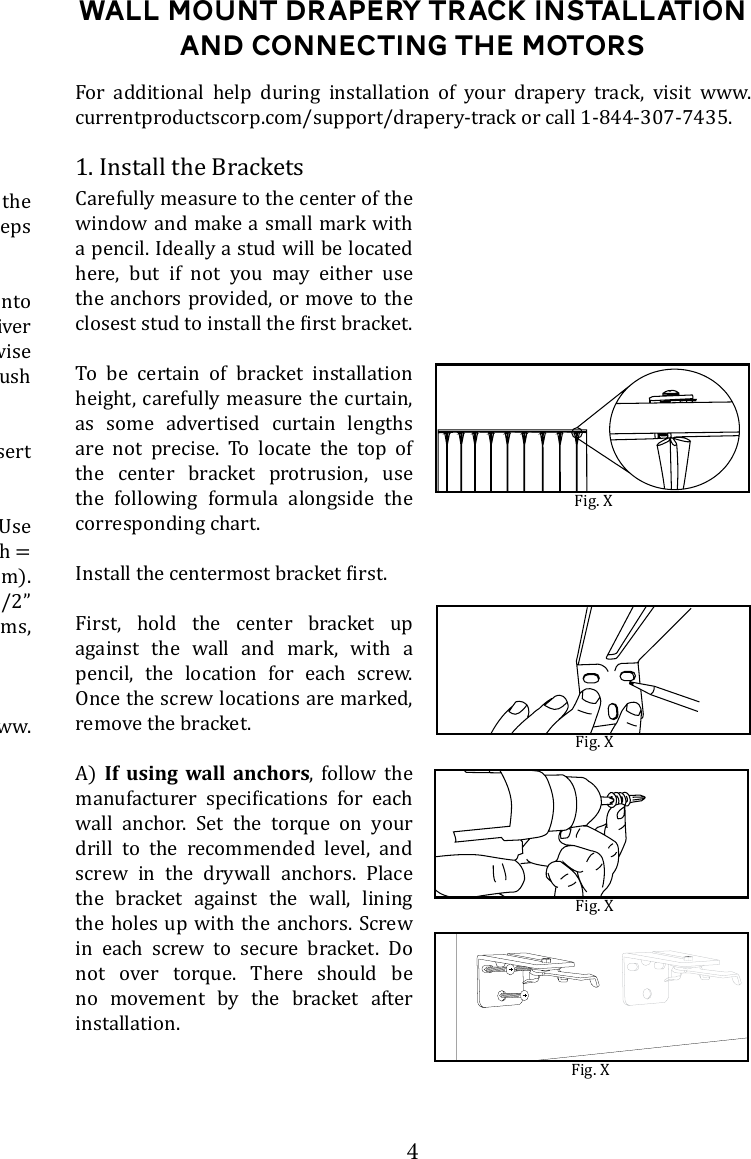
4Wall Mount DRapery Track Installation and connecting the motors1. Install the BracketsFig. XFor additional help during installation of your drapery track, visit www.currentproductscorp.com/support/drapery-track or call 1-844-307-7435.Carefully measure to the center of the window and make a small mark with a pencil. Ideally a stud will be located here, but if not you may either use the anchors provided, or move to the To be certain of bracket installation height, carefully measure the curtain, as some advertised curtain lengths are not precise. To locate the top of the center bracket protrusion, use the following formula alongside the corresponding chart.First, hold the center bracket up against the wall and mark, with a pencil, the location for each screw. Once the screw locations are marked, remove the bracket.A)  If using wall anchors, follow the    wall anchor. Set the torque on your drill to the recommended level, and screw in the drywall anchors. Place the bracket against the wall, lining the holes up with the anchors. Screw in each screw to secure bracket. Do not over torque. There should be no movement by the bracket after installation. Fig. XFig. X(For the anchors included with the drapery track, follow the below steps from the manufacturer’s website: Press tip of SnapSkru anchor into drywall using #2 Phillips screwdriver or screw gun. Drive anchor clockwise      with wall.Place item over anchor and insert screw.      screw with minimum thread length = thickness of item + 1-1/4” (32mm). Maximum item thickness with 1-1/2” long screw: 3/4”. For thicker items, use a longer screw.  For more information, visit www.toggler.com. Fig. X
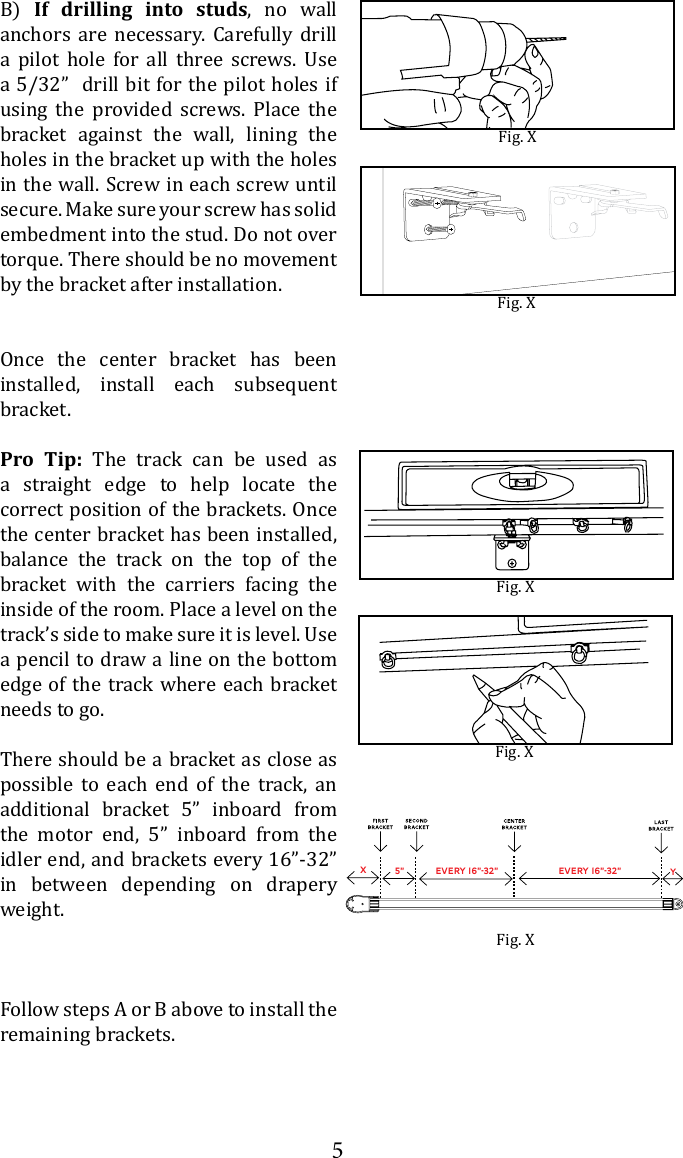
5B)  If drilling into studs, no wall anchors are necessary. Carefully drill        a 5/32”  drill bit for the pilot holes if using the provided screws. Place the bracket against the wall, lining the holes in the bracket up with the holes in the wall. Screw in each screw until secure. Make sure your screw has solid embedment into the stud. Do not over torque. There should be no movement by the bracket after installation. Once the center bracket has been installed, install each subsequent bracket.Pro Tip: The track can be used as a straight edge to help locate the correct position of the brackets. Once the center bracket has been installed, balance the track on the top of the bracket with the carriers facing the inside of the room. Place a level on the a pencil to draw a line on the bottom edge of the track where each bracket needs to go.There should be a bracket as close as possible to each end of the track, an additional bracket 5” inboard from the motor end, 5” inboard from the idler end, and brackets every 16”-32”  in between depending on drapery weight. Follow steps A or B above to install the remaining brackets.Fig. XFig. XFig. XFig. XXy5” Every 16”-32” Every 16”-32”Fig. X
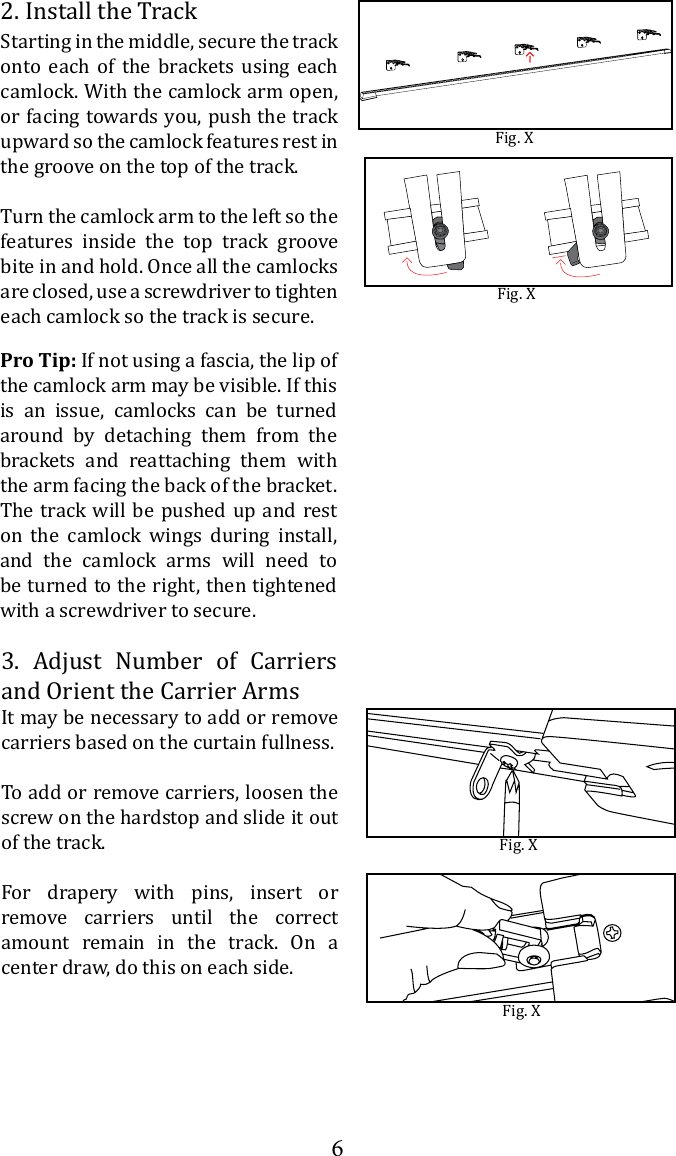
62. Install the TrackStarting in the middle, secure the track onto each of the brackets using each camlock. With the camlock arm open, or facing towards you, push the track upward so the camlock features rest in the groove on the top of the track. Turn the camlock arm to the left so the features inside the top track groove bite in and hold. Once all the camlocks are closed, use a screwdriver to tighten each camlock so the track is secure.Fig. XFig. X3. Adjust Number of Carriers and Orient the Carrier ArmsIt may be necessary to add or remove carriers based on the curtain fullness.To add or remove carriers, loosen the screw on the hardstop and slide it out of the track. For drapery with pins, insert or remove carriers until the correct amount remain in the track. On a center draw, do this on each side.Fig. XFig. XPro Tip: If not using a fascia, the lip of the camlock arm may be visible. If this is an issue, camlocks can be turned around by detaching them from the brackets and reattaching them with the arm facing the back of the bracket. The track will be pushed up and rest on the camlock wings during install, and the camlock arms will need to be turned to the right, then tightened with a screwdriver to secure.
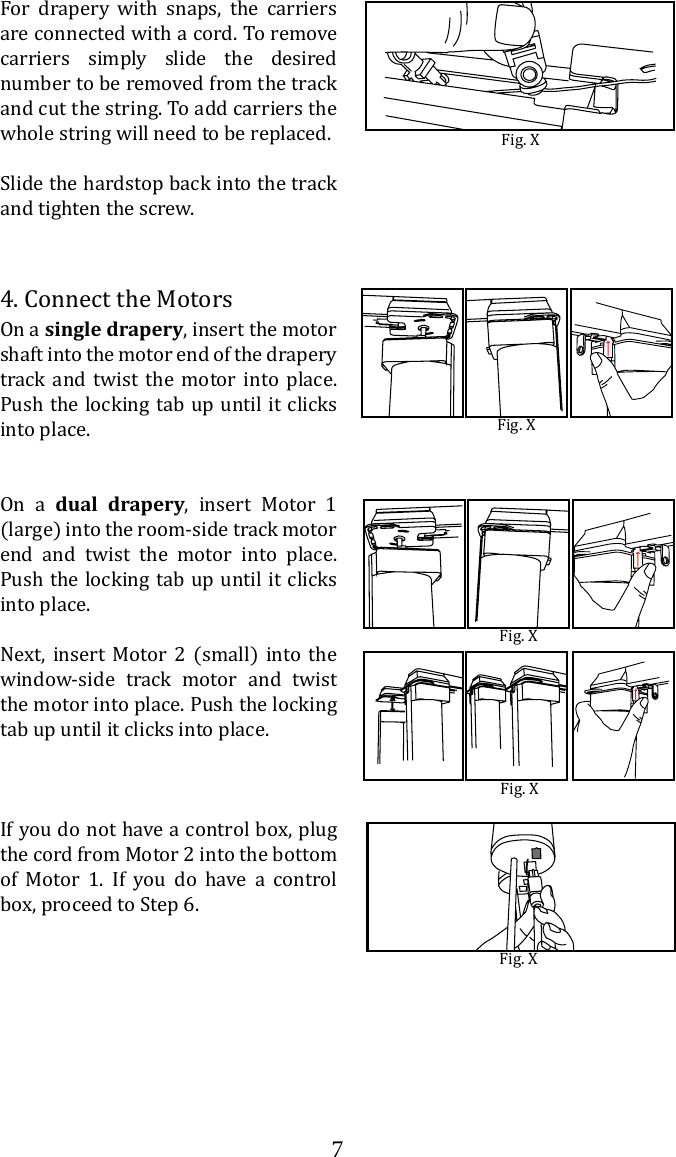
74. Connect the MotorsOn a single drapery, insert the motor shaft into the motor end of the drapery track and twist the motor into place. Push the locking tab up until it clicks into place.On a dual drapery, insert Motor 1 (large) into the room-side track motor end and twist the motor into place. Push the locking tab up until it clicks into place.Next, insert Motor 2 (small) into the window-side track motor and twist the motor into place. Push the locking tab up until it clicks into place.If you do not have a control box, plug the cord from Motor 2 into the bottom of Motor 1. If you do have a control box, proceed to Step 6. Fig. XFig. XFig. XFig. XFor drapery with snaps, the carriers are connected with a cord. To remove carriers simply slide the desired number to be removed from the track and cut the string. To add carriers the whole string will need to be replaced.Slide the hardstop back into the track and tighten the screw.Fig. X
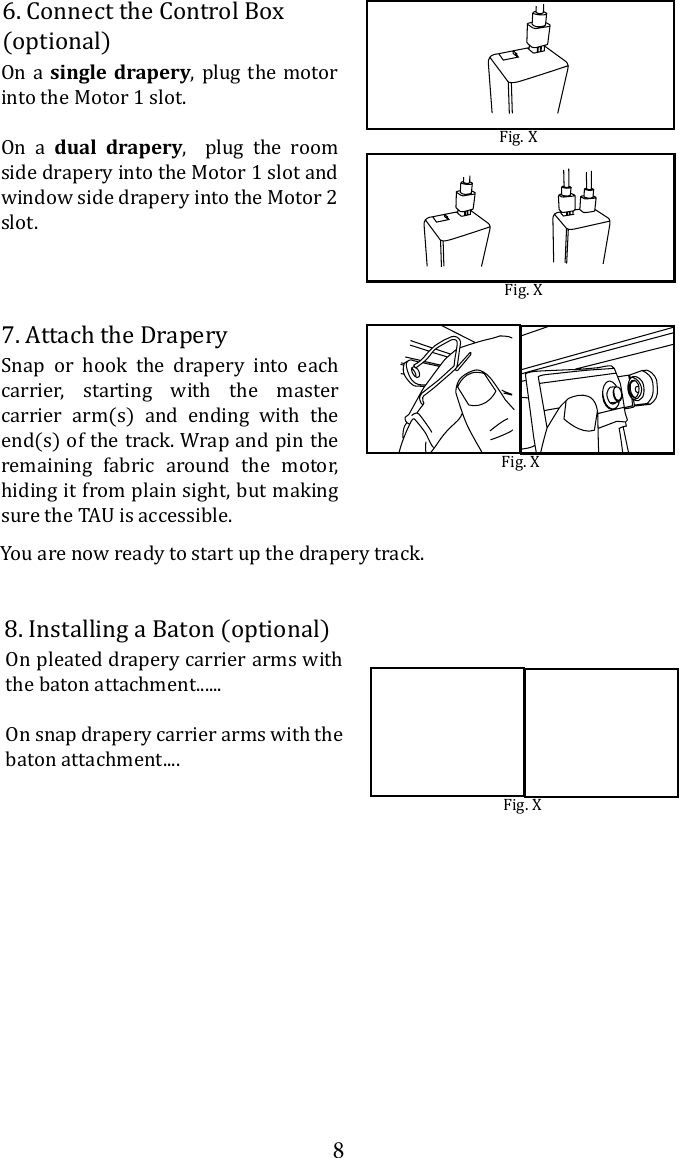
87. Attach the DraperySnap or hook the drapery into each carrier, starting with the master carrier arm(s) and ending with the end(s) of the track. Wrap and pin the remaining fabric around the motor, hiding it from plain sight, but making Fig. XYou are now ready to start up the drapery track.On a single drapery, plug the motor into the Motor 1 slot. On a dual drapery,  plug the room side drapery into the Motor 1 slot and window side drapery into the Motor 2 slot.  6. Connect the Control Box (optional)Fig. XFig. X8. Installing a Baton (optional)On pleated drapery carrier arms with the baton attachment......On snap drapery carrier arms with the baton attachment....Fig. X
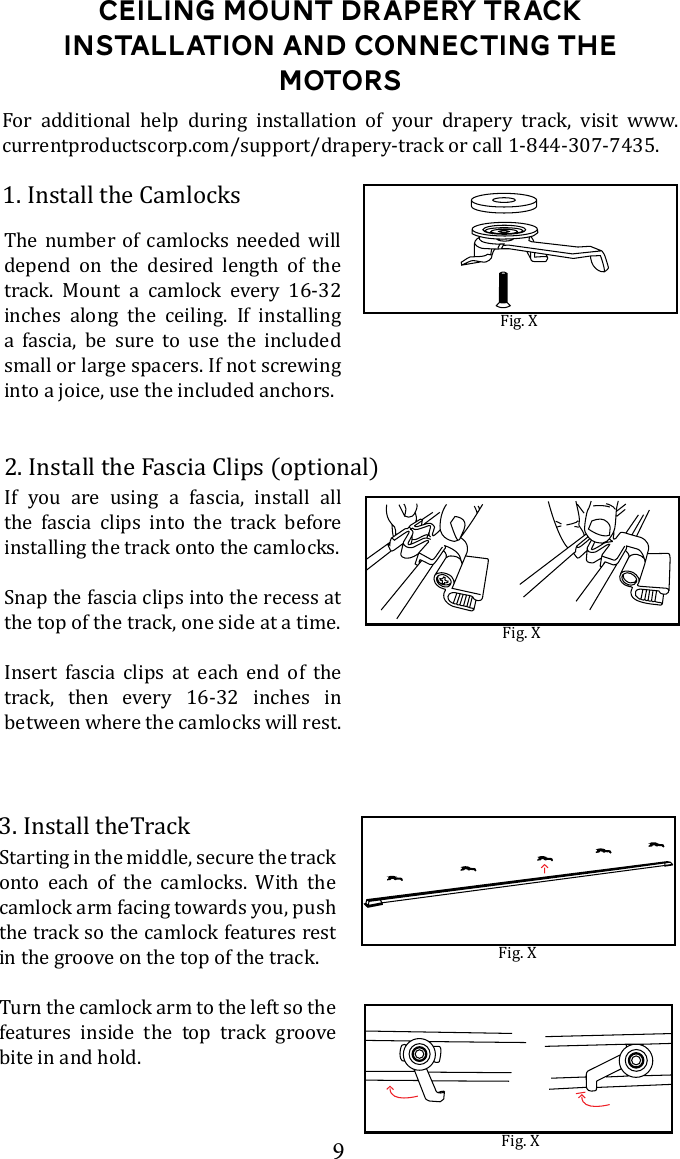
9Ceiling Mount DRapery Track Installation and connecting the motors1. Install the CamlocksFig. XThe number of camlocks needed will depend on the desired length of the track. Mount a camlock every 16-32 inches along the ceiling. If installing a fascia, be sure to use the included small or large spacers. If not screwing into a joice, use the included anchors. For additional help during installation of your drapery track, visit www.currentproductscorp.com/support/drapery-track or call 1-844-307-7435.2. Install the Fascia Clips (optional)Fig. XIf you are using a fascia, install all the fascia clips into the track before installing the track onto the camlocks.Snap the fascia clips into the recess at the top of the track, one side at a time. Insert fascia clips at each end of the track, then every 16-32 inches in between where the camlocks will rest.Fig. X3. Install theTrackStarting in the middle, secure the track onto each of the camlocks. With the camlock arm facing towards you, push the track so the camlock features rest in the groove on the top of the track. Turn the camlock arm to the left so the features inside the top track groove bite in and hold.Fig. X
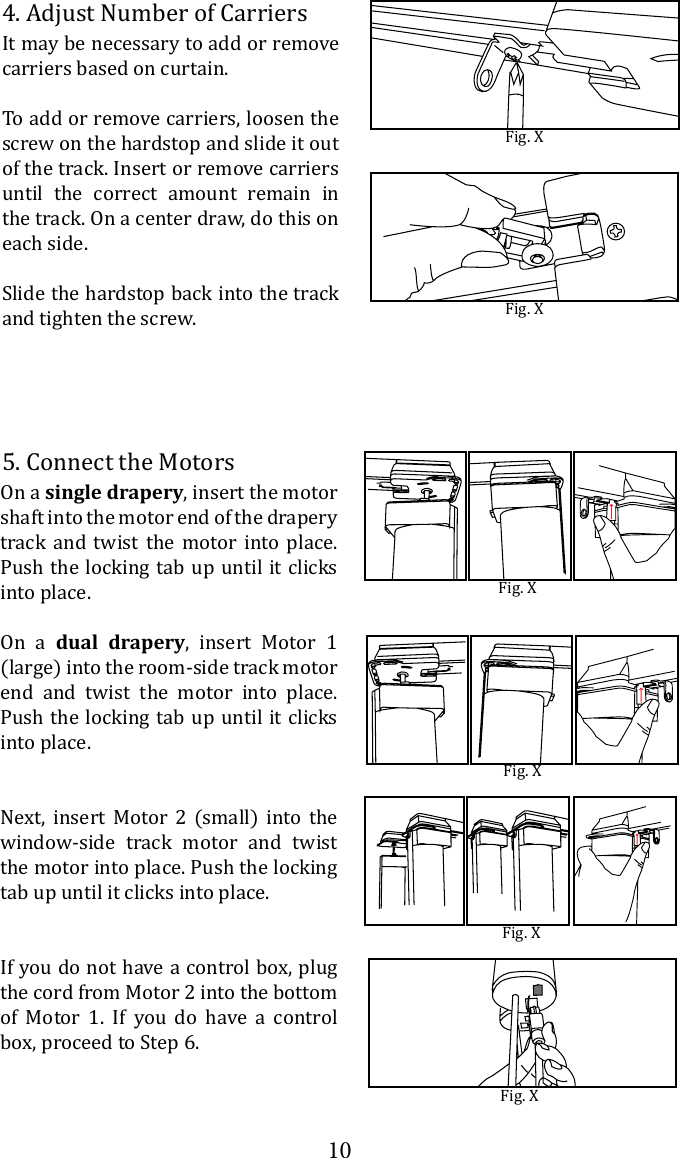
105. Connect the MotorsFig. XOn a single drapery, insert the motor shaft into the motor end of the drapery track and twist the motor into place. Push the locking tab up until it clicks into place.On a dual drapery, insert Motor 1 (large) into the room-side track motor end and twist the motor into place. Push the locking tab up until it clicks into place.Next, insert Motor 2 (small) into the window-side track motor and twist the motor into place. Push the locking tab up until it clicks into place.If you do not have a control box, plug the cord from Motor 2 into the bottom of Motor 1. If you do have a control box, proceed to Step 6. Fig. XFig. XFig. X4. Adjust Number of CarriersIt may be necessary to add or remove carriers based on curtain.To add or remove carriers, loosen the screw on the hardstop and slide it out of the track. Insert or remove carriers until the correct amount remain in the track. On a center draw, do this on each side.Slide the hardstop back into the track and tighten the screw.Fig. XFig. X
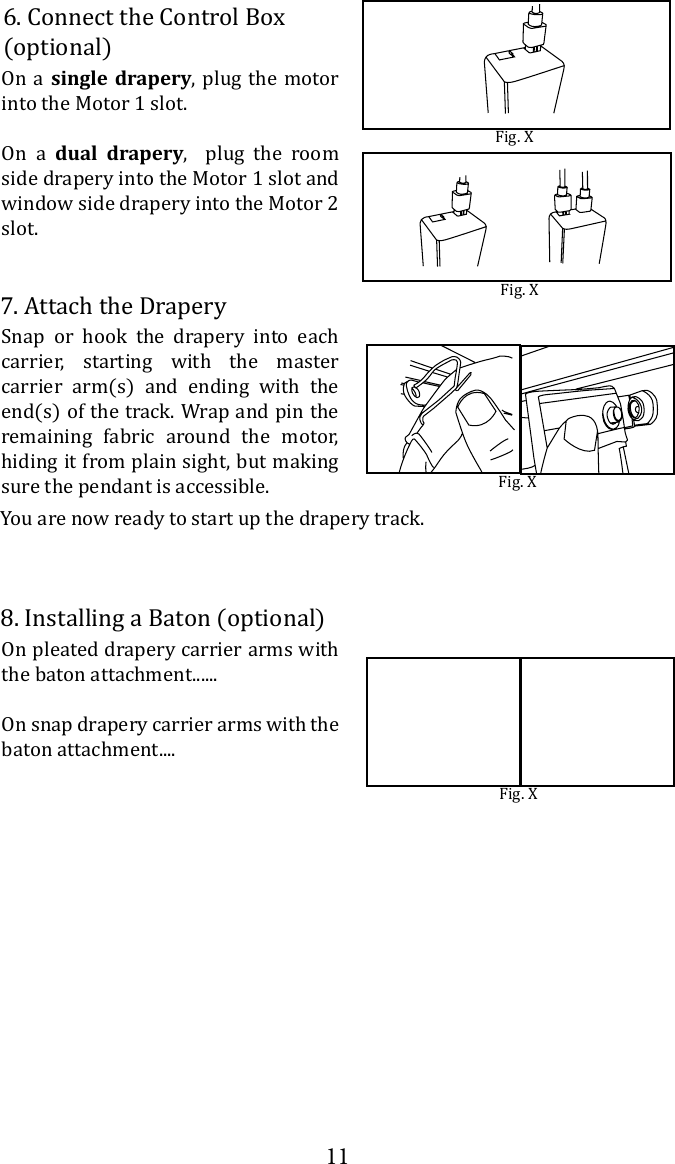
11On a single drapery, plug the motor into the Motor 1 slot. On a dual drapery,  plug the room side drapery into the Motor 1 slot and window side drapery into the Motor 2 slot.  6. Connect the Control Box (optional)Fig. XFig. X7. Attach the DraperyYou are now ready to start up the drapery track.Snap or hook the drapery into each carrier, starting with the master carrier arm(s) and ending with the end(s) of the track. Wrap and pin the remaining fabric around the motor, hiding it from plain sight, but making sure the pendant is accessible. Fig. X8. Installing a Baton (optional)On pleated drapery carrier arms with the baton attachment......On snap drapery carrier arms with the baton attachment....Fig. X
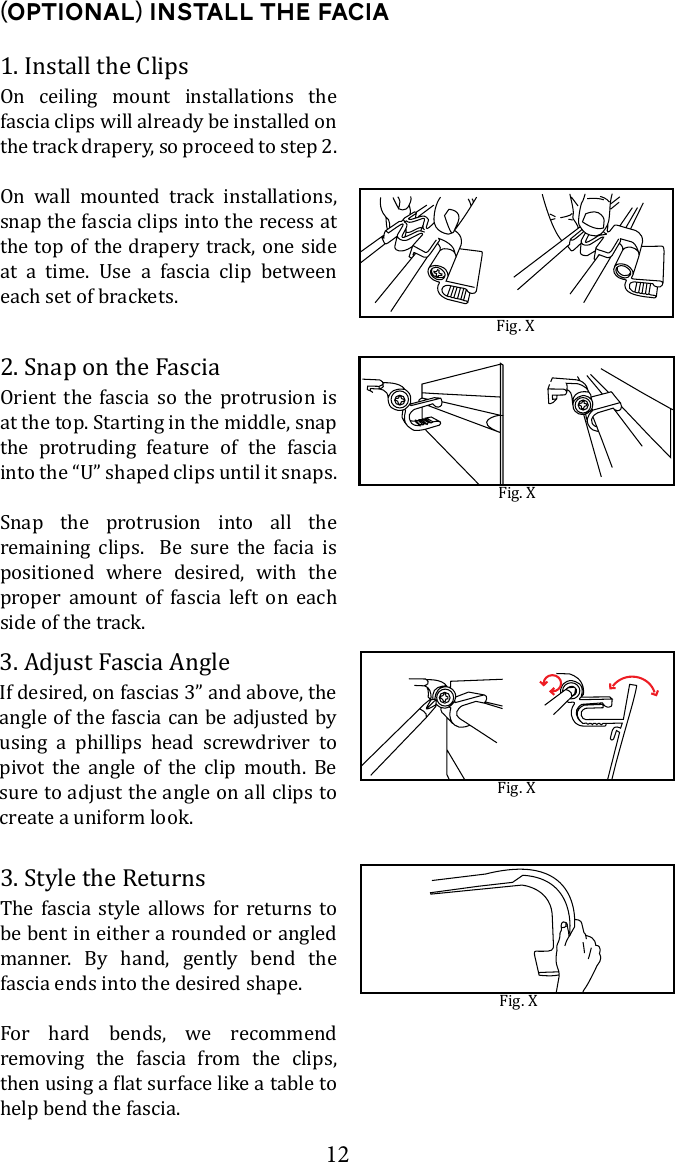
121. Install the Clips(Optional) Install the FaciaOn ceiling mount installations the fascia clips will already be installed on the track drapery, so proceed to step 2.On wall mounted track installations, snap the fascia clips into the recess at the top of the drapery track, one side        each set of brackets.Fig. X2. Snap on the FasciaOrient the fascia so the protrusion is at the top. Starting in the middle, snap the protruding feature of the fascia Snap the protrusion into all the remaining clips.  Be sure the facia is positioned where desired, with the proper amount of fascia left on each side of the track.3. Style the ReturnsThe fascia style allows for returns to be bent in either a rounded or angled manner. By hand, gently bend the fascia ends into the desired shape.For hard bends, we recommend removing the fascia from the clips, help bend the fascia.3. Adjust Fascia AngleIf desired, on fascias 3” and above, the angle of the fascia can be adjusted by using a phillips head screwdriver to pivot the angle of the clip mouth. Be sure to adjust the angle on all clips to create a uniform look. Fig. XFig. XFig. X
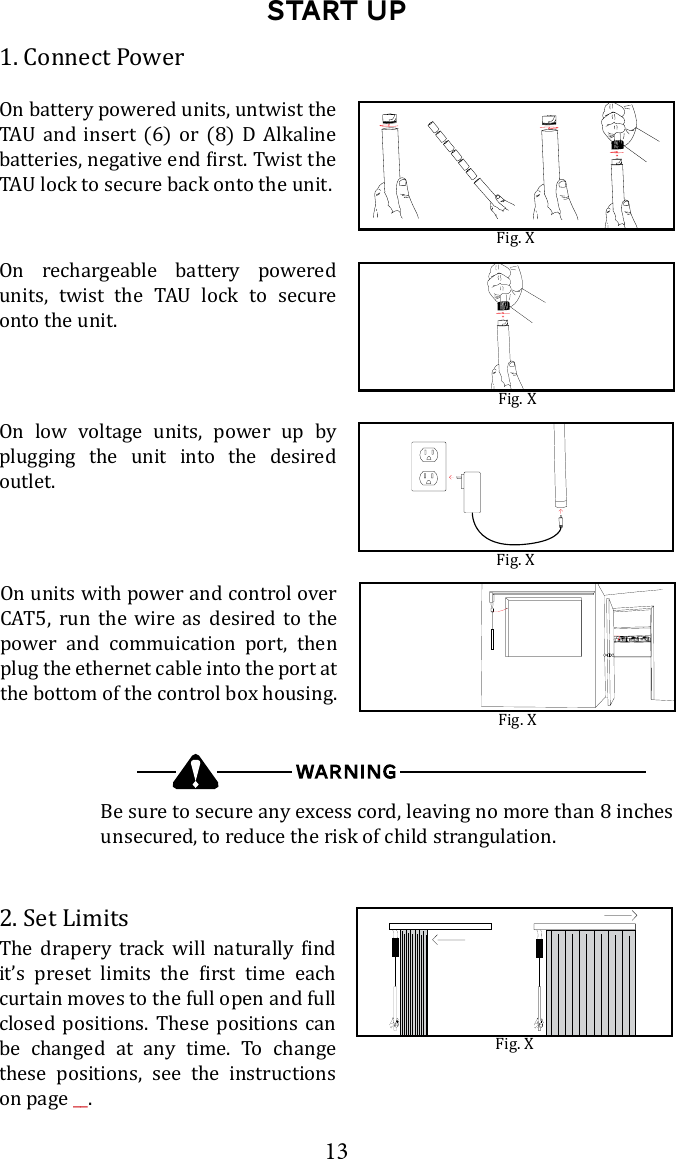
13Start up1. Connect PowerOn battery powered units, untwist the        Fig. XBe sure to secure any excess cord, leaving no more than 8 inches unsecured, to reduce the risk of child strangulation.Fig. XFig. XFig. XOn units with power and control over CAT5, run the wire as desired to the power and commuication port, then plug the ethernet cable into the port at the bottom of the control box housing.On low voltage units, power up by plugging the unit into the desired outlet. 2. Set Limits           curtain moves to the full open and full closed positions. These positions can be changed at any time. To change these positions, see the instructions on page __.Fig. XOn rechargeable battery powered       onto the unit.
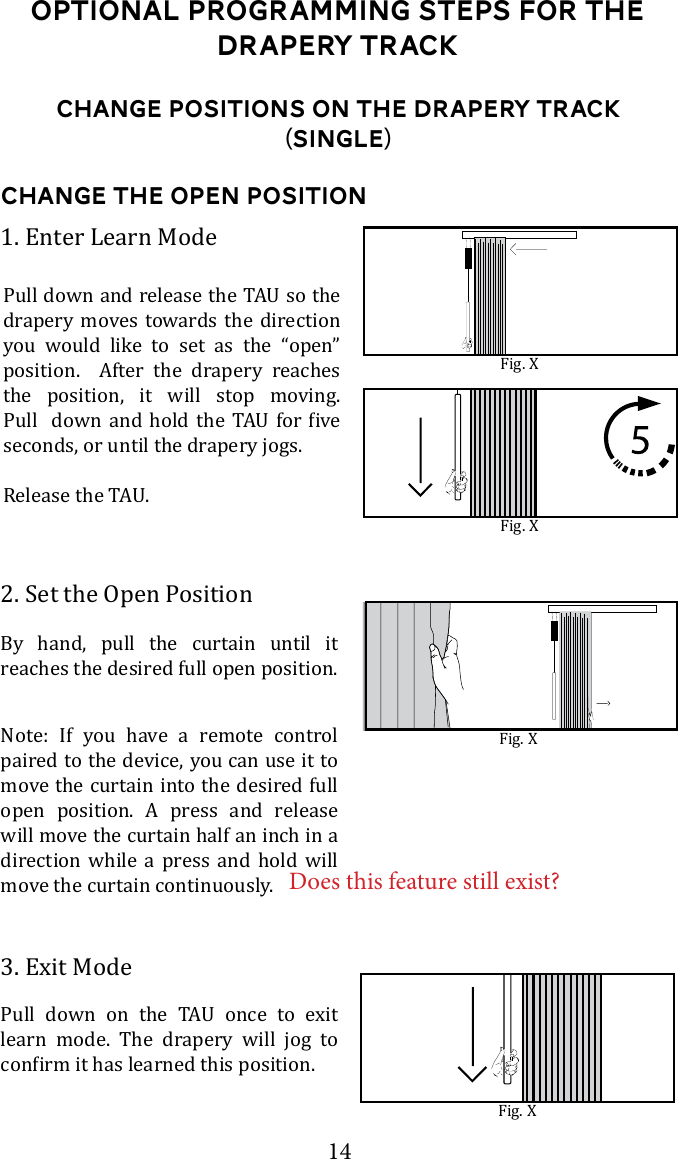
14Change Positions on the drapery Track (Single)Change the open Position2. Set the Open PositionBy hand, pull the curtain until it reaches the desired full open position. 3. Exit Mode       learn mode. The drapery will jog to 1. Enter Learn Modedrapery moves towards the direction you would like to set as the “open” position.  After the drapery reaches the position, it will stop moving.         seconds, or until the drapery jogs.Fig. XFig. XFig. XNote: If you have a remote control paired to the device, you can use it to move the curtain into the desired full open position. A press and release will move the curtain half an inch in a direction while a press and hold will move the curtain continuously. Fig. XOptional Programming steps for the Drapery TrackDoes this feature still exist?
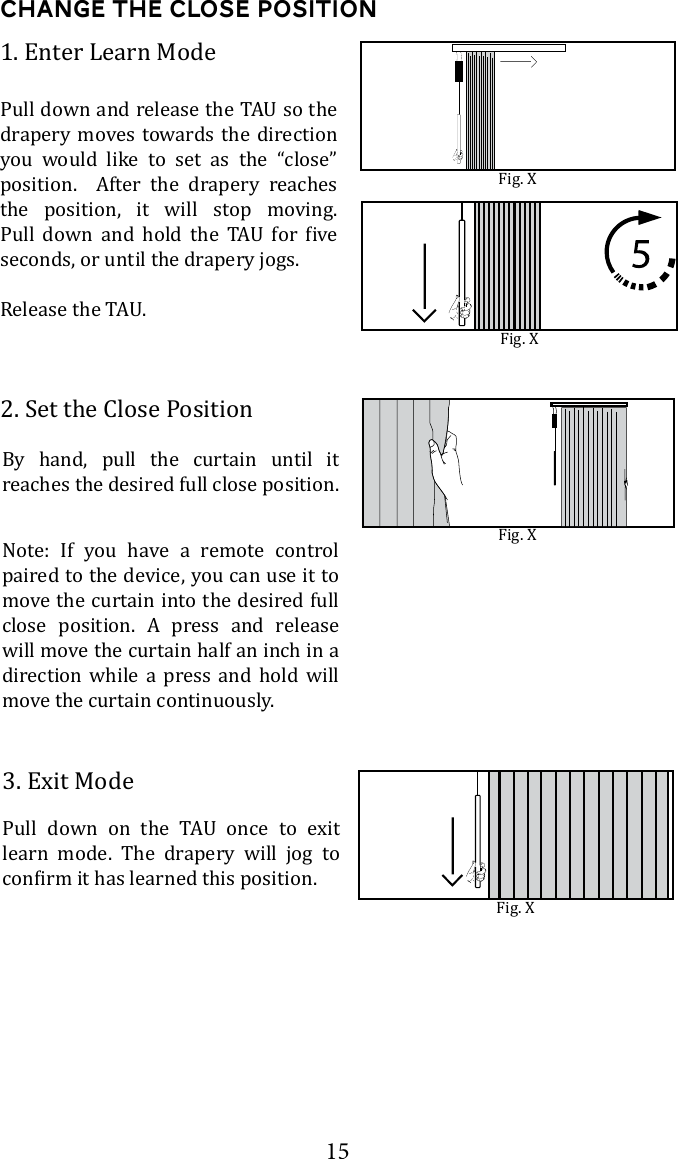
15Change the Close Position2. Set the Close Position3. Exit Mode       learn mode. The drapery will jog to 1. Enter Learn Modedrapery moves towards the direction you would like to set as the “close” position.  After the drapery reaches the position, it will stop moving.        seconds, or until the drapery jogs.Fig. XFig. XNote: If you have a remote control paired to the device, you can use it to move the curtain into the desired full close position. A press and release will move the curtain half an inch in a direction while a press and hold will move the curtain continuously. By hand, pull the curtain until it reaches the desired full close position. Fig. XFig. X
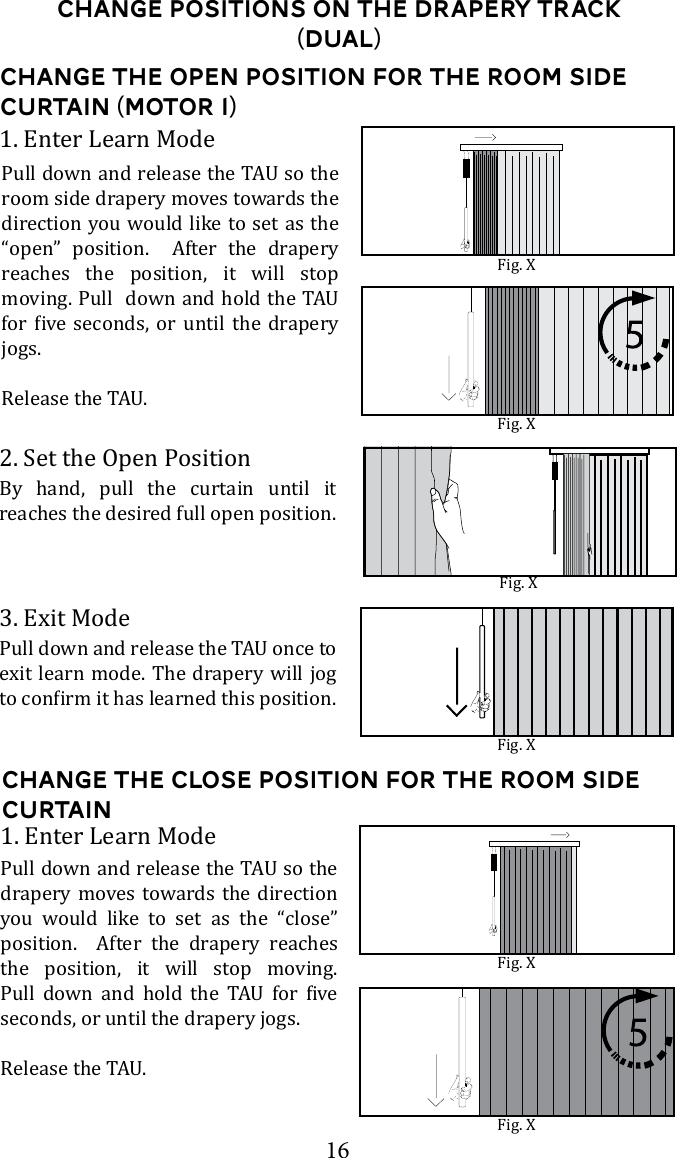
16Change the open Position for the Room Side curtain (Motor 1)2. Set the Open PositionBy hand, pull the curtain until it  reaches the desired full open position. 3. Exit Modeexit learn mode. The drapery will jog 1. Enter Learn Moderoom side drapery moves towards the direction you would like to set as the “open” position.  After the drapery reaches the position, it will stop       jogs.Change the Close Position for the room side curtain1. Enter Learn Modedrapery moves towards the direction you would like to set as the “close” position.  After the drapery reaches the position, it will stop moving.        seconds, or until the drapery jogs.Fig. XFig. XFig. XFig. XFig. XChange Positions on the drapery Track (dual)Fig. X
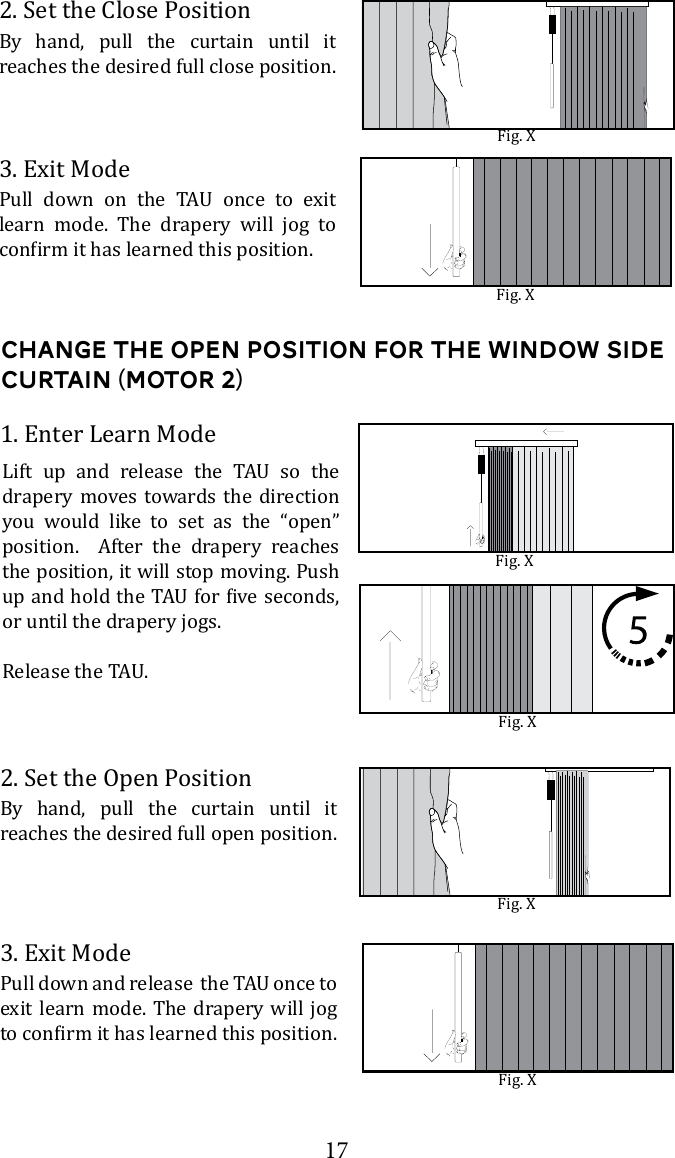
172. Set the Close PositionBy hand, pull the curtain until it  reaches the desired full close position. 3. Exit Mode       learn mode. The drapery will jog to Fig. XFig. XChange the open Position for the window side curtain (Motor 2)2. Set the Open PositionBy hand, pull the curtain until it reaches the desired full open position. 3. Exit Modeexit learn mode. The drapery will jog 1. Enter Learn Mode       drapery moves towards the direction you would like to set as the “open” position.  After the drapery reaches the position, it will stop moving. Push or until the drapery jogs.Fig. XFig. XFig. XFig. X
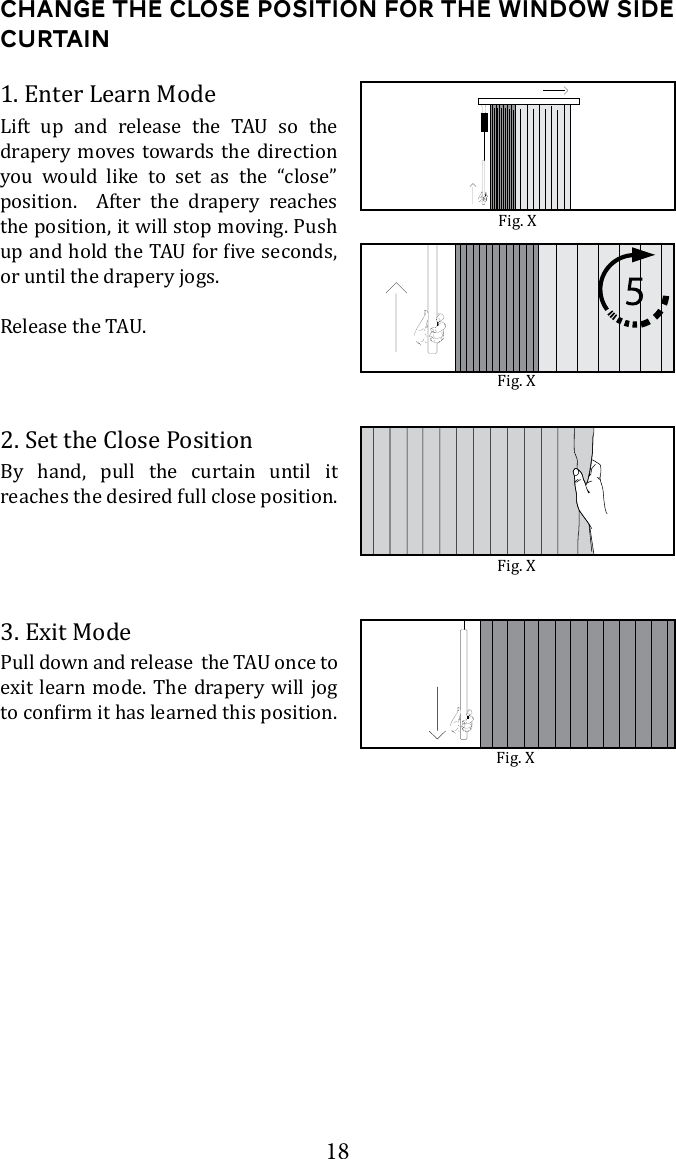
18Change the Close Position for the window side curtain2. Set the Close PositionBy hand, pull the curtain until it reaches the desired full close position. 3. Exit Modeexit learn mode. The drapery will jog 1. Enter Learn Mode       drapery moves towards the direction you would like to set as the “close” position.  After the drapery reaches the position, it will stop moving. Push or until the drapery jogs.Fig. XFig. XFig. XFig. X
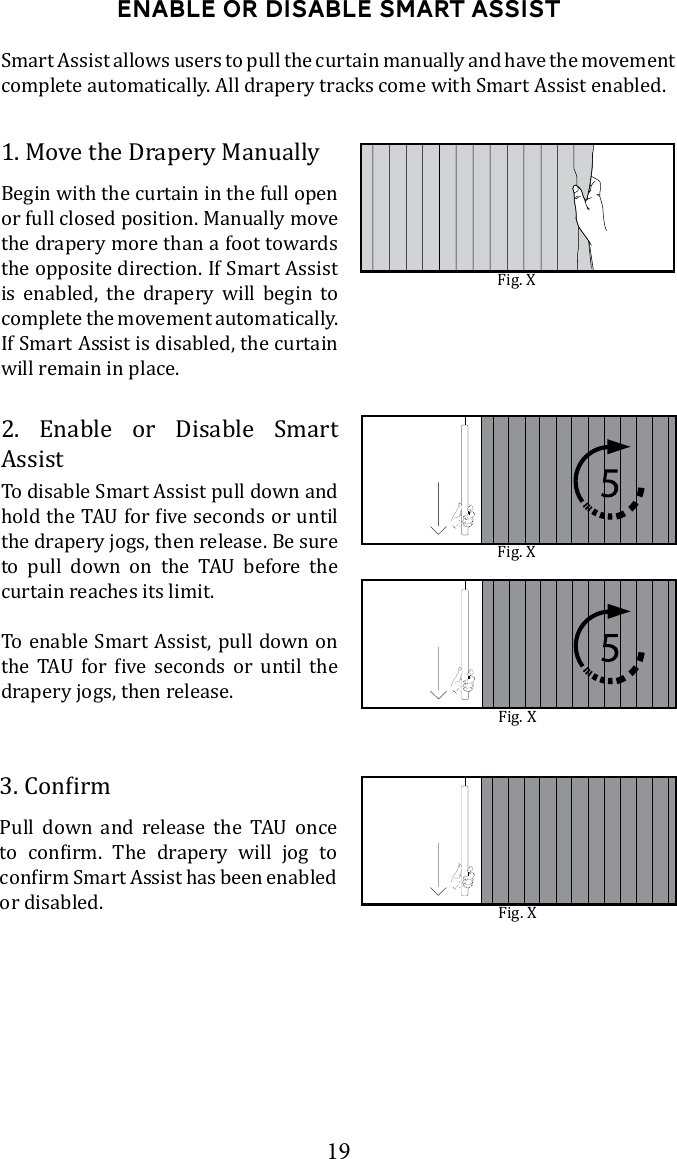
19Enable or disable smart assistSmart Assist allows users to pull the curtain manually and have the movement complete automatically. All drapery tracks come with Smart Assist enabled.1. Move the Drapery ManuallyBegin with the curtain in the full open or full closed position. Manually move the drapery more than a foot towards the opposite direction. If Smart Assist is enabled, the drapery will begin to complete the movement automatically.  If Smart Assist is disabled, the curtain will remain in place.2. Enable or Disable Smart AssistTo disable Smart Assist pull down and the drapery jogs, then release. Be sure        curtain reaches its limit.To enable Smart Assist, pull down on        drapery jogs, then release.            or disabled. Fig. XFig. XFig. XFig. X
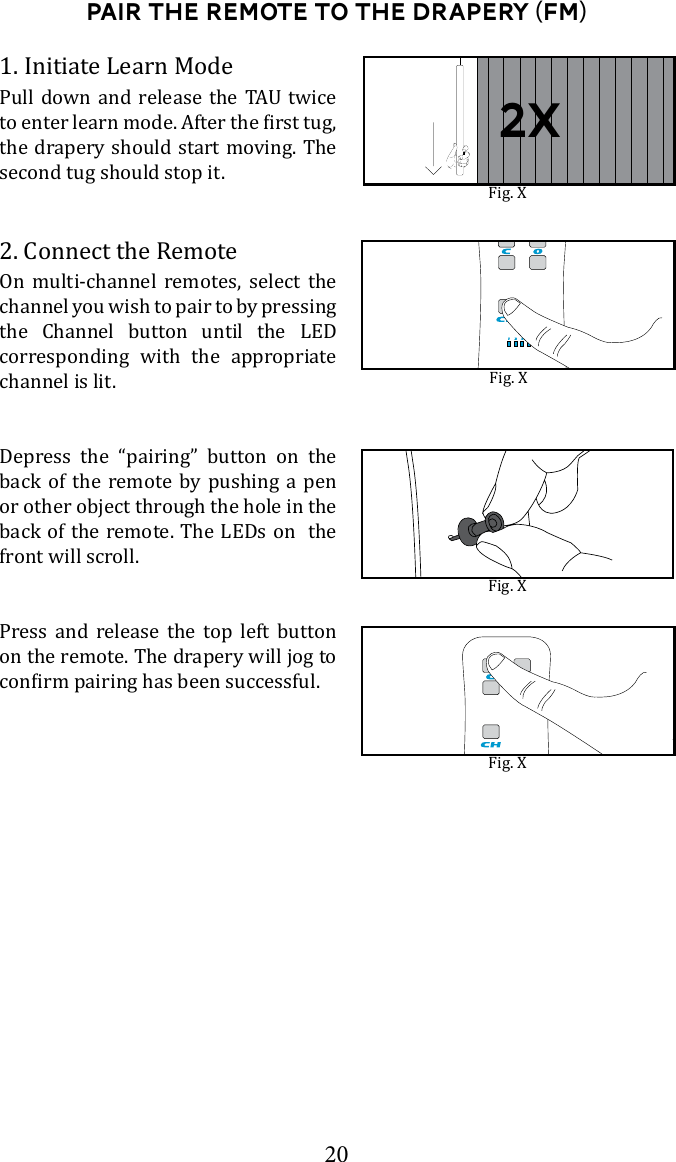
20Pair the Remote to the drapery (FM)1. Initiate Learn Mode      the drapery should start moving. The second tug should stop it. 2. Connect the RemoteOn multi-channel remotes, select the channel you wish to pair to by pressing the Channel button until the LED corresponding with the appropriate channel is lit. Depress the “pairing” button on the back of the remote by pushing a pen or other object through the hole in the back of the remote. The LEDs on  the front will scroll. Press and release the top left button on the remote. The drapery will jog to Fig. XFig. XFig. XFig. X2x
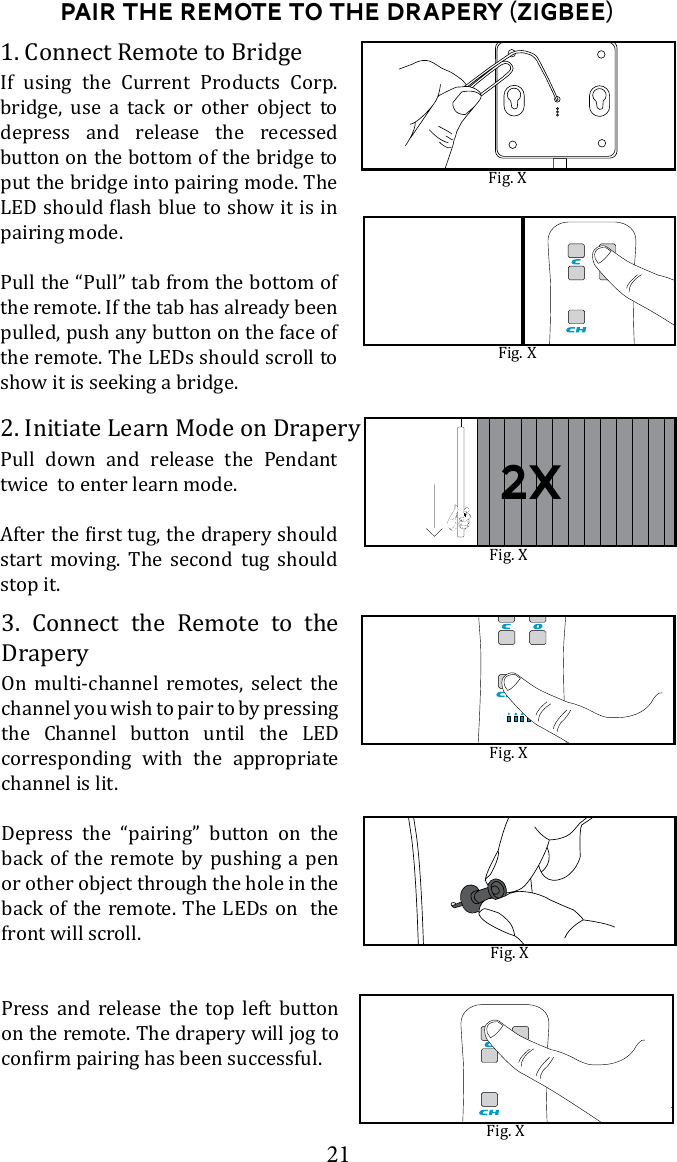
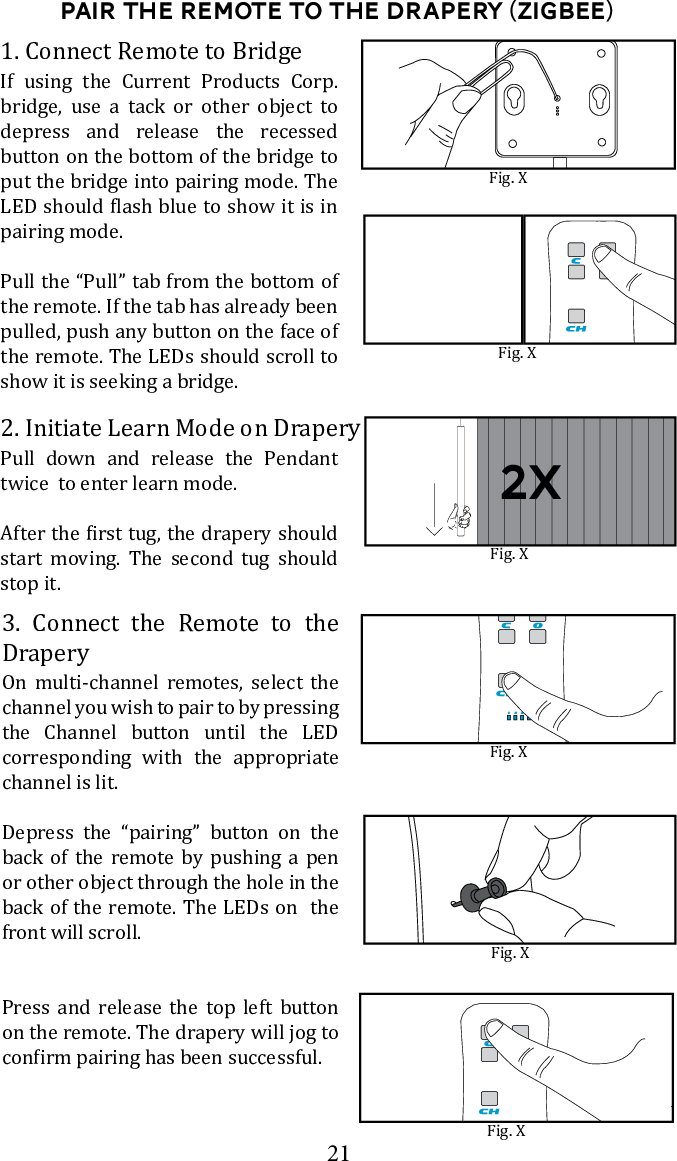
21Pair the Remote to the drapery (Zigbee)2. Initiate Learn Mode on DraperyPull down and release the Pendant twice  to enter learn mode. start moving. The second tug should stop it. 3. Connect the Remote to the DraperyOn multi-channel remotes, select the channel you wish to pair to by pressing the Channel button until the LED corresponding with the appropriate channel is lit. Depress the “pairing” button on the back of the remote by pushing a pen or other object through the hole in the back of the remote. The LEDs on  the front will scroll. Press and release the top left button on the remote. The drapery will jog to Fig. XFig. XFig. XFig. X2x1. Connect Remote to BridgeIf using the Current Products Corp. bridge, use a tack or other object to depress and release the recessed button on the bottom of the bridge to put the bridge into pairing mode. The pairing mode.Pull the “Pull” tab from the bottom of the remote. If the tab has already been pulled, push any button on the face of the remote. The LEDs should scroll to show it is seeking a bridge.Fig. XFig. X
22
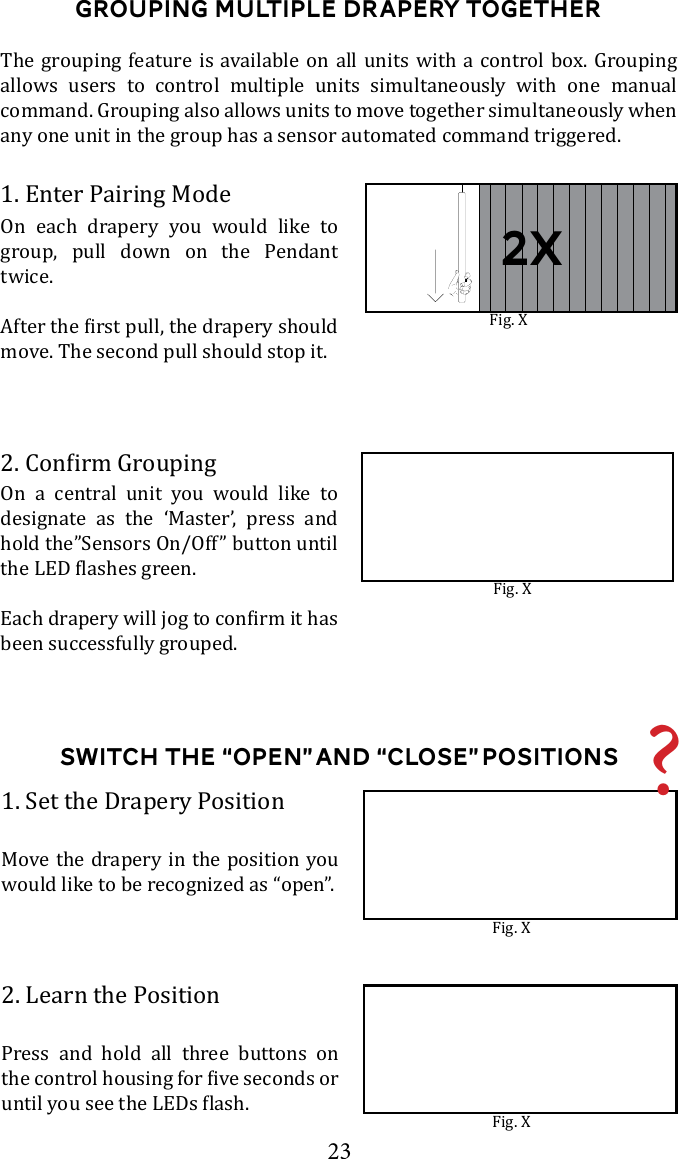
23Switch the “Open” and “close” Positions1. Set the Drapery PositionMove the drapery in the position you would like to be recognized as “open”. Fig. X2. Learn the PositionPress and hold all three buttons on Fig. XGrouping Multiple Drapery TogetherOn a central unit you would like to designate as the ‘Master’, press and hold the”Sensors On/Off” button until been successfully grouped. 1. Enter Pairing ModeOn each drapery you would like to group, pull down on the Pendant twice. move. The second pull should stop it. Fig. XFig. X?2x    allows users to control multiple units simultaneously with one manual any one unit in the group has a sensor automated command triggered.
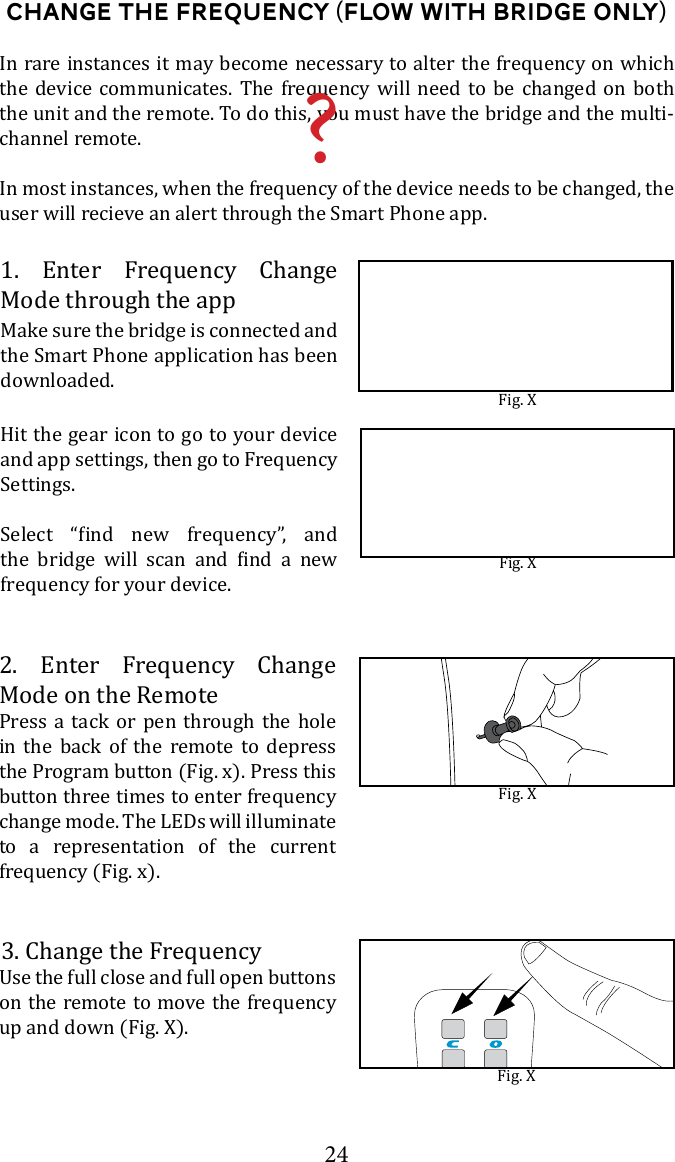
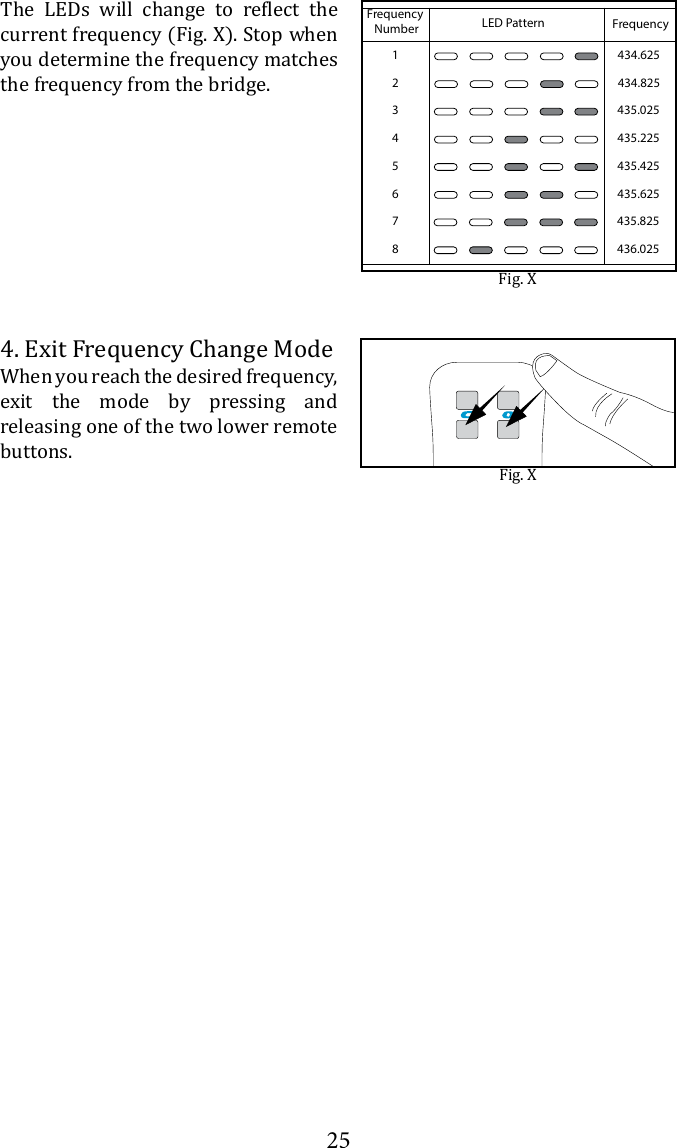
24Change the Frequency (FLOW with bridge ONLY)2. Enter Frequency Change Mode on the RemotePress a tack or pen through the hole in the back of the remote to depress the Program button (Fig. x). Press this button three times to enter frequency change mode. The LEDs will illuminate to a representation of the current frequency (Fig. x).In rare instances it may become necessary to alter the frequency on which the device communicates. The frequency will need to be changed on both the unit and the remote. To do this, you must have the bridge and the multi-channel remote.In most instances, when the frequency of the device needs to be changed, the user will recieve an alert through the Smart Phone app.Fig. XFig. X3. Change the Frequencyon the remote to move the frequency up and down (Fig. X). 1. Enter Frequency Change Mode through the appMake sure the bridge is connected and the Smart Phone application has been downloaded. Fig. XHit the gear icon to go to your device and app settings, then go to Frequency Settings.           frequency for your device. Fig. X?
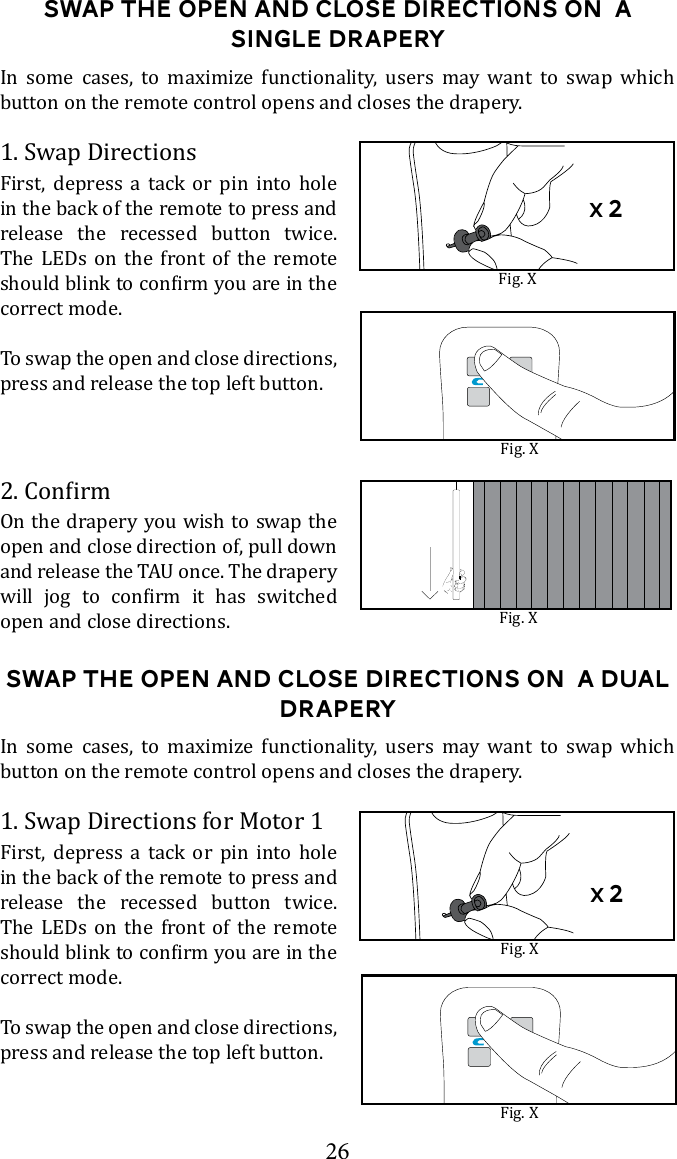
25434.625434.825435.025435.225435.425435.625435.825436.02512345678FrequencyLED PatternFrequency NumberFig. X      current frequency (Fig. X). Stop when  you determine the frequency matches the frequency from the bridge.4. Exit Frequency Change ModeWhen you reach the desired frequency, exit the mode by pressing and releasing one of the two lower remote buttons. Fig. X
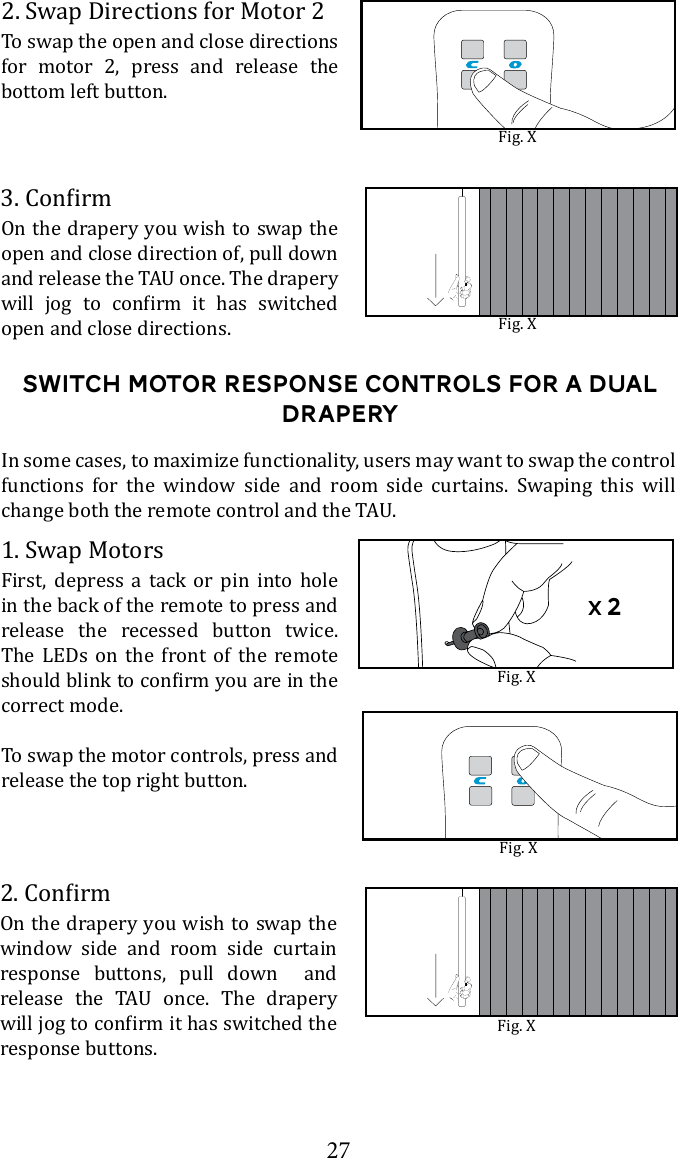
26Swap the Open and Close Directions on  a single draperyIn some cases, to maximize functionality, users may want to swap which button on the remote control opens and closes the drapery. Fig. X1. Swap DirectionsFirst, depress a tack or pin into hole in the back of the remote to press and release the recessed button twice. The LEDs on the front of the remote correct mode. To swap the open and close directions, press and release the top left button.On the drapery you wish to swap the open and close direction of, pull down        open and close directions. Fig. XSwap the Open and Close Directions on  a Dual draperyIn some cases, to maximize functionality, users may want to swap which button on the remote control opens and closes the drapery. Fig. X1. Swap Directions for Motor 1First, depress a tack or pin into hole in the back of the remote to press and release the recessed button twice. The LEDs on the front of the remote correct mode. To swap the open and close directions, press and release the top left button.Fig. XFig. Xx 2x 2
27Switch motor response Controls for a dual draperyOn the drapery you wish to swap the open and close direction of, pull down        open and close directions. Fig. XFig. X2. Swap Directions for Motor 2To swap the open and close directions for motor 2, press and release the bottom left button.Fig. X1. Swap MotorsFirst, depress a tack or pin into hole in the back of the remote to press and release the recessed button twice. The LEDs on the front of the remote correct mode. To swap the motor controls, press and release the top right button.In some cases, to maximize functionality, users may want to swap the control functions for the window side and room side curtains. Swaping this will On the drapery you wish to swap the window side and room side curtain response buttons, pull down  and      response buttons.Fig. XFig. Xx 2
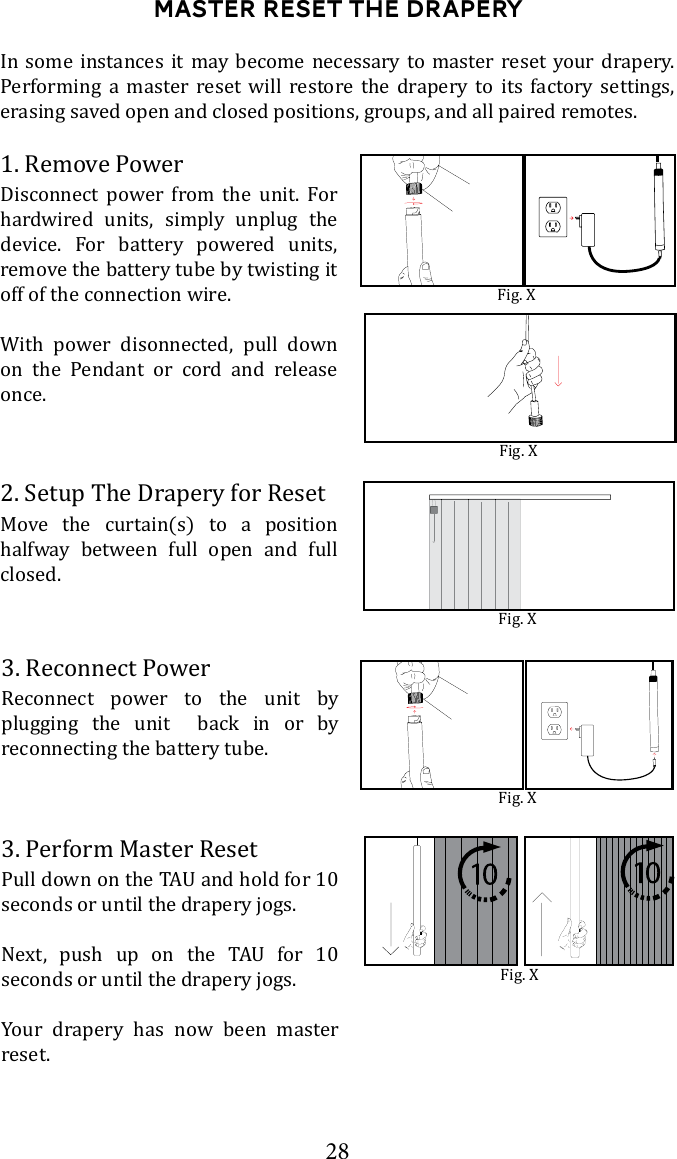
28Master Reset the Drapery2. Setup The Drapery for ResetMove the curtain(s) to a position halfway between full open and full closed. Fig. X3. Reconnect PowerReconnect power to the unit by plugging the unit  back in or by reconnecting the battery tube. Fig. XIn some instances it may become necessary to master reset your drapery. Performing a master reset will restore the drapery to its factory settings, erasing saved open and closed positions, groups, and all paired remotes. 3. Perform Master Resetseconds or until the drapery jogs.       seconds or until the drapery jogs. Your drapery has now been master reset.Fig. XFig. X1. Remove PowerDisconnect power from the unit. For hardwired units, simply unplug the device. For battery powered units, remove the battery tube by twisting it off of the connection wire.With power disonnected, pull down on the Pendant or cord and release once. Fig. X
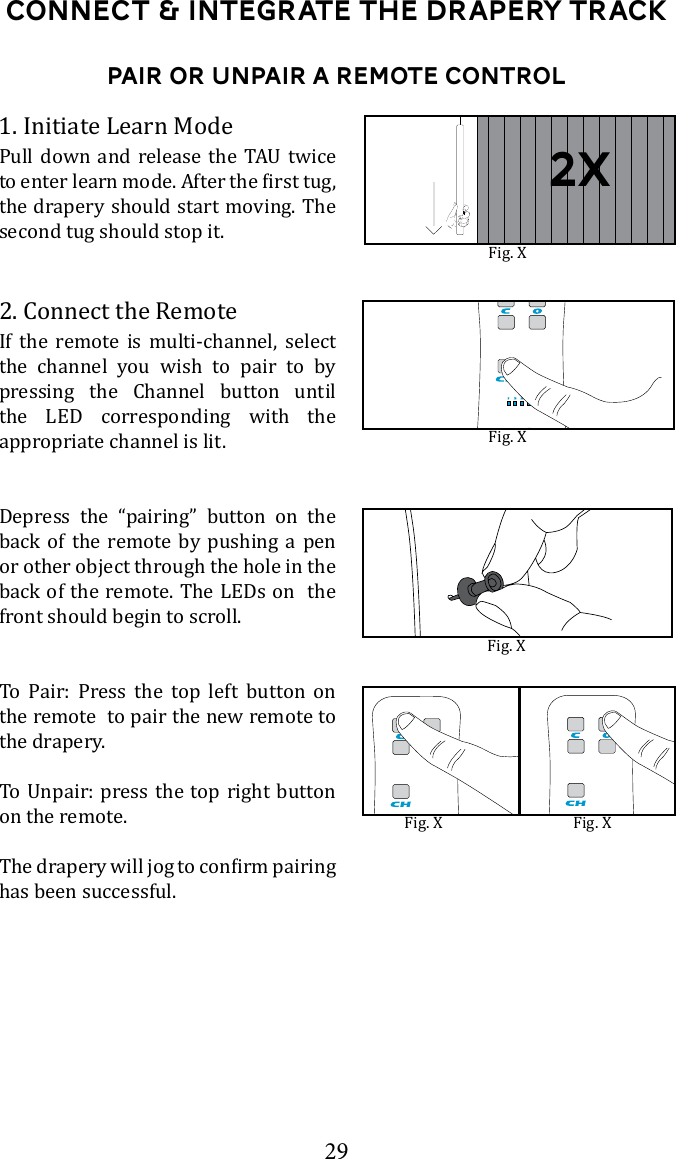
29Connect & Integrate the drapery TrackPair or Unpair A Remote Control1. Initiate Learn Mode      the drapery should start moving. The second tug should stop it. 2. Connect the RemoteIf the remote is multi-channel, select the channel you wish to pair to by pressing the Channel button until the LED corresponding with the appropriate channel is lit. Depress the “pairing” button on the back of the remote by pushing a pen or other object through the hole in the back of the remote. The LEDs on  the front should begin to scroll. To Pair: Press the top left button on the remote  to pair the new remote to the drapery. on the remote.has been successful.  Fig. XFig. XFig. XFig. X Fig. X2x
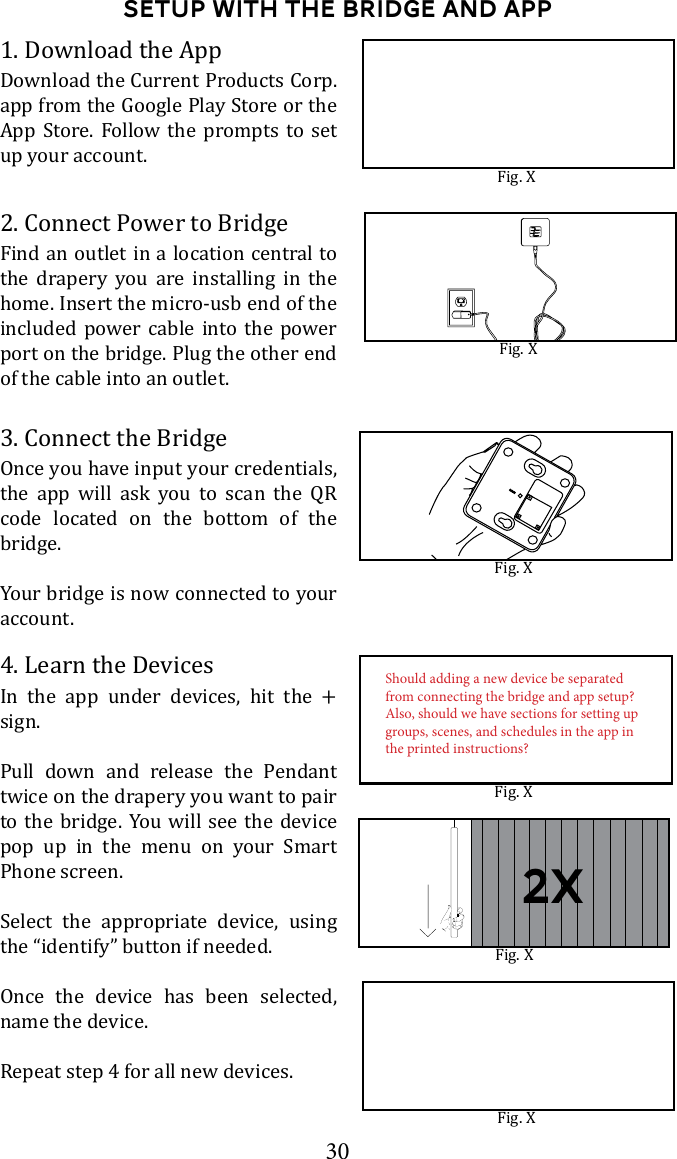
30Setup with the bridge and app1. Download the AppDownload the Current Products Corp. App Store. Follow the prompts to set up your account.3. Connect the BridgeOnce you have input your credentials, the app will ask you to scan the QR code located on the bottom of the bridge.Your bridge is now connected to your account.2. Connect Power to BridgeFind an outlet in a location central to the drapery you are installing in the home. Insert the micro-usb end of the included power cable into the power port on the bridge. Plug the other end of the cable into an outlet. 4. Learn the DevicesIn the app under devices, hit the + sign. Pull down and release the Pendant twice on the drapery you want to pair to the bridge. You will see the device pop up in the menu on your Smart Phone screen. Select the appropriate device, using the “identify” button if needed. Once the device has been selected, name the device. Repeat step 4 for all new devices.Fig. XFig. XFig. XFig. XFig. XFig. XShould adding a new device be separated from connecting the bridge and app setup? Also, should we have sections for setting up groups, scenes, and schedules in the app in the printed instructions?2x
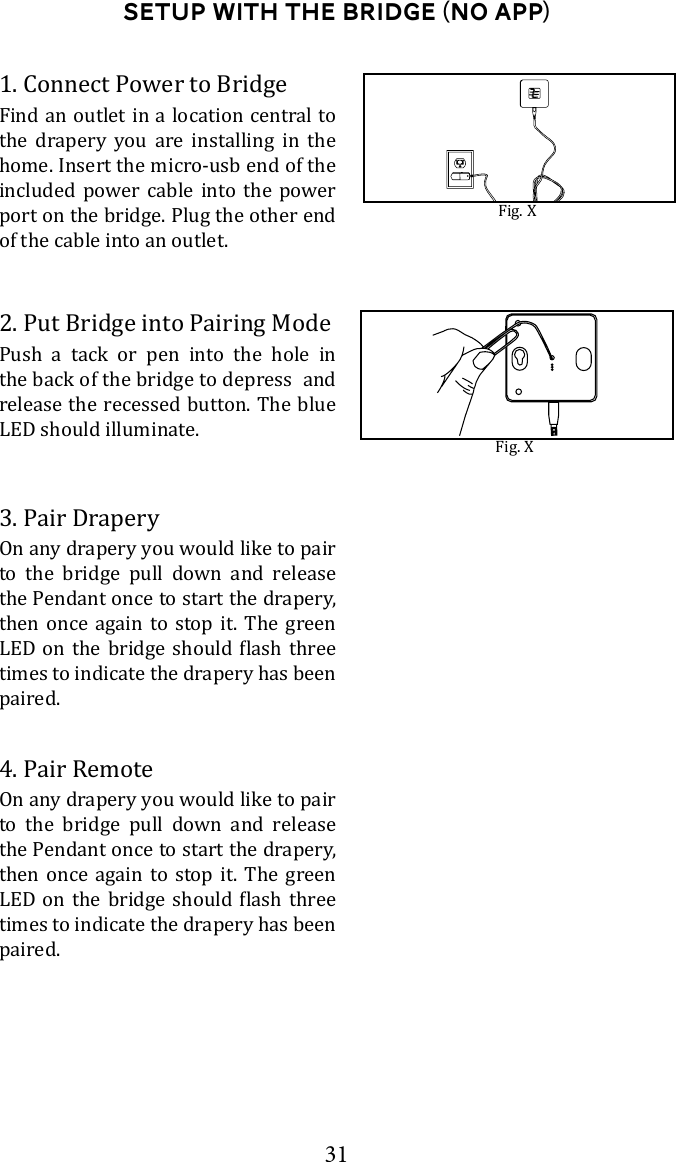
31Setup with the bridge (No App)1. Connect Power to BridgeFind an outlet in a location central to the drapery you are installing in the home. Insert the micro-usb end of the included power cable into the power port on the bridge. Plug the other end of the cable into an outlet. Fig. XFig. XPush a tack or pen into the hole in the back of the bridge to depress  and release the recessed button. The blue LED should illuminate.2. Put Bridge into Pairing ModeOn any drapery you would like to pair to the bridge pull down and release the Pendant once to start the drapery, then once again to stop it. The green     times to indicate the drapery has been paired.3. Pair DraperyOn any drapery you would like to pair to the bridge pull down and release the Pendant once to start the drapery, then once again to stop it. The green     times to indicate the drapery has been paired.4. Pair Remote
32Integrate with Amazon Echo  -  434 FM1. Set up your EchoIf your Alexa device is not yet set up, do so now by following the instructions that came with your device.Also be sure the bridge has been setup. For instructions on how to set up your bridge and app, go to page ____. 2. Download the Skillyour Alexa App. Search for the skill titled “My Curtains” or “Current Products”. If you want to be able to trigger Alexa using both phrases, be sure to download both skills.3. Sign In app. You are now able to control your devices via Amazon Alexa.Trigger Alexa using the trigger word selected when you installed the skill.      You can control devices, groups, or trigger scenes through Alexa, and create custom names for each in the MyCurtains app.Fig. XFig. XFig. X
33Integrate with Amazon Echo Plus- ZigBee with Current Products corp bridge1. Set up your EchoIf your Alexa device is not yet set up, do so now by following the instructions that came with your device.Also be sure the bridge has been setup. For instructions on how to set up your bridge and app, go to page ____. 2. Download the Skillyour Alexa App. Search for the skill titled “My Curtains” or “Current Products”. If you want to be able to trigger Alexa using both phrases, be sure to download both skills.3. Sign In app. You are now able to control your devices via Amazon Alexa.Trigger Alexa using the trigger word selected when you installed the skill.      You can control devices, groups, or trigger scenes through Alexa, and create custom names for each in the MyCurtains app.Fig. XFig. XFig. X
34Integrate with Amazon Echo Plus- ZigBee1. Set up your EchoIf your Alexa device is not yet set up, do so now by following the instructions that came with your device.2. Add a DeviceFrom the menu in the Alexa app, go to “Smart Home” and hit “Add a Device”. Alternately, you can say “Alexa, search for devices”. After Alexa has completed her search,       on each drapery you want to pair to Alexa.3. Customize in AppIn the Alexa app, you can change the name of each device to better your control of the devices. You can also add custom commands. We suggest custom naming each device, and creating commands for “open” and “close”.Is this everything???Fig. XFig. XFig. X
35TroubleshootingIntegrate with Google HomeIntegrate with Control4Integrate with Samsung SmartThings
36Using the DRapery TrackUsing the TAU for Operationon the desired movement. On a single drapery        down once makes the curtain move towards the next position, depending on a second time after stopping will allow the curtain to move in the opposite direction.On a dual draperythe motor 1 slot. Pulling down once makes the curtain move towards the next position, depending on if the curtain is open or closed. Pulling down a second time will stop it. Pulling down a third time, shortly after stopping will allow the curtain to move in the same direction as before. Pulling down after several seconds will change the direction the curtain moves.              slot. Pushing up once makes the curtain move towards the next position, depending on if the drapery is open or closed. Pushing up a second time will stop it. Pushing up a third time, shortly after stopping will allow the curtain to move in the same direction as before. Pulling down after several seconds will change the direction the curtain moves. Using Smart AssistSmart Assist is a drapery track feature to allow users the ability to begin an open or close movement manually, and have the drapery automatically complete the movement. To trigger Smart Assist, simply pull the curtain approximately one foot curtain will continue moving in that direction until it reaches the full open or closed position.
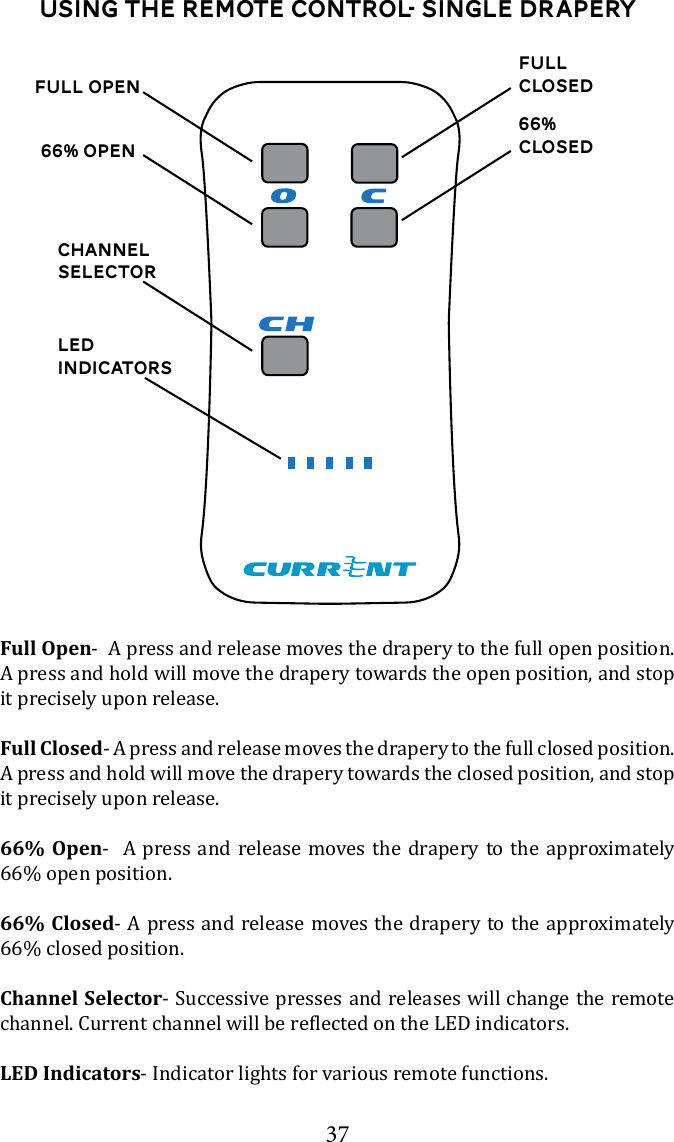
37Using the Remote Control- Single DraperyChannel SelectorLED Indicators66% closedFull Closed66% OpenFull openFull Open-  A press and release moves the drapery to the full open position. A press and hold will move the drapery towards the open position, and stop it precisely upon release. Full Closed- A press and release moves the drapery to the full closed position.A press and hold will move the drapery towards the closed position, and stop it precisely upon release.66% Open-  A press and release moves the drapery to the approximately 66% open position.66% Closed- A press and release moves the drapery to the approximately   66% closed position.Channel Selector- Successive presses and releases will change the remote LED Indicators- Indicator lights for various remote functions.
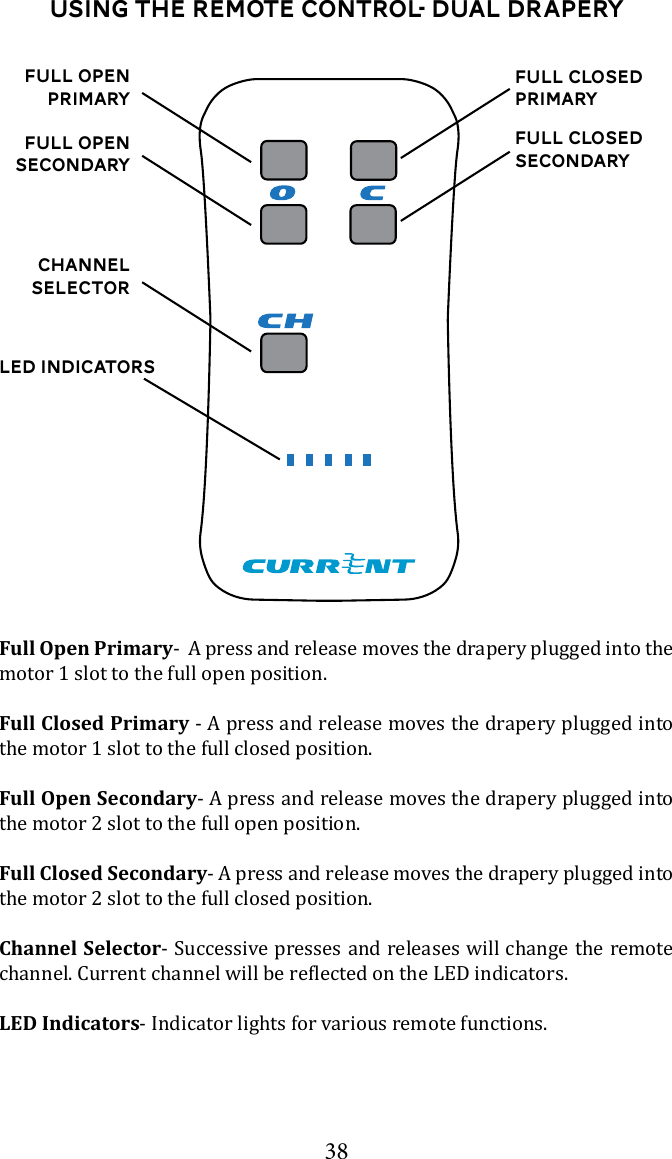
38Using the Remote Control- Dual DraperyChannel SelectorLED IndicatorsFull Closed secondaryFull Closed PrimaryFull Open secondaryFull open primaryFull Open Primary-  A press and release moves the drapery plugged into the motor 1 slot to the full open position. Full Closed Primary - A press and release moves the drapery plugged into the motor 1 slot to the full closed position.Full Open Secondary- A press and release moves the drapery plugged into the motor 2 slot to the full open position. Full Closed Secondary- A press and release moves the drapery plugged into the motor 2 slot to the full closed position.Channel Selector- Successive presses and releases will change the remote LED Indicators- Indicator lights for various remote functions.
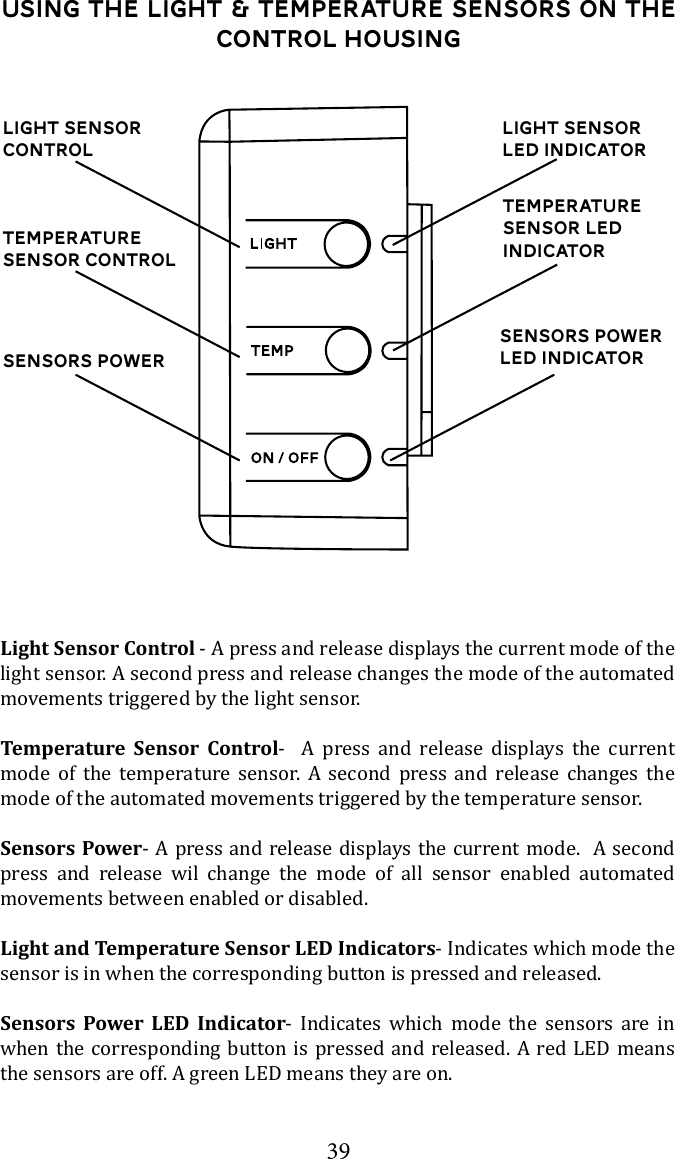
39Using the Light & Temperature Sensors on the control housingLight Sensor ControlTemperature Sensor ControlSensors PowerLight Sensor Control - A press and release displays the current mode of the light sensor. A second press and release changes the mode of the automated movements triggered by the light sensor. Temperature Sensor Control-  A press and release displays the current mode of the temperature sensor. A second press and release changes the mode of the automated movements triggered by the temperature sensor. Sensors Power- A press and release displays the current mode.  A second press and release wil change the mode of all sensor enabled automated movements between enabled or disabled.Light and Temperature Sensor LED Indicators- Indicates which mode the sensor is in when the corresponding button is pressed and released. Sensors Power LED Indicator- Indicates which mode the sensors are in when the corresponding button is pressed and released. A red LED means the sensors are off. A green LED means they are on. Light Sensor LED IndicatorTemperature Sensor LED IndicatorSensors Power LED Indicator
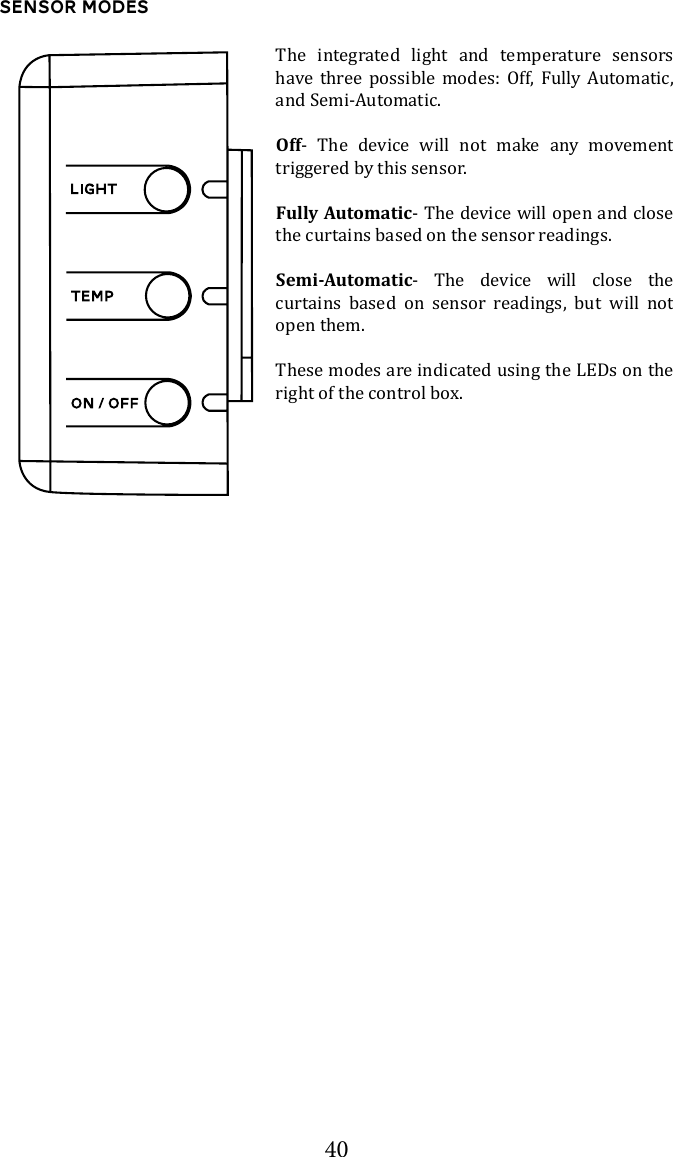
40Sensor ModesThe integrated light and temperature sensors have three possible modes: Off, Fully Automatic, and Semi-Automatic. Off- The device will not make any movement triggered by this sensor.Fully Automatic- The device will open and close the curtains based on the sensor readings.Semi-Automatic- The device will close the curtains based on sensor readings, but will not open them.These modes are indicated using the LEDs on the right of the control box.
41StatementsSAFETY INFORMATIONRead all warnings and instructions prior to installing the E-Wand™.  Failure to follow these instructions may result in property damage or serious personal injury.WARNINGDo not use this product for anything other than its intended use.  Any usage of the parts of this kit outside of its intended purposes in not covered under the warranty.CAUTION-ever removing or reinstalling drapery.CAUTIONFCC STATEMENTThis device complies with Part 15 of the FCC Rules.  Operation is subject to the following two conditions:1.  This device may not cause harmful interference, and2.  This device must accept any interference received, including interference                            that may cause undesired operation.Warning:could void the user’s authority to operate the equipment.NOTE:  This equipment has been tested and found to comply with the limits for a Class B digital device, pursuant to Part 15 of the FCC Rules.  These limits are designed to provide reasonable protection against harmful interference in a residential installation.  This equipment generates, uses, and can radiate radio frequency energy and, if not installed and used in accordance with the instructions, may cause harmful interference to radio communications.  However, there is no guarantee that interference will not occur in a particular installation.  If this equipment does cause harmful interference to radio or television reception, which can be determined by turning the equipment off and on, the user is encouraged to try to correct the interference by one or more of the following measures:•  Reorient or relocate the receiving antenna.•  Increase the separation between the equipment and receiver.•  Connect the equipment into an outlet on a circuit different from that to                    which the receiver is connected.•  Consult the dealer or an experienced radio/TV technician for help.
42RF WARNING STATEMENTThis equipment complies with FCC/ISED radiation exposure limits set forth for an uncontrolled environment. This equipment should be installed and operated to provide a separation distance of at least 20 cm from all persons.Cet équipement est conforme aux limites d’exposition au rayonnement FCC / ISED établies pour un environnement non contrôlé. Cet équipement doit être installé et utilisé de manière à assurer une distance de séparation d’au moins 20 cm de toutes les personnes.IC STATEMENTThis device complies with Industry Canada license-exempt RSS standard(s). Operation is subject to the following two conditions: (1) this device may not cause interference, and (2) this device must accept any interference, including interference that may cause undesired operation of the device. Le présent appareil est conforme aux CNR d’Industrie Canada applicables aux appareils radio exempts de license. L’exploitation est autorisee aux deux conditions suivantes: (1) l’appareil ne doit pas produire de brouillage, et (2) l’utilisateur de l’appareil doit accepter tour brouillage radioélectrique subi, même si le brouillage est susceptible d’en compromettre le fonctionnement. WARRANTY INFORMATIONLIMITED WARRANTYCurrent Products Corp. (the “Manufacturer”) hereby warrants to Customer that the E-Wand™ (the “Product”) is and will remain for a period of one (1) year from the date of delivery to Customer as evidenced by Customer’s proof of purchase (the “Warranty Period”), free of defects in materials and workmanship, provided that the Product Manual provided to Customer.  Subject to the foregoing, if at any time during the Warranty Period the Product fails to conform to the foregoing warranty by reason of defects in materials or workmanship, Customer shall promptly notify Manufacturer in writing, and Manufacturer at its option shall repair or replace the defective Product or component part without charge to Customer, except for:  (A) costs incurred in transporting the Products or component parts to and from Manufacturer’s designated dealer or its manufacturing plant; and (B) charges for labor or other costs incidental to the removal or remounting of component parts repaired or replaced under this Warranty, both of which shall be borne by Customer.  Notwithstanding any provision herein to the contrary, this Warranty shall not extend or obligate Manufacturer to take used or operated in a manner which is not recommended by Manufacturer, including any Products in which parts not manufactured or approved by Manufacturer have
43LIMITATION OF LIABILITY                                          EXTEND BEYOND THE DESCRIPTION ON THE FACE HEREOF.  IN NO EVENT SHALL OTHER LEGAL RIGHTS             which vary from state to state.been installed; (ii) Products which have not been regularly and properly serviced (iii) ordinary wear and tear, service and maintenance and replacement items; (iv) the Product has been used, or attempted to  be used, for other than the customary usage or for other than the Product’s intended use; (v) the Product has been subject to mishandling, misuse, or abuse; (vi) the product has suffered damage resulting from which the product was not designed to withstand; or (vii) damage to the Product cause by battery decay or corrosion.This Limited Warranty extends only to the original owner. This Limited Warranty is not transferable. This Limited Warranty does not cover normal wear or tear or deterioration which occurs with the passage of time. Batteries originally provided with a new product, if any, are produced by a third party and are not warranted by Manufacturer. No employee, distributor, dealer, agent or representative is authorized to change the terms of this Limited Warranty in any way, to extend the warranty time periods, or to grant additional warranties, and no attempt to do any of the foregoing will be binding upon Manufacturer.

Navigation menu