DH Technology DH-R1 UHF Band RFID Reader (Low power transceiver - RX verfied) User Manual UserManual DH hwp
DH Technology, Inc. UHF Band RFID Reader (Low power transceiver - RX verfied) UserManual DH hwp
user manual re

User Manual
DH Technology ,Inc.

Model : DH-R1 User Manual
2DH-Tech,Inc.
[Contents]
1. Summary
2. Composition
2.1 Devices Composition
2.2 System Composition
2.3 Outward Appearance of Device and Dimension
3. Specification of the System
3.1 RFID Tag
3.2 RFID Reader
4. Function of the System
5. Installation of the System
6. System Operation
7. Certification
Model : DH-R1 User Manual
3DH-Tech,Inc.
THIS DEVICE COMPLIES WITH PART 15 OF THE FCC RULES. OPERATION IS
SUBJECT TO THE FOLLOWING TWO CONDITIONS. (1)THE DEVICE MAY NOT
CAUSE HARMFUL INTERFERENCE AND (2)THIS DEVICE MUST ACCEPT ANY
INTERFERENCE RECEIVED, INCLUDING INTERFERENCE THAT MAY CAUSE
UNDESIRED OPERATION.
ALSO, TO PREVENT INTERFERENCE TO FEDERAL GOVERNMENT READER
SYSTEMS, OPERATION GOVERNMENT RADAR SYSTEMS, OPERATION UNDER THE
PROVISIONS OF THIS SECTION IS NOT PERMITTED WITHIN 40 KILOMETERS OF
THE FOLLOWING LOCATIONS:
DoD Radar Site Latitude Longitude
BealeAirForceBase 39°08 10 N′″ 121°21 04 W′″
Cape Cod Air Force Station 41°45 07 N′″ 070°32 17 W′″
Clear Air Force Station 64°55 16 N′″ 143°05 02 W′″
Cavalier Air Force Station 48°43 12 N′″ 097°54 00 W′″
Eglin Air Force Base 30°43 12 N′″ 086°12 36 W′″
CAUTION : Any changes or modifications in construction of this device which are not
expressly approved by the party responsible for compliance could void the user's authority
to operate the equipment.
The user of the device shall be responsible for submitting updated information in the
event the operating location or other information changes after the initial registration by
the grantee. The information provided by the grantee or user to the Commission shall
include the name, address, telephone number and e-mail address of the user, the
address and geographic coordinates of the operating location, and the FCC identification
number of the device. The material shall be submitted to the following address:
Experimental Licensing Branch,
OET, Federal Communications Commission,
445 12th Street, SW., Washington,
DC 20554, ATTN: RFID Registration.
Professional installation is required. Installers are responsible for ensuring that the proper
antenna is used as described in the FCC filing.
and this product is for industrial use product.

Model : DH-R1 User Manual
4DH-Tech,Inc.
1. Summary
A) The RFID system for containers is composed of an "Active RFID Tag" and a
"Reader", and the communication between the tag and reader follows a
Master-Slave model.
B) Containers are embedded with 433.92Mhz RFID tag, and the reader, if necessary,
gives a wake-up signal, activates the RFID tag, so that it can obtain
container-related information.
C) The reader works according to the order of middleware or a terminal(or a
computer). The communication air protocol between the reader and the tag follows
ISO/IEC 18000-7.
D) By using a RFID tag system, the recognition rate and recognition distance for
containers is greatly improved, so that it can lay the foundation for the job
automation of gate, CY storage, shipment, and Air Cargo.
E) By making the best use of wireless/network technology, this system can be flexibly
applied regardless of container's movement of position
2. Composition
2.1 Deceives Composition

Model : DH-R1 User Manual
5DH-Tech,Inc.
No. Model Name Type Remarks
1RFID Tag 433.92MHz active tag DH-ST1
2RFID Reader Fixed type DH-R1
Model : DH-R1 User Manual
6DH-Tech,Inc.
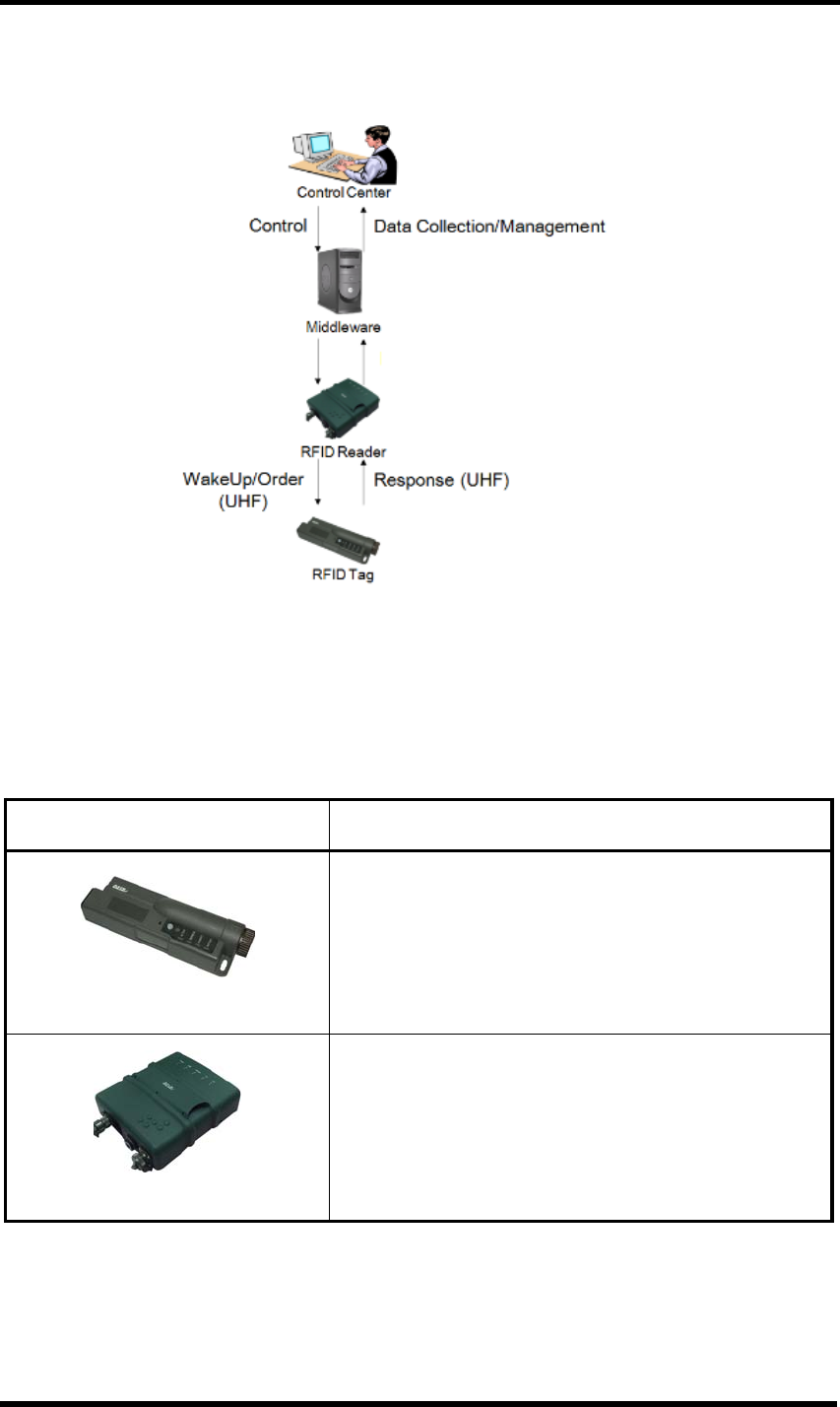
2.2 System Composition
2.3 Dimension
Section Contents
DH-ST1(DH Sensor Tag Type 1)
Dimension: 14.3≫cm*4.3cm*3.0 cm
DH-R1 (DH Reader Type 1)
Dimension: 22.3cm*20.7cm*6.6cm≫

Model : DH-R1 User Manual
7DH-Tech,Inc.
3. Specification of the System
3.1 RFID Tag
Tag Name DH-ST1
UHF Transceiver
Frequency 433.92Mhz
Modulation FSK
Range 100m
Power 3.6mW
Tag Wake-up UHF
Air Protocol ISO/IEC 18000-7
Memory
Tag ID 4bytes(RO)
User ID 16bytes(RW)
User Memory 128Kbytes
Beacon yes
Range(unobstructed) ~100m
Battery
Type Non-replaceable, Non-rechargeable
Volts/Material 3.6V/Lithium
Life 3years(5 read events/day)
Re-Usable yes
Temperature Operation: -30 to +70℃℃
Storage: -40 to +70℃℃
Humidity 100% Condensing
Approval KCC

Model : DH-R1 User Manual
8DH-Tech,Inc.
3.2 RFID Reader
Reader Name DH-R1
Case Material PC(Polycarbonate)/PBT(Polybuthylene Terephalate)
Environmental Temperature
Operating: -30 to +60℃℃
Storage: -40 to +80℃℃
Humidity 90% Condensing
RF Frequency(Transceiver) 433.92Mhz
Range Up to 100m
Modulation FSK, deviation 35Khz for receiver, 50Khz for transmit
Sensitivity 95 dBm
IF Frequency 307.2Khz
Data Rate 27.8Kbps
Air Protocol ISO/IEC 18000-7
RFID Tag Compatibility All 433Mhz Active RFID Tags
Network Interface RS485, RS232
Upgrades Supports firmware downloads
Diagnostics Supports remote reader performance status reports
Type Approval KCC
Other Mounting Mounting Kit

Model : DH-R1 User Manual
9DH-Tech,Inc.
4. Function of the System
The communication protocol and operation between the reader and the tag follows□
ISO/IEC 18000-7.
5. Installation of the System
Installation of the system(Container tag and Reader) follows ISO 10374.2□
6. System Operation
Basic Operation□
A reader(DH-R1) communicates with a server(or middleware) over TCP/IP, and
communicates with a tag(DH-ST1) over RF. Orders sent via a server(or middleware)
are transmitted to the reader(DH-R1), witch gives a wake-up signal, send the orders
to the tag(DH-ST1), receives the response data from the tag(DH-ST1), and finally
transmits them to the server(or middleware).
7. Certification
FCCID : YWVDH-R1□
This equipment has been tested and found to comply with the limits for a Class B digital
device, pursuant to part 15 of the FCC Rules. These limits are designed to provide
reasonable protection against harmful interference in a residential installation.
This equipment generates, uses and can radiate radio frequency energy and, if not
installed and used in accordance with the instructions, may cause harmful interference to
radio communications. However, there is no guarantee that interference will not occur in
a particular installation. If this equipment does cause harmful interference to radio or
television reception, which can be determined by turning the equipment off and on, the
user is encouraged to try to correct the interference by one or more of the following
measures:
- Reorient or relocate the receiving antenna.
- Increase the separation between the equipment and receiver.
- Connect the equipment into an outlet on a circuit different from that to which the
receiver
is connected.
- Consult the dealer or an experienced radio/TV technician for help.
CAUTION : Changes or modifications not expresslyapprovedbythepartyresponsiblefor
compliance could void the user’s authority to operate the equipment.