734A And 7001 DC Reference Standards Voltage Standard Data Sheet Brochure
732B-Direct-Voltage-Standard-Data-Sheet-Brochure 732B-Direct-Voltage-Standard-Data-Sheet-Brochure
User Manual: 734A-Voltage-Reference-DC-Voltage-Standard-Data-Sheet-Brochure
Open the PDF directly: View PDF  .
.
Page Count: 7
734A DC
Reference Standard
Technical Data
734A: The simple way to maintain and
disseminate your volt
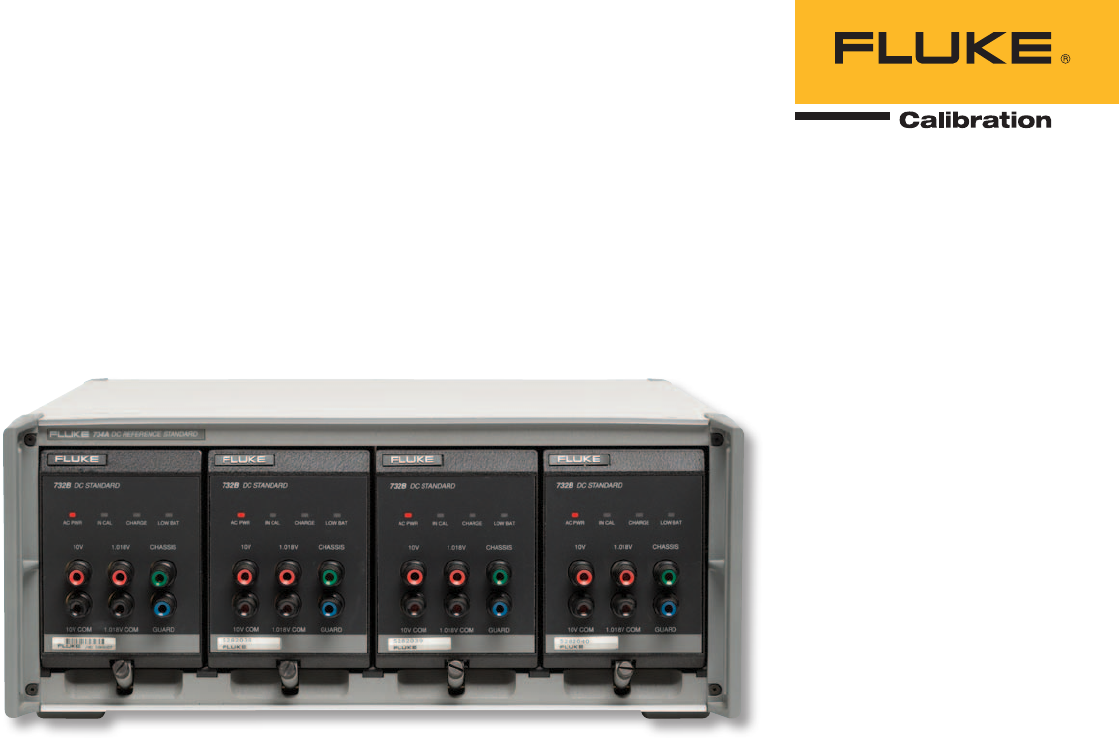
The Fluke Calibration 734A DC Reference
Standard is a direct voltage reference used to
maintain the volt in primary and secondary
standards laboratories. It consists of four electri-
cally and mechanically independent 732B DC
Standards and a rack-width enclosure. Individ-
ual 732Bs provide 10 V and 1.018 V outputs and
may be transported easily to remote locations
while the reference is maintained in the labora-
tory. Stability for each output is ± 2 ppm per year
(10 V) and ± 0.8 ppm per month (1.018 V). Each
10 V output can drive up to 12 mA of current
to simplify use with instrumentation with low
input impedance.
The 734A Reference Standard was designed
for laboratories that need to maintain traceability
to national standards and to distribute the volt
to production, service, calibration laboratories or
other remote locations. To simplify shipment, each
732B Standard is small and highly portable. And
its 72-hour battery life—which can be extended
to more than 130 hours with the optional exter-
nal battery and charger—means it’s practical to
ship a 732B across town or around the world.
Because each 732B in the 734A Reference
Standard is based on the same technology
pioneered in the popular 732A—the first
standards lab quality 10 V electronic reference—
you can rely on it to provide the same high
stability and predictable drift rate you’ve come to
expect, in a smaller, more portable package.
To simplify support of your 734A, Fluke
Calibration offers a variety of calibration services
to assign values and predicted performance for
the 10 V output, traceable to national standards
and to the Fluke Calibration 10 V Josephson
Array.
Why a four-cell reference?
A four-cell reference is desirable any time you
need to maintain and disseminate a refer-
ence voltage. At a minimum, three cells are
intercompared to detect and identify changes
in the output of any one cell. A fourth cell may
be used as a spare or to transport the volt to or
from remote locations. When it returns to the
laboratory, it can be compared to the other three
to determine if its output has shifted during
transport.
2 Fluke Calibration 734A DC Reference Standard
However, there is more to a four-cell reference
than four outputs. According to NBS Technical
Note 1239, published by the U.S. National Bureau
of Standards (now NIST) in 1987, four to six
references are required to provide measurement
integrity and redundancy, and to minimize the
number of measurements required. References
must be completely independent of one another.
Otherwise, common elements, such as a power
supply or oven, might affect the correlation of
reference outputs. In addition, with frequent
intercomparisons of four cells, you can detect
when any one of the cells begins to drift beyond
specifications or needs to be repaired.
Each 732B is a stand-alone dc standard with
its own power supply, oven, supporting elec-
tronics and packaging. Each may be purchased
separately, or as a full 734A system, which
includes four 732Bs that slide into a rack-width
enclosure.
A fractional ppm 10 V reference
in your lab
With the 734A, it is remarkably simple to estab-
lish and maintain a fractional part per million
(ppm) primary voltage standard in your labora-
tory. Over time, with frequent intercomparisons
of your four cells, and regular calibrations of one
or more cells, you can reduce the uncertainty of
your 734A by a factor of three.
From 1984 until the acquisition of our 10 V
Josephson Array, the Fluke Calibration Primary
Standards Laboratory maintained its corpo-
rate volt in this manner, reducing the absolute
uncertainty to ± 0.35 ppm traceable to national
standards.
Taking your reference to the workload
Standards laboratory operations have changed.
In the past, people brought their workload to
the standards lab. Today, the functions of the
standards lab are being distributed, requiring
that many calibrations be performed in the field.
The 734A, and its electrically and mechanically
independent 732B Standards, was designed to
meet that need. The voltage reference remains
undisturbed in your laboratory, while at the
same time you can distribute the volt to remote
locations outside the lab. When the unit is
returned to the lab, comparisons can be made to
the reference to determine if a shift has occured
during the transfer. To maintain traceability to
national standards, one cell may be transported
to a national lab or other primary standards lab
for calibration, again, without disturbing the
reference. Each 732B Standard is relatively light,
weighing just 5.9 kg, and its 72-hour battery life
provides ample capacity for long shipments. An
optional external battery extends that capacity
to 130 hours. A special transit case, designed to
hold one 732B and an external battery, simplifies
transport even further.
The 732B can stand up to a lot of abuse. The
inputs can be shorted indefinitely and are pro-
tected up to 1100 V dc, 25 mA, without damaging
the cell or affecting its output.
Ideal support for artifact calibration
Combined with 742A-1 and 742A-10k Resis-
tance Standards, a single 732B makes a tough
and compact artifact calibration support pack-
age for instruments like the 5700A and 5720A
Calibrators from Fluke Calibration or the 3458A
Multimeter from Agilent.
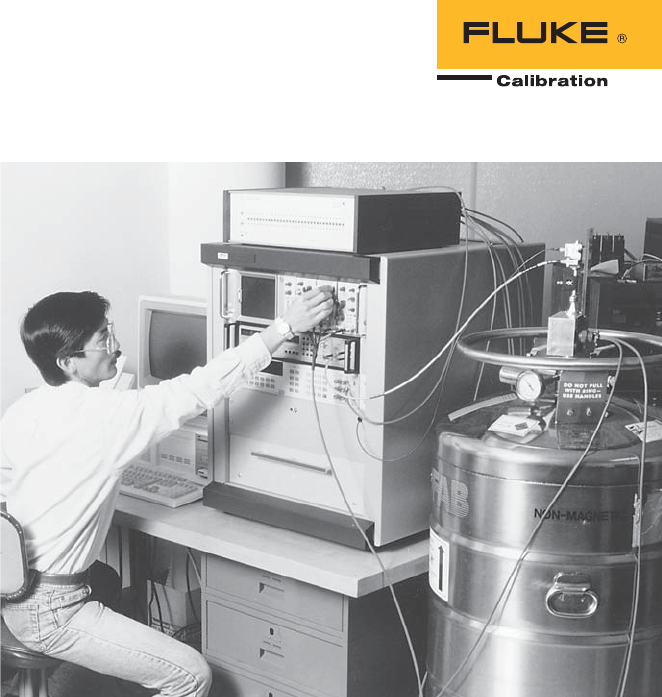
The Fluke Calibration Standards Laboratory offers traceability to its own 10 V Josephson Array,
an intrinsic standard of voltage, and to national standards.
3 Fluke Calibration 734A DC Reference Standard
Why should you prefer the 734A?
• Independence. The 734A is the only standard
of its type offering complete mechanical and
electrical independence of each of its four
standards.
• Portability. Each 732B Standard is designed
for portability. Each is small, light, rugged and
has a long operating battery life.
• Confidence. The 732B is based on the proven
technology of the Fluke Calibration 732A.
The 732A was the first standards lab quality
electronic reference to gain wide acceptance
as a replacement for saturated standard cells.
Originally designed for internal transfers of
Fluke’s corporate volt to the production floor,
thousands are now in service worldwide in a
variety of applications—from maintaining an
institutional reference to transferring values
from national labs or privately-operated 10 V
Josephson Arrays.
The 732B’s reference amplifier and resistors
are identical to those used in the 732A. But the
package is now half the weight, 75 % smaller,
more rugged and offers greatly extended battery
life. The rack-width enclosure provides a con-
venient way to store cells in your lab. And the
internal battery is now a common, off-the-shelf
model that can be purchased from a wide range
of electronic components suppliers, simplifying
your support. Or you can use your own battery,
connecting it to the 12 V to 15 V dc input on
each 732B.
The advantages to maintaining your
reference at 10 V
The primary benefits of maintaining your voltage
reference at 10 V rather than 1.018 V center on
efficiency and ease-of-use. At 10 V, you can
intercompare standards directly with a digital
voltmeter. The effects of noise and thermal EMFs
are diminished by a factor of 10 compared to
standard cells. And with 10 V Josephson Arrays
becoming more common, working at the 10 V
level further simplifies the process of estab-
lishing traceability. Finally, most modern dc
instrumentation today requires a 10 V standard
for calibration. When you ratio up to 10 V from
1.018 V, you lose considerable performance.
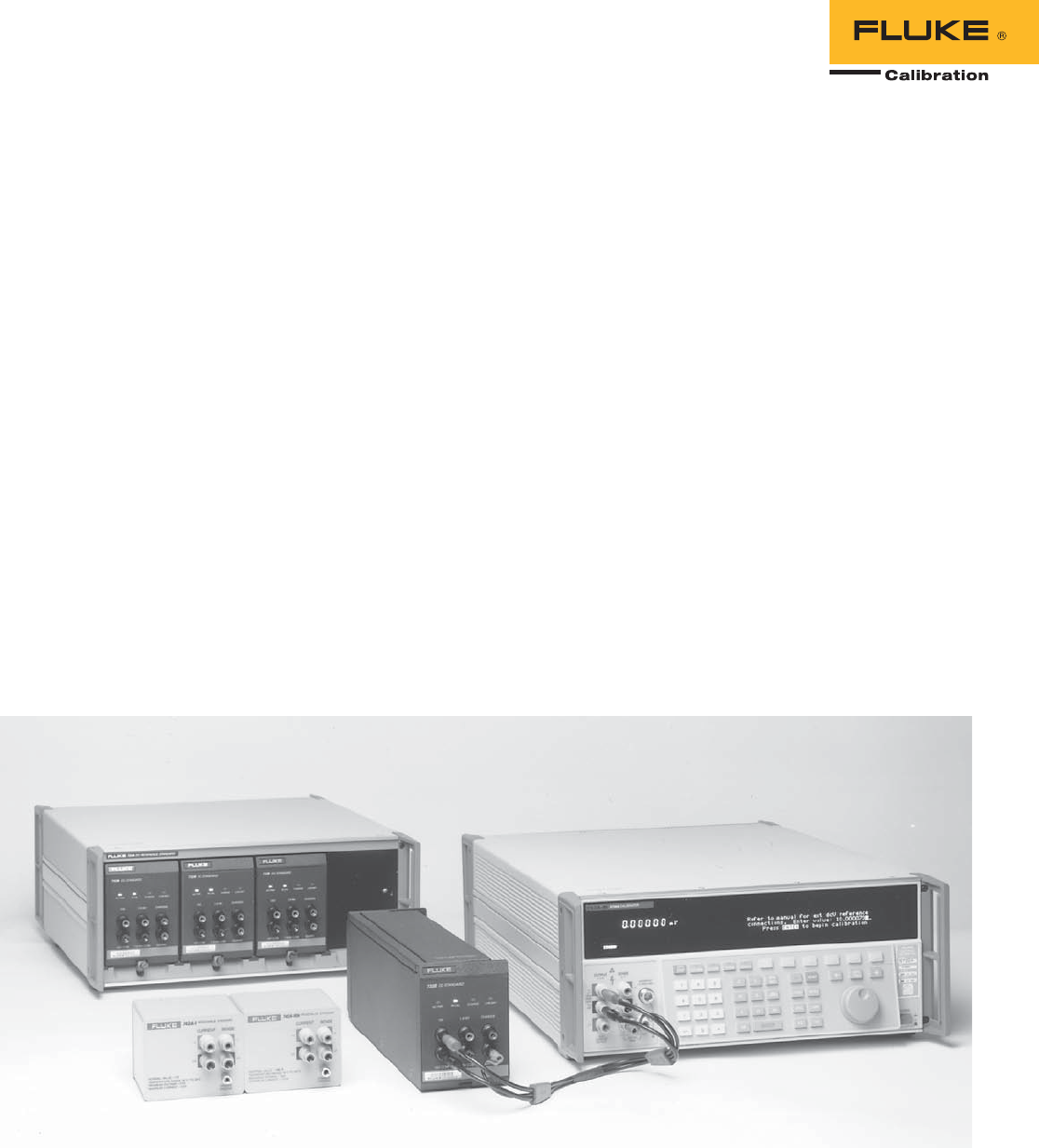
The 734A Reference and 732B Standards are a practical way to maintain and disseminate your volt and to support artifact calibration of instruments like the
5700A and 5720A Calibrators.
4 Fluke Calibration 734A DC Reference Standard
The 734A supports 1.018 V as well
In applications where saturated standard cells
are still used, the 1.018 V output of each 732B
Standard in the 734A Reference greatly simpli-
fies intercomparisons of cell banks. And, like the
10 V output, each 1.018 V output is completely
electrically and mechanically independent to
preserve the integrity of your reference. Unlike
standard cells, the 1.018 V output of the 732B
may be used immediately after shipment,
eliminating the need to let cells stabilize for an
extended period.
Supporting your traceability
requirements
Fluke Calibration provides the products and
services you need to manage your traceability
requirements. New 732Bs can be ordered with
or without calibration certificates. The standard
732B comes without any calibration certifi-
cate, with the intention of the owner providing
traceability as required locally. When delivery
of a new 732B with a calibration certificate is
required, then three alternatives are possible:
• Calibration. The 732B/H is a 732B where
Fluke Calibration performs an output volt-
age calibration on your new standard. Before
shipment, your standard is compared to direct
voltage standards maintained at Fluke. Your
standard, shipped under power, includes a
Report of Calibration showing the deviation
from nominal and the uncertainty of the cali-
bration. This certificate is traceable to NIST via
Fluke’s Josephson Array, an intrinsic standard
of voltage.
• Calibration and drift characterization. The
732B/C is similar to the 732B/H, but it adds
drift rate characterization before shipment.
The output voltage is compared to a Fluke
standard for 90 days. Once the drift rate is
known, total uncertainty as a function of
time is greatly reduced. The projected output
voltage is tabulated for 12 months following
calibration. Uncertainty of the projection varies
linearly, from + 0.5 ppm at the time of calibra-
tion to + 1.5 ppm after 12 months.
• Accredited calibration. Normally, the 732B
calibration certificates are traceable to NIST
but are not considered accredited calibrations.
For an extra charge, an accredited calibra-
tion certificate is available. Contact your Fluke
Calibration representative for details.
Both the 732B/H and 732B/C require that the
standard is shipped to you under power. This
continuous power on condition is required
during shipment through delivery to your lab
for the calibration to remain valid. If continuous
power is not maintained, then the validity of
the calibration certificate may be compromised.
Contact your Fluke Calibration representative to
determine if the 732B/H or 732B/C alternatives
are available in your area.
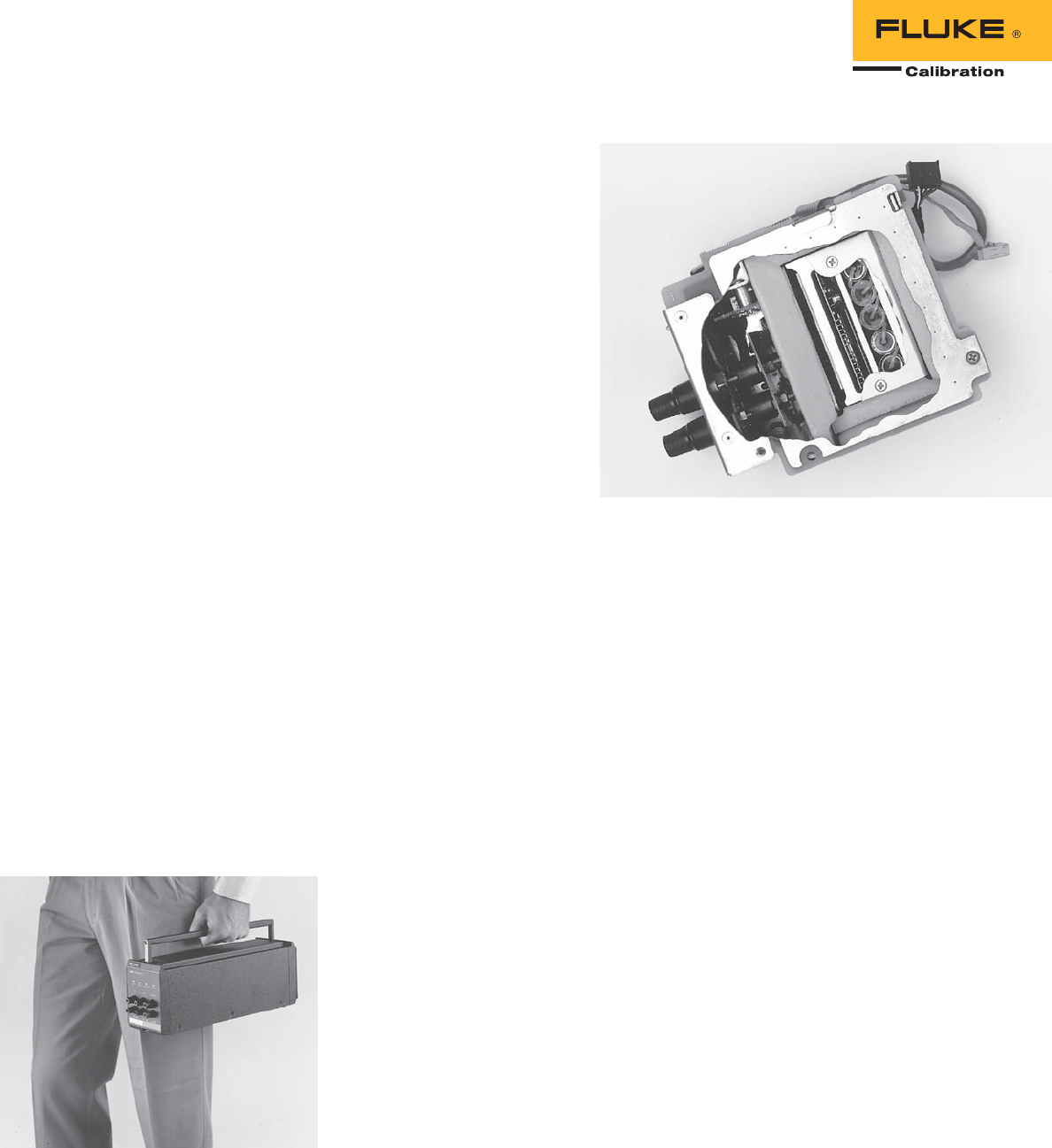
The Fluke Calibration 732B Standard uses the same specially selected
zener reference technology pioneered in the popular 732A.
732B Standards are small, light and rugged.
Their 72-hour battery life, which can be
extended to 130 hours with the optional
external battery and charger, make them ideal
for transfer standards.

5 Fluke Calibration 734A DC Reference Standard
For existing 732Bs or similar standards that are
already in use, the Direct Voltage Maintenance
Program is a service where Fluke Calibration can
provide calibration certificates for these stan-
dards. This service consists of two calibration
alternatives that can be used depending on your
needs.
• Calibrations done by Fluke. Calibration
certificate services can be easily performed on
standards returned to Fluke Calibration service
facilities. Contact your Fluke Calibration repre-
sentative or your local Fluke service center for
details regarding these calibration certificate
alternatives.
• Calibration in your laboratory. With the
732B-200 services, a standard owned and
calibrated by Fluke Calibration, including
all necessary connecting cables and clear
operating instructions, is sent to your site
for comparison with one or more of your
own reference standards. You make a series
of readings over five days and forward
the standard to the next laboratory, then
return the measurement results to the Fluke
Calibration Standards Laboratory. A value for
your reference relative to the Fluke standard
is assigned. Within one week, a preliminary
Report of Calibration is returned to you. Once
the standard is returned to Fluke Calibration,
it is compared to the Fluke Voltage Standard.
A final value is assigned to your reference,
and a final Report of Calibration is sent to you.
The 732B-200 service provides a calibra-
tion certificate for one local standard. Each
additional standard that requires a certificate
can use the 732B-201 service. In this way,
comparing multiple standards to a single Fluke
Calibration standard will provide any required
number of standards with individual calibra-
tion certificates.
Note: This service is not available in all areas. Contact
your local Fluke representative for details).
734A specications
Output voltages
Outputs of 10.0 V and 1.018 V are provided at
separate binding-post pairs with the following
characteristics:
Stability
Stability for the 732B is specified by the follow-
ing at a temperature of Tcal ± 1 °C (15 °C ≤Tcal
± 35 °C):
Stability (ppm)
Output Voltage 30 Days 90 Days 1 Year
10 V 0.3 0.8 2.0
1.018 V 0.8 NA NA
Noise at output terminals
Output noise is specified for both day-to-day
observations and for short-term observations.
The former is given by the standard deviation
about the regression line of a 90-day regression
model. The latter is terms of its rms value in a
bandwidth as follows:
Output Voltage
Day-to-Day (S1)
(ppm)
0.01 Hz
10 Hz (ppm)
10 V 0.065 0.06 rms
1.018 V 0.1 0.3 rms
Output current and impedance
Output Voltage Output Current
Output
Impedance
10 V 12 mA* ≤1 mW
1.018 V NA ≤1 kW
*Output current is limited to ≤0.1 mA to realize 72-hour operation
under battery power.
Output adjustment
10 V: 0.15 ppm resolution 1.018 V: Set at nominal
± 1 mV. No adjustment is provided, however the
output value changes when the 10 V output is
adjusted
Retrace (hysteresis) error
(Constant temperature)
≤0.1 ppm, 10 minute power off ≤0.25 ppm, 1 to
24 hours power off
Stabilization time (Constant temperature)
For best results, allow a 14-day stabilization
period after power has been off for an extended
period of time
No power interruption
No stabilization time is required after moving
into another environment
Power off <1 hour
1-hour warm up required
Power off 1 to 24 hours
24-hour warm up required
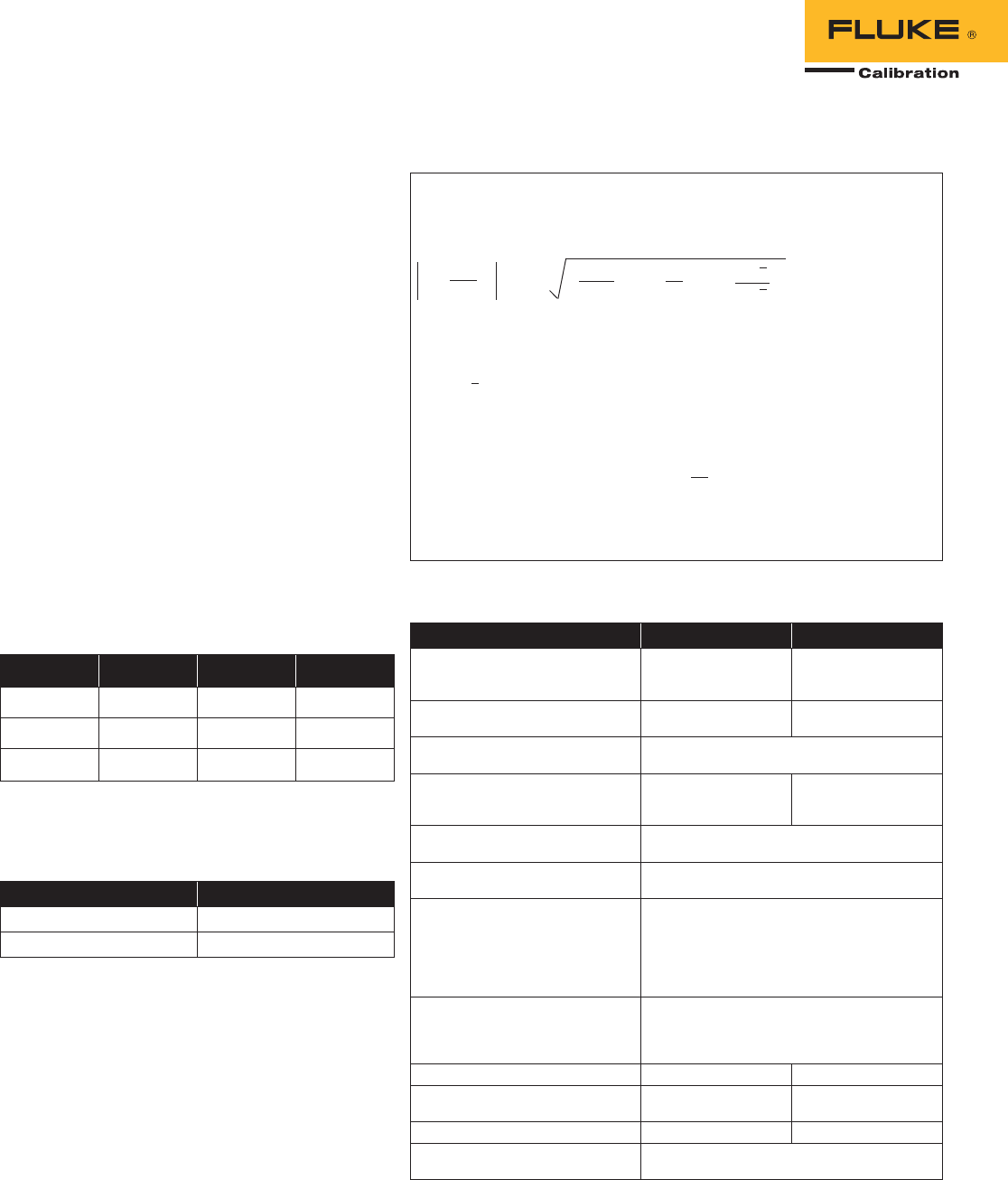
6 Fluke Calibration 734A DC Reference Standard
[ ]
Stability for a given period of time is defined as the output uncertainty
minus the calibration uncertainty at the 99 % confidence level. When the
output voltage is characterized by a regression model, stability is given
by the following equation:
where b = slope of regression in ppm/year
S1 = standard deviation about the regression (SDEV)
Sra = SDEV–of data filtered with 7-day moving average filter (MAF)
P = period of time under consideration in days
= mean time for regression data
n = 180 periods (typically 2 measurements per day)
Xi = ith period
t1 = student’s t statistic for (n-2) degrees of freedom (typically 2.6)
t2 = student’s t statistic for degree of freedom
(typically 2.81)
Each data point for the computation of the regression parameters is the
average voltage of 50 readings taken in a 50-second measurement period.
P
365
Sra t2
S1 t1
b+ S1 t1
( )
2 +
[ ]
1
n
( )
(P -x)
2
Σ(Xi-x)
2
+
Explanation of stability verification
x
Reference standard comparison selection guide
Model 732B 734A1
10 V output
Stability (± ppm), 90 days
Stability (± ppm), 1 year
0.7
1.6
0.7
1.2
Predictability
After 5 points, 3 months apart ± 0.4 ppm/year typ. ± 0.2 ppm/year typ.
Temperature coefficient
(15 °C to 35 °C) < 0.04 ppm
Noise
0.01 Hz to 10 Hz
Std. dev. of 90 days regression
< 0.06 ppm RMS
< 0.065 ppm
< 0.03 ppm RMS
< 0.04 ppm RMS
Hysteresis recovery
(after battery discharge) 0.2 ppm[2]
Output current
Output resistance
12 mA
< 1 mW
Battery type
Back-up period
Recharge time (typical)
Half life
Reference conditioning
(power loss recovery)
72 hours
24 hours
No
Temperature
Operating
Transit
Warm-up period
+15 °C to 35 °C
-40 °C to 50 °C
1 hour (power off for less than 1 hour)
Power < 10 W < 40 W
Dimensions (H x W x D) 135 x 99 x 419 mm
(5.3 x 3.9 x 16.5 in)
191 x 432 x 502 mm
(7.5 x 17 x 19.75 in)
Weight 5.9 kg (13 lb) 29.6 kg (65 lb)
Safety UL1244; CE marked; CSA C22.2 # 231;
IEC 348; IEC 1010
Notes: All specifications, including 732B, are stated with 98 % confidence level.
[1] 734A specifications are using a mathematical average of four cells.
[2] Conditioning not available. Specification assumes reference remains within a temp controlled
environment.
[4] Actual resistance = 500/n, where n = number of references in the Average.
Temperature coefficient (TC) of output
In the temperature range of 15 °C to 35 °C, the
magnitude of TC is bounded by the following: 10
V TC ≤0.04 ppm/°C
1.018 V TC ≤0.1 ppm/°C
Load regulation
10 V output will change less than 1 ppm for a
full load change from 0 to 12 mA and less than
0.1 ppm for a load change from 0 to 2 mA
Line regulation
The outputs will change no more than 0.05 ppm
for any 10 % line voltage change or for the entire
operating range of the battery
Output protection
All outputs can be shorted indefinitely without
damage to the instrument. The 10 V output
can withstand voltages from other sources as
follows:
1. For voltages ≤220 V dc, the unit is protected
for up to 50 mA continuous current
2. For voltage ≤1100 V dc, the unit is protected
for up to 25 mA continuous current or up to
0.6 joules of energy
Environment
Temp Relative
°C
Range
Humidity %
Altitude meters
(feet)
Normal operation 15-35 15-80 0-1,830
(0-6,000)
Safe operation 0-50 15-90 0-3050
(0-10,000)
Storage (no batt) -40-50 non-cond 0-12,200
(0-40,000)
Compliance with external standards
ANSI ISA-S2 IEC 348 CSA C22.2 #231
IEC 1010 UL 1244
Line power requirements
Voltage Frequency
90 V to 132 V ac 47 Hz to 63 Hz
180 V to 264 V ac 47 Hz to 63 Hz
Battery operation
When fully charged, the batterieswill maintain the
732B for a minimum of 72 hours at 23 °C ±5 °C, with
an output current <0.1 mA.
The batteries are rechargeable in less than 24 hours
with a self-contained battery charger.
A rear-panel input has been provided to accept an
external 12 V battery or equivalent 12 V to 15 V dc
power source.
Isolation
The resistance from any 732B output terminal to earth
ground or to the ac mains is at least 10,000 MW shunt-
ed by less than 1000 pF.
Guard and grounding
Chassis ground terminals are provided on both front
and rear panels. Access to the internal guard is pro-
vided by a front-panel terminal.
[ ]
( )
— 2
n
7
7 Fluke Calibration 734A DC Reference Standard
Ordering information
Models
734A Reference Standard
Includes four 732Bs in a rack-width enclosure.
Calibration of each 732B output optional.
732B DC Standard, without calibration certificate,
shipped under a power-off condition.
732B/H DC Standard, with calibration certificate
included, shipped under power.
732B/C DC Standard with drift characterization and
calibration certificate included, shipped under power.
Direct Voltage Maintenance Program
(U.S. only)
732B-200 10 V Output Voltage Calibration On Site
732B-201 Additional 10 V Output Voltage Calibration at
the same site
Bibliography of technical references
Emery, Kletke and Voorheis, A New Approach to Specifying a
DC Reference Standard, Proceedings of the 1992 Measurement
Science Conference.
Field, NBS Technical Note 1239: Solid-State Voltage Standard
Performance and Design Guidelines, Electricity Division, Center
for Basic Standards, National Measurement Laboratory, National
Bureau of Standards, September, 1987.
Huntley, A Primary Standard of Voltage Maintained in Solid-
State References, IEEE Transactions on Instrumentation and
Measurement, Vol. 1M-36, No. 4, December 1987.
Fluke Corporation, Technical Information: Fractional PPM
Traceability Using Your 732A, Application Note B0196A,
January, 1990.
National Conference of Standards Laboratories, Array Josephson
Junction, Recommended Intrinsic/Derived Standards Practice,
RISP-1, August, 1991.
Fluke Calibration
PO Box 9090,
Everett, WA 98206 U.S.A.
Fluke Europe B.V.
PO Box 1186, 5602 BD
Eindhoven, The Netherlands
For more information call:
In the U.S.A. (877) 355-3225 or Fax (425) 446-5116
In Europe/M-East/Africa +31 (0) 40 2675 200 or Fax +31 (0) 40 2675 222
In Canada (800)-36-FLUKE or Fax (905) 890-6866
From other countries +1 (425) 446-5500 or Fax +1 (425) 446-5116
Web access: http://www.flukecal.com
©2002-2012 Fluke Calibration. Specifications subject to change without notice.
Printed in U.S.A. 3/2012 1260120F D-EN-N
Modification of this document is not permitted without written permission
from Fluke Calibration.
Fluke Calibration. Precision, performance, confidence.™
