CLS User Manual CHRocodile Compact
CHRocodile%20Compact%20User%20Manual
CHRocodile%20Compact%20User%20Manual
User Manual:
Open the PDF directly: View PDF  .
.
Page Count: 63
1
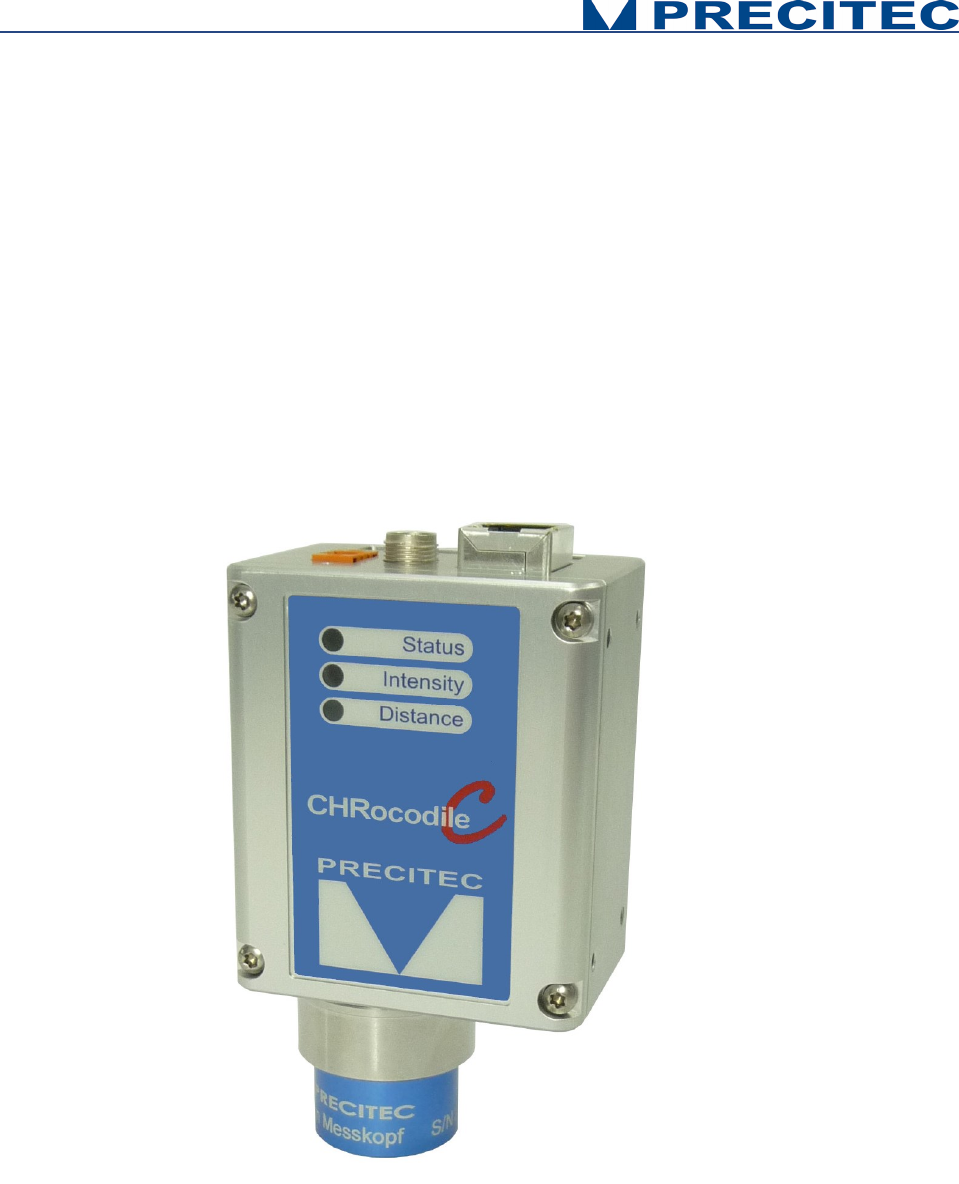
CHRocodile C
Compact sensor for non-contact distance and thickness measurement
Operation Manual
2
Imprint
This documentation is under the copyright of Precitec Optronik GmbH.
It may not be reproduced or used in a manner contrary to the company’s legal interests without prior
written approval of Precitec Optronik GmbH. It is strictly intended for use in the context of service
operations. Any other use is impermissible. Any sharing of this documentation with third parties
requires the prior, expressed written approval of Precitec Optronik GmbH.
Changes in the technical details from the descriptions, data and figures in this documentation are
reserved.
Printed in the Federal Republic of Germany.
Responsible for Contents
Original Edition
Precitec Optronik GmbH
Schleussnerstrasse 54
63263 Neu-Isenburg / Germany
Telephone: 0049 (0)6102 / 36 76 – 100
Telefax: 0049 (0)6102 / 36 76 – 126
e-mail: info@precitec-optronik.de
Website: http://www.precitec.de/en/precitec-group-start-page/
Representatives
Please visit our website to know the current addresses of our representatives.
PRECITEC OPTRONIK's regional contacts for the Optical Measuring Technology can be found here:
http://www.precitec.de/en/contact/precitec-worldwide/
3
Version Control
Version –
Manual
Date
Type of Change
1.0.0.0
2016/09/20
Original edition

4
Table of Contents
Table of Contents ........................................................................................................... 4
Basic Safety Instructions ................................................................................................ 7
1.1 Warranty and Liability ...................................................................................... 7
1.2 Safety Symbols .................................................................................................. 7
1.3 Proper Use ......................................................................................................... 8
1.4 Duty of Operator and Personnel ....................................................................... 9
1.5 Safety Measurements in Normal Operation ..................................................... 9
1.5.1 Protection from Electronic Shock ............................................................................................ 9
1.5.2 Protection from Optic Radiation / Eye Safety ....................................................................... 9
1.5.3 Grounding the device ............................................................................................................. 10
1.6 Medical or safety-relevant usage ................................................................... 10
1.7 Storage and Transport .................................................................................... 10
1.8 Emergency Procedures ................................................................................... 10
Product Description ....................................................................................................... 11
2.2 General Description ......................................................................................... 11
2.3 Measuring principle .......................................................................................... 12
2.3.1 Optical principle ..................................................................................................................... 12
2.4 Sensor Functionalities ...................................................................................... 14
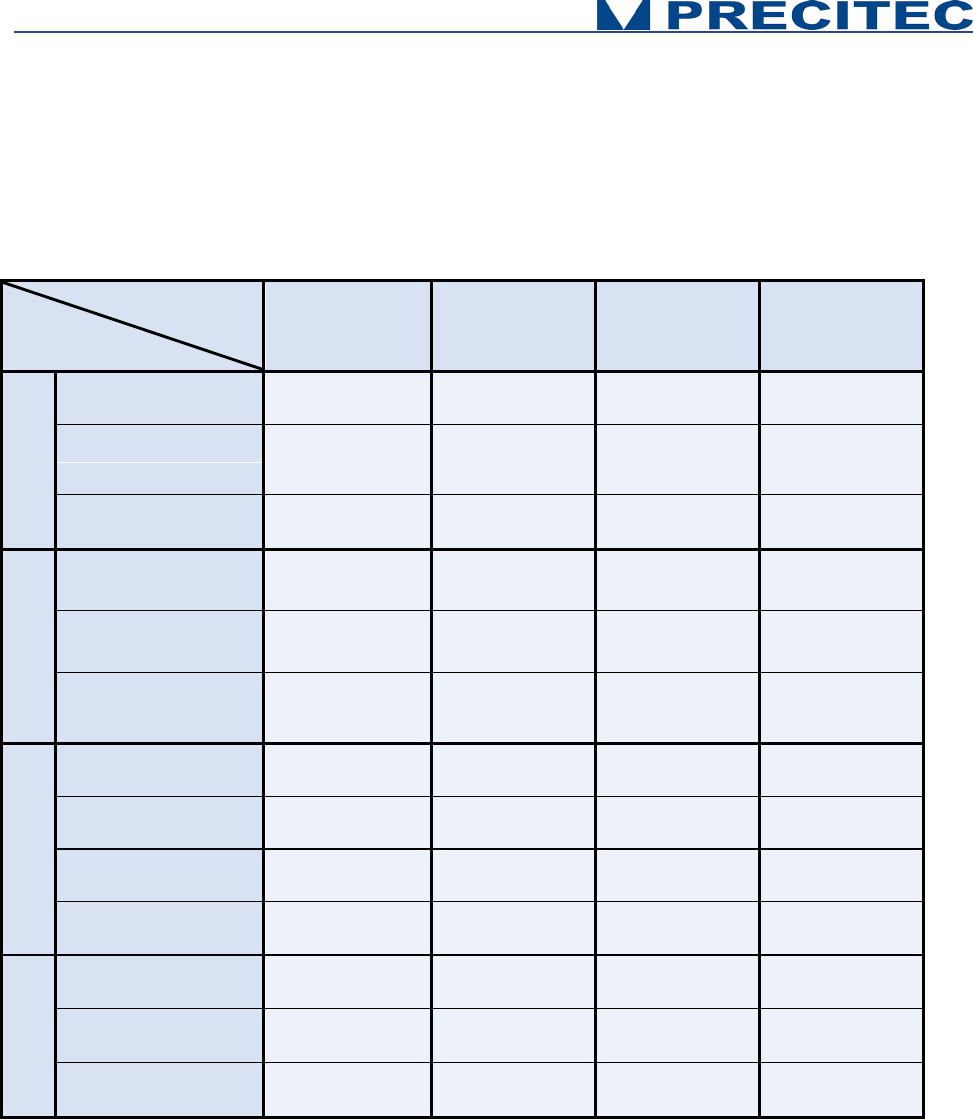
2.5 Typical applications (Overview) ......................................................................16
2.6 List of Deliverables .......................................................................................... 17
2.7 Connections and Interfaces ............................................................................ 18
2.7.1 Power supply jack ................................................................................................................... 18
2.7.2 Ethernet connector ................................................................................................................. 18

5
2.7.3 Trigger Input/Output and RS422 serial communication ...................................................... 18
2.7.4 External analogue converter box connection .......................................................................20
2.7.5 Status LED ................................................................................................................................ 21
2.8 Sensor Characteristics .................................................................................... 22
2.8.1 Sensor unit characteristics ..................................................................................................... 22
2.8.2 Optical probes characteristics ............................................................................................... 23
2.9 Optical Head Specifications definitions ......................................................... 24
2.10 CHRocodile C performance specifications: ................................................... 26
Operational Start up ..................................................................................................... 28
3.1 Connections and Interfaces ............................................................................ 28
3.2 CHRocodile Explorer and Drivers installations .............................................. 30
3.3 Communication with CHRocodile C ................................................................ 30
Measurements Start Up ................................................................................................ 32
4.1 Calibration Table ............................................................................................ 32
4.2 Dark Acquisition .............................................................................................. 32
4.3 Mechanical interfacing ................................................................................... 33
4.4 Basic Settings Configuration ........................................................................... 34
4.5 Data measurement Training ........................................................................... 35
Appendix 1: Advanced Configuration .......................................................................... 37
1. Commands List .................................................................................................... 37
2. Detailed Commands Description ........................................................................ 42
2.1 CTN Command ........................................................................................................................ 42
2.2 DRK Command ........................................................................................................................ 42
2.3 ENC Command ........................................................................................................................ 42
2.4 ETR Command ........................................................................................................................ 43
2.5 IPCN Command ....................................................................................................................... 52

6
2.6 LAI Command .......................................................................................................................... 52
2.7 NOP Command ........................................................................................................................ 53
2.8 SCA Command ......................................................................................................................... 53
2.9 SEN / SENX Command ............................................................................................................ 53
2.10 SHZ Command ......................................................................................................................... 54
2.11 SODX Command ...................................................................................................................... 55
2.12 SSU Command .........................................................................................................................60
2.13 STA Command .........................................................................................................................60
2.14 STO Command ........................................................................................................................ 61
2.15 THR Command ........................................................................................................................ 61
2.16 TRE Command ........................................................................................................................ 62
2.17 TRG Command ........................................................................................................................ 62
2.18 VER Command ........................................................................................................................ 63
Appendix 2: Mechanical Plans ...................................................................................... 64
1. Optical probe mechanical plans ........................................................................ 64
2. CHRocodile C unit mechanical plans ................................................................. 66
3. CHRocodile C unit mechanical interface plans ................................................. 67
Appendix 3: Trouble Shooting ...................................................................................... 68
1.1 Power off ............................................................................................................ 68
1.2 Communication error: ........................................................................................ 68
1.3 Distance Measurement: ...................................................................................... 68
1.4 Thickness measurement: ................................................................................... 69
Appendix 4: Technical support .................................................................................... 70
7
Basic Safety Instructions
This operation manual contains the most important instructions for the safe operation of the product.
Observe all instructions and guidelines in this documentation.
Moreover, the locally applicable regulations and codes for accident
prevention at the use site must be observed.
1.1 Warranty and Liability
The general terms and conditions of delivery for products and services in the electronics industry
along with the amendments and restrictions deriving from the general terms and conditions of delivery
for Precitec Optronik GmbH apply to all of our products.
We reserve the right to make any changes to the device’s construction for reasons of improving quality
or expanding the possible applications as well as any made for production-related reasons.
Dismantling the device voids all warranty claims. The exception to this is the replacement of parts that
are subject to wear and tear and require maintenance or calibration, to the extent that these are
expressly identified in this documentation.
Changes made to the device on own authority render liability claims void.
1.2 Safety Symbols
The following terms and symbols for hazards and instructions are used in the operation manual.
WARNING
This symbol indicates a possibly dangerous situation. Failure to heed
these instructions can result in minor injuries or cause property damage.
WARNING
High voltage hazard – indicates a hazard from electrical shock and
warns of immediate or impending danger to the life and health of
persons or of extensive property damage.
8
WARNING
Do not touch – indicates that touching the contact/optics surface can
cause damage/destruction of the component.
IMPORTANT
Information which the user must pay attention to/ be aware of in order to
avoid disruptions in the course of processing/ in product use.
TIP
Provides information that the user needs in order to achieve the
intended result of an action most directly and without difficulty.
PREREQUISITE
Describes all components as well as all conditions that must be present/
be fulfilled in order to the action to be successfully completed.
ADDITIONAL INFORMATION
Informs the user whenever there is additional information about a
context being described.
1.3 Proper Use
The optical sensor is intended as a stand-alone device or as part of a measurement apparatus for
measuring distance, thickness and surfaces for quality and dimensional control.
Only use the optical sensor in a dry environment. The device may only be operated within the
specifications given in the technical data.
Any use deviating from the intended and proper use is considered
improper. The user assumes liability for the consequences in these
cases.
Electromagnetic
Compatibility (EMC)
Both as an individual device and in combination with the devices
designated in this documentation, the optical sensor fulfils the
requirements of the standards DIN EN 61326-1:2013-07 and DIN EN
61010-1:2011-07, and therefore corresponds to the EU-Directive
2014/35/EU and 2014/30/EU. This declaration is valid for all units with
the CE label on it, and it loses its validity if a modification is done on
the product.
When customer-supplied devices or cables are used this can mean
that these Norms may not be fulfilled. For this reason, you should only
9
use the original devices and replacement parts and observe the
instructions for EMC-compliant installation in the handbooks that
come with them.
If the optical sensor is operated inside a facility with other devices, the
entire facility must comply with the provisions in the EC-Guidelines in
the demands of the general operating permit.
1.4 Duty of Operator and Personnel
The operator of the device is obligated only to allow persons to work on the device who:
are familiar with the basic regulations concerning workplace safety and accident prevention and
who have been instructed in the operation of the device
have read and understood the safety chapter of this operation manual and have confirmed this with
their signature.
The personnel must be trained in compliance with the regulations and safety instructions and must
have been informed of possible hazards.
1.5 Safety Measurements in Normal Operation
When it is assumed that the device can no longer be operated safety, the device or the plant must be
taken out of operation. The device must be secured against unintended use. Unauthorized
interventions will void your rights to assert warranty claims.
Any attempt to copy or analyze the software will lead without fail to the voiding of all rights to assert
warranty claims.
1.5.1 Protection from Electronic Shock
Please make sure that the live components are uncovered after
opening the housing or removing components. Touching these
components presents a potentially lethal hazard.
When service- and repair work is performed on opened devices and
modules, the main power supply must be reliably shut off (mains cable
unplugged).
1.5.2 Protection from Optic Radiation / Eye Safety
When performing service and maintenance work, make sure that you
10
do not look directly into the LED’s light. The light can harm your eyes.
1.5.3 Grounding the device
Make sure that the device is grounded in compliance with
regulations. Please make sure that the optical sensor is supplied
with power via a grounded main power input line (cold device
plug).
1.6 Medical or safety-relevant usage
If the CHRocodile Line Sensor is used in medical or safety-relevant
applications, the operator must ensure that the CHRocodile Line
Sensor is qualified for the specific application. This includes the
optical characteristics of the measured sample as well as the
influence of temperature and vibrations to the CHRocodile sensor.
Furthermore the user has to check the CHRocodile Line Sensor for
correct measurements and for exceeding the specified measuring
uncertainty.
1.7 Storage and Transport
In order to avoid damages in storage and transport, the following ground rules are to be observed:
Maintain the storage temperature range allowed in the technical specifications
Take suitable measures to avoid any damage from humidity or moisture, vibrations or impact
Do not store in or near magnetic fields (e.g. permanent magnet or alternating electrical field)
1.8 Emergency Procedures
Disconnect the plant from the main power supply
Extinguish any flames with a Class B fire extinguisher
11
Product Description
2.2 General Description
The CHRocodile C is a single-point compact optical sensor dedicated to non-contact surface
measurement. This sensor is based on confocal chromatic principle and offers high precision distance
and thickness measurement.
The CHRocodile C has an original architecture, with no optical fibers, which consists in all elements
embedded in one optoelectronic unit. PRECITEC is the first company to propose this unique
architecture for confocal chromatic sensor, which allows to overcome the device integrating
constraints met in industrial environment.
With its robust and integrated design, the CHRocodile C is ideally suited for industrial inline use and
easily integrable into any kind of inspection machine.
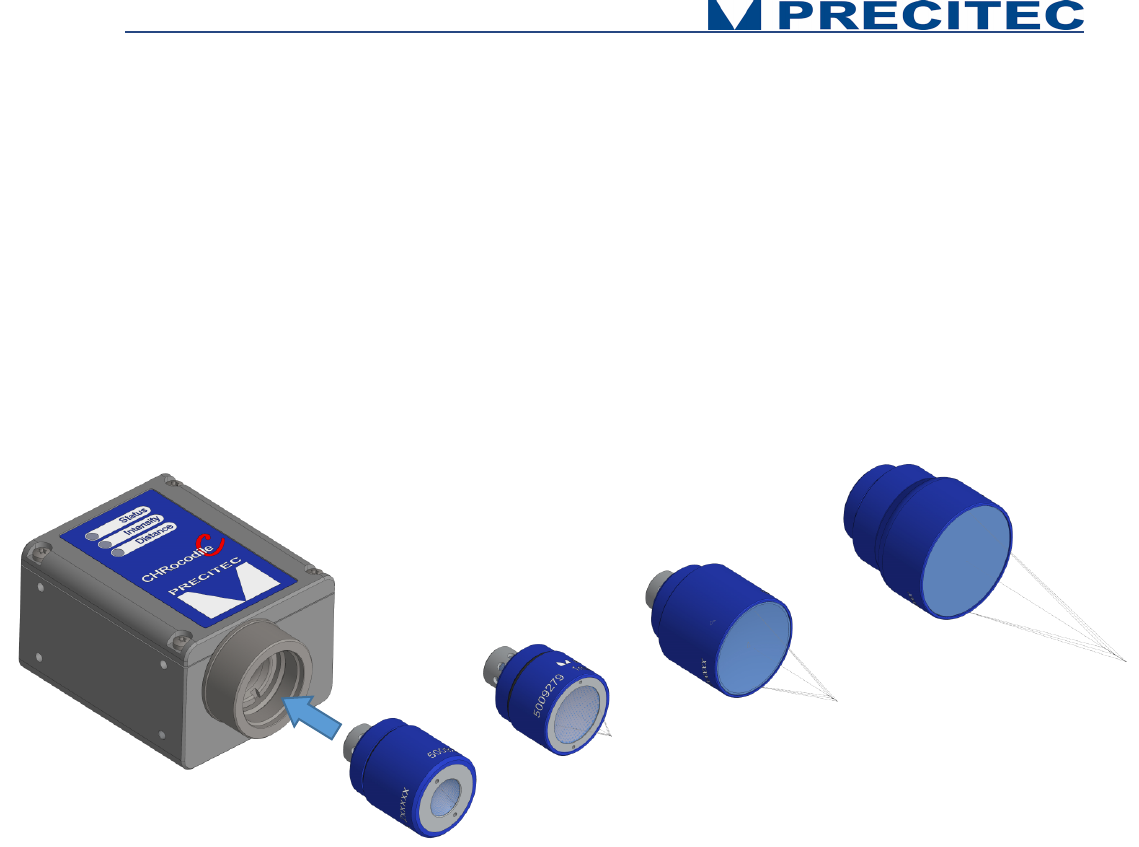
The CHRocodile C can accommodate different types of optical probes. The optical probes
interchangeability is straight forward, as the operator just need to exchange optical probes and move
to the right calibration table. Finally, data transmission is carried out by Ethernet communication up to
4000 measurements per seconds. CHRocodile C characterisctics are described in Section 2.7.
The extraordinary high dynamic range and the outstanding signal-to-noise ratio of the CHRocodile
sensors ensure the best measuring results on any kind of surfaces.
Thanks to its compact dimensions and excellent performance/price ratio, CHRocodile C is the ideal
alternative to classical laser triangulation sensors.
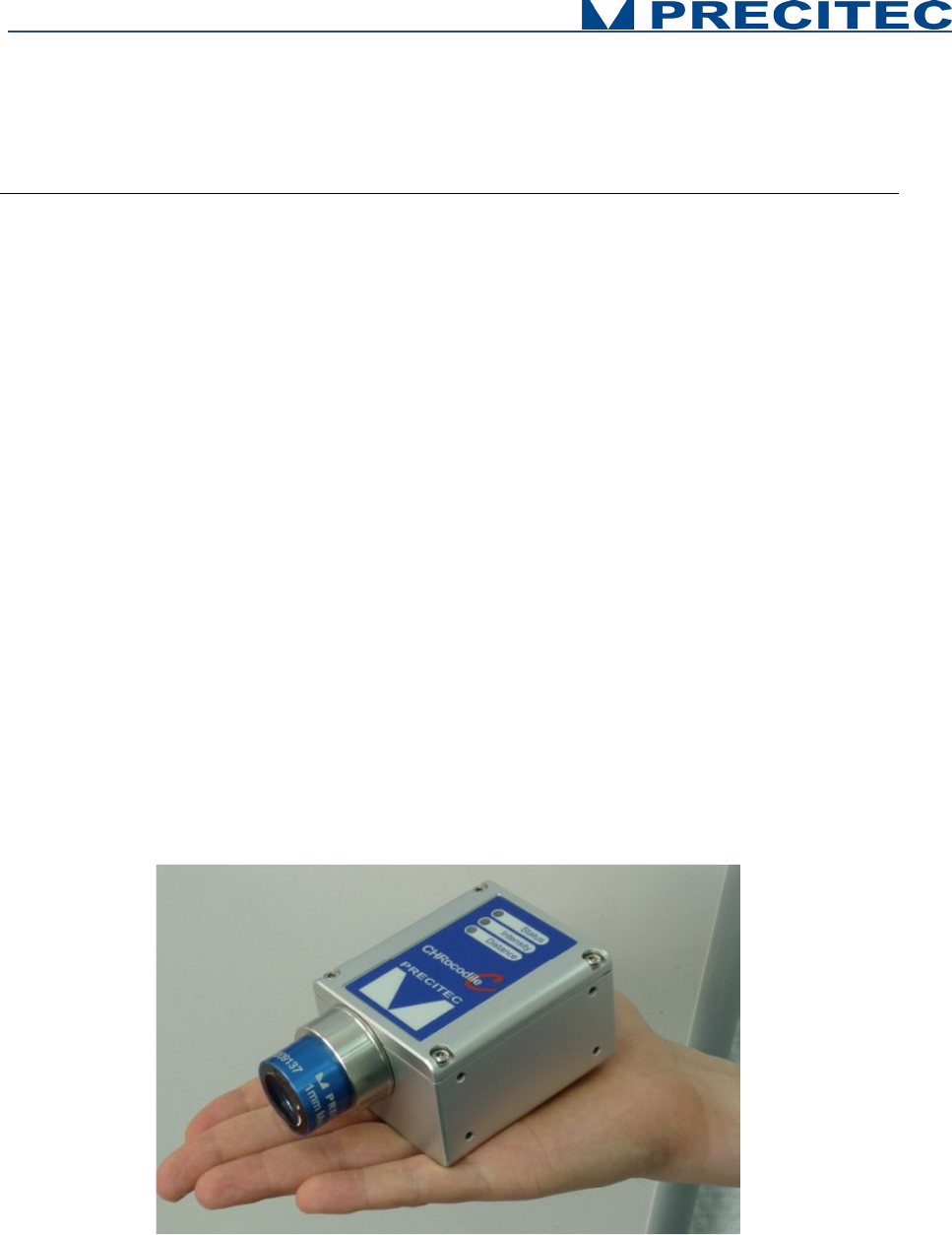
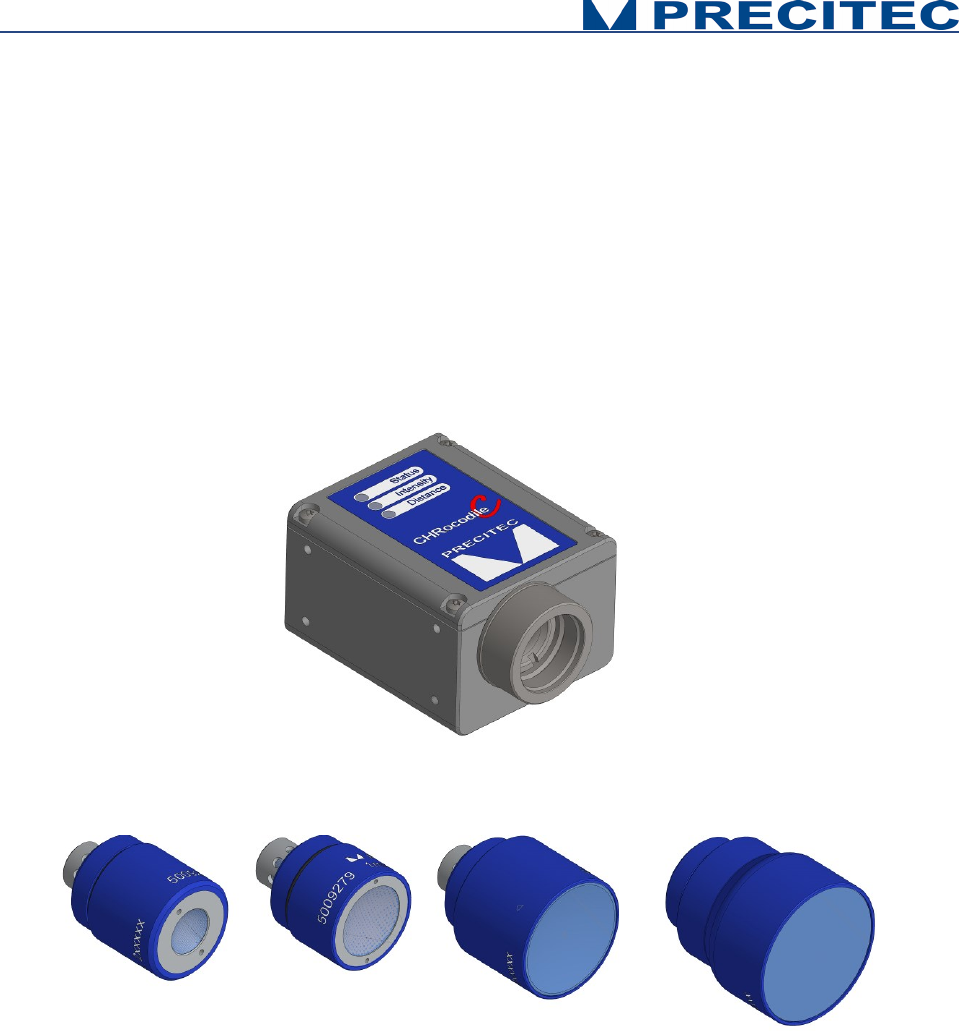
Fig 2-1: CHRocodile C 3D view:

12
2.3 Measuring principle
2.3.1 Optical principle
For most industrial applications the chromatically coded distance detection method turned out to be
very well suited. CHRocodile C is based on this method and more precisely on the Confocal
Chromatic principle. This principle combines the properties of confocality and axial chromatism.
Axial Chromatism:
That method takes advantage from a lens optical error commonly known as axial chromatic aberration:
the axial position of the focal point depends on the wavelength (color) of the light to be focused. For
example, in the visible spectral range, the focal distance for blue light is shorter than for red light. The
focal points of intermediate wavelengths are located in between according to a continuous axial
position variation. Thus, considering white light passing through an optical objective provided with
axial chromatic aberration, a continuum of color along the optical axis is generated, as an axial
rainbow.
Confocality:
That method also takes advantage from confocal opto-mechanical configuration. A confocal optical
system uses illumination point source and a pinhole in an optically conjugate plane in front of the
detecting system to eliminate out-of-focus signal. As only in focus light can be detected, the image's
optical lateral and axial resolution is improved. Consequently the pinhole act as a spatial filter which
block light which is out of focus or light which come from an external light source.
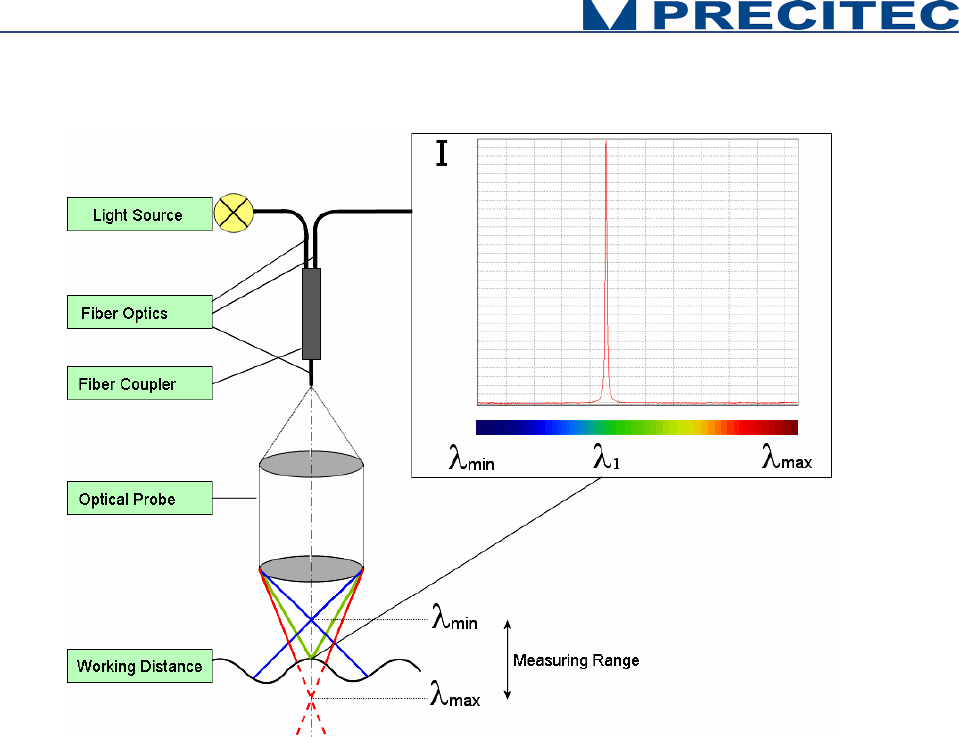
Confocal Chromatic Imaging:
Considering both confocality and axial chromatism properties, a white light illumination point is imaged
through the chromatic objective on a target object. Depending on the distance of the target from the
focusing chromatic objective, light of just a very narrow wavelength bandwidth is perfectly focused on
the target’s surface. All other spectral components of the light source are out of focus. In the back
path, from the target’s surface to the detector, the reflected light passes through the chromatic
objective, the optically conjugate pinhole which is in front of the spectrometer. The pinhole filters all
wavelengths except the narrow bandwidth which is in focus. The spectrometer analyses the spectrum
of the light reflected back by the target’s surface, and only a chromatic peak is observed
corresponding to the narrow wavelength bandwidth perfectly in focus. The analysis and the barycenter
calculation of this chromatic peak allow to determine the distance of the target surface from the
chromatic objective. (Cf. Fig. 2.2)
13
Fig. 2-2: Chromatic Confocal Imaging principle (point sensor)
14
2.4 Sensor Functionalities
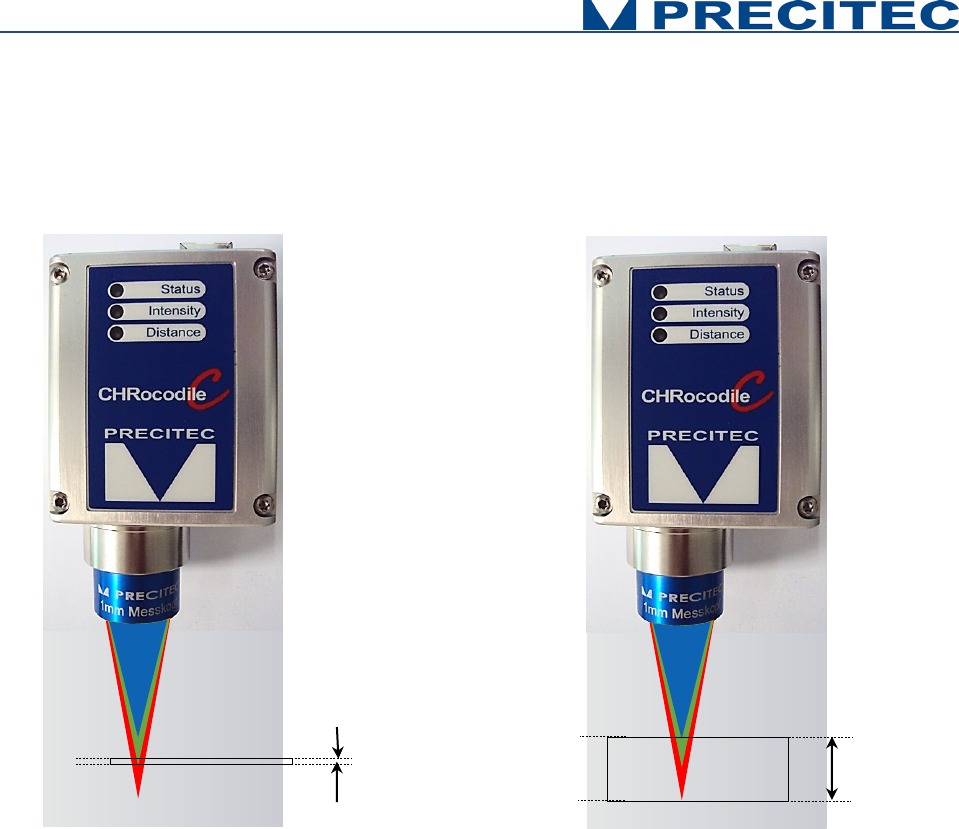
The CHRocodile C can transmit two different data: distance and thickness measurements. The
principle of these two applications are explained hereafter.
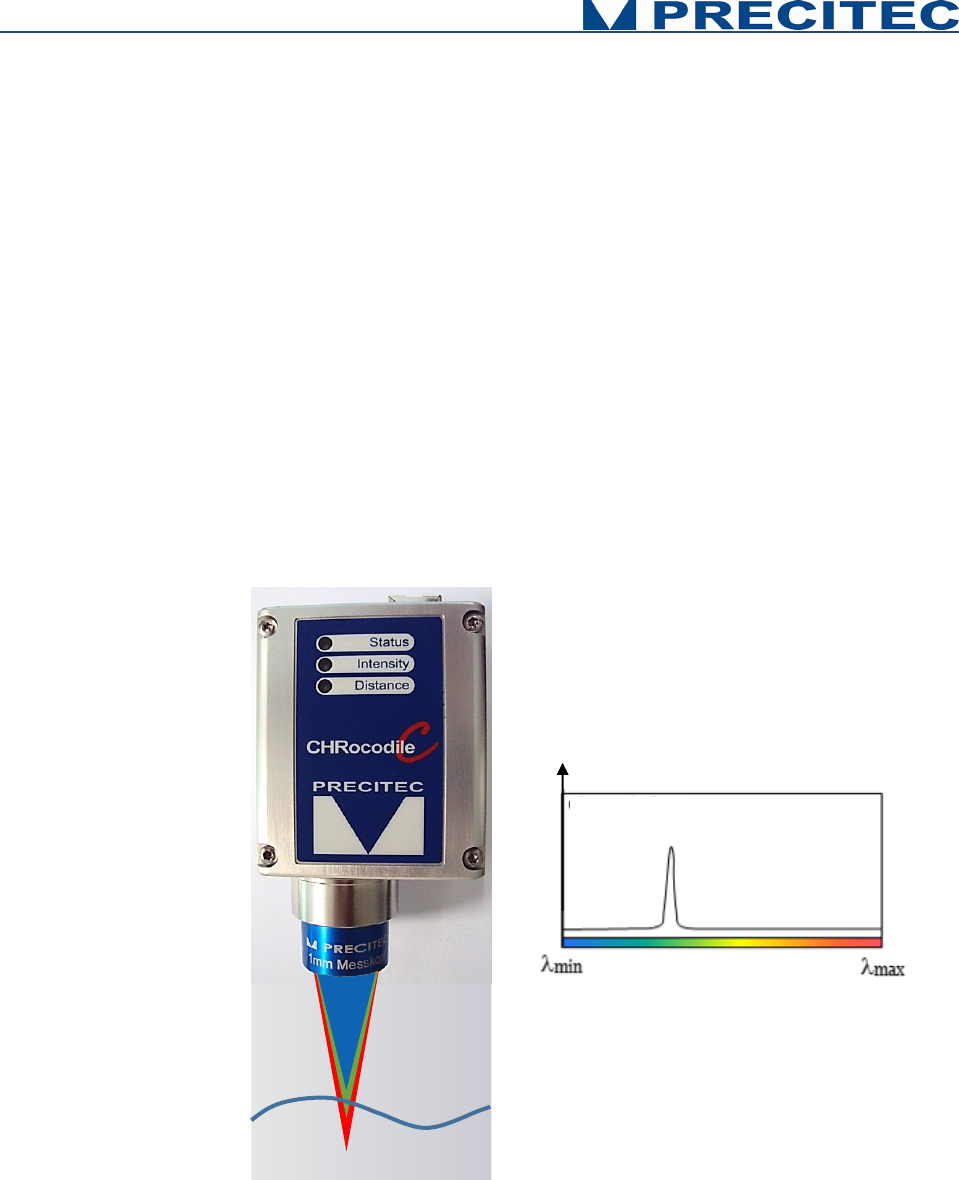
Application type 1
Chromatic distance measurement
Topographic, profile or roughness measurements are performed with
distance data measurement. With single-point sensors, i.e. CHRocodile
C, one spot is focused on the surface of the measured object using an
optic with a known chromatic aberration. The reflected light is more
intense for the wavelength in focus on the surface. Reflected light is
spectrally analyzed and the spectral response is a peak centered on
focused wavelengths. The spectral peak positions determine the distance
to the surface information. The distance is calculated and transmitted to
host computer at up to 4KHz frequency See Fig. 2-3.
Fig. 2-3: Chromatic measurement principle, distance measurement
Intensity
Chromatic
optical probe
Spectral signal
Target
15
Application type 2
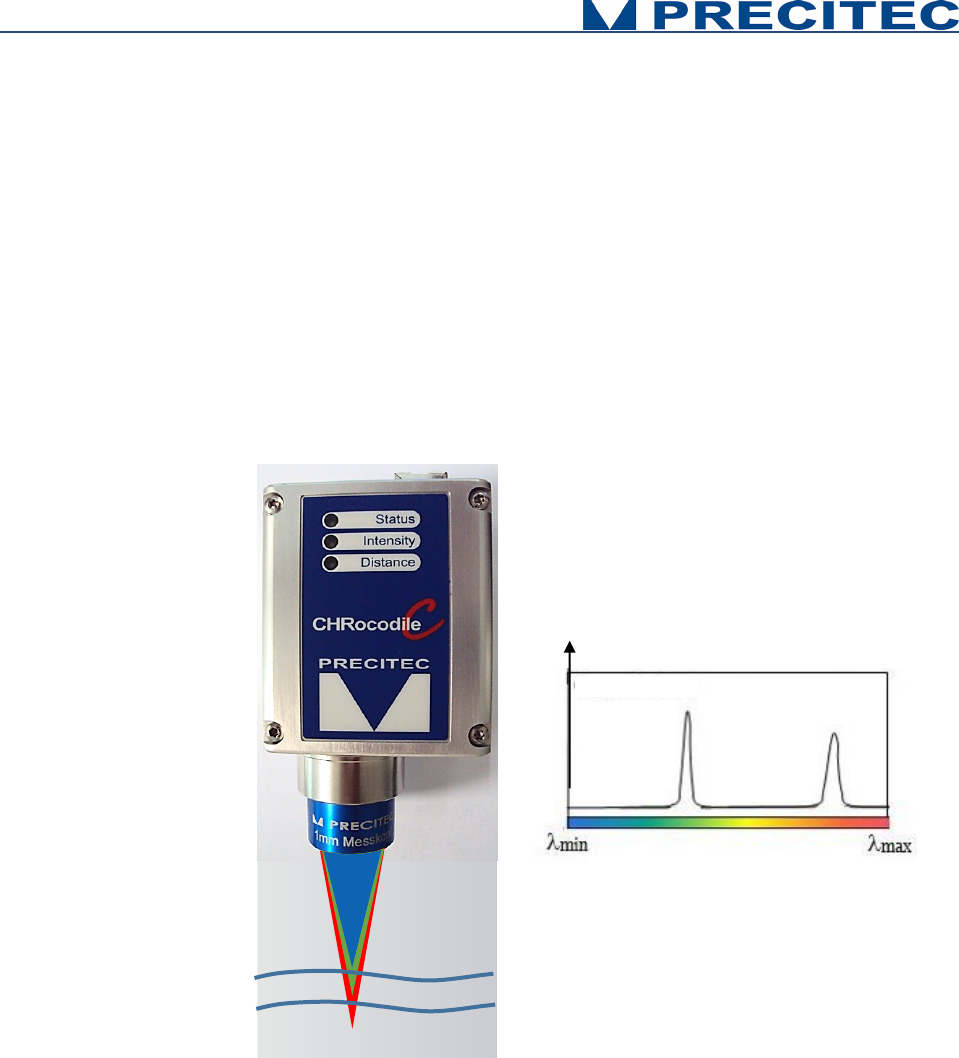
Chromatic thickness measurement
Thickness measurements can be performed when thickness data is
selected. If a transparent material is within the measurement volume of
the chromatic optical probe, the white light spot is focused on both the
two surfaces of the measured object. The reflected light is more intense
for the two wavelengths in focus on the two surfaces. Reflected light is
spectrally analyzed and the spectral response is constituted of two peaks
centered on focused wavelengths. Considering the refractive index of the
object, one can determine the thickness of the object at the spot light
location. This thickness data is calculated and transmitted to host
computer at up to 4KHz frequency. See Fig. 2-4.
Fig. 2-4: Chromatic measurement principle, thickness measurement
Target
Chromatic
optical probe
Intensity
Spectral signal
16
2.5 Typical applications (Overview)
A broad range of possible applications is available to this highly precise sensor.
The CHRocodile C is the most compact sensor based on confocal chromatic imaging principle. This
sensor is perfectly suitable for demanding measuring tasks, like non-contact measurement of
microtopography, layer thickness measurements. It could be used both on various reflecting and
scattering surfaces.
The PRECITEC confocal chromatic compact sensor is very well adapted to industrial environment, as
no optical cable are connected to the CHRocodile C unit. The absence of optical cables, promotes
robustness and compactness of the measuring device, and also facilitates the integration and use on
a motorized moving system, such as a coordinate measuring machine (CMM). Then this new type of
sensor overcomes the industrial constraints induced by fiber optic cables that are known to deteriorate
when the measuring device is subject to high accelerations and / or rotational movements.
The CHRocodile C offers the ability to perform fast and accurate metrological control of production, by
being built on automatic or semi-automatic inspection machines, or by being directly integrated on
production line for 100% inspection of manufactured parts. In this, this new technology fully meets the
current needs of the industry as it is suitable for many applications:
- The measurement of wafer in the field of semiconductor and generally microelectronics,
- The measurement and online control of mechanical or optical parts,
- Or even the measurement and control of glass or plastic film thickness.
Other fields of applications exist, the common point is to seek a cost effective measurement system
going, more and more compact, as flexible as possible, and highly accurate. It is the case in laboratory
environment and even more in industrial environment. It appears clearly here that the CHRocodile C
unit of measurement meet these different needs.
Optical Head
Application
Probe
200µm
Probe
1mm
Probe
4mm
Probe
10mm
Electronics
Micro-Electronics
Mechanics
Micro-Mechanics
Optics
Micro-Optics
Shape
Flatness
Roughness
Plastic and glass thickness
Thin film thickness
Coating thickness
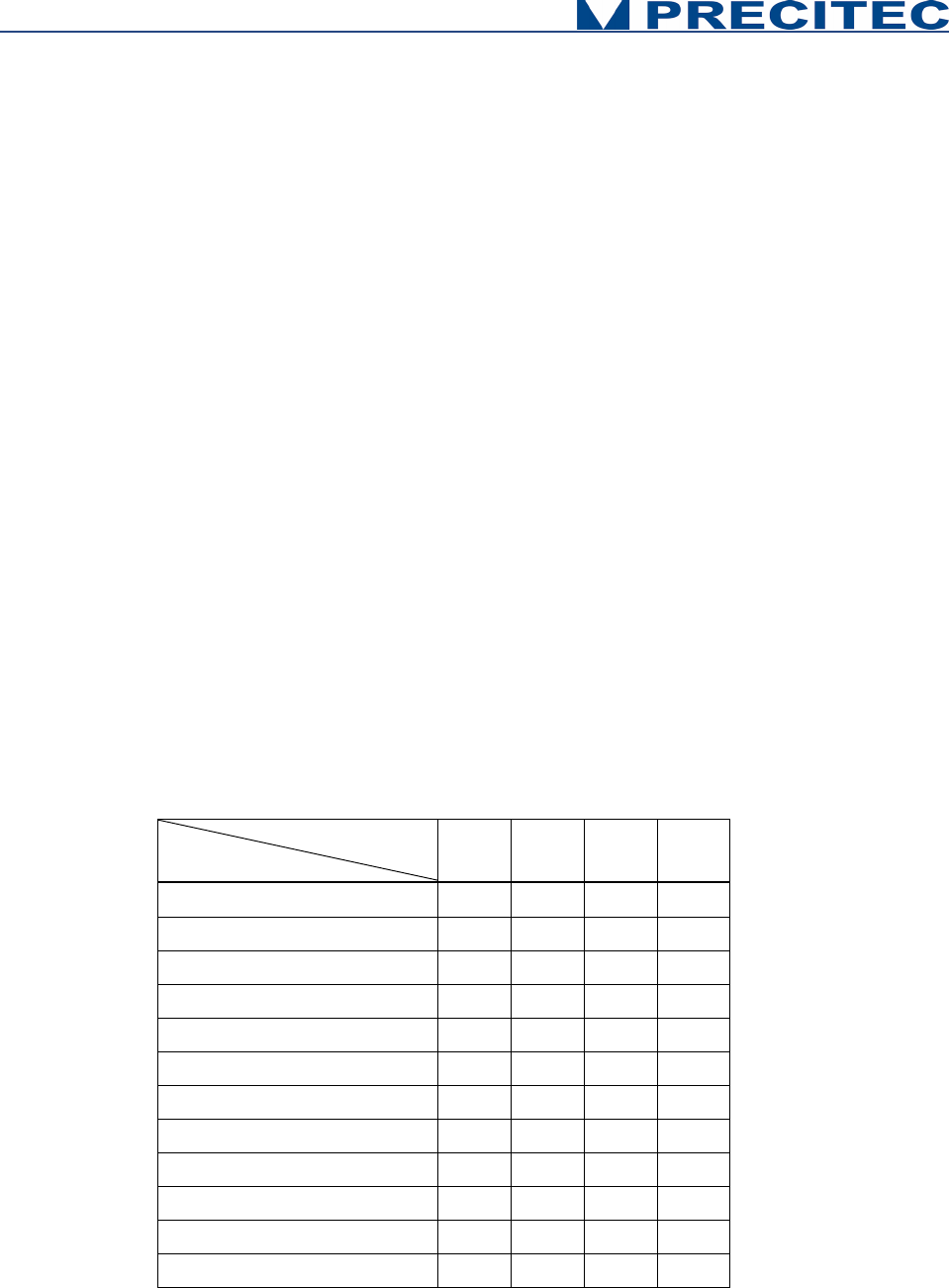
Table 2.1: Sensor applications
17
2.6 List of Deliverables
- One operational confocal chromatic unit (see Fig. 2-5),
- One operational optical probe (see Fig. 2-6),
- Power Supply Adapter (100-240VAC to 24VDC +/-10%),
- Ethernet cable,
- A CD with DLL and firmware,
- Software user guide,
- Operation Manual,
- Calibration report.
Fig 2-5: CHRocodile C unit 3D view:
Fig 2-6: Optical Head 3D view: a- 0.2mm b- 1mm c- 4mm d- 10mm
18
2.7 Connections and Interfaces
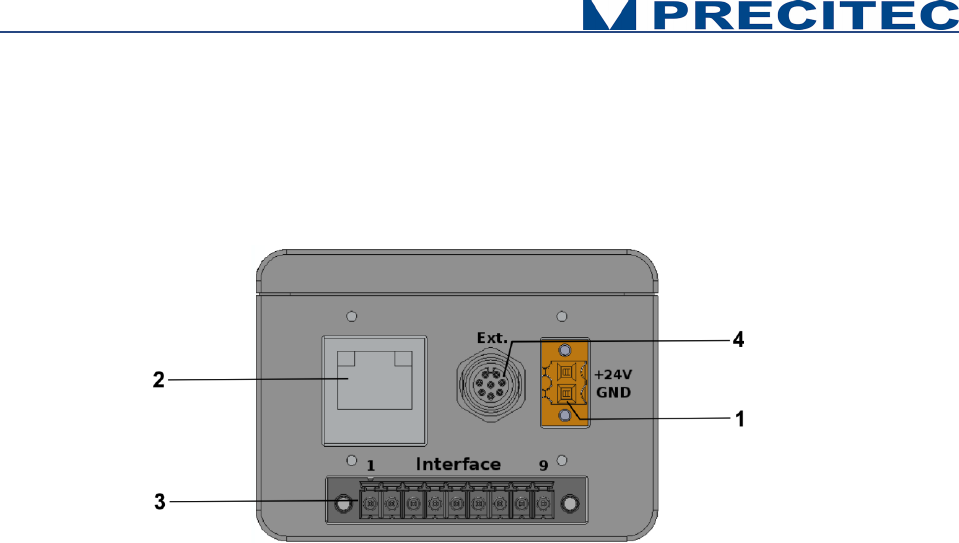
All of the connection ports for the sensor unit are located at the rear of the system (see Fig 2-7):
1. Power supply jack,
2. Ethernet interface, RJ45 port
3. 9-PINS Multipoint interface connector (Trigger / Serial communication)
4. 8-PINS round connector (analog converter module connection)
Fig. 2-7: CHRocodile C rear panel: Connections
2.7.1 Power supply jack
The CHRocodile C has two pluggable screw terminal for power supply with 24VDC +/-10%.
Connect the set of power cable supply associated to the Power Supply Adapter (100-240VAC to
24VDC +/-10%) delivered with the CHRocodile C unit.
2.7.2 Ethernet connector
The CHRocodile C has a RJ45 standard connector for Ethernet communication.
Connect the isolated RJ45 standard connector from the CHRocodile C unit to an Ethernet network
(PC). Ethernet supports the data transfer and can also be used for setting configuration by using $
command protocol (Cf. command SODX in Appendix 1), or for loading Calibration Table (Cf. command
TABL in Appendix 1). Ethernet communication allows to transmit a maximum of 16 data values at 4
KHz.
2.7.3 Trigger Input/Output and RS422 serial communication
The Trigger input/output use a multipoint connector interface (9 pins). This connector is used for
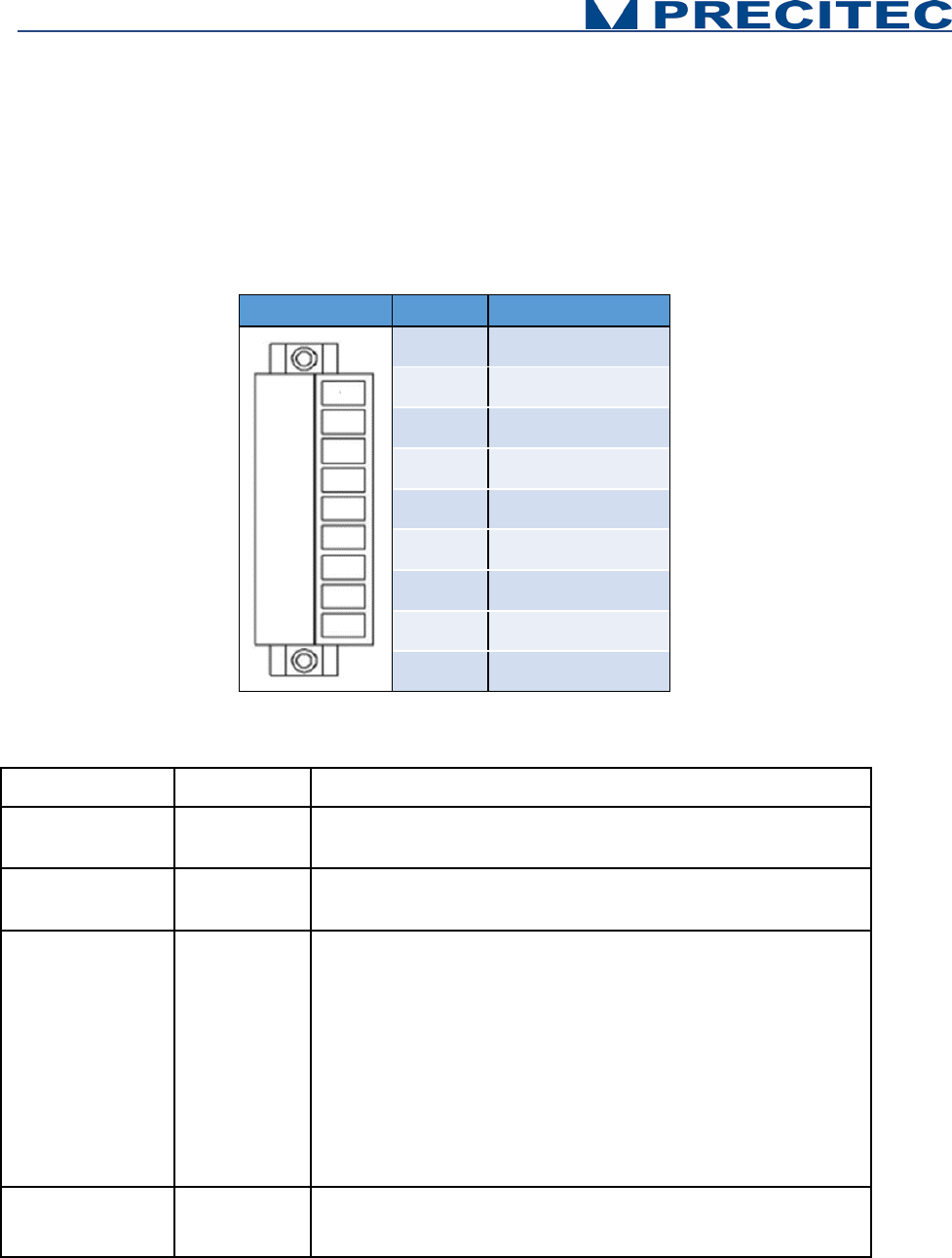
trigger Input / Output and for RS422 serial communication (Cf. Table 2-2 and Table 2-3).
The trigger options make the lighting cycle externally controllable and the synchronization between
e.g. a scanning system cycle and the CHRocodile C measurement rate. This means that external
triggering is possible for every measurement up to the full measurement rate of 4000Hz.
19
The interface contains the connection points for the synchronization and RS422 or RS232 serial
communication.
The serial RS232/RS422 is interfaced on the multipoint connector interface (9 pins). Serial
communication are mostly used for sending command as a hyper-terminal, and can also support data
transfer. The maximum transfer rate RS232/RS422 is 1843200 Bd.
PIN
SIGNAL
1
RS232 TX / RS422 TX-
2
RS232 RTS / RS422 TX+
3
RS232 CTS / RS422 RX-
4
RS232 RX / RS422 RX+
5
GND
6
Sync In
7
Sync Out
8
Reserve
9
GND
Table 2.2: Multipoint connector PIN / Signal correspondence
Signal
Function
Description
RS422
RS422
Interface
RS422 (differential signaling) Interface, internally terminated,
no handshaking
RS232
RS232
interface
RS232 interface, RTS/CTS handshaking possible
Sync In
Sync. Input
Positive slope from 0V to 5-24V causes according to the
settings of the sensor:
starts the continuous measurement, if the command
wait for trigger was received first (TRG Command)
starts the single measurement in mode trigger each
(TRE Command)
When in TRW mode, a positive slope starts continuous
measuring, a negative slope stops the measurement
the input has an internal 10 kΩ pullup-resistor to 5 V.
Sync Out
Sync. Output
Sync Output
Positive slope 0 V to 5 V with the start of each measurement.
Table 2.3: Interface
20
Remark: As the Sync-input has a weak pull-up to 5V, your trigger source definitely needs to be able to
sink that current in order to pull the input down to Gnd. So as a trigger source, you can use an open
collector transistor output, that pulls to ground or a push pull output. The input can support 24V, but
the trigger threshold is always at approximately 2V. The trigger occurs on the rising edge, that means
when the external pulldown transistor releases the input or when the pushpull drives to 5V.
Wait for trigger – signal characteristics to Analog Out
The sensor stops after the current data telegram is transmitted and
goes into a standby mode.
The last transmitted analog value persists until the next exposure
(also see TRG command).
2.7.4 External analogue converter box connection
The 8 pins round connector is used for external analogue converter box connection. This option can
be added to the CHRocodile C in order to obtain an analogue output. Also it is possible to add up to 2
encoder-input using this external analogue converter box connection.
The incremental encoder-input makes it possible to precisely assign the measurement point and axis
position without additional hardware. The CHRocodile C can manage with 2-axis encoders if the
optional analogue converter box is connected to the CHRocodile C 8-pins mini-DIN connector.
For an exact distance measurement it is necessary for every measurement value to be assigned to the
exactly correct spatial coordinates. This data must be recorded in the system and transferred to the
evaluation processing unit over the internal interface. To accomplish this, the sensor must be
equipped with the analogue box accessory.
21
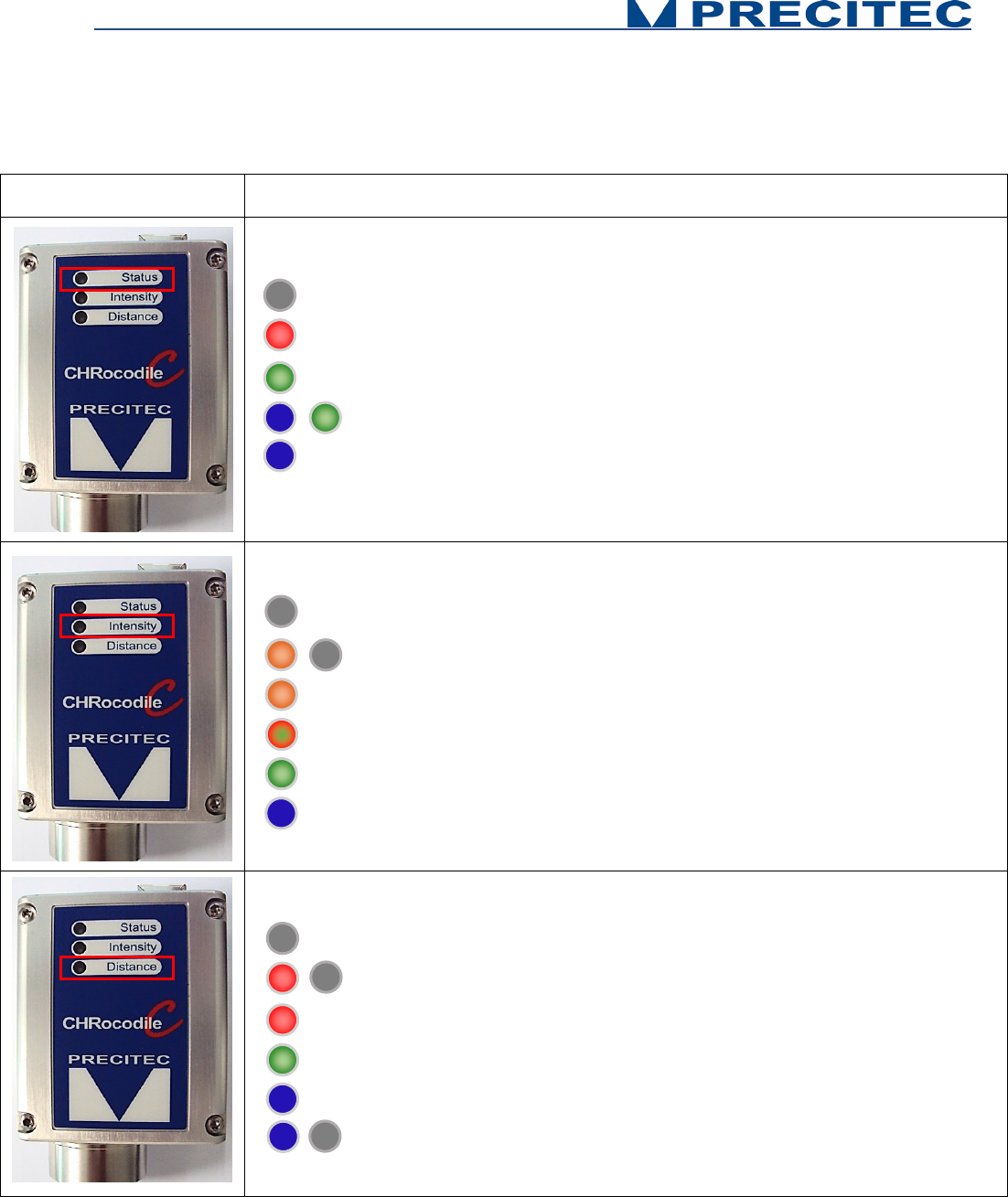
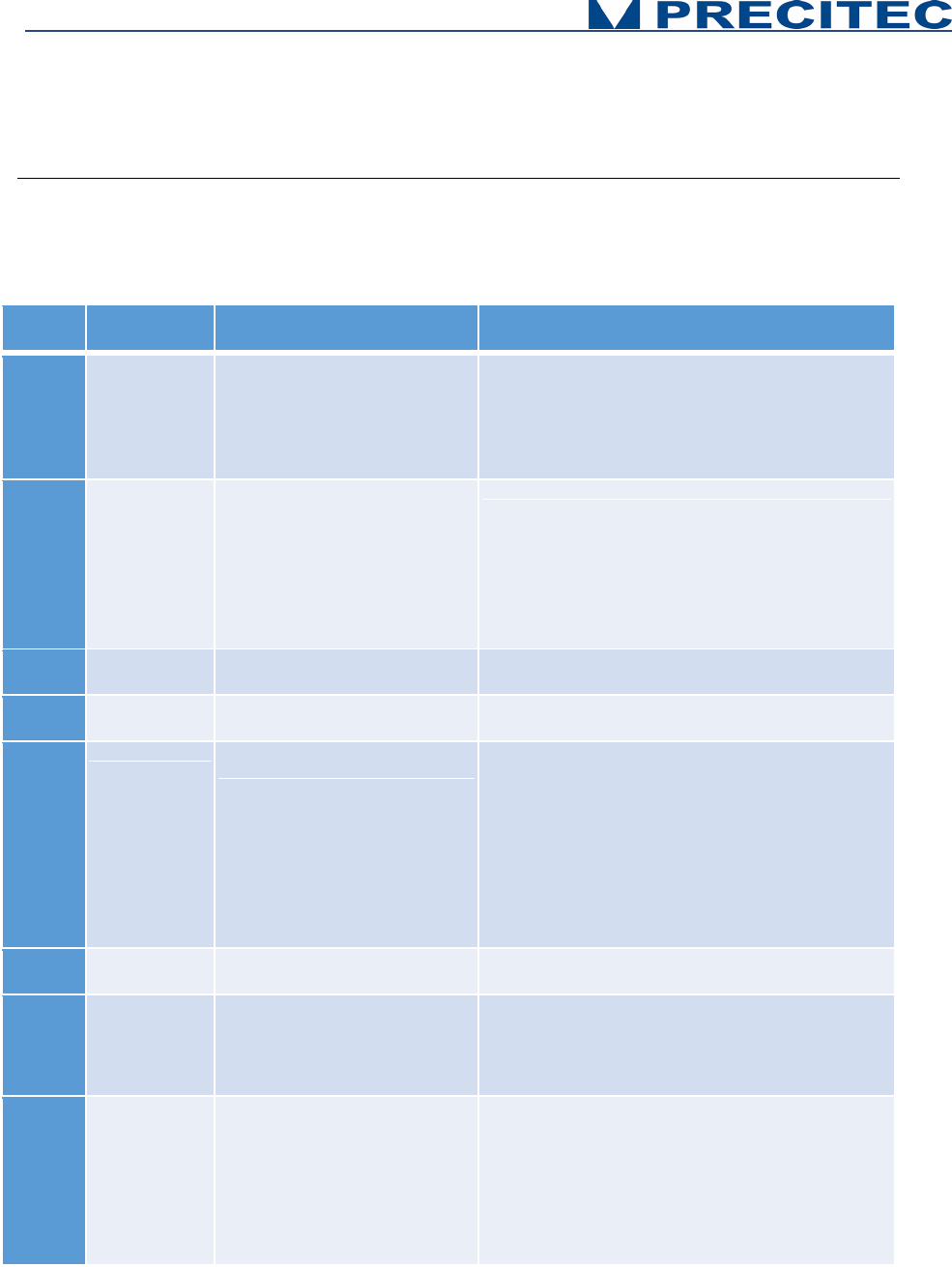
2.7.5 Status LED
LED status / CHRocodile C Status
Table 2.4: Status LED during functioning
No signal
High intensity signal
Medium intensity signal
Low intensity signal
Optimal intensity signal
(blink) Saturated intensity signal
No signal
Far Range
Mid Range
Near Range
(blink) Out of range : too far
(blink) Out of range : too close
Power OFF
Power ON, Firmware boot failure
(blink) Power ON, Triggering session (1)
Power ON, Waiting for trigger
(1) green when triggered at high frequency
Power ON, Firmware is configured / Continuous measurement

22
2.8 Sensor Characteristics
2.8.1 Sensor unit characteristics
Optical sensor
Measuring principle (1)
Confocal Chromatic
Measuring data (1)
Distance, Thickness (1)
Light source
LED
Dimensions (sensor unit)
99.3 x 65 x 47 mm (L x W x H) (2)
Weight
425g
Data Transmission
Measurements / second
Up to 4000 Hz
Interfaces
Ethernet, RS422, external analogue converter box as accessory
Transfer rate
Ethernet (100Mbits); RS422 (9600 – 921600 Baud)
Synchronization with ext. devices
Trigger-input / Output (TTL)
Encoder-inputs
Optional: 2 encoders input available through analogue converter box accessory
SDK
DLL written in C, C++ / SDK written in C# with .NET framework 4
OS
Windows XP, Windows 7, Windows 8
Data processing / calculation
Embedded processing unit
Standard to be met
Supply voltage
24VDC +/-10% with separate main supply unit 100 to 240VAC – 50Hz to 60Hz
Rated power
4W
Operating temperature
0 °C to +50 °C
Storage temperature
-20°C to +70°C
CE marking / EMC
Compliant with applicable regulation
RoHS
Compliant with applicable regulation
Protection class
IP50 (DIN 40050/ IEC 144)
Metrological specifications
Axial resolution / Repeatability (3) (4)
3x10⁻⁵ x Measuring Range
Accuracy (4)
2x10⁻⁴ x Measuring Range
Optical probes specifications
See Table 2.7
Order number
5009276
Table 2.6: Sensor Characteristics
(1) See section 2-3: Sensor functionalities. With CHRocodile C, the transmitted data are limited to up to 4 Altitudes, up to
4 Intensities and up to 3 Thicknesses.
(2) See Fig A2-2 Sensor unit mechanical plan in Appendix 2 CHRocodile C unit mechanical plan.
23
(3) See section 2.9: CHRocodile C performance Specifications.
(4) Resolution / Repeatability is given for optimal conditions (with a high intensity signal).
2.8.2 Optical probes characteristics
Optical probe
Specifications
Probe 200µm
Probe 1mm
Probe 4mm
Probe 10mm
DISTANCE
MODE
Measuring range (1)
200µm
1mm
4mm
10mm
Axial resolution /
Repeatability (Rmin)(4)(5)(6)
8nm
30nm
120nm
300nm
Accuracy (4) (5)
50nm
200nm
0.8µm
2µm
THICKNESS
MODE
Min. measurable
thickness (4) (7)
8µm
40µm
160µm
400µm
Max. measurable
thickness (4) (7)
300µm
1.5mm
6mm
15mm
Axial resolution /
Repeatability (4)
20nm
75nm
300nm
750nm
GLOBAL
SPECIFICATIONS
Working distance (1) (2)
4.7mm +/- 0.3mm
15.7mm +/- 0.5mm
36.7mm +/- 0.7mm
68.7mm +/- 1mm
Spot diameter (1)
3.4µm
5µm
8µm
16µm
Lateral resolution
1.7µm
2.5µm
4µm
8µm
Max object slope (1) (3)
+/- 45deg
+/- 28deg
+/- 20deg
+/- 14deg
MECHANICAL
DIMENSIONS
Length
17mm (8)
23.7mm (8)
26.6mm (8)
35.3mm (8)
Diameter
28mm (8)
28mm (8)
33.8mm (8)
40mm (8)
Weight
33g
30g
44g
50g
Table 2.7: Optical Head Specifications
(1) See section 2.9: Optical probe specifications definitions
(2) Bottom of the optical probe to middle of the measuring range
(3) Decreasing accuracy on the limits
(4) See section 2.10: CHRocodile C performance Specifications
(5) Measurement on perpendicular mirror at 20°C with optimal Signal to Noise ratio.
(6) Axial Resolution varies with intensity signal in %. Axial Resolution = 10 x Rmin x I-0.5
(7) Refractive index n=1.5
(8) See Fig A2-1: Optical probes mechanical plan
(9) See Fig A2-2: CHRocodile C unit mechanical plan
24
Optical probes are interchangeable: the same CHRocodile C unit can store up to 8 different
calibration tables corresponding to different optical probes. The optical probe is totally passive,
only the CHRocodile C unit has an internal light source and electronic board which can be
considered as heat and electrical sources. However the optical probe is highly isolated from these
heat and electrical sources in order to avoid any thermal expansion which could affect the
accuracy of the sensor measuring process. Considering this opto-mechanical architecture the
CHRocodile C unit has no visible optical cable and the user don’t need to take care with this
particularly sensitive component.
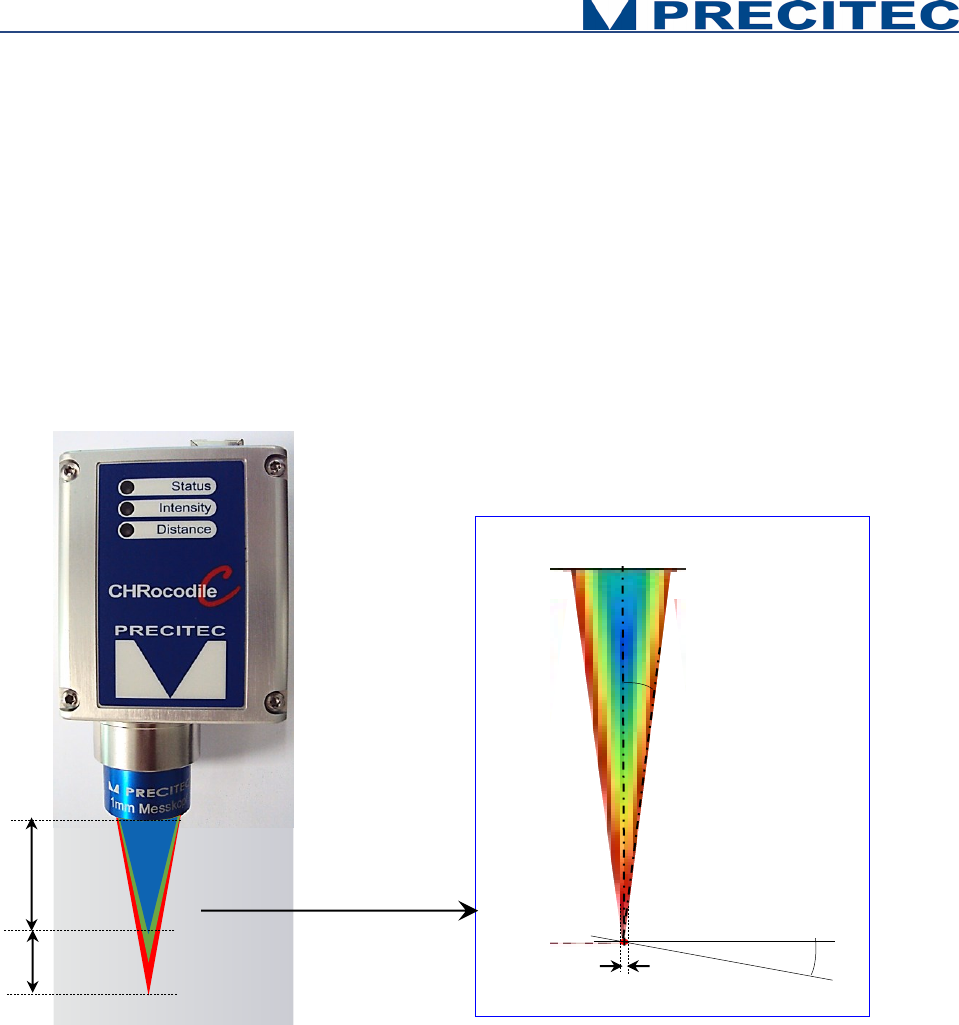
2.9 Optical Head Specifications definitions
W.D : Working Distance
M.R : Measuring Range
S.D: Spot Diameter (Size)
M.S: Max Object Slope (specified for specular
object. On diffuse object, it is possible to
measure on slope up to 85°)
Fig 2-8: Optical probes specification definition
W.D
M.R
Acceptance Angle:
related to M.S
S.D
M.S
26
2.10 CHRocodile C performance specifications:
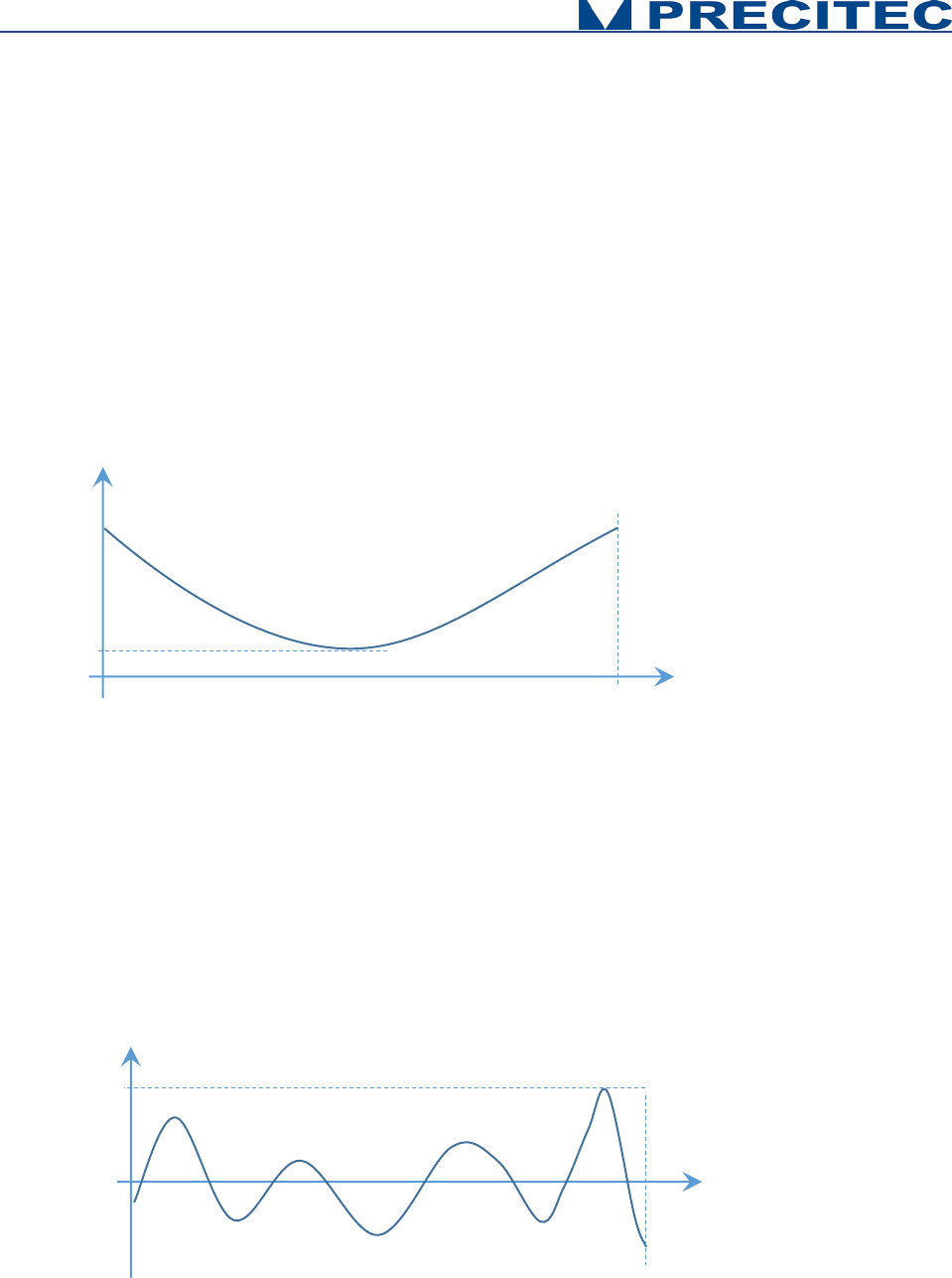
Axial Resolution / Repeatability:
Axial resolution / Repeatability corresponds to the static noise (standard deviation 1) on altitude or
thickness measurements. Axial resolution is measured on 1000 continuous points at different target
positions inside the measuring range. By default axial resolution specification corresponds to the
minimum value (Rmin) along the measuring range (See Fig. 2-9). The minimum value (Rmin)
corresponds to the target position where the signal to noise ratio is maximum. Resolution is inversely
proportional to the signal intensity.
Fig 2-9: Axial Resolution as a function of target position in measuring range.
Accuracy:
Accuracy corresponds to the altitude deviation between the CHRocodile C and a calibrated
interferometric reference sensor as a function of target position in the measuring range. Consequently,
accuracy is an experimental specification. By default accuracy specification corresponds to the
maximum of absolute value (Amax) (See Fig. 2-10).
Fig 2-10: Accuracy as a function of target position in Measuring Range.
Position in the
Measuring Range
Channel p
Axial Resolution (nm)
Rmin
0
0
Position in the
Measuring Range
Channel p
Accuracy (nm)
Amax
0
27
Minimum and Maximum Measurable Thicknesses:
The minimum and maximum measurable thickness specification is given for n=1.5 refractive index. It
is measured on a standard sample in the center of measuring range. T=n x (D1-D2)
Fig 2-11: Minimum and maximum measurable thicknesses
D1
D2
Tmin
Tmax
D1
D2

28
Operational Start up
3.1 Connections and Interfaces
All of the connection ports are located at the rear of the CHRocodile C (Cf. section 2.6 Connections
and Interfaces):
The power supply jack,
The RJ45 standard connector for Ethernet communication,
The multipoint connector interface (9 pins) for trigger input / output and RS422/RS232 serial
communication,
3.1.1 CHRocodile C Stand Alone device:
The device can be used as a stand-alone device in order to perform selective distance or thickness
measurements. In this condition, only the power supply and Ethernet connector or multipoint
connector are useful.
Power supply
The CHRocodile C has two pluggable screw terminal for power supply with 24VDC +/-10%.
Connect the set of power cable supply associated to the Power Supply Adapter (100-240VAC to
24VDC +/-10%) delivered with the CHRocodile C unit.
Ethernet connector
Connect the isolated RJ45 standard connector from the CHRocodile C unit to an Ethernet network
(PC). Use shielded cable for the data port connection (minimum category 5 cable).
The default CHRocodile C IP address is: 192.168.170.4
Configure the PC Ethernet port to the following address: 192.168.170.X (X≠4)
The CHRocodile C can also be configured to use auto-configuration of the IP-Address through
a DHCP server.
To configure the Ethernet port of your PC, you must open the ‘Network connection properties’ menu.
After selecting the right Ethernet card (connected to the sensor), click on ‘network protocol (TCP/IPv4)’
and click ‘Properties’. Set the IP address of the PC and the mask. For a standard use the mask should
be set to 255.255.255.0.
If you need to configure the sensor to another IP address (different than 192.168.170.4), you need to
use the $IPCN command (Cf. Appendix 1). This could be useful in case of multiple CHRocodile C
connection on a single computer.
29
Multipoint connector interface
Data transmission can be done through RS422/RS232 serial communication, using the so called $-
protocol. Two formats are available (ASCII/BIN) for sending the data from the optical sensor via the
RS422.
The data can thus be transferred to a computer as ASCII-symbols (telegram
format) and e.g. viewed with a terminal program (e.g. Tera Term, Freeware).
Output in BIN format, command: $BIN
Output in ASCII format, command: $ASC
The transfer rate for the serial interface port is selected under serial port baud rate.
The standard Baud rates available for selection are 9600, 19200, 38400, 57600, 230400, 460800 ,
921600 Baud and 1843200 Baud. Arbitrary nonstandard Baud rates can also be configured.
3.1.2 CHRocodile C integrated on measurement system:
In addition to the Power supply and Ethernet connector or multipoint connector interface used for
stand-alone device, the CHRocodile C needs to be connected to other interfaces to be integrated into
complex measurement configuration systems. The other possible interfaces are described hereafter:
- The multipoint connector interface for Trigger Input/Output and Serial interface RS422,
- The 8 pins mini-DIN connector for external analogue converter box to add 2 encoder inputs.
Encoder-input
The incremental encoder-input makes it possible to precisely assign the measurement point and axis
positions without additional hardware. The CHRocodile C can manage with 2-axis Encoders if the
optional analogue converter box is connected to the CHRocodile C 8-pins mini-DIN connector.
For an exact distance or thickness measurement it is necessary for every measurement value to be
assigned to the exactly correct spatial coordinates. This data must be recorded in the system and
transferred to the evaluation processing unit over the internal interface. To accomplish this, the sensor
must be equipped with the analogue box accessory.
Default are the encoder inputs not terminated.
Tye Sw0t02 to GND to terminate with 120 Ohm channel 0 to 2
Tye Sw3t04 to GND to terminate with 120 Ohm channel 3 to 4

30
If the encoder-signals are fed through the sensor and additional other devices are connected (e.g. for
axis control), the 120 Ohm termination can also be deactivated. Since the device has to be opened to
do this, you should contact Precitec Optronik before beginning any work of this kind.
Trigger Input/Output
The trigger options make the lighting cycle externally controllable and the synchronization between
e.g. a scanning system and the CHRocodile C measurement rate. This means that external triggering
is possible for every measurement up to the full measurement rate of 4000Hz.
The interface contains the connection points for the synchronization and RS422 serial communication.
Data transmission / sensor configuration
Data transmission and sensor configuration can be done through RS422 serial communication through
the multipoint connector interface or through Ethernet port.
3.2 CHRocodile Explorer and Drivers installations
3.2.1 CHRocodile Explorer installation:
CHRocodile Explorer is a Man-Machine interface which allows to configure, to visualize measurement,
to save data etc… CHRocodile Explorer can manage with all PRECITEC CHRocodile point sensors.
Refer to CHRocodile Explorer Manual to obtain more specifics information.
3.3 Communication with CHRocodile C
There are three possible ways to communicate with the CHRocodile C: via Precitec CHRocodile
Explorer software, via the CHRocodile C DLL and using the ASCII commands sent to the CHRocodile
C through serial interface (RS 422) or Ethernet communication. Up to 10 CHRocodile C can be
connected and controlled by a single computer (Windows XP, Windows 7 or Windows 8 OS, 32 and
64bits). CHRocodile C is automatically detected through Ethernet network (broadcast mode).
3.3.1 Via CHRocodile Explorer:
CHRocodile Explorer software is delivered with the sensor and is useful to configure sensor, to
visualize continuous measurements and to save data.
In order to obtain further detailed on CHRocodile Explorer functionalities, please refer to
CHREplorerManual.

31
3.3.2 Via CHRocodile C DLL:
DLL is used to interface the sensor with a general-purpose user program. This CHRocodile C DLL is
written in C, C++ language and is intended for .NET compatible language. This DLL allows to use
whole CHRocodile C functionalities. In order to obtain further detailed refer to CHRocodile C DLL
documentation.
A CD containing the DLL, some code examples and the operating Manual is delivered with the
CHRocodile C.
3.3.3 ASCII command communication
The ASCII commands can be sent to the controller via the RS422 interface using a specific command
structure described on Appendix 1.
Serial interface communication can be used to configure the sensor and receive measurement data.
As an example, the Windows™ « Hyper Terminal »™ utility can be used to send the commands and
configure the sensor via the RS232 or RS422 communication port.
32
Measurements Start Up
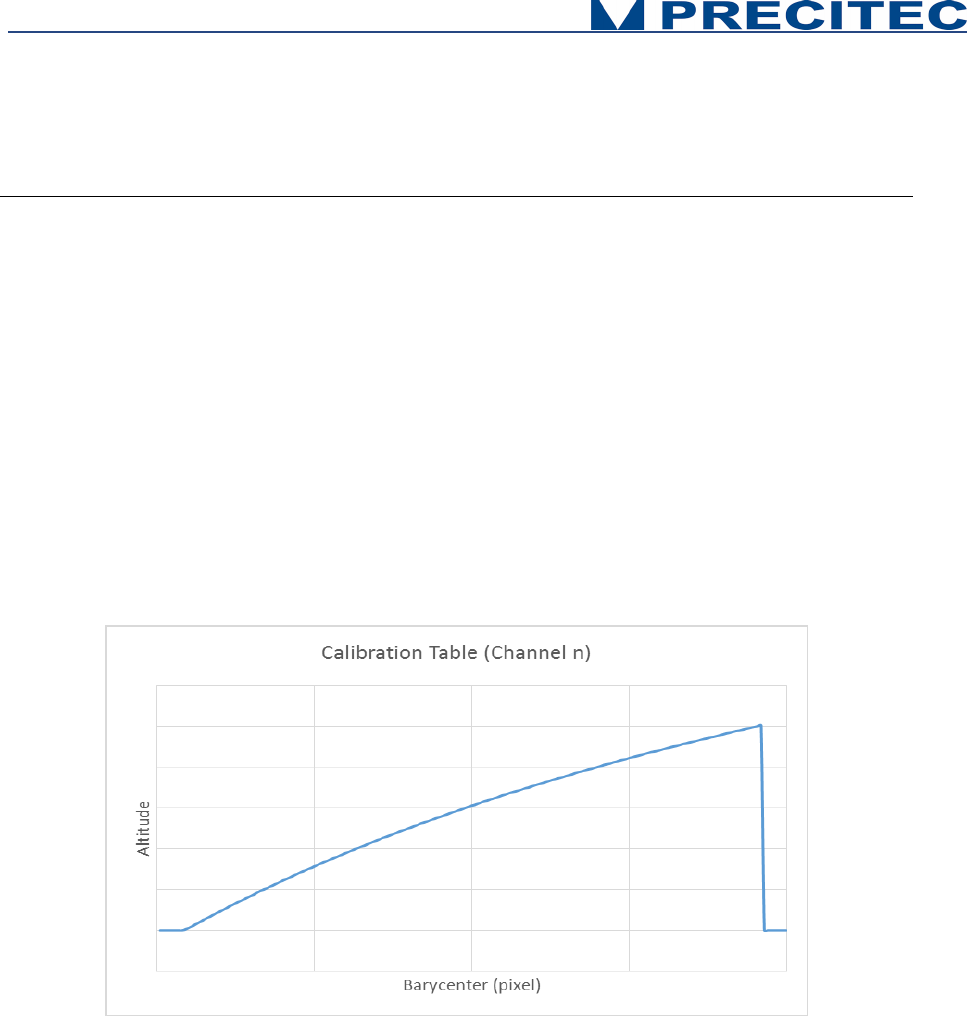
4.1 Calibration Table
The CHRocodile C unit can store up to 8 different calibration tables corresponding to different optical
probes. In order to start measurement you need to download or select the calibration which
corresponds to the used optical probe (Cf. command $SEN in Appendix 1). Calibration table consists
in a look up table which gives the correspondence between the peak position (Barycenter data) and
the Altitude data.
The CHRocodile C is calibrated at factory with a certified calibration bench.
The calibration table depends on both spectrometer and optical probe. Consequently a calibration
table is specific to one set of CHRocodile C sensor (CHRocodile C unit + optical probe), it can’t be
used on another set even if you are using the same optical probe type (i.e same measuring range).
Fig 4-1: Example of calibration table for a single channel
4.2 Dark Acquisition
Even when there is no surface in the probe’s measurement range, the signal on the detector is not
zero. These non-zero values for each pixel on the detector is due to electronic dark and mostly to flare
corresponding to unwanted back-reflected light on optical lenses surfaces. This Dark signal which
limits the measurement dynamics of the sensor can be remove from the useful signal.
In order to eliminate the influence of this undesirable light, a dark reference is performed on the sensor
(Cf command DRK in Appendix 1). The Dark reference acquisition must be done when no object is in
the measurement range.
33
4.3 Mechanical interfacing
After completing the operational startup, i.e. connecting with the power supply, proceed with
initializing, then communication is ready and mechanical interfacing should be done.
Mechanical interfacing consists in:
- Connecting the optical probe, which suits to your application, to the CHRocodile C unit. The
optical probe is simply screwed on the CHRocodile C unit (Cf. Figure 4.2).
Fig 4-2: Interchangeable optical heads
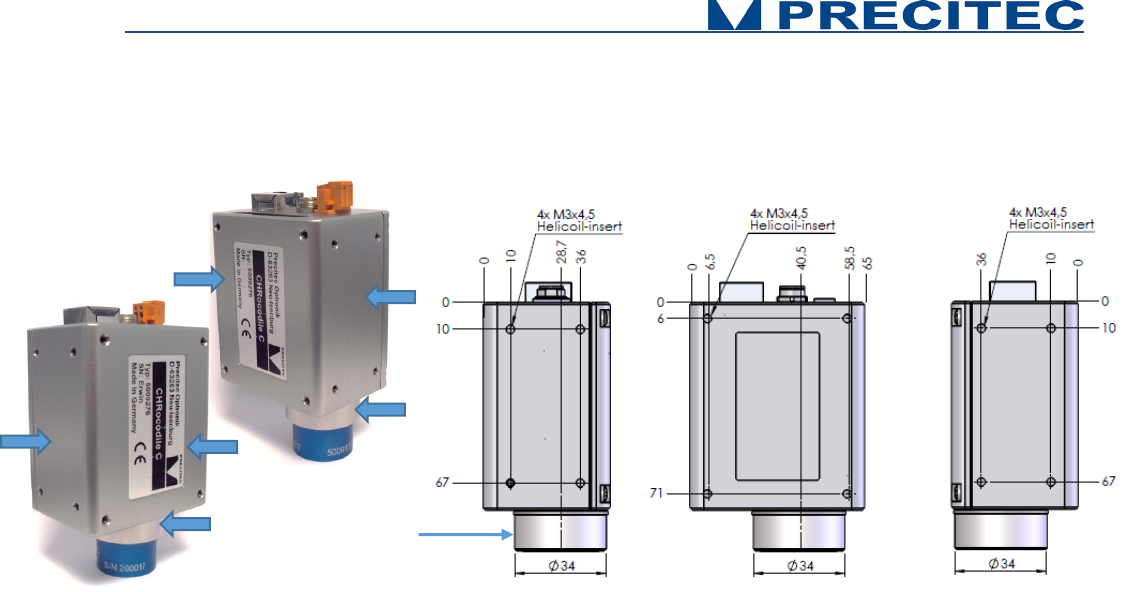
- And, fixing the CHRocodile C on your system using the interface threaded M3 holes located
on the soleplates and on the lateral surfaces of the CHRocodile C unit or using the ring
surrounding the optical probe (Cf. Fig 4-3).
Screw optical head
on sensor unit
34
Fig 4-3: CHRocodile C unit mechanical interface: fixture holes on:
a- lateral surface 1
b- soleplate,
c- lateral surface 2.
4.4 Basic Settings Configuration
In order the CHRocodile C to be operational for startup some basic parameters should be set up. You
can also refer to the CHRocodile C quick start guide documentation.
Basic setting configuration consists in selection of:
• Measuring Range: The CHRocodile C could accept up to 8 calibration tables. Each calibration
table corresponds to a unique optical probe. Consequently, depending on the optical probe
which is mounted on the CHRocodile C unit, the operator must select the right measuring
range or calibration table. (Cf. command $SEN in Appendix 1)
• Data transmission: The CHRocodile C can transmit different data: up to 4 Altitudes, up to 4
Intensities and up to 3 Thicknesses. Depending on the application, operator must select the
right data. (Cf. command $SODX in Appendix 1)
• LED intensity level: The LED intensity Level can be adjusted from 0 to 100%. As for
measuring rate, this adjustment essentially depends on object reflectivity. Adjust LED intensity
in order to obtain a high signal intensity, but avoid saturating the detector (intensity LED blinks
orange). In order to adjust LED intensity, use the LAI command (Cf. Appendix 1).
c-
b-
a-
Possible fixture on
the surrounding ring.
35
• Measuring Rate: Instead of adjusting intensity or in addition to LED intensity adjustment, it is
also possible to adjust the measuring rate. The measuring rate is related to data transmission
frequency. The CHRocodile C maximum measuring rate is 4KHz. The higher the measuring
rate is the lower the signal intensity is. Consequently, depending on the object reflectivity
under measurement, the measuring rate (measuring frequency) must be adjusted in order to
remove saturation or too low intensity signal. In order to adjust measuring frequency, use the
SHZ command (Cf. Appendix 1).
4.5 Data measurement Training
When mechanical interfacing is done, the object to be measured must be positioned inside the
measuring range of the CHRocodile C optical probe.
This procedure is valid for altitude and thickness measurement, i.e. to perform topographic
measurement on reflecting object or to perform thickness measurement on transparent object.
Measuring altitude procedure consists in:
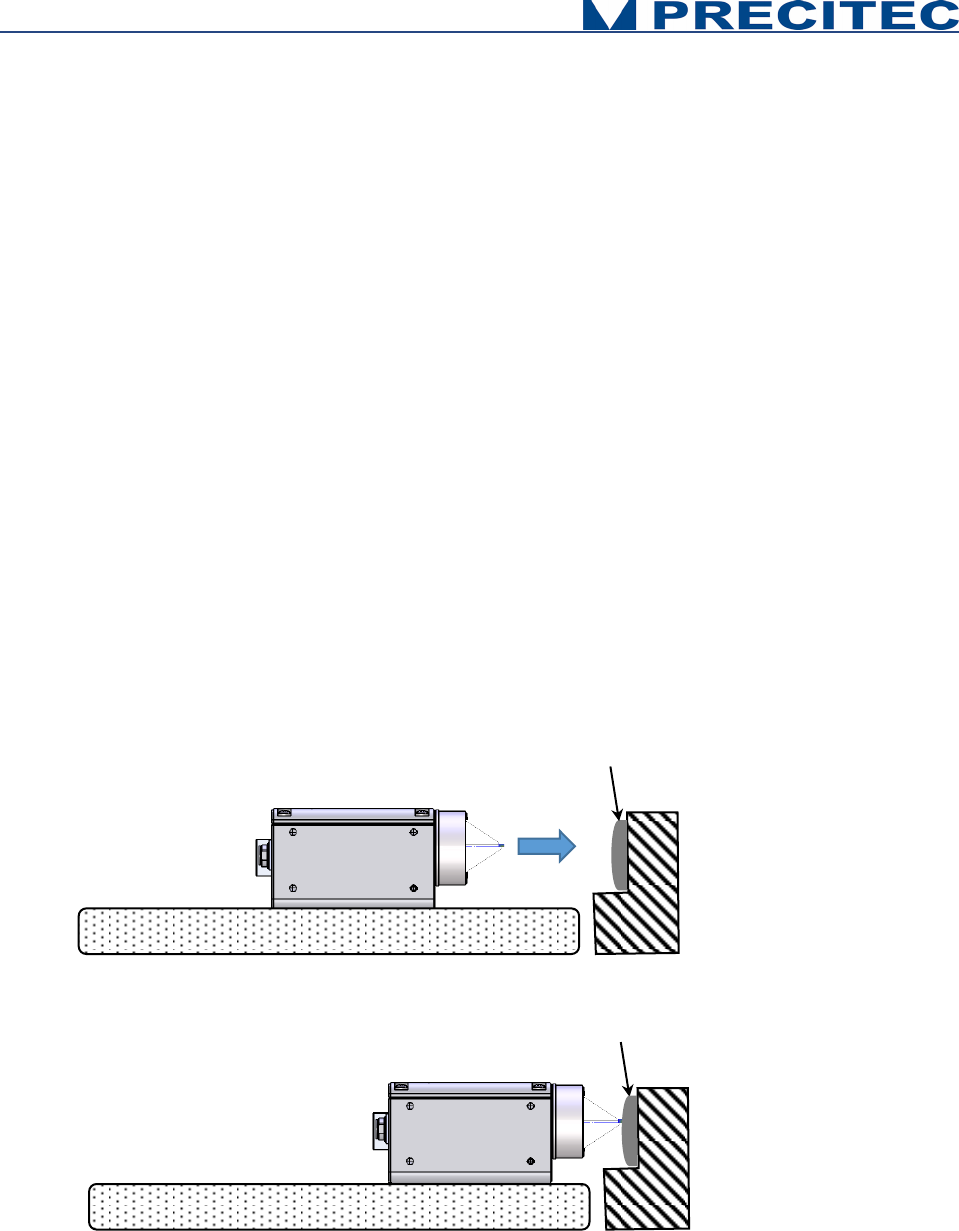
- Adjusting the axial position of the target in order the target is centered inside the optical
sensor measuring range. To do this, one can move the optical probe or the target along the
optical axis. Thus, it is recommended to fix the optical probe or the target on a translation
plate.
- Adjusting the spot on the area to be measured.
Fig 4-5: Axial position adjustment
When the target is correctly positioned in front of the optical head and basic configuration is
correctly set, it is possible to collect the needed data using the SODX command (Cf. Appendix 1).
Translation plate
Target
Translation plate
Target

36
In order to record the data corresponding to the CHRocodile C unit, the Ethernet port or the
RS422/RS232 communication port must be connected to the computer.
It is now possible to perform an area scan:
- In order to scan the target, one can move the optical probe or the target inside optical axis
perpendicular plan. Thus, a 2 axis translation system is required. The altitude or thickness
data is recorded during the scan. In order to synchronized the data acquisition with the moving
session, one need to connect the trigger in/out to the translation system. The command TRG,
enables an exact alignment of the sensors sampling intervals with the movement of a
scanning axis.
- However, if scan velocity is not constant, the pitch between each recorded point is not
constant and the global topography will be distorted. To overcome this image deformation it is
important to assign precisely each measured points and axis positions. To do so, one need to
connect the incremental encoder-input. The CHRocodile C can manage with 2-axis Encoders
using the analogue converter box accessory.
37
Appendix 1: Advanced Configuration
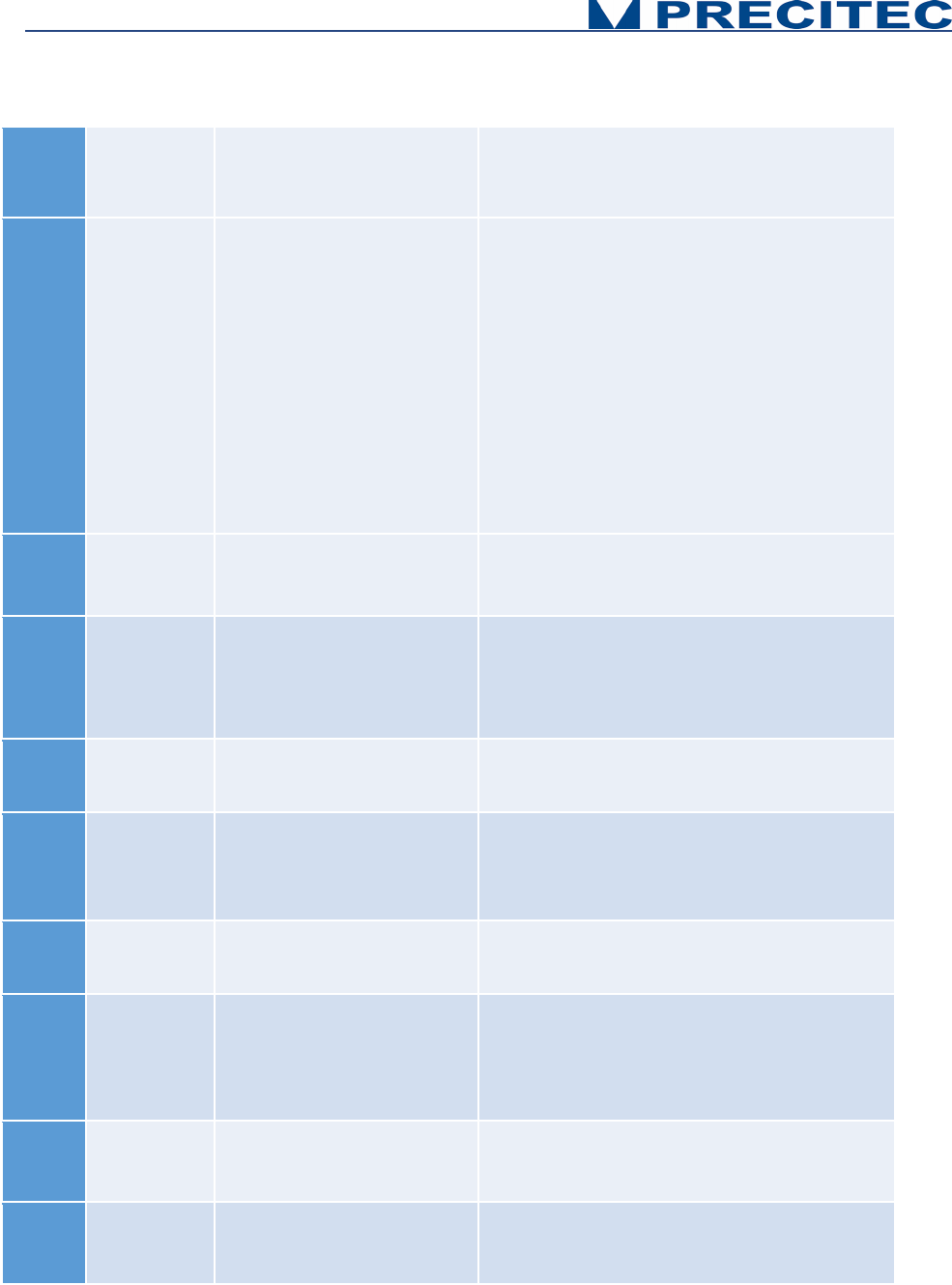
1. Commands List
command
arguments
answer on query
comments
AAL
<0,1>/<0..100>
or <?>
<0,1> <detector level>
Auto Adapt Light source:
First parameter: auto adapt on(1) or off(0, default)
Second parameter, only needed in case first param is 1:
desired detector level in % of saturation level (0-100), 33 is
default.
The autoadapt mode is also disabled by the LAI command!
ABE
<0 .. 500, ?>
<abbe number>
Abbé number:
Dispersion, only active, if SRT 0 selected (no preloaded
Index table)
0 (default): no dispersion
You should give as many Abbé numbers as there are
layers to be measured, that is (number of Peaks - 1).
The first parameter describes the nearest Layer.
AVD
<1 . . . 999, ?>
<number of averaged data
values>
Average Data
AVS
<1 . . . 999, ?>
<number of averaged
spectra>
Average Spectrum
BDR
<Index or custom
Baud rate>
<0,1>
<Index or custom baud
rate> <effective baudrate>
<0,1>
BauD Rate for serial port
Command: “Baud rate” If 1st arg <= 8, then baudrate
index is selected, otherwise free custom baudrate is given
index of baud rate in [bit/s]
0: 9600; 1: 19200;
2: 38400; 3: 57600;
4: 115200; 5: 230400;
6: 460800; 7: 921600;
8: 1843200
2nd arg: HW Handshake on/off
Response: 2nd arg: effective baudrate (may deviate)
CTN
Continue (Measuring)
free running mode
See also: TRE, TRG, TRW
CRDK
<0 . . . 65535, ?>
<Replacement rate>
Continuously Refresh DarK
0 (default, no refresh)-65535 (full replacement with every
spectrum)
See also: DRK, FDK
DRK
<n>(<x>)
n: Index of the lowest measuring
rate
x: lowest frequency in Hz, floating
point
“Dark reference”
take and store dark reference
The execution of this command takes approx. 0.8sec.
The result will be valid and used for all exposure settings.
Due to the storage to nonvolatile memory, the
dark calibration will be restored on the next powerup.
See also: FDK, CRDK
38
DWD
<0..n1><0..n2>
[<0..n1><0..n2>]
…
<0..n1><0..n2>
[<0..n1><0..n2>]
...
Detection WinDow
Up to 16 windows (window1left, window1right,
window2left, window2right...), in micrometers
See also: LMA
ENC
<0..4> [<0..3>]
< -2147483648 ..
4294967295, ?>
-
ENCoder Position:
$ENC <axis#> <function> <arg>
-index of axis -optional: Function
-position (treated modulo 2^32)
Defined functions:
• 0: Set / Read Pos.
• 1: set count source <value>
(0..9: A0, B0, A1, B1, . . . ; 10:
SyncIn; 11..14: n.a., 15: Quardr.)
• 2: set preload value <value>
• 3: set preload event <value>
- Query currently supported for
position only.
For detailed description see
below
ETR
<func. Index>
<arguments>
-
Encoder TRigger
For detailed description see below
FDK
[<1..300>]
[<0..32767>]
(<x>)” x being the (virtual) exposure
rate in Hz at which the CCD would
saturate
Fast Dark
The dark reference is taken with current exp. settings
and is not stored to nonvolatile memory.
When changing the exposure settings, the dark settings
acquired by the last DRK command are restored.
See also: DRK, CRDK
IDE
IDEntification
String with key-value pairs that enable identification of
the device
IPCN
<0,1>,
[eight numbers
<0..255>]
<DHCP, IP address, subnet MASK>
IP-Address change
Configure TCP address and subnet mask. 1st arg: DHCP
on/off, args 2.5: fixed IP addr. args 6..9: subnet mask
(only if DHCP off, i.e. 1st arg = 0)
LAI
<0…100, ?>
<value in %>
LAmp Intensity
Set on-time of LED between 1-100% of the exposure time.
This command also disables the autoadapt mode!
LTC
LaTenCy
Experimental parameter, is not saved to nonvolatile.
Determines the time after which a packet is closed and
sent.
Default 1ms.
LMA
<0,1, ?>
<0,1>
LiMits Active
Detection Limits active, 0(default) or 1. See also: DWD
See also: DWD
MOD
<0,1,127, ?>
either:
0 (confocal, 1 surface) or:
1 (confocal, 2 surfaces) or:
127 (more than 2 peaks)
measurement MODe
For compatibility: 0: one surface (default), 1: thickness,
127: different mode (detect more than 2 peaks)
39
MMD
<0,?>
<0,?>
Measuring MoDe
Only argument <0>, chromatic mode supported
NOP
<1..4>
<1..4>
Number Of Peaks
1(default)-MaxNOP.
The MaxNOP value is a characteristic of the device and
can be read back by the IDE command.
In confocal mode, if less than NOP peaks are detected, all
thickness signals will be invalidated because peak
identification is not possible.
OPD
<?>
<Operation time in seconds, number
of powerups>
OPeration Data
Query command, must contain the query arg.
First parameter 2: Operation time in seconds
First parameter 3: number of powerups
PSM
<10 .. 90>
<10 .. 90>
Peak Separation Minimum
The fraction in % of the height of the smaller peak that
the signal must go below in order to separate 2 peaks.
RST
ReSeT device
SCA
<?>
<Scale value>
SCAle
Query full scale value in micrometers of the currently
selected probe.
SEN
<0 .. 7, ?>
<optical probe Index>
Select SENsor (probe)
0(default) - 7 (depending on the existence of the calibration
tables)
See also: SENX
SENX
<?>
<(probe index), SNr: (serial number
of probe), Range: (measuring
range)um>
Query details of SENsor (probe)
Without parameter: returns a string with serial number
and measuring range of the currently selected probe in
the following format:
(probe index), SNr: (serial number of probe), Range:
(measuring range)um
When used with enum as string parameter, the device
enumerates all available calibrated probes in one string,
separated by ;
See also: SEN
SFD
-
-
Set Factory Defaults
Without parameter: reset the normal operation
parameters.
With parameter: reset also the communication
parameters (IP).
The parameter set is NOT automatically stored in
nonvolatile memory. To do so, please issue the SSU
command!
SHZ
<30 .. 4000, ?>
<x>Hz
x meaning the exact sample rate in
Hz in floating point format
Set measurement cycle frequency in HZ
30 - 4000(default)
See also: SRA
SODX
<0..17> <0..17>
…<0..17>
(max 16 times)
or <?>
<0..17> <0..17> … <0..17> (max 16
times)
Set output data extended
Set the content of the output telegram
40
SRA
<3..17, ?>
<index of sample rate>
<sample rate in Hz>HZ
set Sample Rate
Compatibility command 3:32Hz, 4:100Hz, 5:320Hz,
6:1000Hz, 7:2000Hz, 8: 3200Hz, 9: 4000Hz(default)
See also: SHZ
SRI
<1..5>
<refractive index> at
spectral d-line (587,567
nm)
Set/query Refractive Index
Only active, if SRT 0 selected (no preloaded Index table)
1.0(default)-5.0
You should give as many indices as there are layers to
be measured, that is (number of Peaks - 1). The _rst
parameter describes the nearest Layer.
See also: ABE, SRT
SRT
<0..16>
<0..16>:name of
table [CR/LF]
Set Refractive index Table
Preloaded Tables can be used instead of SRI/ABE.
SRI/ABE is active when table 0 is choosen (SRT 0)
You should give as many table indices as there are layers
to be measured, that is (number of Peaks - 1). The _rst
parameter describes the nearest Layer.
See also: SRI, ABE
SSQ
two binary bytes
-
Synchronisation SeQuence
2 Byte sync sequence used only in $-protocol
SSU
-
-
Save SetUp
Saves the current setting to nonvolatile memory. The
Sensor will restart on the next power-up with this
configuration.
STA
-
-
STArt data flow
(default) Sending of measurement data enabled.
See also: STO
STO
-
-
STOp data flow
Sending of measurement data disabled. Only Command
responsesor updates are transmitted.
See also: STA
THR
<0..4094, ?>
<threshold value>
detection THReshold
threshold for peak detection in the confocal modes (0 and
1)
0-4095, default is 50
TRE
-
-
TRigger Each Mode
Every exposure (or exposure burst in case of averaging)
needs a trigger event (e.g. rising edge on Trigger input).
All exposures will begin exactly at the trigger events as
long as the previous exposure is ended. If the previous
exposure is still ongoing, the trigger will be delayed. If
the device receives a trigger event, while the precedent
trigger still waits for execution, the trigger event will be
lost and the trigger lost counter will be incremented.
See also: TRG, TRW, CTN
TRG
-
-
TRiGger once
Stops the free running measurement and waits for a
trigger event. The trigger event restarts free running
41
mode.
The first exposure start will occur immediately at the
trigger.
See also: TRE, TRW, CTN
TRW
-
-
TRigger Window
The device runs freely as long as the trigger condition is
fulfilled. The first exposure start will occur immediately
at the trigger
See also: TRG, TRE, CTN
VER
-
-
VERsion
Responds with a string containing several lines with
Key-Value pairs
See also: IDE
Table A1.1: Commands list
42
2. Detailed Commands Description
2.1 CTN Command
This command lets the sensor exit any of the above trigger modes and returns to freerun.
No parameters are needed, so the syntax is just $CTN.
2.2 DRK Command
This command lets the sensor acquire a background spectrum that the incoming spectra will
be corrected for during normal operation. The acquisition of this background will take about
one second. The resulting background spectrum will be saved in the internal non-volatile
memory.
This command does not take any parameters, so the syntax is just $DRK.
It is important to remove any object within the measuring range before applying
the command.
The command response contains a number which is a measure of the background intensity. A
high background intensity can be related to e. g. stray light.
Command syntax:
$DRK
Command
Description
$DRK
Response: $DRK127 (63.2Hz)ready[CR/LF].
Execute a Dark reference
2.3 ENC Command
The encoder inputs and related commands ETR or ENC are available only with
the analogue converter box accessory.
This is an encoder control command. It has the following format:
ENC <Axis index> <arg1> <arg2> where arg1 denotes a certain function and arg2 some
parameter related to it.
43
The following functions are defined:
Arg1
Function
Arg2
0
Set / Read current encoder
counter value
Encoder counter value to set
1
Set count source
0: Pulse on A0, 1: Pulse on B0, 2: Pulse on A1 . . . 9: Pulse on B4
10: Pulse on SyncIn
11..14: not used
15: Quadrature A/B on encoder input <axis index>
2
Set preload value
Value to load into encoder counter on preload event
3
Set preload function
See table below
The preload function defines under which condition the value set with function 2 will be loaded
into the encoder counter. The respective argument 2 is a bit field as defined below:
Preload function value calculation
Bit(s)
Function
0
0: Preload once, 1: Preload each time
1
0: preload event on raising edge or high level, 1: falling edge or low level
2
0: the preload event is triggered by an edge 1: it is triggered by the level
3
0: Preload function inactive, 1: active (in case of “preload once”, this bit will be automatically reset)
7 .. 4
0: Pulse on A0
1: Pulse on B0
2: Pulse on A1
…
9: Pulse on B4
10: Pulse on SyncIn
11..14: not used
15: Immediate preload
2.4 ETR Command
The encoder inputs and related commands ETR or ENC are available only with
the analogue converter box accessory.
The settings will not be saved in the nonvolatile memory by the $SSU
command.
44
This command groups several functions related to encoder triggering. The encoder trigger can
work in two ways:
1. Roundtrip trigger (scanning application)
2. Endless trigger
Roundtrip trigger (scanning application)
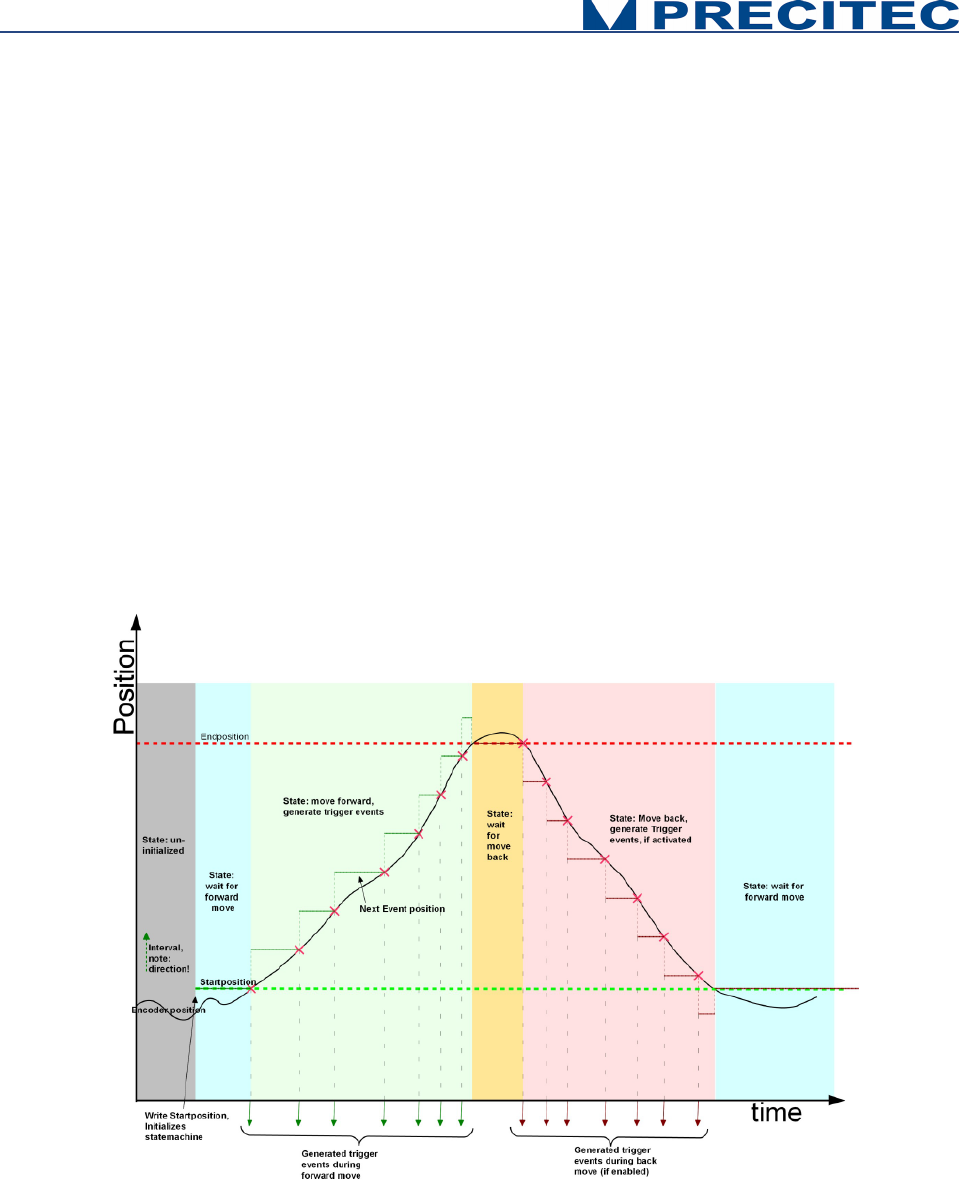
The encoder trigger is implemented as a state machine (see figure below). In the idle state, it
waits for the encoder counter of the selected axis to pass the start position (in either direction)
where it generates the first trigger event. Then the trigger interval value is added to the current
position and when this position is reached, the next trigger event is generated. This step is
repeated until the stop position is encountered.
The generation of trigger events is now stopped. If triggering during return movement is
selected, the state machine waits for the stop position to be passed once again and generates
trigger events similarly to the forward movement (the trigger interval is now subtracted instead
of added) until the start position is reached. The state machine then goes back to the idle
state. If no Trigger during return movement is selected, the state machine waits for the start
position to be passed over (during return movement) and then passes to the idle state.
Fig A1-1: Roundtrip Trigger
45
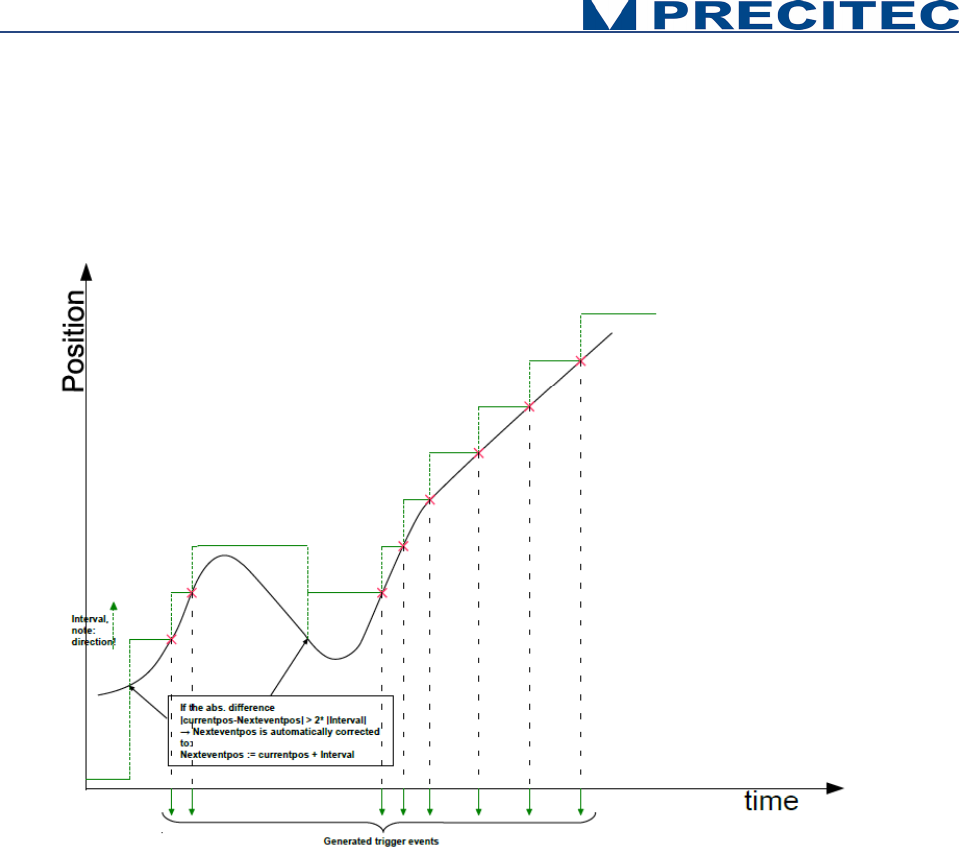
Endless trigger
This mode is destined for applications where the encoder primarily moves in one direction as
in production lines and where equidistant sampling is needed. In order to use this mode, only
a trigger interval has to be parametrized.
Fig A1-2: Endless Trigger
Format
The command has the following format: ETR <function> <arg> where function is:
0: Set start position ((int) arg = start position to set, see figure)
1: Set stop position ((int) arg = stop position to set, see figure)
2: Set trigger interval ((float) arg = trigger interval, see figure) Note that the interval can be
given in fractions of encoder counts.
3: Enable encoder (0: disabled, 1: enabled)
4: Enable triggering during return move, see figure. 0: disabled, 1: enabled.
5: Select encoder counter
6: reserved
7: Enable endless triggering (in this mode, start and stop positions are ignored, trigger events
will be generated on the current position and the trigger interval) 0: disabled, 1: enabled.
52
2.5 IPCN Command
Short description:
This command allows to configure TCP/IP address and subnet mask.
Command syntax:
$IPCN <DHCP> <IPA> <IPB> <IPC> <IPC> <MA> <MB> <MC> <MD> <MTU>
Command
Description
$IPCN 1
$IPCN <DHCP>
Configured as DHCP client
$IPCN 0 192 168 170 4 255 255 255 0 0
$IPCN <DHCP> <IPA> <IPB> <IPC> <IPC> <MA> <MB> <MC> <MD> <MTU>
Configured as static IP address
IP Address = 192.168.170.4
Subnet Mask = 255.255.255.0
MTU = 0 (no jumbo packets)
MTU argument gives the maximum
transferable unit which can be anything
between 1500 and 9000 bytes per TCP
packet (jumbo packets).
2.6 LAI Command
Short description:
This command allows to adjust LED intensity in order i.e. to remove saturation.
Command syntax:
$LAI <I>
Param: <I> is Led intensity (0...100%)
Command
Description
$LAI 95
Response: $LAI 95[CR]ready[CR/LF].
Write Led intensity 95%
$LAI ?
Response: $LAI ? 95ready[CR/LF].
Read Led Intensity
53
2.7 NOP Command
Short description:
This command allows to set the number of peak to evaluate.
WARNING: In confocal mode, if less than NOP peaks are detected, all thicknesses signals will
be invalidated because peak identification is not possible.
Command syntax:
$NOP <I>
Param: <I> is Number of Peak from 1 to 4
Command
Description
$NOP 3
Response: $NOP 3[CR]ready[CR/LF].
Write Number of Peak (3)
$NOP ?
Response: $NOP ? 3ready[CR/LF].
Read Number of Peak
2.8 SCA Command
Short description:
The command Scale allows to query of Full Scale in micrometers.
A distance value of 32768 on the serial interface would mean a distance in (Full Scale)
micrometers. To convert the integer distance value (d) received from the serial interface to a
value in micrometers (D), use the formula:
D[µm] = d[integer] / 32768 * Full Scale.
Command syntax:
$SCA
Command
Description
$SCA ?
Response: $SCA ? 3320ready[CR/LF].
Read Full Scale
2.9 SEN / SENX Command
Short description:
The $SEN command is used to activate the chromatic—confocal calibration related to a specific
sensor head. With the single channel device, up to sixteen calibrations can be uploaded and
stored in the device. With the Chrocodile C device, up to eight calibrations are supported.
54
The format of the command is as follows:
$SEN n where n is the calibration table index. As the possible measuring range of each probe is
much higher than the range for which it is specified and guarateed to adhere to the
specifications, there is a way to use the full range with degraded precision. This might be useful
in applications where not the full precision is required. In order to enable the full range, send
$SEN n 1.
The currently active calibration table can also be queried:
$SEN? (or query flag in case of packet protocol) – returns active calibration index and if the
extended range is enabled (1) or not (0)
$SENX? - returns more details of the active calibration, I. e. index, serial number of the related
probe and the current range in micrometers:
$SENX?0, SNr: 0, Range: 7999umready
$SENX enum? - (“enum” as a string argument in case of packet protocol) returns complete list of
calibrations.
Command syntax:
$SEN
Command
Description
$SEN?
Response: $SEN? 0 0ready[CR/LF].
Returns active calibration index and if
extended range is selected
$SEN1 1
Response: $SEN1 1ready[CR/LF].
Set calibration table n°1 with extended
range
2.10 SHZ Command
Short description:
The command SHZ set sample rate in Hz
It is possible with this command to realize any sample rates between 100Hz and 2000Hz.
If the value is not accepted, the sensor responds with the string "not valid".
Due to the nature of the internal time base, not every sample rate can be realized exactly. In
order to give the user the possibility to know the exact frequency, to which the sample rate has
been "rounded", the frequency can be queried with "?" and will be returned as ASCII floating
point number with 6 decimals.
Command syntax:
$SHZ <I>
Param: <I> is sample rate (32Hz…4000Hz)
Command
Description
55
$SHZ 1000
Response: $SHZ 1000[CR]ready[CR/LF].
Write Sample Rate (1000 Hz)
$SHZ ?
Response: $SHZ ? 1000ready[CR/LF].
Read Sample Rate
2.11 SODX Command
Short description:
Select Output Data (extended)
SODX directly selects the data words that will be included in the output telegram by specifying
their indices.
For example SODX 83, 16640, 16641 will output the sample counter, the distance and the
intensity.
Command syntax:
$SODX [A0] [A1]…[AN]
[Ax] is optional parameters
Signal ID's scheme
CLS02
CLS1
CLS2,3
CLS0,5
CLS4
Grandissement
25,4
12,7
15,9
15,9
5,1
MR
0,2
1
2,3
0,5
4
Table A1.2: SODX command: Signal Identity’s scheme.
Global Exposure Information:
Definition: Bit 8 = 0 (Bit 8 to 15 = 0)
Type:
Float
Command
Description
$SODX 64
Response: $SODX 64[CR]ready[CR/LF].
Start of exposure Time (in
nanoseconds)
$SODX 65
Response: $SODX 65[CR]ready[CR/LF].
Start of exposure PositionX(X
encoder position on beginning of
exposure)
$SODX 66
Start of exposure PositionY(Y
56
Response: $SODX 66[CR]ready[CR/LF].
encoder position on beginning of
exposure)
$SODX 67
Response: $SODX 67[CR]ready[CR/LF].
Start of exposure PositionZ(Z
encoder position on beginning of
exposure)
$SODX 68
Response: $SODX 68[CR]ready[CR/LF].
Start of exposure PositionU(U
encoder position on beginning of
exposure)
$SODX 69
Response: $SODX 69[CR]ready[CR/LF].
Start of exposure PositionV(V
encoder position on beginning of
exposure)
$SODX 70
Response: $SODX 70[CR]ready[CR/LF].
End of exposure PositionX(X
encoder position on end of exposure)
$SODX 71
Response: $SODX 71[CR]ready[CR/LF].
End of exposure PositionY(Y
encoder position on end of exposure)
$SODX 72
Response: $SODX 72[CR]ready[CR/LF].
End of exposure PositionZ(Z encoder
position on end of exposure)
$SODX 73
Response: $SODX 73[CR]ready[CR/LF].
End of exposure PositionU(U
encoder position on end of exposure)
$SODX 74
Response: $SODX 74[CR]ready[CR/LF].
End of exposure PositionV(V
encoder position on end of exposure)
$SODX 75
Response: $SODX 75[CR]ready[CR/LF].
FirstExposureCount
$SODX 76
Response: $SODX 76[CR]ready[CR/LF].
ExposureFlags
$SODX 77
Response: $SODX 77[CR]ready[CR/LF].
RealExpTimeNs(Effective exposure
period in nanoseconds)
$SODX 78
Response: $SODX 78[CR]ready[CR/LF].
RealLightingTimeNs(Effective lighting
period in nanoseconds)
$SODX 79
Response: $SODX 79[CR]ready[CR/LF].
TriggerLostCounter (Accumulates
trigger events that have occurred
during exposure and therefore have
been ignored.
$SODX 80
Response: $SODX 80[CR]ready[CR/LF].
NumberOfValidPeaks (Number of
peaks that have been found in the
spectrum)
$SODX 83
Response: $SODX 83[CR]ready[CR/LF].
SampleCounter
57
Peak Signal:
Definition: Bit 8 = 1
Type:
• Value encoding (Bits 15, 14):
For geometrical quantities like thickness or distance
• 00: float in micrometers, including refractive index (geometrical thickness)
• 01: integer 16bit, scaled as fraction of measurement range, without refractive
index (optical thickness).
Distance and thickness values are given as: d[µm] = value * $SCA[µm] /
32768.
In order to get the geometrical thickness, the value has to be multiplied by the
index of refraction of the material.
• 10: 32bit integer value in nanometers, including refractive index (geometrical
thickness)
• 11: integer 32bit, scaled as fraction of measurement range, without refractive
index (optical thickness)
Distance and thickness values are given as: d[µm] = value * $SCA[µm] / (1 <<
31).
In order to get the geometrical thickness, the value has to be multiplied by the
index of refraction of the material. This format yields the highest theoretical
resolution.
For non-geometrical quantities (like intensity)
• Floating point values:
• 00: float
• 01: truncated 16bit integer value
• 10: 32bit integer value in 16.16 format
• 11: undefined
• Integer Values:
• 00: 32bit integer
• 01: least significant 16 bit
• 10: most significant 16 bit
• 11: undefined
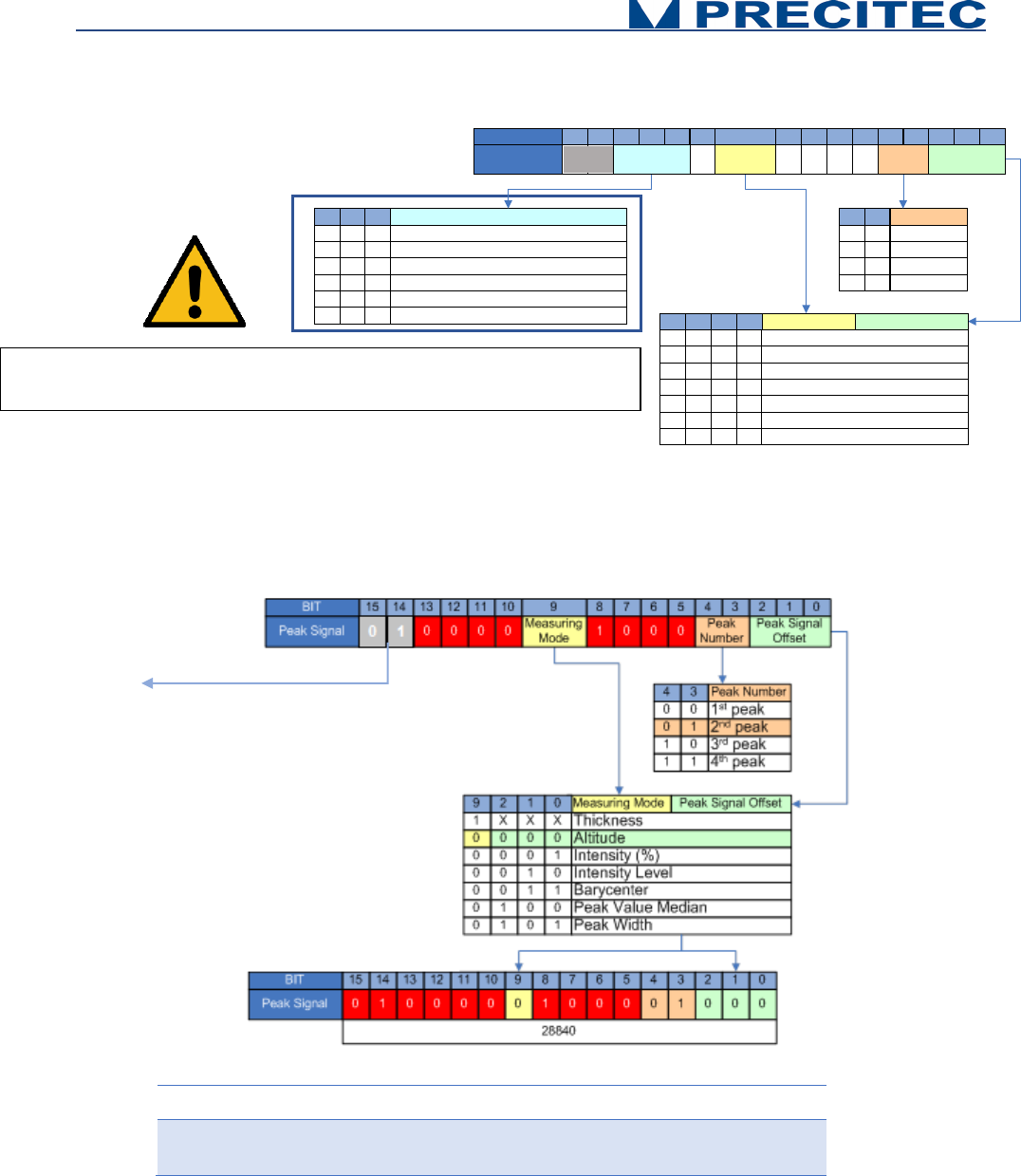
58
Example:
Command
Description
$SODX 28840
Response: $SODX 16648[CR]ready[CR/LF].
Altitude, 2nd peak
Statistics are not supported by CHRocodile C. Consequently the
respective bit 11 to 13 are set to 0.
Statistics
13
12
11
Average
Std
.
Deviation
Number of valid values
Minimum
Maximum
Peak
-
to
-
peak difference
(
max
-
min
)
0
0
0
0
0
1
0
1
0
0
1
1
1
0
0
1
0
1
Peak Number
4
3
1
st
peak
2
nd
peak
3
rd
peak
4
th
peak
0
0
0
1
1
0
1
1
BIT
15
14
13
12
11
10
9
8
7
6
5
4
3
2
1
0
Peak Signal
Value
encoding
Statistics
Measuring
Mode
0
1
0
0
0
Peak Signal
Offset
Peak
Number
Measuring Mode
2
1
0
Peak Signal Offset
9
X
X
X
1
Thickness
0
0
0
0
Altitude
0
0
1
0
I
ntensity
(%)
0
1
0
0
Intensity Level
0
1
1
0
Barycenter
1
0
0
0
Peak Value Median
1
0
1
0
Peak
Width
Value encoded
in integer 16 bits
59
Additional information:
Peak Signal Offset (Bits 0 to 2)
Signal ID Offset
Signal Name
Remarks
0
Peak Value
Scaled peak distance
1
PeakIntensity
Intensity of peak
2
CCDSaturation
max. CCD illumination of related spectrum
3
PeakPos
CCD pixel pos
4
reserved
5
PeakWidth
confocal mode only: given in CCD pixels
6
reserved
7
reserved
Peak Number (Bits 3 and 4)
Bits 3 and 4 are used to define the Peak Number which will be
processed to calculate the demanded data. The following quantities
are available:
Measuring Mode (Bit 9)
Thickness: If bit 9 is set to 1, then the resulting value is thickness
corresponding to the difference of the peak as defined in bits 3 and 4
and the next peak. This facility is used to request thicknesses directly.
NOTE
This difference value is not corrected for the index of refraction.
Consequently, in order to obtain the real thickness data, one must
divide the result by the refractive index.
Altitude: If bit 9 is set to 0, then the resulting value is the Altitude
corresponding to the peak number defined in bits 3 and 4.
Statistics (Bit 11 to 13)
Statistics are not supported by CHRocodile C.
Consequently the respective bit 11 to 13 are set to 0.

60
2.12 SSU Command
Short description:
The command SSU saves Setup
Saves current setup to non-volatile memory. The Setup will be restored upon next power up.
Command syntax:
$SSU
Command
Description
$SSU
Response: $SSU [CR]ready[CR/LF].
Saves current setup
2.13 STA Command
Short description:
The command STA starts serial data output
This mode can be stored in the nonvolatile memory. If stored, the CHRocodile C will begin
immediately to output data telegrams on the next power-up.
Command syntax:
$STA
Command
Description
$STA
Response: $STA [CR]ready[CR/LF].
Starts serial data output
61
2.14 STO Command
Short description:
The command STO stops serial data output
This mode can be stored in the nonvolatile memory, so on the next power up the CHRocodile C
will not begin to send measurement data until the output is restarted by the "STA" command.
Command syntax:
$STO
Command
Description
$STO
Response: $STO [CR]ready[CR/LF].
Stops serial data output
2.15 THR Command
Short description:
The command THR lets you specify an intensity threshold for the distance detection.
It may be useful to specify a high threshold to reject all noise spikes during a measurement or to
specify a low threshold to get a (noisy) result from very black surfaces. When the signal is below
the threshold, 0 is output for distance and intensity. The threshold is in arbitrary units which may
be subject to change in future software versions.
At faster sample rates, lower settings for threshold can be used than at slower sampling rates.
The reason is, that at slower sampling rates, the stray light of fiber and coupler is integrated
longer on the detector. Even though this signal is automatically subtracted as "dark reference",
the statistical variations of this signal are stronger, the higher the dark signal becomes. If a
typical value for good noise suppression and maximum sensitivity at 2kHz sampling rate could
be 20, at 100Hz 50 would be needed.
If the sensor doesn’t detect a signal which passes the threshold, 0 is output for distance and
intensity.
Command syntax:
$THR <I>
Param: <I> is intensity threshold
Command
Description
$THR 35
Response: $THR 35[CR]ready[CR/LF].
Write Intensity Threshold
$THR ?
Response: $THR ? 35ready[CR/LF].
Read Intensity Threshold
62
2.16 TRE Command
Short description:
This command lets the sensor enter a trigger mode where one trigger event will produce one
sample. Trigger signals can be SyncIn or Encoder inputs, depending on $ETR settings, see
$ETR description below. $TRE is particularly useful in conjunction with encoder based trigger
generation as described in the $ETR section below.
The encoder inputs and related commands ETR or ENC are available only with
the analogue converter box accessory.
The maximum frequency (or the shortest interval of two consecutive trigger events) is defined by
the cycle frequency ($SHZ). Trigger events that occur while the sensor is idle will cause an
immediate exposure. If a trigger event occurs during an ongoing acquisition cycle, then the
respective exposure will be delayed until the current cycle is completed. In this case, the
TriggerDelayed – Flag (Bit 2) is set in the flags signal of the delayed exposure. This flags signal
is a global signal (ID = 76) that can be requested just like any other signal using $SODX. If more
than one trigger event occurs during an ongoing exposure cycle, then only the first event will
result in a delayed exposure cycle as described above, all consecutive trigger events will be
ignored. In this case, the TriggerIgnored – Flag (Bit 1) will be set in the flags signal of the
delayed exposure.
Command syntax:
$TRE
Command
Description
$TRE
Response: $TRE[CR]ready[CR/LF].
Trigger each
2.17 TRG Command
Short description:
The command TRG is a Wait For Trigger. The command enables an exact alignment of the
sensors sampling intervals with the movement of a scanning axis.
It stops the sensor after completion of the current data telegram and puts it in a waiting state.
This state is left by a trigger event (rising edge on the Sync in, Encoder Trigger).
Command syntax:
$TRG
Command
Description
$TRG
Response: $TRG[CR]ready[CR/LF].
Wait For Trigger

63
2.18 VER Command
Short description:
The command VER give the Version of CHRocodile C.
The command sends back an ASCII string which gives information on the serial number of the
CHRocodile C (SN: ...), the DSP software (DSPsoft: ...) and the microcontroller software (C: ...).
Command syntax:
$VER
Command
Description
$VER
Response:
ChrocodileCompact[CR]
device_serial_number = 201223[CR]
firmware-version = 1.2.3[CR]
build = 2016-09-29 427f188cbd[CR]
ready[CR/LF].
>>
Read Versions
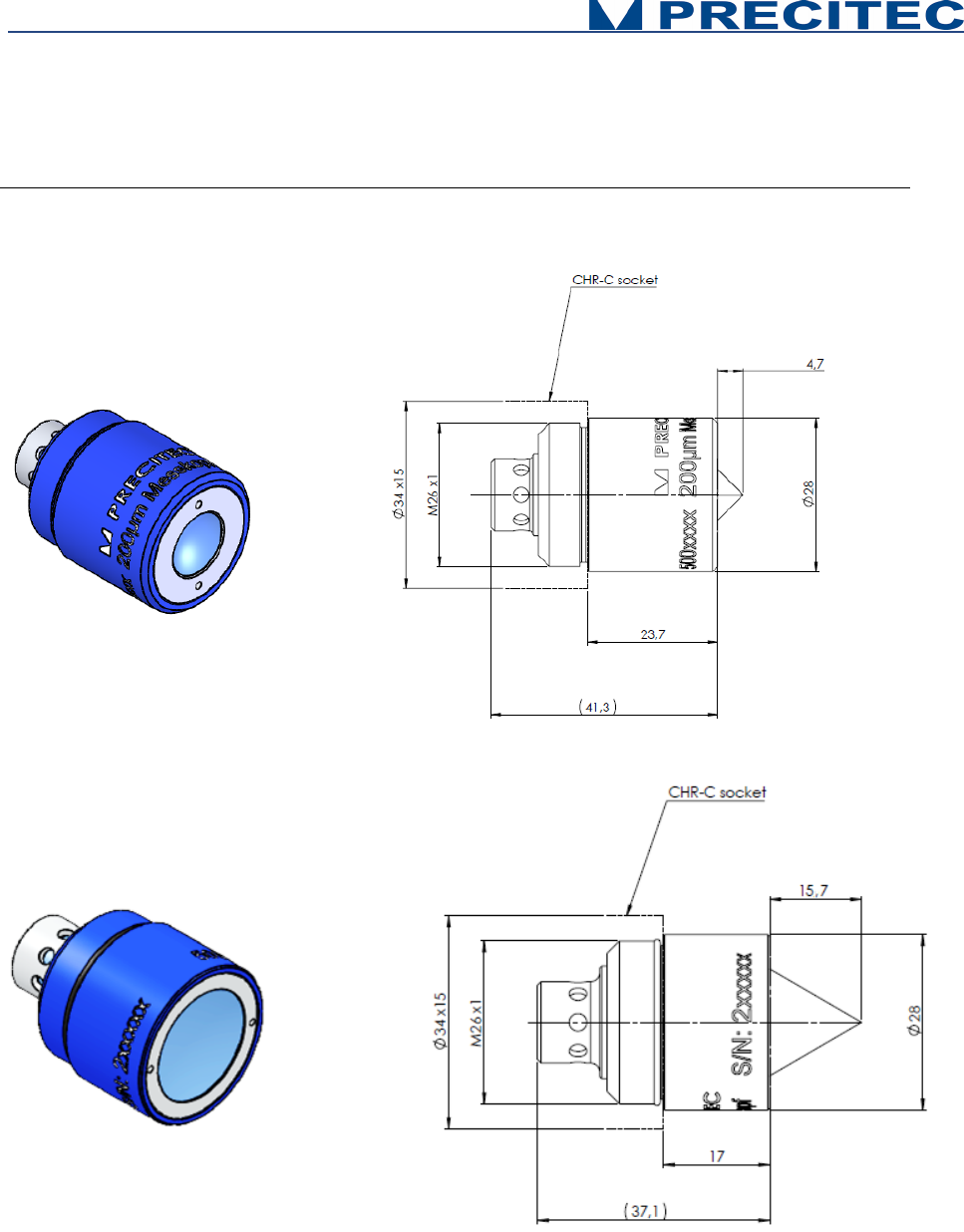
64
Appendix 2: Mechanical Plans
1. Optical probe mechanical plans
b- Probe 1mm
a- Probe 0.2mm
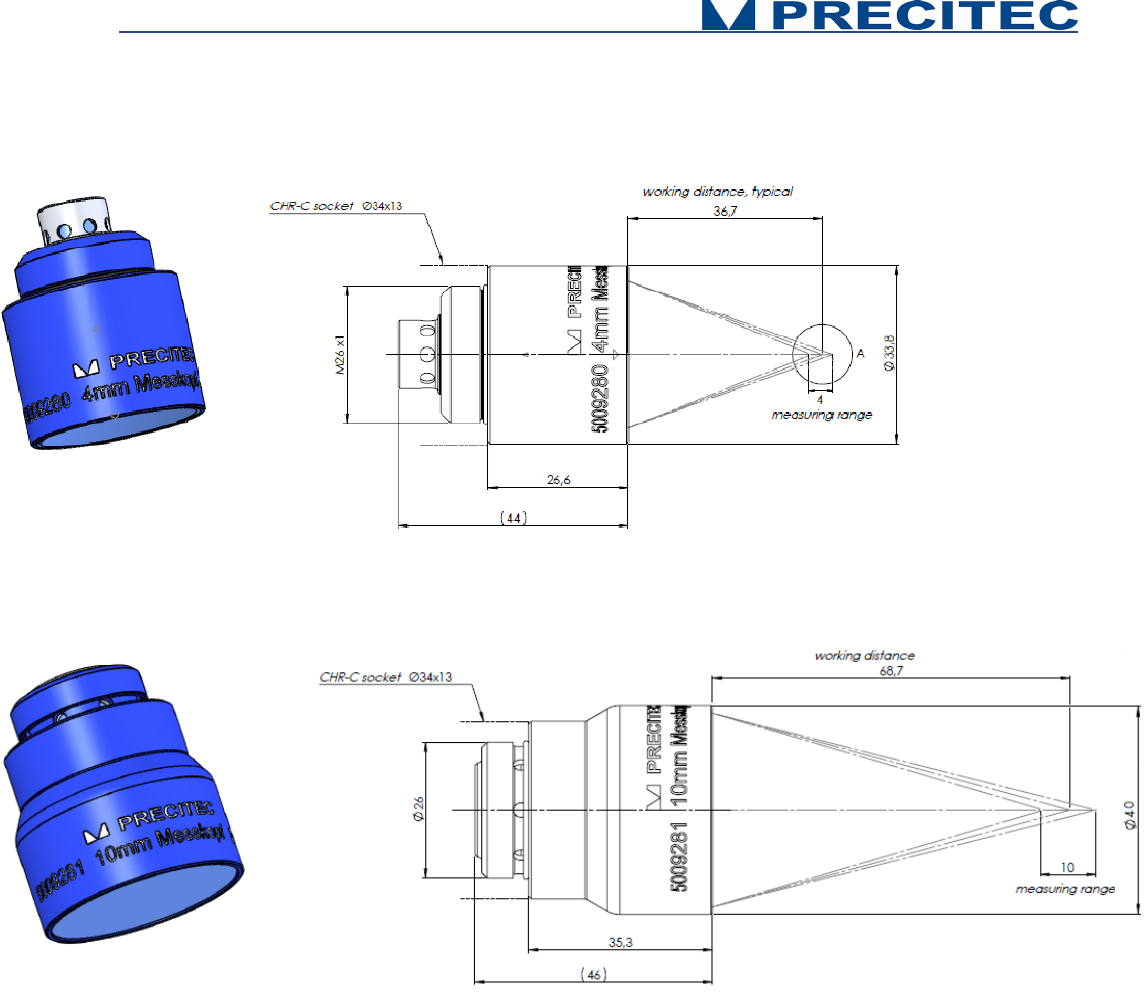
65
Fig A2-1: Optical Head Mechanical plans: a- 0.2mm b- 1mm c- 4mm d- 10mm
c- Probe 4mm
d- Probe 10mm
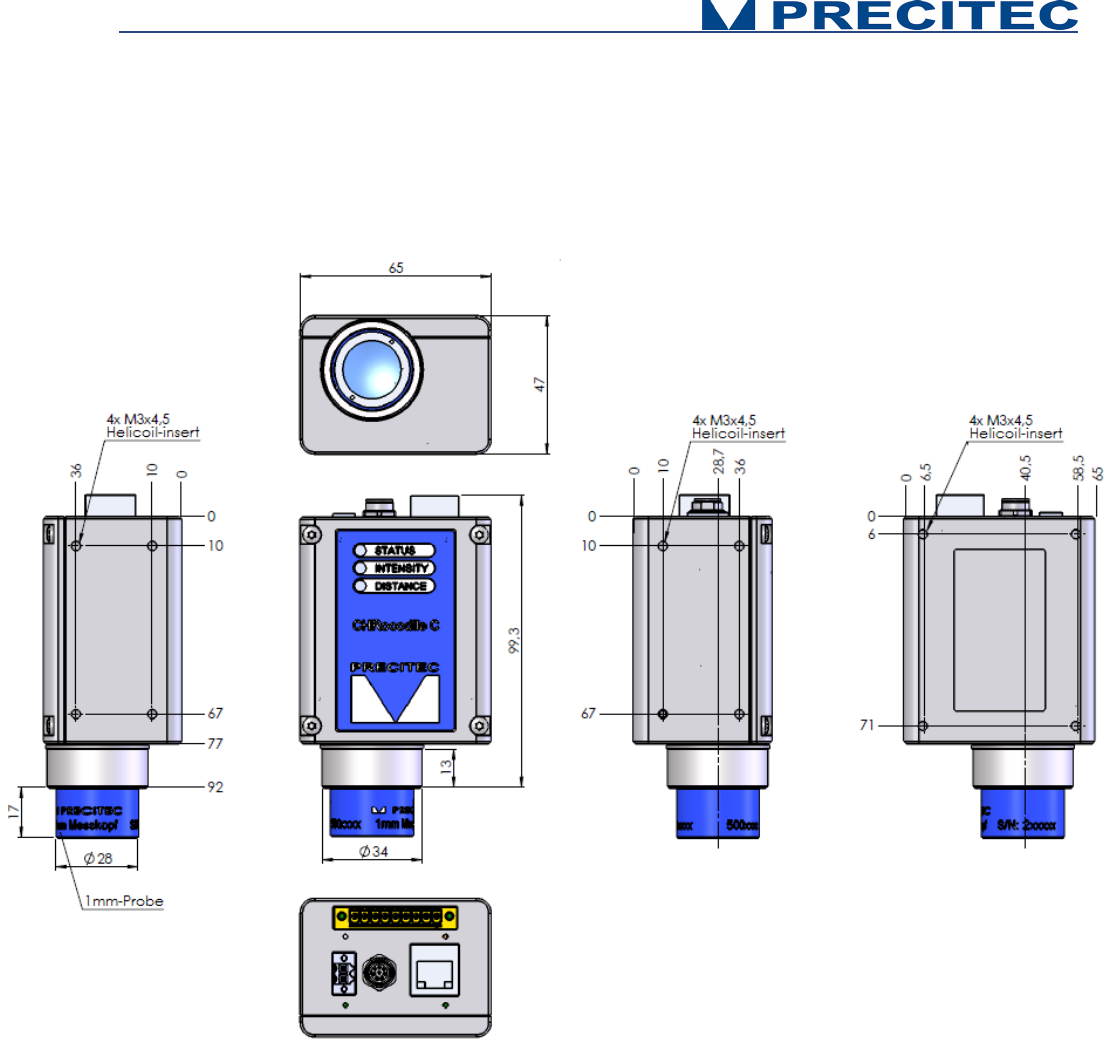
66
2. CHRocodile C unit mechanical plans
Fig A2-2: CHRocodile C sensor unit mechanical plans:
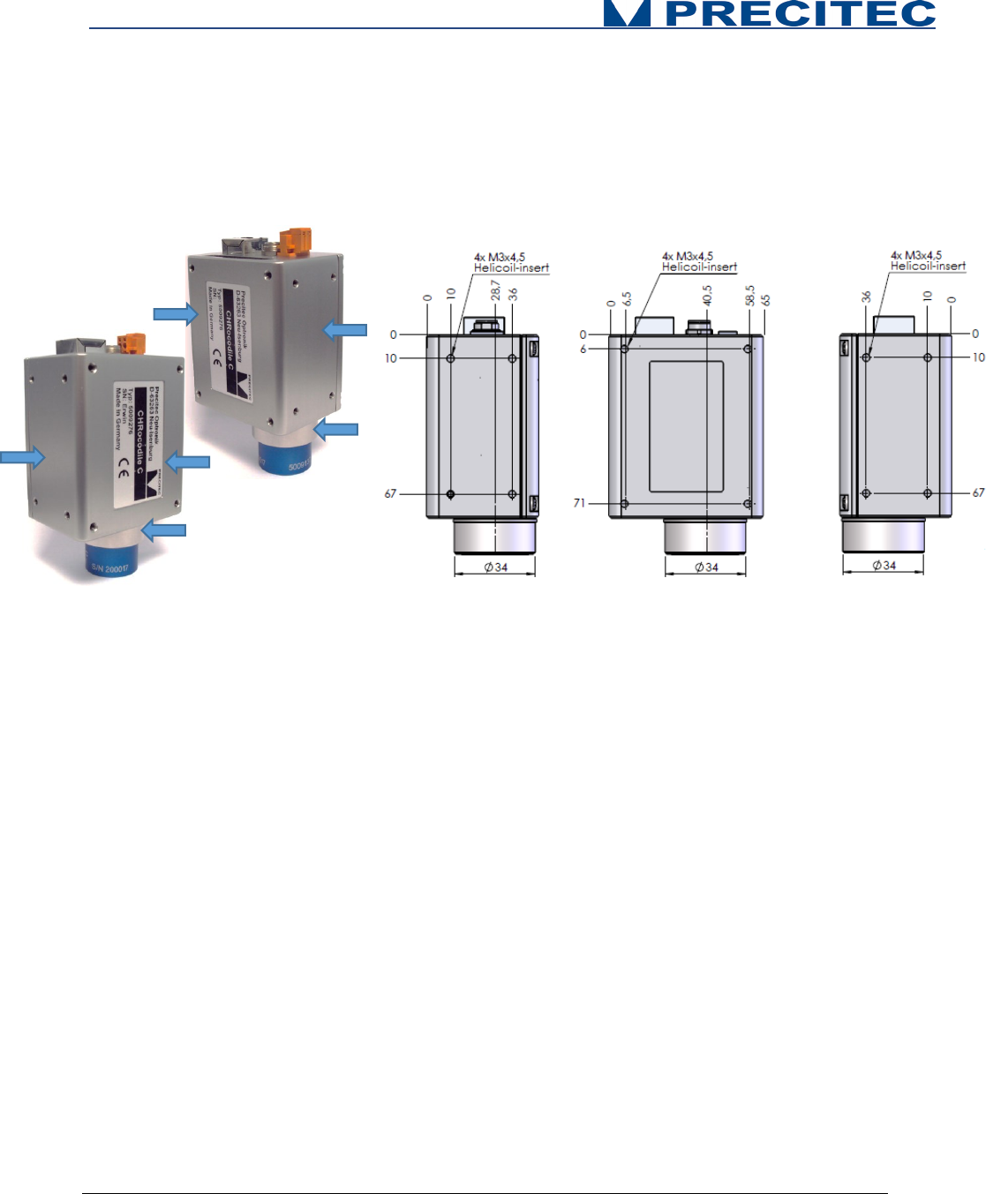
67
3. CHRocodile C unit mechanical interface plans
Fig A2-3: CHRocodile C unit mechanical interfaces
Three surfaces are designed to fix the CHRocodile C unit on customer system. On these 3 surfaces, 4
M3x4.5 threaded holes are available. Positions of threaded holes are specified on the Figure A2-3.
It is also possible to fix the CHRocodile C unit on the front ring of 34mm diameter.
Consequently several mechanical interfaces are available on this sensor in order to ease the
integration on customers / integrators systems.

68
Appendix 3: Trouble Shooting
1.1 Power off
The Status LEDs are off when the power supply cable is not connected:
- Check the power cable.
1.2 Communication error:
No possible Ethernet communication between CHRocodile C and your computer:
- Check the Ethernet cable is plugged correctly in RJ45 sensor unit connector.
- Check the IP configuration for your PC and the CHRocodile C unit (Cf. $IPCN command in
Appendix 1).
- If you are using a switch, then try to connect directly from your LAN network to the sensor unit.
- If possible, a Peer-to-Peer connection is recommended.
No possible serial communication between CHRocodile C and your computer:
- Check the multipoint cable is plugged correctly in multipoint connector (9 pins),
- Check the baud rate is correct.
1.3 Distance Measurement:
The target is positioned in front of the sensor, and no distance measurement is collected for all
channels.
- Set the measuring frequency to minimum ($SHZ100).
- Set the LED intensity to maximum ($LAI100).
- Check if a white light spot is emitted from the optical probe and if it is focused on the target.
- Check if the target is inside the measuring range of optical probe (Cf. section 2.8).

69
- Check if the target surface is normal to the optical probe axis. The maximum angle between
target surface and optical axis is given by the maximum measurable slope (Cf. section 2.8).
- Check if the distance is transmitted ($SODX 16640 or SODX 256),
- Check that a calibration table is uploaded ($SCA?)
- Then, check and store the raw signal (this file could be demanded by PRECITEC technical
support team). The raw signal should show one peak.
1.4 Thickness measurement:
The target is positioned in front of the sensor, and no thickness measurement is collected for all
channels.
- Check that the target thickness is inside minimal and maximal measuring thickness range,
- Check the target transparency,
- Set the measuring frequency to minimum ($SHZ100).
- Set the LED intensity to maximum ($LAI100).
- Check if a white light spot is emitted from the optical probe and if it is focused on the target.
- Check if the two surfaces of the target are inside the measuring range of the optical probe (Cf.
section 2.8).
- Check if the target surface is normal to the optical probe axis. The maximum angle between
target surface and optical axis is given by the maximum measurable slope (Cf. section 2.8).
- Check if the two distance peaks are transmitted ($SODX 16640 16648),
- Then, check and store the raw signal (this file could be demanded by PRECITEC technical
support team). The raw signal should show two peaks.
If after reading the previous section you didn’t succeed in resolving your problem, please contact your
vendor for technical support. In order to be more efficient, we recommend to fill the following technical
support datasheet and if necessary prepare the files which are demanded in previous section.
70
Appendix 4: Technical support
Technical Support
Date :
CUSTOMER :
PRECITEC Number:
PRODUCT IDENTIFICATION
Sensor Unit Serial Number :
Optical Head Serial Number :
Firmware Serial Number :
PROBLEM IDENTIFICATION
Type :
Software
Optic
Mechanic
Electronic
Description :
Photos:
Attached files :
Photos
Raw data
Diagnostic file
