Classification Of Learning Activities Manual
User Manual:
Open the PDF directly: View PDF  .
.
Page Count: 36
- CLASSIFICATION OF LEARNING ACTIVITIES - MANUAL
- Table of contents
- 1. Foreword
- 2. IntroductIon
- 3. General concepts and definitions
- 3.1. Lifelong Learning
- 3.2. Learning activities versus non-learning Activities
- 3.3. Single Learning Activities (SLA)
- 3.4. Learning map and aggregation of single Learning Activities
- 3.5. Scope of education and learning and categories of Learning Activities
- 3.6. Operational criteria for distinguishing the broad categories of Learning Activities
- 3.7. Summary decision making flow chart
- 4. Classification of Learning Activities (CLA)
- 5. Broad Categories, Classes and sub-Classes
- 6. Bibliography
- Table of contents
EUROPEAN
COMMISSION
THEME
Population
and social
conditions
ONI2006 EDIT
ISSN 1725-0056
Classification of
learning activities -
Manual

A great deal of additional information on the European Union is available on the Internet.
Luxembourg: Office for Official Publications of the European Communities, 2006
© European Communities, 2006
Europe Direct is a service to help you find answers to your questions about the European Union
Freephone number (*):
00 800 6 7 8 9 10 11
(*) Certain mobile telephone operators do not allow access to 00 800 numbers or these calls may be billed.
It can be accessed through the Europa server (http://europa.eu).
ISBN 92-79-01806-X
ISSN 1725-0056
The views expressed in this document are the author’s and do not necessarily refl ect the opinion of the European
Commission.
This document is available upon request at:
For more information: Agnieszka LITWINSKA
European Commission, Eurostat Unit F4, Bâtiment Jean Monnet, Offi ce BECH-D3/704, L-2920 Luxembourg
Tel.: +352/4301-36765 - E-mail: Agnieszka.Litwinska@ec.europa.eu
European Commission, Eurostat Unit F4, Bâtiment Jean Monnet, Offi ce BECH-B3/427, L-2920 Luxembourg
Tel.: +352/4301-35307 - E-mail: muriel.de-lattin@ec.europa.eu

Classification of learning activities - Manual 3
Table of contents
1. FOREWORD ..............................................................................................................................5
2. INTRODUCTION .......................................................................................................................6
2.1. The need for CLA ..............................................................................................................6
2.2. Purpose of CLA ..................................................................................................................6
2.3. Purpose of this manual .......................................................................................................7
3. GENERAL CONCEPTS AND DEFINITIONS ..........................................................................8
3.1. Lifelong Learning ..............................................................................................................8
3.2. Learning activities versus non-learning Activities .............................................................9
3.3. Single Learning Activities (SLA) ....................................................................................10
3.4. Learning map and aggregation of Single Learning Activities .........................................11
3.5. Scope of education and learning and categories of Learning Activities ..........................12
3.6. Operational criteria for distinguishing the broad categories of Learning Activities ........14
3.6.1. Informal learning versus formal and non-formal education ...........................14
3.6.2. Formal education versus non-formal education ..............................................15
3.7. Summarydecisionmakingowchart ..............................................................................19
4. CLASSIFICATION OF LEARNING ACTIVITIES (CLA)......................................................20
4.1. Content and structure of CLA ..........................................................................................20
4.2. Primary statistical units of CLA .......................................................................................20
4.3. Formal Education .............................................................................................................20
4.4. Non-Formal Education .....................................................................................................20
4.5. Informal Learning ............................................................................................................20
5. BROAD CATEGORIES, CLASSES AND SUB-CLASSES ....................................................22
5.1. Summary table .................................................................................................................22
5.2. Explanatory notes to CLA ................................................................................................23
6. BIBLIOGRAPHY ......................................................................................................................27
6.1. EUROPEAN COMMISSION ..........................................................................................27
6.2. CEDEFOP ........................................................................................................................28
6.3. UNESCO and UNESCO Institute for Statistics ...............................................................28
6.4. OECD ...............................................................................................................................28
6.5.
6.6. World Bank ......................................................................................................................28
6.7. National reference papers ................................................................................................28
6.8.
ILO and United Nations Statistics Division ...................................................................28
Internet sites of some of the references ..........................................................................29
.
.

Classifi cation of learning activities - Manual 4
Abbreviations and acronyms
LLL Lifelong Learning
FED Formal Education
NF Non Formal Education
INF Informal Learning
LA Learning Activities
NLA Non Learning Activities
SLA Single Learning Activities
NFQ National Framework of Qualifi cations
ISCED International Standard Classifi cation of Education
HALLA Harmonised List of Learning Activities
CLA Classifi cation of Learning Activities
ETS WG Education and Training Statistics Working Group
TF/MLLL Task Force on Measuring Lifelong Learning
AES Adult Education Survey
Q&A Question and Answer

Classifi cation of learning activities - Manual 5
1. FOREWORD
Since the treaties of Maastricht and Amsterdam included education and training as part of action at Community
level, lifelong training has been a key element of the education and training policy in Europe. Thus, the
conclusions of the Lisbon summit (2000) mention lifelong learning as a way of ensuring a successful transition
towards a knowledge society. Moreover, the EU Council resolution of 27 June 2002 on lifelong learning
stresses that « Education and training are an indispensable means for promoting social cohesion, active
citizenship, personal and professional fulfi lment, adaptability and employability» and that lifelong learning
must cover learning from the pre-school age to that of post-retirement.
Lifelong Learning (LLL) is not simply a summing up of traditional education programme and modern
learning opportunities. While traditional educational institutions have been (and still are) primarily concerned
with transmitting knowledge, modern learning opportunities and the LLL approach put the emphasis on the
development of individual capabilities and the capacity of the person to learn. LLL implies a paradigm shift
from the dominance of traditional education institutions to a diverse fi eld of traditional and modern learning
opportunities that are more process and outcome oriented as well as of a modular structure. At the same time,
responsibility for education and learning shifts from the public (state) to non-governmental organisations as
well as to the individuals themselves.
This political priority results in a growing need for statistics on lifelong learning. Now, learning activities
cover many fi elds. According to the defi nition of the European Union, education and lifelong learning include
the entire spectrum of formal, non-formal and informal learning. Furthermore, lifelong learning must be
understood as all learning activity undertaken throughout life, with the aim of improving knowledge, skills
and competence.
The work carried out by the Task Force set up by Eurostat with a view to proposing means of measuring
lifelong learning has resulted in several recommendations, including the establishment of a classifi cation of
such activities.
Classifi cations and nomenclatures are the basic tools for structuring statistical information in well-defi ned
categories excluding one another. These classifi cations are a prerequisite for the data collection and they
play an important part in the quality of statistics in that they make it possible to set common harmonised
defi nitions.
A classifi cation is primarily meant to ensure the comparability of the data. The existing classifi cations
only cover part of all learning activities. Thus, regarding formal and non-formal learning, the ISCED 97
classifi cation, which covers education programmes by levels and fi elds, needs to be refi ned before it can be
used for non-formal learning. And as for the Classifi cation of Training Provisions (Brandsma and Kornelius)
of the Leonardo da Vinci project, it covers other aspects of education and formal and non-formal learning. It
would then be interesting to obtain a classifi cation that would include these different aspects.
On the contrary, as regards informal learning, there is practically no information at the international level.
Some useful refl ection on concepts that could underpin a classifi cation of learning activities has taken place
in the project on Harmonised List of Learning Activities carried out at the request of CEDEFOP in 2001-
2002 (Dieter Gnahs, Alexandra Ioannidou, Klaus Pehl, Sabine Seidel). The results of this project constitute an
important input for the Classifi cation of Learning Activities.

Classifi cation of learning activities - Manual 6
2. INTRODUCTION
2.1. The need for CLA
The need of policy-makers for statistical information on the participation of individuals in lifelong
learning had generated a need for appropriate statistical tools to measure this. A Classifi cation of
Learning Activities (CLA) is one of the tools required for the statistical measurement of key lifelong
learning issues.
Within the framework of the CLA project launched by Eurostat in December 2002, a survey on the
needs of potential users of the classifi cation was conducted. The main general conclusions that were
drawn from the survey can be summarised as follows:
• Need to develop an operational defi nition of learning activity at EU level
• No operational defi nition of learning activities has been identifi ed even at national level
• Non-existence of a Classifi cation of learning activities at country level
• Lack of conceptual work in the fi eld of non-formal and informal
• Need to take into account all learning activities either formal or informal and/or taught or non-
taught
• Need to develop and detail the ISCED fi elds of education and training, especially for subjects like
personal development and working life.
Moreover the UN Expert Group on International Economic and Social Classifi cations formulated the
following recommendation (New York, 8-10 December 2003):
“The Expert Group recommended that the classifi cation and reporting of non-traditional educational
and/or recreational and life-long learning activities should be addressed and solved. The UNESCO
Institute for Statistics (UIS), Eurostat and ILO should be involved in this task.”
Both the UIS and ILO have been involved in the development since the beginning of the CLA project
participating in the Task Group on Classifi cations, which acted as the steering group for the project in
2002-2003, in the framework of the Eurostat Task Force on Adult Education Survey.
2.1. Purpose of CLA
CLA is intended to cover all types of learning opportunities and education/learning pathways. It is
intended to be universal in nature, applicable in countries irrespective of their level of development
or systems of education and learning.
It is designed to serve as an instrument for compiling and presenting comparable statistics and
indicators on learning activities both within individual countries and across countries. It covers all
intentional and organised learning activities for all age groups.

Classifi cation of learning activities - Manual 7
CLA is to be applied to statistical surveys to collect quantitative information on different aspects of
participation of individuals in learning. The CLA has been designed to cover and serve the scope
of the European Union Adult Education Survey (AES). However, other EU household surveys (e.g.
LFS1, TUS2, etc) as well as specifi c enterprise surveys (e.g. CVTS3) may use it if it is adequate for
their needs.
CLA is intended for the collection, compilation and presentation of data:
• regarding both individuals (through household surveys such as the future survey on adult education,
which will focus on lifelong learning) and training providers;
• covering the participation of individuals in learning systems, as well as other aspects of learning
such as the time dedicated to learning, the money spent/invested in it.
CLA provides relevant criteria for the classifi cation of all learning activities: formal, non-formal
education and informal learning. In doing so it remains coherent with ISCED 97, and builds on key
methodological references documents (see bibliography on last pages of this document).
2.1. Purpose of this manual
The CLA manual provides a set of defi nitions and criteria aiming to ensure international comparability
in the classifi cation of learning activities.
The manual seeks to clarify the fundamental concepts underlying statistical information on learning
activities.
Defi nitions of “Learning Activities” do not exist at national level in Europe, nor at international level.
From the outset of the CLA project the non-existence of such a defi nition was identifi ed, and without
a defi nition of learning activities there can be no classifi cation.
The manual has three main components:
• Concepts and defi nitions
• Classifi cations
• Operational guidelines
General concepts and defi nitions are covered in section 3. This section covers concepts and defi nitions
of LLL, Learning activities versus non-learning activities, those of formal education, non-formal
education and informal learning. It provides the determining criteria to distinguish these 3 broad
categories of learning.
Section 4 presents the classifi cation of learning activities while section 5 presents the broad categories,
classes and sub-classes as well as the corresponding explanatory notes.
Operational guidelines on the basis of the results of the CLA and manual testing are provided in the
text in form of question and answer.
Finally several cases exemplifying the application are proposed in the annexe 1.
1 Labour Force Survey
2 Time Use Survey
3 Continuing Vocational Training Survey

Classifi cation of learning activities - Manual 8
3. GENERAL CONCEPTS AND DEFINITIONS
3.1. Lifelong Learning
Lifelong Learning (LLL) is defi ned as encompassing “all learning activity undertaken throughout
life, with the aim of improving knowledge, skills and competences, within a personal, civic, social
and or employment related perspective.”4
Lifelong learning includes all learning activities5:
“that are purposeful, that is activities which are undertaken with the purpose of improvement
in behaviour, information, knowledge, understanding, attitude, values or skills;
that are undertaken on an ongoing basis, which means that they are not incidental or random
but have “the elements of duration and continuity6”, as indication of organisation, in principle
without any lower duration limits;
independent of whether they are formal or not; includes different types of learning like
apprenticeships, second-chance schools, on-the job or off-the job education and training, self-
learning, etc.;
independent of source of funding, that is funded either by the private sector, the public sector
or the individual;
independent of mode of provision (using traditional or modern means, such as information
and communication technologies)
encompassing the entire population independent of age and independent of labour market
status;
– it includes in principal all kinds of activities ranging from early childhood education to
leisure education for retired persons.
– should not be limited to work related outcomes.”
The defi nition of LLL remains consistent with ISCED since learning in ISCED is understood to be
“any improvement in behaviour, information, knowledge, understanding, attitude, value or skills”7.
Nevertheless, the focus of the LLL defi nition is the process of learning while the ISCED defi nition
describes learning by the intended outcome.
4 Defi nition of the Communication from the Commission “Making a European Area of Lifelong Learning a Reality”, 2001a. The
European Employment strategy defi nition of LLL reads: “all purposeful learning activities, whether formal or informal, under-
taken on an ongoing basis with the aim of improving knowledge, skills and competences.”
5 Report of the Eurostat Task Force on Measuring Lifelong Learning (Working paper 3/2001/E/N°4)
6 ISCED 1997, paragraph 11, page4: “Sustained: intended to mean that the learning experience has the elements of duration an
continuity”.
7 ISCED 97, paragraph 9, page 3.

Classifi cation of learning activities - Manual 9
3.2. Learning activities versus non-learning Activities
Learning Activities are defi ned as “any activities of an individual organised with the intention to
improve his/her knowledge, skills and competence”
The two fundamental criteria to distinguish learning activities from non-learning activities are:
• the activity must be intentional (as opposed to random learning), so the act has a predetermined
purpose;
• the activity is organised in some way, including being organised by the learner himself/herself;
it typically involves the transfer of information in a broader sense (messages, ideas, knowledge,
strategies).
Intentional learning is defi ned as “a deliberate search for knowledge, skills, competences or attitudes
of lasting value”8. The intention of learning formulated before starting the activity, by the learner or
by another individual is the crucial criterion.
It is the intention to learn that distinguishes learning activities from non-learning activities. Of course
a number of activities whose main purpose is not learning may also produce learning. For example:
when entering a sport competition one might improve one’s own performance although there might
not be a formulated intention to do that. This case should be considered as a non-learning activity
because, although learning may be generated, it is just a by-product of the activity.
In other words a non-learning activity can produce the same type of outcomes as a learning activity.
Random learning can be generated as a by-product of a non learning activity in the sense of
“improvement in behaviour, information, knowledge, understanding, attitude, values or skills” in
terms of “work, societal and personal outcomes”.
The borderline between learning activities and non-learning activities is sometimes diffi cult to
distinguish. Culture, sports or religion include activities, which may or may not be considered
learning activities, depending on whether there is or there is no intention to learn, have to be dealt
with particular care. This is particularly the case in less organised activities like self-learning. In more
organised activities designed for learning the desire or effort of the participant to learn would not
change the nature of the activity to make it a “non-learning activity”. Cases exemplifying borderlines
are presented in annex 1.
Q&A What are the limits between information and learning?
This borderline is basically between learning and non-learning activities. It has
been stated elsewhere in this document that “for informal learning knowledge is
made available and it is up to the individual to use it or not for learning, so it is the
“intention to learn” that counts.” So at this stage the decision is up to the individual
accessing the information.
Q&A Should there be a duration threshold for considering any activity as learning?
At the conceptual level a lower duration limit does not seem to be necessary. At the
implementation level the respondent in a household survey would implicitly use such a
threshold and imposing a common threshold of say 4 hours would not add much to the
comparability since the indication of the duration by the respondent is not considered
precise enough for informal learning.
8 Defi nition based on the EU defi nition of LA and HALLA. The term “deliberate” is proposed instead of term “voluntary” used in
HALLA. The word “voluntary” implies acting on one’s own free will, not constrained or compulsory. The word “deliberate” is
close to the meaning of “intentional” i.e. done on or with purpose. The word deliberate also keeps it in line with ISCED “the term
education is thus taken to comprise all deliberate and systematic activities designed to meet learning needs” para 7, page 3.

Classifi cation of learning activities - Manual 10
Organised learning is defi ned as “planned in a pattern or sequence with explicit or implicit aims.
It involves a providing agency (person or persons or body) which sets up the learning environment
and a method of teaching through which the communication is organised. The method is typically
someone who is engaged in communicating or releasing knowledge and skills with a view to bringing
about learning, but it can also be indirect/inanimate e.g. a piece of computer software, a fi lm, or a
tape, etc”. 9
From this defi nition we can see that the concept of “organised” is a characteristic of any learning
activity, since the decision to organise an action in order to learn a subject is a key criterion for
considering that there is intention to learn. Some activities might have a high degree of organisation
(e.g. attending school). Others activities that are considered as a LA may have a very low level of
organisation, e.g. self-learning on a new software, by using a manual. From this perspective, every
purposeful action has a certain level of organisation.
The defi nition of organised refers a decision being made on different aspects related to learning
(content, structuring knowledge, methods, timing, purpose, environment, etc) which are pre-
determined before starting the activity. This can refer either to the role of an institution or body that
structures, funds and/or conducts the learning process, or to the process of planning learning in terms
of setting the content, the methods or the timing.10
Learning Activities are made up of one or more Single Learning Activities. Thus the Single Learning
Activity is the basic theoretical building block of the CLA with which all learning activities can be
captured and described.
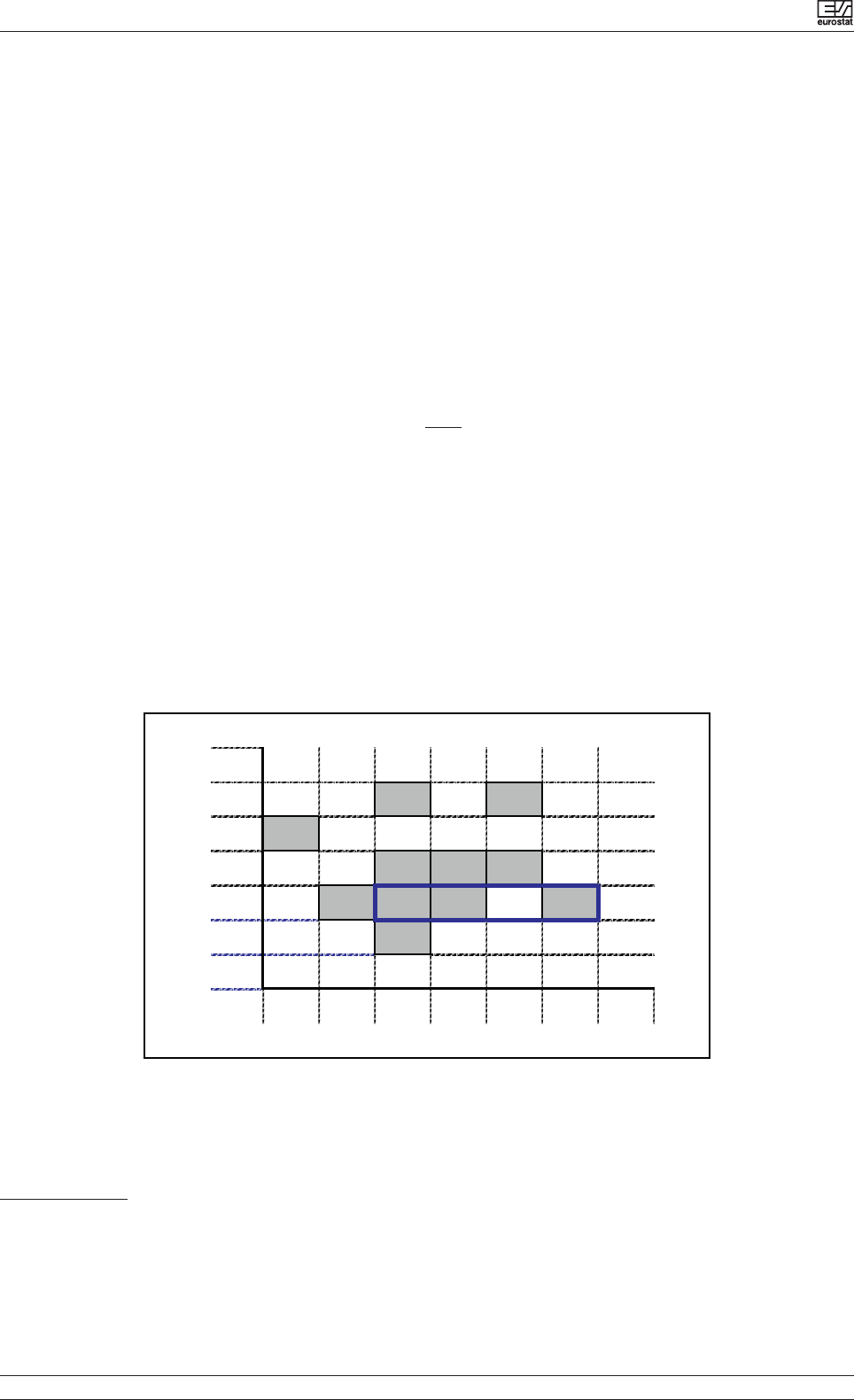
A Single Learning Activity is defi ned as being “characterised by unity of method and subject”.
This means that each time there is a change in method of learning or subject of learning you have a
different single learning activity. Figure 1 illustrates this.
S7
S6 SLA SLA
S5 SLA
S4 SLA SLA SLA
S3 SLA SLA SLA SLA
S2 SLA
S1
M1 M2 M3 M4 M5 M6 M7
METHODS
S
U
B
J
E
C
T
S
Figure 1: Single Learning Activities
9 ISCED 1997, paragraph 10, page 4
10 HALLA, page 12.
3.3. Single Learning Activities (SLA)
Classifi cation of learning activities - Manual 11
The Subject (or fi eld) is what the individual learns. The ISCED Fields of education11 and the Eurostat
manual on “Fields of Education and Training12”should be adopted. However further work in detailing
the fi elds is needed, especially for subjects like personal development and working life, to improve
the appropriateness of the classifi cation for lifelong learning.
The Method is the organisational frame used to learn or to teach (i.e. acquire or transmit ideas,
information, knowledge, skills and competences). This can take the form of (educational) programmes,
courses, events, or other more or less organised forms.
The method i.e. organisational frame coincides closest with the everyday understanding of the method
used for learning at different levels (e.g. classroom instruction, private tuition, self-learning). Within
each SLA different learning media and tools may be used. A change of media or tools does not mean
change of SLA. This means that if, for example, classroom instruction includes oral presentation, use
of books in the classroom and use of internet in the classroom as part of the pedagogical approach of
the teacher, the activity should still be considered one SLA.
3.4. Learning map and aggregation of Single Learning Activities
The grid presented in fi gure 1 completed with all learning activities attended by a person constitutes
the “learning map” of this person. It covers all kinds of methods used by the person to learn all kinds
of subjects and represents them graphically.
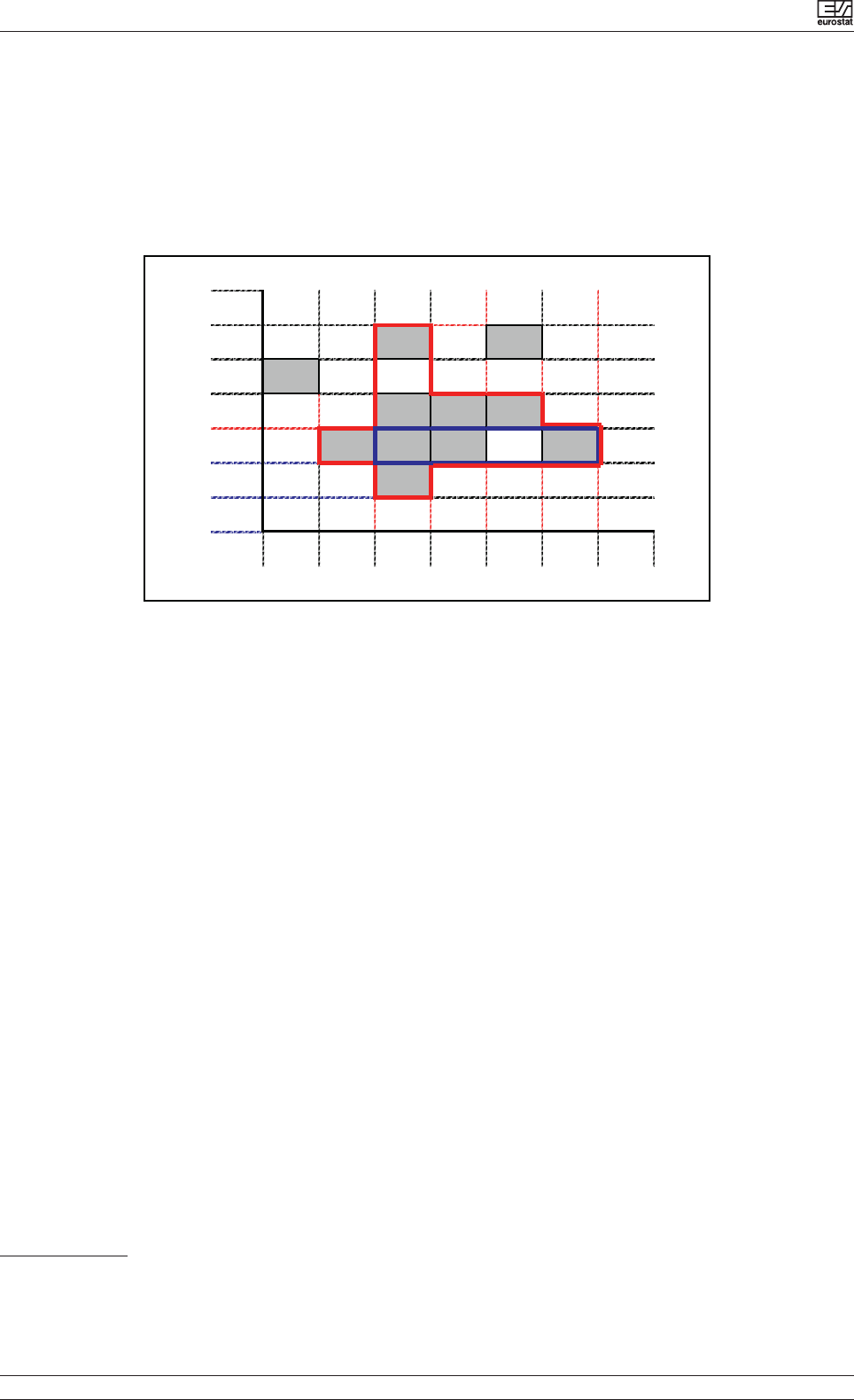
However in practice several Single Learning Activities can be grouped together. A series of SLAs to
learn a subject (fi eld of study) is called a Course. A course is defi ned as “a planned series of single
learning activities in a particular range of subject-matters offered by a provider” 13. Figure 2, where
the different methods used to learn subject S3 are framed in blue, illustrates this:
S7
S6 SLA SLA
S5 SLA
S4 SLA SLA SLA
S3 SLA SLA SLA SLA
S2 SLA
S1
M1 M2 M3 M4 M5 M6 M7
METHODS
S
U
B
J
E
C
T
S
Figure 2: A Course is basically a grouping of SLAs by subject
11 ISCED 97 pages 35 to 39.
12 Eurostat, December 1999.
13 Adapted from the defi nition of courses for formal education, ISCED 97 glossary page 41: “A course for this purpose is taken to
be a planned series of learning experiences in a particular range of subject-matters or skills offered by a sponsoring agency and
undertaken by one or more students”. Another defi nition is that presented in HALLA (page 36): “A series of lectures or lessons
in a particular subject typically leading to certifi cation or at least to a confi rmation of participation” (source: based on the New
Oxford Dictionary, 1998)
Classifi cation of learning activities - Manual 12
Another type of grouping of is when there are several SLAs organised as a set using different methods
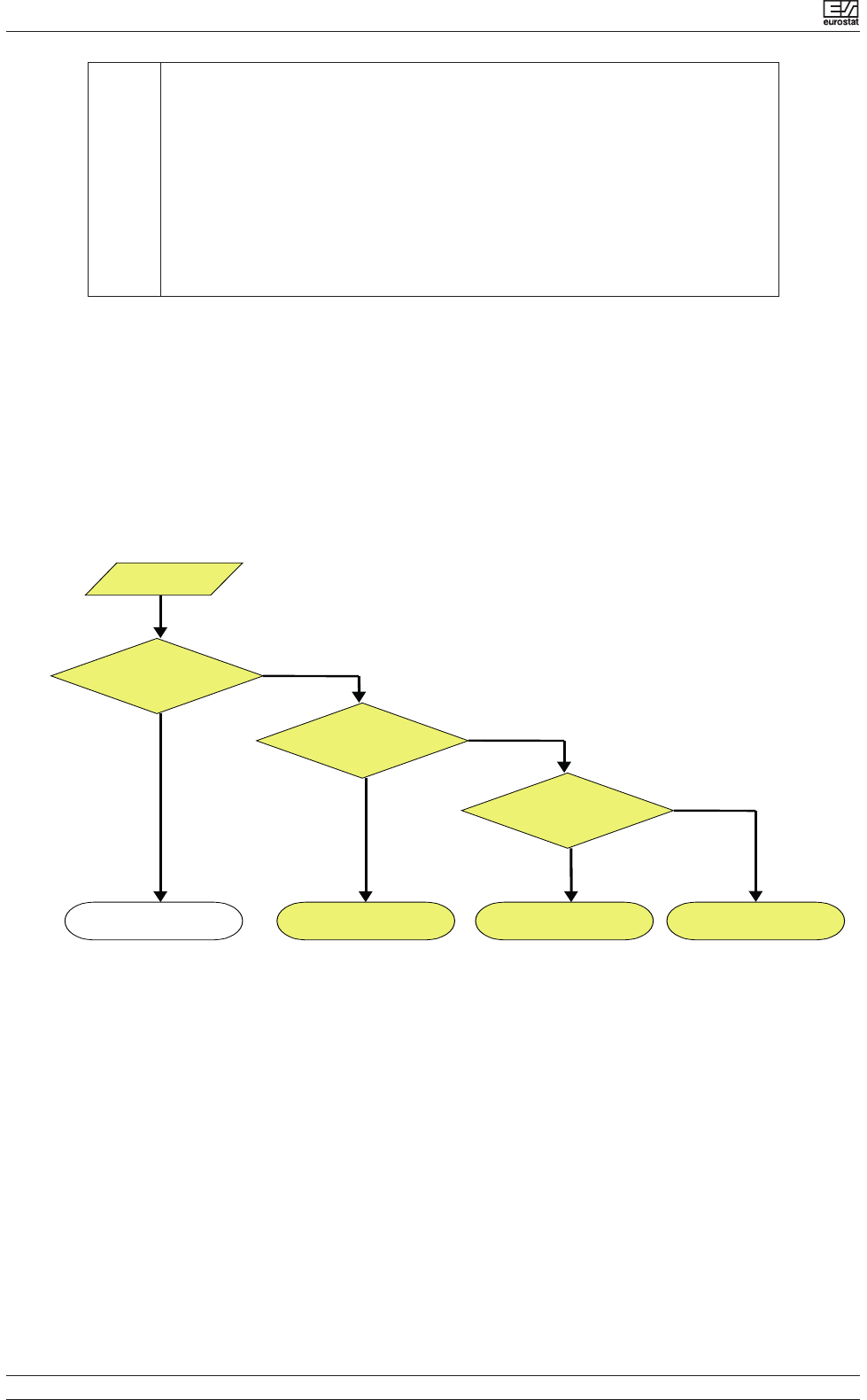
to learn different subjects. This is called a programme. A programme is defi ned “on the basis of
its educational content as “an array or sequence of education activities, which are organised to
accomplish a predetermined objective or a specifi ed set of educational tasks” 14. A programme would
typically include several courses but also separate SLA, i.e. activities where a specifi c method is used
to learn a specifi c subject which is not part of any kind of programme or course. Figure 2, where a
programme is framed in red, illustrates this.
S7
S6 SLA SLA
S5 SLA
S4 SLA SLA SLA
S3 SLA SLA SLA SLA
S2 SLA
S1
M1 M2 M3 M4 M5 M6 M7
METHODS
S
U
B
J
E
C
T
S
Figure 3: A Programme can be a grouping of courses and SLAs
Note: The terms “programme” and “course”, which have been used above to facilitate the understanding
of the concepts of single learning activities and learning map, may be used with different meanings
in everyday language in different institutional and national contexts and can even go down to
corresponding to “the use of one method (e.g. classroom instruction) to learn one subject (history)
which according to the description above is a SLA. Therefore the existence of the term “programme”
or “course” in the description of an activity should not automatically be interpreted as corresponding
to the above theoretical description.
3.5. Scope of education and learning and categories of Learning Activities
Education and learning can be classifi ed into four broad categories: Formal education15 (F), Non-
Formal education16 (NF), Informal learning (INF) and random/incidental learning. This conceptual
structure is presented in fi gure 417.
14 ISCED 97, paragraph 17, page 5.
15 Education meaning by convention education and training.
16 Education meaning by convention education and training.
17 UNESCO, 1996: Manual for statistics on non-formal education.

Classifi cation of learning activities - Manual 13
Random Learning
Informal Learning
Formal
education
Non formal
education
Family, socially or self-directed
Media and communication
Figure 4: Scope of education and learning
Based on the defi nition of learning activities for CLA, random learning is excluded from statistical
observation because it is not intentional. The scope of CLA is indicated with the thick red line in
fi gure 4.
The organising concept of the CLA is based on 3 broad categories: Formal Education (F), Non-
Formal Education (NF) and Informal Learning (INF). It should be possible to classify all learning
activities into these 3 broad categories. The existing conceptual defi nitions of these three categories
are the following:
Formal Education18 as “…education provided in the system of schools, colleges, universities and other
formal educational institutions that normally constitutes a continuous “ladder” of full-time education
for children and young people, generally beginning at age of fi ve to seven and continuing up to 20 or
25 years old. In some countries, the upper parts of this “ladder” are organised programmes of joint
part-time employment and part-time participation in the regular school and university system: such
programmes have come to be known as the “dual system” or equivalent terms in these countries.”
Non Formal Education19 is defi ned as “any organised and sustained educational activities that do not
correspond exactly to the above defi nition of formal education. Non-formal education may therefore
take place both within and outside educational institutions, and cater to persons of all ages. Depending
on country contexts, it may cover educational programmes to impart adult literacy, basic education for
out of school children, life-skills, work-skills, and general culture. Non formal education programmes
do not necessarily follow the “ladder” system, and may have a differing duration.”
Informal Learning is defi ned as “…intentional, but it is less organised and less structured ….and
may include for example learning events (activities) that occur in the family, in the work place, and in
the daily life of every person, on a self-directed, family-directed or socially directed basis”20.
18 ISCED 97 glossary, page 41
19 ISCED 97 glossary, page 41
20 As defi ned in the report of the Eurostat TF/ MLLL (paragraph 32, page 12).

Classifi cation of learning activities - Manual 14
Q&A When do sports activities become “leisure” and stop being “learning”?
In order to focus on learning activities and exclude the activities which are merely
physical fi tness programs, we only include programs/courses which focus on the
rules and techniques of participation and skill building in competitive (professional
or amateur) physical activities.
So sport activities not formally organised and without a trainer/teacher/coach
involved are not considered as training/learning and merely physical fi tness programs
are not included in non-formal learning as well.
Courses for coaches/trainers and/or umpires/referees/judges that lead to a
qualifi cation/ certifi cate which allows the participants to perform some special
functions should be considered as non-formal education.
The following section includes the operational criteria to use in order to allocate learning activities
to the three categories corresponding to the conceptual defi nitions. In the following the use of the
term “education” is used to mean “education and training”.
3.6. Operational criteria for distinguishing the broad categories of Learning
Activities
3.6.1. Informal learning versus formal and non-formal education
There is one fundamental criterion that distinguishes Informal Learning from Education (formal and
non-formal). This is whether the learning activity is institutionalised or not.
Institutionalised learning activities occur when there is “an organisation providing structured
arrangements (which must include a student-teacher-relationship), especially designed for education
and learning”.
Institutionalised learning activities happen when there is a providing agency/body responsible for
determining at least the following:
– Teaching / learning method (predetermined)
– Scheduling of the learning
– Admission requirements
– Location of the learning/teaching facility
Informal learning activities are not institutionalised.
They are less structured and they can take place almost anywhere: within the family, with friends, at
work or even using facilities made available by education and training providers.

Classifi cation of learning activities - Manual 15
Q&A What if the employer has a learning centre where the employees can borrow “teach
yourself” material (electronic or paper format) and use it either on location or take
at home?
The learning centre is knowledge infrastructure for learning and not institutionalised
learning activity. This means that “knowledge” is institutionalised (as it would be
for any type of learning centre made available by the state or the municipality or an
association) but not the learning activity which is self-learning and thus informal.
Q&A Is a teacher giving private lessons an “institution”, which means that most private
lessons qualify as “non-formal education”?
A private tutor should be considered as an institution. As far as the learner is
concerned it is an external body deciding (and at the same time implementing) the
teaching contents and methods.
Private lessons can even be “formal education” in the case where the national
educational system recognises home schooling, as the pupil would participate in
institutionalised learning designed to lead to a qualifi cation in the NFQ.
Q&A Training during the military service may include some courses. How should they
be treated?
These courses should be classifi ed using the CLA as non formal training. In the
framework of the implementation in a household survey it may be considered
necessary to exclude them (suggestion by a respondent).
3.6.2. Formal education versus non-formal education
Formal education and non-formal education are both part of the education framework. There is one
fundamental criterion that distinguishes Formal Education from Non Formal Education. This is
whether the activity is designed to lead upon successful completion to a learning achievement that is
possible to position within the National Framework of Qualifi cation (NFQ).
The National Framework of Qualifi cation (NFQ) is defi ned as “the single, nationally and
internationally accepted entity21, through which all learning achievements may be measured and
related to each other in a coherent way and which defi ne the relationship between all education
and training awards”. The NFQ could take the form of a regulatory document which stipulates the
qualifi cations and their relative positions in a hierarchy of learning achievements as well as the bodies
that provide or deliver these qualifi cations (awarding bodies). An institutionalised learning activity
(i.e. education in the broader sense) is formal when its completion leads to a learning achievement
(a qualifi cation or award) that is possible to position within a National Framework of Qualifi cation
(NFQ).
21 The entity can take the form of an organisation/body, or regulatory document. It stipulates the qualifi cations and the bodies that
provide or deliver the qualifi cation (awarding bodies) that are part of the National Framework of Qualifi cations.

Classifi cation of learning activities - Manual 16
A National Framework of Qualifi cations can be a mechanism to relate learning achievements to
each other, to communicate them to a wide audience and/or a regulatory device to for example set
overall standards for qualifi cations The recognition of the qualifi cation in the National Framework
of Qualifi cations may, in some cases, be characterised by a “set of structured learning experiences …
leading to a completion point that is formally certifi ed by an award or any form of recognition.” In
other cases, such frameworks may promote and facilitate the recognition of prior learning with a view
to the achievement of credit or a qualifi cation.
It is important to note that the concept of NFQ is different from the concept of “Framework of
national qualifi cations” which would only include the qualifi cations awarded by national education
and training bodies. The NFQ should cover also the qualifi cations delivered by awarding bodies
operating based in other countries.
(1) The concept of the NFQ is another way of taking into account the criteria proposed in the
TF/MLLL report22 to delimit formal education as opposed to non-formal education. These
criteria were: Hierarchy level-grade: Structure is defi ned as “levels` of education is broadly
related to that of gradations of learning experience and competencies that the contents of
educational programmes require of participants if they are to successfully complete any given
programme. Broadly speaking, the level is related to the degree of complexity of the content
of the programme.”23 According to the ISCED defi nition Formal Education can be seen as a
complex ladder of education where recognised completion of one level gives access to another
higher level of complexity.
(2) Admission requirements: They defi ned as “The requirement or set of requirements, which
have to be fulfi lled to have access to learning”. Formal education is typically subject to
various admission requirements, notably in terms of age and prior education attainment. In
Non-formal education admission requirements may not exist.
(3) Registration requirements: They are defi ned as “The requirement or set of requirements which
have to be fi lled to record formally the enrolment to learning”. Formal education is typically
subject to registration. Non formal education is characterised by the absence of registration
requirements24.
Although the NFQ refers to “qualifi cations” while these criteria refer to the characteristics of the
“programme that is designed to lead to the qualifi cations” included in the NFQ they can be considered
as 2 ways to describe the same concept of i.e. “formal education” for the purpose of the CLA. In fact
concept of NFQ is used in the context of CLA as a means to indicate that an activity is “qualifying”.
The NFQ covers both education and training and is independent of the pathway leading to the award
of the qualifi cations included in it. The national awarding bodies would typically include public
bodies with the authority to defi ne and/or recognise the value of a qualifi cation positioning it in the
NFQ, and therefore are not limited to the ministries of education, although they are expected to be
playing the major role in such a system.
22 Inspired from the UNESCO manual for statistics on Non Formal Education, 1996.
23 ISCED 97, page 5
24 UNESCO Manual for statistics on non-formal education, page 4.

Classifi cation of learning activities - Manual 17
Q&A Should a NFQ exist already in the country?
The NFQ is a concept used for the CLA. It may or may not correspond to constructions
bearing the same name in the country. It is assumed however that even if there is
no unique established construction which can be considered as corresponding to
the CLA NFQ concept, its elements exist and are already used in countries when
discussing about formal education and training. It includes a grid of qualifi cations,
usually linked to programmes designed to lead to them, to institutions providing these
programmes and to organisations awarding or recognising these qualifi cations.
By applying the NFQ criterion formal education refers to institutionalised learning activities that
are designed to lead to a learning achievement (qualifi cation or award) that can be positioned in a
National Framework of Qualifi cations. This situation can also be formulated as “formal education
includes activities that are part of the NFQ” denoting the link existing on the basis of the design of the
activity with the resulting qualifi cation.
On the other hand non-formal education refers to institutionalised learning activities, which are not
part of the NFQ. It includes structured programmes that cannot be positioned in the NFQ usually
because the provider and/or the awarding organisation are not part of the NFQ. Therefore for examples
some programmes which may be organised in a well established institutional context may not be part
of the NFQ if the education and training provider and/or the awarding body are not part of the NFQ
(e.g. professional organisations, private commercial companies, non-governmental organisations).
Q&A What about formal training where the provider is an employer? Is this part of the
NFQ?
If the employer is providing this training as part of a programme designed to lead to
a qualifi cation in the NFQ, then the employer is part of the NFQ and the activity, even
if it is 100% work based is “formal training”.
If the person is participating in training after receiving his/her qualifi cation in order
to be a recognised professional (e.g. a law graduate practicing to become a lawyer,
or a medicine graduate practicing to become a pathologist) then this is work and not
learning.
If the person is obtaining work experience which s/he can later on decide to recognise
in the NFQ, then his/her activity is work and not learning (it is separate from the
recognition which may be undertaken on a voluntary basis).
The fact that national authorities may have established procedures for the recognition of prior work
experience or non-formal or informal activities (like self-learning) would not change the category in
which the activity of the person would be classifi ed. An activity is considered formal only when the
“NFQ qualifi cation” is part of the design of the programme/activity.

Classifi cation of learning activities - Manual 18
Q&A If a qualifi cation is in the NFQ and the individual may obtain this by participating in
an examination after studying on his/her own, should this self-study be considered
as formal education?
The NFQ is a structure based on outcomes (qualifi cations). A learning activity of an
individual is considered “formal” only when it is designed to lead to a qualifi cation
in the NFQ. This means that if a person is studying in a programme designed to lead
to qualifi cation A after succeeding in fi nal examinations, this person is participating
in formal education or training.
If another person is studying on his/her own and is allowed to be registered for
the fi nal examination so that s/he can obtain qualifi cation A, then his/her learning
activity is informal as it is separate from the examination which may be undertaken
on a voluntary basis.
Q&A If somebody participates in a course (which can also be a distance learning course)
giving him/her credits which he can use for example in the framework of a modular
programme to complete a programme and obtain a qualifi cation in NFQ, is s/he
participating in formal education?
Yes. Participating in and completing a module which is part of a programme designed
to lead to an NFQ qualifi cation is formal education. The fact that the theoretical
duration of a programme in the case of full-time attendance may be 3 years while a
part-time participant may need 6 and a “module” participant may take 15 does not
change the nature of the activity.
Q&A Watching a “language course” programme on the TV is informal learning. What
if (case A) there is the possibility to be registered beforehand and have interaction
with a teacher while following the TV course and at the end participate in
examinations which lead to an NFQ qualifi cation? And what if (case B) the person
who is attending the programme can at its end register for an examination to get a
degree corresponding to the knowledge acquired through the programme?
In case A the TV is used as any other means of distance learning (internet,
correspondence etc) and the registered viewer is in fact registered in a programme
designed to lead to an NFQ qualifi cation. Therefore the activity should be considered
formal.
In case B the learning activity is separated form the requirement for obtaining the
qualifi cation and therefore it should be considered as informal.
In the case of foreign educational institutions established in a country or distance learning in institutions
based outside the reporting country (i.e. the country of residence of the respondent/individual in the
case of a household survey), the qualifi cation obtained by the participant which is included in the
NFQ of the country of origin. This activity is to be considered formal if this qualifi cation which is part
of the design of the programme is already included in the NFQ (direct recognition and equivalence),
or if it is in principle recognised by the NFQ but there are additional equivalence examinations to
decide whether the student has a suffi cient level of knowledge so as to recognise equivalence on a
personal basis. Otherwise the programme is non-formal education.
Classifi cation of learning activities - Manual 19
Q&A If there is a requirement for “equivalence examination” for a degree so that it can
be considered equivalent to a well established national formal degree, does this
mean that the degree does not belong to the NFQ?
A degree whose holder is admitted to participate in an equivalence examination
should in principle be considered as belonging to (recognised by) the National
Framework of Qualifi cations (as opposed to belonging to the framework of national
qualifi cations). The equivalence is normally meant to give a score for the degree
for further educational or professional use. Therefore the corresponding programme
should be considered formal education.
3.7. Summary decision making fl ow chart
In synthesis, the process to allocate education and learning according to the broad categories is
presented in the decision making fl owchart shown in Figure 5.
Activity
Intention to learn
Institutionalised
included in NFQ
not learning Informal learning Non-formal educ. Formal educ.
YES
NO
NO
NO
YES
YES
Figure 5: Allocation of learning activities according to the 3 broad categories

Classifi cation of learning activities - Manual 20
4. CLASSIFICATION OF LEARNING ACTIVITIES (CLA)
4.1. Content and structure of CLA
CLA is a taxonomic coding scheme of Learning Activities. Learning Activities encompass one or
more Single Learning Activities (SLAs). The titles and description of the classes and subclasses are
generic categories based on common characteristics.
4.2. Primary statistical units of CLA
Each learning activity can be allocated to only one of the 3 broad categories of learning (Formal
education, Non-Formal Education or Informal learning) according to the dominating (see section 6)
method and the decisive criteria to be applied to the 3 broad categories as explained in the previous
section of this manual.
4.3. Formal Education
The primary statistical unit for formal education remains the educational programme as defi ned by
ISCED 97.
The central or main SLA of formal education has to be taught learning (face to face and at
distance).
To classifying formal education learning activities educational programmes by level based on
educational content is considered suffi cient.
4.4. Non-Formal Education
The primary statistical unit for Non-Formal Education are institutionalised learning arrangements
(organising frames) to learn one or more subjects.
These arrangements could take the form of courses, non-formal education programmes or any
arrangement where the central or main SLA is institutionalised and taught (face to face and at
distance).
Some Non-formal education learning activities are taken into account in ISCED97 classifi cation of
educational programmes by level, based on educational content.
4.5. Informal Learning
The primary statistical unit for Informal Learning is the method used for one subject.
Those two statistical units form the basic theoretical unit Single Learning Activity of informal learning.
Informal learning may or may not involve taught learning but it must not be institutionalised.

Classifi cation of learning activities - Manual 21
Q&A What should happen when the activity reported is in fact several different
activities?
Although CLA is built around the basic building block of the “Single Learning
Activity” which has unit of method and subject the level of detail at which information
will be collected and analysed depends on the purpose of the survey that is going
to use CLA.
For this purpose we can say that there is an implicit hierarchy of the categories.
“Formal” is higher than “non-formal” higher than “informal”. Activities of a
lower level carried out as part of an activity of a higher level can be considered part
of the higher level activity: for example using self-study, additional tutoring, use
of internet resources as part of the preparation homework for a formal education
programme can be considered as part of the formal activity in case we are not
interested in going into the detail of the methods used by the student to participate
in the formal activity.
On the contrary when an activity at a higher level is organised in the framework of a
longer activity of a lower level then it should be considered as a separate activity.

Classifi cation of learning activities - Manual 22
5. BROAD CATEGORIES, CLASSES AND SUB-CLASSES
5.1. Summary table
The proposed categories, classes and subclasses for the Classifi cation of Learning Activities are
summarised in the following table. The explanatory notes are presented in section 6.
Codes Broad categories / Classes / Sub-classes
1. Formal education
2. Non-formal education
2.1. Non formal programmes
2.2. Courses:
2.2.1. Courses conducted via classroom instuction (including lectures)
2.2.2. Combined theoretical-practical courses (including workshops)
2.2.3 Courses conducted through open and distance education
2.2.4.Private tuition (private lessons)
2.3. Guided on-the-job-training
2.4. Other non-specifi ed elsewhere
3. Informal learning
3.1. Taught Learning
3.1.1. Coaching / Informal tuition
3.1.2. Guided visits
3.2. Non-taught learning
3.2.1. Self-learning
3.2.2. Learning-group
3.2.3. Practice
3.2.4. Non-guided visits

Classifi cation of learning activities - Manual 23
5.2. Explanatory notes to CLA
1. Formal education
Formal education refers to institutionalised learning activities that lead to a learning achievement that
can be positioned in the National Framework of Qualifi cations (NFQ). The National Framework of
Qualifi cations recognises learning activities constituted of structured hierarchical programmes with
chronological succession of levels and grades, admission requirements and formal registration.
The explanatory notes for the classes of formal education are those of the levels of education of ISCED
1997 (pages 13-33). Readers should therefore refer to this publication for any further information on
the content of this broad category, its classes and sub-classes.
2. Non-formal education
Non-formal education refers to institutionalised learning activities, which are not part of the NFQ.
It includes structured activities which either do not lead to any qualifi cation or lead to qualifi cations
which are that are not included in the National Framework of Qualifi cations. The latter is the case for
example for programmes or courses that are not part of the NFQ but are recognised by professional
organisations.
2.1. Non-formal programmes
An education and training programmes, i.e. “an array or sequence of education activities, which
are organised to accomplish a predetermined objective or a specifi ed set of educational tasks” is
classifi ed as non-formal25 if it does not lead to a qualifi cation included in the NFQ.
In case the content of non-formal education programmes can be considered as of similar/equivalent
level of formal education programmes then the ISCED criteria should be used (see UNESCO ISCED 97
document pages 13-33). Readers should therefore refer to this publication for any further information
on the content of this broad category, its classes and sub-classes.
2.2. Courses
Courses are typically subject oriented. They are taught by one or more persons specialised in the
fi eld(s). They may take place in one or more settings/environments as listed below.26
2.2.1 Courses conducted via classroom instuction (including lectures)
This subcategory includes learning organised in a classroom for a group of people and is built around
the transmission of knowledge by a teacher/tutor/instructor with the intention to provide instructions
and educate. It may or may not include discussion on a given subject.
Includes:
Job-related courses undertaken during work time or outside work time either in the workplace or outside the work-place,
either paid or not paid by employer.
25 Non formal programmes are not broken down by ISCED levels because it might be diffi cult to clearly determine these levels in a
survey.
26 Note in HALLA, page 37, a lecture is defi ned as “a talk on a subject by someone knowledgeable in that subject to a class or
invited audience” (source OECD, 1999).

Classifi cation of learning activities - Manual 24
Sessions having the character of a course conducted through classroom instruction, which may be provided during a
conferences or congresses. These sessions which may have names like “tutorial”, “seminar” or even “workshop” are
included if there is an educational objective, distinguishing them from information sessions, and there is no practical
training involved. In which case they would be classifi ed under 2.2.2.
2.2.2 Combined theoretical-practical courses (including workshops)
This subcategory covers all courses combining classroom instruction (theoretical) with, practice
in real or simulated situations. It includes vocational apprenticeships, with the exception of those
covered by formal education (e.g. “dual system” programmes or “alternance training” combining
formal schooling and work/enterprise based training). Combined theoretical-practical courses include
also learning activities which include some classroom instruction together with guided on-the-job-
training and practice.
Includes:
Sessions combining theoretical instruction with “hands-on” training provided during a conferences or congresses which
may bear the names “workshop”, “seminar”, “tutorial” or other.
2.2.3 Courses conducted through open and distance education 27
This subcategory covers courses which are similar to face-to-face courses, i.e. they may have elements
like curriculum, registration, tutoring and even tests but take place via postal correspondence or
electronic media, linking instructors/teacher/tutor or students who are not together in a classroom. This
type of courses involves interaction between the instructor and the student, albeit not simultaneously
but with a delay.
2.2.4 Private tuition (private lessons)
This is a “planned series of (supplementary) learning experiences offered by experts or other who
act as experts, selected to deepen knowledge or skills, to learn more intensively, usually undertaken
by only one or very few learners”28. Typically the tutor (physical person) in this case is also the
“provider” having education as “core activity”.
Q&A What is the difference of a private lesson that is institutionalised (category 2.2.5)
from a private lesson that is not institutionalised (category 3.1.1)?
It is the role of the provider/tutor and his/her relation to the learner. If the person
has as main activity delivering private lessons and has a professional teacher-to-
student relationship in this context to the learner then it is 2.3. If the provider/tutor is
assisting the learner in the framework of a social relationship then it is 3.1.1.
2.3. Guided on-the-job-training
This type of training is characterised by planned periods of training, instruction or practical experience,
using normal tools of work, either as the immediate place of work or in the work-situation29 with the
presence of a tutor. It is usually organised by the employer to facilitate adaptation of (new) staff,
including transferred, re-hired and seasonal/temporary staff in their new or current jobs. It may include
general training about the company (organisation, operating procedures, etc.) as well as specifi c job-
related instructions (safety and health hazards, working practices).
27 As defi ned in HALLA page 36.Source: based on European Foundation for the Improvement of Living and Working Conditions.
28 Based on HALLA defi nition, page 38.
29 This corresponds to category “Planned periods of training, instruction or practical experience”.

Classifi cation of learning activities - Manual 25
Excludes:
All apprenticeships under Formal Education and under combined theoretical-practical courses under Non Formal
education (see subclass 2.2.3)
Job-related courses undertaken during work time or outside work time either in the workplace or outside the workplace,
paid by employer or not paid by the employer (see sub-class 2.2).
2.4. Other non-specifi ed elsewhere
This sub-category is for non-formal education activities that cannot be allocated to one of the other
categories of this broad category. Thus may be the case for certain activities very specifi c to a country
or to new activities that could emerge on the market.
3. Informal learning
Informal learning activities are not institutionalised. It encompasses a less structured set of Single
Learning Activities. It can take place almost anywhere: within the family, with friends, at work.
3.1. Taught Learning
3.1.1 Coaching / Informal tuition
This includes a very wide range of organised not institutionalised learning experiences offered by
experts or other who act as experts, selected to deepen knowledge or skills, to learn more intensively,
undertaken by one or very few learners. It also includes activities designed to assist and support
individuals in other processes of learning.
This includes all taught learning, both face to face and at distance. Coaching and informal tuition may
involve monetary compensation (payment).
Includes:
Face-to-face instruction from a colleague on how to use a new tool at work.
Lessons provided by household members or other individuals, such as relatives, acquaintances or neighbours.
Tuition/Lessons by a relative, acquaintance or neighbour who is also an expert/teacher for the subject to be learned.
3.1.2 Guided visits
This includes a very wide range of organised events designed to transmit information within a
predetermined limited time period in a given location. The location is the principal medium for
exhibiting the subject-matter that the learner intends to learn about and for the provider to transmit
the information. The key criterion for deciding whether such an activity is a learning activity or not is
whether there is a pre-determined learning objective prior to the visit. This intention to learn may also
be refl ected in the choice of type of guide (tourist guide or educational support/scientifi c personnel
of the site visited).
Includes:
Visiting cultural heritage sites (e.g. museums, exhibitions, historical and sacral sites and buildings).
Visiting scientifi c and natural sites (e.g. space centres, nature parks, botanical and zoological gardens)
Visiting private and public businesses or organisations (e.g. visiting a farm, a nuclear power plant, the EU institutions,
trade fairs and exhibitions).

Classifi cation of learning activities - Manual 26
3.2. Non-taught learning
3.2.1 Self-learning
Self-learning (self-study) is conducted alone by the individual. It involves the use of one, or more or
all the learning media presented in the classifi cation of learning media, with which it may be useful
to combine with certain learning tools (see Annex1).
This can take place in private (e.g. the home, car), general public (e.g. train, aeroplane, in the
countryside) and job-related settings/environments.
Includes:
Studying a subject using printed material (books etc)
Listening to a foreign language audio tape in the car
Watching a documentary on TV
Systematically observing animals in the countryside
Using teaching material from the internet
Practising or doing homework
3.2.2 Learning-group
This includes participating in all types of informal groups (among like-minded persons, friends,
colleagues, students, etc.) that are not instructed. This can take place in private (e.g. the home),
general public (e.g. community hall, hotels) and job-related settings/environments.
Communication among the learners may be face-to-face or at distance. Distance group discussion
channels of communication can be via postal correspondence or via electronic means e.g. Internet
“chats”, email, web camera, video-conferencing.
This category includes “Learning circles” which are defi ned as 30 “groups of employees who
come together on a regular basis with the primary aim to learn about the requirements of the work
organisation, work-procedures and work place (it is a form of individual learning within groups)”
or “Quality circles” which are defi ned as31 “working groups with the aim to discuss about problems
and search for problem-solving in the production and on the work place where participants have to
be integrated in the planning and controlling procedures of the enterprise (a moderator co-ordinates
quality circles).”
3.2.3 Practice
Practice typically involves the implementation or repetition of knowledge, methods rules or
instructions related to a subject already received, with the intention to improve personal performance
in this specifi c subject. It can be done in any setting/environment conducive to practising the subject-
matter. This can take place in private (e.g. the home), general public (e.g. the street) and job-related
settings/environments. It includes doing homework for formal or non-formal programmes.
3.2.4 Non-guided visits
This includes any visit undertaken with the predetermined purpose to learn, without the intervention
of a guide. Tools like printed visitors’ guides, brochures or pre-recorded audio guides may be used for
this type of non-guided visits.
30 CVTS2 manual
31 CVTS2 manual

Classifi cation of learning activities - Manual 27
6. BIBLIOGRAPHY
6.1. EUROPEAN COMMISSION
Communication from the Commission: European benchmarks in education and training: follow-up to
the Lisbon European Council, 20 November 2002.
Communication from the Commission: Making a European Area of Lifelong Learning a Reality.
Brussels, 20 December 2001. COM (2002) 629 fi nal.
Commission Regulation (EC) N° 1313/2002 of 19 July 2002 implementing Council Regulation (EC)
N°577/98 on the organisation of a labour force sample survey in the Community concerning the
specifi cation of the 2003 ad hoc module on lifelong learning. OJ 192/16 of 20.07.2002.
Fields of Education and Training Manual, Eurostat, December 1999. Authors: R. Andersson & A.K.
Olsson of Statistics Sweden.
Eurostat Task Force on Measuring Lifelong Learning (TF/MLLL) Report. By Spyridon Pilos, Eurostat
– Education and Training Statistics, March 2001. Eurostat Working Papers “Population and social
conditions” 3/2001/E/N°4.
Methodological manual for statistics on congresses and conferences, 2000 edition. Catalogue n° KS-
28-00-599-EN-C. ISBN 92-828-9213-1.
NACE Rev.1. Statistical Classifi cation of Economic Activities. Catalogue n° CA-80-93-436-EN-C.
ISBN 92-826-8767-8.
CPA 1996. Statistical Classifi cation of Products by Activity.
Eurostat Information Society Questionnaire 2002.
Eurostat Task Force on Adult Education Survey, Glossary for an adult learning to be used by the TF
AES, 3rd meeting of the Eurostat task Force on Adult Education Survey, 16-18 June 2003, Helsinki.
Doc.TFAES-M3-2003 – Background document N°1.
Eurostat Task Force on Adult Education Survey, Rainer Wilhelm, Statistisches Bundesamt Deutschland,
13 June 2003,Task 3 Group (T3G)
Eurostat Task Force on Adult Education Survey, Basic dimensions of learning activities, Rainer
Wilhelm, Statistisches Bundesamt Deutschland, 3rd meeting of the Eurostat, Task Force on Adult
Education Survey, Helsinki, 16-18 June 2003
Classifi cation of Training Provisions. June 1999. Brandsma and Kornelius. Funded by the Leonardo
da Vinci project of the Commission.

Classifi cation of learning activities - Manual 28
6.2. CEDEFOP
Harmonised List of Learning Activities (HALLA). Final version. April 2002. Authors: D. Gnahs,
A. Ioannidou, K.Pehl, S.Seidel. Edited by: P. Descy, A.F. Moussoux, S.Pilo
s.
Summary and analysis of the feedback from the Member States and other EEA countries as part of
the consultation on the Commission’s memorandum. November 2001.
6.3. UNESCO and UNESCO Institute for Statistics
International Standard Classifi cation of Education, July 1995. Abridged edition. Offi ce of Statistics.
ED/BIE/CONFINTED.35/Ref.8.
International Standard Classifi cation of Education (ISCED 1997). November 1997.
Operational Manual for ISCED-1997 (International Standard Classifi cation of Education) 1st edition.
June 1999. UNESCO Institute for Statistics.
Manual for statistics on non-formal education (preliminary version for fi eld test and comments).
October 1996. ST-96/WS/1C.
6.4. OECD
OECD (1997), Manuel pour élaborer de meilleures statistiques de la formation - Conception,
mesure, enquêtes / Manual for better Training Statistics - Conceptual, Measurement and Survey
Issues, Paris.
OECD (2000), Guidelines on the measurement of training -- a draft proposal, Working Party on
Employment and Unemployment Statistics DEELSA/ELSA/WP7(2000)6, Paris
UIS/OECD/Eurostat UOE data collection. 2002 Data Collection on Education Systems: Defi nitions,
Explanations and Instructions. Doc. Ref.: UOE (02) 1. Paris, April 2002
Standard statistical classifi cations: basic principles, February 1999. By E. Hoffman (ILO) and M.
Chamie (UN). Presented at the UN Statistics Commission 30th session. New York. March 1999.
UN Glossary of Classifi cation Terms, available directly on the UN Statistical Division’s website.
6.6. World Bank
Lifelong Learning in the Global Knowledge Economy. ISBN 0-8213-5475-2
6.7. National reference papers
GERMANY:
Towards a statistical framework for monitoring progress towards Lifelong Learning. By Walter
Horner, Federal Statistical Offi ce of Germany. Prepared for the INES Technical Group, 2000.
The inclusion of Lifelong Learning issues in the German Time Use Survey 2001/2002 (available as
annex 4 of Eurostat TF/MMLL report)
6.5. ILO and United Nations Statistics Division

Classifi cation of learning activities - Manual 29
CANADA and UNITED STATES OF AMERICA:
Classifi cation of Instructional programs (CIP – 2000), November 2001. National Center for Education
Statistics (US) and Statistics Canada.
FINLAND:
Participation in Adult education and training in Finland. Adult education survey 2000. By I.Blomqvist,
http://ec.europa.eu/education/policies/III/III_en.html
http://forum.europa.eu.int/Public/irc/dsis/edtcs/library?l=/public
www.oecd.org
www.uis.unesco.org
www.ilo.org/stat
www.un.org/Depts/unsd/
www.worldbank.org
T
www.cedefop.europa.eu
6.8. Internet sites of some of the references
. Russkanen, H.Niemi, E. Nyyssönen, Statistics Finland, ISBN-952-467-140-9

Classifi cation of learning activities - Manual 30
ANNEX 1: CASES – CLASSIFICATION INTO BROAD CATEGORIES
nr case description classifi ed as
01
Peter, aged 17, is learning French cuisine in an education college. The course lasts
3 years, and theoretical matters are taught in the classroom, complemented with
practice. To be admitted to this course, he had to have completed secondary school.
Every year he must sit for an examination that gives access to the next year. At the
end, the organisation gives a diploma recognised in the NFQ as a qualifi cation in
French cuisine with the title of “French cuisine Chef”.
FED
02
Peter, aged 30, is learning French cuisine in an in a large employer. The course lasts
3 years, and theoretical matters are taught in the classroom, complemented with
practice. To be admitted to this course, he had to have completed secondary school.
Every year he must sit for an examination that gives access to the next year. At the
end, the organisation gives a diploma recognised in the NFQ as a qualifi cation in
French cuisine with the title of “French cuisine Chef”.
FED
03
Peter, aged 30, is learning French cuisine in an unoffi cial religious organisation e.g. the
Moonies: the course lasts 3 years, and theoretical matters are taught in the classroom,
complemented with practice. To be admitted to this course, he had to have completed
secondary school. Every year he must sit for an examination that gives access to the
next year. At the end, the organisation gives a diploma recognised in the NFQ as a
qualifi cation in French cuisine with the title of “French cuisine Chef”.
FED
04
Peter is learning French cuisine in an education college: the course lasts 3 years, and
theoretical matters are taught in the classroom, complemented with practice. To be
admitted to this course, the person needs to have completed secondary school. Every
year he must sit for an examination that gives access to the next year. At the end, the
organisation gives a diploma recognised by the labour market but not by the NFQ.
NF
05
Peter is learning French cuisine in an in a large employer: the course lasts 3 years, and
theoretical matters are taught in the classroom, complemented with practice. To be
admitted to this course, the person needs to have completed secondary school. Every
year he must sit for an examination that gives access to the next year. The qualifi cation
is not recognised by the labour market nor by the NFQ.
NF
06
Peter is learning French cuisine with an unoffi cial association that organises 1 weekend
workshop with theoretical matters taught in a classroom, complemented with practice.
Everybody can register to attend the workshop. After the completion of the workshop
the organisation gives a certifi cate proving the participation and completion of the
workshop.
NF
07
Peter is learning French cuisine in a large employer that organises 1 weekend
workshop with theoretical matters taught in a classroom, complemented with practice.
Everybody can register to attend the workshop. After the completion of the workshop
the organisation gives a certifi cate proving the participation and completion of the
workshop recognised by the NFQ.
FED
08
Peter is learning French cuisine with a group of friends. One of them is a “Chef
of French Cuisine” and, as such, gives them guidance on theoretical and practice
matters. The group will get together once a week, during 2 months. Each one bought
some books and/or some video material to keep after the end of the learning.
INF

Classifi cation of learning activities - Manual 31
nr case description classifi ed as
09
Peter is learning French cuisine with a group of friends who have called themselves
the French Cuisine Association, and award themselves certifi cates. One of them is
a “Chef of French Cuisine” and, as such, gives them guidance on theoretical and
practice matters. The group will get together once a week, during 2 months. Each one
bought some books and/or some video material to keep after the end of the learning.
INF
10
Peter is learning French cuisine with a group of friends who have called themselves
the French Cuisine Association, and award themselves certifi cates. One of them is
a “Chef of French Cuisine” and, as such, gives them guidance on theoretical and
practice matters. The group will get together once a week, during 2 months. Each one
bought some books and/or some video material to keep after the end of the learning.
At the end of 2 months they take an examination for a qualifi cation in the NFQ.
INF
11
Peter (qualifi ed at ISCED 2) working in a commercial bank as an employee decides
to improve his skill on pottery. He chooses to take an evening course, during 1 year
with a cultural organisation named “Youth and cultural Training”. He attends 2 hours
classes, twice a week for practising and developing his creativity. At the end of the
year he will be able to participate in specifi c exhibitions although the course does not
give any offi cial qualifi cation.
NF
12
Peter (qualifi ed at ISCED 3) working in a commercial bank as an employee decides
to improve his skill on pottery. He chooses to take an evening course, during 1 year
with a cultural organisation named “Youth and cultural Training”. He attends 2 hours
classes, twice a week for practising and developing his creativity. At the end of the year
he receives an ISCED 2 qualifi cation at the end, and becomes a professional potter.
FED
13
Peter (qualifi ed at ISCED 3) working in a commercial bank as an employee decides
to improve his skill on pottery. He chooses to take an evening course, during 1 year
with a cultural organisation named “Youth and cultural Training”. He attends 2 hours
classes, twice a week for practising and developing his creativity. At the end of the year
he receives an ISCED 2 qualifi cation. He continues his work in the commercial bank.
FED
14
Peter (qualifi ed at ISCED 3) working in a commercial bank as an employee decides
to improve his skill on pottery. He chooses to take an evening course, during 1 year
with a cultural organisation named “Youth and cultural Training”. He attends 2 hours
classes, twice a week for practising and developing his creativity. At the end he
receives an ISCED 4 qualifi cation.
FED
15
Peter retired for 5 years has a science and technology hobby. He decides to improve his
knowledge in the fi eld of “Climate Changes”. He follows a distance learning course
in the Internet that organises 4 training meetings a year of the group. This course lasts
for 2 years and gives a university diploma recognised in the NFQ. He does not return
to work.
FED
16
Peter works as a technician in a biology laboratory, decides to train to become a
fi nancial consultant. He fi nds 1 distance learning course run by an “Open University”
lasting for 2 years. The course is organised in modules. These are valued according
to a system of credits that the individual is able to transfer to another university to
complete a diploma of fi nancial engineering and do a Ph.D. in the same fi eld.
FED
17
Peter (qualifi ed to ISCED 4) works as a technician in a biology laboratory, decides to train
to become a fi nancial consultant. He fi nds 1 distance learning course run by the “Open
University” lasting for 2 years. The course is organised in modules. These are valued
according to a system of credits that the individual is able to transfer to another university
to complete a diploma of fi nancial engineering and do a Ph.D. in the same fi eld
FED

Classifi cation of learning activities - Manual 32
nr case description classifi ed as
18
Peter (with no qualifi cations) works in a factory of textiles as a worker. He decides
to learn about English civilisation during the leisure time. He buys some software to
develop his English language skills and chose a number of exhibitions and conferences
about the theme. He identifi ed a number of websites from where he downloads
information that he studies 2 hours every evening.
INF
19
Peter (with no qualifi cations) works in a factory of textiles as a worker. He decides
to learn about English civilisation during the leisure time. He buys some software to
develop his English language skills and chose a number of exhibitions and conferences
about the theme. He identifi ed a number of websites from where he downloads
information that he studies 2 hours every evening. He takes an exam and gains an
ISCED 2 qualifi cation.
INF
20
Peter (already has an ISCED 3 qualifi cation) works in a factory of textiles as a worker.
He decides to learn about English civilisation during the leisure time. He buys some
software to develop his English language skills and chose a number of exhibitions
and conferences about the theme. He identifi ed a number of websites from where he
downloads information that he studies 2 hours every evening. He takes an exam and
gains an ISCED 2 qualifi cation.
INF
21
Peter, a non-skier, receives paid instruction from a registered ski-instructor who
works for “Ski like a Penguin company”. At the end he receives a recognised basic ski
certifi cate (not in NFQ).
NF
22 Peter, a non-skier, receives paid instruction from a registered ski-instructor who works
for “Ski like a Penguin company”. At the end he doesn’t receive any certifi cate.
NF
23 Peter, a non-skier, receives paid instruction from an instructor who is working privately
and declares earnings. At the end he doesn’t receive any certifi cate.
NF
24
Peter, a non-skier, receives paid instruction from a private instructor. But instructor
puts money in back pocket and doesn’t declare it. At the end he doesn’t receive any
certifi cate.
NF
25 Peter, a non-skier, receives unpaid instruction from a friend. At the end he can
participate in examinations to receive a recognised basic ski certifi cate (not in NFQ).
INF
26 Peter, a non-skier, pays to learn to ski from someone who is not registered as a ski
instructor but is qualifi ed as an instructor.
NF
27 Peter, a non-skier, pays to learn to ski from someone who is not registered as a ski
instructor but is a qualifi ed skier.
NF
28 Peter, a non-skier, is teaching himself to ski. At the end he participates in exams and
receives a recognised basic ski certifi cate (not in NFQ).
INF
29 Peter works in a cake factory, and is moving to a new machine. His supervisor gives
him 5 minutes/ 1 hour /4 hours/ 1 days training on how to use the new machine.
NF
30 Peter reads a trade journal “Rat catching today” to keep up with developments in his
profession daily/weekly/monthly/annually at home/at work.
INF
31
Peter, a hairdresser, attends a seminar on hairdressing at a university/professional
organisation which lasts 1 hour/1 day to keep up with new developments in scissors
technology.
NF
32
Peter, a hairdresser, attends a seminar on hairdressing at a university/professional
organisation which lasts 1 hour/1 day to keep up with new developments in scissors
technology but gets drunk on the train, and sleeps through the seminar.
NF

Classifi cation of learning activities - Manual 33
nr case description classifi ed as
33
Peter, a hairdresser, attends a seminar on hairdressing at a university/professional
organisation which lasts 1 hour/1 day to keep up with new developments in scissors
technology but Peter is not very interested and is only attending because his boss
couldn’t go.
NF
34
Peter, a hairdresser, attends a seminar on hairdressing at a university/professional
organisation which lasts 1 hour/1 day to keep up with new developments in scissors
technology but found that he already new everything about scissors but didn’t learn
anything from the seminar.
NF
35 Peter teaches himself to juggle over a 1 month/ 1 year period. INF
36 Peter teaches himself to juggle over a 1 month/ 1 year period and receives a certifi cate
from the national juggling foundation.
INF
37 Peter teaches himself Russian using text books. He is then registered for an examination
at a college, and receives a qualifi cation equivalent to ISCED 2.
INF
38 Peter wants to learn to type. He attends a course at work. NF
39 Peter wants to learn to type. He is given ”typing tutor” software to use at work by his
employer.
INF
40 Peter wants to learn to type. He uses “typing tutor” software at work, but doesn’t tell
his employer.
INF
41 Peter wants to learn to type. Peter’s employer asks Klaus, a colleague hired as a
qualifi ed typing instructor to provide training to staff, to teach Peter.
NF
42 Peter wants to learn to type. Peter’s employer asks Klaus, an external qualifi ed typing
instructor hired for this purpose, to teach Peter.
NF
43
Peter wants to learn to type. Peter asks Klaus, a colleague and a qualifi ed typing
instructor (without telling employer) to give him private lessons at work which he
pays for.
NF
44
Peter wants to learn to type. Peter asks Klaus, a colleague and a qualifi ed typing
instructor, (without telling employer) to give him private lessons at work which he
doesn’t pays for.
INF
45
Peter decides to learn Spanish at work at lunchtimes. He does this in his employer’s
training centre using “teach yourself” material which was purchased by his
employer.
INF
46
Peter decides to learn Spanish. He takes home from work (with permission) the “teach
yourself” material which was purchased by his employer and uses it to learn Spanish
in the evening.
INF
47 Peter decides to learn Spanish at lunchtime, using “Manuel’s guide to Spanish” on the
Internet. Manuel built the language course for a hobby, and not for commercial gain.
INF
48 Peter is a diplomat and the foreign offi ce has told him to teach himself Spanish before
he becomes ambassador to Peru. He does this from text books in work time.
INF
49
In order to learn Spanish Peter is enrolled for a correspondence course. Every week he
receives the package with the lessons in the textbooks and cassette. Every 2 weeks he
is obliged to send back the exercises for a correction by a teacher. After the 10 weeks
he receives a certifi cate (not recognised by NFQ) of fi nishing the particular level of
the course.
NF
50 Peter is learning Spanish following a “TV language course”. INF

Classifi cation of learning activities - Manual 34
nr case description classifi ed as
51
Peter attends a seminar of 2 days on IT technologies. 10 personalities gave lectures
on the future of IT in the assurance business. No certifi cate was delivered after the
seminar.
NF
52
Peter attends a seminar of 2 days on IT technologies. 10 personalities gave lectures
on the future of IT in the assurance business. An attendance certifi cate was delivered
proving attendance of the seminar.
NF
53
Peter attends a seminar of 2 days on IT technologies. 5 workshops were organised
on the future of IT in the assurance business. All participants are registered and have
received before the workshop the material for the workshop they attend. At the end of
the workshop participants who want certifi cation of the knowledge acquired, receive
a test and are given one hour to complete it. Those successful receive a certifi cate of
successful completion of the subject of the workshop. The rest of the participants just
receive attendance certifi cates. Pascal decides to participate in the test and receives
the successful completion certifi cate which is not part of the NFQ.
NF
54 Peter is visiting the history museum without taking any guide. NLA
55 Peter is visiting the history museum and is following the guided tour given by the
museum guide into small groups of persons.
INF
56 Peter is visiting the history museum and rents the pre-recorded audio guide. INF
57 Peter is visiting the Zoo to teach his children about reptiles. He is using the teaching
material provided by the zoo.
NLA
(teaching)
58
Peter is visiting the Zoo to learn more about reptiles. He had visited the zoo before
to get the “Zoo guide” and has studied at home the reptiles and has noted down the
characteristics for which he would need to observe closely the reptiles in the Zoo.
INF
59 Peter is visiting the Zoo on a weekend for fun. NLA
60 Peter is playing a football match. NLA
61 Peter is following a course on golf rules. The course also has some practice in order
to learn the rules.
NF
62 Peter has just started playing golf with a trainer, who is giving him elementary
knowledge about the rules and practices of the game.
NF
63 Peter plays golf with a trainer, in order to improve his performance. NLA
64 Peter attends classes in a Buddhist temple to learn about Buddhism. NFE
65 Peter is Muslim and is going to a mosque. NLA
66 Peter is Christian and is visiting a mosque. NLA
67 Peter is an atheist and is visiting a mosque as his hobby is comparing religious
practices.
INF
68 Peter is practising meditation. NLA
69
Peter is participating in a self-organised learning group of friends to improve computer
skills in Excel. The group has also engaged for some time a professional tutor for
more complicated subjects like Visual Basic programming.
INF
70
Peter belongs to a network of researchers working on numismatics of central Europe
in the 1st century. The network does not have any legal status. The network members
meet once a year in a “conference” organised by them in order to exchange knowledge
and best practice in their specifi c domain. Peter participates in this conference.
INF

Classifi cation of learning activities - Manual 35
nr case description classifi ed as
71
Peter is participating in a State-run “adult literacy programme” as he did not have the
opportunity to learn to write and read while he was young. The completion of this
programme gives a qualifi cation at ISCED level 1.
FED
72
Peter is participating in a programme organised by the association “Fight illiteracy”
aimed at giving adults the basic literacy and numeracy skills for their everyday life.
No certifi cate is delivered at the end of the programme.
NF
73 Peter is participating in training as part of his compulsory military service. NF
74
Peter has completed successfully the classroom instruction (theoretical training) for
his driving licence. He is now taking driving lessons from a cousin with the aim to
pass the hand-on driving test of the Ministry of Transport.
INF
75
Peter is currently studying to become a car engineer in a vocational training school
(ISCED4). During his studies he has been searching on the internet for more
information on his subject. and he is now attending a conference on “evolution of
transmission systems”.
FED
76 Peter is a book publisher and is visiting the “Annual international book exhibition”
in his city. NLA
77
Peter is a book publisher and is attending the “31st International conference on
typography techniques” organised as part of the “Annual international book exhibition”
in his city During this conference he is taking part in the workshop on creating the
3D maps.
NF
78 Peter is doing his homework for the upper secondary programme in which he is
participating. FED
79 Peter is participating in a training organised by Microsoft to receive a Certifi cate in
Software Engineering. NF
80
Peter has worked as a manager of cultural events for 10 years. He now has the
opportunity to register in a national examination through which successful candidates
receive a certifi cate which makes it possible for them to continue with advanced
studies in Management of cultural events at post-secondary level.
NLA
81
Peter has worked as a manager of cultural events for 10 years. He now has the
opportunity to register in a national examination through which successful candidates
receive a certifi cate which he is recognised by his national professional association
but does not allow him to continue with more advanced studies (i.e. is not recognised
in the NFQ).
NLA
82
Peter is participating during his leisure time in a course on “Multivariate analysis” at
the University for 5 weeks specifi cally designed for employed people. Upon successful
completion of the course he receives credits, which in a later stage can be added to
credits forming part of a degree in “Statistics”.
FED
83
Peter is participating in a course on “Multivariate analysis” at the University for 5
weeks. He does this during his working time (paid training leave) as his employer
has offered him this possibility. Upon successful completion of the course he receives
credits, which in a later stage can be added to credits forming part of a degree in
“Statistics”.
FED
84
Peter is participating in courses in Psychology provided by a municipal adult education
institution. Upon successful completion of the course he receives an upper secondary
qualifi cation in Psychology recognised in the NFQ.
FED

Classifi cation of learning activities - Manual 36
nr case description classifi ed as
85
Peter was enrolled in a programme for medicine in a foreign university established
physically in his country. The degree is recognized as equivalent to university education
in his country (i.e. it is in the NFQ).
FED
86
Peter was enrolled in a programme for medicine in a foreign university established
physically in his country of residence. The degree received is in principle recognised
by the NFQ but Peter has to go through an equivalence examination specifi c for his
country on the basis of bilateral (or multilateral) agreements between his country of
residence and the country of origin of the university in order to be able to use it for
further education or working as a doctor in his country of residence.
FED
87
Peter has participated in distance tertiary education programme on Law offered by an
institution outside his country. The degree is recognized as equivalent to university
education in his country (i.e. it is in the NFQ).
FED
88
Peter has participated in distance tertiary education programme on Law offered by
an institution outside his country of residence. The degree received is in principle
recognised by the NFQ but Peter has to go through an equivalence examination
specifi c for his country on the basis of bilateral (or multilateral) agreements between
his country of residence and the country of origin of the university in order to be able
to use it for further education or working as a lawyer in his country of residence.
FED
89
Peter is participating in specifi c “labour market education” which has as main purpose
to educate people in occupations lacking in the labour market. The certifi cate received
is at the same level as upper secondary education but it is not in the NFQ.
NF
90 Peter has participated in courses leading to a fl ight certifi cate recognized at the national
level (i.e. in the NFQ). FED
