Letter PVL15 Manual AP 2
2019-04-22
: Letter Pvl15 Manual Ap-Pvl15-2 Letter_PVL15_Manual_AP-PVL15-2 2postlifts manuals s
Open the PDF directly: View PDF  .
.
Page Count: 60
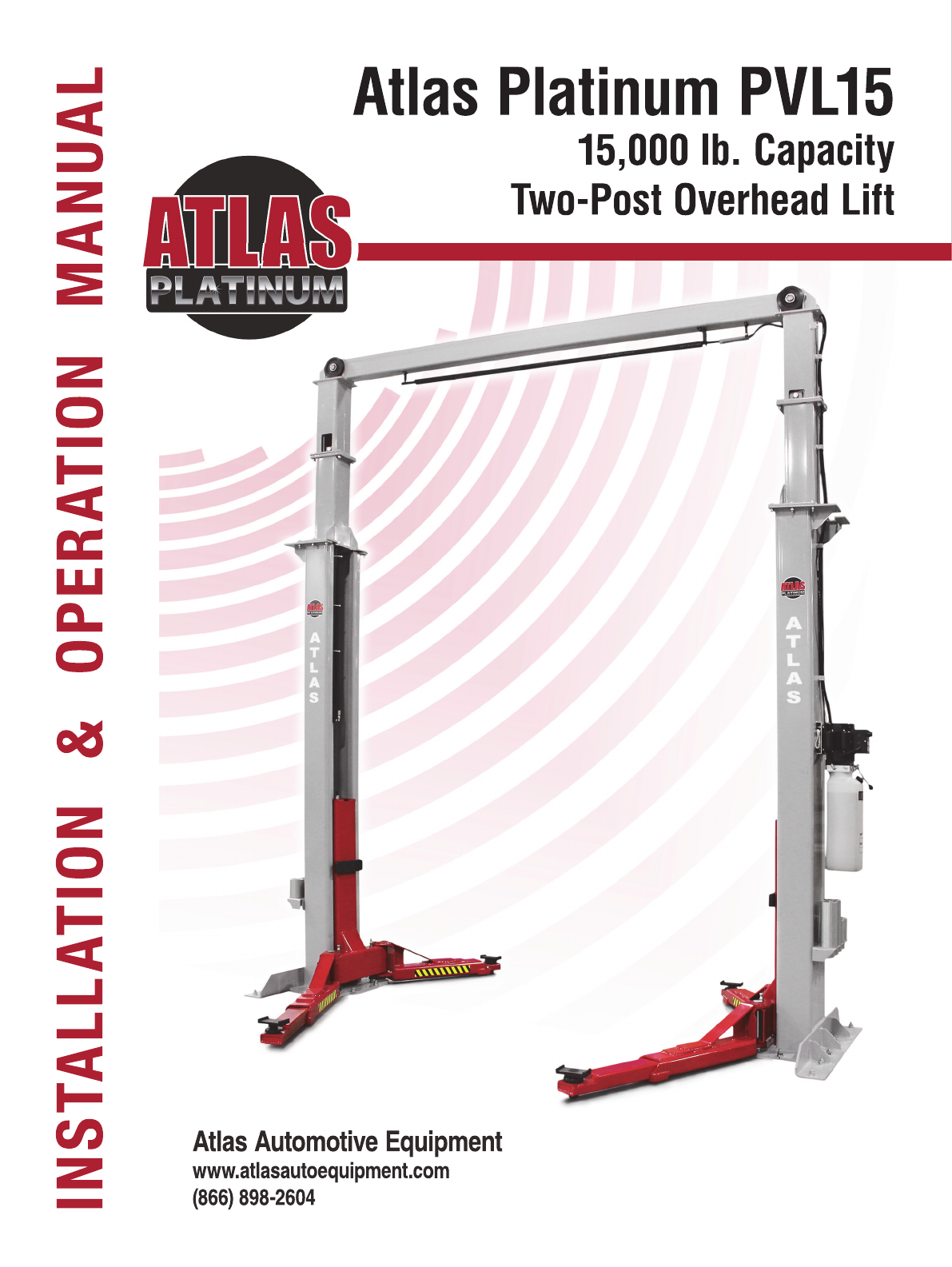
Replace This With Cover PDF

Revised 4/22/2018
Read this entire manual before operation begins.
Record below the following information which is located on the serial number
data plate.
Serial No.
Model No.
Date of Installation

Contents
General Information. . . . . . . . . . 9
Product Identication . . . . . . . . .12
Packing / Transport / Storage . . . . . 13
Lift Description . . . . . . . . . . . .15
Technical Specication. . . . . . . . . 17
Safety . . . . . . . . . . . . . . . .24
Installation . . . . . . . . . . . . . . 28
Operation And Use . . . . . . . . . . 38
Maintenance . . . . . . . . . . . . .41
Troubleshooting. . . . . . . . . . . . 43
Additional Information. . . . . . . . . 44
Part List . . . . . . . . . . . . . . . 53
Warranty . . . . . . . . . . . . . . . 60

4
PVL15
Operations And Maintenance Manual: 2-Post Lifts
Please read this manual in its entirety before installing or operating
your lift. By proceeding, you agree that you fully understand the contents
of this manual and the installation, operation, and maintenance instructions
contained within. Please deliver this manual to the lift owner and/or operator
along with all other documentation provided with the lift. Failure to operate this
equipment as intended may cause injury or death.
Check for any freight damages. The shipment should be thoroughly inspected
as soon as it is received. The signed bill of lading is acknowledgement by the
carrier of receipt in good condition of shipment covered by your invoice. If any of
the goods called for on your bill of lading are shorted or damaged, do not accept
to unload until the carrier makes a notation on the freight bill of the missing
or damaged goods. Do this for your own protection. Check the contents of the
accessory and hardware boxes to make sure no parts are missing.
Important Notice And Operating Conditions
• This lift is not intended for outdoor use. It is intended for indoor installation
only, with an operating temperature range of 41 – 104 °F (5 – 40 °C).
• Concrete ooring must be 6” minimum thicknesses with 3,000 psi. Do not
install on asphalt or other similar unstable surface type.
• Check ceiling height and electrical requirements as described in this
manual.
• Reference ANSI/ALI ALIS, Safety Requirements for Installation and Service
of Automotive Lifts.
• Consult a qualied expert to address all seismic load concerns and other
local or state requirements.
• Atlas Automotive Equipment and its distributors will assume no liability for
loss or damage of any kind, express or implied, resulting from improper
installation, operation or maintenance of this lift.

5
PVL15
Owner, Operator, & Employer Responsibilities:
• Shall ensure that lift operators are qualied and that they are trained in
the safe use and operation of the lift using the manufacturer’s operating
instructions; ALI/SM 93-1, ALI Lifting it Right safety manual; ALI/ST-90
ALI Safety Tips card; ANSI/ALI ALOIM-2008, American National Standard
for Automotive Lifts - Safety Requirements for Operation, Inspection and
Maintenance; ALI/WL Series, ALI Uniform Warning Label Decals/Placards;
and in the case of frame engaging lifts, ALI/LP-GUIDE, Vehicle Lifting
Points/Quick Reference Guide for Frame Engaging Lifts.
• Shall establish procedures to periodically inspect the lift in accordance
with the lift manufacturer’s instructions or ANSI/ALI ALOIM-2008,
American National Standard for Automotive Lifts - Safety Requirements
for Operation, Inspection and Maintenance; and the Employer shall ensure
that the lift inspectors are qualied and that they are adequately trained in
the inspection of the lift.
• Shall establish procedures to periodically maintain the lift in accordance
with the lift manufacturer’s instructions or ANSI/ALI ALOIM-2008,
American National Standard for Automotive Lifts - Safety Requirements
for Operation, Inspection and Maintenance; and the Employer shall
ensure that the lift maintenance personnel are qualied and that they are
adequately trained in the maintenance of the lift.
• Shall maintain the periodic inspection and maintenance records
recommended by the lift manufacturer’s instructions or ANSI/ALI
ALOIM-2008, American National Standard for Automotive Lifts - Safety
Requirements for Operation, Inspection and Maintenance.
• Shall display the lift manufacturer’s operating instructions; ALI/SM 93-
1, ALI Lifting it Right safety manual; ALI/ST-90 ALI Safety Tips card;
ANSI/ALI ALOIM-2008, American National Standard for Automotive Lifts
- Safety Requirements for Operation, Inspection and Maintenance; ALI/
WL Series, ALI Uniform Warning Label Decals/Placards; and in the case of
frame engaging lifts, ALI/LP- GUIDE, Vehicle Lifting Points/Quick Reference
Guide for Frame Engaging Lifts in a conspicuous location in the lift area
convenient to the operator.
• Shall provide necessary lockout/tagout means for energy sources per ANSI
Z244.1-1982 (R1993), Safety Requirements for the Lockout/Tagout of
Energy Sources, before beginning any lift repairs and maintenance.
• Shall not modify the lift without the prior written consent of the
manufacturer.

6
PVL15
IMPORTANT SAFETY INSTRUCTIONS
Please read carefully
• Read all instructions and warnings thoroughly before servicing, or
maintaining the lift.
• Inspect the lift daily. Never operate if there are broken or damaged parts
or if the lift is malfunctioning.
• Do not operate if there are damaged cords or if any piece of the equipment
has been dropped or damaged until it has been examined by a qualied
professional.
• Do not touch hot parts as burns can occur.
• Keep area well lit at all times and do not use in damp or wet locations.
• Do not let any cords come in contact with hot manifolds or moving blades.
• A cord with a current rating equal to or more than that of the equipment
should be used if an extension cord is necessary. Cords rated for less
current than the equipment may overhead. Be careful to avoid putting in
an area where it could be tripped over or interfered with.
• Always unplug equipment when not in use. Do not attempt to grab the
cord, grasp plug to disconnect.
• Allow equipment to cool completely before storing away. Loop cord loosely
around the equipment when storing.
• To reduce the risk of re, never operate near open containers of ammable
liquids (for example, gasoline).
• Adequate ventilation should be provided when working on or operating
internal combustion engines.
• Always keep loose clothing, hair, ngers, and all parts of the body away
from any moving parts.
• To reduce the risk of electric shock, never use on wet surfaces or expose to
rain.
• Always wear safety glasses. Everyday glasses are not safety glasses and do
not provide adequate protection.
• Use only as described in this manual – use only Atlas Automotive
Equipment optional accessories and attachments.
• Never attempt to overload the lift. The rated capacity is shown on the
identication label.
• Never modify the lift or attempt to override the operating controls.
• Do not attempt to raise a vehicle until installation is completed per
instructions in this manual.
• Keep hands and feet clear of any moving parts and avoid pinch points.

7
PVL15
• Only trained and qualied personnel are to operate, maintain, service or
repair the lift.
• Always use all four arms to raise and support the vehicle.
• Never work under or near the lift unless the mechanical safety locks are
securely engaged.
• Always keep the work area free of spills and debris.
• Label indicated the safety latches do not automatically reset, please push
UP bottom to get the safety latches reengaged.
• Never permit anyone in a vehicle or on the lift when it is either being raised
or lowered.
• Always check for obstructions before lowering the lift.
• Never remove hydraulic ttings while the lift is under pressure.
• Clear the work area immediately if a vehicle is in danger of falling.
• Do not hit or drive over arms or adapters. Always provide an unobstructed
entrance between columns prior to loading vehicle onto the lift.
• Always ensure that the lift is grounded while in use to protect the operator
from electric shock.
• Disconnect power unit before performing any electrical repairs.
• Avoid rocking a vehicle while it is on the lift.
• Always use safety and/or support stands when removing or installing heavy
vehicle components.
• Never remove or tamper with safety components.
• Use common sense and always stay alert.
• SAVE THESE INSTRUCTIONS
Record the following information which can be located on the serial
number data plate: Serial No, Model No, and Date of Installation.
The Following Are Included With Your Lift:
• ALI/SM Lifting it Right
• ALI/ST Safety Tips
• ALI/ALOIM
• ALI/ALIS
• ALI/LPG Lifting Point Guide
• Attachment/accessory Notice labels
8
PVL15
Printing Characters And Symbols
Throughout this manual, the following symbols and printing characters are used
to facilitate reading:
Indicates the operations which need proper care
Indicates prohibition
Indicates a possibility of danger for the operators
ïIndicates the direction of access for motor vehicles to the lift
BOLD
TYPE Important information
WARNING: before operating the lift and carrying out any
adjustment, read carefully chapter 7 “installation” where all
proper operations for a better functioning of the lift are shown.

General Information 9
PVL15
General Information
This chapter contains warning instructions to operate the lift properly and
prevent injury to operators or objects. This manual has been written to be used
by shop technicians in charge of the lift (operator) and routine maintenance
technician (maintenance operator). The operating instructions are considered to
be an integral part of the machine and must remain with it for its whole useful
life.
Read every section of this manual carefully before operating the lift and
unpacking it since it gives helpful information about:
• safety of people
• safety of the lift
• safety of lifted vehicles
The company is not liable for possible problems, damage, accidents, etc.
resulting from failure to follow the instructions contained in this manual.
Only skilled technicians of AUTHORISED DEALERS or SERVICE CENTRES
AUTHORISED by the manufacturer shall be allowed to carry out lifting,
transport, assembling, installation, adjustment, calibration, settings,
extraordinary maintenance, repairs, overhauling and dismantling of the lift.
The manufacturer is not responsible for possible damage to people,
vehicles or objects if said operations are carried out by unauthorized
personnel or the lift is improperly used.
Any use of the machine made by operators who are not familiar with the
instructions and procedures contained herein shall be forbidden.
1.1 Manual Keeping
For a proper use of this manual, the following is recommended:
• Keep the manual near the lift, in an easily accessible place.
• Keep the manual in an area protected from the damp.
• Use this manual properly without damaging it.
• Any use of the machine made by operators who are not familiar with the
instructions and procedures contained herein shall be forbidden.
General Information 10
PVL15
This manual is an integral part of the lift: it shall be given to the new owner if
and when the lift is resold.
1.2 Obligation In Case Of Malfunction
In case of machine malfunction, follow the instructions
contained in the following chapters.
1.3 Cautions For The Safety Of The Operator
Operators must not be under the inuence of sedatives, drugs or alcohol when
operating the machine.
Before operating the lift, operators must be familiar with
the position and function of all controls, as well as with the
machine features shown in the chapter “Operation and use”
1.4 Warnings
Unauthorized changes and/or modications to the machine
relieve the manufacturer of any liability for possible damages
to objects or people. Do not remove or make inoperative the
safety devices, this would cause a violation of safety at work
laws and regulations.
Any other use which differs from that provided for by the
manufacturer of the machine is strictly forbidden.
The use of non genuine parts may cause damage to people or
objects

General Information 11
PVL15
1.5 Scrapping
When your machine’s working life is over and it can no longer be used, it must
be made inoperative by removing any connection to power sources.
These units are considered as special waste material, and should be broken
down into uniform parts and disposed of in compliance with current laws and
regulations.
If the packing are not polluting or non-biodegradable, deliver them to
appropriate handling station.
Declaration Of Warranty And Limitation Of Liability
The manufacturer has paid proper attention to the preparation of this manual.
However, nothing contained herein modies or alters, in any way, the terms
and conditions of manufacturer agreement by which this lift was acquired, nor
increase, in any way, manufacturer’s liability to the customer.
To The Reader
Every effort has been made to ensure that the information contained in this
manual is correct, complete and up-to date. The manufacturer is not liable for
any mistakes made when drawing up this manual and reserves the right to make
any changes due the development of the product, at any time.

Product Identification 12
PVL15
Product Identication
The identication data of the machine are shown in the serial plate placed on the
power side column.
The removal of the serial plate is strictly forbidden.
Machines may be updated or slightly modied from an aesthetic point of view
and, as a consequence, they may present different features from these shown,
this without prejudicing what has been described herein.
2.1 WarrantyCerticate
The warranty is valid for a period of 12 months starting from the date of the
purchase invoice.
The warranty will come immediately to an end when unauthorized modications
to the machine or parts of it are carried out.
The presence of defects in workmanship must be veried by the Manufacturer’s
personnel in charge.
2.2 Technical Servicing
For all servicing and maintenance operations not specied or shown in these
instructions, contact your Dealer where the machine has been bought or the
Manufacturer’s Commercial Department.
Packing / Transport / Storage 13
PVL15
Packing / Transport / Storage
Only skilled personnel who are familiar with the lift and this manual shall
be allowed to carry out packing, lifting, handling, transport and unpacking
operations.
3.1 Packing
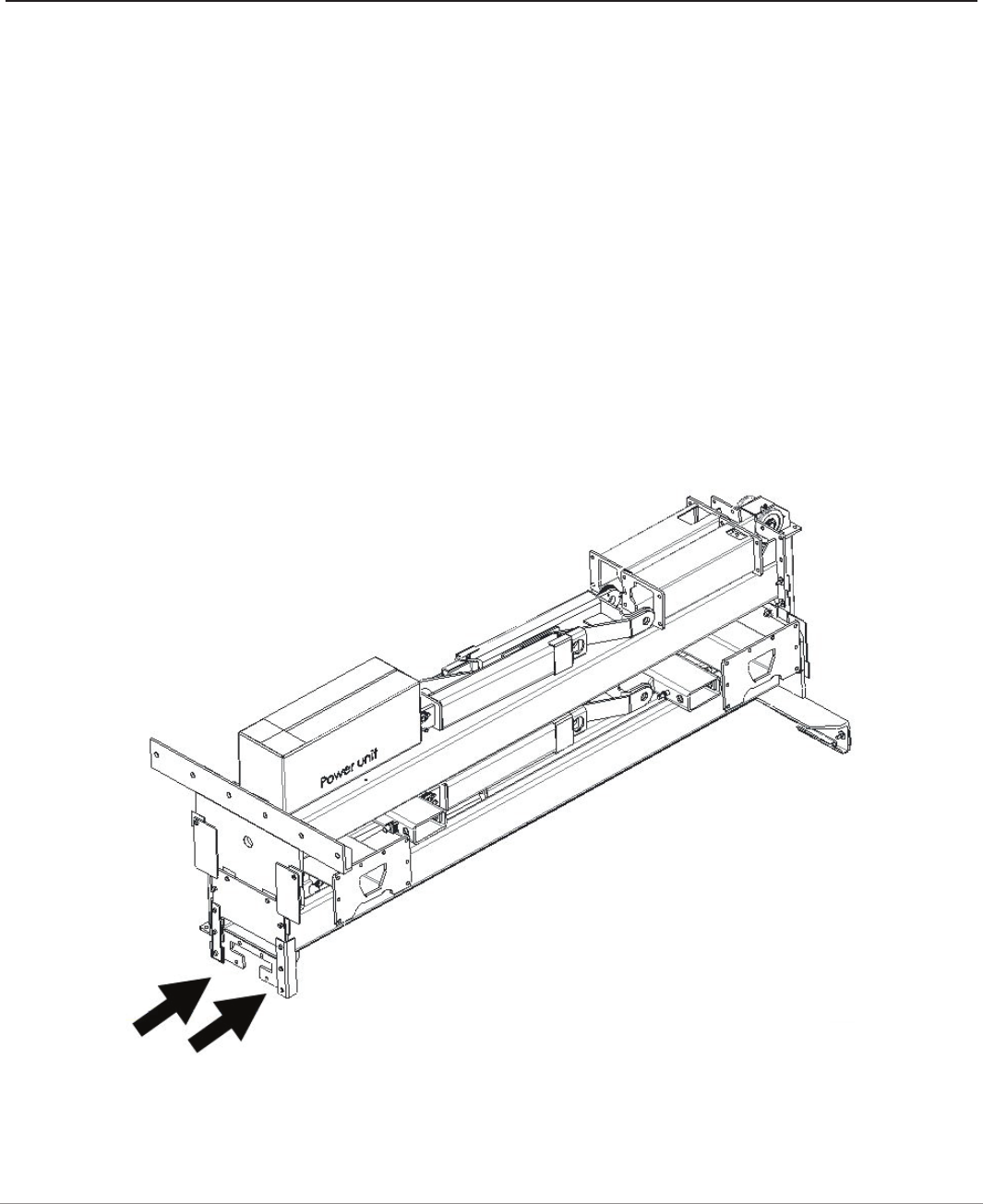
The packing of the lift is shown in the gure 1: N. 1 base unit packed in a steel
frame, wrapped up in non-scratch material, including the accessory box, the
power unit.
The package weight is about 3306 lbs.
If requested, optional accessories are available to satisfy each customer’s
requirements.
Figure 1 - Packages

Packing / Transport / Storage 14
PVL15
3.2 Lifting And Handling
When loading/unloading or transporting the equipment to the site, be sure to
use suitable loading (e.g. cranes, trucks) and hoisting means. Be sure also to
hoist and transport the components securely so that they cannot drop, taking
into consideration the package’s size, weight and centre of gravity and it’s fragile
parts.
3.3 Storage And Stacking Of Packages
Packages must be stored in a covered place, out of direct sunlight and in low
humidity, at a temperature between -10°C and +40°C.
3.4 Delivery And Check Of Packages
When the lift is delivered, check for possible damages due to transport and
storage; verify that what is specied in the manufacturer’s conrmation of order
is included. In case of damage in transit, the customer must immediately inform
the carrier of the problem.
Packages must be opened paying attention not to cause damage to people (keep
a safe distance when opening straps) and parts of the lift (be careful the objects
do not drop from the package when opening).
Lift Description 15
PVL15
Lift Description
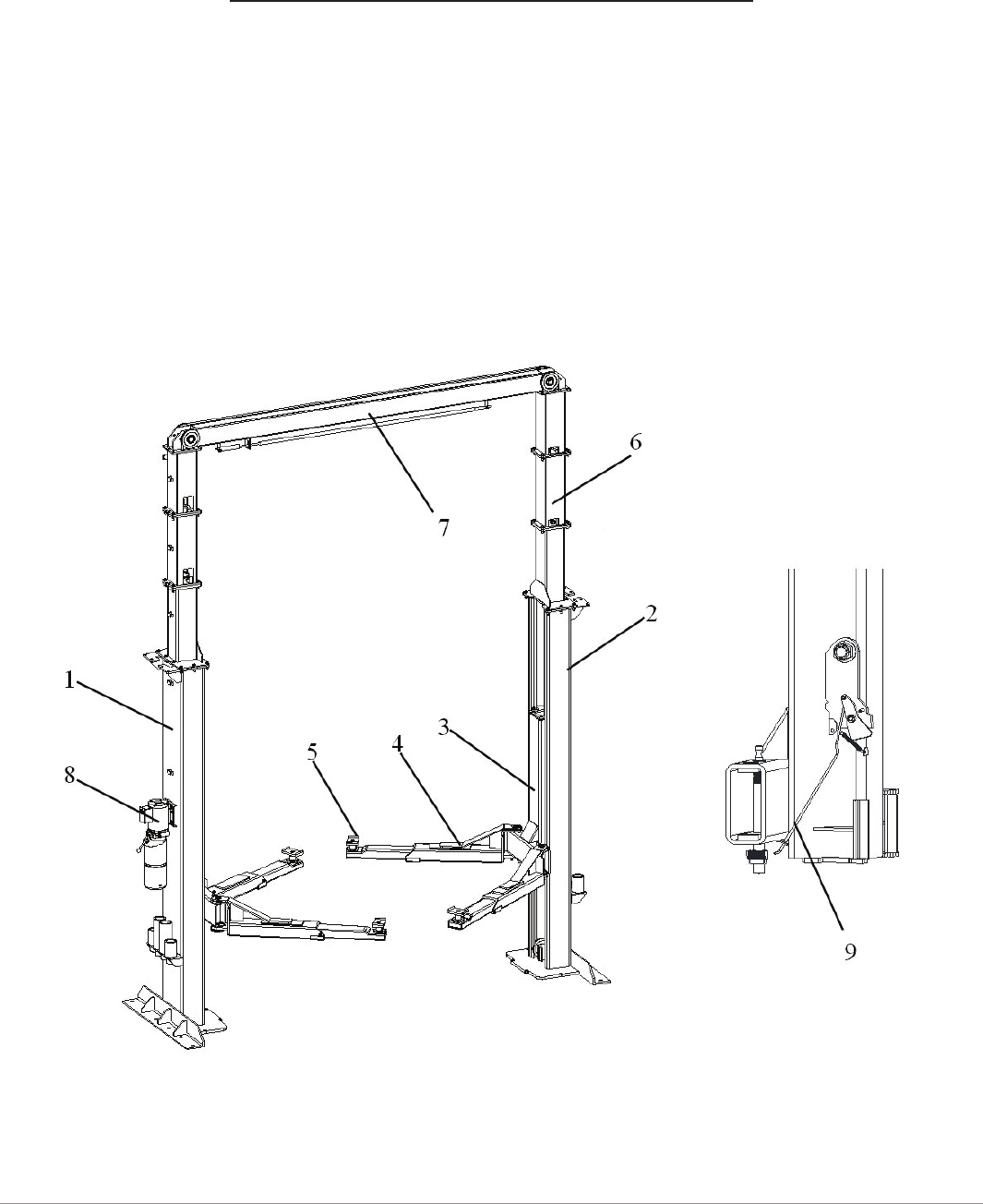
Lift Description (Ref. Figure 2)
The lift is suitable for lifting motor vehicles having maximum weight as described
in the nameplate on the power side column of the lift.
All mechanical parts such as columns, carriages and lift arms have been built in
steel plate to make the frame stiff and strong while keeping a low weight.
The electro hydraulic operation is described in detail in chapter 8.
Figure 2 – Lift

Lift Description 16
PVL15
This chapter describes the lift’s principal elements, allowing the user to be
familiar with the machine.
As shown in gure 2, the lift is composed of two columns: power-side column
(1) and off-side column (2), each equipped with a carriage (3) and a pair of
lifting arms (4) with the adaptor (5) anchored to the ground by means of the
column base.
The (sold separately) column extension (6) can be ordered as an option to
accommodate taller vehicles.
The overhead beam (7) is equipped with the anti-crush safety bar and an
overhead cut-off switch for protection of the vehicle roof.
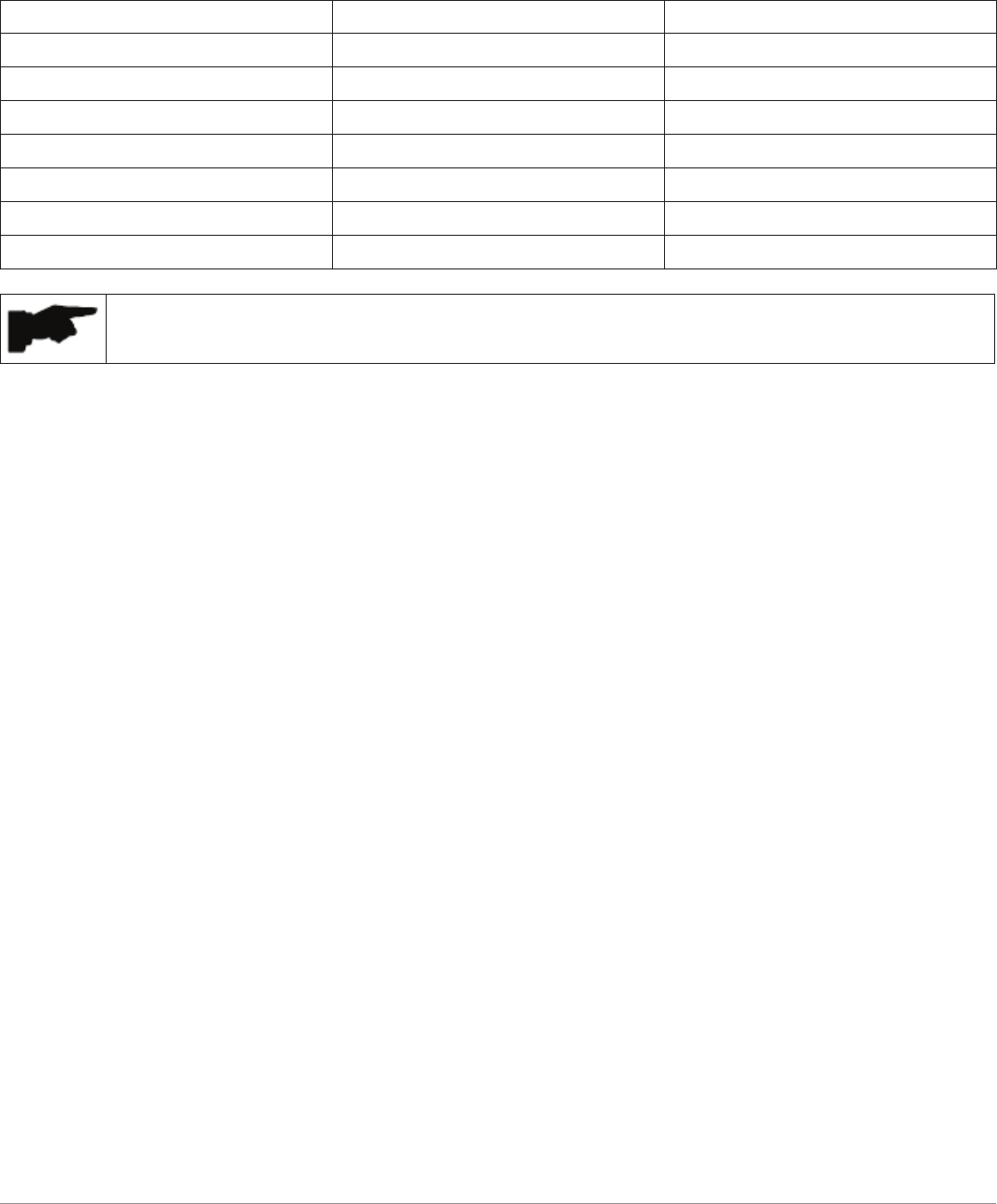
Raising motion is carried out by pushing the lifting button on the power unit (8),
which delivers the hydraulic uid to cylinders inside the columns.
The mechanical safety release is carried out by pulling out the lock release rod
(9) on each carriage.
Lowering motion is controlled by pushing the lowering lever on the power unit
and carried out under the weight of the load lifted.
The synchronization is controlled by the equalizer cables.
The arm locks can be engaged automatically when the lift is raised.
Technical Specification 17
PVL15
Technical Specication
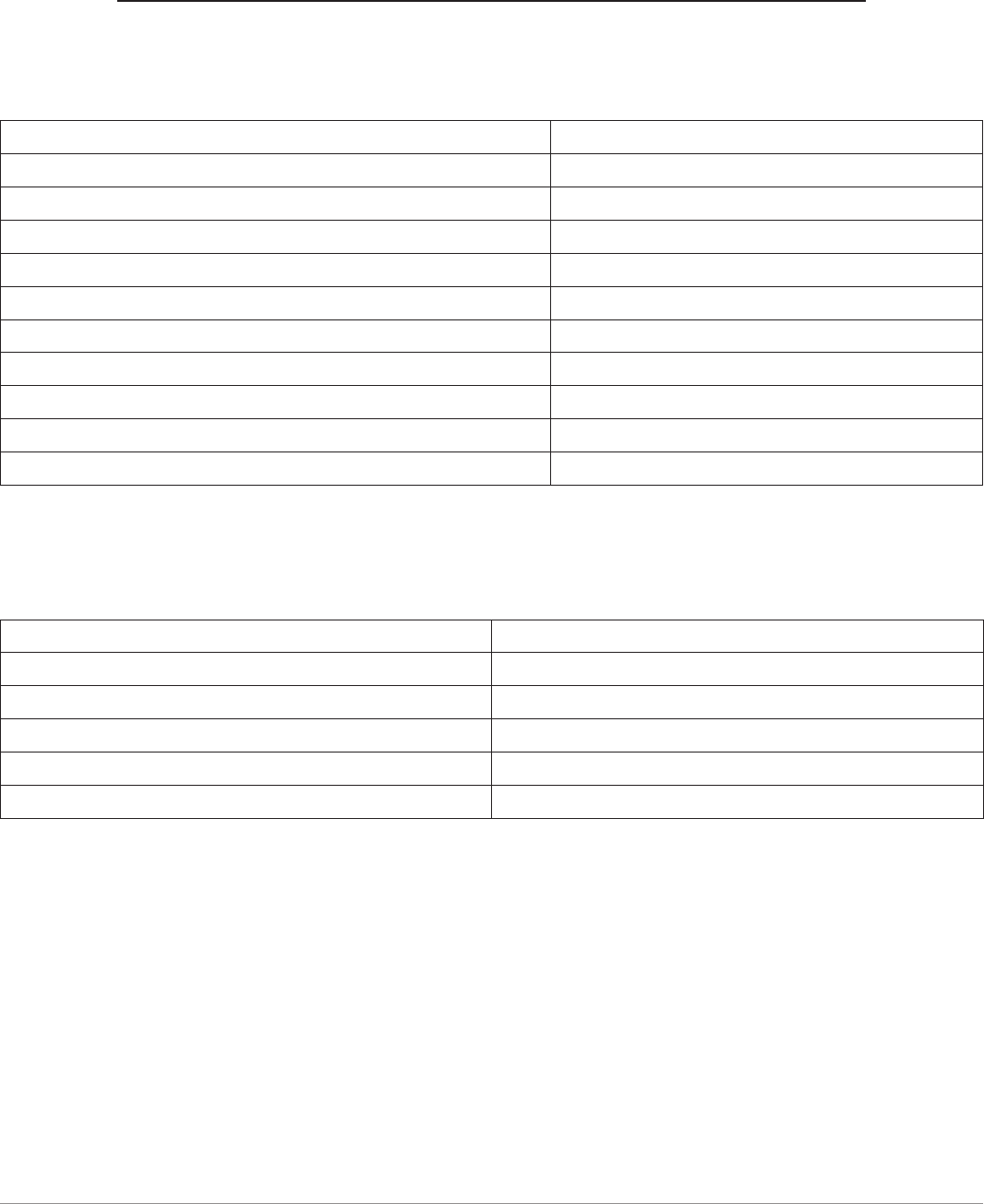
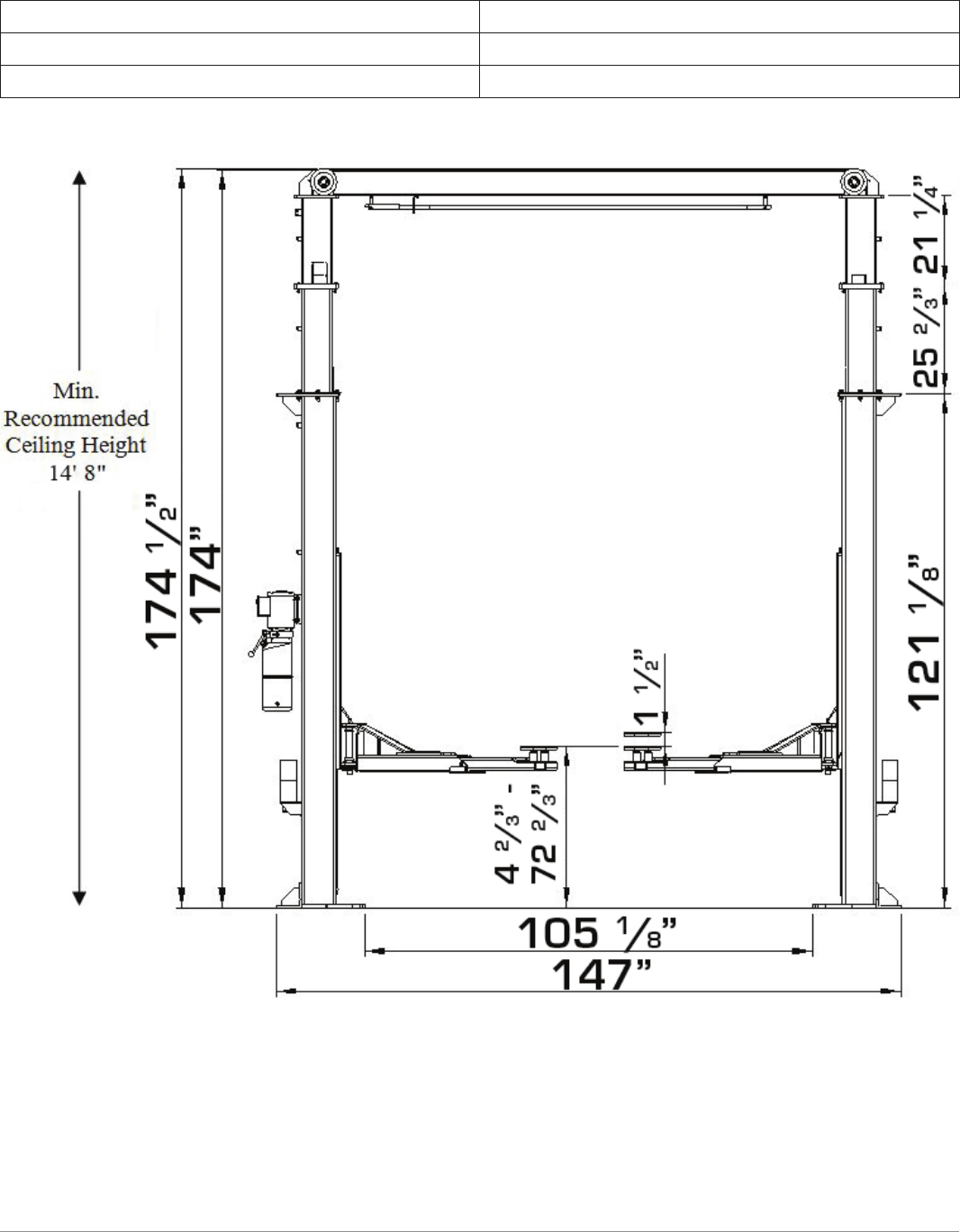
5.1 Size And Main Features (Ref. Figure 3)
CAPACITY 6800kg (15,000lbs)
Max. lifting height 72 2/3” (1844mm)
Min. lowered height 4 2/3” (118mm)
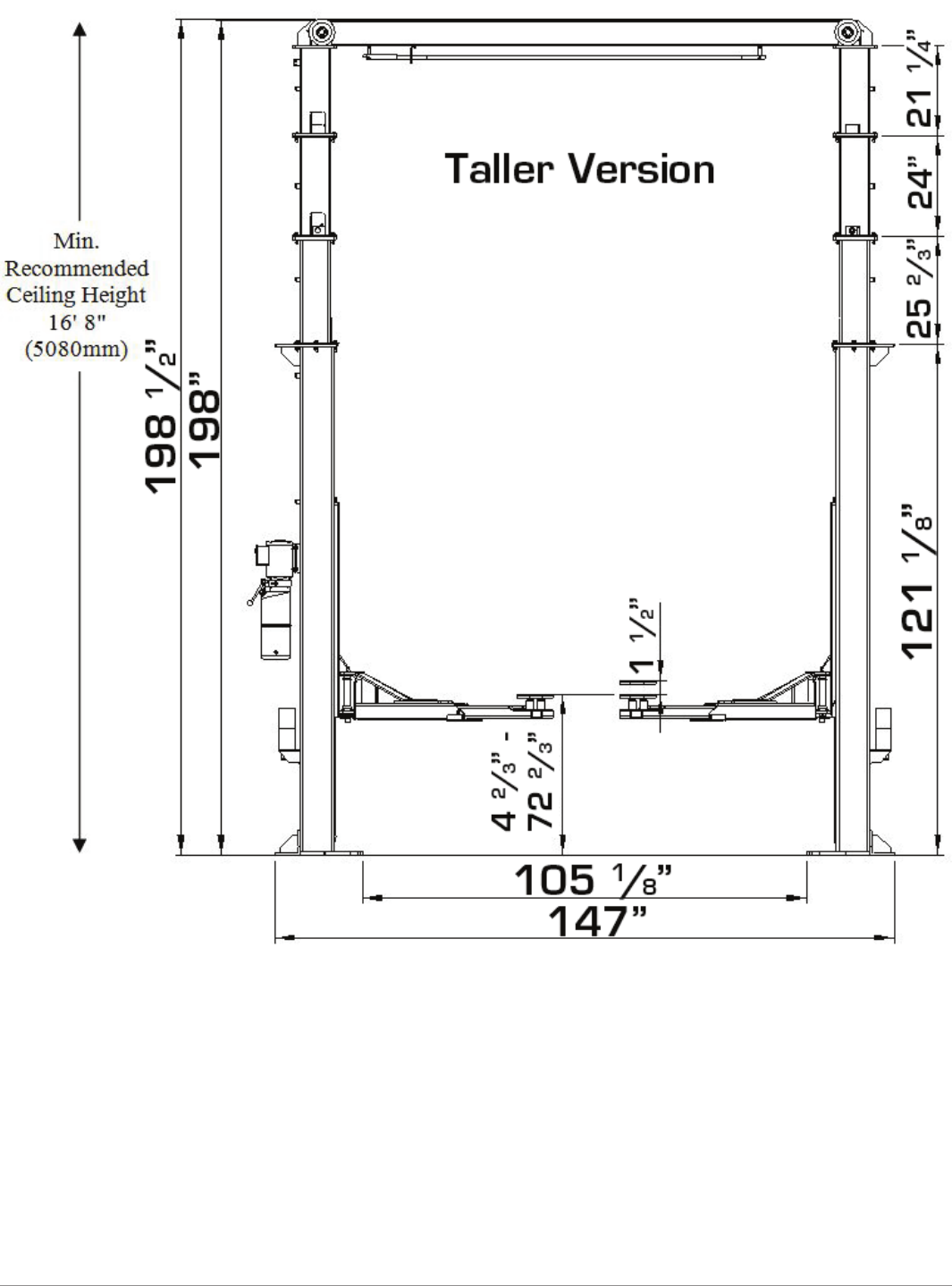
Overall height – taller version (Option) 198 1/2” (5040mm)
Overall height – standard version 174 1/2” (4430mm)
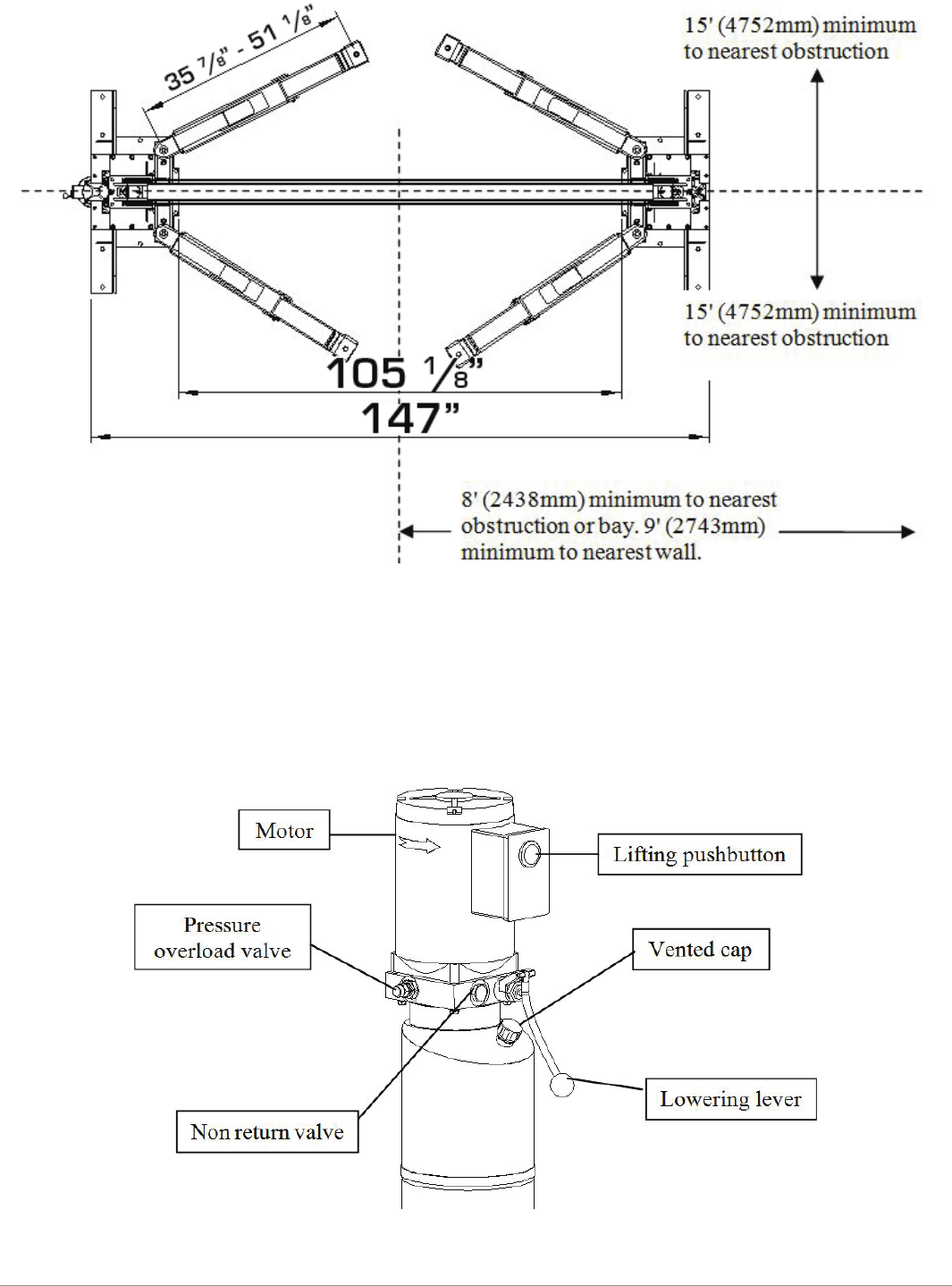
Clearance between columns 105 1/8” (2670 mm)
Lifting time 80 s
Lowering time with full load 40 s
Noise level 75 dB(A)/1m
Working temperature 5 °C - 40 °C
Average weight of package – tallest version 1500kg (3306lbs)
5.2 Electric Motor
Voltage 208V-240V/50Hz/60Hz/1Ph
Power 3HP
N° Poles 2
Speed 3450 rpm
Motor enclosure type B14
Insulation class IP 54
Motor connection must be carried out referring to the attached wiring diagrams
(g.6). The motor direction of rotation is shown in the label placed on the motor.
Before use of the lift, make sure to check if the motor specication shown in the
nameplate of the motor conforms to the local electric supply.
Technical Specification 18
PVL15
5.3 Pump
Type Gear
Flow rate 2.7 cm3/g
Continuous working pressure 145 bar
Figure 3a – Standard Version
Technical Specification 19
PVL15
Figure 3b – Taller Version (Option)
Technical Specification 20
PVL15
Figure 3c – Layout
5.4 Hydraulic Power Unit
The power unit is equipped with:
Figure 4 – Hydraulic Power Unit
Technical Specification 21
PVL15
5.5 Oil
Use wear proof oil for hydraulic drive, in conformity with ISO 6743/4 rules (HM
class). The oil with features similar to those shown in the table is recommended.
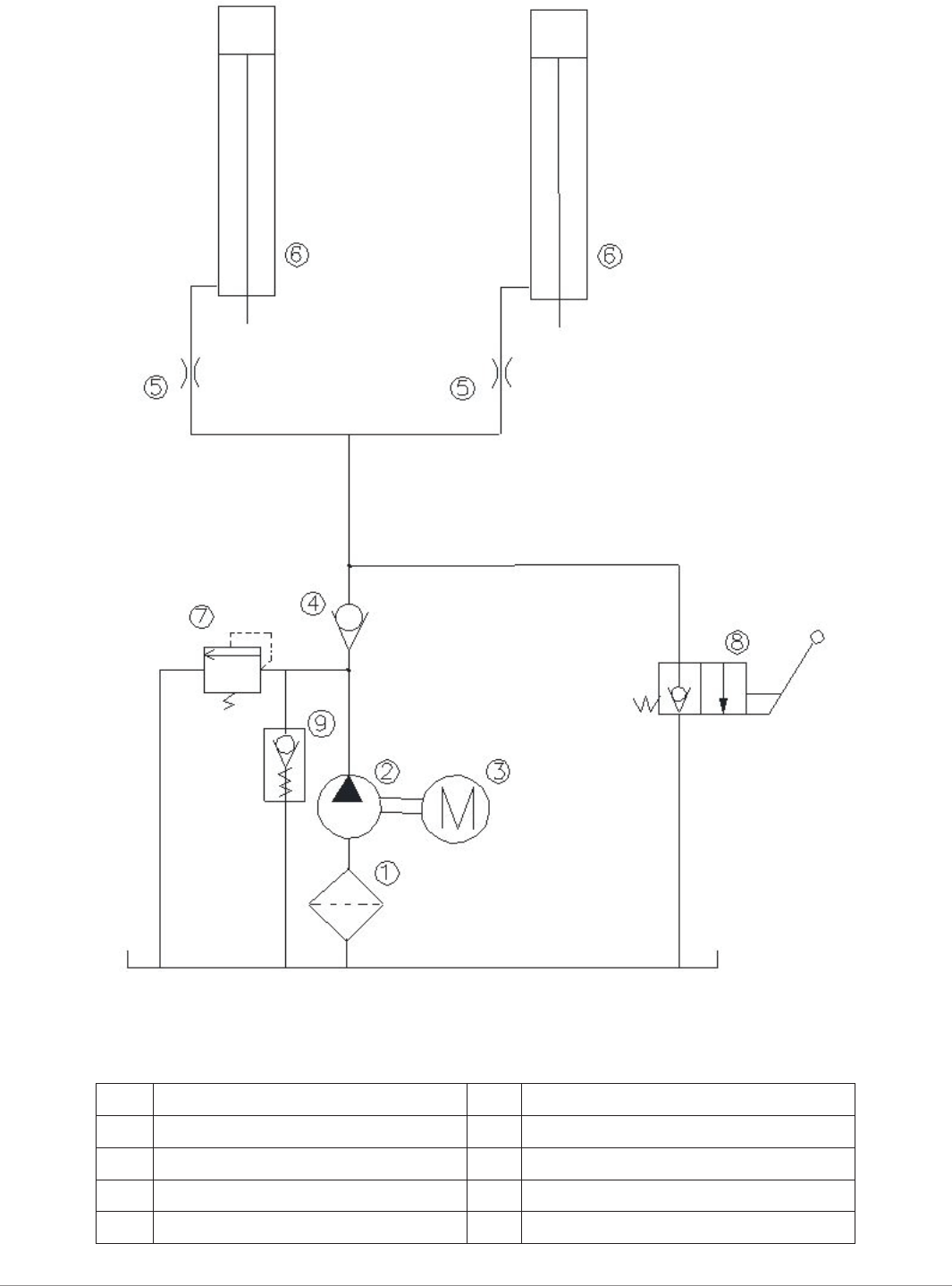
Test standards Features Value
ASTM D 1298 Density 20°C 0.8 kg/l
ASTM D 445 Viscosity 40°C 32 cSt
ASTM D 445 Viscosity 100°C 5.43 cSt
ASTM D 2270 Viscosity index 104 N°
ASTM D 97 Pour point ~ 30 °C
ASTM D 92 Flash point 215 °C
ASTM D 644 Neutralization number 0.5 mg KOH/g
Change hydraulic oil at 1 year intervals
Technical Specification 22
PVL15
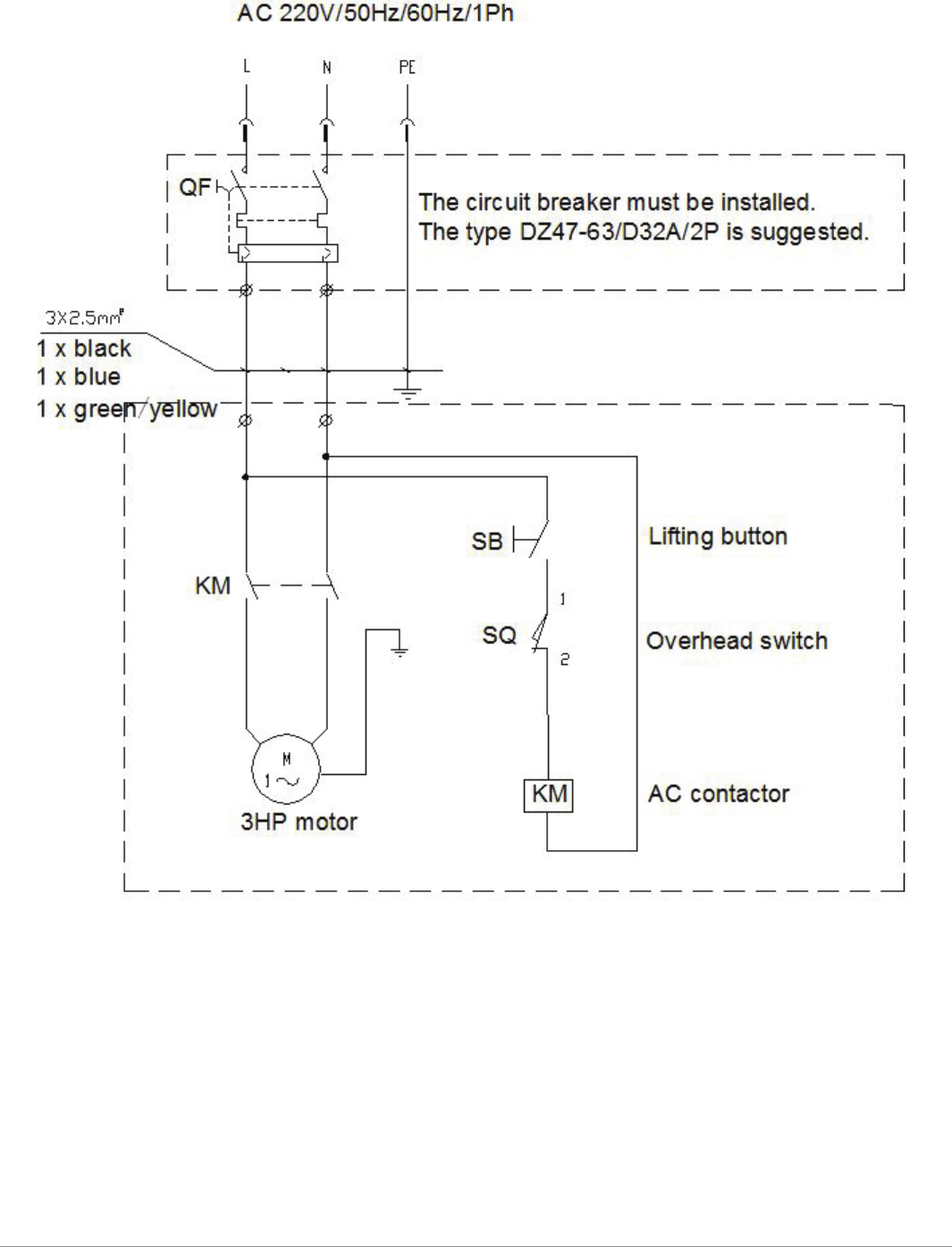
Figure 5 - Hydraulic Plan
1Oil lter 6 Hydraulic cylinder
2 Gear pump 7 Pressure overload valve
3 Motor 8 Manual lowering valve
4 Non return valve 9 Startup valve
5 Flow restrictor
Technical Specification 23
PVL15
Figure 6 – Electrical Diagram (220V/50Hz/60Hz/1Ph)

Safety 24
PVL15
Safety
Read this chapter carefully and completely because it contains important
information for the safety of the operator and the person in charge of
maintenance.
The lift has been designed and built for lifting vehicles and
making them stand above level in a closed area. any other use
is forbidden.
The manufacturer is not liable for possible damages to people,
vehicles or objects resulting from an improper or unauthorized
use of the lift.
For operator and people safety, a square space for a safety area at least 1m free
away from the lift must be vacated during lifting and lowering. The lift must be
operated only from the operator’s control site in this safety area.
Operator’s presence under the vehicle, during working, is only admitted when
the vehicle is lifted and the safety lock is engaged.
Never use the lift when safety devices are off-line. People, the
lift and the vehicles lifted can be seriously damaged if these
instructions are not followed.
6.1 General Warnings
The operator and the person in charge of maintenance must follow accident-
prevention laws and rules in force in the country where the lift is installed.
They also must carry out the following:
• Neither remove nor disconnect hydraulic, electric or other safety devices;
• Carefully follow the safety indications applied on the machine and included
in the manual;
• Observe the safety area during lifting;

Safety 25
PVL15
• Be sure the motor of the vehicle is off, the gear engaged and the parking
brake put on;
• Be sure only authorized vehicles are lifted without exceeding the maximum
lifting capacity;
• Verify that no one is on the arms during lifting or standing.
6.2 Safety Device
To avoid overloading and possible breaking, the following safety devices have
been used:
• A pressure overload valve built inside the hydraulic power unit to prevent
excessive weight.
The pressure overload valve has been preset by the
manufacturer to a proper pressure. DO NOT try to adjust it to
overrun the rated lifting capacity.
• Mechanical safeties built in each carriage with automatic engagement for
lifting safety.
It is strictly forbidden to modify any safety device. Always
ensure the safety device for proper operation during the
service.
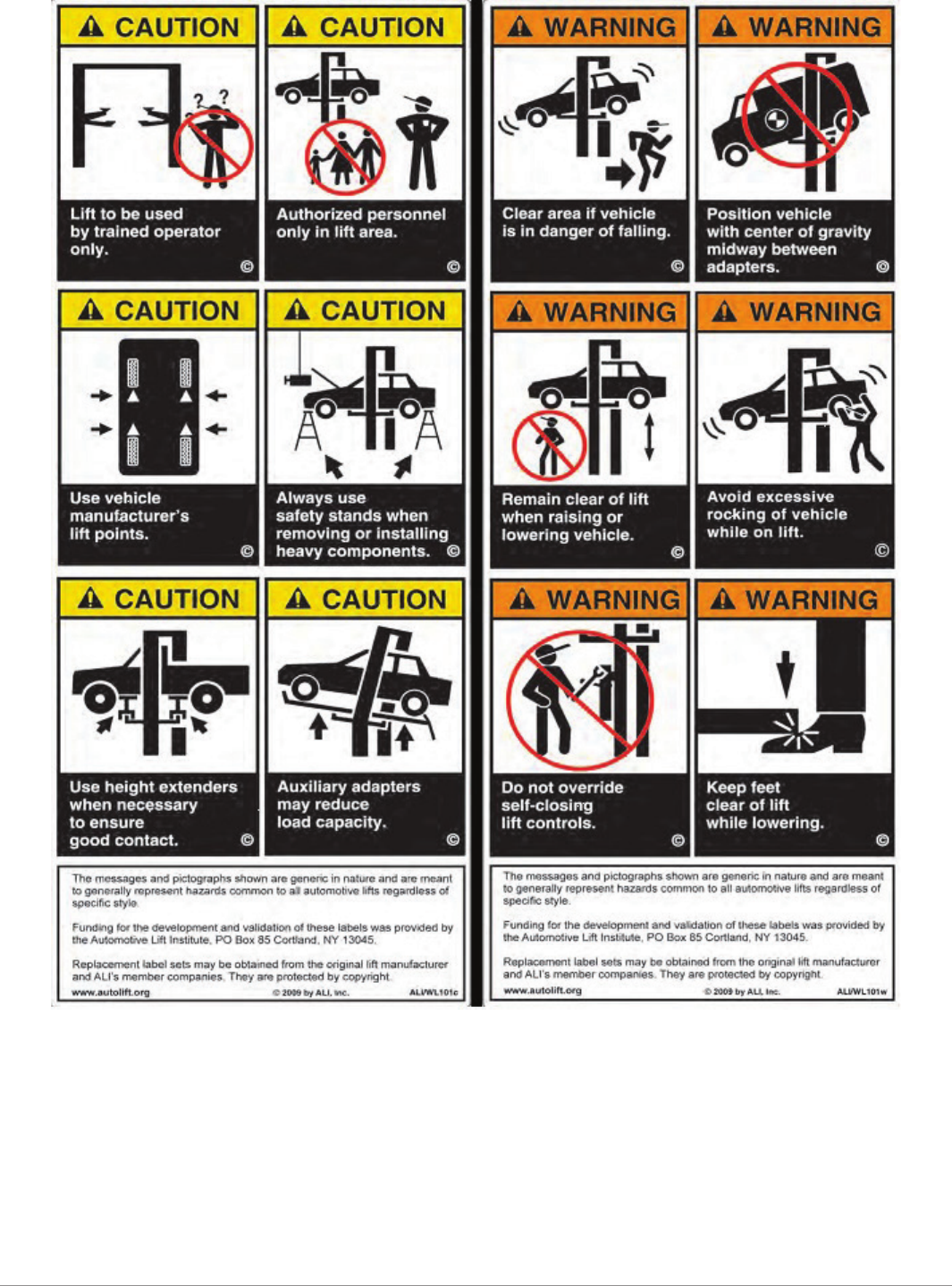
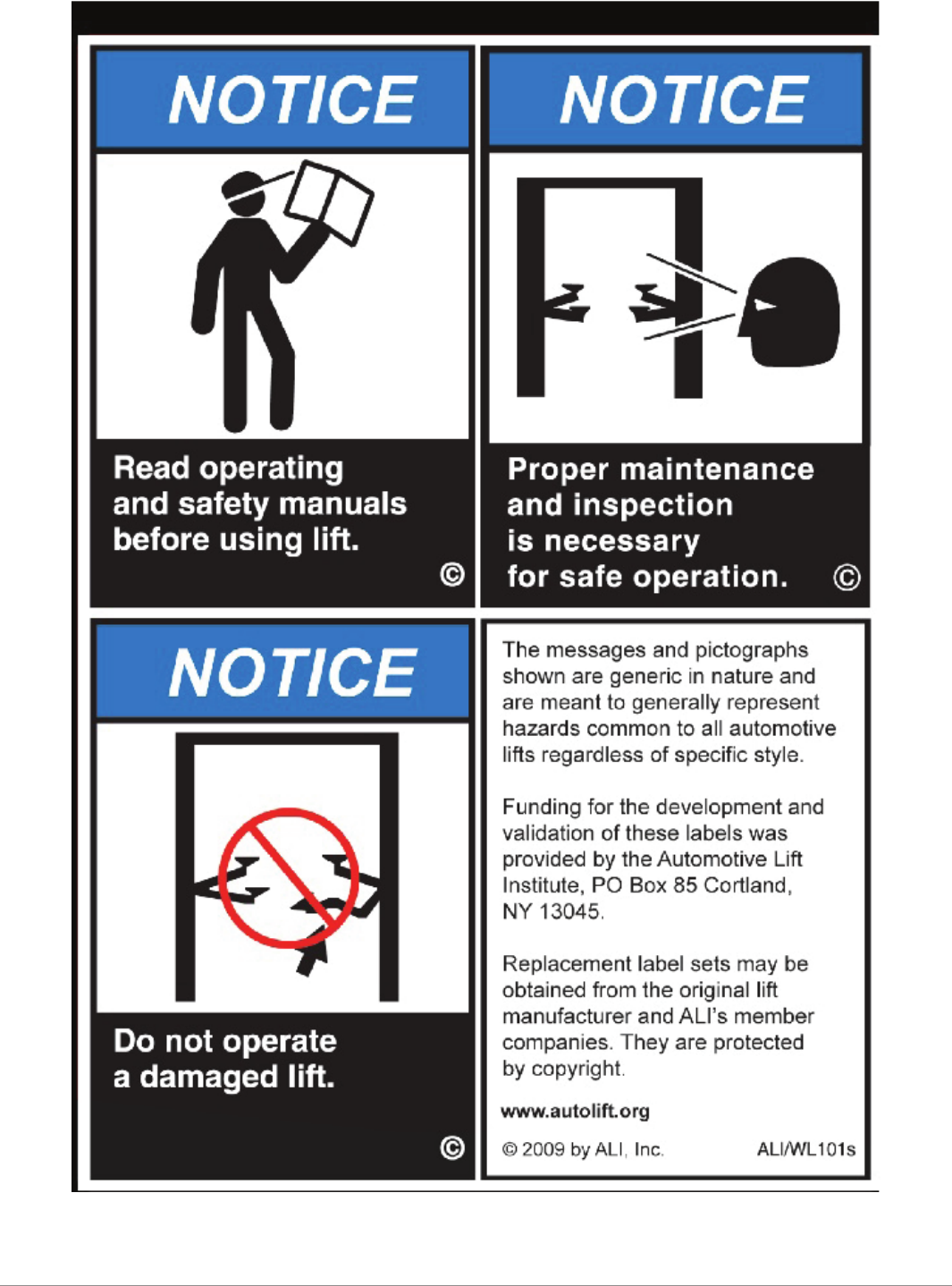
6.3 Safety Signs
All safety warning signs (ref. gure 7) displayed on the lift are with the purpose
to draw the operator’s attention to dangerous or unsafe situations. The labels
must be kept clean and they have to be replaced if detached or damaged. Read
the meaning of the labels carefully and memorize it.
Safety 26
PVL15
Safety 27
PVL15
Figure 7 – Safety Signs
Installation 28
PVL15
Installation
Only skilled technicians, appointed by the manufacturer, or by
authorized dealers, must be allowed to carry out installation.
Serious damage to people and to the lift can be caused if
installations are made by unskilled personnel.
Always refer to the exploded views attached during installation.
7.1 Tool Required
Rotary Hammer Drill D.19 Hex-Key/Allen Wrench Set
Masonry Bit Crow Bar For Shim Installation
Hammer Chalk Line
Level Medium Cross Screwdriver
Open-End Wrench Set Medium Flat Screwdriver
Medium Crescent Wrench Tape Measure
7.2 Checking For Room Suitability
The lift has been designed to be used in covered and sheltered places free of
overhead obstructions.
The place of installation must not be next to washing areas, painting
workbenches, solvent or varnish deposits. The installation near to rooms, where
a dangerous situation of explosion can occur, is strictly forbidden. The relevant
standards of the local Health and Safety at Work regulations, for instance, with
respect to minimum distance to wall or other equipment, escapes and the like,
must be observed.
7.3 Lighting
Lighting must be carried out according to the effective regulations of the place of
installation. All areas next to the lift must be well and uniformly lit.
Installation 29
PVL15
7.4 Floor Requirement
The lift MUST be installed on 3000 PSI concrete with the minimum thickness
6 1/3” and a minimum edge distance of 5’’ from anchoring points. New
concrete must be adequately cured by at least 21 days minimum.
Specications of concrete must be adhered to. Failure to do so
could cause lift failure resulting in personal injury or death.
A level oor is suggested for proper installation. Small
differences in oor slope may be compensated for by proper
shimming. Any major slope change will affect the level lifting
performance. If a oor is of questionable slope considering to
pour the new concrete slab.
7.5 Site Layout
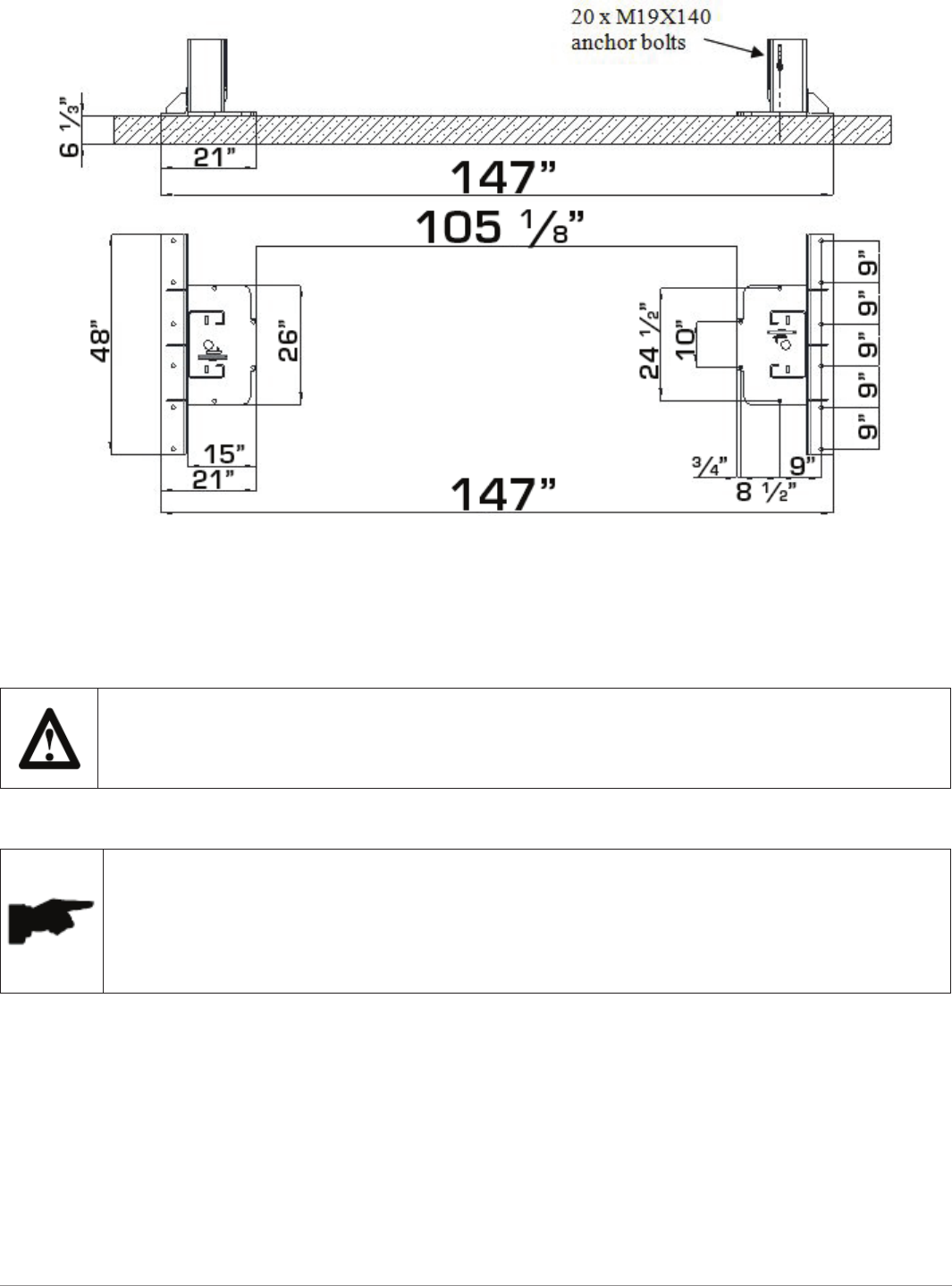
• Now locate the lift according to the oor plan the gure 8, use a carpenters
chalk line to layout a grid for the column locations
• After the column locations are properly marked, use a chalk or crayon to
make an outline of the columns on the oor at each location using the
column base plates as a template.
• Double check all dimensions and make sure that the bases of each column
are square and aligned with the chalk line
Installation 30
PVL15
Figure 8 – Floor Plan
7.6 Anchoring Power-Side Column
The requirements for column’s square-ness and plumb must be
adhered to. Failure to do so could cause lift failure resulting in
personal injury or death.
Do not drill anchor holes of off-side column and anchor it in
this procedure.
Make sure to use caution to prevent off-side column from
falling over before it is anchored.
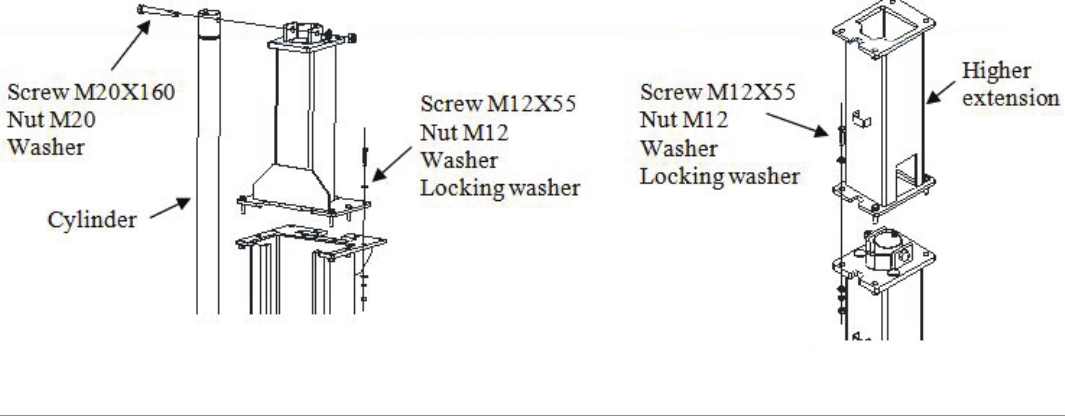
• Use the base plate on the power-side column as the guide, drill each hole
in the concrete approximately 6” deep with the rotary hammer drill D.19.
To assure full holding power, do not ream the hole or allow drill to wobble;
• After drilling, remove dust thoroughly from each hole using compressed air
and/or wire brush. Make certain that the column remains aligned with the
chalk line during this process;
Installation 31
PVL15
• Assemble the washers and nuts on the anchors then tap into each hole
with a hammer until the washer rests against the base plate. Be sure that
if shimming is required that enough threads are left exposed;
• If shimming is required, insert the shims as necessary under the base plate
so that when the anchor bolts are tightened, the column will be plumb;
• With the shims and anchor bolts in place, tighten by securing the nut to
the base. DO NOT use an impact wrench for this procedure.
• If anchors do not tighten to 150 ft-lbs. installation torque, replace the
concrete under each column base with a 4’ x 4’ x 6” thick 3000 PSI
minimum concrete pad keyed under and ush with the top of existing oor.
Allow concrete to cure before installing lifts and anchors (typically 2 to 3
weeks).
• Anchor another column as outlined in above steps.
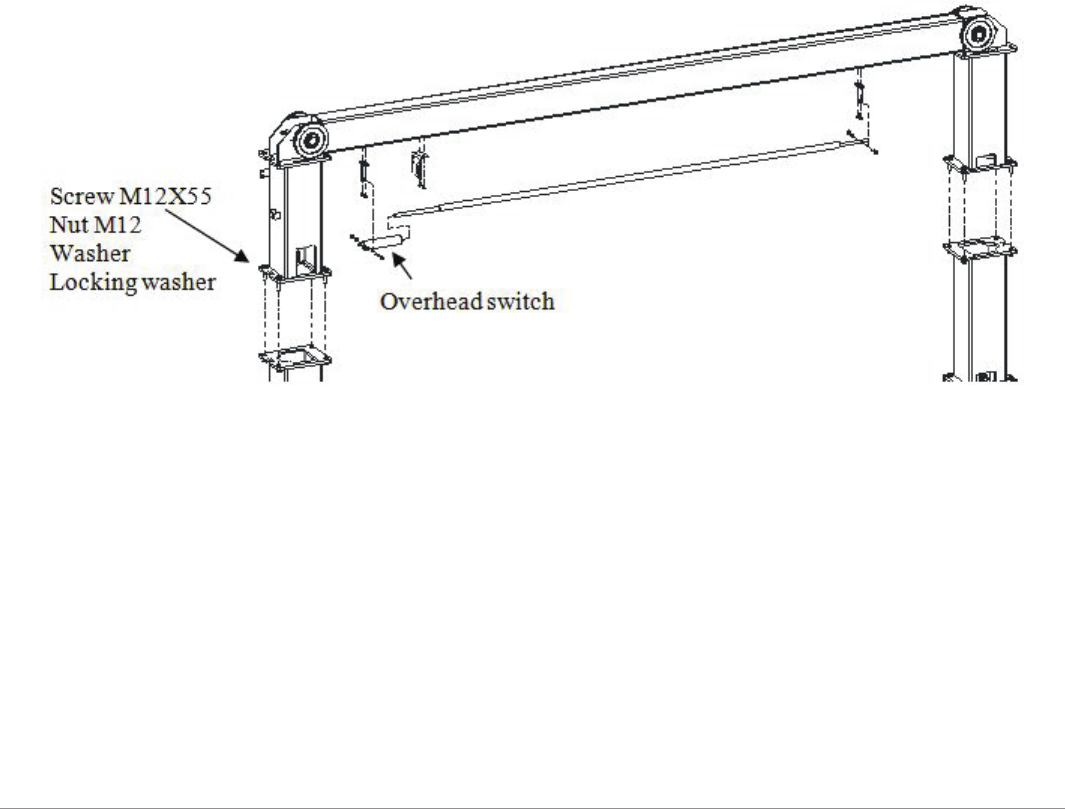
7.7 Installation Of (Optional) Extension And Cylinder
• Disengage the latch by pulling out the lock release rod (9/g.2);
• Slide the carriage to the column baseplate, then engage the latch by
pushing the lock release rod in;
• Slide the carriage up until the rst “click” is heard;
• Align the holes between the column and the extension with screws and the
washers as shown in the gure 9A;
• Tighten the screws and nuts thoroughly;
• Install the cylinder as shown in the gure 9A.
If the higher extensions are ordered, install referring to the gure 9B.
Fig. 9A Fig. 9B
Installation 32
PVL15
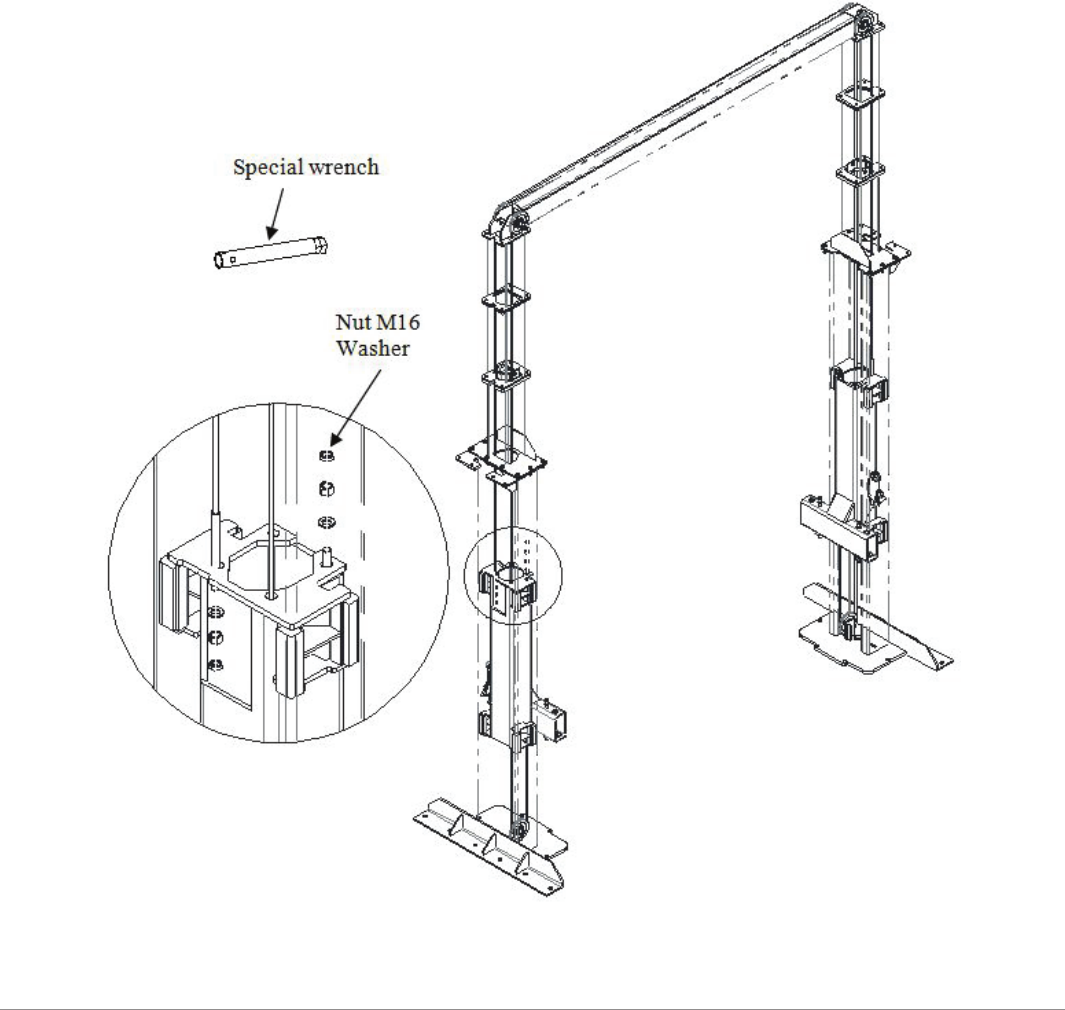
7.8 Installation Of Overhead Beam (Ref. Fig. 10)
• Install the anti-crushing bar brackets on the beam using M6X12 screws
and nuts. Make sure to position the overhead switch bracket adjacent the
power-side column;
• Place the anti-crushing bar on the overhead switch bracket and x it on
another bracket using M8X40 screw and nuts;
• Slide the overhead switch into the anti-crushing bar and x it using M8X55
screws and nuts. Make sure the switch cable goes through hose guides /
retainers on the columns;
• Use a lifting device to raise the assembled beam and install it to the
column extensions as shown.
• Align the holes between the column and the extension with screws and the
washers as shown;
• Tighten all screws and nuts for connection of the overhead beam properly.
Figure 10 – Installation Of Overhead Beam
7.9 Anchoring Off-Side Column
• The real layout of the base of the off-side column may vary slightly from
the preliminary layout. Make sure that the off-side column perpendicular
and parallel to the power-side column;
• Drill holes and anchor the off-side column referring to the procedure
described in the chapter 7.6 for anchoring the power-side column.
Installation 33
PVL15
7.10 Routing Equalizer Cables (Ref. Fig. 11)
• Use an appropriate lifting equipment to raise the carriage to the rst latch
position. Be sure the carriage is engaged securely before attempting to
route the equalizer cables. Carriages must be equal height from the oor
before proceeding;
• With the carriages in equal height, route the equalizer cables as shown.
Make sure the cables in the place on the pulleys. Make sure the cables
routed properly;
• After the equalizer cables have been routed, adjust the nut to make each
cable in equal tension using the special wrench supplied.
Figure 11 – Routing Equalizer Cable
Installation 34
PVL15
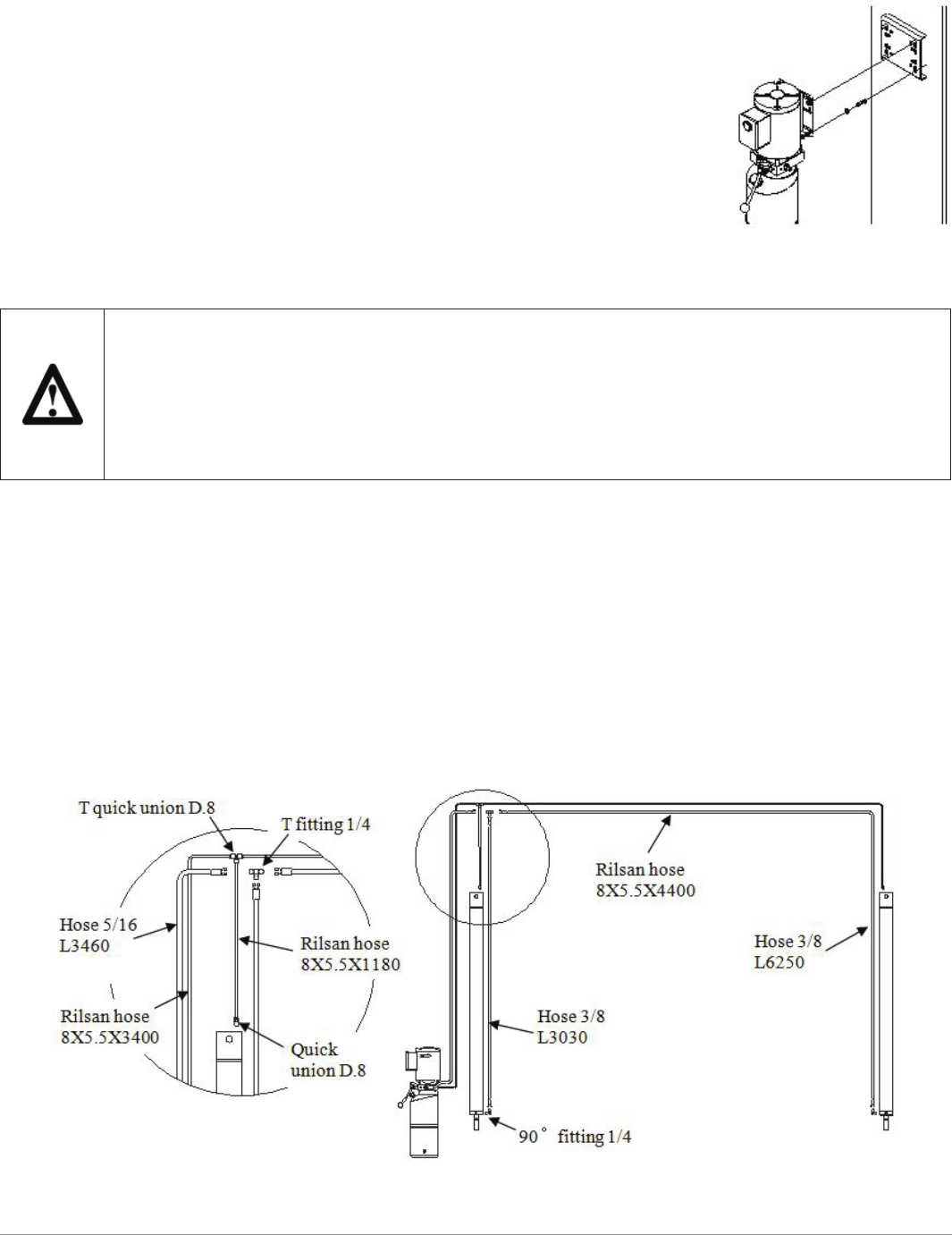
7.11 Installation Of Power Unit (Ref. Fig. 12)
• Attach the power unit onto the bracket on the power side
column;
• Secure it using M8X30 screws, M8 nuts and the washers;
• Make sure to keep the power unit clean.
7.12 Connection Of Hydraulic Hoses
When routing the hydraulic hose, make sure that the hose is
clear of any moving part. Make sure to keep the hoses clean
from dust.
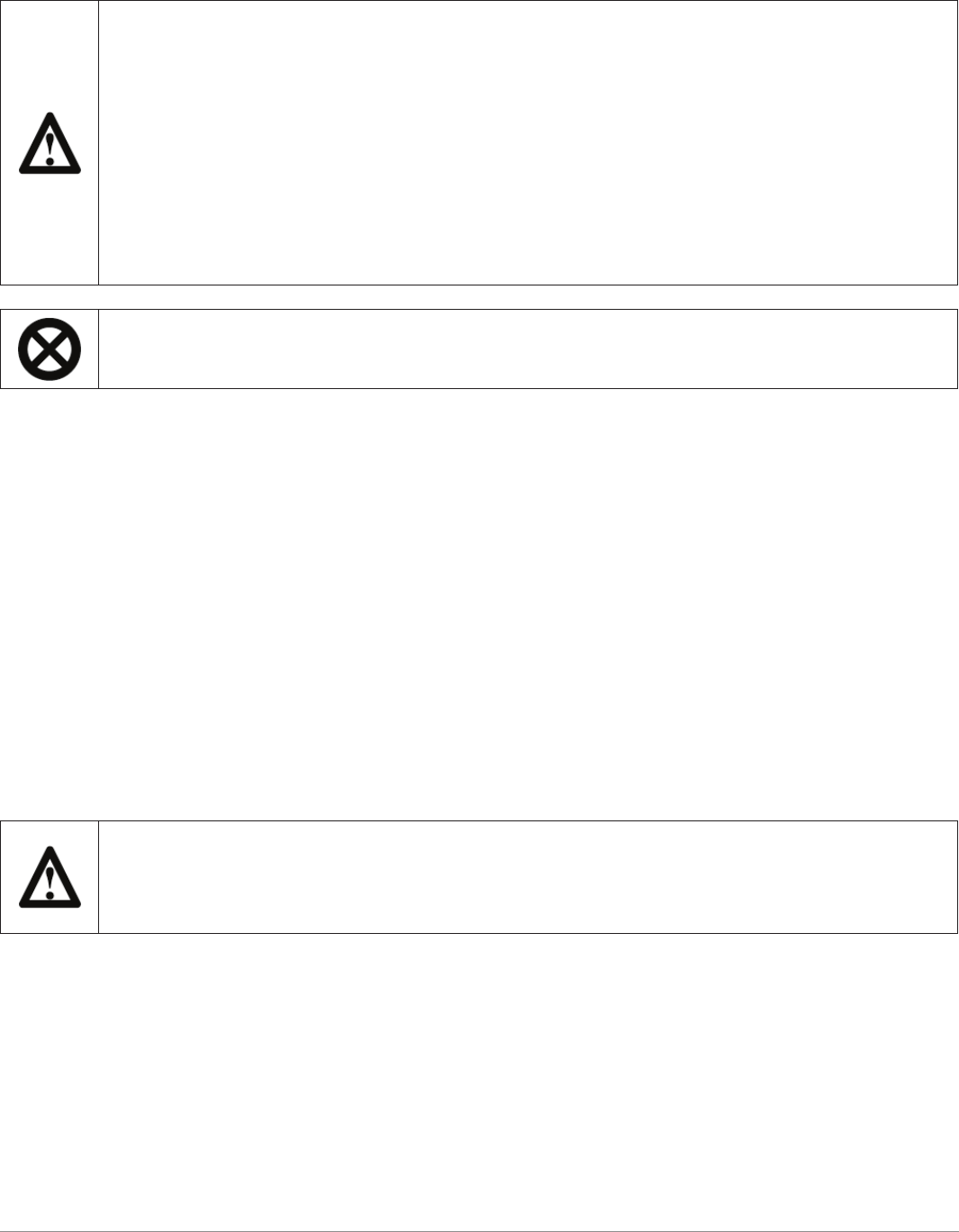
Make sure not to over-tighten the hose ttings so as to result
in oil leakage.
• Clean the hoses and ttings;
• Inspect all threads for damage and make sure that all hose ttings are in
good condition;
• Route the hoses as shown. Make sure the hose goes through hose guides /
retainers on the columns and in center of overhead beam;
• Tighten the hose ttings thoroughly.
Figure 13 – Hydraulic Line Connection
Fig. 12
Installation 35
PVL15
7.13 Make The Electrical Connection
The hookup work must be carried out by a qualied electrician.
Make sure that the power supply is right.
Make sure the connection of the phases is right. Improper
electrical hook-up can damage motor and will not be covered
under warranty.
Make sure the lift is ground well.
The power unit must be kept dry.
It is strictly forbidden to use 60Hz motor on 50Hz power
supply.
• Make the electric hookup to the hydraulic power unit referring to the wiring
diagram (g. 6);
• Make sure to install a proper circuit breaker on the circuit (DZ47-63/
D32A/2P is suggested for single phase 208-240V);
• When routing the electric cable for the overhead switch, make sure to keep
it clear of any moving parts and go through hose guides / retainers on the
power-side column and in center of overhead beam;
• Make sure the lift is grounded well.
7.14 Oil Filling And Bleeding
DO NOT run power unit with no oil. Damage to pump can occur.
If motor gets hot or sounds peculiar, stop immediately and
recheck the electric connection.
• Use the hydraulic uid recommended in the chapter 5.5;
• Remove the vented cap on the oil tank and pour oil in the tank about 15
liters;
• Cycle the lift up and down several times to insure latches click together
and all air is removed from the system;
• To lower the lift, raise the lift to clear the latches at rst then release the
latches manually;
Installation 36
PVL15
• If latches click out of synchronization, tighten the cable on the one that
clicks rst;
• Fill the more uid if necessary till the tank is full.
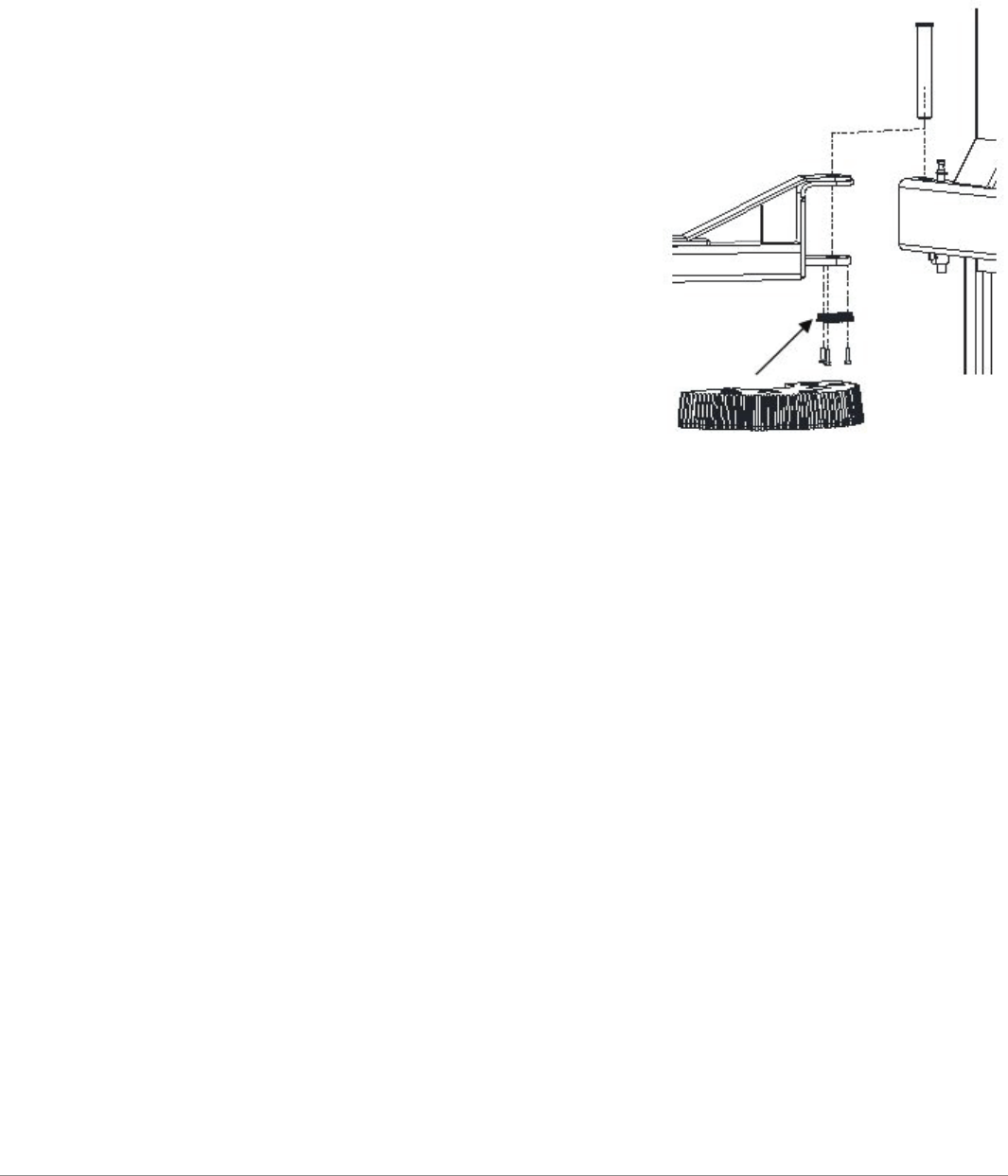
7.15 Installation Of Arms (Ref. Fig. 14)
• Raise the carriages to a convenient height;
• Install the swing arms on the carriages using
the included pins as shown;
• Install the gears on arms using M10X35
screws. Pay attention to the beveled gear
orientation;
• Check for proper engagement of the arm lock
– the teeth on the lock should fully engage the
gear on the arm. If arm pins are not tting,
pull up on arm lock to allow slack for the arm
to move around in the carriage, allowing the
arm pin to t easier.
7.16 Check Before Start-Up
7.16.1 General Checks
• Make sure that the columns are plumb;
• Make sure the lift anchored to the ground and all anchor bolts tightened.
• Make sure the electrical system feeding voltage is equal to that specied in
the nameplate on the motor;
• Make sure the electric system connection in conformity of the electric plan
shown as the electric diagram (g. 6) and for proper grounding.
• Particularly, below checks must be followed:
7.16.2 Mechanical Safeties For Proper Installation
• Check to make sure that safety latches will properly engage and disengage
by manual release;
• If latches click out of synchronization, tighten the cable on the one that
clicks rst.
Fig. 14
Installation 37
PVL15
7.16.3 Equalizer Cable For Proper Installation
The equalizer cables should be checked weekly for equal
tension. Failure to do this will cause uneven lifting. The cables
should always be adjusted so that they are equal tension when
resting on the safety locks.
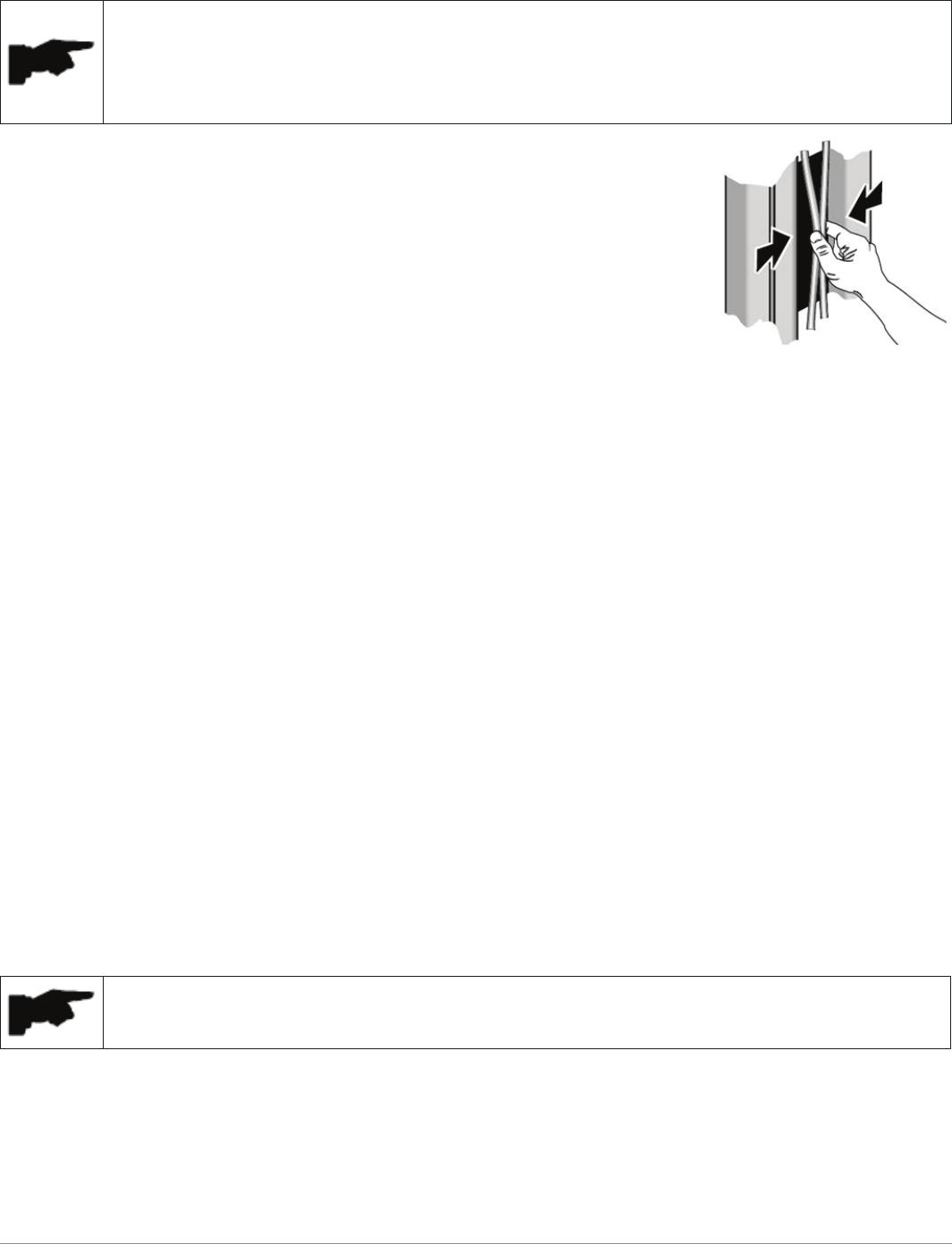
• Raise the carriages to check the equalizer cable tension
by grasping the adjacent cables between the thumb
and the forenger so that you can just pull the cables
together (ref. g. 15);
• Adjust the cable tensions if necessary.
7.16.4 Hydraulic System For Proper Operation
• Make sure that the cylinder is located in the center hole in the base of column;
• Proper oil level in the tank, rell if needed;
• Raise the lift to the full height and keep the motor running for 5 seconds
and check all hoses connections to make sure no leakage. Tighten the
connections or reseal if necessary;
• Check the lift for reaching its maximum height;
• Repeat the air bleeding of cylinders if necessary.
7.16.5 Overhead Switch For Proper Operation
• Check the overhead switch. Verify that it cuts of electrical supply when the
crush proof bar is raised.
• If the overhead switch does not interrupt the electrical supply, check wiring
to the A/C contactor.
7.17 Check With Load
WARNING: please follow carefully the instructions in the
coming paragraph for avoiding damages on the lift.
Carried out two or three complete cycles of lowering with the vehicle loaded:
• Repeat the checks provided for by 7.16.
• Check no strange noise during lifting and lowering
Fig. 15
Operation And Use 38
PVL15
Operation And Use
NEVER operate the lift with any person or equipment below.
NEVER exceed the rate lifting capacity.
NEVER lift a vehicle in any manner with less than four arms.
Always ensure that the mechanical locks are engaged before
any attempt is made to work on or near the vehicle.
Always lift a vehicle on the lifting pads.
NEVER leave the lift in an elevated position unless the safeties
are engaged.
If an anchor bolt becomes loose or any component of the lift is
found to be defective, DO NOT USE THE LIFT until repairs are
made.
8.1 Controls
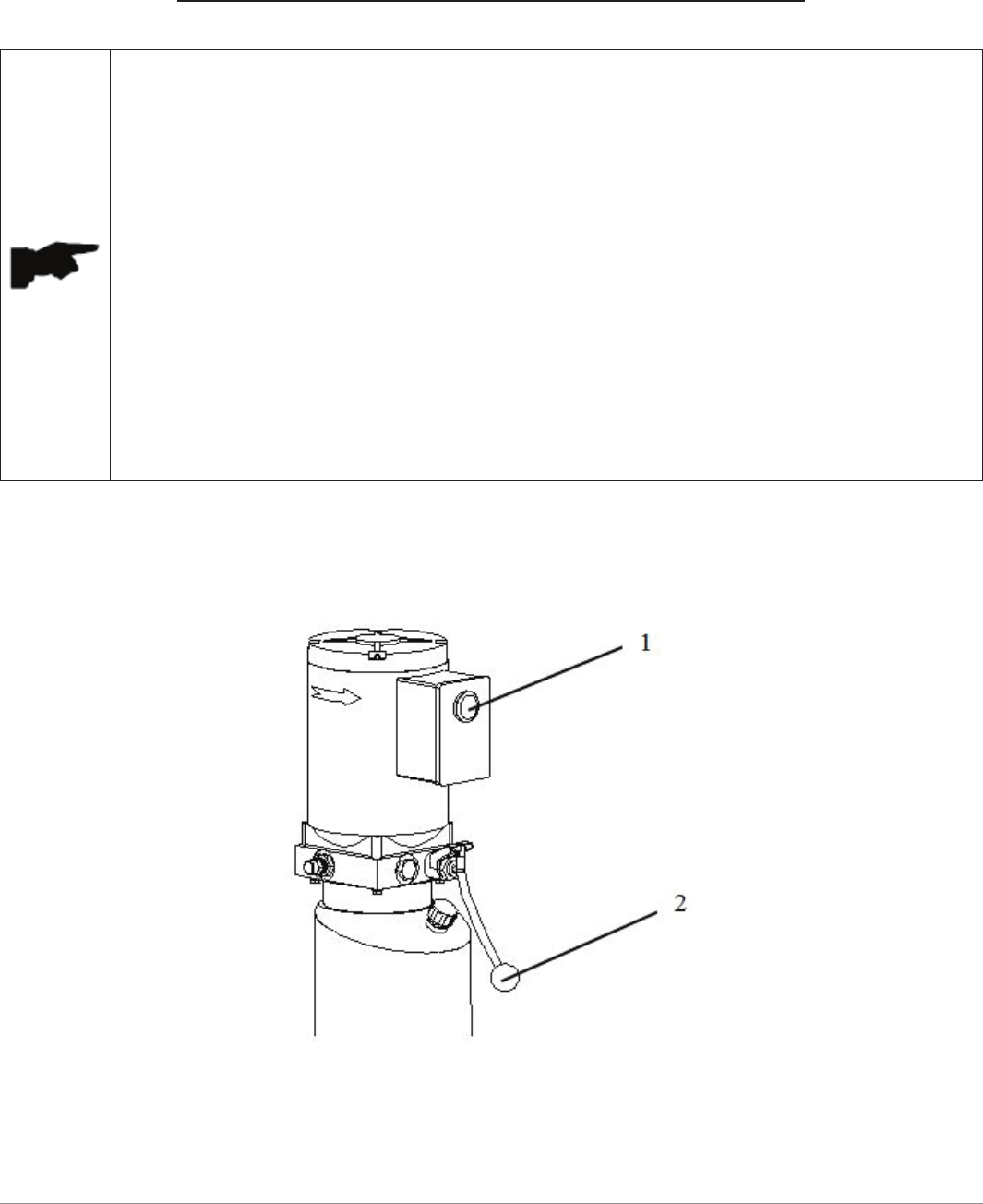
Figure 16 - Controls

Operation And Use 39
PVL15
Controls for operating the lift are:
LIFTING BUTTON (1)
• When pressed, the power unit is running and the lift can be raised to a
desired height until the button is released.
LOWERING LEVER (2)
• If the mechanical locks are not released, the lift will lower to the nearest
lock position.
• If both mechanical locks are released, press the lower lever, the lift will
lower to the desired height under its weight and the load lifted until the
lever is released.
Lift operation can be summarized into four steps:
8.2 Vehicle positioning
• Positioning the vehicle between columns;
• Adjust lift arms so that the vehicle is positioned with the centre gravity
between the pads. Make sure the arm safeties are engaged;
• Raise the lift by pressing the lifting button until the lifting adaptors contact
underside of the vehicle;
• Make sure the vehicle is secured.
8.3 Lifting
• Raise the lift by pushing the lifting button until reaching the desire height.
8.4 Standing
• Press the lowering lever to engage the nearest lock position;
• Always ensure that the lock in each column is engaged before any attempt
is made to work on or near the vehicle.
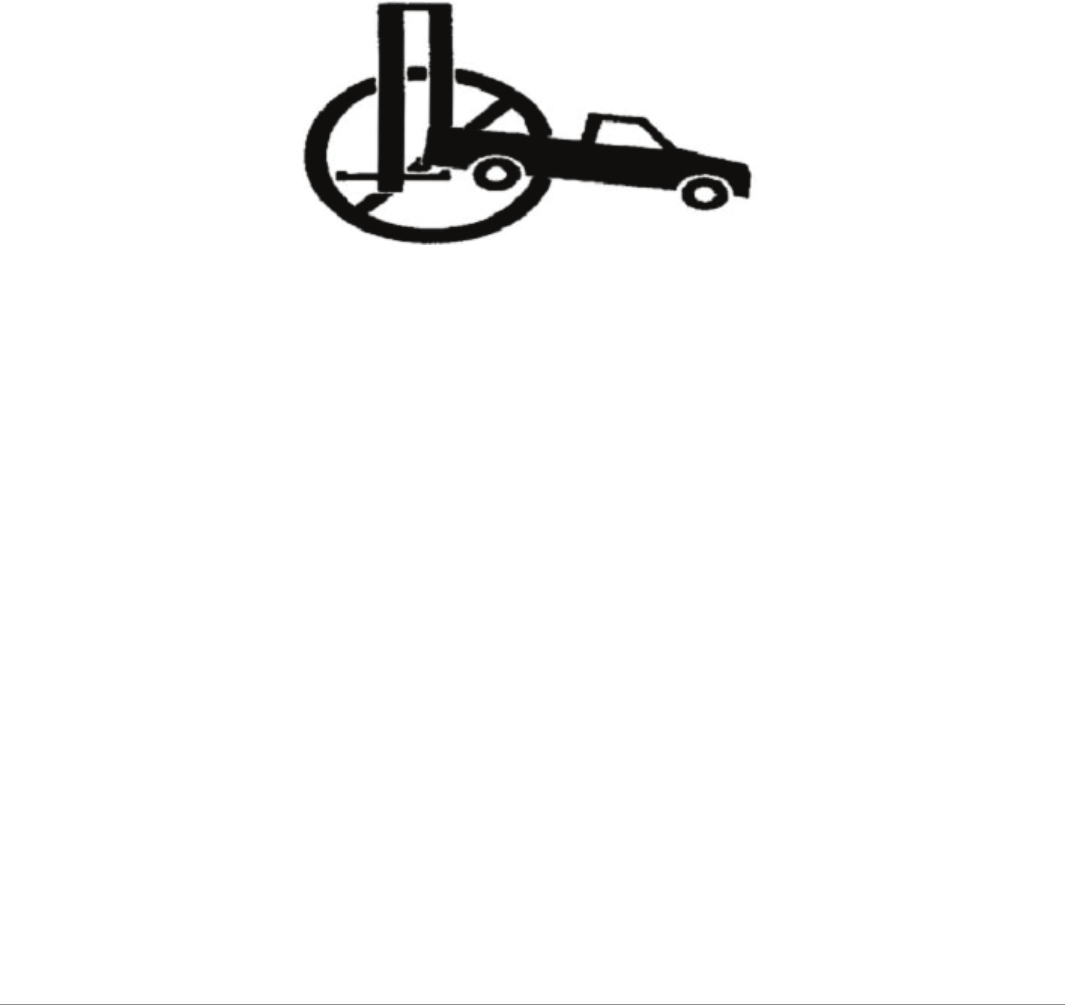
Operation And Use 40
PVL15
8.5 Lowering
• Raise the lift a little bit by pushing the lifting button to clear off the
mechanical locks;
• Release the locks manually;
• Lower the lift by pressing the lowering lever;
• Before removing vehicle from the lift area, position the lift arms to and
pads to provide an obstructed exit;
• Never drive over the lift arms.
NEVER LIFT ANY VEHICLE IN ANY MANNER WITH LESS THAN FOUR
(4) ARMS. RATED CAPACITY OF EACH LIFT ARM IS NO GREATER
THAN ONE FOURTH (1/4) OF THE OVERALL LIFTING CAPACITY.

Maintenance 41
PVL15
Maintenance
Only trained people who know how the lift works, can be
allowed to service the lift.
To service properly the lift, the following has to be carried out:
• use only genuine spare parts as well as equipment suitable for the work
required;
• follow the scheduled maintenance and check periods shown in the manual;
• discover the reason for possible failures such as too much noise,
overheating, oil blow-by, etc.
• refer to documents supplied by the manufacture or dealer to carry out
maintenance.
Before carrying out any maintenance or repair on the lift,
disconnect the power supply.
9.1 Ordinary Maintenance
The lift has to be properly cleaned at least once a month using self-cleaning
clothes.
The use of water or inammable liquid is strictly forbidden
Be sure the rod of the hydraulic cylinders is always clean and not damaged
since this may result in leakage from seals and, as a consequence, in possible
malfunctions.

Maintenance 42
PVL15
9.2 Periodic Maintenance
Daily pre-operation
• Check hydraulic connections and hoses for leaks
• Check mechanical locks audibly and visually while in operation
• Check arm locks
• Check bolts, nuts and screws are tight
Every 1 month
• Check all cable connections, pins and bolts to insure proper mounting
• Inspect all anchor bolts and retighten if necessary
• Check columns for square-ness and plumb
• Check equalizer cable tension, adjust if necessary
• Check safety cable, adjust it if necessary
• Check all arm pivot pins. Make sure they are properly secured
• Check all lifting pads, replace if necessary
• Lubricant columns with grease
• Check the hydraulic oil, ll or replace if necessary
• Check hydraulic systems for proper operation
Every 12 months
• Verify that all components and mechanisms are not damaged
• Verify the equalizer cables are not worn, change if necessary
• Check the electrical system to verify that the motors operate properly (this
work must be carried out by skilled electricians)
• empty the oil tank and change the hydraulic oil

Troubleshooting 43
PVL15
Troubleshooting
A list of possible troubles and solutions is given below
Trouble: Possible Cause: Solution:
The lift does not
work
There is no power Check Power on to restore if
necessary
The electrical wires are
disconnected Reconnect
The circuit breaker are
blown
Check for correct voltage
Replace
The lift does not
raise
The lift is overloaded Check the vehicle weight
The motor direction of
rotation is not correct.
Interchange the two phases
on the main switch
The oil in the power unit
is not sufcient. Add some hydraulic oil
The UP button is faulty.
Check UP button and
connection for proper
operation. Replace if needed
The lowering valve does
not close.
Check and clean, if dirty or
replace if faulty
The suction tube or pump
lter is dirty. Check and clean if needed.
Presence of air in the
hydraulic system Bleed the hydraulic system
The lifting capacity
is not sufcient
The pump is faulty Check the pump and replace
if needed.
Oil leakages in hydraulic
circuit
Check the circuit for any
leakage
The lift does not
lower when the
lowering lever and
the safety release
lever are pressed
The lowering valve does
not work properly
Check the valve and replace
if needed.
The equalizer cables are
not in the same tension.
Readjust the equalizer
cables.
The lift does not
lower smoothly
Presence of air in the
hydraulic system Bleed the hydraulic system
Lubrication of sliders is
not enough. Grease
Sliders are damaged Replace

Additional Information 44
PVL15
Additional Information
Final Check of Assembled Lift
Final dimension check after anchoring.
Base and columns properly shimmed and stable.
Anchor bolts tightened.
Runways properly attached, secured, and level.
Check for hydraulic leaks.
Ensure cables are properly routed and free from obstructions.
Check jam nuts on cables are tightened.
Check oil level and look for leaks.
Check adjustment of safety release cable to ensure both
sides are working properly.
Re-check level of towers.
Check torque of anchor bolts.
Check all fasteners, tighten if necessary.
Electric power supply conrmed.
Check for overhead obstructions.
Check shut off at top of stroke to ensure lift shuts off.
Check proper operation of arm restraints.
Operate lift to full stroke then lower to ground while checking
for proper functionality.
Check proper operation of arm restraints.
Operation and Safety Manual at site.
Ensure all documents listed below are given to the owner.
ANSI / ALI Lift It Right Manual
ANSI / ALI Safety Tip Card
ANSI / ALI ALIS Safety Requirements for Installation
ALI/LP Lifting Points Quick Reference Guide
Train end user on operation of lift.
Additional Information 45
PVL15
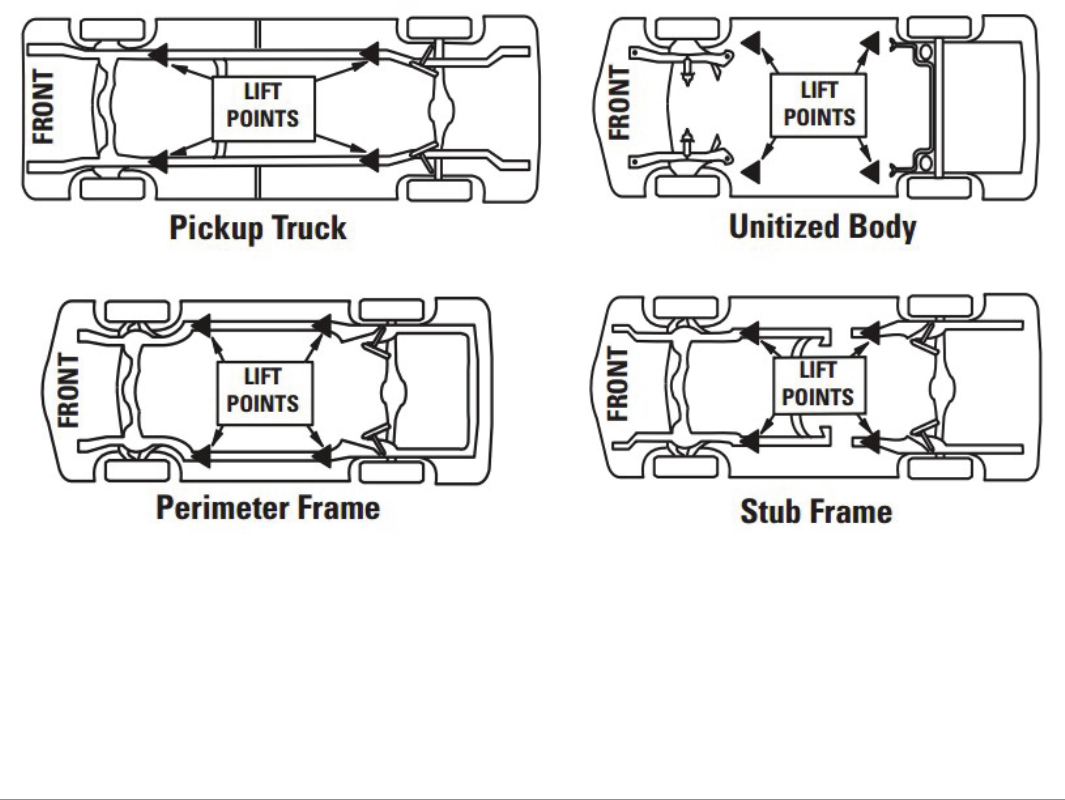
Vehicle Lifting Points
Some vehicles may have the manufacturer’s Service Garage Lift Point locations
identied by triangle shape marks on its undercarriage (reference SAE J2184).
Also, there may be a label located on the right front door lock face showing
specic vehicle lift points. If the specic vehicle lift points are not identied,
refer to the “Typical Lift Points” gure below or the ALI/LP Guide - Vehicle Lifting
Points/ Quick Reference Guide included with your lift. Consider center of gravity,
contents of vehicle and weight shifting before operating.
Make sure vehicle is neither front nor rear heavy. If the specic vehicle lift points
are not identied, or if the vehicle has additional or uniquely positioned payload,
have a qualied person calculate the vehicle center of gravity or have the vehicle
center of gravity determined at a vehicle scale. Load the vehicle with the center
of gravity midway between adapters.
Unusual vehicles, such as limousines, RV’s, and long wheelbase vehicles, may
not be suitable for lifting on this equipment. If necessary, consult with your Atlas
Automotive Equipment representative or contact the vehicle manufacturer.

Additional Information 46
PVL15
Operation Test with Vehicle
Prior to starting this section, please refer to the important safety instructions at
the beginning of this manual. Reference Automotive Lift-Safety Requirements for
Operation, Inspection, and Maintenance (ANSI/ALI ALOIM)
After nishing the above assembly instructions and adjustments, perform an
operation test of the lift using a typical vehicle.
1. Lower lift to ground.
2. Drive vehicle on to lift and position the arms as per the “Lift it Right”
manual and “Lifting Points Quick Reference” guide.
3. Raise lift to and lower onto 3-4 lock positions during full rise to ensure all
locks are working correctly.
4. Re-adjust cables if necessary while vehicle is on.
5. Check lowering speed and smooth decent rate.
6. Lower lift to ground and drive vehicle off lift.
Run the lift in the low position several times, and then run the lift to the top
completely.
If any problems occur during the nal checkout or operation test
of the lift with a vehicle, please contact your lift distributor, sales
representative or manufacturer immediately.

Additional Information 47
PVL15
Operating Instructions
Please reference enclosed ANSI/ALI ALOIM – Current Edition and ALI/LP Guide
before proceeding.
1. Ensure lift is fully lowered and service bay is clear.
2. Move swing arms to full drive thru position.
3. Center the vehicle between the lift posts and position the arms in
accordance with the supplied “Lifting it Right” and “Lifting Point” guides. Be
sure you are using the proper adapters.
4. Push the raise switch on the power unit and ensure that the arm restraint
pins for engagement.
5. Raise the vehicle until the suspension and tires clear the oor.
6. Stop and check the adapters for secure contact in accordance with the
vehicle manufacturer recommended lifting points and “Lifting Point” guide.
7. Moderately shake vehicle by pushing on the front or rear bumper to ensure
that vehicle is safely positioned on the lift.
8. After conrmation that vehicle is securely positioned, continue to raise the
lift to the desired lift height.
9. Lower the lift onto the mechanical locking latches.
10. Avoid excessive rocking of the vehicle while it on the lift.
11. Always use safety support stands when removing or installing heavy vehicle
components.
12. To lower the lift, rst be sure that all objects and all personnel are free from
lift area. Observe pinch point and other warning decals.
13. Raise the lift off the locking latches.
14. Pull down and hold the safety release while pressing the hydraulic lowering
valve handle until the lift has fully lowered to the ground and the arm
restraints have disengaged.
15. Remove adapters and position arms in full drive thru position before
removing vehicle from the service bay.

Additional Information 48
PVL15
Inspection and Maintenance
Please refer to the ANSI/ALI ALOIM – Current Edition “AMERICAN NATIONAL
STANDARD for Automotive Lifts – Safety Requirements for Operation, Inspection
and Maintenance”.
Periodic inspections and maintenance shall be performed only by trained lift
service personnel. Never operate a lift that is damaged or in disrepair. Proper
inspection and maintenance is necessary for the safe operation of the lift. Contact
a local service or factory representative immediately if any issues arise or if you
are not completely familiar with automotive lift maintenance procedures.
Daily Procedures
• Check to ensure bolts are tightened
• Check lift components and keep clean and free of debris
• Check for oil leakage
• Check all electrical components and wiring
• Check cables and sheaves
• Check all hydraulic lines and ttings
• Repair or replace all damaged, defective, worn, frayed or broken
components immediately. Only use parts approved by the original
equipment manufacturer or parts meeting original manufacturer
specications.
Monthly Procedures
• Check equalizer cable tension and adjust accordingly
• Check lubrication points and lubricate accordingly
• Check anchor bolts for tightness and appropriate torque
• Check uid levels
• Repair or replace all damaged, defective, worn, frayed or broken
components immediately. Only use parts approved by the original
equipment manufacturer or parts meeting original manufacturer
specications.

Additional Information 49
PVL15
Lockout and Tagout Procedures
Please refer to ANSI Z244.1
Purpose: This procedure establishes the minimum requirements for lockout of
energy sources that could cause injury to personnel by the operation of the lift. .
All employees and/or operators shall comply with the procedure.
Responsibility: The responsibility for seeing that this procedure is followed is
binding upon all owners, employees and lift operators. All owners, employees
and operators shall be instructed in the safety signicance of the lockout
procedure by the owner, supervisor or appropriate personnel. Each new or
transferred affected employee or operator shall be instructed by appropriate
personnel in the purpose and use of the lockout procedure.
Preparation for Lockout: Employees authorized to perform lockout shall be
certain as to which switch, valve, or other energy isolating devices applies to
the lift. More than one energy source (electrical, mechanical, or others) may
be involved. Any questionable identication of sources shall be cleared by
the employees, their supervisors, or appropriate personnel. Assure that job
authorization has been obtained before lockout commences.
Sequence of Lockout Procedure
• Notify all affected employees and operators that a lockout is required and
the reason therefore.
• If the lift is operating, shut it down by the normal stopping procedure (such
as assuring the disconnect switch is off)
• Operate the switch, valve, or other energy isolating devices so that
the energy source(s) (electrical, mechanical, hydraulic, and other) are
disconnected or isolated from the lift.
• If it is a lockable device, lockout with an assigned individual lock. If it is
not a lockable device, replace with a dummy device and tag accordingly.
If more than one individual is required to lock out the lift, each shall place
their own personal lock on the energy isolating device(s).
• Adequately label or tag the lift stating not to operate or tamper with the
tag or label
• Stored energy (such as that in capacitors and hydraulic systems) must also
be addressed
• After ensuring that no personnel are exposed and as a check to ensure
the lockout is working, operate the push button or other normal operating
controls to make certain the lift will not operate. Return the lift operating
controls to neutral position after the test.
• The equipment is now locked out.
Additional Information 50
PVL15
Restoring Equipment to Service
• When the job is complete and equipment is ready for testing or normal
service, check the lift area to see that no one is exposed.
• When lift is clear, remove all locks. The energy isolating devices may be
operated to restore energy to lift.
Rules for Using Lockout Procedure: The lift shall be locked out to protect
against accidental or inadvertent operation when such operation could cause
injury to personnel. Never attempt to operate any switch, valve, or other energy
isolating device bearing a lock.
Wire Ropes
WARNING
• Wire ropes are critical to the safe and reliable performance of your lift.
• Cables are expendable items and should be replaced as a set.
Cable Condition Guide
Maximum Allowable Cable Necking
Nom. Cable Diameters Max.
Reduction in Diameter
Up to 5/16” 1/64”
3/8” to 1/2” 1/32”
9/16” to 3/4” 3/64”
7/8” to 1-1/8” 1/16”
1-1/4” to 1-1/2” 3/32”
Additional Information 51
PVL15
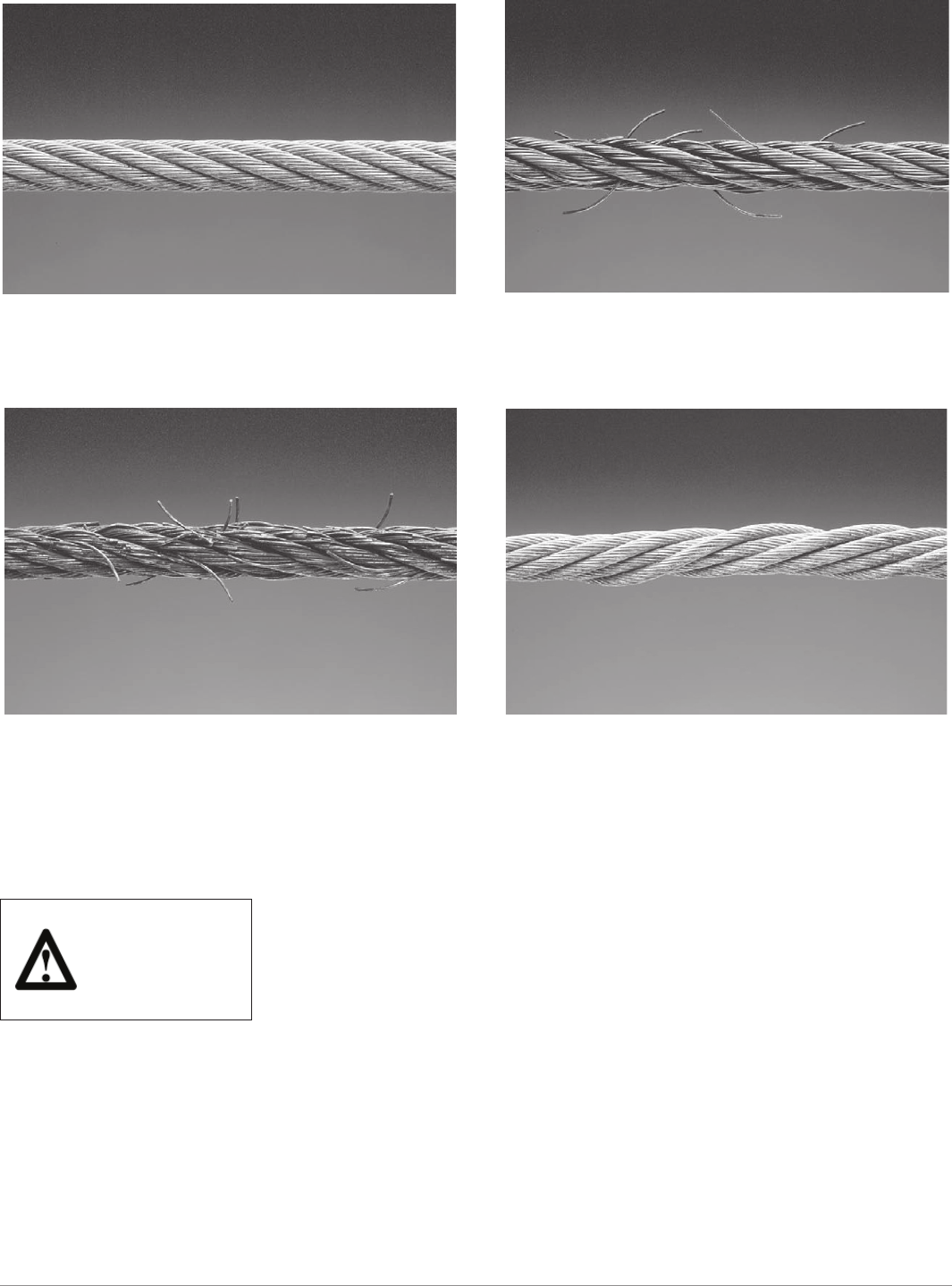
Typical Good Cable Cable with Broken Wires
Cable with Severe Corrosion Cable with Necking
Wire Rope Replacement Criteria
WARNING
If any cable is found to be in need of replacement,
the entire cable set, pulleys and safety rollers,
must be replaced immediately.
See Cable Condition Guide.
The Wire Rope MUST be Replaced if One or More of the Following
Criteria Are Met:
• More than six (6) randomly distributed broken wires in one rope lay or 6xd
length.
• More than three (3) broken wires in one strand in one rope lay or 6xd length.

Additional Information 52
PVL15
• Three (3) or more broken wires at rope terminations.
• One outer wire broken at the point or contact with the core of the rope
whish has worked its way out of the rope structure and protrudes or loops
out from the rope structure.
• Heavy rusting, corrosion, or pitting. A light surface corrosion on outer wires
is normal.
• Wear or scraping of one-third (1/3) of the original diameter of outside
individual wires.
• Excessive stretch. It is normal for new cable to require adjustment during
“break-in,” after which small periodic adjustments may be required.
However, if a cable that has been in service for 6 months should suddenly
require frequent adjustments or has used all the cable adjustments
available, all cables must be replaced immediately.
• Deformed strands, kinking, crushing, bird-caging, or any other damage or
distortion of wire rope structure.
• Variations in diameter (necking) or any change from normal appearance.
• Reductions from nominal diameter of more than 1/32” (for cables 3/8” to
1/2” diameter inclusive.)
• End attachments cracked, deformed or worn.
* Lay is the distance measured, parallel to the rope axis, in which a single strand
makes one complete turn around the rope axis, or the wires make a complete
turn around the axis of the strand.
Please reference ANSI/ALI ALOIM standard for
more information on wire rope cable inspection.
EMERGENCY OPERATION IF LIFT BECOMES
INOPERABLE IN RAISED POSITION
If the lift becomes inoperable in the raised position, wait until electrical
power is restored to the lift before attempting to lower the vehicle. If
it is crucial for reasons of safety that the vehicle be lowered, please
DO NOT attempt to do so on your own without rst contacting your
local authorized service representative or distributor, who can verbally
walk you through the process or assist, in person, where necessary.
WARNING: DO NOT LOOSEN OR REMOVE HYDRAULIC
CONNECTIONS OR FITTINGS UNDER PRESSURE.
SERIOUS INJURY OR DEATH COULD OCCUR.
Part List 53
PVL15
Part List
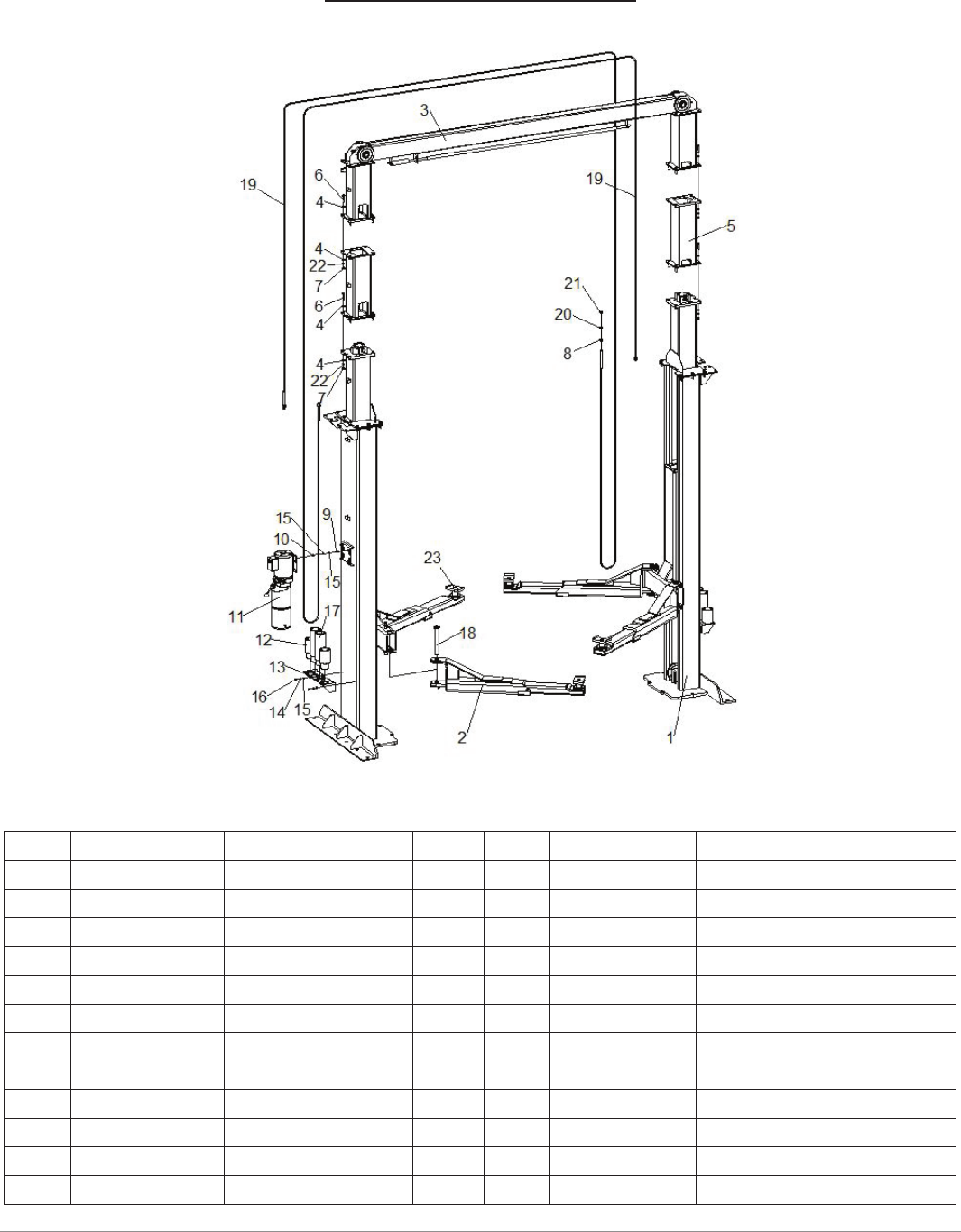
Figure 17 – General Part List
Item Part number Description Qty Item Part number Description Qty
1 Z22A101000 Column assembly 2 13 Z22A500102 Extension holder 2
2 Z22A310000 Arms assembly 4 14 0208006 Locking washer D.8 4
3 Z22A410000 Overhead beam 1 15 0205008 Washer D.8 12
4 0205013 Washer D.12 32 16 0201025 Screw M8X16 4
5 Z22A601100 Column extension 2 2 17 Z22A600102 Pad extension H.254 4
6 0201121 Screw M12X55 16 18 Z22A530100 Arm shaft 4
7 0203013 Nut M12 16 19 Z22A520100 Equalizer steel cable 2
8 0205020 Washer D.16 4 20 0203025 Nut M16 4
9 0201031 Screw M8X30 4 21 0204032 Jam nut M16 4
10 0203029 Nut M8 4 22 0208009 Locking washer D.12 16
11 0302008 Hydraulic power unit 1 23 Z22A313000 Adaptor assembly 4
12 Z22A600101 Pad extension H.127 4
Part List 54
PVL15
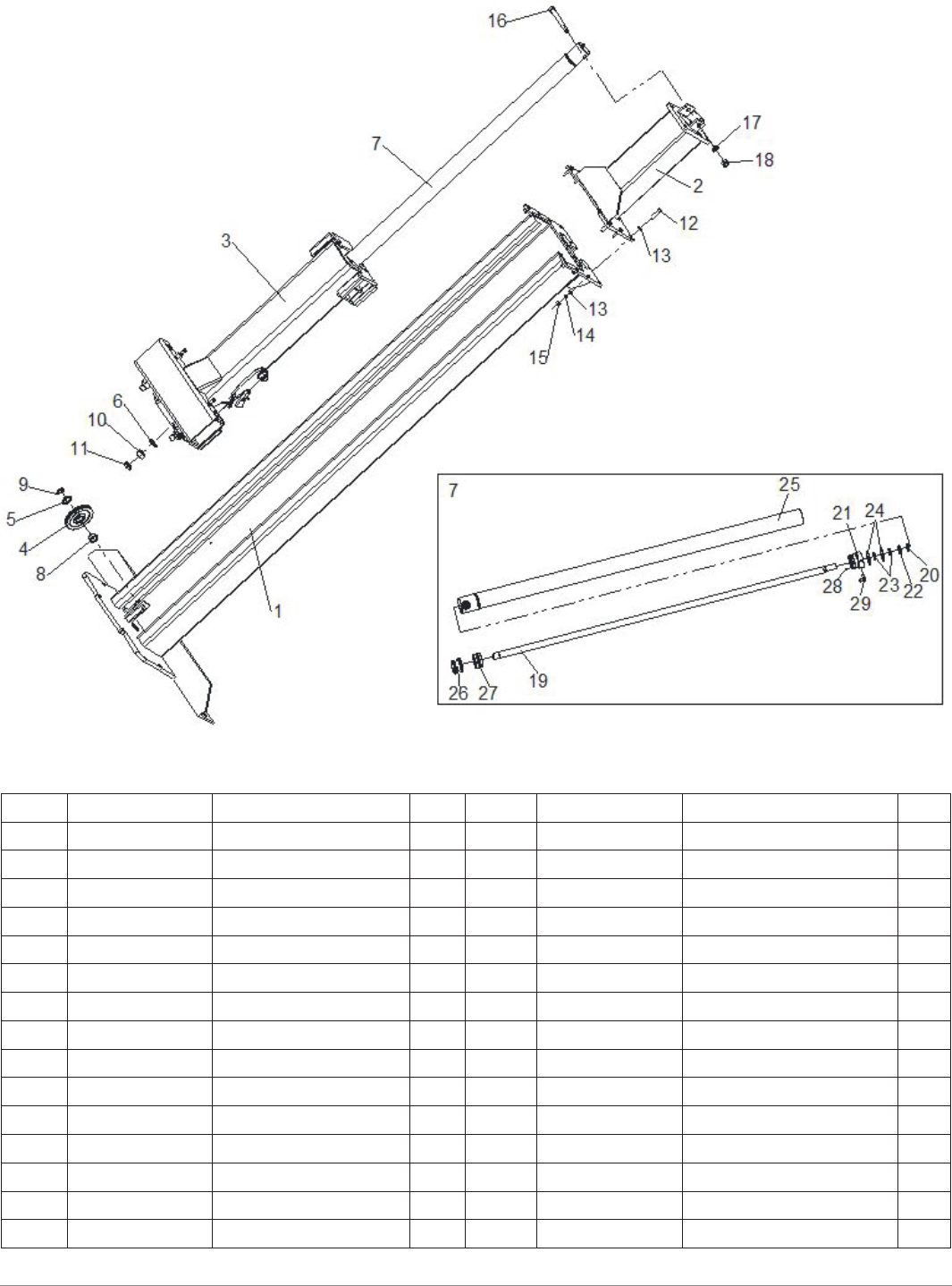
Figure 18 – Column Assembly
Item Part number Description Qty Item Part number Description Qty
1 Z22A111000 Column weldment 1 16 0201017 Screw M20X160 1
2 Z22A121000 Column extension 1 1 17 0205023 Washer D.24 1
3 Z22A201000 Carriage assembly 1 18 0204027 Self-locking nut M20 1
4 Z22A110001 Cable pulley 1 19 Z22AY75002 Cylinder shaft 1
5 Z22A110002 Washer 1 20 0311026 Scraper 32X40X5/6.5 1
6 Z22A231003 Washer 1 21 Z22AY75001 Cylinder guiding cover 1
7 Z22AY75000 Hydraulic cylinder unit 1 22 0310036 Seal 32X42X7.3 1
8 0210099 Bush 3520F/SF-1 1 23 0305005 Guiding ring 32X5.6X2.5 2
9 0212022 Seeger D.35 1 24 0309039 O-ring 75X3.1 2
10 0203041 Nut M27X2 1 25 Z22AY75100 Cylinder liner 1
11 0204020 Jame nut M27X2 1 26 Z22AY75003 Piston 1
12 0201121 Screw M12X55 8 27 0312015 Gasket 75X55X22.4 1
13 0205013 Washer D.12 16 28 BZ-GZ-001 Restrictor 1
14 0208009 Locking washer D.12 8 29 0303002 90° tting 1/4 1
15 0203013 Nut M12 8
Part List 55
PVL15
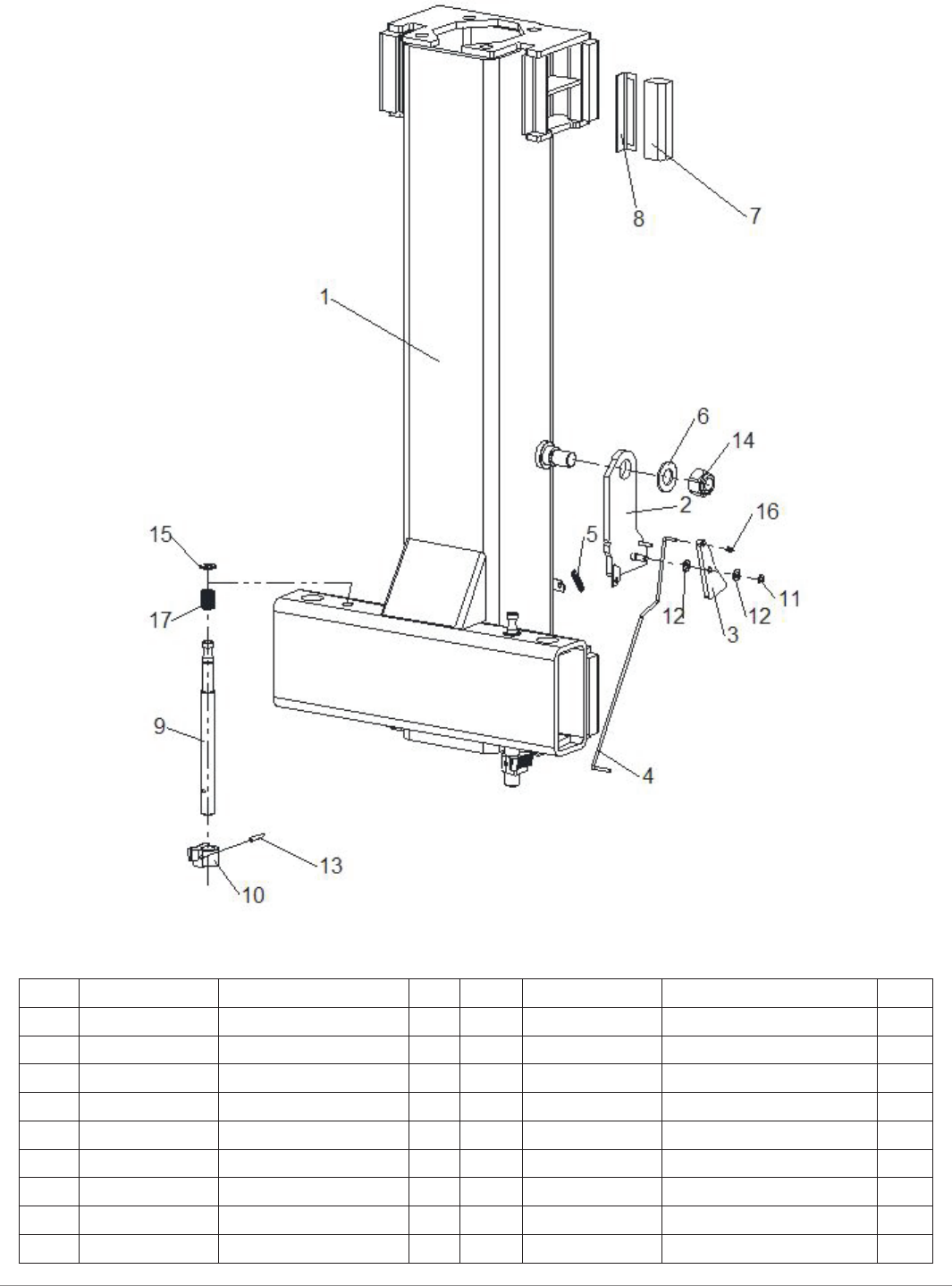
Figure 19 – Carriage Assembly
Item Part number Description Qty Item Part number Description Qty
1 Z22A211000 Carriage weldment 1 10 Z23A200003 Toothed gear 2
2 Z22A221100 Lock latch 1 11 0211015 Seeger D.8 1
3 Z22A221201 Lock latch lever 1 12 0205011 Washer D.10 2
4 Z22A231001 Lock release rod 1 13 0213052 Elastic pin 6X40 2
5 Z22A231002 Return spring 1 14 0204082 Lelf-locking nut M27X2 1
6 Z22A231003 Washer 1 15 0211014 Seeger D.15 2
7 Z22A241101 Slider 8 16 0204002 Self-locking nut M5 1
8 Z22A242100 Slider shim 8 17 0208019 Spring 2
9 Z22A251101 Lock release pin 2
Part List 56
PVL15
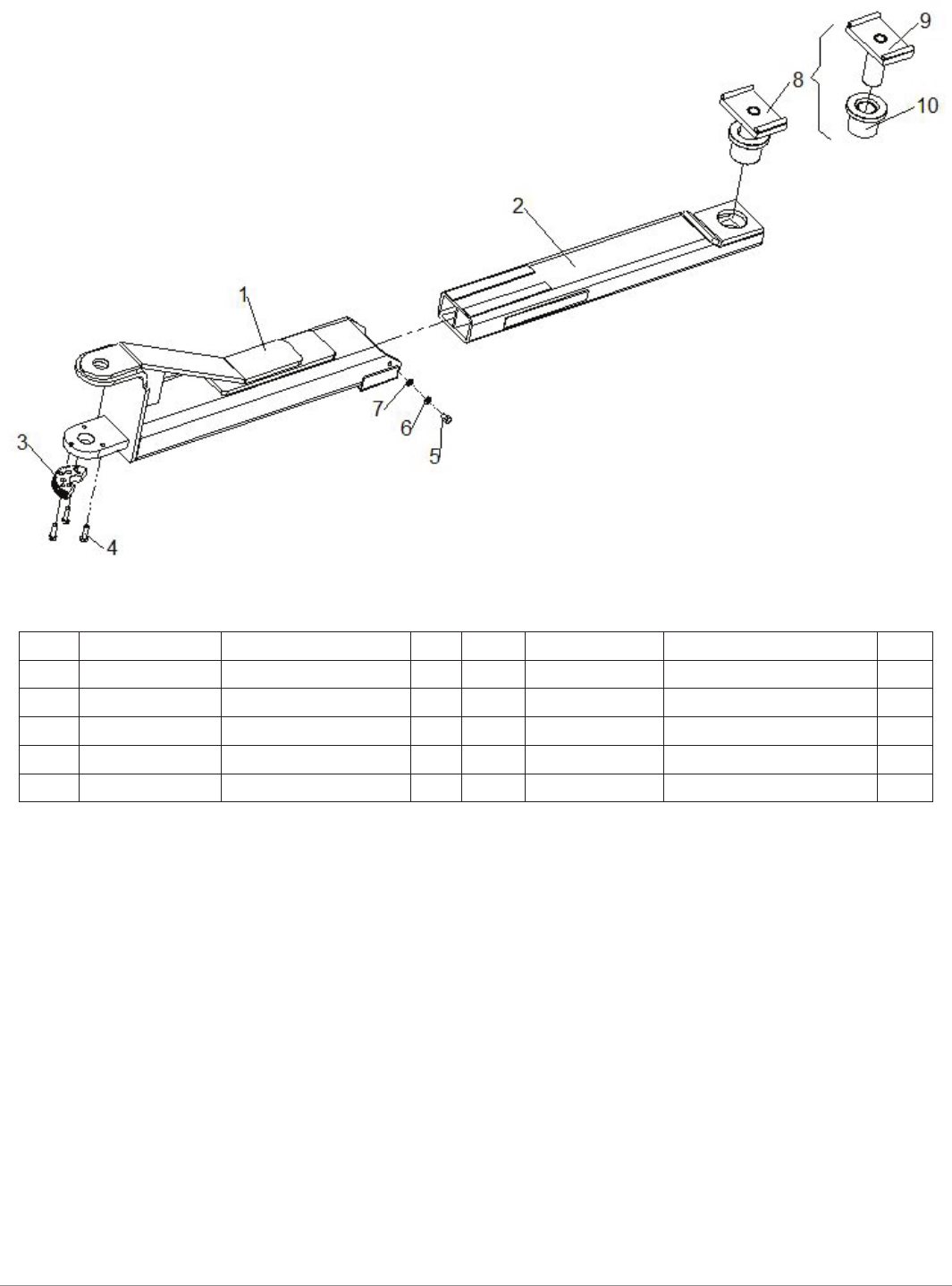
Figure 20 – Arm Assembly And Adaptor Assembly
Item Part number Description Qty Item Part number Description Qty
1 Z22A311000 Arm frame 1 6 0205011 Washer D.10 1
2 Z22A312000 Telescopic arm 1 7 0211029 Locking washer D.10 1
3 Z23A310001 Anti-rotating gear 1 8 Z22A313000 Adaptor assembly 1
4 0201050 Screw M10X35 3 9 Z22A313100 Adaptor 1
5 0201060 Screw M10X16 1 10 Z22A313001 Thread bush 1
Part List 57
PVL15
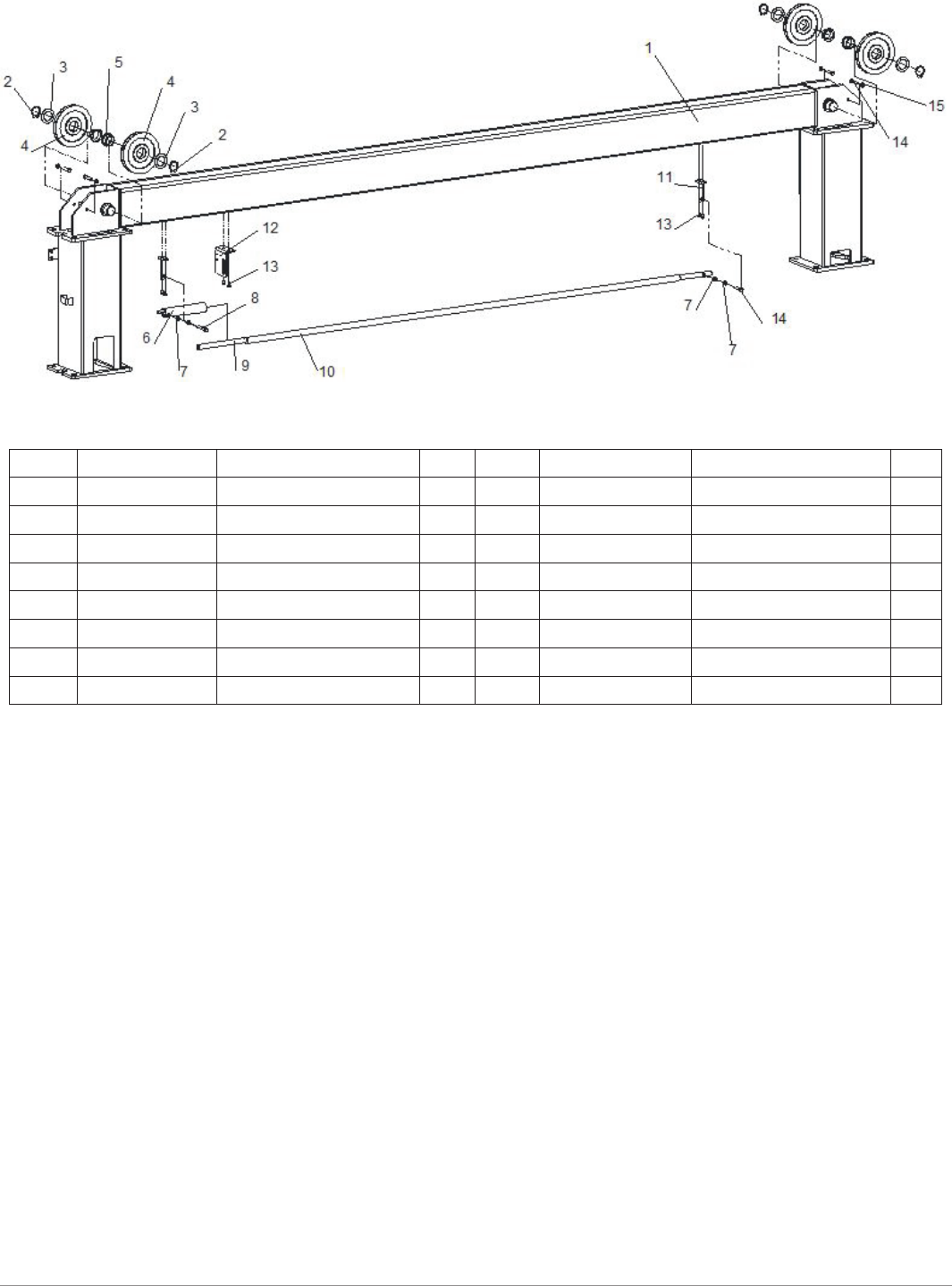
Figure 21 – Overhead Beam Assembly
Item Part number Description Qty Item Part number Description Qty
1 Z22A411000 Beam weldment 1 9 Z23A400001AM Crush safety bar 1
2 0212022 Seeger D.35 4 10 Z23A400002 Crush safety bar cover 1
3 Z22A110002 Washer 4 11 SYJ30-17-02M1 Safety bar bracket 2
4 Z22A110001 Pulley 4 12 2L-1-07 Safety bar support 1
5 0210099 Bush 3520F/SF-1 4 13 0206040 Screw M6X12 6
6 SP-1430-14 Overhead switch 1 14 0201033 Screw M8X40 5
7 0203029 Nut M8 4 15 0211030 Toothed washer D.8 4
8 0201020 Screw M8X55 1
Part List 58
PVL15
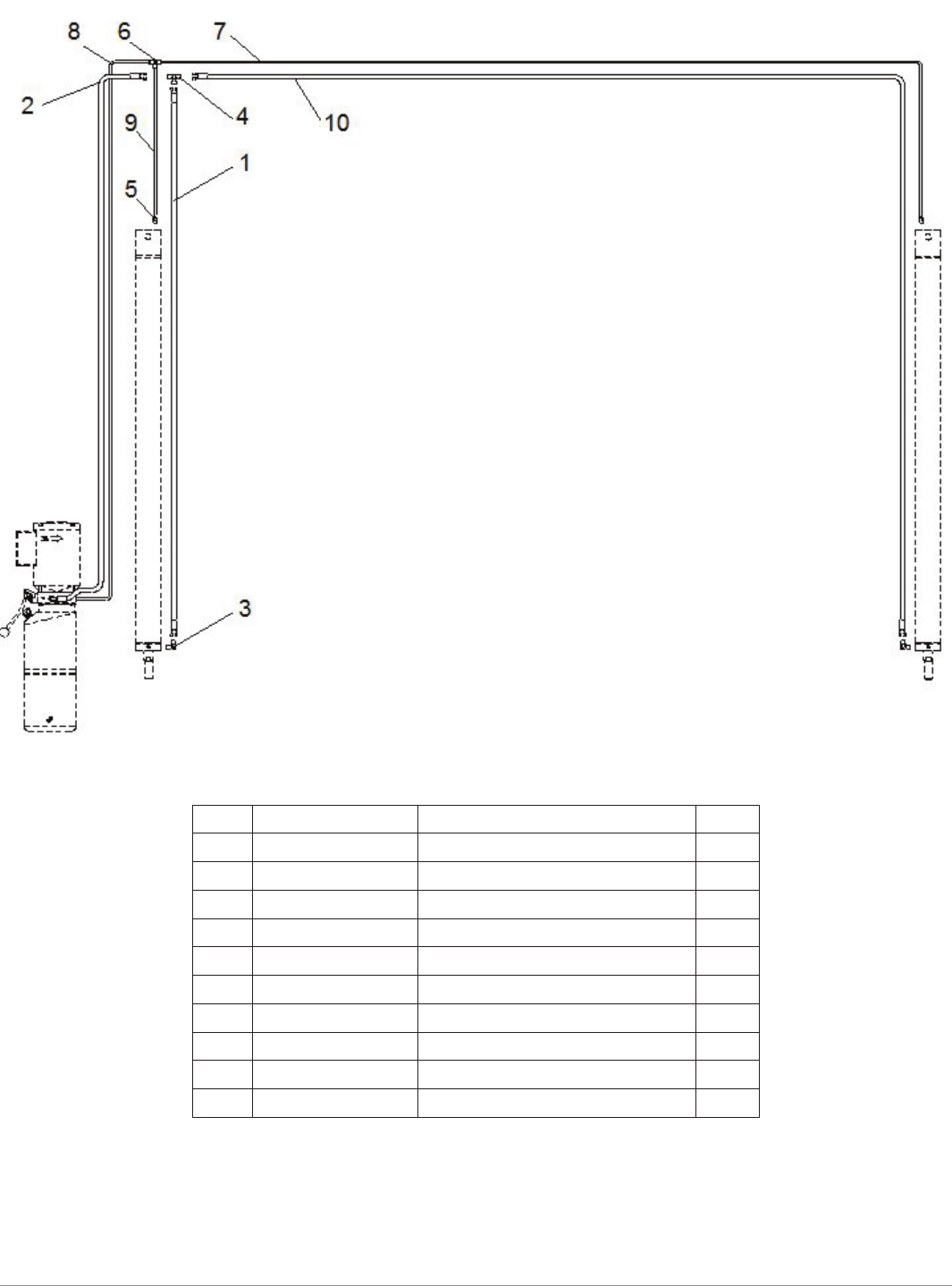
Figure 22 – Hydraulic Line
Item Part number Description Qty
1 ZZ2420 Hydraulic hose 3/8 L=2420 1
2 ZW2850 Hydraulic hose 5/16 L=2850 1
3 0303002 90° tting 1/4 2
4 0303021 Tee tting 1/4 1
5 0306144 Quick union 8-1/4 2
6 0306024 Tee quick union 8 1
7 0306096 Rilsan hose 8X5.5 L=4400 1
8 0306096 Rilsan hose 8X5.5 L=3200 1
9 0306096 Rilsan hose 8X5.5 L=1150 1
10 ZZ5640 Hydraulic hose 3/8 L=5640 1
Part List 59
PVL15
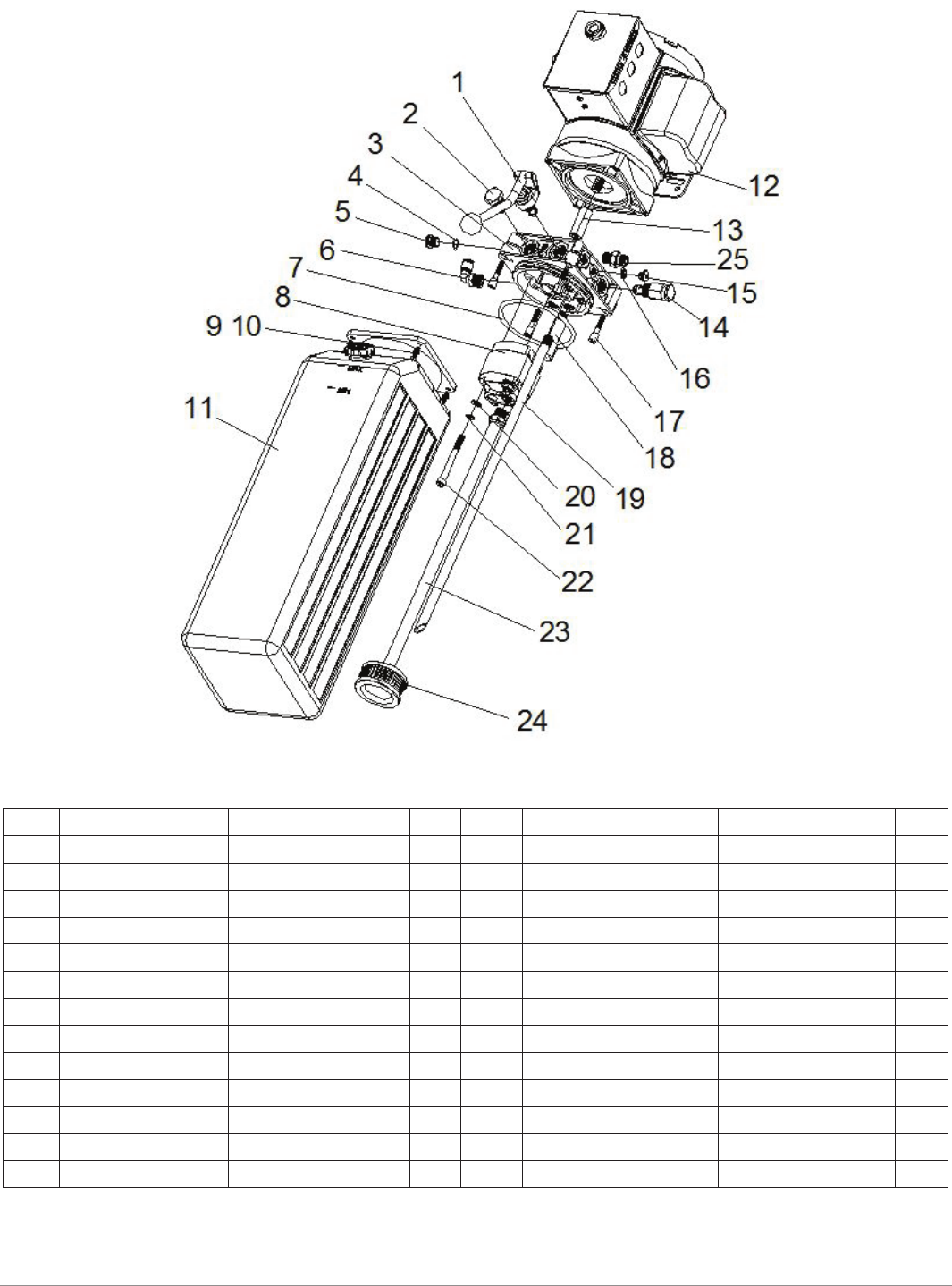
Figure 23 – Hydraulic Power Unit
Item Part number Description Qty Item Part number Description Qty
1 YBZ-E2D3l1/1-02 Manual release valve 1 14 LHRV-08-42 Relief valve 1
2 YBZ-E2D3l1/1-03 Check Valve 1 15 JB/ZQ4444 Plug M10X1 1
3 YLBZ-T1KK-2 Manifold 1 16 JB/T982 Bonded washer D.10 1
4 GB/1235 O-ring 16X2 2 17 YBZ-E3D4H1/10-02 Special screw 4
5 YBZ1-PG06B Plug 1 18 YBZ-E2D3l1/1-05A Buffer valve 1
6 10-03 Rotation union 10-3/8 1 19 YBZ-THYG-530 Return pipe 1
7 GB/3452.1 O-ring 109X5.3 1 20 GB/95 Washer D.8 4
8 CBKA-F2.5F Gear Pump 2.5CC 1 21 GB/859 Locking washer D.8 2
9 GB/95 Washer D.5 4 22 GB/70.1 Screw M8X80 2
10 GB/T70.1 Screw M5X18 4 23 YBZ-TJYG-485 Suction pipe 1
11 YBZ-SLYX-14L-L Tank 14L 1 24 YBZ-E2D3l1/1-10 Suction lter 1
12 AM61-3HAM-3BA14R Motor 204-240V/1PH 1 25 GJT-9/16-18UNF-G1/4-A Fitting 1/4 1
13 YBZ-F2.1D4H1/1-03 Coupling 1

Warranty 60
PVL15
Warranty
Atlas® Platinum Series Two-Post Lifts are warranted for
ve (5) years on structural components and two (2) years
on the hydraulic system, power unit and cylinders effective
from date of invoice. Wear items carry a 90-day warranty.
Structural components are considered the Carriage,
Columns, Yokes, Arms, Runways, Plungers, etc. Hydraulic
components are cylinders, hoses, and ttings. Cables,
sheaves, latches and controls are considered wear items.
The Manufacturer shall repair or replace at their option for this period those parts returned to the
factory freight prepaid or, those inspected by an Atlas Authorized Service Provider which prove
after inspection to be defective. This warranty will not apply unless the product is installed, used
and maintained in accordance with the Manufacturers installation, operation and maintenance
instructions.
This warranty applies to the ORIGINAL purchaser only, and is non-transferable. The warranty
covers the products to be free of defects in material and workmanship but, does not cover normal
maintenance or adjustments, damage or malfunction caused by: improper handling, installation,
abuse, misuse, negligence, carelessness of operation or normal wear and tear. In addition, this
warranty does not cover equipment when repairs or alterations have been made or attempted to
the Manufacturer’s products.
THIS WARRANTY IS EXCLUSIVE AND IS LIEU OF ALL OTHER WARRANTIES EXPRESSED OR IMPLIED
INCLUDING ANY IMPLIED WARRANTY OR MERCHANTABILITY OR ANY IMPLIED WARRANTY OF
FITNESS FROM A PARTICULAR PURPOSE, AND ALL SUCH IMPLIED WARRANTIES ARE EXPRESSLY
EXCLUDED. THE REMEDIES DESCRIBED ARE EXCLUSIVE AND IN NO EVENT SHALL THE
MANUFACTURER, NOR ANY SALES AGENT OR OTHER COMPANY AFFILIATED WITH IT OR THEM,
BE LIABLE FOR SPECIAL CONSEQUENTIAL OR INCIDENTAL DAMAGES FOR THE BREACH OF OR
DELAY IN PERFORMANCE OF THIS WARRANTY. THIS INCLUDES, BUT IS NOT LIMITED TO, LOSS OF
PROFIT, RENTAL OR SUBSTITUTE EQUIPMENT OR OTHER COMMERCIAL LOSS.
PRICES: Prices and specications are subject to change without notice. All orders will be invoiced at
prices prevailing at time of shipment. Prices do not include any local, state or federal taxes.
RETURNS: Products may not be returned without prior written approval from the Manufacturer.
DUE TO THE COMPETITIVENESS OF THE SELLING PRICE OF THESE LIFTS, THIS WARRANTY POLICY
WILL BE STRICTLY ADMINISTERED AND ADHERED TO.
