PIC32MX FRM Section 31. DMA Controller PIC32 Family Reference Manual, Sect. 31
User Manual:
Open the PDF directly: View PDF  .
.
Page Count: 60
- Section 31. DMA Controller
- 31.1 Introduction
- 31.2 Status and Control Registers
- Table 31-1: DMA Register Summary (Continued)
- Register 31-1: DMACON: DMA Controller Control Register(1,2,3) (Continued)
- Register 31-2: DMASTAT: DMA Status Register(1)
- Register 31-3: DMAADDR: DMA Address Register(1)
- Register 31-4: DCRCCON: DMA CRC Control Register(1,2,3) (Continued)
- Register 31-5: DCRCDATA: DMA CRC Data Register(1,2,3)
- Register 31-6: DCRCXOR: DMA CRCXOR Enable Register(1,2,3)
- Register 31-7: DCHxCON: DMA Channel x Control Register(1,2,3) (Continued)
- Register 31-8: DCHxECON: DMA Channel x Event Control Register(1,2,3) (Continued)
- Register 31-9: DCHxINT: DMA Channel x Interrupt Control Register(1,2,3) (Continued)
- Register 31-10: DCHxSSA: DMA Channel x Source Start Address Register(1,2,3)
- Register 31-11: DCHxDSA: DMA Channel x Destination Start Address Register
- Register 31-12: DCHxSSIZ: DMA Channel x Source Size Register(1,2,3)
- Register 31-13: DCHxDSIZ: DMA Channel x Destination Size Register(1,2,3)
- Register 31-14: DCHxSPTR: DMA Channel x Source Pointer Register(1)
- Register 31-15: DCHxDPTR: DMA Channel x Destination Pointer Register
- Register 31-16: DCHxCSIZ: DMA Channel x Cell-Size Register(1,2,3)
- Register 31-17: DCHxCPTR: DMA Channel x Cell Pointer Register(1)
- Register 31-18: DCHxDAT: DMA Channel x Pattern Data Register(1,2,3)
- 31.3 Modes of Operation
- 31.3.1 Basic Transfer Mode
- 31.3.2 Pattern Match Termination Mode
- 31.3.3 Channel Chaining Mode
- 31.3.4 Channel Auto-Enable Mode
- 31.3.5 Special Function Module (SFM) Mode
- Figure 31-4: Special Function Module (SFM)
- Example 31-4: DMA LFSR CRC Calculation in Background Mode Code Example
- Example 31-5: CRC Calculation in Append Mode Code Example
- Figure 31-5: Byte Order for BYTO Values
- Example 31-6: 16-bit CRC Polynomial
- Example 31-7: 32-bit CRC Polynomial
- Table 31-2: Example CRC Setup
- 31.3.6 Suspending Transfers
- 31.3.7 Resetting the Channel
- 31.3.8 Channel Priority and Selection
- 31.3.9 Byte Alignment
- 31.3.10 Channel Transfer Behavior
- 31.3.11 Channel Enable
- 31.3.12 Channel IRQ Detection
- 31.3.13 Channel Event Transfer Initiation
- 31.3.14 Channel Event Transfer Termination
- 31.3.15 Channel Abort Interrupt
- 31.3.16 Channel Abort
- 31.3.17 Address Error
- 31.3.18 DMA Suspend
- 31.4 Interrupts
- 31.5 Operation in Power-Saving and Debug Modes
- 31.6 Effects of Various Resets
- 31.7 Related Application Notes
- 31.8 Revision History
- Worldwide Sales and Service

© 2010 Microchip Technology Inc. DS61117F-page 31-1
DMA Controller
31
Section 31. DMA Controller
HIGHLIGHTS
This section of the manual contains the following major topics:
31.1 Introduction.............................................................................................................. 31-2
31.2 Status and Control Registers................................................................................... 31-5
31.3 Modes of Operation ............................................................................................... 31-31
31.4 Interrupts................................................................................................................ 31-51
31.5 Operation in Power-Saving and Debug Modes ..................................................... 31-55
31.6 Effects of Various Resets....................................................................................... 31-55
31.7 Related Application Notes ..................................................................................... 31-56
31.8 Revision History..................................................................................................... 31-57

PIC32MX Family Reference Manual
DS61117F-page 31-2 © 2010 Microchip Technology Inc.
31.1 INTRODUCTION
The Direct Memory Access (DMA) controller is a bus master module that is useful for data trans-
fers between different peripherals without intervention from the CPU. The source and destination
of a DMA transfer can be any of the memory-mapped modules included in the PIC32MX. For
example, memory, or one of the Peripheral Bus (PBUS) devices such as SPI, UART and so on.
Following are some of the key features of the DMA module:
• Depending on the device variant, up to eight identical channels are available, including the
following:
- Auto-Increment Source and Destination Address registers
- Source and Destination Pointers
• Depending on the device variant, data transfers of up to 64 Kbytes are supported
• Automatic Word-Size Detection, featuring the following:
- Transfer granularity down to byte level
- Bytes need not be word-aligned at source and destination
• Fixed Priority Channel Arbitration
• Flexible DMA Channel Operating modes, including the following:
- Manual (software) or automatic (interrupt) DMA requests
- One-Shot or Auto-Repeat Block Transfer modes
- Channel-to-channel chaining
• Flexible DMA Requests, featuring the following:
- A DMA request can be selected from any of the peripheral interrupt sources
- Each channel can select any interrupt as its DMA request source
- A DMA transfer abort can be selected from any of the peripheral interrupt sources
- Automatic transfer termination upon a data pattern match
• Multiple DMA Channel Status Interrupts, supplying the following:
- DMA channel block transfer complete
- Source empty or half empty
- Destination full or half full
- DMA transfer aborted due to an external event
- Invalid DMA address generated
• DMA Debug Support Features, including the following:
- Most recent address accessed by a DMA channel
- Most recent DMA channel to transfer data
• CRC Generation Module, featuring the following:
- CRC module can be assigned to any of the available channels
- Data read from the source can be reordered on some device variants
- CRC module is highly configurable
The following features are also available in the DMA controller:
• Unaligned Transfers
• Different Source and Destination Sizes
• Memory-to-Memory Transfers
• Memory-to-Peripheral Transfers
• Channel Auto-Enable
• Events Start/Stop
• Pattern Match Detection
• Channel Chaining
• CRC Calculation
Note: This family reference manual section is meant to serve as a complement to device
data sheets. Depending on the device variant, this manual section may not apply to
all PIC32MX devices.
Please consult the note at the beginning of the “Direct Memory Access (DMA)
Controller” chapter in the current device data sheet to check whether this
document supports the device you are using.
Device data sheets and family reference manual sections are available for
download from the Microchip Worldwide Web site at: http://www.microchip.com
© 2010 Microchip Technology Inc. DS61117F-page 31-3
Section 31. DMA Controller
DMA Controller
31
31.1.1 DMA Operation
A DMA channel transfers data from a source to a destination without CPU intervention. The
source and destination start addresses define the start address of the source and destination,
respectively.
Both the source and destination have independently configurable sizes and the number of the
transferred bytes is independent of the source and destination sizes.
A transfer is initiated either by software or by an interrupt request. The user can select any
interrupt on the device to start a DMA transfer.
Upon transfer initiation, the DMA controller will perform a cell transfer and the channel remains
enabled until a block transfer is complete. When a channel is disabled, further transfers will be
prohibited until the channel is re-enabled.
The DMA channel uses separate pointers to keep track of the current word locations at the
source and destination.
Interrupts can be generated when the source/destination pointer is half of the source/destination
size, or when the source/destination counter reaches the end of the source/destination.
A DMA transfer can be aborted by the software, by a pattern match or by an interrupt event. The
transfer will also stop when an address error is detected.
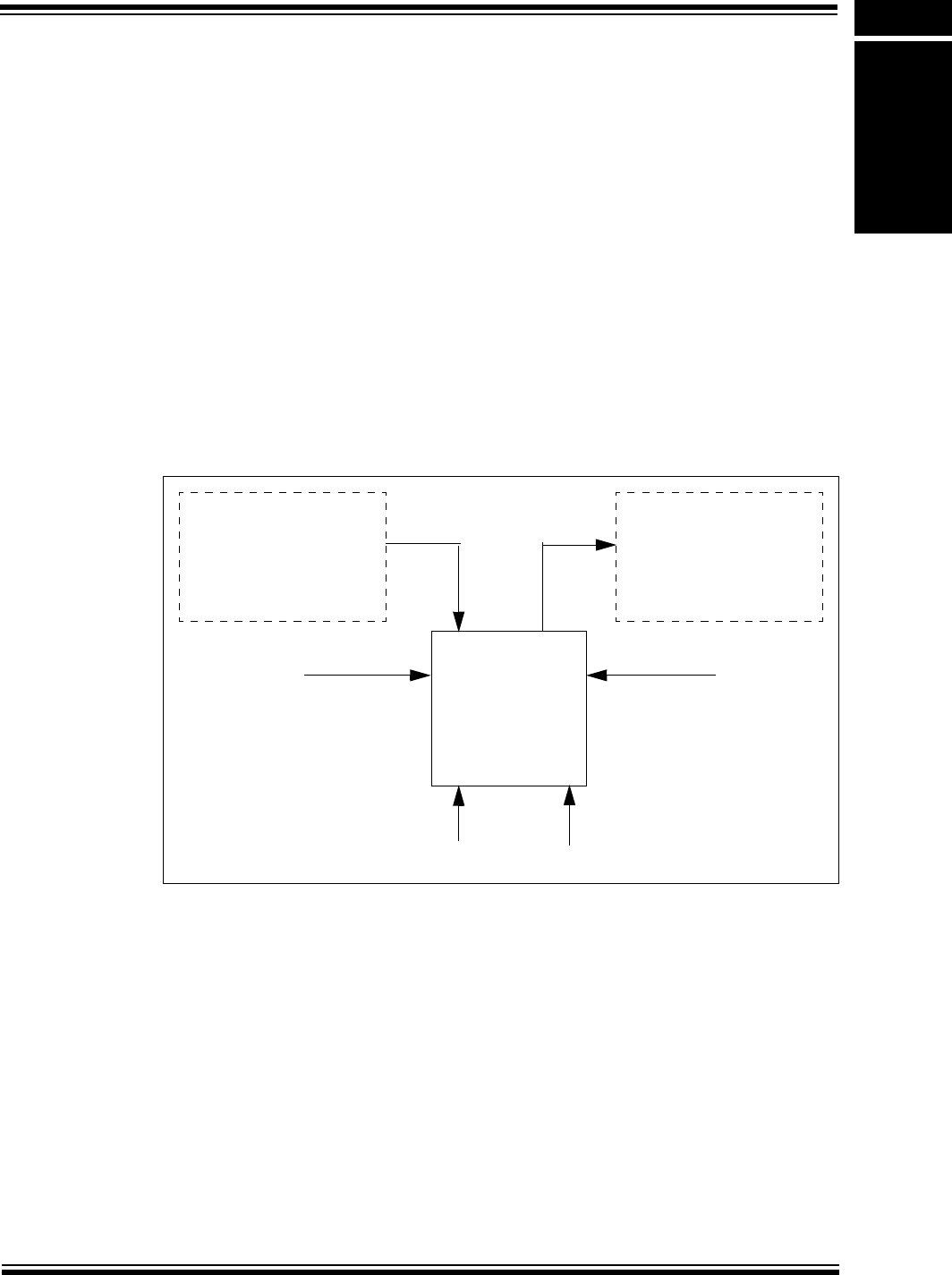
Figure 31-1: Typical DMA Source to Destination Transfer Diagram
[Destination Device/Memory][Source Device/Memory]
DMA
Start Transfer
IRQ
Stop Transfer
IRQ
1/2/3/4 Bytes in Access Size 1/2/3/4 Bytes in Access Size
Software Start Transfer Software Abort Transfer
PIC32MX Family Reference Manual
DS61117F-page 31-4 © 2010 Microchip Technology Inc.
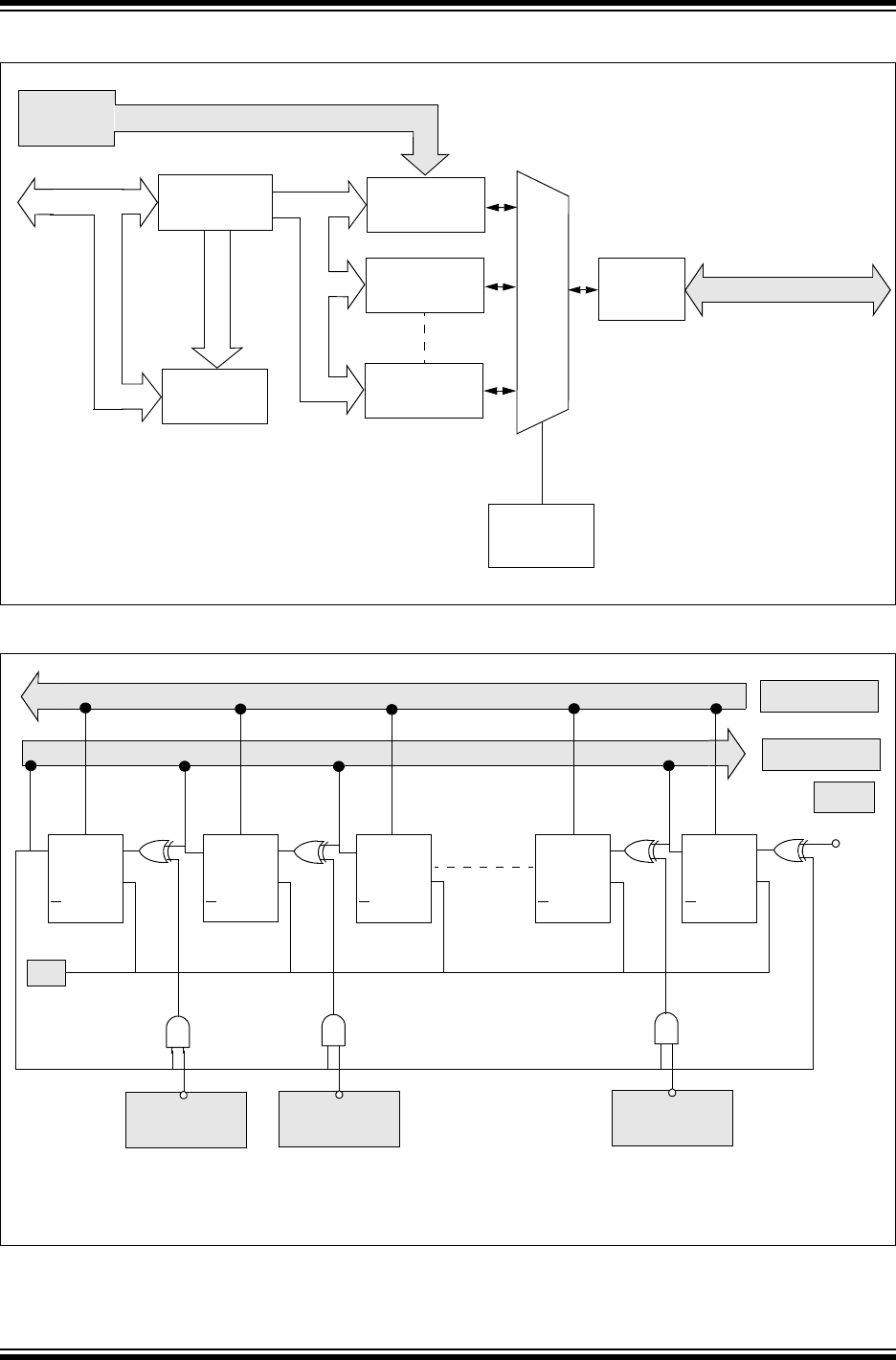
Figure 31-2: DMA Module Block Diagram
Figure 31-3: CRC Implementation Details
Peripheral Bus Address Decoder Channel 0 Control
Channel 1 Control
Channel n Control
Global Control
(DMACON)
Bus Interface
Channel Priority
Arbitration
SEL
SEL
Y
I0
I1
I2
In
System IRQ
Device Bus + Bus Arbitration
INT Controller
CRC Seed Write
CRC Data Read
DataIn
Stage Feedback
enable
Clk
Stage 31(1) Stage 30 Stage 29 Stage 1 Stage 0
SET
QD
QCLR
<
SET
QD
QCLR
<
SET
QD
QCLR
<
SET
QD
QCLR
<
SET
QD
QCLR
<
Stage Feedback
enable
Stage Feedback
enable
Note 1: Depending on the device variant, up to 32 stages (0 through 31) are available. Refer to the specific
device data sheet for more details.

© 2010 Microchip Technology Inc. DS61117F-page 31-5
Section 31. DMA Controller
DMA Controller
31
31.2 STATUS AND CONTROL REGISTERS
The DMA module consists of the following Special Function Registers (SFRs):
•DMACON: DMA Controller Control Register(1,2,3)
•DMASTAT: DMA Status Register(1)
•DMAADDR: DMA Address Register(1)
•DCRCCON: DMA CRC Control Register(1,2,3)
•DCRCDATA: DMA CRC Data Register(1,2,3) – The initial value of the CRC generator
•DCRCXOR: DMA CRCXOR Enable Register(1,2,3) – Provides a description of the genera-
tor polynomial for CRC calculation
•DCHxCON: DMA Channel x Control Register(1,2,3)
•DCHxECON: DMA Channel x Event Control Register(1,2,3)
•DCHxINT: DMA Channel x Interrupt Control Register(1,2,3)
•DCHxSSA: DMA Channel x Source Start Address Register(1,2,3)
•DCHxDSA: DMA Channel x Destination Start Address Register
•DCHxSSIZ: DMA Channel x Source Size Register(1,2,3)
•DCHxDSIZ: DMA Channel x Destination Size Register(1,2,3)
•DCHxSPTR: DMA Channel x Source Pointer Register(1)
•DCHxDPTR: DMA Channel x Destination Pointer Register
•DCHxCSIZ: DMA Channel x Cell-Size Register(1,2,3)
•DCHxCPTR: DMA Channel x Cell Pointer Register(1)
•DCHxDAT: DMA Channel x Pattern Data Register(1,2,3)
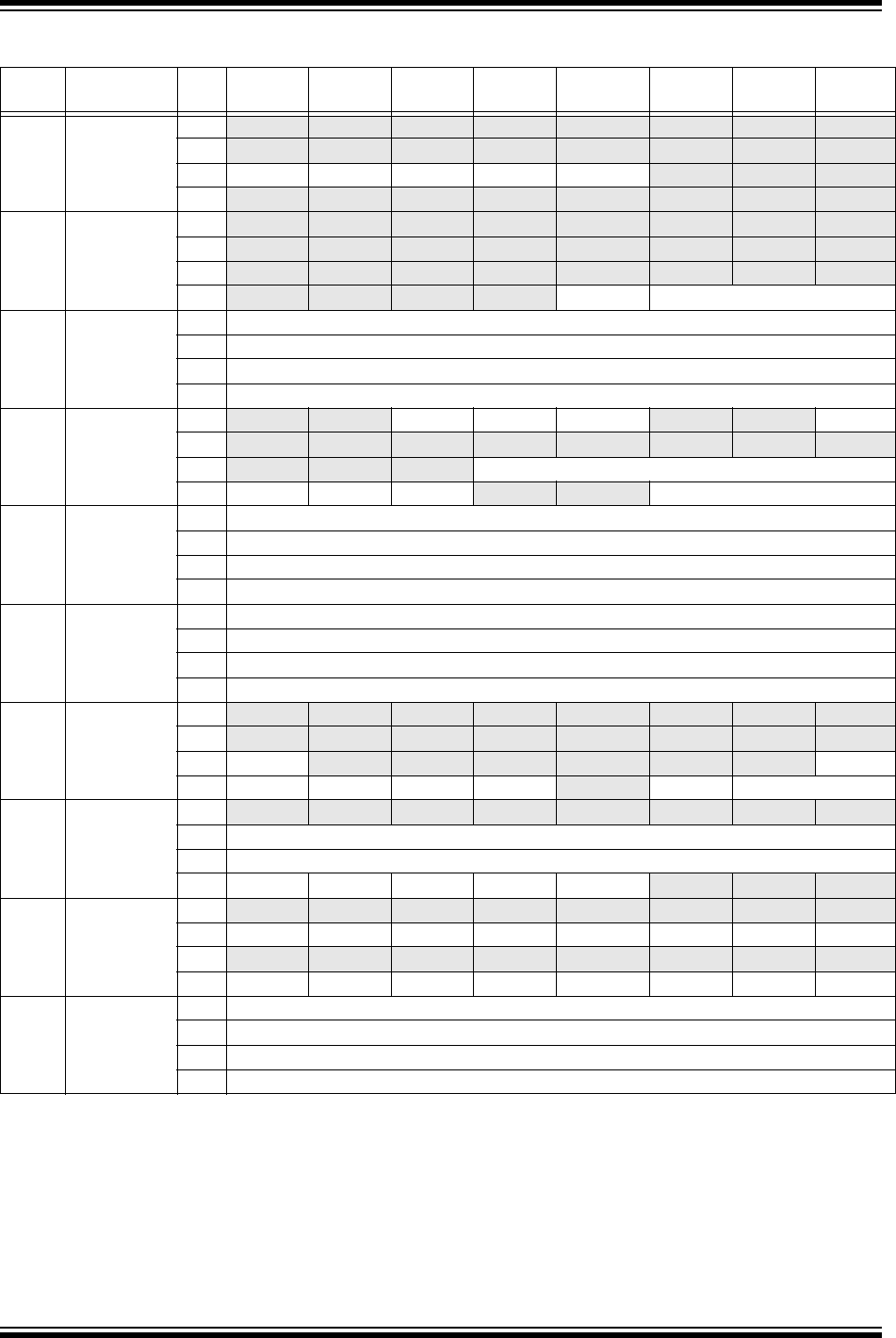
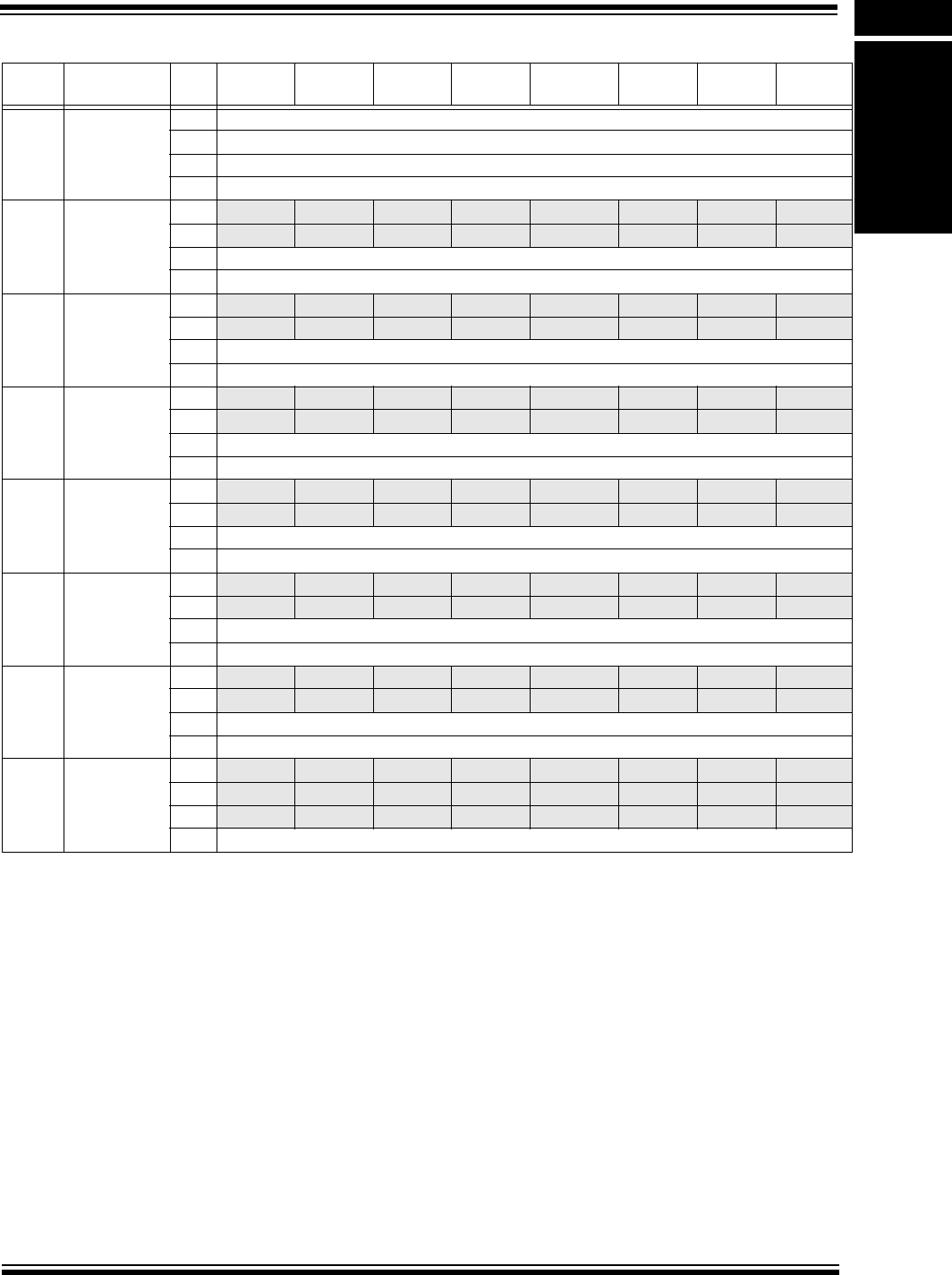
Table 31-1 provides a brief summary of DMA-module-related registers. Corresponding registers
appear after the summary, followed by a detailed description of each register.
Note: Each PIC32MX device variant may have one or more DMA channels. An ‘x’ used in
the names of Control/Status bits and registers denotes the particular channel. Refer
to the specific device data sheets for more details.
PIC32MX Family Reference Manual
DS61117F-page 31-6 © 2010 Microchip Technology Inc.
Table 31-1: DMA Register Summary
Address
Offset Name Bit
Range
Bit
31/23/15/7
Bit
30/22/14/6
Bit
29/21/13/5
Bit
28/20/12/4
Bit
27/19/11/3
Bit
26/18/10/2
Bit
25/17/9/1
Bit
24/16/8/0
0x00 DMACON(1,2,3) 31:24 — — — — — — — —
23:16 — — — — — — — —
15:8 ON FRZ SIDL(4) SUSPEND DMABUSY(4) — — —
7:0 — — — — — — — —
0x10 DMASTAT 31:24 — — — — — — — —
23:16 — — — — — — — —
15:8 — — — — — — — —
7:0 ———— RDWR DMACH<2:0>(5)
0x20 DMAADDR 31:24 DMAADDR<31:24>
23:16 DMAADDR<23:16>
15:8 DMAADDR<15:8>
7:0 DMAADDR<7:0>
0x30 DCRCCON(1,2,3) 31:24 ——BYTO1
(4) BYTO0(4) WBO(4) ——BITO
(4)
23:16 — — — — — — — —
15:8 — — — PLEN<4:0>(5)
7:0 CRCEN CRCAPP CRCTYP(4) —— CRCCH<2:0>(5)
0x40 DCRCDATA(1,2,3) 31:24 DCRCDATA<31:24>(5)
23:16 DCRCDATA<23:16>(5)
15:8 DCRCDATA<15:8>(5)
7:0 DCRCDATA<7:0>(5)
0x50 DCRCXOR(1,2,3) 31:24 DCRCXOR<31:24>(5)
23:16 DCRCXOR<23:16>(5)
15:8 DCRCXOR<15:8>(5)
7:0 DCRCXOR<7:0>(5)
0x60 DCHxCON(1,2,3) 31:24 — — — — — — — —
23:16 — — — — — — — —
15:8 CHBUSY(4) — — — — — — CHCHNS
7:0 CHEN CHAED CHCHN CHAEN — CHEDET CHPRI<1:0>
0x70 DCHxECON(1,2,3) 31:24 — — — — — — — —
23:16 CHAIRQ<7:0>
15:8 CHSIRQ<7:0>
7:0 CFORCE CABORT PATEN SIRQEN AIRQEN — — —
0x80 DCHxINT(1,2,3) 31:24 — — — — — — — —
23:16 CHSDIE CHSHIE CHDDIE CHDHIE CHBCIE CHCCIE CHTAIE CHERIE
15:8 — — — — — — — —
7:0 CHSDIF CHSHIF CHDDIF CHDHIF CHBCIF CHCCIF CHTAIF CHERIF
0x90 DCHxSSA(1,2,3) 31:24 CHSSA<31:24>
23:16 CHSSA<23:16>
15:8 CHSSA<15:8>
7:0 CHSSA<7:0>
Legend: — = unimplemented, read as ‘0’. Address offset values are shown in hexadecimal.
Note 1: This register has an associated Clear register at an offset of 0x4 bytes. These registers have the same name with CLR appended to the end
of the register name (e.g., DMACONCLR). Writing a ‘1’ to any bit position in the Clear register will clear valid bits in the associated register.
Reads from the Clear register should be ignored.
2: This register has an associated Set register at an offset of 0x8 bytes. These registers have the same name with SET appended to the end
of the register name (e.g., DMACONSET). Writing a ‘1’ to any bit position in the Set register will set valid bits in the associated register.
Reads from the Set register should be ignored.
3: This register has an associated Invert register at an offset of 0xC bytes. These registers have the same name with INV appended to the end
of the register name (e.g., DMACONINV). Writing a ‘1’ to any bit position in the Invert register will invert valid bits in the associated register.
Reads from the Invert register should be ignored.
4: This bit is not available on all devices. Refer to the specific device data sheet for more details.
5: Depending on the device variant, not all bits are available. Refer to the specific device data sheet for more details.
© 2010 Microchip Technology Inc. DS61117F-page 31-7
Section 31. DMA Controller
DMA Controller
31
0xA0 DCHxDSA 31:24 CHDSA<31:24>
23:16 CHDSA<23:16>
15:8 CHDSA<15:8>
7:0 CHDSA<7:0>
0xB0 DCHxSSIZ(1,2,3) 31:24 — — — — — — — —
23:16 — — — — — — — —
15:8 CHSSIZ<15:8>(5)
7:0 CHSSIZ<7:0>(5)
0xC0 DCHxDSIZ(1,2,3) 31:24 — — — — — — — —
23:16 — — — — — — — —
15:8 CHDSIZ<15:8>(5)
7:0 CHDSIZ<7:0>(5)
0xD0 DCHxSPTR 31:24 — — — — — — — —
23:16 — — — — — — — —
15:8 CHSPTR<15:8>(5)
7:0 CHSPTR<7:0>(5)
0xE0 DCHxDPTR 31:24 — — — — — — — —
23:16 — — — — — — — —
15:8 CHDPTR<15:8>(5)
7:0 CHDPTR<7:0>(5)
0xF0 DCHxCSIZ(1,2,3) 31:24 — — — — — — — —
23:16 — — — — — — — —
15:8 CHCSIZ<15:8>(5)
7:0 CHCSIZ<7:0>(5)
0x100 DCHxCPTR 31:24 — — — — — — — —
23:16 — — — — — — — —
15:8 CHCPTR<15:8>(5)
7:0 CHCPTR<7:0>(5)
0x110 DCHxDAT(1,2,3) 31:24 — — — — — — — —
23:16 — — — — — — — —
15:8 — — — — — — — —
7:0 CHPDAT<7:0>
Table 31-1: DMA Register Summary (Continued)
Address
Offset Name Bit
Range
Bit
31/23/15/7
Bit
30/22/14/6
Bit
29/21/13/5
Bit
28/20/12/4
Bit
27/19/11/3
Bit
26/18/10/2
Bit
25/17/9/1
Bit
24/16/8/0
Legend: — = unimplemented, read as ‘0’. Address offset values are shown in hexadecimal.
Note 1: This register has an associated Clear register at an offset of 0x4 bytes. These registers have the same name with CLR appended to the end
of the register name (e.g., DMACONCLR). Writing a ‘1’ to any bit position in the Clear register will clear valid bits in the associated register.
Reads from the Clear register should be ignored.
2: This register has an associated Set register at an offset of 0x8 bytes. These registers have the same name with SET appended to the end
of the register name (e.g., DMACONSET). Writing a ‘1’ to any bit position in the Set register will set valid bits in the associated register.
Reads from the Set register should be ignored.
3: This register has an associated Invert register at an offset of 0xC bytes. These registers have the same name with INV appended to the end
of the register name (e.g., DMACONINV). Writing a ‘1’ to any bit position in the Invert register will invert valid bits in the associated register.
Reads from the Invert register should be ignored.
4: This bit is not available on all devices. Refer to the specific device data sheet for more details.
5: Depending on the device variant, not all bits are available. Refer to the specific device data sheet for more details.

PIC32MX Family Reference Manual
DS61117F-page 31-8 © 2010 Microchip Technology Inc.
Register 31-1: DMACON: DMA Controller Control Register(1,2,3)
U-0 U-0 U-0 U-0 U-0 U-0 U-0 U-0
— — — — — — — —
bit 31 bit 24
U-0 U-0 U-0 U-0 U-0 U-0 U-0 U-0
— — — — — — — —
bit 23 bit 16
R/W-0 R/W-0 R/W-0 R/W-0 R/W-0 U-0 U-0 U-0
ON FRZ SIDL(4) SUSPEND DMABUSY(4) — — —
bit 15 bit 8
U-0 U-0 U-0 U-0 U-0 U-0 U-0 U-0
— — — — — — — —
bit 7 bit 0
Legend:
R = Readable bit W = Writable bit P = Programmable bit r = Reserved bit
U = Unimplemented bit -n = Bit Value at POR: (‘0’, ‘1’, x = Unknown)
bit 31-16 Unimplemented: Read as ‘0’
bit 15 ON: DMA On bit
1 = DMA module is enabled
0 = DMA module is disabled
Note: When using 1:1 PBCLK divisor, the user’s software should not read/write the peripheral’s
SFRs in the SYSCLK cycle immediately following the instruction that clears the module’s
ON bit.
bit 14 FRZ: DMA Freeze bit
1 = DMA is frozen during Debug mode
0 = DMA continues to run during Debug mode
Note: FRZ is writable in Debug Exception mode only, it is forced to ‘0’ in Normal mode.
bit 13 SIDL: Stop in Idle Mode bit(4)
1 = DMA transfers are frozen during Idle
0 = DMA transfers continue during Idle
bit 12 SUSPEND: DMA Suspend bit
1 = DMA transfers are suspended to allow CPU uninterrupted access to data bus
0 = DMA operates normally
Note 1: This register has an associated Clear register (DMACONCLR) at an offset of 0x4 bytes. Writing a ‘1’ to any
bit position in the Clear register will clear valid bits in the associated register. Reads from the Clear register
should be ignored.
2: This register has an associated Set register (DMACONSET) at an offset of 0x8 bytes. Writing a ‘1’ to any
bit position in the Set register will set valid bits in the associated register. Reads from the Set register
should be ignored.
3: This register has an associated Invert register (DMACONINV) at an offset of 0xC bytes. Writing a ‘1’ to any bit
position in the Invert register will invert valid bits in the associated register. Reads from the Invert register
should be ignored.
4: This bit is not available on all devices. Refer to the specific device data sheet for more details.

© 2010 Microchip Technology Inc. DS61117F-page 31-9
Section 31. DMA Controller
DMA Controller
31
bit 11 DMABUSY: DMA Module Busy bit(4)
1 = DMA module is active
0 = DMA module is disabled and not actively transferring data
bit 10-0 Unimplemented: Read as ‘0’
Register 31-1: DMACON: DMA Controller Control Register(1,2,3) (Continued)
Note 1: This register has an associated Clear register (DMACONCLR) at an offset of 0x4 bytes. Writing a ‘1’ to any
bit position in the Clear register will clear valid bits in the associated register. Reads from the Clear register
should be ignored.
2: This register has an associated Set register (DMACONSET) at an offset of 0x8 bytes. Writing a ‘1’ to any
bit position in the Set register will set valid bits in the associated register. Reads from the Set register
should be ignored.
3: This register has an associated Invert register (DMACONINV) at an offset of 0xC bytes. Writing a ‘1’ to any bit
position in the Invert register will invert valid bits in the associated register. Reads from the Invert register
should be ignored.
4: This bit is not available on all devices. Refer to the specific device data sheet for more details.

PIC32MX Family Reference Manual
DS61117F-page 31-10 © 2010 Microchip Technology Inc.
Register 31-2: DMASTAT: DMA Status Register(1)
U-0 U-0 U-0 U-0 U-0 U-0 U-0 U-0
— — — — — — — —
bit 31 bit 24
U-0 U-0 U-0 U-0 U-0 U-0 U-0 U-0
— — — — — — — —
bit 23 bit 16
U-0 U-0 U-0 U-0 U-0 U-0 U-0 U-0
— — — — — — — —
bit 15 bit 8
U-0 U-0 U-0 U-0 R-0 R-0 R-0 R-0
— — — — RDWR DMACH<2:0>(2)
bit 7 bit 0
Legend:
R = Readable bit W = Writable bit P = Programmable bit r = Reserved bit
U = Unimplemented bit -n = Bit Value at POR: (‘0’, ‘1’, x = Unknown)
bit 31-4 Unimplemented: Read as ‘0’
bit 3 RDWR: Read/Write Status bit
1 = Last DMA bus access was a read
0 = Last DMA bus access was a write
bit 2-0 DMACH<2:0>: DMA Channel bits(2)
Note 1: This register contains the value of the most recent active DMA channel.
2: Depending on the device variant, not all bits are available. Refer to the specific device data sheet for more
details.

© 2010 Microchip Technology Inc. DS61117F-page 31-11
Section 31. DMA Controller
DMA Controller
31
Register 31-3: DMAADDR: DMA Address Register(1)
R-0 R-0 R-0 R-0 R-0 R-0 R-0 R-0
DMAADDR<31:24>
bit 31 bit 24
R-0 R-0 R-0 R-0 R-0 R-0 R-0 R-0
DMAADDR<23:16>
bit 23 bit 16
R-0 R-0 R-0 R-0 R-0 R-0 R-0 R-0
DMAADDR<15:8>
bit 15 bit 8
R-0 R-0 R-0 R-0 R-0 R-0 R-0 R-0
DMAADDR<7:0>
bit 7 bit 0
Legend:
R = Readable bit W = Writable bit P = Programmable bit r = Reserved bit
U = Unimplemented bit -n = Bit Value at POR: (‘0’, ‘1’, x = Unknown)
bit 31-0 DMAADDR<31:0>: DMA Module Address bits
Note 1: This register contains the address of the most recent DMA access.

PIC32MX Family Reference Manual
DS61117F-page 31-12 © 2010 Microchip Technology Inc.
Register 31-4: DCRCCON: DMA CRC Control Register(1,2,3)
U-0 U-0 R/W-0 R/W-0 R/W-0 U-0 U-0 R/W-0
—— BYTO<1:0>(4) WBO(4,5) ——BITO
(4)
bit 31 bit 24
U-0 U-0 U-0 U-0 U-0 U-0 U-0 U-0
— — — — — — — —
bit 23 bit 16
U-0 U-0 U-0 R/W-0 R/W-0 R/W-0 R/W-0 R/W-0
— — — PLEN<4:0>(5)
bit 15 bit 8
R/W-0 R/W-0 R/W-0 U-0 U-0 R/W-0 R/W-0 R/W-0
CRCEN CRCAPP(5) CRCTYP(4) —— CRCCH<2:0>(4)
bit 7 bit 0
Legend:
R = Readable bit W = Writable bit P = Programmable bit r = Reserved bit
U = Unimplemented bit -n = Bit Value at POR: (‘0’, ‘1’, x = Unknown)
bit 31-30 Unimplemented: Read as ‘0’
bit 29-28 BYTO<1:0>: CRC Byte Order Selection bits(4)
11 = Endian byte swap on half-word boundaries (i.e., source half-word order with reverse source byte
order per half-word)
10 = Swap half-words on word boundaries (i.e., reverse source half-word order with source byte order
per half-word)
01 = Endian byte swap on word boundaries (i.e., reverse source byte order)
00 = No swapping (i.e., source byte order)
bit 27 WBO: CRC Write Byte Order Selection bit(4,5)
1 = Source data is written to the destination re-ordered as defined by BYTO<1:0>
0 = Source data is written to the destination unaltered
bit 26-25 Unimplemented: Read as ‘0’
Note 1: This register has an associated Clear register (DCRCCONCLR) at an offset of 0x4 bytes. Writing a ‘1’ to
any bit position in the Clear register will clear valid bits in the associated register. Reads from the Clear
register should be ignored.
2: This register has an associated Set register (DCRCCONSET) at an offset of 0x8 bytes. Writing a ‘1’ to any
bit position in the Set register will set valid bits in the associated register. Reads from the Set register
should be ignored.
3: This register has an associated Invert register (DCRCCONINV) at an offset of 0xC bytes. Writing a ‘1’ to
any bit position in the Invert register will invert valid bits in the associated register. Reads from the Invert
register should be ignored.
4: Depending on the device variant, not all bits are available on all devices. Refer to the specific device data
sheet for more details.
5: When WBO = 1, unaligned transfers are not supported and the CRCAPP bit cannot be set.

© 2010 Microchip Technology Inc. DS61117F-page 31-13
Section 31. DMA Controller
DMA Controller
31
bit 24 BITO: CRC Bit Order Selection bit(4)
When CRCTYP (DCRCCON<15>) = 1 (CRC module is in IP Header mode):
1 = The IP header checksum is calculated Least Significant bit (LSb) first (i.e., reflected)
0 = The IP header checksum is calculated Most Significant bit (MSb) first (i.e., not reflected)
When CRCTYP (DCRCCON<15>) = 0 (CRC module is in LFSR mode):
1 = The LFSR CRC is calculated Least Significant bit first (i.e., reflected)
0 = The LFSR CRC is calculated Most Significant bit first (i.e., not reflected)
bit 23-13 Unimplemented: Read as ‘0’
bit 12-8 PLEN<4:0>: Polynomial Length bits(5)
When CRCTYP (DCRCCON<15>) = 1 (CRC module is in IP Header mode):
These bits are unused.
When CRCTYP (DCRCCON<15>) = 0 (CRC module is in LFSR mode):
Denotes the length of the polynomial – 1.
bit 7 CRCEN: CRC Enable bit
1 = CRC module is enabled and channel transfers are routed through the CRC module
0 = CRC module is disabled and channel transfers proceed normally
bit 6 CRCAPP: CRC Append Mode bit(5)
1 = The DMA transfers data from the source into the CRC but NOT to the destination. When a block
transfer completes the DMA writes the calculated CRC value to the location given by CHxDSA
0 = The DMA transfers data from the source through the CRC obeying WBO as it writes the data to
the destination
bit 5 CRCTYP: CRC Type Selection bit(4)
1 = The CRC module will calculate an IP header checksum
0 = The CRC module will calculate a LFSR CRC
bit 4-3 Unimplemented: Read as ‘0’
bit 2-0 CRCCH<2:0>: CRC Channel Select bits(4)
111 = CRC is assigned to Channel 7
110 = CRC is assigned to Channel 6
101 = CRC is assigned to Channel 5
100 = CRC is assigned to Channel 4
011 = CRC is assigned to Channel 3
010 = CRC is assigned to Channel 2
001 = CRC is assigned to Channel 1
000 = CRC is assigned to Channel 0
Register 31-4: DCRCCON: DMA CRC Control Register(1,2,3) (Continued)
Note 1: This register has an associated Clear register (DCRCCONCLR) at an offset of 0x4 bytes. Writing a ‘1’ to
any bit position in the Clear register will clear valid bits in the associated register. Reads from the Clear
register should be ignored.
2: This register has an associated Set register (DCRCCONSET) at an offset of 0x8 bytes. Writing a ‘1’ to any
bit position in the Set register will set valid bits in the associated register. Reads from the Set register
should be ignored.
3: This register has an associated Invert register (DCRCCONINV) at an offset of 0xC bytes. Writing a ‘1’ to
any bit position in the Invert register will invert valid bits in the associated register. Reads from the Invert
register should be ignored.
4: Depending on the device variant, not all bits are available on all devices. Refer to the specific device data
sheet for more details.
5: When WBO = 1, unaligned transfers are not supported and the CRCAPP bit cannot be set.

PIC32MX Family Reference Manual
DS61117F-page 31-14 © 2010 Microchip Technology Inc.
Register 31-5: DCRCDATA: DMA CRC Data Register(1,2,3)
R/W-0 R/W-0 R/W-0 R/W-0 R/W-0 R/W-0 R/W-0 R/W-0
DCRCDATA<31:24>(4)
bit 31 bit 24
R/W-0 R/W-0 R/W-0 R/W-0 R/W-0 R/W-0 R/W-0 R/W-0
DCRCDATA<23:16>(4)
bit 23 bit 16
R/W-0 R/W-0 R/W-0 R/W-0 R/W-0 R/W-0 R/W-0 R/W-0
DCRCDATA<15:8>(4)
bit 15 bit 8
R/W-0 R/W-0 R/W-0 R/W-0 R/W-0 R/W-0 R/W-0 R/W-0
DCRCDATA<7:0>(4)
bit 7 bit 0
Legend:
R = Readable bit W = Writable bit P = Programmable bit r = Reserved bit
U = Unimplemented bit -n = Bit Value at POR: (‘0’, ‘1’, x = Unknown)
bit 31-0 DCRCDATA<31:0>: CRC Data Register bits(4)
Writing to this register will seed the CRC generator. Reading from this register will return the current
value of the CRC. Bits greater than PLEN will return ‘0’ on any read.
When CRCTYP (DCRCCON<15>) = 1 (CRC module is in IP Header mode):
Only the lower 16 bits contain IP header checksum information. The upper 16 bits are always ‘0’. Data
written to this register is converted and read back in 1’s complement form (i.e., current IP header
checksum value).
When CRCTYP (DCRCCON<15>) = 0 (CRC module is in LFSR mode):
Bits greater than PLEN will return ‘0’ on any read.
Note 1: This register has an associated Clear register (DCRCDATACLR) at an offset of 0x4 bytes. Writing a ‘1’ to
any bit position in the Clear register will clear valid bits in the associated register. Reads from the Clear
register should be ignored.
2: This register has an associated Set register (DCRCDATASET) at an offset of 0x8 bytes. Writing a ‘1’ to
any bit position in the Set register will set valid bits in the associated register. Reads from the Set register
should be ignored.
3: This register has an associated Invert register (DCRCDATAINV) at an offset of 0xC bytes. Writing a ‘1’ to
any bit position in the Invert register will invert valid bits in the associated register. Reads from the Invert
register should be ignored.
4: Depending on the device variant, not all bits are available. Refer to the specific device data sheet for more
details.

© 2010 Microchip Technology Inc. DS61117F-page 31-15
Section 31. DMA Controller
DMA Controller
31
Register 31-6: DCRCXOR: DMA CRCXOR Enable Register(1,2,3)
R/W-0 R/W-0 R/W-0 R/W-0 R/W-0 R/W-0 R/W-0 R/W-0
DCRCXOR<31:24>(4)
bit 31 bit 24
R/W-0 R/W-0 R/W-0 R/W-0 R/W-0 R/W-0 R/W-0 R/W-0
DCRCXOR<23:16>(4)
bit 23 bit 16
R/W-0 R/W-0 R/W-0 R/W-0 R/W-0 R/W-0 R/W-0 R/W-0
DCRCXOR<15:8>(4)
bit 15 bit 8
R/W-0 R/W-0 R/W-0 R/W-0 R/W-0 R/W-0 R/W-0 R/W-0
DCRCXOR<7:0>(4)
bit 7 bit 0
Legend:
R = Readable bit W = Writable bit P = Programmable bit r = Reserved bit
U = Unimplemented bit -n = Bit Value at POR: (‘0’, ‘1’, x = Unknown)
bit 31-0 DCRCXOR<31:0>: CRC XOR Register bits(4)
When CRCTYP (DCRCCON<15>) = 1 (CRC module is in IP Header mode):
This register is unused.
When CRCTYP (DCRCCON<15>) = 0 (CRC module is in LFSR mode):
1 = Enable the XOR input to the Shift register
0 = Disable the XOR input to the Shift register; data is shifted in directly from the previous stage in
the register
Note 1: This register has an associated Clear register (DCRCXORCLR) at an offset of 0x4 bytes. Writing a ‘1’ to
any bit position in the Clear register will clear valid bits in the associated register. Reads from the Clear
register should be ignored.
2: This register has an associated Set register (DCRCXORSET) at an offset of 0x8 bytes. Writing a ‘1’ to any
bit position in the Set register will set valid bits in the associated register. Reads from the Set register
should be ignored.
3: This register has an associated Invert register (DCRCXORINV) at an offset of 0xC bytes. Writing a ‘1’ to
any bit position in the Invert register will invert valid bits in the associated register. Reads from the Invert
register should be ignored.
4: Depending on the device variant, not all bits are available. Refer to the specific device data sheet for more
details.

PIC32MX Family Reference Manual
DS61117F-page 31-16 © 2010 Microchip Technology Inc.
Register 31-7: DCHxCON: DMA Channel x Control Register(1,2,3)
U-0 U-0 U-0 U-0 U-0 U-0 U-0 U-0
— — — — — — — —
bit 31 bit 24
U-0 U-0 U-0 U-0 U-0 U-0 U-0 U-0
— — — — — — — —
bit 23 bit 16
R/W-0 U-0 U-0 U-0 U-0 U-0 U-0 R/W-0
CHBUSY(4) — — — — — — CHCHNS(5)
bit 15 bit 8
R/W-0 R/W-0 R/W-0 R/W-0 U-0 R-0 R/W-0 R/W-0
CHEN(6) CHAED CHCHN CHAEN — CHEDET CHPRI<1:0>
bit 7 bit 0
Legend:
R = Readable bit W = Writable bit P = Programmable bit r = Reserved bit
U = Unimplemented bit -n = Bit Value at POR: (‘0’, ‘1’, x = Unknown)
bit 31-16 Unimplemented: Read as ‘0’
bit 15 CHBUSY: Channel Busy bit(4)
1 = Channel is active or has been enabled
0 = Channel is inactive or has been disabled
bit 14-9 Unimplemented: Read as ‘0’
bit 8 CHCHNS: Chain Channel Selection bit(5)
1 = Chain to channel lower in natural priority (CH1 will be enabled by CH2 transfer complete)
0 = Chain to channel higher in natural priority (CH1 will be enabled by CH0 transfer complete)
bit 7 CHEN: Channel Enable bit(6)
1 = Channel is enabled
0 = Channel is disabled
bit 6 CHAED: Channel Allow Events If Disabled bit
1 = Channel start/abort events will be registered, even if the channel is disabled
0 = Channel start/abort events will be ignored if the channel is disabled
Note 1: This register has an associated Clear register (DCHxCONCLR) at an offset of 0x4 bytes. Writing a ‘1’ to
any bit position in the Clear register will clear valid bits in the associated register. Reads from the Clear
register should be ignored.
2: This register has an associated Set register (DCHxCONSET) at an offset of 0x8 bytes. Writing a ‘1’ to any
bit position in the Set register will set valid bits in the associated register. Reads from the Set register
should be ignored.
3: This register has an associated Invert register (DCHxCONINV) at an offset of 0xC bytes. Writing a ‘1’ to
any bit position in the Invert register will invert valid bits in the associated register. Reads from the Invert
register should be ignored.
4: This bit is not available on all devices. Refer to the specific device data sheet for more details.
5: The chain selection bit takes effect when chaining is enabled (i.e., CHCHN = 1).
6: When the channel is suspended by clearing this bit, the user application should poll the CHBUSY bit (if
available on the device variant) to see when the channel is suspended, as it may take some clock cycles
to complete a current transaction before the channel is suspended.

© 2010 Microchip Technology Inc. DS61117F-page 31-17
Section 31. DMA Controller
DMA Controller
31
bit 5 CHCHN: Channel Chain Enable bit
1 = Allow channel to be chained
0 = Do not allow channel to be chained
bit 4 CHAEN: Channel Automatic Enable bit
1 = Channel is continuously enabled, and not automatically disabled after a block transfer is complete
0 = Channel is disabled on block transfer complete
bit 3 Unimplemented: Read as ‘0’
bit 2 CHEDET: Channel Event Detected bit
1 = An event has been detected
0 = No events have been detected
bit 1-0 CHPRI<1:0>: Channel Priority bits
11 = Channel has priority 3 (highest)
10 = Channel has priority 2
01 = Channel has priority 1
00 = Channel has priority 0
Register 31-7: DCHxCON: DMA Channel x Control Register(1,2,3) (Continued)
Note 1: This register has an associated Clear register (DCHxCONCLR) at an offset of 0x4 bytes. Writing a ‘1’ to
any bit position in the Clear register will clear valid bits in the associated register. Reads from the Clear
register should be ignored.
2: This register has an associated Set register (DCHxCONSET) at an offset of 0x8 bytes. Writing a ‘1’ to any
bit position in the Set register will set valid bits in the associated register. Reads from the Set register
should be ignored.
3: This register has an associated Invert register (DCHxCONINV) at an offset of 0xC bytes. Writing a ‘1’ to
any bit position in the Invert register will invert valid bits in the associated register. Reads from the Invert
register should be ignored.
4: This bit is not available on all devices. Refer to the specific device data sheet for more details.
5: The chain selection bit takes effect when chaining is enabled (i.e., CHCHN = 1).
6: When the channel is suspended by clearing this bit, the user application should poll the CHBUSY bit (if
available on the device variant) to see when the channel is suspended, as it may take some clock cycles
to complete a current transaction before the channel is suspended.

PIC32MX Family Reference Manual
DS61117F-page 31-18 © 2010 Microchip Technology Inc.
Register 31-8: DCHxECON: DMA Channel x Event Control Register(1,2,3)
U-0 U-0 U-0 U-0 U-0 U-0 U-0 U-0
— — — — — — — —
bit 31 bit 24
R/W-1 R/W-1 R/W-1 R/W-1 R/W-1 R/W-1 R/W-1 R/W-1
CHAIRQ<7:0>
bit 23 bit 16
R/W-1 R/W-1 R/W-1 R/W-1 R/W-1 R/W-1 R/W-1 R/W-1
CHSIRQ<7:0>
bit 15 bit 8
S-0 S-0 R/W-0 R/W-0 R/W-0 U-0 U-0 U-0
CFORCE CABORT PATEN SIRQEN AIRQEN — — —
bit 7 bit 0
Legend: S = Settable bit
R = Readable bit W = Writable bit P = Programmable bit r = Reserved bit
U = Unimplemented bit -n = Bit Value at POR: (‘0’, ‘1’, x = Unknown)
bit 31-24 Unimplemented: Read as ‘0’
bit 23-16 CHAIRQ<7:0>: Channel Transfer Abort IRQ bits
11111111 = Interrupt 255 will abort any transfers in progress and set CHAIF flag
•
•
•
00000001 = Interrupt 1 will abort any transfers in progress and set CHAIF flag
00000000 = Interrupt 0 will abort any transfers in progress and set CHAIF flag
bit 15-8 CHSIRQ<7:0>: Channel Transfer Start IRQ bits
11111111 = Interrupt 255 will initiate a DMA transfer
•
•
•
00000001 = Interrupt 1 will initiate a DMA transfer
00000000 = Interrupt 0 will initiate a DMA transfer
bit 7 CFORCE: DMA Forced Transfer bit
1 = A DMA transfer is forced to begin when this bit is written to a ‘1’
0 = This bit always reads ‘0’
bit 6 CABORT: DMA Abort Transfer bit
1 = A DMA transfer is aborted when this bit is written to a ‘1’
0 = This bit always reads ‘0’
Note 1: This register has an associated Clear register (DCHxECONCLR) at an offset of 0x4 bytes. Writing a ‘1’ to
any bit position in the Clear register will clear valid bits in the associated register. Reads from the Clear
register should be ignored.
2: This register has an associated Set register (DCHxECONSET) at an offset of 0x8 bytes. Writing a ‘1’ to
any bit position in the Set register will set valid bits in the associated register. Reads from the Set register
should be ignored.
3: This register has an associated Invert register (DCHxECONINV) at an offset of 0xC bytes. Writing a ‘1’ to
any bit position in the Invert register will invert valid bits in the associated register. Reads from the Invert
register should be ignored.

© 2010 Microchip Technology Inc. DS61117F-page 31-19
Section 31. DMA Controller
DMA Controller
31
bit 5 PATEN: Channel Pattern Match Abort Enable bit
1 = Abort transfer and clear CHEN on pattern match
0 = Pattern match is disabled
bit 4 SIRQEN: Channel Start IRQ Enable bit
1 = Start channel cell transfer if an interrupt matching CHSIRQ occurs
0 = Interrupt number CHSIRQ is ignored and does not start a transfer
bit 3 AIRQEN: Channel Abort IRQ Enable bit
1 = Channel transfer is aborted if an interrupt matching CHAIRQ occurs
0 = Interrupt number CHAIRQ is ignored and does not terminate a transfer
bit 2-0 Unimplemented: Read as ‘0’
Register 31-8: DCHxECON: DMA Channel x Event Control Register(1,2,3) (Continued)
Note 1: This register has an associated Clear register (DCHxECONCLR) at an offset of 0x4 bytes. Writing a ‘1’ to
any bit position in the Clear register will clear valid bits in the associated register. Reads from the Clear
register should be ignored.
2: This register has an associated Set register (DCHxECONSET) at an offset of 0x8 bytes. Writing a ‘1’ to
any bit position in the Set register will set valid bits in the associated register. Reads from the Set register
should be ignored.
3: This register has an associated Invert register (DCHxECONINV) at an offset of 0xC bytes. Writing a ‘1’ to
any bit position in the Invert register will invert valid bits in the associated register. Reads from the Invert
register should be ignored.

PIC32MX Family Reference Manual
DS61117F-page 31-20 © 2010 Microchip Technology Inc.
Register 31-9: DCHxINT: DMA Channel x Interrupt Control Register(1,2,3)
U-0 U-0 U-0 U-0 U-0 U-0 U-0 U-0
— — — — — — — —
bit 31 bit 24
R/W-0 R/W-0 R/W-0 R/W-0 R/W-0 R/W-0 R/W-0 R/W-0
CHSDIE CHSHIE CHDDIE CHDHIE CHBCIE CHCCIE CHTAIE CHERIE
bit 23 bit 16
U-0 U-0 U-0 U-0 U-0 U-0 U-0 U-0
— — — — — — — —
bit 15 bit 8
R/W-0 R/W-0 R/W-0 R/W-0 R/W-0 R/W-0 R/W-0 R/W-0
CHSDIF CHSHIF CHDDIF CHDHIF CHBCIF CHCCIF CHTAIF CHERIF
bit 7 bit 0
Legend:
R = Readable bit W = Writable bit P = Programmable bit r = Reserved bit
U = Unimplemented bit -n = Bit Value at POR: (‘0’, ‘1’, x = Unknown)
bit 31-24 Unimplemented: Read as ‘0’
bit 23 CHSDIE: Channel Source Done Interrupt Enable bit
1 = Interrupt is enabled
0 = Interrupt is disabled
bit 22 CHSHIE: Channel Source Half Empty Interrupt Enable bit
1 = Interrupt is enabled
0 = Interrupt is disabled
bit 21 CHDDIE: Channel Destination Done Interrupt Enable bit
1 = Interrupt is enabled
0 = Interrupt is disabled
bit 20 CHDHIE: Channel Destination Half Full Interrupt Enable bit
1 = Interrupt is enabled
0 = Interrupt is disabled
bit 19 CHBCIE: Channel Block Transfer Complete Interrupt Enable bit
1 = Interrupt is enabled
0 = Interrupt is disabled
bit 18 CHCCIE: Channel Cell Transfer Complete Interrupt Enable bit
1 = Interrupt is enabled
0 = Interrupt is disabled
Note 1: This register has an associated Clear register (DCHxINTCLR) at an offset of 0x4 bytes. Writing a ‘1’ to any
bit position in the Clear register will clear valid bits in the associated register. Reads from the Clear register
should be ignored.
2: This register has an associated Set register (DCHxINTSET) at an offset of 0x8 bytes. Writing a ‘1’ to any
bit position in the Set register will set valid bits in the associated register. Reads from the Set register
should be ignored.
3: This register has an associated Invert register (DCHxINTINV) at an offset of 0xC bytes. Writing a ‘1’ to any
bit position in the Invert register will invert valid bits in the associated register. Reads from the Invert register
should be ignored.

© 2010 Microchip Technology Inc. DS61117F-page 31-21
Section 31. DMA Controller
DMA Controller
31
bit 17 CHTAIE: Channel Transfer Abort Interrupt Enable bit
1 = Interrupt is enabled
0 = Interrupt is disabled
bit 16 CHERIE: Channel Address Error Interrupt Enable bit
1 = Interrupt is enabled
0 = Interrupt is disabled
bit 15-8 Unimplemented: Read as ‘0’
bit 7 CHSDIF: Channel Source Done Interrupt Flag bit
1 = Channel Source Pointer has reached end of source (CHSPTR = CHSSIZ)
0 = No interrupt is pending
bit 6 CHSHIF: Channel Source Half Empty Interrupt Flag bit
1 = Channel Source Pointer has reached midpoint of source (CHSPTR = CHSSIZ/2)
0 = No interrupt is pending
bit 5 CHDDIF: Channel Destination Done Interrupt Flag bit
1 = Channel Destination Pointer has reached end of destination (CHDPTR = CHDSIZ)
0 = No interrupt is pending
bit 4 CHDHIF: Channel Destination Half Full Interrupt Flag bit
1 = Channel Destination Pointer has reached midpoint of destination (CHDPTR = CHDSIZ/2)
0 = No interrupt is pending
bit 3 CHBCIF: Channel Block Transfer Complete Interrupt Flag bit
1 = A block transfer has been completed (the larger of CHSSIZ/CHDSIZ bytes has been transferred),
or a pattern match event occurs
0 = No interrupt is pending
bit 2 CHCCIF: Channel Cell Transfer Complete Interrupt Flag bit
1 = A cell transfer has been completed (CHCSIZ bytes have been transferred)
0 = No interrupt is pending
bit 1 CHTAIF: Channel Transfer Abort Interrupt Flag bit
1 = An interrupt matching CHAIRQ has been detected and the DMA transfer has been aborted
0 = No interrupt is pending
bit 0 CHERIF: Channel Address Error Interrupt Flag bit
1 = A channel address error has been detected
Either the source or the destination address is invalid.
0 = No interrupt is pending
Register 31-9: DCHxINT: DMA Channel x Interrupt Control Register(1,2,3) (Continued)
Note 1: This register has an associated Clear register (DCHxINTCLR) at an offset of 0x4 bytes. Writing a ‘1’ to any
bit position in the Clear register will clear valid bits in the associated register. Reads from the Clear register
should be ignored.
2: This register has an associated Set register (DCHxINTSET) at an offset of 0x8 bytes. Writing a ‘1’ to any
bit position in the Set register will set valid bits in the associated register. Reads from the Set register
should be ignored.
3: This register has an associated Invert register (DCHxINTINV) at an offset of 0xC bytes. Writing a ‘1’ to any
bit position in the Invert register will invert valid bits in the associated register. Reads from the Invert register
should be ignored.

PIC32MX Family Reference Manual
DS61117F-page 31-22 © 2010 Microchip Technology Inc.
Register 31-10: DCHxSSA: DMA Channel x Source Start Address Register(1,2,3)
R/W-0 R/W-0 R/W-0 R/W-0 R/W-0 R/W-0 R/W-0 R/W-0
CHSSA<31:24>
bit 31 bit 24
R/W-0 R/W-0 R/W-0 R/W-0 R/W-0 R/W-0 R/W-0 R/W-0
CHSSA<23:16>
bit 23 bit 16
R/W-0 R/W-0 R/W-0 R/W-0 R/W-0 R/W-0 R/W-0 R/W-0
CHSSA<15:8>
bit 15 bit 8
R/W-0 R/W-0 R/W-0 R/W-0 R/W-0 R/W-0 R/W-0 R/W-0
CHSSA<7:0>
bit 7 bit 0
Legend:
R = Readable bit W = Writable bit P = Programmable bit r = Reserved bit
U = Unimplemented bit -n = Bit Value at POR: (‘0’, ‘1’, x = Unknown)
bit 31-0 CHSSA<31:0> Channel Source Start Address bits
Channel source start address.
Note: This must be the physical address of the source.
Note 1: This register has an associated Clear register (DCHxSSACLR) at an offset of 0x4 bytes. Writing a ‘1’ to
any bit position in the Clear register will clear valid bits in the associated register. Reads from the Clear
register should be ignored.
2: This register has an associated Set register (DCHxSSASET) at an offset of 0x8 bytes. Writing a ‘1’ to any
bit position in the Set register will set valid bits in the associated register. Reads from the Set register
should be ignored.
3: This register has an associated Invert register (DCHxSSAINV) at an offset of 0xC bytes. Writing a ‘1’ to
any bit position in the Invert register will invert valid bits in the associated register. Reads from the Invert
register should be ignored.

© 2010 Microchip Technology Inc. DS61117F-page 31-23
Section 31. DMA Controller
DMA Controller
31
Register 31-11: DCHxDSA: DMA Channel x Destination Start Address Register
R/W-0 R/W-0 R/W-0 R/W-0 R/W-0 R/W-0 R/W-0 R/W-0
CHDSA<31:24>
bit 31 bit 24
R/W-0 R/W-0 R/W-0 R/W-0 R/W-0 R/W-0 R/W-0 R/W-0
CHDSA<23:16>
bit 23 bit 16
R/W-0 R/W-0 R/W-0 R/W-0 R/W-0 R/W-0 R/W-0 R/W-0
CHDSA<15:8>
bit 15 bit 8
R/W-0 R/W-0 R/W-0 R/W-0 R/W-0 R/W-0 R/W-0 R/W-0
CHDSA<7:0>
bit 7 bit 0
Legend:
R = Readable bit W = Writable bit P = Programmable bit r = Reserved bit
U = Unimplemented bit -n = Bit Value at POR: (‘0’, ‘1’, x = Unknown)
bit 31-0 CHDSA<31:0>: Channel Destination Start Address bits
Channel destination start address.
Note: This must be the physical address of the destination.

PIC32MX Family Reference Manual
DS61117F-page 31-24 © 2010 Microchip Technology Inc.
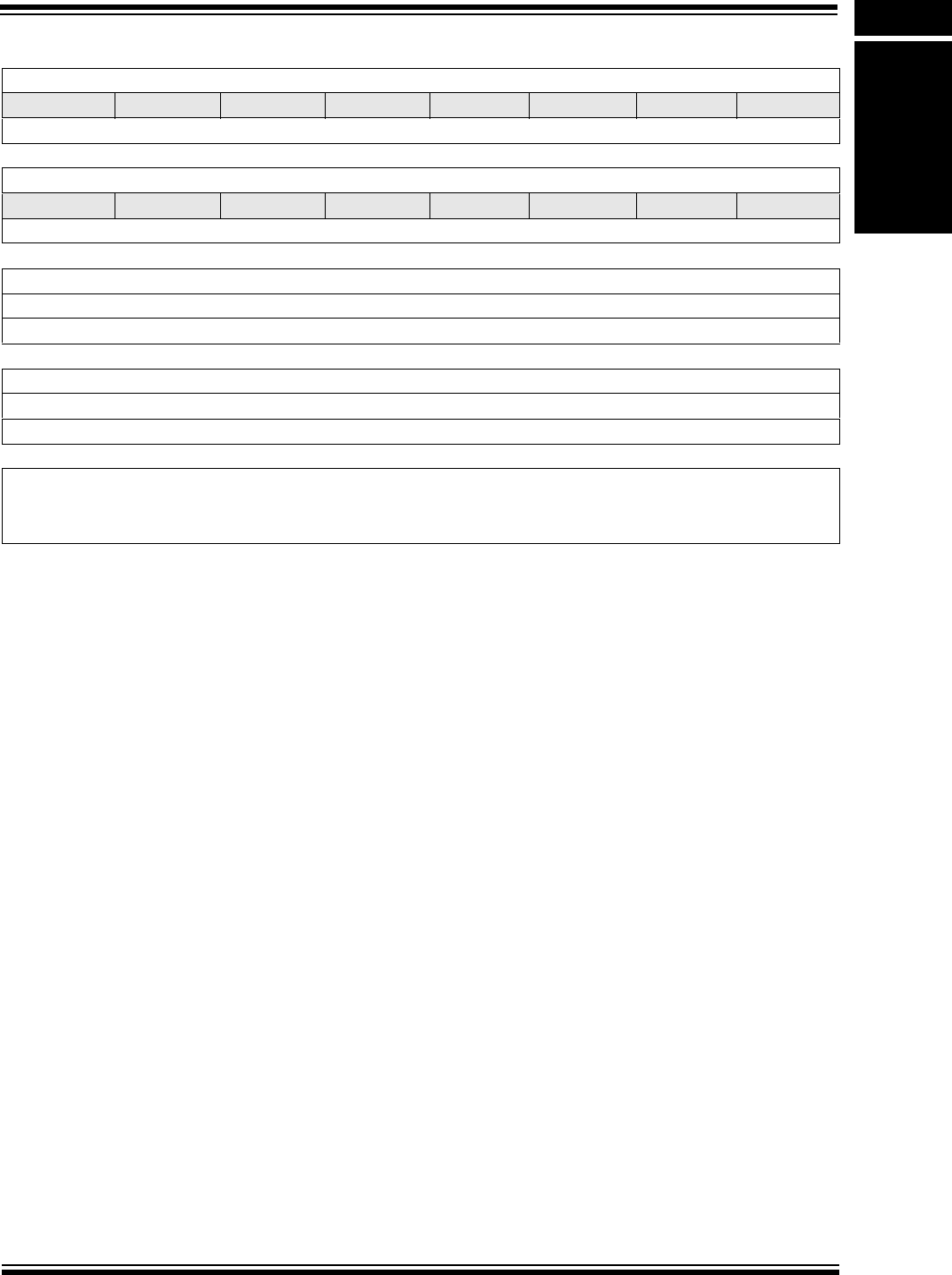
Register 31-12: DCHxSSIZ: DMA Channel x Source Size Register(1,2,3)
U-0 U-0 U-0 U-0 U-0 U-0 U-0 U-0
— — — — — — — —
bit 31 bit 24
U-0 U-0 U-0 U-0 U-0 U-0 U-0 U-0
— — — — — — — —
bit 23 bit 16
R/W-0 R/W-0 R/W-0 R/W-0 R/W-0 R/W-0 R/W-0 R/W-0
CHSSIZ<15:8>(4)
bit 15 bit 8
R/W-0 R/W-0 R/W-0 R/W-0 R/W-0 R/W-0 R/W-0 R/W-0
CHSSIZ<7:0>(4)
bit 7 bit 0
Legend:
R = Readable bit W = Writable bit P = Programmable bit r = Reserved bit
U = Unimplemented bit -n = Bit Value at POR: (‘0’, ‘1’, x = Unknown)
bit 31-16 Unimplemented: Read as ‘0’
bit 15-0 CHSSIZ<15:0>: Channel Source Size bits(4)
1111111111111111 = 65,535 byte source size
•
•
•
0000000000000010 = 2 byte source size
0000000000000001 = 1 byte source size
0000000000000000 = 65,536 byte source size
Note 1: This register has an associated Clear register (DCHxSSIZCLR) at an offset of 0x4 bytes. Writing a ‘1’ to
any bit position in the Clear register will clear valid bits in the associated register. Reads from the Clear
register should be ignored.
2: This register has an associated Set register (DCHxSSIZSET) at an offset of 0x8 bytes. Writing a ‘1’ to any
bit position in the Set register will set valid bits in the associated register. Reads from the Set register
should be ignored.
3: This register has an associated Invert register (DCHxSSIZINV) at an offset of 0xC bytes. Writing a ‘1’ to
any bit position in the Invert register will invert valid bits in the associated register. Reads from the Invert
register should be ignored.
4: Depending on the device variant, not all bits are available. Refer to the specific device data sheet for more
details.
© 2010 Microchip Technology Inc. DS61117F-page 31-25
Section 31. DMA Controller
DMA Controller
31
Register 31-13: DCHxDSIZ: DMA Channel x Destination Size Register(1,2,3)
U-0 U-0 U-0 U-0 U-0 U-0 U-0 U-0
— — — — — — — —
bit 31 bit 24
U-0 U-0 U-0 U-0 U-0 U-0 U-0 U-0
— — — — — — — —
bit 23 bit 16
R/W-0 R/W-0 R/W-0 R/W-0 R/W-0 R/W-0 R/W-0 R/W-0
CHDSIZ<15:8>(4)
bit 15 bit 8
R/W-0 R/W-0 R/W-0 R/W-0 R/W-0 R/W-0 R/W-0 R/W-0
CHDSIZ<7:0>(4)
bit 7 bit 0
Legend:
R = Readable bit W = Writable bit P = Programmable bit r = Reserved bit
U = Unimplemented bit -n = Bit Value at POR: (‘0’, ‘1’, x = Unknown)
bit 31-16 Unimplemented: Read as ‘0’
bit 15-0 CHDSIZ<15:0>: Channel Destination Size bits(4)
1111111111111111 = 65,535 byte destination size
•
•
•
0000000000000010 = 2 byte destination size
0000000000000001 = 1 byte destination size
0000000000000000 = 65,536 byte destination size
Note 1: This register has an associated Clear register (DCHxDSIZCLR) at an offset of 0x4 bytes. Writing a ‘1’ to
any bit position in the Clear register will clear valid bits in the associated register. Reads from the Clear
register should be ignored.
2: This register has an associated Set register (DCHxDSIZSET) at an offset of 0x8 bytes. Writing a ‘1’ to any
bit position in the Set register will set valid bits in the associated register. Reads from the Set register
should be ignored.
3: This register has an associated Invert register (DCHxDSIZINV) at an offset of 0xC bytes. Writing a ‘1’ to
any bit position in the Invert register will invert valid bits in the associated register. Reads from the Invert
register should be ignored.
4: Depending on the device variant, not all bits are available. Refer to the specific device data sheet for more
details.

PIC32MX Family Reference Manual
DS61117F-page 31-26 © 2010 Microchip Technology Inc.
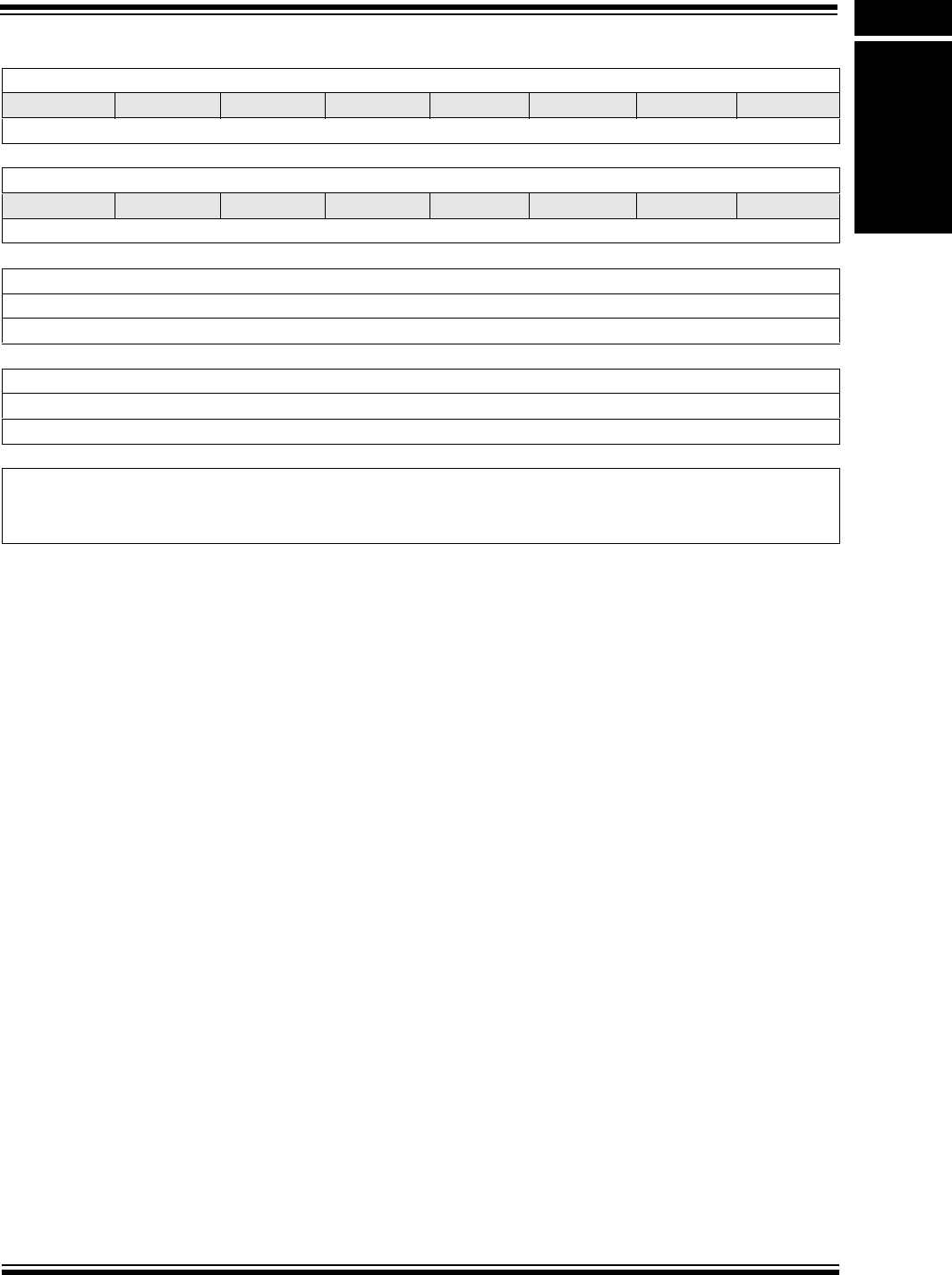
Register 31-14: DCHxSPTR: DMA Channel x Source Pointer Register(1)
U-0 U-0 U-0 U-0 U-0 U-0 U-0 U-0
— — — — — — — —
bit 31 bit 24
U-0 U-0 U-0 U-0 U-0 U-0 U-0 U-0
— — — — — — — —
bit 23 bit 16
R-0 R-0 R-0 R-0 R-0 R-0 R-0 R-0
CHSPTR<15:8>(2)
bit 15 bit 8
R-0 R-0 R-0 R-0 R-0 R-0 R-0 R-0
CHSPTR<7:0>(2)
bit 7 bit 0
Legend:
R = Readable bit W = Writable bit P = Programmable bit r = Reserved bit
U = Unimplemented bit -n = Bit Value at POR: (‘0’, ‘1’, x = Unknown)
bit 31-16 Unimplemented: Read as ‘0’
bit 15-0 CHSPTR<15:0>: Channel Source Pointer bits(2)
1111111111111111 = Points to byte 65,535 of the source
•
•
•
0000000000000001 = Points to byte 1 of the source
0000000000000000 = Points to byte 0 of the source
Note 1: When in Pattern Detect mode, this register is reset on a pattern detect.
2: Depending on the device variant, not all bits are available. Refer to the specific device data sheet for more
details.
© 2010 Microchip Technology Inc. DS61117F-page 31-27
Section 31. DMA Controller
DMA Controller
31
Register 31-15: DCHxDPTR: DMA Channel x Destination Pointer Register
U-0 U-0 U-0 U-0 U-0 U-0 U-0 U-0
— — — — — — — —
bit 31 bit 24
U-0 U-0 U-0 U-0 U-0 U-0 U-0 U-0
— — — — — — — —
bit 23 bit 16
R-0 R-0 R-0 R-0 R-0 R-0 R-0 R-0
CHDPTR<15:8>(1)
bit 15 bit 8
R-0 R-0 R-0 R-0 R-0 R-0 R-0 R-0
CHDPTR<7:0>(1)
bit 7 bit 0
Legend:
R = Readable bit W = Writable bit P = Programmable bit r = Reserved bit
U = Unimplemented bit -n = Bit Value at POR: (‘0’, ‘1’, x = Unknown)
bit 31-16 Unimplemented: Read as ‘0’
bit 15-0 CHDPTR<15:0>: Channel Destination Pointer bits(1)
1111111111111111 = Points to byte 65,535 of the destination
•
•
•
0000000000000001 = Points to byte 1 of the destination
0000000000000000 = Points to byte 0 of the destination
Note 1: Depending on the device variant, not all bits are available. Refer to the specific device data sheet for more
details.

PIC32MX Family Reference Manual
DS61117F-page 31-28 © 2010 Microchip Technology Inc.
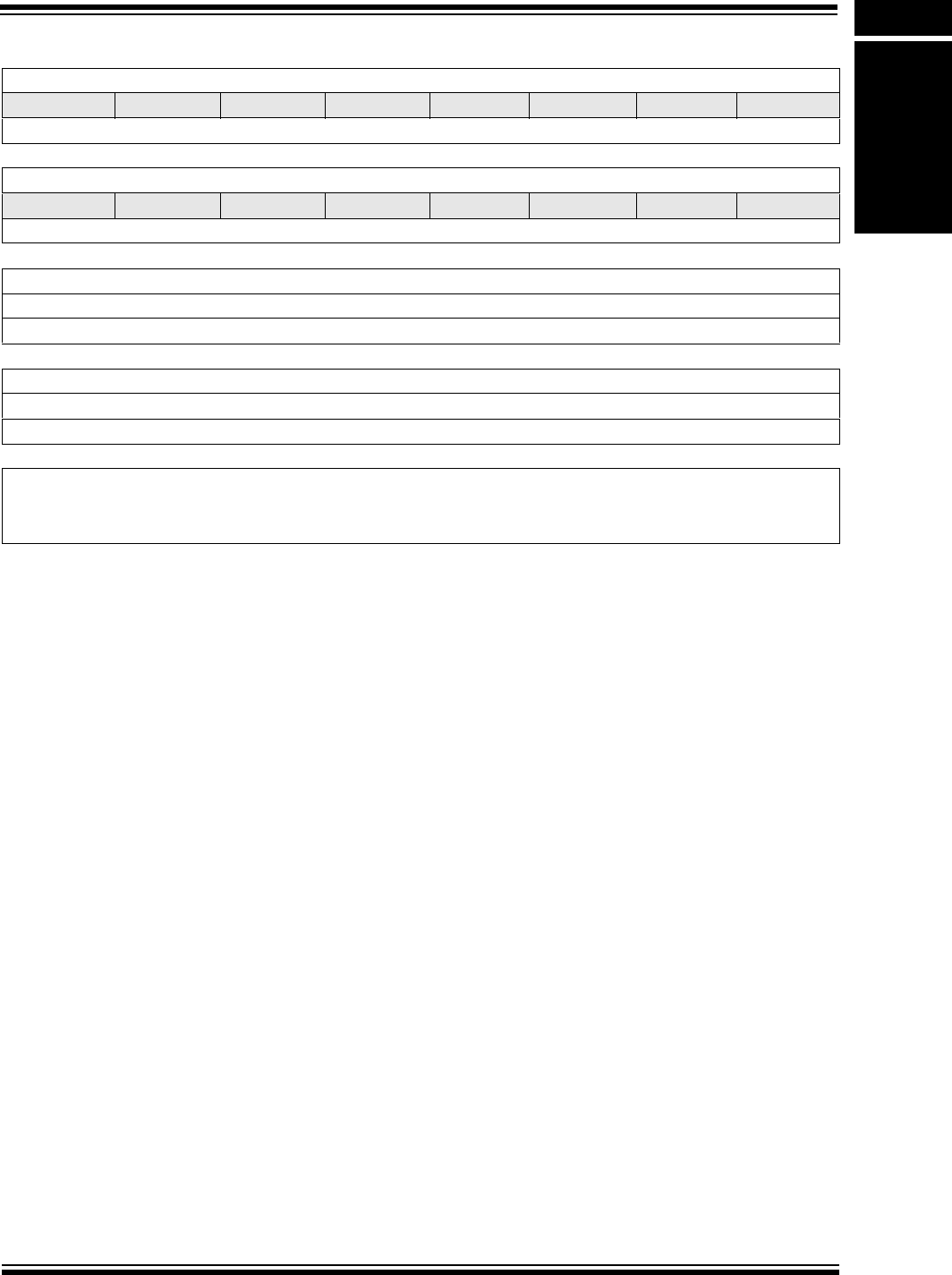
Register 31-16: DCHxCSIZ: DMA Channel x Cell-Size Register(1,2,3)
U-0 U-0 U-0 U-0 U-0 U-0 U-0 U-0
— — — — — — — —
bit 31 bit 24
U-0 U-0 U-0 U-0 U-0 U-0 U-0 U-0
— — — — — — — —
bit 23 bit 16
R/W-0 R/W-0 R/W-0 R/W-0 R/W-0 R/W-0 R/W-0 R/W-0
CHCSIZ<15:8>(4)
bit 15 bit 8
R/W-0 R/W-0 R/W-0 R/W-0 R/W-0 R/W-0 R/W-0 R/W-0
CHCSIZ<7:0>(4)
bit 7 bit 0
Legend:
R = Readable bit W = Writable bit P = Programmable bit r = Reserved bit
U = Unimplemented bit -n = Bit Value at POR: (‘0’, ‘1’, x = Unknown)
bit 31-16 Unimplemented: Read as ‘0’
bit 15-0 CHCSIZ<15:0>: Channel Cell-Size bits(4)
1111111111111111 = 65,535 bytes transferred on an event
•
•
•
0000000000000010 = 2 bytes transferred on an event
0000000000000001= 1 byte transferred on an event
0000000000000000 = 65,536 bytes transferred on an event
Note 1: This register has an associated Clear register (DCHxCSIZCLR) at an offset of 0x4 bytes. Writing a ‘1’ to
any bit position in the Clear register will clear valid bits in the associated register. Reads from the Clear
register should be ignored.
2: This register has an associated Set register (DCHxCSIZSET) at an offset of 0x8 bytes. Writing a ‘1’ to any
bit position in the Set register will set valid bits in the associated register. Reads from the Set register
should be ignored.
3: This register has an associated Invert register (DCHxCSIZINV) at an offset of 0xC bytes. Writing a ‘1’ to
any bit position in the Invert register will invert valid bits in the associated register. Reads from the Invert
register should be ignored.
4: Depending on the device variant, not all bits are available. Refer to the specific device data sheet for more
details.
© 2010 Microchip Technology Inc. DS61117F-page 31-29
Section 31. DMA Controller
DMA Controller
31
Register 31-17: DCHxCPTR: DMA Channel x Cell Pointer Register(1)
U-0 U-0 U-0 U-0 U-0 U-0 U-0 U-0
— — — — — — — —
bit 31 bit 24
U-0 U-0 U-0 U-0 U-0 U-0 U-0 U-0
— — — — — — — —
bit 23 bit 16
R-0 R-0 R-0 R-0 R-0 R-0 R-0 R-0
CHCPTR<15:8>(2)
bit 15 bit 8
R-0 R-0 R-0 R-0 R-0 R-0 R-0 R-0
CHCPTR<7:0>(2)
bit 7 bit 0
Legend:
R = Readable bit W = Writable bit P = Programmable bit r = Reserved bit
U = Unimplemented bit -n = Bit Value at POR: (‘0’, ‘1’, x = Unknown)
bit 31-16 Unimplemented: Read as ‘0’
bit 15-0 CHCPTR<7:0>: Channel Cell Progress Pointer bits(2)
1111111111111111 = 65,535 bytes have been transferred since the last event
•
•
•
0000000000000001 = 1 byte has been transferred since the last event
0000000000000000 = 0 bytes have been transferred since the last event
Note 1: When in Pattern Detect mode, this register is reset on a pattern detect.
2: Depending on the device variant, not all bits are available. Refer to the specific device data sheet for more
details.

PIC32MX Family Reference Manual
DS61117F-page 31-30 © 2010 Microchip Technology Inc.
Register 31-18: DCHxDAT: DMA Channel x Pattern Data Register(1,2,3)
U-0 U-0 U-0 U-0 U-0 U-0 U-0 U-0
— — — — — — — —
bit 31 bit 24
U-0 U-0 U-0 U-0 U-0 U-0 U-0 U-0
— — — — — — — —
bit 23 bit 16
U-0 U-0 U-0 U-0 U-0 U-0 U-0 U-0
— — — — — — — —
bit 15 bit 8
R/W-0 R/W-0 R/W-0 R/W-0 R/W-0 R/W-0 R/W-0 R/W-0
CHPDAT<7:0>
bit 7 bit 0
Legend:
R = Readable bit W = Writable bit P = Programmable bit r = Reserved bit
U = Unimplemented bit -n = Bit Value at POR: (‘0’, ‘1’, x = Unknown)
bit 31-8 Unimplemented: Read as ‘0’
bit 7-0 CHPDAT<7:0>: Channel Data Register bits
Pattern Terminate mode:
Data to be matched must be stored in this register to allow terminate on match.
All other modes:
Unused.
Note 1: This register has an associated Clear register (DCHxDATCLR) at an offset of 0x4 bytes. Writing a ‘1’ to
any bit position in the Clear register will clear valid bits in the associated register. Reads from the Clear
register should be ignored.
2: This register has an associated Set register (DCHxDATSET) at an offset of 0x8 bytes. Writing a ‘1’ to any
bit position in the Set register will set valid bits in the associated register. Reads from the Set register
should be ignored.
3: This register has an associated Invert register (DCHxDATINV) at an offset of 0xC bytes. Writing a ‘1’ to
any bit position in the Invert register will invert valid bits in the associated register. Reads from the Invert
register should be ignored.

© 2010 Microchip Technology Inc. DS61117F-page 31-31
Section 31. DMA Controller
DMA Controller
31
31.3 MODES OF OPERATION
The DMA module offers the following operating modes:
• Basic Transfer mode
• Pattern Match Termination mode
• Channel Chaining mode
• Channel Auto-Enable mode
• Special Function Module (SFM) mode: LFSR CRC, IP header checksum
Note that these operation modes are not mutually exclusive, but can be simultaneously
operational. For example, the DMA controller can perform CRC calculation using chained
channels and terminating the transfer upon a pattern match.
The following terminology is used while describing the various operational modes of the DMA
Controller:
Event: Any system event that can initiate or abort a DMA transfer.
Transaction: A single word transfer (up to 4 bytes), comprised of read and write operations.
Cell Transfer: The number of bytes transferred when a DMA channel has a transfer initiated
before waiting for another event (given by the DCHxCSIZ register). A cell transfer is comprised
of one or more transactions.
Block Transfer: Defined as the number of bytes transferred when a channel is enabled. The
number of bytes is the larger of either DCHxSSIZ or DCHxDSIZ. A block transfer is comprised
of one or more cell transfers.
31.3.1 Basic Transfer Mode
A DMA channel will transfer data from a source register to a destination register without CPU
intervention. The Channel Source Start Address register (DCHxSSA) defines the physical start
address of the source. The Channel Destination Start Address register (DCHxDSA) defines the
physical start address of the destination. Both the source and destination are independently
configurable using the DCHxSSIZ and DCHxDSIZ registers.
A cell transfer is initiated in one of two ways:
• Software can initiate a transfer by setting the channel CFORCE bit (DCHxECON<7>)
• Interrupt event occurs on the device that matches the CHSIRQ interrupt and SIRQEN = 1
(DCHxECON<4>). The user can select any interrupt on the device to start a DMA transfer
A DMA transfer will transfer DCHxCSIZ (cell transfer) bytes when a transfer is initiated (an
event occurs). The channel remains enabled until the DMA channel has transferred the larger of
DCHxSSIZ and DCHxDSIZ (i.e., block transfer is complete). If DCHxCSIZ is greater than the
larger of DCHxSSIZ and DCHxDSIZ, then the larger of DCHxSSIZ and DCHxDSIZ bytes will be
transferred. When the channel is disabled, further transfers will be prohibited until the channel is
re-enabled (CHEN is set to ‘1’).
Each channel keeps track of the number of words transferred from the source and destination
using the pointers DCHxSPTR and DCHxDPTR. Interrupts are generated when the source or
Destination Pointer is half of the size (DCHxSSIZ/2 or DCHxDSIZ/2), or when the source or
destination counter reaches the end. These interrupts are CHSHIF (DCHxINT<6>), CHDHIF
(DCHxINT<4>), CHSDIF (DCHxINT<7>) or CHDDIF (DCHxINT<5>), respectively.
A DMA transfer request can be reset by the following:
• Writing the CABORT bit (DCHxECON<6>)
• Pattern match occurs if pattern match is enabled as described in 31.3.2 “Pattern Match
Termination Mode”, provided that Channel Auto-Enable mode bit CHAEN
(DCHxCON<4>), is not set
• Interrupt event occurs on the device that matches the CHAIRQ <7:0> bits (DCHxECON<23:16>)
interrupt if enabled by AIRQEN bit (DCHxECON<3>)
• Detection of an address error
• Completion of a cell transfer
• A block transfer completes and the Channel Auto-Enable mode (CHAEN) is not set

PIC32MX Family Reference Manual
DS61117F-page 31-32 © 2010 Microchip Technology Inc.
When a channel abort interrupt occurs, the Channel Transfer Abort Interrupt Flag CHTAIF bit
(DCHxINT<1>) is set. This allows the user to detect and recover from an aborted DMA transfer.
When a transfer is aborted, any transaction currently underway will be completed.
The Source and Destination Pointers are updated as a transfer progresses. These pointers are
read-only. The pointers are reset under the following conditions:
• If the channel source address (DCHxSSA) is updated, the Source Pointer (DCHxSPTR)
will be reset
• Similar updates to the destination address (DCHxDSA) will cause the Destination Pointer
(DCHxDPTR) to be reset
• A channel transfer is aborted by writing the CABORT bit (DCHxECON<6>)
Example 31-1: DMA Channel Initialization for Basic Transfer Mode Code Example
Note: Refer to Ta bl e 31 -5 for more detailed information about the channel event behavior.
/*
The following code example illustrates the DMA channel 0 configuration for a data transfer.
*/
IEC1CLR=0x00020000; // disable DMA channel 0 interrupts
IFS1CLR=0x00020000; // clear existing DMA channel 0 interrupt flag
IEC1CLR=0x00010000; // disable DMA channel 0 interrupts
IFS1CLR=0x00010000; // clear existing DMA channel 0 interrupt flag
DMACONSET=0x00008000; // enable the DMA controller
DCH0CON=0x3; // channel off, pri 3, no chaining
CH0ECON=0; // no start or stop irq’s, no pattern match
// program the transfer
DCH0SSA=0x1d010000; // transfer source physical address
DCH0DSA=0x1d020000; // transfer destination physical address
DCH0SSIZ=200; // source size 200 bytes
DCH0DSIZ=200; // destination size 200 bytes
DCH0CSIZ=200; // 200 bytes transferred per event
DCH0INTCLR=0x00ff00ff; // clear existing events, disable all interrupts
DCH0CONSET=0x80; // turn channel on
// initiate a transfer
DCH0ECONSET=0x00000080; // set CFORCE to 1
// do something else
// poll to see that the transfer was done
while(TRUE)
{
register int pollCnt; // use a poll counter.
// continuously polling the DMA controller in a tight
// loop would affect the performance of the DMA transfer
int dmaFlags=DCH0INT;
if( (dmaFlags&0xb)
{ // one of CHERIF (DCHxINT<0>), CHTAIF (DCHxINT<1>)
// or CHBCIF (DCHxINT<3>) flags set
break; // transfer completed
}
pollCnt=100; // use an adjusted value here
while(pollCnt--); // wait before reading again the DMA controller
}
// check the transfer completion result

© 2010 Microchip Technology Inc. DS61117F-page 31-33
Section 31. DMA Controller
DMA Controller
31
31.3.1.1 Interrupt and Pointer Updates
The Source and Destination Pointers are updated after every transaction. Interrupts will also be
set or cleared at this time. If a pointer passes the halfway point during a transaction, the
interrupt will be updated accordingly.
Pointers are reset when any of the following occurs:
• On any device Reset
• When the DMA is turned off (ON bit (DMACON<15>)) is ‘0’
• A block transfer completes, regardless of the state of CHAEN bit (DCHxCON<4>)
• A pattern match terminates a transfer, regardless of the state of CHAEN bit
(DCHxCON<4>)
• The CABORT bit (DCHxECON<6>) flag is written
• Source or destination start addresses are updated
31.3.2 Pattern Match Termination Mode
Pattern Match Termination mode allows the user to end a transfer if a byte of data written during
a transaction matches a specific pattern, as defined by the DCHxDAT register. A pattern match
is treated the same way as a block transfer complete, where the CHBCIF bit (DCHxINT<3>) is
set and the CHEN bit (DCHxCON<7>) is cleared.
This feature is useful in applications where a variable data size is required and eases the set up
of the DMA channel. UART is a good example of where this can be effectively used.
Assuming a system has a series of messages that are routinely transmitted to an external host
and it has a maximum message size of 86 characters, the user would set the following
parameters on the channel:
• DCHxSSIZ to 87 bytes:
If something unexpected occurs the CPU program will be interrupted when the buffer
overflows and can take the appropriate action.
• DCHxDSIZ set to 1 byte.
• The destination address is set to the UART TXREG.
• The DCHxDAT is set to 0x00, which will stop the transfer on a NULL character in any byte
lane.
• The CHSIRQ bits (DCHxECON<15:8>) is set to the UART “transmit buffer empty” IRQ.
• The SIRQEN bit (DCHxECON<4>) is set to enable the channel to respond to the start
interrupt event.
• The start address is set to the start address of the message to be transferred.
• The channel is enabled, CHEN = 1 (DCHxCON<7>).
• The user will then force a cell transfer through CFORCE bit (DCHxECON<7>) and the first
byte transmission by the UART.
• Each time a byte is transmitted by the UART, the transmit buffer empty interrupt will initiate
the following byte transfer from the source to the UART.
• When the DMA channel detects a NULL character in any of the byte lanes of the channel,
the transaction will be completed and the channel disabled.
Pattern matching is independent of the byte lane of the source data. If ANY byte in the source
buffer matches DCHxDAT, a pattern match is detected. The transaction will be completed and
the data read from the source will be written to the destination.

PIC32MX Family Reference Manual
DS61117F-page 31-34 © 2010 Microchip Technology Inc.
Example 31-2: DMA Channel Initialization in Pattern Match Transfer Mode Code Example
/*
The following code example illustrates the DMA channel 0 configuration for data transfer with
pattern match enabled. Transfer from the UART1 a <CR> ended string, at most 200 characters long
*/
IEC1CLR=0x00020000; // disable DMA channel 0 interrupts
IFS1CLR=0x00020000; // clear any existing DMA channel 0 interrupt flag
IEC1CLR=0x00010000; // disable DMA channel 0 interrupts
IFS1CLR=0x00010000; // clear any existing DMA channel 0 interrupt flag
DMACONSET=0x00008000; // enable the DMA controller
DCH0CON=0x03; // channel off, priority 3, no chaining
DCH0ECON=(27 <<8)| 0x30; // start irq is UART1 RX, pattern match enabled
DCH0DAT=’\r’; // pattern value, carriage return
// program the transfer
DCH0SSA=VirtToPhys(&U1RXREG); // transfer source physical address
DCH0DSA=0x1d020000; // transfer destination physical address
DCH0SSIZ=1; // source size is 1 byte
DCH0DSIZ=200; // destination size at most 200 bytes
DCH0CSIZ=1; // one byte per UART transfer request
DCH0INTCLR=0x00ff00ff; // clear existing events, disable all interrupts
DCH0INTSET=0x00090000; // enable Block Complete and error interrupts
IPC9CLR=0x00001f00; // clear the DMA channel 0 priority and sub-priority
IPC9SET=0x00001600; // set IPL 5, sub-priority 2
IPC9CLR=0x0000001f; // clear the DMA channel 0 priority and sub-priority
IPC9SET=0x00000016; // set IPL 5, sub-priority 2
IEC1SET=0x00020000; // enable DMA channel 0 interrupt
IEC1SET=0x00010000; // enable DMA channel 0 interrupt
DCH0CONSET=0x80; // turn channel on

© 2010 Microchip Technology Inc. DS61117F-page 31-35
Section 31. DMA Controller
DMA Controller
31
31.3.3 Channel Chaining Mode
Channel chaining is an enhancement to the DMA channel operation. A channel (slave channel)
can be chained to an adjacent channel (master channel). The slave channel will be enabled
when a block transfer of the master channel completes (i.e., CHBCIF bit (DCHxINT<3>) is set).
At this point, any event on the slave channel will initiate a cell transfer. If the channel has an
event pending, a cell transfer will begin immediately.
The master channel will set its interrupt flags normally, CHBCIF bit (DCHxINT<3>) and has no
knowledge of the “chain” status of the slave channel. The master channel is still able to cause
interrupts at the end of a DMA transfer if one of the CHSDIE/CHDDIE/CHBCIE bits
(DCHxINT<23/21/19>) is set.
In the channels natural priority order, channel 0 has the highest priority and channel 7 the
lowest. The channel higher or lower in natural priority, that can enable a specific channel, is
selected by CHCHNS bit (DCHxCON<8>), provided that channel chaining is enabled,
CHCHN = 1 (DCHxCON<5>).
A feature of the DMA module is the ability to allow events while the channel is disabled using
the CHAED bit (DCHxCON<6>). This bit is particularly useful in Chained mode, in which the
slave channel needs to be ready to start a transfer as soon as the channel is enabled by the
master channel.
The following examples demonstrate situations in which chaining may be useful:
1. Transferring data in one peripheral (e.g., from UART1, DMA channel 0, at 9600 baud, to
SRAM) to another peripheral (e.g., from SRAM to UART2, DMA channel 1, at
19200 baud).
In this example, CHAED will be set in both channels; with UART2 setting the event detect,
CHEDET bit (DCHxCON<2>), on channel 1 when the last byte has been transmitted. As
soon as channel 0 completes a transfer, channel 1 is enabled and the data is
transferred immediately.
2. A/D converter transfers data to one buffer (connected to channel 0).
When the destination buffer 0 is full (block transfer completes), channel 1 is enabled and
further conversions are transferred to buffer 1. In this case, CHAED will not be enabled. If
it were, the last word transferred by channel 0 would be transferred a second time by
channel 1 (because the A/D converter interrupt event would have set the event detect flag
CHEDET in both channels).
Note: In some devices, channel 0 has the highest priority and channel 4 the lowest. Refer
to the specific device data sheet for availability.

PIC32MX Family Reference Manual
DS61117F-page 31-36 © 2010 Microchip Technology Inc.
Example 31-3: DMA Channel Initialization in Chaining Mode Code Example
/*
The following code example illustrates the DMA channel 0 configuration for data transfer with
pattern match enabled. DMA channel 0 transfer from the UART1 to a RAM buffer while DMA channel 1
transfers data from the RAM buffer to UART2. Transferred strings are at most 200 characters
long. Transfer on UART2 will start as soon as the UART1 transfer is completed.
*/
unsigned char myBuff<200>; // transfer buffer
IEC1CLR=0x00020000; // disable DMA channel 0 interrupts
IFS1CLR=0x00020000; // clear any existing DMA channel 0 interrupt flag
IEC1CLR=0x00010000; // disable DMA channel 0 interrupts
IFS1CLR=0x00010000; // clear any existing DMA channel 0 interrupt flag
DMACONSET=0x00008000; // enable the DMA controller
DCH0CON=0x3; // channel 0 off, priority 3, no chaining
DCH1CON=0x62; // channel 1 off, priority 2
// chain to higher priority
// (channel 0), enable events detection while disabled
DCH0ECON=(27 <<8)| 0x30; // start IRQ is UART1 RX, pattern enabled
DCH1ECON=(42 <<8)| 0x30; // start IRQ is UART1 TX, pattern enabled
DCH0DAT=DCH1DAT=’\r’; // pattern value, carriage return
// program channel 0 transfer
DCH0SSA=VirtToPhys(&U1RXREG); // transfer source physical address
DCH0DSA=VirtToPhys(myBuff); // transfer destination physical address
DCH0SSIZ=1; // source size is 1 byte
DCH0DSIZ=200; // dst size at most 200 bytes
DCH0CSIZ=1; // one byte per UART transfer request
// program channel 1 transfer
DCH1SSA=VirtToPhys(myBuff); // transfer source physical address
DCH1DSA=VirtToPhys(&U2TXREG); // transfer destination physical address
DCH1SSIZ=200; // source size at most 200 bytes
DCH1DSIZ=0; // dst size is 1 byte
DCH1CSIZ=1; // one byte per UART transfer request
DCH0INTCLR=0x00ff00ff; // DMA0: clear events, disable interrupts
DCH1INTCLR=0x00ff00ff; // DMA1: clear events, disable interrupts
DCH1INTSET=0x00090000; // DMA1: enable Block Complete and error interrupts
IPC9CLR=0x001f1f00; // clear the DMA channels 0 and 1 priority and
// sub-priority
IPC9SET=0x000b1600; // set IPL 5, sub-priority 2 for DMA channel 0
// set IPL 2, sub-priority 3 for DMA channel 1
IPC9CLR=0x00001f1f; // clear the DMA channels 0 and 1 priority and
// sub-priority
IPC9SET=0x00000b16; // set IPL 5, sub-priority 2 for DMA channel 0
// set IPL 2, sub-priority 3 for DMA channel 1
IEC1SET=0x00040000; // enable DMA channel 1 interrupt
IEC1SET=0x00020000; // enable DMA channel 1 interrupt
DCH0CONSET=0x80; // turn channel on
© 2010 Microchip Technology Inc. DS61117F-page 31-37
Section 31. DMA Controller
DMA Controller
31
31.3.4 Channel Auto-Enable Mode
The channel auto-enable can be used to keep a channel active, even if a block transfer
completes or pattern match occurs. This prevents the user from having to re-enable the channel
each time a block transfer completes. To use this mode the user will configure the channel,
setting the CHAEN bit (DCHxCON<4>) before enabling the channel (i.e., setting the CHEN bit
(DCHxCON<7>)). The channel will behave as normal except that normal termination of a
transfer will not result in the channel being disabled.
Normal block transfer completion is defined as:
• Block Transfer Complete
• Pattern Match Detect
As before, the Channel Pointers will be reset. This mode is useful for applications that do
repeated pattern matching.
Note: The CHAEN bit prevents the channel from being automatically disabled once it has
been enabled. The channel will still have to be enabled by the software.
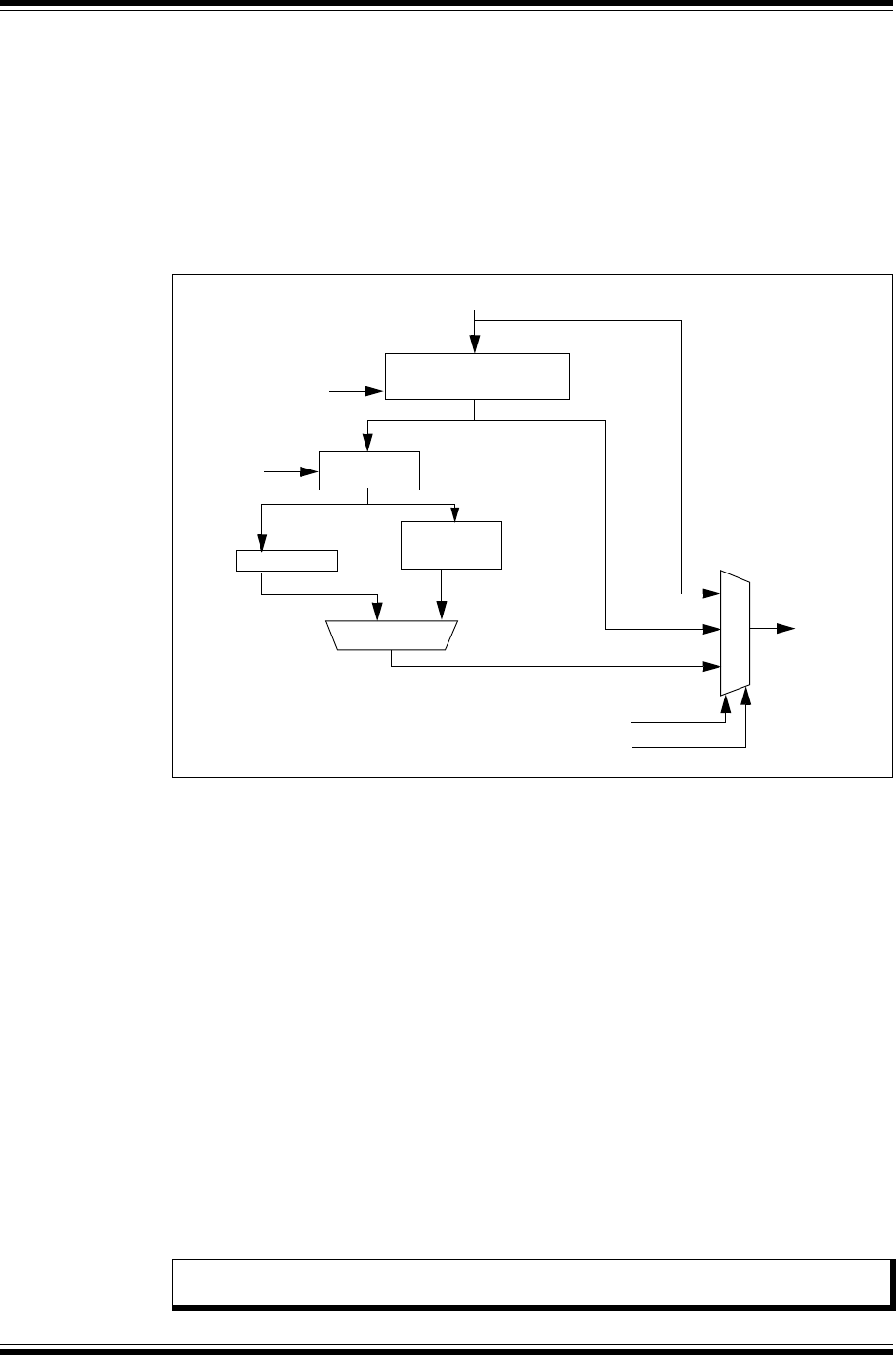
PIC32MX Family Reference Manual
DS61117F-page 31-38 © 2010 Microchip Technology Inc.
31.3.5 Special Function Module (SFM) Mode
The DMA module has one integrated Special Function Module (SFM) shared by all channels.
As illustrated in Figure 31-4, the SFM has the following blocks:
•LFSR CRC
• IP Header Checksum
• Byte Reordering
• Bit Reordering
Figure 31-4: Special Function Module (SFM)
Depending on the device variant, the SFM is a highly configurable, 16-bit or 32-bit CRC
generator. The SFM can be assigned to any available DMA channel by setting the CRCCH bits
(DCRCCON<2:0>) appropriately. The SFM is enabled by setting the CRCEN bit
(DCRCCON<7>).
The data from the source can be optionally subjected to byte reordering using the WBO bit. The
data is then optionally passed to the LFSR CRC or IP header checksum blocks based on the
setting of the CRCTYP bit (DCRCCON<15>), as illustrated in Figure 31-4.
Further, the SFM modifies the behavior of the DMA channel associated with the SFM. The
behavior of the channel is selected by the CRCAPP bit (DCRCCON<6>), resulting in the
following two modes:
• Background Mode: CRC is calculated in the background, with normal DMA behavior
maintained (see 31.3.5.1 “CRC Background Mode (CRCAPP = 0)”).
• Append Mode: Data read from the source is not written to the destination, but the CRC data
is accumulated in the CRC data register. The accumulated CRC is written to the location
given by DCHxDSA when a block transfer completes (see 31.3.5.2 “CRC Append Mode
(CRCAPP = 1)”).
The order in which data is written to the destination can be selected using the WBO bit
(DCRCCON<27>). If the WBO bit is cleared, the writes to the destination are unaltered. If the
WBO bit is set, the writes to the destination are reordered as defined by the CRC Byte Order
Selection (BYTO<1:0>) bits (DCRCCON<29:28>).
Note: This feature is not available on all devices. Refer to the specific device data sheet
for availability.
Data In
Byte
Reordering
LFSR CRC
BYTO
CRCDATA
CRCAPP
WBO
Data Out
Bit
Reordering
BITO
Note: CRCAPP = 1; WBO = 1 is invalid.
00
01
10
IP Header
Checksum

© 2010 Microchip Technology Inc. DS61117F-page 31-39
Section 31. DMA Controller
DMA Controller
31
The SFM generator can be seeded by writing to the DCRCDATA register before enabling the
channel.
Note that when in IP Header Checksum mode (CRCTYP = 1), data written reads back as the
1’s complement form as this is the current value of the checksum.
The CRC value in DCRCDATA can be read at any time during the CRC generation, but is only
valid once the transfer completes.
31.3.5.1 CRC BACKGROUND MODE (CRCAPP = 0)
In this mode, the behavior of the DMA channel is maintained. The DMA reads the data from the
source, passes it through the CRC module and writes it to the destination. Writes to the
destination obey the WBO selection. In this mode, the calculated CRC is left in the DCRCDATA
register at the end of the block transfer.
This mode can be used to calculate a CRC as data is moved from a source address to a
destination address. The data source can be either a memory buffer or a FIFO in a peripheral.
Likewise, the destination can be either a memory buffer or a FIFO. When the data transfer
completes, the user can read the calculated CRC value and either append it to the transmitted
data or verify the received CRC data.
Background mode potentially ties up the CRC module for extended periods of time. For instance,
when assigned to a UART data stream, the SFM cannot be used by another channel until the
UART data stream completes.
Note 1: If a DMA Transfer is aborted while a CRC calculation is in progress, the DMA chan-
nel should be reset before the next CRC calculation is started. Alternatively, the
same channel or another unused channel can be configured to transfer two or more
bytes. The transfer should then be initiated and allowed to complete. The CRC
module is then ready for the next CRC calculation.
2: If a DMA channel is disabled (CHEN = 0) when a CRC calculation is in progress,
the value in the DCRCDATA register is not updated. The same channel or another
unused channel can be configured to transfer two or more bytes. The transfer
should then be initiated and allowed to complete. When the transfer is complete,
the DCRCDATA value will be correct for the number of byte processed prior to the
stop being issued. The DMA address register can be inspected to determine the
address range of the current CRC value.

PIC32MX Family Reference Manual
DS61117F-page 31-40 © 2010 Microchip Technology Inc.
Example 31-4: DMA LFSR CRC Calculation in Background Mode Code Example
/*
The following code example illustrates a DMA calculation using the CRC background mode. Data is
transferred from a 200 bytes Flash buffer to a RAM buffer and the CRC is calculated while the
transfer takes place. */
unsigned int blockCrc; // CRC of the flash block
IEC1CLR=0x00020000; // disable DMA channel 0 interrupts
IFS1CLR=0x00020000; // clear any existing DMA channel 0 interrupt flag
IEC1CLR=0x00010000; // disable DMA channel 0 interrupts
IFS1CLR=0x00010000; // clear any existing DMA channel 0 interrupt flag
DMACONSET=0x00008000; // enable the DMA controller
DCRCDATA=0xffff; // seed the CRC generator
DCRCXOR=0x1021; // Use the standard CCITT CRC 16 polynomial: X^16+X^12+X^5+1
DCRCCON=0x0f80; // CRC enabled, polynomial length 16, background mode
// CRC attached to the DMA channel 0.
DCH0CON=0x03; // channel off, priority 3, no chaining
DCH0ECON=0; // no start irqs, no match enabled
// program channel transfer
DCH0SSA=VirtToPhys(flashBuff); // transfer source physical address
DCH0DSA=VirtToPhys(ramBuff); // transfer destination physical address
DCH0SSIZ=200; // source size
DCH0DSIZ=200; // destination size
DCHOCSIZ=200; // 200 bytes per event
DCH0INTCLR=0x00ff00ff; // DMA0: clear events, disable interrupts
DCH0CONSET=0x80; // channel 0 on
// initiate a transfer
DCH0ECONSET=0x00000080; // set CFORCE to 1
// do something else while the transfer takes place
// poll to see that the transfer was done
BOOL error=FALSE;
while(TRUE)
{
register int pollCnt; // don’t poll in a tight loop
int dmaFlags=DCH0INT;
if( (dmaFlags& 0x3)
{ // CHERIF (DCHxINT<0>) or CHTAIF (DCHxINT<1> set
error=TRUE; // error or aborted...
break;
}
else if (dmaFlags&0x8)
{ // CHBCIF (DCHxINT<3>) set
break; // transfer completed normally
}
pollCnt=100; // use an adjusted value here
while(pollCnt--); // wait before polling again
}
if(!error)
{
blockCrc=DCRDATA; // read the CRC of the transferred flash block
}
else
{
// process error
}

© 2010 Microchip Technology Inc. DS61117F-page 31-41
Section 31. DMA Controller
DMA Controller
31
31.3.5.2 CRC APPEND MODE (CRCAPP = 1)
In this mode, the DMA only feeds source data to the CRC module; it does not write source data
to the destination address. However, when the block transfer completes or a pattern match
occurs, the DMA writes the CRC value to the destination address.
This mode is best used when multiple peripherals are required to use the CRC generator. In this
case, the input data is accumulated in a buffer on the device. Once the buffer is complete the
CRC is generated on the buffer and used appropriately. Because the DMA does not need to wait
for multiple events (typically interrupts) a block of data is passed through the CRC in fairly short
order, allowing the CRC module to be assigned to a different channel, or redirected to a different
block of data.
The following usage notes apply to CRC Append mode:
• Only the source buffer is viewed when considering whether a block transfer is complete,
the destination address (DCHxDSA) is only used as the location to write the generated
CRC value.
• The destination size (DCHxDSIZ) can be a maximum of 4.
- If DCHxDSIZ is greater than 4, only 4 bytes are written
- If DCHxDSIZ is less than 4, only DCHxDSIZ bytes of the CRC are written
- PLEN bit has no effect on the number of CRC bytes or bits written
• After the write, the channel is disabled.
• Any abort (i.e., abort IRQ asserts) prevents the CRC value from being written
• Reordering is not supported in Append mode if WBO bit is set to ‘0’.

PIC32MX Family Reference Manual
DS61117F-page 31-42 © 2010 Microchip Technology Inc.
Example 31-5: CRC Calculation in Append Mode Code Example
/*
The following code example illustrates a DMA calculation using the CRC append mode. The CRC of
a 256 bytes flash buffer is calculated without performing any data transfer. As soon as the CRC
calculation is completed the CRC value of the flash buffer is available in a local variable for
further use. */
unsigned int blockCrc; // CRC of the flash block
IEC1CLR=0x00020000; // disable DMA channel 0 interrupts
IFS1CLR=0x00020000; // clear any existing DMA channel 0 interrupt flag
IEC1CLR=0x00010000; // disable DMA channel 0 interrupts
IFS1CLR=0x00010000; // clear any existing DMA channel 0 interrupt flag
DMACONSET=0x00008000; // enable the DMA controller
DCRCDATA=0xffff; // seed the CRC generator
DCRCXOR=0x1021; // Use the standard CCITT CRC 16 polynomial: X^16+X^12+X^5+1
DCRCCON=0x0fc0; // CRC enabled, polynomial length 16, append mode
// CRC attached to the DMA channel 0.
DCH0CON=0x03; // channel off, priority 3, no chaining
DCH0ECON=0; // no start irqs, no match enabled
// program channel transfer
DCH0SSA=VirtToPhys(flashBuff); // transfer source physical address
DCH0DSA=VirtToPhys(&blockCrc); // transfer destination physical address
DCH0SSIZ=200; // source size
DCH0DSIZ=200; // dst size
DCHOCSIZ=200; // 200 bytes transferred per event
DCH0INTCLR=0x00ff00ff; // DMA0: clear events, disable interrupts
DCH1INTCLR=0x00ff00ff; // DMA1: clear events, disable interrupts
DCH0CONSET=0x80; // channel 0 on
// initiate a transfer
DCH0ECONSET=0x00000080; // set CFORCE to 1
// do something else while the CRC calculation takes place
// poll to see that the transfer was done
BOOL error=FALSE;
while(TRUE)
{
register int pollCnt; // don’t poll in a tight loop
int dmaFlags=DCH0INT;
if( (dmaFlags& 0x3)
{ // CHERIF (DCHxINT<0>) or CHTAIF (DCHxINT<1> set
error=TRUE; // error or aborted...
break;
}
else if (dmaFlags&0x8)
{ // CHBCIF (DCHxINT<3>) set
break; // transfer completed normally
}
pollCnt=100; // use an adjusted value here
while(pollCnt--); // wait before polling again
}
if(error)
{
// process error
}
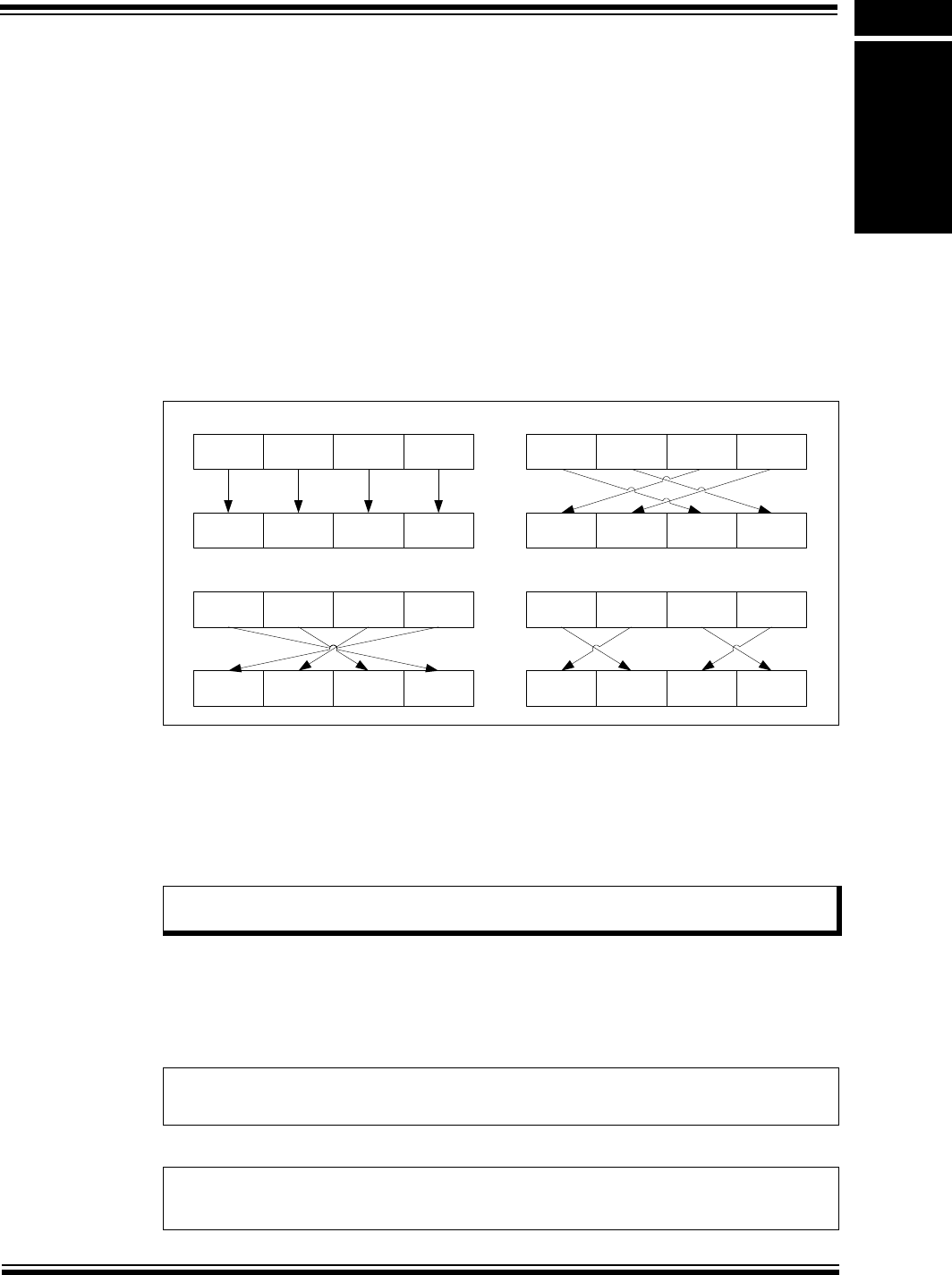
© 2010 Microchip Technology Inc. DS61117F-page 31-43
Section 31. DMA Controller
DMA Controller
31
31.3.5.3 DATA ORDER
Data read from the source can be reordered to allow for variations in the byte order of the source
data, such as endianness. The reordered source data is written to the channel destination when
WBO = 1. The unaltered source data is written to the destination when WBO = 0.
The CRC calculation takes place, even if the user does not utilize the result stored in
DCRCDATA.
BYTO controls the byte order of the data being processed by the module. Figure 31-5 shows the
different byte order settings and the effect on data reads. BYTO value of ‘01’ is useful for
reordering bytes within words. BYTO values of ‘10’ and ‘11’ are useful for reordering bytes within
half-words.
It is important to note that the data is reordered as it is read. This means that data that is not
word-aligned may not be reordered correctly.
When using the LFSR CRC mode or IP Header Checksum mode of the SFM, the bit order can
be changed by using the BITO bit.
Figure 31-5: Byte Order for BYTO Values
31.3.5.4 LFSR CRC
The CRC generator will take one system clock to process each byte of data read from the
source. This implies that if 32 bits of data are read from the source, the CRC generation will take
four system clocks to process the data.
When the CRYTYP bit is cleared, the SFM is set to LFSR CRC mode and calculates the LFSR
CRC.
The implementation of the CRC module is software configurable. The terms of the polynomial
and its length can be programmed using the DCRCXOR<31:0> bits and the PLEN<4:0> bits
(DCRCCON<12:8>), respectively.
Example 31-6 and Example 31-7 show the polynomials for the 16-bit and 32-bit CRC.
Example 31-6: 16-bit CRC Polynomial
Example 31-7: 32-bit CRC Polynomial
Note: This feature is not available on all devices. Refer to the specific device data sheet
for availability.
Byte3 Byte2 Byte1 Byte0
Byte3 Byte2 Byte1 Byte0
Byte3 Byte2 Byte1 Byte0
Byte3Byte2Byte1Byte0
Byte3 Byte2 Byte1 Byte0
Byte3 Byte2Byte1 Byte0
Byte3 Byte2 Byte1 Byte0
Byte3Byte2 Byte1Byte0
BYTO=00
BYTO=01 BYTO=11
BYTO=10
x16 x12 x51+++
x31 x26 x23 x22 x16 x12 x11 x10 x8x7x5x4x2x1++++++++++++++
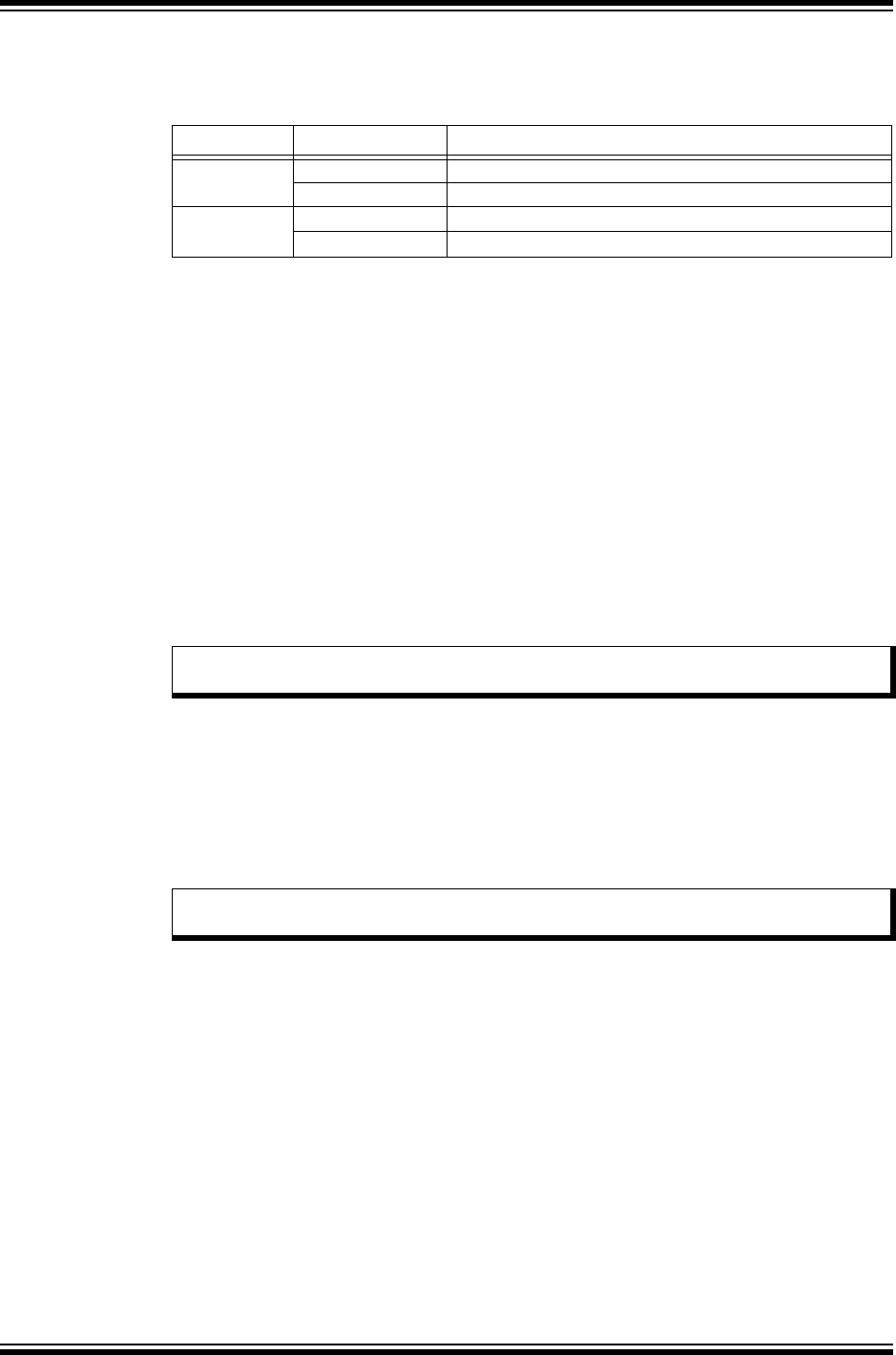
PIC32MX Family Reference Manual
DS61117F-page 31-44 © 2010 Microchip Technology Inc.
To program either polynomial into the CRC generator, the CRC register bits should be set as
shown in the following table:
The PLEN<4:0> bits (DCRCCON<12:8>) in the CRC generator are used to select which bit is
used as the feedback point of the CRC. For a 16-bit CRC example, if PLEN<4:0> = 0x0110, bit
6 of the Shift register is fed into the XOR gates of all bits set in the CRCXOR register.
The CRCXOR feedback points are specified using the DCRCXOR register. Setting the Nth bit in
the DCRCXOR register will enable the input to the Nth bit of the CRC Shift register to be XORed
with the (PLEN + 1)th bit of the CRC Shift register. Bit 0 of the CRC generator is always XORed.
31.3.5.5 CALCULATING THE IP HEADER CHECKSUM
When the CRCTYP bit is set, the SFM calculates the IP header checksum. Use the following
procedure to calculate the IP header checksum:
1. Configure a channel to point to the IP header.
2. Configure CRCCON to enable the SFM and select the channel being used.
3. Set the CRCTYP bit (DCRCCON<15>), which selects IP Header checksum.
4. Set DCRCDATA to ‘0000’.
5. Start the transfer.
6. When the transfer completes, read the data out of the DCRCDATA register.
31.3.6 Suspending Transfers
The user application can immediately suspend the DMA module by writing the SUSPEND bit
(DMACON<12>). This will immediately suspend the DMA controller from any further bus
transactions.
Depending on the device variant, when the DMA module is suspended by setting the
SUSPEND bit, the user application should poll the DMABUSY bit (DMACON<11>) to determine
when the module is completely suspended following the completion of the current transaction.
Individual channels may be suspended using the CHEN bit (DCHxCON<7>). If a DMA transfer
is in progress and the CHEN bit is cleared, the current transaction will be completed and further
transactions on the channel will be suspended.
Depending on the device variant, when the channel is suspended by clearing the CHEN bit, the
user application should poll the CHBUSY bit (DCHxCON<15>) to determine when the channel
is completely suspended following completion of the current transaction.
Clearing the enable bit (CHEN) will not affect the Channel Pointers or the transaction counters.
While a channel is suspended, the user can elect to continue to receive events (abort interrupts,
etc.) by setting CHAED bit (DCHxCON<6>).
Table 31-2: Example CRC Setup
CRC Type Bit Name Bit Value
Devices with
16-bit CRC
PLEN<3:0> ‘b1111
DCRCXOR<15:0> ‘b0001 0000 0010 000
Devices with
32-bit CRC
PLEN<4:0> ‘b11111
DCRCXOR<31:0> ‘b0000 0100 1100 0001 0001 1101 1011 0110
Note: This feature is not available on all devices. Refer to the specific device data sheet
for availability.
Note: The DMABUSY bit is not available on all device. Refer to the specific device data
sheet for availability.
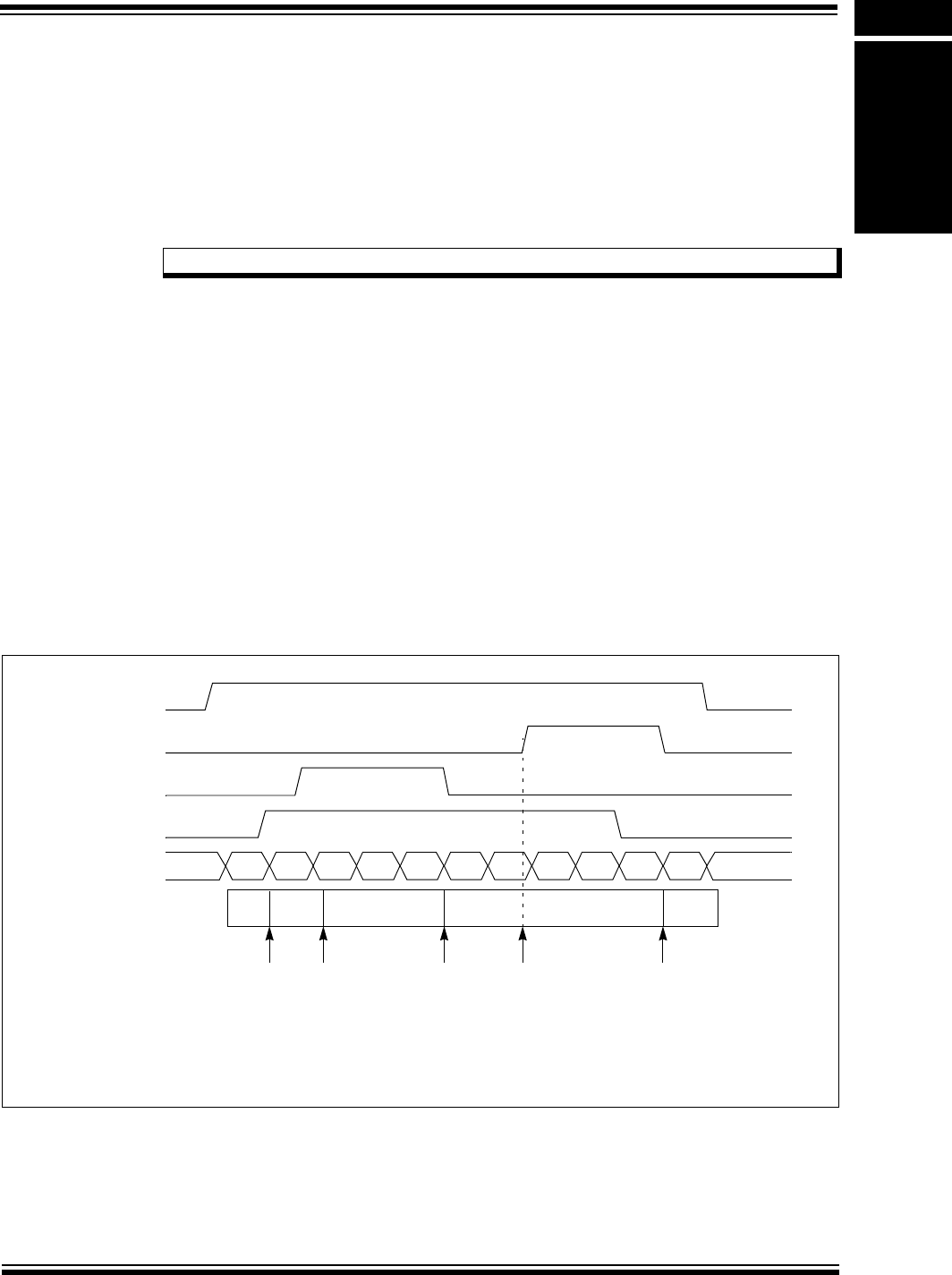
© 2010 Microchip Technology Inc. DS61117F-page 31-45
Section 31. DMA Controller
DMA Controller
31
31.3.7 Resetting the Channel
The channel logic will be reset on any device Reset. The channel is also reset when the channel
flag bit CABORT (DCHxECON<6>) is written. This will turn off channel flag bit CHEN = 0, clear
the Source and Destination Pointers, and reset the event detector. When the CABORT bit is set,
the current transaction in progress (if any) will complete before the channel is reset, but any
remaining transactions will be aborted.
The user should modify the channel registers only while the channel is disabled (CHEN = 0).
Modifying the Source and Destination registers will reset the corresponding pointer registers
(DCHxSPTR or DCHxDPTR).
31.3.8 Channel Priority and Selection
The DMA controller has a natural priority associated with each of the channels. Channel 0 has
the highest natural priority. The channel priority is defined by CHPRI<1:0> bits (DCHx-
CON<1:0>). These bits identify the channel’s priority. When multiple channels have transfers
pending, the next channel to transmit data will be selected as follows:
• Channels with the highest priority will complete all cell transfers before moving onto
channels with a lower priority (see behavior, “PRI3 xfers”, in Figure 31-6).
• If multiple channels have the same priority (identical CHPRI), the controller will cycle
through all channels at that priority. Each channel with a cell transfer in progress at the
highest priority will be allowed a single transaction of the active cell transfer before the
controller allows a single transaction by the next channel at that priority level (see behavior,
“PRI2 xfers” between markers “C” and “B”, in Figure 31-6).
• If a channel with a higher priority requests a transfer while another channel of lower priority
has a transaction in process, the transaction will complete before moving to the channel
with the higher priority (see events at markers “A” in Figure 31-6).
Figure 31-6: Channel Priority Behavior
Note: The channel size must be changed while the channel is disabled.
REQ: CH0, PRI0
REQ: CH1, PRI2
REQ: CH2, PRI3
REQ: CH3, PRI2
DMA Active Channel none 0 3 2 2 2 3 3 31 1 0 none
PRI0
xfers
PRI2
xfers
PRI0
xfers PRI3 xfers PRI2 xfers
Cycle through
CH1 and CH3
AA B C B
Transition Legend:
A – Higher priority transfer request; suspend current and transfer next.
B – All highest priority transfers complete; drop to channels at lower priority.
C – Cycle through all channels at the current priority.
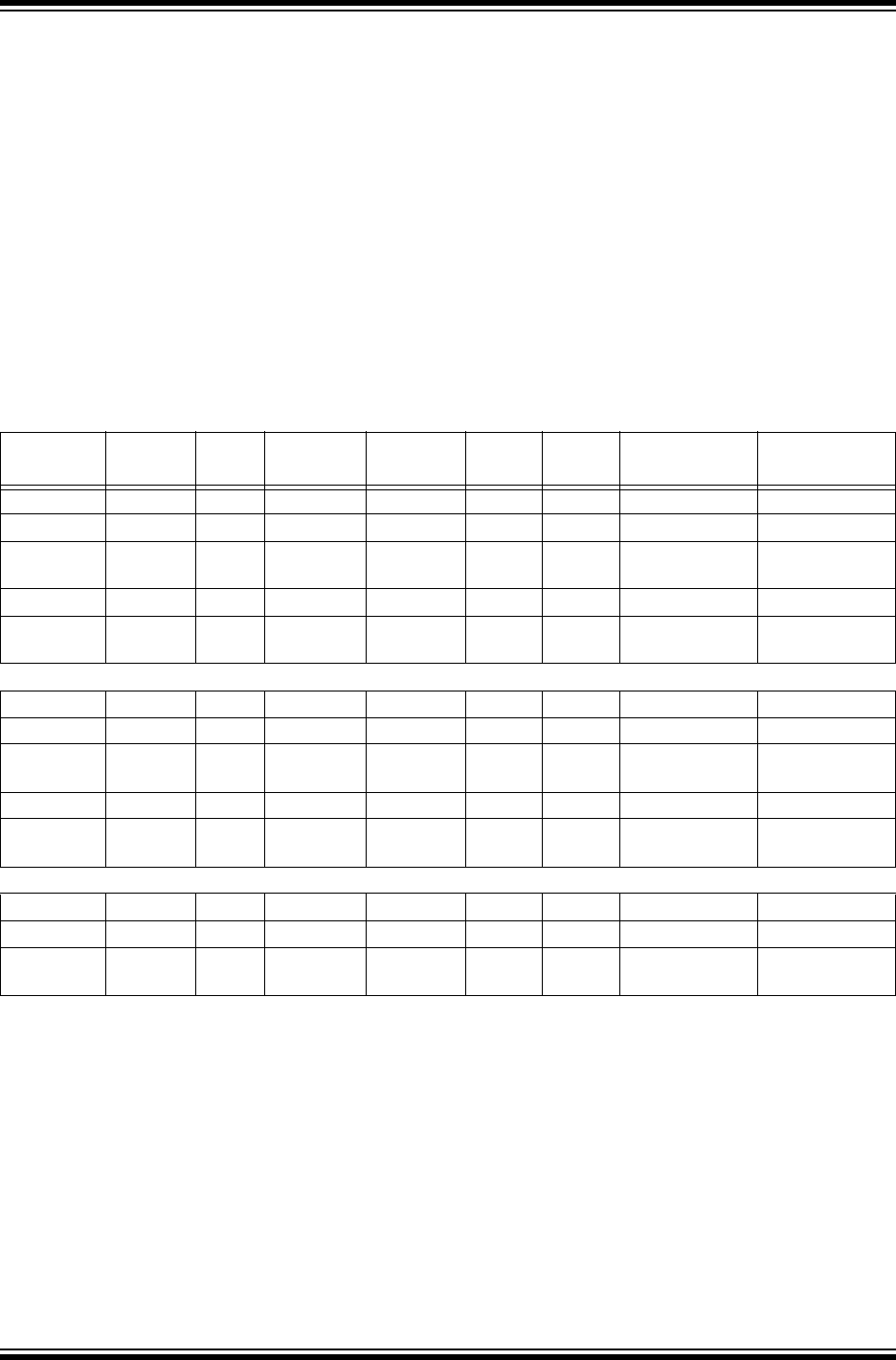
PIC32MX Family Reference Manual
DS61117F-page 31-46 © 2010 Microchip Technology Inc.
31.3.9 Byte Alignment
The byte alignment feature of the DMA controller relieves the user from aligning the source and
destination addresses.The read portion of a transaction will read the maximum number of bytes
that are available to be read in a given word. For example, if the Source Pointer is N > 4 bytes
from the source size, 4 bytes will be read if the Source Pointer points to byte 0, 3 bytes if the
Source Pointer points to byte 1, etc. If the number of bytes remaining in the source is N < 4, only
the first N bytes are read. This is important when the read includes registers that are updated on
a read.
The Source Pointer and Destination Pointers are updated after every write, with the number of
bytes that have been written. The user should note that in cases where a transfer is aborted,
before a transaction is complete, the Source Pointer will not necessarily reflect the reads that
have taken place.
An example of this behavior is given in Table 31-3. Example 1 demonstrates a simple transfer of
9 bytes between two large buffers, in which CHxSSA = 0x1000, CHxSSIZ = 100,
CHxDSA = 0x43F9, CHxDSIZ = 100 and CHxCSIZ = 9.
Table 31-3: Source and Destination Pointer Updates – Example 1
Transaction Operation Source
Pointer
Destination
Pointer
Transfer
Count/Size
Read
Address
Write
Address Read Data(1) Write Data(2)
1 Read 9 11 0/9 1009 xxxx(4) 33_22_11_XX YY_YY_YY_YY
1 Write1 9 11 0/9 1009 440A 33_22_11_XX 22_11_YY_YY
1Ptr
Update(3)
B 13 2/9 1009 440A 33_22_11_XX YY_YY_YY_YY
1 Write2 B 13 2/9 1009 440C 33_22_11_XX YY_YY_YY_33
1Ptr
Update(3)
C 14 3/9 1009 440C 33_22_11_XX YY_YY_YY_YY
2 Read C 14 3/9 100C 440C 77_66_55_44 YY_YY_YY_YY
2 Write1 C 14 3/9 100C 440D 77_66_55_44 66_55_44_YY
2Ptr
Update(3)
F 17 6/9 100C 440D 77_66_55_44 YY_YY_YY_YY
2 Write2 F 17 6/9 100C 4410 77_66_55_44 YY_YY_YY_77
2Ptr
Update(3)
10 18 7/9 100C 4410 77_66_55_44 YY_YY_YY_YY
3 Read 10 18 7/9 1010 4410 XX_XX_99_88 YY_YY_YY_YY
3 Write1 10 18 7/9 1010 4411 XX_XX_XX_88 YY_99_88_YY
3Ptr
Update(3)
12 1A 9/9 1010 4411 XX_XX_XX_88 YY_YY_YY_YY
Note 1: XX indicates that data read is discarded.
2: YY indicates that data that is NOT written.
3: Interrupts are updated when the pointers are updated as required.
4: Don’t care.
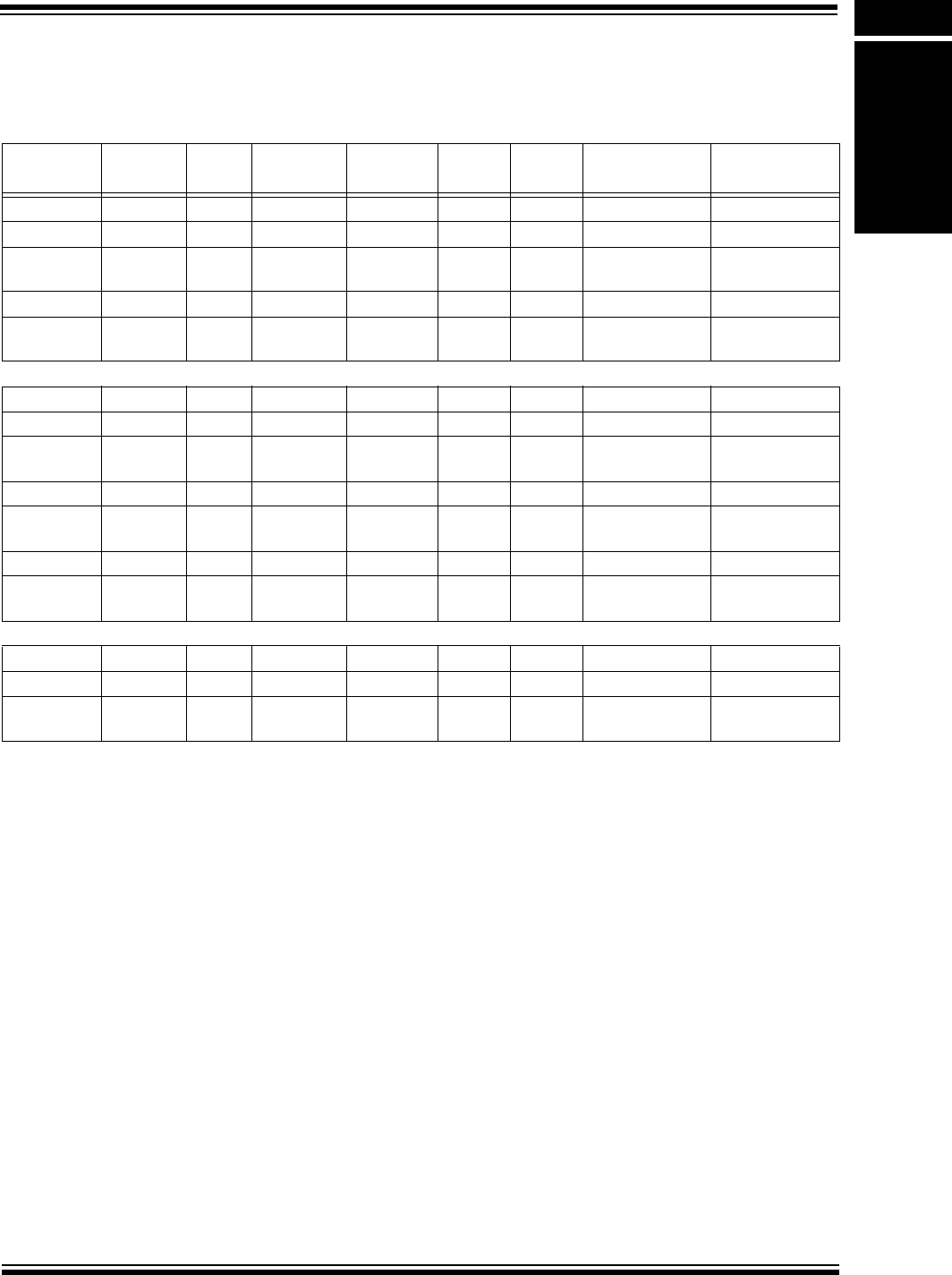
© 2010 Microchip Technology Inc. DS61117F-page 31-47
Section 31. DMA Controller
DMA Controller
31
Another example of this behavior is given in Table 31-4. Example 2 demonstrates worst-case bus
utilization, i.e., unaligned buffers with destination buffer wrapping, in which CHxSSA = 0x1000,
CHxSSIZ = 100, CHxDSA = 0x4402, CHxDSIZ = 4 and CHxCSIZ = 8.
31.3.10 Channel Transfer Behavior
Once a channel has been enabled, CHEN = 1 (DCHxCON<7>), any event that starts a cell
transfer will transfer the CHCSIZ (DCHxCSIZ) bytes of data. This will require one or more
transactions. Once the cell transfer is complete the channel will return to an inactive state, and
will wait for another channel start event to occur before starting another cell transfer.
When the larger of CHSSIZ (DCHxSSIZ) or CHDSIZ (DCHxDSIZ) bytes are transferred, a block
transfer completes, the channel transfer will be halted and the channel will be disabled (i.e.,
CHEN set to ‘0’ by hardware, and pointers are reset).
Table 31-4: Source and Destination Pointer Updates – Example 2
Transaction Operation Source
Pointer
Destination
Pointer
Transfer
Count/Size
Read
Address
Write
Address Read Data(1) Write Data(2)
1 Read 9 0 0/8 1009 xxxx(4) 33_22_11_XX YY_YY_YY_YY
1 Write1 9 0 0/8 1009 4402 33_22_11_XX 22_11_YY_YY
1Ptr
Update(3)
B 2 2/8 1009 4402 33_22_11_XX YY_YY_YY_YY
1 Write2 B 2 2/8 1009 4404 33_22_11_XX YY_YY_YY_33
1Ptr
Update(3)
C 3 3/8 1009 4404 33_22_11_XX YY_YY_YY_YY
2 Read C 3 3/8 100C 4404 77_66_55_44 YY_YY_YY_YY
2 Write1 C 3 3/8 100C 4405 77_66_55_44 YY_YY_44_YY
2Ptr
Update(3)
D 0 4/8 100C 4405 77_66_55_44 YY_YY_YY_YY
2 Write2 D 0 4/8 100C 4402 77_66_55_44 66_55_YY_YY
2Ptr
Update(3)
F 2 6/8 100C 4402 77_66_55_44 YY_YY_YY_YY
3 Write3 F 2 6/8 100F 4404 77_66_55_44 YY_YY_YY_77
3Ptr
Update(3)
10 3 7/8 100F 4404 77_66_55_44 YY_YY_YY_YY
3 Read 10 18 7/8 1010 4404 BB_AA_99_88 YY_YY_YY_YY
3 Write1 10 18 7/8 1010 4405 BB_AA_99_88 YY_YY_88_YY
3Ptr
Update(3)
11 1A 8/8 1010 4405 77_66_55_44 YY_YY_YY_YY
Note 1: XX indicates that data read is discarded.
2: YY indicates that data that is NOT written.
3: Interrupts are updated when the pointers are updated as required.
4: Don’t care.

PIC32MX Family Reference Manual
DS61117F-page 31-48 © 2010 Microchip Technology Inc.
31.3.11 Channel Enable
Each channel has an enable bit, CHEN, which can be used to enable or disable the channel in
question. When this bit is set, the channel transfer requests are serviced by the DMA controller.
When the CHEN bit is clear, the state of the channel is preserved (this allows the channel to be
suspended once a transfer has begun).
The CHEN bit will be cleared by hardware under the following conditions:
• A block transfer is complete, the pointer to the larger of the source or destination matches
the size (only if the CHAEN bit (DCHxCON<4>) is clear).
• A pattern match occurs in Pattern Match mode (only if the CHAEN bit is clear).
• An abort interrupt occurs.
• The user writes the CABORT bit (DCHxECON<6>).
31.3.12 Channel IRQ Detection
The DMA Controller maintains its own flags for detecting the start and abort IRQ in the system
and is completely independent of the INT Controller and IES/IFS flags. The corresponding IRQ
does not have to be enabled before a transfer can take place, nor cleared at the end of a DMA
transfer.
Once the start or abort IRQ system events are triggered, they will be detected automatically by
the DMA controller internal logic, without the need for user intervention.
31.3.13 Channel Event Transfer Initiation
A given channel transfer can be initiated by:
• Writing the CFORCE bit (DCHxECON<7>).
• An interrupt occurs that matches the value of CHSIRQ<7:0> (DCHxECON<15:8>) if it is
enabled by SIRQEN bit (DCHxECON<4>).
Channel events are registered if the channel is enabled (CHEN = 1), or if “Allow Event If
Disabled” is set (i.e., CHAED = 1 (DCHxCON<6>)).
31.3.14 Channel Event Transfer Termination
Channel transfer is terminated in any of the following cases:
• A transfer is aborted as described in 31.3.16 “Channel Abort”.
• A cell transfer (CHCSIZ bytes (DCHxCSIZ transferred)) completes.
• The DMA has transferred the larger of CHSSIZ or CHDSIZ bytes (block transfer complete),
the channel is disabled in hardware and must be re-enabled by user software before the
channel will respond to channel events.
• A pattern match occurs if enabled.
• An abort interrupt, CHAIRQ<7:0> (DCHxECON<23:16>), occurs if abort interrupts are
enabled by AIRQEN bit (DCHxECON<3>).
• An address error occurs.
An example of how to use the abort interrupt would be a transfer from a UART channel to the
memory. While the UART Receive Data Available interrupt can be used to start the transfer, the
UART Error interrupt can abort the transfer. This way, whenever an error occurs on the commu-
nication channel (a framing/parity error or even an overrun), the transfer is stopped and the user
code gets control in an ISR (if the abort interrupt is enabled for the DMA controller).
A summary of the status flags affected by channel transfer initiation or termination is provided in
Table 31-5. Channel abort events are allowed if the channel is enabled, CHEN = 1, or if the user
elects to allow events while the channel is disabled, CHAED = 1.

© 2010 Microchip Technology Inc. DS61117F-page 31-49
Section 31. DMA Controller
DMA Controller
31
Table 31-5: Channel Event Behavior
Event Description and Function Registers Affected
Events Initiating Transfers
System Interrupt Matching
CHSIRQ<7:0>(1,2)
The channel event detect will be set. CHEDET = 1
Channel Chain Event This will enable the channel if not already set. If an event detect
is pending, a channel transfer will begin immediately.
CHEN = 1
User Writes the CFORCE bit(1) The channel event detect will be set. CHEDET = 1
Events Terminating Transfers
System Interrupt Matching
CHAIRQ<7:0>(1,2)
The channel event detect will be reset and the channel turned
off. The abort interrupt flag is set.
CHEDET = 0
CHEN = 0
CHAIF = 1
Pattern Match(1) This occurs when any byte of data written in a transaction
matches the data in CHPDAT.
The channel event detect is reset.
The channel is turned off if CHAEN = 0. This event is treated
as a completed block transfer.
Pointers are reset.
CHEDET = 0
CHEN = 0
CHBCIF = 1
CHSPTR = 0
CHDPTR = 0
CHCPTR = 0
Cell Transfer is Complete This occurs when CHCSIZ bytes have been transferred. The
transfer event detect is reset and the channel remains enabled
pending the next event.
CHEDET = 0
CHCCIF = 1
Block Transfer is Complete The channel event detect is reset.
The channel is turned off if CHAEN = 0. This event is treated
as a completed transfer.
Pointers are reset.
CHEDET = 0
CHEN = 0
CHBCIF = 1
CHSPTR = 0
CHDPTR = 0
CHCPTR = 0
User Writes the CABORT bit The channel is turned off and the channel event detect is reset.
The pointers are reset.
CHEDET = 0
CHEN = 0
CHSPTR = 0
CHDPTR = 0
CHCPTR = 0
Address Error is Detected The channel is turned off and the event detect is reset. The
address error interrupt flag is set.
CHEDET = 0
CHEN = 0
CHERIF = 1
Note 1: Events are allowed only when the channel is enabled, or the user allows events while disabled (CHEN = 1
or CHAED = 1).
2: The DMA Controller maintains its own flags for detecting start and abort interrupt requests (IRQs) in the sys-
tem, and is completely independent of the INT Controller IES/IFS flags. Once the start or abort IRQ system
events are triggered, they will be detected automatically by the DMA controller internal logic, without the
need for user intervention.

PIC32MX Family Reference Manual
DS61117F-page 31-50 © 2010 Microchip Technology Inc.
31.3.15 Channel Abort Interrupt
A channel can elect to abort a cell transfer if an interrupt event occurs. The interrupt is selected
by the channel’s abort IRQ, CHAIRQ<7:0> (DCHxECON<23:16>). Any one of the device
interrupt events can cause a channel abort. An abort only occurs if enabled by AIRQEN bit
(DCHxECON<3>).
If this occurs (often a timer time-out or a module error flag), the channel’s status flags will
indicate the external abort event on the channel in question by setting its CHTAIF bit
(DCHxINT<1>). The Source and Destination Pointers are not reset, allowing the user to recover
from the error.
31.3.16 Channel Abort
A channel transfer can be aborted by the user by writing the CABORT bit (DCHxECON<6>).
When a transfer is aborted, the current bus transaction will be completed and any transactions
that remain will be aborted. The CHEN bit (DCHxCON<7>) will be cleared. When the user
writes the CABORT bit, the Source and Destination Pointers are reset.
31.3.17 Address Error
If the address (either source or destination) occurring during a transfer is an illegal address, the
channel’s address error interrupt flag CHERIF bit (DCHxINT<0>) will be set. The channel will be
disabled (i.e., CHEN bit will be reset by hardware).
The channel status is unaffected to aid in the debug of the problem.
31.3.18 DMA Suspend
DMA transactions are suspended immediately if the SUSPEND bit (DMACON<12>) is set. The
current read or write will be completed. If the suspend comes during the read portion of the
transaction, the transaction will be suspended and the write will be put on hold. If the suspend
comes during the write portion of the transaction, the write will complete and the pointers
updated as normal. Any transactions that were in process will continue where they left off when
the SUSPEND bit is cleared.
Depending on the device variant, when the DMA module is suspended by setting the
SUSPEND bit, the user application should poll the DMABUSY bit (DMACON<11>) to determine
when the module is completely suspended following the completion of the current transaction.
Example 31-8: DMA Controller Suspension
Note: The DMABUSY bit is not available on all device. Refer to the specific device data
sheet for availability.
/*
The following code example will suspend the DMA Controller.
*/
DMACONSET=0x00001000; // suspend the DMA controller
while(!(DMACONbits.busy)); // wait for the transfer to be actually suspended
// let the CPU have complete control of the bus
DMACONCLR=0x00001000; // clear the suspend mode and let the DMA operate normally
// from now on, the CPU and DMA controller share the bus access

© 2010 Microchip Technology Inc. DS61117F-page 31-51
Section 31. DMA Controller
DMA Controller
31
31.4 INTERRUPTS
The DMA device has the ability to generate interrupts reflecting the events that occur during the
channel’s data transfer:
• Error interrupts, signaled by each channel’s CHERIF bit (DCHxINT<0>) and enabled using
the CHERIE bit (DCHxINT<16>). This event occurs when there is an address error
occurred during the channel transfer operation.
• Abort interrupts, signaled by each channel’s CHTAIF bit (DCHxINT<1>) and enabled using
the CHTAIE bit (DCHxINT<17>). This event occurs when a DMA channel transfer gets
aborted because of a system event (interrupt) matching the CHAIRQ<7:0>
(DCHxECON<23:16>) when the abort interrupt request is enabled, AIRQEN = 1
(DCHxECON<3>).
• Block complete interrupts, signaled by each channel’s CHBCIF bit (DCHxINT<3>) and
enabled using the CHBCIE bit (DCHxINT<19>). This event occurs when a DMA channel
block transfer is completed.
• Cell complete interrupts, signaled by each channel’s CHCCIF bit (DCHxINT<2>) and
enabled using the CHCCIE bit (DCHxINT<18>). This event occurs when a DMA channel
cell transfer is completed.
• Source Address Pointer activity interrupts: either when the Channel Source Pointer
reached the end of the source, signaled by the CHSDIF bit (DCHxINT<7>) and enabled by
CHSDIE bit (DCHxINT<23>), or when the Channel Source Pointer reached midpoint of the
source, signaled by the CHSHIF bit (DCHxINT<6>) and enabled by the CHSHIE bit
(DCHxINT<22>).
• Destination Address Pointer activity interrupts: either when the Channel Destination Pointer
reached the end of the destination, signaled by the CHDDIF bit (DCHxINT<5>) and
enabled by the CHDDIE bit (DCHxINT<21>), or when the Channel Destination Pointer
reached midpoint of the destination, signaled by the CHDHIF bit (DCHxINT<4>) and
enabled by the CHDHIE bit (DCHxINT<20>).
All the interrupts belonging to a DMA channel map to the corresponding channel interrupt vector.
The corresponding DMA channels interrupt flags are:
• DMA0IF (IFS1<16>)
• DMA1IF (IFS1<17>)
• DMA2IF (IFS1<18>)
• DMA3IF (IFS1<19>)
• DMA4IF (IFS1<20>)
• DMA5IF (IFS1<21>)
• DMA6IF (IFS1<22>)
• DMA7IF (IFS1<23>)
All of these interrupt flags must be cleared in software.
A DMA channel is enabled as a source of interrupts through the respective DMA interrupt enable
bits:
• DMA0IE (IEC1<17>)
• DMA1IE (IEC1<18>)
• DMA2IE (IEC1<19>)
• DMA3IE (IEC1<20>)
• DMA0IE (IEC1<16>)
• DMA1IE (IEC1<17>)
• DMA2IE (IEC1<18>)
• DMA3IE (IEC1<19>)
• DMA4IE (IEC1<20>)
• DMA5IE (IEC1<21>)
Note: Not all DMA channels are available on all devices. Refer to the specific device data
sheet for availability.

PIC32MX Family Reference Manual
DS61117F-page 31-52 © 2010 Microchip Technology Inc.
• DMA6IE (IEC1<22>)
• DMA7IE (IEC1<23>)
• DMA4IE (IEC1<20>)
• DMA5IE (IEC1<21>)
• DMA6IE (IEC1<22>)
• DMA7IE (IEC1<23>)
The interrupt-priority-level bits and interrupt-subpriority-level bits must also be configured:
• DMA0IP<2:0> (IPC9<12:10>), DMA0IS<1:0> (IPC9<9:8>).
• DMA1IP<2:0> (IPC9<20:18>), DMA1IS<1:0> (IPC9<17:16>).
• DMA2IP<2:0> (IPC9<28:26>), DMA2IS<1:0> (IPC9<25:24>).
• DMA3IP<2:0> (IPC10<4:2>), DMA3IS<1:0> (IPC10<1:0>).
• DMA0IP<2:0> (IPC9<4:2>), DMA0IS<1:0> (IPC9<1:0>)
• DMA1IP<2:0> (IPC9<12:10>), DMA1IS<1:0> (IPC9<9:8>)
• DMA2IP<2:0> (IPC9<20:18>), DMA2IS<1:0> (IPC9<17:16>)
• DMA3IP<2:0> (IPC9<28:26>), DMA3IS<1:0> (IPC9<25:24>)
• DMA4IP<2:0> (IPC10<4:2>), DMA4IS<1:0> (IPC10<1:0>)
• DMA5IP<2:0> (IPC10<12:10>), DMA5IS<1:0> (IPC10<9:8>)
• DMA7IP<2:0> (IPC10<20:18>), DMA6IS<1:0> (IPC10<17:16>)
• DMA7IP<2:0> (IPC10<28:26>), DMA7IS<1:0> (IPC10<25:24>)
• DMA4IP<2:0> (IPC10<4:2>), DMA0IS<1:0> (IPC10<1:0>).
• DMA5IP<2:0> (IPC10<12:10>), DMA1IS<1:0> (IPC10<9:8>).
• DMA6IP<2:0> (IPC10<20:18>), DMA2IS<1:0> (IPC10<17:16>).
• DMA7IP<2:0> (IPC10<28:26>), DMA3IS<1:0> (IPC10<25:24>).
31.4.1 Interrupt Configuration
Each DMA channel internally has multiple interrupt flags (CHSDIF, CHSHIF, CHDDIF, CHDHIF,
CHBCIF, CHCCIF, CHTAIF, CHERIF) and corresponding enable interrupt control bits (CHSDIE,
CHSHIE, CHDDIE, CHDHIE, CHBCIE, CHCCIE, CHTAIE, CHERIE).
However, for the interrupt controller, there is just one dedicated interrupt flag bit per channel,
DMAxIF, DMA4IF, DMA5IF, DMA6IF, DMA7IF(IFS1<20:17>) and the corresponding interrupt
enable/mask bits, DMAxIE(IEC1<23:16>).
Therefore, note that all of the interrupt conditions for a specific DMA channel share just one
interrupt vector. Each DMA channel can have its own priority level independent of other DMA
channels.
Note that the DMAxIF bits will be set without regard to the state of the corresponding enable bits
DMAxIE. The DMAxIF bits can be polled by software if desired.
The DMAxIE bits are used to define the behavior of the Vector Interrupt Controller or INT when
a corresponding DMAxIF bit is set. When the corresponding DMAxIE bit is clear, the INT module
does not generate a CPU interrupt for the event. If the DMAxIE bit is set, the INT module will
generate an interrupt to the CPU when the corresponding DMAxIF bit is set (subject to the priority
and subpriority as follows).
It is the responsibility of the user’s software routine that services a particular interrupt to clear the
appropriate interrupt flag bit before the service routine is complete.
The priority of each DMA channel can be set independently with the DMAxIP bits in the IPCx
register. These priorities define the priority group to which the interrupt source will be assigned.
The priority groups range from a value of 7 (the highest priority), to a value of 0, which does not
generate an interrupt. An interrupt being serviced will be preempted by an interrupt in a higher
priority group.
Note: Depending on the device variant, up to 8 (i.e., 0-7) interrupt flags and interrupt
enable/mask bits are available. Refer to the specific device data sheet for
availability.

© 2010 Microchip Technology Inc. DS61117F-page 31-53
Section 31. DMA Controller
DMA Controller
31
The subpriority bits allow setting the priority of an interrupt source within a priority group. The val-
ues of the subpriority range from 3 (the highest priority), to 0 the lowest priority. An interrupt with
the same priority group but having a higher subpriority value will not preempt a lower subpriority
interrupt that is in progress.
The priority group and subpriority bits allow more than one interrupt source to share the same
priority and subpriority. If simultaneous interrupts occur in this configuration, the natural order of
the interrupt sources within a Priority/subpriority group pair determine the interrupt generated.
The natural priority is based on the vector numbers of the interrupt sources. The lower the vector
number the higher the natural priority of the interrupt. Any interrupts that were overridden by
natural order will then generate their respective interrupts based on Priority, subpriority and
natural order after the interrupt flag for the current interrupt is cleared.
After an enabled interrupt is generated, the CPU will jump to the vector assigned to that interrupt.
The vector number for the interrupt is the same as the natural order number. The CPU will then
begin executing code at the vector address. The user’s code at this vector address should
perform any application-specific operations and clear the DMAxIF interrupt flags, and then exit.
Refer to the vector address table details in Section 8. “Interrupts” (DS61108) in the “PIC32MX
Family Reference Manual” for more information on interrupts.
Table 31-6: DMA Interrupt Vectors for Various Offsets with EBASE =0x8000:0000
Interrupt Vector/Natural
Order
IRQ
Number
Vector
Address
IntCtl.VS
= 0x01
Vector
Address
IntCtl.VS
= 0x02
Vector
Address
IntCtl.VS
= 0x04
Vector
Address
IntCtl.VS
= 0x08
Vector
Address
IntCtl.VS
= 0x10
DMA0 37 49 8000 06A0 8000 0B40 8000 1480 8000 2700 8000 4C00
DMA1 38 50 8000 06C0 8000 0B80 8000 1500 8000 2800 8000 4E00
DMA2 39 51 8000 06E0 8000 0BC0 8000 1580 8000 2900 8000 5000
DMA3 40 52 8000 0700 8000 0C00 8000 1600 8000 2A00 8000 5200
DMA0 36 48 8000 0680 8000 0B00 8000 1400 8000 2600 8000 4A00
DMA1 37 49 8000 06A0 8000 0B40 8000 1480 8000 2700 8000 4C00
DMA2 38 50 8000 06C0 8000 0B80 8000 1500 8000 2800 8000 4E00
DMA3 39 51 8000 06E0 8000 0BC0 8000 1580 8000 2900 8000 5000
DMA4(1) 40 52 8000 0700 8000 0C00 8000 1600 8000 2A00 8000 5200
DMA5(1) 41 53 8000 0720 8000 0C40 8000 1680 8000 2B00 8000 5400
DMA6(1) 42 54 8000 0740 8000 0C80 8000 1700 8000 2C00 8000 5600
DMA7(1) 43 55 8000 0760 8000 0CC0 8000 1780 8000 2D00 8000 5800
DMA4 40 52 8000 0700 8000 0C00 8000 1600 8000 2A00 8000 5200
DMA5 41 53 8000 0720 8000 0C40 8000 1680 8000 2B00 8000 5400
DMA6 42 54 8000 0740 8000 0C80 8000 1700 8000 2C00 8000 5600
DMA7 43 55 8000 0760 8000 0CC0 8000 1780 8000 2D00 8000 5800
Note 1: These interrupts are not available on all devices. Refer to the specific device data sheet for availability.

PIC32MX Family Reference Manual
DS61117F-page 31-54 © 2010 Microchip Technology Inc.
Example 31-9: DMA Channel Initialization with Interrupts Enabled Code Example
Example 31-10: DMA Channel 0 ISR Code Example
/*
The following code example illustrates a DMA channel 0 interrupt configuration.
When the DMA channel 0 interrupt is generated, the CPU will jump to the vector assigned to
DMA0 interrupt.
*/
IEC1CLR=0x00020000; // disable DMA channel 0 interrupts
IFS1CLR=0x00020000; // clear any existing DMA channel 0 interrupt flag
IEC1CLR=0x00010000; // disable DMA channel 0 interrupts
IFS1CLR=0x00010000; // clear any existing DMA channel 0 interrupt flag
DMACONSET=0x00008000; // enable the DMA controller
DCH0CON=0x03; // channel off, priority 3, no chaining
DCH0ECON=0; // no start or stop irq’s, no pattern match
// program the transfer
DCH0SSA=0x1d010000; // transfer source physical address
DCH0DSA=0x1d020000; // transfer destination physical address
DCH0SSIZ=200; // source size 200 bytes
DCH0DSIZ=200; // destination size 200 bytes
DCH0CSIZ=200; // 200 bytes transferred per event
DCH0INTCLR=0x00ff00ff; // clear existing events, disable all interrupts
DCH0INTSET=0x00090000; // enable Block Complete and error interrupts
IPC9CLR=0x00001f00; // clear the DMA channel 0 priority and sub-priority
IPC9SET=0x00001600; // set IPL 5, sub-priority 2
IPC9CLR=0x0000001f; // clear the DMA channel 0 priority and sub-priority
IPC9SET=0x00000016; // set IPL 5, sub-priority 2
IEC1SET=0x00020000; // enable DMA channel 0 interrupt
IEC1SET=0x00010000; // enable DMA channel 0 interrupt
DCH0CONSET=0x80; // turn channel on
// initiate a transfer
DCH0ECONSET=0x00000080; // set CFORCE to 1
/*
The following code example demonstrates a simple Interrupt Service Routine for DMA channel 0
interrupts. The user’s code at this vector should perform any application specific operations
and must clear the DMA0 interrupt flags before exiting.
*/
void __attribute__ ((interrupt(ipl3), at_vector(37))) __DMA0Interrupt(void)
void __ISR(_DMA_0_VECTOR, ipl5) __DMA0Interrupt(void)
{
int dmaFlags=DCH0INT&0xff; // read the interrupt flags
/*
perform application specific operations in response to any interrupt flag set
*/
DCH0INTCLR=0x000000ff; // clear the DMA channel interrupt flags
IFS1CLR = 0x00020000; // Be sure to clear the DMA0 interrupt flags
IFS1CLR = 0x00010000; // Be sure to clear the DMA0 interrupt flags
// before exiting the service routine.
}
Note: The DMA ISR code example shows MPLAB® C32 C compiler specific syntax. Refer
to your compiler manual regarding support for ISRs.

© 2010 Microchip Technology Inc. DS61117F-page 31-55
Section 31. DMA Controller
DMA Controller
31
31.5 OPERATION IN POWER-SAVING AND DEBUG MODES
31.5.1 DMA Operation in Idle Mode
When the device enters Idle mode, the system clock sources remain functional and the DMA
module continues to operate.
On some variants, the SIDL bit (DMACON<13>) selects whether the module will stop or continue
functioning on Idle.
•If SIDL = 0, the module will continue operation in Idle mode and will have the clocks turned
off.
• If SIDL = 1, the module will discontinue operation in Idle mode. The DMA module will turn
off the clocks so that the power consumption is more efficient.
31.5.2 DMA Operation in Sleep Mode
When the device enters Sleep mode, the system clock is disabled. No DMA activity can occur in
this mode.
31.5.3 DMA Operation in Debug Mode
The FRZ bit (DMACON<14>) determines whether the DMA module will run or stop while the CPU
is executing debug exception code (i.e., application is halted) in Debug mode. When FRZ = 0,
the DMA module continues to run even when application is halted in Debug mode. When
FRZ = 1 and the application is halted in Debug mode, the module will freeze its operations and
make no changes to the state of the DMA module. The module will resume its operation after
CPU resumes execution.
31.6 EFFECTS OF VARIOUS RESETS
31.6.1 Device Reset
All DMA registers are forced to their reset states upon a device Reset. When the asynchronous
Reset input goes active, the DMA logic:
• Resets all fields in DMACON, DMASTAT, DMAADDR, DCRCCON, DCRCDATA and
DCRCXOR
• Sets the appropriate values in each channel’s register fields: DCHxCON, DCHxECON,
DCHxINT, DCHxSSIZ, DCHxDSIZ, DCHxSPTR, DCHxDPTR, DCHxCSIZ, DCHxCPTR
and DCHxDAT
• Registers DCHxSSA and DCHxDSA have random values after a reset
• Aborts any ongoing data transfers
31.6.2 Power-on Reset
All DMA registers are forced to their reset states upon a Power-on Reset.
31.6.3 Watchdog Timer Reset
All DMA registers are forced to their reset states upon a Watchdog Timer Reset.
Note: The DMA module cannot be used by a peripheral that has its SIDL bit set to ‘1’.
Note: The FRZ bit is readable and writable only when the CPU is executing in Debug
Exception mode. In all other modes, the FRZ bit reads as ‘0’. If the FRZ bit is
changed during Debug mode, the new value does not take effect until the current
Debug Exception mode is exited and re-entered. During the Debug Exception
mode, the FRZ bit reads the state of the peripheral when entering Debug mode.

PIC32MX Family Reference Manual
DS61117F-page 31-56 © 2010 Microchip Technology Inc.
31.7 RELATED APPLICATION NOTES
This section lists application notes that are related to this section of the manual. These
application notes may not be written specifically for the PIC32MX device family, but the concepts
are pertinent and could be used DMA Controller with modification and possible limitations. The
current application notes related to the Direct Memory Access (DMA) module are:
Title Application Note #
No related application notes at this time N/A
Note: Visit the Microchip web site (www.microchip.com) for additional application notes
and code examples for the PIC32MX family of devices.

© 2010 Microchip Technology Inc. DS61117F-page 31-57
Section 31. DMA Controller
DMA Controller
31
31.8 REVISION HISTORY
Revision A (October 2007)
This is the initial released version of this document.
Revision B (October 2007)
Updated document to remove Confidential status.
Revision C (April 2008)
Revised status to Preliminary; Revised U-0 to r-x; Revised Table 31-1; Revised Table 31-2
(DCHxCON, bit 3), deleted Note 1; Revised Registers 31-19, 31-39, 31-43, 31-47, 31-48, 31-49,
31-53; Revise Sections 31.3, 31.3.2; Revised Examples 31-1, 31-3, 31-4, 31-6, 31-7, 31-8;
Delete Example 31-2 and renumber examples; Delete Section 31.3.3 and renumber sections;
Revised Section 31.3.20.7.
Revision D (June 2008)
Revised Registers 31-58 to 31-60, Footnote; Revised Example 31-8; Change Reserved bits
“Maintain as” to “Write”; Added Note to ON bit (DMACON Register).
Revision E (August 2009)
This revision introduces new bits and functionality that are only available on certain devices. The
following details the resulting changes:
• DMA Register Summary (Table 31-1)
- Added the BUSY, BYTO1, BYTO0, WBO, BITO, CRCTYP and CHBUSY bits
- Removed references to the IEC1, IPC9 and IFS1 registers
- Added the Address Offset column to the DMA Register Summary
- Added Notes 1, 2 and 3, which describe the Clear, Set and Invert registers
- Added Notes 4 and 5 regarding the availability of certain bits and ranges of bits
depending on the device variant
• Added Notes describing the Clear, Set and Invert registers to the following registers:
-DMACON (Register 31-1)
- DMASTAT (Register 31-2)
- DMAADDR (Register 31-3)
- DCRCCON (Register 31-4)
- DCRCDATA (Register 31-5)
- DCRCXOR (Register 31-6)
- DCHxCON (Register 31-7)
- DCHxECON (Register 31-8)
- DCHxINT (Register 31-9)
- DCHxSSA (Register 31-10)
- DCHxDSA (Register 31-11)
- DCHxSSIZ (Register 31-12)
- DCHxDSIZ (Register 31-13)
- DCHSPTR (Register 31-14)
- DCHxDPTR (Register 31-15)
- DCHxCSIZ (Register 31-16)
- DCHxCPTR (Register 31-17)
- DCHxDAT (Register 31-18)
• Removed these registers: IFS1, IEC1 and IPC9
• Added the BUSY bit (DMACON<11>) and Note 1 regarding availability of the SIDL and
BUSY bits to Register 31-1

PIC32MX Family Reference Manual
DS61117F-page 31-58 © 2010 Microchip Technology Inc.
Revision E (August 2009) (Continued)
• Updated the DMACH bit (DMASTAT<2:0>) and added Note 2 regarding the availability of
all bits in Register 31-2
• Added the BYTO1, BYTO0, WBO, BITO and CRCTYP bits, updated bits PLEN<4:0> and
CRCCH<2:0>, and added Notes 1 and 2 to Register 31-4
• Updated DCRCDATA bits and added Note 1 to Register 31-5
• Updated DCRCXOR bits and added Note 1 to Register 31-6
• Added CHBUSY bit (DCHxCON<15>) and added Note 1 to Register 31-7
• Updated DCHxSSIZ bits and added Note 1 to Register 31-12
• Updated DCHxDSIZ bits and added Note 1 to Register 31-13
• Updated DCHxSPTR bits and added Note 2 to Register 31-14
• Updated DCHxDPTR bits and added Note 1 to Register 31-15
• Updated DCHxCSIZ bits and added Note 1 to Register 31-16
• Updated DCHxCPTR bits and added Note 2 to Register 31-17
• Updated the lowest priority channel number and added a related note to the fourth
paragraph in 31.3.3 “Channel Chaining Mode”
• Added information on suspending the DMA module and a related Note to
31.3.6 “Suspending Transfers” and 31.3.18 “DMA Suspend”
• Updated 31.3.5 “Special Function Module (SFM) Mode” to differentiate between the
16-bit and 32-bit CRC
• Added 31.3.5.5 “Calculating the IP Header Checksum”
• Added DMA channel interrupt flags, enable bits and priority-level bits to 31.4 “Interrupts”
• Added DMA interrupt vectors (DMA4-DMA7) to Table 31-6
• Updated 31.5.1 “DMA Operation in Idle Mode”
Revision F (October 2010)
This revision includes the following updates:
• Added a note at the beginning of this section, which provides information on complementary
documentation
• Changed all occurrences of “Reserved: Write ‘0’; ignore read” to “Unimplemented: Read
as ‘0’, and updated the default POR definitions in all registers
• Added Notes 1, 2 and 3, which describe the Clear, Set and Invert registers to the following:
-Table 31-1: DMA Register Summary
-Register 31-1: DMACON: DMA Controller Control Register(1,2,3)
-Register 31-4: DCRCCON: DMA CRC Control Register(1,2,3)
-Register 31-5: DCRCDATA: DMA CRC Data Register(1,2,3)
-Register 31-6: DCRCXOR: DMA CRCXOR Enable Register(1,2,3)
-Register 31-7: DCHxCON: DMA Channel x Control Register(1,2,3)
-Register 31-8: DCHxECON: DMA Channel x Event Control Register(1,2,3)
-Register 31-9: DCHxINT: DMA Channel x Interrupt Control Register(1,2,3)
-Register 31-10: DCHxSSA: DMA Channel x Source Start Address Register(1,2,3)
-Register 31-12: DCHxSSIZ: DMA Channel x Source Size Register(1,2,3)
-Register 31-13: DCHxDSIZ: DMA Channel x Destination Size Register(1,2,3)
-Register 31-16: DCHxCSIZ: DMA Channel x Cell-Size Register(1,2,3)
-Register 31-18: DCHxECON: DMA Channel x Event Control Register(1,2,3)
• Removed all Clear, Set and Invert registers
• Removed all Interrupt registers
• Changed the name of the BUSY bit to DMABUSY in Register 31-1 and in Table 31-1
• Added a note box just after the last paragraph of 31.3.5 “Special Function Module (SFM)
Mode”
• Minor formatting and text updates have been incorporated throughout the document
© 2010 Microchip Technology Inc. DS61117F-page 59
Information contained in this publication regarding device
applications and the like is provided only for your convenience
and may be superseded by updates. It is your responsibility to
ensure that your application meets with your specifications.
MICROCHIP MAKES NO REPRESENTATIONS OR
WARRANTIES OF ANY KIND WHETHER EXPRESS OR
IMPLIED, WRITTEN OR ORAL, STATUTORY OR
OTHERWISE, RELATED TO THE INFORMATION,
INCLUDING BUT NOT LIMITED TO ITS CONDITION,
QUALITY, PERFORMANCE, MERCHANTABILITY OR
FITNESS FOR PURPOSE. Microchip disclaims all liability
arising from this information and its use. Use of Microchip
devices in life support and/or safety applications is entirely at
the buyer’s risk, and the buyer agrees to defend, indemnify and
hold harmless Microchip from any and all damages, claims,
suits, or expenses resulting from such use. No licenses are
conveyed, implicitly or otherwise, under any Microchip
intellectual property rights.
Trademarks
The Microchip name and logo, the Microchip logo, dsPIC,
KEELOQ, KEELOQ logo, MPLAB, PIC, PICmicro, PICSTART,
PIC32 logo, rfPIC and UNI/O are registered trademarks of
Microchip Technology Incorporated in the U.S.A. and other
countries.
FilterLab, Hampshire, HI-TECH C, Linear Active Thermistor,
MXDEV, MXLAB, SEEVAL and The Embedded Control
Solutions Company are registered trademarks of Microchip
Technology Incorporated in the U.S.A.
Analog-for-the-Digital Age, Application Maestro, CodeGuard,
dsPICDEM, dsPICDEM.net, dsPICworks, dsSPEAK, ECAN,
ECONOMONITOR, FanSense, HI-TIDE, In-Circuit Serial
Programming, ICSP, Mindi, MiWi, MPASM, MPLAB Certified
logo, MPLIB, MPLINK, mTouch, Omniscient Code
Generation, PICC, PICC-18, PICDEM, PICDEM.net, PICkit,
PICtail, REAL ICE, rfLAB, Select Mode, Total Endurance,
TSHARC, UniWinDriver, WiperLock and ZENA are
trademarks of Microchip Technology Incorporated in the
U.S.A. and other countries.
SQTP is a service mark of Microchip Technology Incorporated
in the U.S.A.
All other trademarks mentioned herein are property of their
respective companies.
© 2010, Microchip Technology Incorporated, Printed in the
U.S.A., All Rights Reserved.
Printed on recycled paper.
ISBN: 978-1-60932-621-0
Note the following details of the code protection feature on Microchip devices:
• Microchip products meet the specification contained in their particular Microchip Data Sheet.
• Microchip believes that its family of products is one of the most secure families of its kind on the market today, when used in the
intended manner and under normal conditions.
• There are dishonest and possibly illegal methods used to breach the code protection feature. All of these methods, to our
knowledge, require using the Microchip products in a manner outside the operating specifications contained in Microchip’s Data
Sheets. Most likely, the person doing so is engaged in theft of intellectual property.
• Microchip is willing to work with the customer who is concerned about the integrity of their code.
• Neither Microchip nor any other semiconductor manufacturer can guarantee the security of their code. Code protection does not
mean that we are guaranteeing the product as “unbreakable.”
Code protection is constantly evolving. We at Microchip are committed to continuously improving the code protection features of our
products. Attempts to break Microchip’s code protection feature may be a violation of the Digital Millennium Copyright Act. If such acts
allow unauthorized access to your software or other copyrighted work, you may have a right to sue for relief under that Act.
Microchip received ISO/TS-16949:2002 certification for its worldwide
headquarters, design and wafer fabrication facilities in Chandler and
Tempe, Arizona; Gresham, Oregon and design centers in California
and India. The Company’s quality system processes and procedures
are for its PIC® MCUs and dsPIC® DSCs, KEELOQ® code hopping
devices, Serial EEPROMs, microperipherals, nonvolatile memory and
analog products. In addition, Microchip’s quality system for the design
and manufacture of development systems is ISO 9001:2000 certified.

DS61117F-page 60 © 2010 Microchip Technology Inc.
AMERICAS
Corporate Office
2355 West Chandler Blvd.
Chandler, AZ 85224-6199
Tel: 480-792-7200
Fax: 480-792-7277
Technical Support:
http://support.microchip.com
Web Address:
www.microchip.com
Atlanta
Duluth, GA
Tel: 678-957-9614
Fax: 678-957-1455
Boston
Westborough, MA
Tel: 774-760-0087
Fax: 774-760-0088
Chicago
Itasca, IL
Tel: 630-285-0071
Fax: 630-285-0075
Cleveland
Independence, OH
Tel: 216-447-0464
Fax: 216-447-0643
Dallas
Addison, TX
Tel: 972-818-7423
Fax: 972-818-2924
Detroit
Farmington Hills, MI
Tel: 248-538-2250
Fax: 248-538-2260
Kokomo
Kokomo, IN
Tel: 765-864-8360
Fax: 765-864-8387
Los Angeles
Mission Viejo, CA
Tel: 949-462-9523
Fax: 949-462-9608
Santa Clara
Santa Clara, CA
Tel: 408-961-6444
Fax: 408-961-6445
Toronto
Mississauga, Ontario,
Canada
Tel: 905-673-0699
Fax: 905-673-6509
ASIA/PACIFIC
Asia Pacific Office
Suites 3707-14, 37th Floor
Tower 6, The Gateway
Harbour City, Kowloon
Hong Kong
Tel: 852-2401-1200
Fax: 852-2401-3431
Australia - Sydney
Tel: 61-2-9868-6733
Fax: 61-2-9868-6755
China - Beijing
Tel: 86-10-8528-2100
Fax: 86-10-8528-2104
China - Chengdu
Tel: 86-28-8665-5511
Fax: 86-28-8665-7889
China - Chongqing
Tel: 86-23-8980-9588
Fax: 86-23-8980-9500
China - Hong Kong SAR
Tel: 852-2401-1200
Fax: 852-2401-3431
China - Nanjing
Tel: 86-25-8473-2460
Fax: 86-25-8473-2470
China - Qingdao
Tel: 86-532-8502-7355
Fax: 86-532-8502-7205
China - Shanghai
Tel: 86-21-5407-5533
Fax: 86-21-5407-5066
China - Shenyang
Tel: 86-24-2334-2829
Fax: 86-24-2334-2393
China - Shenzhen
Tel: 86-755-8203-2660
Fax: 86-755-8203-1760
China - Wuhan
Tel: 86-27-5980-5300
Fax: 86-27-5980-5118
China - Xian
Tel: 86-29-8833-7252
Fax: 86-29-8833-7256
China - Xiamen
Tel: 86-592-2388138
Fax: 86-592-2388130
China - Zhuhai
Tel: 86-756-3210040
Fax: 86-756-3210049
ASIA/PACIFIC
India - Bangalore
Tel: 91-80-3090-4444
Fax: 91-80-3090-4123
India - New Delhi
Tel: 91-11-4160-8631
Fax: 91-11-4160-8632
India - Pune
Tel: 91-20-2566-1512
Fax: 91-20-2566-1513
Japan - Yokohama
Tel: 81-45-471- 6166
Fax: 81-45-471-6122
Korea - Daegu
Tel: 82-53-744-4301
Fax: 82-53-744-4302
Korea - Seoul
Tel: 82-2-554-7200
Fax: 82-2-558-5932 or
82-2-558-5934
Malaysia - Kuala Lumpur
Tel: 60-3-6201-9857
Fax: 60-3-6201-9859
Malaysia - Penang
Tel: 60-4-227-8870
Fax: 60-4-227-4068
Philippines - Manila
Tel: 63-2-634-9065
Fax: 63-2-634-9069
Singapore
Tel: 65-6334-8870
Fax: 65-6334-8850
Taiwan - Hsin Chu
Tel: 886-3-6578-300
Fax: 886-3-6578-370
Taiwan - Kaohsiung
Tel: 886-7-213-7830
Fax: 886-7-330-9305
Taiwan - Taipei
Tel: 886-2-2500-6610
Fax: 886-2-2508-0102
Thailand - Bangkok
Tel: 66-2-694-1351
Fax: 66-2-694-1350
EUROPE
Austria - Wels
Tel: 43-7242-2244-39
Fax: 43-7242-2244-393
Denmark - Copenhagen
Tel: 45-4450-2828
Fax: 45-4485-2829
France - Paris
Tel: 33-1-69-53-63-20
Fax: 33-1-69-30-90-79
Germany - Munich
Tel: 49-89-627-144-0
Fax: 49-89-627-144-44
Italy - Milan
Tel: 39-0331-742611
Fax: 39-0331-466781
Netherlands - Drunen
Tel: 31-416-690399
Fax: 31-416-690340
Spain - Madrid
Tel: 34-91-708-08-90
Fax: 34-91-708-08-91
UK - Wokingham
Tel: 44-118-921-5869
Fax: 44-118-921-5820
Worldwide Sales and Service
08/04/10
