ST TC1
User Manual: ST-TC1
Open the PDF directly: View PDF  .
.
Page Count: 2
STICK-ON® SERIES
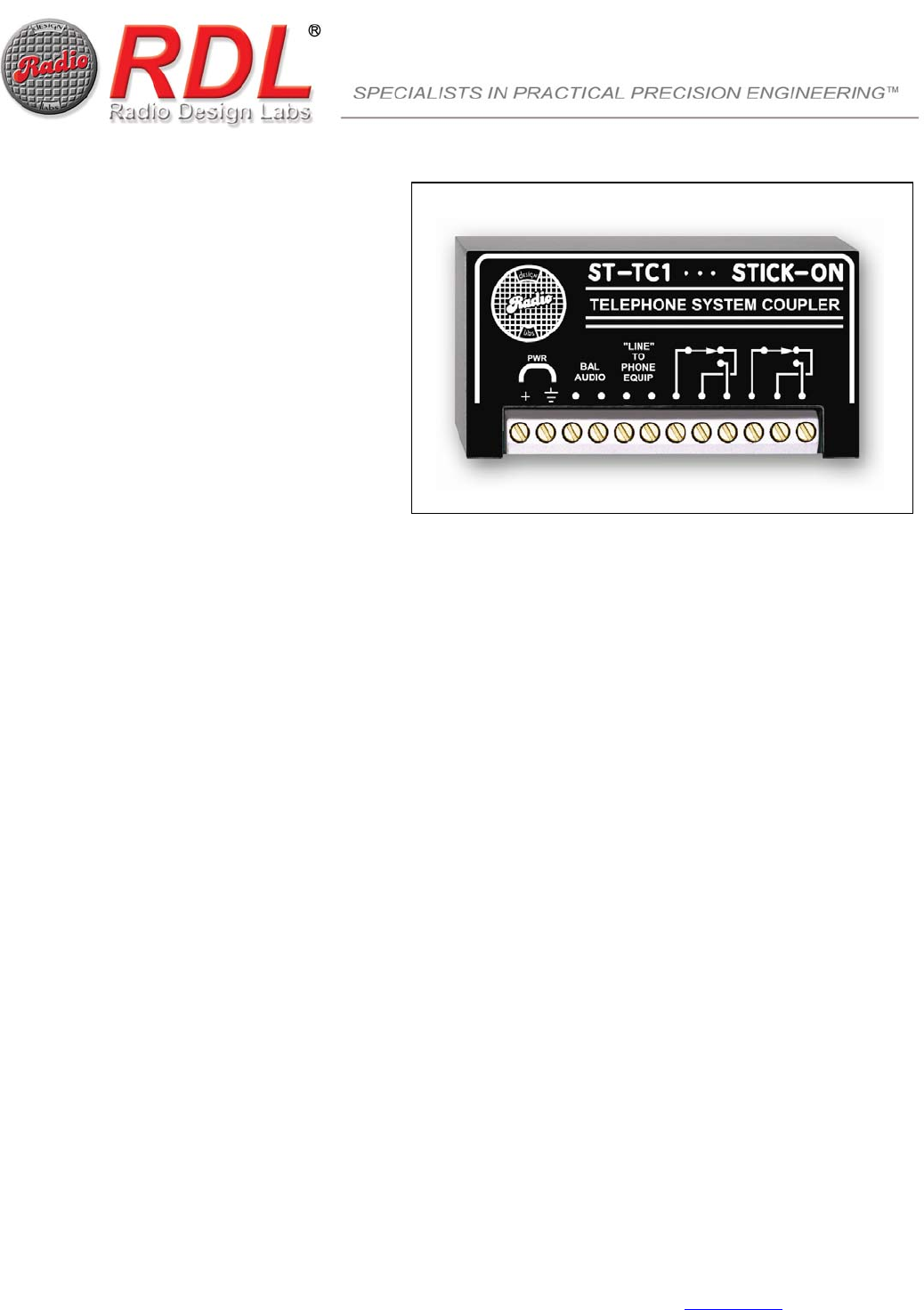
Model ST-TC1
Telephone System Coupler
ANYWHERE YOU NEED...
• To Simulate a Telco CO Line
• To Add Radio Control or Paging to KSU
• Contact Closure when Line is Selected
• Audio Input / Output from Telephone
Switching Unit
You Need The ST-TC1!
The ST-TC1 is part of the STICK-ON series from Radio Design Labs. The durable adhesives permit quick,
permanent or removable mounting nearly anywhere or it may be used with RDL’s racking accessories.
APPLICATION: The ST-TC1 is primarily intended to connect to an on-site telephone system switching
(KSU). Connections from the ST-TC1 go into the KSU as if the ST-TC1 was an incoming phone line.
When the KSU seizes the line to the ST-TC1, a relay contact closure is provided which can be used to
control a variety of equipment, such as a paging system or radio system. The closure is maintained as
long as the line is seized. A 600 Ω transformer-isolated audio feed is available for audio to or from the
telephone switching unit. The ST-TC1 will pass DTMF audio from a telephone keypad or other DTMF
generating device.
The ST-TC1 may be utilized to add paging zones or a radio system interface to a telephone system.
When any instrument in the telephone system picks up the line associated with the ST-TC1, the relay
closes to activate the radio or paging function, and the audio spoken into the handset appears at the
BAL-AUDIO terminals. The ST-TC1 can not be connected to a phone line that has ringer voltage present.
The ST-TC1 can be used in conjunction with RDL’s ST-VOX1 modules to provide two-way
communication. The ST-VOX1 will provide the necessary push-to-talk function to key the two-way
communications systems.
RDL • 659 N. 6th St. • Prescott, AZ., USA 86301 • (928) 443-9391 • FAX (928) 443-9392 • www.rdlnet.com
STICK-ON® SERIES
Model ST-TC1
Telephone System Coupler
TYPICAL PERFORMANCE
Line Connection: Simulated telco central office line to feed telephone system.
Audio In/Out Impedance: 600 Ω balanced
Switching Contacts: Double-Pole, Double-Throw
Maximum Switching Power: 60 W (220 Vdc, 125 Vac, 2 A)
Supply Input: 24 to 33 Vdc @ 50 mA, Ground-referenced
Dimensions: Height: 1.55 in 3.94 cm
Width: 3.00 in 7.62 cm
Depth: 0.65 in 1.65 cm
Note: Do not connect ST-TC1 directly to a telephone-company phone line, or any
phone line that has ringer voltage present.
Installation/Operation
EN55103-1 E1-E5; EN55103-2 E1-E4
Typical Performance reflects product at publication time
exclusive of EMC data, if any, supplied with product.
Specifications are subject to change without notice.
Radio Design Labs Technical Support Centers
U.S.A. (800) 933-1780, (928) 778-3554; Fax: (928) 778-3506
Europe [NH Amsterdam] (++31) 20-6238 983; Fax: (++31) 20-6225-287
891-0023J
PWR
TELEPHONE SYSTEM COUPLER
"LINE"
AUDIO
BAL EQUIP
PHONE
TO
4
1
65
32
LINE 1
LINE 2
LINE 3
LINE 4
LINE 5
LINE 6
On-Site
Telephone
Switching
System
Balanced
Audio Input
or Output
Incoming
Lines from
Phone
Company
21 3
5
46
12
45
3
6
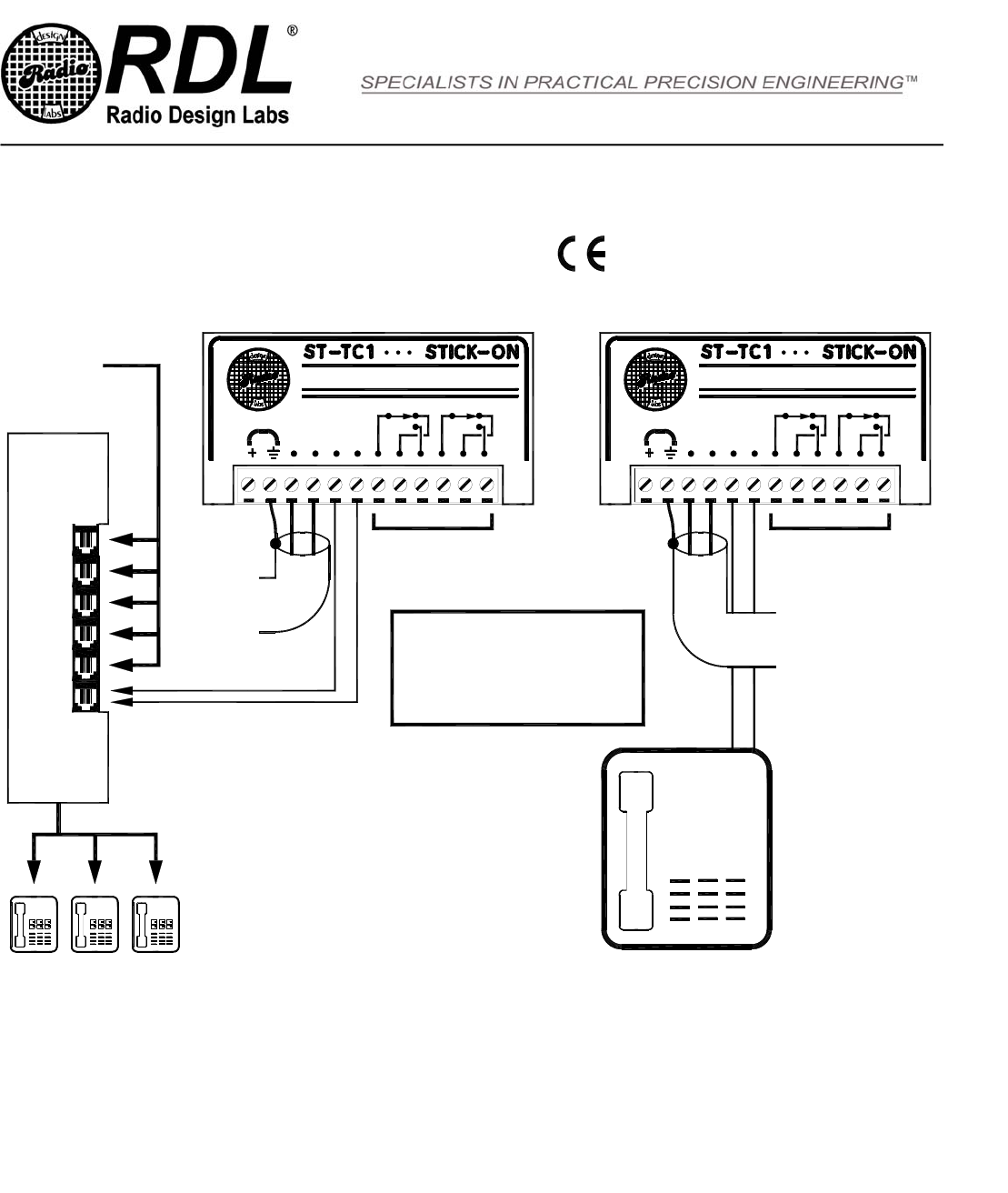
Use relay contacts to
trigger paging or radio
system.
Use the BAL AUDIO terminals
to either connect to the
line-level input or output of
audio devices such as a paging
system, radio, or a monitor.
In this example, selecting LINE 6 on any instrument
will activate the relay inside the ST-TC1 and will
make the BAL AUDIO connection available to that
instrument. If the BAL AUDIO terminals on the
ST-TC1 are connected to a paging input of an
amplifier system, then any phone instrument may
initiate an audio page by selecting LINE 6 and then
speaking.
Connection
to Phone
Instruments
TELEPHONE SYSTEM COUPLER
BAL
AUDIO
PWR PHONE
EQUIP
"LINE"
TO
Use relay contacts to
trigger paging or radio
system.
Balanced
Audio Input
or Output
In this example, The
ST-TC1's relay will
energize when the
phone handset is
taken off hook. The
relay will de-energize
when the handset is
returned to the
on-hook position.
DTMF audio can be
passed through the
BAL AUDIO
connection from the
phone keypad or
other DTMF
generating devices.
WARNING: Do NOT connect the
ST-TC1 directly to a
telephone-company phone line or
any phone line with ringer voltage
present.
