PR4401, PR4402 Datasheet. Www.s Manuals.com. Pr4401 Prema
User Manual: Marking of electronic components, SMD Codes UI**. Datasheets PR4401.
Open the PDF directly: View PDF  .
.
Page Count: 13
LED DRIVER PR4401/PR4402
0.9V Boost Driver for White LEDs PR4401/4402
Requires Only One External Component
The PR4401 and PR4402* are single cell step-up converters for white LEDs operating
from a supply voltage of less than 0.9V. Only one external inductor is needed for operation
of a white LED. PR4401 is recommended for mean LED currents of up to 20mA, PR4402
for up to 40mA. This makes PR4401 and PR4402 ideal for use in low-cost or small-sized
applications such as LED flashlights or LCD backlighting for portable devices.
Features Applications
• minimum startup voltage 0.9V • Small-sized LED torches
• 200/250mA peak output current • LCD backlighting
• only one external component required • LED indicator lights
• battery deep discharge protection
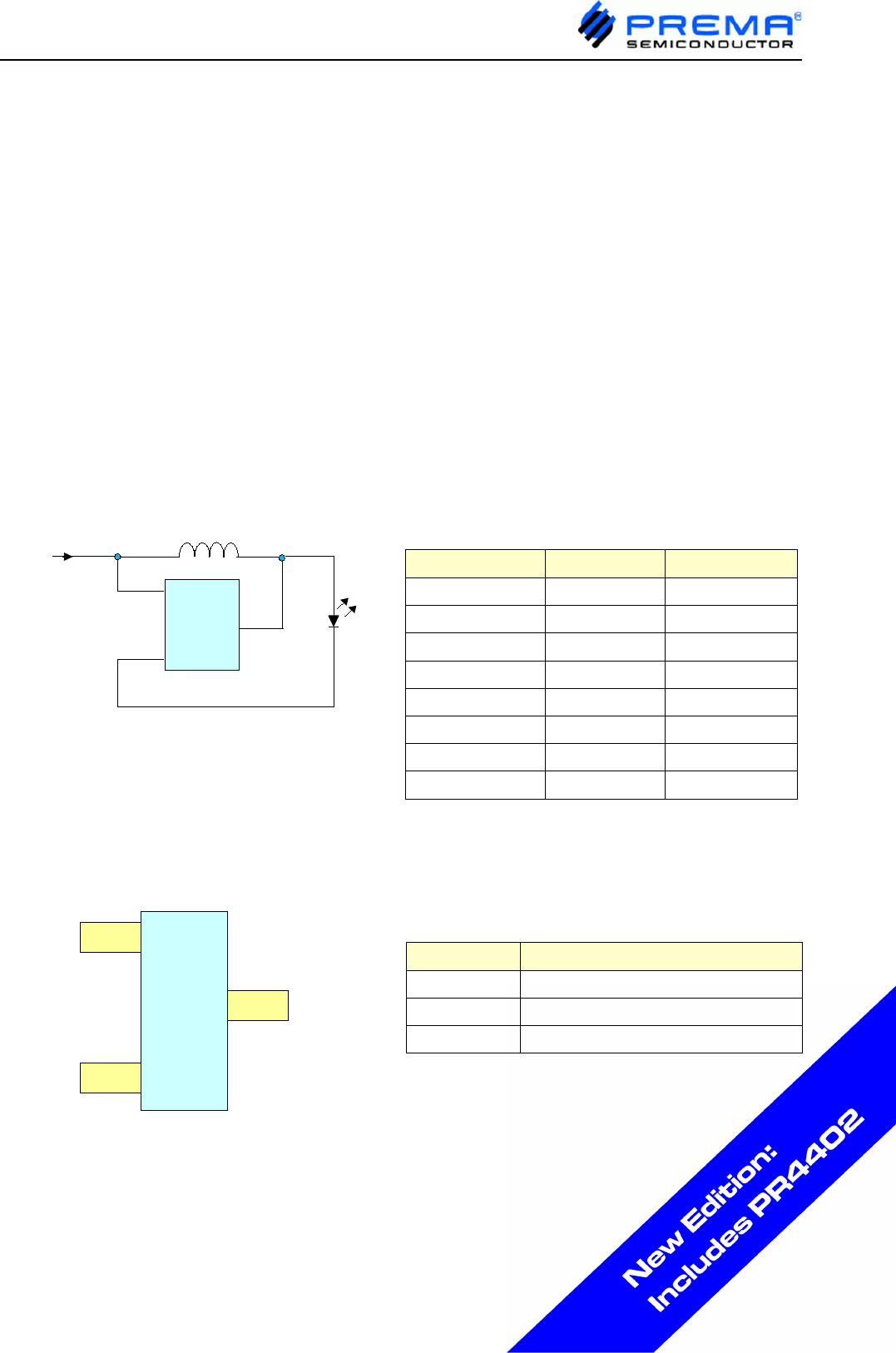
Typical Application
Vcc
Gnd
Vout
PR4401/02
Vbat =1.2V or 1.5V L1
White
LED
For output currents higher than 20mA an additional
blocking capacitor at Vcc is recommended.
The inductance L1 determines the LED
current:
Inductance L1 Mean current for
47µH 6.5 mA PR4401
32µH 8.3 mA PR4401
26.7µH 10.8 mA PR4401
22 µH 11 mA PR4401
14.7 µH 14 mA PR4401
10 µH 22 mA PR4401/4402
6.8 µH * 32 mA * PR4402
4.7 µH * 40 mA * PR4402
* PR4402 only measured with inductor Murata type
LQH32C series
10-22µH: one white LED
4.7-6.8µH: two white LEDs in parallel
Pin Description
PIN Name PIN Function Description
Vcc Supply voltage
Vout Output voltage, LED connection
Gnd Ground connection
Topside marking: "UI" (PR4401) or "UJ" (PR4402) with a two-digit lot code
Package SOT23-3 or COB on request
© PREMA Semiconductor GmbH 2006-2008
Page 1/12 Rev 0908
Vcc
Vout
Gnd
top view
UIxx
Ref.
Vcc
Gnd
Vout
Comp.
Control
Logic
LED DRIVER PR4401/PR4402
Absolute Maximum Ratings (PR4401 and PR4402)
Parameter Min Typ Max Units
VCC (no damage) -0.3 8 V
Operating Temperature Range -20 85 °C
Storage Temperature Range -55 150 °C
Electrostatic Discharge (ESD) Protection 2 kV
Electrical Characteristics
Vcc=1.5V, Ta = 25°C, 10-22µH: one white LED / 4.7-6.8µH: two white LEDs in parallel, unless otherwise noted.
Parameter Conditions Min Typ Max Min Typ Max Units
PR4401 PR4402
Supply Voltage, min. operating
min. startup
max. operating
L1 = 10...22µH
Ta = 25°C 1.90
0.70
0.90
0.80
0.95
1.90
0.70
0.90
0.80
0.95
V
V
V
Supply Voltage, min. operating
min. startup
max. operating
L1 = 10...22µH
Ta = 0...60°C 1.90
0.80
1.00
0.90
1.05
1.90
0.80
1.00
0.90
1.05
V
V
V
LED Mean Current
measured with L1 type LQH32C Murata
L1 = 47µH
L1 = 32µH
L1 = 26.7µH
L1 = 22µH
L1 = 14.7µH
L1 = 10µH
L1 = 6.8µH
L1 = 4.7µH
6.5
8.3
10.8
12
15
23
--
--
--
--
--
12
15
23
32
40
mA
mA
mA
mA
mA
Switching Current at Vout Vout = 0.4V 200 250 mA
Switching Frequency 500 500 kHz
Quiescent supply current Vcc > 950mV
Vcc = 600mV
Vcc = 400mV
4
50
10
5 8
100
20
10 mA
µA
µA
Efficiency 80 80 %
Vout Vcc 15 15 V
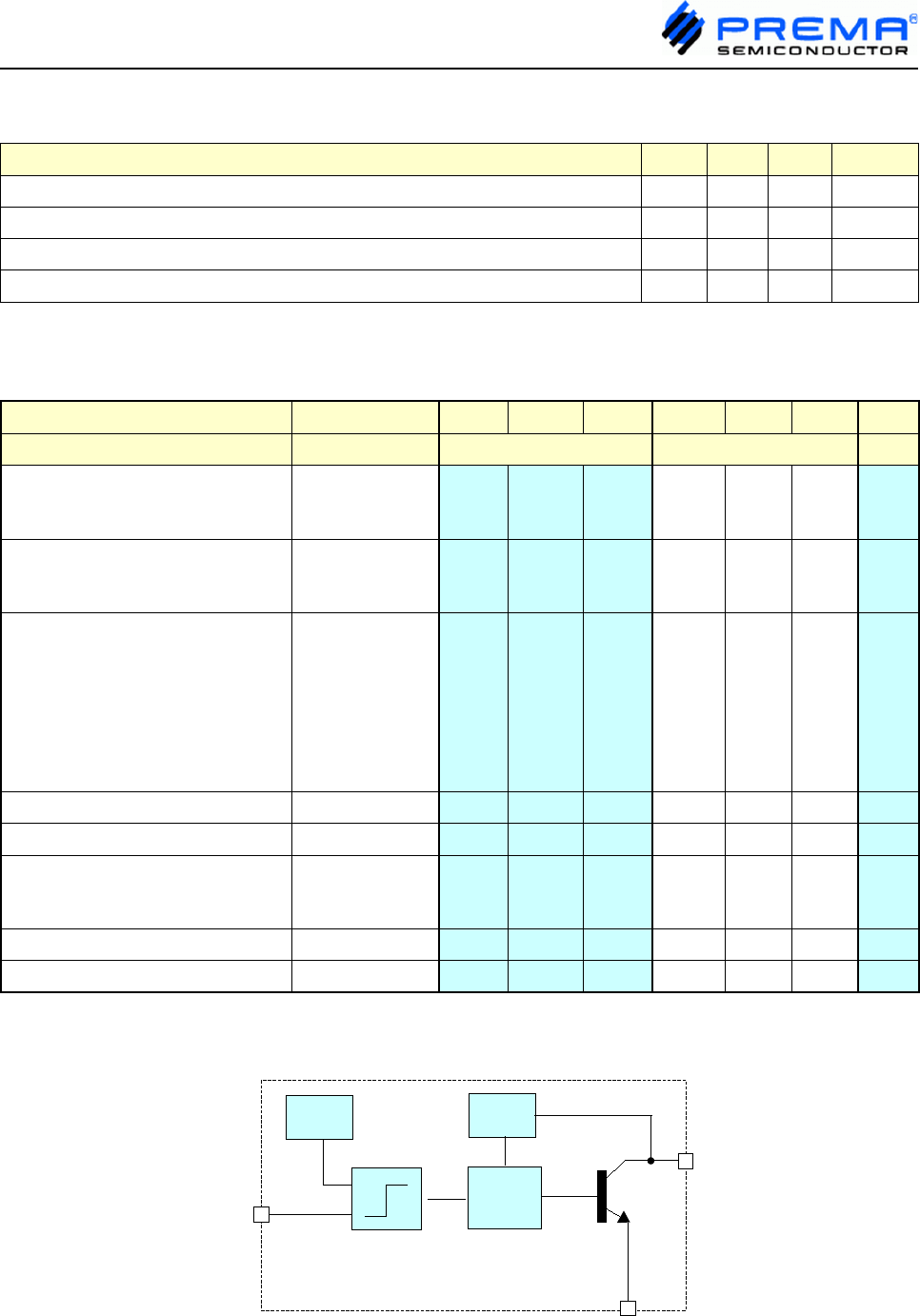
Block Diagram
© PREMA Semiconductor GmbH 2006-2008
Page 2/12 Rev 0908
LED DRIVER PR4401/PR4402
Typical Characteristics
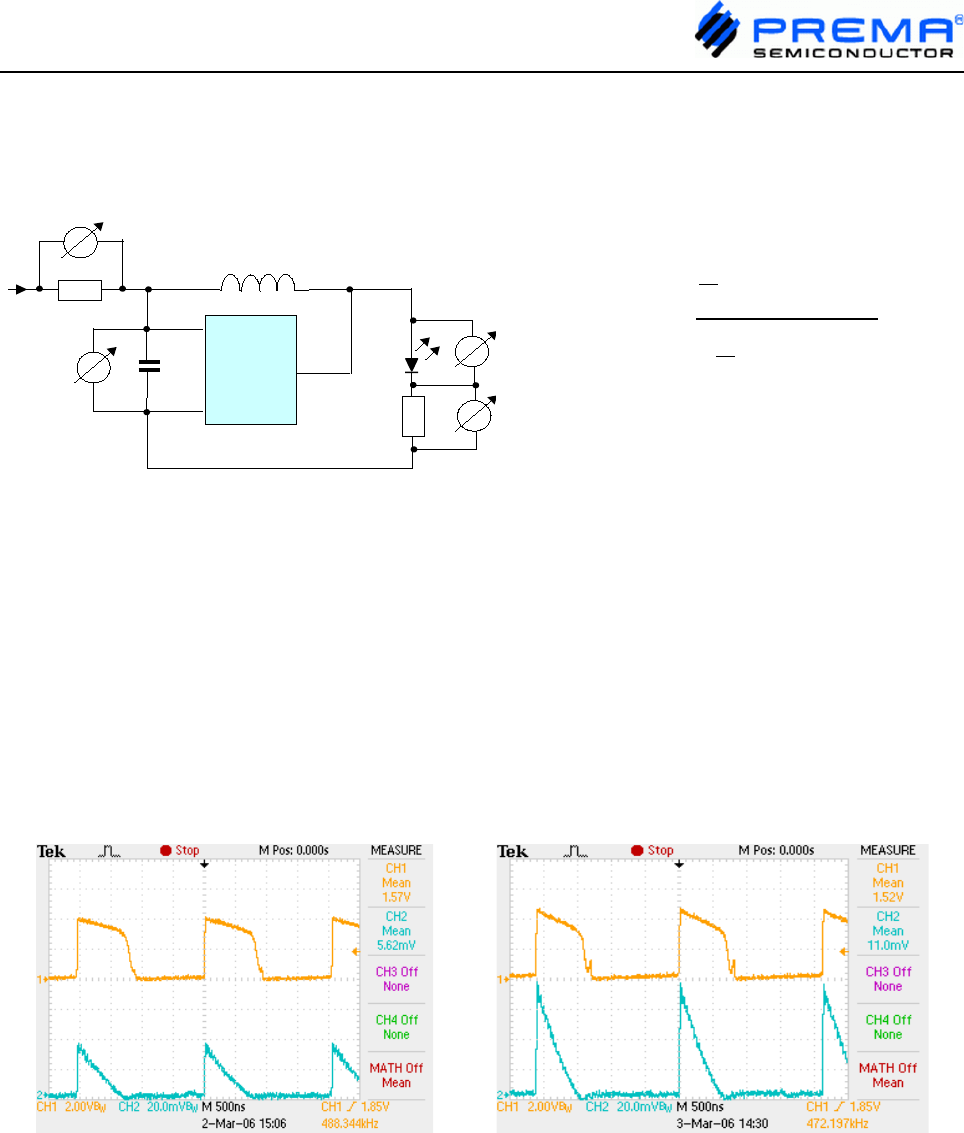
Test circuit
Measurement and Calculation of Efficiency
Efficiency %=
1
T∫
0
T
VLED
⋅ILED
dt
1
T∫
0
T
Vin
⋅Iin
dt
⋅100
Depending on test setup and measuring method, efficiency values can vary by approx. ±5%, and peak
current values can vary by up to ±20%, Accuracy of mean currents: ±1mA.
Measuring conditions for all diagrams, unless otherwise noted:
●Ta = 25°C
●one LED connected (peak voltage 4.2...5.8V)
A LQH32C from Murata has been used as reference inductor, the DC resistance is specified as 0.44 Ω ±
30% for 10 µH (max current 300 mA), 0.71 Ω ± 30% for 22 µH (max. current 250 mA) and 1.30 Ω ± 30% for a
47 µH inductor (max. current 170 mA).
Oscilloscope Displays
PR4401; LED voltage (CH1) and LED current (CH2, over 0.5 Ohm resistor)
with L1 = 22 µH L1 = 10 µH
© PREMA Semiconductor GmbH 2006-2008
Page 3/12 Rev 0908
Vcc
Gnd
Vout
PR4401
L1
0.5Ω
or 1Ω
470nF
0.5Ω
or 1Ω
LED DRIVER PR4401/PR4402
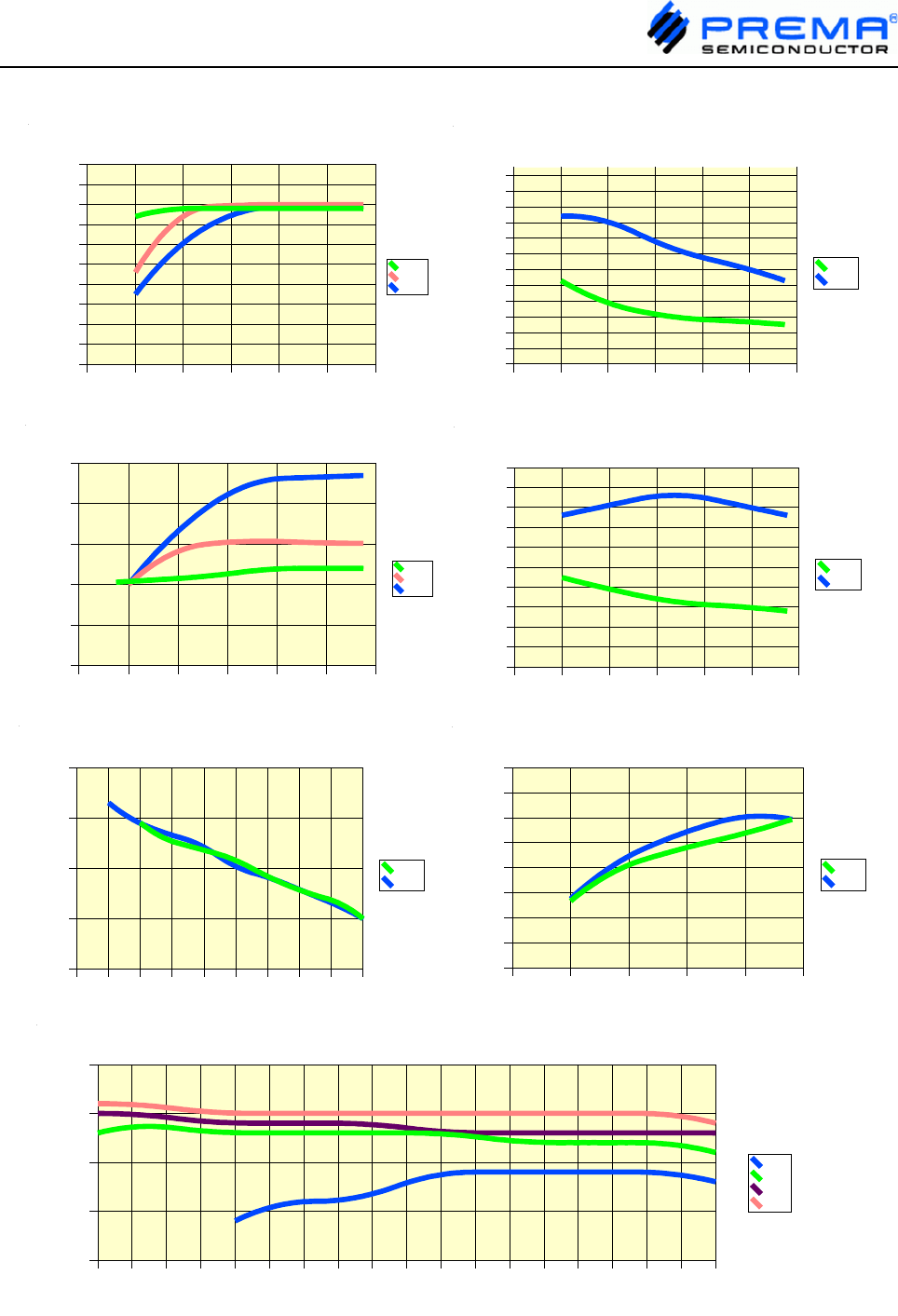
PR4401 data
0,8 1 1,2 1,4 1,6 1,8 2
0
10
20
30
40
50
60
70
80
90
100
Efficiency vs. Supply Voltage
22 µH
14,7 µH
10 µH
Supply Voltage (V)
Efficiency (%)
0,8 1 1,2 1,4 1,6 1,8 2
0
10
20
30
40
50
60
70
80
90
100
110
120
Mean Supply Current vs. Supply Voltage
22 µH
10 µH
Supply Voltage (V)
Supply Current (mA)
0,8 1 1,2 1,4 1,6 1,8 2
0
5
10
15
20
25
Mean LED Current vs. Supply Voltage
22 µH
14.7 µH
10 µH
Supply Voltage (V)
LED Mean Current (mA)
0,8 1 1,2 1,4 1,6 1,8 2
0
25
50
75
100
125
150
175
200
225
250
Peak LED Current vs. Supply Voltage
22 µH
10 µH
Supply Voltage (V)
LED Peak Current (mA)
-20 -10 0 10 20 30 40 50 60 70
0,7
0,8
0,9
1
1,1
Startup Voltage vs. Temperature
22 µH
10 µH
Temperature (°C)
Startup Voltage (V))
0,75 1 1,25 1,5 1,75 2
0
100
200
300
400
500
600
700
800
Oscillation Frequency vs. Supply Voltage
22 µH
10 µH
Supply Voltage (V)
Frequency (kHz)
-20 -15 -10 -5 0 5 10 15 20 25 30 35 40 45 50 55 60 65 70
10
15
20
25
30
Mean LED Current vs. Temp. @ L1=10µH
1.0V
1,25V
1,50V
1,75V
Temperature (°C)
Mean LED current (mA)
© PREMA Semiconductor GmbH 2006-2008
Page 4/12 Rev 0908
LED DRIVER PR4401/PR4402
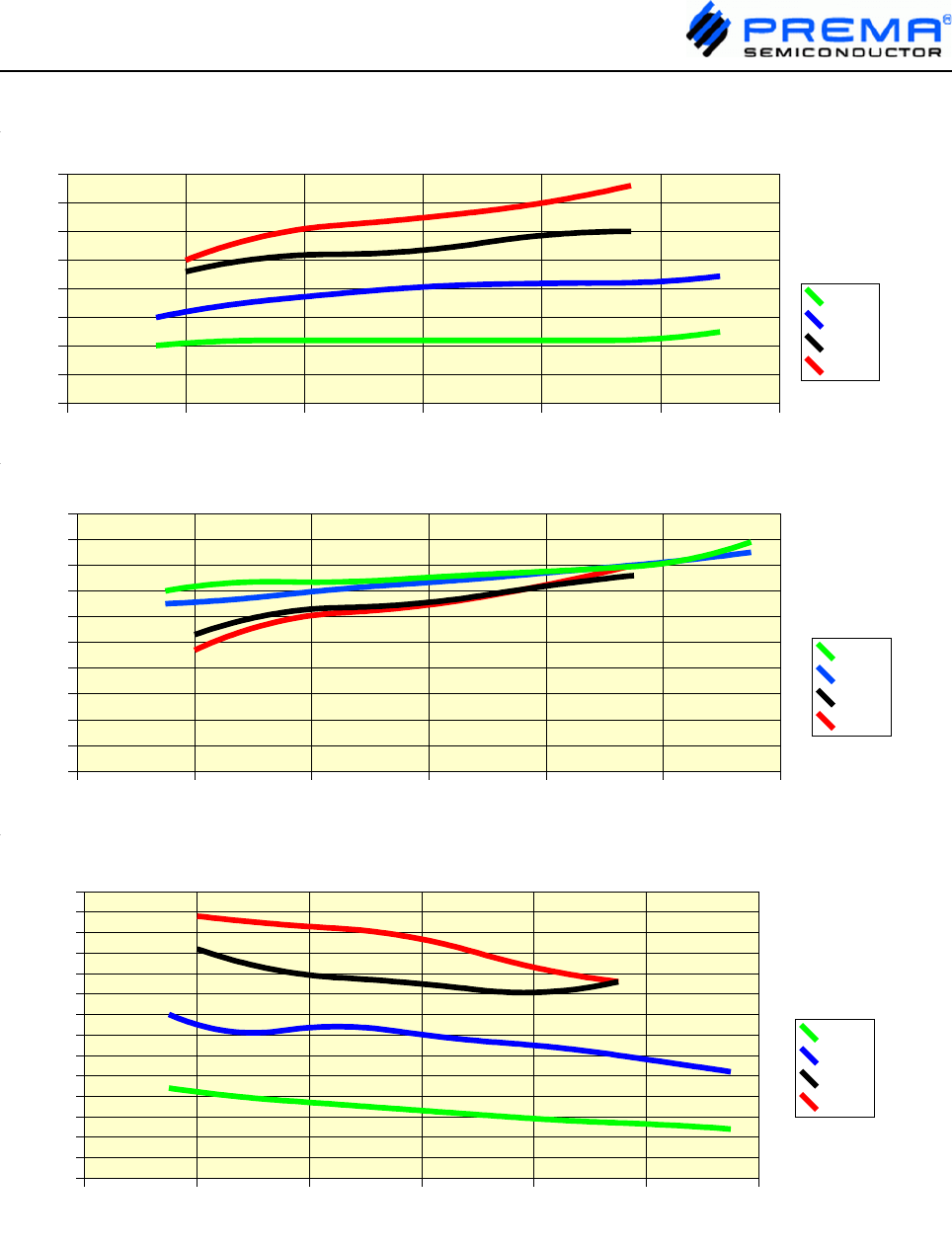
PR4402 data
0,8 1 1,2 1,4 1,6 1,8 2
0
5
10
15
20
25
30
35
40
Mean LED Current vs. Supply Voltage
22 µH
10 µH
6.8 µH
4.7 µH
Supply Voltage (V)
LED Mean Current (mA)
0,8 1 1,2 1,4 1,6 1,8 2
0
10
20
30
40
50
60
70
80
90
100
Efficiency vs. Supply Voltage
22 µH
10 µH
6.8 µH
4.7 µH
Supply Voltage (V)
Efficiency (%)
0,8 1 1,2 1,4 1,6 1,8 2
0
25
50
75
100
125
150
175
200
225
250
275
300
325
350
Peak LED Current vs. Supply Voltage
22 µH
10 µH
6.8 µH
4.7 µH
Supply Voltage (V)
LED Peak Current (mA)
© PREMA Semiconductor GmbH 2006-2008
Page 5/12 Rev 0908
LED DRIVER PR4401/PR4402
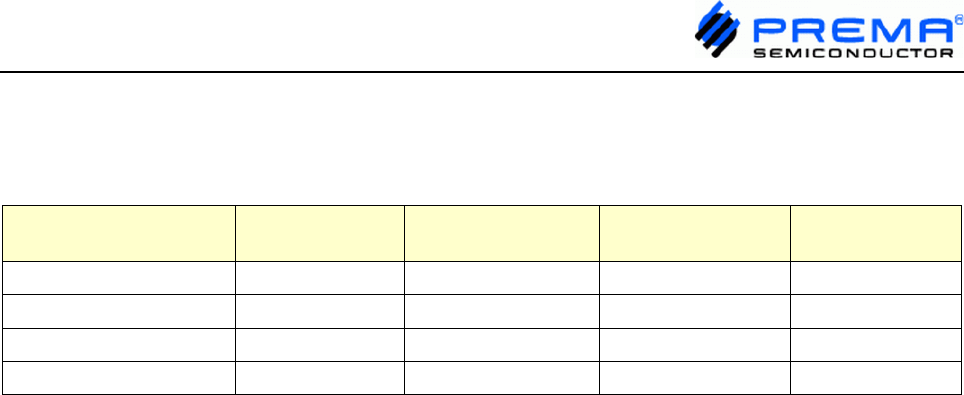
Influence of the LED Forward Voltage
measured with 1 LED / 2 LEDs in parallel; Vcc = 1.5V
Circuit LED Peak
Forward Voltage
LED Mean Current Mean Supply
Current
Efficiency
10 µH, 1 LED 5.8 V 20 mA 70 mA 77 %
10 µH, 2 LEDs || 4.6 V 24 mA 70 mA 80 %
22 µH, 1 LED 4.2 V 13 mA 33 mA 82 %
22 µH, 2 LEDs || 3.5 V 14 mA 32 mA 82 %
Peak forward voltages above approx. 5V are often considered as an overload condition
and may lead to a lower LED efficiency.
Application Notes
Selection of PR4401 and PR4402
The circuit type should be selected according to the required LED current.
PR4401 is best operated with inductors between 10 and 22µH.
PR4402 is best operated with inductors between 4.7 and 10µH.
Using lower inductances may lead to erratic behaviour, especially at low supply voltages
and should be avoided.
Operating with higher inductances is possible and will lead to lower supply and LED
current.
However the quiescent current which is independent of the inductance will lead to a lower
overall efficiency. Since PR4402 has about twice the quiescent current of PR4401, it is not
recommended for small LED currents.
LED compatibility
It must be considered that the peak current through the LED is a factor of up to 7 higher
than the mean current. LED lifetime may be affected if operated outside the range
specified by the LED vendor.
Since the emission spectrum of white LEDs usually depends on the current, the light color
may shift to blueish white. High peak currents may also saturate the LED and reduce the
light efficiency of the LED.
If the rated LED peak current is exceeded, it is recommended to use a smoothing
capacitor and diode to provide a continuous output current (see below). With most
standard LEDs, this will improve the overall performance with inductors of 10µH and less,
or mean output currents of 23mA and more.
Note that with especially with the higher currents of PR4402 the current rating of most
standard LEDs is exceeded, and more powerful or multiple LEDs must be used.
Inductor compatibility
While the series resistance of the coil has a small impact on the LED current, it is
important that the saturation current is higher than the maximum peak current over the
supply voltage range. Inductors optimized for DC-DC converters are mostly suitable.
© PREMA Semiconductor GmbH 2006-2008
Page 6/12 Rev 0908
LED DRIVER PR4401/PR4402
Connection from Battery
Due to high peak currents, it is important to connect the PR4401/PR4402 to the battery
with short, low resistance wires, to achieve the best performance. A voltage drop along the
wire affects LED current, efficiency and minimum startup and operating voltage.
This is most critical for applications with low inductivity and high current.
In cases where a longer wire from the battery cannot be avoided, a capacitor should be
placed close to the Vcc and Gnd pin of PR4401. Typically capacitors between 220nF and
1µF are used.
With PR4402 operated at higher currents, a blocking capacitor is usually necessary even
if wires or board layout are optimized.
Using Different Battery Types
The input voltage must be 1.90V at maximum. At higher voltages the circuit may not
trigger and start up correctly. Therefore operation with one Alkaline, NiCd, or NiMH cell
(AA or AAA type) is recommended.
Alkaline button cells can also be used for supply. However, since high peak currents are
drawn from the battery, button cells are recommended only with inductors of 22µH or
more, depending on the battery type. A capacitor at the supply pins of PR4401 may also
improve performance with button cells.
Lithium batteries are not suitable due to their higher voltage.
Approximate battery lifetime:
Battery Battery Lifetime, typical
L1= 22µH, LED mean current 12mA
Battery Lifetime, typical
L1= 10µH, LED mean current 23mA
AA (Mignon, LR 6/AM-3) 55 h 27 h
AAA (Micro, LR 03/AM-4) 22 h 8 h
Conditions: one white LED connected, measured with single 1.5V TDK Alkaline battery.
Battery lifetime depends on battery capacity and operating conditions. Therefore the times
indicated here can only give a rough indication of achievable times.
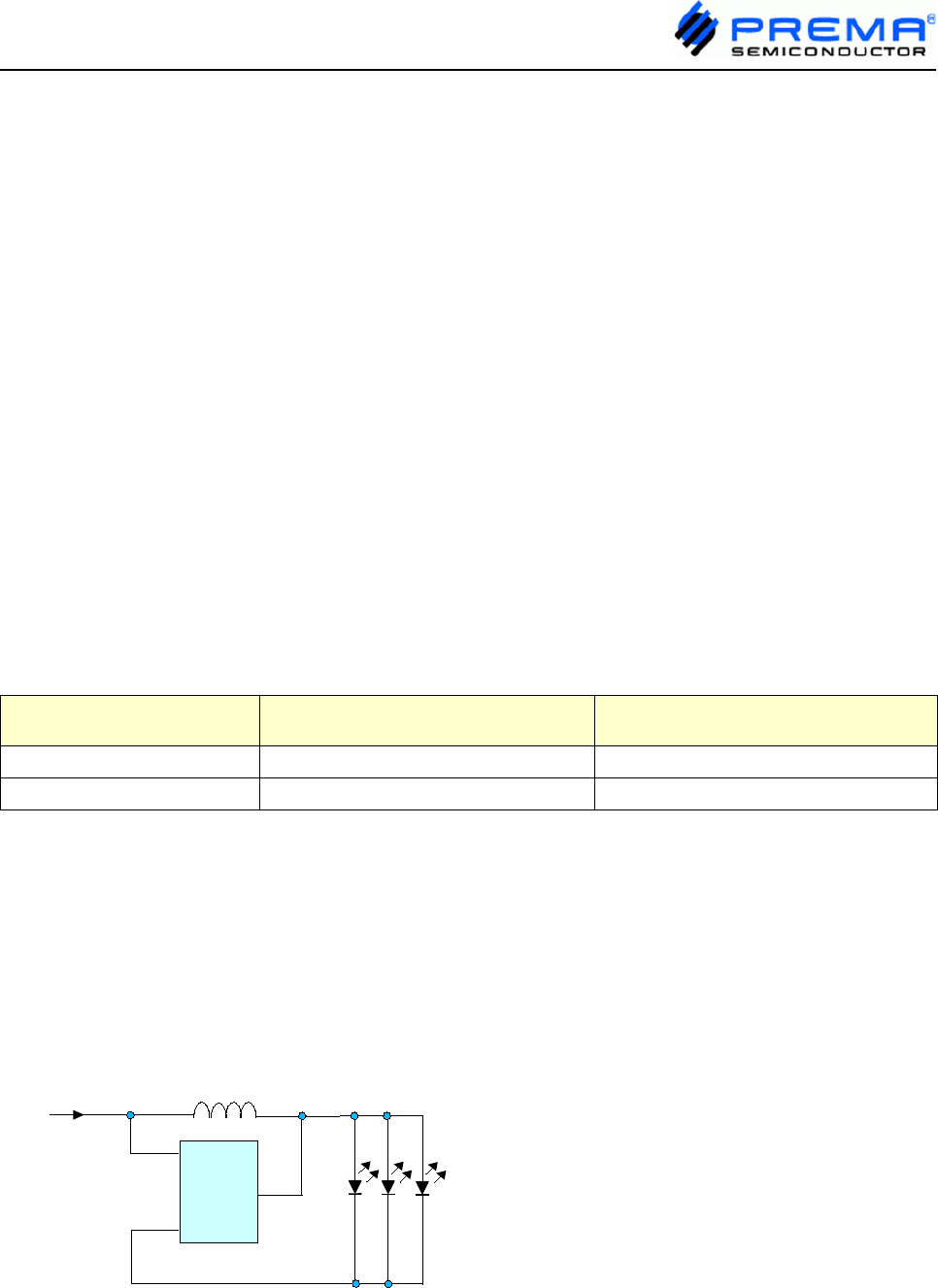
Connecting several LEDs in parallel
When several LEDs are connected in parallel, it is necessary to match the forward voltage
of these LEDs, to achieve a uniform brightness. The total current of all LEDs together
corresponds approximately to the mean output current for operation with one LED.
Vcc
Gnd
Vout
PR4401
Vbat =1.2V or 1.5V L1=10µH
Matching
White
LEDs
© PREMA Semiconductor GmbH 2006-2008
Page 7/12 Rev 0908
LED DRIVER PR4401/PR4402
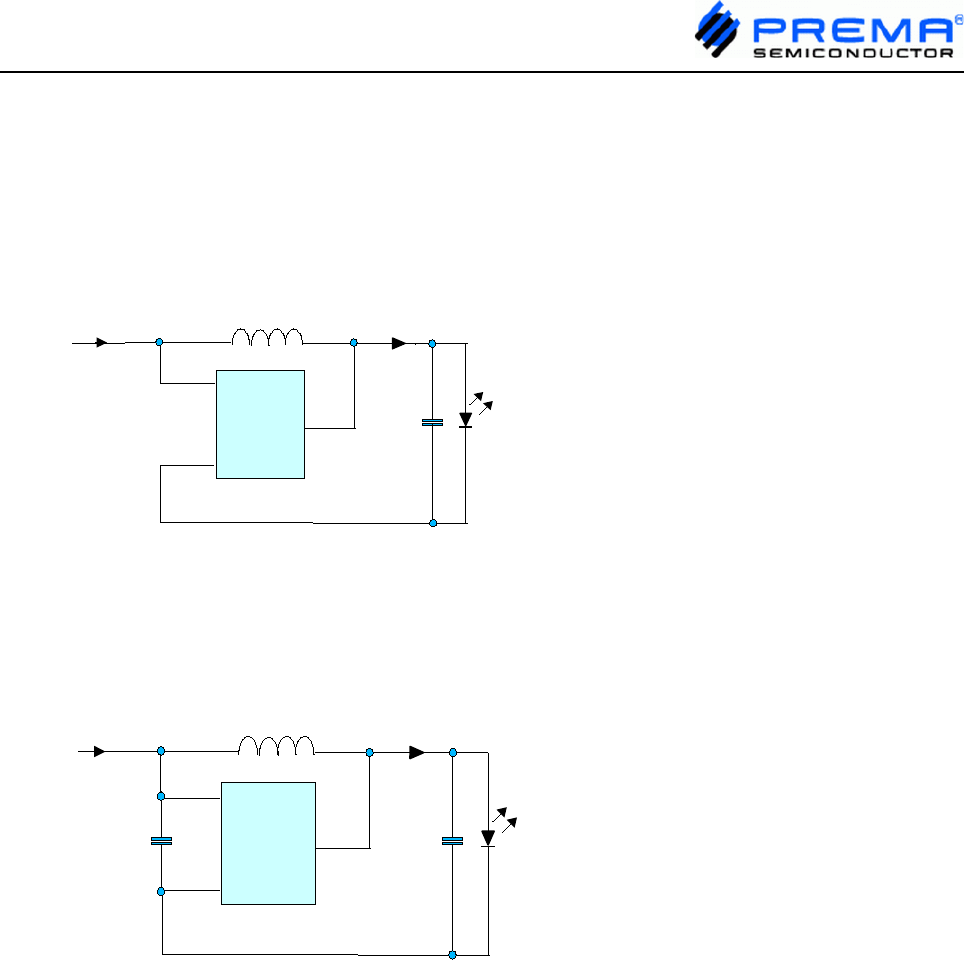
Operation of LED with smoothed current (rectifier)
With a diode (preferably a Schottky diode) and a smoothing capacitor the voltage at the
LED can be buffered if necessary. The capacitance must be small enough so that the
voltage at the capacitor will exceed a voltage of 2.5V in the first cycle, otherwise the circuit
may not start up. In most cases, values between 100nF and 1µF are appropriate.
Due to different load characteristics, output current and efficiency are typically higher than
without capacitor, especially in the high-current range.
Vcc
Gnd
Vout
PR4401/02
Vbat =1.2V or 1.5V L1
White
LED
S
Recommended configuration for higher LEDs currents
While for lower LED currents it is possible to operate PR4401 with the minimum number
of components, it is recommended to provide both rectifier circuit a the output and buffer
capacitor at the input at high LED currents, to achieve the best performance.
Vcc
Gnd
Vout
PR4401/02
Vbat =1.2V or 1.5V L1
White
LED
S
Whether the extra components are necessary or not depends largely on the performance
of the components used, most importantly the peak current of the LED, the internal
resistance of the battery and the resistance of the battery cables. If by adding the extra
components the mean LED current increases significantly, it is usually advisable to add
them permanently to achieve a high efficiency.
As a rule of thumb, with a 22µH inductor the extra components will usually not increase
the current significantly, while for inductors below 10µH they will usually improve the
performance noticeably.
Buffer capacitor and rectifier circuit are independent measures. For powerful LEDs, or two
or more LEDs in parallel at the output, the rectifier may not be necessary, but the buffer
capacitor will still prevent high voltage drops along the supply wire.
For the buffer capacitor, values between 220nF and 1µF are common.
© PREMA Semiconductor GmbH 2006-2008
Page 8/12 Rev 0908

LED DRIVER PR4401/PR4402
Connecting two LEDs in series
It is possible to operate PR4401 and PR4402 with two LEDs in series at the output.
However, while the peak output current is nearly independent of the output load, the mean
output current with two LEDs in series is reduced to half the current with one LED. In
addition, at high output voltages the efficiency drops significantly, depending on operating
conditions, and current pulses become shorter and sharper.
Therefore, although possible and useful in some cases, this operation mode is not
recommended for general applications and not specified further.
Using red, green or yellow LEDs
Although PR4401/PR4402 is optimized for operation with white or blue LEDs, it will usually
also work with red, green or yellow LEDs, with the following restrictions:
a) The LED must build up a sufficient forward voltage to trigger PR4401/PR4402. Due to
the internal resistance of the LED, this condition is usually met. However, no guarantee
can be assumed for proper operation under all conditions, and you need to qualify the
system yourself
b) Due to the different forward voltage level and internal resistance of colored LEDs, the
timing is different, and mean currents are mostly lower than for white LEDs. Also other
parameters may deviate from this data sheet.
© PREMA Semiconductor GmbH 2006-2008
Page 9/12 Rev 0908
LED DRIVER PR4401/PR4402
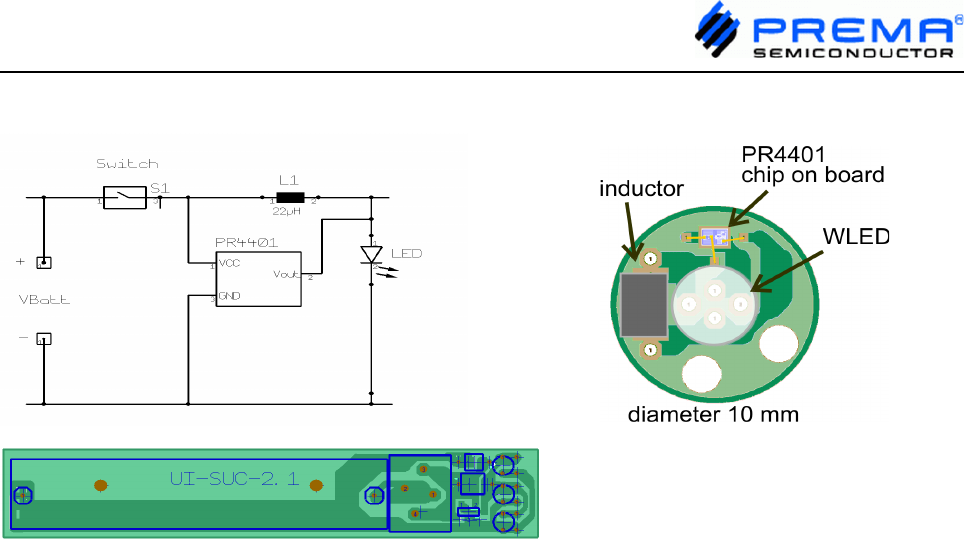
Sample Board Layouts
Flashlight board with AAA battery holder
Size: 77.5 mm x 14 mm
© PREMA Semiconductor GmbH 2006-2008
Page 10/12 Rev 0908
LED DRIVER PR4401/PR4402
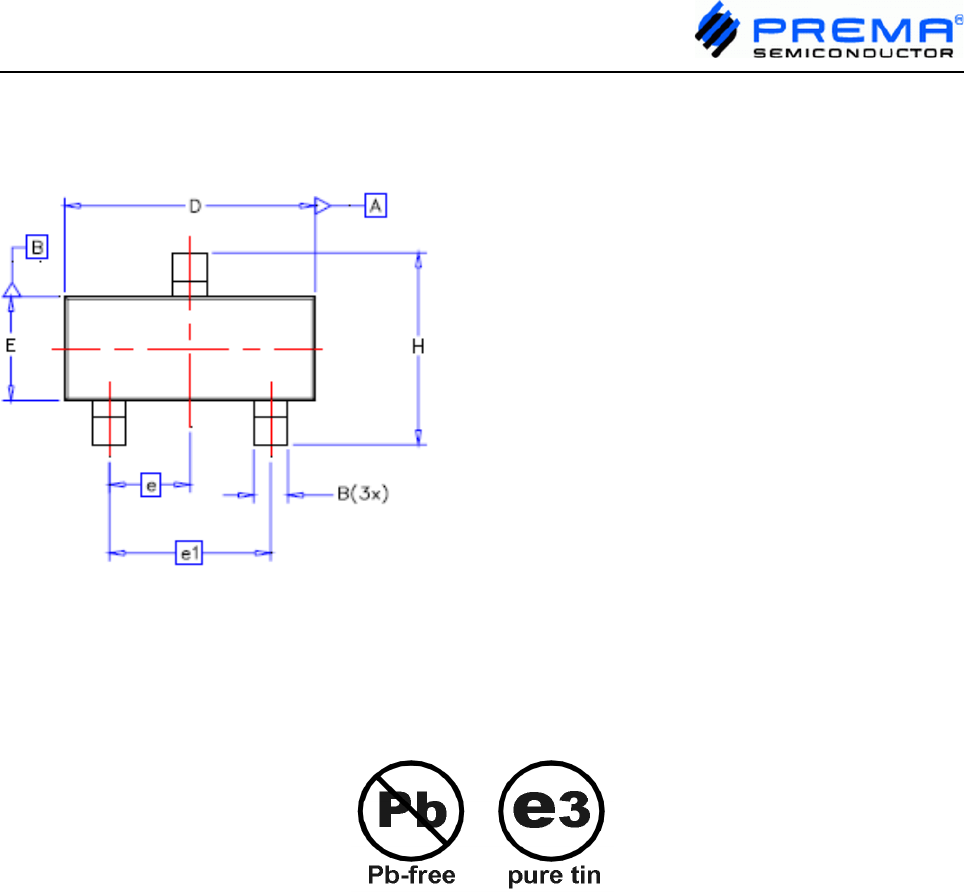
Available Packages
Typical Dimensions
B = 0.40 mm D = 2.92 mm
E = 1.30 mm H = 2.37 mm
e1 = 1.92 mm
PR4401/PR4402 SOT23 package in tape and reel
Packing unit: 3000 ICs per reel (reel diameter 7" / 178mm)
Delivery in die form on request
All parts delivered comply with RoHS. Finish is pure tin.
© PREMA Semiconductor GmbH 2006-2008
Page 11/12 Rev 0908

LED DRIVER PR4401/PR4402
Disclaimer
Information provided by PREMA is believed to be accurate and correct. However, no responsibility is assumed by PREMA for its use,
nor for any infringements of patents or other rights of third parties which may result from its use. PREMA reserves the right at any time
without notice to change circuitry and specifications.
Life Support Policy
PREMA Semiconductors products are not authorized for use as critical components in life support devices or systems without the
express written approval of PREMA Semiconductor. As used herein:
1. Life support devices or systems are devices or systems which, (a) are intended for surgical implant into the body, or (b) support or
sustain life, and whose failure to perform when properly used in accordance with instructions for use provided in the labeling, can be
reasonably expected to result in a significant injury to the user.
2. A critical component is any component of a life support device or system whose failure to perform can be reasonably expected to
cause the failure of the life support device or system, or to affect its safety or effectiveness.
PREMA Semiconductor GmbH
Robert-Bosch-Str. 6
55129 Mainz Germany
Phone: +49-6131-5062-0
Fax: +49-6131-5062-220
Email: prema@prema.com Web site: www.prema.com
© PREMA Semiconductor GmbH 2006-2008
Page 12/12 Rev 0908