SST49LF002A, SST49LF003A, SST49LF004A, SST49LF008A Datasheet. Www.s Manuals.com. 20020521 Sst
User Manual: Datasheets SST49LF004, SST49LF004A.
Open the PDF directly: View PDF  .
.
Page Count: 37
©2002 Silicon Storage Technology, Inc.
S71161-06-000 2/02 504
1
The SST logo and SuperFlash are registered trademarks of Silicon Storage Technology, Inc.
Intel is a registered trademark of Intel Corporation.
These specifications are subject to change without notice.
Advance Information
FEATURES:
• Firmware Hub for Intel 8xx Chipsets
• 2 Mbit, 3 Mbit, 4 Mbit, or 8 Mbit SuperFlash
memory array for code/data storage
– SST49LF002A: 256K x8 (2 Mbit)
– SST49LF003A: 384K x8 (3 Mbit)
– SST49LF004A: 512K x8 (4 Mbit)
– SST49LF008A: 1024K x8 (8 Mbit)
• Flexible Erase Capability
– Uniform 4 KByte Sectors
– Uniform 16 KByte overlay blocks for
SST49LF002A
– Uniform 64 KByte overlay blocks for
SST49LF003A/004A/008A
– Top Boot Block protection
- 16 KByte for SST49LF002A
- 64 KByte for SST49LF003A/004A/008A
– Chip-Erase for PP Mode Only
• Single 3.0-3.6V Read and Write Operations
• Superior Reliability
– Endurance:100,000 Cycles (typical)
– Greater than 100 years Data Retention
• Low Power Consumption
– Active Read Current: 6 mA (typical)
– Standby Current: 10 µA (typical)
• Fast Sector-Erase/Byte-Program Operation
– Sector-Erase Time: 18 ms (typical)
– Block-Erase Time: 18 ms (typical)
– Chip-Erase Time: 70 ms (typical)
– Byte-Program Time: 14 µs (typical)
– Chip Rewrite Time:
SST49LF002A: 4 seconds (typical)
SST49LF003A: 6 seconds (typical)
SST49LF004A: 8 seconds (typical)
SST49LF008A: 15 seconds (typical)
– Single-pulse Program or Erase
– Internal timing generation
• Two Operational Modes
– Firmware Hub Interface (FWH) Mode for
in-system operation
– Parallel Programming (PP) Mode for fast
production programming
• Firmware Hub Hardware Interface Mode
– 5-signal communication interface supporting
byte Read and Write
– 33 MHz clock frequency operation
– WP# and TBL# pins provide hardware write
protect for entire chip and/or top Boot Block
– Block Locking Register for all blocks
– Standard SDP Command Set
– Data# Polling and Toggle Bit for End-of-Write
detection
– 5 GPI pins for system design flexibility
– 4 ID pins for multi-chip selection
• Parallel Programming (PP) Mode
– 11-pin multiplexed address and
8-pin data I/O interface
– Supports fast In-System or PROM programming
for manufacturing
• CMOS and PCI I/O Compatibility
• Packages Available
– 32-lead PLCC
– 32-lead TSOP (8mm x 14mm)
PRODUCT DESCRIPTION
The SST49LF00xA flash memory devices are designed
to be read-compatible with the Intel 82802 Firmware Hub
(FWH) device for PC-BIOS application. It provides pro-
tection for the storage and update of code and data in
addition to adding system design flexibility through five
general purpose inputs. Two interface modes are sup-
ported by the SST49LF00xA: Firmware Hub (FWH)
Interface Mode for In-System programming and Parallel
Programming (PP) Mode for fast factory programming of
PC-BIOS applications.
The SST49LF00xA flash memory devices are manufac-
tured with SST’s proprietary, high performance Super-
Flash Technology. The split-gate cell design and thick
oxide tunneling injector attain better reliability and manu-
facturability compared with alternate approaches. The
SST49LF00xA devices significantly improve performance
and reliability, while lowering power consumption. The
SST49LF00xA devices write (Program or Erase) with a
single 3.0-3.6V power supply. It uses less energy during
Erase and Program than alternative flash memory tech-
nologies. The total energy consumed is a function of the
applied voltage, current and time of application. Since for
2 Mbit / 3 Mbit / 4 Mbit / 8 Mbit Firmware Hub
SST49LF002A / SST49LF003A / SST49LF004A / SST49LF008A
SST49LF002A / 003A / 004A / 008A2Mb / 3Mb / 4Mb / 8Mb Firmware Hub for Intel 8xx Chipsets

2
Advance Information
2 Mbit / 3 Mbit / 4 Mbit / 8 Mbit Firmware Hub
SST49LF002A / SST49LF003A / SST49LF004A / SST49LF008A
©2002 Silicon Storage Technology, Inc. S71161-06-000 2/02 504
any given voltage range, the SuperFlash technology uses
less current to program and has a shorter Erase time, the
total energy consumed during any Erase or Program oper-
ation is less than alternative flash memory technologies.
The SST49LF00xA products provide a maximum Byte-
Program time of 20 µsec. The entire memory can be
erased and programmed byte-by-byte typically in 15 sec-
onds for an 8-Mbit device, when using status detection
features such as Toggle Bit or Data# Polling to indicate the
completion of Program operation. The SuperFlash tech-
nology provides fixed Erase and Program time, indepen-
dent of the number of Erase/Program cycles that have
performed. Therefore the system software or hardware
does not have to be calibrated or correlated to the cumu-
lated number of Erase/Program cycles as is necessary
with alternative flash memory technologies, whose Erase
and Program time increase with accumulated Erase/Pro-
gram cycles.
To protect against inadvertent write, the SST49LF00xA
devices employ hardware and software data (SDP) protec-
tion schemes. It is offered with typical endurance of
100,000 cycles. Data retention is rated at greater than 100
years.
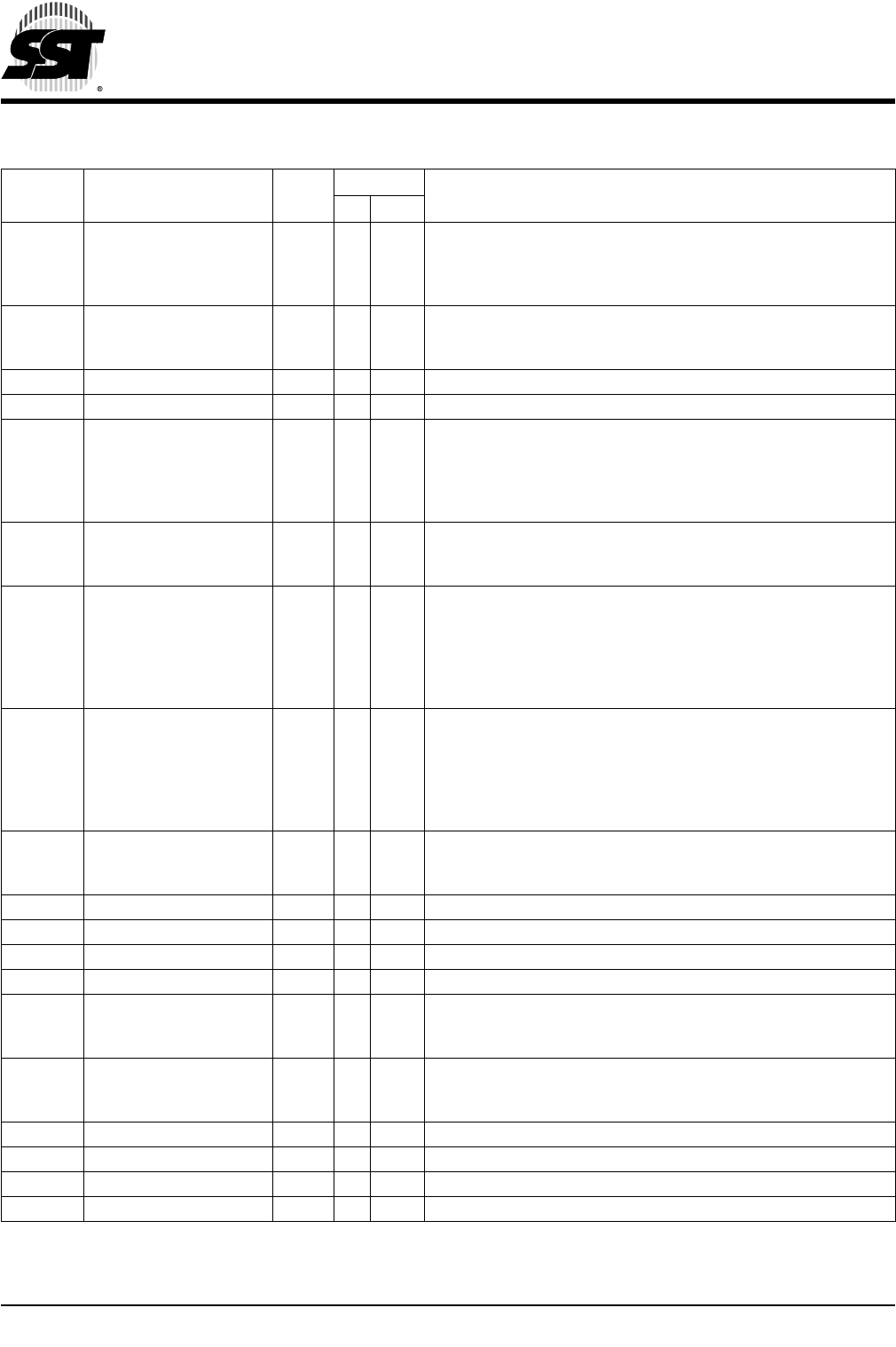
To meet high density, surface mount requirements, the
SST49LF00xA device is offered in 32-lead TSOP and 32-
lead PLCC packages. See Figures 7 and 8 for pin assign-
ments and Table 8 for pin descriptions.
Mode Selection and Description
The SST49LF00xA flash memory devices can operate in
two distinct interface modes: the Firmware Hub Interface
(FWH) mode and the Parallel Programming (PP) mode.
The IC (Interface Configuration pin) is used to set the
interface mode selection. If the IC pin is set to logic High,
the device is in PP mode; while if the IC pin is set Low,
the device is in the FWH mode. The IC selection pin must
be configured prior to device operation. The IC pin is
internally pulled down if the pin is not connected. In FWH
mode, the device is configured to interface with its host
using Intel’s Firmware Hub proprietary protocol. Commu-
nication between Host and the SST49LF00xA occurs via
the 4-bit I/O communication signals, FWH [3:0] and the
FWH4. In PP mode, the device is programmed via an 11-
bit address and an 8-bit data I/O parallel signals. The
address inputs are multiplexed in row and column
selected by control signal R/C# pin. The column
addresses are mapped to the higher internal addresses,
and the row addresses are mapped to the lower internal
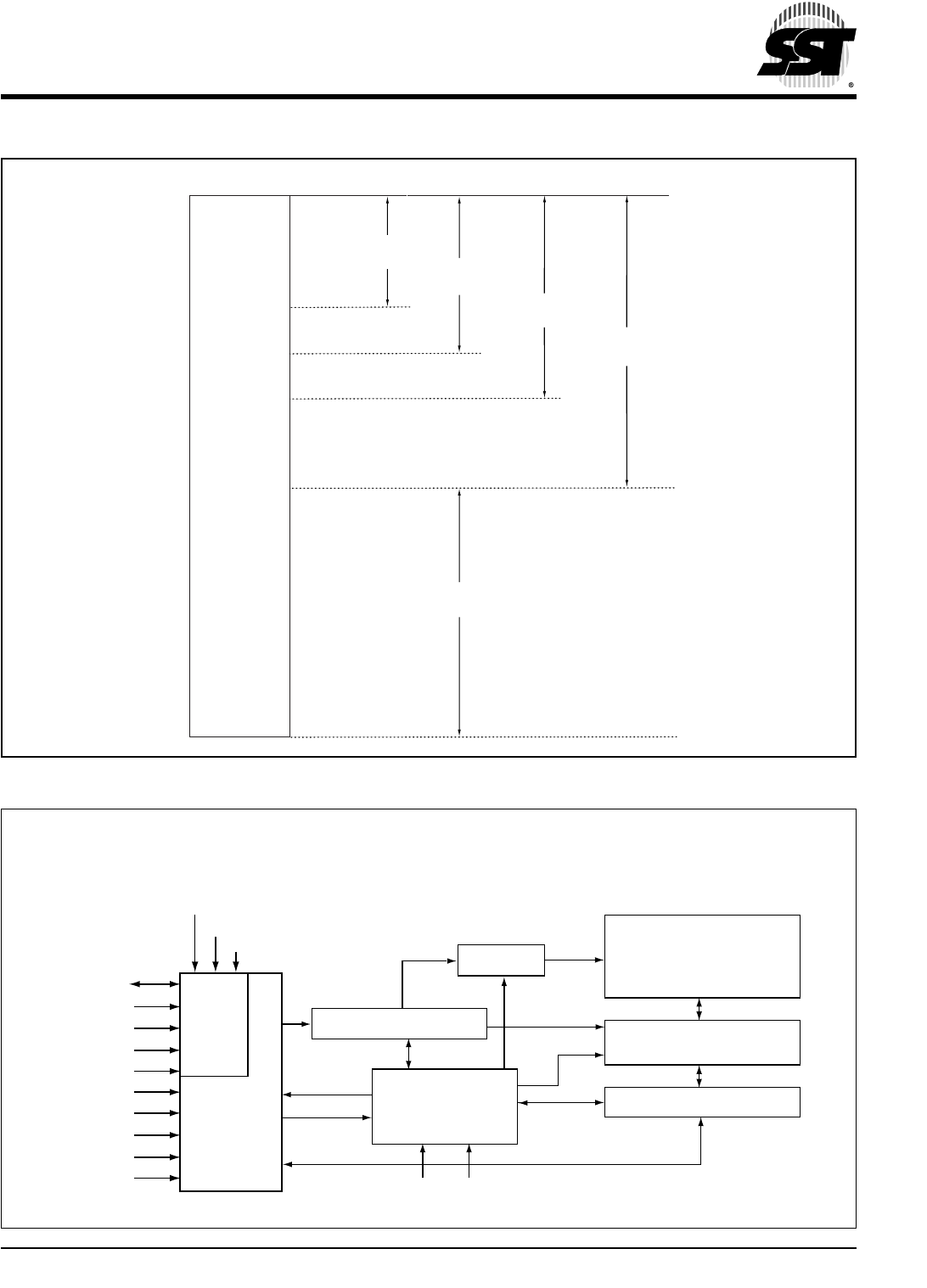
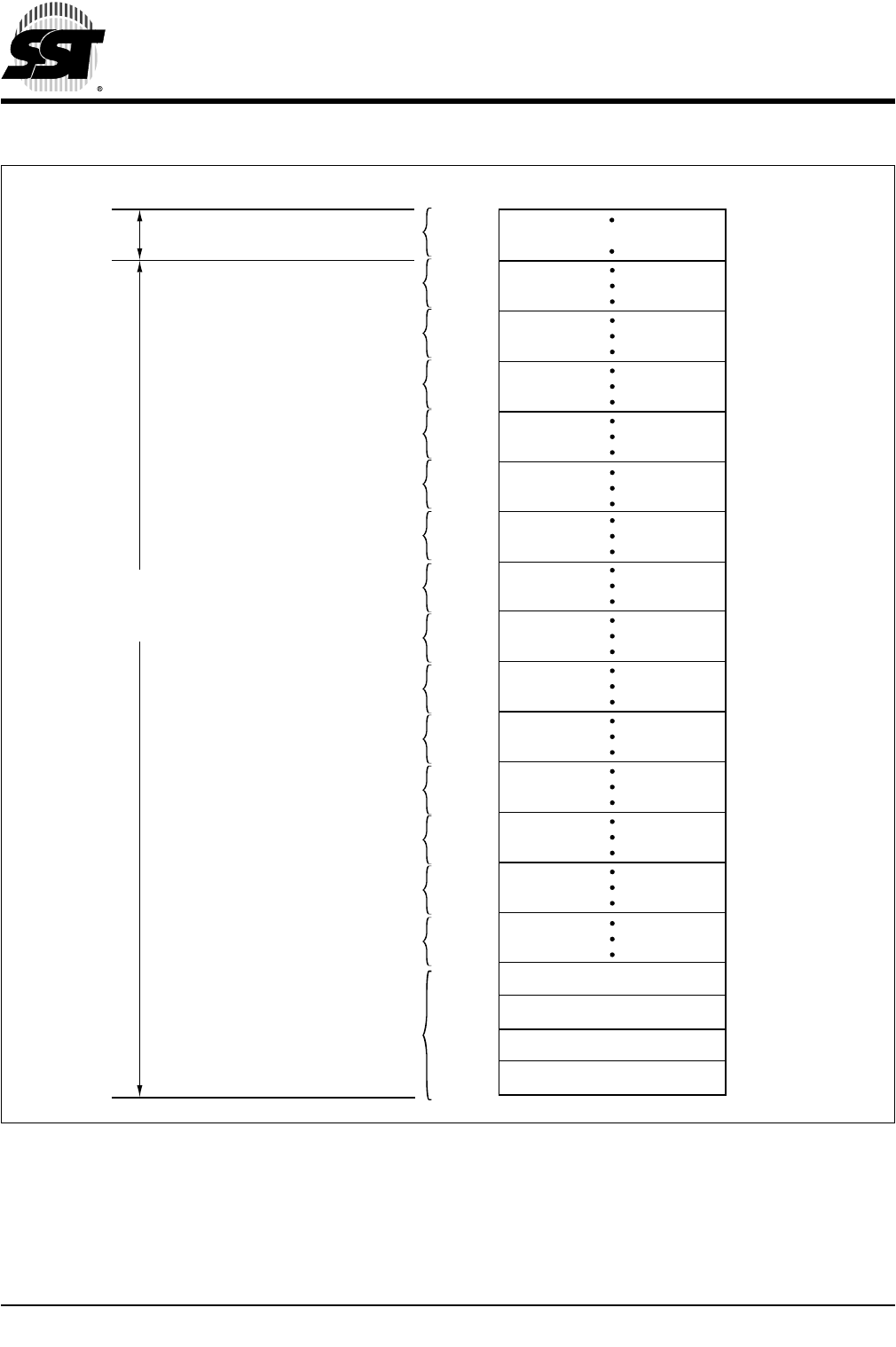
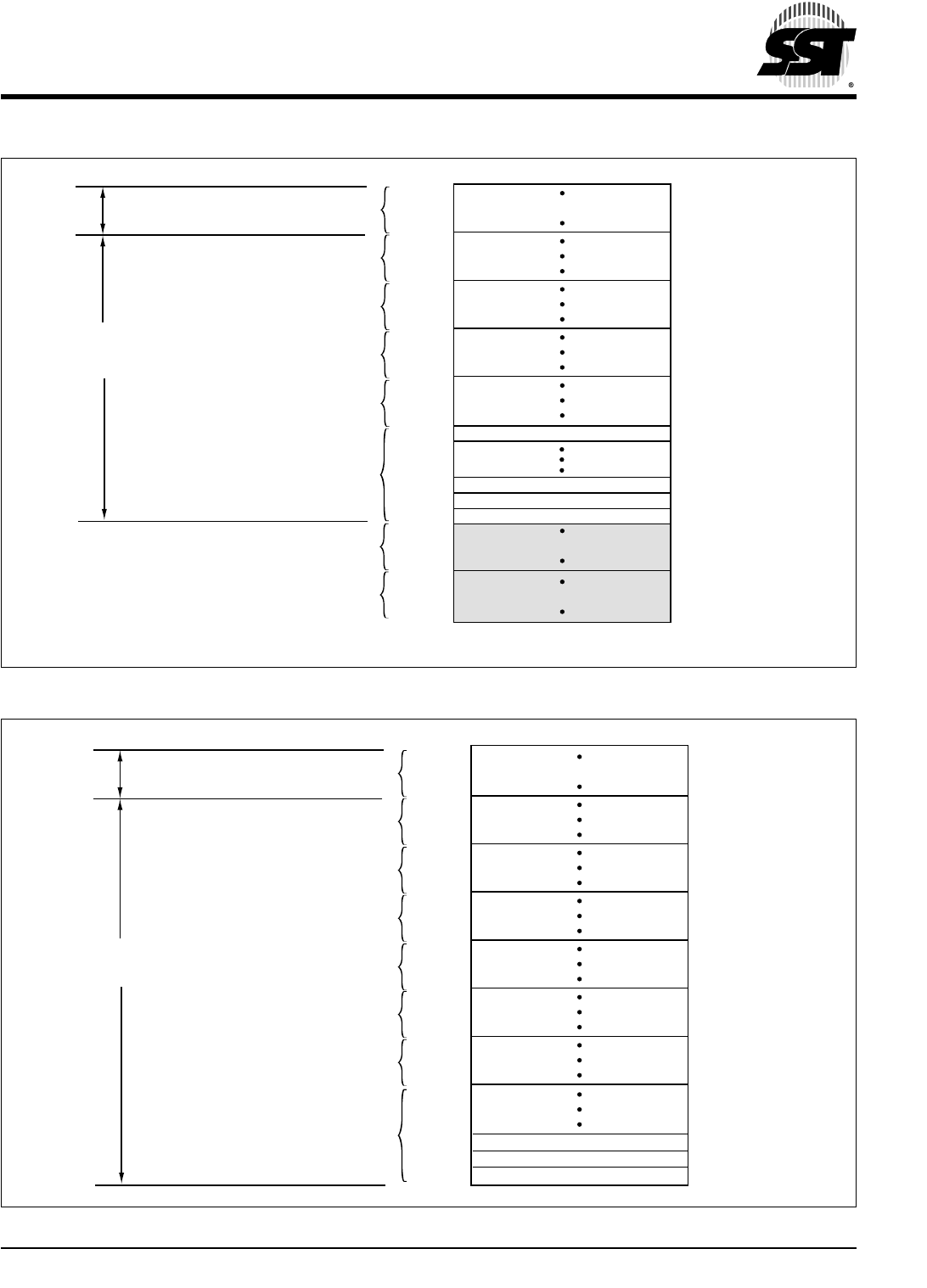
addresses. See the Device Memory Maps in Figures 3
through 6 for address assignments.
FIRMWARE HUB (FWH) MODE
Device Operation
The FWH mode uses a 5-signal communication interface,
FWH[3:0] and FWH4, to control operations of the
SST49LF00xA. Operations such as Memory Read and
Memory Write uses Intel FWH propriety protocol. JEDEC
Standard SDP (Software Data Protection) Byte-Program,
Sector-Erase and Block-Erase command sequences are
incorporated into the FWH memory cycles. Chip-Erase is
only available in PP Mode.
The device enters standby mode when FWH4 is high and
no internal operation is in progress. The device is in ready
mode when FWH4 is low and no activity is on the FWH bus.
Firmware Hub Interface Cycles
Addresses and data are transferred to and from the
SST49LF00xA by a series of “fields,” where each field con-
tains 4 bits of data. ST49LF00xA supports only single-byte
read and writes, and all fields are one clock cycle in length.
Field sequences and contents are strictly defined for Read
and Write operations. Addresses in this section refer to
addresses as seen from the SST49LF00xA’s “point of
view,” some calculation will be required to translate these to
the actual locations in the memory map (and vice versa) if
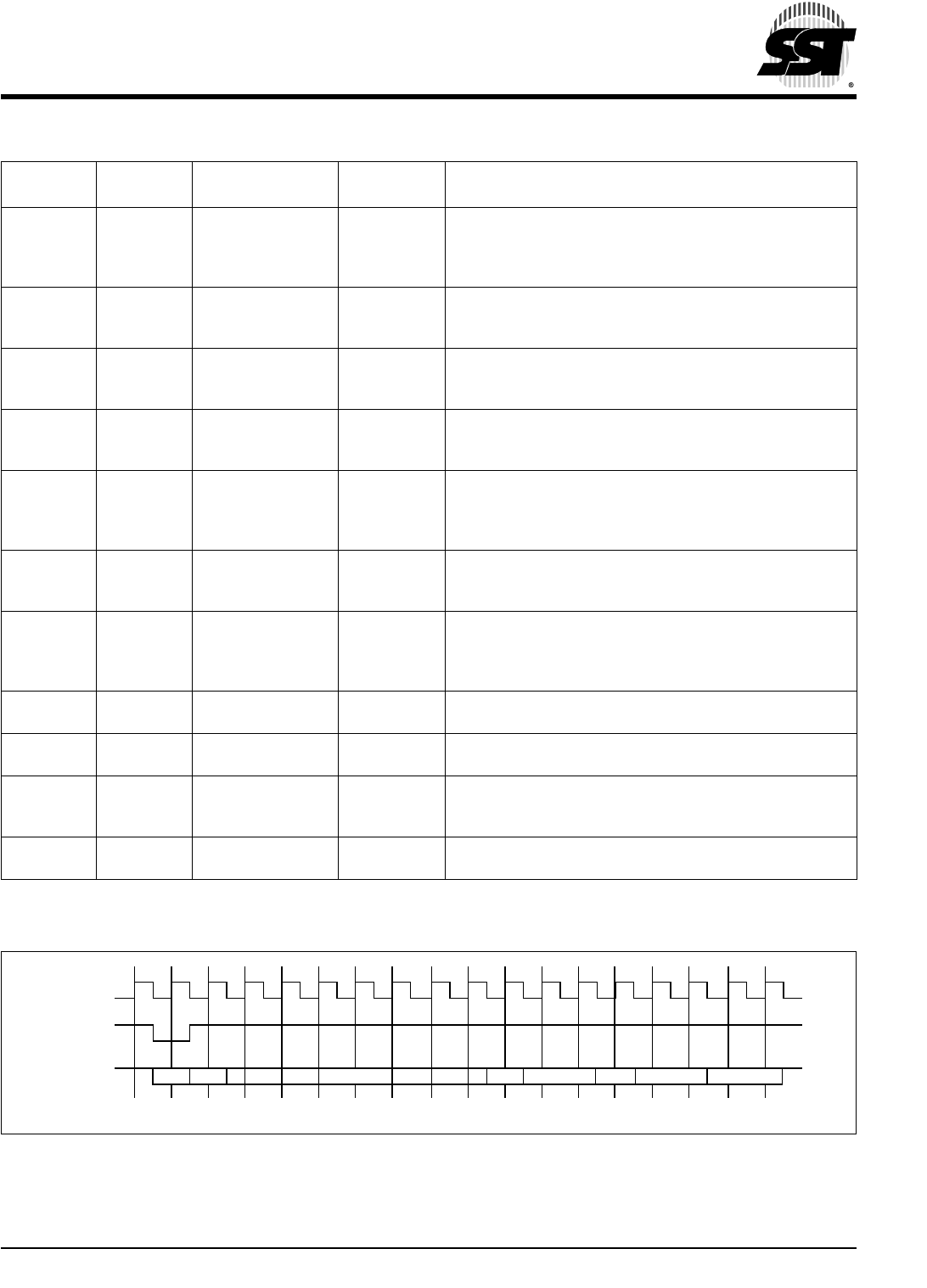
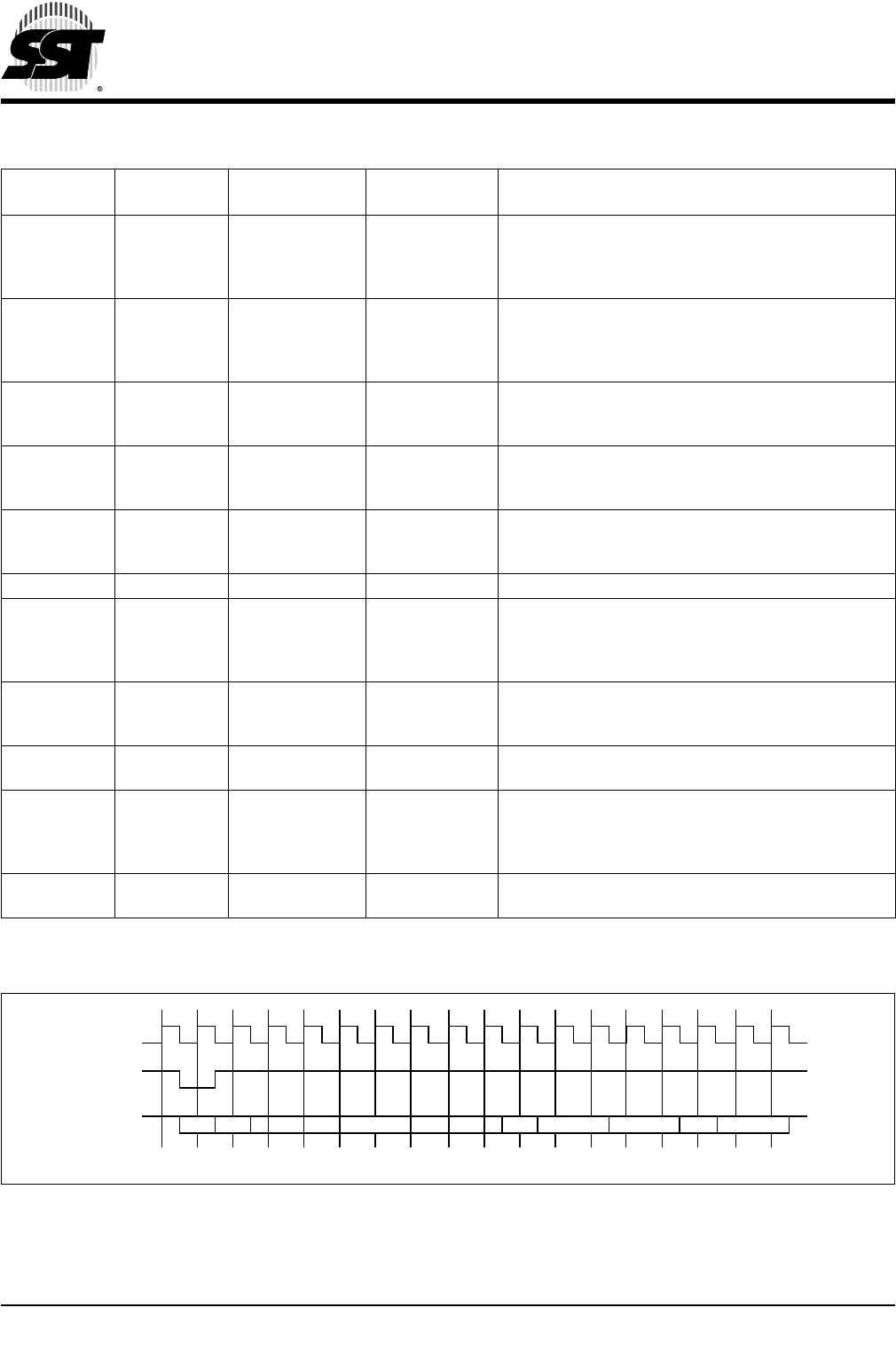
multiple memory device is used on the bus. Tables 1 and 2
list the field sequences for Read and Write cycles.
Advance Information
2 Mbit / 3 Mbit / 4 Mbit / 8 Mbit Firmware Hub
SST49LF002A / SST49LF003A / SST49LF004A / SST49LF008A
3
©2002 Silicon Storage Technology, Inc. S71161-06-000 2/02 504
FIGURE 1: SINGLE-BYTE READ WAVEFORMS
TABLE 1: FWH READ CYCLE
Clock
Cycle
Field
Name
Field Contents
FWH[3:0]1
FWH[3:0]
Direction Comments
1 START 1101 IN FWH4 must be active (low) for the part to respond. Only the
last start field (before FWH4 transitioning high) should be
recognized. The START field contents indicate a FWH
memory Read cycle.
2 IDSEL 0000 to 1111 IN Indicates which FWH device should respond. If the to IDSEL (ID
select) field matches the value ID[3:0], then that particular device
will respond to the whole bus cycle.
3-9 IMADDR YYYY IN These seven clock cycles make up the 28-bit memory
address. YYYY is one nibble of the entire address.
Addresses are transferred most-significant nibble first.
10 IMSIZE 0000 (1 byte) IN A field of this size indicates how many bytes will be or trans-
ferred during multi-byte operations. The SST49LF00xA will
only support single-byte operation. IMSIZE=0000b
11 TAR0 1111 IN
then Float
In this clock cycle, the master (Intel ICH) has driven the bus
then float to all ‘1’s and then floats the bus, prior to the next
clock cycle. This is the first part of the bus “turnaround
cycle.”
12 TAR1 1111 (float) Float
then OUT
The SST49LF00xA takes control of the bus during this
cycle. During the next clock cycle, it will be driving “sync
data.”
13 RSYNC 0000 (READY) OUT During this clock cycle, the FWH will generate a “ready-
sync” (RSYNC) indicating that the least-significant nibble of
the least-significant byte will be available during the next
clock cycle.
14 DATA YYYY OUT YYYY is the least-significant nibble of the least-significant
data byte.
15 DATA YYYY OUT YYYY is the most-significant nibble of the least-significant
data byte.
16 TAR0 1111 OUT
then Float
In this clock cycle, the SST49LF00xA has driven the bus to
all ones and then floats the bus prior to the next clock cycle.
This is the first part of the bus “turnaround cycle.”
17 TAR1 1111 (float) Float then
IN
The master (Intel ICH) resumes control of the bus during
this cycle.
T1.3 504
1. Field contents are valid on the rising edge of the present clock cycle.
CLK
FWH4
FWH[3:0]
504 ILL F59.1
STR TAR RSYNCIMSIMADDRIDS DATA TAR
4
Advance Information
2 Mbit / 3 Mbit / 4 Mbit / 8 Mbit Firmware Hub
SST49LF002A / SST49LF003A / SST49LF004A / SST49LF008A
©2002 Silicon Storage Technology, Inc. S71161-06-000 2/02 504
FIGURE 2: WRITE WAVEFORMS
TABLE 2: FWH WRITE CYCLE
Clock
Cycle
Field
Name
Field Contents
FWH[3:0]1
FWH[3:0]
Direction Comments
1 START 1110 IN FWH4 must be active (low) for the part to respond.
Only the last start field (before FWH4 transitioning
high) should be recognized. The START field contents
indicate a FWH memory Read cycle.
2 IDSEL 0000 to 1111 IN Indicates which SST49LF00xA device should
respond. If the IDSEL (ID select) field matches the
value ID[3:0], then that particular device will respond
to the whole bus cycle.
3-9 IMADDR YYYY IN These seven clock cycles make up the 28-bit memory
address. YYYY is one nibble of the entire address.
Addresses are transferred most-significant nibble first.
10 IMSIZE 0000 (1 byte) IN This size field indicates how many bytes will be
transferred during multi-byte operations. The FWH
only supports single-byte writes. IMSIZE=0000b
11 DATA YYYY IN This field is the least-significant nibble of the data byte.
This data is either the data to be programmed into the
flash memory or any valid flash command.
12 DATA YYYY IN This field is the most-significant nibble of the data byte.
13 TAR0 1111 IN then Float In this clock cycle, the master (Intel ICH) has driven the
then float bus to all ‘1’s and then floats the bus prior to
the next clock cycle. This is the first part of the bus
“turnaround cycle.”
14 TAR1 1111 (float) Float then OUT The SST49LF00xA takes control of the bus during this
cycle. During the next clock cycle it will be driving the
“sync” data.
15 RSYNC 0000 OUT The SST49LF00xA outputs the values 0000, indicat-
ing that it has received data or a flash command.
16 TAR0 1111 OUT then Float In this clock cycle, the SST49LF00xA has driven the
bus to all then float ‘1’s and then floats the bus prior to
the next clock cycle. This is the first part of the bus
“turnaround cycle.”
17 TAR1 1111 (float) Float then IN The master (Intel ICH) resumes control of the bus during
this cycle.
T2.4 504
1. Field contents are valid on the rising edge of the present clock cycle.
CLK
FWH4
FWH[3:0]
504 ILL F60.1
STR DATA TARTAR
RSYNC
IMSIMADDRIDS
Advance Information
2 Mbit / 3 Mbit / 4 Mbit / 8 Mbit Firmware Hub
SST49LF002A / SST49LF003A / SST49LF004A / SST49LF008A
5
©2002 Silicon Storage Technology, Inc. S71161-06-000 2/02 504
Abort Mechanism
If FWH4 is driven low for one or more clock cycles during a
FWH cycle, the cycle will be terminated and the device will
wait for the ABORT command. The host may drive the
FWH[3:0] with ‘1111b’ (ABORT command) to return the
device to Ready mode. If abort occurs during a Write oper-
ation, the data may be incorrectly altered.
Response To Invalid Fields
During FWH operations, the FWH will not explicitly indicate
that it has received invalid field sequences. The response
to specific invalid fields or sequences is as follows:
Address out of range: The FWH address sequence is
7 fields long (28 bits), but only the last five address fields
(20 bits) will be decoded by SST49LF00xA.
Address A22 has the special function of directing reads and
writes to the flash core (A22=1) or to the register space
(A22=0).
The SST49LF003A features are equivalent to the
SST49LF004A with 128 KByte less memory. For the
SST49LF003A, operations beyond the 3-Mbit boundary
(below 20000H) are not valid (see Device Memory Map).
Invalid IMSIZE field: If the FWH receives an invalid size
field during a Read or Write operation, the device will reset
and no operation will be attempted. The SST49LF00xA will
not generate any kind of response in this situation. Invalid-
size fields for a Read/Write cycle are anything but 0000b.
Device Memory Hardware Write Protection
The Top Boot Lock (TBL#) and Write Protect (WP#) pins
are provided for hardware write protection of device
memory in the SST49LF00xA. The TBL# pin is used to
write protect 16 boot sectors (64 KByte) at the highest
flash memory address range for the SST49LF003A/
004A/008A and 4 boot sectors (16 KByte) for
SST49LF002A. WP# pin write protects the remaining
sectors in the flash memory.
An active low signal at the TBL# pin prevents Program and
Erase operations of the top boot sectors. When TBL# pin is
held high, write protection of the top boot sectors is then
determined by the Boot Block Locking register. The WP#
pin serves the same function for the remaining sectors of
the device memory. The TBL# and WP# pins write protec-
tion functions operate independently of one another.
Both TBL# and WP# pins must be set to their required
protection states prior to starting a Program or Erase
operation. A logic level change occurring at the TBL# or
WP# pin during a Program or Erase operation could
cause unpredictable results. TBL# and WP# pins cannot
be left unconnected.
TBL# is internally ORed with the top Boot Block Locking
register. When TBL# is low, the top Boot Block is hard-
ware write protected regardless of the state of the Write-
Lock bit for the Boot Block Locking register. Clearing the
Write-Protect bit in the register when TBL# is low will have
no functional effect, even though the register may indicate
that the block is no longer locked.
WP# is internally ORed with the Block Locking register.
When WP# is low, the blocks are hardware write pro-
tected regardless of the state of the Write-Lock bit for the
corresponding Block Locking registers. Clearing the
Write-Protect bit in any register when WP# is low will have
no functional effect, even though the register may indicate
that the block is no longer locked.
Reset
A VIL on INIT# or RST# pin initiates a device reset. INIT#
and RST# pins have the same function internally. It is
required to drive INIT# or RST# pins low during a system
reset to ensure proper CPU initialization.
During a Read operation, driving INIT# or RST# pins low
deselects the device and places the output drivers,
FWH[3:0], in a high-impedance state. The reset signal
must be held low for a minimal duration of time TRSTP. A
reset latency will occur if a reset procedure is performed
during a Program or Erase operation. See Table 18, Reset
Timing Parameters for more information. A device reset
during an active Program or Erase will abort the operation
and memory contents may become invalid due to data
being altered or corrupted from an incomplete Erase or
Program operation.
6
Advance Information
2 Mbit / 3 Mbit / 4 Mbit / 8 Mbit Firmware Hub
SST49LF002A / SST49LF003A / SST49LF004A / SST49LF008A
©2002 Silicon Storage Technology, Inc. S71161-06-000 2/02 504
Write Operation Status Detection
The SST49LF00xA device provides two software means to
detect the completion of a Write (Program or Erase) cycle,
in order to optimize the system Write cycle time. The soft-
ware detection includes two status bits: Data# Polling
(DQ7) and Toggle Bit (DQ6). The End-of-Write detection
mode is incorporated into the FWH Read cycle. The actual
completion of the nonvolatile write is asynchronous with the
system; therefore, either a Data# Polling or Toggle Bit read
may be simultaneous with the completion of the Write
cycle. If this occurs, the system may possibly get an errone-
ous result, i.e., valid data may appear to conflict with either
DQ7 or DQ6. In order to prevent spurious rejection, if an
erroneous result occurs, the software routine should
include a loop to read the accessed location an additional
two (2) times. If both reads are valid, then the device has
completed the Write cycle, otherwise the rejection is valid.
Data# Polling (DQ7)
When the SST49LF00xA device is in the internal Program
operation, any attempt to read DQ7 will produce the com-
plement of the true data. Once the Program operation is
completed, DQ7 will produce true data. Note that even
though DQ7 may have valid data immediately following the
completion of an internal Write operation, the remaining
data outputs may still be invalid: valid data on the entire
data bus will appear in subsequent successive Read
cycles after an interval of 1 µs. During internal Erase opera-
tion, any attempt to read DQ7 will produce a ‘0’. Once the
internal Erase operation is completed, DQ7 will produce a
‘1’. Proper status will not be given using Data# Polling if the
address is in the invalid range.
Toggle Bit (DQ6)
During the internal Program or Erase operation, any con-
secutive attempts to read DQ6 will produce alternating
‘0’s and ‘1’s, i.e., toggling between 0 and 1. When the
internal Program or Erase operation is completed, the
toggling will stop.
Multiple Device Selection
The four ID pins, ID[3:0], allow multiple devices to be
attached to the same bus by using different ID strapping in
a system. When the SST49LF00xA is used as a boot
device, ID[3:0] must be strapped as 0000, all subsequent
devices should use a sequential up-count strapping (i.e.
0001, 0010, 0011, etc.). The SST49LF00xA will compare
the strapping values, if there is a mismatch, the device will
ignore the remainder of the cycle and go into standby
mode. For further information regarding FWH device map-
ping and paging, please refer to the Intel 82801(ICH) I/O
Controller Hub documentation. Since there is no ID support
in PP Mode, to program multiple devices a stand-alone
PROM programmer is recommended.
REGISTERS
There are three types of registers available on the
SST49LF00xA, the General Purpose Inputs Register,
Block Locking Registers, and the JEDEC ID Registers.
These registers appear at their respective address location
in the 4 GByte system memory map. Unused register loca-
tions will read as 00H. Any attempt to read or write any reg-
ister during an internal Write operation will be ignored.
General Purpose Inputs Register
The GPI_REG (General Purpose Inputs Register) passes
the state of FGPI[4:0] pins at power-up on the
SST49LF00xA. It is recommended that the FGPI[4:0] pins
are in the desired state before FWH4 is brought low for the
beginning of the bus cycle, and remain in that state until the
end of the cycle. There is no default value since this is a
pass-through register. The GPI register for the boot device
appears at FFBC0100H in the 4 GByte system memory
map, and will appear elsewhere if the device is not the boot
device. Register is not available for read when the device is
in Erase/Program operation. See Table 3 for the GPI_REG
bits and function.
TABLE 3: GENERAL PURPOSE INPUTS REGISTER
Bit Function
Pin #
32-PLCC 32-TSOP
7:5 Reserved - -
4 FGPI[4]
Reads status of general
purpose input pin
30 6
3 FGPI[3]
Reads status of general
purpose input pin
311
2 FGPI[2]
Reads status of general
purpose input pin
412
1 FGPI[1]
Reads status of general
purpose input pin
513
0 FGPI[0]
Reads status of general
purpose input pin
614
T3.2 504
Advance Information
2 Mbit / 3 Mbit / 4 Mbit / 8 Mbit Firmware Hub
SST49LF002A / SST49LF003A / SST49LF004A / SST49LF008A
7
©2002 Silicon Storage Technology, Inc. S71161-06-000 2/02 504
Block Locking Registers
SST49LF00xA provides software controlled lock protection through a set of Block Locking registers. The Block
Locking Registers are read/write registers and it is accessible through standard addressable memory locations
specified in Table 4 and Table 5. Unused register locations will read as 00H.
TABLE 4: BLOCK LOCKING REGISTERS FOR SST49LF002A1
1. Default value at power up is 01H
Register Block Size
Protected Memory
Address Package
Memory Map
Register Address
T_BLOCK_LK 16K 3FFFFH - 3C000H FFBF8002H
T_MINUS01_LK 16K
16K
16K
3BFFFH - 38000H
37FFFH - 34000H
33FFFH - 30000H
FFBF0002H
T_MINUS02_LK 16K
16K
2FFFFH - 2C000H
2BFFFH - 28000H
FFBE8002H
T_MINUS03_LK 16K
16K
27FFFH - 24000H
23FFFH - 20000H
FFBE0002H
T_MINUS04_LK 16K
16K
1FFFFH - 1C000H
1BFFFH - 18000H
FFBD8002H
T_MINUS05_LK 16K
16K
17FFFH - 14000H
13FFFH - 10000H
FFBD0002H
T_MINUS06_LK 16K
16K
0FFFFH - 0C000H
0BFFFH - 08000H
FFBC8002H
T_MINUS07_LK 16K
16K
07FFFH - 04000H
03FFFH - 00000H
FFBC0002H
T4.1 504
TABLE 5: BLOCK LOCKING REGISTERS FOR SST49LF003A/004A/008A1
1. Default value at power up is 01H
Register
Block
Size
Protected Memory Address Range Memory Map
Register AddressSST49LF003A SST49LF004A SST49LF008A
T_BLOCK_LK 64K 07FFFFH - 070000H 07FFFFH - 070000H 0FFFFFH - 0F0000H FFBF0002H
T_MINUS01_LK 64K 06FFFFH - 060000H 06FFFFH - 060000H 0EFFFFH - 0E0000H FFBE0002H
T_MINUS02_LK 64K 05FFFFH - 050000H 05FFFFH - 050000H 0DFFFFH - 0D0000H FFBD0002H
T_MINUS03_LK 64K 04FFFFH - 040000H 04FFFFH - 040000H 0CFFFFH - 0C0000H FFBC0002H
T_MINUS04_LK 64K 03FFFFH - 030000H 03FFFFH - 030000H 0BFFFFH - 0B0000H FFBB0002H
T_MINUS05_LK 64K 02FFFFH - 020000H 02FFFFH - 020000H 0AFFFFH - 0A0000H FFBA0002H
T_MINUS06_LK 64K 01FFFFH - 010000H 09FFFFH - 090000H FFB90002H
T_MINUS07_LK 64K 00FFFFH - 000000H 08FFFFH - 080000H FFB80002H
T_MINUS08_LK 64K 07FFFFH - 070000H FFB70002H
T_MINUS09_LK 64K 06FFFFH - 060000H FFB60002H
T_MINUS10_LK 64K 05FFFFH - 050000H FFB50002H
T_MINUS11_LK 64K 04FFFFH - 040000H FFB40002H
T_MINUS12_LK 64K 03FFFFH - 030000H FFB30002H
T_MINUS13_LK 64K 02FFFFH - 020000H FFB20002H
T_MINUS14_LK 64K 01FFFFH -010000H FFB10002H
T_MINUS15_LK 64K 00FFFFH - 000000H FFB00002H
T5.2 504
8
Advance Information
2 Mbit / 3 Mbit / 4 Mbit / 8 Mbit Firmware Hub
SST49LF002A / SST49LF003A / SST49LF004A / SST49LF008A
©2002 Silicon Storage Technology, Inc. S71161-06-000 2/02 504
Write Lock
The Write-Lock bit, bit 0, controls the lock state described in
Table 6. The default Write status of all blocks after power-
up is write locked. When bit 0 of the Block Locking register
is set, Program and Erase operations for the corresponding
block are prevented. Clearing the Write-Lock bit will unpro-
tect the block. The Write-Lock bit must be cleared prior to
starting a Program or Erase operation since it is sampled at
the beginning of the operation.
The Write-Lock bit functions in conjunction with the hard-
ware Write Lock pin TBL# for the top Boot Block. When
TBL# is low, it overrides the software locking scheme. The
top Boot Block Locking register does not indicate the state
of the TBL# pin.
The Write-Lock bit functions in conjunction with the hard-
ware WP# pin for blocks 0 to 6. When WP# is low, it over-
rides the software locking scheme. The Block Locking
register does not indicate the state of the WP# pin.
Lock Down
The Lock-Down bit, bit 1, controls the Block Locking regis-
ter as described in Table 6. When in the FWH interface
mode, the default Lock Down status of all blocks upon
power-up is not locked down. Once the Lock-Down bit is
set, any future attempted changes to that Block Locking
register will be ignored. The Lock-Down bit is only cleared
upon a device reset with RST# or INIT# or power down.
Current Lock Down status of a particular block can be
determined by reading the corresponding Lock-Down bit.
Once a block’s Lock-Down bit is set, the Write-Lock bits for
that block can no longer be modified, and the block is
locked down in its current state of write accessibility.
JEDEC ID Registers
The JEDEC ID registers for the boot device appear at
FFBC0000H and FFBC0001H in the 4 GByte system
memory map, and will appear elsewhere if the device is not
the boot device. Register is not available for read when the
device is in Erase/Program operation. Unused register
location will read as 00H. Refer to the relevant application
note for details. See Table 7 for the device ID code.
PARALLEL PROGRAMMING MODE
Device Operation
Commands are used to initiate the memory operation func-
tions of the device. The data portion of the software com-
mand sequence is latched on the rising edge of WE#.
During the software command sequence the row address
is latched on the falling edge of R/C# and the column
address is latched on the rising edge of R/C#.
Read
The Read operation of the SST49LF00xA device is con-
trolled by OE#. OE# is the output control and is used to
gate data from the output pins. Refer to the Read cycle
timing diagram, Figure 14, for further details.
Reset
A VIL on RST# pin initiates a device reset.
Byte-Program Operation
The SST49LF00xA device is programmed on a byte-by-
byte basis. Before programming, one must ensure that the
sector, in which the byte which is being programmed exists,
is fully erased. The Byte-Program operation is initiated by
executing a four-byte command load sequence for Soft-
ware Data Protection with address (BA) and data in the last
byte sequence. During the Byte-Program operation, the
row address (A10-A0) is latched on the falling edge of R/C#
and the column Address (A21-A11) is latched on the rising
edge of R/C#. The data bus is latched in the rising edge of
WE#. The Program operation, once initiated, will be com-
pleted, within 20 µs. See Figure 15 for Program operation
timing diagram, Figure 18 for timing waveforms, and Figure
26 for its flowchart. During the Program operation, the only
valid reads are Data# Polling and Toggle Bit. During the
internal Program operation, the host is free to perform addi-
tional tasks. Any commands written during the internal Pro-
gram operation will be ignored.
TABLE 6: BLOCK LOCKING REGISTER BITS
Reserved Bit [7..2] Lock-Down Bit [1] Write-Lock Bit [0] Lock Status
000000 0 0 Full Access
000000 0 1 Write Locked (Default State at Power-Up)
000000 1 0 Locked Open (Full Access Locked Down)
000000 1 1 Write Locked Down
T6.3 504
Advance Information
2 Mbit / 3 Mbit / 4 Mbit / 8 Mbit Firmware Hub
SST49LF002A / SST49LF003A / SST49LF004A / SST49LF008A
9
©2002 Silicon Storage Technology, Inc. S71161-06-000 2/02 504
Sector-Erase Operation
The Sector-Erase operation allows the system to erase
the device on a sector-by-sector basis. The sector archi-
tecture is based on uniform sector size of 4 KByte. The
Sector-Erase operation is initiated by executing a six-byte
command load sequence for Software Data Protection
with Sector-Erase command (30H) and sector address
(SA) in the last bus cycle. The internal Erase operation
begins after the sixth WE# pulse. The End-of-Erase can
be determined using either Data# Polling or Toggle Bit
methods. See Figure 19 for Sector-Erase timing wave-
forms. Any commands written during the Sector-Erase
operation will be ignored.
Block-Erase Operation
The Block-Erase Operation allows the system to erase the
device in 64 KByte uniform block size for the
SST49LF003A/SST49LF004A/SST49LF008A and 16
KByte uniform block size for the SST49LF002A. The Block-
Erase operation is initiated by executing a six-byte com-
mand load sequence for Software Data Protection with
Block-Erase command (50H) and block address. The inter-
nal Block-Erase operation begins after the sixth WE#
pulse. The End-of-Erase can be determined using either
Data# Polling or Toggle Bit methods. See Figure 20 for tim-
ing waveforms. Any commands written during the Block-
Erase operation will be ignored.
Chip-Erase
The SST49LF00xA device provides a Chip-Erase opera-
tion only in PP Mode, which allows the user to erase the
entire memory array to the ‘1’s state. This is useful when
the entire device must be quickly erased.
The Chip-Erase operation is initiated by executing a six- byte
Software Data Protection command sequence with Chip-
Erase command (10H) with address 5555H in the last byte
sequence. The internal Erase operation begins with the ris-
ing edge of the sixth WE#. During the internal Erase opera-
tion, the only valid read is Toggle Bit or Data# Polling. See
Table 10 for the command sequence, Figure 21 for timing
diagram, and Figure 29 for the flowchart. Any commands
written during the Chip-Erase operation will be ignored.
Write Operation Status Detection
The SST49LF00xA device provides two software means
to detect the completion of a Write (Program or Erase)
cycle, in order to optimize the system Write cycle time. The
software detection includes two status bits: Data# Polling
(DQ7) and Toggle Bit (DQ6). The End-of-Write detection
mode is enabled after the rising edge of WE# which ini-
tiates the internal Program or Erase operation.
The actual completion of the nonvolatile write is asynchro-
nous with the system; therefore, either a Data# Polling or Tog-
gle Bit read may be simultaneous with the completion of the
Write cycle. If this occurs, the system may possibly get an
erroneous result, i.e., valid data may appear to conflict with
either DQ7 or DQ6. In order to prevent spurious rejection, if an
erroneous result occurs, the software routine should include a
loop to read the accessed location an additional two (2) times.
If both reads are valid, then the device has completed the
Write cycle, otherwise the rejection is valid.
Data# Polling (DQ7)
When the SST49LF00xA device is in the internal Program
operation, any attempt to read DQ7 will produce the com-
plement of the true data. Once the Program operation is
completed, DQ7 will produce true data. Note that even
though DQ7 may have valid data immediately following the
completion of an internal Write operation, the remaining
data outputs may still be invalid: valid data on the entire data
bus will appear in subsequent successive Read cycles after
an interval of 1 µs. During internal Erase operation, any
attempt to read DQ7 will produce a ‘0’. Once the internal
Erase operation is completed, DQ7 will produce a ‘1’. The
Data# Polling is valid after the rising edge of fourth WE#
pulse for Program operation. For Sector- or Chip-Erase, the
Data# Polling is valid after the rising edge of sixth WE#
pulse. See Figure 16 for Data# Polling timing diagram and
Figure 27 for a flowchart. Proper status will not be given
using Data# Polling if the address is in the invalid range.
Toggle Bit (DQ6)
During the internal Program or Erase operation, any con-
secutive attempts to read DQ6 will produce alternating
‘0’s and ‘1’s, i.e., toggling between 0 and 1. When the
internal Program or Erase operation is completed, the
toggling will stop. The device is then ready for the next
operation. The Toggle Bit is valid after the rising edge of
fourth WE# pulse for Program operation. For Sector-,
Block- or Chip-Erase, the Toggle Bit is valid after the ris-
ing edge of sixth WE# pulse. See Figure 17 for Toggle Bit
timing diagram and Figure 27 for a flowchart.
10
Advance Information
2 Mbit / 3 Mbit / 4 Mbit / 8 Mbit Firmware Hub
SST49LF002A / SST49LF003A / SST49LF004A / SST49LF008A
©2002 Silicon Storage Technology, Inc. S71161-06-000 2/02 504
Data Protection
The SST49LF00xA device provides both hardware and
software features to protect nonvolatile data from inadvert-
ent writes.
Hardware Data Protection
Noise/Glitch Protection: A WE# pulse of less than 5 ns will
not initiate a Write cycle.
VDD Power Up/Down Detection: The Write operation is
inhibited when VDD is less than 1.5V.
Write Inhibit Mode: Forcing OE# low, WE# high will inhibit
the Write operation. This prevents inadvertent writes during
power-up or power-down.
Software Data Protection (SDP)
The SST49LF00xA provides the JEDEC approved Soft-
ware Data Protection scheme for all data alteration opera-
tion, i.e., Program and Erase. Any Program operation
requires the inclusion of a series of three-byte sequences.
The three-byte load sequence is used to initiate the Pro-
gram operation, providing optimal protection from inadvert-
ent Write operations, e.g., during the system power-up or
power-down. Any Erase operation requires the inclusion of
a six-byte load sequence. The SST49LF00xA device is
shipped with the Software Data Protection permanently
enabled. See Table 10 for the specific software command
codes. During SDP command sequence, invalid com-
mands will abort the device to Read mode, within TRC.
Electrical Specifications
The AC and DC specifications for the FWH Interface sig-
nals (FWH[3:0], CLK, FWH4, and RST#) as defined in
Section 4.2.2 of the PCI Local Bus Specification, Rev. 2.1.
Refer to Table 11 for the DC voltage and current specifica-
tions. Refer to the tables on pages 19 through 23 for the AC
timing specifications for Clock, Read/Write, and Reset
operations.
Product Identification
The product identification mode identifies the device as the
SST49LF00xA and manufacturer as SST.
Design Considerations
SST recommends a high frequency 0.1 µF ceramic capacitor
to be placed as close as possible between VDD and VSS less
than 1 cm away from the VDD pin of the device. Additionally, a
low frequency 4.7 µF electrolytic capacitor from VDD to VSS
should be placed within 1 cm of the VDD pin. If you use a
socket for programming purposes add an additional 1-10 µF
next to each socket.
The RST# pin must remain stable at VIH for the entire dura-
tion of an Erase operation. WP# must remain stable at VIH for
the entire duration of the Erase and Program operations for
non-Boot Block sectors. To write data to the top Boot Block
sectors, the TBL# pin must also remain stable at VIH for the
entire duration of the Erase and Program operations.
TABLE 7: PRODUCT IDENTIFICATION
Byte Data
JEDEC ID
Address
Location
Manufacturer’s ID 0000H BFH FFBC0000H
Device ID
SST49LF002A 0001H 57H FFBC0001H
SST49LF003A 0001H 1BH FFBC0001H
SST49LF004A 0001H 60H FFBC0001H
SST49LF008A 0001H 5AH FFBC0001H
T7.5 504
Advance Information
2 Mbit / 3 Mbit / 4 Mbit / 8 Mbit Firmware Hub
SST49LF002A / SST49LF003A / SST49LF004A / SST49LF008A
11
©2002 Silicon Storage Technology, Inc. S71161-06-000 2/02 504
BOOT-CONFIGURATION SYSTEM MEMORY MAP
Range for
Additional FWH Devices
FFC00000H
FFF00000H
SST49LF004A
(4 Mbit)
SST49LF008A
(8 Mbit)
FFF80000H
FFFA0000H
FFFC0000H
FFFFFFFFH
SST49LF002A
(2 Mbit)
SST49LF003A
(3 Mbit)
System Memory
(Top 4 MByte)
504 ILL B1A.3
504 ILL B1.2
Y-Decoder
I/O Buffers and Data Latches
Address Buffers & Latches
X-Decoder SuperFlash
Memory
Control Logic
CLK
RST#
IC
FGPI[4:0]
Programmer
Interface
WP#
TBL#
INIT#
ID[3:0]
FWH4
R/C#
OE#
WE#
A[10:0]
DQ[7:0]
FWH[3:0]
FWH
Interface
FUNCTIONAL BLOCK DIAGRAM
12
Advance Information
2 Mbit / 3 Mbit / 4 Mbit / 8 Mbit Firmware Hub
SST49LF002A / SST49LF003A / SST49LF004A / SST49LF008A
©2002 Silicon Storage Technology, Inc. S71161-06-000 2/02 504
FIGURE 3: DEVICE MEMORY MAP FOR SST49LF002A
3FFFFH
3C000H
3BFFFH
38000H
37FFFH
34000H
33FFFH
30000H
2FFFFH
2C000H
2BFFFH
28000H
27FFFH
24000H
23FFFH
20000H
1FFFFH
1C000H
1BFFFH
18000H
17FFFH
14000H
13FFFH
10000H
0FFFFH
0C000H
0BFFFH
08000H
07FFFH
04000H
03FFFH
300000
02FFFH
02000H
01FFFH
01000H
00FFFH
00000H
Block 7
Block 8
Block 6
Block 5
Block 4
Block 3
Block 2
Block 1
Block 15
Block 14
Block 13
Block 12
Block 11
Block 10
Block 9
Block 0
(16 KByte)
504 ILL F52.7
WP# for
Block 0~14
TBL#
4 KByte Sector 1
4 KByte Sector 2
4 KByte Sector 3
4 KByte Sector 0
Boot Block
Advance Information
2 Mbit / 3 Mbit / 4 Mbit / 8 Mbit Firmware Hub
SST49LF002A / SST49LF003A / SST49LF004A / SST49LF008A
13
©2002 Silicon Storage Technology, Inc. S71161-06-000 2/02 504
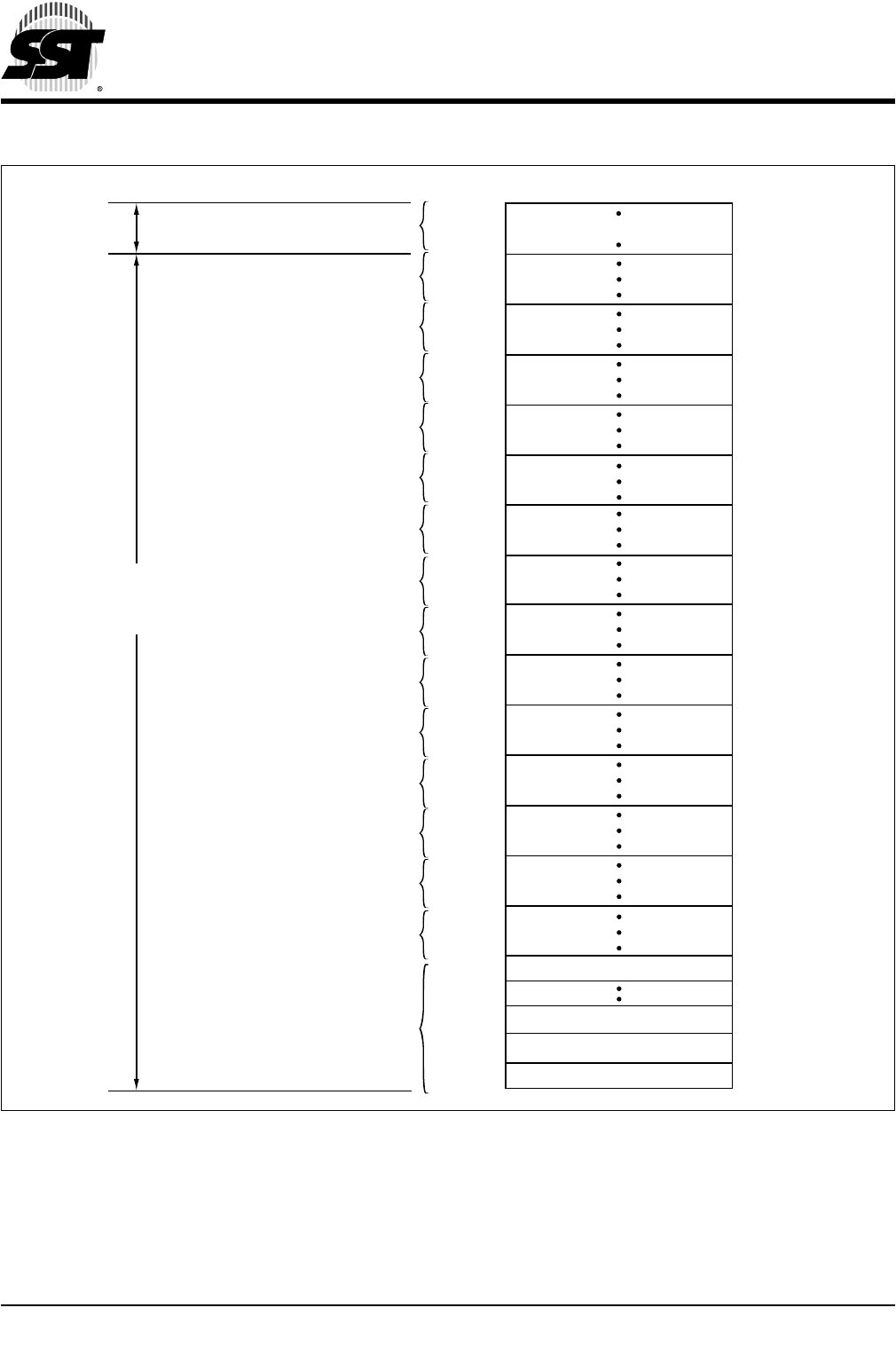
FIGURE 4: DEVICE MEMORY MAP FOR SST49LF003A
FIGURE 5: DEVICE MEMORY MAP FOR SST49LF004A
7FFFFH
70000H
6FFFFH
60000H
5FFFFH
50000H
4FFFFH
40000H
3FFFFH
30000H
2F000H
22000H
21000H
20000H
1FFFFH
10000H
0FFFFH
00000H
Block 7
Block 6
Block 5
Block 4
Block 3
Block 2
*Block 1
4 KByte Sector 33
4 KByte Sector 34
4 KByte Sector 32
Invalid Range
Invalid Range
4 KByte Sector 47
*Block 0
504 ILL F56.1
(64 KByte)
Boot Block
* operations to shaded area are not valid.
WP# for
Block 2~6
TBL#
7FFFFH
70000H
6FFFFH
60000H
5FFFFH
50000H
4FFFFH
40000H
3FFFFH
30000H
2FFFFH
20000H
1FFFFH
10000H
0F000H
02000H
01000H
00000H
4 KByte Sector 1
4 KByte Sector 2
4 KByte Sector 0
Block 7
Block 6
Block 5
Block 4
Block 3
Block 2
Block 1
Block 0
504 ILL F45.5
(64 KByte)
Boot Block
WP# for
Block 0~6
TBL#
14
Advance Information
2 Mbit / 3 Mbit / 4 Mbit / 8 Mbit Firmware Hub
SST49LF002A / SST49LF003A / SST49LF004A / SST49LF008A
©2002 Silicon Storage Technology, Inc. S71161-06-000 2/02 504
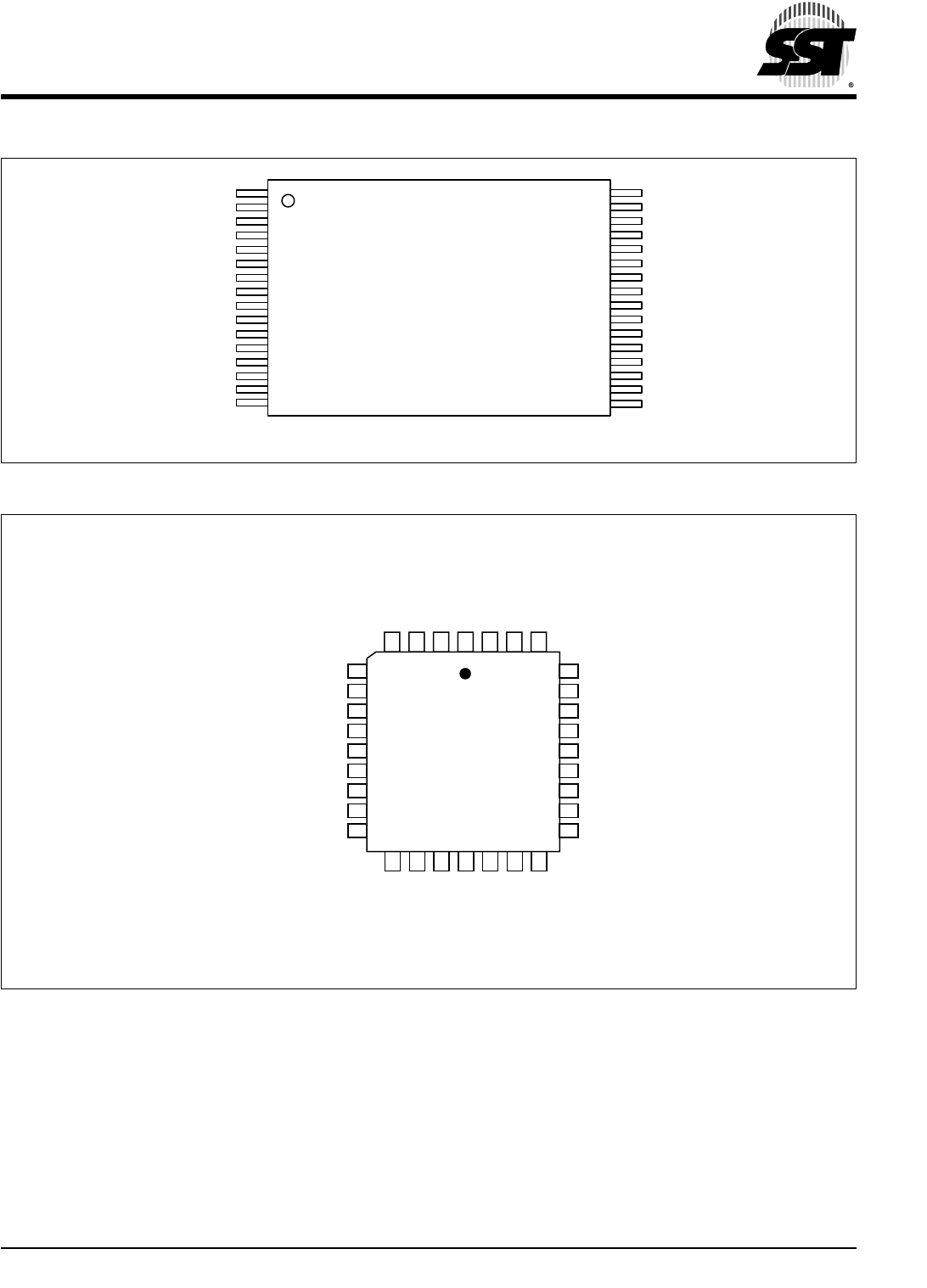
FIGURE 6: DEVICE MEMORY MAP FOR SST49LF008A
0FFFFFH
0F0000H
0EFFFFH
0E0000H
0DFFFFH
0D0000H
0CFFFFH
0C0000H
0BFFFFH
0B0000H
0AFFFFH
0A0000H
09FFFFH
090000H
08FFFFH
080000H
07FFFFH
070000H
06FFFFH
060000H
05FFFFH
050000H
04FFFFH
040000H
03FFFFH
030000H
02FFFFH
020000H
01FFFFH
010000H
00FFFFH
Block 7
Block 8
Block 6
Block 5
Block 4
Block 3
Block 2
Block 1
Block 15
Block 14
Block 13
Block 12
Block 11
Block 10
Block 9
Block 0
(64 KByte)
504 ILL F57.0
WP# for
Block 0~14
TBL#
4 KByte Sector 1
4 KByte Sector 2
4 KByte Sector 15
4 KByte Sector 0
Boot Block
002000H
001000H
000000H
Advance Information
2 Mbit / 3 Mbit / 4 Mbit / 8 Mbit Firmware Hub
SST49LF002A / SST49LF003A / SST49LF004A / SST49LF008A
15
©2002 Silicon Storage Technology, Inc. S71161-06-000 2/02 504
FIGURE 7: PIN ASSIGNMENTS FOR 32-LEAD TSOP (8MM X 14MM)
FIGURE 8: PIN ASSIGNMENTS FOR 32-LEAD PLCC
NC
NC
NC
VSS (VSS)
IC (IC)
A10 (FGPI4)
R/C# (CLK)
VDD (VDD)
NC
RST# (RST#)
A9 (FGPI3)
A8 (FGPI2)
A7 (FGPI1)
A6 (FGPI0)
A5 (WP#)
A4 (TBL#)
1
2
3
4
5
6
7
8
9
10
11
12
13
14
15
16
OE# (INIT#)
WE# (FWH4)
VDD (VDD)
DQ7 (RES)
DQ6 (RES)
DQ5 (RES)
DQ4 (RES)
DQ3 (FWH3)
VSS (VSS)
DQ2 (FWH2)
DQ1 (FWH1)
DQ0 (FWH0)
A0 (ID0)
A1 (ID1)
A2 (ID2)
A3 (ID3)
32
31
30
29
28
27
26
25
24
23
22
21
20
19
18
17
504 ILL F01.4
Standard Pinout
Top View
Die Up
( ) Designates FWH Mode
5
6
7
8
9
10
11
12
13
29
28
27
26
25
24
23
22
21
A7(FGPI1)
A6 (FGPI0)
A5 (WP#)
A4 (TBL#)
A3 (ID3)
A2 (ID2)
A1 (ID1)
A0 (ID0)
DQ0 (FWH0)
IC (IC)
VSS (VSS)
NC
NC
VDD (VDD)
OE# (INIT#)
WE# (FWH4)
NC
DQ7 (RES)
4 3 2 1 32 31 30
A8 (FGPI2)
A9 (FGPI3)
RST# (RST#)
NC
VDD (VDD)
R/C# (CLK)
A10 (FGPI4)
32-lead PLCC
Top View
504 ILL F02.3
14 15 16 17 18 19 20
DQ1 (FWH1)
DQ2 (FWH2)
VSS (VSS)
DQ3 (FWH3)
DQ4 (RES)
DQ5 (RES)
DQ6 (RES)
( ) Designates FWH Mode
16
Advance Information
2 Mbit / 3 Mbit / 4 Mbit / 8 Mbit Firmware Hub
SST49LF002A / SST49LF003A / SST49LF004A / SST49LF008A
©2002 Silicon Storage Technology, Inc. S71161-06-000 2/02 504
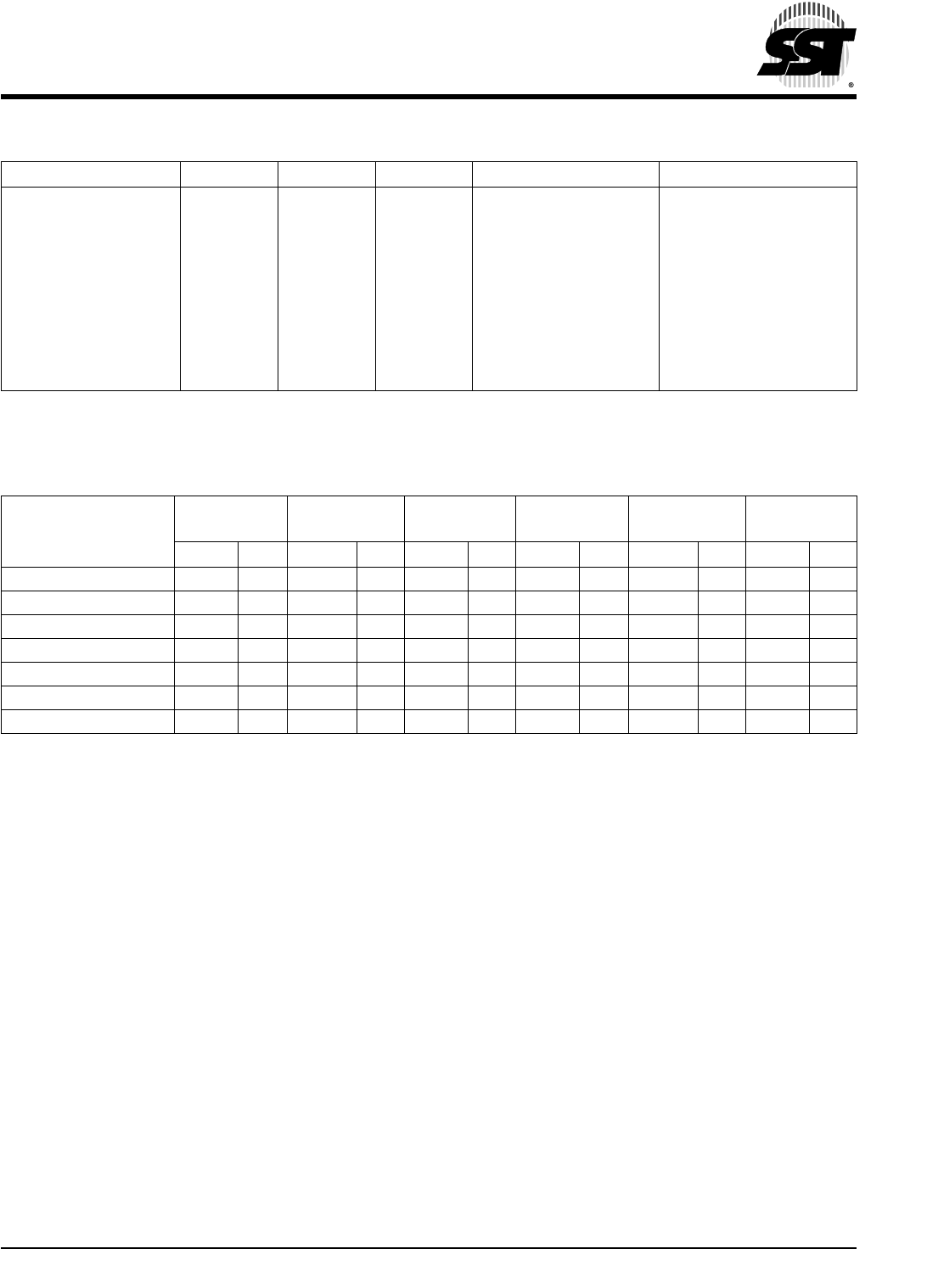
TABLE 8: PIN DESCRIPTION
Symbol Pin Name Type1
Interface
FunctionsPP FWH
A10-A0Address I X Inputs for low-order addresses during Read and Write operations.
Addresses are internally latched during a Write cycle. For the pro-
gramming interface, these addresses are latched by R/C# and share
the same pins as the high-order address inputs.
DQ7-DQ0Data I/O X To output data during Read cycles and receive input data during
Write cycles. Data is internally latched during a Write cycle. The out-
puts are in tri-state when OE# is high.
OE# Output Enable I X To gate the data output buffers
WE# Write Enable I X To control the Write operations
IC Interface
Configuration Pin
I X X This pin determines which interface is operational. When held high,
programmer mode is enabled and when held low, FWH mode is
enabled. This pin must be setup at power-up or before return from
reset and not change during device operation. This pin is internally
pulled- down with a resistor between 20-100 KΩ.
INIT# Initialize I X This is the second reset pin for in-system use. This pin is internally
combined with the RST# pin; If this pin or RST# pin is driven low,
identical operation is exhibited.
ID[3:0] Identification Inputs I X These four pins are part of the mechanism that allows multiple parts
to be attached to the same bus. The strapping of these pins is used
to identify the component.The boot device must have ID[3:0]=0000
and it is recommended that all subsequent devices should use
sequential up-count strapping. These pins are internally pulled-down
with a resistor between 20-100 KΩ.
FGPI[4:0] General Purpose Inputs I X These individual inputs can be used for additional board flexibility.
The state of these pins can be read through GPI_REG register.
These inputs should be at their desired state before the start of the
PCI clock cycle during which the read is attempted, and should
remain in place until the end of the Read cycle. Unused GPI pins
must not be floated.
TBL# Top Block Lock I X When low, prevents programming to the Boot Block sectors at top of
memory. When TBL# is high it disables hardware write protection for
the top block sectors. This pin cannot be left unconnected.
FWH[3:0] FWH I/Os I/O X I/O Communications
CLK Clock I X To provide a clock input to the control unit
FWH4 FWH Input I X Input Communications
RST# Reset I X X To reset the operation of the device
WP# Write Protect I X When low, prevents programming to all but the highest addressable
blocks. When WP# is high it disables hardware write protection for
these blocks. This pin cannot be left unconnected.
R/C# Row/Column Select I X Select For the Programming interface, this pin determines whether
the address pins are pointing to the row addresses, or to the column
addresses.
RES Reserved X These pins must be left unconnected.
VDD Power Supply PWR X X To provide power supply (3.0-3.6V)
VSS Ground PWR X X Circuit ground (OV reference) All VSS pins must be grounded.
NC No Connection I X X Unconnected pins
T8.4 504
1. I = Input, O = Output
Advance Information
2 Mbit / 3 Mbit / 4 Mbit / 8 Mbit Firmware Hub
SST49LF002A / SST49LF003A / SST49LF004A / SST49LF008A
17
©2002 Silicon Storage Technology, Inc. S71161-06-000 2/02 504
TABLE 9: OPERATION MODES SELECTION (PP MODE)
Mode RST# OE# WE# DQ Address
Read VIH VIL VIH DOUT AIN
Program VIH VIH VIL DIN AIN
Erase VIH VIH VIL X1Sector or Block address,
XXH for Chip-Erase
Reset VIL XXHigh Z X
Write Inhibit VIH VIL XHigh Z/D
OUT X
XX
VIH High Z/DOUT X
Product Identification VIH VIL VIH Manufacturer’s ID (BFH)
Device ID2
A18-A1=VIL, A0=VIL
A18-A1=VIL, A0=VIH
T9.5 504
1. X can be VIL or VIH, but no other value.
2. Device ID 57H for SST49LF002A, 1BH for SST49LF003A, 60H for SST49LF004A, and 5AH for SST49LF008A
TABLE 10: SOFTWARE COMMAND SEQUENCE
Command Sequence
1st1
Write Cycle
1. FWH Mode uses consecutive Write cycles to complete a command sequence; PP Mode uses consecutive bus cycles to complete a
command sequence.
2nd1
Write Cycle
3rd1
Write Cycle
4th1
Write Cycle
5th1
Write Cycle
6th1
Write Cycle
Addr2
2. Address format A14-A0 (Hex), Addresses A21-A15 can be VIL or VIH, but no other value, for the Command sequence in PP Mode.
Data Addr2Data Addr2Data Addr2Data Addr2Data Addr2Data
Byte-Program 5555H AAH 2AAAH 55H 5555H A0H BA3
3. BA = Program Byte address
Data
Sector-Erase 5555H AAH 2AAAH 55H 5555H 80H 5555H AAH 2AAAH 55H SAX4
4. SAX for Sector-Erase Address
30H
Block-Erase 5555H AAH 2AAAH 55H 5555H 80H 5555H AAH 2AAAH 55H BAX5
5. BAX for Block-Erase Address
50H
Chip-Erase6
6. Chip-Erase is supported in PP Mode only
5555H AAH 2AAAH 55H 5555H 80H 5555H AAH 2AAAH 55H 5555H 10H
Software ID Entry7,8
7. SST Manufacturer’s ID = BFH, is read with A0=0,
With A17-A1 = 0; 49LF002A Device ID = 57H, is read with A0 = 1.
With A18-A1 = 0; 49LF003A Device ID = 1BH, is read with A0 = 1.
With A18-A1 = 0; 49LF004A Device ID = 60H, is read with A0 = 1.
With A19-A1 = 0; 49LF008A Device ID = 5AH, is read with A0 = 1.
8. The device does not remain in Software Product ID mode if powered down.
5555H AAH 2AAAH 55H 5555H 90H
Software ID Exit9
9. Both Software ID Exit operations are equivalent
XXH F0H
Software ID Exit95555H AAH 2AAAH 55H 5555H F0H
T10.5 504
18
Advance Information
2 Mbit / 3 Mbit / 4 Mbit / 8 Mbit Firmware Hub
SST49LF002A / SST49LF003A / SST49LF004A / SST49LF008A
©2002 Silicon Storage Technology, Inc. S71161-06-000 2/02 504
Absolute Maximum Stress Ratings (Applied conditions greater than those listed under “Absolute Maximum
Stress Ratings” may cause permanent damage to the device. This is a stress rating only and functional operation
of the device at these conditions or conditions greater than those defined in the operational sections of this data
sheet is not implied. Exposure to absolute maximum stress rating conditions may affect device reliability.)
Temperature Under Bias . . . . . . . . . . . . . . . . . . . . . . . . . . . . . . . . . . . . . . . . . . . . . . . . . . . . . . . . . -55°C to +125°C
Storage Temperature . . . . . . . . . . . . . . . . . . . . . . . . . . . . . . . . . . . . . . . . . . . . . . . . . . . . . . . . . . . . -65°C to +150°C
D. C. Voltage on Any Pin to Ground Potential . . . . . . . . . . . . . . . . . . . . . . . . . . . . . . . . . . . . . . . . -0.5V to VDD+0.5V
Transient Voltage (<20 ns) on Any Pin to Ground Potential1 . . . . . . . . . . . . . . . . . . . . . . . . . . . . . -2.0V to VDD+2.0V
Package Power Dissipation Capability (Ta=25°C) . . . . . . . . . . . . . . . . . . . . . . . . . . . . . . . . . . . . . . . . . . . . . . . 1.0W
Surface Mount Lead Soldering Temperature (3 Seconds) . . . . . . . . . . . . . . . . . . . . . . . . . . . . . . . . . . . . . . . . 240°C
Output Short Circuit Current2. . . . . . . . . . . . . . . . . . . . . . . . . . . . . . . . . . . . . . . . . . . . . . . . . . . . . . . . . . . . . . 50 mA
1. Do not violate processor or chipset limitations on the INIT# pin.
2. Outputs shorted for no more than one second. No more than one output shorted at a time. This note applies to non-PCI outputs.
OPERATING RANGE
Range Ambient Temp VDD
Commercial 0°C to +85°C 3.0-3.6V
AC CONDITIONS OF TEST1
1. FWH interface signals use PCI load test conditions
Input Rise/Fall Time . . . . . . . . . . . . . . . 3 ns
Output Load . . . . . . . . . . . . . . . . . . . . . CL = 30 pF
See Figures 24 and 25
TABLE 11: DC OPERATING CHARACTERISTICS (ALL INTERFACES)
Symbol Parameter
Limits
Test Conditions1
1. Test conditions apply to PP mode.
Min Max Units
IDD Active VDD Current Address input=VIL/VIH, at F=1/TRC Min,
VDD=VDD Max (PP Mode)
Read 12 mA OE#=VIH, WE#=VIH
Write2
2. IDD active while Erase or Program is in progress.
24 mA OE#=VIH, VDD=VDD Max (PP Mode)
ISB Standby VDD Current
(FWH Interface)
100 µA FWH4=0.9VDD, f=33 MHz VDD=VDD Max, All
other inputs ≥ 0.9 VDD or ≤ 0.1 VDD
IRY3
3. The device is in Ready Mode when no activity is on the FWH bus.
Ready Mode VDD Current
(FWH Interface)
10 mA FWH4=VIL, f=33 MHz VDD=VDD Max
All other inputs ≥ 0.9 VDD or ≤ 0.1 VDD
IIInput Current for IC,
ID [3:0] pins
200 µA VIN=GND to VDD
, VDD=VDD Max
ILI Input Leakage Current 1 µA VIN=GND to VDD
, VDD=VDD Max
ILO Output Leakage Current 1 µA VOUT=GND to VDD, VDD=VDD Max
VIHI4
4. Do not violate processor or chipset specification regarding INIT# voltage.
INIT# Input High Voltage 1.0 VDD+0.5 V VDD=VDD Max
VILI4INIT# Input Low Voltage -0.5 0.4 V VDD=VDD Min
VIL Input Low Voltage -0.5 0.3 VDD VV
DD=VDD Min
VIH Input High Voltage 0.5 VDD VDD+0.5 V VDD=VDD Max
VOL Output Low Voltage 0.1 VDD VI
OL=1500µA, VDD=VDD Min
VOH Output High Voltage 0.9 VDD VI
OH=-500 µA, VDD=VDD Min
T11.9 504
Advance Information
2 Mbit / 3 Mbit / 4 Mbit / 8 Mbit Firmware Hub
SST49LF002A / SST49LF003A / SST49LF004A / SST49LF008A
19
©2002 Silicon Storage Technology, Inc. S71161-06-000 2/02 504
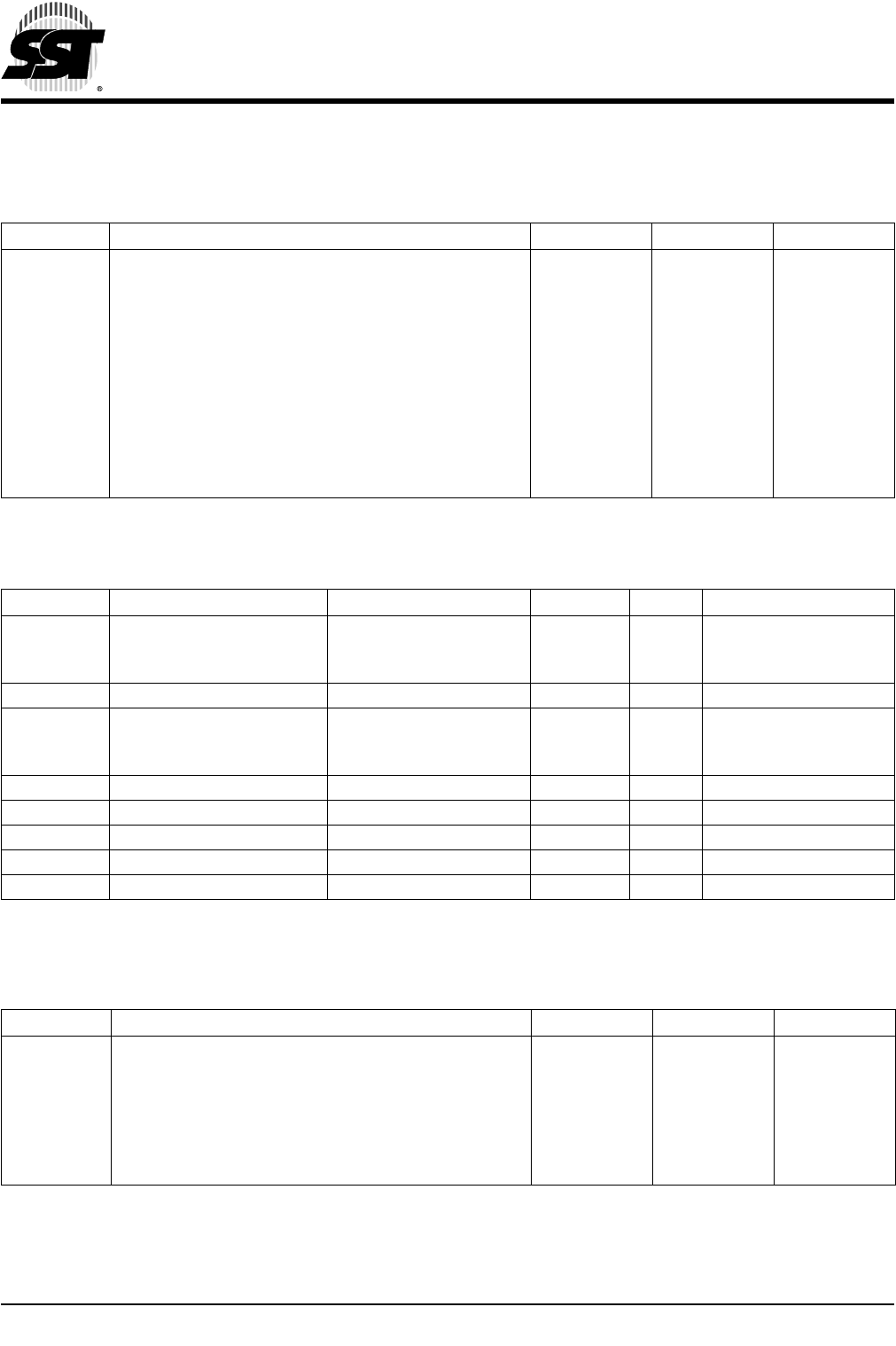
FIGURE 9: CLK WAVEFORM
TABLE 12: RECOMMENDED SYSTEM POWER-UP TIMINGS
Symbol Parameter Minimum Units
TPU-READ1Power-up to Read Operation 100 µs
TPU-WRITE1Power-up to Write Operation 100 µs
T12.2 504
1. This parameter is measured only for initial qualification and after a design or process change that could affect this parameter
TABLE 13: PIN IMPEDANCE (VDD=3.3V, Ta=25 °C, f=1 Mhz, other pins open)
Parameter Description Test Condition Maximum
CI/O1
1. This parameter is measured only for initial qualification and after a design or process change that could affect this parameter.
I/O Pin Capacitance VI/O = 0V 12 pF
CIN1Input Capacitance VIN = 0V 12 pF
LPIN2
2. Refer to PCI spec.
Pin Inductance 20 nH
T13.4 504
TABLE 14: RELIABILITY CHARACTERISTICS
Symbol Parameter Minimum Specification Units Test Method
NEND1
1. This parameter is measured only for initial qualification and after a design or process change that could affect this parameter.
Endurance 10,000 Cycles JEDEC Standard A117
TDR1Data Retention 100 Years JEDEC Standard A103
ILTH 1Latch Up 100 + IDD mA JEDEC Standard 78
T14.3 504
TABLE 15: CLOCK TIMING PARAMETERS
Symbol Parameter Min Max Units
TCYC CLK Cycle Time 30 ns
THIGH CLK High Time 11 ns
TLOW CLK Low Time 11 ns
- CLK Slew Rate (peak-to-peak) 1 4 V/ns
- RST# or INIT# Slew Rate 50 mV/ns
T15.1 504
504 ILL F27.0
0.4 VDD p-to-p
(minimum)
Tcyc
Thigh
Tlow
0.4 VDD
0.3 VDD
0.6 VDD
0.2 VDD
0.5 VDD
20
Advance Information
2 Mbit / 3 Mbit / 4 Mbit / 8 Mbit Firmware Hub
SST49LF002A / SST49LF003A / SST49LF004A / SST49LF008A
©2002 Silicon Storage Technology, Inc. S71161-06-000 2/02 504
AC CHARACTERISTICS (FWH MODE)
TABLE 16: READ/WRITE CYCLE TIMING PARAMETERS (FWH MODE), VDD =3.0-3.6V
Symbol Parameter Min Max Units
TCYC Clock Cycle Time 30 ns
TSU Data Set Up Time to Clock Rising 7 ns
TDH Clock Rising to Data Hold Time 0 ns
TVAL1
1. Minimum and maximum times have different loads. See PCI spec.
Clock Rising to Data Valid 2 11 ns
TBP Byte Programming Time 20 µs
TSE Sector-Erase Time 25 ms
TBE Block-Erase Time 25 ms
TSCE Chip-Erase Time 100 ms
TON Clock Rising to Active (Float to Active Delay) 2 ns
TOFF Clock Rising to Inactive (Active to Float Delay) 28 ns
T16.3 504
TABLE 17: AC INPUT/OUTPUT SPECIFICATIONS (FWH MODE)
Symbol Parameter Min Max Units Conditions
IOH(AC) Switching Current High -12 VDD
-17.1(VDD-VOUT)
Equation C1
1. See PCI spec.
mA
mA
0 < VOUT ≤ 0.3VDD
0.3VDD < VOUT < 0.9VDD
0.7VDD < VOUT <VDD
(Test Point) -32 VDD mA VOUT=0.7VDD
IOL(AC) Switching Current Low 16 VDD
26.7 VOUT
Equation D1mA
mA
VDD >VOUT ≥0.6VDD
0.6VDD > VOUT > 0.1VDD
0.18VDD > VOUT > 0
(Test Point) 38 VDD mA VOUT=0.18VDD
ICL Low Clamp Current -25+(VIN+1)/0.015 mA -3 < VIN ≤ -1
ICH High Clamp Current 25+(VIN-VDD-1)/0.015 mA VDD+4 > VIN ≤ VDD+1
slewr2
2. PCI specification output load is used.
Output Rise Slew Rate 1 4 V/ns 0.2VDD-0.6VDD load
slewf2Output Fall Slew Rate 1 4 V/ns 0.6VDD-0.2VDD load
T17.3 504
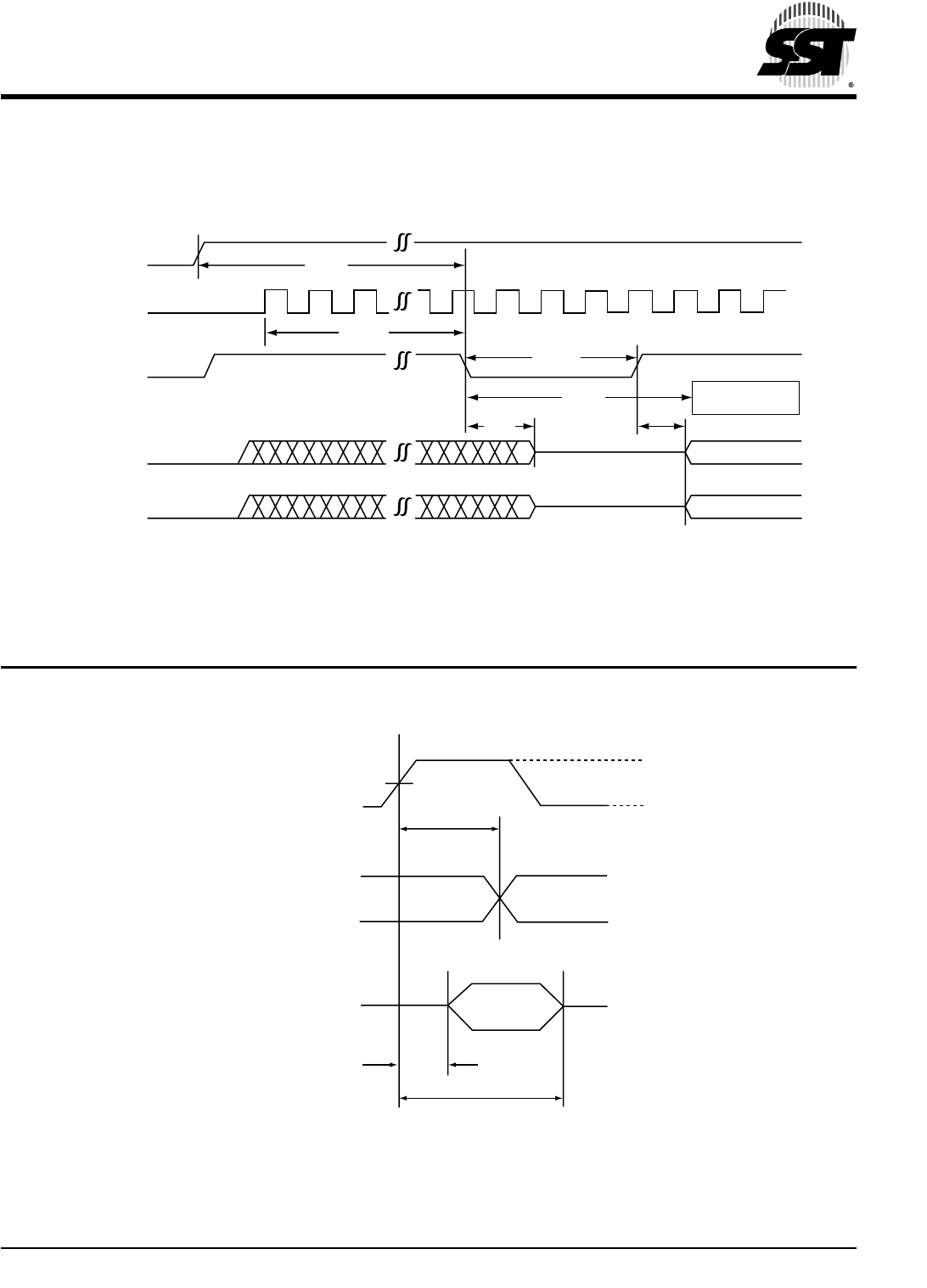
TABLE 18: RESET TIMING PARAMETERS, VDD =3.0-3.6V (FWH MODE)
Symbol Parameter Min Max Units
TPRST VDD stable to Reset Low 1 ms
TKRST Clock Stable to Reset Low 100 µs
TRSTP RST# Pulse Width 100 ns
TRSTF RST# Low to Output Float 48 ns
TRST1
1. There will be a latency of TRSTE if a reset procedure is performed during a Program or Erase operation.
RST# High to FWH4 Low 1 µs
TRSTE RST# Low to reset during Sector-/Block-Erase or Program 10 µs
T18.5 504
Advance Information
2 Mbit / 3 Mbit / 4 Mbit / 8 Mbit Firmware Hub
SST49LF002A / SST49LF003A / SST49LF004A / SST49LF008A
21
©2002 Silicon Storage Technology, Inc. S71161-06-000 2/02 504
FIGURE 10: RESET TIMING DIAGRAM
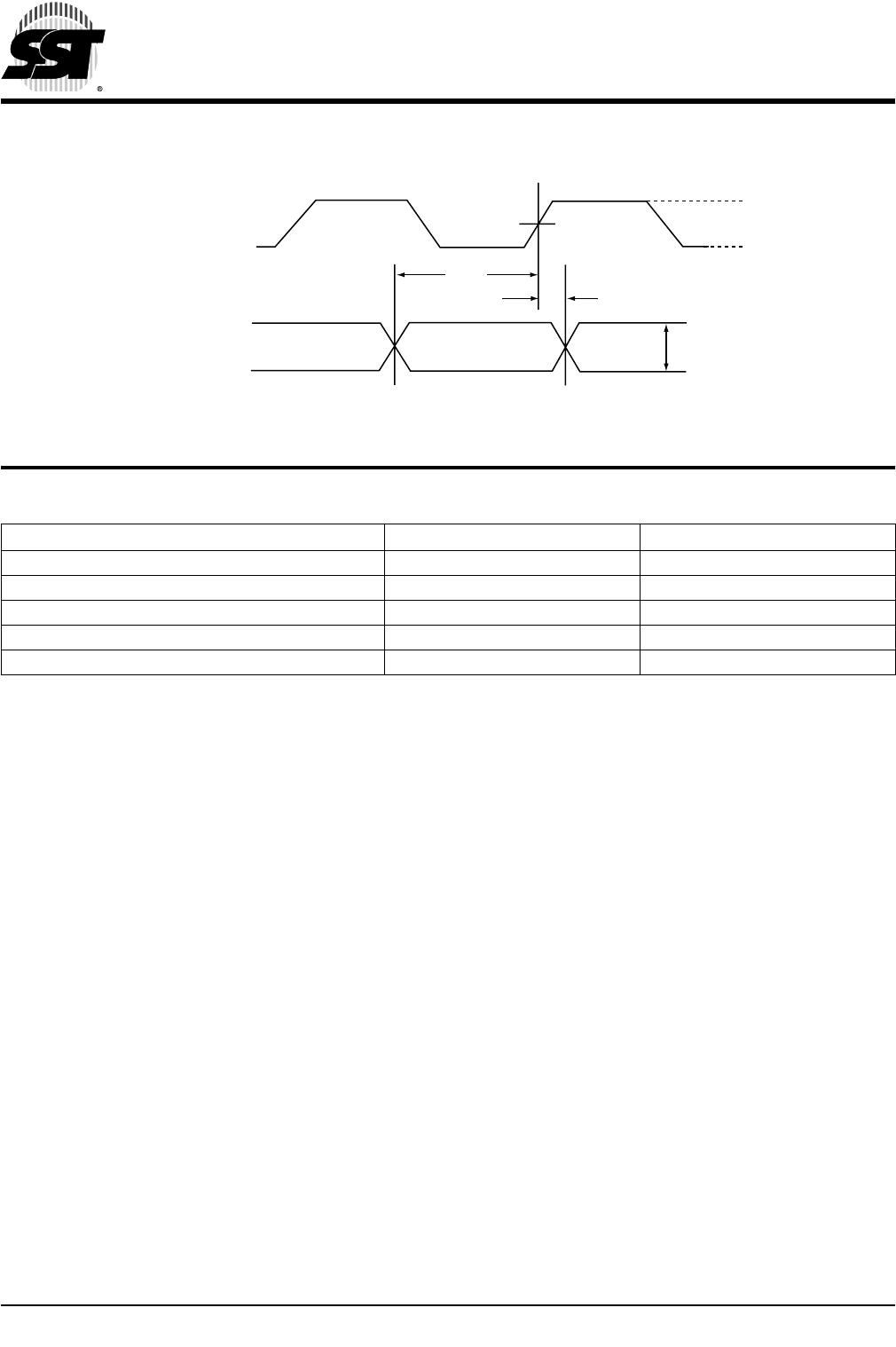
FIGURE 11: OUTPUT TIMING PARAMETERS
CLK
VDD
RST#/INIT#
FWH4
FWH[3:0]
504 ILL F51.1
TPRST
TKRST
TRSTP
TRSTF
TRSTE Sector-/Block-Erase
or Program operation
aborted
TRST
TVAL
VTEST
VTL
VTH
TOFF
TON
504 ILL F49.1
CLK
FWH [3:0]
(Valid Output Data)
FWH [3:0]
(Float Output Data)
22
Advance Information
2 Mbit / 3 Mbit / 4 Mbit / 8 Mbit Firmware Hub
SST49LF002A / SST49LF003A / SST49LF004A / SST49LF008A
©2002 Silicon Storage Technology, Inc. S71161-06-000 2/02 504
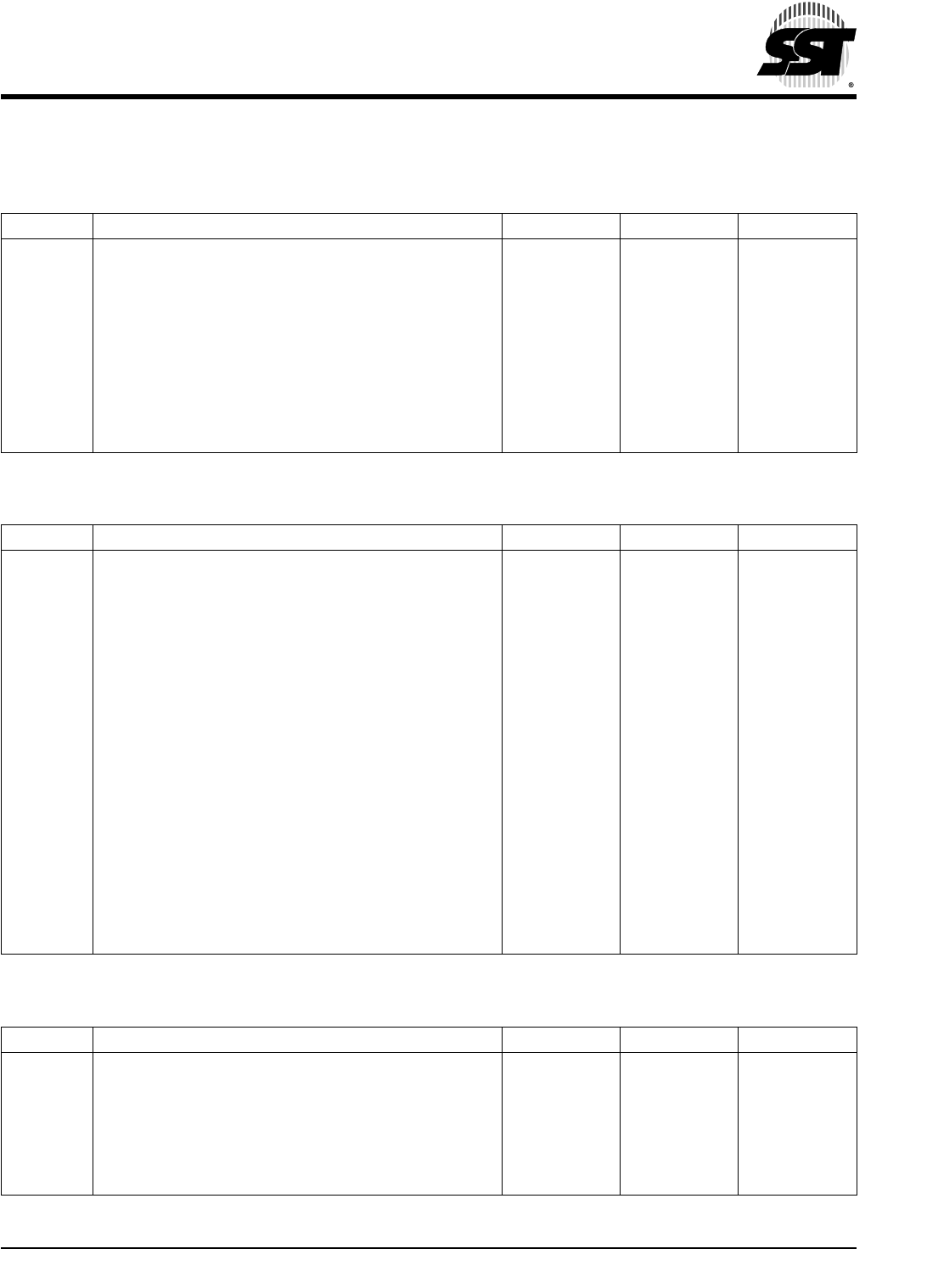
FIGURE 12: INPUT TIMING PARAMETERS
TABLE 19: INTERFACE MEASUREMENT CONDITION PARAMETERS
Symbol Value Units
VTH1
1. The input test environment is done with 0.1 VDD of overdrive over VIH and VIL. Timing parameters must be met with no more
overdrive than this. VMAX specified the maximum peak-to-peak waveform allowed for measuring input timing. Production testing
may use different voltage values, but must correlate results back to these parameters.
0.6 VDD V
VTL10.2 VDD V
VTEST 0.4 VDD V
VMAX10.4 VDD V
Input Signal Edge Rate 1 V/ns
T19.3 504
TSU
TDH
Inputs
Valid
504 ILL F50.1
CLK
FWH [3:0]
(Valid Input Data)
VTEST
VTL
VMAX
VTH
Advance Information
2 Mbit / 3 Mbit / 4 Mbit / 8 Mbit Firmware Hub
SST49LF002A / SST49LF003A / SST49LF004A / SST49LF008A
23
©2002 Silicon Storage Technology, Inc. S71161-06-000 2/02 504
AC CHARACTERISTICS (PP MODE)
TABLE 20: READ CYCLE TIMING PARAMETERS VDD =3.0-3.6V (PP MODE)
Symbol Parameter Min Max Units
TRC Read Cycle Time 270 ns
TRST RST# High to Row Address Setup 1 µs
TAS R/C# Address Set-up Time 45 ns
TAH R/C# Address Hold Time 45 ns
TAA Address Access Time 120 ns
TOE Output Enable Access Time 60 ns
TOLZ OE# Low to Active Output 0 ns
TOHZ OE# High to High-Z Output 35 ns
TOH Output Hold from Address Change 0 ns
T20.2 504
TABLE 21: PROGRAM/ERASE CYCLE TIMING PARAMETERS VDD =3.0-3.6V (PP MODE)
Symbol Parameter Min Max Units
TRST RST# High to Row Address Setup 1 µs
TAS R/C# Address Setup Time 50 ns
TAH R/C# Address Hold Time 50 ns
TCWH R/C# to Write Enable High Time 50 ns
TOES OE# High Setup Time 20 ns
TOEH OE# High Hold Time 20 ns
TOEP OE# to Data# Polling Delay 40 ns
TOET OE# to Toggle Bit Delay 40 ns
TWP WE# Pulse Width 100 ns
TWPH WE# Pulse Width High 100 ns
TDS Data Setup Time 50 ns
TDH Data Hold Time 5 ns
TIDA Software ID Access and Exit Time 150 ns
TBP Byte Programming Time 20 µs
TSE Sector-Erase Time 25 ms
TBE Block-Erase Time 25 ms
TSCE Chip-Erase Time 100 ms
T21.2 504
TABLE 22: RESET TIMING PARAMETERS, VDD =3.0-3.6V (PP MODE)
Symbol Parameter Min Max Units
TPRST VDD stable to Reset Low 1 ms
TRSTP RST# Pulse Width 100 ns
TRSTF RST# Low to Output Float 48 ns
TRST1
1. There will be a reset latency of TRSTE or TRSTC if a reset procedure is performed during a Program or Erase operation.
RST# High to Row Address Setup 1 µs
TRSTE RST# Low to reset during Sector-/Block-Erase or Program 10 µs
TRSTC RST# Low to reset during Chip-Erase 50 µs
T22.1 504
24
Advance Information
2 Mbit / 3 Mbit / 4 Mbit / 8 Mbit Firmware Hub
SST49LF002A / SST49LF003A / SST49LF004A / SST49LF008A
©2002 Silicon Storage Technology, Inc. S71161-06-000 2/02 504
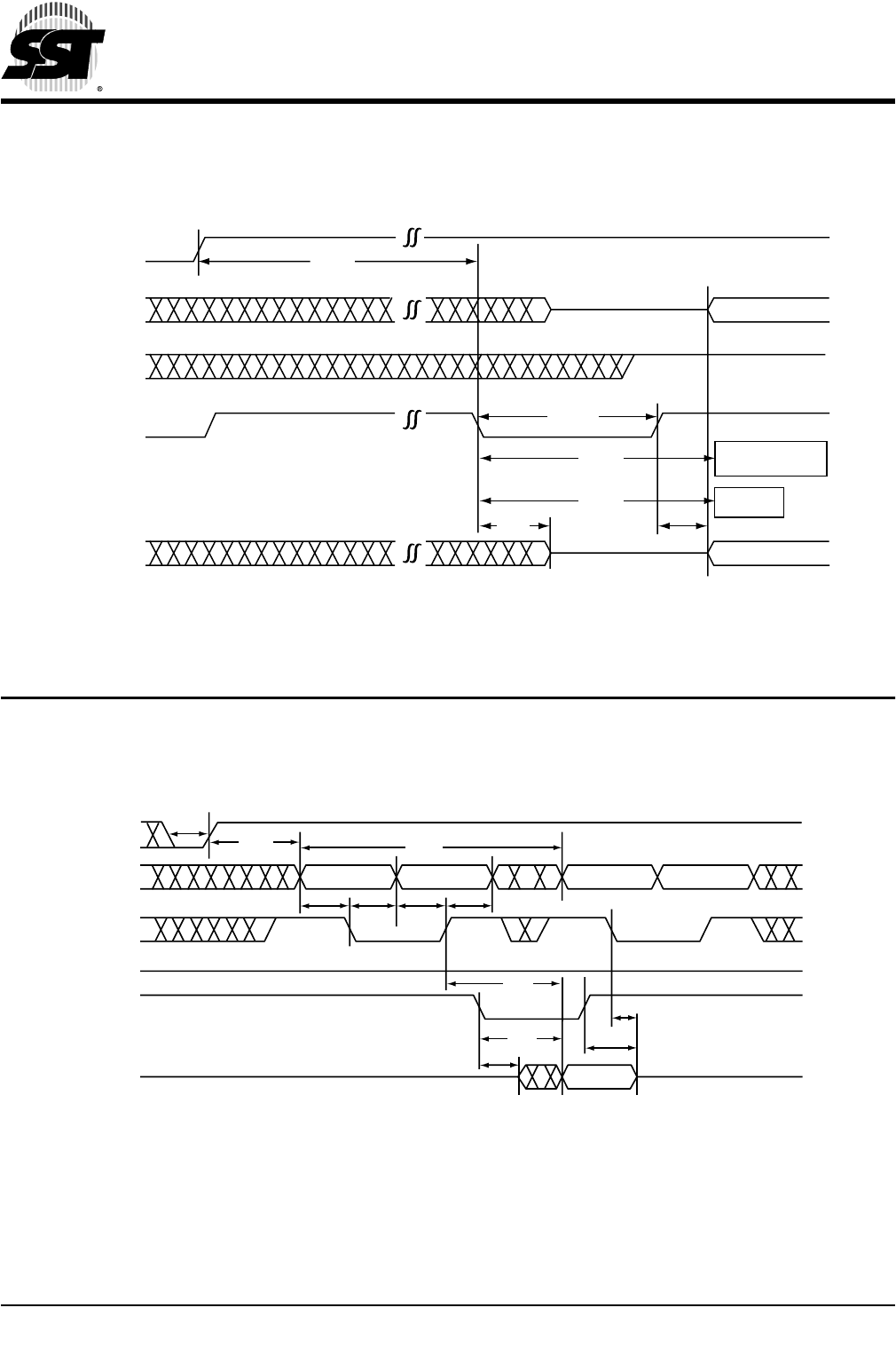
FIGURE 13: RESET TIMING DIAGRAM
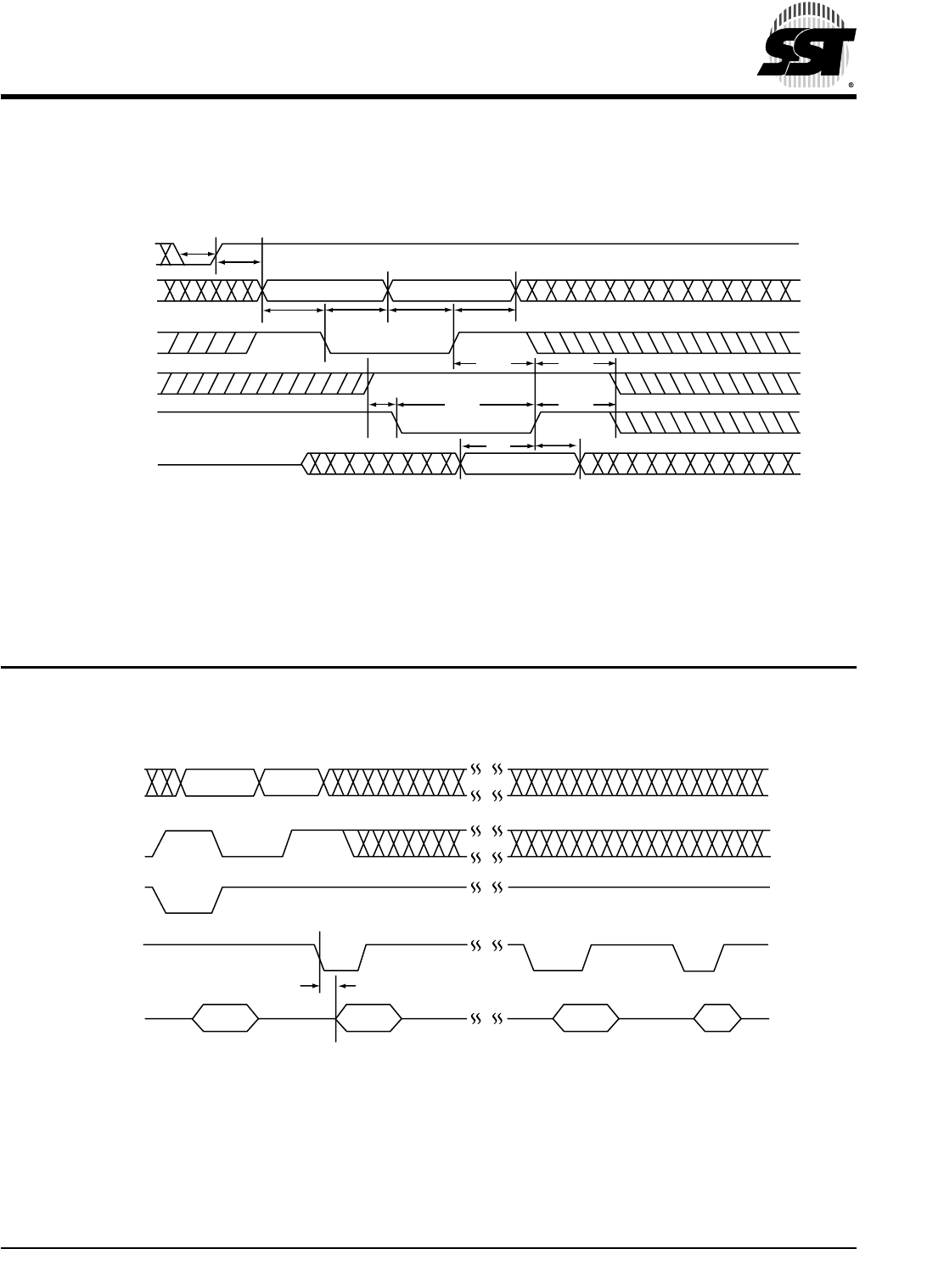
FIGURE 14: READ CYCLE TIMING DIAGRAM (PP MODE)
VDD
RST#
Addresses
R/C#
DQ7-0
504 ILL F58.0
TPRST
TRSTP
TRSTF
TRSTE
Row Address
Sector-/Block-Erase
or Program operation
aborted
TRST
TRSTC Chip-Erase
aborted
504 ILL F28.2
Column Address
Data Valid High-Z
Row AddressColumn AddressRow Address
RST#
Addresses
R/C#
VIH
High-Z
TRST TRC
TAS TAH TAH
TAA
TOE
TOLZ
TOHZ
TOH
TAS
WE#
OE#
DQ7-0
TRSTP
Advance Information
2 Mbit / 3 Mbit / 4 Mbit / 8 Mbit Firmware Hub
SST49LF002A / SST49LF003A / SST49LF004A / SST49LF008A
25
©2002 Silicon Storage Technology, Inc. S71161-06-000 2/02 504
FIGURE 15: WRITE CYCLE TIMING DIAGRAM (PP MODE)
FIGURE 16: DATA# POLLING TIMING DIAGRAM (PP MODE)
504 ILL F29.2
Column AddressRow Address
Data Valid
RST#
Addresses
R/C#
TRST
TAS TAH
TCWH
TWP TWPH
TOEH
TDH
TDS
TAH
TAS
WE#
OE#
DQ7-0
TOES
TRSTP
504 ILL F54.2
Addresses
R/C#
TOEP
Row Column
WE#
OE#
DQ7D#D D# D
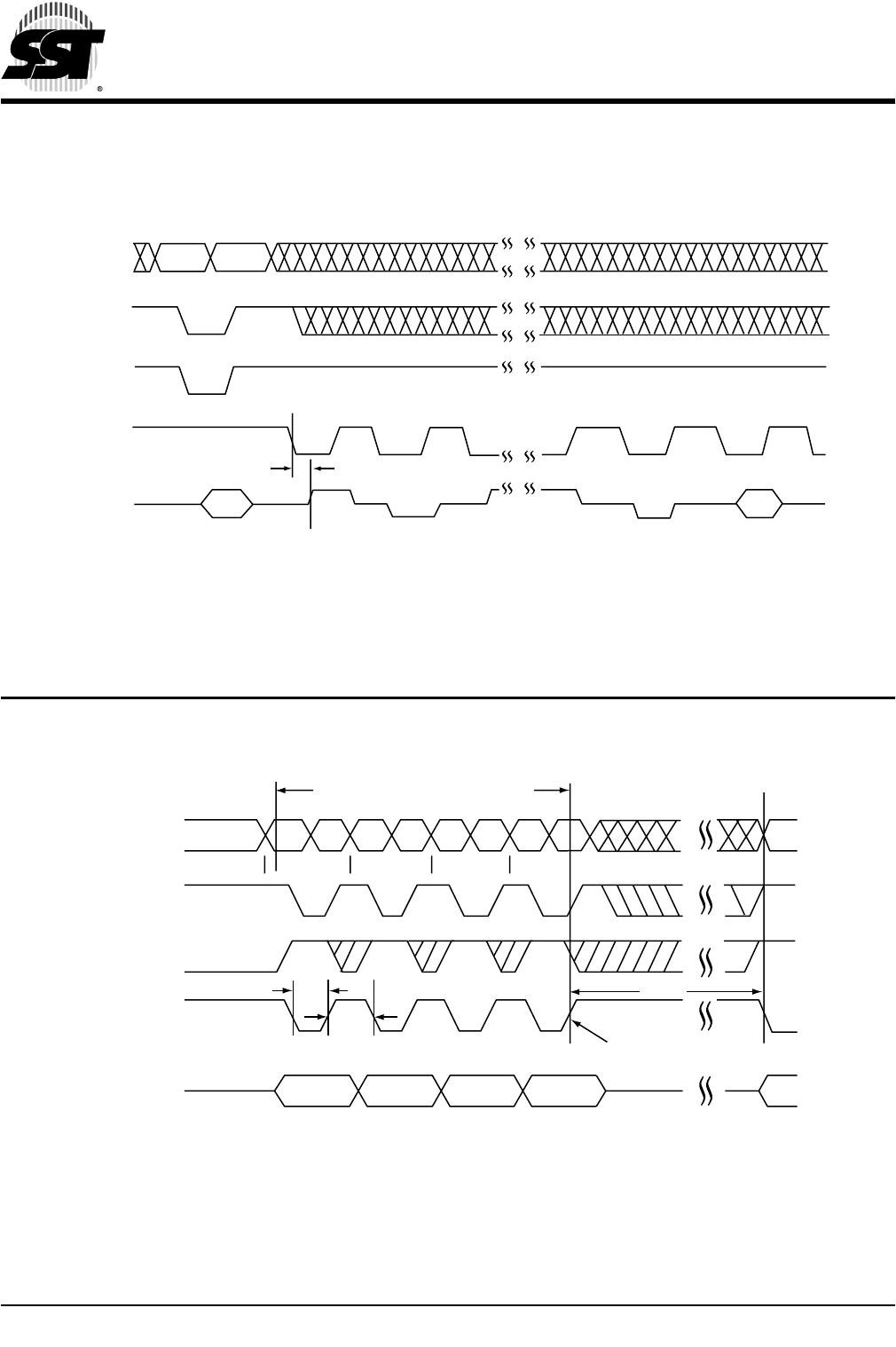
26
Advance Information
2 Mbit / 3 Mbit / 4 Mbit / 8 Mbit Firmware Hub
SST49LF002A / SST49LF003A / SST49LF004A / SST49LF008A
©2002 Silicon Storage Technology, Inc. S71161-06-000 2/02 504
FIGURE 17: TOGGLE BIT TIMING DIAGRAM (PP MODE)
FIGURE 18: BYTE-PROGRAM TIMING DIAGRAM (PP MODE)
504 ILL F55.0
Addresses
R/C#
TOET
Row Column
WE#
OE#
DQ6D D
504 ILL F53.0
TWP
TWPH
TBP
Four-Byte Code for Byte-Program
5555 2AAA 5555 BA
SB0
BA = Byte-Program Address
SB1 SB2 SB3 Internal Program Starts
WE#
Addresses
R/C#
OE#
Data55AA A0
DQ7-0
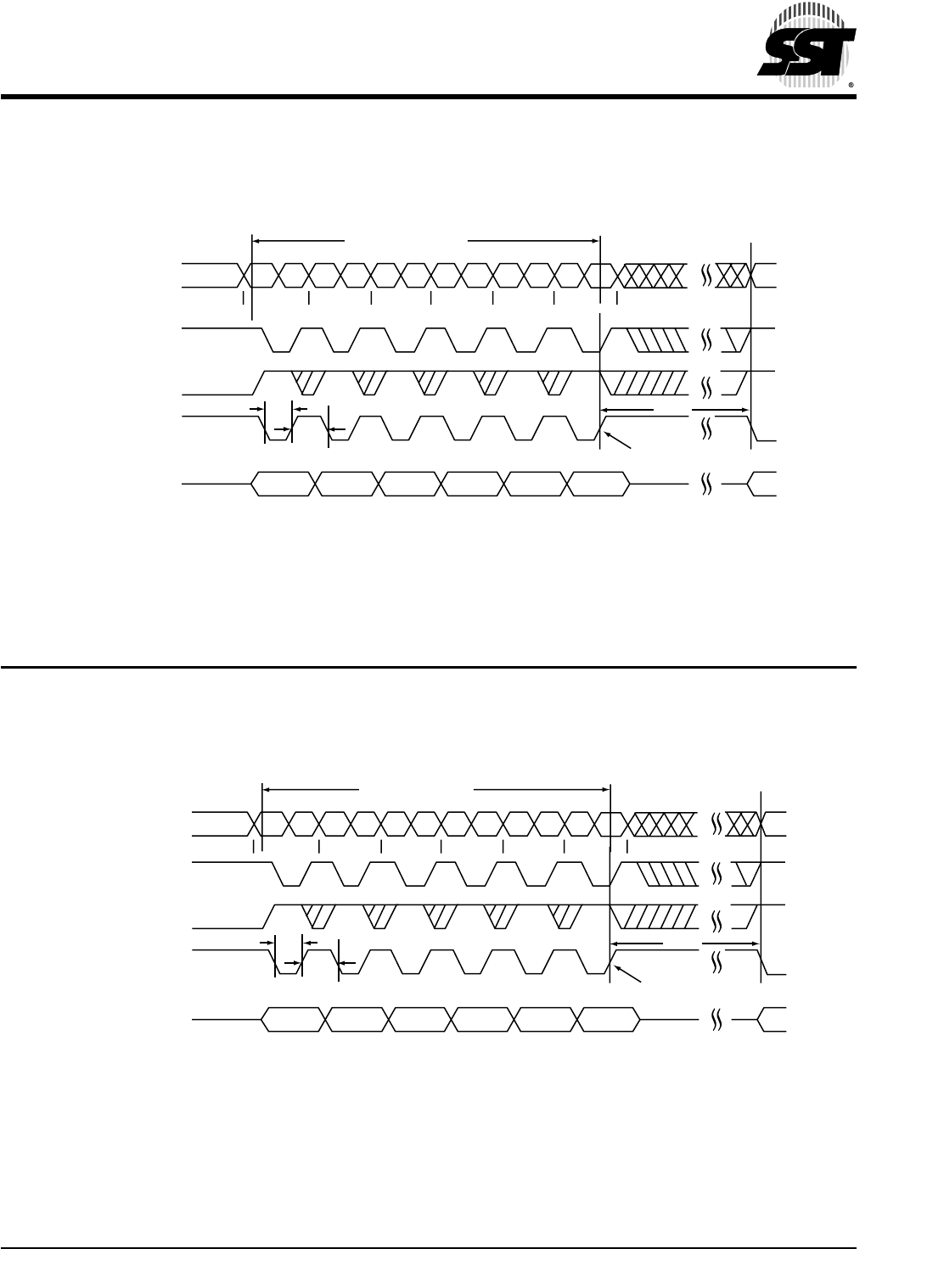
Advance Information
2 Mbit / 3 Mbit / 4 Mbit / 8 Mbit Firmware Hub
SST49LF002A / SST49LF003A / SST49LF004A / SST49LF008A
27
©2002 Silicon Storage Technology, Inc. S71161-06-000 2/02 504
FIGURE 19: SECTOR-ERASE TIMING DIAGRAM (PP MODE)
FIGURE 20: BLOCK-ERASE TIMING DIAGRAM (PP MODE)
504 ILL F32.1
TWP
TWPH
TSE
Six-Byte code for
Sector-Erase Operation
5555 2AAA 5555 5555 2AAA SAx
SB0
SAx = Sector Address
SB1 SB2 SB3 SB4 SB5 Internal Erasure Starts
WE#
Addresses
R/C#
OE#
55AA55AA 80 30
DQ7-0
504 ILL F48.1
TWP
TWPH
TBE
Six-Byte code for
Block-Erase Operation
5555 2AAA 5555 5555 2AAA BAx
SB0
BAx = Block Address
SB1 SB2 SB3 SB4 SB5 Internal Erasure Starts
WE#
Addresses
R/C#
OE#
55AA55AA 80 50
DQ7-0
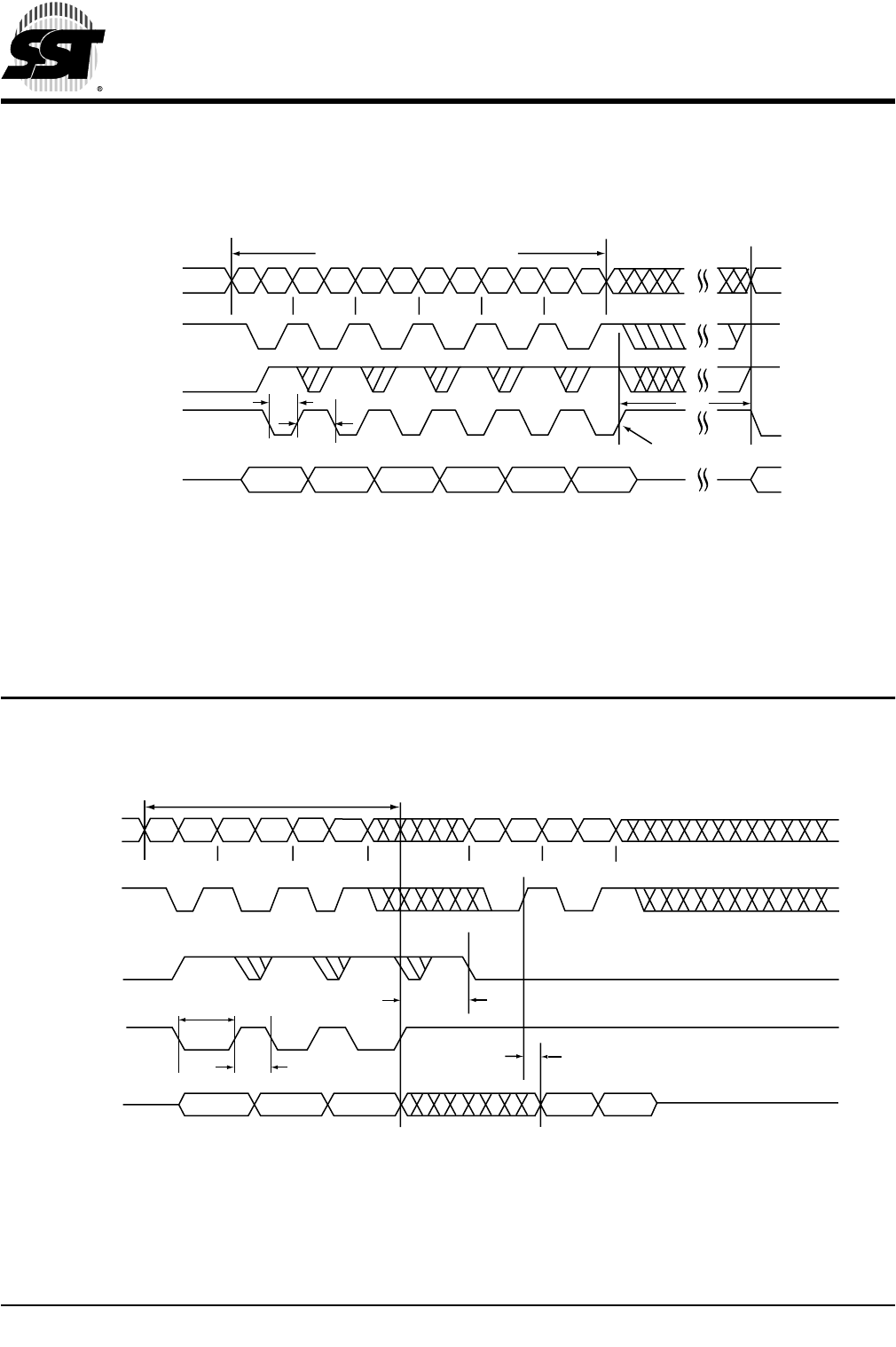
28
Advance Information
2 Mbit / 3 Mbit / 4 Mbit / 8 Mbit Firmware Hub
SST49LF002A / SST49LF003A / SST49LF004A / SST49LF008A
©2002 Silicon Storage Technology, Inc. S71161-06-000 2/02 504
FIGURE 21: CHIP-ERASE TIMING DIAGRAM (PP MODE)
FIGURE 22: SOFTWARE ID ENTRY AND READ (PP MODE)
504 ILL F33.1
TWP
TWPH
TSCE
Six-Byte code for Chip-Erase Operation
5555 2AAA 5555 5555 2AAA 5555
SB0 SB1 SB2 SB3 SB4 SB5 Internal Erasure Starts
WE#
Addresses
R/C#
OE#
55AA55AA 80 10
DQ7-0
504 ILL F34.5
Addresses
TIDA
DQ7-0
WE#
SW0
Device ID = 57H for SST49LF002A, 1BH for SST49LF003A,
60H for SST49LF004A, 5AH for SST49LF008A
SW1 SW2
5555 2AAA 5555 0000 0001
OE#
R/C#
Three-byte sequence for
Software ID Entry
TWP
TWPH
TAA
BF
Device ID
55AA 90
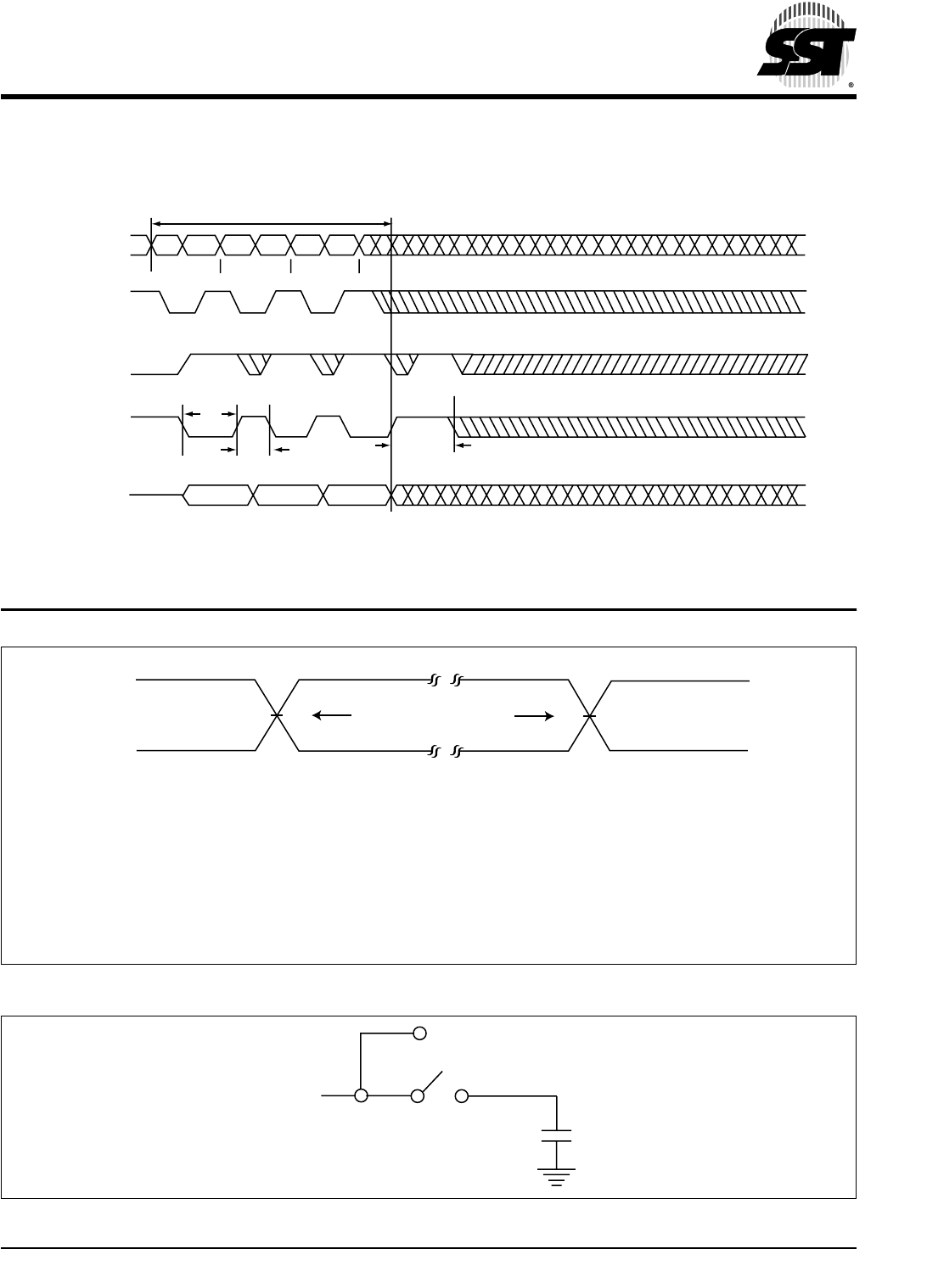
Advance Information
2 Mbit / 3 Mbit / 4 Mbit / 8 Mbit Firmware Hub
SST49LF002A / SST49LF003A / SST49LF004A / SST49LF008A
29
©2002 Silicon Storage Technology, Inc. S71161-06-000 2/02 504
FIGURE 23: SOFTWARE ID EXIT AND RESET (PP MODE)
FIGURE 24: AC INPUT/OUTPUT REFERENCE WAVEFORMS (PP MODE)
FIGURE 25: A TEST LOAD EXAMPLE (PP MODE)
504 ILL F35.2
Addresses
DQ7-0
TIDA
TWP
TWPH
WE#
SW0 SW1 SW2
5555 2AAA 5555
Three-Byte Sequence for
Software ID Exit and Reset
OE#
R/C#
AA 55 F0
504 ILL F06.1
REFERENCE POINTS OUTPUTINPUT VIT
VIHT
VILT
VOT
AC test inputs are driven at VIHT (0.9 VDD) for a logic “1” and VILT (0.1 VDD) for a logic “0”. Measurement reference points
for inputs and outputs are VIT (0.5 VDD) and VOT (0.5 VDD). Input rise and fall times (10% ↔ 90%) are <5 ns.
Note: VIT - VINPUT Te st
VOT - VOUTPUT Te s t
VIHT - VINPUT HIGH Test
VILT - VINPUT LOW Test
504 ILL F07.0
TO TESTER
TO DUT
CL
30
Advance Information
2 Mbit / 3 Mbit / 4 Mbit / 8 Mbit Firmware Hub
SST49LF002A / SST49LF003A / SST49LF004A / SST49LF008A
©2002 Silicon Storage Technology, Inc. S71161-06-000 2/02 504
FIGURE 26: BYTE-PROGRAM ALGORITHM
504 ILL F36.1
Start
Write data: AAH
Address: 5555H
Write data: 55H
Address: 2AAAH
Write data: A0H
Address: 5555H
Load Byte
Address/Byte
Data
Wait for end of
Program (TBP,
Data# Polling
bit, or Toggle bit
operation)
Program
Completed
Advance Information
2 Mbit / 3 Mbit / 4 Mbit / 8 Mbit Firmware Hub
SST49LF002A / SST49LF003A / SST49LF004A / SST49LF008A
31
©2002 Silicon Storage Technology, Inc. S71161-06-000 2/02 504
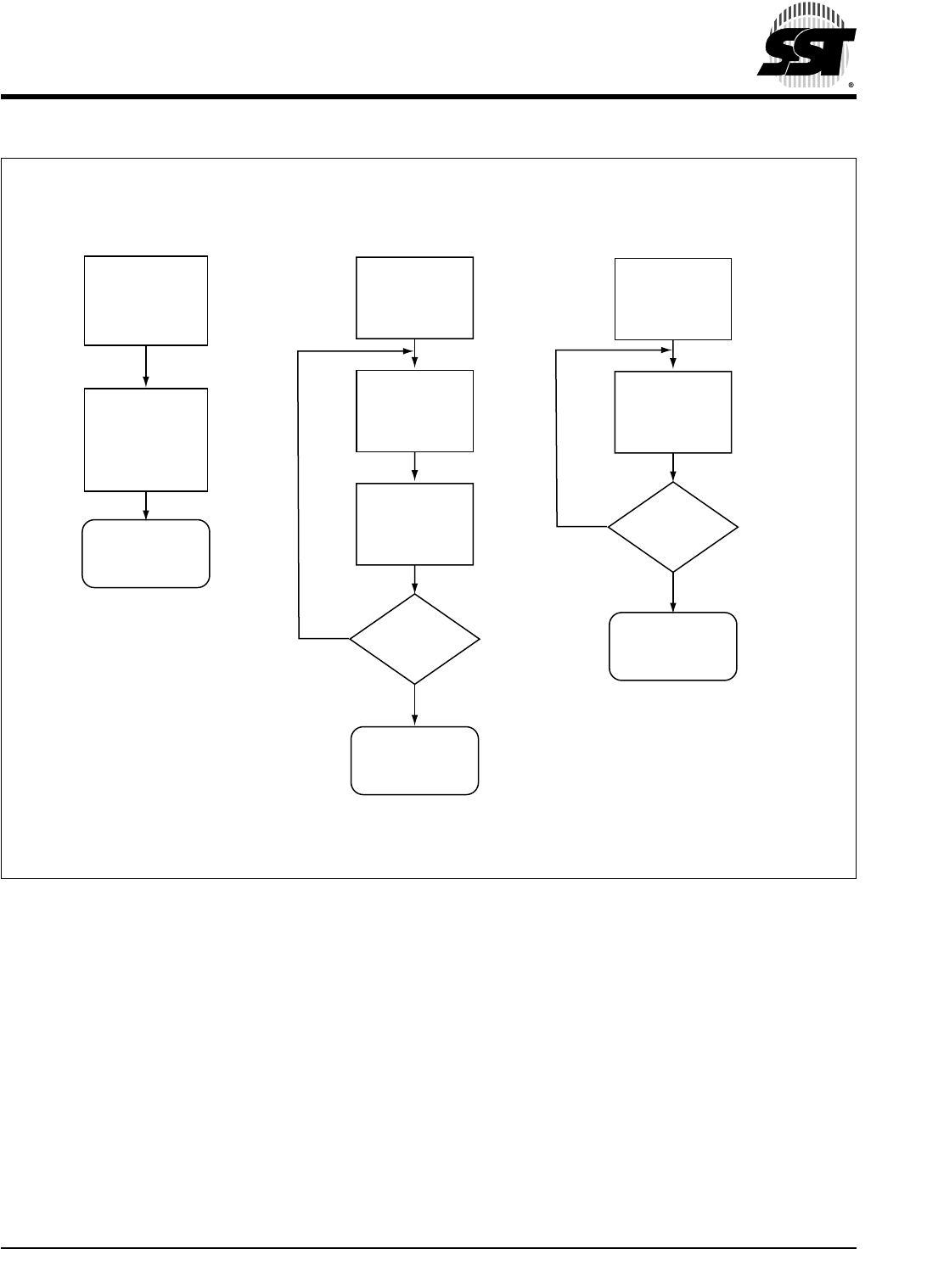
FIGURE 27: WAIT OPTIONS
504 ILL F37.0
Wait TBP,
TSCE, TBE
or TSE
Byte-
Program/Erase
Initiated
Internal Timer Toggle Bit
Ye s
Ye s
No
No
Program/Erase
Completed
Does DQ6
match?
Read same
byte
Data# Polling
Program/Erase
Completed
Program/Erase
Completed
Read byte
Is DQ7 =
true data?
Read DQ7
Byte-
Program/Erase
Initiated
Byte-
Program/Erase
Initiated
32
Advance Information
2 Mbit / 3 Mbit / 4 Mbit / 8 Mbit Firmware Hub
SST49LF002A / SST49LF003A / SST49LF004A / SST49LF008A
©2002 Silicon Storage Technology, Inc. S71161-06-000 2/02 504
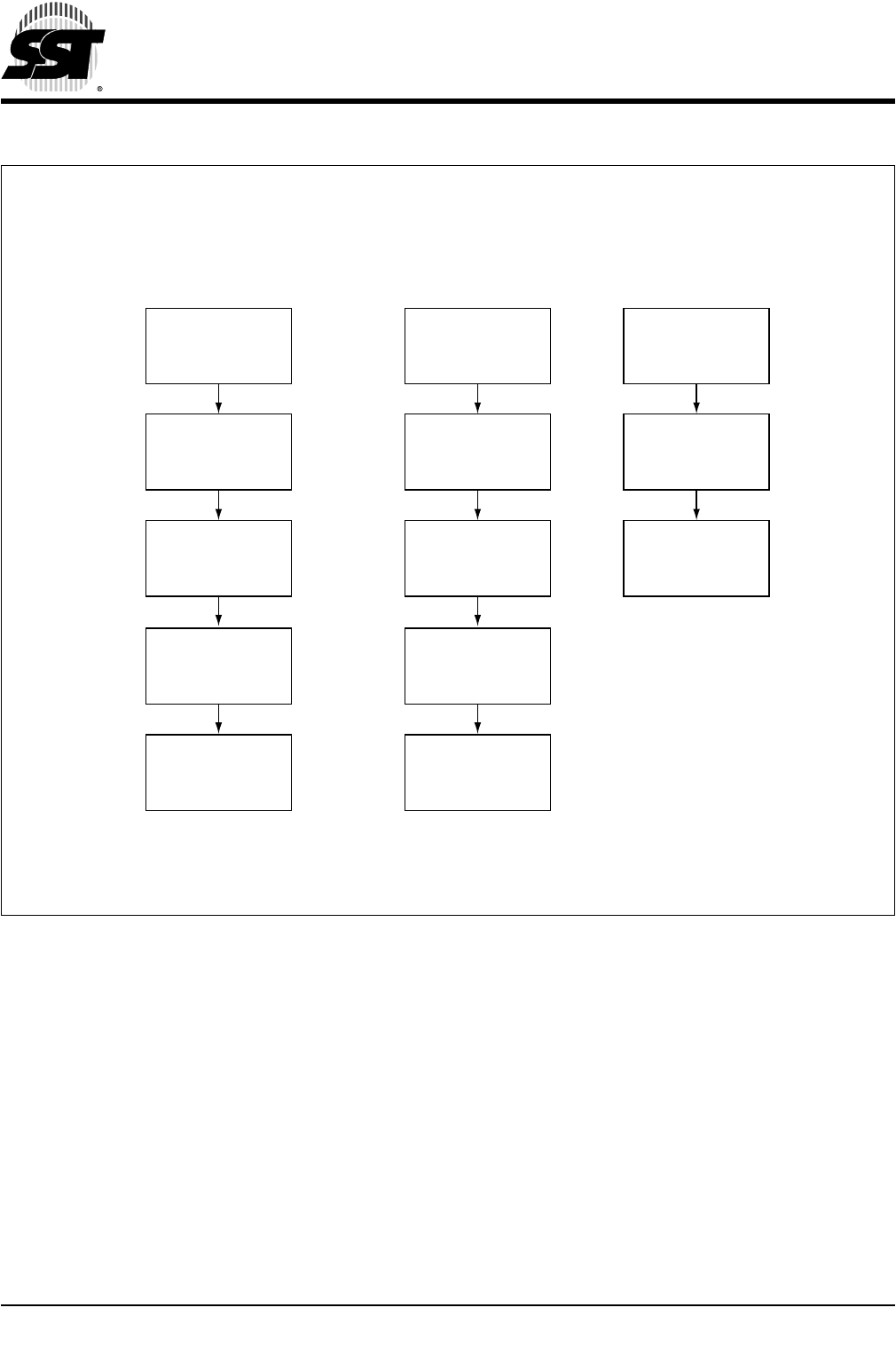
FIGURE 28: SOFTWARE PRODUCT COMMAND FLOWCHARTS
504 ILL F38.1
Write data: AAH
Address: 5555H
Software Product ID Entry
Command Sequence
Write data: 55H
Address: 2AAAH
Write data: 90H
Address: 5555H
Wait TIDA
Read Software ID
Write data: AAH
Address: 5555H
Software Product ID Exit &
Reset Command Sequence
Write data: 55H
Address: 2AAAH
Write data: F0H
Address: 5555H
Write data: F0H
Address: XXH
Return to normal
operation
Wait TIDA
Wait TIDA
Return to normal
operation
Advance Information
2 Mbit / 3 Mbit / 4 Mbit / 8 Mbit Firmware Hub
SST49LF002A / SST49LF003A / SST49LF004A / SST49LF008A
33
©2002 Silicon Storage Technology, Inc. S71161-06-000 2/02 504
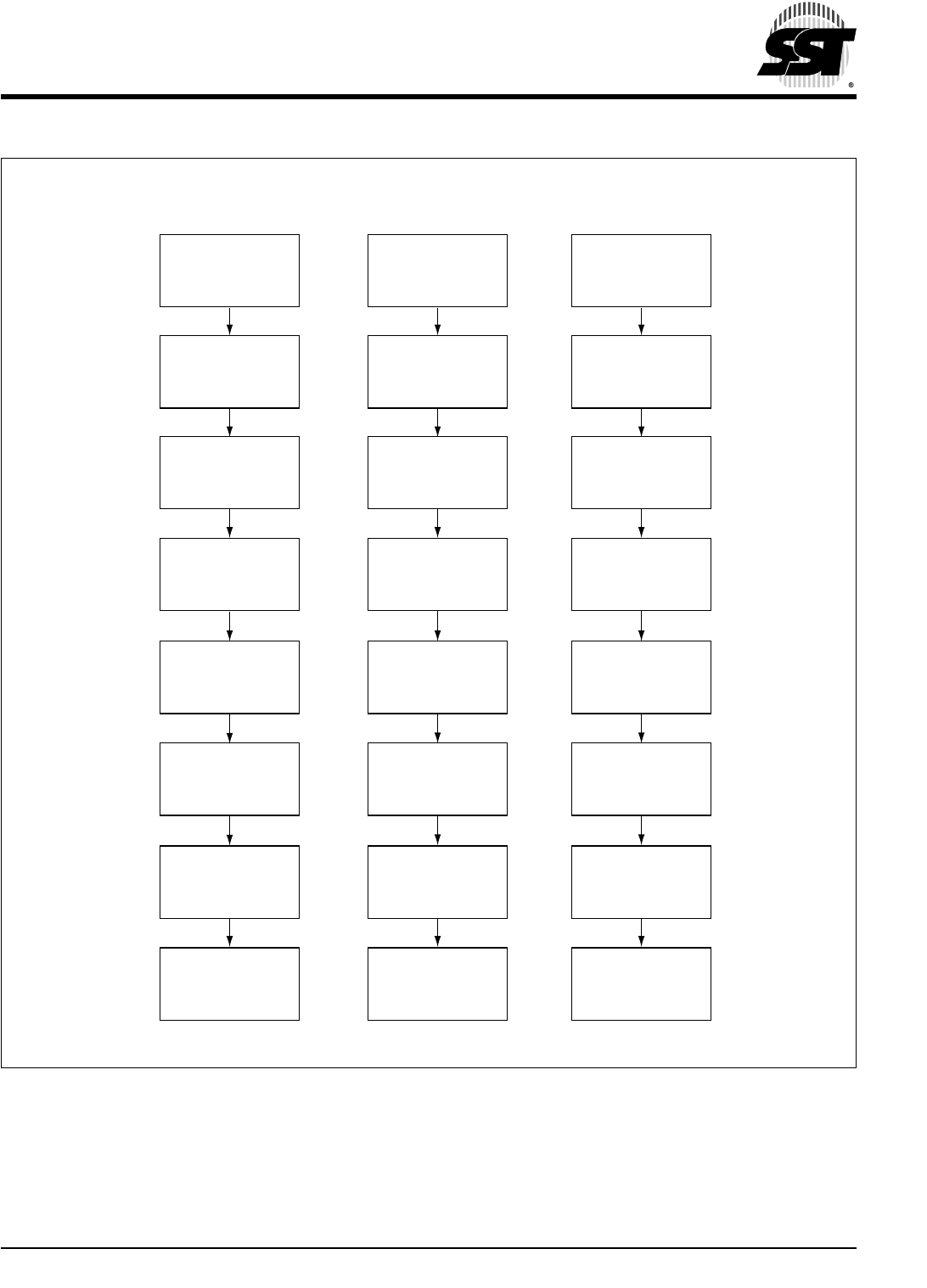
FIGURE 29: ERASE COMMAND SEQUENCE
504 ILL F39.1
Write data: AAH
Address: 5555H
Chip-Erase
Command Sequence
Write data: 55H
Address: 2AAAH
Write data: 80H
Address: 5555H
Write data: 55H
Address: 2AAAH
Write data: 10H
Address: 5555H
Write data: AAH
Address: 5555H
Wait Options
Chip erased
to FFH
Write data: AAH
Address: 5555H
Sector-Erase
Command Sequence
Write data: 55H
Address: 2AAAH
Write data: 80H
Address: 5555H
Write data: 55H
Address: 2AAAH
Write data: 30H
Address: SAX
Write data: AAH
Address: 5555H
Wait Options
Sector erased
to FFH
Write data: AAH
Address: 5555H
Block-Erase
Command Sequence
Write data: 55H
Address: 2AAAH
Write data: 80H
Address: 5555H
Write data: 55H
Address: 2AAAH
Write data: 50H
Address: BAX
Write data: AAH
Address: 5555H
Wait Options
Block erased
to FFH
34
Advance Information
2 Mbit / 3 Mbit / 4 Mbit / 8 Mbit Firmware Hub
SST49LF002A / SST49LF003A / SST49LF004A / SST49LF008A
©2002 Silicon Storage Technology, Inc. S71161-06-000 2/02 504
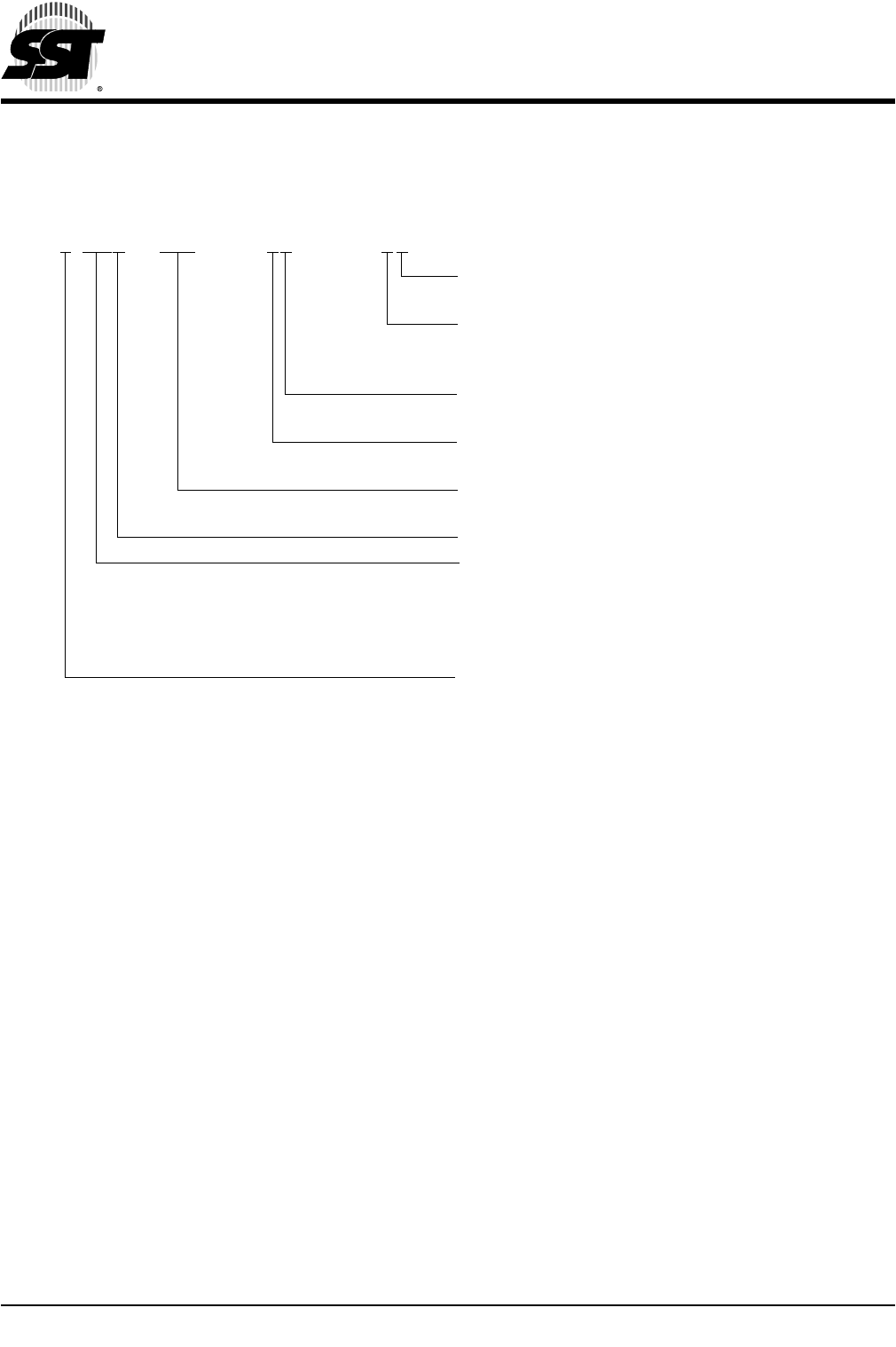
PRODUCT ORDERING INFORMATION
Valid combinations for SST49LF002A
SST49LF002A-33-4C-WH SST49LF002A-33-4C-NH
Valid combinations for SST49LF003A
SST49LF003A-33-4C-WH SST49LF003A-33-4C-NH
Valid combinations for SST49LF004A
SST49LF004A-33-4C-WH SST49LF004A-33-4C-NH
Valid combinations for SST49LF008A
SST49LF008A-33-4C-WH SST49LF008A-33-4C-NH
Note: Valid combinations are those products in mass production or will be in mass production. Consult your SST sales
representative to confirm availability of valid combinations and to determine availability of new combinations.
Device Speed Suffix1 Suffix2
SST49LF00xA-XXX -XX-XX
Package Modifier
H = 32 leads
Package Type
N = PLCC
W = TSOP (type 1, die up, 8mm x 14mm)
Operating Temperature
C = Commercial = 0°C to +85°C
Minimum Endurance
4 = 10,000 cycles
Serial Access Clock Frequency
33 = 33 MHz
Version
Device Density
008 = 8 Mbit
004 = 4 Mbit
003 = 3 Mbit
002 = 2 Mbit
Voltage Range
L = 3.0-3.6V
Advance Information
2 Mbit / 3 Mbit / 4 Mbit / 8 Mbit Firmware Hub
SST49LF002A / SST49LF003A / SST49LF004A / SST49LF008A
35
©2002 Silicon Storage Technology, Inc. S71161-06-000 2/02 504
PACKAGING DIAGRAMS
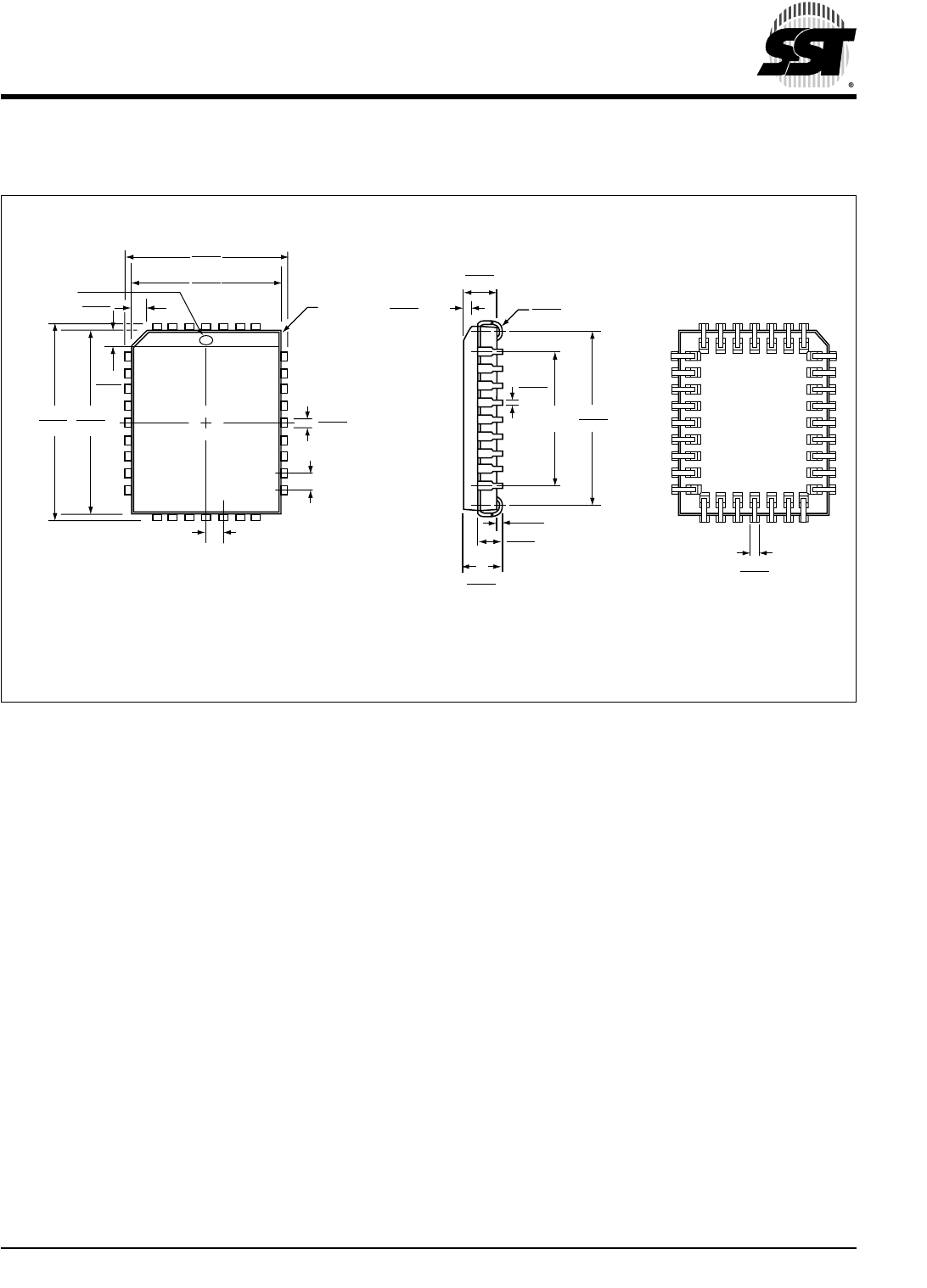
32-LEAD PLASTIC LEAD CHIP CARRIER (PLCC)
SST PACKAGE CODE: NH
.040
.030
.021
.013
.530
.490
.095
.075
.140
.125
.032
.026
.032
.026
.029
.023
.453
.447
.553
.547
.595
.585
.495
.485 .112
.106
.042
.048
.048
.042
.015 Min.
TOP VIEW SIDE VIEW BOTTOM VIEW
1232
.400
BSC
32-plcc-NH-3
Note: 1. Complies with JEDEC publication 95 MS-016 AE dimensions, although some dimensions may be more stringent.
2. All linear dimensions are in inches (max/min).
3. Dimensions do not include mold flash. Maximum allowable mold flash is .008 inches.
4. Coplanarity: 4 mils.
.050
BSC
.050
BSC
Optional
Pin #1
Identifier .020 R.
MAX. R.
x 30˚
36
Advance Information
2 Mbit / 3 Mbit / 4 Mbit / 8 Mbit Firmware Hub
SST49LF002A / SST49LF003A / SST49LF004A / SST49LF008A
©2002 Silicon Storage Technology, Inc. S71161-06-000 2/02 504
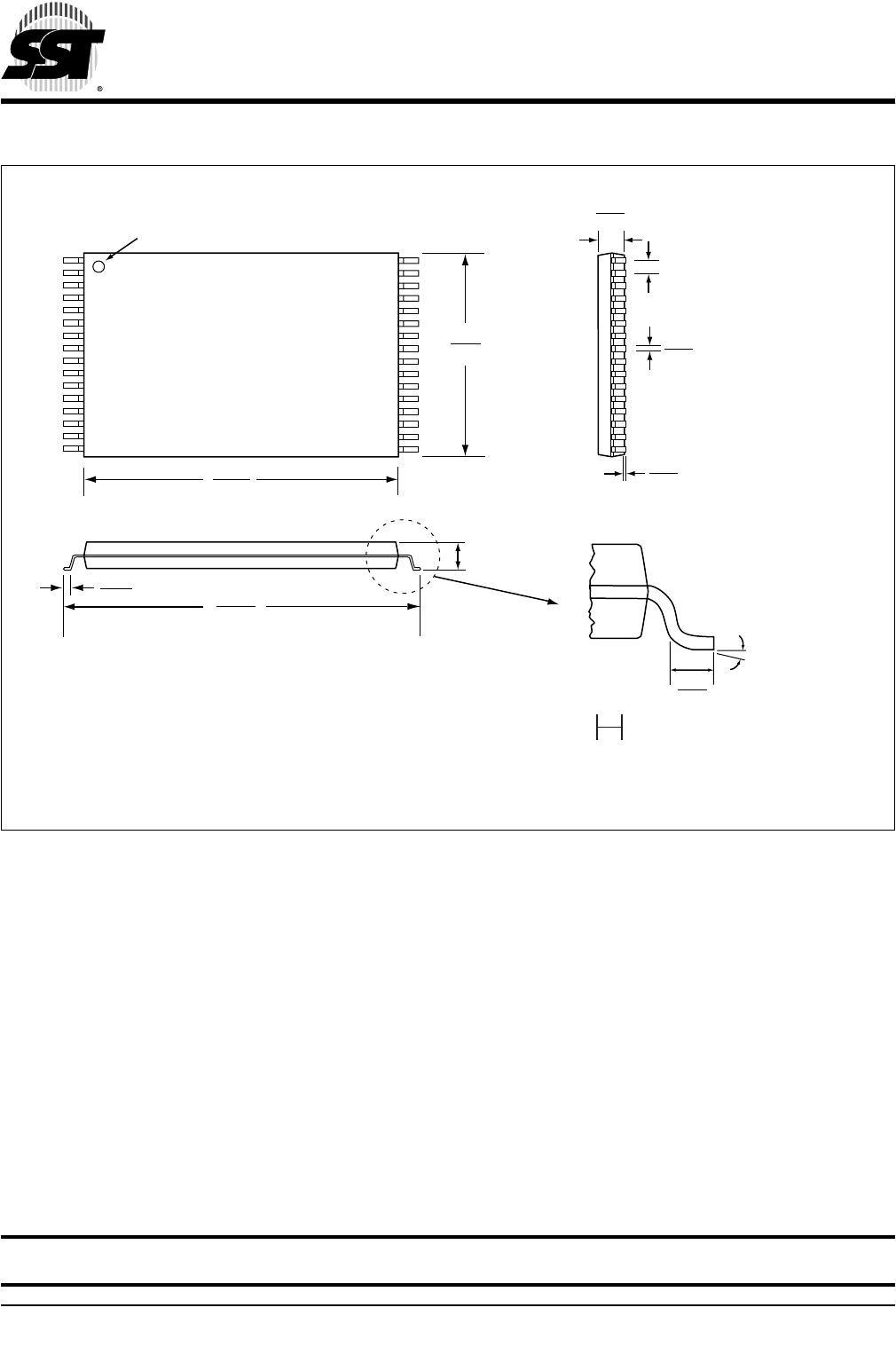
32-LEAD THIN SMALL OUTLINE PACKAGE (TSOP) 8MM X 14MM
SST PACKAGE CODE: WH
32-tsop-WH-7
Note: 1. Complies with JEDEC publication 95 MO-142 BA dimensions,
although some dimensions may be more stringent.
2. All linear dimensions are in millimeters (max/min).
3. Coplanarity: 0.1 mm
4. Maximum allowable mold flash is 0.15 mm at the package ends, and 0.25 mm between leads.
1.20
max.
1mm
Pin # 1 Identifier
12.50
12.30
14.20
13.80
0.70
0.50
8.10
7.90 0.27
0.17
0.50
BSC
1.05
0.95
0.15
0.05
0.70
0.50
0˚- 5˚
DETAIL
Silicon Storage Technology, Inc. • 1171 Sonora Court • Sunnyvale, CA 94086 • Telephone 408-735-9110 • Fax 408-735-9036
www.SuperFlash.com or www.sst.com