EULUM DESIGN EUCSBM Casambi BLE Module User Manual PowerPoint Presentation

EULUM DESIGN, LLC Casambi BLE Module PowerPoint Presentation

Users Manual

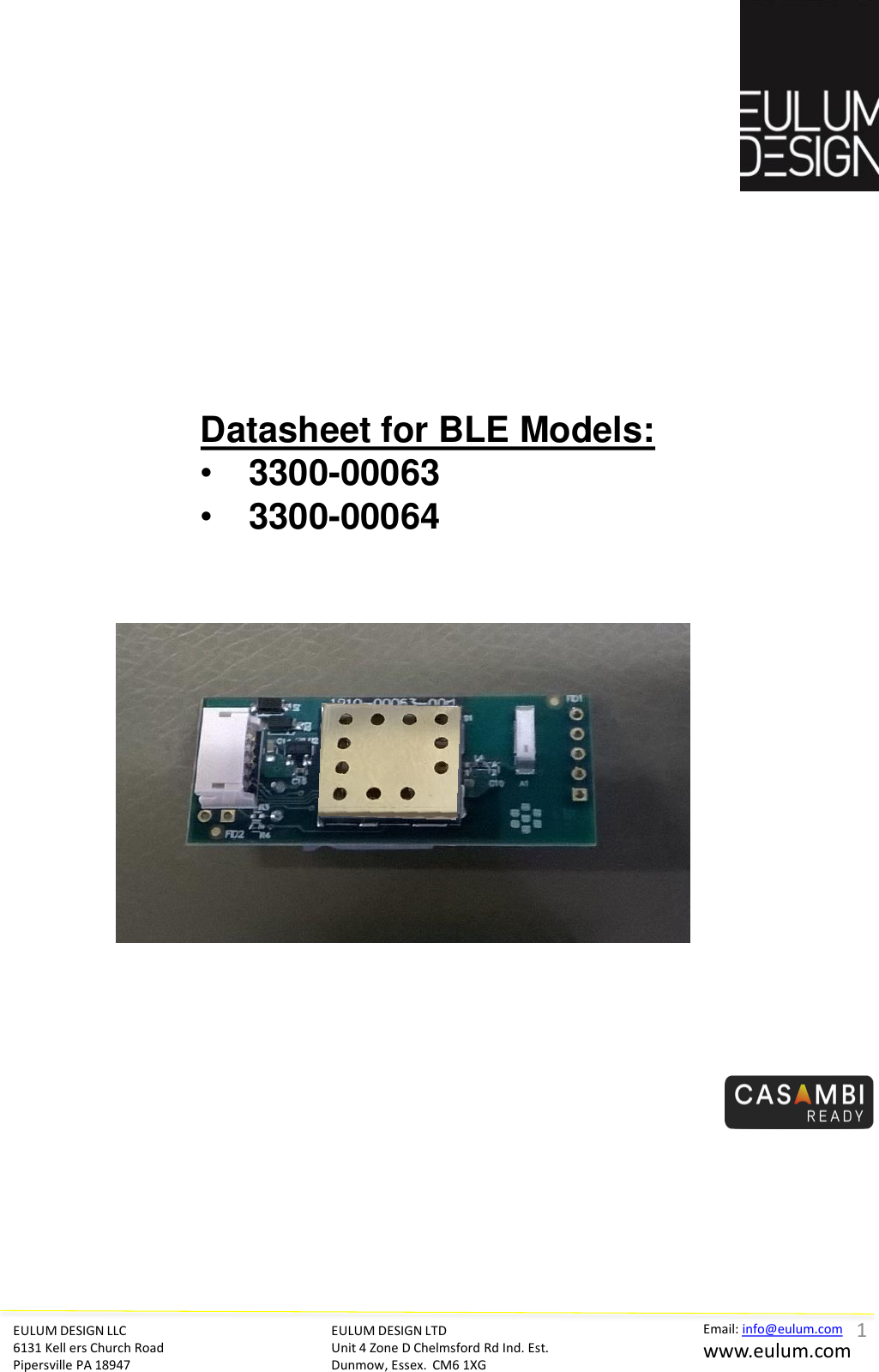
EULUM DESIGN LLC 6131 Kell ers Church Road Pipersville PA 18947 Email: info@eulum.com www.eulum.com Datasheet for BLE Models:  •3300-00063 •3300-00064 EULUM DESIGN LTD Unit 4 Zone D Chelmsford Rd Ind. Est. Dunmow, Essex.  CM6 1XG         1
EULUM DESIGN LLC 6131 Kell ers Church Road Pipersville PA 18947 Email: info@eulum.com www.eulum.com 3300-00063/64 EULUM DESIGN LTD Unit 4 Zone D Chelmsford Rd Ind. Est. Dunmow, Essex.  CM6 1XG         Table of Contents   1. Operation………………………………………………………………3 2. Block Diagram………………………………………………………...3 3. Peripheral Blocks.…………………………………………………….4 4. Zero Cross Detection………………………………………………...6 5. Specifications………………………………………………………….7 6. Dimensions…………………………………………………………..10 7. Regulatory Statements……………………………………………...11   2
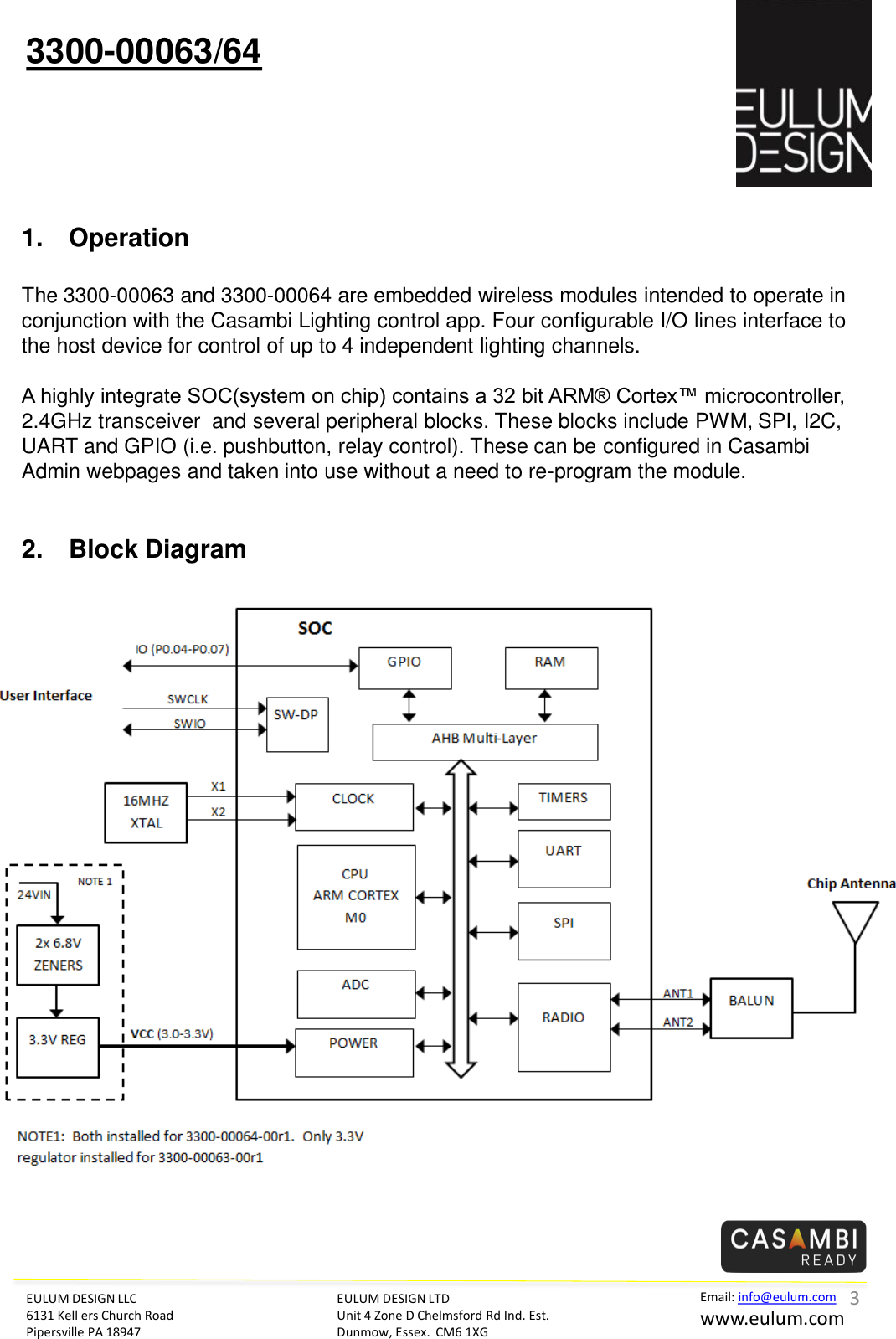
EULUM DESIGN LLC 6131 Kell ers Church Road Pipersville PA 18947 Email: info@eulum.com www.eulum.com 3300-00063/64 EULUM DESIGN LTD Unit 4 Zone D Chelmsford Rd Ind. Est. Dunmow, Essex.  CM6 1XG         1. Operation  The 3300-00063 and 3300-00064 are embedded wireless modules intended to operate in conjunction with the Casambi Lighting control app. Four configurable I/O lines interface to the host device for control of up to 4 independent lighting channels.  A highly integrate SOC(system on chip) contains a 32 bit ARM® Cortex™ microcontroller, 2.4GHz transceiver  and several peripheral blocks. These blocks include PWM, SPI, I2C, UART and GPIO (i.e. pushbutton, relay control). These can be configured in Casambi Admin webpages and taken into use without a need to re-program the module.    2. Block Diagram      3
EULUM DESIGN LLC 6131 Kell ers Church Road Pipersville PA 18947 Email: info@eulum.com www.eulum.com 3300-00063/64 EULUM DESIGN LTD Unit 4 Zone D Chelmsford Rd Ind. Est. Dunmow, Essex.  CM6 1XG         3. Peripheral Blocks a. PWM  Any GPIO pin can be configured to output a PWM signal.  Up to 4 PWM channels can be used simultaneously.  PWM frequency can be determined freely up to 40 kHz. By default the PWM frequency is the same for all PWM channels. The maximum resolution is 400-1600 steps and it depends on the PWM frequency. The PWM signal is logic level (max. VCC) and it has driving capacity from 0,5 mA (standard) up to 15 mA (high-drive).  b. SPI The modules support a 3-wire (SCK, MISO, MOSI) bidirectional SPI bus with fast data transfers to and from multiple slaves. RFM-CSB-2 acts as a master and it provides a simple CPU interface which includes a TXD register for sending data and an RXD register for receiving data. These registers are double buffered to enable some degree of uninterrupted data flow in and out of the SPI master.  Each of the slave devices requires an individual chip select signal which can be connected to any available GPIO pin. The SPI master does not implement support for chip select directly. Therefore the correct slave must be selected independently of the SPI master.   The GPIOs used for each SPI interface line can be chosen from any GPIO on the module and are independently configurable. This enables great flexibility in module pinout and enables efficient use of printed circuit board space and signal routing.  The SPI peripheral supports SPI modes 0, 1, 2, and 3.  c. I2C This two-wire interface uses clock (SCL) and bidirectional data (SDA). The protocol makes it possible to interconnect up to 128 individually addressable devices. The interface is capable of clock stretching and data rates of 100 kbps and 400 kbps are supported. The GPIOs used for each Two-Wire Interface line can be chosen from any GPIO on the module and are independently configurable.   c. UART The Universal Asynchronous Receiver/Transmitter offers fast, full-duplex, asynchronous serial communication with built-in flow control (CTS, RTS) support in HW up to 1 Mbps baud. Parity checking and generation for the 9th data bit are supported.       4
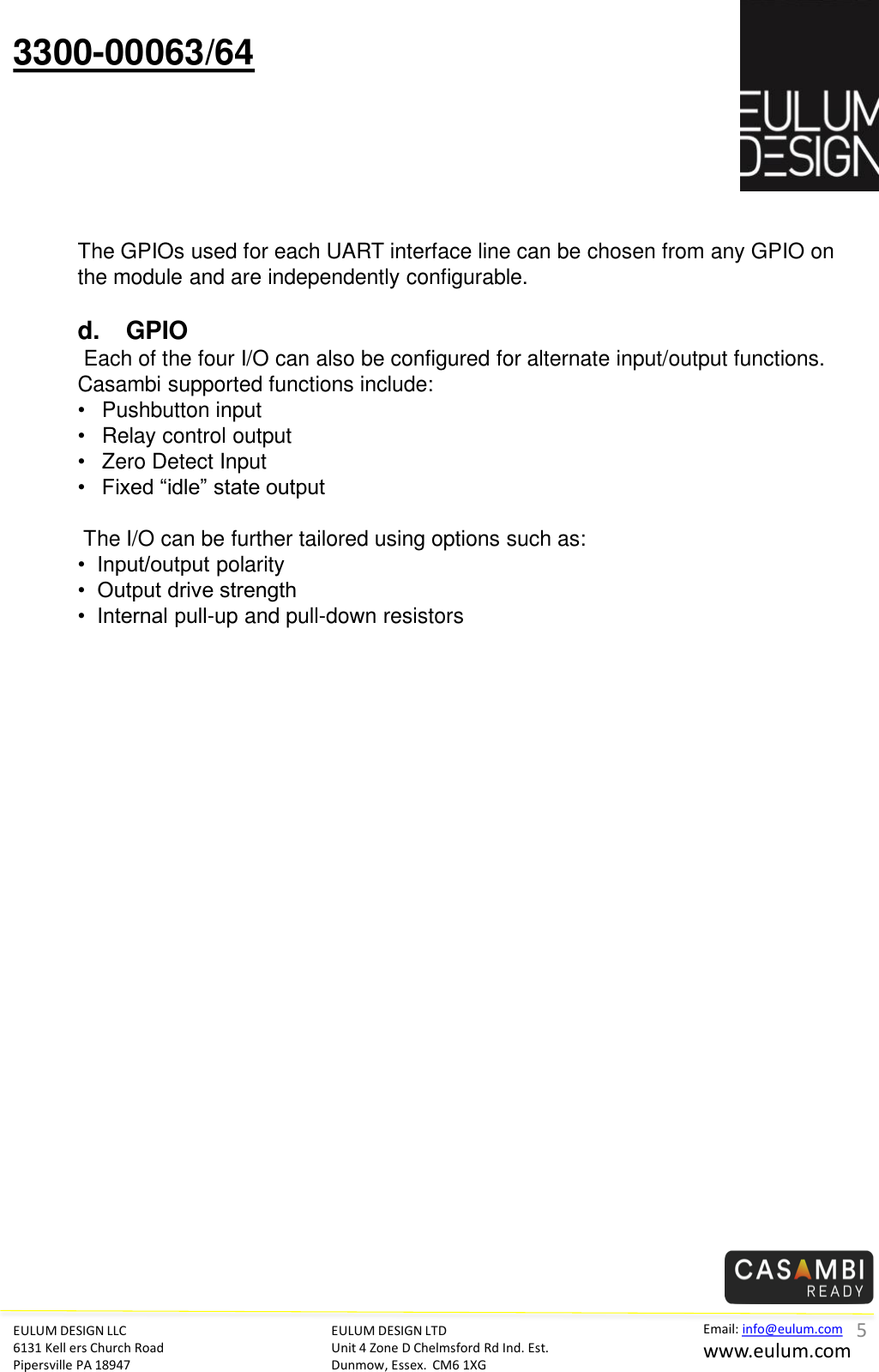
EULUM DESIGN LLC 6131 Kell ers Church Road Pipersville PA 18947 Email: info@eulum.com www.eulum.com 3300-00063/64 EULUM DESIGN LTD Unit 4 Zone D Chelmsford Rd Ind. Est. Dunmow, Essex.  CM6 1XG          The GPIOs used for each UART interface line can be chosen from any GPIO on the module and are independently configurable.   d. GPIO  Each of the four I/O can also be configured for alternate input/output functions.  Casambi supported functions include: •Pushbutton input •Relay control output •Zero Detect Input •Fixed “idle” state output   The I/O can be further tailored using options such as: •  Input/output polarity •  Output drive strength •  Internal pull-up and pull-down resistors 5
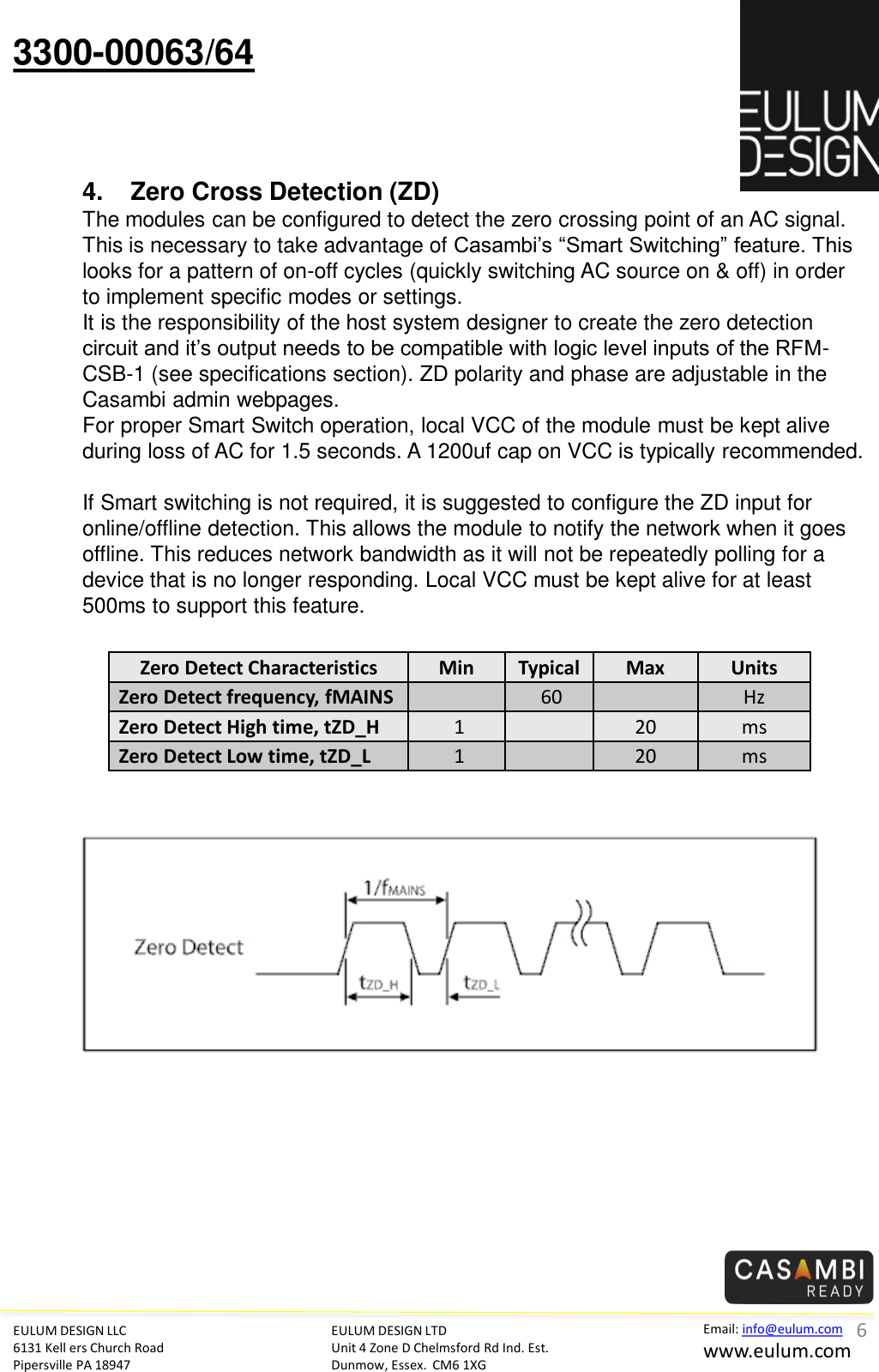
EULUM DESIGN LLC 6131 Kell ers Church Road Pipersville PA 18947 Email: info@eulum.com www.eulum.com 3300-00063/64 EULUM DESIGN LTD Unit 4 Zone D Chelmsford Rd Ind. Est. Dunmow, Essex.  CM6 1XG         4. Zero Cross Detection (ZD) The modules can be configured to detect the zero crossing point of an AC signal. This is necessary to take advantage of Casambi’s “Smart Switching” feature. This looks for a pattern of on-off cycles (quickly switching AC source on & off) in order to implement specific modes or settings. It is the responsibility of the host system designer to create the zero detection circuit and it’s output needs to be compatible with logic level inputs of the RFM-CSB-1 (see specifications section). ZD polarity and phase are adjustable in the Casambi admin webpages.   For proper Smart Switch operation, local VCC of the module must be kept alive during loss of AC for 1.5 seconds. A 1200uf cap on VCC is typically recommended.  If Smart switching is not required, it is suggested to configure the ZD input for online/offline detection. This allows the module to notify the network when it goes offline. This reduces network bandwidth as it will not be repeatedly polling for a device that is no longer responding. Local VCC must be kept alive for at least 500ms to support this feature. Zero Detect Characteristics  Min  Typical Max  Units Zero Detect frequency, fMAINS     60 Hz Zero Detect High time, tZD_H   1     20 ms Zero Detect Low time, tZD_L   1     20 ms 6
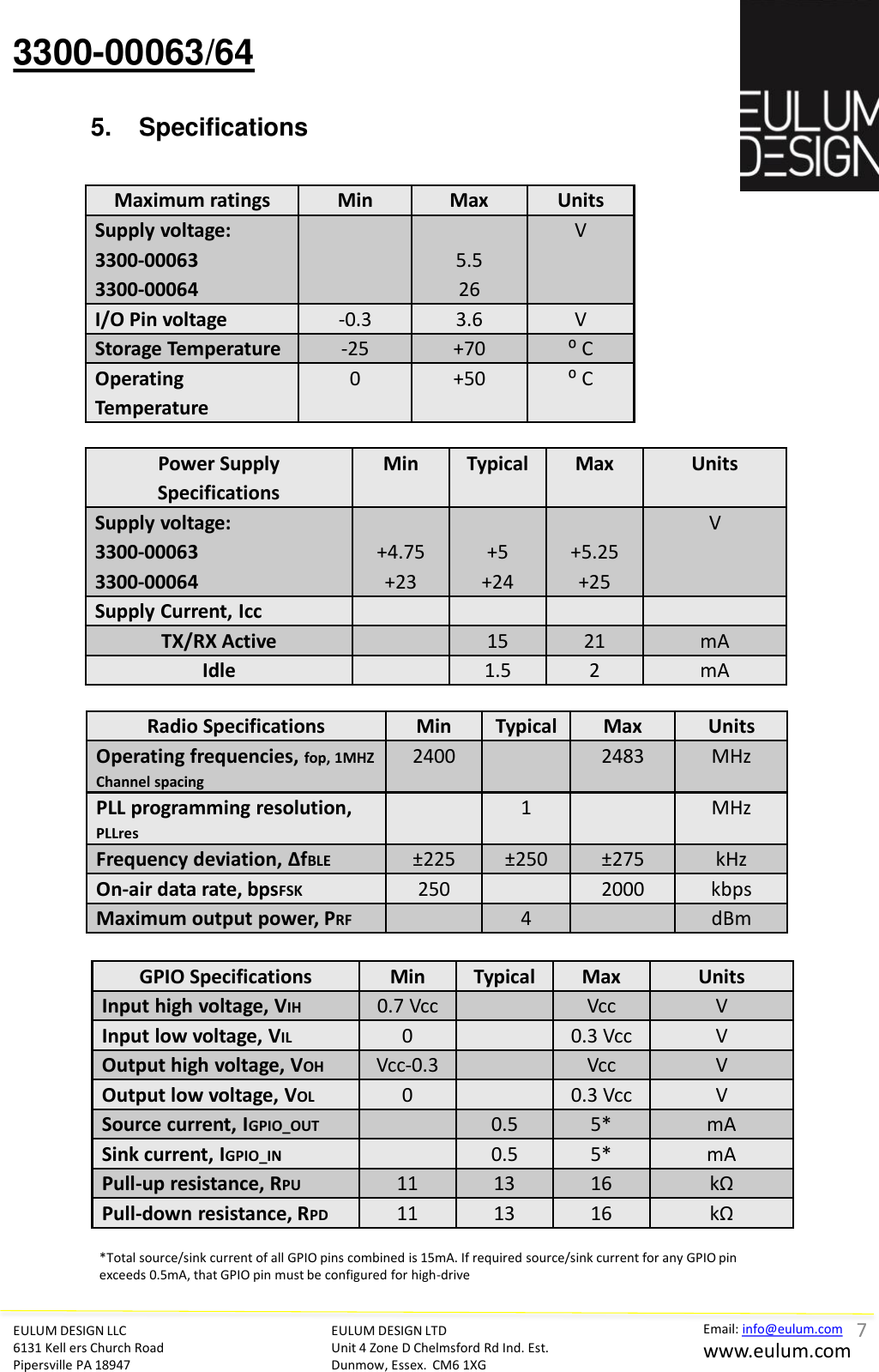
3300-00063/64 Radio Specifications  Min  Typical Max  Units Operating frequencies, fop, 1MHZ Channel spacing 2400     2483  MHz PLL programming resolution, PLLres    1     MHz Frequency deviation, ∆fBLE  ±225  ±250  ±275  kHz On-air data rate, bpsFSK  250     2000  kbps Maximum output power, PRF    4     dBm 5. Specifications EULUM DESIGN LLC 6131 Kell ers Church Road Pipersville PA 18947 Email: info@eulum.com www.eulum.com EULUM DESIGN LTD Unit 4 Zone D Chelmsford Rd Ind. Est. Dunmow, Essex.  CM6 1XG         Maximum ratings  Min  Max  Units Supply voltage: 3300-00063 3300-00064  5.5 26 V I/O Pin voltage -0.3  3.6  V Storage Temperature -25  +70  ⁰ C Operating Temperature 0  +50  ⁰ C Power Supply Specifications Min  Typical Max  Units Supply voltage: 3300-00063 3300-00064  +4.75 +23  +5 +24  +5.25 +25 V Supply Current, Icc             TX/RX Active     15 21 mA Idle     1.5  2  mA GPIO Specifications  Min  Typical Max  Units Input high voltage, VIH 0.7 Vcc    Vcc  V Input low voltage, VIL 0     0.3 Vcc V Output high voltage, VOH Vcc-0.3    Vcc  V Output low voltage, VOL 0     0.3 Vcc V Source current, IGPIO_OUT     0.5  5*  mA Sink current, IGPIO_IN     0.5  5* mA Pull-up resistance, RPU 11 13 16 kΩ Pull-down resistance, RPD 11 13 16 kΩ *Total source/sink current of all GPIO pins combined is 15mA. If required source/sink current for any GPIO pin exceeds 0.5mA, that GPIO pin must be configured for high-drive 7
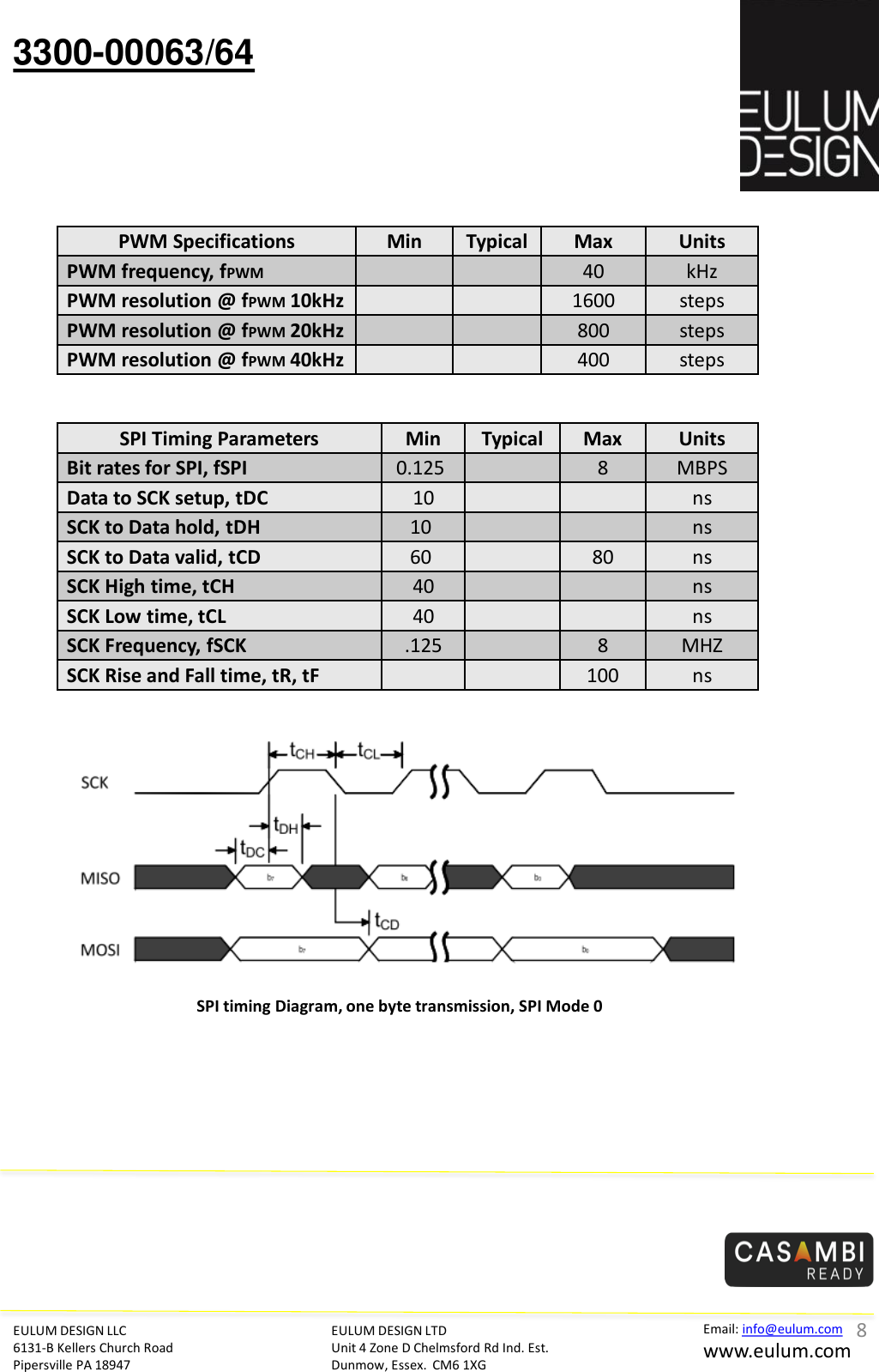
3300-00063/64 EULUM DESIGN LLC 6131-B Kellers Church Road Pipersville PA 18947 EULUM DESIGN LTD Unit 4 Zone D Chelmsford Rd Ind. Est. Dunmow, Essex.  CM6 1XG Email: info@eulum.com www.eulum.com PWM Specifications  Min  Typical Max  Units PWM frequency, fPWM        40  kHz PWM resolution @ fPWM 10kHz       1600  steps PWM resolution @ fPWM 20kHz       800  steps PWM resolution @ fPWM 40kHz       400  steps SPI Timing Parameters  Min  Typical Max  Units Bit rates for SPI, fSPI  0.125     8  MBPS Data to SCK setup, tDC 10 ns SCK to Data hold, tDH 10      ns SCK to Data valid, tCD  60      80 ns SCK High time, tCH  40 ns SCK Low time, tCL  40 ns SCK Frequency, fSCK  .125  8  MHZ SCK Rise and Fall time, tR, tF 100 ns SPI timing Diagram, one byte transmission, SPI Mode 0 8
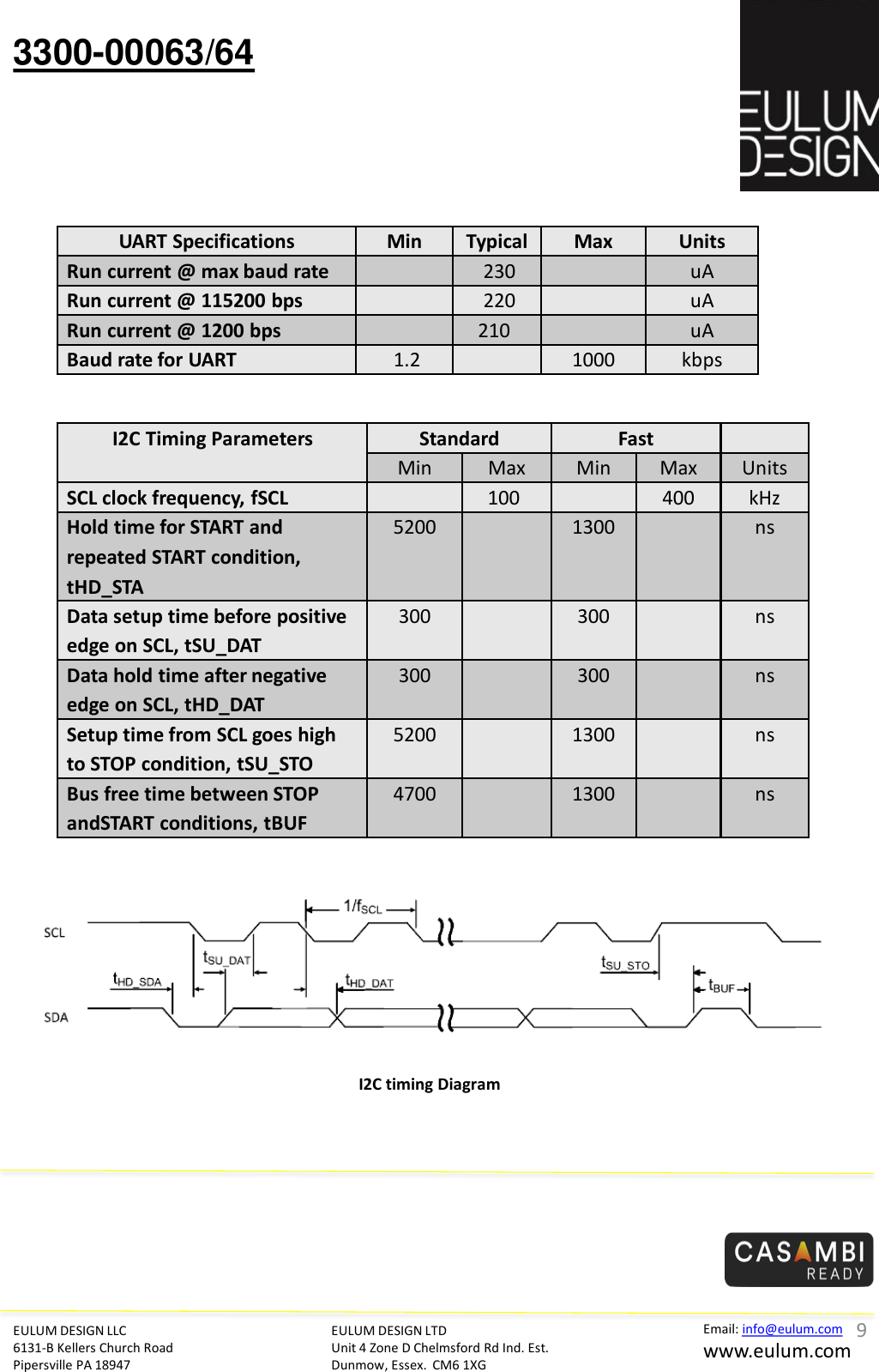
3300-00063/64 EULUM DESIGN LLC 6131-B Kellers Church Road Pipersville PA 18947 EULUM DESIGN LTD Unit 4 Zone D Chelmsford Rd Ind. Est. Dunmow, Essex.  CM6 1XG Email: info@eulum.com www.eulum.com UART Specifications  Min  Typical Max  Units Run current @ max baud rate     230 uA Run current @ 115200 bps     220 uA Run current @ 1200 bps    210   uA Baud rate for UART  1.2     1000  kbps I2C Timing Parameters  Standard  Fast Min  Max  Min  Max  Units SCL clock frequency, fSCL     100   400  kHz Hold time for START and repeated START condition, tHD_STA 5200 1300 ns Data setup time before positive edge on SCL, tSU_DAT 300     300 ns Data hold time after negative edge on SCL, tHD_DAT 300     300 ns Setup time from SCL goes high to STOP condition, tSU_STO 5200 1300 ns Bus free time between STOP andSTART conditions, tBUF 4700 1300 ns I2C timing Diagram 9
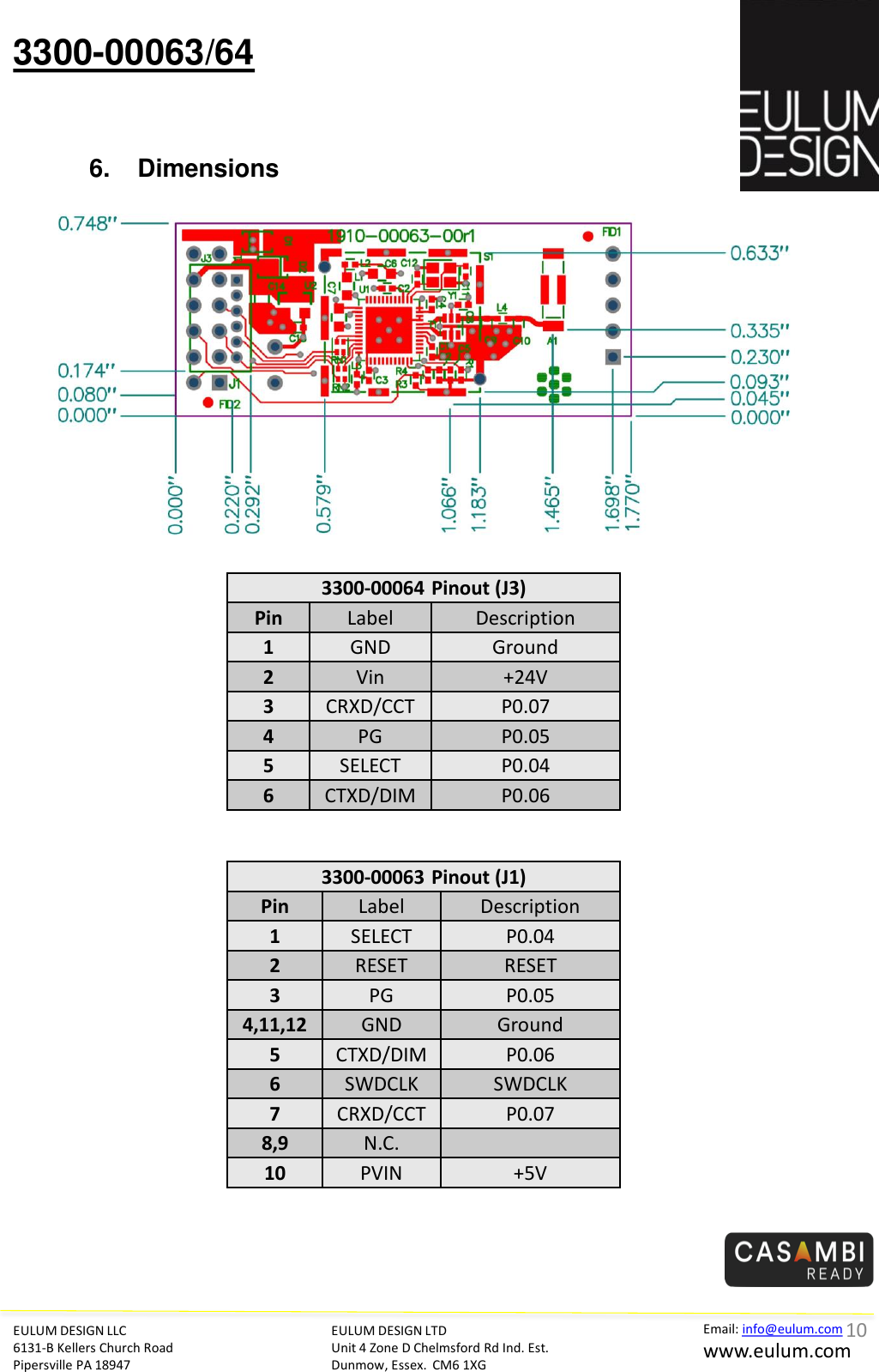
3300-00063/64 EULUM DESIGN LLC 6131-B Kellers Church Road Pipersville PA 18947 EULUM DESIGN LTD Unit 4 Zone D Chelmsford Rd Ind. Est. Dunmow, Essex.  CM6 1XG Email: info@eulum.com www.eulum.com 3300-00064 Pinout (J3) Pin  Label  Description 1  GND  Ground 2  Vin  +24V 3  CRXD/CCT P0.07 4  PG  P0.05 5  SELECT  P0.04 6  CTXD/DIM P0.06 6. Dimensions 10 3300-00063 Pinout (J1) Pin  Label  Description 1  SELECT  P0.04 2  RESET  RESET 3  PG  P0.05 4,11,12 GND  Ground 5  CTXD/DIM P0.06 6  SWDCLK  SWDCLK 7  CRXD/CCT P0.07 8,9  N.C. 10 PVIN  +5V
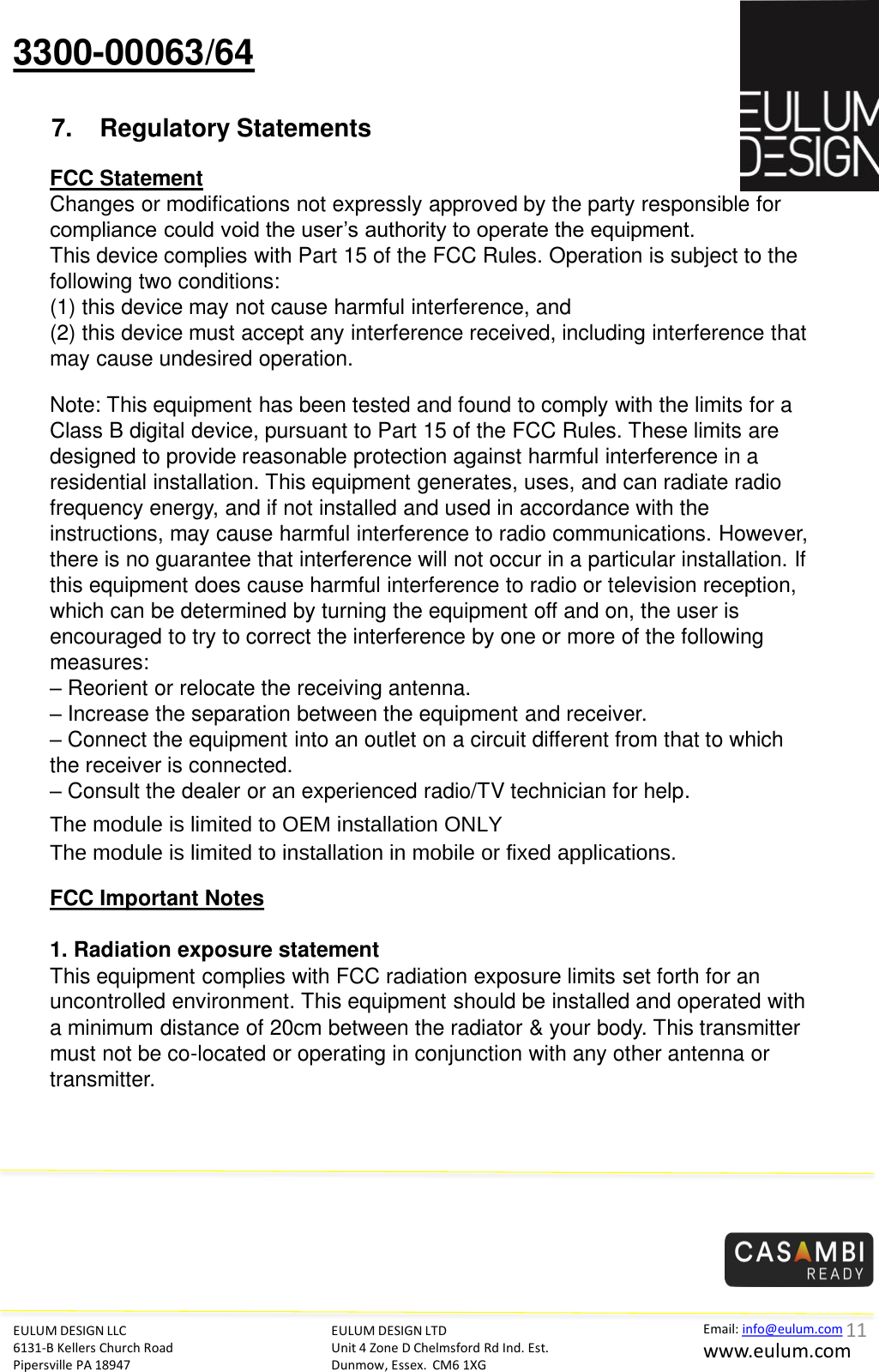
3300-00063/64 7. Regulatory Statements EULUM DESIGN LLC 6131-B Kellers Church Road Pipersville PA 18947 EULUM DESIGN LTD Unit 4 Zone D Chelmsford Rd Ind. Est. Dunmow, Essex.  CM6 1XG Email: info@eulum.com www.eulum.com   FCC Statement Changes or modifications not expressly approved by the party responsible for compliance could void the user’s authority to operate the equipment.  This device complies with Part 15 of the FCC Rules. Operation is subject to the following two conditions:  (1) this device may not cause harmful interference, and (2) this device must accept any interference received, including interference that may cause undesired operation.   Note: This equipment has been tested and found to comply with the limits for a Class B digital device, pursuant to Part 15 of the FCC Rules. These limits are designed to provide reasonable protection against harmful interference in a residential installation. This equipment generates, uses, and can radiate radio frequency energy, and if not installed and used in accordance with the instructions, may cause harmful interference to radio communications. However, there is no guarantee that interference will not occur in a particular installation. If this equipment does cause harmful interference to radio or television reception, which can be determined by turning the equipment off and on, the user is encouraged to try to correct the interference by one or more of the following measures: – Reorient or relocate the receiving antenna. – Increase the separation between the equipment and receiver. – Connect the equipment into an outlet on a circuit different from that to which the receiver is connected. – Consult the dealer or an experienced radio/TV technician for help. 7KHPRGXOHLVOLPLWHGWR2(0LQVWDOODWLRQ21/<7KHPRGXOHLVOLPLWHGWRLQVWDOODWLRQLQPRELOHRUIL[HGDSSOLFDWLRQV FCC Important Notes   1. Radiation exposure statement This equipment complies with FCC radiation exposure limits set forth for an uncontrolled environment. This equipment should be installed and operated with a minimum distance of 20cm between the radiator & your body. This transmitter must not be co-located or operating in conjunction with any other antenna or transmitter.    11
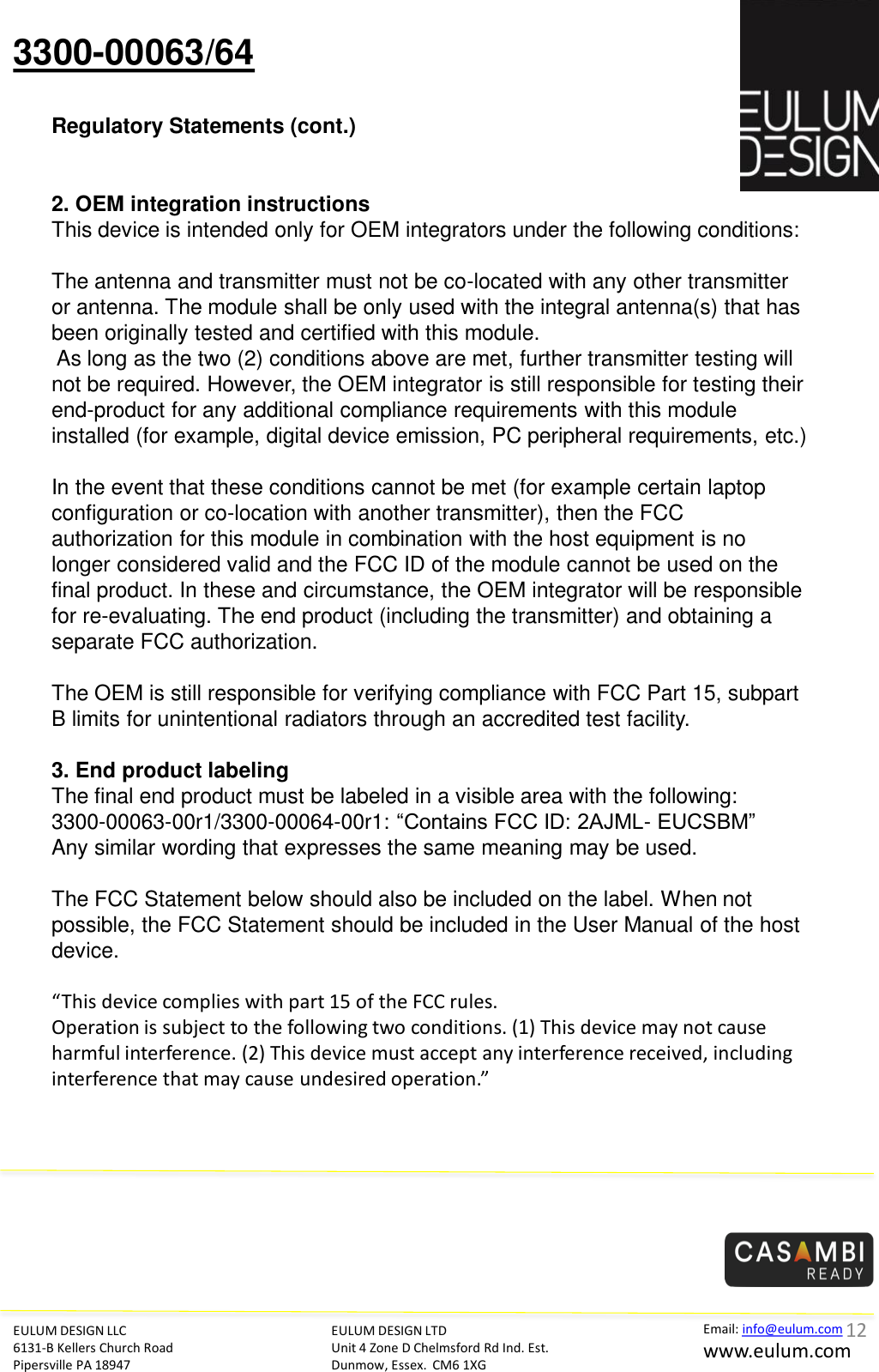
3300-00063/64 Regulatory Statements (cont.) EULUM DESIGN LLC 6131-B Kellers Church Road Pipersville PA 18947 EULUM DESIGN LTD Unit 4 Zone D Chelmsford Rd Ind. Est. Dunmow, Essex.  CM6 1XG Email: info@eulum.com www.eulum.com     2. OEM integration instructions This device is intended only for OEM integrators under the following conditions:    The antenna and transmitter must not be co-located with any other transmitter or antenna. The module shall be only used with the integral antenna(s) that has been originally tested and certified with this module.   As long as the two (2) conditions above are met, further transmitter testing will not be required. However, the OEM integrator is still responsible for testing their end-product for any additional compliance requirements with this module installed (for example, digital device emission, PC peripheral requirements, etc.)    In the event that these conditions cannot be met (for example certain laptop configuration or co-location with another transmitter), then the FCC authorization for this module in combination with the host equipment is no longer considered valid and the FCC ID of the module cannot be used on the final product. In these and circumstance, the OEM integrator will be responsible for re-evaluating. The end product (including the transmitter) and obtaining a separate FCC authorization.    The OEM is still responsible for verifying compliance with FCC Part 15, subpart B limits for unintentional radiators through an accredited test facility.    3. End product labeling  The final end product must be labeled in a visible area with the following:  3300-00063-00r1/3300-00064-00r1: “Contains FCC ID: 2AJML- EUCSBM”  Any similar wording that expresses the same meaning may be used.     The FCC Statement below should also be included on the label. When not possible, the FCC Statement should be included in the User Manual of the host device.    “This device complies with part 15 of the FCC rules.   Operation is subject to the following two conditions. (1) This device may not cause harmful interference. (2) This device must accept any interference received, including interference that may cause undesired operation.”     12
3300-00063/64 Regulatory Statements (cont.) EULUM DESIGN LLC 6131-B Kellers Church Road Pipersville PA 18947 EULUM DESIGN LTD Unit 4 Zone D Chelmsford Rd Ind. Est. Dunmow, Essex.  CM6 1XG Email: info@eulum.com www.eulum.com      4 Information regarding the end user manual  The OEM integrator has to be aware not to provide information to the end user regarding how to install or remove this RF module in the user’s manual of the end product which integrates this module. The end user manual shall include all required regulatory information/warning as show in this manual.     CE Regulatory This device is tested and compliant against the following standards. OEM integrators should consult with qualified test house to verify all regulatory requirements have been met for their complete device.  From R&TTE Directive 1999/5/EC:  •   ETSI EN 300328  •   ETSI EN 62479 From Directive 2004/108/EC:  •   ETSI EN 301489-1  •   ETSI EN 301489-17   13
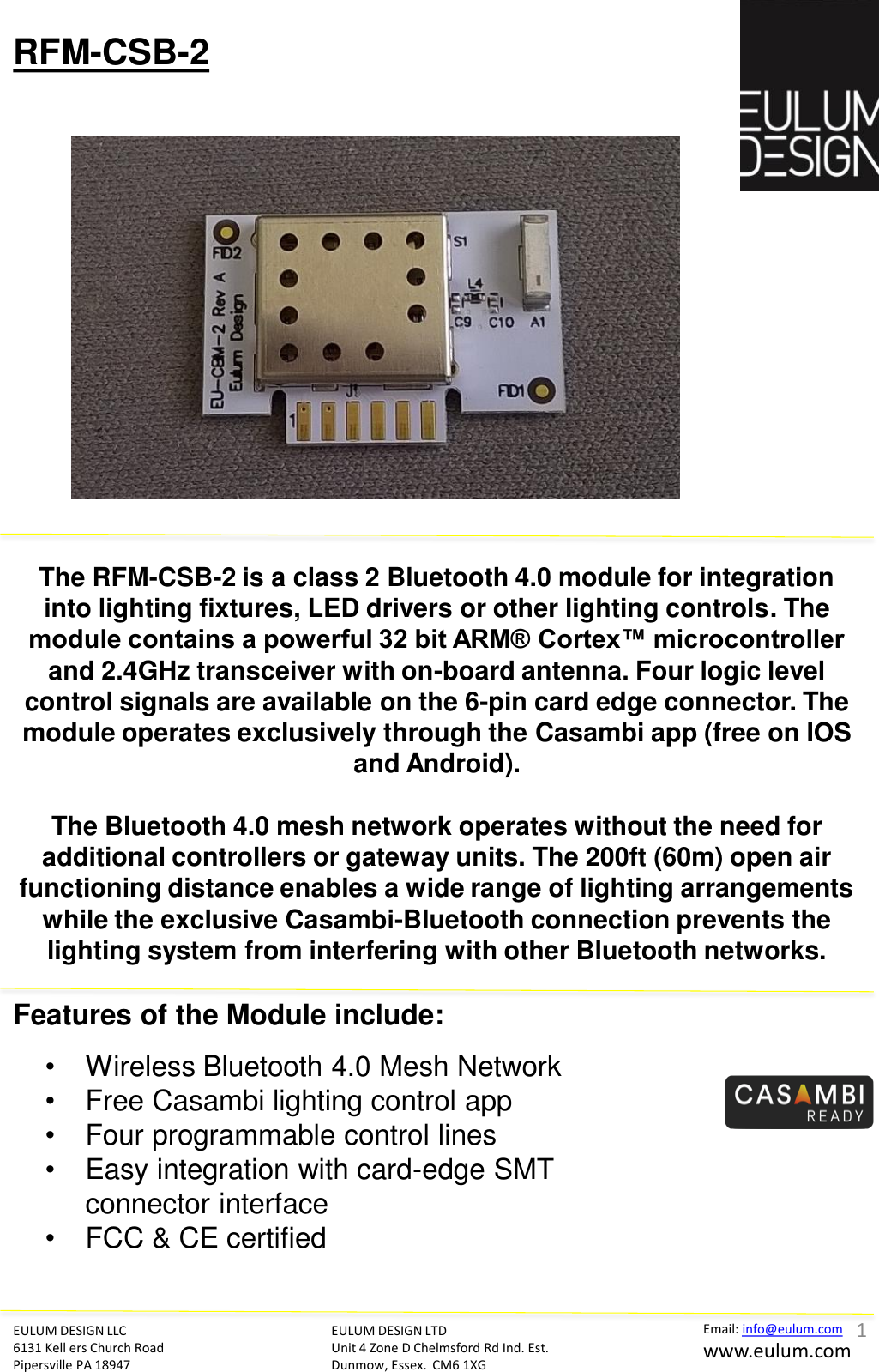
EULUM DESIGN LLC 6131 Kell ers Church Road Pipersville PA 18947 Email: info@eulum.com www.eulum.com RFM-CSB-2 EULUM DESIGN LTD Unit 4 Zone D Chelmsford Rd Ind. Est. Dunmow, Essex.  CM6 1XG         The RFM-CSB-2 is a class 2 Bluetooth 4.0 module for integration into lighting fixtures, LED drivers or other lighting controls. The module contains a powerful 32 bit ARM® Cortex™ microcontroller and 2.4GHz transceiver with on-board antenna. Four logic level control signals are available on the 6-pin card edge connector. The module operates exclusively through the Casambi app (free on IOS and Android).  The Bluetooth 4.0 mesh network operates without the need for additional controllers or gateway units. The 200ft (60m) open air functioning distance enables a wide range of lighting arrangements while the exclusive Casambi-Bluetooth connection prevents the lighting system from interfering with other Bluetooth networks.  Features of the Module include:  •Wireless Bluetooth 4.0 Mesh Network •Free Casambi lighting control app •Four programmable control lines •Easy integration with card-edge SMT connector interface •FCC & CE certified  1
EULUM DESIGN LLC 6131 Kell ers Church Road Pipersville PA 18947 Email: info@eulum.com www.eulum.com RFM-CSB-2 EULUM DESIGN LTD Unit 4 Zone D Chelmsford Rd Ind. Est. Dunmow, Essex.  CM6 1XG         Table of Contents   1. Operation………………………………………………………………3 2. Block Diagram………………………………………………………...3 3. Peripheral Blocks.…………………………………………………….4 4. Zero Cross Detection………………………………………………...6 5. Specifications………………………………………………………….7 6. Dimensions…………………………………………………………..10 7. Regulatory Statements……………………………………………...11   2
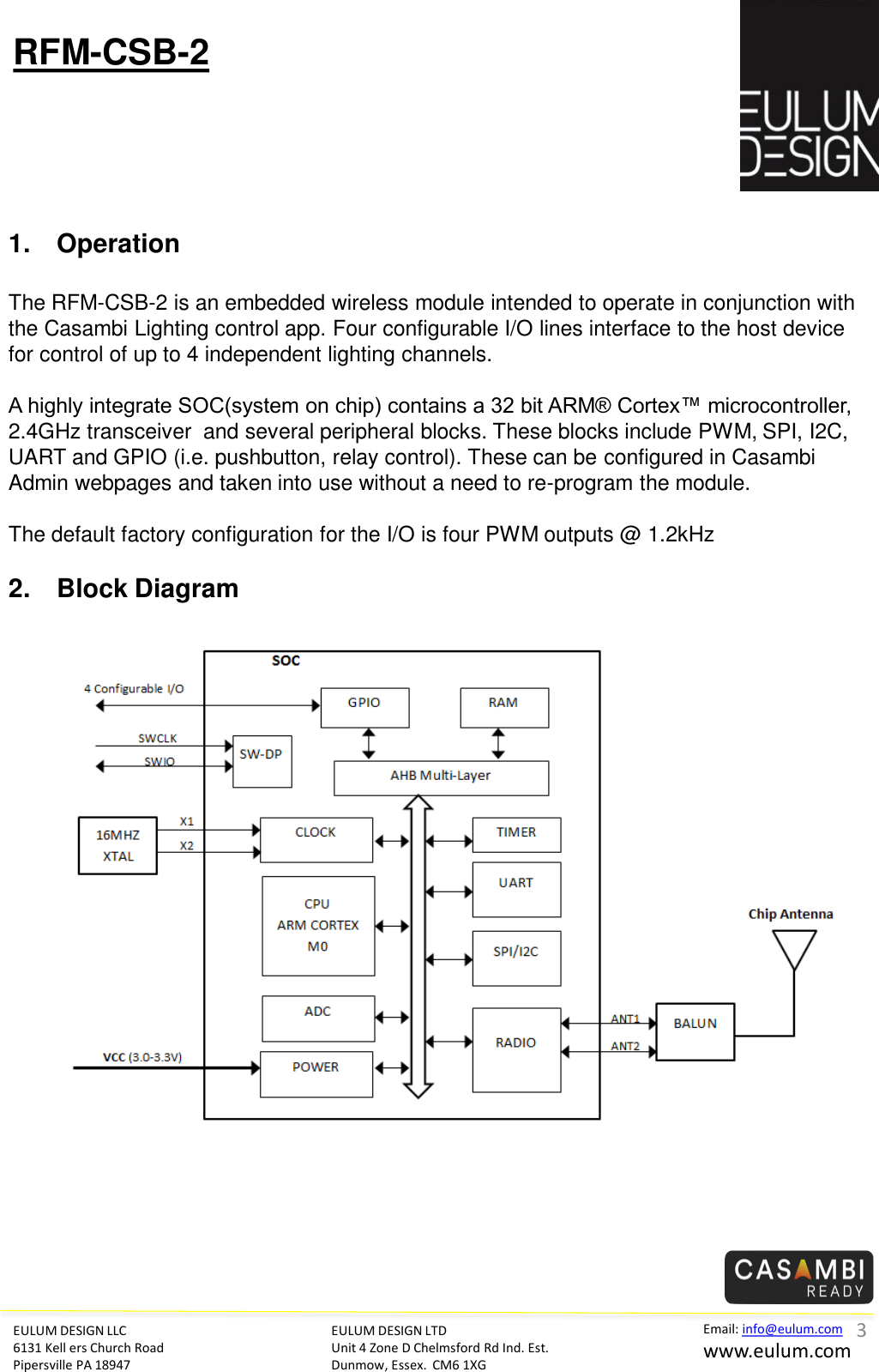
EULUM DESIGN LLC 6131 Kell ers Church Road Pipersville PA 18947 Email: info@eulum.com www.eulum.com RFM-CSB-2 EULUM DESIGN LTD Unit 4 Zone D Chelmsford Rd Ind. Est. Dunmow, Essex.  CM6 1XG         1. Operation  The RFM-CSB-2 is an embedded wireless module intended to operate in conjunction with the Casambi Lighting control app. Four configurable I/O lines interface to the host device for control of up to 4 independent lighting channels.  A highly integrate SOC(system on chip) contains a 32 bit ARM® Cortex™ microcontroller, 2.4GHz transceiver  and several peripheral blocks. These blocks include PWM, SPI, I2C, UART and GPIO (i.e. pushbutton, relay control). These can be configured in Casambi Admin webpages and taken into use without a need to re-program the module.   The default factory configuration for the I/O is four PWM outputs @ 1.2kHz  2. Block Diagram      3
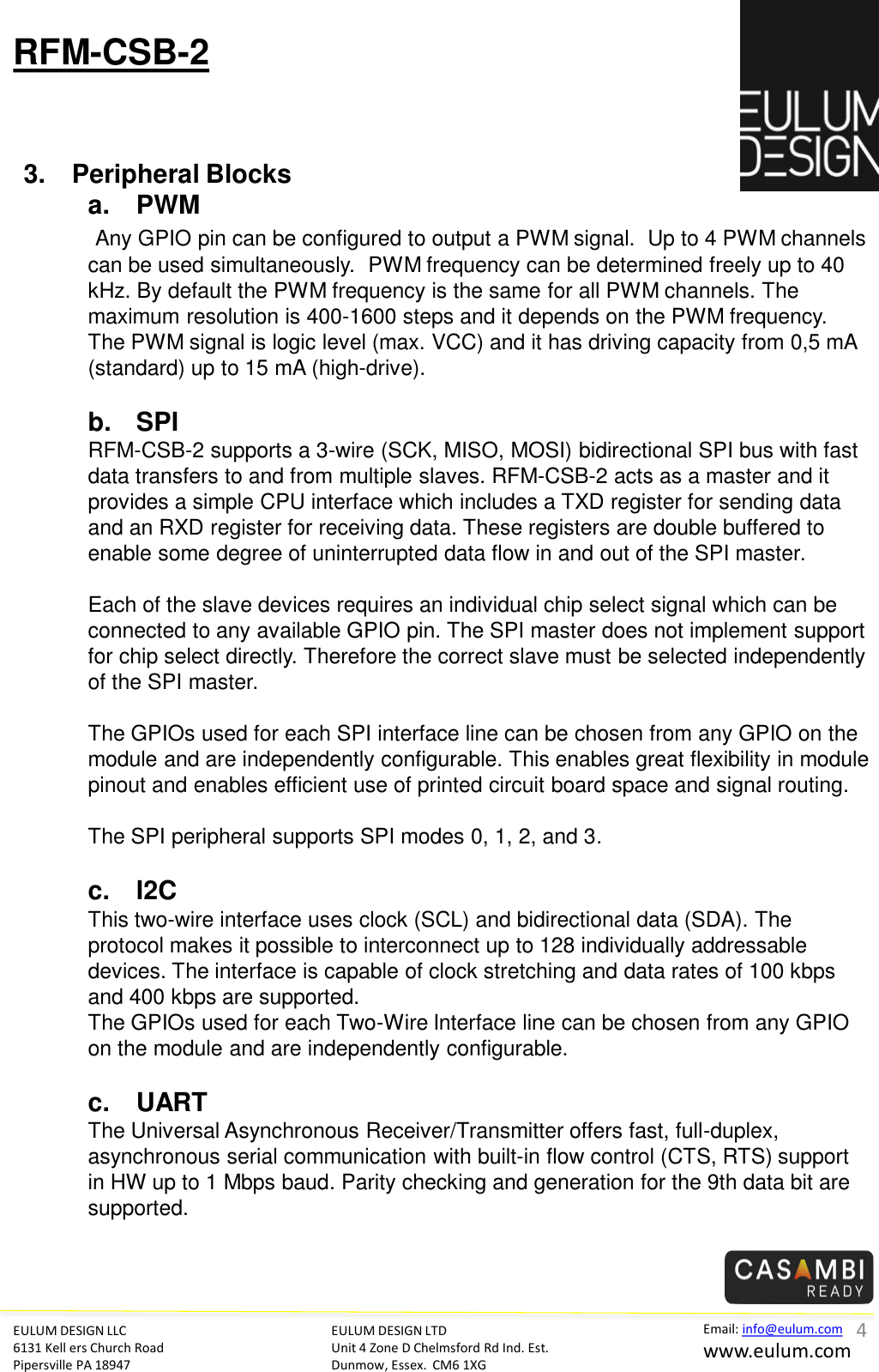
EULUM DESIGN LLC 6131 Kell ers Church Road Pipersville PA 18947 Email: info@eulum.com www.eulum.com RFM-CSB-2 EULUM DESIGN LTD Unit 4 Zone D Chelmsford Rd Ind. Est. Dunmow, Essex.  CM6 1XG         3. Peripheral Blocks a. PWM  Any GPIO pin can be configured to output a PWM signal.  Up to 4 PWM channels can be used simultaneously.  PWM frequency can be determined freely up to 40 kHz. By default the PWM frequency is the same for all PWM channels. The maximum resolution is 400-1600 steps and it depends on the PWM frequency. The PWM signal is logic level (max. VCC) and it has driving capacity from 0,5 mA (standard) up to 15 mA (high-drive).  b. SPI RFM-CSB-2 supports a 3-wire (SCK, MISO, MOSI) bidirectional SPI bus with fast data transfers to and from multiple slaves. RFM-CSB-2 acts as a master and it provides a simple CPU interface which includes a TXD register for sending data and an RXD register for receiving data. These registers are double buffered to enable some degree of uninterrupted data flow in and out of the SPI master.  Each of the slave devices requires an individual chip select signal which can be connected to any available GPIO pin. The SPI master does not implement support for chip select directly. Therefore the correct slave must be selected independently of the SPI master.   The GPIOs used for each SPI interface line can be chosen from any GPIO on the module and are independently configurable. This enables great flexibility in module pinout and enables efficient use of printed circuit board space and signal routing.  The SPI peripheral supports SPI modes 0, 1, 2, and 3.  c. I2C This two-wire interface uses clock (SCL) and bidirectional data (SDA). The protocol makes it possible to interconnect up to 128 individually addressable devices. The interface is capable of clock stretching and data rates of 100 kbps and 400 kbps are supported. The GPIOs used for each Two-Wire Interface line can be chosen from any GPIO on the module and are independently configurable.   c. UART The Universal Asynchronous Receiver/Transmitter offers fast, full-duplex, asynchronous serial communication with built-in flow control (CTS, RTS) support in HW up to 1 Mbps baud. Parity checking and generation for the 9th data bit are supported.       4
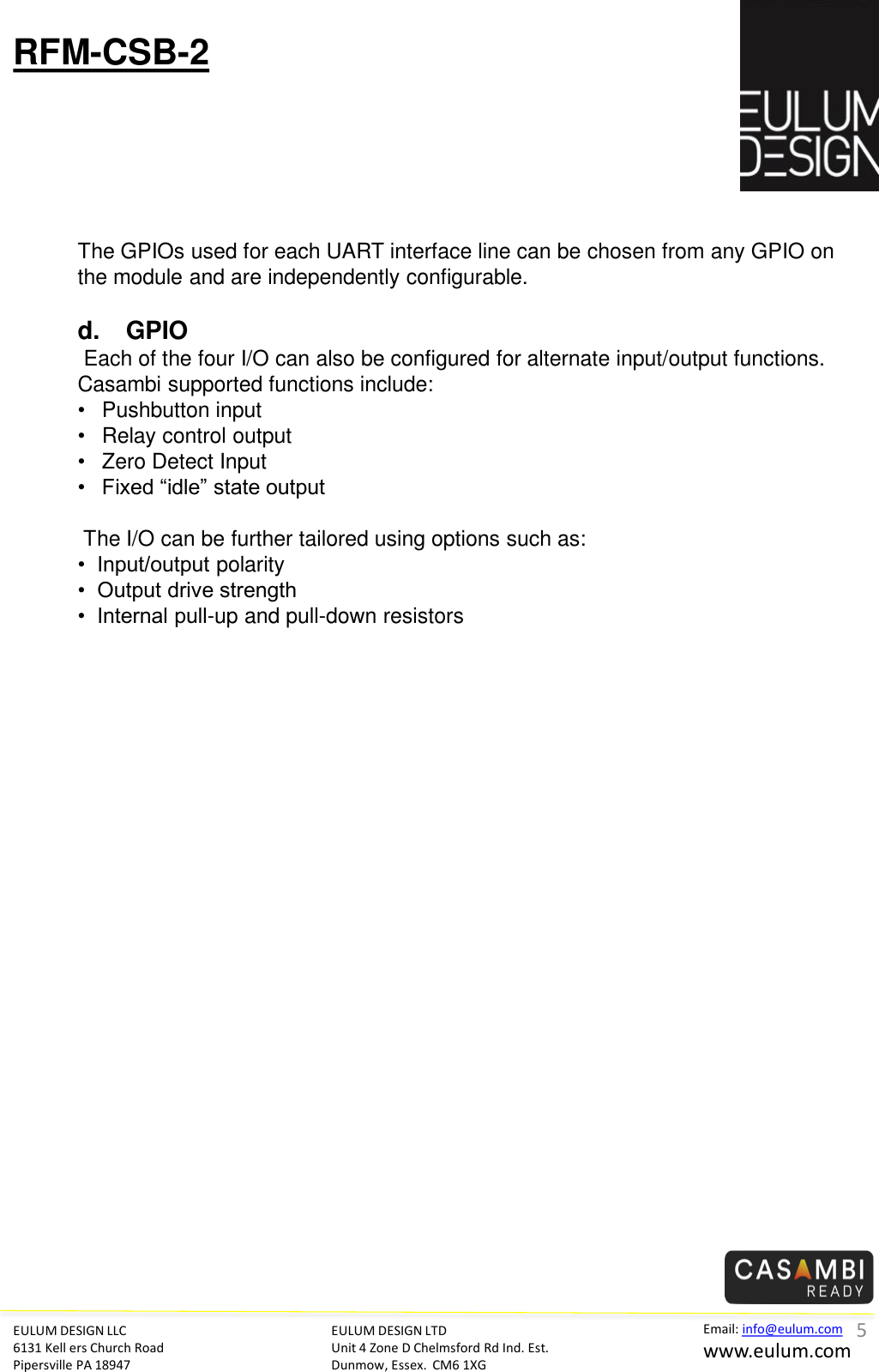
EULUM DESIGN LLC 6131 Kell ers Church Road Pipersville PA 18947 Email: info@eulum.com www.eulum.com RFM-CSB-2 EULUM DESIGN LTD Unit 4 Zone D Chelmsford Rd Ind. Est. Dunmow, Essex.  CM6 1XG          The GPIOs used for each UART interface line can be chosen from any GPIO on the module and are independently configurable.   d. GPIO  Each of the four I/O can also be configured for alternate input/output functions.  Casambi supported functions include: •Pushbutton input •Relay control output •Zero Detect Input •Fixed “idle” state output   The I/O can be further tailored using options such as: •  Input/output polarity •  Output drive strength •  Internal pull-up and pull-down resistors 5
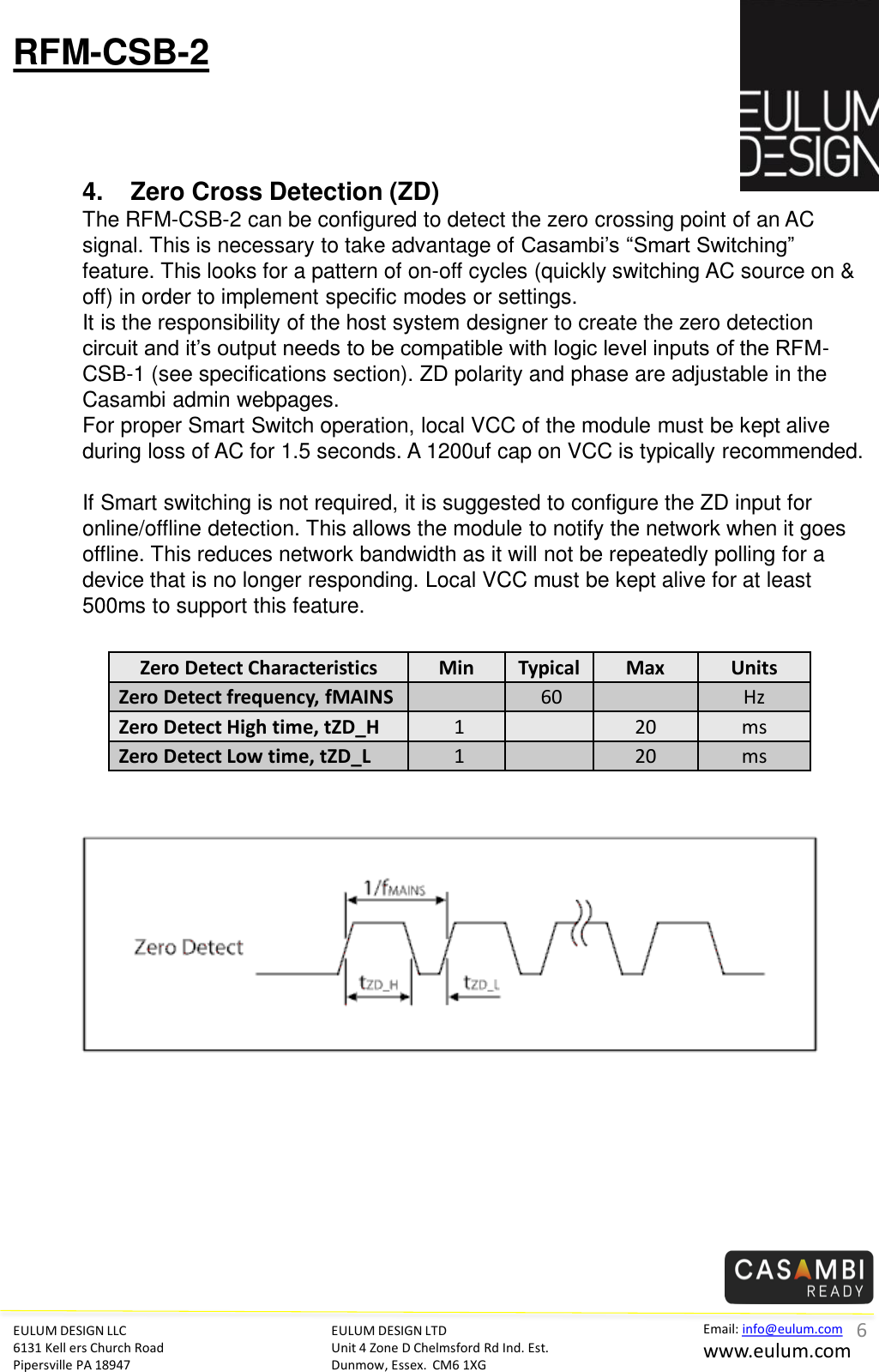
EULUM DESIGN LLC 6131 Kell ers Church Road Pipersville PA 18947 Email: info@eulum.com www.eulum.com RFM-CSB-2 EULUM DESIGN LTD Unit 4 Zone D Chelmsford Rd Ind. Est. Dunmow, Essex.  CM6 1XG         4. Zero Cross Detection (ZD) The RFM-CSB-2 can be configured to detect the zero crossing point of an AC signal. This is necessary to take advantage of Casambi’s “Smart Switching” feature. This looks for a pattern of on-off cycles (quickly switching AC source on & off) in order to implement specific modes or settings. It is the responsibility of the host system designer to create the zero detection circuit and it’s output needs to be compatible with logic level inputs of the RFM-CSB-1 (see specifications section). ZD polarity and phase are adjustable in the Casambi admin webpages.   For proper Smart Switch operation, local VCC of the module must be kept alive during loss of AC for 1.5 seconds. A 1200uf cap on VCC is typically recommended.  If Smart switching is not required, it is suggested to configure the ZD input for online/offline detection. This allows the module to notify the network when it goes offline. This reduces network bandwidth as it will not be repeatedly polling for a device that is no longer responding. Local VCC must be kept alive for at least 500ms to support this feature. Zero Detect Characteristics  Min  Typical Max  Units Zero Detect frequency, fMAINS     60 Hz Zero Detect High time, tZD_H   1     20 ms Zero Detect Low time, tZD_L   1     20 ms 6
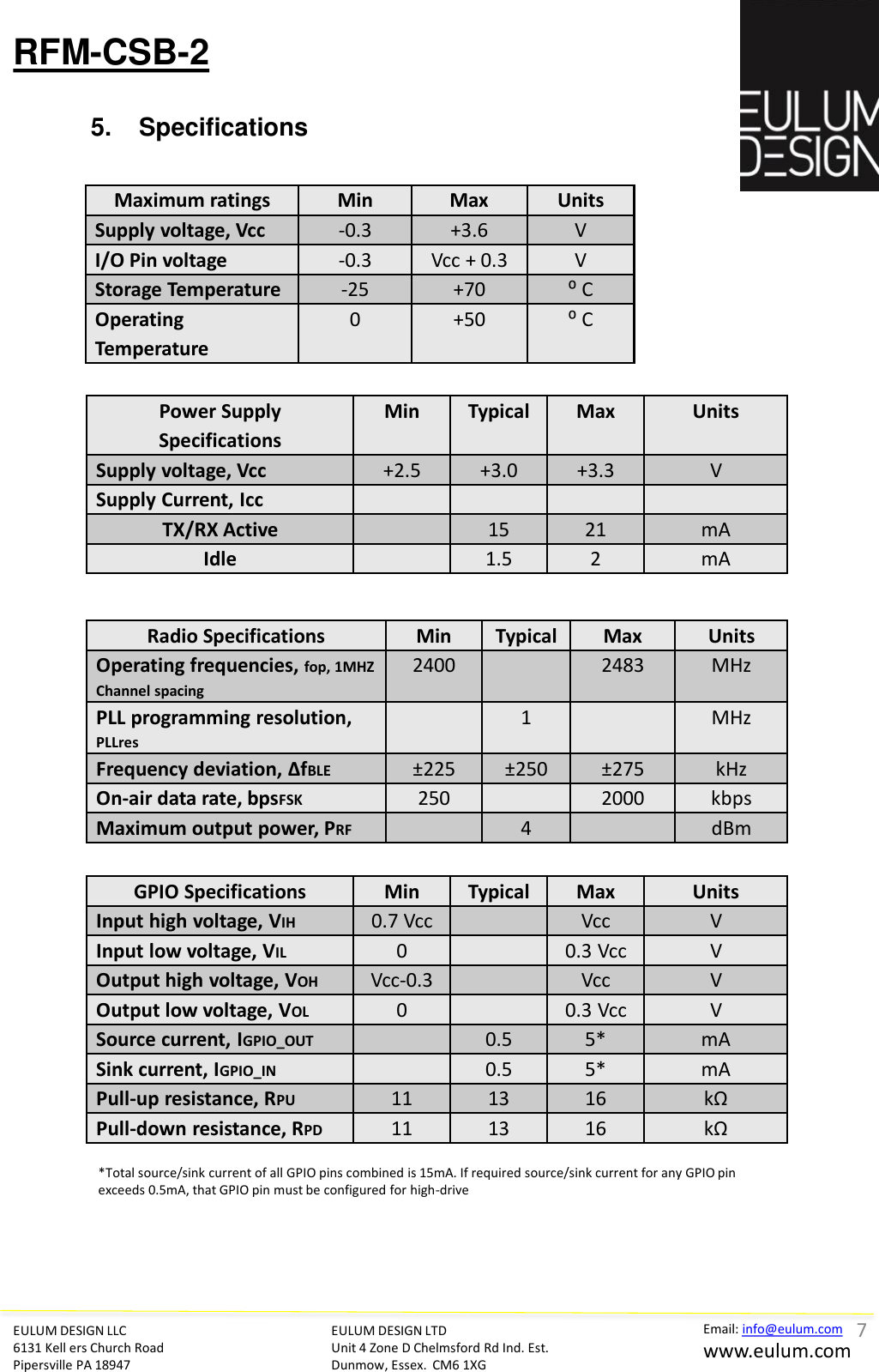
RFM-CSB-2 Radio Specifications  Min  Typical Max  Units Operating frequencies, fop, 1MHZ Channel spacing 2400     2483  MHz PLL programming resolution, PLLres    1     MHz Frequency deviation, ∆fBLE  ±225  ±250  ±275  kHz On-air data rate, bpsFSK  250     2000  kbps Maximum output power, PRF    4     dBm 5. Specifications EULUM DESIGN LLC 6131 Kell ers Church Road Pipersville PA 18947 Email: info@eulum.com www.eulum.com EULUM DESIGN LTD Unit 4 Zone D Chelmsford Rd Ind. Est. Dunmow, Essex.  CM6 1XG         Maximum ratings  Min  Max  Units Supply voltage, Vcc -0.3  +3.6  V I/O Pin voltage -0.3  Vcc + 0.3  V Storage Temperature -25  +70  ⁰ C Operating Temperature 0  +50  ⁰ C Power Supply Specifications Min  Typical Max  Units Supply voltage, Vcc +2.5  +3.0  +3.3  V Supply Current, Icc             TX/RX Active     15 21 mA Idle     1.5  2  mA GPIO Specifications  Min  Typical Max  Units Input high voltage, VIH 0.7 Vcc    Vcc  V Input low voltage, VIL 0     0.3 Vcc V Output high voltage, VOH Vcc-0.3    Vcc  V Output low voltage, VOL 0     0.3 Vcc V Source current, IGPIO_OUT     0.5  5*  mA Sink current, IGPIO_IN     0.5  5* mA Pull-up resistance, RPU 11 13 16 kΩ Pull-down resistance, RPD 11 13 16 kΩ *Total source/sink current of all GPIO pins combined is 15mA. If required source/sink current for any GPIO pin exceeds 0.5mA, that GPIO pin must be configured for high-drive 7
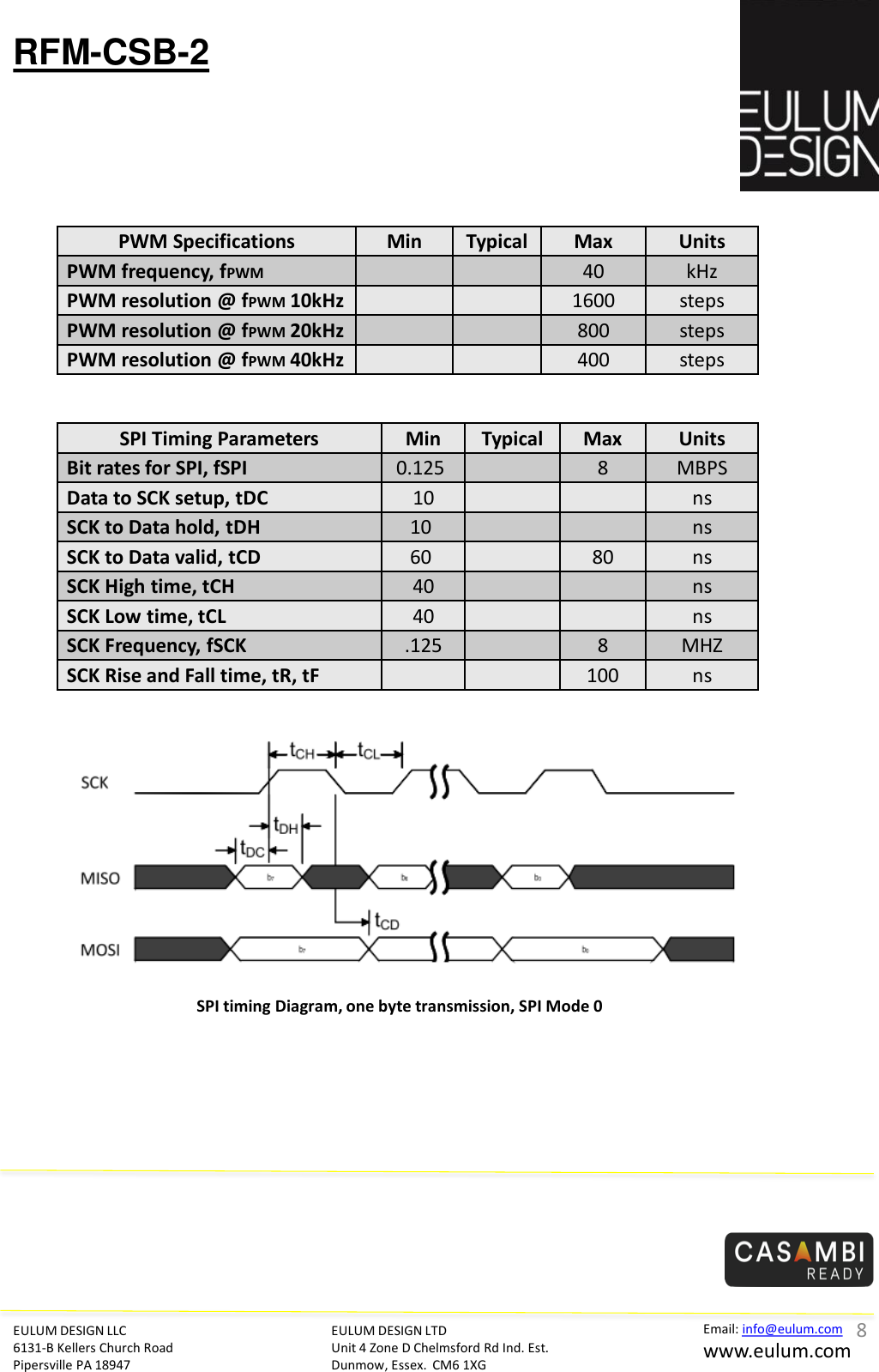
RFM-CSB-2 EULUM DESIGN LLC 6131-B Kellers Church Road Pipersville PA 18947 EULUM DESIGN LTD Unit 4 Zone D Chelmsford Rd Ind. Est. Dunmow, Essex.  CM6 1XG Email: info@eulum.com www.eulum.com PWM Specifications  Min  Typical Max  Units PWM frequency, fPWM        40  kHz PWM resolution @ fPWM 10kHz       1600  steps PWM resolution @ fPWM 20kHz       800  steps PWM resolution @ fPWM 40kHz       400  steps SPI Timing Parameters  Min  Typical Max  Units Bit rates for SPI, fSPI  0.125     8  MBPS Data to SCK setup, tDC 10 ns SCK to Data hold, tDH 10      ns SCK to Data valid, tCD  60      80 ns SCK High time, tCH  40 ns SCK Low time, tCL  40 ns SCK Frequency, fSCK  .125  8  MHZ SCK Rise and Fall time, tR, tF 100 ns SPI timing Diagram, one byte transmission, SPI Mode 0 8
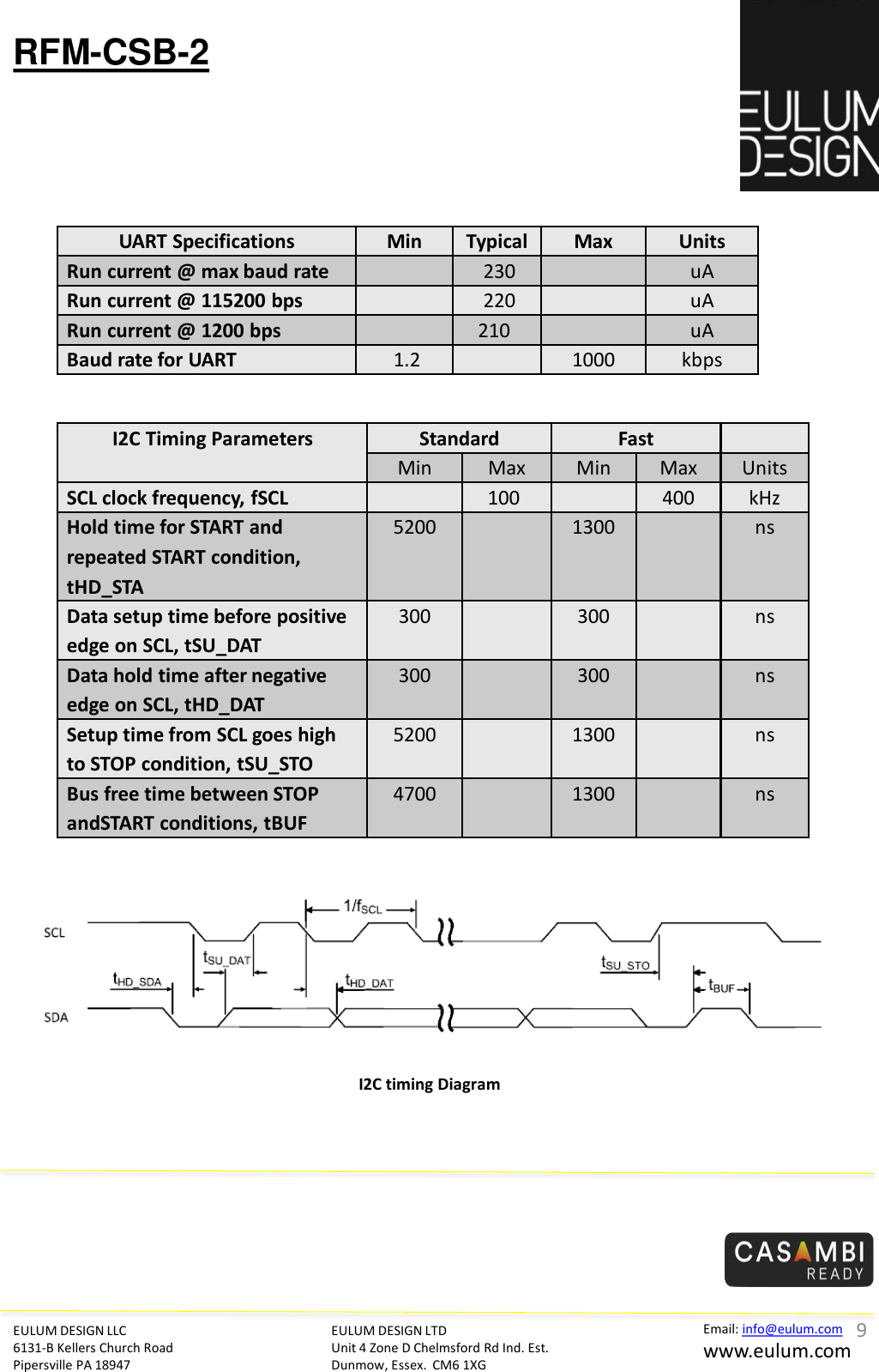
RFM-CSB-2 EULUM DESIGN LLC 6131-B Kellers Church Road Pipersville PA 18947 EULUM DESIGN LTD Unit 4 Zone D Chelmsford Rd Ind. Est. Dunmow, Essex.  CM6 1XG Email: info@eulum.com www.eulum.com UART Specifications  Min  Typical Max  Units Run current @ max baud rate     230 uA Run current @ 115200 bps     220 uA Run current @ 1200 bps    210   uA Baud rate for UART  1.2     1000  kbps I2C Timing Parameters  Standard  Fast Min  Max  Min  Max  Units SCL clock frequency, fSCL     100   400  kHz Hold time for START and repeated START condition, tHD_STA 5200 1300 ns Data setup time before positive edge on SCL, tSU_DAT 300     300 ns Data hold time after negative edge on SCL, tHD_DAT 300     300 ns Setup time from SCL goes high to STOP condition, tSU_STO 5200 1300 ns Bus free time between STOP andSTART conditions, tBUF 4700 1300 ns I2C timing Diagram 9
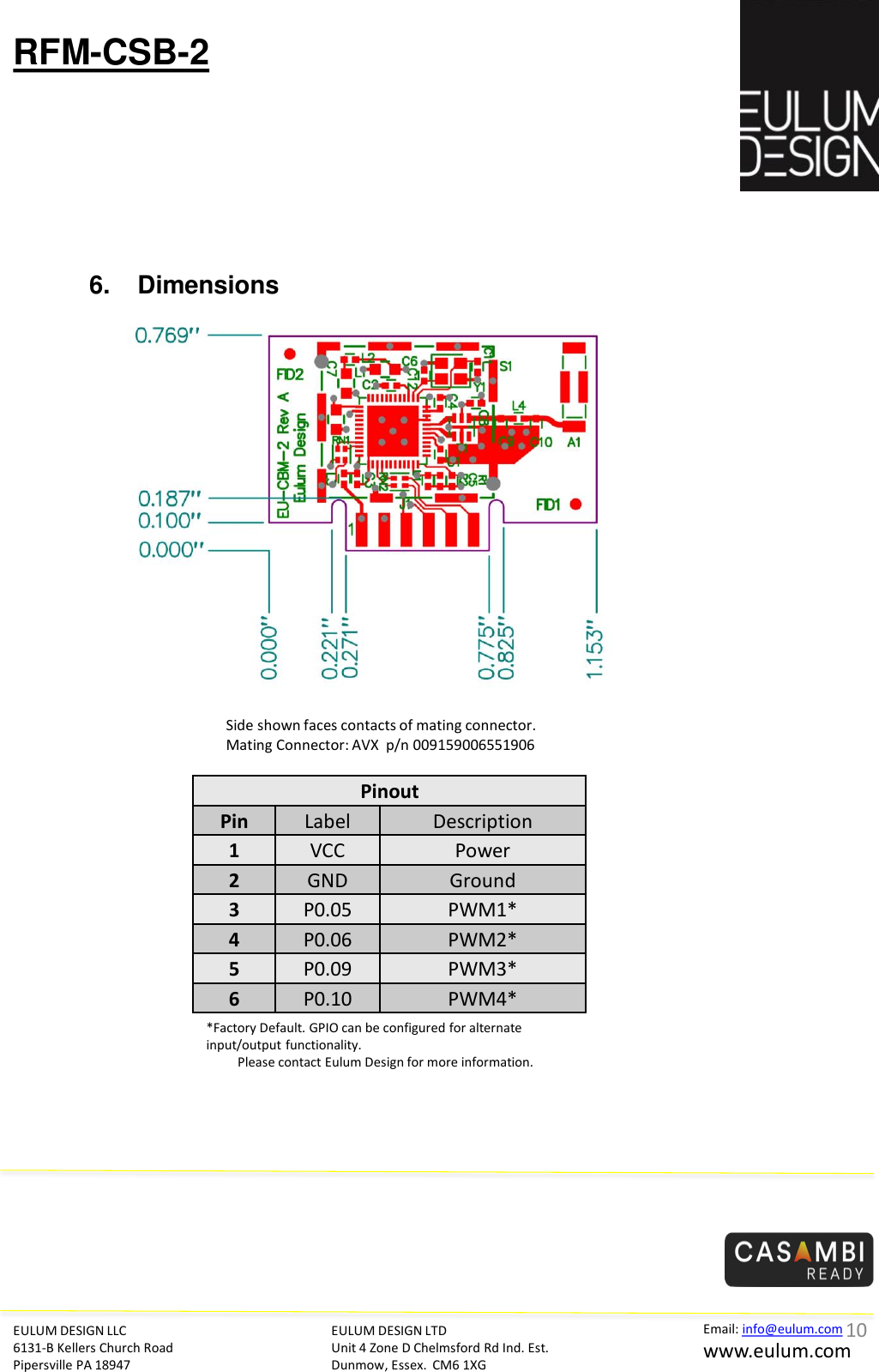
RFM-CSB-2 EULUM DESIGN LLC 6131-B Kellers Church Road Pipersville PA 18947 EULUM DESIGN LTD Unit 4 Zone D Chelmsford Rd Ind. Est. Dunmow, Essex.  CM6 1XG Email: info@eulum.com www.eulum.com   1      2     3      4      5     6 Side shown faces contacts of mating connector. Mating Connector: AVX  p/n 009159006551906 Pinout Pin  Label  Description 1  VCC  Power 2  GND  Ground 3  P0.05  PWM1* 4  P0.06  PWM2* 5  P0.09  PWM3* 6  P0.10  PWM4* *Factory Default. GPIO can be configured for alternate input/output functionality.            Please contact Eulum Design for more information. 6. Dimensions 10
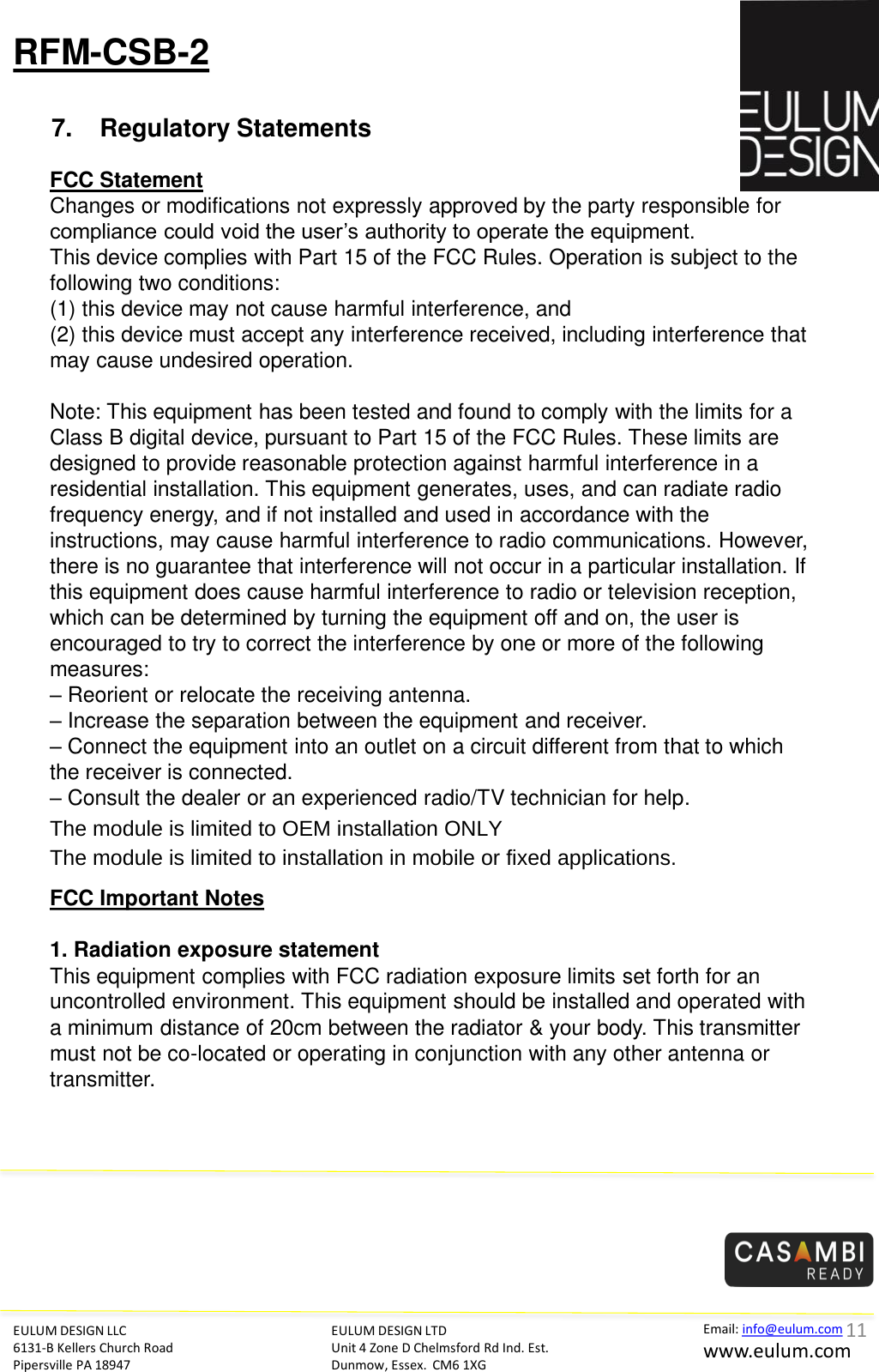
RFM-CSB-2 7. Regulatory Statements EULUM DESIGN LLC 6131-B Kellers Church Road Pipersville PA 18947 EULUM DESIGN LTD Unit 4 Zone D Chelmsford Rd Ind. Est. Dunmow, Essex.  CM6 1XG Email: info@eulum.com www.eulum.com   FCC Statement Changes or modifications not expressly approved by the party responsible for compliance could void the user’s authority to operate the equipment.  This device complies with Part 15 of the FCC Rules. Operation is subject to the following two conditions:  (1) this device may not cause harmful interference, and (2) this device must accept any interference received, including interference that may cause undesired operation.   Note: This equipment has been tested and found to comply with the limits for a Class B digital device, pursuant to Part 15 of the FCC Rules. These limits are designed to provide reasonable protection against harmful interference in a residential installation. This equipment generates, uses, and can radiate radio frequency energy, and if not installed and used in accordance with the instructions, may cause harmful interference to radio communications. However, there is no guarantee that interference will not occur in a particular installation. If this equipment does cause harmful interference to radio or television reception, which can be determined by turning the equipment off and on, the user is encouraged to try to correct the interference by one or more of the following measures: – Reorient or relocate the receiving antenna. – Increase the separation between the equipment and receiver. – Connect the equipment into an outlet on a circuit different from that to which the receiver is connected. – Consult the dealer or an experienced radio/TV technician for help.   FCC Important Notes   1. Radiation exposure statement This equipment complies with FCC radiation exposure limits set forth for an uncontrolled environment. This equipment should be installed and operated with a minimum distance of 20cm between the radiator & your body. This transmitter must not be co-located or operating in conjunction with any other antenna or transmitter.    11  7KHPRGXOHLVOLPLWHGWR2(0LQVWDOODWLRQ21/<7KHPRGXOHLVOLPLWHGWRLQVWDOODWLRQLQPRELOHRUIL[HGDSSOLFDWLRQV
RFM-CSB-2 Regulatory Statements (cont.) EULUM DESIGN LLC 6131-B Kellers Church Road Pipersville PA 18947 EULUM DESIGN LTD Unit 4 Zone D Chelmsford Rd Ind. Est. Dunmow, Essex.  CM6 1XG Email: info@eulum.com www.eulum.com     2. OEM integration instructions This device is intended only for OEM integrators under the following conditions:    The antenna and transmitter must not be co-located with any other transmitter or antenna. The module shall be only used with the integral antenna(s) that has been originally tested and certified with this module.   As long as the two (2) conditions above are met, further transmitter testing will not be required. However, the OEM integrator is still responsible for testing their end-product for any additional compliance requirements with this module installed (for example, digital device emission, PC peripheral requirements, etc.)    In the event that these conditions cannot be met (for example certain laptop configuration or co-location with another transmitter), then the FCC authorization for this module in combination with the host equipment is no longer considered valid and the FCC ID of the module cannot be used on the final product. In these and circumstance, the OEM integrator will be responsible for re-evaluating. The end product (including the transmitter) and obtaining a separate FCC authorization.    The OEM is still responsible for verifying compliance with FCC Part 15, subpart B limits for unintentional radiators through an accredited test facility.    3. End product labeling  The final end product must be labeled in a visible area with the following:  RFM-CSB-2: “Contains FCC ID: 2AJML- EUCSBM”  Any similar wording that expresses the same meaning may be used.     The FCC Statement below should also be included on the label. When not possible, the FCC Statement should be included in the User Manual of the host device.    “This device complies with part 15 of the FCC rules.   Operation is subject to the following two conditions. (1) This device may not cause harmful interference. (2) This device must accept any interference received, including interference that may cause undesired operation.”     12
RFM-CSB-2 Regulatory Statements (cont.) EULUM DESIGN LLC 6131-B Kellers Church Road Pipersville PA 18947 EULUM DESIGN LTD Unit 4 Zone D Chelmsford Rd Ind. Est. Dunmow, Essex.  CM6 1XG Email: info@eulum.com www.eulum.com      4 Information regarding the end user manual  The OEM integrator has to be aware not to provide information to the end user regarding how to install or remove this RF module in the user’s manual of the end product which integrates this module. The end user manual shall include all required regulatory information/warning as show in this manual.     CE Regulatory This device is tested and compliant against the following standards. OEM integrators should consult with qualified test house to verify all regulatory requirements have been met for their complete device.  From R&TTE Directive 1999/5/EC:  •   ETSI EN 300328  •   ETSI EN 62479 From Directive 2004/108/EC:  •   ETSI EN 301489-1  •   ETSI EN 301489-17   13
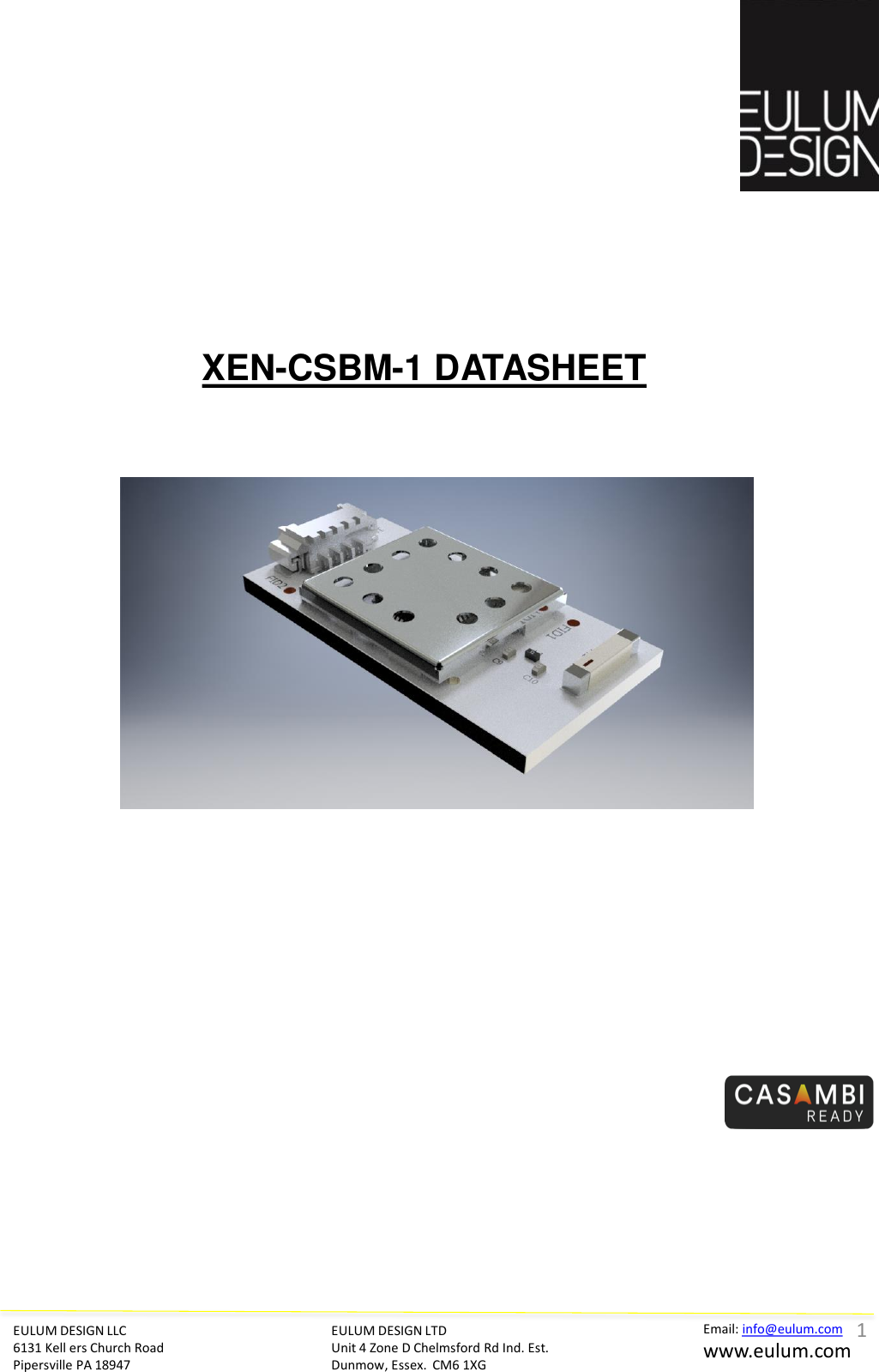
EULUM DESIGN LLC 6131 Kell ers Church Road Pipersville PA 18947 Email: info@eulum.com www.eulum.com XEN-CSBM-1 DATASHEET EULUM DESIGN LTD Unit 4 Zone D Chelmsford Rd Ind. Est. Dunmow, Essex.  CM6 1XG         1
EULUM DESIGN LLC 6131 Kell ers Church Road Pipersville PA 18947 Email: info@eulum.com www.eulum.com XEN-CSBM-1 EULUM DESIGN LTD Unit 4 Zone D Chelmsford Rd Ind. Est. Dunmow, Essex.  CM6 1XG         Table of Contents   1. Operation ..……………………………………………………………3 2. Block Diagram………………………………………………………...3 3. I2C Interface…….…………………………………………………….4 4. Specifications ..……………………………………………………….5 5. Dimensions…………………………………………………………....6 6. Regulatory Statements……………………………………………....7   2
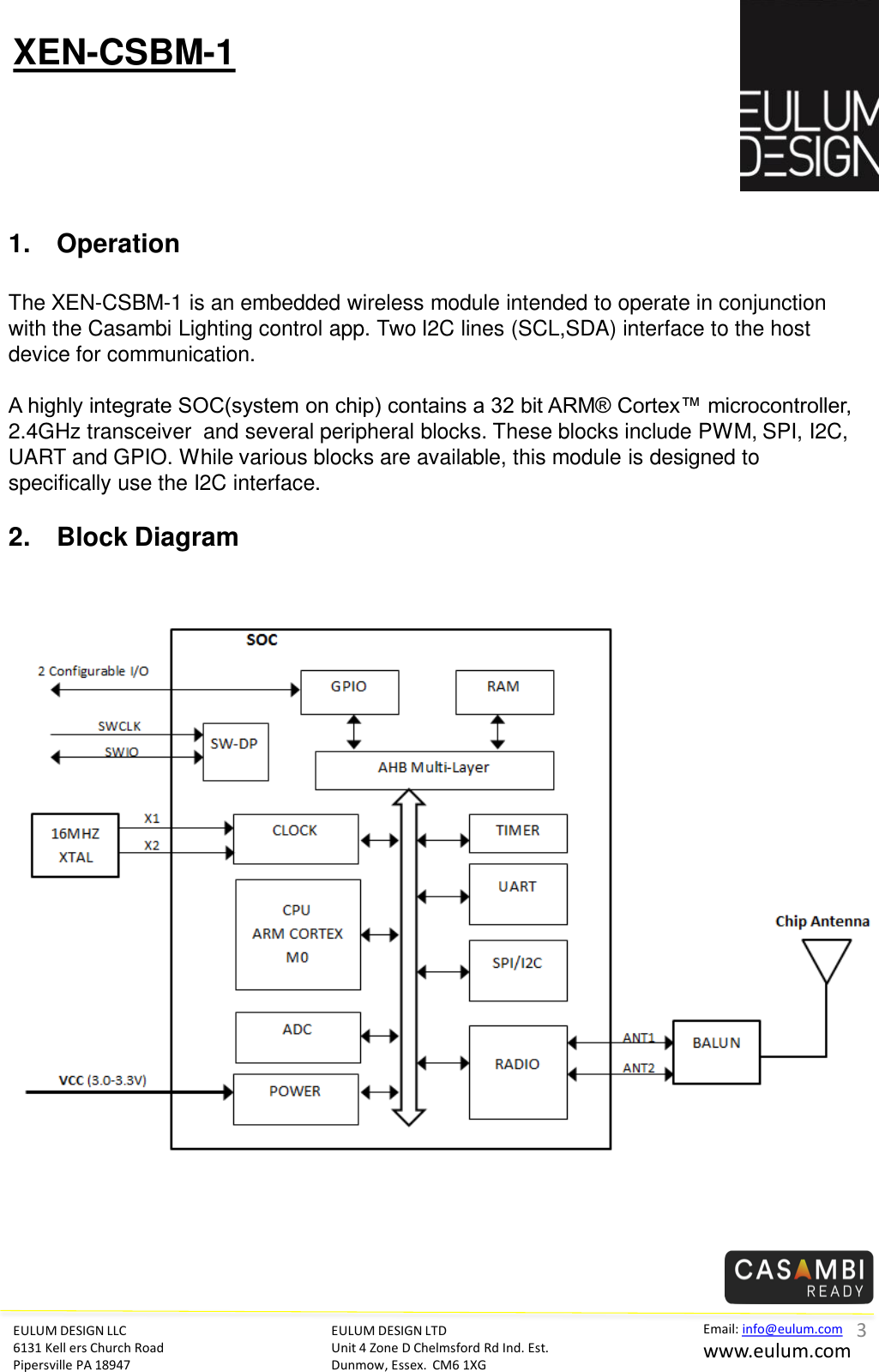
EULUM DESIGN LLC 6131 Kell ers Church Road Pipersville PA 18947 Email: info@eulum.com www.eulum.com XEN-CSBM-1 EULUM DESIGN LTD Unit 4 Zone D Chelmsford Rd Ind. Est. Dunmow, Essex.  CM6 1XG         1. Operation  The XEN-CSBM-1 is an embedded wireless module intended to operate in conjunction with the Casambi Lighting control app. Two I2C lines (SCL,SDA) interface to the host device for communication.  A highly integrate SOC(system on chip) contains a 32 bit ARM® Cortex™ microcontroller, 2.4GHz transceiver  and several peripheral blocks. These blocks include PWM, SPI, I2C, UART and GPIO. While various blocks are available, this module is designed to specifically use the I2C interface.  2. Block Diagram      3
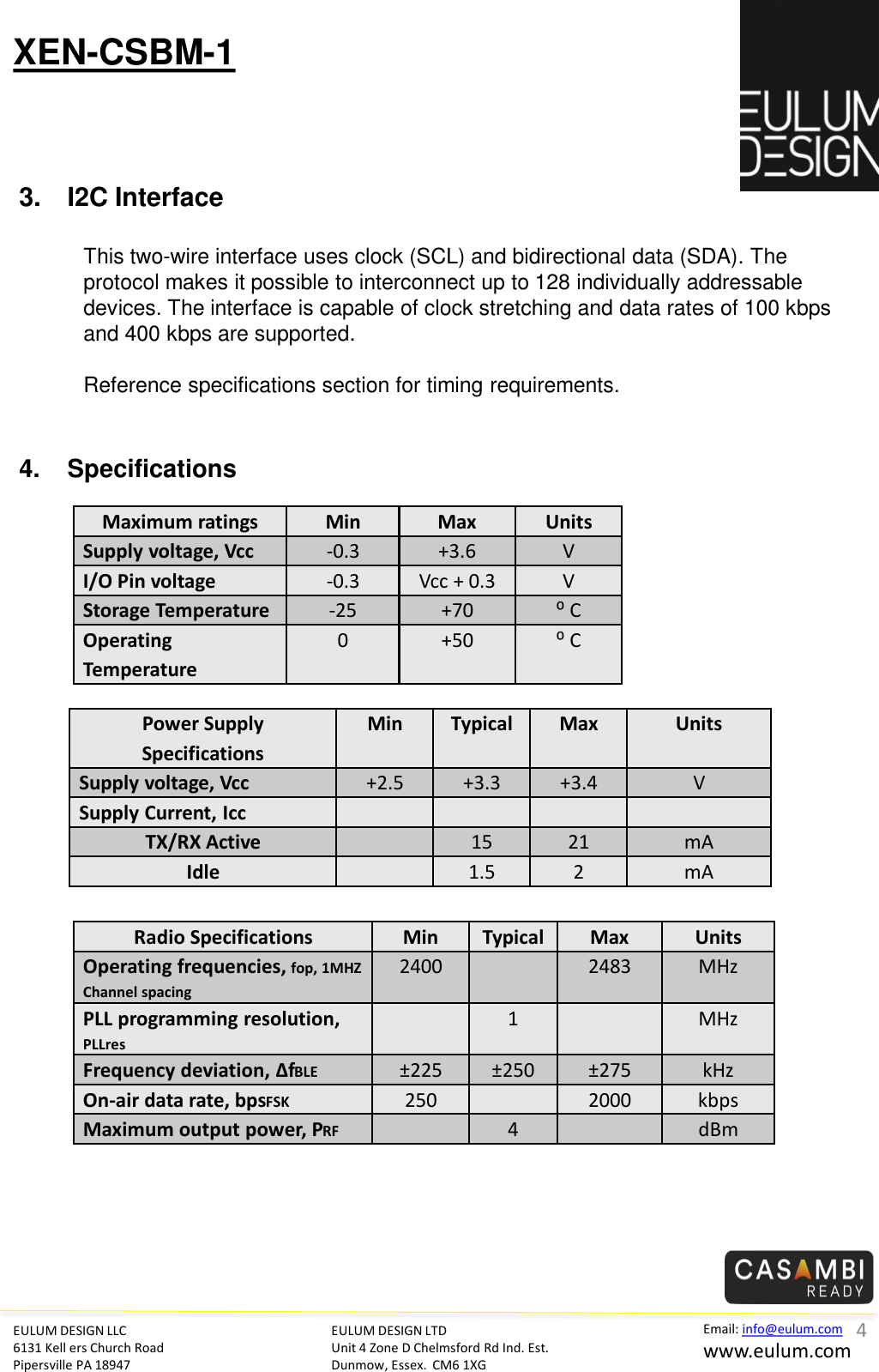
EULUM DESIGN LLC 6131 Kell ers Church Road Pipersville PA 18947 Email: info@eulum.com www.eulum.com XEN-CSBM-1 EULUM DESIGN LTD Unit 4 Zone D Chelmsford Rd Ind. Est. Dunmow, Essex.  CM6 1XG         3. I2C Interface  This two-wire interface uses clock (SCL) and bidirectional data (SDA). The protocol makes it possible to interconnect up to 128 individually addressable devices. The interface is capable of clock stretching and data rates of 100 kbps and 400 kbps are supported.  Reference specifications section for timing requirements.      4 4. Specifications Maximum ratings  Min  Max  Units Supply voltage, Vcc -0.3  +3.6  V I/O Pin voltage -0.3  Vcc + 0.3  V Storage Temperature -25  +70  ⁰ C Operating Temperature 0  +50  ⁰ C Power Supply Specifications Min  Typical Max  Units Supply voltage, Vcc +2.5  +3.3  +3.4  V Supply Current, Icc             TX/RX Active     15 21 mA Idle     1.5  2  mA Radio Specifications  Min  Typical Max  Units Operating frequencies, fop, 1MHZ Channel spacing 2400     2483  MHz PLL programming resolution, PLLres    1     MHz Frequency deviation, ∆fBLE  ±225  ±250  ±275  kHz On-air data rate, bpsFSK  250     2000  kbps Maximum output power, PRF    4     dBm
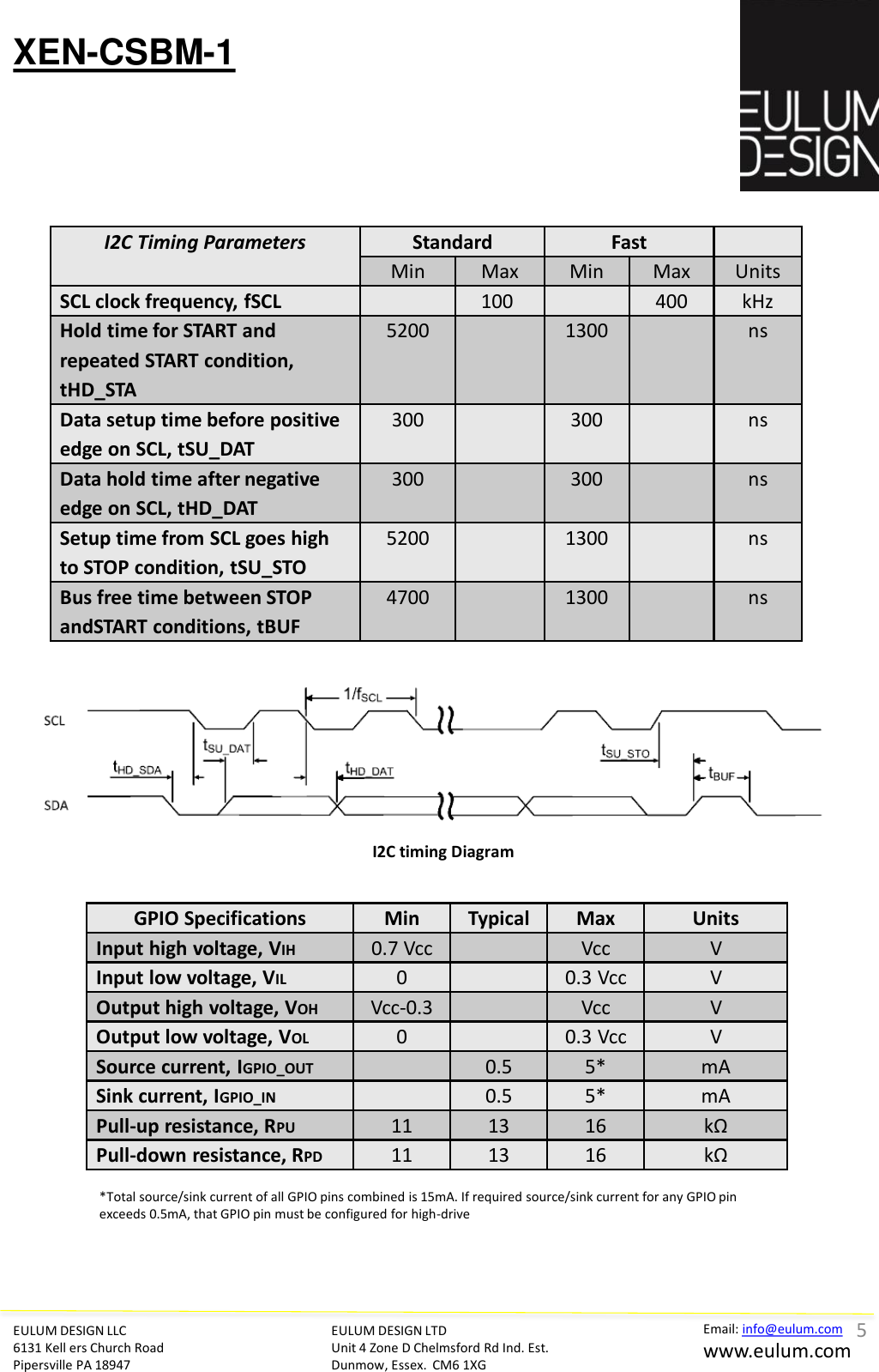
XEN-CSBM-1 EULUM DESIGN LLC 6131 Kell ers Church Road Pipersville PA 18947 Email: info@eulum.com www.eulum.com EULUM DESIGN LTD Unit 4 Zone D Chelmsford Rd Ind. Est. Dunmow, Essex.  CM6 1XG         GPIO Specifications  Min  Typical Max  Units Input high voltage, VIH 0.7 Vcc    Vcc  V Input low voltage, VIL 0     0.3 Vcc V Output high voltage, VOH Vcc-0.3    Vcc  V Output low voltage, VOL 0     0.3 Vcc V Source current, IGPIO_OUT     0.5  5*  mA Sink current, IGPIO_IN     0.5  5* mA Pull-up resistance, RPU 11 13 16 kΩ Pull-down resistance, RPD 11 13 16 kΩ *Total source/sink current of all GPIO pins combined is 15mA. If required source/sink current for any GPIO pin exceeds 0.5mA, that GPIO pin must be configured for high-drive 5 I2C Timing Parameters  Standard  Fast Min  Max  Min  Max  Units SCL clock frequency, fSCL     100   400  kHz Hold time for START and repeated START condition, tHD_STA 5200 1300 ns Data setup time before positive edge on SCL, tSU_DAT 300     300 ns Data hold time after negative edge on SCL, tHD_DAT 300     300 ns Setup time from SCL goes high to STOP condition, tSU_STO 5200 1300 ns Bus free time between STOP andSTART conditions, tBUF 4700 1300 ns I2C timing Diagram
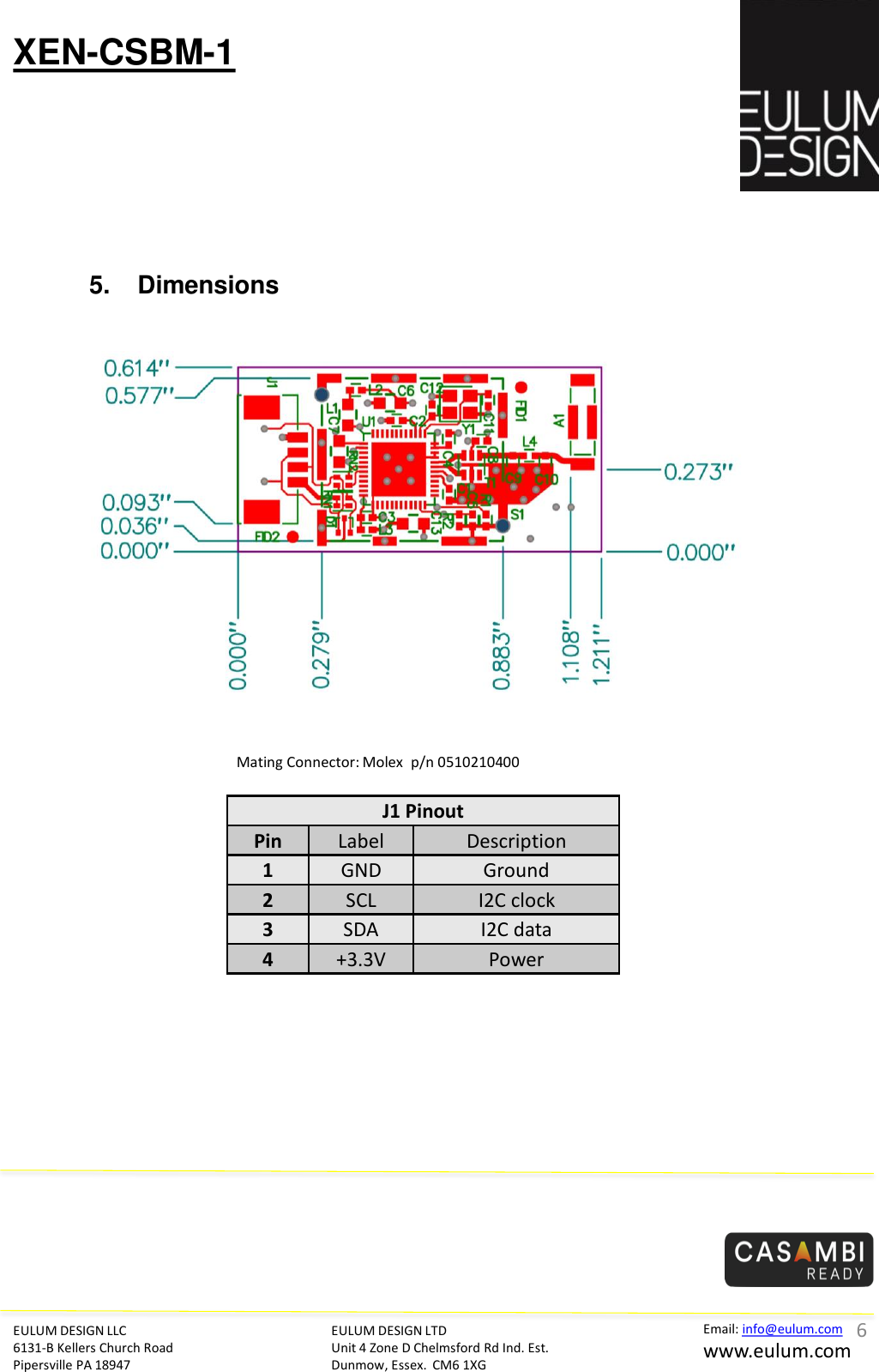
XEN-CSBM-1 EULUM DESIGN LLC 6131-B Kellers Church Road Pipersville PA 18947 EULUM DESIGN LTD Unit 4 Zone D Chelmsford Rd Ind. Est. Dunmow, Essex.  CM6 1XG Email: info@eulum.com www.eulum.com Mating Connector: Molex  p/n 0510210400  J1 Pinout Pin  Label  Description 1  GND  Ground 2  SCL  I2C clock 3  SDA  I2C data 4  +3.3V  Power 5. Dimensions 6
XEN-CSBM-1 6. Regulatory Statements EULUM DESIGN LLC 6131-B Kellers Church Road Pipersville PA 18947 EULUM DESIGN LTD Unit 4 Zone D Chelmsford Rd Ind. Est. Dunmow, Essex.  CM6 1XG Email: info@eulum.com www.eulum.com   FCC Statement Changes or modifications not expressly approved by the party responsible for compliance could void the user’s authority to operate the equipment.  This device complies with Part 15 of the FCC Rules. Operation is subject to the following two conditions:  (1) this device may not cause harmful interference, and (2) this device must accept any interference received, including interference that may cause undesired operation.   Note: This equipment has been tested and found to comply with the limits for a Class B digital device, pursuant to Part 15 of the FCC Rules. These limits are designed to provide reasonable protection against harmful interference in a residential installation. This equipment generates, uses, and can radiate radio frequency energy, and if not installed and used in accordance with the instructions, may cause harmful interference to radio communications. However, there is no guarantee that interference will not occur in a particular installation. If this equipment does cause harmful interference to radio or television reception, which can be determined by turning the equipment off and on, the user is encouraged to try to correct the interference by one or more of the following measures: – Reorient or relocate the receiving antenna. – Increase the separation between the equipment and receiver. – Connect the equipment into an outlet on a circuit different from that to which the receiver is connected. – Consult the dealer or an experienced radio/TV technician for help.   FCC Important Notes   1. Radiation exposure statement This equipment complies with FCC radiation exposure limits set forth for an uncontrolled environment. This equipment should be installed and operated with a minimum distance of 20cm between the radiator & your body. This transmitter must not be co-located or operating in conjunction with any other antenna or transmitter.    7  7KHPRGXOHLVOLPLWHGWR2(0LQVWDOODWLRQ21/<7KHPRGXOHLVOLPLWHGWRLQVWDOODWLRQLQPRELOHRUIL[HGDSSOLFDWLRQV
XEN-CSBM-1 Regulatory Statements (cont.) EULUM DESIGN LLC 6131-B Kellers Church Road Pipersville PA 18947 EULUM DESIGN LTD Unit 4 Zone D Chelmsford Rd Ind. Est. Dunmow, Essex.  CM6 1XG Email: info@eulum.com www.eulum.com     2. OEM integration instructions This device is intended only for OEM integrators under the following conditions:    The antenna and transmitter must not be co-located with any other transmitter or antenna. The module shall be only used with the integral antenna(s) that has been originally tested and certified with this module.   As long as the two (2) conditions above are met, further transmitter testing will not be required. However, the OEM integrator is still responsible for testing their end-product for any additional compliance requirements with this module installed (for example, digital device emission, PC peripheral requirements, etc.)    In the event that these conditions cannot be met (for example certain laptop configuration or co-location with another transmitter), then the FCC authorization for this module in combination with the host equipment is no longer considered valid and the FCC ID of the module cannot be used on the final product. In these and circumstance, the OEM integrator will be responsible for re-evaluating. The end product (including the transmitter) and obtaining a separate FCC authorization.    The OEM is still responsible for verifying compliance with FCC Part 15, subpart B limits for unintentional radiators through an accredited test facility.    3. End product labeling  The final end product must be labeled in a visible area with the following:  XEN-CSBM-1: “Contains FCC ID: 2AJML- EUCSBM”  Any similar wording that expresses the same meaning may be used.     The FCC Statement below should also be included on the label. When not possible, the FCC Statement should be included in the User Manual of the host device.    “This device complies with part 15 of the FCC rules.   Operation is subject to the following two conditions. (1) This device may not cause harmful interference. (2) This device must accept any interference received, including interference that may cause undesired operation.”     8
XEN-CSBM-1 Regulatory Statements (cont.) EULUM DESIGN LLC 6131-B Kellers Church Road Pipersville PA 18947 EULUM DESIGN LTD Unit 4 Zone D Chelmsford Rd Ind. Est. Dunmow, Essex.  CM6 1XG Email: info@eulum.com www.eulum.com      4 Information regarding the end user manual  The OEM integrator has to be aware not to provide information to the end user regarding how to install or remove this RF module in the user’s manual of the end product which integrates this module. The end user manual shall include all required regulatory information/warning as show in this manual.     CE Regulatory This device is tested and compliant against the following standards. OEM integrators should consult with qualified test house to verify all regulatory requirements have been met for their complete device.  From R&TTE Directive 1999/5/EC:  •   ETSI EN 300328  •   ETSI EN 62479 From Directive 2004/108/EC:  •   ETSI EN 301489-1  •   ETSI EN 301489-17   9

Navigation menu