Eaton HHB1BASE Home Security Base Station Transceiver User Manual hhb users guide 05 dec indd

Eaton Corporation Home Security Base Station Transceiver hhb users guide 05 dec indd

Manual

User’s Guide
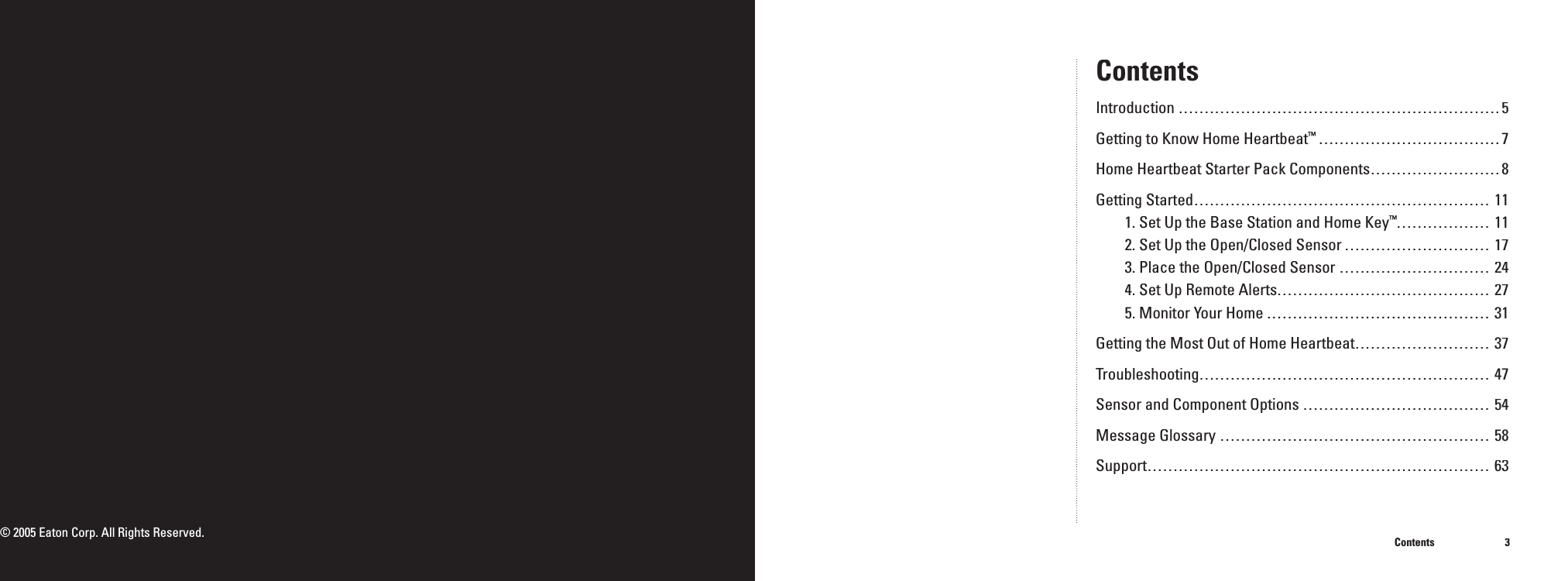
3ContentsContentsIntroduction ..............................................................5Getting to Know Home Heartbeat™ ...................................7Home Heartbeat Starter Pack Components .........................8Getting Started .........................................................111. Set Up the Base Station and Home Key™ ..................112. Set Up the Open/Closed Sensor ............................173. Place the Open/Closed Sensor .............................244. Set Up Remote Alerts .........................................275. Monitor Your Home ...........................................31Getting the Most Out of Home Heartbeat ..........................37Troubleshooting ........................................................47Sensor and Component Options ....................................54Message Glossary ....................................................58Support ..................................................................63© 2005 Eaton Corp. All Rights Reserved.
54IntroductionWelcome to Home Heartbeat™—the world’s fi rst personal wireless Home Awareness System!Home Heartbeat provides a new perspective on your home environment. The system helps you keep a watchful eye on the comfort and safety of your home. It can be extended to monitor the vital, yet often overlooked parts of your home, giving you peace of mind that all is secure. The compact, portable visual display—the Home Key™—organizes and presents you with the information you care about most. It can even automatically shift to alert you via your cell phone or email when you are away from home.This User’s Guide will introduce you to the Home Heartbeat system, assist you with initial setup, and explain how you can use it to monitor your home.Introduction
7Getting to Know Home HeartbeatThe Home Heartbeat Starter Pack includes the following three essential components of a Home Heartbeat system:• Base Station• Sensor• Home KeyYou can expand your Home Heartbeat system any time by adding additional accessories, such as more sensors or Range Extenders. (Visit www.homeheartbeat.com for more information on the latest introduction of sensors.)The next two pages provide more details about the components you will fi nd in the Home Heartbeat Starter Pack, and how they work together. This product is designed for in-home use only.Getting to Know Home Heartbeat6
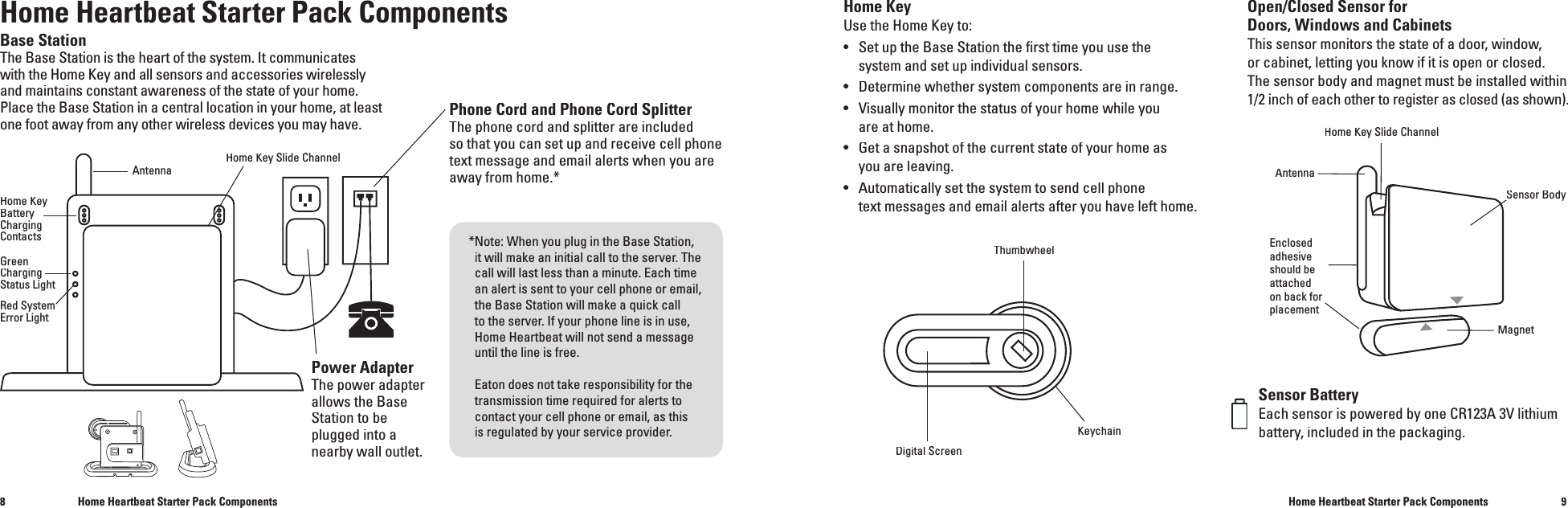
89Base StationThe Base Station is the heart of the system. It communicates with the Home Keyand all sensors and accessories wirelesslyand maintains constant awareness of the state of your home. Place the Base Station in a central location in your home, at least one foot away from any other wireless devices you may have.Power Adapter The power adapter allows the Base Station to be plugged into a nearby wall outlet.Home KeyUse the Home Key to:•  Set up the Base Station the fi rst time you use the  system and set up individual sensors. •  Determine whether system components are in range.•  Visually monitor the status of your home while you   are at home.•  Get a snapshot of the current state of your home as  you are leaving.•  Automatically set the system to send cell phone  text messages and email alerts after you have left home.Sensor BatteryEach sensor is powered by one CR123A 3V lithium battery, included in the packaging.Phone Cord and Phone Cord SplitterThe phone cord and splitter are included so that you can set up and receive cell phonetext message and email alertswhen you are away from home.*Home Heartbeat Starter Pack ComponentsHome Heartbeat Starter Pack ComponentsHome Heartbeat Starter Pack ComponentsAntennaDigital ScreenThumbwheelKeychainAntennaHome Key Slide ChannelMagnetEnclosed adhesive should be attached on back for placementHome KeySlide ChannelOpen/Closed Sensor for Doors, Windows and CabinetsThis sensor monitors the state of a door, window, or cabinet, letting you know if it is open or closed. The sensor body and magnet must be installed within 1/2 inch of each other to register as closed (as shown).Sensor BodyHome KeyBattery Charging ContactsRed SystemError Light* Note: When you plug in the Base Station, it will make an initial call to the server. The call will last less than a minute.Each time an alert is sent to your cell phone or email, the Base Station will make a quick call to the server. If your phone line is in use, Home Heartbeat will not send amessage until the line is free.Eaton does not take responsibility for the transmission time required for alerts to contact your cell phone or email, as thisis regulated by your service provider.GreenChargingStatus Light
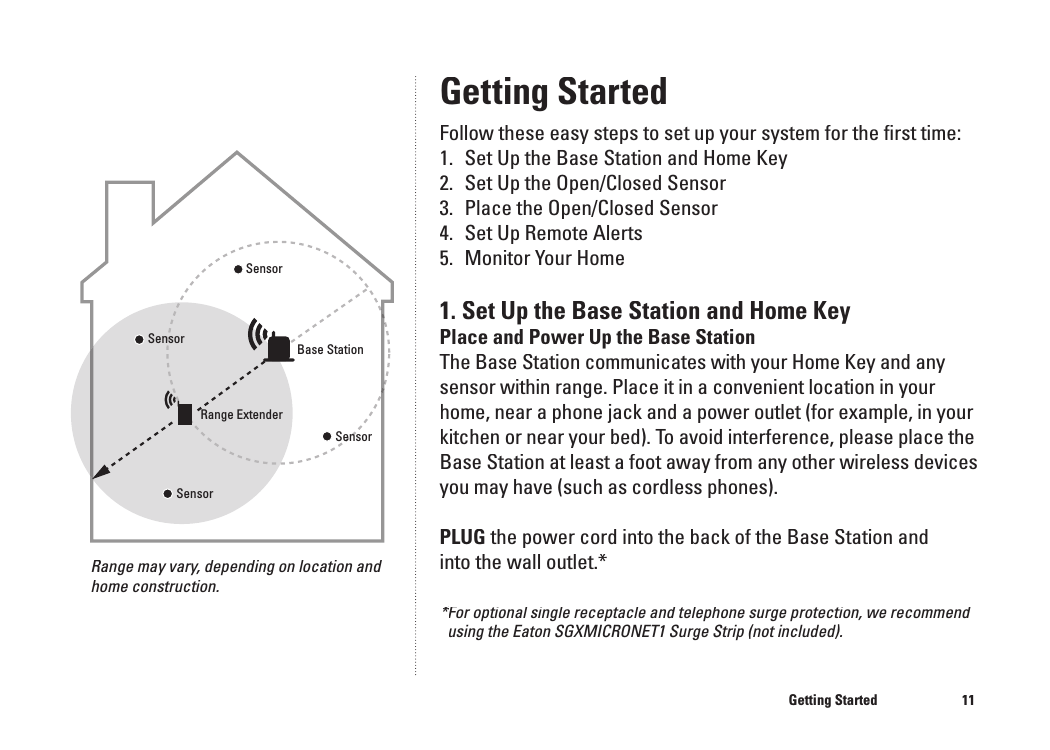
11Getting StartedFollow these easy steps to set up your system for the fi rst time:1.   Set Up the Base Station and Home Key2.  Set Up the Open/Closed Sensor3.  Place the Open/Closed Sensor4.  Set Up Remote Alerts5.  Monitor Your Home1. Set Up the Base Station and Home KeyPlace and Power Up the Base StationThe Base Station communicates with your Home Key and any sensor within range. Place it in a convenient location in your home, near a phone jack and a power outlet (for example, in your kitchen or near your bed). To avoid interference, please place the Base Station at least a foot away from any other wireless devices you may have (such as cordless phones).PLUG the power cord into the back of the Base Station and into the wall outlet.*Getting Started Range may vary, depending on location and home construction.10*For optional single receptacle and telephone surge protection, we recommend *For optional single receptacle and telephone surge protection, we recommend *using the Eaton SGXMICRONET1 Surge Strip (not included).
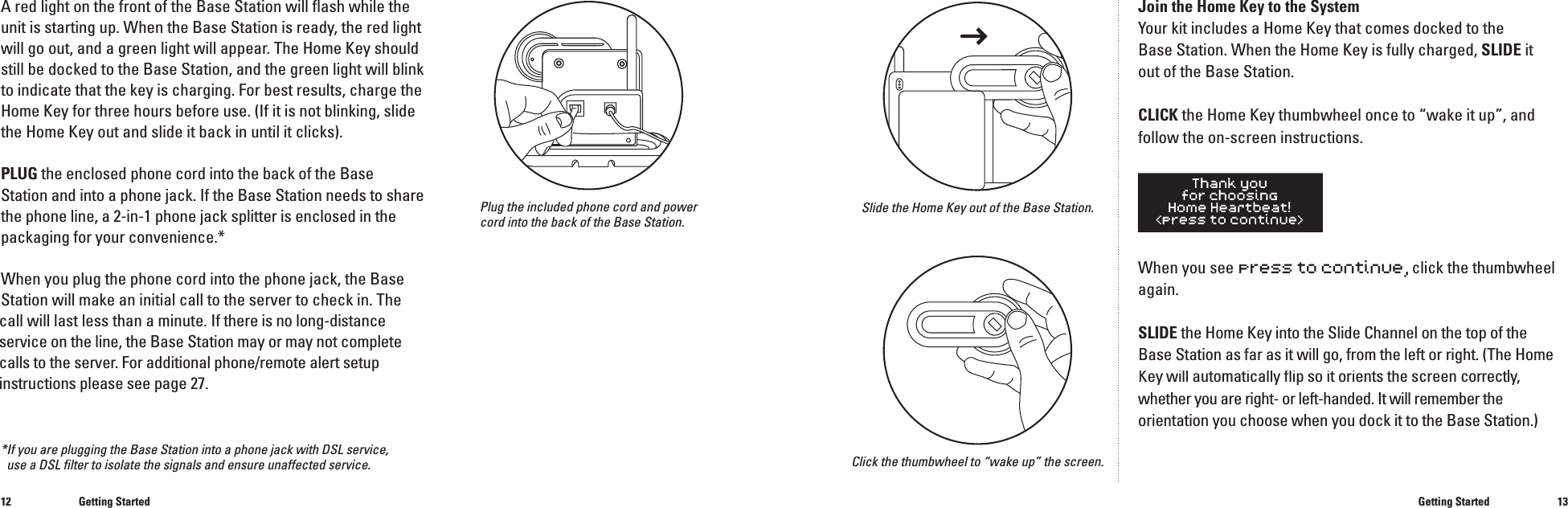
1213A red light on the front of the Base Station will fl ash while the unit is starting up. When the Base Station is ready, the red light will go out, and a green light will appear. The Home Key should still be docked to the Base Station, and the green light will blink to indicate that the key is charging. For best results, charge the Home Key for three hours before use. (If it is not blinking, slide the Home Key out and slide it back in until it clicks).PLUG the enclosed phone cord into the back of the Base Station and into a phone jack. If the Base Station needs to share the phone line, a 2-in-1 phone jack splitter is enclosed in the packaging for your convenience.*When you plug the phone cord into the phone jack, the Base Station will make an initial callto the server to check in. The call will last less than a minute.If there is no long-distance service on the line, the Base Station may or may not complete calls to the server. For additional phone/remote alert setup instructions please see page 27.Plug the included phone cord and power cord into the back of the Base Station.Getting StartedJoin the Home Key to the SystemYour kit includes a Home Key that comes docked to the Base Station. When the Home Key is fully charged, SLIDE it out of the Base Station.CLICK the Home Key thumbwheel once to “wake it up”, and follow the on-screen instructions.When you see press to continue, click the thumbwheel again.SLIDE the Home Key into the Slide Channel on the top of theBase Station as far as it will go, from the left or right. (The Home Key will automatically fl ip so it orients the screen Key will automatically fl ip so it orients the screen Keycorrectly, whether you are right- or left-handed. It will remember theorientation you choose when you dock it to the Base Station.)Getting StartedSlide the Home Key out of the Base Station.Click the thumbwheel to “wake up” the screen.*If you are plugging the Base Station into a phone jack with DSL service, use a DSL fi lter to isolate the signals and ensure unaffected service.
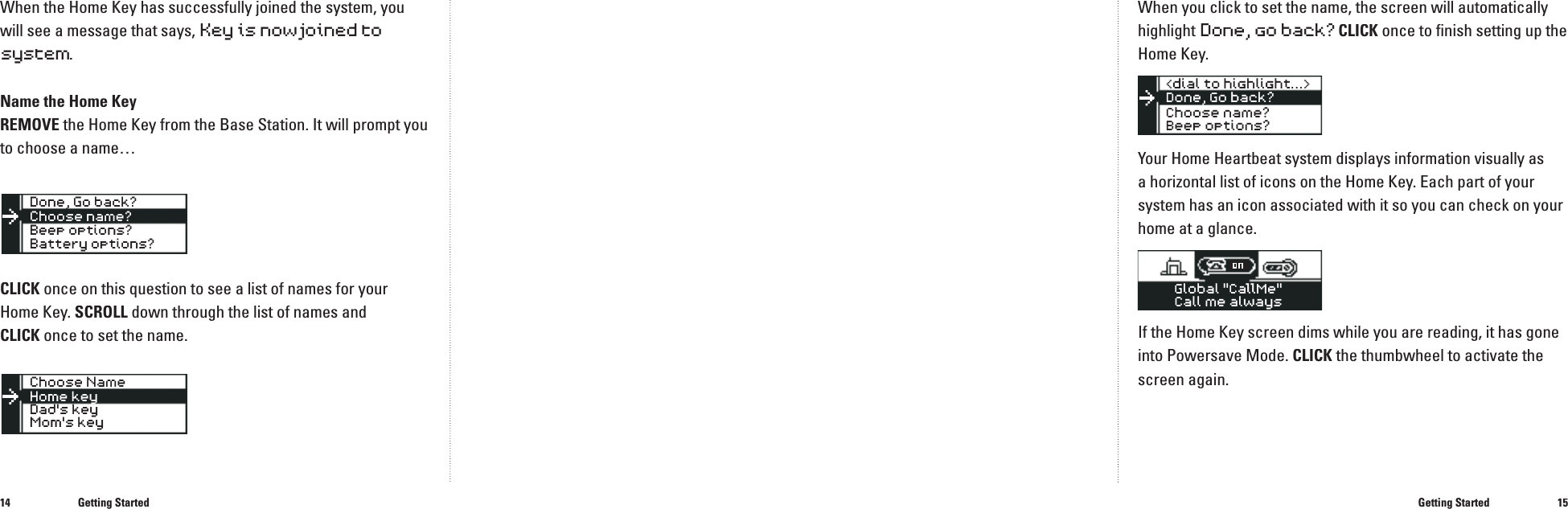
1415When the Home Key has successfully joined the system, you will see a message that says, Key is now joined to system.Name the Home KeyREMOVE the Home Key from the Base Station. It will prompt you to choose a name…CLICK once on this question to see a list of names for your Home Key. SCROLL down through the list of names and CLICKonce to set the name.Getting StartedWhen you click to set the name, the screen will automatically highlight Done,go back?CLICK once to fi nish setting up the Home Key.Your Home Heartbeat system displays information visually as a horizontal list of icons on the Home Key. Each part of your system has an icon associated with it so you can check on your home at a glance.If the Home Key screen dims while you are reading, it has gone into Powersave Mode. CLICK the thumbwheel to activate the screen again.Getting StartedGlobal "CallMe"Call me always ���
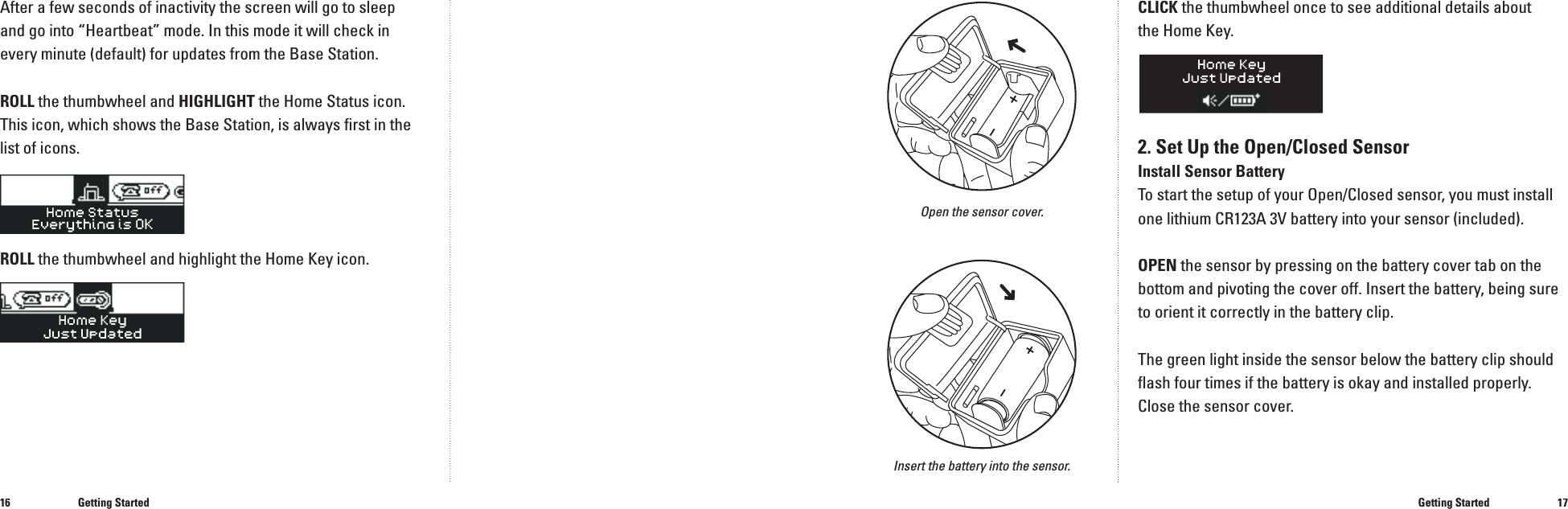
1617After a few seconds of inactivity the screen will go to sleepand go into “Heartbeat” mode. In this mode it will check in every minute (default) for updates from the Base Station.ROLL the thumbwheel and HIGHLIGHT the Home Status icon. This icon, which shows the Base Station, is always fi rst in the list of icons.ROLL the thumbwheel and highlight the Home Key icon.Getting StartedCLICK the thumbwheel once to see additional details about the Home Key.2. Set Up the Open/Closed SensorInstall Sensor BatteryTo start the setup of your Open/Closed sensor, you must install one lithium CR123A 3V battery into your sensor (included). OPEN the sensor by pressing on the battery cover tab on the bottom and pivoting the cover off. Insert the battery, being sure to orient it correctly in the battery clip.The green light inside the sensor below the battery clip should fl ash four times if the battery is okay and installed properly. Close the sensor cover.Getting StartedOpen the sensor cover.Insert the battery into the sensor.���
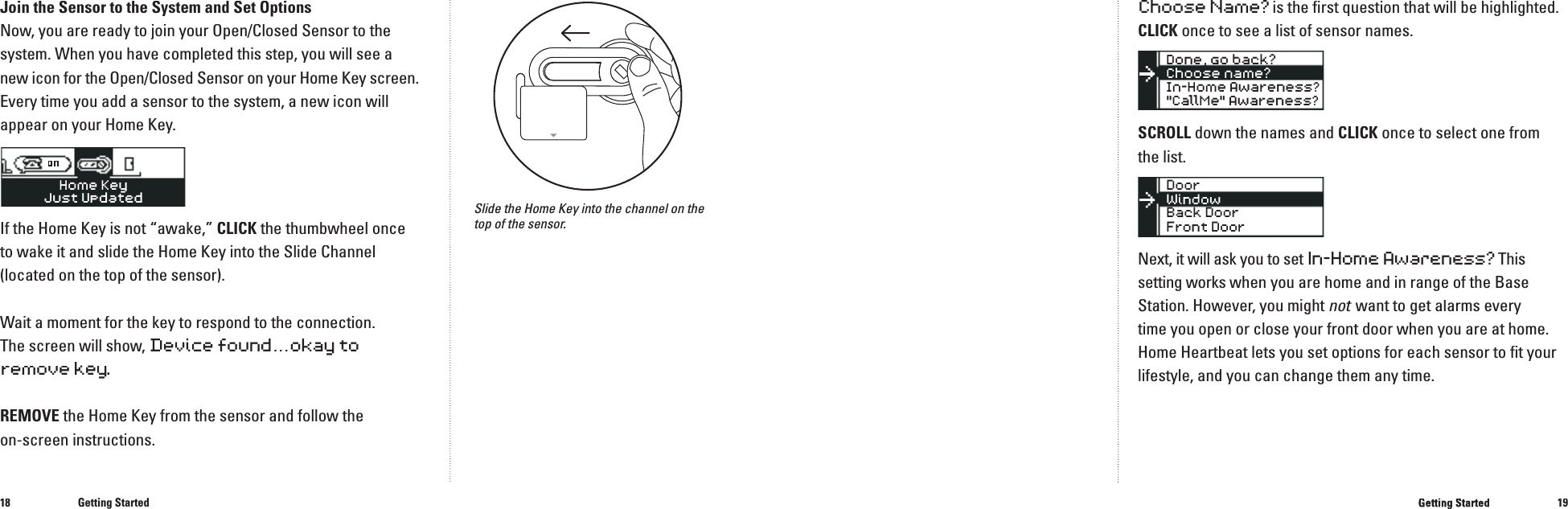
1819Join the Sensor to the System and Set Options Now, you are ready to join your Open/Closed Sensor to the system. When you have completed this step, you will see a new icon for the Open/Closed Sensor on your Home Key screen. Every time you add a sensor to the system, a new icon will appear on your Home Key.�If the Home Key is not “awake,” CLICK the thumbwheel once to wake it and slide the Home Key into the Slide Channel (located on the top of the sensor).Wait a moment for the key to respond to the connection. The screen will show, Devicefound...okay toremovekey.REMOVE the Home Key from the sensor and follow the on-screen instructions.Getting StartedChoose Name? is the fi rst question that will be highlighted. CLICK once to see a list of sensor names.SCROLL down the names and CLICKonce to select one from the list.Next, it will ask you to setIn-Home Awareness? This setting works when you are home and in range of the Base Station. However, you might not  want to get alarms every not  want to get alarms every nottime you open or close your front door when you are at home. Home Heartbeat lets you set options for each sensor to fi t your lifestyle, and you can change them any time.�Getting StartedSlide the Home Key into the channel on the top of the sensor.
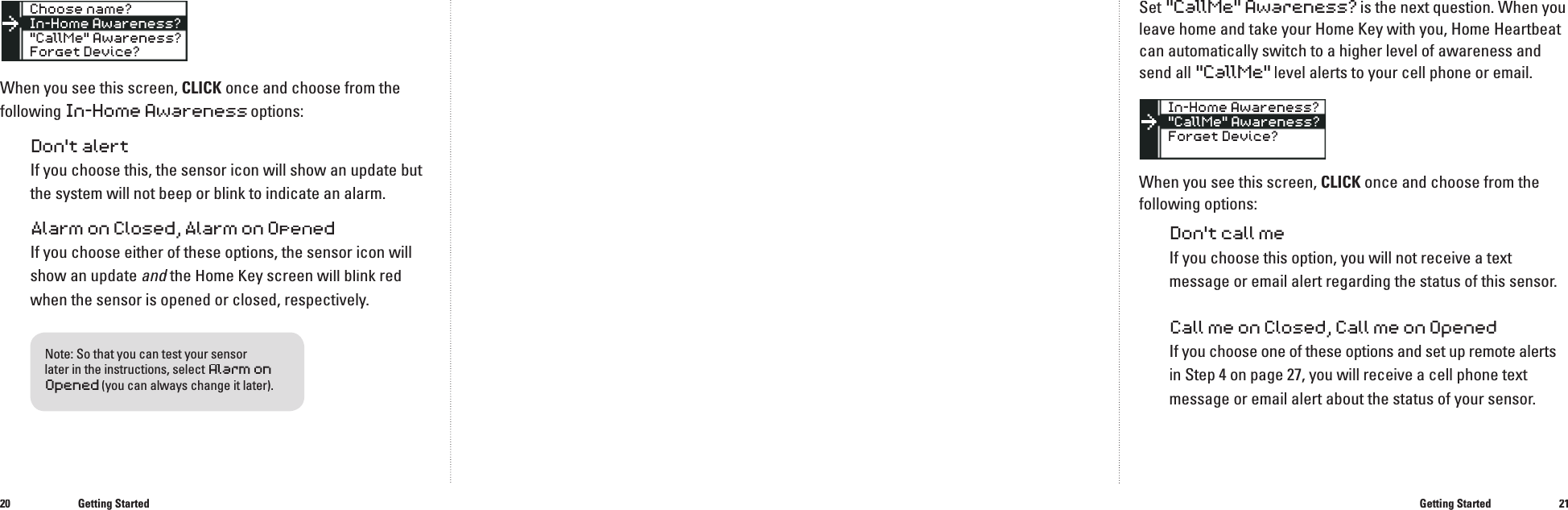
2021When you see this screen, CLICK once and choose from the following In-Home Awareness options:Don't alertIf you choose this, the sensor icon will show an update but the system will not beep or blink to indicate an alarm.Alarm on Closed, Alarm on OpenedIf you choose either of these options, the sensor icon will show an update and the Home Key screen will blink red and the Home Key screen will blink red andwhen the sensor is opened or closed, respectively.Getting StartedSet"CallMe" Awareness?is the next question. When you leave home and take your Home Key with you, Home Heartbeat can automatically switch to a higher level of awareness and send all "CallMe" level alerts to your cell phone or email.When you see this screen, CLICK once and choose from the following options:Don't call meIf you choose this option, you will not receive a text message or email alert regarding the status of this sensor.Call me on Closed, Call me on OpenedIf you choose one of these options and set up remote alerts in Step 4 on page 27, you will receive a cell phone text message or email alert about the status of your sensor. Getting Started��Note: So that you can test your sensor later in the instructions, select Alarm onOpened(you can always change it later).
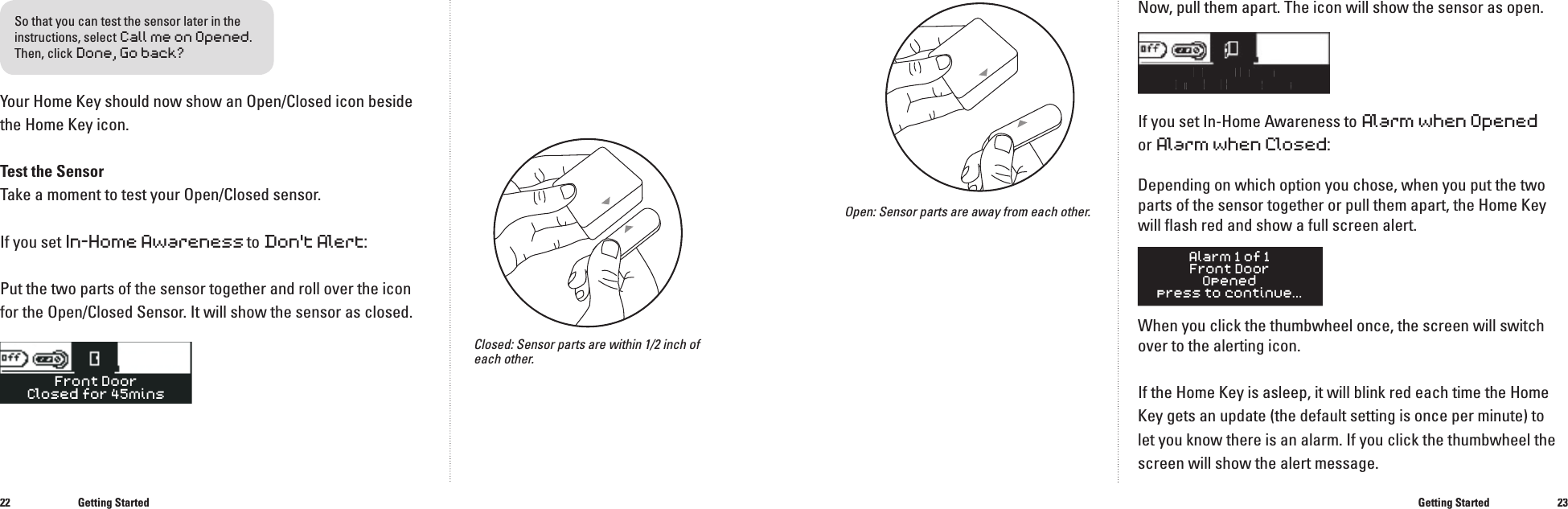
2223Your Home Key should now show an Open/Closed icon beside the Home Key icon. Test the SensorTake a moment to test your Open/Closed sensor. If you set In-Home Awareness to Don't Alert:Put the two parts of the sensor together and roll over the icon for the Open/Closed Sensor. It will show the sensor as closed.Getting StartedNow, pull them apart. The icon will show the sensor as open.FrontDoorOpenedfor 5minsIf you set In-Home Awareness to Alarm when Openedor Alarm when Closed:Depending on which option you chose, when you put the two parts of the sensor together or pull them apart, the Home Key will fl ash red and show a full screen alert.When you click the thumbwheel once, the screen will switch over to the alerting icon.If the Home Key is asleep, it will blink red each time the Home Key gets an update (the default setting is once per minute) to let you know there is an alarm. If you click the thumbwheel the screen will show the alert message.Open: Sensor parts are away from each other.Getting StartedClosed: Sensor parts are within 1/2 inch of each other.Front DoorClosed for 45minsSo that you can test the sensor later in the instructions, selectCall me on Opened.Then, click Done, Go back?���
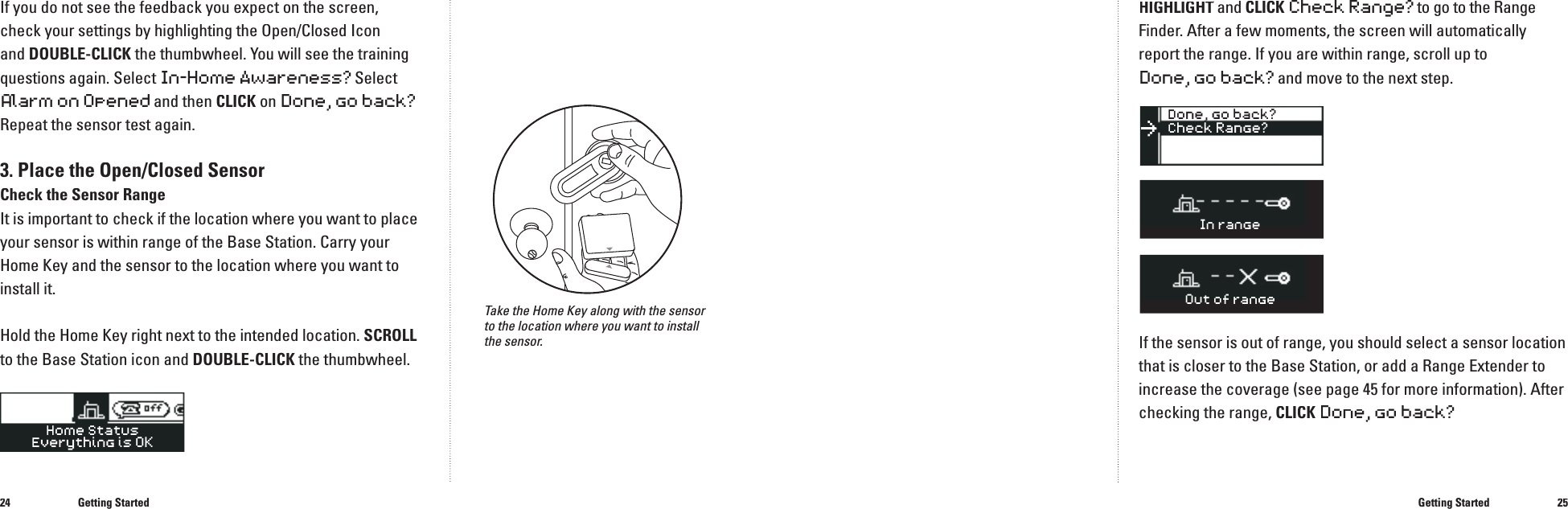
2425If you do not see the feedback you expect on the screen, check your settings by highlighting the Open/Closed Icon and DOUBLE-CLICK the thumbwheel. You will see the training questions again. SelectIn-HomeAwareness?SelectAlarm on Opened and then CLICK on Done, go back?Repeat the sensor test again.3. Place the Open/Closed SensorCheck the Sensor Range It is important to check if the location where you want to place your sensor is within range of the Base Station. Carry your Home Key and the sensor to the location where you want to install it. Hold the Home Key right next to the intended location. SCROLLto the Base Station icon and DOUBLE-CLICK the thumbwheel.Getting StartedTake the Home Key along with the sensor to the location where you want to install the sensor.HIGHLIGHT andHIGHLIGHT andHIGHLIGHTCLICKCheck Range? to go to the Range Finder. After a few moments, the screen will automatically report the range. If you are within range, scroll up to Done, go back? and move to the next step. If the sensor is out of range, you should select a sensor location that is closer to the Base Station, or add a Range Extender to increase the coverage (see page 45 for more information). After checking the range, CLICKDone, go back?Getting Started�������
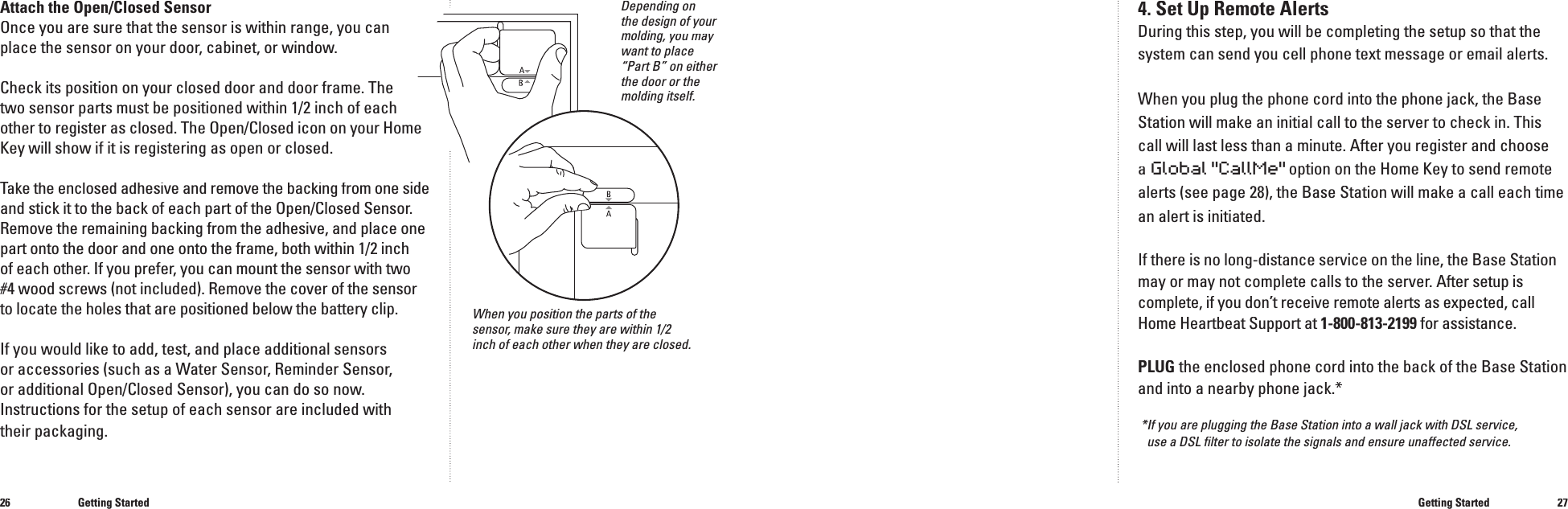
2627Attach the Open/Closed SensorOnce you are sure that the sensor is within range, you can place the sensor on your door, cabinet, or window. Check its position on your closed door and door frame. The two sensor parts must be positioned within 1/2 inch of each other to register as closed. The Open/Closed icon on your Home Key will show if it is registering as open or closed.Take the enclosed adhesive and remove the backing from one Take the enclosed adhesive and remove the backing from one Tsideand stick it to the back of each part of the Open/Closed Sensor. Remove the remaining backing from the adhesive, and place one part onto the door and one onto the frame, both within 1/2 inchof each other. If you prefer, you can mount the sensor with two #4 wood screws (not included). Remove the cover of the sensor to locate the holes that are positioned below the battery clip.If you would like to add, test, and place additional sensors or accessories (such as a Water Sensor, Reminder Sensor, or additional Open/Closed Sensor), you can do so now. Instructions for the setup of each sensor are included with their packaging.Getting Started4. Set Up Remote AlertsDuring this step, you will be completing the setup so that the system can send you cell phone text message or email alerts.When you plug the phone cord into the phone jack, the Base Station will make an initial call to the server to check in. This call will last less than a minute. After you register and choose a Global "CallMe" option on the Home Key to send remote alerts (see page 28), the Base Station will make a call each time an alert is initiated.If there is no long-distance service on the line, the Base Station may or may not complete calls to the server. After setup is complete, if you don’t receive remote alerts as expected, call Home Heartbeat Support at 1-800-813-2199 for assistance.PLUG the enclosed phone cord into the back of the Base Station and into a nearby phone jack.**If you are plugging the Base Station into a wall jack with DSL service,use a DSL fi lter to isolate the signals and ensure unaffected service.Getting StartedWhen you position the parts of the sensor, make sure they are within 1/2 inch of each other when they are closed.Depending on the design of your molding, you may want to place “Part B” on either the door or the molding itself.
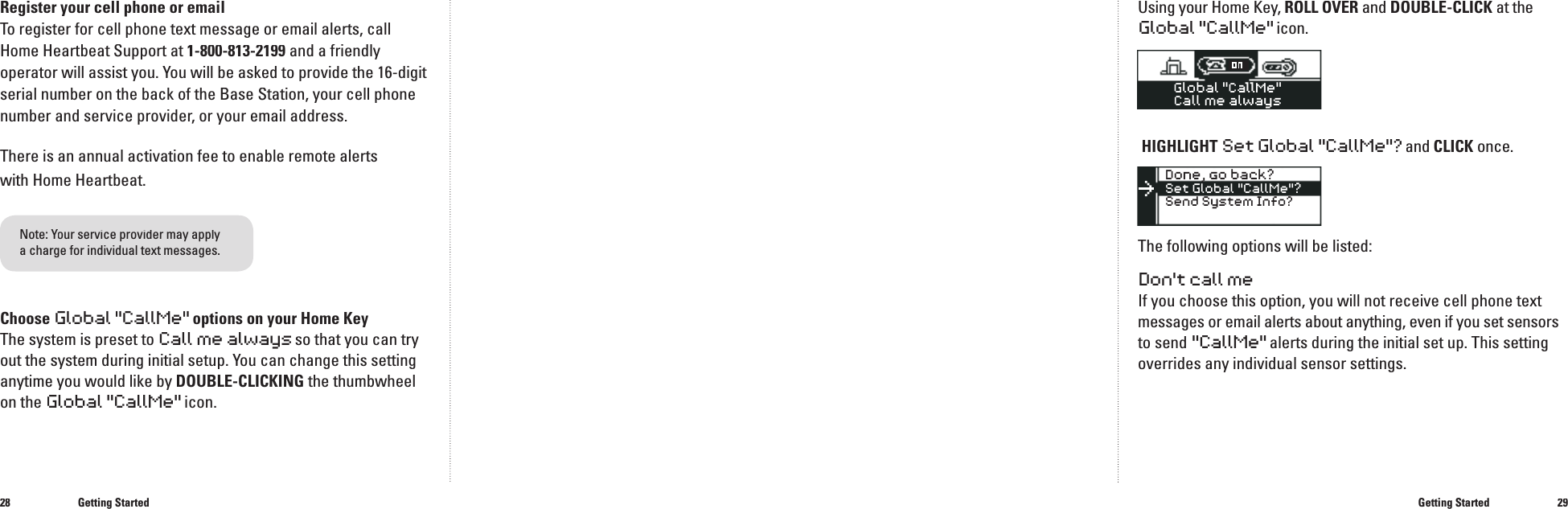
2829Getting StartedUsing your Home Key, ROLL OVER and DOUBLE-CLICK at theGlobal "CallMe" icon.HIGHLIGHTSet Global "CallMe"?and CLICKonce.The following options will be listed:Don't call meIf you choose this option, you will not receive cell phone text messages or email alerts about anything, even if you set sensorsto send "CallMe"alerts during the initial set up. This setting overrides any individual sensor settings.Getting StartedRegister your cell phone or emailTo register for cell phone text message or email alerts, call Home Heartbeat Support at 1-800-813-2199 and a friendly operator will assist you. You will be asked to provide the 16-digit serial number on the back of the Base Station, your cell phone number and service provider, or your email address.There is an annual activation fee to enable remote alerts with Home Heartbeat. Choose Global"CallMe" options on your Home KeyThe system is preset to Call me always so that you can try out the system during initial setup. You can change this setting anytime you would like by DOUBLE-CLICKINGthe thumbwheel on the Global "CallMe" icon.Note: Your service provider may apply Your service provider may apply Ya charge for individual text messages.�
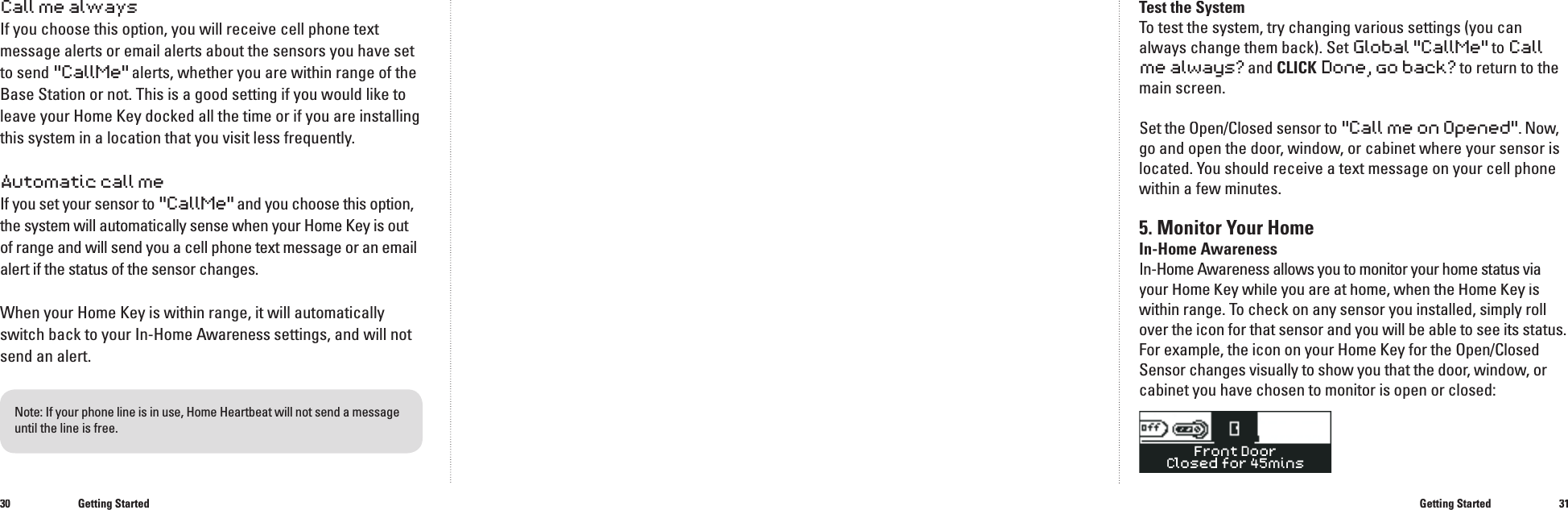
3031Test the SystemTo test the system, try changing various settings (you can always change them back). SetGlobal "CallMe"to Call me always? and CLICK Done, go back?to return to the main screen.Set the Set the SetOpen/Closed sensor to "Call me on Opened". Now, go and open the door, window, or cabinet where your sensor is located. You should receive a text message on your cell phone within a few minutes.5. Monitor Your HomeIn-Home AwarenessIn-Home Awareness allows you to monitor your home status viayour Home Key while you are at home, when the Home Key is your Home Key while you are at home, when the Home Key is your Home Key while you are at home, when the Home Keywithin range. To check on any sensor you installed, simply roll over the icon for that sensor and you will be able to see its status.For example, the icon on your Home Key for the Open/Closed Sensor changes visually to show you that the door, window, or cabinet you have chosen to monitor is open or closed:Call me alwaysIf you choose this option, you will receive cell phone text message alerts or email alerts about the sensors you have set to send "CallMe"alerts, whether you are within range of the Base Station or not. This is a good setting if you would like to leave your Home Key docked all the time or if you are installing this system in a location that you visit less frequently.Automatic call meIf you set your sensor to "CallMe"and you choose this option, the system will automatically sense when your Home Key is out of range and will send you a cell phone text message or an email alert if the status of the sensor changes. When your Home Key is within range, it will automatically switch back to your In-Home Awareness settings, and will not send an alert.Getting StartedGetting StartedNote: If your phone line is in use, Home Heartbeat will not send a messageuntil the line is free.Front DoorClosed for 45mins
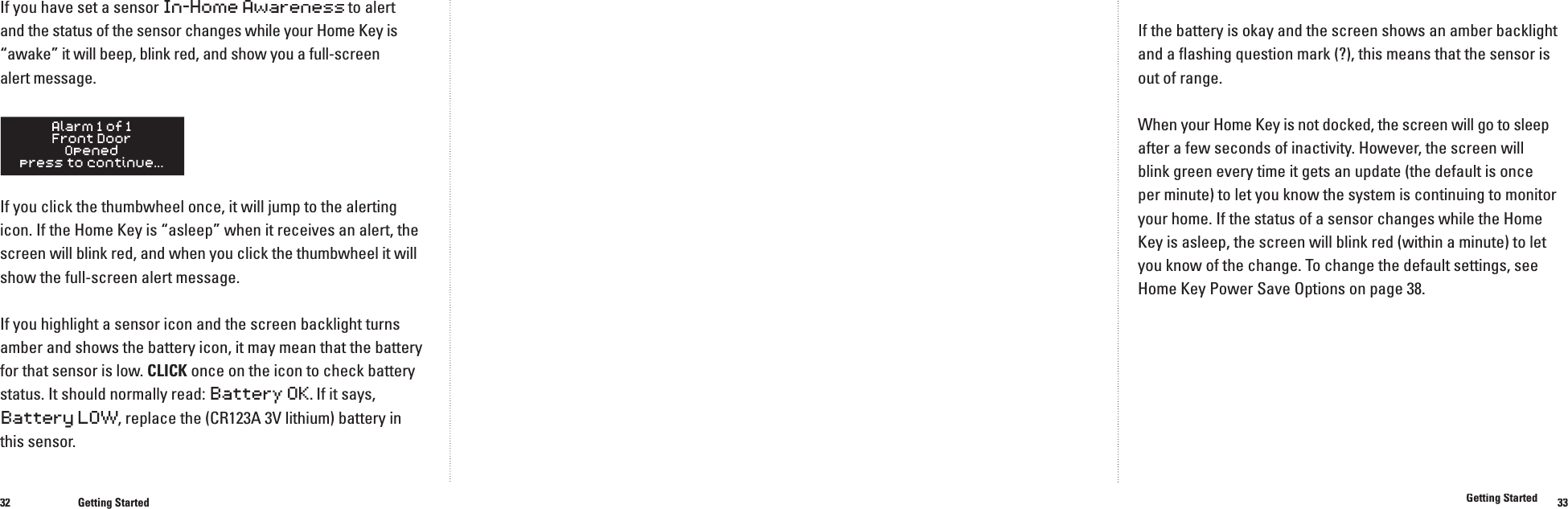
3233If you have set a sensor In-Home Awareness to alert and the status of the sensor changes while your Home Key is “awake” it will beep, blink red, and show you a full-screen alert message.If you click the thumbwheel once, it will jump to the alerting icon. If the Home Key is “asleep” when it receives an alert, the screen will blink red, and when you click the thumbwheel it will show the full-screen alert message.If you highlight a sensor icon and the screen backlight turns amber and shows the battery icon, it may mean that the battery for that sensor is low. CLICK once on the icon to check battery status. It should normally read: Battery OK. If it says, Battery LOW, replace the (CR123A 3V lithium) battery in this sensor.Getting StartedIf the battery is okay and the screen shows an amber backlight and a fl ashing question mark (?), this means that the sensor is out of range.When your Home Key is not docked, the screen will go to sleep after a few seconds of inactivity. However, the screen willblink green every time it gets an update (the default is once per minute) to let you know the system is continuing to monitor your home. If the status of a sensor changes while the Home Key is asleep, the screen will blink red (within a minute) to let you know of the change. To change the default settings, see Home Key Power Save Options on page 38.Getting Started���
3435As You Are LeavingAs you leave your home, bring your Home Key with you. It will automatically do two things once you exit the Base Station range:1.  It will freeze the last system update that it received from the Base Station. This snapshot of the system is based on the last “heartbeat” the Home Key receives and can be adjusted. (For more information, see page 38, Home Key Power Save Options). You'll be able to check at a glance if you left the front door open, for example. Snapshot mode is indicated with brackets [  ] that surround the sensor icon messages.2.  If you have set your system to Automatic call me, it will utomatic call me, it will utomatic call me,shift the system to send cell phone text messages or email alerts for sensors set to "CallMe" Awareness.Getting StartedGetting Started"CallMe" Awareness Outside Your HomeIf you set the system to Automatic call me, bringing the Home Key with you when you leave your home automatically signals the system to shift to a higher level of awareness called "CallMe" Awareness. When this occurs you will automatically receive cell phone text message or email alerts, unless you have confi gured the system not to call you about a given sensor or sensors.If you set your system to Call me always, you will get cell phone text message or email alerts for all sensors set to "CallMe" Awareness. You will receive these alerts both at home and away, whether the Home Key is within range of the Base Station or not.
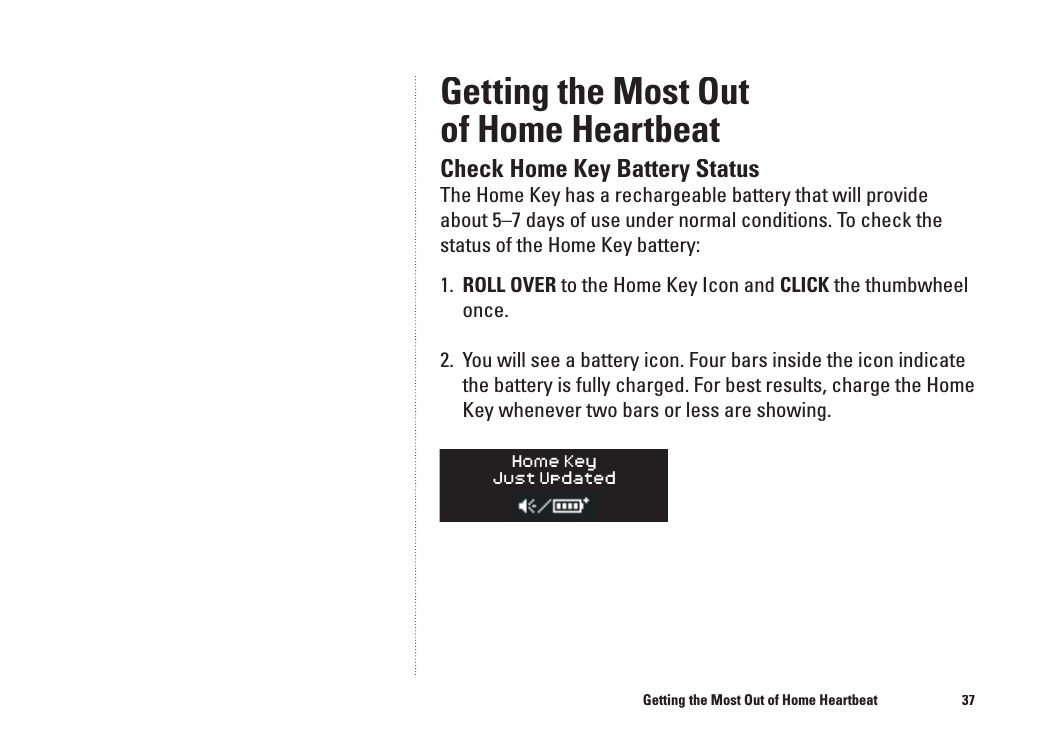
37Getting the Most Outof Home HeartbeatCheck Home Key Battery StatusThe Home Key has a rechargeable battery that will provide about 5–7 days of use under normal conditions. To check the status of the Home Key battery:1.  ROLL OVER to the Home Key Icon and CLICK the thumbwheel once. 2.  You will see a battery icon. Four bars inside the icon indicate the battery is fully charged. For best results, charge the Home Key whenever two bars or less are showing.Getting the Most Out of Home Heartbeat36�
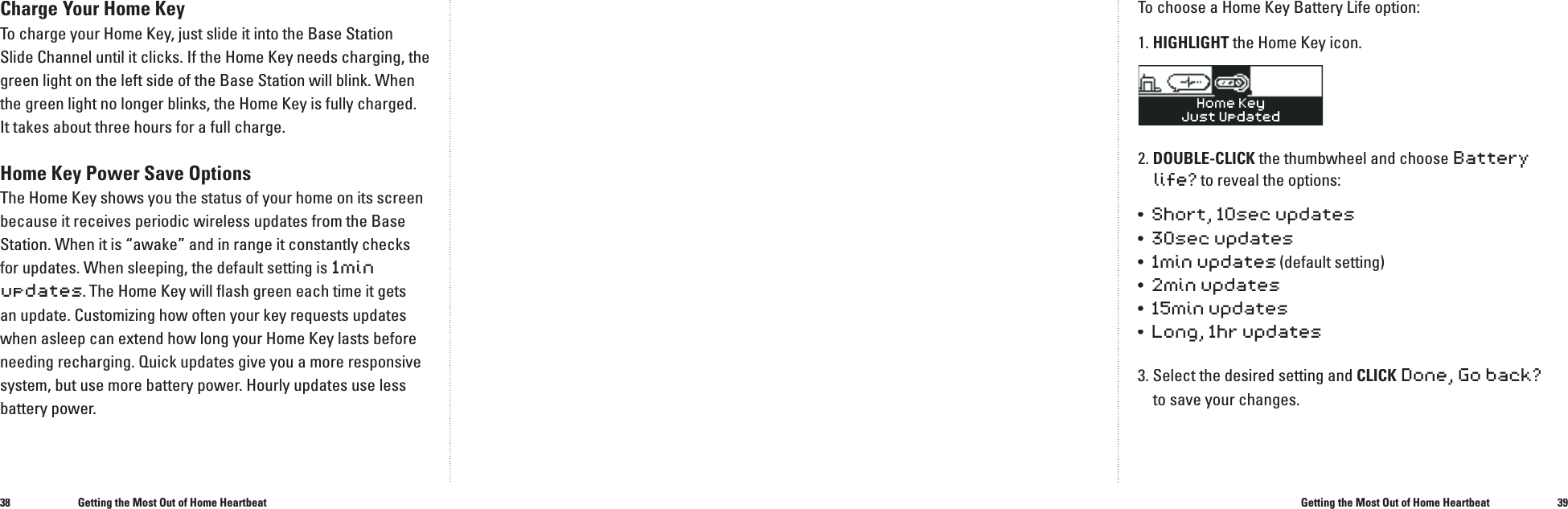
3839Charge Your Home KeyTo charge your Home Key, just slide it into the Base Station Slide Channel until it clicks. If the Home Key needs charging, the green light on the left side of the Base Station will blink. When the green light no longer blinks, the Home Key is fully charged. It takes about three hours for a full charge.Home Key Power Save OptionsThe Home Key shows you the status of your home on its screen because it receives periodic wireless updates from the Base Station. When it is “awake” and in range it constantly checks for updates. When sleeping, the default setting is 1min updates. The Home Key will fl ash green each time it gets an update. Customizing how often your key requests updates when asleep can extend how long your Home Key lasts before needing recharging. Quick updates give you a more responsive system, but use more battery power. Hourly updates use less battery power. Getting the Most Out of Home HeartbeatGetting the Most Out of Home HeartbeatTo choose a Home Key Battery Life option:1. HIGHLIGHT the Home Key icon.2. DOUBLE-CLICK the thumbwheel and choose Battery life? to reveal the options:•  Short, 10sec updates•  30sec updates•  1min updates (default setting) •  2min updates•  15min updates•  Long, 1hr updates3. Select the desired setting and CLICKDone, Go back?to save your changes.�
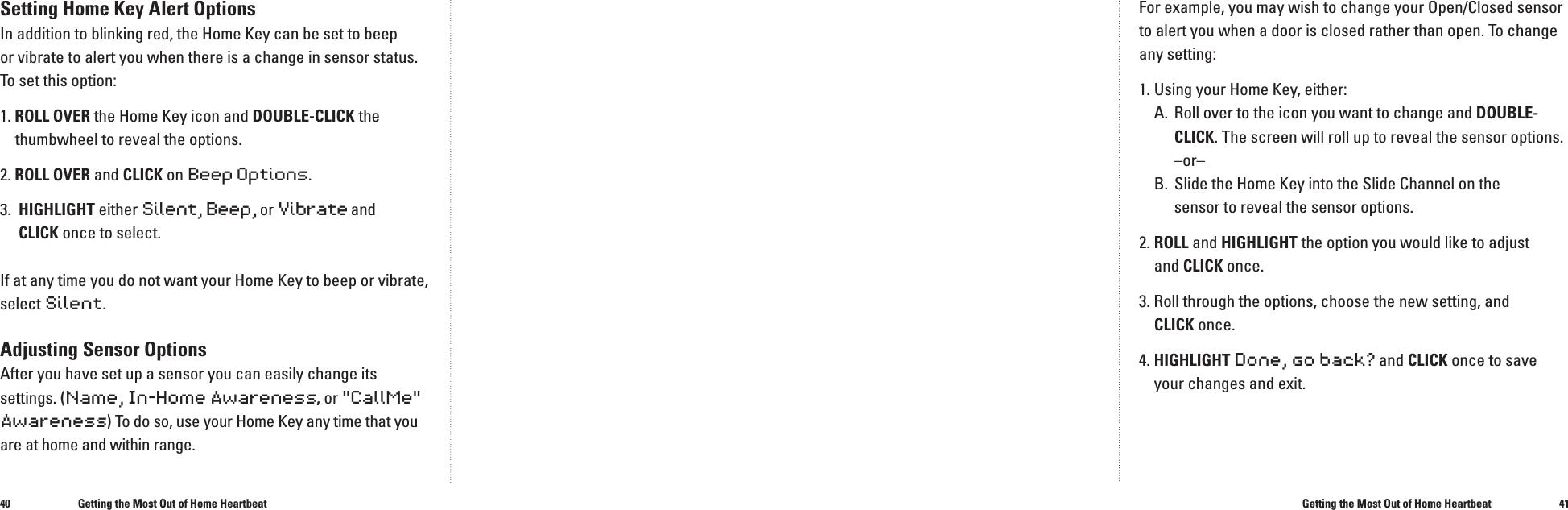
4041Setting Home Key Alert OptionsIn addition to blinking red, the Home Key can be set to beep or vibrate to alert you when there is a change in sensor status. To set this option:1. ROLL OVER the Home Key icon and DOUBLE-CLICKthe thumbwheel to reveal the options.2. ROLL OVER andCLICK on Beep Options.3.   HIGHLIGHT either Silent, Beep,orVibrate and CLICK once to select.If at any time you do not want your Home Key to beep or vibrate, select Silent.Adjusting Sensor OptionsAfter you have set up a sensor you can easily change its settings. (Name, In-Home Awareness, or"CallMe" Awareness) To do so, use your Home Key any time that you are at home and within range. Getting the Most Out of Home HeartbeatFor example, you may wish to change your Open/Closed sensor to alert you when a door is closed rather than open. To change any setting:1.  Using your Home Key, either:A.  Roll over to the icon you want to change and DOUBLE-    CLICK. The screen will roll up to reveal the sensor options.   –or–B.   Slide the Home Key into the Slide Channel on thesensor to reveal the sensor options.2.  ROLL and HIGHLIGHT the option you would like to adjust and CLICK once. 3. Roll through the options, choose the new setting, and CLICK once. 4.  HIGHLIGHTDone, go back? and CLICK once to save your changes and exit.Getting the Most Out of Home Heartbeat
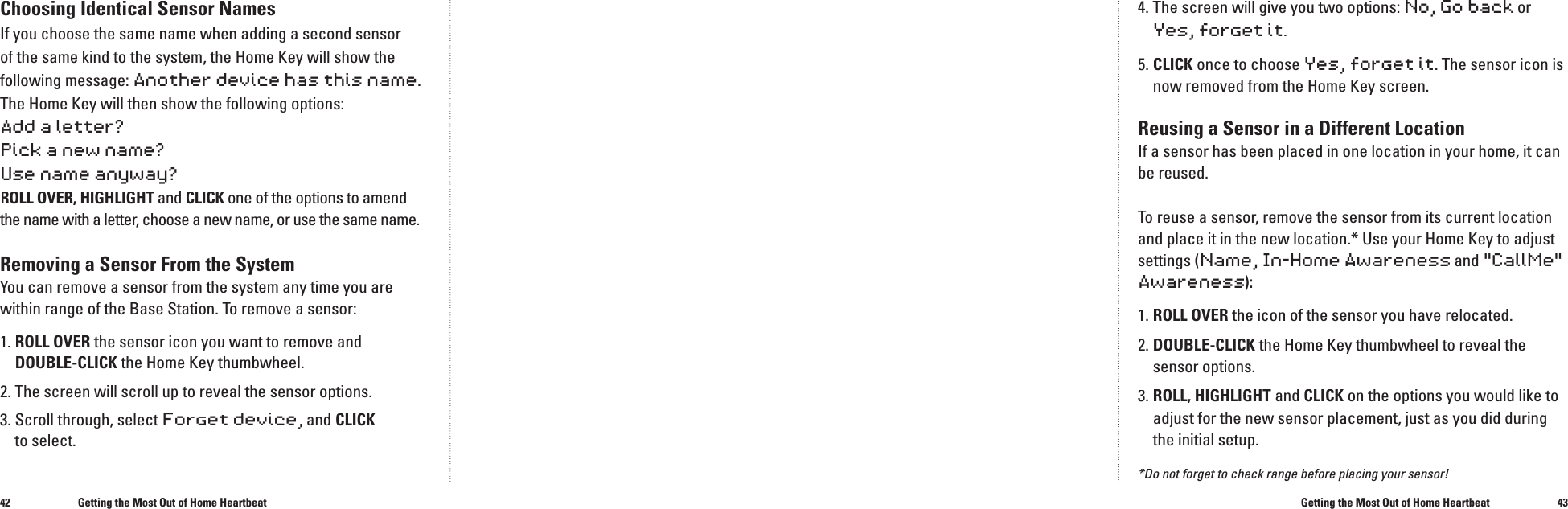
4243Choosing Identical Sensor NamesIf you choose the same name when adding a second sensor of the same kind to the system, the Home Key will show the following message: Another device has this name.The Home Key will then show the following options:Add a letter?Pick a new name?Use name anyway?ROLL OVER, HIGHLIGHT and ROLL OVER, HIGHLIGHT and ROLL OVER, HIGHLIGHTCLICK one of the options to amend CLICK one of the options to amend CLICKthe name with a letter, choose a new name, or use the same name.Removing a Sensor From the SystemYou can remove a sensor from the system any time you are within range of the Base Station. To remove a sensor:1.  ROLL OVER the sensor icon you want to remove and DOUBLE-CLICK the Home Key thumbwheel. 2.  The screen will scroll up to reveal the sensor options.3.  Scroll through, select Forget device, and CLICKto select. Getting the Most Out of Home Heartbeat4.  The screen will give you two options: No, Go backor Yes,forget it.5.  CLICK once to choose Yes,forget it. The sensor icon is now removed from the Home Key screen.Reusing a Sensor in a Different LocationIf a sensor has been placed in one location in your home, it can be reused.To reuse a sensor, remove the sensor from its current location and place it in the new location.* Use your Home Key to adjust settings (Name, In-Home Awarenessand"CallMe" Awareness):1. ROLL OVER the icon of the sensor you have relocated. 2.  DOUBLE-CLICK the Home Key thumbwheel to reveal the sensor options.3.  ROLL, HIGHLIGHT and CLICK on the options you would like to adjust for the new sensor placement, just as you did during the initial setup.*Do not forget to check range before placing your sensor!Getting the Most Out of Home Heartbeat
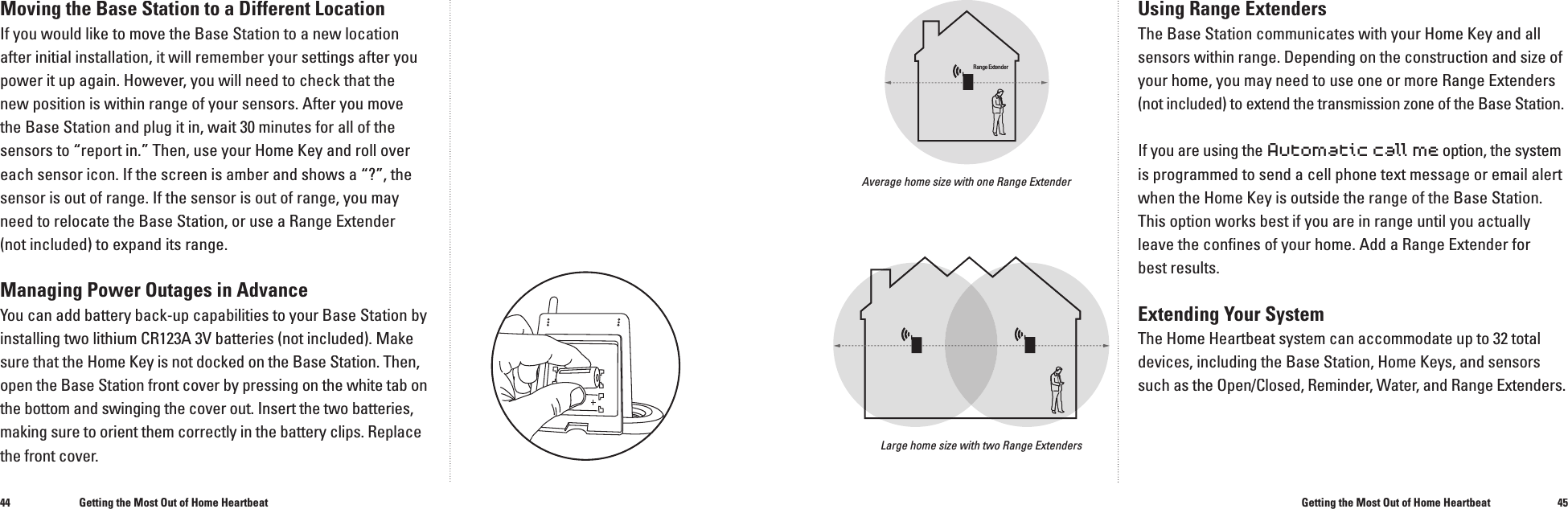
4445Moving the Base Station to a Different LocationIf you would like to move the Base Station to a new location after initial installation, it will remember your settings after you power it up again. However, you will need to check that the new position is within range of your sensors. After you move the Base Station and plug it in, wait 30 minutes for all of the sensors to “report in.” Then, use your Home Key and roll over each sensor icon. If the screen is amber and shows a “?”, the sensor is out of range. If the sensor is out of range, you may need to relocate the Base Station, or use a Range Extender (not included) to expand its range.Managing Power Outages in AdvanceYou can add battery back-up capabilities to your Base Station by installing two lithium CR123A 3V batteries (not included). Make sure that the Home Key is not docked on the Base Station. Then, open the Base Station front cover by pressing on the white tab on the bottom and swinging the cover out. Insert the two batteries, making sure to orient them correctly in the battery clips. Replace the front cover.Using Range ExtendersThe Base Station communicates with your Home Key and all sensors within range. Depending on the construction and size of your home, you may need to use one or more Range Extenders (not included) to extend the transmission zone of the Base Station.If you are using the Automatic call me option, the system is programmed to send a cell phone text message or email alert when the Home Key is outside the range of the Base Station. This option works best if you are in range until you actually leave the confi nes of your home. Add a Range Extender for best results.Extending Your SystemThe Home Heartbeat system can accommodate up to 32 total devices, including the Base Station, Home Keys, and sensors such as the Open/Closed, Reminder, Water, and Range Extenders.Getting the Most Out of Home HeartbeatGetting the Most Out of Home HeartbeatLarge home size with two Range ExtendersAverage home size with one Range ExtenderRange Extender
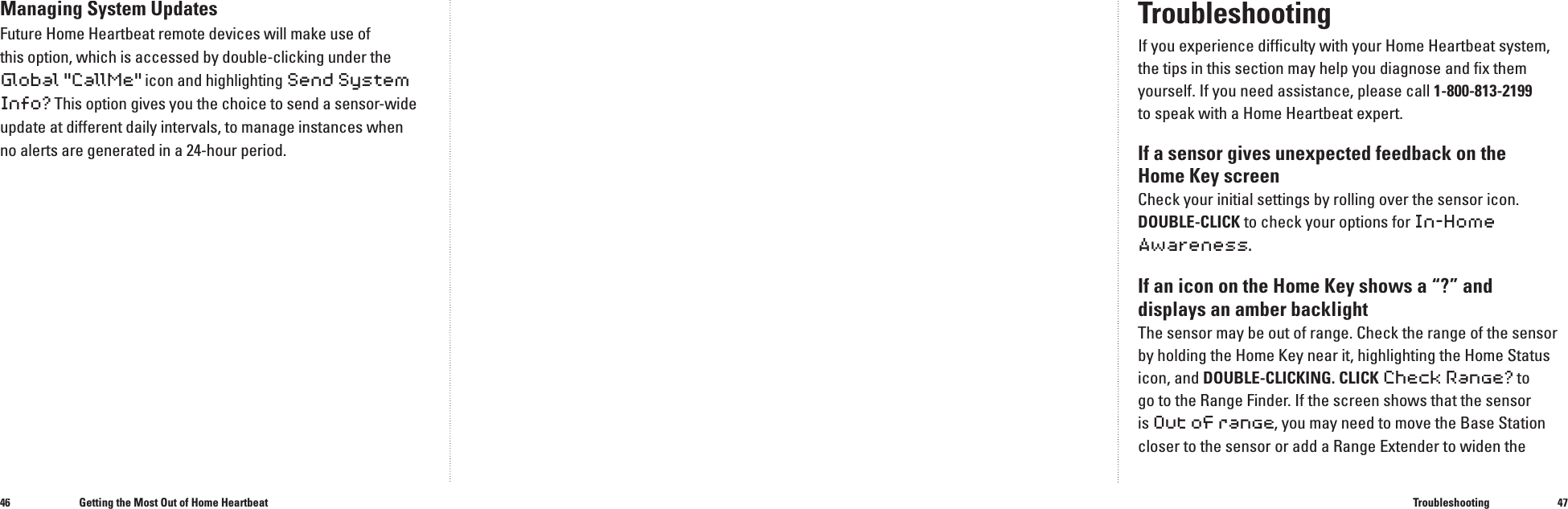
4647TroubleshootingIf you experience diffi culty with your Home Heartbeat system, the tips in this section may help you diagnose and fi x them yourself. If you need assistance, please call 1-800-813-2199to speak with a Home Heartbeat expert.If a sensor gives unexpected feedback on the Home Key screen Check your initial settings by rolling over the sensor icon. DOUBLE-CLICK to check your options for In-Home Awareness.If an icon on the Home Key shows a “?” and displays an amber backlight The sensor may be out of range. Check the range of the sensor by holding the Home Key near it, highlighting the Home Status icon, and DOUBLE-CLICKING. CLICK Check Range? to go to the Range Finder.If the screen shows that the sensor is Out of range, you may need to move the Base Station closer to the sensor or add a Range Extender to widen the TroubleshootingManaging System UpdatesFuture Home Heartbeat remote devices will make use of this option, which is accessed by double-clicking under the Global "CallMe" icon and highlighting Send System Info? This option gives you the choice to send a sensor-wide update at different daily intervals, to manage instances when no alerts are generated in a 24-hour period.Getting the Most Out of Home Heartbeat
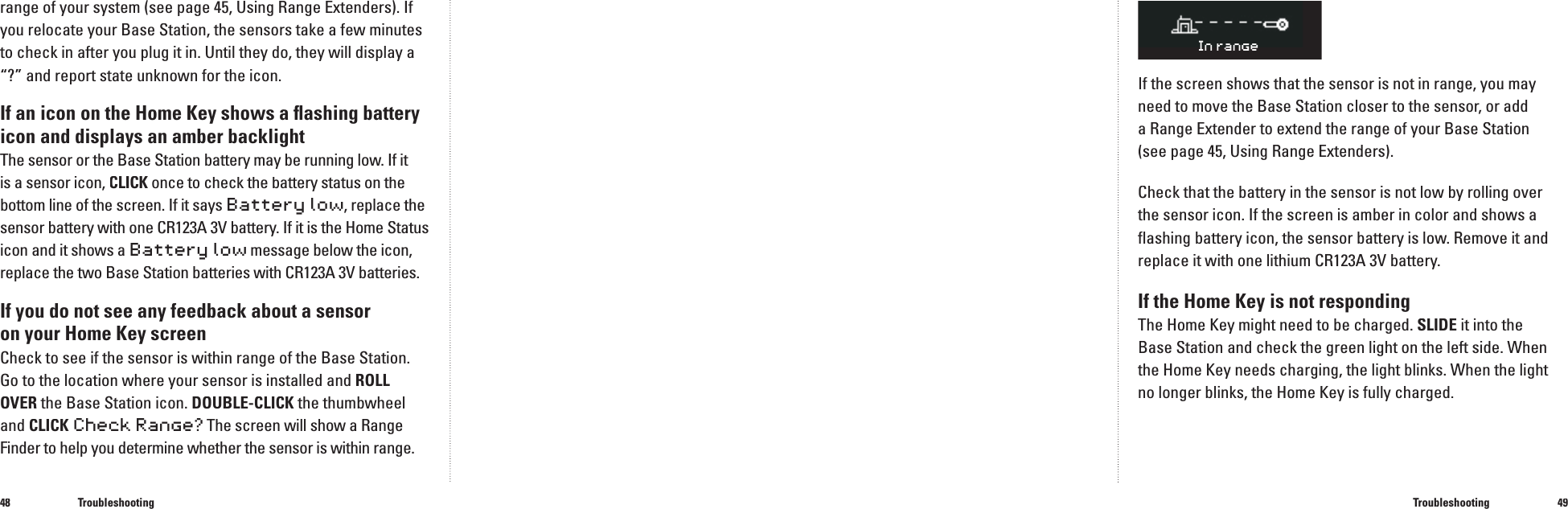
4849range of your system (see page 45, Using Range Extenders). If you relocate your Base Station, the sensors take a few minutes to check in after you plug it in. Until they do, they will display a “?” and report state unknown for the icon.If an icon on the Home Key shows a fl ashing battery icon and displays an amber backlightThe sensor or the Base Station battery may be running low. If it is a sensor icon, CLICK once to check the battery status on the CLICK once to check the battery status on the CLICKbottom line of the screen. If it says Battery low, replace the sensor battery with one CR123A 3V battery. If it is the Home Status icon and it shows a Battery low message below the icon, replace the two Base Station batteries with CR123A 3V batteries.If you do not see any feedback about a sensor on your Home Key screen Check to see if the sensor is within range of the Base Station. Go to the location where your sensor is installed and ROLL OVER the Base Station icon. DOUBLE-CLICKthe thumbwheel and CLICKCheck Range?The screen will show a Range Finderto help you determine whether the sensor is within range.TroubleshootingIf the screen shows that the sensor is not in range, you may need to move the Base Station closer to the sensor, or adda Range Extender to extend the range of your Base Station (see page 45, Using Range Extenders).Check that the battery in the sensor is not low by rolling over the sensor icon. If the screen is amber in color and shows a fl ashing battery icon, the sensor battery is low. Remove it and replace it with one lithium CR123A 3V battery.If the Home Key is not respondingThe Home Key might need to be charged. SLIDE it into the Base Station and check the green light on the left side. When the Home Key needs charging, the light blinks. When the light no longer blinks, the Home Key is fully charged.Troubleshooting�
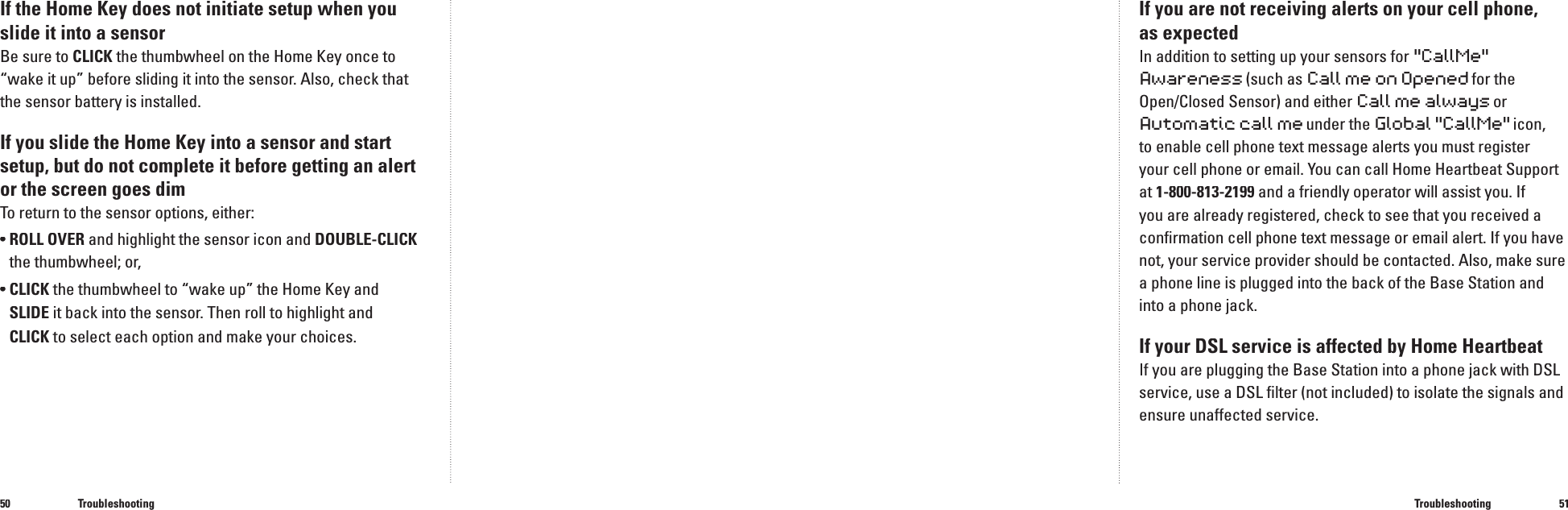
5051If the Home Key does not initiate setup when you slide it into a sensorBe sure to CLICK the thumbwheel on the Home Key once to “wake it up” before sliding it into the sensor. Also, check that the sensor battery is installed.If you slide the Home Key into a sensor and start setup, but do not complete it before getting an alert or the screen goes dimTo return to the sensor options, either:•  ROLL OVER and highlight the sensor icon and DOUBLE-CLICKthe thumbwheel; or,•  CLICK the thumbwheel to “wake up” the Home Key and SLIDE it back into the sensor. Then roll to highlight and CLICK to select each option and make your choices.TroubleshootingIf you are not receiving alerts on your cell phone, as expectedIn addition to setting up your sensors for "CallMe" Awareness(such as Call me on Opened for theOpen/Closed Sensor) and either Call me always or Automatic call me under the Global "CallMe" icon, to enable cell phone text message alerts you must register your cell phone or email. You can call Home Heartbeat Support at 1-800-813-2199 and a friendly operator will assist you. If you are already registered, check to see that you received a confi rmation cell phone text message or email alert. If you have not, your service provider should be contacted. Also, make sure a phone line is plugged into the back of the Base Station and into a phone jack.If your DSL service is affected by Home HeartbeatIf you are plugging the Base Station into a phone jack with DSL service, use a DSL fi lter (not included) to isolate the signals and ensure unaffected service.Troubleshooting
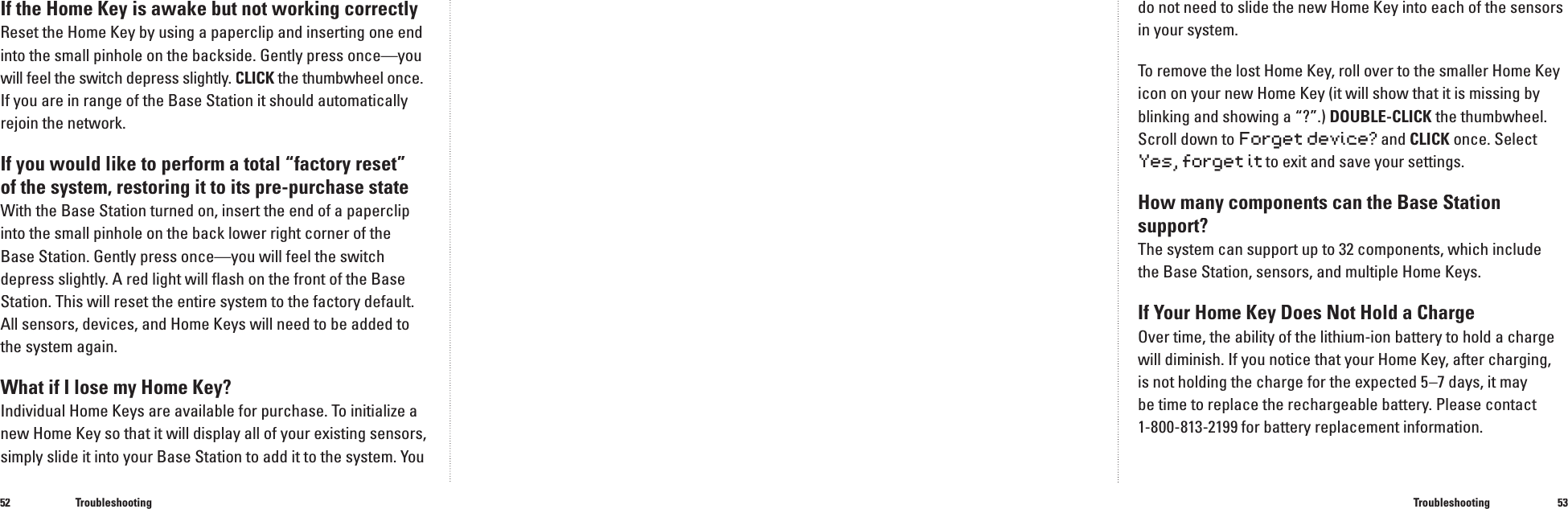
5253If the Home Key is awake but not working correctlyReset the Home Key by using a paperclip and inserting one end into the small pinhole on the backside. Gently press once—you will feel the switch depress slightly. CLICK the thumbwheel CLICK the thumbwheel CLICKonce.If you are in range of the Base Station it should automatically rejoin the network.If you would like to perform a total “factory reset” of the system, restoring it to its pre-purchase stateWith the Base Station turned on, insert the end of a paperclip into the small pinhole on the back lower right corner of the Base Station. Gently press once—you will feel the switch depress slightly. A red light will fl ash on the front of the Base Station. This will reset the entire system to the factory default. All sensors, devices, and Home Keys will need to be added to the system again.What if I lose my Home Key?Individual Home Keys are available for purchase. To initialize a new Home Key so that it will display all of your existing sensors, simply slide it into your Base Station to add it to the system. You TroubleshootingTroubleshootingdo not need to slide the new Home Key into each of the sensors in your system.To remove the lost Home Key, roll over to the smaller Home Key icon on your new Home Key (it will show that it is missing by blinking and showing a “?”.) DOUBLE-CLICK the thumbwheel. Scroll down toForget device? and CLICK once. Select Yes, forget it to exit and save your settings.How many components can the Base Station support?The system can support up to 32 components, which include the Base Station, sensors, and multiple Home Keys.If Your Home Key Does Not Hold a ChargeOver time, the ability of the lithium-ion battery to hold a charge will diminish. If you notice that your Home Key, after charging, is not holding the charge for the expected 5–7 days, it may be time to replace the rechargeable battery. Please contact 1-800-813-2199 for battery replacement information.
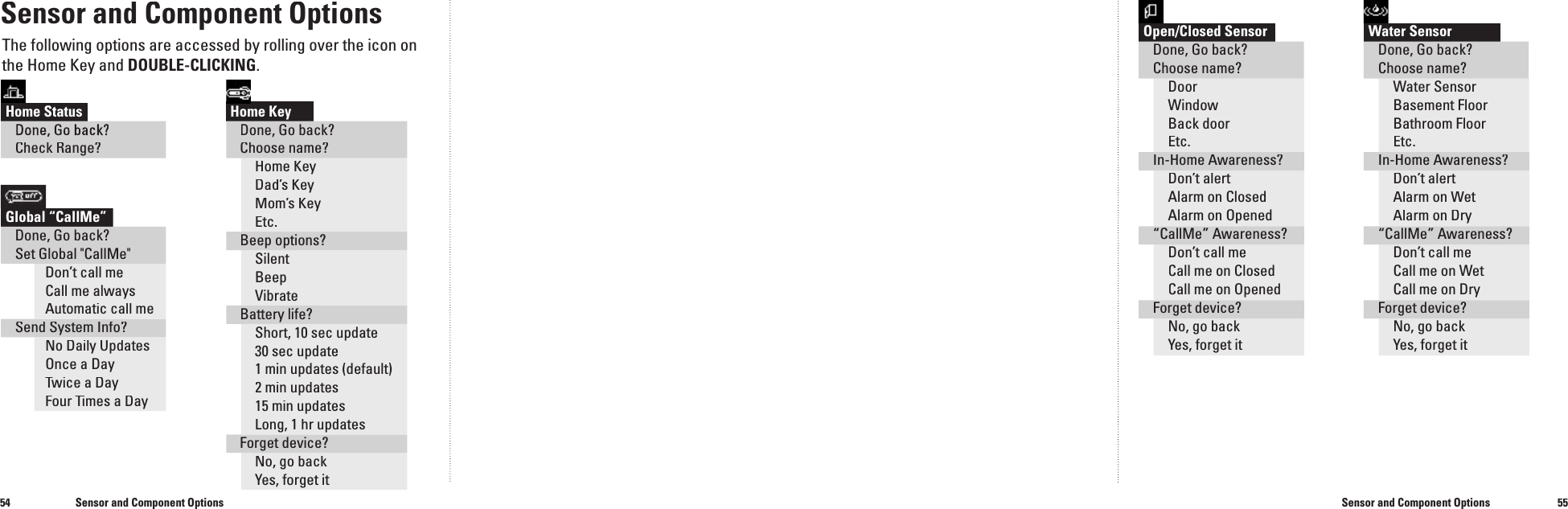
5455Sensor and Component OptionsThe following options are accessed by rolling over the icon on the Home Key and DOUBLE-CLICKING.Open/Closed SensorDone, Go back?Choose name?DoorWindowBack doorEtc.In-Home Awareness?Don’t alertAlarm on ClosedAlarm on Opened“CallMe” Awareness?Don’t call meCall me on ClosedCall me on OpenedForget device?No, go backYes, forget itWater SensorDone, Go back?Choose name?Water SensorBasement FloorBathroom FloorEtc.In-Home Awareness?  Don’t alert  Don’t alert  Alarm on Wet  Alarm on Wet  Alarm on Dry  Alarm on Dry“CallMe” Awareness?  Don’t call me  Don’t call me  Call me on Wet  Call me on Wet  Call me on Dry  Call me on DryForget device?No, go backYes, forget itSensor and Component OptionsSensor and Component OptionsHome StatusDone, Go back?Check Range?Global “CallMe” Done, Go back?Set Global "CallMe"Don’t call meCall me alwaysAutomatic call meSend System Info?No Daily UpdatesOnce a DayTwice a DayFour Times a DayHome KeyDone, Go back?Choose name?Home KeyDad’s KeyMom’s KeyEtc.Beep options?SilentBeepVibrateBattery life?Short, 10 sec update30 sec update 1 min updates (default)2 min updates 15 min updates Long, 1 hr updates Forget device?No, go backYes, forget it
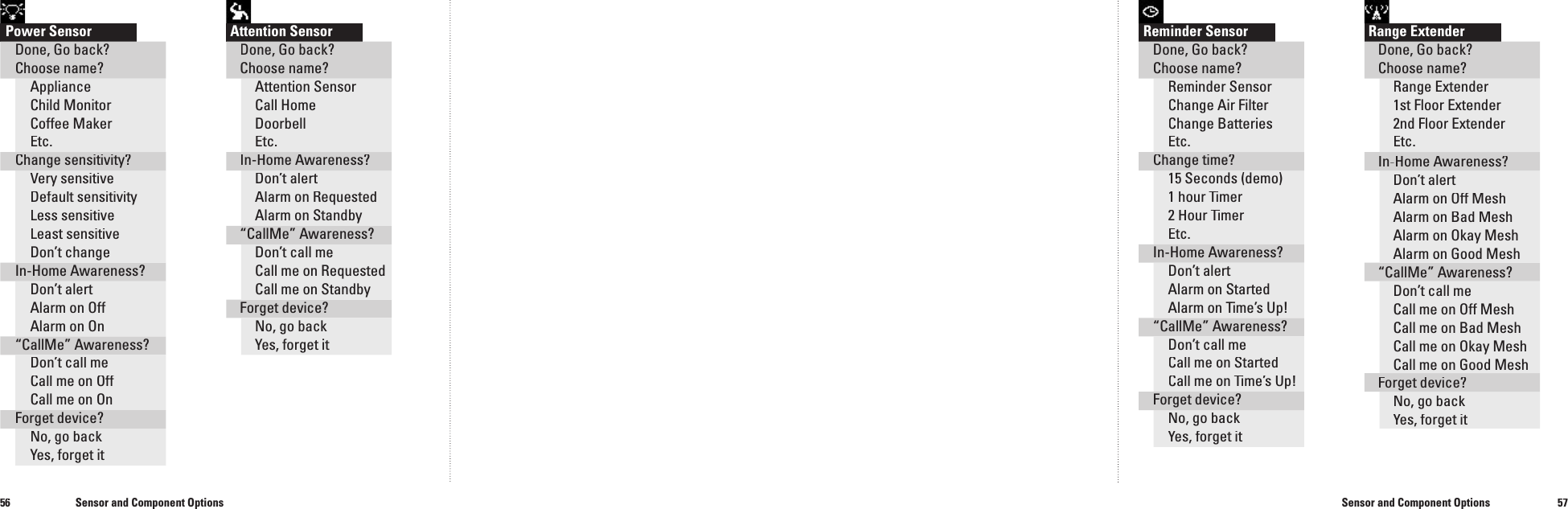
5657Power SensorDone, Go back?Choose name?ApplianceChild MonitorCoffee MakerEtc.Change sensitivity?Very sensitiveDefault sensitivityLess sensitiveLeast sensitiveDon’t change In-Home Awareness?Don’t alertAlarm on OffAlarm on On“CallMe” Awareness?Don’t call meCall me on OffCall me on OnForget device?No, go backYes, forget it Attention SensorDone, Go back?Choose name?Attention SensorCall HomeDoorbellEtc.In-Home Awareness?Don’t alertAlarm on RequestedAlarm on Standby“CallMe” Awareness?Don’t call meCall me on RequestedCall me on StandbyForget device?No, go backYes, forget itReminder SensorDone, Go back?Choose name?Reminder SensorChange Air FilterChange BatteriesEtc.Change time?15 Seconds (demo)1 hour Timer2 Hour TimerEtc.In-Home Awareness?Don’t alertAlarm on StartedAlarm on Time’s Up!“CallMe” Awareness?Don’t call meCall me on StartedCall me on Time’s Up!Forget device?No, go backYes, forget itRange ExtenderDone, Go back?Choose name?Range Extender1st Floor Extender2nd Floor ExtenderEtc.In-Home Awareness?Don’t alertAlarm on Off MeshAlarm on Bad MeshAlarm on Okay MeshAlarm on Good Mesh“CallMe” Awareness?Don’t call meCall me on Off MeshCall me on Bad MeshCall me on Okay MeshCall me on Good MeshForget device?No, go backYes, forget itSensor and Component OptionsSensor and Component Options
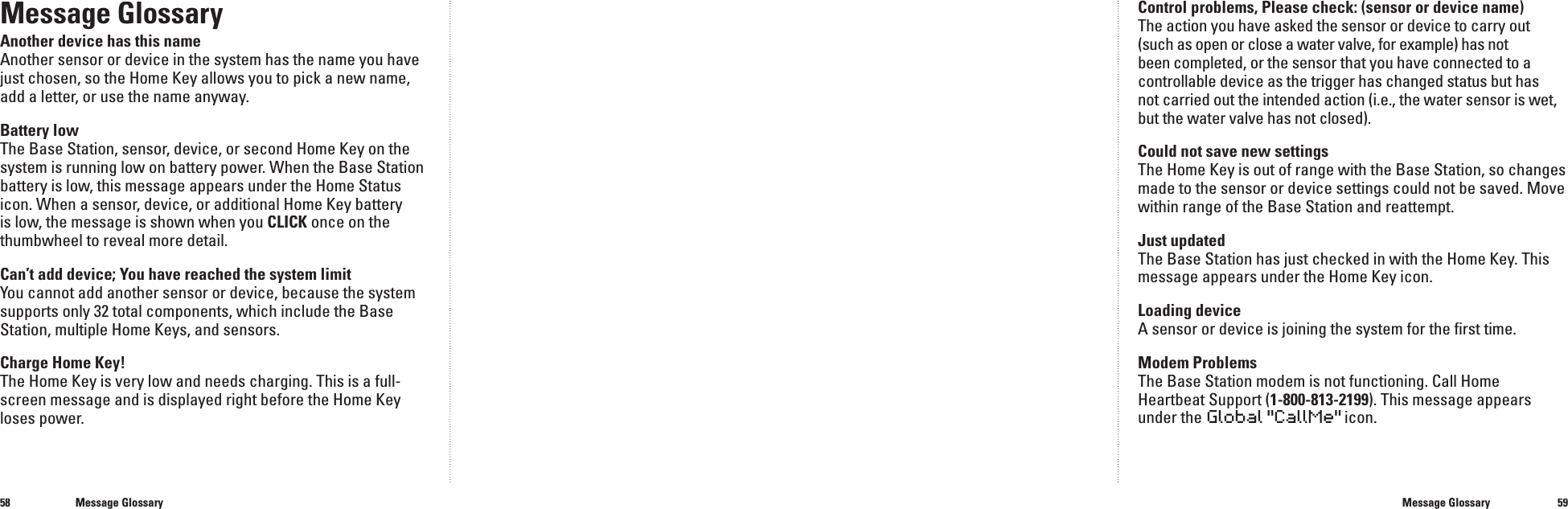
5859Message GlossaryAnother device has this nameAnother sensor or device in the system has the name you have just chosen, so the Home Key allows you to pick a new name, add a letter, or use the name anyway.Battery lowThe Base Station, sensor, device, or second Home Key on the system is running low on battery power. When the Base Station battery is low, this message appears under the Home Status icon. When a sensor, device, or additional Home Key battery is low, the message is shown when you CLICK once on the thumbwheel to reveal more detail.Can’t add device; You have reached the system limitYou cannot add another sensor or device, because the system supports only 32 total components, which include the Base Station, multiple Home Keys, and sensors. Charge Home Key!The Home Key is very low and needs charging. This is a full-screen message and is displayed right before the Home Key loses power.Control problems, Please check: (sensor or device name)The action you have asked the sensor or device to carry out(such as open or close a water valve, for example) has not been completed, or the sensor that you have connected to a controllable device as the trigger has changed status but has not carried out the intended action (i.e., the water sensor is wet, but the water valve has not closed).Could not save new settingsThe Home Key is out of range with the Base Station, so changes made to the sensor or device settings could not be saved. Move within range of the Base Station and reattempt.Just updatedThe Base Station has just checked in with the Home Key. This message appears under the Home Key icon.Loading deviceA sensor or device is joining the system for the fi rst time.Modem ProblemsThe Base Station modem is not functioning. Call Home Heartbeat Support (1-800-813-2199). This message appears under the Global"CallMe" icon.Message GlossaryMessage Glossary
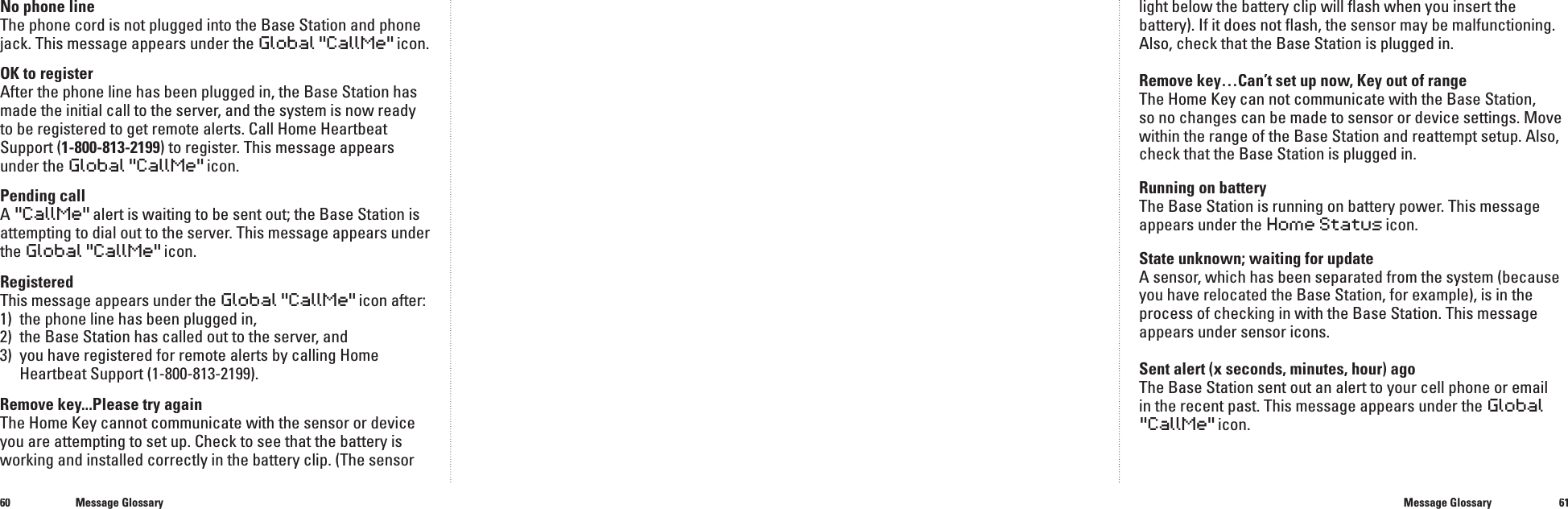
6061No phone lineThe phone cord is not plugged into the Base Station and phone jack. This message appears under the Global"CallMe" icon.OK to registerAfter the phone line has been plugged in, the Base Station has made the initial call to the server, and the system is now ready to be registered to get remote alerts. Call Home Heartbeat Support (1-800-813-2199) to register. This message appears under the Global"CallMe" icon.Pending callA"CallMe"alert is waiting to be sent out; the Base Station is attempting to dial out to the server. This message appears under the Global"CallMe" icon.RegisteredThis message appears under theGlobal"CallMe"icon after:1)  the phone line has been plugged in,2)   the Base Station has called out to the server, and3)   you have registered for remote alerts by calling Home Heartbeat Support (1-800-813-2199).Remove key...Please try againThe Home Key cannot communicate with the sensor or device you are attempting to set up. Check to see that the battery is working and installed correctly in the battery clip. (The sensor light below the battery clip will fl ash when you insert the battery). If it does not fl ash, the sensor may be malfunctioning. Also, check that the Base Station is plugged in.Remove key…Can’t set up now, Key out of rangeThe Home Key can not communicate with the Base Station, so no changes can be made to sensor or device settings. Move within the range of the Base Station and reattempt setup. Also, check that the Base Station is plugged in.Running on battery The Base Station is running on battery power. This message appears under the Home Status icon.State unknown; waiting for updateA sensor, which has been separated from the system (because you have relocated the Base Station, for example), is in the process of checking in with the Base Station. This message appears under sensor icons.Sent alert (x seconds, minutes, hour) ago The Base Station sent out an alert to your cell phone or email in the recent past. This message appears under the Global"CallMe" icon.Message GlossaryMessage Glossary
6263Sent update (x seconds, minutes, hour) agoOnce a day, the Base Station reports the status of your system to the server. This message appears under the Global "CallMe" icon.Server processingAfter a call is tried, the server has received the alert from the Base Station and is processing it. This message appears under the Global "CallMe" icon.Trying CallThe Base Station is attempting to call out to the server to send an alert.This message appears under the Global "CallMe"icon.Warning! Battery LowThe Home Key battery is low and needs to be charged. This message appears as a full-screen alert. Slide the Home Key into the Base Station and charge until the green light on the left stops fl ashing.(#) Missing DeviceThis message will appear under the Home Status icon when a sensor or device has been separated from the system because it is out of range with the Base Station or the battery is dead. This message may also appear to indicate that a second Home Key on the system has left the range of the Base Station (such as when one family member is home with their Home Key and another leaves).Message GlossarySupportSupportIf you need help setting up or using Home Heartbeat, there are two easy ways to get help.Visit www.homeheartbeat.com to learn more about the Home Heartbeat system and read or download additional product support materials.To speak directly with someone who can help you, call 1-800-813-2199 and one of our friendly Home Heartbeat experts will provide assistance.FCC Statement(Compliance Statement, Part 15.19): This device complies with Part 15 of the FCC Rules. Operation is subject to the following two conditions: (1) this device may not cause harmful interference, and (2) this device must accept any interference received, including interference that may cause undesired operation.WARNING (Part 15.21): Changes or modifi cations not expressly approved by the party responsible for compliance could void the user’s authority to operate this equipment.To comply with FCC’s RF exposure limits for general population/uncontrolled exposure, the antenna(s) used for this transmitter must be installed to provide a separation distance of at least 20 cm from all persons and must not be co-located or operating in conjunction with any other antenna or transmitter.Industry Canada StatementThe term “IC” before the certifi cation/registration number only signifi es that the Industry Canada technical specifi cations were met.InterferenceThis equipment has been tested and found to comply with the limits for a Class B digital device, pursuant to Part 15 of the FCC rules. These limits are designed to provide reasonable protection against harmful interference in a residential installation. This equipment generates, uses, and can radiate radio frequency energy and, if not installed and used in accordance with the instructions, may cause harmful interference to radio communications. However, there is no guarantee that interference will not occur in a particular installation. If this equipment does cause harmful interference to radio or television reception, which can be determined by turning the equipment off and on, then the user is encouraged to try to correct the interference by one or more of the following measures:• Reorient or relocate the receiving antenna• Increase the separation between the equipment and the receiver• Connect the equipment into a power source on different circuit than the receiver.
Eaton Electrical Inc.1000 Cherrington ParkwayMoon Township, PA 15108www.homeheartbeat.com© 2005 Eaton CorporationAll Rights ReservedAssembled in the U.S.A.IM00416001E Rev. 2Part No.: 67A5002H01

Navigation menu