Ember EMBER2002 Modular Spread Spectrum Transmitter User Manual DevKitUser

Ember Corporation Modular Spread Spectrum Transmitter DevKitUser

Users Manual

C o m p a n y    C o n f i d e n t i a lEmberNet Developer Kit User’s Guide120-0002-210      December 2002
C o m p a n y    C o n f i d e n t i a lCopyright © 2002 by Ember CorporationAll rights reservedThe information in this document is subject to change without notice. The statements, configurations, technical data,and recommendations in this document are believed to be accurate and reliable, but are presented without express orimplied warranty. Users must take full responsibility for their applications of any products specified in this document.The information in this document is the property of Ember Corporation.EmberNet and Ember are a trademarks of Ember Corporation.All other trademarks are the property of their respective holders.FCC Compliance for the EmberNet NodeCompliance Statement ( Part 15.19 )The EmberNet Node complies with Part 15 of the FCC Rules and with RSS-210 of Industry Canada.  Operation is subject to the following two conditions: --This device may not cause harmful interference, and --This device must accept any interference received, including interference that may cause undesired operation.Warning ( Part 15.21 )Changes or modifications not expressly approved by the party responsible for compliance could void the userís authority to operate the equipment.RF Exposure ( OET Bulletin 65 )To comply with FCC RF exposure requirements for mobile transmitting devices, this transmitter should only be used orinstalled at locations where there is at least 20cm separation distance between the antenna and all persons.The EmberNet Node is intended for installation in mobile devices, and is not intended for installation in portable devices.
 EmberNet Developer Kit User’s Guide 120-0002-210 iii C o m p a n y    C o n f i d e n t i a lContents PrefaceAbout This Guide viiAssociated EmberNet Documentation viiGetting Help viiCHAPTER 1  EmberNet Developer Kit OverviewDeveloper Kit Requirements 1-2Developer Kit Components 1-3Hardware Components 1-3Software Components 1-4Support Services 1-4Hardware Components 1-5EmberNet Node 1-5EmberNet Node Components 1-6EmberNet Node Connections 1-7EmberNet Breakout Boards 1-8Breakout board components and connections 1-9
iv      EmberNet Developer Kit User’s Guide 120-0002-210C o m p a n y    C o n f i d e n t i a lEmberNet Gateway 1-9EmberNet Gateway Components 1-10EmberNet Gateway Connections 1-10Radio antenna 1-11USB Programmer with cable 1-11Software Components 1-12GCC Compiler 1-12Alternate Compiler 1-12EmberNet Node Binary for EmberNet Node Hardware 1-12EmberNet Host API and EmberNet SPI Protocol (ESP) Command Set 1-12Sample Applications 1-13Application Template 1-13CHAPTER 2  Connecting the HardwareAttaching antennae 2-2About the antennae 2-2EmberNet Node antenna 2-2EmberNet Gateway antenna 2-4Connecting the antennae 2-5Connecting the EmberNet Breakout Board 2-6Breakout board components and connections 2-6Select Processor 2-9Set the Serial Select Dip Switch (SW4) 2-10Set the LED Select Dip Switch (SW3) 2-10Installing the EmberNet Gateway 2-11Connecting the Gateway 2-11CHAPTER 3  Using the EmberNet Developer Kit SoftwareInstalling the GCC Compiler 3-2To install the compiler 3-2To compile the sample applications 3-2About the sample applications 3-3To run the default sample application 3-3Using the Application Template 3-4To use the applicatoin template 3-4
EmberNet Developer Kit User’s Guide 120-0002-210  vC o m p a n y    C o n f i d e n t i a lUsing your Implementer ID 3-4Implementer code 3-5Project code 3-5Tag 3-5Defining services using your implementer ID 3-5CHAPTER 4  Installing and Using the USB ProgrammerInstalling the USB Programmer Software 4-2To install the USB Programmer software: 4-2Attach the USB Programmer 4-3To attach the USB Programmer: 4-3Configuring the ISP Super programmer software 4-6To configure the USB programmer: 4-6Programming the Processor 4-8To program the processor: 4-8
vi      EmberNet Developer Kit User’s Guide 120-0002-210C o m p a n y    C o n f i d e n t i a l
EmberNet Developer Kit User’s Guide 120-0002-210     viiC o m p a n y    C o n f i d e n t i a lPrefaceAbout This GuideThis guide introduces you to the components of the EmberNet Developer Kit and provides basic instruction for their use.Associated EmberNet DocumentationEmberNet OverviewEmberNet Application Development GuideEmberNet View User’s GuideEmberNet Node Technical SpecificationEmberNet Gateway Technical Specification
Prefaceviii    EmberNet Developer Kit User’s Guide 120-0002-210C o m p a n y    C o n f i d e n t i a lGetting HelpDocumentation, customer service, and support are available at support.ember.com or by contacting your account representative at Ember.
EmberNet Developer Kit User’s Guide   120-0002-210                   1-1C o m p a n y    C o n f i d e n t i a lCHAPTER 1 EmberNet Developer Kit OverviewOverviewThere are three versions of the EmberNet Developer Kit, a Standard, Advanced and a Premium version. Each Kit contains a number of hardware and software compo-nents to assist you in building an Ember Enabled application. This chapter provides a listing of components and their functions.
EmberNet Developer Kit Overview 1-2                                                   120-0002-210  EmberNet Developer Kit User’s Guide C o m p a n y    C o n f i d e n t i a lEmberNet Developer Kit ComponentsThe following table outlines the components for each EmberNet Developer Kit.Table 1-1: EmberNet Developer KitsStandard Advanced PremiumHardware 8 - EmberNet Nodes8 - EmberNet Breakout Boards1 - EmberNet Gateway1 - USB Programmer1 - 6ft. Ethernet patch cable9 - 9V power supplies12 - EmberNet Nodes12 - EmberNet Breakout Boards12 - EmberNet/Ethernet connection boards1 - EmberNet Gateway1 - USB Programmer1 - 6ft. Ethernet patch cable13 - 9V power supplies12 - EmberNet Nodes12 - EmberNet Breakout Boards12 - EmberNet/Ethernet connec-tion boards1 - EmberNet Gateway1 - USB Programmer1 - 6ft. Ethernet patch cable13 - 9V power suppliesSoftware and Documenta-tion1 - EmberNet Developer Kit CD1 - AVR-GCC 3.2.C Compiler (Win 32)1 - EmberNet Node Binary1 - EmberNet Host API Specifi-cations & Libraries1 - Sample Application1 - EmberNet View     EmberNet Documentation1 - EmberNet Developer Kit CD1 - AVR-GCC 3.2.C Compiler (Win 32)1 - EmberNet Node Binary1 - EmberNet Host API Specifica-tions & Libraries1 - Sample Application1 - EmberNet View1 - EmberNet Simulator v1.0 (Linux)1 - EmberNet Node Binary for EmberNet Simulator1 - EmberNet/Ethernet Debug Appli-cation     EmberNet Documentation1 - EmberNet Developer Kit CD1 - AVR-GCC 3.2.C Compiler (Win 32)1 - EmberNet Node Binary1 - EmberNet Host API Specifi-cations & Libraries1 - Sample Application1 - EmberNet View1 - EmberNet Simulator v1.0 (Linux)1 - EmberNet Node Binary for EmberNet Simulator1 - EmberNet/Ethernet Debug Application     EmberNet DocumentationTraining and Support1 year - Web based support Annual Support1 - Training SeatTelephone, email and web supportPremium Support• 3 days - custom engineer-ing(*T&E excluded)• 2 days (up to 5 students) - Onsite training  (*T&E excluded)• Telephone, email and web support.Optional Upgrades for additional feeDiscounted first seat trainingPer incident support: • $750 per three incidents • First three incidents free upon completion of trainingEmberNet Debug Kit includes:8 - EmberNet/Ethernet Connec-tion Boards1 - EmberNet Simulator1 - EmberNet/Ethernet Debug applicationAdditional training seatsAnnual supportCustom engineering• Additional Training seats• Custom Engineeringz• Additional Training seats• Additional Custom Engi-neering* Travel and Entertainments
 EmberNet Developer Kit User’s Guide   120-0002-210 1-3Developer Kit RequirementsC o m p a n y    C o n f i d e n t i a lDeveloper Kit RequirementsMost modern PCs provide the necessary requirements for developing Ember Enabled applications. Refer to the GCC documentation for specific details on the compiler’s requirements, but in general, the following should be sufficient:• Windows 98 and later• An available USB port for downloading images to the EmberNet Node or appli-cation code to the processor.• Adobe Acrobat reader (available via free download from www.adobe.com) for viewing the documentation.Additionally you may require these optional components• if you would like to connect and manage your EmberNet Gateway directly from your PC•Ethernet connection port on your PC•cross-over cable• if you would like to connect and manage your EmberNet Gateway via your local area network•local area network connection•standard serial cable•HyperTerminal (a Windows Accessory component)
EmberNet Developer Kit Overview 1-4                                                   120-0002-210  EmberNet Developer Kit User’s Guide C o m p a n y    C o n f i d e n t i a lDeveloper Kit ComponentsThe components of the EmberNet Developer Kit include both hardware and soft-ware components, as well as support services.Figure 1-1:  EmberNet Advanced Developer KitNOTE:  An Implementer ID number was included in your EmberNet Devel-oper Kit. This ID number MUST be used as described in Chapter 3 in order to ensure that your application will not interfere with other EmberNet networks.Hardware ComponentsThe hardware components of the development kit include the following:• Either  8 or 12 EmberNet Nodes (attached to Breakout Boards)• Either 8 or 12 EmberNet Breakout Boards (including pre-mounted RabbitCore boards for debugging, and 9V power supplies)• One EmberNet Gateway and 9V power supply• Either 8 or 12 medium profile antennae for the EmberNet Nodes
 EmberNet Developer Kit User’s Guide   120-0002-210 1-5Developer Kit ComponentsC o m p a n y    C o n f i d e n t i a l• One medium profile antenna for the EmberNet Gateway • One USB Programmer with cable, programming applications, and documenta-tion• One 6-foot Ethernet patch cableSoftware ComponentsThe software in the EmberNet Developer Kit includes the following:• EmberNet Developer Suite CD, which includes:• EmberNet Host API• Source code• EmberNet Node binary for EmberNet Node hardware• EmberNet Debug Logging Utility• Application template• Sample applications• GNU/GCC compilerNOTE:  If you are interested in purchasing a commercial compiler, we recommend the IAR Embedded Workbench from IAR Systems. Refer to www.iar.com for more information and pricing, or to download a free demo copy. • EmberNet DocumentationNOTE:  The EmberNet documentation is provided in Adobe Acrobat format (pdf). To view the documentation, you need the Adobe Acrobat reader, available free from www.adobe.com. Support ServicesThe EmberNet Developer Kit also provides you with access to Ember’s Technical Support resources, including training, phone and e-mail support, and the Ember Support web site. Refer to www.ember.com for more details on these services.
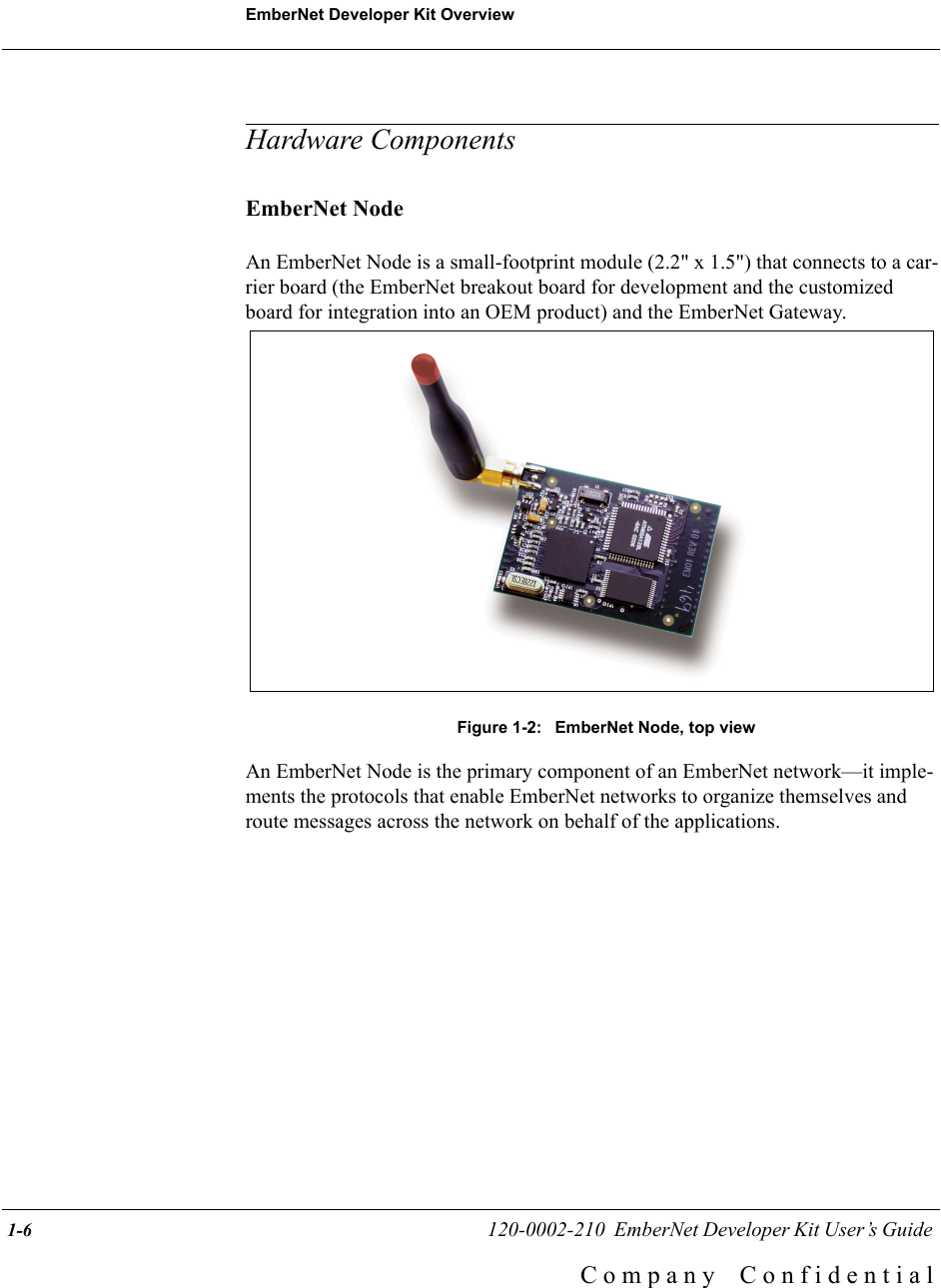
EmberNet Developer Kit Overview 1-6                                                   120-0002-210  EmberNet Developer Kit User’s Guide C o m p a n y    C o n f i d e n t i a lHardware ComponentsEmberNet NodeAn EmberNet Node is a small-footprint module (2.2" x 1.5") that connects to a car-rier board (the EmberNet breakout board for development and the customized board for integration into an OEM product) and the EmberNet Gateway.Figure 1-2:  EmberNet Node, top viewAn EmberNet Node is the primary component of an EmberNet network—it imple-ments the protocols that enable EmberNet networks to organize themselves and route messages across the network on behalf of the applications.
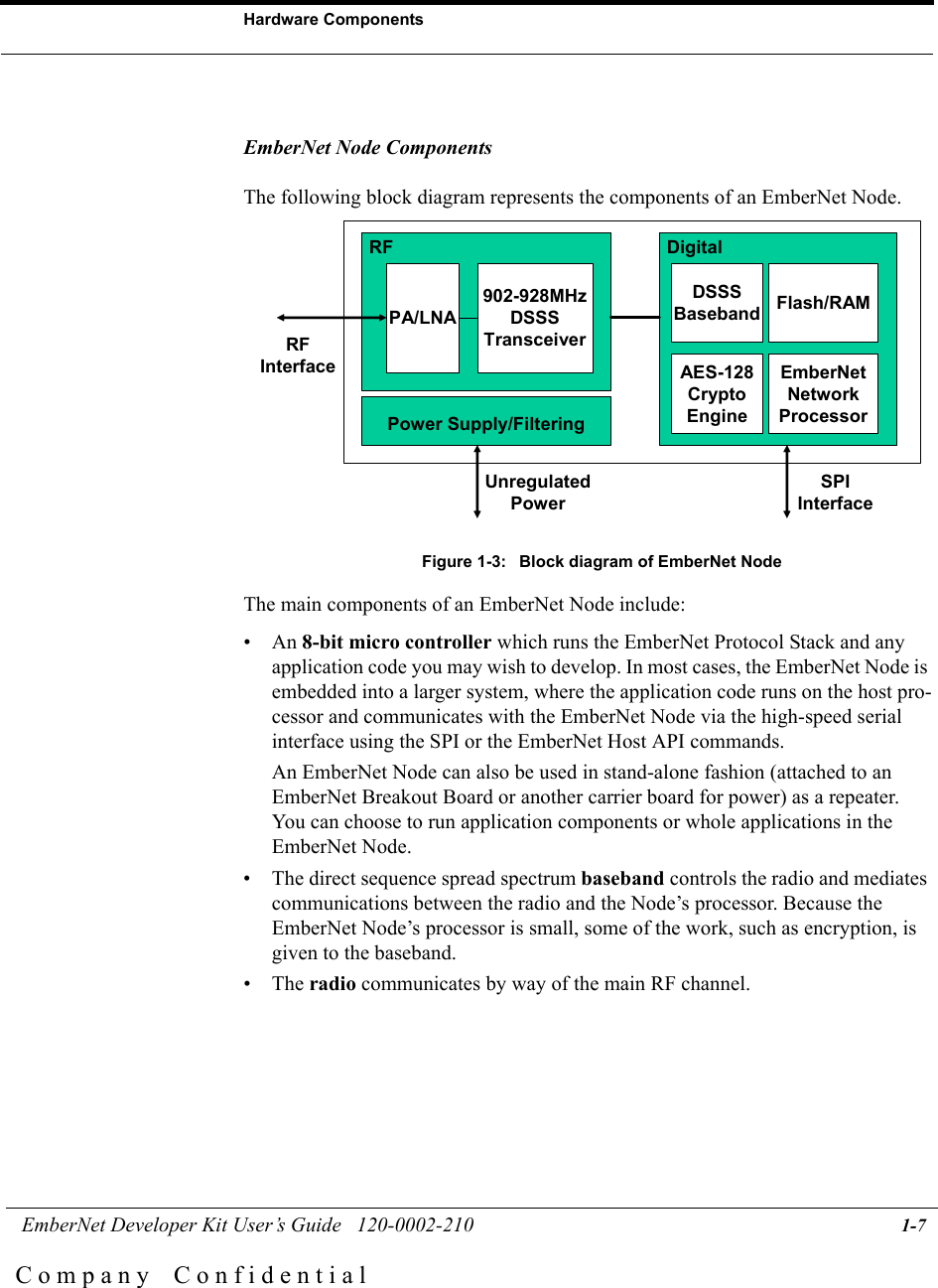
 EmberNet Developer Kit User’s Guide   120-0002-210 1-7Hardware ComponentsC o m p a n y    C o n f i d e n t i a lEmberNet Node ComponentsThe following block diagram represents the components of an EmberNet Node. Figure 1-3:  Block diagram of EmberNet NodeThe main components of an EmberNet Node include:•An 8-bit micro controller which runs the EmberNet Protocol Stack and any application code you may wish to develop. In most cases, the EmberNet Node is embedded into a larger system, where the application code runs on the host pro-cessor and communicates with the EmberNet Node via the high-speed serial interface using the SPI or the EmberNet Host API commands. An EmberNet Node can also be used in stand-alone fashion (attached to an EmberNet Breakout Board or another carrier board for power) as a repeater. You can choose to run application components or whole applications in the EmberNet Node. • The direct sequence spread spectrum baseband controls the radio and mediates communications between the radio and the Node’s processor. Because the EmberNet Node’s processor is small, some of the work, such as encryption, is given to the baseband.• The radio communicates by way of the main RF channel.PA/LNA902-928MHzDSSSTransceiverDSSSBasebandAES-128CryptoEngineEmberNetNetworkProcessorFlash/RAMRF DigitalRFInterfaceSPIInterfacePower Supply/FilteringUnregulatedPower
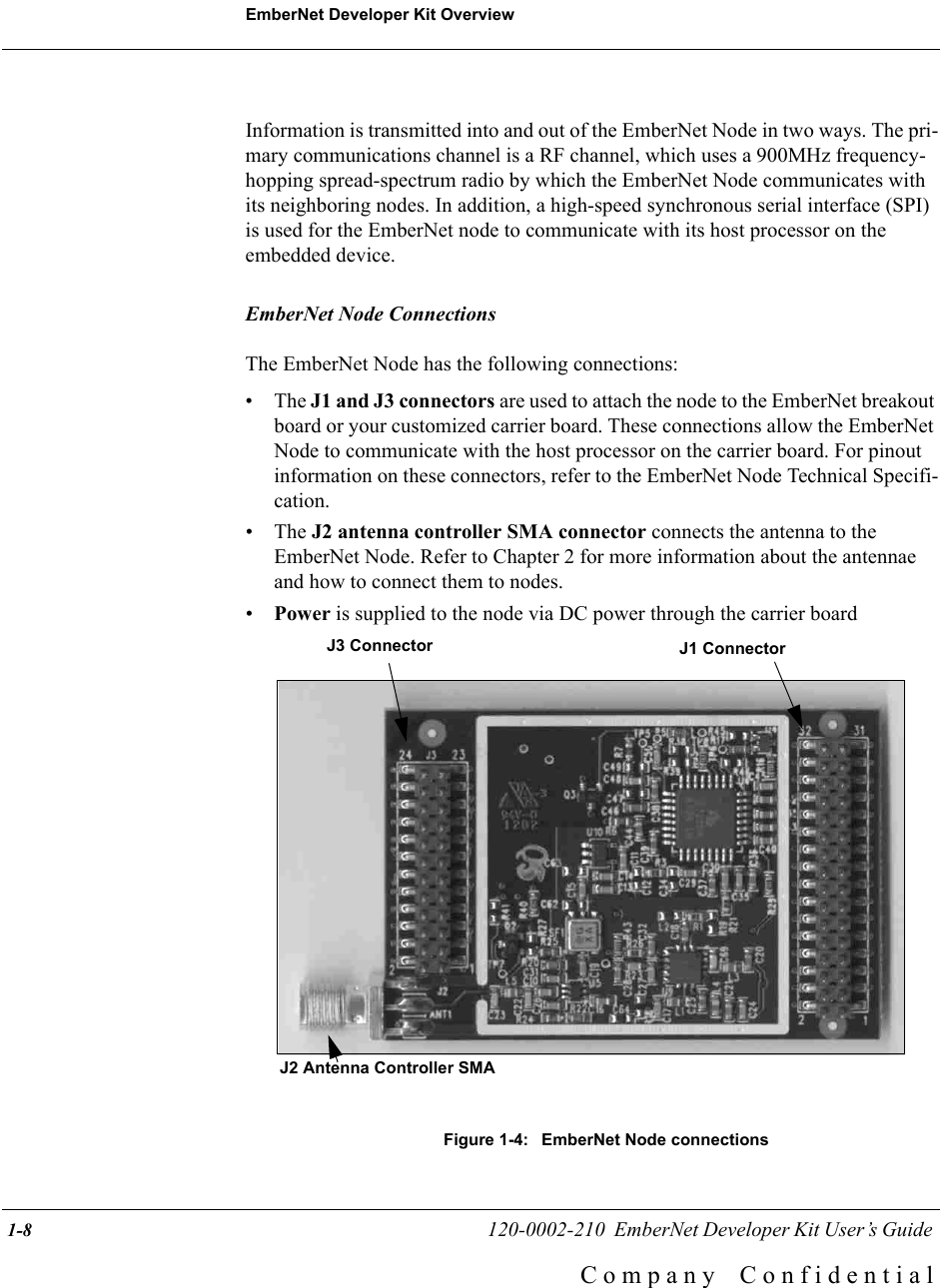
EmberNet Developer Kit Overview 1-8                                                   120-0002-210  EmberNet Developer Kit User’s Guide C o m p a n y    C o n f i d e n t i a lInformation is transmitted into and out of the EmberNet Node in two ways. The pri-mary communications channel is a RF channel, which uses a 900MHz frequency-hopping spread-spectrum radio by which the EmberNet Node communicates with its neighboring nodes. In addition, a high-speed synchronous serial interface (SPI) is used for the EmberNet node to communicate with its host processor on the embedded device.EmberNet Node ConnectionsThe EmberNet Node has the following connections:• The J1 and J3 connectors are used to attach the node to the EmberNet breakout board or your customized carrier board. These connections allow the EmberNet Node to communicate with the host processor on the carrier board. For pinout information on these connectors, refer to the EmberNet Node Technical Specifi-cation.• The J2 antenna controller SMA connector connects the antenna to the EmberNet Node. Refer to Chapter 2 for more information about the antennae and how to connect them to nodes.•Power is supplied to the node via DC power through the carrier boardFigure 1-4:  EmberNet Node connectionsJ1 ConnectorJ3 ConnectorJ2 Antenna Controller SMA
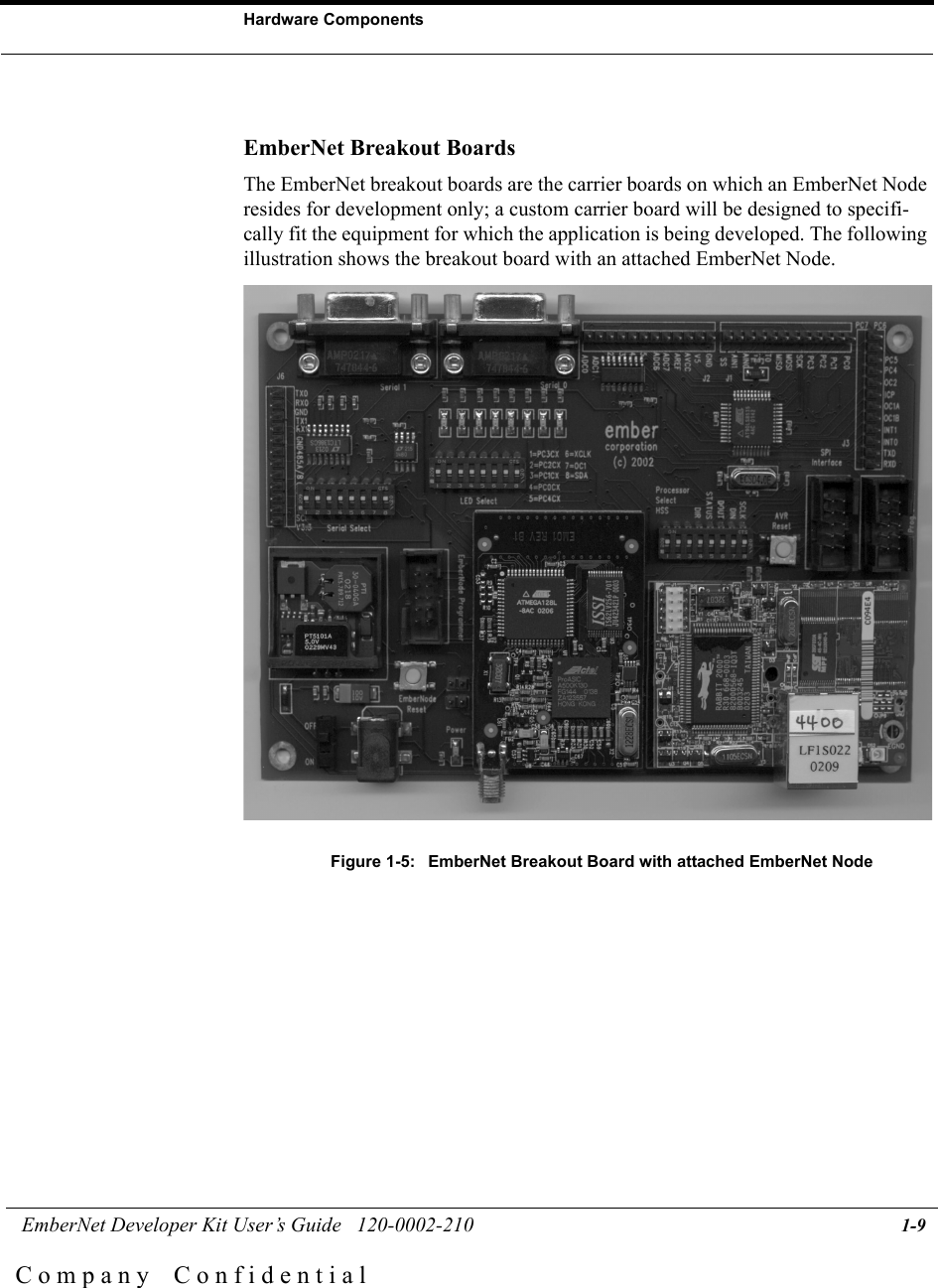
 EmberNet Developer Kit User’s Guide   120-0002-210 1-9Hardware ComponentsC o m p a n y    C o n f i d e n t i a lEmberNet Breakout BoardsThe EmberNet breakout boards are the carrier boards on which an EmberNet Node resides for development only; a custom carrier board will be designed to specifi-cally fit the equipment for which the application is being developed. The following illustration shows the breakout board with an attached EmberNet Node.Figure 1-5:  EmberNet Breakout Board with attached EmberNet Node
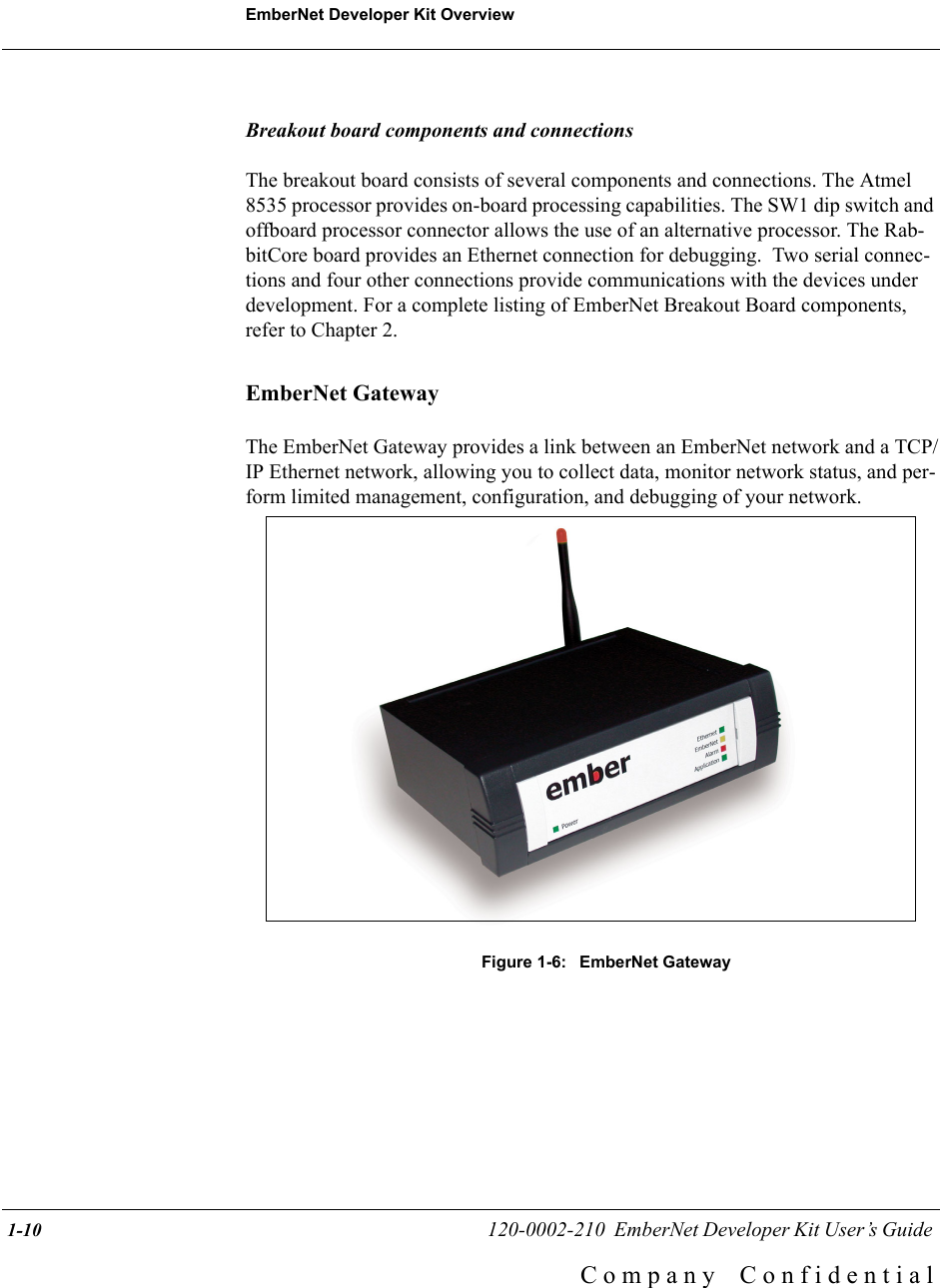
EmberNet Developer Kit Overview 1-10                                                   120-0002-210  EmberNet Developer Kit User’s Guide C o m p a n y    C o n f i d e n t i a lBreakout board components and connectionsThe breakout board consists of several components and connections. The Atmel 8535 processor provides on-board processing capabilities. The SW1 dip switch and offboard processor connector allows the use of an alternative processor. The Rab-bitCore board provides an Ethernet connection for debugging.  Two serial connec-tions and four other connections provide communications with the devices under development. For a complete listing of EmberNet Breakout Board components, refer to Chapter 2.EmberNet GatewayThe EmberNet Gateway provides a link between an EmberNet network and a TCP/IP Ethernet network, allowing you to collect data, monitor network status, and per-form limited management, configuration, and debugging of your network.Figure 1-6:  EmberNet Gateway
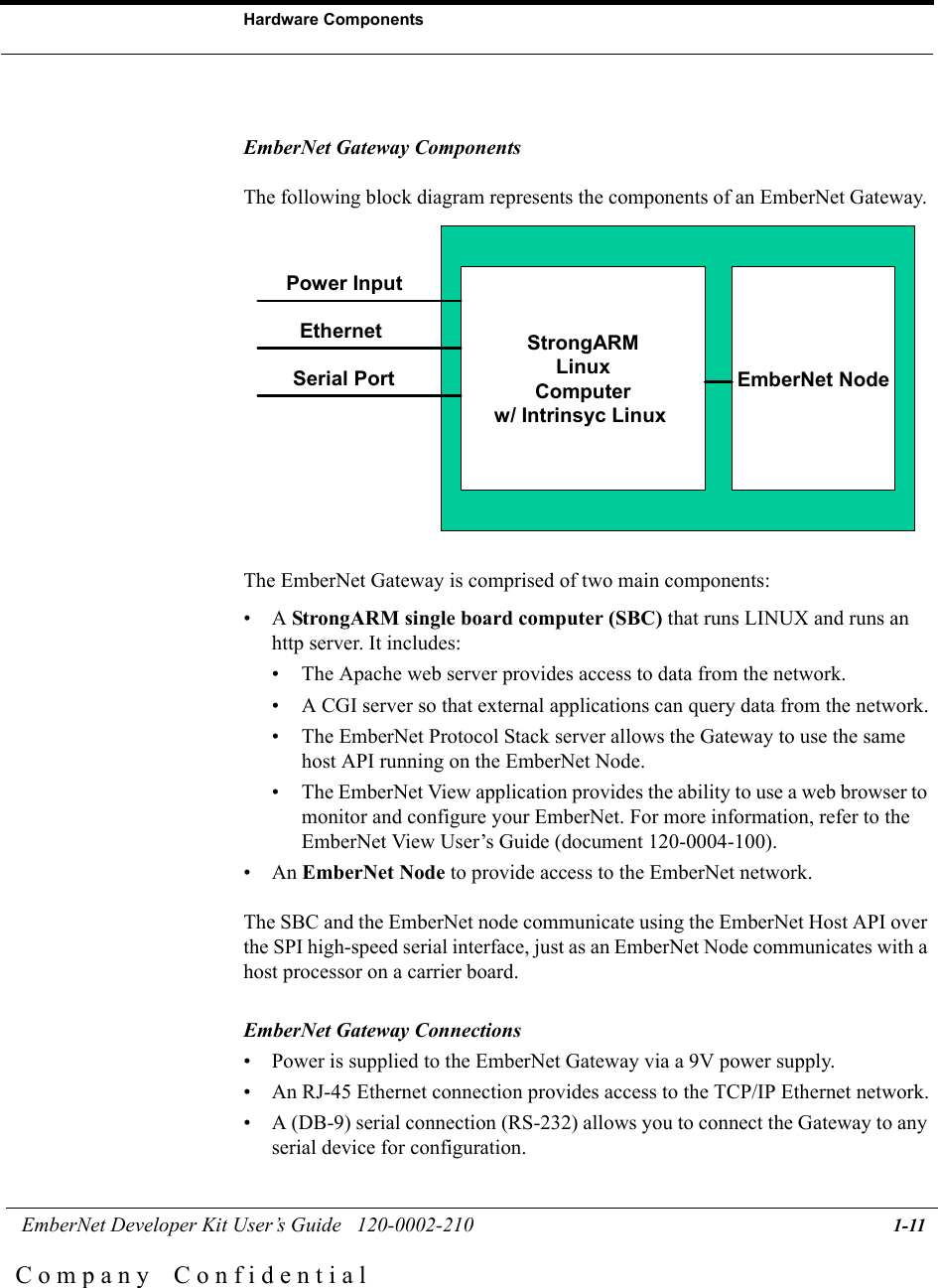
 EmberNet Developer Kit User’s Guide   120-0002-210 1-11Hardware ComponentsC o m p a n y    C o n f i d e n t i a lEmberNet Gateway ComponentsThe following block diagram represents the components of an EmberNet Gateway. The EmberNet Gateway is comprised of two main components:•A StrongARM single board computer (SBC) that runs LINUX and runs an http server. It includes:• The Apache web server provides access to data from the network.• A CGI server so that external applications can query data from the network.• The EmberNet Protocol Stack server allows the Gateway to use the same host API running on the EmberNet Node.• The EmberNet View application provides the ability to use a web browser to monitor and configure your EmberNet. For more information, refer to the EmberNet View User’s Guide (document 120-0004-100).•An EmberNet Node to provide access to the EmberNet network.The SBC and the EmberNet node communicate using the EmberNet Host API over the SPI high-speed serial interface, just as an EmberNet Node communicates with a host processor on a carrier board.EmberNet Gateway Connections• Power is supplied to the EmberNet Gateway via a 9V power supply.• An RJ-45 Ethernet connection provides access to the TCP/IP Ethernet network.• A (DB-9) serial connection (RS-232) allows you to connect the Gateway to any serial device for configuration. EmberNet NodeStrongARMLinuxComputerw/ Intrinsyc Linux Power InputEthernetSerial Port
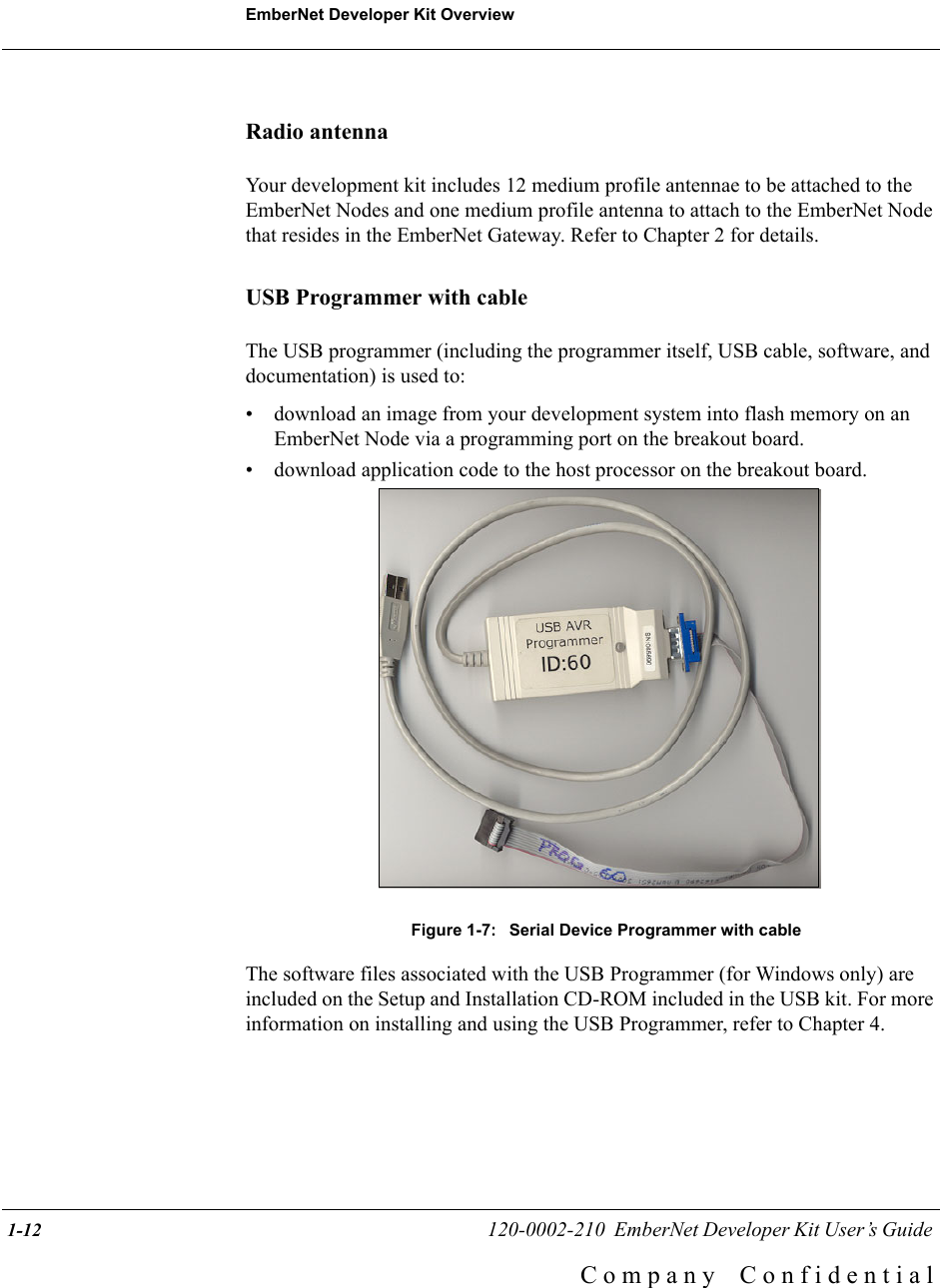
EmberNet Developer Kit Overview 1-12                                                   120-0002-210  EmberNet Developer Kit User’s Guide C o m p a n y    C o n f i d e n t i a lRadio antennaYour development kit includes 12 medium profile antennae to be attached to the EmberNet Nodes and one medium profile antenna to attach to the EmberNet Node that resides in the EmberNet Gateway. Refer to Chapter 2 for details.USB Programmer with cableThe USB programmer (including the programmer itself, USB cable, software, and documentation) is used to:• download an image from your development system into flash memory on an EmberNet Node via a programming port on the breakout board. • download application code to the host processor on the breakout board.Figure 1-7:  Serial Device Programmer with cableThe software files associated with the USB Programmer (for Windows only) are included on the Setup and Installation CD-ROM included in the USB kit. For more information on installing and using the USB Programmer, refer to Chapter 4.
 EmberNet Developer Kit User’s Guide   120-0002-210 1-13Software ComponentsC o m p a n y    C o n f i d e n t i a lSoftware ComponentsA number of EmberNet software tools are used in the development of Ember Enabled devices. GCC CompilerThe EmberNet Developer Kit includes the Win32 build of avr-gcc 3.2, the GCC Compiler for a Windows development environments. The AVR-GCC C compiler is made available under the GNU general public license. There are a number of web sites, including www.avrfreaks.com and gcc.gnu.org, that offer documentation and support via discussion boards for this compiler.   Alternate CompilerIf you are interested in purchasing a commercial compiler, we recommend the IAR Embedded Workbench from IAR Systems. Refer to www.iar.com for more infor-mation and pricing, or to download a free demo copy. EmberNet Node Binary for EmberNet Node HardwareThe EmberNet Node binary contains the software image for the EmberNet Node. This image is provided in the event that you need to reload it onto the EmberNet Node.EmberNet Host API and EmberNet SPI Protocol (ESP) Command SetThe EmberNet Host API is a set of commands that allows the EmberNet Node and the host processor to communicate across the high-speed SPI interface. The API should be used if you are using the ATMel 8535 processor on the breakout board for application development.   For more information on the API, refer to the Ember-Net Application Development Guide (document 120-0003-100). For development using another processor, you should use the API source code and the EmberNet SPI Protocol (ESP) command set to port the API to the processor of your choice.
EmberNet Developer Kit Overview 1-14                                                   120-0002-210  EmberNet Developer Kit User’s Guide C o m p a n y    C o n f i d e n t i a lEmberNet Debug Logging UtilityThe EmberNet Debug Logging Utility provides a means for testing and analyzing EmberNet applications.  EmberNet Nodes attached to the breakout board can gen-erate a variety of debugging messages (configurable through EmberNet Host API) and send them through the Ethernet connection to the EmberNet Debug Logger Utility, a Java program that collects and formats the raw data.Sample ApplicationsA few sample applications are included in the EmberNet Developer Kit so that you can examine sample source code for an Ember Enabled application. For more infor-mation on the sample applications, refer to Chapter 3. You can also checksupport.ember.com for additional sample applications. Application TemplateA template is included for assisting in the development of the application for your Ember Enabled device. Refer to Chapter 3 for information on using the template.
 EmberNet Developer Kit User’s Guide   120-0002-210 2-1C o m p a n y    C o n f i d e n t i a lCHAPTER 2 Connecting the HardwareOverviewIn general, when developing an Ember Enabled device with the Developer Kit, use the following steps:1. Attach the antennae to the EmberNet Nodes and EmberNet Gateways. 2. Attach the EmberNet Breakout Board to the development system PC and to any external devices (sensors, external processor, etc.)3. Write the application code using the EmberNet Host API. Refer to the Ember-Net Application Development Guide. 4. Download the application code to the processor using the USB programmer. Refer to Chapter 4 for information on installing and using the USB programmer.5. Install the EmberNet Gateway to monitor the application using EmberNet View. Refer to the EmberNet View User’s Guide for more details on using this moni-toring tool.6. Use the EmberNet Debug Logging Utility to test and analyze EmberNet appli-cations.  Refer to Chapter 5 for information on installing and using the Ember-Net Debug Logging Utility.This chapter discusses attaching antennae to EmberNet Nodes and Gateways, con-necting an EmberNet Breakout Board for development, and installing an EmberNet Gateway.
Connecting the Hardware2-2                        120-0002-210   EmberNet Developer Kit User’s GuideC o m p a n y    C o n f i d e n t i a lAttaching antennaeThe EmberNet Developer Kit includes twelve medium profile antennae for use with the EmberNet Nodes and one medium profile antenna for the EmberNet Gate-way. These antennae can be used during the design and development of your EmberNet network. EmberNet Nodes and EmberNet Gateways are not shipped with pre-installed anten-nae, so you will need to attach them BEFORE powering on the EmberNet Node or EmberNet Gateway..CAUTION!Always connect an antenna to the EmberNet Node or EmberNet Gate-way prior to power up. Failure to do so could cause permanent dam-age to the EmberNet Node, EmberNet Gateway or the EmberNet Breakout Board.
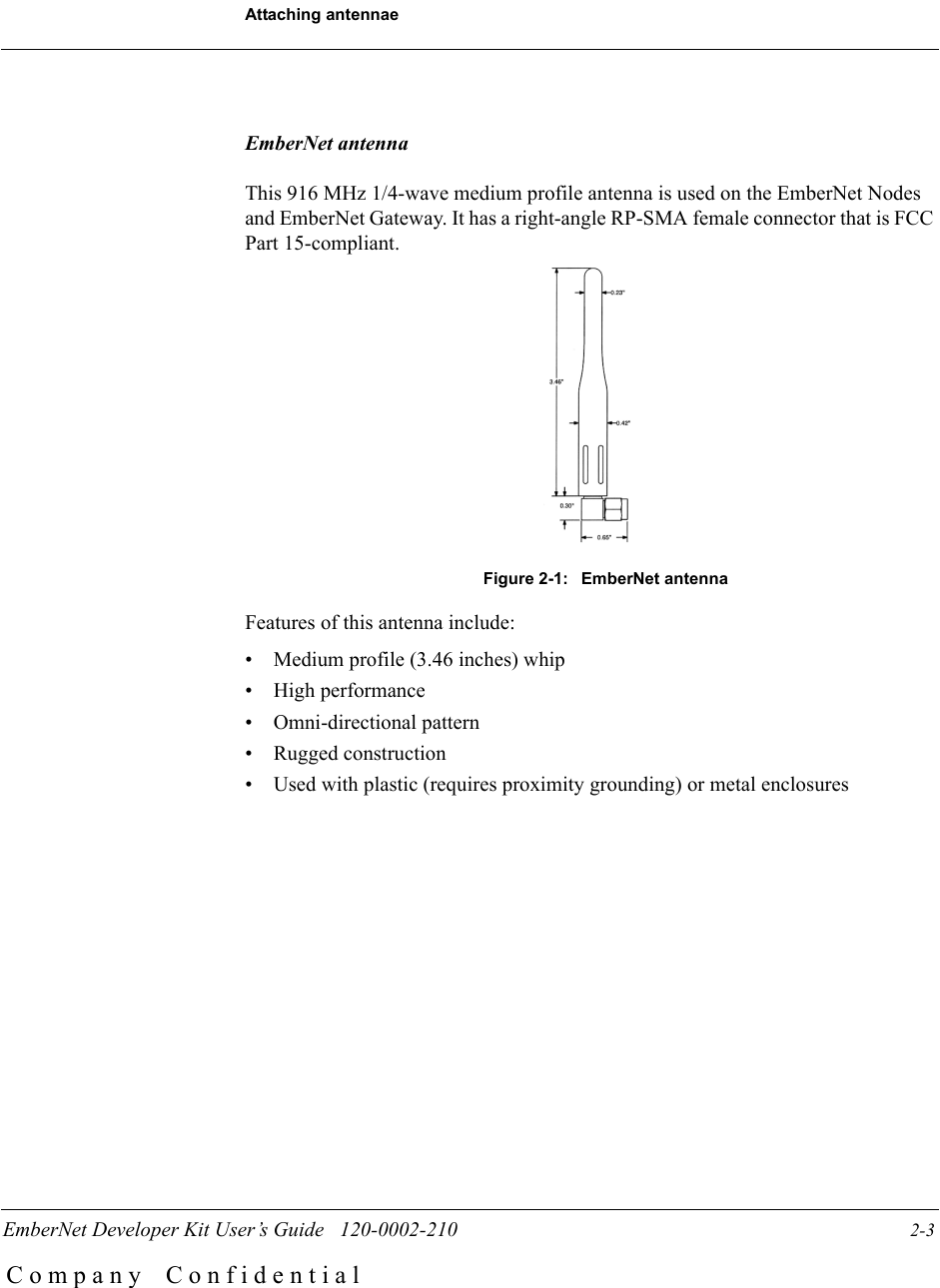
EmberNet Developer Kit User’s Guide   120-0002-210                  2-3Attaching antennaeC o m p a n y    C o n f i d e n t i a lEmberNet antennaThis 916 MHz 1/4-wave medium profile antenna is used on the EmberNet Nodes and EmberNet Gateway. It has a right-angle RP-SMA female connector that is FCC Part 15-compliant.Figure 2-1:  EmberNet antenna Features of this antenna include:• Medium profile (3.46 inches) whip• High performance• Omni-directional pattern• Rugged construction• Used with plastic (requires proximity grounding) or metal enclosures
Connecting the Hardware2-4                        120-0002-210   EmberNet Developer Kit User’s GuideC o m p a n y    C o n f i d e n t i a lConnecting the antennaeThe antennae have FCC Part 15-compliant RP-SMA female connectors that mate with RP-SMA male connectors on an EmberNet Node, which are factory-installed on the EmberNet Breakout Boards and EmberNet Gateways.CAUTION!Always connect the antenna to the EmberNet Node prior to power up. Failure to do so could cause permanent damage to the EmberNet Node, EmberNet Gateway or the EmberNet Breakout Board..To install an antenna on an EmberNet Node, perform the following steps:1. If attaching an antenna to an EmberNet Gateway, connect a medium profile antenna’s RP-SMA connector to the RP-SMA connector of the node in the EmberNet Gateway.2. If attaching an antenna to an EmberNet Node on the breakout board, connect a medium profile antenna’s RP-SMA connector to the EmberNet Node RP-SMA connector.3. Adjust the antenna, by hand, turning it so it is vertical. 4. Tighten the antenna’s RP-SMA connector, not to exceed 8 in-lb. of torque. Use an 8 in-lb. calibrated torque wrench if you are uncertain about the amount of torque you are applying. 5. Repeat steps until you have connected all antennae to all of the EmberNet Nodes.

Navigation menu