FM Broadcast FM300ES FM300ES FM Transmitter User Manual FM300 500ES 5

FM Broadcast Inc. FM300ES FM Transmitter FM300 500ES 5

Users Manual

PTEK1723 Little Orchard Street—Unit DSan Jose, CA 95125Phone—(408) 448-3342 / (888) 889-2958Fax—(408) 448-3342World Wide Web—http://www.ptekpower.comPTEK    reserves the right to revise and change any andall information included in this document.ES SeriesOperating Manualand User GuideVersion 2.0— Sept 2011TMTMES Series Operating Manual and User Guide
Copyright © 2009 PTEKALL RIGHT S RESERVED. No part of this publication may be reproduced in any form, byphotocopy, microfilm, retrieval system, or by any other means now known or hereafter invented withoutthe prior written permission of PTEK.The information in this publication has been carefully checked and is believed to be accurate. However,PTEK assumes no responsibility for inaccuracies. PTEK retains the right to make changes to thispublication at any time without prior notice. PTEK does not assume any liability arising from theapplication or use of this publication or the product(s) described herein.RESTRICTED RIGHTS LE GEND: Use, duplication, or disclosure by the United States Governmentis subject to the restrictions set forth in DFARS 252.227-7013 (c)(1)(ii) and FAR 52.227-19.PTEK Customer SupportTelephone: (408) 448-3342Fax: (408) 549-9991E-mail: service@ptekpower.comWeb Site: http://www.ptekpower.comES Series Operating Manual and User GuidePTEKTM
Revision HistoryVersion 1.0......................................................................................... March 2009......................................................................... ................... JulyVersion 1.1 2010Version 2.0...................................................................... ...................... Sept   2011ES Series Operating Manual and User GuidePTEKTM
Warranty ServiceThe Limited Warranty covers parts and labor to the original purchaser for three years. Damage caused by misuseor shipping is excluded from the Warranty.PTEKCustomer Service Manager1723 Little Orchard Street—Unit DSan Jose, CA 95125(408) 448-3342ES Series Operating Manual and User GuidePTEKTM
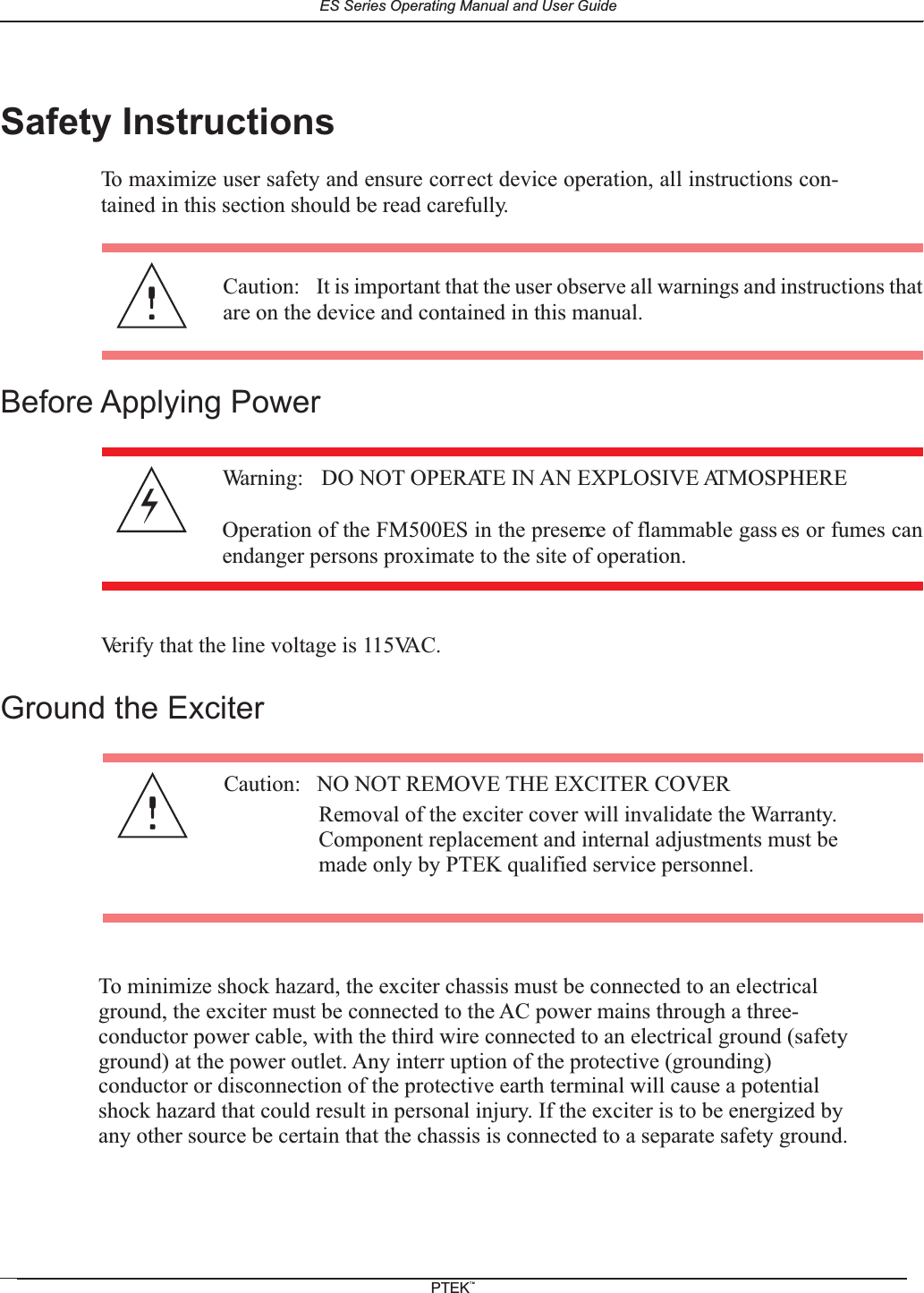
Safety InstructionsTo maximize user safety and ensure correct device operation, all instructions con-tained in this section should be read carefully.Before Applying PowerVerify that the line voltage is 115VAC.Ground the ExciterCaution: It is important that the user observe all warnings and instructions thatare on the device and contained in this manual.Warning: DO NOT OPERATE IN AN EXPLOSIVE ATMOSPHEREOperation of the FM500ES in the presence of flammable gass es or fumes canendanger persons proximate to the site of operation.Caution: NO NOT REMOVE THE EXCITER COVERRemoval of the exciter cover will invalidate the Warranty.Component replacement and internal adjustments must bemade only by PTEK qualified service personnel.To minimize shock hazard, the exciter chassis must be connected to an electricalground, the exciter must be connected to the AC power mains through a three-conductor power cable, with the third wire connected to an electrical ground (safetyground) at the power outlet. Any interr uption of the protective (grounding)conductor or disconnection of the protective earth terminal will cause a potentialshock hazard that could result in personal injury. If the exciter is to be energized byany other source be certain that the chassis is connected to a separate safety ground.ES Series Operating Manual and User GuidePTEKTM
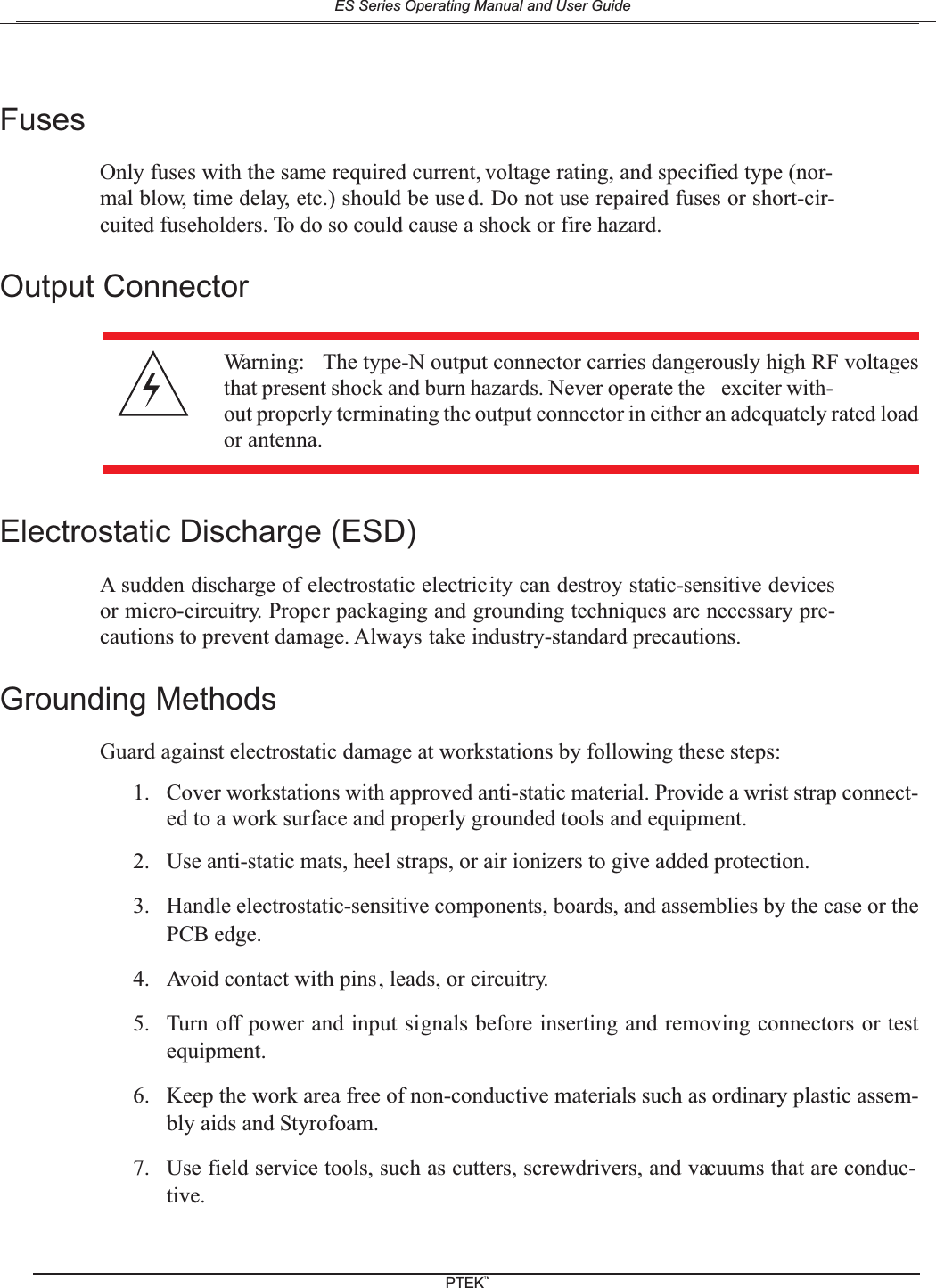
FusesOnly fuses with the same required current, voltage rating, and specified type (nor-mal blow, time delay, etc.) should be use d. Do not use repaired fuses or short-cir-cuited fuseholders. To do so could cause a shock or fire hazard.Output ConnectorElectrostatic Discharge (ESD)A sudden discharge of electrostatic electricity can destroy static-sensitive devicesor micro-circuitry. Proper packaging and grounding techniques are necessary pre-cautions to prevent damage. Always take industry-standard precautions.Grounding MethodsGuard against electrostatic damage at workstations by following these steps:1. Cover workstations with approved anti-static material. Provide a wrist strap connect-ed to a work surface and properly grounded tools and equipment.2. Use anti-static mats, heel straps, or air ionizers to give added protection.3. Handle electrostatic-sensitive components, boards, and assemblies by the case or thePCB edge.4. Avoid contact with pins, leads, or circuitry.5. Turn off power and input signals before inserting and removing connectors or testequipment.6. Keep the work area free of non-conductive materials such as ordinary plastic assem-bly aids and Styrofoam.7. Use field service tools, such as cutters, screwdrivers, and vacuums that are conduc-tive.Warning: The type-N output connector carries dangerously high RF voltagesthat present shock and burn hazards. Never operate the exciter with-out properly terminating the output connector in either an adequately rated loador antenna.ES Series Operating Manual and User GuidePTEKTM
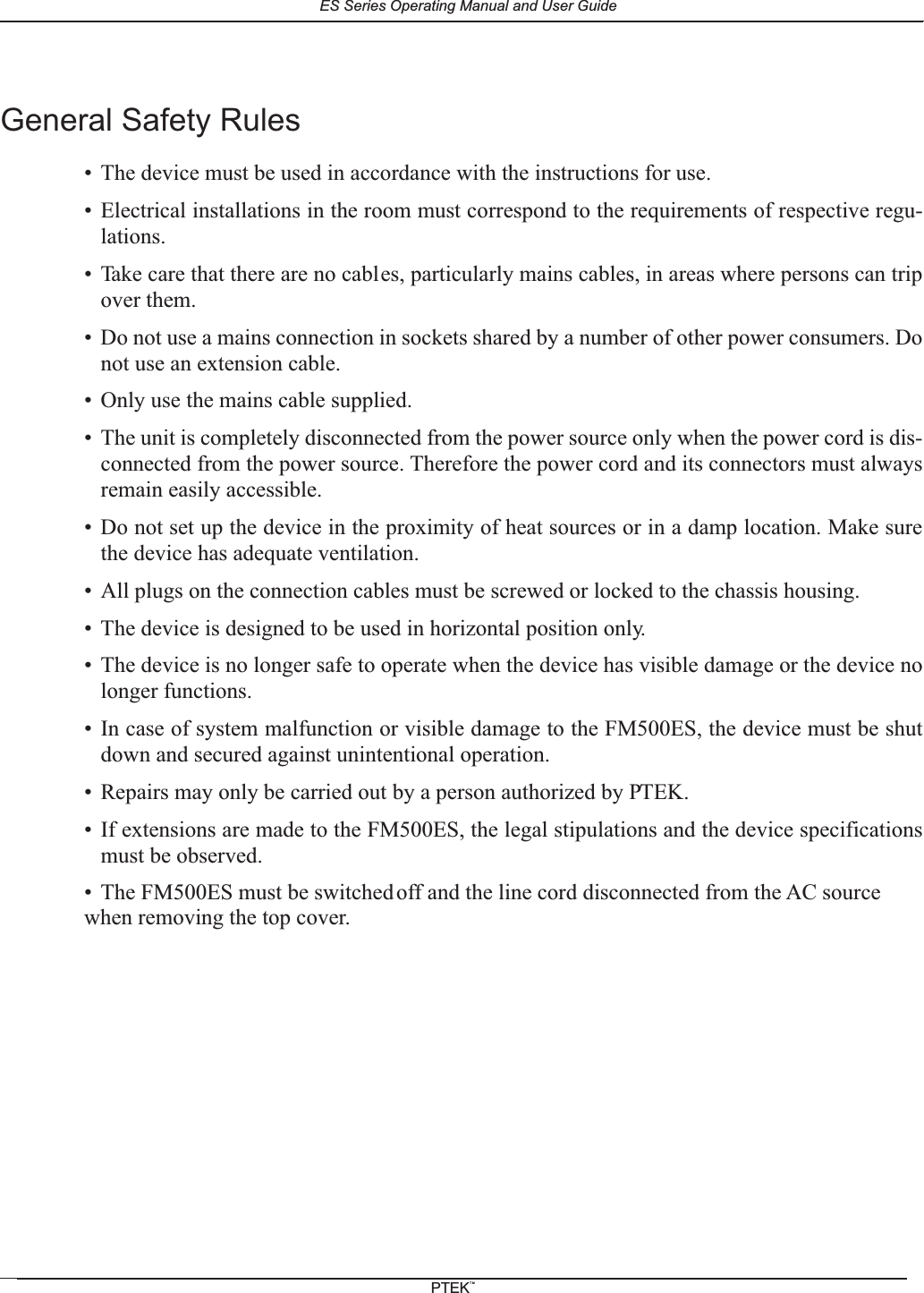
General Safety Rules• The device must be used in accordance with the instructions for use.• Electrical installations in the room must correspond to the requirements of respective regu-lations.• Take care that there are no cables, particularly mains cables, in areas where persons can tripover them.• Do not use a mains connection in sockets shared by a number of other power consumers. Donot use an extension cable.• Only use the mains cable supplied.• The unit is completely disconnected from the power source only when the power cord is dis-connected from the power source. Therefore the power cord and its connectors must alwaysremain easily accessible.• Do not set up the device in the proximity of heat sources or in a damp location. Make surethe device has adequate ventilation.• All plugs on the connection cables must be screwed or locked to the chassis housing.• The device is designed to be used in horizontal position only.• The device is no longer safe to operate when the device has visible damage or the device nolonger functions.• In case of system malfunction or visible damage to the FM500ES, the device must be shutdown and secured against unintentional operation.• Repairs may only be carried out by a person authorized by PTEK.• If extensions are made to the FM500ES, the legal stipulations and the device specificationsmust be observed.• The FM500ES must be switchedoff and the line cord disconnected from the AC sourcewhen removing the top cover.ES Series Operating Manual and User GuidePTEKTM
ES Series Operating Manual and User GuidePTEKTM
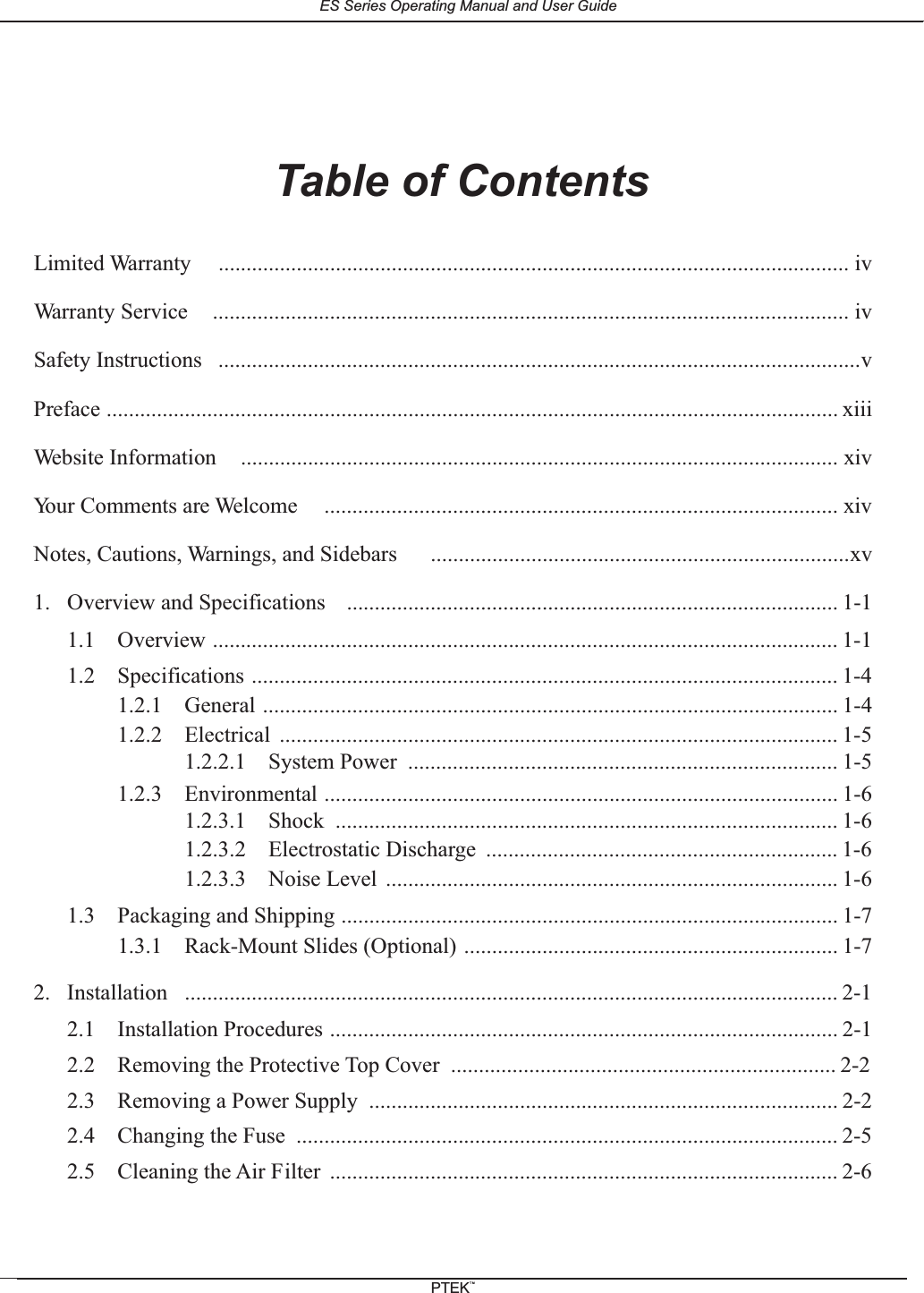
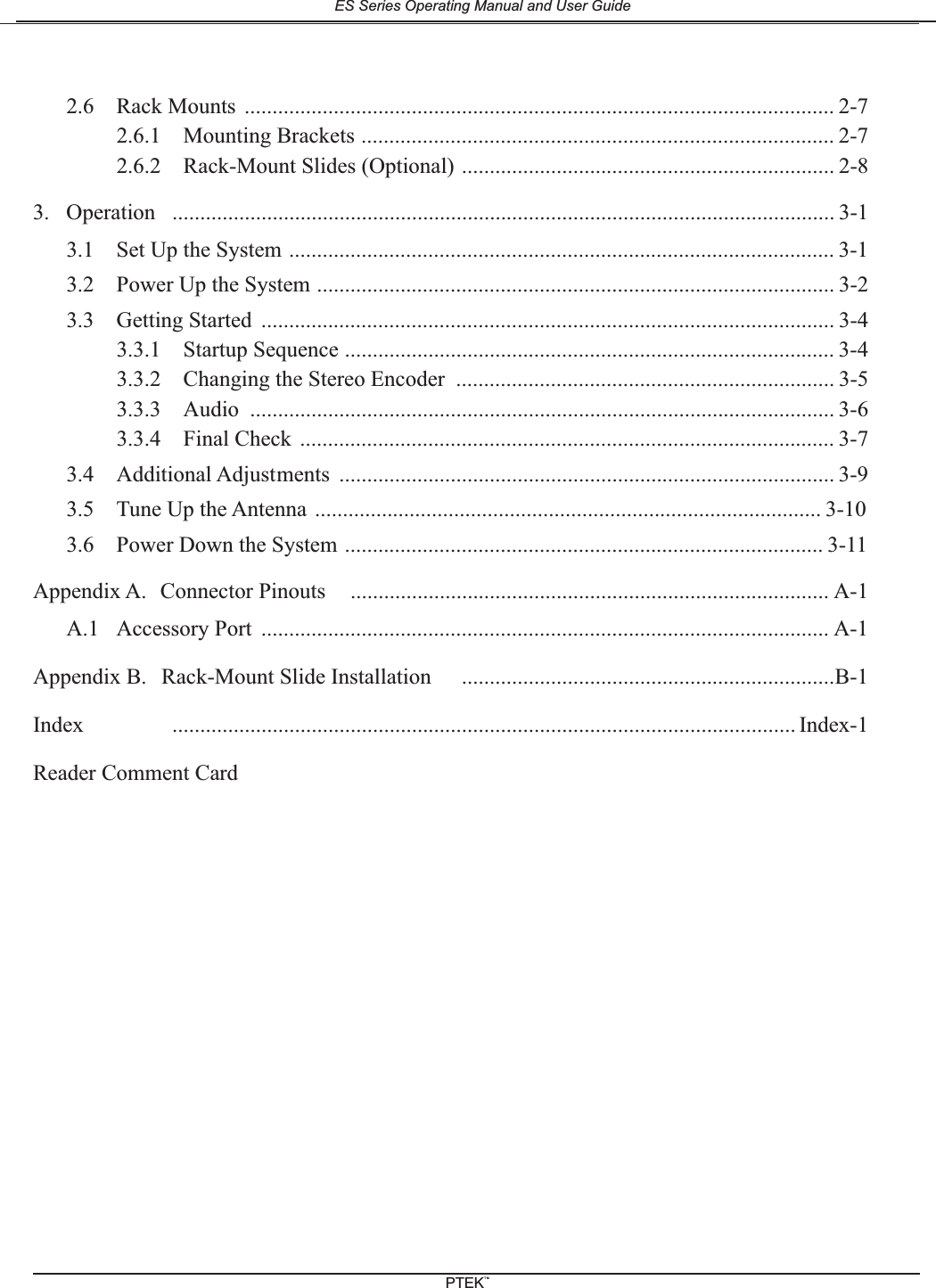
Table of ContentsLimited Warranty .................................................................................................................ivWarranty Service .................................................................................................................. ivSafety Instructions ...................................................................................................................vPreface ................................................................................................................................... xiiiWebsite Information ........................................................................................................... xivYour Comments are Welcome ............................................................................................ xivNotes, Cautions, Warnings, and Sidebars ...........................................................................xv1. Overview and Specifications ........................................................................................ 1-11.1 Overview ................................................................................................................ 1-11.2 Specifications ......................................................................................................... 1-41.2.1 General ....................................................................................................... 1-41.2.2 Electrical .................................................................................................... 1-51.2.2.1 System Power ............................................................................. 1-51.2.3 Environmental ............................................................................................ 1-61.2.3.1 Shock .......................................................................................... 1-61.2.3.2 Electrostatic Discharge ............................................................... 1-61.2.3.3 Noise Level ................................................................................. 1-61.3 Packaging and Shipping ......................................................................................... 1-71.3.1 Rack-Mount Slides (Optional) ................................................................... 1-72. Installation ..................................................................................................................... 2-12.1 Installation Procedures ........................................................................................... 2-12.2 Removing the Protective Top Cover ..................................................................... 2-22.3 Removing a Power Supply .................................................................................... 2-22.4 Changing the Fuse ................................................................................................. 2-52.5 Cleaning the Air Filter ........................................................................................... 2-6ES Series Operating Manual and User GuidePTEKTM
2.6 Rack Mounts .......................................................................................................... 2-72.6.1 Mounting Brackets ..................................................................................... 2-72.6.2 Rack-Mount Slides (Optional) ................................................................... 2-83. Operation ....................................................................................................................... 3-13.1 Set Up the System .................................................................................................. 3-13.2 Power Up the System ............................................................................................. 3-23.3 Getting Started ....................................................................................................... 3-43.3.1 Startup Sequence ........................................................................................ 3-43.3.2 Changing the Stereo Encoder .................................................................... 3-53.3.3 Audio ......................................................................................................... 3-63.3.4 Final Check ................................................................................................ 3-73.4 Additional Adjustments ......................................................................................... 3-93.5 Tune Up the Antenna ........................................................................................... 3-103.6 Power Down the System ...................................................................................... 3-11Appendix A. Connector Pinouts ...................................................................................... A-1A.1 Accessory Port ...................................................................................................... A-1Appendix B. Rack-Mount Slide Installation ...................................................................B-1Index ................................................................................................................ Index-1Reader Comment CardES Series Operating Manual and User GuidePTEKTM
List of FiguresFigure 1-1 FM500ES FM Stereo Broadcast Transmitter .................................................. 1-1Figure 1-2 FM500ES System Block Diagram................................................................... 1-2Figure 1-3 FM500ES Front Panel ..................................................................................... 1-2Figure 1-4 FM500ES Open Top View (A) and Rear Panel (B) ........................................ 1-3Figure 2-1 FM500ES Right-Side Top Cover Phillips Screws........................................... 2-2Figure 2-2 Remove the Four Phillips Screws from thePower Supply Mounting Plate 2-3Figure 2-3 Disconnect Five Wires before Removing Power Supplies.............................. 2-4Figure 2-4 Remove Fuse Holder to Remove Fuse ............................................................ 2-5Figure 2-5 Remove the Front Panel Screws to Access the Air Filter................................ 2-6Figure 2-6 Remove the Exposed Air Filter ....................................................................... 2-6Figure 2-7 Make Sure the Air Vent Hole s are Unobstructed ............................................ 2-6Figure 2-8 Left and Right Rack-Mount Brackets.............................................................. 2-7Figure 3-1 FM50o0ES Rear-Panel Connectors ................................................................... 3-2Figure 3-2 Plug the Power Cord into the FM500ES AC Power Socket............................ 3-3Figure 3-3 After Power has been Applied to the FM500ES, it enters Standby mode....... 3-3Figure 3-4 After the OPERATE Key is Pressed, the Startup Sequence Begins................ 3-4Figure 3-5 Stereo Encoder Can be Changed Through the LCD Display .......................... 3-5Figure 3-6 Press the RAISE or LOWER key to Change the LCD Display....................... 3-5Figure 3-7 The Deviation Screen is Displayed through the FUNCTION Key ................. 3-6Figure 3-8 Audio Gain Can be Adjusted Through the LCD Display................................ 3-6Figure 3-9 Press the FUNCTION Key to read Frequency ................................................ 3-7Figure 3-10 Press the FUNCTION Key to read Audio Gain .............................................. 3-7Figure 3-11 Press the FUNCTION Key to read VOLTS & AMPS .................................... 3-8Figure 3-12 Press the FUNCTION Key to read Forward & Reverse Power ...................... 3-8Figure 3-13 Press the FUNCTION Key to read Deviation ................................................. 3-8Figure 3-14 Press LOWER/RAISE/FUNCTION Keys Simultaneously............................. 3-9ES Series Operating Manual and User GuidePTEKTM
Figure 3-15 TO COME........................................................................................................ 3-9Figure 3-16 TO COME...................................................................................................... 3-10Figure 3-17 TO COME...................................................................................................... 3-10Figure A-1 Accessory Port Pinout..................................................................................... A-1Figure B-1 FM500ES Right-Side Rack-Mount Slide Holes.............................................. B-2Figure B-1 FM500ES FM Stereo Broadcast TransmitterRack-Mount Slide Installation B-3Figure B-2 CLB-203 Rack-Mount Slide with Quick Disconnect ...................................... B-4List of TablesTable 1-1 FM500ES General Specifications................................................................... 1-4Table 1-2 FM500ES Electrical Specifications ................................................................ 1-5Table 1-3 Typical Noise Levels of the FM500ES........................................................... 1-6Table A-1 Accessory Port Pinout Signal Descriptions ................................................... A-2ES Series Operating Manual and User GuidePTEKTM
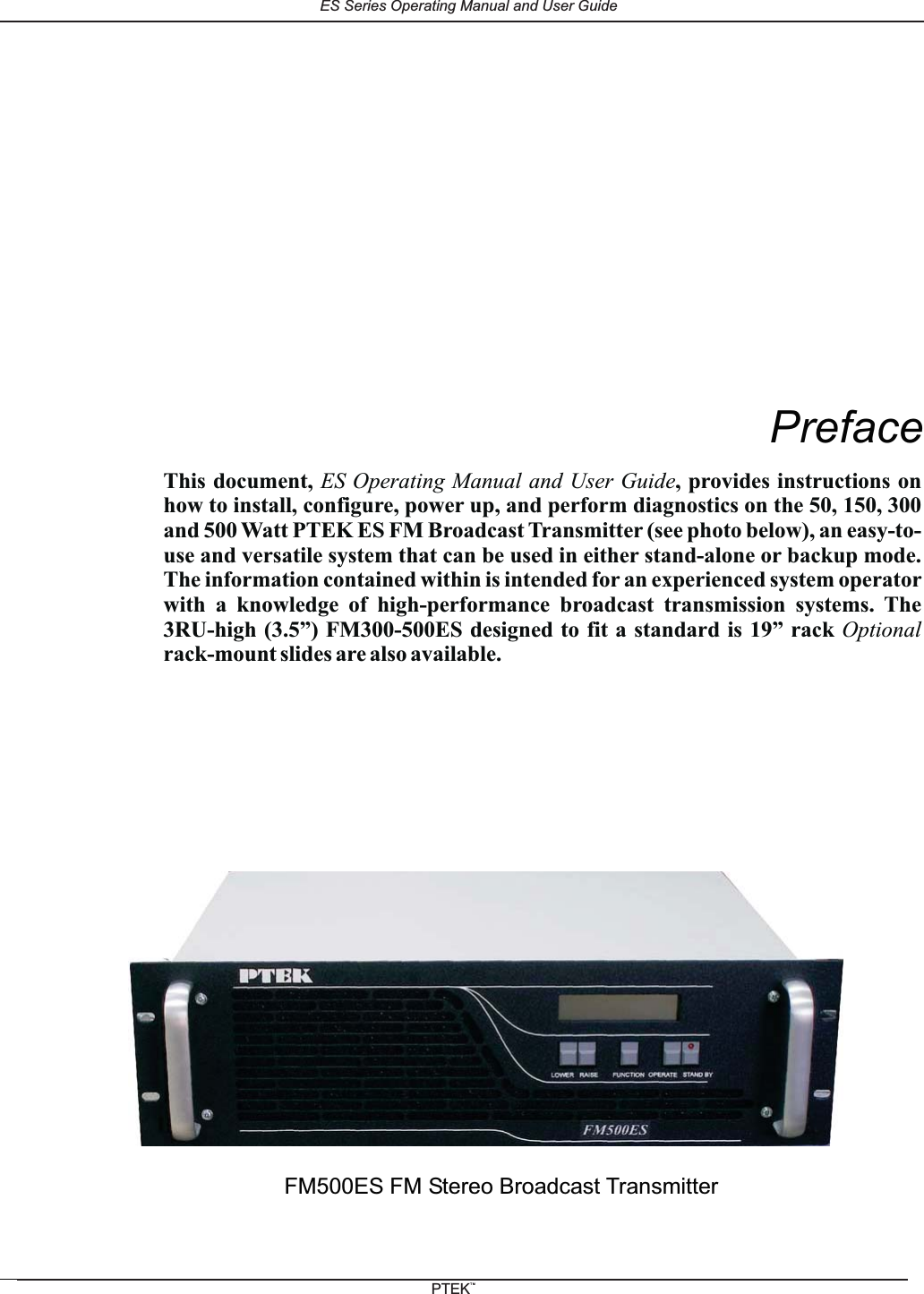
PrefaceFM500ES FM Stereo Broadcast TransmitterThis document, , provides instructions onhow to install, configure, power up, and perform diagnostics on the 50, 150, 300and 500 Watt PTEK ES FM Broadcast Transmitter (see photo below), an easy-to-use and versatile system that can be used in either stand-alone or backup mode.The information contained within is intended for an experienced system operatorwith a knowledge of high-performance broadcast transmission systems. The3RU-high (3.5”) FM300-500ES designed to fit a standard is 19” rackrack-mount slides are also available.ES Operating Manual and User GuideOptionalES Series Operating Manual and User GuidePTEKTM
Key features of the ES FM Stereo Broadcast Transmitter include:• Totally solid-state no-tune construction• Wide input range from 88 to 264 VAC• 3-year warranty on all parts and labor• Built-in field-programmable FSK ID for translator use• Remote-control interface• Optional built-in stereo encoder• Rugged design withstands up to 5G forces and 50°C• Meets or exceeds all FCC and CCIR standards• Designed and manufactured in the United StatesWebsite InformationPTEK corporate and product information may be accessed on the World Wide Webby browsing the website http://www.ptekpower.com .Your Comments are WelcomeWe are interested in improving our documentation and welcome your comments andsuggestions. You can email your comments to us at docfeedback@ptekpower.com .Please include the document part number in the subject line of your email.Frequency stability for each unit is ensured by using PLL (phase-locked loop)frequency synthesis from a highly stable crystal oscillator. All units incorporate over-temperature protection and VSWR foldback to automatically reduce power output tosafe operating levels Switch-mode power supplies provide consistent performanceeven when there are frequent power outages and voltage fluctuations that makestressful demands of power dependence. An overview and specifications of the ES FMStereo Broadcast Transmitters is given in Chapter 1, "Overview and Specifications", ofthis manual.ES Series Operating Manual and User GuidePTEKTM
Notes, Cautions, Warnings, and SidebarsThe following icons and formatted text are included in this document for the reasonsdescribed:Note: A note provides additional information concerning the procedure or actionbeing described.Caution: A caution describes a procedure or action that may result in injury to the op-erator or equipment. This may involve—but is not restricted to—heavy equipment orsharp objects. To reduce the risk, follow the instructions accompanying this symbol.Warning: A warning describes a procedure or action that may cause injury to theoperator or equipment as a result of hazardous voltages. To reduce the risk of elec-trical shock and danger, follow the instructions accompanying this symbol.Sidebar: A “sidebar” adds detail to the section within which it is placed,but is not absolutely vital to the description or procedure of the section.ES Series Operating Manual and User GuidePTEKTM
ES Series Operating Manual and User GuidePTEKTM
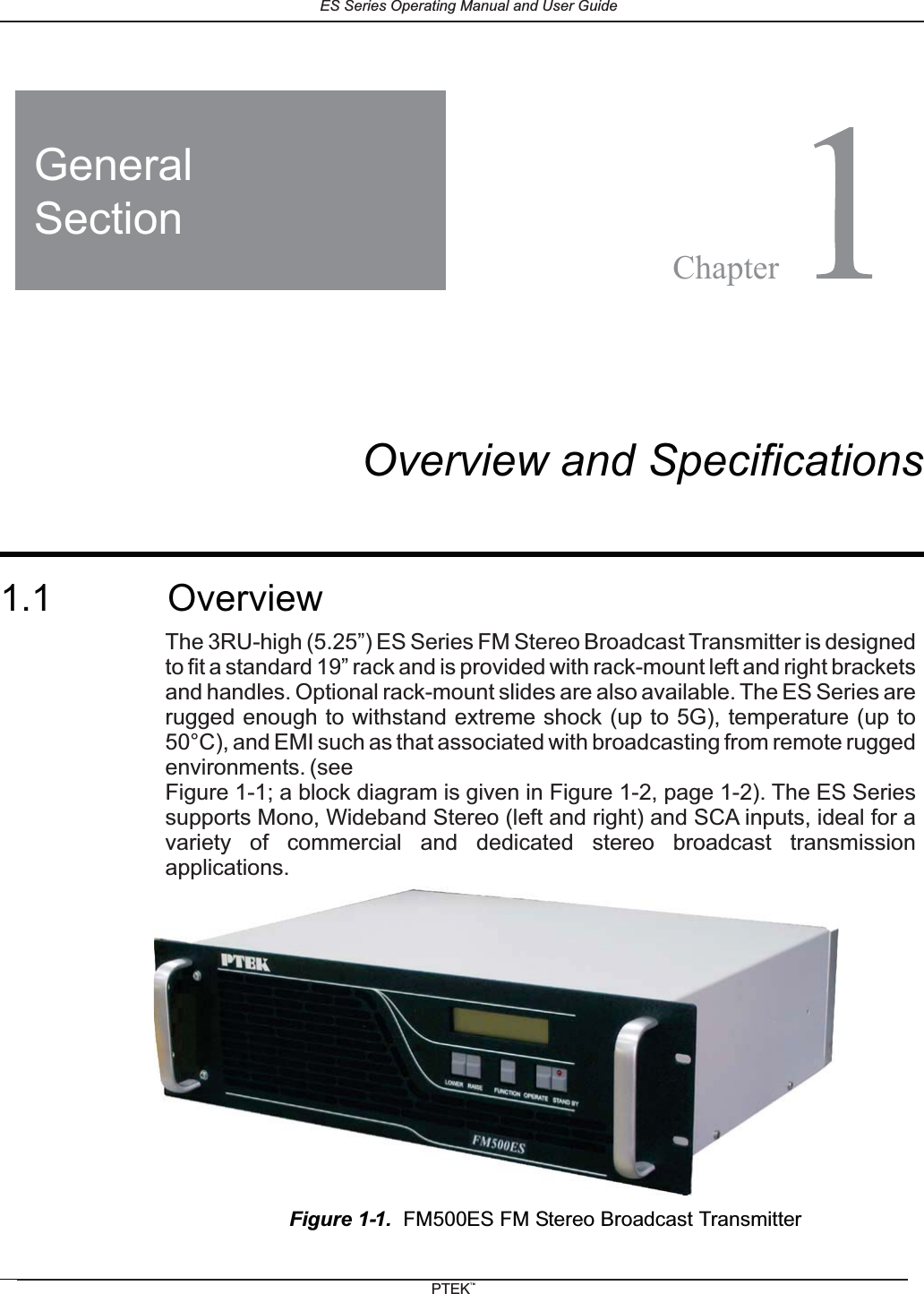
1FM150ES FM Stereo Broadcast TransmitterOverview and Specifications1.1 OverviewFigure 1-1. FM500ES FM Stereo Broadcast TransmitterGeneralSectionChapterThe 3RU-high (5.25”) ES Series FM Stereo Broadcast Transmitter is designedto fit a standard 19” rack and is provided with rack-mount left and right bracketsand handles. Optional rack-mount slides are also available. The arerugged enough to withstand extreme shock (up to 5G), temperature (up to50°C), and EMI such as that associated with broadcasting from remote ruggedenvironments. (seeFigure 1-1; a block diagram is given in Figure 1-2, page 1-2). Thesupports Mono, Wideband Stereo (left and right) and SCA inputs, ideal for avariety of commercial and dedicated stereo broadcast transmissionapplications.ES SeriesES SeriesES Series Operating Manual and User GuidePTEKTM
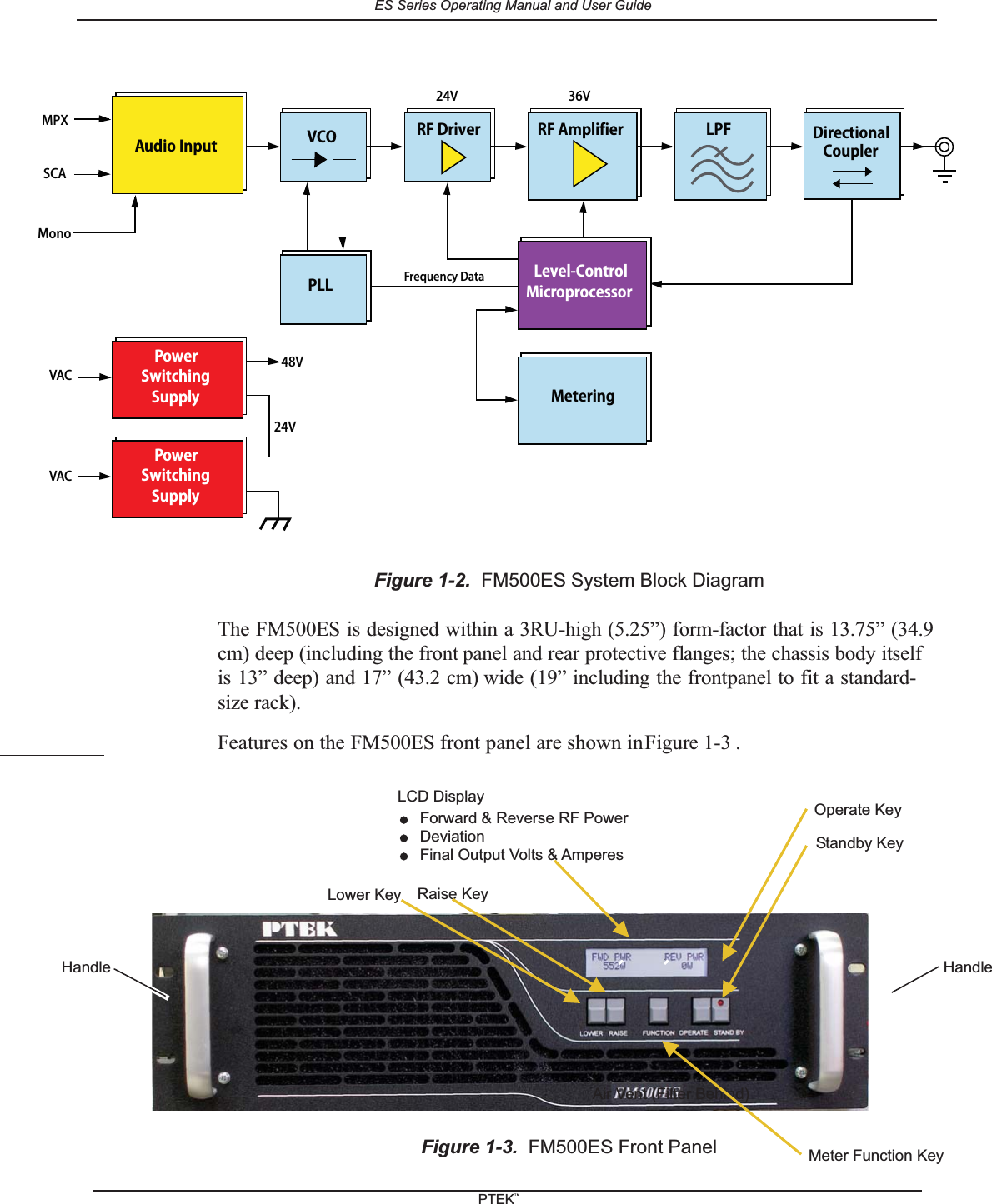
The FM500ES is designed within a 3RU-high (5.25”) form-factor that is 13.75” (34.9cm) deep (including the front panel and rear protective flanges; the chassis body itselfis 13” deep) and 17” (43.2 cm) wide (19” including the frontpanel to fit a standard-size rack).Features on the FM500ES front panel are shown inFigure 1-3 .Figure 1-2. FM500ES System Block DiagramFigure 1-3. FM500ES Front PanelAudio InputPowerSwitchingSupplyPowerSwitchingSupplyMPX24V24V36V48VVCOPLLFrequency DataSCAMonoVACVACDirectionalCouplerRF Driver RF AmplifierLevel-ControlMicroprocessorMeteringLPFAir Vent (Filter Behind)Standby KeyOperate KeyHandleMeter Function KeyLower Key Raise KeyLCD DisplayHandleForward & Reverse RF PowerDeviationFinal Output Volts & AmperesES Series Operating Manual and User GuidePTEKTM
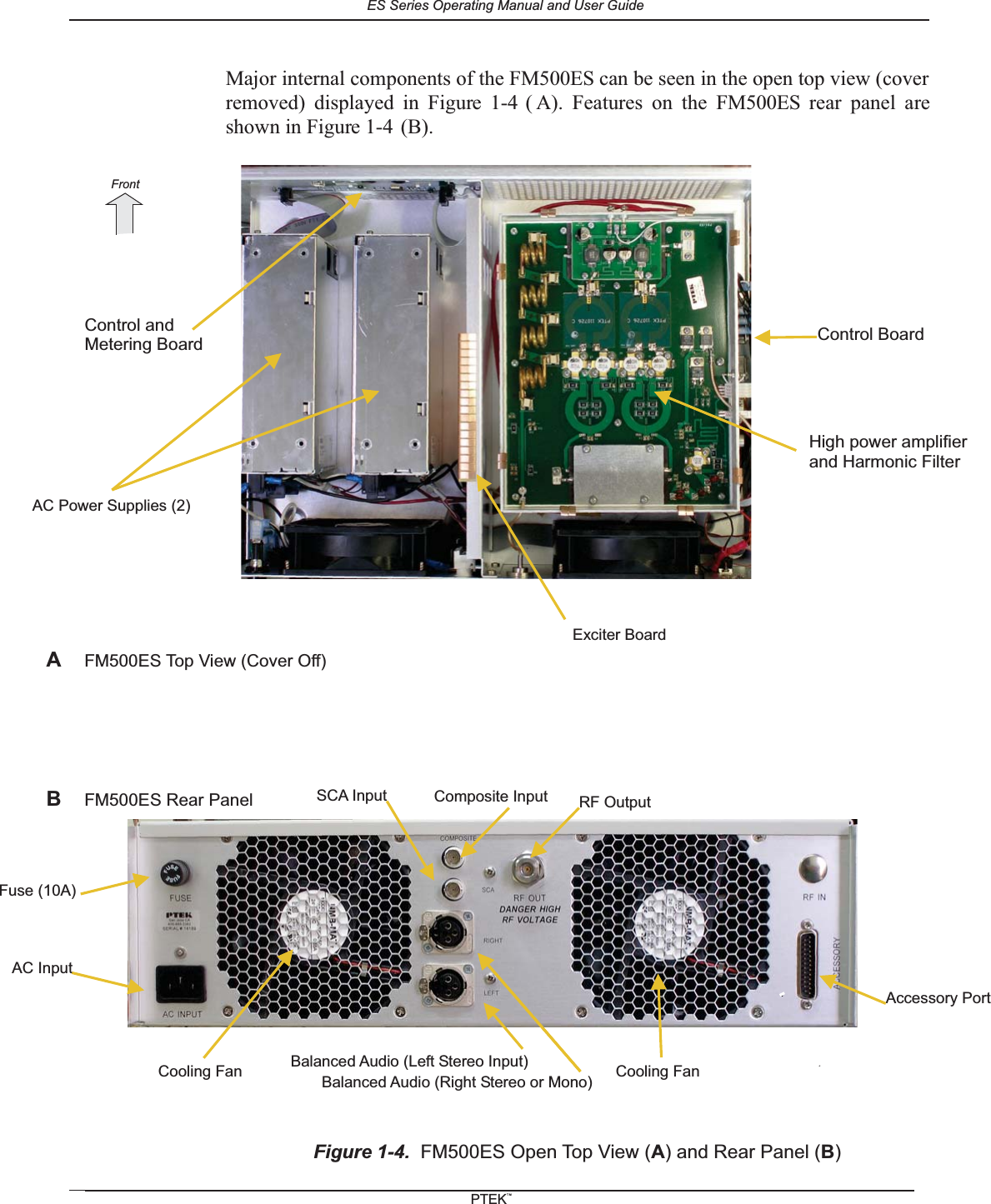
Major internal components of the FM500ES can be seen in the open top view (coverremoved) displayed in Figure 1-4 ( A). Features on the FM500ES rear panel areshown in Figure 1-4 (B).Figure 1-4. FM500ES Open Top View (A) and Rear Panel (B)AC Power Supplies (2)AFM500ES Top View (Cover Off)BFM500ES Rear PanelAccessory PortCooling FanRF OutputFuse (10A)AC InputBalanced Audio (Left Stereo Input)Balanced Audio (Right Stereo or Mono)SCA InputFrontComposite InputHigh power amplifierand Harmonic FilterControl andMetering Board Control BoardExciter BoardCooling FanES Series Operating Manual and User GuidePTEKTM
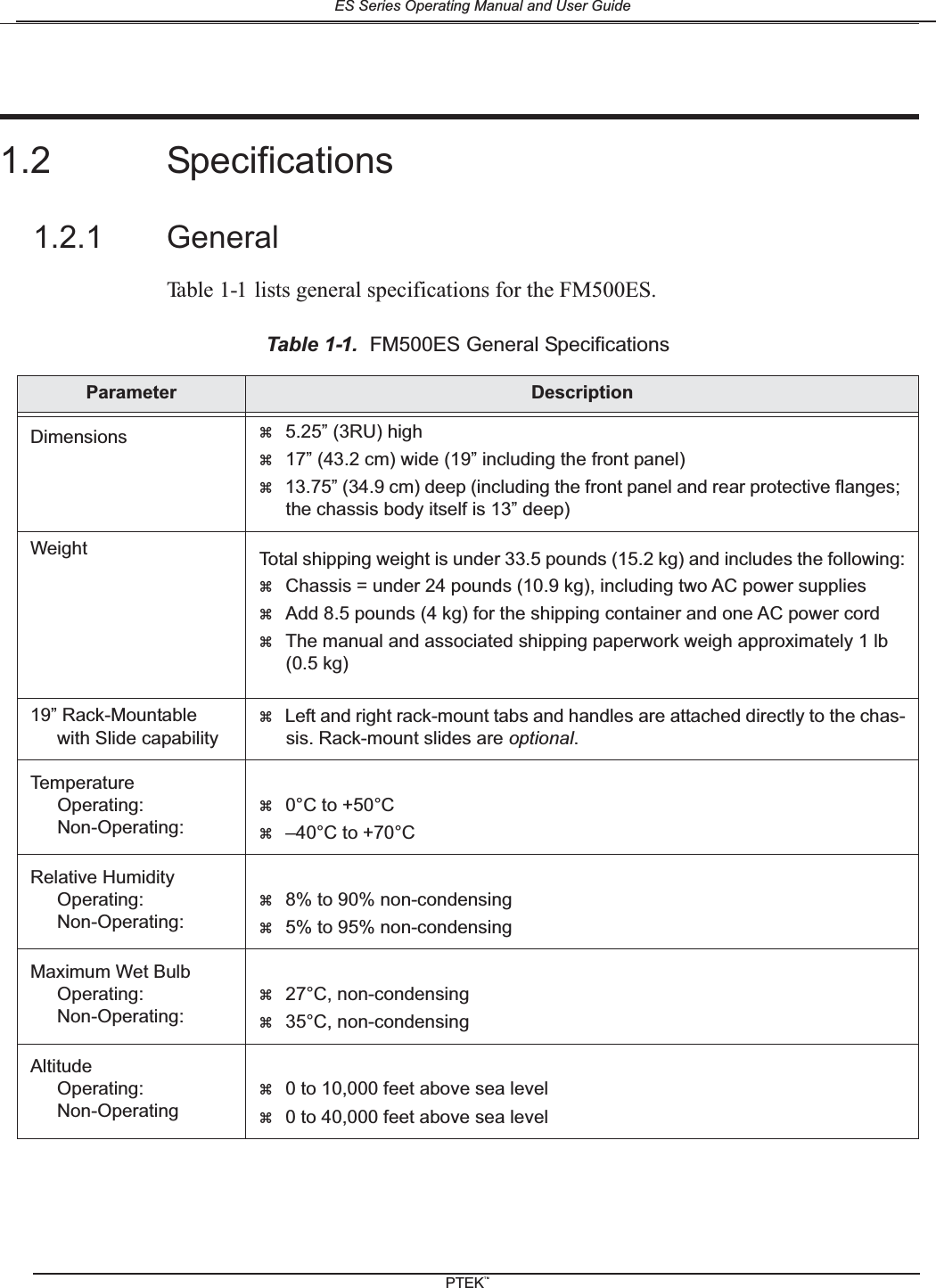
1.2 Specifications1.2.1 GeneralTable 1-1 lists general specifications for the FM500ES.Table 1-1. FM500ES General SpecificationsParameter DescriptionDimensions z5.25” (3RU) highz17” (43.2 cm) wide (19” including the front panel)z13.75” (34.9 cm) deep (including the front panel and rear protective flanges;the chassis body itself is 13” deep)Weight Total shipping weight is under 33.5 pounds (15.2 kg) and includes the following:zChassis = under 24 pounds (10.9 kg), including two AC power supplieszAdd 8.5 pounds (4 kg) for the shipping container and one AC power cordzThe manual and associated shipping paperwork weigh approximately 1 lb(0.5 kg)19” Rack-Mountablewith Slide capabilityzLeft and right rack-mount tabs and handles are attached directly to the chas-sis. Rack-mount slides are optional.TemperatureOperating:Non-Operating:z0°C to +50°Cz–40°C to +70°CRelative HumidityOperating:Non-Operating:z8% to 90% non-condensingz5% to 95% non-condensingMaximum Wet BulbOperating:Non-Operating:z27°C, non-condensingz35°C, non-condensingAltitudeOperating:Non-Operatingz0 to 10,000 feet above sea levelz0 to 40,000 feet above sea levelES Series Operating Manual and User GuidePTEKTM
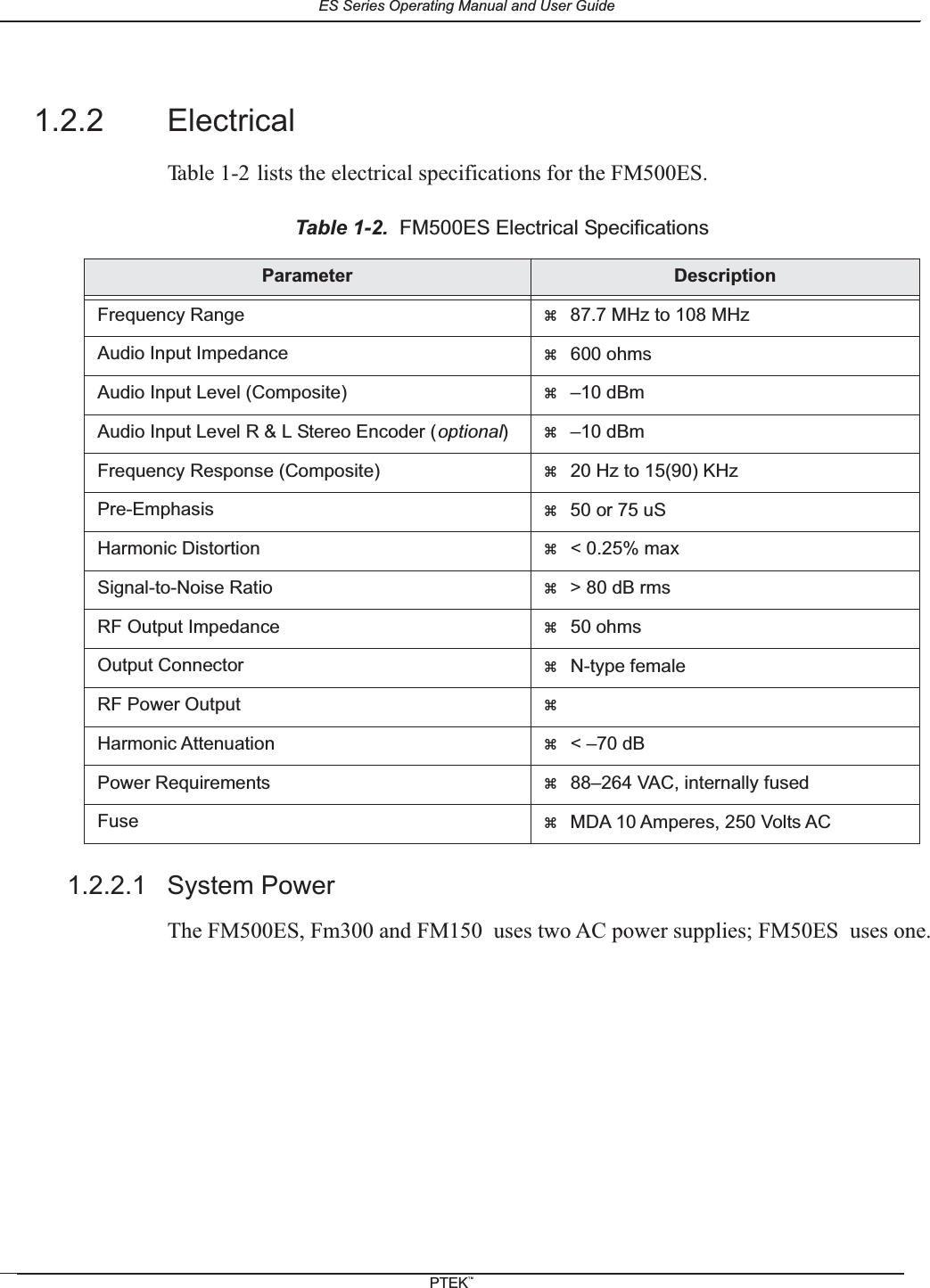
1.2.2 ElectricalTable 1-2 lists the electrical specifications for the FM500ES.1.2.2.1 System PowerThe FM500ES, Fm300 and FM150  uses two AC power supplies; FM50ES  uses one.Table 1-2. FM500ES Electrical SpecificationsParameter DescriptionFrequency Range z87.7 MHz to 108 MHzAudio Input Impedance z600 ohmsAudio Input Level (Composite) z–10 dBmAudio Input Level R & L Stereo Encoder (optional)z–10 dBmFrequency Response (Composite) z20 Hz to 15(90) KHzPre-Emphasis z50 or 75 uSHarmonic Distortion z<0.25%maxSignal-to-Noise Ratio z> 80 dB rmsRF Output Impedance z50 ohmsOutput Connector zN-type femaleRF Power Output zHarmonic Attenuation z< –70 dBPower Requirements z88–264 VAC, internally fusedFuse zMDA 10 Amperes, 250 Volts ACES Series Operating Manual and User GuidePTEKTM
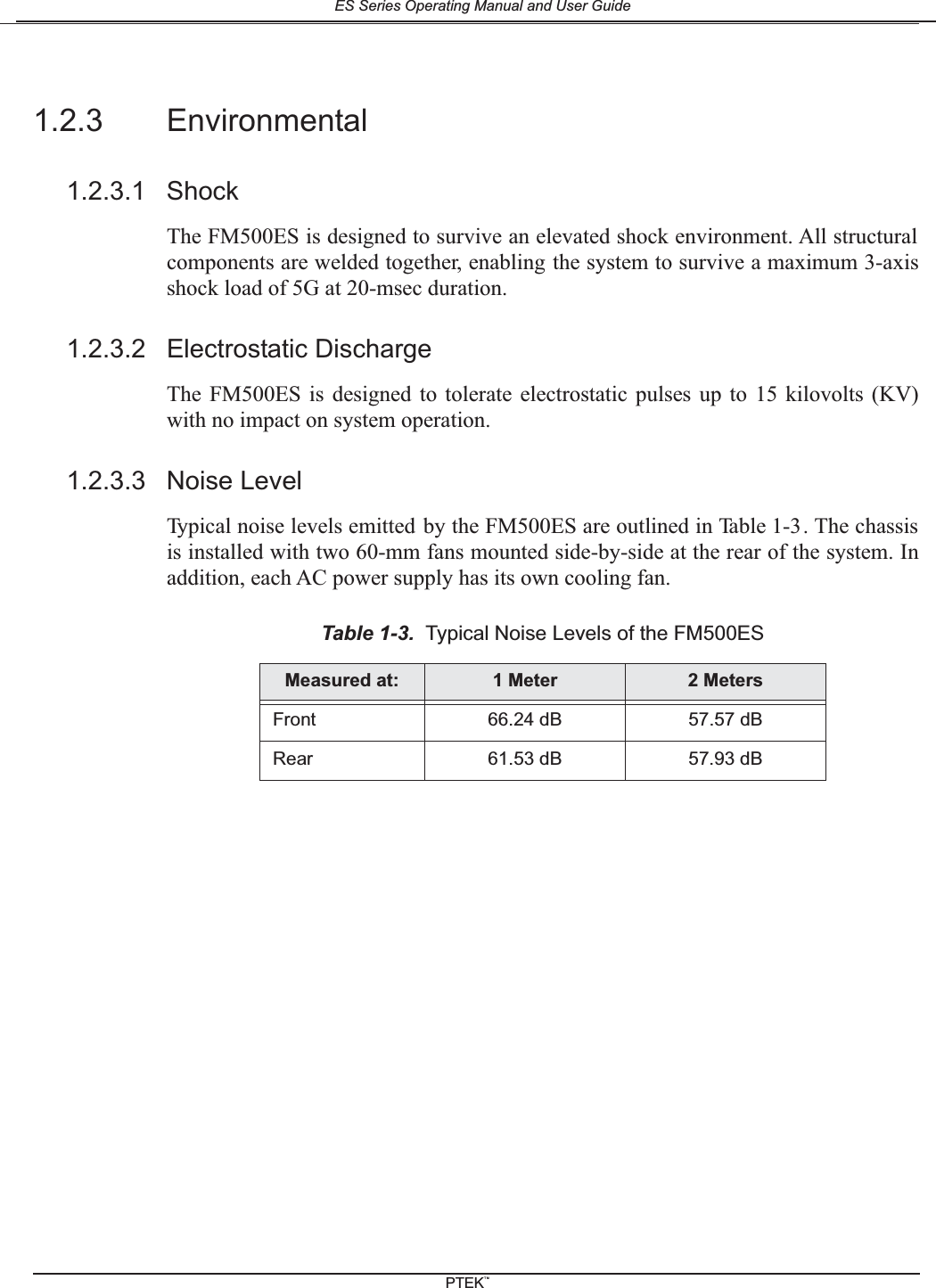
1.2.3 Environmental1.2.3.1 ShockThe FM500ES is designed to survive an elevated shock environment. All structuralcomponents are welded together, enabling the system to survive a maximum 3-axisshock load of 5G at 20-msec duration.1.2.3.2 Electrostatic DischargeThe FM500ES is designed to tolerate electrostatic pulses up to 15 kilovolts (KV)with no impact on system operation.1.2.3.3 Noise LevelTypical noise levels emitted by the FM500ES are outlined in Table 1-3. The chassisis installed with two 60-mm fans mounted side-by-side at the rear of the system. Inaddition, each AC power supply has its own cooling fan.Table 1-3. Typical Noise Levels of the FM500ESMeasured at: 1Meter 2 MetersFront 66.24 dB 57.57 dBRear 61.53 dB 57.93 dBES Series Operating Manual and User GuidePTEKTM
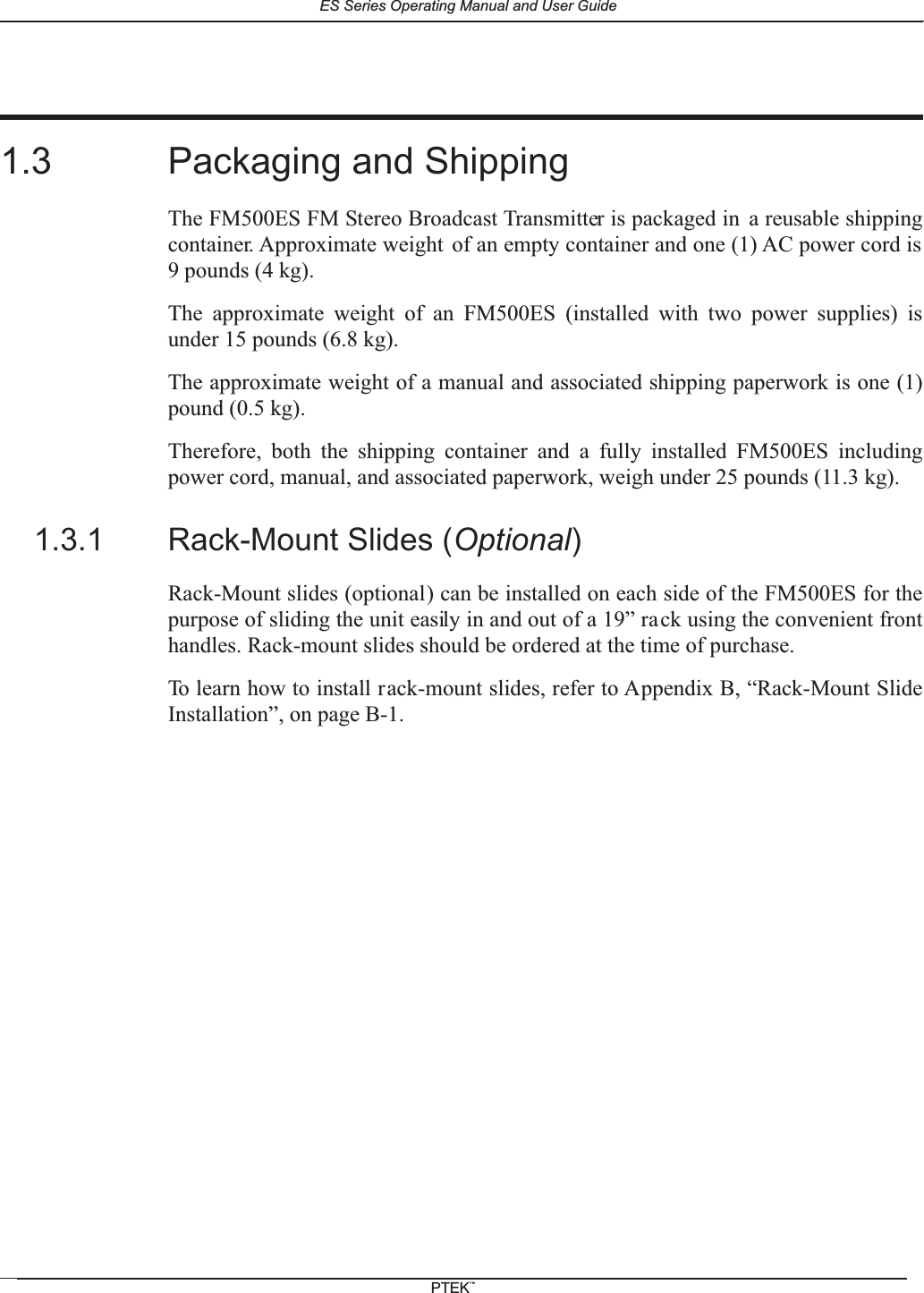
1.3 Packaging and ShippingThe FM500ES FM Stereo Broadcast Transmitter is packaged in a reusable shippingcontainer. Approximate weight of an empty container and one (1) AC power cord is9 pounds (4 kg).The approximate weight of an FM500ES (installed with two power supplies) isunder 15 pounds (6.8 kg).The approximate weight of a manual and associated shipping paperwork is one (1)pound (0.5 kg).Therefore, both the shipping container and a fully installed FM500ES includingpower cord, manual, and associated paperwork, weigh under 25 pounds (11.3 kg).1.3.1 Rack-Mount Slides (Optional)Rack-Mount slides (optional) can be installed on each side of the FM500ES for thepurpose of sliding the unit easily in and out of a 19” rack using the convenient fronthandles. Rack-mount slides should be ordered at the time of purchase.To learn how to install rack-mount slides, refer to Appendix B, “Rack-Mount SlideInstallation”, on page B-1.ES Series Operating Manual and User GuidePTEKTM
ES Series Operating Manual and User GuidePTEKTM
2FM150ES2Installation2.1 Installation ProceduresThere are no operator serviceable parts inside the FM500ES; therefore, replacement,inspection, or adjustment of internal components within the FM500ES requires ser-vice by a PTEK technician only. DO NOT REMOVE THE TOP PROTECTIVECOVER OF THE FM500ES CHASSIS (see following Warning).Caution: Use industry-standard ESD grounding techniques when handling allcomponents. Wear an antistatic wrist strap and use an ESD-protected mat. StoreESD-sensitive components in antistatic bags before placing them on any surface.Handle all IC cards by the front panel or edges only.Warning: Removal of the top protective cover of the FM500ES by anyone otherthan an authorized PTEK technician will void the product warranty.InstallationSectionChapterES Series Operating Manual and User GuidePTEKTM
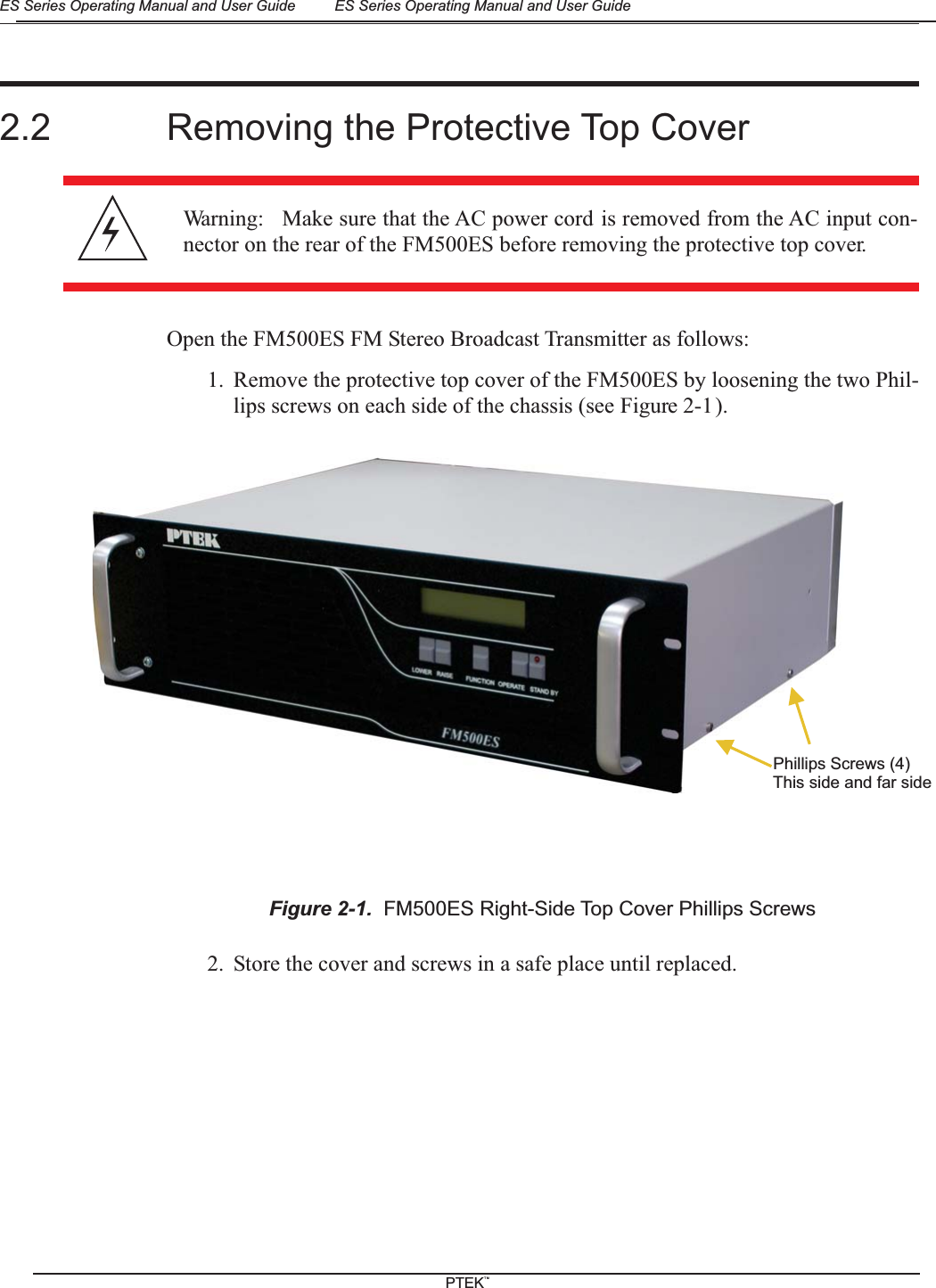
2.2 Removing the Protective Top CoverOpen the FM500ES FM Stereo Broadcast Transmitter as follows:1. Remove the protective top cover of the FM500ES by loosening the two Phil-lips screws on each side of the chassis (see Figure 2-1).2. Store the cover and screws in a safe place until replaced.Warning: Make sure that the AC power cord is removed from the AC input con-nector on the rear of the FM500ES before removing the protective top cover.Figure 2-1. FM500ES Right-Side Top Cover Phillips ScrewsPhillips Screws (4)This side and far sideES Series Operating Manual and User Guide ES Series Operating Manual and User GuidePTEKTM
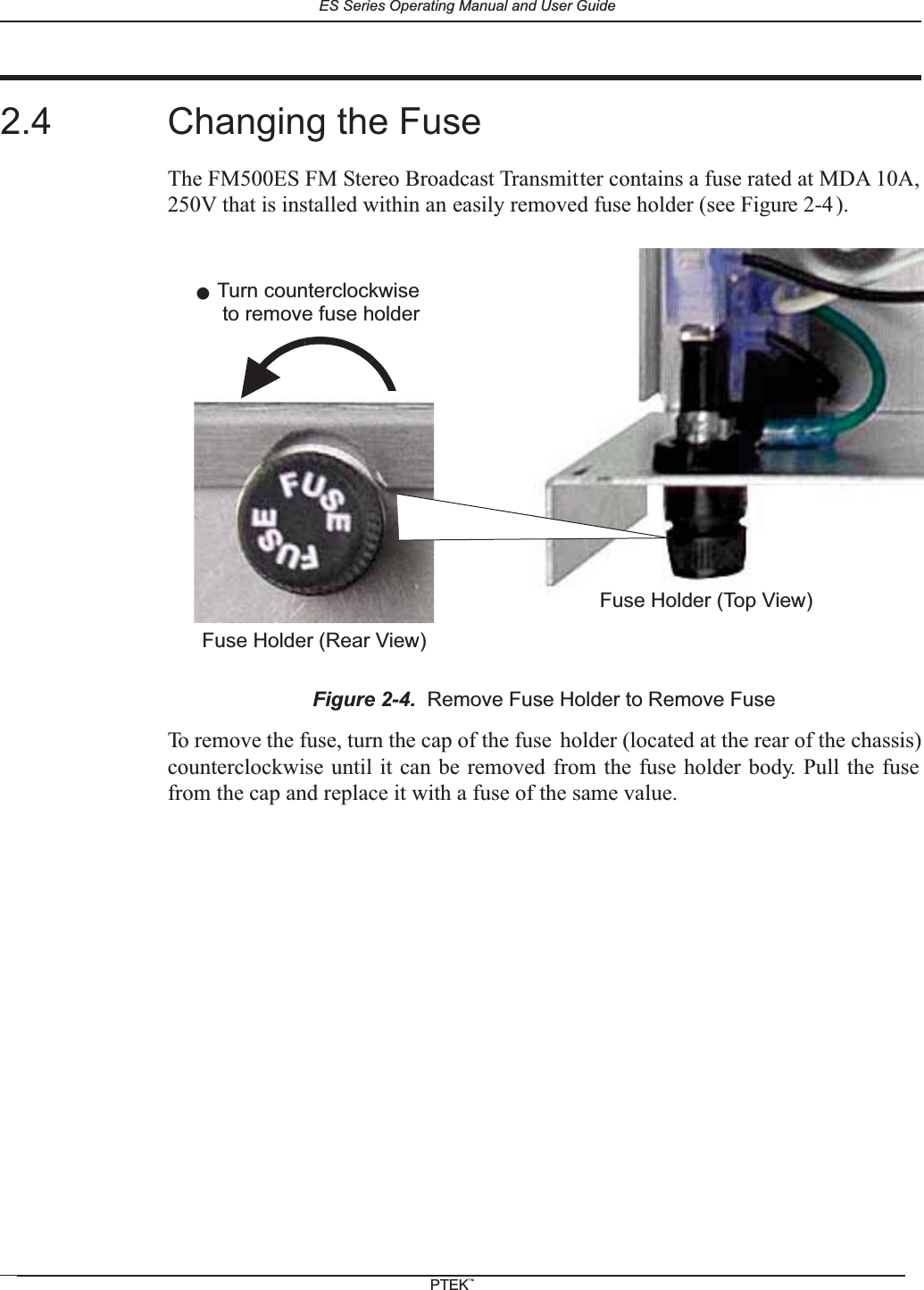
2.4 Changing the FuseThe FM500ES FM Stereo Broadcast Transmitter contains a fuse rated at MDA 10A,250V that is installed within an easily removed fuse holder (see Figure 2-4 ).To remove the fuse, turn the cap of the fuse holder (located at the rear of the chassis)counterclockwise until it can be removed from the fuse holder body. Pull the fusefrom the cap and replace it with a fuse of the same value.Figure 2-4. Remove Fuse Holder to Remove FuseTurn counterclockwiseFuse Holder (Rear View)to remove fuse holderFuse Holder (Top View)ES Series Operating Manual and User GuidePTEKTM
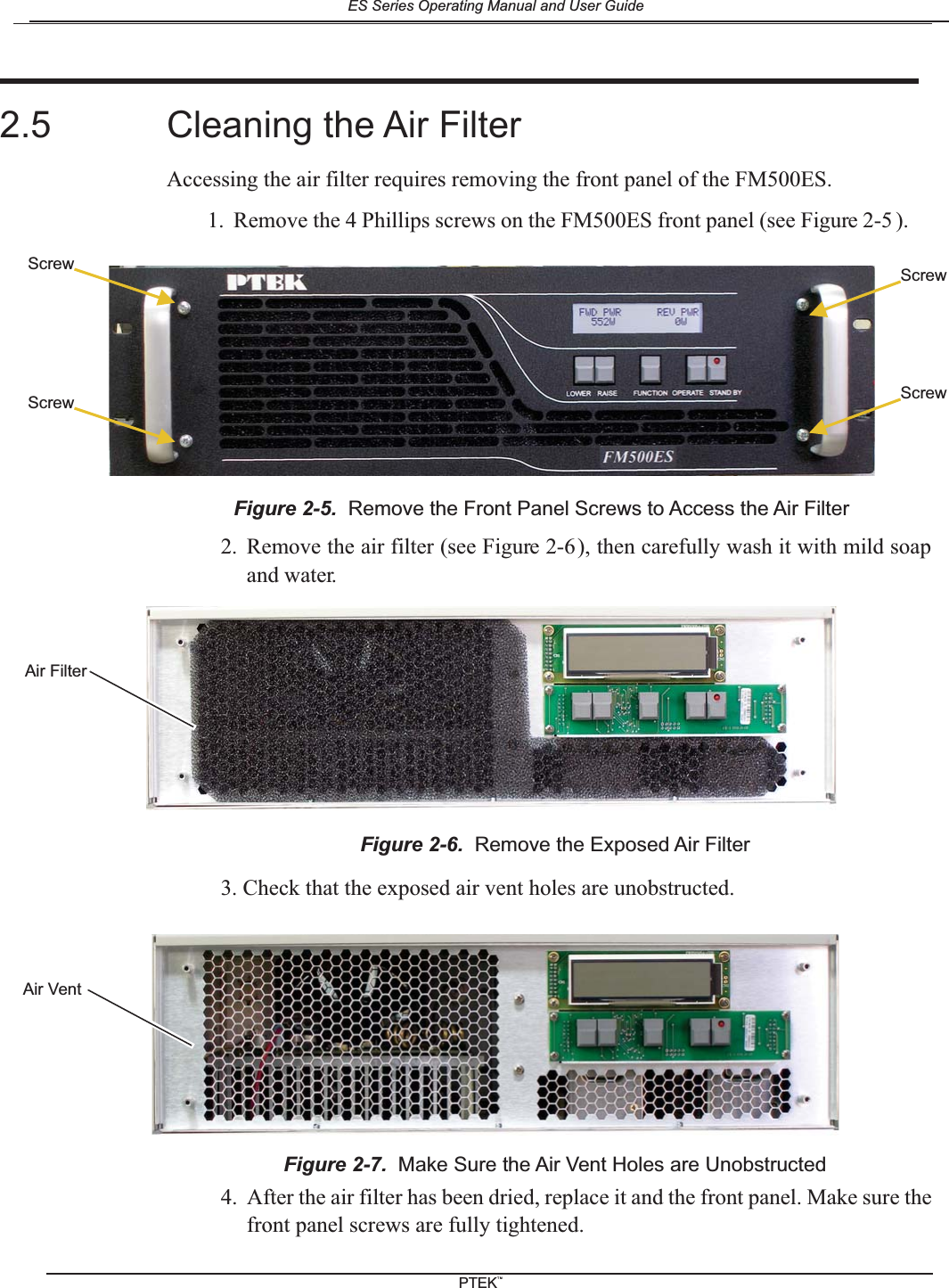
2. Remove the air filter (see Figure 2-6), then carefully wash it with mild soapand water.3. Check that the exposed air vent holes are unobstructed.4. After the air filter has been dried, replace it and the front panel. Make sure thefront panel screws are fully tightened.Figure 2-6. Remove the Exposed Air FilterFigure 2-7. Make Sure the Air Vent Holes are UnobstructedAir FilterAir Vent2.5 Cleaning the Air FilterAccessing the air filter requires removing the front panel of the FM500ES.1. Remove the 4 Phillips screws on the FM500ES front panel (see Figure 2-5 ).Figure 2-5. Remove the Front Panel Screws to Access the Air FilterScrewScrewScrewScrewES Series Operating Manual and User GuidePTEKTM
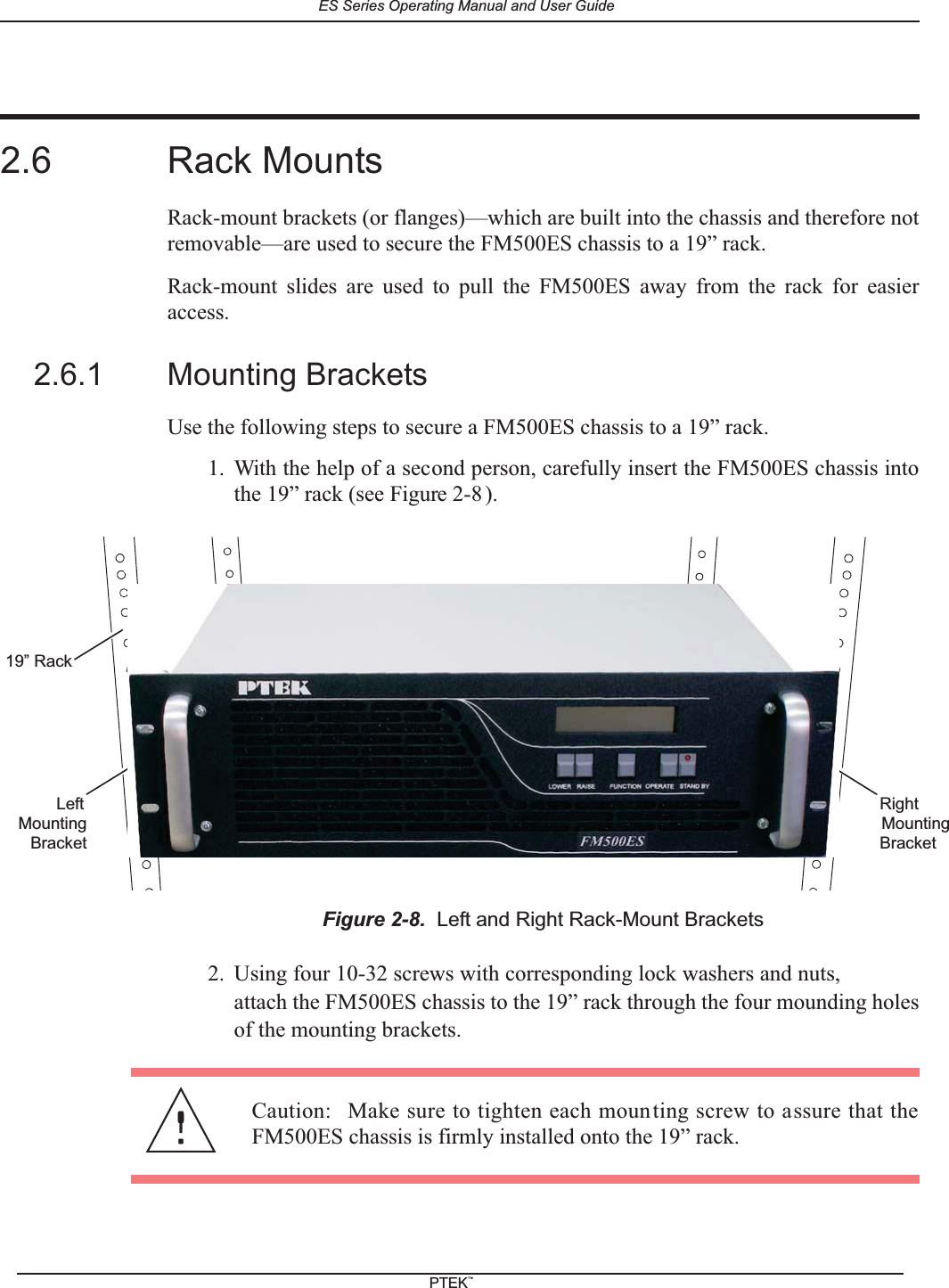
2.6 Rack MountsRack-mount brackets (or flanges)—which are built into the chassis and therefore notremovable—are used to secure the FM500ES chassis to a 19” rack.Rack-mount slides are used to pull the FM500ES away from the rack for easieraccess.2.6.1 Mounting BracketsUse the following steps to secure a FM500ES chassis to a 19” rack.1. With the help of a second person, carefully insert the FM500ES chassis intothe 19” rack (see Figure 2-8 ).2. Using four 10-32 screws with corresponding lock washers and nuts,attach the FM500ES chassis to the 19” rack through the four mounding holesof the mounting brackets.Figure 2-8. Left and Right Rack-Mount Brackets19” RackRightBracketMountingLeftBracketMountingCaution: Make sure to tighten each mounting screw to assure that theFM500ES chassis is firmly installed onto the 19” rack.ES Series Operating Manual and User GuidePTEKTM
2.6.2 Rack-Mount Slides (Optional)Rack-Mount Slides can be mounted on each side of the FM500ES FM Stereo Broad-cast Transmitter for the purpose of sliding the unit inand out of a rack. Mountingslides are optional and should be ordered at the time your system is purchased.To learn how to install rack-mount slides, refer to Appendix B, “Rack-Mount SlideInstallation”.Caution: Any screws used to mount a slide to a FM500ES chassis must not exceeda length of 3/8” to prevent excessive penetration of the chassis.ES Series Operating Manual and User GuidePTEKTM
2FM150ES3OperationThis chapter describes:• How to set up the FM500ES system to begin operation• How to turn the FM500ES on and off• How to monitor and change the operational settings of the FM500ES3.1 Set Up the SystemTo successfully operate the FM500ES FM Stereo Broadcast Tran smitter, an antenna(or power amplifier) and an audio source must first be connected to the system, asoutlined in the following steps:1. Connect the antenna or power amplifier input to the RF output connector onthe rear panel of the FM500ES (see Figure 3-1 on page 3-2).2. Connect the audio input to one of the following connectors the rear panel:• Composite Input (ensure the Stereo encoder is disabled)• Balanced Mono Input• Balanced Stereo Left and Right (if equipped with stereo encoder)OperationSectionChapterES Series Operating Manual and User GuidePTEKTM
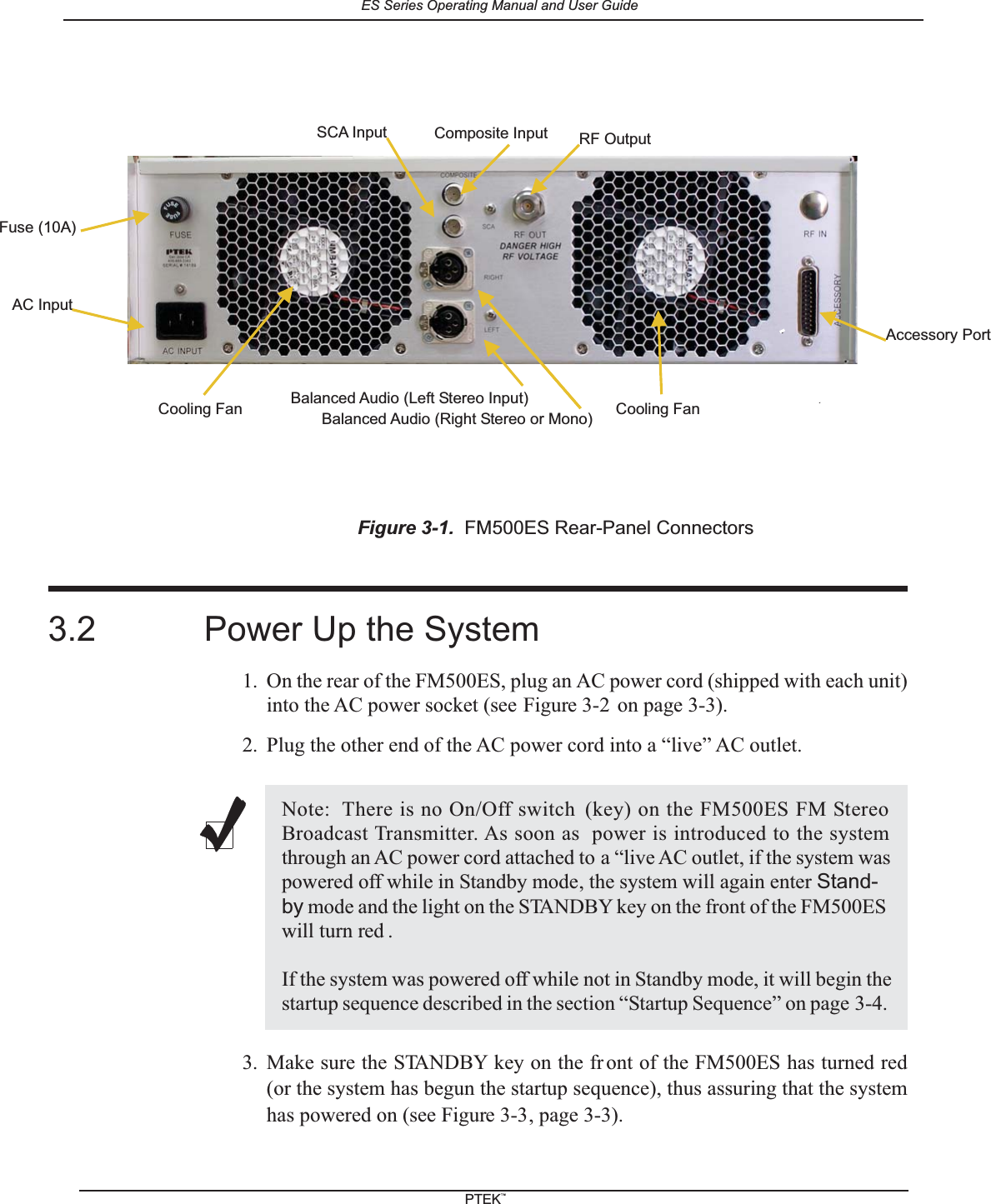
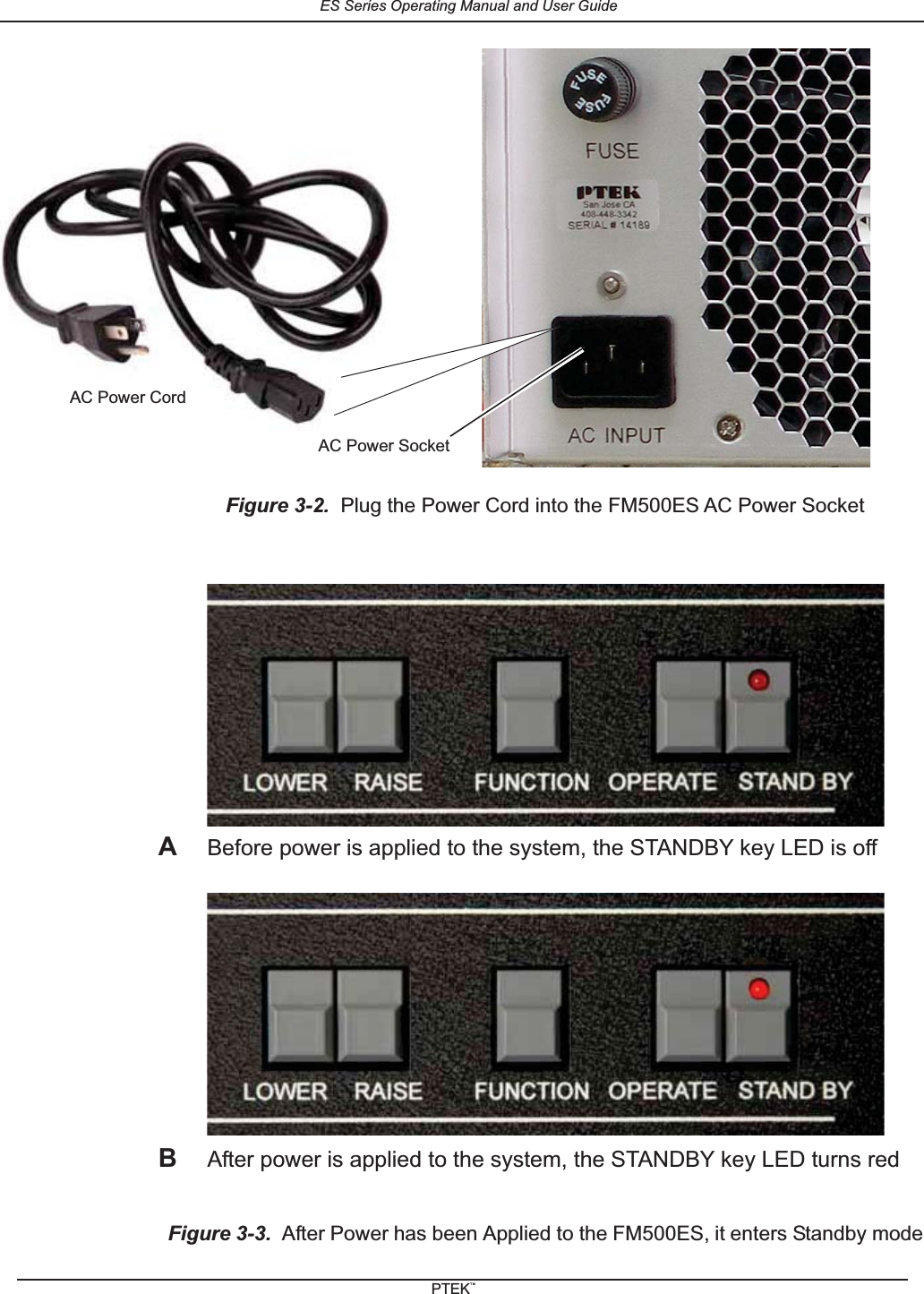
3.2 Power Up the System1. On the rear of the FM500ES, plug an AC power cord (shipped with each unit)into the AC power socket (see Figure 3-2 on page 3-3).2. Plug the other end of the AC power cord into a “live” AC outlet.3. Make sure the STANDBY key on the fr ont of the FM500ES has turned red(or the system has begun the startup sequence), thus assuring that the systemhas powered on (see Figure 3-3, page 3-3).Figure 3-1. FM500ES Rear-Panel ConnectorsNote: There is no On/Off switch (key) on the FM500ES FM StereoBroadcast Transmitter. As soon as power is introduced to the systemthrough an AC power cord attached to a “live AC outlet, if the system waspowered off while in Standby mode, the system will again enter Stand-by mode and the light on the STANDBY key on the front of the FM500ESwill turn red .If the system was powered off while not in Standby mode, it will begin thestartup sequence described in the section “Startup Sequence” on page 3-4.Accessory PortCooling FanRF OutputFuse (10A)AC InputBalanced Audio (Left Stereo Input)Balanced Audio (Right Stereo or Mono)SCA Input Composite InputCooling FanES Series Operating Manual and User GuidePTEKTM
Figure 3-2. Plug the Power Cord into the FM500ES AC Power SocketFigure 3-3. After Power has been Applied to the FM500ES, it enters Standby modeAC Power SocketAC Power CordBefore power is applied to the system, the STANDBY key LED is offAAfter power is applied to the system, the STANDBY key LED turns redBES Series Operating Manual and User GuidePTEKTM
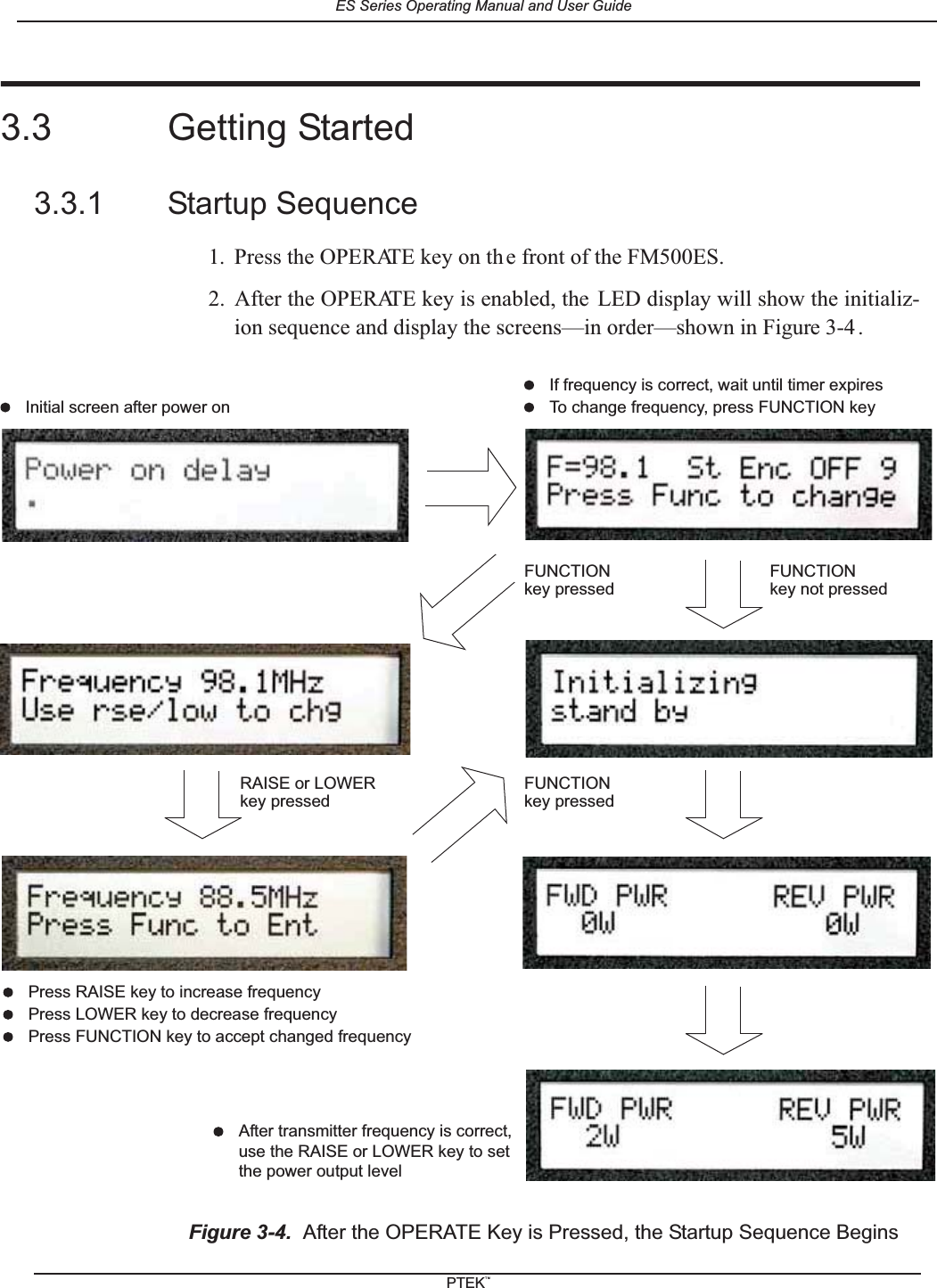
3.3 Getting Started3.3.1 Startup Sequence1. Press the OPERATE key on th e front of the FM500ES.2. After the OPERATE key is enabled, the LED display will show the initializ-ion sequence and display the screens—in order—shown in Figure 3-4.Figure 3-4. After the OPERATE Key is Pressed, the Startup Sequence Beginskey not pressedFUNCTIONkey pressedFUNCTIONkey pressedRAISEorLOWERInitial screen after power on To change frequency, press FUNCTION keyIf frequency is correct, wait until timer expiresPress LOWER key to decrease frequencyPress RAISE key to increase frequencykey pressedFUNCTIONPress FUNCTION key to accept changed frequencyAfter transmitter frequency is correct,use the RAISE or LOWER key to setthe power output levelES Series Operating Manual and User GuidePTEKTM
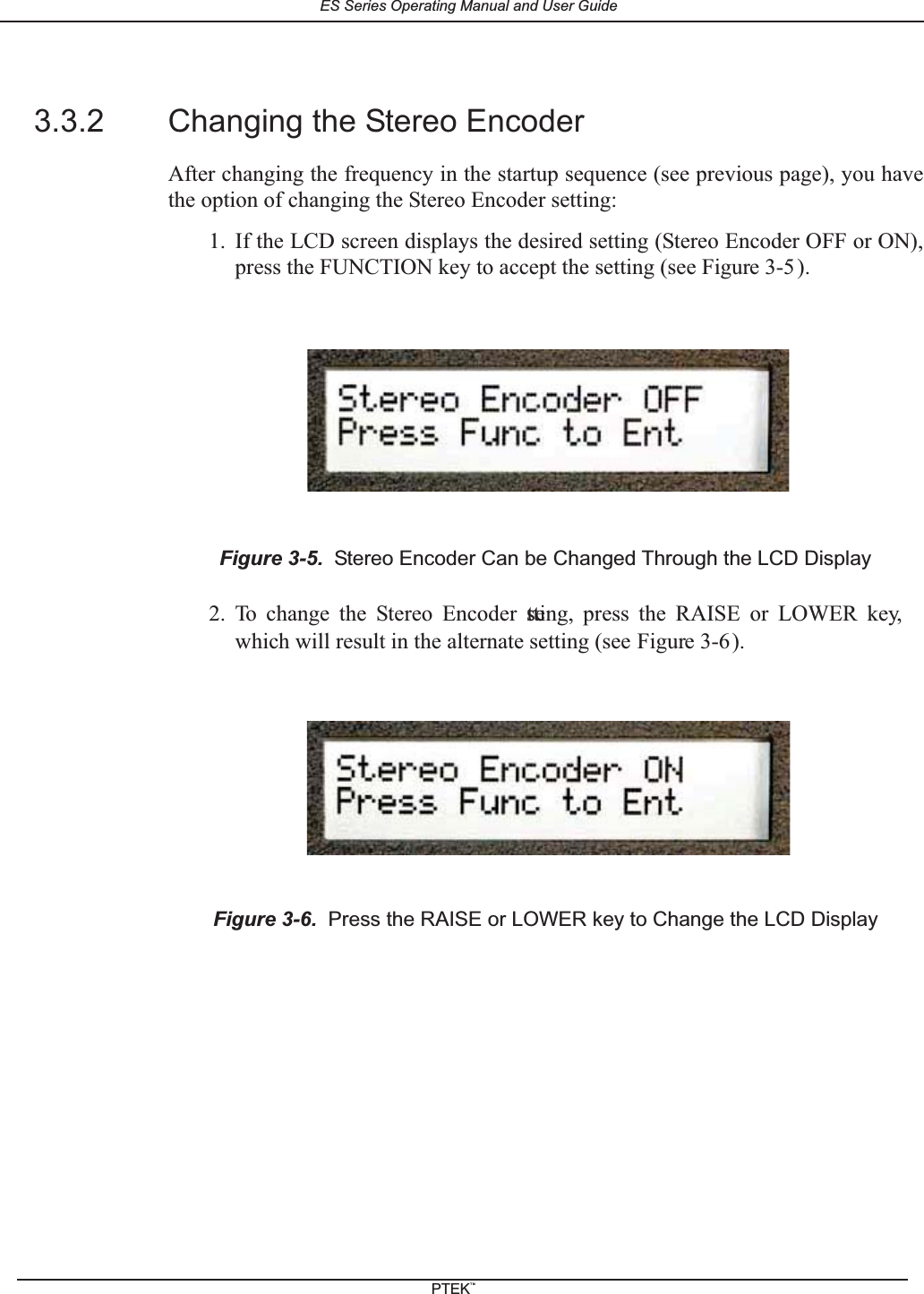
3.3.2 Changing the Stereo EncoderAfter changing the frequency in the startup sequence (see previous page), you havethe option of changing the Stereo Encoder setting:1. If the LCD screen displays the desired setting (Stereo Encoder OFF or ON),press the FUNCTION key to accept the setting (see Figure 3-5).2. To change the Stereo Encoder setting, press the RAISE or LOWER key,which will result in the alternate setting (see Figure 3-6).Figure 3-5. Stereo Encoder Can be Changed Through the LCD DisplayFigure 3-6. Press the RAISE or LOWER key to Change the LCD DisplayES Series Operating Manual and User GuidePTEKTM
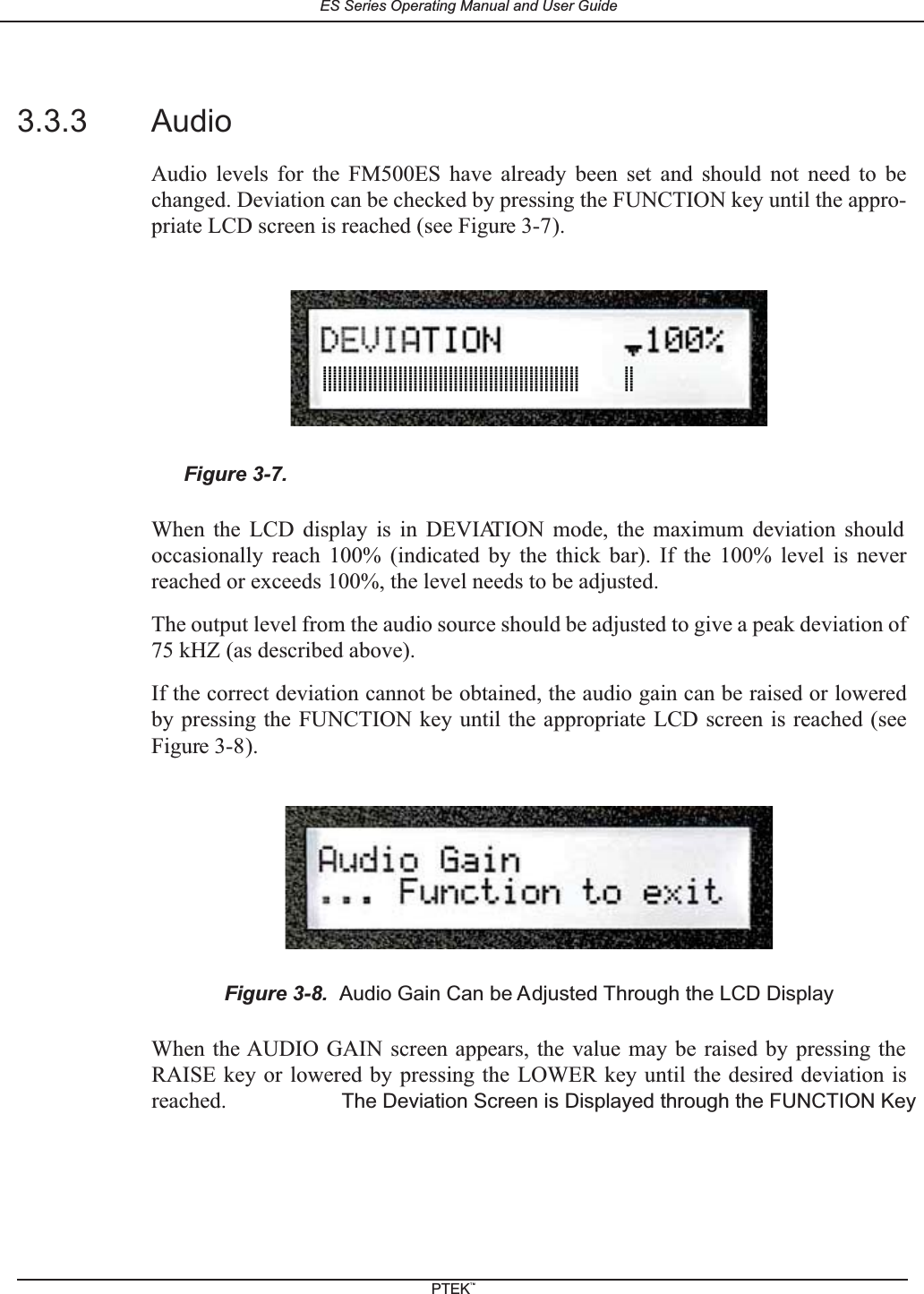
3.3.3 AudioAudio levels for the FM500ES have already been set and should not need to bechanged. Deviation can be checked by pressing the FUNCTION key until the appro-priate LCD screen is reached (see Figure 3-7).When the LCD display is in DEVIATION mode, the maximum deviation shouldoccasionally reach 100% (indicated by the thick bar). If the 100% level is neverreached or exceeds 100%, the level needs to be adjusted.The output level from the audio source should be adjusted to give a peak deviation of75 kHZ (as described above).If the correct deviation cannot be obtained, the audio gain can be raised or loweredby pressing the FUNCTION key until the appropriate LCD screen is reached (seeFigure 3-8).When the AUDIO GAIN screen appears, the value may be raised by pressing theRAISE key or lowered by pressing the LOWER key until the desired deviation isreached.Figure 3-7.The Deviation Screen is Displayed through the FUNCTION KeyFigure 3-8. Audio Gain Can be Adjusted Through the LCD Display|||||||||||||||||||||||||||||||||||||||||||||||||||        ||ES Series Operating Manual and User GuidePTEKTM
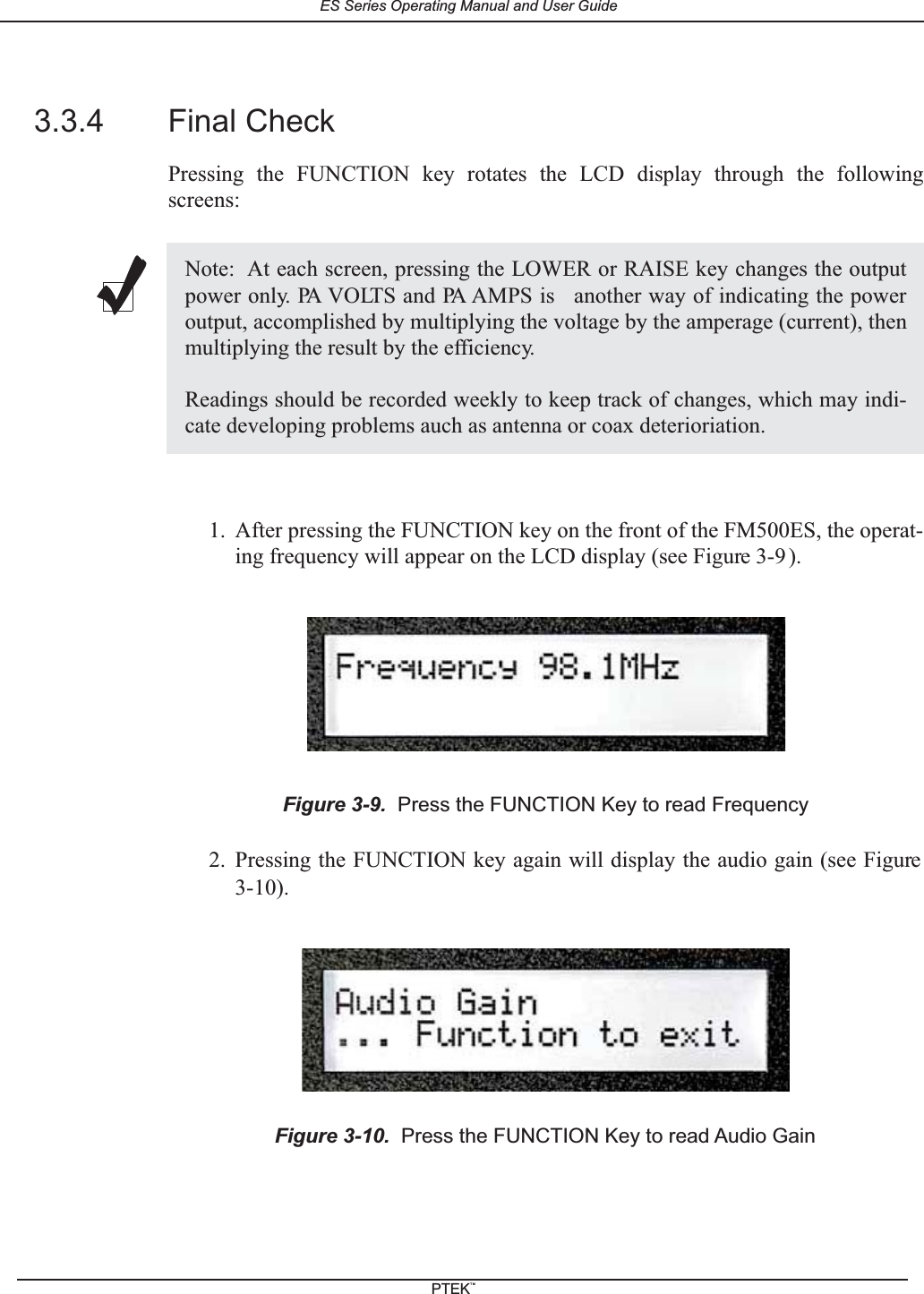
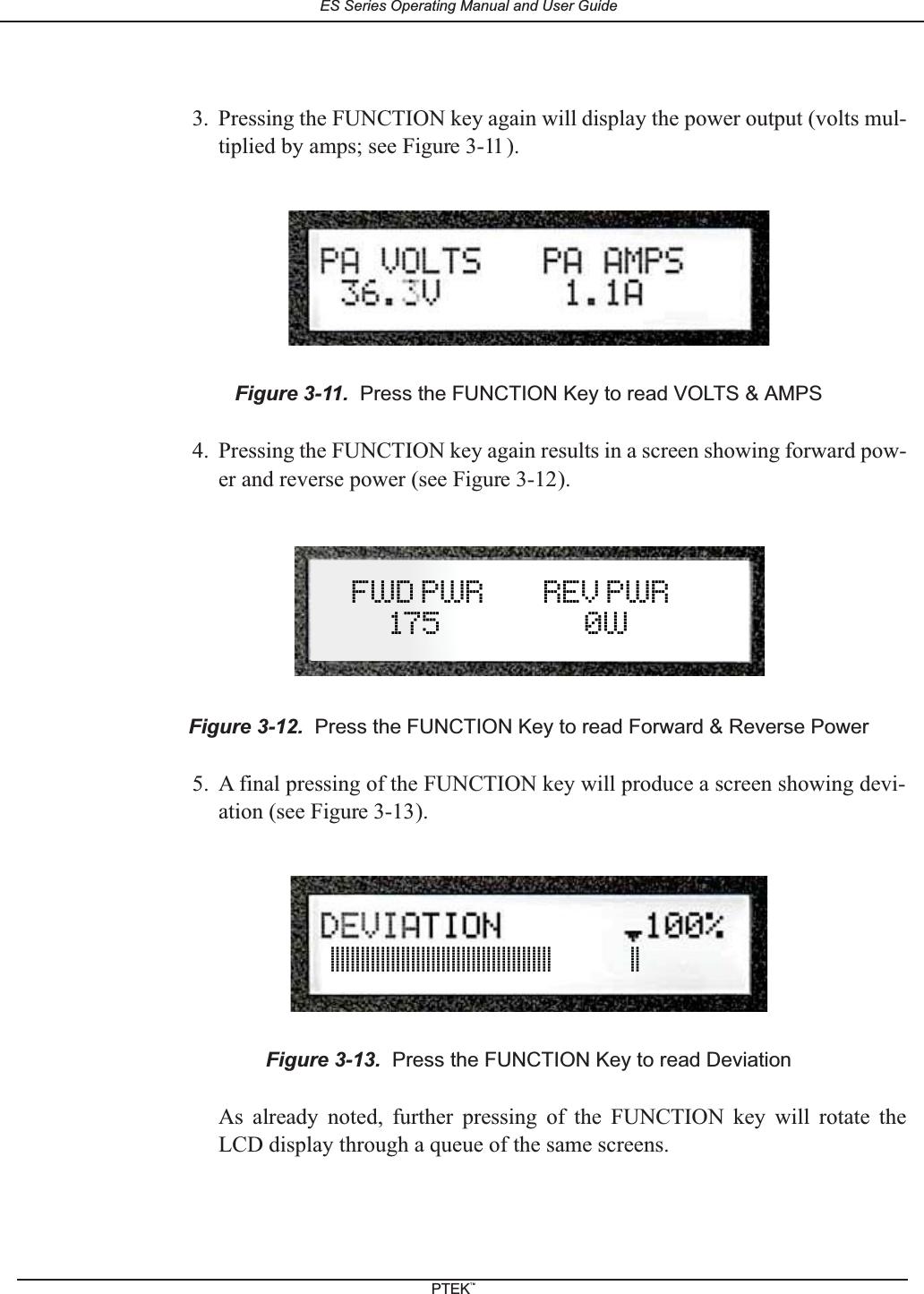
3.3.4 Final CheckPressing the FUNCTION key rotates the LCD display through the followingscreens:1. After pressing the FUNCTION key on the front of the FM500ES, the operat-ing frequency will appear on the LCD display (see Figure 3-9 ).2. Pressing the FUNCTION key again will display the audio gain (see Figure3-10).Note: At each screen, pressing the LOWER or RAISE key changes the outputpower only. PA VOLTS and PA AMPS is another way of indicating the poweroutput, accomplished by multiplying the voltage by the amperage (current), thenmultiplying the result by the efficiency.Readings should be recorded weekly to keep track of changes, which may indi-cate developing problems auch as antenna or coax deterioriation.Figure 3-9. Press the FUNCTION Key to read FrequencyFigure 3-10. Press the FUNCTION Key to read Audio GainES Series Operating Manual and User GuidePTEKTM
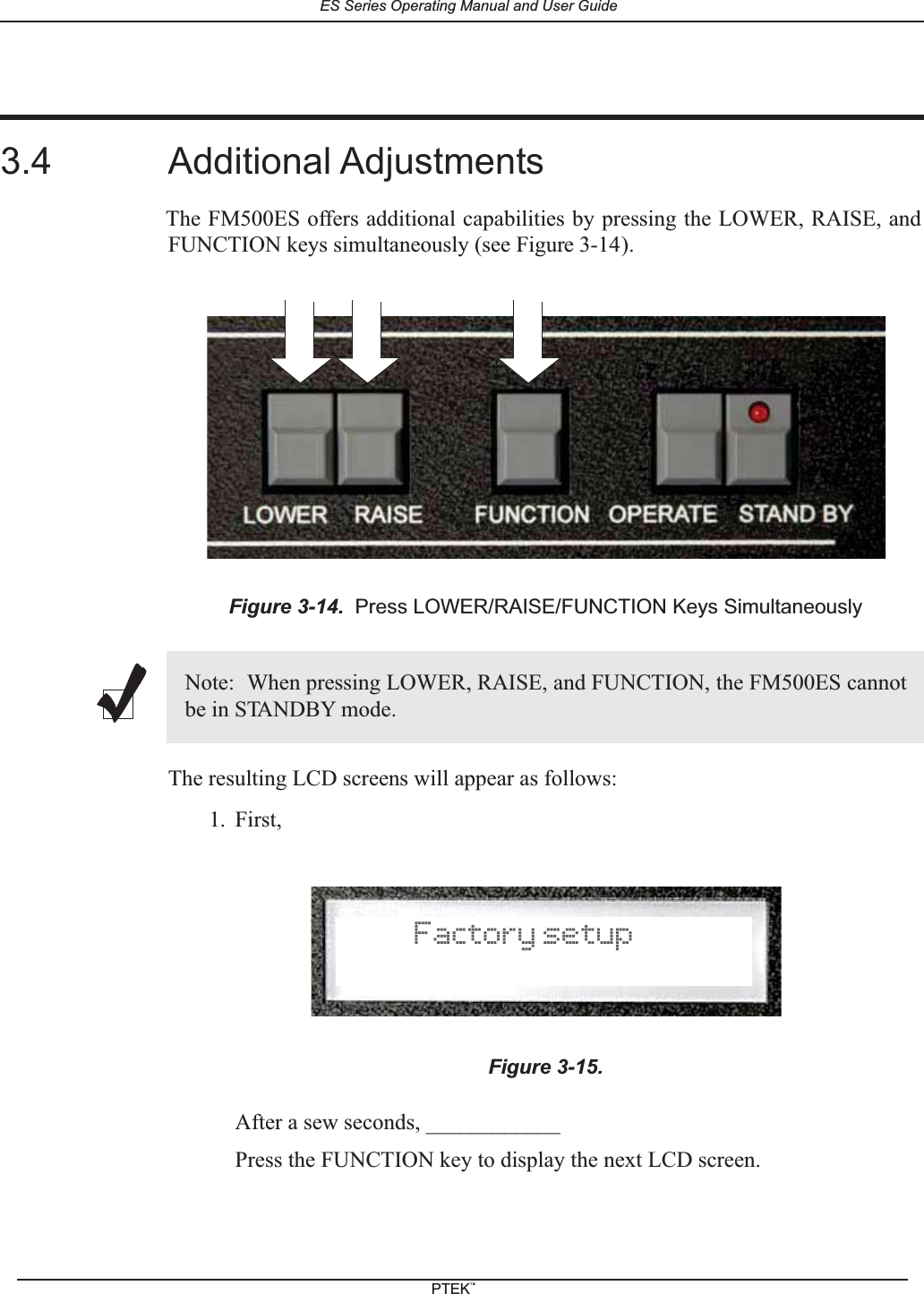
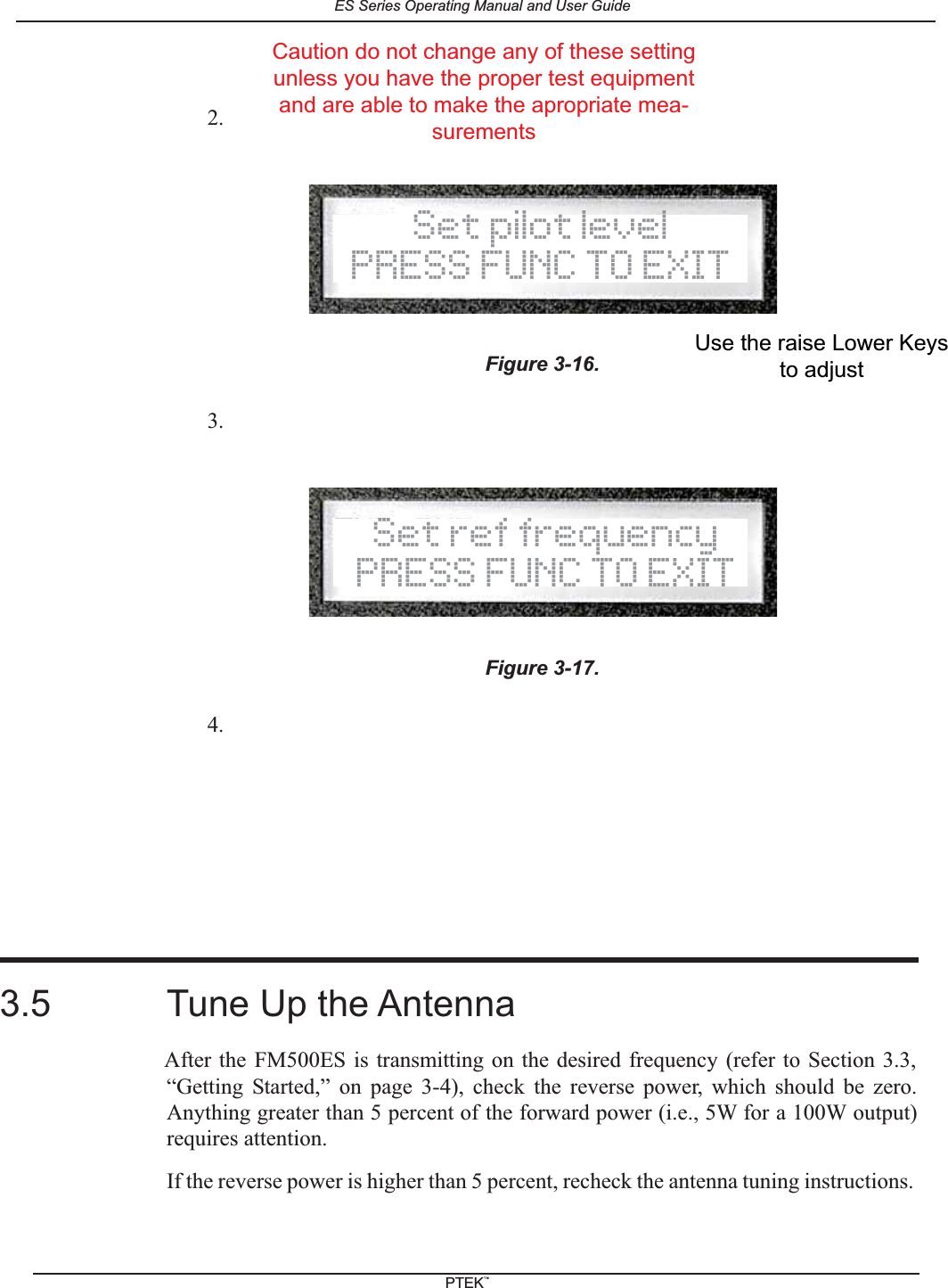
3. Pressing the FUNCTION key again will display the power output (volts mul-tiplied by amps; see Figure 3-11 ).4. Pressing the FUNCTION key again results in a screen showing forward pow-er and reverse power (see Figure 3-12).5. A final pressing of the FUNCTION key will produce a screen showing devi-ation (see Figure 3-13).As already noted, further pressing of the FUNCTION key will rotate theLCD display through a queue of the same screens.Figure 3-11. Press the FUNCTION Key to read VOLTS & AMPSFigure 3-12. Press the FUNCTION Key to read Forward & Reverse PowerFigure 3-13. Press the FUNCTION Key to read Deviation||||||||||||||||||||||||||||||||||||||||||||              ||FWD PWR         REV PWR175 0WES Series Operating Manual and User GuidePTEKTM
3.4 Additional AdjustmentsThe FM500ES offers additional capabilities by pressing the LOWER, RAISE, andFUNCTION keys simultaneously (see Figure 3-14).The resulting LCD screens will appear as follows:1. First,After a sew seconds, ____________Press the FUNCTION key to display the next LCD screen.Figure 3-14. Press LOWER/RAISE/FUNCTION Keys SimultaneouslyNote: When pressing LOWER, RAISE, and FUNCTION, the FM500ES cannotbe in STANDBY mode.Figure 3-15.Factory setupES Series Operating Manual and User GuidePTEKTM
2.3.4.3.5 Tune Up the AntennaAfter the FM500ES is transmitting on the desired frequency (refer to Section 3.3,“Getting Started,” on page 3-4), check the reverse power, which should be zero.Anything greater than 5 percent of the forward power (i.e., 5W for a 100W output)requires attention.If the reverse power is higher than 5 percent, recheck the antenna tuning instructions.Figure 3-16.Figure 3-17.Set pilot levelPRESS FUNC TO EXITSet ref frequencyPRESS FUNC TO EXITUse the raise Lower Keysto adjustCaution do not change any of these settingunless you have the proper test equipmentand are able to make the apropriate mea-surementsES Series Operating Manual and User GuidePTEKTM
3.6 Power Down the SystemTo power down (turn off) the FM500ES FM Stereo Broadcast Transmitter, press theSTANDBY key, then disconnect the AC pow er cord from the AC power socket onthe rear panel of the chassis.ES Series Operating Manual and User GuidePTEKTM
ES Series Operating Manual and User GuidePTEKTM
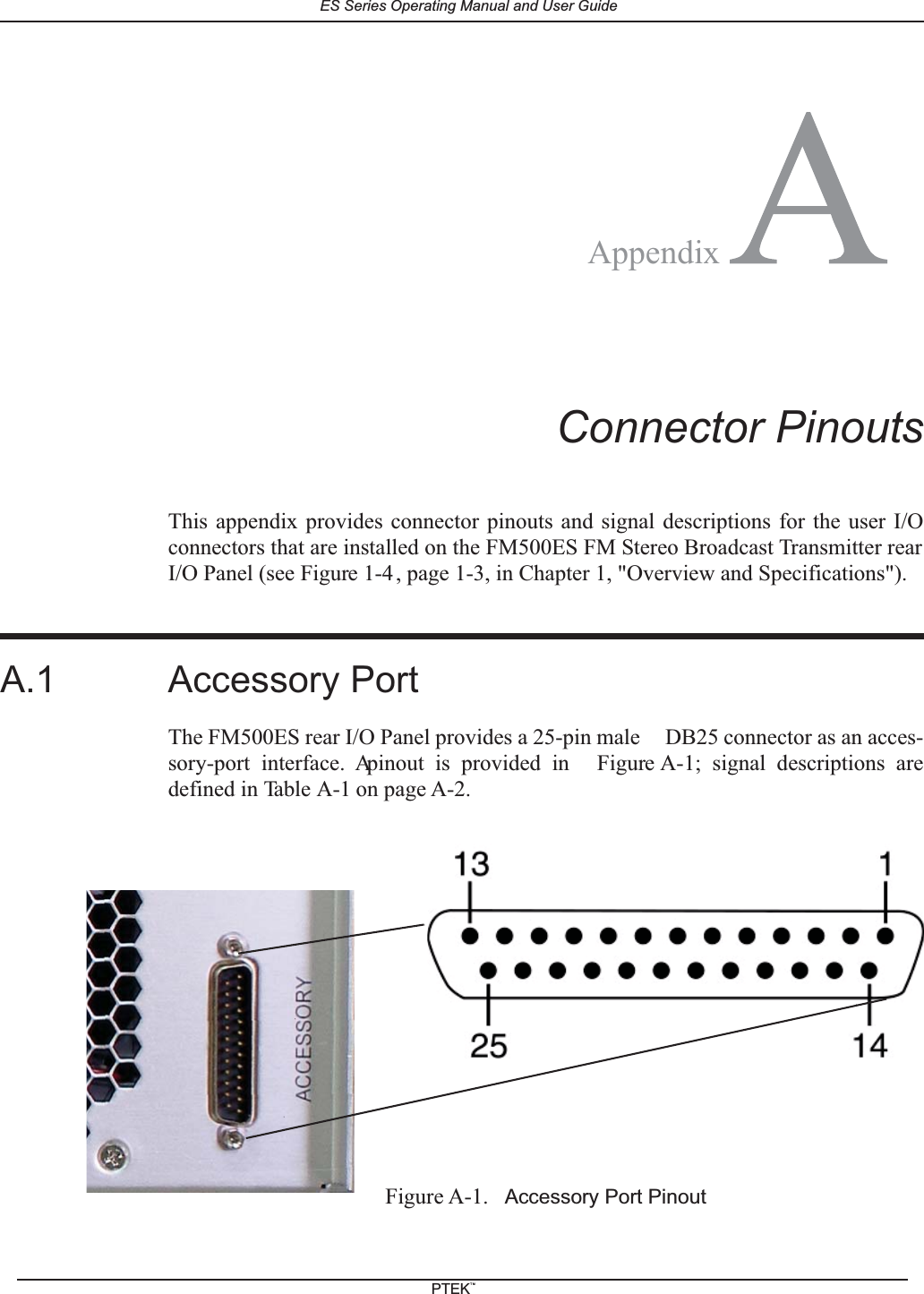
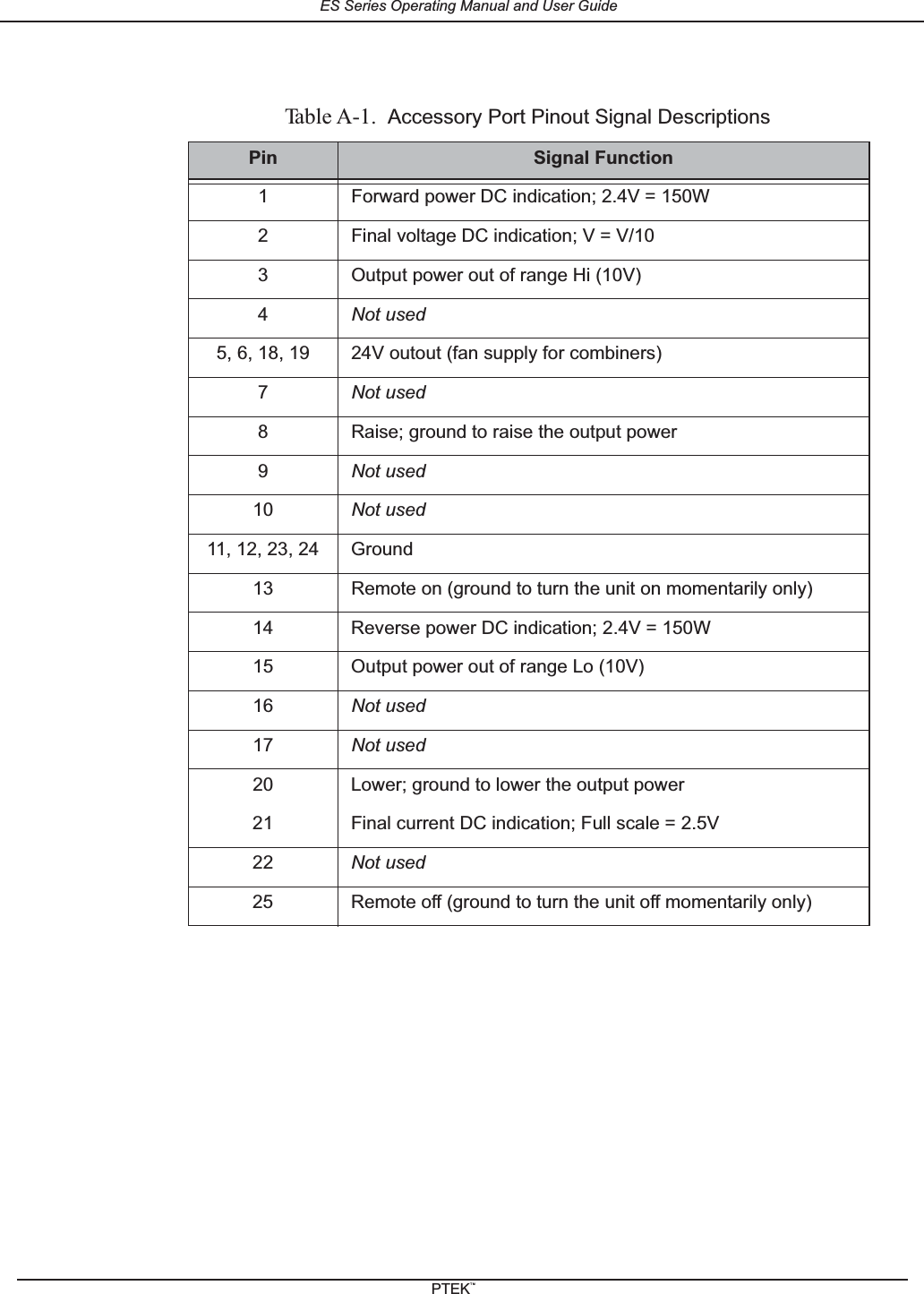
AConnector PinoutsThis appendix provides connector pinouts and signal descriptions for the user I/Oconnectors that are installed on the FM500ES FM Stereo Broadcast Transmitter rearI/O Panel (see Figure 1-4, page 1-3, in Chapter 1, "Overview and Specifications").A.1 Accessory PortThe FM500ES rear I/O Panel provides a 25-pin male DB25 connector as an acces-sory-port interface. Apinout is provided in Figure A-1; signal descriptions aredefined in Table A-1 on page A-2.Figure A-1. Accessory Port PinoutAppendixES Series Operating Manual and User GuidePTEKTM
Table A-1. Accessory Port Pinout Signal DescriptionsPin Signal Function1 Forward power DC indication; 2.4V = 150W2 Final voltage DC indication; V = V/103 Output power out of range Hi (10V)4Not used5, 6, 18, 19 24V outout (fan supply for combiners)7Not used8 Raise; ground to raise the output power9Not used10 Not used11, 12, 23, 24 Ground1314 Reverse power DC indication; 2.4V = 150W15 Output power out of range Lo (10V)16 Not used17 Not used20 Lower; ground to lower the output power21 Final current DC indication; Full scale = 2.5V22 Not used25Remote on (ground to turn the unit on momentarily only)Remote off (ground to turn the unit off momentarily only)ES Series Operating Manual and User GuidePTEKTM
BRack-Mount Slide InstallationAn optional set of two rack-mount slides (left side and right side) is available for allFM500ES FM Stereo Broadcast Transmittersystems, and should be ordered at thetime of purchase. The FM500ES chassis contains two (2) threaded screw holes (seeFigure B-1 on page B-2) on each side to accommodate #10-32 size screws (includedwith the rack-mount slide kit).Dimensions of the screw-hole patterns on the sides of the FM500ES chassis forinstalling rack-mount slides are shown in Figure B-2 on page B-3. The requiredholes for specialized steel or aluminum slides will have to be measured, drilled, andtapped before installation.The rack-mount slide installation kit includes the following items:a. Two inside slide sectionsb. Two outside slide sectionsc. Two front (short) slide bracketsd. Two rear (long) slide bracketse. Assorted screws, washers, and nutsFollow these steps to install a steel rack-mount slide to the FM500ES chassis:Caution: Any screws used to mount a slide to a FM500ES chassis must not exceeda length of 3/8” to prevent excessive penetration of the chassis.AppendixES Series Operating Manual and User GuidePTEKTM
1. Attach the inside slide section (see Figure B-3 on page B-3) to both sides ofthe FM500ES chassis using two #10-32 screws per side (see .2. Measure the depth of the 19” equipment rack into which the FM500ES systemwill be installed (this can vary from 24” to 30”).3. Using the depth of the equipment rack, adjust and attach the front and rearslide brackets to the outside slide section using the screws, washers, and nutsprovided with the slide kit.4. With all slide brackets securely attached to both the right and left outside slidesections, install both sections to the inside right and inside left of a 19” rackwith two bolts per bracket, making sure there is adequate room for the 2RUheight (3.5”) of a FM500ES system.5. Carefully insert the FM500ES system into the 19” rack so that the insideslides on both sides of the chassis travel smoothly into the channels of the out-side slide sections. Push the system into the rack until the mounting bracketson the front of the chassis are flush with the front of the rack.6. Secure the FM500ES system to the 19” rack with two bolts on each side.Figure B-1. FM500ES Right-Side Rack-Mount Slide Holes10-32 Threaded Rack-Mount Slide Holes (2)ES Series Operating Manual and User GuidePTEKTM
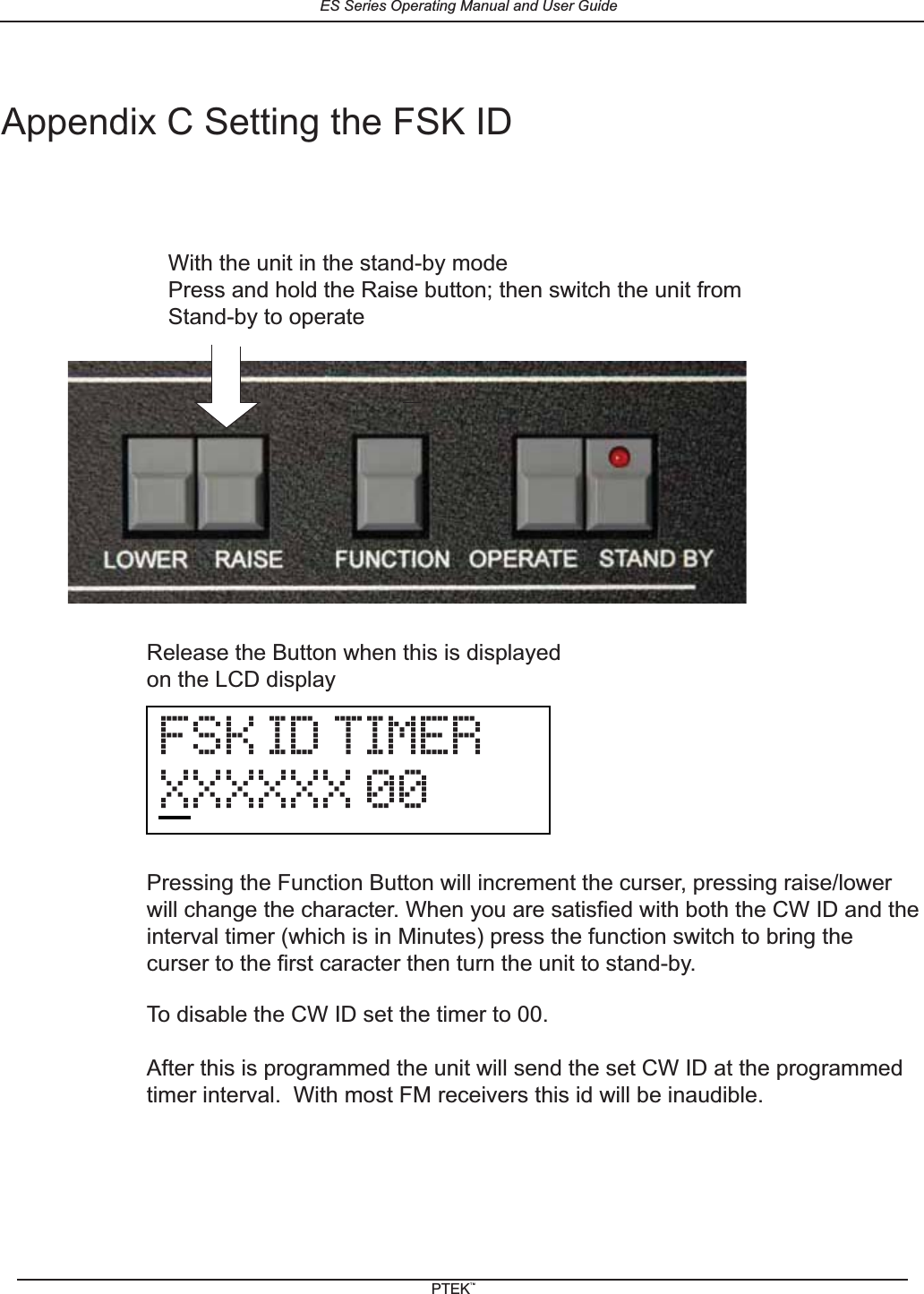
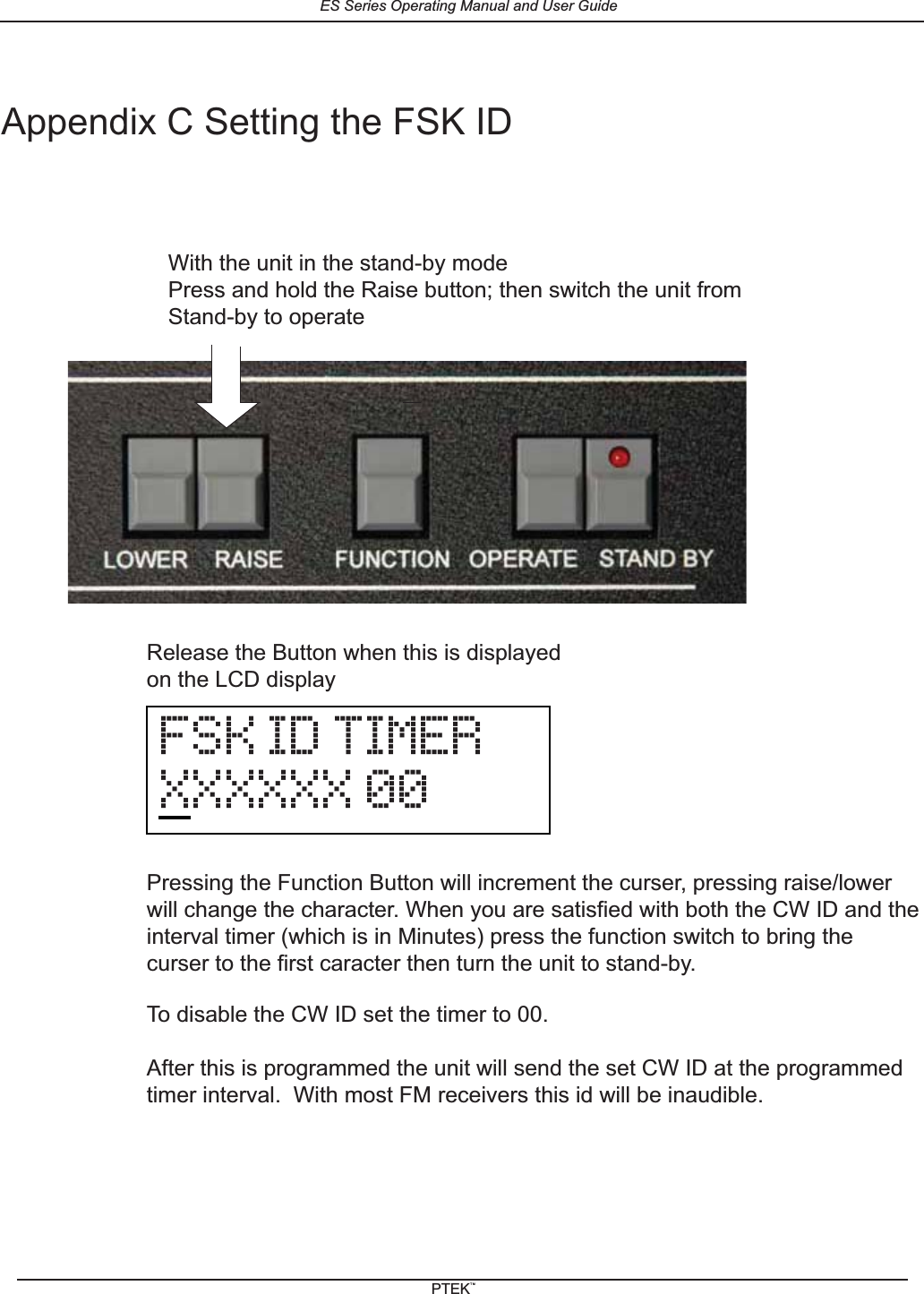
Appendix C Setting the FSK IDWith the unit in the stand-by modePress and hold the Raise button; then switch the unit fromStand-by to operateFSK ID TIMERXXXXXX 00Release the Button when this is displayedon the LCD displayPressing the Function Button will increment the curser, pressing raise/lowerwill change the character. When you are satisfied with both the CW ID and theinterval timer (which is in Minutes) press the function switch to bring thecurser to the first caracter then turn the unit to stand-by.To disable the CW ID set the timer to 00.After this is programmed the unit will send the set CW ID at the programmedtimer interval.  With most FM receivers this id will be inaudible.ES Series Operating Manual and User GuidePTEKTM

Navigation menu