Fit2Go TPMS PC TPMS Pressure Checker User Manual Michelin TPMS Operations Manual 120mm X 170mm

Fit2Go TPMS Ltd TPMS Pressure Checker Michelin TPMS Operations Manual 120mm X 170mm

User Manual

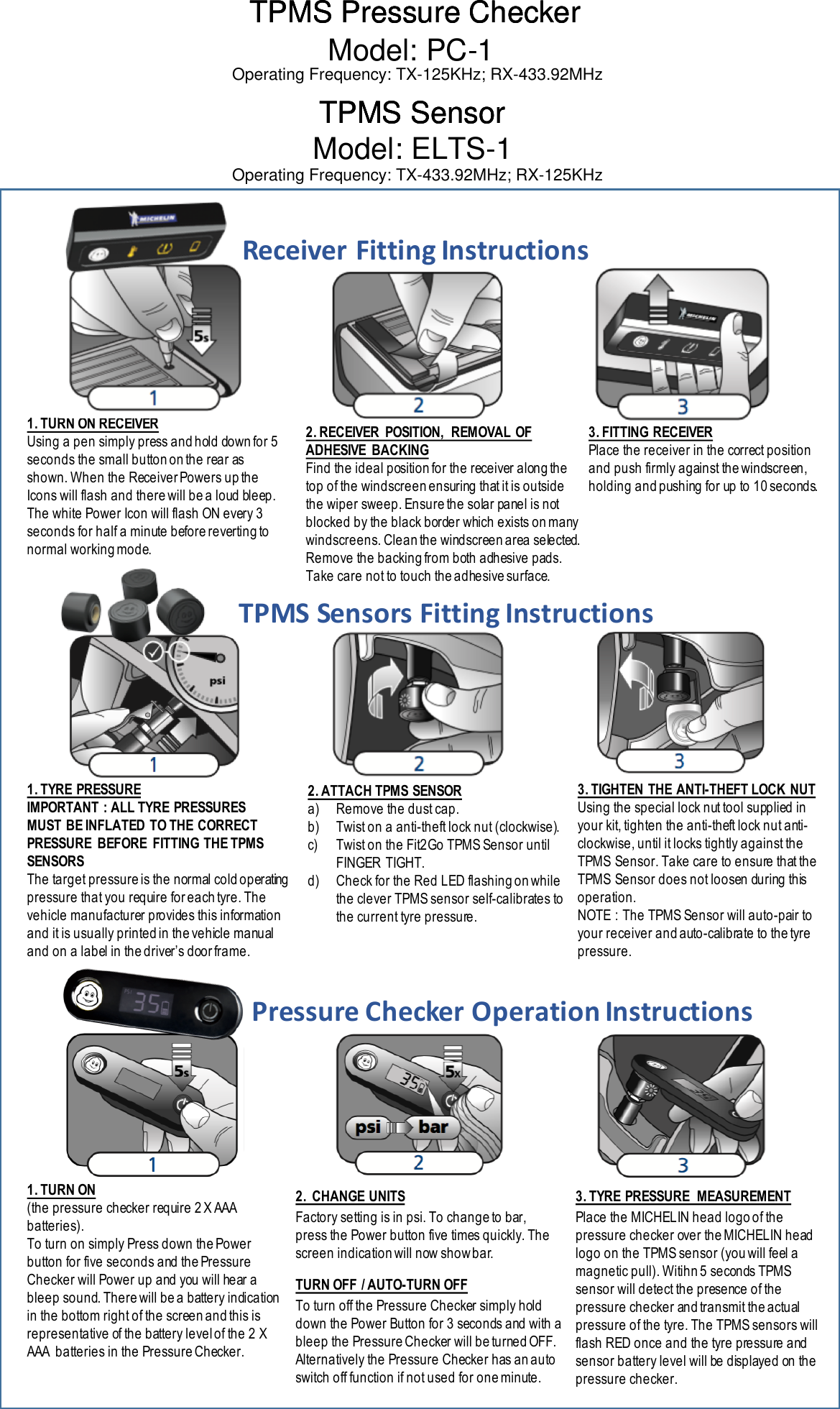
1. TURN ON RECEIVERUsing a pen simply press and hold down for 5 seconds the small button on the rear as shown. When the Receiver Powers up the Icons will flash and there will be a loud bleep. The white Power Icon will flash ON every 3 seconds for half a minute before reverting to normal working mode.2. RECEIVER  POSITION,  REMOVAL OF ADHESIVE  BACKINGFind the ideal position for the receiver along the top of the windscreen ensuring that it is outside the wiper sweep. Ensure the solar panel is not blocked by the black border which exists on many windscreens. Clean the windscreen area selected. Remove the backing from both adhesive pads. Take care not to touch the adhesive surface.3. FITTING RECEIVERPlace the receiver in the correct position and push firmly against the windscreen, holding and pushing for up to 10 seconds. 1. TYRE PRESSUREIMPORTANT : ALL TYRE PRESSURES MUST BE INFLATED TO THE CORRECT PRESSURE  BEFORE  FITTING THE TPMS SENSORSThe target pressure is the normal cold operating pressure that you require for each tyre. The vehicle manufacturer provides this information and it is usually printed in the vehicle manual and on a label in the driver’s door frame. 2. ATTACH TPMS SENSORa) Remove the dust cap.b) Twist on a anti-theft lock nut (clockwise).c) Twist on the Fit2Go TPMS Sensor until FINGER TIGHT.d) Check for the Red LED flashing on while the clever TPMS sensor self-calibrates to the current tyre pressure.3. TIGHTEN THE ANTI-THEFT LOCK NUTUsing the special lock nut tool supplied in your kit, tighten the anti-theft lock nut anti-clockwise, until it locks tightly against the TPMS Sensor. Take care to ensure that the TPMS Sensor does not loosen during this operation.NOTE : The TPMS Sensor will auto-pair to your receiver and auto-calibrate to the tyrepressure.1. TURN ON(the pressure checker require 2 X AAA batteries).To turn on simply Press down the Power button for five seconds and the Pressure Checker will Power up and you will hear a bleep sound. There will be a battery indication in the bottom right of the screen and this is representative of the battery level of the 2 X AAA  batteries in the Pressure Checker.2.  CHANGE UNITSFactory setting is in psi. To change to bar, press the Power button five times quickly. The screen indication will now show bar. 3. TYRE PRESSURE  MEASUREMENTPlace the MICHELIN head logo of the pressure checker over the MICHELIN head logo on the TPMS sensor (you will feel a magnetic pull). Witihn 5 seconds TPMS sensor will detect the presence of the pressure checker and transmit the actual pressure of the tyre. The TPMS sensors will flash RED once and the tyre pressure and sensor battery level will be displayed on the pressure checker.TURN OFF  / AUTO-TURN OFFTo turn off the Pressure Checker simply hold down the Power Button for 3 seconds and with a bleep the Pressure Checker will be turned OFF. Alternatively the Pressure Checker has an auto switch off function if not used for one minute.Receiver'Fitting'InstructionsTPMS'Sensors'Fitting'InstructionsPressure'Checker'Operation'InstructionsTPMS Pressure CheckerTPMS Pressure CheckerTPMS Pressure CheckerModel: PC-1TPMS SensorTPMS SensorTPMS SensorModel: ELTS-1Operating Frequency: TX-125KHz; RX-433.92MHzOperating Frequency: TX-433.92MHz; RX-125KHz
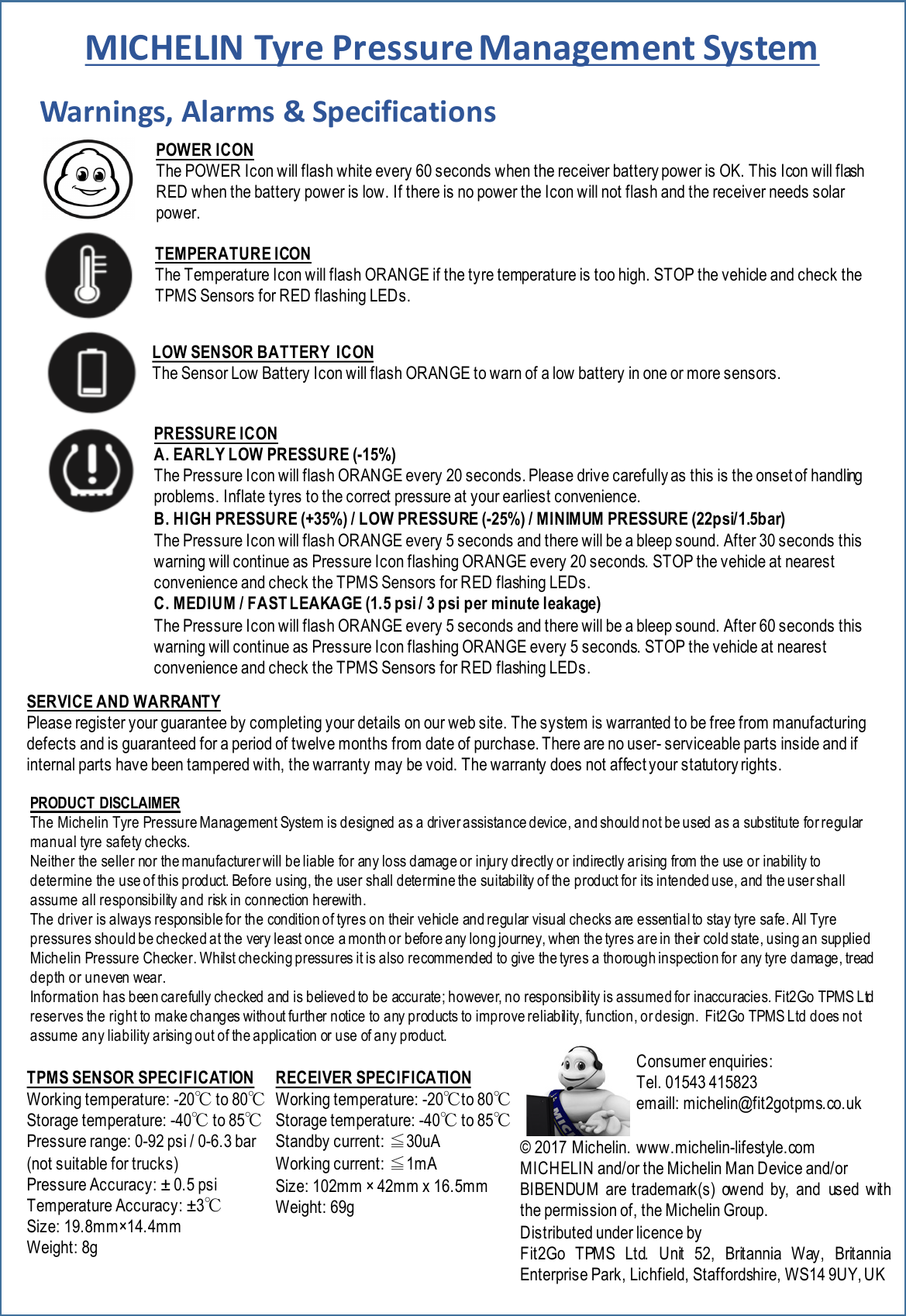
Warnings,'Alarms'&'SpecificationsRECEIVER SPECIFICATIONWorking temperature: -20℃to 80℃Storage temperature: -40℃to 85℃Standby current: ≦30uAWorking current: ≦1mASize: 102mm ×42mm x 16.5mm     Weight: 69gTPMS SENSOR SPECIFICATIONWorking temperature: -20℃to 80℃Storage temperature: -40℃to 85℃Pressure range: 0-92 psi / 0-6.3 bar(not suitable for trucks)Pressure Accuracy: ±0.5 psiTemperature Accuracy: ±3℃Size: 19.8mm×14.4mm      Weight: 8gPOWER ICONThe POWER Icon will flash white every 60 seconds when the receiver battery power is OK. This Icon will flash RED when the battery power is low. If there is no power the Icon will not flash and the receiver needs solar power.TEMPERATURE ICONThe Temperature Icon will flash ORANGE if the tyre temperature is too high. STOP the vehicle and check the TPMS Sensors for RED flashing LEDs.PRESSURE ICONA. EARLY LOW PRESSURE (-15%)The Pressure Icon will flash ORANGE every 20 seconds. Please drive carefully as this is the onset of handling problems. Inflate tyres to the correct pressure at your earliest convenience.B. HIGH PRESSURE (+35%) / LOW PRESSURE (-25%) / MINIMUM PRESSURE (22psi/1.5bar)The Pressure Icon will flash ORANGE every 5 seconds and there will be a bleep sound. After 30 seconds this warning will continue as Pressure Icon flashing ORANGE every 20 seconds. STOP the vehicle at nearest convenience and check the TPMS Sensors for RED flashing LEDs.C. MEDIUM / FAST LEAKAGE (1.5 psi / 3 psi per minute leakage)The Pressure Icon will flash ORANGE every 5 seconds and there will be a bleep sound. After 60 seconds this warning will continue as Pressure Icon flashing ORANGE every 5 seconds. STOP the vehicle at nearest convenience and check the TPMS Sensors for RED flashing LEDs.LOW SENSOR BATTERY  ICONThe Sensor Low Battery Icon will flash ORANGE to warn of a low battery in one or more sensors.Consumer enquiries: Tel. 01543 415823 emaill: michelin@fit2gotpms.co.uk © 2017 Michelin. www.michelin-lifestyle.com MICHELIN and/or the Michelin Man Device and/orBIBENDUM are trademark(s) ow end by, and us ed withthe permission of, the Michelin Group.Distributed under licence byFit2Go TPMS Ltd.Unit 52,Britannia Way, BritanniaEnterprise Park, Lichfield,Staffordshire, WS14 9UY,UKSERVICE AND WARRANTY Please register your guarantee by completing your details on our web site. The system is warranted to be free from manufacturingdefects and is guaranteed for a period of twelve months from date of purchase. There are no user-serviceable parts inside and if internal parts have been tampered with, the warranty may be void. The warranty does not affect your statutory rights. PRODUCT  DISCLAIMERThe Michelin Tyre Pressure Management System is designed as a driver assistance device, and should not be used as a substitute for regular manual tyre safety checks.Neither the seller nor the manufacturer will be liable for any loss damage or injury directly or indirectly arising from the use or inability to determine the use of this product. Before using, the user shall determine the suitability of the product for its intended use, and th e user sha ll assume all responsibility and risk in connection herewith.The driver is always responsible for the condition of tyres on their vehicle and regular visual checks are essential to stay tyre safe. All Tyre pressures should be checked at the very least once a month or before any long journey, when the tyres are in their cold state, using an supplied Michelin Pressure Checker. Whilst checking pressures it is also recommended to give the tyres a thorough inspection for any tyre damage, tread depth or uneven wear. Information has been carefully checked and is believed to be accurate; however, no responsibility is assumed for inaccuracies. Fit2Go TPMS Ltd reserves the right to make changes without further notice to any products to improve reliability, function, or design.  Fit2Go TPMS Ltd does not assume any liability arising out of the application or use of any product. MICHELIN'Tyre Pressure'Management'System
 FCC Statement: This equipment has been tested and found to comply with the limits for a Class B digital device, pursuant to part 15 of the FCC Rules. These limits are designed to provide reasonable protection against harmful interference in a residential installation. This equipment generates, uses and can radiate radio frequency energy and, if not installed and used in accordance with the instructions, may  cause harmful interference to radio  communications. However,  there  is  no guarantee  that interference  will  not  occur  in  a  particular  installation.  If  this  equipment  does  cause  harmful interference to radio or television reception, which can be determined by turning the equipment off  and  on,  the  user  is  encouraged  to  try  to  correct  the  interference  by  one  or  more  of  the following measures: •  Reorient or relocate the receiving antenna. •  Increase the separation between the equipment and receiver. •  Connect the equipment into an outlet on a circuit different from that to which the receiver is connected. •  Consult the dealer or an experienced radio/TV technician for help. Caution:  Any  changes  or  modifications  to  this  device  not  explicitly  approved  by  manufacturer could void your authority to operate this equipment. This  device  complies  with  part  15  of  the  FCC  Rules.  Operation  is  subject  to  the  following  two conditions: (1) This device may not cause harmful interference, and (2) this device must accept any interference received, including interference that may cause undesired operation. The device has been evaluated to meet general RF exposure requirement. The device can be used in portable exposure condition without restriction.

Navigation menu