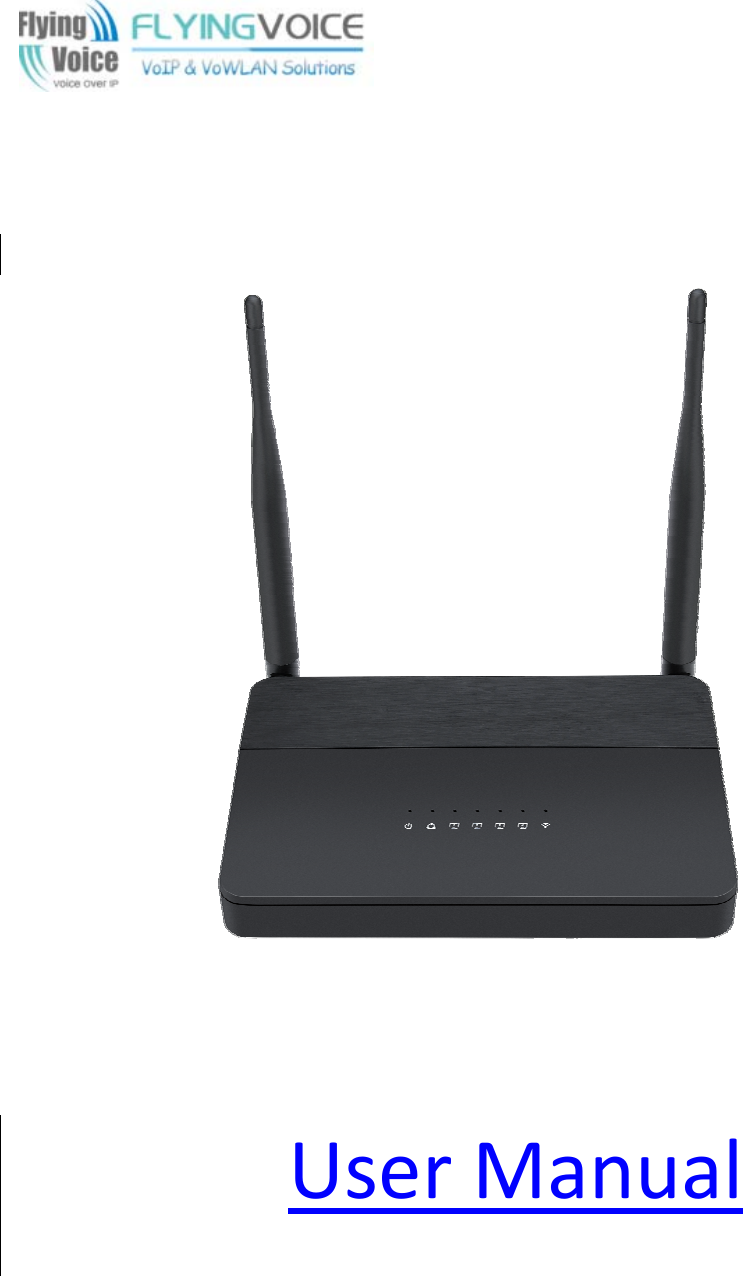
Flyingvoice Network Technology FWR9601 VoIP Wireless Router User Manual

Flyingvoice Network Technology Co., Ltd VoIP Wireless Router Users Manual

Users Manual

User Manual
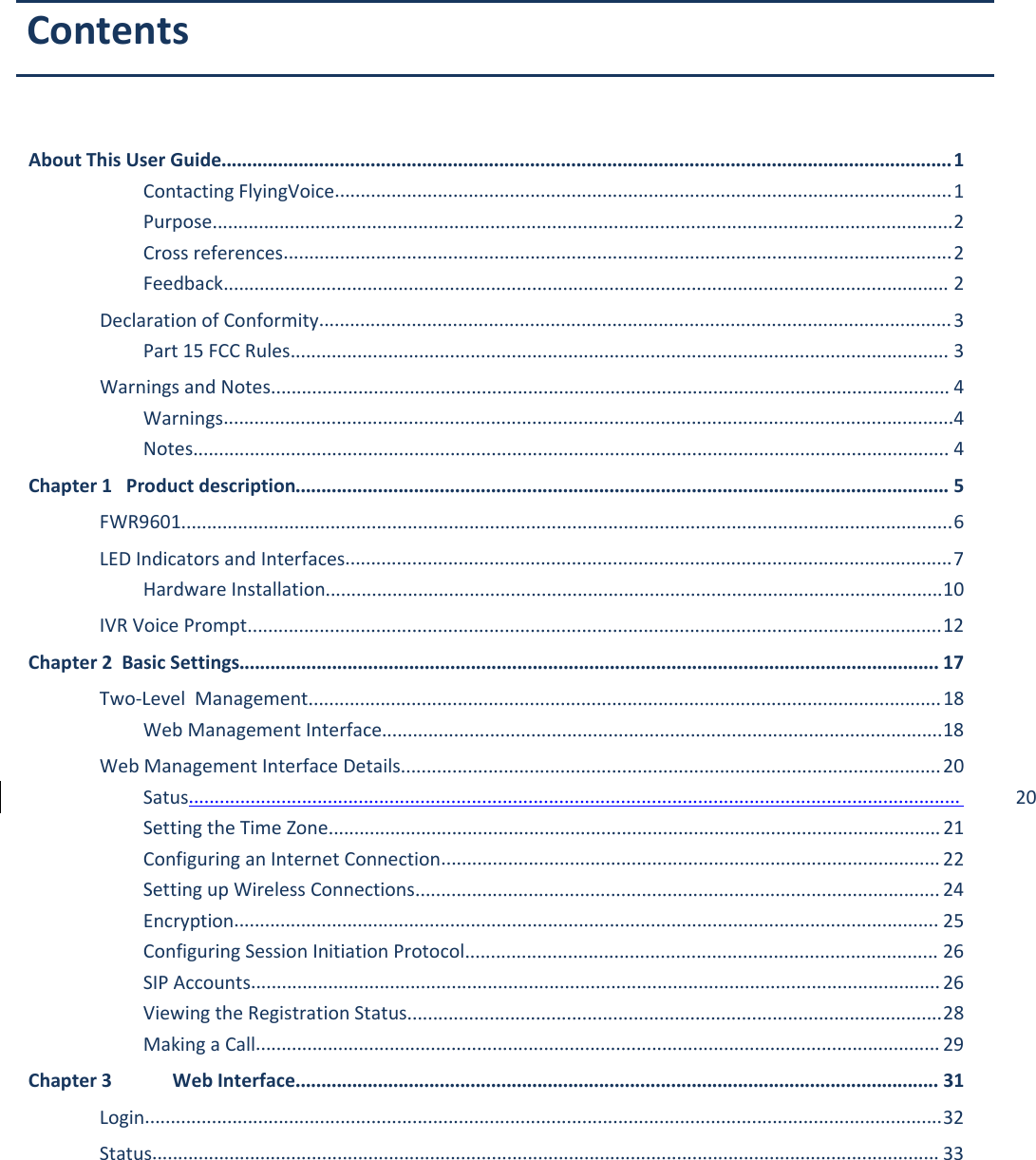
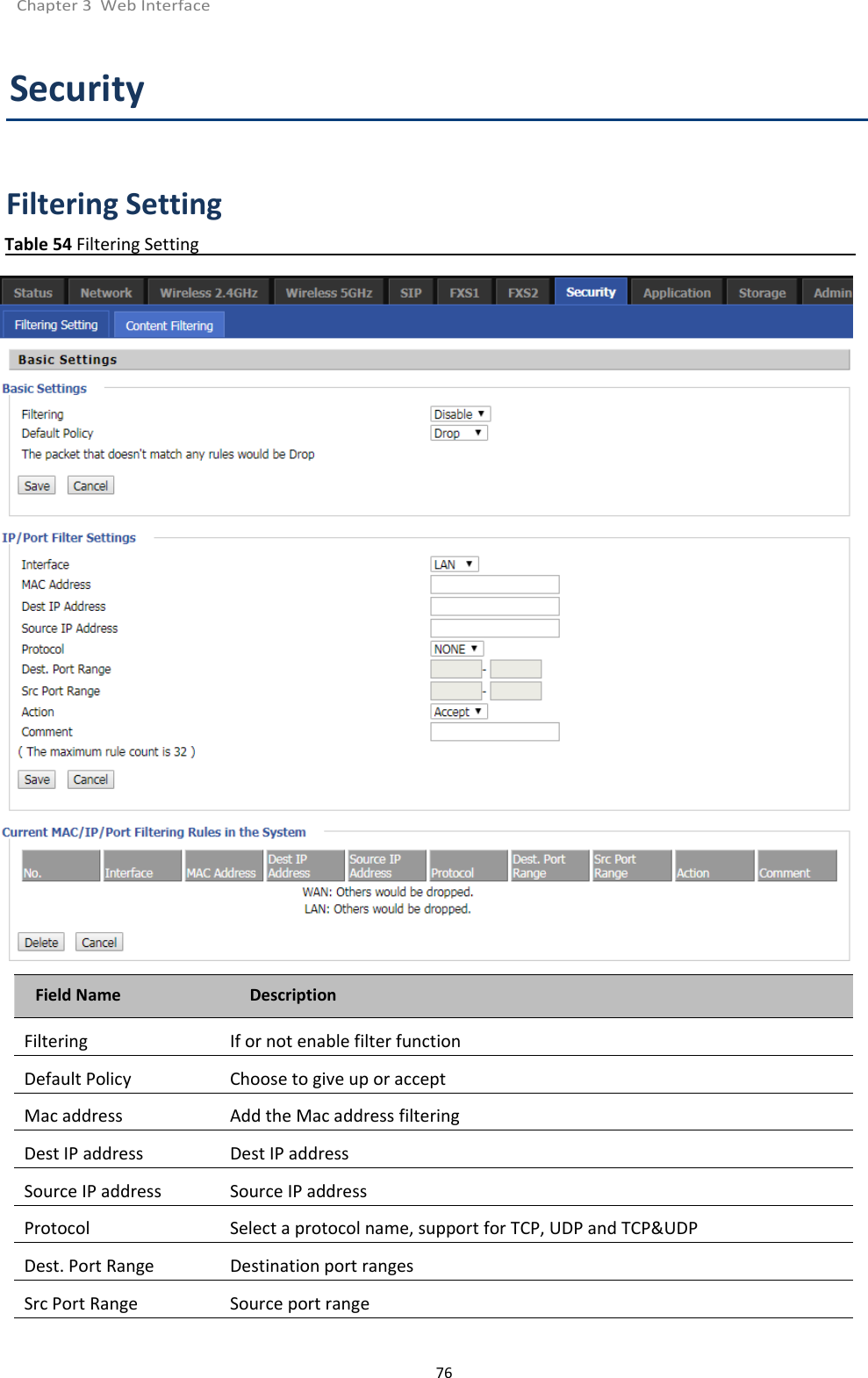
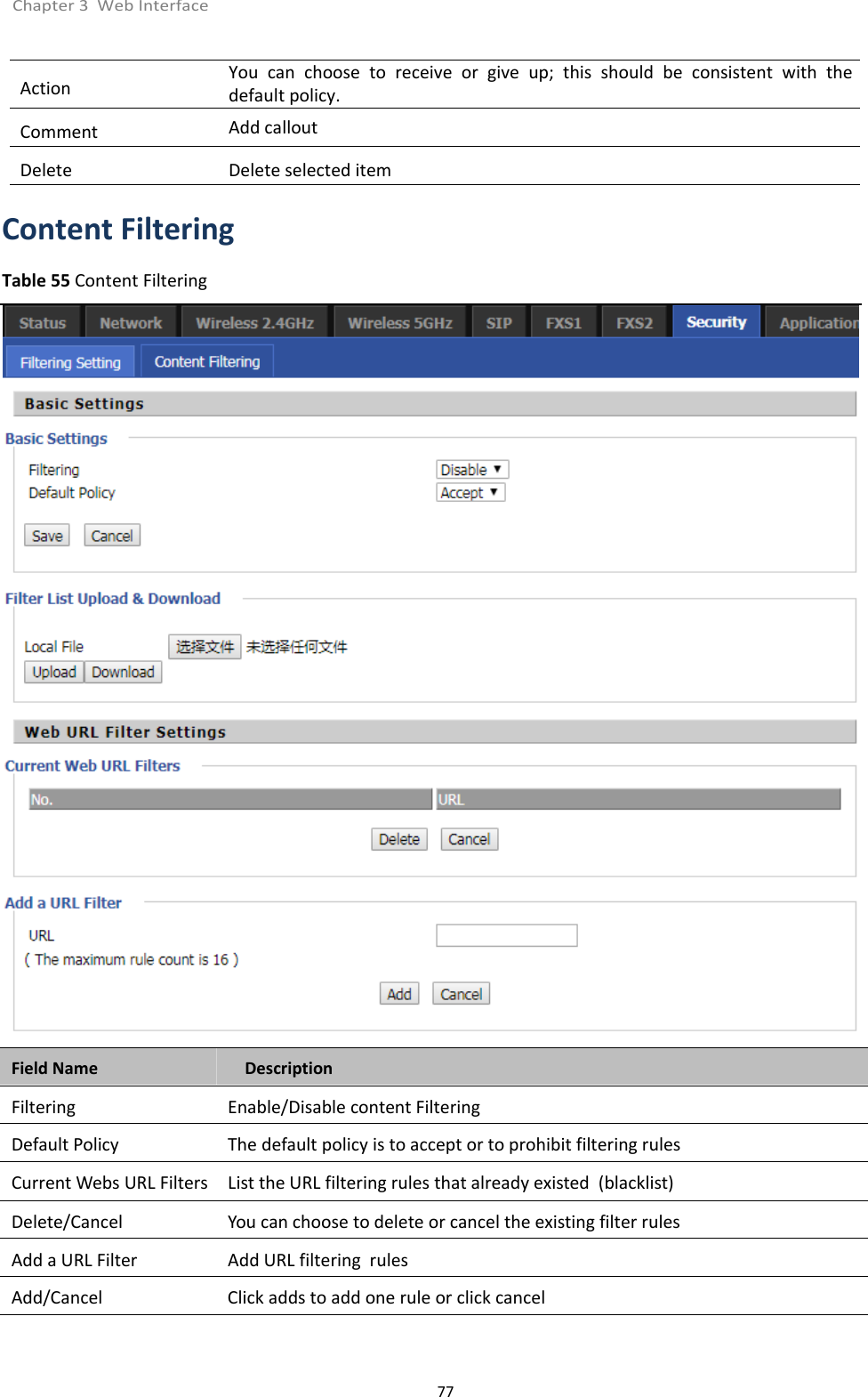
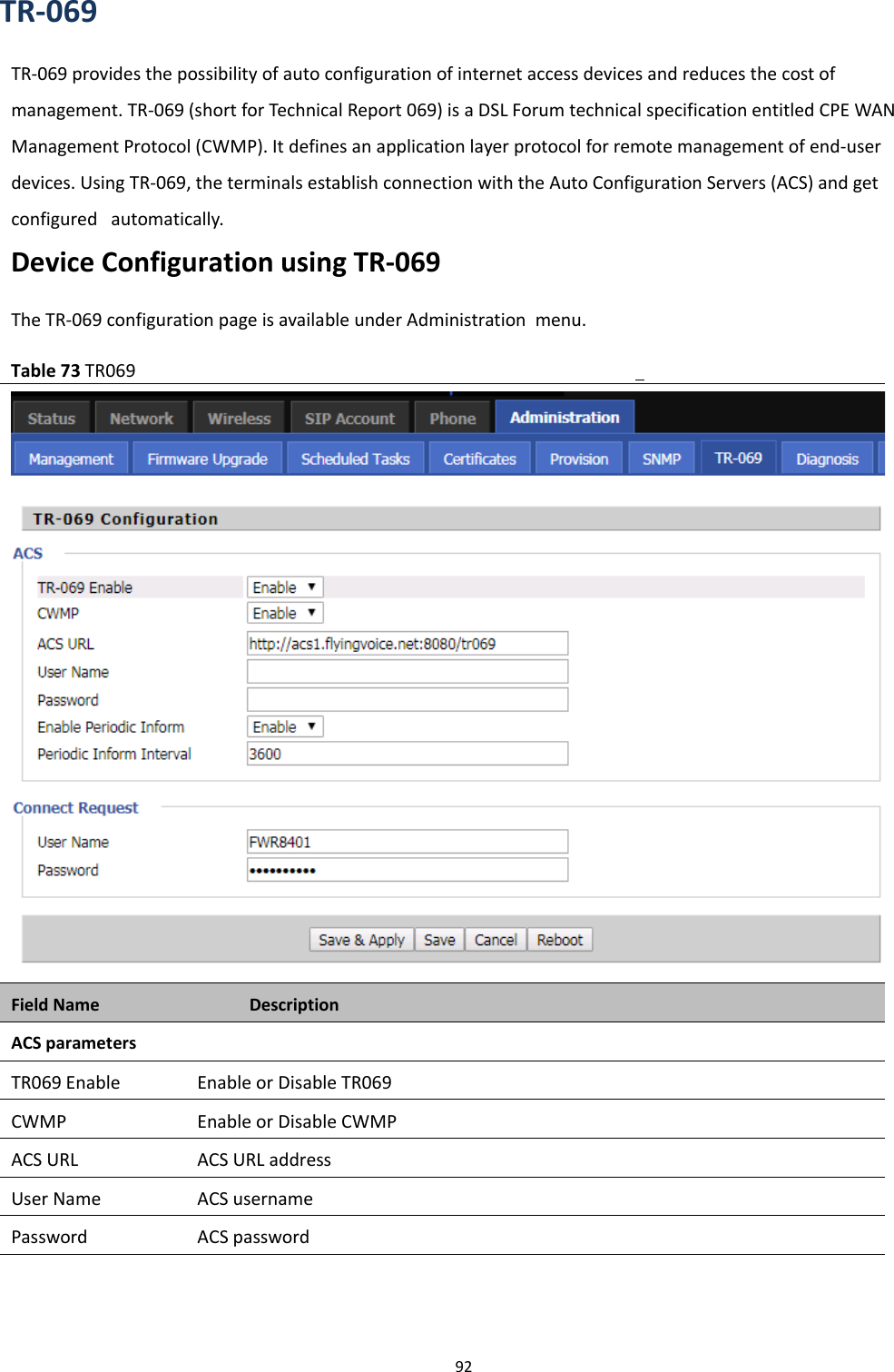
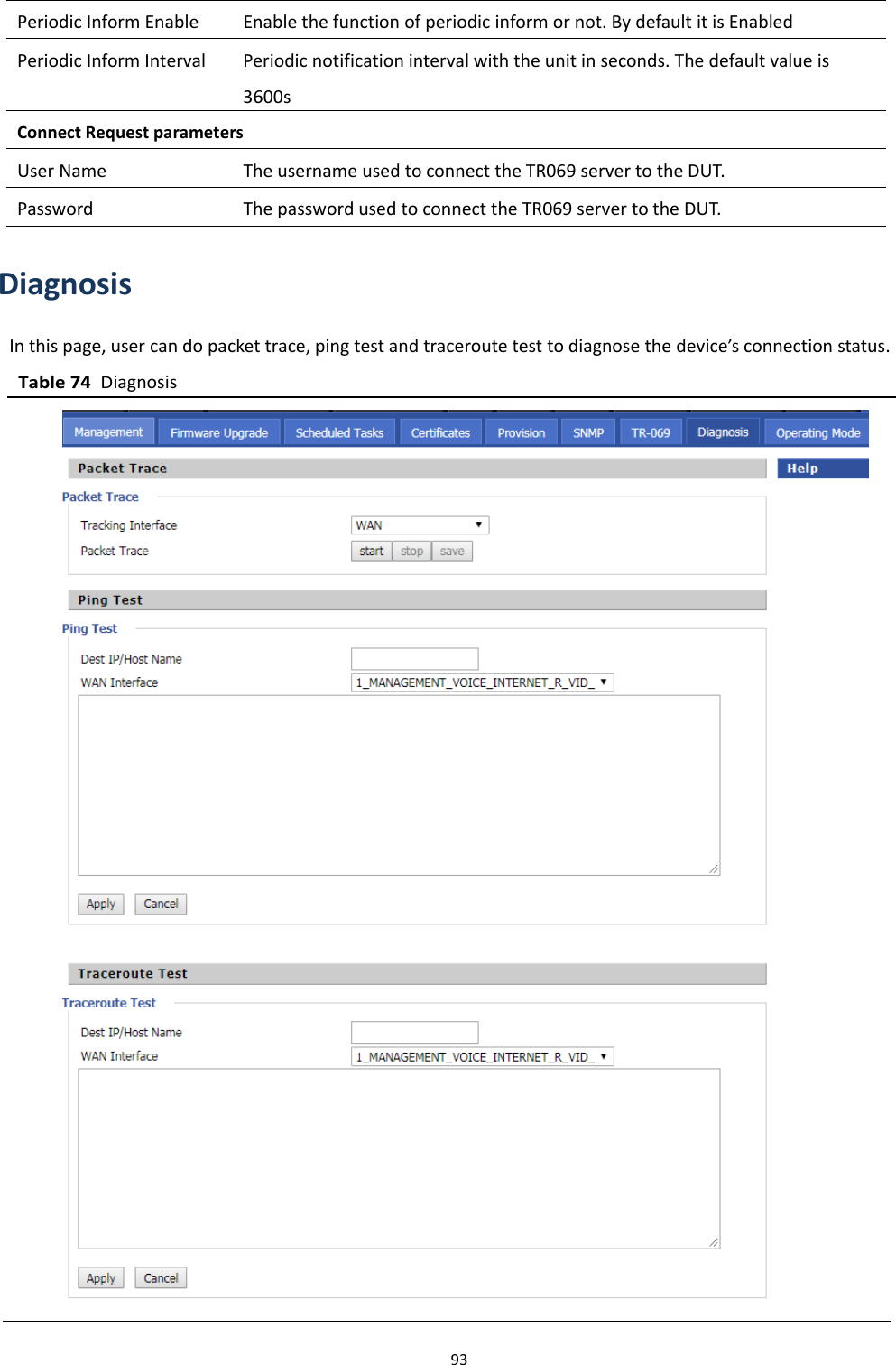
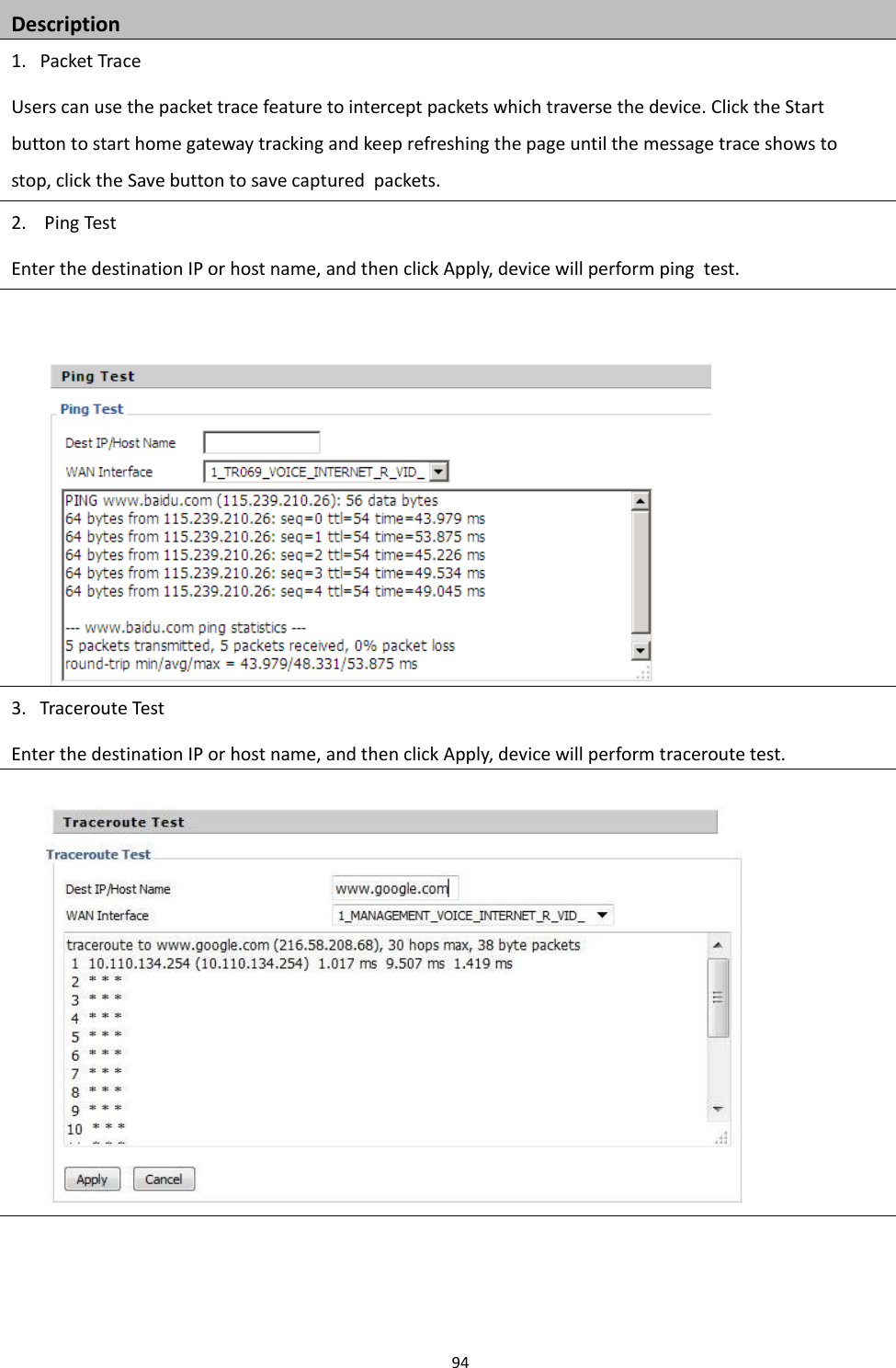
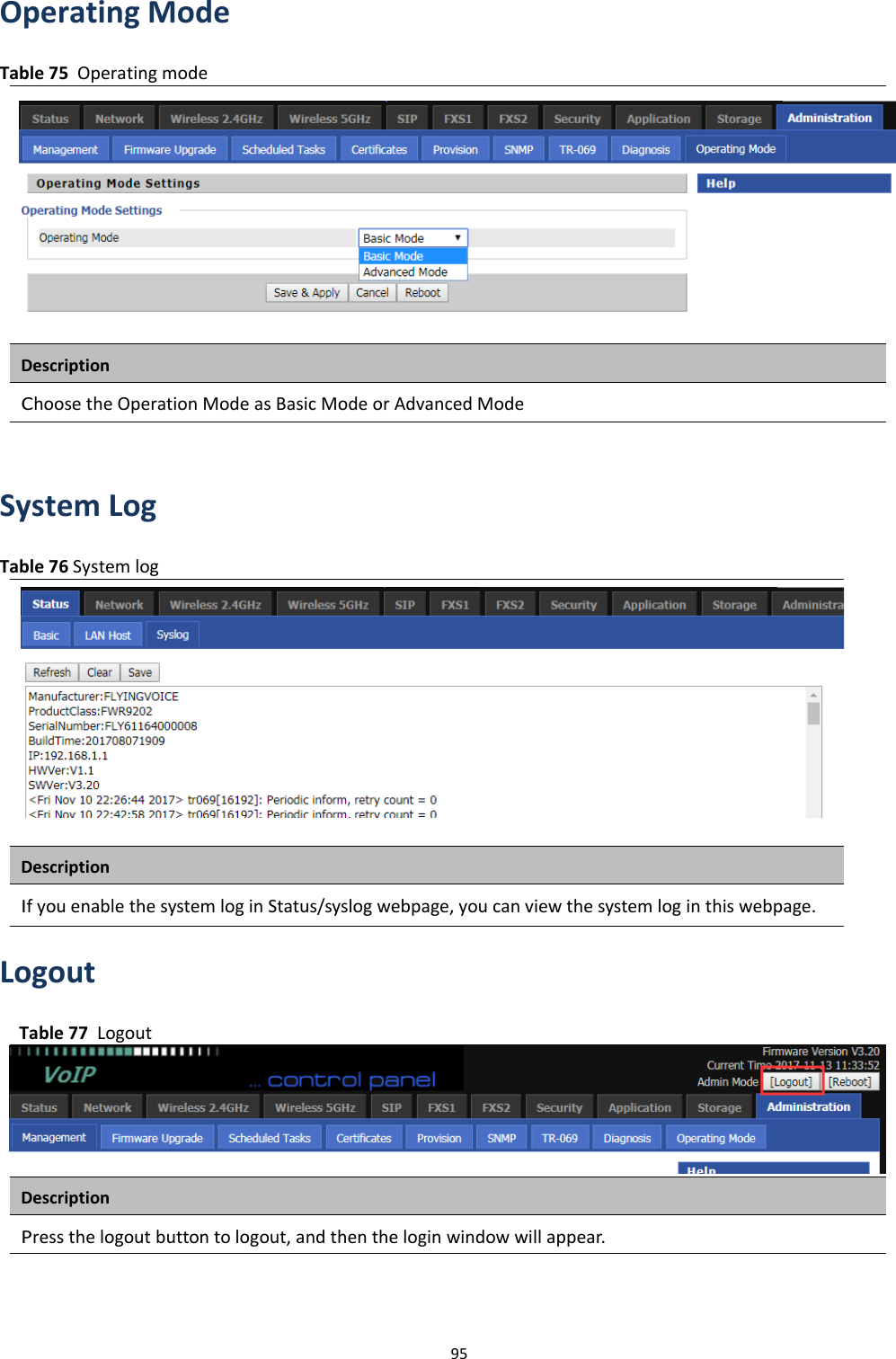
FWR9601 User ManualAbout This User Guide..............................................................................................................................................1Contacting FlyingVoice........................................................................................................................1Purpose................................................................................................................................................2Cross references..................................................................................................................................2Feedback............................................................................................................................................. 2Declaration of Conformity...........................................................................................................................3Part 15 FCC Rules................................................................................................................................3Warnings and Notes.................................................................................................................................... 4Warnings..............................................................................................................................................4Notes................................................................................................................................................... 4Chapter 1 Product description............................................................................................................................... 5FWR9601......................................................................................................................................................6LED Indicators and Interfaces......................................................................................................................7Hardware Installation........................................................................................................................10IVR Voice Prompt.......................................................................................................................................12Chapter 2 Basic Settings........................................................................................................................................ 17Two-Level Management...........................................................................................................................18Web Management Interface.............................................................................................................18Web Management Interface Details.........................................................................................................20Satus...................................................................................................................................................... 20Setting the Time Zone.......................................................................................................................21Configuring an Internet Connection................................................................................................. 22Setting up Wireless Connections...................................................................................................... 24Encryption......................................................................................................................................... 25Configuring Session Initiation Protocol............................................................................................ 26SIP Accounts......................................................................................................................................26Viewing the Registration Status........................................................................................................28Making a Call..................................................................................................................................... 29Chapter 3 Web Interface............................................................................................................................. 31Login...........................................................................................................................................................32Status......................................................................................................................................................... 33Contents
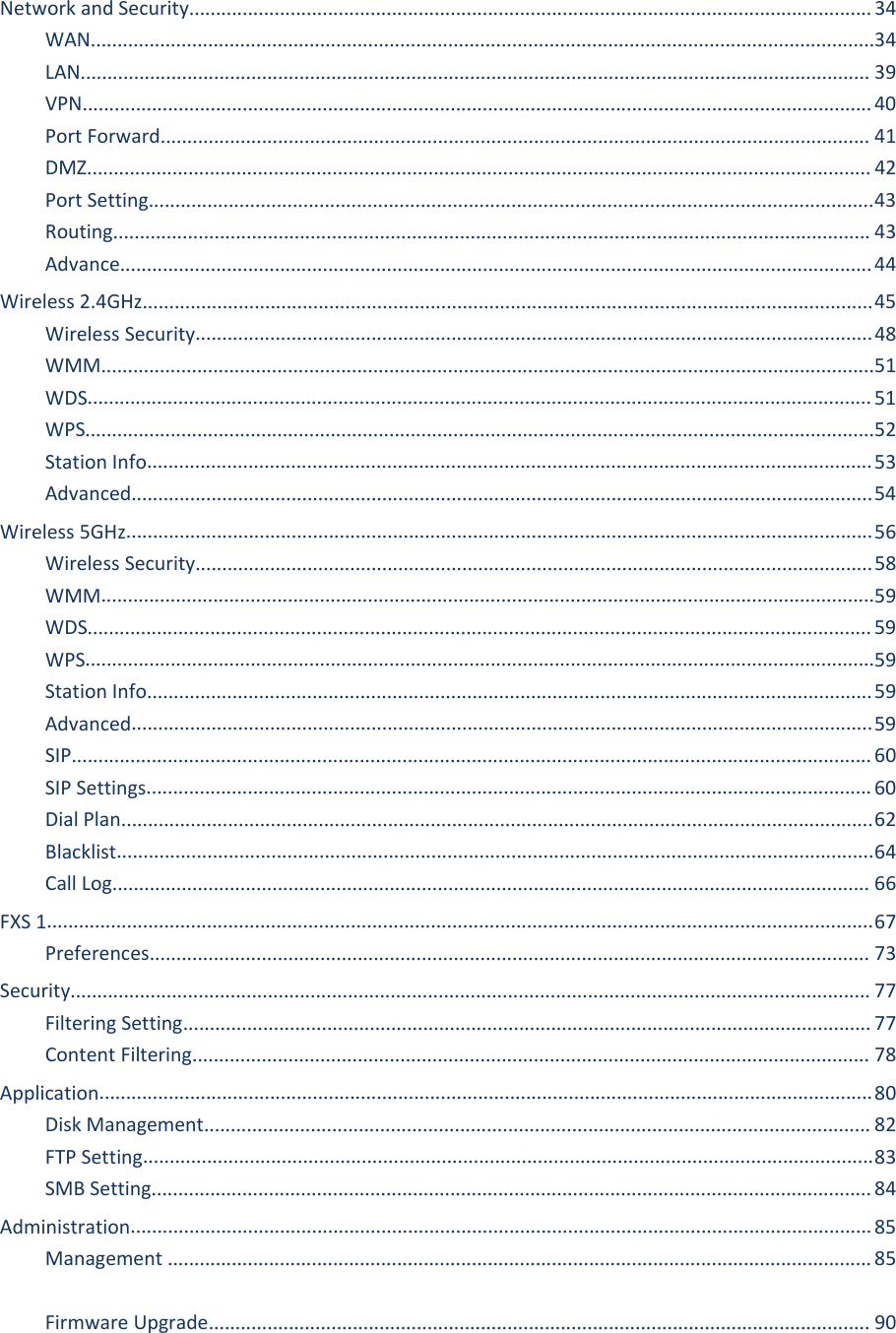
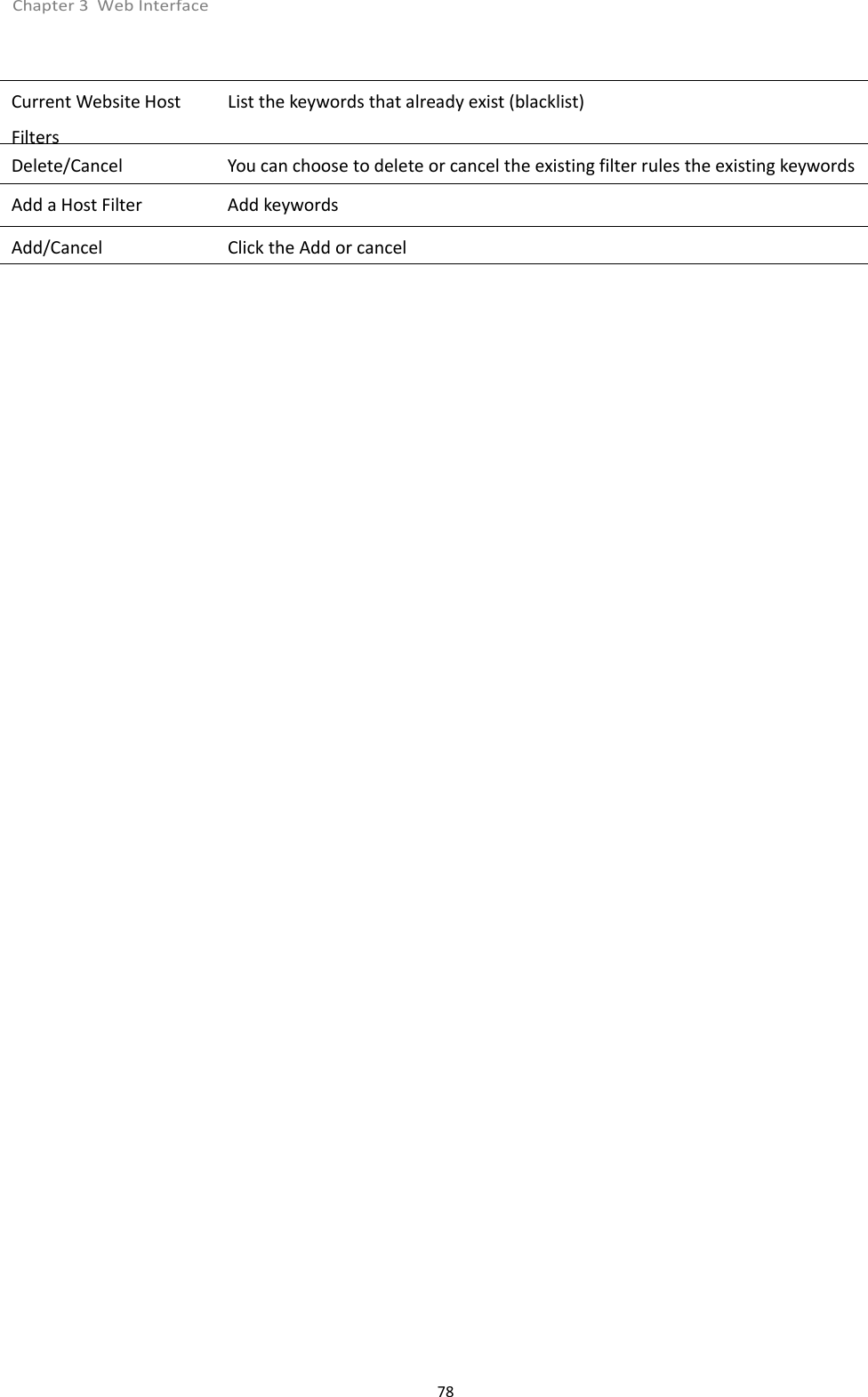
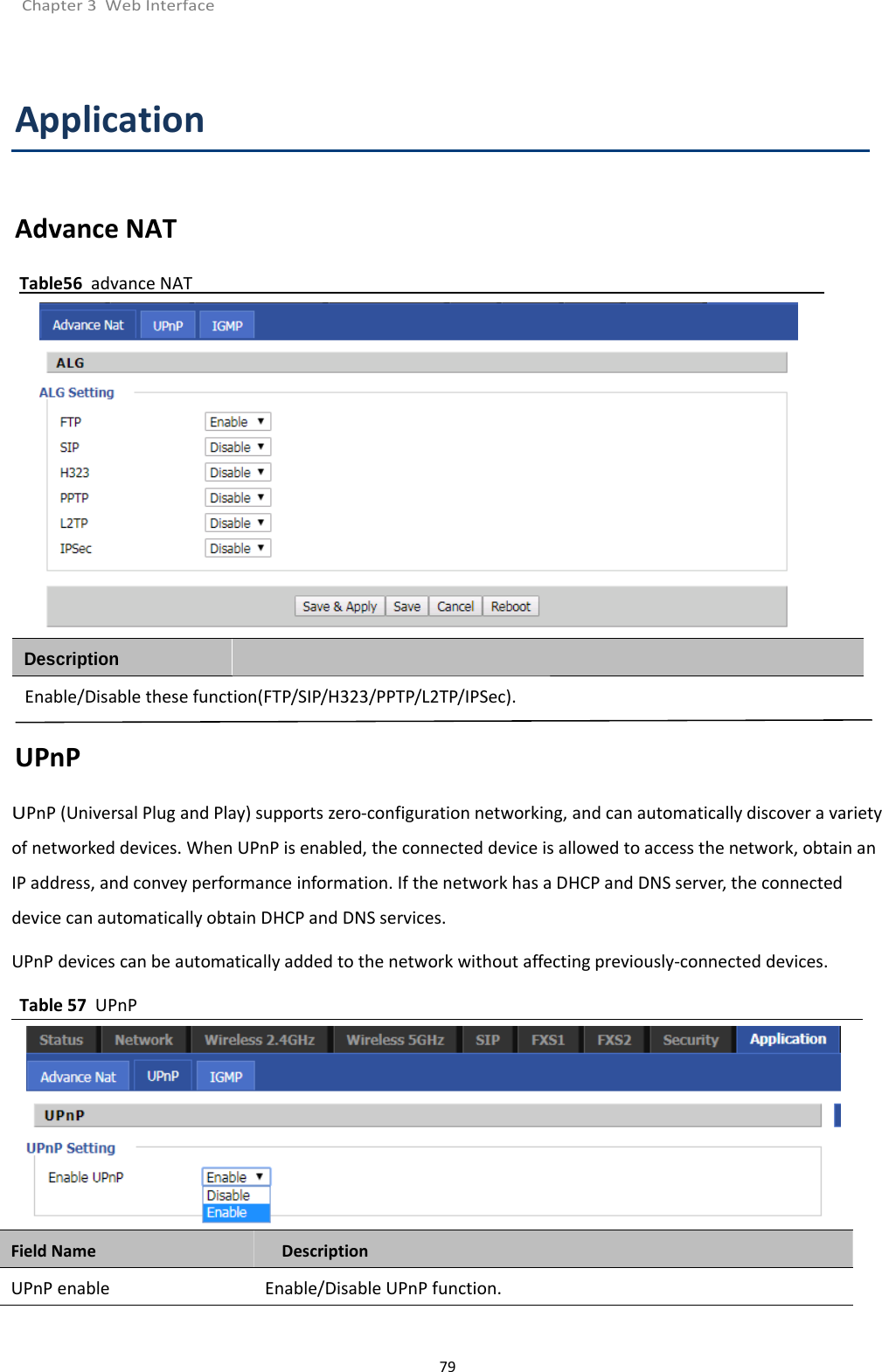
FWR9601 User ManualNetwork and Security................................................................................................................................34WAN...................................................................................................................................................34LAN.................................................................................................................................................... 39VPN....................................................................................................................................................40Port Forward..................................................................................................................................... 41DMZ................................................................................................................................................... 42Port Setting........................................................................................................................................43Routing.............................................................................................................................................. 43Advance.............................................................................................................................................44Wireless 2.4GHz.........................................................................................................................................45Wireless Security...............................................................................................................................48WMM.................................................................................................................................................51WDS................................................................................................................................................... 51WPS....................................................................................................................................................52Station Info........................................................................................................................................53Advanced...........................................................................................................................................54Wireless 5GHz............................................................................................................................................56Wireless Security...............................................................................................................................58WMM.................................................................................................................................................59WDS................................................................................................................................................... 59WPS....................................................................................................................................................59Station Info........................................................................................................................................59Advanced...........................................................................................................................................59SIP......................................................................................................................................................60SIP Settings........................................................................................................................................60Dial Plan.............................................................................................................................................62Blacklist..............................................................................................................................................64Call Log.............................................................................................................................................. 66FXS 1...........................................................................................................................................................67Preferences....................................................................................................................................... 73Security...................................................................................................................................................... 77Filtering Setting................................................................................................................................. 77Content Filtering............................................................................................................................... 78Application.................................................................................................................................................80Disk Management............................................................................................................................. 82FTP Setting.........................................................................................................................................83SMB Setting.......................................................................................................................................84Administration...........................................................................................................................................85Management ....................................................................................................................................85Firmware Upgrade............................................................................................................................ 90
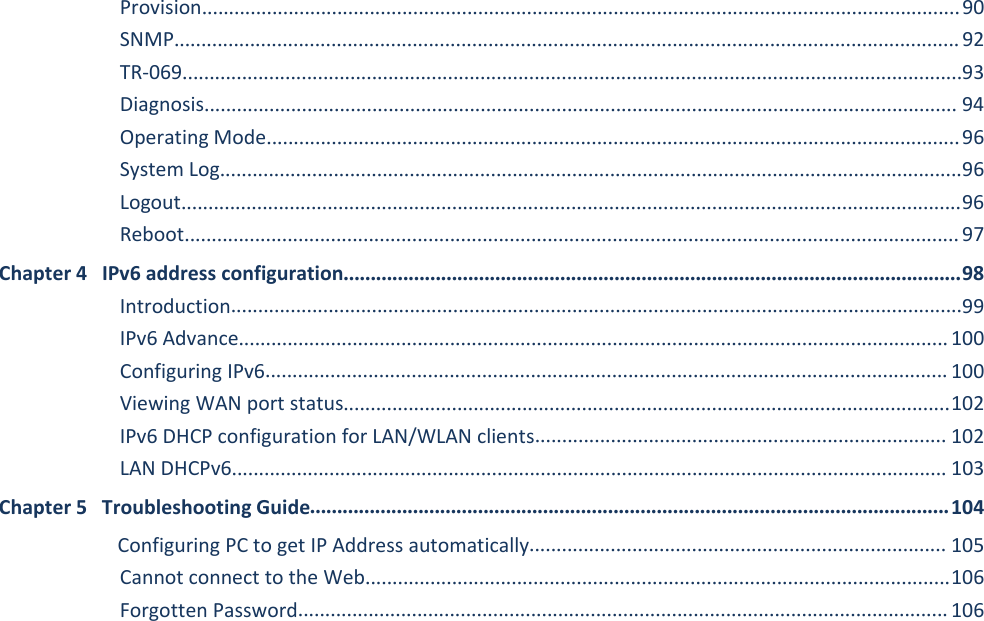
FWR9601 User ManualProvision............................................................................................................................................90SNMP.................................................................................................................................................92TR-069................................................................................................................................................93Diagnosis........................................................................................................................................... 94Operating Mode................................................................................................................................96System Log.........................................................................................................................................96Logout................................................................................................................................................96Reboot............................................................................................................................................... 97Chapter 4 IPv6 address configuration..................................................................................................................98Introduction.......................................................................................................................................99IPv6 Advance...................................................................................................................................100Configuring IPv6.............................................................................................................................. 100Viewing WAN port status................................................................................................................102IPv6 DHCP configuration for LAN/WLAN clients............................................................................ 102LAN DHCPv6.................................................................................................................................... 103Chapter 5 Troubleshooting Guide......................................................................................................................104Configuring PC to get IP Address automatically............................................................................. 105Cannot connect to the Web............................................................................................................106Forgotten Password........................................................................................................................106
Table FWR9601 User ManualTable 1 Features at-a-glance................................................................................................................................... 6Table 2 LED Indicators............................................................................................................................................. 7Table 3 Interfaces.................................................................................................................................................... 8Table 4 IVR Menu Setting Options......................................................................................................................... 11Table 5 Web management interface......................................................................................................................19Table 6 Setting time zone.......................................................................................................................................20Table 7 Configuring an internet connection......................................................................................................... 21Table 8 Wireless > Basic web page (user view)......................................................................................................23Table 9 Wireless Security web page.......................................................................................................................24Table 10 Configuring SIP the Web Management Interface................................................................................. 26Table 11 Registration status....................................................................................................................................27Table 12 Login details.............................................................................................................................................31Table 13 Status....................................................................................................................................................... 32Table 14 Internet.................................................................................................................................................... 33Table 15 DHCP........................................................................................................................................................ 34Table 16 PPPoE....................................................................................................................................................... 35Table 17 Bridge Mode............................................................................................................................................ 36Table 18 LAN port...................................................................................................................................................38Table 19 VPN...........................................................................................................................................................39Table 20 Port Forward.............................................................................................................................................40Table 21 Virtual Servers...........................................................................................................................................41Table 22 DMZ..........................................................................................................................................................41Table 23 Port setting..............................................................................................................................................42Table 24 Routing......................................................................................................................................................42Table 25 Advance.................................................................................................................................................... 43Table 26 Basic......................................................................................................................................................... 44Table 27 Wireless security.......................................................................................................................................47Table 28 WiFI Security Setting.................................................................................................................................47Table 29 WPA-PSK................................................................................................................................................... 48Table 30 WPAPSKWPA2PSK.................................................................................................................................... 49Table
Table FWR9601 User ManualTable 31 Wireless Access Policy............................................................................................................................. 49Table 32 WMM.......................................................................................................................................................50Table 33 WDS..........................................................................................................................................................50Table 34 WPS..........................................................................................................................................................51Table 35 Station info...............................................................................................................................................52Table 36 Advanced.................................................................................................................................................. 53Table 37 Basic......................................................................................................................................................... 55Table 38 Wireless security.......................................................................................................................................57Table 39 SIP Settings............................................................................................................................................... 59Table 40 VoIP QoS................................................................................................................................................... 60Table 41 Dial Plan................................................................................................................................................... 61Table 42 Adding one dial plan.................................................................................................................................62Table 43 Dial Plan Syntactic.....................................................................................................................................62Table 44 Blacklist..................................................................................................................................................... 63Table 45 Call log.......................................................................................................................................................65Table 46 Line...........................................................................................................................................................66Table 47 Audio configuration.................................................................................................................................67Table 48 Supplementary service.............................................................................................................................68Table 49 Advanced.................................................................................................................................................. 69Table 50 Preferences...............................................................................................................................................72Table 51 Regional................................................................................................................................................... 72Table 52 Features and call forward........................................................................................................................73Table 53 Miscellaneous...........................................................................................................................................75Table 54 Filtering Setting........................................................................................................................................76Table 55 Content Filtering.......................................................................................................................................77Table56 advance NAT.............................................................................................................................................79Table 57 UPnP.........................................................................................................................................................79Table 58 IGMP........................................................................................................................................................ 80Table 59 Disk Management.....................................................................................................................................81Table 60 FTP Setting................................................................................................................................................ 82Table 61 SMB Setting...............................................................................................................................................83Table62 SaveConfigFile........................................................................................................................................84Table 63 Administrator settings..............................................................................................................................85Table 64 NTP settings............................................................................................................................................. 86
Table FWR9601 User ManualTable 65 Daylight Saving Time................................................................................................................................87Table 66 System log Setting.................................................................................................................................... 87Table 67 Factory Defaults Setting........................................................................................................................... 88Table 68 Factory Defaults.......................................................................................................................................88Table 69 Firmware upgrade................................................................................................................................... 89Table 70 Provision................................................................................................................................................... 90Table 71 Firmware Upgrade...................................................................................................................................91Table 72 SNMP........................................................................................................................................................91Table 73 TR069 .......................................................................................................................................92Table 75 Operating mode.......................................................................................................................................95Table 76 System log.................................................................................................................................................95Table 77 Logout...................................................................................................................................................... 95Table 78 IPv6 Modes.............................................................................................................................................. 98Table 79 Enabling IPv6............................................................................................................................................99Table 80 Configuring Statefull IPv6.........................................................................................................................99Table 81 Configuring Stateless IPv6......................................................................................................................100
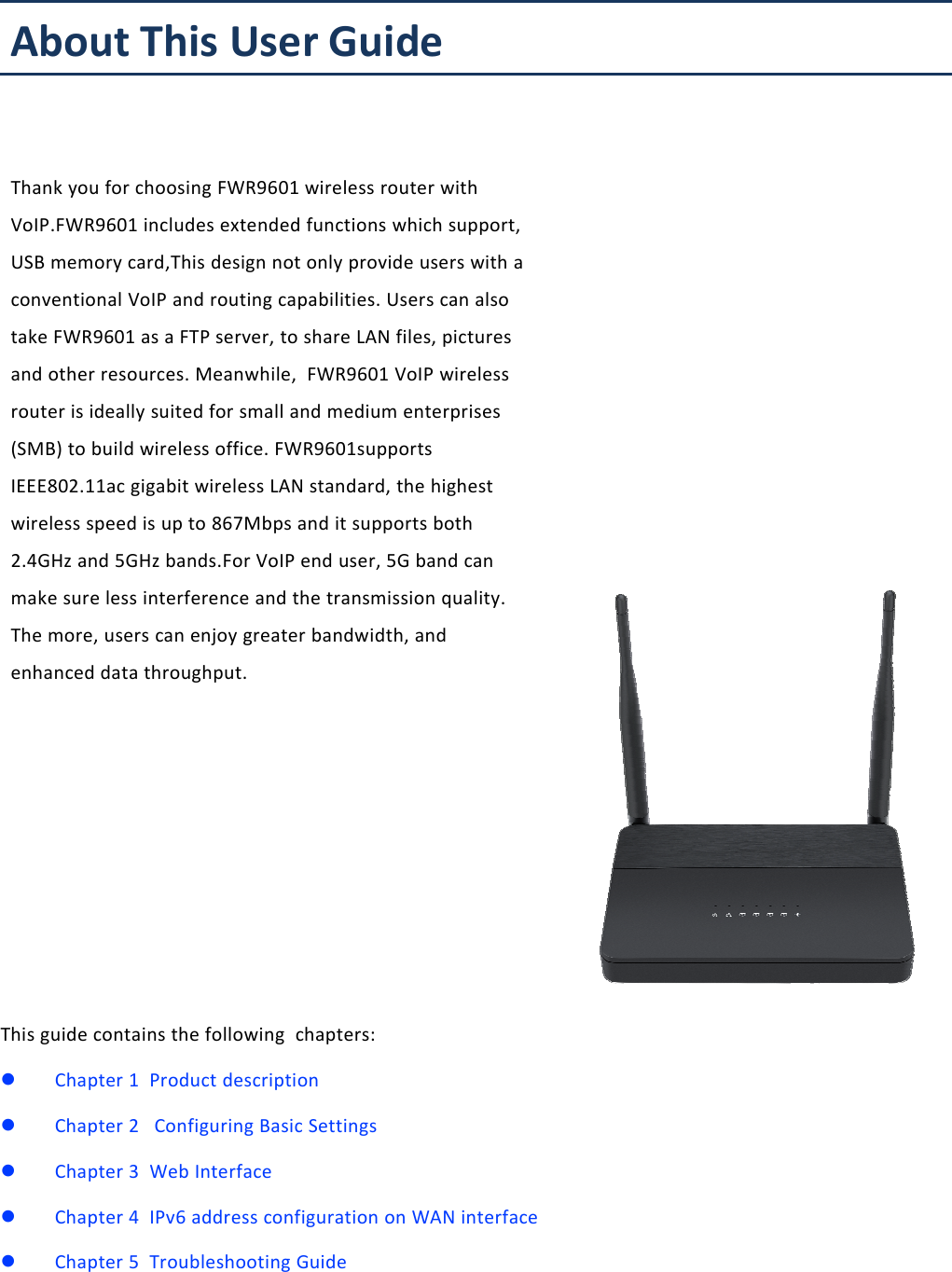
About This User ManualThis guide contains the following chapters:Chapter 1 Product descriptionChapter 2 Configuring Basic SettingsChapter 3 Web InterfaceChapter 4 IPv6 address configuration on WAN interfaceChapter 5 Troubleshooting GuideAbout This User GuideThank you for choosing FWR9601 wireless router withVoIP.FWR9601 includes extended functions which support,USB memory card,This design not only provide users with aconventional VoIP and routing capabilities. Users can alsotake FWR9601 as a FTP server, to share LAN files, picturesand other resources. Meanwhile, FWR9601 VoIP wirelessrouter is ideally suited for small and medium enterprises(SMB) to build wireless office. FWR9601supportsIEEE802.11ac gigabit wireless LAN standard, the highestwireless speed is up to 867Mbps and it supports both2.4GHz and 5GHz bands.For VoIP end user, 5G band canmake sure less interference and the transmission quality.The more, users can enjoy greater bandwidth, andenhanced data throughput.
About This User ManualContacting FlyingVoiceMain website: http://www.flyingvoice.com/Sales enquiries:sales1@flyingvoice.comSupport enquiries:support@flyingvoice.comHotline: 010-67886296 0755-26099365Address: Room508-509, Bldg#1, Dianshi Business Park, No.49 BadachuRd,ShijingshanDistrict,Beijing,China
About This User ManualPurposeThe documents are intended to instruct and assist personnel in the operation, installation andmaintenance of the FlyingVoice equipment and ancillary devices. It is recommended that all personnelengaged in such activities be properly trained.FlyingVoice disclaims all liability whatsoever, implied orexpress, for any risk of damage, loss or reduction in system performance arising directly or indirectlyout of the failure of the customer, or anyone acting on the customer's behalf, to abide by theinstructions, system parameters, or recommendations made in this document.Cross referencesReferences to external publications are shown in italics. Other cross references, emphasized in blue textin electronic versions, are active links to the references.This document is divided into numbered chapters that are divided into sections. Sections are notnumbered, but are individually named at the top of each page, and are listed in the table of contents.FeedbackWe appreciate feedback from the users of our documents. This includes feedback on the structure,content, accuracy, or completeness of our documents. Send feedback to support@flyingvoice.com.
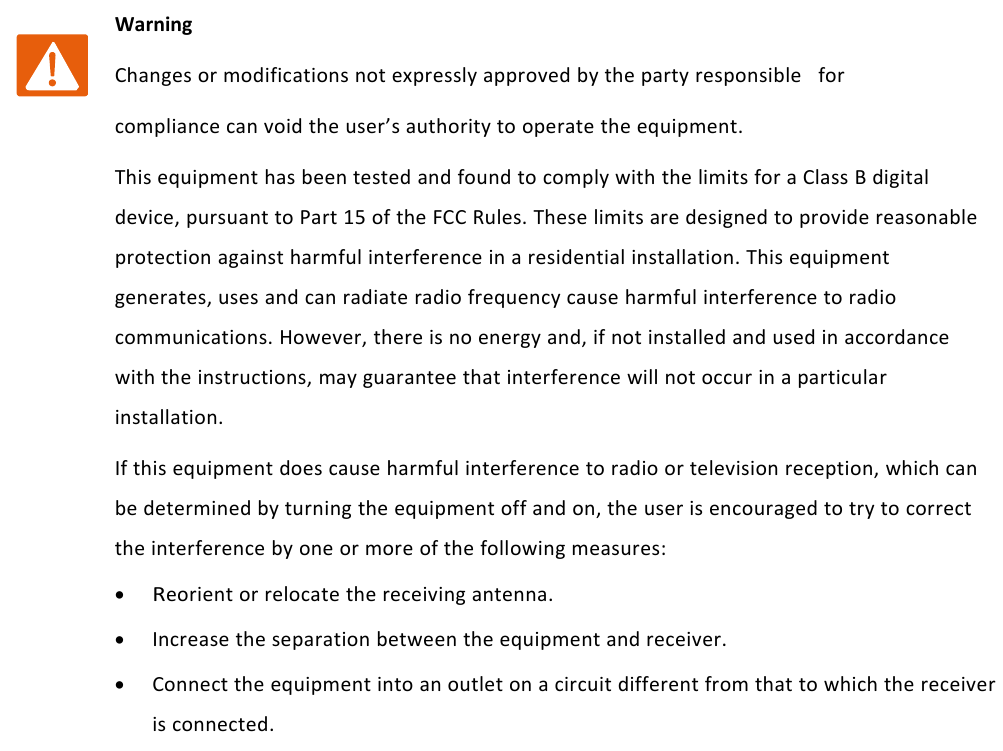
About This User ManualDeclaration of ConformityPart 15 FCC RulesThis device complies with Part 15 of the FCC Rules. Operation is subject to the following two conditions:•This device may not cause harmful interference, and•This device must accept any interference received, including interference that may causeundesired operation.WarningChanges or modifications not expressly approved by the party responsible for compliancecould void the user's authority to operate the equipment.This equipment has been tested and found to comply with the limits for a Class B digital device,pursuant to Part 15 of the FCC Rules.These limits are designed to provide reasonable protection against harmful interference in a residential installation. This equipment generates, uses and can radiate radio frequency energy and, if not installed and used in accordance with the instructions, may cause harmful interference to radio communications. However, there is no guarantee that interference will not occur in a particular installation.If this equipment does cause harmful interference to radio or television reception,which can be determined by turning the equipment off and on, the user is encouraged to try to correct the interference by one or more of the following measures:•Reorient or relocate the receiving antenna.•Increase the separation between the equipment and receiver.•Connect the equipment into an outlet on a circuit different from that to which the receiver is connected.•Consult the dealer or an experienced radio/TV technician for helpThis equipment complies with FCC radiation exposure limits set forth for an uncontrolled environment. This equipment should be installed and operated with minimum distance 20cm between the radiator & your body. Indoor use only.
About This User ManualWarnings and NotesThe following describes how warnings and notes are used in this document and in all documents of theFlyingVoice document set.WarningsWarnings precede instructions that contain potentially hazardous situations. Warnings are used to alertthe reader to possible hazards that could cause loss of life or physical injury. A warning has thefollowing format:WarningWarning text and consequence for not following the instructions in the warning.NotesA note means that there is a possibility of an undesirable situation or provides additionalinformation to help the reader understand a topic or concept. A note has the following format:NotesNotes text and consequence for not following the instructions in the Notes.
Chapter 1 Product descriptionChapter 1 Product descriptionThis chapter covers:·FWR9601·LED Indicators and Interfaces·Hardware Installation·Voice Prompt
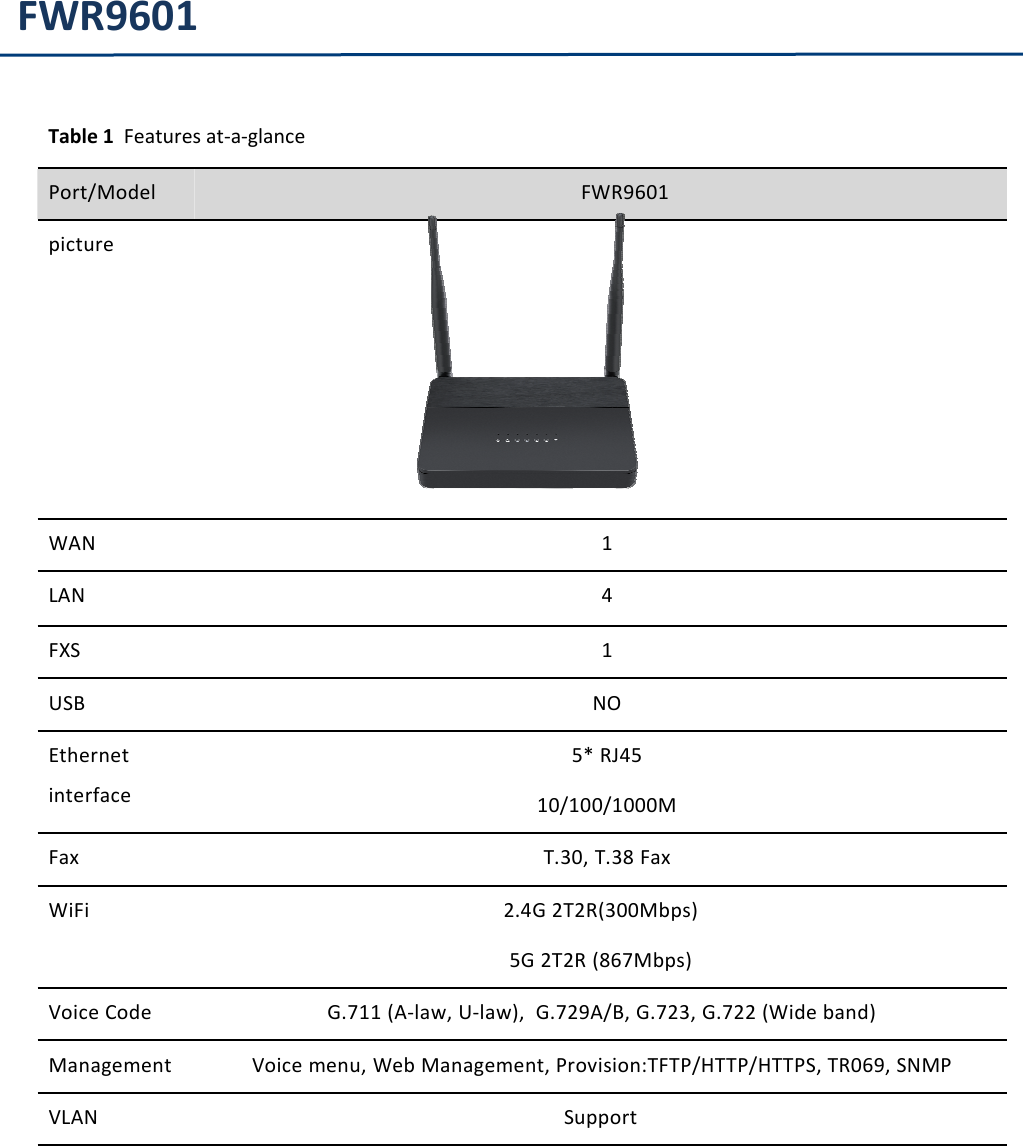
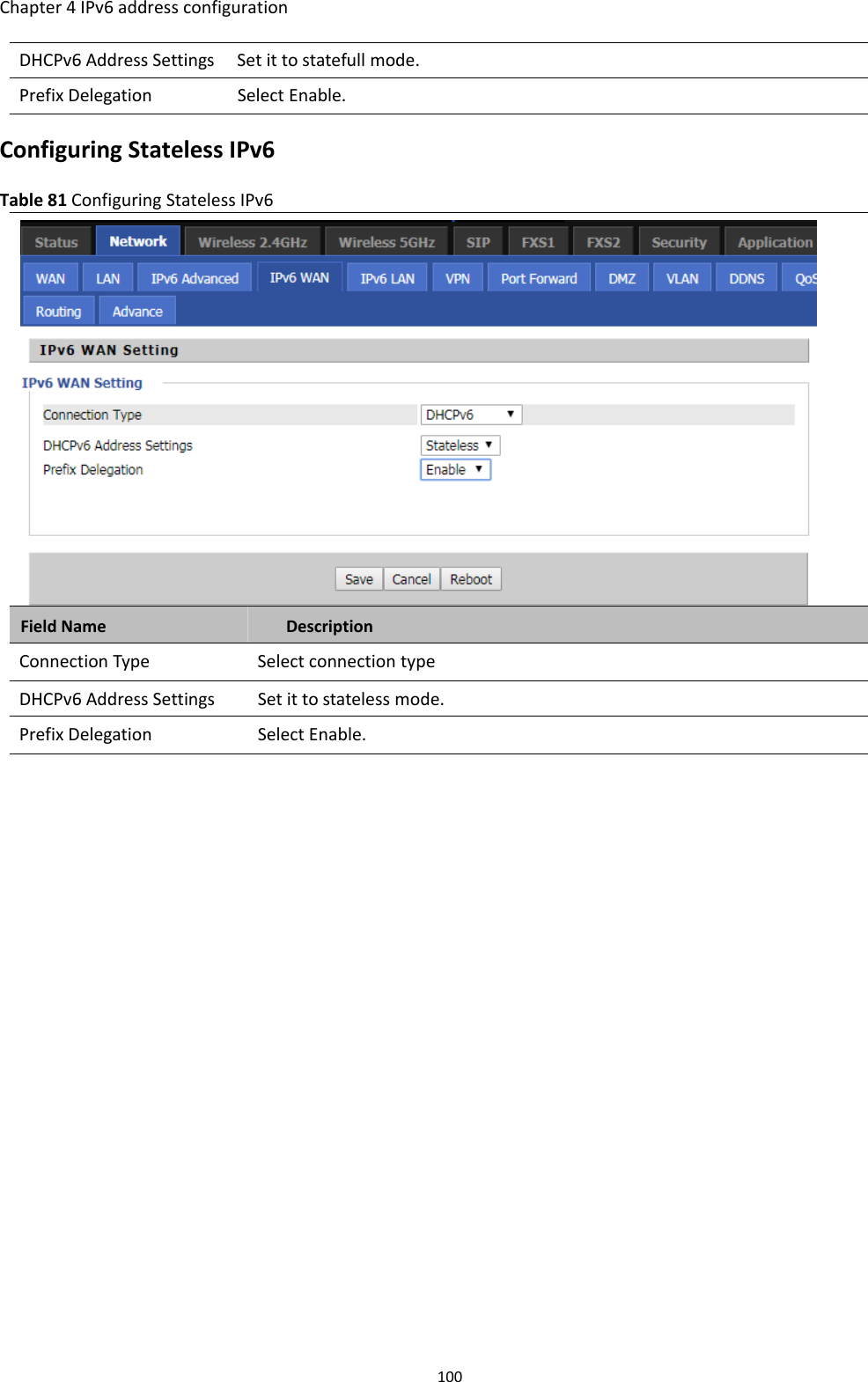
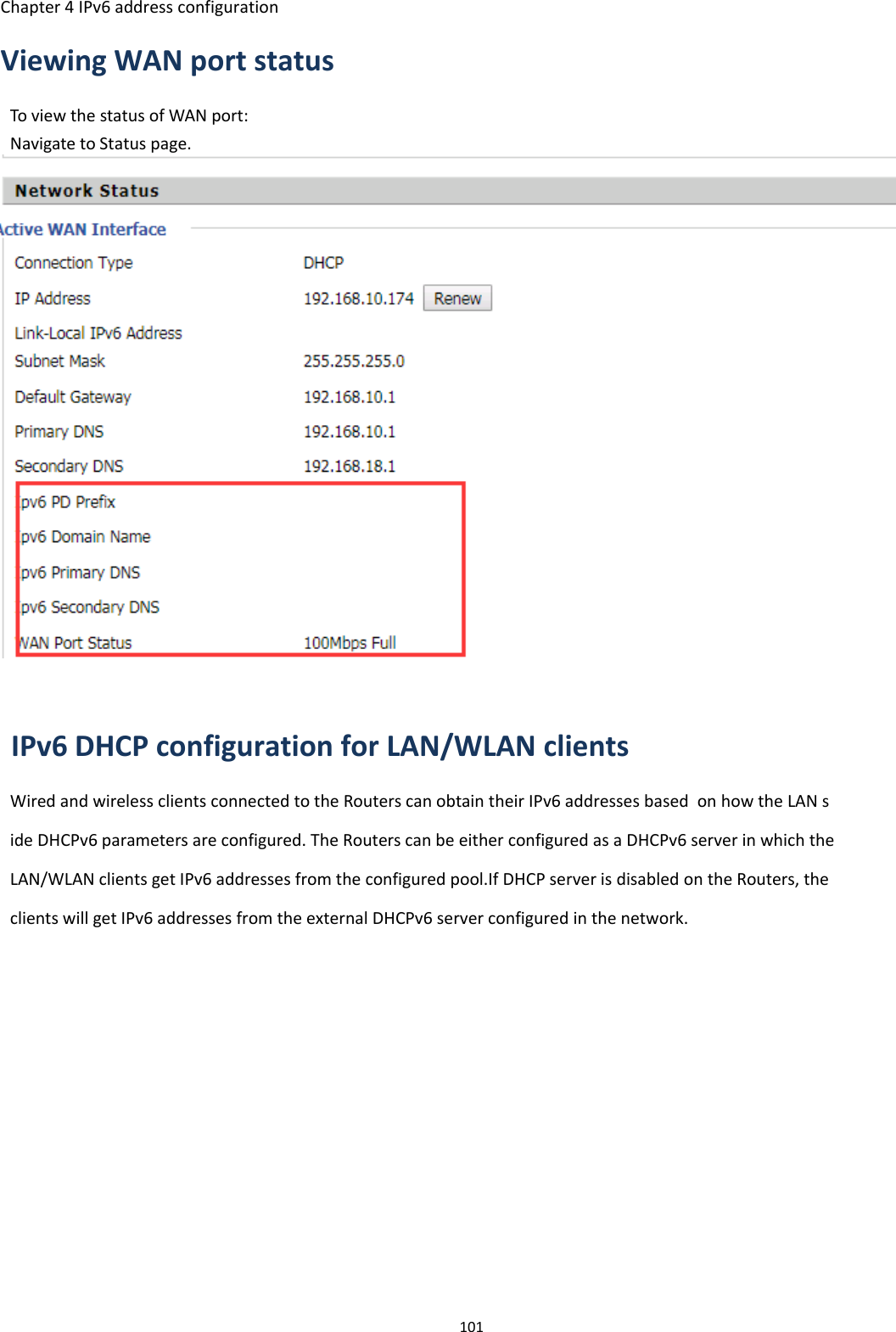
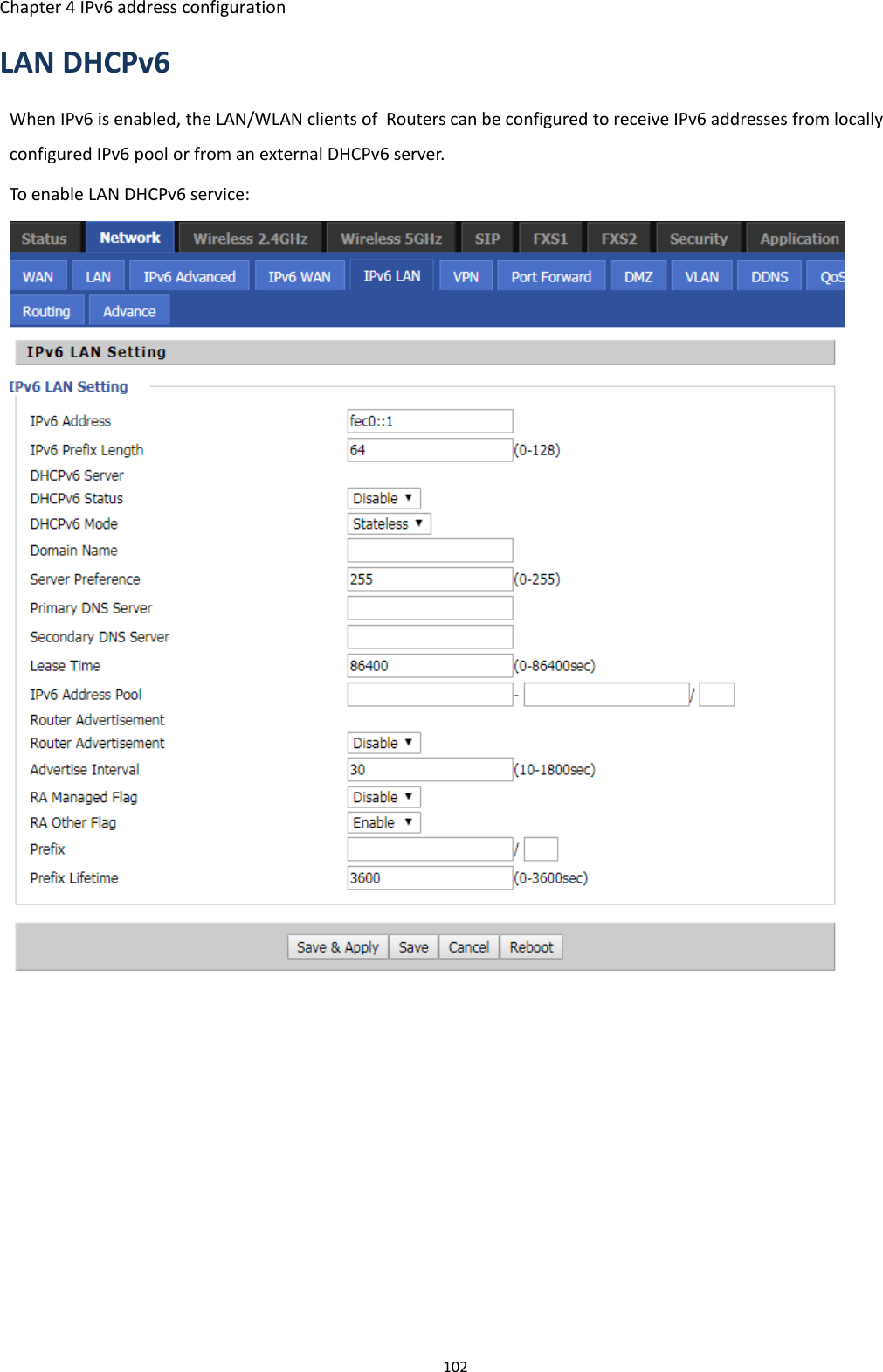
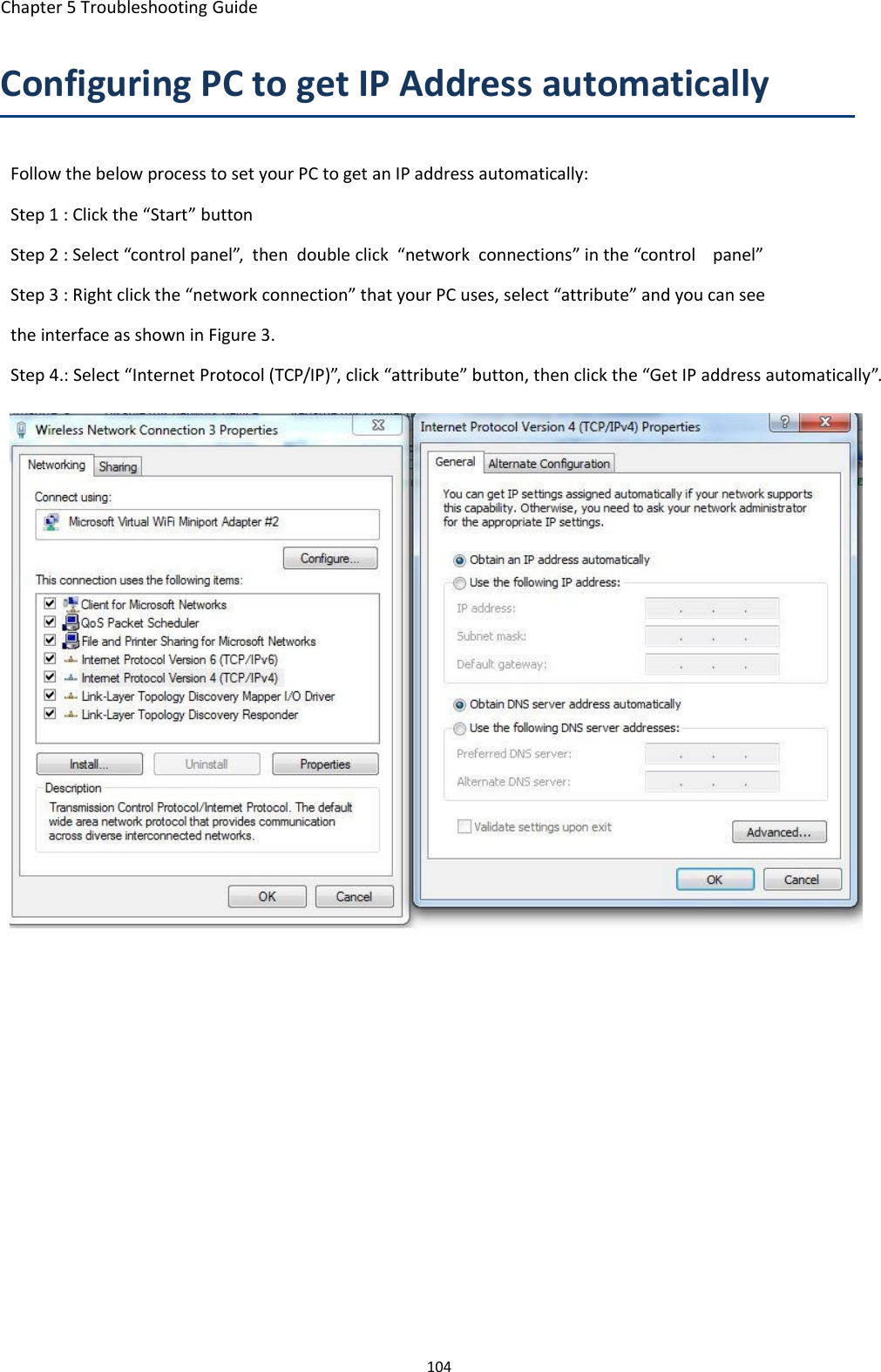
Chapter 1 Product descriptionFWR9601Table 1 Features at-a-glancePort/Model FWR9601pictureWAN 1LAN 4FXS 1USB NOEthernetinterface5* RJ4510/100/1000MFax T.30, T.38 FaxWiFi 2.4G 2T2R(300Mbps)5G 2T2R (867Mbps)Voice Code G.711 (A-law, U-law), G.729A/B, G.723, G.722 (Wide band)Management Voice menu, Web Management, Provision:TFTP/HTTP/HTTPS, TR069, SNMPVLAN Support
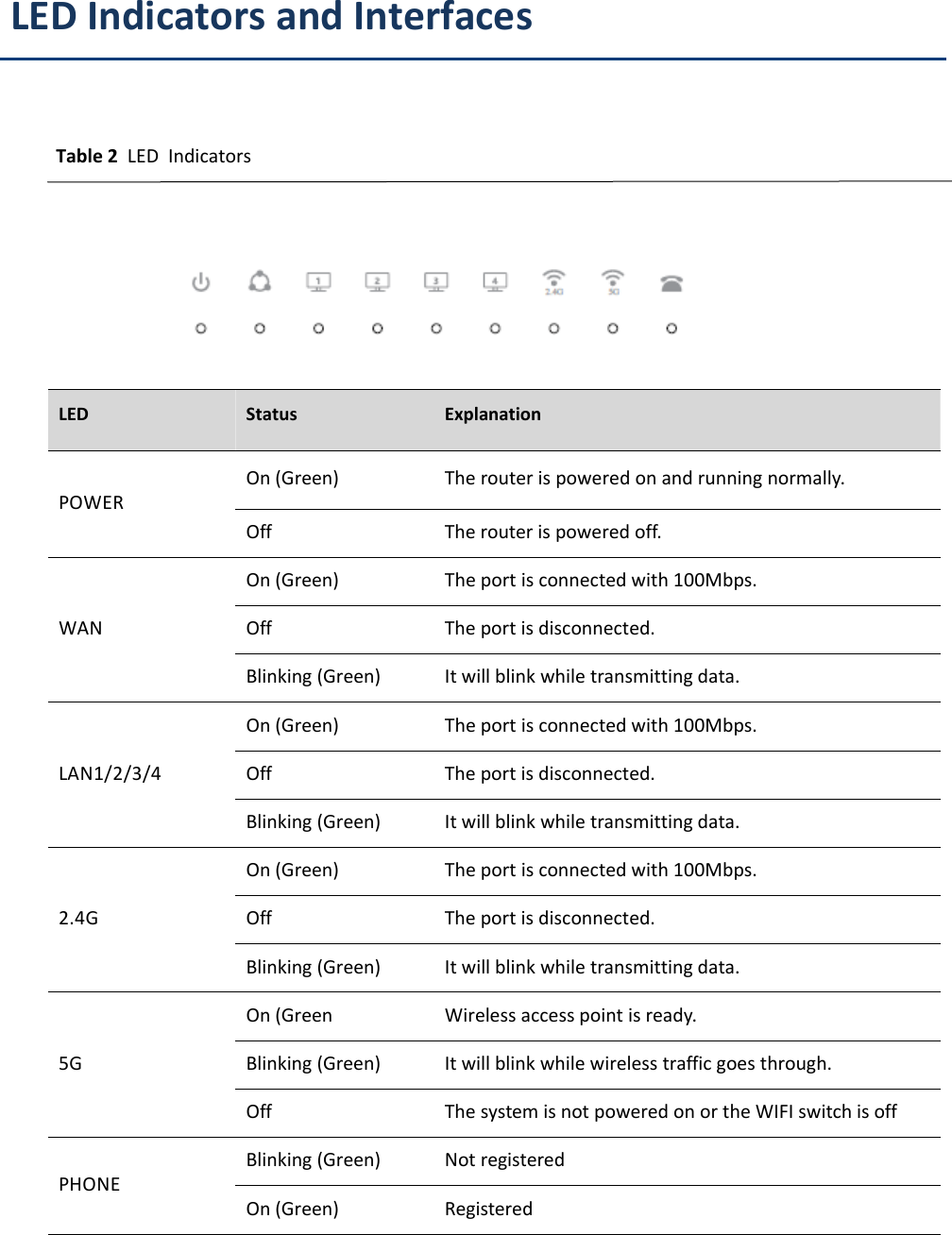
Chapter 1 Product descriptionLED Indicators and InterfacesTable 2 LED IndicatorsLED Status ExplanationPOWEROn (Green) The router is powered on and running normally.Off The router is powered off.WANOn (Green) The port is connected with 100Mbps.Off The port is disconnected.Blinking (Green) It will blink while transmitting data.LAN1/2/3/4On (Green) The port is connected with 100Mbps.Off The port is disconnected.Blinking (Green) It will blink while transmitting data.2.4GOn (Green) The port is connected with 100Mbps.Off The port is disconnected.Blinking (Green) It will blink while transmitting data.5GOn (Green Wireless access point is ready.Blinking (Green) It will blink while wireless traffic goes through.Off The system is not powered on or the WIFI switch is offPHONEBlinking (Green) Not registeredOn (Green) Registered
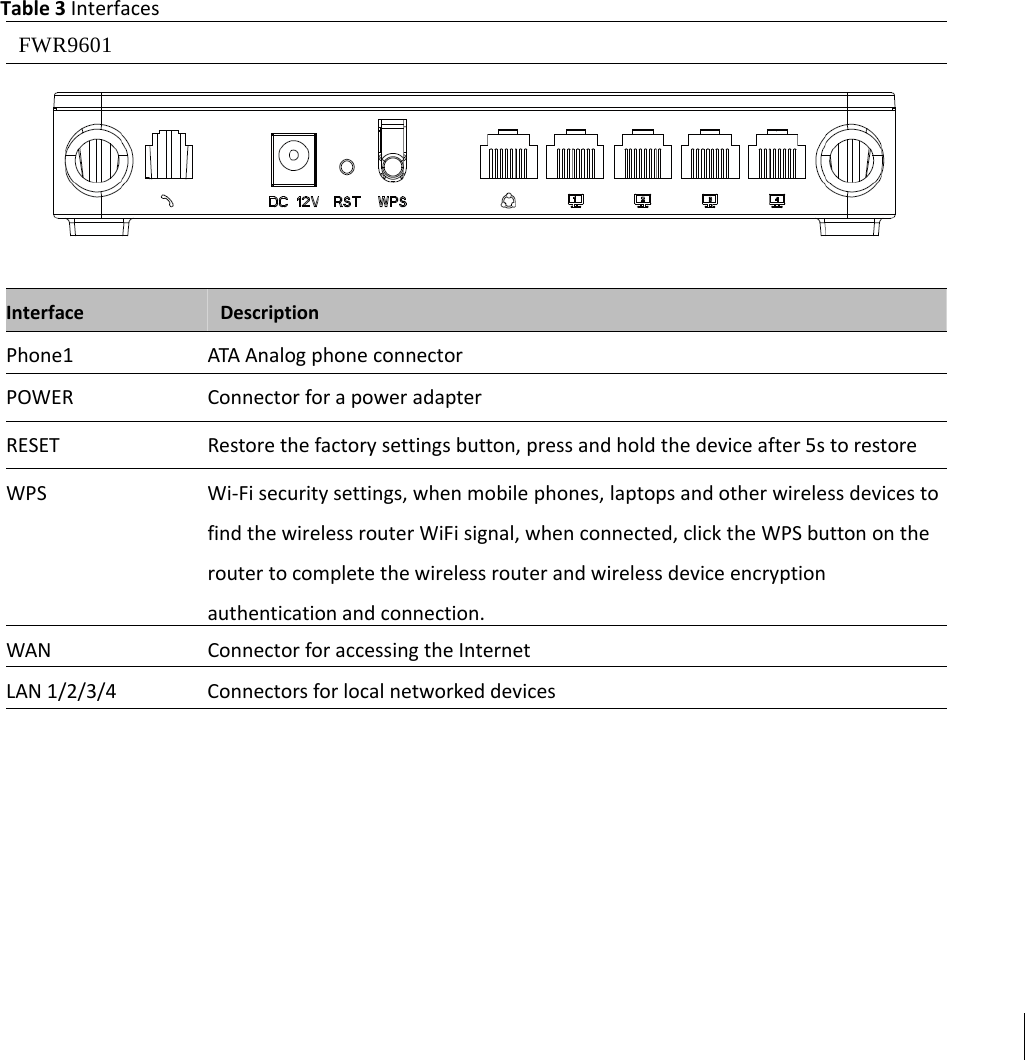
Chapter 1 Product descriptionTable 3 InterfacesFWR9601Interface DescriptionPhone1 ATA Analog phone connectorPOWER Connector for a power adapterRESET Restore the factory settings button, press and hold the device after 5s to restoreWPS Wi-Fi security settings, when mobile phones, laptops and other wireless devices tofind the wireless router WiFi signal, when connected, click the WPS button on therouter to complete the wireless router and wireless device encryptionauthentication and connection.WAN Connector for accessing the InternetLAN 1/2/3/4 Connectors for local networked devices
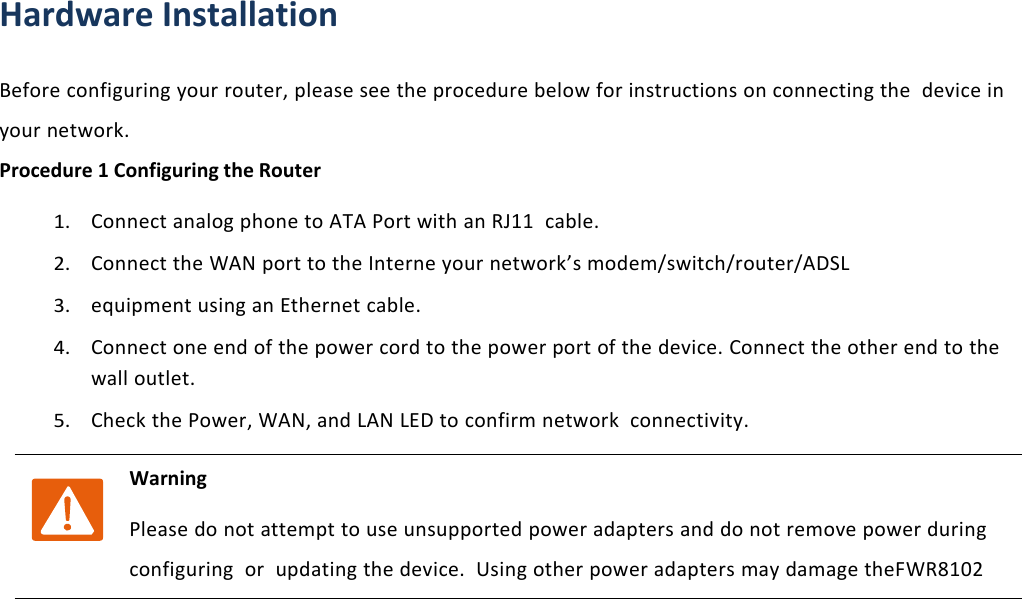
Chapter 1 Product descriptionHardware InstallationBefore configuring your router, please see the procedure below for instructions on connecting the device inyour network.Procedure 1 Configuring the Router1.Connect analog phone to ATA Port with an RJ11 cable.2.Connect the WAN port to the Interne your network’s modem/switch/router/ADSL3.equipment using an Ethernet cable.4.Connect one end of the power cord to the power port of the device. Connect the other end to thewall outlet.5.Check the Power, WAN, and LAN LED to confirm network connectivity.WarningPlease do not attempt to use unsupported power adapters and do not remove power duringconfiguring or updating the device. Using other power adapters may damage theFWR8102
Chapter 1 Product descriptionWarningChanges or modifications not expressly approved by the party responsible forcompliance can void the user’s authority to operate the equipment.This equipment has been tested and found to comply with the limits for a Class B digitaldevice, pursuant to Part 15 of the FCC Rules. These limits are designed to provide reasonableprotection against harmful interference in a residential installation. This equipmentgenerates, uses and can radiate radio frequency cause harmful interference to radiocommunications. However, there is no energy and, if not installed and used in accordancewith the instructions, may guarantee that interference will not occur in a particularinstallation.If this equipment does cause harmful interference to radio or television reception, which canbe determined by turning the equipment off and on, the user is encouraged to try to correctthe interference by one or more of the following measures:•Reorient or relocate the receiving antenna.•Increase the separation between the equipment and receiver.•Connect the equipment into an outlet on a circuit different from that to which the receiveris connected.
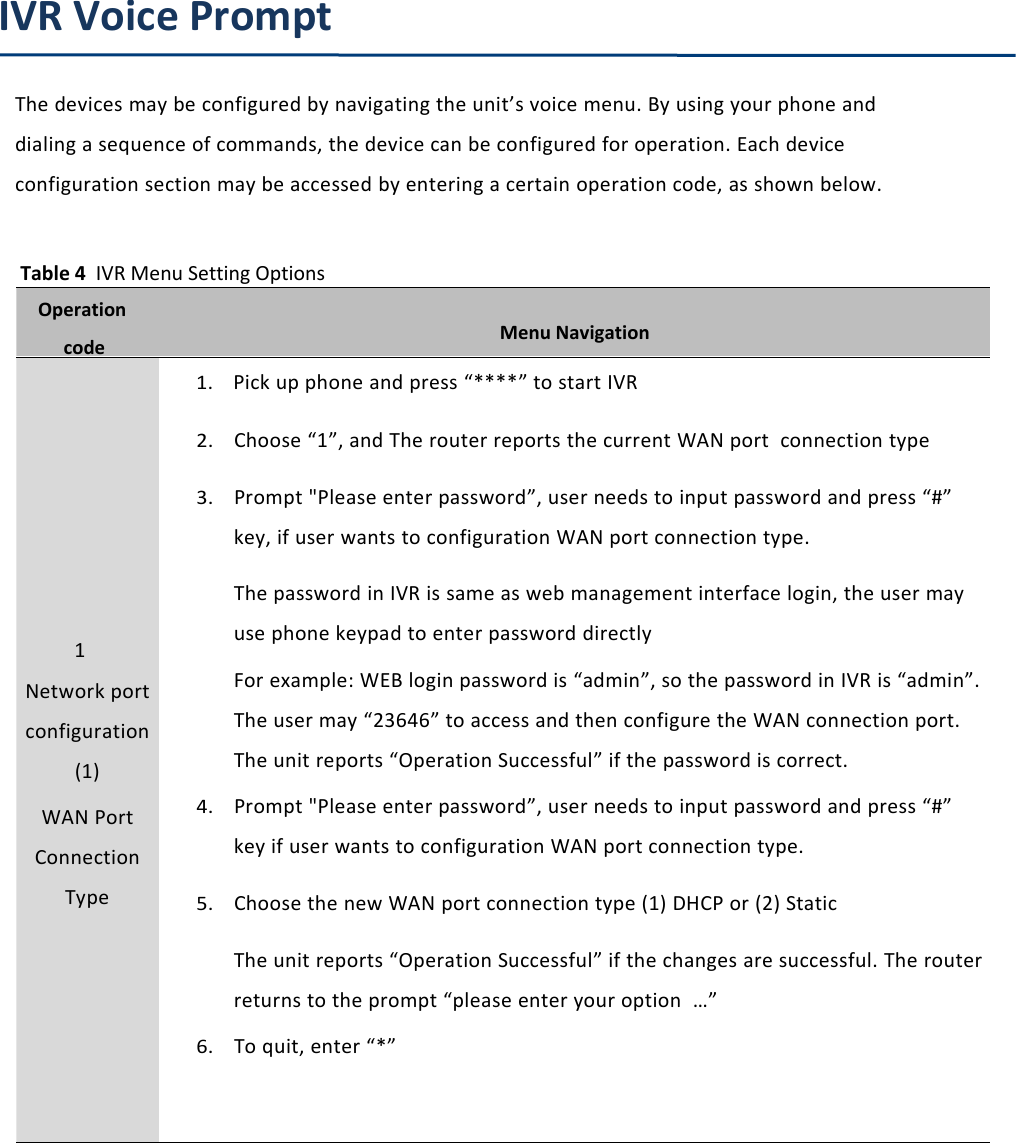
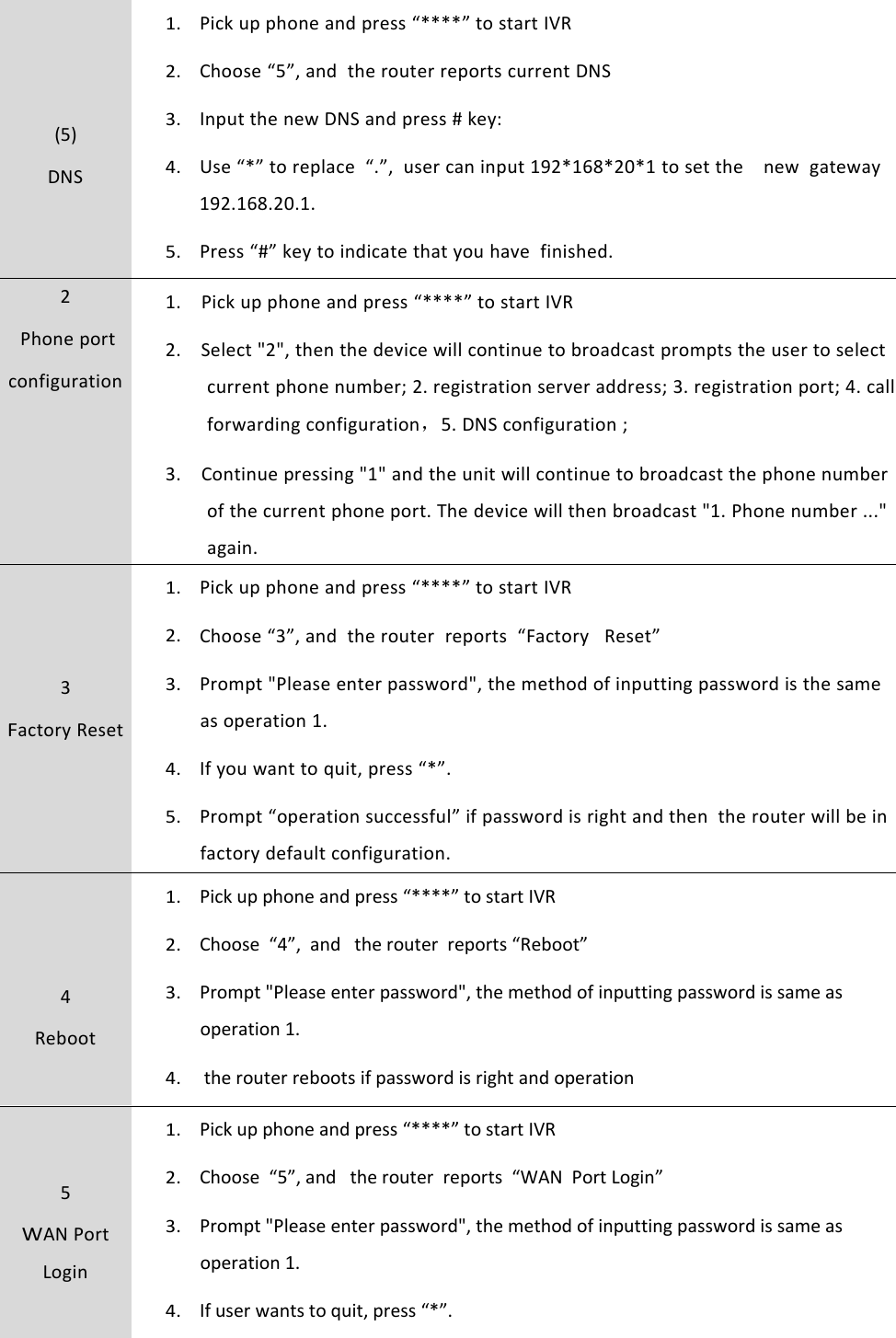
Chapter 1 Product descriptionIVR Voice PromptThe devices may be configured by navigating the unit’s voice menu. By using your phone anddialing a sequence of commands, the device can be configured for operation. Each deviceconfiguration section may be accessed by entering a certain operation code, as shown below.Table 4 IVR Menu Setting OptionsOperationcode Menu Navigation1Network portconfiguration(1)WAN PortConnectionType1.Pick up phone and press “****” to start IVR2.Choose “1”, and The router reports the current WAN port connection type3.Prompt "Please enter password”, user needs to input password and press “#”key, if user wants to configuration WAN port connection type.The password in IVR is same as web management interface login, the user mayuse phone keypad to enter password directlyFor example: WEB login password is “admin”, so the password in IVR is “admin”.The user may “23646” to access and then configure the WAN connection port.The unit reports “Operation Successful” if the password is correct.4.Prompt "Please enter password”, user needs to input password and press “#”key if user wants to configuration WAN port connection type.5.Choose the new WAN port connection type (1) DHCP or (2) StaticThe unit reports “Operation Successful” if the changes are successful. The routerreturns to the prompt “please enter your option …”6.To quit, enter “*”
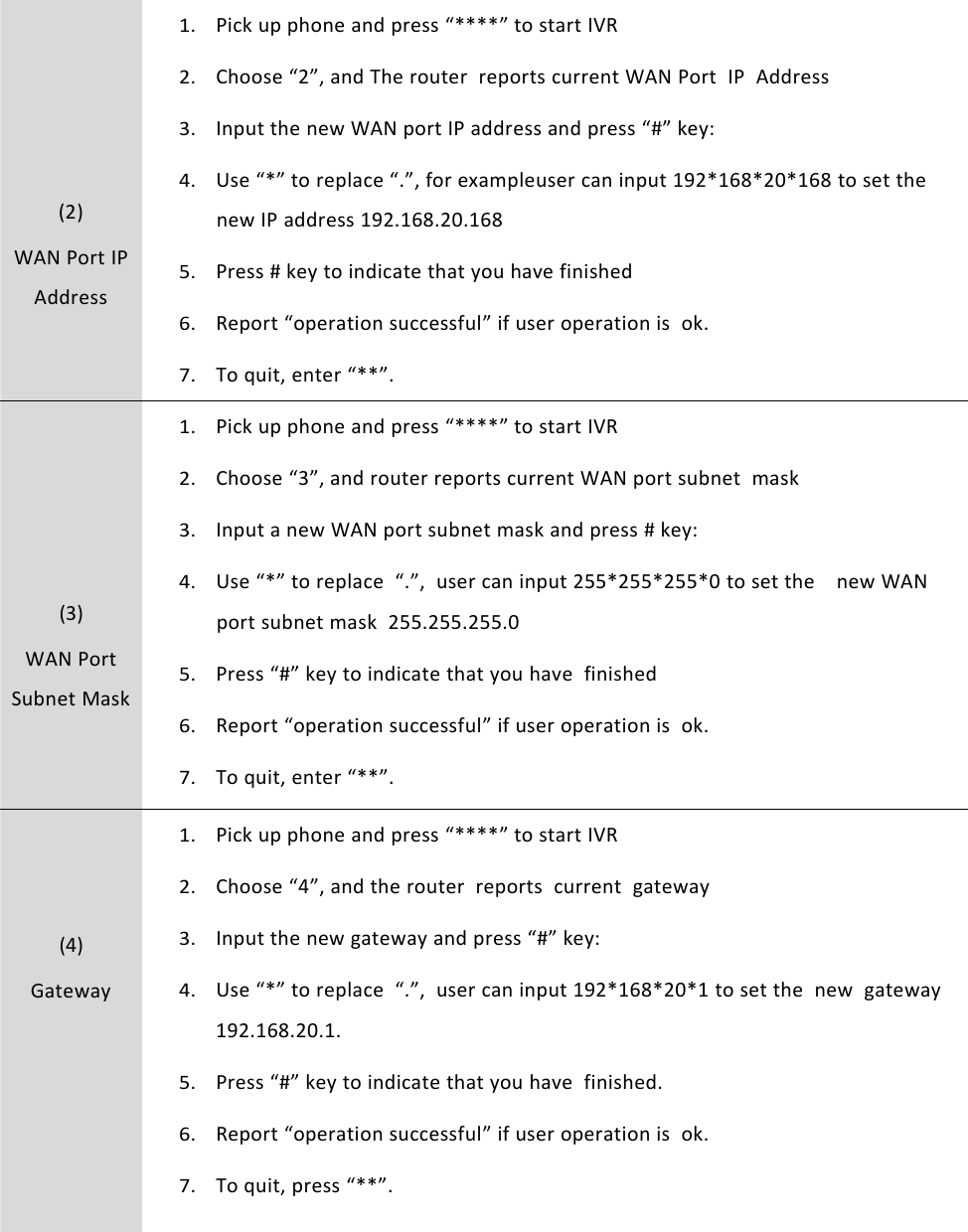
Chapter 1 Product description(2)WAN Port IPAddress1.Pick up phone and press “****” to start IVR2.Choose “2”, and The router reports current WAN Port IP Address3.Input the new WAN port IP address and press “#” key:4.Use “*” to replace “.”, for exampleuser can input 192*168*20*168 to set thenew IP address 192.168.20.1685.Press # key to indicate that you have finished6.Report “operation successful” if user operation is ok.7.To quit, enter “**”.(3)WAN PortSubnet Mask1.Pick up phone and press “****” to start IVR2.Choose “3”, and router reports current WAN port subnet mask3.Input a new WAN port subnet mask and press # key:4.Use “*” to replace “.”, user can input 255*255*255*0 to set the new WANport subnet mask 255.255.255.05.Press “#” key to indicate that you have finished6.Report “operation successful” if user operation is ok.7.To quit, enter “**”.(4)Gateway1.Pick up phone and press “****” to start IVR2.Choose “4”, and the router reports current gateway3.Input the new gateway and press “#” key:4.Use “*” to replace “.”, user can input 192*168*20*1 to set the new gateway192.168.20.1.5.Press “#” key to indicate that you have finished.6.Report “operation successful” if user operation is ok.7.To quit, press “**”.
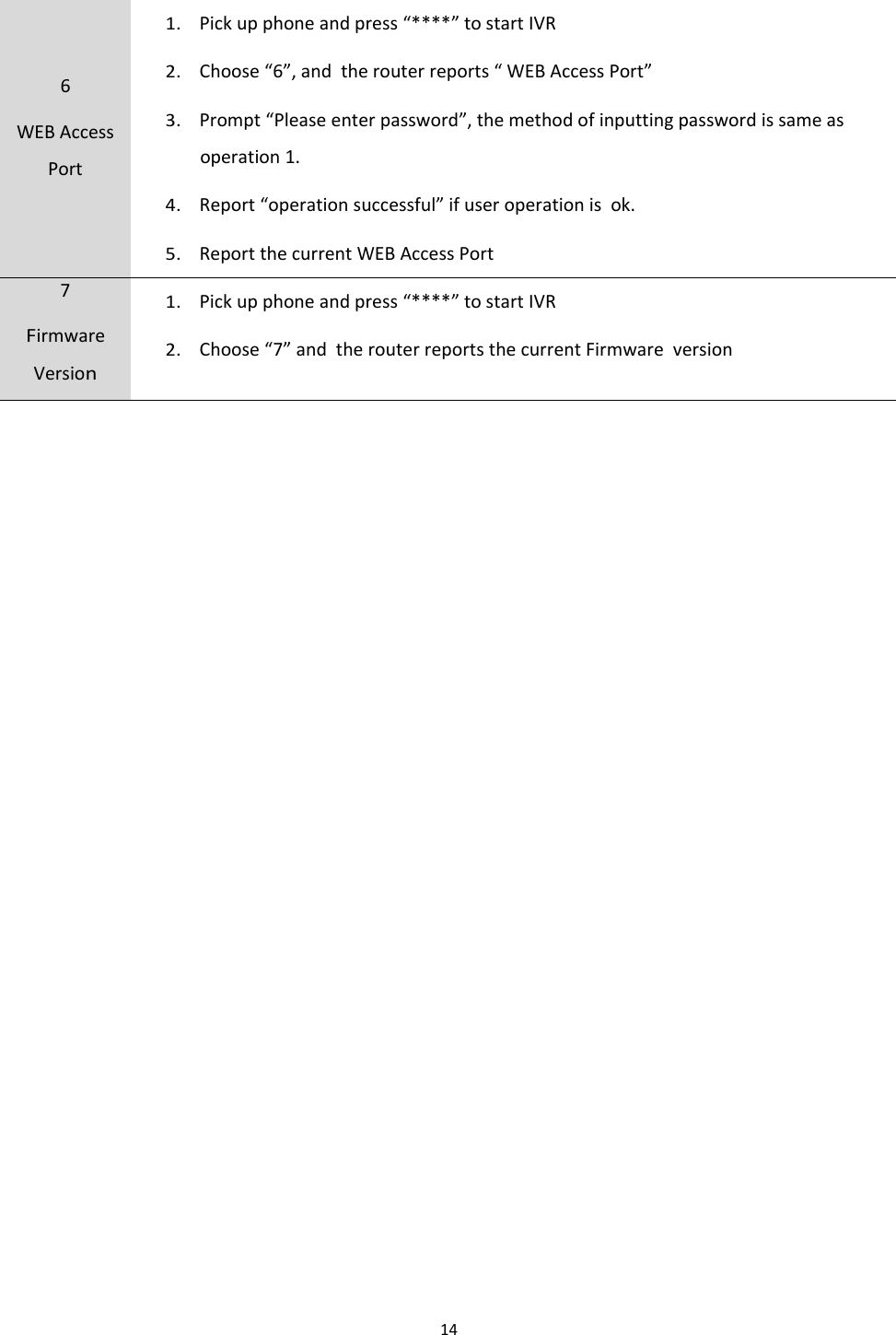
Chapter 1 Product description(5)DNS1.Pick up phone and press “****” to start IVR2.Choose “5”, and the router reports current DNS3.Input the new DNS and press # key:4.Use “*” to replace “.”, user can input 192*168*20*1 to set the new gateway192.168.20.1.5.Press “#” key to indicate that you have finished.2Phone portconfiguration1. Pick up phone and press “****” to start IVR2. Select "2", then the device will continue to broadcast prompts the user to selectcurrent phone number; 2. registration server address; 3. registration port; 4. callforwarding configuration,5. DNS configuration ;3. Continue pressing "1" and the unit will continue to broadcast the phone numberof the current phone port. The device will then broadcast "1. Phone number ..."again.3Factory Reset1.Pick up phone and press “****” to start IVR2.Choose “3”, and the router reports “Factory Reset”3.Prompt "Please enter password", the method of inputting password is the sameas operation 1.4.If you want to quit, press “*”.5.Prompt “operation successful” if password is right and then the router will be infactory default configuration.4Reboot1.Pick up phone and press “****” to start IVR2.Choose “4”, and the router reports “Reboot”3.Prompt "Please enter password", the method of inputting password is same asoperation 1.4.the router reboots if password is right and operation5WAN PortLogin1.Pick up phone and press “****” to start IVR2.Choose “5”, and the router reports “WAN Port Login”3.Prompt "Please enter password", the method of inputting password is same asoperation 1.4.If user wants to quit, press “*”.
Chapter 1 Product description146WEB AccessPort1.Pick up phone and press “****” to start IVR2.Choose “6”, and the router reports “ WEB Access Port”3.Prompt “Please enter password”, the method of inputting password is same asoperation 1.4.Report “operation successful” if user operation is ok.5.Report the current WEB Access Port7FirmwareVersion1.Pick up phone and press “****” to start IVR2.Choose “7” and the router reports the current Firmware version
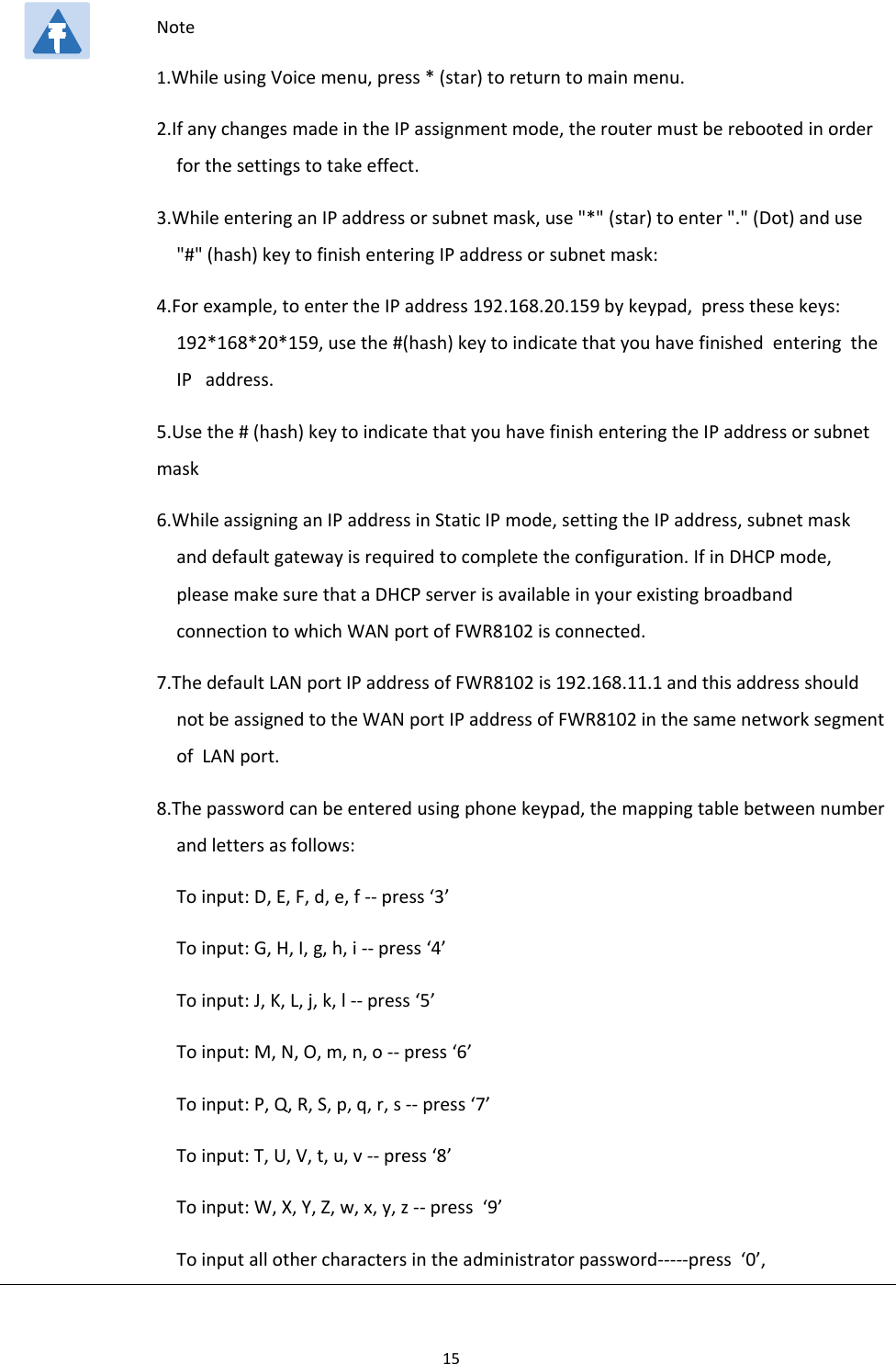
Chapter 1 Product description15Note1.While using Voice menu, press * (star) to return to main menu.2.If any changes made in the IP assignment mode, the router must be rebooted in orderfor the settings to take effect.3.While entering an IP address or subnet mask, use "*" (star) to enter "." (Dot) and use"#" (hash) key to finish entering IP address or subnet mask:4.For example, to enter the IP address 192.168.20.159 by keypad, press these keys:192*168*20*159, use the #(hash) key to indicate that you have finished entering theIP address.5.Use the # (hash) key to indicate that you have finish entering the IP address or subnetmask6.While assigning an IP address in Static IP mode, setting the IP address, subnet maskand default gateway is required to complete the configuration. If in DHCP mode,please make sure that a DHCP server is available in your existing broadbandconnection to which WAN port of FWR8102 is connected.7.The default LAN port IP address of FWR8102 is 192.168.11.1 and this address shouldnot be assigned to the WAN port IP address of FWR8102 in the same network segmentof LAN port.8.The password can be entered using phone keypad, the mapping table between numberand letters as follows:Toinput:D,E,F,d,e,f--press‘3’Toinput:G,H,I,g,h,i--press‘4’Toinput:J,K,L,j,k,l--press‘5’To input: M, N, O, m, n, o -- press ‘6’Toinput:P,Q,R,S,p,q,r,s--press‘7’Toinput:T,U,V,t,u,v--press‘8’Toinput:W,X,Y,Z,w,x,y,z--press ‘9’To input all other characters in the administrator password-----press ‘0’,
16This chapter covers:•Two-Level Management•Web Management Interface•Configuring•Making a CallChapter 2 Basic Settings
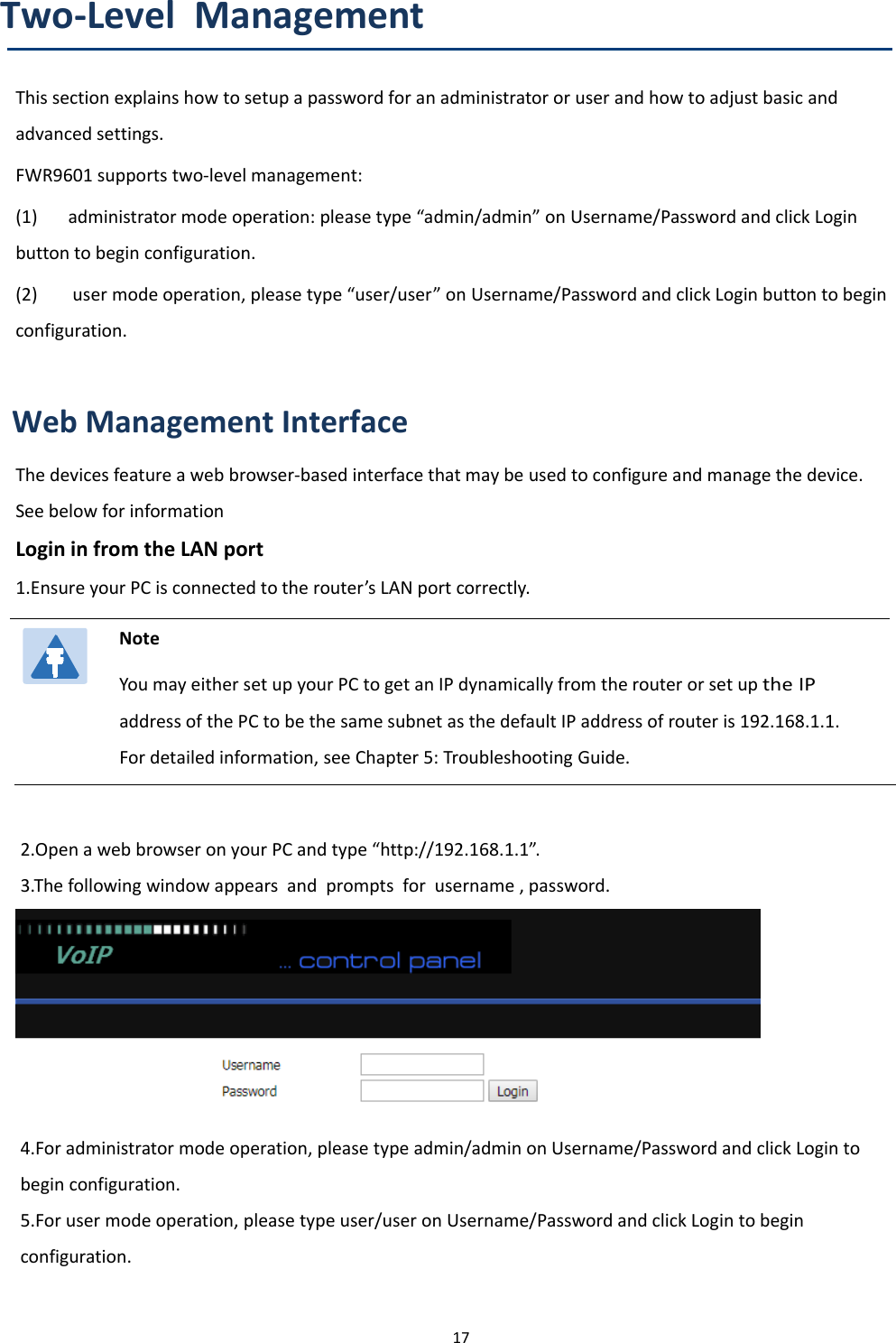
Chapter 2 Basic Settings17Two-Level ManagementThis section explains how to setup a password for an administrator or user and how to adjust basic andadvanced settings.FWR9601 supports two-level management:(1) administrator mode operation: please type “admin/admin” on Username/Password and click Loginbutton to begin configuration.(2) user mode operation, please type “user/user” on Username/Password and click Login button to beginconfiguration.Web Management InterfaceThe devices feature a web browser-based interface that may be used to configure and manage the device.See below for informationLogin in from the LAN port1.Ensure your PC is connected to the router’s LAN port correctly.NoteYou may either set up your PC to get an IP dynamically from the router or set upthe IPaddress of the PC to be the same subnet as the default IP address of router is 192.168.1.1.For detailed information, see Chapter 5: Troubleshooting Guide.2.Open a web browser on your PC and type “http://192.168.1.1”.3.The following window appears and prompts for username , password.4.For administrator mode operation, please type admin/admin on Username/Password and click Login tobegin configuration.5.Forusermodeoperation,pleasetypeuser/useron Username/Password and click Login to beginconfiguration.
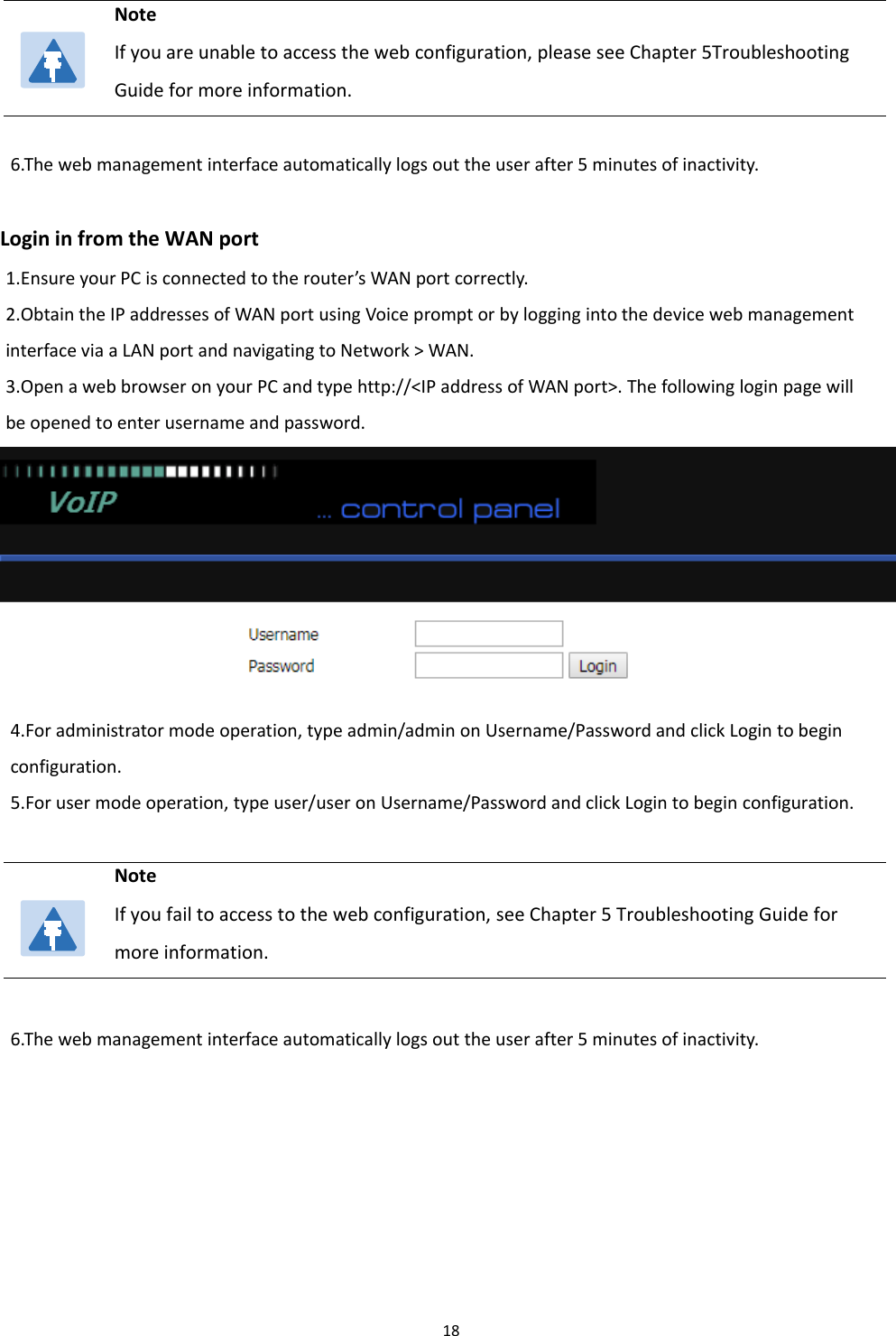
Chapter 2 Basic Settings186.The web management interface automatically logs out the user after 5 minutes of inactivity.Login in from the WAN port1.Ensure your PC is connected to the router’s WAN port correctly.2.Obtain the IP addresses of WAN port using Voice prompt or by logging into the device web managementinterface via a LAN port and navigating to Network > WAN.3.Open a web browser on your PC and type http://<IP address of WAN port>. The following login page willbe opened to enter username and password.4.For administrator mode operation, type admin/admin on Username/Password and click Login to beginconfiguration.5.Forusermodeoperation,typeuser/useronUsername/Password and click Login to begin configuration.6.The web management interface automatically logs out the user after 5 minutes of inactivity.NoteIf you are unable to access the web configuration, please see Chapter 5TroubleshootingGuide for more information.NoteIf you fail to access to the web configuration, see Chapter 5 Troubleshooting Guide formore information.
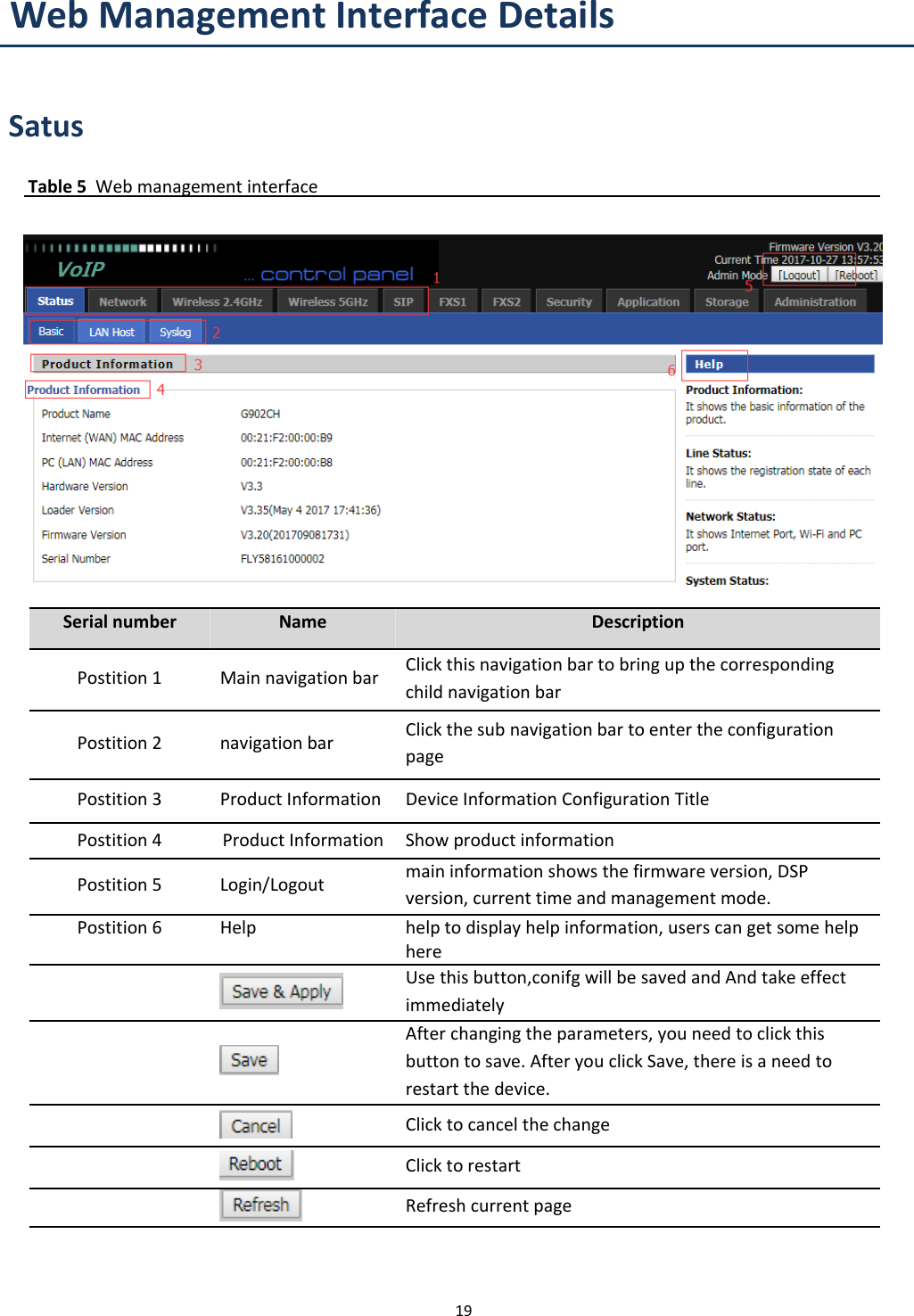
Chapter 2 Basic Settings19SatusTable 5 Web management interfaceWeb Management Interface DetailsSerial number Name DescriptionPostition 1 Main navigation bar Click this navigation bar to bring up the correspondingchild navigation barPostition 2 navigation bar Click the sub navigation bar to enter the configurationpagePostition 3 Product Information Device Information Configuration TitlePostition 4 Product Information Show product informationPostition 5 Login/Logout main information shows the firmware version, DSPversion, current time and management mode.Postition 6 Help help to display help information, users can get some helphereUse this button,conifg will be saved and And take effectimmediatelyAfter changing the parameters, you need to click thisbutton to save. After you click Save, there is a need torestart the device.Click to cancel the changeClick to restartRefresh current page
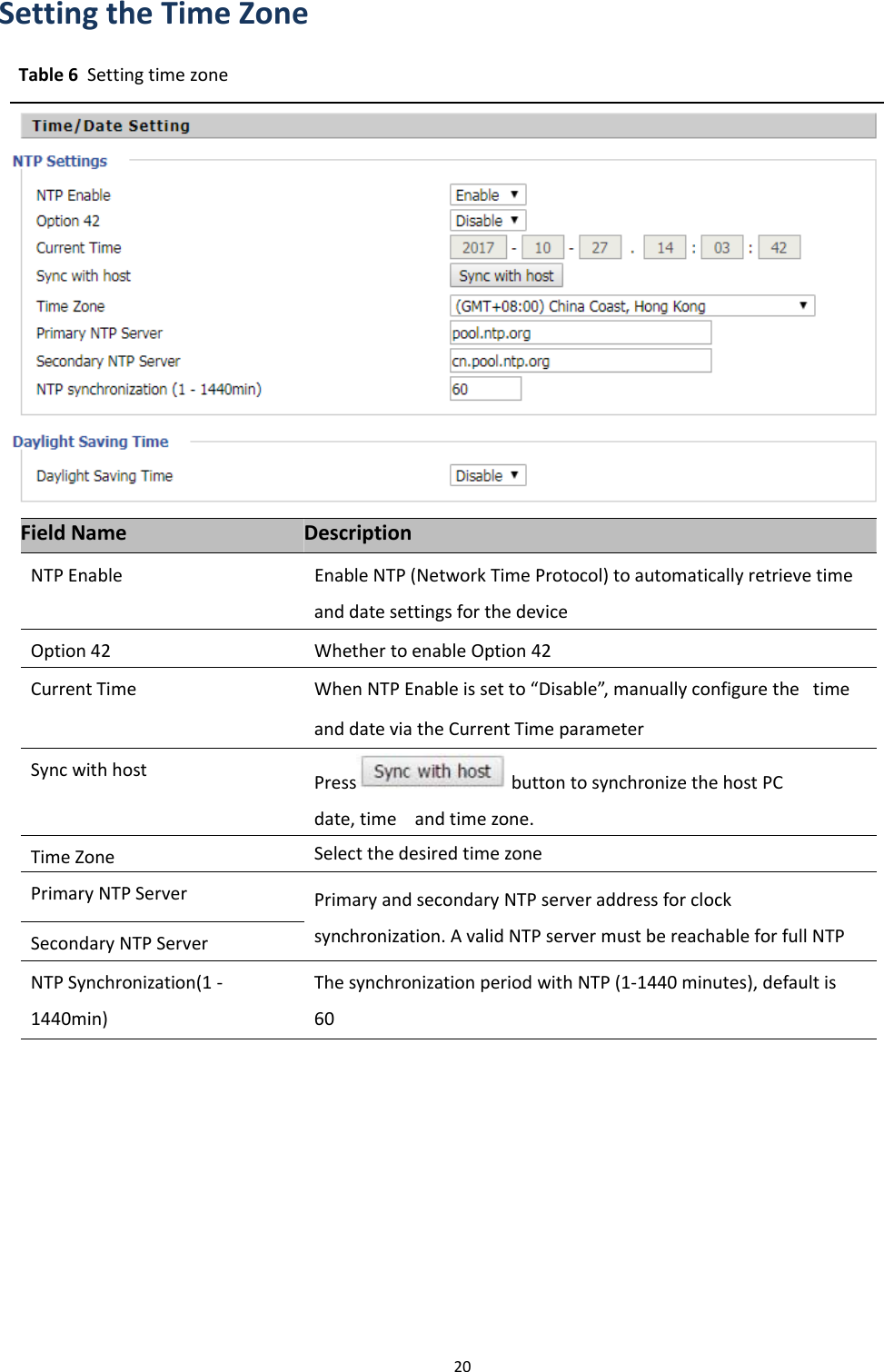
Chapter 2 Basic Settings20Setting the Time ZoneTable 6 Setting time zoneField Name DescriptionNTP Enable Enable NTP (Network Time Protocol) to automatically retrieve timeand date settings for the deviceOption 42 Whether to enable Option 42Current Time When NTP Enable is set to “Disable”, manually configure the timeand date via the Current Time parameterSync with host Press button to synchronize the host PCdate, time and time zone.Time Zone Select the desired time zonePrimary NTP Server Primary and secondary NTP server address for clocksynchronization. A valid NTP server must be reachable for full NTPSecondary NTP ServerNTP Synchronization(1 -1440min)The synchronization period with NTP (1-1440 minutes), default is60
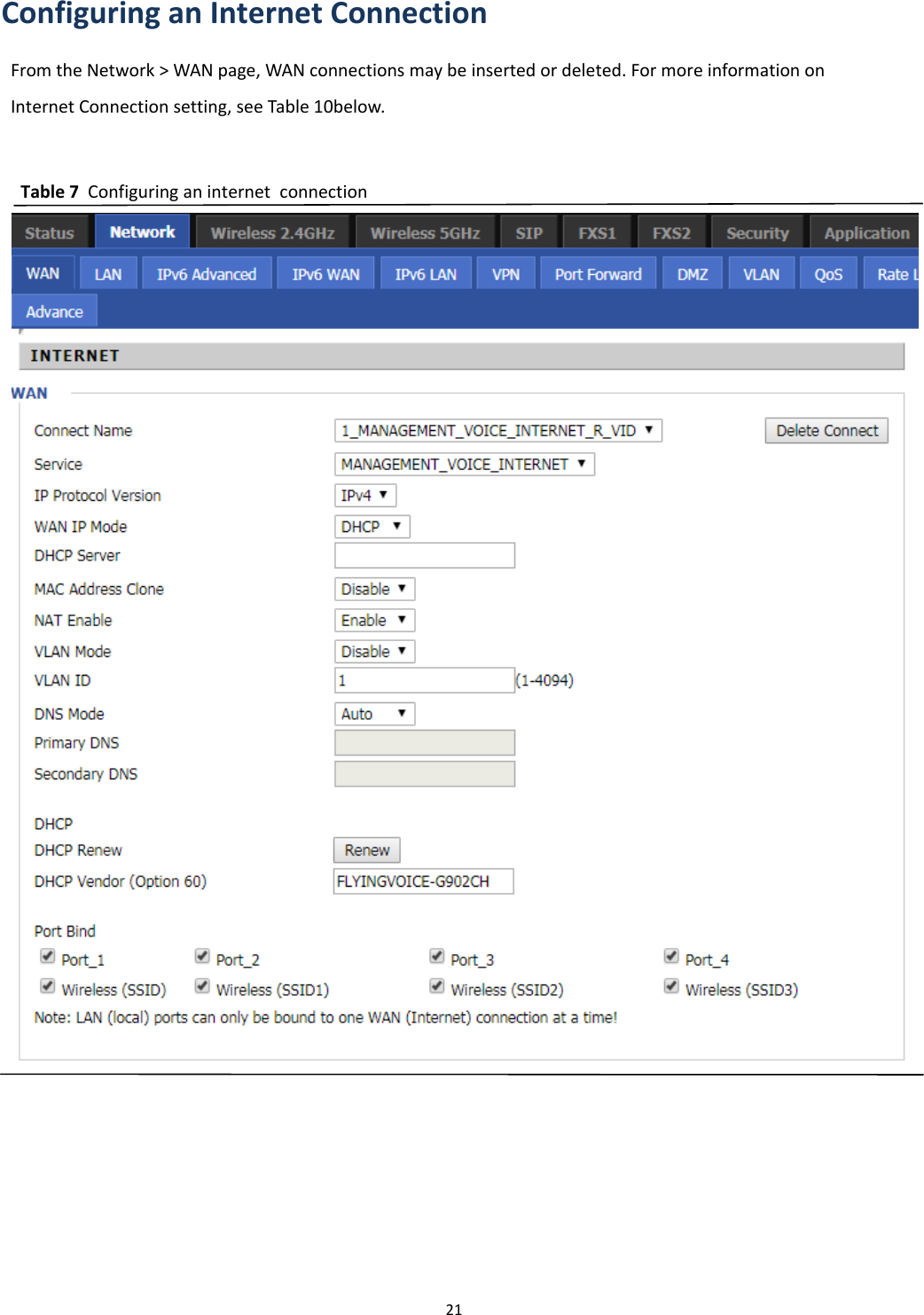
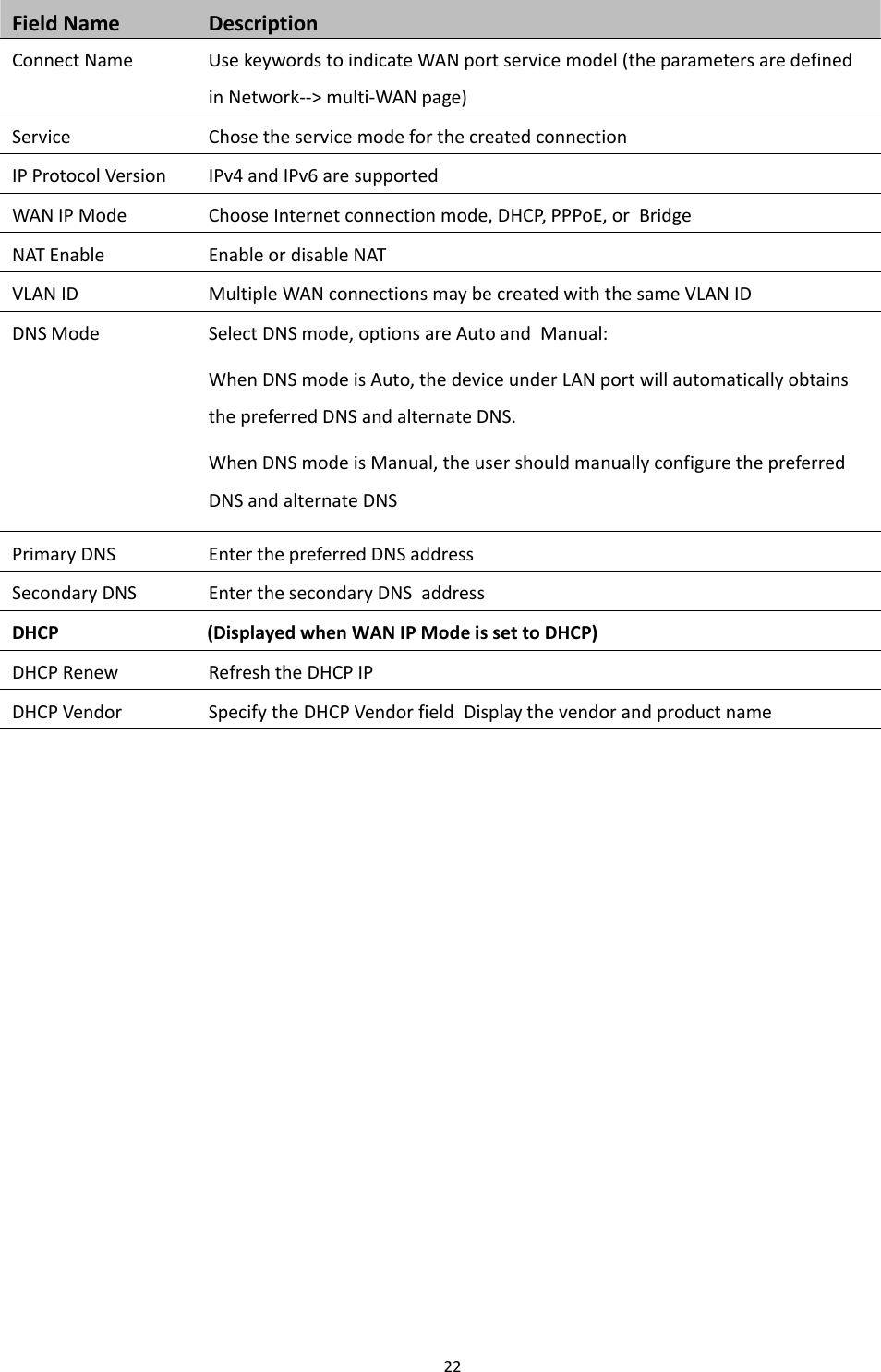
Chapter 2 Basic Settings21Configuring an Internet ConnectionFrom the Network > WAN page, WAN connections may be inserted or deleted. For more information onInternet Connection setting, see Table 10below.Table 7 Configuring an internet connection
Chapter 2 Basic Settings22Field Name DescriptionConnect Name Use keywords to indicate WAN port service model (the parameters are definedin Network--> multi-WAN page)Service Chose the service mode for the created connectionIP Protocol Version IPv4 and IPv6 are supportedWAN IP Mode Choose Internet connection mode, DHCP, PPPoE, or BridgeNAT Enable Enable or disable NATVLAN ID Multiple WAN connections may be created with the same VLAN IDDNS Mode Select DNS mode, options are Auto and Manual:When DNS mode is Auto, the device under LAN port will automatically obtainsthe preferred DNS and alternate DNS.When DNS mode is Manual, the user should manually configure the preferredDNS and alternate DNSPrimary DNS Enter the preferred DNS addressSecondary DNS Enter the secondary DNS addressDHCP (Displayed when WAN IP Mode is set to DHCP)DHCP Renew Refresh the DHCP IPDHCP Vendor Specify the DHCP Vendor field Display the vendor and product name
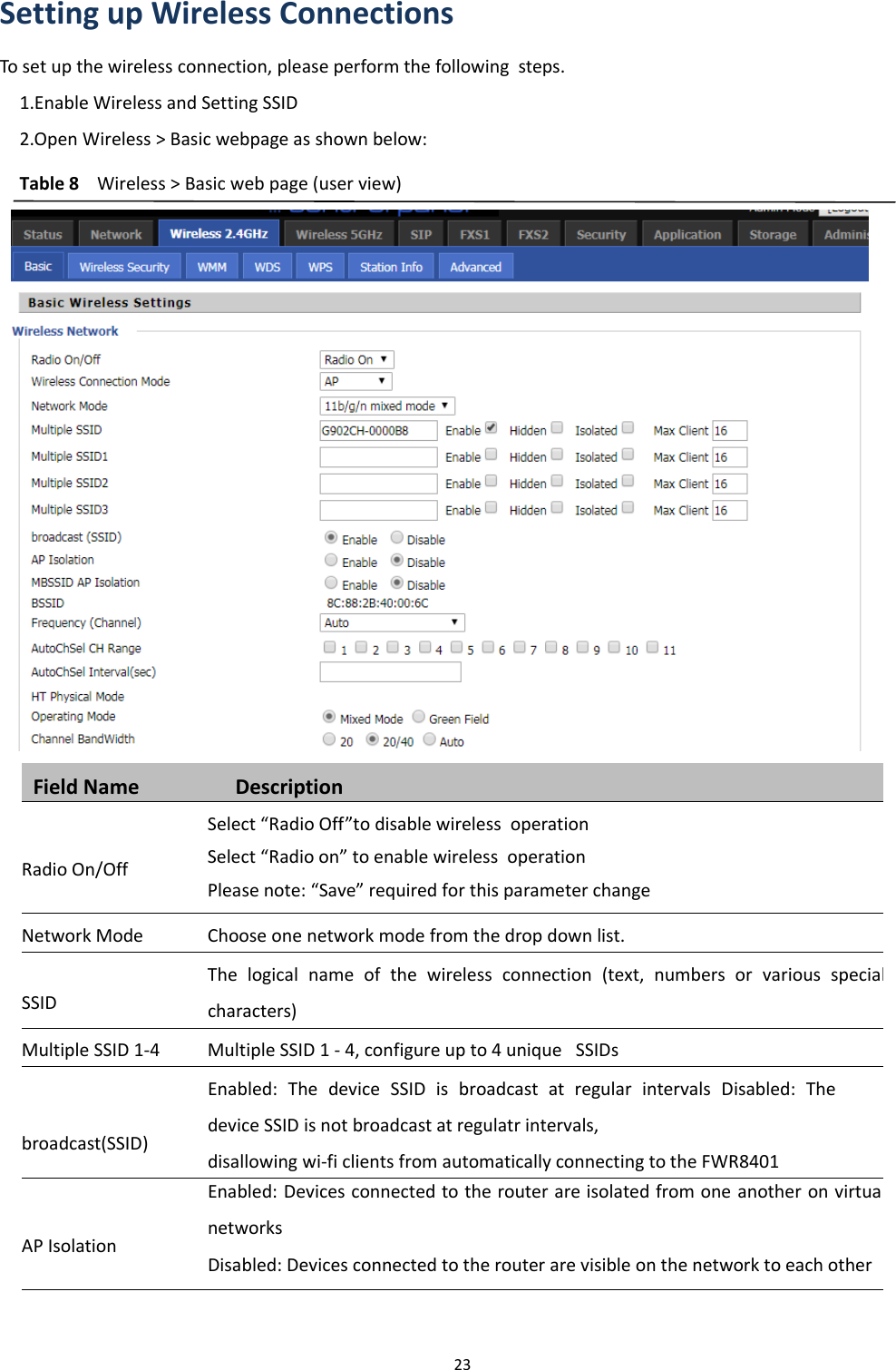
Chapter 2 Basic Settings23Setting up Wireless ConnectionsTo set up the wireless connection, please perform the following steps.1.Enable Wireless and Setting SSID2.Open Wireless > Basic webpage as shown below:Table 8 Wireless > Basic web page (user view)Field Name DescriptionRadio On/OffSelect “Radio Off”to disable wireless operationSelect “Radio on” to enable wireless operationPlease note: “Save” required for this parameter changeNetwork Mode Choose one network mode from the drop down list.SSIDThe logical name of the wireless connection (text, numbers or various specialcharacters)Multiple SSID 1-4 Multiple SSID 1 - 4, configure up to 4 unique SSIDsbroadcast(SSID)Enabled: The device SSID is broadcast at regular intervals Disabled: Thedevice SSID is not broadcast at regulatr intervals,disallowing wi-fi clients from automatically connecting to the FWR8401AP IsolationEnabled: Devices connected to the router are isolated from one another on virtuanetworksDisabled: Devices connected to the router are visible on the network to each other
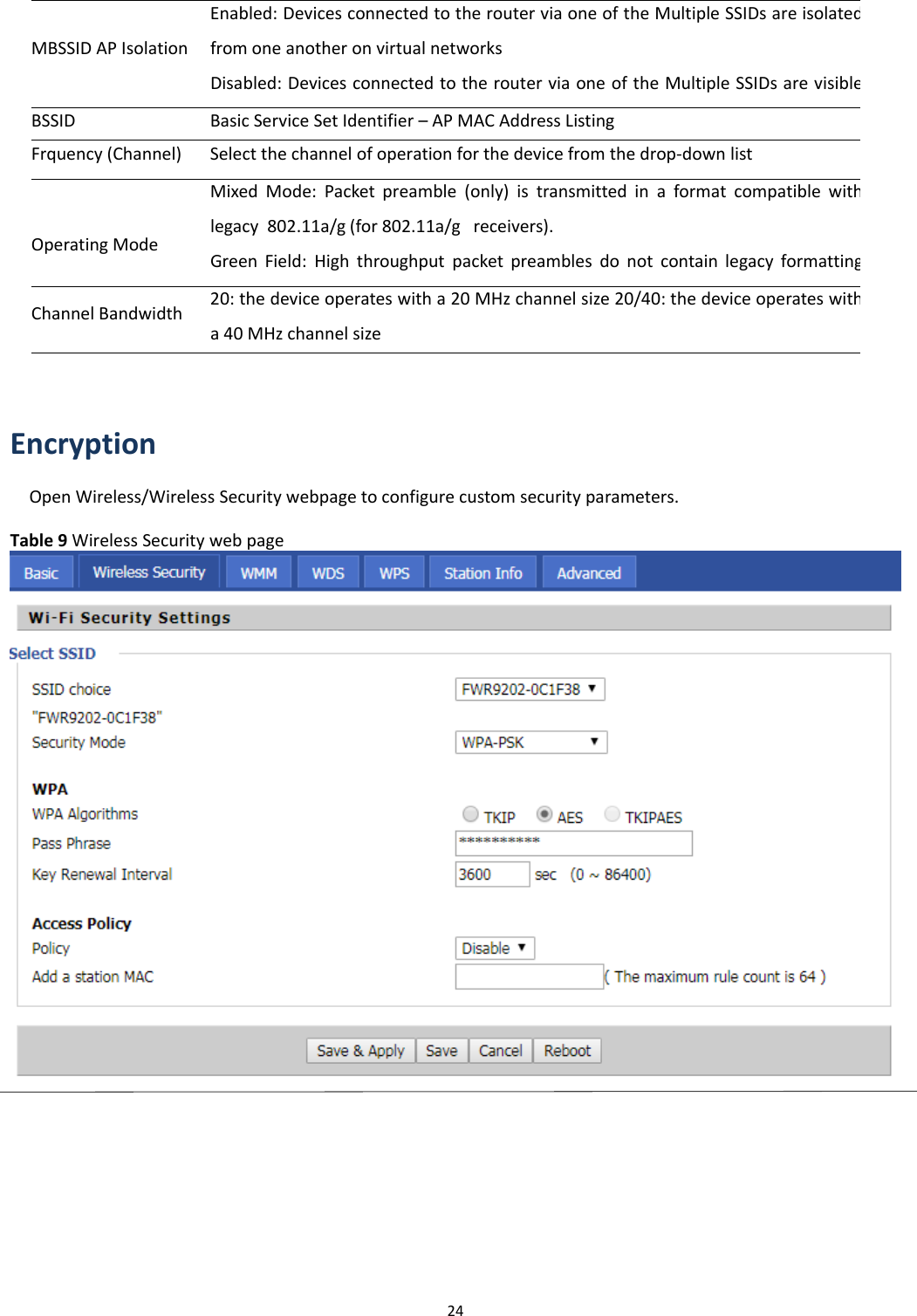
Chapter 2 Basic Settings24EncryptionOpen Wireless/Wireless Security webpage to configure custom security parameters.Table 9 Wireless Security web pageMBSSID AP IsolationEnabled: Devices connected to the router via one of the Multiple SSIDs are isolatedfrom one another on virtual networksDisabled: Devices connected to the router via one of the Multiple SSIDs are visibleBSSID Basic Service Set Identifier – AP MAC Address ListingFrquency (Channel) Select the channel of operation for the device from the drop-down listOperating ModeMixed Mode: Packet preamble (only) is transmitted in a format compatible withlegacy 802.11a/g (for 802.11a/g receivers).Green Field: High throughput packet preambles do not contain legacy formattingChannel Bandwidth 20: the device operates with a 20 MHz channel size 20/40: the device operates witha 40 MHz channel size
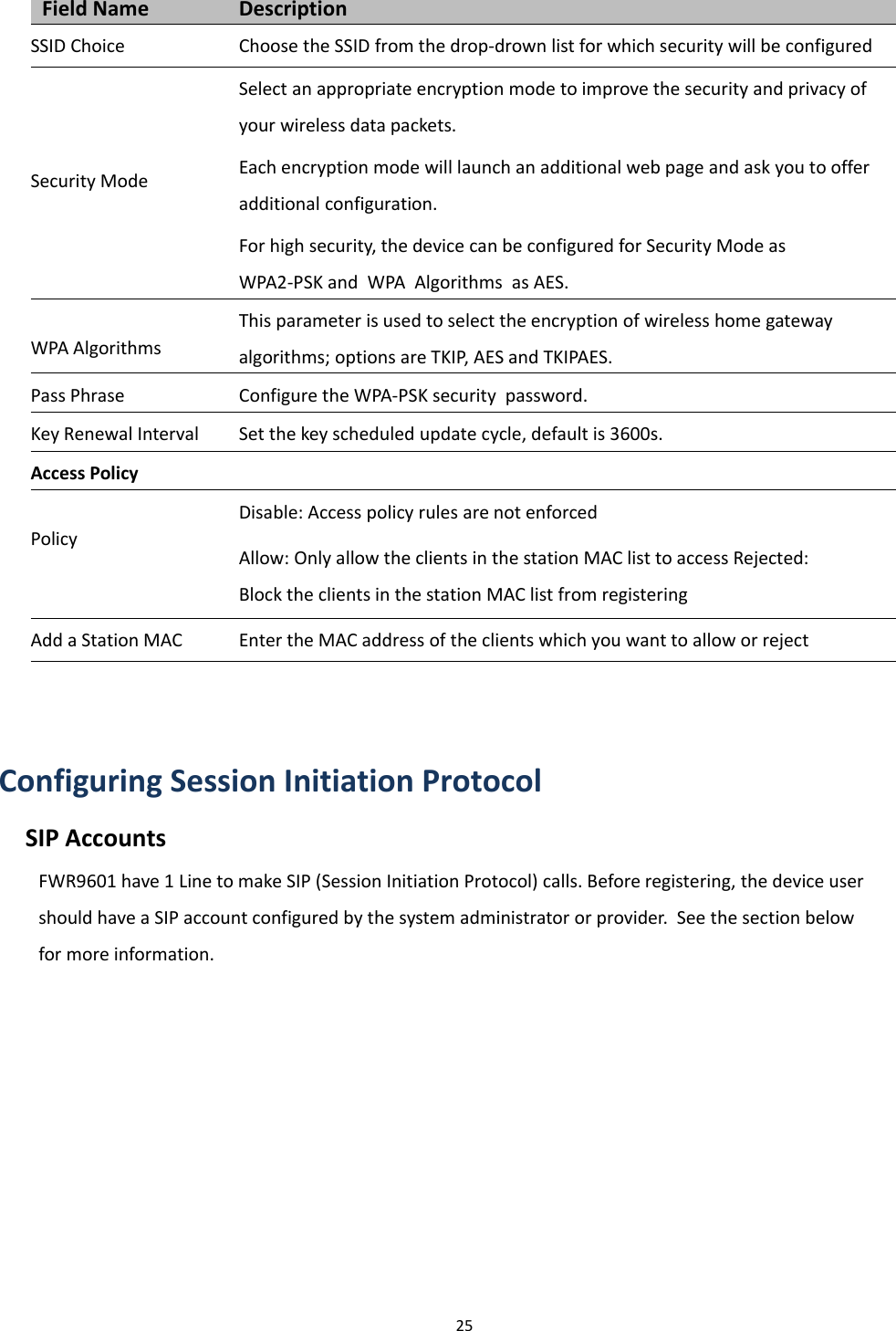
Chapter 2 Basic Settings25Configuring Session Initiation ProtocolSIP AccountsFWR9601 have 1 Line to make SIP (Session Initiation Protocol) calls. Before registering, the device usershould have a SIP account configured by the system administrator or provider. See the section belowfor more information.Field Name DescriptionSSID Choice Choose the SSID from the drop-drown list for which security will be configuredSecurity ModeSelect an appropriate encryption mode to improve the security and privacy ofyour wireless data packets.Each encryption mode will launch an additional web page and ask you to offeradditional configuration.For high security, the device can be configured for Security Mode asWPA2-PSK and WPA Algorithms as AES.WPA AlgorithmsThis parameter is used to select the encryption of wireless home gatewayalgorithms; options are TKIP, AES and TKIPAES.Pass Phrase Configure the WPA-PSK security password.Key Renewal Interval Set the key scheduled update cycle, default is 3600s.Access PolicyPolicyDisable: Access policy rules are not enforcedAllow: Only allow the clients in the station MAC list to access Rejected:Block the clients in the station MAC list from registeringAdd a Station MAC Enter the MAC address of the clients which you want to allow or reject
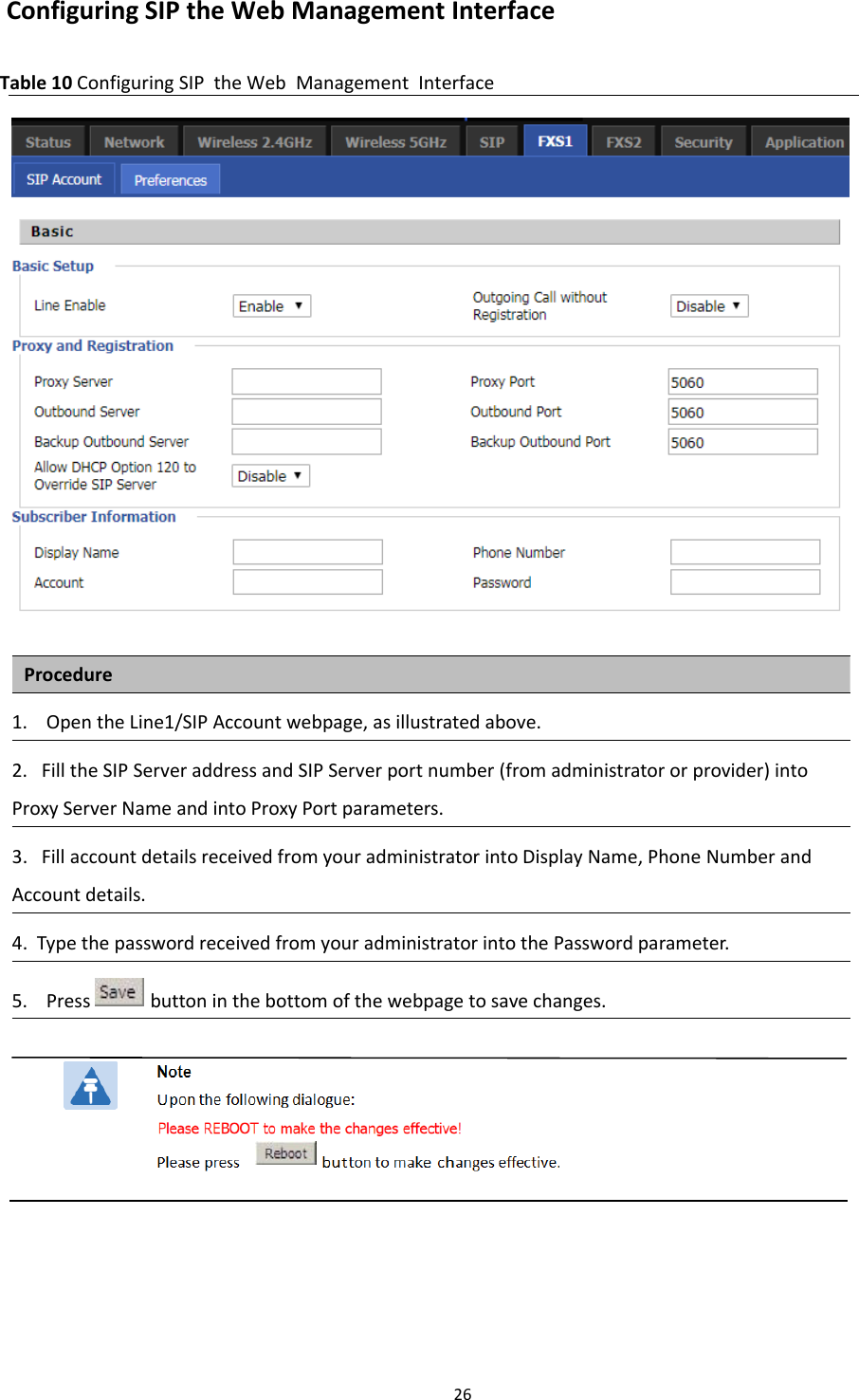
Chapter 2 Basic Settings26Configuring SIP the Web Management InterfaceTable 10 Configuring SIP the Web Management InterfaceProcedure1. Open the Line1/SIP Account webpage, as illustrated above.2. Fill the SIP Server address and SIP Server port number (from administrator or provider) intoProxy Server Name and into Proxy Port parameters.3. Fill account details received from your administrator into Display Name, Phone Number andAccount details.4. Type the password received from your administrator into the Password parameter.5. Press button in the bottom of the webpage to save changes.
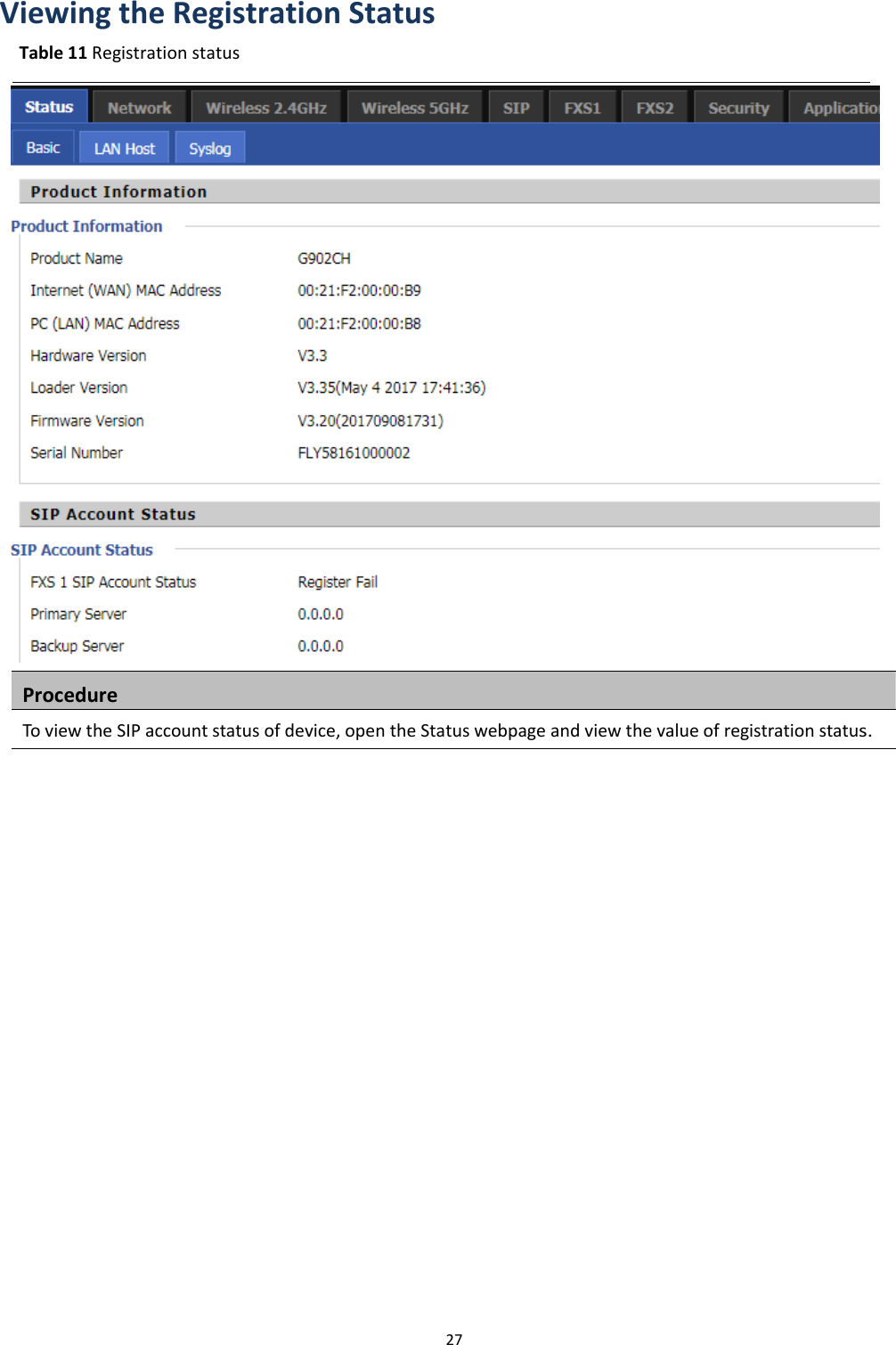
Chapter 2 Basic Settings27Viewing the Registration StatusTable 11 Registration statusProcedureTo view the SIP account status of device, open the Status webpage and view the value of registration status.
Chapter 2 Basic Settings28Making a CallCalling phone or extension numbersTo make a phone or extension number call:•Both ATA and the other VoIP device (i.e., another ATA or other SIP products) must have public IPaddresses, or•Both ATA and the other VoIP device (i.e., another ATA or other SIP products) are on the same LAN usingprivate or public IP addresses, or•Both ATA and the other VoIP device (i.e., another ATA or other SIP products) can be connected through arouter using a public or private IP addresses.To make a call, first pick up the analog phone or turn on the speakerphone on the analog phone, input the IPaddress directly, end with #.Direct IP callsDirect IP calling allows two phones, that is, an ATA with an analog phone and another VoIP Device, to talk toeach other without a SIP proxy. VoIP calls can be made between two phones if:•Both ATA and the other VoIP device (i.e., another ATA or other SIP products) have public IP addresses, or•Both ATA and the other VoIP device (i.e., another ATA or other SIP products) are on the same LAN usingprivate or public IP addresses, or•Both ATA and the other VoIP device (i.e., another ATA or other SIP products) can be connected through arouter using public or private IP addresses.To make a direct IP call, first pick up the analog phone or turn on the speakerphone on the analog phone,Input the IP address directly, with the end “#”.Call HoldWhile in conversation, pressing the “*77” to put the remote end on hold, then you will hear the dial tone andthe remote party will hear hold tone at the same time.Pressing the “*77” again to release the previously hold state and resume the bi-directional media.Blind TransferAssume that call party A and party B are in conversation. Party A wants to Blind Transfer B to C:Party A dials “*78” to get a dial tone, then dials party C’s number, and then press immediately key # (or waitfor 4 seconds) to dial out.A can hang up.
Chapter 2 Basic Settings29Attended TransferAssumethatcallpartyAandBareinaconversation.AwantstoAttendTransferBto C:Party A dials “*77” to hold the party B, when hear the dial tone, A dials C’s number, then party A and partyC are in conversation.Party A dials “*78” to transfer to C, then B and C now in conversation.If the transfer is not completed successfully, then A and B are in conversation again.ConferenceAssume that call party A and B are in a conversation. A wants to add C to the conference:Party A dials “*77” to hold the party B, when hear the dial tone, A dial C’s number, then party A and party Care in conversation.Party A dials “*88” to add C, then A and B, for conference.
Chapter 3 Web Interface30Chapter 3 Web InterfaceThis chapter guides users to execute advanced (full) configuration through admin mode operation. Thischapter covers:•Login•Status•Network and Security•Wireless•SIP•FXS1•Security•Application•Administration•Management•System Log•Logout•Reboot
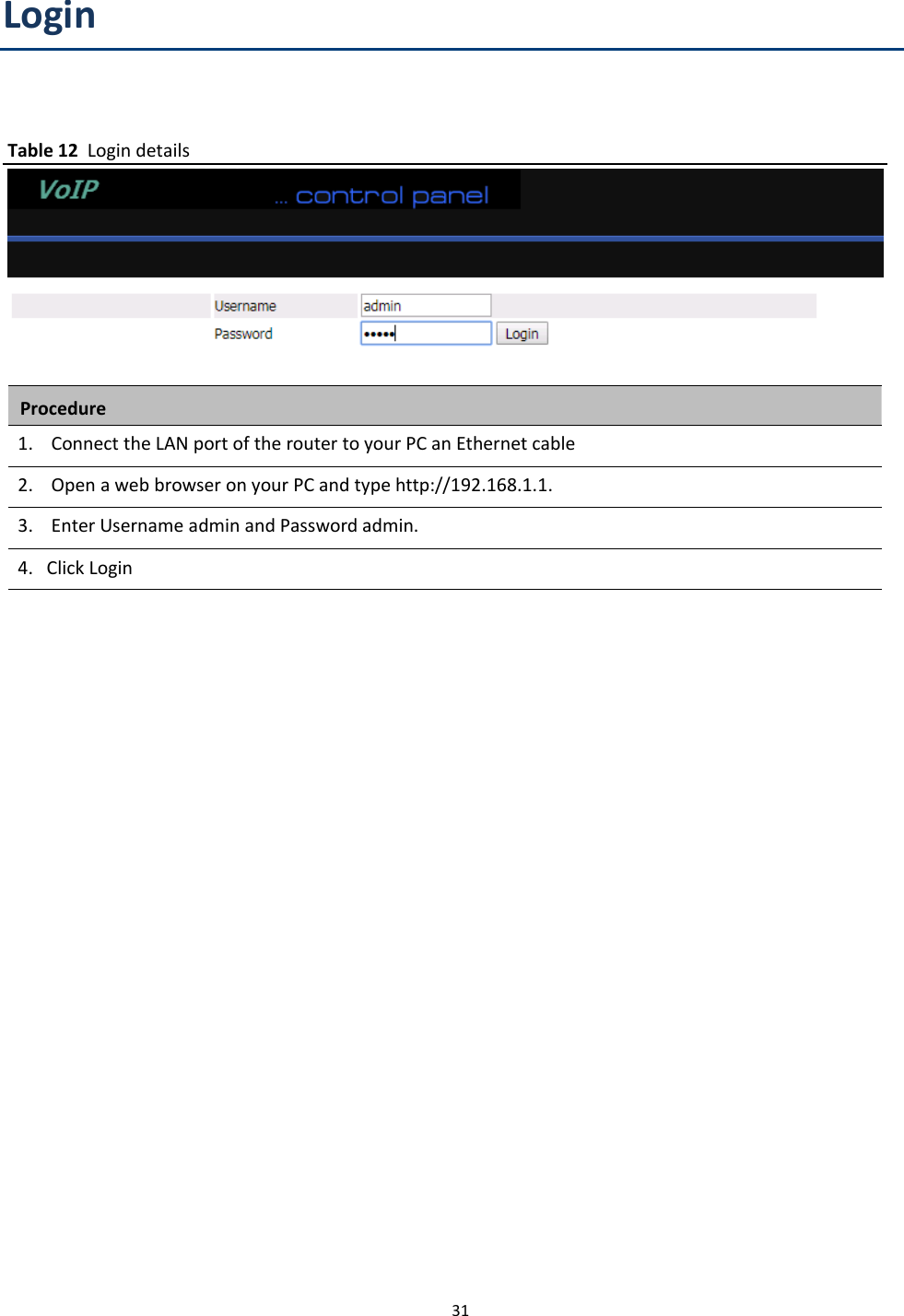
Chapter 3 Web Interface31LoginTable 12 Login detailsProcedure1. Connect the LAN port of the router to your PC an Ethernet cable2. Open a web browser on your PC and type http://192.168.1.1.3. Enter Username admin and Password admin.4. Click Login
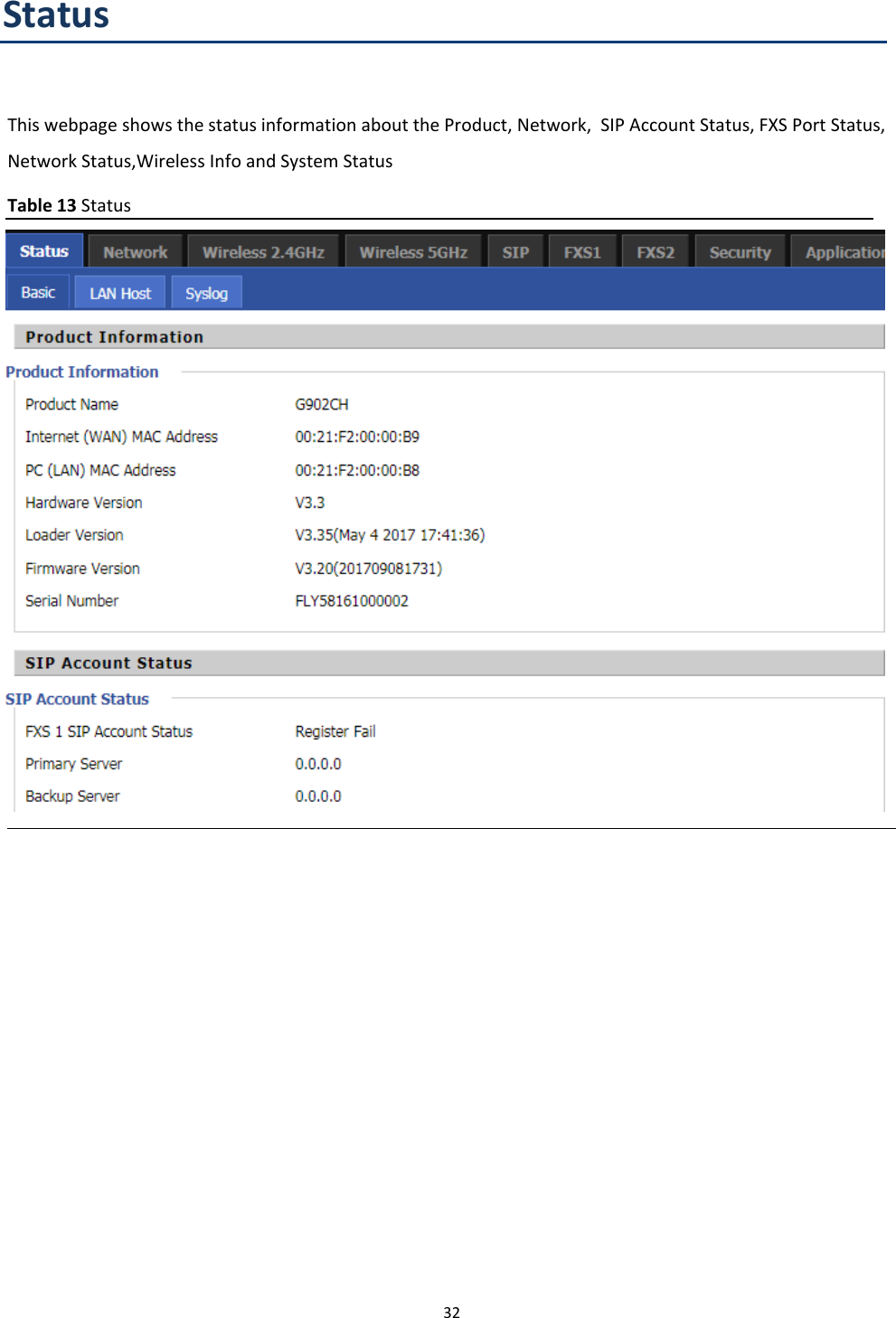
Chapter 3 Web Interface32StatusThis webpage shows the status information about the Product, Network, SIP Account Status, FXS Port Status,Network Status,Wireless Info and System StatusTable 13 Status
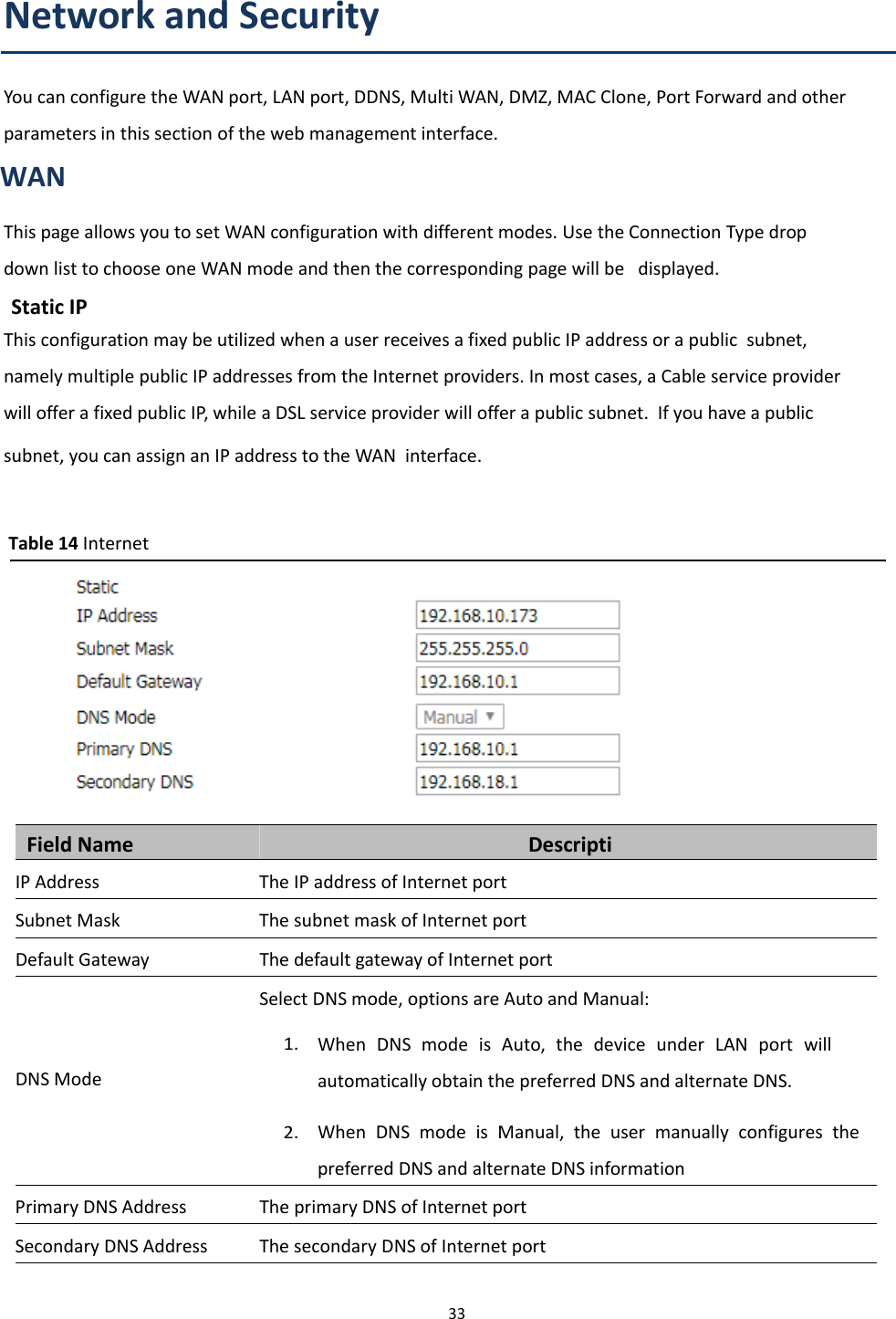
Chapter 3 Web Interface33Network and SecurityYou can configure the WAN port, LAN port, DDNS, Multi WAN, DMZ, MAC Clone, Port Forward and otherparameters in this section of the web management interface.WANThis page allows you to set WAN configuration with different modes. Use the Connection Type dropdown list to choose one WAN mode and then the corresponding page will be displayed.Static IPThis configuration may be utilized when a user receives a fixed public IP address or a public subnet,namely multiple public IP addresses from the Internet providers. In most cases, a Cable service providerwill offer a fixed public IP, while a DSL service provider will offer a public subnet. If you have a publicsubnet, you can assign an IP address to the WAN interface.Table 14 InternetField Name DescriptiIP Address The IP address of Internet portSubnet Mask The subnet mask of Internet portDefault Gateway The default gateway of Internet portDNS ModeSelect DNS mode, options are Auto and Manual:1.When DNS mode is Auto, the device under LAN port willautomatically obtain the preferred DNS and alternate DNS.2.When DNS mode is Manual, the user manually configures thepreferred DNS and alternate DNS informationPrimary DNS Address The primary DNS of Internet portSecondary DNS Address The secondary DNS of Internet port
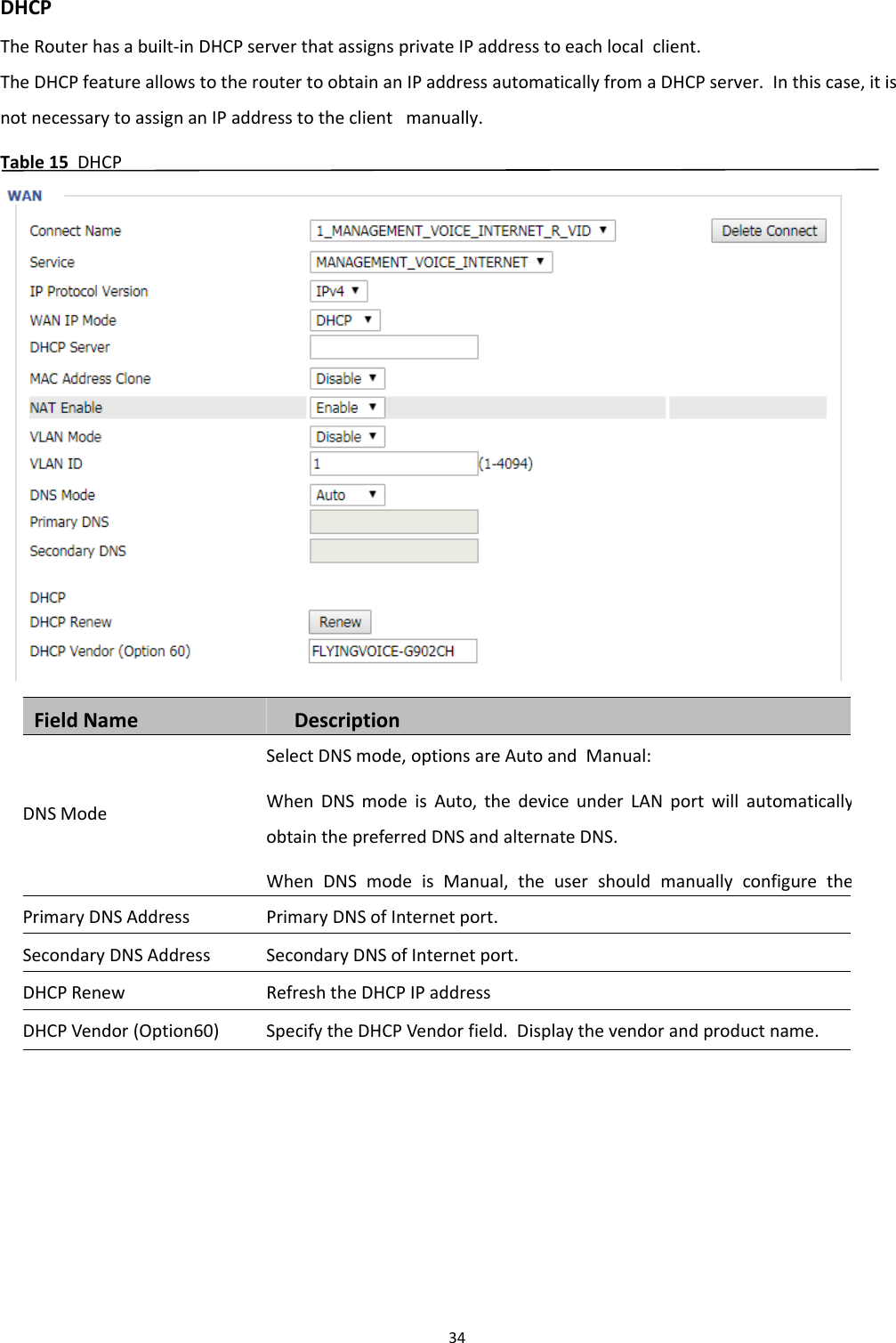
Chapter 3 Web Interface34DHCPThe Router has a built-in DHCP server that assigns private IP address to each local client.The DHCP feature allows to the router to obtain an IP address automatically from a DHCP server. In this case, it isnot necessary to assign an IP address to the client manually.Table 15 DHCPField Name DescriptionDNS ModeSelect DNS mode, options are Auto and Manual:When DNS mode is Auto, the device under LAN port will automaticallyobtain the preferred DNS and alternate DNS.When DNS mode is Manual, the user should manually configure thePrimary DNS Address Primary DNS of Internet port.Secondary DNS Address Secondary DNS of Internet port.DHCP Renew Refresh the DHCP IP addressDHCP Vendor (Option60) Specify the DHCP Vendor field. Display the vendor and product name.
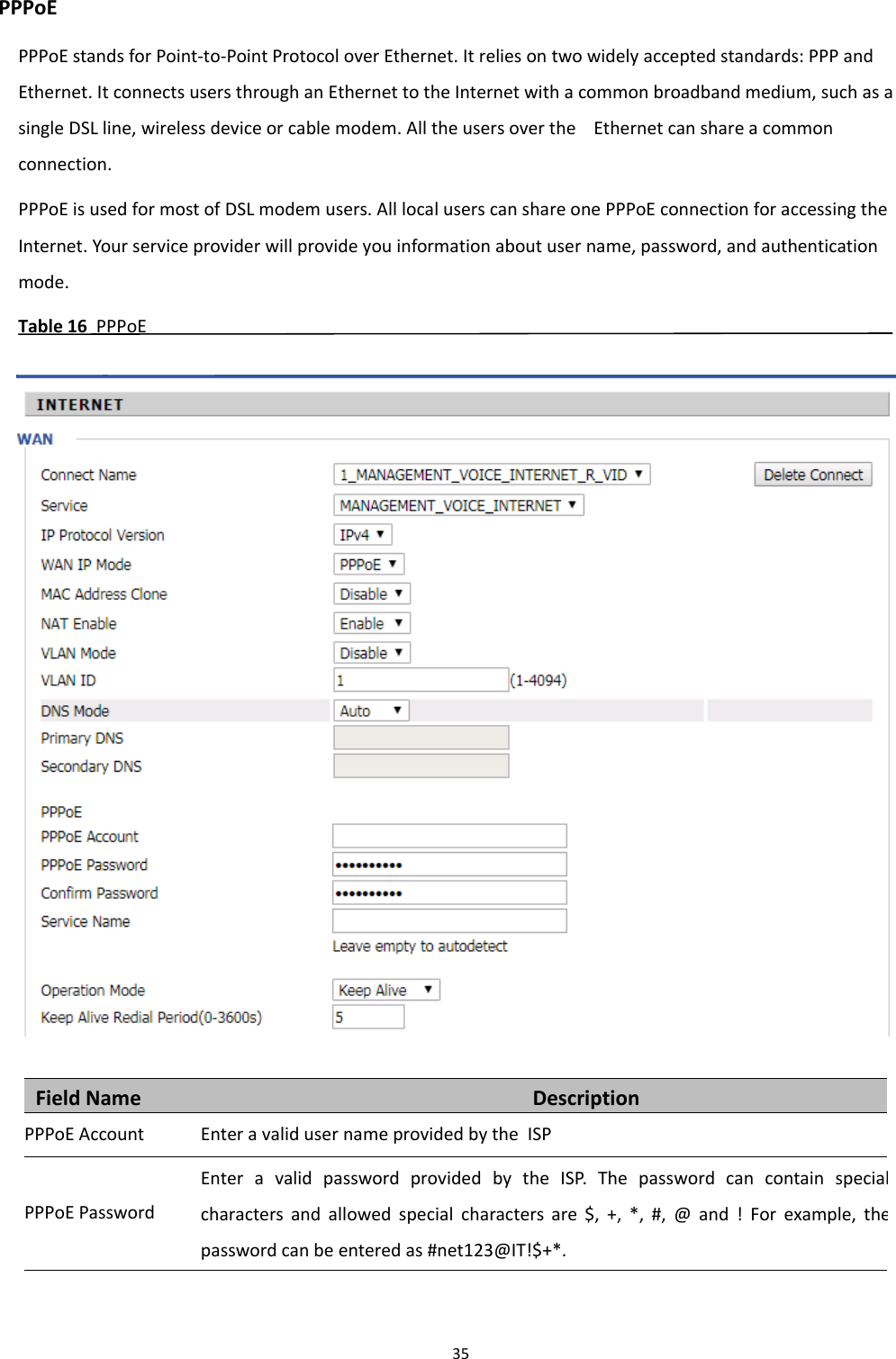
Chapter 3 Web Interface35PPPoEPPPoE stands for Point-to-Point Protocol over Ethernet. It relies on two widely accepted standards: PPP andEthernet. It connects users through an Ethernet to the Internet with a common broadband medium, such as asingle DSL line, wireless device or cable modem. All the users over the Ethernet can share a commonconnection.PPPoE is used for most of DSL modem users. All local users can share one PPPoE connection for accessing theInternet. Your service provider will provide you information about user name, password, and authenticationmode.Table 16 PPPoEField Name DescriptionPPPoE Account Enter a valid user name provided by the ISPPPPoE PasswordEnter a valid password provided by the ISP. The password can contain specialcharacters and allowed special characters are $, +, *, #, @ and ! For example, thepassword can be entered as #net123@IT!$+*.
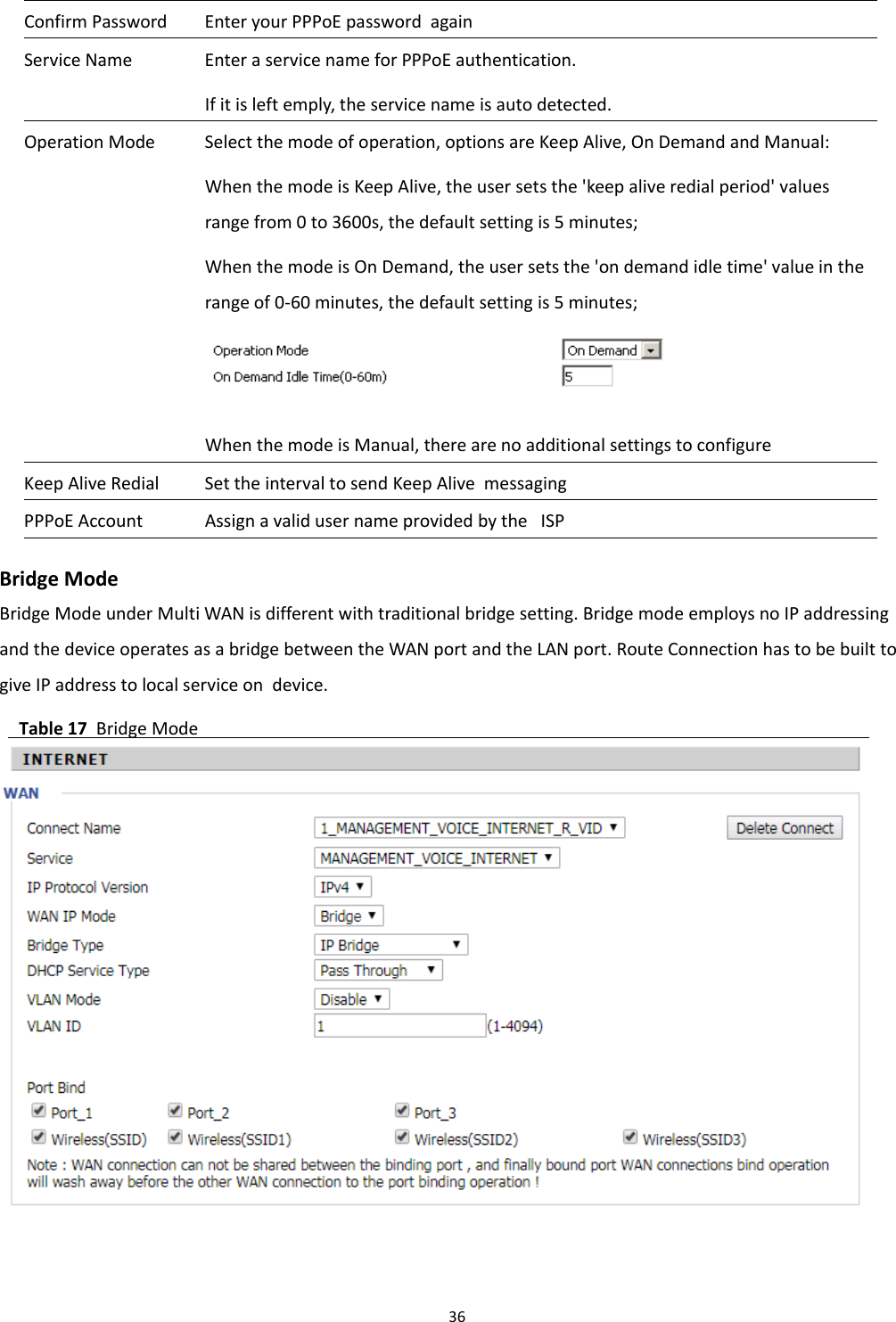
Chapter 3 Web Interface36Confirm Password Enter your PPPoE password againService Name Enter a service name for PPPoE authentication.If it is left emply, the service name is auto detected.Operation Mode Select the mode of operation, options are Keep Alive, On Demand and Manual:When the mode is Keep Alive, the user sets the 'keep alive redial period' valuesrange from 0 to 3600s, the default setting is 5 minutes;When the mode is On Demand, the user sets the 'on demand idle time' value in therange of 0-60 minutes, the default setting is 5 minutes;When the mode is Manual, there are no additional settings to configureKeep Alive Redial Set the interval to send Keep Alive messagingPPPoE Account Assign a valid user name provided by the ISPBridge ModeBridge Mode under Multi WAN is different with traditional bridge setting. Bridge mode employs no IP addressingand the device operates as a bridge between the WAN port and the LAN port. Route Connection has to be built togive IP address to local service on device.Table 17 Bridge Mode
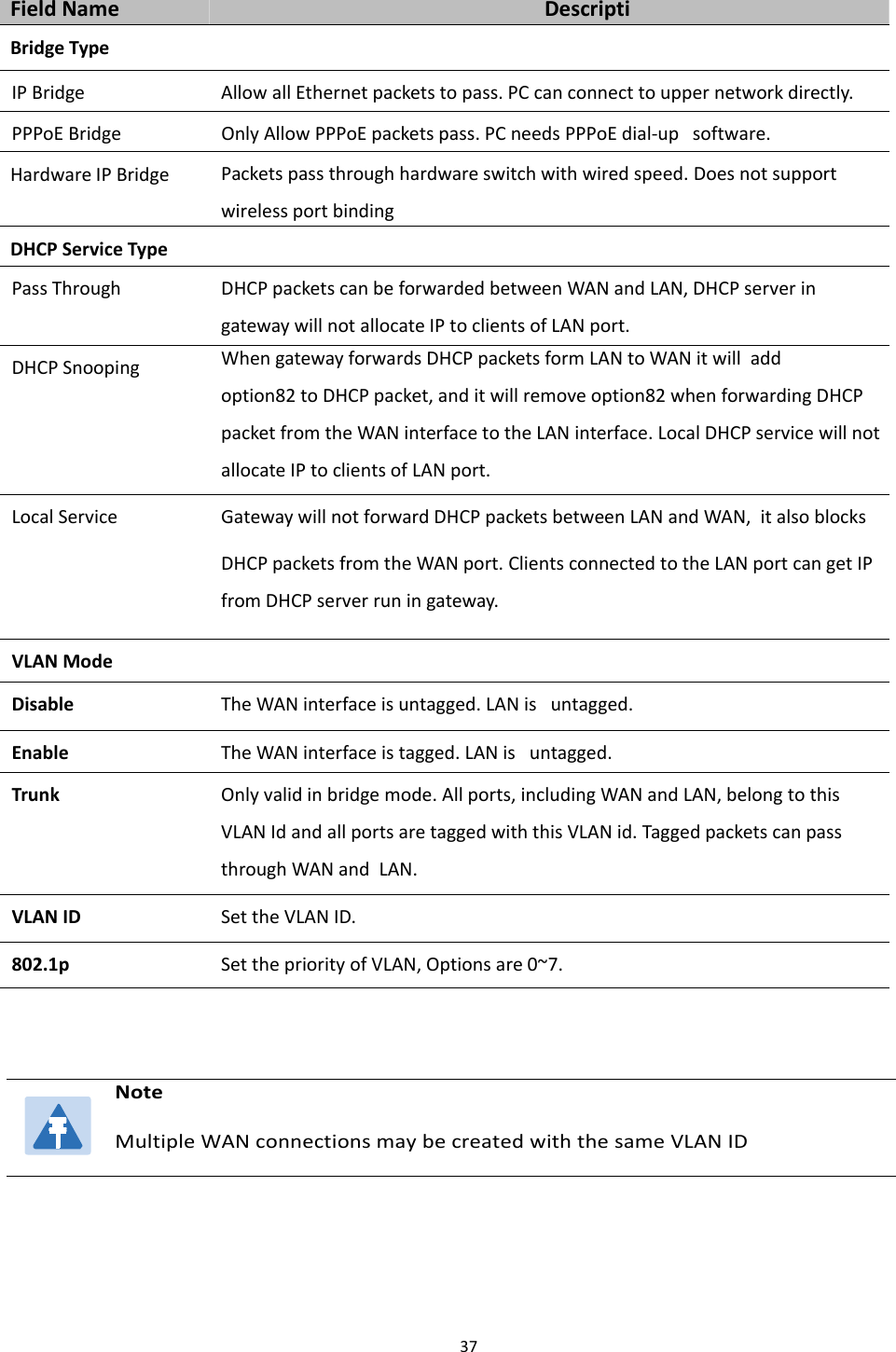
Chapter 3 Web Interface37Field Name DescriptiBridge TypeIP Bridge Allow all Ethernet packets to pass. PC can connect to upper network directly.PPPoE Bridge Only Allow PPPoE packets pass. PC needs PPPoE dial-up software.Hardware IP Bridge Packets pass through hardware switch with wired speed. Does not supportwireless port bindingDHCP Service TypePass Through DHCP packets can be forwarded between WAN and LAN, DHCP server ingateway will not allocate IP to clients of LAN port.DHCP Snooping When gateway forwards DHCP packets form LAN to WAN it will addoption82 to DHCP packet, and it will remove option82 when forwarding DHCPpacket from the WAN interface to the LAN interface. Local DHCP service will notallocate IP to clients of LAN port.Local Service Gateway will not forward DHCP packets between LAN and WAN, it also blocksDHCP packets from the WAN port. Clients connected to the LAN port can get IPfrom DHCP server run in gateway.VLAN ModeDisable The WAN interface is untagged. LAN is untagged.Enable The WAN interface is tagged. LAN is untagged.Trunk Only valid in bridge mode. All ports, including WAN and LAN, belong to thisVLAN Id and all ports are tagged with this VLAN id. Tagged packets can passthrough WAN and LAN.VLAN ID Set the VLAN ID.802.1p Set the priority of VLAN, Options are 0~7.NoteMultiple WAN connections may be created with the same VLAN ID
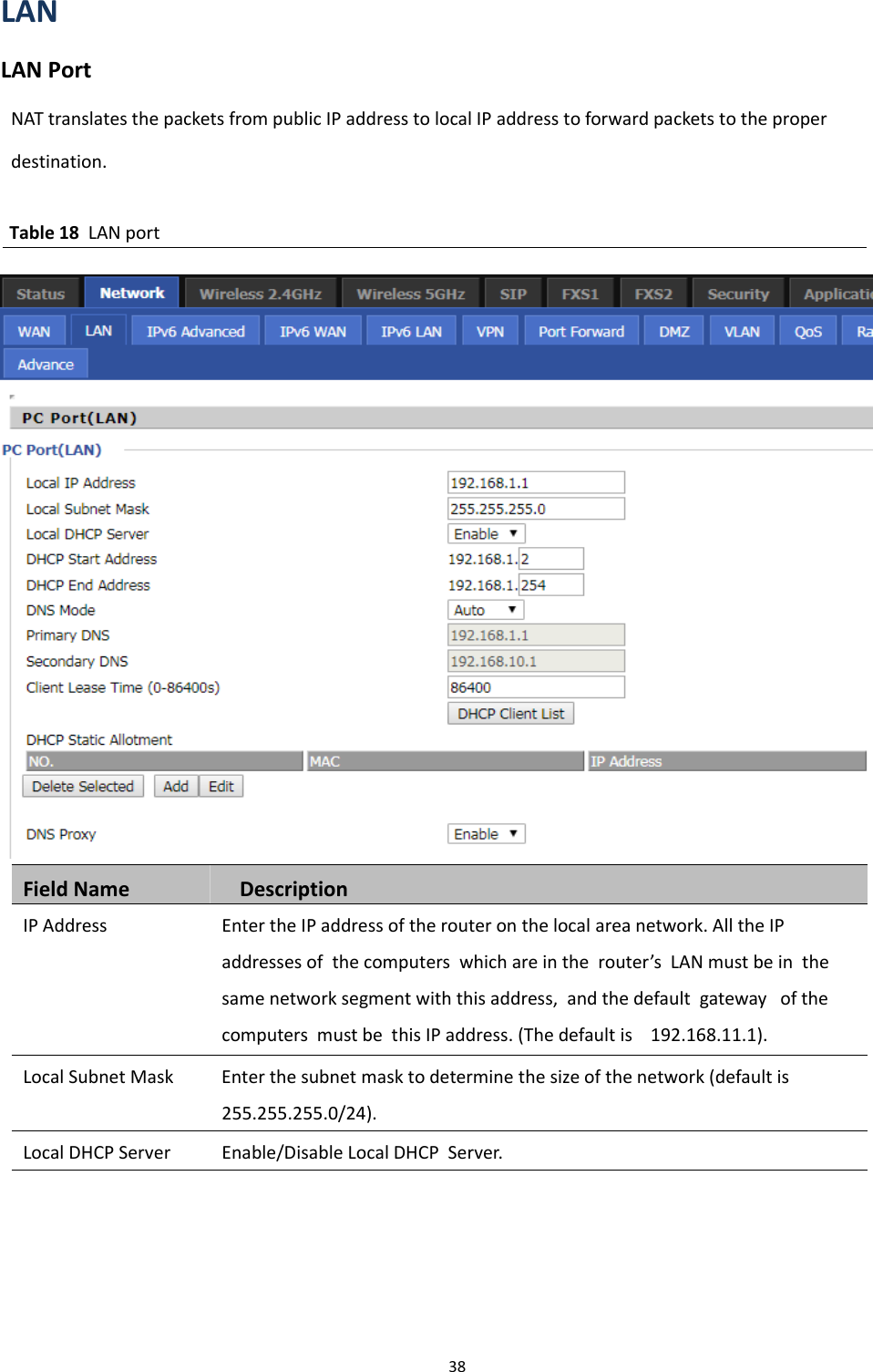
Chapter 3 Web Interface38LANLAN PortNAT translates the packets from public IP address to local IP address to forward packets to the properdestination.Table 18 LAN portField Name DescriptionIP Address Enter the IP address of the router on the local area network. All the IPaddresses of the computers which are in the router’s LAN must be in thesame network segment with this address, and the default gateway of thecomputers must be this IP address. (The default is 192.168.11.1).Local Subnet Mask Enter the subnet mask to determine the size of the network (default is255.255.255.0/24).Local DHCP Server Enable/Disable Local DHCP Server.
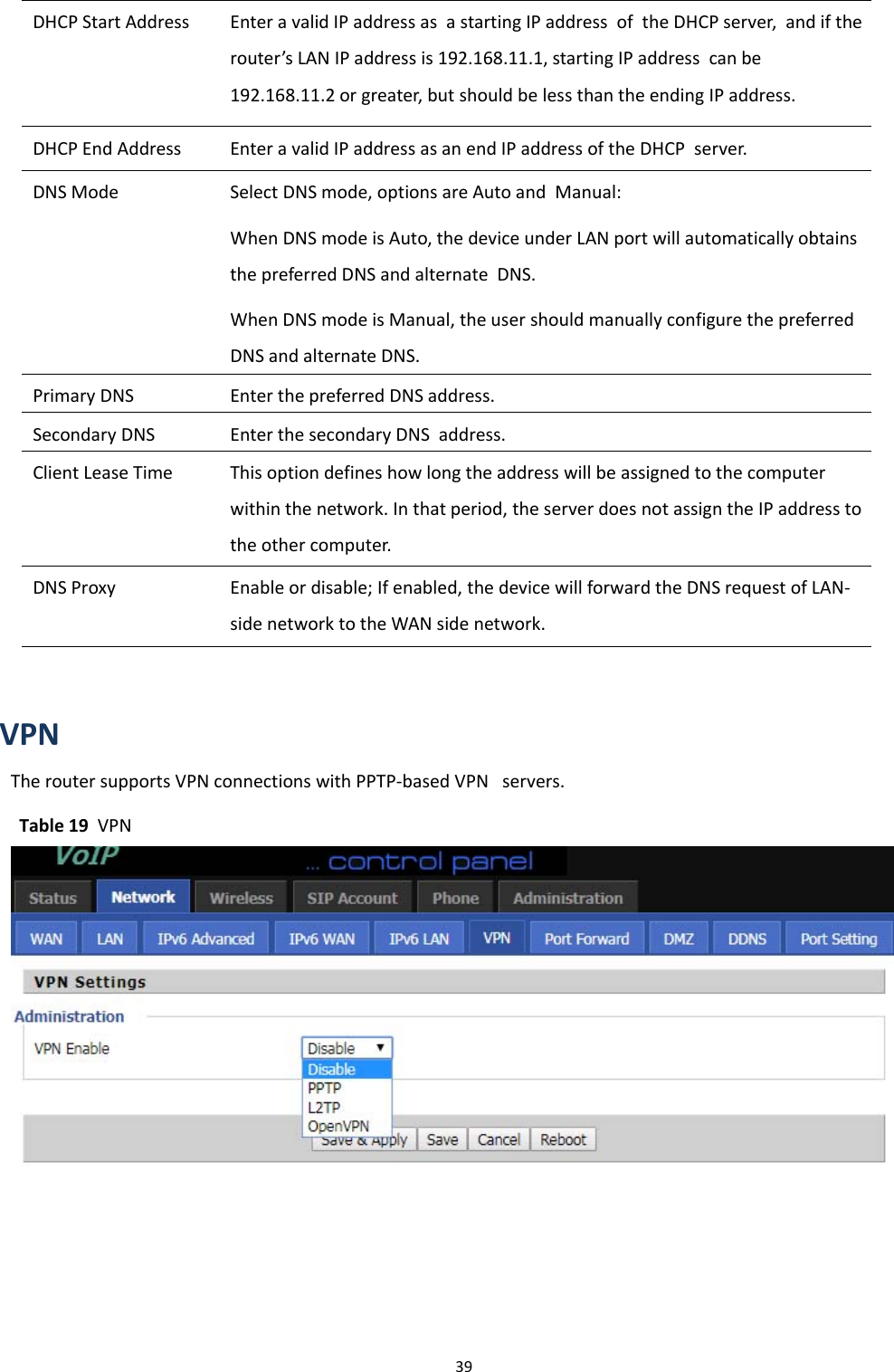
Chapter 3 Web Interface39DHCP Start Address Enter a valid IP address as a starting IP address of the DHCP server, and if therouter’s LAN IP address is 192.168.11.1, starting IP address can be192.168.11.2 or greater, but should be less than the ending IP address.DHCP End Address Enter a valid IP address as an end IP address of the DHCP server.DNS Mode Select DNS mode, options are Auto and Manual:When DNS mode is Auto, the device under LAN port will automatically obtainsthe preferred DNS and alternate DNS.When DNS mode is Manual, the user should manually configure the preferredDNS and alternate DNS.Primary DNS Enter the preferred DNS address.Secondary DNS Enter the secondary DNS address.Client Lease Time This option defines how long the address will be assigned to the computerwithin the network. In that period, the server does not assign the IP address tothe other computer.DNS Proxy Enable or disable; If enabled, the device will forward the DNS request of LAN-side network to the WAN side network.VPNThe router supports VPN connections with PPTP-based VPN servers.Table 19 VPN
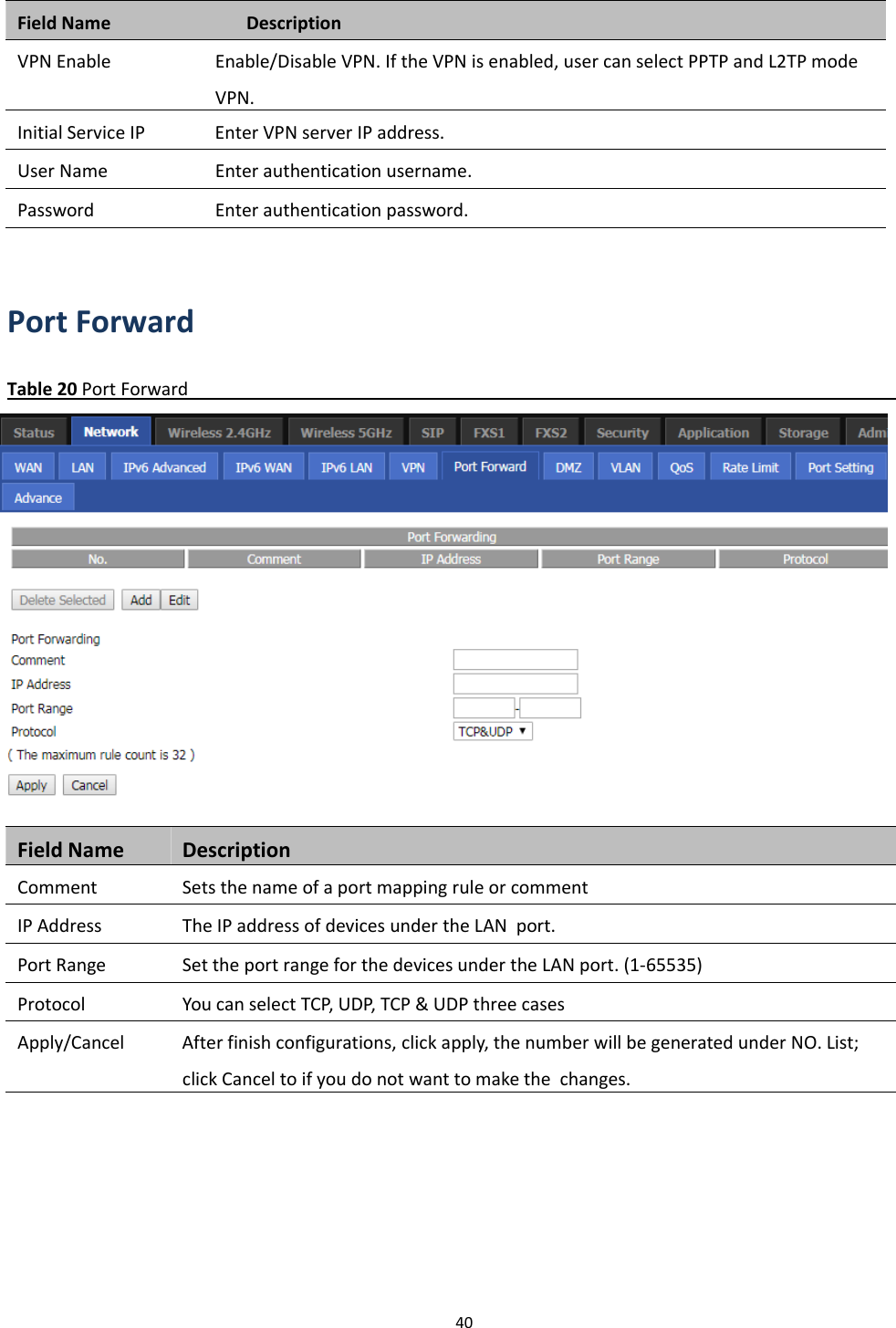
Chapter 3 Web Interface40Field Name DescriptionVPN Enable Enable/Disable VPN. If the VPN is enabled, user can select PPTP and L2TP modeVPN.Initial Service IP Enter VPN server IP address.User Name Enter authentication username.Password Enter authentication password.Port ForwardTable 20 Port ForwardField Name DescriptionComment Sets the name of a port mapping rule or commentIP Address The IP address of devices under the LAN port.Port Range Set the port range for the devices under the LAN port. (1-65535)Protocol You can select TCP, UDP, TCP & UDP three casesApply/Cancel After finish configurations, click apply, the number will be generated under NO. List;click Cancel to if you do not want to make the changes.
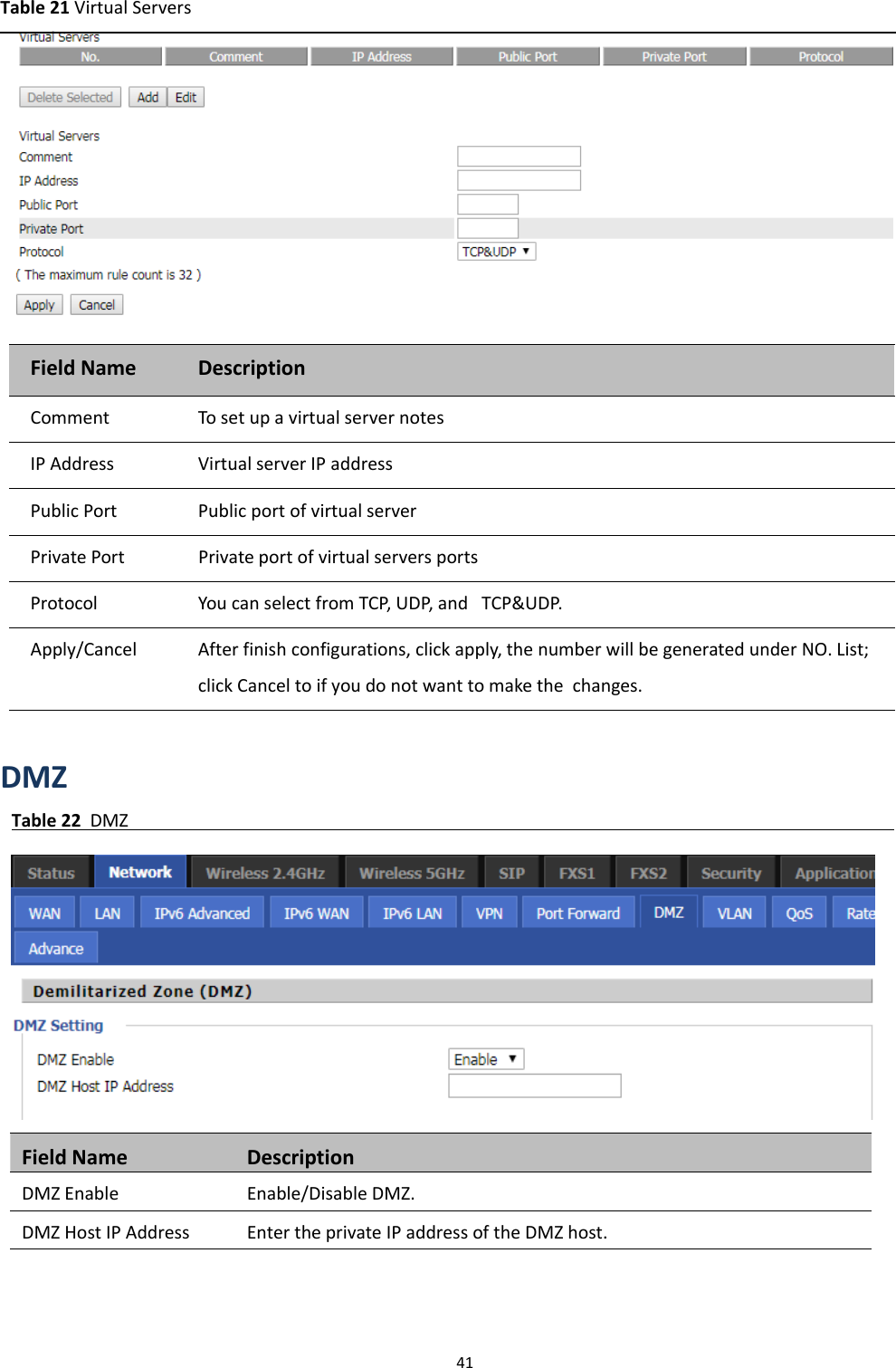
Chapter 3 Web Interface41Table 21 Virtual ServersField Name DescriptionComment To set up a virtual server notesIP Address Virtual server IP addressPublic Port Public port of virtual serverPrivate Port Private port of virtual servers portsProtocol You can select from TCP, UDP, and TCP&UDP.Apply/Cancel After finish configurations, click apply, the number will be generated under NO. List;click Cancel to if you do not want to make the changes.DMZTable 22 DMZField Name DescriptionDMZ Enable Enable/Disable DMZ.DMZ Host IP Address Enter the private IP address of the DMZ host.
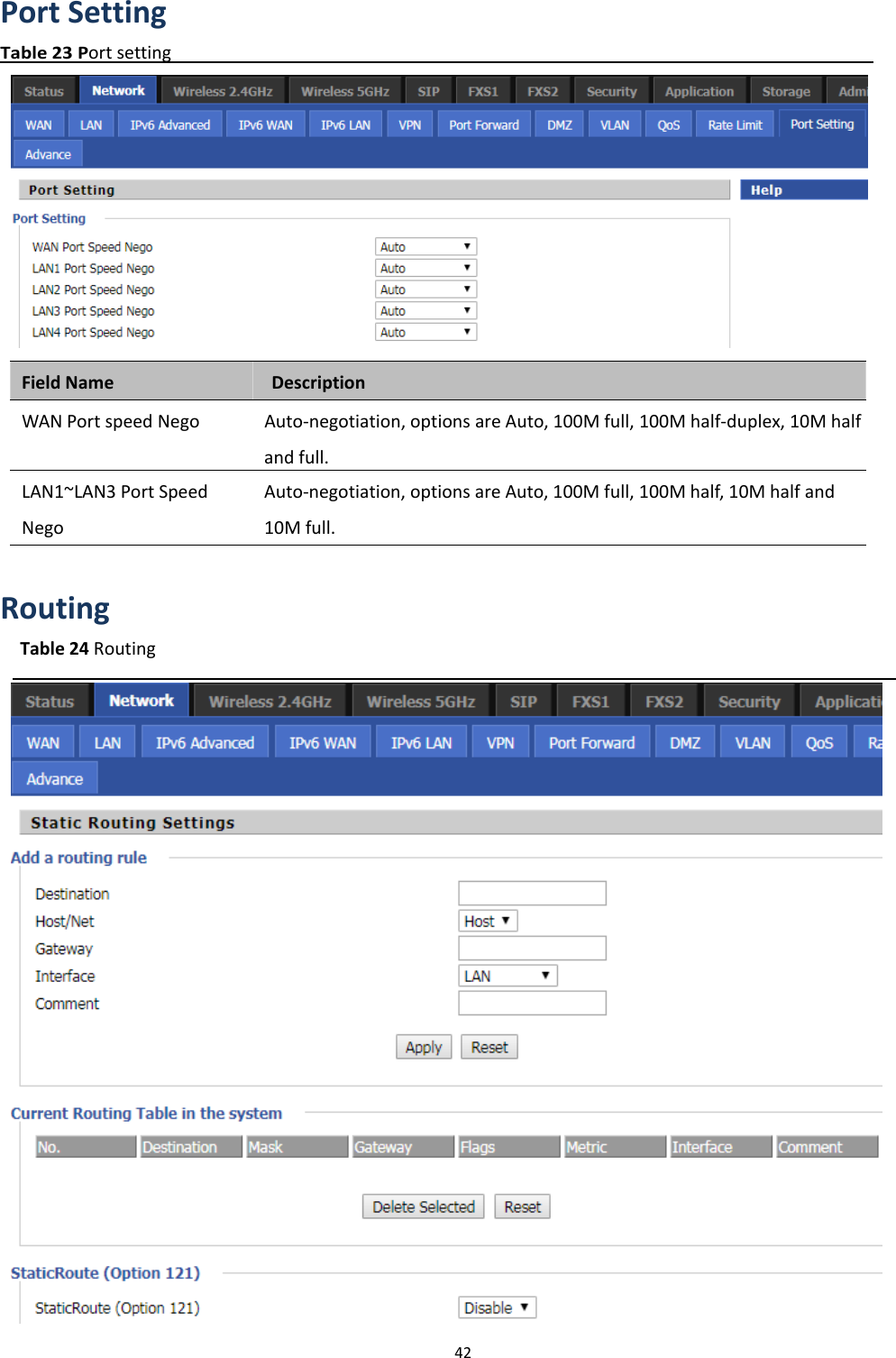
Chapter 3 Web Interface42Port SettingTable 23 Port settingField Name DescriptionWAN Port speed Nego Auto-negotiation, options are Auto, 100M full, 100M half-duplex, 10M halfand full.LAN1~LAN3 Port SpeedNegoAuto-negotiation, options are Auto, 100M full, 100M half, 10M half and10M full.RoutingTable 24 Routing
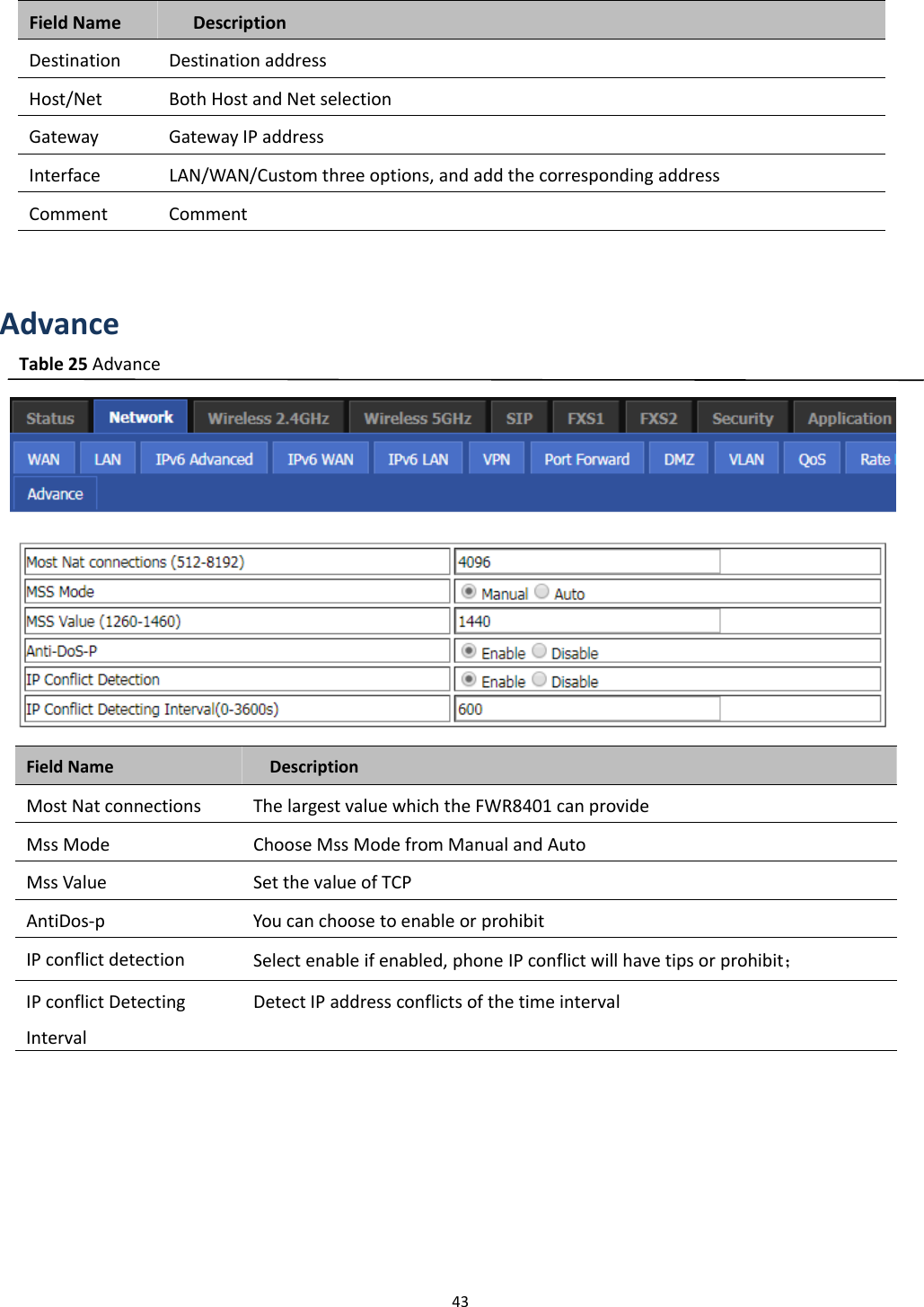
Chapter 3 Web Interface43Field Name DescriptionDestination Destination addressHost/Net Both Host and Net selectionGateway Gateway IP addressInterface LAN/WAN/Custom three options, and add the corresponding addressComment CommentAdvanceTable 25 AdvanceField Name DescriptionMost Nat connections The largest value which the FWR8401 can provideMss Mode Choose Mss Mode from Manual and AutoMss Value Set the value of TCPAntiDos-p You can choose to enable or prohibitIP conflict detection Select enable if enabled, phone IP conflict will have tips or prohibit;IP conflict DetectingIntervalDetect IP address conflicts of the time interval
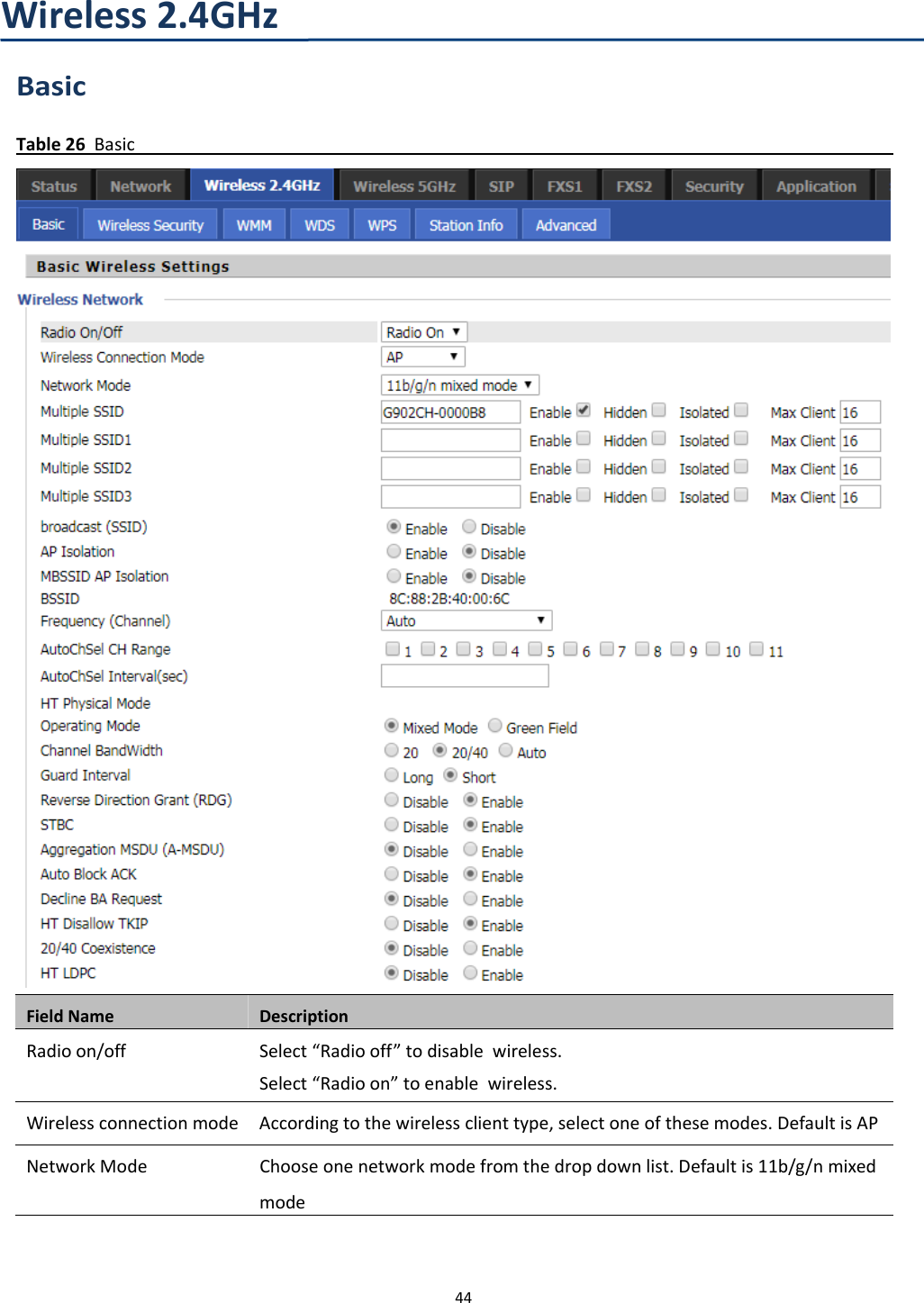
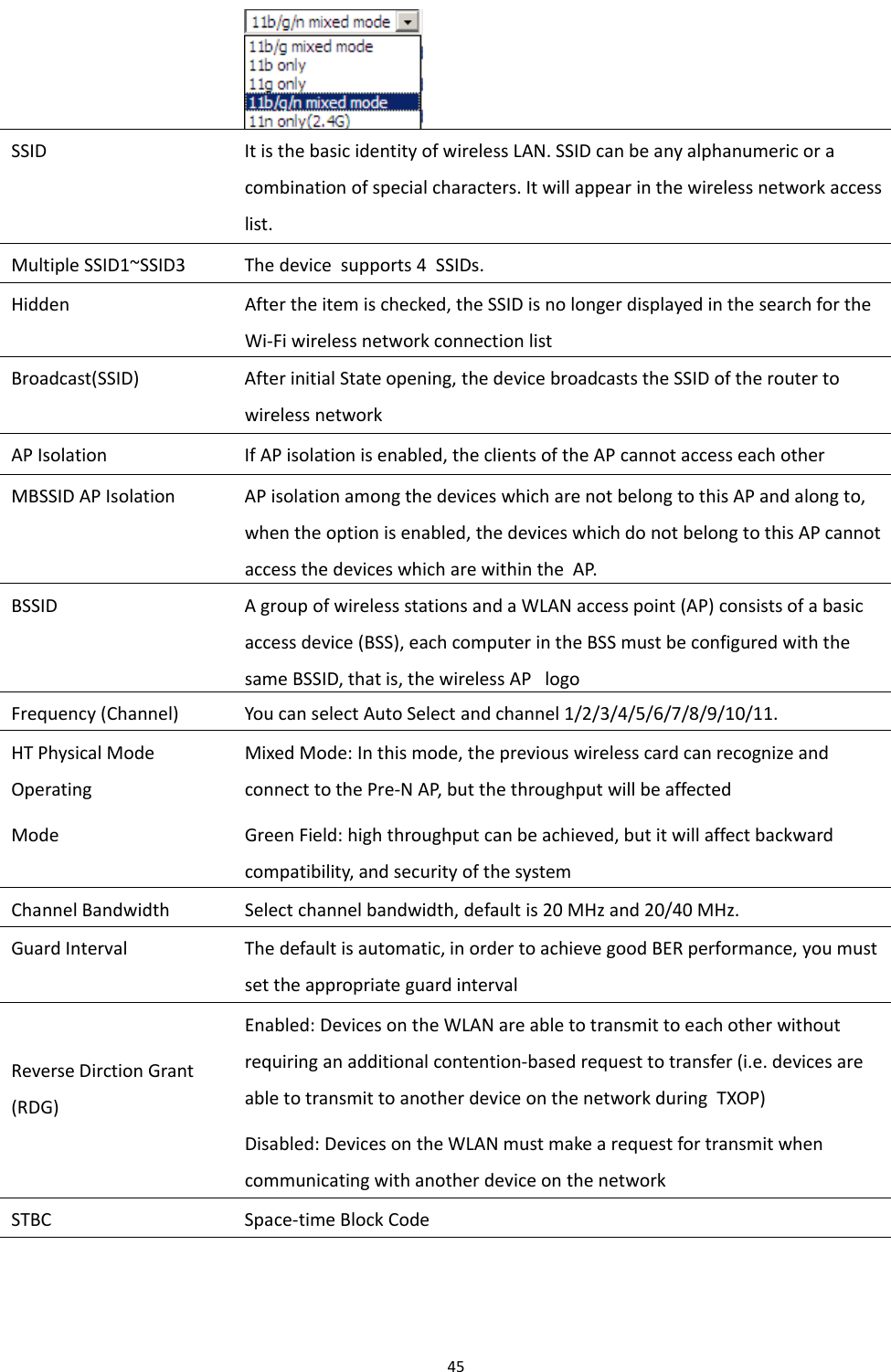
Chapter 3 Web Interface44Wireless 2.4GHzBasicTable 26 BasicField Name DescriptionRadio on/off Select “Radio off” to disable wireless.Select “Radio on” to enable wireless.Wireless connection mode According to the wireless client type, select one of these modes. Default is APNetwork Mode Choose one network mode from the drop down list. Default is 11b/g/n mixedmode
Chapter 3 Web Interface45SSID It is the basic identity of wireless LAN. SSID can be any alphanumeric or acombination of special characters. It will appear in the wireless network accesslist.Multiple SSID1~SSID3 The device supports 4 SSIDs.Hidden After the item is checked, the SSID is no longer displayed in the search for theWi-Fi wireless network connection listBroadcast(SSID) After initial State opening, the device broadcasts the SSID of the router towireless networkAP Isolation If AP isolation is enabled, the clients of the AP cannot access each otherMBSSID AP Isolation AP isolation among the devices which are not belong to this AP and along to,when the option is enabled, the devices which do not belong to this AP cannotaccess the devices which are within the AP.BSSID A group of wireless stations and a WLAN access point (AP) consists of a basicaccess device (BSS), each computer in the BSS must be configured with thesame BSSID, that is, the wireless AP logoFrequency (Channel) You can select Auto Select and channel 1/2/3/4/5/6/7/8/9/10/11.HT Physical ModeOperatingModeMixed Mode: In this mode, the previous wireless card can recognize andconnect to the Pre-N AP, but the throughput will be affectedGreen Field: high throughput can be achieved, but it will affect backwardcompatibility, and security of the systemChannel Bandwidth Select channel bandwidth, default is 20 MHz and 20/40 MHz.Guard Interval The default is automatic, in order to achieve good BER performance, you mustset the appropriate guard intervalReverse Dirction Grant(RDG)Enabled: Devices on the WLAN are able to transmit to each other withoutrequiring an additional contention-based request to transfer (i.e. devices areable to transmit to another device on the network during TXOP)Disabled: Devices on the WLAN must make a request for transmit whencommunicating with another device on the networkSTBC Space-time Block Code
Chapter 3 Web Interface46Enabled: Multiple copies of signals are transmitted to increase the chance ofsuccessful deliveryAggregation MSDU (A-MSDU)Enabled: Allows the device to aggregate multiple Ethernet frames into a single802.11n, thereby improving the ratio of frame data to frame overheadDisabled: No frame aggregation is employed at the routerAuto Block AckEnabled: Multiple frames are acknowledged together using a single BlockAcknowledgement frame.Disabled: Auto block acknowledgement is not used by the device – use thisconfiguration when low throughput/connectivity issues are experienced byDecline BA Request Enabled: Disallow block acknowledgement requests from devices Disabled:Allow block acknowledgement requests from devicesHT Disallow TKIPEnabled: Disallow the use of Temporal Key Integrity Protocol for connecteddevicesDisabled: Allow the use of Temporal Key Integrity Protocol for connecteddevicesHT LDPC Enabled: Enable Low-Density Parity Check mechanism for increasing chance ofsuccessful delivery in challenging wireless environmentsDisabled: Disable Low-Density Parity Check mechanism
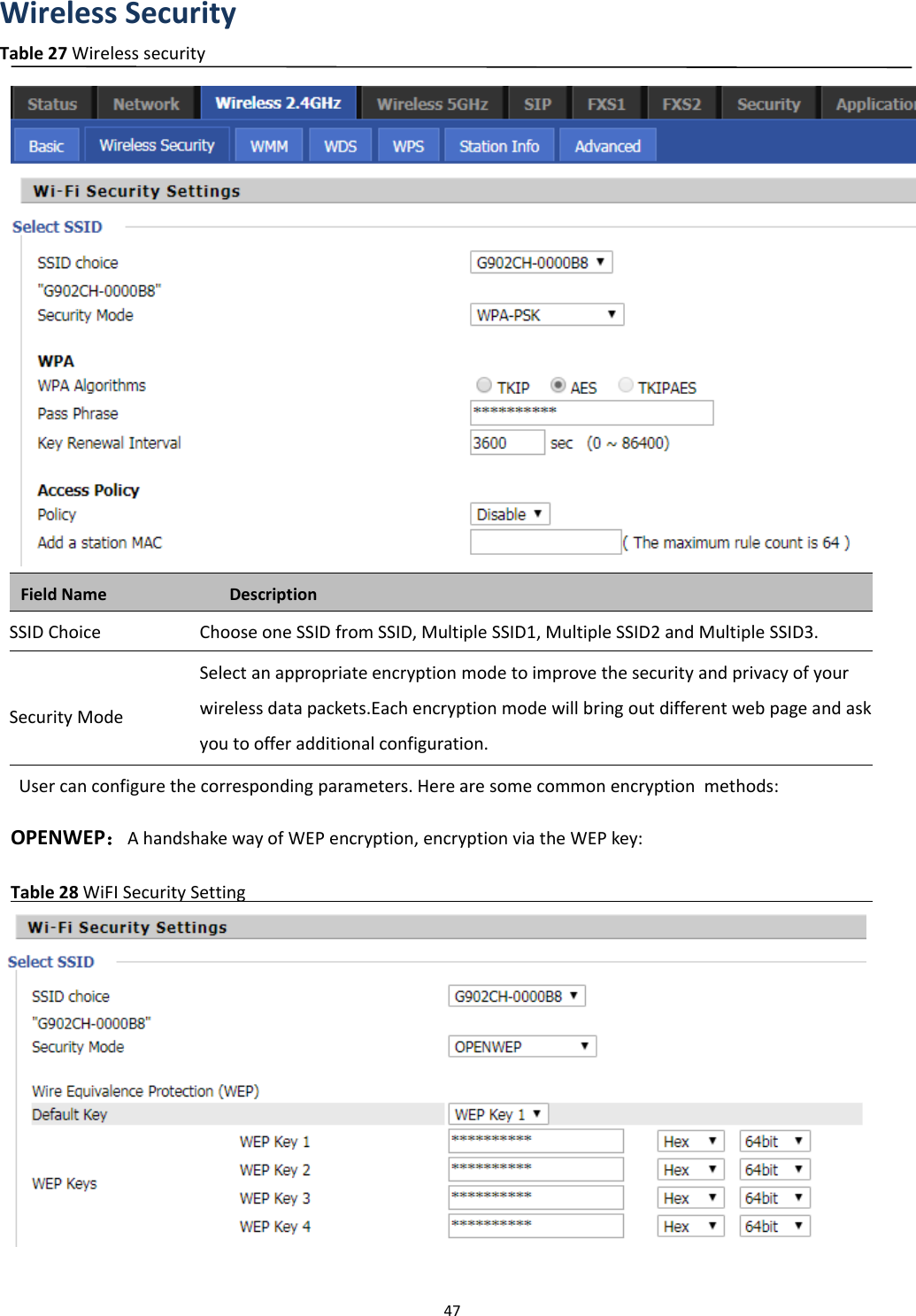
Chapter 3 Web Interface47Wireless SecurityTable 27 Wireless securityField Name DescriptionSSID Choice Choose one SSID from SSID, Multiple SSID1, Multiple SSID2 and Multiple SSID3.Security ModeSelect an appropriate encryption mode to improve the security and privacy of yourwireless data packets.Each encryption mode will bring out different web page and askyou to offer additional configuration.User can configure the corresponding parameters. Here are some common encryption methods:OPENWEP:A handshake way of WEP encryption, encryption via the WEP key:Table 28 WiFI Security Setting
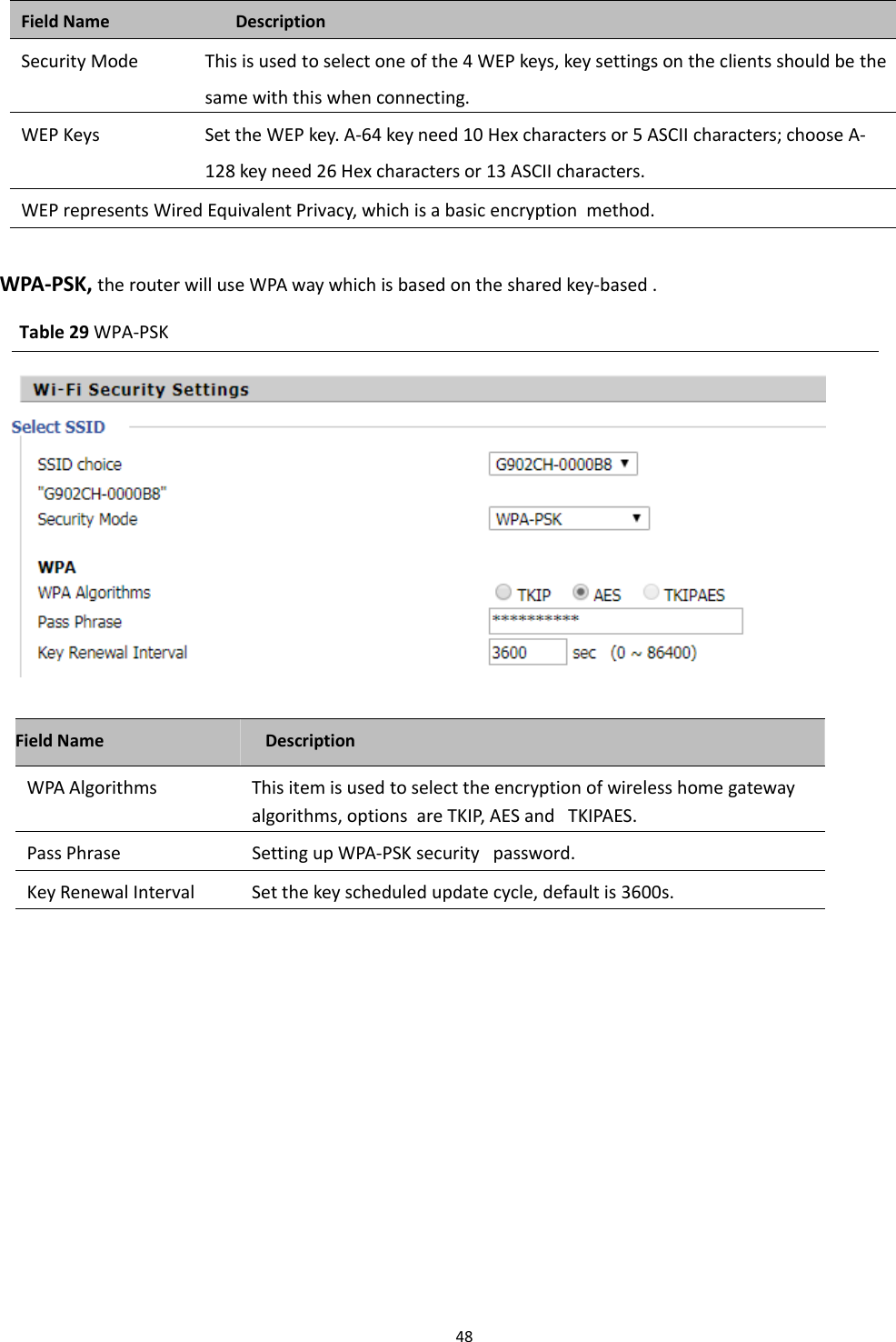
Chapter 3 Web Interface48Field Name DescriptionSecurity Mode This is used to select one of the 4 WEP keys, key settings on the clients should be thesame with this when connecting.WEP Keys Set the WEP key. A-64 key need 10 Hex characters or 5 ASCII characters; choose A-128 key need 26 Hex characters or 13 ASCII characters.WEP represents Wired Equivalent Privacy, which is a basic encryption method.WPA-PSK, the router will use WPA way which is based on the shared key-based .Table 29 WPA-PSKField Name DescriptionWPA Algorithms This item is used to select the encryption of wireless home gatewayalgorithms, options are TKIP, AES and TKIPAES.Pass Phrase Setting up WPA-PSK security password.Key Renewal Interval Set the key scheduled update cycle, default is 3600s.
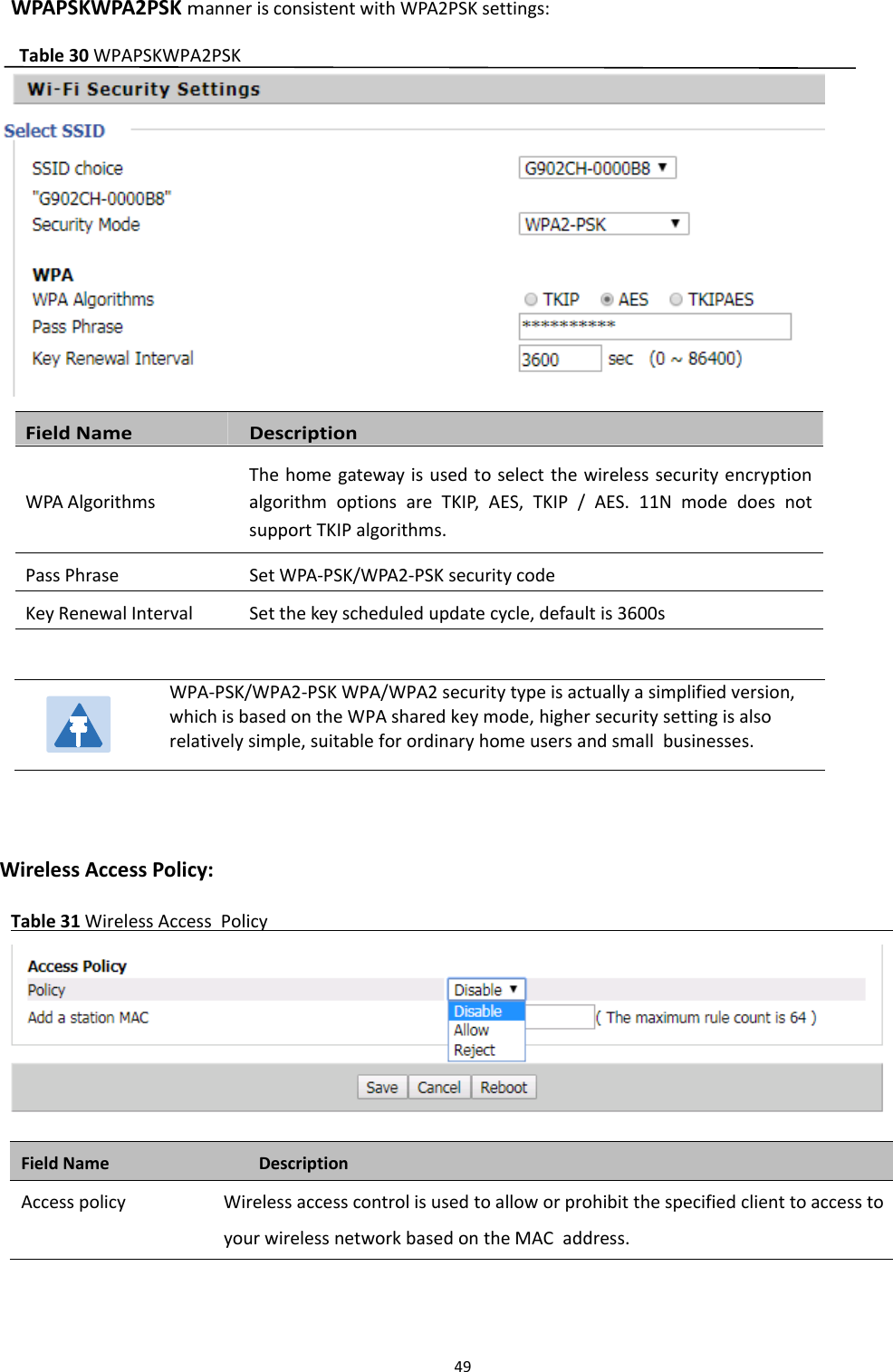
Chapter 3 Web Interface49WPAPSKWPA2PSKmanner is consistent with WPA2PSK settings:Table 30 WPAPSKWPA2PSKField Name DescriptionWPA AlgorithmsThe home gateway is used to select the wireless security encryptionalgorithm options are TKIP, AES, TKIP / AES. 11N mode does notsupport TKIP algorithms.Pass Phrase Set WPA-PSK/WPA2-PSK security codeKey Renewal Interval Set the key scheduled update cycle, default is 3600sWireless Access Policy:Table 31 Wireless Access PolicyField Name DescriptionAccess policy Wireless access control is used to allow or prohibit the specified client to access toyour wireless network based on the MAC address.WPA-PSK/WPA2-PSK WPA/WPA2 security type is actually a simplified version,which is based on the WPA shared key mode, higher security setting is alsorelatively simple, suitable for ordinary home users and small businesses.
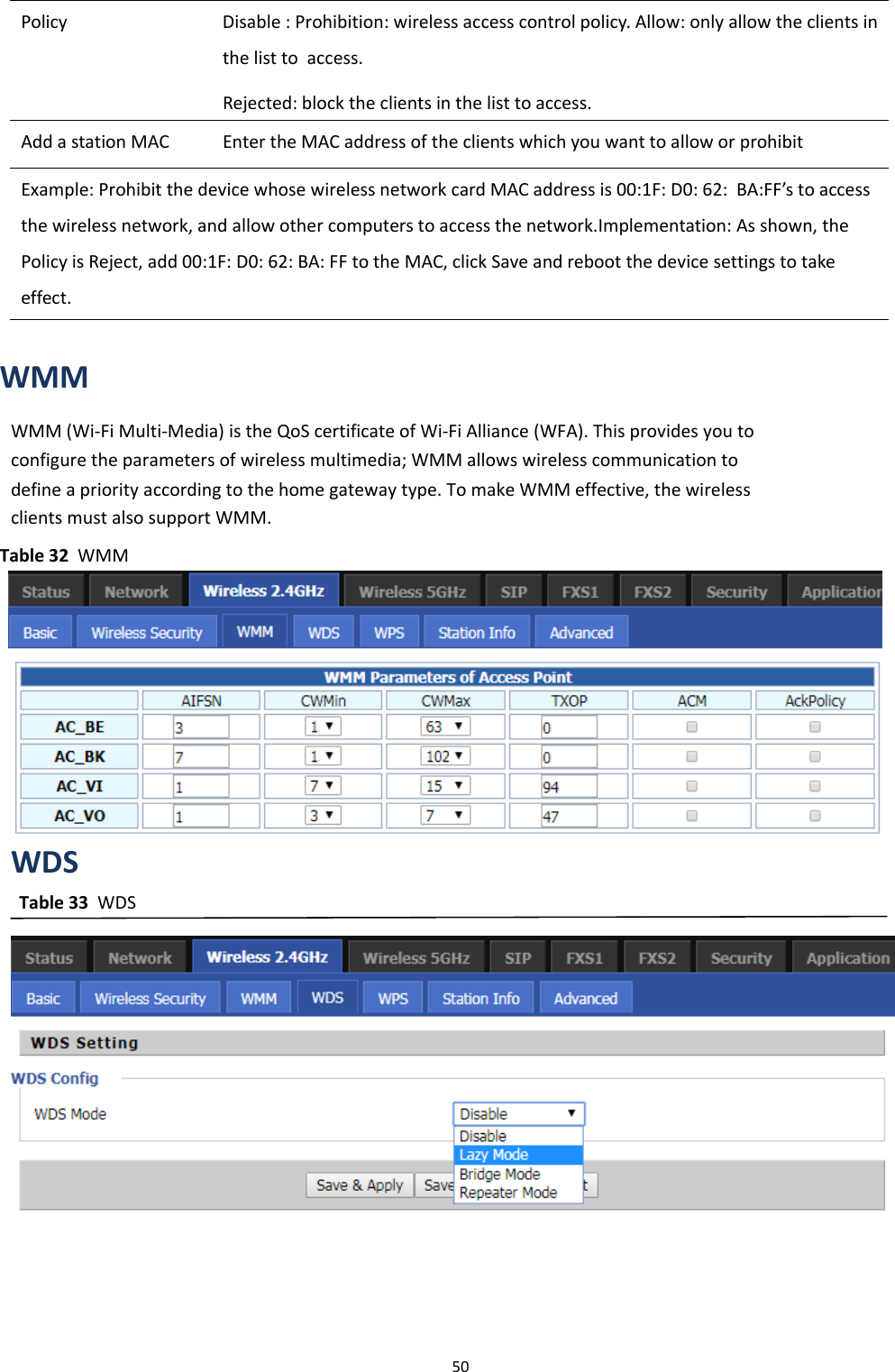
Chapter 3 Web Interface50Policy Disable : Prohibition: wireless access control policy. Allow: only allow the clients inthe list to access.Rejected: block the clients in the list to access.Add a station MAC Enter the MAC address of the clients which you want to allow or prohibitExample: Prohibit the device whose wireless network card MAC address is 00:1F: D0: 62: BA:FF’s to accessthe wireless network, and allow other computers to access the network.Implementation: As shown, thePolicy is Reject, add 00:1F: D0: 62: BA: FF to the MAC, click Save and reboot the device settings to takeeffect.WMMWMM (Wi-Fi Multi-Media) is the QoS certificate of Wi-Fi Alliance (WFA). This provides you toconfigure the parameters of wireless multimedia; WMM allows wireless communication todefine a priority according to the home gateway type. To make WMM effective, the wirelessclients must also support WMM.Table 32 WMMWDSTable 33 WDS
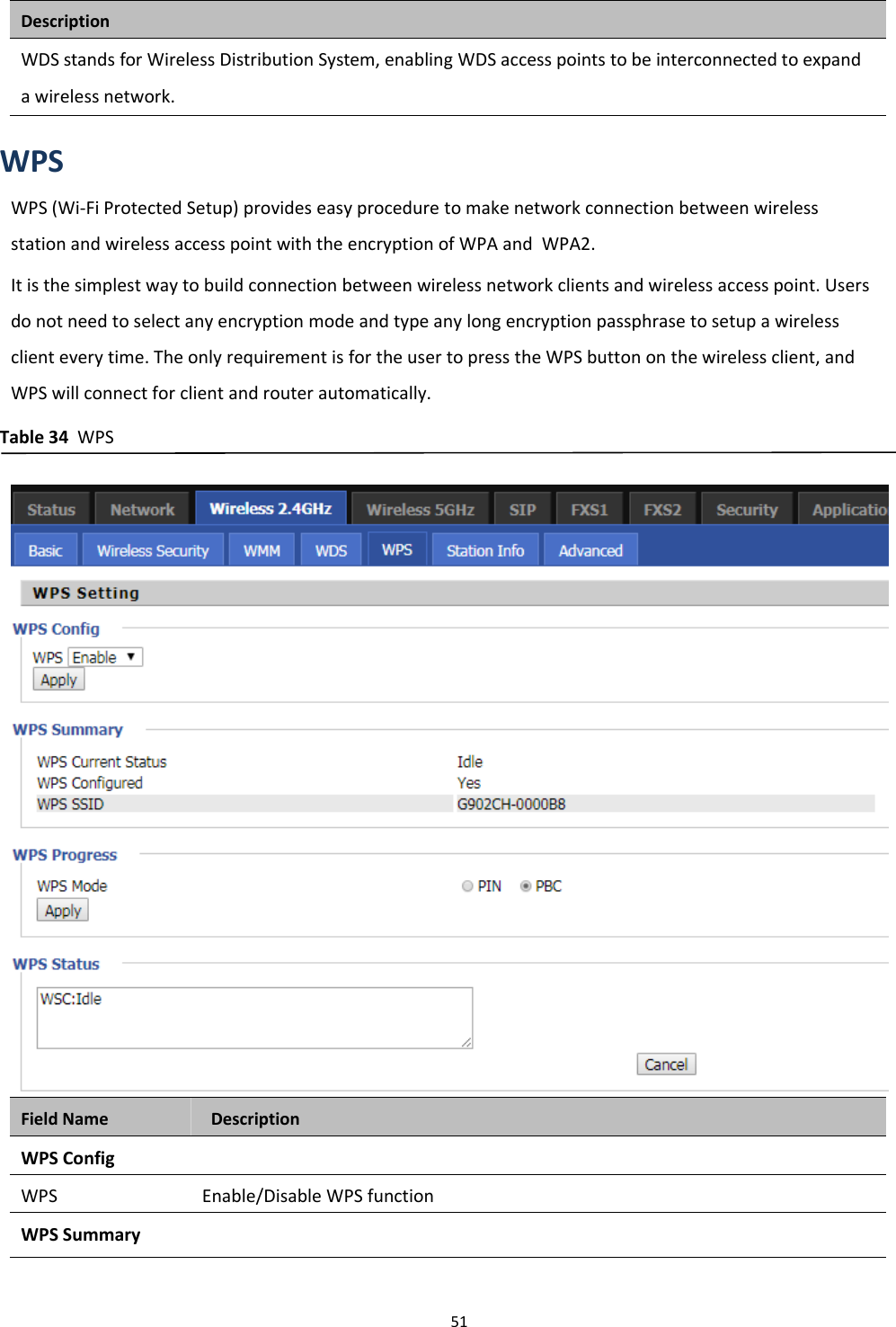
Chapter 3 Web Interface51DescriptionWDS stands for Wireless Distribution System, enabling WDS access points to be interconnected to expanda wireless network.WPSWPS (Wi-Fi Protected Setup) provides easy procedure to make network connection between wirelessstation and wireless access point with the encryption of WPA and WPA2.It is the simplest way to build connection between wireless network clients and wireless access point. Usersdo not need to select any encryption mode and type any long encryption passphrase to setup a wirelessclient every time. The only requirement is for the user to press the WPS button on the wireless client, andWPS will connect for client and router automatically.Table 34 WPSField Name DescriptionWPS ConfigWPS Enable/Disable WPS functionWPS Summary
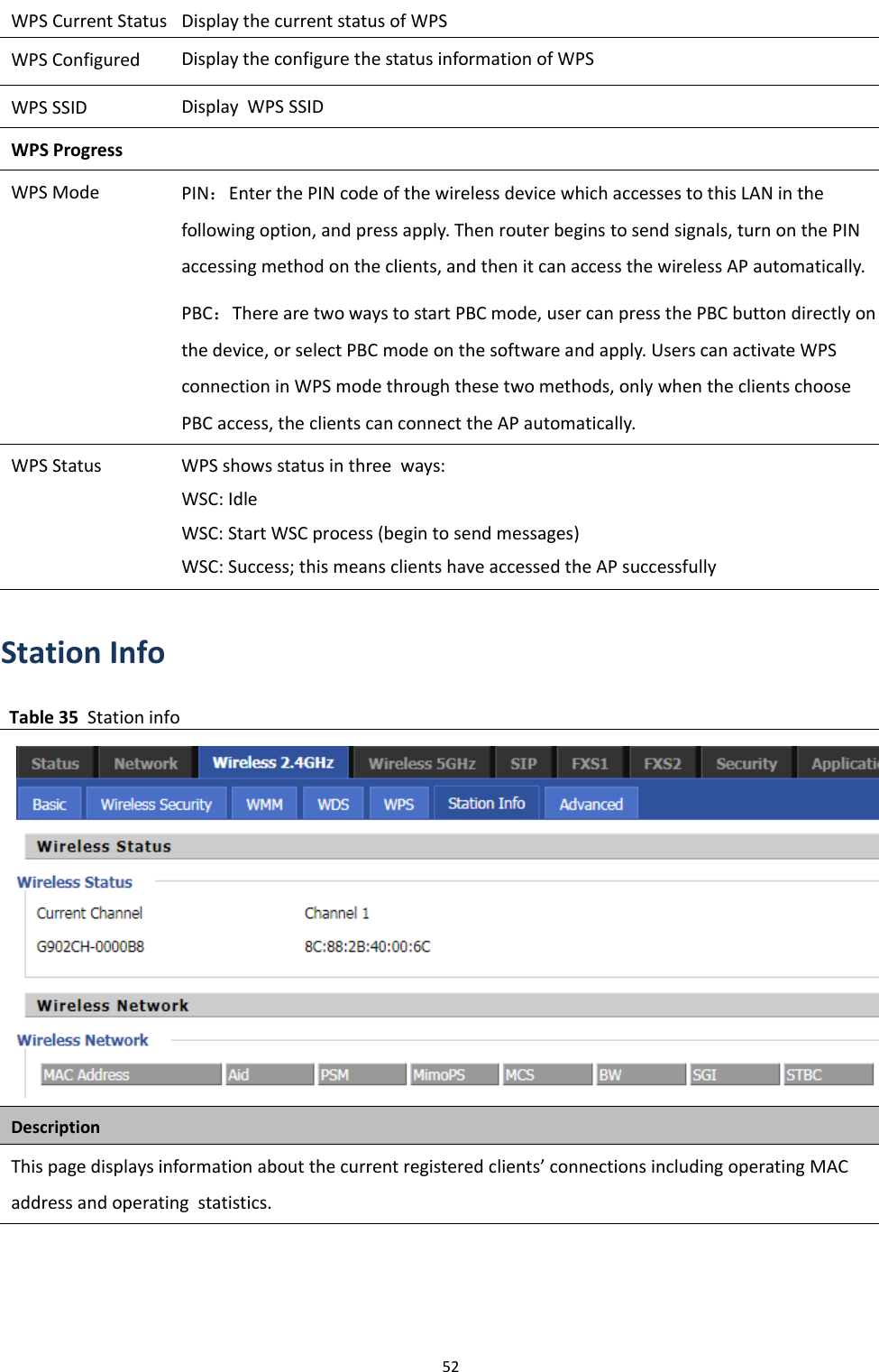
Chapter 3 Web Interface52WPS Current Status Display the current status of WPSWPS Configured Display the configure the status information of WPSWPS SSID Display WPS SSIDWPS ProgressWPS Mode PIN:Enter the PIN code of the wireless device which accesses to this LAN in thefollowing option, and press apply. Then router begins to send signals, turn on the PINaccessing method on the clients, and then it can access the wireless AP automatically.PBC:There are two ways to start PBC mode, user can press the PBC button directly onthe device, or select PBC mode on the software and apply. Users can activate WPSconnection in WPS mode through these two methods, only when the clients choosePBC access, the clients can connect the AP automatically.WPS Status WPS shows status in three ways:WSC: IdleWSC: Start WSC process (begin to send messages)WSC: Success; this means clients have accessed the AP successfullyStation InfoTable 35 Station infoDescriptionThis page displays information about the current registered clients’ connections including operating MACaddress and operating statistics.
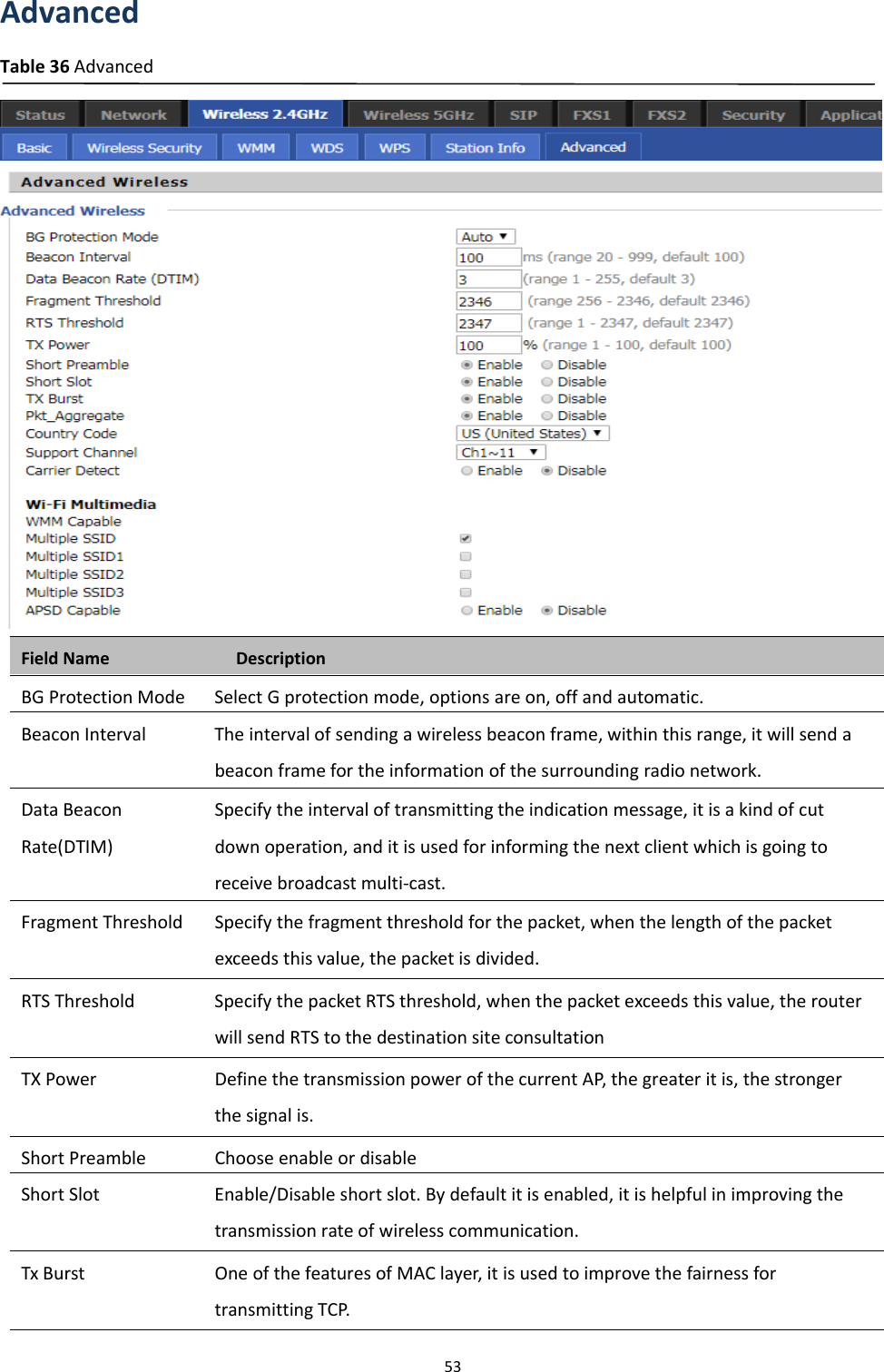
Chapter 3 Web Interface53AdvancedTable 36 AdvancedField Name DescriptionBG Protection Mode Select G protection mode, options are on, off and automatic.Beacon Interval The interval of sending a wireless beacon frame, within this range, it will send abeacon frame for the information of the surrounding radio network.Data BeaconRate(DTIM)Specify the interval of transmitting the indication message, it is a kind of cutdown operation, and it is used for informing the next client which is going toreceive broadcast multi-cast.Fragment Threshold Specify the fragment threshold for the packet, when the length of the packetexceeds this value, the packet is divided.RTS Threshold Specify the packet RTS threshold, when the packet exceeds this value, the routerwill send RTS to the destination site consultationTX Power Define the transmission power of the current AP, the greater it is, the strongerthe signal is.Short Preamble Choose enable or disableShort Slot Enable/Disable short slot. By default it is enabled, it is helpful in improving thetransmission rate of wireless communication.Tx Burst One of the features of MAC layer, it is used to improve the fairness fortransmitting TCP.
Chapter 3 Web Interface54Pkt_Aggregate It is a mechanism that is used to enhance the LAN, in order to ensure that thehome gateway packets are sent to the destination correctly.Support Channel Choose appropriate channelWi-Fi Multimedia (WMM)WMM Capable Enable/Disable WMM.APSD Capable Enable/Disable APSD. Once it is enabled, it may affect wireless performance, butcan play a role in energy-saving powerWMM Parameters Press , the webpage will jump to the configuration pageof Wi-Fi multimedia.Multicast-to-Unicast ConverterEnable/Disable Multicast-to-Unicast. By default, it is Disabled.
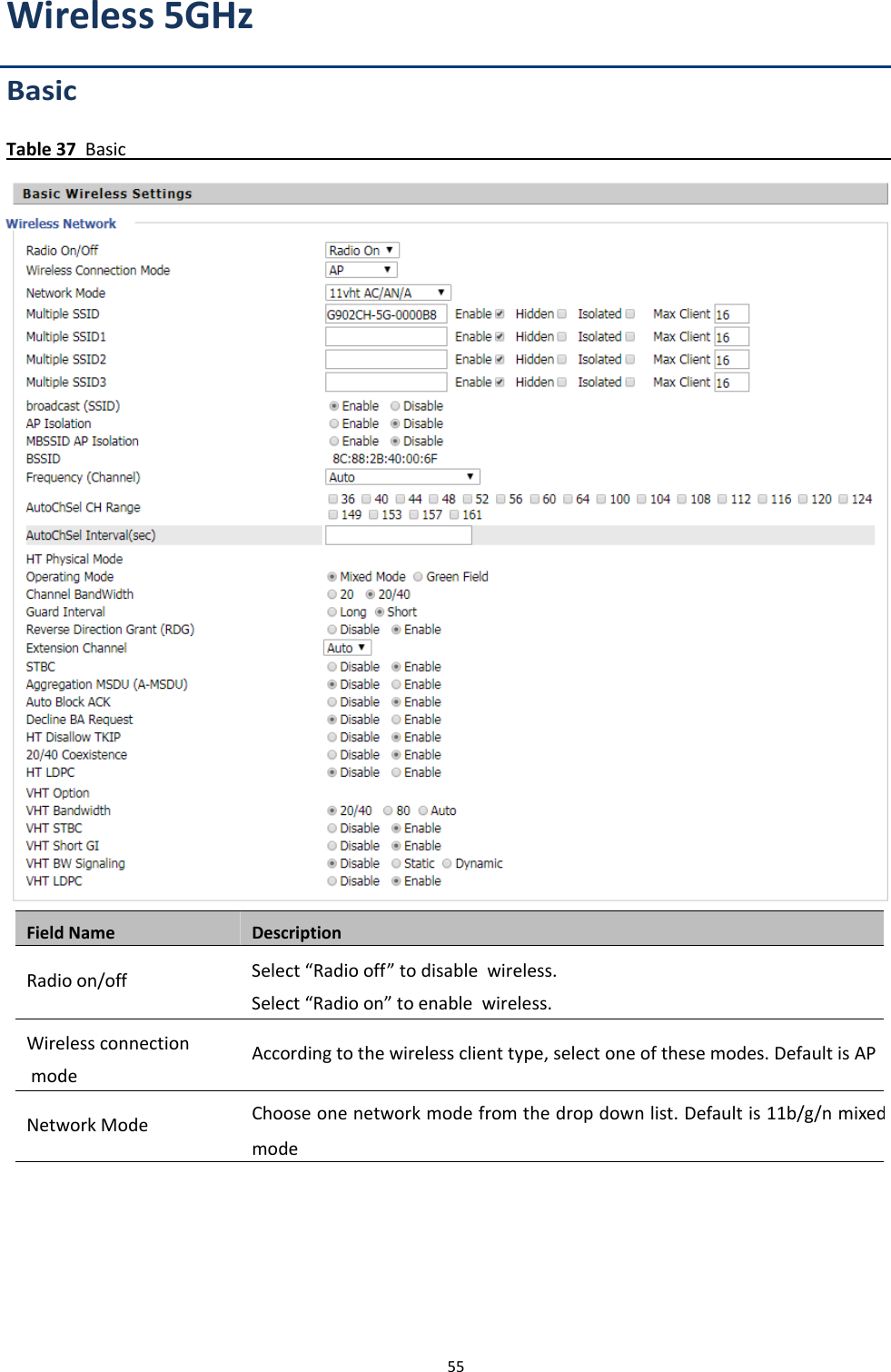
Chapter 3 Web Interface55Wireless 5GHzBasicTable 37 BasicField Name DescriptionRadio on/off Select “Radio off” to disable wireless.Select “Radio on” to enable wireless.Wireless connectionmodeAccording to the wireless client type, select one of these modes. Default is APNetwork Mode Choose one network mode from the drop down list. Default is 11b/g/n mixedmode
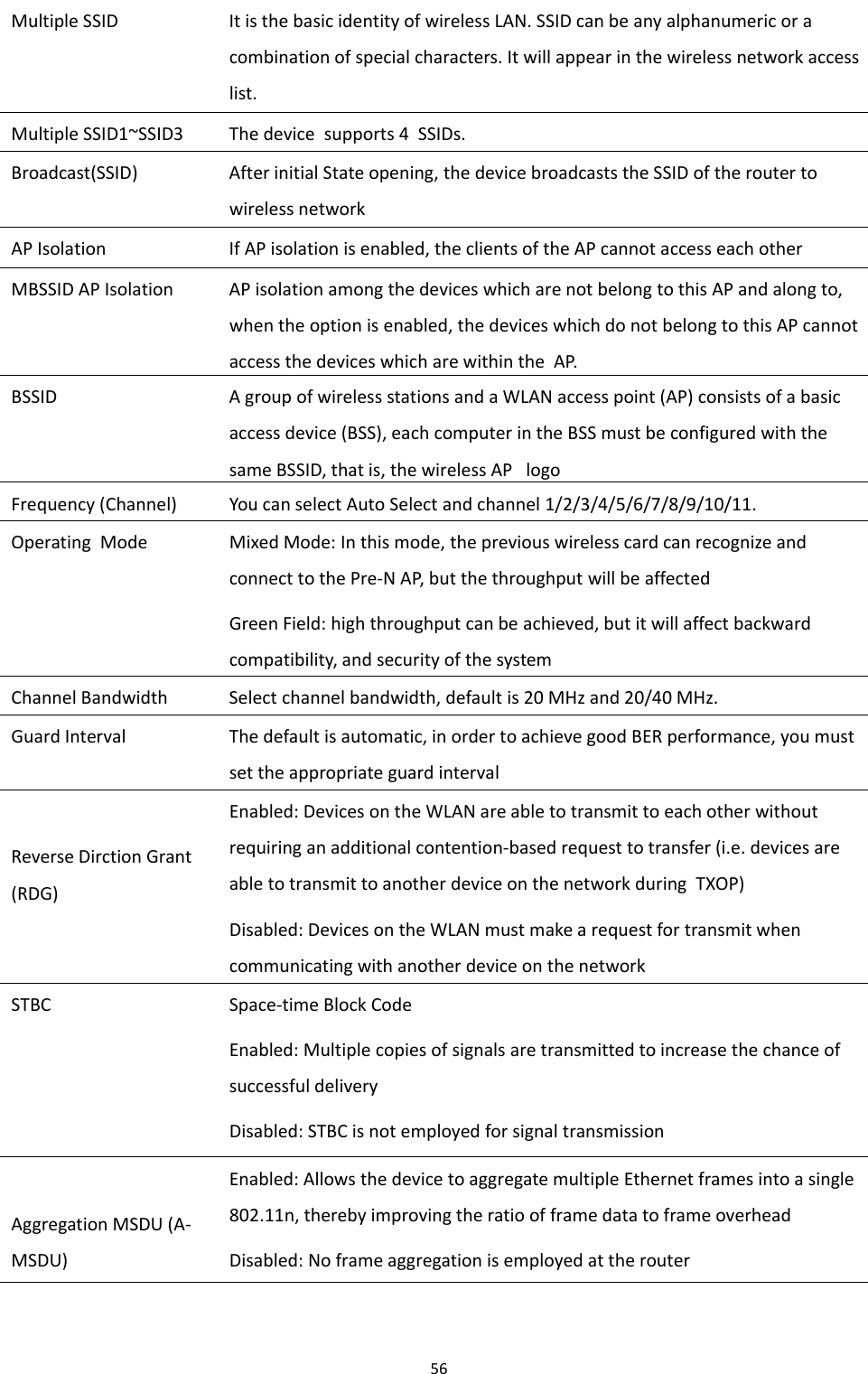
Chapter 3 Web Interface56Multiple SSID It is the basic identity of wireless LAN. SSID can be any alphanumeric or acombination of special characters. It will appear in the wireless network accesslist.Multiple SSID1~SSID3 The device supports 4 SSIDs.Broadcast(SSID) After initial State opening, the device broadcasts the SSID of the router towireless networkAP Isolation If AP isolation is enabled, the clients of the AP cannot access each otherMBSSID AP Isolation AP isolation among the devices which are not belong to this AP and along to,when the option is enabled, the devices which do not belong to this AP cannotaccess the devices which are within the AP.BSSID A group of wireless stations and a WLAN access point (AP) consists of a basicaccess device (BSS), each computer in the BSS must be configured with thesame BSSID, that is, the wireless AP logoFrequency (Channel) You can select Auto Select and channel 1/2/3/4/5/6/7/8/9/10/11.Operating Mode Mixed Mode: In this mode, the previous wireless card can recognize andconnect to the Pre-N AP, but the throughput will be affectedGreen Field: high throughput can be achieved, but it will affect backwardcompatibility, and security of the systemChannel Bandwidth Select channel bandwidth, default is 20 MHz and 20/40 MHz.Guard Interval The default is automatic, in order to achieve good BER performance, you mustset the appropriate guard intervalReverse Dirction Grant(RDG)Enabled: Devices on the WLAN are able to transmit to each other withoutrequiring an additional contention-based request to transfer (i.e. devices areable to transmit to another device on the network during TXOP)Disabled: Devices on the WLAN must make a request for transmit whencommunicating with another device on the networkSTBC Space-time Block CodeEnabled: Multiple copies of signals are transmitted to increase the chance ofsuccessful deliveryDisabled: STBC is not employed for signal transmissionAggregation MSDU (A-MSDU)Enabled: Allows the device to aggregate multiple Ethernet frames into a single802.11n, thereby improving the ratio of frame data to frame overheadDisabled: No frame aggregation is employed at the router
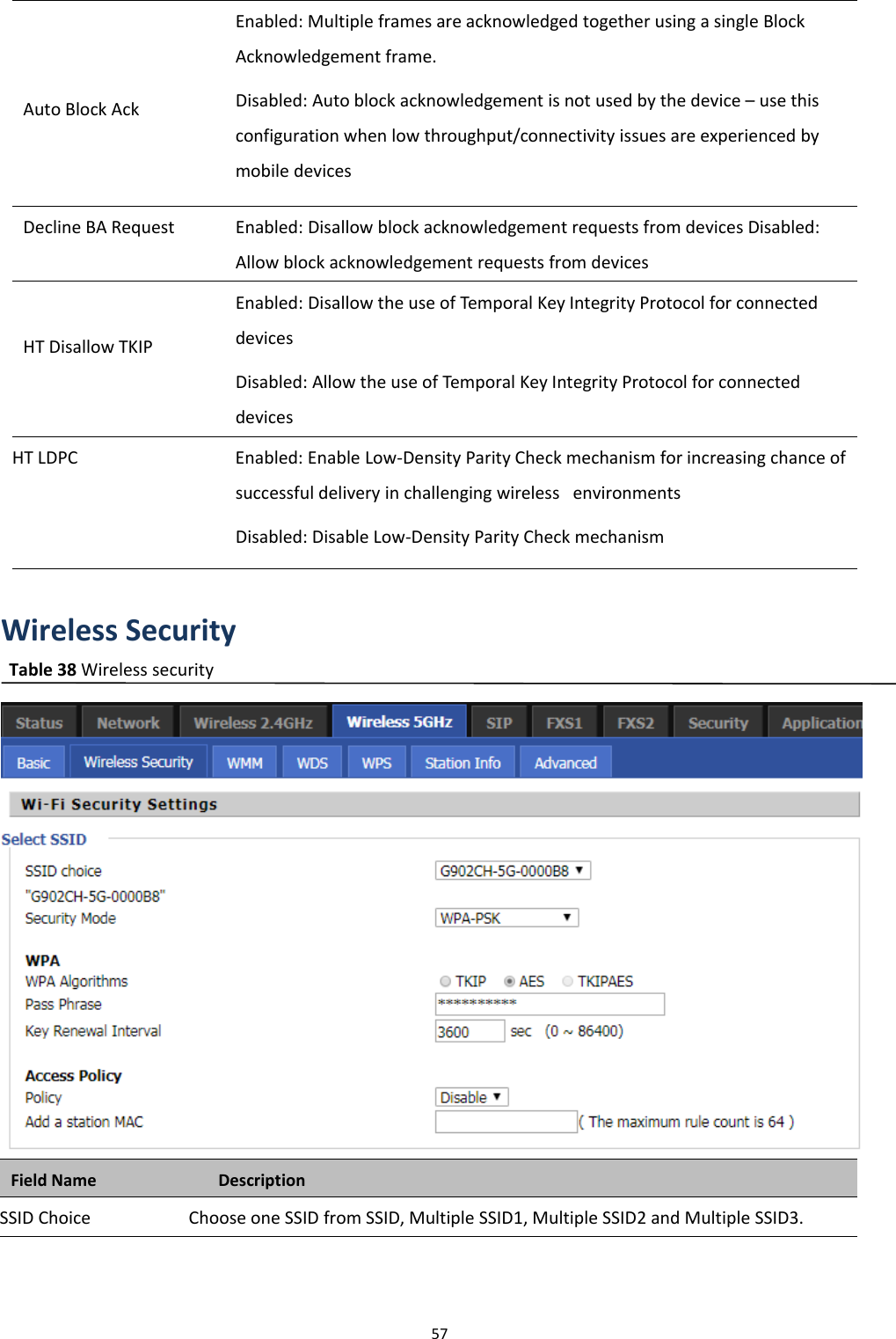
Chapter 3 Web Interface57Auto Block AckEnabled: Multiple frames are acknowledged together using a single BlockAcknowledgement frame.Disabled: Auto block acknowledgement is not used by the device – use thisconfiguration when low throughput/connectivity issues are experienced bymobile devicesDecline BA Request Enabled: Disallow block acknowledgement requests from devices Disabled:Allow block acknowledgement requests from devicesHT Disallow TKIPEnabled: Disallow the use of Temporal Key Integrity Protocol for connecteddevicesDisabled: Allow the use of Temporal Key Integrity Protocol for connecteddevicesHT LDPC Enabled: Enable Low-Density Parity Check mechanism for increasing chance ofsuccessful delivery in challenging wireless environmentsDisabled: Disable Low-Density Parity Check mechanismWireless SecurityTable 38 Wireless securityField Name DescriptionSSID Choice Choose one SSID from SSID, Multiple SSID1, Multiple SSID2 and Multiple SSID3.
Chapter 3 Web Interface58Security ModeSelect an appropriate encryption mode to improve the security and privacy of yourwireless data packets.Each encryption mode will bring out different web page and askyou to offer additional configuration.Select a different encryption mode, the web interface will be different, user can configure the correspondingparametersunderthemodeyouselect.Pleasereferto4.4.2section.WMMPlease refer to 4.4.3 section.WDSPlease refer to 4.4.4 section.WPSPlease refer to 4.4.5 section.Station InfoPlease refer to 4.4.6 section.AdvancedPlease refer to 4.4.7 section.
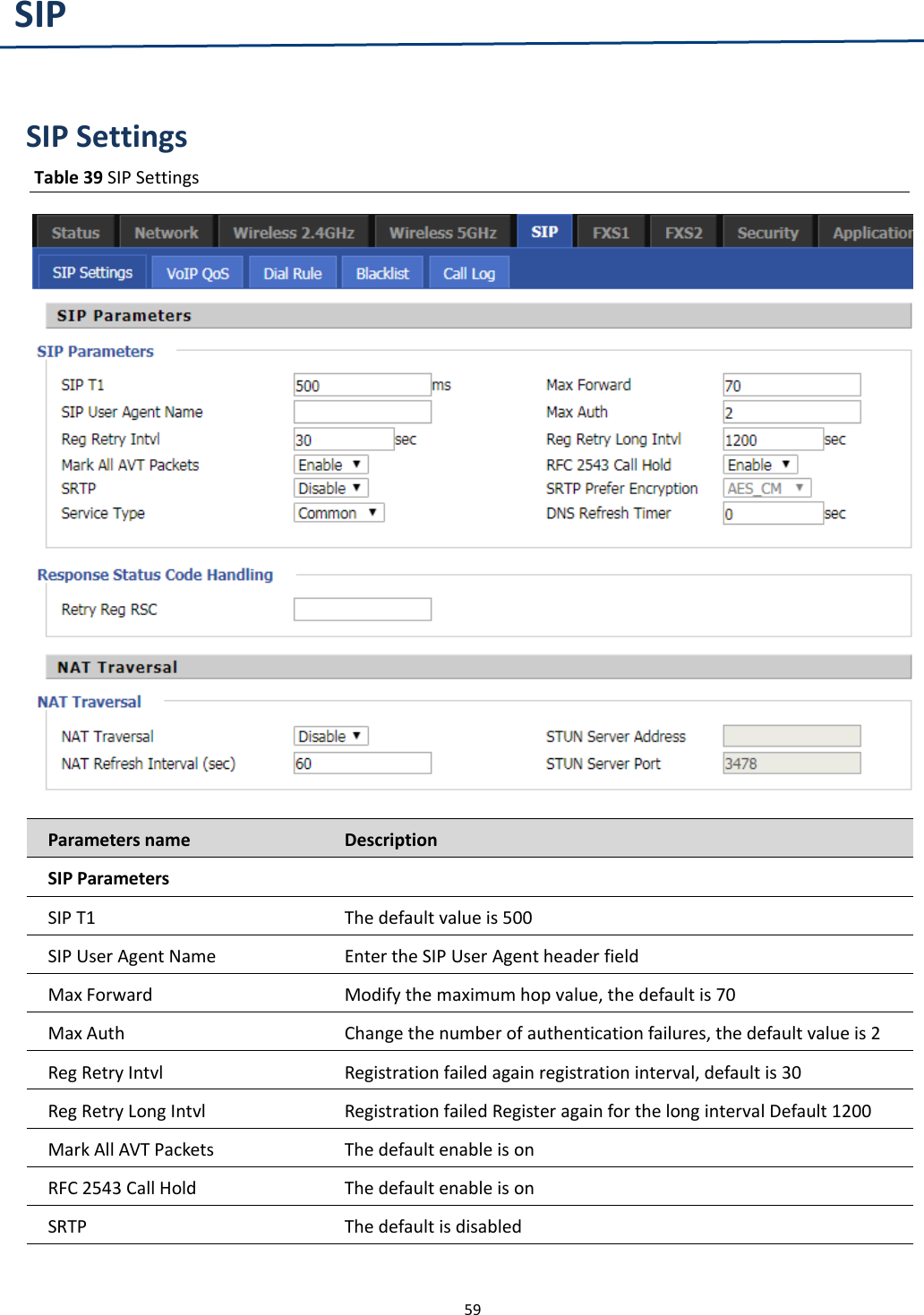
Chapter 3 Web Interface59SIPSIP SettingsTable 39 SIP SettingsParameters name DescriptionSIP ParametersSIP T1 The default value is 500SIP User Agent Name Enter the SIP User Agent header fieldMax Forward Modify the maximum hop value, the default is 70Max Auth Change the number of authentication failures, the default value is 2Reg Retry Intvl Registration failed again registration interval, default is 30Reg Retry Long Intvl Registration failed Register again for the long interval Default 1200Mark All AVT Packets The default enable is onRFC 2543 Call Hold The default enable is onSRTP The default is disabled
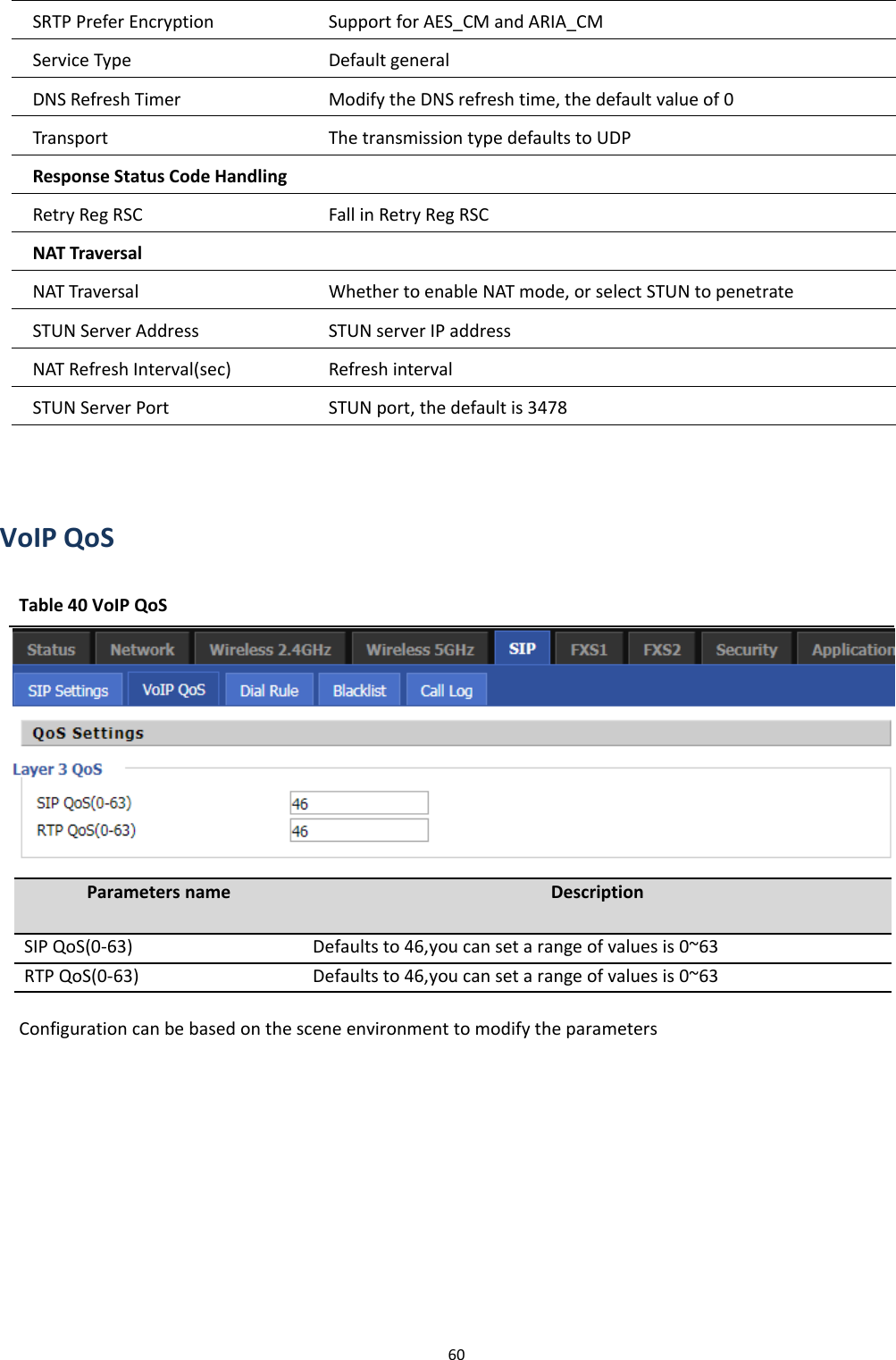
Chapter 3 Web Interface60SRTP Prefer Encryption Support for AES_CM and ARIA_CMService Type Default generalDNS Refresh Timer Modify the DNS refresh time, the default value of 0Transport The transmission type defaults to UDPResponse Status Code HandlingRetry Reg RSC Fall in Retry Reg RSCNAT TraversalNAT Traversal Whether to enable NAT mode, or select STUN to penetrateSTUN Server Address STUN server IP addressNAT Refresh Interval(sec) Refresh intervalSTUN Server Port STUN port, the default is 3478VoIP QoSTable 40 VoIP QoSConfiguration can be based on the scene environment to modify the parametersParameters name DescriptionSIP QoS(0-63) Defaults to 46,you can set a range of values is 0~63RTP QoS(0-63) Defaults to 46,you can set a range of values is 0~63
Chapter 3 Web Interface61Dial PlanTable 41 Dial PlanField Name DescriptionDial Plan Enable/Disable dial plan.Line Set the line.Digit Map Enter the sequence used to match input numberThe syntactic, please refer to the following Dial Plan Syntactic.Action Choose the dial plan mode from Deny and Dial Out.Deny means router will reject the matched number, while Dial Out means router willdial out the matched number.Move Up Move the dial plan up the list.Move Down Move the dial plan down the list.
Chapter 3 Web Interface62Adding one Dial PlanTable 42 Adding one dial planDescriptionStep 1. Enable Dial Plan.Step 2. Click Add button, and the configuration table.Step 3. Fill in the value of parameters.Step 4. Press OK button to end configuration.Dial Plan SyntacticTable 43 Dial Plan SyntacticNo. String Description1 0123456789* # Allowedcharacters2 x Lowercase letter “x” stands for one legal character3[sequence]To match one character form sequence. For example:[0-9]: match one digit form 0 to 9[23-5*]: match one character from 2 or 3 or 4 or 5 or *4x.Match to x, xx, xxx, xxxx and so on.For example:“01” can be match to “0”,”01”,”011”...”011111...” and so on5<dialed:substituted>Replace dialed with substituted.For example:<8:1650>123456:input is “85551212”, output is“16505551212”
Chapter 3 Web Interface636x,yMake outside dial tone after dialing “x”, stop until dialingcharacter “y”For example:“9,1xxxxxxxxxx”:the device reports dial tone after inputting“9”, stops tone until inputting “1”“9,8,010x”: make outside dial tone after inputting “9”,stop tone until inputting “0”7TSet the delayed time. For example:“<9:111>T2”: The device will dial out the matched number“111”after 2 seconds.BlacklistIn this page, user can upload or download blacklist file, and can add or delete or edit blacklist one by one.Table 44 Blacklist
Chapter 3 Web Interface64DescriptionClick to select the blacklist file and to upload it to device; Clickto save the blacklist file to your local computer.Select one contact and click edit to change the information, click delete to delete the contact, click Moveto phonebook to move the contact to phonebook.Click Add to add one blacklist, enter the name and phone number, click OK to confirm and click cancel tocancel.
Chapter 3 Web Interface65Call LogTo view the call log information such as redial list , answered call and missed callTable 45 Call logRedial CallsAnswered CallsMissed Calls
Chapter 3 Web Interface66FXS 1SIP AccountBasicSet the basic information provided by your VOIP Service Provider, such as Phone Number, Account,password, SIP Proxy and others.Table 46 LineField Name DescriptionLine Enable Enable/Disable the line.Peer To PeerEnable/Disable PEER to PEER.If enabled, SIP-1 will not send register request to SIP server; but in Status/ SIPAccount Status webpage, Status is Registered; lines 1 can dial out, but theexternal line number cannot dialed line1.Proxy Server The IP address or the domain of SIP ServerOutbound Server The IP address or the domain of Outbound ServerBackup Outbound Server The IP address or the domain of Backup Outbound Server
Chapter 3 Web Interface67Proxy port SIP Service port, default is 5060Outbound Port Outbound Proxy’s Service port, default is 5060Backup Outbound Port Backup Outbound Proxy’s Service port, default is 5060Display Name The number will be displayed on LCDPhone Number Enter telephone number provided by SIP ProxyAccount Enter SIP account provided by SIP ProxyPassword Enter SIP password provided by SIP ProxyAudio ConfigurationTable 47 Audio configurationField Name DescriptionAudio Codec Type1 Choose the audio codec type from G.711U, G.711A, G.722, G.729, G.723Audio Codec Type2 Choose the audio codec type from G.711U, G.711A, G.722, G.729, G.723Audio Codec Type3 Choose the audio codec type from G.711U, G.711A, G.722, G.729, G.723Audio Codec Type4 Choose the audio codec type from G.711U, G.711A, G.722, G.729, G.723Audio Codec Type5 Choose the audio codec type from G.711U, G.711A, G.722, G.729, G.723G.723 Coding Speed Choose the speed of G.723 from 5.3kbps and 6.3kbpsPacket Cycle The RTP packet cycle time, default is 20msSilence Supp Enable/Disable silence supportEcho Cancel Enable/Disable echo cancel. By default, it is enabled
Chapter 3 Web Interface68Auto Gain Control Enable/Disable auto gainT.38 Enable Enable/Disable T.38T.38 Redundancy Enable/Disable T.38 RedundancyT.38 CNG Detect Enable Enable/Disable T.38 CNG Detectgpmd attribute Enable Enable/Disable gpmd attributeSupplementary Service SubscriptionTable 48 Supplementary serviceField Name DescriptionCall Waiting Enable/Disable Call WaitingHot Line Fill in the hotline number,Pickup handset or press hands-free or headset button,the device will dial out the hotline number automaticallyMWI Enable Enable/Disable MWI (message waiting indicate). If the user needs to user voicemail, please enable this featureMWI Subscribe Enable Enable/Disable MWI Subscribe
Chapter 3 Web Interface69AdvancedTable 49 AdvancedVoice MailboxNumbersFill in the voice mailbox phone number, Asterisk platform, for example, its default voicemail is *97VMWI Serv Enable/Disable VMWI serviceDND Enable/Disable DND (do not disturb)If enable, any phone call cannot arrive at the device; default is disableSpeed DialEnter the speed dial phone numbers. Dial *74 to active speed dial functionThen press the speed dial numbers, for example, press 2, phone dials 075526099365directly
Chapter 3 Web Interface70Parameter name DescriptionDomain Name Type Whether to enable domain name recognition in SIP URIsCarry Port Information Whether to carry the SIP URI port informationSignal Port The local port number of the SIP protocolDTMF Type Select the second way of dialing, optional items are In-band,RFC2833 and SIP Info.RFC2833 Payload(>=96) The user can use the default settingsRegister Refresh Interval(sec) The time interval between two normal registration messages. Theuser can use the default settings.Caller ID HeaderWhen enabled, an unregistered message will be sent before theregistration is disabled, and no unregistered messages will be sentbefore registration; should be set according to the different serverrequirementsRemove Last Reg Whether to remove the last registration messageSession Refresh Time(sec) The interval between two sessions, the user can use the defaultsettingsRefresher Select Refresh from UAC and UASSIP 100REL EnableIf this option is enabled, the IP phone will send SIP-OPTION to theserver instead of sending Hello messages on a regular basis. Theinterval for sending is the parameter set for the "NAT HoldInterval" parameter.SIP OPTIONS Enable Whether to open the SIP OPTION functionInitial Reg With Authorization Whether to carry the certification information when registeringReply 182 On Call Waiting Whether or not to send 182 when the call is waitingNAT Keep-alive Interval(10-60s) The time interval for sending empty packetsAnonymous Call Whether anonymous calls are enabledAnonymous Call Block Whether to enable anonymous call blockingProxy DNS Type Set the DNS server type, the optional items are Type A, DNS SRV,and AutoUse OB Proxy In Dialog Whether the OB agent is used in the conversationComplete Register Whether to enable full registrationReg Subscribe EnableWhen enabled, the subscription message is sent after theregistration message; the subscription message is not sent whendisabledReg Subscribe Interval(sec)Dial Prefix Dial before prefixUser Type Whether the end user is IP or Phone
Chapter 3 Web Interface71Hold Method Call hold is REINVITE or INFORequest-URI User Check Whether to allow the user to checkOnly Recv Request From Server If enabled, will only accept requests from the server, do not acceptother requestsServer Address SIP server addressSIP Received Detection Whether to allow SIP receive detectionVPN Whether to enable VPNSIP Encrypt Type Whether to allow SIP message encryptionRTP Encrypt Type Whether to allow RTP message encryptionCountry Code Country codeRemove Country Code Whether to allow the removal of national codesTel URL Whether to open the Tel URLUse Random SIP Port Whether to use the minimum random portMin Random SIP Port SIP minimum random portMax Random SIP Port SIP maximum random portPrefer Primary SIP Server Whether to enable the preferred primary serverHold SDP Attribute Inactive Whether to enable the call to keep the inactive attributeRemove All BindingsVAD&CNGRTP Port Min RTP minimum portRTP Port Max RTP's maximum port
Chapter 3 Web Interface72PreferencesPreferencesTable 50 PreferencesField Name DescriptionHandset Input Gain Adjust the handset input gain from 0 to 7.Handset Volume Adjust the output gain from 0 to 7.DTMF Volume (0~-45) Default is -19, you can set a range of values is 0~ -45RegionalTable 51 RegionalField Name DescriptionTone Type Choose tone type form China, US, Hong Kong and so on.Dial Tone Dial ToneBusy Tone Busy ToneOff Hook Warning Tone Off Hook warning tone
Chapter 3 Web Interface73Ring Back Tone Ring back toneCall Waiting Tone Call waiting toneMin Jitter Delay The Min value of home gateway’s jitter delay, home gateway is an adaptive jittermechanism.Max Jitter Delay The Max value of home gateway’s jitter delay, home gateway is an adaptive jittermechanism.Ringing Time How long CnPilot Home R190/R200x will ring when there is an incoming call.Ring Waveform Select regional ring waveform, options are Sinusoid and Trapezoid, the defaultSinusoid.Ring Voltage Set ringing voltage, the default value is 70Ring Frequency Set ring frequency, the default value is 25VMWI Ring SplashLen(sec)Set the VMWI ring splash length, default is 0.5s.Flash Time Max(sec) Set the Max value of the device’s flash time, the default value is 0.9Flash Time Min(sec) Set the Min value of the device’s flash time, the default value is 0.1Features and Call ForwardTable 52 Features and call forward
Chapter 3 Web Interface74Field Name DescriptionFeatures All Forward Enable/Disable forward all callsBusy Forward Enable/Disable busy forward.No Answer Forward Enable/Disable no answer forward.Call Forward All Forward Set the target phone number for all forward.The device will forward all calls to the phone number immediatelywhen there is an incoming call.Busy Forward The phone number which the calls will be forwarded to when lineis busy.No Answer Forward The phone number which the call will be forwarded to whenthere's no answer.No Answer Timeout The seconds to delay forwarding calls, if there is no answer at yourphone.Feature Code Hold key code Call hold signatures, default is *77.Conference key Signature of the tripartite session, default is *88.Transfer key code Call forwarding signatures, default is *98.IVR key code Signatures of the voice menu, default is ****.R key enable Enable/Disable R key way call features.R key cancel code Set the R key cancel code, option are ranged from R1 to R9,default value is R1.R key hold code Set the R key hold code, options are ranged from R1 to R9, defaultvalue is R2.R key transfer code Set the R key transfer code, options are ranged from R1 to R9,default value is R4.R key conferencecodeSet the R key conference code, options are ranged from R1 to R9,default value is R3.R Key Reject 2ndCall CodeSet the R key Reject 2nd Call code, options are ranged from R1 toR9, default value is R0.Speed Dial Code Speed dial code, default is *74.
Chapter 3 Web Interface75MiscellaneousTable 53 MiscellaneousField Name DescriptionCodec Loop Current Set off-hook loop current, default is 26Impedance Maching Set impedance matching, default is US PBX,Korea,Taiwan(600).CID service Enable/Disable displaying caller ID; If enable, caller ID is displayed when there is anincoming call or it won’t be displayed. Default is enable.CWCID Service Enable/Disable CWCID. If enable, the device will display the waiting call’s caller ID,or it won’t display. Default is disable.Dial Time Out How long device will sound dial out tone when device dials a number.Call Immediately Key Choose call immediately key form * or #.ICMP Ping Enable/Disable ICMP Ping.If enable this option, home gateway will ping the SIP Server every intervaltime, otherwise, It will send “hello” empty packet to the SIP Server.Escaped char enable Open special character translation function; if enable, when you press the # key, itwill be translated to 23%, when disable, it is just #
Chapter 3 Web Interface76SecurityFiltering SettingTable 54 Filtering SettingField Name DescriptionFiltering If or not enable filter functionDefault Policy Choose to give up or acceptMac address Add the Mac address filteringDest IP address Dest IP addressSource IP address Source IP addressProtocol Select a protocol name, support for TCP, UDP and TCP&UDPDest. Port Range Destination port rangesSrc Port Range Source port range
Chapter 3 Web Interface77Action You can choose to receive or give up; this should be consistent with thedefault policy.Comment Add calloutDelete Delete selected itemContent FilteringTable 55 Content FilteringField Name DescriptionFiltering Enable/Disable content FilteringDefault Policy The default policy is to accept or to prohibit filtering rulesCurrent Webs URL Filters List the URL filtering rules that already existed (blacklist)Delete/Cancel You can choose to delete or cancel the existing filter rulesAdd a URL Filter Add URL filtering rulesAdd/Cancel Click adds to add one rule or click cancel
Chapter 3 Web Interface78Current Website HostFiltersList the keywords that already exist (blacklist)Delete/Cancel You can choose to delete or cancel the existing filter rules the existing keywordsAdd a Host Filter Add keywordsAdd/Cancel Click the Add or cancel
Chapter 3 Web Interface79ApplicationAdvance NATTable56 advance NATEnable/Disable these function(FTP/SIP/H323/PPTP/L2TP/IPSec).UPnPUPnP (Universal Plug and Play) supports zero-configuration networking, and can automatically discover a varietyof networked devices. When UPnP is enabled, the connected device is allowed to access the network, obtain anIP address, and convey performance information. If the network has a DHCP and DNS server, the connecteddevice can automatically obtain DHCP and DNS services.UPnP devices can be automatically added to the network without affecting previously-connected devices.Table 57 UPnPField Name DescriptionUPnP enable Enable/Disable UPnP function.Description
Chapter 3 Web Interface80IGMPMulticast has the ability to send the same data to multiple devices.IP hosts use IGMP (Internet Group Management Protocol) report multicast group memberships to theneighboring routers to transmit data, at the same time, the multicast router use IGMP to discover which hostsbelong to the same multicast group.Table 58 IGMPField Name DescriptionIGMP Proxy enable Enable/Disable IGMP Proxy function.IGMP Snooping enable enable Enable/Disable IGMP Snooping function.
Chapter 3 Web Interface81Disk ManagementTable 59 Disk ManagementField Name DescriptionAdd Adding files to the USB storage deviceDelete Remove the USB storage device fileRemove Disk Transfer files within a USB storage deviceFormat Format the USB storage deviceRe-allocate Resetting the USB storage device
Chapter 3 Web Interface82FTP SettingTable 60 FTP SettingField Name DescriptionFTP Server If or not enable FTP serverFTP Server Name Set the FTP server nameAnonymous Login If or not support anonymous loginFTP Port Set FTP server port numberMax. Sessions Maximum number of connectionsCreate Directory If or not enable create directoryRename File/Directory If or not enable rename file/directoryRemove File/Directory If or not enable transfer of files/directoriesRead File If or not enable read filesWrite File If or not enable write filesDownload Capability If or not enable download capability function.Upload Capability If or not enable upload capability function
Chapter 3 Web Interface83SMB SettingTable 61 SMB SettingField Name DescriptionSAMBA Server If or not enable SAMBA serverWorkgroup Fill in the working groupNetBIOS Name Network basic input/output system nameAdd Add a shared fileEdit Edit a shared fileDel Delete a shared file
Chapter 3 Web Interface84AdministrationThe user can manage the device in these webpages; you can configure the Time/Date, password, web access,system log and associated configuration TR069.ManagementSave config fileTable 62 Save Config FileField Name DescriptionConfig file upload anddownloadUpload: click on browse, select file in the local, press the upload button tobegin uploading filesDownload: click to download, and then select contains the path to downloadthe configuration file
Chapter 3 Web Interface85Administrator settingsTable 63 Administrator settingsField Name DescriptionUser type Choose the user type from admin user and normal user and basic userNew User Name You can modify the user name, set up a new user nameNew Password Input the new passwordConfirm Password Input the new password againLanguage Select the language for the web, the device support Chinese, English, and Spanishand so onRemote Web Login Enable/Disable remote Web loginWeb Port Set the port value which is used to login from Internet port and PC port, default is 80Web Idle timeout Set the Web Idle timeout time. The webpage can be logged out after Web IdleTimeout without any operationAllowed RemoteIP(IP1,IP2,...)Set the IP from which a user can login the device remotelyTelnet Port Set the port value which is used to telnet to the device
Chapter 3 Web Interface86NTP settingsTable 64 NTP settingsField Name DescriptionNTP Enable Enable/Disable NTPOption 42 Enable/Disable DHCP option 42. This option specifies a list of the NTP serversavailable to the client by IP addressCurrent Time Display current timeNTP Settings Setting the Time ZonePrimary NTP Server Primary NTP server's IP address or domain nameSecondary NTP Server Options for NTP server's IP address or domain nameNTP synchronization NTP synchronization cycle, cycle time can be 1 to 1440 minutes in any one, thedefault setting is 60 minutes
Chapter 3 Web Interface87Daylight Saving TimeTable 65 Daylight Saving TimeProcedureStep 1. Enable Daylight Savings Time.Step 2. Set value of offset for Daylight Savings TimeStep 3: Set starting Month/Week/Day/Hour in Start Month/Start Day of Week Last in Month/Start Day ofWeek/Start Hour of Day, analogously set stopping Month/Week/Day/Hour in Stop Month/Stop Day of WeekLast in Month/Stop Day of Week/Stop Hour of Day.Step 4.Press Saving button to save and press Reboot button to active changes.System Log SettingTable 66 System log Setting
Chapter 3 Web Interface88Field Name DescriptionSyslog Enable Enable/Disable syslog functionSyslog Level Select the system log, there is INFO and Debug two grades, the Debug INFO canprovide more informationRemote Syslog Enable Enable/Disable remote syslog functionRemote Syslog server Add a remote server IP addressSyslog Enable Enable/Disable syslog functionFactory Defaults SettingTable 67 Factory Defaults SettingDescriptionWhen enabled, the device may not be reset to factory defaults until this parameter is reset to DisableFactory DefaultsTable 68 Factory DefaultsDescriptionClick Factory Default to restore the residential gateway to factory settings
Chapter 3 Web Interface89Firmware UpgradeTable 69 Firmware upgradeDescription1. Choose upgrade file type from Image File and Dial Rule2. Press “Browse..” button to browser file3. Press to start upgradingProvisionProvisioning allows the router to auto-upgrade and auto-configure devices which support TFTP, HTTP andHTTPs .•Before testing or using TFTP, user should have tftp server and upgrading file and configuring file.•Before testing or using HTTP, user should have http server and upgrading file and configuring file.•Before testing or using HTTPS, user should have https server and upgrading file and configuring fileand CA Certificate file (should same as https server’s) and Client Certificate file and Private key fileUser can upload a CA Certificate file and Client Certificate file and Private Key file in the Security page.
Chapter 3 Web Interface90Table 70 ProvisionField Name DescriptionProvision Enable Enable provision or not.Resync on Reset Enable resync after restart or notResync Random Set the maximum delay for the request of synchronization file. The default is 40Resync Periodic(sec) If the last resync was failure, The router will retry resync after the “Resync ErrorResync Error Retry Set the periodic time for resync, default is 3600sForced Resync If it’s time to resync, but the device is busy now, in this case,the router will waitResync After Enable firmware upgrade after resync or not. The default is EnabledResync From SIP Enable/Disable resync from SIPOption 66 It is used for In-house provision mode only. When use TFTP with option 66 toConfig File Name It is used for In-house provision mode only. When use TFTP with option 66 toProfile Rule URL of profile provision file
Chapter 3 Web Interface91Table 71 Firmware UpgradeField Name DescriptionUpgrade Enable Enable firmware upgrade via provision or notUpgrade Error RetryDelay(sec)If the last upgrade fails, the router will try upgradingagain after “Upgrade Error Retry Delay” period, default is 3600sUpgrade Rule URL of upgrade fileSNMPTable 72 SNMPField Name DescriptionSNMP Service Enable or Disable the SNMP serviceTrap Server Address Enter the trap server address for sending SNMP trapsRead Community Name String value that is used as a password to request information via SNMPfrom the deviceWrite Community Name String value that is used as a password to write configuration values to thedevice SNMPTrap Community String value used as a password for retrieving traps from the deviceTrap period interval(sec) The interval for which traps are sent from the device
Chapter 3 Web Interface92TR-069TR-069 provides the possibility of auto configuration of internet access devices and reduces the cost ofmanagement. TR-069 (short for Technical Report 069) is a DSL Forum technical specification entitled CPE WANManagement Protocol (CWMP). It defines an application layer protocol for remote management of end-userdevices. Using TR-069, the terminals establish connection with the Auto Configuration Servers (ACS) and getconfigured automatically.Device Configuration using TR-069The TR-069 configuration page is available under Administration menu.Table 73 TR069Field Name DescriptionACS parametersTR069 Enable Enable or Disable TR069CWMP Enable or Disable CWMPACS URL ACS URL addressUser Name ACS usernamePassword ACS password
Chapter 3 Web Interface93DiagnosisIn this page, user can do packet trace, ping test and traceroute test to diagnose the device’s connection status.Table 74DiagnosisPeriodic Inform Enable Enable the function of periodic inform or not. By default it is EnabledPeriodic Inform Interval Periodic notification interval with the unit in seconds. The default value is3600sConnect Request parametersUser Name The username used to connect the TR069 server to the DUT.Password The password used to connect the TR069 server to the DUT.
Chapter 3 Web Interface94Description1. Packet TraceUsers can use the packet trace feature to intercept packets which traverse the device. Click the Startbutton to start home gateway tracking and keep refreshing the page until the message trace shows tostop, click the Save button to save captured packets.2. Ping TestEnter the destination IP or host name, and then click Apply, device will perform ping test.3. Traceroute TestEnter the destination IP or host name, and then click Apply, device will perform traceroute test.
Chapter 3 Web Interface95Operating ModeTable 75 Operating modeDescriptionChoose the Operation Mode as Basic Mode or Advanced ModeSystem LogTable 76 System logDescriptionIf you enable the system log in Status/syslog webpage, you can view the system log in this webpage.LogoutTable 77 LogoutDescriptionPress the logout button to logout, and then the login window will appear.
Chapter 3 Web Interface96RebootPress the button to reboot the device.
97Chapter 4 IPv6 address configurationThe router devices support IPv6 addressing.This chapter covers:•Introduction•IPv6 Advance•Configuring IPv6•Viewing WAN port status•IPv6 DHCP configuration for LAN/WLAN clients•LAN DHCPv6
Chapter 4 IPv6 address configuration98IntroductionDHCPv6 protocol is used to automatically provision/configure IPv6 capable end points in a localnetwork. In addition to acquiring an IPv6 IP address for the WAN interface and its associatedLAN/WLAN clients, the devices are also capable of prefix delegation.The Routers devices support the following types of modes of IPv6 addresses:•Stateless DHCPv6•Statefull DHCPv6Table 78 IPv6 ModesModeDescriptionStateless In Stateless DHCPv6 mode, the Routers devices listen for ICMPv6 RouterAdvertisements messages which are periodically sent out by the routers on thelocal link or requested by the node using a Router Advertisements solicitationmessage. The device derives a unique IPv6 address using prefix receives from therouter and its own MAC address.Statefull In Statefull DHCPv6 mode, the client works exactly as IPv4 DHCP, in which hostsreceive both their IPv6 addresses and additional parameters from the DHCP server.
Chapter 4 IPv6 address configuration99IPv6 AdvanceTo enable IPv6 functionality:Navigate to Network > IPv6 Advanced page.Select Enable from the IPv6 Enable drop-down list.Click Save.Table 79 Enabling IPv6Configuring IPv6Configuring Statefull IPv61. Navigate to Network > IPv6WAN page. The following window is displayed:Table 80 Configuring Statefull IPv6Field Name DescriptionConnection Type Select connection type
Chapter 4 IPv6 address configuration100DHCPv6 Address Settings Set it to statefull mode.Prefix Delegation Select Enable.Configuring Stateless IPv6Table 81 Configuring Stateless IPv6Field Name DescriptionConnection Type Select connection typeDHCPv6 Address Settings Set it to stateless mode.Prefix Delegation Select Enable.
Chapter 4 IPv6 address configuration101Viewing WAN port statusTo view the status of WAN port:Navigate to Status page.IPv6 DHCP configuration for LAN/WLAN clientsWired and wireless clients connected to the Routers can obtain their IPv6 addresses based on how the LAN side DHCPv6 parameters are configured. The Routers can be either configured as a DHCPv6 server in which theLAN/WLAN clients get IPv6 addresses from the configured pool.If DHCP server is disabled on the Routers, theclients will get IPv6 addresses from the external DHCPv6 server configured in the network.
Chapter 4 IPv6 address configuration102LAN DHCPv6When IPv6 is enabled, the LAN/WLAN clients of Routers can be configured to receive IPv6 addresses from locallyconfigured IPv6 pool or from an external DHCPv6 server.To enable LAN DHCPv6 service:
103Chapter 5 Troubleshooting GuideThis chapter covers:•Configuring PC to get IP Address automatically•Cannot connect to the Web GUI•Forgotten Password
Chapter 5 Troubleshooting Guide104Configuring PC to get IP Address automaticallyFollow the below process to set your PC to get an IP address automatically:Step 1 : Click the “Start” buttonStep 2 : Select “control panel”, then double click “network connections” in the “control panel”Step 3 : Right click the “network connection” that your PC uses, select “attribute” and you can seetheinterfaceasshowninFigure3.Step 4.: Select “Internet Protocol (TCP/IP)”, click “attribute” button, then click the “Get IP address automatically”.
Chapter 5 Troubleshooting Guide105Cannot connect to the WebSolution:•Check if the Ethernet cable is properly connected•Check if the URL is correct. The format of URL is: http:// the IP address•Check on any other browser apart from Internet explorer such Google•Contact your administrator, supplier or ITSP for more information or assistance.Forgotten PasswordIf you have forgotten the management password, you cannot access the configuration web GUI. Solution:To factory default: press and hold reset button for 10 seconds.

Navigation menu