Fortuneship Technology LF890 Mobile Phone User Manual
Shenzhen Fortuneship Technology Co., LTD Mobile Phone
User manual
1
Shenzhen Fortuneship Technology Co., LTD
Mobile Phone
LF890G
1. Your mobile………..
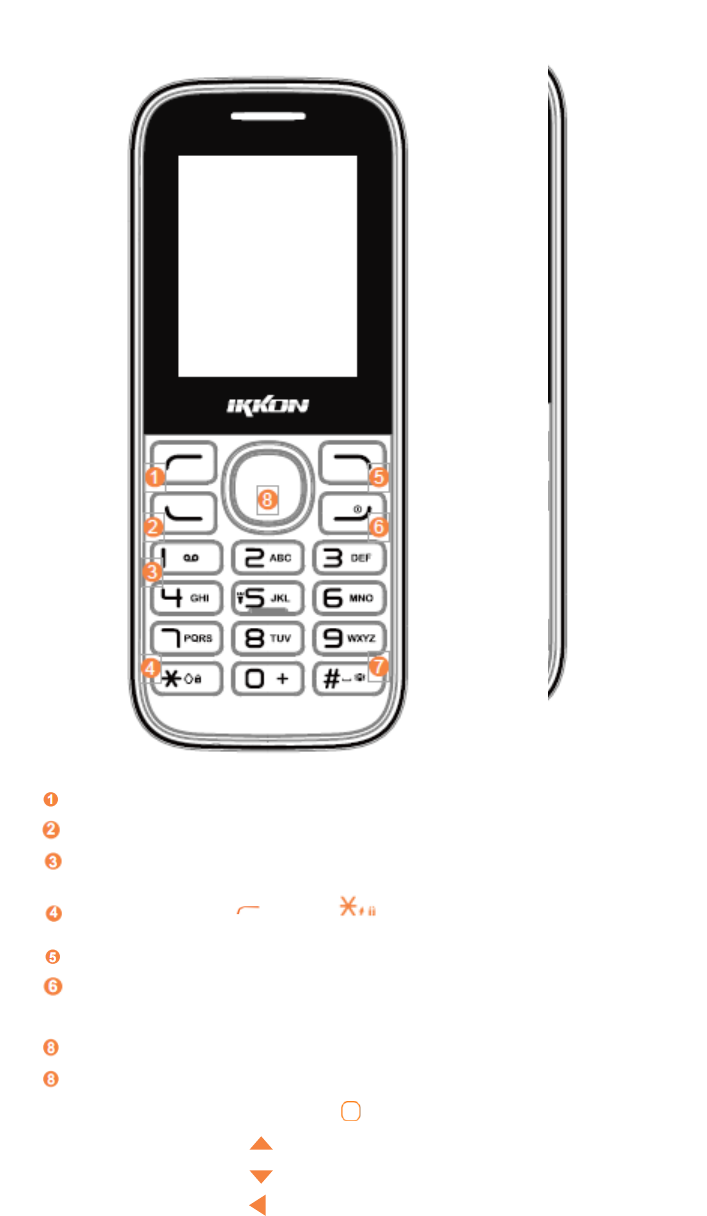
Left soft key
Call log (Idle screen) Send call
Voicemail (long key-press)
Lock Key(press then key)
Right soft key
Power on/Power off
End call
Vibration alert
Navigation key
Menu/Confirm an option
Increase volume
Reduce volume
New SMS
2
Profiles
1.1 Keys
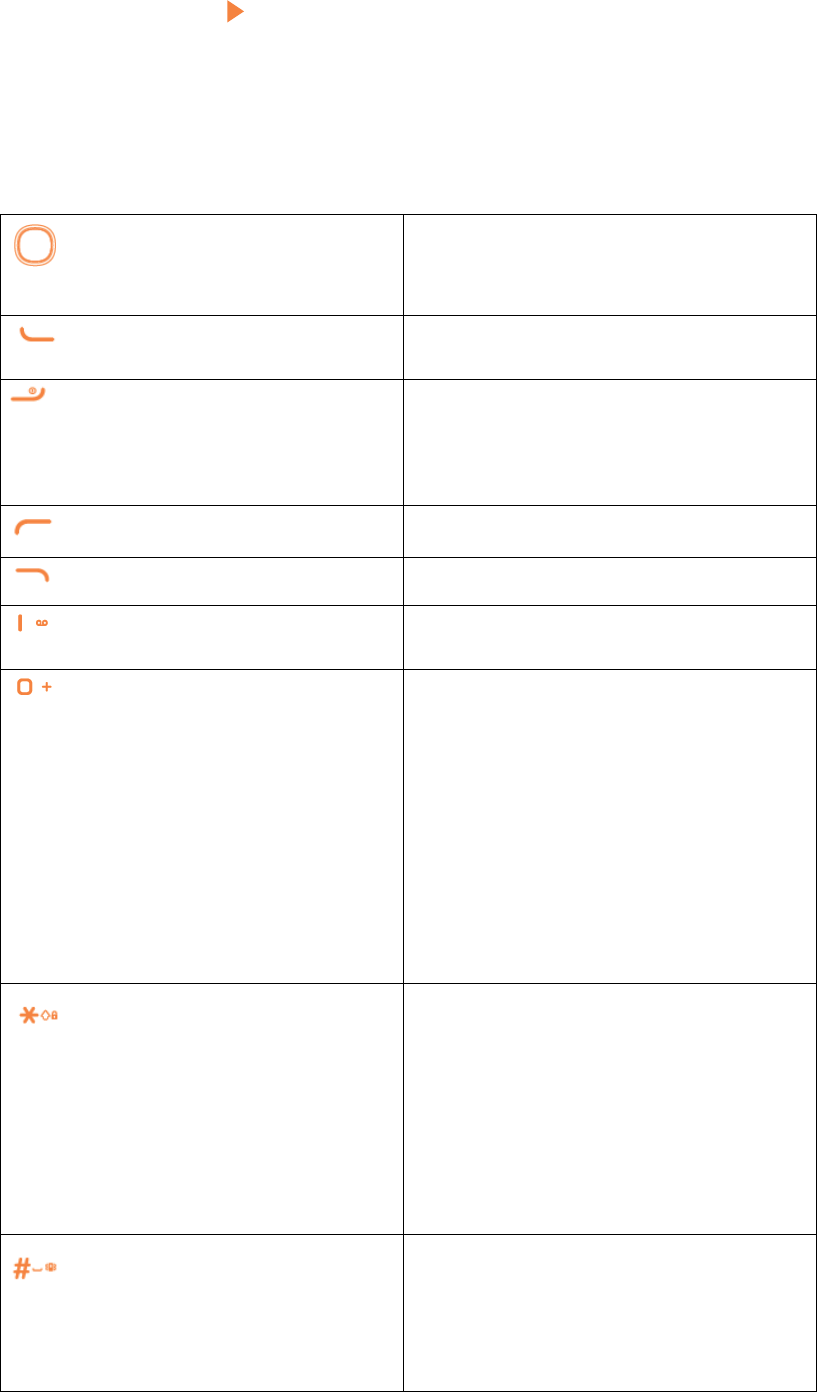
Navigation key
Confirm an option(press the middle of
the key)
Send call
Access to call log (idle screen)
Power on/off the handset (long key
-press)
End call
Return to idle
Left soft key
Right soft key
Dial the voicemail number (long key
-press)
From Idle screen
- Short key-press: enter zero
-Long key-press: +, "+" are used for
dialing an international call.
In Edit mode:
- Short key-press:
Input symbol (text edit mode)
0 (Add numbers)
From Idle screen
- Short key-press: input *
- Long press: lock keypad
In Edit mode:
- Short key-press:
change input methods
an international call, “P” and “W” are
used for calling the extension.
From Idle screen
- Short key-press: input #
- Long key-press: activate/deactivate
the vibrator In Edit mode:
- Short key-press: input “ ” (space)
3
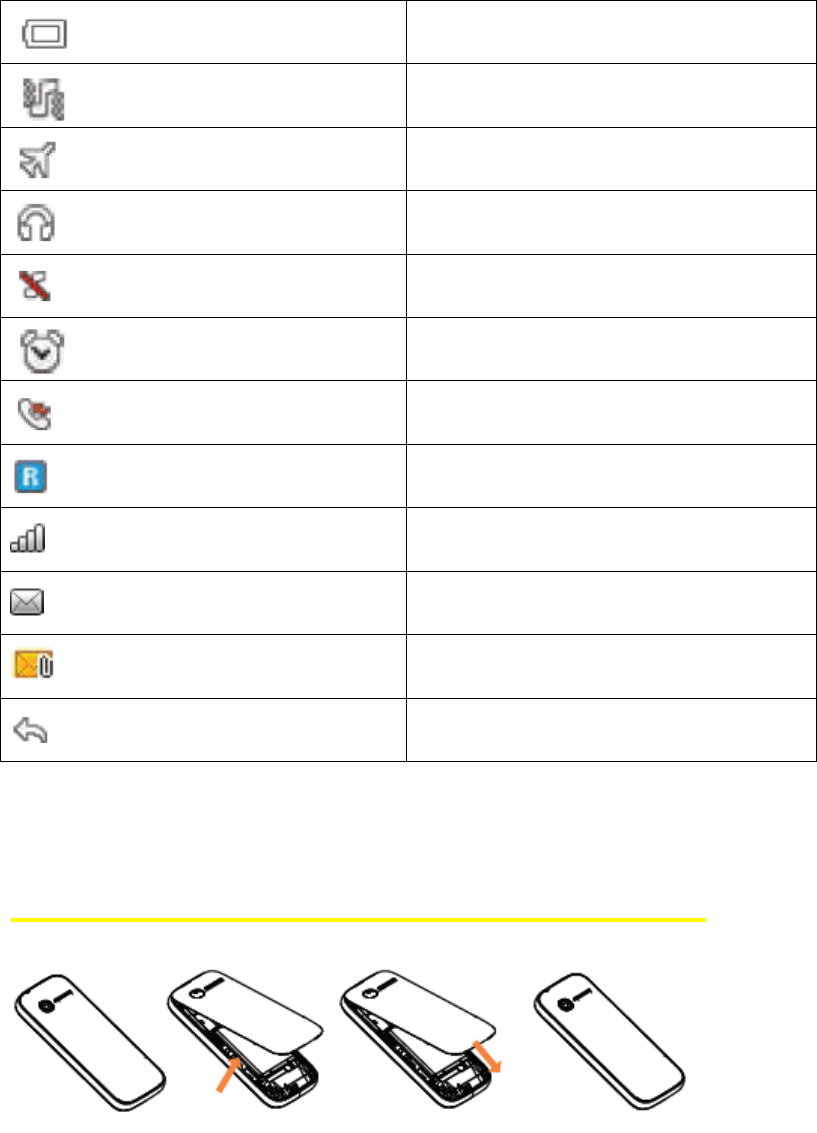
1.2 Idle screen icons
Battery charge level.
Meeting mode: your phone vibrates,
but neither rings nor beeps.
Flight mode.
Headset connected.
Silence mode: your phone neither
rings, beeps nor vibrates.
Alarm clock programmed.
Missed calls.
Roaming.
Level of network reception.
Message unread.
Unread MMS
Call divert.
2. Getting started.........
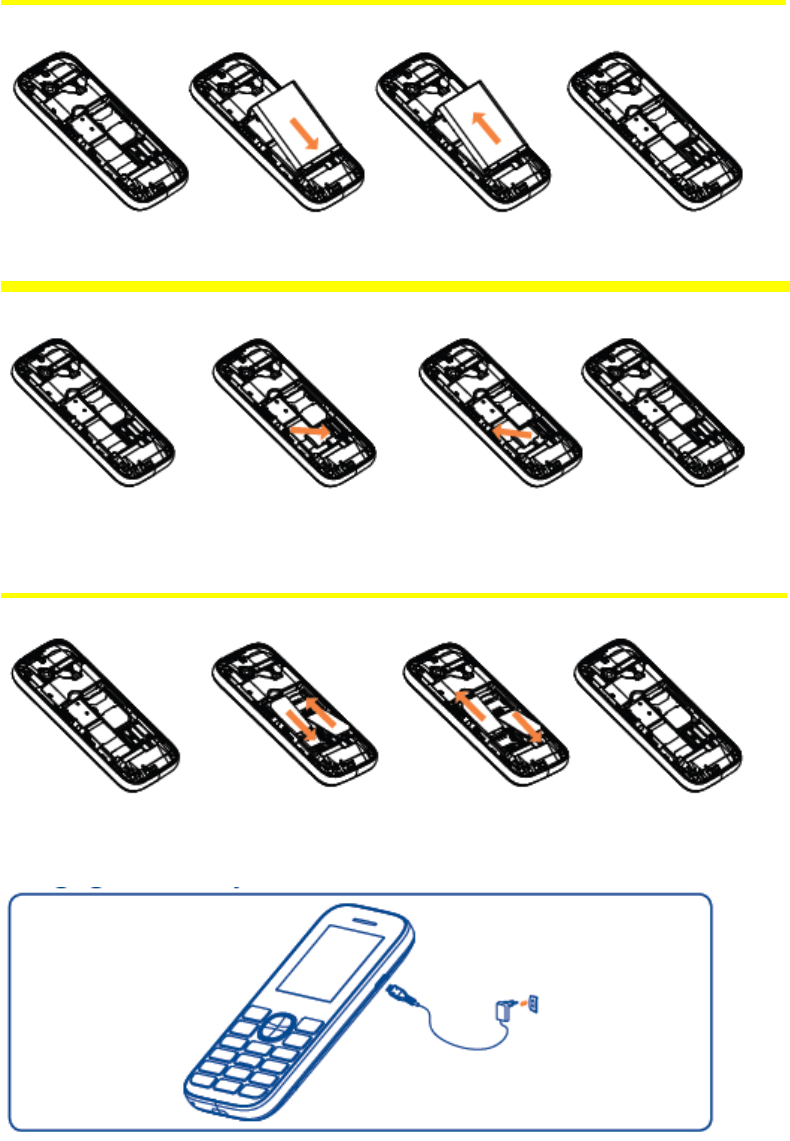
2.1 Set-up
Removing and installing the back cove
Removing and installing the battery
4
Inserting and removing the SIM card
Inserting and removing the TF card
Charging the battery
Connect the battery charger to your phone and mains socket respectively.
•The charging may take about 20 minutes to start if the battery is flat.
•Be careful not to force the plug into the socket.
•Make sure the battery is correctly inserted before connecting the charger.
•The mains socket must be near to the phone and easily accessible (avoid electric
extension cables).
•When using your telephone for the first time, charge the battery fully
5
(approximately 3 hours). You are advised to fully charge the battery ( ).
•To reduce power consumption and energy waste, when battery is fully charged,
disconnect your charger from the plug; reduce the backlight time, etc.
The charge is complete when the animation stops.
2.2 Power on your phone
Hold down the key until the phone powers on.
2.3 Power off your phone
Hold down the key from the idle screen.
3. Calls..........................
3.1 Making a call
Dial the desired number, press the key to place the call. If you make a mistake,
you can delete the incorrect digits by pressing the . To hang up the call, press
the key.
Making an emergency call
If your phone is covered by the network, dial emergency number and press the
key to make an emergency call. This works even without a SIM card and
without typing the PIN code or unlocking the keypad.
3.2 Calling your voicemail 1
You can see SIM voice mail in this menu.
3.3 Receiving a call
When you receive an incoming call, press the key to talk and then hang up
using the key.
3.4 Available functions during the call
During a call, you can use your directory, short messages, etc. without losing your
correspondent.
4. Camera.............
This function enables you to take pictures. Press to take the picture.
6
5. Call logs…………
You can access your call memory by pressing from the idle screen, or press
the key and select the icon from the menu. In this menu, you will see all call
history.
6. Browser…………
This function enables you to surf the Internet using the mobile phone
7. Tools……….
7.1 Alarm
Your mobile phone has a built-in alarm clock with snooze feature.
7.2 Calculator
Press the up, down, left, right and OK key to select +, - ×, ÷ and = respectively. Press
to delete the figure.
7.3 Calendar
Once you enter this menu, there is a monthly-view calendar for you to view the date;
you can go to any day you want.
7.4 Bluetooth
You can transfer data, such as music to other device using Bluetooth. Search the
device and accept/transfer data. The received data is automatically stored in the
directory.
7.5 Unit conversion
Unit conversion support weight conversion and length conversion.
7.6 Torch
You can turn on/off the torch through this function.
8. Message..............
8.1 Create SMS
From the main menu select “Messaging” to create text message. You can type a
message send it to a recipient in the SIM card directory. You can type a message, and
you're also able to insert a pre-defined message from “Templates”. While writing a
message, select “Options” to access all the messaging options.
Specific letters (accent) will increase the size of the SMS, this may cause
7
multiple SMS to be sent to your recipient.
8.2 Create MMS
Your phone can send and receive MMS which enables you to send message
containing picture, ring and text.
9. Multimedia.............
9.1 Music
Use this function to play audio files. Press to play/pause the audio player, short
press or to last or next audio, in audio player interface, press and to
tune volume.
9.2 Video
Use this function to play video files. Press to play/pause the video player,
short press and to tune volume; press or to last or next video.
9.3 FM radio
Your phone is equipped with a radio. You can use the application as a traditional
radio with saved channels. In FM radio interface, press to play/pause the playing
process of the current channel, press and to tune volume.
9.4 Image
You can view images through this function.
9.5 Recorder
Use this function to record audio files. The phone support WAV, AMR or MP3. The
recording file you stopped will be stored in my music list automatically.
9.6 My files
The phone provides a certain space for users to manage files and support the
memory card. The capacity of the memory card is selectable. You can use the file
manager to conveniently manage various directories and files on the phone and the
memory card.
10. SIM Tool Kit.................
STK service is the tool kit of SIM card. This phone supports the service
function .The specific items depend on SIM card and network. Service menu will be
automatically added to the phone menu when supported by network and SIM card.
8
11. Contacts……….
11.1 Consulting your contacts
You can access your call memory by pressing from the idle screen, or press
the key and select the icon from the menu. In this menu, you will see all
call history.
11.2 Adding a contact
Select the menu “Add contacts” then save it to “Phone”, “SIM1”,”SIM2” as you
like.
12. Settings……..
From the main menu, select the menu and select the function of your choice in
order to customize your telephone: Profiles, Phone settings, Call settings, Network
selection, Connections, Security and Restore factory settings.
13. Input mode.........
To write messages, there are two writing methods:
- Normal: this mode allows you to type a text by choosing a letter or a sequence of
characters associated with a key. Press the key several times until the desired letter is
highlighted. When you release the key the highlight character is inserted into the
text.
Safety and use ......................
We recommend that you read this chapter carefully before using your phone. The
manufacturer disclaims any liability for damage, which may result as a consequence
of improper use or use contrary to the instructions contained herein.
TRAFFIC SAFETY:
Given that studies show that using a mobile phone while driving a vehicle
constitutes a real risk, even when the hands-free kit is used (car kit, headset...),
drivers are requested to refrain from using their mobile when the vehicle is not
parked.
When driving, do not use your phone and headphone to listen to music or to the
radio. Using a headphone can be dangerous and forbidden in some areas. When
switched on, your phone emits electromagnetic waves that can interfere with the
vehicle’s electronic systems such as ABS anti-lock brakes or airbags. To ensure that
there is no problem:
- do not place your phone on top of the dashboard or within an airbag
9
deployment area,
- check with your car dealer or the car manufacturer to make sure that the
dashboard is adequately shielded from mobile phone RF energy.
CONDITIONS OF USE:
You are advised to switch off the telephone from time to time to optimise its
performance.
Switch the phone off before boarding an aircraft.
Switch the phone off when you are in health care facilities, except in designated
areas. As with many other types of equipment now in regular use, mobile telephones
can interfere with other electrical or electronic devices, or equipment using radio
frequency.
Switch the phone off when you are near gas or flammable liquids. Strictly obey all
signs and instructions posted in a fuel depot, petrol station, or chemical plant, or in
any potentially explosive atmosphere.
When the phone is switched on, it should be kept at least 15 cm from any
medical device such as a pacemaker, a hearing aid or insulin pump, etc. In particular
when using the phone, you should hold it against the ear on the opposite side to the
device, if any.
To avoid hearing impairment, pick up the call before holding your phone to your
ear. Also move the handset away from your ear while using the “hands-free” mode
because the amplified volume might cause hearing damage.
Do not let children use the phone and/or play with the telephone and accessories
without supervision.
When replacing the cover please note that your phone may contain substances
that could create an allergic reaction.
Always handle your phone with care and keep it in a clean and dust-free place.
Do not allow your phone to be exposed to adverse weather or environmental
conditions (moisture, humidity, rain, infiltration of liquids, dust, sea air, etc). The
manufacturer’s recommended operating temperature range is -10°C to +55°C.
At over 55°C the legibility of the phone’s display may be impaired, though this is
temporary and not serious.
Emergency call numbers may not be reachable on all cellular networks. You
should never rely only on your phone for emergency calls.
Do not open, dismantle or attempt to repair your mobile phone yourself. Do not
drop, throw or bend your mobile phone.
Do not use the phone if the glass made screen, is damaged, cracked or broken to
avoid any injury.
Do not paint it.
Some people may suffer epileptic seizures or blackouts when exposed to flashing
lights, or when playing video games. These seizures or blackouts may occur even if a
person never had a previous seizure or blackout. If you have experienced seizures or
blackouts, or if you have a family history of such occurrences, please consult your
doctor before playing video games on your phone or enabling a flashing-lights

10
feature on your phone.
Parents should monitor their children’s use of video games or other features that
incorporate flashing lights on the phones. All persons should discontinue use and
consult a doctor if any of the following symptoms occur: convulsion, eye or muscle
twitching, loss of awareness, involuntary movements, or disorientation. To limit the
likelihood of such symptoms, please take the following safety precautions:
- Do not play or use a flashing-lights feature if you are tired or need sleep.
- Take a minimum of a 15-minute break hourly.
- Play in a room in which all lights are on.
- Play at the farthest distance possible from the screen.
- If your hands, wrists, or arms become tired or sore while playing, stop and
rest for several hours before playing again.
- If you continue to have sore hands, wrists, or arms during or after playing,
stop the game and see a doctor.
When you play games on your phone, you may experience occasional discomfort
in your hands, arms, shoulders, neck, or other parts of your body. Follow the
instructions to avoid problems such as tendinitis, carpal tunnel syndrome, or other
musculoskeletal disorders.
In non European Union jurisdictions:
Items of equipment with this symbol are not to be thrown into ordinary bins if
your jurisdiction or your region has suitable recycling and collection facilities; instead
they are to be taken to collection points for them to be recycled.
CAUTION: RISK OF EXPLOSION IF BATTERY IS REPLACED BY AN INCORRECT TYPE.
DISPOSE OF USED BATTERIES ACCORDING TO THE INSTRUCTIONS.
CHARGERS
Mains powered chargers will operate within the temperature range of: 0°C to
40°C.
The chargers designed for your mobile phone meet with the standard for safety
of information technology equipment and office equipment use. They are also
compliant to the ecodesign directive 2009/125/EC. Due to different applicable
electrical specifications, a charger you purchased in one jurisdiction may not work in
another jurisdiction. They should be used for this purpose only.
Due to the used enclosure material, the mobile phone shall only be connected to
a USB Interface of version 2.0 or higher. The connection to so called power USB is
prohibited.The adapter shall be installed near the equipment and shall be easily
accessible. This charger is for indoor use only.
Troubleshooting....................
Before contacting the service centre, you are advised to follow the instructions
below:
• You are advised to fully charge the battery for optimal operation.
• Avoid storing large amounts of data in your phone as this may affect its
performance.

11
My phone is frozen or cannot switch on
• Check the battery contacts, remove and reinstall your battery, then turn your
phone on.
• Check the battery power level, charge for at least 20 minutes. My phone has
not responded for several minutes
• Remove and re-install the battery, then restart the phone.My phone turns off
by itself
• Check that your screen is locked when you are not using your phone, and make
sure the Power key is not mis-contacted due to unlocked screen.
• Check the battery charge level.
• If it still does not work, please use User Data Format to reset the phone.
My phone cannot charge properly
• Make sure you are using a battery and the charger from the box.
• Make sure your battery is inserted properly and clean the battery .
• Make sure that your battery is not completely discharged; if the attery power is
empty for a long time, it may take around 20 minutes to display the battery
charger indicator on the screen.
• Make sure charging is carried out under normal conditions (0°C to +40°C).
• When abroad, check that the voltage input is compatible. My phone cannot
connect to a network or “No service” is displayed
• Try connecting in another location.
• Verify the network coverage with your operator.
• Check with your operator that your SIM card is valid.
• Try selecting the available network(s) manually.
• Try connecting at a later time if the network is overloaded. My phone cannot
connect to the Internet
• Check that the IMEI number (press *#06#) is the same as the one printed on
your warranty card or box.
• Make sure that the internet access service of your SIM card is available.
• Check your phone's Internet connecting settings.
• Make sure you are in a place with network coverage.
• Try connecting at a later time or another location. Invalid SIM card
• Make sure the SIM card has been correctly inserted (see “Inserting or removing
the SIM card”).
• Make sure the chip on your SIM card is not damaged or scratched.
• Make sure the service of your SIM card is available.
Unable to make outgoing calls
• Make sure you have dialed a valid number and pressed the key.
• For international calls, check the country and area codes.
• Make sure your phone is connected to a network, and the network is not
overloaded or unavailable.
• Check your subscription status with your operator (credit, SIM card valid, etc.).
• Make sure you have not barred outgoing calls.
12
• Make sure that your phone is not in flight mode.
Unable to receive incoming calls
• Make sure your phone is switched on and connected to a network (check for
overloaded or unavailable network).
• Check your subscription status with your operator (credit, SIM card valid, etc.).
• Make sure you have not forwarded incoming calls.
• Make sure that you have not barred certain calls.
• Make sure that your phone is not in flight mode. The caller’s name/number
does not appear when a call is received
• Check that you have subscribed to this service with your operator.
• Your caller has concealed his/her name or number
I cannot find my contacts
• Make sure your SIM card is not broken.
• Make sure your SIM card is inserted properly.
• Import all contacts stored in SIM card to phone. The sound quality of the calls is
poor
• You can adjust the volume during a call by pressing the Up/Down key.
• Check the network strength .
• Make sure that the receiver, connector or speaker on your phone is clean. I am
unable to use the features described in the manual
• Check with your operator to make sure that your subscription includes this
service.
• Make sure this feature does not require an accessory. When I select a number
from my contacts, the number cannot be dialed
• Make sure that you have correctly recorded the number in your file.
• Make sure that you have selected the country prefix when calling a
foreign country. I am unable to add a contact in my contacts
• Make sure that your SIM card contacts are not full; delete some files or save the
files in the phone contacts (i.e. your professional or personal directories). My
callers are unable to leave messages on my voicemail
• Contact your network operator to check service availability.I cannot access my
voicemail
• Make sure your operator’s voicemail number is correctly entered in "Voicemail
number".
• Try later if the network is busy. I am unable to send and receive MMS
• Check your phone memory availability as it might be full.
• Contact your network operator to check service availability and check MMS
parameters.
• Verify the server centre number or your MMS profile with your operator.
• The server centre may be swamped, try again later.
SIM card PIN locked
• Contact your network operator to obtain the PUK code (Personal Unblocking
Key).I am unable to download new files
• Make sure there is sufficient phone memory for your download.
13
• Select the microSD card as the location to store downloaded files.
• Check your subscription status with your operator. How to make your battery
last longer
• Make sure you follow the complete charge time (minimum 4 hours).
• After a partial charge, the battery level indicator may not be exact. Wait for at
least 20 minutes after removing the charger to obtain an exact indication.
• Switch on the backlight upon request.
• Exit background-running applications if they are not being used for a long time.
The phone will become warm following prolonged calls, game playing, internet
surfing or running other complex applications
• This heating is a normal consequence of the CPU handling excessive data.
Ending above actions will make your phone return to normal temperatures.
FCC Statement
1. This device complies with Part 15 of the FCC Rules. Operation is subject to the following two conditions:
(1) This device may not cause harmful interference.
(2) This device must accept any interference received, including interference that may cause undesired operation.
2. Changes or modifications not expressly approved by the party responsible for compliance could void the user's
authority to operate the equipment.
NOTE:
This equipment has been tested and found to comply with the limits for a Class B digital device, pursuant to Part
15 of the FCC Rules. These limits are designed to provide reasonable protection against harmful interference in a
residential installation.
This equipment generates uses and can radiate radio frequency energy and, if not installed and used in accordance
with the instructions, may cause harmful interference to radio communications. However, there is no guarantee
that interference will not occur in a particular installation. If this equipment does cause harmful interference to
radio or television reception, which can be determined by turning the equipment off and on, the user is encouraged
to try to correct the interference by one or more of the following measures:
Reorient or relocate the receiving antenna.
Increase the separation between the equipment and receiver.
Connect the equipment into an outlet on a circuit different from that to which the receiver is connected.
Consult the dealer or an experienced radio/TV technician for help.
SAR Information Statement
Your wireless phone is a radio transmitter and receiver. It is designed and manufactured not to exceed the emission
limits for exposure to radiofrequency (RF) energy set by the Federal Communications Commission of the U.S.
Government. These limits are part of comprehensive guidelines and establish permitted levels of RF energy for the
general population. The guidelines are based on standards that were developed by independent scientific
organizations through periodic and thorough evaluation of scientific studies. The standards include a substantial
safety margin designed to assure the safety of all persons, regardless of age and health. The exposure standard for
wireless mobile phones employs a unit of measurement known as the Specific Absorption Rate, or SAR. The SAR
limit set by the FCC is 1.6 W/kg. * Tests for SAR are conducted with the phone transmitting at its highest certified
power level in all tested frequency bands. Although the SAR is determined at the highest certified power level, the
actual SAR level of the phone while operating can be well below the maximum value. This is because the phone is
14
designed to operate at multiple power levels so as to use only the power required to reach the network. In general,
the closer you are to a wireless base station antenna, the lower the power output. Before a phone model is available
for sale to the public, it must be tested and certified to the FCC that it does not exceed the limit established by the
government adopted requirement for safe exposure. The tests are performed in positions and locations (e.g., at the
ear and worn on the body) as required by the FCC for each model. The highest SAR value for this model phone
when tested for use at the ear is 0.797W/Kg and when worn on the body, as described in this user guide, is 0.618
W/Kg(Body-worn measurements differ among phone models, depending upon available accessories and FCC
requirements). While there may be differences between the SAR levels of various phones and at various positions,
they all meet the government requirement for safe exposure. The FCC has granted an Equipment Authorization for
this model phone with all reported SAR levels evaluated as in compliance with the FCC RFexposure guidelines.
SAR information on this model phone is on file with the FCC and can be found under the Display Grant section of
http://www.fcc.gov/ oet/fccid after searching on
FCC ID: 2ABXI-LF890 Additional information on Specific Absorption Rates (SAR) can be found on the Cellular
Telecommunications Industry Asso-ciation (CTIA) web-site at http://www.wow-com.com. * In the United States
and Canada, the SAR limit for mobile phones used by the public is 1.6 watts/kg (W/kg) averaged over one gram of
tissue. The standard incorporates a sub-stantial margin of safety to give additional protection for the public and to
account for any variations in measurements.
Body-worn Operation
This device was tested for typical body-worn operations. To comply with RF exposure requirements, a minimum
separation distance of 15mm must be maintained between the user’s body and the handset, including the antenna.
Third-party belt-clips, holsters, and similar accessories used by this device should not contain any metallic
components. Body-worn accessories that do not meet these requirements may not comply with RF exposure
requirements and should be avoided. Use only the supplied or an approved antenna.