Franklin Submersible Motors 2007 Users Manual
2007 to the manual 123b1374-84c0-425a-860c-8d4eba3cac1c
2015-02-09
: Franklin Franklin-Submersible-Motors-2007-Users-Manual-552104 franklin-submersible-motors-2007-users-manual-552104 franklin pdf
Open the PDF directly: View PDF  .
.
Page Count: 75
Submersible Motors
Application • Installation • Maintenance
60 Hz, Single-Phase and Three-Phase Motors
2007
ATTENTION!
IMPORTANT INFORMATION FOR INSTALLERS OF THIS EQUIPMENT!
THIS EQUIPMENT IS INTENDED FOR INSTALLATION BY TECHNICALLY QUALIFIED PERSONNEL.
FAILURE TO INSTALL IT IN COMPLIANCE WITH NATIONAL AND LOCAL ELECTRICAL CODES, AND
WITHIN FRANKLIN ELECTRIC RECOMMENDATIONS, MAY RESULT IN ELECTRICAL SHOCK OR FIRE
HAZARD, UNSATISFACTORY PERFORMANCE, AND EQUIPMENT FAILURE. FRANKLIN INSTALLATION
INFORMATION IS AVAILABLE FROM PUMP MANUFACTURERS AND DISTRIBUTORS, AND DIRECTLY
FROM FRANKLIN ELECTRIC. CALL FRANKLIN TOLL FREE 800-348-2420 FOR INFORMATION.
WARNING
SERIOUS OR FATAL ELECTRICAL SHOCK MAY RESULT FROM FAILURE TO CONNECT THE MOTOR,
CONTROL ENCLOSURES, METAL PLUMBING, AND ALL OTHER METAL NEAR THE MOTOR OR CABLE,
TO THE POWER SUPPLY GROUND TERMINAL USING WIRE NO SMALLER THAN MOTOR CABLE
WIRES. TO REDUCE RISK OF ELECTRICAL SHOCK, DISCONNECT POWER BEFORE WORKING ON OR
AROUND THE WATER SYSTEM. DO NOT USE MOTOR IN SWIMMING AREAS.
ATTENTION!
INFORMATIONS IMPORTANTES POUR L’INSTALLATEUR DE CET EQUIPEMENT.
CET EQUIPEMENT DOIT ETRE INTALLE PAR UN TECHNICIEN QUALIFIE. SI L’INSTALLATION N’EST
PAS CONFORME AUX LOIS NATIONALES OU LOCALES AINSI QU’AUX RECOMMANDATIONS DE
FRANKLIN ELECTRIC, UN CHOC ELECTRIQUE, LE FEU, UNE PERFORMANCE NON ACCEPTABLE,
VOIRE MEME LE NON-FONCTIONNEMENT PEUVENT SURVENIR. UN GUIDE D’INSTALLATION
DE FRANKLIN ELECTRIC EST DISPONIBLE CHEZ LES MANUFACTURIERS DE POMPES, LES
DISTRIBUTEURS, OU DIRECTEMENT CHEZ FRANKLIN. POUR DE PLUS AMPLES RENSEIGNEMENTS,
APPELEZ SANS FRAIS LE 800-348-2420.
AVERTISSEMENT
UN CHOC ELECTRIQUE SERIEUX OU MEME MORTEL EST POSSIBLE, SI L’ON NEGLIGE DE
CONNECTER LE MOTEUR, LA PLOMBERIE METALLIQUE, BOITES DE CONTROLE ET TOUT METAL
PROCHE DU MOTEUR A UN CABLE ALLANT VERS UNE ALIMENTATION D’ENERGIE AVEC BORNE
DE MISE A LA TERRE UTILISANT AU MOINS LE MEME CALIBRE QUE LES FILS DU MOTEUR. POUR
REDUIRE LE RISQUE DE CHOC ELECTRIQUE. COUPER LE COURANT AVANT DE TRAVAILLER PRES
OU SUR LE SYSTEM D’EAU. NE PAS UTILISER CE MOTEUR DANS UNE ZONE DE BAIGNADE.
ATENCION!
INFORMACION PARA EL INSTALADOR DE ESTE EQUIPO.
PARA LA INSTALACION DE ESTE EQUIPO, SE REQUIERE DE PERSONAL TECNICO CALIFICADO.
EL NO CUMPLIR CON LAS NORMAS ELECTRICAS NACIONALES Y LOCALES, ASI COMO CON LAS
RECOMENDACIONES DE FRANKLIN ELECTRIC DURANTE SU INSTALACION, PUEDE OCASIONAR,
UN CHOQUE ELECTRICO, PELIGRO DE UN INCENDIO, OPERACION DEFECTUOSA E INCLUSO LA
DESCOMPOSTURA DEL EQUIPO. LOS MANUALES DE INSTALACION Y PUESTA EN MARCHA DE
LOS EQUIPOS, ESTAN DISPONIBLES CON LOS DISTRIBUIDORES, FABRICANTES DE BOMBAS
O DIRECTAMENTE CON FRANKLIN ELECTRIC. PUEDE LLAMAR GRATUITAMENTE PARA MAYOR
INFORMACION AL TELEFONO 800-348-2420.
ADVERTENCIA
PUEDE OCURRIR UN CHOQUE ELECTRICO, SERIO O FATAL DEBIDO A UNA ERRONEA CONECCION
DEL MOTOR, DE LOS TABLEROS ELECTRICOS, DE LA TUBERIA, DE CUALQUIER OTRA PARTE
METALICA QUE ESTA CERCA DEL MOTOR O POR NO UTILIZAR UN CABLE PARA TIERRA DE CALIBRE
IGUAL O MAYOR AL DE LA ALIMENTACION. PARA REDUCIR EL RIESGO DE CHOQUE ELECTRIC,
DESCONECTAR LA ALIMENTACION ELECTRICA ANTES DE INICIAR A TRABAJAR EN EL SISTEMA
HIDRAULICO. NO UTILIZAR ESTE MOTOR EN ALBERCAS O AREAS EN DONDE SE PRACTIQUE
NATACION.

Franklin Electric is committed to provide customers with
defect free products through our program of continuous
improvement. Quality shall, in every case, take
precedence over quantity.
Commitment to Quality
Application – All Motors
Storage ...........................................................................3
Frequency of Starts .........................................................3
Mounting Position ...........................................................3
Transformer Capacity .....................................................4
Effects of Torque .............................................................4
Use of Engine Driven Generators ...................................5
Use of Check Valves .......................................................5
Well Diameters, Casing, Top Feeding, Screens .............6
Water Temperature and Flow .........................................6
Flow Inducer Sleeve .......................................................6
Head Loss Past Motor ....................................................7
Hot Water Applications ................................................7-8
Drawdown Seals .............................................................9
Grounding Control Boxes and Panels .............................9
Grounding Surge Arrestors .............................................9
Control Box and Panel Environment ...............................9
Equipment Grounding .....................................................9
Application – Single-Phase Motors
3-Wire Control Boxes ....................................................10
2-Wire Motor Solid State Controls ................................10
QD Relays (Solid State) ................................................10
Cable Selection 2-Wire or 3-Wire .................................11
Two Different Cable Sizes ............................................12
Single-Phase Motor Specifi cations ...............................13
Single-Phase Motor Fuse Sizing ...................................14
Auxiliary Running Capacitors ........................................15
Buck-Boost Transformers .............................................15
Application – Three-Phase Motors
Cable Selection - 60 °C Three-Wire .........................16-17
Cable Selection - 60 °C Six-Wire ..................................18
Cable Selection - 75 °C Three-Wire .........................19-20
Cable Selection - 75 °C Six-Wire ..................................21
Three-Phase Motor Specifi cations ...........................22-26
Three-Phase Motor Fuse Sizing ...................................27
Overload Protection .................................................28-30
Submersible Pump Installation Checklist (No. 3656)
Submersible Motor Installation Record (No. 2207)
Submersible Booster Installation Record (No. 3655)
Contents
SubMonitor ....................................................................31
Power Factor Correction ...............................................31
Three-Phase Starter Diagrams .....................................32
Three-Phase Power Unbalance ....................................33
Rotation and Current Unbalance ..................................33
Three-Phase Motor Lead Identifi cation .........................34
Phase Converters .........................................................34
Reduced Voltage Starters .............................................35
Inline Booster Pump Systems ..................................35-38
Variable Speed Operation .............................................39
Installation – All Motors
Submersible Motors - Dimensions ................................40
Tightening Lead Connector Jam Nut ............................41
Pump to Motor Coupling ...............................................41
Shaft Height and Free End Play ...................................41
Submersible Leads and Cables ....................................41
Maintenance – All Motors
System Troubleshooting ..........................................42-43
Preliminary Tests ..........................................................44
Insulation Resistance ....................................................45
Resistance of Drop Cable .............................................45
Maintenance – Single-Phase Motors & Controls
Identifi cation of Cables ..................................................46
Single-Phase Control Boxes .........................................46
Ohmmeter Tests ...........................................................47
QD Control Box Parts ...................................................48
Integral hp Control Box Parts ...................................49-50
Control Box Wiring Diagrams ...................................51-54
Maintenance – Electronic Products
Pumptec-Plus Troubleshooting During Installation .......55
Pumptec-Plus Troubleshooting After Installation ..........56
QD Pumptec and Pumptec Troubleshooting ................57
SubDrive/MonoDrive Troubleshooting ..........................58
SubMonitor Troubleshooting .........................................59
Subtrol-Plus Troubleshooting ...................................60-61
Submersible Motors
The submersible motor is a reliable, effi cient and trouble-
free means of powering a pump. Its needs for a long
operational life are simple. They are:
1. A suitable operating environment
2. An adequate supply of electricity
3. An adequate fl ow of cooling water over the motor
4. An appropriate pump load
All considerations of application, installation, and
maintenance of submersible motors relating to these four
areas are presented in this manual. Franklin Electric’s
web page, www.franklin-electric.com, should be checked
for the latest updates.
Application • Installation • Maintenance Manual
Application – All Motors
Franklin submersible motors are designed primarily for
operation in the vertical, shaft-up position.
During acceleration, the pump thrust increases as its
output head increases. In cases where the pump head
stays below its normal operating range during startup and
full speed condition, the pump may create upward thrust.
This creates upward thrust on the motor upthrust bearing.
This is an acceptable operation for short periods at each
start, but running continuously with upthrust will cause
excessive wear on the upthrust bearing.
With certain additional restrictions as listed in this section
and the Inline Booster Pump Systems sections of this
manual, motors are also suitable for operation in positions
Franklin Electric submersible motors are a water-
lubricated design. The fi ll solution consists of a mixture
of deionized water and Propylene Glycol (a non-toxic
antifreeze). The solution will prevent damage from
freezing in temperatures to -40 °F (-40 °C); motors should
be stored in areas that do not go below this temperature.
The solution will partially freeze below 27 °F (-3 °C),
but no damage occurs. Repeated freezing and thawing
should be avoided to prevent possible loss of fi ll solution.
There may be an interchange of fi ll solution with well
water during operation. Care must be taken with motors
removed from wells during freezing conditions to
prevent damage.
When the storage temperature does not exceed
100 °F (37 °C), storage time should be limited to two
years. Where temperatures reach 100° to 130 °F, storage
time should be limited to one year.
Loss of a few drops of liquid will not damage the motor
as an excess amount is provided, and the fi lter check
valve will allow lost liquid to be replaced by fi ltered well
water upon installation. If there is reason to believe there
has been a considerable amount of leakage, consult the
factory for checking procedures.
The average number of starts per day over a period
of months or years infl uences the life of a submersible
pumping system. Excessive cycling affects the life of
control components such as pressure switches, starters,
relays and capacitors. Rapid cycling can also cause
motor spline damage, bearing damage, and motor
overheating. All these conditions can lead to reduced
motor life.
The pump size, tank size and other controls should be
selected to keep the starts per day as low as practical for
longest life. The maximum number of starts per 24-hour
period is shown in table 3.
Motors should run a minimum of one minute to dissipate
heat build up from starting current. 6" and larger motors
should have a minimum of 15 minutes between starts or
starting attempts.
from shaft-up to shaft-horizontal. As the mounting position
becomes further from vertical and closer to horizontal, the
probability of shortened thrust bearing life increases. For
normal motor life expectancy with motor positions other
than shaft-up, follow these recommendations:
1. Minimize the frequency of starts, preferably to fewer
than 10 per 24-hour period. 6” and 8” motors should
have a minimum of 20 minutes between starts or
starting attempts
2. Do not use in systems which can run even for short
periods at full speed without thrust toward the motor.
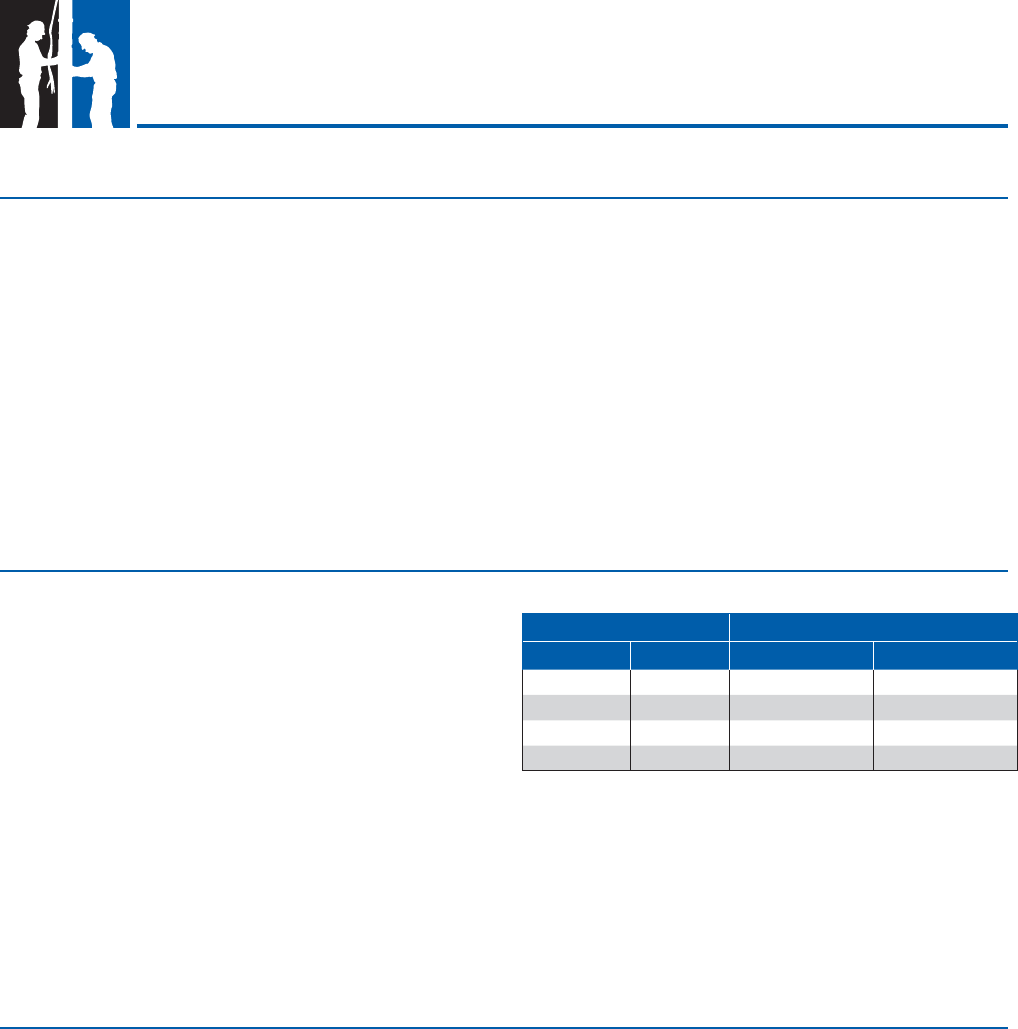
Storage
Frequency of Starts
Mounting Position
MOTOR RATING MAXIMUM STARTS PER 24 HR PERIOD
HP KW SINGLE-PHASE THREE-PHASE
Up to 0.75 Up to 0.55 300 300
1 thru 5.5 0.75 thru 4 100 300
7.5 thru 30 5.5 thru 22 50 100
40 and over 30 and over - 100
Table 3 Number of Starts
3
Application – All Motors
Distribution transformers must be adequately sized to
satisfy the kVA requirements of the submersible motor.
When transformers are too small to supply the load, there
is a reduction in voltage to the motor.
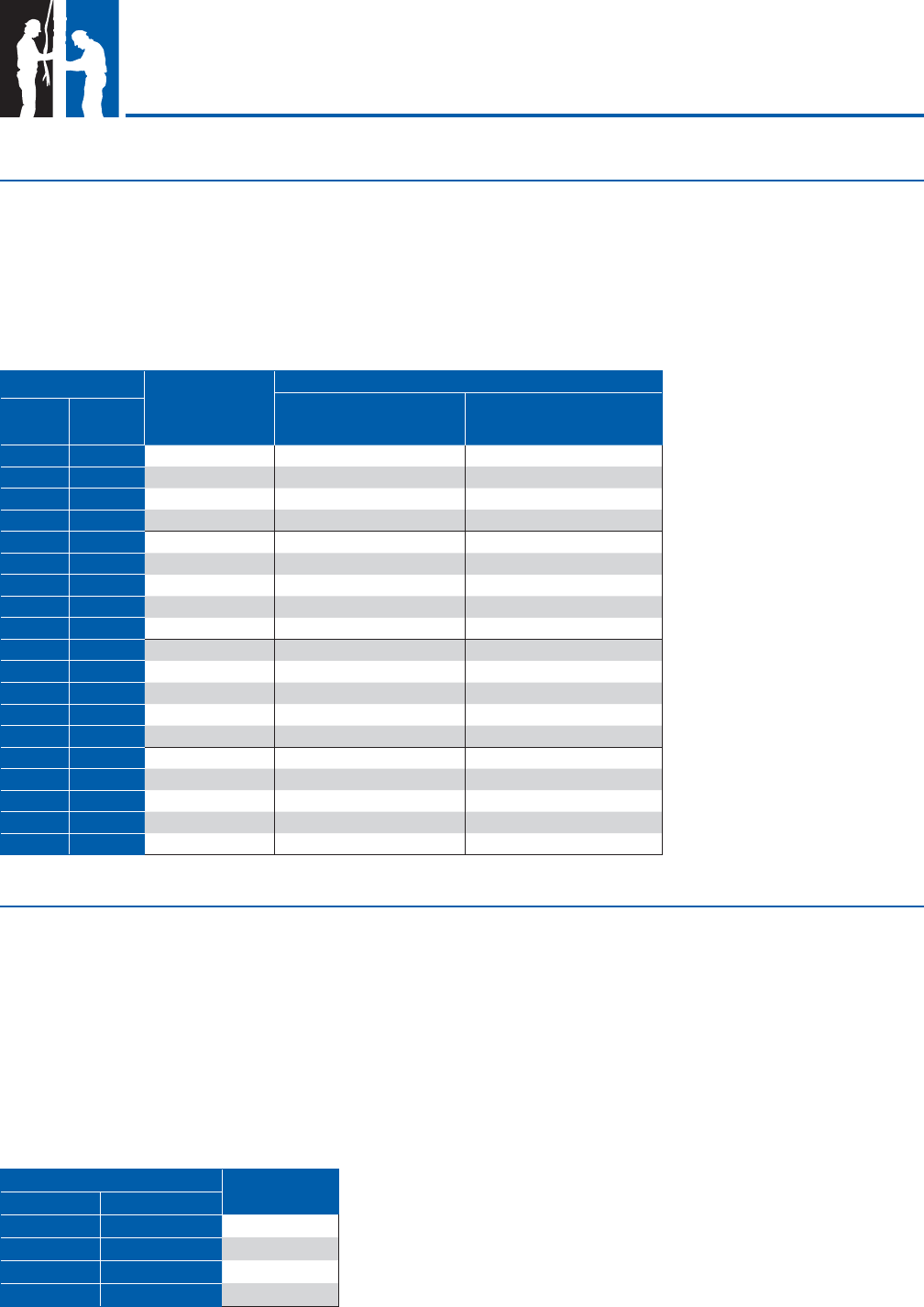
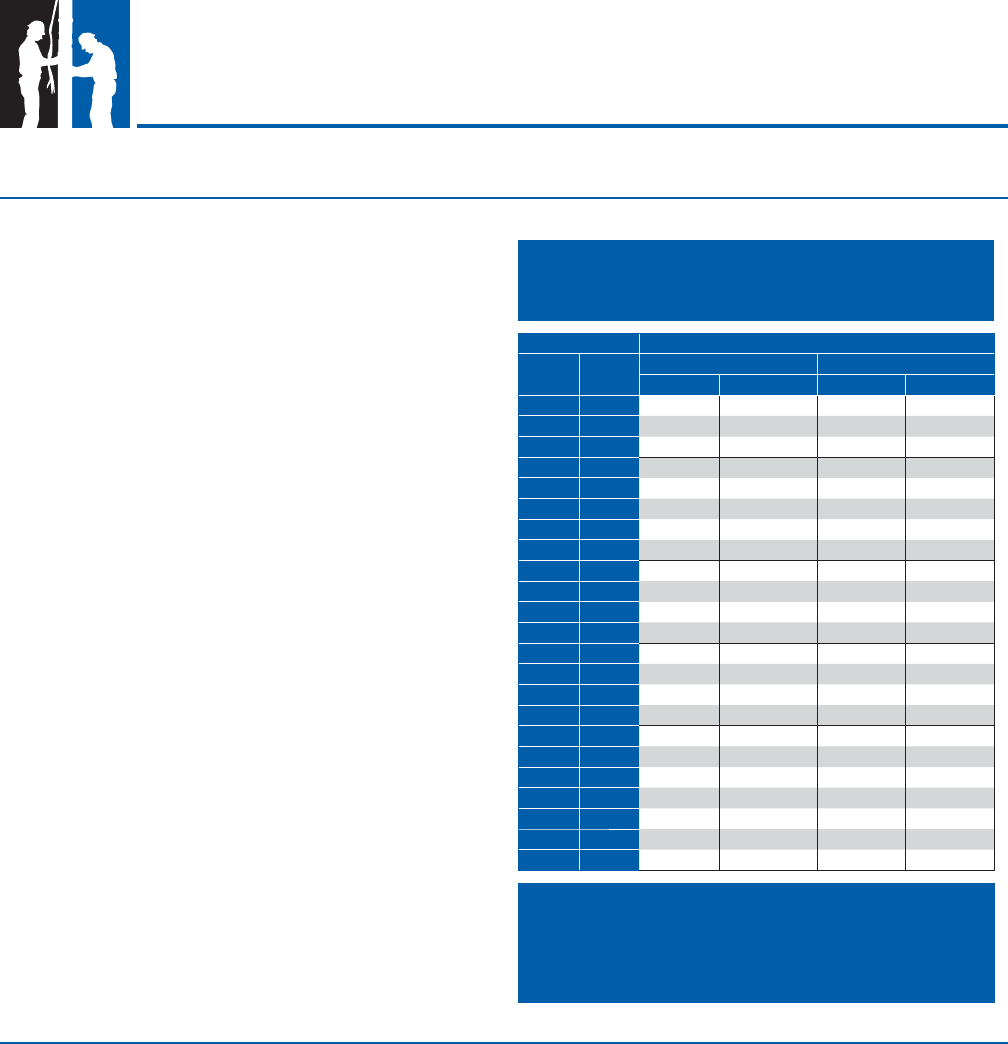
Table 4 references the motor horsepower rating, single-
phase and three-phase, total effective kVA required, and
Transformer Capacity - Single-Phase or Three-Phase
NOTE: Standard kVA
ratings are shown. If power
company experience and
practice allows transformer
loading higher than
standard, higher loading
values may be used to
meet total effective kVA
required, provided correct
voltage and balance is
maintained.
the smallest transformer required for open or closed
three-phase systems. Open systems require larger
transformers since only two transformers are used.
Other loads would add directly to the kVA sizing
requirements of the transformer bank.
During starting of a submersible pump, the torque
developed by the motor must be supported through the
pump, delivery pipe or other supports. Most pumps rotate
in the direction which causes unscrewing torque on
right-handed threaded pipe or pump stages. All threaded
joints, pumps and other parts of the pump support system
must be capable of withstanding the maximum torque
repeatedly without loosening or breaking. Unscrewing
joints will break electrical cable and may cause loss of the
pump-motor unit.
To safely withstand maximum unscrewing torques with
a minimum safety factor of 1.5, tightening all theaded
joints to at least 10 lb-ft per motor horsepower is
recommended (table 4A). It may be necessary to tack
or strap weld pipe joints on high horsepower pumps,
especially at shallower settings.
Effects of Torque
Table 4A Torque Required (Examples)
MOTOR RATING TOTAL
EFFECTIVE
KVA
REQUIRED
SMALLEST KVA RATING-EACH TRANSFORMER
OPEN WYE
OR DELTA
2- TRANSFORMERS
CLOSED
WYE OR DELTA
3- TRANSFORMERS
HP KW
1.5 1.1 32 1
2 1.5 4 2 1.5
3 2.2 53 2
5 3.7 7.5 5 3
7.5 5.5 10 7.5 5
10 7.5 15 10 5
15 11 20 15 7.5
20 15 25 15 10
25 18.5 30 20 10
30 22 40 25 15
40 30 50 30 20
50 37 60 35 20
60 45 75 40 25
75 55 90 50 30
100 75 120 65 40
125 90 150 85 50
150 110 175 100 60
175 130 200 115 70
200 150 230 130 75
Table 4 Transformer Capacity
MOTOR RATING MINIMUM SAFE
TORQUE-LOAD
HP KW
1 hp & Less 0.75 kW & Less 10 lb-ft
20 hp 15 kW 200 lb-ft
75 hp 55 kW 750 lb-ft
200 hp 150 kW 2000 lb-ft
4
Application – All Motors
WARNING: To prevent accidental electrocution,
automatic or manual transfer switches must be used
any time a generator is used as standby or back
up on power lines. Contact power company for use
and approval.
Table 5 lists minimum generator sizes based on typical
80 °C rise continuous duty generators, with 35%
maximum voltage dip during starting, for Franklin’s three-
wire motors, single- or three-phase.
This is a general chart. The generator manufacturer
should be consulted whenever possible, especially on
larger sizes.
There are two types of generators available: externally
and internally regulated. Most are externally regulated.
They use an external voltage regulator that senses the
output voltage. As the voltage dips at motor start-up, the
regulator increases the output voltage of the generator.
Internally regulated (self-excited) generators have an
extra winding in the generator stator. The extra winding
senses the output current to automatically adjust the
output voltage.
Generators must be sized to deliver at least 65% of the
rated voltage during starting to ensure adequate starting
torque. Besides sizing, generator frequency is important
as the motor speed varies with the frequency (Hz). Due
to pump affi nity laws, a pump running at 1 to 2 Hz below
motor nameplate frequency design will not meet its
performance curve. Conversely, a pump running at 1 to 2
Hz above may trip overloads.
Generator Operation
Always start the generator before the motor is started
and always stop the motor before the generator is shut
down. The motor thrust bearing may be damaged if
the generator is allowed to coast down with the motor
running. This same condition occurs when the generator
is allowed to run out of fuel.
Follow generator manufacturer’s recommendations for
de-rating at higher elevations or using natural gas.
It is recommended that one or more check valves always
be used in submersible pump installations. If the pump
does not have a built-in check valve, a line check valve
should be installed in the discharge line within 25 feet
of the pump and below the draw down level of the water
supply. For deeper settings, check valves should be
installed per the manufacturer’s recommendations. More
than one check valve may be required, but more than the
recommended number of check valves should not
be used.
Swing type check valves are not acceptable and should
never be used with submersible motors/pumps. Swing
type check valves have a slower reaction time which can
cause water hammer (see next page). Internal pump
check valves or spring loaded check valves close quickly
and help eliminate water hammer.
Check valves are used to hold pressure in the system
when the pump stops. They also prevent backspin, water
hammer and upthrust. Any of these can lead to early
pump or motor failure.
NOTE: Only positive sealing check valves should be
used in submersible installations. Although drilling the
check valves or using drain-back check valves may
prevent back spinning, they create upthrust and water
hammer problems.
A. Backspin - With no check valve or a failed check
valve, the water in the drop pipe and the water in the
system can fl ow down the discharge pipe when the
motor stops. This can cause the pump to rotate in
a reverse direction. If the motor is started while it is
backspinning, an excessive force is placed across
the pump-motor assembly that can cause impeller
damage, motor or pump shaft breakage, excessive
bearing wear, etc.
B. Upthrust - With no check valve, a leaking check
valve, or drilled check valve, the unit starts under
Use of Engine Driven Generators - Single-Phase or Three-Phase
Table 5 Engine Driven Generators
MOTOR RATING MINIMUM RATING OF GENERATOR
HP KW EXTERNALLY REGULATED INTERNALLY REGULATED
KW KVA KW KVA
1/3 0.25 1.5 1.9 1.2 1.5
1/2 0.37 2 2.5 1.5 1.9
3/4 0.55 3 3.8 2 2.5
1 0.75 4 5.0 2.5 3.13
1.5 1.1 5 6.25 3 3.8
2 1.5 7.5 9.4 4 5
3 2.2 10 12.5 5 6.25
5 3.7 15 18.75 7.5 9.4
7.5 5.5 20 25.0 10 12.5
10 7.5 30 37.5 15 18.75
15 11 40 50 20 25
20 15 60 75 25 31
25 18.5 75 94 30 37.50
30 22 100 125 40 50
40 30 100 125 50 62.5
50 37 150 188 60 75
60 45 175 220 75 94
75 55 250 313 100 125
100 75 300 375 150 188
125 90 375 469 175 219
150 110 450 563 200 250
175 130 525 656 250 313
200 150 600 750 275 344
Use of Check Valves
NOTE: This chart applies to 3-wire or 3-phase
motors. For best starting of 2-wire motors, the
minimum generator rating is 50% higher than shown.
5
Application – All Motors
Franklin Electric submersible motors are designed to
operate with a cooling fl ow of water over and around the
full length of the motor.
If the pump installation does not provide the minimum fl ow
shown in table 6, a fl ow inducer sleeve (fl ow sleeve) must
be used. The conditions requiring a fl ow sleeve are:
Wells – Large Diameter, Uncased, Top Feeding and Screened Sections
• Well diameter is too large to meet table 6
fl ow requirements.
• Pump is in an open body of water.
• Pump is in a rock well or below the well casing.
• The well is “top-feeding” (a.k.a. cascading)
• Pump is set in or below screens or perforations.
Franklin Electric’s standard submersible motors, except
Hi-Temp designs (see note below), are designed to
operate up to maximum service factor horsepower in
water up to 86 °F (30 °C). A fl ow of 0.25 ft/s for 4" motors
rated 3 hp and higher, and 0.5 ft/s for 6 and 8" motors is
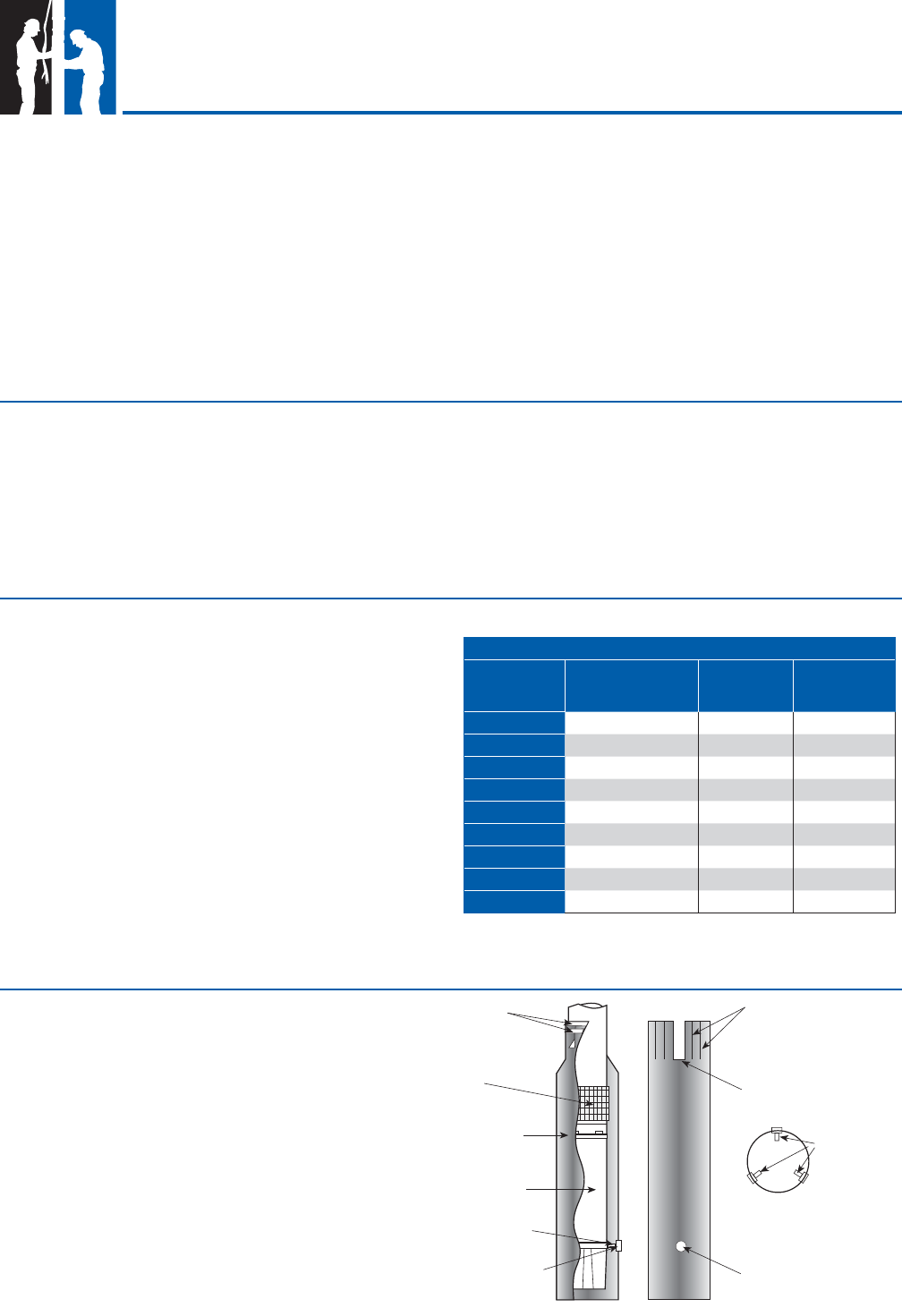
required for proper cooling. Table 6 shows minimum fl ow
rates, in gpm, for various well diameters and motor sizes.
If a standard motor is operated in water over 86 °F
(30 °C), water fl ow past the motor must be increased to
maintain safe motor operating temperatures. See
HOT WATER APPLICATIONS on page 7.
NOTE: Franklin Electric offers a line of Hi-Temp motors
designed to operate in water at higher temperatures or
lower fl ow conditions. Consult factory for details.
Water Temperature and Flow
0.25 ft/s = 7.62 cm/sec 0.50 ft/s = 15.24 cm/sec
1 inch = 2.54 cm
If the fl ow rate is less than specifi ed, then a
fl ow inducer sleeve must be used. A fl ow
sleeve is always required in an open body
of water. FIG. 1 shows a typical fl ow inducer
sleeve construction.
EXAMPLE: A 6" motor and pump that delivers
60 gpm will be installed in a 10" well.
From table 6, 90 gpm would be required to
maintain proper cooling. In this case adding
an 8" or smaller fl ow sleeve provides the
required cooling.
FIG. 1
WORM GEAR
CLAMPS
INTAKE
FLOW INDUCER
SLEEVE
SUBMERSIBLE
MOTOR
CENTERING BOLT
LOCK NUTS
INSIDE SLEEVE
CENTERING
BOLT HOLE
(3 REQUIRED)
BOTTOM END VIEW
NOTCH OUT
FOR CABLE
GUARD
SAW CUTS
CENTERING BOLTS
MUST BE LOCATED
ON MOTOR CASTING.
DO NOT LOCATE ON
STATOR SHELL.
Table 6 Required Cooling Flow
a zero head condition. This causes an uplifting or
upthrust on the impeller-shaft assembly in the pump.
This upward movement carries across the pump-
motor coupling and creates an upthrust condition in
the motor. Repeated upthrust can cause premature
failure of both the pump and the motor.
C. Water Hammer - If the lowest check valve is more
than 30 feet above the standing (lowest static)
water level, or a lower check valve leaks and the
check valve above holds, a vacuum is created in
the discharge piping. On the next pump start, water
moving at very high velocity fi lls the void and strikes
the closed check valve and the stationary water in the
pipe above it, causing a hydraulic shock. This shock
can split pipes, break joints and damage the pump
and/or motor. Water hammer can often be heard or
felt. When discovered, the system should be shut
down and the pump installer contacted to correct
the problem.
MINIMUM GPM REQUIRED FOR MOTOR COOLING IN WATER UP TO 86 °F (30 °C).
CASING OR
SLEEVE ID
INCHES (MM)
4" MOTOR (3-10 HP)
0.25 FT/S
GPM (L/M)
6" MOTOR
0.50 FT/S
GPM (L/M)
8" MOTOR
0.50 FT/S
GPM (L/M)
4 (102) 1.2 (4.5) - -
5 (127) 7 (26.5) - -
6 (152) 13 (49) 9 (34) -
7 (178) 20 (76) 25 (95) -
8 (203) 30 (114) 45 (170) 10 (40)
10 (254) 50 (189) 90 (340) 55 (210)
12 (305) 80 (303) 140 (530) 110 (420)
14 (356) 110 (416) 200 (760) 170 (645)
16 (406) 150 (568) 280 (1060) 245 (930)
Flow Inducer Sleeve
6
Application – All Motors
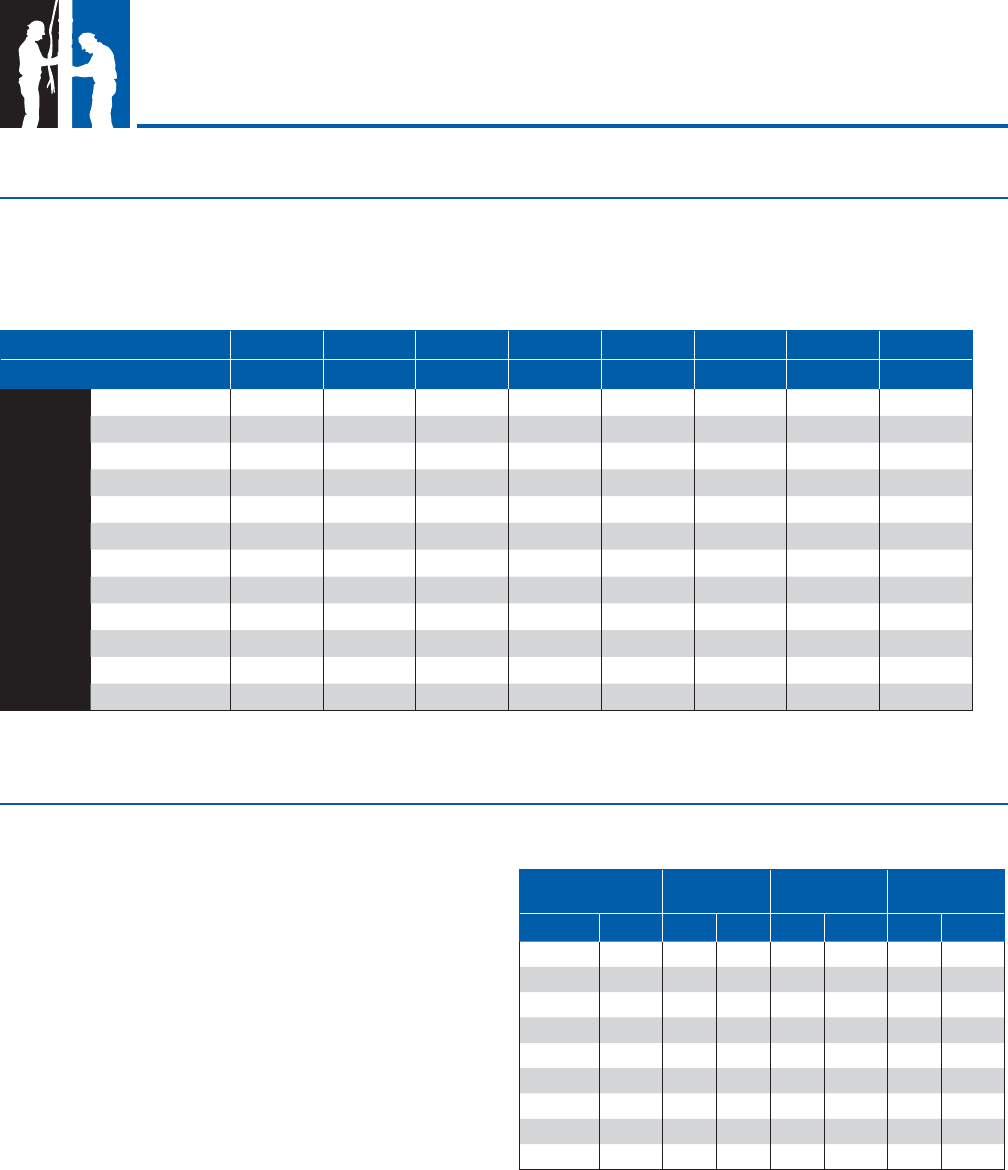
Table 7 lists the approximate head loss due to fl ow
between an average length motor and smooth casing or
fl ow inducer sleeve.
Head Loss From Flow Past Motor
Hot Water Applications (Standard Motors)
Franklin Electric offers a line of Hi-Temp motors
which are designed to operate in water with
various temperatures up to 194 °F (90 °C) without
increased fl ow. When a standard pump-motor
operates in water hotter than 86 °F (30 °C), a fl ow
rate of at least 3 ft/s is required. When selecting
the motor to drive a pump in over 86 °F (30 °C)
water, the motor horsepower must be de-rated per
the following procedure.
1. Using table 7A, determine pump gpm required
for different well or sleeve diameters. If
necessary, add a fl ow sleeve to obtain at least
3 ft/s fl ow rate.
MOTOR DIAMETER 4" 4" 4" 6" 6" 6" 8" 8"
CASING ID IN INCHES (MM) 4 (102) 5 (127) 6 (152) 6 (152) 7 (178) 8 (203) 8.1 (206) 10 (254)
Flow Rate in gpm (l/m)
25 (95) 0.3 (.09)
50 (189) 1.2 (.37)
100 (378) 4.7 (1.4) 0.3 (.09) 1.7 (.52)
150 (568) 10.2 (3.1) 0.6 (.18) 0.2 (.06) 3.7 (1.1)
200 (757) 1.1 (.34) 0.4 (.12) 6.3 (1.9) 0.5 (.15) 6.8 (2.1)
250 (946) 1.8 (.55) 0.7 (.21) 9.6 (2.9) 0.8 (.24) 10.4 (3.2)
300 (1136) 2.5 (.75) 1.0 (.30) 13.6 (4.1) 1.2 (.37) 0.2 (.06) 14.6 (4.5)
400 (1514) 23.7 (7.2) 2.0 (.61) 0.4 (.12) 24.6 (7.5)
500 (1893) 3.1 (.94) 0.7 (.21) 37.3 (11.4) 0.6 (0.2)
600 (2271) 4.4 (1.3) 1.0 (.30) 52.2 (15.9) 0.8 (0.3)
800 (3028) 1.5 (0.5)
1000 (3785) 2.4 (0.7)
Table 7 Head Loss in Feet (Meters) at Various Flow Rates
CASING OR
SLEEVE ID
4" HIGH
THRUST MOTOR 6" MOTOR 8" MOTOR
INCHES (MM) GPM (L/M) GPM (L/M) GPM (L/M)
4 (102) 15 (57)
5 (127) 80 (303)
6 (152) 160 (606) 52 (197)
7 (178) 150 (568)
8 (203) 260 (984) 60 (227)
10 (254) 520 (1970) 330 (1250)
12 (305) 650 (2460)
14 (356) 1020 (3860)
16 (406) 1460 (5530)
Table 7A Minimum gpm (l/m) Required for
3 ft/s (.91 m/sec) Flow Rate
7
Application – All Motors
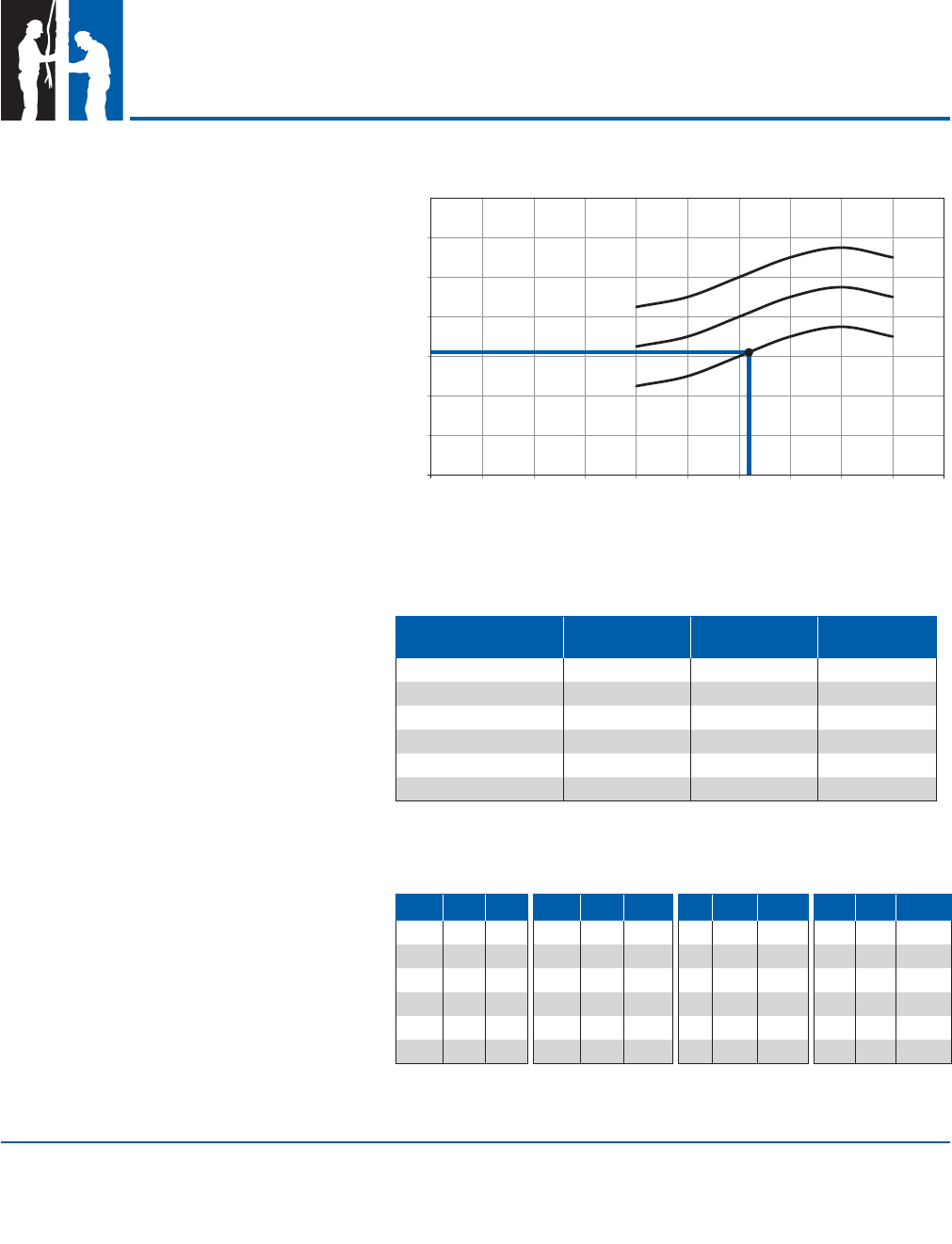
EXAMPLE: A 6" pump end requiring 39 hp input will
pump 124 °F water in an 8" well at a delivery rate of 140
gpm. From table 7A, a 6" fl ow sleeve will be required to
increase the fl ow rate to at least 3 ft/s
Using table 8, the 1.62 heat factor multiplier is selected
because the hp required is over 30 hp and water
3. Multiply the pump horsepower required by
the heat factor multiplier from table 8.
4. Select a rated hp motor on table 8A whose
Service Factor Horsepower is at least the
value calculated in Item 3.
Hot Water Applications - Example
temperature is above 122 °F. Multiply 39 hp x 1.62
(multiplier), which equals 63.2 hp. This is the minimum
rated service factor horsepower usable at 39 hp in 124 °F.
Using table 8A, select a motor with a rated service factor
horsepower above 63.2 hp. A 60 hp motor has a service
factor horsepower of 69, so a 60 hp motor may be used.
Table 8 Heat Factor Multiplier at 3 ft/s (.91 m/sec) Flow Rate
Table 8A Service Factor Horsepower
2. Determine pump horsepower required
from the pump manufacturer’s curve.
FIG. 2 MANUFACTURER’S PUMP CURVE
0
0 5 10 15 20 25 30 35 40 45 50
Gallons Per Minute
Brake Horsepower
1
2
3
4
5
6
A
B
C
EXAMPLE
MAXIMUM
WATER TEMPERATURE
1/3 - 5 HP
.25 - 3.7 KW
7 1/2 - 30 HP
5.5 - 22 KW
OVER 30 HP
OVER 22 KW
140 °F (60 °C) 1.25 1.62 2.00
131 °F (55 °C) 1.11 1.32 1.62
122 °F (50 °C) 1.00 1.14 1.32
113 °F (45 °C) 1.00 1.00 1.14
104 °F (40 °C) 1.00 1.00 1.00
95 °F (35 °C) 1.00 1.00 1.00
HP KW SFHP HP KW SFHP HP KW SFHP HP KW SFHP
1/3 0.25 0.58 3 2.2 3.45 25 18.5 28.75 100 75 115.00
1/2 0.37 0.80 5 3.7 5.75 30 22.0 34.50 125 90 143.75
3/4 0.55 1.12 7.5 5.5 8.62 40 30.0 46.00 150 110 172.50
1 0.75 1.40 10 7.5 11.50 50 37.0 57.50 175 130 201.25
1.5 1.10 1.95 15 11.0 17.25 60 45.0 69.00 200 150 230.00
2 1.50 2.50 20 15.0 23.00 75 55.0 86.25
8
Application – All Motors
The primary purpose of grounding the metal drop pipe
and/or metal well casing in an installation is safety. It is
done to limit the voltage between nonelectrical (exposed
metal) parts of the system and ground, thus minimizing
dangerous shock hazards. Using wire at least the size of
the motor cable wires provides adequate current-carrying
capability for any ground fault that might occur. It also
provides a low resistance path to ground, ensuring that
the current to ground will be large enough to trip any
overcurrent device designed to detect faults (such as a
ground fault circuit interrupter, or GFCI).
Normally, the ground wire to the motor would provide the
Franklin Electric control boxes meet UL requirements for
NEMA Type 3R enclosures. They are suitable for indoor
and outdoor applications within temperatures of +14 °F
(-10 °C) to 122 °F (50 °C). Operating control boxes below
+14 °F can cause reduced starting torque and loss of
overload protection when overloads are located in
control boxes.
Control boxes and panels should never be mounted in
direct sunlight or high temperature locations. This will
cause shortened capacitor life and unnecessary tripping
Control Box and Panel Environment
of overload protectors. A ventilated enclosure painted
white to refl ect heat is recommended for an outdoor, high
temperature location.
A damp well pit, or other humid location, accelerates
component failure from corrosion.
Control boxes with voltage relays are designed for
vertical upright mounting only. Mounting in other
positions will affect the operation of the relay.
Allowable motor temperature is based on atmospheric
pressure or higher surrounding the motor. “Drawdown
seals,” which seal the well to the pump above its intake
Grounding Surge Arrestors
An above ground surge arrestor must be grounded,
metal to metal, all the way to the lowest draw down water
strata for the surge arrestor to be effective. GROUNDING
THE ARRESTOR TO THE SUPPLY GROUND OR TO
A DRIVEN GROUND ROD PROVIDES LITTLE OR NO
SURGE PROTECTION FOR THE MOTOR.
to maximize delivery, are not recommended, since the
suction created can be lower than atmospheric pressure.
Equipment Grounding
primary path back to the power supply ground for any
ground fault. There are conditions, however, where the
ground wire connection could become compromised.
One such example would be the case where the water
in the well is abnormally corrosive or aggressive. In this
example, a grounded metal drop pipe or casing would
then become the primary path to ground. However,
the many installations that now use plastic drop pipes
and/or casings require further steps to be taken for
safety purposes, so that the water column itself does not
become the conductive path to ground.
When an installation has abnormally corrosive water
AND the drop pipe or casing is plastic, Franklin Electric
recommends the use of a GFCI with a 10 mA set-point.
In this case, the motor ground wire should be routed
through the current-sensing device along with the motor
power leads. Wired this way, the GFCI will trip only when
a ground fault has occurred AND the motor ground wire
is no longer functional.
WARNING: Serious or fatal electrical shock may
result from failure to connect the motor, control
enclosures, metal plumbing and all other metal
near the motor or cable to the power supply ground
terminal using wire no smaller than motor cable wires.
WARNING: Failure to ground the control frame can
result in a serious or fatal electrical shock hazard.
The National Electrical Code requires that the control box
or panel-grounding terminal always be connected to supply
ground. If the circuit has no grounding conductor and no
metal conduit from the box to supply panel, use a wire at
least as large as line conductors and connect as required
by the National Electrical Code, from the grounding terminal
to the electrical supply ground.
Drawdown Seals
Grounding Control Boxes and Panels
9
Application – Single-Phase Motors
BIAC Switch Operation
When power is applied the bi-metal switch contacts are
closed, so the triac is conducting and energizes the start
winding. As rpm increases, the voltage in the sensor coil
generates heat in the bi-metal strip, causing the bi-metal
strip to bend and open the switch circuit. This removes
the starting winding and the motor continues to run on
the main winding alone.
Approximately 5 seconds after power is removed from
the motor, the bi-metal strip cools suffi ciently to return
to its closed position and the motor is ready for the next
start cycle.
Rapid Cycling
The BIAC starting switch will reset within approximately 5
seconds after the motor is stopped. If an attempt is made
2-Wire Motor Solid State Controls
to restart the motor before the starting switch has reset,
the motor may not start; however, there will be current in
the main winding until the overload protector interrupts
the circuit. The time for the protector to reset is longer
than the reset of the starting switch. Therefore, the start
switch will have closed and the motor will operate.
A waterlogged tank will cause fast cycling. When a
waterlogged condition does occur, the user will be
alerted to the problem during the off time (overload reset
time) since the pressure will drop drastically. When the
waterlogged tank condition is detected, the condition
should be corrected to prevent nuisance tripping of the
overload protector.
Bound Pump (Sandlocked)
When the motor is not free to turn, as with a sandlocked
pump, the BIAC switch creates a “reverse impact
torque” in the motor in either direction. When the sand is
dislodged, the motor will start and operate in the
correct direction.
There are two elements in the relay: a reed switch and
a triac. The reed switch consists of two tiny rectangular
blade-type contacts, which bend under magnetic fl ux. It
is hermetically sealed in glass and is located within a coil,
which conducts line current. When power is supplied to
the control box, the main winding current passing through
the coil immediately closes the reed switch contacts.
This turns on the triac, which supplies voltage to the start
winding, thus starting the motor.
Once the motor is started, the operation of the QD relay
is an interaction between the triac, the reed switch and
the motor windings. The solid state switch senses motor
speed through the changing phase relationship between
start winding current and line current. As the motor
approaches running speed, the phase angle between
the start current and the line current becomes nearly
in phase. At this point, the reed switch contacts open,
turning off the triac. This removes voltage from the start
winding and the motor continues to run on the main
winding only. With the reed switch contacts open and
the triac turned off, the QD relay is ready for the next
starting cycle.
Single-phase three-wire submersible motors require the
use of control boxes. Operation of motors without control
boxes or with incorrect boxes can result in motor failure
and voids warranty.
Control boxes contain starting capacitors, a starting
relay, and, in some sizes, overload protectors, running
capacitors and contactors.
Ratings through 1 hp may use either a Franklin Electric
solid state QD or a potential (voltage) type starting relay,
while larger ratings use potential relays.
Potential (Voltage) Relays
Potential relays have normally closed contacts. When
power is applied, both start and main motor windings
are energized, and the motor starts. At this instant, the
voltage across the start winding is relatively low and not
3-Wire Control Boxes
enough to open the contacts of the relay.
As the motor accelerates, the increasing voltage across
the start winding (and the relay coil) opens the relay
contacts. This opens the starting circuit and the motor
continues to run on the main winding alone, or the main
plus run capacitor circuit. After the motor is started the
relay contacts remain open.
CAUTION: The control box and motor are two pieces
of one assembly. Be certain that the control box and
motor hp and voltage match. Since a motor is designed
to operate with a control box from the same
manufacturer, we can promise warranty coverage
only when a Franklin control box is used with a
Franklin motor.
CAUTION: Restarting the motor within 5 seconds
after power is removed may cause the motor overload
to trip.
QD Relays (Solid State)
10
Application – Single-Phase Motors
75 °C
2 or 3-Wire Cable, 60 Hz (Service Entrance to Motor - Maximum Length In Feet)
Lengths in BOLD only meet the US National Electrical
Code ampacity requirements for individual conductors
60 °C or 75 °C in free air or water, not in magnetic
enclosures, conduit or direct buried.
Lengths NOT in bold meet the NEC ampacity
requirements for either individual conductors or jacketed
60 °C or 75 °C cable and can be in conduit or direct
buried. Flat molded and web/ribbon cable are considered
jacketed cable.
If any other cable is used, the NEC and local codes
should be observed.
Cable lengths in tables 11 & 11A allow for a 5% voltage
drop running at maximum nameplate amperes. If 3%
voltage drop is desired, multiply table 11 and 11A lengths
by 0.6 to get maximum cable length.
The portion of the total cable length, which is between
the supply and single-phase control box with a line
contactor, should not exceed 25% of total maximum
allowable to ensure reliable contactor operation. Single-
phase control boxes without line contactors may be
connected at any point in the total cable length.
Tables 11 & 11A are based on copper wire. If aluminum
wire is used, it must be two sizes larger than copper wire
and oxidation inhibitors must be used on connections.
EXAMPLE: If tables 11 & 11A call for #12 copper wire,
#10 aluminum wire would be required.
Contact Franklin Electric for 90 °C cable lengths. See
pages 15, 48, and 49 for applications using 230 V motors
on 208 V power systems.
MOTOR RATING 60 °C INSULATION - AWG COPPER WIRE SIZE
VOLTSHPKW1412108643210000000000
115 1/2 .37 100 160 250 390 620 960 1190 1460 1780 2160 2630 3140 3770
230
1/2 .37 400 650 1020 1610 2510 3880 4810 5880 7170 8720
3/4 .55 300 480 760 1200 1870 2890 3580 4370 5330 6470 7870
1 .75 250 400 630 990 1540 2380 2960 3610 4410 5360 6520
1.5 1.1 190 310 480 770 1200 1870 2320 2850 3500 4280 5240
2 1.5 150 250 390 620 970 1530 1910 2360 2930 3620 4480
3 2.2 120 190 300 470 750 1190 1490 1850 2320 2890 3610
5 3.7 00
180 280 450 710 890 1110 1390 1740 2170 2680
7.5 5.5 000
200 310 490 610 750 930 1140 1410 1720
10 7.5 0000
250 390 490 600 750 930 1160 1430 1760
15 11 0000
170 270 340 430 530 660 820 1020 1260
Table 11
MOTOR RATING 75 °C INSULATION - AWG COPPER WIRE SIZE
VOLTSHPKW1412108643210000000000
115 1/2 .37 100 160 250 390 620 960 1190 1460 1780 2160 2630 3140 3770
230
1/2 .37 400 650 1020 1610 2510 3880 4810 5880 7170 8720
3/4 .55 300 480 760 1200 1870 2890 3580 4370 5330 6470 7870 9380
1 .75 250 400 630 990 1540 2380 2960 3610 4410 5360 6520 7780 9350
1.5 1.1 190 310 480 770 1200 1870 2320 2850 3500 4280 5240 6300 7620
2 1.5 150 250 390 620 970 1530 1910 2360 2930 3620 4480 5470 6700
3 2.2 120 190 300 470 750 1190 1490 1850 2320 2890 3610 4470 5550
5 3.7 0110 180 280 450 710 890 1110 1390 1740 2170 2680 3330
7.5 5.5 00
120 200 310 490 610 750 930 1140 1410 1720 2100
10 7.5 000
160 250 390 490 600 750 930 1160 1430 1760
15 11 0000
170 270 340 430 530 660 820 1020 1260
Table 11A
1 Foot = .3048 Meter
11
60 °C
Application – Single-Phase Motors
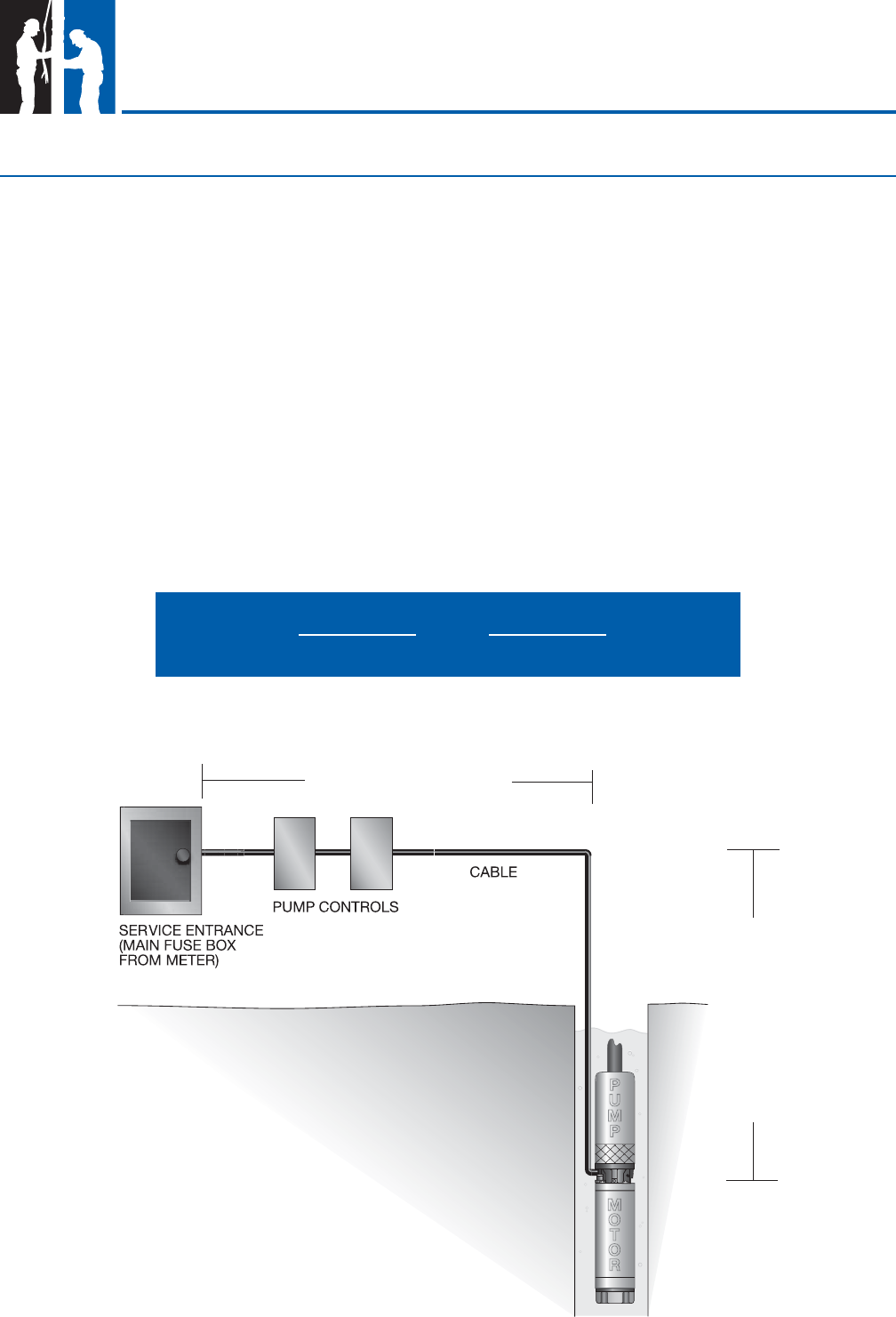
3 hp, 230 V
Single-Phase Motor
310 ft #6 AWG
(41.3% of allowable cable)
160 ft #10 AWG
(53.3% of allowable cable)
Depending on the installation, any number of
combinations of cable may be used.
For example, in a replacement/upgrade installation, the
well already has 160 feet of buried #10 cable between
the service entrance and the wellhead. A new 3 hp,
230-volt, single-phase motor is being installed to replace
a smaller motor. The question is: Since there is already
160 feet of #10 AWG installed, what size cable is
required in the well with a 3 hp, 230-volt, single-phase
motor setting at 310 feet?
From tables 11 & 11A, a 3 hp motor can use up to 300
feet of #10 AWG cable.
The application has 160 feet of #10 AWG copper
wire installed.
Using the formula below, 160 feet (actual) ÷ 300 feet
(max allowable) is equal to 0.533. This means 53.3%
(0.533 x 100) of the allowable voltage drop or loss, which
is allowed between the service entrance and the motor,
occurs in this wire. This leaves us 46.7% (1.00 - 0.533
= 0.467) of some other wire size to use in the remaining
310 feet “down hole” wire run.
The table shows #8 AWG copper wire is good for 470
feet. Using the formula again, 310 feet (used) ÷ 470 feet
(allowed) = 0.660; adding this to the 0.533 determined
earlier; 0.533 + 0.660 = 1.193. This combination is
greater than 1.00, so the voltage drop will not meet US
National Electrical Code recommendations.
Tables 11 & 11A show #6 AWG copper wire is good
for 750 feet. Using the formula, 310 ÷ 750 = 0.413, and
using these numbers, 0.533 + 0.413 = 0.946, we fi nd this
is less than one and will meet the NEC recommended
voltage drop.
This works for two, three or more combinations of wire
and it does not matter which size wire comes fi rst in
the installation.
EXAMPLE: 3 hp, 230-Volt, Single-Phase Motor
Two or More Different Cable Sizes Can Be Used
FIG. 3
Formula: +=1.00
Actual Length
Max Allowed
Actual Length
Max Allowed
12
Application – Single-Phase Motors
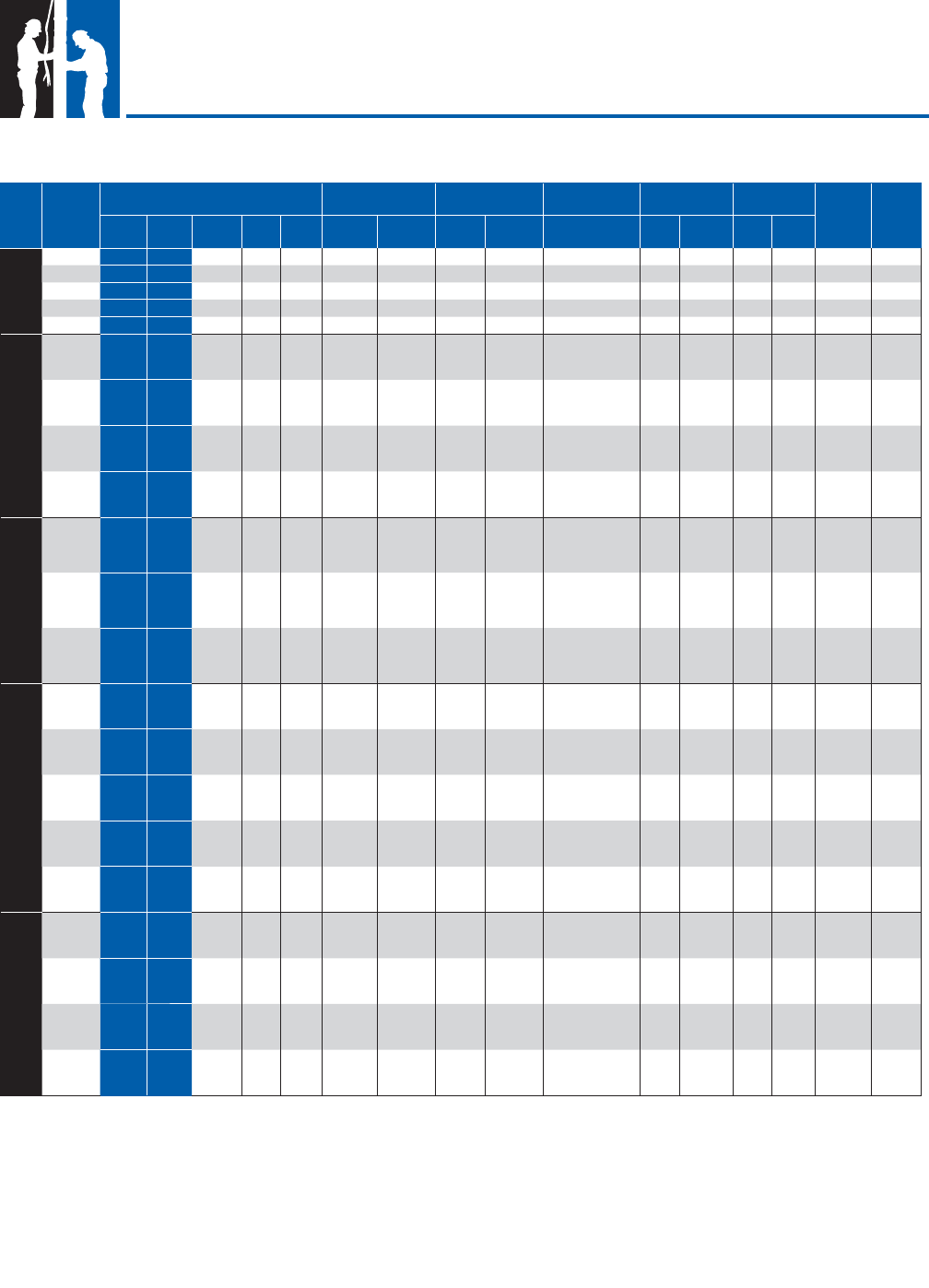
(1) Main winding - yellow to black
Start winding - yellow to red
(2) Y = Yellow lead - line amps
B = Black lead - main winding amps
R = Red lead - start or auxiliary winding amps
(3) Control Boxes date coded 02C and older have
35 MFD run capacitors. Current values should
be Y14.0 @ FL and Y17.0 @ SF Load.
B12.2 B14.5
R4.7 R4.5
(4) Control Boxes date coded 01M and older have
60 MFD run capacitors and the current values on
a 4" motor will be Y23.0 @ FL - Y27.5 @ SF Load.
B19.1 B23.2
R8.0 R7.8
(5) Control Boxes date coded 01M and older have
60 MFD run capacitors and the current values on
a 6" motor will be Y23.0 @ FL -Y27.5 @ SF Load.
B18.2 B23.2
R8.0 R7.8
Performance is typical, not guaranteed, at specifi ed voltages and specifi ed capacitor values. Performance at voltage
ratings not shown is similar, except amps vary inversely with voltage.
TYPE
MOTOR
MODEL
PREFIX
RATING FULL
LOAD
MAXIMUM
(S.F. LOAD)
WINDING (1)
RES. IN OHMS EFFICIENCY % POWER
FACTOR % LOCKED
ROTOR
AMPS
KVA
CODE
HP KW VOLTS HZ S.F. (2)
AMPS WATTS (2)
AMPS WATTS M=MAIN RES.
S=START RES. S.F. F.L. S.F. F.L.
4" 2-WIRE
244504 1/2 0.37 115 60 1.6 10.0 670 12.0 960 1.0-1.3 62 56 73 58 64.4 R
244505 1/2 0.37 230 60 1.6 5.0 670 6.0 960 4.2-5.2 62 56 73 58 32.2 R
244507 3/4 0.55 230 60 1.5 6.8 940 8.0 1310 3.0-3.6 64 59 74 62 40.7 N
244508 1 0.75 230 60 1.4 8.2 1210 9.8 1600 2.2-2.7 65 62 74 63 48.7 N
244309 1.5 1.1 230 60 1.3 10.6 1700 13.1 2180 1.5-1.9 67 66 80 73 66.6 M
4" 3-WIRE
214504 1/2 0.37 115 60 1.6
Y10.0
B10.0
R0
670
Y12.0
B12.0
R0
960 M1.0-1.3
S4.1-5.1 62 56 73 58 50.5 M
214505 1/2 0.37 230 60 1.6
Y5.0
B5.0
R0
670
Y6.0
B6.0
R0
960 M4.2-5.2
S16.7-20.5 62 56 73 58 23 M
214507 3/4 0.55 230 60 1.5
Y6.8
B6.8
R0
940
Y8.0
B8.0
R0
1310 M3.0-3.6
S10.7-13.1 64 59 74 62 34.2 M
214508 1 0.75 230 60 1.4
Y8.2
B8.2
R0
1210
Y9.8
B9.8
R0
1600 M2.2-2.7
S9.9-12.1 65 62 74 63 41.8 L
4" 3-WIRE W/CRC CB
214505 1/2 0.37 230 60 1.6
Y3.6
B3.7
R2.0
655
Y4.3
B4.0
R2.0
890 M4.2-5.2
S16.7-20.5 67 57 90 81 23 M
214507 3/4 0.55 230 60 1.5
Y4.9
B5.0
R3.2
925
Y5.7
B5.2
R3.1
1220 M3.0-3.6
S10.7-13.1 69 60 92 84 34.2 M
214508 1 0.75 230 60 1.4
Y6.0
B5.7
R3.4
1160
Y7.1
B6.2
R3.3
1490 M2.2-2.7
S9.9-12.1 70 64 92 86 41.8 L
4" 3-WIRE
214508
W/1-
1.5 CB
1 0.75 230 60 1.4
Y6.6
B6.6
R1.3
1130
Y8.0
B7.9
R1.3
1500 M2.2-2.7
S9.9-12.1 70 66 82 72 43 L
224300 1.5 1.1 230 60 1.3
Y10.0
B9.9
R1.3
1660
Y11.5
B11.0
R1.3
2100 M1.7-2.2
S8.0-9.7 69 67 82 74 52 J
224301 2 1.5 230 60 1.25
Y10.0
B9.3
R2.6
2060
Y13.2
B11.9
R2.6
2610 M1.8-2.3
S5.8-7.2 71 73 95 93 51 G
224302
(3) 3 2.2 230 60 1.15
Y14.0
B11.2
R6.1
2940
Y17.0
B12.6
R6.0
3350 M1.0-1.5
S3.5-4.4 77 76 97 97 83.5 H
224303
(4) 5 3.7 230 60 1.15
Y23.0
B15.9
R11.0
4920
Y27.5
B19.1
R10.8
5620 M.68-1.0
S1.8-2.2 76 76 100 100 121 F
6"
226110
(5) 5 3.7 230 60 1.15
Y23.0
B14.3
R10.8
4910
Y27.5
B17.4
R10.5
5570 M.55-.68
S1.3-1.7 77 76 100 99 99 E
226111 7.5 5.5 230 60 1.15
Y36.5
B34.4
R5.5
7300
Y42.1
B40.5
R5.4
8800 M.36-.50
S.88-1.1 73 74 91 90 165 F
226112 10 7.5 230 60 1.15
Y44.0
B39.5
R9.3
9800
Y51.0
B47.5
R8.9
11300 M.27-.33
S.80-.99 76 77 96 96 204 E
226113 15 11 230 60 1.15
Y62.0
B52.0
R17.5
13900
Y75.0
B62.5
R16.9
16200 M.17-.22
S.68-.93 79 80 97 98 303 E
Table 13 Single-Phase Motor Specifi cations (60 Hz) 3450 rpm
13
Application – Single-Phase Motors
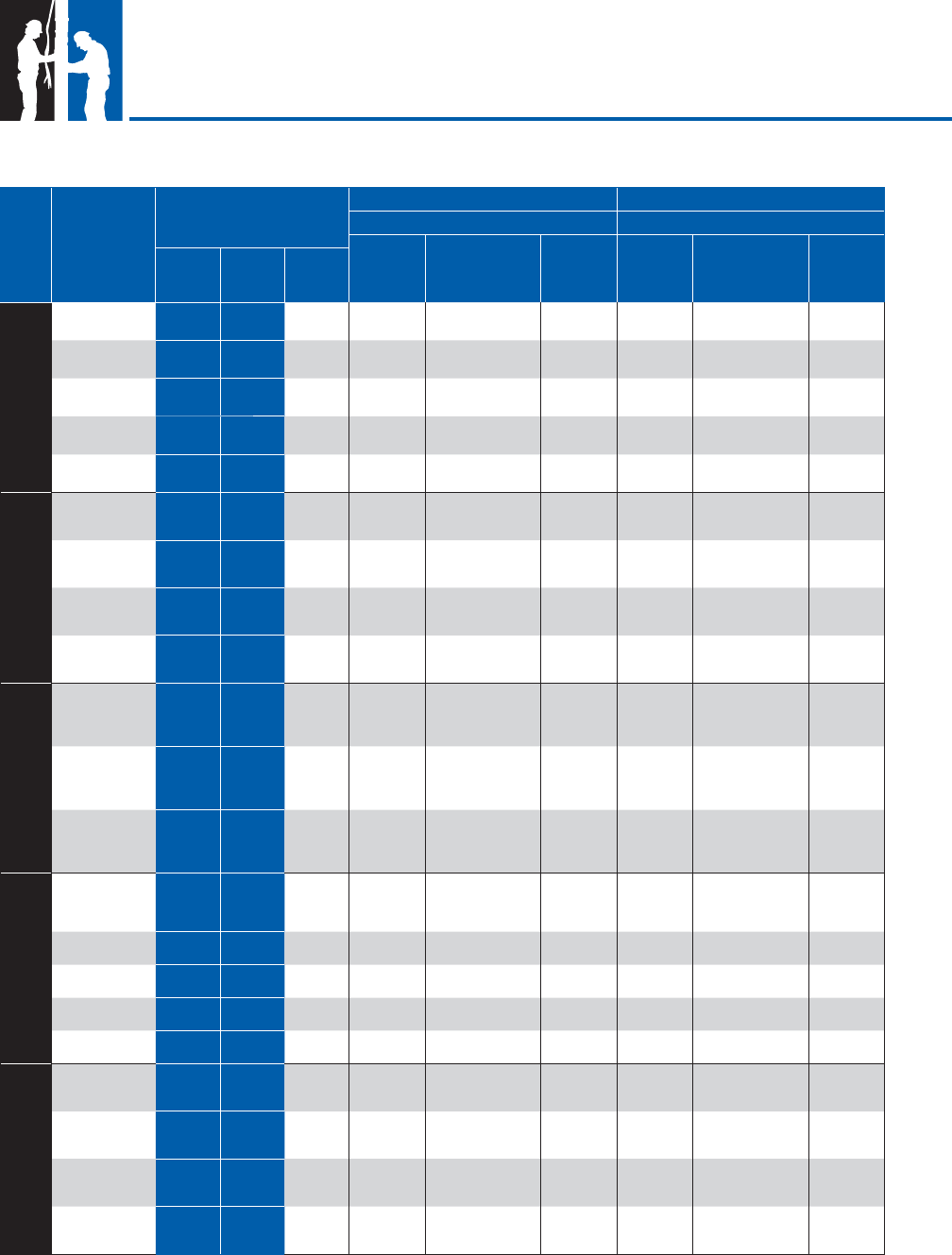
Table 14 Single-Phase Motor Fuse Sizing
TYPE
MOTOR
MODEL
PREFIX
RATING
CIRCUIT BREAKERS OR FUSE AMPS CIRCUIT BREAKERS OR FUSE AMPS
(MAXIMUM PER NEC) (TYPICAL SUBMERSIBLE)
STANDARD
FUSE
DUAL ELEMENT
TIME DELAY
FUSE
CIRCUIT
BREAKER
STANDARD
FUSE
DUAL ELEMENT
TIME DELAY
FUSE
CIRCUIT
BREAKER
HP KW VOLTS
4" 2-WIRE
244504 1/2 0.37 115 35 20 30 30 15 30
244505 1/2 0.37 230 20 10 15 15 8 15
244507 3/4 0.55 230 25 15 20 20 10 20
244508 1 0.75 230 30 20 25 25 11 25
244309 1.5 1.1 230 35 20 30 35 15 30
4" 3-WIRE
214504 1/2 0.37 115 35 20 30 30 15 30
214505 1/2 0.37 230 20 10 15 15 8 15
214507 3/4 0.55 230 25 15 20 20 10 20
214508 1 0.75 230 30 20 25 25 11 25
4" 3-WIRE W/CRC CB
214505 1/2 0.37 230 20 10 15 15 8 15
214507 3/4 0.55 230 25 15 20 20 10 20
214508 1 0.75 230 30 20 25 25 11 25
4" 3-WIRE
214508
1 0.75 230 30 20 25 25 11 25
W/ 1-1.5 CB
224300 1.5 1.1 230 35 20 30 30 15 30
224301 2 1.5 230 30 20 25 30 15 25
224302 3 2.2 230 45 30 40 45 20 40
224303 5 3.7 230 80 45 60 70 30 60
6"
226110 5 3.7 230 80 45 60 70 30 60
226111 7.5 5.5 230 125 70 100 110 50 100
226112 10 7.5 230 150 80 125 150 60 125
226113 15 11 230 200 125 175 200 90 175
14
Application – Single-Phase Motors
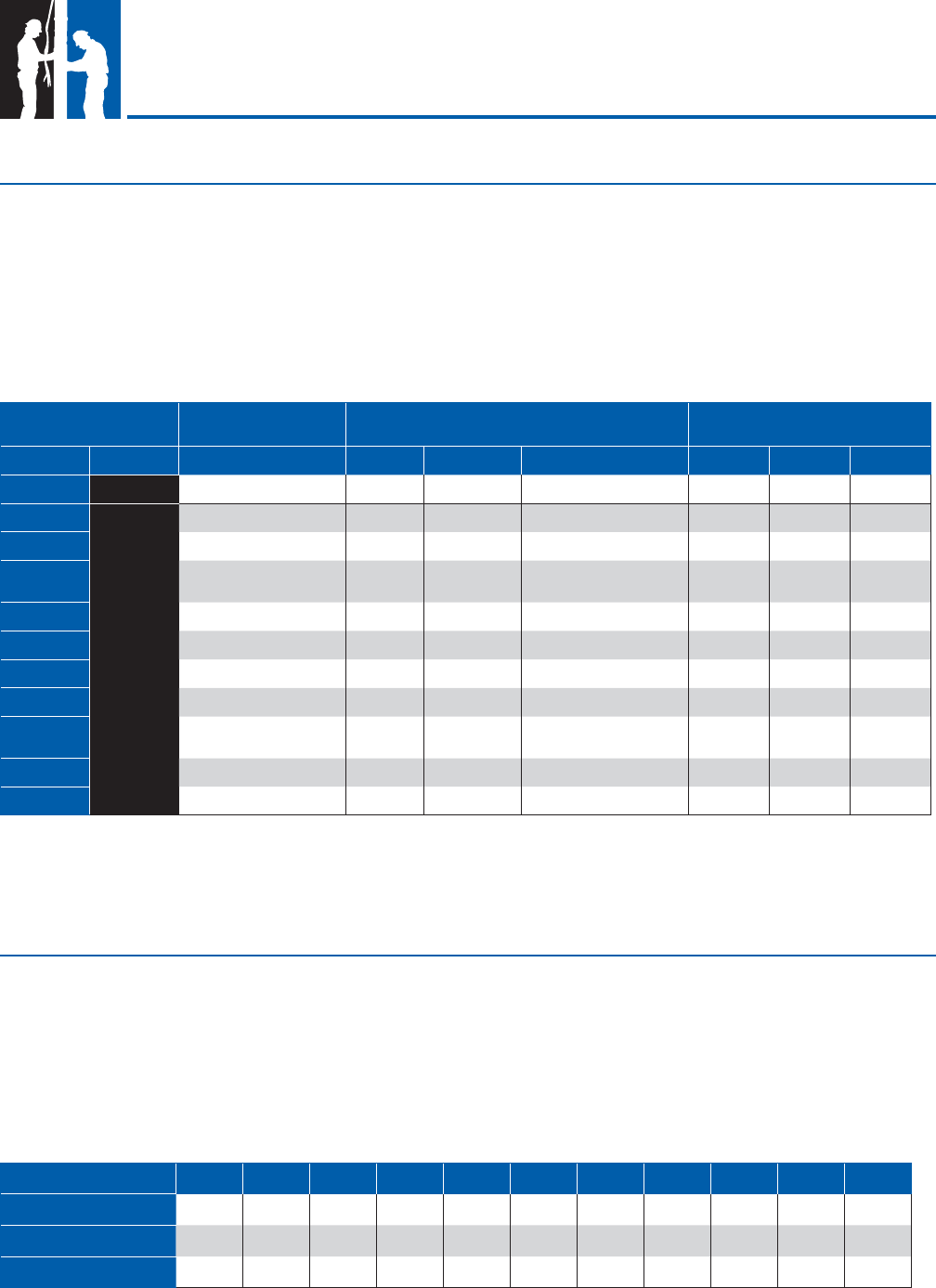
Buck-Boost transformers are power transformers, not control transformers. They may also be used to lower voltage
when the available power supply voltage is too high.
When the available power supply voltage is not within
the proper range, a buck-boost transformer is often
used to adjust voltage to match the motor. The most
common usage on submersible motors is boosting a
208 volt supply to use a standard 230 volt single-phase
submersible motor and control. While tables to give a
wide range of voltage boost or buck are published by
transformer manufacturers, the following table shows
Franklin’s recommendations. The table, based on
boosting the voltage 10%, shows the minimum rated
transformer kVA needed and the common
standard transformer kVA.
(1) Do not add running capacitors to 1/3 through 1 hp control boxes, which use solid state switches or QD relays.
Adding capacitors will cause switch failure. If the control box is converted to use a voltage relay, the specifi ed
running capacitance can be added.
Table 15A Buck-Boost Transformer Sizing
Table 15 Auxiliary Capacitor Sizing
MOTOR RATING NORMAL RUNNING
CAPACITOR(S)
AUXILIARY RUNNING CAPACITORS FOR
NOISE REDUCTION S.F. AMPS WITH RUN CAP
HP VOLTS MFD MFD MIN VOLTS FRANKLIN PART YELLOW BLACK RED
1/2 115 0 60(1) 370 TWO 155327101 8.4 7.0 4.0
1/2
230
0 15(1) 370 ONE 155328101 4.2 3.5 2.0
3/4 0 20(1) 370 ONE 155328103 5.8 5.0 2.5
10 25(1) 370 ONE EA. 155328101
155328102 7.1 5.6 3.4
1.5 10 20 370 ONE 155328103 9.3 7.5 4.4
220 10 370 ONE 155328102 11.2 9.2 3.8
345 NONE 370 17.0 12.6 6.0
580 NONE 370 27.5 19.1 10.8
7.5 45 45 370 ONE EA. 155327101
155328101 37.0 32.0 11.3
10 70 30 370 ONE 155327101 49.0 42.0 13.0
15 135 NONE 75.0 62.5 16.9
MOTOR HP 1/3 1/2 3/4 1 1.5 2 3 5 7.5 10 15
LOAD KVA 1.02 1.36 1.84 2.21 2.65 3.04 3.91 6.33 9.66 11.70 16.60
MINIMUM XFMR KVA 0.11 0.14 0.19 0.22 0.27 0.31 0.40 0.64 0.97 1.20 1.70
STANDARD XFMR KVA 0.25 0.25 0.25 0.25 0.50 0.50 0.50 0.75 1.00 1.50 2.00
Auxiliary Running Capacitors
Buck-Boost Transformers
Added capacitors must be connected across “Red” and
“Black” control box terminals, in parallel with any existing
running capacitors. The additional capacitor(s) should
be mounted in an auxiliary box. The values of additional
running capacitors most likely to reduce noise are given
below. The tabulation gives the max S.F. amps normally
in each lead with the added capacitor.
Although motor amps decrease when auxiliary
run capacitance is added, the load on the motor
does not. If a motor is overloaded with normal
capacitance, it still will be overloaded with auxiliary
run capacitance, even though motor amps may be
within nameplate values.
15
Application – Three-Phase Motors
Continued on page 17
60 °C
MOTOR RATING 60 °C INSULATION - AWG COPPER WIRE SIZE MCM COPPER WIRE SIZE
VOLTSHPKW1412108643210000000000 250 300 350 400 500
200 V
60 Hz
Three-
Phase
3 - Lead
1/2 0.37 710 1140 1800 2840 4420
3/4 0.55 510 810 1280 2030 3160
1 0.75 430 690 1080 1710 2670 4140 5140
1.5 1.1 310 500 790 1260 1960 3050 3780
2 1.5 240 390 610 970 1520 2360 2940 3610 4430 5420
3 2.2 180 290 470 740 1160 1810 2250 2760 3390 4130
5 3.7 110 170 280 440 690 1080 1350 1660 2040 2490 3050 3670 4440 5030
7.5 5.5 0 0 200 310 490 770 960 1180 1450 1770 2170 2600 3150 3560
10 7.5 000
230 370 570 720 880 1090 1330 1640 1970 2390 2720 3100 3480 3800 4420
15 11 000
160 250 390 490 600 740 910 1110 1340 1630 1850 2100 2350 2570 2980
20 15 0000
190 300 380 460 570 700 860 1050 1270 1440 1650 1850 2020 2360
25 18.5 00000
240 300 370 460 570 700 840 1030 1170 1330 1500 1640 1900
30 22 000000
250 310 380 470 580 700 850 970 1110 1250 1360 1590
230 V
60 Hz
Three-
Phase
3 - Lead
1/2 0.37 930 1490 2350 3700 5760 8910
3/4 0.55 670 1080 1700 2580 4190 6490 8060 9860
1 0.75 560 910 1430 2260 3520 5460 6780 8290
1.5 1.1 420 670 1060 1670 2610 4050 5030 6160 7530 9170
2 1.5 320 510 810 1280 2010 3130 3890 4770 5860 7170 8780
3 2.2 240 390 620 990 1540 2400 2980 3660 4480 5470 6690 8020 9680
5 3.7 140 230 370 590 920 1430 1790 2190 2690 3290 4030 4850 5870 6650 7560 8460 9220
7.5 5.5 0160 260 420 650 1020 1270 1560 1920 2340 2870 3440 4160 4710 5340 5970 6500 7510
10 7.5 00
190 310 490 760 950 1170 1440 1760 2160 2610 3160 3590 4100 4600 5020 5840
15 11 000
210 330 520 650 800 980 1200 1470 1780 2150 2440 2780 3110 3400 3940
20 15 0000
250 400 500 610 760 930 1140 1380 1680 1910 2180 2450 2680 3120
25 18.5 00000
320 400 500 610 750 920 1120 1360 1540 1760 1980 2160 2520
30 22 00000
260 330 410 510 620 760 930 1130 1280 1470 1650 1800 2110
380 V
60 Hz
Three-
Phase
3 - Lead
1/2 0.37 2690 4290 6730
3/4 0.55 2000 3190 5010 7860
1 0.75 1620 2580 4060 6390 9980
1.5 1.1 1230 1970 3100 4890 7630
2 1.5 870 1390 2180 3450 5400 8380
3 2.2 680 1090 1710 2690 4200 6500 8020 9830
5 3.7 400 640 1010 1590 2490 3870 4780 5870 7230 8830
7.5 5.5 270 440 690 1090 1710 2640 3260 4000 4930 6010 7290 8780
10 7.5 200 320 510 800 1250 1930 2380 2910 3570 4330 5230 6260 7390 8280 9340
15 11 00
370 590 920 1430 1770 2170 2690 3290 4000 4840 5770 6520 7430 8250 8990
20 15 000
440 700 1090 1350 1670 2060 2530 3090 3760 4500 5110 5840 6510 7120 8190
25 18.5 000
360 570 880 1100 1350 1670 2050 2510 3040 3640 4130 4720 5250 5740 6590
30 22 0000
470 730 910 1120 1380 1700 2080 2520 3020 3430 3920 4360 4770 5490
40 30 00000
530 660 820 1010 1240 1520 1840 2200 2500 2850 3170 3470 3990
50 37 000000
540 660 820 1000 1220 1480 1770 2010 2290 2550 2780 3190
60 45 0000000
560 690 850 1030 1250 1500 1700 1940 2150 2350 2700
75 55 00000000
570 700 860 1050 1270 1440 1660 1850 2030 2350
100 75 000000000
510 630 760 910 1030 1180 1310 1430 1650
125 90 00000000000
620 740 840 950 1060 1160 1330
150 110 000000000000
620 700 790 880 960 1090
175 130 0000000000000
650 750 840 920 1070
200 150 0000000000000 0630 700 760 880
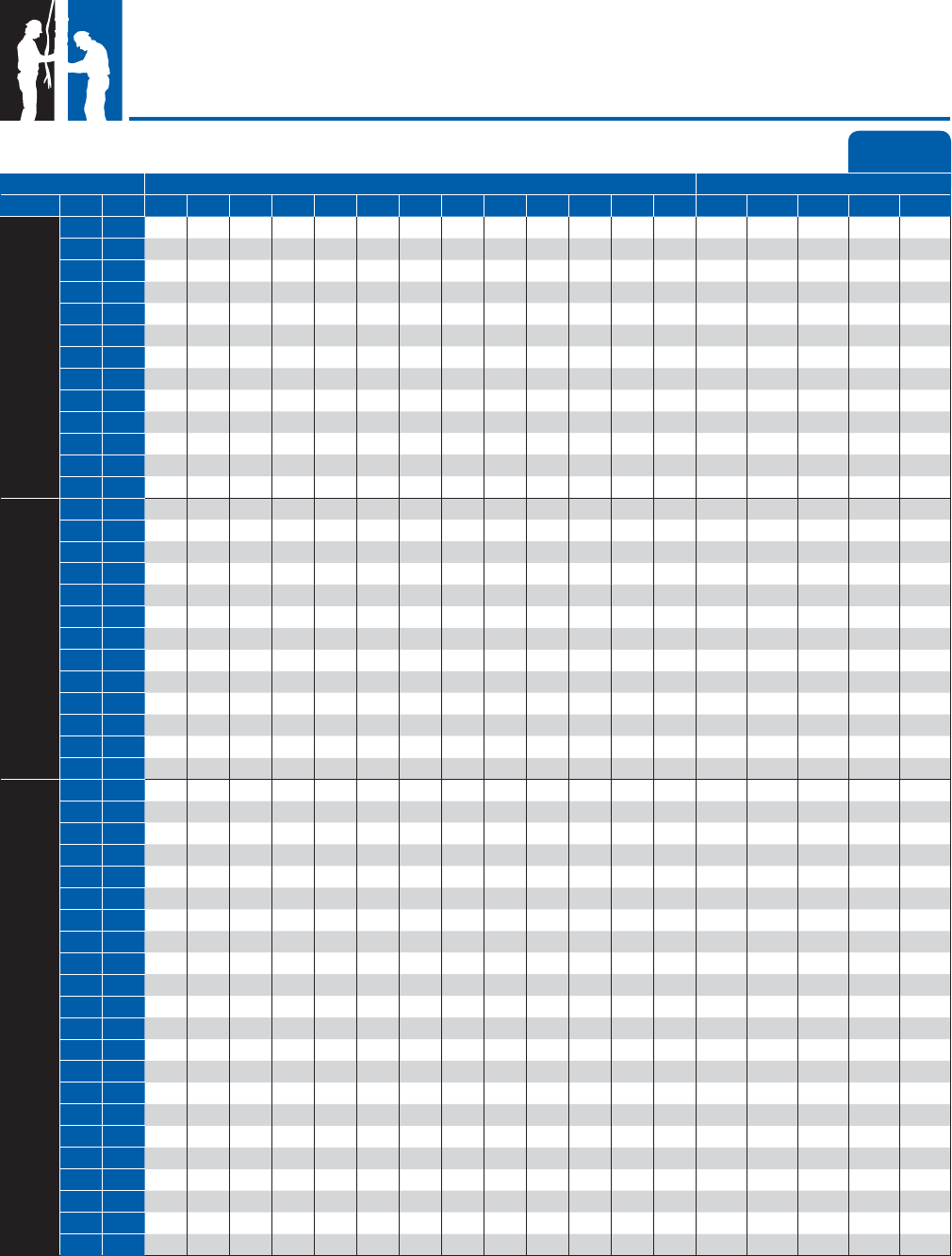
Lengths in BOLD only meet the US National Electrical Code ampacity requirements for individual conductors in free air
or water. Lengths NOT in bold meet NEC ampacity requirements for either individual conductors or jacketed cable. See
page 11 for additional details.
Table 16 Three-Phase 60 °C Cable, 60 Hz (Service Entrance to Motor) Maximum Length in Feet
16
Application – Three-Phase Motors
60 °C
MOTOR RATING 60 °C INSULATION - AWG COPPER WIRE SIZE MCM COPPER WIRE SIZE
VOLTSHPKW1412108643210000000000 250 300 350 400 500
460 V
60 Hz
Three-
Phase
3 - Lead
1/2 0.37 3770 6020 9460
3/4 0.55 2730 4350 6850
1 0.75 2300 3670 5770 9070
1.5 1.1 1700 2710 4270 6730
2 1.5 1300 2070 3270 5150 8050
3 2.2 1000 1600 2520 3970 6200
5 3.7 590 950 1500 2360 3700 5750
7.5 5.5 420 680 1070 1690 2640 4100 5100 6260 7680
10 7.5 310 500 790 1250 1960 3050 3800 4680 5750 7050
15 11 0340 540 850 1340 2090 2600 3200 3930 4810 5900 7110
20 15 00
410 650 1030 1610 2000 2470 3040 3730 4580 5530
25 18.5 000
530 830 1300 1620 1990 2450 3010 3700 4470 5430
30 22 000
430 680 1070 1330 1640 2030 2490 3060 3700 4500 5130 5860
40 30 0000
500 790 980 1210 1490 1830 2250 2710 3290 3730 4250
50 37 00000
640 800 980 1210 1480 1810 2190 2650 3010 3420 3830 4180 4850
60 45 00000
540 670 830 1020 1250 1540 1850 2240 2540 2890 3240 3540 4100
75 55 0000000
680 840 1030 1260 1520 1850 2100 2400 2700 2950 3440
100 75 00000000
620 760 940 1130 1380 1560 1790 2010 2190 2550
125 90 0000000000
740 890 1000 1220 1390 1560 1700 1960
150 110 00000000000
760 920 1050 1190 1340 1460 1690
175 130 000000000000
810 930 1060 1190 1300 1510
200 150 0000000000000
810 920 1030 1130 1310
575 V
60 Hz
Three-
Phase
3 - Lead
1/2 0.37 5900 9410
3/4 0.55 4270 6810
1 0.75 3630 5800 9120
1.5 1.1 2620 4180 6580
2 1.5 2030 3250 5110 8060
3 2.2 1580 2530 3980 6270
5 3.7 920 1480 2330 3680 5750
7.5 5.5 660 1060 1680 2650 4150
10 7.5 490 780 1240 1950 3060 4770 5940
15 11 330 530 850 1340 2090 3260 4060
20 15 0410 650 1030 1610 2520 3140 3860 4760 5830
25 18.5 00
520 830 1300 2030 2530 3110 3840 4710
30 22 00
430 680 1070 1670 2080 2560 3160 3880 4770 5780 7030 8000
40 30 000
500 790 1240 1540 1900 2330 2860 3510 4230 5140 5830
50 37 0000
640 1000 1250 1540 1890 2310 2840 3420 4140 4700 5340 5990 6530 7580
60 45 00000
850 1060 1300 1600 1960 2400 2890 3500 3970 4520 5070 5530 6410
75 55 00000
690 860 1060 1310 1600 1970 2380 2890 3290 3750 5220 4610 5370
100 75 0000000
790 970 1190 1460 1770 2150 2440 2790 3140 3430 3990
125 90 00000000
770 950 1160 1400 1690 1920 2180 2440 2650 3070
150 110 000000000
800 990 1190 1440 1630 1860 2080 2270 2640
175 130 0000000000
870 1050 1270 1450 1650 1860 2030 2360
200 150 00000000000
920 1110 1260 1440 1620 1760 2050
Lengths in BOLD only meet the US National Electrical Code ampacity requirements for individual conductors in free air
or water. Lengths NOT in bold meet NEC ampacity requirements for either individual conductors or jacketed cable. See
11 for additional details.
Table 17 Three-Phase 60 °C Cable (Continued)
17 Continued on page 18
Application – Three-Phase Motors
60 °C
MOTOR RATING 60 °C INSULATION - AWG COPPER WIRE SIZE MCM COPPER WIRE SIZE
VOLTSHPKW1412108643210000000000 250 300 350 400 500
200 V
60 Hz
Three-
Phase
6 - Lead
Y-D
5 3.7 160 250 420 660 1030 1620 2020 2490 3060 3730 4570 5500 6660 7540
7.5 5.5 110 180 300 460 730 1150 1440 1770 2170 2650 3250 3900 4720 5340
10 7.5 80 130 210 340 550 850 1080 1320 1630 1990 2460 2950 3580 4080 4650 5220 5700 6630
15 11 00
140 240 370 580 730 900 1110 1360 1660 2010 2440 2770 3150 3520 3850 4470
20 15 000
170 280 450 570 690 850 1050 1290 1570 1900 2160 2470 2770 3030 3540
25 18.5 000
140 220 360 450 550 690 850 1050 1260 1540 1750 1990 2250 2460 2850
30 22 0000
180 294 370 460 570 700 870 1050 1270 1450 1660 1870 2040 2380
230 V
60 Hz
Three-
Phase
6 - Lead
Y-D
5 3.7 210 340 550 880 1380 2140 2680 3280 4030 4930 6040 7270 8800 9970
7.5 5.5 150 240 390 630 970 1530 1900 2340 2880 3510 4300 5160 6240 7060 8010 8950 9750
10 7.5 110 180 280 460 730 1140 1420 1750 2160 2640 3240 3910 4740 5380 6150 6900 7530 8760
15 11 00
190 310 490 780 970 1200 1470 1800 2200 2670 3220 3660 4170 4660 5100 5910
20 15 00
140 230 370 600 750 910 1140 1390 1710 2070 2520 2860 3270 3670 4020 4680
25 18.5 000
190 300 480 600 750 910 1120 1380 1680 2040 2310 2640 2970 3240 3780
30 22 000
150 240 390 490 610 760 930 1140 1390 1690 1920 2200 2470 2700 3160
380 V
60 Hz
Three-
Phase
6 - Lead
Y-D
5 3.7 600 960 1510 2380 3730 5800 7170 8800
7.5 5.5 400 660 1030 1630 2560 3960 4890 6000 7390 9010
10 7.5 300 480 760 1200 1870 2890 3570 4360 5350 6490 7840 9390
15 11 210 340 550 880 1380 2140 2650 3250 4030 4930 6000 7260 8650 9780
20 15 160 260 410 660 1050 1630 2020 2500 3090 3790 4630 5640 6750 7660 4260 9760
25 18.5 0210 330 540 850 1320 1650 2020 2500 3070 3760 4560 5460 6190 7080 7870 8610 9880
30 22 00
270 430 700 1090 1360 1680 2070 2550 3120 3780 4530 5140 5880 6540 7150 8230
40 30 000
320 510 790 990 1230 1510 1860 2280 2760 3300 3750 4270 4750 5200 5980
50 37 000
250 400 630 810 990 1230 1500 1830 2220 2650 3010 3430 3820 4170 4780
60 45 0000
340 540 660 840 1030 1270 1540 1870 2250 2550 2910 3220 3520 4050
75 55 00000
450 550 690 855 1050 1290 1570 1900 2160 2490 2770 3040 3520
100 75 000000
420 520 640 760 940 1140 1360 1540 1770 1960 2140 2470
125 90 0000000
400 490 600 730 930 1110 1260 1420 1590 1740 1990
150 110 00000000
420 510 620 750 930 1050 1180 1320 1440 1630
175 130 00000000
360 440 540 660 780 970 1120 1260 1380 1600
200 150 0000000000
480 580 690 790 940 1050 1140 1320
460 V
60 Hz
Three-
Phase
6 - Lead
Y-D
5 3.7 880 1420 2250 3540 5550 8620
7.5 5.5 630 1020 1600 2530 3960 6150 7650 9390
10 7.5 460 750 1180 1870 2940 4570 5700 7020 8620
15 11 310 510 810 1270 2010 3130 3900 4800 5890 7210 8850
20 15 230 380 610 970 1540 2410 3000 3700 4560 5590 6870 8290
25 18.5 190 310 490 790 1240 1950 2430 2980 3670 4510 5550 6700 8140
30 22 0250 410 640 1020 1600 1990 2460 3040 3730 4590 5550 6750 7690 8790
40 30 00
300 480 750 1180 1470 1810 2230 2740 3370 4060 4930 5590 6370
50 37 000
370 590 960 1200 1470 1810 2220 2710 3280 3970 4510 5130 5740 6270 7270
60 45 000
320 500 810 1000 1240 1530 1870 2310 2770 3360 3810 4330 4860 5310 6150
75 55 0000
420 660 810 1020 1260 1540 1890 2280 2770 3150 3600 4050 4420 5160
100 75 00000
500 610 760 930 1140 1410 1690 2070 2340 2680 3010 3280 3820
125 90 000000
470 590 730 880 1110 1330 1500 1830 2080 2340 2550 2940
150 110 0000000
510 630 770 950 1140 1380 1570 1790 2000 2180 2530
175 130 00000000
550 680 830 1000 1220 1390 1580 1780 1950 2270
200 150 000000000
590 730 880 1070 1210 1380 1550 1690 1970
575 V
60 Hz
Three-
Phase
6 - Lead
Y-D
5 3.7 1380 2220 3490 5520 8620
7.5 5.5 990 1590 2520 3970 6220
10 7.5 730 1170 1860 2920 4590 7150 8910
15 11 490 790 1270 2010 3130 4890 6090
20 15 370 610 970 1540 2410 3780 4710 5790 7140 8740
25 18.5 300 490 780 1240 1950 3040 3790 4660 5760 7060
30 22 240 400 645 1020 1600 2500 3120 3840 4740 5820 7150 8670
40 30 0300 480 750 1180 1860 2310 2850 3490 4290 5260 6340 7710 8740
50 37 00
380 590 960 1500 1870 2310 2830 3460 4260 5130 6210 7050 8010 8980 9790
60 45 000
500 790 1270 1590 1950 2400 2940 3600 4330 5250 5950 6780 7600 8290 9610
75 55 000
420 660 1030 1290 1590 1960 2400 2950 3570 4330 4930 5620 6330 6910 8050
100 75 0000
400 780 960 1180 1450 1780 2190 2650 3220 3660 4180 4710 5140 5980
125 90 00000
600 740 920 1150 1420 1740 2100 2530 2880 3270 3660 3970 4600
150 110 000000
650 800 990 1210 1480 1780 2160 2450 2790 3120 3410 3950
175 130 0000000
700 860 1060 1300 1570 1910 2170 2480 2780 3040 3540
200 150 00000000
760 930 1140 1370 1670 1890 2160 2420 2640 3070
Lengths in BOLD only meet the US National Electrical Code ampacity requirements for individual conductors in free air
or water. Lengths NOT in bold meet NEC ampacity requirements for either individual conductors or jacketed cable. See
page 11 for additional details.
Table 18 Three-Phase 60 °C Cable (Continued)
18
Application – Three-Phase Motors
Continued on page 20
75 °C
MOTOR RATING 75 °C INSULATION - AWG COPPER WIRE SIZE MCM COPPER WIRE SIZE
VOLTSHPKW1412108643210000000000 250 300 350 400 500
200 V
60 Hz
Three-
Phase
3 - Lead
1/2 0.37 710 1140 1800 2840 4420
3/4 0.55 510 810 1280 2030 3160
1 0.75 430 690 1080 1710 2670 4140 5140
1.5 1.1 310 500 790 1260 1960 3050 3780
2 1.5 240 390 610 970 1520 2360 2940 3610 4430 5420
3 2.2 180 290 470 740 1160 1810 2250 2760 3390 4130
5 3.7 110 170 280 440 690 1080 1350 1660 2040 2490 3050 3670 4440 5030
7.5 5.5 0 0 200 310 490 770 960 1180 1450 1770 2170 2600 3150 3560
10 7.5 00
150 230 370 570 720 880 1090 1330 1640 1970 2390 2720 3100 3480 3800 4420
15 11 000
160 250 390 490 600 740 910 1110 1340 1630 1850 2100 2350 2570 2980
20 15 0000
190 300 380 460 570 700 860 1050 1270 1440 1650 1850 2020 2360
25 18.5 00000
240 300 370 460 570 700 840 1030 1170 1330 1500 1640 1900
30 22 00000
200 250 310 380 470 580 700 850 970 1110 1250 1360 1590
230 V
60 Hz
Three-
Phase
3 - Lead
1/2 0.37 930 1490 2350 3700 5760 8910
3/4 0.55 670 1080 1700 2580 4190 6490 8060 9860
1 0.75 560 910 1430 2260 3520 5460 6780 8290
1.5 1.1 420 670 1060 1670 2610 4050 5030 6160 7530 9170
2 1.5 320 510 810 1280 2010 3130 3890 4770 5860 7170 8780
3 2.2 240 390 620 990 1540 2400 2980 3660 4480 5470 6690 8020 9680
5 3.7 140 230 370 590 920 1430 1790 2190 2690 3290 4030 4850 5870 6650 7560 8460 9220
7.5 5.5 0160 260 420 650 1020 1270 1560 1920 2340 2870 3440 4160 4710 5340 5970 6500 7510
10 7.5 00
190 310 490 760 950 1170 1440 1760 2160 2610 3160 3590 4100 4600 5020 5840
15 11 000
210 330 520 650 800 980 1200 1470 1780 2150 2440 2780 3110 3400 3940
20 15 000
160 250 400 500 610 760 930 1140 1380 1680 1910 2180 2450 2680 3120
25 18.5 0000
200 320 400 500 610 750 920 1120 1360 1540 1760 1980 2160 2520
30 22 00000
260 330 410 510 620 760 930 1130 1280 1470 1650 1800 2110
380 V
60 Hz
Three-
Phase
3 - Lead
1/2 0.37 2690 4290 6730
3/4 0.55 2000 3190 5010 7860
1 0.75 1620 2580 4060 6390 9980
1.5 1.1 1230 1970 3100 4890 7630
2 1.5 870 1390 2180 3450 5400 8380
3 2.2 680 1090 1710 2690 4200 6500 8020 9830
5 3.7 400 640 1010 1590 2490 3870 4780 5870 7230 8830
7.5 5.5 270 440 690 1090 1710 2640 3260 4000 4930 6010 7290 8780
10 7.5 200 320 510 800 1250 1930 2380 2910 3570 4330 5230 6260 7390 8280 9340
15 11 0 0 370 590 920 1430 1770 2170 2690 3290 4000 4840 5770 6520 7430 8250 8990
20 15 00
280 440 700 1090 1350 1670 2060 2530 3090 3760 4500 5110 2840 6510 7120 8190
25 18.5 000
360 570 880 1100 1350 1670 2050 2510 3040 3640 4130 4720 5250 5740 6590
30 22 000
290 470 730 910 1120 1380 1700 2080 2520 3020 3430 3920 4360 4770 5490
40 30 00000
530 660 820 1010 1240 1520 1840 2200 2500 2850 3170 3470 3990
50 37 00000
440 540 660 820 1000 1220 1480 1770 2010 2290 2550 2780 3190
60 45 00000
370 460 560 690 850 1030 1250 1500 1700 1940 2150 2350 2700
75 55 0000000
460 570 700 860 1050 1270 1440 1660 1850 2030 2350
100 75 00000000
420 510 630 760 910 1030 1180 1310 1430 1650
125 90 0000000000
510 620 740 840 950 1060 1160 1330
150 110 00000000000
520 620 700 790 880 960 1090
175 130 000000000000
560 650 750 840 920 1070
200 150 0000000000000
550 630 700 760 880
Lengths in BOLD only meet the US National Electrical Code ampacity requirements for individual conductors in free air
or water. Lengths NOT in bold meet NEC ampacity requirements for either individual conductors or jacketed cable. See
page 11 for additional details.
Table 19 Three-Phase 75 °C Cable, 60 Hz (Service Entrance to Motor) Maximum Length in Feet
19
Application – Three-Phase Motors
75 °C
MOTOR RATING 75 °C INSULATION - AWG COPPER WIRE SIZE MCM COPPER WIRE SIZE
VOLTSHPKW1412108643210000000000 250 300 350 400 500
460 V
60 Hz
Three-
Phase
3 - Lead
1/2 0.37 3770 6020 9460
3/4 0.55 2730 4350 6850
1 0.75 2300 3670 5770 9070
1.5 1.1 1700 2710 4270 6730
2 1.5 1300 2070 3270 5150 8050
3 2.2 1000 1600 2520 3970 6200
5 3.7 590 950 1500 2360 3700 5750
7.5 5.5 420 680 1070 1690 2640 4100 5100 6260 7680
10 7.5 310 500 790 1250 1960 3050 3800 4680 5750 7050
15 11 0340 540 850 1340 2090 2600 3200 3930 4810 5900 7110
20 15 0 0 410 650 1030 1610 2000 2470 3040 3730 4580 5530
25 18.5 00
330 530 830 1300 1620 1990 2450 3010 3700 4470 5430
30 22 00
270 430 680 1070 1330 1640 2030 2490 3060 3700 4500 5130 5860
40 30 000
320 500 790 980 1210 1490 1830 2250 2710 3290 3730 4250
50 37 0000
410 640 800 980 1210 1480 1810 2190 2650 3010 3420 3830 4180 4850
60 45 00000
540 670 830 1020 1250 1540 1850 2240 2540 2890 3240 3540 4100
75 55 00000
440 550 680 840 1030 1260 1520 1850 2100 2400 2700 2950 3440
100 75 0000000
500 620 760 940 1130 1380 1560 1790 2010 2190 2550
125 90 000000000
600 740 890 1000 1220 1390 1560 1700 1960
150 110 0000000000
630 760 920 1050 1190 1340 1460 1690
175 130 00000000000
670 810 930 1060 1190 1300 1510
200 150 00000000000
590 710 810 920 1030 1130 1310
575 V
60 Hz
Three-
Phase
3 - Lead
1/2 0.37 5900 9410
3/4 0.55 4270 6810
1 0.75 3630 5800 9120
1.5 1.1 2620 4180 6580
2 1.5 2030 3250 5110 8060
3 2.2 1580 2530 3980 6270
5 3.7 920 1480 2330 3680 5750
7.5 5.5 660 1060 1680 2650 4150
10 7.5 490 780 1240 1950 3060 4770 5940
15 11 330 530 850 1340 2090 3260 4060
20 15 0410 650 1030 1610 2520 3140 3860 4760 5830
25 18.5 0 0 520 830 1300 2030 2530 3110 3840 4710
30 22 00
430 680 1070 1670 2080 2560 3160 3880 4770 5780 7030 8000
40 30 000
500 790 1240 1540 1900 2330 2860 3510 4230 5140 5830
50 37 000
410 640 1000 1250 1540 1890 2310 2840 3420 4140 4700 5340 5990 6530 7580
60 45 0000
540 850 1060 1300 1600 1960 2400 2890 3500 3970 4520 5070 5530 6410
75 55 00000
690 860 1060 1310 1600 1970 2380 2890 3290 3750 5220 4610 5370
100 75 000000
640 790 970 1190 1460 1770 2150 2440 2790 3140 3430 3990
125 90 0000000
630 770 950 1160 1400 1690 1920 2180 2440 2650 3070
150 110 00000000
660 800 990 1190 1440 1630 1860 2080 2270 2640
175 130 000000000
700 870 1050 1270 1450 1650 1860 2030 2360
200 150 0000000000
760 920 1110 1260 1440 1620 1760 2050
Lengths in BOLD only meet the US National Electrical Code ampacity requirements for individual conductors in free air
or water. Lengths NOT in bold meet NEC ampacity requirements for either individual conductors or jacketed cable. See
page 11 for additional details.
Table 20 Three-Phase 75 °C Cable (Continued)
20
Continued on page 21
Application – Three-Phase Motors
75 °C
MOTOR RATING 75 °C INSULATION - AWG COPPER WIRE SIZE MCM COPPER WIRE SIZE
VOLTSHPKW1412108643210000000000 250 300 350 400 500
200 V
60 Hz
Three-
Phase
6 - Lead
Y-D
5 3.7 160 250 420 660 1030 1620 2020 2490 3060 3730 4570 5500 6660 7540
7.5 5.5 110 180 300 460 730 1150 1440 1770 2170 2650 3250 3900 4720 5340
10 7.5 80 130 210 340 550 850 1080 1320 1630 1990 2460 2950 3580 4080 4650 5220 5700 6630
15 11 0 0 140 240 370 580 730 900 1110 1360 1660 2010 2440 2770 3150 3520 3850 4470
20 15 00
120 170 280 450 570 690 850 1050 1290 1570 1900 2160 2470 2770 3030 3540
25 18.5 000
140 220 360 450 550 690 850 1050 1260 1540 1750 1990 2250 2460 2850
30 22 000
120 180 294 370 460 570 700 870 1050 1270 1450 1660 1870 2040 2380
230 V
60 Hz
Three-
Phase
6 - Lead
Y-D
5 3.7 210 340 550 880 1380 2140 2680 3280 4030 4930 6040 7270 8800 9970
7.5 5.5 150 240 390 630 970 1530 1900 2340 2880 3510 4300 5160 6240 7060 8010 8950 9750
10 7.5 110 180 280 460 730 1140 1420 1750 2160 2640 3240 3910 4740 5380 6150 6900 7530 8760
15 11 0130 190 310 490 780 970 1200 1470 1800 2200 2670 3220 3660 4170 4660 5100 5910
20 15 00
140 230 370 600 750 910 1140 1390 1710 2070 2520 2860 3270 3670 4020 4680
25 18.5 00
120 190 300 480 600 750 910 1120 1380 1680 2040 2310 2640 2970 3240 3780
30 22 000
150 240 390 490 610 760 930 1140 1390 1690 1920 2200 2470 2700 3160
380 V
60 Hz
Three-
Phase
6 - Lead
Y-D
5 3.7 600 960 1510 2380 3730 5800 7170 8800
7.5 5.5 400 660 1030 1630 2560 3960 4890 6000 7390 9010
10 7.5 300 480 760 1200 1870 2890 3570 4360 5350 6490 7840 9390
15 11 210 340 550 880 1380 2140 2650 3250 4030 4930 6000 7260 8650 9780
20 15 160 260 410 660 1050 1630 2020 2500 3090 3790 4630 5640 6750 7660 4260 9760
25 18.5 0210 330 540 850 1320 1650 2020 2500 3070 3760 4560 5460 6190 7080 7870 8610 9880
30 22 00
270 430 700 1090 1360 1680 2070 2550 3120 3780 4530 5140 5880 6540 7150 8230
40 30 00
210 320 510 790 990 1230 1510 1860 2280 2760 3300 3750 4270 4750 5200 5980
50 37 000
250 400 630 810 990 1230 1500 1830 2220 2650 3010 3430 3820 4170 4780
60 45 0000
340 540 660 840 1030 1270 1540 1870 2250 2550 2910 3220 3520 4050
75 55 0000
290 450 550 690 855 1050 1290 1570 1900 2160 2490 2770 3040 3520
100 75 00000
340 420 520 640 760 940 1140 1360 1540 1770 1960 2140 2470
125 90 000000
340 400 490 600 730 930 1110 1260 1420 1590 1740 1990
150 110 0000000
350 420 510 620 750 930 1050 1180 1320 1440 1630
175 130 00000000
360 440 540 660 780 970 1120 1260 1380 1600
200 150 000000000
410 480 580 690 790 940 1050 1140 1320
460 V
60 Hz
Three-
Phase
6 - Lead
Y-D
5 3.7 880 1420 2250 3540 5550 8620
7.5 5.5 630 1020 1600 2530 3960 6150 7650 9390
10 7.5 460 750 1180 1870 2940 4570 5700 7020 8620
15 11 310 510 810 1270 2010 3130 3900 4800 5890 7210 8850
20 15 230 380 610 970 1540 2410 3000 3700 4560 5590 6870 8290
25 18.5 190 310 490 790 1240 1950 2430 2980 3670 4510 5550 6700 8140
30 22 0250 410 640 1020 1600 1990 2460 3040 3730 4590 5550 6750 7690 8790
40 30 00
300 480 750 1180 1470 1810 2230 2740 3370 4060 4930 5590 6370
50 37 00
250 370 590 960 1200 1470 1810 2220 2710 3280 3970 4510 5130 5740 6270 7270
60 45 000
320 500 810 1000 1240 1530 1870 2310 2770 3360 3810 4330 4860 5310 6150
75 55 0000
420 660 810 1020 1260 1540 1890 2280 2770 3150 3600 4050 4420 5160
100 75 0000
310 500 610 760 930 1140 1410 1690 2070 2340 2680 3010 3280 3820
125 90 00000
390 470 590 730 880 1110 1330 1500 1830 2080 2340 2550 2940
150 110 000000
420 510 630 770 950 1140 1380 1570 1790 2000 2180 2530
175 130 0000000
450 550 680 830 1000 1220 1390 1580 1780 1950 2270
200 150 00000000
480 590 730 880 1070 1210 1380 1550 1690 1970
575 V
60 Hz
Three-
Phase
6 - Lead
Y-D
5 3.7 1380 2220 3490 5520 8620
7.5 5.5 990 1590 2520 3970 6220
10 7.5 730 1170 1860 2920 4590 7150 8910
15 11 490 790 1270 2010 3130 4890 6090
20 15 370 610 970 1540 2410 3780 4710 5790 7140 8740
25 18.5 300 490 780 1240 1950 3040 3790 4660 5760 7060
30 22 240 400 645 1020 1600 2500 3120 3840 4740 5820 7150 8670
40 30 0300 480 750 1180 1860 2310 2850 3490 4290 5260 6340 7710 8740
50 37 00
380 590 960 1500 1870 2310 2830 3460 4260 5130 6210 7050 8010 8980 9790
60 45 00
330 500 790 1270 1590 1950 2400 2940 3600 4330 5250 5950 6780 7600 8290 9610
75 55 000
420 660 1030 1290 1590 1960 2400 2950 3570 4330 4930 5620 6330 6910 8050
100 75 0000
400 780 960 1180 1450 1780 2190 2650 3220 3660 4180 4710 5140 5980
125 90 00000
600 740 920 1150 1420 1740 2100 2530 2880 3270 3660 3970 4600
150 110 00000
520 650 800 990 1210 1480 1780 2160 2450 2790 3120 3410 3950
175 130 000000
570 700 860 1060 1300 1570 1910 2170 2480 2780 3040 3540
200 150 000000
500 610 760 930 1140 1370 1670 1890 2160 2420 2640 3070
Lengths in BOLD only meet the US National Electrical Code ampacity requirements for individual conductors in free air
or water. Lengths NOT in bold meet NEC ampacity requirements for either individual conductors or jacketed cable. See
page 11 for additional details.
Table 21 Three-Phase 75 °C Cable (Continued)
21
Application – Three-Phase Motors
TYPE
MOTOR
MODEL
PREFIX
RATING FULL LOAD MAXIMUM
(S.F. LOAD) LINE TO LINE
RESISTANCE
OHMS
EFFICIENCY % LOCKED
ROTOR
AMPS
KVA
CODE
HP KW VOLTS HZ S.F. AMPS WATTS AMPS WATTS S.F. F.L.
4"
234501 1/2 0.37 200 60 1.6 2.8 585 3.4 860 6.6-8.4 70 64 17.5 N
234511 1/2 0.37 230 60 1.6 2.4 585 2.9 860 9.5-10.9 70 64 15.2 N
234541 1/2 0.37 380 60 1.6 1.4 585 2.1 860 23.2-28.6 70 64 9.2 N
234521 1/2 0.37 460 60 1.6 1.2 585 1.5 860 38.4-44.1 70 64 7.6 N
234502 3/4 0.55 200 60 1.5 3.6 810 4.4 1150 4.6-5.9 73 69 23.1 M
234512 3/4 0.55 230 60 1.5 3.1 810 3.8 1150 6.8-7.8 73 69 20.1 M
234542 3/4 0.55 380 60 1.5 1.9 810 2.5 1150 16.6-20.3 73 69 12.2 M
234522 3/4 0.55 460 60 1.5 1.6 810 1.9 1150 27.2-30.9 73 69 10.7 M
234503 1 0.75 200 60 1.4 4.5 1070 5.4 1440 3.8-4.5 72 70 30.9 M
234513 1 0.75 230 60 1.4 3.9 1070 4.7 1440 4.9-5.6 72 70 26.9 M
234543 1 0.75 380 60 1.4 2.3 1070 2.8 1440 12.2-14.9 72 70 16.3 M
234523 1 0.75 460 60 1.4 2 1070 2.4 1440 19.9-23.0 72 70 13.5 M
234504 1.5 1.1 200 60 1.3 5.8 1460 6.8 1890 2.5-3.0 76 76 38.2 K
234514 1.5 1.1 230 60 1.3 5 1460 5.9 1890 3.2-4.0 76 76 33.2 K
234544 1.5 1.1 380 60 1.3 3 1460 3.6 1890 8.5-10.4 76 76 20.1 K
234524 1.5 1.1 460 60 1.3 2.5 1460 3.1 1890 13.0-16.0 76 76 16.6 K
234534 1.5 1.1 575 60 1.3 2 1460 2.4 1890 20.3-25.0 76 76 13.3 K
234305 2 1.5 200 60 1.25 7.7 2150 9.3 2700 1.8-2.4 69 69 53.6 L
234315 2 1.5 230 60 1.25 6.7 2150 8.1 2700 2.3-3.0 69 69 46.6 L
234345 2 1.5 380 60 1.25 4.1 2150 4.9 2700 6.6-8.2 69 69 28.2 L
234325 2 1.5 460 60 1.25 3.4 2150 4.1 2700 9.2-12.0 69 69 23.3 L
234335 2 1.5 575 60 1.25 2.7 2150 3.2 2700 14.6-18.7 69 69 18.6 L
234306 3 2.2 200 60 1.15 10.9 2980 12.5 3420 1.3-1.7 75 75 71.2 K
234316 3 2.2 230 60 1.15 9.5 2980 10.9 3420 1.8-2.2 75 75 61.9 K
234346 3 2.2 380 60 1.15 5.8 2980 6.6 3420 4.7-6.0 75 75 37.5 K
234326 3 2.2 460 60 1.15 4.8 2980 5.5 3420 7.2-8.8 75 75 31 K
234336 3 2.2 575 60 1.15 3.8 2980 4.4 3420 11.4-13.9 75 75 24.8 K
234307 5 3.7 200 60 1.15 18.3 5050 20.5 5810 .74-.91 74 74 122 K
234317 5 3.7 230 60 1.15 15.9 5050 17.8 5810 1.0-1.2 74 74 106 K
234347 5 3.7 380 60 1.15 9.6 5050 10.8 5810 2.9-3.6 74 74 64.4 K
234327 5 3.7 460 60 1.15 8 5050 8.9 5810 4.0-4.9 74 74 53.2 K
234337 5 3.7 575 60 1.15 6.4 5050 7.1 5810 6.4-7.8 74 74 42.6 K
234308 7.5 5.5 200 60 1.15 26.5 7360 30.5 8450 .46-.57 76 76 188 K
234318 7.5 5.5 230 60 1.15 23 7360 26.4 8450 .61-.75 76 76 164 K
234348 7.5 5.5 380 60 1.15 13.9 7360 16 8450 1.6-2.0 76 76 99.1 K
234328 7.5 5.5 460 60 1.15 11.5 7360 13.2 8450 2.5-3.1 76 76 81.9 K
234338 7.5 5.5 575 60 1.15 9.2 7360 10.6 8450 4.0-5.0 76 76 65.5 K
234549 10 7.5 380 60 1.15 19.3 10000 21 11400 1.2-1.6 75 75 140 L
234595 10 7.5 460 60 1.15 15.9 10000 17.3 11400 1.8-2.3 75 75 116 L
234598 10 7.5 575 60 1.15 12.5 10000 13.6 11400 2.8-3.5 75 75 92.8 L
Table 22 Three-Phase Motor Specifi cations (60 Hz)
22
Application – Three-Phase Motors
Table 23 Three-Phase Motor Fuse Sizing
TYPE
MOTOR
MODEL
PREFIX
RATING
CIRCUIT BREAKERS OR FUSE AMPS CIRCUIT BREAKERS OR FUSE AMPS
(MAXIMUM PER NEC) (TYPICAL SUBMERSIBLE)
STANDARD
FUSE
DUAL ELEMENT TIME
DELAY FUSE
CIRCUIT
BREAKER
STANDARD
FUSE
DUAL ELEMENT TIME
DELAY FUSE
CIRCUIT
BREAKER
HP KW VOLTS
4"
234501 1/2 0.37 200 10 5 8 10 4 15
234511 1/2 0.37 230 8 4.5 6 8 4 15
234541 1/2 0.37 380 5 2.5 4 5 2 15
234521 1/2 0.37 460 4 2.25 3 4 2 15
234502 3/4 0.55 2001571012515
234512 3/4 0.55 230 10 5.6 8 10 5 15
234542 3/4 0.55 380 6 3.5 5 6 3 15
234522 3/4 0.55 460 5 2.8 4 5 3 15
234503 1 0.75 2001581515615
234513 1 0.75 2301571012615
234543 1 0.75 380 8 4.5 8 8 4 15
234523 1 0.75 460 6 3.5 5 6 3 15
234504 1.5 1.1 200 20 12 15 20 8 15
234514 1.5 1.1 2301591515815
234544 1.5 1.1 380 10 5.6 8 10 4 15
234524 1.5 1.1 460 8 4.5 8 8 4 15
234534 1.5 1.1 575 6 3.5 5 6 3 15
234305 2 1.5 200 25 15 20 25 11 20
234315 2 1.5 230 25 12 20 25 10 20
234345 2 1.5 3801581515615
234325 2 1.5 4601561011515
234335 2 1.5 575 10 5 8 10 4 15
234306 3 2.2 200 35 20 30 35 15 30
234316 3 2.2 230 30 17.5 25 30 12 25
234346 3 2.2 380 20 12 15 20 8 15
234326 3 2.2 4601591515615
234336 3 2.2 5751571011515
234307 5 3.7 200 60 35 50 60 25 50
234317 5 3.7 230 50 30 40 45 20 40
234347 5 3.7 380 30 17.5 25 30 12 25
234327 5 3.7 460 25 15 20 25 10 20
234337 5 3.7 575 20 12 20 20 8 20
234308 7.5 5.5 200 90 50 70 80 35 70
234318 7.5 5.5 230 80 45 60 70 30 60
234348 7.5 5.5 380 45 25 40 40 20 40
234328 7.5 5.5 460 40 25 30 35 15 30
234338 7.5 5.5 575 30 17.5 25 30 12 25
234349 10 7.5 380 70 40 60 60 25 60
234329 10 7.5 460 60 30 45 50 25 45
234339 10 7.5 575 45 25 35 40 20 35
234549 10 7.5 380 70 35 60 60 25 60
234595 10 7.5 460 60 30 45 50 25 45
234598 10 7.5 575 45 25 35 40 20 35
23
Application – Three-Phase Motors
Model numbers above are for three-lead motors. Six-lead motors with different model numbers have the same running
performance, but when wye connected for starting have locked rotor amps 33% of the values shown. Six-lead individual
phase resistance = table X 1.5.
Table 24 Three-Phase Motor Specifi cations (60 Hz)
TYPE
MOTOR
MODEL
PREFIX
RATING FULL LOAD MAXIMUM
(S.F. LOAD) LINE TO LINE
RESISTANCE
OHMS
EFFICIENCY % LOCKED
ROTOR
AMPS
KVA
CODE
HP KW VOLTS HZ S.F. AMPS WATTS AMPS WATTS S.F. F.L.
6"
236650 5 3.7 200 60 1.15 17.5 4700 20.0 5400 .77-.93 79 79 99 H
236600 5 3.7 230 60 1.15 15 4700 17.6 5400 1.0-1.2 79 79 86 H
236660 5 3.7 380 60 1.15 9.1 4700 10.7 5400 2.6-3.2 79 79 52 H
236610 5 3.7 460 60 1.15 7.5 4700 8.8 5400 3.9-4.8 79 79 43 H
236620 5 3.7 575 60 1.15 6 4700 7.1 5400 6.3-7.7 79 79 34 H
236651 7.5 5.5 200 60 1.15 25.1 7000 28.3 8000 .43-.53 80 80 150 H
236601 7.5 5.5 230 60 1.15 21.8 7000 24.6 8000 .64-.78 80 80 130 H
236661 7.5 5.5 380 60 1.15 13.4 7000 15 8000 1.6-2.1 80 80 79 H
236611 7.5 5.5 460 60 1.15 10.9 7000 12.3 8000 2.4-2.9 80 80 65 H
236621 7.5 5.5 575 60 1.15 8.7 7000 9.8 8000 3.7-4.6 80 80 52 H
236652 10 7.5 200 60 1.15 32.7 9400 37 10800 .37-.45 79 79 198 H
236602 10 7.5 230 60 1.15 28.4 9400 32.2 10800 .47-.57 79 79 172 H
236662 10 7.5 380 60 1.15 17.6 9400 19.6 10800 1.2-1.5 79 79 104 H
236612 10 7.5 460 60 1.15 14.2 9400 16.1 10800 1.9-2.4 79 79 86 H
236622 10 7.5 575 60 1.15 11.4 9400 12.9 10800 3.0-3.7 79 79 69 H
236653 15 11 200 60 1.15 47.8 13700 54.4 15800 .24-.29 81 81 306 H
236603 15 11 230 60 1.15 41.6 13700 47.4 15800 .28-.35 81 81 266 H
236663 15 11 380 60 1.15 25.8 13700 28.9 15800 .77-.95 81 81 161 H
236613 15 11 460 60 1.15 20.8 13700 23.7 15800 1.1-1.4 81 81 133 H
236623 15 11 575 60 1.15 16.6 13700 19 15800 1.8-2.3 81 81 106 H
236654 20 15 200 60 1.15 61.9 18100 69.7 20900 .16-.20 82 82 416 J
236604 20 15 230 60 1.15 53.8 18100 60.6 20900 .22-.26 82 82 362 J
236664 20 15 380 60 1.15 33 18100 37.3 20900 .55-.68 82 82 219 J
236614 20 15 460 60 1.15 26.9 18100 30.3 20900 .8-1.0 82 82 181 J
236624 20 15 575 60 1.15 21.5 18100 24.2 20900 1.3-1.6 82 82 145 J
236655 25 18.5 200 60 1.15 77.1 22500 86.3 25700 .12-.15 83 83 552 J
236605 25 18.5 230 60 1.15 67 22500 75 25700 .15-.19 83 83 480 J
236665 25 18.5 380 60 1.15 41 22500 46 25700 .46-.56 83 83 291 J
236615 25 18.5 460 60 1.15 33.5 22500 37.5 25700 .63-.77 83 83 240 J
236625 25 18.5 575 60 1.15 26.8 22500 30 25700 1.0-1.3 83 83 192 J
236656 30 22 200 60 1.15 90.9 26900 104 31100 .09-.11 83 83 653 J
236606 30 22 230 60 1.15 79 26900 90.4 31100 .14-.17 83 83 568 J
236666 30 22 380 60 1.15 48.8 26900 55.4 31100 .35-.43 83 83 317 J
236616 30 22 460 60 1.15 39.5 26900 45.2 31100 .52-.64 83 83 284 J
236626 30 22 575 60 1.15 31.6 26900 36.2 31100 .78-.95 83 83 227 J
236667 40 30 380 60 1.15 66.5 35600 74.6 42400 .26-.33 83 83 481 J
236617 40 30 460 60 1.15 54.9 35600 61.6 42400 .34-.42 83 83 397 J
236627 40 30 575 60 1.15 42.8 35600 49.6 42400 .52-.64 83 83 318 H
236668 50 37 380 60 1.15 83.5 45100 95 52200 .21-.25 82 83 501 H
236618 50 37 460 60 1.15 67.7 45100 77 52200 .25-.32 82 83 414 H
236628 50 37 575 60 1.15 54.2 45100 61.6 52200 .40-.49 82 83 331 H
236669 60 45 380 60 1.15 98.7 53500 111 61700 .15-.18 84 84 627 H
236619 60 45 460 60 1.15 80.5 53500 91 61700 .22-.27 84 84 518 H
236629 60 45 575 60 1.15 64.4 53500 72.8 61700 .35-.39 84 84 414 H
24
Application – Three-Phase Motors
Table 25 Three-Phase Motor Fuse Sizing
TYPE
MOTOR
MODEL
PREFIX
RATING
CIRCUIT BREAKERS OR FUSE AMPS CIRCUIT BREAKERS OR FUSE AMPS
(MAXIMUM PER NEC) (TYPICAL SUBMERSIBLE)
STANDARD
FUSE
DUAL ELEMENT TIME
DELAY FUSE
CIRCUIT
BREAKER
STANDARD
FUSE
DUAL ELEMENT TIME
DELAY FUSE
CIRCUIT
BREAKER
HP KW VOLTS
6"
236650 5 3.7 200 60 35 45 50 25 45
236600 5 3.7 230 45 30 40 45 20 40
236660 5 3.7 380 30 17.5 25 30 12 25
236610 5 3.7 460 25 15 20 25 10 20
236620 5 3.7 575 20 12 15 20 8 15
236651 7.5 5.5 200 80 45 70 80 35 70
236601 7.5 5.5 230 70 40 60 70 30 60
236661 7.5 5.5 380 45 25 35 40 20 35
236611 7.5 5.5 460 35 20 30 35 15 30
236621 7.5 5.5 575 30 17.5 25 25 11 25
236652 10 7.5 200 100 60 90 100 45 90
236602 10 7.5 230 90 50 80 90 40 80
236662 10 7.5 380 60 35 45 50 25 45
236612 10 7.5 460 45 25 40 45 20 40
236622 10 7.5 575 35 20 30 35 15 30
236653 15 11 200 150 90 125 150 60 125
236603 15 11 230 150 80 110 125 60 110
236663 15 11 380 80 50 70 80 35 70
236613 15 11 460 70 40 60 60 30 60
236623 15 11 575 60 30 45 50 25 45
236654 20 15 200 200 110 175 175 80 175
236604 20 15 230 175 100 150 175 70 150
236664 20 15 380 100 60 90 100 45 90
236614 20 15 460 90 50 70 80 35 70
236624 20 15 575 70 40 60 70 30 60
236655 25 18.5 200 250 150 200 225 100 200
236605 25 18.5 230 225 125 175 200 90 175
236665 25 18.5 380 125 80 110 125 50 110
236615 25 18.5 460 110 60 90 100 45 90
236625 25 18.5 575 90 50 70 80 35 70
236656 30 22 200 300 175 250 300 125 250
236606 30 22 230 250 150 225 250 100 200
236666 30 22 380 150 90 125 150 60 125
236616 30 22 460 125 70 110 125 50 100
236626 30 22 575 100 60 90 100 40 80
236667 40 30 380 200 125 175 200 90 175
236617 40 30 460 175 100 150 175 70 150
236627 40 30 575 150 80 110 125 60 110
236668 50 37 380 250 150 225 250 110 225
236618 50 37 460 225 125 175 200 90 175
236628 50 37 575 175 100 150 175 70 150
236669 60 45 380 300 175 250 300 125 250
236619 60 45 460 250 150 225 250 100 225
236629 60 45 575 200 125 175 200 80 175
25
Application – Three-Phase Motors
Model numbers above are for three-lead motors. Six-lead motors with different model numbers have the same running
performance, but when wye connected for starting have locked rotor amps 33% of the values shown. Six-lead individual
phase resistance = table X 1.5.
Table 26 Three-Phase Motor Specifi cations (60 Hz)
TYPE
MOTOR
MODEL
PREFIX
RATING FULL LOAD MAXIMUM
(S.F. LOAD) LINE TO LINE
RESISTANCE
OHMS
EFFICIENCY
%LOCKED
ROTOR
AMPS
KVA
CODE
HP KW VOLTS HZ S.F. AMPS KILOWATTS AMPS KILOWATTS S.F. F.L.
8"
239660 40 30 380 60 1.15 64 35 72 40 .16-.20 86 86 479 J
239600 40 30 460 60 1.15 53 35 60 40 .24-.30 86 86 396 J
239610 40 30 575 60 1.15 42 35 48 40 .39-.49 86 86 317 J
239661 50 37 380 60 1.15 79 43 88 49 .12-.16 87 87 656 K
239601 50 37 460 60 1.15 64 43 73 49 .18-.22 87 87 542 K
239611 50 37 575 60 1.15 51 43 59 49 .28-.34 87 87 434 K
239662 60 45 380 60 1.15 92 52 104 60 .09-.11 88 87 797 K
239602 60 45 460 60 1.15 76 52 86 60 .14-.17 88 87 658 K
239612 60 45 575 60 1.15 61 52 69 60 .22-.28 88 87 526 K
239663 75 55 380 60 1.15 114 64 130 73.5 .06-.09 88 88 1046 L
239603 75 55 460 60 1.15 94 64 107 73.5 .10-.13 88 88 864 L
239613 75 55 575 60 1.15 76 64 86 73.5 .16-.21 88 88 691 L
239664 100 75 380 60 1.15 153 85 172 97.5 .05-.06 89 89 1466 L
239604 100 75 460 60 1.15 126 85 142 97.5 .07-.09 89 89 1211 L
239614 100 75 575 60 1.15 101 85 114 97.5 .11-.13 89 89 969 L
239165 125 90 380 60 1.15 202 109 228 125 .03-.04 87 86 1596 K
239105 125 90 460 60 1.15 167 109 188 125 .05-.07 87 86 1318 K
239115 125 90 575 60 1.15 134 109 151 125 .08-.11 87 86 1054 K
239166 150 110 380 60 1.15 235 128 266 146 .02-.03 88 87 1961 K
239106 150 110 460 60 1.15 194 128 219 146 .04-.05 88 87 1620 K
239116 150 110 575 60 1.15 155 128 176 146 .06-.08 88 87 1296 K
239167 175 130 380 60 1.15 265 150 302 173 .02-.04 88 88 1991 J
239107 175 130 460 60 1.15 219 150 249 173 .04-.05 88 88 1645 J
239117 175 130 575 60 1.15 175 150 200 173 .06-.08 88 88 1316 J
239168 200 150 380 60 1.15 298 169 342 194 .02-.03 88 88 2270 J
239108 200 150 460 60 1.15 246 169 282 194 .03-.05 88 88 1875 J
239118 200 150 575 60 1.15 197 169 226 194 .05-.07 88 88 1500 J
26
Application – Three-Phase Motors
Table 27 Three-Phase Motor Fuse Sizing
TYPE
MOTOR
MODEL
PREFIX
RATING CIRCUIT BREAKERS OR FUSE AMPS CIRCUIT BREAKERS OR FUSE AMPS
(MAXIMUM PER NEC) (TYPICAL SUBMERSIBLE)
STANDARD
FUSE
DUAL ELEMENT
TIME DELAY FUSE
CIRCUIT
BREAKER
STANDARD
FUSE
DUAL ELEMENT TIME
DELAY FUSE
CIRCUIT
BREAKER
HP KW VOLTS
8"
239660 40 30 380 200 125 175 200 80 175
239600 40 30 460 175 100 150 175 70 150
239610 40 30 575 150 80 110 125 60 110
239661 50 37 380 250 150 200 225 100 200
239601 50 37 460 200 125 175 200 80 175
239611 50 37 575 175 90 150 150 70 150
239662 60 45 380 300 175 250 300 125 250
239602 60 45 460 250 150 200 225 100 200
239612 60 45 575 200 110 175 175 80 175
239663 75 55 380 350 200 300 350 150 300
239603 75 55 460 300 175 250 300 125 250
239613 75 55 575 250 150 200 225 100 200
239664 100 75 380 500 275 400 450 200 400
239604 100 75 460 400 225 350 400 175 350
239614 100 75 575 350 200 300 300 125 300
239165 125 90 380 700 400 600 600 250 600
239105 125 90 460 500 300 450 500 225 450
239115 125 90 575 450 250 350 400 175 350
239166 150 110 380 800 450 600 700 300 600
239106 150 110 460 600 350 500 600 250 500
239116 150 110 575 500 300 400 450 200 400
239167 175 130 380 800 500 700 800 350 700
239107 175 130 460 700 400 600 700 300 600
239117 175 130 575 600 350 450 600 225 450
239168 200 150 380 1000 600 800 1000 400 800
239108 200 150 460 800 450 700 800 350 700
239118 200 150 575 600 350 500 600 250 500
27
Application – Three-Phase Motors
Overload Protection of Three-Phase Submersible Motors
The characteristics of submersible motors are different
than standard motors and special overload protection
is required.
If the motor is locked, the overload protection must trip
within 10 seconds to protect the motor windings. Subtrol/
SubMonitor, a Franklin-approved adjustable overload
relay, or a Franklin-approved fi xed heater must be used.
Fixed heater overloads must be the ambient-compensated
quick-trip type to maintain protection at high and low
air temperatures.
All heaters and amp settings shown are based on total
line amps. When determining amperage settings or
making heater selections for a six-lead motor with a
Wye-Delta starter, divide motor amps by 1.732.
pages 28, 29 and 30 list the correct selection and
settings for some manufacturers. Approval for other
manufacturers’ types not listed may be requested by
calling Franklin’s Submersible Service Hotline at
800-348-2420.
Refer to notes on page 29.
HP KW VOLTS
NEMA
STARTER
SIZE
HEATERS FOR
OVERLOAD RELAYS
ADJUSTABLE
RELAYS
(NOTE 3)
FURNAS
(NOTE 1)
G.E.
(NOTE 2) SET MAX.
1/2 0.37
200 00 K31 L380A 3.2 3.4
230 00 K28 L343A 2.7 2.9
380 00 K22 L211A 1.7 1.8
460 00 - L174A 1.4 1.5
575 00 - - 1.2 1.3
3/4 0.55
200 00 K34 L51CA 4.1 4.4
230 00 K32 L420A 3.5 3.8
380 00 K27 L282A 2.3 2.5
460 00 K23 L211A 1.8 1.9
575 00 K21 L193A 1.5 1.6
1 0.75
200 00 K37 L618A 5.0 5.4
230 00 K36 L561A 4.4 4.7
380 00 K28 L310A 2.6 2.8
460 00 K26 L282A 2.2 2.4
575 00 K23 L211A 1.8 1.9
1.5 1.1
200 00 K42 L750A 6.3 6.8
230 00 K39 L680A 5.5 5.9
380 00 K32 L420A 3.3 3.6
460 00 K29 L343A 2.8 3.0
575 00 K26 L282A 2.2 2.4
2 1.5
200 0 K50 L111B 8.6 9.3
230 0 K49 L910A 7.5 8.1
380 0 K36 L561A 4.6 4.9
460 00 K33 L463A 3.8 4.1
575 00 K29 L380A 3.0 3.2
3 2.2
200 0 K55 L147B 11.6 12.5
230 0 K52 L122B 10.1 10.9
380 0 K41 L750A 6.1 6.6
460 0 K37 L618A 5.1 5.5
575 0 K34 L510A 4.1 4.4
5 3.7
200 1 K62 L241B 19.1 20.5
230 1 K61 L199B 16.6 17.8
380 0 K52 L122B 10.0 10.8
460 0 K49 L100B 8.3 8.9
575 0 K42 L825A 6.6 7.1
7.5 5.5
200 1 K68 L332B 28.4 30.5
230 1 K67 L293B 24.6 26.4
380 1 K58 L181B 14.9 16.0
460 1 K55 L147B 12.3 13.2
575 1 K52 L122B 9.9 10.6
10 7.5
380 1 K62 L241B 19.5 21.0
460 1 K60 L199B 16.1 17.3
575 1 K56 L165B 12.9 13.6
Class 10 Protection Required
Table 28 - 60 Hz 4" Motors
28
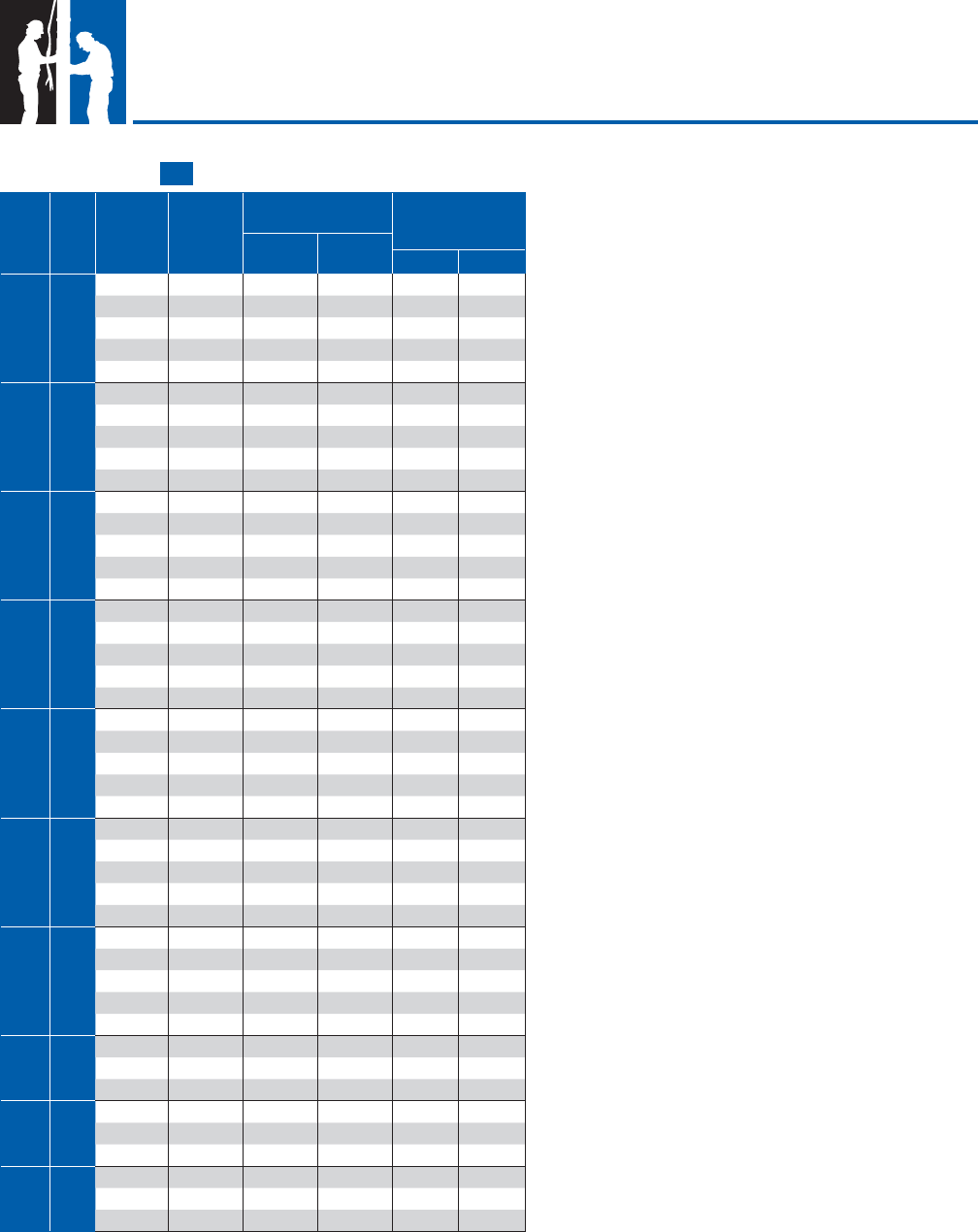
Application – Three-Phase Motors
Footnotes for Tables 28, 29, and 30
NOTE 1: Furnas intermediate sizes between
NEMA starter sizes apply where (1) is shown in
tables, size 1.75 replacing 2, 2.5 replacing 3, 3.5
replacing 4, and 4.5 replacing 5. Heaters were
selected from Catalog 294, table 332 and table
632 (starter size 00, size B). Size 4 starters are
heater type 4 (JG). Starters using these heater
tables include classes 14, 17 and 18 (inNOVA),
classes 36 and 37 (reduced voltage), and classes
87, 88 and 89 (pump and motor control centers).
Overload relay adjustments should be set no
higher than 100% unless necessary to stop
nuisance tripping with measured amps in all lines
below nameplate maximum. Heater selections for
class 16 starters (Magnetic Defi nite Purpose) will
be furnished upon request.
NOTE 2: General Electric heaters are type CR123
usable only on type CR124 overload relays and
were selected from Catalog GEP-126OJ, page
184. Adjustment should be set no higher than
100%, unless necessary to stop nuisance tripping
with measured amps in all lines below nameplate
maximum.
NOTE 3: Adjustable overload relay amp settings
apply to approved types listed. Relay adjustment
should be set at the specifi ed SET amps. Only if
tripping occurs with amps in all lines measured to
be within nameplate maximum amps should the
setting be increased, not to exceed the MAX
value shown.
NOTE 4: Heaters shown for ratings requiring
NEMA size 5 or 6 starters are all used with
current transformers per manufacturer standards.
Adjustable relays may or may not use current
transformers depending on design.
HP KW VOLTS
NEMA
STARTER
SIZE
HEATERS FOR
OVERLOAD RELAYS
ADJUSTABLE
RELAYS
(NOTE 3)
FURNAS
(NOTE 1)
G.E.
(NOTE 2) SET MAX.
5 3.7
200 1 K61 L220B 17.6 19.1
230 1 K61 L199B 15.4 16.6
380 0 K52 L122B 9.4 10.1
460 0 K49 L100B 7.7 8.3
575 0 K42 L825A 6.1 6.6
7.5 5.5
200 1 K67 L322B 26.3 28.3
230 1 K64 L293B 22.9 24.6
380 1 K57 L165B 13.9 14.9
460 1 K54 L147B 11.4 12.3
575 1 K52 L111B 9.1 9.8
10 7.5
200 2(1) K72 L426B 34.4 37.0
230 2(1) K70 L390B 29.9 32.2
380 1 K61 L220B 18.1 19.5
460 1 K58 L181B 15.0 16.1
575 1 K55 L147B 12.0 12.9
15 11
200 3(1) K76 L650B 50.7 54.5
230 2 K75 L520B 44.1 47.4
380 2(1) K68 L322B 26.7 28.7
460 2(1) K64 L265B 22.0 23.7
575 2(1) K61 L220B 17.7 19.0
20 15
200 3 K78 L787B 64.8 69.7
230 3(1) K77 L710B 56.4 60.6
380 2 K72 L426B 34.1 36.7
460 2 K69 L352B 28.2 30.3
575 2 K64 L393B 22.7 24.4
25 18.5
200 3 K86 L107C 80.3 86.3
230 3 K83 L866B 69.8 75.0
380 2 K74 L520B 42.2 45.4
460 2 K72 L426B 34.9 37.5
575 2 K69 L352B 27.9 30.0
30 22
200 4(1) K88 L126C 96.7 104.0
230 3 K87 L107C 84.1 90.4
380 3(1) K76 L650B 50.9 54.7
460 3(1) K74 L520B 42.0 45.2
575 3(1) K72 L390B 33.7 36.2
40 30
380 3 K83 L866B 69.8 75.0
460 3 K77 L710B 57.7 62.0
575 3 K74 L593B 46.1 49.6
50 37
380 3 K87 L107C 86.7 93.2
460 3 K83 L950B 71.6 77.0
575 3 K77 L710B 57.3 61.6
60 45
380 4(1) K89 L126C 102.5 110.2
460 4(1) K87 L107C 84.6 91.0
575 4(1) K78 L866B 67.7 72.8
Table 29 - 60 Hz 6" Motors
29

1. Motor Inspection
A. Verify that the model, hp or kW, voltage, phase and hertz on the motor nameplate match the
installation requirements.
B. Check that the motor lead assembly is not damaged.
C. Measure insulation resistance using a 500 or 1000 volt DC megohmmeter from each lead wire to the
motor frame. Resistance should be at least 200 megohms without drop cable.
D. Keep a record of motor model number, hp or kW, voltage, and serial number (S/N).
(S/N is stamped in shell above the nameplate. A typical example, S/N 07A18 01-0123)
2. Pump Inspection
A. Check that the pump rating matches the motor.
B. Check for pump damage and verify that the pump shaft turns freely.
3. Pump/Motor Assembly
A. If not yet assembled, check that pump and motor mounting faces are free from dirt, debris and uneven
paint thickness.
B. Pumps and motors over 5 hp should be assembled in the vertical position to prevent stress on pump
brackets and shafts. Assemble the pump and motor together so their mounting faces are in contact and
then tighten assembly bolts or nuts evenly to manufacturer specifi cations.
C. If accessible, check that the pump shaft turns freely.
D. Assemble the pump lead guard over the motor leads. Do not cut or pinch lead wires during assembly or
installation.
4. Power Supply and Controls
A. Verify that the power supply voltage, hertz, and kVA capacity match motor requirements.
B. Verify control box hp and voltage matches motor (3-wire only).
C. Check that the electrical installation and controls meet all safety regulations and match the motor
requirements, including fuse or circuit breaker size and motor overload protection. Connect all metal
plumbing and electrical enclosures to the power supply ground to prevent shock hazard. Comply with
national and local codes.
5. Lightning and Surge Protection
A. Use properly rated surge (lightning) arrestors on all submersible pump installations. Motors 5 hp and
smaller, which are marked “Equipped with Lightning Arrestors”, contain internal arrestors.
B. Ground all above ground arrestors with copper wire directly to the motor frame, or to metal drop pipe or
casing which reaches below the well pumping level. Connecting to a ground rod does not provide good
surge protection.
6. Electrical Drop Cable
A. Use submersible cable sized in accordance with local regulations and the cable charts, see pages 11 and 16-21.
Ground motor per national and local codes.
B. Include a ground wire to the motor and surge protection, connected to the power supply ground if
required by codes. Always ground any pump operated outside a drilled well.
7. Motor Cooling
A. Ensure at all times that the installation provides adequate motor cooling; see page 6 for details.
8. Pump/Motor Installation
A. Splice motor leads to supply cable using electrical grade solder or compression connectors, and carefully
insulate each splice with watertight tape or adhesive-lined shrink tubing, as shown in motor or pump
installation data.
B. Support the cable to the delivery pipe every 10 feet (3 meters) with straps or tape strong enough to
prevent sagging. Use padding between cable and any metal straps.
C. A check valve in the delivery pipe is recommended. More than one check valve may be required,
depending on valve rating and pump setting; see page 5 for details.
D. Assemble all pipe joints as tightly as practical, to prevent unscrewing from motor torque. Torque should
be at least 10 pound feet per hp (2 meter-KG per kW).
E. Set the pump far enough below the lowest pumping level to assure the pump inlet will always have at
least the Net Positive Suction Head (NPSH) specifi ed by the pump manufacturer. Pump should be at
least 10 feet (3 meters) from the bottom of the well to allow for sediment build up.
❑
❑
❑
❑
❑
❑
❑
❑
❑
❑
❑
❑
❑
❑
❑
❑
❑
❑
❑
❑
❑
❑
❑
Form No. 3656 02/07
Submersible Pump Installation Check List

F. Check insulation resistance as pump/motor assembly is lowered into the well. Resistance may drop
gradually as more cable enters the water, but any sudden drop indicates possible cable, splice or motor
lead damage; see page 44.
9. After Installation
A. Check all electrical and water line connections and parts before starting the pump.
B. Start the pump and check motor amps and pump delivery. If normal, continue to run the pump until delivery is
clear. If three-phase pump delivery is low, it may be running backward. Rotation may be reversed (with power off)
by interchanging any two motor lead connections to the power supply.
C. Check three-phase motors for current balance within 5% of average, using motor manufacturer instructions.
Imbalance over 5% will cause higher motor temperatures and may cause overload trip, vibration, and reduced life.
D. Verify that starting, running and stopping cause no signifi cant vibration or hydraulic shocks.
E. After at least 15 minutes running time, verify that pump output, electrical input, pumping level, and other
characteristics are stable and as specifi ed.
Date _____________________ Filled In By ____________________________________________________
Notes _________________________________________________________________________________________
_______________________________________________________________________________________________
_______________________________________________________________________________________________
_______________________________________________________________________________________________
_______________________________________________________________________________________
_______________________________________________________________________________________
❑
❑
❑
❑
❑
❑
Submersible Pump Installation Check List
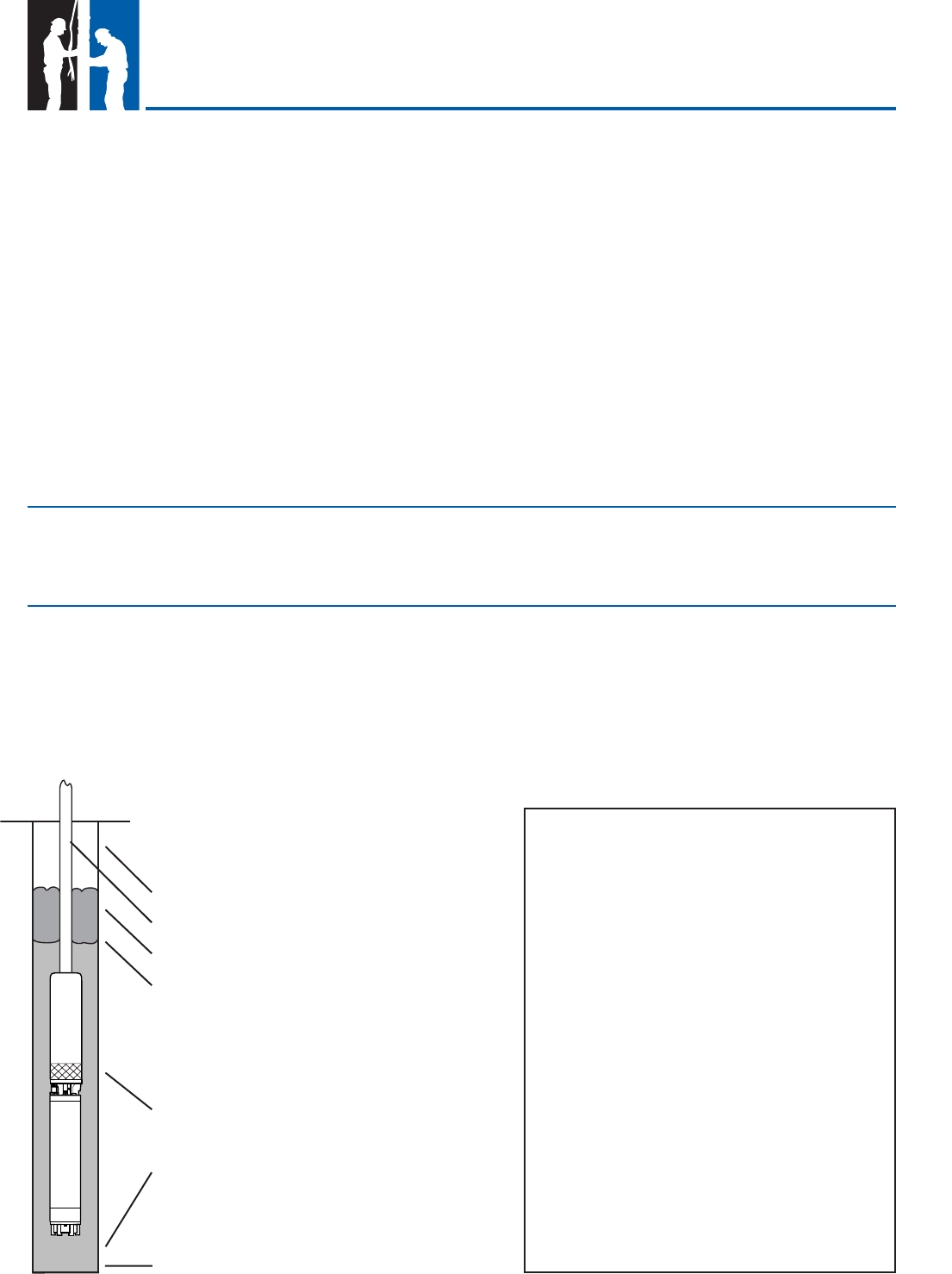
RMA No. _____________
INSTALLER’S NAME ___________________________ OWNER’S NAME _________________________________
ADDRESS ___________________________________ ADDRESS ______________________________________
CITY __________________ STATE_____ ZIP________ CITY ____________________ STATE_____ ZIP________
PHONE (____) _____________ FAX (____) _________ PHONE (____) _____________ FAX (____)____________
CONTACT NAME ______________________________ CONTACT NAME ________________________________
WELL NAME/ID _______________________________ DATE INSTALLED __________ DATE FAILED__________
WATER TEMPERATURE ________ °F or ________ °C
Motor:
Motor No. __________________ Date Code ___________________ hp ________ Voltage _________ Phase ______
Pump:
Manufacturer _________________ Model No. _________ Curve No. _________ Rating: ______ gpm@______ft TDH
NPSH Required ___________ ft NPSH Available_________ ft Actual Pump Delivery__________gpm@ ______ psi
Operating Cycle ______________ON (Min/h) _________________ OFF (min/h) (Circle Min or h as appropriate)
YOUR NAME ___________________________________________________________ DATE ______/______/______
WELL DATA:
Total Dynamic Head ________________ft
Casing Diameter __________________ in
Drop Pipe Diameter ________________ in
Static Water Level __________________ft
Drawdown (pumping) Water Level _____ft
Check Valves at _________ & _______ &
_________ & _______ ft
❑ Solid ❑ Drilled
Pump Inlet Setting _________________ft
Flow Sleeve: ___No____Yes; Dia. _____in
Casing Depth ______________________ft
❑ Well Screen ❑ Perforated Casing
From_____to_____ft & ______to______ft
Well Depth ________________________ft
TOP PLUMBING:
Please sketch the plumbing after the well head
(check valves, throttling valves, pressure tank, etc.)
and indicate the setting of each device.
Form No. 2207 8/00
Submersible Motor Installation Record
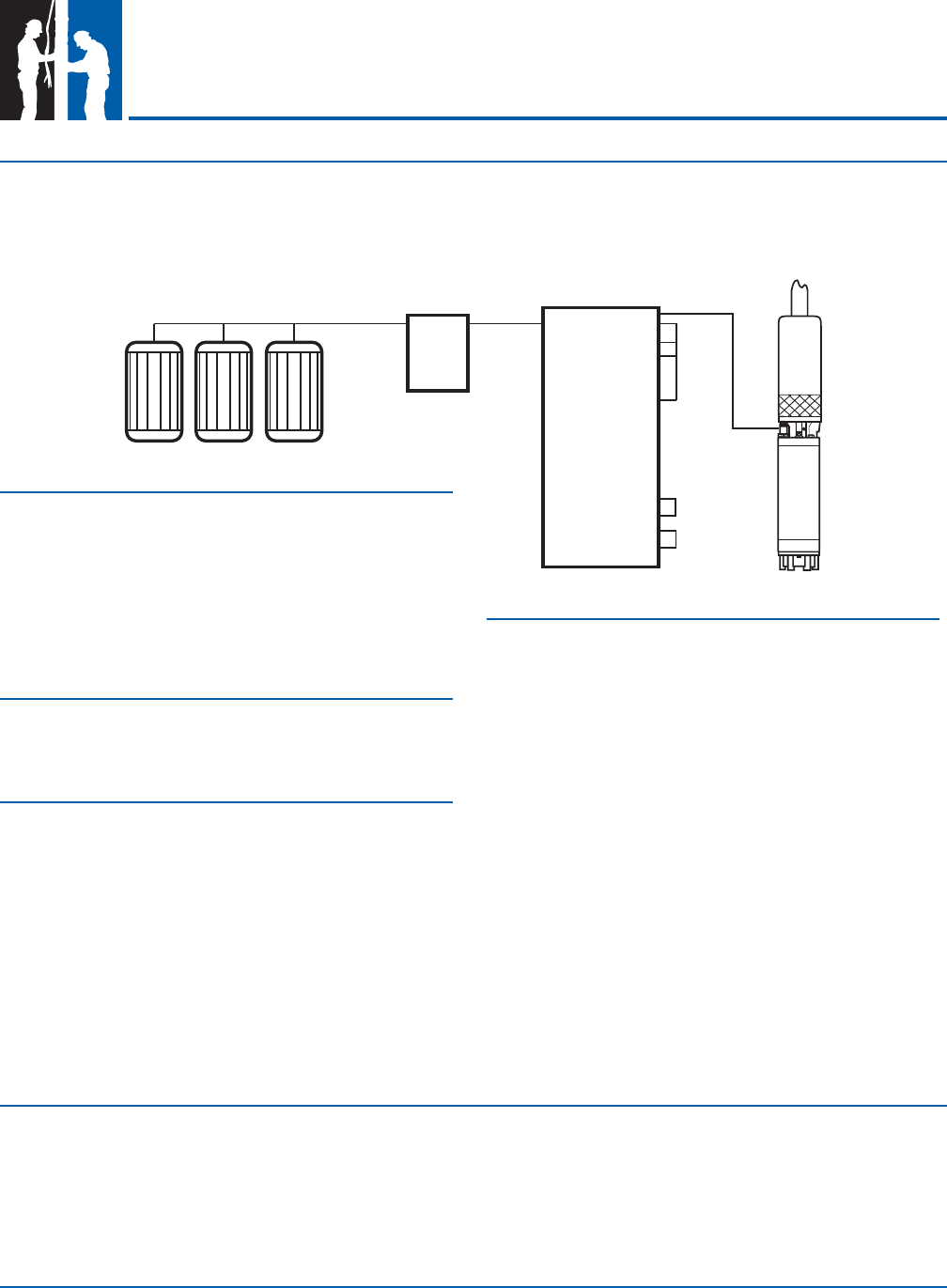
M
O
T
O
R
P
U
M
P
PUMP
PANEL
SERVICE
ENTRANCE
Power Supply:
Cable: Service Entrance to Control ____________ft_______ AWG/MCM ❑ Copper ❑ Aluminum
❑ Jacketed ❑ Individual Conductors
Cable: Control to Motor ____________ft________ AWG/MCM ❑ Copper ❑ Aluminum
❑ Jacketed ❑ Individual Conductors
Transformers:
kVA __________ #1 __________ #2 __________ #3
Initial Megs
(motor & lead) T1________T2_______T3________
Final Megs
(motor, lead & cable) T1______T2______T3______
Incoming Voltage:
No Load L1-L2______ L2-L3_______L1-L3_______
Full Load L1-L2______ L2-L3_______L1-L3_______
Running AMPS:
HOOKUP 1:
Full Load L1______L2_______L3_______
% Unbalance______
HOOKUP 2:
Full Load L1______L2_______L3_______
% Unbalance______
HOOKUP 3:
Full Load L1______L2_______L3_______
% Unbalance______
Ground Wire Size ___________________AWG/MCM
Motor Surge Protection ❑ Yes ❑ No
Variable Frequency Drives:
Manufacturer_________________ Model ______________ Output Frequency: _________ Hz Min _________ Hz Max
Cooling Flow at Min. Freq. ___________________________ Cooling Flow at Max. Freq.________________________
Approved Overload: ❑ Built-in ________ ❑ External Model: (per above) ❑ Cables: (per above) Set Amps __________
Start Time ____________sec Stop Mode ❑ Coast __________sec ❑ Ramp __________ sec
❑ Output fi lter ___________ ❑ Reactor _______________% Make __________ Model ___________ ❑ None
Maximum Load AMPS:
Drive Meter Input Amps Line 1 __________ Line 2 __________ Line 3 __________
Drive Meter Output Amps Line 1 __________ Line 2 __________ Line 3 __________
Test Ammeter Output Amps Line 1 __________ Line 2 __________ Line 3 __________
Test Ammeter Make ________________________ Model ________________________
Control Panel:
Panel Manufacturer______________________________
Short Circuit Device
❑ Circuit Breaker Rating________Setting_____
❑ Fuses Rating___________ Type__________
❑ Standard ❑ Delay
Starter Manufacturer_____________________________
Starter Size ___________________________________
Type of Starter ❑ Full Voltage ❑ Autotransformer
❑ Other:___________Full Voltage in _____sec
Heater Manufacturer_____________________________
Number_____________Adjustable Set at _______amps.
SubMonitor/Subtrol-Plus ❑ No ❑ Yes
Registration No. ________
If yes,
Overload Set? ❑ No ❑ Yes Set at _______amps.
Underload Set? ❑ No ❑ Yes Set at _______amps.
Controls are Grounded to:
❑ Well Head ❑ Motor ❑ Rod ❑ Power Supply
Submersible Motor Installation Record
Submersible Motor Booster Installation Record
Date ______ /______/_______ Filled In By _______________________________ RMA No. _______________
Installation:
Owner/User ________________________________________________ Telephone (______) ____________________
Address ____________________________________________City _______________ State ______ Zip __________
Installation Site, If Different _________________________________________________________________________
Contact ___________________________________________________ Telephone (______) ____________________
System Application________________________________________________________________________________
_______________________________________________________________________________________________
_______________________________________________________________________________________________
System Manufactured By_____________________________Model ________________ Serial No. _______________
System Supplied By_________________________________ City _________________ State ______ Zip _________
Is this a “HERO” system (10.0 - 10.5 PH)? ❑ Yes ❑ No
Motor:
Model No. _______________ Serial No. _______________ Date Code ______
Horsepower ______ Voltage ______ ❑ Single-Phase ❑ Three-Phase Diameter ______ in
Slinger Removed? ❑ Yes ❑ No Check Valve Plug Removed? ❑ Yes ❑ No
Motor Fill Solution ❑ Standard ❑ DI Water
Pump:
Manufacturer _______________ Model _______________ Serial No. _______________
Stages ______ Diameter ________ Flow Rate Of ________ gpm At ______TDH
Booster Case Internal Diameter ________ Material _______________
Controls and Protective Devices:
SubMonitor? ❑ Yes ❑ No If Yes, Warranty Registration No._______________________________________
If Yes, Overload Set? ❑ Yes ❑ No ______ Set At _________________________
Underload Sets? ❑ Yes ❑ No ______ Set At _________________________
VFD or Reduced Voltage Starter? ❑ Yes ❑ No If Yes, Type __________________________________________
Mfr. ______________Setting ________% Full Voltage In ________sec
Pump Panel? ❑ Yes ❑ No If Yes, Mfr. ______________________________Size _______________________
Magnetic Starter/Contactor Mfr. ___________________________ Model __________________Size_______________
Heaters Mfr. _____________________ No. ____________ If Adjustable Set At _______________________________
Fuses Mfr. ____________________ Size ___________ Type _____________________________________________
Lightning/Surge Arrestor Mfr. ________________________ Model __________________________________________
Controls Are Grounded to __________________ with No. ________Wire
Inlet Pressure Control ❑ Yes ❑ No If Yes, Mfr.________ Model _______ Setting _____ psi Delay ____ sec
Inlet Flow Control ❑ Yes ❑ No If Yes, Mfr.________ Model _______ Setting _____ gpm Delay ____ sec
Outlet Pressure Control ❑ Yes ❑ No If Yes, Mfr.________ Model _______ Setting _____ psi Delay ____ sec
Outlet Flow Control ❑ Yes ❑ No If Yes, Mfr.________ Model _______ Setting _____ gpm Delay ____ sec
Water Temperature Control ❑ Yes ❑ No If Yes, Mfr.________ Model _________________________ Delay ____ sec
Set At ________ °F Or ______ °C Located _____________________________________
Form No. 3655 8/00
Submersible Motor Booster Installation Record

Insulation Check:
Initial Megs: Motor & Lead Only Black (T1/U1)_________ Yellow (T2/V1)________ Red (T3/W1)_________
Installed Megs: Motor, Lead, & Cable Black (T1/U1)_________ Yellow (T2/V1)________ Red (T3/W1)_________
Voltage To Motor:
Non-Operating: B-Y (T1/U1 - T2/V1)_____ Y-R (T2/V1 - T3/W1)_____ R-B (T3/W1 - T1/U1)_____
At Rated Flow of __________gpm B-Y (T1/U1 - T2/V1)_____ Y-R (T2/V1 - T3/W1)_____ R-B (T3/W1 - T1/U1)_____
At Open Flow ____________gpm B-Y (T1/U1 - T2/V1)_____ Y-R (T2/V1 - T3/W1)_____ R-B (T3/W1 - T1/U1)_____
Amps To Motor:
At Rated Flow of __________gpm Black (T1/U1)_________ Yellow (T2/V1)________ Red (T3/W1)_________
At Open Flow ____________gpm Black (T1/U1)_________ Yellow (T2/V1)________ Red (T3/W1)_________
At Shut Off* Black (T1/U1)_________ Yellow (T2/V1)________ Red (T3/W1)_________
*Do NOT run at Shut Off more than two (2) minutes.
Inlet Pressure __________psi Outlet Pressure __________psi Water Temperature _______ °F or _______ °C
If you have any questions or problems, call the Franklin Electric Toll-Free Hot Line: 1-800-348-2420
Comments: _____________________________________________________________________________________
_______________________________________________________________________________________________
_______________________________________________________________________________________________
_______________________________________________________________________________________________
_______________________________________________________________________________________________
Please sketch the system
Submersible Motor Booster Installation Record
Application – Three-Phase Motors
Advance Controls: MDR3 Overload
AEG Series: B17S, B27S, B27-2
ABB Type: RVH 40, RVH65, RVP160,
T25DU, T25CT, TA25DU
AGUT: MT03, R1K1, R1L0, R1L3, TE set Class 5
Allen Bradley: Bulletin 193, SMP-Class 10 only
Automatic Switch Types: DQ, LR1-D, LR1-F,
LR2 Class 10
Benshaw: RSD6 (Class 10) Soft Start
Bharita C-H: MC 305 ANA 3
Clipsal: 6CTR, 6MTR
Cutler-Hammer: C316F, C316P, C316S, C310-set
at 6 sec max, Advantage Class10
Fanal Types: K7 or K7D through K400
Franklin Electric: Subtrol-Plus, SubMonitor
Fuji Types: TR-OQ, TR-OQH, TR-2NQ, TR- 3NQ,
TR-4NQ, TR-6NQ, RCa 3737-ICQ & ICQH
Furnas Types: US15 48AG & 48BG, 958L,
ESP100-Class 10 only, 3RB10-Class 10
General Electric: CR4G, CR7G, RT*1, RT*2,
RTF3, RT*4, CR324X-Class 10 only
Kasuga: RU Set Operating Time Code = 10 &
time setting 6 sec max
Klockner-Moeller Types: ZOO, Z1, Z4, PKZM1,
PKZM3 & PKZ2
Lovato: RC9, RC22, RC80, RF9, RF25 & RF95
Matsushita: FKT-15N, 15GN, 15E, 15GE, FT-15N,
FHT-15N
Mitsubishi: ET, TH-K12ABKP, TH-K20KF,
TH-K20KP, TH-K20TAKF, TH-K60KF,
TH-K60TAKF
Omron: K2CM Set Operating Timing Code = 10 &
time setting 6 sec max, SE-KP24E time setting
6 sec max
Riken: PM1, PM3
Samwha: EOCRS Set for Class 5, EOCR-ST,
EOCR-SE, EOCR-AT time setting 6 sec max
Siemens Types: 3UA50, -52, -54, -55, -58, -59, -60,
-61, -62, -66, -68, -70, 3VUI3, 3VE, 3UB
(Class 5)
Sprecher and Schuh Types: CT, CT1, CTA 1,
CT3K, CT3-12 thru CT3-42, KTA3,
CEF1 & CET3 set at 6 sec max, CEP 7 Class
10, CT4, 6, & 7, CT3, KT7
Square D/Telemecanique: Class 9065 Types:
TD, TE, TF, TG, TJ, TK, TR, TJE &TJF (Class
10), LR1-D, LR1-F, LR2 Class 10, Types
18A, 32A, SS-Class 10, SR-Class 10 and
63-A-LB Series. Integral 18,32,63, GV2-L,
GV2-M, GV2-P, GV3-M (1.6-10 amp only)
LR9D, SF Class 10, ST Class 10, LT6 (Class
5 or 10), LRD (Class 10), Motor Logic
(Class10)
Recommended Adjustable Overload Relays
Toshiba Type: 2E RC820, set at 8 sec max.
WEG: RW2
Westinghouse Types: FT13, FT23, FT33, FT43, K7D, K27D, K67D,
Advantage (Class 10), MOR, IQ500 (Class 5)
Westmaster: OLWROO and OLWTOO suffi x D thru P
Other relay types from these and other manufacturers may or may
not provide acceptable protection, and they should not be used
without approval of Franklin Electric.
Some approved types may only be available for part of the listed
motor ratings. When relays are used with current transformers,
relay setting is the specifi ed amps divided by the transformer ratio.
HP KW VOLTS
NEMA
STARTER
SIZE
HEATERS FOR
OVERLOAD RELAYS
ADJUSTABLE
RELAYS
(NOTE 3)
FURNAS
(NOTE 1)
G.E.
(NOTE 2) SET MAX.
40 30
380 3 K78 L866B 68 73
460 3 K77 L710B 56 60
575 3 K73 L520B 45 48
50 37
380 3 K86 L107C 81 87
460 3 K78 L866B 68 73
575 3 K77 L710B 56 60
60 45
380 4(1) K89 L126C 101 108
460 4(1) K86 L107C 83 89
575 4(1) K78 L787B 64 69
75 55
380 4 K92 L142C 121 130
460 4(1) K89 L126C 100 107
575 4(1) K85 L950C 79 85
100 75
380 5(1) K28 L100B 168 181
460 4 K92 L155C 134 144
575 4 K90 L142C 108 116
125 90
380 5 K32 L135B 207 223
460 5(1) K29 L111B 176 189
575 5(1) K26 L825A 140 150
150 110
380 5 - L147B 248 267
460 5(1) K32 L122B 206 221
575 5(1) K28 L100B 165 177
175 130
380 6 K26 - 270 290
460 5 K33 L147B 233 250
575 5 K31 L111B 186 200
200 150
380 6 K27 - 316 340
460 5 K33 L165B 266 286
575 5 K32 L135B 213 229
Table 30 - 60 Hz 8" Motors
30
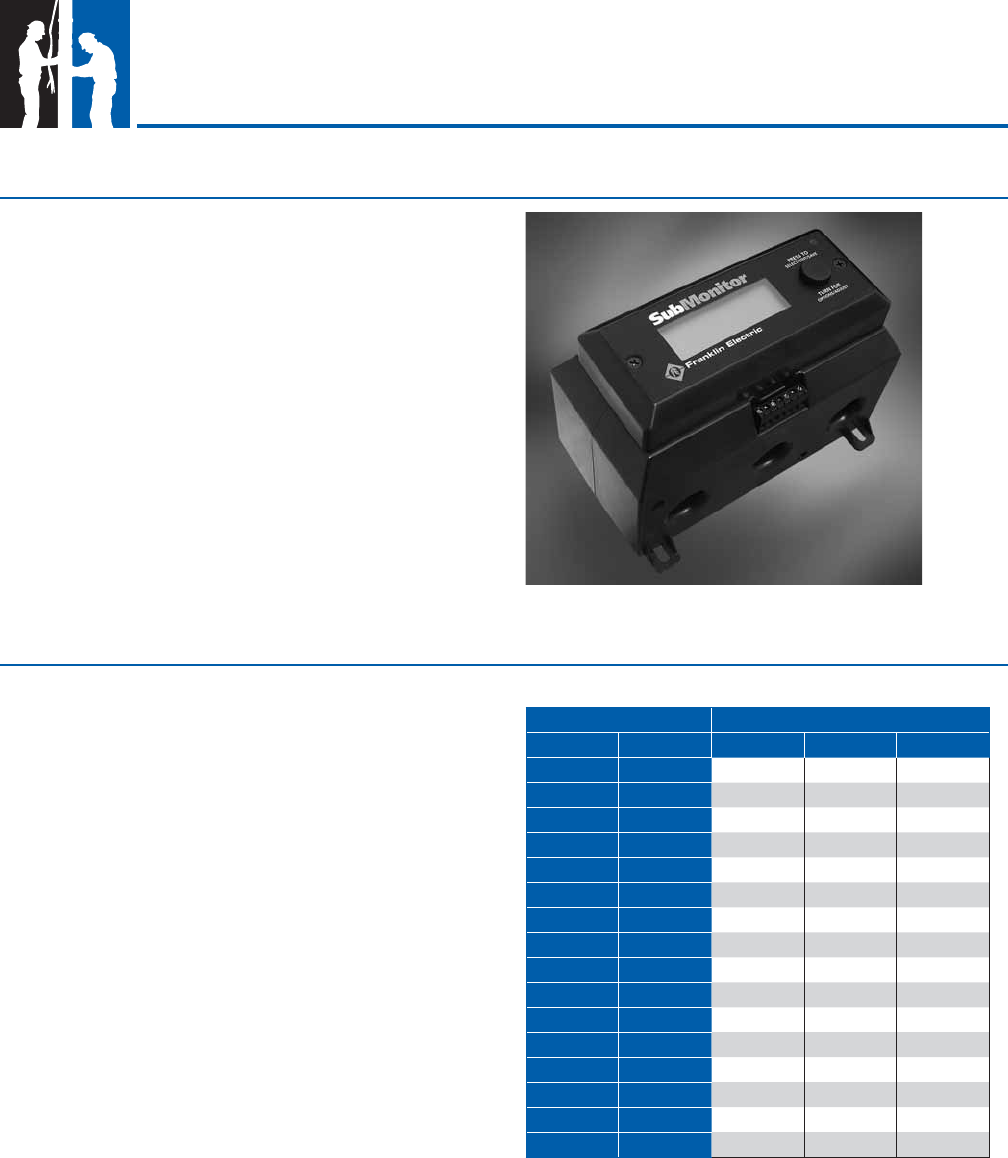
Application – Three-Phase Motors
Applications
SubMonitor is designed to protect 3-phase pumps/
motors with service factor amp ratings (SFA) from 5
to 350 A (approx. 3 to 200 hp). Current, voltage, and
motor temperature are monitored using all three legs
and allows the user to set up the SubMonitor quickly
and easily.
Protects Against
• Under/Overload
• Under/Overvoltage
• Current Unbalance
• Overheated Motor
(if equipped with Subtrol Heat Sensor)
• False Start (Chattering)
• Phase Reversal
In some installations, power supply limitations make it
necessary or desirable to increase the power factor of a
submersible motor. The table lists the capacitive kVAR
required to increase the power factor of large Franklin
three-phase submersible motors to the approximate
values shown at maximum input loading.
Capacitors must be connected on the line side of the
overload relay, or overload protection will be lost.
Values listed are total required (not per phase).
Table 31 kVAR Required 60 Hz
MOTOR KVAR REQUIRED FOR PF OF:
HP KW 0.90 0.95 1.00
5 3.7 1.2 2.1 4.0
7.5 5.5 1.7 3.1 6.0
10 7.5 1.5 3.3 7.0
15 11 2.2 4.7 10.0
20 15 1.7 5.0 12.0
25 18.5 2.1 6.2 15.0
30 22 2.5 7.4 18.0
40 30 4.5 11.0 24.0
50 37 7.1 15.0 32.0
60 45 8.4 18.0 38.0
75 55 6.3 18.0 43.0
100 75 11.0 27.0 60.0
125 90 17.0 36.0 77.0
150 110 20.0 42.0 90.0
175 130 9.6 36.0 93.0
200 150 16.0 46.0 110.0
SubMonitor Three-Phase Protection
Power Factor Correction
31
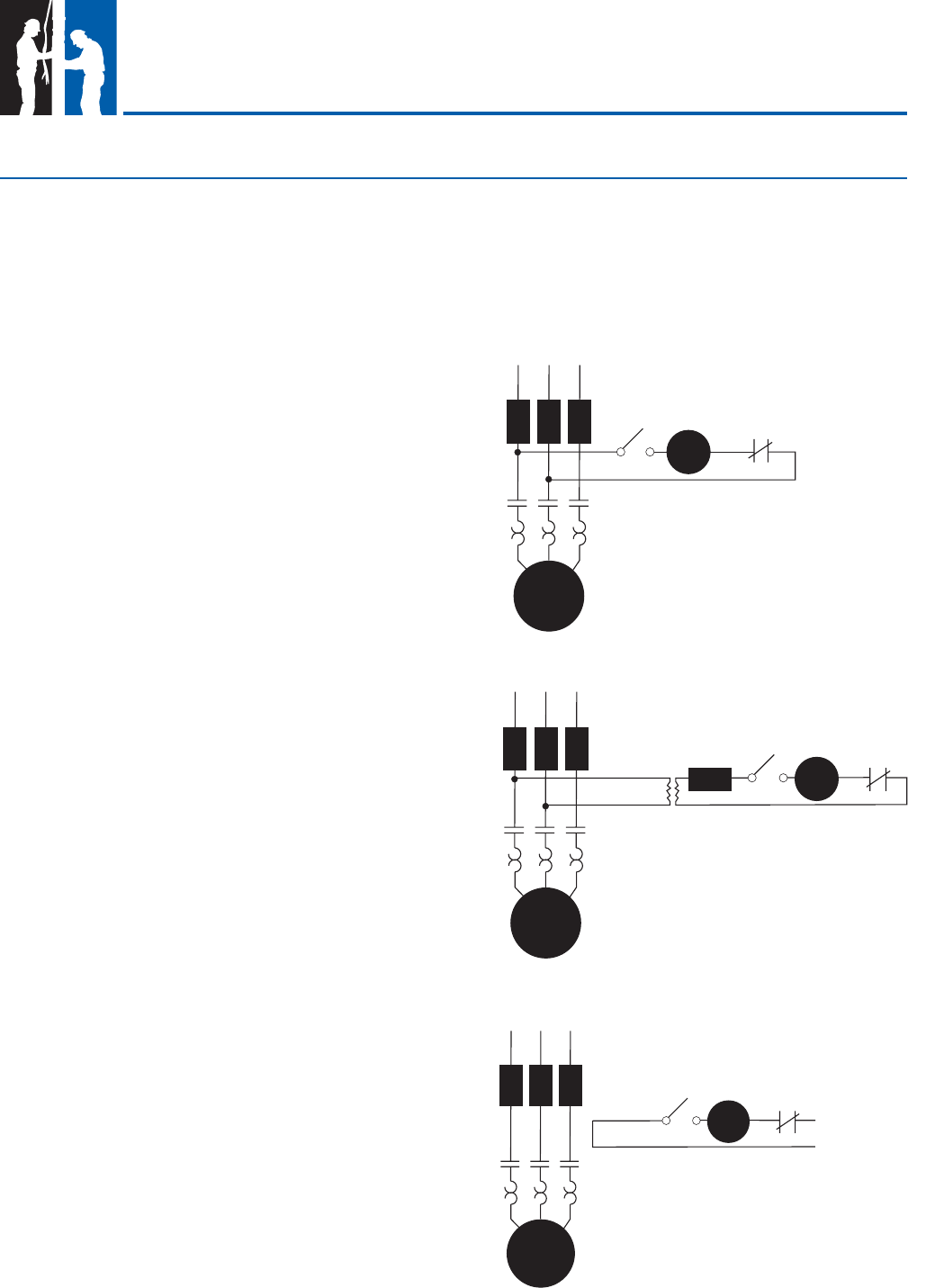
Application – Three-Phase Motors
O.L. CONTACTS
PRESSURE SWITCH OR
OTHER CONTROL DEVICE
COIL
L1 L2 L3
FUSES
CONTACTS
OVERLOAD
HEATERS AND/OR
MOTOR
SUBTROL PLUS
O.L. CONTACTS
PRESSURE SWITCH OR
OTHER CONTROL DEVICE
L1 L2 L3
FUSES
CONTACTS
OVERLOAD
HEATERS AND/OR
MOTOR
TRANSFORMER
COIL
FUSE
SUBTROL PLUS
O.L. CONTACTS
PRESSURE SWITCH OR
OTHER CONTROL DEVICE
L1 L2 L3
FUSES
CONTACTS
OVERLOAD
HEATER AND/OR
MOTOR
COIL TO SEPARATE
CONTROL VOLTAGE
SOURCE
SUBTROL DEVICE
Three-phase combination magnetic starters have two
distinct circuits: a power circuit and a control circuit.
The power circuit consists of a circuit breaker or
fused line switch, contacts, and overload heaters
connecting incoming power lines L1, L2, L3 and the
three-phase motor.
External Voltage Controls
Control of a power circuit by a lower circuit voltage can
also be obtained by connecting to a separate control
voltage source. The coil rating must match the control
voltage source, such as 115 or 24 volts.
The control circuit consists of the magnetic coil, overload
contacts and a control device such as a pressure switch.
When the control device contacts are closed, current
fl ows through the magnetic contactor coil, the contacts
close, and power is applied to the motor. Hand-Off-Auto
switches, start timers, level controls and other control
devices may also be in series in the control circuit.
Line Voltage Control
This is the most common type of control encountered.
Since the coil is connected directly across the power
lines L1 and L2, the coil must match the line voltage.
Low Voltage Transformer Control
This control is used when it is desirable to operate push
buttons or other control devices at some voltage lower
than the motor voltage. The transformer primary must
match the line voltage and the coil voltage must match
the secondary voltage of the transformer.
FIG. 7
FIG. 8
FIG. 9
Three-Phase Starter Diagrams
32
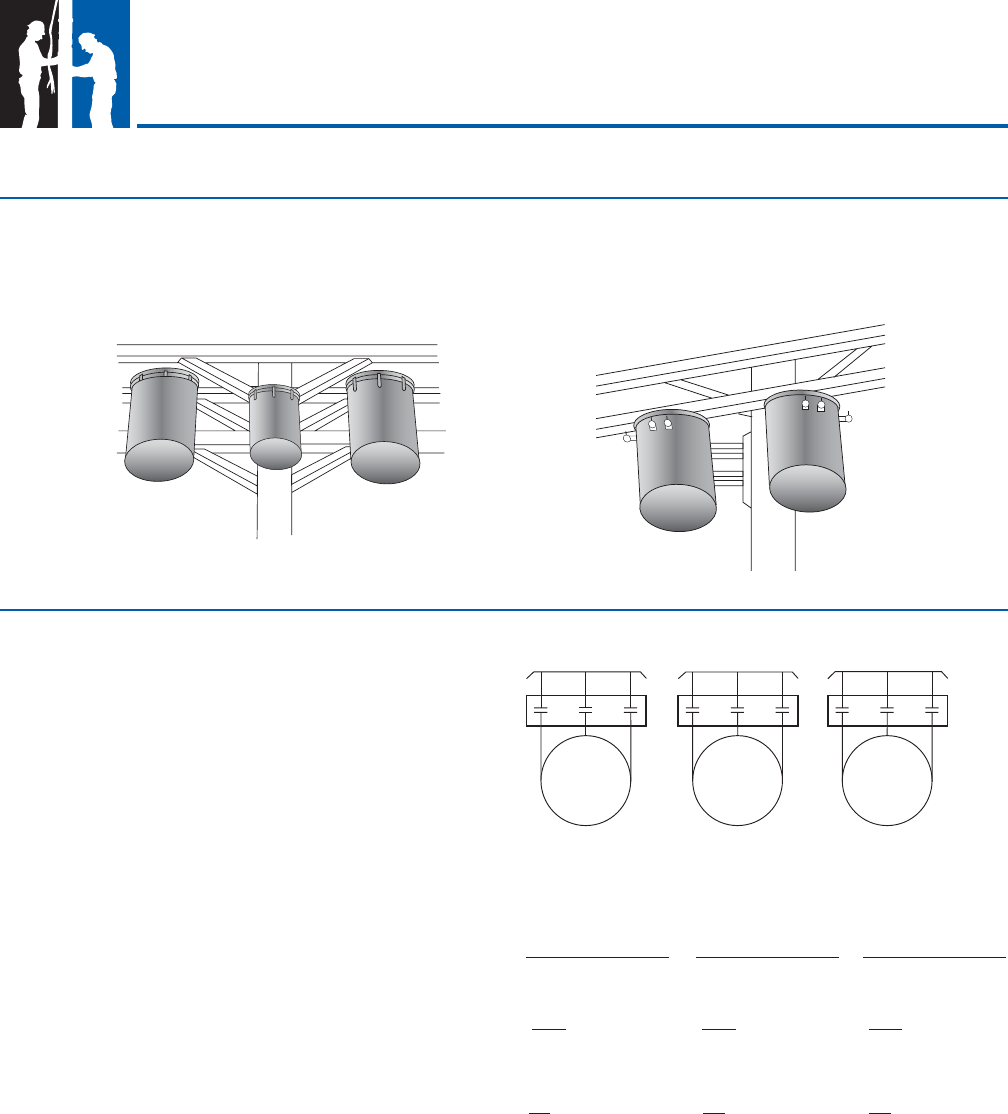
Application – Three-Phase Motors
1
50 = 0.02 or 2%
A full three-phase supply is recommended for all three-
phase motors, consisting of three individual transformers
or one three-phase transformer. So-called “open” delta
or wye connections using only two transformers can be
used, but are more likely to cause problems, such as
poor performance, overload tripping or early motor failure
due to current unbalance.
Transformer rating should be no smaller than listed in
table 4 for supply power to the motor alone.
1. Established correct motor rotation by running in both
directions. Change rotation by exchanging any two
of the three motor leads. The rotation that gives the
most water fl ow is always the correct rotation.
2. After correct rotation has been established, check the
current in each of the three motor leads and calculate
the current unbalance as explained in 3 below.
If the current unbalance is 2% or less, leave the leads
as connected.
If the current unbalance is more than 2%, current
readings should be checked on each leg using each
of three possible hook-ups. Roll the motor leads
across the starter in the same direction to prevent
motor reversal.
3. To calculate percent of current unbalance:
A. Add the three line amps values together.
B. Divide the sum by three, yielding average
current.
C. Pick the amp value which is furthest from the
average current (either high or low).
D. Determine the difference between this amp
value (furthest from average) and the average.
E. Divide the difference by the average. Multiply the
result by 100 to determine percent of unbalance.
4. Current unbalance should not exceed 5% at service
factor load or 10% at rated input load. If the unbalance
cannot be corrected by rolling leads, the source of
the unbalance must be located and corrected. If,
on the three possible hookups, the leg farthest from
the average stays on the same power lead, most
of the unbalance is coming from the power source.
However, if the reading farthest from average moves
with the same motor lead, the primary source of
unbalance is on the “motor side” of the starter. In this
instance, consider a damaged cable, leaking splice,
poor connection, or faulty motor winding.
Checking and Correcting Rotation and Current Unbalance
T2
T1 T3
L1 L2 L3
T1
T3 T2
L1 L2 L3
T3
T2 T1
L1 L2 L3
1st Hook Up 2nd Hook Up 3rd Hook Up
supply
starter
motor
EXAMPLE:
T1 = 51 amps T3 = 50 amps T2 = 50 amps
T2 = 46 amps T1 = 49 amps T3 = 48 amps
T3 = 53 amps T2 = 51 amps T1 = 52 amps
Total = 150 amps Total = 150 amps Total = 150 amps
+++
50 - 46 = 4 amps 50 - 49 = 1 amp 50 - 48 = 2 amps
2
50 = 0.04 or 4%
Phase designation of leads for CCW rotation viewing
shaft end.
To reverse rotation, interchange any two leads.
Phase 1 or “A” - Black, T1, or U1
Phase 2 or “B” - Yellow, T2, or V1
Phase 3 or “C” - Red, T3, or W1
NOTICE: Phase 1, 2 and 3 may not be L1, L2 and L3.
FIG. 10
FULL THREE-PHASE FIG. 11
OPEN DELTA
150
3 = 50 amps 150
3 = 50 amps
4
50 = 0.08 or 8%
150
3 = 50 amps
Three-Phase Power Unbalance
33
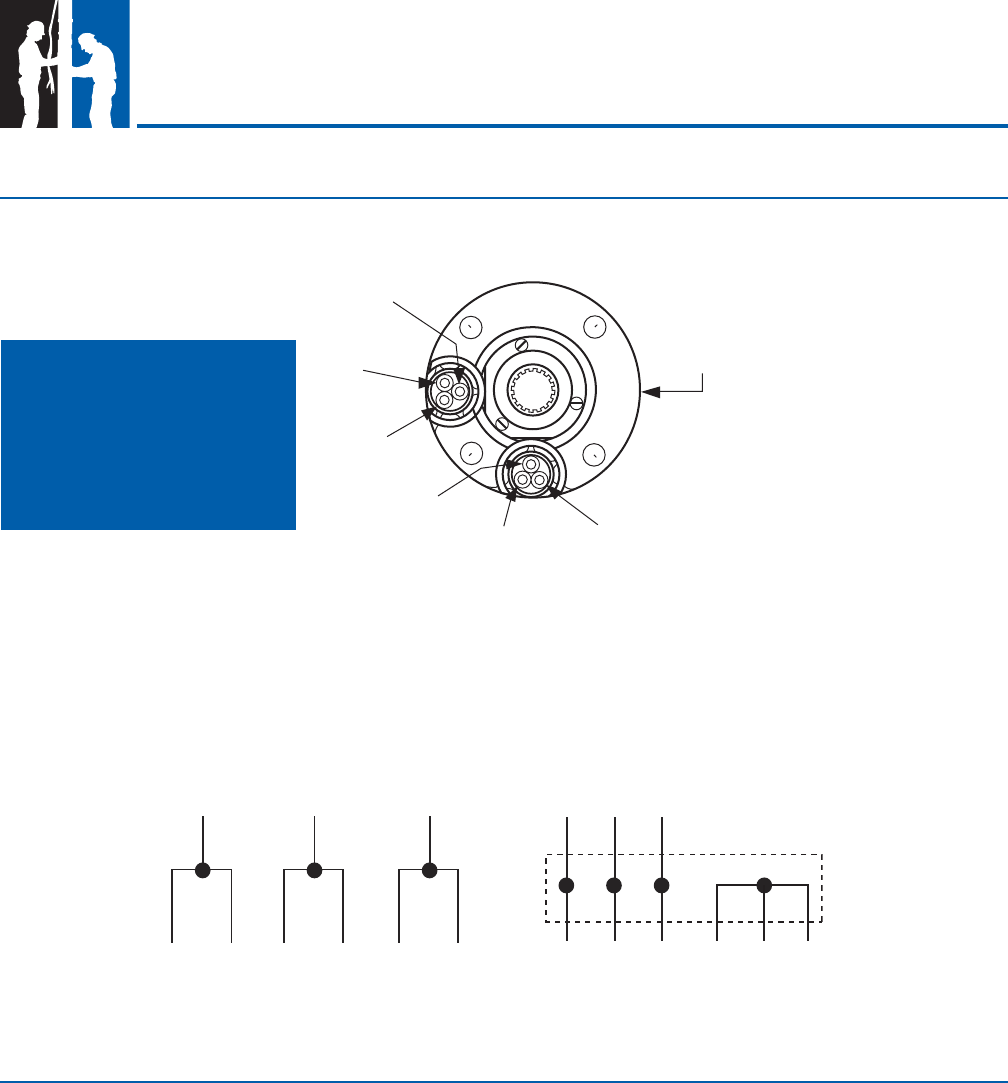
Application – Three-Phase Motors
Three-Phase Motor Lead Identifi cation
Each motor lead is numbered with two markers, one near each end. To reverse rotation, interchange any two line connections.
L1
T1
U1
T1
U1
T6
W2
T6
W2
L2
T2
V1
T2
V1
T4
U2
T4
U2
L3
T3
W1
T3
W1
T5
V2
T5
V2
L1 L2 L3
Connections for across-the-line starting,
running, and any reduced voltage starting
except WYE-DELTA type starters.
WYE-DELTA starters connect the motor as
shown below during starting, then change to
the running connection shown at the left.
There are a number of different types of phase converters
available. Each generates three-phase power from a
single-phase power line.
In all phase converters, the voltage balance is critical to
current balance. Although some phase converters may
be well balanced at one point on the system-operating
curve, submersible pumping systems often operate
at differing points on the curve as water levels and
operating pressures fl uctuate. Other converters may be
well balanced at varying loads, but their output may vary
widely with fl uctuations in the input voltage.
The following guidelines have been established for
submersible installations to be warrantable when used
with a phase converter.
1. Limit pump loading to rated horsepower. Do not load
into motor service factor.
2. Maintain at least 3 ft/s fl ow past the motor. Use a fl ow
sleeve when necessary.
3. Use time delay fuses or circuit breakers in pump
panel. Standard fuses or circuit breakers do not
provide secondary motor protection.
4. SubMonitor may be used with electro mechanical
type phase converters, however special connections
are required. Consult SubMonitor Manual for
connections of receiver and lightning arrestor.
5. SubMonitor will not work with electronic solid state
phase converters.
6. Current unbalance must not exceed 10%.
T5-V2
(YELLOW)
T2-V1
(YELLOW)
T4-U2
(BLACK)
T1-U1
(BLACK)
T6-W2
(RED)
T3-W1
(RED)
LEADS LOCATED HERE ONLY
FOR 3 LEAD
(
DOL
)
MOTORS
CHECK VALVE OR
PIPE PLUG ON RIGHT
SIDE FACING MOTOR
SHAFT
WARNING: When installing
6-lead motors extra care
must be used to ensure lead
identifi cation at the surface.
Leads must be marked and
connected per diagram. Motor
leads are not connected red to
red, yellow to yellow, etc.
Line Connections — Six-Lead Motors
90° Lead Spacing
Phase Converters
34
Application – Three-Phase Motors
All Franklin three-phase submersible motors are suitable
for full-voltage starting. Under this condition the motor
speed goes from zero to full speed within a half second
or less. The motor current goes from zero to locked rotor
amps, then drops to running amps at full speed. This
may dim lights, cause momentary voltage dips
to other electrical equipment, and shock power
distribution transformers.
In some cases the power companies may require
reduced-voltage starters to limit this voltage dip. There
are also times when reduced-voltage starters may be
desirable to reduce motor starting torque thus reducing
the stress on shafts, couplings, and discharge piping.
Reduced-voltage starters also slow the rapid acceleration
of the water on start-up to help control upthrust and
water hammer.
Reduced-voltage starters may not be required if the
maximum recommended cable length is used. With
maximum recommended cable length there is a 5%
voltage drop in the cable at running amps, resulting in
about 20% reduction in starting current and about 36%
reduction in starting torque compared to having rated
voltage at the motor. This may be enough reduction in
starting current so that reduced-voltage starters are
not required.
Three-Lead Motors: Autotransformer or solid-state
reduced-voltage starters may be used for soft-starting
standard three-phase motors.
When autotransformer starters are used, the motor
should be supplied with at least 55% of rated voltage to
ensure adequate starting torque. Most autotransformer
starters have 65% and 80% taps. Setting the taps on
these starters depends on the percentage of the
maximum allowable cable length used in the system.
If the cable length is less than 50% of the maximum
allowable, either the 65% or the 80% taps may be used.
When the cable length is more than 50% of allowable,
the 80% tap should be used.
Six-Lead Motors: Wye-Delta starters are used with
six-lead Wye-Delta motors. All Franklin 6" and 8"
three-phase motors are available in six-lead Wye-Delta
construction. Consult the factory for details and availability.
Part winding starters are not compatible with Franklin
Electric submersible motors and should not be used.
Wye-Delta starters of the open-transition type, which
momentarily interrupt power during the starting cycle, are
not recommended. Closed-transition starters have no
interruption of power during the start cycle and can be
used with satisfactory results.
Reduced-voltage starters have adjustable settings
for acceleration ramp time, typically preset at 30
seconds. They must be adjusted so the motor is at
full voltage within THREE SECONDS MAXIMUM to
prevent excessive radial and thrust bearing wear.
If Subtrol-Plus or SubMonitor is used the
acceleration time must be set to TWO SECONDS
MAXIMUM due to the 3 second reaction time of the
Subtrol-Plus or SubMonitor.
Solid-state starters AKA soft starts may not be
compatible with Subtrol-Plus/SubMonitor. However,
in some cases a bypass contactor has been used.
Consult the factory for details.
During shutdown, Franklin Electric’s
recommendation is for the power to be removed,
allowing the pump/motor to coast down. Stopping
the motor by ramping down the voltage is possible,
but should be limited to three (3) seconds maximum.
Franklin Electric offers three different types of motors for
non-vertical applications.
1. The Booster motors are specifi cally designed for
booster applications. They are the “Best Choice”
for sealed Reverse Osmosis applications.
These motors are the result of two years of focused
development and bring additional value and durability
to booster module systems. These motors are
only available to OEMs or Distributors who have
demonstrated capability in Booster Module systems
design and operation and adhere to Franklin’s
Application Manual requirements.
2. The Hi-Temp motors have many of the internal
design features of the Booster motor. It’s additional
length allows for higher temperature handling and
the Sand Fighter sealing system provides greater
abrasion resistance. One or both of these conditions
are often experienced in open atmosphere
applications such as lakes, ponds, etc.
3. The Standard Vertical Water Well (40-125 hp)
motors can be adapted to non-vertical applications
when applied per the below guidelines. However,
they will be more sensitive to application variances
than the other two designs.
All of the above motors must be applied per the
guidelines listed below. In addition, for all applications
where the motor is applied in a sealed system, a
Submersible Motor Booster Installation Record (Form
3655) or its equivalent must be completed at startup and
received by Franklin Electric within 60 days. A sealed
system is one where the motor and pump intake are
mounted in a sleeve and the water feeding the pump
intake is not open to the atmosphere.
Reduced Voltage Starters
Inline Booster Pump Systems
35
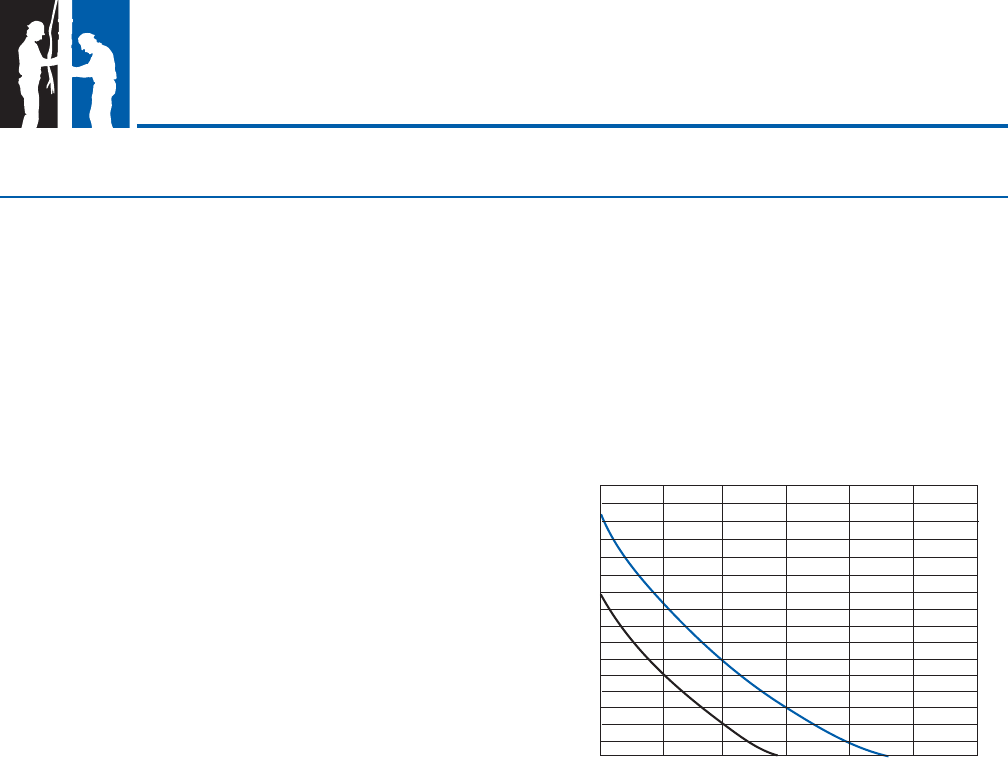
Application – Three-Phase Motors
Design And Operational Requirements
1. Non-Vertical Operation: Vertical Shaft-up (0°) to
Horizontal (90°) operation is acceptable as long as
the pump transmits “down-thrust” to the motor within
3 seconds after start-up and continuously during
operation. However, it is best practice to provide a
positive slope whenever it is possible, even if it is only
a few degrees.
2. Motor, Sleeve, and Pump Support System: The
booster sleeve ID must be sized according to the
motor cooling and pump NPSHR requirements. The
support system must support the motor’s weight,
prevent motor rotation and keep the motor and pump
aligned. The support system must also allow for
thermal axial expansion of the motor without creating
binding forces.
3. Motor Support Points: A minimum of two support
points are required on the motor. One in the motor/
pump fl ange connection area and one in the bottom
end of the motor area. The motor castings, not the
shell area, are recommended as support points. If the
support is a full length support and/or has bands in
the shell area, they must not restrict heat transfer or
deform the shell.
4. Motor Support Material and Design: The support
system shall not create any areas of cavitation or
other areas of reduced fl ow less than the minimum
rate required by this manual. They should also be
designed to minimize turbulence and vibration and
provide stable alignment. The support materials and
locations must not inhibit the heat transfer away from
the motor.
5. Motor and Pump Alignment: The maximum
allowable misalignment between the motor, pump,
and pump discharge is 0.025 inch per 12 inches of
length (2 mm per 1000 mm of length). This must be
measured in both directions along the assembly using
the motor/pump fl ange connection as the starting
point. The booster sleeve and support system must
be rigid enough to maintain this alignment during
assembly, shipping, operation and maintenance.
6. The best motor lubrication and heat resistance is
obtained with the factory based propylene glycol
fi ll solution. Only when an application MUST HAVE
deionized (DI) water should the factory fi ll solution
be replaced. When a deionized water fi ll is required,
the motor must be derated as indicated on the below
chart. The exchange of the motor fi ll solution to DI
Inline Booster Pump Systems (continued)
water must be done by an approved Franklin service
shop or representative using a vacuum fi ll system
per Franklin’s Motor Service Manual instruction. The
motor shell then must be permanently stamped with a
D closely behind the Serial Number.
The maximum pressure that can be applied to the
motor internal components during the removal of the
factory fi ll solution is 7 psi (0.5 bar.)
First: Determine maximum Feed Water Temperature
that will be experienced in this application. If the
feed water exceeds the maximum ambient of the
motor, both the DI water derating and a hot water
application derating must be applied.
Second: Determine the Pump Load Multiplier from the
appropriate Service Factor curve. (Typical 1.15
Service Factor is for 60 Hz ratings &1.00 Service
Factor for 50 Hz ratings).
Third: Multiply the Pump Load Requirement times the pump
load multiplier number indicated on the vertical axis
to determine the Minimum Motor Nameplate Rating.
Fourth: Select a motor with a nameplate equal or higher than
the above calculated value.
7. Motor Alterations - Sand Slinger & Check Valve
Plug: On 6" and 8" motors, the rubber sand slinger
located on the shaft must be removed. The pipe plug
covering the check valve must be removed from Ni-
resist and 316 SS motors. The special Booster motor
already has these alterations made.
8. Frequency of Starts: Fewer than 10 starts per
24-hour period are recommended. Allow at least 20
minutes between shutdown and start-up of the motor.
FIG. 12
1.8
1.7
1.6
1.5
1.4
1.3
1.2
1.1
130 25 20 15 10
35
40
1.75
1.65
1.55
1.45
1.35
1.25
1.15
1.05
1.00 Service Factor (50Hz)
1.15 Service Factor (60Hz)
Derating Factor for Motors That Must Have Their Factory Fill
Replaced With Deionized Water 8" Encapsulated Motor
Feed Water Temperature (°C)
Pump Load Multiplier
36
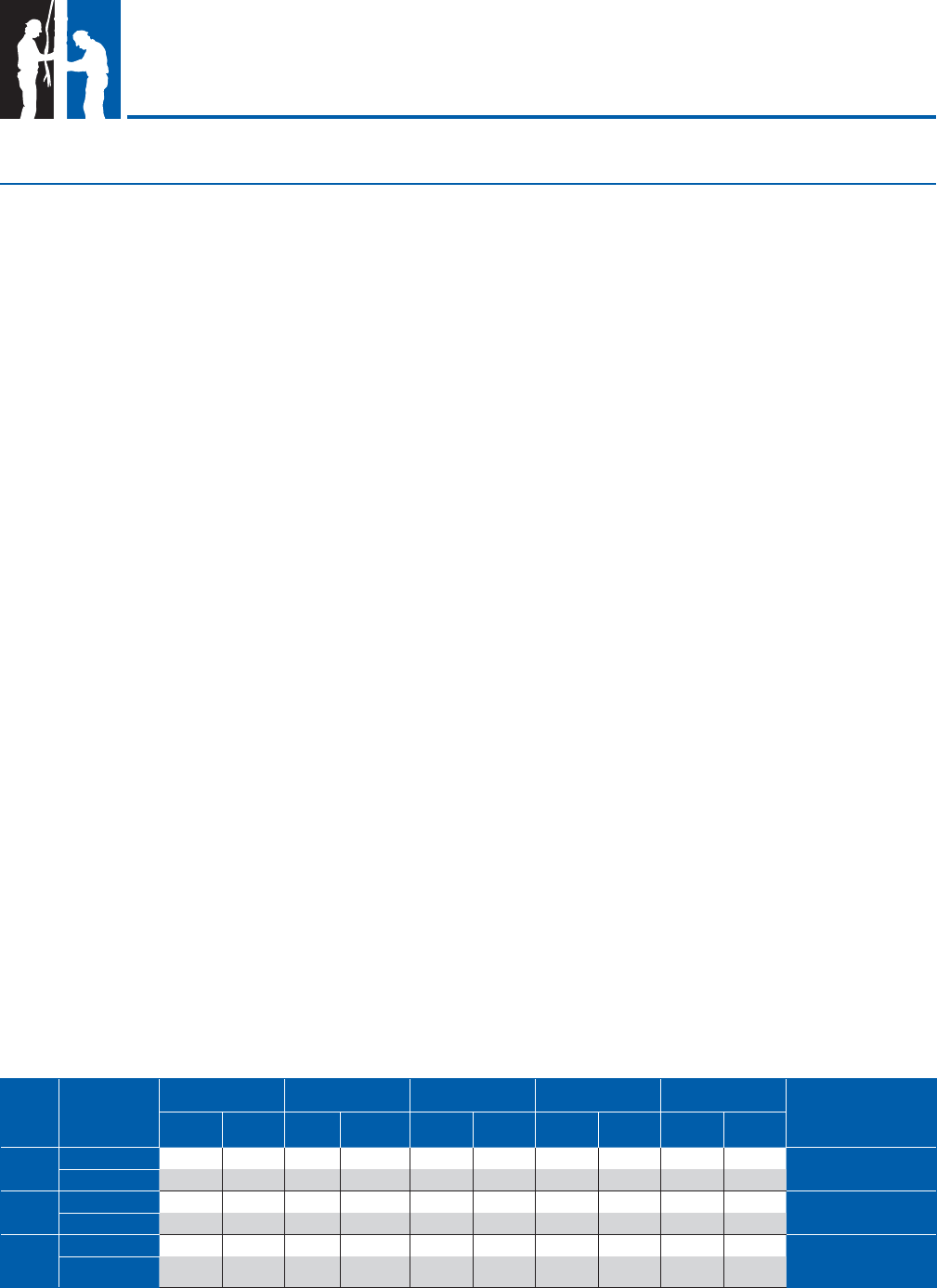
Application – Three-Phase Motors
9. Controls-Soft Starters and VFDs: Reduced voltage
starters and variable speed drives (inverter drives)
may be used with Franklin three-phase submersible
motors to reduce starting current, upthrust, and
mechanical stress during start-up. The guidelines
for their use with submersible motors are different
than with normal air cooled motor applications.
Refer to the Franklin Electric Application, Installation
and Maintenance (AIM) Manual Reduced Voltage
Starters section or Variable Speed Submersible
Pump Operation, Inverter Drives sections for specifi c
details including required fi ltering.
10. Motor Overload Protection: Submersible motors
require properly sized ambient compensated
Class 10 quick-trip overloads per Franklin’s AIM
Manual guidelines to protect the motor. Class 20
or higher overloads are NOT acceptable. Franklin’s
SubMonitor is strongly recommended for all large
submersibles since it is capable of sensing motor
heat without any additional wiring to the motor.
Applications using Soft Starters with a SubMonitor
require a start-up bypass - consult the factory for
details. SubMonitor can not be used in applications
using a VFD control.
11. Motor Surge Protection: Properly sized, grounded
and dedicated motor surge arrestors must be
installed in the supply line of the booster module as
close to the motor as possible. This is required on
all systems including those using soft-starters and
variable speed drives (inverter drives).
12. Wiring: Franklin’s lead assemblies are only sized
for submerged operation in water to the motor
nameplate maximum ambient temperature and
may overheat and cause failure or serious injury
if operated in air. Any wiring not submerged must
meet applicable national and local wiring codes and
Inline Booster Pump Systems (continued)
Franklin Cable Chart tables 16-21. (Notice: wire size,
wire rating and insulation temperature rating must be
known when determining its suitability to operate in
air or conduit. Typically, for a given size and rating,
as the insulation temperature rating increases its
ability to operate in air or conduit also increases.)
13. Check Valves: Spring-loaded check valves must
be used on start-up to minimize motor upthrusting,
water hammer, or in multiple booster (parallel)
applications to prevent reverse fl ow.
14. Pressure Relief Valves: A pressure relief valve is
required and must be selected to ensure that, as the
pump approaches shut-off, it never reaches the point
that the motor will not have adequate cooling fl ow
past it.
15. System Purge (Can Flooding): An air bleeder
valve must be installed on the booster sleeve so that
fl ooding may be accomplished prior to booster start-
up. Once fl ooding is complete, the booster should
be started and brought up to operating pressure as
quickly as possible to minimize the duration of an
upthrust condition. At no time should air be allowed
to gather in the booster sleeve because this will
prevent proper cooling of the motor and permanently
damage it.
16. System Flush – Must Not Spin Pump: Applications
may utilize a low fl ow fl ushing operation. Flow
through the booster sleeve must not spin the pump
impellers and the motor shaft. If spinning takes
place, the bearing system will be permanently
damaged and the motor life shortened. Consult the
booster pump manufacturer for maximum fl ow rate
through the pump when the motor is not energized.
Based on 30 °C maximum ambient with cable length of 100 feet or less.
Table 37 Franklin Cable chart (See 12. Wiring)
CABLE
TEMP.
RATING
(°C)
MOTOR NAME-
PLATE RATED
AMPS FULL
LOAD
#10 AWG #8 AWG #6 AWG #4 AWG #2 AWG SOURCE OF CABLE
AMPACITY
IN AIR IN
CONDUIT IN AIR IN
CONDUIT IN AIR IN
CONDUIT IN AIR IN
CONDUIT IN AIR IN
CONDUIT
75 3-LEAD (DOL) 40A 28A 56A 40A 76A 52A 100A 68A 136A 92A US N.E.C., 2002 edition,
tables 310.16 & 310.17
6-LEAD (Y-∆)69A 48A 97A 69A 132A 90A 173A 118A 236A 19A
90 3-LEAD (DOL) 44A 32A 64A 44A 84A 60A 112A 76A 152A 104A US N.E.C., 2002 edition,
tables 310.16 & 310.17
6-LEAD (Y-∆)76A 55A 111A 76A 145A 104A 194A 132A 263A 180A
135
3-LEAD (DOL) 63A 46A 74A 51A 104A 74A 145A 98A 185A 126A Standard AAR (American
Association of Railroads)
RP-585
6-LEAD (Y-∆)109A 80A 127A 88A 180A 129A 251A 320A 320A 219A
37

Application – Three-Phase Motors
17. Open Atmosphere Booster Pump Systems: When
an open booster is placed in a lake, tank, etc. that is
open to atmospheric pressure, the water level must
provide suffi cient head pressure to allow the pump
to operate above its NPSHR requirement at all times
and all seasons. Adequate inlet pressure must be
provided prior to booster start-up.
Four Continuous Monitoring System Requirements
for Sealed Booster Systems.
1. Water Temperature: Feed water on each
booster must be continuously monitored and
not allowed to exceed the motor nameplate
maximum ambient temperature at any time. IF
THE INLET TEMPERATURE EXCEEDS THE
MOTOR NAMEPLATE MAXIMUM AMBIENT
TEMPERATURE, THE SYSTEM MUST
SHUTDOWN IMMEDIATELY TO PREVENT
PERMANENT MOTOR DAMAGE. If feed water
temperatures are expected to be above the
allowable temperature, the motor must be derated.
See Franklin’s AIM Manual Hot Water Applications
section for derating guidelines. (The high
temperature feed water derating is in addition to the
exchange to DI water derating if the motor factory fi ll
solution was exchanged to DI water.)
2. Inlet Pressure: The inlet pressure on each booster
module must be continuously monitored. It must
always be positive and higher than the NPSHR (Net
Positive Suction Head Requirement) of the pump.
A minimum of 20 PSIG (1.38 Bar) is required at all
times, except for 10 seconds or less when the motor
is starting and the system is coming up to pressure.
Inline Booster Pump Systems (continued)
Even during these 10 seconds the pressure must
remain positive and be higher than the NPSHR (Net
Positive Suction Head Requirement) of the pump.
PSIG is the actual value displayed on a pressure
gauge in the system piping. PSIG is the pressure
above the atmospheric conditions. If at any time
these pressure requirements are not being met, the
motor must be de-energized immediately to prevent
permanent damage to the motor. Once the motor is
damaged, it is usually not immediately noticeable,
but progresses and results in a premature motor
failure weeks or months after the damage occurred.
Motors that will be exposed to pressure in excess
of 500 psi (34.47 Bar) must undergo special high
pressure testing. Consult factory for details
and availability.
3. Discharge Flow: The fl ow rate for each pump must
not be allowed to drop below the motor minimum
cooling fl ow requirement. IF THE MOTOR MINIMUM
COOLING FLOW REQUIREMENT IS NOT BEING
MET FOR MORE THAN 10 SECONDS, THE
SYSTEM MUST BE SHUT DOWN IMMEDIATELY
TO PREVENT PERMANENT MOTOR DAMAGE.
4. Discharge Pressure: The discharge pressure
must be monitored to ensure that a downthrust load
toward the motor is present within 3 seconds after
start-up and continuously during operation.
IF THE MOTOR DISCHARGE PRESSURE IS NOT
ADEQUATE TO MEET THIS REQUIREMENT, THE
SYSTEM MUST BE SHUT DOWN IMMEDIATELY
TO PREVENT PERMANENT MOTOR DAMAGE.
38

Application – Three-Phase Motors
Franklin three-phase submersible motors are operable
from variable frequency inverter drives when applied
within guidelines below. These guidelines are based
on present Franklin information for inverter drives, lab
tests and actual installations, and must be followed
for warranty to apply. Franklin two-wire and three-wire
single-phase submersible motors are not recommended
for variable speed operation.
WARNING: There is a potential shock hazard from
contact with insulated cables from a PWM drive to
the motor. This hazard is due to high frequency
voltage content of a PWM drive output.
Load Capability: Pump load should not exceed
motor nameplate service factor amps at rated voltage
and frequency.
Frequency Range: Continuous between 30 Hz and
rated frequency (50 or 60 Hz). Operations above rated
frequency require special considerations, consult factory
for details.
Volts/Hz: Use motor nameplate volts and frequency
for the drive base settings. Many drives have means to
increase effi ciency at reduced pump speeds by lowering
motor voltage. This is the preferred operating mode.
Voltage Rise-time or dV/dt: Limit the peak voltage to
the motor to 1000 V and keep the rise-time greater than
2 µsec. Alternately stated: keep dV/dt < 500 V/µsec. See
Filters or Reactors below.
Motor Current Limits: Load no higher than motor
nameplate service factor amps. For 50 Hz ratings,
nameplate maximum amps are rated amps. See
Overload Protection below.
Motor Overload Protection: Protection in the drive
(or separately furnished) must be set to trip within 10
seconds at 5 times motor maximum nameplate amps in
any line, and ultimately trip within 115% of nameplate
maximum amps in any line.
Subtrol-Plus and SubMonitor: Franklin’s Subtrol-Plus
and SubMonitor protection systems ARE NOT USABLE
on VFD installations.
Variable Speed Submersible Pump Operation, Inverter Drives
Start and Stop: One second maximum ramp-up and
ramp-down times between stopped and 30 Hz Stopping
by coast-down is preferable.
Successive Starts: Allow 60 seconds before restarting.
Filters or Reactors: Required if all three of the following
conditions are met: (1) Voltage is 380 or greater and
(2) Drive uses IGBT or BJT switches (rise-times < 2
µsec) and (3) Cable from drive to motor is more than
50 ft (15.2 m) A low-pass fi lter is preferable. Filters or
reactors should be selected in conjunction with the drive
manufacturer and must be specifi cally designed for
VFD operation.
Cable Lengths: Per Franklin’s cable tables unless a
reactor is used. If a long cable is used with a reactor,
additional voltage drop will occur between the VFD and
the motor. To compensate, set the VFD output voltage
higher than the motor rating in proportion to the reactor
impedance (102% voltage for 2% impedance, etc.).
Motor Cooling Flow: For installations that are
variable-fl ow, variable-pressure, minimum fl ow rates
must be maintained at nameplate frequency. In variable-
fl ow, constant pressure installations, minimum fl ow
rates must be maintained at the lowest fl ow condition.
Franklin’s minimum fl ow requirements for 4" motors :
0.25 ft/s (7.26 cm/sec) and for 6" and 8" motors: 0.5 ft/s
(15.24 cm/sec)
Carrier Frequency: Applicable to PWM drives only.
These drives often allow selection of the carrier
frequency. Use a carrier frequency at the low end of the
available range.
Miscellaneous: Franklin Electric three-phase motors
are not declared “Inverter Duty” motors per NEMA MG1
standards. The reason is Part 31 of NEMA standard
MG1 does not include a section covering encapsulated
winding designs. However, Franklin submersible motors
can be used with VFDs without problems and/or warranty
concerns provided these guidelines are followed.
39
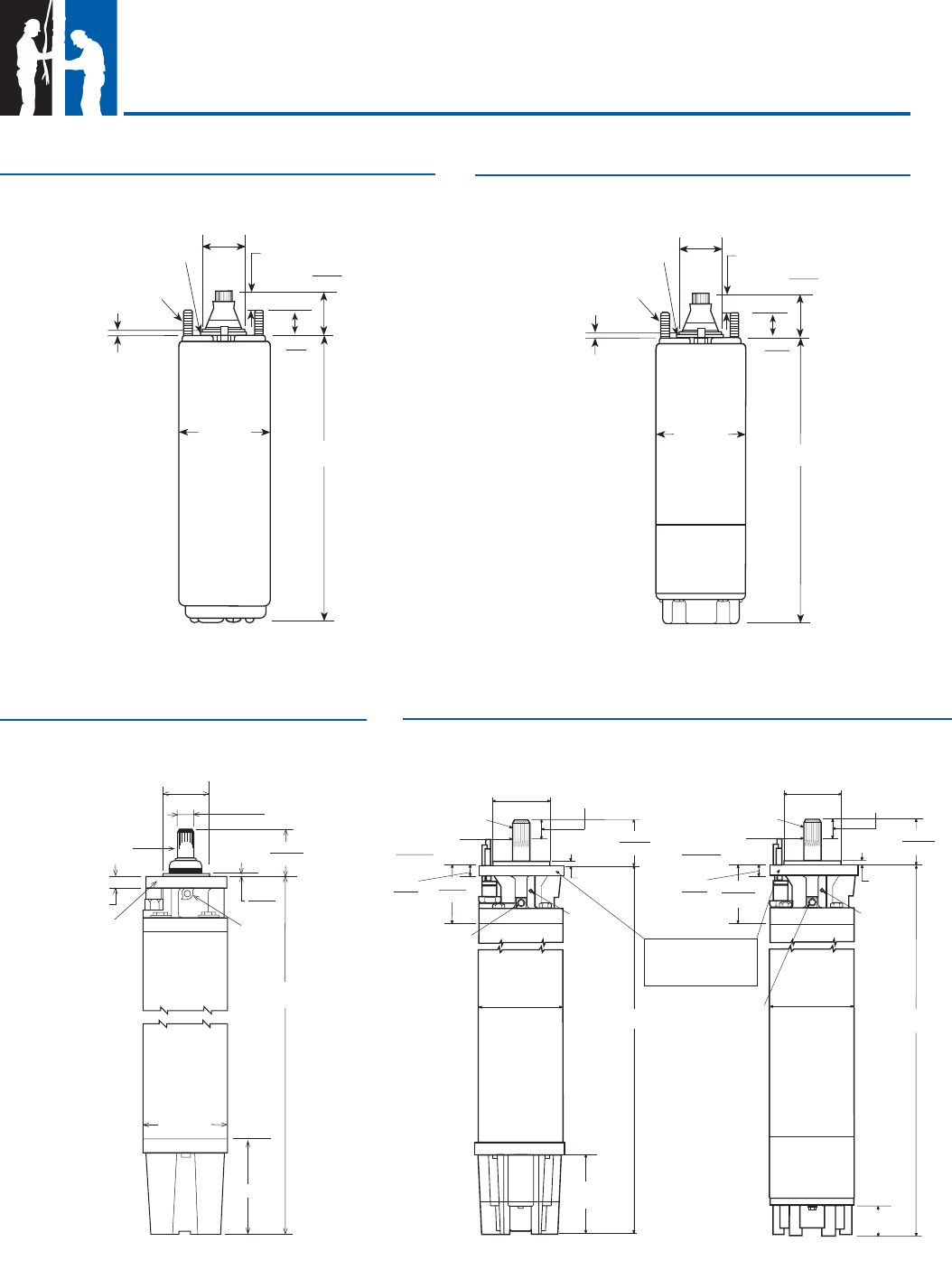
Installation – All Motors
4” Super Stainless — Dimensions
(Standard Water Well)
1.508"
1.498"
1.48"
MAX
0.030" R
MAX
0.97"
0.79"
L*
0.161" MAX LEAD
BOSS HEIGHT
3.75" DIA.
0.50" MIN.
FULL SPLINE
5/16 - 24 UNF-2A
MOUNTING STUDS
4” High Thrust — Dimensions
(Standard Water Well)
L*
5.44" DIA.
0.250"
0.240"
3.000"
2.997" 1.0000"
0.9995" DIA.
.94" MIN.
FULL SPLINE 2.875"
2.869"
6.25"
CHECK
VALVE
15 TOOTH 16/32"
DIAMETRAL PITCH
1/2 - 20 UNF-2B
MOUNTING HOLES
0.75"
6” — Dimensions
(Standard Water Well)
8” — Dimensions
(Standard Water Well)
* Motor lengths and shipping weights are available on Franklin Electric’s web site (www.franklin-electric.com) or by
calling Franklin’s submersible hotline (800-348-2420).
1.508"
1.498"
1.48"
MAX
0.030" R
MAX
L*
0.161" MAX LEAD
BOSS HEIGHT
3.75" DIA.
0.50" MIN.
FULL SPLINE
1.09"
0.91"
5/16 - 24 UNF-2A
MOUNTING STUDS
40 to 100 hp
5.000"
4.997"
5.130"
5.120"
1.69"
MIN FULL
SPLINE
0.240"
23 TOOTH 16/32"
DIAMETRAL PITCH
SHAFT DIA
1.5000"
1.4990"
CHECK
VALVE
WATER
WELL
MODELS
PIPE PLUG
STAINLESS
STEEL
MODELS
M8 x 1.25 6G
GROUND
SCREW
7.70" DIA
MAX
7.00"
FINNED
4.000"
3.990"
L*
23 TOOTH 16/32"
DIAMETRAL PITCH
SHAFT DIA
1.5000"
1.4990"
5.130"
5.120"
M8 x 1.25 6G
GROUND
SCREW
2.75"
FINNED
4.000"
3.990"
L*
125 to 200 hp
5.000"
4.997"
1.69"
MIN FULL
SPLINE
0.240"
CHECK
VALVE
7.70" DIA
MAX
MOUNTING HOLES
CLEARANCE FOR
5/8" BOLTS
1.06"
0.94"
1.06"
0.94"
40
Installation – All Motors
4" Motors:
15 to 20 ft-lb (20 to 27 Nm)
6" Motors:
50 to 60 ft-lb (68 to 81 Nm)
8" Motors with 1-3/16” to 1-5/8” Jam Nut:
50 to 60 ft-lb (68 to 81 Nm)
8" Motors with 4 Screw Clamp Plate:
Apply increasing torque to the screws equally in a
criss-cross pattern until 80 to 90 in-lb (9.0 to 10.2
Nm) is reached.
Jam nut tightening torques recommended for fi eld
assembly are shown. Rubber compression set within the
fi rst few hours after assembly may reduce the jam nut
torque. This is a normal condition which does not indicate
reduced seal effectiveness. Retightening is not required,
but is permissible and recommended if original torque
was questionable.
A motor lead assembly should not be reused. A new lead
assembly should be used whenever one is removed from
the motor, because rubber set and possible damage from
removal may prevent proper resealing of the old lead.
All motors returned for warranty consideration must
have the lead returned with the motor.
Assemble coupling with non-toxic FDA approved
waterproof grease such as Mobile FM102, Texaco
CYGNUS2661, or approved equivalent. This prevents
abrasives from entering the spline area and prolongs
spline life.
A common question is why motor leads are smaller than
specifi ed in Franklin’s cable charts.
The leads are considered a part of the motor and actually
are a connection between the large supply wire and the
motor winding. The motor leads are short and there is
virtually no voltage drop across the lead.
In addition, the lead assemblies operate under water,
while at least part of the supply cable must operate in
air. Lead assemblies running under water operate cooler.
CAUTION: Lead assemblies on submersible motors
are suitable only for use in water and may overheat
and cause failure if operated in air.
Shaft Height and Free End Play
If the height, measured from the
pump-mounting surface of the
motor, is low and/or end play
exceeds the limit, the motor thrust
bearing is possibly damaged, and
should be replaced.
Tightening Motor Lead Connector Jam Nut
Table 41
Pump to Motor Coupling
Submersible Leads and Cables
41
MOTOR NORMAL
SHAFT HEIGHT
DIMENSION
SHAFT HEIGHT
FREE END PLAY
MIN MAX.
4" 1 1/2" 38.1 mm 1.508"
1.498"
38.30
38.05
0.010"
0.25 mm
0.045"
1.14 mm
6" 2 7/8" 73.0 mm 2.875"
2.869"
73.02
72.88
0.030"
0.76 mm
0.050"
1.27 mm
8" TYPE 1 4" 101.6 mm 4.000"
3.990"
101.60
101.35
0.008"
0.20 mm
0.032"
0.81 mm
8" TYPE 2.1 4" 101.6 mm 4.000"
3.990"
101.60
101.35
0.030"
0.76 mm
0.080"
2.03 mm
mm
mm
mm
mm
Maintenance – All Motors
System Troubleshooting
POSSIBLE CAUSE CHECKING PROCEDURES CORRECTIVE ACTION
A. No power or incorrect voltage. Check voltage at line terminals.
The voltage must be ± 10% of rated voltage. Contact power company if voltage is incorrect.
B. Fuses blown or circuit breakers tripped.
Check fuses for recommended size and
check for loose, dirty or corroded
connections in fuse receptacle. Check
for tripped circuit breakers.
Replace with proper fuse or reset
circuit breakers.
C. Defective pressure switch.
Check voltage at contact points. Improper
contact of switch points can cause voltage
less than line voltage.
Replace pressure switch or clean points.
D. Control box malfunction. For detailed procedure, see pages 46-54. Repair or replace.
E. Defective wiring. Check for loose or corroded connections
or defective wiring Correct faulty wiring or connections.
F. Bound pump.
Check for misalignment between pump
and motor or a sand bound pump.
Amp readings will be 3 to 6 times higher
than normal until the overload trips
Pull pump and correct problem. Run new
installation until the water clears
G. Defective cable or motor. For detailed procedure, see pages 44 & 45. Repair or replace.
A. Pressure switch. Check setting on pressure switch and
examine for defects. Reset limit or replace switch.
B. Check valve - stuck open. Damaged or defective check valve will
not hold pressure. Replace if defective.
C. Waterlogged tank. Check air charge Clean or replace.
D. Leak in system. Check system for leaks. Replace damaged pipes or repair leaks.
Motor Does Not Start
Motor Starts Too Often
42
Maintenance – All Motors
System Troubleshooting
POSSIBLE CAUSE CHECKING PROCEDURES CORRECTIVE ACTION
A. Pressure switch. Check switch for welded contacts.
Check switch adjustments. Clean contacts, replace switch, or adjust setting.
B. Low water level in well.
Pump may exceed well capacity. Shut off
pump, wait for well to recover. Check
static and drawdown level from well head.
Throttle pump output or reset pump to lower level.
Do not lower if sand may clog pump.
C. Leak in system. Check system for leaks. Replace damaged pipes or repair leaks.
D. Worn pump.
Symptoms of worn pump are similar to
those of drop pipe leak or low water level
in well. Reduce pressure switch setting, if
pump shuts off worn parts may be the fault.
Pull pump and replace worn parts.
E. Loose coupling or broken motor shaft. Check for loose coupling or damaged shaft. Replace worn or damaged parts.
F. Pump screen blocked. Check for clogged intake screen. Clean screen and reset pump depth.
G. Check valve stuck closed. Check operation of check valve. Replace if defective.
H. Control box malfunction. See pages 46-54 for single-phase. Repair or replace.
A. Incorrect voltage. Using voltmeter, check the line terminals.
Voltage must be within ± 10% of rated voltage. Contact power company if voltage is incorrect.
B. Overheated protectors.
Direct sunlight or other heat source can raise control
box temperature causing protectors to trip. The box
must not be hot to touch.
Shade box, provide ventilation or move
box away from source.
C. Defective control box. For detailed procedures, see pages 46-54. Repair or replace.
D. Defective motor or cable. For detailed procedures, see pages 44 & 45. Repair or replace.
E. Worn pump or motor. Check running current, see tables 13, 22, 24 & 26. Replace pump and/or motor.
Motor Runs Continuously
Motor Runs But Overload Protector Trips
43
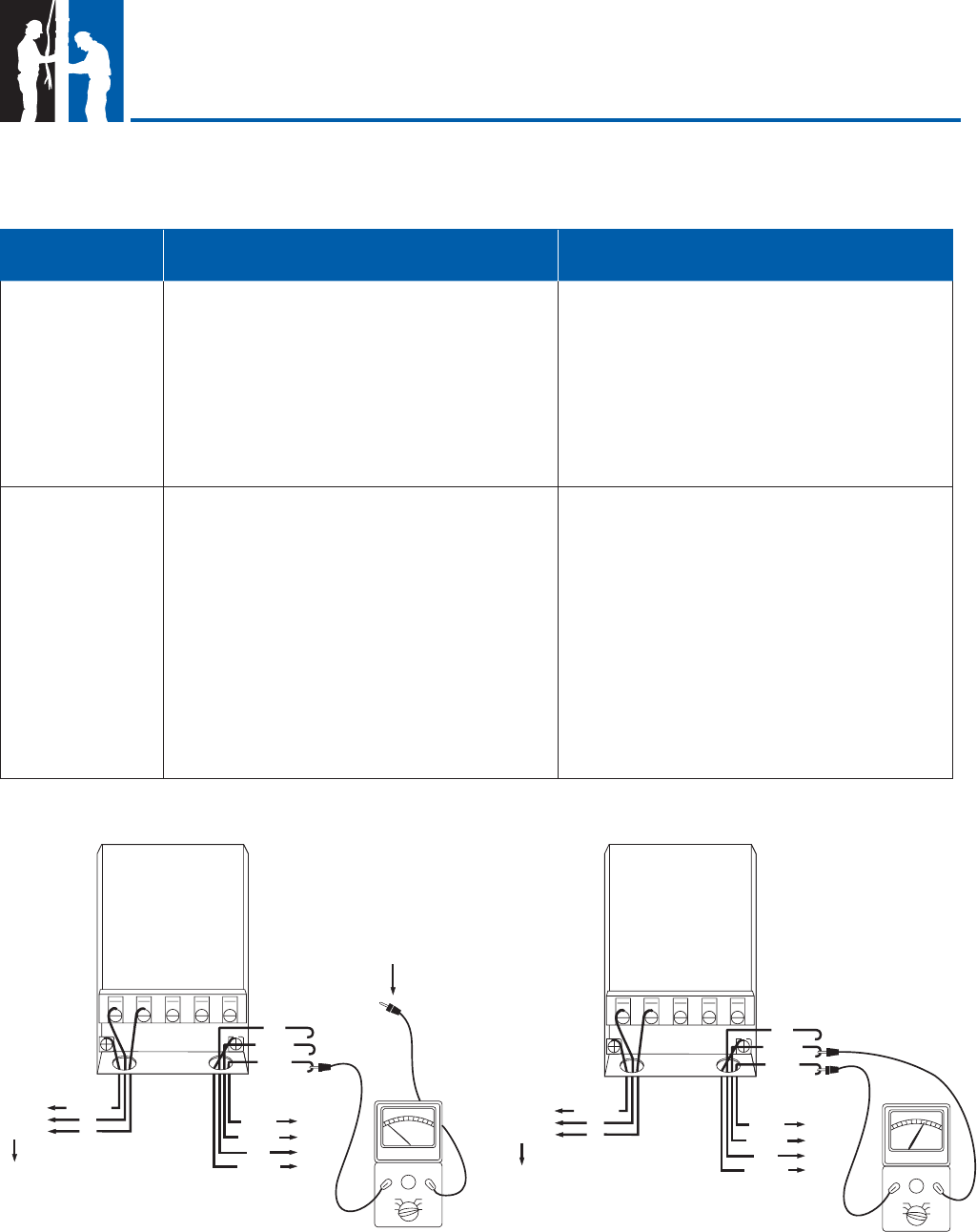
Maintenance – All Motors
GROUND
L2
{
TO
POWER
SUPPLY BLACK
{
YELLOW
RED
GROUND
POWER MUST
BE SHUT OFF
BLACK
YELLOW
RED
L1 L2 R Y B
L1
TO
PUMP
OHMMETER
SET AT R X 1
GROUND
L2
{
TO
POWER
SUPPLY BLACK
{
YELLOW
RED
GROUND
POWER MUST
BE SHUT OFF
BLACK
YELLOW
RED
L1 L2 R Y B
L1
TO
PUMP
MEGGER
OR OHMMETER
SET AT R X 100K
CONNECT
THIS LEAD
TO GROUND
ATTACH THIS LEAD
TO WELL CASING OR
DISCHARGE PIPE
FIG. 13 FIG. 14
Table 44 Preliminary Tests - All Sizes Single- and Three-Phase
“TEST” PROCEDURE WHAT IT MEANS
Insulation
Resistance
1. Open master breaker and disconnect all leads from control
box or pressure switch (QD type control, remove lid) to
avoid electric shock hazard and damage to the meter.
2. Use a megohmmeter or set the scale lever to R X 100K
on an Ohmmeter. Zero the meter.
3. Connect one meter lead to any one of the motor leads
and the other lead to the metal drop pipe. If the drop pipe is
plastic, connect the meter lead to ground.
1. If the ohms value is normal (table 45), the motor is
not grounded and the cable insulation is not damaged.
2. If the ohms value is below normal, either the windings
are grounded or the cable insulation is damaged.
Check the cable at the well seal as the insulation is
sometimes damaged by being pinched.
Winding
Resistance
1. Open master breaker and disconnect all leads from control
box or pressure switch (QD type control, remove lid) to
avoid electric shock hazard and damage to the meter.
2. Set the scale lever to R X 1 for values under 10 ohms.
For values over 10 ohms, set the scale lever to R X 10.
“Zero” the Ohmmeter.
3. On 3-wire motors measure the resistance of yellow to black
(Main winding) and yellow to red (Start winding).
On 2-wire motors: measure the resistance from line-to-line.
Three-phase motors: measure the resistance line-to-line
for all three combinations.
1. If all ohms values are normal (tables 13, 22, 24 & 26), the
motor windings are neither shorted nor open, and the
cable colors are correct
2. If any one value is less than normal, the motor
is shorted.
3. If any one ohm value is greater than normal, the
winding or the cable is open, or there is a poor cable
joint or connection.
4. If some ohms values are greater than normal and some
less on single-phase motors, the leads are mixed. See
page 46 to verify cable colors.
44
Maintenance – All Motors
Insulation Resistance Readings
The values below are for copper conductors. If aluminum
conductor drop cable is used, the resistance will be
higher. To determine the actual resistance of the
aluminum drop cable, divide the ohm readings from this
chart by 0.61. This chart shows total resistance of cable
from control to motor and back.
Winding Resistance Measuring
The winding resistance measured at the motor should
fall within the values in tables 13, 22, 24 & 26. When
measured through the drop cable, the resistance of
the drop cable must be subtracted from the Ohmmeter
readings to get the winding resistance of the motor. See
table below.
Insulation resistance varies very little with rating. Motors of all hp, voltage, and phase rating have similar values of
insulation resistance.
The table above is based on readings taken with a megohm meter with a 500 VDC output. Readings may vary using a lower
voltage Ohmmeter, consult Franklin Electric if readings are in question.
Table 45 Normal ohm and Megohm Values Between All Leads and Ground
Table 45A DC Resistance in ohms per 100 ft of Wire (Two conductors) @ 50 °F
CONDITION OF MOTOR AND LEADS OHMS VALUE MEGOHM VALUE
A new motor (without drop cable).
A used motor which can be reinstalled in well.
200,000,000 (or more)
10,000,000 (or more)
200.0 (or more)
10.0 (or more)
MOTOR IN WELL. READINGS ARE FOR DROP CABLE PLUS MOTOR.
2,000,000 (or more)
500,000 - 2,000,000
Less than 500,000
2.0 (or more)
0.50 - 2.0
Less than .50
New motor.
Motor in good condition.
Insulation damage, locate and repair.
AWG OR MCM WIRE SIZE (COPPER) 14 12 10 86432
OHMS 0.544 0.338 0.214 0.135 0.082 0.052 0.041 0.032
1 1/0 2/0 3/0 4/0 250 300 350 400 500 600 700
0.026 0.021 0.017 0.013 0.010 0.0088 0.0073 0.0063 0.0056 0.0044 0.0037 0.0032
Resistance of Drop Cable (ohms)
45
Maintenance – Single-Phase Motors & Controls
WARNING: Power must be on for these tests. Do not
touch any live parts.
A. VOLTAGE MEASUREMENTS
Step 1. Motor Off
1. Measure voltage at L1 and L2 of pressure switch
or line contactor.
2. Voltage Reading: Should be ± 10% of
motor rating.
Step 2. Motor Running
1. Measure voltage at load side of pressure switch
or line contactor with pump running.
2. Voltage Reading: Should remain the same except
for slight dip on starting. Excessive voltage
drop can be caused by loose connections, bad
contacts, ground faults, or inadequate
power supply.
3. Relay chatter is caused by low voltage or
ground faults.
If the colors on the individual drop cables cannot be
found with an Ohmmeter, measure:
Cable 1 to Cable 2
Cable 2 to Cable 3
Cable 3 to Cable 1
Find the highest resistance reading.
The lead not used in the highest reading is the
yellow lead.
Use the yellow lead and each of the other two leads to
get two readings:
Highest is the red lead.
Lowest is the black lead.
Identifi cation Of Cables When Color Code Is Unknown (Single-Phase 3-Wire Units)
EXAMPLE:
The Ohmmeter readings were:
Cable 1 to Cable 2—6 ohms
Cable 2 to Cable 3—2 ohms
Cable 3 to Cable 1— 4 ohms
The lead not used in the highest reading (6 ohms) was
Cable 3—Yellow
From the yellow lead, the highest reading (4 ohms) was
To Cable 1—Red
From the yellow lead, the lowest reading (2 ohms) was
To Cable 2—Black
Single-Phase Control Boxes
B. CURRENT (AMP) MEASUREMENTS
1. Measure current on all motor leads.
2. Amp Reading: Current in red lead should
momentarily be high, then drop within one second
to values in table 13. This verifi es relay or solid
state relay operation. Current in black and yellow
leads should not exceed values in table 13.
3. Relay or switch failures will cause red lead
current to remain high and overload tripping.
4. Open run capacitor(s) will cause amps to be
higher than normal in the black and yellow motor
leads and lower than normal in the red
motor lead.
5. A bound pump will cause locked rotor amps and
overloading tripping.
6. Low amps may be caused by pump running at
shutoff, worn pump, or stripped splines.
7. Failed start capacitor or open switch/relay are
indicated if the red lead current is not
momentarily high at starting.
CAUTION: The tests in this manual for components such as capacitors, relays, and QD switches should be
regarded as indicative and not as conclusive. For example, a capacitor may test good (not open, not shorted) but
may have lost some of its capacitance and may no longer be able to perform its function.
To verify proper operation of QD switches or relays, refer to operational test procedure described above
in Section B-2.
Checking and Repairing Procedures (Power On)
46

Maintenance – Single-Phase Motors & Controls
Integral Horsepower Control Box (Power Off)
A. OVERLOADS (Push Reset Buttons to make sure
contacts are closed.)
1. Meter Setting: R x 1.
2. Connections: Overload terminals.
3. Correct meter reading: Less than 0.5 ohms.
B. CAPACITOR (Disconnect leads from one side of
each capacitor before checking.)
1. Meter Setting: R x 1,000.
2. Connections: Capacitor terminals.
3. Correct meter reading: Pointer should swing toward
zero, then drift back to infi nity, except for capacitors
with resistors which will drift back to 15,000 ohms.
C. POTENTIAL (VOLTAGE) RELAY
Step 1. Coil Test
1. Meter setting: R x 1,000.
2. Connections: #2 & #5.
3. Correct meter readings: 4.5-7.0 (4,500 to 7,000
ohms) for all models.
QD, Solid State Control Box (Power Off)
A. START CAPACITOR AND RUN CAPACITOR IF
APPLICABLE (CRC)
1. Meter Setting: R x 1,000.
2. Connections: Capacitor terminals.
3. Correct meter reading: Pointer should swing
toward zero, then back to infi nity.
B. Q.D. (BLUE) RELAY
Step 1. Triac Test
1. Meter setting: R x 1,000.
2. Connections: Cap and B terminal.
3. Correct meter reading: Infi nity for all models.
Step 2. Coil Test
1. Meter Setting: R x 1.
2. Connections: L1 and B.
3. Correct meter reading: Zero ohms for all models.
CAUTION: The tests in this manual for components such as capacitors, relays, and QD switches should be regarded as
indicative and not as conclusive. For example, a capacitor may test good (not open, not shorted) but may have lost some
of its capacitance and may no longer be able to perform its function.
To verify proper operation of QD switches or relays, refer to operational test procedure described on page 46, Section B-2.
C. POTENTIAL (VOLTAGE) RELAY
Step 1. Coil Test
1. Meter setting: R x 1,000.
2. Connections: #2 & #5.
3. Correct meter readings:
For 115 Volt Boxes:
0.7-1.8 (700 to 1,800 ohms).
For 230 Volt Boxes:
4.5-7.0 (4,500 to 7,000 ohms).
Step 2. Contact Test
1. Meter setting: R x 1.
2. Connections: #1 & #2.
3. Correct meter reading: Zero for all models.
Step 2. Contact Test
1. Meter Setting: R x 1.
2. Connections: #1 & #2.
3. Correct meter reading: Zero ohms for all models.
D. CONTACTOR
Step 1. Coil
1. Meter setting: R x 100
2. Connections: Coil terminals
3. Correct meter reading:
1.8-14.0 (180 to 1,400 ohms)
Step 2. Contacts
1. Meter Setting: R X 1
2. Connections: L1 & T1 or L2 & T2
3. Manually close contacts
4. Correct meter reading: Zero ohms
Ohmmeter Tests
Ohmmeter Tests
47
Maintenance – Single-Phase Motors & Controls
NOTE 1: Control boxes supplied with QD Relays are
designed to operate on 230 volt systems. For 208 volt
systems or where line voltage is between 200 volts and
210 volts use the next larger cable size, or use a boost
transformer to raise the voltage.
NOTE 2: Voltage relays kits for 115 volts (305102901)
and 230 volts (305102902) will replace current, voltage
or QD Relays, and solid state switches.
(1) For Control Boxes with model numbers that end with 4915.
Table 48 QD Control Box Parts 60 Hz
Table 48A QD Capacitor Replacement Kits
Table 48C QD Relay Replacement Kits
Table 48B Overload Kits 60 Hz
HP VOLTS CONTROL BOX
MODEL NUMBER QD (BLUE) RELAY START
CAPACITOR MFD VOLTS RUN
CAPACITOR MFD VOLTS
1/3
115 280 102 4915 223 415 905 275 464 125 159-191 110
230 280 103 4915 223 415 901 275 464 126 43-53 220
1/2
115 280 104 4915 223 415 906 275 464 201 250-300 125
230 280 105 4915 223 415 902 275 464 105 59-71 220
230 282 405 5015 (CRC) 223 415 912 275 464 126 43-53 220 156 362 101 15 370
3/4
230 280 107 4915 223 415 903 275 464 118 86-103 220
230 282 407 5015 (CRC) 223 415 913 275 464 105 59-71 220 156 362 102 23 370
1
230 280 108 4915 223 415 904 275 464 113 105-126 220
230 282 408 5015 (CRC) 223 415 914 275 464 118 86-103 220 156 362 102 23 370
CAPACITOR NUMBER KIT
275 464 105 305 207 905
275 464 113 305 207 913
275 464 118 305 207 918
275 464 125 305 207 925
275 464 126 305 207 926
275 464 201 305 207 951
156 362 101 305 203 907
156 362 102 305 203 908
QD RELAY NUMBER KIT
223 415 901 305 101 901
223 415 902 305 101 902
223 415 903 305 101 903
223 415 904 305 101 904
223 415 905 305 101 905
223 415 906 305 101 906
223 415 912 (CRC) 305 105 901
223 415 913 (CRC) 305 105 902
223 415 914 (CRC) 305 105 903
HP VOLTS KIT (1)
1/3 115 305 100 901
1/3 230 305 100 902
1/2 115 305 100 903
1/2 230 305 100 904
3/4 230 305 100 905
1 230 305 100 906
48
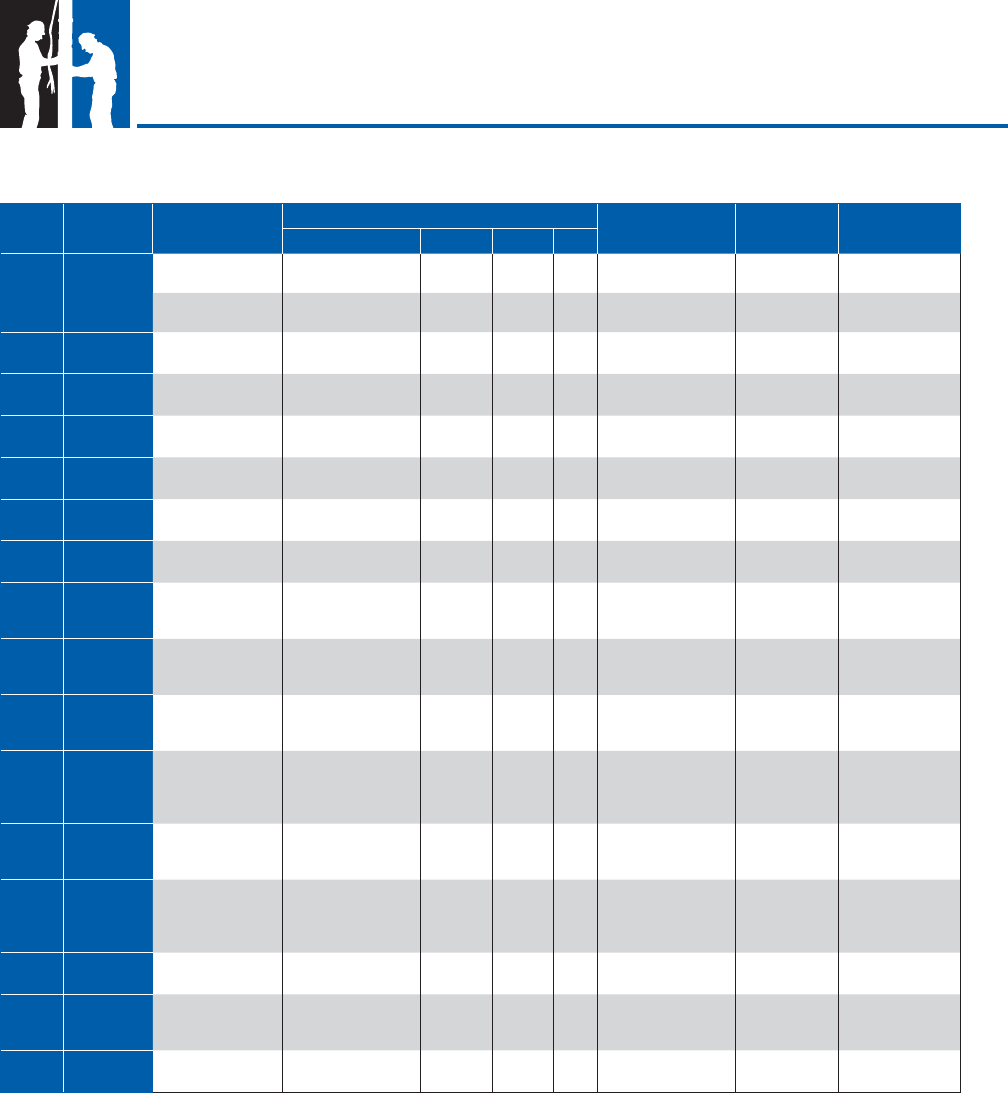
Maintenance – Single-Phase Motors & Controls
FOOTNOTES:
(1) Lightning arrestors 150 814 902 are suitable for all control boxes.
(2) S = Start, M = Main, L = Line, R = Run
Deluxe = Control box with line contactor.
(3) For 208-volt systems or where line voltage is between 200 V and 210 V, a low voltage relay is required. On 3 hp
and smaller control boxes use relay part 155 031 103 in place of 155 031 102 and use the next larger cable size
than specifi ed in the 230 V table. On 5 hp and larger use relay 155 031 602 in place of 155 031 601 and next
larger wire. Boost transformers per page 15 are an alternative to special relays and cable.
(4) Control box model 282 300 8610 is designed for use with motors having internal overload protectors. If used with a
1.5 hp motor manufactured prior to date code 06H18, Overload/Capacitor Kit 305 388 901 is required.
Table 49 Integral Horsepower Control Box Parts 60 Hz
MOTOR
SIZE
MOTOR
RATING HP
CONTROL BOX (1)
MODEL NO.
CAPACITORS OVERLOAD (2)
PART NO.
RELAY (3)
PART NO.
CONTACTOR (2)
PART NO.
PART NO. (2) MFD. VOLTS QTY.
4" 1 - 1.5
STANDARD
282 300 8110 275 464 113 S
155 328 102 R
105-126
10
220
370
1
1275 411 107 155 031 102
282 300 8610 275 464 113 S
155 328 101 R
105-126
15
220
370
1
1
None
(See Note 4) 155 031 102
4" 2
STANDARD 282 301 8110 275 464 113 S
155 328 103 R
105-126
20
220
370
1
1
275 411 117 S
275 411 113 M 155 031 102
4" 2
DELUXE 282 301 8310 275 464 113 S
155 328 103 R
105-126
20
220
370
1
1
275 411 117 S
275 411 113 M 155 031 102 155 325 102 L
4" 3
STANDARD 282 302 8110 275 463 111 S
155 327 109 R
208-250
45
220
370
1
1
275 411 118 S
275 411 115 M 155 031 102
4" 3
DELUXE 282 302 8310 275 463 111 S
155 327 109 R
208-250
45
220
370
1
1
275 411 118 S
275 411 115 M 155 031 102 155 325 102 L
4" & 6" 5
STANDARD 282 113 8110 275 468 119 S
155 327 114 R
270-324
40
330
370
1
2
275 411 119 S
275 406 102 M 155 031 601
4" & 6" 5
DELUXE 282 113 9310 275 468 119 S
155 327 114 R
270-324
40
330
370
1
2
275 411 119 S
275 406 102 M 155 031 601 155 326 101 L
6" 7.5
STANDARD 282 201 9210
275 468 119 S
275 468 118 S
155 327 109 R
270-324
216-259
45
330
330
370
1
1
1
275 411 102 S
275 406 122 M 155 031 601
6" 7.5
DELUXE 282 201 9310
275 468 119 S
275 468 118 S
155 327 109 R
270-324
216-259
45
330
330
370
1
1
1
275 411 102 S
275 406 121 M 155 031 601 155 326 102 L
6" 10
STANDARD 282 202 9210
275 468 119 S
275468 120 S
155 327 102 R
270-324
350-420
35
330
330
370
1
1
2
275 406 103 S
155 409 101 M 155 031 601
6" 10
STANDARD 282 202 9230
275 463 120 S
275 468 118 S
275 468 119 S
155 327 102 R
130-154
216-259
270-324
35
330
330
330
370
1
1
1
2
275 406 103 S
155 409 101 M
155 031 601
6" 10
DELUXE 282 202 9310
275 468 119 S
275468 120 S
155 327 102 R
270-324
350-420
35
330
330
370
1
1
2
275 406 103 S
155 409 101 M 155 031 601 155 326 102 L
6" 10
DELUXE 282 202 9330
275 463 120 S
275 468 118 S
275 468 119 S
155 327 102 R
130-154
216-259
270-324
35
330
330
330
370
1
1
1
2
275 406 103 S
155 409 101 M
155 031 601 155 326 102 L
6" 15
DELUXE 282 203 9310 275 468 120 S
155 327 109 R
350-420
45
330
370
2
3
275 406 103 S
155 409 102 M 155 031 601 155 429 101 L
6" 15
DELUXE 282 203 9330
275 463 122 S
275 468 119 S
155 327 109 R
161-193
270-324
45
330
330
370
1
2
3
275 406 103 S
155 409 102 M
155 031 601 155 429 101 L
6" 15
X-LARGE 282 203 9621 275 468 120 S
155 327 109 R
350-420
45
330
370
2
3
275 406 103 S
155 409 102 M
155 031 601
2 required 155 429 101 L
49
Maintenance – Single-Phase Motors & Controls
CAPACITOR NUMBER KIT
275 463 122 305 206 912
275 463 111 305 206 911
275 463 120 305 206 920
275 464 113 305 207 913
275 468 117 305 208 917
275 468 118 305 208 918
275 468 119 305 208 919
275 468 120 305 208 920
155 327 101 305 203 901
155 327 102 305 203 902
155 327 109 305 203 909
155 327 114 305 203 914
155 328 101 305 204 901
155 328 102 305 204 902
155 328 103 305 204 903
OVERLOAD NUMBER KIT
275 406 102 305 214 902
275 406 103 305 214 903
275 406 121 305 214 921
275 406 122 305 214 922
275 411 102 305 215 902
275 411 107 305 215 907
275 411 108 305 215 908
275 411 113 305 215 913
275 411 115 305 215 915
275 411 117 305 215 917
275 411 118 305 215 918
275 411 119 305 215 919
RELAY NUMBER KIT
155 031 102 305 213 902
155 031 103 305 213 903
155 031 601 305 213 961
155 031 602 305 213 904
CONTACTOR KIT
155 325 102 305 226 901
155 326 101 305 347 903
155 326 102 305 347 902
155 429 101 305 347 901
Table 50 Integral hp Capacitor Replacement Kits
Table 50A Integral hp Overload Replacement Kits
Table 50B Integral hp Voltage Relay Replacement Kits
Table 50C Integral hp Contactor Replacement Kits
50
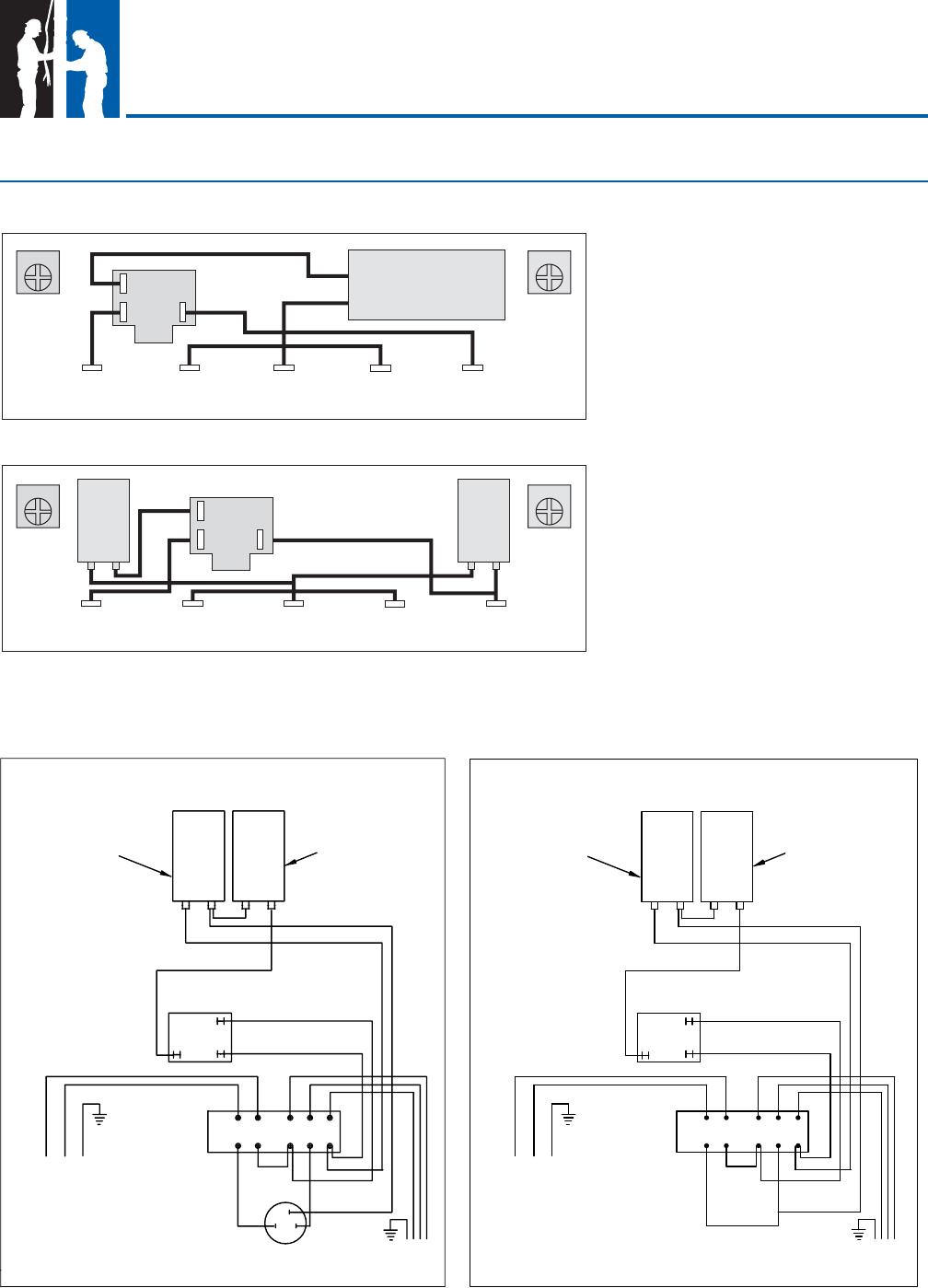
Maintenance – Single-Phase Motors & Controls
1/2 - 1 hp CRC QD RELAY
282 40_ 5015
Sixth digit depends on hp
Control Box Wiring Diagrams
LINE POWER
FROM TWO POLE
FUSED SWITCH OR
CIRCUIT BREAKER,
AND OTHER CONTROL
IF USED.
OVERLOAD TO
MOTOR
RED
BLK
YEL
12
3
BLU
BLK
YEL
12
5
RED
YEL
START CAPACITOR
RUN CAPACITOR
BLK
ORG
BLK
RED
GROUND
LEAD
GROUND
LEAD
RELAY
L1 L2 YEL BLK RED
GND
GREEN
CAPACITOR
CAP
BL1
B (MAIN) Y R (START) L2 L1
(MOTOR LEADS) (LINE LEADS)
ORANGE
QD RELAY
BLACK
YELLOW
RED
BLUE
GND
GREEN
GND
GREEN
GND
GREEN
START
CAPACITOR
RUN
CAPACITOR
CAP
BL1
QD RELAY
B (MAIN) Y R (START) L2 L1
(MOTOR LEADS) (LINE LEADS)
RED
YELLOW
BLUE
BLUE
BLACK
RED
ORANGE
1/3 - 1 hp QD RELAY
280 10_ 4915
Sixth digit depends on hp
51
1 - 1.5 hp
282 300 8110
1 - 1.5 hp
282 300 8610
RELAY
L1 L2 YEL BLK RED
LINE POWER
FROM TWO POLE
FUSED SWITCH OR
CIRCUIT BREAKER,
AND OTHER CONTROL
IF USED.
TO
MOTOR
RED
BLK
YEL
BLK
BLK
YEL
12
5
RED
YEL
RUN CAPACITOR START CAPACITOR
BLK
ORG
BLK
RED
GROUND
LEAD
GROUND
LEAD
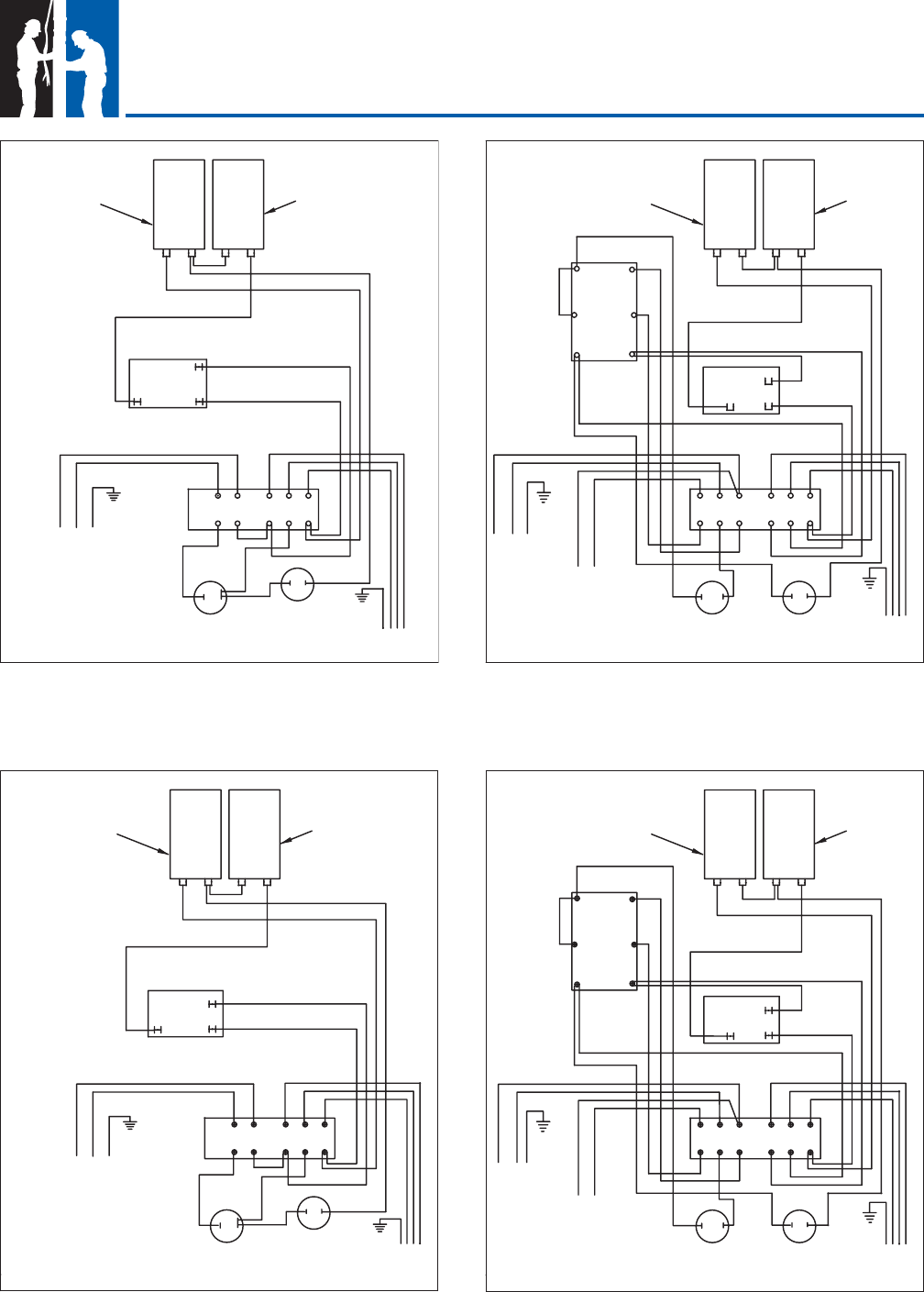
Maintenance – Single-Phase Motors & Controls
START
OVERLOAD
LINE POWER
FROM TWO POLE
FUSED SWITCH OR
CIRCUIT BREAKER,
AND OTHER CONTROL
IF USED.
RELAY
12
5
TO
MOTOR
BLK
RED
RED
YEL
3
1
MAIN
OVERLOAD
13
RED
BLK
YEL
BLU
BLK
YEL
START CAPACITOR
RUN CAPACITOR
BLK
BLK
ORG
GROUND
LEAD
GROUND
LEAD
L1 L2 YEL BLK RED
START
OVERLOAD
LINE
POWER
FROM
TWO POLE
FUSED
SWITCH
OR
CIRCUIT
BREAKER
TO
PRESSURE
OR OTHER
CONTROL
SWITCH
RELAY
START CAPACITOR
RUN CAPACITOR
LINE
CONTACTOR
12
5
T2
T1
L1 L2
COIL
TO
MOTOR
RED
BLK
YEL
3
1
ORG
MAIN OVERLOAD
31
RED
BLK
YEL
BLU
RED
YEL
BLK
BLK
BLK
BLK
BLK
YEL
YEL
GROUND
LEAD
GROUND
LEAD
L1 L2 YEL BLK RED
SW
START
OVERLOAD
LINE POWER
FROM TWO POLE
FUSED SWITCH OR
CIRCUIT BREAKER,
AND OTHER CONTROL
IF USED.
RELAY
12
5
TO
MOTOR
BLK
RED
RED
YEL
2
1
MAIN
OVERLOAD
12
RED
BLK
YEL
BLU
BLK
YEL
START CAPACITOR
RUN CAPACITOR
BLK
BLK
ORG
GROUND
LEAD
GROUND
LEAD
L1 L2 YEL BLK RED
START
OVERLOAD
LINE
POWER
FROM
TWO POLE
FUSED
SWITCH
OR
CIRCUIT
BREAKER
TO
PRESSURE
OR OTHER
CONTROL
SWITCH
RELAY
START CAPACITOR
RUN CAPACITOR
LINE
CONTACTOR
12
5
T2
T1
L1 L2
COIL
TO
MOTOR
RED
BLK
YEL
2
1
ORG
MAIN OVERLOAD
21
RED
BLK
YEL
BLU
RED
YEL
BLK
BLK
BLK
BLK
BLK
YEL
YEL
GROUND
LEAD
GROUND
LEAD
L1 L2 YEL BLK RED
SW
2 hp STANDARD
282 301 8110
3 hp STANDARD
282 302 8110
3 hp DELUXE
282 302 8310
2 hp DELUXE
282 301 8310
52
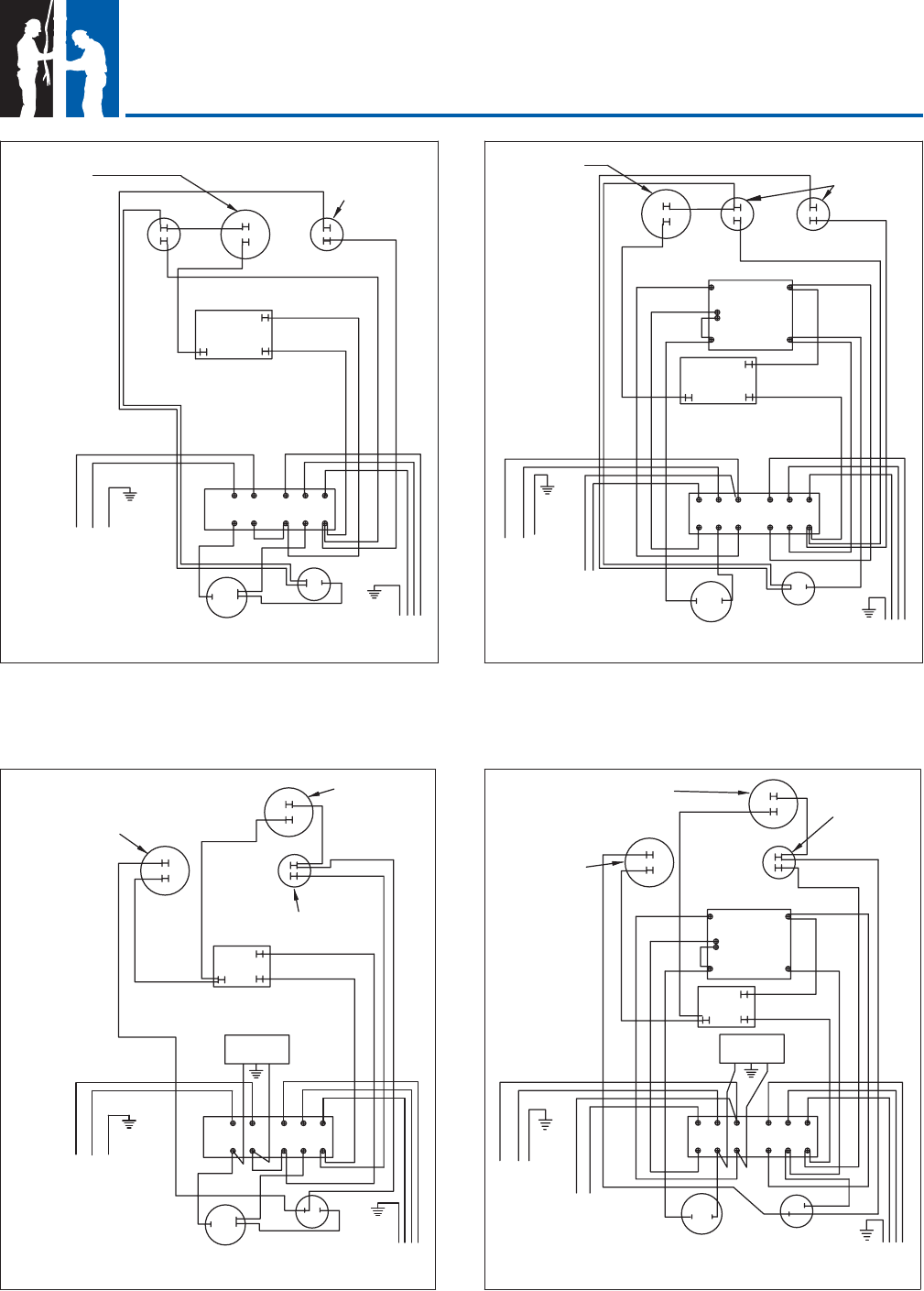
Maintenance – Single-Phase Motors & Controls
START
OVERLOAD
LINE POWER
FROM TWO POLE
FUSED SWITCH OR
CIRCUIT BREAKER,
AND OTHER CONTROL
IF USED.
RELAY
START CAPACITOR
12
5
TO
MOTOR
BLK
RED
RED
ORG
YEL
1
3
SURGE
ARRESTOR
MAIN OVERLOAD
12
BLK
RED
BLK
YEL
BLU
BLK
YEL
BLK
ORG
BLK
RUN CAPACITOR
START CAPACITOR
GROUND
LEAD
GROUND
LEAD
L1 L2 YEL BLK RED
START
OVERLOAD
LINE
POWER
FROM
TWO POLE
FUSED
SWITCH
OR
CIRCUIT
BREAKER
TO
PRESSURE
OR OTHER
CONTROL
SWITCH MAIN
OVERLOAD
RELAY
START CAPACITOR
RUN CAPACITOR
12
5
TO
MOTOR
BLK
BLK
BLK
BLU
YEL
RED
RED
ORG
YEL
RED
BLK
YEL
1
2
1
3
START CAPACITOR
BLK
ORG
BLK
YEL
SURGE
ARRESTOR
BLK
GROUND
LEAD
GROUND
LEAD
SW L1 L2 YEL BLK RED
CONTACTOR
L2
COIL
L1
COIL
T2
T1
LINE
YEL
5 hp STANDARD
282 113 8110
5 hp DELUXE
282 113 8310 or 282 113 9310
7.5 hp STANDARD
282 201 9210
7.5 hp DELUXE
282 201 9310
START
OVERLOAD
LINE
POWER
FROM
TWO POLE
FUSED
SWITCH
OR
CIRCUIT
BREAKER
TO
PRESSURE
OR OTHER
CONTROL
SWITCH
RELAY
START CAPACITOR
RUN CAPACITOR
12
5
T2
T1
L1
L2
TO
MOTOR
BLK
RED
BLK
YEL
YEL
RED
RED
ORG
YEL
1
2
BLK
YEL
BLK
MAIN OVERLOAD
21
BLK
RED
BLK
YEL
BLU
BLK
GROUND
LEAD
GROUND
LEAD
L1 L2 YEL BLK RED
SW
COIL
COIL
BLK
LINE
CONTACTOR
START
OVERLOAD
LINE POWER
FROM TWO POLE
FUSED SWITCH OR
CIRCUIT BREAKER,
AND OTHER CONTROL
IF USED.
RELAY
START CAPACITOR
RUN CAPACITOR
12
5
TO
MOTOR
BLK
RED
BLK
RED
RED
ORG
YEL
1
2
BLK
MAIN OVERLOAD
12
BLK
RED
BLK
YEL
BLU
BLK
YEL
GROUND
LEAD
GROUND
LEAD
L1 L2 YEL BLK RED
53
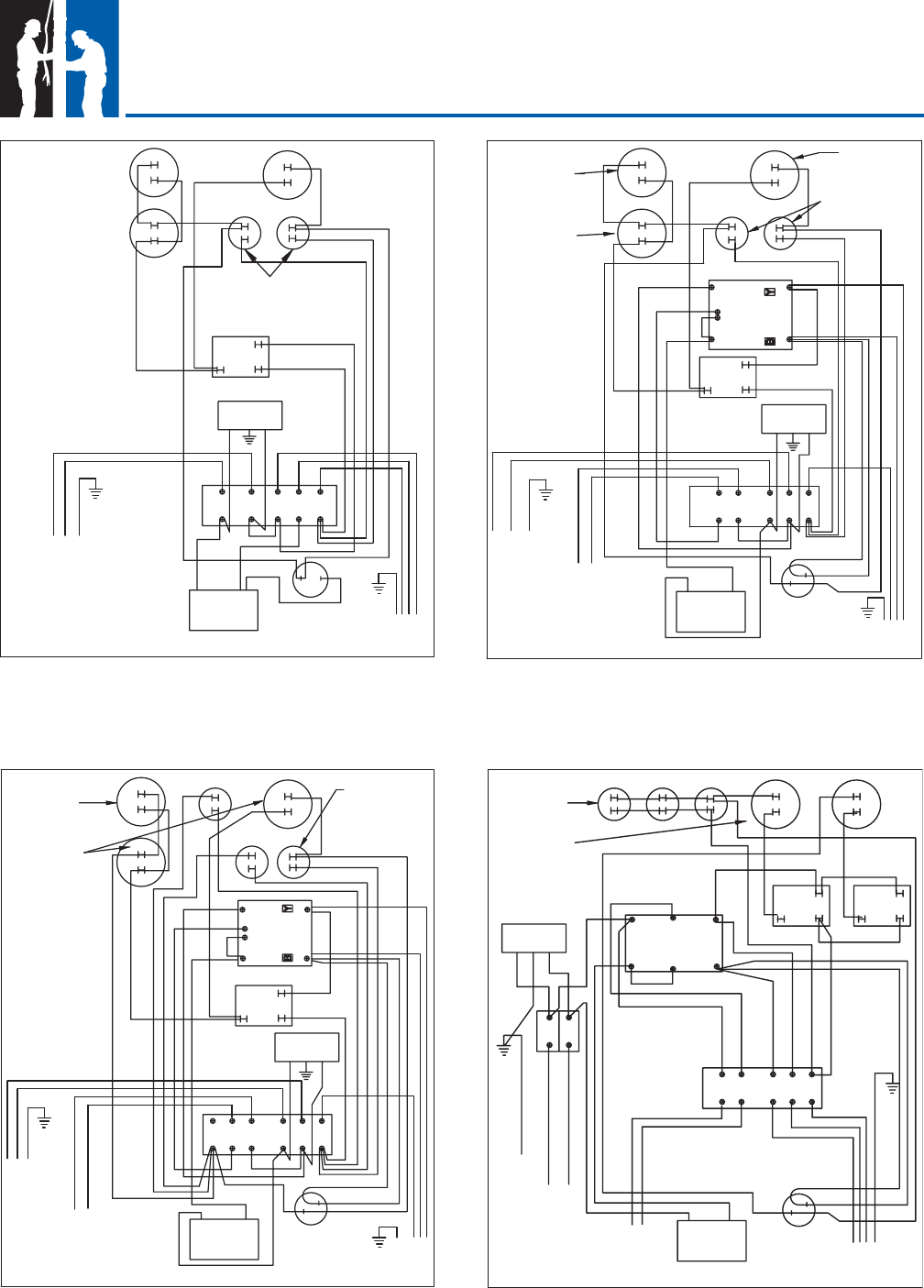
Maintenance – Single-Phase Motors & Controls
BREAKER
CIRCUIT
SWITCH
FUSED
TWO POLE
FROM
POWER
LINE
OR CONTROL
SWITCH
OR OTHER
PRESSURE
TO
LEAD
GROUND
ORG
BLK
START CAPACITOR
START CAPACITOR
MOTOR
TO
YEL
OVERLOAD
MAIN
BLK
BLK
OVERLOAD
START
2
1
LEAD
GROUND
BLK
RED
RELAY
12
5
YEL
BLK
YEL
ARRESTOR
SURGE
YEL
RED
BLK
YEL
ORG
RED
RUN CAPACITOR
BLK
BLK
START CAPACITOR
SW SW L1 L2 RED
CONTACTOR
L2
COIL
L1
COIL
T2
T1
LINE
BLK
RED
ORG
BLK
BLK
10 hp STANDARD
282 202 9210 or 282 202 9230
10 hp DELUXE
282 202 9230 or 282 202 9330
15 hp DELUXE
282 203 9330 or 282 203 9330
LINE POWER
FROM TWO POLE
FUSED SWITCH OR
CIRCUIT BREAKER,
AND OTHER CONTROL
IF USED.
GROUND
LEAD
START CAPACITOR
START CAPACITOR
MOTOR
MAIN
OVERLOAD
L1 L2
OVERLOAD
START
1
2
LEAD
GROUND
RED
YEL
YEL BLK
ORG 12
RELAY
5
RED
ARRESTOR
SURGE
YEL
TO
RUN CAPACITOR
BLK
RED
BLK
START CAPACITOR
ORG
BLK
BLK
BLK
YEL
BLK
RED
BLK
RED
BLK ORG
BLK
START
OVERLOAD
LINE
POWER
FROM
TWO POLE
FUSED
SWITCH
OR
CIRCUIT
BREAKER
TO
PRESSURE
OR OTHER
CONTROL
SWITCH
MAIN
OVERLOAD
RELAY
START CAPACITOR
START CAPACITOR
12
5
TO
MOTOR
BLK
YEL
RED
RED
ORG
YEL
1
2
BLK
ORG
BLK
YEL
SURGE
ARRESTOR
BLK
RED
BLK
BLK
BLK
YEL
BLK
GROUND
LEAD
GROUND
LEAD
RUN CAPACITOR
SW SW L1 L2 RED
BLK
RED
RED
T2
T1
L1 L2
BLK
COIL
COIL
YEL
BLK
BLK
15 hp X-LARGE
282 203 9621
START
OVERLOAD
LINE
POWER
FROM
TWO POLE
FUSED
SWITCH
OR
CIRCUIT
BREAKER
TO
PRESSURE
OR OTHER
CONTROL
SWITCH
MAIN
OVERLOAD
RELAY
START CAPACITOR
RUN CAPACITOR
LINE CONTACTOR
12
5
T2
T1
L1
L2 COIL
TO
MOTOR
1
2
COIL
SURGE
ARRESTOR
GROUND
LEAD
5
RELAY
2
1
L2 L1
GROUND
LEAD
SW SW BYR
54
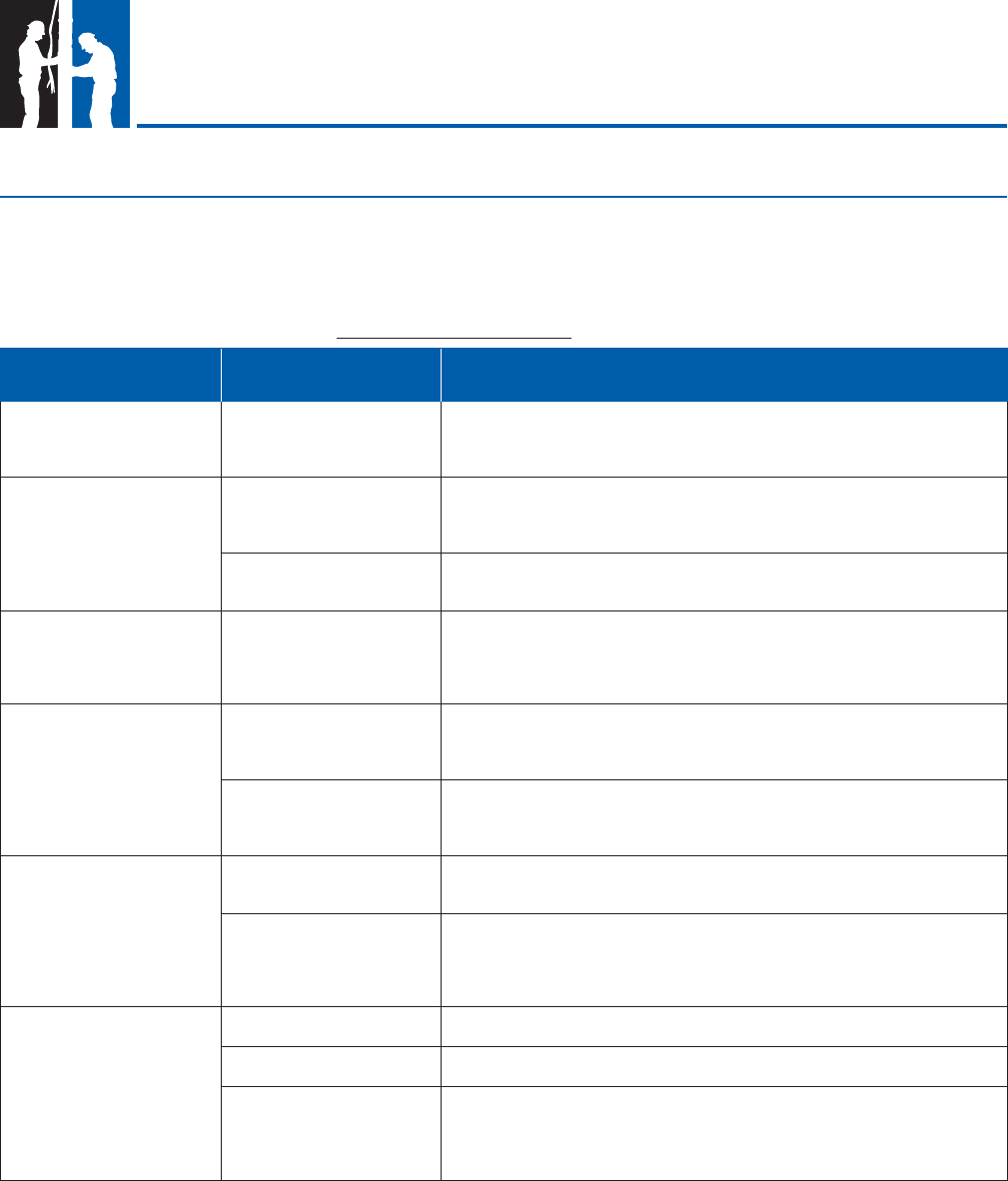
Maintenance – Electronic Products
Pumptec-Plus
Pumptec-Plus is a pump/motor protection device designed to work on any 230 V single-phase induction motor (PSC,
CSCR, CSIR, and split phase) ranging in size from 1/2 to 5 horsepower. Pumptec-Plus uses a micro-computer to
continuously monitor motor power and line voltage to provide protection against dry well, water logged tank, high and
low voltage and mud or sand clogging.
Pumptec-Plus – Troubleshooting During Installation
SYMPTOM POSSIBLE CAUSE SOLUTION
Unit Appears Dead
(No Lights) No Power to Unit
Check wiring. Power supply voltage should be applied to L1 and L2 terminals of the
Pumptec-Plus. In some installations the pressure switch or other control devices is wired
to the input of the Pumptec-Plus. Make sure this switch is closed.
Flashing Yellow Light
Unit Needs to Be Calibrated
Pumptec-Plus is calibrated at the factory so that it will overload on most pump systems
when the unit is fi rst installed. This overload condition is a reminder that the Pumptec-
Plus unit requires calibration before use. See step 7 of the installation instructions.
Miscalibrated Pumptec-Plus should be calibrated on a full recovery well with the maximum water fl ow.
Flow restrictors are not recommended.
Flashing Yellow Light
During Calibration 2-Wire Motor
Step C of the calibration instructions indicate that a fl ashing green light condition will
occur 2 to 3 seconds after taking the SNAPSHOT of the motor load. On some two wire
motors the yellow light will fl ash instead of the green light. Press and release the reset
button. The green should start fl ashing.
Flashing Red and
Yellow Lights
Power Interruption
During the installation of Pumptec-Plus power may be switched on and off several times.
If power is cycled more than four times within a minute Pumptec-Plus will trip on rapid
cycle. Press and release the reset button to restart the unit.
Float Switch
A bobbing fl oat switch may cause the unit to detect a rapid cycle condition on any motor
or an overload condition on two wire motors. Try to reduce water splashing or use a
different switch.
Flashing Red Light
High Line Voltage The line voltage is over 253 volts. Check line voltage. Report high line voltage to the
power company.
Unloaded Generator
If you are using a generator the line voltage may become too high when the generator
unloads. Pumptec-Plus will not allow the motor to turn on again until the line voltage
returns to normal. Over voltage trips will also occur if line frequency drops too far
below 60 Hz.
Solid Red Light
Low Line Voltage The line voltage is below 207 volts. Check line voltage.
Loose Connections Check for loose connections which may cause voltage drops.
Loaded Generator
If you are using a generator the line voltage may become too low when the generator
loads. Pumptec-Plus will trip on undervoltage if the generator voltage drops below 207
volts for more than 2.5 seconds. Undervoltage trips will also occur if the line frequency
rises too far above 60 Hz.
55
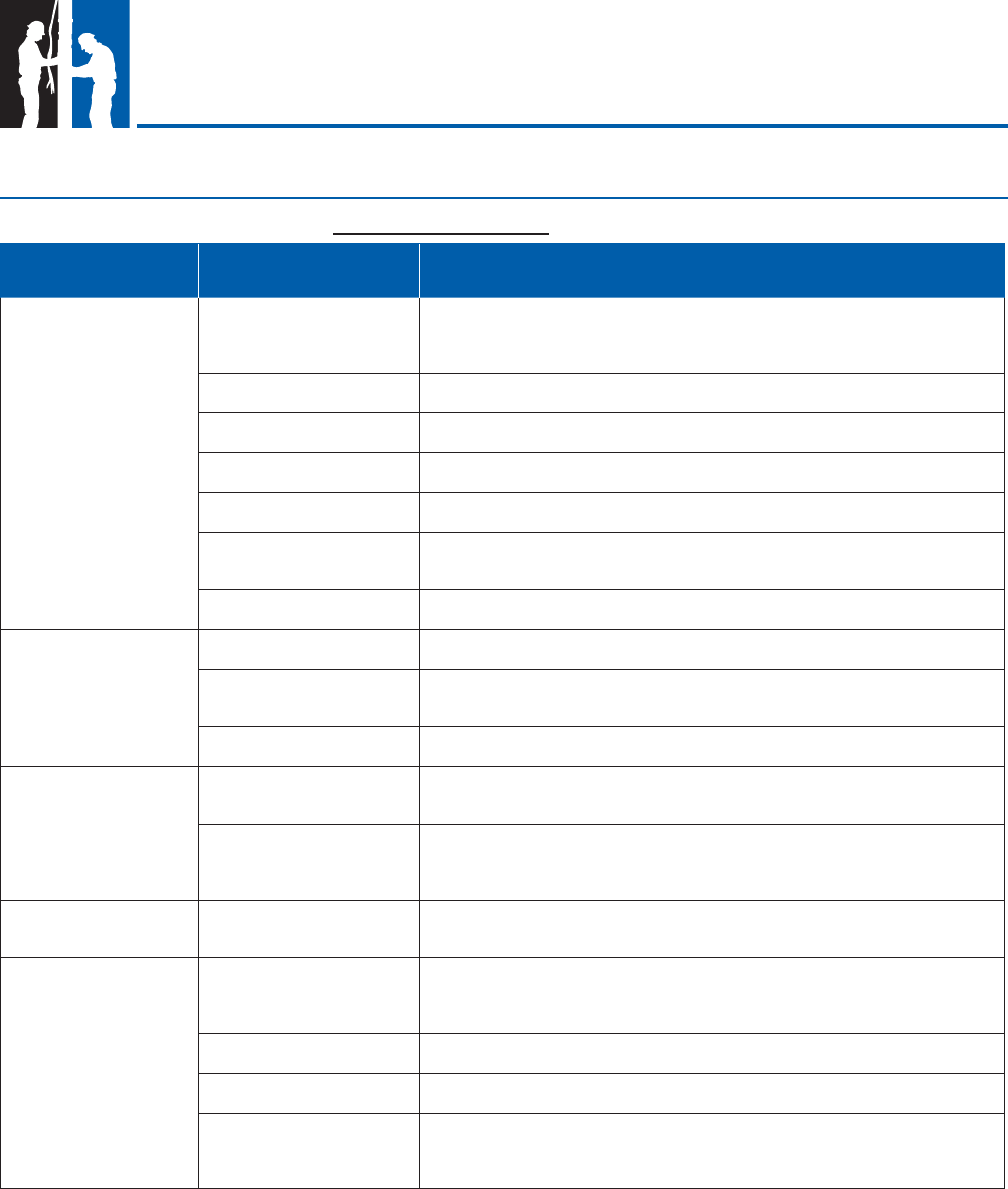
Maintenance – Electronic Products
Pumptec-Plus
Pumptec-Plus - Troubleshooting After Installation
SYMPTOM POSSIBLE CAUSE SOLUTION
Solid Yellow Light
Dry Well
Wait for the automatic restart timer to time out. During the time out period the well should
recover and fi ll with water. If the automatic reset timer is set to the manual position, then the
reset button must be pressed to reactivate the unit.
Blocked Intake Clear or replace pump intake screen.
Blocked Discharge Remove blockage in plumbing.
Check Valve Stuck Replace check valve.
Broken Shaft Replace broken parts.
Severe Rapid Cycling Machine gun rapid cycling can cause an underload condition. See fl ashing red and yellow
lights section below.
Worn Pump Replace worn pump parts and recalibrate.
Yellow Flashing Light
Stalled Motor Repair or replace motor. Pump may be sand or mud locked.
Float Switch A bobbing fl oat switch can cause two-wire motors to stall. Arrange plumbing to avoid
splashing water. Replace fl oat switch.
Ground Fault Check insulation resistance on motor and control box cable.
Solid Red Light
Low Line Voltage The line voltage is below 207 volts. Pumptec-Plus will try to restart the motor every two
minutes until line voltage is normal.
Loose Connections
Check for excessive voltage drops in the system electrical connections (i.e. circuit breakers,
fuse clips, pressure switch, and Pumptec-Plus L1 and L2 terminals).
Repair connections.
Flashing Red Light High Line Voltage The line voltage is over 253 volts. Check line voltage. Report high line voltage to the
power company.
Flashing Red and
Yellow Lights
Rapid Cycle
The most common cause for the rapid cycle condition is a waterlogged tank. Check for a
ruptured bladder in the water tank. Check the air volume control or snifter valve for proper
operation. Check setting on the pressure switch and examine for defects.
Leaky Well System Replace damaged pipes or repair leaks.
Stuck Check Valve Failed valve will not hold pressure. Replace valve.
Float Switch
Press and release the reset button to restart the unit. A bobbing fl oat switch may cause the
unit to detect a rapid cycle condition on any motor or an overload condition on 2-wire
motors. Try to reduce water splashing or use a different switch.
56
Maintenance – Electronic Products
QD Pumptec and Pumptec
QD Pumptec & Pumptec – Troubleshooting
SYMPTOM CHECKS OR SOLUTION
If the QD Pumptec or Pumptec trips in about
4 seconds with some water delivery.
A. Is the voltage less than 90% of nameplate rating?
B. Are the pump and motor correctly matched?
C. Is the QD Pumptec or Pumptec wired correctly? For the Pumptec check the wiring
diagram and pay special attention to the positioning of the power lead
(230 V or 115 V).
D. For QD Pumptec is your system 230 V 60 Hz or 220 V 50 Hz?
If the QD Pumptec or Pumptec trips in about
4 seconds with no water delivery.
A. The pump may be airlocked. If there ia a check valve on top of the pump, put another
section of pipe between the pump and the check valve.
B. The pump may be out of water.
C. Check the valve settings. The pump may be dead-heading.
D. Pump or motor shaft may be broken.
E. Motor overload may be tripped. Check the motor current (amperage).
If the QD Pumptec or Pumptec will not timeout
and reset.
A. Check switch position on side of circuit board on Pumptec. QD Pumptec check timer
position on top/front of unit. Make sure the switch is not between settings.
B. If the reset time switch is set to manual reset (position 0), QD Pumptec and Pumptec
will not reset (turn power off for 5 sec then back on to reset).
If your pump/motor will not run at all.
A. Check voltage.
B. Check wiring.
C. Remove the QD Pumptec from the control box. Reconnect wires in box to original
state. If motor does not run the problem is not QD Pumptec. Bypass Pumptec by
connecting L2 and motor lead with jumper. Motor should run. If not, the problem is
not Pumptec.
D. On Pumptec only check that Pumptec is installed between the control switch and
the motor.
If your QD Pumptec or Pumptec will not trip
when the pump breaks suction.
A. Be sure you have a Franklin motor.
B. Check wiring connections. On Pumptec is lead power (230 V or 115 V) connected to
correct terminal? Is motor lead connected to correct terminal?
C. Check for ground fault in the motor and excessive friction in the pump.
D. The well may be “gulping” enough water to keep QD Pumptec or Pumptec from
tripping. It may be necessary to adjust the QD Pumptec or the Pumptec for these
extreme applications. Call the Franklin Electric Service Hotline at 800-348-2420
for information.
E. On Pumptec applications does the control box have a run capacitor? If so, Pumptec
will not trip. (Except for Franklin 1.5 hp motors).
If your QD Pumptec or Pumptec chatters
when running.
A. Check for low voltage.
B. Check for waterlogged tank. Rapid cycling for any reason can cause the QD Pumptec
or the Pumptec relay to chatter.
C. On Pumptec make sure the L2 and motor wires are installed correctly. If they are
reversed, the unit can chatter.
57
QD Pumptec and Pumptec are load sensing devices that monitor the load on submersible pumps/motors. If the load
drops below a preset level for a minimum of 4 seconds the QD Pumptec or the Pumptec will shut off the motor.
The QD Pumptec is designed and calibrated expressly for use on Franklin Electric 230 V 3-wire motors (1/3 to 1 hp.)
The QD Pumptec must be installed in QD relay boxes.
The Pumptec is designed for use on Franklin Electric 2- and 3-wire motors (1/3 to 1.5 hp) 115 and 230 V. The Pumptec
is not designed for jet pumps.
Maintenance – Electronic Products
The Franklin Electric SubDrive/MonoDrive Constant Pressure controller is a variable-speed drive that delivers water
at a constant pressure.
WARNING: Serious or fatal electrical shock may result from failure to connect the motor, SubDrive/MonoDrive
Controller, metal plumbing and all other metal near the motor or cable to the power supply ground terminal using
wire no smaller than motor cable wires. To reduce the risk of electrical shock, disconnect power before working on
or around the water system. Capacitors inside the SubDrive/MonoDrive Controller can still hold a lethal voltage even
after power has been removed. Allow 10 minutes for dangerous internal voltage to discharge. Do not use motor in
swimming areas.
SubDrive/MonoDrive Troubleshooting
Should an application or system problem occur, a built-in diagnostics will protect the system. The “FAULT” light on the
front of the SubDrive/MonoDrive Controller will fl ash a given number of times indicating the nature of the fault. In some
cases, the system will shut itself off until corrective action is taken. Fault codes and their corrective actions are listed
below. See SubDrive Installation Manual for installation data.
SubDrive75, 150, 300, MonoDrive, & MonoDrive XT
* “Cycle input power” means turn the power off until both lights fade off and apply power again
# OF
FLASHES FAULT POSSIBLE
CAUSE CORRECTIVE ACTION
1Motor Underload
Air-locked pump.
Overpumped or dry well.
Worn pump.
Damaged shaft or coupling.
Blocked pump or screen.
Wait for well to recover and automatic restart timer to time
out. If the problem does not correct, check motor and pump.
See description on “smart reset” at the end of the
installation manual.
2Undervoltage Low line voltage.
Misconnected input leads.
Check for loose connections. Check line voltage. Report low
voltage to the power company. Unit will start automatically
when proper power is supplied.
3Locked Pump
Motor/pump misaligned.
Abrasive/sand bound pump.
Dragging pump or motor.
Unit will attempt to free a locked pump. If unsuccessful, check
the motor and pump.
4
(MonoDrive Only) Incorrectly Wired Start winding resistance too low. Check if main and start wires are swapped. Make certain
proper motor is installed.
5Open Circuit Loose connections.
Defective motor or cable.
Check motor wiring. Make certain all connections are tight.
Make certain proper motor is installed.
*Cycle input power to reset.
6
Short Circuit
When fault is indicated immediately
after power-up, short circuit due to loose
connection, defective cable, splice or motor.
Check motor wiring. *Cycle input power to reset.
Over Current
When fault is indicated while motor is
running, over current due to loose debris
trapped in pump.
Check pump.
7Overheated
Controller
High ambient temperature.
Direct sunlight.
Obstruction of air fl ow.
This fault automatically resets when temperature returns to
a safe level.
58
Maintenance – Electronic Products
SubMonitor
SubMonitor Troubleshooting
FAULT MESSAGE PROBLEM/CONDITION POSSIBLE CAUSE
SF Amps Set Too High SF Amps setting above 359 Amps. Motor SF Amps not entered.
Phase Reversal Reversed incoming voltage phase sequence. Incoming power problem.
Underload
Normal line current. Wrong SF Max Amps setting.
Low line current.
Over pumping well.
Clogged pump intake.
Closed valve.
Loose pump impeller.
Broken shaft or coupling.
Phase loss.
Overload
Normal line current. Wrong SF Max Amps setting.
High line current.
High or low line voltage.
Ground fault.
Pump or motor dragging.
Motor stalled or bound pump.
Overheat Motor temperature sensor has detected excess
motor temperature.
High or low line voltage.
Motor is overloaded.
Excessive current unbalance.
Poor motor cooling.
High water temperature.
Excessive electrical noise
(VFD in close proximity).
Unbalance Current difference between any two legs
exceeds programmed setting.
Phase loss.
Unbalanced power supply.
Open delta transformer.
Overvoltage Line voltage exceeds programmed setting. Unstable power supply.
Undervoltage Line voltage below programmed setting. Poor connection in motor power circuit.
Unstable or weak power supply.
False Starts Power has been interrupted too many times in a
10 second period.
Chattering contacts.
Loose connections in motor power circuit.
Arcing contacts.
59
Maintenance – Electronic Products
Subtrol-Plus (Obsolete - See SubMonitor)
Subtrol-Plus - Troubleshooting After Installation
SYMPTOM POSSIBLE CAUSE OR SOLUTION
Subtrol-Plus Dead
When the Subtrol-Plus reset button is depressed and released, all indicator lights should fl ash. If line voltage is
correct at the Subtrol-Plus L1, L2, L3 terminals and the reset button does not cause lights to fl ash, Subtrol-Plus
receiver is malfunctioning.
Green Off Time
Light Flashes
The green light will fl ash and not allow operation unless both sensor coils are plugged into the receiver. If both are
properly connected and it still fl ashes, the sensor coil or the receiver is faulty. An Ohmmeter check between the two
center terminals of each sensor coil connected should read less than 1 ohm, or coil is faulty. If both coils check good,
receiver is faulty.
Green Off Time
Light On
The green light is on and the Subtrol-Plus requires the specifi ed off time before the pump can be restarted after
having been turned off. If the green light is on except as described, the receiver is faulty. Note that a power
interruption when the motor is running will initiate the delay function.
Overheat Light On
This is a normal protective function which turns off the pump when the motor reaches maximum safe temperatures.
Check that amps are within the nameplate maximum on all three lines, and that the motor has proper water fl ow past
it. If overheat trip occurs without apparent motor overheating, it may be the result of an arcing connection somewhere
in the circuit or extreme noise interference on the power lines. Check with the power company or Franklin Electric.
A true motor overheat trip will require at least fi ve minutes for a motor started cold. If trips do not conform to this
characteristic, suspect arcing connections, power line noise, ground fault, or SCR variable speed control equipment.
Overload Light On
This is a normal protective function, protecting against an overload or locked pump. Check the amps in all lines
through a complete pumping cycle, and monitor whether low or unbalanced voltage may be causing high amps at
particular times. If overload trip occurs without high amps, it may be caused by a faulty rating insert, receiver, or
sensor coil. Recheck that the insert rating matches the motor. If it is correct, carefully remove it from the receiver by
alternately lifting sides with a knife blade or thin screwdriver, and make sure it has no pins bent over. If the insert is
correct and its pins are okay, replace receiver and/or sensor coils.
Underload Light On
This is a normal protective function.
A. Make sure the rating insert is correct for the motor.
B. Adjusting the underload setting as described to allow the desired range of operating conditions. Note that a
DECREASE in underload setting is required to allow loading without trip.
C. Check for drop in amps and delivery just before trip, indicating pump breaking suction, and for unbalanced
line current.
D. With the power turned off, recheck motor lead resistance to ground. A grounded lead can cause underload trip.
60
Maintenance – Electronic Products
Subtrol-Plus (Obsolete - See SubMonitor)
Subtrol-Plus - Troubleshooting After Installation (Continued)
SYMPTOM POSSIBLE CAUSE OR SOLUTION
Tripped Light On
Whenever the pump is off as a result of Subtrol-Plus protective function, the red tripped light is on.
A steady light indicates the Subtrol-Plus will automatically allow the pump to restart as described,
and a fl ashing light indicates repeated trips, requiring manual reset before the pump can be restarted.
Any other red light operation indicates a faulty receiver. One-half voltage on 460 V will cause tripped
light on.
Control Circuit
Fuse Blows
With power turned off, check for a shorted contactor coil or a grounded control circuit lead. The
coil resistance should be at least 10 ohms and the circuit resistance to panel frame over 1 megohm.
A standard or delay-type 2 amp fuse should be used.
Contactor Will
Not Close
If proper voltage is at the control coil terminals when controls are operated to turn the pump on, but
the contactor does not close, turn off power and replace the coil. If there is no voltage at the coil,
trace the control circuit to determine if the fault is in the Subtrol-Plus receiver, fuse, wiring, or panel
operating switches. This tracing can be done by fi rst connecting a voltmeter at the coil terminals,
and then moving the meter connections step by step along each circuit to the power source, to
determine at which component the voltage is lost.
With the Subtrol-Plus receiver powered up, with all leads disconnected from the control terminals
and with an Ohmmeter set at RX10, measure the resistance between the control terminals. It should
measure 100 to 400 ohms. Depress and hold in the reset button. The resistance between the
control terminals should measure close to infi nity.
Contactor Hums or Chatters
Check that coil voltage is within 10% of rated voltage. If voltage is correct and matches line voltage,
turn off power and remove the contactor magnetic assembly and check for wear, corrosion, and dirt.
If voltage is erratic or lower than line voltage, trace the control circuit for faults similar to the previous
item, but looking for a major drop in voltage rather than its complete loss.
Contactor Opens When Start
Switch is Released
Check that the small interlocks switch on the side of the contactor closes when the contactor
closes. If the switch or circuit is open, the contactor will not stay closed when the selector switch
is in HAND position.
Contactor Closes But
Motor Doesn’t Run
Turn off power. Check the contactor contacts for dirt, corrosion, and proper closing when the
contactor is closed by hand.
Signal Circuit Terminals
Do Not Energize
With the Subtrol-Plus receiver powered up and all leads disconnected from the Signal
terminals, with an Ohmmeter set at RX10, measure the resistance between the Signal
terminals. Resistance should measure close to infi nite. Depress and hold in the reset button.
The resistance between the Signal terminals should measure 100 to 400 ohms.
61

A Amp or amperage
AWG American Wire Gauge
BJT Bipolar Junction Transistor
°C Degree Celsius
CB Control Box
CRC Capacitor Run Control
DI Deionized
Dv/dt Rise Time of the Voltage
EFF Effi ciency
°F Degree Fahrenheit
FDA Federal Drug Administration
FL Full Load
ft Foot
ft-lb Foot Pound
ft/s Feet per Second
GFCI Ground Fault Circuit Interrupter
gpm Gallon per Minute
HERO High Effi ciency Reverse Osmosis
hp Horsepower
Hz Hertz
ID Inside Diameter
IGBT Insulated Gate Bipolar Transistor
in Inch
kVA Kilovolt Amp
kVAR Kilovolt Amp Rating
kW Kilowatt (1000 watts)
L1, L2, L3 Line One, Line Two, Line Three
lb-ft Pound Feet
L/min Liter per Minute
mA Milliamp
max Maximum
MCM Thousand Circular Mils
mm Millimeter
MOV Metal Oxide Varister
NEC National Electrical Code
NEMA National Electrical Manufacturer
Association
Nm Newton Meter
NPSH Net Positive Suction Head
OD Outside Diameter
OL Overload
PF Power Factor
psi Pounds per Square Inch
PWM Pulse Width Modulation
QD Quick Disconnect
R Resistance
RMA Return Material Authorization
RMS Root Mean Squared
rpm Revolutions per Minute
SF Service Factor
SFhp Service Factor Horsepower
S/N Serial Number
TDH Total Dynamic Head
UNF Fine Thread
V Voltage
VAC Voltage Alternating Current
VDC Voltage Direct Current
VFD Variable Frequency Drive
W Watts
XFMR Transformer
Y-D Wye-Delta
Ω ohms
Abbreviations

Notes

Notes

Notes

M1311 03/07
Phone Franklin’s toll free SERVICE HOTLINE for answers to your pump and
motor installation questions. When you call, a Franklin expert will offer assistance
in troubleshooting and provide immediate answers to your system application
questions. Technical support is also available online. Visit our website at:
TOLL FREE HELP FROM A FRIEND
800-348-2420 • 260-827-5102 (fax)
www.franklin-electric.com
The Company You Trust Deep Down
