Fusion Electronics MS-AL300 AUDIO RECEIVER/PROCESSOR/AMPLIFIER WITH BLUETOOTH AND SEPARATE WIRED REMOTE CONTROL WITH USB PORT User Manual

Fusion Electronics Ltd AUDIO RECEIVER/PROCESSOR/AMPLIFIER WITH BLUETOOTH AND SEPARATE WIRED REMOTE CONTROL WITH USB PORT

Contents

User Manual

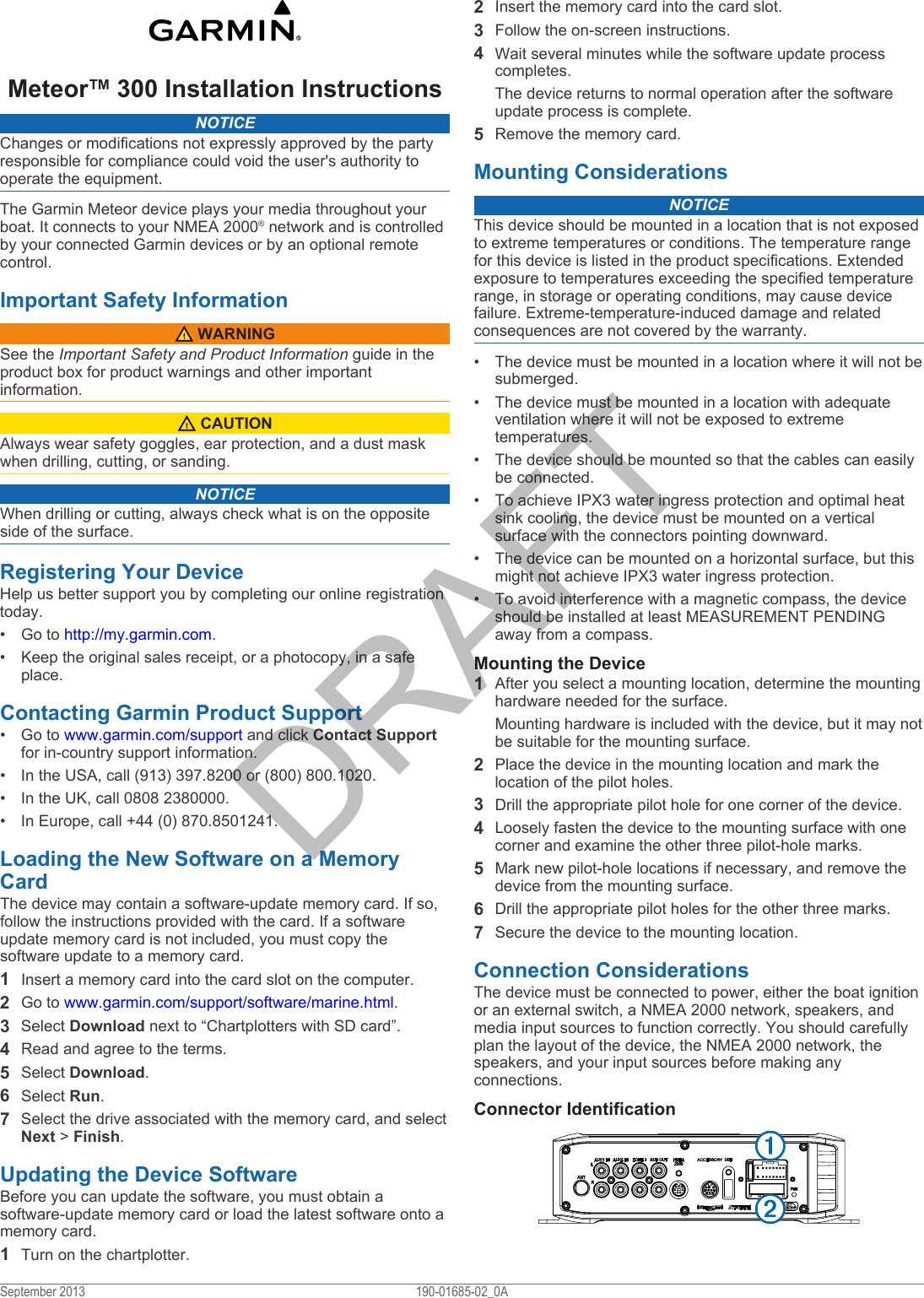
Meteor™ 300 Installation Instructions NOTICEChanges or modifications not expressly approved by the party responsible for compliance could void the user's authority to operate the equipment.The Garmin Meteor device plays your media throughout your boat. It connects to your NMEA 2000® network and is controlled by your connected Garmin devices or by an optional remote control.Important Safety Information WARNINGSee the Important Safety and Product Information guide in the product box for product warnings and other important information. CAUTIONAlways wear safety goggles, ear protection, and a dust mask when drilling, cutting, or sanding.NOTICEWhen drilling or cutting, always check what is on the opposite side of the surface.Registering Your DeviceHelp us better support you by completing our online registration today.• Go to http://my.garmin.com.• Keep the original sales receipt, or a photocopy, in a safe place.Contacting Garmin Product Support• Go to www.garmin.com/support and click Contact Support for in-country support information.• In the USA, call (913) 397.8200 or (800) 800.1020.• In the UK, call 0808 2380000.• In Europe, call +44 (0) 870.8501241.Loading the New Software on a Memory CardThe device may contain a software-update memory card. If so, follow the instructions provided with the card. If a software update memory card is not included, you must copy the software update to a memory card.1Insert a memory card into the card slot on the computer.2Go to www.garmin.com/support/software/marine.html.3Select Download next to “Chartplotters with SD card”.4Read and agree to the terms.5Select Download.6Select Run.7Select the drive associated with the memory card, and select Next > Finish.Updating the Device SoftwareBefore you can update the software, you must obtain a software-update memory card or load the latest software onto a memory card.1Turn on the chartplotter.2Insert the memory card into the card slot.3Follow the on-screen instructions.4Wait several minutes while the software update process completes.The device returns to normal operation after the software update process is complete.5Remove the memory card.Mounting ConsiderationsNOTICEThis device should be mounted in a location that is not exposed to extreme temperatures or conditions. The temperature range for this device is listed in the product specifications. Extended exposure to temperatures exceeding the specified temperature range, in storage or operating conditions, may cause device failure. Extreme-temperature-induced damage and related consequences are not covered by the warranty.• The device must be mounted in a location where it will not be submerged.• The device must be mounted in a location with adequate ventilation where it will not be exposed to extreme temperatures.• The device should be mounted so that the cables can easily be connected.• To achieve IPX3 water ingress protection and optimal heat sink cooling, the device must be mounted on a vertical surface with the connectors pointing downward.• The device can be mounted on a horizontal surface, but this might not achieve IPX3 water ingress protection.• To avoid interference with a magnetic compass, the device should be installed at least MEASUREMENT PENDING away from a compass.Mounting the Device1After you select a mounting location, determine the mounting hardware needed for the surface.Mounting hardware is included with the device, but it may not be suitable for the mounting surface.2Place the device in the mounting location and mark the location of the pilot holes.3Drill the appropriate pilot hole for one corner of the device.4Loosely fasten the device to the mounting surface with one corner and examine the other three pilot-hole marks.5Mark new pilot-hole locations if necessary, and remove the device from the mounting surface.6Drill the appropriate pilot holes for the other three marks.7Secure the device to the mounting location.Connection ConsiderationsThe device must be connected to power, either the boat ignition or an external switch, a NMEA 2000 network, speakers, and media input sources to function correctly. You should carefully plan the layout of the device, the NMEA 2000 network, the speakers, and your input sources before making any connections.Connector IdentificationSeptember 2013 190-01685-02_0ADRAFT
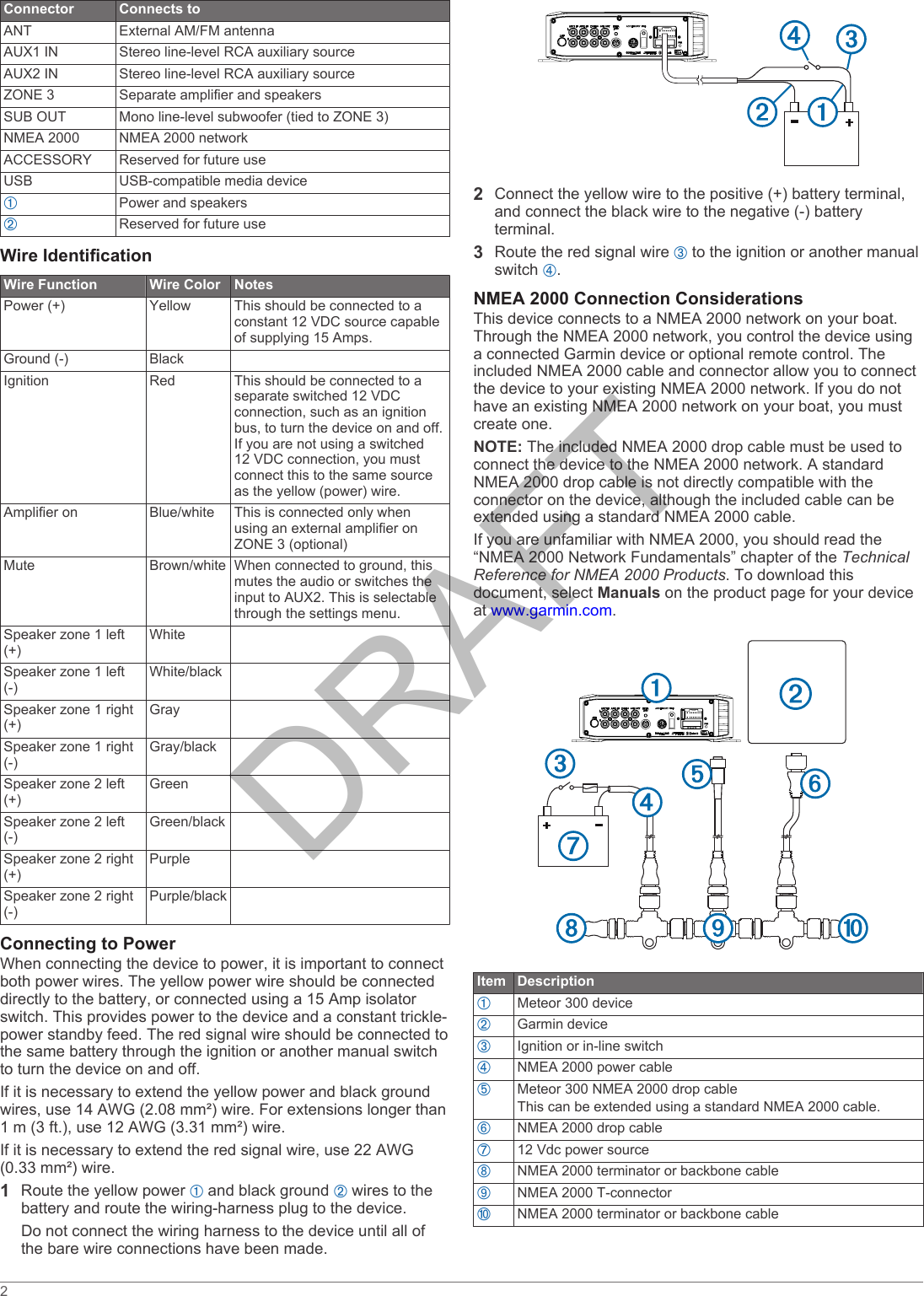
Connector Connects toANT External AM/FM antennaAUX1 IN Stereo line-level RCA auxiliary sourceAUX2 IN Stereo line-level RCA auxiliary sourceZONE 3 Separate amplifier and speakersSUB OUT Mono line-level subwoofer (tied to ZONE 3)NMEA 2000 NMEA 2000 networkACCESSORY Reserved for future useUSB USB-compatible media deviceÀPower and speakersÁReserved for future useWire IdentificationWire Function Wire Color NotesPower (+) Yellow This should be connected to a constant 12 VDC source capable of supplying 15 Amps.Ground (-) BlackIgnition Red This should be connected to a separate switched 12 VDC connection, such as an ignition bus, to turn the device on and off. If you are not using a switched 12 VDC connection, you must connect this to the same source as the yellow (power) wire.Amplifier on Blue/white This is connected only when using an external amplifier on ZONE 3 (optional)Mute Brown/white When connected to ground, this mutes the audio or switches the input to AUX2. This is selectable through the settings menu.Speaker zone 1 left (+)WhiteSpeaker zone 1 left (-)White/blackSpeaker zone 1 right (+)GraySpeaker zone 1 right (-)Gray/blackSpeaker zone 2 left (+)GreenSpeaker zone 2 left (-)Green/blackSpeaker zone 2 right (+)PurpleSpeaker zone 2 right (-)Purple/blackConnecting to PowerWhen connecting the device to power, it is important to connect both power wires. The yellow power wire should be connected directly to the battery, or connected using a 15 Amp isolator switch. This provides power to the device and a constant trickle-power standby feed. The red signal wire should be connected to the same battery through the ignition or another manual switch to turn the device on and off.If it is necessary to extend the yellow power and black ground wires, use 14 AWG (2.08 mm²) wire. For extensions longer than 1 m (3 ft.), use 12 AWG (3.31 mm²) wire.If it is necessary to extend the red signal wire, use 22 AWG (0.33 mm²) wire.1Route the yellow power À and black ground Á wires to the battery and route the wiring-harness plug to the device.Do not connect the wiring harness to the device until all of the bare wire connections have been made.2Connect the yellow wire to the positive (+) battery terminal, and connect the black wire to the negative (-) battery terminal.3Route the red signal wire  to the ignition or another manual switch Ã.NMEA 2000 Connection ConsiderationsThis device connects to a NMEA 2000 network on your boat. Through the NMEA 2000 network, you control the device using a connected Garmin device or optional remote control. The included NMEA 2000 cable and connector allow you to connect the device to your existing NMEA 2000 network. If you do not have an existing NMEA 2000 network on your boat, you must create one.NOTE: The included NMEA 2000 drop cable must be used to connect the device to the NMEA 2000 network. A standard NMEA 2000 drop cable is not directly compatible with the connector on the device, although the included cable can be extended using a standard NMEA 2000 cable.If you are unfamiliar with NMEA 2000, you should read the “NMEA 2000 Network Fundamentals” chapter of the Technical Reference for NMEA 2000 Products. To download this document, select Manuals on the product page for your device at www.garmin.com.Item DescriptionÀMeteor 300 deviceÁGarmin deviceÂIgnition or in-line switchÃNMEA 2000 power cableÄMeteor 300 NMEA 2000 drop cableThis can be extended using a standard NMEA 2000 cable.ÅNMEA 2000 drop cableÆ12 Vdc power sourceÇNMEA 2000 terminator or backbone cableÈNMEA 2000 T-connectorÉNMEA 2000 terminator or backbone cable2DRAFT
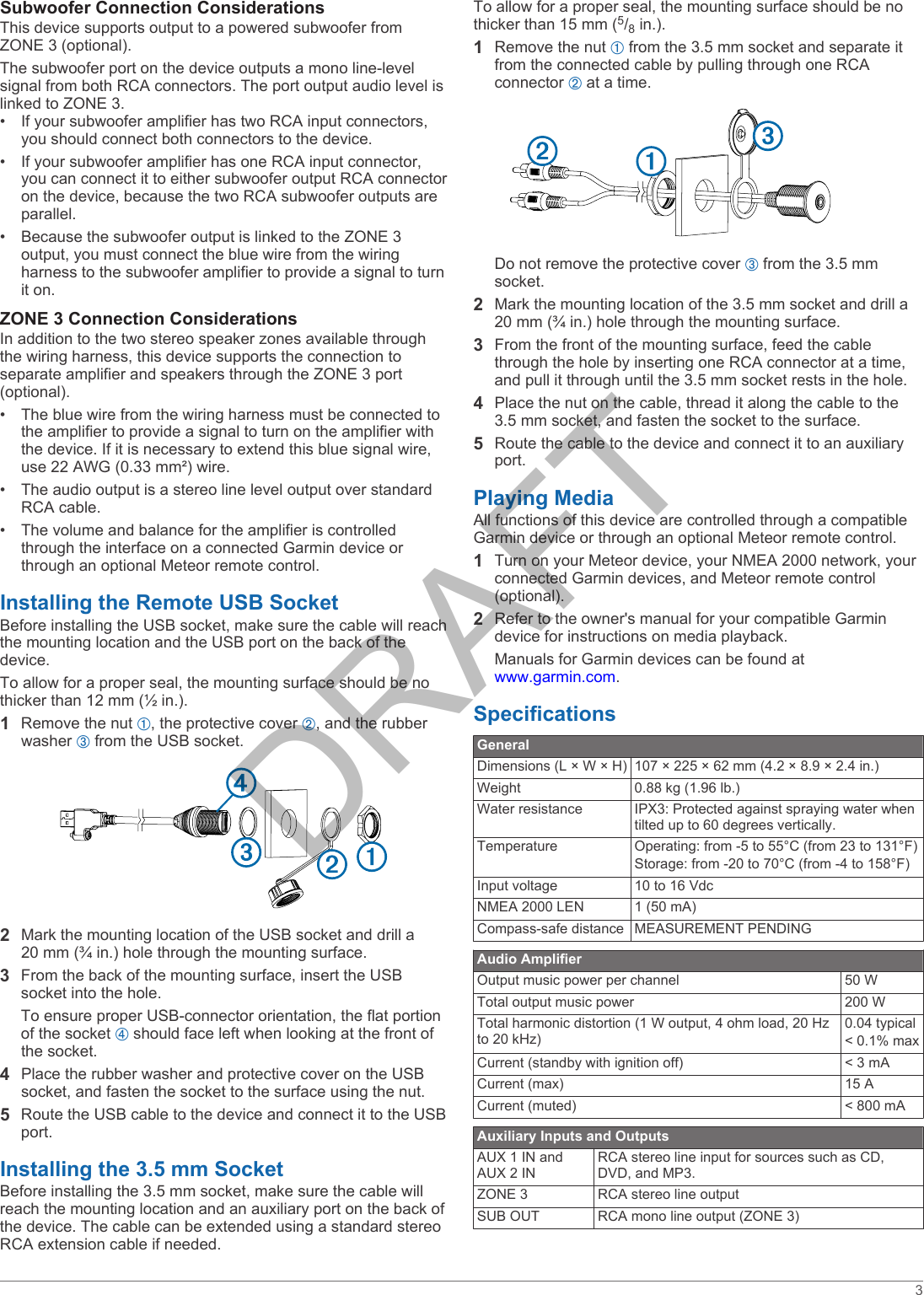
Subwoofer Connection ConsiderationsThis device supports output to a powered subwoofer from ZONE 3 (optional).The subwoofer port on the device outputs a mono line-level signal from both RCA connectors. The port output audio level is linked to ZONE 3.• If your subwoofer amplifier has two RCA input connectors, you should connect both connectors to the device.• If your subwoofer amplifier has one RCA input connector, you can connect it to either subwoofer output RCA connector on the device, because the two RCA subwoofer outputs are parallel.• Because the subwoofer output is linked to the ZONE 3 output, you must connect the blue wire from the wiring harness to the subwoofer amplifier to provide a signal to turn it on.ZONE 3 Connection ConsiderationsIn addition to the two stereo speaker zones available through the wiring harness, this device supports the connection to separate amplifier and speakers through the ZONE 3 port (optional).• The blue wire from the wiring harness must be connected to the amplifier to provide a signal to turn on the amplifier with the device. If it is necessary to extend this blue signal wire, use 22 AWG (0.33 mm²) wire.• The audio output is a stereo line level output over standard RCA cable.• The volume and balance for the amplifier is controlled through the interface on a connected Garmin device or through an optional Meteor remote control.Installing the Remote USB SocketBefore installing the USB socket, make sure the cable will reach the mounting location and the USB port on the back of the device.To allow for a proper seal, the mounting surface should be no thicker than 12 mm (½ in.).1Remove the nut À, the protective cover Á, and the rubber washer  from the USB socket.2Mark the mounting location of the USB socket and drill a 20 mm (¾ in.) hole through the mounting surface.3From the back of the mounting surface, insert the USB socket into the hole.To ensure proper USB-connector orientation, the flat portion of the socket à should face left when looking at the front of the socket.4Place the rubber washer and protective cover on the USB socket, and fasten the socket to the surface using the nut.5Route the USB cable to the device and connect it to the USB port.Installing the 3.5 mm SocketBefore installing the 3.5 mm socket, make sure the cable will reach the mounting location and an auxiliary port on the back of the device. The cable can be extended using a standard stereo RCA extension cable if needed.To allow for a proper seal, the mounting surface should be no thicker than 15 mm (5/8 in.).1Remove the nut À from the 3.5 mm socket and separate it from the connected cable by pulling through one RCA connector Á at a time.Do not remove the protective cover  from the 3.5 mm socket.2Mark the mounting location of the 3.5 mm socket and drill a 20 mm (¾ in.) hole through the mounting surface.3From the front of the mounting surface, feed the cable through the hole by inserting one RCA connector at a time, and pull it through until the 3.5 mm socket rests in the hole.4Place the nut on the cable, thread it along the cable to the 3.5 mm socket, and fasten the socket to the surface.5Route the cable to the device and connect it to an auxiliary port.Playing MediaAll functions of this device are controlled through a compatible Garmin device or through an optional Meteor remote control.1Turn on your Meteor device, your NMEA 2000 network, your connected Garmin devices, and Meteor remote control (optional).2Refer to the owner's manual for your compatible Garmin device for instructions on media playback.Manuals for Garmin devices can be found at www.garmin.com.SpecificationsGeneralDimensions (L × W × H) 107 × 225 × 62 mm (4.2 × 8.9 × 2.4 in.)Weight 0.88 kg (1.96 lb.)Water resistance IPX3: Protected against spraying water when tilted up to 60 degrees vertically.Temperature Operating: from -5 to 55°C (from 23 to 131°F)Storage: from -20 to 70°C (from -4 to 158°F)Input voltage 10 to 16 VdcNMEA 2000 LEN 1 (50 mA)Compass-safe distance MEASUREMENT PENDINGAudio AmplifierOutput music power per channel 50 WTotal output music power 200 WTotal harmonic distortion (1 W output, 4 ohm load, 20 Hz to 20 kHz)0.04 typical< 0.1% maxCurrent (standby with ignition off) < 3 mACurrent (max) 15 ACurrent (muted) < 800 mAAuxiliary Inputs and OutputsAUX 1 IN and AUX 2 INRCA stereo line input for sources such as CD, DVD, and MP3.ZONE 3 RCA stereo line outputSUB OUT RCA mono line output (ZONE 3)3DRAFT
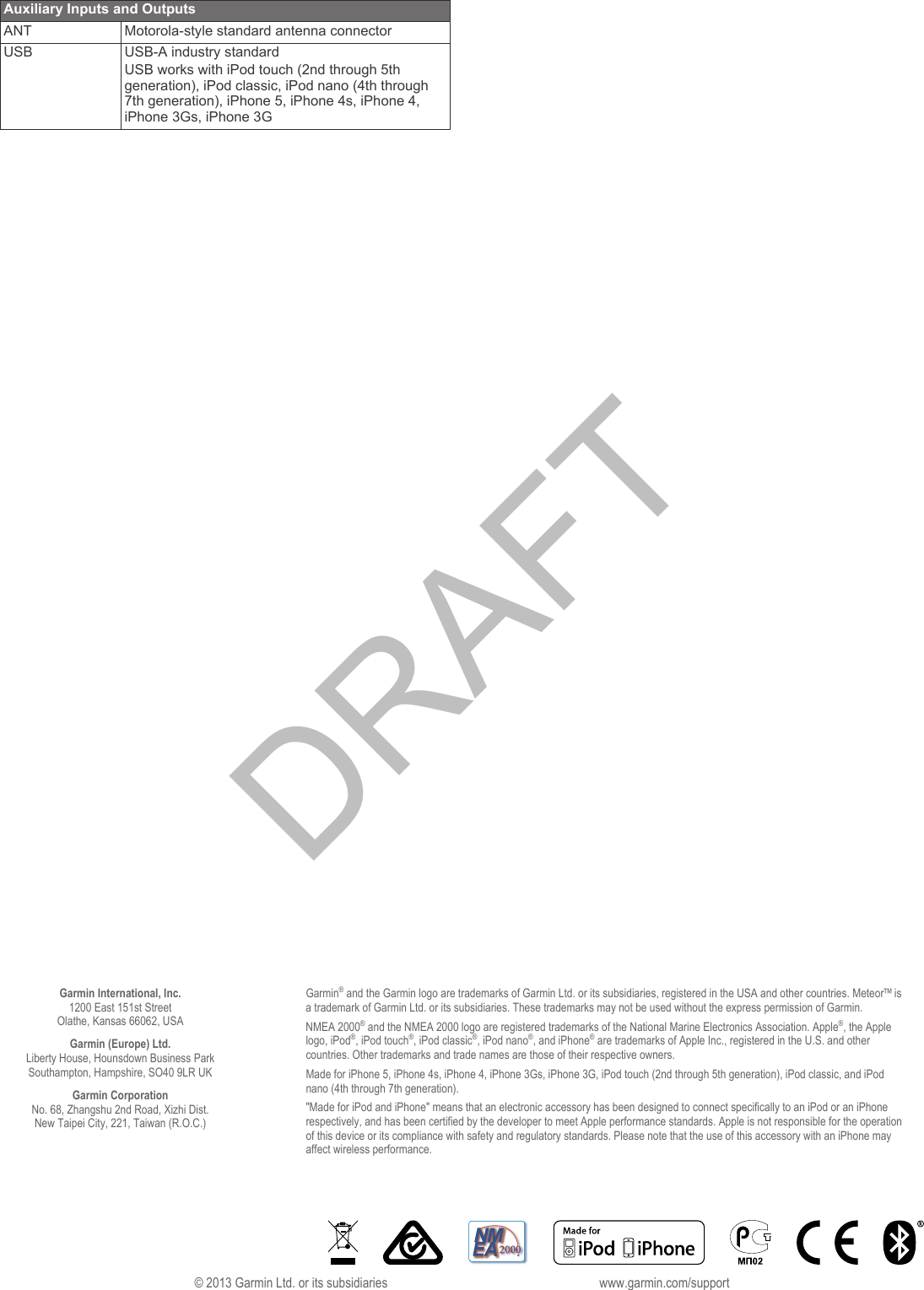
Auxiliary Inputs and OutputsANT Motorola-style standard antenna connectorUSB USB-A industry standardUSB works with iPod touch (2nd through 5th generation), iPod classic, iPod nano (4th through 7th generation), iPhone 5, iPhone 4s, iPhone 4, iPhone 3Gs, iPhone 3GGarmin International, Inc.1200 East 151st StreetOlathe, Kansas 66062, USAGarmin (Europe) Ltd.Liberty House, Hounsdown Business ParkSouthampton, Hampshire, SO40 9LR UKGarmin CorporationNo. 68, Zhangshu 2nd Road, Xizhi Dist.New Taipei City, 221, Taiwan (R.O.C.)Garmin® and the Garmin logo are trademarks of Garmin Ltd. or its subsidiaries, registered in the USA and other countries. Meteor™ is a trademark of Garmin Ltd. or its subsidiaries. These trademarks may not be used without the express permission of Garmin.NMEA 2000® and the NMEA 2000 logo are registered trademarks of the National Marine Electronics Association. Apple®, the Apple logo, iPod®, iPod touch®, iPod classic®, iPod nano®, and iPhone® are trademarks of Apple Inc., registered in the U.S. and other countries. Other trademarks and trade names are those of their respective owners.Made for iPhone 5, iPhone 4s, iPhone 4, iPhone 3Gs, iPhone 3G, iPod touch (2nd through 5th generation), iPod classic, and iPod nano (4th through 7th generation)."Made for iPod and iPhone" means that an electronic accessory has been designed to connect specifically to an iPod or an iPhone respectively, and has been certified by the developer to meet Apple performance standards. Apple is not responsible for the operation of this device or its compliance with safety and regulatory standards. Please note that the use of this accessory with an iPhone may affect wireless performance.© 2013 Garmin Ltd. or its subsidiaries www.garmin.com/supportDRAFT

Navigation menu