Ge Phoenix Nanomex Micromex Dxr Brochure
Ge-Phoenix-Nanomex-Micromex-Dxr-Brochure-648916 ge-phoenix-nanomex-micromex-dxr-brochure-648916
2015-03-09
: Ge Ge-Phoenix-Nanomex-Micromex-Dxr-Brochure-648916 ge-phoenix-nanomex-micromex-dxr-brochure-648916 ge pdf
Open the PDF directly: View PDF  .
.
Page Count: 8
GE
Inspection Technologies
SOLDER JOINT INSPECTION AND ANALYSIS
with GE’s phoenix|x-ray microfocus and nanofocus X-ray systems
FAQs about X-ray
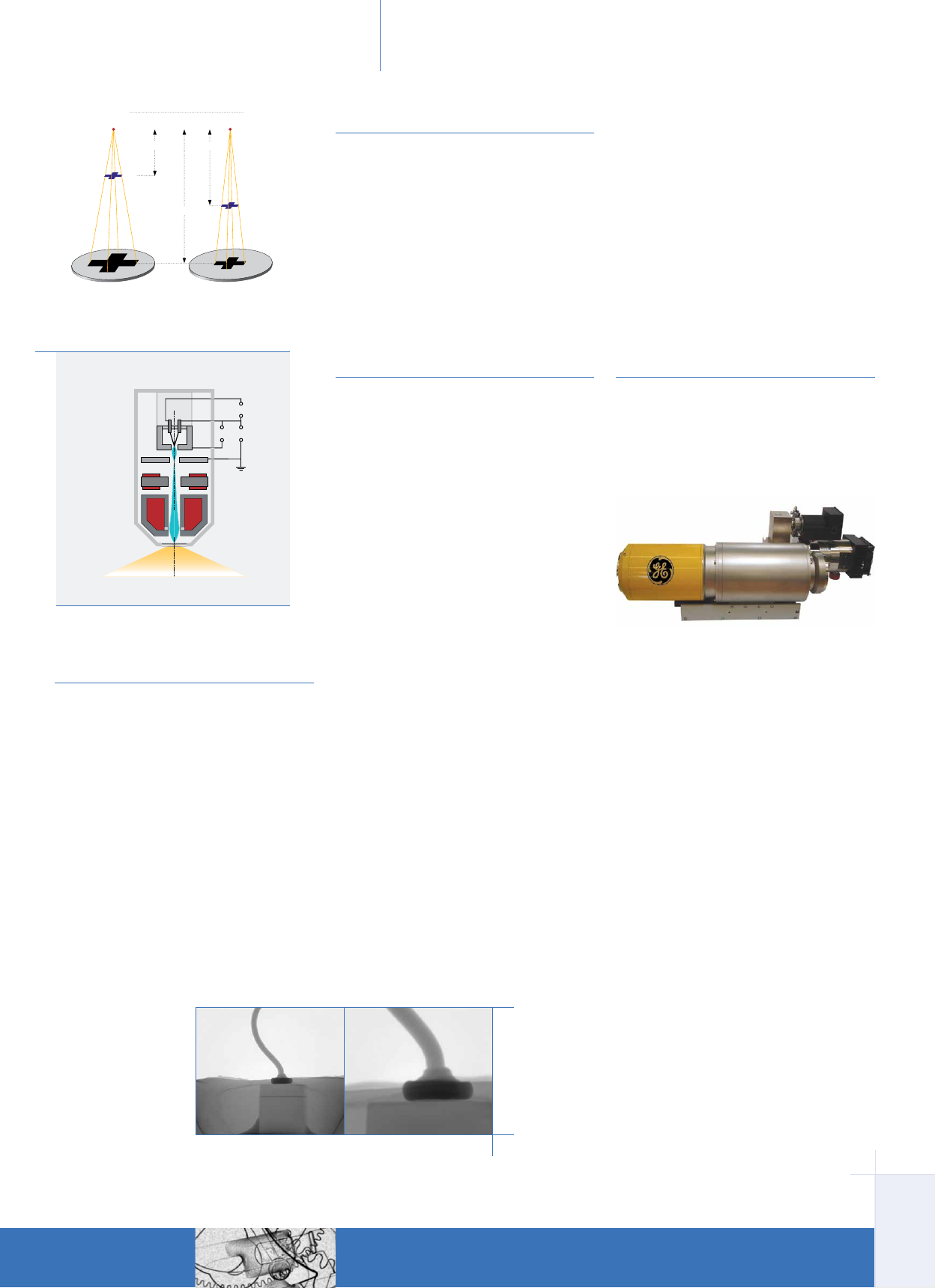
X-ray starts with a sample being irradiated by an X-ray source and projected onto a
detector. The geometric magnification M of the image is the ratio of focus-detector
distance (FDD), Focus-object distance (FOD): M=FDD/FOD. The smaller the focal spot,
the greater the resolution. With the nanofocus technology an unique detail detec-
tability down to 0.2 microns can be achieved. phoenix|x-ray systems reach geometric
magnifications over 2,000x resulting in total magnifications beyond 24,000x.
• High power nanofocus X-ray tubes up
to 180 kV and unipolar microfocus X-ray
tubes up to 300 kV maximum voltage.
• Down to 200 nm (0.2 microns) detail
detectability.
• Anti-arcing: dedicated surface treatment
during fabrication and automated warm-
up procedures prevent discharges.
• Self adjustment: all tube adjustments are
performed automatically during warm-up
to achieve optimum results.
• Plug-in cathodes: pre-adjusted spare ca-
thodes prevent malfunction due to wrong
filament adjustment and minimize down-
time to less than 20 min.
• long-life|filament: ensuring high emission
current CT with up to 10 times increased
filament lifetime of directional target
tubes.
• diamond|window: high output of up to
max. 20 W power with high-resolution.
• Target check: target condition is checked
automatically; automatic target wear is
indicated.
One of phoenix|x-ray’s key technology com-
petencies are tube and generator design and
manufacturing ensuring reliable results and
highest up-time.
source
detector
high magnification
object
low magnification
FDD
small FOD large FOD
How X-ray inspection
works
What makes an excellent
X-ray?
The heart of the X-ray machine is an elec-
trodepairconsistingofacathode,thela-
ment, and an anode, that is located inside a
vacuum tube. Current is passed through the
lamentheatingitup,causingthelament
to emit electrons. The positively charged
anode draws the electrons across the tube.
Unlike with conventional X-ray tubes, the
electrons pass through the anode into a spe-
cicallydesignedset-upofelectromagnetic
lenses, where they are bundled and directed
ontoasmallspotonthetarget,aatmetal
disc covered by a layer of tungsten. When
the electrons collide with the target, they in-
teract with the ions in the tungsten, causing
X-rays to be emitted. Key to sharp, crisp
X-ray images at micron or even submicron
resolutions is the size of the focal spot,
meaning the ability to focus the electron
beam in such way that the area on the target
where the electrons hit be as small as pos-
sible – an obstacle yet to be overcome by
conventional X-ray machines.
However, phoenix|x-ray has mastered this
challenge with its unique nanofocus tube
providing detail detectabilities as low as 200
nanometers (0.2 microns).
For ultimate protection of your sample, all
phoenix|x-ray systems come standard with
a password-protected anti-collision fea-
ture. But when inspecting certain samples,
it might become necessary to deactivate
the collision protection, as for example with
25µmbondwires,which,evenformagni-
cations of just 500x, need to be as close as
4 mm to the tube head. phoenix|x-ray has
come up with a solution to give the user
maximumexibilitywhendealingwithvery
small samples: Unlike with conventional
systems, the X-ray tube is located
above the sample tray
allowing the user to
move the sample as
close to the tube head
as needed.
insulator
cathode
(filament)
grid
anode
deflection
unit
magnetic
lens
target
X-ray beam
UGUACC
UH
electron beam
FOD‑=‑4 mm: 500 x Sample touching the tube:
Maximum magnification
How X-ray tubes
work
Why can the collision
protection be deactivated?
GE’s unique 180 kV high power nanofocus X‑ray tube
The View Inside
Why to inspect solder joints with X-ray?
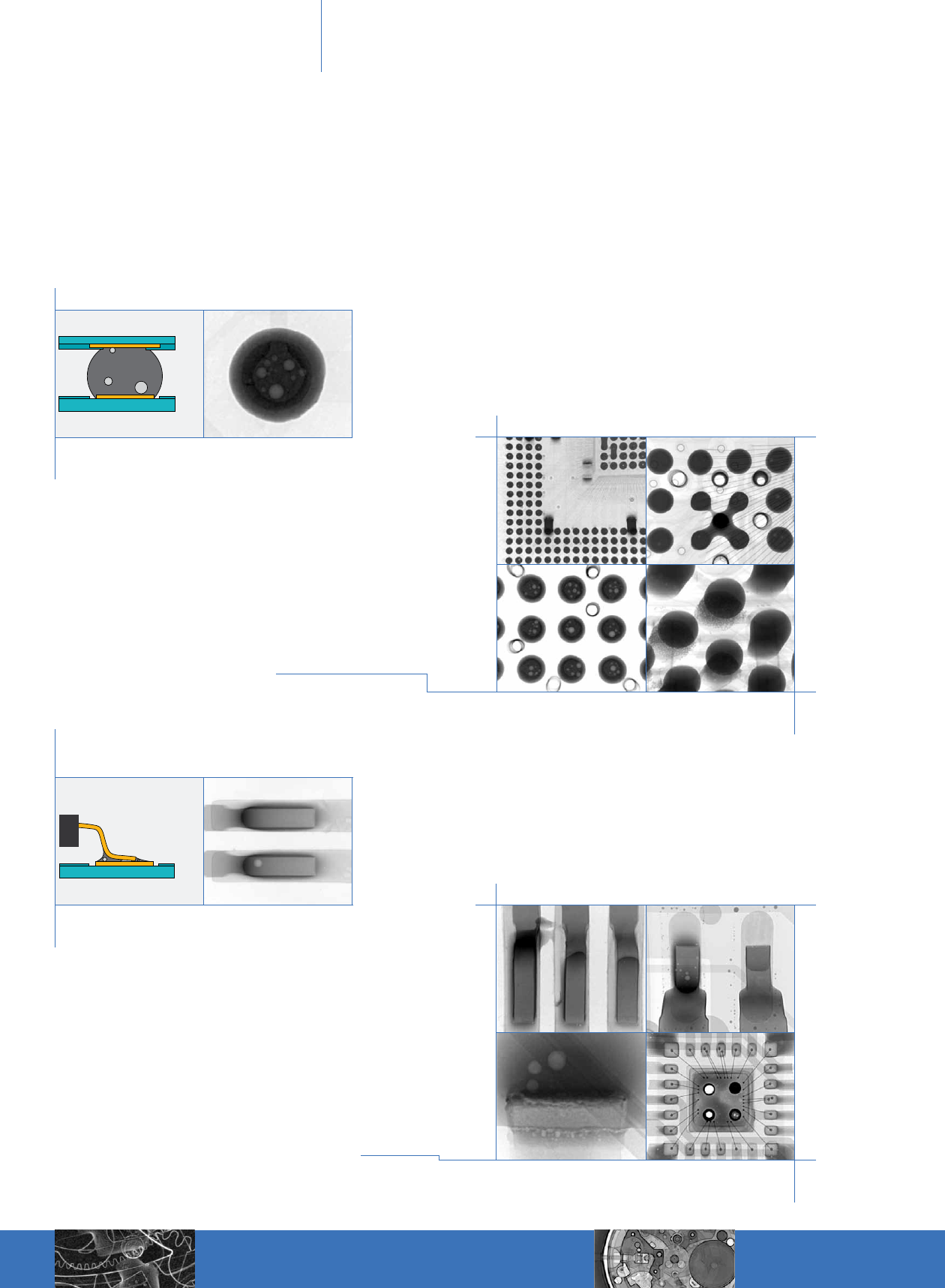
The reliability of electronic assemblies strongly depends on solder joint quality. Acceptability criteria are mainly based on shape
and dimension of the solder joints. As quality demands and technology for assembly process for new package types increase,
many solder joints are no longer directly visible. Fortunately, they can easily be inspected by advanced microfocus and nanofo-
cusX-raysystems.phoenix|x-rayoersdedicatedanalysisandautomaticinspectionsolutionsforanytypeofsolderjoint:
BGA: voiding
BGA: solder bridge
BGA: insufficient reflow
BGA
PCB
Scheme of a BGA solder joint , X‑ray image of a BGA solder joint
(top‑down view)
BGA: warpage
All dimensions and features of the solder joint are imaged: diameter,
thickness (grey value), lands and contact areas (darker and brighter
circles), voids (bright spots). All defects that have any influence on the
solder joint's shape are detectable:
Bridges, opens, missing joints, warpage, popcorning, component tilt,
voids, diameter deviations, roundness, shape deviations (roundness),
fuzzy edges (insufficient reflow), misregistration.
BGA type solder joints such as PBGA, CBGA, CGA, etc.
SMD: crack
SOT: defective paste print
MLF: two open joints
Lead
PCB
Scheme of a Gull Wing (QFP) solder joint, X‑ray image of a QFP
solder joint (top‑down view)
QFP: weak heel fillet
In addition to toe and side fillets the X-ray image reveals hidden fea-
tures of the interconnection: the heel fillet which is most important for
the reliability of the solder joint and voids.
Detectable defects: Bridges (in particular under the component),
opens, defective paste print, insufficient co-planarity, incomplete fil-
lets, de-wetting, insufficient reflow, mis-registration, cracks.
Gull Wing and flat ribbon solder joints such as
QFP, SOT, PLCC, Chip devices etc.
>
>
>
>
>
>
>
The Third Dimension
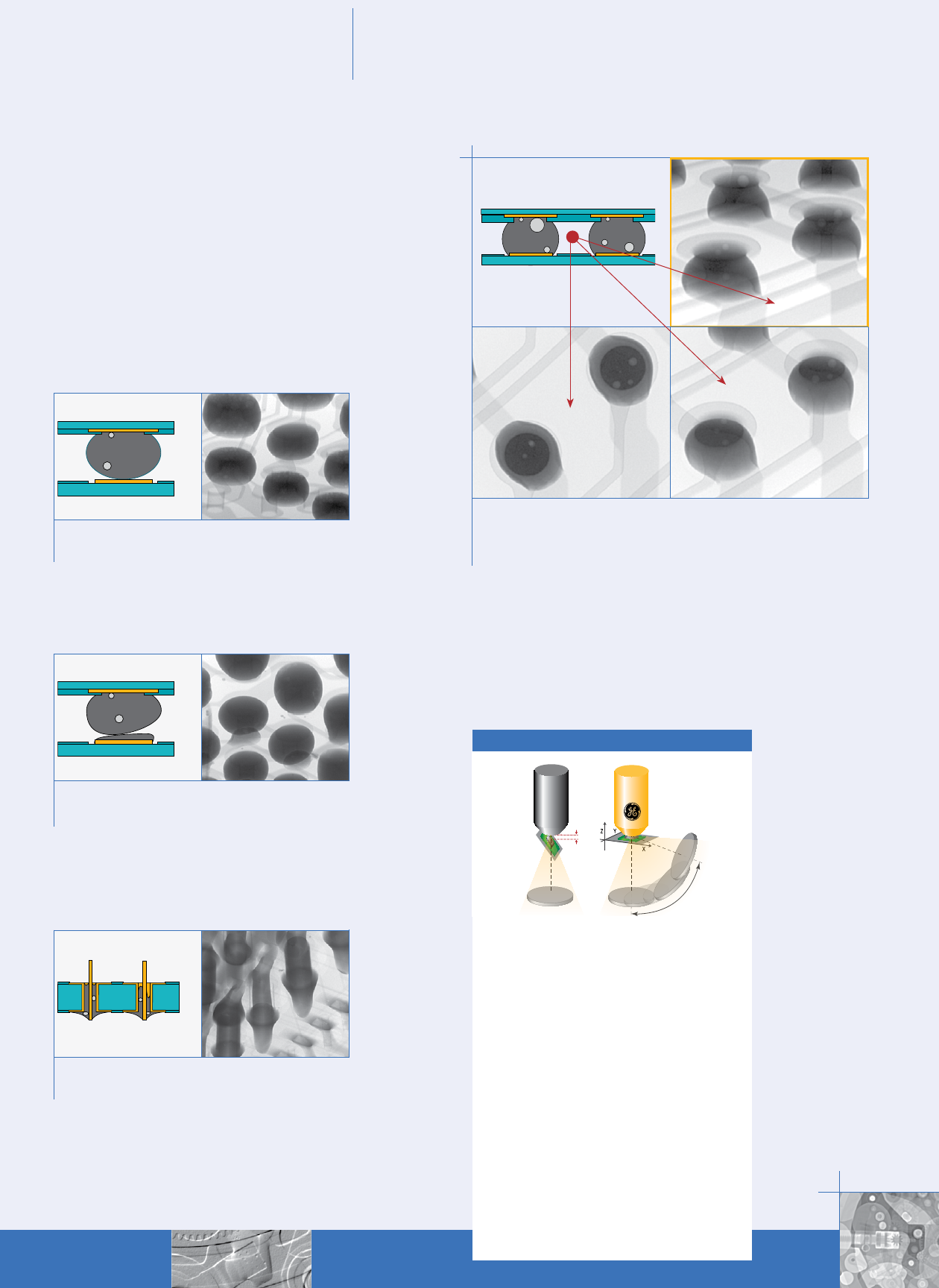
Some acceptability criteria refer to a side view and many
defects can be seen best from the side, in other words, some
information about the vertical dimension is required.
phoenix|x-ray systems provide this information by oblique view
– up to 70 degrees – at highest magnification. As an
example, this enables the user to see open BGA solder joints
directly instead of interpreting signatures.
Just look from the side
ovhm ‑ oblique views at highest magnification
X-ray tube
0 - 70°
detector
Conventional tilting vs. ovhm
Technology
ovhm: Oblique views at highest
magnications
Conventional tilt techniques generate
oblique views by simply tilting the sample
to the side, which involves moving one part
of the sample further away from the X-ray
tuberesultinginadecreaseinmagnica-
tion.Theovhm|modulewasspecically
designed to enable oblique views of up to
70 degrees and 0 to 360 degree rota-
tionswithoutadecreaseinmagnication.
Magnicationremainsthesamebecause
the distance between focus and sample
does not change while the detector is be-
ing tilted.
BGA
PCB
Scheme of non‑wetted BGA land and its detection by
ovhm: the land is empty
BGA
PCB
Scheme of non‑wetted BGA ball and its detection by ovhm:
paste solder and ball are separated
Leads
PCB
Scheme of THT solder joints and their inspection by ovhm: one
through-hole is not lled and the hole plating is not wetted by
the solder
>
>
>
ovhm: oblique views give excellent information in the vertical direction. At 70 degrees
the prole of these CSP solder joints is fully displayed and even the void position can
be clearly determined. In contrast to 45 degrees, at 70 degrees the component and
board pads are completely separated and can be inspected without any interference.
70°
45°
0°
>
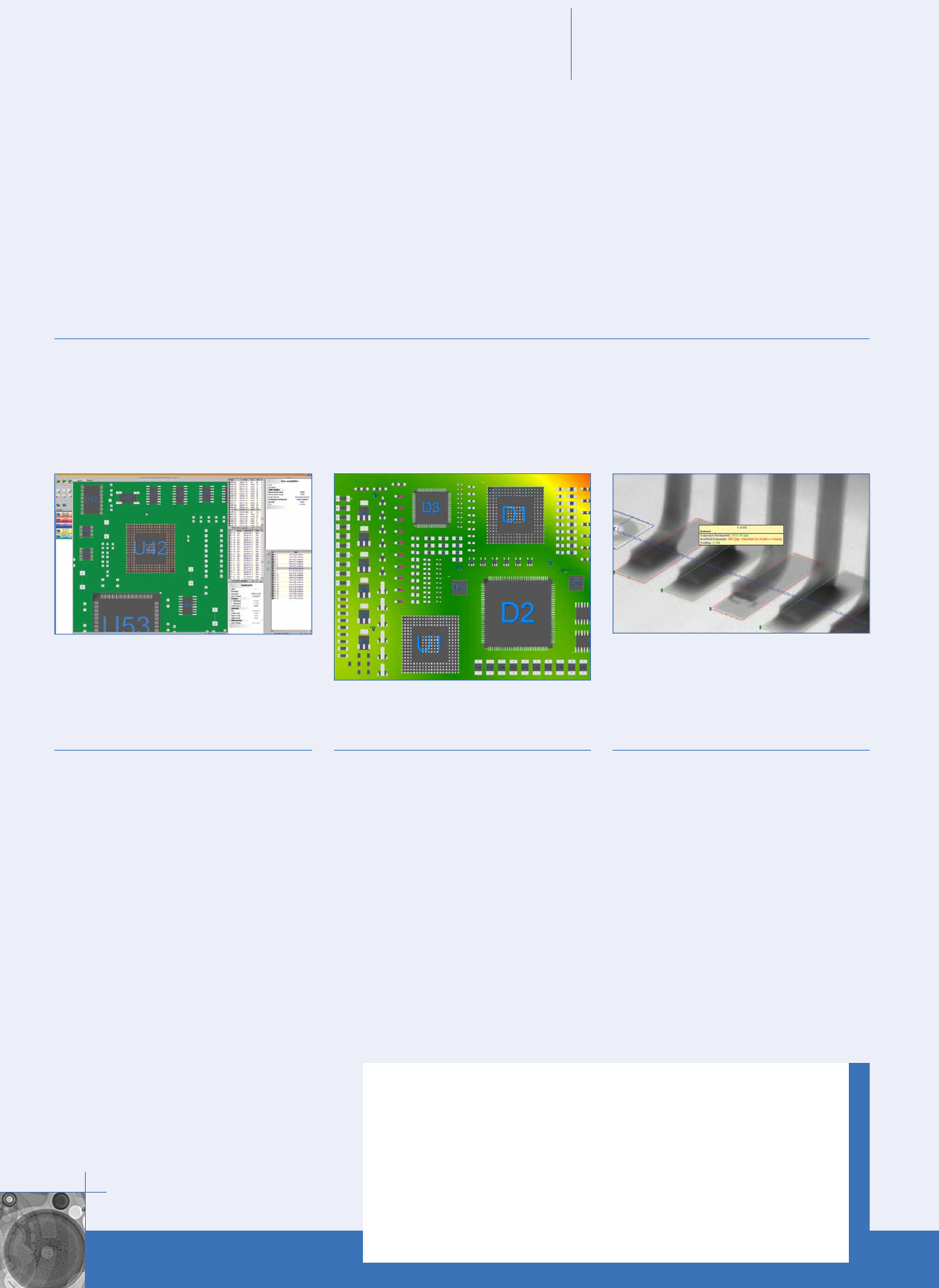
Automated Inspection
Ecientsolderingprocesscontrolrequirestheacquisitionofstatisticaldataonthesolderjointsofalargernumberofsamples.
phoenix|x-rayoersarangeofplug-insoftwaremodulesfortheautomatedevaluationofstandardsolderjointslikeBGA,QFP,
QFN,orPTH.Fornon-typicalinterconnections,appropriatemodulescanquicklybecustomisedwiththeXE²(X-rayimageEvalu-
ationEnvironment)software.TogetherwiththehighprecisionCNCmanipulationwhichcomesstandardwithphoenix|x-ray
systems these modules enable the automated X-ray inspection (AXI) of solder joints at minimum set-up time, due to teach-in
programming and auto-setup routines. An additional software package – quality|review – is the perfect connection to rework.
phoenix|x-ray's inspection modules can also easily be activated during manual inspection as a quick inspection aid.
The efficient way of process control and rework
• Import of CAD-data
• Easypad-basedoineprogramming
• Optimized inspection strategies for
dierentpadtypes
• Fully automated generation of inspection
program even in oblique view and multiple
angular positions per component
• Full program portability for all compatible
phoenix|x-ray inspection systems with
x|act
Automated measurement and compensation
ofheightdierencesanddistortions:
• phoenix|x-ray inspection systems equip-
ped with x|act operator or pro come stan-
dardwithhighprecisionCNCmanipulation
• Local 3D height and distortion referencing
by X-ray
• Highest precision through use of multiple
ducials
• Automated correction of image chain
distortion
• Extremely high positioning accuracy even
at oblique viewing and rotation
• Perfect orientation through live overlay of
CAD-data and test results even in rotated
oblieque views
• Pad ID available at any time
• Inspection results and images include
correct pad numbering for easy rework
• Easypadidenticationeveninmanual
inspection
Visualization of board distortion
Live CAD overlay in ovhm with inspection results
Fast and easy programming: just assign the inspec‑
tion strategies and let x|act generate the automated
inspection program
As a solution for µAXI with high magnification and repeatability, GE provides calibrated high precision offline µAXI systems including the unique
phoenix x|act software package for fast and easy offline CAD programming. Small views with a resolution of up to a few micrometers, 360° rota-
tionandobliqueviewingupto70°ensuretomeethighestqualitystandards.BesidestheautomatedX-rayinspection,theμAXIsystemcanbe
used for manual failure analysis or 3D computed tomography as well.
phoenix x|act µAXI
Fully automated CAD based high-resolution X-ray inspection for extremely high defect coverage
Technology
Inline or oine inspection?
With common inline AXI, the inspection depth is normally determined by the
throughput of the SMT line. Principally, X-ray inspection takes much more time
than AOI. The higher the defect coverage, the more inspection time is required.
For zero defect production inspection with small fields of view with micrometer
resolution, 360° rotation and oblique viewing up to 70° is essential. To ensure
thesehigherdefectcoveragerequirements,μAXIhastobeperformedbeside
the production line.
3D auto-referencing
optimized positioning accuracy
Efficient CAD programming
minimized setup time
Live 3D CAD overlay
highest magnification in oblique view
Anticipating the Future
Technology
What is the difference between
nanofocus and microfocus tubes?
Although the
focal spot of
microfocus tubes
is as small as 3
microns, it is still
large enough
to cause a half
shadow, known
as the penumbra
microfocus system nanofocus system
effect. This results in a residual unsharp-
ness and can be avoided by using nanofo-
custechnology.Nanofocusprovidesfocal
spots well below one micron while main-
taining the highest intensity needed.
source
object
detector
Miniaturization and new assembly tech-
niques demand resolution in the sub-
micron range and also highest contrast
resolution. With the nanofocus tube tech-
nology together with digital image chains
or fully digital detector arrays,
phoenix|x-ray provides proven detail
detectability down to 200 nm (0.2 microns)
combined with superior contrast reso-
lution. In this way fine details and slight
variations in thickness, such as those
caused by tiny voids in microscopic Flip
Chip solder joints are detected.
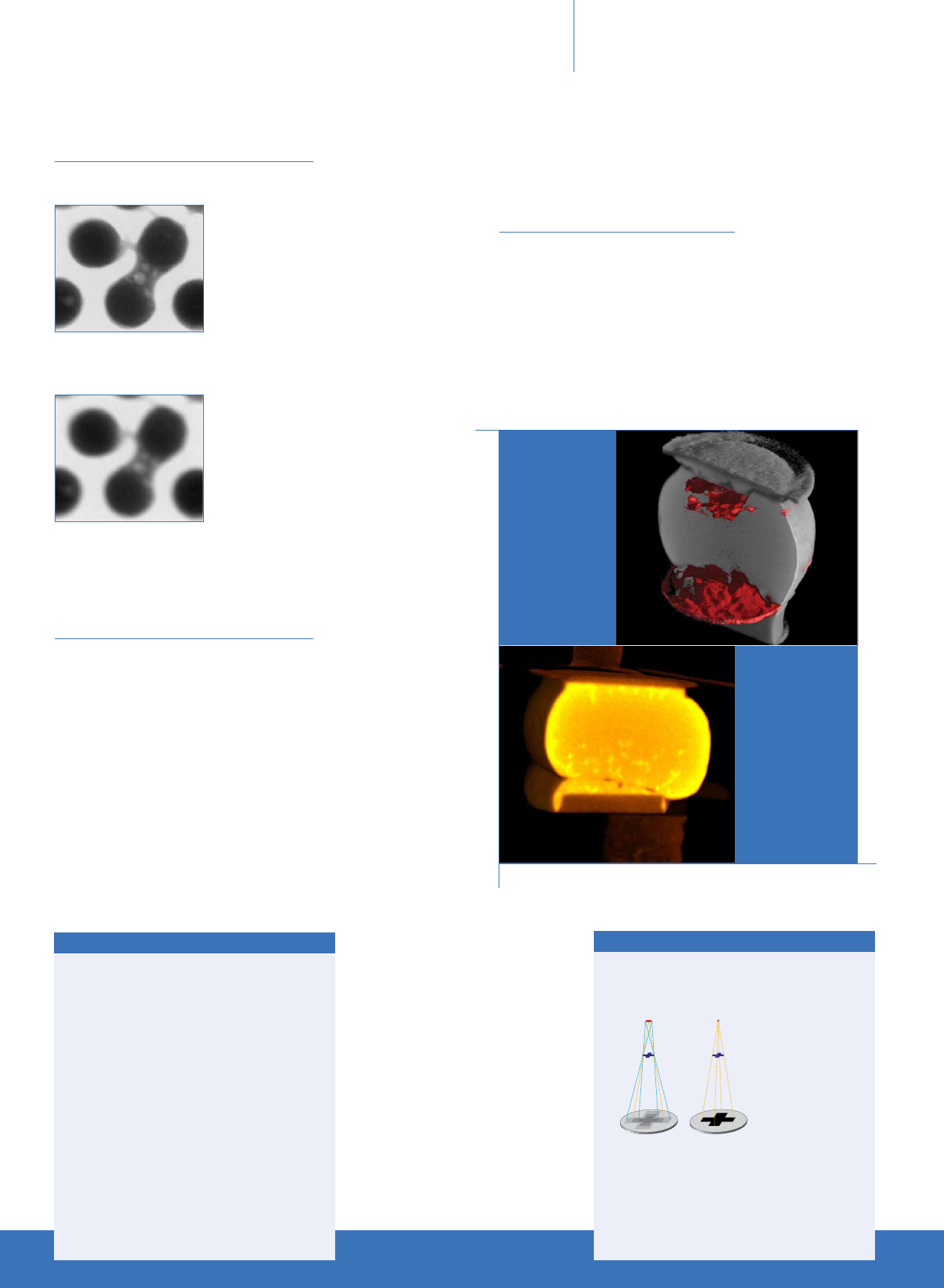
The combination of phoenix|x-ray's high-power nanofocus
X-ray tube and optimized reconstruction software enables
unprecedented nanoCT® image resolution and quality. This
technology allows the inspection and 3-dimensional visualiza-
tion of the internal details of smaller specimens with submi-
crometer voxel resolution.
The image quality is essential for an optimal defect coverage of all
2D and 3D inspection tasks. Due to its high dynamic, the new active
temperature stabilized GE DXR digital detector arrays ensure a very
low noise fast and detailed live inspection with up to 30 frames per
second at full resolution. This makes it possible to run a 3D CT scan
within only 10 seconds.
nanoCT® of a BGA ball with cracks of 1‑8 µm
Open BGA with head‑in‑pillow‑effect;
metallic dendrites visible in the eutectic matrix
Inspecting the smallest and finest
nanofocus and digital imaging
High dynamic digital detectors
Active temperature stabilization
High-resolution 3D-imaging
nanoCT®
Technology
phoenix|x-ray systems help you
meet the standards
The phoenix|x-ray solder joint inspection
software modules include all X-ray acces-
sible criteria mentioned in the commonly
applied standards for acceptability of PCB
assemblies, namely:
• IPC-A-610 Revision E
• IPC 7095
The modules are continuously updated to
adapt them to revisions of the standards.
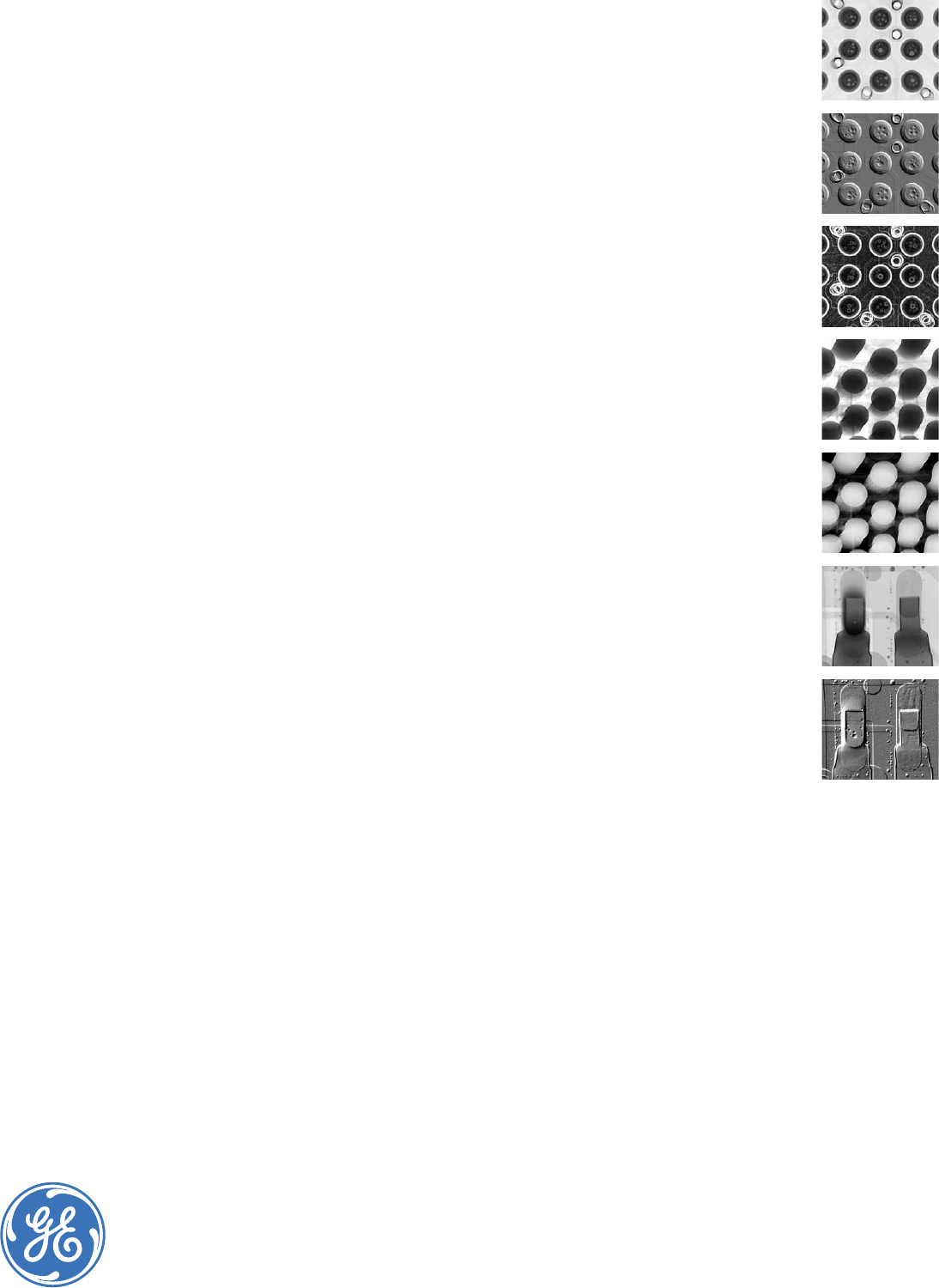
40 micron solder bumps at
nanofocus resolution
40 micron solder bumps at
microfocus resolution
Systems
Technology
Closed tube or open tube?
Closed tubes: All tube components are con-
tained in a sealed vacuum vessel container.
Closed tubes are maintenance-free and are
completely replaced at the end of their lifetime.
Open tubes: All components and wear-out parts
are accessible and replaceable, the tube is con-
tinuously evacuated by a turbomolecular pump.
Open tubes yield higher resolution and magnifi-
cation and are not limited in lifetime.
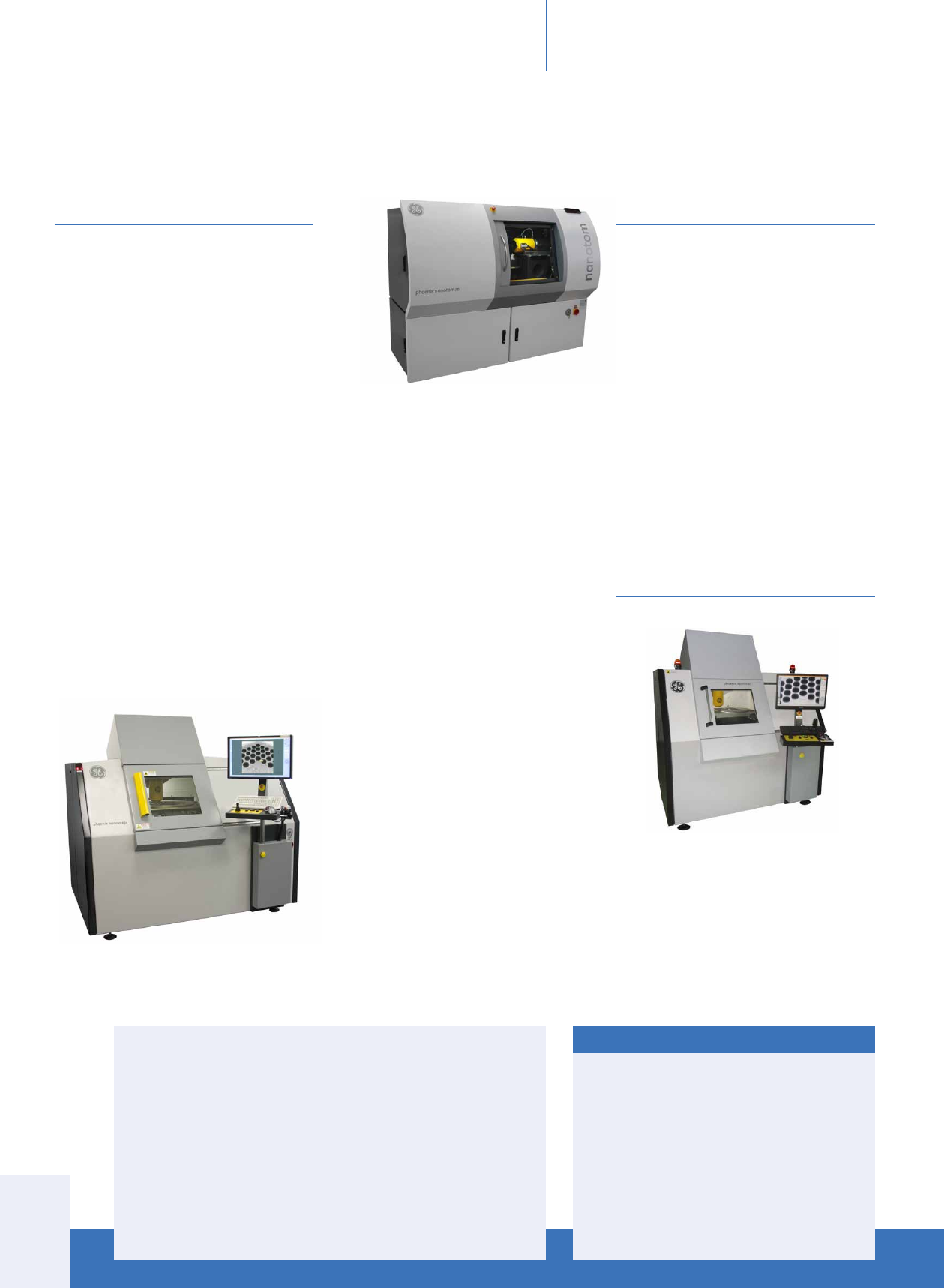
GE’sphoenix|x-raybusinessoersawiderangeofsystemsandsystemcongurationsdedicatedtovarious2Dand3Dinspection
tasks in printed circuit board assembly:
This automated X-ray system with superior
specifications satisfies even the highest
demands: The 180 kV / 15 W high-power
nanofocus tube (4-in-1) covers the full range
from submicron resolution to high intensity
applications. Due to the easy view configu-
ration the X-ray image displays the sample
exactly as the operator sees it through the
radiation protection window. The digital
realtime image chain with 4 MPixel camera
provides an excellent contrast resolution
and enables oblique views up to 70 degrees
and magnifications well above 24,000 x. For
samples of poor contrast the system may be
equipped with a high dynamic fully digital
DXR detector array – as supplement to the
image chain, offering unique performance
and versatility as well as live imaging with up
to 30 fps. Optionally, the nanome|x may be
equipped with nanoCT® capability.
phoenix nanome|x
the ultimate nanofocus X-ray solution
phoenix x|aminer
strong entry-level inspection system
With it’s 160 kV / 20 W microfocus X-ray tube,
GE’s phoenix x|aminer meets the require-
ments for high-resolution X-ray inspection
of electronic assemblies, components and
PCBA. The phoenix x|act base software pack-
age offers ease of use allowing manual as
well as automated solder joint inspection.
Both versions of the nanotom come stan-
dard with a 180 kV / 15 W ultra high-perfor-
mance nanofocus X-ray tube and precision
mechanics for extremely high stability.
With voxel resolution as low as < 500 (s) or
even <300 (m) nanometer and below, the nanotom is the inspection solution of choice for 3D
nanoCT® applications in a wide range of fields. Equipped with its unique high dynamic tem-
perature stabilized 3,072 x 2,400 pixels GE DXR detector, the nanotom m scans samples up
to 240 mm in diameter. With its small footprint, the nanotom is suitable for even the smallest
labs. For many research applications, the nanotom offers even a viable alternative to syn-
chrotron-based computed tomography.
What does “easy and intuitive use“ mean?
• Due to the “Easy View Configuration“ the X-ray image shows the
object exactly as the operator sees it through the radiation
protection window
• Precise and easy operation by using the mouse, joystick or key
board
• phoenix|x-ray systems can be operated in either sitting or standing
position
• Programming is possible in different layers of complexity, each of
them supported by an intuitive graphically oriented or CAD based
user interface
phoenix nanotom s and m
outstanding spatial and contrast
resolution on a wide sample range
phoenix microme|x
automated solder joint inspection
The phoenix microme|x is a high-resolution
automated X-ray inspection (AXI) system
that is suitable for failure analysis in the
semiconductor and electronics industry.
The microme|x combines proven high-
resolution 2D and 3D X-ray technology in
one system. This system comes standard
with an ultra high-performance 180 kV / 20 W
X-ray tube for sub-micron feature recognition
> 0.5 µm and a high-resolution 2 MPixel digital
image chain. The microme|x provides a total
optical magnification of up to 23,320 x and
oblique angle views of up to 70 degrees.
Optionally, it may be equipped with GE’s
DXR digital detector array for brilliant live
imaging and the capability for high-resolu-
tion CT for advanced 3D failure analysis.
The tube makes the difference:
phoenix nanome|x / microme|x
©2011GeneralElectricCompany.AllRightsReserved.Specicationssubjecttochangewithoutpriornotice. nanotom and nanoCT are registered trademarks of General Electric Company. Other company or product
namesmentionedinthisdocumentmaybetrademarksorregisteredtrademarksoftheirrespectivecompanies,whicharenotaliatedwithGE.
GEIT-31101EN (11/11)
Regional Contact Information
Europe, Asia, Africa, South America
GE Sensing & Inspection Technologies
Niels-Bohr-Str.7
31515 Wunstorf
P.O. Box 6241
31510 Wunstorf
Germany
Tel.: +49 5031 172 0
Fax: +49 5031 172 299
E-mail: phoenix-info@ge.com
phoenix-asia@ge.com
Americas
GE Inspection Technologies, LP
50 Industrial Park Rd
Lewistown, PA 17044
USA
Tel.: +1 (717) 242 0327
Fax: +1 (717) 717 242 2606
E-mail: phoenix-usa@ge.com
www.ge-mcs.com/phoenix
