HYUNDAI ELEVATOR HWC-W120 RF Data Modem HWC-W120 User Manual rev hwp

HYUNDAI ELEVATOR CO., LTD. RF Data Modem HWC-W120 rev hwp

User Manual

RF Data ModemHWC-M100HWC-W100HWC-W120User Manual
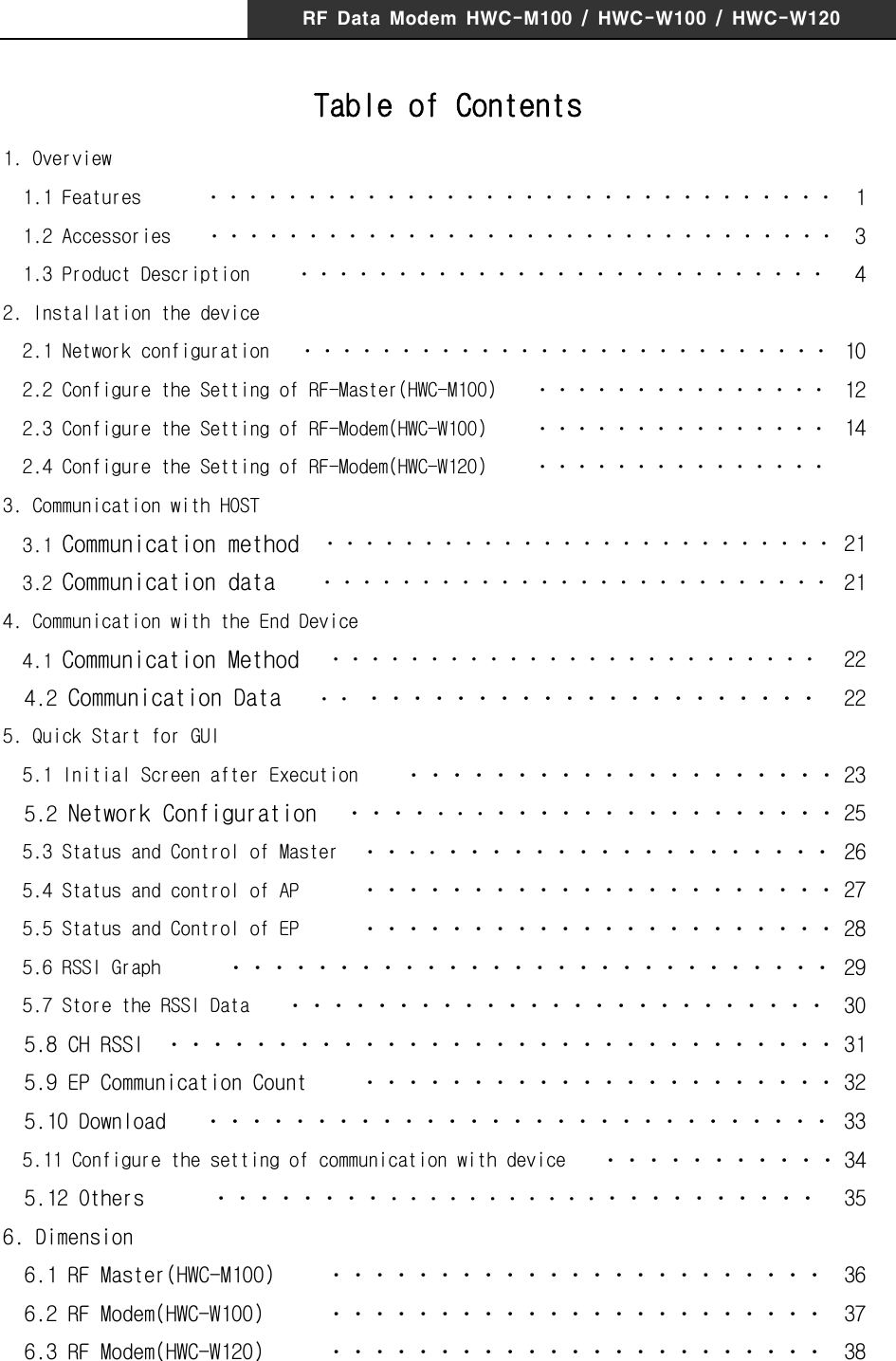
RF  Data  Modem  HWC-M100  /  HWC-W100  /  HWC-W120Table of Contents1. Overview  1.1 Features  ㆍㆍㆍㆍㆍㆍㆍㆍㆍㆍㆍㆍㆍㆍㆍㆍㆍㆍㆍㆍㆍㆍㆍㆍㆍㆍㆍㆍㆍㆍㆍㆍ  1  1.2 Accessories  ㆍㆍㆍㆍㆍㆍㆍㆍㆍㆍㆍㆍㆍㆍㆍㆍㆍㆍㆍㆍㆍㆍㆍㆍㆍㆍㆍㆍㆍㆍㆍㆍ  3  1.3 Product Description   ㆍㆍㆍㆍㆍㆍㆍㆍㆍㆍㆍㆍㆍㆍㆍㆍㆍㆍㆍㆍㆍㆍㆍㆍㆍㆍㆍ  42. Installation the device  2.1 Network configuration ㆍㆍㆍㆍㆍㆍㆍㆍㆍㆍㆍㆍㆍㆍㆍㆍㆍㆍㆍㆍㆍㆍㆍㆍㆍㆍㆍ 10  2.2 Configure the Setting of RF-Master(HWC-M100) ㆍㆍㆍㆍㆍㆍㆍㆍㆍㆍㆍㆍㆍㆍㆍ 12  2.3 Configure the Setting of RF-Modem(HWC-W100) ㆍㆍㆍㆍㆍㆍㆍㆍㆍㆍㆍㆍㆍㆍㆍ14  2.4 Configure the Setting of RF-Modem(HWC-W120) ㆍㆍㆍㆍㆍㆍㆍㆍㆍㆍㆍㆍㆍㆍㆍ3. Communication with HOST  3.1 Communication method  ㆍㆍㆍㆍㆍㆍㆍㆍㆍㆍㆍㆍㆍㆍㆍㆍㆍㆍㆍㆍㆍㆍㆍㆍㆍㆍ 21  3.2 Communication data  ㆍㆍㆍㆍㆍㆍㆍㆍㆍㆍㆍㆍㆍㆍㆍㆍㆍㆍㆍㆍㆍㆍㆍㆍㆍㆍ 214. Communication with the End Device  4.1 Communication Method  ㆍㆍㆍㆍㆍㆍㆍㆍㆍㆍㆍㆍㆍㆍㆍㆍㆍㆍㆍㆍㆍㆍㆍㆍㆍ 22  4.2 Communication Data ㆍㆍ ㆍㆍㆍㆍㆍㆍㆍㆍㆍㆍㆍㆍㆍㆍㆍㆍㆍㆍㆍㆍㆍ 225. Quick Start for GUI  5.1 Initial Screen after Execution  ㆍㆍㆍㆍㆍㆍㆍㆍㆍㆍㆍㆍㆍㆍㆍㆍㆍㆍㆍㆍ 23  5.2 Network Configuration  ㆍㆍㆍㆍㆍㆍㆍㆍㆍㆍㆍㆍㆍㆍㆍㆍㆍㆍㆍㆍㆍㆍㆍ 25  5.3 Status and Control of Master ㆍㆍㆍㆍㆍㆍㆍㆍㆍㆍㆍㆍㆍㆍㆍㆍㆍㆍㆍㆍㆍㆍ 26  5.4 Status and control of AP ㆍㆍㆍㆍㆍㆍㆍㆍㆍㆍㆍㆍㆍㆍㆍㆍㆍㆍㆍㆍㆍㆍ 27  5.5 Status and Control of EP ㆍㆍㆍㆍㆍㆍㆍㆍㆍㆍㆍㆍㆍㆍㆍㆍㆍㆍㆍㆍㆍㆍ 28  5.6 RSSI Graph ㆍㆍㆍㆍㆍㆍㆍㆍㆍㆍㆍㆍㆍㆍㆍㆍㆍㆍㆍㆍㆍㆍㆍㆍㆍㆍㆍㆍ 29  5.7 Store the RSSI Data  ㆍㆍㆍㆍㆍㆍㆍㆍㆍㆍㆍㆍㆍㆍㆍㆍㆍㆍㆍㆍㆍㆍㆍㆍㆍ 30  5.8 CH RSSI ㆍㆍㆍㆍㆍㆍㆍㆍㆍㆍㆍㆍㆍㆍㆍㆍㆍㆍㆍㆍㆍㆍㆍㆍㆍㆍㆍㆍㆍㆍㆍ 31  5.9 EP Communication Count ㆍㆍㆍㆍㆍㆍㆍㆍㆍㆍㆍㆍㆍㆍㆍㆍㆍㆍㆍㆍㆍㆍ 32  5.10 Download ㆍㆍㆍㆍㆍㆍㆍㆍㆍㆍㆍㆍㆍㆍㆍㆍㆍㆍㆍㆍㆍㆍㆍㆍㆍㆍㆍㆍㆍ 33  5.11 Configure the setting of communication with device ㆍㆍㆍㆍㆍㆍㆍㆍㆍㆍㆍ 34  5.12 Others  ㆍㆍㆍㆍㆍㆍㆍㆍㆍㆍㆍㆍㆍㆍㆍㆍㆍㆍㆍㆍㆍㆍㆍㆍㆍㆍㆍㆍㆍ 356. Dimension    6.1 RF Master(HWC-M100) ㆍㆍㆍㆍㆍㆍㆍㆍㆍㆍㆍㆍㆍㆍㆍㆍㆍㆍㆍㆍㆍㆍㆍ 36  6.2 RF Modem(HWC-W100) ㆍㆍㆍㆍㆍㆍㆍㆍㆍㆍㆍㆍㆍㆍㆍㆍㆍㆍㆍㆍㆍㆍㆍ 37  6.3 RF Modem(HWC-W120) ㆍㆍㆍㆍㆍㆍㆍㆍㆍㆍㆍㆍㆍㆍㆍㆍㆍㆍㆍㆍㆍㆍㆍ 38
RF  Data  Modem  HWC-M100  /  HWC-W100  /  HWC-W12011. Overview1.1 Features∎  A license and qualification of application of the radio station are unnecessary.∎ RF Range - Indoor/Urban            up to 75m(depending on environment) - Outdoor(line-of-sight)  up to 300m∎ Communication Interface  [RF Master(HWC-M100)] - Ethernet port(for Host) : 10/100Base-T, UDP - Serial port(for Debug)  : RS-232(57600bps,8-N-1) - Interface with HWC-W100 through ethernet  [RF Modem(HWC-W100)] - RS-232/422/485(for Device) : 4800~38400bps, 8-N-1 - Serial port(for Debug)     : RS-232(57600bps,8-N-1) - Interface with HWC-W100 through ethernet - Interface with HWC-W120 through RF  [RF Modem(HWC-W120)] - RS-232/422/485(for Device) : 4800~38400bps, 8-N-1 - Serial port(for Debug)     : RS-232(57600bps,8-N-1) - Interface with HWC-W100 through RF∎ Wireless Interface - Based on the IEEE 802.15.4 DSSS(Direct Sequence Spread Spectrum) - ISM 2.4GHz operating frequency band∎ RF Modem Diversity(Antenna Diversity-Dedicated Receive Port) - Reduced the Multi-pass interference in the communication between moving-vehicles.∎ Interactive wireless communication - Half-duplex packet-communication based on Time-division-multiple-access  - Supports the interactive communication between devices with RF-Modem∎ Supports up to 16 RF channels in the same area
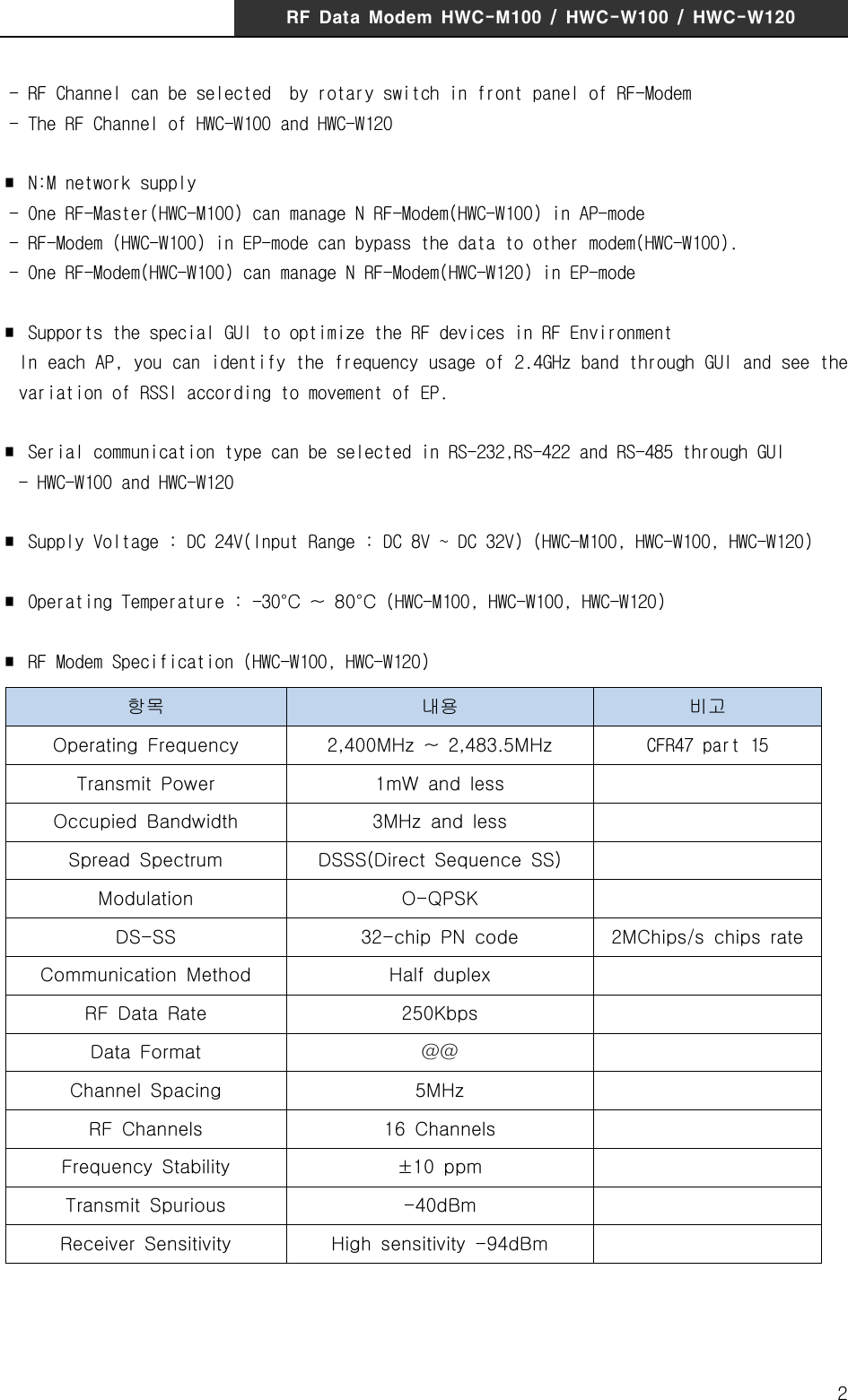
RF  Data  Modem  HWC-M100  /  HWC-W100  /  HWC-W1202 - RF Channel can be selected  by rotary switch in front panel of RF-Modem - The RF Channel of HWC-W100 and HWC-W120∎ N:M network supply - One RF-Master(HWC-M100) can manage N RF-Modem(HWC-W100) in AP-mode  - RF-Modem (HWC-W100) in EP-mode can bypass the data to other modem(HWC-W100). - One RF-Modem(HWC-W100) can manage N RF-Modem(HWC-W120) in EP-mode ∎ Supports the special GUI to optimize the RF devices in RF Environment  In each AP, you can identify the frequency usage of 2.4GHz band through GUI and see the variation of RSSI according to movement of EP.∎ Serial communication type can be selected in RS-232,RS-422 and RS-485 through GUI  - HWC-W100 and HWC-W120∎  Supply Voltage : DC 24V(Input Range : DC 8V ~ DC 32V) (HWC-M100, HWC-W100, HWC-W120)∎  Operating Temperature : -30°C  ~  80°C (HWC-M100, HWC-W100, HWC-W120)∎ RF Modem Specification (HWC-W100, HWC-W120)항목 내용 비고Operating  Frequency 2,400MHz  ~  2,483.5MHz CFR47 part 15Transmit  Power 1mW  and  lessOccupied Bandwidth 3MHz and lessSpread  Spectrum DSSS(Direct  Sequence  SS)Modulation O-QPSKDS-SS 32-chip  PN  code 2MChips/s  chips  rateCommunication  Method Half  duplexRF  Data  Rate 250KbpsData  Format @@Channel  Spacing 5MHzRF  Channels 16  ChannelsFrequency  Stability ±10  ppmTransmit  Spurious -40dBmReceiver  Sensitivity High  sensitivity  -94dBm
RF  Data  Modem  HWC-M100  /  HWC-W100  /  HWC-W12031.2 Accessories∎ RF Master(HWC-M100)∎ RF Modem(HWC-W100)∎ RF Master(HWC-W120)
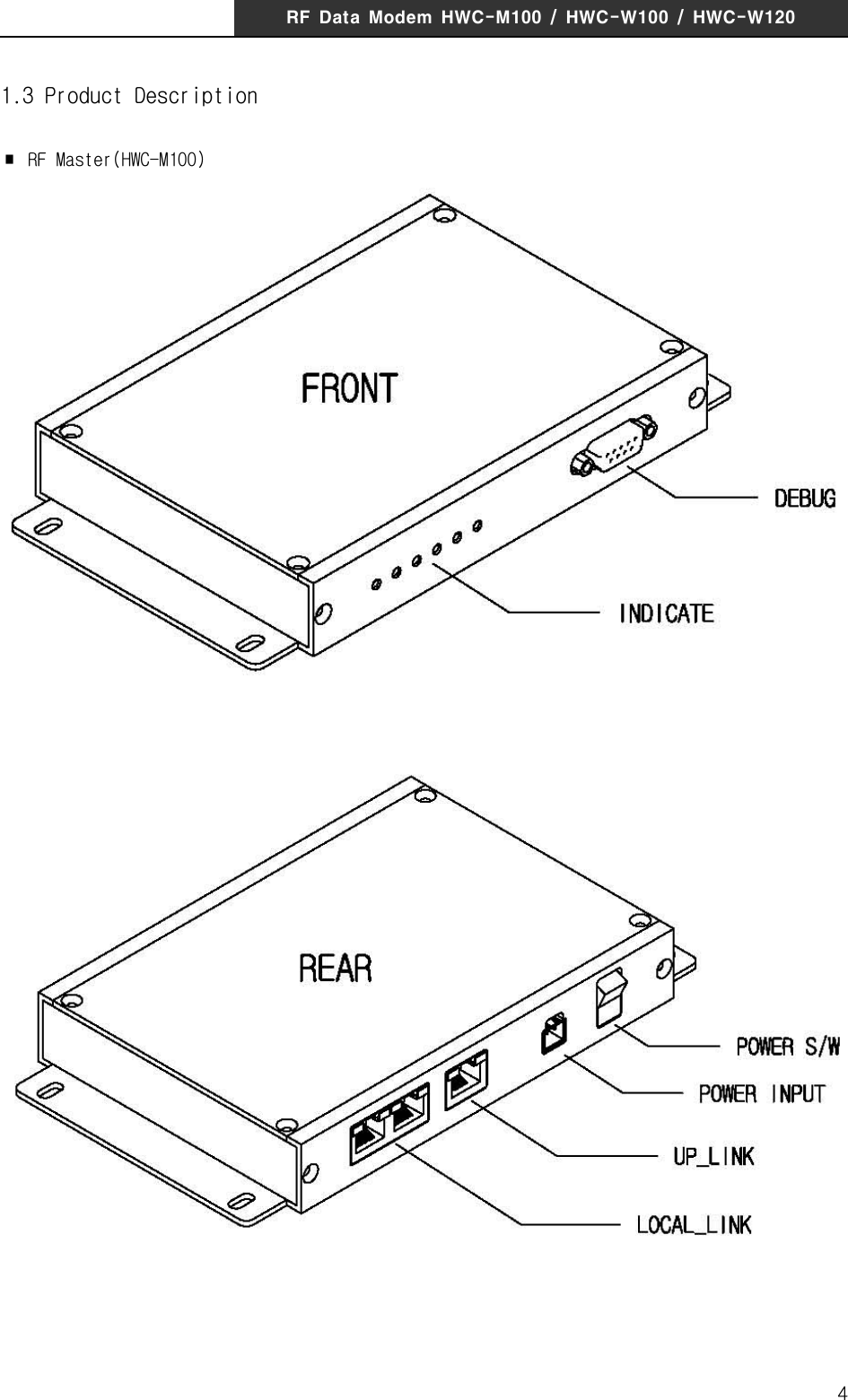
RF  Data  Modem  HWC-M100  /  HWC-W100  /  HWC-W12041.3 Product Description∎ RF Master(HWC-M100)
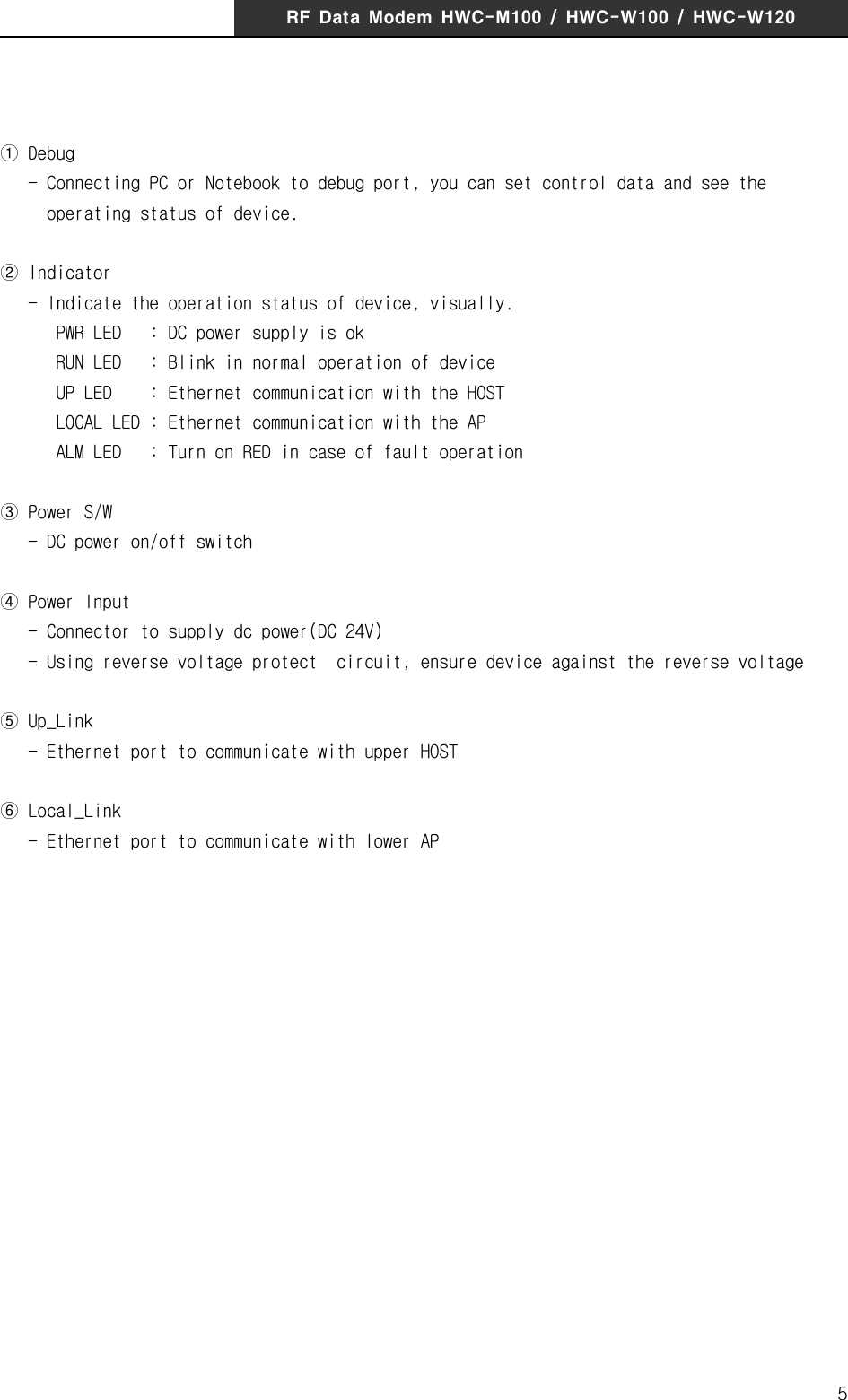
RF  Data  Modem  HWC-M100  /  HWC-W100  /  HWC-W1205① Debug   - Connecting PC or Notebook to debug port, you can set control data and see the          operating status of device.② Indicator   - Indicate the operation status of device, visually.       PWR LED   : DC power supply is ok      RUN LED   : Blink in normal operation of device      UP LED    : Ethernet communication with the HOST      LOCAL LED : Ethernet communication with the AP      ALM LED   : Turn on RED in case of fault operation③ Power S/W   - DC power on/off switch ④ Power Input   - Connector to supply dc power(DC 24V)   - Using reverse voltage protect  circuit, ensure device against the reverse voltage ⑤ Up_Link   - Ethernet port to communicate with upper HOST⑥ Local_Link   - Ethernet port to communicate with lower AP
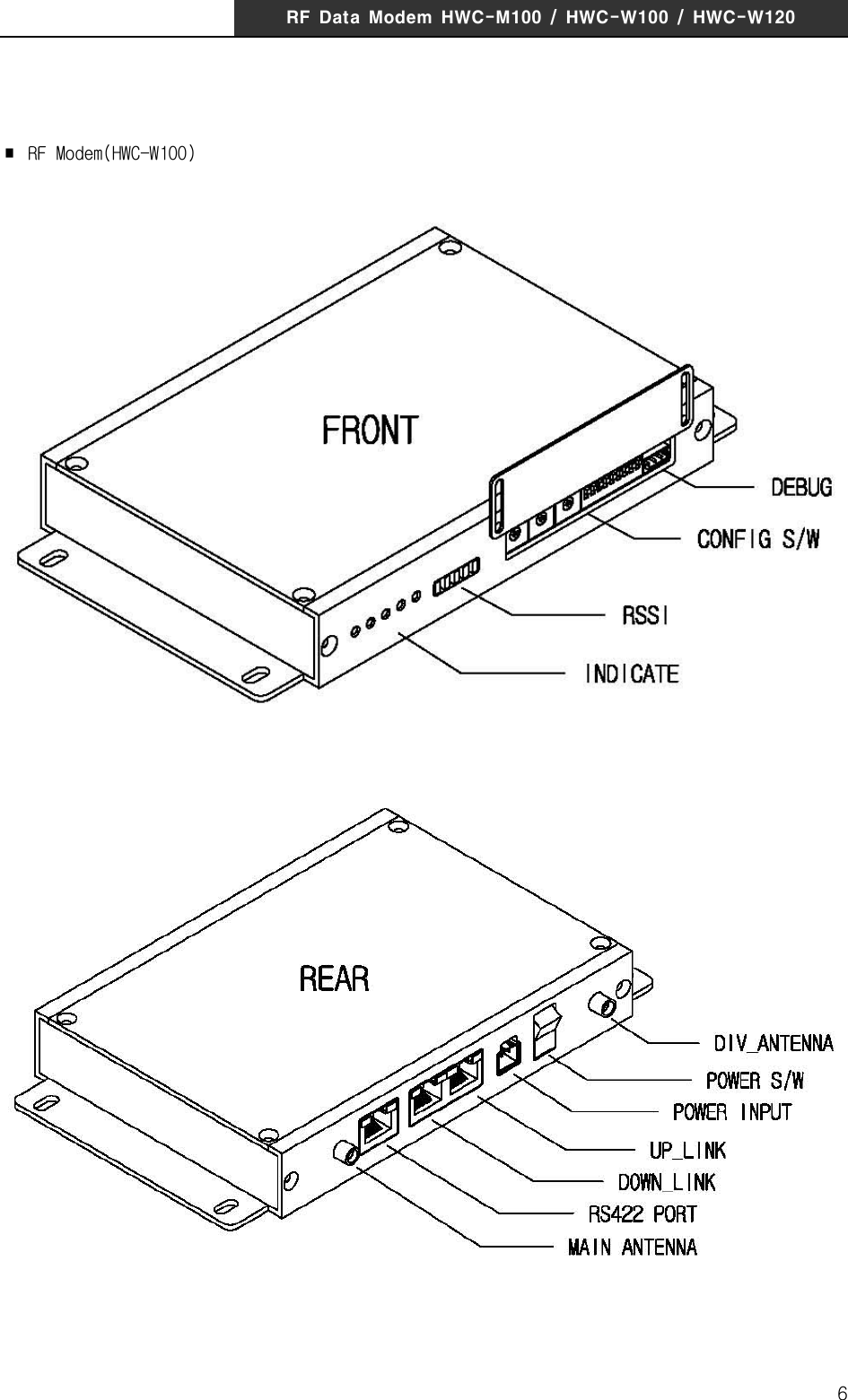
RF  Data  Modem  HWC-M100  /  HWC-W100  /  HWC-W1206∎ RF Modem(HWC-W100)
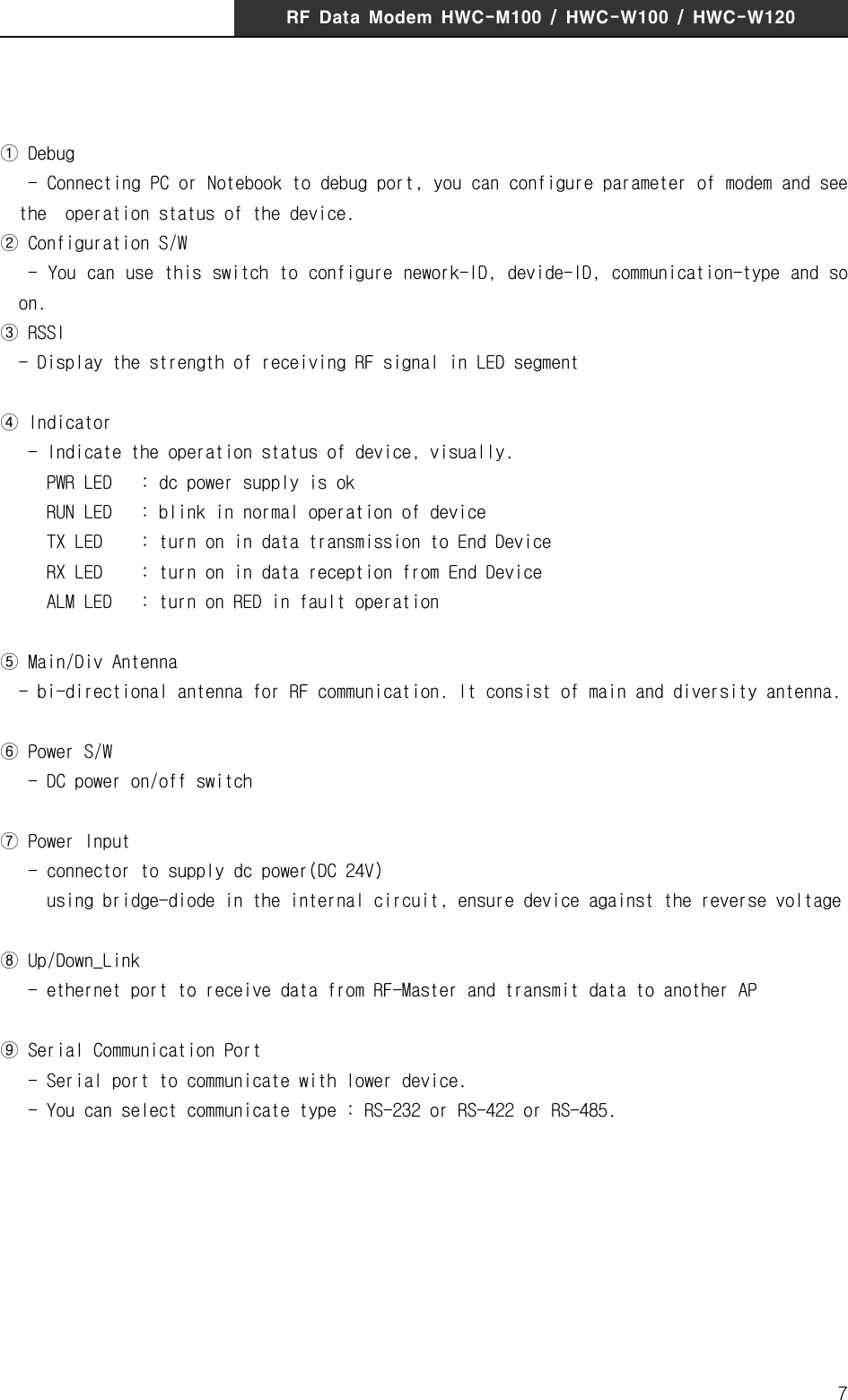
RF  Data  Modem  HWC-M100  /  HWC-W100  /  HWC-W1207① Debug   - Connecting PC or Notebook to debug port, you can configure parameter of modem and see the  operation status of the device.② Configuration S/W   - You can use this switch to configure nework-ID, devide-ID, communication-type and so on.③ RSSI  - Display the strength of receiving RF signal in LED segment④ Indicator   - Indicate the operation status of device, visually.      PWR LED   : dc power supply is ok     RUN LED   : blink in normal operation of device     TX LED    : turn on in data transmission to End Device     RX LED    : turn on in data reception from End Device     ALM LED   : turn on RED in fault operation⑤ Main/Div Antenna  - bi-directional antenna for RF communication. It consist of main and diversity antenna.⑥ Power S/W   - DC power on/off switch ⑦ Power Input   - connector to supply dc power(DC 24V)     using bridge-diode in the internal circuit, ensure device against the reverse voltage ⑧ Up/Down_Link   - ethernet port to receive data from RF-Master and transmit data to another AP⑨ Serial Communication Port   - Serial port to communicate with lower device.    - You can select communicate type : RS-232 or RS-422 or RS-485.
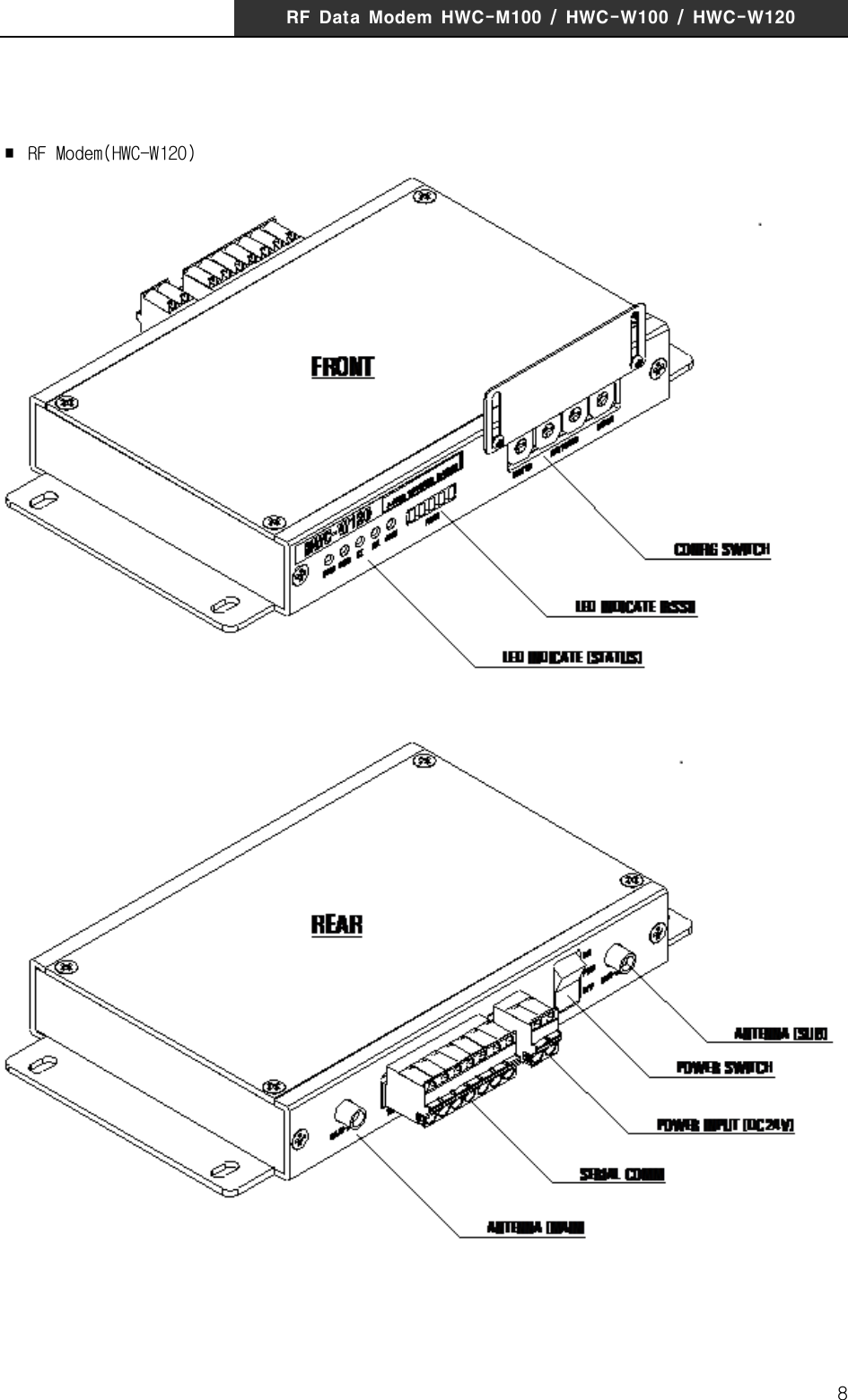
RF  Data  Modem  HWC-M100  /  HWC-W100  /  HWC-W1208∎ RF Modem(HWC-W120)
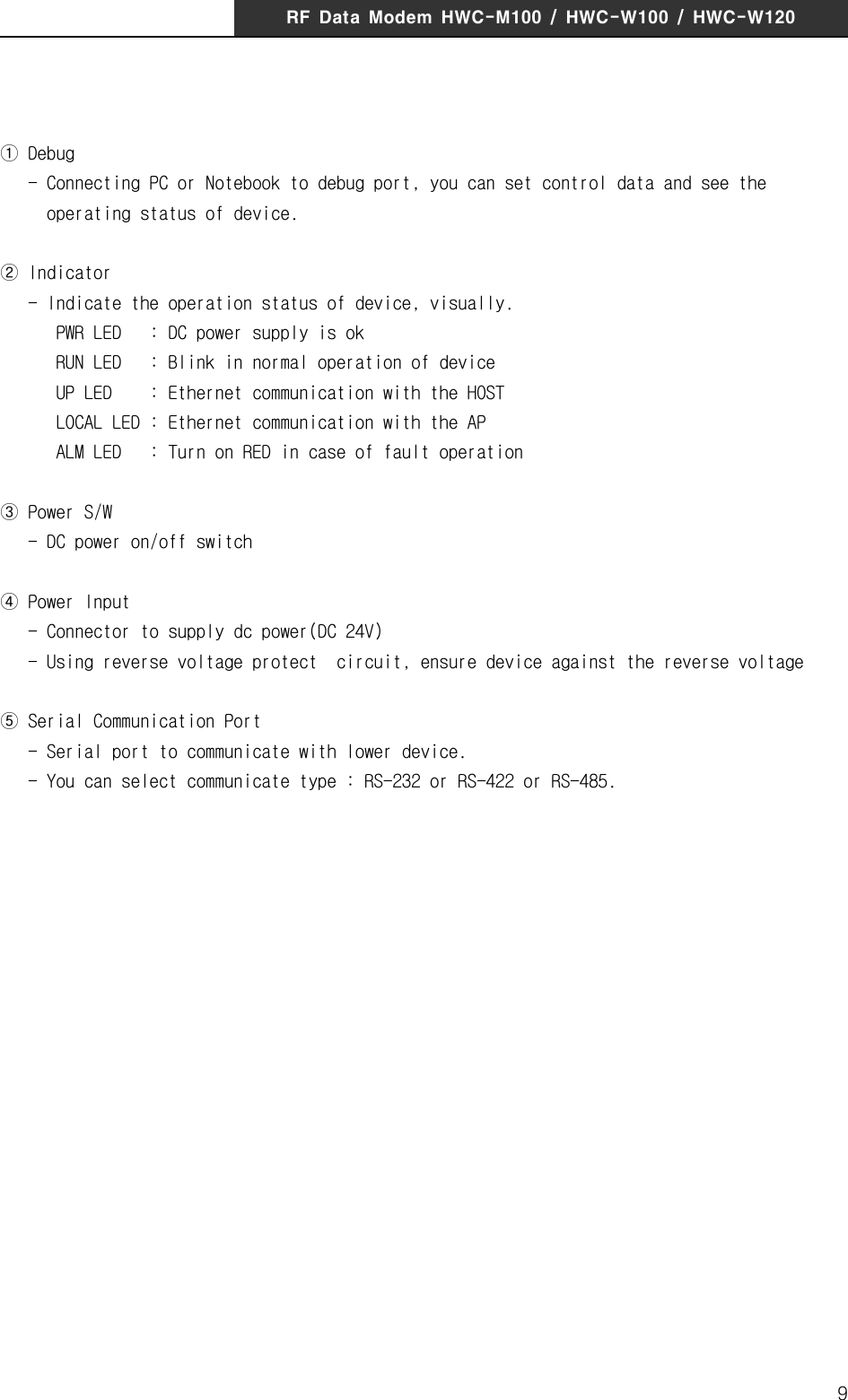
RF  Data  Modem  HWC-M100  /  HWC-W100  /  HWC-W1209① Debug   - Connecting PC or Notebook to debug port, you can set control data and see the          operating status of device.② Indicator   - Indicate the operation status of device, visually.       PWR LED   : DC power supply is ok      RUN LED   : Blink in normal operation of device      UP LED    : Ethernet communication with the HOST      LOCAL LED : Ethernet communication with the AP      ALM LED   : Turn on RED in case of fault operation③ Power S/W   - DC power on/off switch ④ Power Input   - Connector to supply dc power(DC 24V)   - Using reverse voltage protect  circuit, ensure device against the reverse voltage ⑤ Serial Communication Port   - Serial port to communicate with lower device.    - You can select communicate type : RS-232 or RS-422 or RS-485.
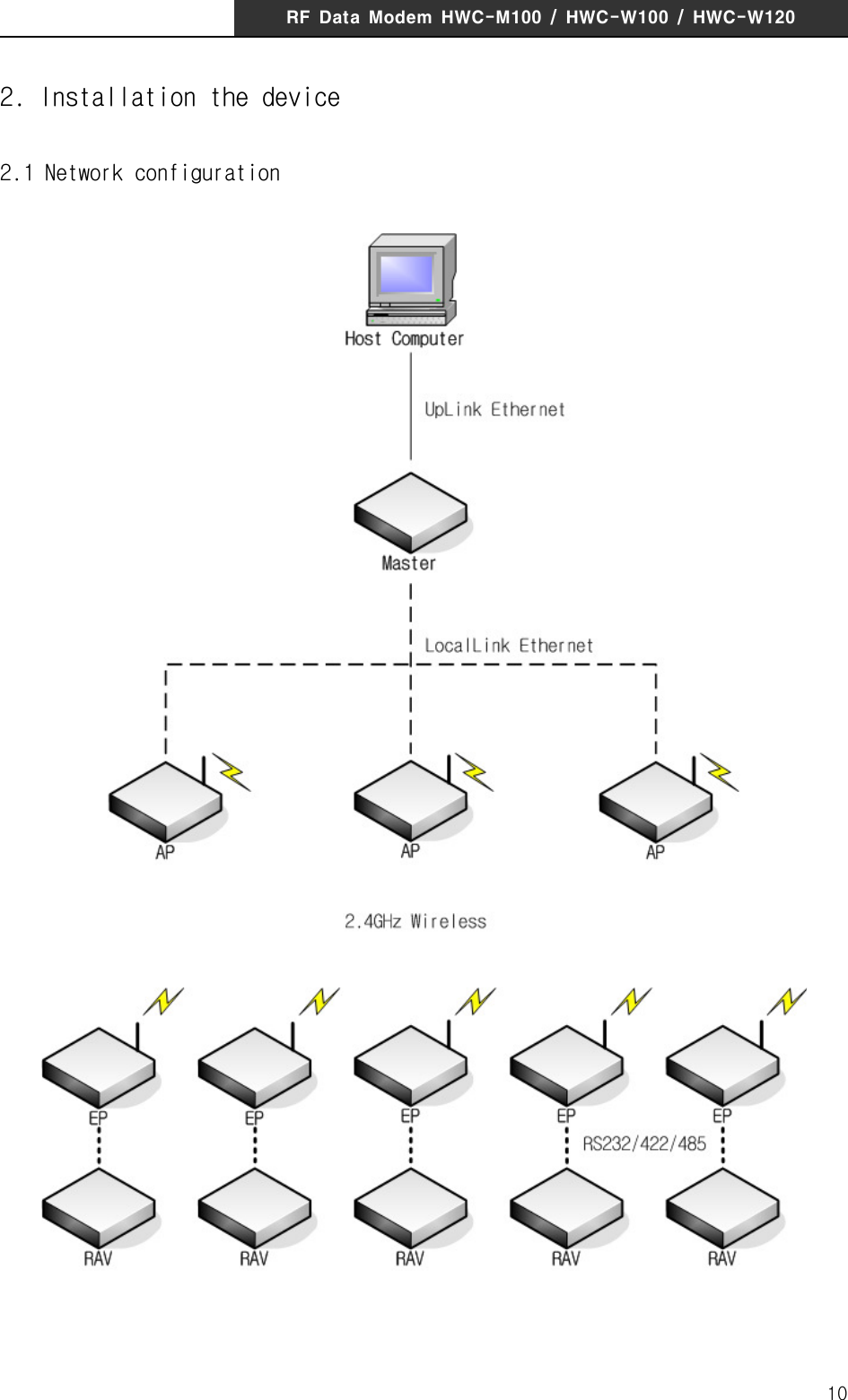
RF  Data  Modem  HWC-M100  /  HWC-W100  /  HWC-W120102. Installation the device2.1 Network configuration
RF  Data  Modem  HWC-M100  /  HWC-W100  /  HWC-W12011  ∎  The  network  consists  of  one  RF-Master(HWC-M100)  and  several  AP(Access  Point)/EP(End Point)  ∎  You  can  set  AP(Access  Point)  or  EP(End  Point)  mode  of  RF  Master(HWC-M100)  using configuration-Switch.  ∎  Communication  between  HOST  and  RF-Master  can  be  implemented  in  public  or  private network.  ∎  One  RF-Master  can  be  connected  to  several  AP  in  ethernet  communication.  It  can  be implemented in multi-drop bus for interconnecting RF-Master and APs.  ∎  RF-Master manages network that relays the communication of HOST and lower equipment.   ∎  AP(Access poing) Managed by RF-Master relays data in which Host delivers to EP. When the shadow region exists with a AP, AP can be additionally installed and the coverage can be expanded.    ∎  EP(End  Point)  is  connected  with  a  subordinate  equipment  by  wire  and  supports  a communication  with  HOST. You  can select  one of  the RS232/RS422/RS485  to communicate with the lower equipment.
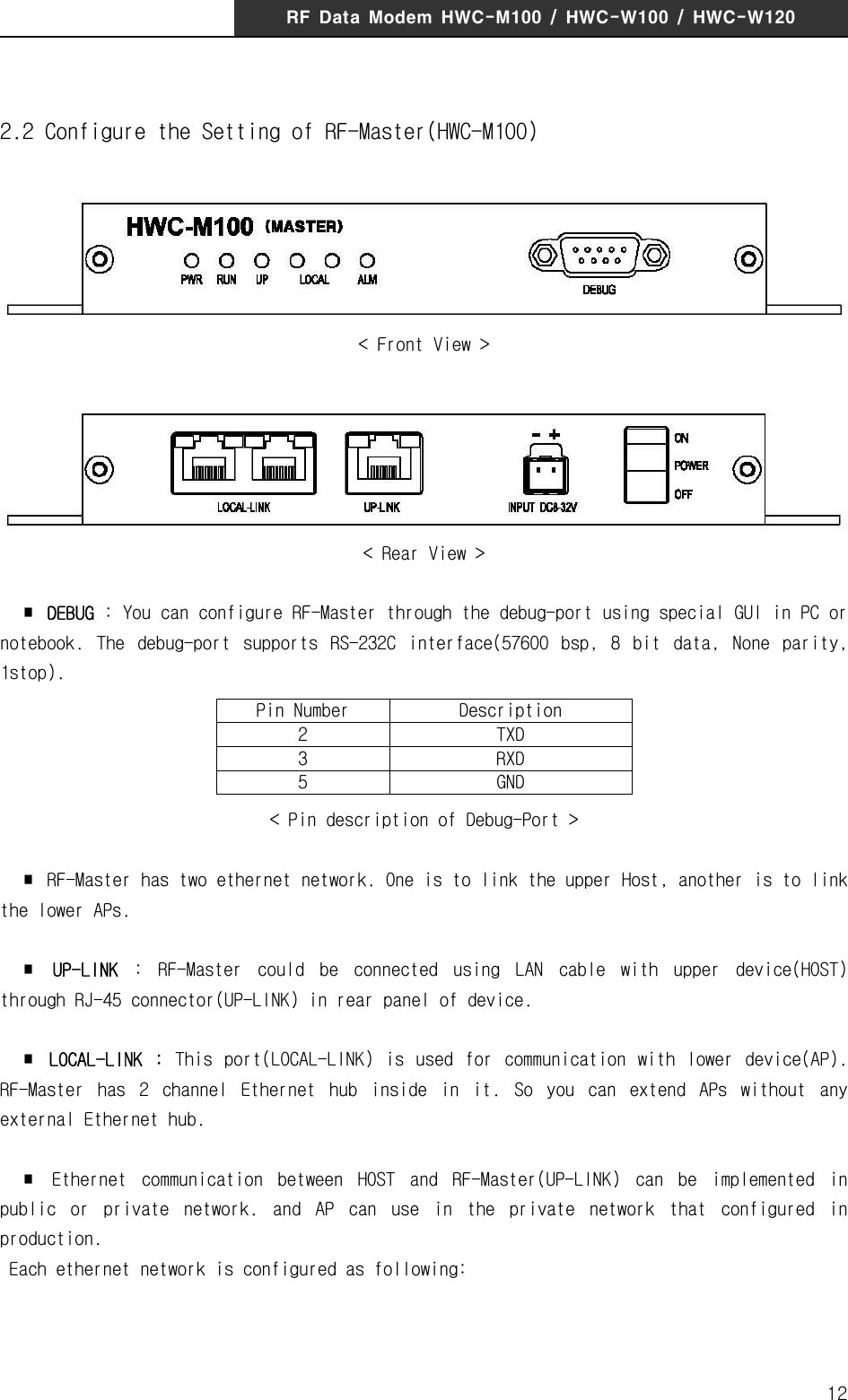
RF  Data  Modem  HWC-M100  /  HWC-W100  /  HWC-W120122.2 Configure the Setting of RF-Master(HWC-M100)< Front View >< Rear View >  ∎  DEBUG : You can configure RF-Master through the debug-port using special GUI in PC or notebook.  The  debug-port  supports  RS-232C  interface(57600  bsp,  8  bit  data,  None  parity, 1stop).Pin Number Description2TXD3RXD5GND< Pin description of Debug-Port >  ∎  RF-Master has two ethernet network. One is to link the upper Host, another is to link the lower APs.  ∎  UP-LINK  :  RF-Master  could  be  connected  using  LAN  cable  with  upper  device(HOST) through RJ-45 connector(UP-LINK) in rear panel of device.  ∎  LOCAL-LINK  :  This  port(LOCAL-LINK)  is  used  for  communication  with  lower  device(AP). RF-Master  has  2  channel  Ethernet  hub  inside  in  it.  So  you  can  extend  APs  without  any external Ethernet hub.  ∎  Ethernet  communication  between  HOST  and  RF-Master(UP-LINK)  can  be  implemented  in public  or  private  network.  and  AP  can  use  in  the  private  network  that  configured  in production. Each ethernet network is configured as following:
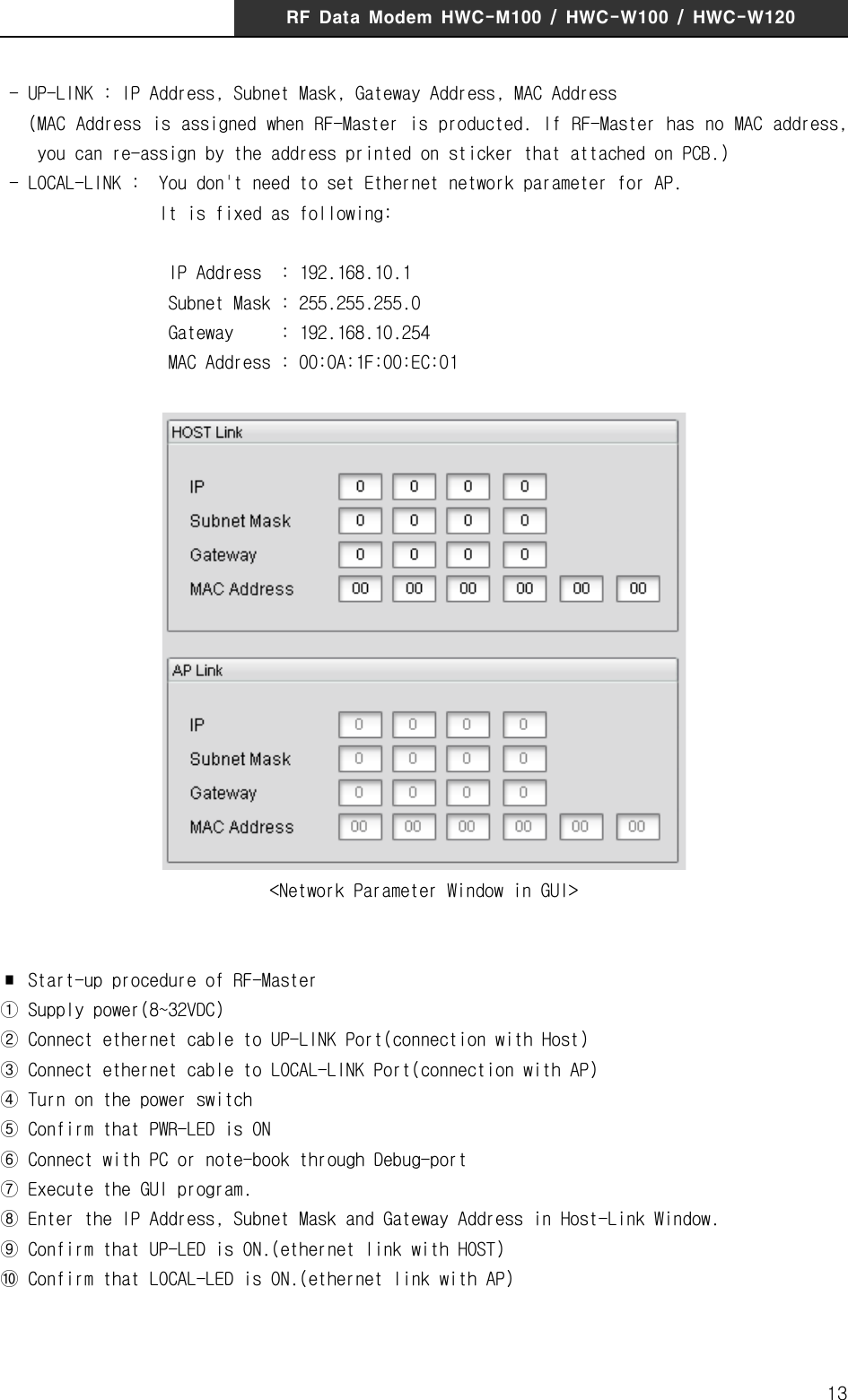
RF  Data  Modem  HWC-M100  /  HWC-W100  /  HWC-W12013 - UP-LINK : IP Address, Subnet Mask, Gateway Address, MAC Address   (MAC Address is assigned when RF-Master is producted. If RF-Master has no MAC address,      you can re-assign by the address printed on sticker that attached on PCB.) - LOCAL-LINK :  You don't need to set Ethernet network parameter for AP.                  It is fixed as following:                  IP Address  : 192.168.10.1                  Subnet Mask : 255.255.255.0                  Gateway     : 192.168.10.254                  MAC Address : 00:0A:1F:00:EC:01   <Network Parameter Window in GUI>    ∎  Start-up procedure of RF-Master① Supply power(8~32VDC)② Connect ethernet cable to UP-LINK Port(connection with Host)③ Connect ethernet cable to LOCAL-LINK Port(connection with AP)④ Turn on the power switch ⑤ Confirm that PWR-LED is ON⑥ Connect with PC or note-book through Debug-port⑦ Execute the GUI program.⑧ Enter the IP Address, Subnet Mask and Gateway Address in Host-Link Window.⑨ Confirm that UP-LED is ON.(ethernet link with HOST)⑩ Confirm that LOCAL-LED is ON.(ethernet link with AP)
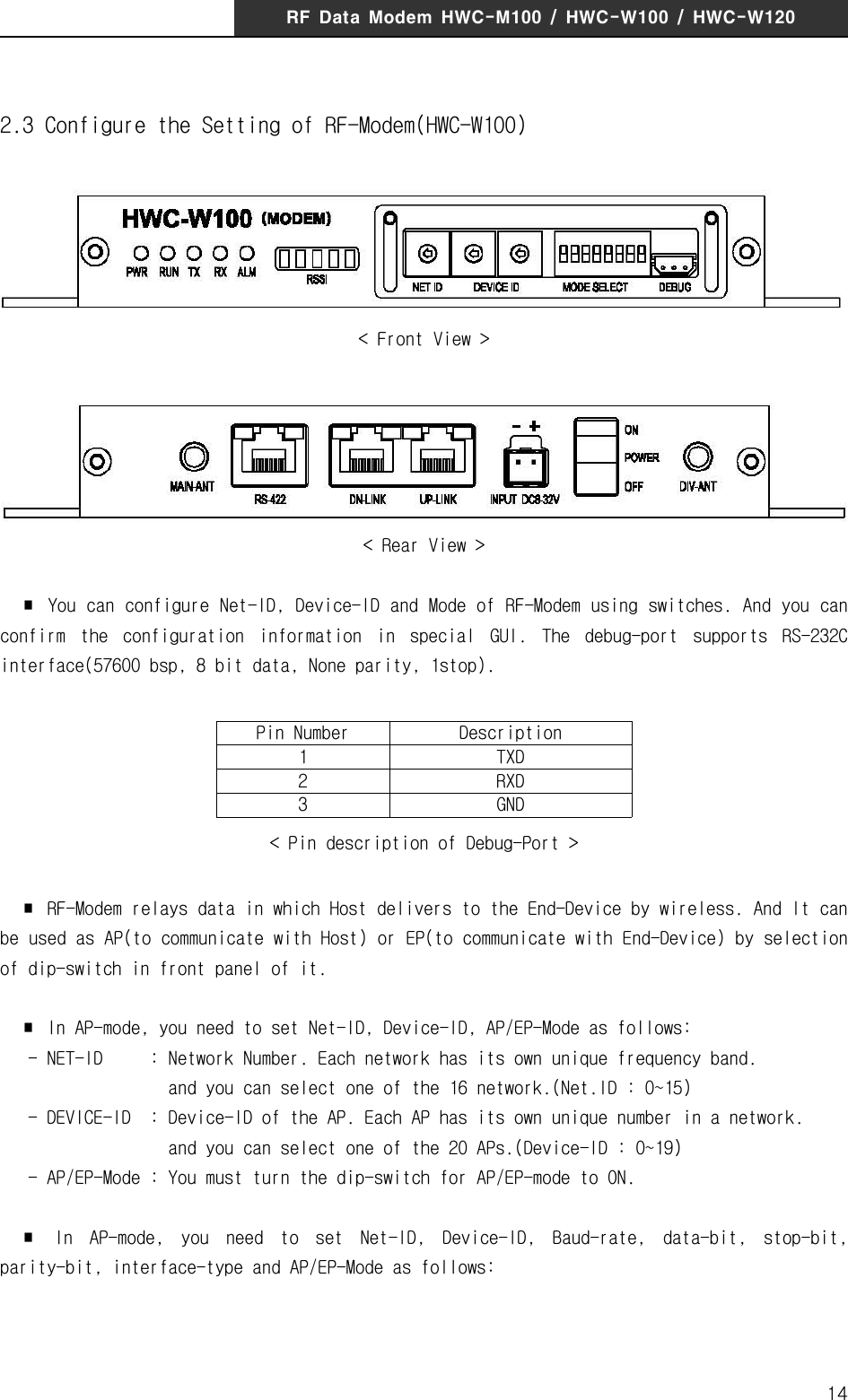
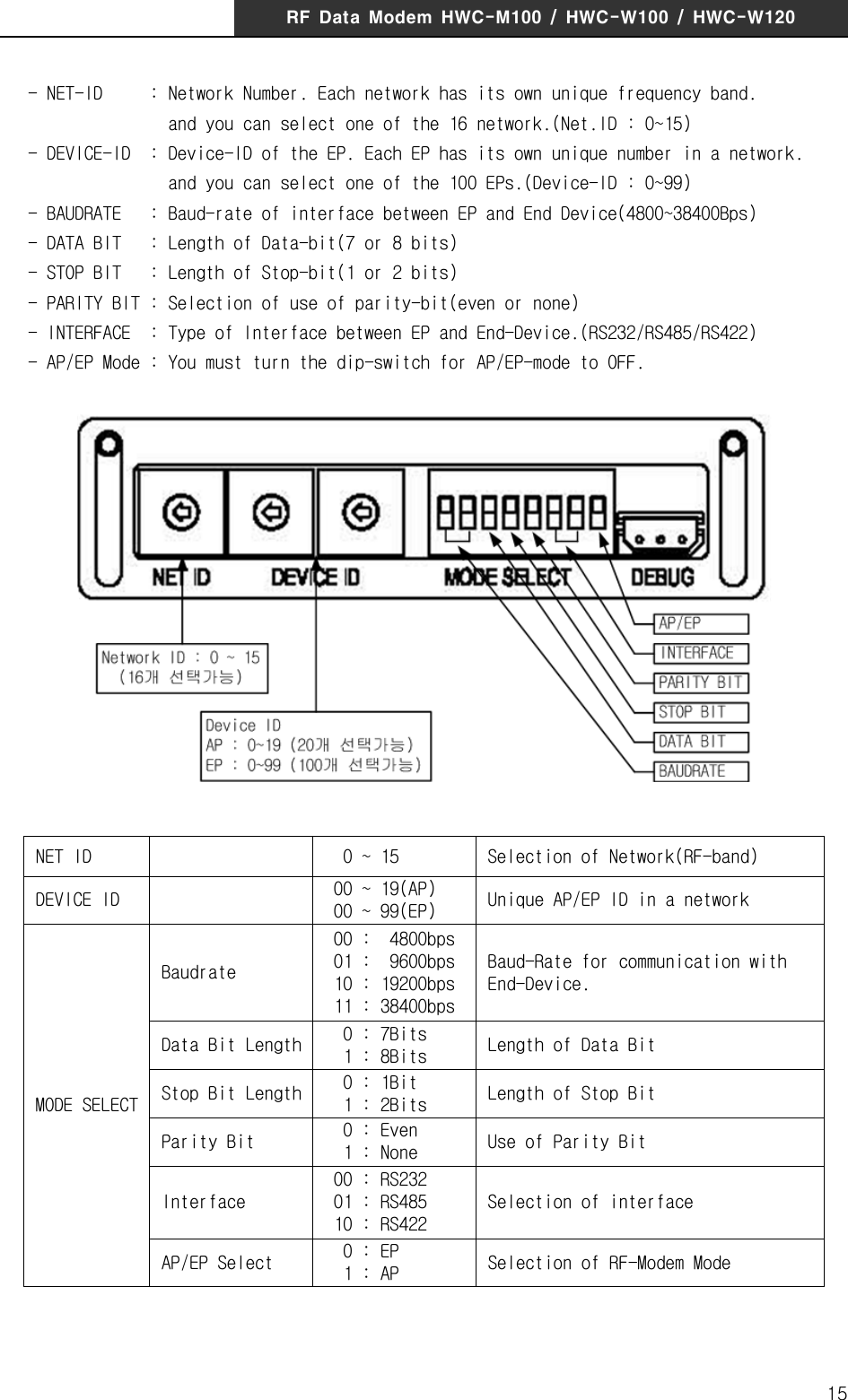
RF  Data  Modem  HWC-M100  /  HWC-W100  /  HWC-W120142.3 Configure the Setting of RF-Modem(HWC-W100)< Front View >< Rear View >  ∎  You can configure Net-ID, Device-ID and Mode of RF-Modem using switches. And you can confirm  the  configuration  information  in  special  GUI.  The  debug-port  supports  RS-232C interface(57600 bsp, 8 bit data, None parity, 1stop).Pin Number Description1TXD2RXD3GND< Pin description of Debug-Port >  ∎  RF-Modem relays data in which Host delivers to the End-Device by wireless. And It can be used as AP(to communicate with Host) or EP(to communicate with End-Device) by selection of dip-switch in front panel of it.  ∎  In AP-mode, you need to set Net-ID, Device-ID, AP/EP-Mode as follows:   - NET-ID     : Network Number. Each network has its own unique frequency band.                  and you can select one of the 16 network.(Net.ID : 0~15)   - DEVICE-ID  : Device-ID of the AP. Each AP has its own unique number in a network.                  and you can select one of the 20 APs.(Device-ID : 0~19)   - AP/EP-Mode : You must turn the dip-switch for AP/EP-mode to ON.  ∎  In  AP-mode,  you  need  to  set  Net-ID,  Device-ID,  Baud-rate,  data-bit,  stop-bit, parity-bit, interface-type and AP/EP-Mode as follows:
RF  Data  Modem  HWC-M100  /  HWC-W100  /  HWC-W12015   - NET-ID     : Network Number. Each network has its own unique frequency band.                  and you can select one of the 16 network.(Net.ID : 0~15)   - DEVICE-ID  : Device-ID of the EP. Each EP has its own unique number in a network.                  and you can select one of the 100 EPs.(Device-ID : 0~99)   - BAUDRATE   : Baud-rate of interface between EP and End Device(4800~38400Bps)   - DATA BIT   : Length of Data-bit(7 or 8 bits)   - STOP BIT   : Length of Stop-bit(1 or 2 bits)   - PARITY BIT : Selection of use of parity-bit(even or none)   - INTERFACE  : Type of Interface between EP and End-Device.(RS232/RS485/RS422)   - AP/EP Mode : You must turn the dip-switch for AP/EP-mode to OFF. NET ID    0 ~ 15  Selection of Network(RF-band) DEVICE ID   00 ~ 19(AP)  00 ~ 99(EP)  Unique AP/EP ID in a network MODE SELECT Baudrate  00 :  4800bps  01 :  9600bps  10 : 19200bps  11 : 38400bps Baud-Rate for communication with  End-Device. Data Bit Length    0 : 7Bits   1 : 8Bits  Length of Data Bit Stop Bit Length    0 : 1Bit   1 : 2Bits  Length of Stop Bit Parity Bit    0 : Even   1 : None  Use of Parity Bit Interface  00 : RS232  01 : RS485  10 : RS422 Selection of interface AP/EP Select    0 : EP   1 : AP  Selection of RF-Modem Mode
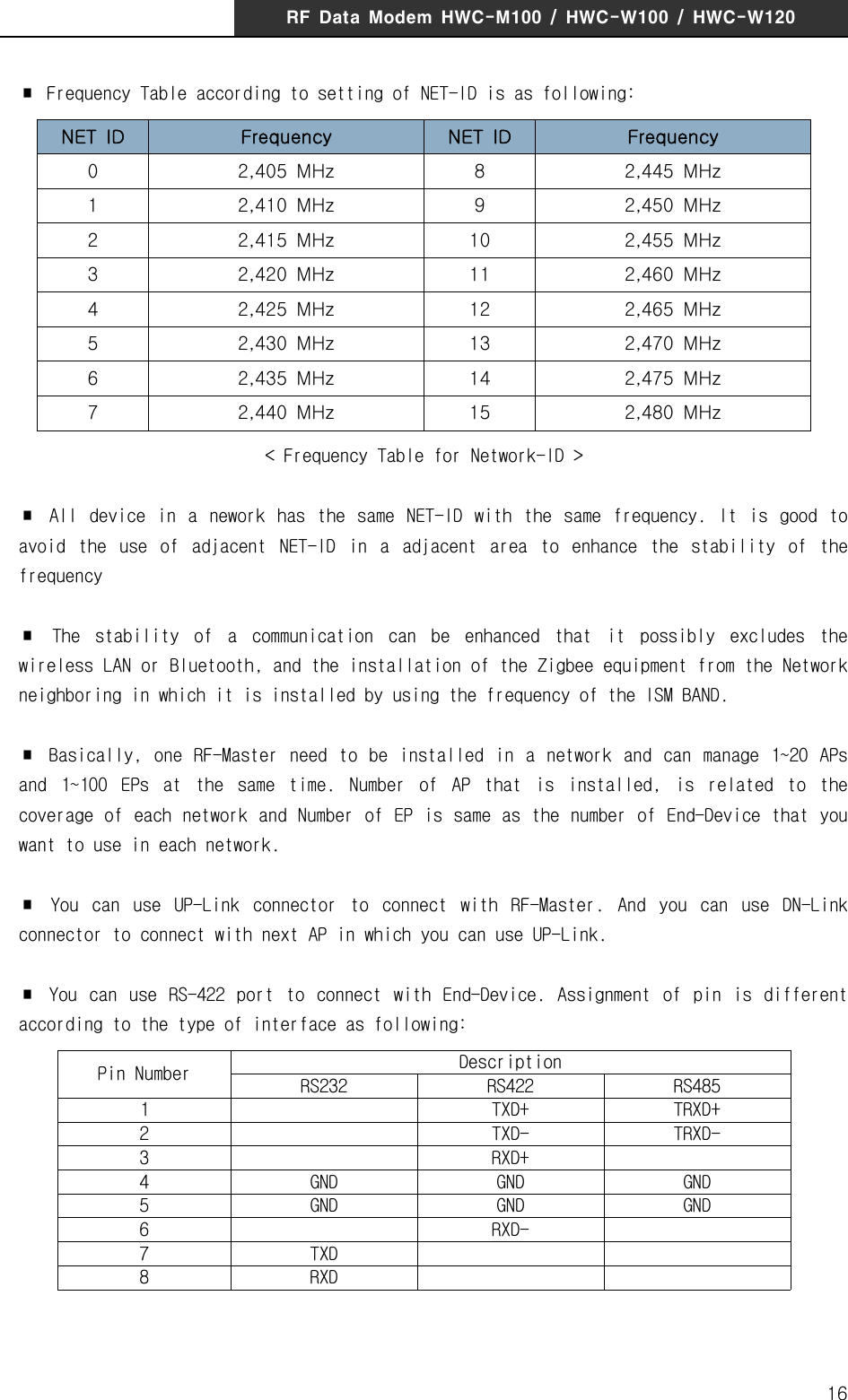
RF  Data  Modem  HWC-M100  /  HWC-W100  /  HWC-W12016  ∎  Frequency Table according to setting of NET-ID is as following:NET  ID Frequency NET  ID Frequency0 2,405  MHz 8 2,445  MHz1 2,410  MHz 9 2,450  MHz2 2,415  MHz 10 2,455  MHz3 2,420  MHz 11 2,460  MHz4 2,425  MHz 12 2,465  MHz5 2,430  MHz 13 2,470  MHz6 2,435  MHz 14 2,475  MHz7 2,440  MHz 15 2,480  MHz< Frequency Table for Network-ID >  ∎  All  device  in  a  nework  has  the  same  NET-ID  with  the  same  frequency.  It  is  good  to avoid  the  use  of  adjacent  NET-ID  in  a  adjacent  area  to  enhance  the  stability  of  the frequency  ∎  The  stability  of  a  communication  can  be  enhanced  that  it  possibly  excludes  the wireless LAN or Bluetooth, and the installation of the Zigbee equipment from the Network neighboring in which it is installed by using the frequency of the ISM BAND.   ∎  Basically,  one  RF-Master  need  to  be  installed  in  a  network  and can  manage  1~20  APs and  1~100  EPs  at  the  same  time.  Number  of  AP  that  is  installed,  is  related  to  the coverage of each network and Number of EP is same as the number of End-Device that you want to use in each network.   ∎  You  can  use  UP-Link  connector  to  connect  with  RF-Master.  And  you  can  use  DN-Link connector to connect with next AP in which you can use UP-Link.  ∎  You  can  use  RS-422  port  to  connect  with  End-Device.  Assignment  of  pin  is  different according to the type of interface as following:Pin Number DescriptionRS232 RS422 RS4851 TXD+ TRXD+2 TXD- TRXD-3 RXD+4 GND GND GND5 GND GND GND6 RXD-7TXD8RXD
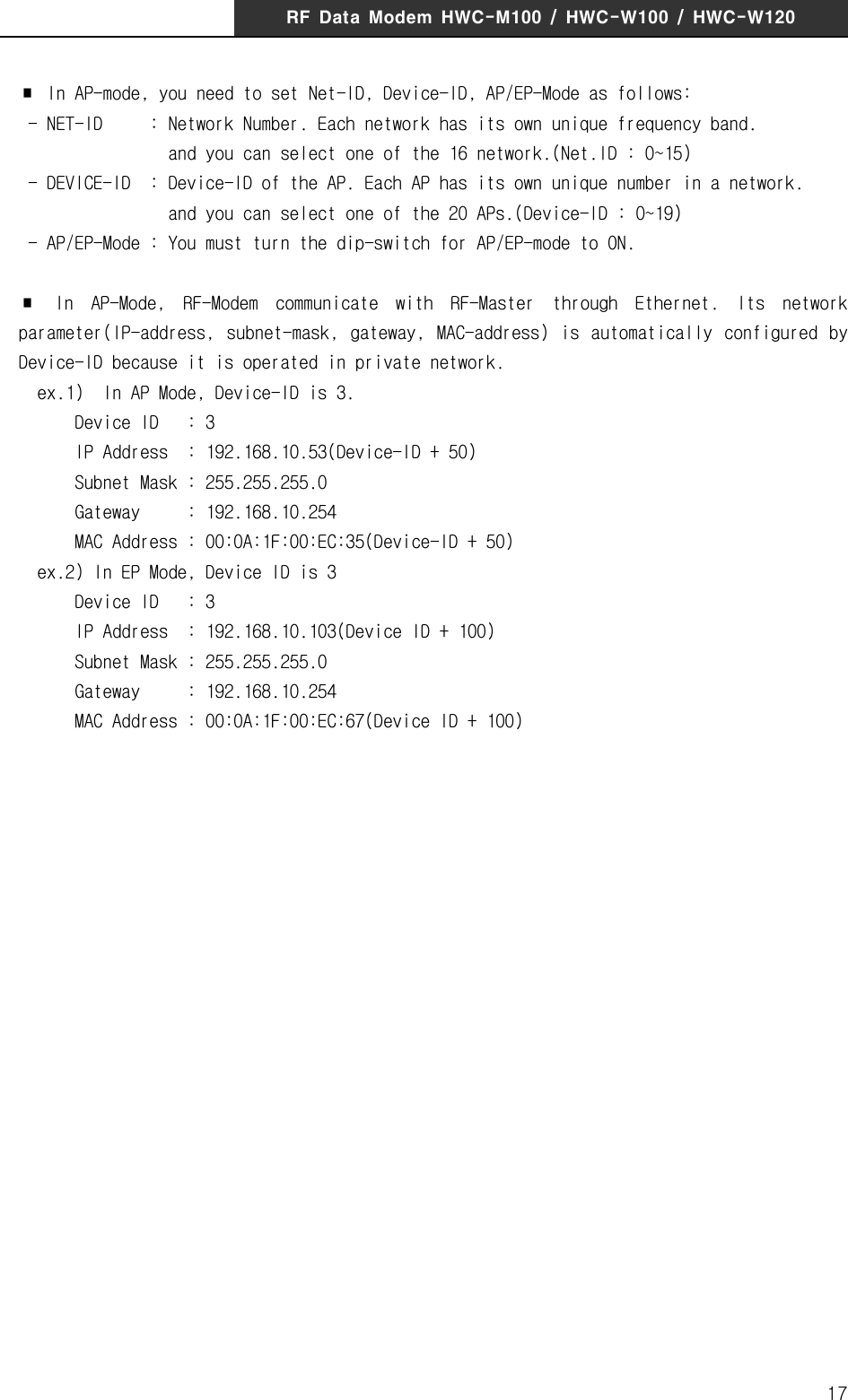
RF  Data  Modem  HWC-M100  /  HWC-W100  /  HWC-W12017  ∎  In AP-mode, you need to set Net-ID, Device-ID, AP/EP-Mode as follows:   - NET-ID     : Network Number. Each network has its own unique frequency band.                  and you can select one of the 16 network.(Net.ID : 0~15)   - DEVICE-ID  : Device-ID of the AP. Each AP has its own unique number in a network.                  and you can select one of the 20 APs.(Device-ID : 0~19)   - AP/EP-Mode : You must turn the dip-switch for AP/EP-mode to ON.  ∎  In  AP-Mode,  RF-Modem  communicate  with  RF-Master  through  Ethernet.  Its  network parameter(IP-address,  subnet-mask,  gateway,  MAC-address)  is  automatically  configured  by Device-ID because it is operated in private network.    ex.1)  In AP Mode, Device-ID is 3.        Device ID   : 3        IP Address  : 192.168.10.53(Device-ID + 50)        Subnet Mask : 255.255.255.0        Gateway     : 192.168.10.254        MAC Address : 00:0A:1F:00:EC:35(Device-ID + 50)    ex.2) In EP Mode, Device ID is 3        Device ID   : 3        IP Address  : 192.168.10.103(Device ID + 100)        Subnet Mask : 255.255.255.0        Gateway     : 192.168.10.254        MAC Address : 00:0A:1F:00:EC:67(Device ID + 100)
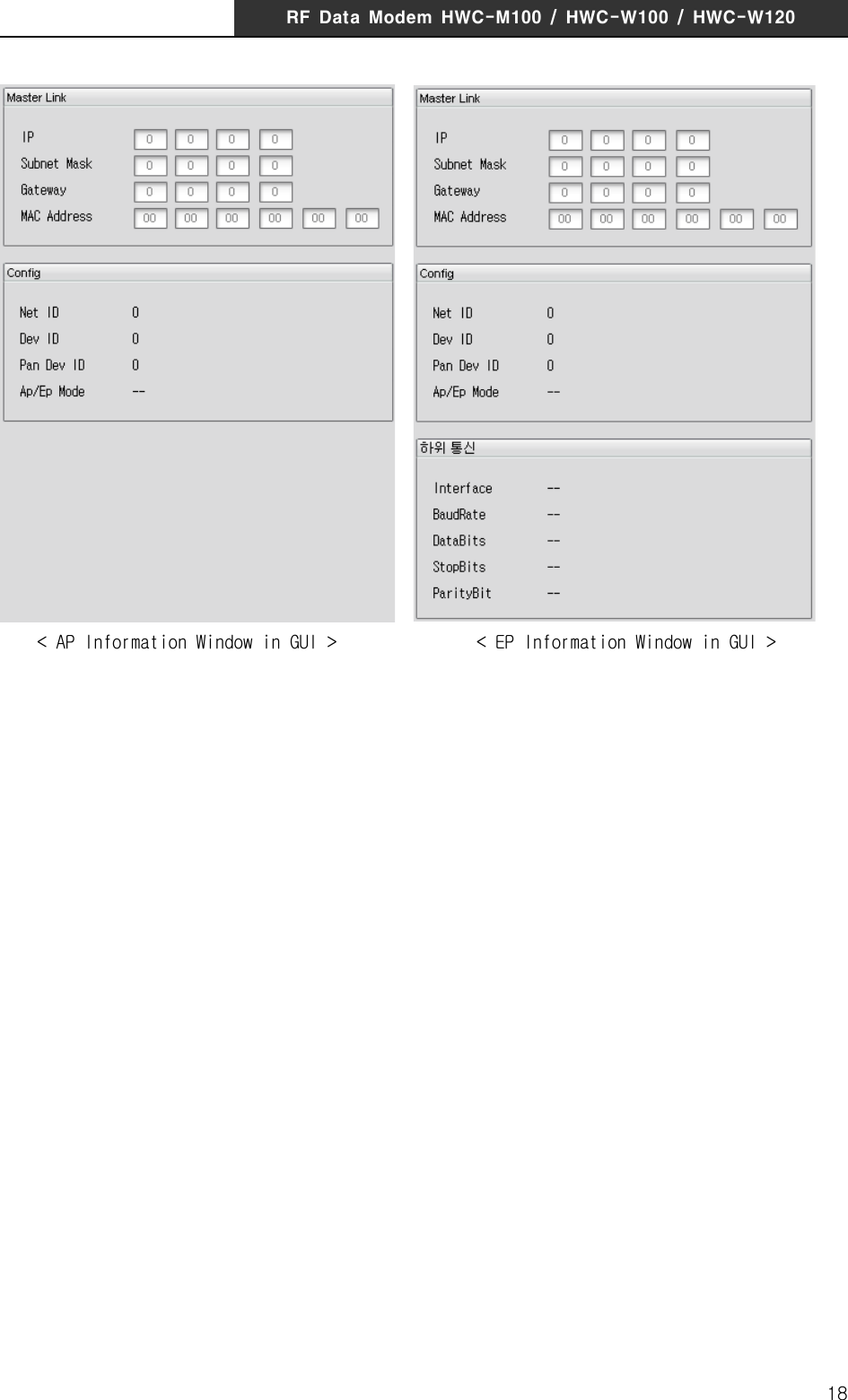
RF  Data  Modem  HWC-M100  /  HWC-W100  /  HWC-W12018      < AP Information Window in GUI >               < EP Information Window in GUI >
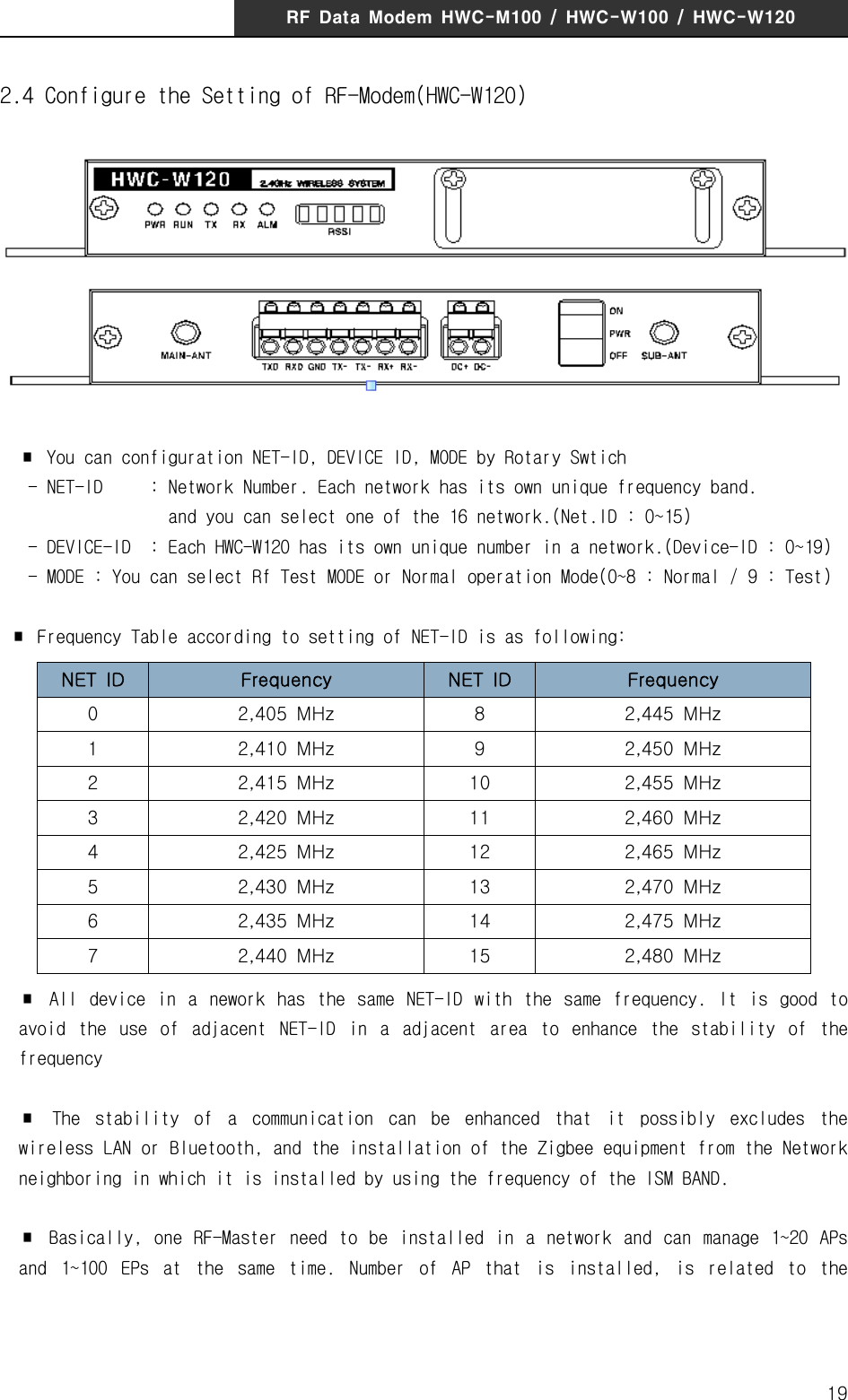
RF  Data  Modem  HWC-M100  /  HWC-W100  /  HWC-W120192.4 Configure the Setting of RF-Modem(HWC-W120)  ∎  You can configuration NET-ID, DEVICE ID, MODE by Rotary Swtich   - NET-ID     : Network Number. Each network has its own unique frequency band.                  and you can select one of the 16 network.(Net.ID : 0~15)   - DEVICE-ID  : Each HWC-W120 has its own unique number in a network.(Device-ID : 0~19)   - MODE : You can select Rf Test MODE or Normal operation Mode(0~8 : Normal / 9 : Test) ∎  Frequency Table according to setting of NET-ID is as following:NET  ID Frequency NET  ID Frequency0 2,405  MHz 8 2,445  MHz1 2,410  MHz 9 2,450  MHz2 2,415  MHz 10 2,455  MHz3 2,420  MHz 11 2,460  MHz4 2,425  MHz 12 2,465  MHz5 2,430  MHz 13 2,470  MHz6 2,435  MHz 14 2,475  MHz7 2,440  MHz 15 2,480  MHz  ∎  All  device  in  a  nework  has  the  same  NET-ID  with  the  same  frequency.  It  is  good  to avoid  the  use  of  adjacent  NET-ID  in  a  adjacent  area  to  enhance  the  stability  of  the frequency  ∎  The  stability  of  a  communication  can  be  enhanced  that  it  possibly  excludes  the wireless LAN or Bluetooth, and the installation of the Zigbee equipment from the Network neighboring in which it is installed by using the frequency of the ISM BAND.   ∎  Basically,  one  RF-Master  need  to  be  installed  in  a  network  and can  manage  1~20  APs and  1~100  EPs  at  the  same  time.  Number  of  AP  that  is  installed,  is  related  to  the
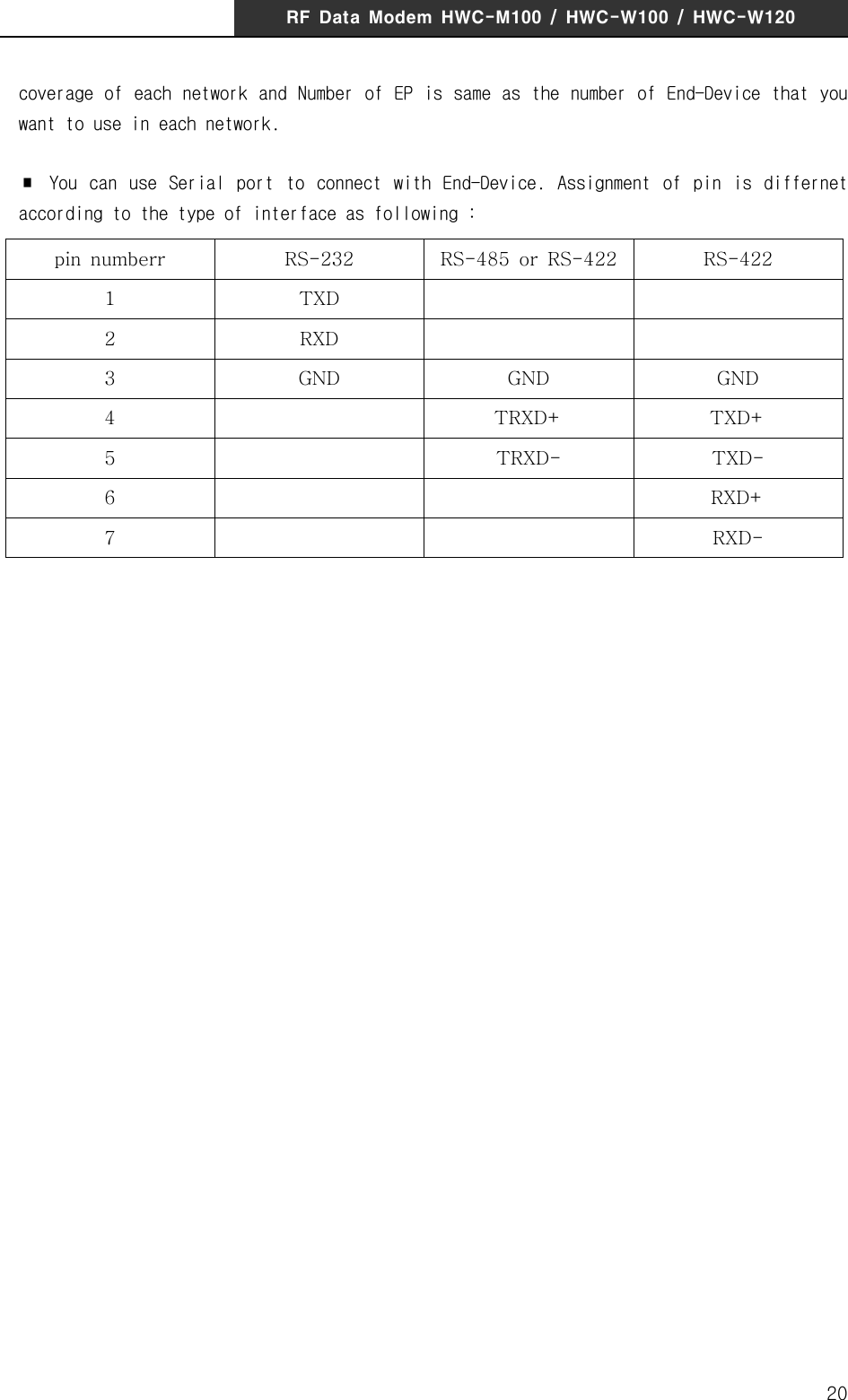
RF  Data  Modem  HWC-M100  /  HWC-W100  /  HWC-W12020coverage of each network and Number of EP is same as the number of End-Device that you want to use in each network.   ∎  You  can  use  Serial  port  to  connect  with  End-Device.  Assignment  of  pin  is  differnet according to the type of interface as following :pin  numberr RS-232 RS-485  or  RS-422 RS-4221TXD2RXD3GNDGNDGND4 TRXD+ TXD+5 TRXD- TXD-6RXD+7RXD-
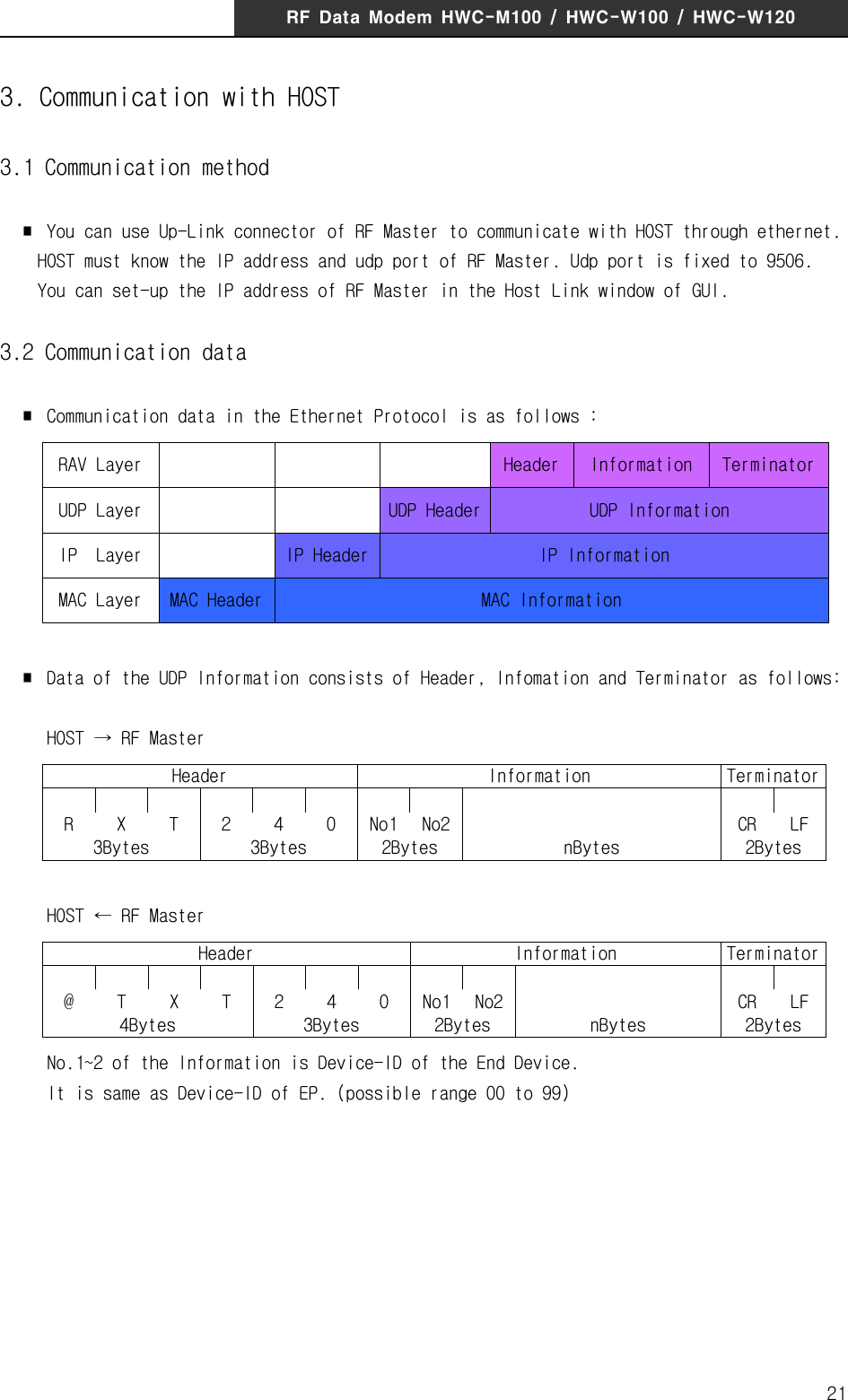
RF  Data  Modem  HWC-M100  /  HWC-W100  /  HWC-W120213. Communication with HOST 3.1 Communication method  ∎  You can use Up-Link connector of RF Master to communicate with HOST through ethernet.     HOST must know the IP address and udp port of RF Master. Udp port is fixed to 9506.    You can set-up the IP address of RF Master in the Host Link window of GUI.  3.2 Communication data  ∎  Communication data in the Ethernet Protocol is as follows :    RAV Layer Header Information TerminatorUDP Layer UDP Header UDP InformationIP  Layer IP Header IP InformationMAC Layer MAC Header MAC Information  ∎  Data of the UDP Information consists of Header, Infomation and Terminator as follows:     HOST → RF Master    Header Information TerminatorR X T 2 4 0 No1 No2 CR LF3Bytes 3Bytes 2Bytes nBytes 2Bytes     HOST ← RF Master    Header Information Terminator@TXT240No1No2 CRLF4Bytes 3Bytes 2Bytes nBytes 2Bytes     No.1~2 of the Information is Device-ID of the End Device.      It is same as Device-ID of EP. (possible range 00 to 99)
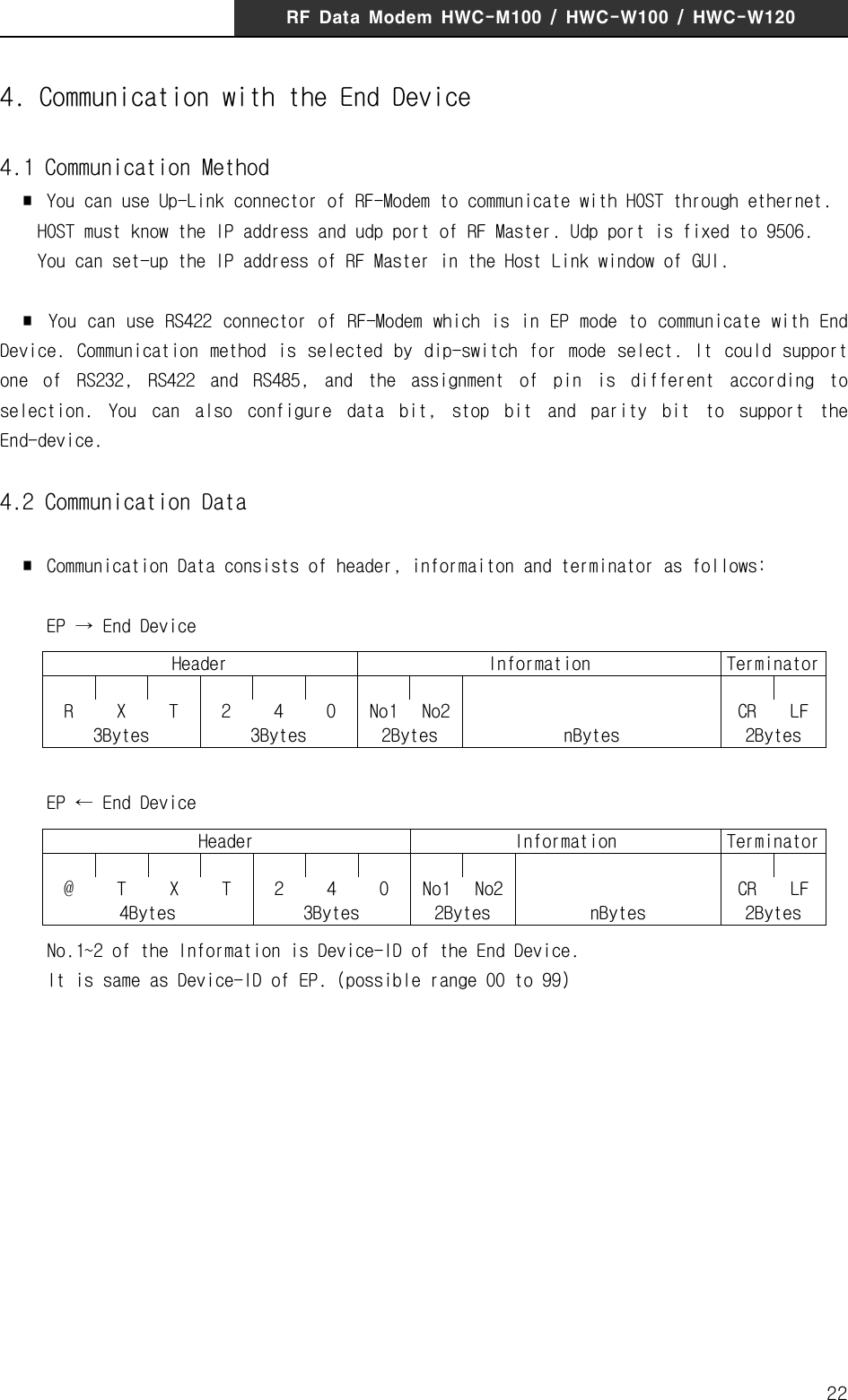
RF  Data  Modem  HWC-M100  /  HWC-W100  /  HWC-W120224. Communication with the End Device4.1 Communication Method  ∎  You can use Up-Link connector of RF-Modem to communicate with HOST through ethernet.     HOST must know the IP address and udp port of RF Master. Udp port is fixed to 9506.    You can set-up the IP address of RF Master in the Host Link window of GUI.    ∎  You can use RS422 connector of RF-Modem which is in EP mode to communicate with End Device.  Communication  method is  selected by  dip-switch  for mode  select.  It  could  support one  of  RS232,  RS422  and  RS485,  and  the  assignment  of  pin  is  different  according  to selection.  You  can  also  configure  data  bit,  stop  bit  and  parity  bit  to  support  the End-device.4.2 Communication Data  ∎  Communication Data consists of header, informaiton and terminator as follows:     EP → End Device    Header Information TerminatorR X T 2 4 0 No1 No2 CR LF3Bytes 3Bytes 2Bytes nBytes 2Bytes     EP ← End Device    Header Information Terminator@TXT240No1No2 CRLF4Bytes 3Bytes 2Bytes nBytes 2Bytes     No.1~2 of the Information is Device-ID of the End Device.      It is same as Device-ID of EP. (possible range 00 to 99)
RF  Data  Modem  HWC-M100  /  HWC-W100  /  HWC-W120235. Quick Start for GUI5.1 Initial Screen after Execution When you execute the GUI program, the following screen is shown up.(In case of showing message about the setting of program, please refer to "5.11 Configure the setting of communication with device"! )This system consists of Master, AP and EP. As soon as excutuion, you can only see Master in  left  window.  Therefore,  user  must  request  the  list  of  device(AP,  EP)  by  clicking [Configure Network] or [Request Device List].There is the following differences between [Configure Network] and [Request Device List].∎  [Configure Network]   : It send commands to Master to gather the list of AP/EP again,                            Master  begins  to  gather  information  and  sends  the  progressing                              status and result to GUI.∎  [Request Device List] : It requests the device list that Master already gathers.                           Master sends the device list of AP/EP to GUI.Tip) After execution, It only show Master. If PC is not connected to Master, you couldn't see  any  AP/EP  in  left  window  because  PC  can't  receive  the  device  list.  In  other  words, when  PC  is  directly  connected  to  AP/EP,  PC can't  receive  any device  list.  In  this  case,
RF  Data  Modem  HWC-M100  /  HWC-W100  /  HWC-W12024you  can  see  AP.0/EP.0  by  pressing  'F5'Key.  It  could  be  different  with  real  device  list, and This is the function that you can see device information without Master.
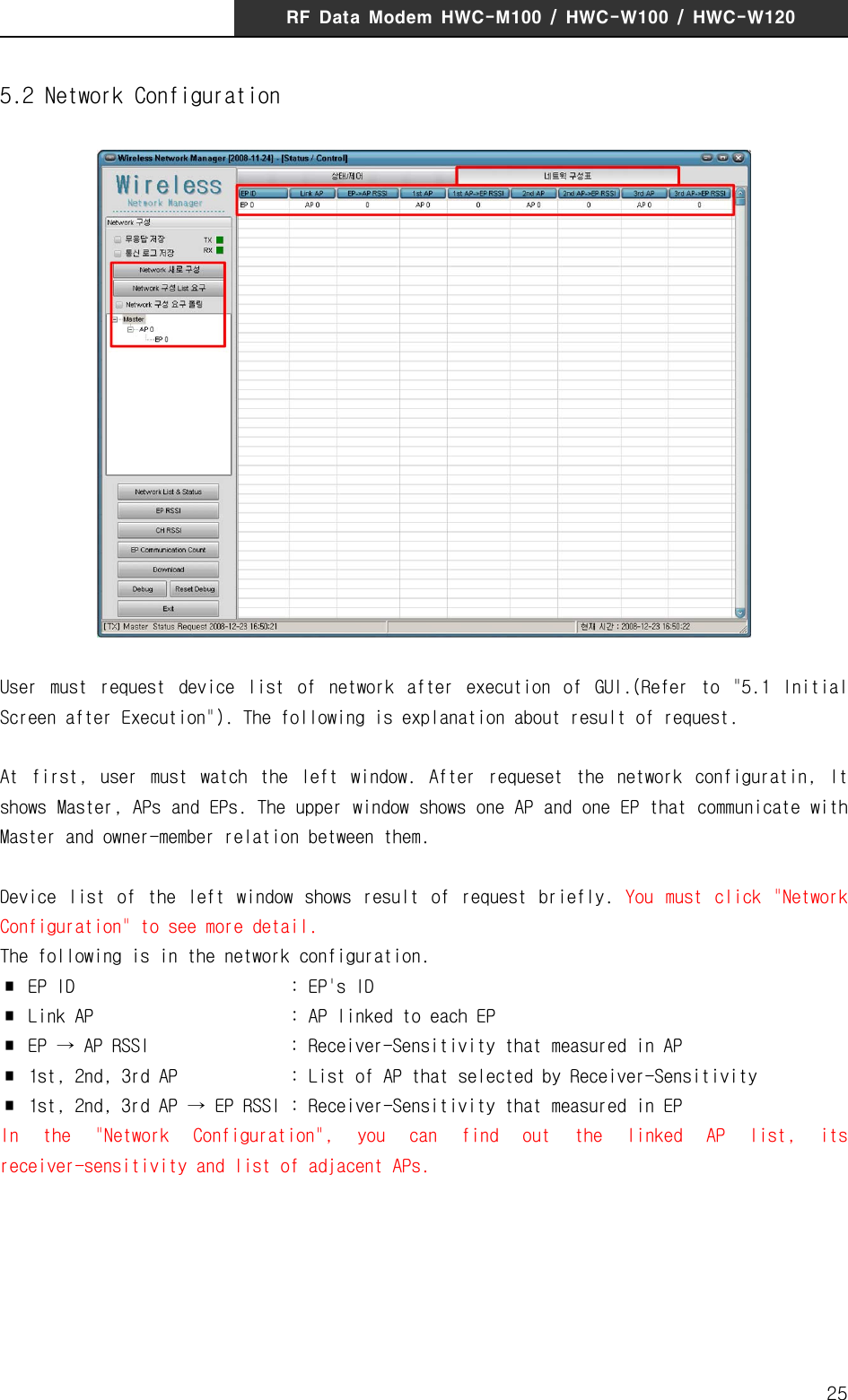
RF  Data  Modem  HWC-M100  /  HWC-W100  /  HWC-W120255.2 Network ConfigurationUser  must  request  device  list  of  network  after  execution  of  GUI.(Refer  to  "5.1  Initial Screen after Execution"). The following is explanation about result of request.At  first,  user  must  watch  the  left  window.  After  requeset  the  network  configuratin,  It shows Master, APs and EPs. The upper window shows one AP and one EP that communicate with Master and owner-member relation between them.Device  list  of  the  left  window  shows  result  of  request  briefly. You  must  click  "Network Configuration" to see more detail.The following is in the network configuration.∎  EP ID        : EP's ID∎  Link AP            : AP linked to each EP∎  EP → AP RSSI        : Receiver-Sensitivity that measured in AP∎  1st, 2nd, 3rd AP        : List of AP that selected by Receiver-Sensitivity∎  1st, 2nd, 3rd AP → EP RSSI : Receiver-Sensitivity that measured in EPIn  the  "Network  Configuration",  you  can  find  out  the  linked  AP  list,  its receiver-sensitivity and list of adjacent APs.
RF  Data  Modem  HWC-M100  /  HWC-W100  /  HWC-W120265.3 Status and Control of MasterIn upper screen, please confirm whether the "state/control" is selected.  (If "status/control" is not selected, click the tab of "status/control")The following is the status information of Master.  ∎  System Type : Type of system.  ∎  Version     : Firmware version of Master  ∎  Host Link  : Network information to communicate with HOST.                    These are network information of the Master.  ∎  AP Link     : Network information of communicate with AP.                   (User do not need to set this information.)  ∎  Range of EP : Number of EP that installed. (Only by range)[Caution.1]  When  you want to  see the status or control the value,  "Network Polling" must not  be  checked.  GUI  program  requests  the  network  device  list  when  "Network  Polling"  is checked and the status of selected device in other case, by periods. [Caution.2]  If  you  couldn't  see  the  upper  screen,  please  confirm  whether  you  select Master!
RF  Data  Modem  HWC-M100  /  HWC-W100  /  HWC-W120275.4 Status and control of APAfter selecting AP in device list, please confirm whether the "state/control" is selected  (If "status/control" is not selected, click the tab of "status/control")The following is the status information of AP.  ∎  System Type : Type of system.  ∎  Version  : Firmware version of AP.  ∎  Master Link : Network information to communicate with Master.                    (User do not need to set this information.)  ∎  Config      : Configuration information of AP [Caution.1]  When  you want to  see the status or control the value,  "Network Polling" must not  be  checked.  GUI  program  requests  the  network  device  list  when  "Network  Polling"  is checked and the status of selected device in other case, by periods. [Caution.2] If you couldn't see the upper screen, please confirm whether you select AP!
RF  Data  Modem  HWC-M100  /  HWC-W100  /  HWC-W120285.5 Status and Control of EPAfter selecting EP in device list, please confirm whether the "state/control" is selected  (If "status/control" is not selected, click the tab of "status/control")The following is the status information of EP.  ∎  System Type : Type of system.  ∎  Version  : Firmware version of EP.  ∎  Master Link : Network information to communicate with Master.                    (User do not need to set this information.)  ∎  Config      : Configuration information of EP   ∎  Comm. of End Device : Information of serial port to communicate with End-device  ∎  EP Control  : Item to control EP.[Caution.1]  When  you want to  see the status or control the value,  "Network Polling" must not  be  checked.  GUI  program  requests  the  network  device  list  when  "Network  Polling"  is checked and the status of selected device in other case, by periods. [Caution.2] If you couldn't see the upper screen, please confirm whether you select EP!
RF  Data  Modem  HWC-M100  /  HWC-W100  /  HWC-W120295.6 RSSI GraphThe Graph of RSSI visualizes the received signal strength between the installed AP and the selected  EP.  When  it  tries  to  determine  whether  the  installation  position  of  APs  is appropriate or not, it will be useful. The following is the usage :1. Select the EP of the End-device that you want to see in left window.2. Click the check box for "Individual RSSI" and "MAX RSSI"   Individual RSSI : display all of the RSSI value   MAX RSSI        : display the maximum value of each RSSI valule   It is possible to select over 1 option.3.  Set  the  time.  It  can  set  till  a  maximum  200  second,  and  this  time  means  the  X-axis.     For  example,  If  the  time  setting  was  10  seconds,  receiver-sensitivity  data  of  10  second  amount is drawn on a screen. The time itself to measure is not limited to 10 seconds. Moreover, it is the setting about time interval to measure receiver-sensitivity data.The time interval is calculated by following formula :   [Time interval for receiver-sensitivity data = time / 700]4. Start to move the End-device and measure. (click "Start measure")5.  If  the  device  does  not  communicate  with  any  AP,  finish  to  measure.  and  restart  the measurement after changing the installation position of AP.   (If the device does not communicate with any AP, it is not drawn on screen during that time. In this case, you must confirm the installation position of AP! )
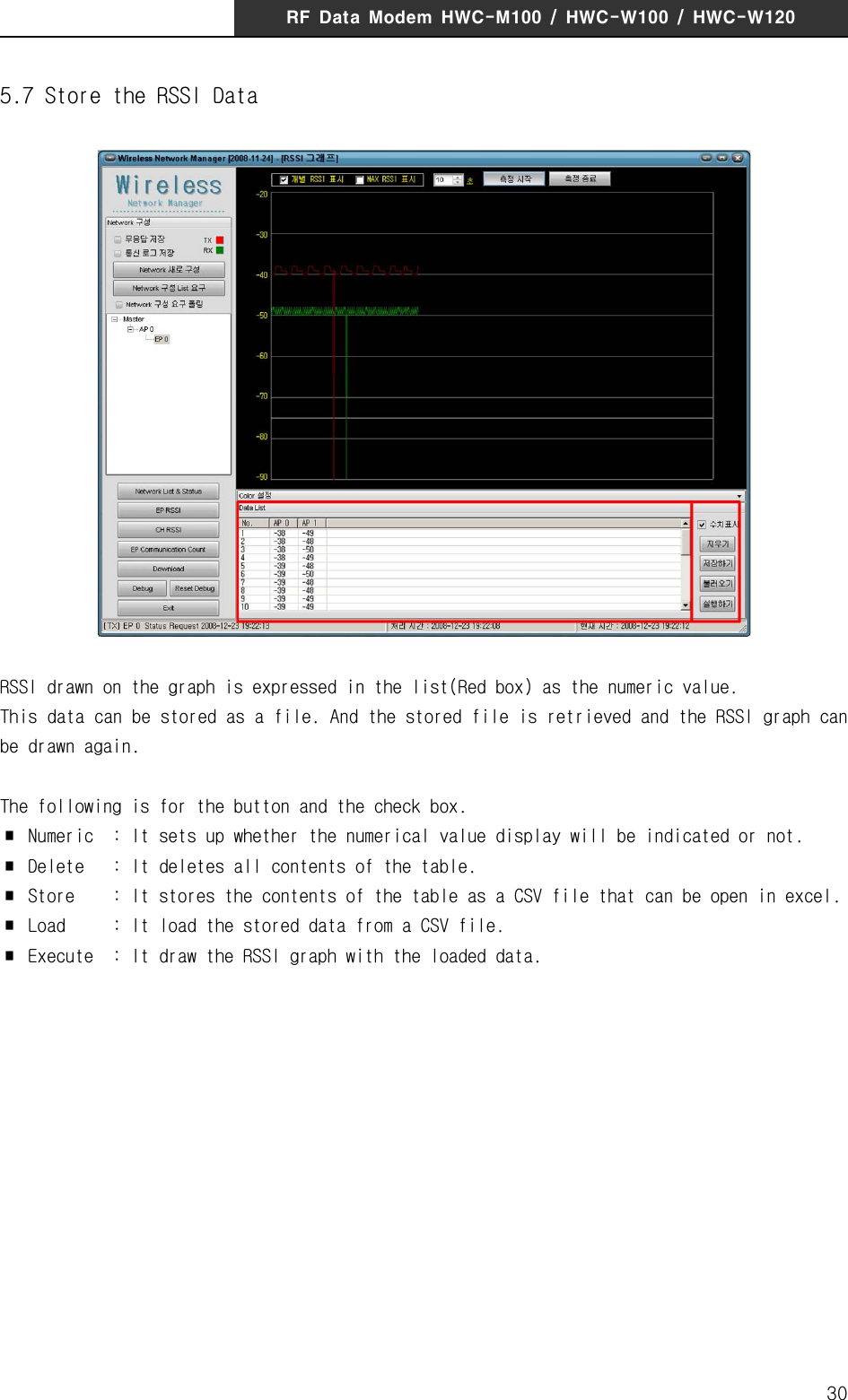
RF  Data  Modem  HWC-M100  /  HWC-W100  /  HWC-W120305.7 Store the RSSI DataRSSI drawn on the graph is expressed in the list(Red box) as the numeric value. This data can be stored as a file. And the stored file is retrieved and the RSSI graph can be drawn again.The following is for the button and the check box.∎  Numeric  : It sets up whether the numerical value display will be indicated or not. ∎  Delete   : It deletes all contents of the table.∎  Store    : It stores the contents of the table as a CSV file that can be open in excel.∎  Load     : It load the stored data from a CSV file.∎  Execute  : It draw the RSSI graph with the loaded data.
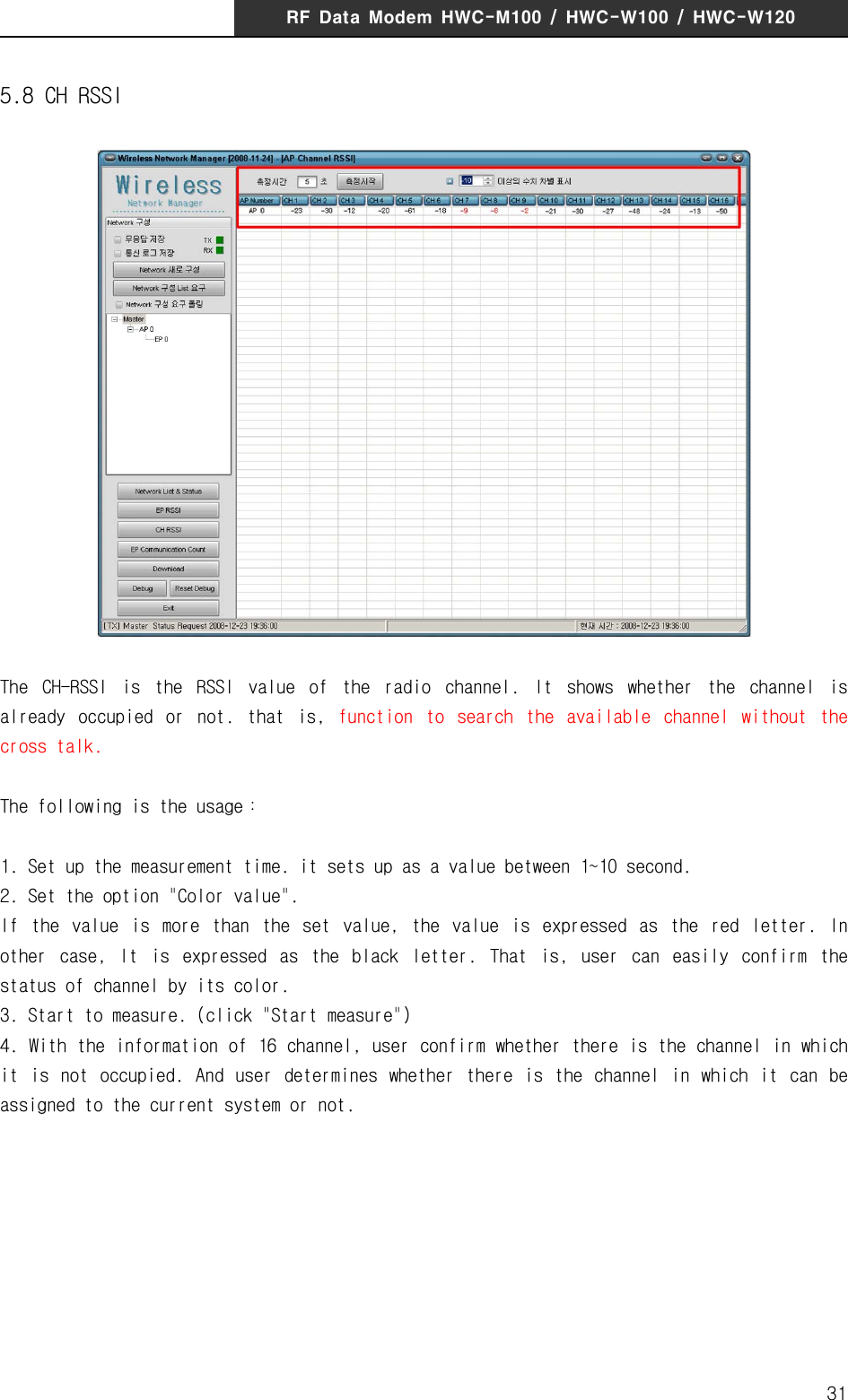
RF  Data  Modem  HWC-M100  /  HWC-W100  /  HWC-W120315.8 CH RSSIThe  CH-RSSI  is  the  RSSI  value  of  the  radio  channel.  It  shows  whether  the  channel  is already  occupied  or  not.  that  is,  function  to  search  the  available  channel  without  the cross talk. The following is the usage:1. Set up the measurement time. it sets up as a value between 1~10 second. 2. Set the option "Color value".  If  the  value  is  more  than  the  set  value,  the  value  is  expressed  as  the  red  letter.  In other  case,  It  is  expressed  as  the  black  letter.  That  is,  user  can  easily  confirm  the status of channel by its color.3. Start to measure. (click "Start measure")4. With the information of 16 channel, user confirm whether there is the channel in which it  is  not  occupied.  And user  determines  whether there  is  the  channel  in which  it can  be assigned to the current system or not.
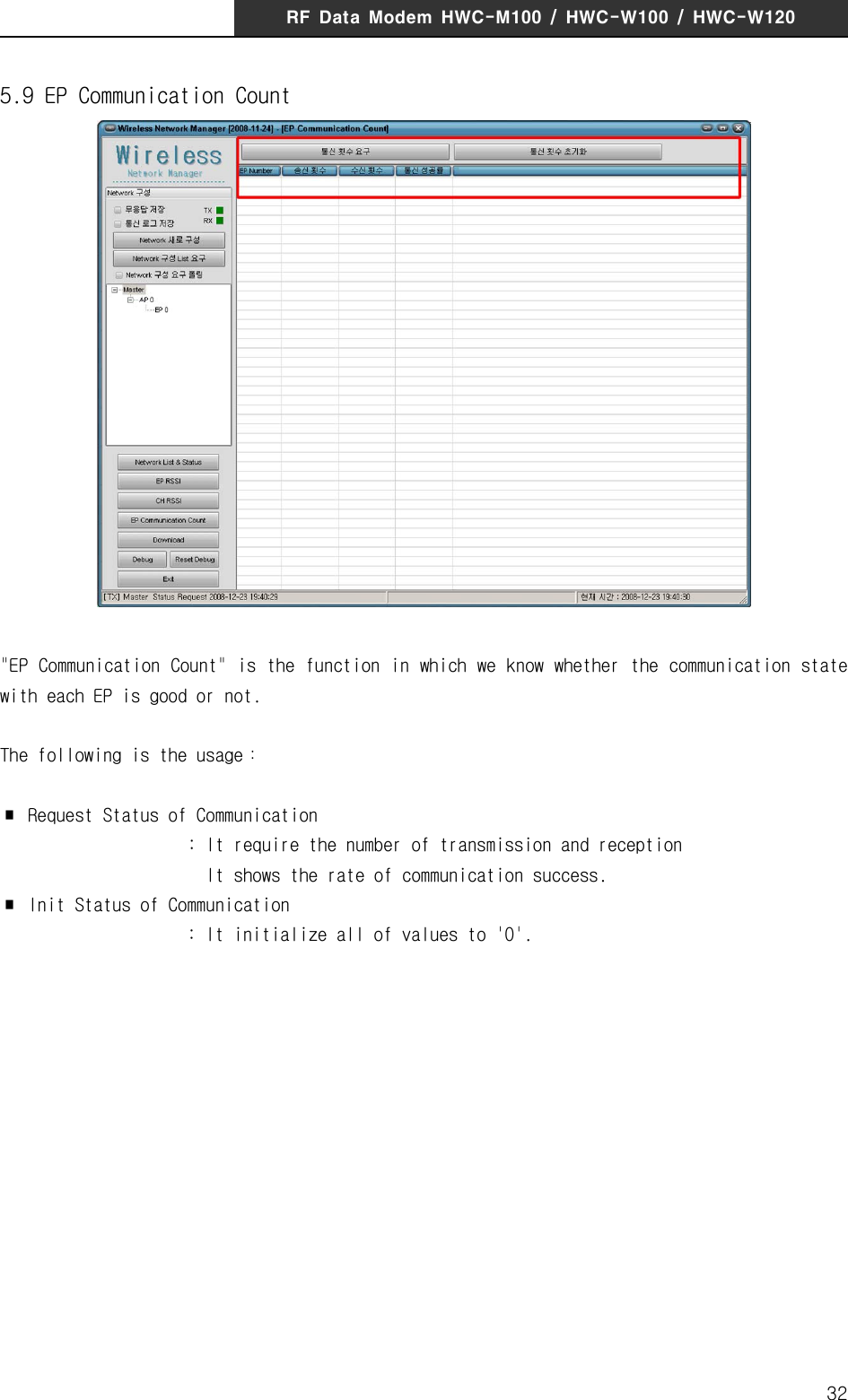
RF  Data  Modem  HWC-M100  /  HWC-W100  /  HWC-W120325.9 EP Communication Count"EP Communication Count" is the function in which we know whether the communication state with each EP is good or not. The following is the usage:∎  Request Status of Communication                     : It require the number of transmission and reception                       It shows the rate of communication success.∎  Init Status of Communication          : It initialize all of values to '0'.
RF  Data  Modem  HWC-M100  /  HWC-W100  /  HWC-W120335.10 DownloadThis is the function that upgrade the firmware of the deviceThe following is the usage :1. Select the device that is to be upgraded in the left list.2.  Click  the  'File  Open’button  and  show up  the  dialog  box.  Click  the  'OK'  button  after selecting the download file.   (The  file  extension  is  MAU[Master],  AP[RFU]  and  EP[RFU].  If  the  file  extension  is different, please confirm the device selected in left window)3.  If  the  file  is  opened  correctly,  'Download'  button  is  activated.  Press  the  button  to begin to download.4. Download in Progress. If you would like to finish the download, press the "Stop" button 5. Complete to download. If it fails, try again!
RF  Data  Modem  HWC-M100  /  HWC-W100  /  HWC-W120345.11 Configure the setting of communication with deviceIn  spite  of  executing  the  program  after  connecting  the  device  with  PC,  If  it  is  not communicated, The configuration of communication has to be confirmed. The following is the usage :1. Click the 'Debug' button in the main window.2. Check whether the received data "[RX] -------" is in the left window.   You can use the 'start/stop' to start/stop the communication with the device.    If there is not the received data "[RX] -----", please confirm the hardware connection.3.  After  checking  the  check  box  "Comport  Close",  you  can  change  the  configuration  of communication.4. At first, confirm whether the PC is connected with the device through the serial cable or LAN cable. And select one of Serial/UDP.5. In case of serial, you must select and confirm the comport and baud-rate.    In case of UDP, you must confirm the Target IP and Target Port. Target IP means the IP address of the device. Target Port must be always set to '9506'.   The initial value of the polling Time is 1000, and the initial value of the waite time is 1500. It is recommended that is not changed.6.  After  the  setting  the  communication  configuration,  Be  sure  to  uncheck  the  check  box 'Comport Close' and confirm the received data "[RX] -----" in the left side of the window.  If there is not the received data, confirm whether the 'start' button is activated.
RF  Data  Modem  HWC-M100  /  HWC-W100  /  HWC-W12035When  there  is  an  error  related  to  the  setting  of  communication  after  executing  the  GUI program,  the  communication  status  window  is  automatically  pop  up.  In  this  case,  please confirm the communication configuration again!The error is in following case :∎  In serial mode, when the comport is set up incorrectly. ∎  In UDP mode, when the TargetIP is set to "0.0.0.0" or the Target Port is set to '0'.5.12 OthersThe  following  is  essential  function  to  debug  the  system  ;  "No  Response  Store",  "Store Communication  Log"  and  "Reset  Debug".  Normally  "No  Response  Store",  "Store  Communication Log" are unchecked.
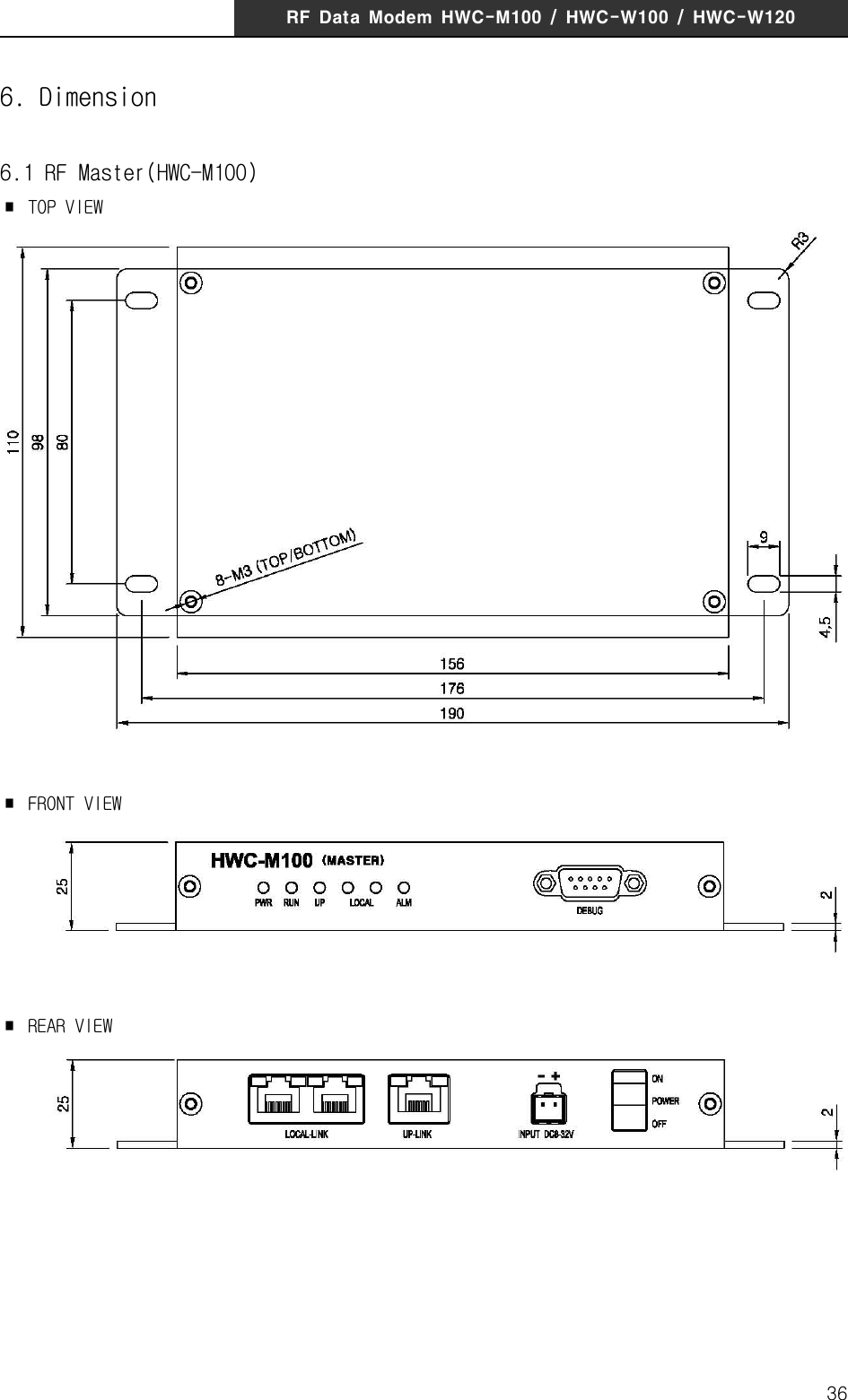
RF  Data  Modem  HWC-M100  /  HWC-W100  /  HWC-W120366. Dimension6.1 RF Master(HWC-M100)∎ TOP VIEW∎ FRONT VIEW∎ REAR VIEW
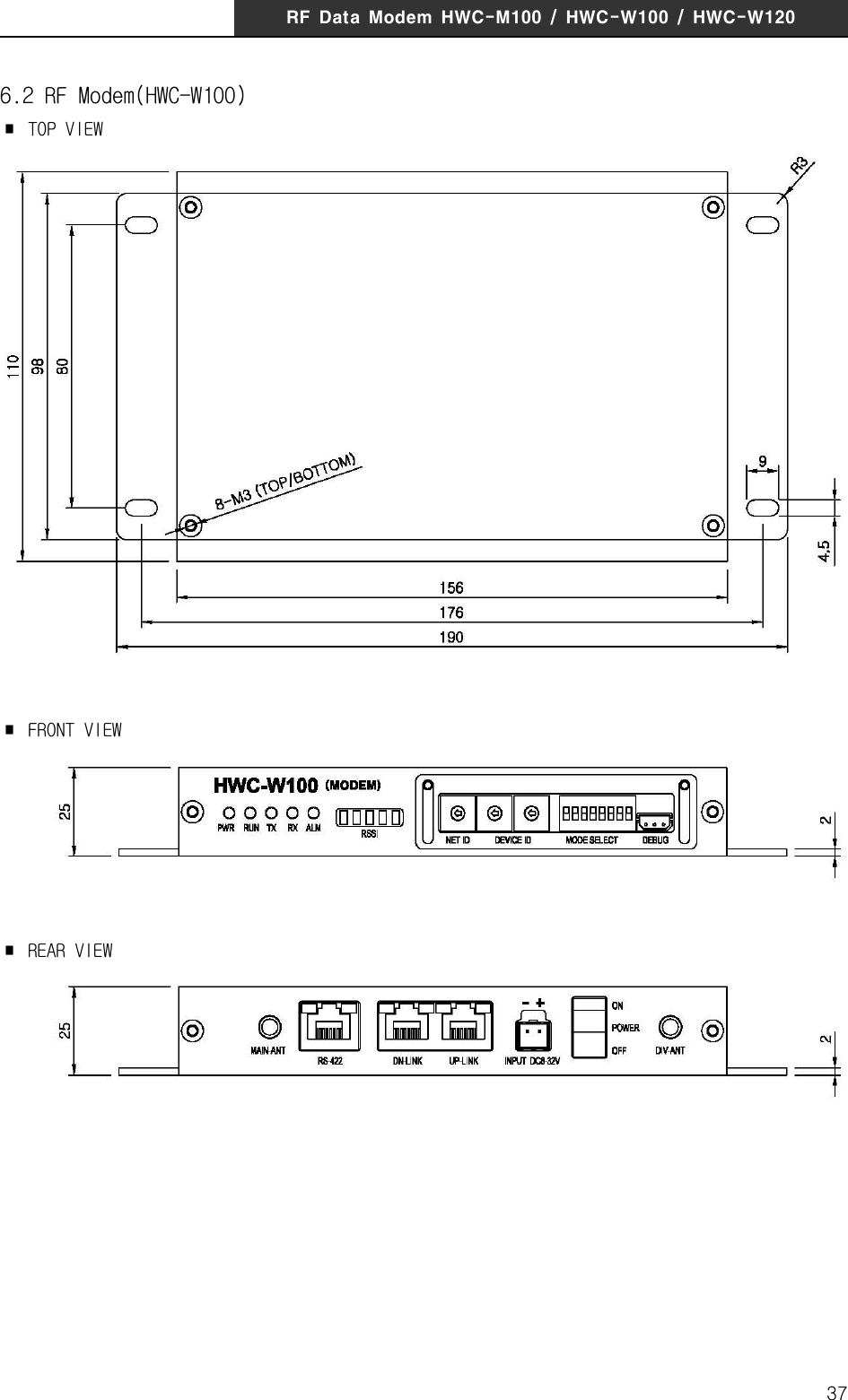
RF  Data  Modem  HWC-M100  /  HWC-W100  /  HWC-W120376.2 RF Modem(HWC-W100)∎ TOP VIEW∎ FRONT VIEW∎ REAR VIEW
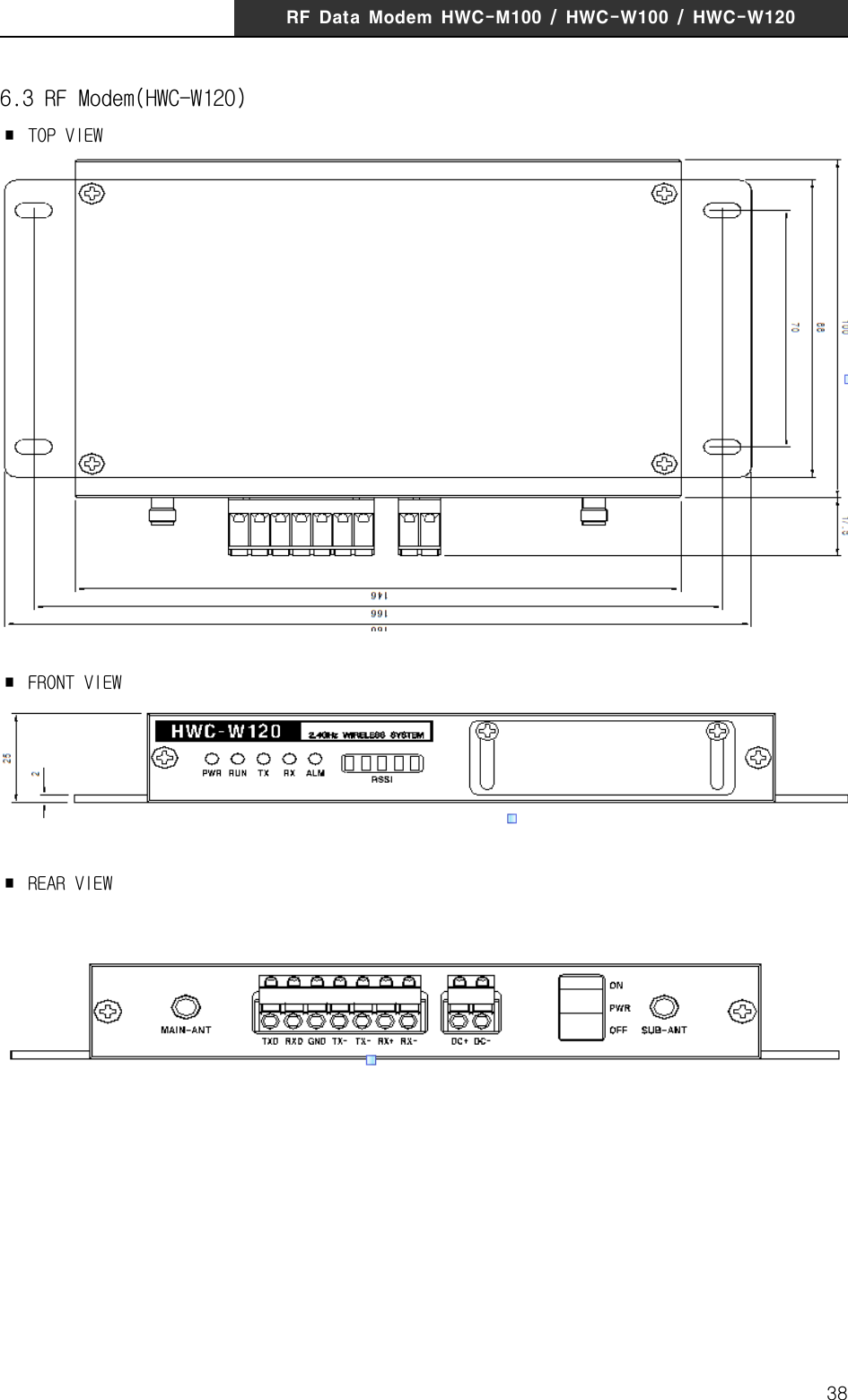
RF  Data  Modem  HWC-M100  /  HWC-W100  /  HWC-W120386.3 RF Modem(HWC-W120)∎ TOP VIEW∎ FRONT VIEW∎ REAR VIEW
RF  Data  Modem  HWC-M100  /  HWC-W100  /  HWC-W12039[ A/S CENTER ]806 Ace Techno Tower 1st. 197-17 Guro3-Dong, Guro-Gu, Seoul, KoreaTel. +82-2-3281-9300Fax. +82-2-3281-7775FCC󰚟Information󰚟to󰚟User󰚟This󰚟equipment󰚟has󰚟been󰚟tested󰚟and󰚟found󰚟to󰚟comply󰚟with󰚟the󰚟limits󰚟for󰚟a󰚟Class󰚟B󰚟digital󰚟device,󰚟 pursuant󰚟 to󰚟 Part󰚟 15󰚟 of󰚟 the󰚟 FCC󰚟 Rules.󰚟 These󰚟 limits󰚟 are󰚟 designed󰚟 to󰚟 provide󰚟reasonable󰚟 protection󰚟 against󰚟 harmful󰚟 interference󰚟 in󰚟 a󰚟 residential󰚟 installation.󰚟 This󰚟equipment󰚟generates,󰚟uses󰚟and󰚟can󰚟radiate󰚟radio󰚟frequency󰚟energy󰚟and,󰚟if󰚟not󰚟installed󰚟and󰚟used󰚟 in󰚟 accordance󰚟 with󰚟 the󰚟 instructions,󰚟 may󰚟 cause󰚟 harmful󰚟 interference󰚟 to󰚟 radio󰚟communications.󰚟 However,󰚟 there󰚟 is󰚟 no󰚟 guarantee󰚟 that󰚟 interference󰚟 will󰚟 not󰚟 occur󰚟 in󰚟 a󰚟particular󰚟 installation.󰚟If󰚟this󰚟 equipment󰚟does󰚟 cause󰚟harmful󰚟 interference󰚟to󰚟radio󰚟 or󰚟television󰚟reception,󰚟which󰚟can󰚟be󰚟determined󰚟by󰚟turning󰚟the󰚟equipment󰚟off󰚟and󰚟on,󰚟the󰚟user󰚟is󰚟encouraged󰚟to󰚟try󰚟to󰚟correct󰚟the󰚟interference󰚟by󰚟one󰚟of󰚟the󰚟following󰚟measures:󰚟•󰚟Reorient󰚟or󰚟relocate󰚟the󰚟receiving󰚟antenna.󰚟•󰚟Increase󰚟the󰚟separation󰚟between󰚟the󰚟equipment󰚟and󰚟receiver.󰚟•󰚟 Connect󰚟 the󰚟 equipment󰚟 into󰚟 an󰚟 outlet󰚟 on󰚟 a󰚟 circuit󰚟 different󰚟 from󰚟that󰚟 to󰚟which󰚟the󰚟receiver󰚟is󰚟con-nected.󰚟•󰚟Consult󰚟the󰚟dealer󰚟or󰚟an󰚟experienced󰚟radio/TV󰚟technician󰚟for󰚟help.󰚟󰚟Caution󰚟Modifications󰚟not󰚟expressly󰚟approved󰚟by󰚟the󰚟party󰚟responsible󰚟for󰚟compliance󰚟could󰚟void󰚟the󰚟user’s󰚟authority󰚟to󰚟operate󰚟the󰚟equipment.󰚟󰚟FCC󰚟 Compliance󰚟 Information󰚟 :󰚟 This󰚟 device󰚟 complies󰚟 with󰚟 Part󰚟 15󰚟 of󰚟 the󰚟 FCC󰚟 Rules.󰚟Operation󰚟 is󰚟 subject󰚟 to󰚟 the󰚟 following󰚟 two󰚟 conditions:󰚟 (1)󰚟 This󰚟 device󰚟 may󰚟 not󰚟 cause󰚟harmful󰚟interference,󰚟and󰚟(2)󰚟this󰚟device󰚟must󰚟accept󰚟any󰚟interference󰚟received,󰚟including󰚟interference󰚟that󰚟may󰚟cause󰚟undesired󰚟operation󰚟󰚟
40WARRANTY  Warranty is to cover the operating defaults after the purchase   during the warranty period.(12 months after the purchase).  Please notify us the defaults for repairs with short description   of the defaults confirming the information of person in charge.  The demages(defaults) prescribed below are NOT to be covered by   warranty.    * Users faults by lack of care.    * Unauthorised electric currency connection defaults.    * Faults by the users own intention of dismantle or repairs.    * Demages caused by natural disaster. ( Fire, Flood, Earthquake,       Lighting, etc.)    * Replacement to new parts.  Shape or circuit of the product are subject to change without any   notice to improve the quality of product.  Customer Name :                                                  Address :                                                        Telephone Number :                                               E-Mail Address :                                                 Serial # :                                                       Date of Purchase :                                               Company purchased from :

Navigation menu