HandyWave HPS-110 2.4GHz Transceiver Module User Manual Manual

HandyWave Co., Ltd. 2.4GHz Transceiver Module Manual

Manual

HPS-110 HandyPort-Serial Wireless Solutions in your Hand User’s Manual  Version 2.0
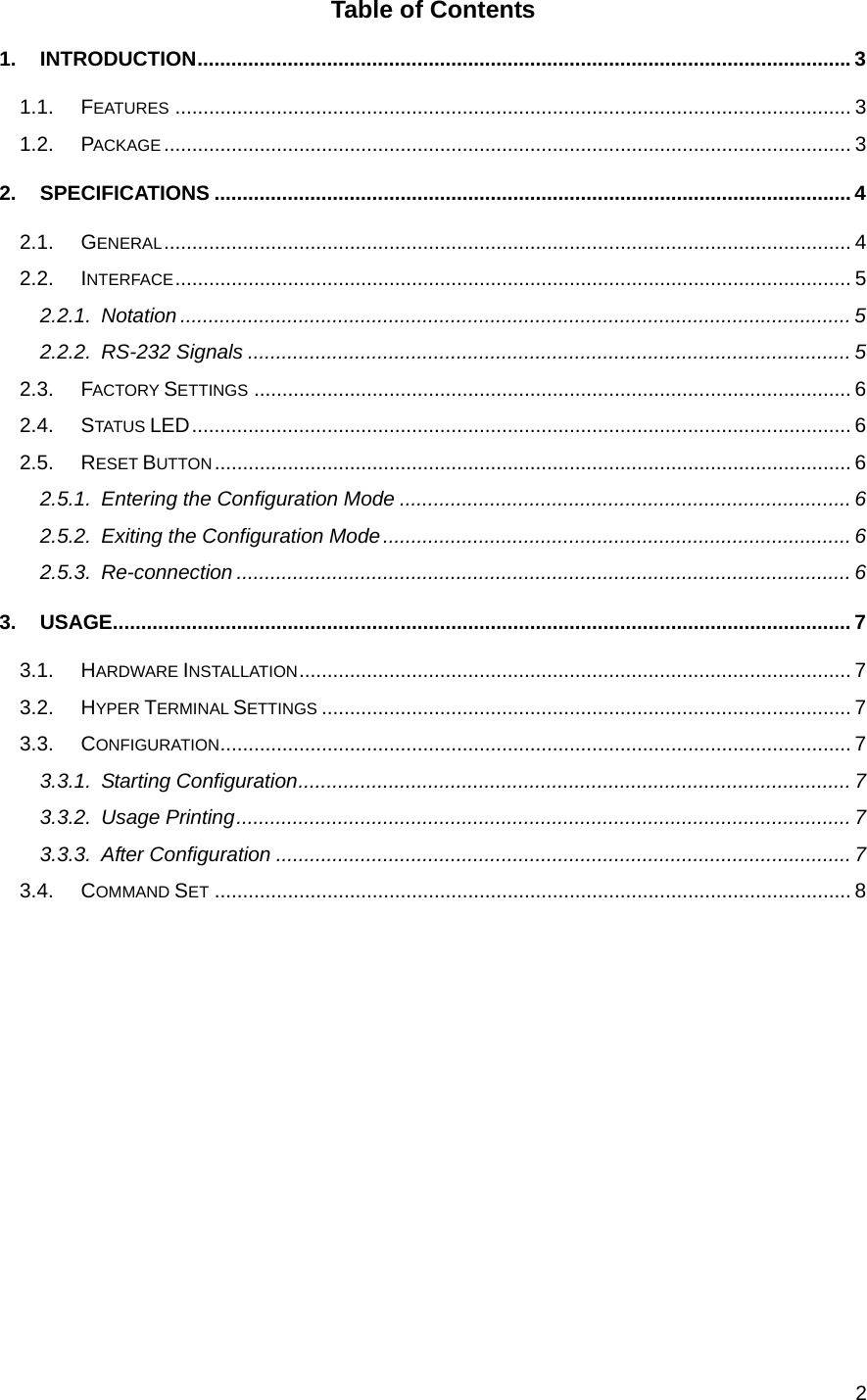
 2Table of Contents 1. INTRODUCTION....................................................................................................................3 1.1. FEATURES ........................................................................................................................ 3 1.2. PACKAGE .......................................................................................................................... 3 2. SPECIFICATIONS ................................................................................................................. 4 2.1. GENERAL.......................................................................................................................... 4 2.2. INTERFACE........................................................................................................................ 5 2.2.1. Notation ....................................................................................................................... 5 2.2.2. RS-232 Signals ........................................................................................................... 5 2.3. FACTORY SETTINGS .......................................................................................................... 6 2.4. STATUS LED..................................................................................................................... 6 2.5. RESET BUTTON................................................................................................................. 6 2.5.1. Entering the Configuration Mode ................................................................................ 6 2.5.2. Exiting the Configuration Mode................................................................................... 6 2.5.3. Re-connection ............................................................................................................. 6 3. USAGE................................................................................................................................... 7 3.1. HARDWARE INSTALLATION.................................................................................................. 7 3.2. HYPER TERMINAL SETTINGS .............................................................................................. 7 3.3. CONFIGURATION................................................................................................................ 7 3.3.1. Starting Configuration.................................................................................................. 7 3.3.2. Usage Printing............................................................................................................. 7 3.3.3. After Configuration ...................................................................................................... 7 3.4. COMMAND SET ................................................................................................................. 8
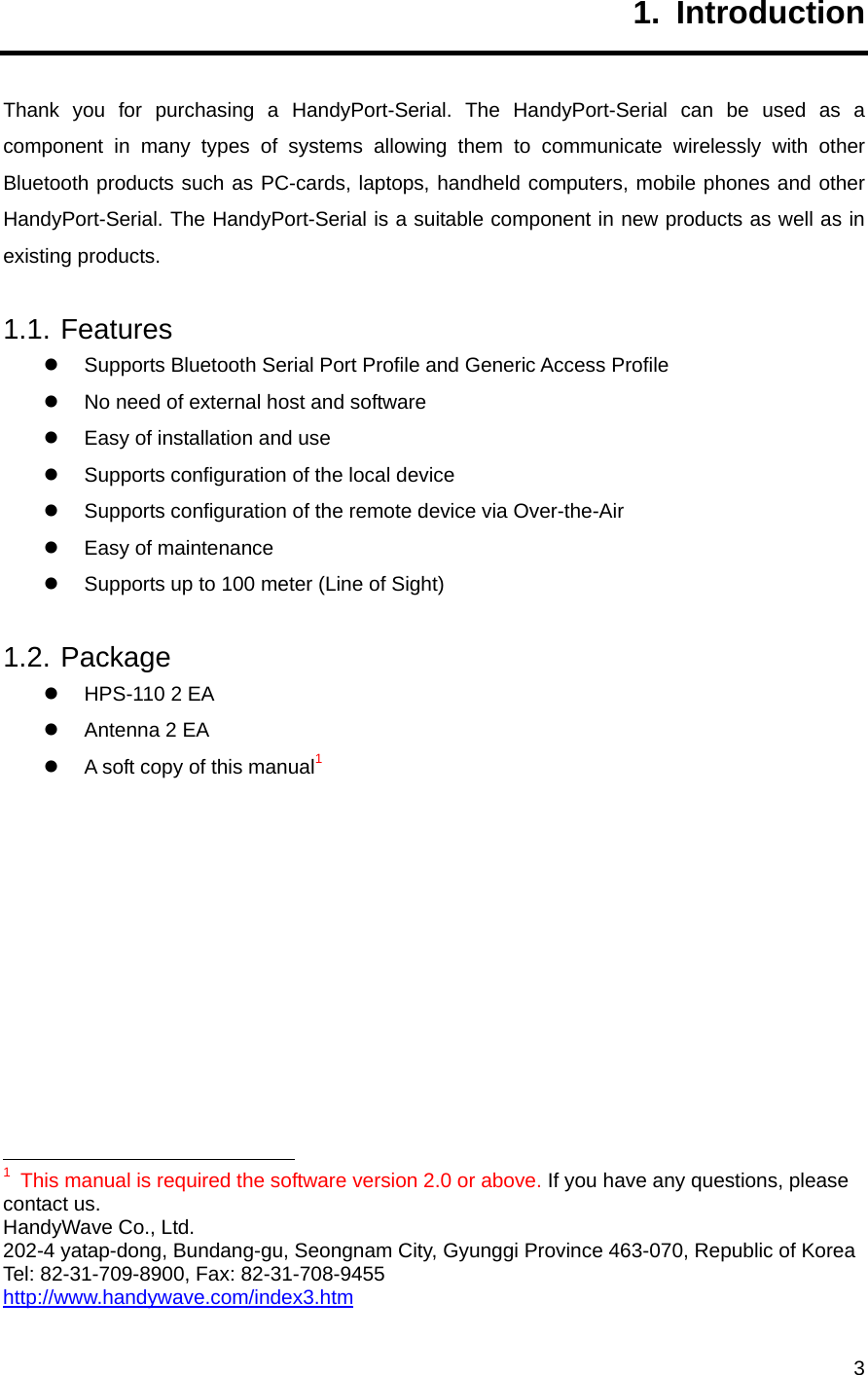
    31. Introduction Thank you for purchasing a HandyPort-Serial. The HandyPort-Serial can be used as a component in many types of systems allowing them to communicate wirelessly with other Bluetooth products such as PC-cards, laptops, handheld computers, mobile phones and other HandyPort-Serial. The HandyPort-Serial is a suitable component in new products as well as in existing products. 1.1. Features z  Supports Bluetooth Serial Port Profile and Generic Access Profile z  No need of external host and software z  Easy of installation and use z  Supports configuration of the local device z  Supports configuration of the remote device via Over-the-Air z  Easy of maintenance z  Supports up to 100 meter (Line of Sight) 1.2. Package z  HPS-110 2 EA z  Antenna 2 EA z  A soft copy of this manual1                                                              1  This manual is required the software version 2.0 or above. If you have any questions, please contact us. HandyWave Co., Ltd.   202-4 yatap-dong, Bundang-gu, Seongnam City, Gyunggi Province 463-070, Republic of Korea Tel: 82-31-709-8900, Fax: 82-31-708-9455 http://www.handywave.com/index3.htm
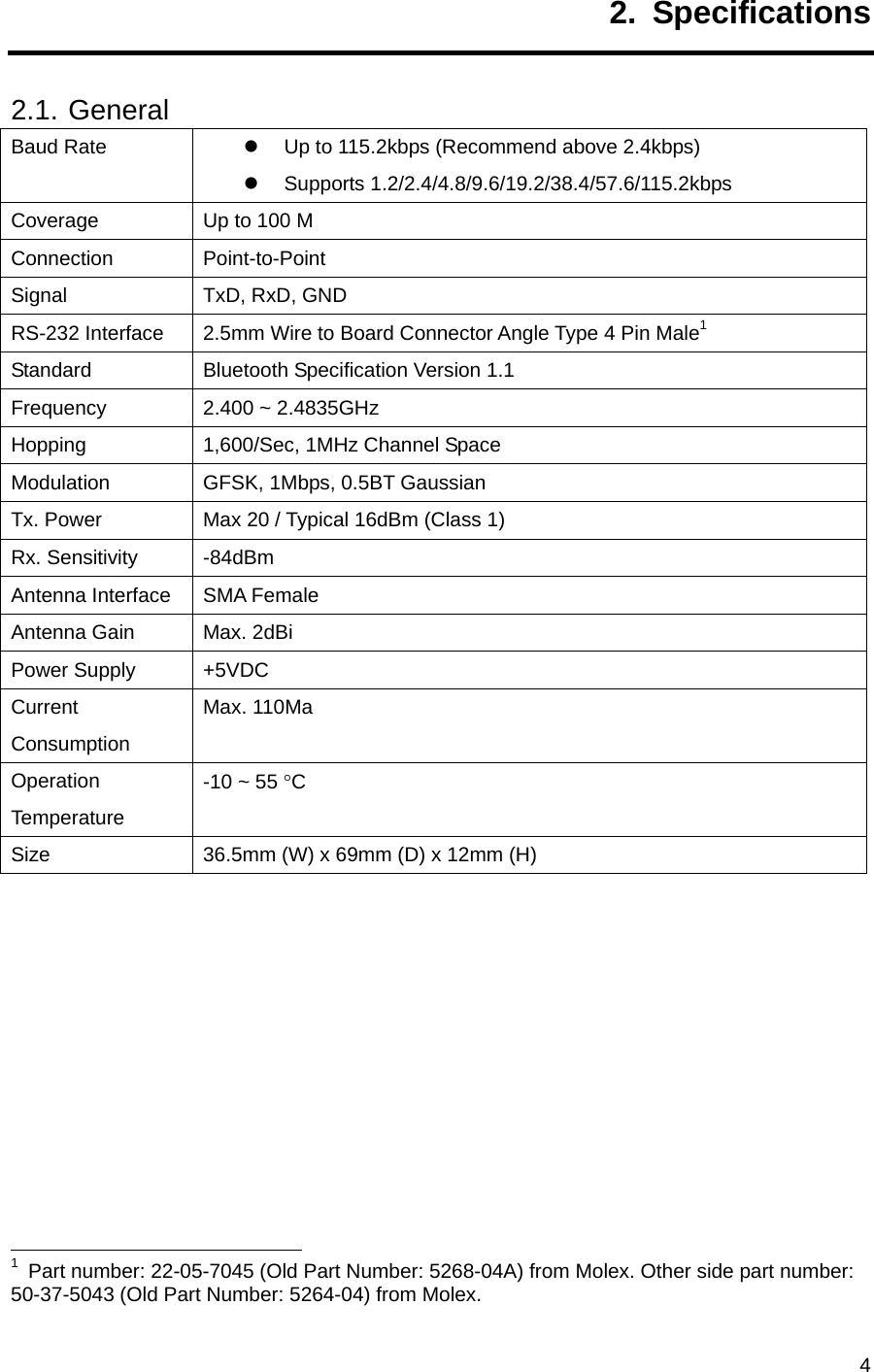
 42. Specifications 2.1. General Baud Rate  z  Up to 115.2kbps (Recommend above 2.4kbps) z Supports 1.2/2.4/4.8/9.6/19.2/38.4/57.6/115.2kbps  Coverage  Up to 100 M Connection Point-to-Point Signal  TxD, RxD, GND RS-232 Interface  2.5mm Wire to Board Connector Angle Type 4 Pin Male1 Standard  Bluetooth Specification Version 1.1 Frequency  2.400 ~ 2.4835GHz Hopping  1,600/Sec, 1MHz Channel Space Modulation  GFSK, 1Mbps, 0.5BT Gaussian Tx. Power  Max 20 / Typical 16dBm (Class 1) Rx. Sensitivity  -84dBm Antenna Interface  SMA Female Antenna Gain  Max. 2dBi Power Supply  +5VDC Current Consumption Max. 110Ma Operation Temperature -10 ~ 55 °C Size  36.5mm (W) x 69mm (D) x 12mm (H)                                                               1  Part number: 22-05-7045 (Old Part Number: 5268-04A) from Molex. Other side part number: 50-37-5043 (Old Part Number: 5264-04) from Molex.
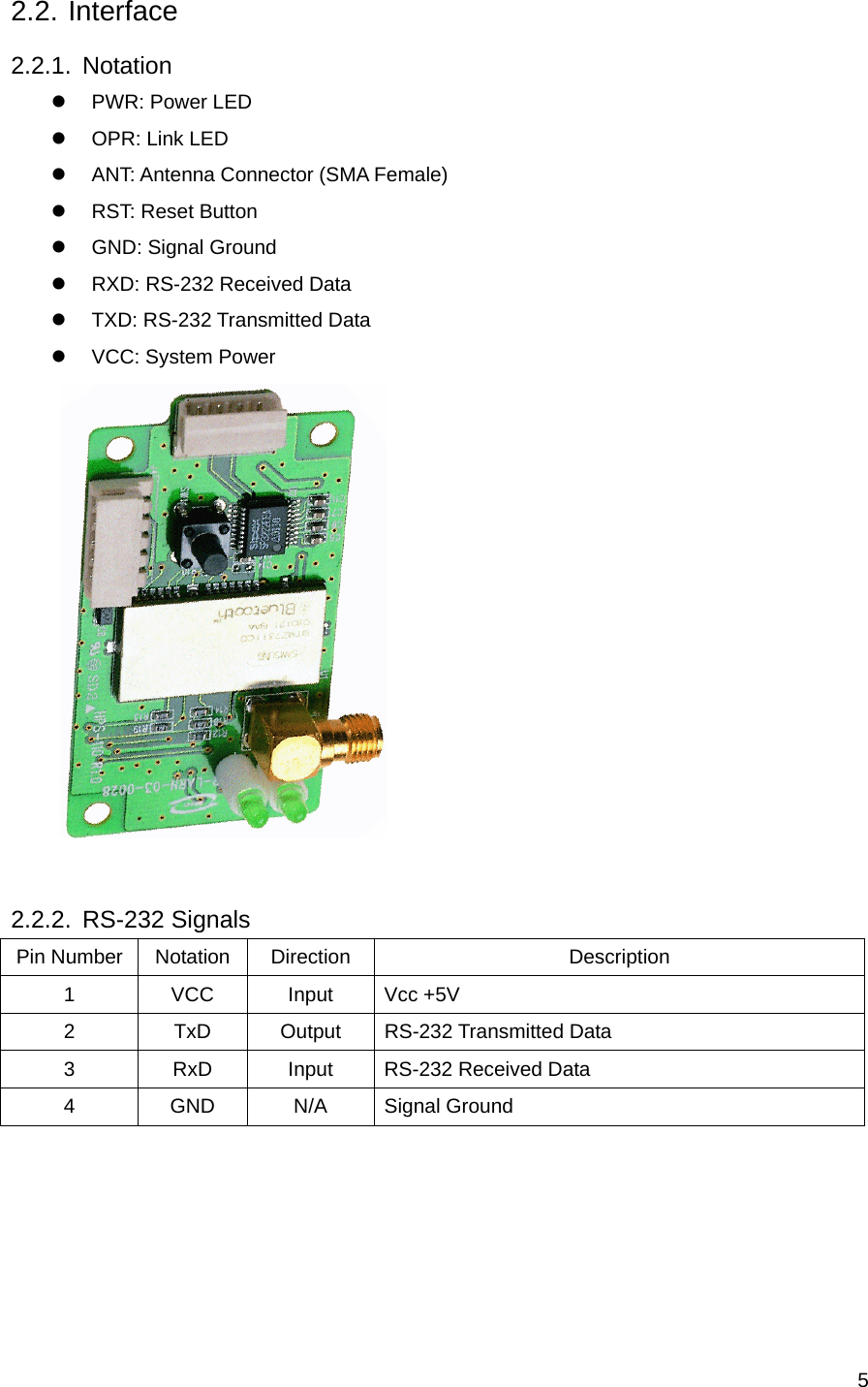
    52.2. Interface 2.2.1. Notation z PWR: Power LED z  OPR: Link LED z  ANT: Antenna Connector (SMA Female) z  RST: Reset Button z  GND: Signal Ground z  RXD: RS-232 Received Data z TXD: RS-232 Transmitted Data z  VCC: System Power   2.2.2. RS-232 Signals Pin Number  Notation  Direction  Description 1 VCC Input Vcc +5V 2 TxD Output RS-232 Transmitted Data 3  RxD  Input  RS-232 Received Data 4 GND N/A Signal Ground
 62.3. Factory Settings The following are the factory settings of COM port. You can change the factory settings of COM port with commands. In this case, you have to remember the changed factory settings. z  Baud rate: 9600 bps z  Data Bit: 8 bit z  Parity Bit: No parity z  Stop Bit: 1 stop bit z  Flow control: None 2.4. Status LED There are two LED on HPS-110. z  PWR (Green): It is an indication of power on/off status. z  LNK (Green): When a wireless link is on, it is turned on. If HPS-110 is in the configuration mode, it will be flashing every second. 2.5. Reset Button The RST button has the following functions. z  Enter / Exit the configuration mode z  Restore the factory settings1 z  Disconnect and reconnect a wireless connection. 2.5.1. Entering the Configuration Mode When the LNK LED is OFF, push the RST button. When the LNK LED is ON, you have to push the RST button twice to enter the configuration mode. If you enter the configuration mode successfully, LNK LED will be flashing every second. And HPS-110 COM port will be stored the factory settings. 2.5.2. Exiting the Configuration Mode You can have two options to exit the configuration mode. z  Exit the configuration mode by software: Type “X”. z  Exit the configuration mode by the RST button: Push the RST button. 2.5.3. Re-connection When the LNK LED is on, you can push the RST button to disconnect and reconnect a wireless link.                                                        1  If you push the RST button, the COM port of HPS-110 will be stored the factory settings.
    73. Usage You can change the configuration of HPS-110 using Hyper Terminal1. 3.1. Hardware Installation Step 1: Assemble a provided antenna to HPS-110 body. Step 2: Plug a HPS-110 into the COM port of device. Step 3: Power on. Step 4: Configure the HPS-110, if necessary. 3.2. Hyper Terminal Settings Baud Rate: 9600 bps / Data Bit: 8 / Parity Bit: None / Stop Bit: 1 / Flow Control: None / Emulation: VT100 3.3. Configuration 3.3.1. Starting Configuration Step 1: Plug a HPS-110 into a COM port of PC. And Power it on. Step 2: Open a Hyper Terminal and set it up. Step 3: Push the RST button on HPS-110. If you enter the configuration mode successfully, LNK LED will be flashing every second. Step 4: Hit the <Enter> key, 5 second later.   Step 5: Change the configuration of HPS-110 with commands, if necessary. 3.3.2. Usage Printing If you are in the configuration mode, type “?<Enter>” for listing of commands. If you want to know the usage of a command, type “?[command]<Enter>”. All commands and parameters are case sensitive. And you cannot use a <Backspace>. 3.3.3. After Configuration After finishing the configuration, you have to execute a command “X” to apply changes.                                                           1 This manual is required the software version 2.0 or above.
 83.4. Command Set The commands are as follows1: Item Syntax Description  Remarks 1. Connecting address AAddr<CR>  Set a remote device address for a wireless connection. A local and remote BD_ADDR always need to be difference. 2. Baud rate  BBR[D]<CR>  Change the baud rate.   D (option): Change a factory setting2. Baud Rate (BR) - 0: 1200, 1: 2400, 2: 4800, 3: 9600, 4: 19200, 5: 38400, 6: 57600, 7: 115200 3. COM port  CCOMPort<CR>  Change a request serial port.  COMPort: ‘1’ ~ ‘7’ Only valid in connection mode 2. 4. PIN code  EPIN<CR> Authentication Off: hit <Enter> Authentication On: Type up to 11 characters Paired adapters should have a same PIN code. 5. Search timer  GTO<CR> Set a search timeout. TO (timeout): ASCII ‘0’ ~ “999” Connection mode 3 only. Default: 10 sec. 6. Max number of search HNO<CR> Set the max number of search. NO: ASCII ‘0’ ~ “999” Connection mode 3 only. Default: 10 7. Search device  ITO,NO[L]<CR> Execute searching devices. TO: ASCII ‘0’ ~ “999” NO: ASCII ‘0’ ~ “999” L (option): Display a long form. Connection mode 3 only. ‘,’: ASCII 0x2C 8. Discovery mode JE/D<CR> Set the discovery mode. ‘E’: Enable ‘D’: Disable Connection mode 1 only. Default: Enable 9. Low Power Mode KE/D<CR> Set the low power mode. ‘E’: Enable ‘D’: Disable Default: Disable                                                            1  If you push the RST button, the COM port of HPS-110 will be stored the factory settings. 2  If you change a factory setting for baud rate, you have to remember it.
    910. Connection mode MMode<CR>1 Set a connection mode. Mode: ‘0’ – ‘3’ Mode 0 & 2: Required a remote address. Mode 2: Required a serial port. 0: 1:1 Mode 1: WAIT Mode 2: REGISTER and CONNECT Mode 3: WAIT Command Mode 11. Friendly name NName<CR> Set a friendly name up to 11 characters.  12. Parity Bit  PPA[D]2<CR> Set the parity bit.   D (option): Change a factory setting3. 0: None, 1: Odd 2: Even 13. Connection Timeout QTO<CR> Set the connection timeout.TO: ASCII ‘0’ ~ “999” Connection mode 3 only. Default: 10 sec. 14. Stop Bit  SST[D]<CR> Set the stop bit.   D (option): Change a factory setting4. 0: 1 Stop, 1: 2 Stop 15. Connect  TAddr[,TO]<CR> Try to make a connection. Addr: a remote address TO (option): ASCII ‘0’ ~ “999” Connection mode 3 only. ‘,’: ASCII 0x2C Default Timeout: 10 sec. 16. Cancel  U Cancel a command.  Connection mode 3 only. 17. View  V Display the device information You can find out a software version. 18. CoD  WCoD<CR> Set the class of device. CoD: 6-Hex in ASCII Default: “001F00” 19. Exit  X Apply changes.  Rebooting 20. Status  Z  Display the status of state machine. ‘S’: Idle / ’P’: Pairing / ’C’: Connecting / ’A’: RF on / ’I’: Inquiring 21. Usage  ?[C]<CR> Display the command list or usage.   C: Command AT+Z?<CR>: Command list AT+Z?A<CR>: Usage of ‘A’                                                         1  <CR>: Carriage Return (0x0D) 2  []: An optional parameter. 3  If you change a factory setting for parity bit, you have to remember it. 4  If you change a factory setting for stop bit, you have to remember it.
 10Note. This device complies with Part 15 of the FCC Rules. Operation is subject to the following two conditions: (1) This device may not cause harmful interference, and (2) this device must accept any interference received, including interference that may cause undesired operation. Note. Modifications not expressly approved by this company could void the user’s authority to operate the equipment.  Note. This equipment has been tested and found no comply with the limits for a Class B digital device, pursuant to part 15 of the FCC rules. These limits are designed to provide reasonable protection against harmful interference in a residential installation. This equipment generates, uses and can radiate radio frequency energy and, if not installed and used in accordance with the instructions, may cause harmful interference to radio communications. However, there is no guarantee that interference will not occur in a particular installation. If this equipment does cause harmful interference to radio or television reception, which can be determined by turning the equipment off and on, the user is encouraged to try to correct the interference by one or more of the following measures; - Reorient or relocate the receiving antenna. - Increase the separation between the equipment and receiver. - Connect the equipment into an outlet on a circuit different from that to which the receiver is connected - Consult the dealer or an experienced radio/TV technician for help.  INFORMATION TO USER The users manual or instruction manual for an intentional or unintentional radiator shall caution the user that changes or modifications not expressly approved by the party responsible for compliance could void the user’s authority to operate the equipment.  CAUTION FCC Radio-Frequency Exposure Statement This equipment generates and radiates radio frequency energy. In order to comply with FCC radio-frequency radiation exposure guidelines for an uncontrolled environment, this equipment has to be installed and operated while maintaining a minimum body to antenna distance of 20cm. User are not permitted to make changes or modify the system in any way. The antenna(s) used for this transmitter must be installed to provide a separation distance of at least 20cm from all persons and must not be collocated or operating in conjunction with any other antenna or transmitter.

Navigation menu