Hangzhou Gubei Electronics Technology BL3335-P WiFi Module User Manual

Hangzhou Gubei Electronics Technology Co.,Ltd WiFi Module

User Manual

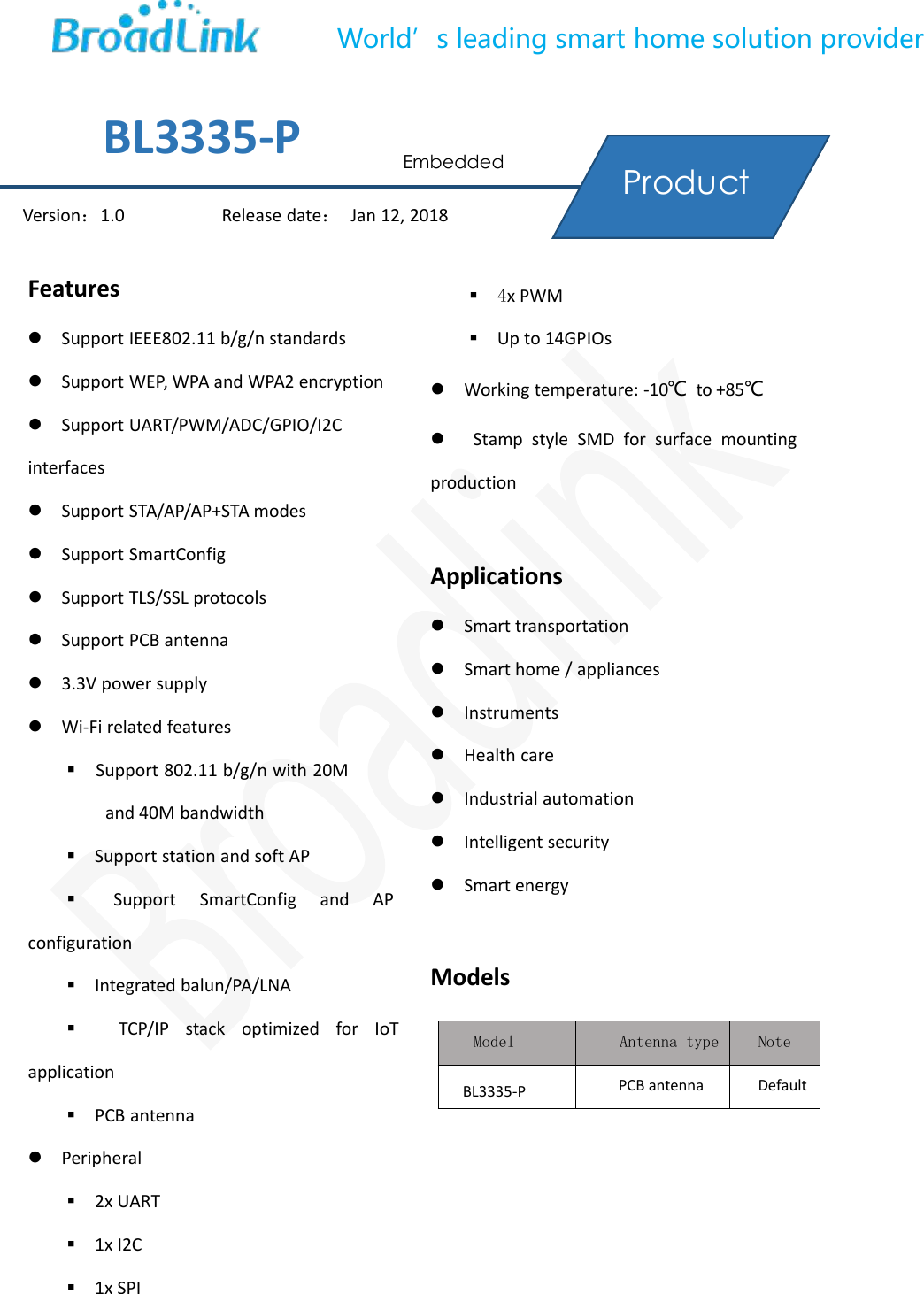
World’s leading smart home solution providerFeaturesSupport IEEE802.11 b/g/n standardsSupport WEP, WPA and WPA2 encryptionSupport UART/PWM/ADC/GPIO/I2CinterfacesSupport STA/AP/AP+STA modesSupport SmartConfigSupport TLS/SSL protocolsSupport PCB antenna3.3V power supplyWi-Fi related featuresSupport 802.11 b/g/n with 20Mand 40M bandwidthSupport station and soft APSupport SmartConfig and APconfigurationIntegrated balun/PA/LNATCP/IP stack optimized for IoTapplicationPCB antennaPeripheral2x UART1x I2C1x SPI4x PWMUp to 14GPIOsWorking temperature: -10℃to +85℃Stamp style SMD for surface mountingproductionApplicationsSmart transportationSmart home / appliancesInstrumentsHealth careIndustrial automationIntelligent securitySmart energyModelsModel Antenna type NoteBL3335-P PCB antenna DefaultVersion:1.0 Release date:Jan 12, 2018BL3335-P EmbeddedProductManual
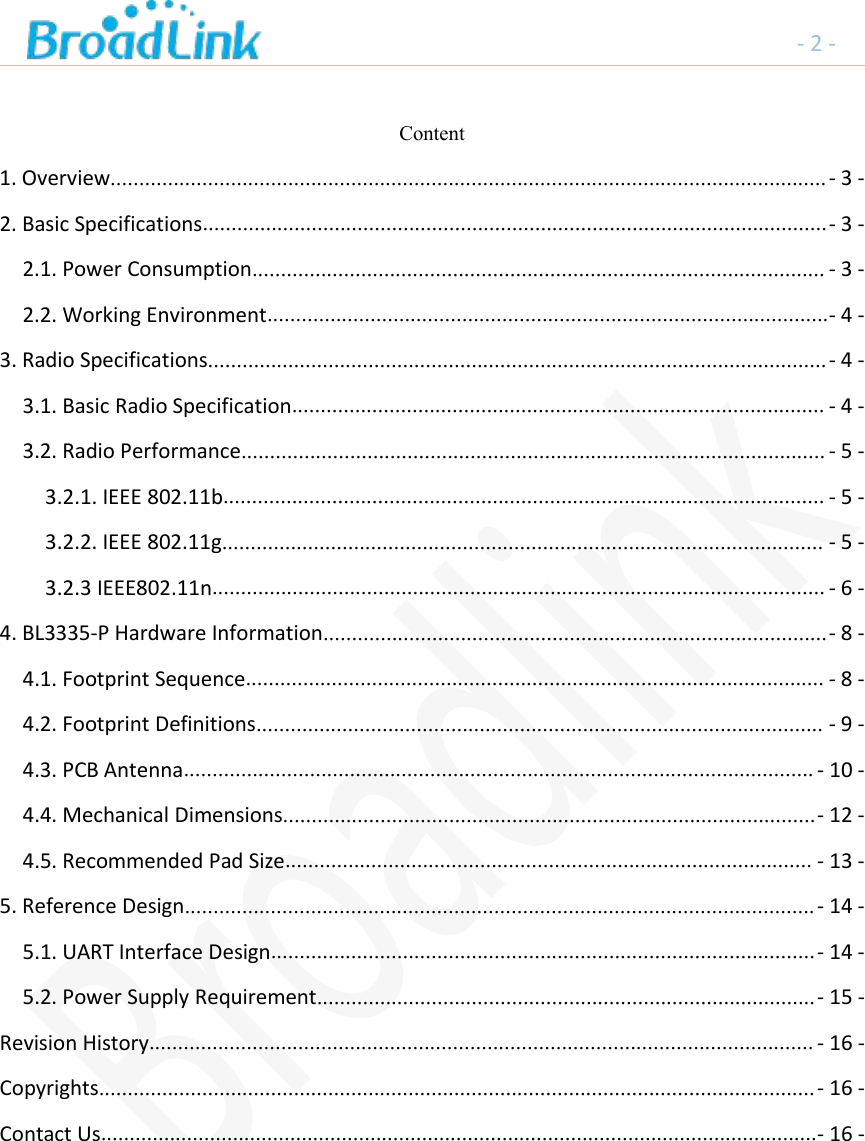
-2-Content1. Overview.............................................................................................................................- 3 -2. Basic Specifications.............................................................................................................- 3 -2.1. Power Consumption.................................................................................................... - 3 -2.2. Working Environment..................................................................................................- 4 -3. Radio Specifications............................................................................................................- 4 -3.1. Basic Radio Specification............................................................................................. - 4 -3.2. Radio Performance...................................................................................................... - 5 -3.2.1. IEEE 802.11b......................................................................................................... - 5 -3.2.2. IEEE 802.11g......................................................................................................... - 5 -3.2.3 IEEE802.11n........................................................................................................... - 6 -4. BL3335-P Hardware Information........................................................................................- 8 -4.1. Footprint Sequence..................................................................................................... - 8 -4.2. Footprint Definitions................................................................................................... - 9 -4.3. PCB Antenna.............................................................................................................. - 10 -4.4. Mechanical Dimensions.............................................................................................- 12 -4.5. Recommended Pad Size............................................................................................ - 13 -5. Reference Design..............................................................................................................- 14 -5.1. UART Interface Design...............................................................................................- 14 -5.2. Power Supply Requirement.......................................................................................- 15 -Revision History.................................................................................................................... - 16 -Copyrights.............................................................................................................................- 16 -Contact Us.............................................................................................................................- 16 -
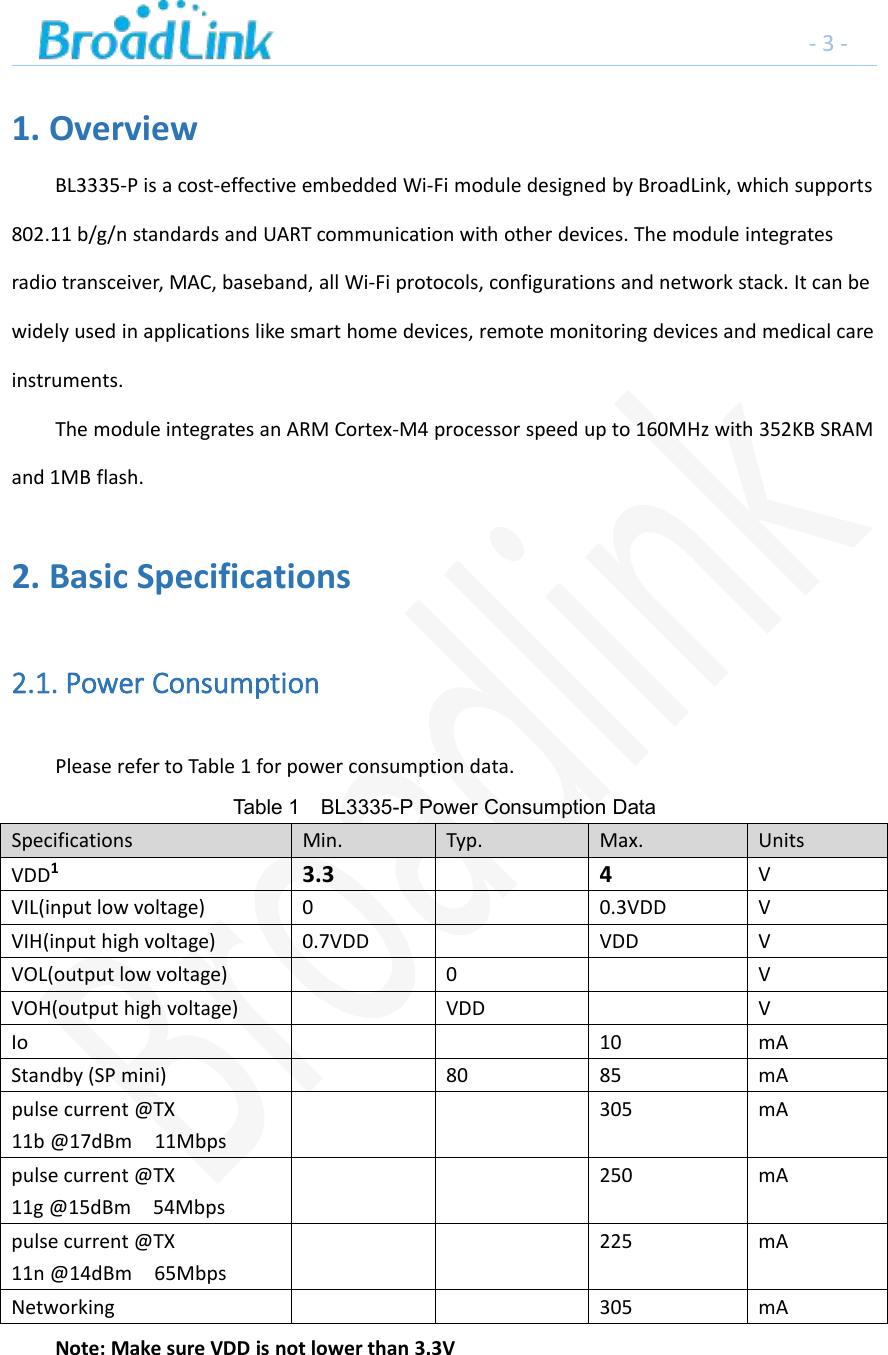
-3-1. OverviewBL3335-P is a cost-effective embedded Wi-Fi module designed by BroadLink, which supports802.11 b/g/n standards and UART communication with other devices. The module integratesradio transceiver, MAC, baseband, all Wi-Fi protocols, configurations and network stack. It can bewidely used in applications like smart home devices, remote monitoring devices and medical careinstruments.The module integrates an ARM Cortex-M4 processor speed up to 160MHz with 352KB SRAMand 1MB flash.2. Basic Specifications2.1. Power ConsumptionPlease refer to Table 1 for power consumption data.Table 1 BL3335-P Power Consumption DataSpecifications Min. Typ. Max. UnitsVDD13.3 4 VVIL(input low voltage) 0 0.3VDD VVIH(input high voltage) 0.7VDD VDD VVOL(output low voltage) 0 VVOH(output high voltage) VDD VIo 10 mAStandby (SP mini) 80 85 mApulse current @TX11b @17dBm 11Mbps305 mApulse current @TX11g @15dBm 54Mbps250 mApulse current @TX11n @14dBm 65Mbps225 mANetworking 305 mANote: Make sure VDD is not lower than 3.3V
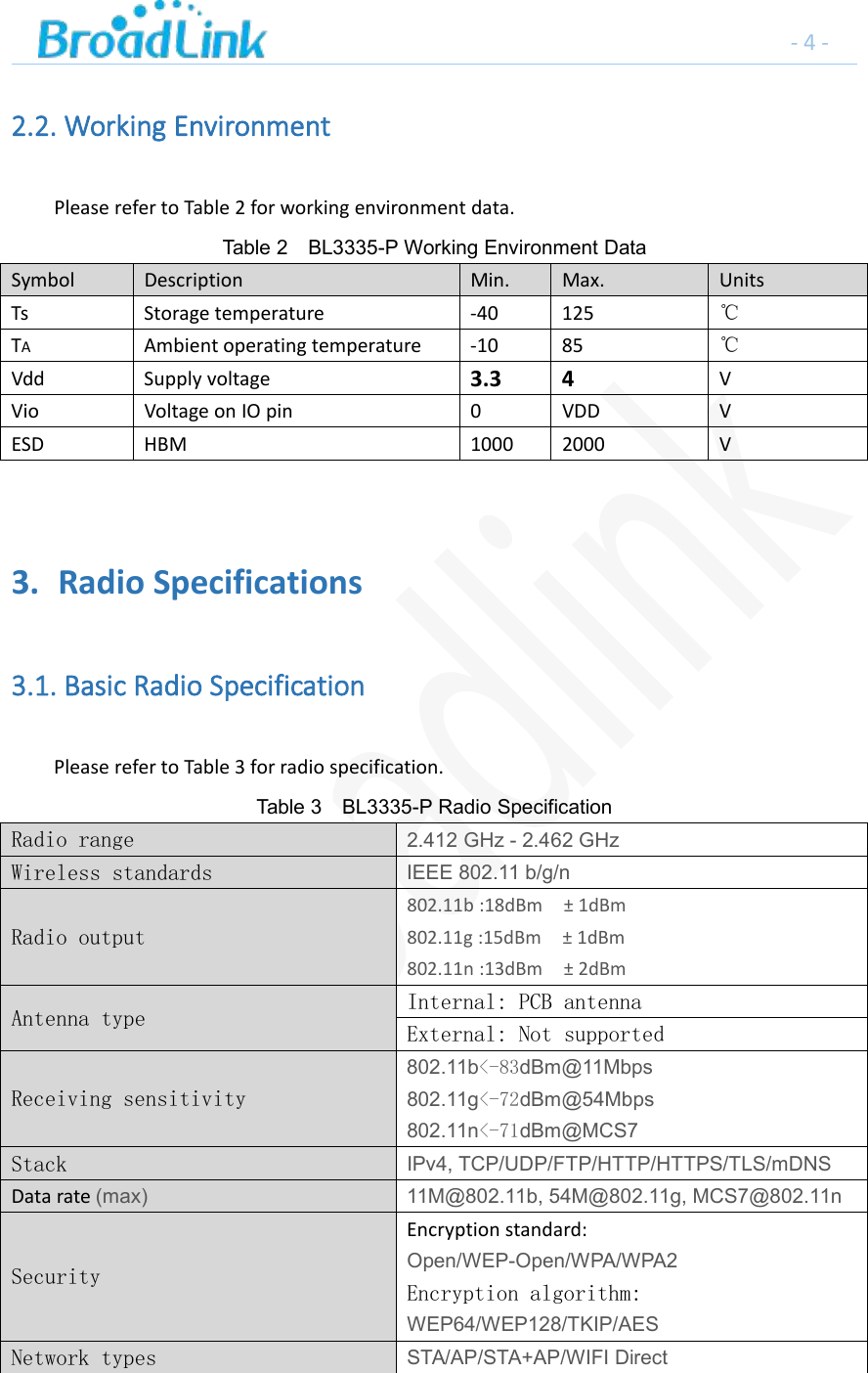
-4-2.2. Working EnvironmentPlease refer to Table 2 for working environment data.Table 2 BL3335-P Working Environment DataSymbol Description Min. Max. UnitsTs Storage temperature -40 125 ℃TAAmbient operating temperature -10 85 ℃Vdd Supply voltage 3.3 4 VVio Voltage on IO pin 0 VDD VESD HBM 1000 2000 V3. Radio Specifications3.1. Basic Radio SpecificationPlease refer to Table 3 for radio specification.Table 3 BL3335-P Radio SpecificationRadio range 2.412 GHz - 2.462 GHzWireless standards IEEE 802.11 b/g/nRadio output802.11b :18dBm ± 1dBm802.11g :15dBm ± 1dBm802.11n :13dBm ± 2dBmAntenna type Internal: PCB antennaExternal: Not supportedReceiving sensitivity802.11b<-83dBm@11Mbps802.11g<-72dBm@54Mbps802.11n<-71dBm@MCS7Stack IPv4, TCP/UDP/FTP/HTTP/HTTPS/TLS/mDNSData rate (max) 11M@802.11b, 54M@802.11g, MCS7@802.11nSecurityEncryption standard:Open/WEP-Open/WPA/WPA2Encryption algorithm:WEP64/WEP128/TKIP/AESNetwork types STA/AP/STA+AP/WIFI Direct
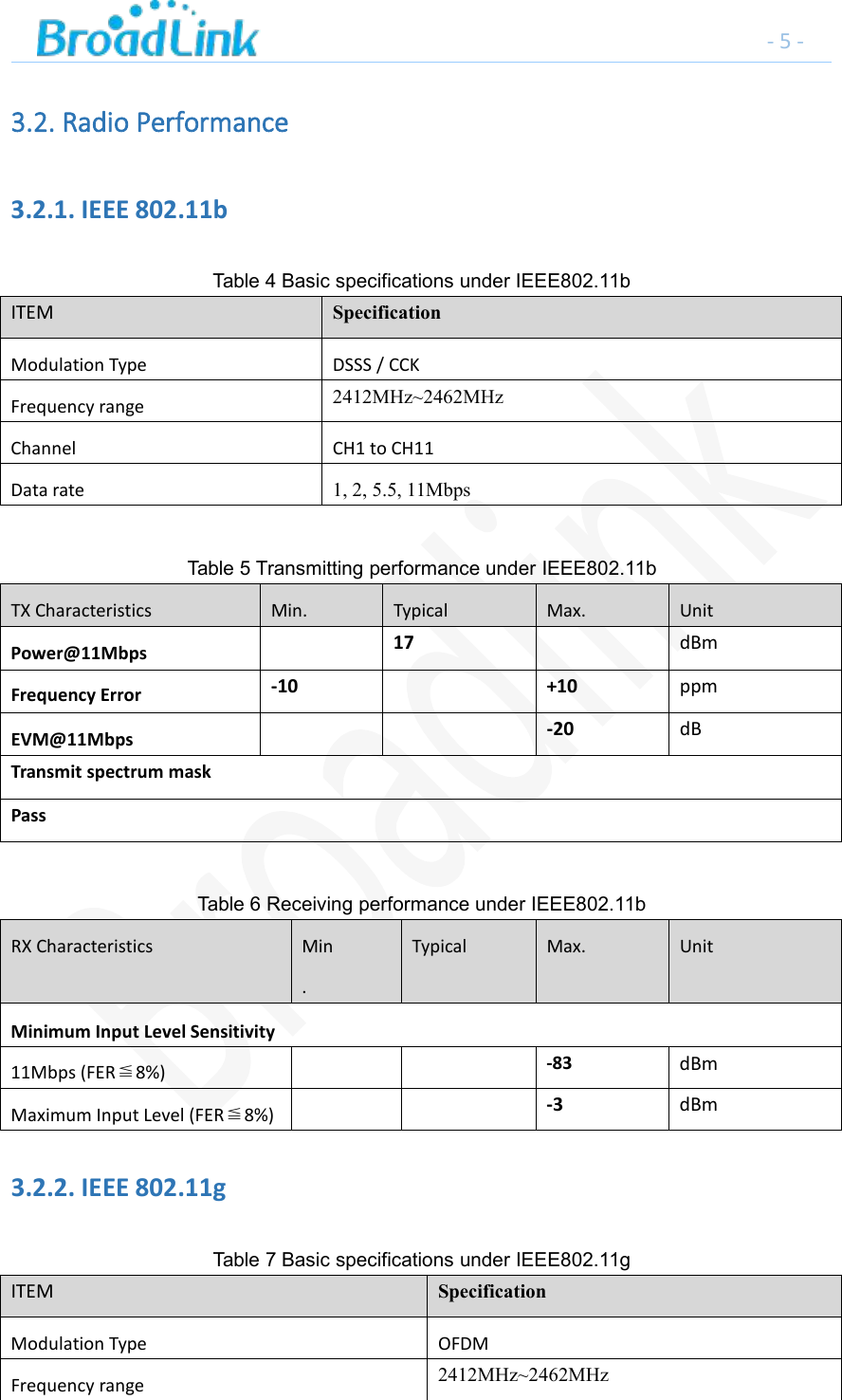
-5-3.2. Radio Performance3.2.1. IEEE 802.11bTable 4 Basic specifications under IEEE802.11bITEM SpecificationModulation Type DSSS / CCKFrequency range 2412MHz~2462MHzChannel CH1 to CH11Data rate 1, 2, 5.5, 11MbpsTable 5 Transmitting performance under IEEE802.11bTX Characteristics Min. Typical Max. UnitPower@11Mbps 17 dBmFrequency Error -10 +10 ppmEVM@11Mbps -20 dBTransmit spectrum maskPassTable 6 Receiving performance under IEEE802.11bRX Characteristics Min.Typical Max. UnitMinimum Input Level Sensitivity11Mbps (FER≦8%) -83 dBmMaximum Input Level (FER≦8%) -3 dBm3.2.2. IEEE 802.11gTable 7 Basic specifications under IEEE802.11gITEM SpecificationModulation Type OFDMFrequency range 2412MHz~2462MHz
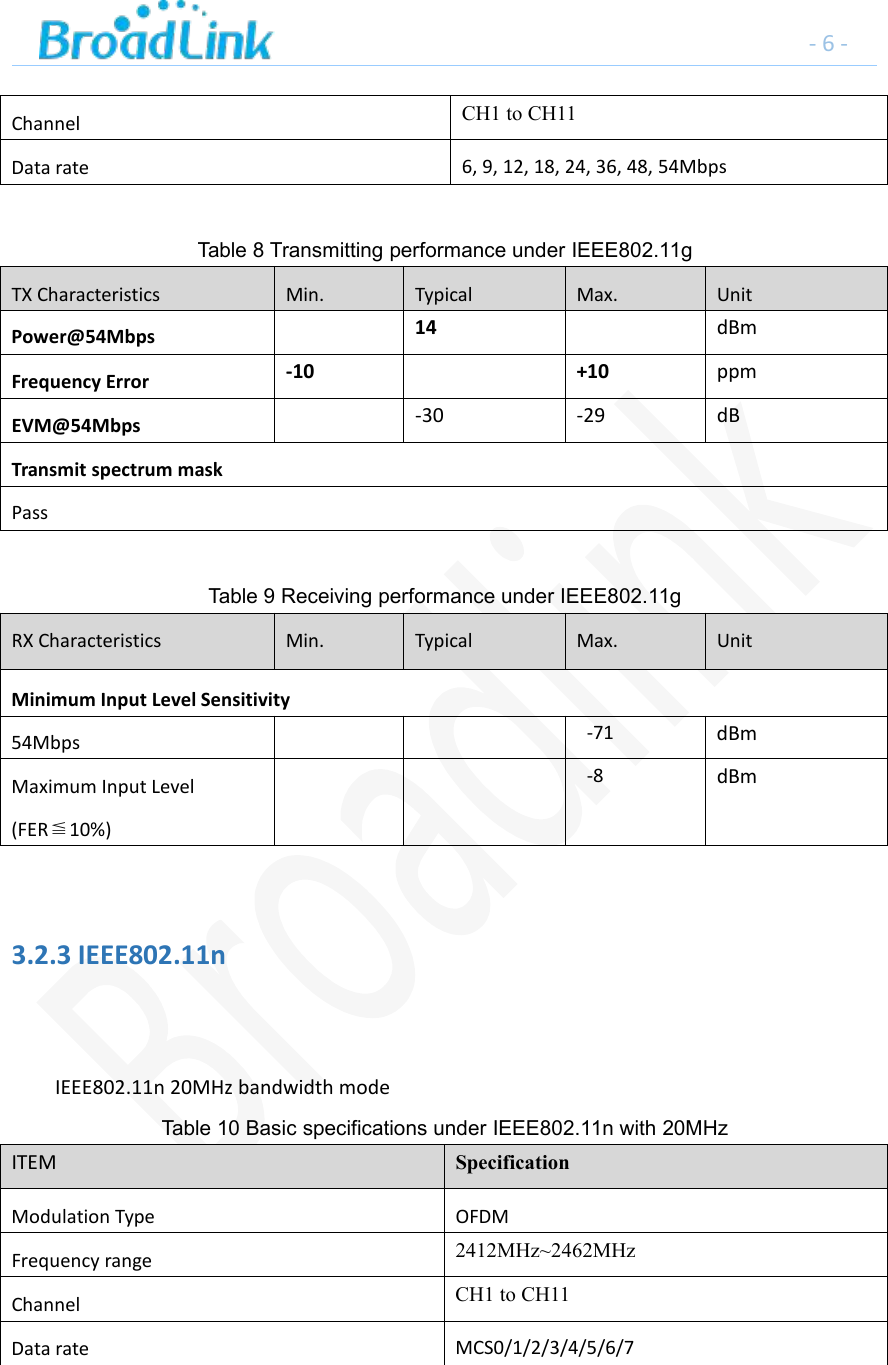
-6-Channel CH1 to CH11Data rate 6, 9, 12, 18, 24, 36, 48, 54MbpsTable 8 Transmitting performance under IEEE802.11gTX Characteristics Min. Typical Max. UnitPower@54Mbps 14 dBmFrequency Error -10 +10 ppmEVM@54Mbps -30 -29 dBTransmit spectrum maskPassTable 9 Receiving performance under IEEE802.11gRX Characteristics Min. Typical Max. UnitMinimum Input Level Sensitivity54Mbps -71 dBmMaximum Input Level(FER≦10%)-8 dBm3.2.3 IEEE802.11nIEEE802.11n 20MHz bandwidth modeTable 10 Basic specifications under IEEE802.11n with 20MHzITEM SpecificationModulation Type OFDMFrequency range 2412MHz~2462MHzChannel CH1 to CH11Data rate MCS0/1/2/3/4/5/6/7
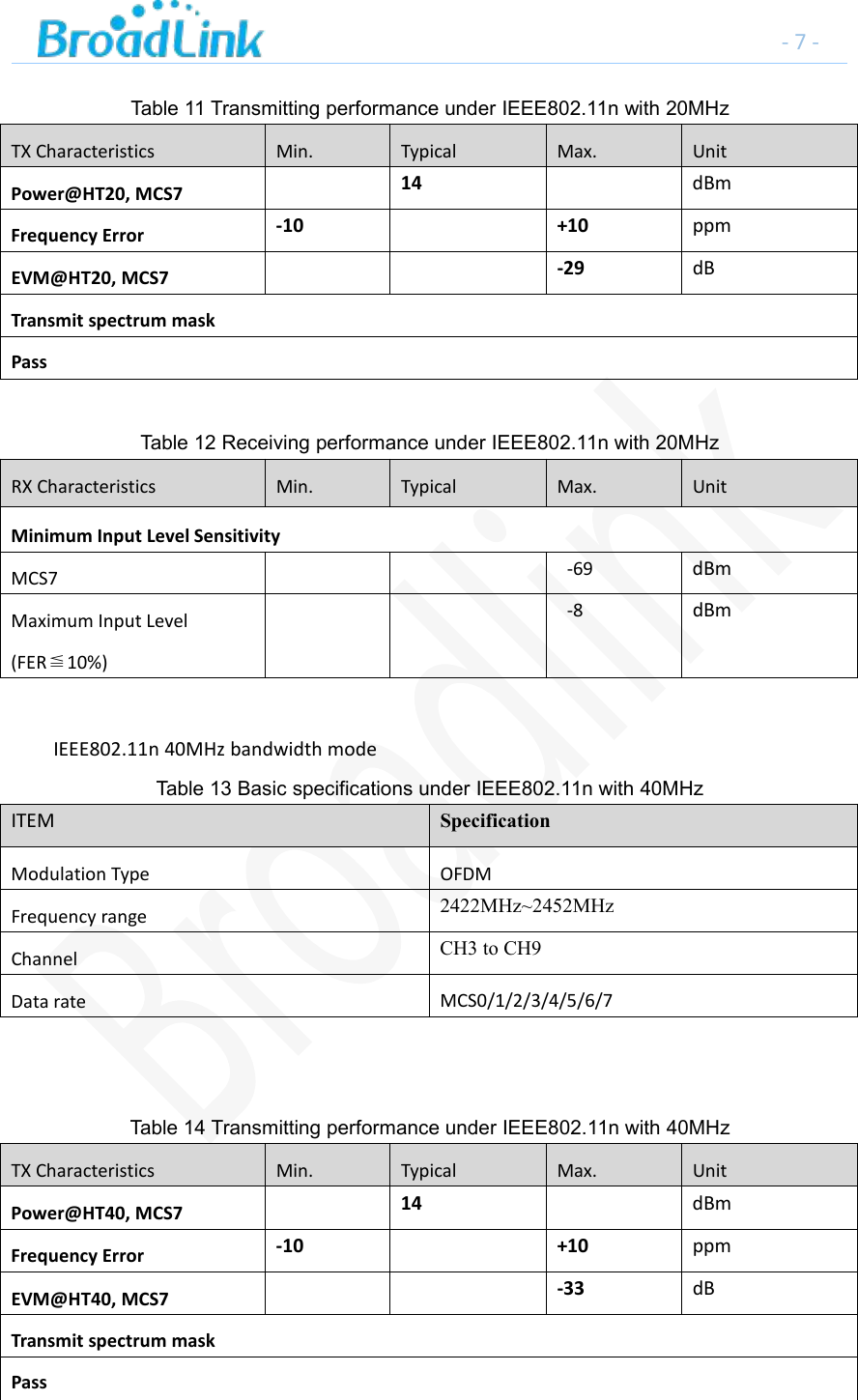
-7-Table 11 Transmitting performance under IEEE802.11n with 20MHzTX Characteristics Min. Typical Max. UnitPower@HT20, MCS7 14 dBmFrequency Error -10 +10 ppmEVM@HT20, MCS7 -29 dBTransmit spectrum maskPassTable 12 Receiving performance under IEEE802.11n with 20MHzRX Characteristics Min. Typical Max. UnitMinimum Input Level SensitivityMCS7 -69 dBmMaximum Input Level(FER≦10%)-8 dBmIEEE802.11n 40MHz bandwidth modeTable 13 Basic specifications under IEEE802.11n with 40MHzITEM SpecificationModulation Type OFDMFrequency range 2422MHz~2452MHzChannel CH3 to CH9Data rate MCS0/1/2/3/4/5/6/7Table 14 Transmitting performance under IEEE802.11n with 40MHzTX Characteristics Min. Typical Max. UnitPower@HT40, MCS7 14 dBmFrequency Error -10 +10 ppmEVM@HT40, MCS7 -33 dBTransmit spectrum maskPass
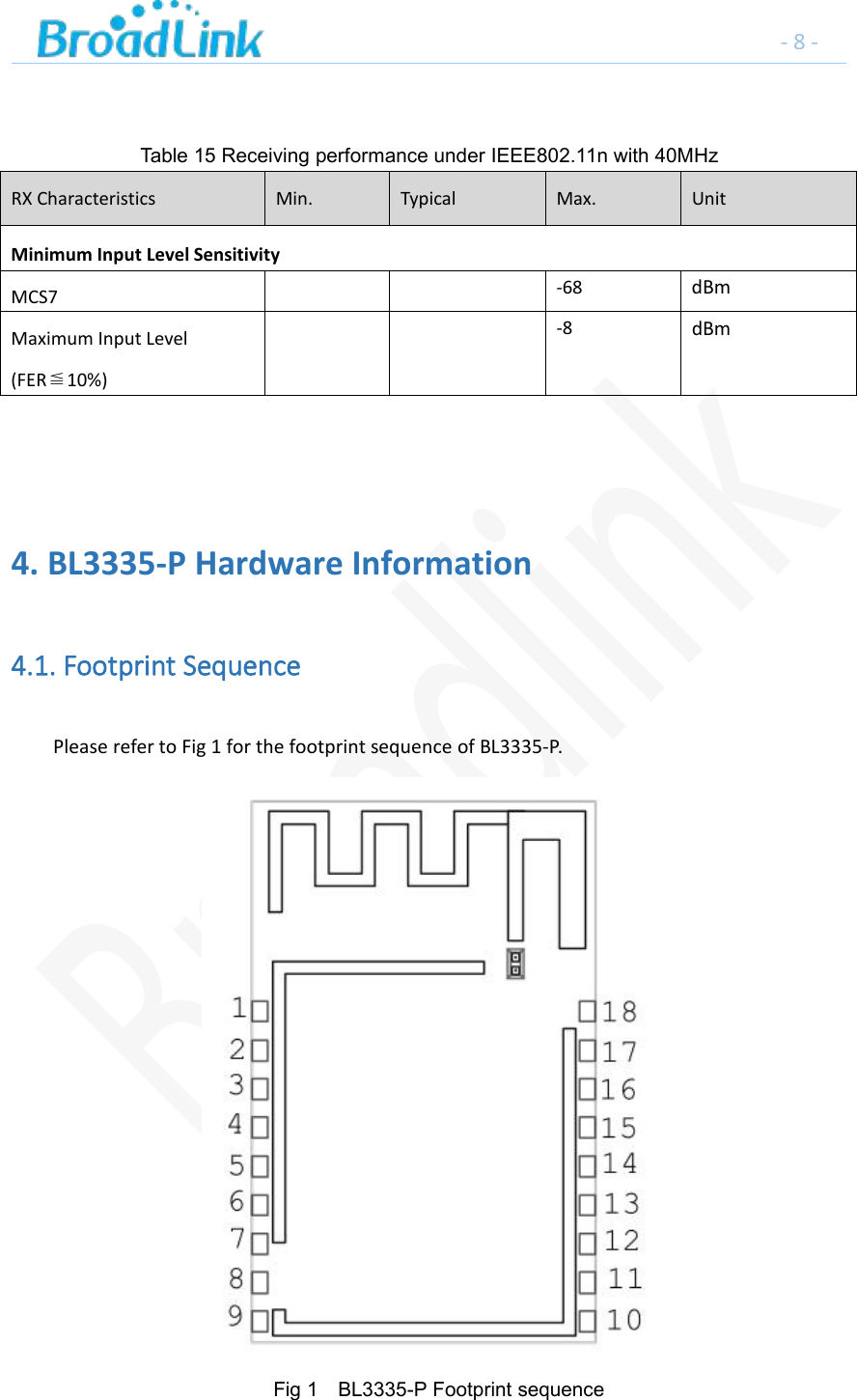
-8-Table 15 Receiving performance under IEEE802.11n with 40MHzRX Characteristics Min. Typical Max. UnitMinimum Input Level SensitivityMCS7 -68 dBmMaximum Input Level(FER≦10%)-8 dBm4. BL3335-P Hardware Information4.1. Footprint SequencePlease refer to Fig 1 for the footprint sequence of BL3335-P.Fig 1 BL3335-P Footprint sequence
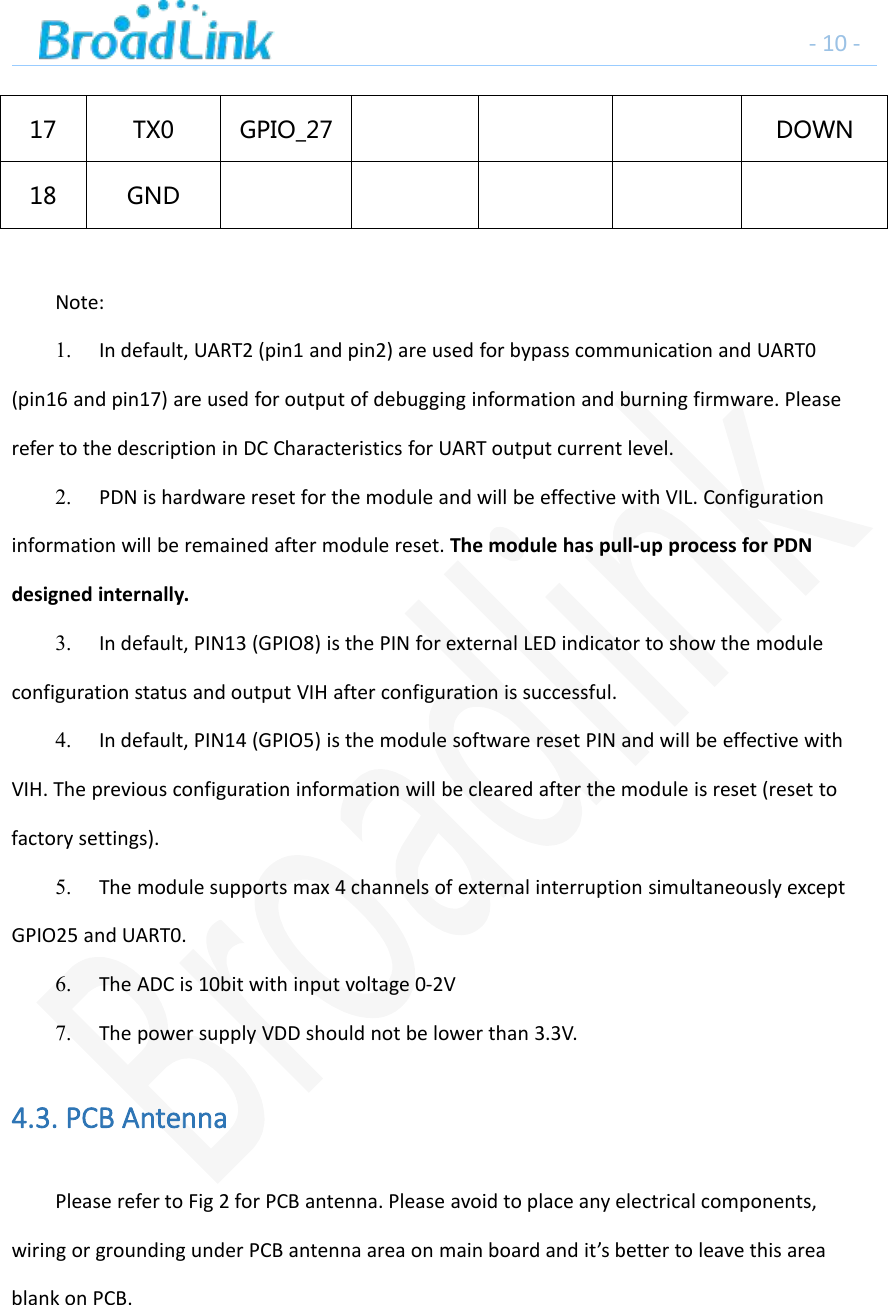
-9-4.2. Footprint DefinitionsPlease refer to Table 16 for the footprint definitions of BL3335-P.Table 16 BL3335-P footprint definitionspinFunction1Function2Function3Function4Function5Defaultstate1 GPIO2 TX2 UP2 GPIO1 RX2 I2C_SDA UP3 GPIO3 I2C_SCK UP4 GPIO12 SPI_MOSI DOWN5 GPIO13 SPI_MISO PWM1 DOWN6 GPIO25 PWM3 DOWN7 GPIO0 PWM2 DOWN8 VDD9 GND10 PDN11 GPADC GPIO6 DOWN12 GPIO7 DOWN13 GPIO8 PWM0 DOWN14 GPIO5 SPI_CS DOWN15 GPIO4 SPI_CLK DOWN16 RX0 GPIO_26 DOWN
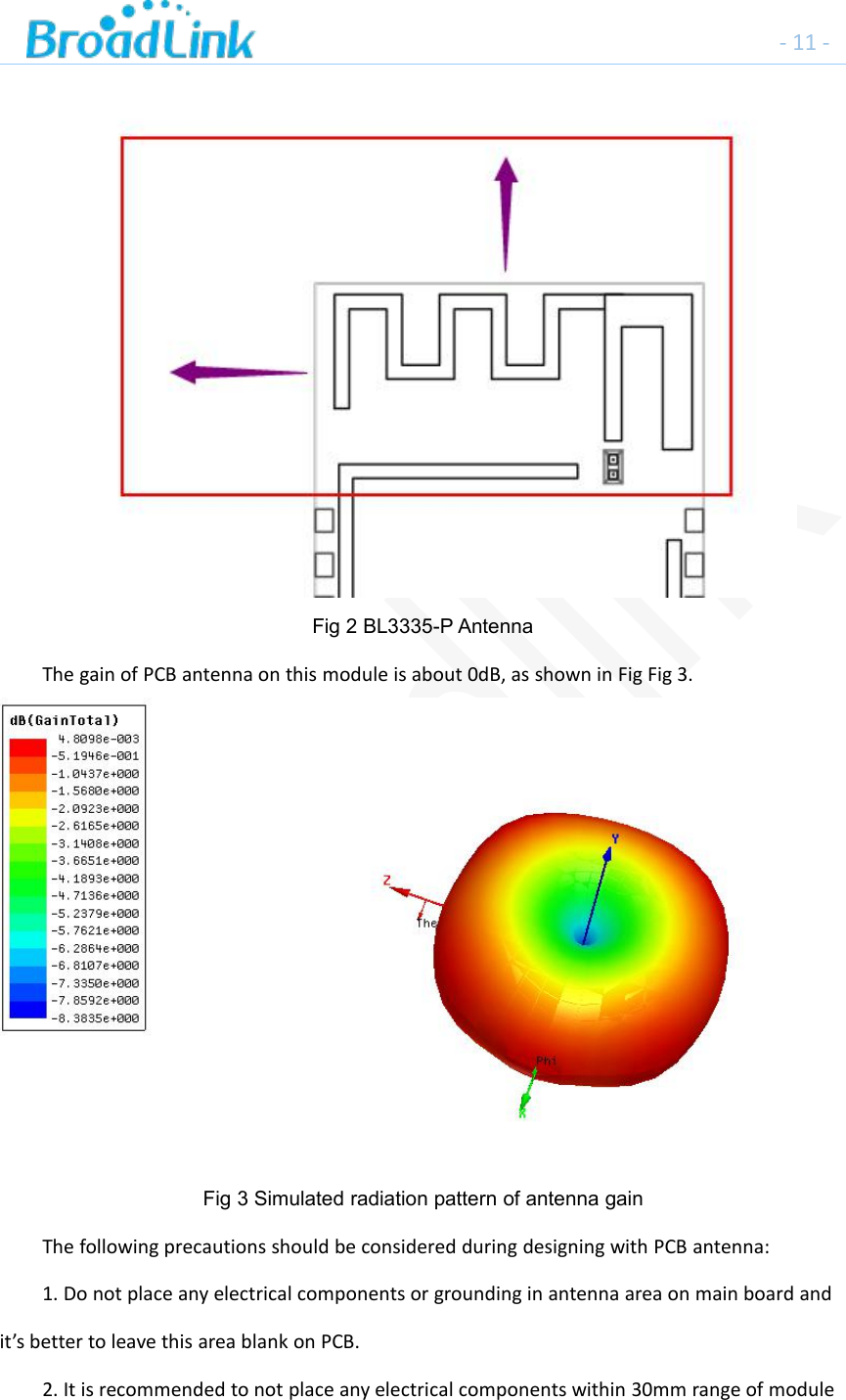
- 10 -17 TX0 GPIO_27 DOWN18 GNDNote:1. In default, UART2 (pin1 and pin2) are used for bypass communication and UART0(pin16 and pin17) are used for output of debugging information and burning firmware. Pleaserefer to the description in DC Characteristics for UART output current level.2. PDN is hardware reset for the module and will be effective with VIL. Configurationinformation will be remained after module reset. The module has pull-up process for PDNdesigned internally.3. In default, PIN13 (GPIO8) is the PIN for external LED indicator to show the moduleconfiguration status and output VIH after configuration is successful.4. In default, PIN14 (GPIO5) is the module software reset PIN and will be effective withVIH. The previous configuration information will be cleared after the module is reset (reset tofactory settings).5. The module supports max 4 channels of external interruption simultaneously exceptGPIO25 and UART0.6. The ADC is 10bit with input voltage 0-2V7. The power supply VDD should not be lower than 3.3V.4.3. PCB AntennaPlease refer to Fig 2 for PCB antenna. Please avoid to place any electrical components,wiring or grounding under PCB antenna area on main board and it’s better to leave this areablank on PCB.
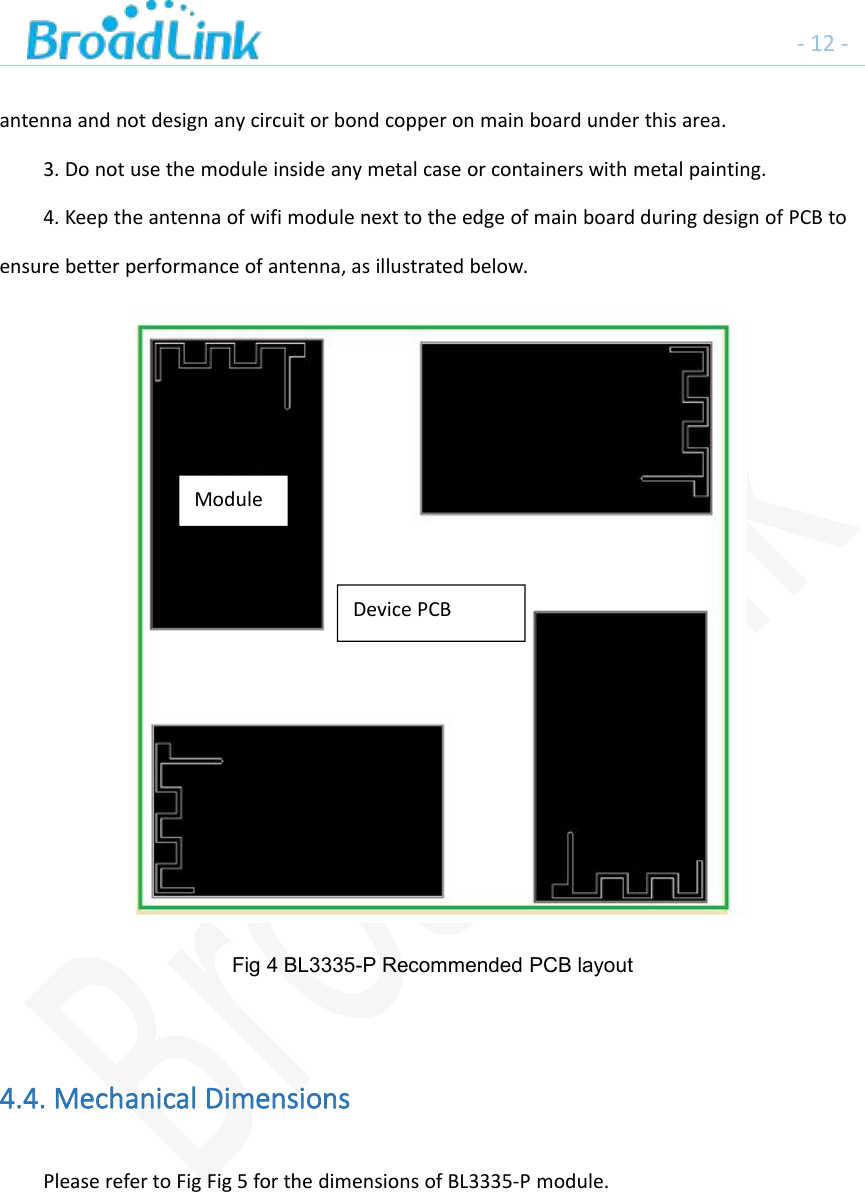
- 11 -Fig 2 BL3335-P AntennaThe gain of PCB antenna on this module is about 0dB, as shown in Fig Fig 3.Fig 3 Simulated radiation pattern of antenna gainThe following precautions should be considered during designing with PCB antenna:1. Do not place any electrical components or grounding in antenna area on main board andit’s better to leave this area blank on PCB.2. It is recommended to not place any electrical components within 30mm range of module
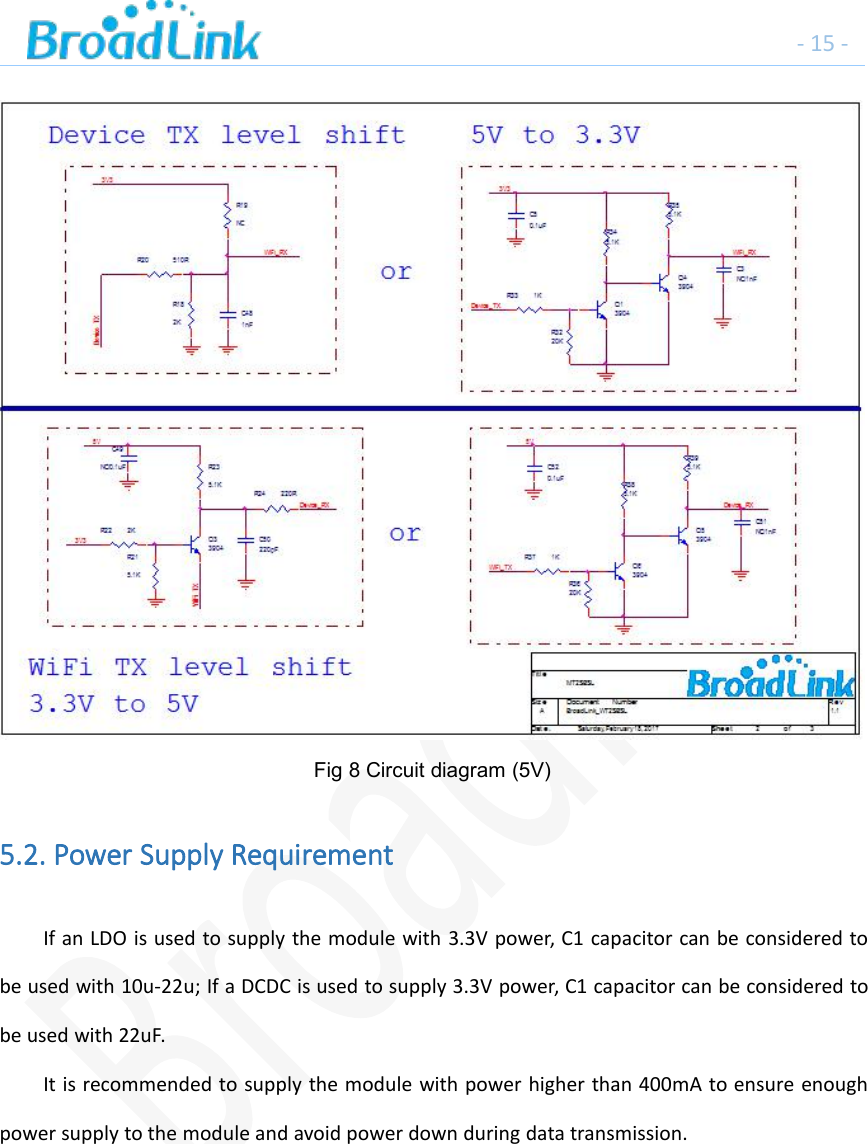
- 12 -antenna and not design any circuit or bond copper on main board under this area.3. Do not use the module inside any metal case or containers with metal painting.4. Keep the antenna of wifi module next to the edge of main board during design of PCB toensure better performance of antenna, as illustrated below.Fig 4 BL3335-P Recommended PCB layout4.4. Mechanical DimensionsPlease refer to Fig Fig 5 for the dimensions of BL3335-P module.ModuleDevice PCB
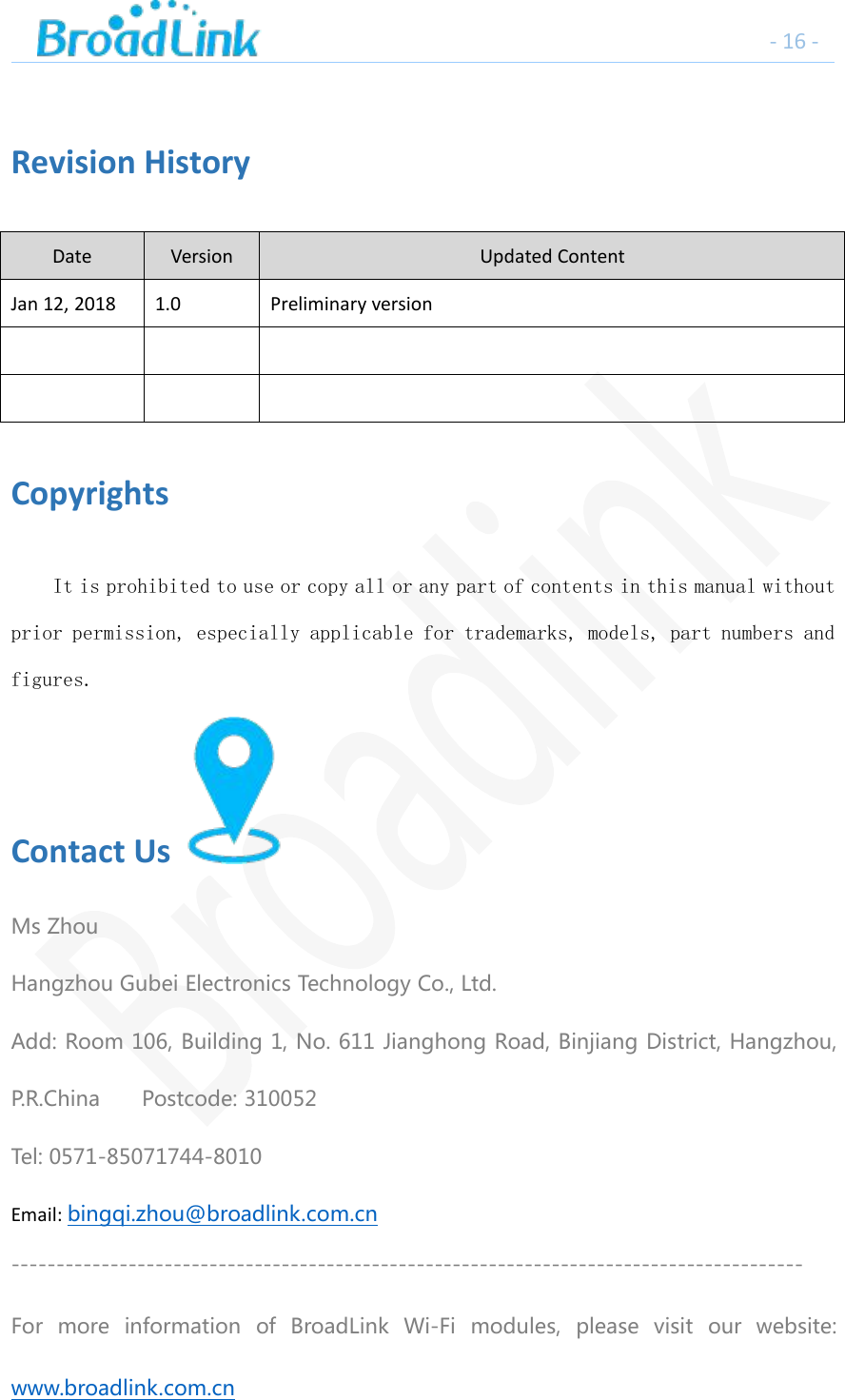
- 13 -Fig 5 BL3335-P Dimensionsa.Note: Dimensions (13.3±0.2) mm * (21±0.2) mm * (2.6±0.2)mm (with shielding case)4.5. Recommended Pad SizePlease refer to Fig Fig 6 for the recommended pad size of BL3335-P module.Fig 6 BL3335-P Recommended pad sizeUnit: mm
- 14 -5. Reference Design5.1. UART Interface DesignFor devices with 3.3V power supply, you can directly connect the device UART port withmodule UART port according to the illustration in Fig Fig 7.Fig 7 Circuit diagram (3.3V)If your device is powered by 5V, you can refer to the circuit shown in Fig Fig 8 or design yourown circuit for power conversion. The value of resistor can be adjusted according to actual circuitdesign.Wi-FimoduleExternalMCUCapacitorGrounding
- 15 -Fig 8 Circuit diagram (5V)5.2. Power Supply RequirementIf an LDO is used to supply the module with 3.3V power, C1 capacitor can be considered tobe used with 10u-22u; If a DCDC is used to supply 3.3V power, C1 capacitor can be considered tobe used with 22uF.It is recommended to supply the module with power higher than 400mA to ensure enoughpower supply to the module and avoid power down during data transmission.
- 16 -Revision HistoryDateVersionUpdated ContentJan 12, 20181.0Preliminary versionCopyrightsIt is prohibited to use or copy all or any part of contents in this manual withoutprior permission, especially applicable for trademarks, models, part numbers andfigures.Contact UsMs ZhouHangzhou Gubei Electronics Technology Co., Ltd.Add: Room 106, Building 1, No. 611 Jianghong Road, Binjiang District, Hangzhou,P.R.China Postcode: 310052Tel: 0571-85071744-8010Email: bingqi.zhou@broadlink.com.cn----------------------------------------------------------------------------------------For more information of BroadLink Wi-Fi modules, please visit our website:www.broadlink.com.cn
- 17 -This device complies with Part 15 of the FCC Rules. Operation is subject to thefollowing two conditions:(1) This device may not cause harmful interference, and(2) This device must accept any interference received, including interference thatmay cause undesired operation.Note: This product has been tested and found to comply with the limits for a ClassB digital device, pursuant to Part 15 of the FCC Rules. These limits are designed toprovide reasonable protection against harmful interference in a residentialinstallation. This product generates, uses, and can radiate radio frequency energyand, if not installed and used in accordance with the instructions, may causeharmful interference to radio communications. However, there is no guarantee thatinterference will not occur in a particular installation. If this product does causeharmful interference to radio or television reception, which can be determined byturning the equipment off and on, the user is encouraged to try to correct theinterference by one or more of the following measures:—Reorient or relocate the receiving antenna.—Increase the separation between the equipment and receiver.—Connect the equipment into an outlet on a circuit different from that to which thereceiver is connected.—Consult the dealer or an experienced radio/TV technician for help.Please take attention that changes or modification not expressly approved by theparty responsible for compliance could void the user’s authority to operate theequipment.This equipment should be installed and operated with a minimum distance 20cmbetween the radiator and your body
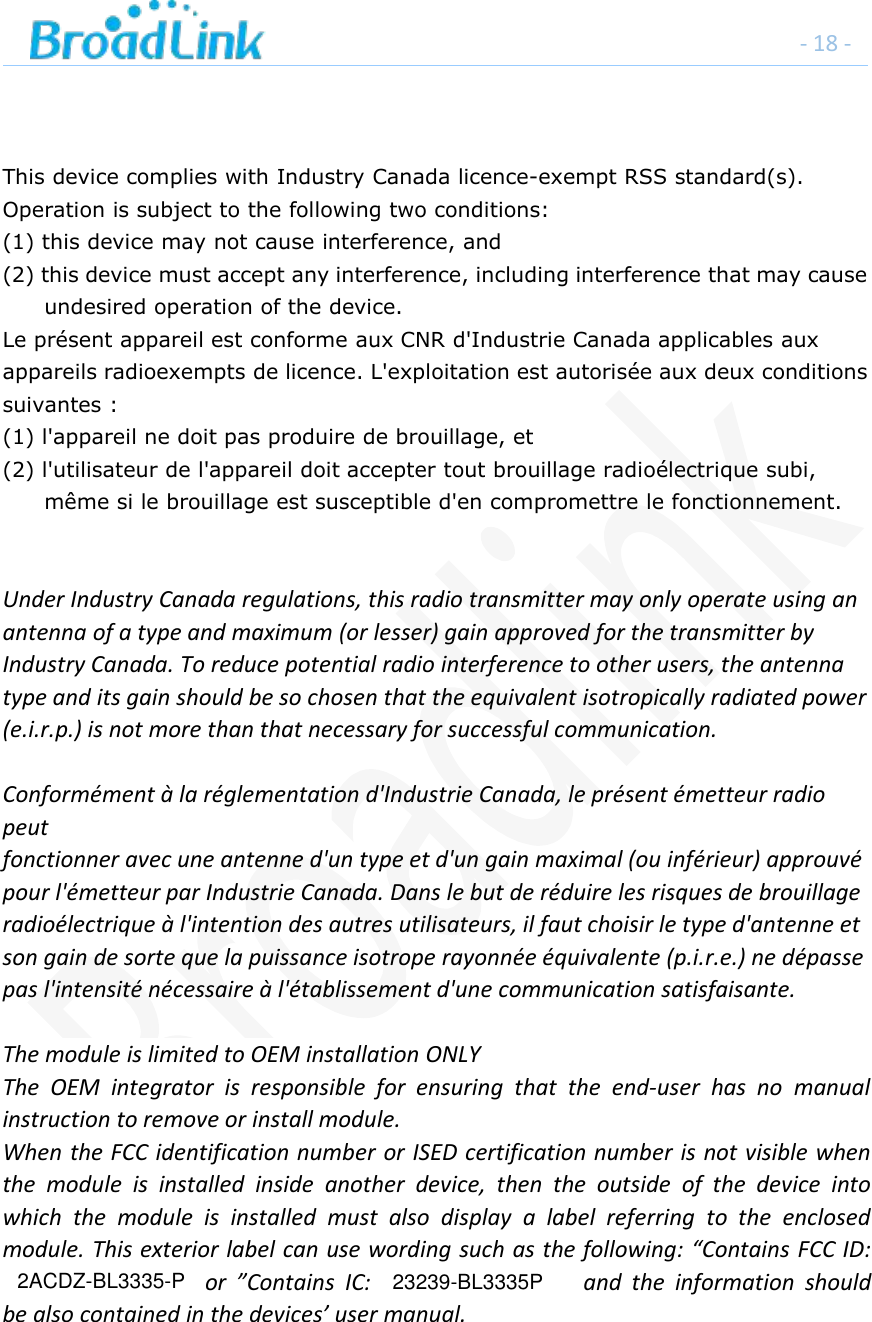
- 18 -This device complies with Industry Canada licence-exempt RSS standard(s).Operation is subject to the following two conditions:(1) this device may not cause interference, and(2) this device must accept any interference, including interference that may causeundesired operation of the device.Le présent appareil est conforme aux CNR d'Industrie Canada applicables auxappareils radioexempts de licence. L'exploitation est autorisée aux deux conditionssuivantes :(1) l'appareil ne doit pas produire de brouillage, et(2) l'utilisateur de l'appareil doit accepter tout brouillage radioélectrique subi,même si le brouillage est susceptible d'en compromettre le fonctionnement.Under Industry Canada regulations, this radio transmitter may only operate using anantenna of a type and maximum (or lesser) gain approved for the transmitter byIndustry Canada. To reduce potential radio interference to other users, the antennatype and its gain should be so chosen that the equivalent isotropically radiated power(e.i.r.p.) is not more than that necessary for successful communication.Conformément à la réglementation d'Industrie Canada, le présent émetteur radiopeutfonctionner avec une antenne d'un type et d'un gain maximal (ou inférieur) approuvépour l'émetteur par Industrie Canada. Dans le but de réduire les risques de brouillageradioélectrique à l'intention des autres utilisateurs, il faut choisir le type d'antenne etson gain de sorte que la puissance isotrope rayonnée équivalente (p.i.r.e.) ne dépassepas l'intensité nécessaire à l'établissement d'une communication satisfaisante.The module is limited to OEM installation ONLYThe OEM integrator is responsible for ensuring that the end-user has no manualinstruction to remove or install module.When the FCC identification number or ISED certification number is not visible whenthe module is installed inside another device, then the outside of the device intowhich the module is installed must also display a label referring to the enclosedmodule. This exterior label can use wording such as the following: “Contains FCC ID:or ”Contains IC: and the information shouldbe also contained in the devices’ user manual.2ACDZ-BL3335-P 23239-BL3335P

Navigation menu