Honda R and D 70410-QAB Wireless Access Point User Manual

Honda R&D; Co., Ltd. Wireless Access Point Users Manual

Users Manual

Dual band Access Point User’s Guide Rev001, Page 1 of 41       2.4GHz/5.2GHz Dual band Wireless LAN Access Point User's Guide  70410-QAB   Preliminary Revision October 2005
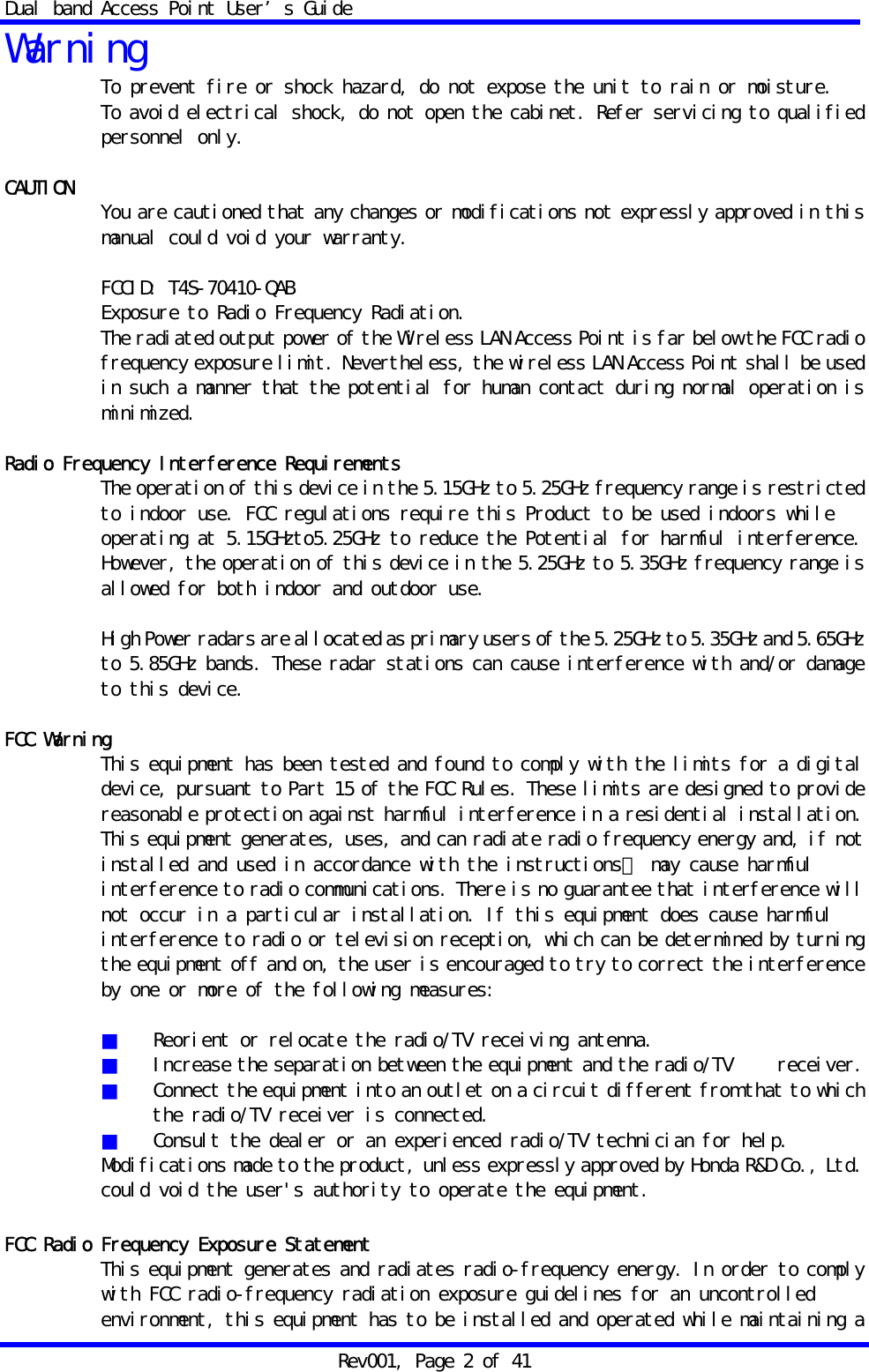
Dual band Access Point User’s Guide Rev001, Page 2 of 41 Warning To prevent fire or shock hazard, do not expose the unit to rain or moisture. To avoid electrical shock, do not open the cabinet. Refer servicing to qualified personnel only.  CAUTION  You are cautioned that any changes or modifications not expressly approved in this manual could void your warranty.  FCCID: T4S-70410-QAB Exposure to Radio Frequency Radiation. The radiated output power of the Wireless LAN Access Point is far below the FCC radio frequency exposure limit. Nevertheless, the wireless LAN Access Point shall be used in such a manner that the potential for human contact during normal operation is minimized.  Radio Frequency Interference Requirements The operation of this device in the 5.15GHz to 5.25GHz frequency range is restricted to indoor use. FCC regulations require this Product to be used indoors while operating at 5.15GHzto5.25GHz to reduce the Potential for harmful interference. However, the operation of this device in the 5.25GHz to 5.35GHz frequency range is allowed for both indoor and outdoor use.  High Power radars are allocated as primary users of the 5.25GHz to 5.35GHz and 5.65GHz to 5.85GHz bands. These radar stations can cause interference with and/or damage to this device.  FCC Warning This equipment has been tested and found to comply with the limits for a digital device, pursuant to Part 15 of the FCC Rules. These limits are designed to provide reasonable protection against harmful interference in a residential installation. This equipment generates, uses, and can radiate radio frequency energy and, if not installed and used in accordance with the instructions, may cause harmful interference to radio communications. There is no guarantee that interference will not occur in a particular installation. If this equipment does cause harmful interference to radio or television reception, which can be determined by turning the equipment off and on, the user is encouraged to try to correct the interference by one or more of the following measures:  ■  Reorient or relocate the radio/TV receiving antenna. ■  Increase the separation between the equipment and the radio/TV    receiver. ■  Connect the equipment into an outlet on a circuit different from that to which the radio/TV receiver is connected. ■  Consult the dealer or an experienced radio/TV technician for help. Modifications made to the product, unless expressly approved by Honda R&D Co., Ltd. could void the user's authority to operate the equipment.  FCC Radio Frequency Exposure Statement This equipment generates and radiates radio-frequency energy. In order to comply with FCC radio-frequency radiation exposure guidelines for an uncontrolled environment, this equipment has to be installed and operated while maintaining a
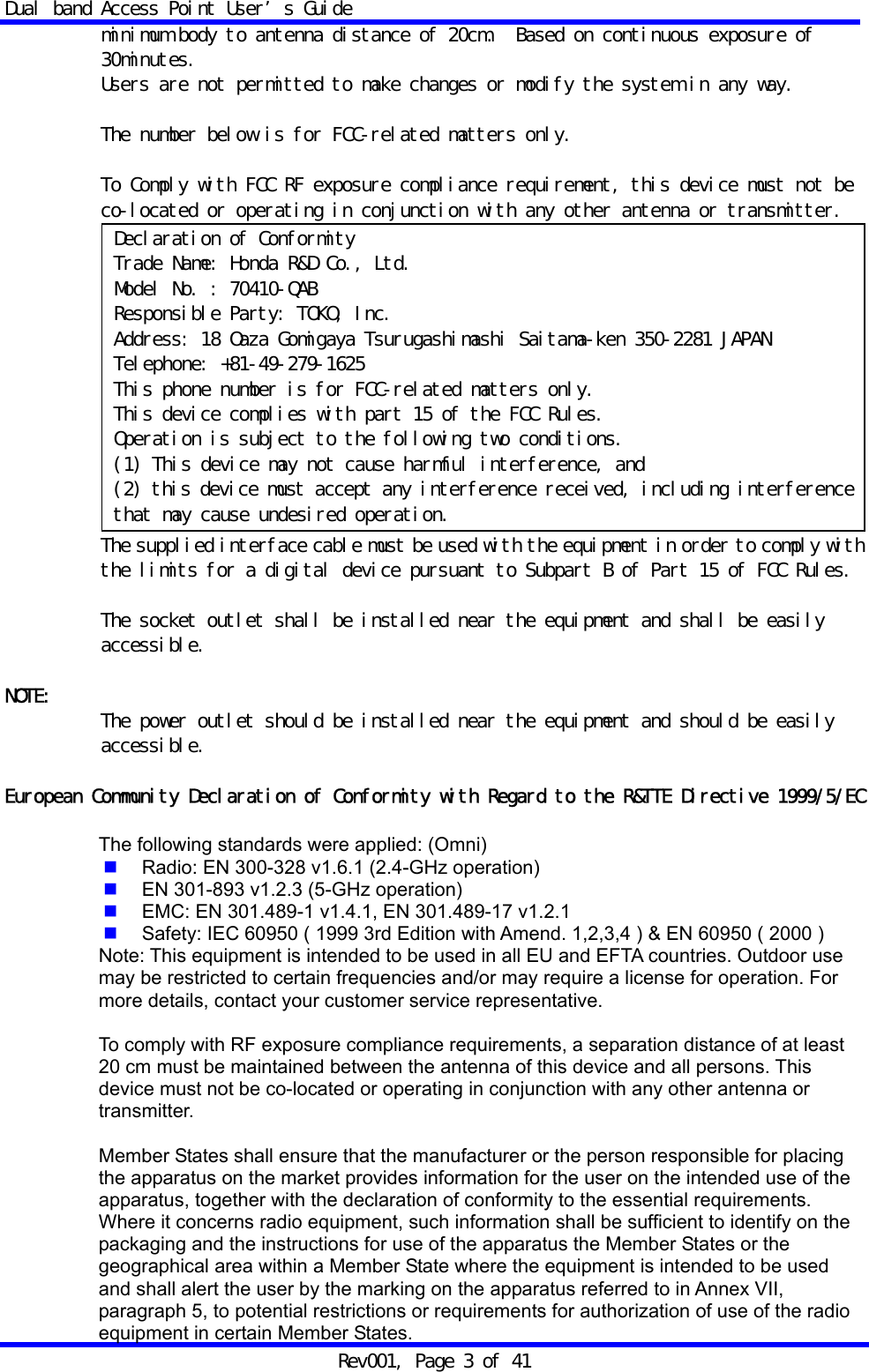
Dual band Access Point User’s Guide Rev001, Page 3 of 41 minimum body to antenna distance of 20cm.  Based on continuous exposure of 30minutes. Users are not permitted to make changes or modify the system in any way.   The number below is for FCC-related matters only.  To Comply with FCC RF exposure compliance requirement, this device must not be co-located or operating in conjunction with any other antenna or transmitter.  The supplied interface cable must be used with the equipment in order to comply with the limits for a digital device pursuant to Subpart B of Part 15 of FCC Rules.  The socket outlet shall be installed near the equipment and shall be easily accessible.  NOTE:  The power outlet should be installed near the equipment and should be easily accessible.  European Community Declaration of Conformity with Regard to the R&TTE Directive 1999/5/EC  The following standards were applied: (Omni)  Radio: EN 300-328 v1.6.1 (2.4-GHz operation)  EN 301-893 v1.2.3 (5-GHz operation)  EMC: EN 301.489-1 v1.4.1, EN 301.489-17 v1.2.1  Safety: IEC 60950 ( 1999 3rd Edition with Amend. 1,2,3,4 ) & EN 60950 ( 2000 ) Note: This equipment is intended to be used in all EU and EFTA countries. Outdoor use may be restricted to certain frequencies and/or may require a license for operation. For more details, contact your customer service representative.  To comply with RF exposure compliance requirements, a separation distance of at least 20 cm must be maintained between the antenna of this device and all persons. This device must not be co-located or operating in conjunction with any other antenna or transmitter.  Member States shall ensure that the manufacturer or the person responsible for placing the apparatus on the market provides information for the user on the intended use of the apparatus, together with the declaration of conformity to the essential requirements. Where it concerns radio equipment, such information shall be sufficient to identify on the packaging and the instructions for use of the apparatus the Member States or the geographical area within a Member State where the equipment is intended to be used and shall alert the user by the marking on the apparatus referred to in Annex VII, paragraph 5, to potential restrictions or requirements for authorization of use of the radio equipment in certain Member States. Declaration of Conformity Trade Name: Honda R&D Co., Ltd. Model No. : 70410-QAB Responsible Party: TOKO, Inc. Address: 18 Oaza Gomigaya Tsurugashimashi Saitama-ken 350-2281 JAPAN Telephone: +81-49-279-1625 This phone number is for FCC-related matters only. This device complies with part 15 of the FCC Rules. Operation is subject to the following two conditions. (1) This device may not cause harmful interference, and (2) this device must accept any interference received, including interference that may cause undesired operation.
Dual band Access Point User’s Guide Rev001, Page 4 of 41  Declaration of Conformity with Regard to the R&TTE Directive 1999/5/EC Česky [Czech]  HONDA tímto prohlašuje, že tento 70410-QAB je ve shodě se základními požadavky a dalšími příslušnými ustanoveními směrnice 1999/5/ES. Dansk [Danish] Undertegnede HONDA erklærer herved, at følgende udstyr 70410-QAB overholder de væsentlige krav og øvrige relevante krav I direktiv 1999/5/EF. Deutsch [German] Hiermit erklärt HONDA dass sich das Gerät 70410-QAB in Übereinstimmung mit den grundlegenden Anforderungen und den übrigen einschlägigen Bestimmungen der Richtlinie 1999/5/EG befindet. Eesti [Estonian] Käesolevaga kinnitab HONDA seadme 70410-QAB vastavust direktiivi 1999/5/EÜ põhinõuetele ja nimetatud direktiivist tulenevatele teistele asjakohastele sätetele. English  Hereby, HONDA declares that this 70410-QAB is in compliance with the essential requirements and other relevant provisions of Directive 1999/5/EC. Español [Spanish] Por medio de la presente HONDA declara que el 70410-QAB cumple con los requisitos esenciales y cualesquiera otras disposiciones aplicables o exigibles de la Directiva 1999/5/CE. Ελληνική [Greek] ΜΕ ΤΗΝ ΠΑΡΟΥΣΑHONDA ∆ΗΛΩΝΕΙ ΟΤΙ70410-QAB ΣΥΜΜΟΡΦΩΝΕΤΑΙ ΠΡΟΣ ΤΙΣ ΟΥΣΙΩ∆ΕΙΣ ΑΠΑΙΤΗΣΕΙΣ ΚΑΙ ΤΙΣ ΛΟΙΠΕΣ ΣΧΕΤΙΚΕΣ ∆ΙΑΤΑΞΕΙΣ ΤΗΣ Ο∆ΗΓΙΑΣ 1999/5/ΕΚ. Français [French] Par la présente HONDA déclare que l'appareil 70410-QAB est conforme aux exigences essentielles et aux autres dispositions pertinentes de la directive 1999/5/CE. Italiano [Italian] Con la presente HONDA dichiara che questo 70410-QAB è conforme ai requisiti essenziali ed alle altre disposizioni pertinenti stabilite dalla direttiva 1999/5/CE. Latviski [Latvian] Ar šo HONDA deklarē, ka 70410-QAB atbilst Direktīvas 1999/5/EK būtiskajām prasībām un citiem ar to saistītajiem noteikumiem. Lietuvių [Lithuanian] Šiuo HONDA deklaruoja, kad šis 70410-QAB atitinka esminius reikalavimus ir kitas 1999/5/EB Direktyvos nuostatas. Nederlands [Dutch] Hierbij verklaart HONDA dat het toestel 70410-QAB in overeenstemming is met de essentiële eisen en de andere relevante bepalingen van richtlijn 1999/5/EG. Malti [Maltese] Hawnhekk, HONDA , jiddikjara li dan 70410-QAB) jikkonforma mal-ħtiġijiet essenzjali u ma provvedimenti oħrajn relevanti li hemm fid-Dirrettiva 1999/5/EC. Magyar [Hungarian] Alulírott, HONDA nyilatkozom, hogy a 70410-QAB megfelel a vonatkozó alapvetõ követelményeknek és az 1999/5/EC irányelv egyéb elõírásainak. Polski [Polish] Niniejszym, HONDA , deklaruję, że 70410-QAB spełnia wymagania zasadnicze oraz stosowne postanowienia zawarte Dyrektywie 1999/5/EC. Português [Portuguese]  HONDA declara que este 70410-QAB está conforme com os requisitos essenciais e outras disposições da Directiva 1999/5/CE. Slovensko [Slovenian]  HONDA izjavlja, da je ta 70410-QAB v skladu z bistvenimi zahtevami in ostalimi relevantnimi določili direktive 1999/5/ES. Slovensky [Slovak]  HONDA týmto vyhlasuje, že 70410-QAB spĺňa základné požiadavky a všetky príslušné ustanovenia Smernice 1999/5/ES. Suomi [Finnish]  HONDA vakuuttaa täten että 70410-QAB tyyppinen laite on direktiivin 1999/5/EY oleellisten vaatimusten ja sitä koskevien direktiivin muiden ehtojen mukainen. Svenska [Swedish] Härmed intygar HONDA att denna 70410-QAB står I överensstämmelse med de väsentliga egenskapskrav och övriga relevanta bestämmelser som framgår av direktiv 1999/5/EG.
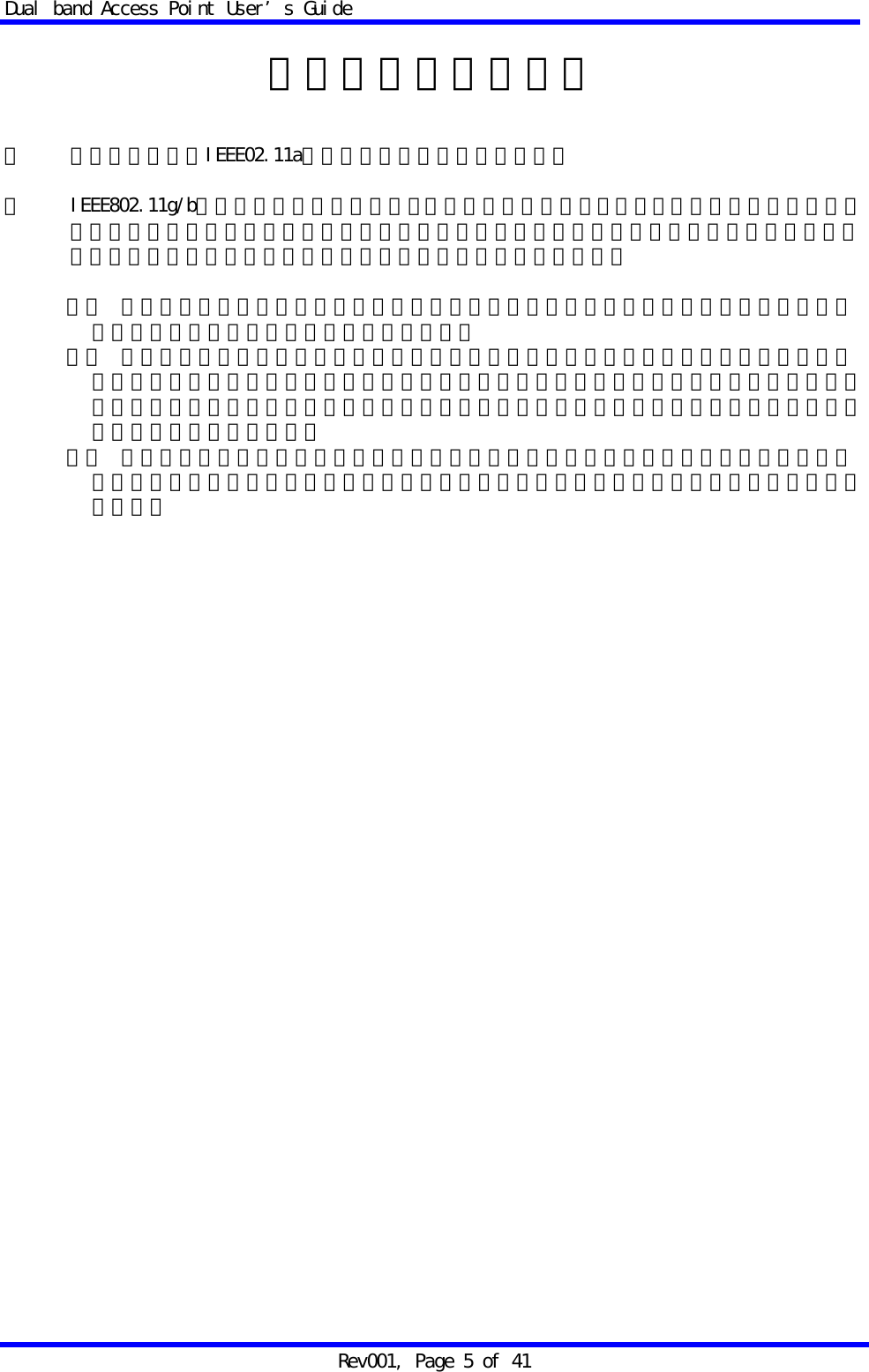
Dual band Access Point User’s Guide Rev001, Page 5 of 41  電波に関するご注意  ・ 本機器におけるIEEE02.11aでの通信は屋内に限られます。  ・ IEEE802.11g/bで使用する周波数帯では、電子レンジ等の産業・科学・医療用機器のほか工場の製造ライン等で使用されている移動体識別用の構内無線局(免許を要する無線局)及び特定小電力無線局(免許を要しない無線局)が運用されています。  1. この機器を使用する前に、近くで移動体識別用の構内無線局及び特定小電力無線局が運用されていないことを確認してください。 2. 万一、この機器から移動体識別用の構内無線局に対して電波干渉の事例が発生した場合には、速やかに仕様周波数を変更するか、又は電波の発射を停止した上、弊社サポートセンターにご連絡頂き、混信回避のための処置等(例えば、パーティションの設置など)についてご相談ください。 3. その他、この機器から移動体識別用の特定小電力無線局に対して電波干渉事例が発生した場合など何かお困りのことが起きたときは、弊社サポートセンターへお問い合わせください。
Dual band Access Point User’s Guide Rev001, Page 6 of 41 Safety information WARNING  ・Opening the unit, for whatever reason, could read to damages that are not covered by the warranty. ・Do not touch the device or accessories during thunder storms. Electrical shock could result. ・For indoor use only. ・Do not use this equipment on hospital premises. Doing so many cause medical devices to malfunction. ・If using the equipment near a pacemaker, make sure it is at least 9inches (22cm) away from the pacemaker. ・Do not use this equipment in an aircraft, as doing so could cause the aircraft‘s equipment to malfunction. ・While using the Access Point, do not cover it or turn it on its side. Do not cover the Access Point with objects such as magazines or newspapers or use it in confined, enclosed places, such as the spaces between walls and furniture. Further, do not turn the Access Point on its side while using it. Either situation could cause heat to build up inside the Access Point, leading to overheating and possible fire. ・Carefully place  the Ethernet cable, AC adapter, and other wire ring. Personal injury or damage to the Access Point could result from people tripping over the Ethernet cable, AC adapter, or power cord. Protect wiring by locating it in places where people do not walk. ・Do not swing the AC adapter. Injury could result if the adapters strike a person or fragile material, such as glass. ・Keep the Access Point out of the reach of children. Unforeseeable injury could result from swallowing loose parts, etc. ・Place the Access Point on a stable surface. Do not place the Access Point on wobbly or tilted   surfaces. Tipping or falling could result injury. ・When using wall mounting, make sure that the wall is strong enough to support the Access   Point. The Access Point could fall if the wall is not strong enough, leading to unforeseeable accidents. Further, be careful not to drop the unit or the tools used for mounting it. Doing so could result in unforeseeable accidents. ・Avoid locations that are directly exposed to sunlight or heaters. ・Internal overheating could result in fire or damage to the unit. ・Make sure connectors are properly connected. −Do not insert any metallic objects inside the connectors. Short-circuiting then pins could cause fire or damage to the unit. −Be careful to insert connectors squarely. Crooked insertion could cause pins to short-circuit, possibly causing fire or damage to the unit. ・Use only the supplied AC adapter with Access Point. To disconnect Access Point from the power supply, unplug the AC adapter.
Dual band Access Point User’s Guide Rev001, Page 7 of 41 Precautions AC Adapter Use only supplied AC adapter. Other AC adapters may cause a failure in the Access Point. Safety Do not drop the Access Point. Careful handling will help prevent damage. Installation Do not place the Access Point where it will be exposed to the following conditions: ■ Unstable surface. ■  High humidity or poor ventilation. ■ Excessive dust. ■  Direct sunlight or extreme heat. ■ Closed cars. ■  Magnetized location (near magnet, speakers, or televisions). ■  Locations exposed to frequent vibration. ■  Locations where the transmission of radio waves may be obstructed by metal plates or concrete walls. Operation Exposure to cold-to hot temperature extremes or very damp environments may cause moisture to condense on internal parts. This may prevent the Access Point from operating properly. If this should happen, unplug the AC adapter from the power outlet and let the Access Point sit for two to three hours or until the moisture evaporates. Cleaning Clean the casing with a soft cloth lightly moistened with water or a mild detergent solution. Do not use any type of abrasive pad, scouring powder or solvent such as alcohol or benzene. This may damage the finish of the casing.
Dual band Access Point User’s Guide Rev001, Page 8 of 41 Contents    Chapter1 introduction - Describes the Access Point package contents and system requirements.  Chapter2  AP Network Attachment and Configuration - Describes the Access Point network connections and initial software configuration.  Appendix A  AP Web Server - Describes the use of the web server to configure the access point.
Dual band Access Point User’s Guide Rev001, Page 9 of 41 1 Introduction  Package Contents Once you have unpacked the units, make sure that all of the following items are present. ■ Access Point (TMW1247) ■ AC Adaptor ■ Power Cable ■ External Antenna (TMM1262)   System Requirements The AP contains a small boot executive that allows the main operating system software to be downloaded using the Ethernet Port over an FTP connection. The operating system software can also reside in the Flash memory of the AP, which allows booting without the need to download the operating system from the host PC over an FTP connection. A configuration file is created in Flash memory to store user-configurable parameters such as wired equivalent Privacy (WEP) keys. A terminal or PC with an Ethernet connection is required to perform the initial AP configuration. An FTP server is required for firmware update to the AP.  WARNING: lf end users are allowed to upgrade firmware through the FTP server,confirm that the End User License Agreement (EULA) covers upgrades to the firmware. The AP upgrade code permits direct upgrades of the AP from the configuration screen if a web browser is used. As a precaution, also use the EULA as the FTP startup text in the event some end users log in to the FTP server manually.  Use the AP Web Server for firmware updates. Refer to ″AP Firmware Update Configuration Window″ on Page A-33 for information on the web server.
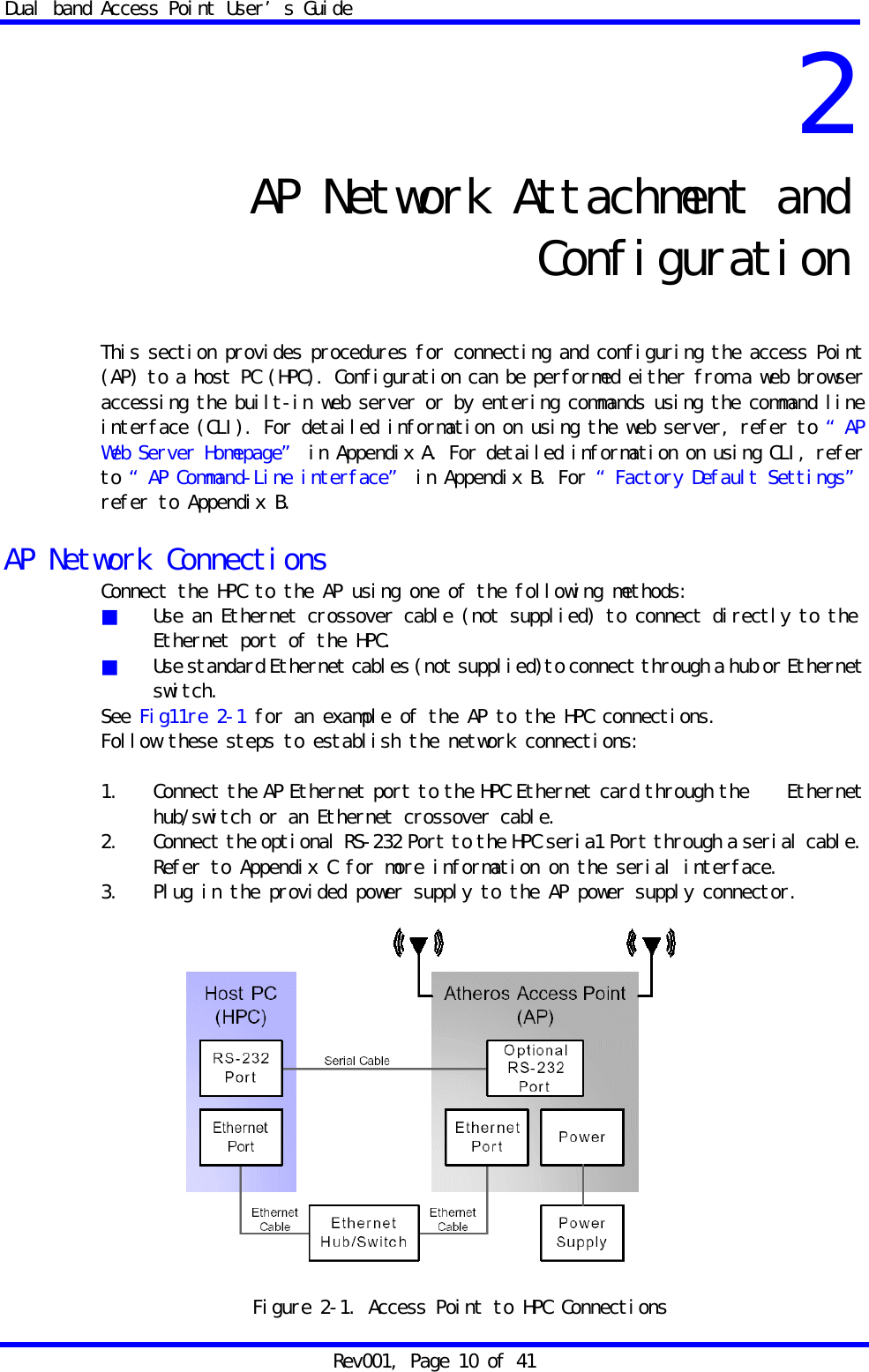
Dual band Access Point User’s Guide Rev001, Page 10 of 41 2   AP Network Attachment and            Configuration   This section provides procedures for connecting and configuring the access Point (AP) to a host PC (HPC). Configuration can be performed either from a web browser accessing the built-in web server or by entering commands using the command line interface (CLI). For detailed information on using the web server, refer to “AP Web Server Homepage” in Appendix A. For detailed information on using CLI, refer to “AP Command-Line interface” in Appendix B. For “Factory Default Settings” refer to Appendix B.  AP Network Connections Connect the HPC to the AP using one of the following methods: ■  Use an Ethernet crossover cable (not supplied) to connect directly to the Ethernet port of the HPC. ■  Use standard Ethernet cables (not supplied)to connect through a hub or Ethernet switch. See Fig11re 2-1 for an example of the AP to the HPC connections. Follow these steps to establish the network connections:  1.  Connect the AP Ethernet port to the HPC Ethernet card through the  Ethernet hub/switch or an Ethernet crossover cable. 2.  Connect the optional RS-232 Port to the HPC seria1 Port through a serial cable. Refer to Appendix C for more information on the serial interface. 3.  Plug in the provided power supply to the AP power supply connector.   Figure 2-1. Access Point to HPC Connections
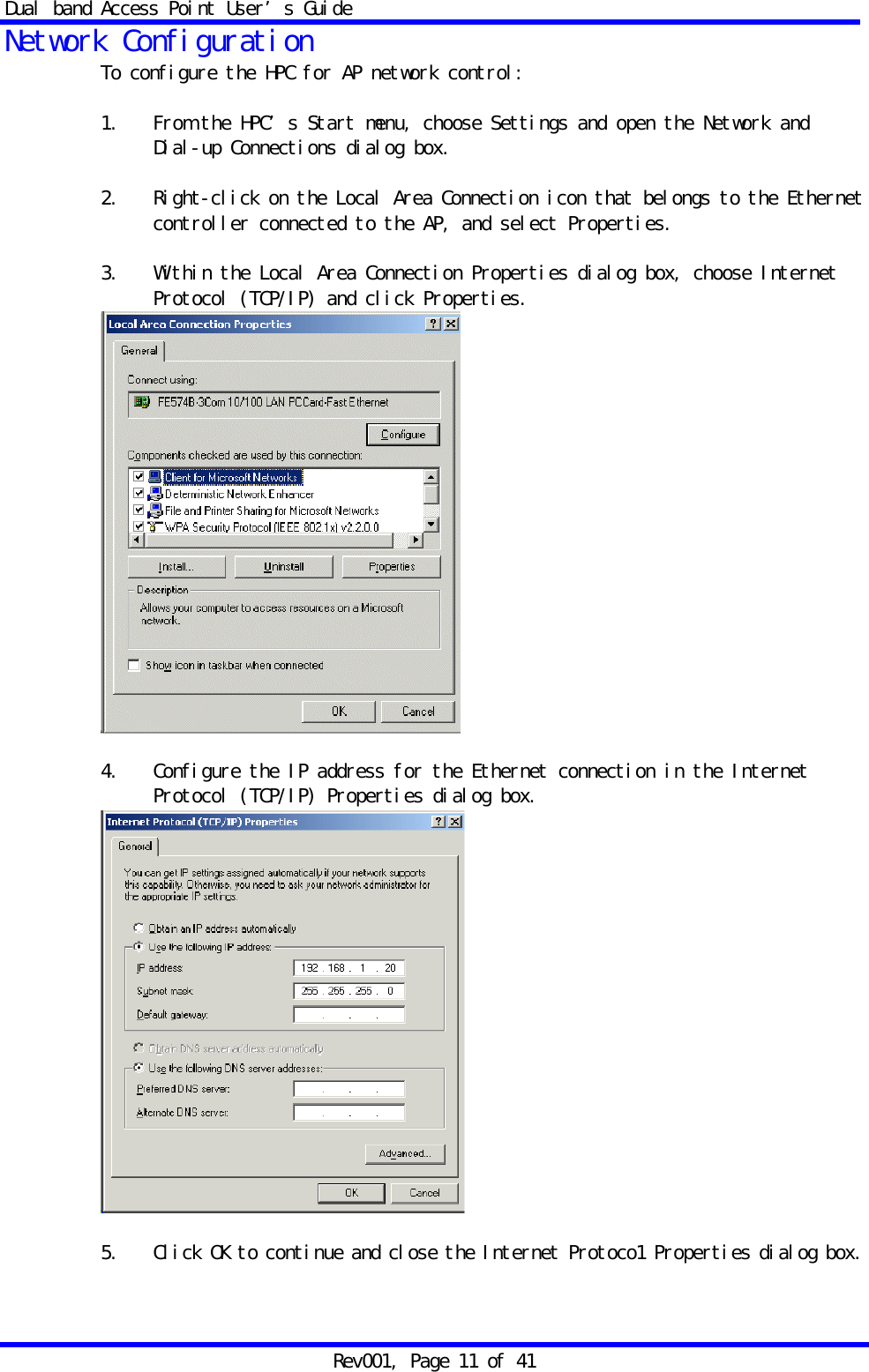
Dual band Access Point User’s Guide Rev001, Page 11 of 41 Network Configuration To configure the HPC for AP network control:  1.  From the HPC’s Start menu, choose Settings and open the Network and    Dial-up Connections dialog box.  2.  Right-click on the Local Area Connection icon that belongs to the Ethernet controller connected to the AP, and select Properties.  3.  Within the Local Area Connection Properties dialog box, choose Internet Protocol (TCP/IP) and click Properties.   4.  Configure the IP address for the Ethernet connection in the Internet    Protocol (TCP/IP) Properties dialog box.   5.  Click OK to continue and close the Internet Protoco1 Properties dialog box.
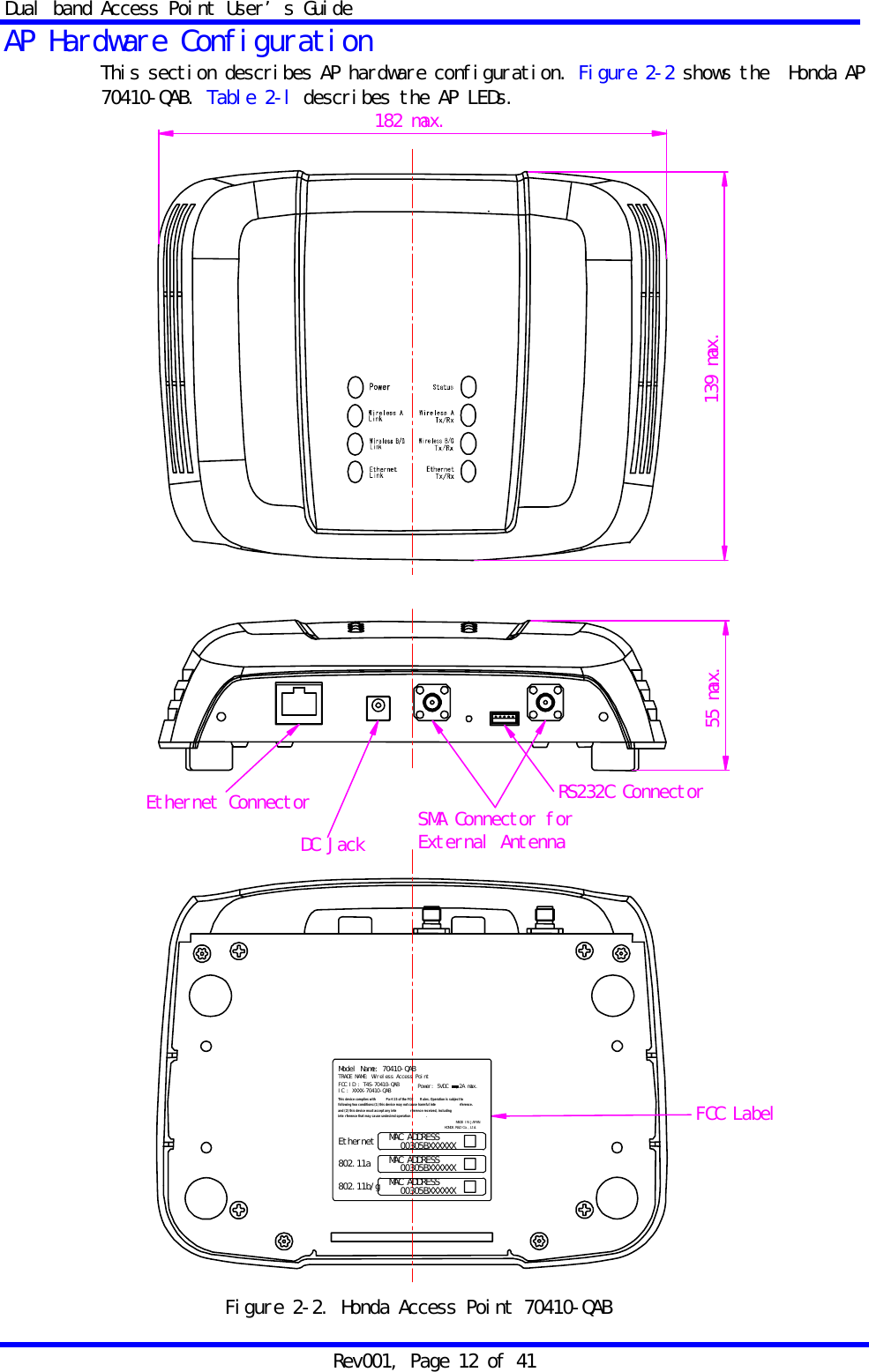
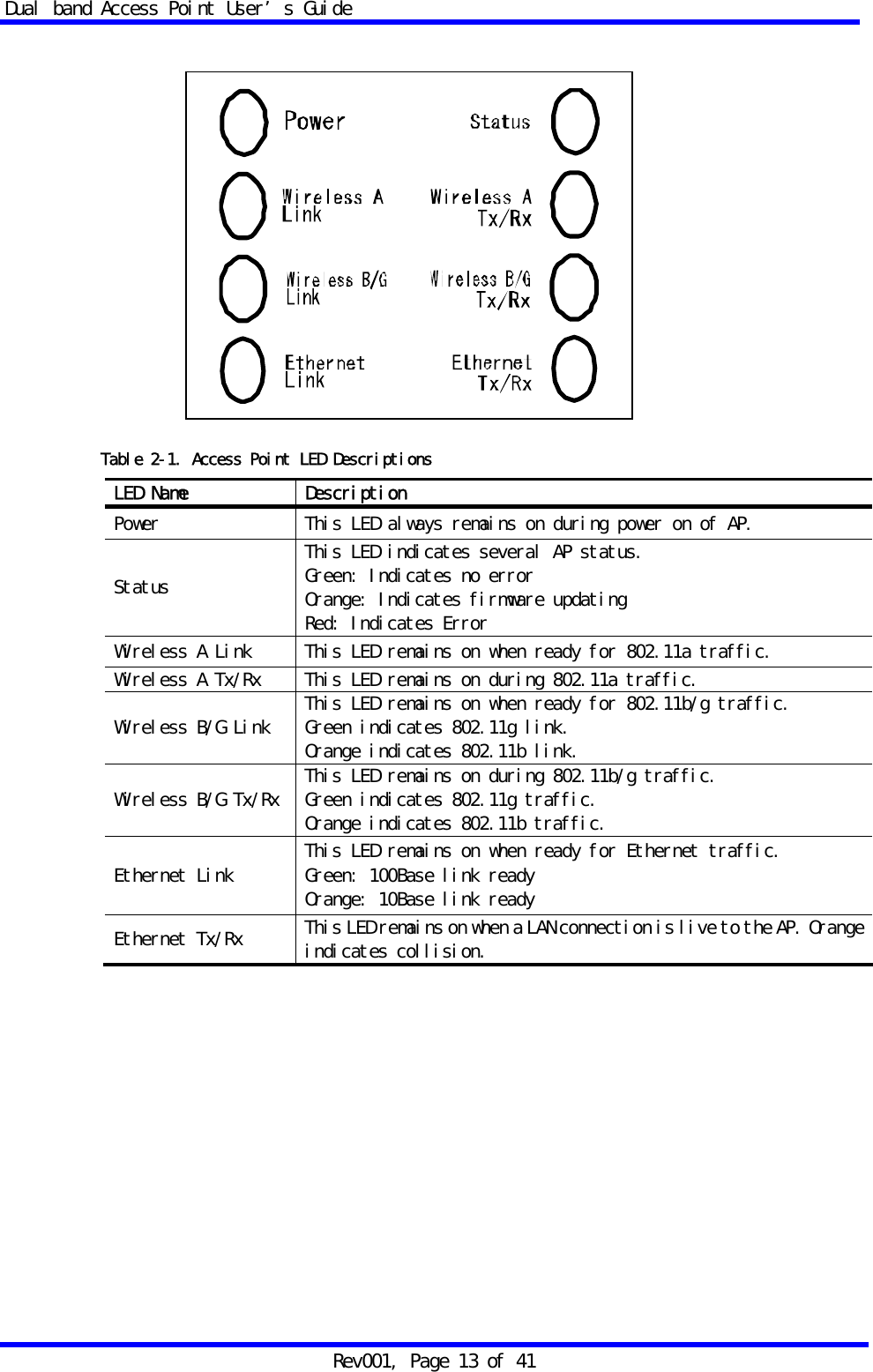
Dual band Access Point User’s Guide Rev001, Page 12 of 41 AP Hardware Configuration This section describes AP hardware configuration. Figure 2-2 shows the  Honda AP 70410-QAB. Table 2-l describes the AP LEDs.                       Figure 2-2. Honda Access Point 70410-QAB 139 max.182 max.55 max.SMA Connector forExternal AntennaEthernet ConnectorDC JackRS232C ConnectorFCC Label00305BXXXXXX00305BXXXXXX00305BXXXXXXMAC ADDRESSMAC ADDRESSMAC ADDRESSTRADE NAME: Wireless Access PointModel Name: 70410-QABIC : XXXX-70410-QABFCC ID : T4S-70410-QABThis device complies with P art 15 of the FCC R ules. Operation is subject tofollowing two conditions:(1) this device may not cause harmful inte r ference.and (2) this device must accept any inte r ference received, includinginte rference that may cause undesired operation .802.11b/g802.11aEthernetHONDA R&D Co.,Ltd.MADE IN JAPANPower: 5VDC   ,2A max.
Dual band Access Point User’s Guide Rev001, Page 13 of 41                  Table 2-1. Access Point LED Descriptions LED Name  Description Power  This LED always remains on during power on of AP. Status This LED indicates several AP status. Green: Indicates no error Orange: Indicates firmware updating Red: Indicates Error Wireless A Link  This LED remains on when ready for 802.11a traffic.  Wireless A Tx/Rx  This LED remains on during 802.11a traffic. Wireless B/G Link  This LED remains on when ready for 802.11b/g traffic.  Green indicates 802.11g link. Orange indicates 802.11b link. Wireless B/G Tx/Rx  This LED remains on during 802.11b/g traffic. Green indicates 802.11g traffic. Orange indicates 802.11b traffic. Ethernet Link  This LED remains on when ready for Ethernet traffic. Green: 100Base link ready Orange: 10Base link ready Ethernet Tx/Rx  This LED remains on when a LAN connection is live to the AP. Orange indicates collision.
Dual band Access Point User’s Guide Rev001, Page 14 of 41 AP Initial Configuration Configure the AP after booting from Flash memory. Refer to “Firmware Update Configuration window” on Page A-33 for information on loading the operating image file to the Flash file system, if the operating system software needs updating.  Configure the AP for its channel frequency and service set identifier (SSID) unique to the application. This configuration can be done through a web browser with access to the built-in AP web server. The AP can be configured at any time to tailor it for the application environment.  For more information on configuring the AP using the web browser, refer to “AP Web Server” in Appendix A.   The following description illustrates the use of the web browser.
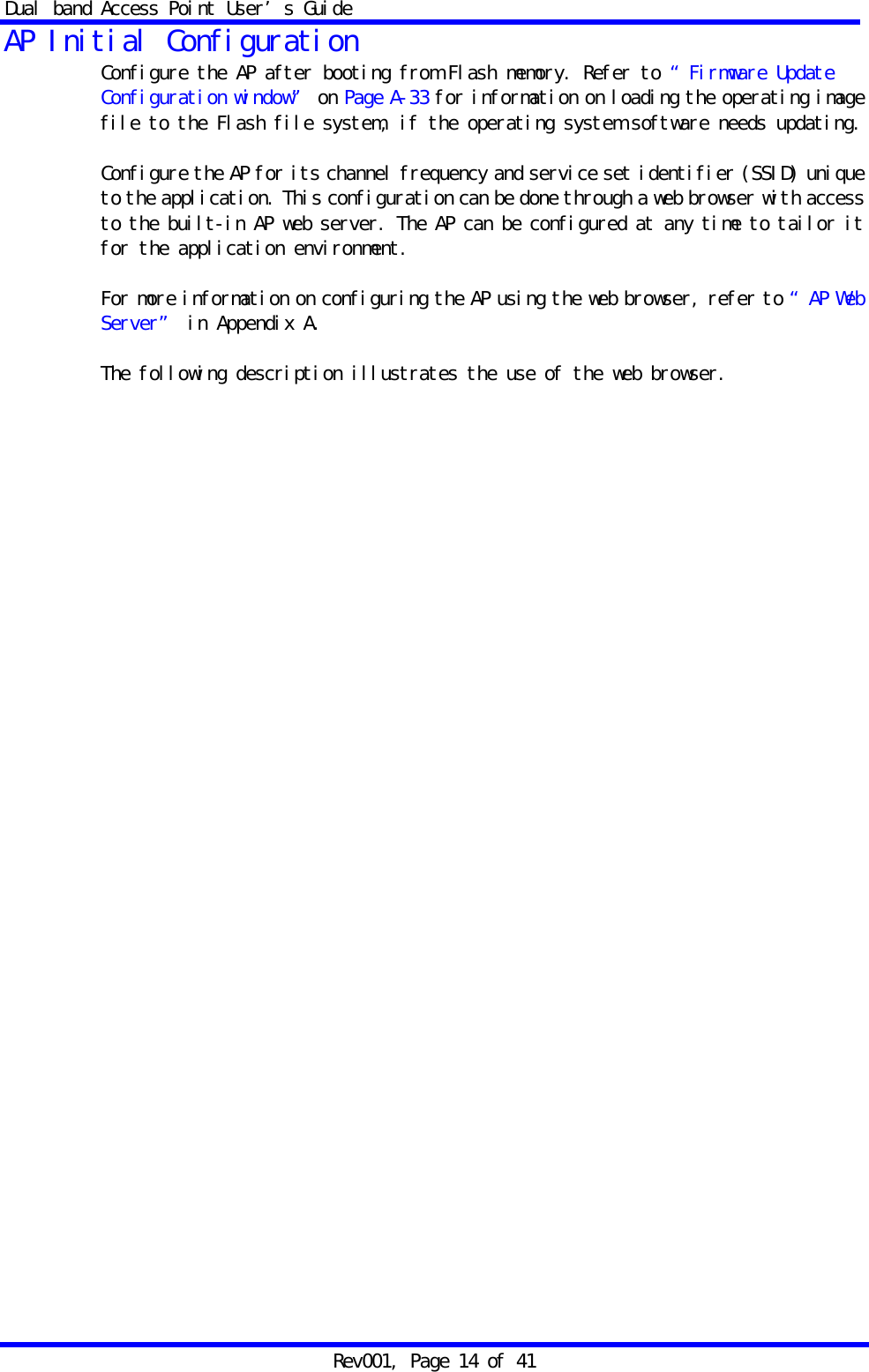
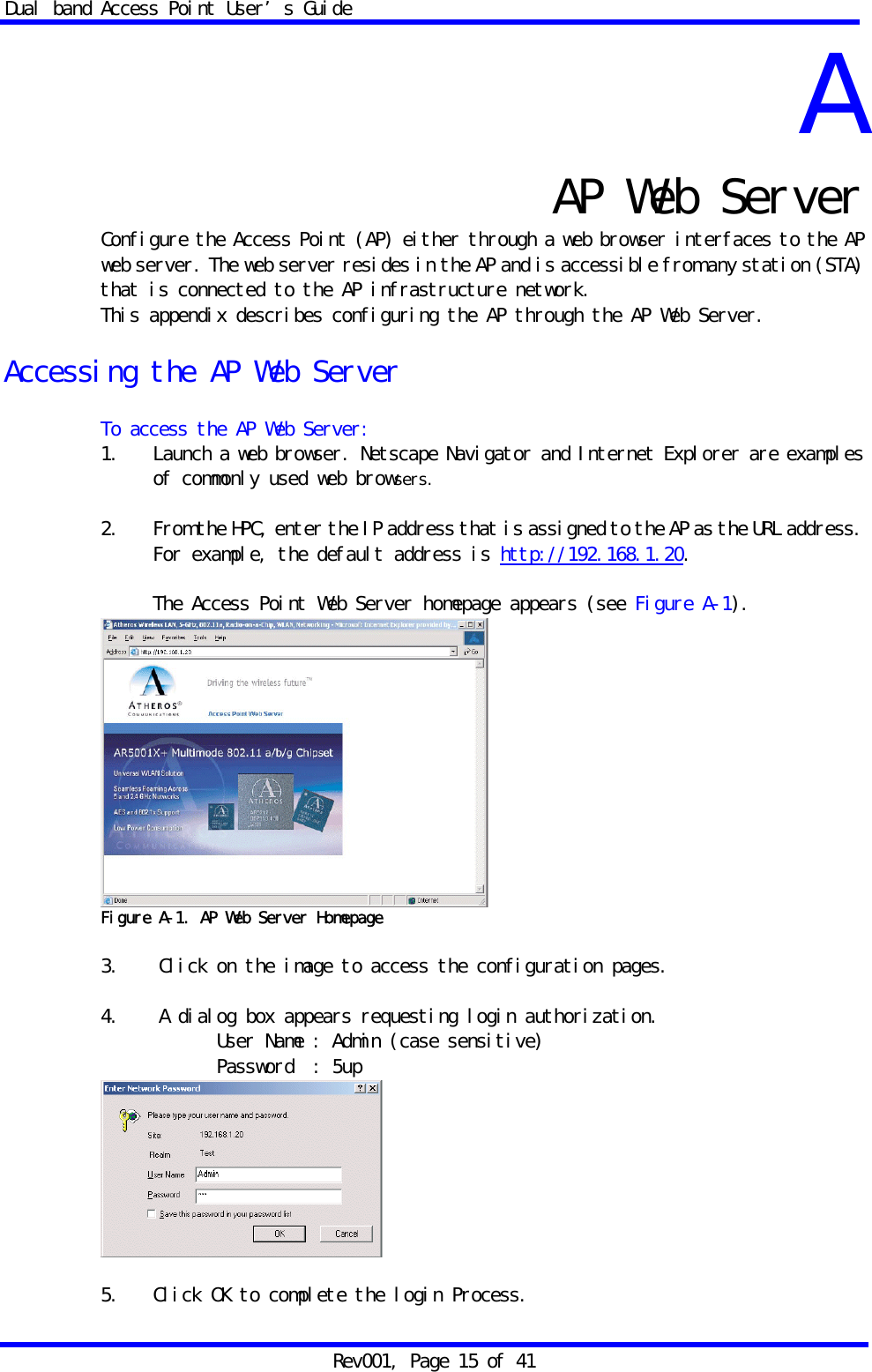
Dual band Access Point User’s Guide Rev001, Page 15 of 41 A  AP Web Server Configure the Access Point (AP) either through a web browser interfaces to the AP web server. The web server resides in the AP and is accessible from any station (STA) that is connected to the AP infrastructure network. This appendix describes configuring the AP through the AP Web Server.  Accessing the AP Web Server  To access the AP Web Server: 1.   Launch a web browser. Netscape Navigator and Internet Explorer are examples of commonly used web browsers.  2.    From the HPC, enter the IP address that is assigned to the AP as the URL address. For example, the default address is http://192.168.1.20.  The Access Point Web Server homepage appears (see Figure A-1).  Figure A-1. AP Web Server Homepage  3.   Click on the image to access the configuration pages.  4.   A dialog box appears requesting login authorization.             User Name : Admin (case sensitive) Password  : 5up   5.   Click OK to complete the login Process.
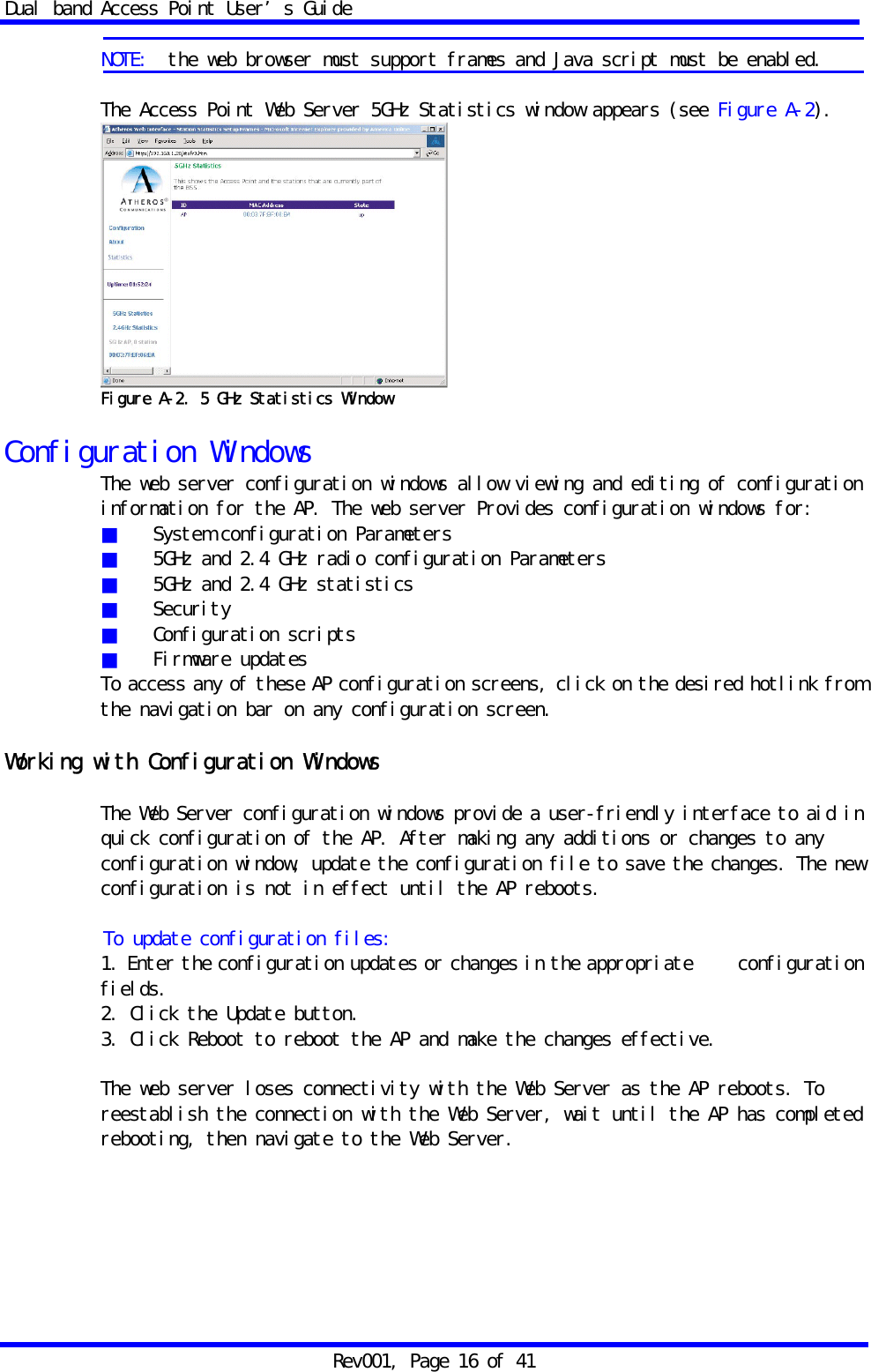
Dual band Access Point User’s Guide Rev001, Page 16 of 41  NOTE:  the web browser must support frames and Java script must be enabled.  The Access Point Web Server 5GHz Statistics window appears (see Figure A-2).  Figure A-2. 5 GHz Statistics Window  Configuration Windows The web server configuration windows allow viewing and editing of configuration information for the AP. The web server Provides configuration windows for: ■  System configuration Parameters ■   5GHz and 2.4 GHz radio configuration Parameters ■   5GHz and 2.4 GHz statistics ■  Security ■  Configuration scripts ■  Firmware updates To access any of these AP configuration screens, click on the desired hotlink from the navigation bar on any configuration screen.  Working with Configuration Windows  The Web Server configuration windows provide a user-friendly interface to aid in quick configuration of the AP. After making any additions or changes to any configuration window, update the configuration file to save the changes. The new configuration is not in effect until the AP reboots.  To update configuration files: 1. Enter the configuration updates or changes in the appropriate   configuration fields. 2. Click the Update button. 3. Click Reboot to reboot the AP and make the changes effective.  The web server loses connectivity with the Web Server as the AP reboots. To reestablish the connection with the Web Server, wait until the AP has completed rebooting, then navigate to the Web Server.
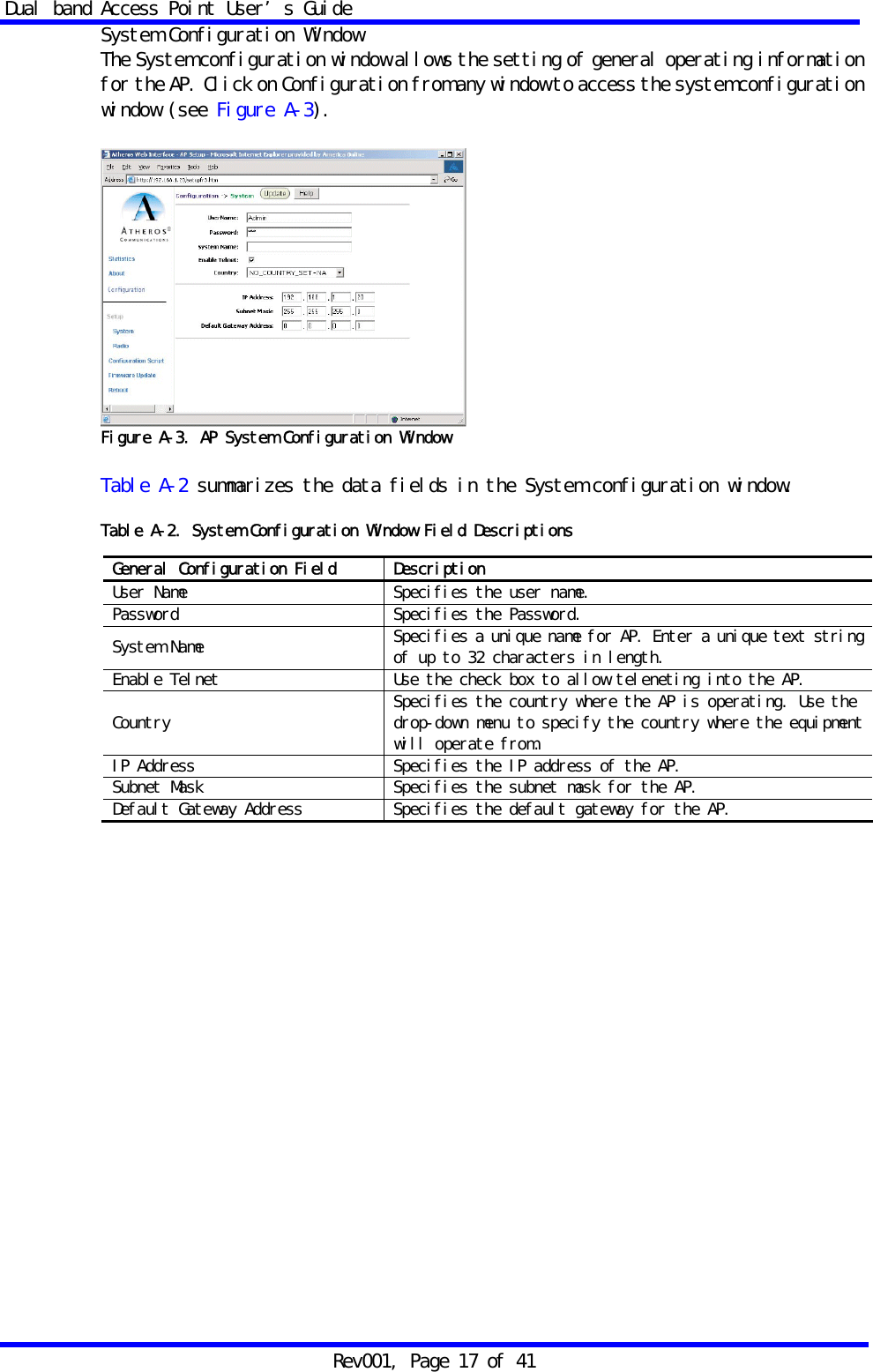
Dual band Access Point User’s Guide Rev001, Page 17 of 41 System Configuration Window The System configuration window allows the setting of general operating information for the AP. Click on Configuration from any window to access the system configuration window (see Figure A-3).   Figure A-3. AP System Configuration Window  Table A-2 summarizes the data fields in the System configuration window.  Table A-2. System Configuration Window Field Descriptions      General Configuration Field  Description User Name  Specifies the user name. Password  Specifies the Password. System Name  Specifies a unique name for AP. Enter a unique text string of up to 32 characters in length. Enable Telnet  Use the check box to allow teleneting into the AP. Country  Specifies the country where the AP is operating. Use the drop-down menu to specify the country where the equipment will operate from. IP Address  Specifies the IP address of the AP. Subnet Mask  Specifies the subnet mask for the AP. Default Gateway Address  Specifies the default gateway for the AP.
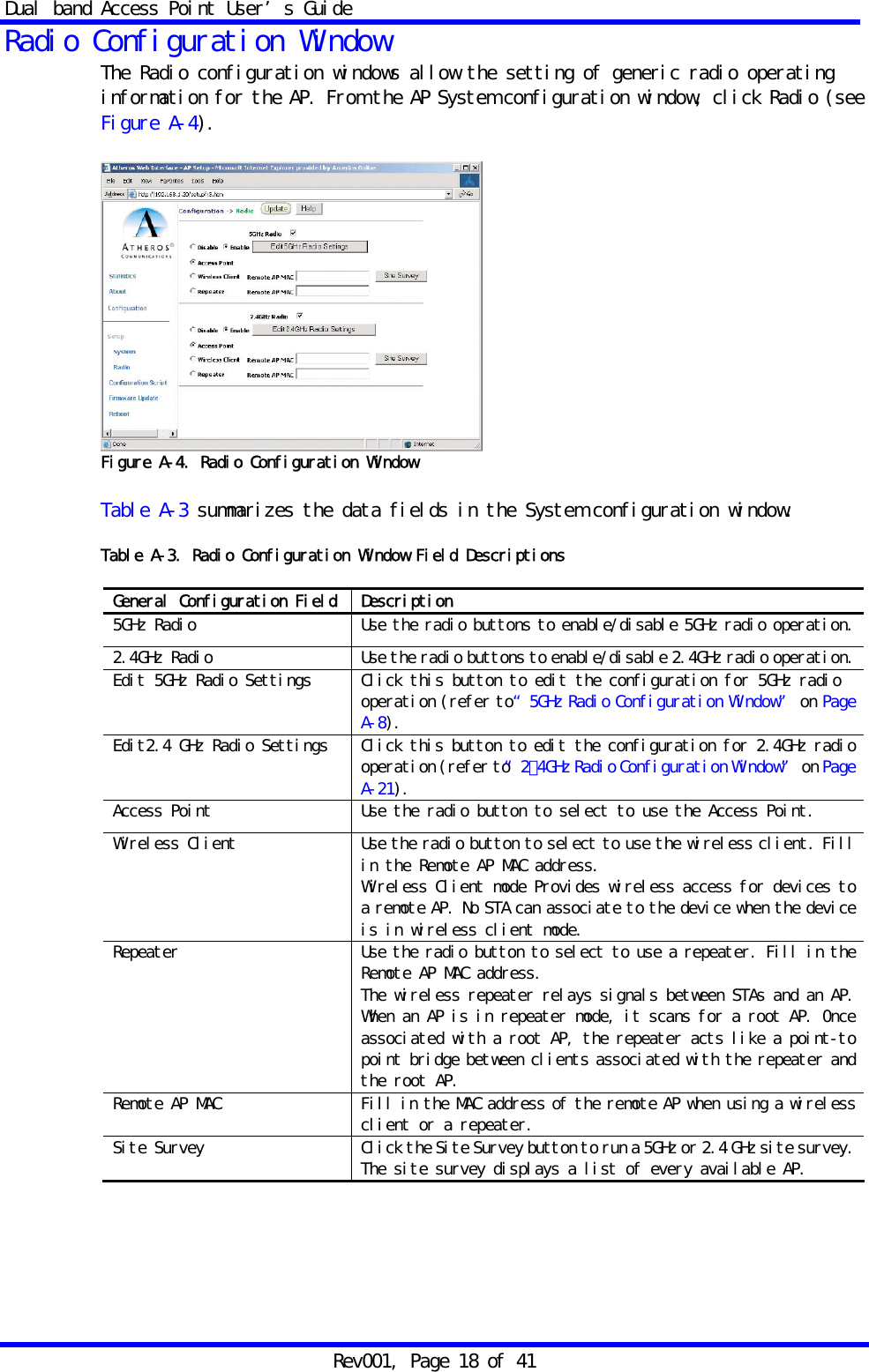
Dual band Access Point User’s Guide Rev001, Page 18 of 41 Radio Configuration Window The Radio configuration windows allow the setting of generic radio operating information for the AP. From the AP System configuration window, click Radio (see Figure A-4).   Figure A-4. Radio Configuration Window  Table A-3 summarizes the data fields in the System configuration window.  Table A-3. Radio Configuration Window Field Descriptions  General Configuration Field Description 5GHz Radio  Use the radio buttons to enable/disable 5GHz radio operation.2.4GHz  Radio  Use the radio buttons to enable/disable 2.4GHz radio operation.Edit 5GHz Radio Settings  Click this button to edit the configuration for 5GHz radio operation (refer to“5GHz Radio Configuration Window” on Page A-8). Edit2.4 GHz Radio Settings  Click this button to edit the configuration for 2.4GHz radio operation (refer to“2、4GHz Radio Configuration Window” on Page A-21). Access Point  Use the radio button to select to use the Access Point. Wireless Client  Use the radio button to select to use the wireless client. Fill in the Remote AP MAC address. Wireless Client mode Provides wireless access for devices to a remote AP. No STA can associate to the device when the device is in wireless client mode. Repeater  Use the radio button to select to use a repeater. Fill in the Remote AP MAC address. The wireless repeater relays signals between STAs and an AP. When an AP is in repeater mode, it scans for a root AP. 0nce associated with a root AP, the repeater acts like a point-to point bridge between clients associated with the repeater and the root AP. Remote AP MAC  Fill in the MAC address of the remote AP when using a wireless client or a repeater. Site  Survey  Click the Site Survey button to run a 5GHz or 2.4 GHz site survey. The site survey displays a list of every available AP.
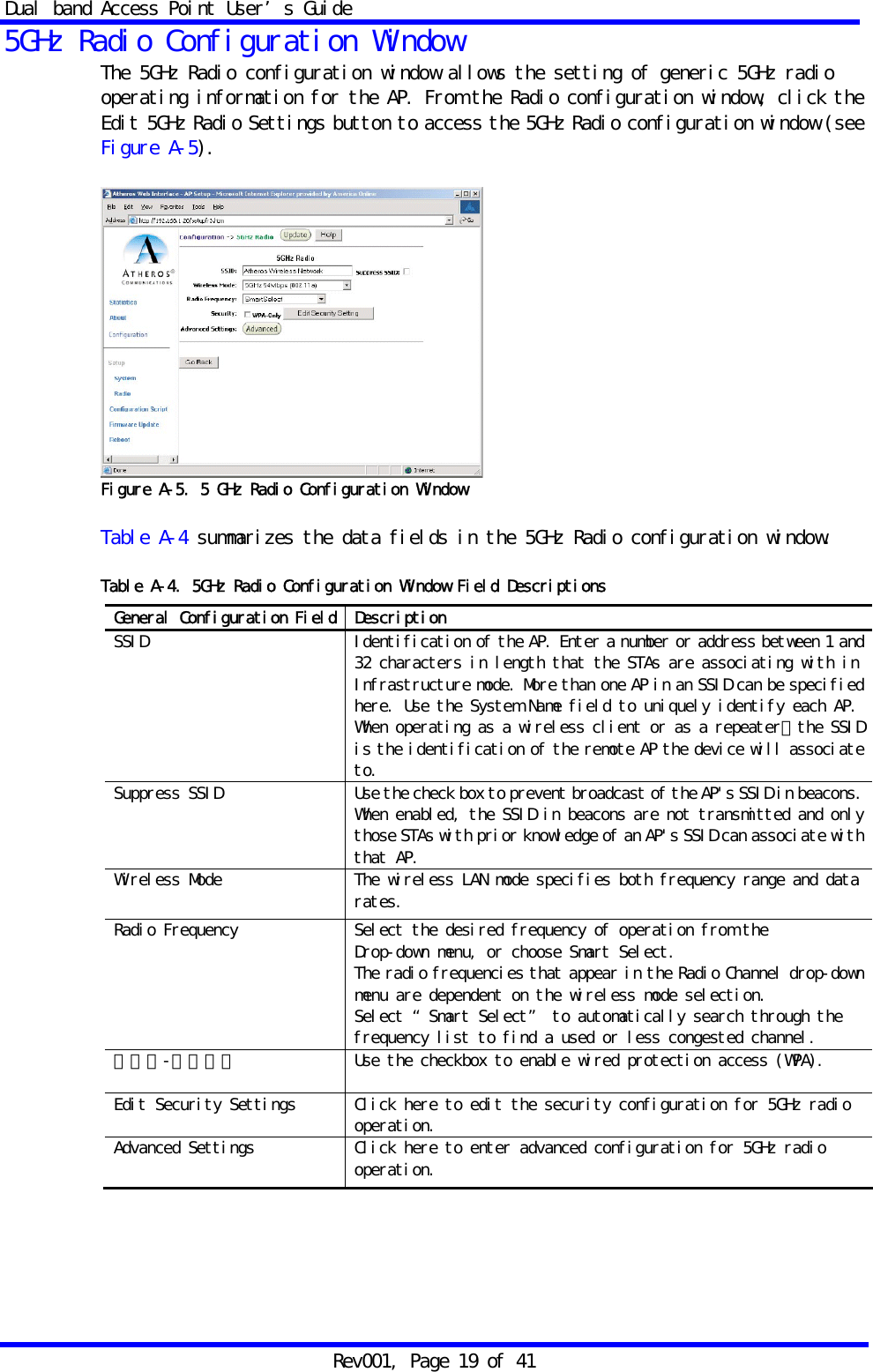
Dual band Access Point User’s Guide Rev001, Page 19 of 41 5GHz Radio Configuration Window The 5GHz Radio configuration window allows the setting of generic 5GHz radio operating information for the AP. From the Radio configuration window, click the Edit 5GHz Radio Settings button to access the 5GHz Radio configuration window (see Figure A-5).   Figure A-5. 5 GHz Radio Configuration Window  Table A-4 summarizes the data fields in the 5GHz Radio configuration window.  Table A-4. 5GHz Radio Configuration Window Field Descriptions    General Configuration Field Description SSID  Identification of the AP. Enter a number or address between 1 and 32 characters in length that the STAs are associating with in Infrastructure mode. More than one AP in an SSID can be specified here. Use the System Name field to uniquely identify each AP.When operating as a wireless client or as a repeater,the SSID is the identification of the remote AP the device will associate to. Suppress SSID  Use the check box to prevent broadcast of the AP's SSID in beacons. When enabled, the SSID in beacons are not transmitted and only those STAs with prior knowledge of an AP's SSID can associate with that AP. Wireless Mode  The wireless LAN mode specifies both frequency range and data rates. Radio Frequency  Select the desired frequency of operation from the Drop-down menu, or choose Smart Select. The radio frequencies that appear in the Radio Channel drop-down menu are dependent on the wireless mode selection. Select “Smart Select” to automatically search through the frequency list to find a used or less congested channel. WPA-Only  Use the checkbox to enable wired protection access (WPA). Edit Security Settings  Click here to edit the security configuration for 5GHz radio operation. Advanced Settings  Click here to enter advanced configuration for 5GHz radio operation.
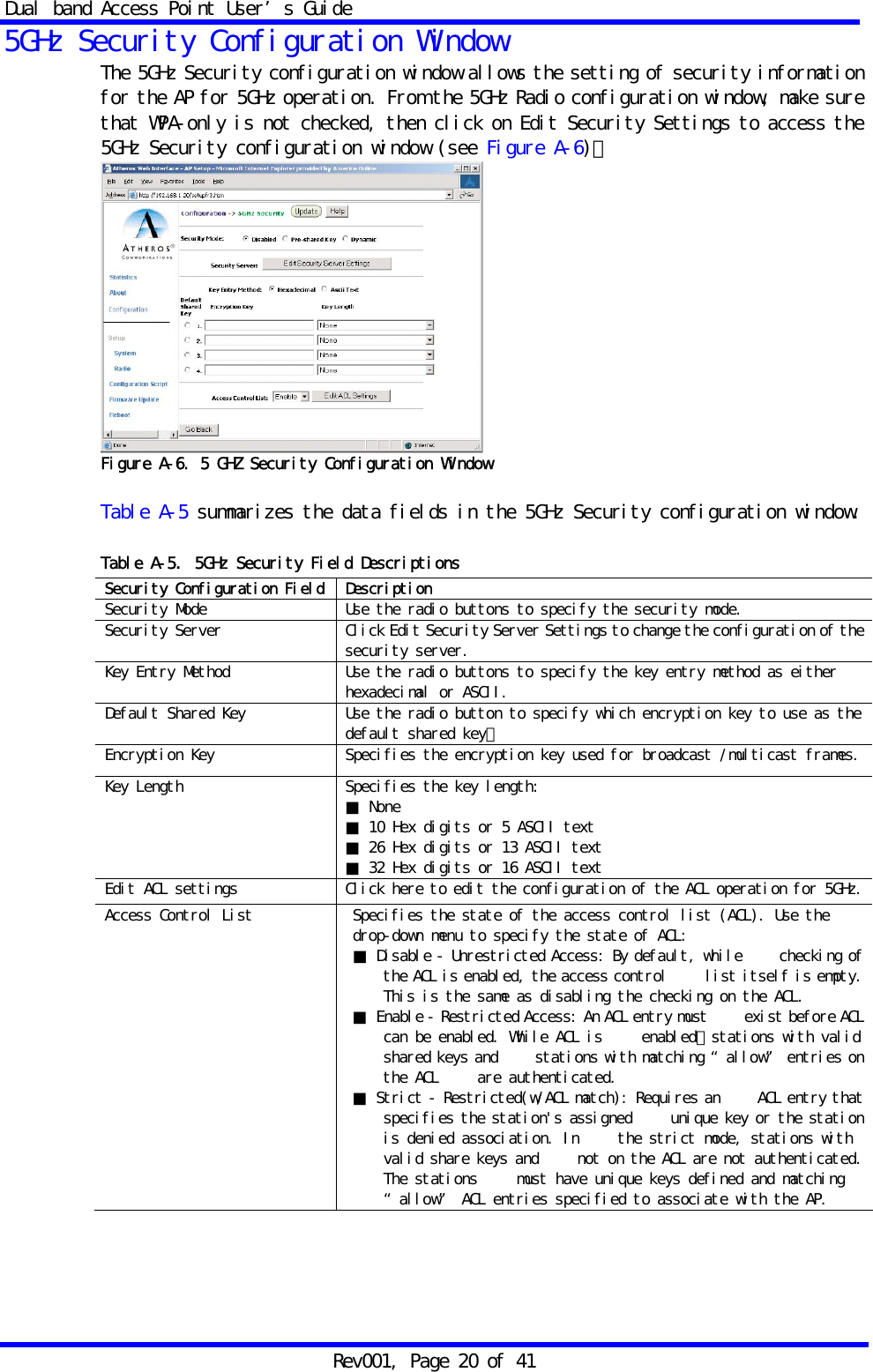
Dual band Access Point User’s Guide Rev001, Page 20 of 41 5GHz Security Configuration Window The 5GHz Security configuration window allows the setting of security information for the AP for 5GHz operation. From the 5GHz Radio configuration window, make sure that WPA-only is not checked, then click on Edit Security Settings to access the 5GHz Security configuration window (see Figure A-6)・  Figure A-6. 5 GHZ Security Configuration Window  Table A-5 summarizes the data fields in the 5GHz Security configuration window.  Table A-5. 5GHz Security Field Descriptions Security Configuration Field  Description Security Mode Use the radio buttons to specify the security mode. Security Server  Click Edit Security Server Settings to change the configuration of the security server. Key Entry Method  Use the radio buttons to specify the key entry method as either hexadecimal or ASCII. Default Shared Key  Use the radio button to specify which encryption key to use as the default shared key・ Encryption Key  Specifies the encryption key used for broadcast /multicast frames.Key Length  Specifies the key length: ■ None ■ 10 Hex digits or 5 ASCII text ■ 26 Hex digits or 13 ASCII text ■ 32 Hex digits or 16 ASCII text Edit ACL settings  Click here to edit the configuration of the ACL operation for 5GHz.Access Control List  Specifies the state of the access control list (ACL). Use the drop-down menu to specify the state of ACL: ■ Disable - Unrestricted Access: By default, while     checking of the ACL is enabled, the access control     list itself is empty. This is the same as disabling the checking on the ACL. ■ Enable - Restricted Access: An ACL entry must     exist before ACL can be enabled. While ACL is     enabled,stations with valid shared keys and     stations with matching “allow” entries on the ACL   are authenticated. ■ Strict - Restricted(w/ACL match): Requires an     ACL entry that specifies the station's assigned     unique key or the station is denied association. In     the strict mode, stations with valid share keys and     not on the ACL are not authenticated. The stations     must have unique keys defined and matching “allow” ACL entries specified to associate with the AP.
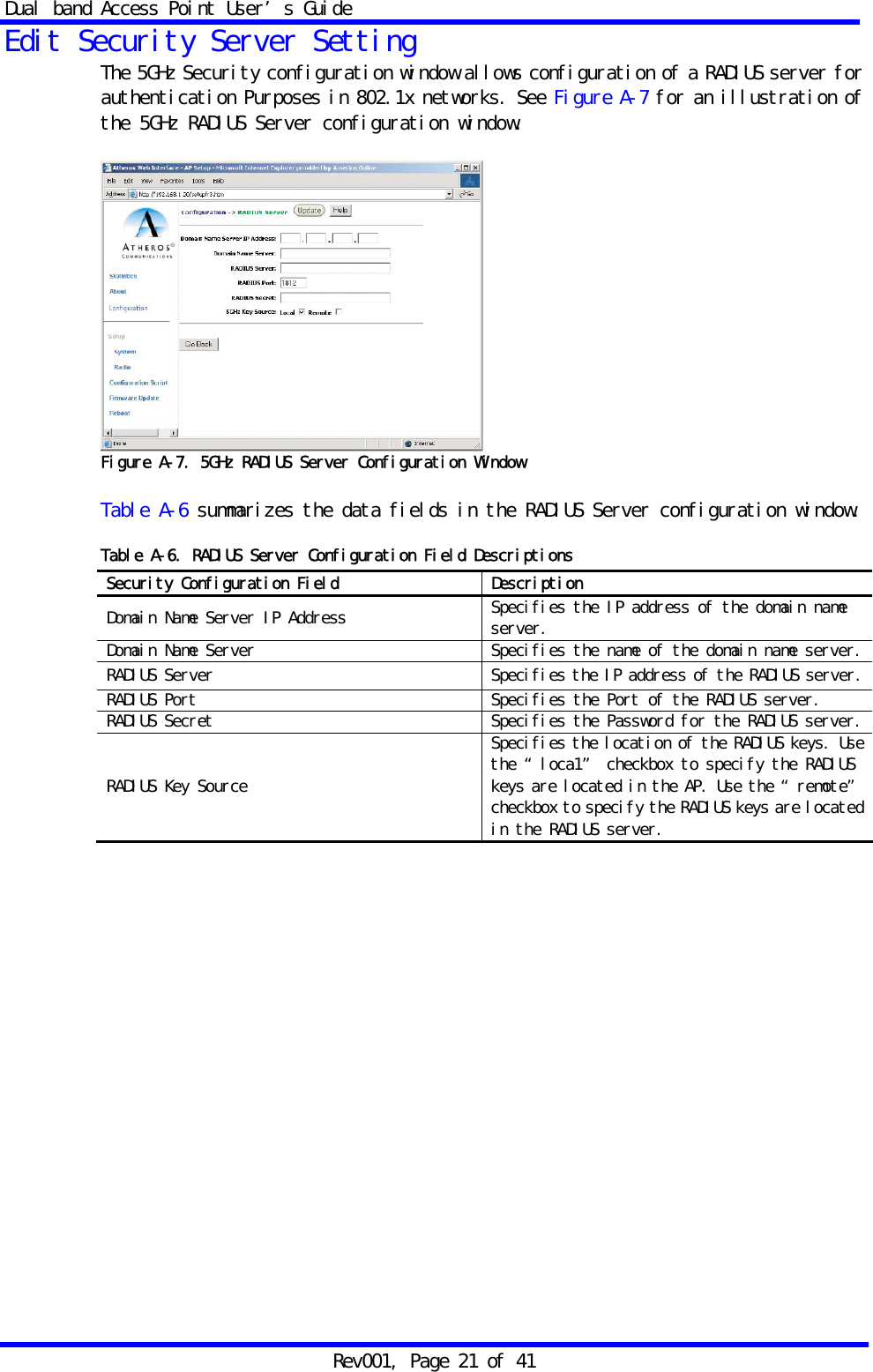
Dual band Access Point User’s Guide Rev001, Page 21 of 41 Edit Security Server Setting The 5GHz Security configuration window allows configuration of a RADIUS server for authentication Purposes in 802.1x networks. See Figure A-7 for an illustration of the 5GHz RADIUS Server configuration window.   Figure A-7. 5GHz RADIUS Server Configuration Window  Table A-6 summarizes the data fields in the RADIUS Server configuration window.  Table A-6. RADIUS Server Configuration Field Descriptions                 Security Configuration Field  Description Domain Name Server IP Address  Specifies the IP address of the domain name server. Domain Name Server  Specifies the name of the domain name server.RADIUS Server  Specifies the IP address of the RADIUS server.RADIUS Port  Specifies the Port of the RADIUS server. RADIUS Secret  Specifies the Password for the RADIUS server.RADIUS Key Source Specifies the location of the RADIUS keys. Use the “loca1” checkbox to specify the RADIUS keys are located in the AP. Use the “remote” checkbox to specify the RADIUS keys are located in the RADIUS server.
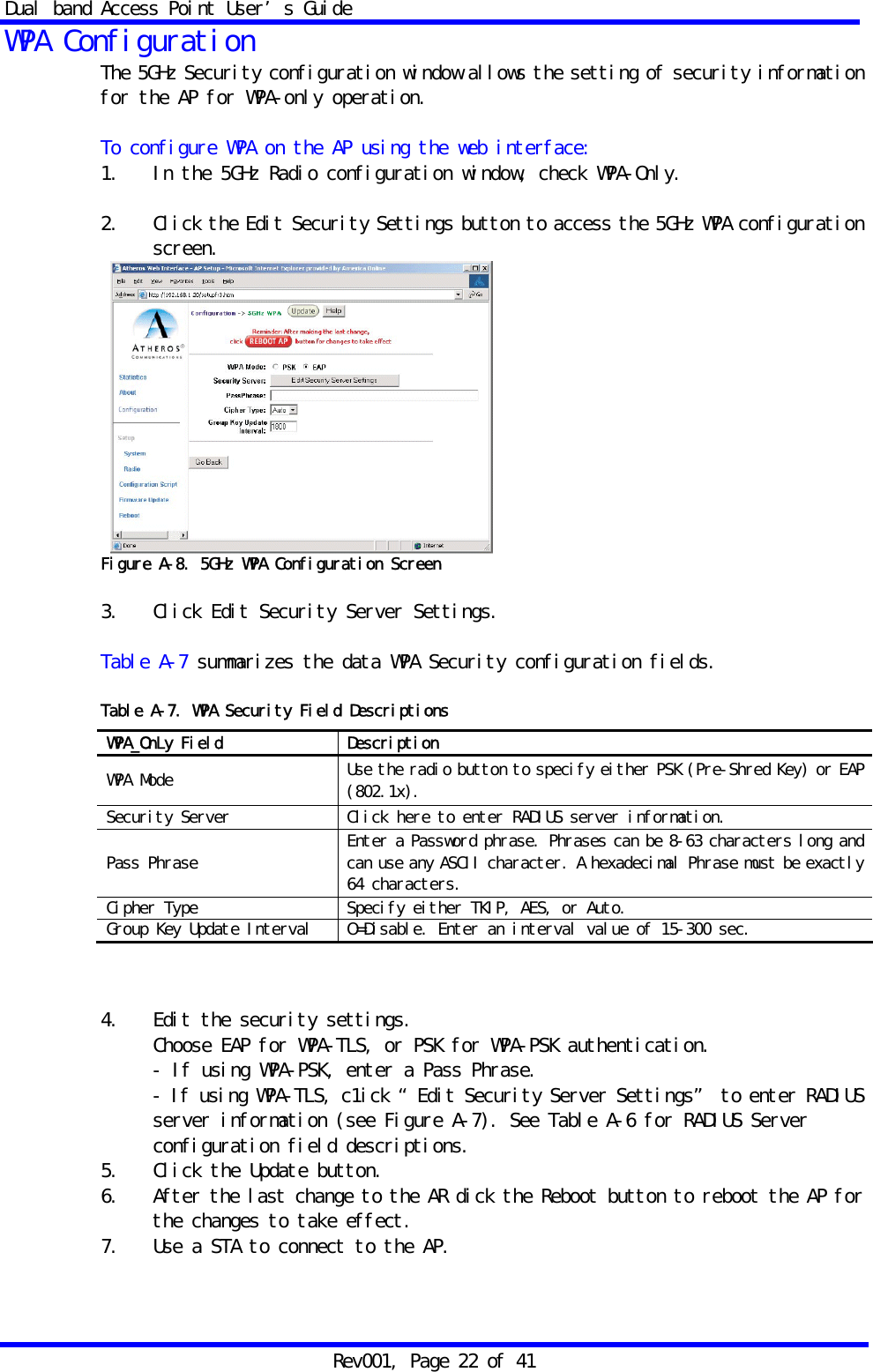
Dual band Access Point User’s Guide Rev001, Page 22 of 41 WPA Configuration The 5GHz Security configuration window allows the setting of security information for the AP for WPA-only operation.  To configure WPA on the AP using the web interface: 1.   In the 5GHz Radio configuration window, check WPA-Only.  2.   Click the Edit Security Settings button to access the 5GHz WPA configuration screen.   Figure A-8. 5GHz WPA Configuration Screen  3.   Click Edit Security Server Settings.  Table A-7 summarizes the data WPA Security configuration fields.  Table A-7. WPA Security Field Descriptions              4.   Edit the security settings. Choose EAP for WPA-TLS, or PSK for WPA-PSK authentication. - If using WPA-PSK, enter a Pass Phrase. - If using WPA-TLS, c1ick “Edit Security Server Settings” to enter RADIUS server information (see Figure A-7). See Table A-6 for RADIUS Server configuration field descriptions. 5.   Click the Update button. 6.   After the last change to the AR dick the Reboot button to reboot the AP for the changes to take effect. 7.   Use a STA to connect to the AP.  WPA_OnLy Field  Description WPA Mode  Use the radio button to specify either PSK (Pre-Shred Key) or EAP (802.1x). Security Server  Click here to enter RADIUS server information. Pass Phrase  Enter a Password phrase. Phrases can be 8-63 characters long and can use any ASCII character. A hexadecimal Phrase must be exactly 64 characters. Cipher Type  Specify either TKIP, AES, or Auto. Group Key Update Interval  O=Disable. Enter an interval value of 15-300 sec.
Dual band Access Point User’s Guide Rev001, Page 23 of 41 5GHz 802.1X Configuration The IEEE 802.1X Protocol is designed to support Port-based authentication and secure key distribution, as well as unique encryption keys distribution for an entire BSS. Honda provides AP and STA support for this Protocol.  To enable 802.1x on the AP, take the following steps on the 5GHz RADIUS Server configuration window (see Figure A-7):  1.   Specify the domain name server IP address.  2.   Specify the name of the domain server.  3.   Specify a RADIUS Server name.  4.   Specify a RADIUS Server secret.  5.   Specify the location of the 5GHz Key Source as Remote.  6.   Click the Update button.  7.   After the last change to the AP, click the Reboot button to reboot the AP for the changes to take effect.  Reminder: After making the last change,  click [Reboot AP] button for changes to take effect.
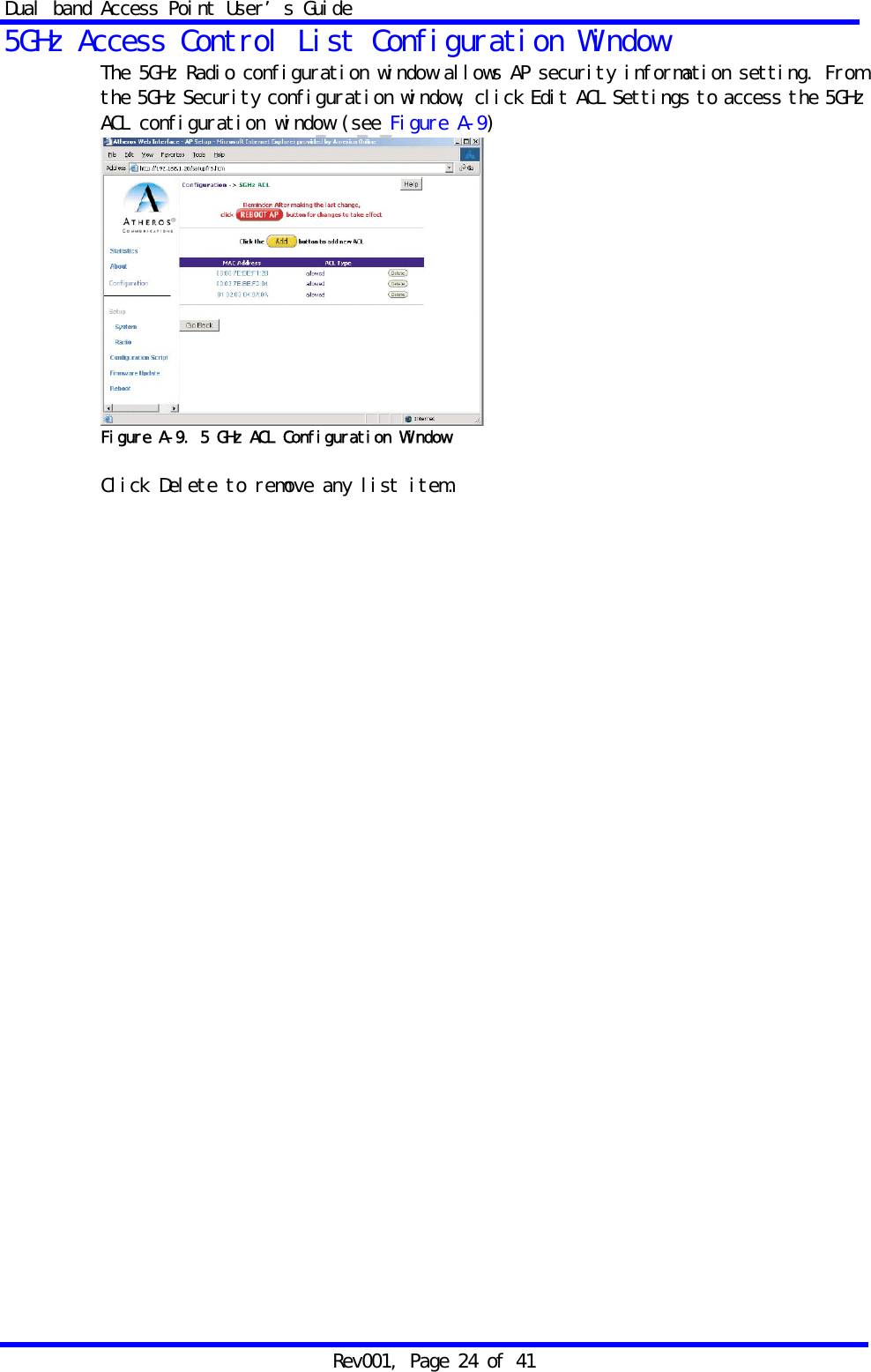
Dual band Access Point User’s Guide Rev001, Page 24 of 41 5GHz Access Control List Configuration Window The 5GHz Radio configuration window allows AP security information setting. From the 5GHz Security configuration window, click Edit ACL Settings to access the 5GHz ACL configuration window (see Figure A-9)  Figure A-9. 5 GHz ACL Configuration Window  Click Delete to remove any list item.
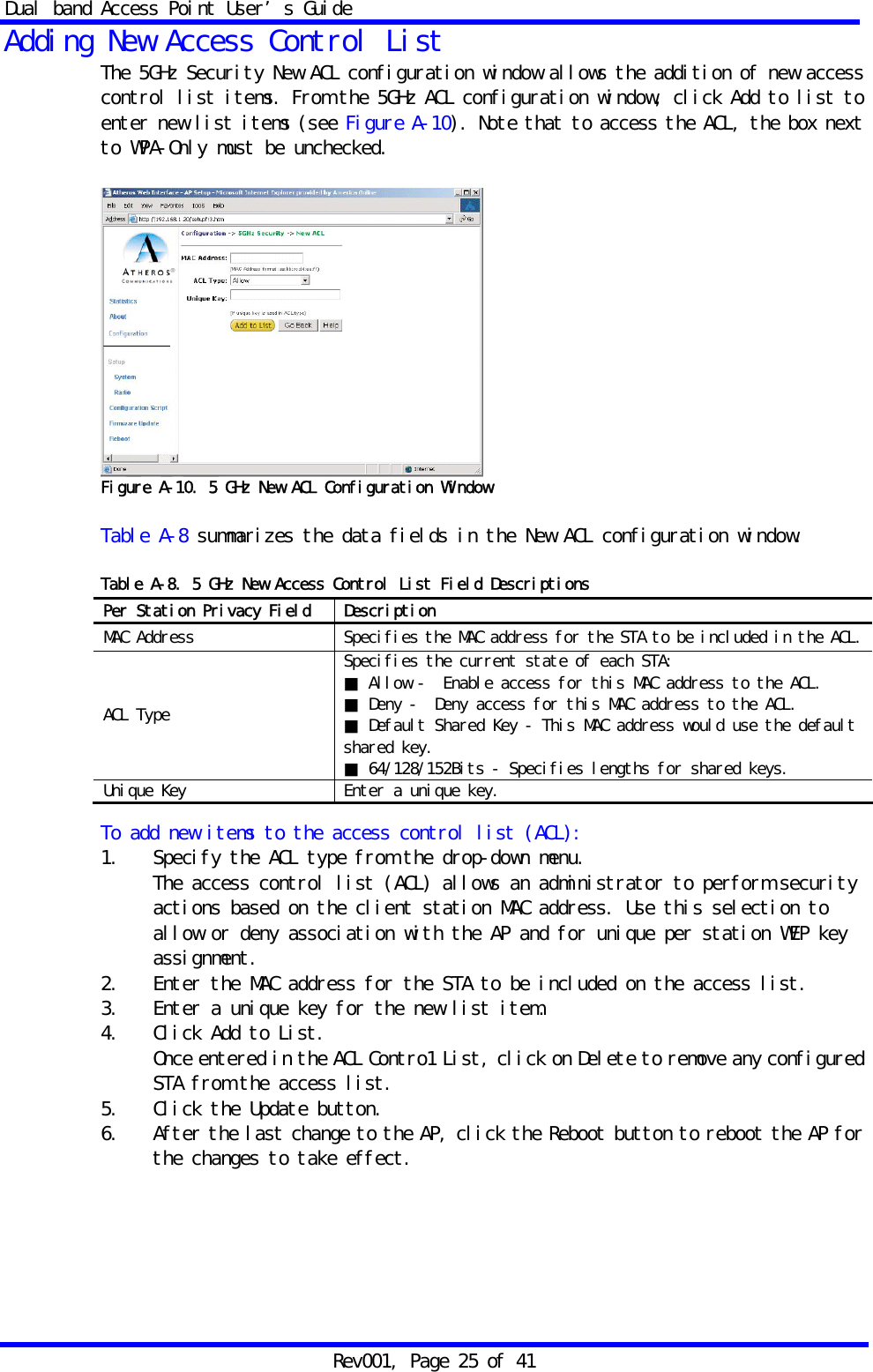
Dual band Access Point User’s Guide Rev001, Page 25 of 41 Adding New Access Control List The 5GHz Security New ACL configuration window allows the addition of new access control list items. From the 5GHz ACL configuration window, click Add to list to enter new list items (see Figure A-10). Note that to access the ACL, the box next to WPA-Only must be unchecked.   Figure A-10. 5 GHz New ACL Configuration Window  Table A-8 summarizes the data fields in the New ACL configuration window.  Table A-8. 5 GHz New Access Control List Field Descriptions          To add new items to the access control list (ACL): 1.   Specify the ACL type from the drop-down menu. The access control list (ACL) allows an administrator to perform security    actions based on the client station MAC address. Use this selection to    allow or deny association with the AP and for unique per station WEP key assignment. 2.   Enter the MAC address for the STA to be included on the access list. 3.   Enter a unique key for the new list item. 4.   Click Add to List. Once entered in the ACL Contro1 List, click on Delete to remove any configured STA from the access list. 5.   Click the Update button. 6.   After the last change to the AP, click the Reboot button to reboot the AP for the changes to take effect. Per Station Privacy Field  Description MAC Address  Specifies the MAC address for the STA to be included in the ACL.ACL Type Specifies the current state of each STA: ■ Allow ‐  Enable access for this MAC address to the ACL. ■ Deny ‐  Deny access for this MAC address to the ACL. ■ Default Shared Key - This MAC address would use the default shared key. ■ 64/128/152Bits - Specifies lengths for shared keys. Unique Key  Enter a unique key.
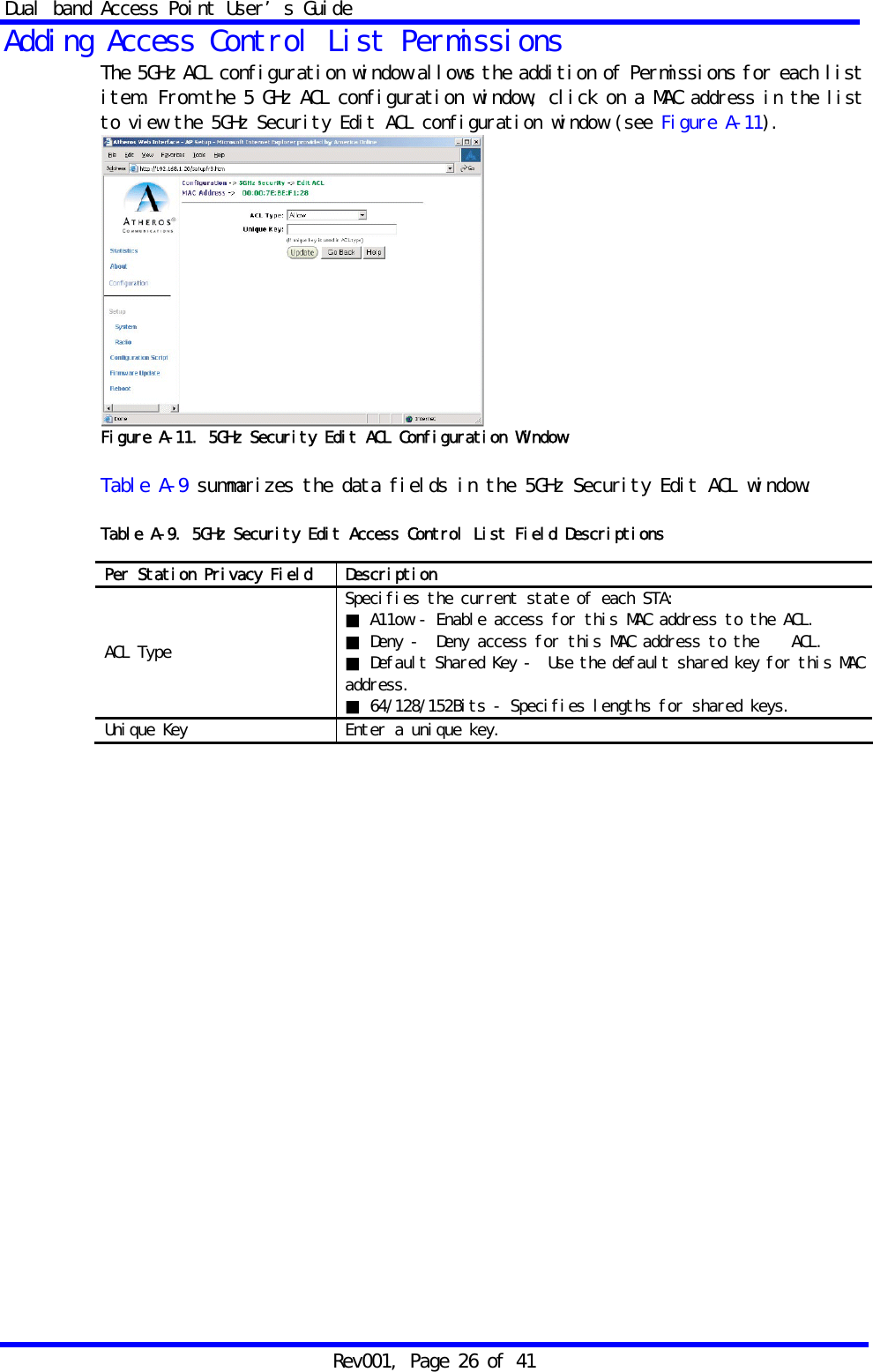
Dual band Access Point User’s Guide Rev001, Page 26 of 41 Adding Access Control List Permissions The 5GHz ACL configuration window allows the addition of Permissions for each list item. From the 5 GHz ACL configuration window, click on a MAC address in the list to view the 5GHz Security Edit ACL configuration window (see Figure A-11).  Figure A-11. 5GHz Security Edit ACL Configuration Window  Table A-9 summarizes the data fields in the 5GHz Security Edit ACL window.  Table A-9. 5GHz Security Edit Access Control List Field Descriptions                  Per Station Privacy Field  Description ACL Type Specifies the current state of each STA: ■ A11ow - Enable access for this MAC address to the ACL. ■ Deny ‐  Deny access for this MAC address to the    ACL. ■ Default Shared Key ‐  Use the default shared key for this MAC address. ■ 64/128/152Bits - Specifies lengths for shared keys. Unique Key  Enter a unique key.
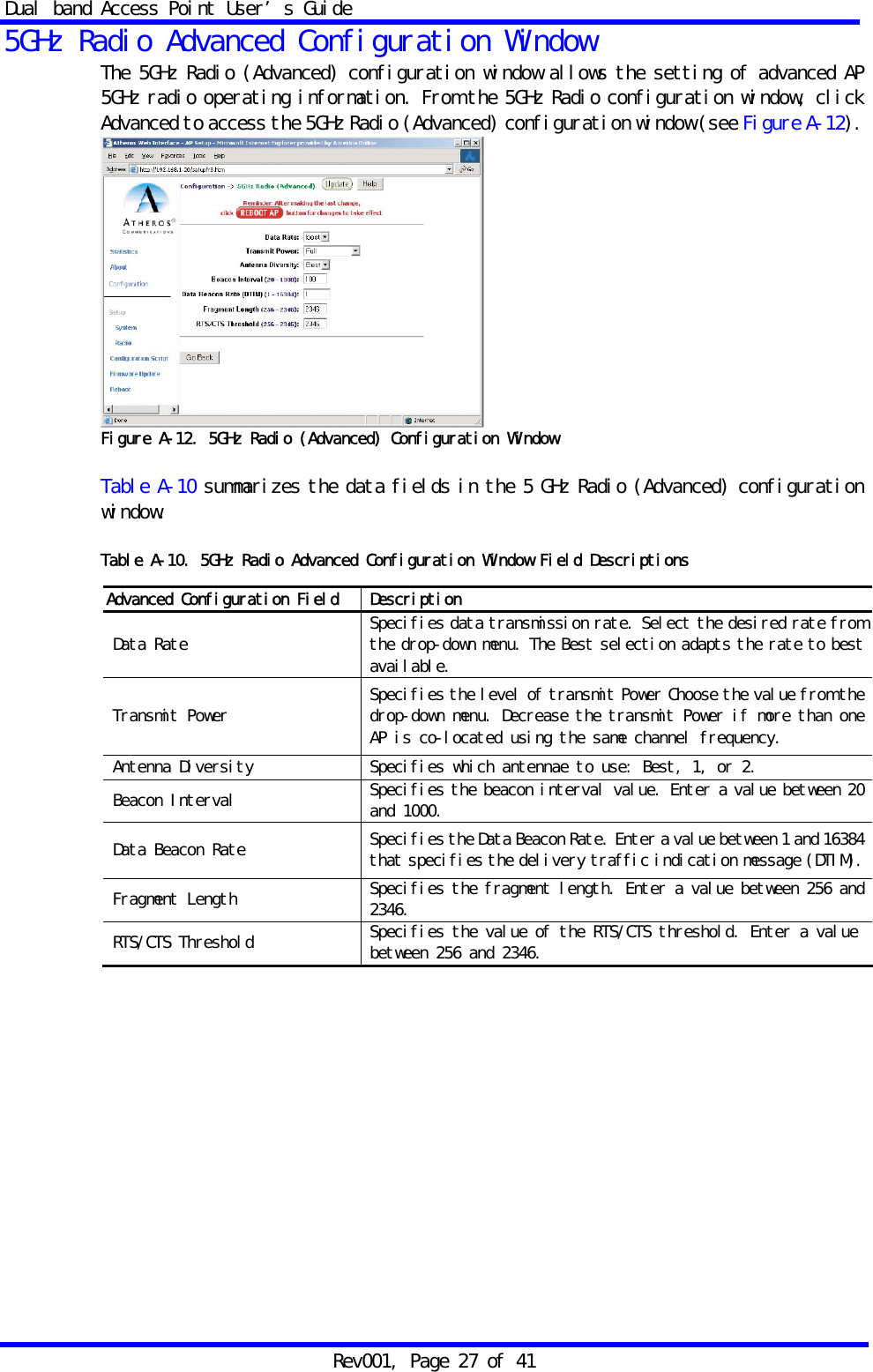
Dual band Access Point User’s Guide Rev001, Page 27 of 41 5GHz Radio Advanced Configuration Window The 5GHz Radio (Advanced) configuration window allows the setting of advanced AP 5GHz radio operating information. From the 5GHz Radio configuration window, click Advanced to access the 5GHz Radio (Advanced) configuration window (see Figure A-12).  Figure A-12. 5GHz Radio (Advanced) Configuration Window  Table A-10 summarizes the data fields in the 5 GHz Radio (Advanced) configuration window.  Table A-10. 5GHz Radio Advanced Configuration Window Field Descriptions                   Advanced Configuration Field  Description Data Rate  Specifies data transmission rate. Select the desired rate from the drop-down menu. The Best selection adapts the rate to best available. Transmit Power  Specifies the level of transmit Power Choose the value from the drop-down menu. Decrease the transmit Power if more than one AP is co-located using the same channel frequency. Antenna Diversity  Specifies which antennae to use: Best, 1, or 2. Beacon Interval  Specifies the beacon interval value. Enter a value between 20 and 1000. Data Beacon Rate  Specifies the Data Beacon Rate. Enter a value between 1 and 16384 that specifies the delivery traffic indication message (DTIM).Fragment Length  Specifies the fragment length. Enter a value between 256 and 2346. RTS/CTS Threshold  Specifies the value of the RTS/CTS threshold. Enter a value between 256 and 2346.
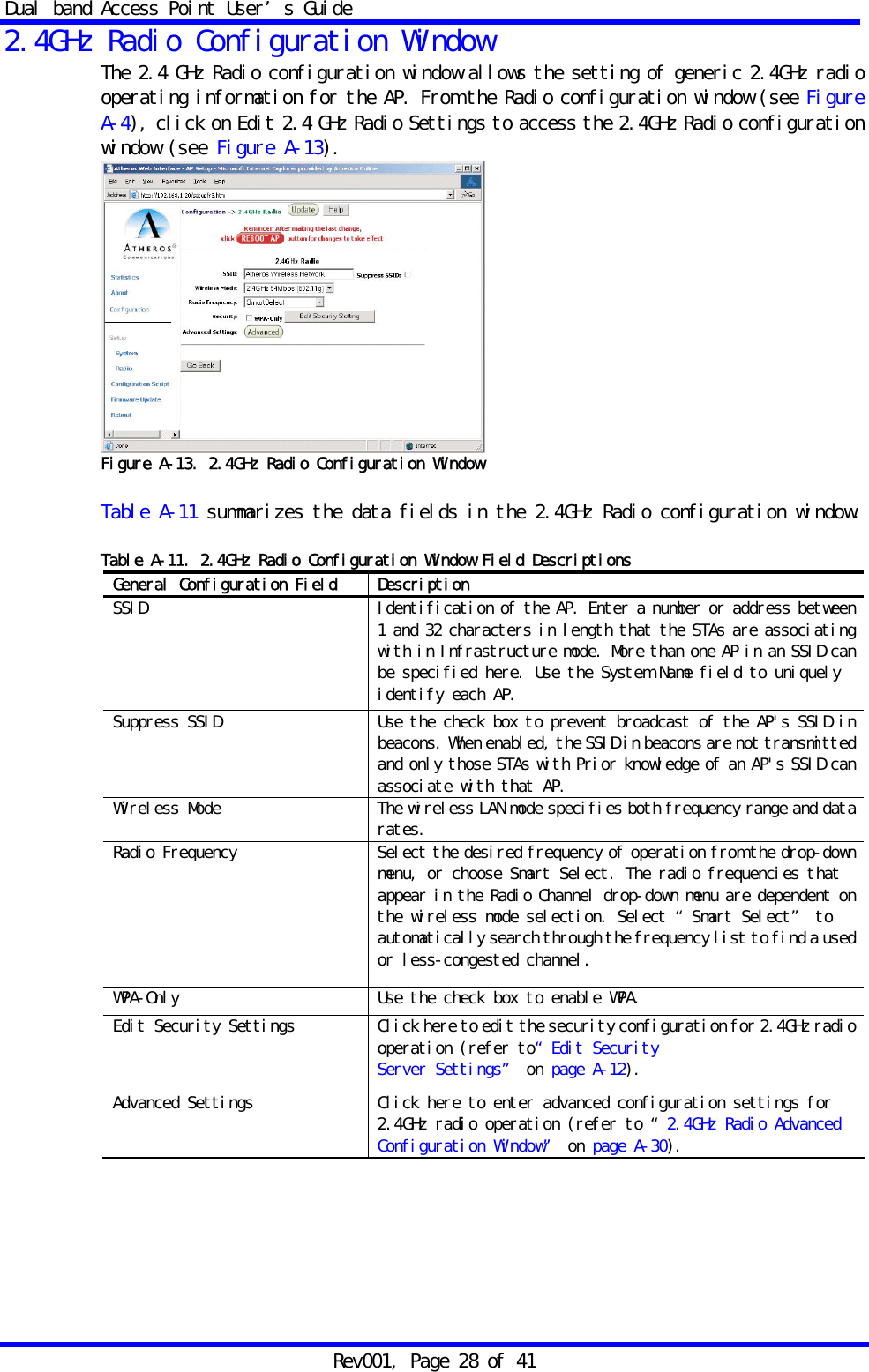
Dual band Access Point User’s Guide Rev001, Page 28 of 41 2.4GHz Radio Configuration Window The 2.4 GHz Radio configuration window allows the setting of generic 2.4GHz radio operating information for the AP. From the Radio configuration window (see Figure A-4), click on Edit 2.4 GHz Radio Settings to access the 2.4GHz Radio configuration window (see Figure A-13).  Figure A-13. 2.4GHz Radio Configuration Window  Table A-11 summarizes the data fields in the 2.4GHz Radio configuration window.   Table A-11. 2.4GHz Radio Configuration Window Field Descriptions General Configuration Field  Description SSID  Identification of the AP. Enter a number or address between 1 and 32 characters in length that the STAs are associating with in Infrastructure mode. More than one AP in an SSID can be specified here. Use the System Name field to uniquely identify each AP. Suppress SSID  Use the check box to prevent broadcast of the AP's SSID in beacons. When enabled, the SSID in beacons are not transmitted and only those STAs with Prior knowledge of an AP's SSID can associate with that AP. Wireless Mode  The wireless LAN mode specifies both frequency range and data rates. Radio Frequency  Select the desired frequency of operation from the drop-down menu, or choose Smart Select. The radio frequencies that appear in the Radio Channel drop-down menu are dependent on the wireless mode selection. Select “Smart Select” to automatically search through the frequency list to find a used or less-congested channel. WPA-Only  Use the check box to enable WPA. Edit  Security  Settings  Click here to edit the security configuration for 2.4GHz radio operation (refer to“Edit Security Server Settings” on page A-12). Advanced Settings  Click here to enter advanced configuration settings for 2.4GHz radio operation (refer to “2.4GHz Radio Advanced Configuration Window” on page A-30).
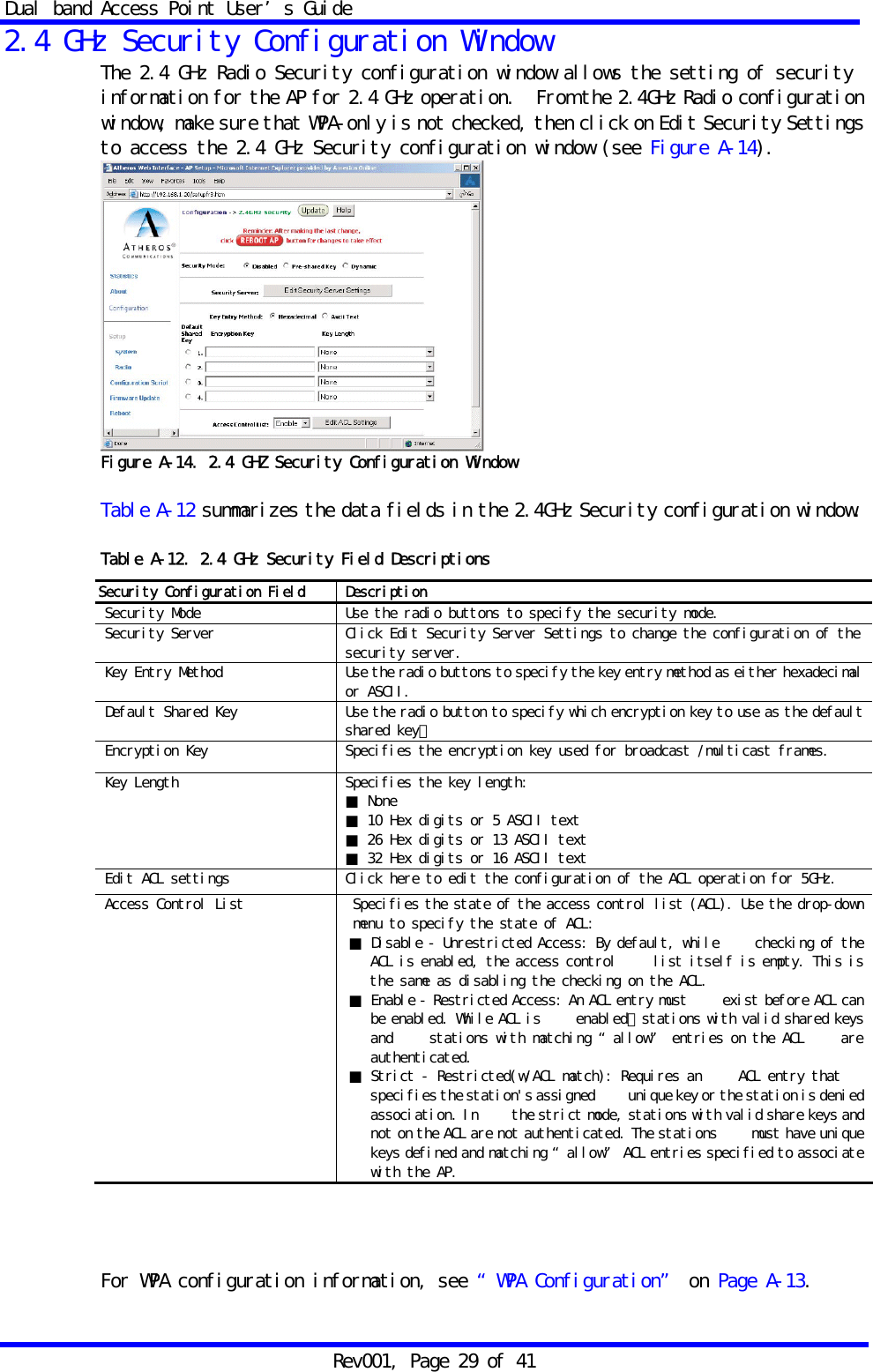
Dual band Access Point User’s Guide Rev001, Page 29 of 41 2.4 GHz Security Configuration Window The 2.4 GHz Radio Security configuration window allows the setting of security information for the AP for 2.4 GHz operation.  From the 2.4GHz Radio configuration window, make sure that WPA-only is not checked, then click on Edit Security Settings to access the 2.4 GHz Security configuration window (see Figure A-14).  Figure A-14. 2.4 GHZ Security Configuration Window  Table A-12 summarizes the data fields in the 2.4GHz Security configuration window.  Table A-12. 2.4 GHz Security Field Descriptions                                 For WPA configuration information, see “WPA Configuration” on Page A-13. Security Configuration Field  Description Security Mode Use the radio buttons to specify the security mode. Security Server  Click Edit Security Server Settings to change the configuration of the security server. Key Entry Method  Use the radio buttons to specify the key entry method as either hexadecimal or ASCII. Default Shared Key  Use the radio button to specify which encryption key to use as the default shared key・ Encryption Key  Specifies the encryption key used for broadcast /multicast frames. Key Length  Specifies the key length: ■ None ■ 10 Hex digits or 5 ASCII text ■ 26 Hex digits or 13 ASCII text ■ 32 Hex digits or 16 ASCII text Edit ACL settings  Click here to edit the configuration of the ACL operation for 5GHz. Access Control List  Specifies the state of the access control list (ACL). Use the drop-down menu to specify the state of ACL: ■ Disable - Unrestricted Access: By default, while     checking of the ACL is enabled, the access control     list itself is empty. This is the same as disabling the checking on the ACL. ■ Enable - Restricted Access: An ACL entry must     exist before ACL can be enabled. While ACL is     enabled,stations with valid shared keys and     stations with matching “allow” entries on the ACL     are authenticated. ■ Strict - Restricted(w/ACL match): Requires an     ACL entry that specifies the station's assigned     unique key or the station is denied association. In     the strict mode, stations with valid share keys and not on the ACL are not authenticated. The stations     must have unique keys defined and matching “allow” ACL entries specified to associate with the AP.
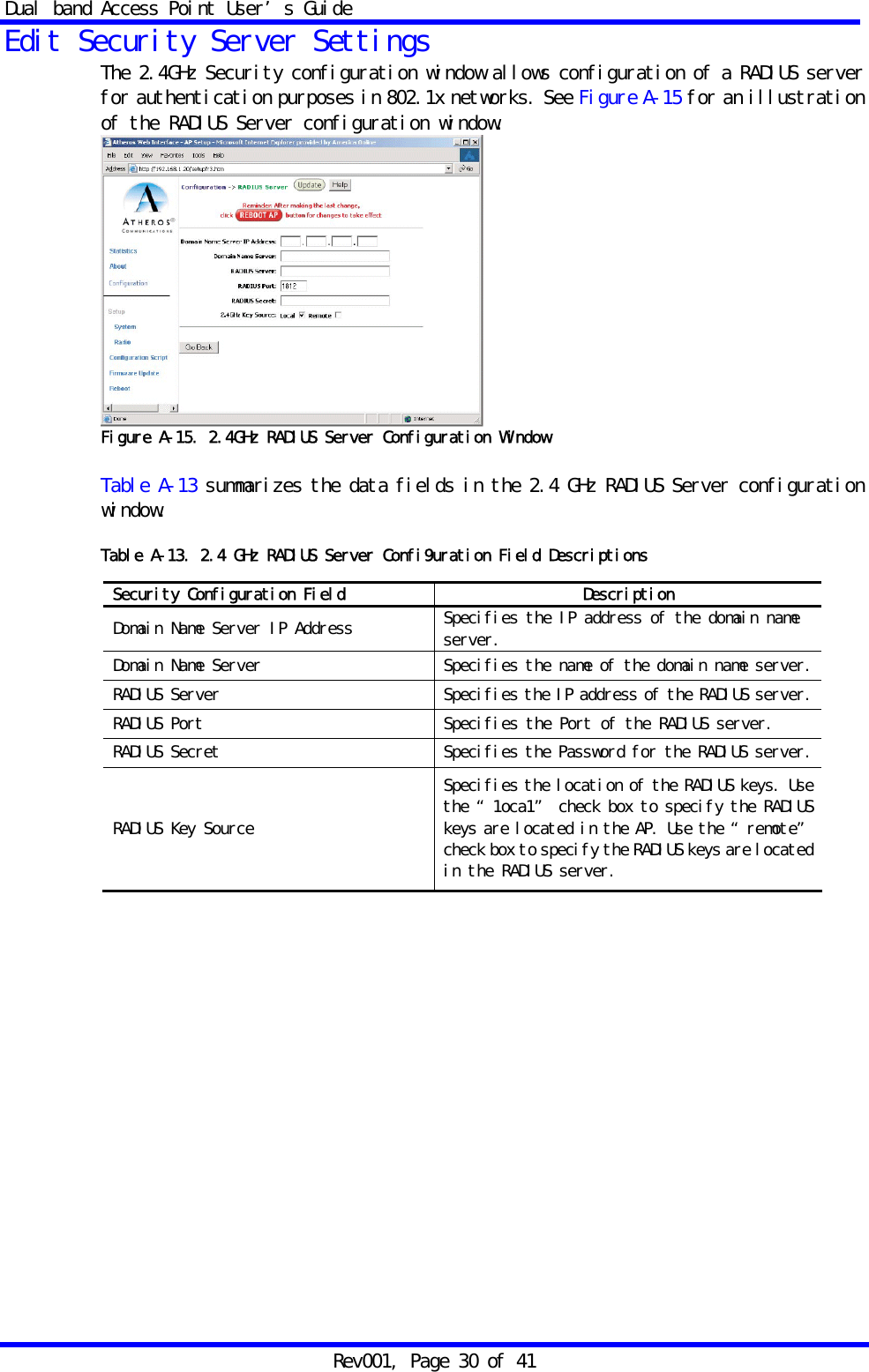
Dual band Access Point User’s Guide Rev001, Page 30 of 41 Edit Security Server Settings The 2.4GHz Security configuration window allows configuration of a RADIUS server for authentication purposes in 802.1x networks. See Figure A-15 for an illustration of the RADIUS Server configuration window.  Figure A-15. 2.4GHz RADIUS Server Configuration Window  Table A-13 summarizes the data fields in the 2.4 GHz RADIUS Server configuration window.  Table A-13. 2.4 GHz RADIUS Server Confi9uration Field Descriptions                   Security Configuration Field  Description Domain Name Server IP Address  Specifies the IP address of the domain name server. Domain Name Server  Specifies the name of the domain name server.RADIUS Server  Specifies the IP address of the RADIUS server.RADIUS Port  Specifies the Port of the RADIUS server. RADIUS Secret  Specifies the Password for the RADIUS server.RADIUS Key Source Specifies the location of the RADIUS keys. Use the “1oca1” check box to specify the RADIUS keys are located in the AP. Use the “remote” check box to specify the RADIUS keys are located in the RADIUS server.
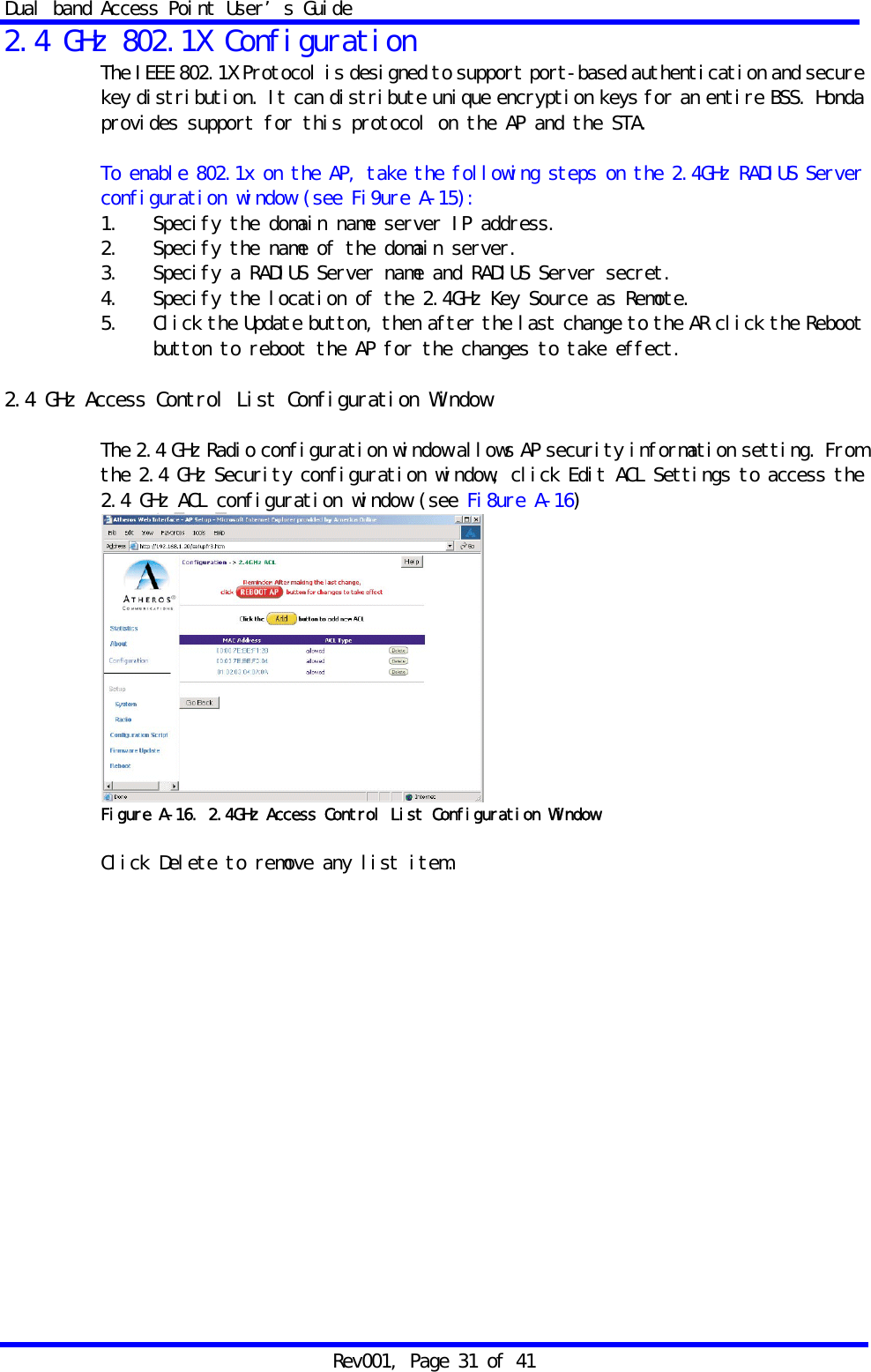
Dual band Access Point User’s Guide Rev001, Page 31 of 41 2.4 GHz 802.1X Configuration The IEEE 802.1X Protocol is designed to support port-based authentication and secure key distribution. It can distribute unique encryption keys for an entire BSS. Honda provides support for this protocol on the AP and the STA.  To enable 802.1x on the AP, take the following steps on the 2.4GHz RADIUS Server configuration window (see Fi9ure A-15): 1.   Specify the domain name server IP address.  2.   Specify the name of the domain server. 3.   Specify a RADIUS Server name and RADIUS Server secret. 4.   Specify the location of the 2.4GHz Key Source as Remote. 5.   Click the Update button, then after the last change to the AR click the Reboot button to reboot the AP for the changes to take effect.  2.4 GHz Access Control List Configuration Window  The 2.4 GHz Radio configuration window allows AP security information setting. From the 2.4 GHz Security configuration window, click Edit ACL Settings to access the 2.4 GHz ACL configuration window (see Fi8ure A-16)  Figure A-16. 2.4GHz Access Control List Configuration Window  Click Delete to remove any list item.
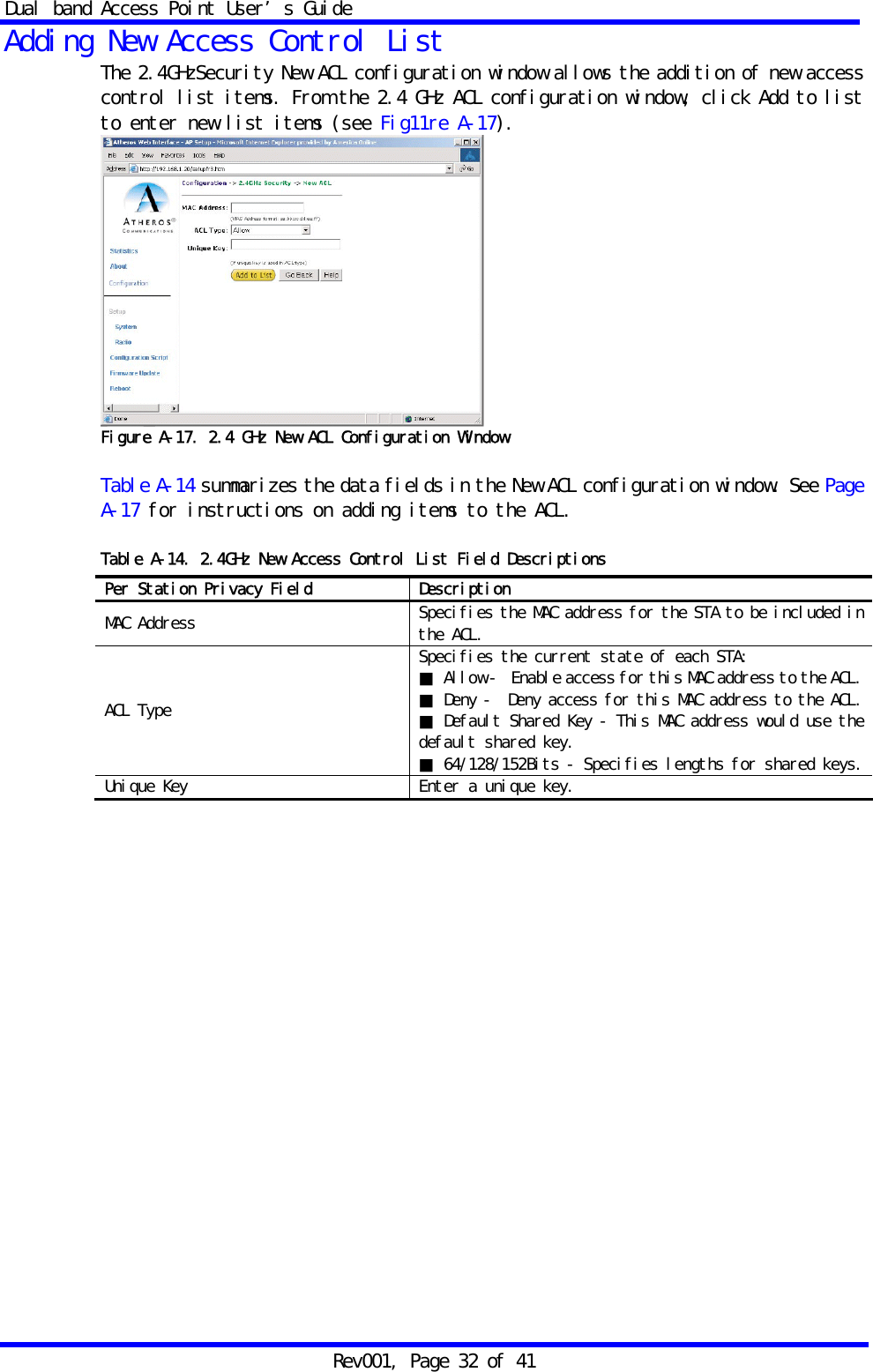
Dual band Access Point User’s Guide Rev001, Page 32 of 41 Adding New Access Control List The 2.4GHzSecurity New ACL configuration window allows the addition of new access control list items. From the 2.4 GHz ACL configuration window, click Add to list to enter new list items (see Fig11re A-17).  Figure A-17. 2.4 GHz New ACL Configuration Window  Table A-14 summarizes the data fields in the New ACL configuration window. See Page A-17 for instructions on adding items to the ACL.  Table A-14. 2.4GHz New Access Control List Field Descriptions       Per Station Privacy Field  Description MAC Address  Specifies the MAC address for the STA to be included in the ACL. ACL Type Specifies the current state of each STA: ■  Allow ‐  Enable access for this MAC address to the ACL.■ Deny ‐  Deny access for this MAC address to the ACL.■ Default Shared Key - This MAC address would use the default shared key. ■ 64/128/152Bits - Specifies lengths for shared keys.Unique Key  Enter a unique key.
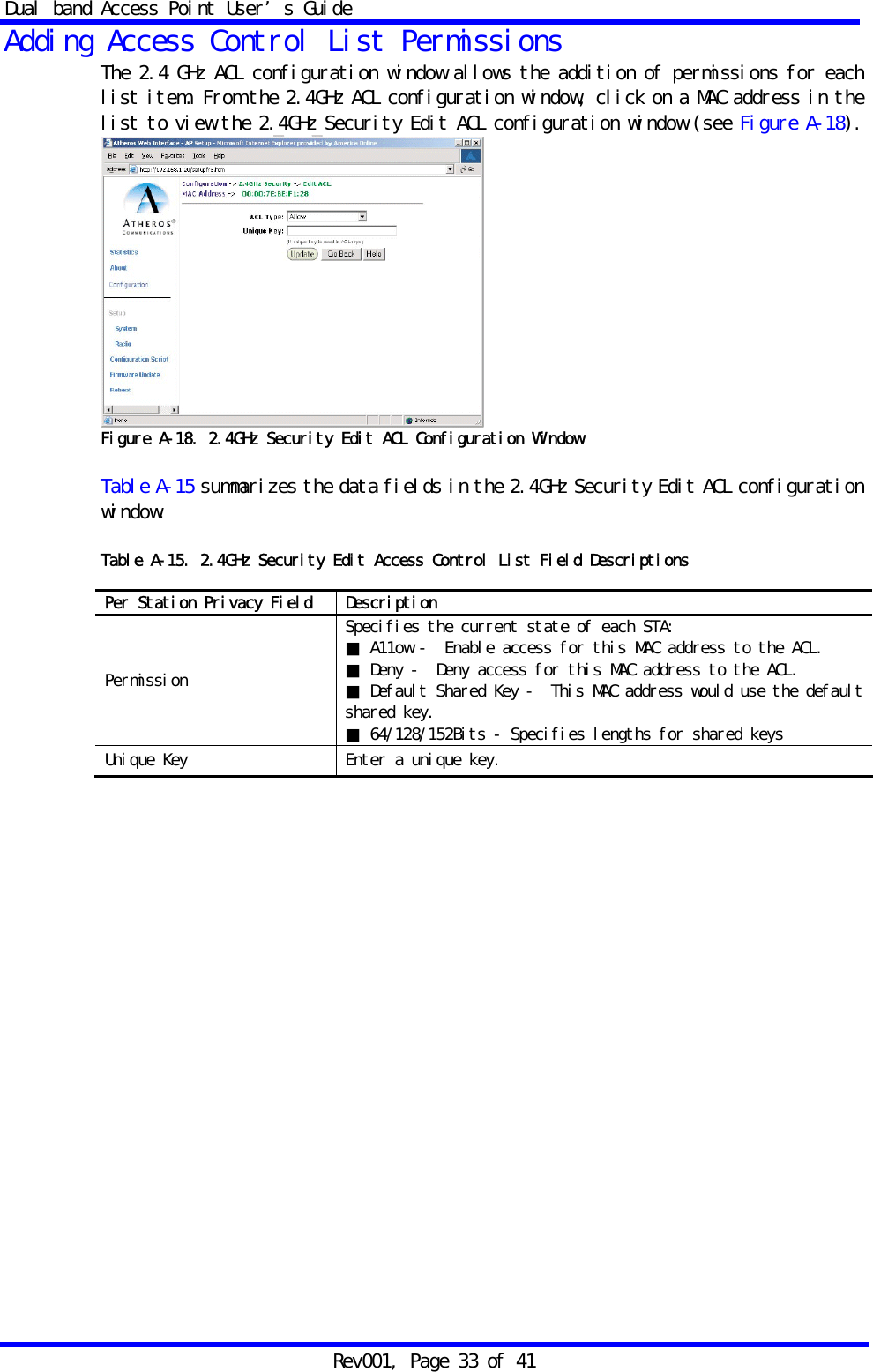
Dual band Access Point User’s Guide Rev001, Page 33 of 41 Adding Access Control List Permissions The 2.4 GHz ACL configuration window allows the addition of permissions for each list item. From the 2.4GHz ACL configuration window, click on a MAC address in the list to view the 2.4GHz Security Edit ACL configuration window (see Figure A-18).  Figure A-18. 2.4GHz Security Edit ACL Configuration Window  Table A-15 summarizes the data fields in the 2.4GHz Security Edit ACL configuration window.  Table A-15. 2.4GHz Security Edit Access Control List Field Descriptions Per Station Privacy Field  Description Permission Specifies the current state of each STA: ■ A11ow ‐  Enable access for this MAC address to the ACL. ■ Deny ‐  Deny access for this MAC address to the ACL. ■ Default Shared Key ‐  This MAC address would use the default shared key. ■ 64/128/152Bits - Specifies lengths for shared keys Unique Key  Enter a unique key.
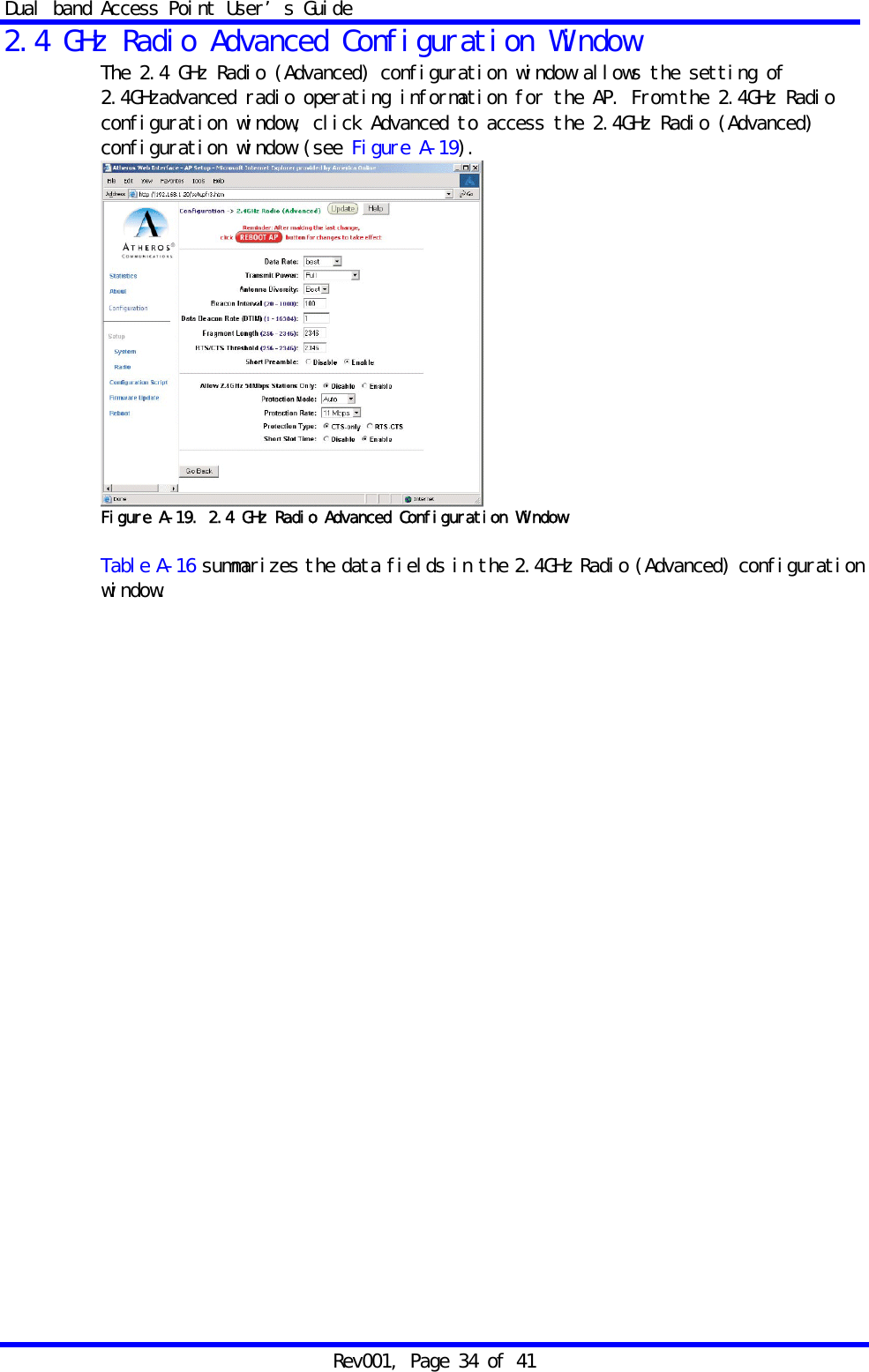
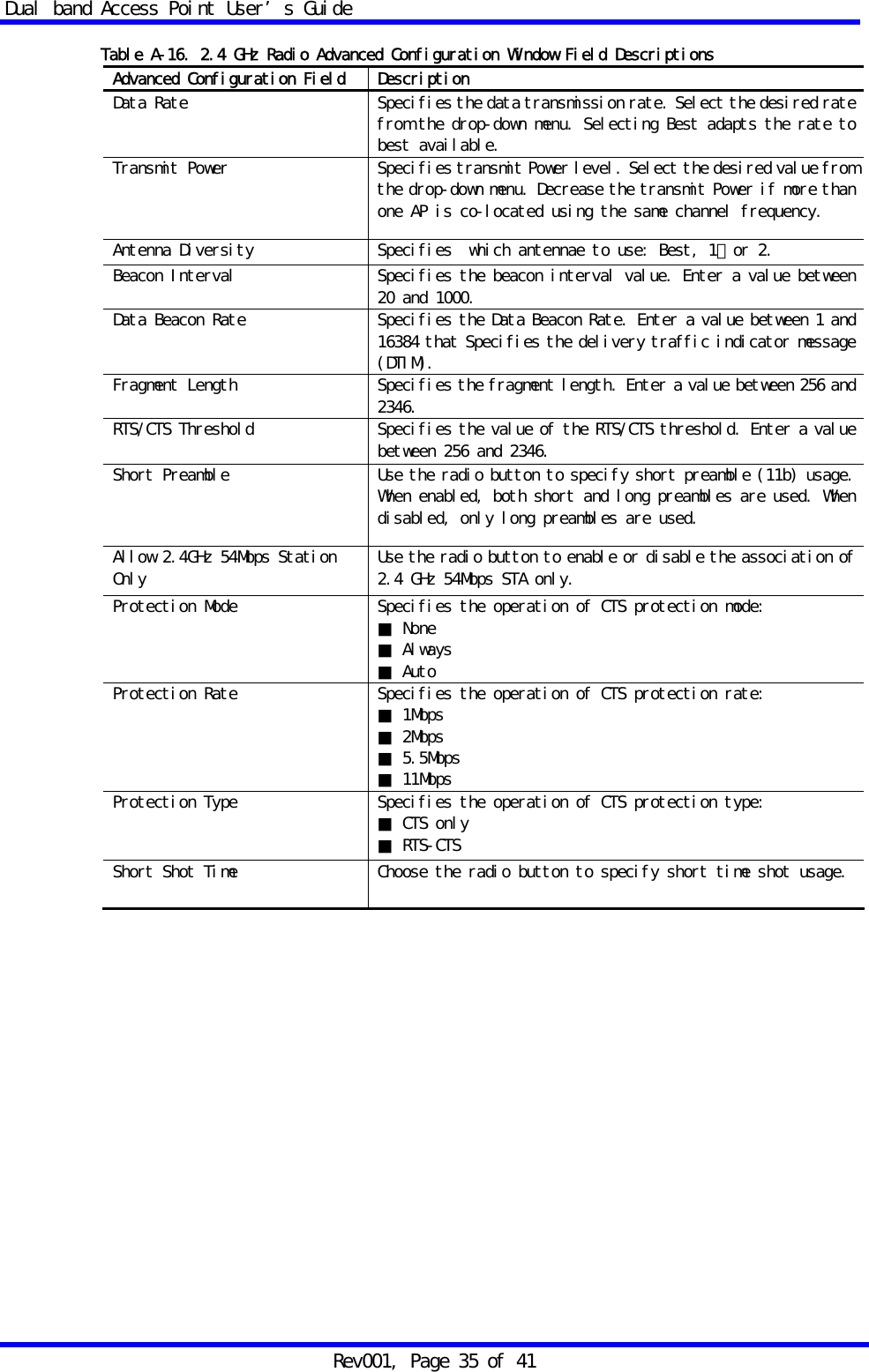
Dual band Access Point User’s Guide Rev001, Page 34 of 41 2.4 GHz Radio Advanced Configuration Window The 2.4 GHz Radio (Advanced) configuration window allows the setting of 2.4GHzadvanced radio operating information for the AP. From the 2.4GHz Radio configuration window, click Advanced to access the 2.4GHz Radio (Advanced) configuration window (see Figure A-19).  Figure A-19. 2.4 GHz Radio Advanced Configuration Window  Table A-16 summarizes the data fields in the 2.4GHz Radio (Advanced) configuration window.
Dual band Access Point User’s Guide Rev001, Page 35 of 41  Table A-16. 2.4 GHz Radio Advanced Configuration Window Field Descriptions Advanced Configuration Field  Description Data  Rate  Specifies the data transmission rate. Select the desired rate from the drop-down menu. Selecting Best adapts the rate to best available. Transmit  Power  Specifies transmit Power level. Select the desired value from the drop-down menu. Decrease the transmit Power if more than one AP is co-located using the same channel frequency. Antenna Diversity  Specifies  which antennae to use: Best, 1,or 2. Beacon Interval  Specifies the beacon interval value. Enter a value between 20 and 1000. Data Beacon Rate  Specifies the Data Beacon Rate. Enter a value between 1 and 16384 that Specifies the delivery traffic indicator message (DTIM). Fragment Length  Specifies the fragment length. Enter a value between 256 and 2346. RTS/CTS Threshold  Specifies the value of the RTS/CTS threshold. Enter a value between 256 and 2346. Short Preamble  Use the radio button to specify short preamble (11b) usage. When enabled, both short and long preambles are used. When disabled, only long preambles are used. Allow 2.4GHz 54Mbps Station Only  Use the radio button to enable or disable the association of 2.4 GHz 54Mbps STA only. Protection Mode  Specifies the operation of CTS protection mode: ■ None ■ Always ■ Auto Protection Rate  Specifies the operation of CTS protection rate: ■ 1Mbps ■ 2Mbps ■ 5.5Mbps ■ 11Mbps Protection Type  Specifies the operation of CTS protection type: ■ CTS only ■ RTS-CTS Short Shot Time  Choose the radio button to specify short time shot usage.
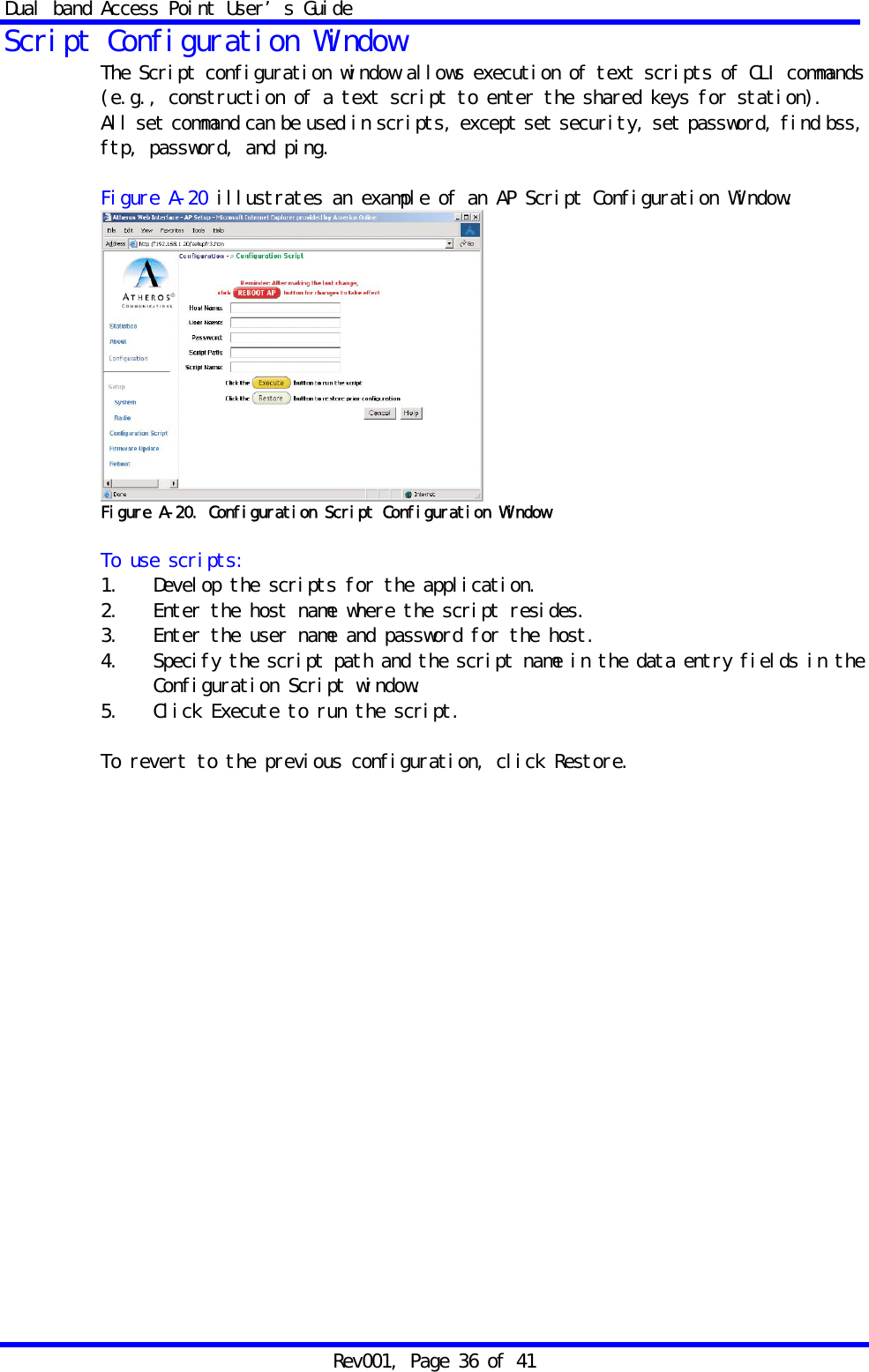
Dual band Access Point User’s Guide Rev001, Page 36 of 41 Script Configuration Window The Script configuration window allows execution of text scripts of CLI commands (e.g., construction of a text script to enter the shared keys for station). All set command can be used in scripts, except set security, set password, find bss, ftp, password, and ping.  Figure A-20 illustrates an example of an AP Script Configuration Window.  Figure A-20. Configuration Script Configuration Window  To use scripts: 1.   Develop the scripts for the application. 2.   Enter the host name where the script resides. 3.   Enter the user name and password for the host. 4.   Specify the script path and the script name in the data entry fields in the Configuration Script window. 5.   Click Execute to run the script.  To revert to the previous configuration, click Restore.
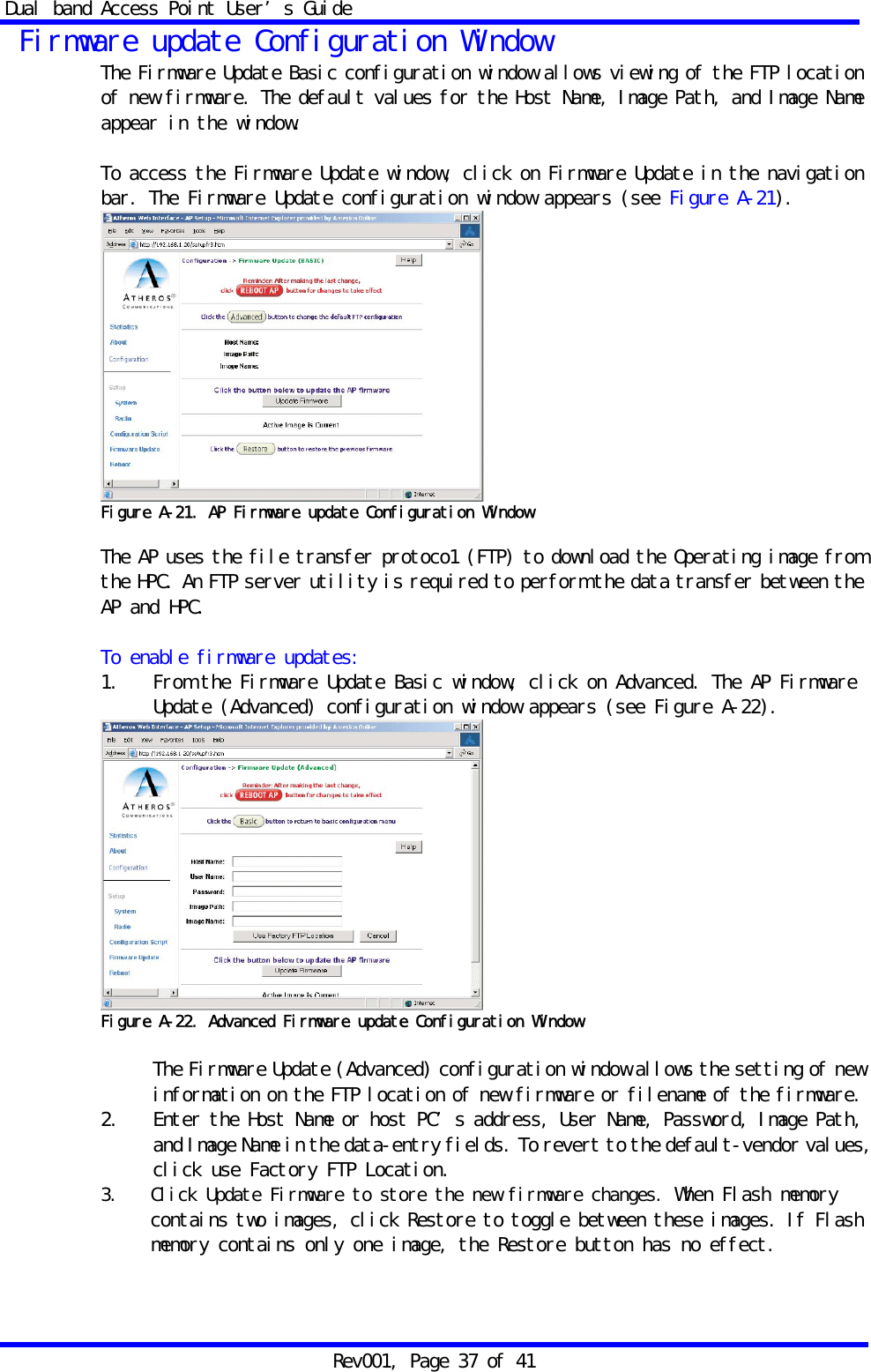
Dual band Access Point User’s Guide Rev001, Page 37 of 41  Firmware update Configuration Window The Firmware Update Basic configuration window allows viewing of the FTP location of new firmware. The default values for the Host Name, Image Path, and Image Name appear in the window.  To access the Firmware Update window, click on Firmware Update in the navigation bar. The Firmware Update configuration window appears (see Figure A-21).  Figure A-21. AP Firmware update Configuration Window  The AP uses the file transfer protoco1 (FTP) to download the Operating image from the HPC. An FTP server utility is required to perform the data transfer between the AP and HPC.  To enable firmware updates: 1.    From the Firmware Update Basic window, click on Advanced. The AP Firmware Update (Advanced) configuration window appears (see Figure A-22).  Figure A-22. Advanced Firmware update Configuration Window   The Firmware Update (Advanced) configuration window allows the setting of new information on the FTP location of new firmware or filename of the firmware. 2.   Enter the Host Name or host PC’s address, User Name, Password, Image Path, and Image Name in the data-entry fields. To revert to the default-vendor values, click use Factory FTP Location. 3.   Click Update Firmware to store the new firmware changes. When Flash memory contains two images, click Restore to toggle between these images. If Flash memory contains only one image, the Restore button has no effect.
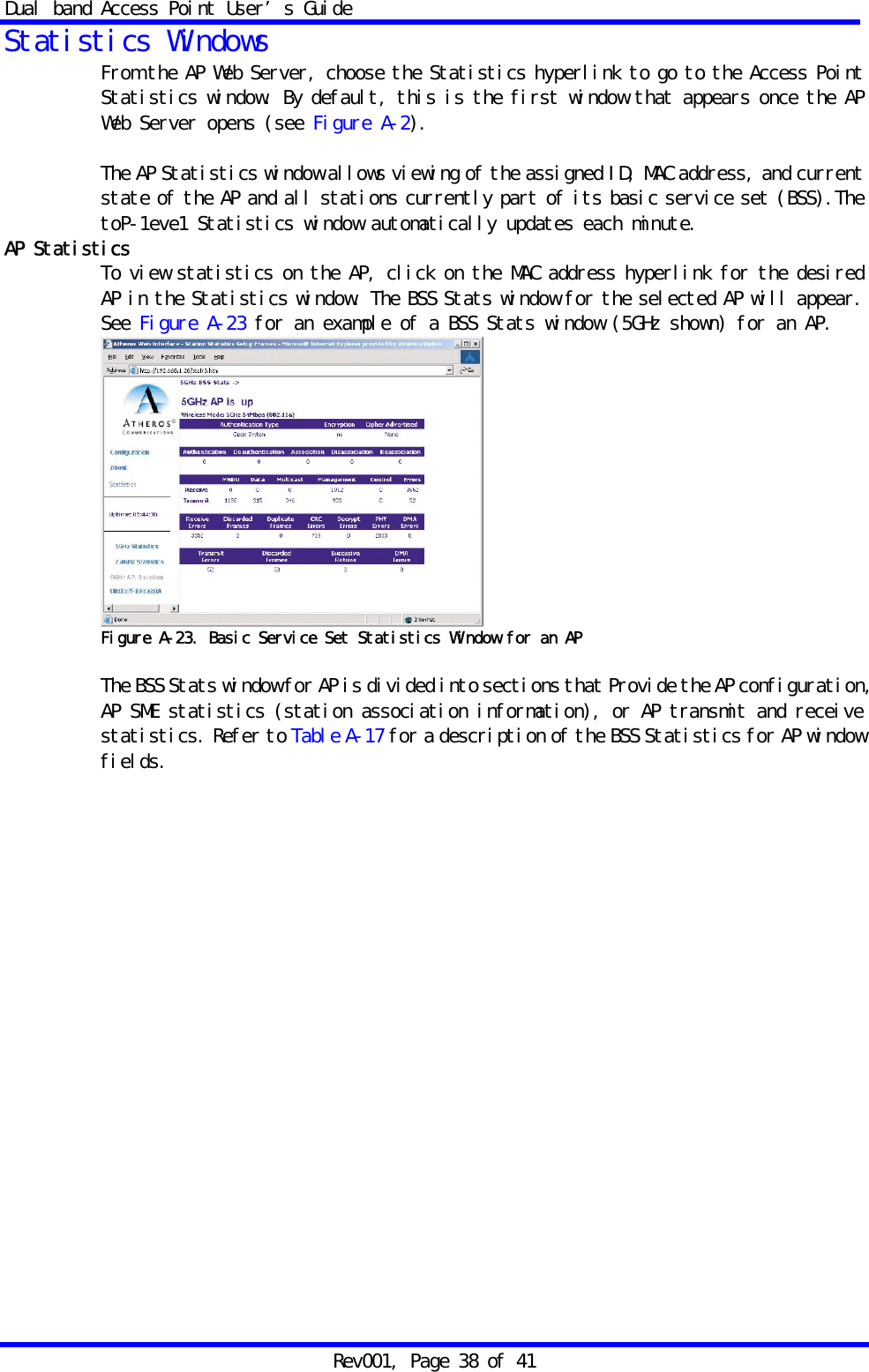
Dual band Access Point User’s Guide Rev001, Page 38 of 41 Statistics Windows From the AP Web Server, choose the Statistics hyperlink to go to the Access Point Statistics window. By default, this is the first window that appears once the AP Web Server opens (see Figure A-2).  The AP Statistics window allows viewing of the assigned ID, MAC address, and current state of the AP and all stations currently part of its basic service set (BSS).The toP-1eve1 Statistics window automatically updates each minute. AP Statistics To view statistics on the AP, click on the MAC address hyperlink for the desired AP in the Statistics window. The BSS Stats window for the selected AP will appear. See Figure A-23 for an example of a BSS Stats window (5GHz shown) for an AP.  Figure A-23. Basic Service Set Statistics Window for an AP  The BSS Stats window for AP is divided into sections that Provide the AP configuration, AP SME statistics (station association information), or AP transmit and receive statistics. Refer to Table A-17 for a description of the BSS Statistics for AP window fields.
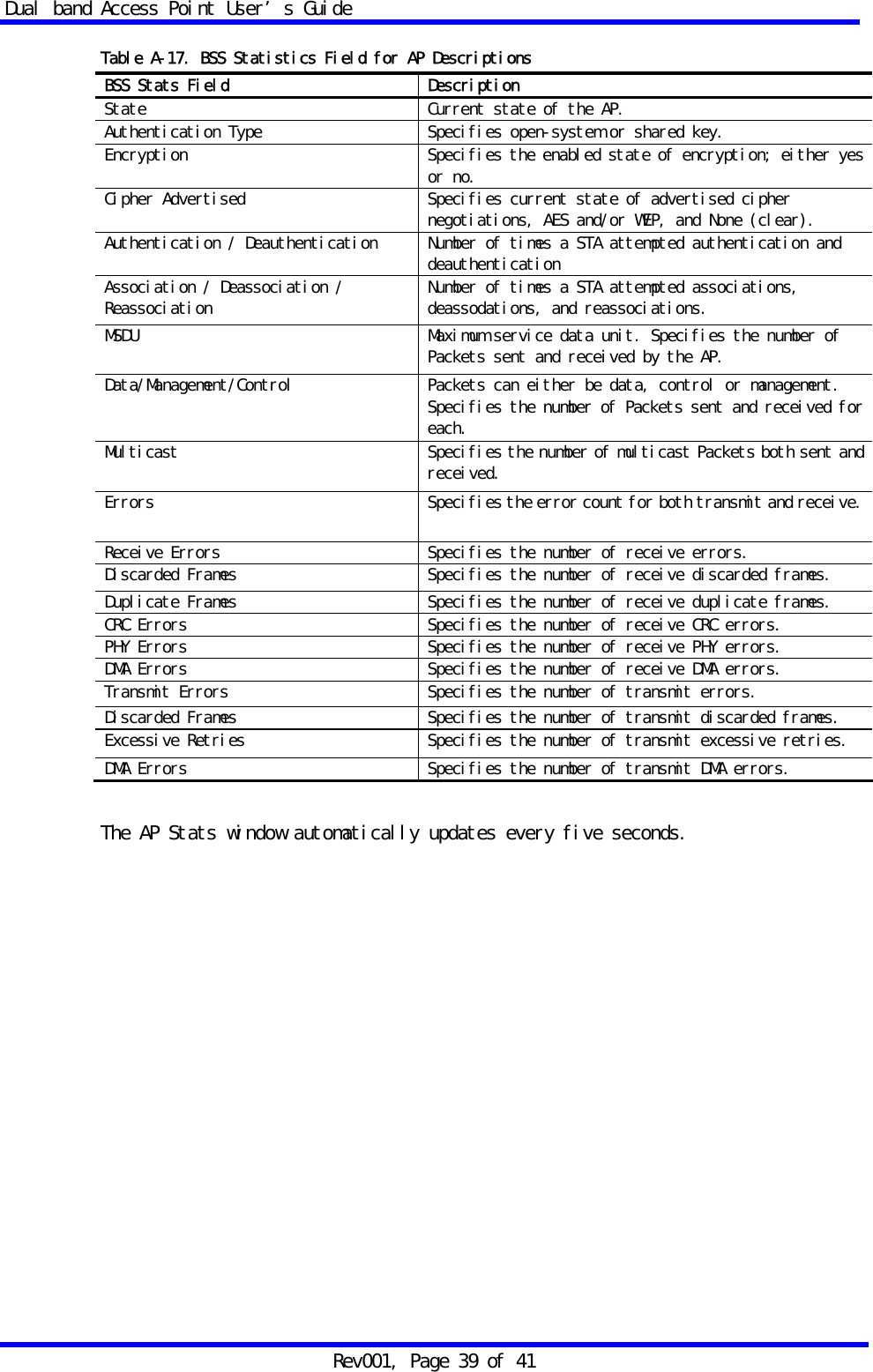
Dual band Access Point User’s Guide Rev001, Page 39 of 41  Table A-17. BSS Statistics Field for AP Descriptions                               The AP Stats window automatically updates every five seconds.    BSS Stats Field  Description State  Current state of the AP. Authentication Type  Specifies open-system or shared key. Encryption  Specifies the enabled state of encryption; either yes or no. Cipher Advertised  Specifies current state of advertised cipher negotiations, AES and/or WEP, and None (clear). Authentication / Deauthentication  Number of times a STA attempted authentication and deauthentication Association / Deassociation /  Reassociation  Number of times a STA attempted associations, deassodations, and reassociations. MSDU  Maximum service data unit. Specifies the number of Packets sent and received by the AP. Data/Management/Control  Packets can either be data, control or management. Specifies the number of Packets sent and received for each. Multicast  Specifies the number of multicast Packets both sent and received. Errors  Specifies the error count for both transmit and receive.Receive Errors  Specifies the number of receive errors. Discarded Frames  Specifies the number of receive discarded frames. Duplicate Frames  Specifies the number of receive duplicate frames. CRC Errors  Specifies the number of receive CRC errors. PHY Errors  Specifies the number of receive PHY errors. DMA Errors  Specifies the number of receive DMA errors. Transmit Errors  Specifies the number of transmit errors. Discarded Frames  Specifies the number of transmit discarded frames. Excessive Retries  Specifies the number of transmit excessive retries. DMA Errors  Specifies the number of transmit DMA errors.
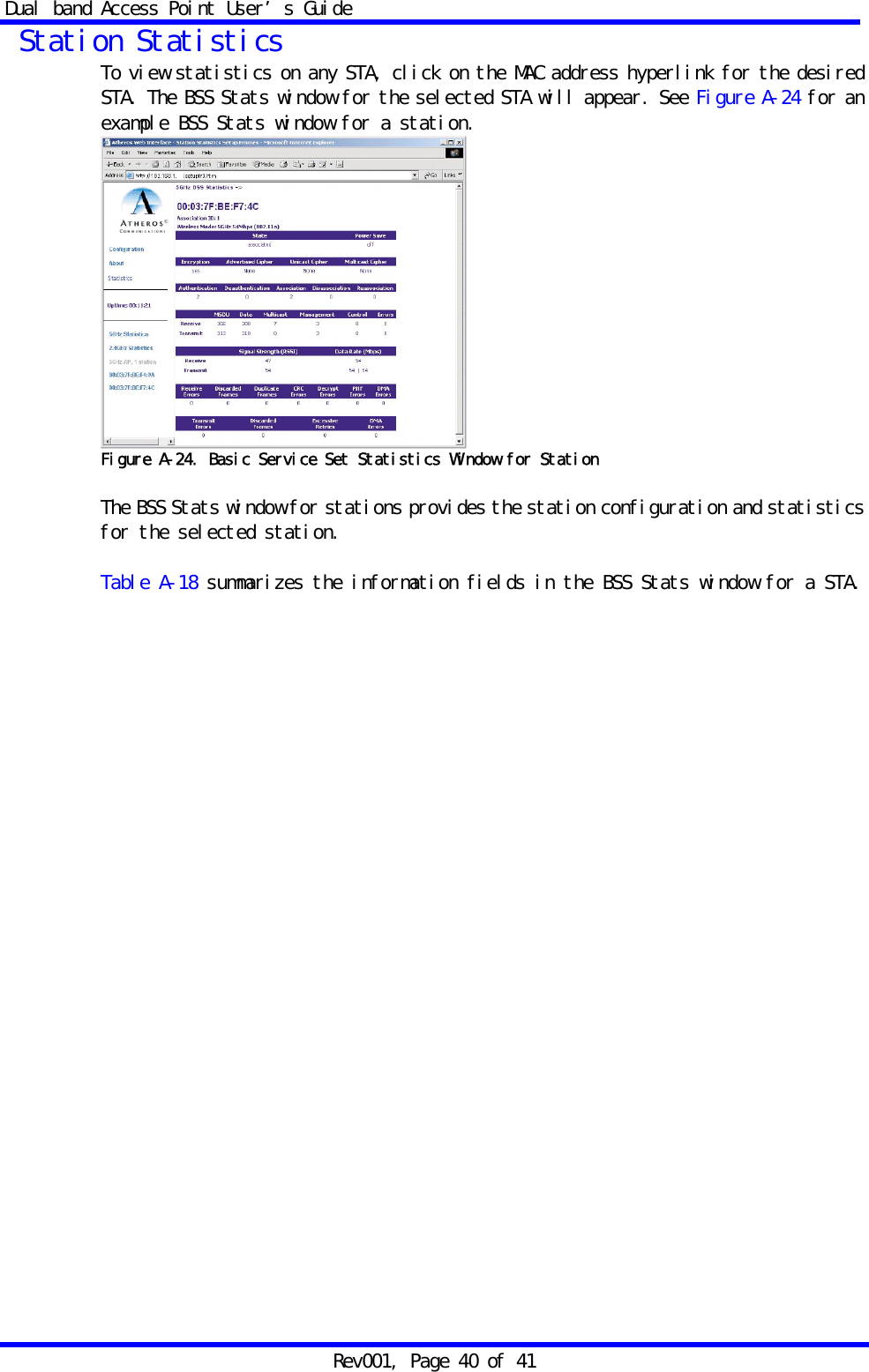
Dual band Access Point User’s Guide Rev001, Page 40 of 41  Station Statistics To view statistics on any STA, click on the MAC address hyperlink for the desired STA. The BSS Stats window for the selected STA will appear. See Figure A-24 for an example BSS Stats window for a station.  Figure A-24. Basic Service Set Statistics Window for Station  The BSS Stats window for stations provides the station configuration and statistics for the selected station.  Table A-18 summarizes the information fields in the BSS Stats window for a STA.
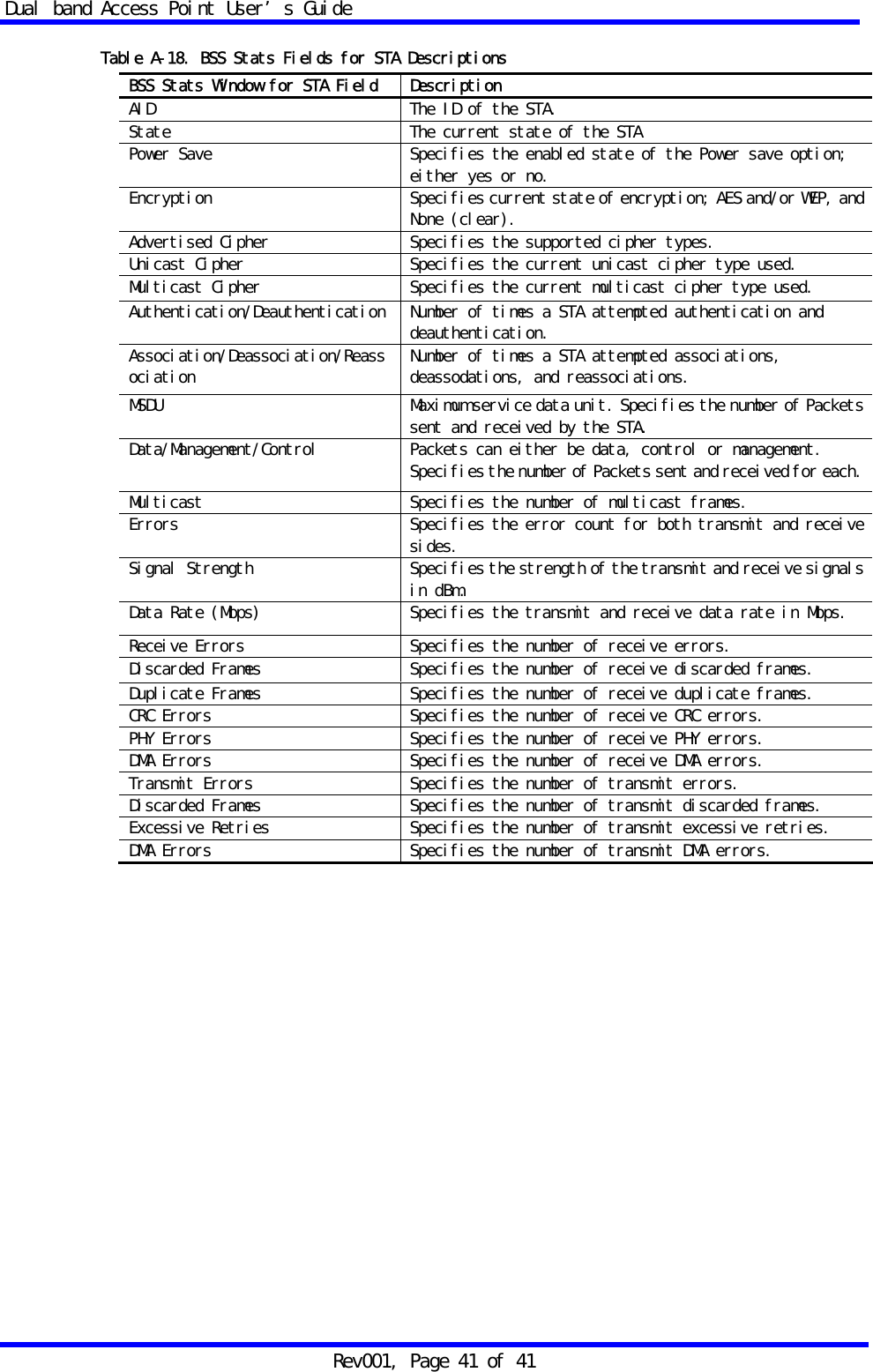
Dual band Access Point User’s Guide Rev001, Page 41 of 41  Table A-18. BSS Stats Fields for STA Descriptions                                        BSS Stats Window for STA Field  Description AID  The ID of the STA. State  The current state of the STA Power Save  Specifies the enabled state of the Power save option; either yes or no. Encryption  Specifies current state of encryption; AES and/or WEP, and None (clear). Advertised Cipher  Specifies the supported cipher types. Unicast Cipher  Specifies the current unicast cipher type used. Multicast Cipher  Specifies the current multicast cipher type used. Authentication/Deauthentication Number of times a STA attempted authentication and deauthentication. Association/Deassociation/Reassociation  Number of times a STA attempted associations, deassodations, and reassociations. MSDU  Maximum service data unit. Specifies the number of Packets sent and received by the STA. Data/Management/Control  Packets can either be data, control or management. Specifies the number of Packets sent and received for each.Multicast  Specifies the number of multicast frames. Errors  Specifies the error count for both transmit and receive sides. Signal Strength  Specifies the strength of the transmit and receive signals in dBm. Data Rate (Mbps)  Specifies the transmit and receive data rate in Mbps. Receive Errors  Specifies the number of receive errors. Discarded Frames  Specifies the number of receive discarded frames. Duplicate Frames  Specifies the number of receive duplicate frames. CRC Errors  Specifies the number of receive CRC errors. PHY Errors  Specifies the number of receive PHY errors. DMA Errors  Specifies the number of receive DMA errors. Transmit Errors  Specifies the number of transmit errors. Discarded Frames  Specifies the number of transmit discarded frames. Excessive Retries  Specifies the number of transmit excessive retries. DMA Errors  Specifies the number of transmit DMA errors.

Navigation menu