InFocus IN3924 Digital Projector User Manual RG INF IN3924 IN3926
InFocus Corporation Digital Projector RG INF IN3924 IN3926
InFocus >
Contents
- 1. User Manual Part 1
- 2. User Manual Part 2
User Manual Part 2
11
Connecting a video device
You can connect video devices such as VCRs, DVD players, camcorders, digital
cameras, video game consoles, HDTV receivers, and TV tuners to the projector.
You can connect the audio directly to the projector to get sound from the built-in
speaker, or you can bypass the projector’s audio system and connect the audio
directly from your source to a stereo or home theater system.
You can connect the projector to most video devices that can output video. You
cannot directly connect the coaxial cable that enters your house from a cable or
satellite company, the signal must pass through a tuner first. Examples of tuners
are digital cable boxes, VCRs, digital video recorders, and satellite TV boxes.
Basically, any device that can change channels is considered a tuner.
Before connecting your projector, you should decide which aspect ratio you want
to use. The projector’s Aspect Ratio setting is accessed through the Resize button
on the remote or through the projector’s Basic Menu. See page 26 for more
information.
Video device connections
No video cables are provided with the projector. You can order cables from
InFocus or provide your own.
HDMI connection
HDMI is a standard, uncompressed, all-digital audio/video interface. HDMI
provides an interface between sources, such as set-top boxes, DVD players, and
receivers and your projector. Plug an HDMI cable into the video-out connector on
the video device and into the HDMI connector on the projector.
Composite video connection
Plug the composite video cable’s yellow connector into the video-out connector
on the video device. Plug the other yellow connector into the yellow V
Video
connector on the projector.
VGA connection
If your video device has a 15-pin VGA output, plug one end of the included
computer cable into the VGA connector on your video source. This connector
may be labeled “To Monitor” on the video source. Plug the computer cable into
either the C
Computer 1
or C
Computer 2
connector on the projector.
Component video connection
If your HD video device has component connectors, an optional Component to
VGA adapter can be used. Plug the component cable into the video device. Plug
the other end of the component cable into the adapter and plug the adapter into
the C
Computer 1
or C
Computer 2
connector.
S-video connection
Plug the S-video cable’s connector into the video-out connector on the video
device. Plug the other connector into the S
S-Video
connector on the projector.
Audio
For PC audio jack, connect a 3.5mm stereo cable to the A
Audio In
connector on
the projector and to your source. If your source uses RCA audio connectors, a Y-
cable or adapter may be used. For RCA audio jack, connect a RCA stereo cable to
the A
Audio/L
and A
Audio/R
connectors on the projector and to your source. (Note:
A separate audio connection is not required for HDMI source inputs.)

12
Shutting down the projector
Auto Off Time
The projector also has an Auto Off Time feature that automatically turns the
projector off after no active sources are detected and no user interaction with the
projector is performed for 30 minutes. By default, this feature is off. You can
change the length of time, see page 30.
Turning off the projector
To turn the projector off, press the P
Power
button on the remote or keypad. The
lamp turns off and the Power LED blinks orange for 1 minute while the fans
continue to run to cool the lamp. If the Power Saving Mode feature is on and when
the lamp has cooled, the LED lights orange and the fans stop. If the Power Saving
Mode feature is off and when the lamp has cooled, the LED blinks orange and the
fans stop. Unplug the power cable to completely power off the projector.
Troubleshooting your setup
If your image appears correctly on the screen, skip to the next section. If it does
not, troubleshoot the setup.
The Status Indicator Panel on top of the projector indicates the state of the
projector and can help you troubleshoot.
Table 3: Status indicator light behavior and meaning
Status Indicator Light Meaning
POWER: Solid orange
POWER: Blinking orange
1. If the Power Saving Mode feature is on,
the projector is plugged in.
2. The projector is on and initialized.
3. The projector is in normal operation.
1. If the Power Saving Mode is off, the
projector is plugged in.
2. The projector is powering down and
the fans are cooling the projector.
POWER: Blinking orange
TEMP: Blinking red
LAMP: Blinking red
POWER: Solid orange
TEMP: Blinking red
LAMP: Blinking red
The projector fan(s) are not operating
correctly and the projector has been shut
down.
The lamp failed to ignite.
Contact Technical Support if the problem
persists. Visit www.infocus.com/support
to contact service.
POWER: Solid orange
TEMP: Off
LAMP: Blinking red
The lamp has reached its end of life and
must be replaced. The lamp will continue
to operate until it fails.
Contact Technical Support. Repair may be
needed.
POWER: Solid orange
TEMP: Blinking red
LAMP: Off
1. The projector is overheating and the
lamp will be shut off. The fans will
continue to run.
2. The projector will not turn back on
until the cooling process is complete.
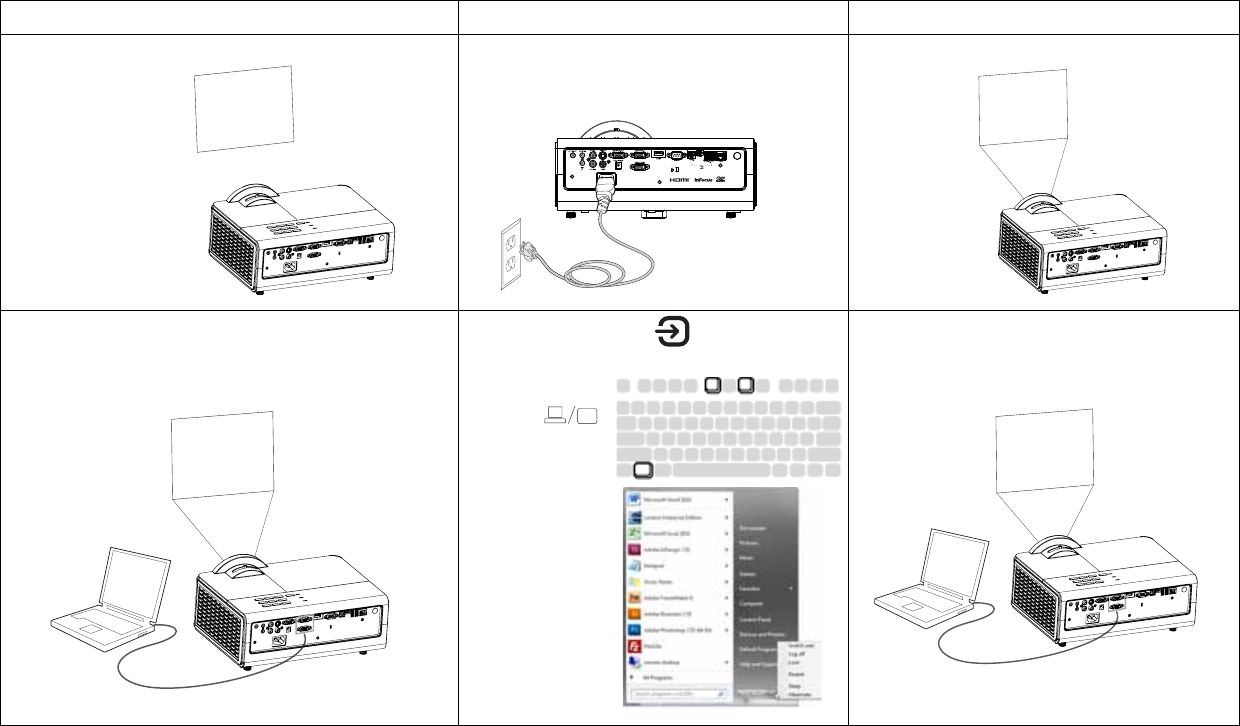
Problem Solution Result
N
No start up screen
P
Plug power cord into the projector
press power button
Startup
Screen
Correct image
A
Startup
Screen
O
Only start up screen appears
Restart laptop
Press the Source button
activate laptop’s external port
A
A
Computer image projected
13
14
Problem Solution Result
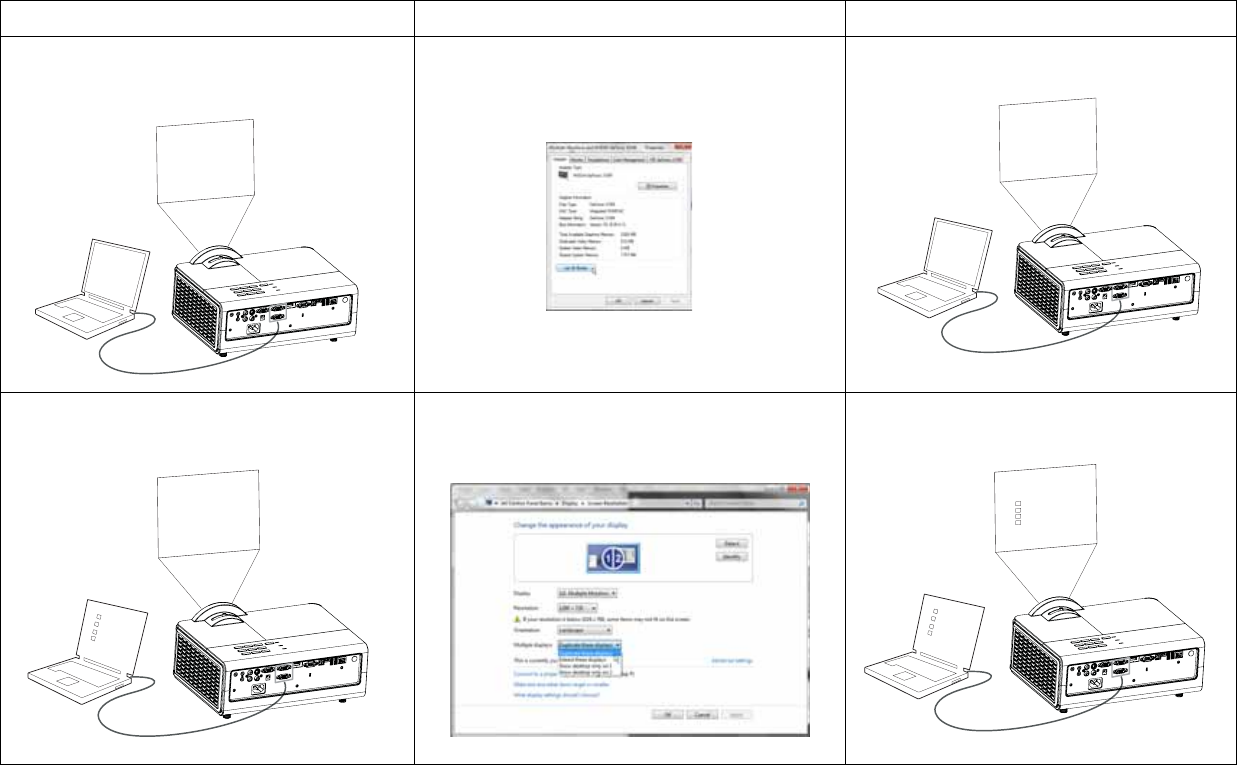
No computer image, just the words “Signal out of
range”
A
Signal out of
the range
P
Press the Auto Image button on remote
Adjust computer refresh rate (Windows 7: Control
Panel > Display > Screen Resolution > Advanced
Settings > Adapter tab). Varies per operating system.
You may also need to set a different resolution on your
computer, as shown in the following problem, “image
fuzzy or cropped”
Computer image projected
A
A
Only my laptop’s background appears, not the
Desktop icons
A
A
C
Change the Multiple Display setting to "Duplicate these
displays" (Windows 7: Control Panel > Display > Screen
Resolution). Varies per operating system.
Background and Desktop projected
A
A
15
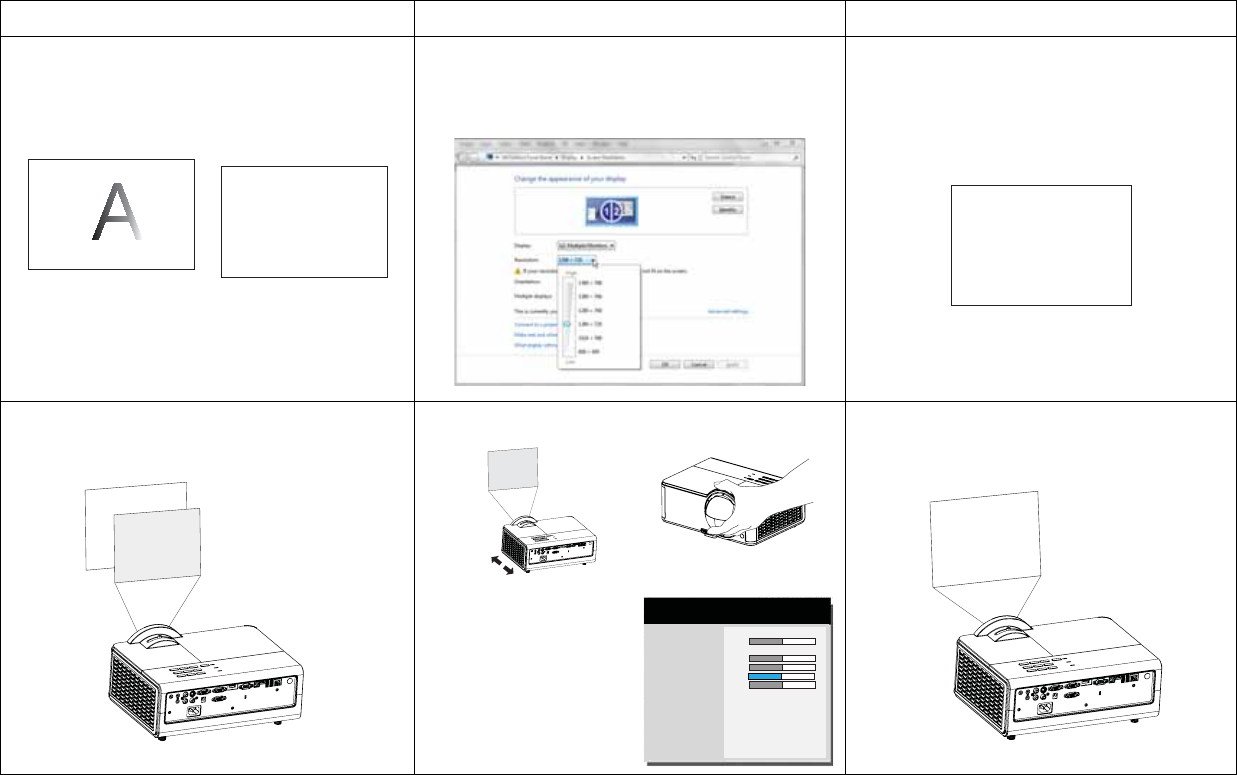
Image fuzzy or cropped
A
A
Change the computer's "Resolution" setting to match
the projector's resolution (Windows 7: Control Panel >
Display > Screen Resolution). Varies per operating
system.
A
Image clear and not cropped
Image not centered on screen
Force Wide
Phase
Prevent PC Screen Saver
Sync Threshold
Tracking
Horz Position
Vert Position
Previous
Off
50
Off
50
50
50
50
( PC ) MDL: IN3924
FW: 1.02
A
Adjust horizontal or
vertical position in
Advanced Menu >
Image > PC menu
M
Move projector, adjust height Correct image
Problem Solution Result
16
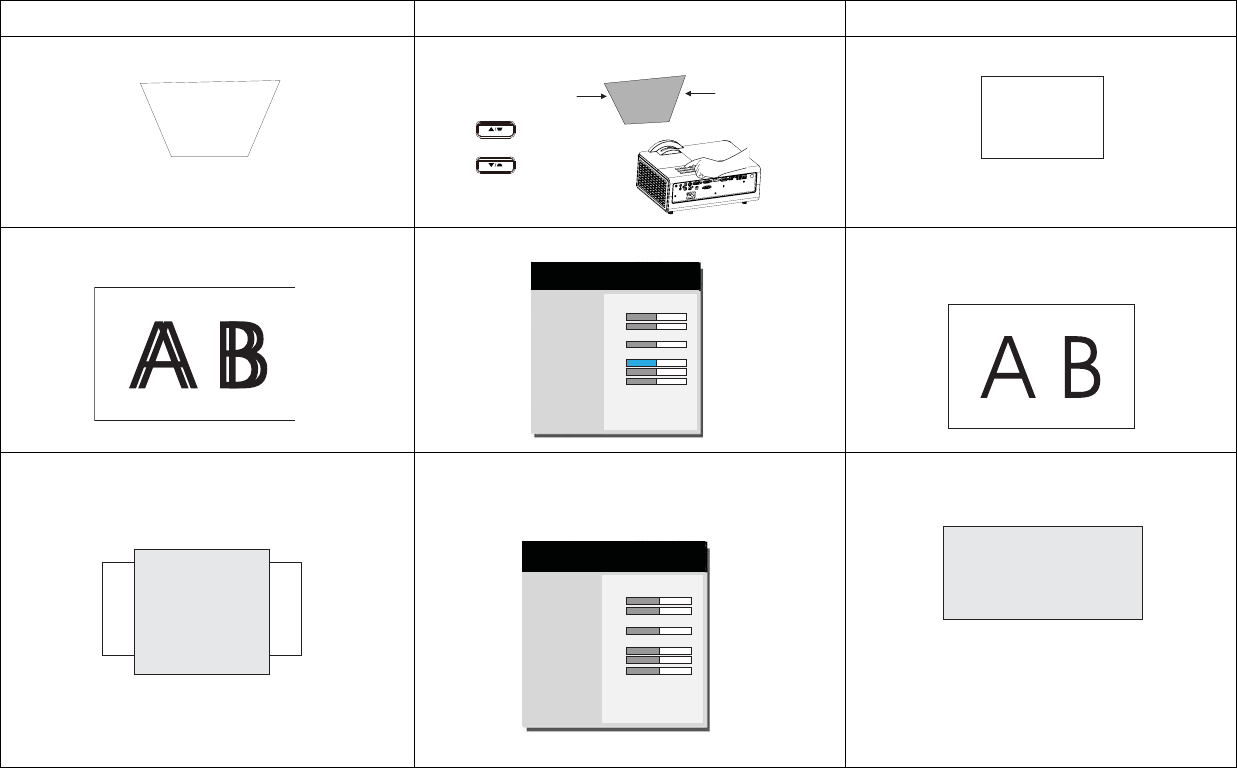
Image not square
A
Adjust Keystone on keypad Square image
Image not sharp
Aspect Ratio
Auto Image
Brightness
Contrast
Auto Keystone
Keystone
Presets
Sharpness
Volume
Microphone Volume
Ceiling Mount
Advanced Menu
◄ Auto ►
Execute
50
50
Off
50
Presentation
50
50
5
Off
(
Basic Menu
) MDL: IN3924
FW: 1.02
A
Adjust Sharpness in the Basic Menu Correct image
Image does not fit 4:3 or 16:9 screen
Aspect Ratio
Auto Image
Brightness
Contrast
Auto Keystone
Keystone
Presets
Sharpness
Volume
Microphone Volume
Ceiling Mount
Advanced Menu
◄ Auto ►
Execute
50
50
Off
50
Presentation
50
50
5
Off
( Basic Menu ) MDL: IN3924
FW: 1.02
C
Change aspect ratio to 4:3 or 16:9 in Basic Menu >
Aspect Ratio menu
Correct image
Problem Solution Result
A
17
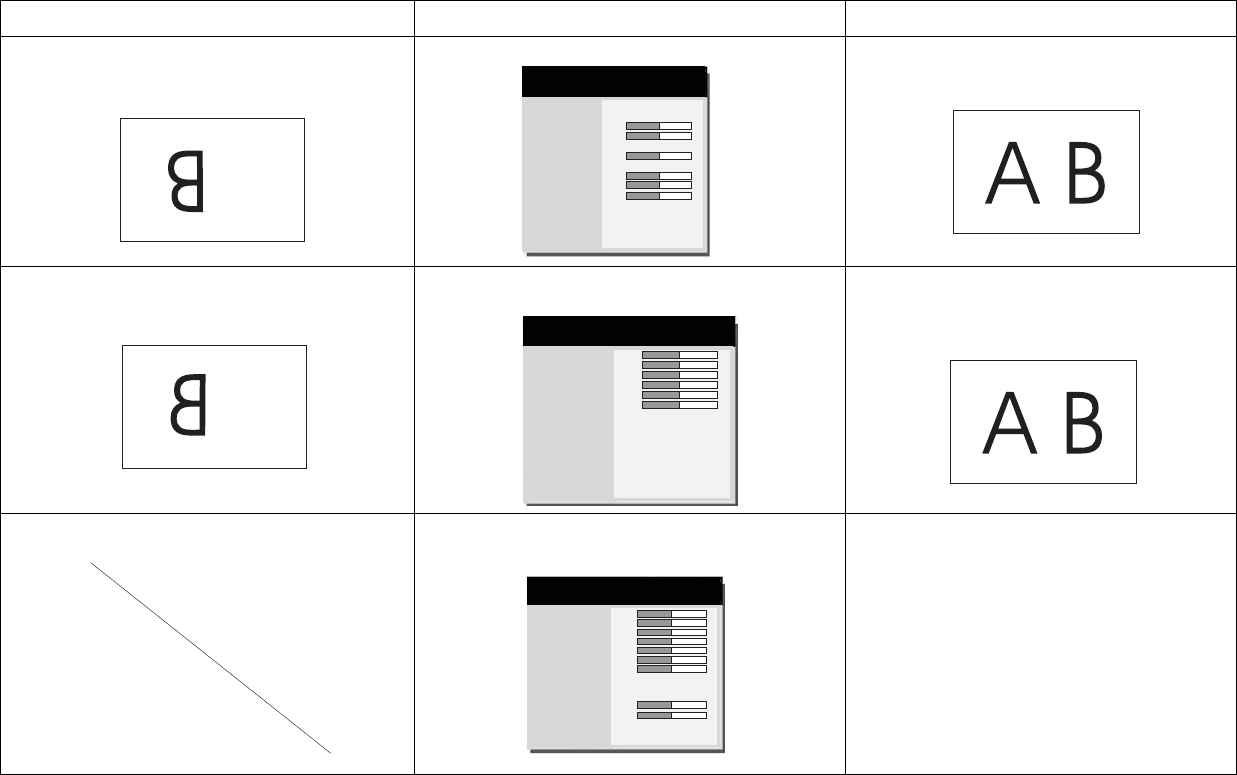
Image upside down
Aspect Ratio
Auto Image
Brightness
Contrast
Auto Keystone
Keystone
Presets
Sharpness
Volume
Microphone Volume
Ceiling Mount
Advanced Menu
◄ Auto ►
Execute
50
50
Off
50
Presentation
50
50
5
Off
( Basic Menu ) MDL: IN3924
FW: 1.02
T
Turn off Ceiling Mount in Basic menu Correct image
Image reversed left to right
A
Digital Zoom
Horz Shift
Vert Shift
Magnify Level
Horz Shift
Vert Shift
Ceiling Mount
Rear Project
Previous
50
50
50
50
50
50
Off
Off
( Image Setup ) MDL: IN3924
FW: 1.02
T
Turn off Rear Project in Advanced Menu > Setup >
Image Setup... menu Correct image
COLOR
Projected colors don’t match source
Color
Red Gain
Green Gain
Blue Gain
Red Offset
Green Offset
Blue Offset
Color Space
Color Temp
Gamma
Tint
White Intensity
Previous
50
50
50
50
50
50
50
Auto
Warm
Bright
50
50
( Color ) MDL: IN3924
FW: 1.02
A
Adjust the items in the Advanced Menu > Image >
Color... menu
COLOR
Correct image
Problem Solution Result
18
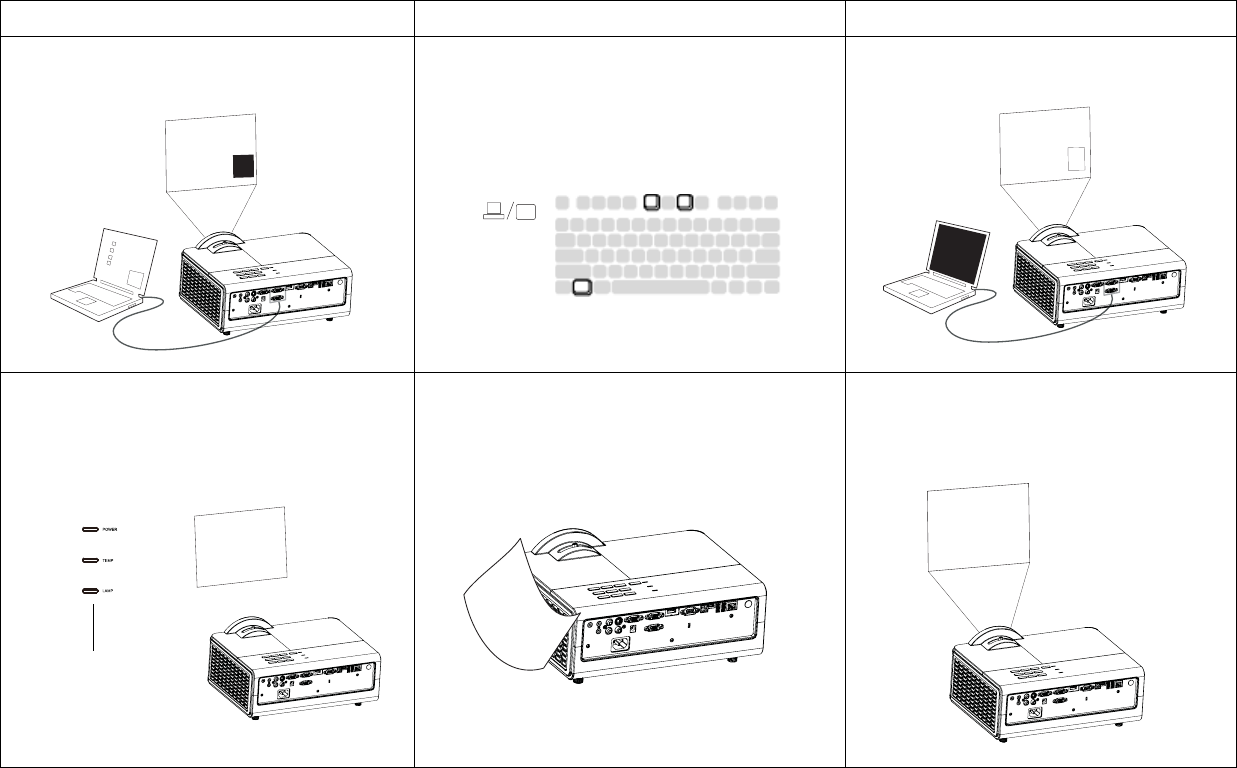
The video embedded in my PowerPoint presentation
does not play on the screen
A
A
B
B
T
Turn off the internal LCD display on your laptop Embedded video plays correctly
A
B
Overheating
indicator
L
Lamp won’t turn on, the projector is overheating
M
Make sure vents aren’t blocked, turn off the projector
and allow it to cool for one minute
Startup
Screen
Lamp turns on
Problem Solution Result
19
Still need assistance?
If you need assistance, visit our website at w
www.infocus.com/support
or call us.
See the Warranty/Safety booklet for support contact information.
This product is backed by a limited warranty. An extended warranty plan may be
purchased from your dealer. When sending the projector in for repair, we
recommend shipping the unit in its original packing material, or having a
professional packaging company pack the unit. Please insure your shipment for its
full value.
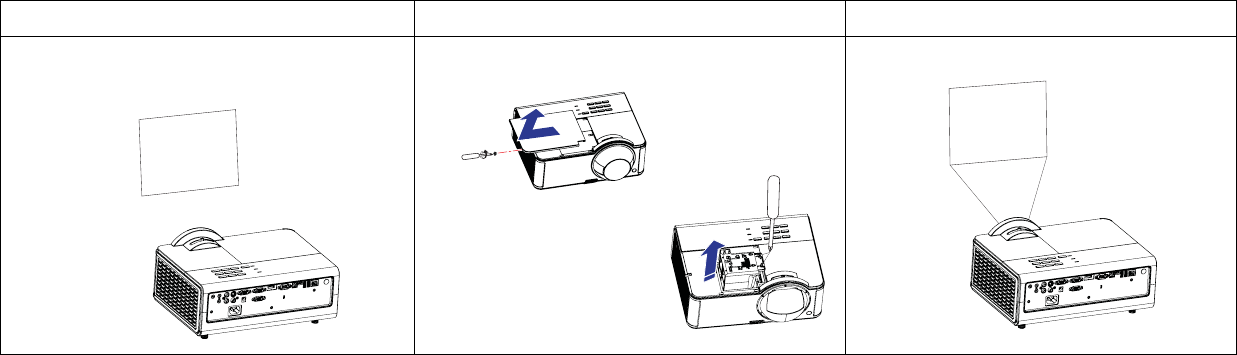
“Replace lamp” message appears at startup, lamp
won’t turn on
l
lamp door
replace lamp
L
Lamp must be replaced (see page 46)
Startup
Screen
Lamp turns on
Problem Solution Result
20
Using the remote control
The remote uses two (2) AAA batteries (not provided). They are easily installed
by removing the cover from the remote’s back, aligning the + and - ends of the
batteries, sliding them into place, and then replacing the cover.
Caution
:
• When replacing the remote batteries, be aware that using batteries other
than AAA batteries may risk severe damage to the remote. When disposing
of the batteries, be sure to do so in an enviromentally proper manner.
• If the remote control gets wet, wipe it dry immediately.
• Avoid excessive heat and humidity.
• Ensure the batteries' polarity (+/-) is aligned correctly.
• Do not mix new and old batteries together, or mix different types of batter-
ies together.
• Replace the batteries as soon as they run out.
• Remove batteries from the remote control when storing or not in use for a
prolonged period.
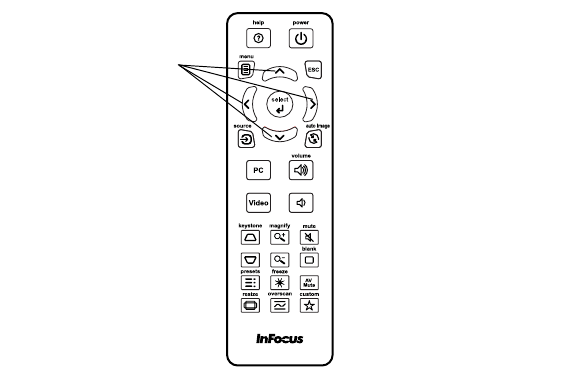
To operate, point the remote at the front of the projector (not at the computer).
The range of optimum operation is about 15 feet (4.5m).
Press the remote’s P
Power
button to turn the projector on and off (see page 41 for
shutdown info).
Press the remote’s M
Menu
button to open the projector’s menu system. Use the
arrow buttons to navigate, and the S
Select
button to select features and adjust
values in the menus. See page 25 for more info on the menus.
The remote also has:
•V
Volume
buttons adjust the sound.
•C
Custom
button that can be assigned to a special function, like Blank Screen or
Freeze (see page 28).
•S
Source
button brings up a menu of all possible sources allowing the user to
switch the active source.
•B
Blank
button to blank the screen.
•P
Presets
button to select stored settings (see page 26).
•M
Mute
button to silence the audio.
•A
Auto Image
button to resynch the projector to the source.
•R
Resize
button to switch among aspect ratios (see page 26).
•H
Help
button to get help with connecting sources and improving the picture.
• ESC
button to go back to previous OSD menu.
•P
PC
button to cycle through the Computer sources.
•V
Video
button to cycle through Composite/S-Video/HDMI input sources.
•K
Keystone
buttons adjust the squareness of the image
•M
Magnify
buttons magnify and reduce the projected picture size.
•F
Freeze
button to pause the projected image.
•O
Overscan
button remove noise around the video image.
•A
AV Mute
button blanks the projected image and mutes audio.
Troubleshooting the remote
• Make sure the batteries are installed in the proper orientation and are not
dead.
• Make sure you’re pointing the remote at the projector or the screen, not the
computer, and are within the remote range of 15 feet (4.5m). For best
results, point the remote at the projector.
navigation
buttons
21
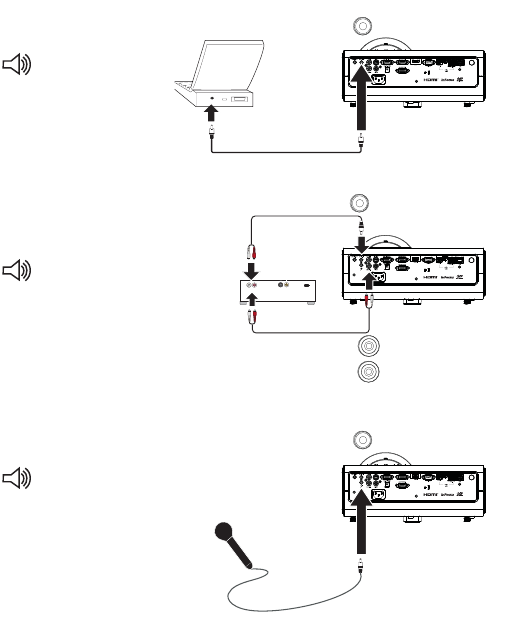
Using the audio
Using the projector’s speakers
Connect the audio source to the Audio In or Audio L/R connectors to hear audio
through the projector speakers. You may use the projector’s speakers by
connecting a microphone to the Microphone input connector.
Amplified speakers may also be connected to the projector using the Audio Out
connector.
To adjust the volume, press the V
Volume
buttons on the remote.
Troubleshooting Audio
If you aren’t hearing the audio, check the following:
• Make sure the audio cable is connected to the Audio In or Audio L/R
connectors on the projector, and that the other end of the cable is connected
to an Audio Out connector on the source (not a “line-in” or “microphone”
connector).
• Make sure the volume is turned up enough. Press the V
Volume
button on the
remote.
• Make sure the correct source is active.
• Adjust the audio source.
• If playing a video, make sure the playback has not been paused.
connect PC audio cable
Video Out HDMI Out
Audio Out
L R
connect video source audio
cable
connect microphone
22
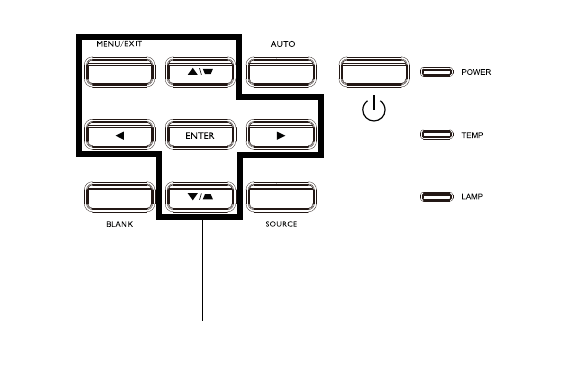
Using the keypad buttons
Most buttons are described in detail in other sections, but here is an overview of
their functions:
Power
–turns the projector on and off (page 9).
Auto
–resynchronize the projector to the source.
Menu
–opens the onscreen menus (page 25).
Enter
–acts as a Select button in the OSD menu and is used for USB storage device
operation (page 39).
Up/Down/Left/Right arrows
–When the menu is displayed, the up and down
buttons navigate through the menu.
Keystone
–adjusts the squareness of the image (page 10).
Source
–brings up a menu of all possible sources allowing the user to switch the
active source (page 9).
Blank
–blanks the screen.
menu navigation
buttons
23
Optimizing computer images
After the projector is running and the image is on the screen, you can optimize the
image using the onscreen menus. For general information on using the menus, see
page 25.
• Select default image settings using a preset appropriate to your environment.
• Adjust the Keystone, Contrast, or Brightness (page 26).
• Change the Aspect Ratio. Choose the option that best fits your input source
(page 26).
• Adjust the Color Temperature (page 27).
• Adjust the Phase, Tracking, or Horizontal or Vertical position (page 27).
• Once you have optimized the image for a particular source, you can save the
settings using Presets. This allows you to quickly recall these settings later
(page 26).
Presentation features
Several features are provided to make giving presentations easier. Here is an
overview, details are found in the menu section.
• The Custom key allows you to assign various features to the button. The
default effect is Source Info, which displays information about the projector
and current source. See page 28 for details.
• The Search Screen option lets you change the appearance of the blank screen
and start up screen (page 29).
• Auto Off Time is provided to automatically shut down the projector after
several minutes. This helps preserve lamp life (page 29).
24
Optimizing video images
After your video device is connected properly and the image is on the screen, you
can optimize the image using the onscreen menus. For general information on
using the menus, see page 25.
• Adjust the Keystone, Contrast, Brightness, Color, or Tint (page 26).
• Change the Aspect Ratio. Choose the option that best fits your input source
(page 26).
• Select a Sharpness setting (page 26).
• Adjust the Color Temperature. Select a listed warmth value (page 27).
• Turn on Overscan to remove noise on the edges of the image (page 28).
Customizing the projector
You can customize the projector for your specific setup and needs. See page 28
for details on these features.
• For rear projection, turn Rear Project on in the Advanced Menu > Setup >
Image Setup menu.
• For ceiling mounted projection, turn Ceiling Mount on in the Basic menu.
• Specify which source the projector checks first for active video during power-
up.
• Specify the function of the Custom key on the remote.
• Turn the projector’s display messages on and off.
• Turn on power saving features.
• Specify appearance of blank screen and startup screen.
• Specify the language viewed on the menus.
• Save settings for the active source as a preset.
25
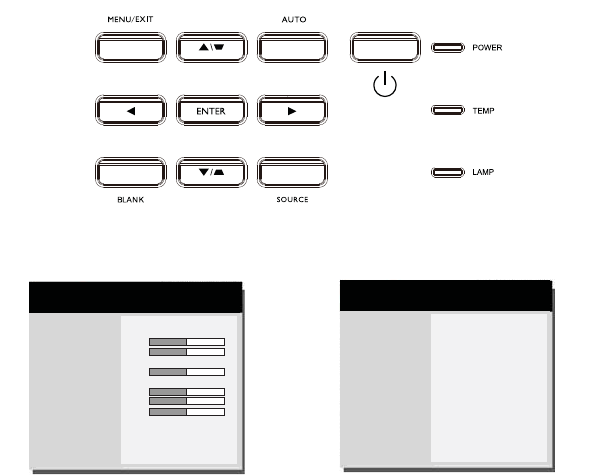
Using the menus
1
To open the menus, press the M
Menu
button on the keypad or remote. (The
menus automatically close after 60 seconds if no buttons are pressed.) Use the
arrow buttons to move up and down to review the menu options.
2
To enter a submenu, highlight the desired submenu and press >
>
on the keypad
or remote.
3
To adjust a menu setting, highlight the desired menu option and press < or >
to scroll through the available adjustments.
4
Press the M
Menu
button to exit the menu system.
The menus are grouped by usage:
• The Basic Menu provides common adjustments.
• The Advanced Menu provides more complex adjustments.
keypad navigation
buttons
Image
Setup
Status/Service
Basic Menu
3D Control...
Color...
PC...
Video...
( Advanced Menu ) MDL: IN3924
FW: 1.02
Basic Menu Advanced Menu
Aspect Ratio
Auto Image
Brightness
Contrast
Auto Keystone
Keystone
Presets
Sharpness
Volume
Microphone Volume
Ceiling Mount
Advanced Menu
◄ Auto ►
Execute
50
50
Off
50
Presentation
50
50
5
Off
(
Basic Menu
)
MDL: IN3924
FW: 1.02
26
Basic Menu
To adjust the following settings, highlight the setting, use the right and left arrows
to adjust the values.
Aspect Ratio
: Aspect ratio is the ratio of the image width to image height. TV
screens are usually 4:3. HDTV and most DVDs are 16:9.
Select Auto to have the projector choose the ratio. Choose Native to see the
unmodified input with no resizing by the projector. Select 16:9 to watch enhanced
widescreen DVDs.
Auto Image
: resets the projector to the source.
Brightness
: changes the intensity of the image.
Contrast
: controls the degree of difference between the lightest and darkest parts
of the picture and changes the amount of black and white in the image.
Auto
K
Keystone
: enables and disables the projector’s automatic vertical keystone
adjustment.
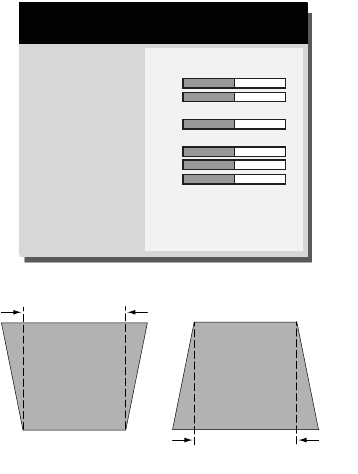
Keystone
: adjusts the image vertically and makes a squarer image. You can also
adjust keystone from the keypad.
Presets:
Presets are provided that optimize the projector for displaying computer
presentations and video images under certain conditions. Note: Users can save
their settings as a User Preset.
Sharpness
: Changes the clarity of the edges of a video image. Select a sharpness
setting.
Volume
: increases or decreases the audio volume.
Microphone Volume
: adjusts the microphone sound level.
Ceiling Mount
: turns the image upside down for ceiling-mounted projection.
Basic Menu
Aspect Ratio
Auto Image
Brightness
Contrast
Auto Keystone
Keystone
Presets
Sharpness
Volume
Microphone Volume
Ceiling Mount
Advanced Menu
◄ Auto ►
Execute
50
50
Off
50
Presentation
50
50
5
Off
(
Basic Menu
)
MDL: IN3924
FW: 1.02
increasing keystone decreasing keystone

27
Advanced Menu
Image
Setup
Status/Service
Basic Menu
3D Control...
Color...
PC...
Video...
( Advanced Menu )
MDL: IN3924
FW: 1.02
Advanced Menu
Image:
3D Control:
3D Control:
allows you to enjoy 3D (stereoscopic) content. Your projector
supports two synchronization modes (External Sync and DLP Link™) for
controlling LCD shutter glasses. In addition to the projector, you will need a
pair of 3D shutter glasses, 3D content, and 3D compatible source (and emit-
ter). Ensure the glasses you choose are consistent with the synchronization
mode you will be using.
3D Sync Invert:
(Only applies when 3D control is set to DLP Link™.) If the
image appears to flutter, look odd or if the image depth looks off or you
experience eye strain, turn this feature on to see if the image improves.
Color
Color
: adjusts a video image from black and white to fully saturated color.
The color setting applies to video sources only.
Red/Green/Blue Gain
: adjusts the gain of the red, green or blue channel of the
image.
Red/Green/Blue Offset
: adjusts the offset of the red, green or blue channel of
the image.
Color Space
: applies to computer and component video sources. It allows
you to select a color space that has been specifically tuned for the input signal.
When Auto is selected, the projector automatically determines the standard.
To choose a different setting, turn off Auto, then choose RGB for computer
sources or choose either REC709 or REC601 for component video sources.
Color Temperature
: changes the intensity of the colors. Select a listed rela-
tive warmth value.
Gamma
: select the appropriate gamma from among Video, Film, Bright, and
CRT.
Tint
: adjusts the red-green color balance in the image of NTSC video images.
The tint setting applies to NTSC video sources only.
White Intensity
: increases the brightness of whites that are near 100%.
PC:
Force Wide
: when this is off, the analog locking algorithms choose the stan-
dard mode resolution (4:3) as the preferred default resolution. When this is
on, the analog locking algorithms choose wide mode resolution (16:10) as the
preferred default resolution.
Phase
: adjusts the horizontal phase of a computer source.
Prevent PC Screen Saver
: prevents your computer from going into Screen
Save mode. The projector must be connected to the PC via a USB cable for
this feature to work.
Sync Threshold
: (progressive signals only) If a hardware device, such as a
DVD player, is not syncing properly with the projector, select this option to
help it to sync when connected to the projector.
Tracking
: adjusts the vertical scan of a computer source.
Horizontal/Vertical Position
: adjusts the position of a computer source.

28
Video:
Detect Film
: determines whether the original source of the input video was
film (progressive) or video (interlaced).
Overscan
: removes noise around the video image.
Set Black Level
: analyzes the current input image and calculates an offset value
which is then added to the analog to digital converter black level value. This
ensures optimum black level for each analog source.
Setup:
Audio Setup
Internal Speakers
: turns the internal speakers on or off.
Computer 1
: selects the audio input for Computer in 1 signal.
Computer 2
: selects the audio input for Computer in 2 signal.
Video
: selects the audio input for video source.
HDMI
: select the audio input for HDMI signal.
Closed Captions
Closed Captions
: controls closed captioning. If the source is NTSC and
contains captions on the selected channel, then the projector will display
caption text overlaid on the image. When Closed Captions is off and volume
is muted, closed captioning will appear. Options are: Off, CC1 and CC2.
Image Setup
Digital Zoom
: reduces the size of projector’s display area. If the display area
has been resized by this setting, it can be moved by changing the H
Horz Shift
and V
Vert Shift
settings.
Magnify Level
: magnifies the image. If the image has been magnified by this set-
ting, it can be moved by changing the H
Horz Shift
and V
Vert Shift
settings.
Ceiling Mount
: turns the image upside down for ceiling-mounted projection.
Rear Project
: reverses the image so you can project from behind a translu-
cent screen.
Keypad/Remote
Blank Key
: select what to display when the blank key on the remote is
pressed: a solid color screen (blue, black or white), or the factory logo
screen.
Custom Key
: allows you to assign a different function to the Custom button,
allowing you to quickly and easily use the effect. Press < or > on the keypad
or remote to choose a different one.
•
Blank Screen
: displays an empty screen.
•
Mute
: turns off all sound.
•
Source
: brings up a menu of available sources.
•
Auto Image
: resets the projector to the source.
•
Freeze Screen
: pauses the projected image.
•
Source Info
: the default action. Shows the Source Info menu.
•
Projector Info
: shows the Projector Info menu.
•
Overscan
: removes noise around the image.
•A
AV Mute
: enables or disables AV Mute function.
•C
Closed Captions
: enables or disables Closed Captions.
Keypad:
enables or locks the projector keypad.
LiteBoard
™W
Wand:
selects the LiteBoard™Wand mode. Options are: None,
Single Pen and Dual Pens.
29
Lamp
Programmed Dimming
: When enabled, Programmed Dimming enhances con-
trast ratios in dark scenes and disables Lamp Low Power. Programmed Dim-
ming will impact lamp life and system noise performance. Programmed
Dimming works in conjunction with the lamp. If Lamp Low Power is enabled,
Programmed Dimming is unavailable.
Lamp Low Power
: toggles between on and off. Turn it on to lower the light
output of the lamp. This also lowers the fan speed, making the projector qui-
eter.
OSD Setup
Language
: allows you to select a language for the onscreen display.
Menu Position
: allows you to change the position of the On Screen Display
items.
Menu Transparency
: allows you to change how much of the projected image
behind the menu you can see. As the value increases, more of the image
behind the menu is visible.
Show Messages
: displays status messages (such as “Searching”) in the lower-
left corner of the screen.
PIN Settings
PIN Protect
: The PIN (personal identification number) feature allows you to
password protect your projector. Once you enable the PIN feature, you must
enter the PIN before you can project an image. Use the U
Up/Down/Left/Right
arrows buttons on the remote or keypad to set a 4-button press sequence. If
you enter an incorrect PIN 3 times in succession, the projector will automat-
ically shut down. If you lose or forget your custom PIN, contact InFocus
Technical Support.
To enter the PIN at projector startup:
Power up the projector. The “E
Enter PIN
” dialog box displays after the star-
tup screen. Enter the PIN. Use the U
Up/Down/Left/Right
arrows buttons on
the remote or keypad to enter the correct 4-button press sequence. See the
description above for instructions.
To change the PIN:
Select “C
Change PIN...
” in the Advanced Menu > Setup > PIN settings menu.
Enter the existing PIN. Enter the new PIN.
Power
Power Saving Mode
: When the Power Saving Mode is On and the projector is
in standby (powered off but connected to AC power), the monitor out func-
tion will not work.
Source
Auto Source
: When this feature is On, the projector automatically finds the
active source, checking the selected Power-up Source first. When this feature
is Off, the projector defaults to the source selected in Power-up Source. To
display another source, you must manually select one by pressing the S
Source
button on the remote or keypad and selecting one from the displayed Source
menu.
Power-up Source
: determines which source the projector checks first for
active video during power-up.
Search Screen
: allows you to display a blank screen instead of the default
screen at startup, and when no source is detected.

30
Timer
Auto Off Time
: automatically turns the projector off after no signals are
detected for a preset number of minutes. If an active signal is received before
the projector powers down, the image will be displayed.
High Altitude
High Altitude Setting
: We recommend you turn on the High Altitude Mode
when your environment is between 5000' (1500m) and 10,000' (3000m)
above sea level.
Network
Allow you to configure the network settings.
Wired LAN
DHCP: Abbreviation for Dynamic Host Configuration Protocol. This protocol
automatically assigns IP Addresses to networked devices.
• When the “D
DHCP
” is set to “O
On
”, the DHCP server will assign an IP
address to the projector automatically. This may take up to a minute.
• When the "D
DHCP
" is set to "O
Off
", the user will need to set the IP
address manually.
IP Address: The numerical address used to identify devices on the network.
This is only accessible when DHCP is set to Off.
• The IP Address is the number that identifies this projector on the
network. You cannot have two devices with the same IP Address on
the same network.
• The IP Address “0.0.0.0” is prohibited.
Subnet Mask: A numeric value defining the number of bits used in an IP
Address when the network is divided into subnets. This function can only be
used when DHCP is set to Off.
• The Subnet Mask “0.0.0.0” is prohibited.
Default Gateway: A server (or router) to communicate across networks (sub-
nets) that are divided by a Subnet Mask. This function can only be used when
DHCP is set to Off.
DNS: Setup DNS server address when DHCP is disabled.
Mac Address: Abbreviation for Media Access Control Address. A Mac Address
is a unique ID number assigned to each network adapter.
Apply: Save and execute the wired network settings.
Wireless LAN
SSID: Display the projector’s SSID information.
IP Address: a read-only display of IP Address.
Subnet Mask: a read-only display of Subnet Mask.
Restart Network...
: Restart network settings.
Status/Service:
Source Info
: a read-only display of current source settings.
Projector Info
: a read-only display of current projector settings.
Reset Lamp Hours...
: resets the lamp hours used counter in the Projector
Info menu to zero. Do this only after changing the lamp.
Factory Reset...
: restores all settings to their factory default settings.
Service Code...
: only used by authorized service personnel.
Wired LAN
Wireless LAN
Restart Network
Previous
( Network ) MDL: IN3924
FW: 1.02
Network menu
31
Controlling the projector through a LAN
environment
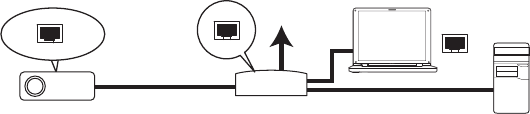
The projector supports Crestron® software. With correct settings for the
Network
menu, you can manage the projector from a computer using a web
browser when the computer and the projector are properly connected to the
same local area network.
Wired connection
Internet
IP Router
C
Configuring the LAN control setting
If you are in a DHCP environment:
1
Take a RJ45 cable and connect one end to the RJ45 LAN input jack of the
projector and the other end to the RJ45 port .
2
Press M
Menu
on the keypad or remote and then go to A
Advanced Menu
> S
Setup
> N
Network
menu.
3
Press v
to highlight D
DHCP
and press < or > to select O
On
.
4
Press v to highlight A
Apply
and press >.
5
Please wait for around 15 - 20 seconds, and then re-enter the N
Network
page.
The I
IP address
, S
Subnet Mask
, D
Default Gateway
, D
DNS
and Mac Address
settings will be displayed. Write down the IP address displayed in the I
IP
address
row.
•If the Projector IP Address still does not display, contact your network
administrator.
•If the RJ45 cables are not properly connected, the IP Address, Subnet Mask,
Default Gateway, DNS and Mac Address settings will display 0.0.0.0. Make
sure the cables are properly connected and perform the procedures above
again.
•If you need to connect to the projector in its standby mode, set the P
Power
Saving Mode
feature to O
Off
.
If you are in a non-DHCP environment:
1
Repeat steps 1-2 above.
2
Press v
to highlight D
DHCP
and press < or > to select O
Off
.
3
Contact your network administrator for information on the I
IP address
, S
Subnet
Mask
, D
Default Gateway
, D
DNS
and Mac Address settings.
4
Press ^ or v to select the item you want to modify.
5
Press < or > to move the cursor and then press ^ or v to select the value.
6
Press v to highlight A
Apply
and press > to save the settings.
•If the RJ45 cables are not properly connected, the IP Address, Subnet Mask,
Default Gateway, DNS and Mac Address settings will display 0.0.0.0. Make
sure the cables are properly connected and perform the procedures above
again.
•If you wish to connect to the projector in its standby mode, be sure to
select RJ45 and obtain the IP Address, Subnet Mask, Default Gateway, DNS
and Mac Address information when the projector is on.
32
Wireless connection
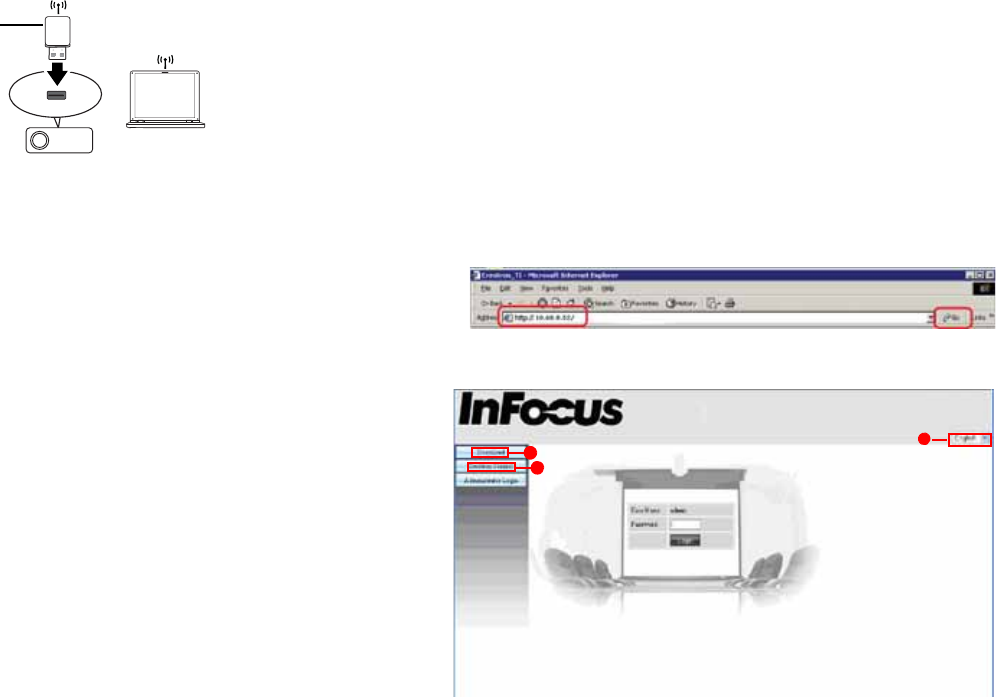
To connect to the projector wirelessly, you need to plug an optional InFocus
wireless dongle (p/n SP-WIFIUSB) to the USB Type A connector on the projector,
and then check the Wireless LAN Info on Network Info menu.
1
Make sure the projector is turned on.
2
Press M
Menu
on the keypad or remote and then go to A
Advanced Menu
> S
Status/
Service
> N
Network Info
.
3
3Make sure S
SSID
and I
IP Address
information are displayed.
Controlling the projector remotely through a web
browser
Once you have the correct IP address for the projector and the projector is on or
in standby mode, you can use any computer that is on the same local area network
to control the projector.
•If you are using Microsoft Internet Explorer, make sure it is version 7.0 or
higher.
•The screenshots in this manual are for reference only, and may differ
depending on your browser.
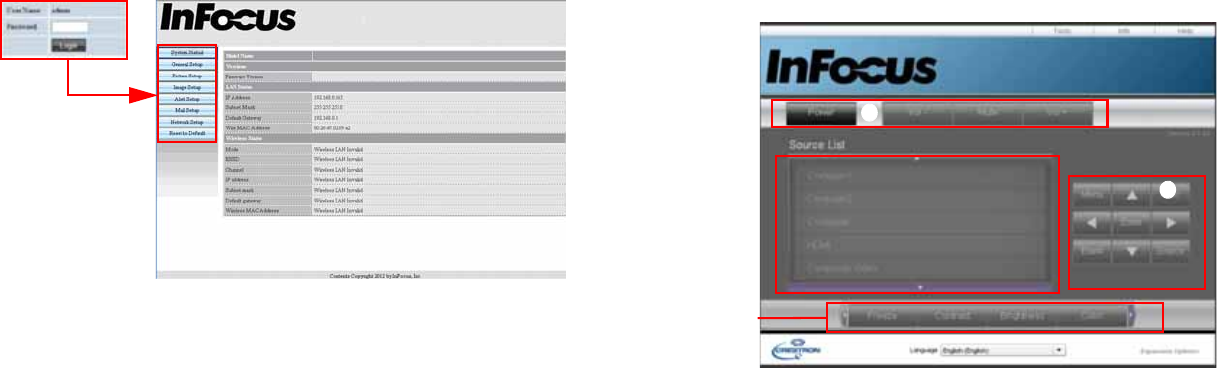
1
Enter the address of the projector in the address bar of your browser and
press E
Enter
.
2
The main page of the Network Control displays.
ii
i
iii
i. To change the language for the web pages, click the down arrow to reveal a
drop down list and select a desired language.
ii. To download ifPresenter, click Download. See page 36 for details.
InFocus wireless dongle
(p/n SP-WIFIUSB)
33
iii. The Crestron (eControl) page displays the Crestron eControl user inter-
face. See page 33 for details.
3
To access the Admin page, enter the password. The default password is
“admin”.
•S
System Status:
Displays the system information.
•G
General Setup:
Allows you to turn on/off the projector, switch the input
signal for the projector, and change the password for the Administrator
page.
•P
Picture Setup/Image Setup:
Provides some OSD menu items for adjusting
the projected pictures. See page 25 for details.
•A
Alert Setup/Mail Setup:
Allows you to setup the mail server and send
system error messages to your network administrator.
•N
Network Setup:
Provides wired and wireless network settings.
•R
Reset to Default:
Allows you to restore the device to the factory default
settings.
About Crestron e-Control®
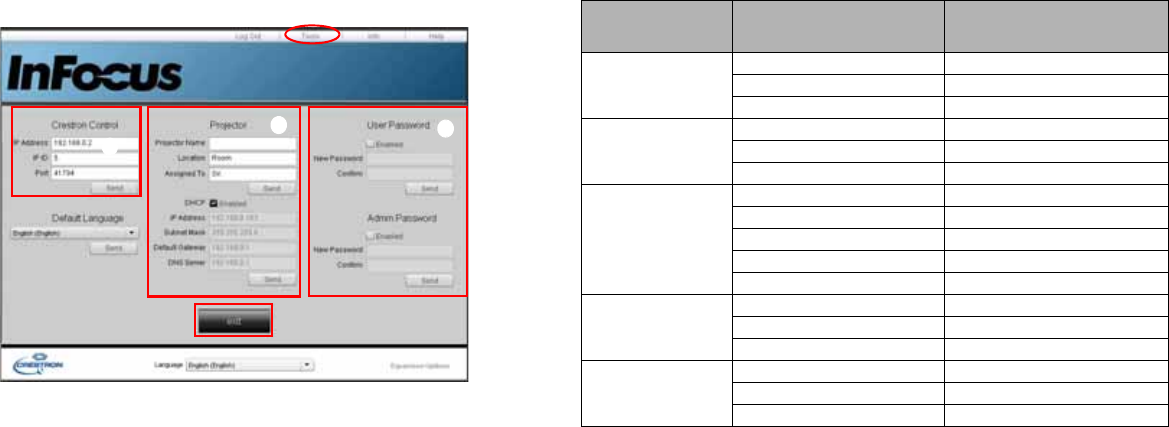
1
The C
Crestron e-Control®
page provides a variety of virtual keys to control the
projector or adjust the projector’s image.
i
i
You can press </>
to reveal more
buttons.
i. These buttons function the same as the OSD menus and remote control
functions.
•S
Source List:
To switch the source, click on the desired source.
•M
Menu:
Use to go back to the previous OSD menu, exit and save menu
settings.
• When you use the projector control panel or remote control to change the
OSD menu settings, it may take a while for the web browser to synchronize
these changes with the projector.
34
2
The T
Tools
page allows you to manage the projector, configure the LAN
control settings and remotely access the network operations of this projector.
iii
ii
i
i. This area is only used with a Crestron Control System. Please contact Cre-
ston or refer to the Crestron user manual for setup information.
ii. This area is used for naming the projector, associating it with a particular
location, assigning a responsible party to it, and adjusting network settings.
iii. This area is used to set User and Admin passwords. When password protec-
tion is enabled, unauthorized changes to the projector configuration will be
avoided.
•To prevent errors, only enter alphanumeric characters on the T
Tools
page.
•After configuring the settings, press the S
Send
button and the data will be
saved in the projector.
•Press e
exit
to go back to the Crestron remote network operation page.
Please pay attention to the input length and character limitations (including
character and punctuation restrictions) listed below:
Category Item Input-Length Maximum Number of
Characters
Crestron Control
•/ > < $ % + \ ' " are prohibited.
IP Address 15
IP ID 2
Port 5
Projector
Projector Name 10
Location 9
Assigned To 9
Network
Configuration
DHCP (Enabled) (N/A)
IP Address 15
Subnet Mask 15
Default Gateway 15
DNS Server 15
User Password
Enabled (N/A)
New Password 20
Confirm 2
Admin Password
Enabled (N/A)
New Password 20
Confirm 20
35
3
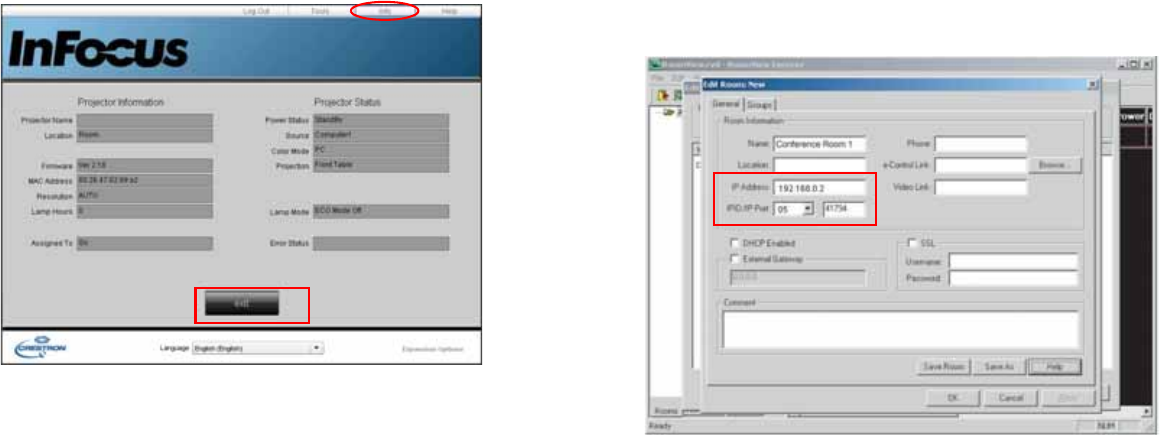
The I
Info
page displays the information and status of this projector.
Press e
exit
to go back to the Crestron remote network operation page.
4
After pressing the H
Help
button, the T
Title
window will display in the upper right
corner of the screen. You will be able to send messages to RoomView™
software administrators/users who are connected to the same local area
network.
• For more information, visit http://www.crestron.com and
www.crestron.com/getroomview.
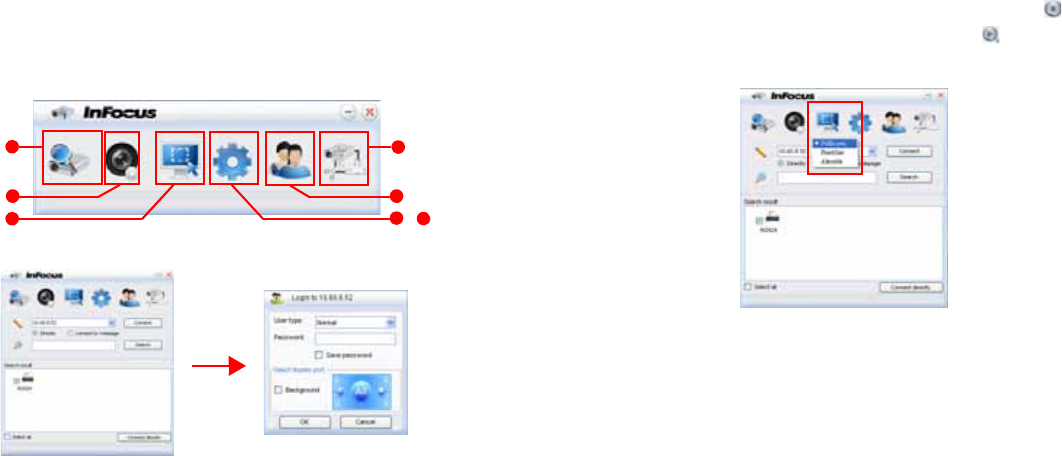
Crestron RoomView
From the Crestron RoomView software in the E
Edit Room
page, enter the IP
Address (or hostname) as shown on the projector’s on-screen display (OSD)
menu, “05” for IPID, and “41794” for the reserved Crestron control port.
For the Crestron RoomView user guide and information about RoomView settings
and commands, go to: http://www.crestron.com/products/
roomview_connected_embedded_projectors_devices/resources.asp
36
Displaying images through ifPresenter
Downloading and installing ifPresenter
The ifPresenter is an application which can run on the host PC. It helps connect
your computer to an available network projector and transfer the desktop content
to the network projector via local network connection.
1
Enter the main page of Network Control. See steps 1-2 on page 32 for details.
2
Download ifPresenter.
3
When the download is complete, install the software to your computer by
clicking the exe file. Follow the on-screen instructions to complete the
installation.
4
Launch ifPresenter.
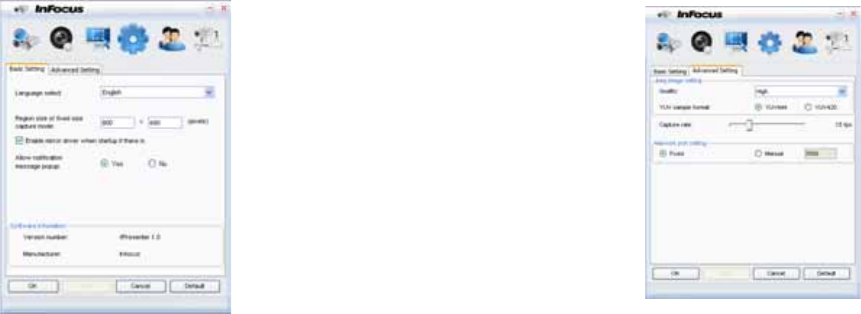
Using ifPresenter
7
1
2
345&
6
1
The Search page allows you to search and connect to a projector.
i. To connect to a projector, select C
Connect Directly
then type the projector’s
IP Address and click C
Connect
.
ii. To search for projectors, simply click S
Search
to list all the projectors on the
same local area network. Click the desired projector in the Search result list,
and click C
Connect directly
. You can also type a desired projector name and
click S
Search
.
iii. You can link to the InFocus webpage control system on page 32.
• If you are a first time user, choose your identity as a N
Normal user
or
Administrator
. Neither requires a password. However if you choose to be
an Administrator, you have the authority to set a password for connecting
to the projector. That password should be written down and used to
connect to the same projector.
• If there are multiple computers connected to the projector, you can decide
a display zone by clicking 1
1
,
2
,
3
,
4
,
L
,
R
,
All
, or B
Background
.
2
If you want to freeze the projected image on the screen, press . Any further
movements will be not been seen on the screen until is pressed.
3
You can choose a capture mode from here.
i. To display a full screen, click F
FullScreen
.
ii. To display a partial screen, click F
FixedSize
. A square appears on your screen.
You can place it where you want to project.
iii. If you wish to change the square, click A
Alterable
.
37
4
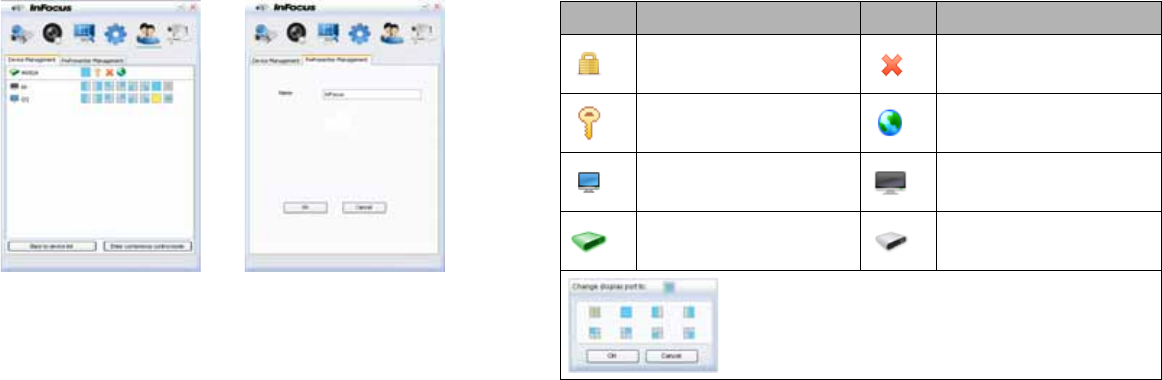
The Basic Setting page allows you to configure ifPresenter.
i. To change the ifPresenter interface language, click the down arrow to reveal
a drop-down list and select a desired language. Click A
Apply
.
ii. Users can change the size parameters of the frame in F
FixedSize
capture
mode by modifying width and height on this page and click A
Apply
to make
changes take effect.
iii. User can use the mirror driver for presenter capture image, if the system has
installed the mirror driver.
iv. To allow notification messages to appear, click Y
Yes
. Click A
Apply
.
v. The Software Information is available on this page.
5
The Advanced Setting page allows you to configure ifPresenter.
i. To adjust the image quality, click the down arrow to reveal a drop-down list
and select a desired quality level. The higher image quality you select, the
higher network transfer speed is required. Select a YUV sample format
between YUV444 and YUV420. Compared to format YUV420, format YUV
444 provides better image quality but may slow the loading and playing
speed. Click A
Apply
after your selections.
ii. To adjust the capture rate, move the slide bar. The network bandwidth may
also affect the performance.
iii. Network port setting for fixed or manual type.
38
6
You can manage the connected projectors listed under Device Management.
• Under a conference mode:
1 Only the administrator can take control.
2 A projector can display up to 4 computer screens.
• You can set the name of your computer under ifPresenter Management.
• For details about the icons, please see the following:
7
Disconnect
To disconnect from the projector(s), click the D
Disconnect
icon.
• Be sure to turn off other virtual network control programs before using
ifPresenter.
Icon Description Icon Description
You are a standard user and can-
not change the password.
Disconnects from the projector.
You are an administrator and can
change the password.
Opens the web page of the Net-
work Control.
You are in control of the projec-
tor.
Someone else is controlling the
projector.
You are an administrator. You are a standard user.
Sets a display zone for the projector.
39
Displaying pictures with a USB storage device
The projector has a built-in application which can display images from a USB
storage device. It can eliminate the need for a computer source.
The projector supports the following image formats:
File format Maximum pixel size
JPEG 8000 x 8000
GIF/TIFF/PNG/BMP 1280 x 800
• Progressive JPEG files are not supported.
• Some JPEG files may not display clearly.
To display images from a USB storage device:
1
Plug the USB storage device into one of the USB Type A connectors.
2
The projector automatically displays the main screen. You can also manually
select U
USB Type A
by pressing the S
Source
button and choosing the USB Type
A input.
3
Press E
Enter
to display the content of your USB storage device.
4
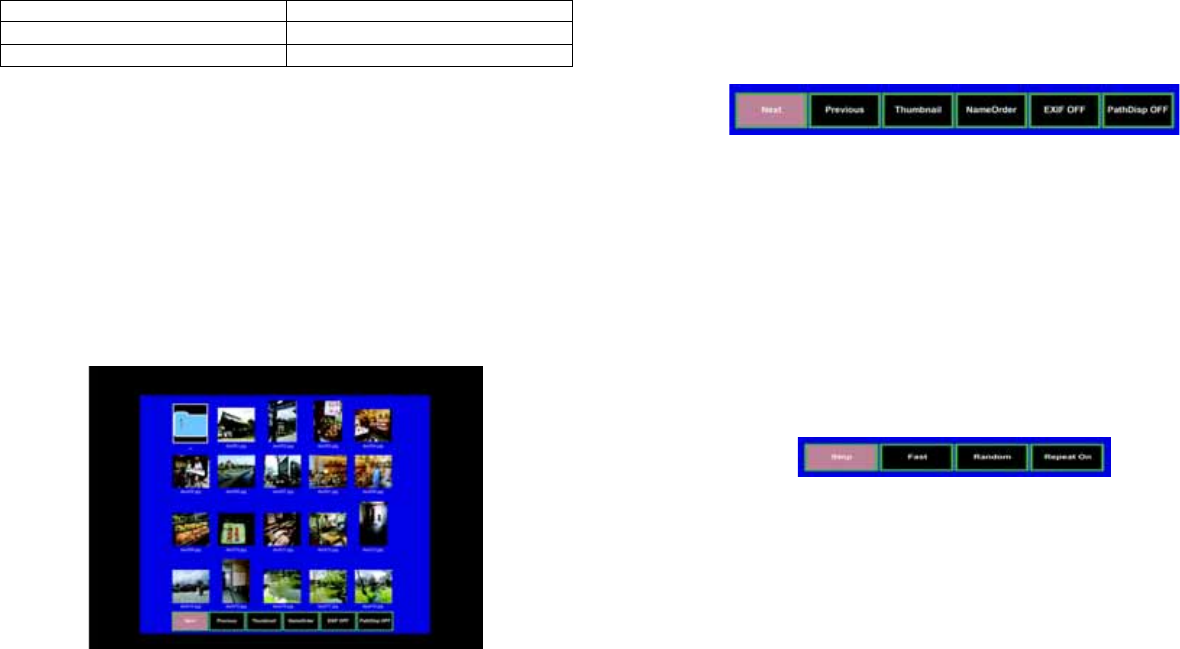
Folders and supported files are represented in thumbnail mode.
• To scroll through the thumbnails, use the arrow keys on your remote or
the projector keypad.
• To open a folder/file, press E
Enter
.
• To go back to the previous screen, select the thumbnail with an up arrow in
the top right corner of the screen, and press E
Enter
.
• To obtain more functions, press M
Menu
and E
Enter
to open the menu. To
leave the menu, press M
Menu
and E
Enter
again.
When viewing thumbnails
•N
Next:
Selects the next folder/image.
•P
Previous:
Selects the previous folder/image.
•T
Thumbnail/Full Screen/SlideShow:
Displays the selected image(s) in
Thumbnail, Full Screen or SlideShow mode.
•N
NameOrder/ExtendOrder/SizeOrder/TimeOrder:
Sets the images to be
displayed in the order of filenames, filename extension, file sizes, or time the
photos were taken.
•E
EXIF OFF/EXIF ON:
Toggles the EXIF data associated with the image on
and off.
•P
PathDisp OFF/PathDisp ON:
Toggles the display of the file name and path
on and off.
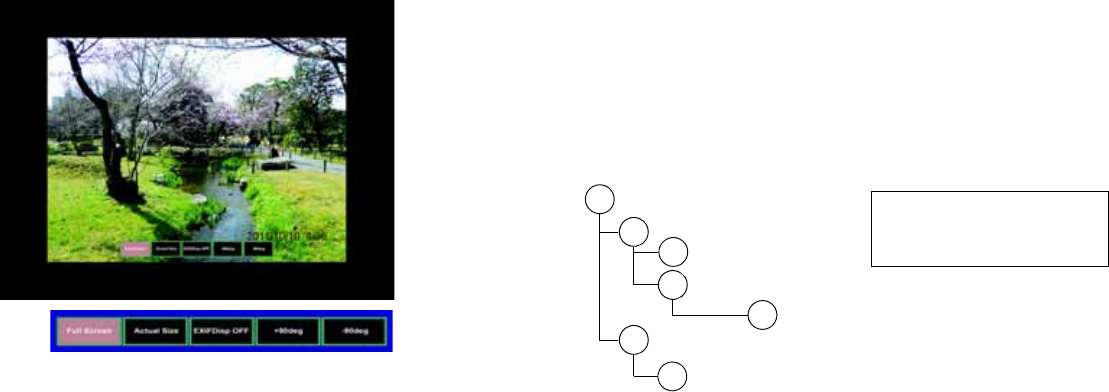
When viewing slide shows
•S
Stop:
Stops the slide show.
•F
Fast/Medium/Slow:
Sets the interval between the two images display.
•S
Slide Right/Slide Up/Right down/Random:
Sets the way the slide show is!
displayed.
•R
Repeat On/Off:
Sets whether to repeat the slide shows.
40
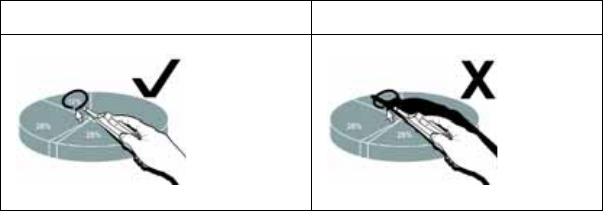
When viewing full screen images
•T
Thumbnail/Full Screen/SlideShow:
Displays the selected image(s) in
Thumbnail, Full Screen or SlideShow mode.
•B
Best Fit/Actual Size:
Sets the display size of the image.
•E
EXIFDisp OFF/EXIFDisp ON:
Toggles the EXIF data associated with the
image on and off.
•+
+ 90deg:
Rotates the image 90 degrees clockwise.
•-
-90deg:
Rotates the image 90 degrees counterclockwise.
• USB 2.0 compliant USB storage media (Mass Storage Class) is supported.
• We strongly recommend using an AC power adaptor with any USB hard
drives.
• The following formats are recommended for any USB hard drives. FAT12/
FAT16/FAT32 (NTFS format is not supported).
• Some USB flash drives may not work correctly with the projector.
• A security-enabled USB flash drive is not supported.
• Do not connect any apparatus other than USB storage devices. Do not
charge other equipment through the USB connector. It may cause a
malfunction.
• The projector plays up to 200 files in a folder.
• The filenames are displayed in the following order: symbols, digits, letters.
• The projector can display the filenames up to 16 characters including the file
extension.
• The application displays English filenames the best. If the files are named in
other languages, the filenames may not show properly, however the content
will still display properly.
• Folders in the USB storage device can be recognized up to 3 layers. The
priority of thumbnail display for image files is as follows:
A
B
C
D
E
F
G
: Currect directory:
: Folder B
: Folder D
: Folder E
: Folder G
: Folder C
: Folder F
File display priority in folder: A
> B > C > D > E > F.
Folder G: Cannot be displayed
• Response times may vary depending on the image contents when switching
pages, loading!and playing files.
41
LiteBoard
™
Wand
The LiteBoard Wand works like a wireless mouse - but one that works in midair,
not on your desktop. Just hold the wand in your hand, and point it at the projected
image to point, click and drag. The wand works with all your software, just like a
regular mouse.
Charging the Wand’s Battery
When the wand’s amber battery light starts to blink, its internal battery is low (if
the battery is fully discharged, you won’t be able to turn the wand on by pressing
its tip, left or right buttons).
To charge the battery, open the flap at the bottom of the wand to expose the
wand’s USB connector. Then connect a USB cable between the wand and the USB
power adapter, or a computer (if connecting to a computer, make sure the
computer is powered on). The battery light will stay on while the battery is
charging, then it will turn off when the battery is fully charged.
When charging is finished, you can disconnect the USB cable (or keep the cable
connected and use the wand while it’s charging).
NOTE
: 5-10 minutes of charging is enough for about an hour of wand use. A full
charge will take 6-8 hours and will allow 20-40 hours of non-stop wand use. A fully
charged, new wand will hold a charge in standby for up to 3 weeks.
Caution
: The lithium battery is only rechargeable, and is not user serviceable or
user replaceable.
Caution
: Always use the included USB cable and power adapter (or your
computer) to charge the wand.
How to Use the Wand
1
The projector needs to be powered on and connected to your computer.
2
Connect the projector and your computer with a USB cable.
3
Connect the projector and your computer with a VGA cable.
4
Make sure the wand's battery is charged or charging.
5
Turn on the projector and make sure it's displaying the computer's screen -
set the source to Computer 1 or Computer 2 (press the source button on the
projector or its remote if needed - you may need to press it several times).
6
Turn on the wand by pressing its tip, left or right button - the wand's blue
status light will start to blink.
7
Point the wand at the screen to point, click, and drag - just like a normal
mouse. The Undo button is located at the bottom of the wand. You can select
the function of the wand's Undo Button.
NOTE
: When you’re done, set the wand aside and make sure it isn’t pointing at
the screen; it will turn itself off automatically after 1 minute.
Wand Position and Avoiding Shadows
Your Location Distance from the Screen
You can use the LiteBoard Wand right up against the screen, or around the room.
You might find that your pointing accuracy will improve if you get closer to the
screen. Also, avoid standing too far off from either side of the screen.
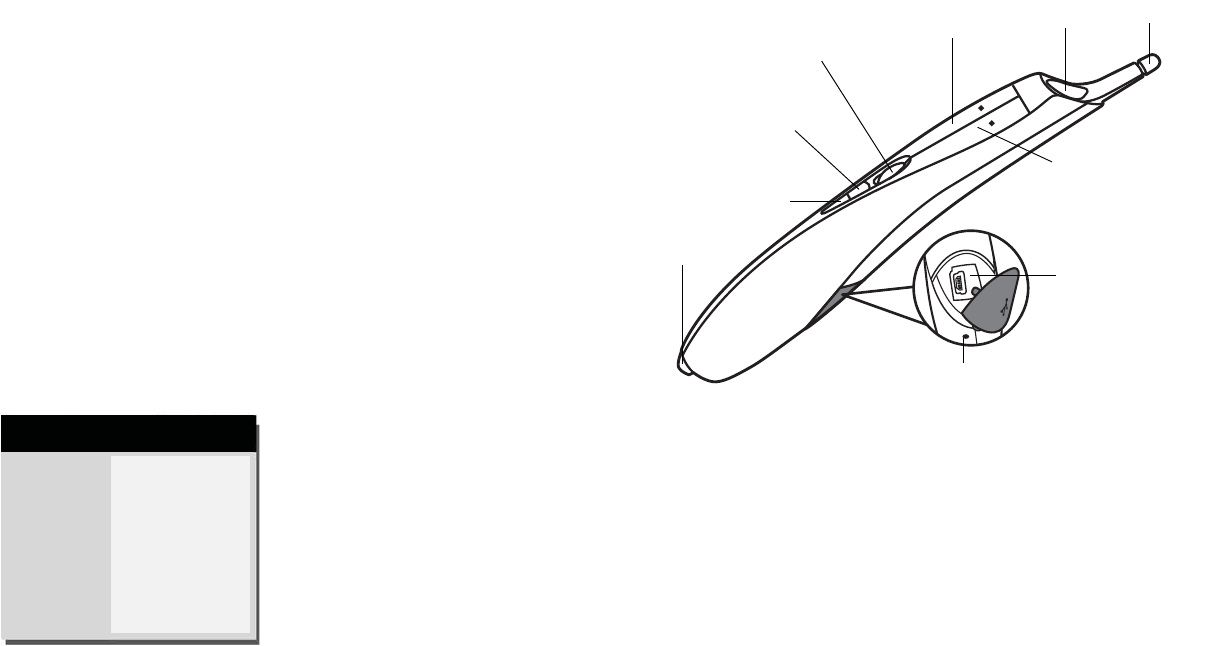
Avoid Shadows!
The wand won't work if its sensor is in a shadow or if it is pointing at a shadow:
Correct (no shadow) Incorrect (shadow)
42
How to Hold the Wand
You can hold the wand the way you would hold a normal pencil or pen, or you can
hold it like a remote control - use in whichever position is most comfortable.
NOTE
: If the wand is up close to the screen, you can press its tip against the
projection surface to click and drag. Not recommended for use with fabric
screens.
Using More than One Wand
The projector can work with more than one wand, but you can only use one wand
at a time. When you want to switch to a different wand:
1
Point the current wand away from the projected image for at least 3 seconds.
2
Press the tip, left or right button on the new wand to turn it on, and then start
using the new wand.
NOTE
: You can access the LiteBoard Wand menu from the projector's Setup >
Keypad/Remote menu. Three options are available: None, Single Pen and Dual
Pens.
Blank Key
Custom Key
Keypad
LiteBoard™ Wand
Previous
Factory Logo
Source Info
Enable
None
( Keypad/Remote ) MDL: IN3924
FW: 1.02
Wand Features
USB connector
Link light
Battery light
Reset button
Right mouse button
Left mouse button
Scroll Wheel button
Sensor Tip
Undo button
B
Buttons and Wand Tip
The wand's three top buttons are equivalent to the left, right, and scroll wheel
buttons on a mouse. The wand's tip is also a button, and is equivalent to the left
mouse button.
NOTE
: The Scroll Wheel button allows you to set the wand’s motion mode.
Toggle the Scroll Wheel button to select an active mode.
Battery Light
The amber battery light shows the status of the wand's built-in battery (see below
for battery information). The battery light will turn on while the wand is charging,
and it will blink if the battery is low (2-4 hours of wand use left).
43
Link Light
The blue link light shows the status of the wand's wireless connection to the
projector. The link light will blink frequently (more than once per second) when
the wand is attempting to link to the projector; then it will blink less frequently
(about once every 4 seconds) after the wand has linked to the projector.
NOTE
: The link light will stay off when the wand is off.
USB Connector
The wand's USB connector is behind a flap on the back of the wand. The USB
connector is only used for charging the wand's battery - using the included USB
power adapter, or a computer.
NOTE
: You can use the wand while charging the battery, but after the battery is
charged (battery light turns off), you can unplug the USB cable and continue to use
the wand without a cable.
Undo Button
The wand's Undo button will function the same as the computer's Escape, Delete,
or Backspace buttons, or the same as a Ctrl+Z (Windows/Linux) or Cmd+Z (Mac
OS) command, depending on which function you select.
Sensor
The wand's optical sensor opening is located above the wand's tip. Don't block the
sensor, and make sure it always has a clear view of the screen.
NOTE
: The sensor won't work if you point it at a shadow or away from the
screen.
Reset Button
The wand has a reset button, behind a small hole on its underside. Under normal
conditions, you should not need to reset the wand. See the Troubleshooting
section below for more information.
Internal Radio
The wand has a built-in wireless transmitter/receiver which it uses to
communicate with the projector.
Lithium Battery Information
Manufacturer: HiTech Energy Inc.
Model: E3BE105K1002
Rating: 3.7V/800mAh
Caution
: Lithium battery is only rechargeable, and not user replaceable. Not user
serviceable.
Troubleshooting LiteBoard
For the most up-to-date information, visit our support site at w
www.infocus.com/
support
• If the wand doesn't work at all, or it works intermittently, try one of these
solutions:
- P
Press to Move
may be enabled; try holding down one of the wand’s buttons
while moving the wand.
- Press the tip, left or right button on the wand to turn it on.
- If the wand's blue Link light never blinks, then the wand's battery is fully dis-
charged; connect the wand to the USB power adapter or your computer.
- Make sure the wand is not pointing at a shadow and make sure its tip is not
in a shadow.
- If the room is brightly lit, reduce the room illumination.
- If you're trying to use the computer's mouse at the same time as the wand,
point the wand away from the screen while using the mouse.
- If someone else is using a different wand with the same projector, they must
stop using it before you can use another wand.
- Reset the wand: push the end of a paper clip into the reset opening on the
underside of the wand.
• If accurate clicking is difficult, try one of these solutions:
- Hold the wand steadier when clicking.
- Use the wand right up against the screen so it's easier to avoid unexpected
movements.
44
• If the mouse pointer is in the wrong place on the screen, or the mouse
pointer's movement is restricted to only part of the screen, try one of these
solutions:
- Make sure your projector is displaying the computer's screen and not some
other source (such as DVD, VCR, etc.). To change the source, press the
Source button on the projector or its remote.
- Make sure the projector is displaying the same image as the computer's main
or built-in monitor (don't extend your desktop onto multiple monitors). To
correct this:
On Windows XP: Open the Display control panel, click Settings, click the dis-
play that represents the projector, then un-check “Extend my Windows desk-
top...”.
On Windows Vista: Right-click on the desktop, choose Personalize..., click
Display Settings, click the display that represents the projector, then un-check
“Extend the desktop...”
On Windows 7.0: Right-click on the desktop, choose Screen Resolution, click
the display that represents the projector, and then choose the “Duplicate
Display...” under Multiple Displays.
On Macintosh: Select System Preferences from the Apple Menu, then select
Displays. Click Arrangement, and check “Mirror Displays.”
• If the battery light does not turn on when the wand is being charged, try one
of the following:
- Make sure a USB cable is connected between the wand and either the USB
power adapter, or a USB port on your computer.
- If the wand is connected to the USB power adapter, make sure the adapter
is plugged in to a live electrical outlet. If the wand is connected to your com-
puter, make sure the computer is powered on.
- If the wand still won't charge, contact InFocus support at: w
www.infocus.com/
support
.
45
Maintenance
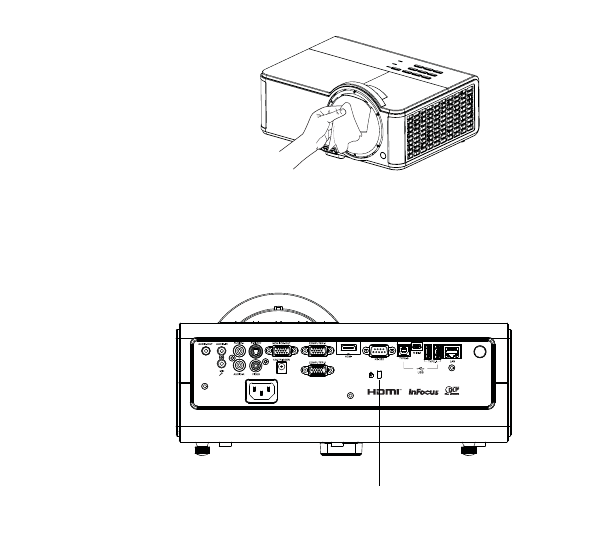
Cleaning the lens
1
Apply a non-abrasive camera lens cleaner to a soft, dry cloth.
•Projector must be off and the lens must be at room temperature.
•Avoid using an excessive amount of cleaner, and don’t apply the cleaner
directly to the lens. Abrasive cleaners, solvents or other harsh chemicals
might scratch the lens.
2
Lightly wipe the cleaning cloth over the lens in a circular motion.
WARNINGS:
•Turn the projector off and unplug power cord before cleaning any part of
the projector.
•Do not touch or block the projector lens with any objects as this can
damage the projector lens. Scratches, gouges and other lens damage are not
covered by the product warranty.
•Do not open any cover on the projector, except the lamp cover.
•Do not attempt to service this product yourself as opening and removing
covers may expose you to dangerous voltage and other hazards. Refer all
servicing to qualified service personnel.
Using the security lock
The projector has a security lock for use with a Cable Lock System. Refer to the
information that came with the lock for instructions on how to use it.
security
lock
46
Replacing the projection lamp
The Lamp Hours timer in the Projector Info menu counts the number of hours the
lamp has been in use. Twenty hours before the lamp life expires, the message
“Replace lamp” displays on the screen at startup.
•N
NOTE
: Be sure to use the InFocus lamp module designed for this projector.
You can order new lamps from w
www.infocus.com
(in select areas), your
retailer or your dealer. O
Only genuine InFocus lamps are tested for use in this
projector.
Use of non InFocus lamps may cause electrical shock and fire, and
may void the projector warranty. InFocus is not liable for the performance,
safety or certification of any other lamps.
WARNINGS
:
• The projector uses a high-pressure mercury glass lamp. The lamp may fail
prematurely, or it may rupture with a popping sound if jolted, scratched, or
handled while hot. The risk of lamp failure or rupture also increases as the
lamp age increases; please replace the lamp when you see the “Replace Lamp”
message.
• To avoid burns, allow the projector to cool for at least 60 minutes before you
replace the lamp.
• Do not touch or block the projector lens with any objects as this can damage
the projector lens. Scratches, gouges and other lens damage are not covered
by the product warranty.
• Unplug the power cord before replacing the lamp.
• Do not drop the lamp module. The glass may shatter and cause injury.
• Do not touch the glass surface of the lamp module. Fingerprints can obscure
projection sharpness and may cause the glass to shatter.
• Be extremely careful when removing the lamp housing. In the unlikely event
that the lamp ruptures, small glass fragments may be generated. The lamp
module is designed to contain most of these fragments, but use caution when
removing it.
• Before replacing a ruptured lamp, clean the lamp compartment and dispose of
cleaning materials. Wash hands after lamp replacement.
• When replacing the lamp while the projector is ceiling-mounted, wear
protective eyewear to prevent eye injury.
Hg – Lamp contains mercury. Manage in accordance with local disposal
laws. See w
www.lamprecycle.org
.
47
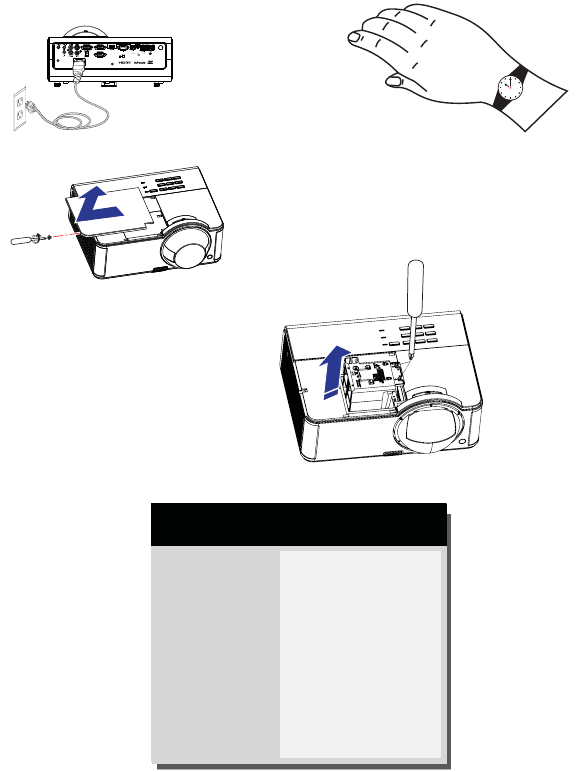
1
Turn off the projector and unplug the power cord.
2
Wait 60 minutes to allow the projector to cool thoroughly.
3
Remove the lamp door, located on top of the projector, by removing the
screw on the side of the lamp door, sliding the door to the left, and lifting the
lamp door off.
4
Loosen the captive screws that attach the lamp housing to the projector.
NOTE
: If the projector is installed on a ceiling mount, be careful not to drop
the lamp module once the captive screws are loosened.
5
Carefully lift the lamp straight up, off of the alignment pins; being careful not to
pinch the lamp connector. Dispose of the lamp in an environmentally proper
manner.
6
Install the new lamp module, aligning the pins properly. Be careful not to pinch
the lamp connector.
7
Tighten the screws. (N
NOTE
: If the pins have not been aligned properly, the
screws will not tighten securely.)
8
Replace the lamp door by reversing step 3 and locking it back into place.
9
Replace the lamp door screw and tighten securely.
10
Plug in the power cord and press the Power button to turn the projector back
on.
11
To reset the lamp hour timer, navigate to the A
Advanced Menu > Status/Service
menu and select R
Reset Lamp Hours...
.
turn off and unplug
projector
wait 60 minutes
loosen screws
loosen lamp door screw
Image
Setup
Status/Service
Basic Menu
Source Info...
Projector Info...
Network Info...
Reset Lamp Hours...
Factory Reset...
Service Code...
( Advanced Menu ) MDL: IN3924
FW: 1.02
48
INDEX
Numerics
3D Sync Invert 27
A
Apply 30
Aspect Ratio 26
Audio In Computer connector 8
Auto Image 26
Auto Keystone 26
Auto Off Time 30
Auto Source 29
AV Mute 28
B
Battery Light 42
Blank Key 28
Blank Screen 28
Brightness 26
C
Cable box 11
Ceiling Mount 28
Closed Captions 28
Color Space 27
Computer In connector 8
Connecting
Video device 11
Contrast 26
Crestron e-Control® 33
Crestron RoomView 35
D
Default Gateway 30
Detect Film 28
DHCP 30
Digital Zoom 28
DNS 30
F
Factory Reset 30
Focus 10
Force wide 27
Freeze Screen 28
G
Gamma 27
H
HDTV 26
High Altitude Setting 30
Horizontal Position 27
Horz Shift 28
I
ifPresenter 32
Internal Radio 43
Internal Speaker 28
IP Address 30
K
Keypad 28
Keypad buttons 22
Keystone 26
L
Lamp Low Power 29
LAN 31
Link Light 43
LiteBoard™ Wand 41
M
Mac Address 30
Magnify Level 28
Menu Transparency 29
Menu usage 25
Microphone Volume 26
Mute 28
N
Network 30
49
O
Overscan 28
P
Phase 27
PIN Protect 29
Power connector 8
Power cord 8
Power Saving Mode 29
Prevent PC Screen Saver 27
Programmed Dimming 29
Projector
Keypad buttons 22
Menus 25
Positioning 7
Setting up 7
Troubleshooting problems 12
Projector Info 28, 30
R
Rear Project 28
Red/Green/Blue Gain 27
Red/Green/Blue Offset 27
Remote control 20
Reset Button 43
Resetting the projector 30
Restart Network... 30
S
Screen Aspect 11
Search Screen 29
Sensor 43
Service 30
Set Black Level... 28
Sharpness 26
Show Messages 29
Source 28
Source Info 28, 30
SSID 30
Subnet Mask 30
Sync Threshold 27
T
Tint 27
Tracking 27
Troubleshooting 12
Troubleshooting LiteBoard 43
U
Undo Button 43
USB 6
USB Connector 43
V
Vert Shift 28
Vertical Position 27
Volume 26
Volume button 21
W
Warranty 19
Web browser 32
Wired LAN 30
Wireless connection 32
Wireless LAN 30