Intelyt orporated ITAGV33 GPS tracking device with 802.15.4 Radio and 3G cell modem User Manual iDAC Mode

iControl Incorporated GPS tracking device with 802.15.4 Radio and 3G cell modem iDAC Mode

Command List

        iControl Incorporated  iTAG  Command List        Revision 2.2    Date:  January   2015
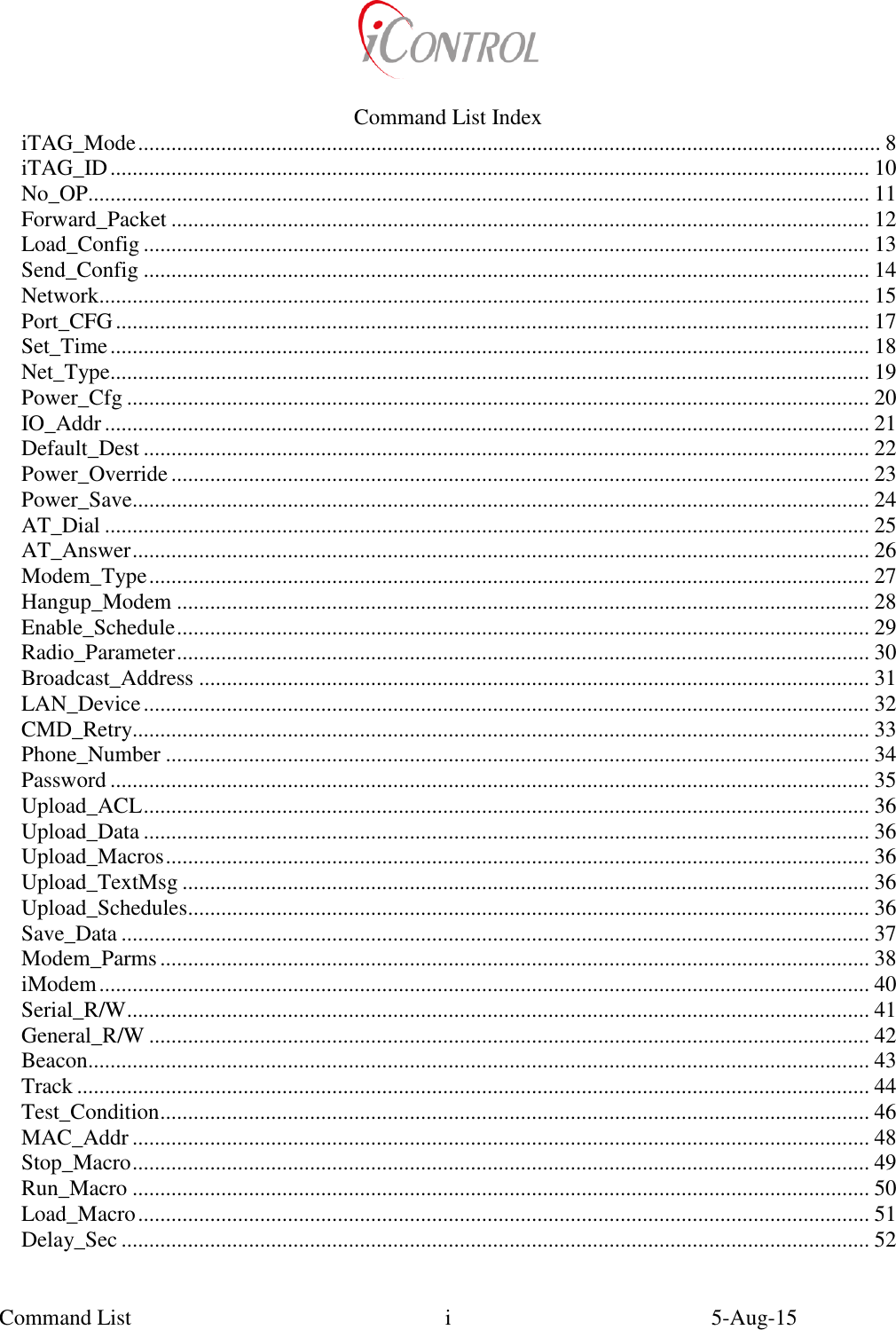
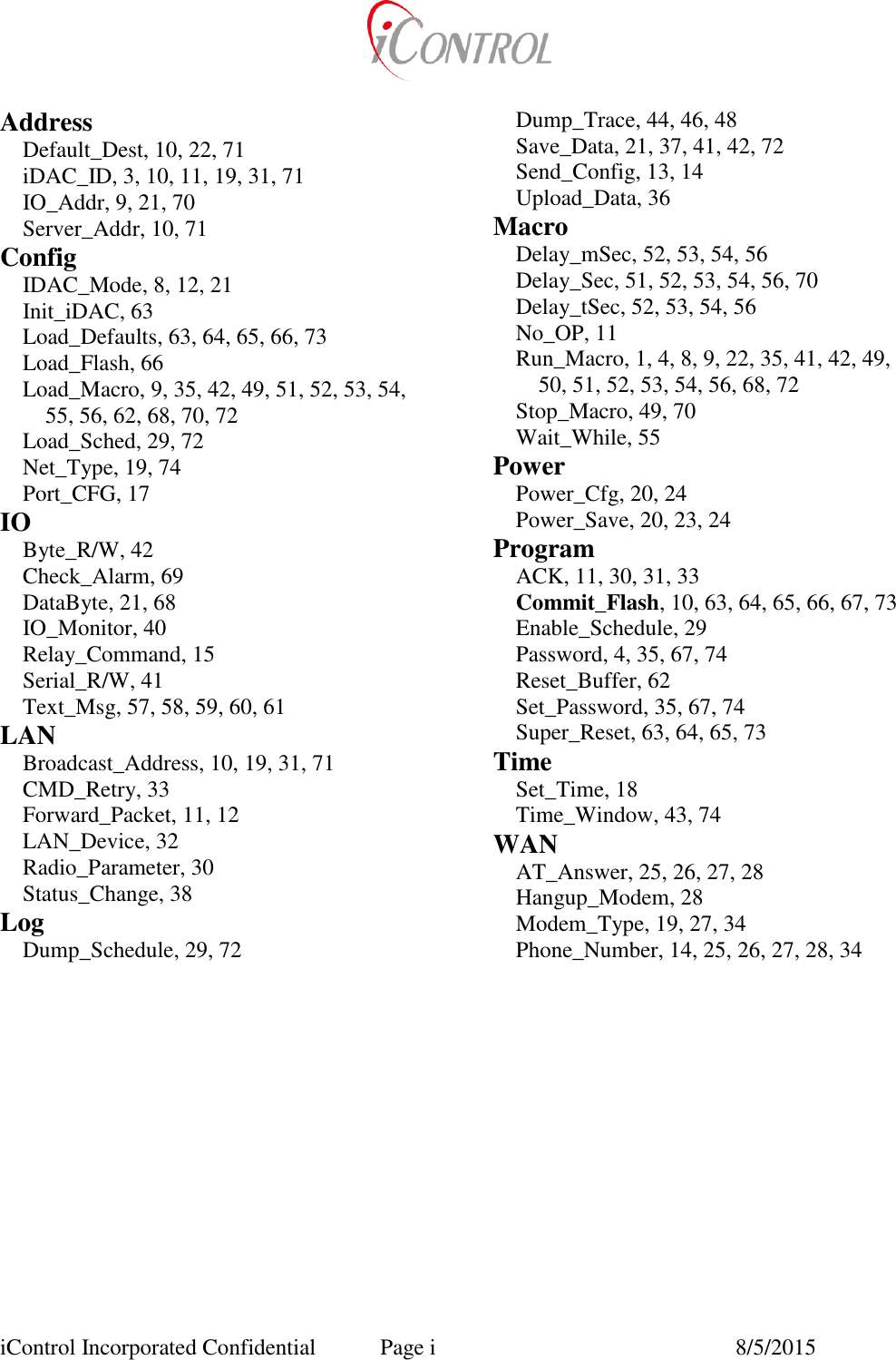
 Command List    5-Aug-15   i  Command List Index iTAG_Mode ...................................................................................................................................... 8 iTAG_ID ......................................................................................................................................... 10 No_OP............................................................................................................................................. 11 Forward_Packet .............................................................................................................................. 12 Load_Config ................................................................................................................................... 13 Send_Config ................................................................................................................................... 14 Network........................................................................................................................................... 15 Port_CFG ........................................................................................................................................ 17 Set_Time ......................................................................................................................................... 18 Net_Type......................................................................................................................................... 19 Power_Cfg ...................................................................................................................................... 20 IO_Addr .......................................................................................................................................... 21 Default_Dest ................................................................................................................................... 22 Power_Override .............................................................................................................................. 23 Power_Save..................................................................................................................................... 24 AT_Dial .......................................................................................................................................... 25 AT_Answer ..................................................................................................................................... 26 Modem_Type .................................................................................................................................. 27 Hangup_Modem ............................................................................................................................. 28 Enable_Schedule ............................................................................................................................. 29 Radio_Parameter ............................................................................................................................. 30 Broadcast_Address ......................................................................................................................... 31 LAN_Device ................................................................................................................................... 32 CMD_Retry..................................................................................................................................... 33 Phone_Number ............................................................................................................................... 34 Password ......................................................................................................................................... 35 Upload_ACL ................................................................................................................................... 36 Upload_Data ................................................................................................................................... 36 Upload_Macros ............................................................................................................................... 36 Upload_TextMsg ............................................................................................................................ 36 Upload_Schedules........................................................................................................................... 36 Save_Data ....................................................................................................................................... 37 Modem_Parms ................................................................................................................................ 38 iModem ........................................................................................................................................... 40 Serial_R/W ...................................................................................................................................... 41 General_R/W .................................................................................................................................. 42 Beacon............................................................................................................................................. 43 Track ............................................................................................................................................... 44 Test_Condition ................................................................................................................................ 46 MAC_Addr ..................................................................................................................................... 48 Stop_Macro ..................................................................................................................................... 49 Run_Macro ..................................................................................................................................... 50 Load_Macro .................................................................................................................................... 51 Delay_Sec ....................................................................................................................................... 52
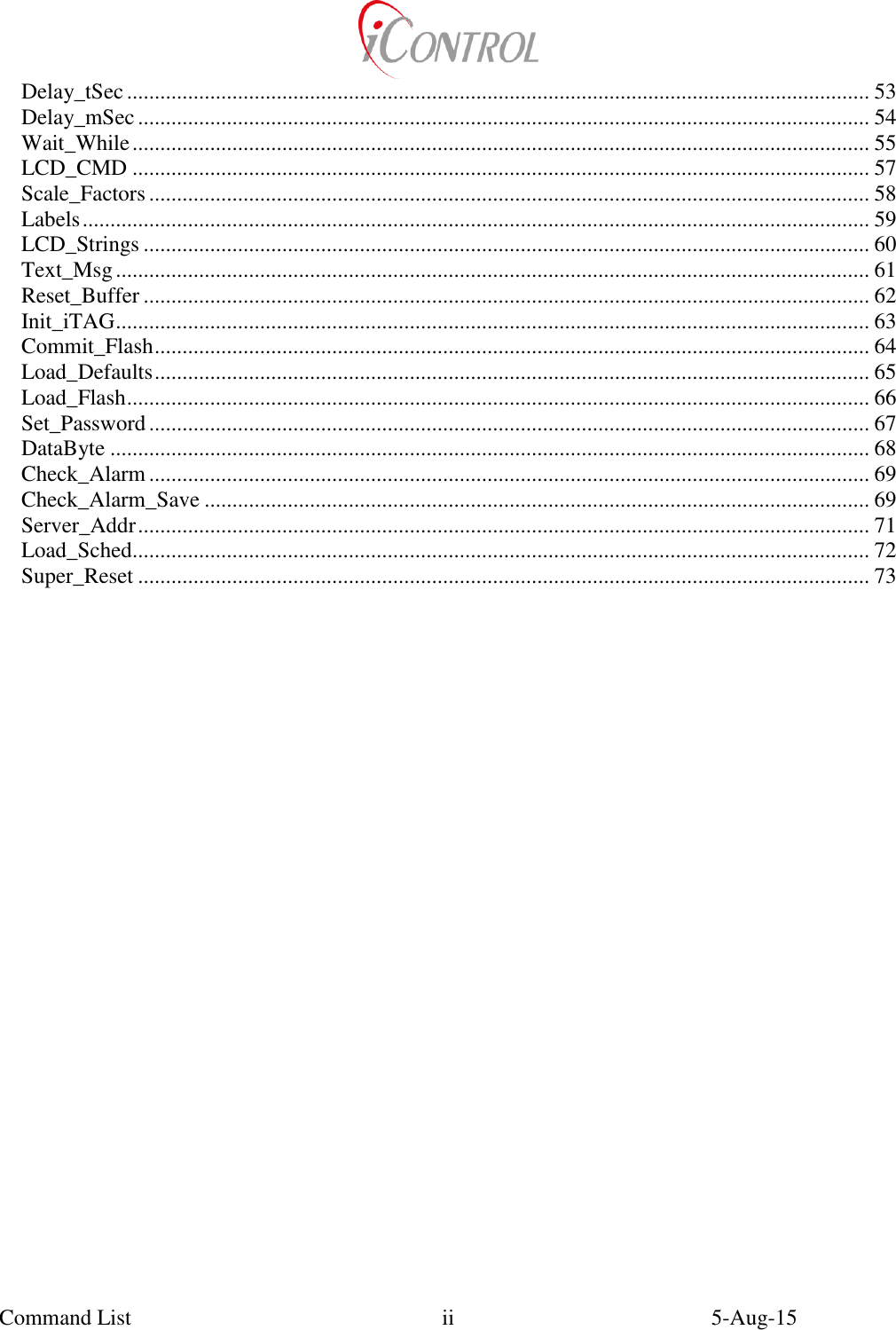
 Command List    5-Aug-15   ii Delay_tSec ...................................................................................................................................... 53 Delay_mSec .................................................................................................................................... 54 Wait_While ..................................................................................................................................... 55 LCD_CMD ..................................................................................................................................... 57 Scale_Factors .................................................................................................................................. 58 Labels .............................................................................................................................................. 59 LCD_Strings ................................................................................................................................... 60 Text_Msg ........................................................................................................................................ 61 Reset_Buffer ................................................................................................................................... 62 Init_iTAG ........................................................................................................................................ 63 Commit_Flash ................................................................................................................................. 64 Load_Defaults ................................................................................................................................. 65 Load_Flash ...................................................................................................................................... 66 Set_Password .................................................................................................................................. 67 DataByte ......................................................................................................................................... 68 Check_Alarm .................................................................................................................................. 69 Check_Alarm_Save ........................................................................................................................ 69 Server_Addr .................................................................................................................................... 71 Load_Sched..................................................................................................................................... 72 Super_Reset .................................................................................................................................... 73
 iControl Incorporated Confidential  Page 1  5-Aug-15 iTAG Command List  iTAG Operation Description.  The iTAG is configured through the 802.15.4 radio interface for network management, trip set-up, and checkout.   The factory default radio channel is 802.15.4 channel 21. All commands for controlling the radio are identified in the iTAG Command List.   Once a User as completed the initial  iTAG  configuration,  complete control and operation of the iTAG can be accomplished through the radio link interface using  commands available in the iTAG Command List. The radio in the iTAG is nominally operated in a power saving mode with the receiver periodically enabled and “listening” for commands or data requests.   A key element to the power saving mode is the principle of “tag-talks-last”.  In this mode, battery power is conserved by only responding to messages that are sent directly to the specific iTAG MAC address or mutual broadcast address.  For a majority of iTAG operation,  the iTAG is in a deep power saving mode (~98% of the time).  The iTAG will only transmit when it receives a properly encrypted message during its receiver active period.  The encrypted message directed to the iTAG may include information about which channel  the  iTAG should use for further transmissions.   Once, the communication parameters are exchanged, there will typically be a period a several seconds of active radio transmission as the iTAG relays data.  The data transmitted may either be security data destined for government servers, and/or commercial data destined for the end customer.  This data may originate from internal flash storage or it may be received and relayed from another compatible device.    Command Formats: To enhance speed, minimize memory, and reduce network traffic, iTAG’s use binary codes (command ID’s) to represent iTAG functions. Command codes eliminate the need to perform string comparisons to determine a particular operation.  When encrypted, command codes are also harder to break since “named” commands are identifiable patterns.   iTAG  User  interfaces,  (iControl’s  iView  and  other  applications)  convert  iTAG  command ID’s to “named” strings to aid in interpreting iTAG commands.   Each command listed in this document includes the  iVIEW  command  name  (ASCII  string), the hexadecimal command ID, and the decimal equivalent command used by PC terminal emulators. These command descriptions are the minimum information required to configure and operate an iTAG using the terminal emulator available on most PC’s (HyperTerminal).    iTAG’s  may  be  commanded  in  either binary or ASCII mode.   User interfaces with direct serial interfaces to the iTAG use ASCII Decimal commanding. All commands and telemetry transmitted over an iTAG network are commanded in binary.
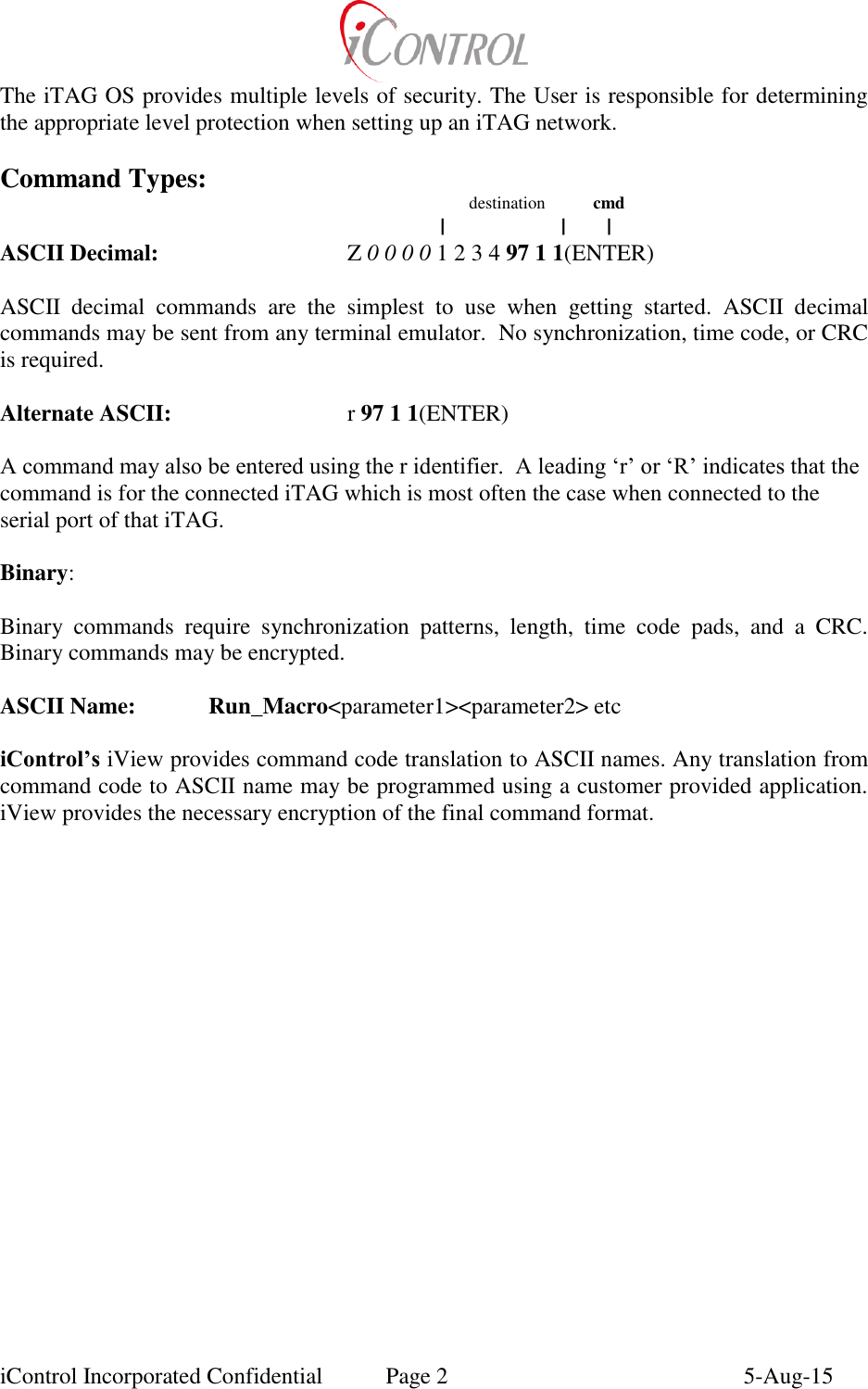
 iControl Incorporated Confidential  Page 2  5-Aug-15 The iTAG OS provides multiple levels of security. The User is responsible for determining the appropriate level protection when setting up an iTAG network.  Command Types:                        destination           cmd                 |                    |       | ASCII Decimal:       Z 0 0 0 0 1 2 3 4 97 1 1(ENTER)       ASCII  decimal  commands  are  the  simplest  to  use  when  getting  started.  ASCII  decimal commands may be sent from any terminal emulator.  No synchronization, time code, or CRC is required.  Alternate ASCII:      r 97 1 1(ENTER)  A command may also be entered using the r identifier.  A leading ‘r’ or ‘R’ indicates that the command is for the connected iTAG which is most often the case when connected to the serial port of that iTAG.  Binary:                       Binary  commands  require  synchronization  patterns,  length,  time  code  pads,  and  a  CRC. Binary commands may be encrypted.  ASCII Name:   Run_Macro<parameter1><parameter2> etc   iControl’s iView provides command code translation to ASCII names. Any translation from command code to ASCII name may be programmed using a customer provided application.  iView provides the necessary encryption of the final command format.
 iControl Incorporated Confidential  Page 3  5-Aug-15 ASCII Commands  The ASCII decimal format is the easiest to implement. ASCII commands do not require (or support)  a  Cyclical  Redundancy Code  (CRC),  Time  Code  pad,  or  encryption.  Users  may deploy an iTAG using only ASCII commanding.   The only security feature available with ASCII commanding is password protection.  To send an ASCII command, a command file may be generated from any text editor, and transferred to an iTAG using the “Transfer Text File” option in HyperTerminal.  Each ASCII command from a PC to an iTAG must use the “Z” or “R” command format. The “Z” prefix signals  the  iTAG  to  send  an  ASCII  formatted  command  to  the  indicated  address.  All commands included in this list may be sent in ASCII mode with an “Z” or “R” at the start of the command, “Space” as character delimiter, and a carriage return at the end.   Examples:  The following commands may be sent (using HyperTerminal) to an iTAG whose 8 byte ID is Destination”.  The  Destination  Address  is  the  first  8  bytes,  then  command,  and  a  carriage return.  The  Destination  Address  must  match  the  iTAG_ID  for  which  the  command  is intended.  An  iGATE  will  automatically  forward  commands  it  receives  with  different destination  iTAG_ID’s.  Z 0 0 0 0 0 1 2 255 1 5 5  Destination(0.0.0.0.0.1.2.255), Command (1 5 5)  Same command for the iTAG that we are directly connected to  R 1 5 5  Invalid commands,  1 2 3 4 5 5 6       (need ‘Z’ and command is too short )  Z 0 0 0 0 1 2 3       (too few characters, need full destination and command)  Z12345678123      (need spaces between each character)  Z 0 255 1000 1 1 2 3 4 1 2   (All numbers represent 1 byte, no number larger than 255)
 iControl Incorporated Confidential  Page 4  5-Aug-15 ASCII Command Files:  iTAG ASCII commands may be  grouped in  a file  and  loaded  all  at  once with  a  terminal emulator  or  other  PC  application.    The  command  files  may  be  built  using  common  text editors such as Notepad, Word, etc.   iTAG command files may include comment fields and up to 1k bytes of commands to be sent. All characters following a “//” are considered comments and are ignored by the iTAG processing functions.  The only iTAG serial ports which are enabled for ASCII commanding are User Port, Modem Port,  or  DataPort.  If  password  protection  is  enabled  for  ASCII  commanding,  include  a Password command at the beginning of the command file.  ASCII Command File Examples:  The following text may  be copied and pasted  into a  text (.txt) file.   If HyperTerminal (or other  application)  sends  this  file  to  an  iTAG  (via  modem,  User  Port  etc)  the  iTAG  will process all commands and commit them to flash.  Example1.txt //  This File is an iTAG command file. //  To load, send file using any terminal emulator with a “Transfer Text” Option //  Send file once. The iTAG will begin running its schedule as long as schedule  //  checking is enabled. // R 253 0 255 255 255 255 23 30 0 97 6 1  // Run Macro 6 at 11:30:00 PM R 253 1 255 255 255 255 4 15 0 97 0 1  // Run Macro 0 at 4:15:00 AM R 253 2 255 255 255 255 19 15 97 0 1  // Run Macro 0 at 7:15:00 PM R 99 0 16 2 18 0 2 17 1 4 100 0 2 120 2 17 0 1 20  // Load Macro 0 R 99 6 5 2 18 1 1 29        // Load Macro 6 R 240            // Commit to flash  Example2.txt // This File is an iTAG command file. // To load , send file using any terminal emulator with a “Transfer Text” Option //  Send file once.  //  File loads Macro with Relay cycling Macro. Turns all relays off, delays 0.100 seconds, //  Turns all relays on // R 99 0 15 4 8 2 0 0 4 101 0 0 1 4 8 2 255 255// Load Macro 0 w/Relay cmds R 240            // Commit to flash  To run Example2, send the command; R 97 0 1 (Run_Macro[0] once)
 iControl Incorporated Confidential  Page 5  5-Aug-15 Binary Commands  Binary  commands  are  sent  between  iTAG’s  and  between  an  iGATE  and  iTAG  using  the radio interface.  As such, this document does not cover binary commanding.  This document covers only user initiated commands.
 iControl Incorporated Confidential  Page 6  5-Aug-15 Power Considerations  As a remote asset, an iTAG will generally be powered by a battery with no means or very minor means of being recharged.  As such, operating in power savings mode is an important concept.  The present iTAG firmware implements a power savings mode in which the iTAG will sleep for most of each second (see commands 12, 15, and 16).  During the remaining fraction, the iTAG may come out of sleep by one of three actions: 1) It is time for a scheduled command to be executed, 2) A radio packet addressed for this iTAG is received, or 3) There is user port activity on the serial port.  When a scheduled command is executed, it may or may not cause the iTAG to come out of power savings mode.  Each command is that will affect the sleep mode is noted in the section for each command.  In general, the iTAG will not sleep when a macro is running.  When  the  iTAG  wakes  up  from  sleep,  it  will  remain  awake  for  the  number  of  seconds indicated by command 16.
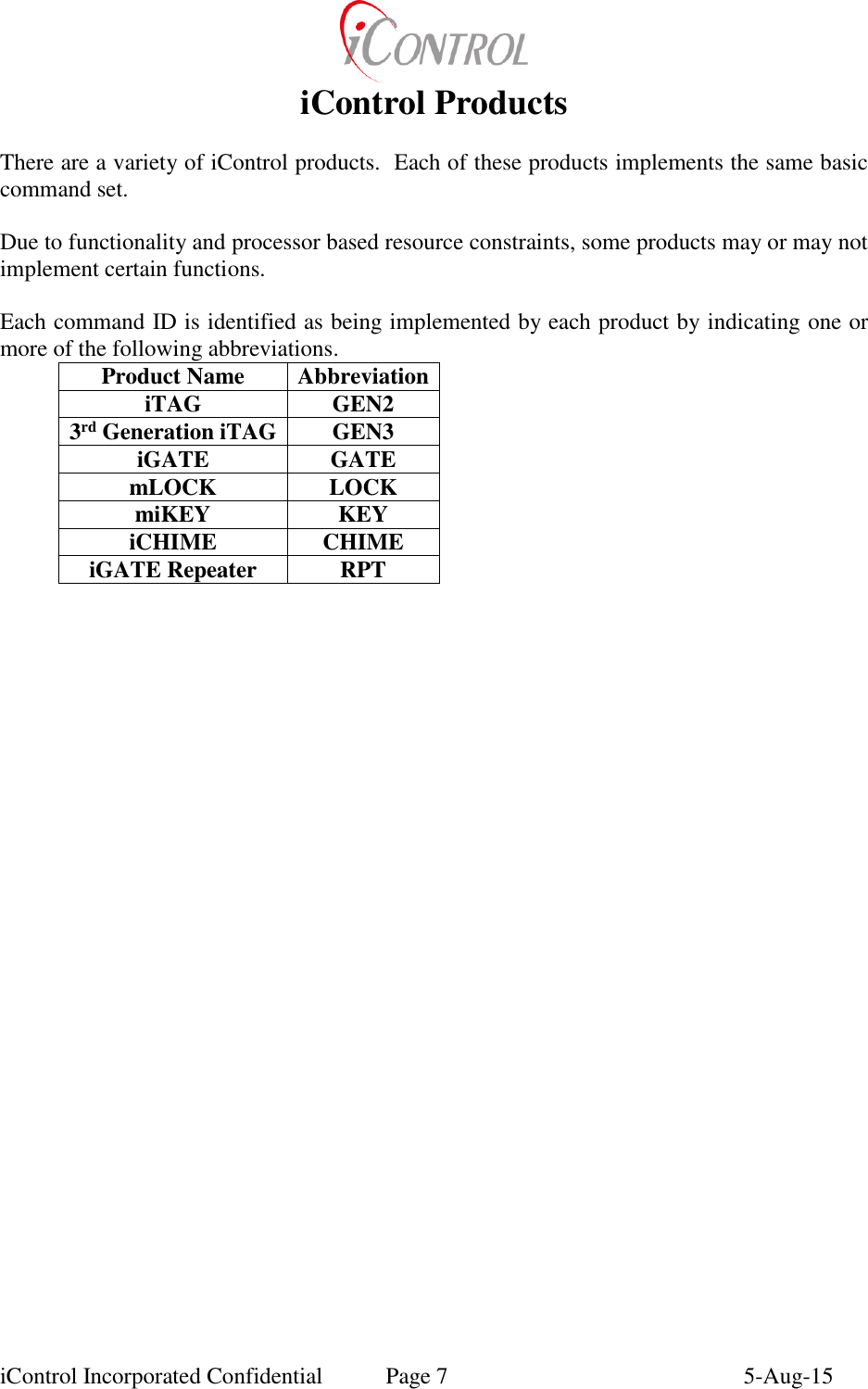
 iControl Incorporated Confidential  Page 7  5-Aug-15 iControl Products  There are a variety of iControl products.  Each of these products implements the same basic command set.  Due to functionality and processor based resource constraints, some products may or may not implement certain functions.  Each command ID is identified as being implemented by each product by indicating one or more of the following abbreviations. Product Name Abbreviation iTAG GEN2 3rd Generation iTAG GEN3 iGATE GATE mLOCK LOCK miKEY KEY iCHIME CHIME iGATE Repeater RPT
 iControl Incorporated Confidential  Page 8  5-Aug-15 Command List  iTAG_Mode:  CMD_ID=0x01    (decimal 1)   Format:    r 1 <iTAG_Mode> [Param]  iTAG_Mode sets  the data  reporting  function  on  the  iTAG.   Additional functionality may also be accomplished by appending Run_Macro commands to the end of the iTAG_Mode command. If a User wishes to execute additional commands while the iTAG is in a broadcast mode, other iTAG functions may be linked to the mode by pointing to a Macro at the end of the iTAG mode command. While the iTAG mode is 0x00 (0) the iTAG is not broadcasting data over the Local Area Network (LAN).    Definitions:                 <Param> <iTAG_Mode>  0x00  Silent  N/A   0x01  One Sample  N/A       0x02  Stream (1Hz):  N/A     0x05  Stream “N” Samples (0<”N”<255)     (Once per second)   0x06  Stream Samples  (0<”N”<255)     (For “N” minutes)   0x0a  Send record to default destination       P1: IO MSB Address       P2: IO LSB Address       P3: Xmit Port   0x0b  Send record to destination       P1: IO MSB Address       P2: IO LSB Address       P3: Xmit Port       P4-P7: Destination Address   0x0c  Send record using repeater channel (RPT)       P1: IO MSB Address       P2: IO LSB Address       P3: don’t care       P5: 0, use repeater channel             Otherwise, indicates channel  Example:  Append the Run_Macro command at the end of the iTAG_Mode to cause the iTAG to execute Macro_ID (3) once per second while transmitting data over the LAN.  r 1 2 97 3 1
 iControl Incorporated Confidential  Page 9  5-Aug-15    See Also: Run_Macro, Load_Macro, IO_Address  Last updated 11-Nov-08
 iControl Incorporated Confidential  Page 10  5-Aug-15 iTAG_ID:  CMD_ID=0x03  (decimal 3)  Format:    r 3 <D3> <D2> <D1> <D0> [DeviceType]  iTAG_ID sets the four byte iTAG identification number.  This ID may also be programmed from the Setup Menu. (GEN2, GATE, RPT)  Each iTAG should have a unique four byte address. Group calls for multiple iTAG’s may be achieved by setting Group Call ID’s via the Broadcast_Address command.  This  command  also  updates  the  first  four  bytes  of  the  MAC_Addr  with  this  entered iTAG_ID value.  If DeviceType is included and it is ‘I’, ‘g’, or ‘G’, then the system Device Type variable is also updated.  Description:  <D3>    Most Significant Byte of iTAG address <D2> <D1> <D0>    Least Significant Byte of iTAG address [DeviceType]  If ‘I’, ‘g’, or ‘G’, then system device type is updated.   Example:    Program new iTAG_ID (0.1.2.3)  r 3 0 1 2 3  See Also: Broadcast_Address, Default_Dest, Server_Address, Commit_Flash  Last updated 11-Nov-08
 iControl Incorporated Confidential  Page 11  5-Aug-15 No_OP:  CMD_ID=0x04  (decimal 4)   Format:    r 4 [D3] [D2] [D1] [Dn]  An iTAG No_Op command is used to test the Network connection to an iTAG. Sending a No_OP command from one iTAG to another causes the receiving iTAG to respond to the Source ITAG with an ACK packet containing the iTAG_ID. A No_OP causes the iTAG to perform no other functions. Data appended to the end of the No_Op command can be used to perform a communication test. The user may send up to 236 bytes of data using the No_OP command. The returned ACK will append the user data to the end of the ACK.  A failed CRC error will be written to the iTAG display if a communication error occurs.  Examples:  Send No_Op packet to iGate 0.0.0.0  This command is useful to establish whether a recently installed iTAG is connected to the iTAG LAN.  When an installer sets up an iTAG, the No_OP command can be sent to the network iGATE while at the iTAG location. If networked, the iGATE will respond with an ACK packet to the iTAG. The installed iTAG will print to the screen that an ACK has been received from the iGATE. If available, the Radio signal strength will be displayed when the ACK is received.  R 5 1 0 0 0 0 4   (standard No_OP command)  R 5 1 0 0 0 0 4 1 2 3 4 5 6 7 8 9 10 11 12 13 14 15 16  (No_OP with test data)  See Also: Forward_Packet  Last updated 11-Nov-08
 iControl Incorporated Confidential  Page 12  5-Aug-15  Forward_Packet:    CMD_ID=0x05  (decimal 5)  Format:    r 5 <Forward_Type> <Dest> <Forward Packet>  iTAG’s  may  forward  data  packets  and  commands  to  other  iTAG’s  or  iGATEs  using  the Forward_Packet command.  The  Forward_Packet  provides  all  of  the  necessary  routing information for the packet to make multiple hops, command an iGATE, or send data to a server through a complex network topology.  Decimal:  <Forward_Type>:  ‘C’:  Forward to an iCHIME  (GEN2) 0:  Forward packet once. Do not wait for an ACK. Use encryption configured on iTAG (see Net_Type) 1:  Forward packet using transmit buffer configured for timeout and retries (see Command_Retry).  Use encryption configured on iTAG ‘s’:  Forward packet once.  Do not wait for an ACK.  Do not encrypt.  (GEN2) 243:  Forward packet once.  Do not wait for an ACK.  Use encryption.  Note 243 == 128 | ‘s’  (GEN2) ‘S’:  Forward packet using transmit buffer configured for timeout and retries.  Do not encrypt  (GEN2) 211:   Forward packet using transmit buffer configured for timeout and retries. Use encryption.  Note 211 == 128 | ‘S’  (GEN2)  <Dest>:  Four byte address which is the desired destination ID for the packet.  < Forward Packet>:    Data to be sent to other iTAG’s  Example:  Send No_Op packet to iGate 0.0.0.0  r 5 1 0 0 0 0 4  Send iTAG_Mode command to (4.5.6.7)    r 5 1 4 5 6 7 1 2  See Also: Command_Retry, Net_Type  Last updated 11-Nov-08
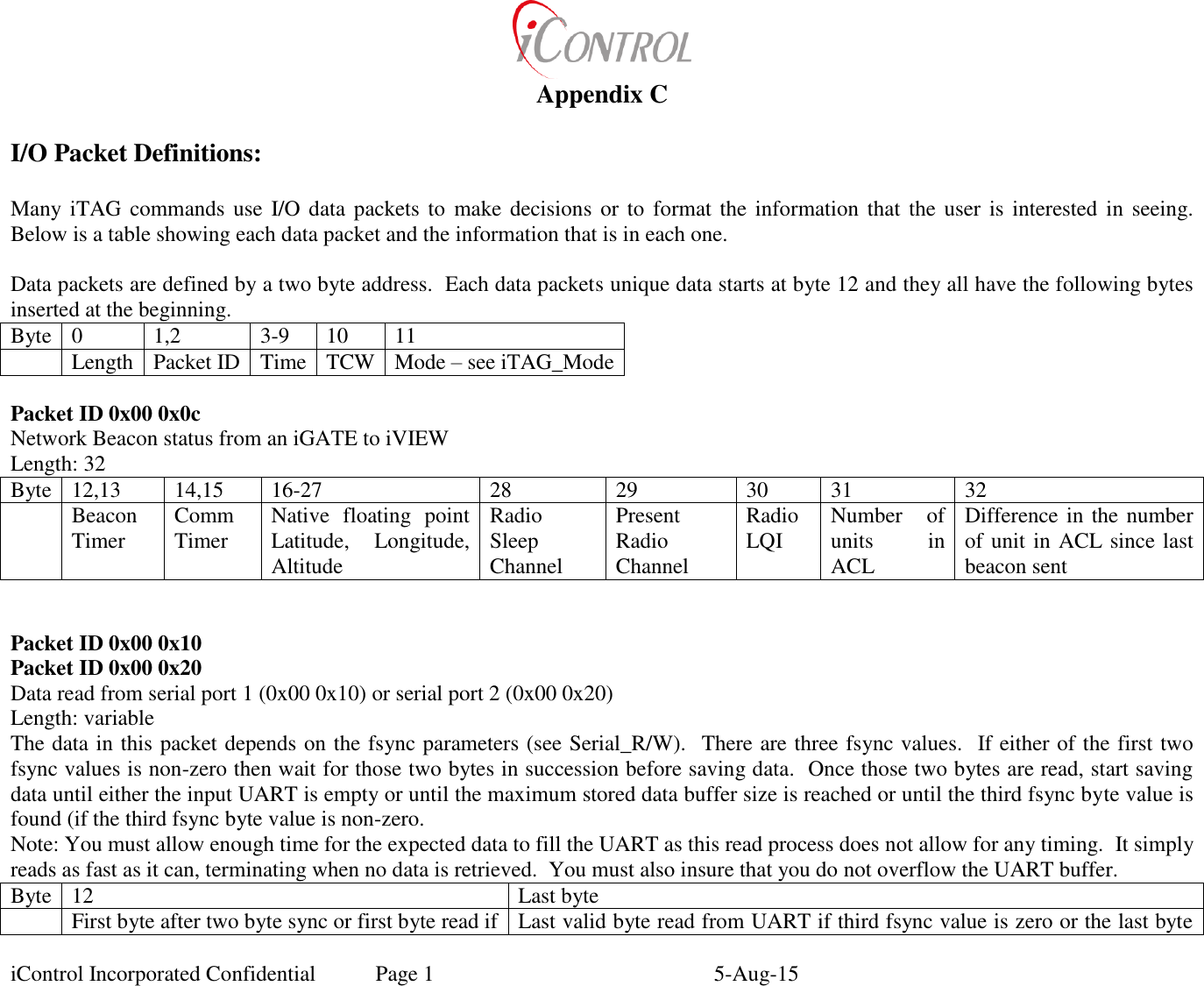
 iControl Incorporated Confidential  Page 13  5-Aug-15 Load_Config:  CMD_ID=0x06  (decimal 6)   Format:    R 7 <Lat> <Lon> <Alt>  iGATE  location  information  may  be  sent  using  the  Load_Config  command.  The Load_Config command sets the iGATE position in memory.  The iGATE location is used as the default location when GPS has not been acquired.  It is also used to calculate distance relative to an iGATE.  Definitions:  <Lat>    Latitude of the iGATE in degrees (ASCII formatted float) <Lon>   Longitude of the iGATE in degrees (ASCII formatted float) <Alt>    Altitude of the iGATE in degrees (ASCII formatted float)  Examples:  R 6 “30.5 -121.7 10.”     Set the iGATE position to 30.5 degrees latitude, -121.7 degrees longitude, and altitude of 10  R 6 51 48 46 53 32 45 49 50 49 46 55 32 49 48 46  Same command using ASCII codes  See Also:  Appendix C, Packet ID 0x00 0xfa  Last updated 11-Nov-08
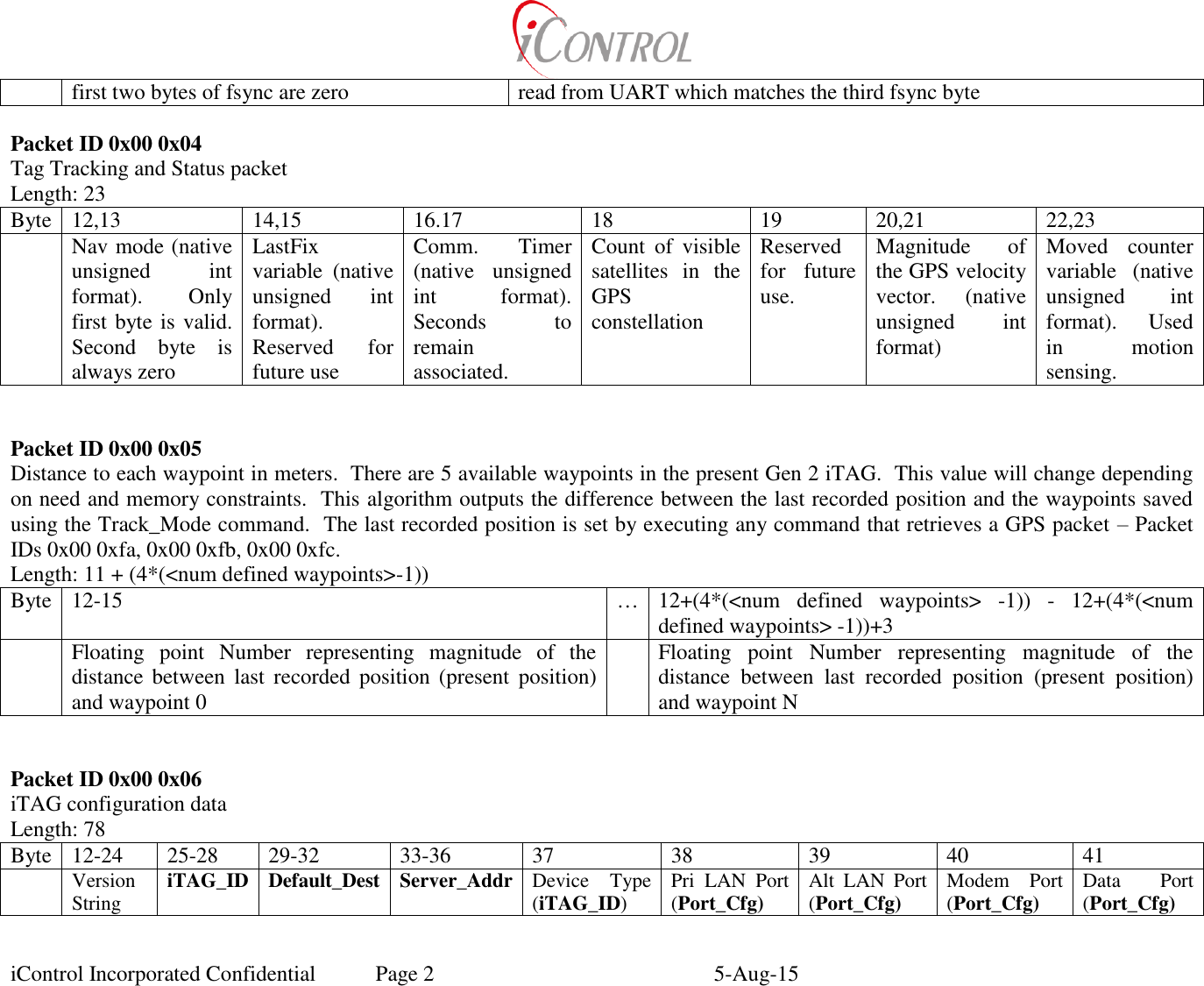
 iControl Incorporated Confidential  Page 14  5-Aug-15 Send_Config:  CMD_ID=0x07  (decimal 7)   Format:    r 7 <port> <param>  iTAG configuration data may be requested (or sent) using the Send_Config command. The Send_Config command causes the iTAG to collect the specified data (defined by Param) and send the data  out  the specified  Port.  Data  format is  automatically  determined by the function define for the specified port.  Any packet id  (as defined in  Appendix  C) with the first byte  of 0  can  be sent  using this command.  Definitions:  <port>   0-2  Serial port used for configuration data transmission <param>  6  Standard iTAG configuration data (Packet ID 0x00 0x06)     23  Broadcast ID’s  (up to 20  four byte addresses)  (ID 0x00 0x17)     27  Programmed Phone Number for Modem dial outs (ID 0x00 0x1b)  Examples:  r 7 1 6  Send the “standard”  iTAG configuration parameters out serial port 1  r 7 2 23  Send all programmed Broadcast ID’s out serial port 2  See Also:  Broadcast_ID, Phone_Number, Appendix C  Last updated 11-Nov-08
 iControl Incorporated Confidential  Page 15  5-Aug-15 Network:  CMD_ID=0x08  (decimal 8)   Format:    r 8 <Type> [Params]  iTAG’s use an 802.15.4 radio for LAN communications.  Network commands are used to configure the network.  Definitions:         Params <Type>  ‘A’  Force association to specified state (‘l’, ‘L’, ‘N’, ‘S’, ‘W’) P0: association state P1: Comm (Association) timer value – stay associated P1 seconds ‘C’  Set Commissioned state P0: ‘Y’ or ‘N’: Commissioned state is Yes or No.  See Test_Condition ‘D’  Action when beacon received from specified address P0: ‘E’-enable macro, ‘D’-disable, ‘C’-command enabled P1-P4: 4 byte address to check against beacon sender P5: Macro number for P0=‘E’, Command length for P0=’C’ P6: Command number for P0=’C’ P7-Pn: Command parameters for P0=’C’ ‘I’  Setup Internetworking for meshing ‘J’  Insert a unit into ACL (Join) P0-P7: 8 byte address to insert into the ACL P8: 0x80 or 0 indicates whether to use encryption or not when communicating with this unit P9: Non zero indicates that this unit has power saving enabled.  Send wakeup packets to this unit before trying to communicate. ‘L’  Delete unit form the ACL (Leaving) P0-P7: 8 byte address of unit to remove from the ACL ‘R’  If address is different from destination ID, send an association request P0-P3: 4 byte address to send the association request to ‘T’  Set ACL Timer to specified value.  Unit in ACL stay in ACL for this specified number of seconds P0: MSB of ACL timer (unsigned int) P1: LSB of ACL timer (unsigned int)  Examples:  r 8 ‘C’ ‘Y’   Set commissioned state to Yes  r 8 ‘DC’ 14 0 0 1 3 249 10 11   Set DataByte[10]=11 when a beacon from 14 0 0 1 is received
 iControl Incorporated Confidential  Page 16  5-Aug-15 r 8 ‘J’ 0 0 0 0 1 2 3 4 128 5  Add unit 0.0.0.0.1.2.3.4 to the ACL, unit uses encryption (128), unit uses power save (5)  r 8 ‘T’ 1 5 Set units ACL Timer to 261 seconds  Last updated 11-Nov-08
 iControl Incorporated Confidential  Page 17  5-Aug-15 Port_CFG: CMD_ID=0x09  (decimal 9)   Format:    r 9 <port> <baud> <cfg> <function> [Param]  Port_CFG remotely (or via a Macro) change a serial port configuration identified by <port>. Once the Port_CFG is executed, the specified port is re-initialized.  The iTAG serial ports can be configured via the iTAG Setup Menu. (GEN2, GATE, RPT)  Definitions:         Param <port>   Serial port to be changed (0-2) <baud>  New baud rate, ranges from 1.2-115 Kbps (use baud/1200) <cfg>    For Radio (port 2) specify radio parameters <function>  2:  LANPort[0] 3:  LANPort[1] 4:  ModemPort 5:  DataPort P0:  ‘T’ or ‘F’, enables checking of this serial port as a user interface 6:  LCD port  ‘D’:   Disable echo port (Not implemented) P0: Port number to be used as an echo port ‘E’:  Set Echo Port (Not implemented)  Example:  Set Serial Port 1, to 57.6KBps, use for LANPort[1]  R 9 1 48 0 3  See Also:  Last updated 11-Nov-08
 iControl Incorporated Confidential  Page 18  5-Aug-15  Set_Time: CMD_ID=0x0a  (decimal 10)  Format:    r 10 <D0> <D1> <D2> <D3> <D4> <D5> <D6>  Set_Time programs the iTAG real-time clock using seconds since 1980.  This command is not implemented.  Example:  Set timer to 1(month) 2(day) 3(year) 4(week day) 5(hour) 6(minute) 7(seconds): January 2, 1983, 05:06:07.  Week Day is ignored.  r 10 1 2 3 4 5 6 7  See Also:  Last updated 12-Nov-08
 iControl Incorporated Confidential  Page 19  5-Aug-15 Net_Type: CMD_ID=0x0b  (decimal 11)    Format:    r 11 <cmd> <Params>  Net_Type  defines  alternative  addressing  schemes  available  on  iTAG’s  along  with  an encryption key. In most cases, Net_Type is not a command sent over the LAN. Typically, Net_Type is one of many commands in an iTAG configuration file which programs iTAG’s prior to deployment. It is possible to use Net_Type to periodically change an encryption key to  increase  the  security  of  a  Network.    Extreme  caution  should  be  used  when  sending Net_Type  over  an  established  LAN  network.  Changing  an  iTAG  address  scheme  or encryption  may  render  an  iTAG  unreachable  until  the  Network  iGATE  has  an  updated configuration also.  Definitions:        Params <cmd>  ‘I’|’Z’|’F’:  Set Network type to iControl, Zigbee, or Fulton respectively ‘K’    Set encryption Key P0: ASCII formatted index of encryption key to set P1-P16: Encryption key ‘E’    Enable or disable encryption for the radio network P0:  0  disables  encryption,  any  non-zero  enables encryption  Examples:    Create an iTAG configuration file which defines the network type (wireless LAN) and sets encryption  key  0  to  “myencryptionkey0”.  The  configuration  file  should  also  define  the iTAG_ID, and Radio_Type. Make sure that the configuration file commits the changes to iTAG flash.  Note: The Default Broadcast_Address is (0.0.0.0).  The Configuration file would contain.  r 3 0 0 0 1  // Set the ITAG_ID to (0.0.0.1) r 11 ‘I’   // Use iControl wireless LAN r 11 ‘K0’ “myencryptionkey0” // load encryption key 0 r 25 “Z”  // Use Zigbee Radio r 240    // Commit changes to flash  See Also: Configuration Files, Broadcast Address, Network Security  Last updated 11-Nov-08
 iControl Incorporated Confidential  Page 20  5-Aug-15 Power_Cfg:    CMD_ID=0x0c  (decimal 12)    Format:    r 12 <Normal> <Sleep> <Macro>  Power_Cfg sets the normal and Sleep mode power configuration. During normal operation, the Radio, GPS, and ASIC are enabled. In this configuration the iTAG draws approximately 100 mamps. To reduce power, the iTAG may be placed in a sleep mode using a command or programmable timeout.  During Sleep, the iTAG either wakes up once per second to check for radio traffic, a scheduled command, or serial port data. While in Sleep, an iTAG uses approximately  10  mamps.  Both  the  normal  and  sleep  configurations  may  be  set  by  the Power_Cfg command.  Definitions:   Power mode setting for normal operation <Normal>  0x01  Enable radio   0x02  Enable GPS   0x04  Enable ASIC   Power mode sitting during sleep operation <Sleep>  0x01  Enable radio   0x02  Enable GPS   0x04  Enable ASIC   0x08  Enable deep sleep (Deprecated)   0x10  Enable sleep  <Macro>  Not implemented  Example:  While awake, use a completely powered iTAG, while in Sleep, power down everything.   Note: This command only needs to be sent once to maintain this sleep/wake configuration.  r 12 7 16  See Also: Power_Save  Last updated 11-Nov-08
 iControl Incorporated Confidential  Page 21  5-Aug-15 IO_Addr:  CMD_ID=0x0d  (decimal 13)    Format:    r 13 <BoardAddress> <ExtAddress>  Legacy hardware allowed a unit interface to a variety of Input and Output (IO) devices. Each IO interface board had a unique address.  An IO address would include a Board address and an Extended address; thus the naming convention.  IO_Addr is typically used to set the default address of the iTAG IO. When the iTAG_Mode is set to send data, the current value of IO_Addr is used to build the packet sent over the LAN.  Definition:  <BoardAddress> and <ExtAddress> are equivalent to the two byte Packet ID shown in Appendix C.  Example:  Set Default IO address to reflect an Analog-to-Digital status packet (56)(12).  r 13 56 12  See Also: Appendix C, iTAG_Mode, Save_Data, Upload_Record, DataByte  Last updated 11-Nov-08
 iControl Incorporated Confidential  Page 22  5-Aug-15 Default_Dest:  CMD_ID=0x0e  (decimal 14)    Format:    r 14 <D3> <D2> <D1> <D0>  When the iTAG must send an un-requested data packet (like alarms) to the iGate or Server, the iTAG uses the Default_Dest as the sending address. Typically, the Default_Dest should be the same four byte address as the network’s iGate ID.    Definition:  <D0>      Least significant Byte of Destination address <D1> <D2> <D3>      Most significant Byte of Destination address  Example:  Change the iTAG default destination ID to (0.0.0.0)  r 14 0 0 0 0  See Also: Check_Alrms, Run_Macros  Last updated 11-Nov-08
 iControl Incorporated Confidential  Page 23  5-Aug-15 Power_Override:    CMD_ID=0x0f  (decimal 15)    Format:    r 15 <PowerCfg>  Power_Override  sets  the  current  power  configuration  to  that  specified  by  the  PowerCfg bitmask parameter.  Definitions:  <PowerCfg>  0x01  Enable radio   0x02  Enable GPS   0x04  Enable ASIC   0x08  Enable deep sleep (Deprecated)   0x10  Enable sleep  Example:  Enable only GPS and ASIC.  r 15 6  See Also: Power_Cfg  Last updated 11-Nov-08
 iControl Incorporated Confidential  Page 24  5-Aug-15 Power_Save:    CMD_ID=0x10  (decimal 16)    Format:    Z(Source) (Destination) (16) (Power_Save) (seconds)  The iTAG will enter Sleep mode after the sleep counter decrements from the Power_Save count to zero. Setting Power_Save to zero disables the iTAG from transitioning into Sleep mode.  Any  Power_Save  value  above  zero,  represents  the  number  of  seconds  before  the iTAG will transition to Sleep.  While  in  Sleep  mode,  the  iTAG  checks  to  see  if  any  Scheduled  commands  need  to  be processed. Also, all serial ports are monitored to see if any activity indicates a transition to normal operation may be required.  When an iTAG is wakened, the Power configuration on wake up is controlled by the Power_Cfg.  The initial Power_Save count remains the same value  set  by  the  Power_Save  command.  The  power  down  count  re-starts  from  the Power_Save count.  If there is no serial port  activity, or executing macros,  the  iTAG  will return to sleep mode after the Power_Save counter decrements to zero.  Definitions:  <Power_Save>    0x00     Disable Power_Save         1-255    Transition to Power Save mode after (seconds)  Example:  Enable Sleep mode with a Power_Save count down of 10 seconds (0x0a).  S 0 0 0 0 1 2 3 4 16 10  Last updated 11-Nov-08
 iControl Incorporated Confidential  Page 25  5-Aug-15  AT_Dial:  CMD_ID=0x11  (decimal 17)    Format:    r 17 <Enable | Disable>  An iTAG that is configured with a modem uses the AT_Dial command to enable (or disable)  an attempt to communicate with iVIEW using the modem. If a modem is not enabled, the AT_Dial  command  will  be ignored.    The  number the modem  uses  to  dial  is  set  with  the Phone_Number command.  When AT_Dial is enabled, AT_Answer  is automatically disabled.  Definitions:  <Enable/Disable>:    0x01= Enable modem dial out         0x00= Disable modem dial out  Example:  Command the modem to dial the stored Phone_Number   r 17 1      See Also: Phone_Number, AT_Answer,  Set_Modem  Last updated 11-Nov-08
 iControl Incorporated Confidential  Page 26  5-Aug-15 AT_Answer:    CMD_ID=0x12  (decimal 18)  Format:    r 18 <Enable | Disable>  An iTAG that is configured with a modem utilizes the AT_Answer command to enable (or disable) checking for connections on the modem. If a modem is not enabled, the AT_Answer command will be ignored.  An iTAG may leave the parameter AT_Answer equal to 0x01 (Answer  enable)  even  if  the  modem  is  not  receiving  a  call.  The  parameter  AT_Answer simple permits the iTAG to answer if a remote computer is attempting to communicate via the modem.  Definition:  <Enable/Disable>:  0x01= Enable modem Answer       0x00= Disable modem Answer  Example:        r 18 1  See Also: Phone_Number, AT_Dial,  Set_Modem  Last updated 11-Nov-08
 iControl Incorporated Confidential  Page 27  5-Aug-15 Modem_Type:  CMD_ID=0x13  (decimal 19)    Format:    r 19 <Modem_Type>  To  enable  the  iTAG  to  use  a  modem,  the  Modem_Type  command  is  sent  to  enable  the appropriate iTAG drivers.  Before enabling the iTAG Modem_Type, the modem serial port must be enabled for modem use and the corresponding modem baud rate should be selected.   Check the Set Up Menu to verify the modem serial port properties. (GEN2, GATE, RPT)  Definition:  < Modem_Type >      ‘N’:  No Modem      ‘P’:  PSTN      ‘C’  Cellular connecting to remote PSTN      ‘s’:  Cellular using SMS      ‘S’:  Satellite      ‘e’:  Ethernet with DNS and DHCP enabled      ‘E’:  Ethernet      ‘g’:  GSM using GPRS      ‘i’:  Iridium SBD modem      ‘I’:  Iridium modem  Example:  Enable the iTAG to use the cellular modem using SMS.  r 19 “s”  See Also: AT_Answer, AT_Dial, Phone_Number, Hangup_Modem  Last updated 11-Nov-08
 iControl Incorporated Confidential  Page 28  5-Aug-15 Hangup_Modem    CMD_ID=0x14  (decimal 20)    Format:    r 20 [ModemState]  For general usage, the Hangup_Modem command ends the present modem connection.  In most cases, the ModemState is set to ‘S’ which will (shutdown) power down and disable the modem.  For a  PSTN modem, if  the  modem  is  connected,  the  iTAG  may  hang-up  the  modem  and return  to  command  mode  using  the  Hangup_Modem  command.      The  Hangup_Modem command is equivalent to the standard (AT modem command) ATH0.  If the user wants to override the modem state  (in the iTAG  software),  an optional parameter can be provided which controls the software state.  This feature is useful for writing custom modem drivers using macros, or adapting the iTAG to unsupported modem types.   Please  Note:    Overriding  the  modem  state  parameter  does  not  control  the  external modem,  only  the  iTAG  firmware  state  machine  is  affected  by  the  ModemState parameter  i.e.    (commanding  ModemState=>  Connect,  does  not  mean  the  modem  is connected. The iTAG with “think” it is connected)  Definition:  < ModemState >      ‘I’:  Initialize modem      ‘C’:  Modem State is connected      ‘G’:  Modem command mode, while online      ‘R’:     Modem state = ready      ‘O’:   Modem is offline      ‘D’:   Modem is dialing a number      ‘A’:   Modem is answering a call      ‘X’:   Modem is waiting for a connection      ‘S’:  Shutdown modem  Example:  Send command to hang up modem, then reconfigure modem to Answer any incoming call.  r 20     // Hangup command r 18 1    // AT_Answer = 1; Enable Answer  See Also: AT_Answer, AT_Dial, Phone_Number  Last updated 11-Nov-08
 iControl Incorporated Confidential  Page 29  5-Aug-15 Enable_Schedule:    CMD_ID=0x15  (decimal 21)    Format:    r 21 [Enable | Disable]  The iTAG Operating System supports stored commands which are executed at User specified times. The stored commands utilize the clock/calendar function on the iTAG to  determine when  a  scheduled  command  should  be  executed.    Enable_Schedule is  used  to  enable  or disable the execution of stored commands. A User may wish to disable schedule checking to prevent an iTAG from “Hanging up” during a commanded connection.    Definition:  <Enable/Disable>:  0x01= Enable Schedule Checking       0x00= Disable Schedule Checking  Example:  r 21 1    Enable Schedule checking    See Also: Load_Schedule, Dump_Schedule  Last updated 11-Nov-08
 iControl Incorporated Confidential  Page 30  5-Aug-15  Radio_Parameters:  CMD_ID=0x16  (decimal 22)  Format:  r 22 <TXpreamble> <TXtail> <bSpacing>  An iTAG configured with a LAN radio uses parameters to control the timing for transmit, receipt and RX mode.  TXpreamble is deprecated and no longer used, but is reserved for future use.  TXtail is the duration of time (milliseconds) that the iTAG waits before sending an ACK.  bSpacing is used in the Delay_mSec command.  Definitions:  <TXpreamble>:    Deprecated <TXtail>:      0-255 msec <bSpacing>:      0-255 msec * DataByte[0] to delay in Delay_mSec command  Example:  Set Radio parameters  TXpreamble  don’t care TXtail to 150 msec bSpacing 10 msec  r 22 0 150 10    See also: Delay_mSec  Last updated 11-Nov-08
 iControl Incorporated Confidential  Page 31  5-Aug-15 Broadcast_Address:  CMD_ID=0x17  (decimal 23)    Format:    r 23 <N_Addrs> <B03> <B02> <B01> <B00> … <Bn3> <Bn2> <Bn1> <Bn0>  An  iTAG  may  be  programmed  with  “Broadcast”  addresses  that  are  used  as  alternative iTAG_ID’s. The iTAG will not respond with an ACK when commanded using a broadcast address.  Multiple iTAG’s may have the same broadcast address allowing groups of iTAG’s to  be  commanded  with  a  single  command.    Typical  uses  for  broadcast  addresses  are commanded time updates or Macro loads which all units in a group need. Up to 20 broadcast addresses may be used per iTAG.   The  factory  default  configuration  defines  one  Broadcast_Address  (0.0.0.0.).  This  allows multiple iTAG’s to be programmed with the same Configuration File via the user interface. iControl  recommends  retaining  the  first  Broadcast_Address  as  a  generic  iTAG_ID  for configuration loading.  Definitions:  N_Addrs:      1-20 possible broadcast addresses (0 disables)   B00-B03:      Broadcast address <0> (Bytes 1-4) Bn0-Bn3:      Broadcast address <n> (Bytes 1-4)  Example:  Program the following three broadcast addresses:  0.0.0.0 1.2.3.4 5.6.7.8  r 23 3 0 0 0 0 1 2 3 4 5 6 7 8  See Also: Configuration File  Last updated 11-Nov-08
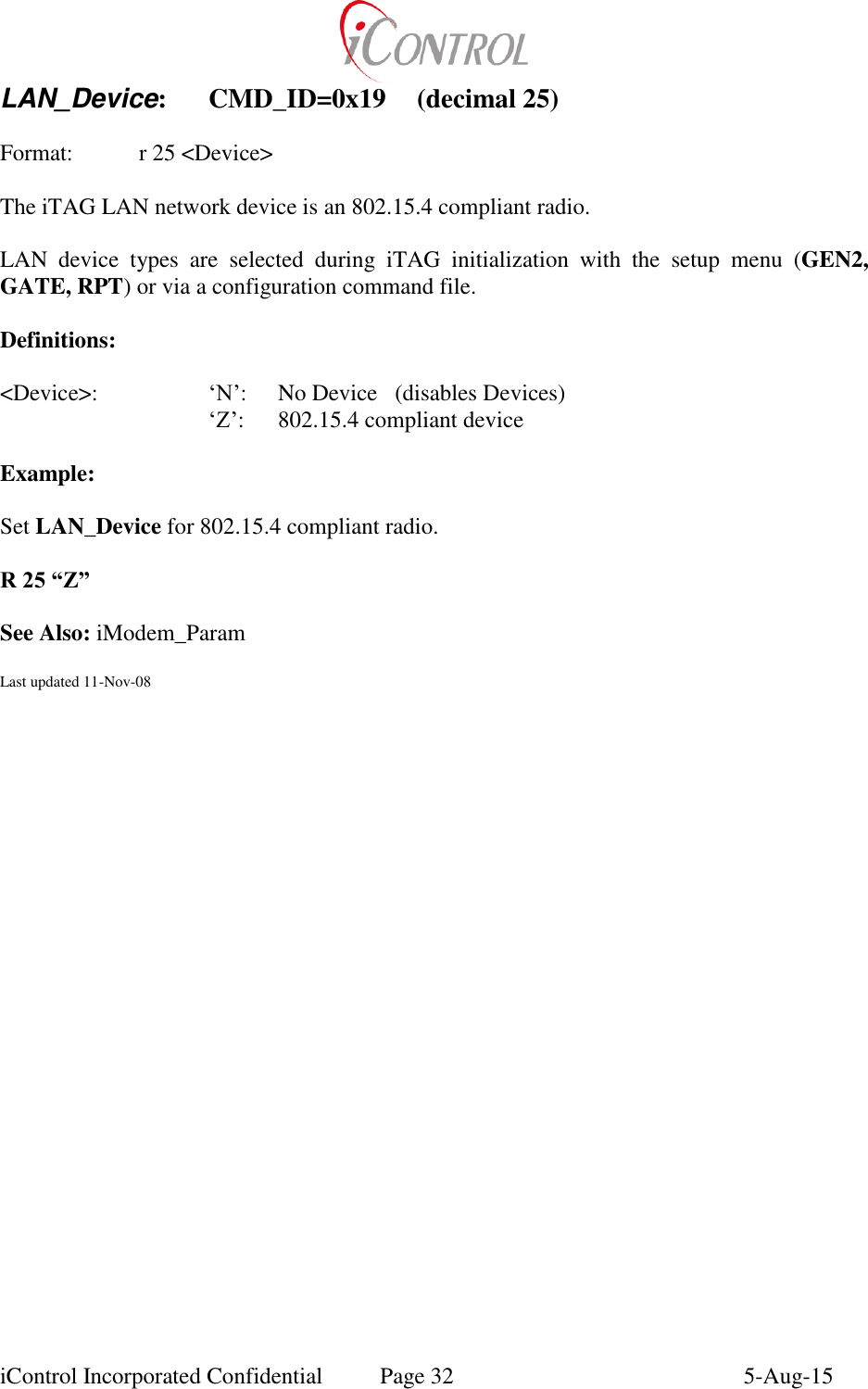
 iControl Incorporated Confidential  Page 32  5-Aug-15 LAN_Device:  CMD_ID=0x19  (decimal 25)    Format:    r 25 <Device>  The iTAG LAN network device is an 802.15.4 compliant radio.  LAN  device  types  are  selected  during  iTAG  initialization  with  the  setup  menu  (GEN2, GATE, RPT) or via a configuration command file.  Definitions:  <Device>:    ‘N’:  No Device   (disables Devices)    ‘Z’:  802.15.4 compliant device  Example:  Set LAN_Device for 802.15.4 compliant radio.  R 25 “Z”  See Also: iModem_Param  Last updated 11-Nov-08
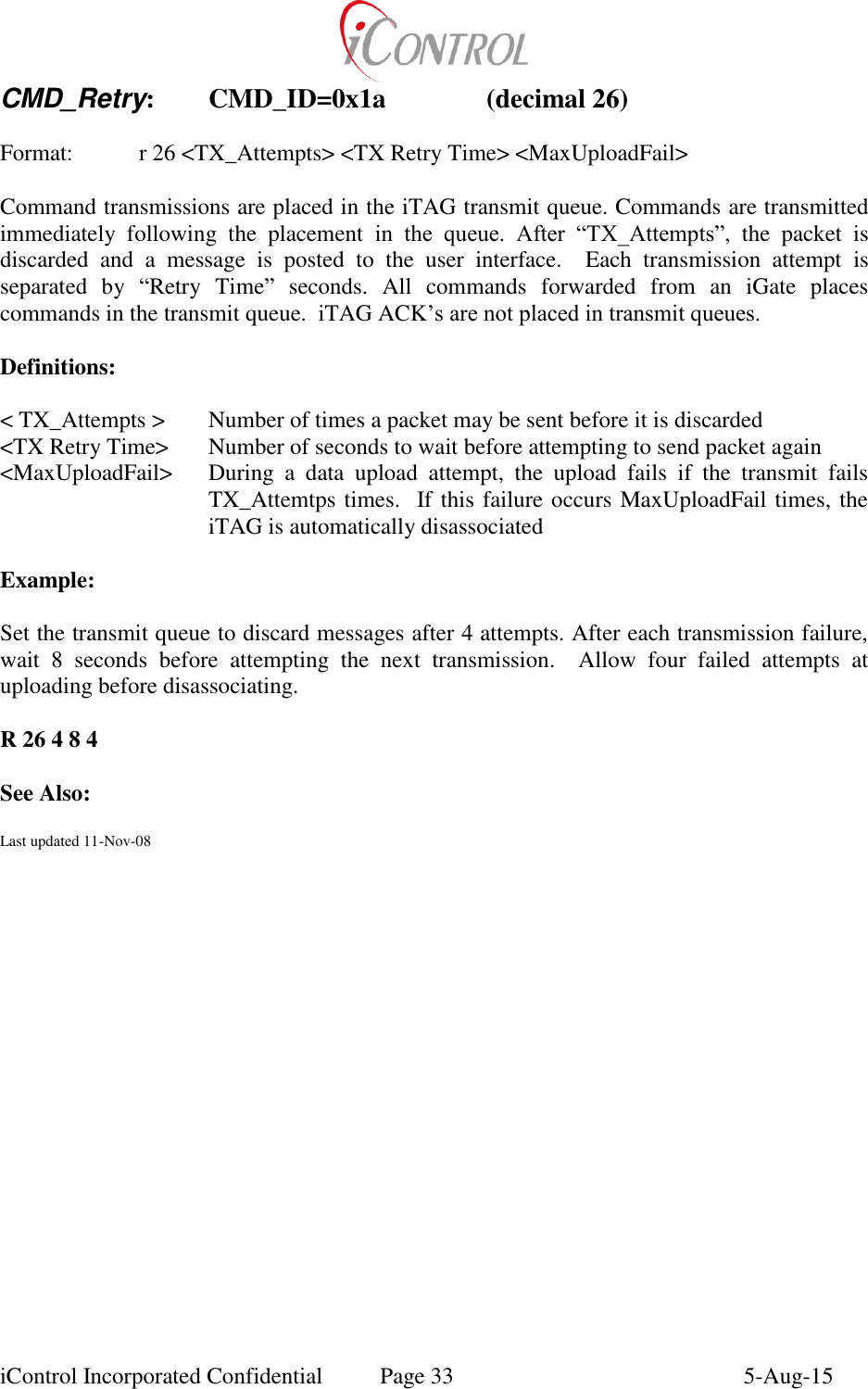
 iControl Incorporated Confidential  Page 33  5-Aug-15 CMD_Retry:  CMD_ID=0x1a    (decimal 26)  Format:    r 26 <TX_Attempts> <TX Retry Time> <MaxUploadFail>  Command transmissions are placed in the iTAG transmit queue. Commands are transmitted immediately  following  the  placement  in  the  queue.  After  “TX_Attempts”,  the  packet  is discarded  and  a  message  is  posted  to  the  user  interface.    Each  transmission  attempt  is separated  by  “Retry  Time”  seconds.  All  commands  forwarded  from  an  iGate  places commands in the transmit queue.  iTAG ACK’s are not placed in transmit queues.  Definitions:  < TX_Attempts > Number of times a packet may be sent before it is discarded <TX Retry Time>  Number of seconds to wait before attempting to send packet again <MaxUploadFail>  During  a  data  upload  attempt,  the  upload  fails  if  the  transmit  fails TX_Attemtps times.  If this failure occurs MaxUploadFail times, the iTAG is automatically disassociated  Example:  Set the transmit queue to discard messages after 4 attempts. After each transmission failure, wait  8  seconds  before  attempting  the  next  transmission.  Allow  four  failed  attempts  at uploading before disassociating.  R 26 4 8 4  See Also:  Last updated 11-Nov-08
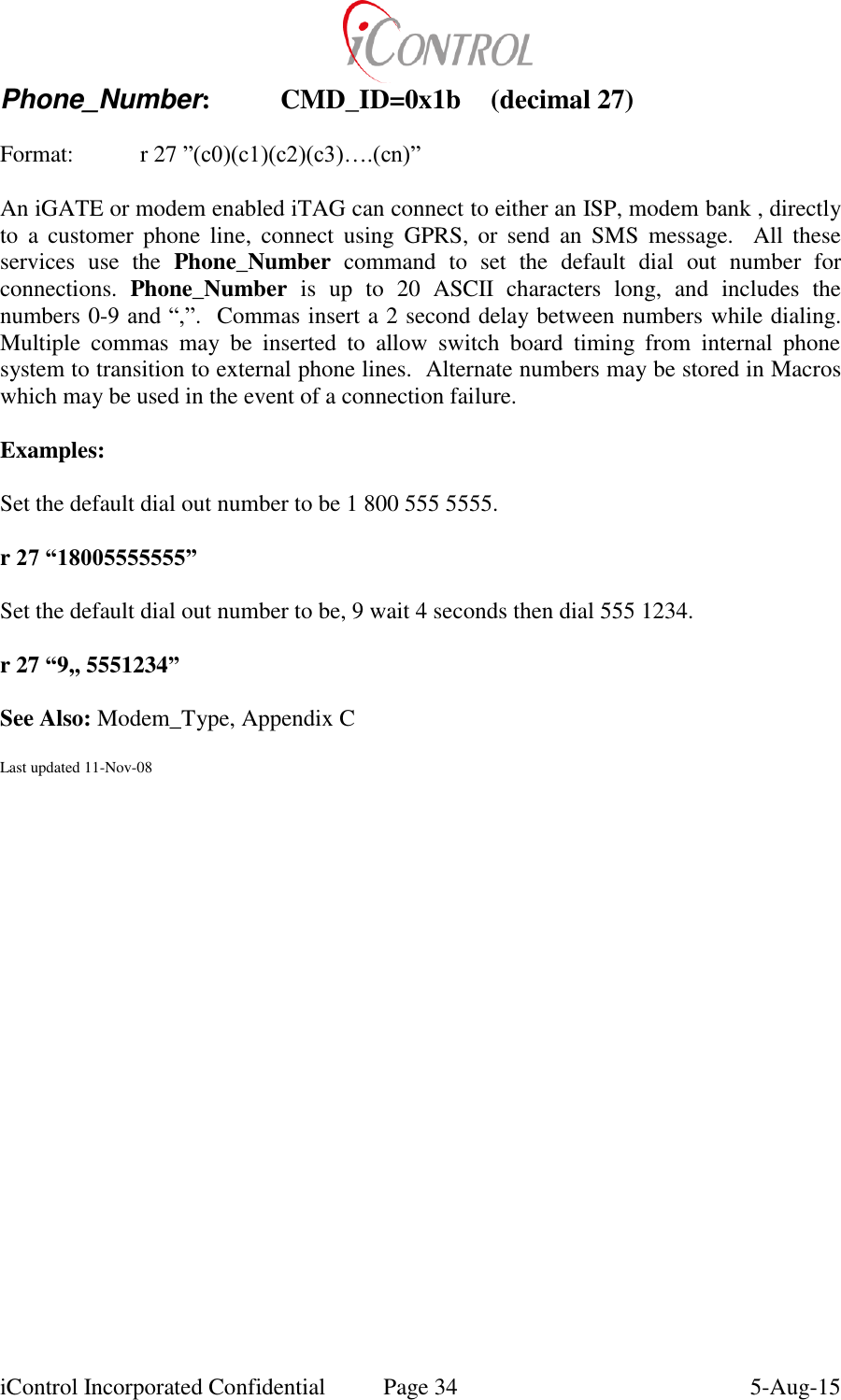
 iControl Incorporated Confidential  Page 34  5-Aug-15 Phone_Number:  CMD_ID=0x1b  (decimal 27)  Format:    r 27 ”(c0)(c1)(c2)(c3)….(cn)”  An iGATE or modem enabled iTAG can connect to either an ISP, modem bank , directly to  a  customer  phone  line,  connect  using  GPRS,  or  send  an  SMS  message.    All  these services  use  the  Phone_Number  command  to  set  the  default  dial  out  number  for connections.  Phone_Number  is  up  to  20  ASCII  characters  long,  and  includes  the numbers 0-9 and “,”.  Commas insert a 2 second delay between numbers while dialing. Multiple  commas  may  be  inserted  to  allow  switch  board  timing  from  internal  phone system to transition to external phone lines.  Alternate numbers may be stored in Macros which may be used in the event of a connection failure.  Examples:  Set the default dial out number to be 1 800 555 5555.  r 27 “18005555555”  Set the default dial out number to be, 9 wait 4 seconds then dial 555 1234.  r 27 “9,, 5551234”  See Also: Modem_Type, Appendix C  Last updated 11-Nov-08
 iControl Incorporated Confidential  Page 35  5-Aug-15 Password: CMD_ID=0x1c  (decimal 28)  Format:    r 28 <p0><p1><p2><p3>…<pn>  iTAG  Set-Up  and  ASCII  command  functions  may  be  password  protected  to  prevent accidental or deliberate commands from being executed. Password can be sent remotely through the LAN or via the User Interface. The Password command is functionally the same  as  entering  the  Set-Up  Menu  using  the  iTAG  login  via  the  User  Interface.  The password is an ASCII alpha-numeric string with no more than 9 characters. Spaces and control  characters  are  not  allowed  in  the  password.  When  the  Password  command  is sent, both the Set Up menu and iTAG command processing functions are enabled.  The string which accompanies the Password command is the iTAG password. Sending a zero length string disables both Set-Up Menu access and the command process functions.  The Factory default password settings are:  Password:      “icontrol”.    SET-Up Menu:     Password Required ASCII Commanding:    Access Permitted  Examples:  An iTAG has  its  password  set  to  “yourword”.  For security purposes, a User programmed Macro[38] sends the password command “0” effectively disabling Set-Up menu access and command processing.   Send a command to the iTAG to re-enable ASCII commanding.  r 28 “yourword”  After the iTAG receives this command, access to the Set Up menu and command processing is enabled. When the user is ready to disable access, send a zero length Password command.  R 28  Password may be used remotely to enable/disable iTAG access.    See Also: Set_Password, Run_Macro,Load_Macro  Last updated 11-Nov-08
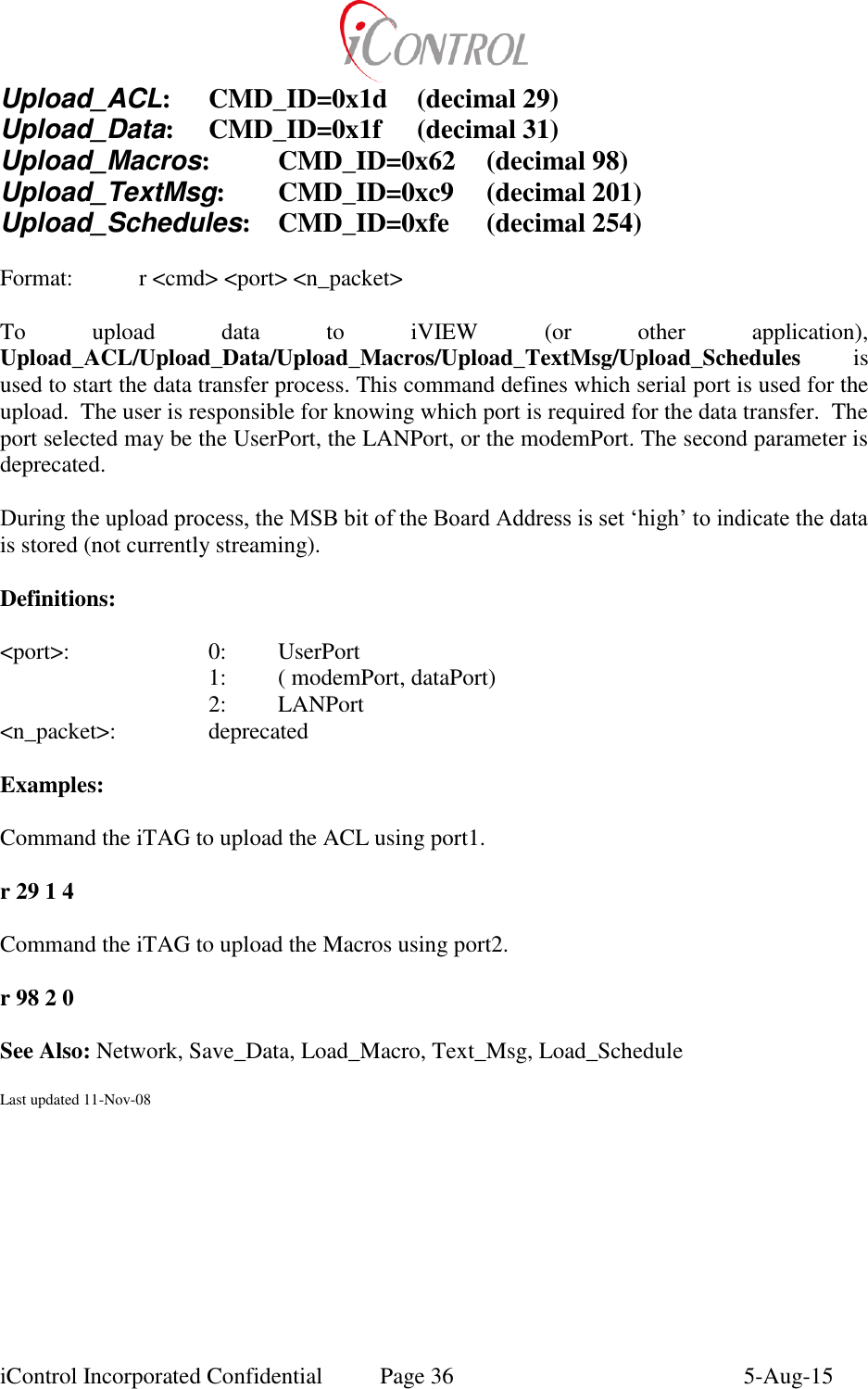
 iControl Incorporated Confidential  Page 36  5-Aug-15 Upload_ACL:  CMD_ID=0x1d  (decimal 29) Upload_Data:  CMD_ID=0x1f  (decimal 31) Upload_Macros:  CMD_ID=0x62  (decimal 98) Upload_TextMsg:  CMD_ID=0xc9  (decimal 201) Upload_Schedules:  CMD_ID=0xfe  (decimal 254)  Format:    r <cmd> <port> <n_packet>  To  upload  data  to  iVIEW  (or  other  application), Upload_ACL/Upload_Data/Upload_Macros/Upload_TextMsg/Upload_Schedules  is used to start the data transfer process. This command defines which serial port is used for the upload.  The user is responsible for knowing which port is required for the data transfer.  The port selected may be the UserPort, the LANPort, or the modemPort. The second parameter is deprecated.  During the upload process, the MSB bit of the Board Address is set ‘high’ to indicate the data is stored (not currently streaming).  Definitions:  <port>:    0:  UserPort       1:  ( modemPort, dataPort)       2:  LANPort <n_packet>:    deprecated  Examples:  Command the iTAG to upload the ACL using port1.  r 29 1 4  Command the iTAG to upload the Macros using port2.  r 98 2 0  See Also: Network, Save_Data, Load_Macro, Text_Msg, Load_Schedule  Last updated 11-Nov-08
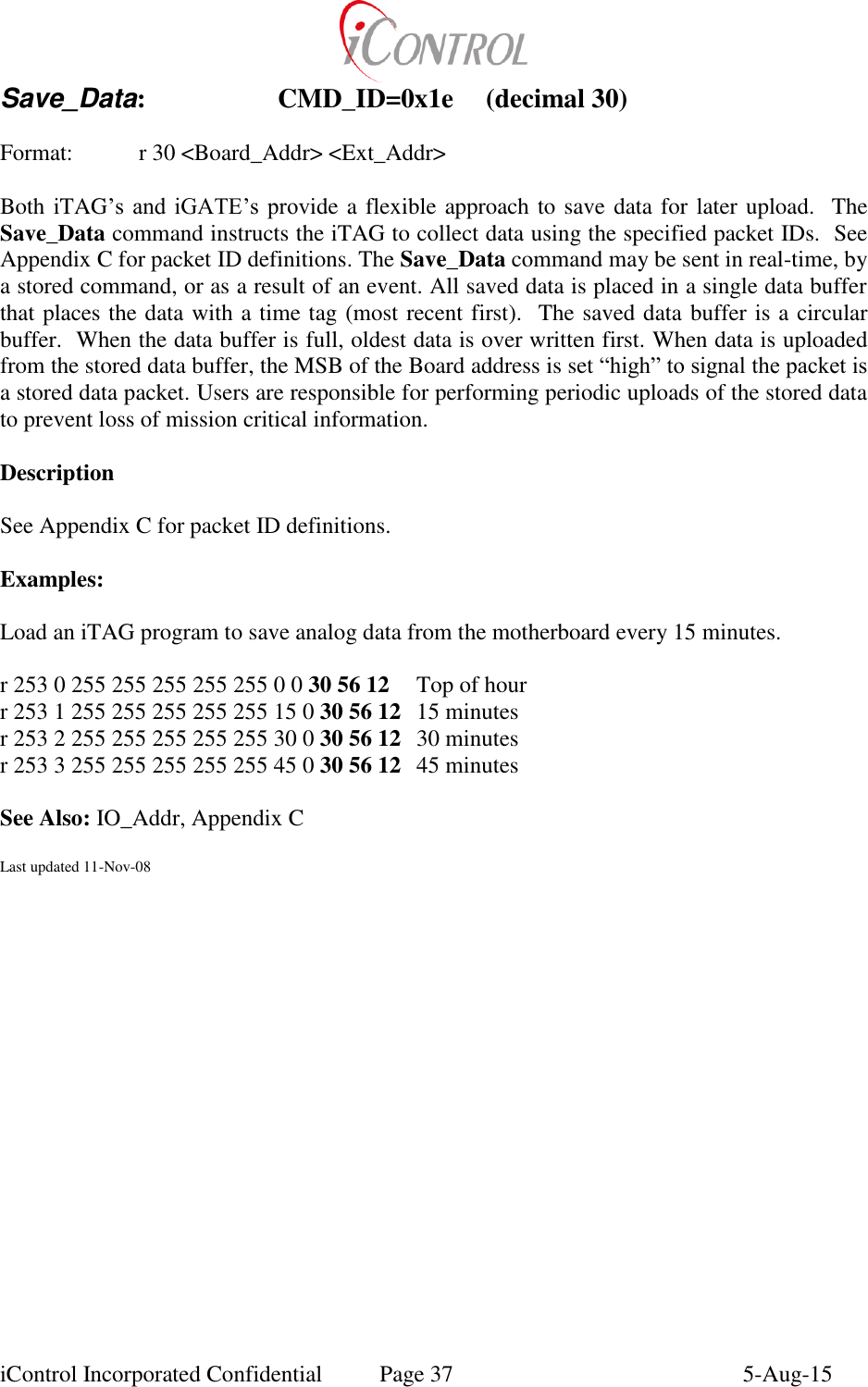
 iControl Incorporated Confidential  Page 37  5-Aug-15 Save_Data:    CMD_ID=0x1e  (decimal 30)  Format:    r 30 <Board_Addr> <Ext_Addr>  Both iTAG’s  and  iGATE’s  provide a flexible approach to save data for later upload.  The Save_Data command instructs the iTAG to collect data using the specified packet IDs.  See Appendix C for packet ID definitions. The Save_Data command may be sent in real-time, by a stored command, or as a result of an event. All saved data is placed in a single data buffer that places the data with a time tag (most recent first).  The saved data buffer is a circular buffer.  When the data buffer is full, oldest data is over written first. When data is uploaded from the stored data buffer, the MSB of the Board address is set “high” to signal the packet is a stored data packet. Users are responsible for performing periodic uploads of the stored data to prevent loss of mission critical information.  Description  See Appendix C for packet ID definitions.  Examples:  Load an iTAG program to save analog data from the motherboard every 15 minutes.  r 253 0 255 255 255 255 255 0 0 30 56 12  Top of hour r 253 1 255 255 255 255 255 15 0 30 56 12  15 minutes   r 253 2 255 255 255 255 255 30 0 30 56 12  30 minutes r 253 3 255 255 255 255 255 45 0 30 56 12  45 minutes  See Also: IO_Addr, Appendix C  Last updated 11-Nov-08
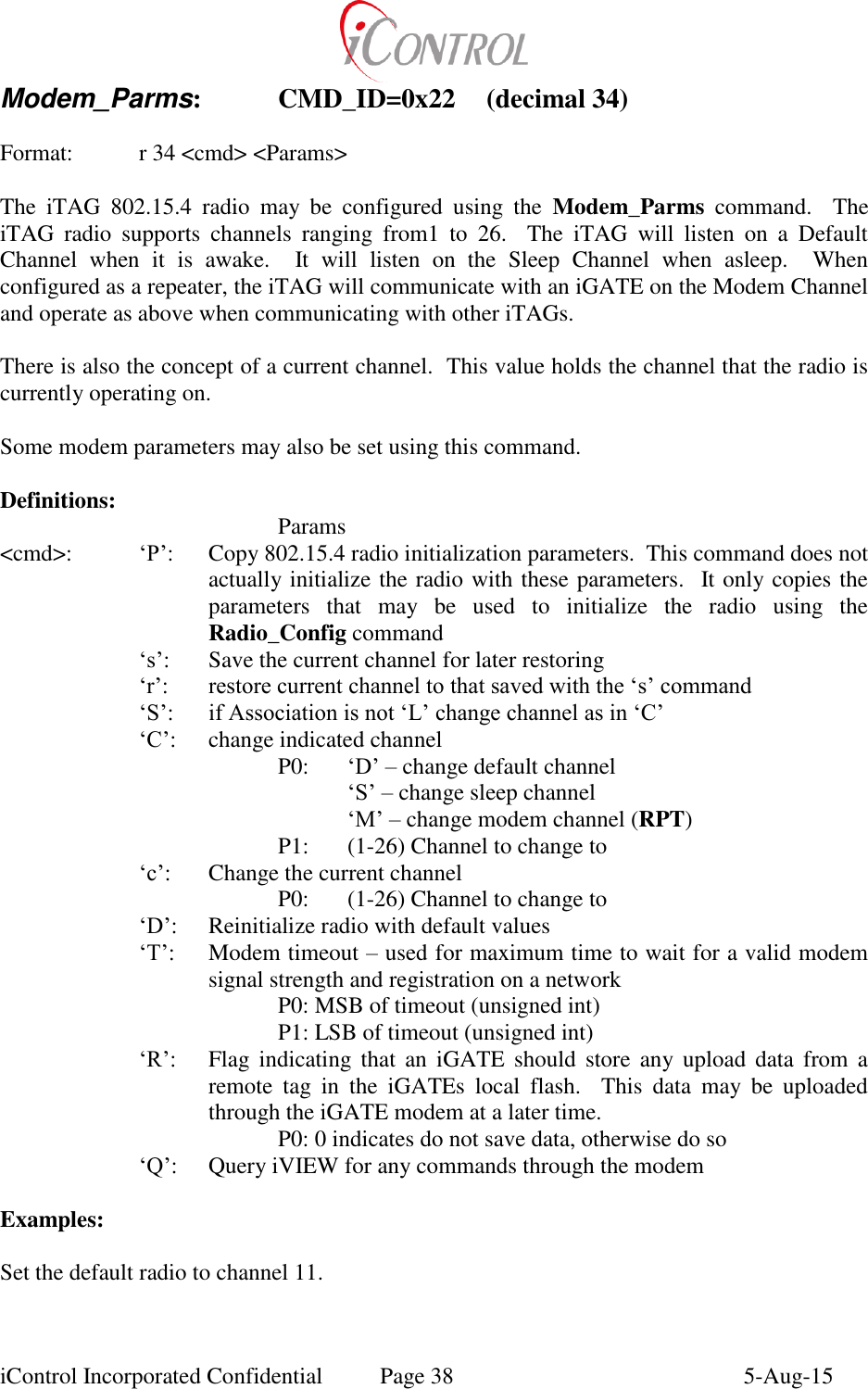
 iControl Incorporated Confidential  Page 38  5-Aug-15 Modem_Parms:   CMD_ID=0x22  (decimal 34)  Format:    r 34 <cmd> <Params>  The  iTAG  802.15.4  radio  may  be  configured  using  the  Modem_Parms  command.    The iTAG  radio  supports  channels  ranging  from1  to  26.    The  iTAG  will  listen  on  a  Default Channel  when  it  is  awake.    It  will  listen  on  the  Sleep  Channel  when  asleep.    When configured as a repeater, the iTAG will communicate with an iGATE on the Modem Channel and operate as above when communicating with other iTAGs.  There is also the concept of a current channel.  This value holds the channel that the radio is currently operating on.  Some modem parameters may also be set using this command.  Definitions:         Params <cmd>: ‘P’:  Copy 802.15.4 radio initialization parameters.  This command does not actually initialize the radio with these parameters.  It only copies the parameters  that  may  be  used  to  initialize  the  radio  using  the Radio_Config command ‘s’:  Save the current channel for later restoring ‘r’: restore current channel to that saved with the ‘s’ command ‘S’: if Association is not ‘L’ change channel as in ‘C’ ‘C’:  change indicated channel P0:   ‘D’ – change default channel  ‘S’ – change sleep channel  ‘M’ – change modem channel (RPT) P1:  (1-26) Channel to change to ‘c’:  Change the current channel     P0:  (1-26) Channel to change to ‘D’:  Reinitialize radio with default values ‘T’:  Modem timeout – used for maximum time to wait for a valid modem signal strength and registration on a network     P0: MSB of timeout (unsigned int)     P1: LSB of timeout (unsigned int) ‘R’:  Flag  indicating  that  an  iGATE  should  store  any  upload  data  from  a remote  tag  in  the  iGATEs  local  flash.    This  data  may  be  uploaded through the iGATE modem at a later time.     P0: 0 indicates do not save data, otherwise do so ‘Q’:  Query iVIEW for any commands through the modem  Examples:  Set the default radio to channel 11.
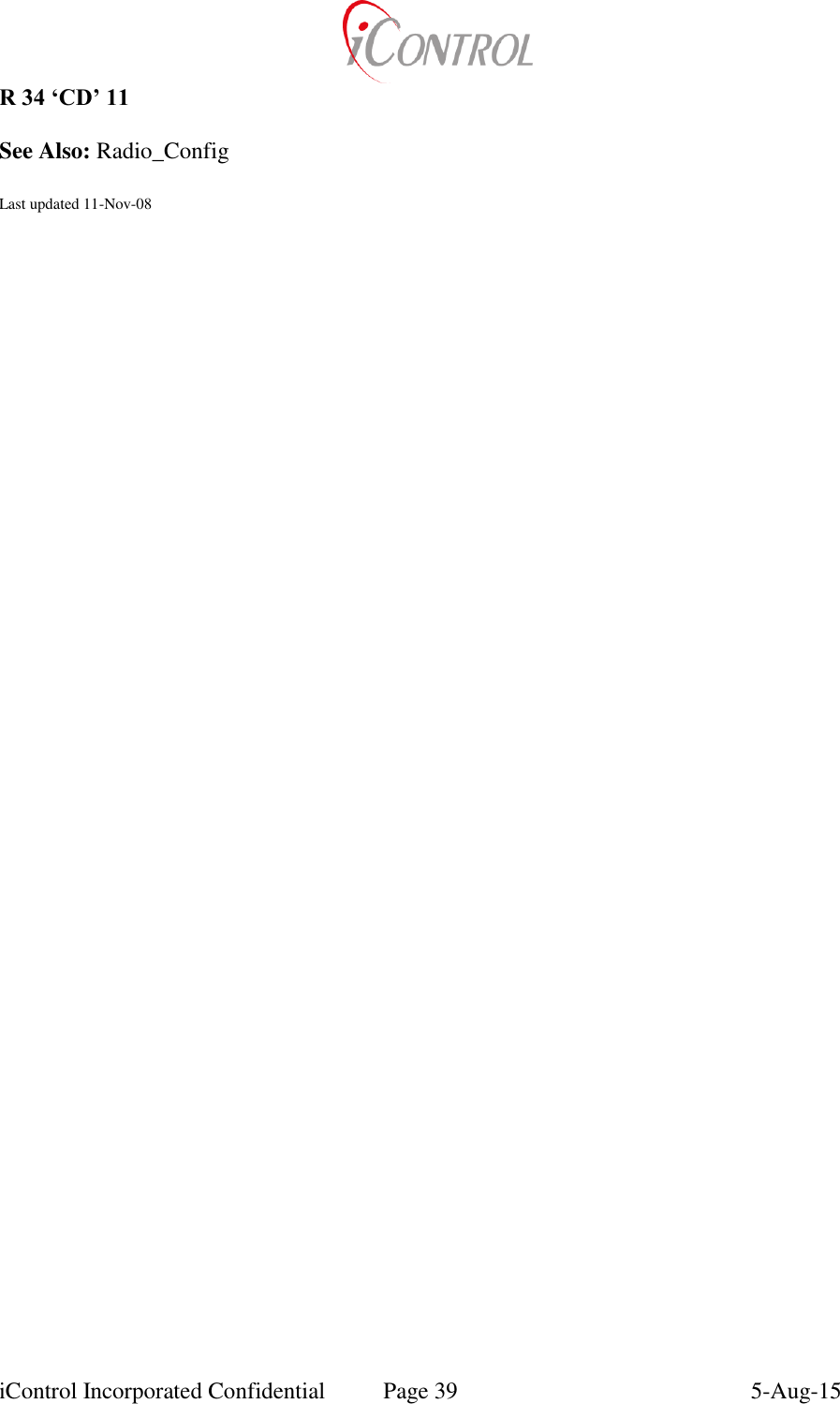
 iControl Incorporated Confidential  Page 39  5-Aug-15 R 34 ‘CD’ 11  See Also: Radio_Config  Last updated 11-Nov-08
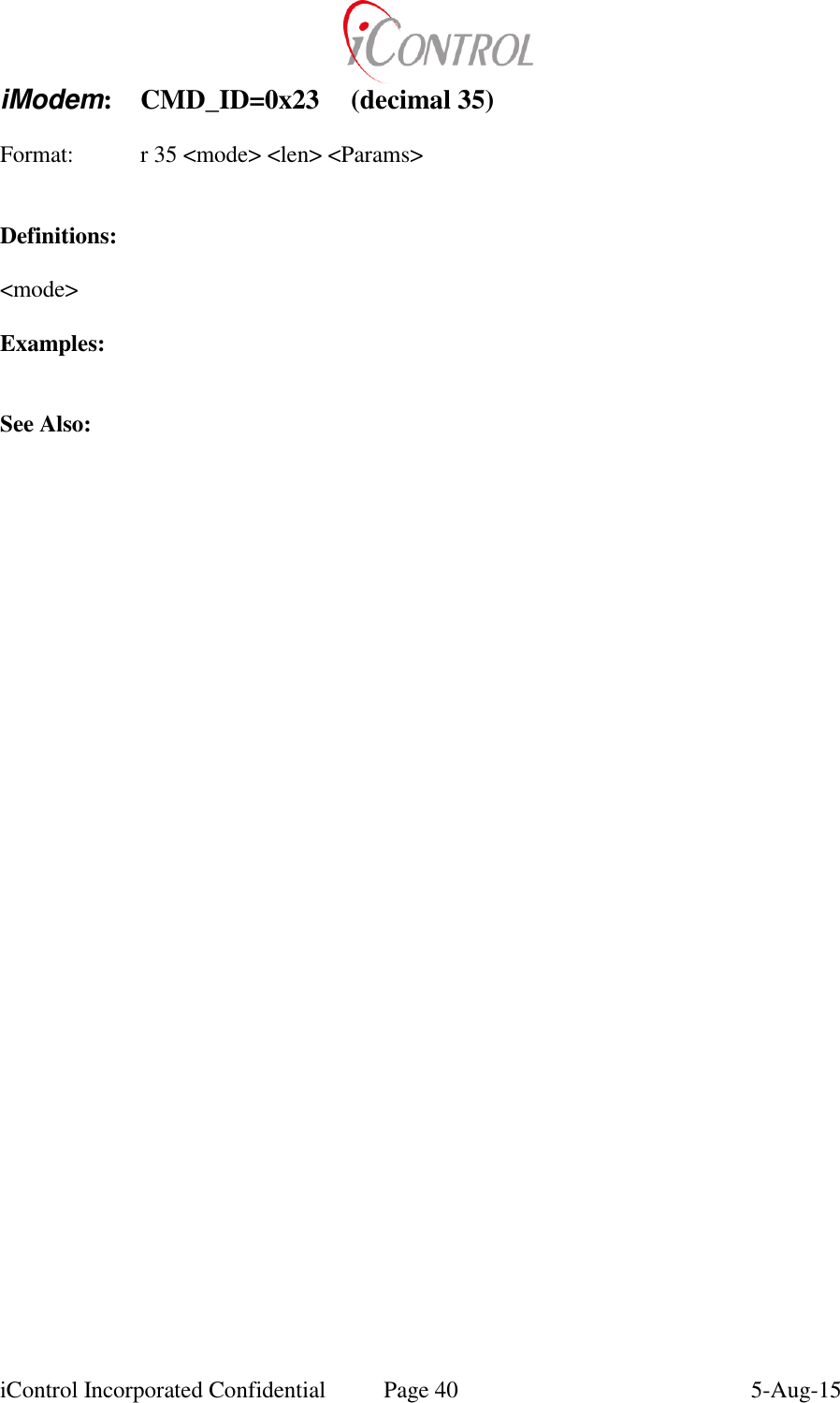
 iControl Incorporated Confidential  Page 40  5-Aug-15 iModem:  CMD_ID=0x23  (decimal 35)  Format:  r 35 <mode> <len> <Params>   Definitions:  <mode>  Examples:   See Also:
 iControl Incorporated Confidential  Page 41  5-Aug-15 Serial_R/W:  CMD_ID=0x27  (decimal 39)    Format:    r 39 <R/W> <port> <data>  iTAG’s may  send or receive data via the serial ports to communicate with smart sensors. For most applications this operation is performed using the serial port configured as the DataPort.  With this command, users define the parameters necessary to prompt MODBUS devices or PLC’s to return data for the iTAG to store or place in telemetry.  Definitions:  <R/W>    (0)  Sets message sync characters used for receiving data.         There are 3 sync characters. Two start characters and          a terminating character.        (1)  Write <serial message> bytes out specified port        (2)  Write contents of DataBytes out specified port        (3)  Reset specified serial port to flush receive buffer  <port>     0-2  Serial port for data read write operations        Examples:  Prompt a GPS receiver to return data.  Send appropriate prompt, wait 20 milliseconds, read data into a stored data packet.   Assume:   a) GPS receiver is hooked to serial port 2 b) “#<ENTER>” Generates data prompt c) Receiver needs 20 milliseconds to respond with data d) Start of returned data packet is a “&=”.  e) The terminating character is <ENTER>  Load Macro 0 with the following commands, (in a text file they are decimal)  r 39 0 2 38 61 13  Sets the message sync and terminating characters r 39 1 2 35 13   Send the Prompt (ASCII decimal #,enter) r 102 20    Delay Macro[0] 20 milliseconds r 30 0 32    Read/save data string from serial port 2 (0x20=32)  Each time the user wishes to save data from the GPS receiver, execute Macro 0 with a Run_Macro command.   See Also: MS_Delay, Save_Data, Run_Macro  Last updated 11-Nov-08
 iControl Incorporated Confidential  Page 42  5-Aug-15 General_R/W:    CMD_ID=0x28  (decimal 40)  Format:    r 40 <R/W> <Addr> <data>  iTAG’s  may  read  or  write  data  to  internal  or  external  IO  address  space.  At  present, General_R/W only writes to general purpose I/O pins.  Although implemented in hardware which can change with each revision, the GPIO 3 pin is usually used to control the power to an installed modem.  Definitions:  <R/W>  (4) Write to a general purpose I/O pin <Addr>  (3,4,10,15) GPIO Pin to write to <data>   (0 or 1) Set specified GPIO pin to 0 or 1  Examples:  Set GPIO pin 3 to high (1).    r 40 3 1  See Also: Save_Data, Load_Macro,Run_Macro  Last updated 11-Nov-08
 iControl Incorporated Confidential  Page 43  5-Aug-15 Beacon:    CMD_ID=0x3c  (decimal 60)  Format:    r 60 <broadcast addr> <BeaconTimerMSB> <BeaconTimerLSB> <type> <Channel>  iTAGs  join  the  iGATE  802.15.4  network  by  sending  a  beacon  request.    The  only  valid parameter when sending a beacon request is the broadcast address.  An iGATE sends a Beacon signal to inform iTAGs of the channel that the iGATE is listening on.  Definitions:  <broadcast addr>  Index  of  broadcast  address  to  use  when  sending  beacon    or  beacon request <BeaconTimerMSB> Most  significant byte of an  unsigned int  value indicating  how many seconds that the remote iTAG should remain associated <BeaconTimerLSB>  Least significant byte of an unsigned int value indicating how many seconds that the remote iTAG should remain associated <type>  Beacon type: ‘W’ or ‘B’.   W – send beacon using the Sleep Channel.  B – send beacon using the Default Channel <Channel>  Radio  channel  that  remote  iTAGs  use  to  communicate  with  this iGATE  Example:  Request a beacon using the first broadcast address.  r 60 0  Send a beacon on the Sleep Channel using broadcast address 0.  Send a beacon timer of 900 seconds.  Tell remote iTAGs to use Channel 14 to communicate with this iGATE.  r 60 0 3 132 ‘W’ 14  See Also: Broadcast_Address, Modem_Parms  Last updated 11-Nov-08
 iControl Incorporated Confidential  Page 44  5-Aug-15 Track:  CMD_ID=0x3e  (decimal 62)  Format:    r 62 <Command> [params]  Program Track mode and motion sense parameters.  The motion sense parameters are used when the  iTAG is equipped with an accelerometer.  The accelerometer is checked once per second.  If the magnitude of the accelerometer axis has changed more than MotionDetect, then increment a counter.  If that counter is greater than MotionTimer, indicate that motion has occurred.  This counter is reset with each 63 ‘M’ command.  The track parameters are used to check for changes related to GPS.  The 63 ‘T’ ‘P’ or the 62 ‘t’ ‘P’ command uses the TrackRange value to determine if the iTAG has moved greater than TrackRange meters from Waypoint[0].  Waypoint[0] is overwritten with the present location if the iTAG is greater than TrackRange meters from the previous Waypoint[0] value.  The  algorithm  that  uses  the  TrackVelocity,  MovingFix,  and  StationaryFix  is  not implemented.  The waypoints are used to calculate distance from the present position.  These distances can then be formatted into a data packet and used in the Check_Alarm command.  All parameters can be saved to non-volatile ram using the 240 command.  (GEN2)  Definitions:    (Params) <Command>  C  Set Velocity counters (Not presently implemented)     P0: Moving Fix MSB of unsigned int       P1: Moving Fix LSB of unsigned int       P2: Stationary Fix MSB of unsigned int       P3: Stationary Fix LSB of unsigned int  D  Debug/Display parameters – only valid in DN display   M  Set motion sense parameters       P0: Motion Detect MSB of unsigned int       P1: Motion Detect LSB of unsigned int       P2: Motion Timer MSB of unsigned int       P3: Motion Timer LSB of unsigned int   t  Run track algorithm       P0: P | V | T   T  Set Tracking parameters       P0: Track Range (string formatted float)       P1: Track Velocity (string formatted float)   W  Program waypoints     P0: ‘C’ – clear all waypoints
 iControl Incorporated Confidential  Page 45  5-Aug-15       P0: Index of waypoint to program       P1: Waypoint Lat (string formatted float)       P2: Waypoint Long (string formatted float)  Example:  Set Track Range to 500 meters and Track Velocity to 10.3 meters per second.  r 62 ‘T’ “500. 10.3” r 63 84 53 48 48 46 32 49 48 46 51  Set waypoint 2 to 35.12 and -90.01 degrees  r 62 ‘W’ 2 “35.12 -90.01” r 62 87 2 51 53 46 49 50 32 45 57 48 46 48 49  Set motion detect to 60 and motion timer to 301.  r 62 ‘M’ 0 60 1 45 r 62 77 0 60 1 45  If  DataByte[5]==8  and  iTAG  is  associated  and  GPS  is  valid,  execute  macro  20,  else  do nothing.  Note that the ‘x’ value in “G=x” is a don’t care as GPS is either valid or not and this state is not compared to any value that may be set in the firmware.  r ‘?d58?A=L?G=xrM’ 20 99 r 63 100 5 8 63 65 61 76 63 71 61 120 114 77 20 99  See Also: Test_Condition, Check_Alarm  Last updated 11-Nov-08
 iControl Incorporated Confidential  Page 46  5-Aug-15 Test_Condition: CMD_ID=0x3f  (decimal 63)  Format:    r 63 “<Object>=<Test>rM” <true Macro> <false Macro> Alternate:    r 63 “<Object>=<Test>rC” <Command> Alternate:    r 63 “d<Index><Value>rM” <true Macro> <false Macro> Alternate:    r 63 “d<Index><Value>rC” <Command>  iTAG’s have many conditions that may be tested for a certain condition.  The Test_Condition command allows logic that will execute a certain macro if a condition is true and a different macro if the condition is false.  Alternately, a command may be executed if the condition is true.  Tests may be  combined,  where each test  case will  be  checked  in  order.   The  true  case  is executed if and only if all test cases are true.  Definitions:  <Object>:    iTAG state to be tested <Test>:    State of Object for comparison <true Macro>:   Macro to run if above comparison is TRUE <false Macro>:  Macro to run if above comparison is FALSE <Command>:    Command to run if above comparison is TRUE  Object Description Possible States for Test A Is  iTAG  is  associated  in  an  802.15.4 network l: transitory state, iTAG is about to become associated L:  iTAG  is  associated  with  an iGATE n: transitory state, iTAG is about to become disassociated N: iTAG is not associated S: iTAG is scanning T: iCHIME is associated W:  iGATE  is  associated  in  a  Wide Area Network C Is iTAG commissioned N:  iTAG  has  not  been commissioned Any  other  8-bit  value  can  be commanded and therefore tested d Test if DataByte[Index]==value Any 8-bit value can be commanded and therefore tested for D Is there stored data None G Is GPS valid None M Has there been motion sensed N: no motion Y: motion has occurred
 iControl Incorporated Confidential  Page 47  5-Aug-15 N Check  for  a  change  in  the  number  of members in the ACL None t Check Track status, save data if true None T Check Track status None   Power Considerations:  If either true or false Macro is a valid macro and that macro will be executed, the iTAG is reset from power savings mode.  If  a  command  is  to  be  executed,  the  power  savings  mode  will  be  reset  according  to  that specific command.  Example:  If iTAG is associated, execute macro 5, execute macro 6 otherwise.  r ‘?A=LrM’ 5 6 r 63 65 61 76 114 77 5 6  If iTAG is associated, execute command to change mode to flow 5 samples.  r ‘?A=LrC’ 1 5 5 r 63 65 61 76 114 67 1 5 5  If DataByte[5]==8, execute macro 20, else do nothing  r ‘?d58rM’ 20 99 r 63 100 5 8 114 77 20 99  If  DataByte[5]==8  and  iTAG  is  associated  and  GPS  is  valid,  execute  macro  20,  else  do nothing.  Note that the ‘x’ value in “G=x” is a don’t care as GPS is either valid or not and this state is not compared to any value that may be set in the firmware.  r ‘?d58?A=L?G=xrM’ 20 99 r 63 100 5 8 63 65 61 76 63 71 61 120 114 77 20 99  See Also: Commissioned, Track, DataByte  Last updated 11-Nov-08
 iControl Incorporated Confidential  Page 48  5-Aug-15 MAC_Addr:  CMD_ID=0x4d  (decimal 77)  Format:    r 77 <8 byte MAC>  All  units  in  an  802.15.4  network  have  a  unique  8  byte  MAC  address.    The  MAC_Addr command is used to program the 8 byte MAC for the iTAG.  Definitions:  <8 byte MAC>  MAC address of this unit. This value is entered in reverse byte order.  Example:  Set the MAC address of this unit to 63.0.1.2.10.11.12.13.  r 77 13 12 11 10 2 1 0 63  See Also:  Last updated 11-Nov-08
 iControl Incorporated Confidential  Page 49  5-Aug-15 Stop_Macro:  CMD_ID=0x60  (decimal 96)  Format:    r 96 <Macro_ID>  When a user (or the iTAG) wants to stop a running a Macro, the Stop_Macro command is used. Stop_Macro will stop the Macro specified by Macro_ID. If the user wants to stop all running  Macros,  a  Macro_ID  of  0xff  will  stop  all  non-Background  Macros.    To  stop  a Background Macro configured for infinite operation, a Stop_Macro command is sent using the specific ID of the Background Macro. There is no problem stopping an already stopped Macro.  Definitions:   <Macro_ID>  (0-39)  Stops the Macro specified by the Macro_ID    (255)  Stops all non-Background Macros  Example:  Stop Macro 3  r 96 3  See Also: Run_Macro, Load_Macro  Last updated 11-Nov-08
 iControl Incorporated Confidential  Page 50  5-Aug-15 Run_Macro:  CMD_ID=0x61  (decimal 97)  Format:    r 97 <Macro_ID> <Loop>  A User, remote command, Alarm condition, or another Macro may be used to start a loaded Macro.  Macro_ID is used to identify the desired Macro to run.  Macros may be run multiple times using the Loop parameter at the end of the Run_Macro Command. A loop value of (255,<0xff>) causes the Macro to run in infinite Background mode.     There  are  two  special  purpose  Macros.  Macro[38]  is  run  each  time  the  iTAG  reboots.  Background Macros and initialization parameters may be placed in Macro[38] to start each time an iTAG reboots. Macro[39] may be used as a general purpose Macro. If the iTAG is configured with a modem, Macro[39] is run when the modem establishes a connection. Any command the user wishes to execute when an iTAG modem connects should be placed in Macro[39]. Typical uses for Macro[39] are triggered data uploads, LAN network commands, or backup timers which limit connection times. If an empty Macro is commanded to run, an error message will be written to the screen.  Definitions:  <Macro_ID>    (0-39)  Runs the specified Macro <Loop>    (0-254) Runs the specified Macro up to 254 times before stopping        255  Places Macro in an infinite loop (Background)    Examples:  Command Macro(0) to run 20 times.  r 97 0 20  Command Macro(37)  to run in Background mode.  r 97 37 255  See Also:  Last updated 11-Nov-08
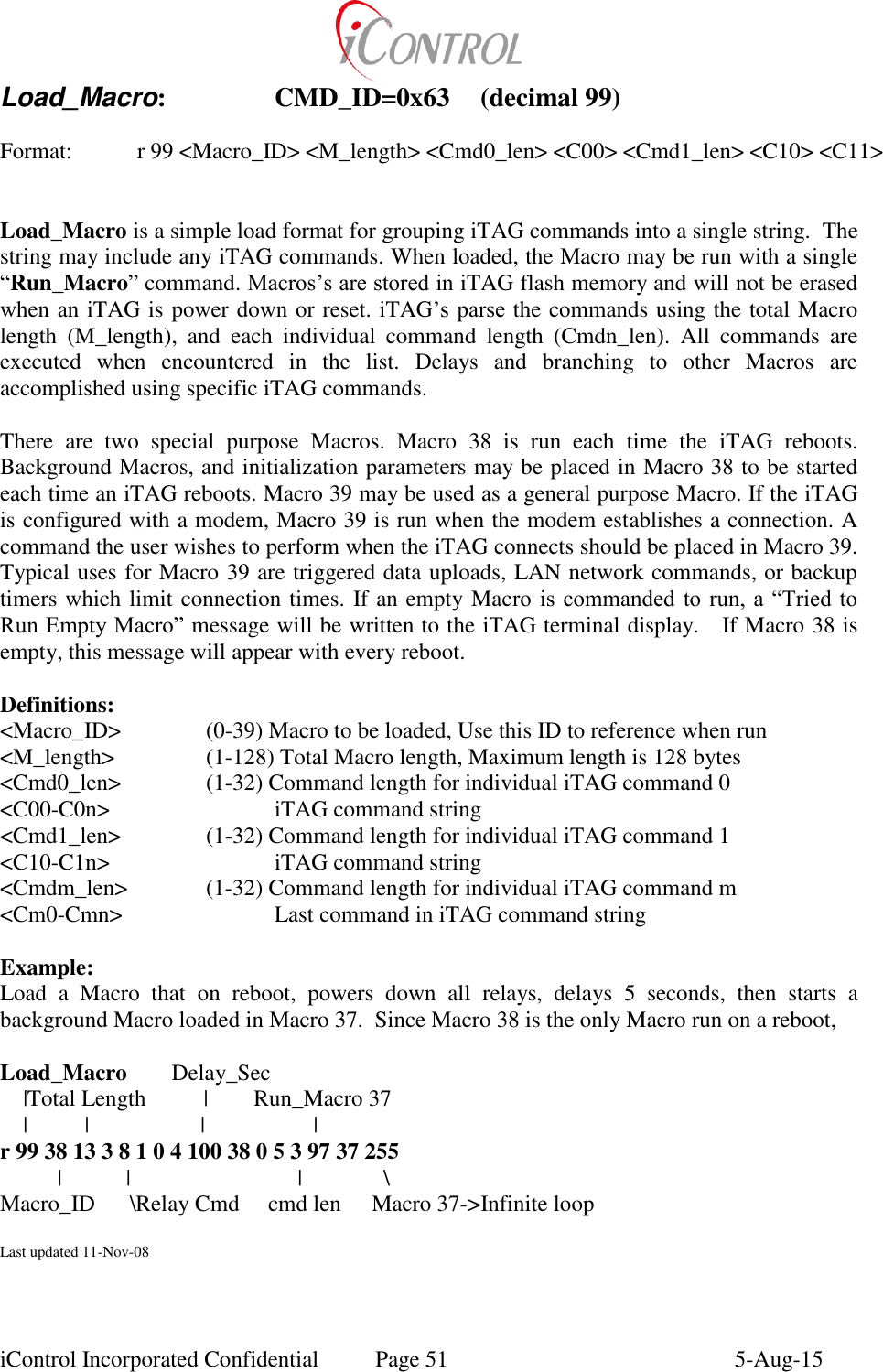
 iControl Incorporated Confidential  Page 51  5-Aug-15 Load_Macro:    CMD_ID=0x63  (decimal 99)  Format:    r 99 <Macro_ID> <M_length> <Cmd0_len> <C00> <Cmd1_len> <C10> <C11>   Load_Macro is a simple load format for grouping iTAG commands into a single string.  The string may include any iTAG commands. When loaded, the Macro may be run with a single “Run_Macro” command. Macros’s are stored in iTAG flash memory and will not be erased when an iTAG is power down or reset. iTAG’s parse the commands using the total Macro length  (M_length),  and  each  individual  command  length  (Cmdn_len).  All  commands  are executed  when  encountered  in  the  list.  Delays  and  branching  to  other  Macros  are accomplished using specific iTAG commands.  There  are  two  special  purpose  Macros.  Macro  38  is  run  each  time  the  iTAG  reboots.  Background Macros, and initialization parameters may be placed in Macro 38 to be started each time an iTAG reboots. Macro 39 may be used as a general purpose Macro. If the iTAG is configured with a modem, Macro 39 is run when the modem establishes a connection. A command the user wishes to perform when the iTAG connects should be placed in Macro 39. Typical uses for Macro 39 are triggered data uploads, LAN network commands, or backup timers which limit connection times. If an empty Macro  is  commanded to  run,  a  “Tried to Run Empty Macro” message will be written to the iTAG terminal display.   If Macro 38 is empty, this message will appear with every reboot.  Definitions: <Macro_ID>    (0-39) Macro to be loaded, Use this ID to reference when run <M_length>    (1-128) Total Macro length, Maximum length is 128 bytes <Cmd0_len>    (1-32) Command length for individual iTAG command 0 <C00-C0n>      iTAG command string <Cmd1_len>    (1-32) Command length for individual iTAG command 1 <C10-C1n>      iTAG command string <Cmdm_len>    (1-32) Command length for individual iTAG command m <Cm0-Cmn>      Last command in iTAG command string  Example: Load  a  Macro  that  on  reboot,  powers  down  all  relays,  delays  5  seconds,  then  starts  a background Macro loaded in Macro 37.  Since Macro 38 is the only Macro run on a reboot,  Load_Macro        Delay_Sec     |Total Length          |        Run_Macro 37     |          |             |                   | r 99 38 13 3 8 1 0 4 100 38 0 5 3 97 37 255           |           |                             |         \ Macro_ID      \Relay Cmd     cmd len      Macro 37->Infinite loop  Last updated 11-Nov-08
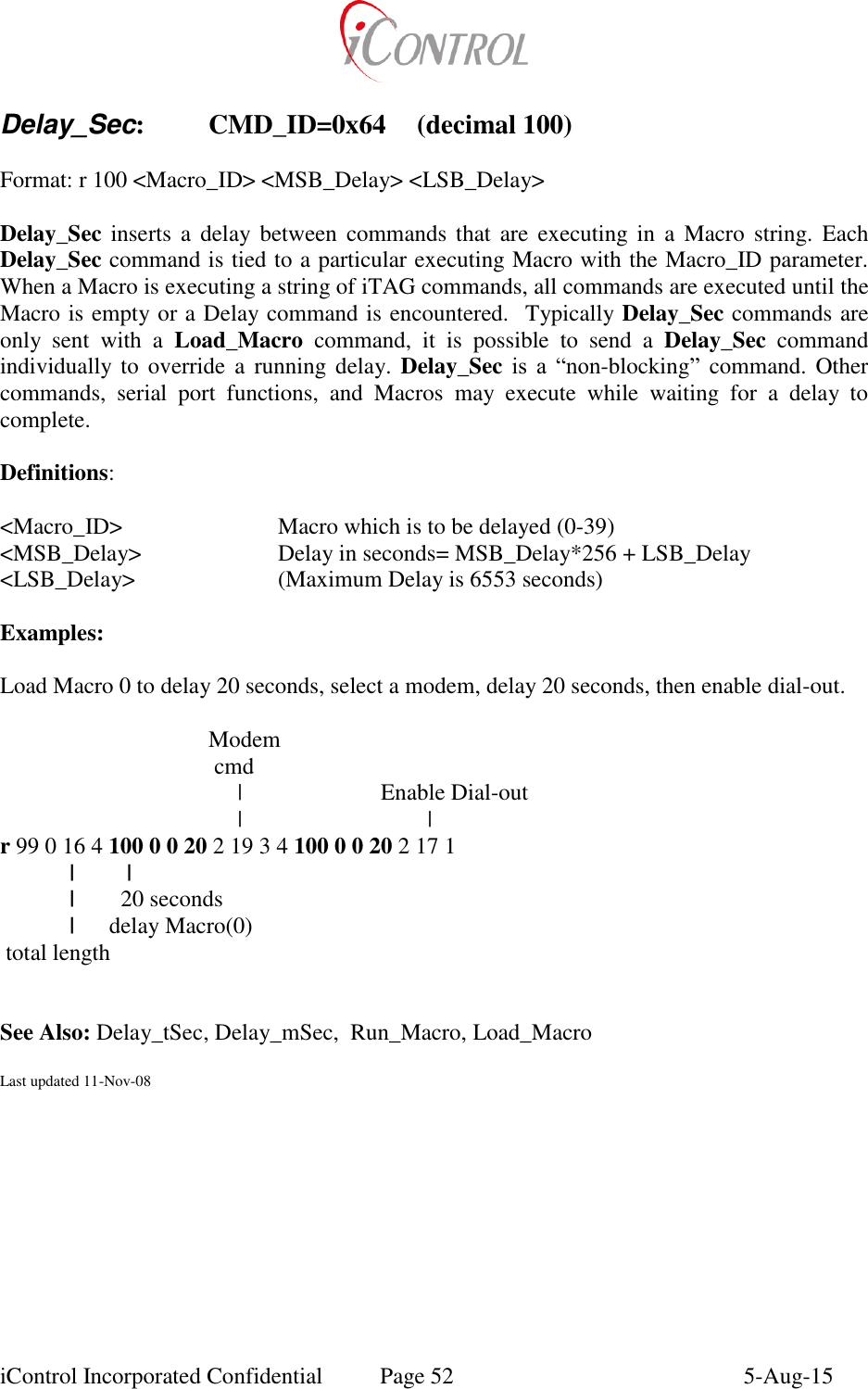
 iControl Incorporated Confidential  Page 52  5-Aug-15  Delay_Sec:  CMD_ID=0x64  (decimal 100)  Format: r 100 <Macro_ID> <MSB_Delay> <LSB_Delay>  Delay_Sec inserts  a  delay  between  commands  that  are  executing in a  Macro  string.  Each Delay_Sec command is tied to a particular executing Macro with the Macro_ID parameter.  When a Macro is executing a string of iTAG commands, all commands are executed until the Macro is empty or a Delay command is encountered.  Typically Delay_Sec commands are only  sent  with  a  Load_Macro  command,  it  is  possible  to  send  a  Delay_Sec  command individually to  override a  running delay. Delay_Sec is  a  “non-blocking”  command.  Other commands,  serial  port  functions,  and  Macros  may  execute  while  waiting  for  a  delay  to complete.  Definitions:  <Macro_ID>       Macro which is to be delayed (0-39) <MSB_Delay>    Delay in seconds= MSB_Delay*256 + LSB_Delay <LSB_Delay>     (Maximum Delay is 6553 seconds)  Examples:  Load Macro 0 to delay 20 seconds, select a modem, delay 20 seconds, then enable dial-out.                                      Modem                                      cmd                                          |                        Enable Dial-out                      |                                | r 99 0 16 4 100 0 0 20 2 19 3 4 100 0 0 20 2 17 1   |         |     |        20 seconds   |      delay Macro(0)  total length             See Also: Delay_tSec, Delay_mSec,  Run_Macro, Load_Macro  Last updated 11-Nov-08
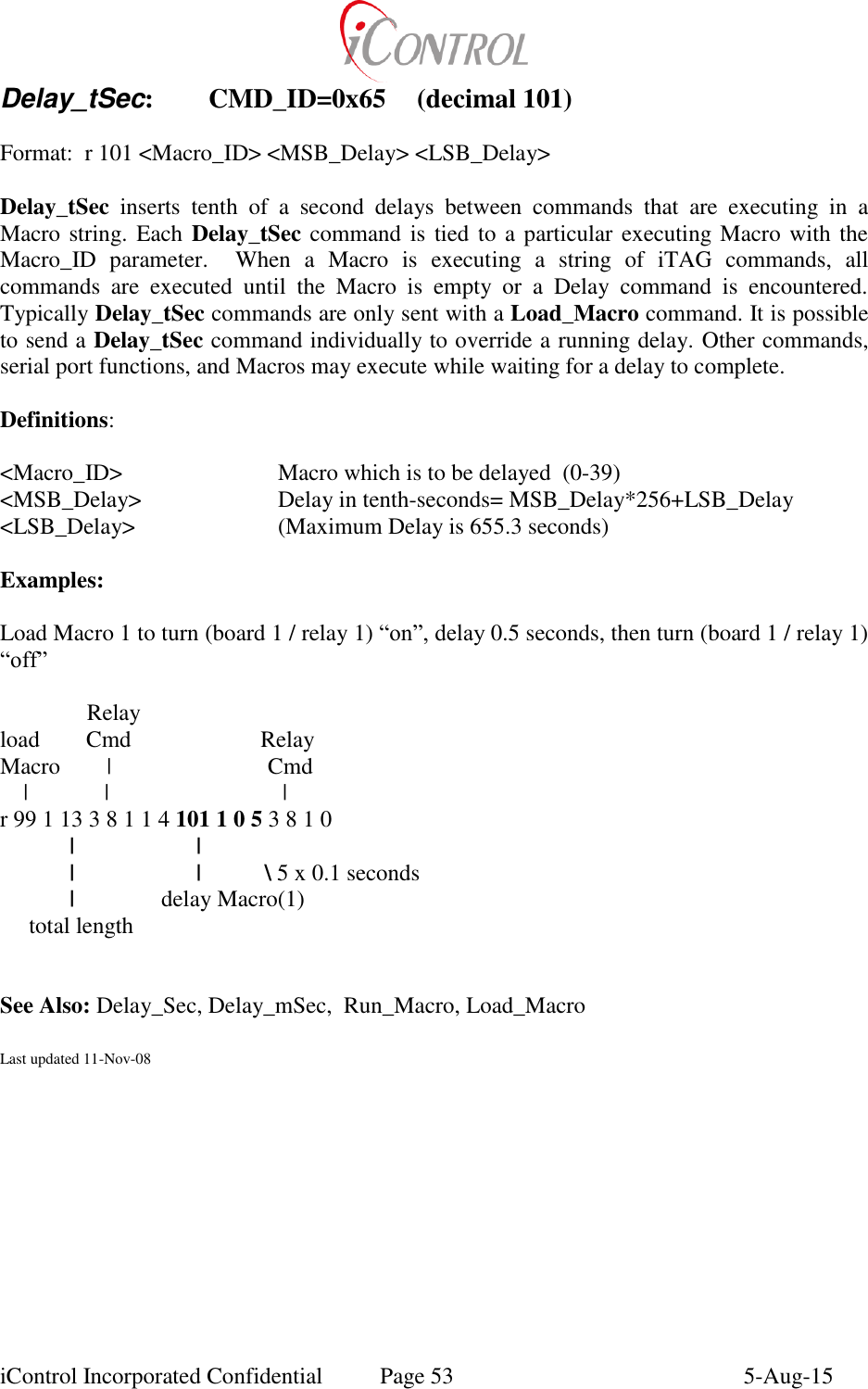
 iControl Incorporated Confidential  Page 53  5-Aug-15 Delay_tSec:  CMD_ID=0x65  (decimal 101)  Format:  r 101 <Macro_ID> <MSB_Delay> <LSB_Delay>  Delay_tSec  inserts  tenth  of  a  second  delays  between  commands  that  are  executing  in  a Macro string. Each Delay_tSec command is tied to a particular executing Macro with  the Macro_ID  parameter.    When  a  Macro  is  executing  a  string  of  iTAG  commands,  all commands  are  executed  until  the  Macro  is  empty  or  a  Delay  command  is  encountered.  Typically Delay_tSec commands are only sent with a Load_Macro command. It is possible to send a Delay_tSec command individually to override a running delay. Other commands, serial port functions, and Macros may execute while waiting for a delay to complete.  Definitions:  <Macro_ID>       Macro which is to be delayed  (0-39) <MSB_Delay>    Delay in tenth-seconds= MSB_Delay*256+LSB_Delay <LSB_Delay>     (Maximum Delay is 655.3 seconds)  Examples:  Load Macro 1 to turn (board 1 / relay 1) “on”, delay 0.5 seconds, then turn (board 1 / relay 1) “off”                 Relay load        Cmd                      Relay Macro        |                           Cmd     |        |                              | r 99 1 13 3 8 1 1 4 101 1 0 5 3 8 1 0              |                     |          |                     |           \ 5 x 0.1 seconds   |               delay Macro(1)      total length             See Also: Delay_Sec, Delay_mSec,  Run_Macro, Load_Macro   Last updated 11-Nov-08
 iControl Incorporated Confidential  Page 54  5-Aug-15 Delay_mSec:  CMD_ID=0x66  (decimal 102)  Format: r 102 <MS_Delay>  Delay_mSec inserts milli-second delays between commands that are executing in a Macro string.  Delay_mSec  commands  are  not  tied  to  a  particular  Macro.    When  a  Macro  is executing a string of iTAG commands, all commands are executed until the Macro is empty or  a  Delay  command  is  encountered.    Delay_mSec  commands  are  only  sent  with  a Load_Macro command. Delay_mSec is a blocking command, other commands and Macros are suspended while Delay_mSec completes.  Definitions:  <MS_Delay>      (1-50)  Delay in milli-seconds         (Maximum Delay is 50 milli-seconds)         (>50) Delay is DataByte[0]*Bspacing seconds  Examples:  Load Macro 1 to turn (board 1/relay 1) “on”, delay 0.010 seconds, then turn (board 1/relay 1) “off”                 Relay  Load      Cmd                   Relay  Macro         |                     Cmd      |          |                          | r 99 1 11 3 8 1 1 2 102 10 3 8 1 0 |                    |        \     |                    |         10 x 0.001 seconds   |              delay Macro     total length             See Also: Delay_tSec, Delay_Sec,  Run_Macro, Load_Macro, Radio_Parameters, DataByte   Last updated 11-Nov-08
 iControl Incorporated Confidential  Page 55  5-Aug-15 Wait_While:  CMD_ID=0x67  (decimal 103)  Format: r 103 <Delay Macro “n”> <until Macro “m”> <timeout>  Wait_While  is  a  non-blocking  delay  command  which  holds  execution  of  Macro_ID “n” until Macro_ID “m” completes.  When a Macro is executing a string of iTAG commands, all commands  are  executed  until  the  Macro  is  empty  or  a  Delay  command  is  encountered.  Wait_While commands are only sent with a Load_Macro command. Serial port functions, commands, and Macros all execute while waiting for a delay to complete. A Wait_While command  is  placed  in  the  Macro  which  is  required  to  delay.  Command  processing  will resume after the Macro_ID[m] is finished.  The Wait_While command initiates a 65535 count 100 mSec delay for macro n (similar to a 102 n 255 255 command).  Only one macro complete value is saved for each macro.  The delay  is  only  reset  when  macro  m  completes.    A  Stop_Macro  command  deletes  the completion flag, but does not signal the waiting macro to continue.  To  illustrate  these  issues,  say  macro  5  is  to  wait  for  macro  6.    If  another  Wait_While command is executed for macro 10 to wait for macro 6 before 6 completes, then macro 5 will delay until 655.35 seconds have expired because each macro can only signal one other macro after it has completed.  Macro 10 will delay until macro 6 completes.  If macro 6 is stopped, then both macro 5 and macro 10 will delay until each has waited for 655.35 seconds since their respective 103 commands was executed.  There is no interaction when different macros are used for macro m, so macro 5 may wait for macro 6 and macro 10 may wait for macro 20.  In each case, macro 5 and macro 10 will resume execution as expected when their respective macros complete execution.  Alternately, m may be replace with ‘A’, ‘G’, or ‘U’.  In each case, macro n will wait until the iTAG is Associated, GPS is acquired, or a data upload has completed.  Only one macro is saved for each flag.  That is, a 103 A 5 command will delay macro 5 until Associated or for timeout seconds whichever comes first.  A subsequent 103 A 10 command that is executed while macro 5  is  still  waiting for  the  iTAG  to  become  associated  will  cause macro  10  to delay until associated or for timeout seconds whichever comes first and macro 5 will only be waiting  for  the  timeout  second  timeout  and  will  not  continue  when  the  iTAG  becomes associated.  Furthermore, the associated and GPS delay states are checked every second.  The upload complete delay is only terminated when an upload has ended.   Definitions:  < Delay Macro “n”>    (0-39) Macro which will wait until Macro[m] completes < until Macro “m”>    (0-39) Macro which is to be waited for completion  Example:
 iControl Incorporated Confidential  Page 56  5-Aug-15 Load  Macro[4] which  will start a second Macro(Macro[24]) . Macro[4] should wait until Macro[24] is complete, then save the resulting data.  r 99 4 12 3 97 24 25 3 103 4 24 3 30 4 255  (waits until M24 completes) r 99 24 20 4 8 2 255 0 4 101 24 0 2 4 8 2 0 0 4 101 24 0 2   Load Macro [4] which will initiate a data upload and delay until that upload is complete or 60 seconds whichever comes first.  r 103 4 ‘U’ 60 (waits up to 60 seconds until upload completes)  See Also: Delay_Sec, Delay_tSec, Delay_mSec, Run_Macro, Load_Macro, Upload_Data  Last updated 11-Nov-08
 iControl Incorporated Confidential  Page 57  5-Aug-15   LCD_CMD:  CMD_ID=0x8c  (decimal 140)  Format:   r 140 <cmd> <Params>  Definition:  Example:  See Also:
 iControl Incorporated Confidential  Page 58  5-Aug-15   Scale_Factors:  CMD_ID=0x95  (decimal 149)  Format:   r 149 <Index> <Scale> <Offset>  Definition:  Example:  See Also:
 iControl Incorporated Confidential  Page 59  5-Aug-15 Labels:  CMD_ID=0x96  (decimal 150)  Format:   r 150 <Index> <displayString>  Definition:  Example:  See Also:
 iControl Incorporated Confidential  Page 60  5-Aug-15 LCD_Strings:  CMD_ID=0x97  (decimal 151)  Format:   r 151 <Index> <displayString>  Definition:  Example:  See Also:
 iControl Incorporated Confidential  Page 61  5-Aug-15 Text_Msg: CMD_ID=0xc8  (decimal 200)  Format: r 200 [‘#’] <“Text String to be Sent”>  Text_Msg is a command which places received text messages into battery backed RAM. The text message buffer is 20 bytes x 40 bytes.  Each message is placed on a new line when a carriage  return  is  encountered  in  the  text  message.  The  User  at  the  receiving  iTAG  may review the text message by using the Text Message Display option.  If the first byte after command 200 is a ‘#’ character, then program the unit ID instead of the Text Message.  Definition:  “Text String”    Any ACSII character string not exceeding 40 characters per line       String should terminate with a carriage return. Example:  Send a text message.  r 200 “ET Phone Home!”  See Also:  Last updated 11-Nov-08
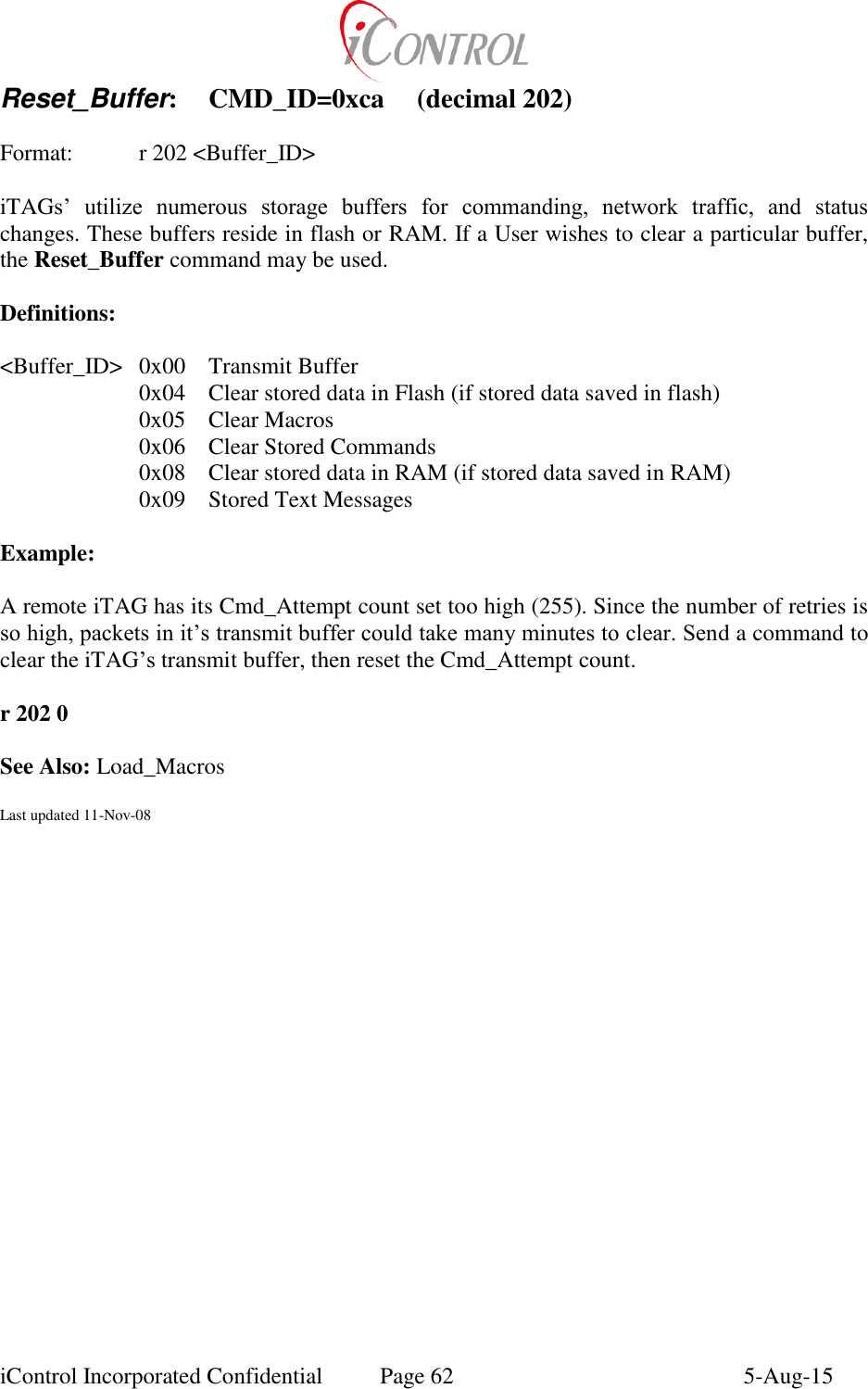
 iControl Incorporated Confidential  Page 62  5-Aug-15 Reset_Buffer:  CMD_ID=0xca  (decimal 202)  Format:  r 202 <Buffer_ID>  iTAGs’  utilize  numerous  storage  buffers  for  commanding,  network  traffic,  and  status changes. These buffers reside in flash or RAM. If a User wishes to clear a particular buffer, the Reset_Buffer command may be used.  Definitions:  <Buffer_ID>  0x00  Transmit Buffer 0x04  Clear stored data in Flash (if stored data saved in flash) 0x05  Clear Macros 0x06  Clear Stored Commands 0x08  Clear stored data in RAM (if stored data saved in RAM) 0x09  Stored Text Messages  Example:  A remote iTAG has its Cmd_Attempt count set too high (255). Since the number of retries is so high, packets in it’s transmit buffer could take many minutes to clear. Send a command to clear the iTAG’s transmit buffer, then reset the Cmd_Attempt count.  r 202 0  See Also: Load_Macros  Last updated 11-Nov-08
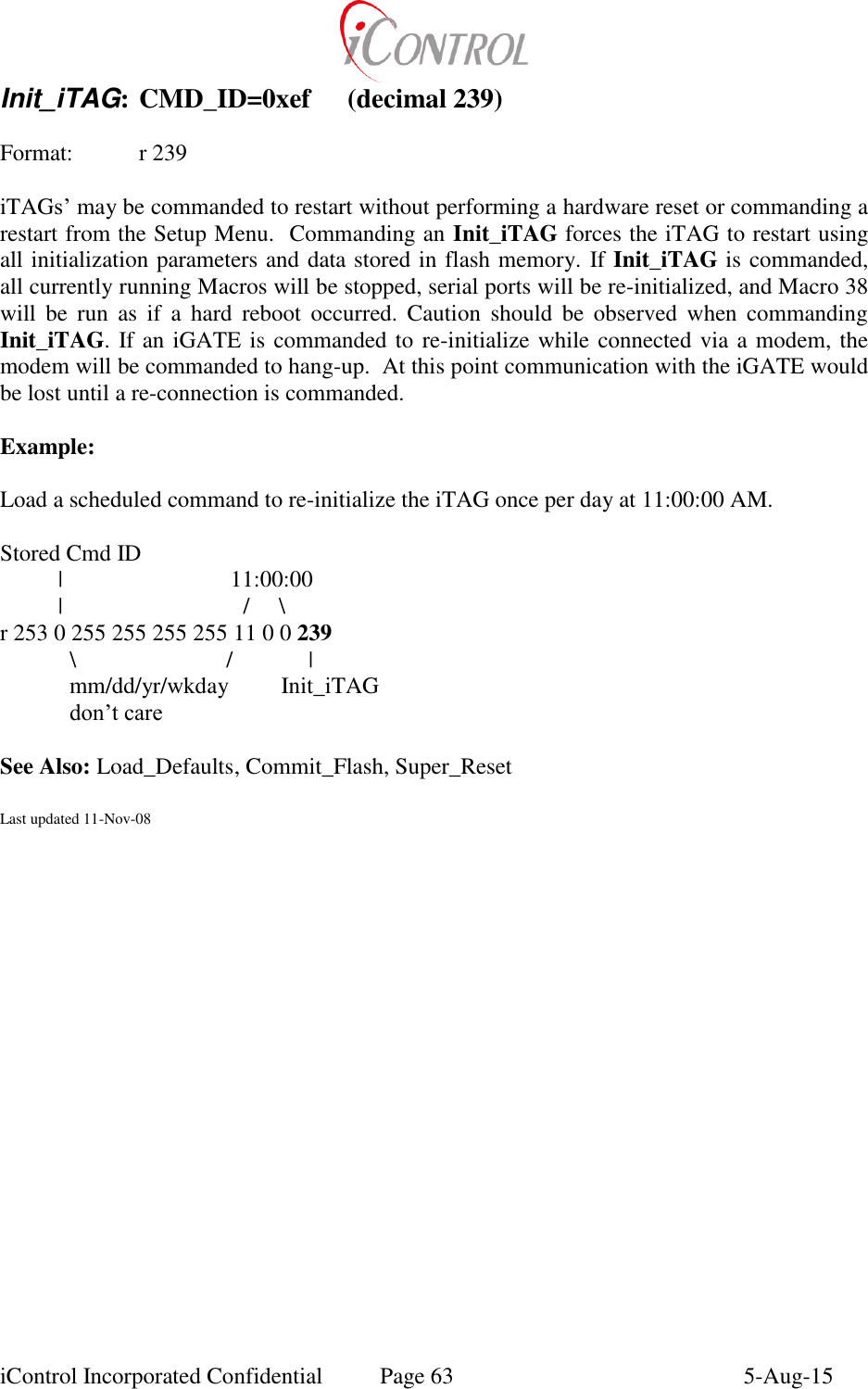
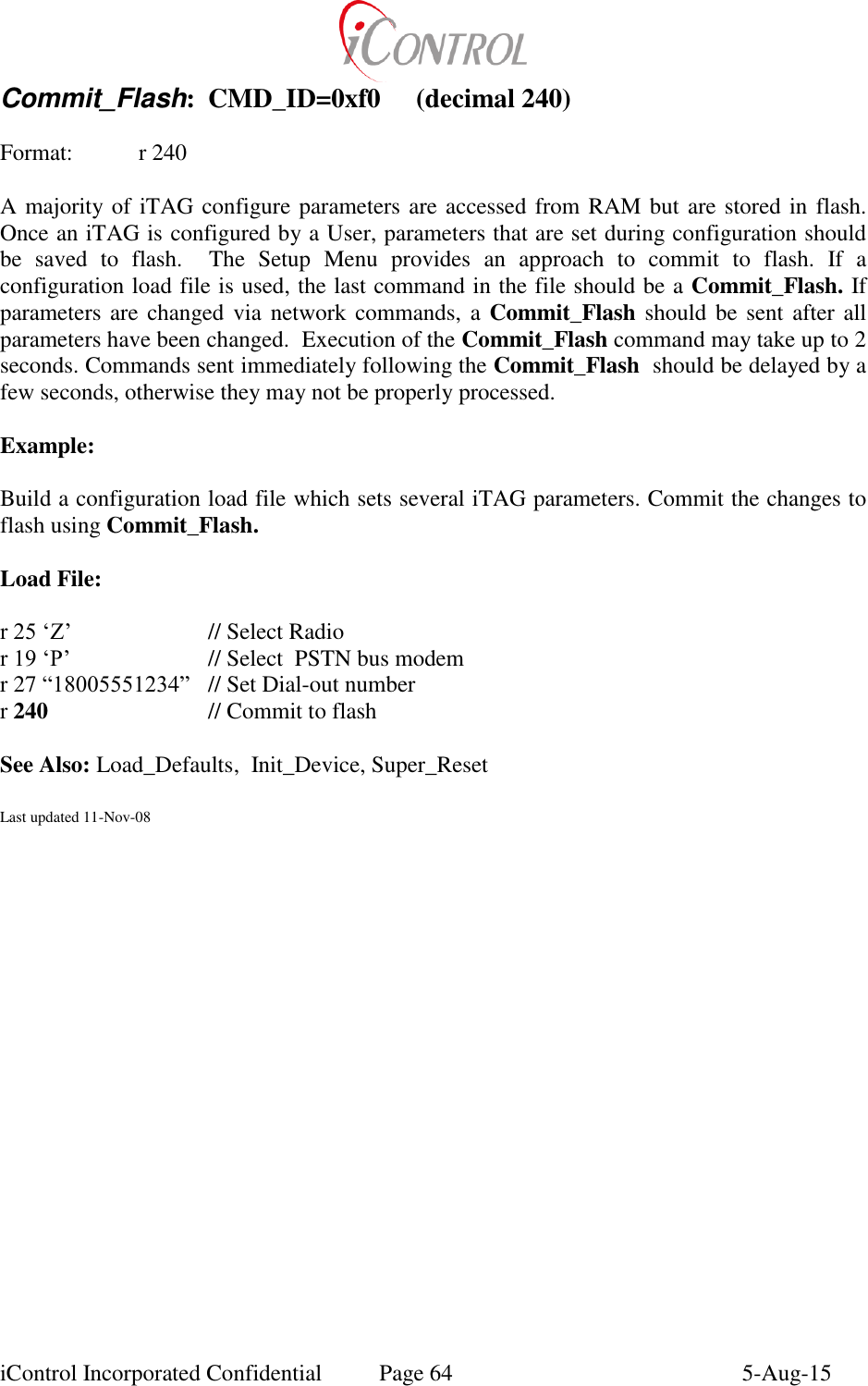
 iControl Incorporated Confidential  Page 63  5-Aug-15 Init_iTAG: CMD_ID=0xef  (decimal 239)  Format:   r 239  iTAGs’ may be commanded to restart without performing a hardware reset or commanding a restart from the Setup Menu.  Commanding an Init_iTAG forces the iTAG to restart using all initialization parameters and data stored in flash memory. If Init_iTAG is commanded, all currently running Macros will be stopped, serial ports will be re-initialized, and Macro 38 will  be  run  as  if  a  hard  reboot  occurred.  Caution  should  be  observed  when  commanding Init_iTAG. If an iGATE is commanded to re-initialize while connected via a modem, the modem will be commanded to hang-up.  At this point communication with the iGATE would be lost until a re-connection is commanded.   Example:  Load a scheduled command to re-initialize the iTAG once per day at 11:00:00 AM.       Stored Cmd ID           |                             11:00:00                   |           /     \         r 253 0 255 255 255 255 11 0 0 239             \                          /             |   mm/dd/yr/wkday         Init_iTAG  don’t care  See Also: Load_Defaults, Commit_Flash, Super_Reset   Last updated 11-Nov-08
 iControl Incorporated Confidential  Page 64  5-Aug-15 Commit_Flash:  CMD_ID=0xf0  (decimal 240)  Format:   r 240  A majority of iTAG configure parameters are accessed from RAM but are stored in flash.  Once an iTAG is configured by a User, parameters that are set during configuration should be  saved  to  flash.    The  Setup  Menu  provides  an  approach  to  commit  to  flash.  If  a configuration load file is used, the last command in the file should be a Commit_Flash. If parameters are changed via  network commands, a  Commit_Flash should be sent  after all parameters have been changed.  Execution of the Commit_Flash command may take up to 2 seconds. Commands sent immediately following the Commit_Flash  should be delayed by a few seconds, otherwise they may not be properly processed.  Example:  Build a configuration load file which sets several iTAG parameters. Commit the changes to flash using Commit_Flash.  Load File:  r 25 ‘Z’    // Select Radio r 19 ‘P’    // Select  PSTN bus modem r 27 “18005551234”  // Set Dial-out number r 240      // Commit to flash  See Also: Load_Defaults,  Init_Device, Super_Reset  Last updated 11-Nov-08
 iControl Incorporated Confidential  Page 65  5-Aug-15 Load_Defaults:  CMD_ID=0xf1  (decimal 241)  Format:   r 241  To  ensure  minimal  functionality  during  an  iTAG  reboot,  default  configurations  are programmed into the iTAG flash. Many of these parameters are over-written during the Set-up process. If a User wishes to restore the factory defaults for an  iTAG configuration, the Load_Defaults command is sent. The User should exercise caution in using Load_Defaults. Depending on the iTAG configuration, the User may lose communication capability if this command  is  sent  over  the  Network.    If  a  User  resets  the  iTAG  configuration  over  the Network, the User can restore Network operation parameters only through the Setup Menu on the iTAG.  Example:  A User has corrupted an iTAG configuration when performing a firmware upload.  Many of the  parameters  in  flash  may  be  corrupted.  To  restore  the  iTAG  parameters  to  the  factory defaults send the Load _Defaults command.  r 241  See Also: Commit_Flash, Super_Reset  Last updated 11-Nov-08
 iControl Incorporated Confidential  Page 66  5-Aug-15 Load_Flash:  CMD_ID=0xf2  (decimal 242)  Format:  r 242  During start up, an iTAG copies configuration data from flash into a global array in RAM.  While the iTAG is executing, the configuration data is accessed from the RAM parameters.  If the RAM variables are corrupted via a command or internal RAM errors, Load_Flash will reload the global configuration data with data in Flash.  Load_Flash is also performed by Init_Device except the iTAG is not re-booted, serial ports are not initialized, and Macros are not stopped.  Example:  A  near-by lighting  strike  has  effected  an  iTAG  configuration.  Many of  the  parameters  in RAM may be corrupted resulting in a loss of communication with the iGATE.  The following command (if residing) in the Stored Command buffer will execute once per hour (at the top of the hour) to restore the Flash configuration to RAM.   r 253 10 255 255 255 255 255 0 0 242  See Also: Commit_Flash, Load_Defaults, Init_Device  Last updated 11-Nov-08
 iControl Incorporated Confidential  Page 67  5-Aug-15 Set_Password:  CMD_ID=0x1c  (decimal 248)  Format:    r 28 “<p0><p1><p2><p3>….<pn>  The  iTAG  Set-Up  Menu  and  ASCII  command  functions  are  password  protected  to prevent accidental or deliberate commands from being executed. Set_Password changes the default access password to a User configurable string. The maximum password length is nine (9) characters. Spaces and control characters are not valid password characters.  Use  caution  when  changing  the  password  string.  If  a  boot  macro  enables  password checking,  sending  a  command  to  change  the  password  will  not  be  possible  if  a  User forgets the updated value. Make sure to use Commit_Flash to save the new password in flash.  The Factory default password settings are:  Password:      “icontrol”.    SET-Up Menu:     Password Required ASCII Commanding:    No Password Required  See Also: ASCII Commands, Password, User Menu  Last updated 11-Nov-08
 iControl Incorporated Confidential  Page 68  5-Aug-15 DataByte:  CMD_ID=0xf9  (decimal 249)  Format:  r 249 <Index> <Value> [Params]  iTAG’s  provide  a  global  data  structure  which  may  be  used  to  build  user  specified  data packets.   DataByte  is  a  40  byte  structure  which  may  be  loaded  with  data  which  is  sent, received,  or  alarmed.  The  DataByte  command  is  used  to  set  the  value  of  a  particular Databyte,  or  if  requested,  increment  or  decrement  the  current  DataByte  value.  A  User should make sure that other Macro’s or  commands are not affecting the use of a particular DataByte.  Definitions:  <Index>    (0-39)    Index identifying which DataByte[] to modify   <Value>  ‘+’    Current value of DataByte[index] is incremented by one   ‘-‘    Current value of DataByte[index] is decremented by one ‘s’  Copy  command  Params  starting  at  DataByte[Index]  to DataByte[Index + number of Params] ‘c’  copy Packet data into DataByte[Index] P0-P1: Packet ID bytes (see Appendix C) P2: start byte in above data packet to start copy from P3: number of bytes to copy (0-255)  If an integer is sent, DataByte[index] will be assigned          the new value)  Example:  Use DataByte[3] as an internal counter that is incremented every time Macro [4] is run.  Load into Macro[4]:  r 99 4 ”Macro Commands……” 249 3+     See Also: Load_Macros, Run_Macros    Last updated 11-Nov-08
 iControl Incorporated Confidential  Page 69  5-Aug-15 Check_Alarm:  CMD_ID=0xfa  (decimal 250) Check_Alarm_Save:  CMD_ID=0xfb  (decimal 251)  Format:  r 250 <Board Add> <Extended Add> <Index> <Op> <value> [value2] <Macro_ID>  Scheduled  or  background  commands  may  be  used  to  check  iTAG  input  data  or  system configuration for alarm conditions (or desired events).  Check_Alarms retrieves data using the  specified  Board  Address  and  Extended  Address,  performs  a  comparison  using  the  Op character against the value parameter. If the Op condition is met, Macro[Macro_ID] will be run once.  The Check_Alarm_Save command saves the retrieved data if the Op condition is met.  Definitions:  <Board Add>    IO card address (See IO_Add) <Extended Add>  IO card address (See IO_Add) 5, 250, 251: copy native floating point for test value 83, 254: copy one byte into floating point test value Default: format floating point test value using sFactors[Index] (See Scale_Factors) <Index>    0-12  Data[index]  is value to be checked <Op>      >  Runs Macro[ID] if Data[index]>value       <  Runs Macro[ID] if Data[index]<value       =  Runs Macro[ID] if Data[index]=value       !  Runs Macro[ID] if Data[index]!=value “A”  Run Macro[ID] if Data[index] < value && Data[index] > value2 “O”  Run Macro[ID] if Data[index] & value || Data[index] > value2 “&”  Run Macro[ID] if Data[index] & value “|”  Run Macro[ID] if Data[index] | value <value>    “Threshold” value which triggers Macro[ID]  <value2>    Second Threshold value <Macro_ID>    ID of Macro which is run on an alarm condition  Examples:  Load Macro[37] with a Check_Alarm command that calls Macro[36].  Macro[37] will be a Background  Macro  which  checks  data  once  per  second.  The  Check_Alarm  command executes when motherboard analog[1] is greater than value “128”.  Default scale factors are used which indicate to use counts for comparison.  r 99 36 7 3 96 37 2 17 1      Stop Macro[37],  Enable Dialout r 99 37 13 4 100 37 0 1 7 250 56 12 1> 128 36  Check_Alarm r 99 38 3 97 37 255        Runs Macro[37] on boot up. Loop counter 255 places Macro[37] in an infinite loop
 iControl Incorporated Confidential  Page 70  5-Aug-15  See Also: IO_Addr, Stop_Macro, Delay_Sec, Load_Macro, Scale_Factors  Last updated 11-Nov-08
 iControl Incorporated Confidential  Page 71  5-Aug-15 Server_Addr:  CMD_ID=0xfc  (decimal 252)  Format:  r 252 <D3> <D2> <D1> <D1>  Server_Addr programs  the four  byte Server identification number used by an iGATE for Internet connections. This ID may also be programmed from the Setup Menu. Server_ID is used only if the iTAG is configured as an iGATE. If the iTAG is not configured as an iGATE, the Server address is ignored.  Description:  <D3>    Most Significant Byte of Server address <D2> <D1> <D0>    Least Significant Byte of Server address  Example:    Program the Server_Addr to 3.4.5.6  r 252 3 4 5 6  See Also: Broadcast_Address, Default_Dest, iTAG_ID  Last updated 11-Nov-08
 iControl Incorporated Confidential  Page 72  5-Aug-15 Load_Schedule:  CMD_ID=0xfd  (decimal 253)  Format:  r 253 <Index> <M> <D> <Y> <WkD> <Hr> <Min> <Sec> <cmd……..>  Load_Schedule places iTAG commands into an iTAG command buffer used for scheduled execution. The buffer holds up to 40 commands which are  continually scanned for a valid execution time. The index into the stored command is used for loading only.  Execution of the commands is determined by matching time tags with the current iTAG clock. If multiple commands  are  to  be  called  at  the  same  time,  use  a  Run_Macro  command  to  link  the commands into a single call from the check schedule function.  Description:  <Index>   (0-39)    Index into storage buffer  <M>    (1-12,255)  Desired month for scheduled command,   255= don’t check <D>    (1-31,255)  Desired day for scheduled command,   255= don’t check <Y>    (0-99,255)  Desired year for scheduled command,   255= don’t check <WkD>  (0-6,255)  Desired week day for scheduled command,   255= don’t check <Hr>    (0-23,255)  Desired hour for scheduled command,   255= don’t check <Min>   (0-59,255)  Desired minute for scheduled command,   255= don’t check <Sec>    (0-59,255)  Desired second for scheduled command,   255= don’t check  Example:  Load a command into the Schedule buffer location (0) to perform a Save_Data command once per minute (top of each minute).         Stored Index     seconds            |               | r 253 0 255 255 255 255 255 255 0 30 56 12         |             Save Data  This command loads “don’t cares” in all time fields except the (seconds) field.  The iTAG will ignore this command until the iTAG clock (seconds) matches the “seconds” time field. Every  time  the  iTAG  seconds  equals  “0”  the  command  Save_Data  (30)(56)(12)  will  be executed.  See Also: Load_Macro, Dump_Schedule  Last updated 11-Nov-08
 iControl Incorporated Confidential  Page 73  5-Aug-15 Super_Reset:  CMD_ID=0xff  (decimal 255)  Format:  r 255  In  the  event  that  an  iTAG  configuration  has  become  corrupted  to  the  point  of  non-operation, (continual reboots), or loss of communication, a unit may be commanded to perform  a  Super_Reset.  A  Super_Reset  restores  all  protected  variables,  performs  a Load_Defaults, and reboots the system immediately after the restoration of the default configuration.   Users should  exercise  caution when sending the  Super_Reset.  Loss of communication across the iTAG LAN may result if a Super_Reset is performed using a LAN command.   Example:  A User has performed a series of configuration changes which results in an  iTAG not being able to successfully complete a reboot.  Typical errors which may cause this are corrupted protected variables,  or boot-up macros that  run in a  background mode (high speed infinite loop)  While the iTAG attempts to reboot, load and send a Super_Reset command to clear all buffers and restore the protected variable values. Once sent, the iTAG should be able to boot correctly and allow the User to correct the boot problems.  r 255  See Also: Load_Defaults  Last updated 11-Nov-08
 iControl Incorporated Confidential  Page 74  5-Aug-15        Appendix A  Security:  Password Protection:  The only level of protection available for ASCII commanding is password protection. The factory default protection allows password access for the Set-Up Menu and open access to ASCII commanding.  To enable password access for commanding, the User should load and enable a  “Null”  Password command in the boot up Macro (Macro[38]). Once the iTAG is rebooted, password protection will be enabled. When password protection is set, a Password command  must  be  sent  prior  to  sending  any  ASCII  command.  The  Password  command enables commanding until a “Null” Password command is sent, the iTAG reboots, or until a Stored Command executes a “Null” Password.   Encryption:  A  majority  of  the  wireless  devices  iControl  provides  include  built  in  encryption.    These devices enable a DES encryption algorithm independent of the iTAG OS setting.  Setting the radio encryption key is covered by the Radio Manufacturers User Manual included with your purchase.  In  addition  to  the  radio  encryption,  iControl  offers  both  LAN  and  iGATE  encryption algorithms that may be used over cellular and satellite links.  iControl ships each iTAG unit with encryption disabled (a zero encryption key).  Use the Net_Type command to set the iTAG  OS  encryption  key.    In  addition  to  the  encryption  key,  Users  should  be  aware  of Time_Window.   Time_Window specifies the valid duration of time for an iTAG command.  Time_Window  reduces  the  possibility    of  recorded  (even  if  encrypted)  commands  being recorded and played back by un-authorized parties.   See Also:  Password, Set_Password, Time_Window, Net_Type
 iControl Incorporated Confidential  Page 75  5-Aug-15  Appendix B  Cyclical Redundancy Code (CRC):  The  following  ‘C’  source  code  may  be  utilized  by  Users  to  develop  binary  protocols  for interfacing to iTAG’s and iGATE’s. Two bytes are returned which represent the 16 bit CRC for any input string. iTAG’s apply CRC’s to all binary communication packets.      void getCRC(char *buf, int len, char *value) {  //CCITT CRC  // buf: pointer to string which is to have CRC computed // len: Number of bytes in buf which are used for CRC computation // value: Two bytes representing 16 bit CRC // unsigned int crcval, temp; int i;      crcval = 0xffff;          for (i=0; i<len; ++i)     {     temp = crcval ^ (unsigned int)buf[i];     temp = (temp ^ (temp << 4)) & 0xff;     crcval = (crcval >> 8) ^ (temp << 8) ^ (temp << 3) ^ (temp >> 4);     } crcval = ~crcval;   value[0]=  (char)(crcval  &  0x00ff);    // return LSB (sent first)   value[1]=    (char)((crcval & 0xff00)>>8);    // return MSB (sent second) }
 iControl Incorporated Confidential  Page 1  5-Aug-15 Appendix C  I/O Packet Definitions:  Many iTAG  commands  use  I/O data packets to  make decisions or to  format the  information  that  the user is  interested  in seeing.  Below is a table showing each data packet and the information that is in each one.  Data packets are defined by a two byte address.  Each data packets unique data starts at byte 12 and they all have the following bytes inserted at the beginning. Byte 0 1,2 3-9 10 11  Length Packet ID Time TCW Mode – see iTAG_Mode  Packet ID 0x00 0x0c Network Beacon status from an iGATE to iVIEW Length: 32 Byte 12,13 14,15 16-27 28 29 30 31 32  Beacon Timer Comm Timer Native  floating  point Latitude,  Longitude, Altitude Radio Sleep Channel Present Radio Channel Radio LQI Number  of units  in ACL Difference in the number of unit in ACL since last beacon sent   Packet ID 0x00 0x10 Packet ID 0x00 0x20 Data read from serial port 1 (0x00 0x10) or serial port 2 (0x00 0x20) Length: variable The data in this packet depends on the fsync parameters (see Serial_R/W).  There are three fsync values.  If either of the first two fsync values is non-zero then wait for those two bytes in succession before saving data.  Once those two bytes are read, start saving data until either the input UART is empty or until the maximum stored data buffer size is reached or until the third fsync byte value is found (if the third fsync byte value is non-zero. Note: You must allow enough time for the expected data to fill the UART as this read process does not allow for any timing.  It simply reads as fast as it can, terminating when no data is retrieved.  You must also insure that you do not overflow the UART buffer. Byte 12 Last byte  First byte after two byte sync or first byte read if Last valid byte read from UART if third fsync value is zero or the last byte
 iControl Incorporated Confidential  Page 2  5-Aug-15 first two bytes of fsync are zero read from UART which matches the third fsync byte  Packet ID 0x00 0x04 Tag Tracking and Status packet Length: 23 Byte 12,13 14,15 16.17 18 19 20,21 22,23  Nav mode (native unsigned  int format).    Only first byte is valid.  Second  byte  is always zero LastFix variable  (native unsigned  int format).  Reserved  for future use Comm.  Timer (native  unsigned int  format).  Seconds  to remain associated. Count  of  visible satellites  in  the GPS constellation Reserved for  future use. Magnitude  of the GPS velocity vector.  (native unsigned  int format) Moved  counter variable  (native unsigned  int format).    Used in  motion sensing.   Packet ID 0x00 0x05 Distance to each waypoint in meters.  There are 5 available waypoints in the present Gen 2 iTAG.  This value will change depending on need and memory constraints.  This algorithm outputs the difference between the last recorded position and the waypoints saved using the Track_Mode command.  The last recorded position is set by executing any command that retrieves a GPS packet – Packet IDs 0x00 0xfa, 0x00 0xfb, 0x00 0xfc. Length: 11 + (4*(<num defined waypoints>-1)) Byte 12-15 … 12+(4*(<num  defined  waypoints>  -1))  -  12+(4*(<num defined waypoints> -1))+3  Floating  point  Number  representing  magnitude  of  the distance  between  last  recorded  position  (present  position) and waypoint 0  Floating  point  Number  representing  magnitude  of  the distance  between  last  recorded  position  (present  position) and waypoint N   Packet ID 0x00 0x06 iTAG configuration data Length: 78 Byte 12-24 25-28 29-32 33-36 37 38 39 40 41  Version String iTAG_ID Default_Dest Server_Addr Device  Type (iTAG_ID) Pri  LAN  Port (Port_Cfg) Alt  LAN  Port (Port_Cfg) Modem  Port (Port_Cfg) Data  Port (Port_Cfg)
 iControl Incorporated Confidential  Page 3  5-Aug-15 Byte 42-44 45 46 47 48 49  Baud  rate  of  ports 0,1,2.  Value=Baud/12 Reserved  for  future use Tpreamble/4  Not Used TXTail (Radio_Parameters) Present  radio channel (Modem_Parms) Nav  Mode.    See Chip doc Byte 50 51 52 53 54 55  Power_Save Wake Power Config (Power_Config) Sleep  Power Config (Power_Config) Present  Power  Config (Power_Config, Power_Override) Radio  Status  Byte.  See chip doc Lower  8  bits  of comm. Timer Byte 56 57 58 59 60 61  Reboot  counter  – incremented  with each soft reboot TX_Attempts (CMD_Retry) TX Retry Time (CMD_Retry) Default Channel (Modem_Parms) Sleep  Channel (Modem_Parms) Primary Radio (LAN_Device) Byte 62 63 64 65 66 67  Alt Radio Enable_Schedule Modem_Type Modem State AT_Answer AT_Dial Byte 68 69 70 71 72-76 77,78  Data  Port  User Interface  flag (Port_Cfg) Flag indicating flash has been initialized Network ‘E’:  Encryption  enabled ‘N’: Disabled Bit  mask  indicating Macro  is  running  or not ACL  Timer (native  unsigned int format)  Packet ID 0x00 0x17 Broadcast IDs set with command 23 Length: 12 + (4*<number of broadcast groups>) Byte 12 13-16 [13+(n*4)] – [16+(n*4)]  Number of valid Broadcast groups (n) Broadcast Group 1 Broadcast Group n  Packet ID 0x00 0x22 Radio initialization parameters set with command 34 Length: 29  Packet ID 0x00 0x1b Telephone number used for modem communication.  Number starts at byte 12.  Length does not include null terminator. Length: 11 + length of telephone number  Packet ID 0x00 0xfa
 iControl Incorporated Confidential  Page 4  5-Aug-15 Difference between present GPS position and last recorded iGATE position.  GPS solution must be valid, otherwise length of data packet is zero. Length: 42 Byte 12-15 16-19 20-23 24-27 28-31 32-35 36-39 40,41 42  Difference in  meters between iGATE latitude  and latitude  of present location Difference in  meters between iGATE longitude and longitude  of present location Altitude  – indeterminate value Northern Velocity as measured by  present GPS solution Eastern Velocity as measured by  present GPS solution Downward Velocity  as measured by  present GPS solution Magnitude of  distance between iGATE position  and present location  in meters.  Ignores Altitude. GPS  Nav Mode.    See Chip documentation for description. Radio LQI  Packet ID 0x00 0xfb Packet ID 0x00 0xfc GPS position.  If GPS solution is invalid and associated with an iGATE, report the iGATE position.  If GPS solution is invalid and not associated with an iGATE, length of data is zero. Length: 42 Byte 12-15 16-19 20-23 24-27 28-31 32-35 36-39 40,41 42  Lattitude in degrees Longitude in degrees Altitude Northern Velocity  as measured  by present  GPS solution Eastern Velocity  as measured  by present  GPS solution Downward Velocity  as measured  by present  GPS solution Magnitude of  the present velocities GPS  Nav  Mode.  See  Chip documentation for description. Radio LQI  Packet ID 0x00 0xfc (Deprecated) Floating point State Variables Length: 42  Packet ID 0x00 0xfe DataByte variables. . The value of DataByte[0] defines the number of DataByte values to output in this packet. Length: 11 + DataByte[0]
 iControl Incorporated Confidential  Page 5  5-Aug-15 Byte 12 … 12+DataByte[0]  DataByte[1]  DataByte[DataByte[0]]  Packet ID 0x20 0xXX (Deprecated) Address of parallel processor connected via serial port  Packet ID 0x01 0xNN Packet ID 0x30 0xNN (Deprecated) Packet ID 0x38 0xNN Status information including Analog-to-Digital converter data. NN defines the number of bits in each 2-byte A/D value.  This NN value is only used when decoding the A/D values as it records the maximum counts for the A/D values, it is not used by internal firmware.  Although the connections to the individual A/D channels is totally dependent on hardware connections, A8 (A0 being the first channel) is connected to a voltage divider indicating the voltage powering the unit. Length: 42 Byte 12-35 36 37 37 37 38 39 40 41 42  12 channels of  A/D data  (2-bytes each) Reboot counter  – incremented with each soft reboot Lower 5  bits of comm. timer Bit  6  –  flag indicating in range  of  an 802.15.4 radio network Bit 7 – flag indicating that there is stored data Clock source 0: SW 1: RTC 2: GPS Last DataByte value Radio LQI Last  RSSI indicated from  an attached modem ‘N’  -  not commissioned ‘Y’  – commissioned  Last updated 12-Nov-08
 iControl Incorporated Confidential  Page i  8/5/2015 Address Default_Dest, 10, 22, 71 iDAC_ID, 3, 10, 11, 19, 31, 71 IO_Addr, 9, 21, 70 Server_Addr, 10, 71 Config IDAC_Mode, 8, 12, 21 Init_iDAC, 63 Load_Defaults, 63, 64, 65, 66, 73 Load_Flash, 66 Load_Macro, 9, 35, 42, 49, 51, 52, 53, 54, 55, 56, 62, 68, 70, 72 Load_Sched, 29, 72 Net_Type, 19, 74 Port_CFG, 17 IO Byte_R/W, 42 Check_Alarm, 69 DataByte, 21, 68 IO_Monitor, 40 Relay_Command, 15 Serial_R/W, 41 Text_Msg, 57, 58, 59, 60, 61 LAN Broadcast_Address, 10, 19, 31, 71 CMD_Retry, 33 Forward_Packet, 11, 12 LAN_Device, 32 Radio_Parameter, 30 Status_Change, 38 Log Dump_Schedule, 29, 72 Dump_Trace, 44, 46, 48 Save_Data, 21, 37, 41, 42, 72 Send_Config, 13, 14 Upload_Data, 36 Macro Delay_mSec, 52, 53, 54, 56 Delay_Sec, 51, 52, 53, 54, 56, 70 Delay_tSec, 52, 53, 54, 56 No_OP, 11 Run_Macro, 1, 4, 8, 9, 22, 35, 41, 42, 49, 50, 51, 52, 53, 54, 56, 68, 72 Stop_Macro, 49, 70 Wait_While, 55 Power Power_Cfg, 20, 24 Power_Save, 20, 23, 24 Program ACK, 11, 30, 31, 33 Commit_Flash, 10, 63, 64, 65, 66, 67, 73 Enable_Schedule, 29 Password, 4, 35, 67, 74 Reset_Buffer, 62 Set_Password, 35, 67, 74 Super_Reset, 63, 64, 65, 73 Time Set_Time, 18 Time_Window, 43, 74 WAN AT_Answer, 25, 26, 27, 28 Hangup_Modem, 28 Modem_Type, 19, 27, 34 Phone_Number, 14, 25, 26, 27, 28, 34

Navigation menu