Ixia EE11ABG3 802.11 a/b/g Emulation Engine User Manual EmulationEngine 11a b g User s Guide
Ixia 802.11 a/b/g Emulation Engine EmulationEngine 11a b g User s Guide
Ixia >
Contents
- 1. User Manual part 1
- 2. User Manual part 2
- 3. User Manual part 3
User Manual part 1
v2.3
Communication Machinery Corporation | 402 E. Gutierrez Street | Santa Barbara, CA. 93101
Phone: 1.805.879.1521| Fax: 1.805.564.7188 | Web: www.cmc.com

Communication Machinery Corporation (CMC)
ii 080104
Copyright & Trademark Notices
Copyright 2004 by Communication Machinery Corporation (CMC). All
rights reserved. This document may not be reproduced in whole or in part
by any means without the written consent of CMC.
EmulationEngine and vSTA are registered trademarks of Communication
Machinery Corporation.
The web-based user interface uses the GoAhead WebServer: Copyright (c)
2003 GoAhead Software, Inc. All rights reserved.
Radio Frequency Interference Requirements
802.11a devices transmit in the 5 GHz band. 802.11b and 802.11g
devices transmit in the 2.4 GHz band. FCC regulations require this product
to be used indoors to reduce the potential for interference with (to or
from) other devices that operate in the same frequency range.
FCC Warning
This equipment has been tested and found to comply with the limits for a
Class B digital device, pursuant to Part 15 of the FCC rules. These limits
are designed to provide reasonable protection against harmful
interference in a residential installation. This equipment generates, uses,
and can radiate radio frequency energy and, if not installed and used in
accordance with the instructions, may cause harmful interference to radio
communications. There is no guarantee that interference will not occur in
a particular installation. If this equipment does cause harmful interference
to radio or television reception, which can be determined by turning the
equipment off and on, the user is encouraged to try to correct the
interference by one or more of the following measures:
!" Reorient or relocate the radio /TV receiving antenna.
!" Increase the separation between the equipment and the radio/TV receiver.
!" Connect the equipment to an outlet that is on a different circuit from
where the radio/TV receiver is connected.
!" Consult the dealer or an experienced radio/TV technician for help.
Unless expressly approved by CMC, modifications to this product could
void the user's authority to operate the equipment.
RF Exposure Requirements
To ensure compliance with FCC RF exposure requirements, the antenna
used for this device must be installed to provide a separation distance of
at least 20 cm from all persons and must not be co-located or operating in
conjunction with any other antenna or radio transmitter. Installers and
end-users must follow the installation instructions provided in this guide.

EmulationEngine 11a/b/g User's Guide
080104 iii
TABLE OF CONTENTS
CHAPTER 1:
CHAPTER 1:CHAPTER 1:
CHAPTER 1: Overview
OverviewOverview
Overview ................................
................................................................
................................................................
................................................................
................................................................
................................................................
................................................................
................................................................
..................................
....
..1
11
1-
---1
11
1
Packaging Checklist ................................................................................... 1-1
Feature List .............................................................................................. 1-2
Files......................................................................................................... 1-3
System Requirements ................................................................................ 1-3
Hardware Characteristics............................................................................ 1-4
General Usage Notes ................................................................................. 1-4
CHAPTER 2:
CHAPTER 2:CHAPTER 2:
CHAPTER 2: Connectors, LEDs & Antennas
Connectors, LEDs & AntennasConnectors, LEDs & Antennas
Connectors, LEDs & Antennas................................
................................................................
................................................................
................................................................
.............................................................
..........................................................
.............................2
22
2-
---1
11
1
Front Panel/LEDs....................................................................................... 2-1
Back Panel................................................................................................ 2-2
Connectors............................................................................................ 2-2
Antennas............................................................................................... 2-2
Reset Button.......................................................................................... 2-2
CHAPTER 3:
CHAPTER 3:CHAPTER 3:
CHAPTER 3: Installation
InstallationInstallation
Installation................................
................................................................
................................................................
................................................................
................................................................
................................................................
................................................................
................................................................
.................................
...3
33
3-
---1
11
1
Connecting Directly to a Command PC ......................................................... 3-1
Connecting Through an Ethernet Hub/Switch ................................................ 3-1
Connecting to the Serial Port (Optional) ....................................................... 3-1
CHAPTER 4:
CHAPTER 4:CHAPTER 4:
CHAPTER 4: Initial Setup
Initial SetupInitial Setup
Initial Setup................................
................................................................
................................................................
................................................................
................................................................
................................................................
...............................................................
..............................................................
...............................4
44
4-
---1
11
1
For an Ethernet Port Connection.................................................................. 4-1
For a Serial Port Connection........................................................................ 4-3
CHAPTER 5:
CHAPTER 5:CHAPTER 5:
CHAPTER 5: The Web
The WebThe Web
The Web-
---Based User Interface
Based User InterfaceBased User Interface
Based User Interface................................
................................................................
................................................................
................................................................
............................................................
........................................................
............................5
55
5-
---1
11
1
System Requirements ................................................................................ 5-1
Start-Up/Login .......................................................................................... 5-1
Choosing a Scenario/Test ........................................................................... 5-1
Create New Scenario .............................................................................. 5-3
Open Existing Scenario ........................................................................... 5-4
The Main Page ....................................................................................... 5-4
Creating an Internal Mode/Ping Test......................................................... 5-5
Creating an External Mode Test................................................................ 5-8
Running a Test.......................................................................................... 5-9
About/Using the Main Page........................................................................5-11
Group Control Grid ................................................................................5-14
Load Profile ..........................................................................................5-18
Target Systems.....................................................................................5-18
Load Profile/Monitor Graphs....................................................................5-19
Range Checking/Error Messages..............................................................5-20
Using Load Profiles ................................................................................5-20
vSTA Side Bar..........................................................................................5-22
vSTA->New Group ................................................................................5-22
vSTA->New Group->vSTA...................................................................5-22
vSTA->New Group->Traffic .................................................................5-24
vSTA->New Group->Runtime ..............................................................5-26
vSTA->New Group->On Error..............................................................5-27
vSTA->New Group->Encryption ...........................................................5-29
vSTA->Edit Group .................................................................................5-30
vSTA->Delete Group .............................................................................5-31
vSTA->Add New vSTA to Group ..............................................................5-31
EE (EmulationEngine) Side Bar...................................................................5-32
EE->Select SUT ....................................................................................5-33
EE->Join SUT .......................................................................................5-34
EE->Configure EE..................................................................................5-34
EE->Configure EE->UI........................................................................5-34
EE->Configure EE->EE/Basic ...............................................................5-36
EE->Configure EE->EE/Radio...............................................................5-38
EE->Configure EE->EE/Power..............................................................5-39

Communication Machinery Corporation (CMC)
iv 080104
EE->Reconnect EE.................................................................................5-41
EE->Reset EE .......................................................................................5-42
EE->Reboot EE .....................................................................................5-42
Monitors Side Bar .....................................................................................5-43
Monitors->New Monitor..........................................................................5-43
Monitors->New Monitor->Predefined ....................................................5-43
Monitors->New Monitor->Summary .....................................................5-44
Monitors->New Monitor->vSTA............................................................5-45
Monitors->Delete Monitor.......................................................................5-47
Monitors->Clear Monitor ........................................................................5-47
Monitors->Export Monitor.......................................................................5-48
Monitors->Config Monitors .....................................................................5-49
Event Log Side Bar ...................................................................................5-50
Event Log->Event Log ...........................................................................5-50
Event Log->Clear Log ............................................................................5-51
Event Log->Export Log ..........................................................................5-52
Event Log->Configure Log......................................................................5-52
Reports Side Bar ......................................................................................5-53
Reports->EE Configuration .....................................................................5-54
Reports->Scenario Summary..................................................................5-54
Reports->Group Summary .....................................................................5-55
Reports->vSTA Master...........................................................................5-56
Reports->vSTA Detail ............................................................................5-57
Reports->Export Reports........................................................................5-57
Configuration Side Bar ..............................................................................5-58
Configuration->Encryption .....................................................................5-58
Configuration->Ping Defaults..................................................................5-59
Configuration->Preferences ....................................................................5-60
Menus & Toolbars.....................................................................................5-60
File Toolbar ..........................................................................................5-61
Edit Toolbar..........................................................................................5-61
Scenario Toolbar ...................................................................................5-61
vSTA Toolbar ........................................................................................5-61
Reports Toolbar ....................................................................................5-62
Monitor Toolbar.....................................................................................5-62
File Menu .............................................................................................5-64
Edit Menu.............................................................................................5-66
Scenario Menu ......................................................................................5-66
Group Menu..........................................................................................5-67
vSTA Menu...........................................................................................5-68
Reports Menu .......................................................................................5-68
Options Menu .......................................................................................5-69
CHAPTER 6:
CHAPTER 6:CHAPTER 6:
CHAPTER 6: The Command Line Interface (CLI)
The Command Line Interface (CLI)The Command Line Interface (CLI)
The Command Line Interface (CLI)................................
................................................................
................................................................
................................................................
....................................................
........................................
....................6
66
6-
---1
11
1
CLI Usage Notes........................................................................................ 6-1
User Log-In .............................................................................................. 6-1
User Log-Off ............................................................................................. 6-2
CLI Commands.......................................................................................... 6-2
System Under Test Commands.................................................................... 6-4
bssid (get/set/clear) ............................................................................... 6-5
get bssid............................................................................................ 6-5
set bssid ............................................................................................ 6-5
clear bssid.......................................................................................... 6-5
bsslist (get)........................................................................................... 6-5
join ...................................................................................................... 6-6
scan ..................................................................................................... 6-6
wirelessmode (get/set) ........................................................................... 6-7

EmulationEngine 11a/b/g User's Guide
080104 v
get wirelessmode ................................................................................ 6-7
set wirelessmode ................................................................................ 6-8
Virtual Station Set-Up & Control Commands ................................................. 6-8
acquireip..............................................................................................6-10
assoc...................................................................................................6-10
auth ....................................................................................................6-10
autoconf...............................................................................................6-11
autorun................................................................................................6-14
conf.....................................................................................................6-15
deauth.................................................................................................6-16
disassoc...............................................................................................6-16
group (clear/del/get/reset/save/set)........................................................6-17
clear group stats ................................................................................6-17
del group ..........................................................................................6-17
get group ..........................................................................................6-17
reset group .......................................................................................6-19
save group stats ................................................................................6-19
save group summary ..........................................................................6-19
set group ..........................................................................................6-19
halt .....................................................................................................6-21
init ......................................................................................................6-22
releaseip ..............................................................................................6-22
run......................................................................................................6-22
vsta (clear/del/get/reset/save/set)..........................................................6-23
clear vsta stats ..................................................................................6-23
del vsta.............................................................................................6-23
get vsta ............................................................................................6-23
reset vsta..........................................................................................6-27
save vsta stats...................................................................................6-28
save vsta all summary ........................................................................6-28
set vsta.............................................................................................6-28
Statistics File Commands...........................................................................6-31
Delete Statistics File ..............................................................................6-31
del statfile group................................................................................6-31
del statfile vsta ..................................................................................6-31
del summfile group.............................................................................6-31
del summfile vsta all...........................................................................6-31
Get/Display Statistics File.......................................................................6-31
get statfile group................................................................................6-31
get statfile vsta..................................................................................6-32
get summfile group ............................................................................6-32
get summfile vsta all ..........................................................................6-32
Event Log Commands ...............................................................................6-32
Clear Event Log.....................................................................................6-32
clear evlog buffer ...............................................................................6-32
clear evlog file ...................................................................................6-32
Get/Display Event Log ...........................................................................6-33
get evlog buffer .................................................................................6-33
get evlog file......................................................................................6-33
get evlog settings...............................................................................6-34
Save Event Log (save evlog)...................................................................6-34
Set Event Log Controls...........................................................................6-34
set evlog...........................................................................................6-34
set evlog console................................................................................6-34
set evlog file......................................................................................6-34
set evlog level ...................................................................................6-35

Communication Machinery Corporation (CMC)
vi 080104
set evlog module................................................................................6-35
EmulationEngine Commands......................................................................6-35
association (get) ...................................................................................6-37
channel (get)........................................................................................6-37
config (get) ..........................................................................................6-37
countrycode (get/set) ............................................................................6-38
get countrycode .................................................................................6-38
set countrycode .................................................................................6-38
date (set).............................................................................................6-38
eemac (get/reset/set)............................................................................6-38
get eemac.........................................................................................6-39
reset eemac ......................................................................................6-39
set eemac .........................................................................................6-39
eemask (get/set) ..................................................................................6-39
get eemask .......................................................................................6-39
set eemask........................................................................................6-40
eestatus (get).......................................................................................6-40
exec ....................................................................................................6-40
factorydefault (set)................................................................................6-40
features (get/set)..................................................................................6-41
get features.......................................................................................6-41
set features.......................................................................................6-41
frequency (get).....................................................................................6-41
ftp.......................................................................................................6-42
gateway (get/set) .................................................................................6-42
get gateway ......................................................................................6-42
set gateway.......................................................................................6-43
hardware (get) .....................................................................................6-43
help.....................................................................................................6-43
history.................................................................................................6-43
hwtxretries (get/set) .............................................................................6-43
get hwtxretries ..................................................................................6-43
set hwtxretries...................................................................................6-44
ipaddr (get/set) ....................................................................................6-44
get ipaddr .........................................................................................6-44
set ipaddr..........................................................................................6-44
ipmask (get/set) ...................................................................................6-44
get ipmask ........................................................................................6-44
set ipmask ........................................................................................6-44
key (del/get/set)...................................................................................6-44
del key..............................................................................................6-44
get key .............................................................................................6-45
set key .............................................................................................6-45
keyentrymethod (get/set) ......................................................................6-45
get keyentrymethod ...........................................................................6-45
set keyentrymethod............................................................................6-45
login (get/set) ......................................................................................6-45
get login ...........................................................................................6-45
set login............................................................................................6-46
password (set)......................................................................................6-46
ping.....................................................................................................6-46
pmmode (get/set).................................................................................6-46
get pmmode......................................................................................6-46
set pmmode ......................................................................................6-47
power (get/set).....................................................................................6-47
get power..........................................................................................6-47

EmulationEngine 11a/b/g User's Guide
080104 vii
set power..........................................................................................6-47
psinterval (get/set) ...............................................................................6-48
get psinterval ....................................................................................6-48
set psinterval.....................................................................................6-48
quit .....................................................................................................6-48
rate (get/set)........................................................................................6-48
get rate.............................................................................................6-48
set rate.............................................................................................6-49
reboot..................................................................................................6-49
sntpserver (get/set/clear) ......................................................................6-49
clear sntpserver .................................................................................6-49
get sntpserver ...................................................................................6-49
set sntpserver....................................................................................6-50
station (get) .........................................................................................6-50
systemname (clear/get/set) ...................................................................6-50
clear systemname ..............................................................................6-50
get systemname ................................................................................6-50
set systemname.................................................................................6-50
telnet (get/set) .....................................................................................6-50
get telnet ..........................................................................................6-50
set telnet ..........................................................................................6-50
time (set).............................................................................................6-51
timeofday.............................................................................................6-51
tzone (get/set) .....................................................................................6-51
get tzone ..........................................................................................6-51
set tzone...........................................................................................6-51
uptime (get).........................................................................................6-51
version (get) ........................................................................................6-51
802.11b/g Commands...............................................................................6-52
basic11b (get/set).................................................................................6-52
get basic11b (11b only) ......................................................................6-52
set basic11b (11b only).......................................................................6-52
ctsmode (get/set) .................................................................................6-53
get ctsmode (11g only).......................................................................6-53
set ctsmode (11g only) .......................................................................6-53
ctsrate (get/set)....................................................................................6-53
get ctsrate (11g only).........................................................................6-53
set ctsrate (11g only) .........................................................................6-53
ctstype (get/set) ...................................................................................6-53
get ctstype (11g only) ........................................................................6-53
set ctstype (11g only).........................................................................6-54
shortpreamble (get/set).........................................................................6-54
get shortpreamble (11b/11g)...............................................................6-54
set shortpreamble (11b/11g)...............................................................6-54
shortslottime (get/set)...........................................................................6-54
get shortslottime (11g only) ................................................................6-54
set shortslottime (11g only) ................................................................6-54
Administrative Mode Commands.................................................................6-55
admin (clear)........................................................................................6-55
basic11g (get/set).................................................................................6-56
get basic11g (11g only) ......................................................................6-56
set basic11g (11g only).......................................................................6-56
boot ....................................................................................................6-56
bootrom...............................................................................................6-57
calibration (get/set)...............................................................................6-57
get calibration....................................................................................6-57

Communication Machinery Corporation (CMC)
viii 080104
set calibration....................................................................................6-57
cp .......................................................................................................6-57
format .................................................................................................6-57
hostipaddr (get/set) ..............................................................................6-57
get hostipaddr ...................................................................................6-57
set hostipaddr....................................................................................6-57
ls ........................................................................................................6-58
mv ......................................................................................................6-58
regulatorydomain (set) ..........................................................................6-58
rm.......................................................................................................6-58
trace....................................................................................................6-58
watchdog (get/set)................................................................................6-59
get watchdog.....................................................................................6-59
set watchdog .....................................................................................6-59
Example Configurations.............................................................................6-59
Example First Time Configuration............................................................6-59
Example Security Configuration...............................................................6-60
Changing the EmulationEngine IP Address................................................6-61
CLI Editor................................................................................................6-64
Movement & Search Commands..............................................................6-65
Insert Commands..................................................................................6-65
Editing Commands ................................................................................6-66
Special Commands ................................................................................6-66
CHAPTER 7:
CHAPTER 7:CHAPTER 7:
CHAPTER 7: The Programming Interface (Perl)
The Programming Interface (Perl)The Programming Interface (Perl)
The Programming Interface (Perl)................................
................................................................
................................................................
................................................................
.......................................................
..............................................
.......................7
77
7-
---1
11
1
CHAPTER 8:
CHAPTER 8:CHAPTER 8:
CHAPTER 8: Event Logging
Event LoggingEvent Logging
Event Logging ................................
................................................................
................................................................
................................................................
................................................................
................................................................
..........................................................
....................................................
..........................8
88
8-
---1
11
1
Overview.................................................................................................. 8-1
Event Record Format ................................................................................. 8-1
CLI Commands.......................................................................................... 8-2
The Web-Based User Interface .................................................................... 8-2
CHAPTER 9:
CHAPTER 9:CHAPTER 9:
CHAPTER 9: Statistics Counters
Statistics CountersStatistics Counters
Statistics Counters ................................
................................................................
................................................................
................................................................
................................................................
................................................................
..................................................
....................................
..................9
99
9-
---1
11
1
Individual Virtual Station Counters .............................................................. 9-1
Individual Virtual Station 802.11 Management Counters ............................. 9-1
Individual Virtual Station Signal Quality Indication...................................... 9-1
Individual Virtual Station Frame Counts .................................................... 9-1
Individual Virtual Station Ping Statistics .................................................... 9-2
Individual Virtual Station Error Statistics ................................................... 9-2
Summary Statistics.................................................................................... 9-3
Summary Signal Counters....................................................................... 9-3
Summary Transmit Statistics................................................................... 9-3
Summary Receive Statistics..................................................................... 9-4
Summary Error Statistics ........................................................................ 9-5
CHAPTER 10:
CHAPTER 10:CHAPTER 10:
CHAPTER 10: Troubleshooting
TroubleshootingTroubleshooting
Troubleshooting ................................
................................................................
................................................................
................................................................
................................................................
................................................................
...............................................
..............................
...............10
1010
10-
---1
11
1
Login Name and/or Password Recovery .......................................................10-1
Using a Third-Party Load Generator ............................................................10-1
Web-Based User Interface Start-Up Error ....................................................10-1
Web-Based User Interface Login Error.........................................................10-2
Hardware Installation/LEDs........................................................................10-2
EmulationEngine Busy or Not Responding....................................................10-3
Loading Files from the Command PC...........................................................10-4
Missing Key File........................................................................................10-4
Configuration Records...............................................................................10-6
APPENDIX A:
APPENDIX A:APPENDIX A:
APPENDIX A: Specifications
SpecificationsSpecifications
Specifications................................
................................................................
................................................................
................................................................
................................................................
................................................................
...........................................................
......................................................
...........................A
AA
A-
---1
11
1
Hardware ................................................................................................. A-1
Software .................................................................................................. A-2
Performance ............................................................................................. A-3

EmulationEngine 11a/b/g User's Guide
080104 ix
APPENDIX B:
APPENDIX B:APPENDIX B:
APPENDIX B: Software Upgrades
Software UpgradesSoftware Upgrades
Software Upgrades................................
................................................................
................................................................
................................................................
................................................................
................................................................
.................................................
..................................
.................B
BB
B-
---1
11
1
APPENDIX C:
APPENDIX C:APPENDIX C:
APPENDIX C: C
CC
Cable Pin Assignments
able Pin Assignmentsable Pin Assignments
able Pin Assignments ................................
................................................................
................................................................
................................................................
................................................................
................................................................
..........................................
....................
..........C
CC
C-
---1
11
1
Standard Ethernet Cable ............................................................................ C-1
Ethernet Cross-Over Cable ......................................................................... C-1
RJ-45 Connector........................................................................................ C-1
Serial Cable .............................................................................................. C-1
APPENDIX D:
APPENDIX D:APPENDIX D:
APPENDIX D: Error and Status Messages
Error and Status MessagesError and Status Messages
Error and Status Messages................................
................................................................
................................................................
................................................................
................................................................
................................................................
...................................
......
... D
DD
D-
---1
11
1
EmulationEngine or Virtual Station Control Messages .....................................D-1
MAC Layer Management Messages...............................................................D-1
Standard 802.11 WLAN Reason Codes .........................................................D-2
Standard 802.11 WLAN Status Codes...........................................................D-2

Communication Machinery Corporation (CMC)
x 080104

EmulationEngine 11a/b/g User's Guide
080104 1-1
CHAPTER 1: Overview
The EmulationEngine is a test and measurement device that emulates up
to 64 wireless stations in an IEEE 802.11 wireless LAN environment. The
EmulationEngine operates in accordance with the IEEE 802.11a, 802.11b,
and 802.11g specifications. The EmulationEngine is offered in three
configurations:
!" EmulationEngine 11a: Supports IEEE 802.11a only.
!" EmulationEngine 11b: Supports IEEE 802.11b only.
!" EmulationEngine 11a/b/g: Supports IEEE 802.11a, 802.11b, and 802.11g.
Each configuration is shipped with a unique feature key that is stored in
the EmulationEngine’s flash file system. The EmulationEngine software is
locked to its specific hardware platform and feature set through the use of
this feature key. Feature keys can be upgraded at any time to provide
access to additional features.
The objective of the EmulationEngine is to reduce the number of PC and
station NIC cards that are needed to test and stage 802.11 products and
wireless LANs in terms of packet performance and number-of-stations
capacity. In addition, it allows a user to fine-tune system parameters in
order to maximize performance during testing. The primary difference
between the EmulationEngine and other IP Load Generators is:
!" IP-based Load Generators are per-station devices that do not reduce the
number of PCs and station NIC cards. You can only configure an IP per
station and then send traffic.
!" The EmulationEngine allows all stations to be emulated on a single
platform and radio chipset thus reducing the cost and complexity of
multiple PCs.
CMC's EmulationEngine creates Virtual Stations (vSTAs) and generates or
passes traffic that will load and stress test a Wireless LAN and 802.11
products in terms of:
!" Frame performance
!" Number-of-stations capacity
!" Scalability
!" WLAN optimization
Because a single physical 802.11a/b/g emulator emulates multiple STAs,
it reduces the number of PC and station NIC cards that are needed to test
and stage 802.11 products and wireless LANs.
Packaging Checklist
Your shipping container should include the following items:
!" EmulationEngine
!" Power Adapter
!" Crossover cable
!" Serial Cable
!" Quick Start Guide
!" Specifications

Communication Machinery Corporation (CMC)
1-2 080104
!" Release Notes
!" Warranty Card
!" End User License Agreement
!" Installation CD-ROM which includes this User's Guide, the
EmulationEngine Test Setup & Configuration Guide, and the Perl SDK.
If any of these items are not included in your shipping container, contact
CMC.
Feature List
!" Supports IEEE 802.11a, 802.11b, and 802.11g
!" Emulates up to 64 concurrent virtual stations (vSTAs)
!" Interaction with virtual stations in real time
!" Configuration and monitoring of virtual stations
!" Internally inject load into a System Under Test (SUT)
!" Externally forward load from third-party traffic generator into a System
Under Test
!" For external mode, frames can be captured based on the source 802.3
MAC address (Layer 2) or the source IP address (Layer 3).
!" Log and performance statistics data
!" vSTA support: 802.11 Authentication, Association, De-authentication,
Disassociation
!" ICMP Echo Request/Reply (Ping)
!" WEP Encryption (Shared static key for authentication and data) per vSTA
!" Persistent connection to the System Under Test
!" DHCP Client: vSTAs can have IP addresses dynamically assigned from a
DHCP server on the network rather than a fixed, configured IP address.
!" Command Line Interface (CLI) and Web-Based User Interface.
!" Telnet and Serial Port access to the CLI
!" Automatically configure and run multiple virtual stations via the CLI
!" The Web-Based User Interface supports:
# Different types of graphs per time and virtual station
# Export of event log and statistics data
# Scenario scheduling to bring vSTAs online in a time appointed manner
# User defined virtual station groups based on end-user requirements
# Multiple types of reports
# The ability to save test scenario files in order to repeat a test
# Configuration and monitoring of virtual stations include: copy and
paste, printing, and add and delete virtual stations
# The ability to select a System Under Test
# The ability to set up groups and select individual virtual stations to run
through the 802.11 state machine

EmulationEngine 11a/b/g User's Guide
080104 1-3
Files
The following files are maintained in the EmulationEngine’s flash file
system:
1) EmulationEngine Configuration (eecfg)
2) Scenario definitions
3) Logs
4) Statistics
5) EE22.SYS
6) keyfile
1) The EmulationEngine configuration file (eecfg) stores information
settings that can be defined via the CLI or the web-based user interface. A
backup version (.bak) of this file is also maintained in the unlikely event
that the original might become corrupted. The EmulationEngine will load
from this file at power-up/initialization time. It contains basic
configuration information.
2) After the EmulationEngine is configured, you may create test scenarios
that contain virtual station definitions that are organized into groups. This
information is stored in scenario files. The scenario files are created and
used by the web-based user interface. The CLI does not create or use
scenario files.
3) Log files store records of all EmulationEngine activities with a time
stamp indicating when the activity occurred. Logging to the CLI console,
the web-based user interface, or a file can be enabled/disabled.
4) Statistics files contain statistics of a test (scenario) run. When a test is
complete, a statistics file can be written in the flash file system for each
virtual station involved in the test. The Reports section of the web-based
user interface can be used to show the contents of these files.
5) The EE22.SYS file is the EmulationEngine software image file.
6) The keyfile is a reserved file that contains the EmulationEngine
authorization code. It is a hidden file and will only be shown in the
directory list in the CLI’s administrative mode. Do not delete this file or
attempt to access or modify it. It is required by the system.
System Requirements
!" An A/C power outlet (100~240 V, 50~60 Hz) that will supply power to the
EmulationEngine
!" A PC with an available serial port or 10/100 Ethernet port that can be
used to send commands to the EmulationEngine
!" If the web-based user interface is used, the command PC must be
equipped with the following:
# Microsoft Windows 2000/XP
# Microsoft Internet Explorer Version 6.0 or higher
# Recommended Memory: 256 MB
# Recommended Virtual Memory: 300 MB
# Recommended Processor Speed: PIII 700 MHz.

Communication Machinery Corporation (CMC)
1-4 080104
Hardware Characteristics
Ethernet Compatibility: The EmulationEngine can attach directly to
10BASE-T/100BASE-TX (twisted-pair) Ethernet LAN Hubs, segments or a
PC. All of these must conform to the IEEE 802.3 specification.
Radio Characteristics: The EmulationEngine conforms to the IEEE
802.11a, 802.11b, and 802.11g specifications. In 802.11a mode, it
operates at the 5GHz Unlicensed National Information Infrastructure
(UNII) band. Data is transmitted over a half-duplex radio channel
operating at up to 54 Megabits per second (Mbps) using OFDM
(Orthogonal Frequency Division Multiplexing). In 802.11b mode, the
EmulationEngine operates in the 2.4 GHz band and sends data at up to 11
Mbps. In 802.11g mode, the EmulationEngine operates within the 2.4 GHz
band using OFDM at rates up to 54 Mbps.
General Usage Notes
1) The EmulationEngine's default IP address is 192.168.0.50. In order to
establish initial communications between the command PC and the
EmulationEngine using an Ethernet connection, you must set your PC's IP
address and network mask to match this default address (e.g., IP
address: 192.168.0.2, Netmask: 255.255.255.0). After you establish
communications using the default IP address, you can change the
EmulationEngine's and your command PC's address to match the
addressing scheme used in your network.
2) Depending on your feature key, the EmulationEngine can operate in
802.11a, 802.11b, or 802.11g wireless mode. The EmulationEngine's
wireless mode affects the devices that you can select as a System Under
Test. For example, an EmulationEngine that is operating in 802.11a
wireless mode will not discover an 802.11b or 802.11g device. Make sure
the wireless mode you select for the EmulationEngine is compatible with
the device you wish to test. See EE->Configure EE in Chapter 5 and “set
wirelessmode” in Chapter 6.
3) The EmulationEngine's Wireless LAN MAC address defaults to a specific
address (typically in the 00:0b:cd:xx:xx:xx range). It is a globally unique
MAC address that is programmed in to the EmulationEngine hardware.
The WLAN base MAC address and mask (ff:ff:ff:ff:00:00) define the range
of MAC addresses that can be assigned to virtual stations. When you
specify a starting MAC address for virtual stations, make sure that address
is within the range defined by the WLAN base MAC address and mask. See
vSTA->New Emulation Group->vSTA and EE->Configure EE in Chapter 5
and “set eemac” and “set eemask” in Chapter 6.
4) The default WLAN base MAC address can be overridden to prevent
conflict with other wireless devices. If you use multiple EmulationEngines
at your facility, each should have a WLAN MAC whose prefix is unique. For
example, on the first EmulationEngine, use WLAN MAC Address:
04:0d:e0:62:23:57 and on the second EmulationEngine, use WLAN MAC
Address: 06:0f:14:62:32:a0.
5) The IP Mask of the EmulationEngine must match the IP subnet
addressing scheme for internal mode testing (it is not used for external
mode). For example, if the EmulationEngine's IP address is 10.1.40.18
and the System Under Test is 10.1.35.17, then the subnet mask must be
16 bits or 255.255.0.0 for an internal mode test.
EmulationEngine 11a/b/g User's Guide
080104 2-1
CHAPTER 2: Connectors, LEDs & Antennas
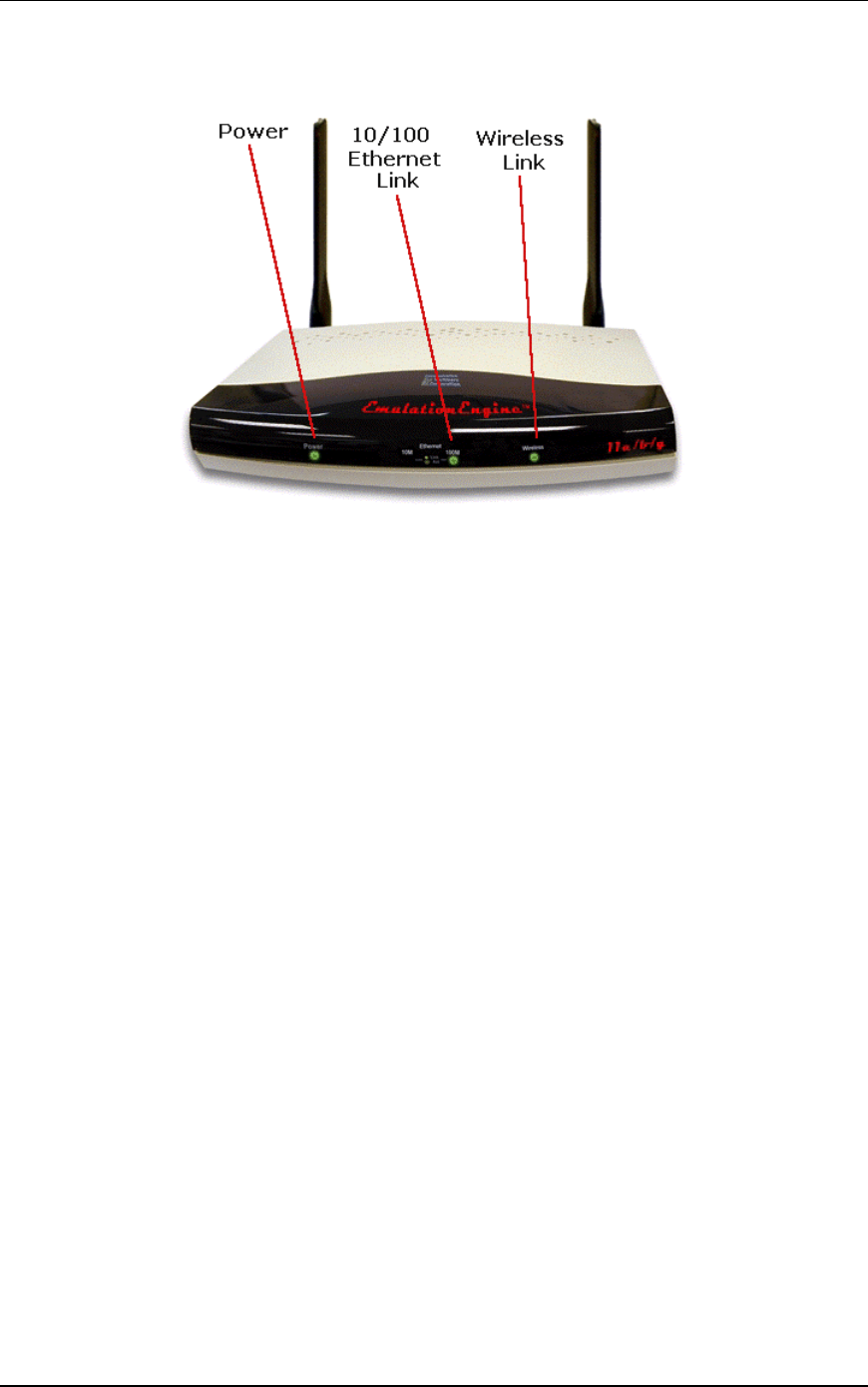
Front Panel/LEDs
LED Status Description
Off Power is not supplied to the EmulationEngine
On Power is supplied to the EmulationEngine
Power
Flashing Running a self test, loading software, or system errors
10/100: Off No Ethernet activity
100: On Green Indicates 100 Mbps Ethernet cable link
10: On Green Indicates 10 Mbps Ethernet cable link
100: Flashing
Green The EmulationEngine is transmitting or receiving data on
the 100 Mbps Ethernet LAN. Blink rate is proportional to
network activity.
Ethernet Link
10/100
(See Note
below)
10: Flashing Green The EmulationEngine is transmitting or receiving data on
the 10 Mbps Ethernet LAN. Blink rate is proportional to
network activity.
Off Wireless link disabled
On Valid wireless link but the EmulationEngine is not joined
with a System Under Test or the EmulationEngine has lost
communication with a System Under Test and has not
joined with any other System Under Test.
Wireless Link
Flashing EmulationEngine has joined with a System Under Test.
NOTE: The Ethernet LED is normally ON while a link is detected. It turns
OFF when a packet is received or transmitted. The OFF period is 50
milliseconds. If packets are being transmitted or received every 50
milliseconds or faster (e.g., 20 packets per seconds evenly spaced) for a
sustained period, the LED will stay off. This is done by the hardware and
the timing/proportionality is not adjustable.

Communication Machinery Corporation (CMC)
2-2 080104
Back Panel
Connectors
10/100 Ethernet Connector: This connector provides 10/100 Mbps
connectivity to a wired Ethernet LAN. It is used to connect a command PC
to the EmulationEngine.
Serial Port: This connector can also be used to connect a command PC to
the EmulationEngine. The configuration of the serial port is: 9600 bps, 8
data bits, no parity, 1 stop bit, and no flow control
AC Power Connector: This connector is used to connect the
EmulationEngine to the provided power supply.
Antennas
There are two antennas on the back of the device. The system chooses
the best antenna for transmit and receive. The antennas can be swiveled
180 degrees and angled up or down to optimize signal gain.
Reset Button
A recessed reset button is located between the Ethernet Connector and
Power Supply Connector on the back of the unit. It can be used to perform
a hard reset of the EmulationEngine. To perform a hard reset, use a paper
clip to press the reset button.

EmulationEngine 11a/b/g User's Guide
080104 3-1
CHAPTER 3: Installation
Use the provided Power Adapter to supply power to the EmulationEngine.
Connecting Directly to a Command PC
!" Connect one end of the supplied Ethernet crossover cable to the Ethernet
port on the command PC.
!" Connect the other end of the crossover cable to the RJ-45 Ethernet
Connector on the EmulationEngine.
Connecting Through an Ethernet Hub/Switch
!" Connect one end of a standard Ethernet cable (not provided) to the
Ethernet port on the command PC. Connect the other end of the cable to
the Ethernet Connector on the Ethernet hub/switch.
!" Connect one end of a standard Ethernet cable to a port on the hub/switch.
Connect the other end of the cable to the Ethernet Connector on the
EmulationEngine.
Connecting to the Serial Port (Optional)
!" A standard straight serial cable is provided with the EmulationEngine.
!" Connect the female connector end of the cable to a serial port on the
command PC.
!" Connect the male connector end of the cable to the serial port on the
EmulationEngine.

Communication Machinery Corporation (CMC)
3-2 080104
EmulationEngine 11a/b/g User's Guide
080104 4-1
CHAPTER 4: Initial Setup
For an Ethernet Port Connection
If the Command PC is attached to the Ethernet Port on the
EmulationEngine, complete the following steps to configure the Command
PC and access the EmulationEngine web-based user interface or
Command Line Interface (CLI):
1) Select Control Panel from the Start menu on the PC.
2) Double click on the Network Connections icon.
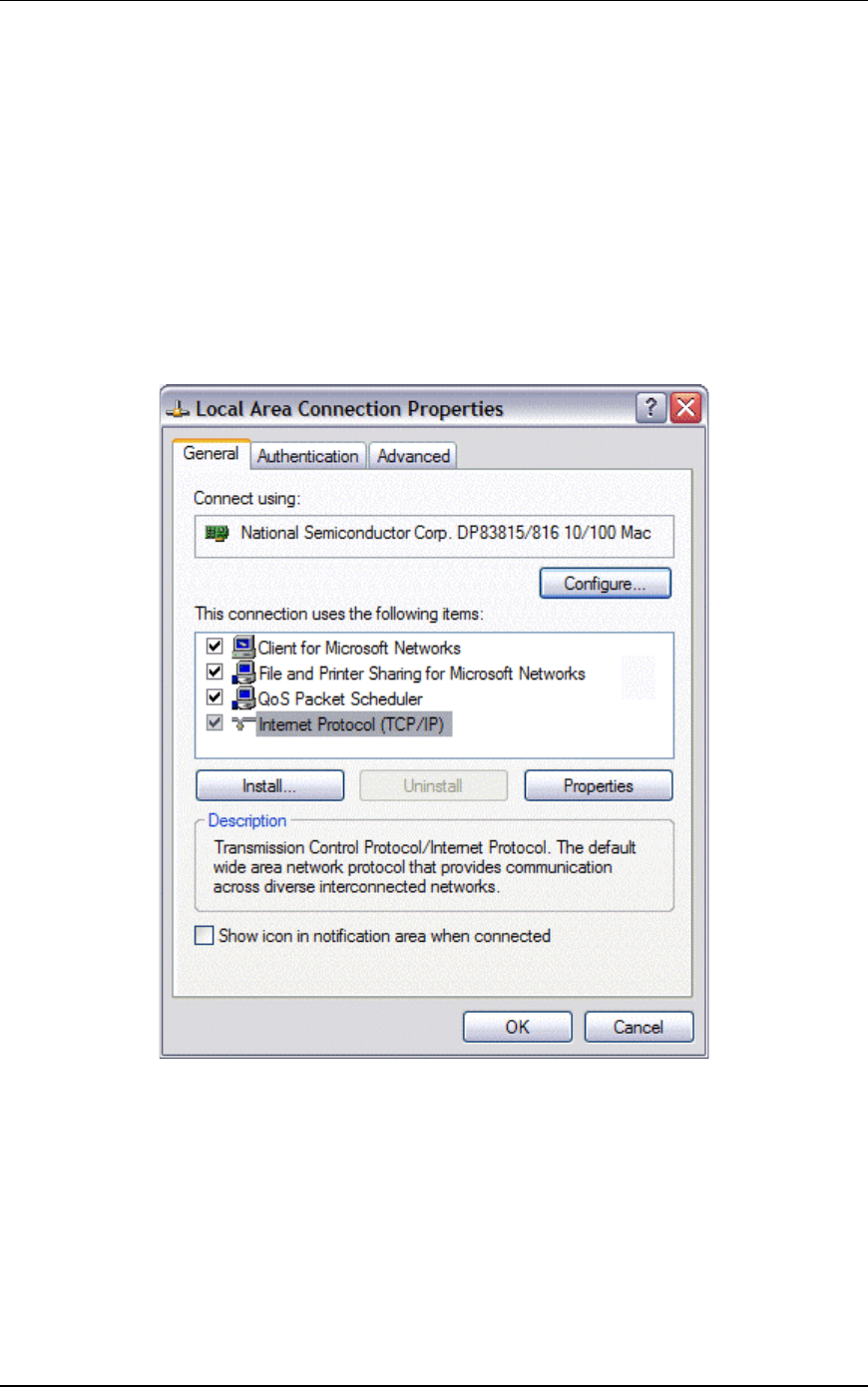
3) Right-click on the Local Area Connection icon for the Ethernet
controller that is connected to the EmulationEngine. Select Properties from
the right-click menu to display the Local Area Connection Properties
dialog.
4) Select/highlight Internet Protocol (TCP/IP).
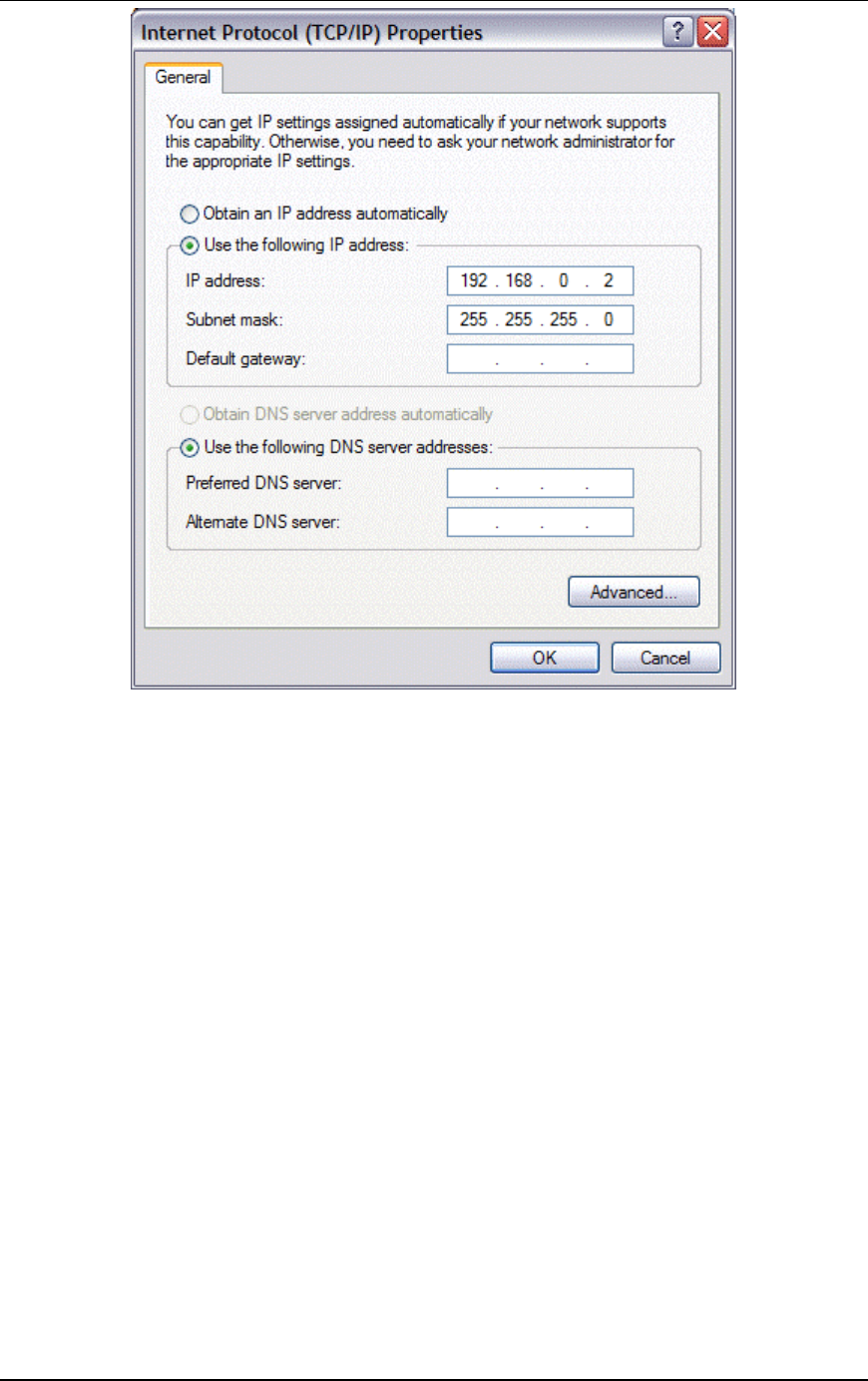
5) Click the Properties button to display the Internet Protocol (TCP/IP)
Properties dialog.
Communication Machinery Corporation (CMC)
4-2 080104
6) Select the “Use the following IP address” radio button and enter the IP
address for the Ethernet connection. Use an IP Address that resides on the
same IP subnet as the EmulationEngine. For example, use 192.168.0.2 if
you are using the EmulationEngine's default IP address 192.168.0.50.
7) Click “OK” to close the Internet Protocol (TCP/IP) Properties dialog.
8) Click the Close button in the Local Area Connection Properties dialog.
You can access the EmulationEngine using one of the following methods.
Web-Based User Interface: You can use a PC with Microsoft Windows
2000/XP and Internet Explorer (Version 6.0 or higher) to access the web-
based user interface.
!" Launch Internet Explorer on the command PC.
!" Select Internet Options from the Tools menu. Select the Settings button
and make sure the "Every Visit to Page" radio button is selected in the
Settings dialog. This step is only required the first time you use the web-
based user interface.
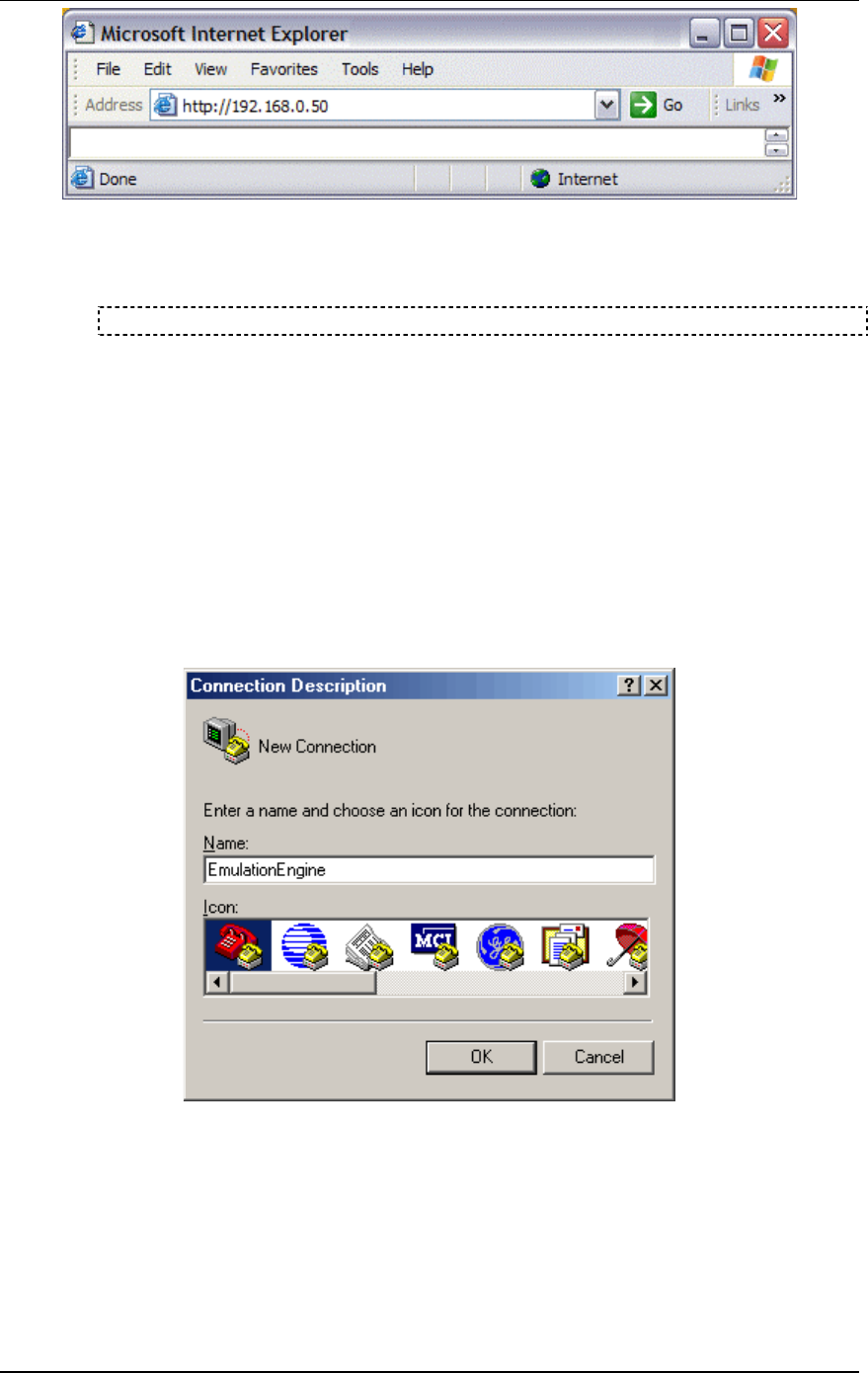
!" For initial setup, use the EmulationEngine's default IP address
192.168.0.50. Example:
EmulationEngine 11a/b/g User's Guide
080104 4-3
Command Line Interface (CLI): You can use a PC that is connected via
Telnet to access the CLI. For initial setup, use the EmulationEngine's
default IP address 192.168.0.50 to establish a Telnet connection.
Example:
telnet 192.168.0.50
See Chapter 5 for information about using the web-based user interface.
See Chapter 6 for information about using the CLI.
For a Serial Port Connection
If the command PC is connected to the EmulationEngine via the serial
port, the web-based user interface is not available. Use the following
procedure to configure the Command PC and access the EmulationEngine
Command Line Interface (CLI):
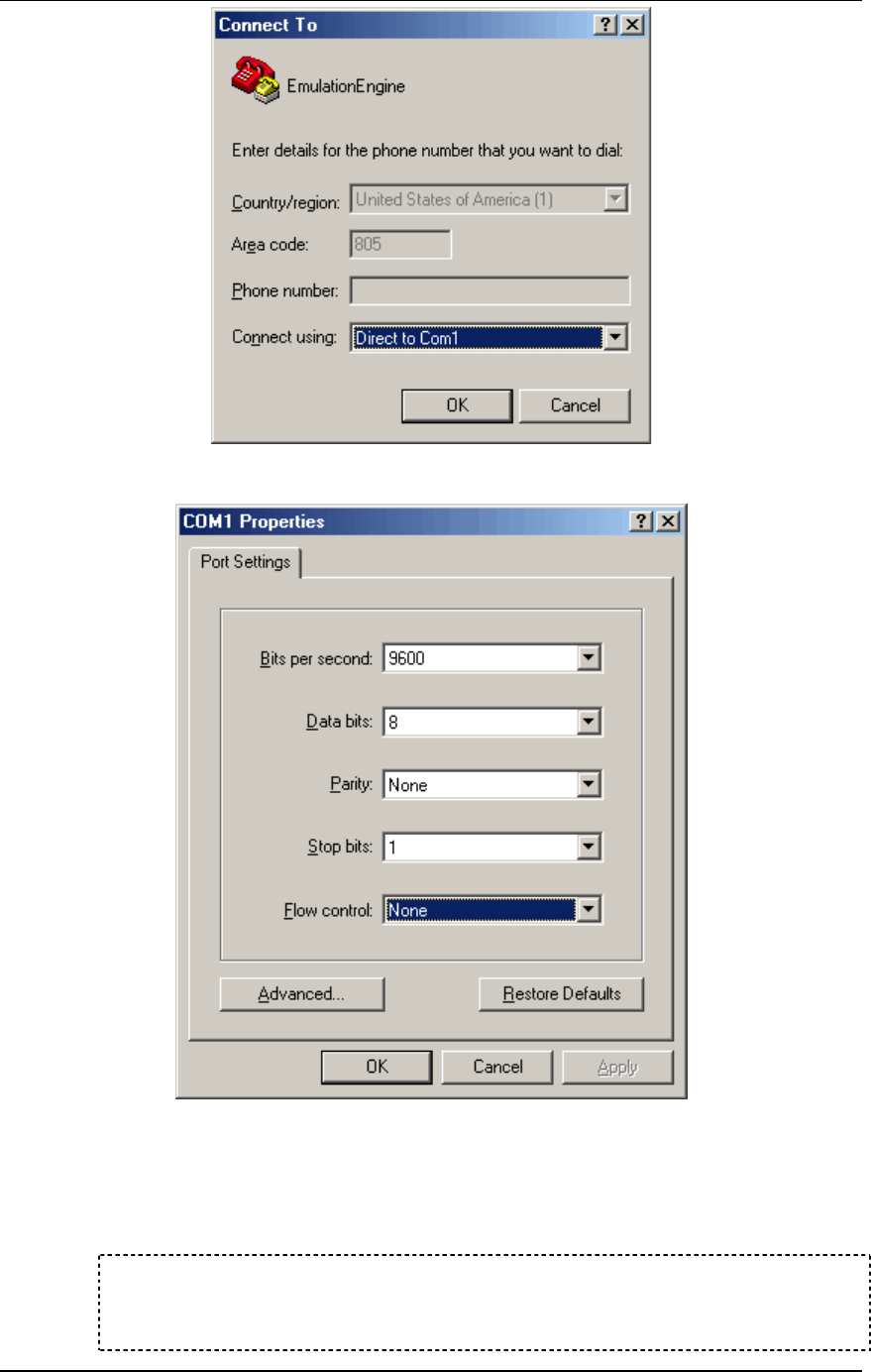
1) At the Command PC, launch a terminal-emulation program such as
HyperTerminal.
2) In the Connection Description dialog, enter a name for the connection
in the Name field (e.g., EmulationEngine).
3) Choose an icon for the connection and click OK to display the Connect
To dialog:
Communication Machinery Corporation (CMC)
4-4 080104
4) Select the COM port that is connected to the EmulationEngine from the
“Connect using” list box. Click OK to display the COM properties dialog:
5) Set the COM port settings as shown in this dialog: Bits per second:
9600, Data bits: 8, Parity: None, Stop bits: 1, Flow control: None.
6) Click OK to close the COM properties dialog.
The POST (Power On Self-Test) appears on the HyperTerminal screen a
few seconds after the EmulationEngine is connected to the power source.
POST...
Memory test : passed
Ethernet MAC register test : passed

EmulationEngine 11a/b/g User's Guide
080104 4-5
Ethernet PHY register test : passed
Ethernet interrupt test : passed
Pl
Atheros AP 8245 Reference Design version 2.3.0.70
0
auto-booting...
Attaching to TFFS... done.
Loading /fl/ee22.sys...1028084
Starting at 0x480000...
Reading Configuration File "/fl/eecfg".
Configuration file checksum: 19eb7 is good
Please check the ethernet cable!
Attaching interface lo0...done
Starting WLAN ...
Starting quick passive scan ...
Passive scanning 5 GHz 54Mbps (802.11a) channels for 7
seconds...
CMC EmulationEngine Ready
EE login:
When the EE login prompt is displayed, use the information in Chapter 6
to log in and access the EmulationEngine CLI.

Communication Machinery Corporation (CMC)
4-6 080104
EmulationEngine 11a/b/g User's Guide
080104 5-1
CHAPTER 5: The Web-Based User Interface
System Requirements
The command PC must be equipped with:
!" Microsoft Windows 2000/XP
!" Microsoft Internet Explorer Version 6.0 or higher
!" Recommended Memory: 256 MB
!" Recommended Virtual Memory: 300 MB
!" Recommended Processor Speed: PIII 700 MHz
Start-Up/Login
!" Launch Internet Explorer.
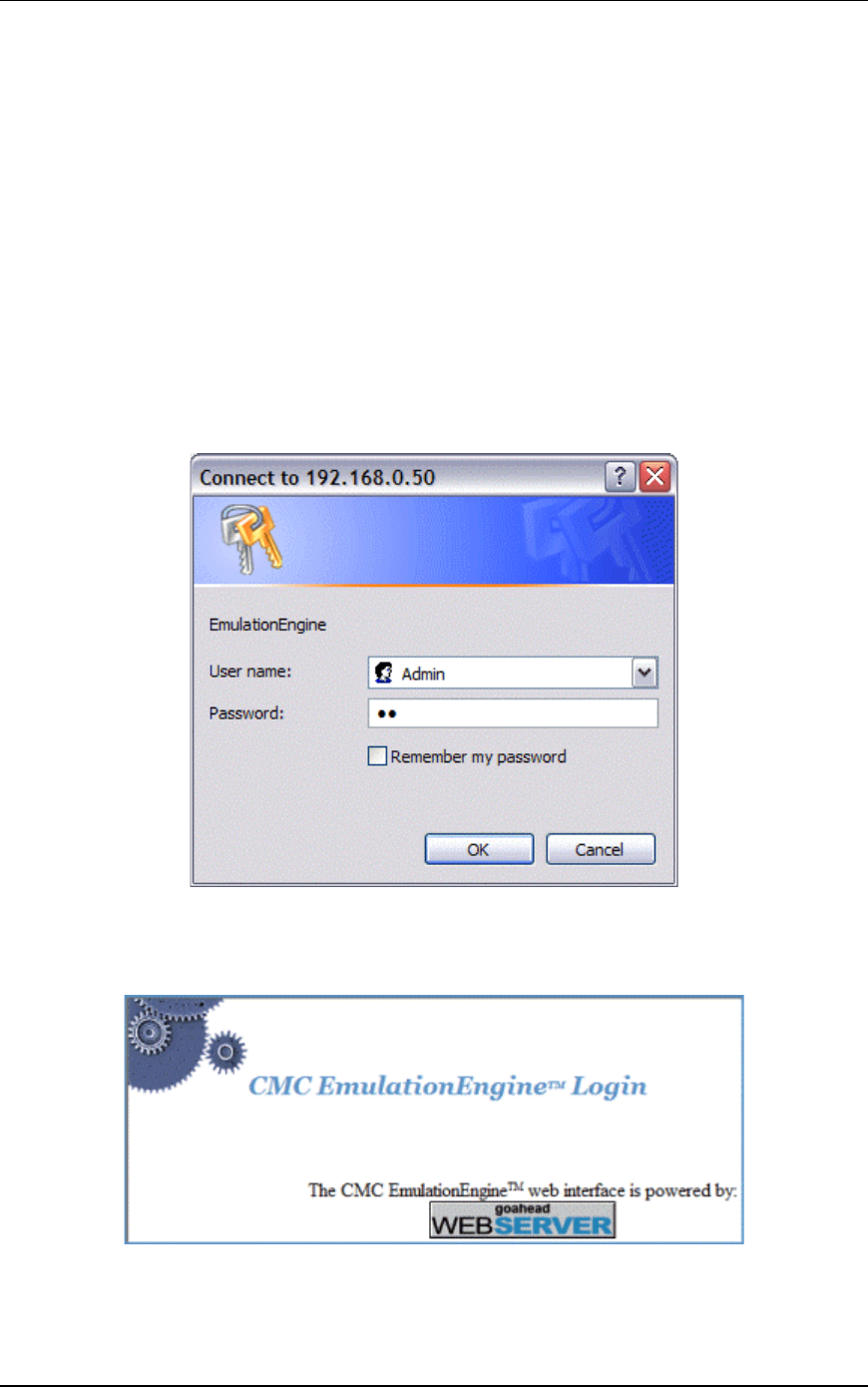
!" Enter the IP address of the EmulationEngine in the URL address field of
the browser (e.g., http://192.168.0.50).
Enter your user name and password and select “OK” to access the
EmulationEngine web server. The default user name is "Admin". The
default password is "EE". The user name and password are case sensitive.
After successful log in, a splash page is displayed for a few seconds:
Choosing a Scenario/Test
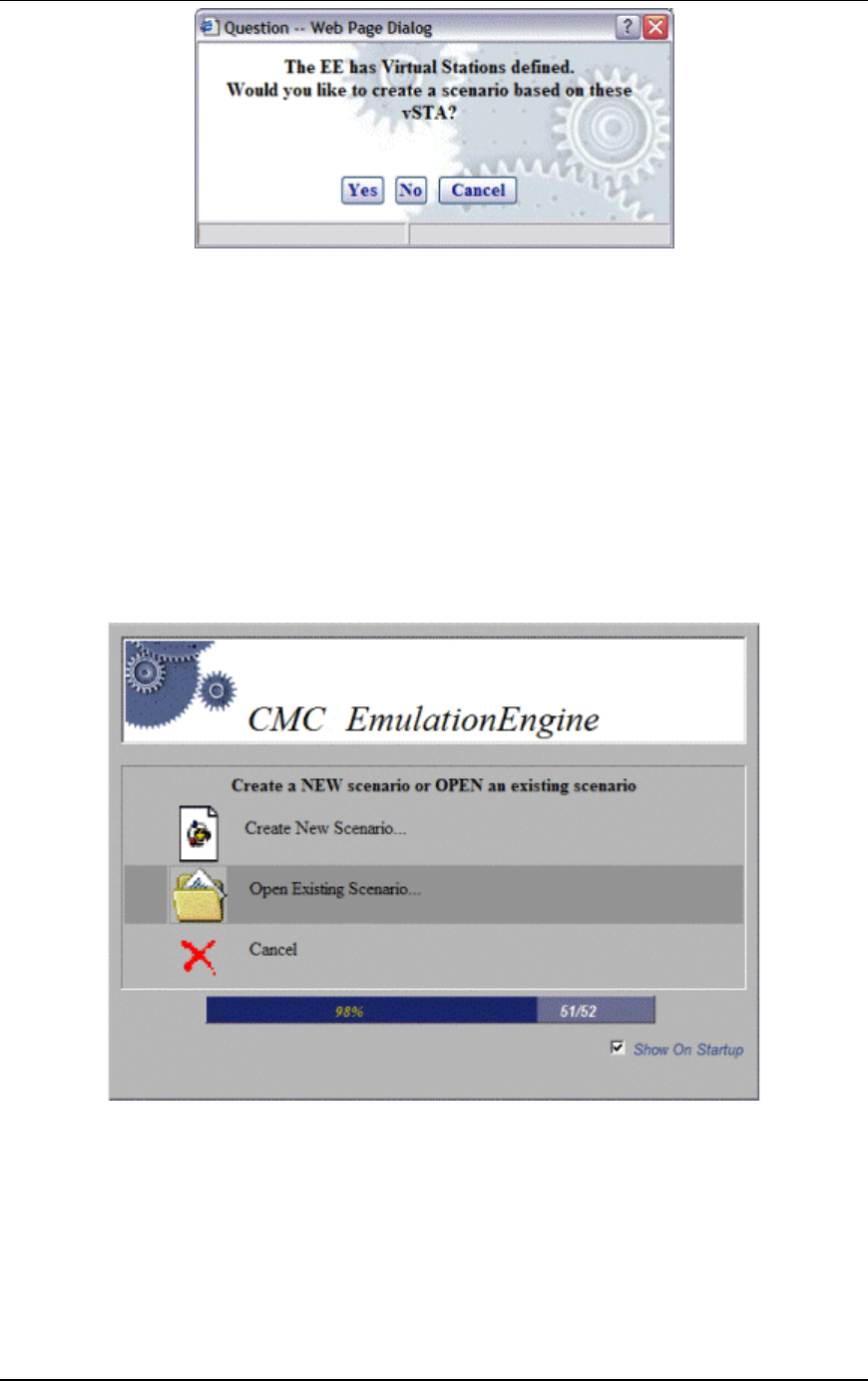
If the EmulationEngine already contains virtual station definitions, the
following dialog will be displayed:
Communication Machinery Corporation (CMC)
5-2 080104
!" Select “Yes” to build a scenario in the user interface that is based on the
virtual stations that are already defined in the EmulationEngine.
!" Select “No” to delete the virtual station definitions in the EmulationEngine
and create a new empty scenario.
!" Select “Cancel” to retain the virtual stations in the EmulationEngine but do
not create a new empty scenario. When the main page is displayed, you
can display the Scenario Summary Report, Group Summary Report, and
Event Log for these existing virtual stations.
Following a Yes, No, or Cancel selection, the web-based user interface
main page is displayed.
If there are no virtual station definition in the EmulationEngine and the
welcome screen has not been disabled in the UI Configuration dialog (see
Configuration->Preferences), the following screen will be displayed:
!" Select “Create New Scenario” to select a System Under Test. When you
create a new scenario, the user interface provides a list of active Basic
Service Set IDs (BSSIDs) that have been detected.
!" Select “Open Existing Scenario” to choose from a list of scenario files that
have already been created. When you open an existing scenario, the
EmulationEngine information is already stored with the scenario file.
!" Select “Cancel” to exit this dialog. You can create a new scenario or open
an existing scenario in the main page.
EmulationEngine 11a/b/g User's Guide
080104 5-3
!" Uncheck the “Show On Startup” checkbox if you do not want to show this
screen each time you access the EmulationEngine web server. You can
restore this screen on start-up in the UI Configuration dialog (See
Configuration->Preferences).
Create New Scenario
If you selected “Create New Scenario” in the welcome screen and have not
previously joined with a System Under Test, the Select System Under Test
dialog will be displayed:
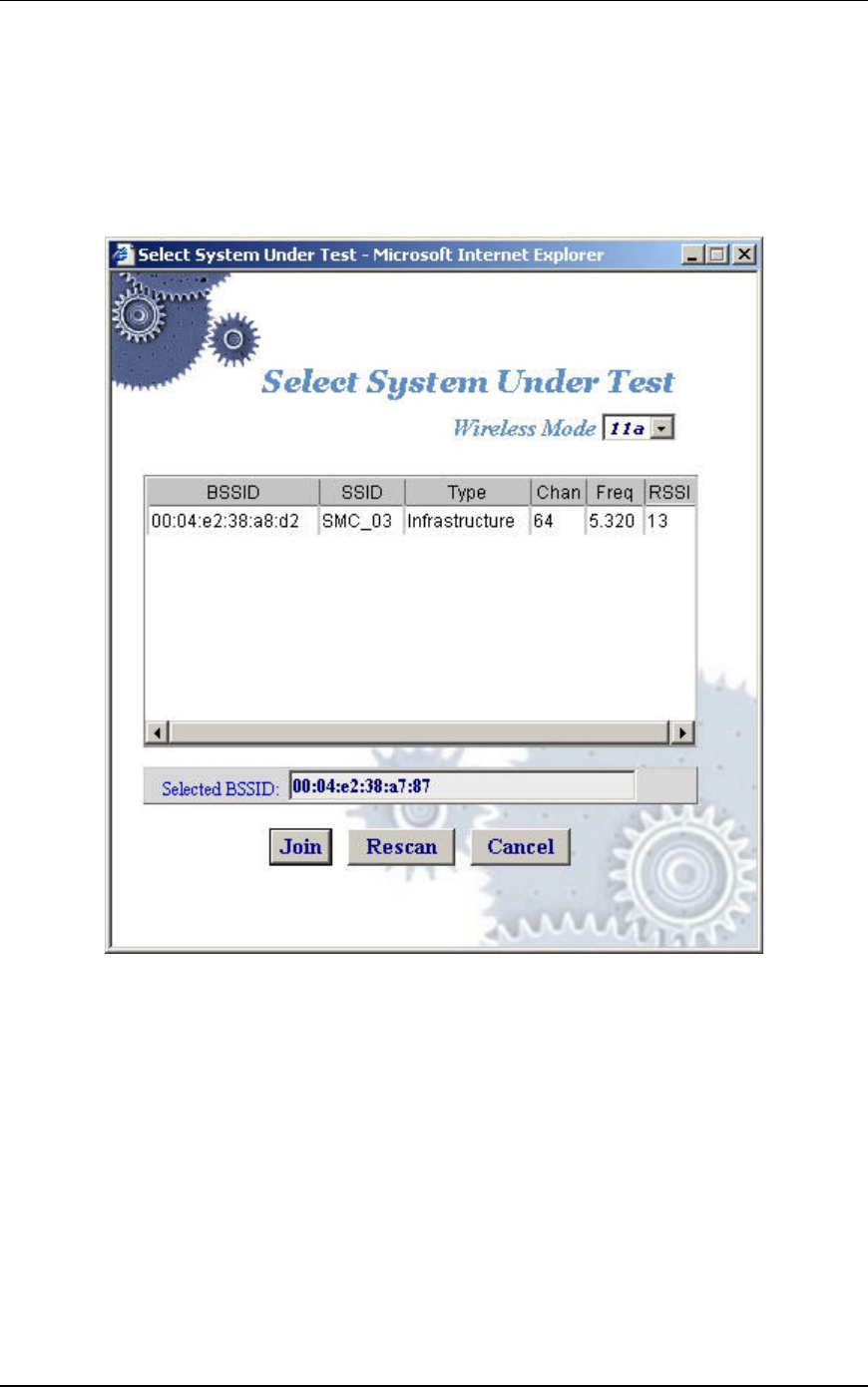
Wireless Mode: This field shows the EmulationEngine’s current wireless
mode (11a, 11b, or 11g). You can select a different wireless mode from
the list box. The web-based user interface will issue a command to the
EmulationEngine to change its wireless mode and scan for compatible
systems. The results of the new scan will be reflected in the BSSIDs in the
list box.
Select a BSSID in the list box. The selected BSSID will be shown in the
"Selected BSSID" text box.
!" Select “Join” to join with the selected target system.
!" Select “Rescan” to update the list of BSSIDs. This selection will cause the
EmulationEngine to scan for Basic Service Set IDs.
!" Select “Cancel” to close this dialog without selecting a target system. You
can select a target system and create or open an existing scenario in the
main page.
Communication Machinery Corporation (CMC)
5-4 080104
Open Existing Scenario
If you selected “Open Existing Scenario” in the welcome screen and have
not joined with a target system, the Select System Under Test dialog is
displayed as described above. After you have joined with a target system,
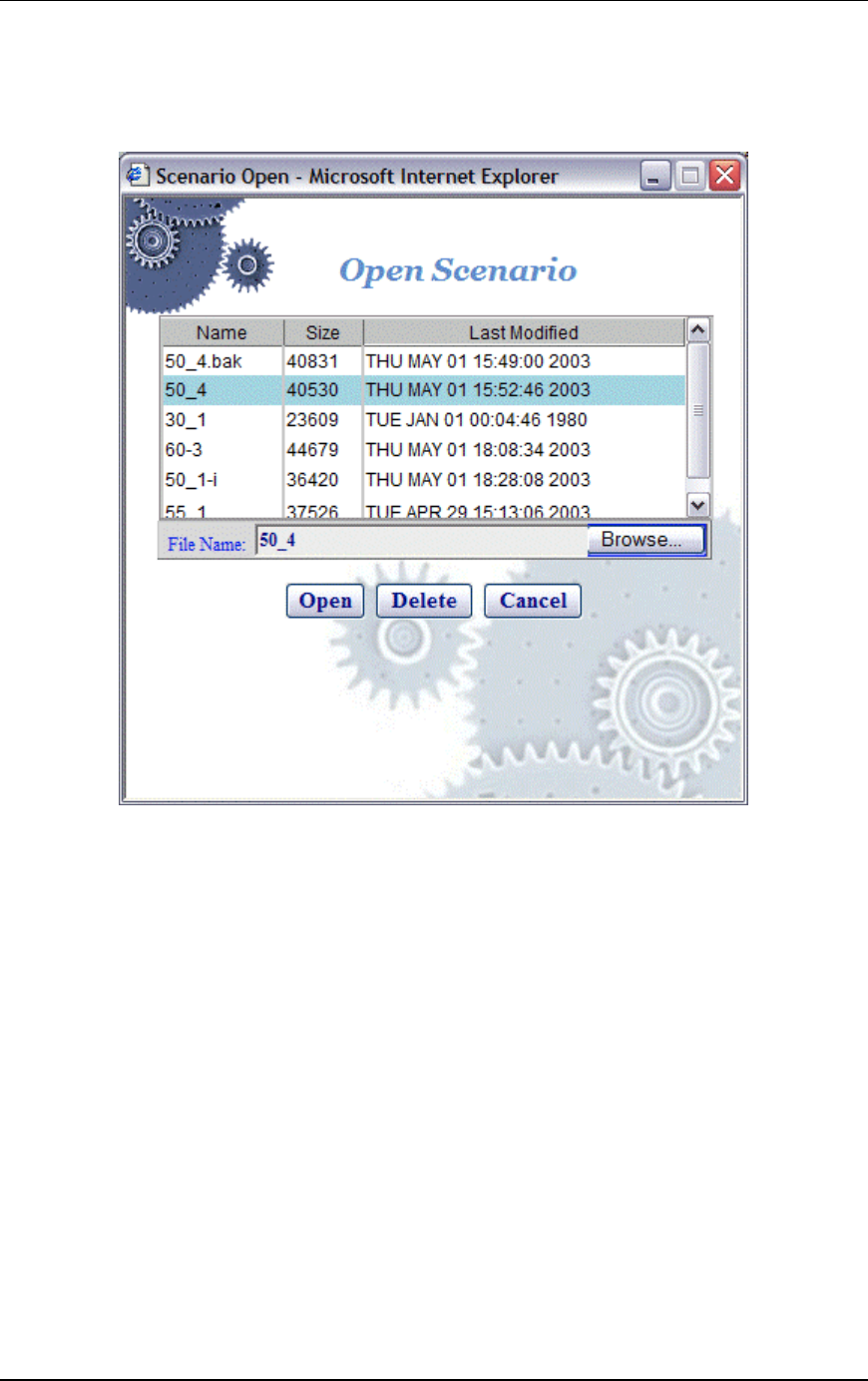
the Open Scenario dialog will be displayed:
The list box shows a list of scenario files on the EmulationEngine. Select
“Browse” to select from scenario files stored on the command PC. Click on
a file name in the list of scenario files.
!" Select “Open” to open the selected scenario file and continue.
!" Select “Delete” to delete the selected file.
!" Select “Cancel” to close this dialog without opening a scenario file. You
can create a new scenario or open an existing scenario in the main page.
The Main Page
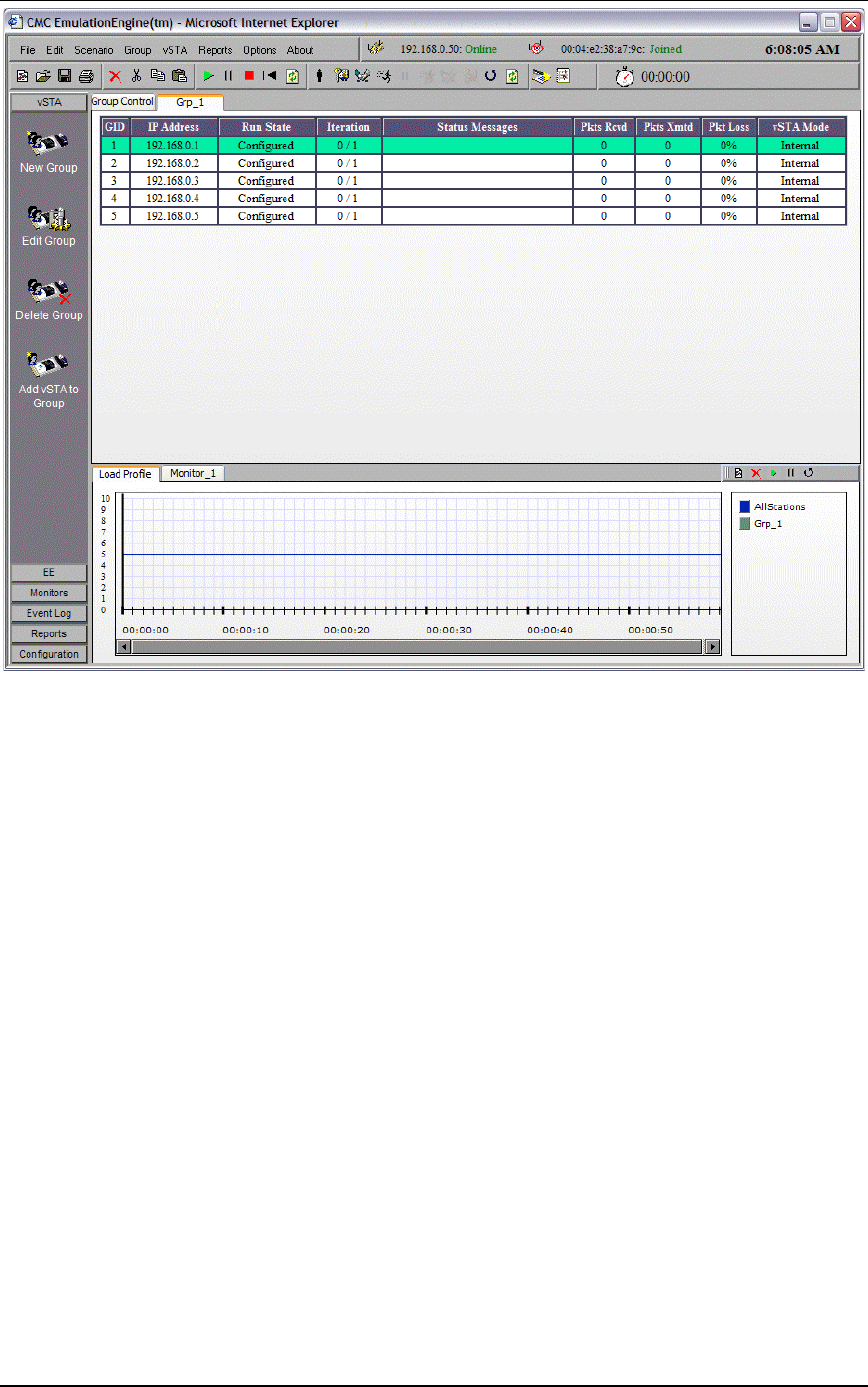
The following illustration shows the format of the main page that is
displayed after you select any of the options in start-up dialogs:
EmulationEngine 11a/b/g User's Guide
080104 5-5
The content of this page will be different depending on whether you
created a new scenario, opened an existing scenario, or cancelled/closed
any of the start-up dialogs. This example page shows an existing scenario
where one group is defined. This section of the page will be blank (No
Scenario Defined) if a scenario has not been created.
If you successfully opened a scenario file or chose to use one that is
already defined in the EmulationEngine, you can continue with the testing
functions that are available in the menus and toolbar. See “Running a
Test”. If you selected "Create New Scenario", you must create a group of
virtual stations. If you selected "Cancel", you must select and join with a
target system and create a new scenario that contains one or more
group(s) of one or more virtual station(s).
Creating an Internal Mode/Ping Test
For a simple internal mode/ping test, complete the following steps.
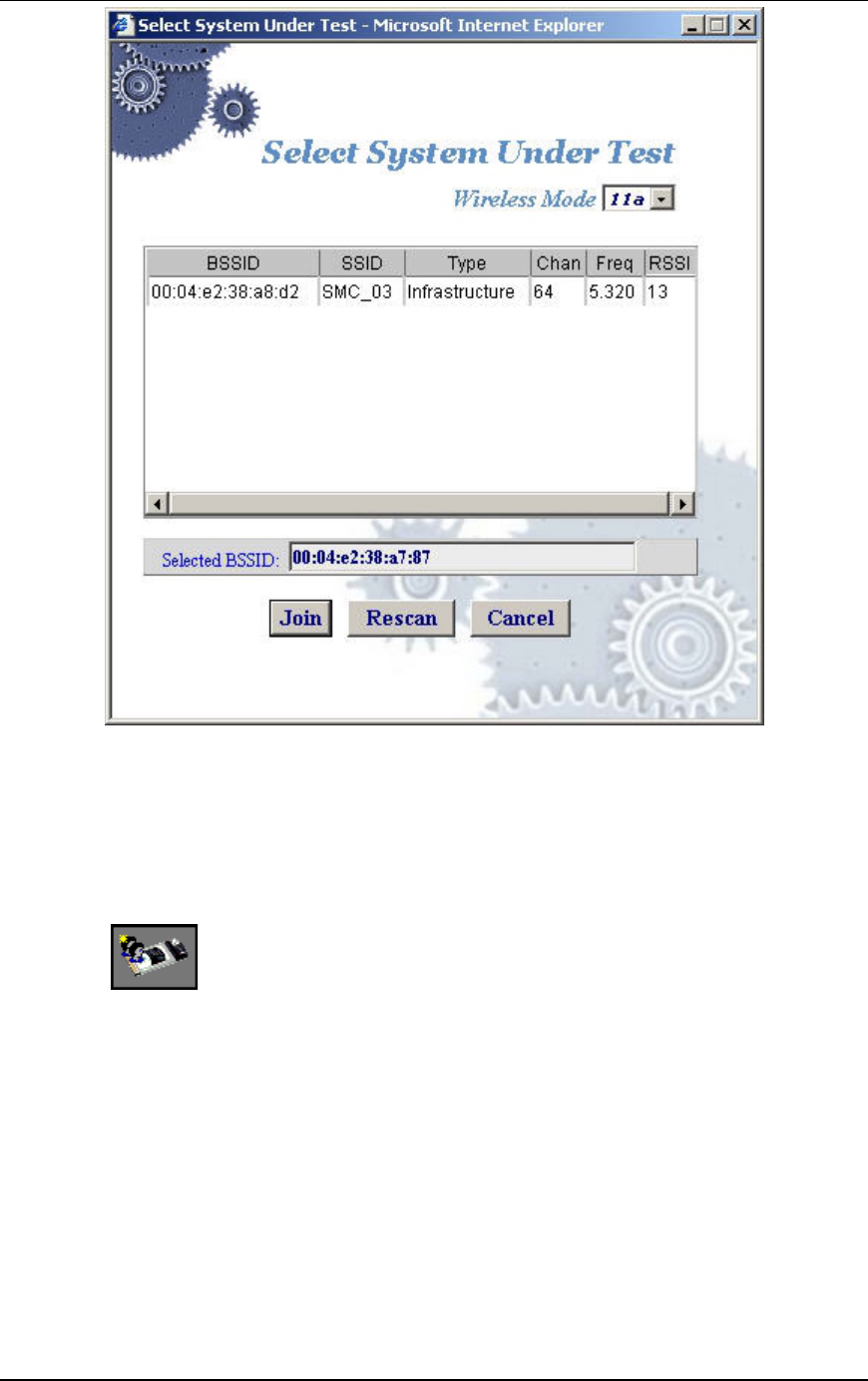
Step 1) If you have already opened or created a scenario, skip to step 2.
Otherwise, select "New Scenario" from the File menu to show the Select
System Under Test dialog.
Communication Machinery Corporation (CMC)
5-6 080104
Wireless Mode: This field shows the EmulationEngine’s current wireless
mode (11a, 11b, or 11g). You can select a different wireless mode from
the list box. The web-based user interface will issue a command to the
EmulationEngine to change its wireless mode and scan for compatible
systems. The results of the new scan will be reflected in the BSSIDs in the
list box.
Click on a BSSID in the list box and click “Join” to continue.
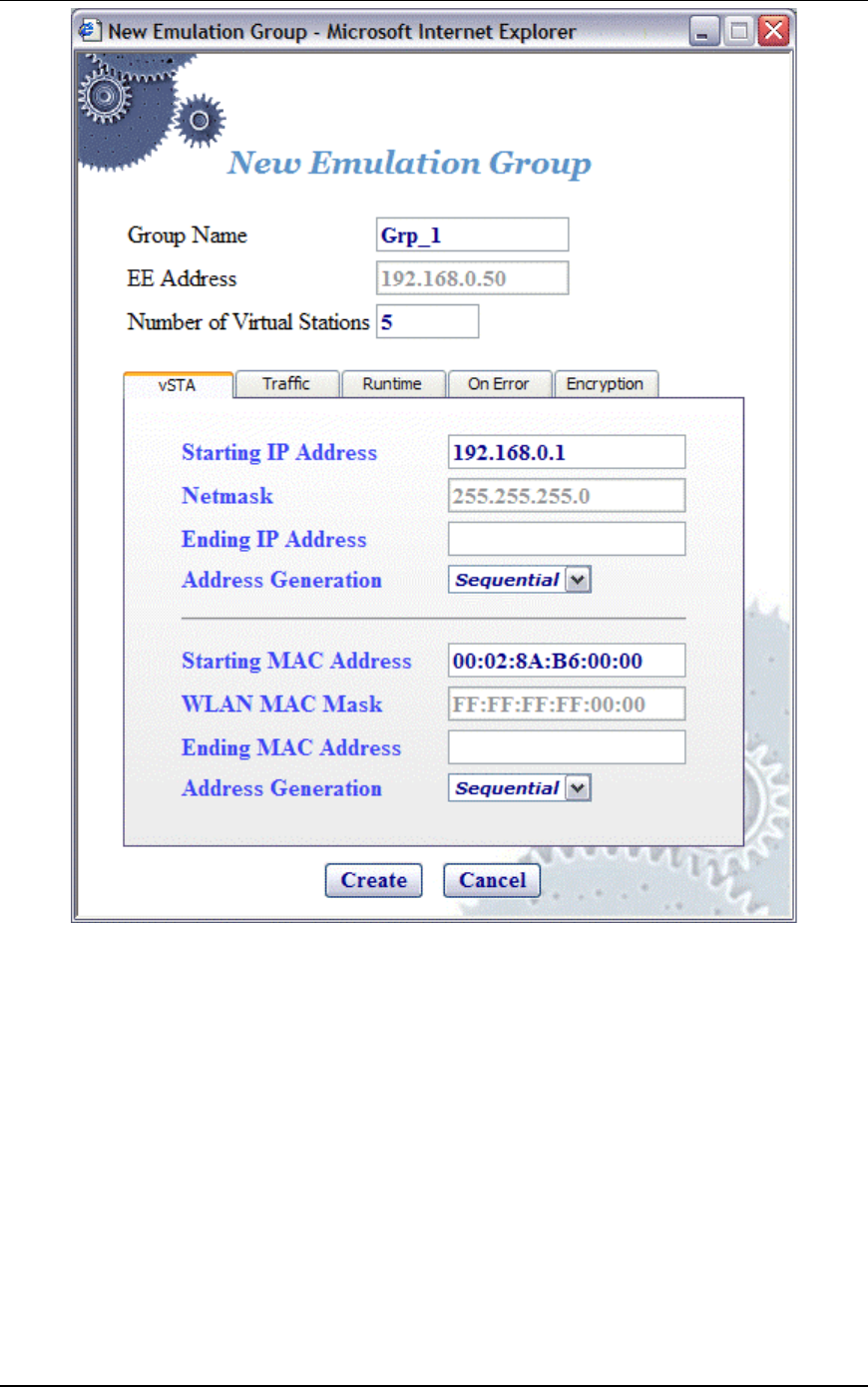
Step 2) Select New Group from the vSTA side bar to show the
New Emulation Group dialog.
EmulationEngine 11a/b/g User's Guide
080104 5-7
Step 3) If you want the EmulationEngine to dynamically assign IP
addresses, select DHCP from the Address Generation drop-down list box.
Otherwise, enter an IP address in the Starting IP Address field to define
the starting IP address to be used by virtual stations that are created in
this scenario. Virtual stations will be created with unique IP addresses,
sequentially or randomly, based on this starting IP address.
Step 4) Select the Traffic tab.

Communication Machinery Corporation (CMC)
5-8 080104
Step 5) Make sure the Target IP Address field is set to the address of a
target server to be pinged. The default IP address (0.0.0.0) shown in this
example screen must be replaced by a valid IP address (e.g.,
10.10.10.19). Click “Create” to create a group with five virtual stations.
See "vSTA->New Group" for more information about defining and editing
groups and virtual stations in a scenario.
Creating an External Mode Test
For an external mode test, a third-party load generator outside the
EmulationEngine must be set up to provide the traffic to be forwarded to
the System Under Test.
!" Use the documentation provided by the manufacturer to set up the load
generator.
!" See the EmulationEngine Test Set-Up & Configuration Guide for more
information about setting up an external mode test.
EmulationEngine 11a/b/g User's Guide
080104 5-9
!" Complete steps 1) through 4) as described above for “Creating an Internal
Mode Test”.
!" In Step 5), select “External” in the “Traffic Source” field and select the
Layer 2 radio button to capture frames based on 802.3 MAC source
address or the Layer 3 radio button to capture frames based on IP source
address.
!" Click the Create button to create the scenario for an external mode test.
Running a Test
Click this button in the toolbar to run the scenario/test for all groups
and all virtual stations in a scenario.
Click this button in the toolbar to run a test for selected virtual
stations or groups.
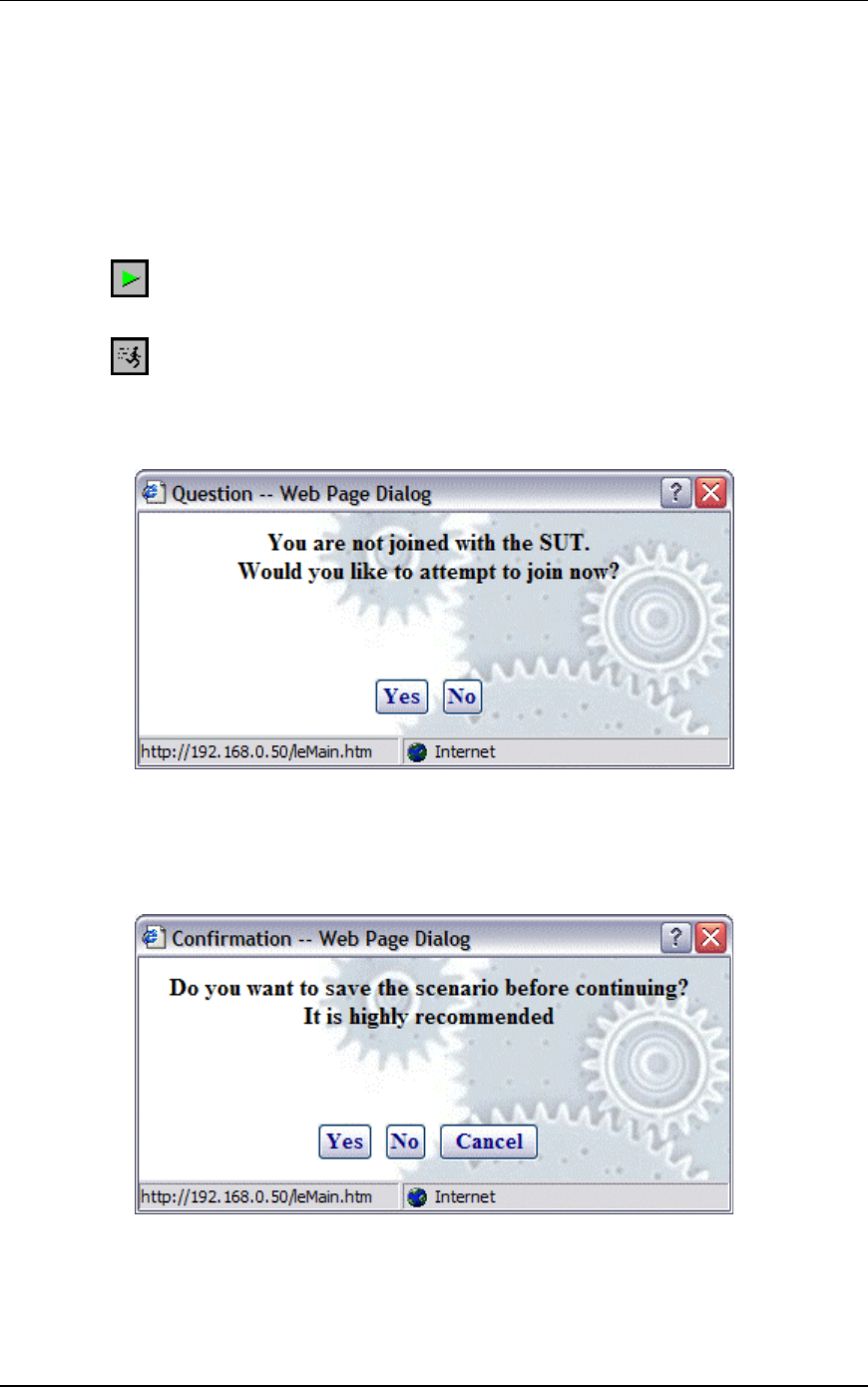
If you created a new scenario and have not yet joined with a target
system, the following dialog will be displayed:
Click “Yes” to show the Select System Under Test dialog and join with the
System Under Test.
If you created a new scenario and have not saved it using the Save
Scenario option in the File menu, a dialog will prompt you to save the
scenario.
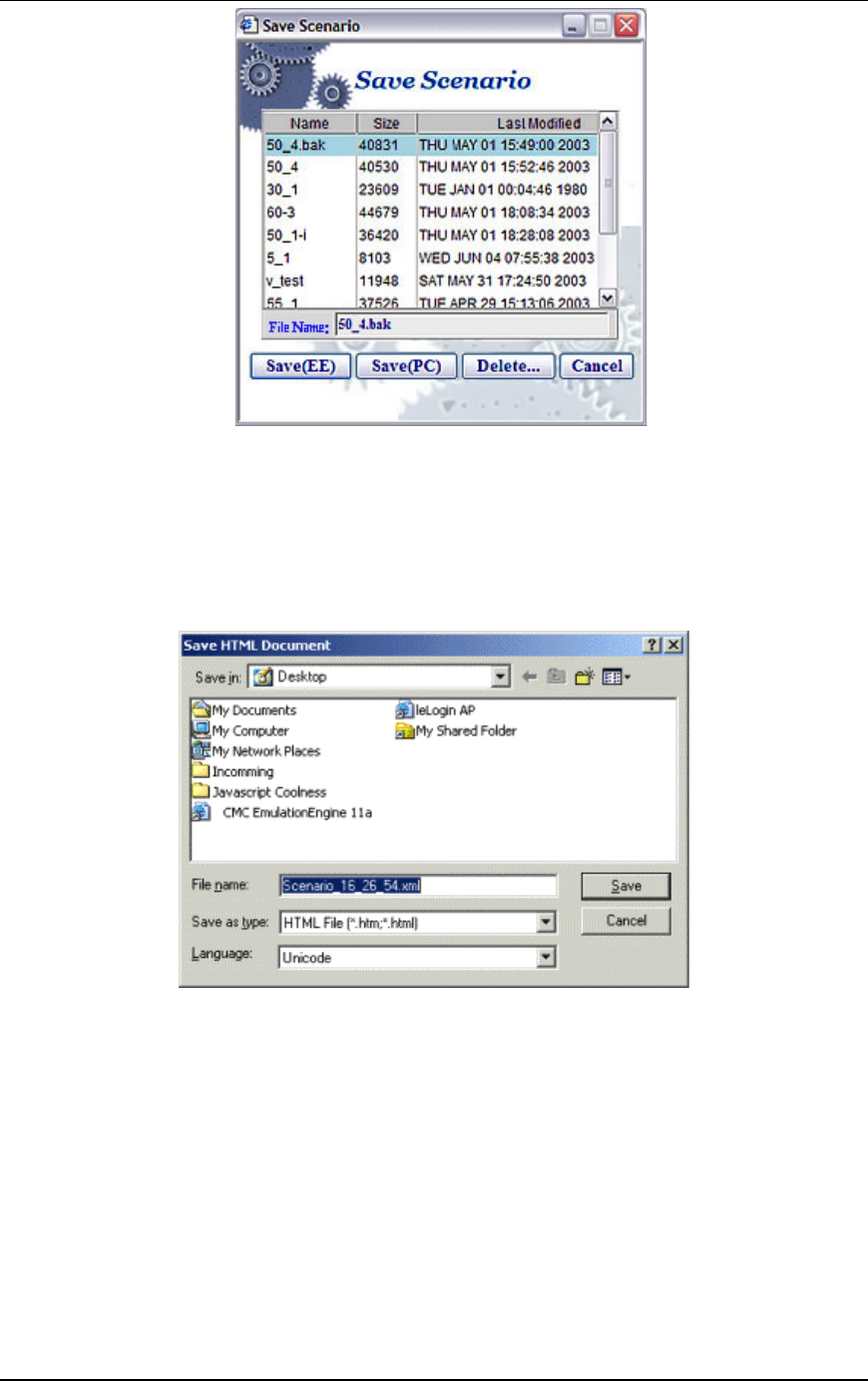
Select “Yes” to save the scenario file. The Save Scenario dialog is
displayed:
Communication Machinery Corporation (CMC)
5-10 080104
Type a name in the File Name field. Do not use colon (:), asterisk (*),
question mark (?), quotes (“”), less-than/greater than signs (< >),
vertical bar (|), or spaces in a file name.
!" Select “Save(EE)” to save the scenario in the EmulationEngine’s flash file
system.
!" Select “Save(PC)” to save the scenario on the command PC. A standard
save dialog will be displayed.
Type a name in the File Name field. Do not use colon (:), asterisk (*),
question mark (?), quotes (“”), less-than/greater than signs (< >),
vertical bar (|), or spaces in a file name. A disk drive specification (e.g.,
C:/, D:/) is optional. Select “Save” to save the scenario at the designated
location on the command PC.
The virtual stations will start running a few seconds after the scenario has
been saved. As the test runs, you will see the "Run State" in the group
grid go through the 802.11 states: configure, initialize, authenticate,
associate, and run. When an internal mode/ping test is complete, the "Run
State" will display "Done".
NOTE: Any interaction with a running test can affect the operation of the
test which may result in skewed statistics.
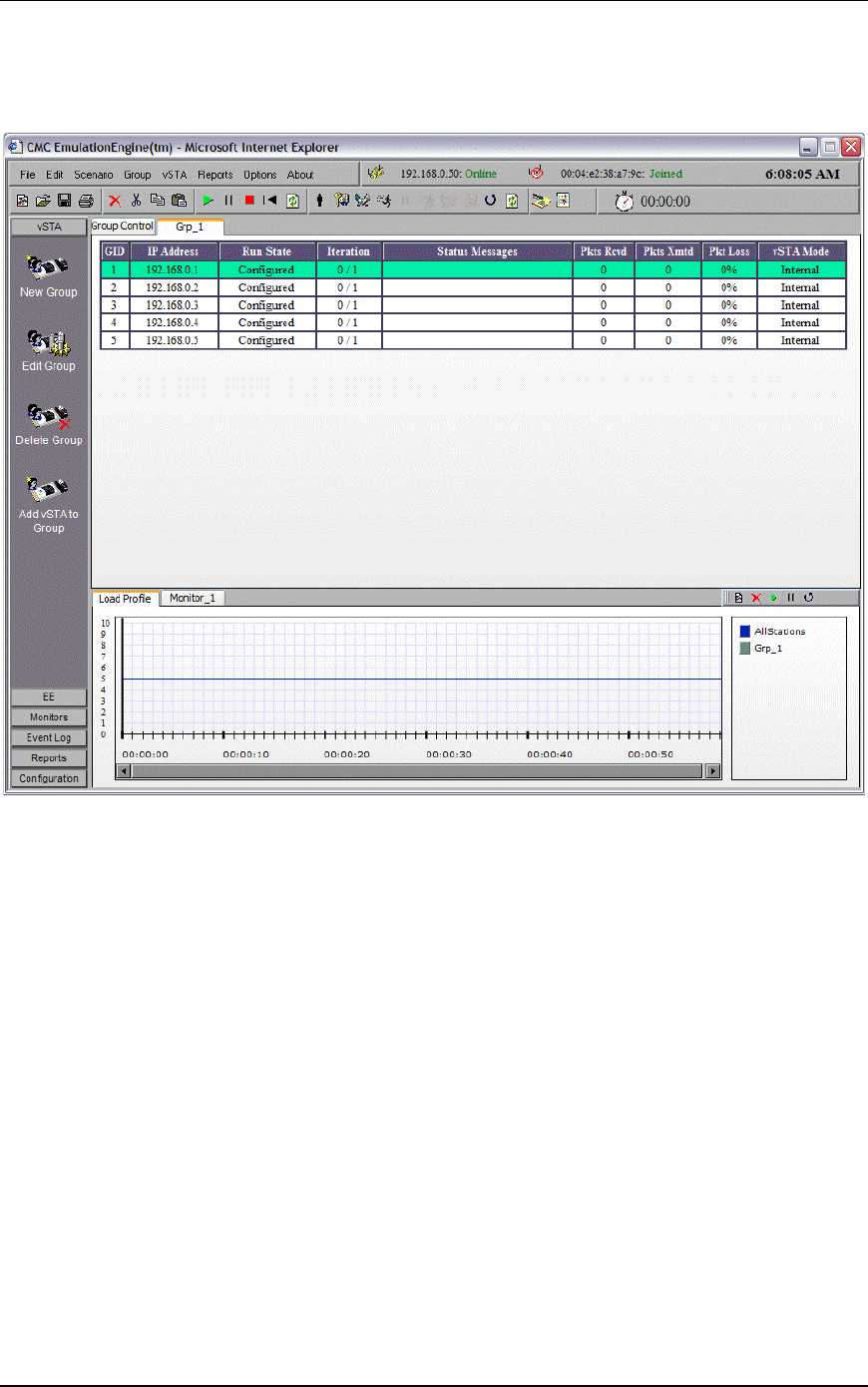
EmulationEngine 11a/b/g User's Guide
080104 5-11
About/Using the Main Page
The following illustration shows the general format of the main page
where a scenario with one group of virtual stations has been defined and
the group tab (Grp_1) is selected:
When the “Group Control” tab is selected, the main page will show the
Load Profile and a list of devices that have been discovered (if any) in a
scan:
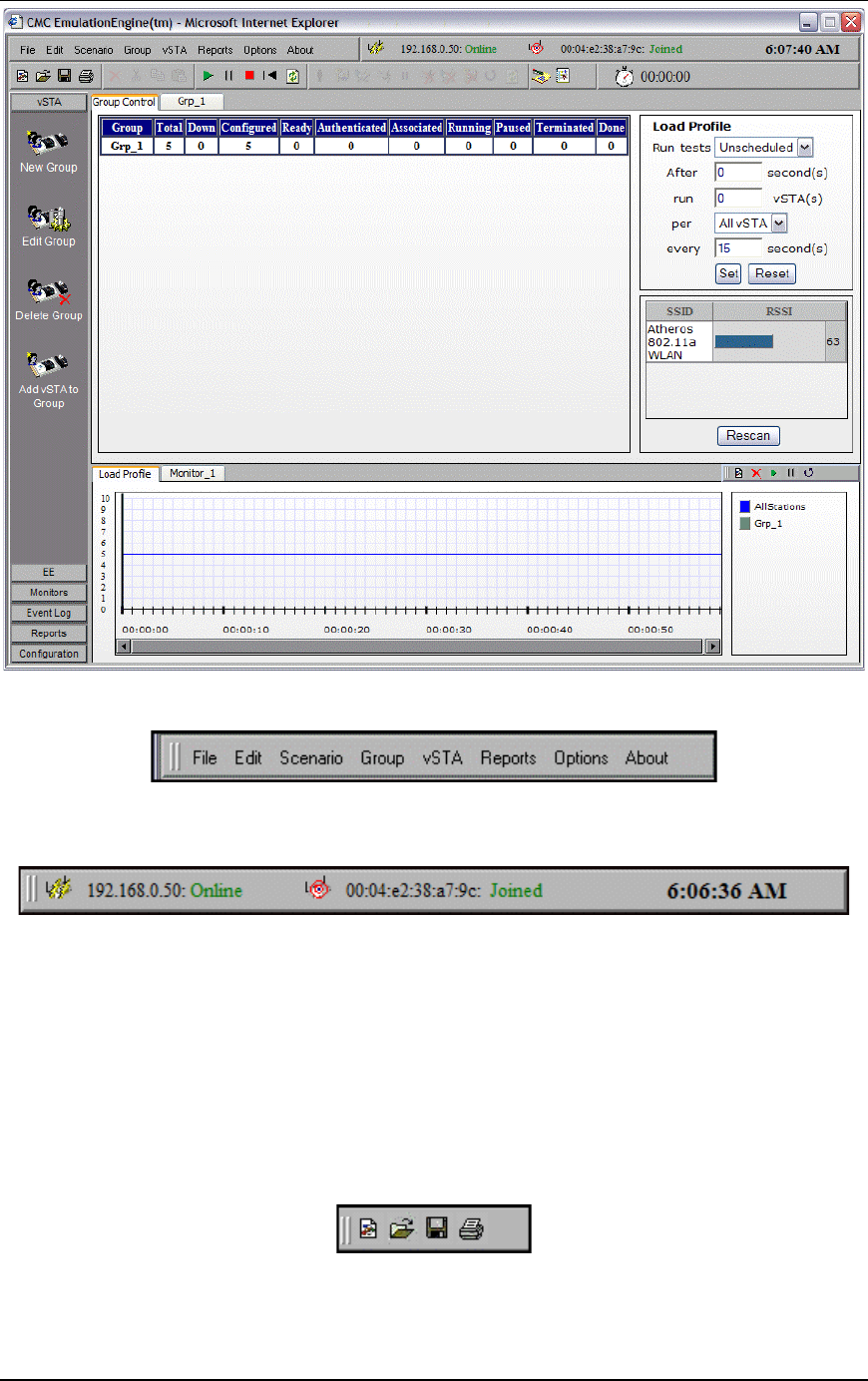
Communication Machinery Corporation (CMC)
5-12 080104
!" Menu Toolbar: The top-left toolbar at the top of the page is a drop-down
menu bar of all EmulationEngine functions.
!" Status Toolbar: The top-right toolbar shows the status of the
EmulationEngine, the System Under Test and the current time on the
command PC.
The status (e.g., Online) next to the EmulationEngine IP Address Address
indicates the current status of the EmulationEngine with the web-based
user interface. This status may intermittently display “Busy” or “Offline”. If
the Busy or Offline status displays frequently or for extended periods of
time, check the Polling Interval and Polling Timeout values in the
Configure EmulationEngine dialog (see EE->Configure EE). Also see
Chapter 9, Troubleshooting/EmulationEngine Busy or Not Responding. The
status (e.g., Joined) next to the BSSID/MAC address indicates the current
status of the EmulationEngine with a System Under Test.
!" File Toolbar: This toolbar is used to create, open, save and print
scenarios.
!" Edit Toolbar: This toolbar is used to delete, cut, copy, and paste virtual
stations within and between groups. It can also be used to delete groups
when a group is selected in the group control tab/table.
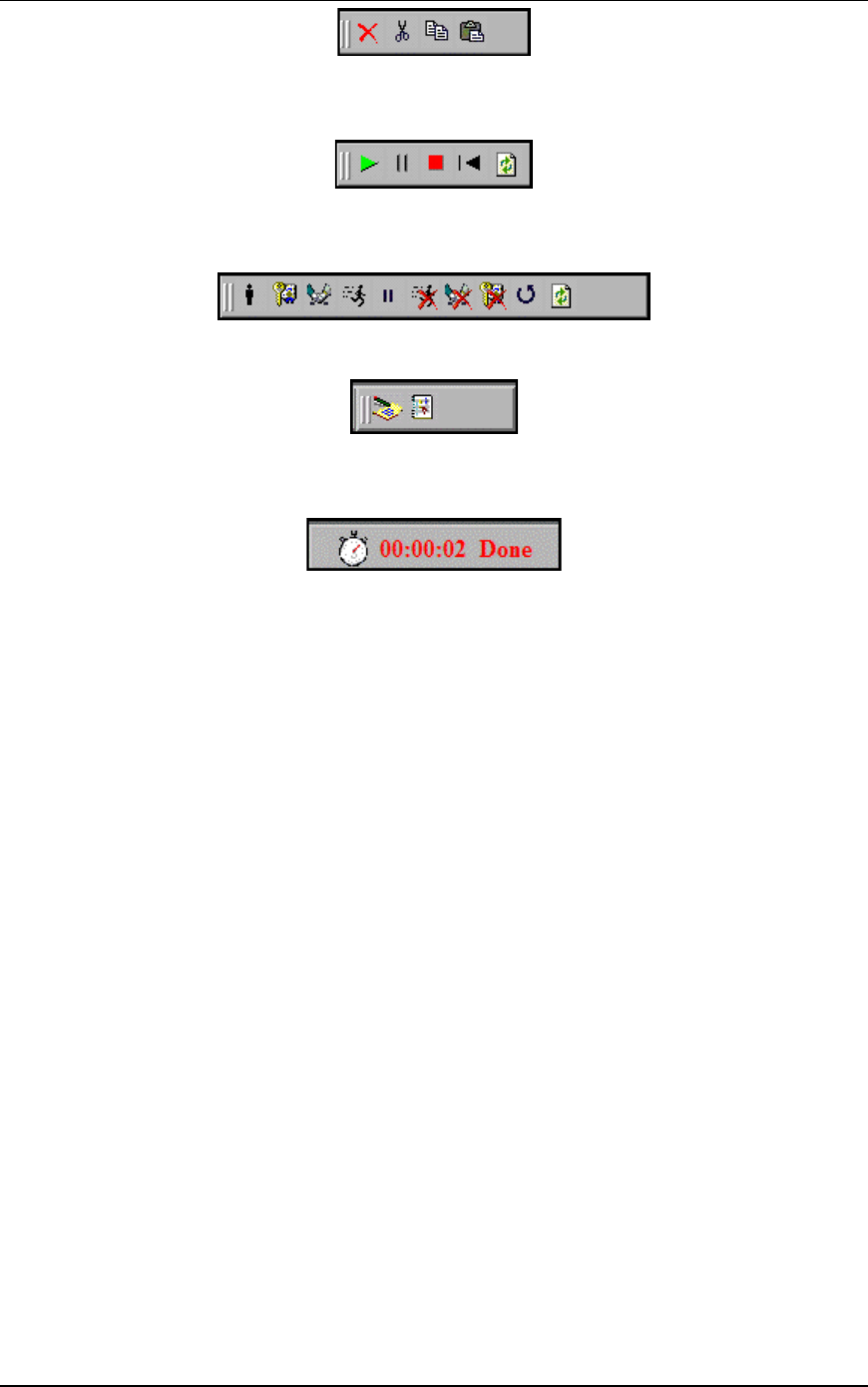
EmulationEngine 11a/b/g User's Guide
080104 5-13
!" Scenario Toolbar: The buttons in this section of the toolbar can be used
to run, pause, stop, restart, or refresh the entire scenario of all virtual
stations.
!" vSTA Toolbar: The buttons in this toolbar are used to initialize,
authenticate, associate, run, pause, stop, disassociate, de-authenticate,
restart, or refresh selected virtual stations or groups of virtual stations.
!" Reports Toolbar: The buttons in this toolbar are used to view reports
and the event log:
!" Test Clock: The clock icon and time (hh:mm:ss) immediately adjacent to
the Reports Toolbar, shows the elapsed duration of a test that is in
progress or the most recent test that completed:
!" Side Bar Buttons: The buttons in the side bar provide access to most
virtual station, EmulationEngine, monitoring, logging and report functions
as well as user interface and encryption configuration.
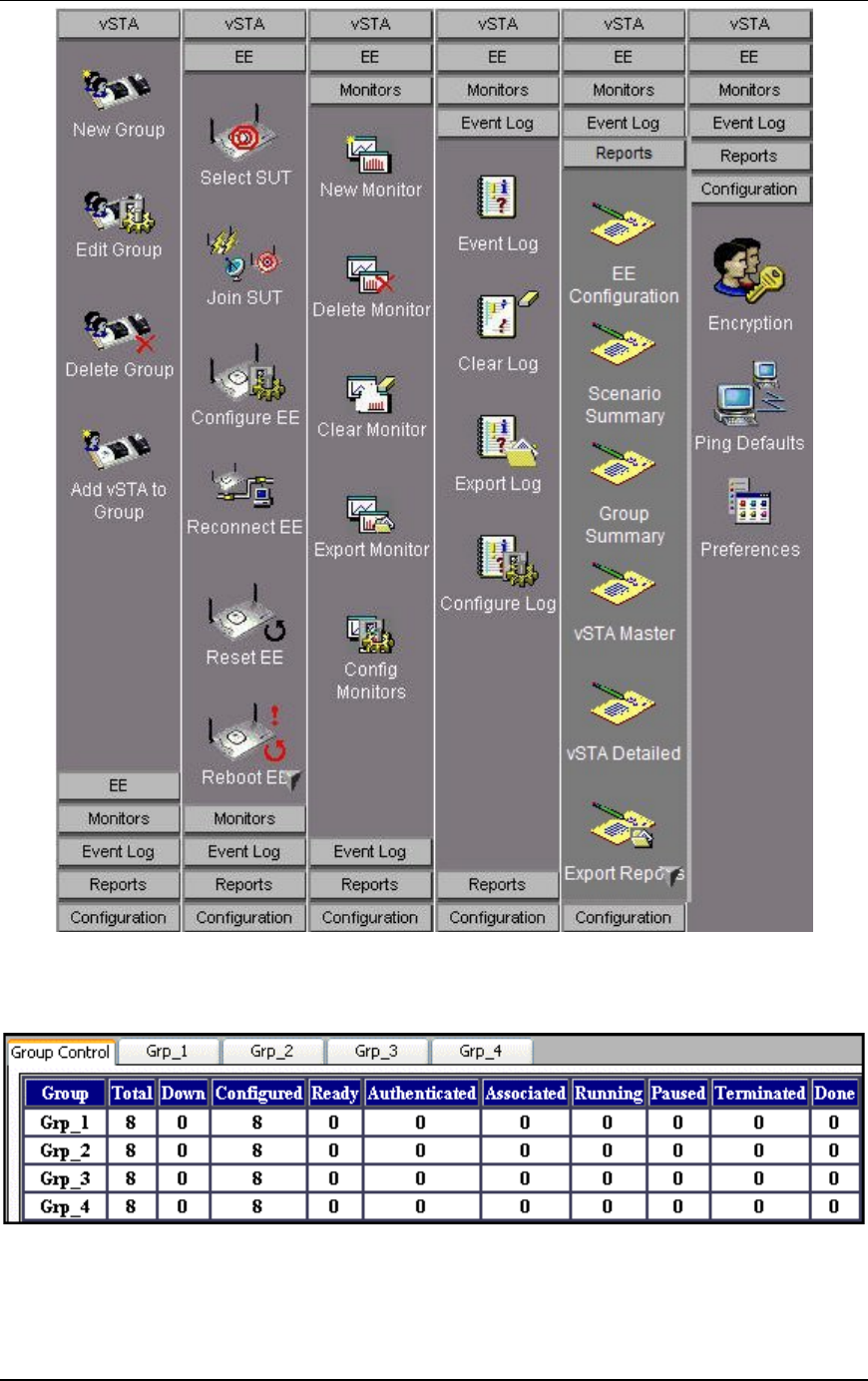
Communication Machinery Corporation (CMC)
5-14 080104
Group Control Grid
When the Group Control tab is selected, the table shows the status of
each group and its associated virtual stations:
Group: This field displays the name of each group. The name is assigned
in the New Emulation Group dialog (See vSTA->New Group).
The remaining fields in the group line are counters that show the state of
each group’s virtual stations during a test.
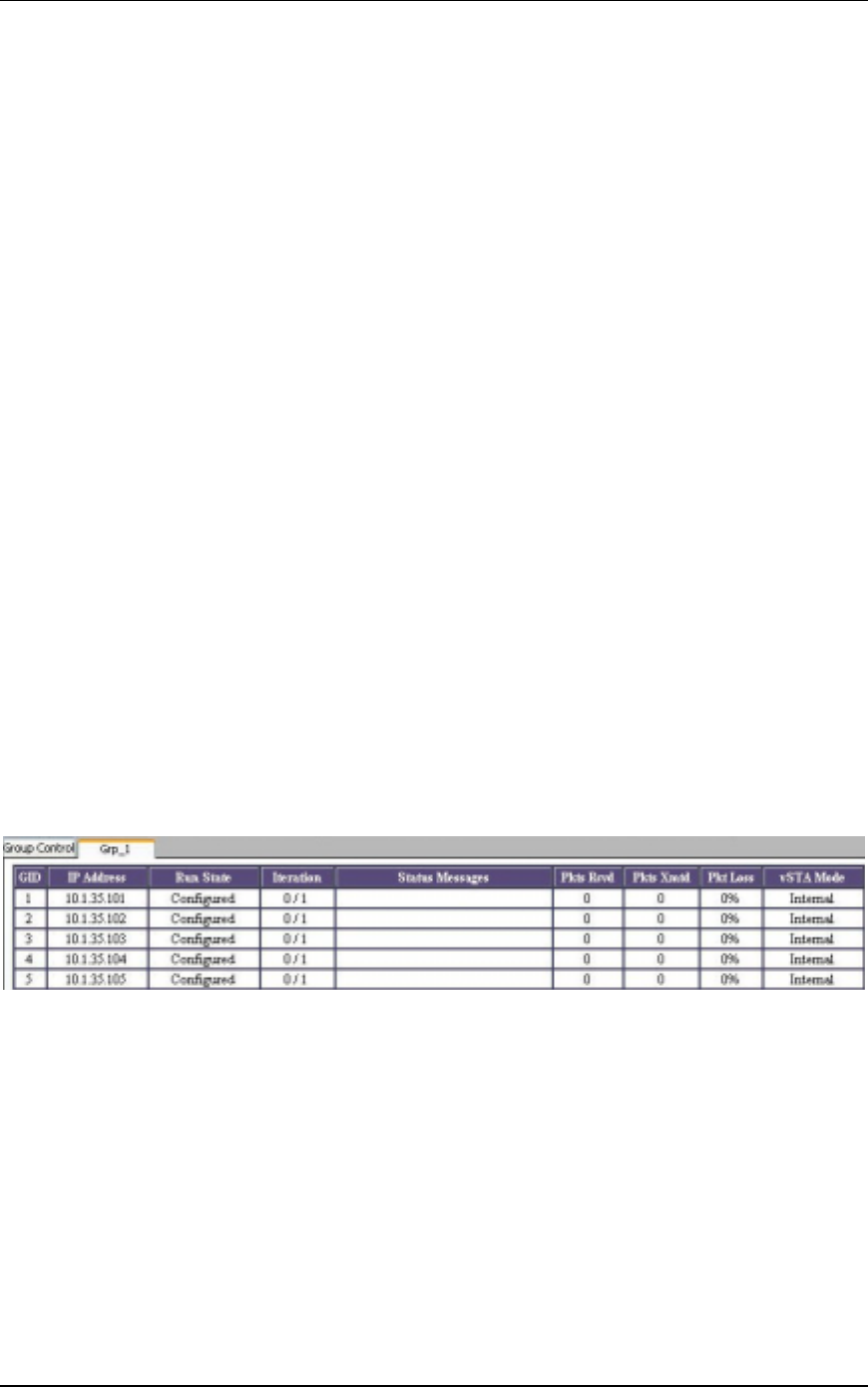
EmulationEngine 11a/b/g User's Guide
080104 5-15
Total: This field shows the total number of virtual stations in each group.
Down: This field shows the total number of virtual stations in a group
that have not been configured in the EmulationEngine and are in a “down”
state.
Configured: This field shows the total number of virtual stations in each
group that have been configured in the EmulationEngine.
Ready: This field shows the total number of virtual stations in each group
that are ready (in the initialized state) to begin testing. These virtual
stations have been initialized in the EmulationEngine.
Authenticated: This field shows the total number of virtual stations in
each group that have authenticated with the System Under Test.
Associated: This field shows the total number of virtual stations in each
group that have associated with the System Under Test.
Running: This field shows the total number of virtual stations in each
group that are currently performing an operation defined by the scenario.
The operation that is being performed depends on whether the virtual
stations are configured for internal or external traffic generation.
Paused: This field shows the total number of virtual stations in each
group that have paused in their execution.
Terminated: This field shows the total number of virtual stations in each
group that have been terminated. These virtual stations must be reset
before they can be used again.
Done: This field shows the total number of virtual stations in each group
that have completed their run of an internal mode/ping test. This field will
not be incremented for virtual stations that are running an external mode
test or an internal mode test with infinite iterations.
Group Tabs: Each group defined in the scenario has its own tab. When
an individual group tab is selected, the table shows details of each virtual
station in the group.
GID: The global ID is a unique ID that is assigned by the EmulationEngine
to each virtual station in a scenario group. It is a unique ID across all
groups in the EmulationEngine.
IP Address: This field shows each virtual station's IP Address.
Run State: This column shows the current state of each virtual station in
the scenario group (i.e., Initializing, Authenticating, Authenticated,
Associating, etc.).
Iteration: The two numbers in this column show the current iteration of
the test that a virtual station is running or has completed and the number
of iterations that are configured for the virtual station (e.g., 5/10 = 5
iterations have been completed/10 iterations are to be run). These
numbers can be a value in the range zero (0) to 9999 or Infinite.

Communication Machinery Corporation (CMC)
5-16 080104
Status Messages: This column shows status and/or error messages
returned by the EmulationEngine for each virtual station in the scenario
group. See Appendix D for a list of messages that may be displayed in this
column.
Pkts Rcvd: This column shows the total number of packets received by
each virtual station in this group.
Pkts Xmtd: This column shows the total number of packets transmitted
by each virtual station in this group.
Pkt Loss: This column shows the percentage of packet loss for each
virtual station in this group.
vSTA Mode: This column shows the traffic generation mode (Internal or
External) of each virtual station in the scenario group.
You can select one or more line items/virtual stations in the table and
choose a menu item or toolbar button to execute a command for an
individual or multiple virtual stations.
You can double click on a virtual station line item in the table to display
the Edit Virtual Station dialog:
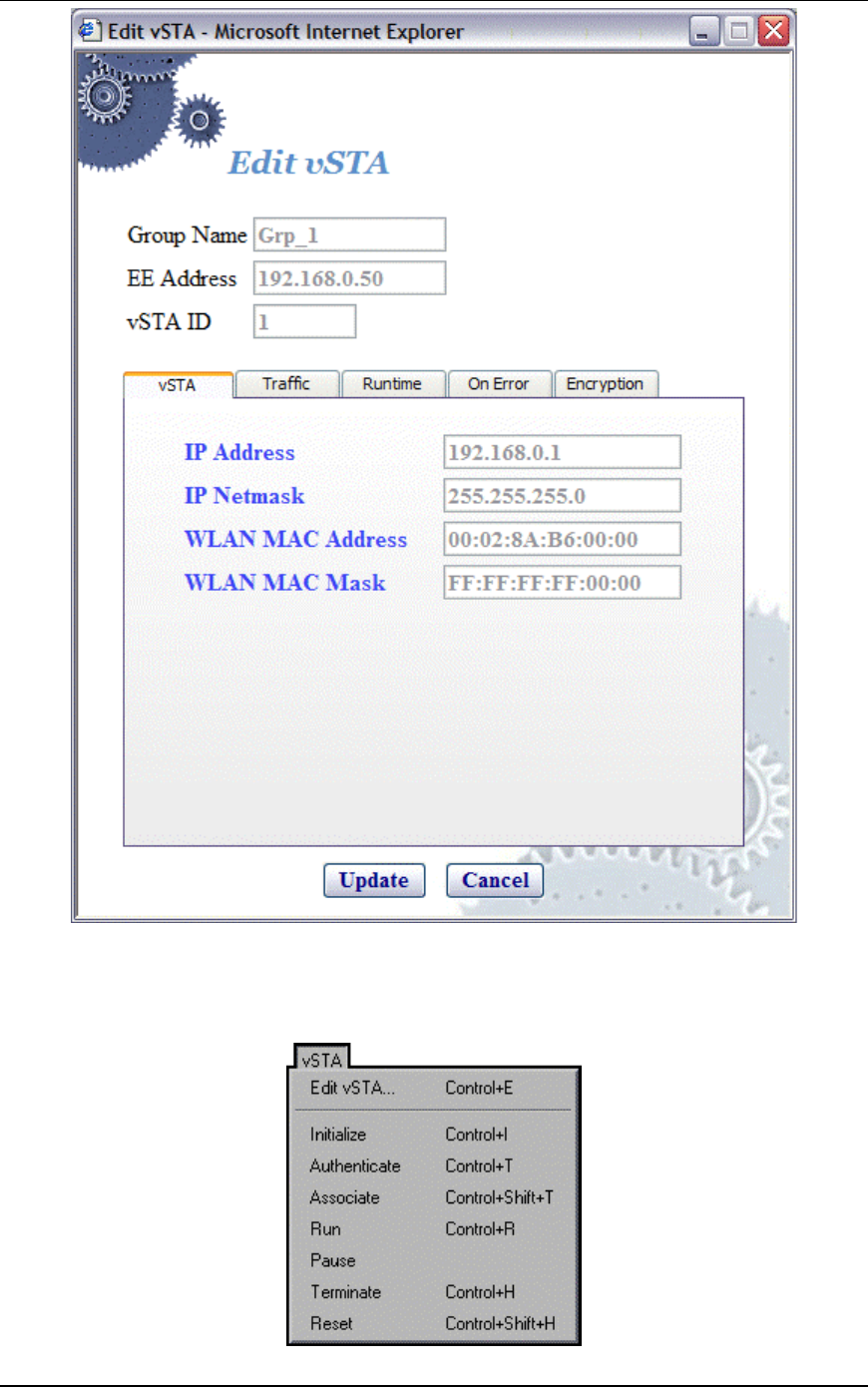
EmulationEngine 11a/b/g User's Guide
080104 5-17
See vSTA->Add New vSTA to Group for information about the fields in this
dialog.
You can right click on selected virtual stations to display the vSTA menu.
Any menu option will affect the selected virtual station(s).
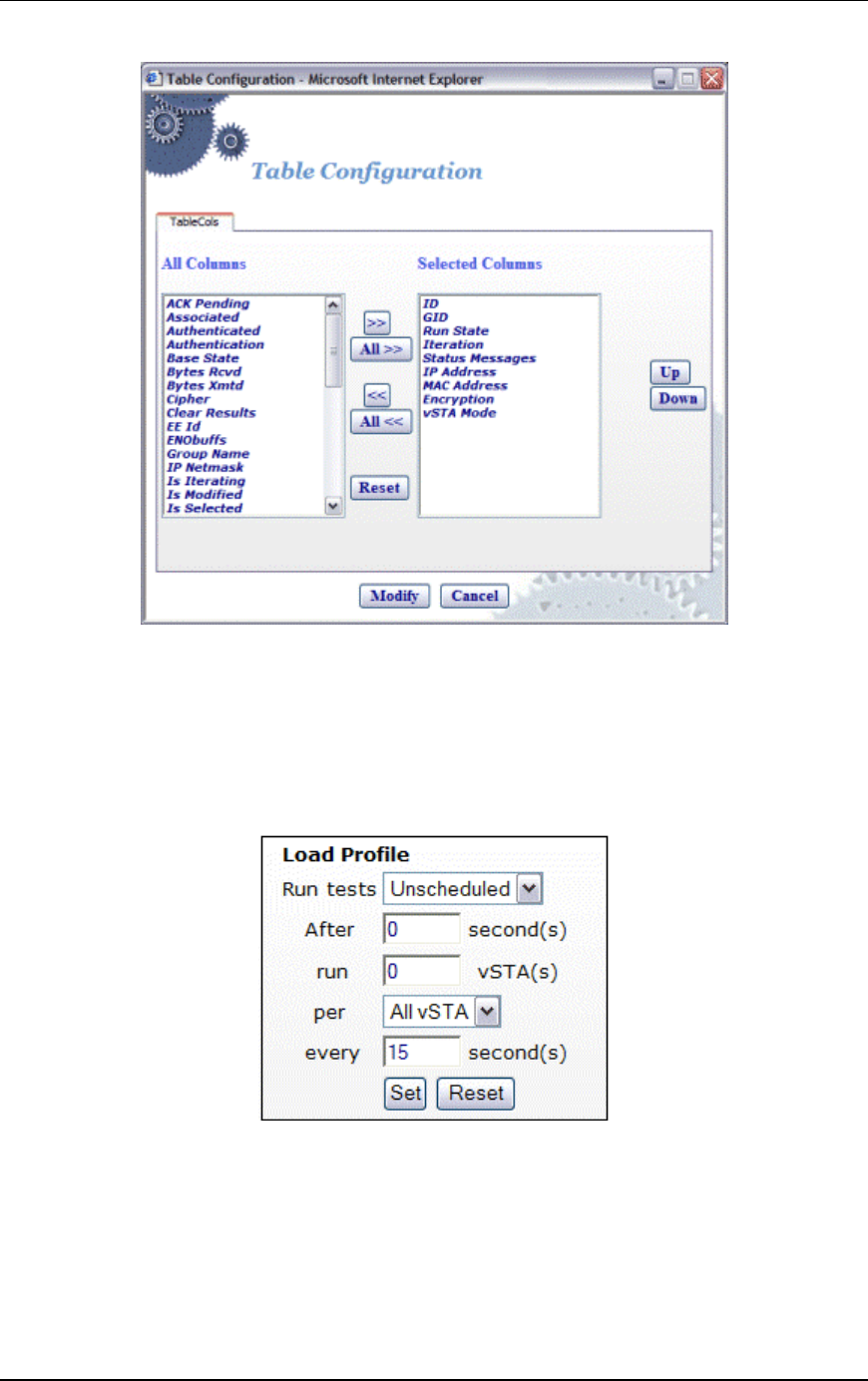
Communication Machinery Corporation (CMC)
5-18 080104
Group Tab Columns: Within a group, you can double click on the table
heading to configure the columns that are displayed.
Select one or more items in the All Columns list box and click the [>>]
button to move them to the Selected Columns list box. Click “Modify” to
add the columns to the group table. Select “Reset” to return the columns
to their default setting.
Load Profile
The Load Profile section of the page can be used to automatically execute
scenarios at scheduled intervals.
When automatic scheduling is defined, the grid below the
Scheduling/Group table will chart the status of each virtual station over
the period of the test. See "Using Load Profiles" below for more
information about using this feature.
Target Systems
Below Load Profile, the main page displays a list of target systems and
their signal strength in relationship to the EmulationEngine. Target
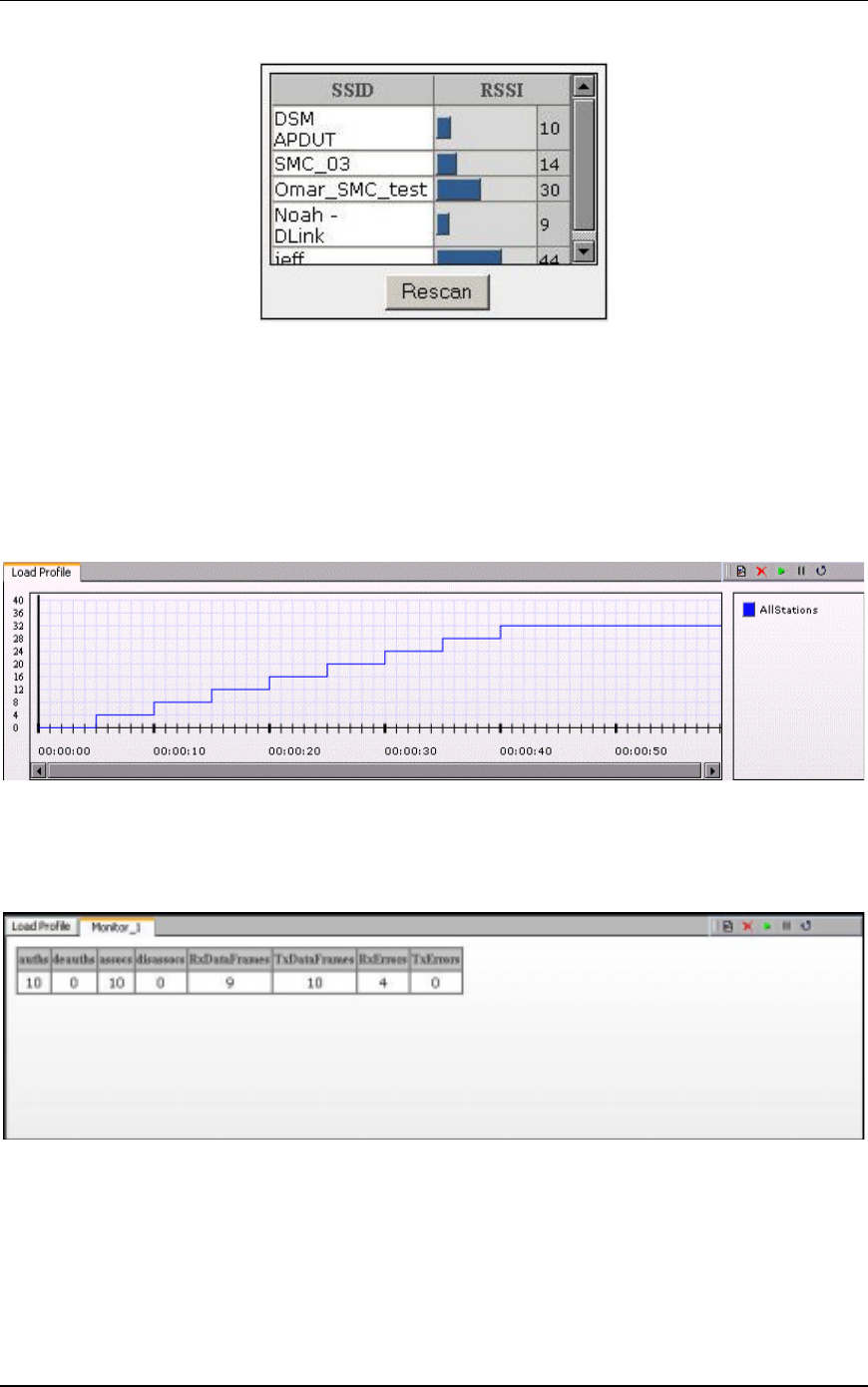
EmulationEngine 11a/b/g User's Guide
080104 5-19
systems with a higher signal strength value have a better/higher
transmission rate to the EmulationEngine.
You can select “Rescan” to instruct the EmulationEngine to rescan for all
systems. The devices shown in this list box will be displayed in the Select
System Under Test dialog where you can choose a system to test.
Load Profile/Monitor Graphs
The bottom half of the web page is reserved for charts that graphically
illustrate a load profile and monitor test results. When the Load Profile tab
is selected, a graph shows the loading profile based on an active Load
Profile.
See "Using Load Profiles" below for more information about how to set up
a Load Profile.
If multiple monitors have been defined, use the horizontal tabs at the top
of this section of the page to select and show each monitor.
A maximum of four monitors can be defined in each scenario. The toolbar
in the top-right corner of the monitor area can be used to define a new
monitor, delete a monitor, run a paused monitor, pause a running
monitor, and clear a monitor’s display. See "Monitors Side Bar" for more
information about this section of the page.
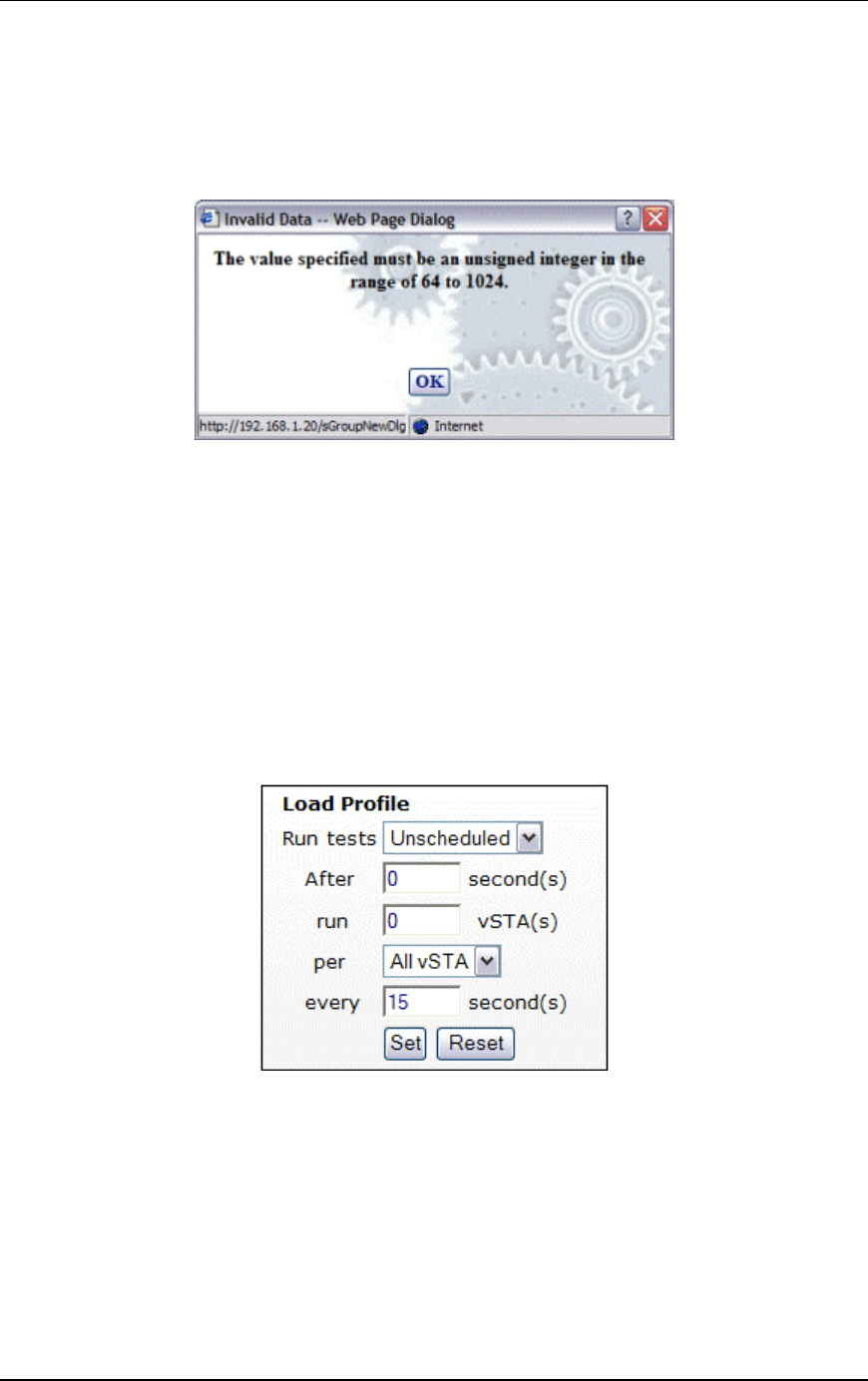
Communication Machinery Corporation (CMC)
5-20 080104
Range Checking/Error Messages
In the dialogs described later in this chapter, the user interface will verify
all entries that require values within a specified range. If a field can
contain a very large number, do not enter commas (,) for values larger
than 999 (e.g., use 1000 rather than 1,000). If you use an invalid
character in a field or specify a value that is not within range, a dialog will
tell you the allowable range. Example:
When an Invalid Data dialog is displayed, click “OK” and reenter a value
that is within the allowable range for the field.
Using Load Profiles
Load Profiles allow you to control the execution of virtual stations:
Unscheduled or Scheduled. In Unscheduled mode, virtual stations can be
manually controlled. In Scheduled mode, virtual stations can be run
incrementally based on groups (all virtual stations within the group) or by
individual virtual stations.
NOTE: In order to use Scheduled mode, you must disable “Batch EE
Requests” in EmulationEngine configuration (See EE->Configure EE).
When requests are batched for transmission to the EmulationEngine, they
will not be sent at the scheduled interval defined by the Load Profile.
Run tests: Select Unscheduled or Scheduled. The default is Unscheduled.
If Scheduled is selected, the Load Profile is in effect for the scenario. If
Unscheduled is selected, the Load Profile is not in effect.
After: This field defines an initial delay before a run starts: 0...3600
seconds (1 hour). It is the number of seconds after a Run command has
been issued (e.g., the Run button is selected in the toolbar) that the Load
Profile will begin executing.
run: Enter the number of virtual stations to start each time interval of the
load profile. The time interval is specified in the “every” field.
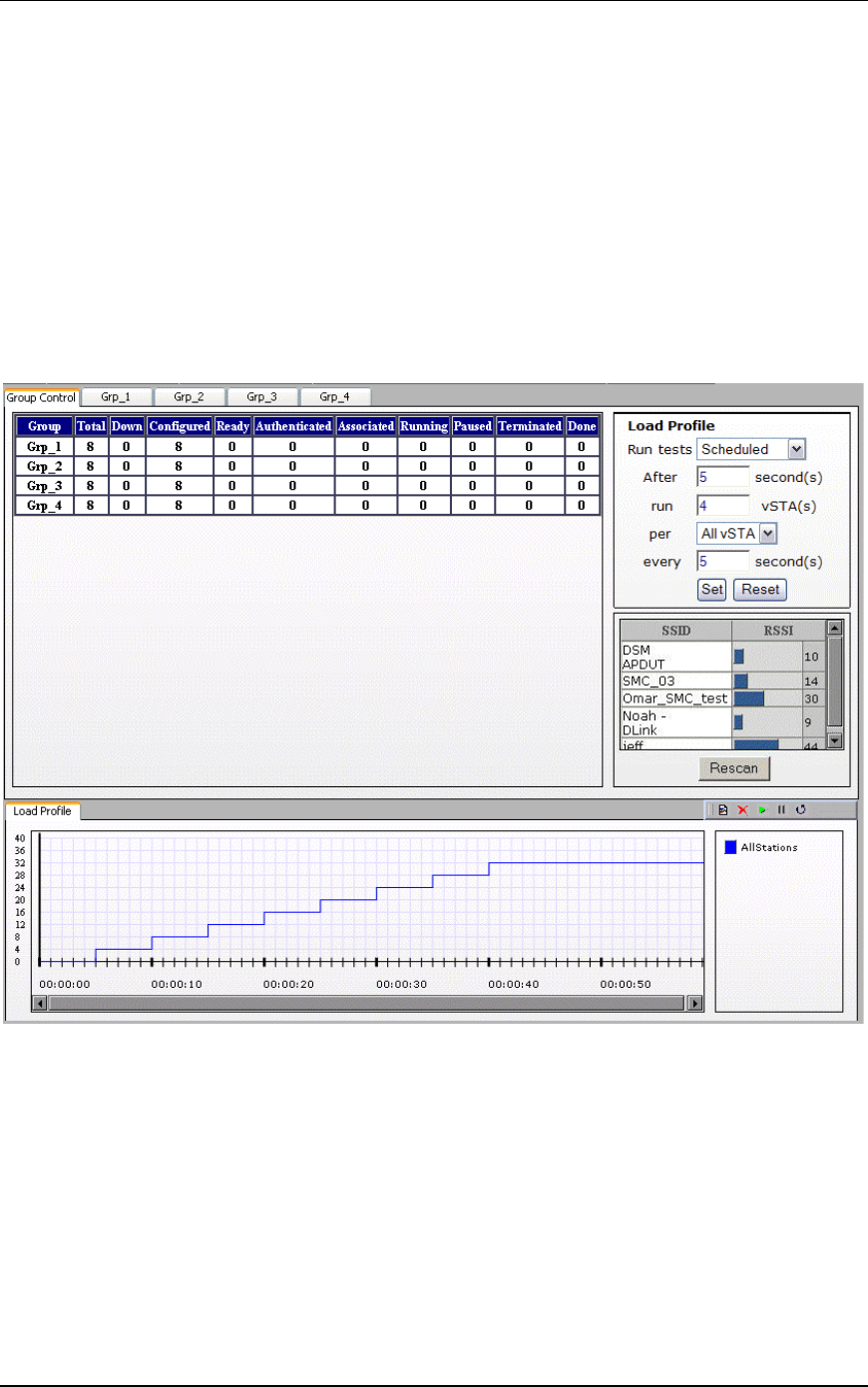
EmulationEngine 11a/b/g User's Guide
080104 5-21
per: This field defines what scheduling is based on (All vSTA = all virtual
stations, Groups = virtual stations within each group). If "All vSTA" is
selected, the Load Profile will run the next “run” number of virtual stations
at each scheduled iteration. If Group is selected, the Load Profile will run
the next “run” number of virtual stations from each group at each
scheduled iteration. The scheduled iteration is defined in the “every” field.
every: This field defines the number of seconds between each repetition
of the Load Profile: 1...3600 seconds (1 hour). When this time expires, the
next set of virtual stations (as defined in the run field) will be executed.
Select the Load Profile tab in the Load Profile/Monitors section of the page
to show the Load Profile graph. The Load Profile graph displays the Load
Profile setup: x-Axis = time, y-Axis = Groups or All vSTA depending on
the selection in the per field. The following illustration shows an example
Load Profile setup and graph:
After a delay of five seconds, the user interface will instruct the
EmulationEngine to run four virtual stations. Every five seconds
thereafter, the user interface will instruct the EmulationEngine to run
another four virtual stations until all virtual stations have been executed.
The graph depicts this scheduling scheme.
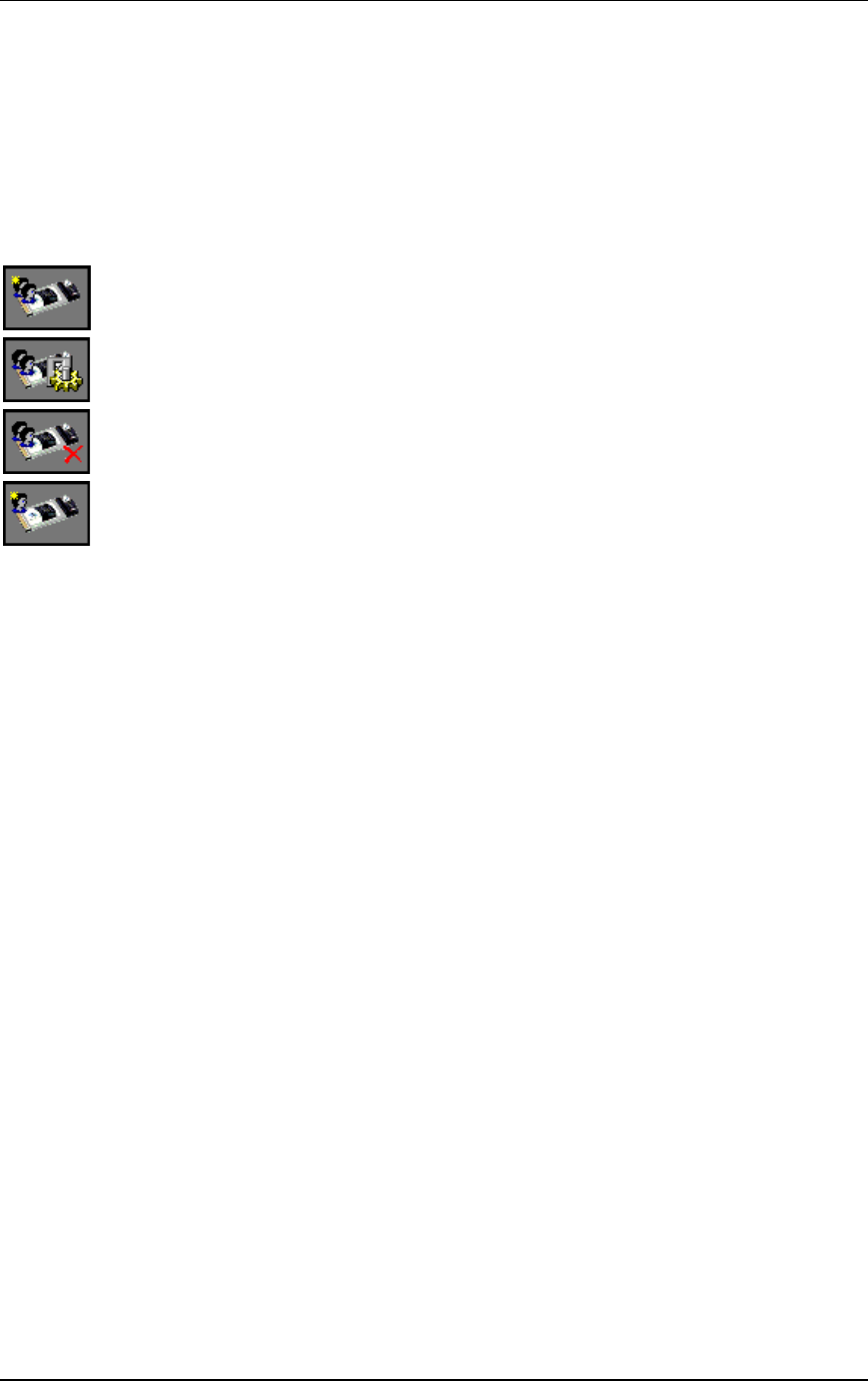
Communication Machinery Corporation (CMC)
5-22 080104
vSTA Side Bar
In the web-based user interface you can create scenarios that consist of
one or more groups of virtual stations. The group configuration defines a
test sequence that the EmulationEngine will activate to exercise the
System Under Test. Virtual stations can be configured individually or by
group. In internal mode, you can configure each virtual station and/or
group to generate traffic to the system being tested. You can also
configure virtual stations to operate in external mode where an external
load generator will generate the traffic.
New Group: Select this button in the vSTA side bar to define a new
group in a scenario.
Edit Group: Select this button in the vSTA side bar to modify the
definition of a group.
Delete Group: Select this button in the vSTA side bar to remove a group
and all of its virtual stations from a scenario.
Add vSTA to Group: Select this button in the vSTA side bar to define a
new virtual station in a scenario group.
vSTA->New Group
The New Group dialog is used to define new groups of virtual stations in a
scenario. It is a tabbed dialog with the following sections: vSTA, Traffic,
Runtime, On Error, and Encryption.
vSTA->New Group->vSTA
The vSTA section of the New Emulation Group dialog defines the range of
IP and MAC addresses to be used by virtual stations. The range of MAC
addresses specified in this dialog must be within the range of MAC
addresses defined by the WLAN Base MAC Address and WLAN MAC Mask
in EmulationEngine configuration (see EE->Configure EE).
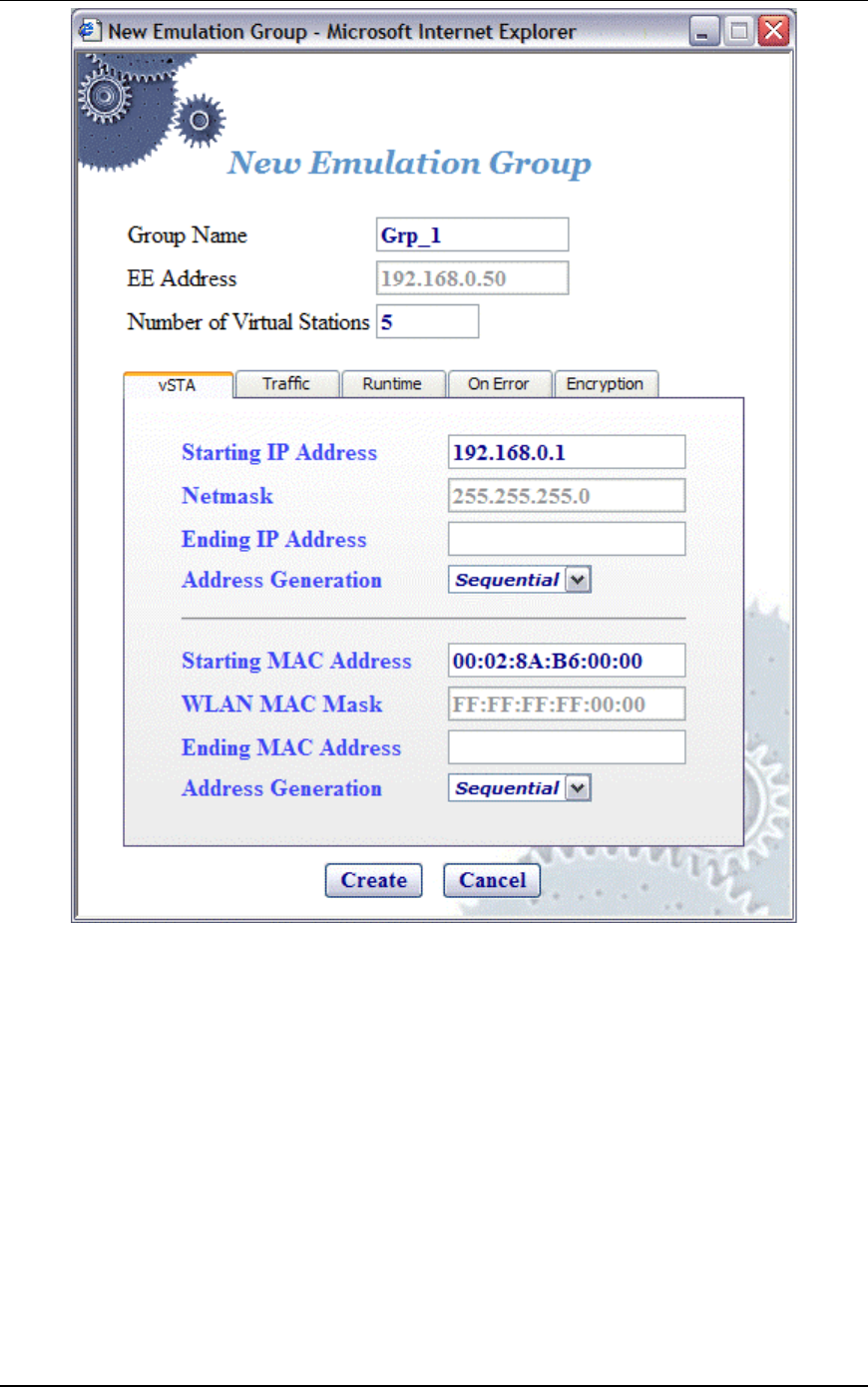
EmulationEngine 11a/b/g User's Guide
080104 5-23
Group Name: Use a group name that helps you identify the devices that
will be tested (e.g., Warehouse, Stock_Room, Control_Tour, Shop_Floor,
etc.). It can be up to 12 characters (a...z, 0..9, and underscore (_)).
EE Address: This field shows the IP address of the EmulationEngine that
will run this scenario/test.
Number of Virtual Stations: Enter the number of virtual stations
(0...64) to be created in this scenario group. The default value is 5. If you
specify zero virtual stations in this dialog, you must use the Add vSTA to
Group dialog to add one or more virtual stations to this group. The Add
vSTA to Group dialog will use the default parameters you set in this group
definition.
Starting IP Address: If Sequential or Random is selected in the Address
Generation field, enter the starting IP address to be used for virtual
station IP address generation of newly created virtual stations in this
group. Successive virtual station IP addresses will be sequentially or
randomly generated from this base address.

Communication Machinery Corporation (CMC)
5-24 080104
Netmask: This field shows the network mask to be used by virtual
stations in this group. It is not settable here. It is global for all virtual
stations and is an EmulationEngine configuration parameter.
Ending IP Address: If Random is selected in the Address Generation
field, enter the ending IP address to be used by virtual stations in this
group when generating random addresses within a range.
Address Generation: Select Sequential, Random, or DHCP from the
drop-down list box. The Sequential or Random selections will instruct the
EmulationEngine to sequentially or randomly assign IP addresses to newly
created virtual stations. The DHCP mode allows virtual stations to have IP
addresses dynamically assigned from a DHCP server on the network
rather than a fixed, configured IP address. If DHCP is selected, the
EmulationEngine will initiate lease negotiation if association succeeds for
each individual virtual station.
Starting MAC Address: Enter the starting MAC address to be used for
virtual station MAC address generation of newly created virtual stations in
this group. Successive virtual station MAC addresses will be sequentially
or randomly generated from this base address. The starting MAC address
must be within the range of MAC addresses defined by the WLAN Base
MAC Address and WLAN MAC Mask in EmulationEngine configuration (see
EE->Configure EE).
WLAN MAC Mask: The WLAN MAC Mask is a display-only field. It is
defined in EmulationEngine configuration (see EE->Configure EE). It limits
the range of MAC addresses that can be detected on the wireless LAN and
received by the EmulationEngine. For example, if the WLAN MAC is set to
00:0b:cd:59:23:44 and the mask is set to ff:ff:ff:ff:00:00, the only MAC
addresses that can be detected on the wireless LAN and received by the
EmulationEngine are: 00:0b:cd:59:00:00 - 00:0b:cd:59:ff:ff. All other
MAC addresses will be filtered out.
Ending MAC Address: Enter the ending MAC address to be used by
virtual stations in this group.
Address Generation: Select Sequential or Random from the drop-down
list box to instruct the EmulationEngine to sequentially or randomly assign
IP addresses to newly created virtual stations.
!" Click “Create” to create the group.
!" Click “Cancel” to exit this dialog.
vSTA->New Group->Traffic
The Traffic section of the New Emulation Group dialog defines the type of
traffic (Internal/Ping or External/Load Generator) to be used by the virtual
station(s).