Jakob Hatteland Logistics AS ROBR-915-2 AUTOSTORE Robot Radio User Manual

Jakob Hatteland Logistics AS AUTOSTORE Robot Radio

User manual

Distributor Manual - Radios 2.0Copyright 2011 Jakob Hatteland Computer ASVersion: 06 - 2012Language: English OriginalAS-50040 - 2.0 - N.Am. - engKeep for future reference!
Copyright and DisclaimerAll rights reserved. No parts of this work may be reproduced inany form or by any means - graphic, electronic, or mechanical,including photocopying, recording, taping, or informationstorage and retrieval systems - without the written permission ofthe publisher.Products that are referred to in this document may be eithertrademarks and/or registered trademarks of the respectiveowners. The publisher and the author make no claim to thesetrademarks.All specifications are subject to change without notice. Whileevery precaution has been taken in the preparation of thisdocument, the publisher and the author assume no responsibilityfor errors or omissions, or for damages resulting from the use ofinformation contained in this document or from the use ofprograms and source code that may accompany it.AutoStore is a certified product, Modules and parts of theAutoStore system must not be modified, altered, or installed orused in a way not explicitly endorsed by the officialdocumentation. In no event shall the publisher and the author beliable for any loss of profit or any other commercial damagecaused or alleged to have been caused directly or indirectly bythis document.iiiCopyright and Disclaimer
iv Copyright and Disclaimer
Contents  Copyright and Disclaimer iii 1 About AutoStore Radio Communication 1 2 AutoStore Access Point 2  2.1 Access Point Frequency 2 3 The Robot Radio 3  3.1 Robot Radio Frequency 3 4 Troubleshooting Access Point Errors 4  4.1 Checking Ethernet Cable and POE 4  4.2 Replacing the Access Point 4  Index 5iContents
ii Contents
1About AutoStore RadioCommunicationThe AutoStore Access Point (ASAP) and the Robot Radio provide wireless connections that enablesthe AutoStore system to control the Robots. Every AutoStore installation has at least one ASAP andone Robot Radio in every Robot.ASAP and Robot Radio must only be used with AutoStore modules!This device complies with part 15 of the FCC Rules. Operation is subject to the following twoconditions: (1) This device may not cause harmful interference, and (2) this device must acceptany interference received, including interference that may cause undesired operation.1About AutoStore Radio Communication
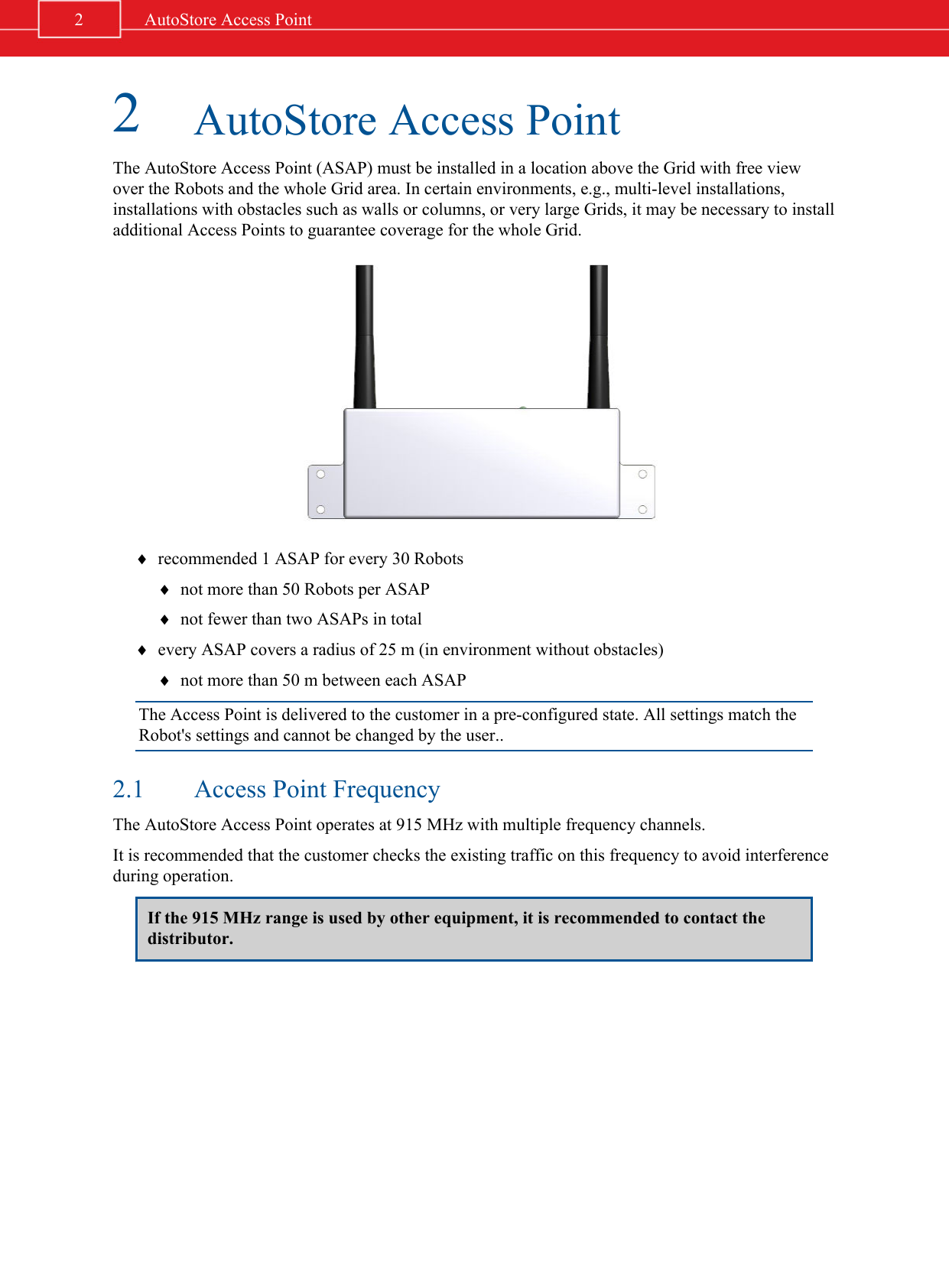
2AutoStore Access PointThe AutoStore Access Point (ASAP) must be installed in a location above the Grid with free viewover the Robots and the whole Grid area. In certain environments, e.g., multi-level installations,installations with obstacles such as walls or columns, or very large Grids, it may be necessary to installadditional Access Points to guarantee coverage for the whole Grid.¨recommended 1 ASAP for every 30 Robots¨not more than 50 Robots per ASAP¨not fewer than two ASAPs in total¨every ASAP covers a radius of 25 m (in environment without obstacles)¨not more than 50 m between each ASAPThe Access Point is delivered to the customer in a pre-configured state. All settings match theRobot's settings and cannot be changed by the user..2.1 Access Point FrequencyThe AutoStore Access Point operates at 915 MHz with multiple frequency channels.It is recommended that the customer checks the existing traffic on this frequency to avoid interferenceduring operation.If the 915 MHz range is used by other equipment, it is recommended to contact thedistributor.2AutoStore Access Point
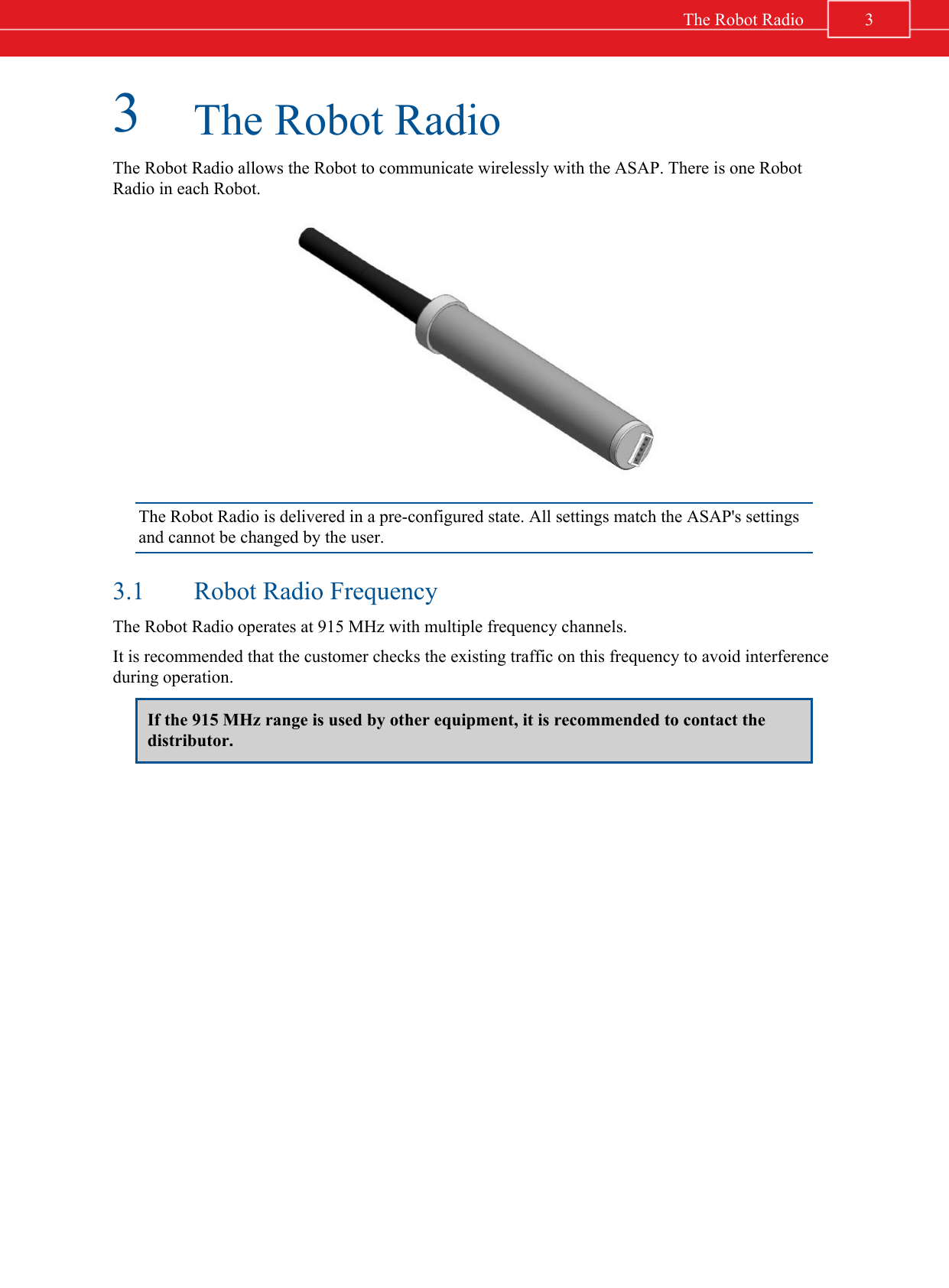
3The Robot RadioThe Robot Radio allows the Robot to communicate wirelessly with the ASAP. There is one RobotRadio in each Robot.The Robot Radio is delivered in a pre-configured state. All settings match the ASAP's settingsand cannot be changed by the user.3.1 Robot Radio FrequencyThe Robot Radio operates at 915 MHz with multiple frequency channels.It is recommended that the customer checks the existing traffic on this frequency to avoid interferenceduring operation.If the 915 MHz range is used by other equipment, it is recommended to contact thedistributor.3The Robot Radio
4Troubleshooting Access Point ErrorsThere are two main indications that point towards an Access Point error:¨the LED on the Access Point blinks red¨the LED on the Access Point shows a steady orange light for a prolonged period of time¨several Robots stop moving on the Grid at the same time4.1 Checking Ethernet Cable and POEThe Access Point is Powered Over the Ethernet (POE). Make sure that the cable sits securely in bothsockets.If the cable is connected correctly and the Access Point LED is blinking, try pinging the Access Pointat it's IP address.To do this:¨Open a Windows command prompt on the console (Type cmd in the search bar of the Windowsstart menu and press ENTER)¨Type ping followed by the IP address of the Access Point you want to test¨If the connection is working correctly it will return "Reply from ..." at the command prompt¨If the connection is not working you will return "Request timed out" at the command promt4.2 Replacing the Access PointIf the cabling (Ethernet / POE) has been tested and the LED on the Access Point is still not on, or if itis not possible to ping the Access Point from the Console, then the Access Point has to be replaced.4 Troubleshooting Access Point Errors
IndexAAbout AutoStore Radio Communication 1Access Point Frequency 2AutoStore Access Point 2CChecking Ethernet Cable and POE 4Copyright and Disclaimer iiiRReplacing the Access Point 4Robot Radio Frequency 3TThe Robot Radio 3Troubleshooting Access Point Errors 45Index
6 Index

Navigation menu