K Best Technology KBW2458-001 KBW58 Converter With NDC WLAN Access Point User Manual Revised Users Manual

K-Best Technology Inc. KBW58 Converter With NDC WLAN Access Point Revised Users Manual

Contents

Revised Users Manual

  Converter Installation Guide  Version 1.2
Copyright Copyright © 2003 all rights reserved. No part of this publication may be reproduced, adapted, stored in a retrieval system, translated into any language, or transmitted in any form or by any means without the written permission of the supplier.   About This Manual The purpose of this manual is for the setup of Converter & DC Injector.  This manual, revised as version 1.2 in 2003, includes procedures assisting you in avoiding unforeseen problems.    Technical Support If you have difficulty resolving the problem while installing or using the Converter & DC Injector, please contact the supplier for support.
FCC Notice   Reminder: To comply with FCC part 15 rules, the Converter must only be used as a system as FCC certified. The system must also be professionally installed to ensure compliance with the Part 15 certification. It is the responsibility of the operator and professional installer to ensure that only certified systems are deployed in where FCC rules apply. Further, according to FCC Part 15 regulations, Section 15.247(b)(3)(iii), the installer must ensure that the high-gain directional antenna used in this system is used exclusively for fixed, point-to-point operations and that multiple co-located intentional radiators transmitting the same information are not used. For further information, please see Appendix B.  FCC Certified Declaration: This device complies with part 15 of the FCC rules. Operation is subject to the following two conditions: (1) This device may not cause harmful interference and (2) this device must accept any interference received, including interference that may cause undesired operation. Notice:     To comply with the FCC RF exposure compliance requirements, the antenna(s) used for this transmitter must be installed to provide a separation distance of at least 2 meters from all persons and must not be co-located or operating in conjunction with any other antenna or transmitter. No change to the antenna or the device is permitted. Any change to the antenna or the device could result in the device exceeding the RF exposure requirements and void user's authority to operate the device.
Table of Contents  Chapter 1  Introduction ..........................................................5 1-1 Product Kit............................................................................................. 5 1-2 Features and Benefits ....................................................................... 6 1.3 Specifications ....................................................................................... 7 1-4 Calculate Transmit Power................................................................. 9 1-5 Installing the Converter .................................................................. 11 Appendix A: Channels and Cable Attenuations ............................. 12 Appendix B: FCC Certified Systems ................................................... 13 Appendix C: Troubleshooting................................................................ 15
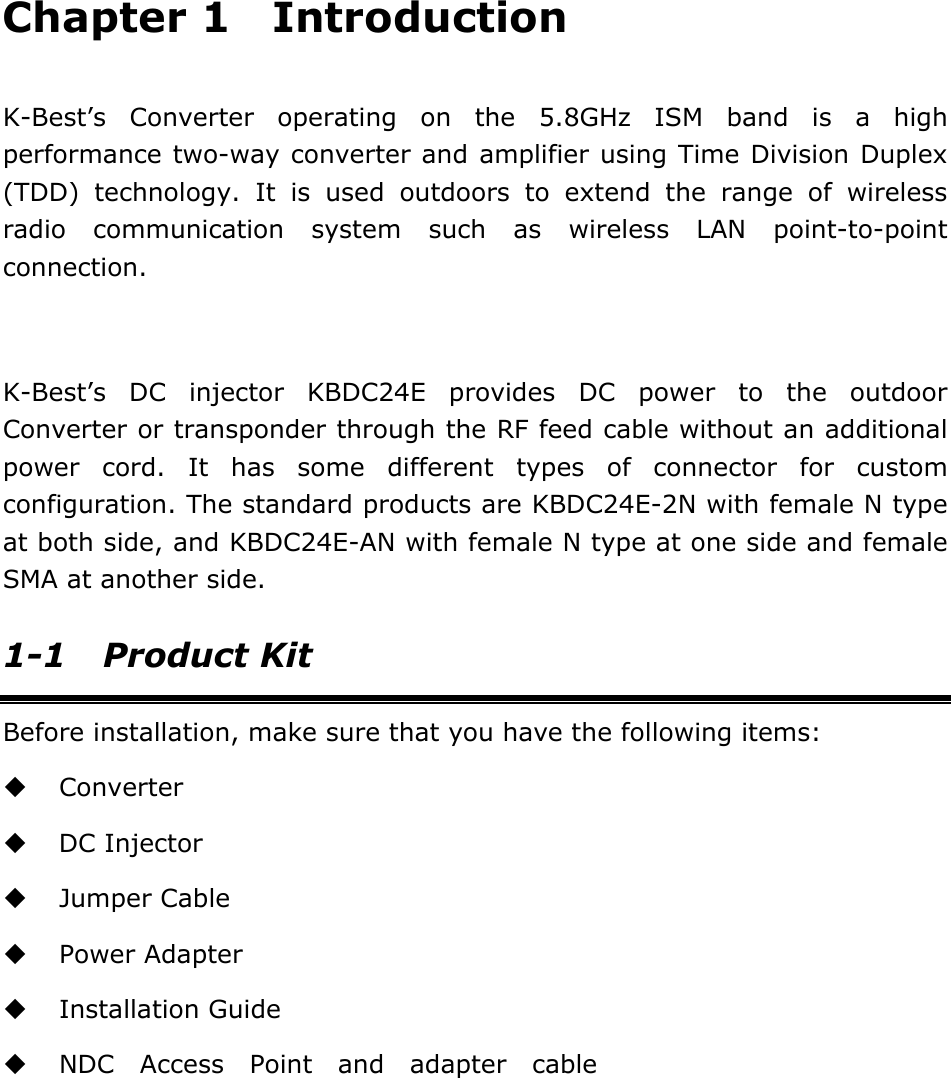
Chapter 1  Introduction  K-Best’s Converter operating on the 5.8GHz ISM band is a high performance two-way converter and amplifier using Time Division Duplex (TDD) technology. It is used outdoors to extend the range of wireless radio communication system such as wireless LAN point-to-point connection.  K-Best’s DC injector KBDC24E provides DC power to the outdoor Converter or transponder through the RF feed cable without an additional power cord. It has some different types of connector for custom configuration. The standard products are KBDC24E-2N with female N type at both side, and KBDC24E-AN with female N type at one side and female SMA at another side. 1-1 Product Kit Before installation, make sure that you have the following items:  Converter  DC Injector  Jumper Cable  Power Adapter  Installation Guide  NDC Access Point and adapter cable
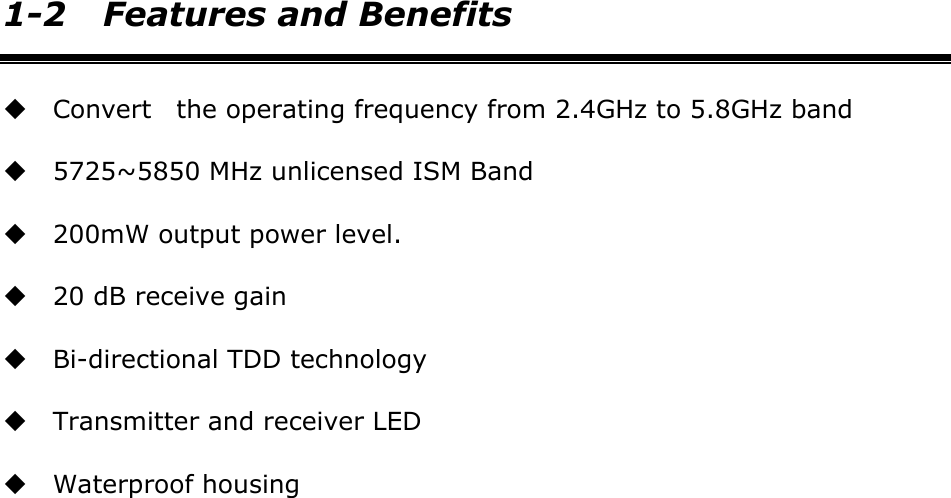
   1-2 Features and Benefits  Convert    the operating frequency from 2.4GHz to 5.8GHz band  5725~5850 MHz unlicensed ISM Band  200mW output power level.  20 dB receive gain  Bi-directional TDD technology  Transmitter and receiver LED  Waterproof housing
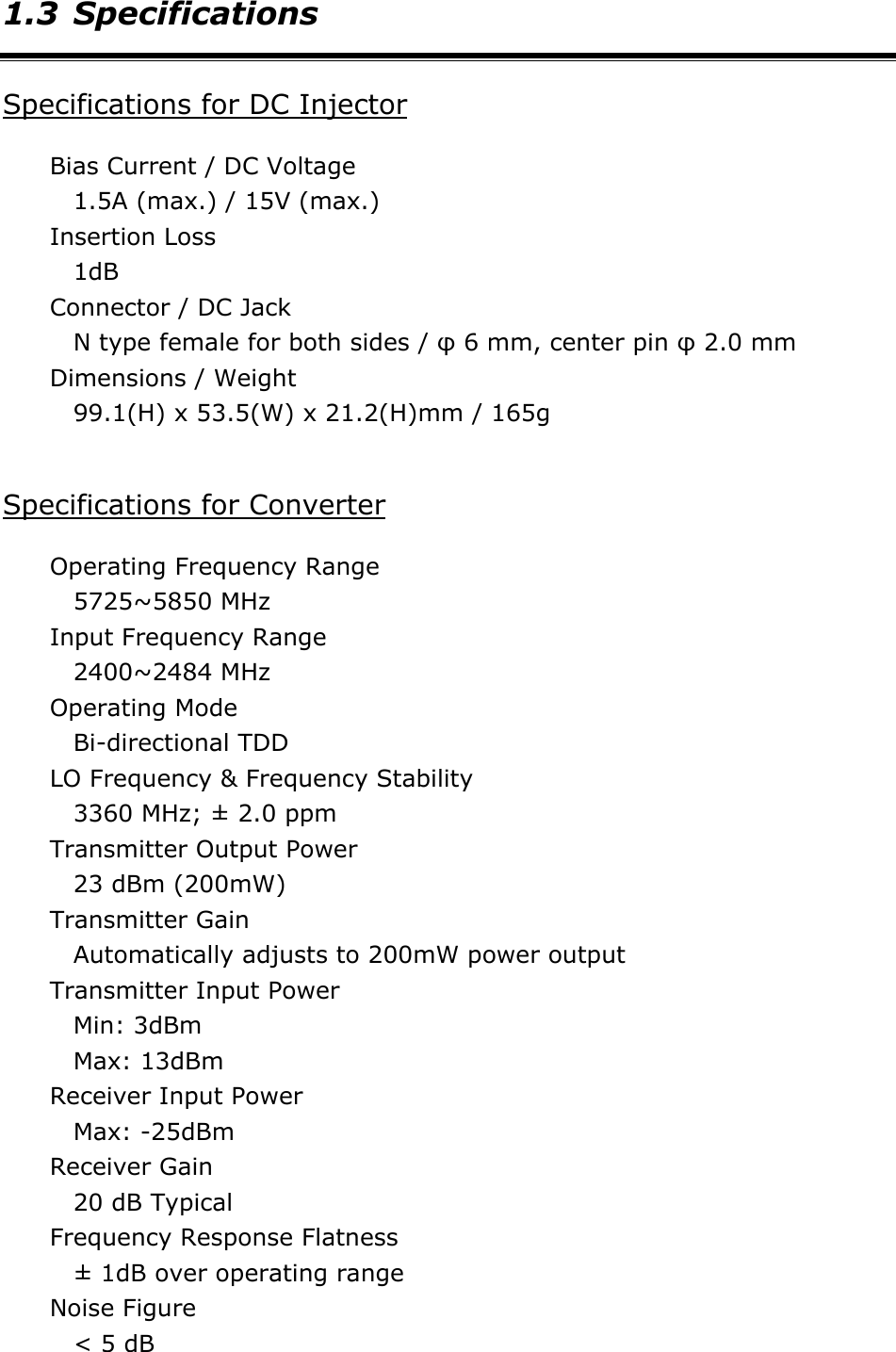
1.3 Specifications Specifications for DC Injector Bias Current / DC Voltage 1.5A (max.) / 15V (max.) Insertion Loss 1dB Connector / DC Jack N type female for both sides / φ 6 mm, center pin φ 2.0 mm Dimensions / Weight 99.1(H) x 53.5(W) x 21.2(H)mm / 165g  Specifications for Converter Operating Frequency Range 5725~5850 MHz   Input Frequency Range   2400~2484 MHz Operating Mode Bi-directional TDD LO Frequency & Frequency Stability 3360 MHz; ± 2.0 ppm Transmitter Output Power 23 dBm (200mW)   Transmitter Gain Automatically adjusts to 200mW power output Transmitter Input Power Min: 3dBm   Max: 13dBm   Receiver Input Power Max: -25dBm   Receiver Gain 20 dB Typical Frequency Response Flatness ± 1dB over operating range Noise Figure < 5 dB
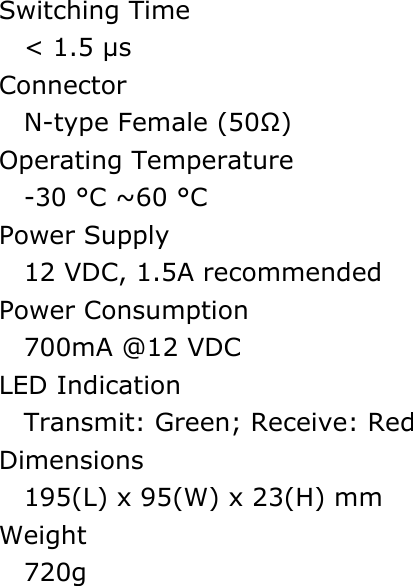
Switching Time < 1.5 µs Connector N-type Female (50Ω) Operating Temperature -30 °C ~60 °C Power Supply   12 VDC, 1.5A recommended Power Consumption 700mA @12 VDC LED Indication Transmit: Green; Receive: Red Dimensions 195(L) x 95(W) x 23(H) mm Weight  720g
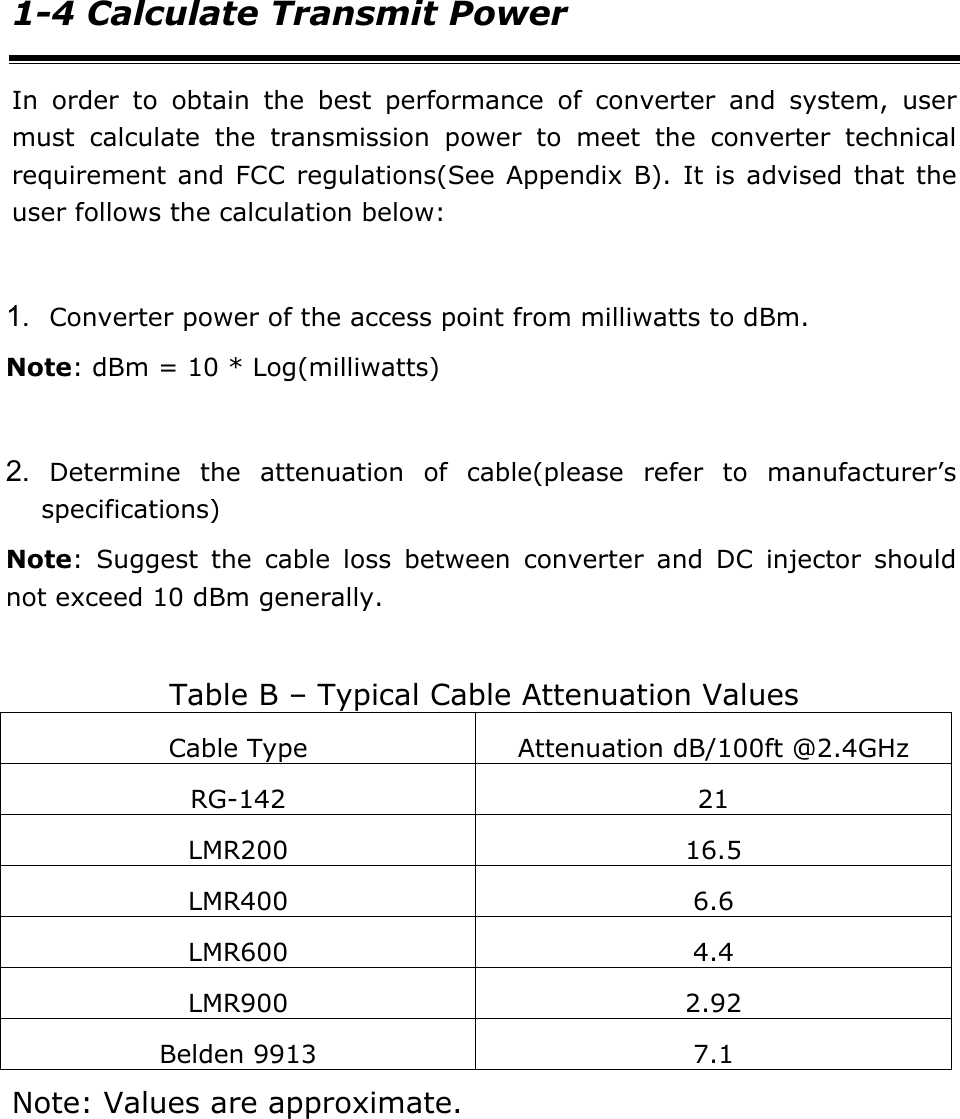
1-4 Calculate Transmit Power In order to obtain the best performance of converter and system, user must calculate the transmission power to meet the converter technical requirement and FCC regulations(See Appendix B). It is advised that the user follows the calculation below:  1. Converter power of the access point from milliwatts to dBm. Note: dBm = 10 * Log(milliwatts)  2. Determine the attenuation of cable(please refer to manufacturer’s specifications) Note: Suggest the cable loss between converter and DC injector should not exceed 10 dBm generally.  Table B – Typical Cable Attenuation Values Cable Type  Attenuation dB/100ft @2.4GHz RG-142 21 LMR200 16.5 LMR400 6.6 LMR600 4.4 LMR900 2.92 Belden 9913  7.1 Note: Values are approximate.
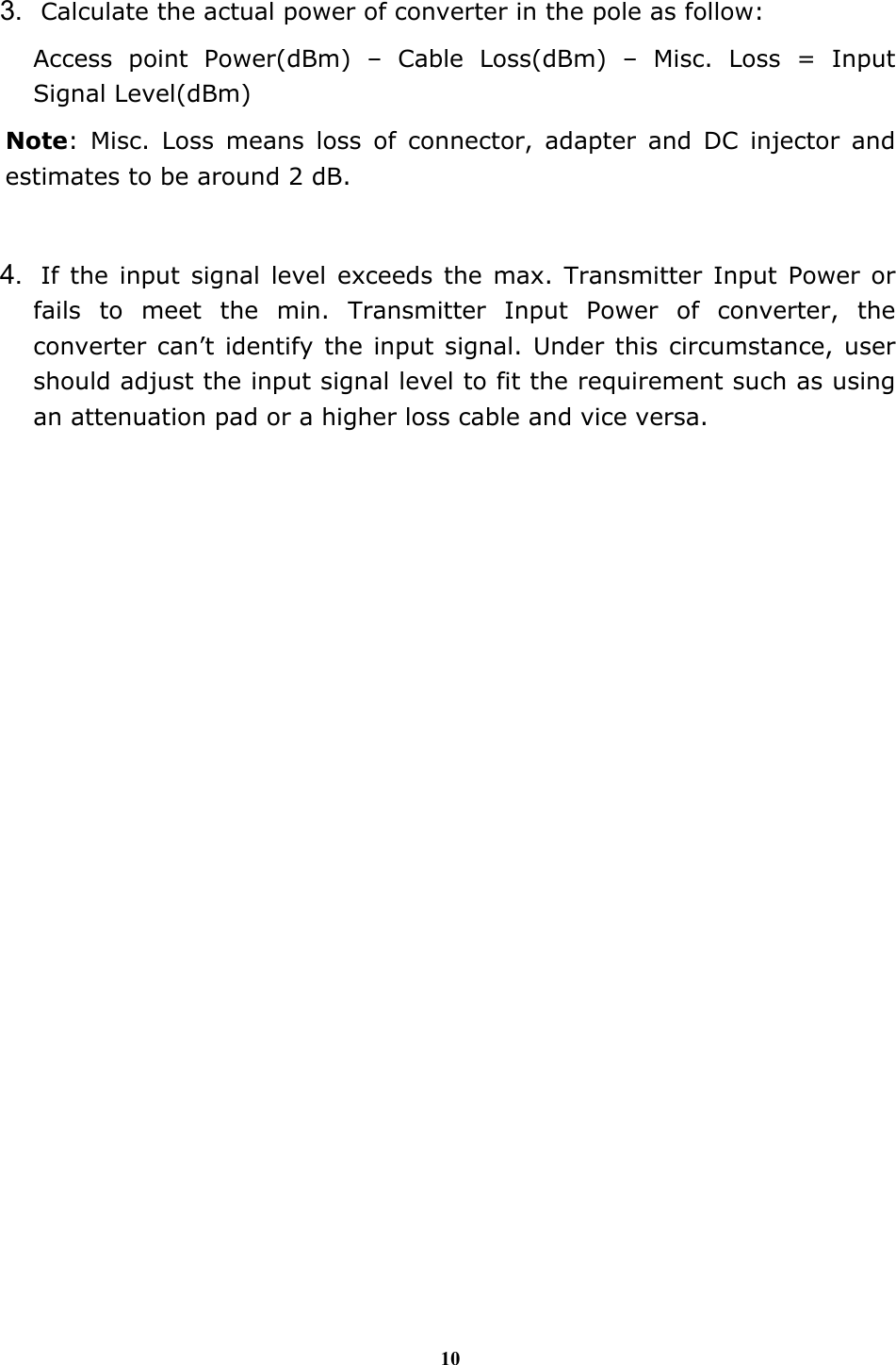
10  3. Calculate the actual power of converter in the pole as follow: Access point Power(dBm) – Cable Loss(dBm) – Misc. Loss = Input Signal Level(dBm) Note: Misc. Loss means loss of connector, adapter and DC injector and estimates to be around 2 dB.  4. If the input signal level exceeds the max. Transmitter Input Power or fails to meet the min. Transmitter Input Power of converter, the converter can’t identify the input signal. Under this circumstance, user should adjust the input signal level to fit the requirement such as using an attenuation pad or a higher loss cable and vice versa.
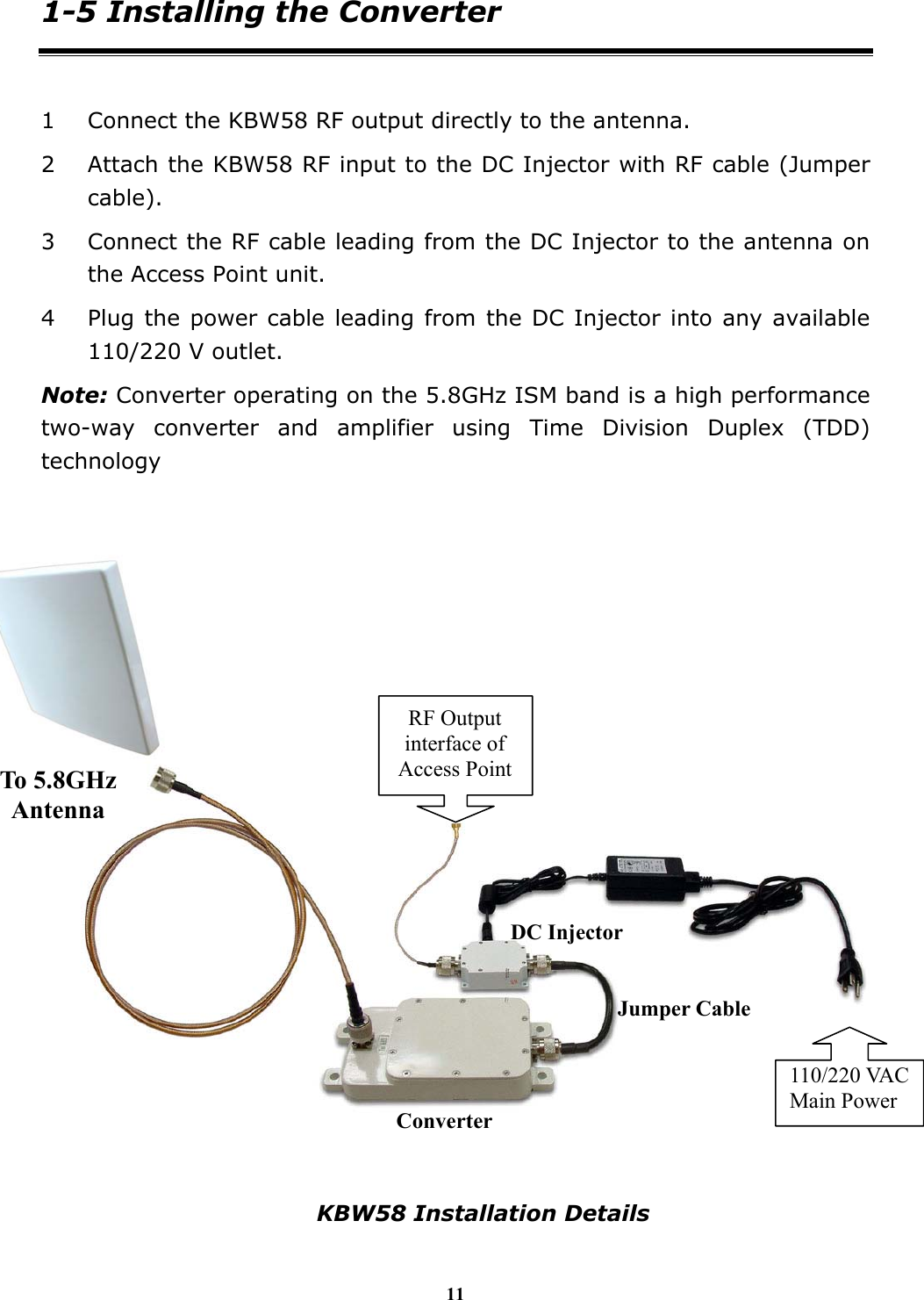
11 1-5 Installing the Converter  1 Connect the KBW58 RF output directly to the antenna. 2 Attach the KBW58 RF input to the DC Injector with RF cable (Jumper cable). 3 Connect the RF cable leading from the DC Injector to the antenna on the Access Point unit. 4 Plug the power cable leading from the DC Injector into any available 110/220 V outlet. Note: Converter operating on the 5.8GHz ISM band is a high performance two-way converter and amplifier using Time Division Duplex (TDD) technology        KBW58 Installation Details DC InjectorConverterJumper Cable 110/220 VAC Main Power To 5.8GHz Antenna RF Output interface of Access Point
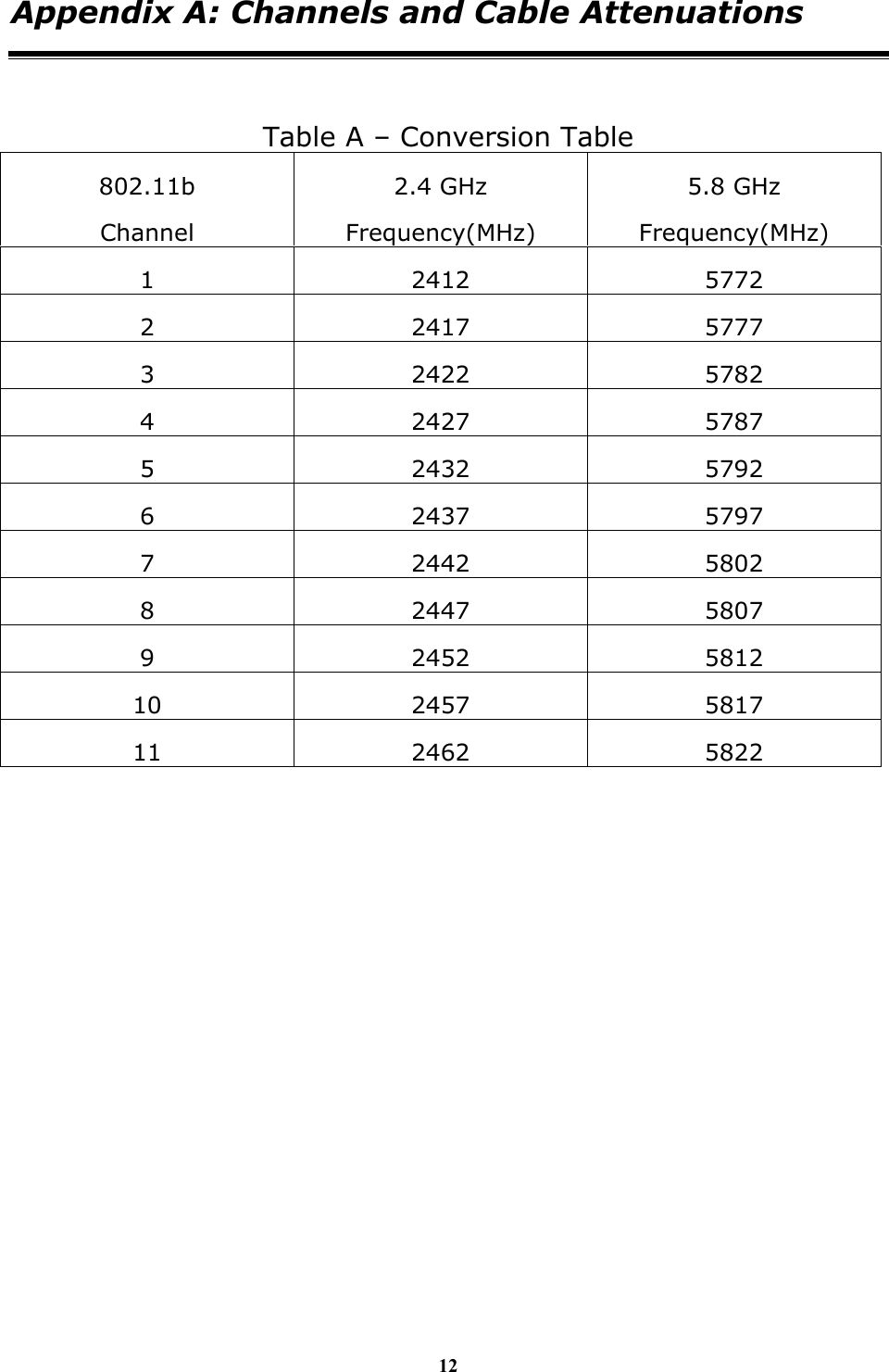
12 Appendix A: Channels and Cable Attenuations  Table A – Conversion Table 802.11b Channel 2.4 GHz Frequency(MHz) 5.8 GHz Frequency(MHz) 1 2412 5772 2 2417 5777 3 2422 5782 4 2427 5787 5 2432 5792 6 2437 5797 7 2442 5802 8 2447 5807 9 2452 5812 10 2457 5817 11 2462 5822
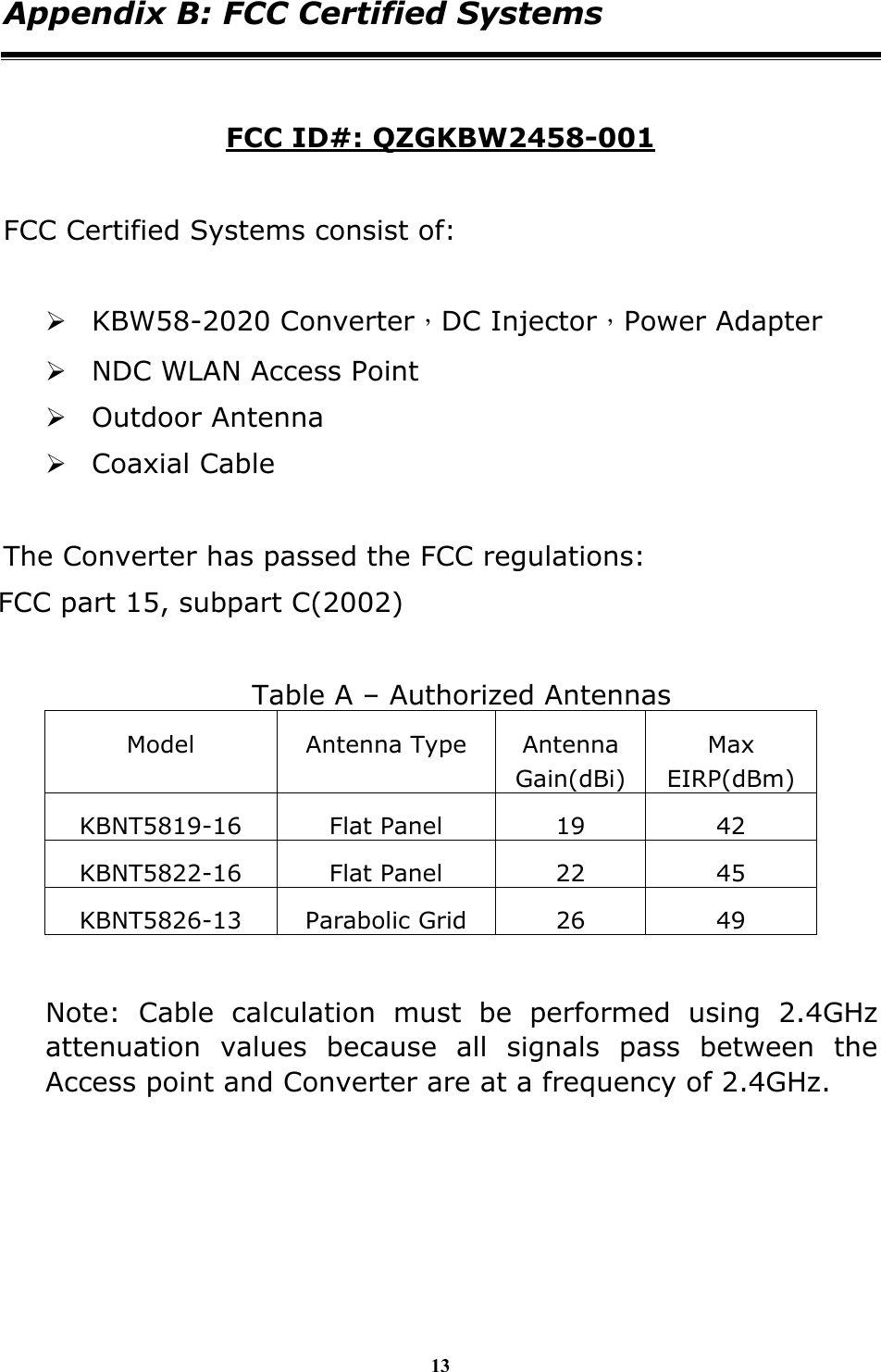
13 Appendix B: FCC Certified Systems  FCC ID#: QZGKBW2458-001  FCC Certified Systems consist of:     ¾ KBW58-2020 Converter,DC Injector,Power Adapter ¾ NDC WLAN Access Point ¾ Outdoor Antenna ¾ Coaxial Cable  The Converter has passed the FCC regulations: FCC part 15, subpart C(2002)  Table A – Authorized Antennas Model Antenna Type Antenna Gain(dBi) Max EIRP(dBm) KBNT5819-16 Flat Panel  19  42 KBNT5822-16 Flat Panel  22  45 KBNT5826-13 Parabolic Grid  26  49  Note: Cable calculation must be performed using 2.4GHz attenuation values because all signals pass between the Access point and Converter are at a frequency of 2.4GHz.
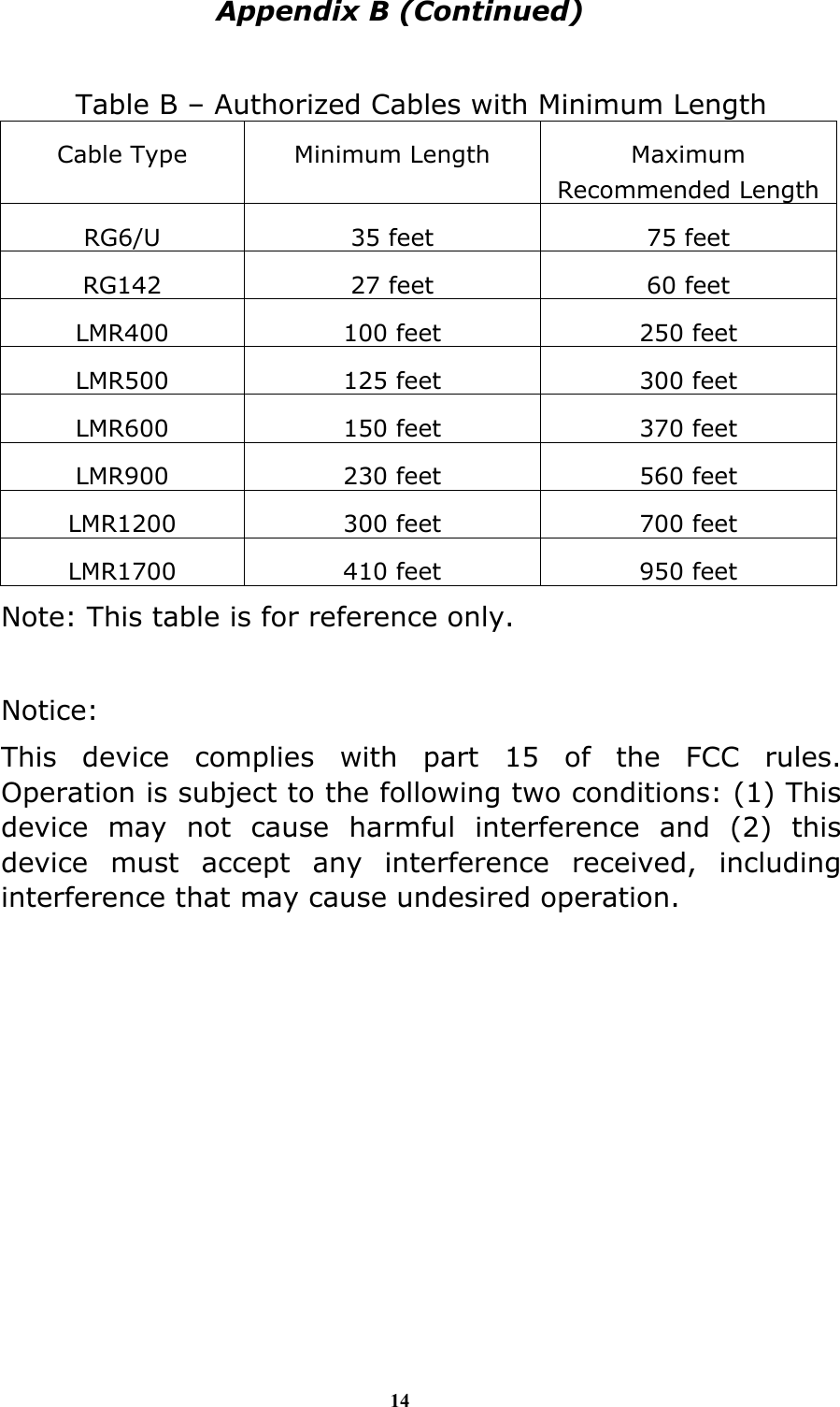
14 Appendix B (Continued)  Table B – Authorized Cables with Minimum Length Cable Type  Minimum Length  Maximum Recommended Length RG6/U  35 feet  75 feet RG142  27 feet  60 feet LMR400  100 feet  250 feet LMR500  125 feet  300 feet LMR600  150 feet  370 feet LMR900  230 feet  560 feet LMR1200  300 feet  700 feet LMR1700  410 feet  950 feet Note: This table is for reference only.  Notice: This device complies with part 15 of the FCC rules. Operation is subject to the following two conditions: (1) This device may not cause harmful interference and (2) this device must accept any interference received, including interference that may cause undesired operation.
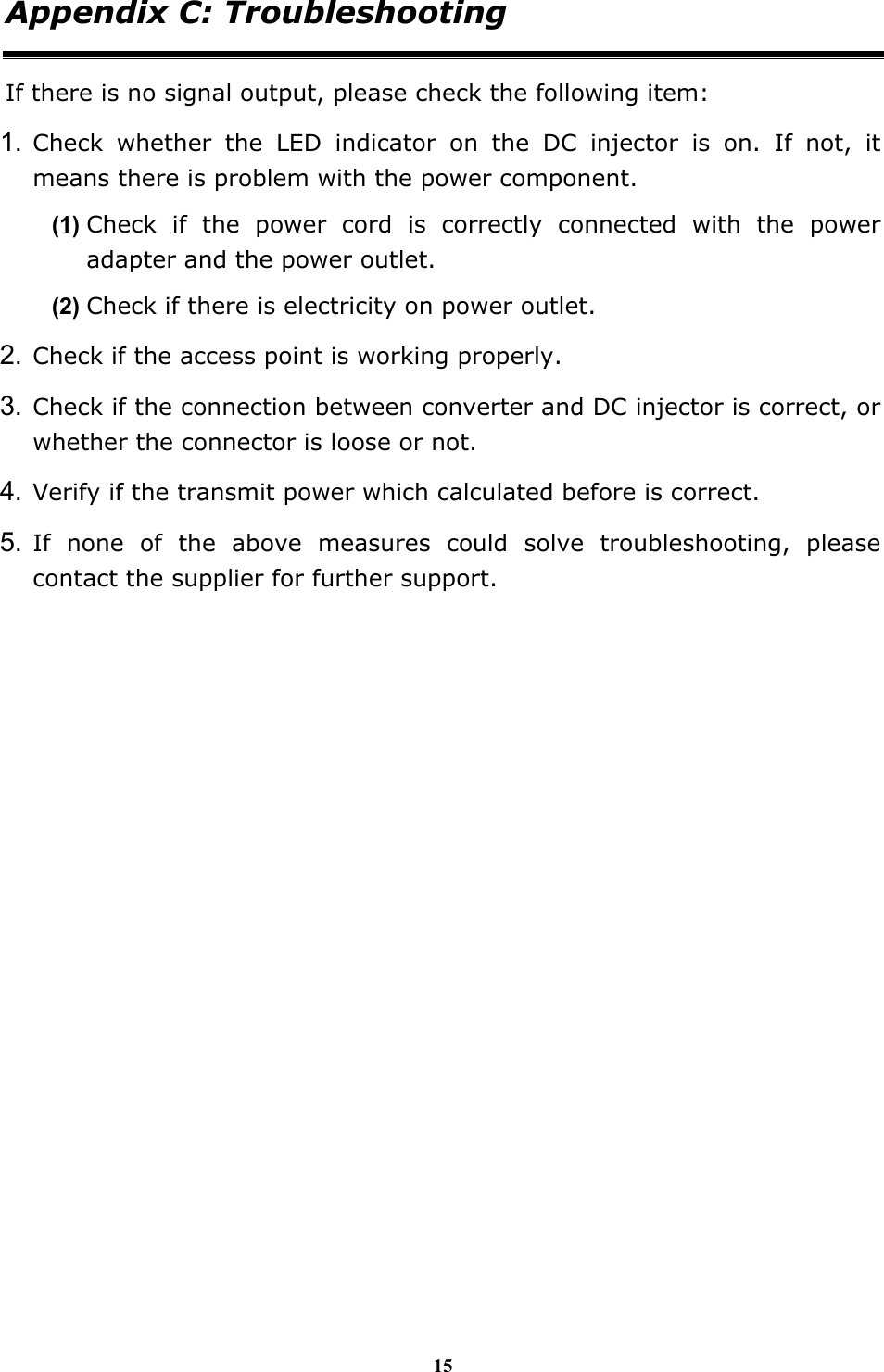
15 Appendix C: Troubleshooting If there is no signal output, please check the following item: 1. Check whether the LED indicator on the DC injector is on. If not, it means there is problem with the power component.   (1) Check if the power cord is correctly connected with the power adapter and the power outlet. (2) Check if there is electricity on power outlet.   2. Check if the access point is working properly. 3. Check if the connection between converter and DC injector is correct, or whether the connector is loose or not. 4. Verify if the transmit power which calculated before is correct. 5. If none of the above measures could solve troubleshooting, please contact the supplier for further support.

Navigation menu