Kenmore 38512490 User Manual SEWING MACHINE Manuals And Guides L0709233
KENMORE Mechanical Sewing Manual L0709233 KENMORE Mechanical Sewing Owner's Manual, KENMORE Mechanical Sewing installation guides
User Manual: Kenmore 38512490 38512490 KENMORE SEWING MACHINE - Manuals and Guides View the owners manual for your KENMORE SEWING MACHINE #38512490. Home:Laundry & Garment Care Parts:Kenmore Parts:Kenmore SEWING MACHINE Manual
Open the PDF directly: View PDF  .
.
Page Count: 52
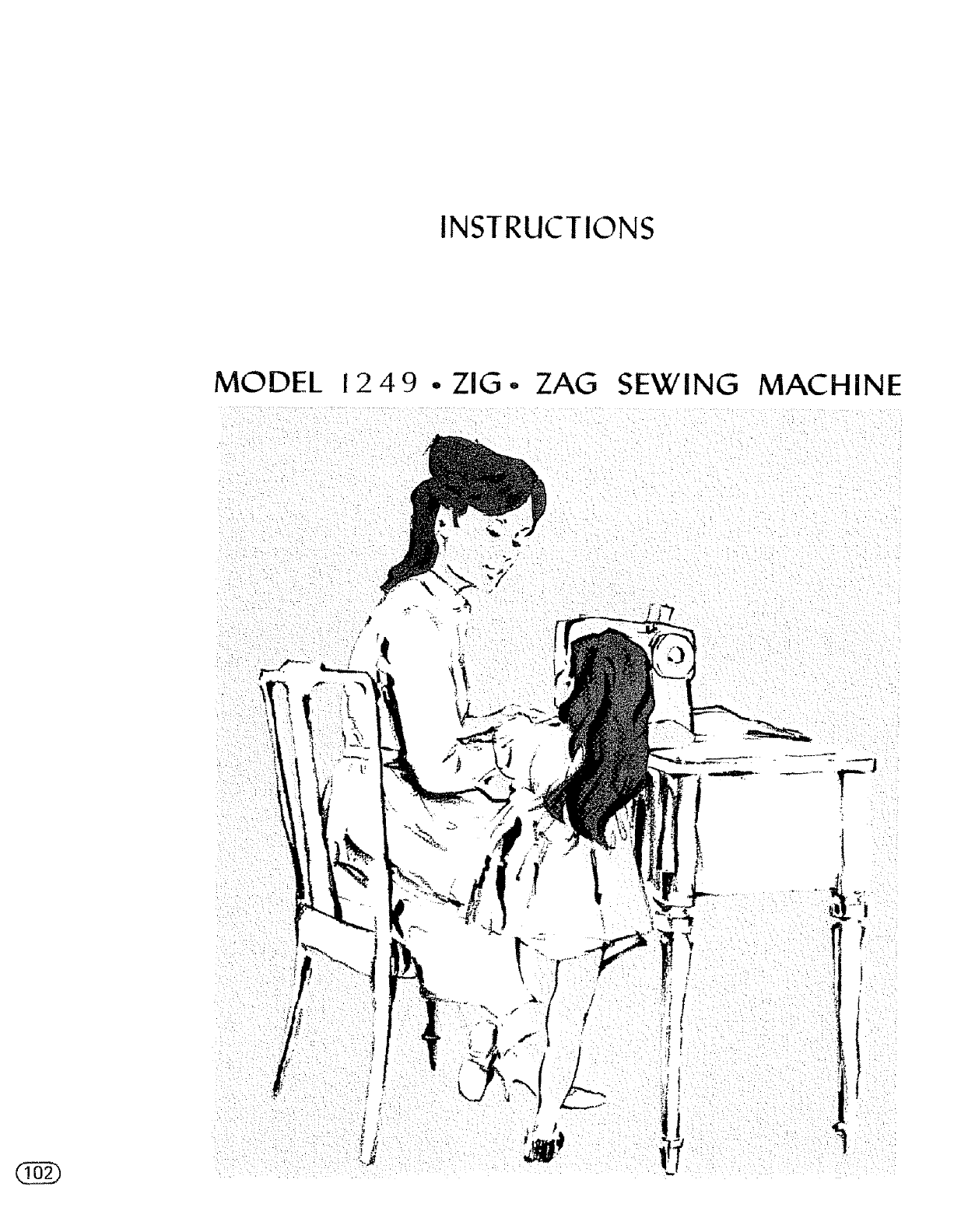
INSTRUCTIONS
MODEL 1249 . ZIG- ZAG SEWING MACHINE
(ZD
Sears, Roebuck and Co.
Dear Homemaker:
You have just invested in a very fine stretch stitch sewing machine. Be-
fore using your new Kenmore machine, please pause for a moment and
carefully read this booklet which contains instructions on how to oper-
ate and care for your machine.
Specific instructions are given on threading, tension adjustments, cIean-
ing, oiling, etc. This will help you obtain the best sewing results and
avoid unnecessary service expense for conditions beyond our control.
Advice on the operation and care of your machine is always available at
your nearest Sears Retail Store,
Please remember, any correspondence or reference to your machine
must mention the model number and serial number of your machine.
Kenmore Sewing Machine
Record in space provided below the model number
and serial number of this appliance° The model num-
ber and serial number' are located on the nomenclature
plate, as identified on Page 3 of this booklet.
Model No. Serial No
Retain these numbers for future reference.
,i;i!_!iiii!)_i_i_iii:I i _
_FI:i:_)! ¸ <
::ii!iil;!)_:i_):;::i¸:¸/5
! i: ¸ <
ii ?iiii _i! _,,_i
i_:i:iiii_;'_II_!I__i! :i)
TABLE OF
CONTENTS Section I Knowing Your Sewing Machine
Identifying Parts ................... 2, 3
Installing Machine ................... 4
Converting to Free-arm Sewing ............ 5
Winding the Bobbin ....................... 6
Threading the Bobbin Case ................ 7
Threading of Top Thread .................. 8
Using the Controls
Adjusting Top Tension ............... 9
Adjusting Bobbin Tension ............ 10
Checking Tensions ................... 11
Stitch Width Control ............ 12, 13
Stitch Length Control ............ 12, 13
Reverse Stitch Control ................ 14
Stretch Stitch Control ................ !4
Stitch Selector ................... 15, 16
Pressure Regulator ..................... ! 7
Sewing Light ........................... t8
Seam Guides ..................... 19
Presser Foot Lever ...................... 19
Accessories
Needles ......................... 20
Needle, Thread and Fabric Chart ......... 21
Presser Feet .......................... 22
Section |I Starting to Sew ................... 1
Garment Construction Stitches
Straight Stitching ....................... 2
Zigzag Stitching ................... 3
Stretch Stitching .................. 4
Special Finishing Stitches
Buttonhole Making ................. 5
Blind Hemming ...................... 6
Satin Stitching, Appliqueing ............ 7
Zipper Application .................... 8
Mending, Darning ........................ 9
Button Sewing, Bar Tacking .............. 10
Free-arm Sewing ................... t 1
Section 11] Checking Performance Problems
Section IV Caring for the Machine
Cleaning Feed Dogs and Shuttle ......... !
Oiling Under Arm Cover Plate .......... 2
Oiling Underside ...................... 3
Oiling in Face Cover Plate .................. 4
Parts List .................... 5, 6
Memo .................................... 7
Warranty ........................... 8
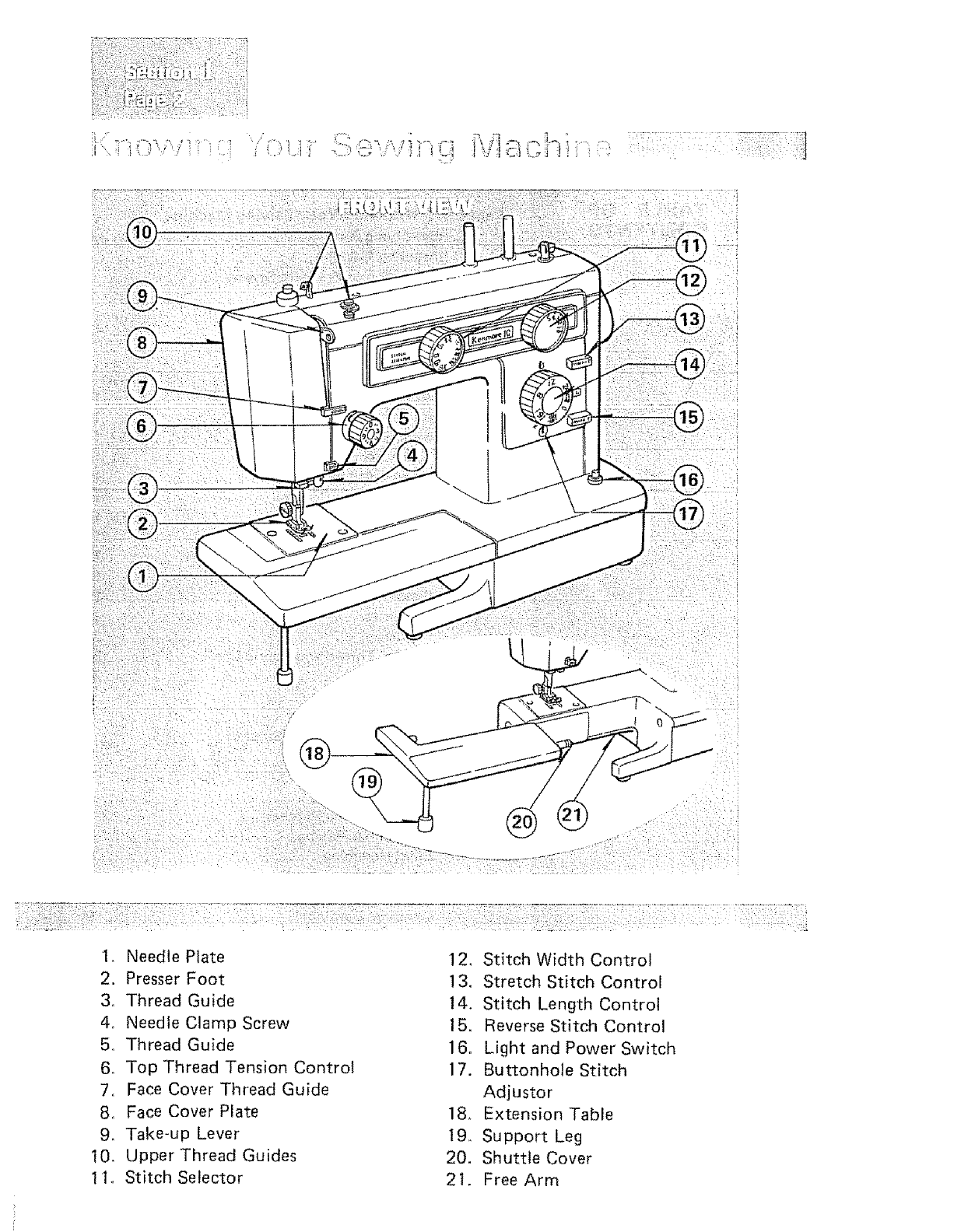
I. Needle Plate
2. Presser Foot
3. Thread Guide
4. Needle Clamp Screw
5. Thread Guide
6, Top Thread Tension Control
7. Face Cover Thread Guide
8, Face Cover Plate
9. Take-up Lever
10. Upper Thread Guides
1 1, Stitch Selector
12. Stitch Width Control
13. Stretch Stitch Control
14. Stitch Length Control
15. Reverse Stitch Control
16. Light and Power Switch
17. Buttonhole Stitch
Adjustor
18_ Extension Table
19. Support Leg
20. Shuttle Cover
2t. Free Arm
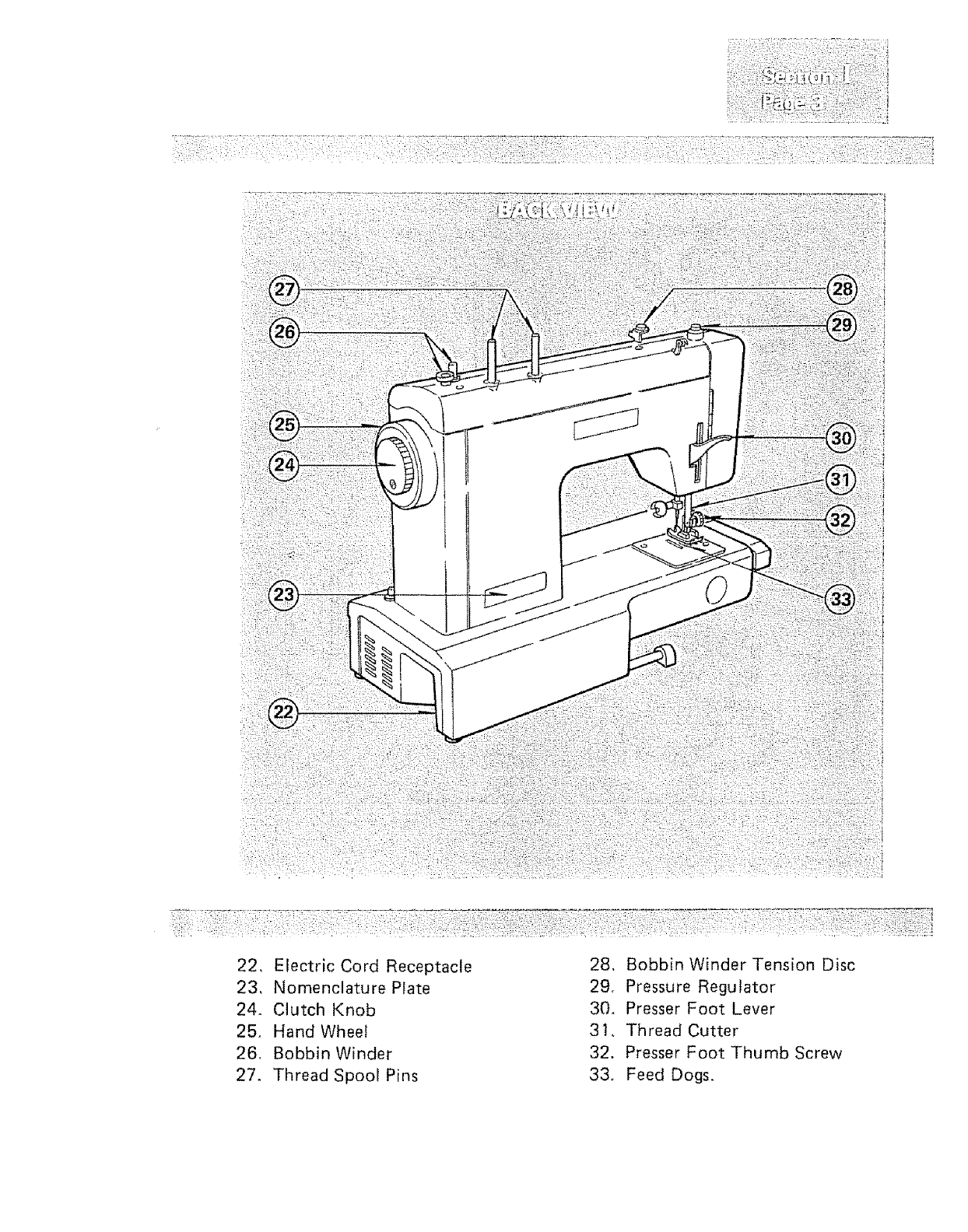
22, Electric Cord Receptacle
23, Nomenclature Plate
24. Clutch Knob
25° Hand Wheel
26, Bobbin Winder
27. Thread Spool Pins
28, Bobbin Winder Tension Disc
29. Pressure Regulator
30. Presser Foot Lever
3t, Thread Cutter
32. Presser Foot Thumb Screw
33. Feed Dogs.
1_ ST_ LL ii!!_ J_,/__::_C_i !i¸,i _ii
\
Fig. 1 Fig, 3
Discs
Fig, 2 Fig. 4
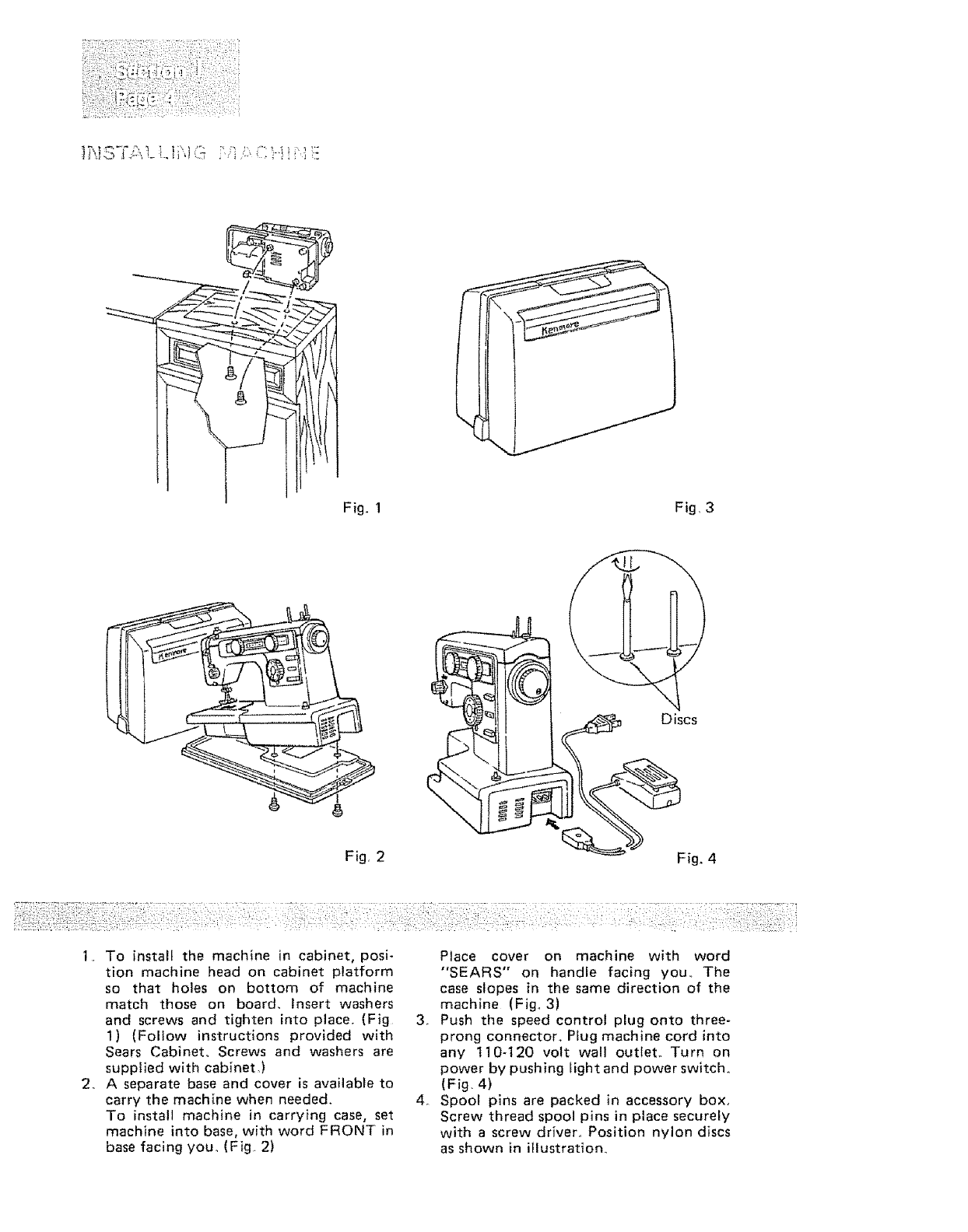
1 To install the machine in cabinet, posi-
tion machine head on cabinet platform
so that holes on bottom of machine
match those on board, Insert washers
and screws and tighten into place° (Fig
1) (Follow instructions provided with
Sears Cabinet, Screws and washers are
supplied with cabinet.)
2, A separate base and cover is available to
carry the machine when needed.
To install machine in carrying case, set
machine into base, with word FRONT in
base facing you, (Fig 2)
.
4.
Place cover on machine with word
"SEARS" on handle facing you., The
case slopes in the same direction of the
machine (Fig_ 3)
Push the speed control plug onto three-
prong connector_ Plug machine cord into
any 110-120 volt wall outlet. Turn on
power by poshing light and power switch.
(Fig, 4)
Spool pins are packed in accessory box,
Screw thread spool pins in place securely
with a screw driver, Position nylon discs
as shown in illustration.
:,i ¸ _ , ;. _ .-
• ,_,_ i _i_:i _i:_'_ i_i_:i!'i:i_i. __'_.i_ii_'_,,_ii_!_i_!_.'_/!/]__i_
Fig_ I
Fig 2
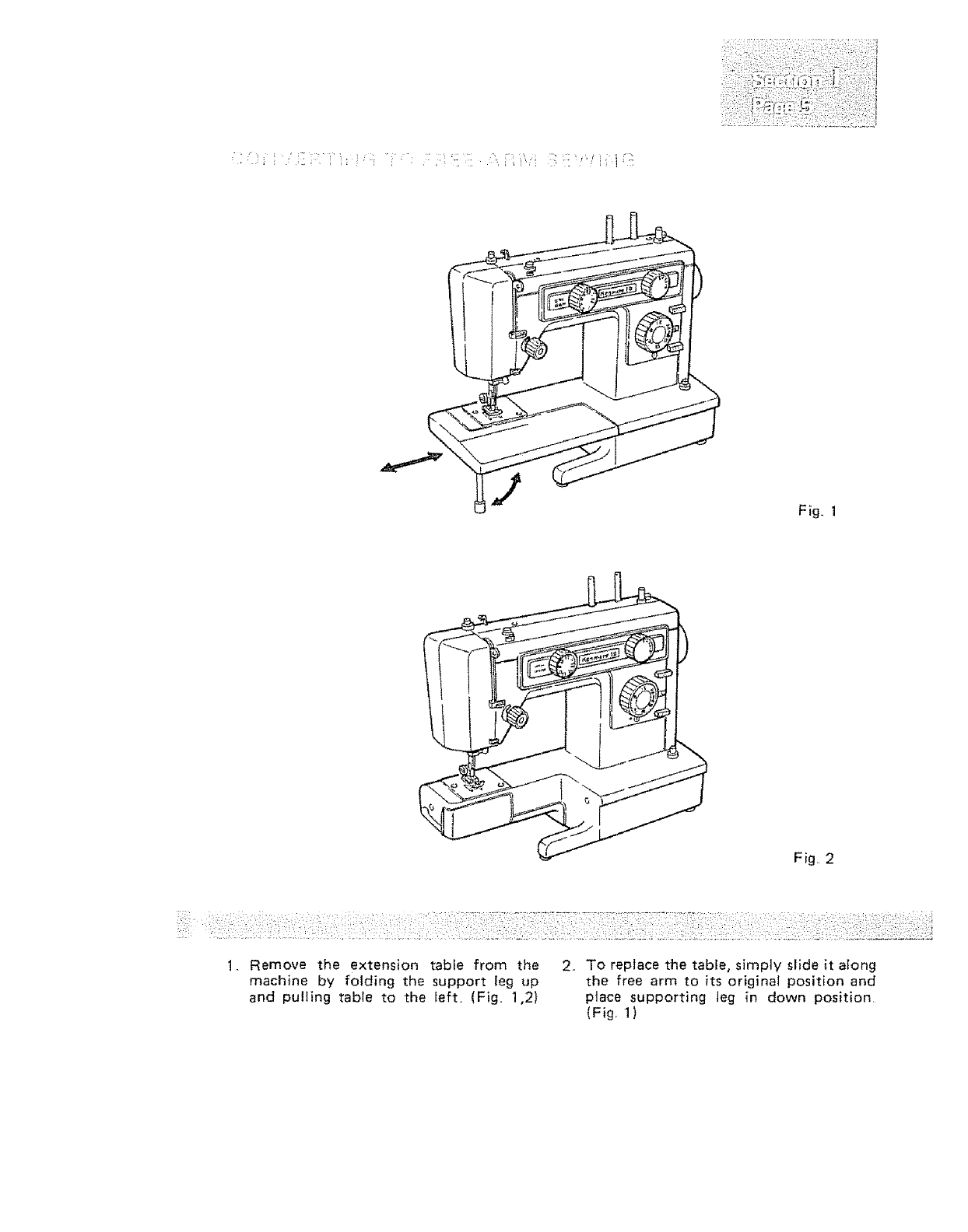
1. Remove the extension table from the
machine by folding the support leg up
and pulling table to the Ieft. (Fig.. 1,2)
2. To replace the table, simply slide it along
the free arm to its original position and
place supporting leg in down position
{Fig, 1 )
@
®
®®
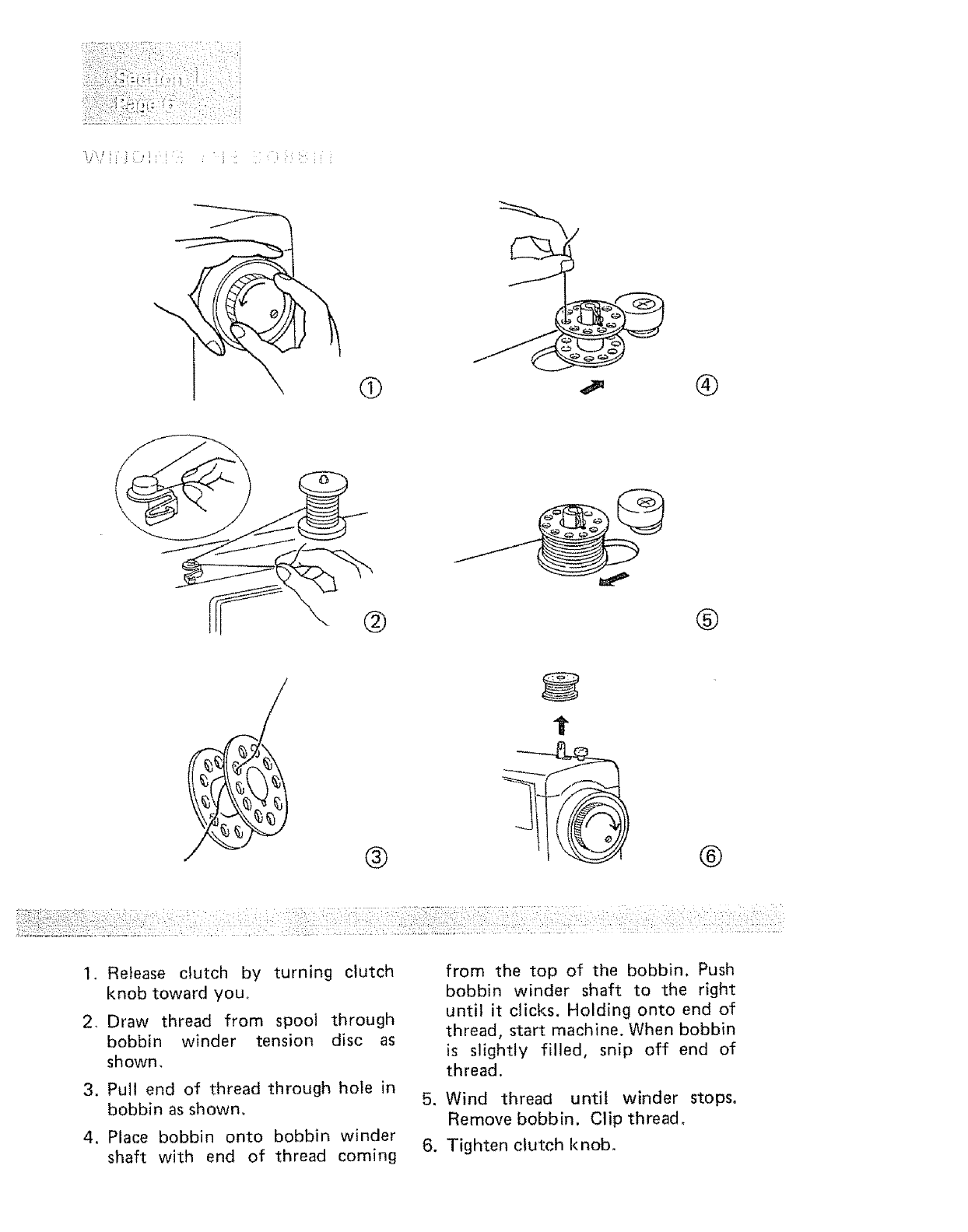
1. Release clutch by turning clutch
knob toward you.
2. Draw thread from spool through
bobbin winder tension disc as
shown,
3. Pull end of thread through hole in
bobbin as shown,
4. Place bobbin onto bobbin winder
shaft with end of thread coming
from the top of the bobbin. Push
bobbin winder shaft to the right
until it clicks. Holding onto end of
thread, start machine. When bobbin
is slightly filled, sn_p off end of
thread.
5. Wind thread until winder stops,
Remove bobbin. Clip thread.
6. Tighten clutch knob.
®®
\
@ ® ®
® ® ®
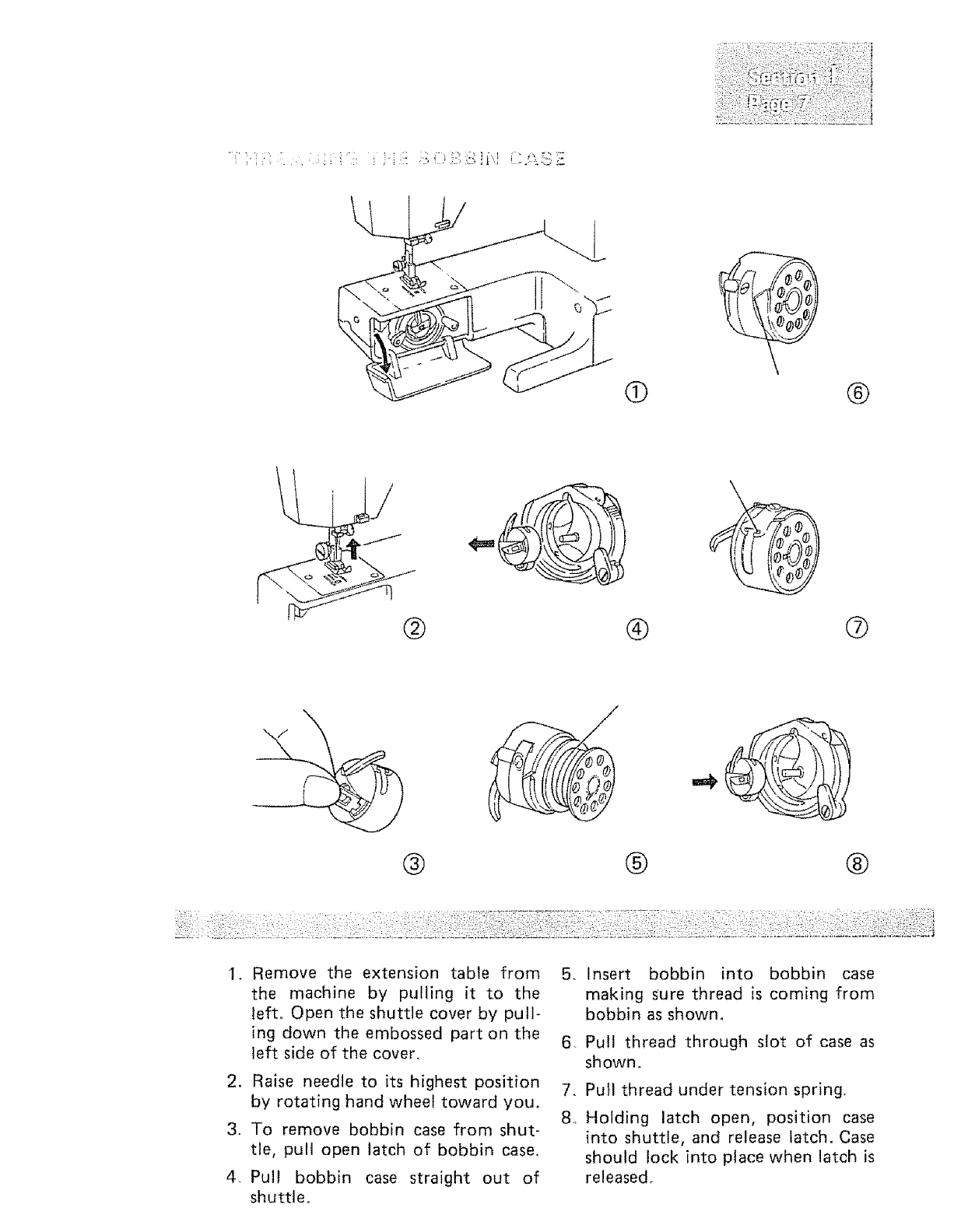
1. Remove the extension table from
the machine by pulling it to the
left, Open the shuttle cover by pull-
ing down the embossed part on the
left side of the cover,
2. Raise needle to its highest position
by rotating hand wheel toward you.
3. To remove bobbin case from shut-
tle, pull open latch of bobbin case,
4. Pull bobbin case straight out of
shuttle.
5. Insert bobbin into bobbin case
making sure thread is coming from
bobbin as shown.
6- Pull thread through slot of case as
shown.
7. Pull thread under tension spring.
8., Holding latch open, position case
into shuttle, and release latch. Case
should lock into place when latch is
released.
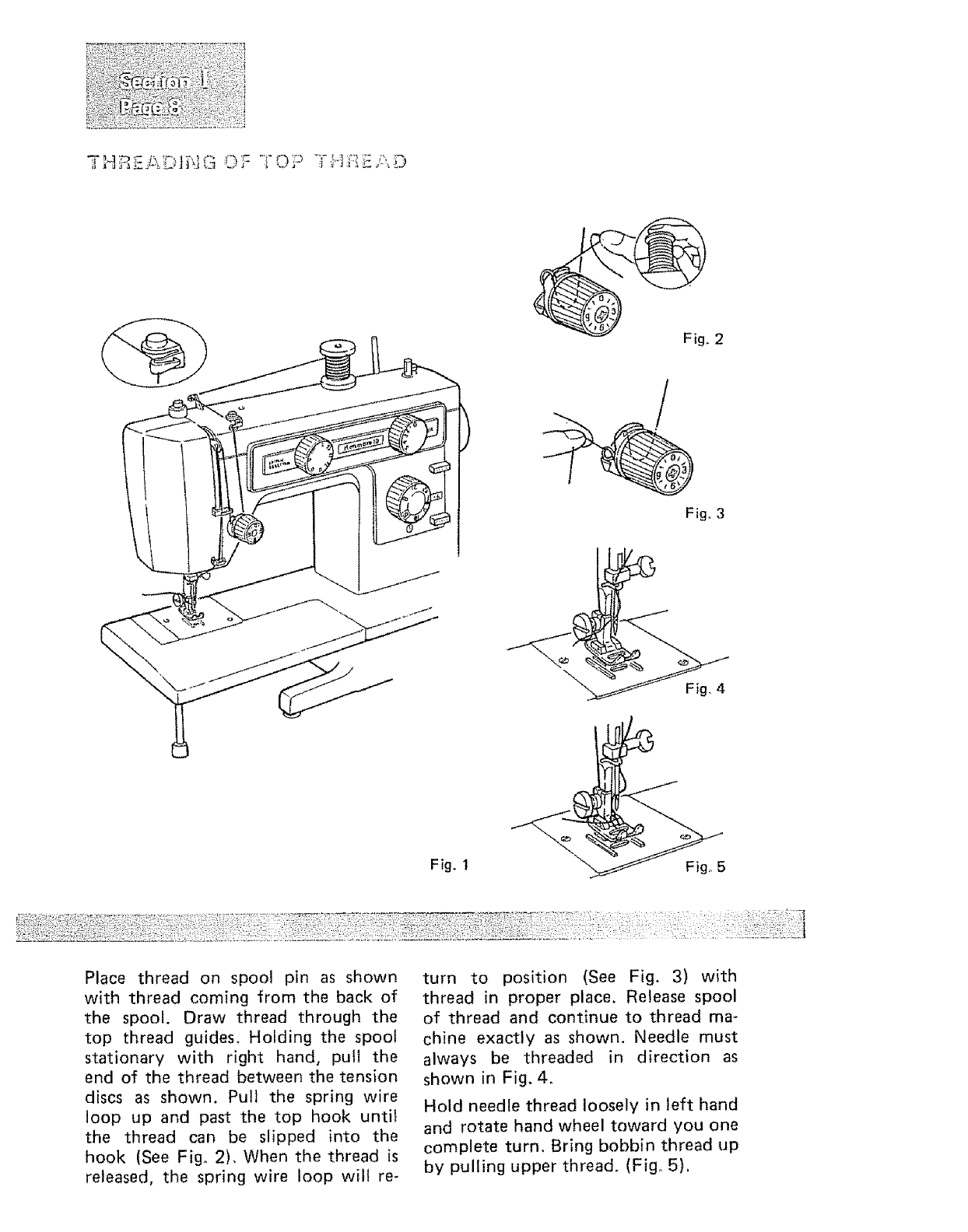
Fig_2
Fig.3
Fig. I
Fig_ 4
Place thread on spool pin as shown
with thread coming from the back of
the spool. Draw thread through the
top thread guides, Holding the spool
stationary with right hand, pull the
end of the thread between the tension
discs as shown. Pull the spring wire
loop up and past the top hook until
the thread can be slipped into the
hook (See Fig° 2), When the thread is
released, the spring wire loop will re-
turn to position (See Fig. 3) with
thread in proper place. Release spool
of thread and continue to thread ma-
chine exactly as shown, Needle must
always be threaded in direction as
shown in Fig. 4,
Hold needle thread loosely in left hand
and rotate hand wheel toward you one
complete turn, Bring bobbin thread up
by pulling upper thread° (Fig, 5).
i"i i
/:"L:_j!i S"ii* i_¸'___¸_:_i _0 _::_' _ i'¸i :!i!_i ¢_i:,,__:-'
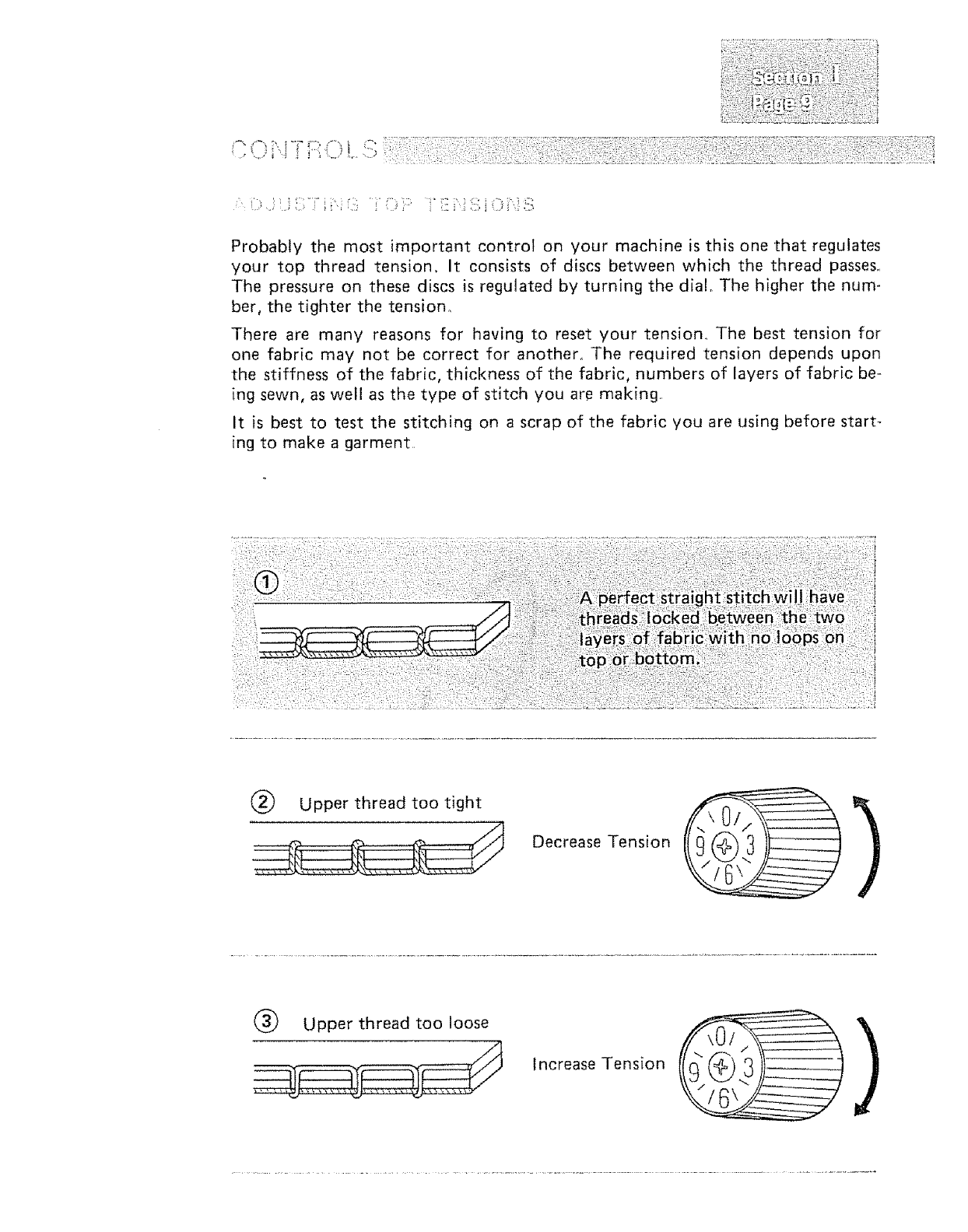
Probably the most important control on your machine is this one that regulates
your top thread tension. It consists of discs between which the thread passes..
The pressure on these discs is regulated by turning the dial. The higher the num-
ber, the tighter the tenston°
There are many reasons for having to reset your tension_ The best tension for
one fabric may not be correct for another.. The required tension depends upon
the stiffness of the fabric, thickness of the fabric, numbers of layers of fabric be-
ing sewn, as well as the type of stitch you are making.
It is best to test the stitching on a scrap of the fabric you are using before start-
ing to make a garment
(_ Upper thread too tight
Decrease Tension
Upper thread too loose
Increase Tension
............ _,_ ;4 • _,, _ _
............. ,t, ....._ > :::}i,J
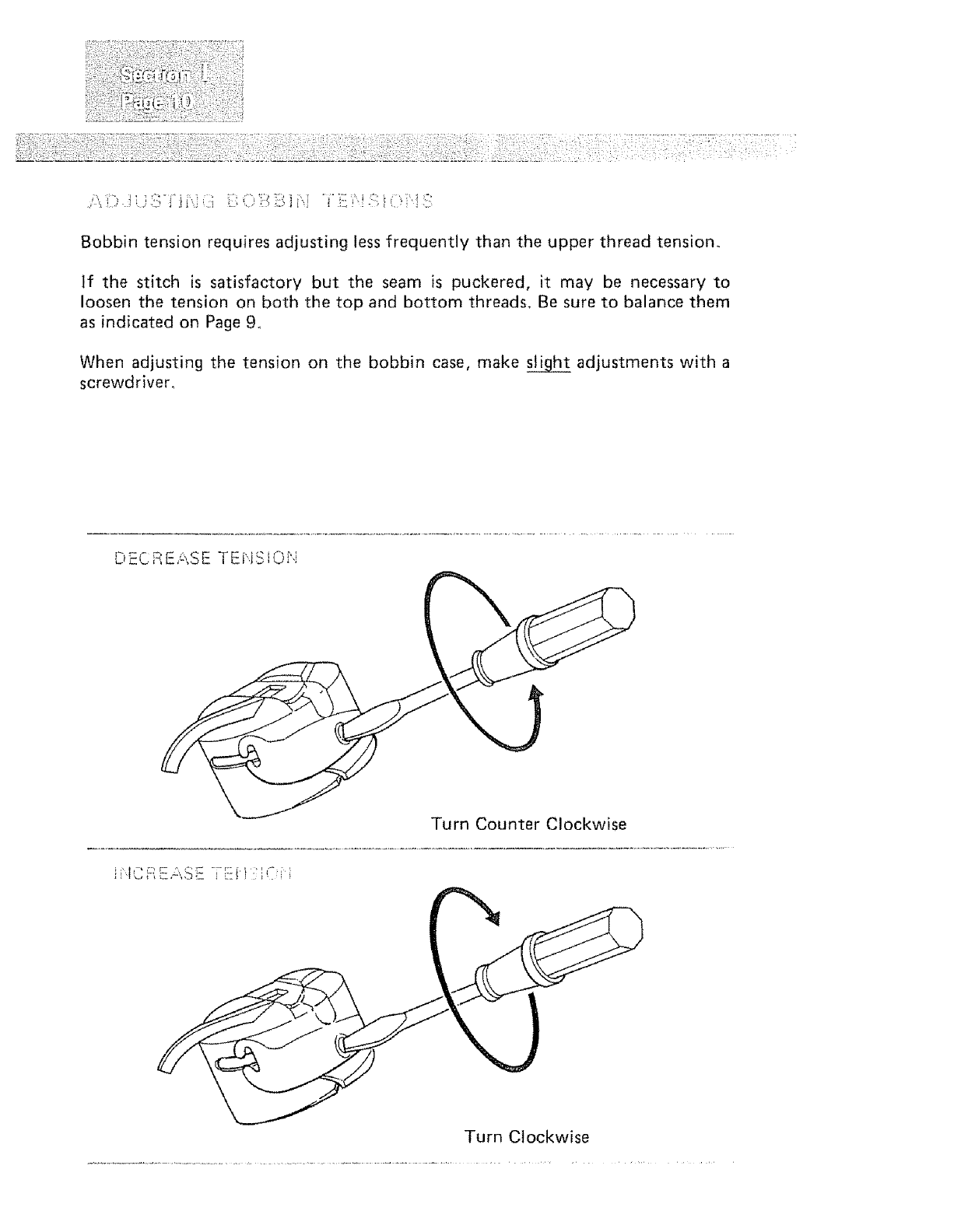
Bobbin tension requires adjusting less frequently than the upper thread tension.
If the stitch is satisfactory but the seam is puckered, it may be necessary to
loosen the tension on both the top and bottom threads. Be sure to balance them
as indicated on Page 9.
When adjusting the tension on the bobbin case, make _ adjustments with a
screwdriver.
D2CREASE -iEHStON
Turn Counter Clockwise
Turn Clockwise
,__:..... _ii} J;:i!_,i_,i;;:_i¸¸iiii::
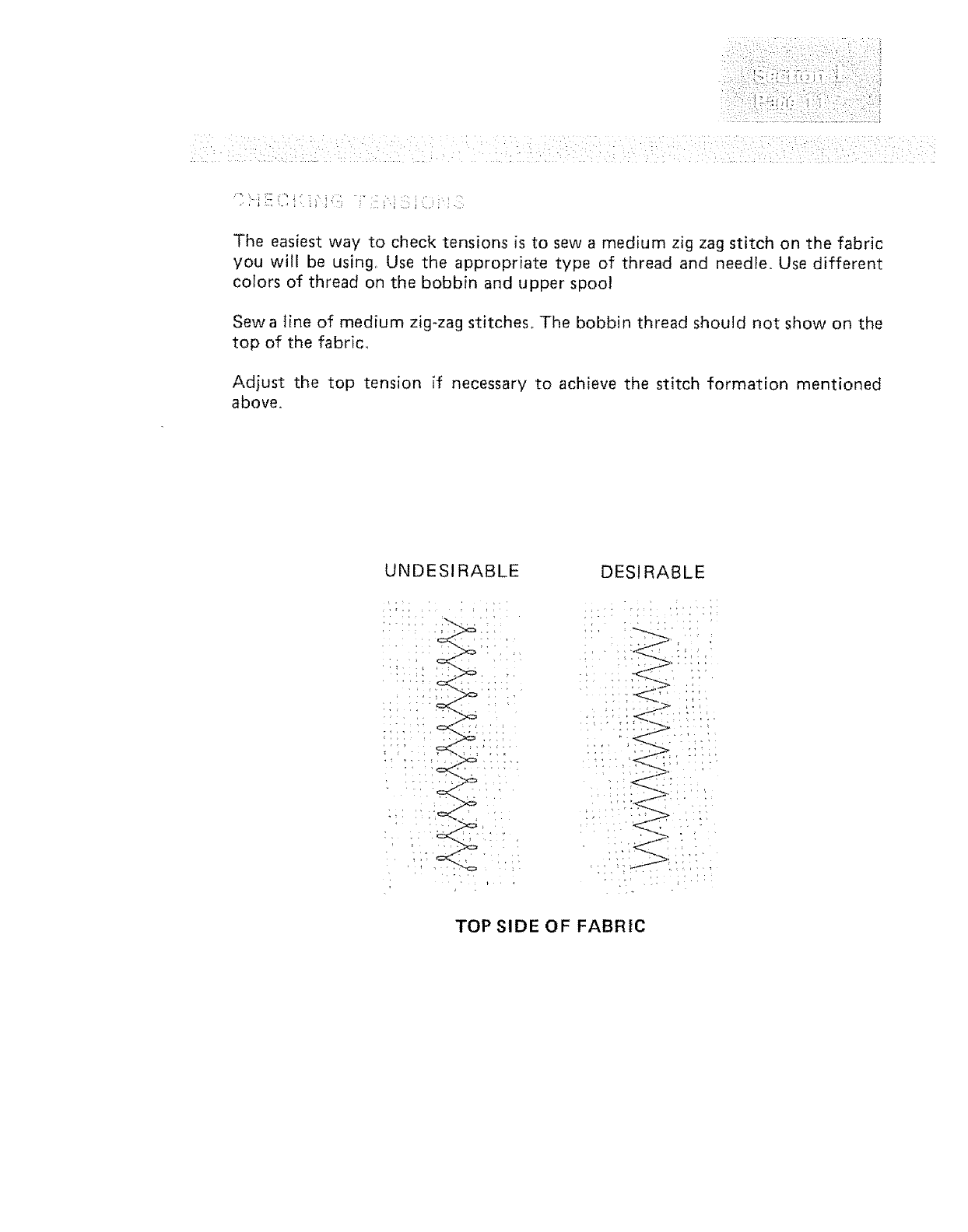
The easiestway to checktensions is to sewa medium zigzagstitch on the fabric
you will be using, Usethe appropriate type of thread and needle.Usedifferent
colors of thread on the bobbin and upper spool
Sewa line of medium zig-zagstitches_The bobbin thread should not show on the
top of the fabric,,
Adjust the top tension if necessaryto achievethe stitch formation mentioned
above.
UNDESIRABLE DESIRABLE
. ,}' , <L
.<L
TOP SIDE OF FABRIC
iii_i _ii/_: _L_ ¸ •
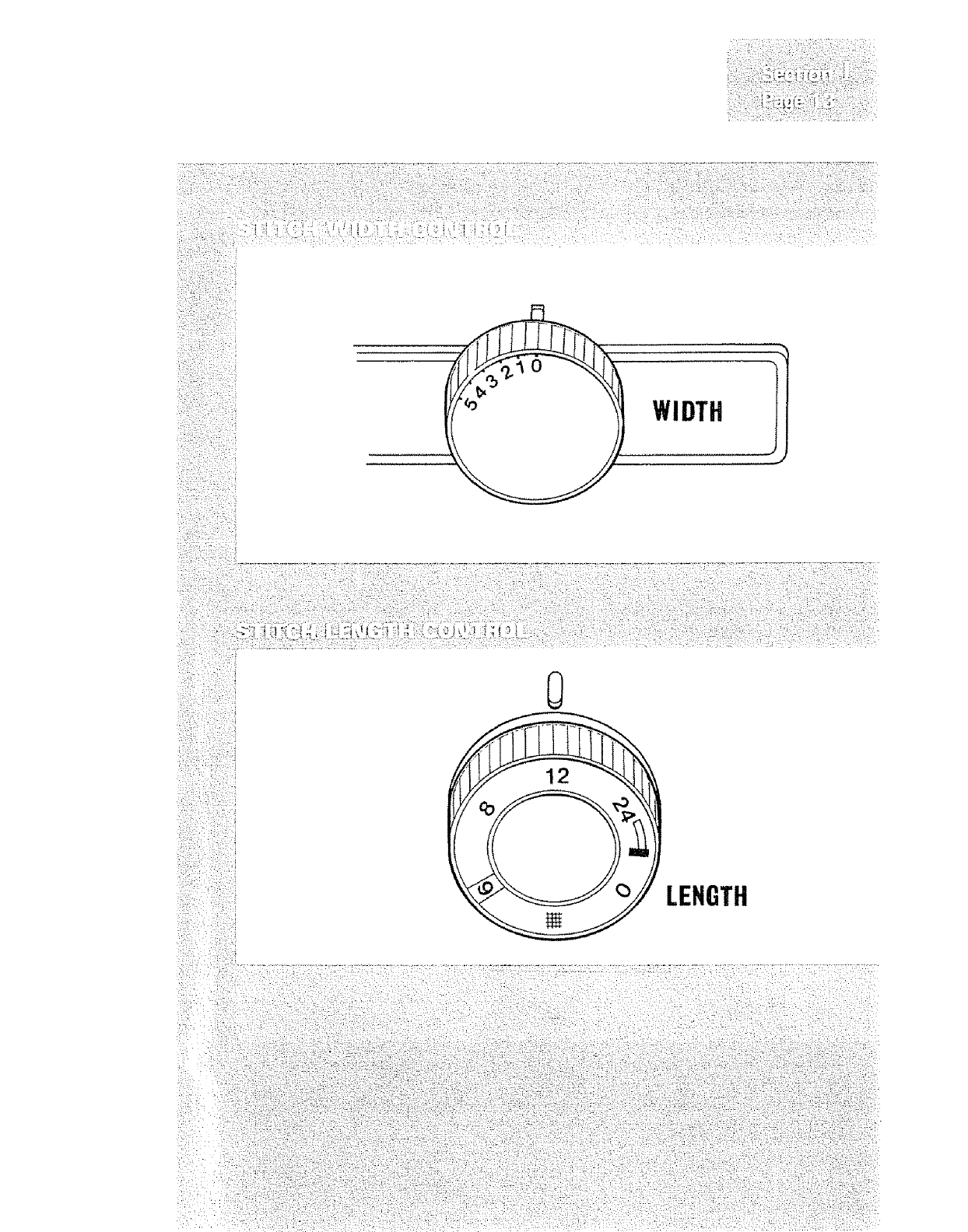
=control regulates the width of the stitch you select° THE HIGHER THE
i:: NUMBER-THE WIDER THE STITCH° You may vary your zigzag stitch width
by adjusting this control to the setting you desire.
_This control must be set on "'0" position in order to do straight stitching°
........
: iThe stitch length control regulates the length of the stitch you select, THE
IIGHER THE NUMBER_THE SHORTER THE STITCH.
;L ................. i
The number on stitch length control indicates the approximate number of stitch_
inch° The stitch setting you use will be determined by the thickness of the
:fabric you are sewing,
i
longer stitch setting should be used for thicker fabric or more layers of fabric.
,: Themiddle range of the control is the t0-12 stitch per inch range which is the
;ommonly used,
basting stitch is made by using the longest possible stitch setting-6 stitches per
green marking _ on the control is the setting used for the
stitches such as in Satin Stitching.
; marking on the control is the setting used for darning or embroider-
WIDTH
O
LENGTH
\
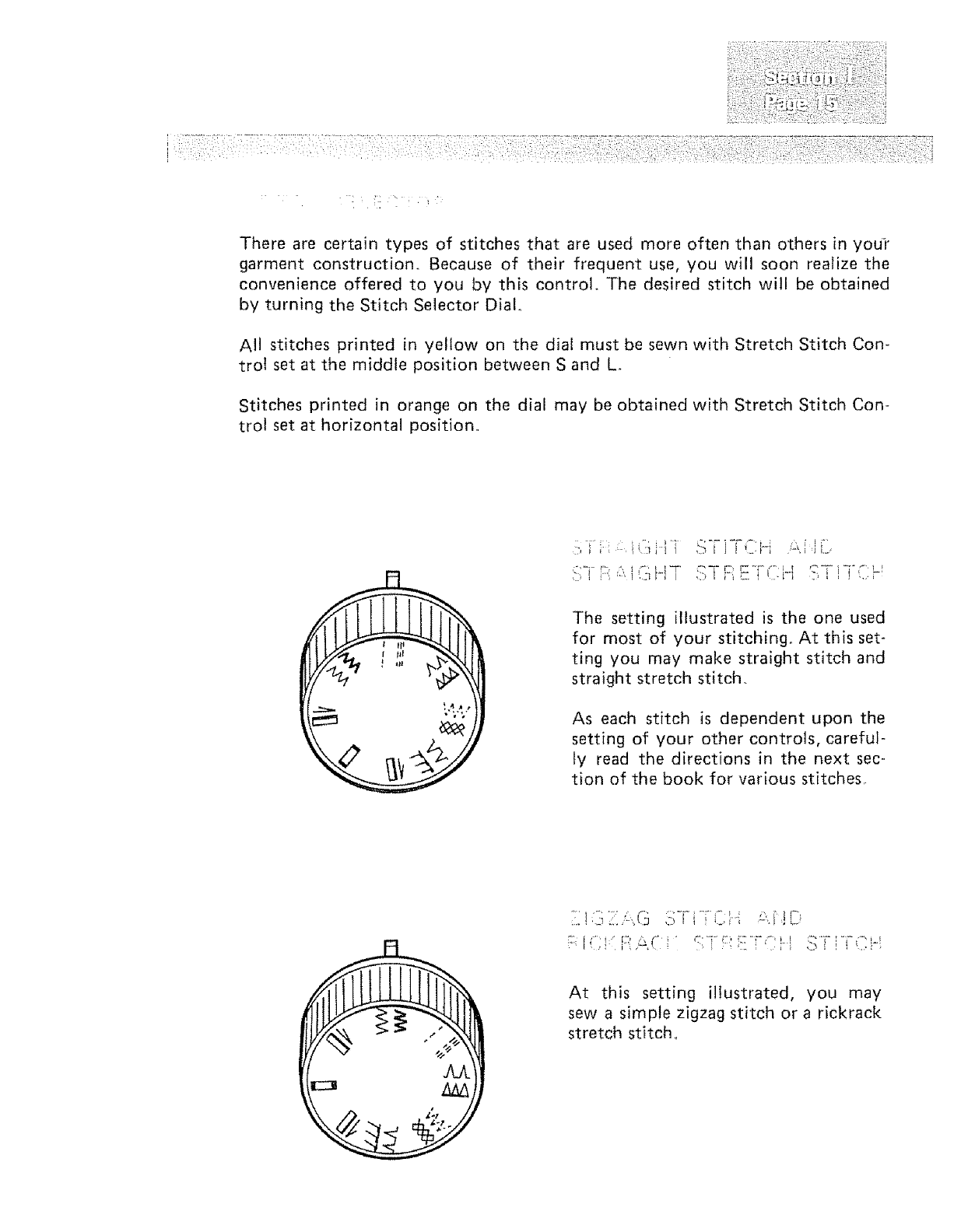
There are certain types of stitches that are used more often than others in your
garment construction. Because of their frequent use, you will soon realize the
convenience offered to you by this control. The desired stitch will be obtained
by turning the Stitch Selector Dialo
All stitches printed in yellow on the dial must be sewn with Stretch Stitch Con-
tro! set at the middle position between S and L.
Stitches printed in orange on the dial may be obtained with Stretch Stitch Con-
trol set at horizontal position.
_; i i:i : i_._ili ::;TIT_2 i-i .:,,i,Ii2,
.... :_t-, _ :BT !Td:-
The setting illustrated is the one used
for most of your stitching. At this set-
ting you may make straight stitch and
straight stretch stitch.
As each stitch is dependent upon the
setting of your other controls, careful-
ly read the directions in the next sec-
tion of the book for various stitches,
JLA
21!2__-,1:ZG ST iT C H &[,} D
_: [Ci RAC;, !; ::i_-_?,i_-i S f-!TCI-!
At this setting illustrated, you may
sew a simple zigzag stitch or a rickrack
stretch stitch_
w_ -Vlr
MA r77i
S[..[fli::3TLi!:H Ai'!i:}Ok,_i:_-
CL'!{.T }T'I:::-::}. }-t T_::F
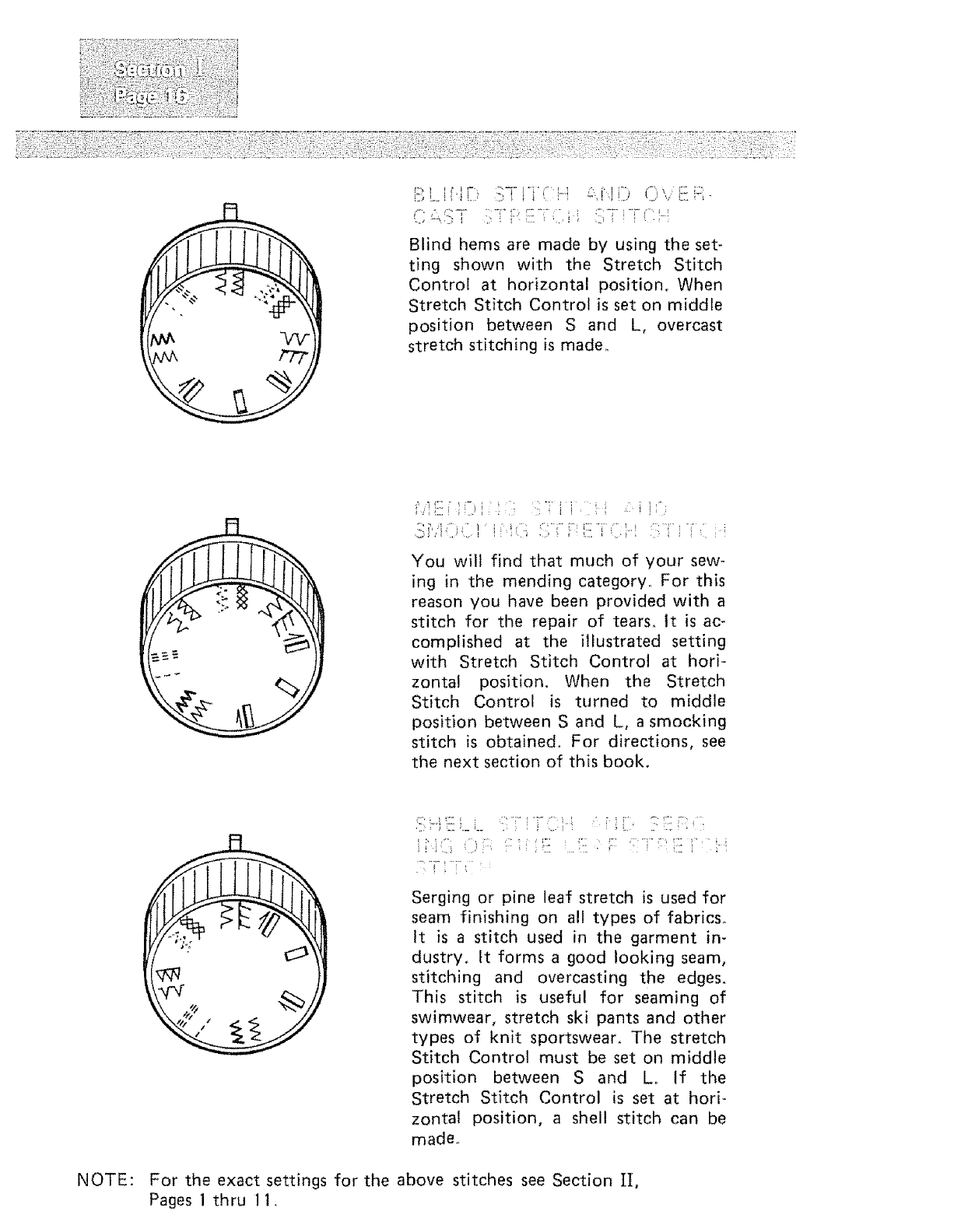
Blind hems are made by using the set-
ting shown with the Stretch Stitch
Control at horizontal position. When
Stretch Stitch Control isset on middle
position between S and L, overcast
stretch stitching is made,,
:,_, _-,- ........" _i{ ,..-
You wilt find that much of your sew-
ing in the mending category. For this
reason you have been provided with a
stitch for the repair of tears. It is ac-
complished at the illustrated setting
with Stretch Stitch Control at hori-
zontal position. When the Stretch
Stitch Control is turned to middle
position between S and L, a smocking
stitch is obtained° For directions, see
the next section of this book.
NOTE:
!::!--i"ii'' _-'_ '' " _ .....-
........ L --
Serging or pine leaf stretch _s used for
seam finishing on all types of fabrics.
It is a stitch used in the garment in-
dustry, It forms a good looking seam,
stitching and overcasting the edges.
This stitch is useful for seaming of
swimwear, stretch ski pants and other
types of knit sportswear. The stretch
Stitch Control must be set on middle
position between S and Lo If the
Stretch Stitch Control is set at hori-
zontal position, a shell stitch can be
made.
For the exact settings for the above stitches see Section ]:[,
Pages 1 thru 11.
OiI-IIR;:.i ._: ]])JUS]'BilI;FNiL30i i\]IAOI-IIDJI Ii\I SEV_]ID]G
In addition to the obvious controls of your machine, there are other small regu-
lators and controls to aid you in using your sewing machine..
1::_ii E,(415{] 1:i1! ]I :ii¢£U 1.-S_-]'O ]G
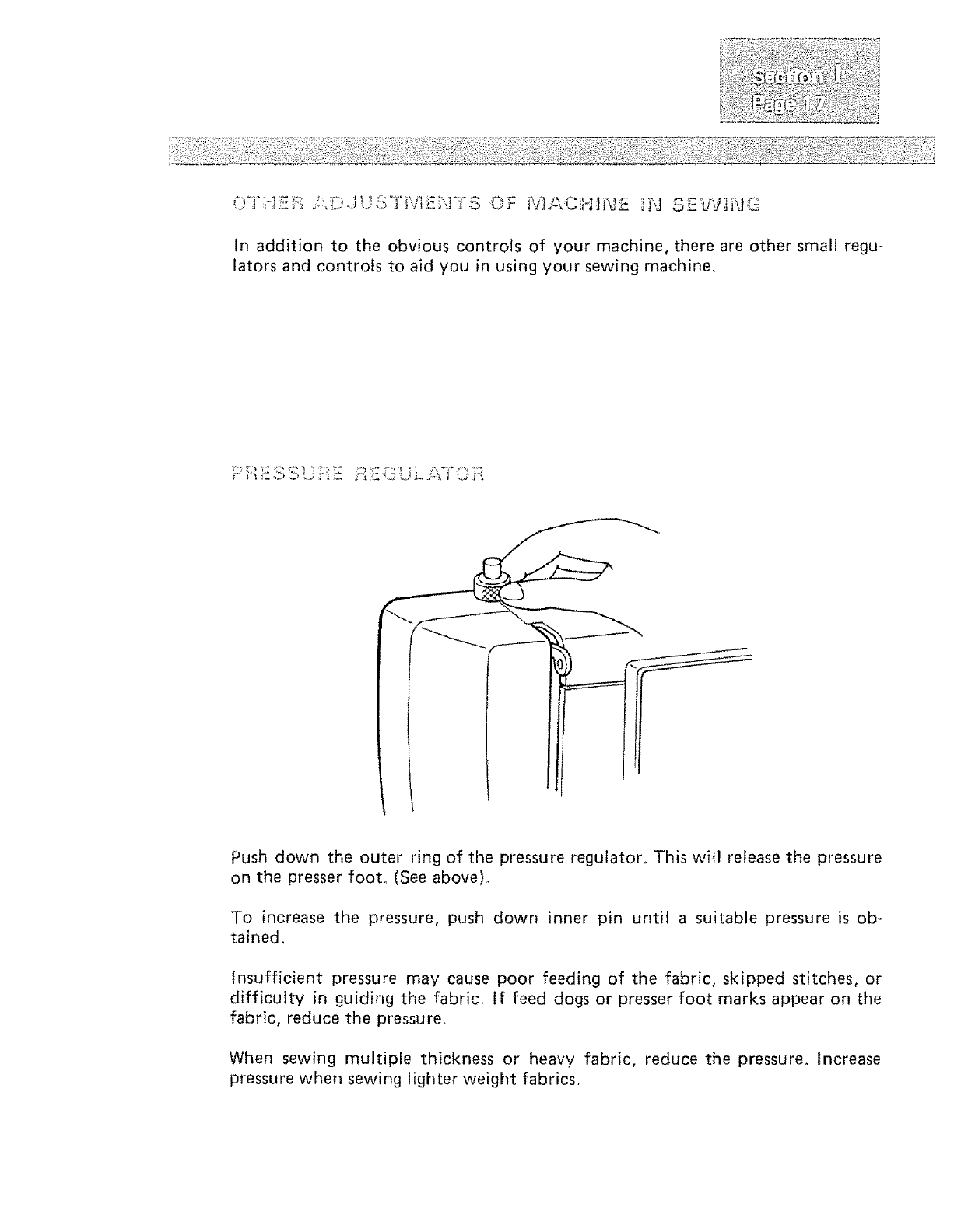
Push down the outer ring of the pressure regulator. This will release the pressure
on the presser foot. (See above).
To increase the pressure, push down inner pin until a suitable pressure is ob-
tainedo
Insufficient pressure may cause poor feeding of the fabric, skipped stitches, or
difficulty in guiding the fabric.. If feed dogs or presser foot marks appear on the
fabric, reduce the pressure.
When sewing multiple thickness or heavy fabric, reduce the pressure. Increase
pressure when sewing lighter weight fabrics.
Fig, 1
J
Fig, 2
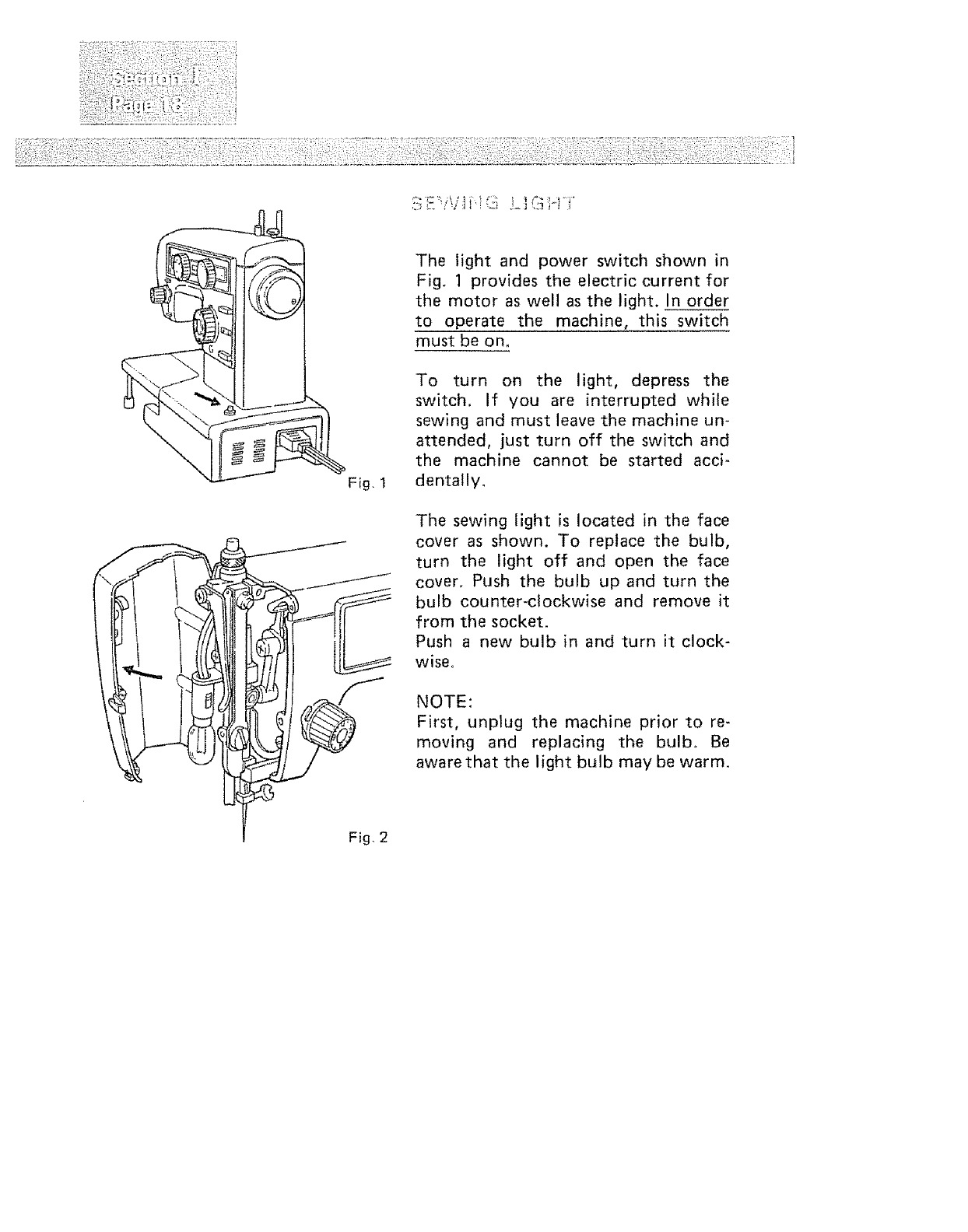
The light and power switch shown in
Fig. 1 provides the electric current for
the motor as wel! as the light. In order
to operate the machine, this switch
must be on,
To turn on the light, depress the
switch. If you are interrupted while
sewing and must leave the machine un-
attended, just turn off the switch and
the machine cannot be started accio
dentally,
The sewing light is located in the face
cover as shown. To replace the bulb,
turn the light off and open the face
cover, Push the bulb up and turn the
bulb counter-clockwise and remove it
from the socket.
Push a new bulb in and turn it clock-
wise.
NOTE:
First, unplug the machine prior to re-
moving and replacing the bulb. Be
awarethat the light bulb may be warm_
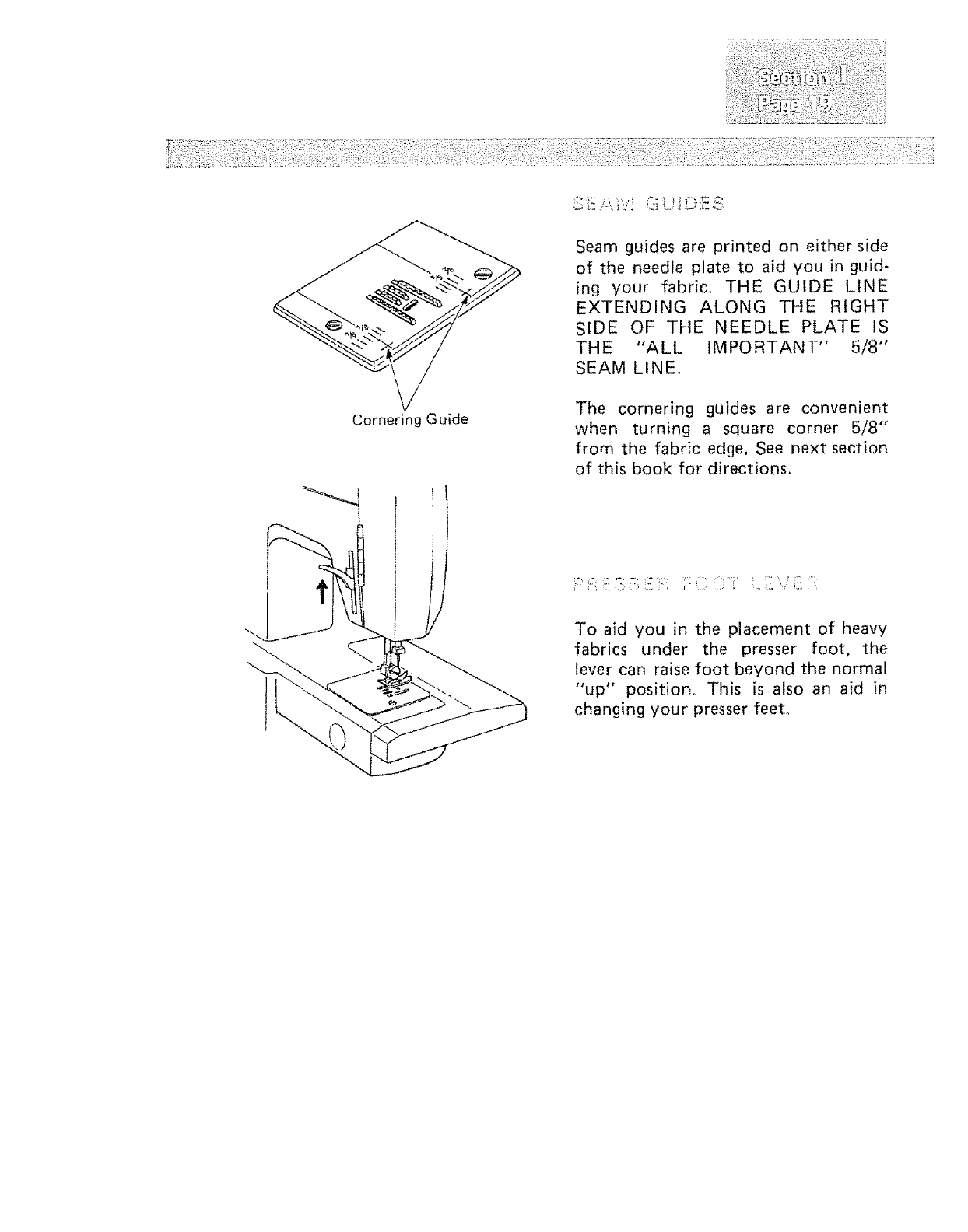
Seamguidesare printed on either side
of the needle plate to aid you in guid-
ing your fabric. THE GUIDE LINE
EXTENDING ALONG THE RIGHT
SIDE OF THE NEEDLE PLATE IS
THE "ALL IMPORTANT" 5/8"
SEAM LINEo
Cornering Guide The cornering guides are convenient
when turning a square corner 5/8"
from the fabric edge. See next section
of this book for directions,
To aid you in the placement of heavy
fabrics under the presser foot, the
lever can raise foot beyond the normal
"up" position,, This is also an aid in
changing your presser feet.
tC 1
i
Flat
side
away
from
you
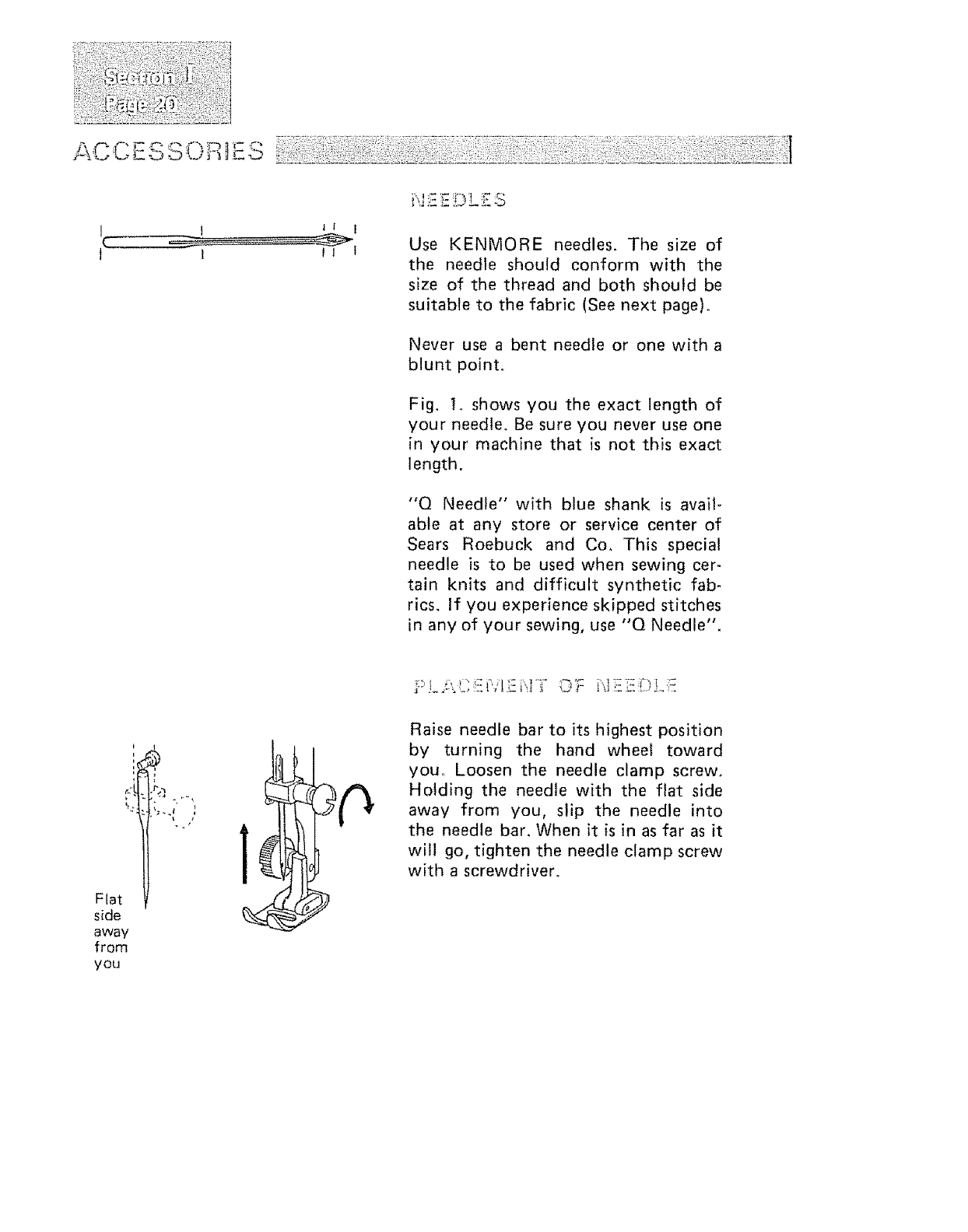
Use KENMORE needles. The size of
the needle should conform with the
size of the thread and both should be
suitable to the fabric (See next page),
Never use a bent needle or one with a
blunt poinL
Fig. l. shows you the exact length of
your needle° Be sure you never use one
in your machine that is not this exact
length.
"Q Needle" with blue shank is avail-
able at any store or service center of
Sears Roebuck and Co. This special
needle is to be used when sewing cer-
tain knits and difficult synthetic fab-
rics. if you experience skipped stitches
in any of your sewing, use "Q Needle".
Raise needle bar to its highest position
by turning the hand wheel toward
you° Loosen the needle clamp screw.
Holding the needle with the flat side
away from you, slip the needle into
the needle bar. When it is in as far as it
will go, tighten the needle clamp screw
with a screwdriver,
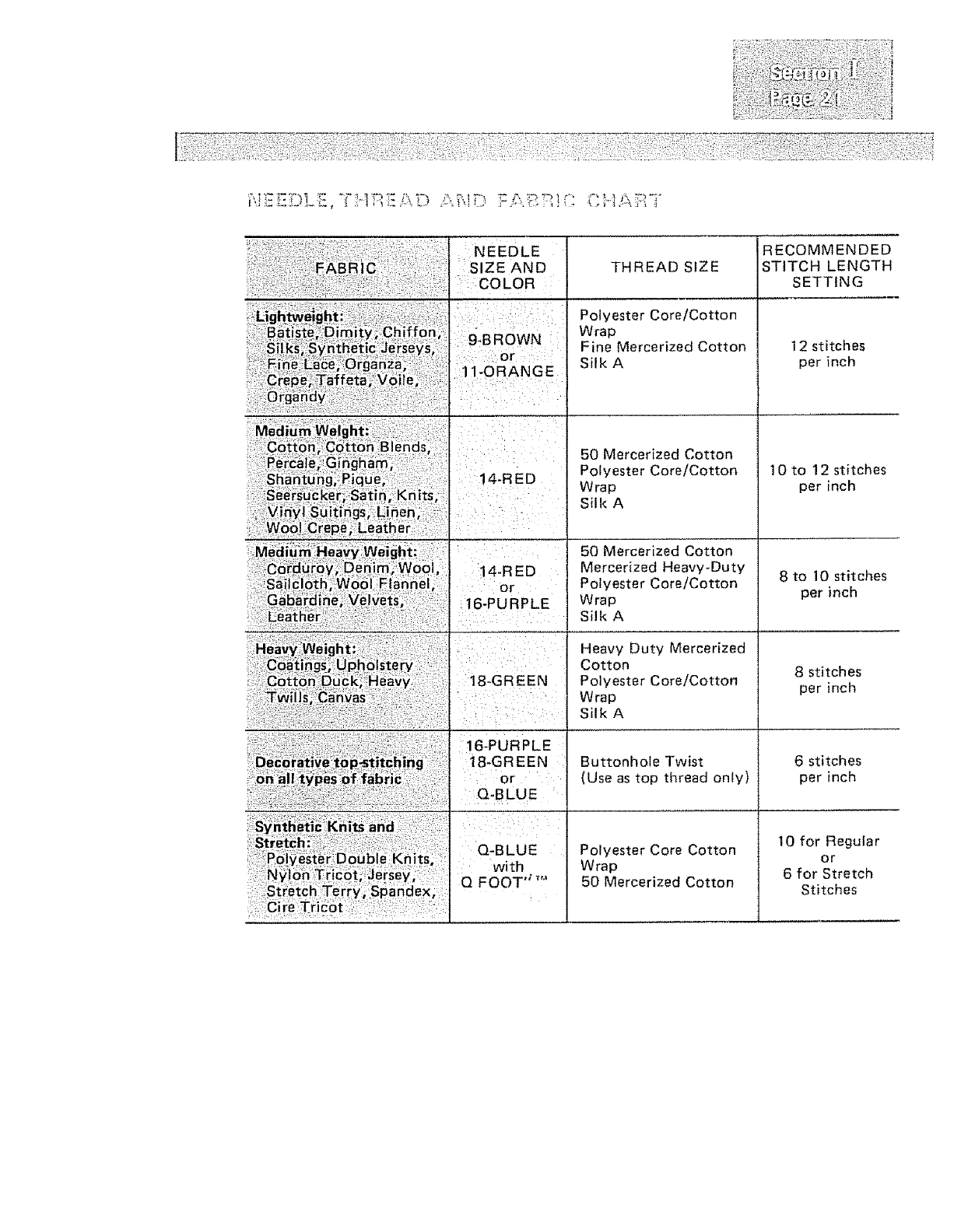
NEEDLE
SIZE AND
COLOR
: 9-BROWN
• Or
11-ORANGE I
RECOMMENDED
THREAD SIZE STITCH LENGTH
I SETTtNG_ .........
Polyester Core/Cotton
Wrap
Fine Mercerized Cotton
Silk A
50 Mercerized Cotton
Polyester Core/Cotton
Wrap
Silk A
i 50 Mercerized Cotton
4 RED i Mercerized Heavy-Duty
1 -or ! Polyester Core!Cotton
16-PURPLE Wrap
Silk A
Heavy Duty Mercerized
Cotton
Polyester Core/Cotton
Wrap
Silk A
18-GREEN
i
16-PURPLE
18-GREEN
or
Q-BLUE
Buttonhole Twist
(Use as top thread only)
Polyester Core Cotton
Wrap
50 Mercerized Cotton
12 stitches
per inch
10 to 12 stitches
per inch
8 to 10 stitches
per inch
8 stitches
per inch
6 stitches
per inch
10 for Regular
or
6 for Stretch
Stitches
Gi
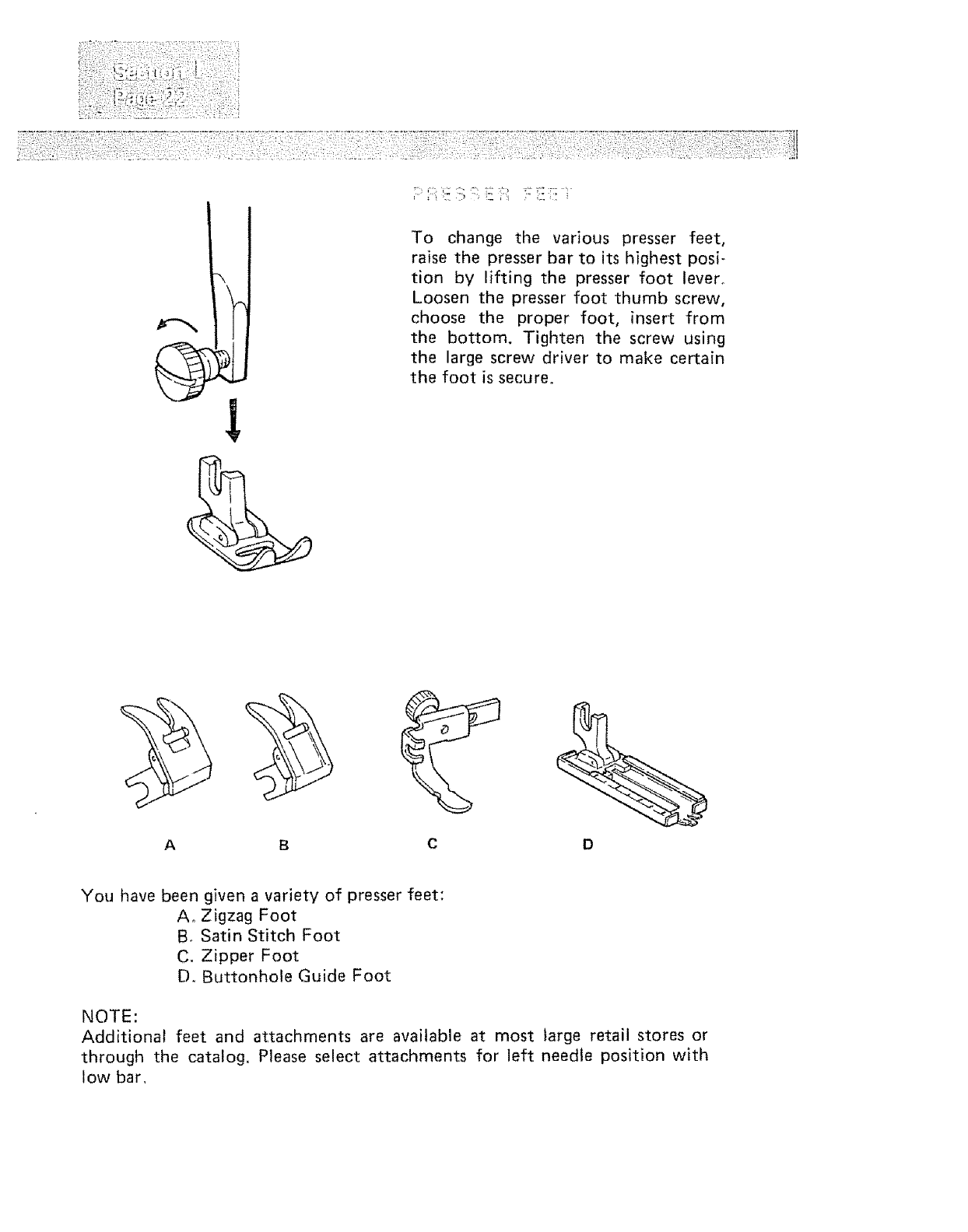
To change the various presser feet,
raise the presser bar to its highest posi-
tion by lifting the presser foot lever°
Loosen the presser foot thumb screw,
choose the proper foot, insert from
the bottom. Tighten the screw using
the large screw driver to make certain
the foot is secure.
A B C D
You have been given a variety of presser feet:
Ao Zigzag Foot
B. Satin Stitch Foot
C° Zipper Foot
D. Buttonhole Guide Foot
NOTE:
Additional feet and attachments are available at most large retail stores or
through the catalog. Please select attachments for left needle position with
low bar.

Sta ti g to Sew
Now that you are famitiar with the controts on your machine and with the
accessories provided for the machine, you are ready to start to sew with your
new Kenmore sewing machine Below are some good habits to follow each time
you sit down to sew:
1, Test the needle it should be straight, properly set and sharp on the point. It
should be the correct size for the fabric and thread being used, Do not be
afraid to change your needle frequently. Many of the new fabrics made of
synthetic blends tend to dull the needles more easily than fabrics made of
natural fibers.
2. Before placing the material on the machine, see that the ends of the threads
have been drawn about 4 inches to the rear of the machine. Hold on to
threads during the sewing of the first 3 or 4 stitches of the seam.
3, Test the machine stitch on a scrap of fabric you plan to use. The fabric
should be double thickness. Adjust the machine for the length of stitch and
tension su itable to your fabric°
4. Fabric should be placed under the presser foot with the bulk of the material
to the left of the needle and the right edge of the material placed on the 5/8"
seam marking on the needle plate when making a simple seam.
5. Run the machine at a slow even speed. The more pressure you put on the
speed control, the faster the machine wit! sew,
6. Fasten each seam by back tacking at the beginning and end of the seam,
7. Always finish sewing each seam with the needle at its highest point°
8, Guide the fabric gently with your hand in front of the needle, Never pull or
hold the fabric in such a way that the normal feeding is altered.
9. When turning the hand wheel manually, always turn it toward you.
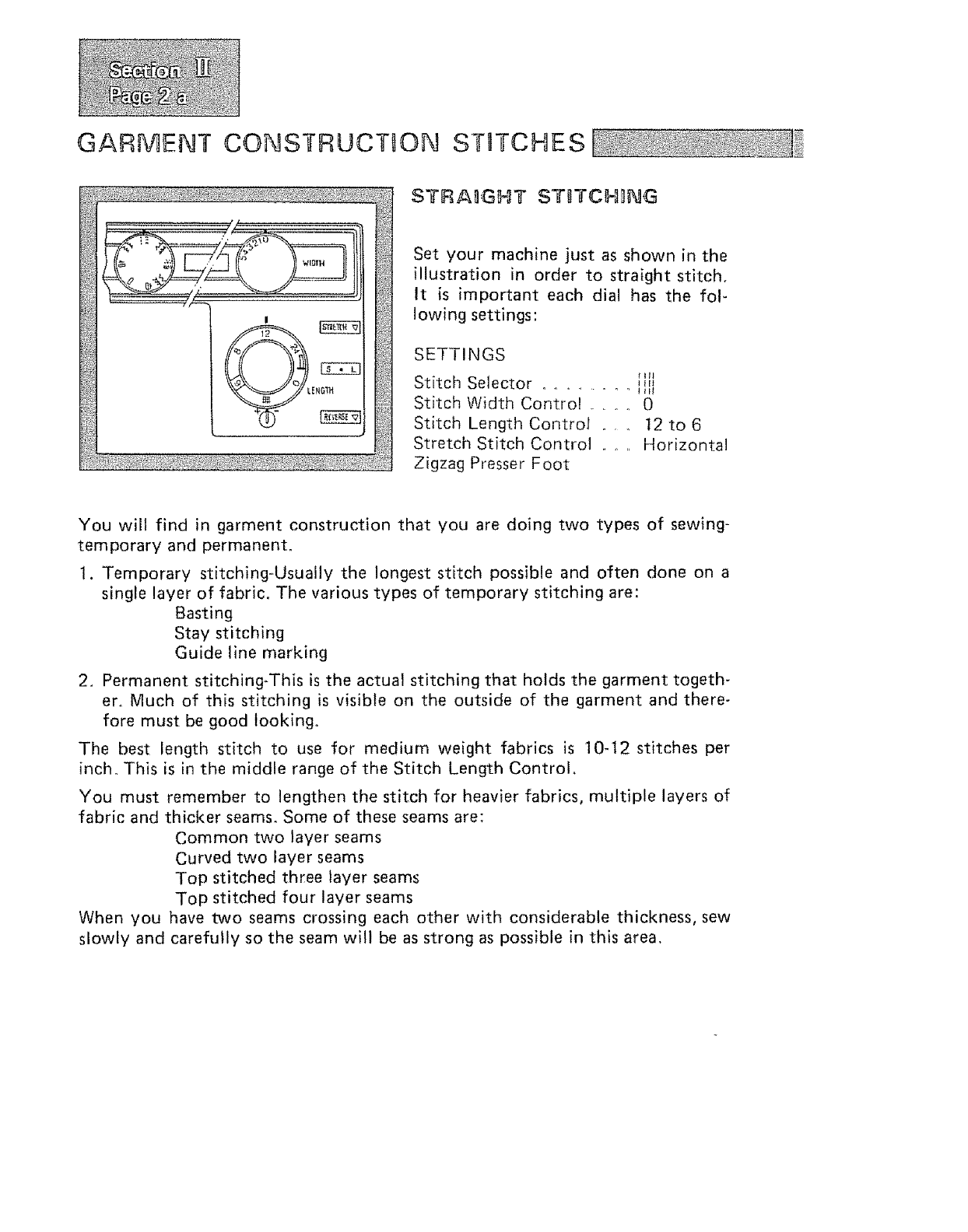
GARMENT CONSTRUCTION STITCHES
STRAIGHT STITCHING
Set your machine just as shown in the
illustration in order to straight stitch,
It is important each dial has the fol-
lowing settings:
SETTINGS
Stitch Selector , _,_
......... _ tH
Stitch Width Control ....... 0
Stitch Length Control . . . t2 to 6
Stretch Stitch Control ..... Horizontal
Zigzag Presser Foot
You will find in garment construction that you are doing two types of sewing-
temporary and permanent,
t. Temporary stitching-Usually the longest stitch possible and often done on a
single layer of fabric, The various types of temporary stitching are:
Basting
Stay stitching
Guide line marking
2. Permanent stitching-This is the actual stitching that holds the garment togeth-
er, Much of this stitching is visible on the outside of the garment and there-
fore must be good looking,.
The best length stitch to use for medium weight fabrics is 10-t2 stitches per
inch. This is in the middle range of the Stitch Length Control,
You must remember to lengthen the stitch for heavier fabrics, multiple layers of
fabric and thicker seams, Some of these seams are:
Common two layer seams
Curved two layer seams
Top stitched three layer seams
Top stitched four layer seams
When you have two seams crossing each other with considerable thickness, sew
slowly and carefully so the seam will be as strong as possible in this area,
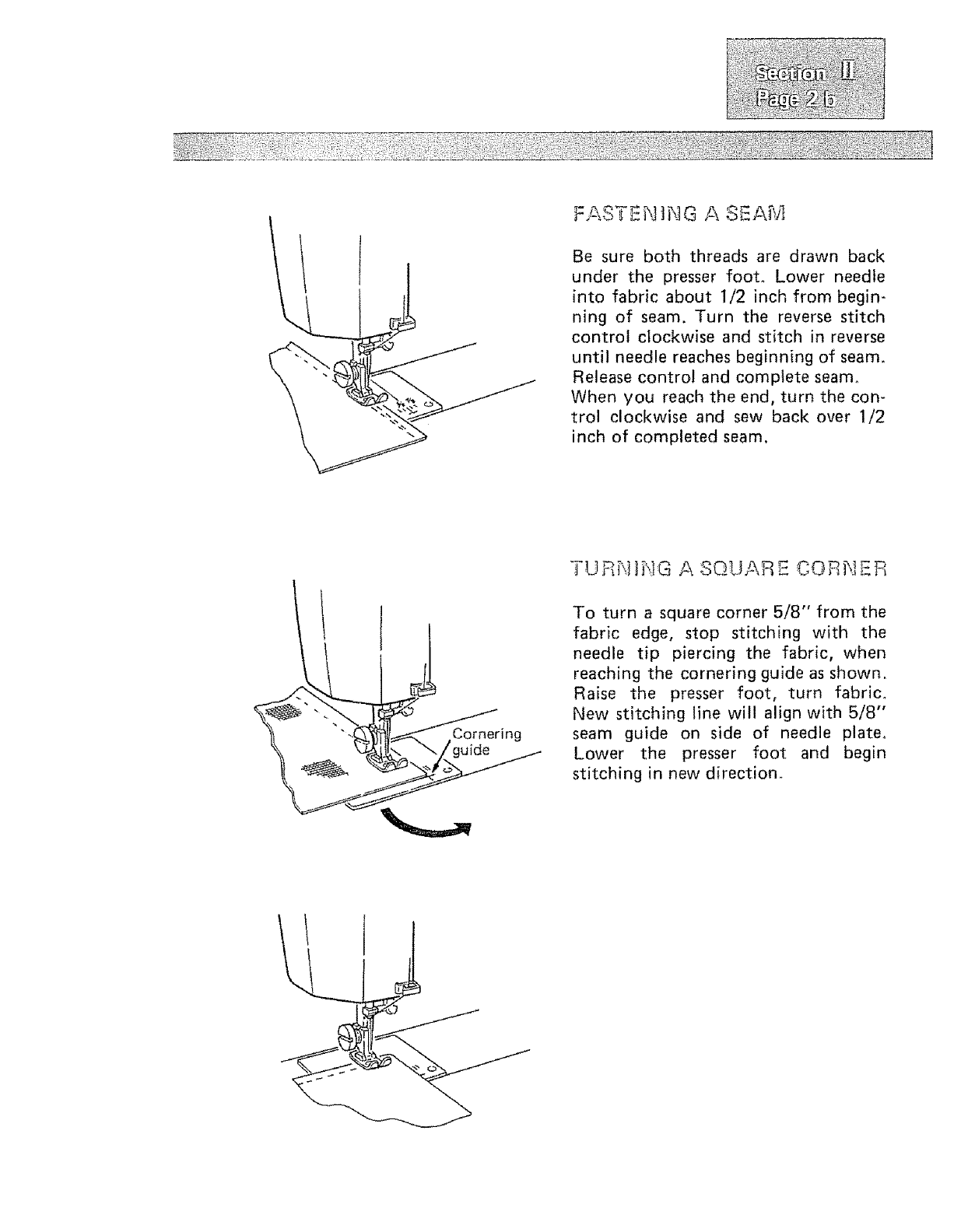
FASTENING A SEAl;i]
Be sure both threads are drawn back
under the presser foot. Lower needle
into fabric about 1/2 inch from begin-
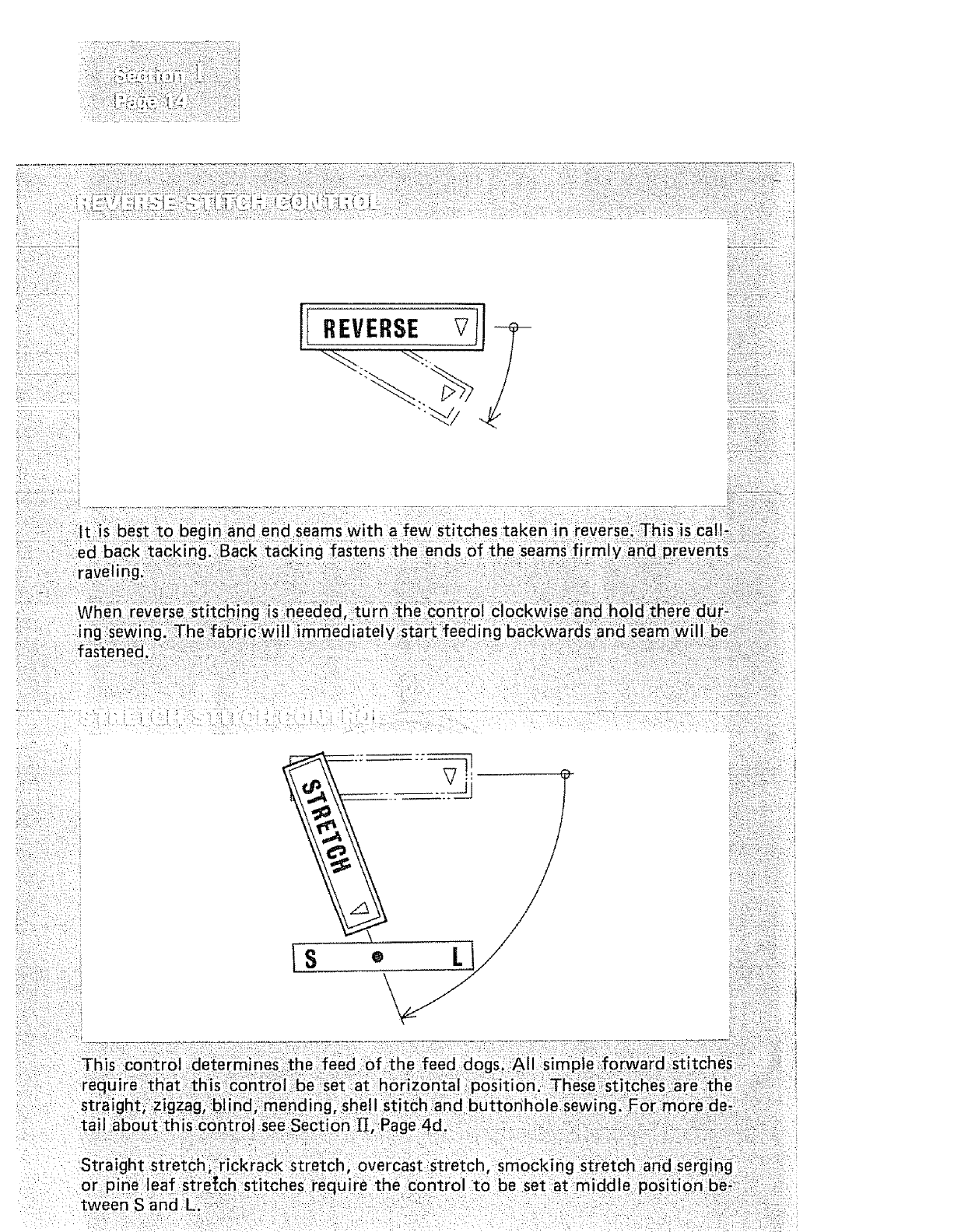
ning of seam. Turn the reverse stitch
control clockwise and stitch in reverse
until needle reaches beginning of seam.
Release control and complete seam°
When you reach the end, turn the con-
trol clockwise and sew back over 1/2
inch of completed seam.
TURN3NG A SQUARe2 CQRf',JER
To turn a square corner 5/8" from the
fabric edge, stop stitching with the
needle tip piercing the fabric, when
reaching the cornering guide as shown.
Raise the presser foot, turn fabric.
New stitching line will align with 5/8"
seam guide on side of needle plate,
Lower the presser foot and begin
stitching in new direction.
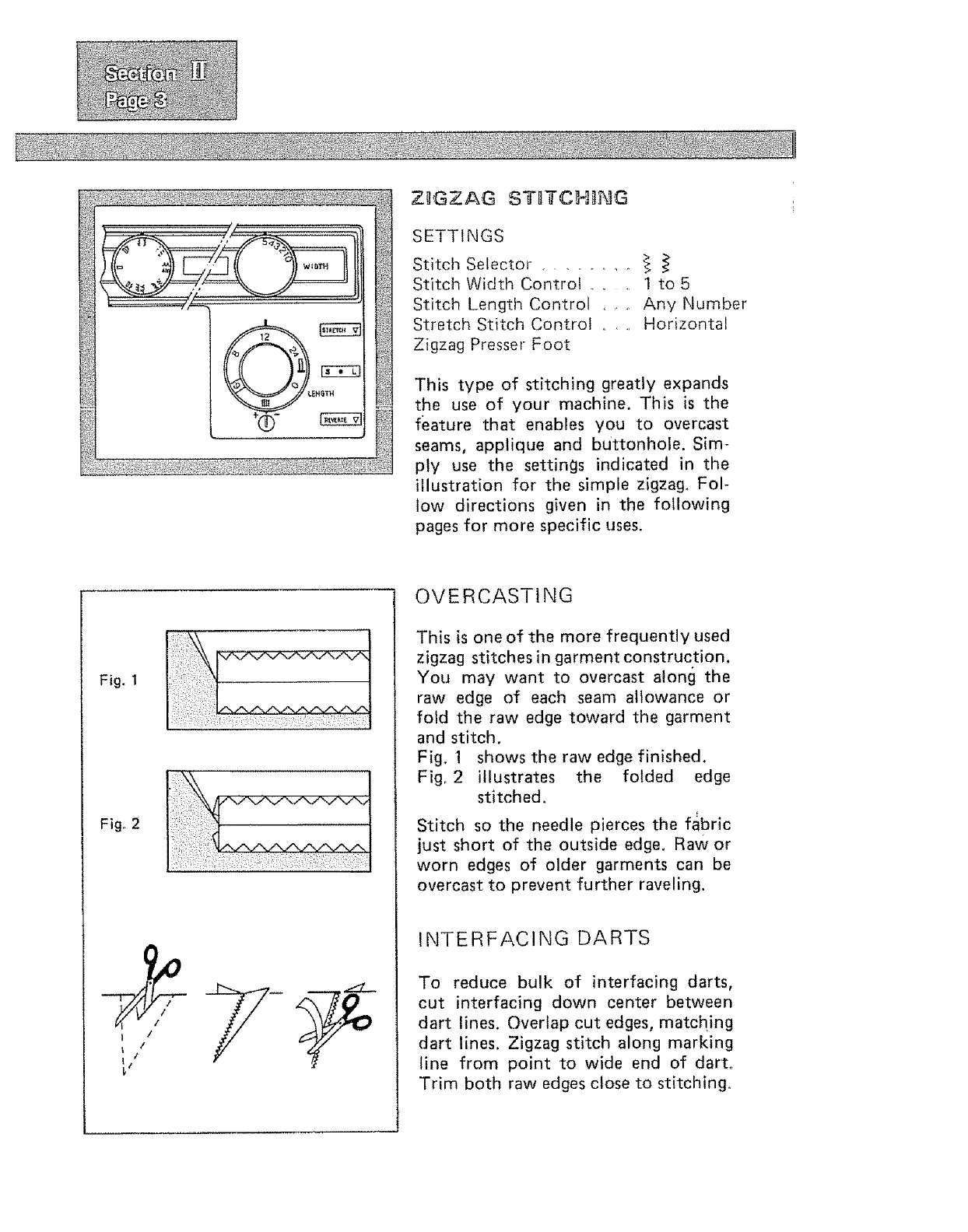
ZJG ZAG S3"IITCHI?_G
SETTINGS
Stitch Selector ......... _> }
Stitch Width Control .... I to 5
Stitch Length Control .... Any Number
Stretch Stitch Control .... Horizontal
Zigzag Presser" Foot
This type of stitching greatly expands
the use of your machine, This is the
feature that enables you to overcast
seams, applique and buttonhole. Sim-
ply use the settings indicated in the
illustration for the simple zigzag, Fol-
low directions given in the following
pages for more specific uses.
Fig. 1
Fig°2
I/
!
/
OVERCASTING
This is one of the more frequently used
zigzag stitches in garment construction.
You may want to overcast along the
raw edge of each seam allowance or
fold the raw edge toward the garment
and stitch.
Fig, 1 shows the raw edge finished.
Fig, 2 illustrates the folded edge
stitched.
Stitch so the needle pierces the fabric
just short of the outside edge, Raw or
worn edges of older garments can be
overcast to prevent further raveling.
INTERFACING DARTS
To reduce bulk of interfacing darts,
cut interfacing down center between
dart lines. Overlap cut edges, matching
dart lines. Zigzag stitch along marking
line from point to wide end of dart,
Trim both raw edges close to stitching.
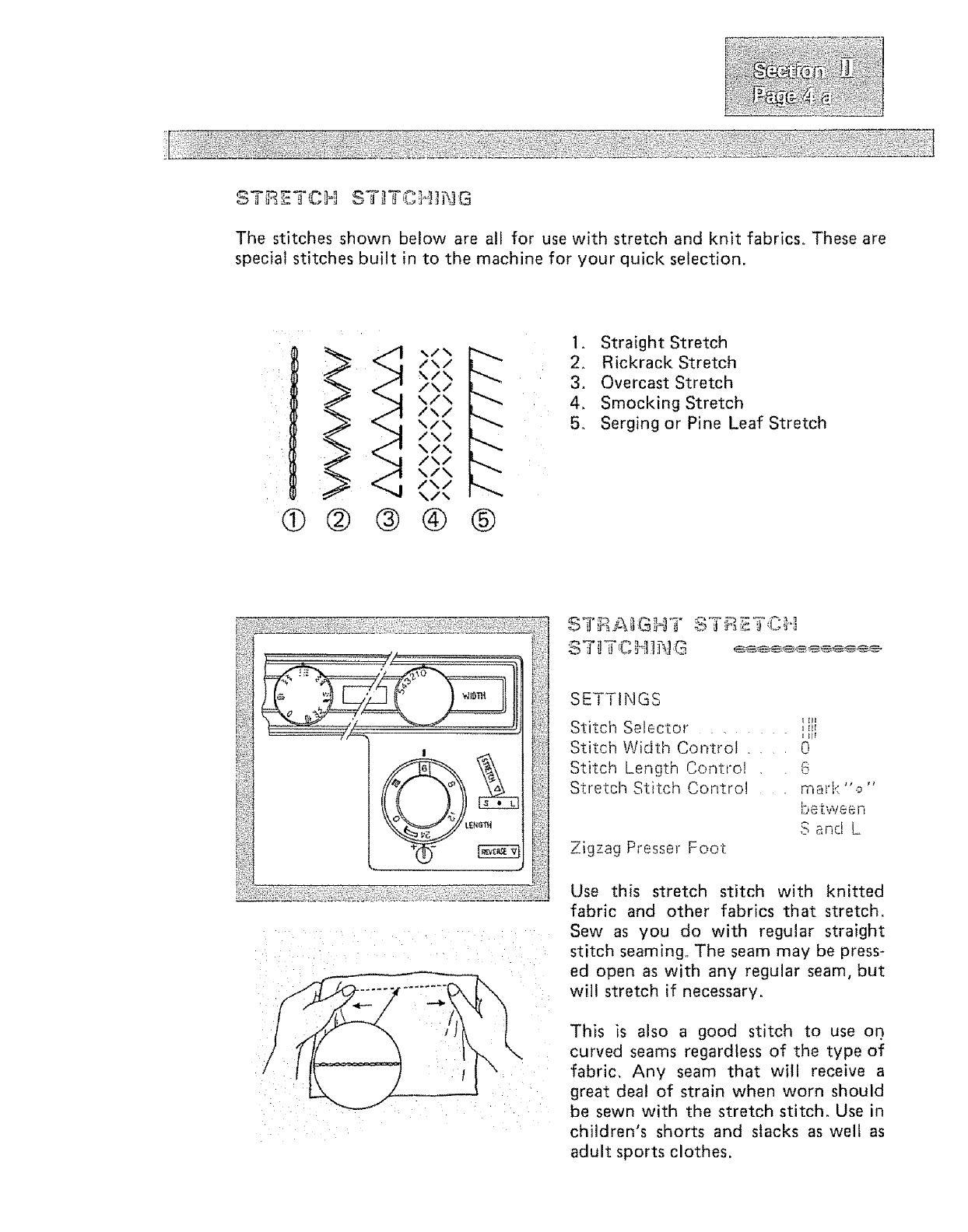
STR_7C=°I STIWCIQIRI, "
The stitches shown below are a!l for use with stretch and knit fabrics, These are
special stitches built in to the machine for your quick selection.
/\/
/\i
\I_
I\I
\I\
I_I
\I\
I\I
\I\
@ @@(9 ®
1. Straight Stretch
Rickrack Stretch
3, Overcast Stretch
4, Smocking Stretch
5. Serging or Pine Leaf Stretch
S7tTCII][U G -_-=÷_÷-=_-=÷÷÷_
J
/
SETTINGS
Stitch Selector ..... ',I'_
I Ilf
Stitch Width Control .... 0
Stitch Length Control ,
Stretch Stitch Control
Zigzag Presser Foot
G
•maYP,"o "
between
S and L
Use this stretch stitch with knitted
fabric and other fabrics that stretch.
Sew as you do with regular straight
stitch seaming° The seam may be press-
ed open as with any regular seam, but
will stretch if necessary.
This is also a good stitch to use on
curved seams regardless of the type of
fabric, Any seam that will receive a
great deal of strain when worn should
be sewn with the stretch stitch. Use in
children's shorts and slacks as well as
adult sports clothes.
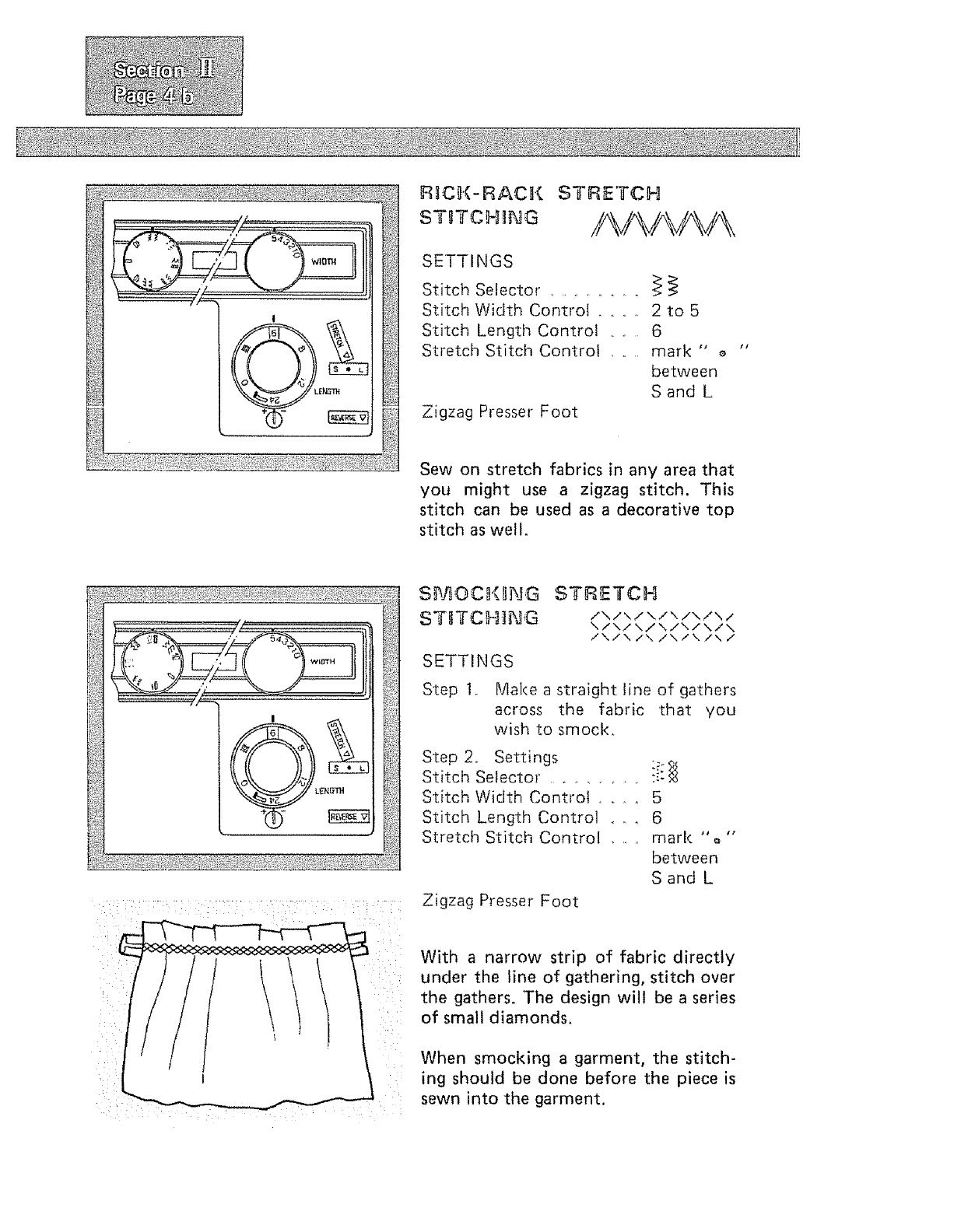
R':iCiK-RAC1K STRETCH
s-_a-_c, _ G _,_-v, '_,,_,_'V'w'w_,,_J"_
SETTINGS
Stitch Selector , .......... _
Stitch Width Control ...... 2 to 5
Stitch Length Control ...... 6
Stretch Stitch Control ..... mark "
Zigzag Presser Foot
between
S and L
Sew on stretch fabrics in any area that
you might use a zigzag stitch. This
stitch can be used as a decorative top
stitch as well.
SETTINGS
STRETCH
/\/\/\/N/N/N/
N/\/\/\/\/\/\
/N/N/X/N/N/\/
Step 1. Make a straight line of gathers
across the fabric that you
wish to smock.
Step 2. Settings
Stitch Selector .......... ::_i_
Stitch Width Control ...... 5
Stitch Length Control . _ .6
Stretch Stitch Control ..... marl< ",, "
between
S and L
Zigzag Presser Foot
With a narrow strip of fabric directly
under the line of gathering, stitch over
the gathers. The design will be a series
of small diamonds.
When smocking a garment, the stitch-
ing should be done before the piece is
sewn into the garment.
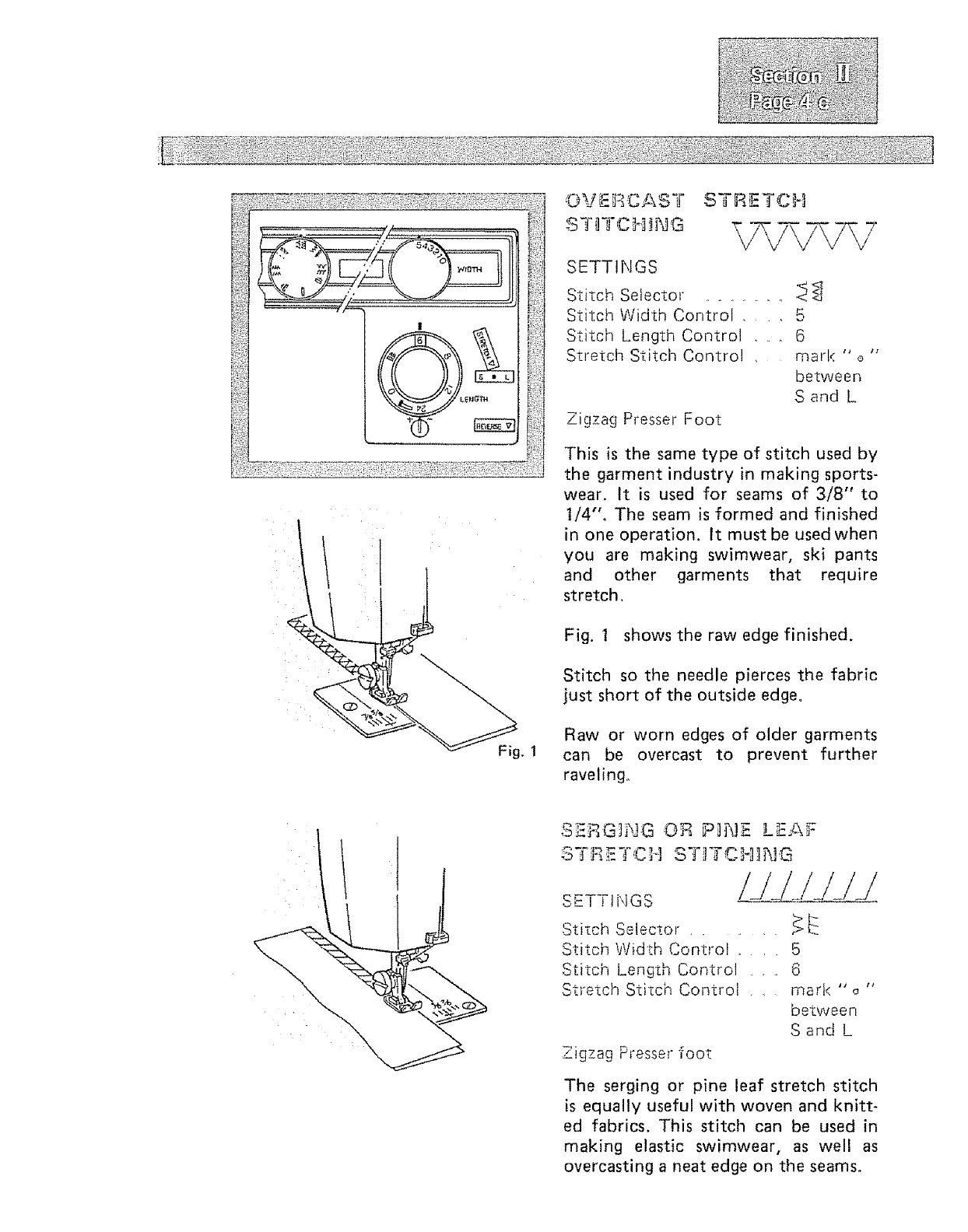
Fig. 1
STITCHING
SETTINGS
Stitch Selector . ....... _
Stitctn Width Control .... 5
Stitctn Length Control .... 6
Stretch Stitclq Control .... mark "
Zigzag Presser Foot
o
between
S and L
This is the same type of stitch used by
the garment industry in making sports-
wear. It is used for seams of 3/8" to
t/4% The seam is formed and finished
in one operation, It must be used when
you are making swimwear, ski pants
and other garments that require
stretch,
Fig. ! shows the raw edge finished.
Stitch so the needle pierces the fabric
just short of the outside edge.
Raw or worn edges of older garments
can be overcast to prevent further
raveling,,
,_=_Gh'_JG OR PINE L_A_"
o I _°,:;: TCH _TIT_..._ IIR]G
SETTt NGS
Sti_ch Selector , ....... _
Stitch Width Control ...... 5
SIitch Length Control .... 6
Stretch Stitch Control , mark "
Zigzag Presser foot
]
The serging or pine leaf stretch stitch
is equally useful with woven and knitt-
ed fabrics. This stitch can be used in
making elastic swimwear, as well as
overcasting a neat edge on the seams.
_s
between
S and L
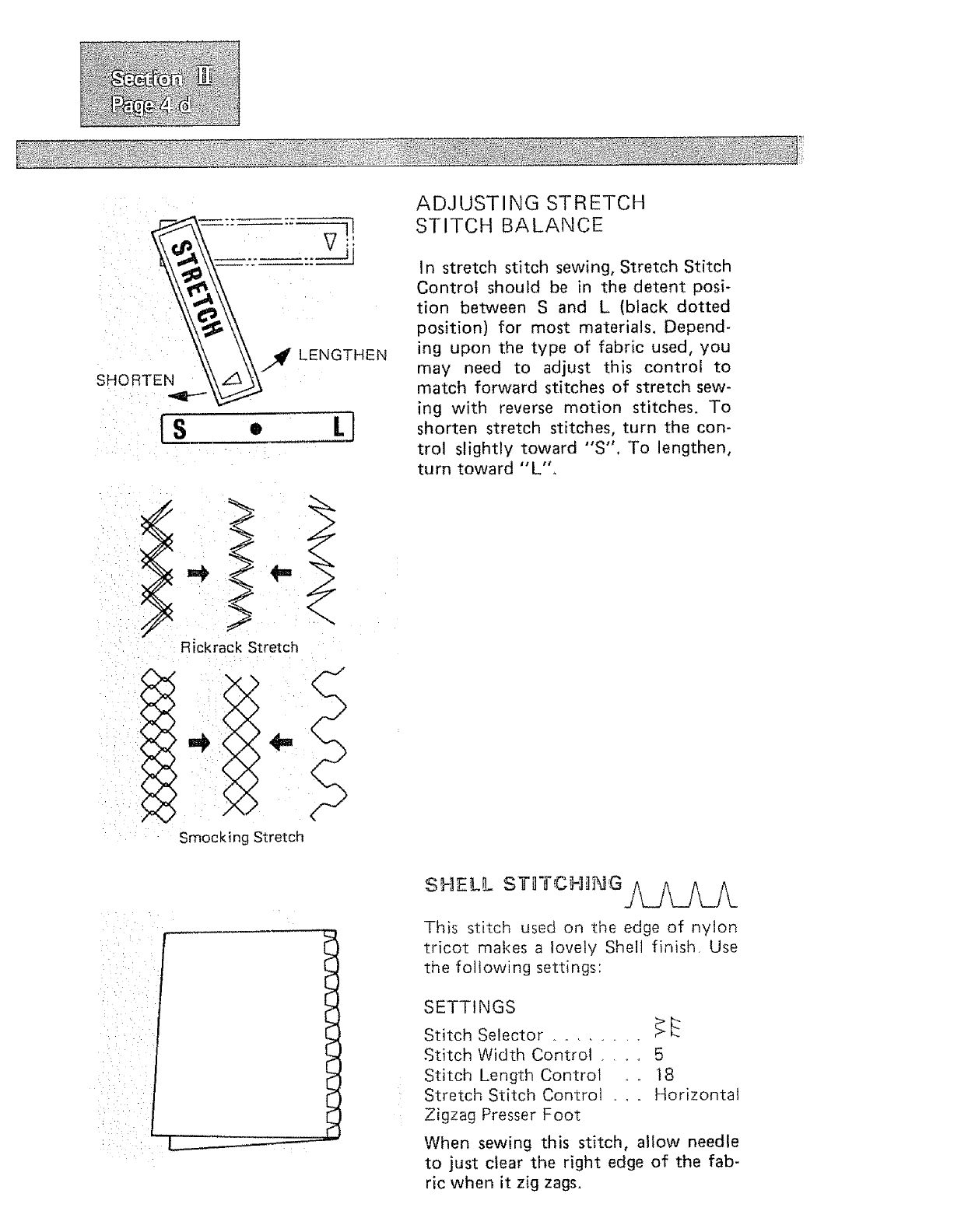
V] I
Jl
LENGTHEN
tl
//
lRickrack Stretch
Smocking Stretch
ADJ USTI NG ST R ETCH
STITCH BALANCE
In stretch stitch sewing, Stretch Stitch
Control should be in the detent posi-
tion between S and L (black dotted
position) for most materials. Depend-
ing upon the type of fabric used, you
may need to adjust this control to
match forward stitches of stretch sew-
ing with reverse motion stitches. To
shorten stretch stitches, turn the con-
trol slightly toward "S". To lengthen,
turn toward "L"_
i _
i_i! L
C
C
C
SHELL STITCHi]_JG
This stitch used on the edge of nylon
tricot makes a lovely Shell finish, Use
the following settings:
SETTINGS
Stitch Selector ............ _
Stitch Width Control .... 5
Stitch Length Control o. 18
Stretch Stitch Control .... Horizontal
Zigzag Presser Foot
When sewing this stitch, allow needle
to just clear the right edge of the fab-
ric when it zig zags.
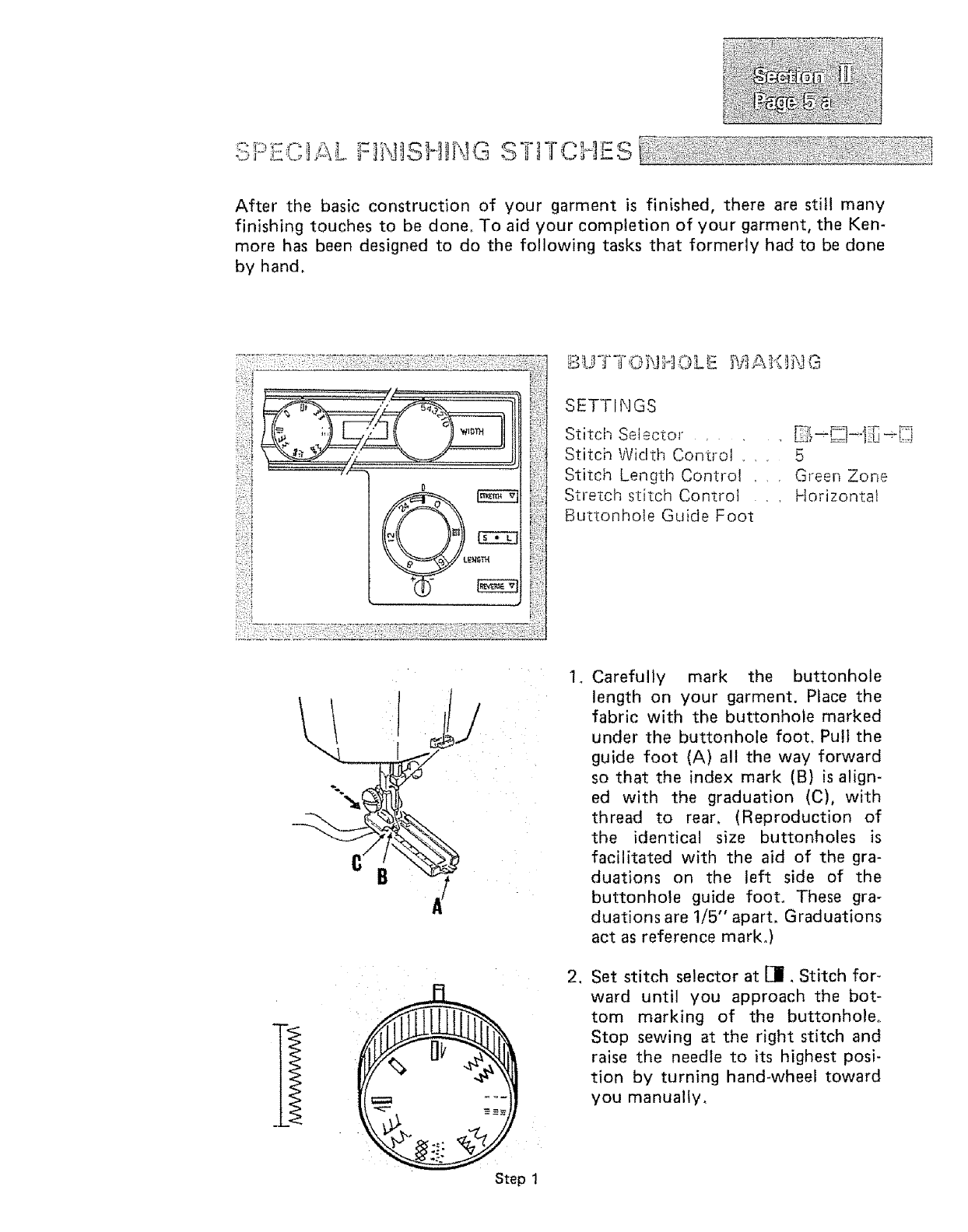
After the basic construction of your garment is finished, there arestill many
finishing touches to be done, To aid your completion of your garment,the Ken-
more has beendesignedto do the following tasks that formerly hadto be done
by hand,
SETTINGS
Stitch Selector ,, , _t--_]_-]:_e-[]_j
Stitch Width Control ....... 5
Stitch Length Control .... Green Zone
Strezchstitch Control , , Horizontal
Buttonhole Guide Foot
Step 1
2_
Carefully mark the buttonhole
length on your garment. Place the
fabric with the buttonhole marked
under the buttonhole foot_ Pull the
guide foot {A) all the way forward
so that the index mark (B) is align-
ed with the graduation (C), with
thread to rear, (Reproduction of
the identical size buttonholes is
facilitated with the aid of the gra-
duations on the left side of the
buttonhole guide foot. These gra-
duations are t/5" apart. Graduations
act as reference mark.)
Set stitch selector at []. Stitch for-
ward until you approach the bot-
tom marking of the buttonhole.
Stop sewing at the right stitch and
raise the needle to its highest posi-
tion by turning hand-wheel toward
you manually.
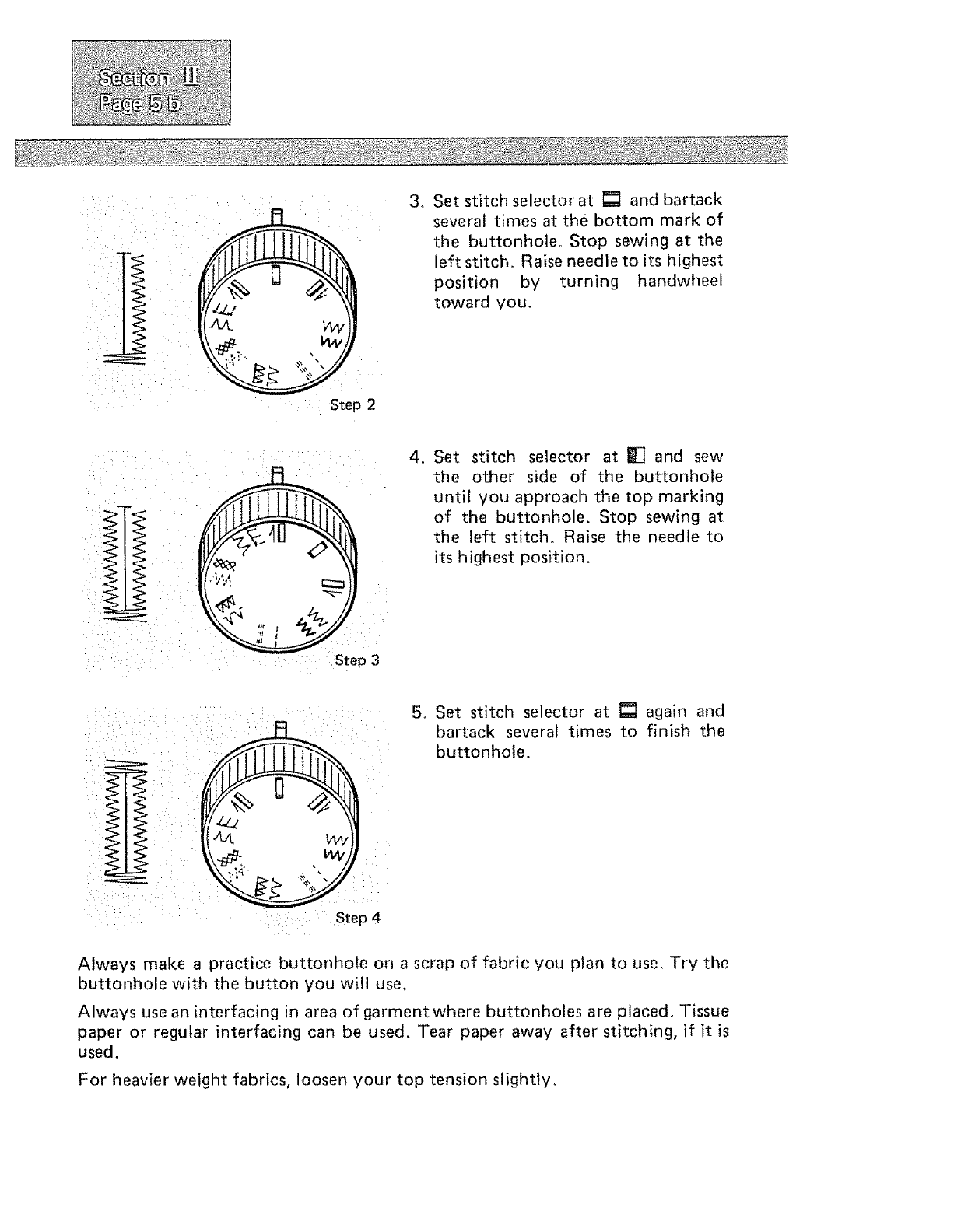
Step2
3o Set stitch selectorat [] and bartack
severaltimes at the bottom mark of
the buttonhole. Stop sewingat the
left stitch, Raiseneedleto its highest
position by turning handwheel
toward your
: Step 3
4. Set stitch selector at [] and sew
the other side of the buttonhole
until you approach the top marking
of the buttonhole. Stop sewing at
the left stitch. Raise the needle to
its highest position.
: Step 4
5, Set stitch selector at I_ again and
bartack several times to finish the
buttonhole.
Always make a practice buttonhole on a scrap of fabric you plan to use, Try the
buttonhole with the button you will use,
Always use an interfacing in area of garment where buttonholes are placed° Tissue
paper or regular interfacing can be used. Tear paper away after stitching, if it is
used,
For heavier weight fabrics, loosen your top tension slightly,
0
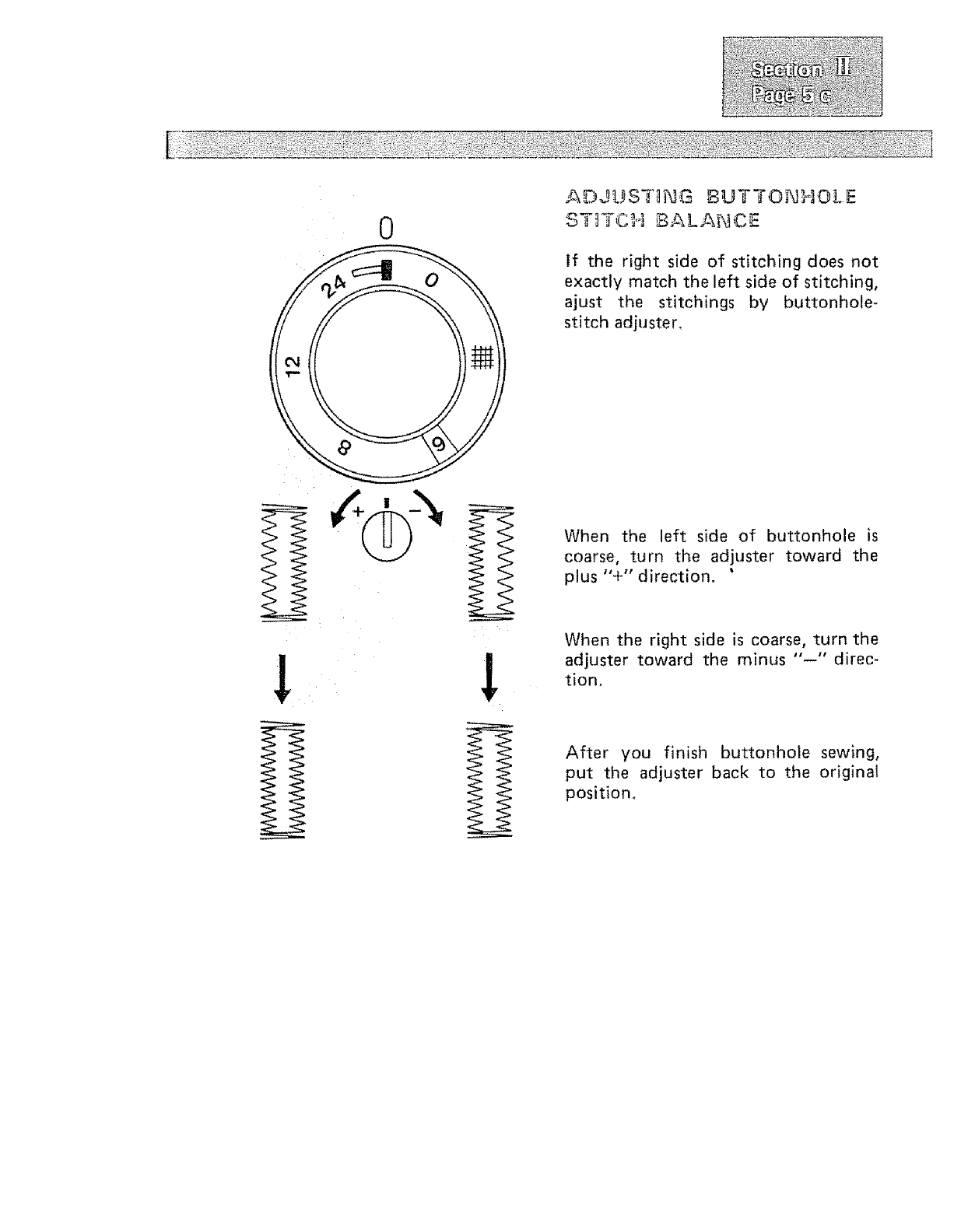
ADJUSTING BUTTONHOLE
ST17CH BALANCE
tf the right side of stitching does not
exactly match the left side of stitching,
ajust the stitchings by buttonhole-
stitch adjusteh
When the left side of buttonhole is
coarse, turn the adjuster toward the
plus "+" direction. '
!When the right side is coarse, turn the
adjuster toward the minus "-" direc-
tion.
After you finish buttonhole sewing,
put the adjuster back to the original
positiom
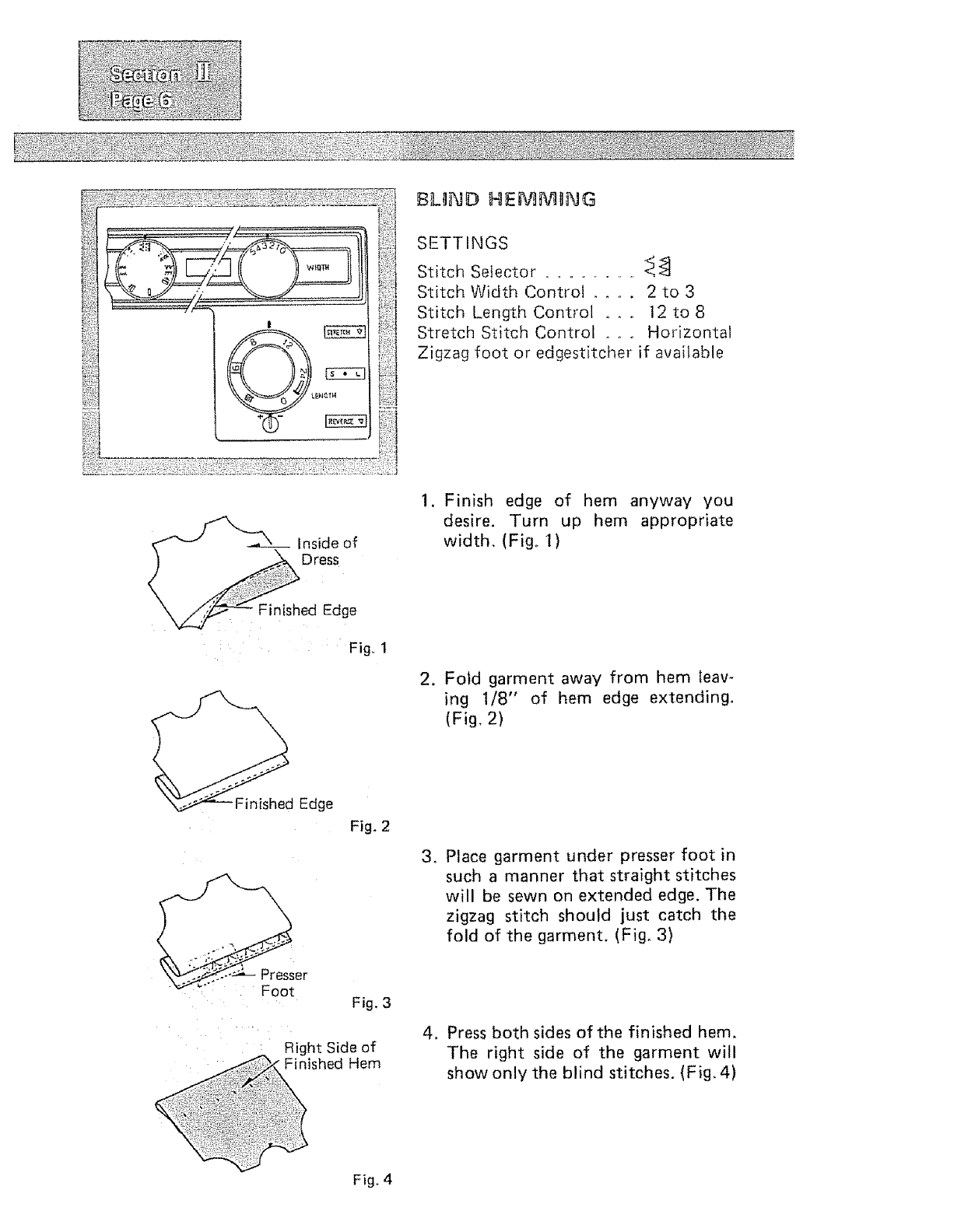
BL_D HEMMING
SETTINGS
Stitch Selector ............ _
Stitch Width Control .... 2 to 3
Stitch Length Control . . .12 to 8
Stretch Stitch Control .° . Horizontal
Zigzag foot or edgestitcher if available
nside of
Dress
ed Edge
Fig. 1
1. Finish edge of hem anyway you
desire. Turn up hem appropriate
width, (Fig. 1)
2. Fold garment away from hem leav-
ing 1/8" of hem edge extending,
(Fig, 2)
Edge
Fig. 2
Fig. 3
Right Side of
Hem
.... [_.t,',-" _ ¢'.i,'? '._.f;tl b :, i,
Fig. 4
3, Place garment under presser foot in
such a manner that straight stitches
will be sewn on extended edge. The
zigzag stitch should just catch the
fold of the garment. (Fig° 3)
4, Press both sides of the finished hem.
The right side of the garment will
show only the blind stitches. (Fig. 4)
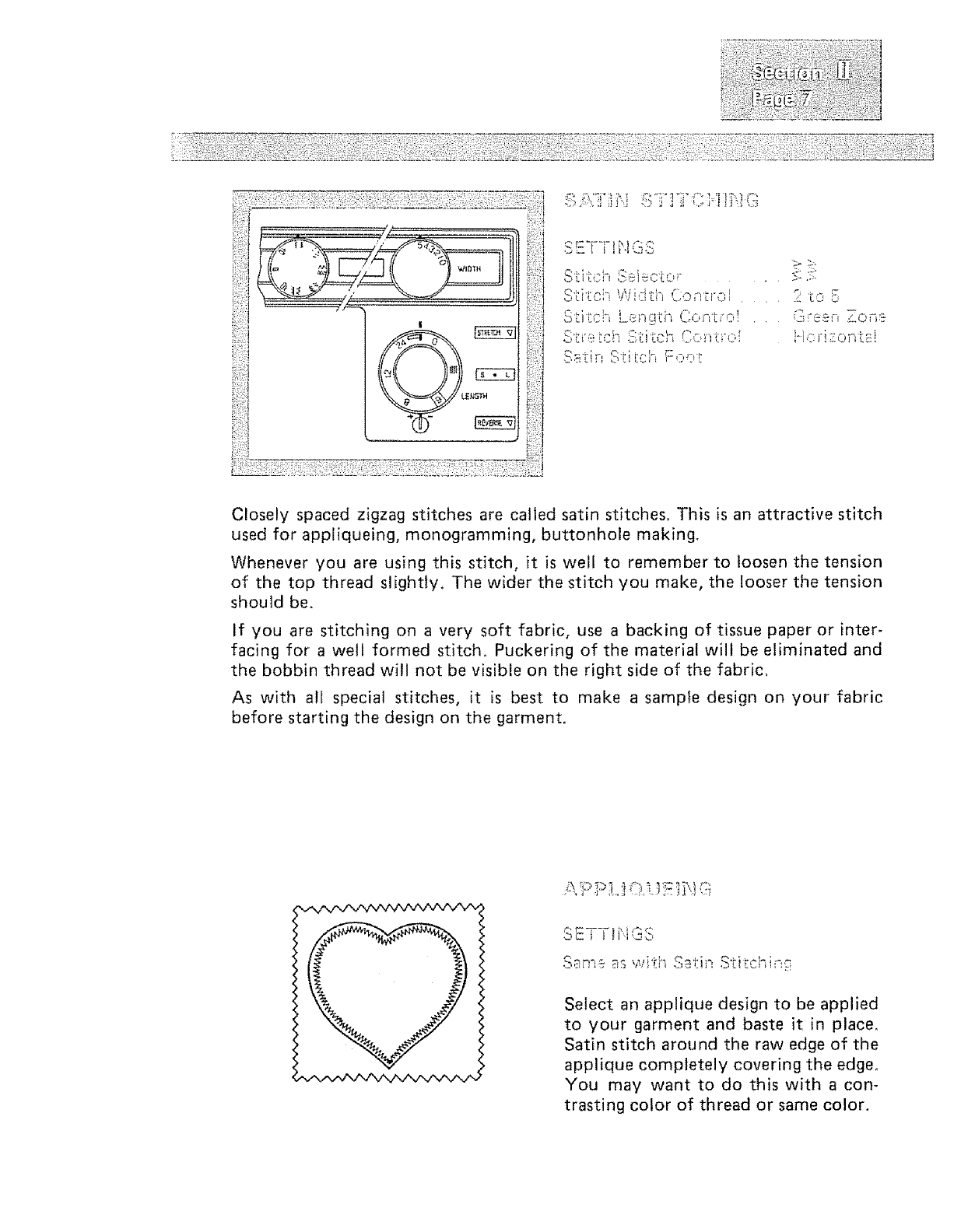
c_,_:_ _ _i _._i _ _' _n
....U..... _ {<eiecto ,s.::.
©'Q'[C" ,,,c L.I L..O,lu_,] .- LO c_
Closely spaced zigzag stitches are called satin stitches, This is an attractive stitch
used for appliqueing, monogramming, buttonhole making_
Whenever you are using this stitch, it is well to remember to loosen the tension
of the top thread slightly. The wider the stitch you make, the looser the tension
should be.
If you are stitching on a very soft fabric, use a backing of tissue paper or inter-
facing for a well formed stitch, Puckering of the material will be eliminated and
the bobbin thread will not be visible on the right side of the fabric.
As with all special stitches, it is best to make a sample design on your fabric
before starting the design on the garment..
o_ i tt,l,se,
'_'_'- "" SStiP, ..... "
bc,_I;_ 8S WI'(i'i b'[!EC_ q_i
Setect an applique design to be applied
to your garment and baste it in place.
Satin stitch around the raw edge of the
applique completely covering the edge.
You may want to do this with a con-
trasting color of thread or same color.
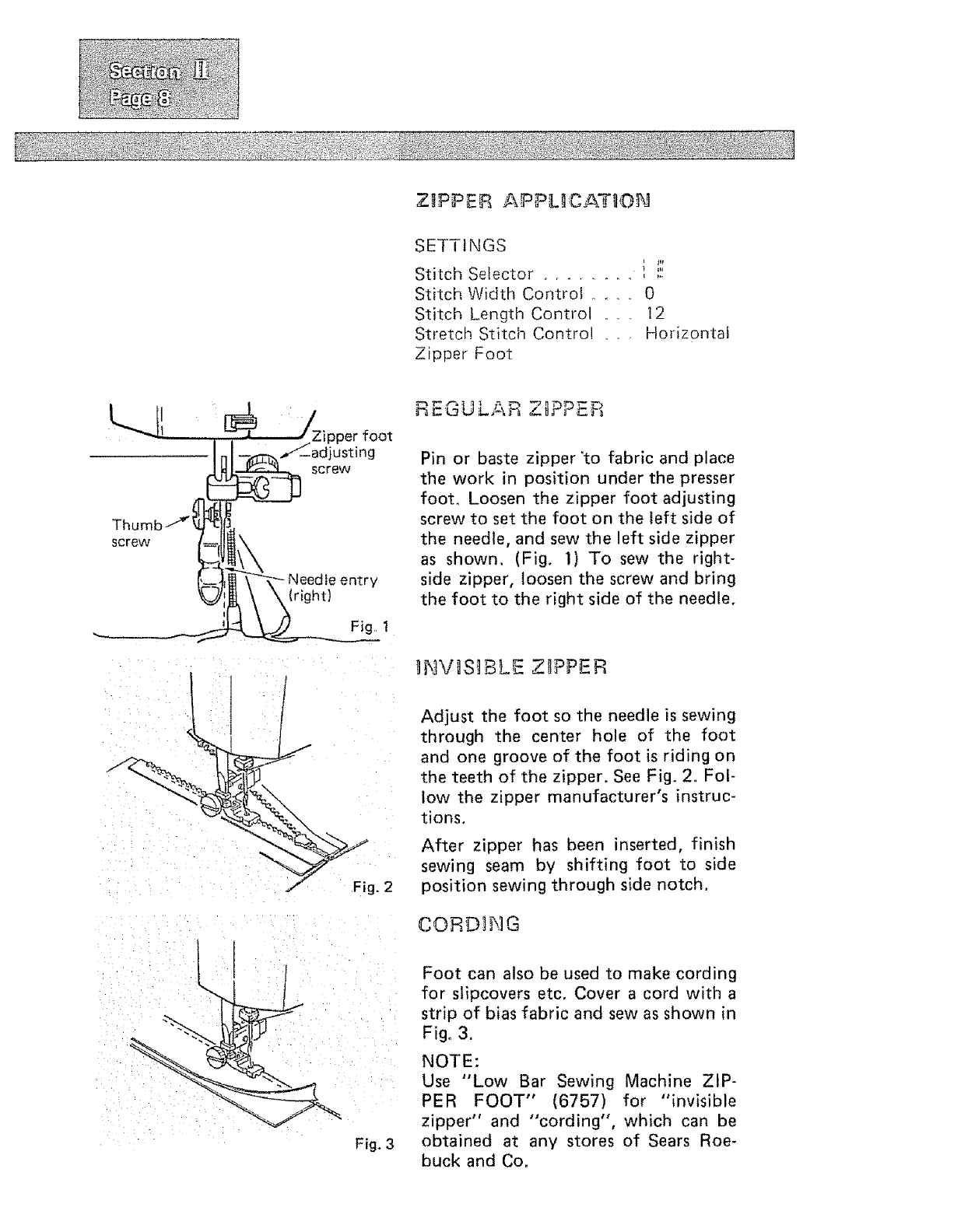
ZgPPER APPLOCA"C_ON
SETTINGS
Stitch Selector ', ,..'"
Stitch Width Controt ..... 0
Stitch Length Control ...... 12
Stretch Stitch Control .... Horizontal
Zipper Foot
_K_Zipper foot
adjusting
screw
Thum_
screw
(right) Y
Fig,, t
.2
Fig. 3
REGU'
Pin or baste zipper "to fabric and place
the work in position under the presser
foot. Loosen the zipper foot adjusting
screw to set the foot on the left side of
the needle, and sew the left side zipper
as shown. (Fig. 1) To sew the right-
side zipper, loosen the screw and bring
the foot to the right side of the needle.
_NV_S]BLE Z_PPER
Adjust the foot so the needle is sewing
through the center hole of the foot
and one groove of the foot is riding on
the teeth of the zipper. See Fig. 2. Fol-
low the zipper manufacturer's instruc-
tions.
After zipper has been inserted, finish
sewing seam by shifting foot to side
position sewing through side notch.
CORDING
Foot can also be used to make cording
for slipcovers etc. Cover a cord with a
strip of bias fabric and sew as shown in
Fig, 3.
NOTE:
Use "Low Bar Sewing Machine ZIP-
PER FOOT" (6757) for "invisible
zipper" and "cording", which can be
obtained at any stores of Sears Roe-
buck and Co,
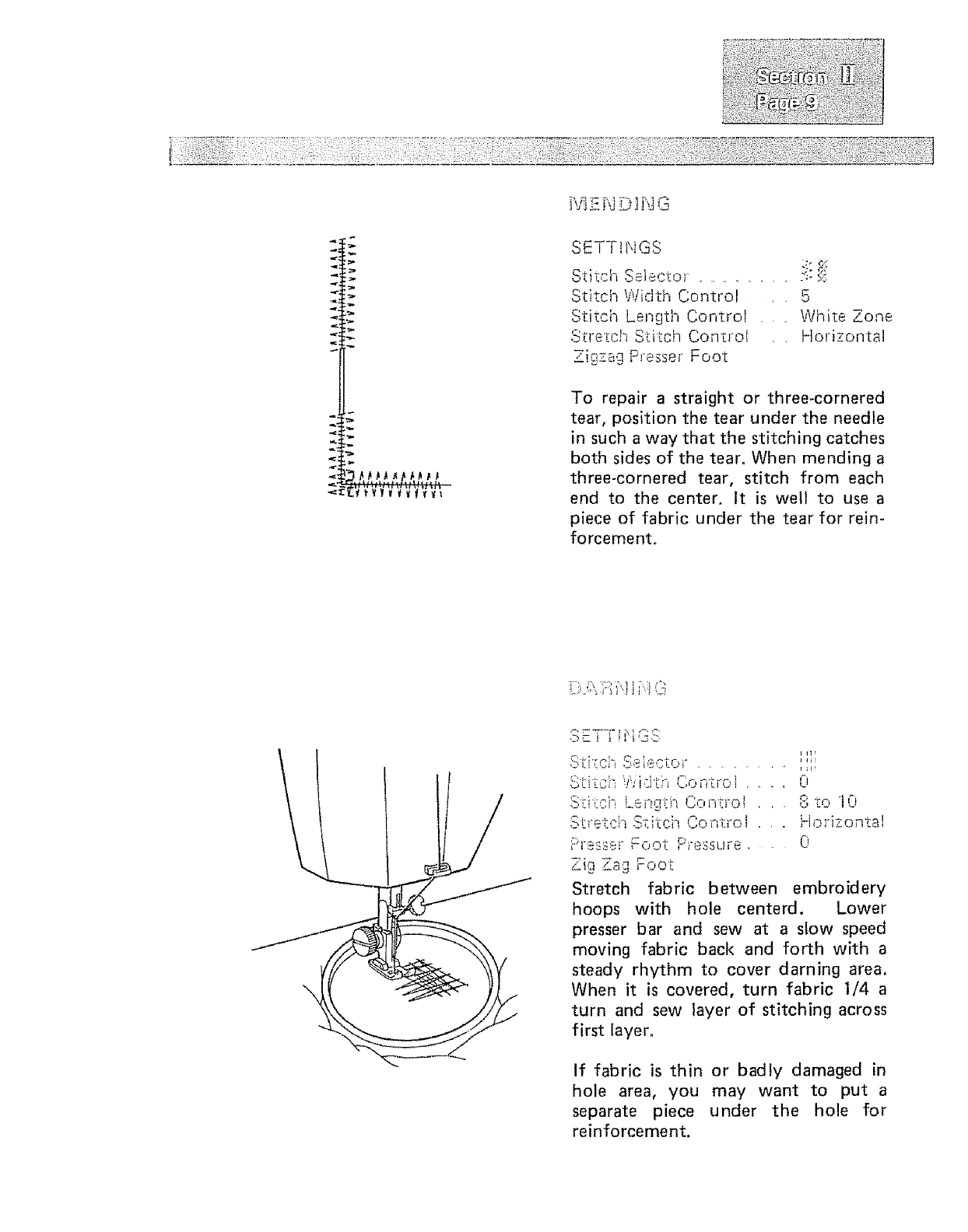
4' ,4
_t
vvv vvVVVV',
SETTIBiGS
Stitct_ Selectol ...........
Stitch Width Control ......
Stitch Length Control ....
Stre_ch Sdtch Control , ,
Zigzag PresserFoo_:
5
White Zone
Horizontal
To repair a straight or three-cornered
tear, position the tear under the needle
in such a way that the stitching catches
both sides of the tear. When mending a
three-cornered tear, stitch from each
end to the center. It is well to use a
piece of fabric under the tear for rein-
forcement.
b_!;C_ VViC]{;"i .,O_uuI
St;,:ch Le ng th Co nlLro I o
.... _, to "t0
St_e-tch Sdtciq Control .. . Horizontal
;::'resset- Foot P_-essure, -0
4_g __ag Poor
Stretch fabric between embroidery
hoops with hole centerd. Lower
presser bar and sew at a slow speed
moving fabric back and forth with a
steady rhythm to cover darning area.
When it is covered, turn fabric I/4 a
turn and sew layer of stitching across
first layer,
If fabric is thin or badly damaged in
hole area, you may want to put a
separate piece under the hole for
reinforcement.
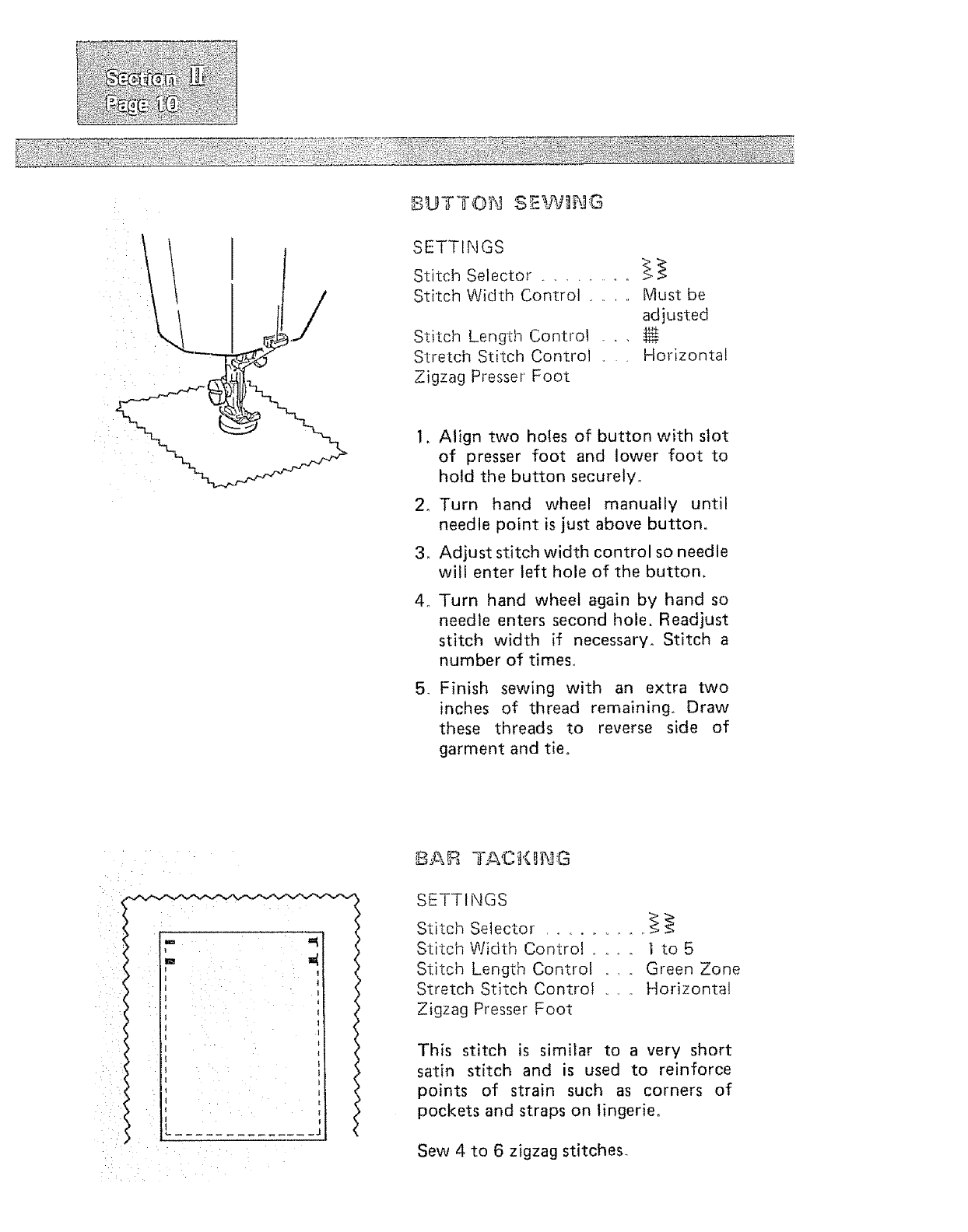
!/
ILl'it T Oi_,l SEIJVII]G
SETTINGS
Stitch Selector ........... -_}
Stitch Width Control ....... Must be
adjusted
Stitch Length Control . ,
Stretch Stitch Control .Horizontal
Zigzag Presser' Foot
1. Align two holes of button with slot
of presser foot and lower foot to
hold the button securely°
2. Turn hand wheel manually until
needle point is just above button°
3, Adjust stitch width control so needle
will enter left hole of the button.
4o Turn hand wheel again by hand so
needle enters second hole. Readjust
stitch width if necessary. Stitch a
number of times.
.Finish sewing with an extra two
inches of thread remaining. Draw
these threads to reverse side of
garment and tie°
,4
SETTINGS
Stitch Setector , ........... _}
Stitch Width Control ..... 1to 5
Stitch Length Control . , .Green Zone
Stretch Stitch Control ...... Horizontal
Zigzag Presser Foot
This stitch is similar to a very short
satin stitch and is used to reinforce
points of strain such as corners of
pockets and straps on lingerie,
Sew 4 to 6 zigzag stitches.
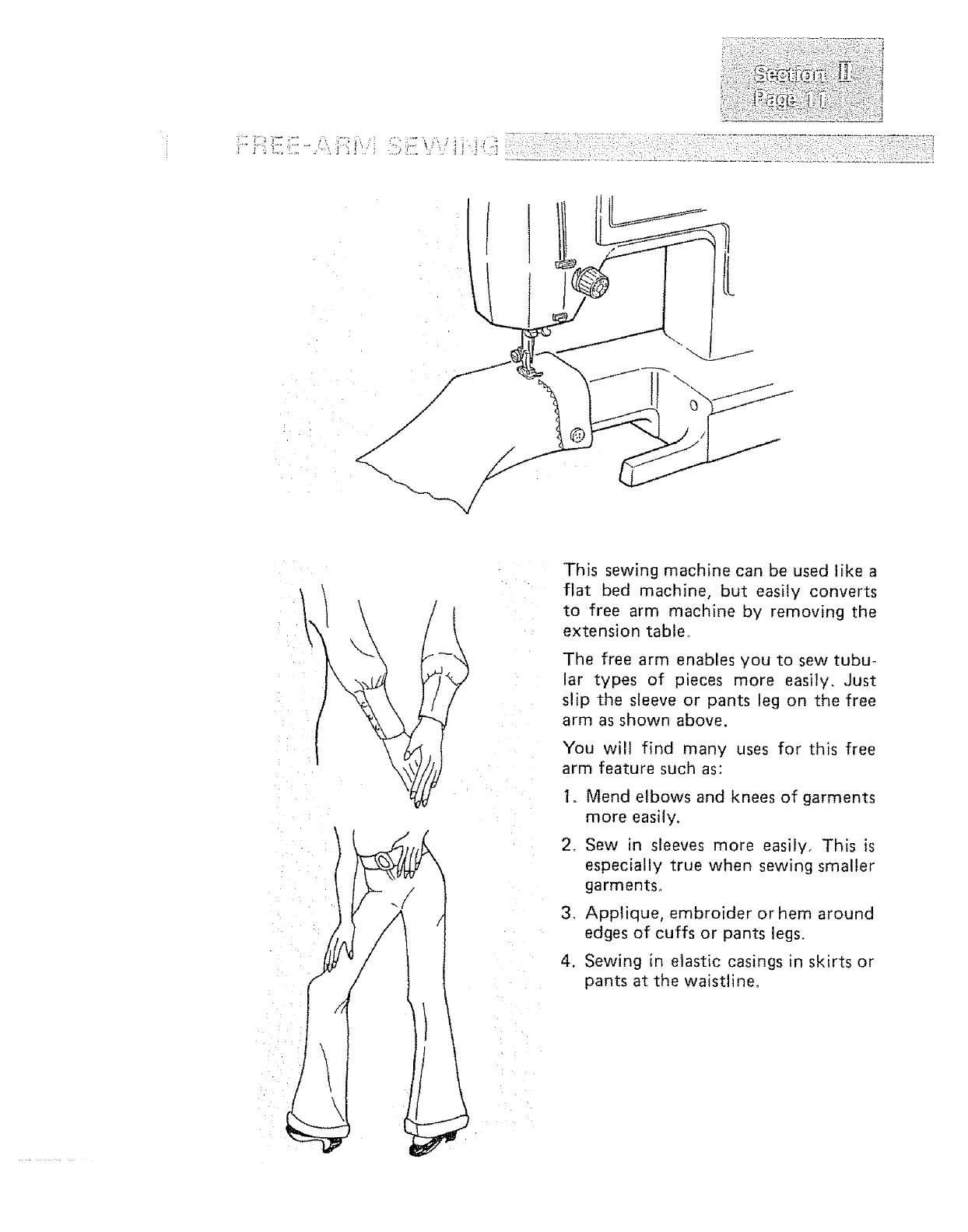
This sewing machine can be used like a
flat bed machine, but easily converts
to free arm machine by removing the
extension table.,
The free arm enables you to sew tubu-
lar types of pieces more easily, Just
slip the sleeve or pants leg on the free
arm as shown above.
You will find many uses for this free
arm feature such as:
1. Mend elbows and knees of garments
more easily.
2, Sew in sleeves more easily, This is
especially true when sewing smaller
garments_
3, Applique, embroider or hem around
edges of cuffs or pants legs.
4. Sewing in elastic casings in skirts or
pants at the waistNne,
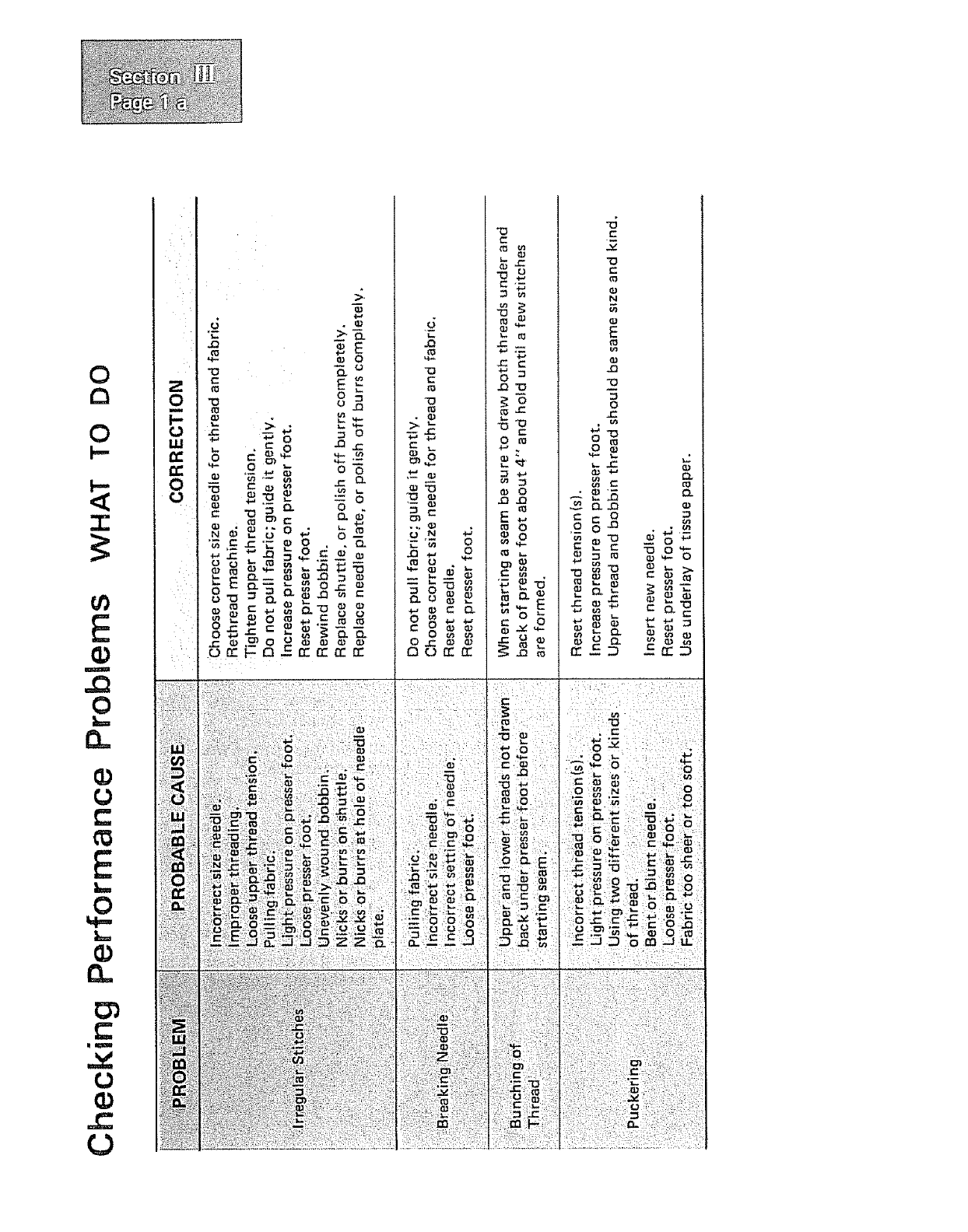
o
0
h--
-r-
00
E
0
_=
_L
(D
CO
E
;.=
0
4=,
;.=
_J
O_
m_
3=
(J
m I
_oE
_°
oE_
-- 3
.Q
.- :g_
"0
"0
(j N
_o
8
°o
o_
oo
"0
._'13
0 ro
0
._JD
-5
37
t-
¢o
E
.I3
0
A_
_,. r_ _
_= -
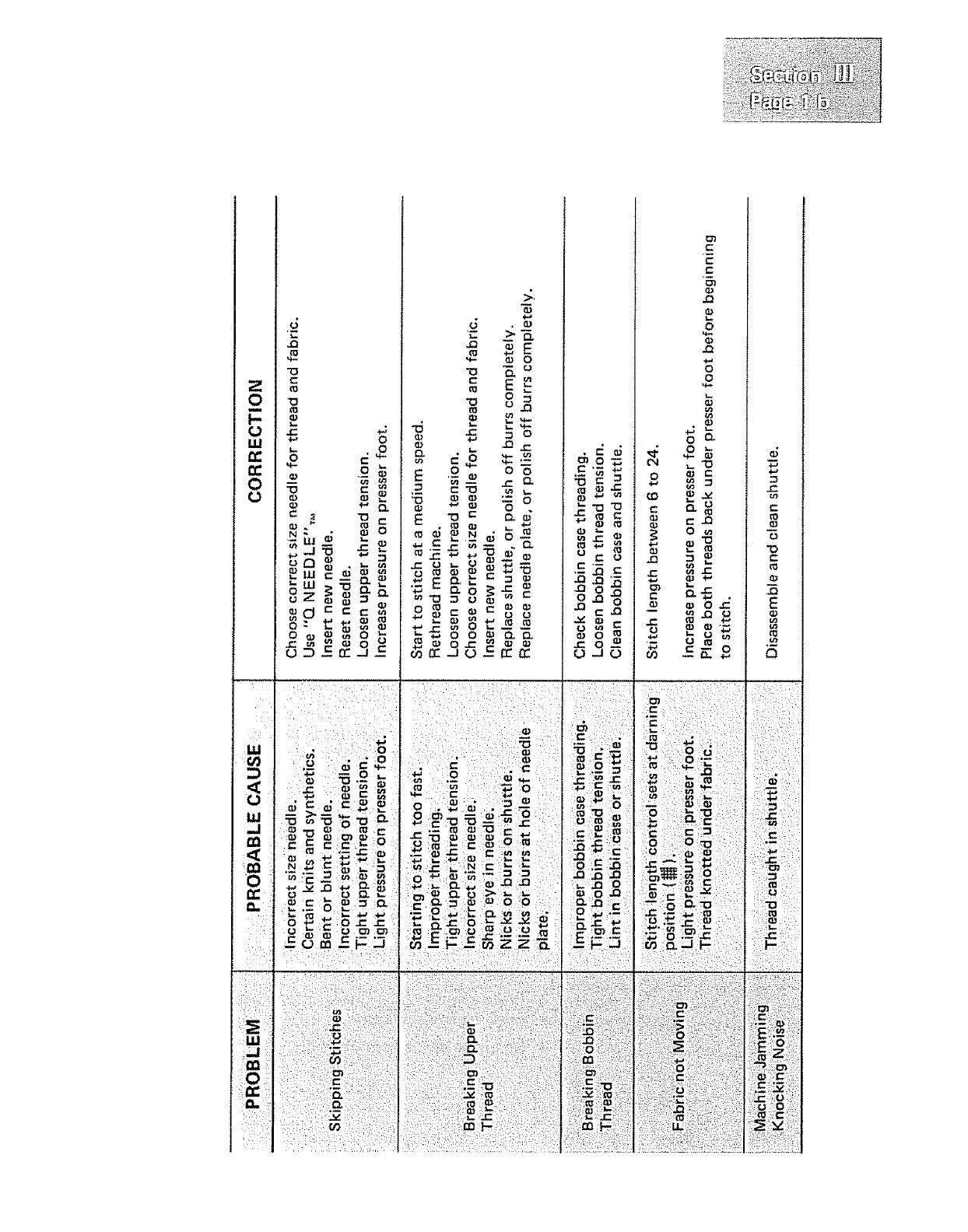
o
0
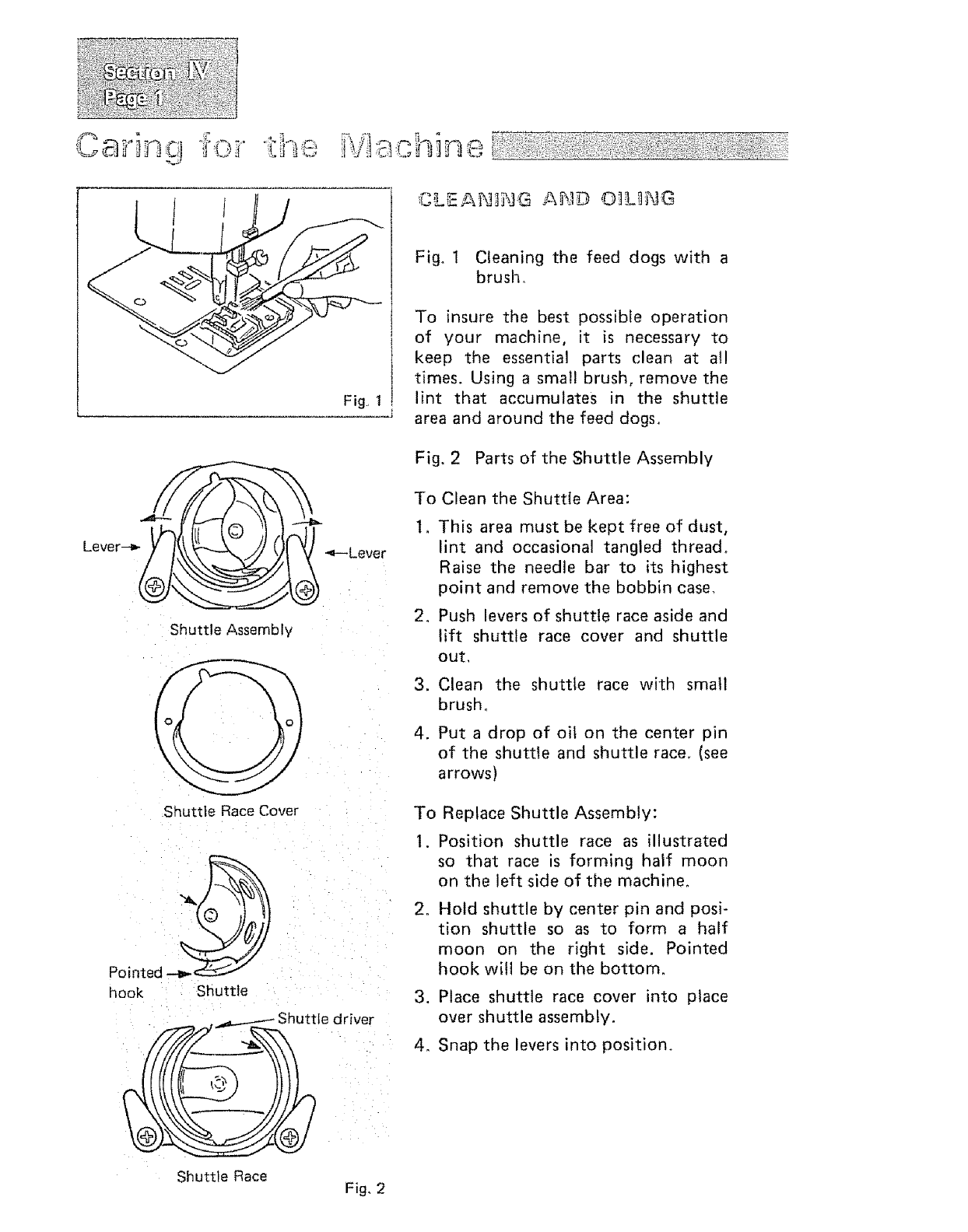
Fig I
CLEANIb3G AS:t# OILING
Fig° i Cleaning the feed dogs with a
brush
To insure the best possible operation
of your machine, it is necessary to
keep the essential parts clean at all
times. Using a small brush, remove the
lint that accumulates in the shuttle
area and around the feed dogs°
Fig. 2 Parts of the Shuttle Assembly
-_--Lever
Shuttle Assembly
Shuttle Race Cover
Pointed
hook Shuttle
le drive-
Shuttle Race Fig, 2
To Clean the Shuttle Area:
1, This area must be kept free of dust,
lint and occasional tangled thread°
Raise the needle bar to its highest
point and remove the bobbin case,
2, Push levers of shuttle race aside and
lift shuttle race cover and shuttle
out,
3. Clean the shuttle race with small
brush.
4. Put a drop of oil on the center pin
of the shuttle and shuttle race, (see
arrows)
To Replace Shuttle Assembly:
1. Position shuttle race as illustrated
so that race is forming half moon
on the left side of the machine,
.Hold shuttle by center pin and posi-
tion shuttle so as to form a half
moon on the right side. Pointed
hook will be on the bottom.
3. Place shuttle race cover into place
over shuttle assembly.
4. Snap the levers into position°
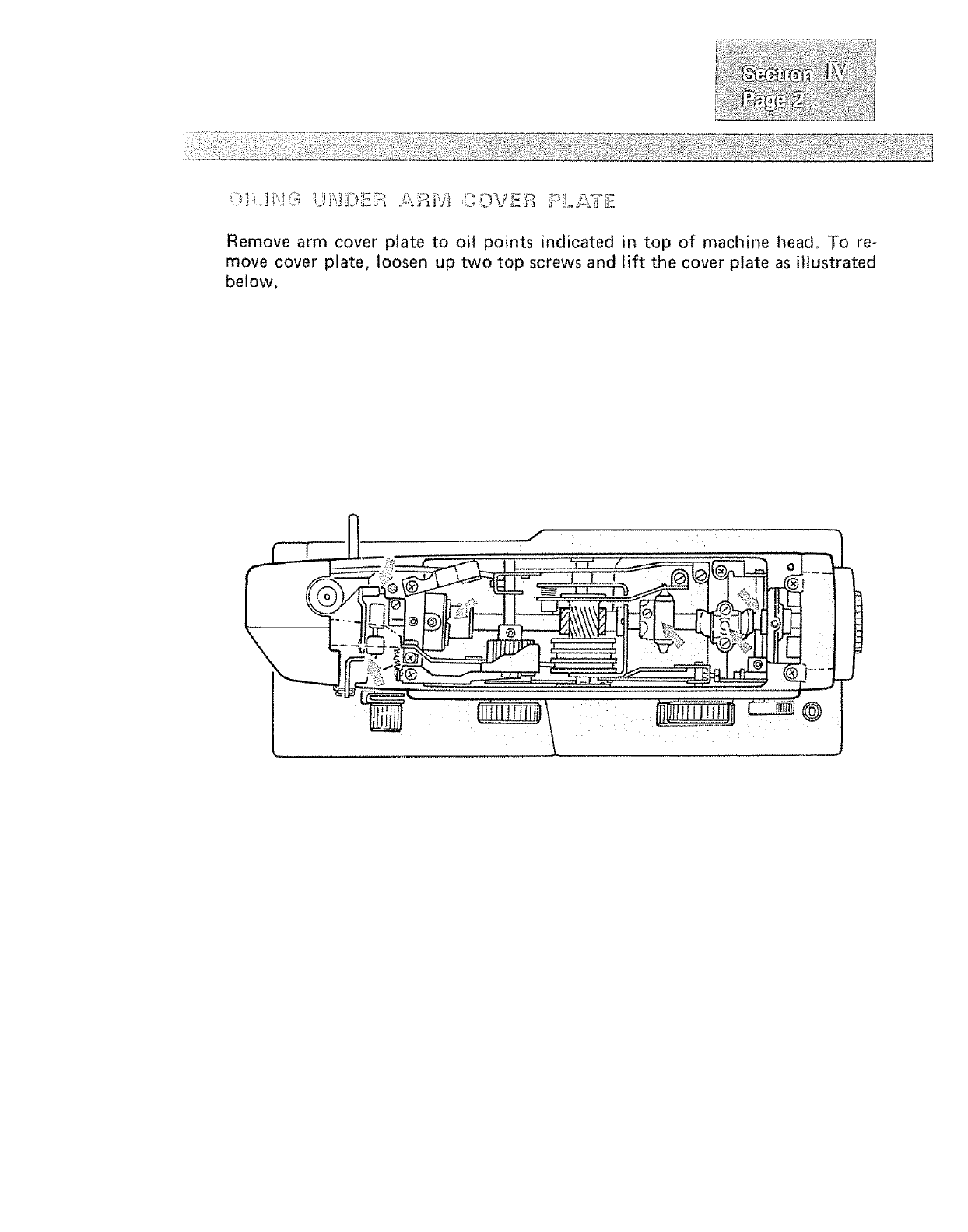
Removearm cover plate to oil points indicated in top of machine head°To re-
movecover plate, loosenup two top screwsandlift the coverplate asillustrated
below.
OILING lJ_HDEE_S_©E
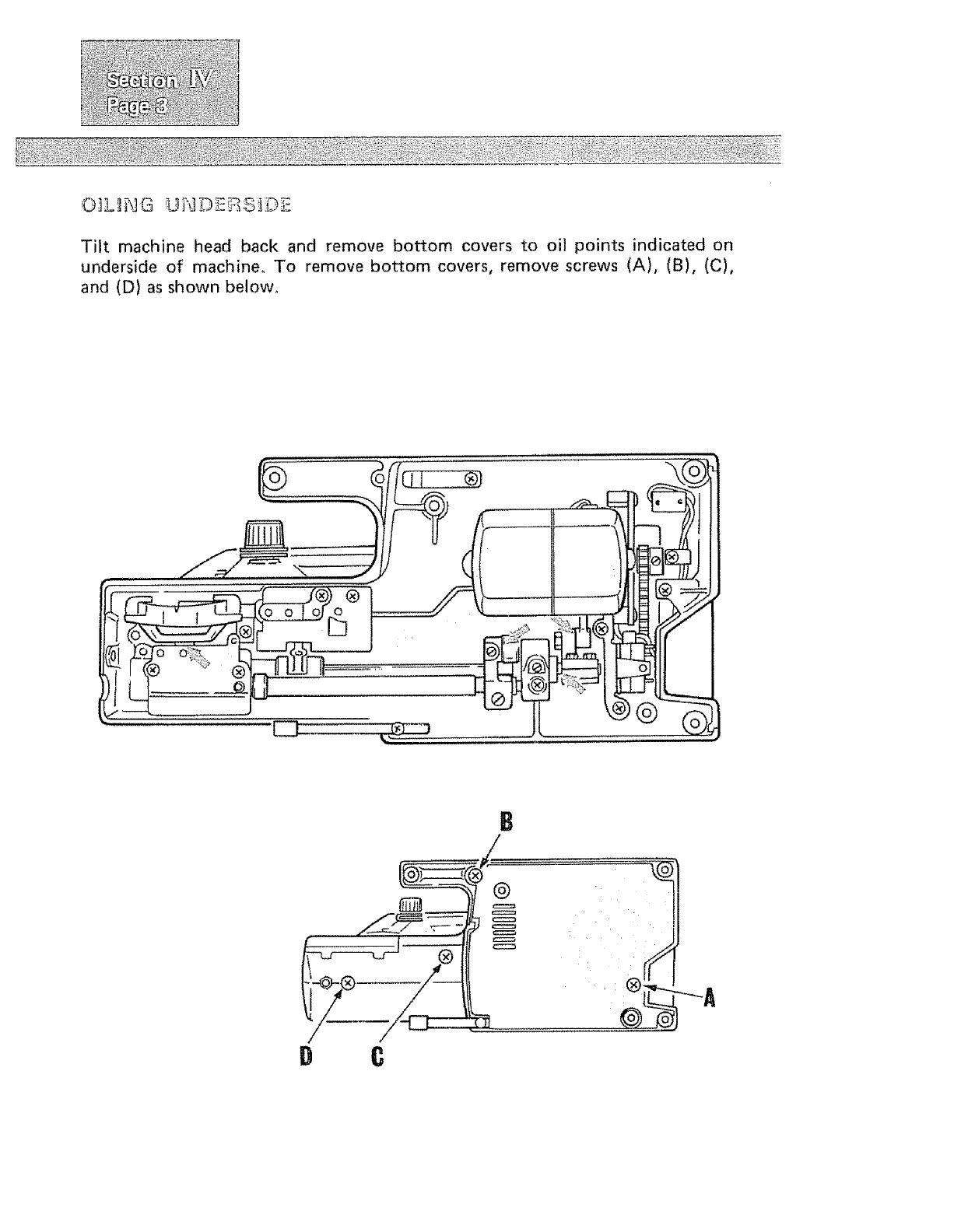
Tilt machine head back and remove bottom covers to oil points indicated on
underside of machine. To remove bottom covers, remove screws (A), (B), (C),
and (D) as shown below.
B
D
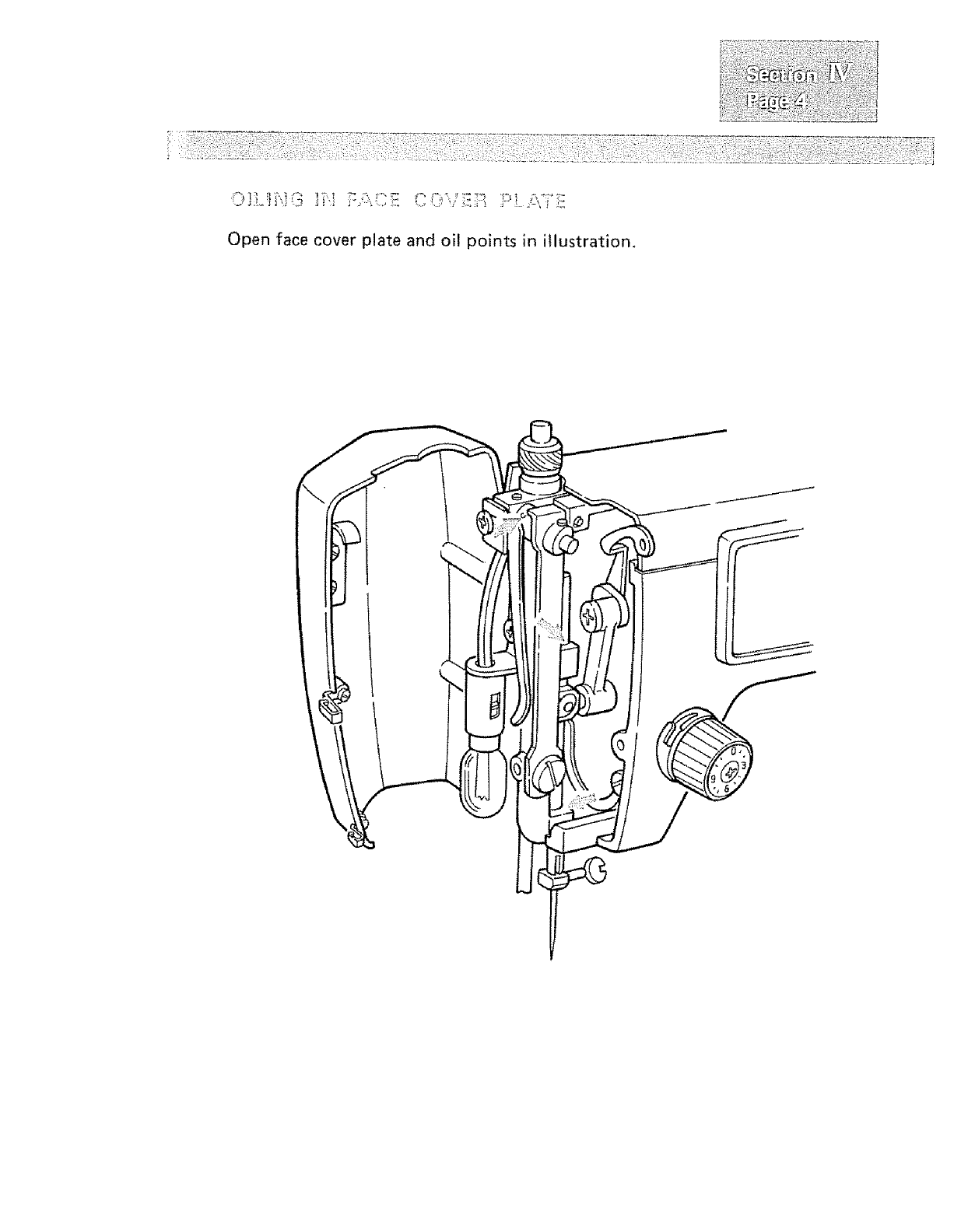
Open faco corot plate and o11 points in illustration_
I
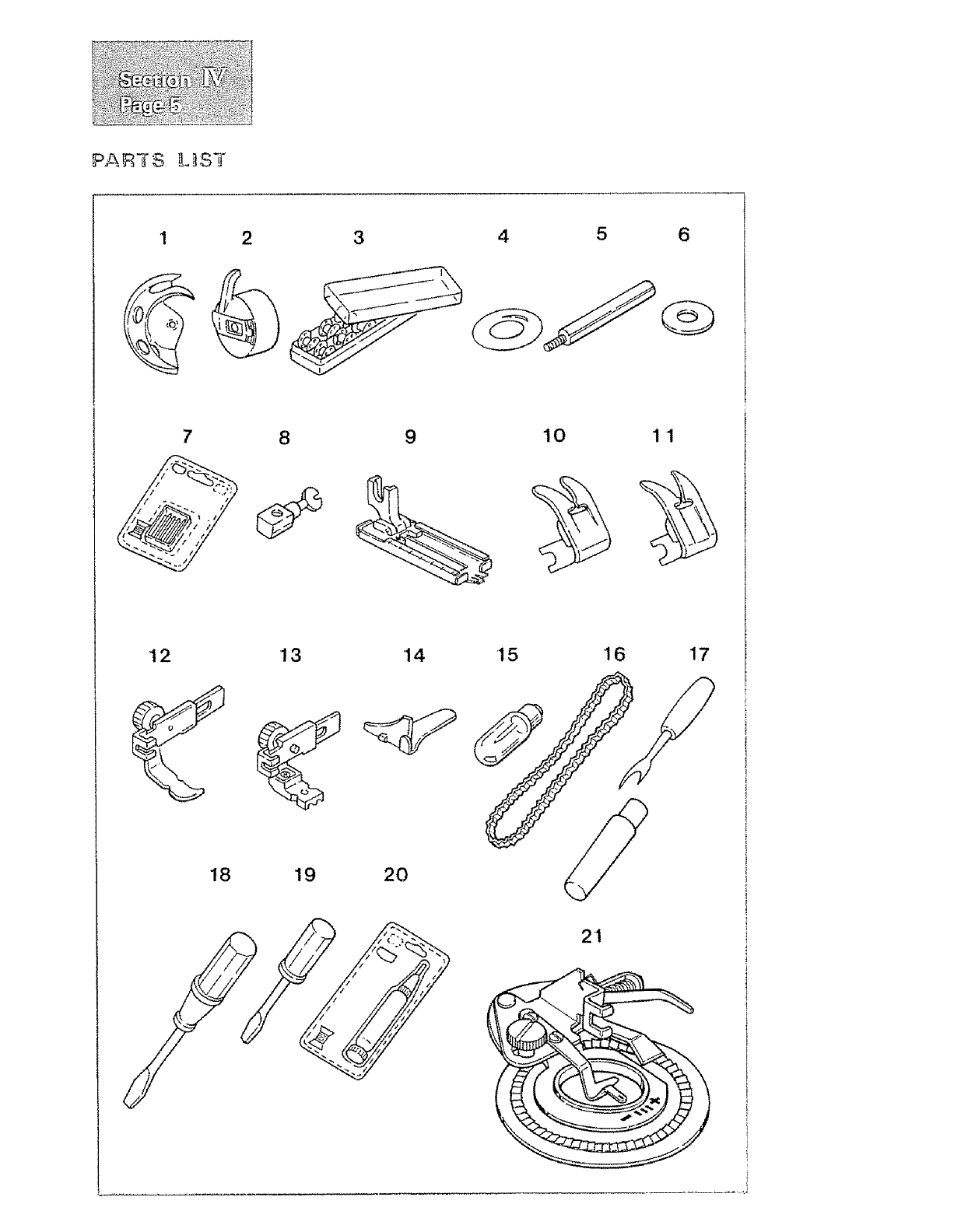
PAW_S L_]SY
1 2 3 45
8910 11
12 13
18 19 20
14 15 16 17
21
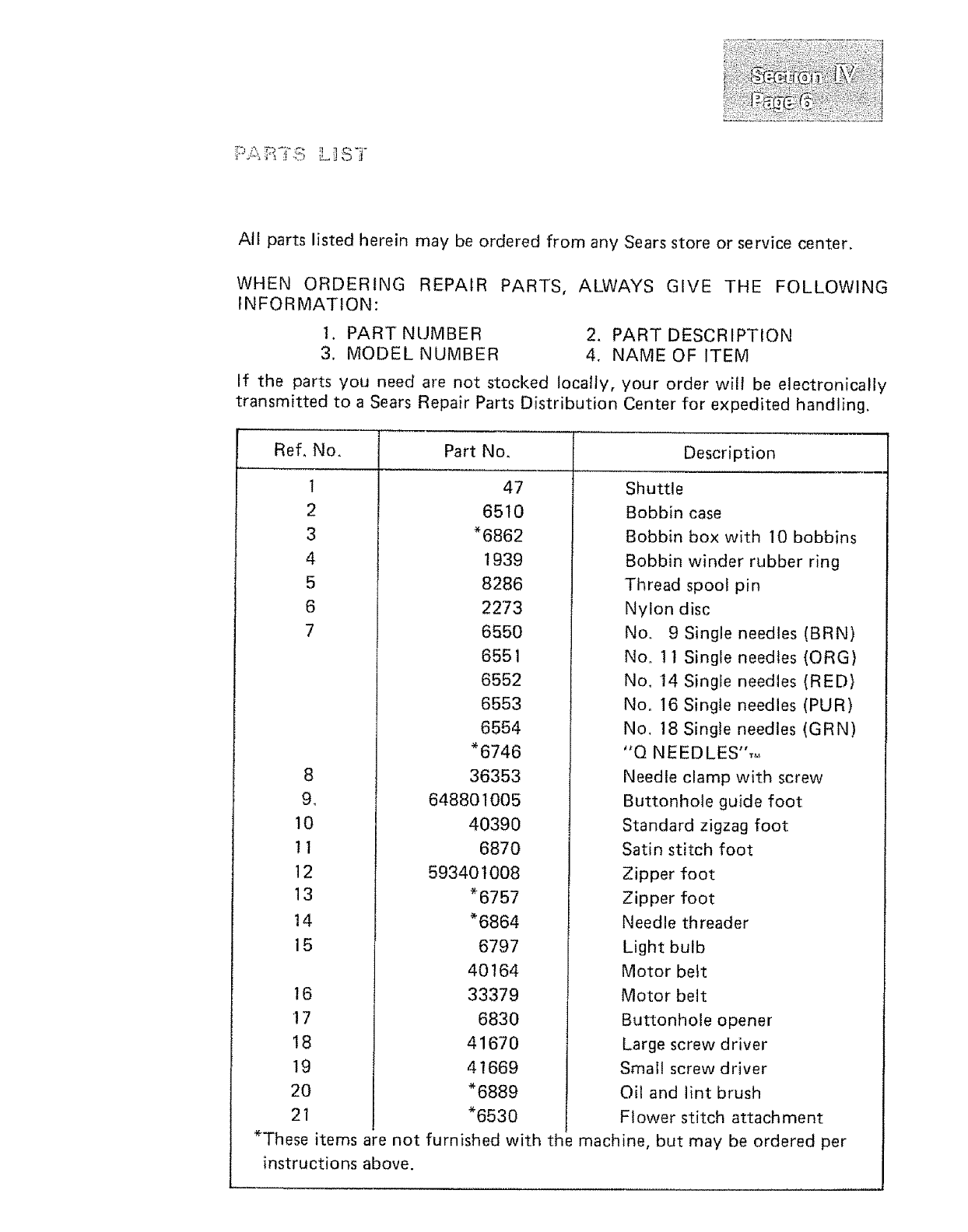
PA _3_5 L_S'Y
All parts listed herein may be ordered from any Sears store or service center.
WHEN ORDERING REPAIR PARTS, ALWAYS GIVE THE FOLLOWING
INFORMATION:
1. PART NUMBER 2. PART DESCRIPTION
3. MODEL NUMBER 4. NAME OF ITEM
If the parts you need are not stocked locally, your order will be electronically
transmitted to a Sears Repair Parts Distribution Center for expedited handling.
Re£ No. Part No. Description
1
2
3
4
5
6
7
8
9,
10
tl
12
13
14
15
47
6510
*6862
1939
8286
2273
655O
6551
6552
6553
Shuttle
Bobbin case
Bobbin box with 10 bobbins
Bobbin winder rubber ring
Thread spool pin
Nylon disc
No. 9 Single needles (BRN)
16
17
18
19
20
21
*These items are not furnished with th,
instructions above.
No, 11 Single needles (ORG)
No. 14 Single needles (RED)
No. 16 Single needles (PUR)
6554
*6746
36353
6488O10O5
40390
687O
593401008
*6757
*6864
6797
40164
33379
6830
41670
41669
*6889
*6530
No, 18 Single needles (GRN)
"Q NEEDLES",,.,
Needle clamp with screw
Buttonhole guide foot
Standard zigzag foot
Satin stitch foot
Zipper foot
Zipper foot
Needle threader
Light bulb
Motor be_t
Motor belt
Buttonhole opener
Large screw driver
Small screw driver
Oil and lint brush
Flower stitch attachment
machine, but may be ordered per

_ _ _°i__ _"ii
l_q z: I\il
C
#
_z-
i
i
#
i
!
#
#
#
i
WARRANTY
FULL 25 -YEAR WARRANTY ON SEWING MACHINE
HEAD
For 25 years from the date of purchase, Sears will, free of
charge, repair defects in material or workmanship which
appear in the sewing machine head,
FULL TWO YEAR WARRANTY ON ELECTRICAL EQUIP-
MENT OF SEWING MACHINE
For two years from the date of purchase, Sears will, free
of charge, repair defects in material or workmanship which
appear in the electrical equipment of the sewing machine,
including motor, wiring, switch and speed control°
FULL 90 - DAY WARRANTY ON ALL PARTS AND
MECHAN ICAL ADJUSTMENTS
For 90 days from the date of purchase, Sears will, free of
charge, replace any parts and provide mechanical service
necessary for proper operation of the sewing machine, except
for normal maintenance.
#
#
i
i
i
To obtain warranty service described above, SIMPLY CONTACT
THE NEAREST SEARS STORE OR SERVICE CENTER IN THE
UNITED STATES. This warranty applies only while this product
is in use in the United States°
This warranty gives you specific legal rights, and you may also
have other rights which vary from state to state.
f
"_"Jill- 'lilt, _ 'llll, "llll- 'ltlt+ +'qli, - _llti+ -Illl_ 'lilt+ _ 'llli, "IIII-4Iii1,
SEARS, ROEBUCK AND CO., Dept. 698/73tA, Sears Tower, Chicago, IL 60684
3.
=
#
=
z
SEWING MACHINE
Now that you have purchased your Sewing Machine, should a
need ever exist for repair parts or service, simply contact any
Sears Service Center and most Sears, Roebuck and Co_
Be sure to provide all pertinent facts when you call or visit.
The model number of your Sewing Machine will be shown on
your nomenclature plate on the back of your Sewing Machine_
See Section 1, page 3 for location.
WHEN ORDERING REPAIR PARTS, ALWAYS GIVE THE
FOLLOWING INFORMATION :
*MODEL NUMBER *NAME OF ITEM *PART DESCRIPTION
If the parts you need are not stocked locally, your order will be
electronically transmitted to a Sears Repair Parts Distribution
Center for handling.
SEARS, ROEBUCK AND CO., Chicago, IL 60684 U.S.A.
S-385 Printed in Taiwan Part Nor 6488000'15
