Kenwood Kca Bt300 Users Manual B64 4713 00_10_KCA BT300_KE.indb
KCA-BT300 to the manual 0091036b-0c97-43ab-a459-ac57a0d17a0a
2015-01-23
: Kenwood Kenwood-Kca-Bt300-Users-Manual-262783 kenwood-kca-bt300-users-manual-262783 kenwood pdf
Open the PDF directly: View PDF  .
.
Page Count: 104 [warning: Documents this large are best viewed by clicking the View PDF Link!]

KCA-BT300
Bluetooth UNIT
INSTRUCTION MANUAL
APPAREIL Bluetooth
MODE D’EMPLOI
UNIDAD Bluetooth
MANUAL DE INSTRUCCIONES
© B64-4713-00/10 (KW/ EW)
Take the time to read through this instruction manual.
Familiarity with installation and operation procedures will help you obtain the best
performance from your new Bluetooth unit.
For your records
Record the serial number, found on the back of the unit, in the spaces designated on the
warranty card, and in the space provided below. Refer to the model and serial numbers
whenever you call upon your Kenwood dealer for information or service on the product.
Model KCA-BT300 Serial number
US Residence Only
Register Online
Register your Kenwood product at
www.Kenwoodusa.com
B64-4713-00_10_KCA-BT300_KE.indb 1B64-4713-00_10_KCA-BT300_KE.indb 1 10/03/12 14:5110/03/12 14:51

2 | KCA-BT300
Contents
Before use 3
Model List 4
Basic Operation of hands-free phoning
(Model-A) 6
Before Use
Making a call
Receiving a call
Call waiting
During a call
Other functions
Basic Operation of hands-free phoning
(Model-B) 8
Before Use
Making a call
Receiving a call
Call waiting
During a call
Other functions
Basic Operation of hands-free phoning
(Model-C) 10
Before Use
Making a call
Receiving a call
Call waiting
During a call
Other functions
Basic Operation of hands-free phoning
(Model-D) 12
Before Use
Making a call
Receiving a call
Call waiting
During a call
Other functions
Basic Operation of hands-free phoning
(Model-E) 14
Before Use
Making a call
Receiving a call
Call waiting
During a call
Other functions
Basic Operation of hands-free phoning
(Model-F) 16
Before Use
Making a call
Receiving a call
Call waiting
During a call
Other functions
Basic Operation of hands-free phoning
(Model-G) 18
Before Use
Making a call
Receiving a call
During a call
Other functions
Function Operation 20
Registering Bluetooth device
Registering Special Bluetooth device
Registering PIN Code
Downloading the Phone Book
Selecting the Bluetooth device You Wish to
Connect
Deleting a Registered Bluetooth device
Adding a Voice Dialing Command
Setting a Voice Command for Category
Downloading the SMS
SMS (Short Message Service)
Remote control 25
Making a call
Receiving a call
Call waiting (Function of Model-A, B, C, D, E, F)
During a call
Bluetooth Audio 25
Before Use
Playing Bluetooth Audio
Operation of hands-free phoning
(Model-H) 26
Registering Bluetooth device
Downloading the Phone Book
Hands-Free Control screen
Key Operation
Making a call
Receiving a call
During a call
Other functions
Appendix 30
Accessories/ Installation Procedure 32
Connection 33
Installation 33
Troubleshooting Guide 34
Specifications 35
B64-4713-00_10_KCA-BT300_KE.indb 2B64-4713-00_10_KCA-BT300_KE.indb 2 10/03/12 14:5110/03/12 14:51

English | 3
Before use
2WARNING
To prevent injury or fire, take the following
precautions:
• To prevent a short circuit, never put or leave any
metallic objects (such as coins or metal tools) inside
the unit.
• Mounting and wiring this product requires skills and
experience. For safety’s sake, leave the mounting
and wiring work to professionals.
2CAUTION
• Do not install the unit in a spot exposed to direct
sunlight or excessive heat or humidity. Also avoid
places with too much dust or the possibility of
water splashing.
Notes
• If you experience problems during installation,
consult your Kenwood dealer.
• The capital letters and small letters of the display
can be reversed.
• The illustrations of the display and the panel
appearing in this manual are examples used to
explain more clearly how the controls are used.
Therefore, what appears on the display in the
illustrations may differ from what appears on the
display on the actual equipment, and some of the
illustrations on the display may be inapplicable.
Kenwood Receivers available for this unit
Operation methods are classified into groups by
receiver (control unit) type.
First, refer to <Model List> (page 4) to confirm the
group of the operation you whish to perform.
Model-A, B, C, D, E, F, G
Refer to the relevant pages (<Basic Operation of
hands-free phoning>). To use a Bluetooth audio player
with this unit, refer to <Bluetooth Audio> (page 25).
Model-H
Refer to the relevant pages (<Operation of hands-free
phoning>). To use a Bluetooth audio player with this
unit, refer to <Bluetooth Audio> (page 25).
Model-I
After performing the operation mentioned
<Registering Bluetooth device> (page 26) or
<Downloading the Phone Book> (page 26), refer to the
Instruction Manual for Control Unit.
To use a Bluetooth audio player with this unit, refer to
<Bluetooth Audio> (page 25).
Notes on selecting and deleting a Hands-Free
Phone
• If a cell-phone is already selected, deselect it, and then
select a different one.
• "BT300 FW***" and the firmware version are displayed in the
cell-phone selection list. Although the same contents are
displayed in the deletion list, they cannot be deleted.
• The audio player is displayed on the device list after the
registration. However, the audio player on the list cannot be
selected.
Model-J, L
Refer to the Instruction Manual for Control Unit.
Model-K
Refer to the Instruction Manual for Control Unit.
The functions requiring different operation are
described below:
• Displaying song information of Bluetooth audio
source files
The currently playing song information can be
displayed when Bluetooth audio player supports
AVRCP 1.3 profile.
Title & Artist ("Title/Artist"), Album & Artist ("Album/
Artist")
• Displaying timestamp when dialing from call history
list
Name, telephone number, and timestamp can be
selected by switching among display items.
• Registering Bluetooth device
When a Bluetooth device to be connected is
selected from the device list, "Pairing" appears
and this unit automatically starts pairing with the
selected Bluetooth device
- The registration is complete when "Pairing Success"
is displayed. Perform the operation after sending a
PIN code.
- Enter a PIN code when "PIN Code NG" is displayed.
• Bluetooth Settings
Display Overview
"MIC Gain" "–3" – "0" – "+3": Adjust the sensitivity of the
microphone for a telephone call. Adjust the voice
of caller.
"NR Level" "–3" – "0" – "+3": Reduce the noises generated
by surrounding environment without changing the
microphone volume. Adjust the voice of caller when
it is not clear.
"Echo Cancel" "–2" – "0" – "+2": Adjust the level of echo
cancellation.
B64-4713-00_10_KCA-BT300_KE.indb 3B64-4713-00_10_KCA-BT300_KE.indb 3 10/03/12 14:5110/03/12 14:51
4 | KCA-BT300
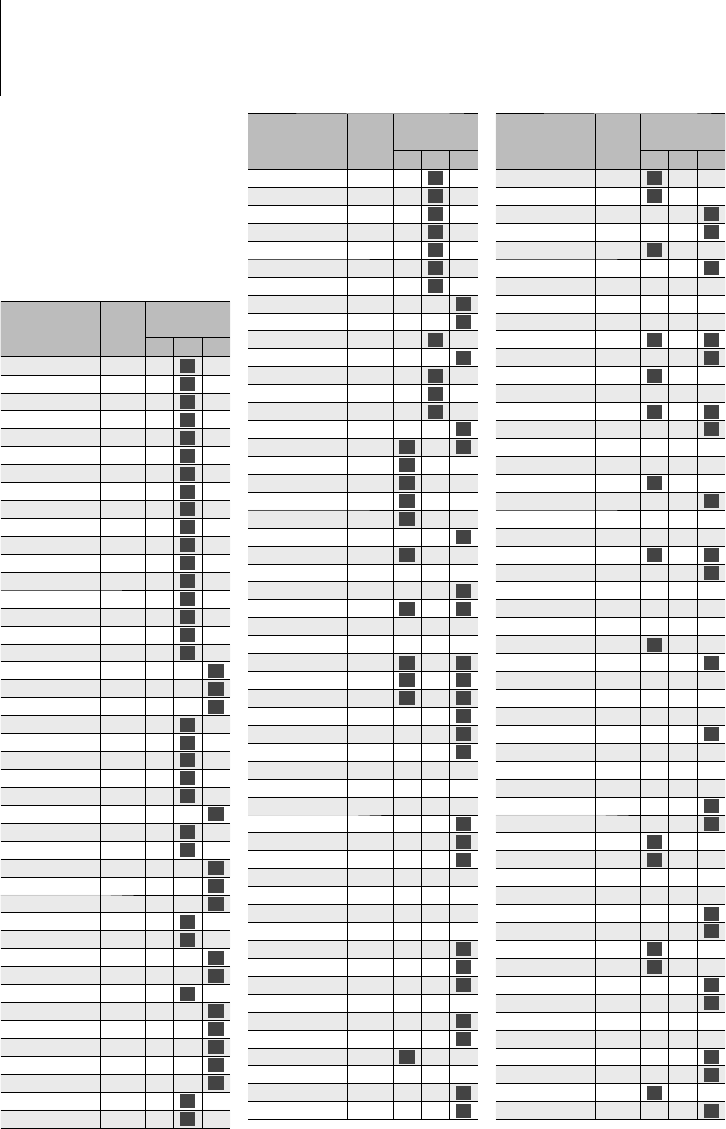
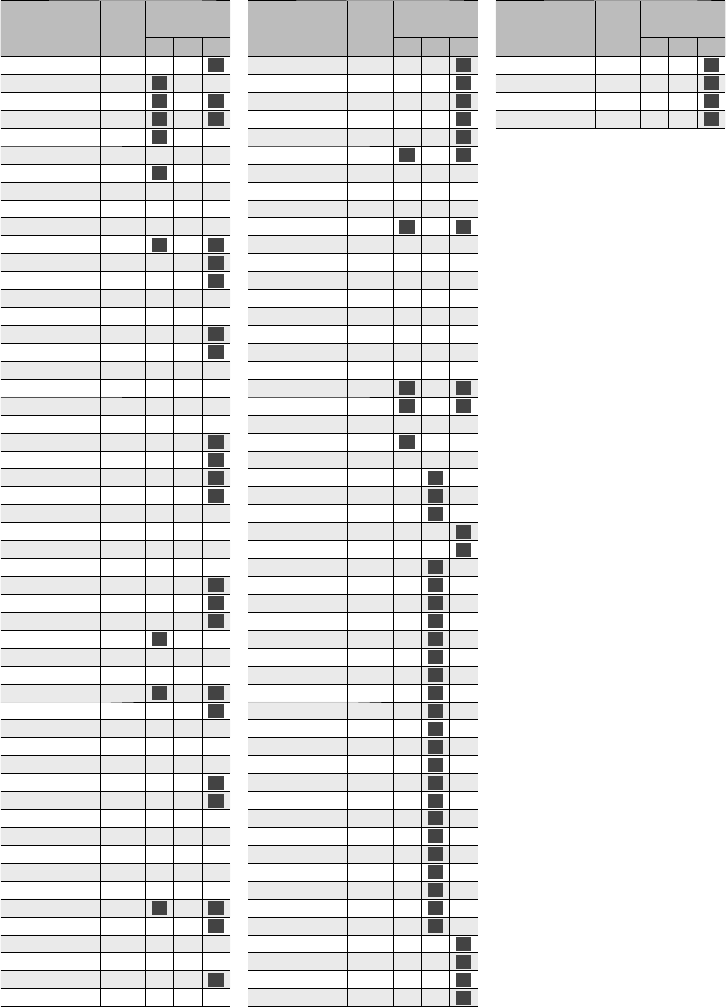
The receiver units that can be used
with KCA-BT300 are as follows: (As
of April 2010)
For details on the compatible
receivers to be released in the
future, access the following URL:
http://www.kenwood.com/cs/
ce/bt/
Model name Group Type switch
setting
123
DDX5022 J OFF ON OFF
DDX5022Y J OFF ON OFF
DDX5024 J OFF ON OFF
DDX5026 J OFF ON OFF
DDX5032 J OFF ON OFF
DDX5032M J OFF ON OFF
DDX5034 J OFF ON OFF
DDX5034M J OFF ON OFF
DDX5036 J OFF ON OFF
DDX5036M J OFF ON OFF
DDX5054 J OFF ON OFF
DDX5056 J OFF ON OFF
DDX512 J OFF ON OFF
DDX514 J OFF ON OFF
DDX516 J OFF ON OFF
DDX52RY J OFF ON OFF
DDX54R J OFF ON OFF
DDX6019 H OFF OFF ON
DDX6029 H OFF OFF ON
DDX6029Y H OFF OFF ON
DDX6034 J OFF ON OFF
DDX6034M J OFF ON OFF
DDX6036 J OFF ON OFF
DDX6036 J OFF ON OFF
DDX6036M J OFF ON OFF
DDX6039 H OFF OFF ON
DDX6054 J OFF ON OFF
DDX630BT J OFF ON OFF
DDX7019 I OFF OFF ON
DDX7029 I OFF OFF ON
DDX7029Y I OFF OFF ON
DDX7032 J OFF ON OFF
DDX7032M J OFF ON OFF
DDX7039 I OFF OFF ON
DDX7039M I OFF OFF ON
DDX712 J OFF ON OFF
DDX8019 I OFF OFF ON
DDX8029 I OFF OFF ON
DDX8029Y I OFF OFF ON
DDX8039 I OFF OFF ON
DNX210EX G-1 OFF OFF ON
DNX5120 J OFF ON OFF
DNX512EX J OFF ON OFF
Model name Group Type switch
setting
123
DNX5140 J OFF ON OFF
DNX5160 J OFF ON OFF
DNX5220 J OFF ON OFF
DNX5240 J OFF ON OFF
DNX5360 J OFF ON OFF
DNX5360M J OFF ON OFF
DNX5560 J OFF ON OFF
DNX7100 I OFF OFF ON
DNX710EX I OFF OFF ON
DNX7120 J OFF ON OFF
DNX7200 I OFF OFF ON
DNX7220 J OFF ON OFF
DNX7320 J OFF ON OFF
DNX7320CN J OFF ON OFF
DPX-MP2090U G-1 OFF OFF ON
DPX-MP2100 G-1 ON OFF ON
DPX-MP3110 F ON OFF OFF
DPX-MP3110S F ON OFF OFF
DPX-MP4110 F ON OFF OFF
DPX-MP4110S F ON OFF OFF
DPX-MP5100U G-1 OFF OFF ON
DPX-MP5110U F ON OFF OFF
DPX-MP6110U E-1 OFF OFF OFF
DPX-MP7090U G-1 OFF OFF ON
DPX302 G-1 ON OFF ON
DPX303 E-1 OFF OFF OFF
DPX313Y E-1 OFF OFF OFF
DPX501 G-1 ON OFF ON
DPX501U G-1 ON OFF ON
DPX501UY G-1 ON OFF ON
DPX502 G-1 OFF OFF ON
DPX502U G-1 OFF OFF ON
DPX502UY G-1 OFF OFF ON
DPX503 E-1 OFF OFF OFF
DPX503U E-1 OFF OFF OFF
DPX503UY E-1 OFF OFF OFF
DPX701 G-1 OFF OFF ON
DPX701U G-1 OFF OFF ON
DPX701UY G-1 OFF OFF ON
KDC-5047U K OFF OFF OFF
KDC-6047U K OFF OFF OFF
KDC-HD545U J OFF OFF OFF
KDC-HD942U J OFF OFF OFF
KDC-MP2035 G-1 OFF OFF ON
KDC-MP235 G-1 OFF OFF ON
KDC-MP238 G-4 OFF OFF ON
KDC-MP242 A OFF OFF OFF
KDC-MP3035 G-1 OFF OFF ON
KDC-MP335 G-1 OFF OFF ON
KDC-MP338 D-1 ON OFF OFF
KDC-MP342U A OFF OFF OFF
KDC-MP4036AX G-1 OFF OFF ON
KDC-MP4036U G-1 OFF OFF ON
Model name Group Type switch
setting
123
KDC-MP4039 D-1 ON OFF OFF
KDC-MP408U D-1 ON OFF OFF
KDC-MP435U G-1 OFF OFF ON
KDC-MP436U G-1 OFF OFF ON
KDC-MP438U D-1 ON OFF OFF
KDC-MP439 G-4 OFF OFF ON
KDC-MP442U B OFF OFF OFF
KDC-MP443 A OFF OFF OFF
KDC-MP445U K OFF OFF OFF
KDC-MP5033U G-1 ON OFF ON
KDC-MP5036U G-1 OFF OFF ON
KDC-MP5039U D-1 ON OFF OFF
KDC-MP5043U A OFF OFF OFF
KDC-MP532U G-1 ON OFF ON
KDC-MP535U G-1 OFF OFF ON
KDC-MP538U E-2 OFF OFF OFF
KDC-MP543U A OFF OFF OFF
KDC-MP5539U D-1 ON OFF OFF
KDC-MP6036 G-1 OFF OFF ON
KDC-MP6039 E-2 OFF OFF OFF
KDC-MP6043U B OFF OFF OFF
KDC-MP632U G-1 ON OFF ON
KDC-MP635 G-3 OFF OFF ON
KDC-MP638U E-1 OFF OFF OFF
KDC-MP642U J OFF OFF OFF
KDC-MP6539U E-2 OFF OFF OFF
KDC-MP7090U D-1 ON OFF OFF
KDC-MP735U G-3 OFF OFF ON
KDC-MP738U E-1 OFF OFF OFF
KDC-MP745U K OFF OFF OFF
KDC-MP8090U E-1 OFF OFF OFF
KDC-MP832U G-3 OFF OFF ON
KDC-MP9090U E-1 OFF OFF OFF
KDC-U6046 K OFF OFF OFF
KDC-U6046L K OFF OFF OFF
KDC-W3537 G-1 OFF OFF ON
KDC-W3537Y G-1 OFF OFF ON
KDC-W3541 D-2 ON OFF OFF
KDC-W3541Y D-2 ON OFF OFF
KDC-W3544W A OFF OFF OFF
KDC-W3544WY A OFF OFF OFF
KDC-W4037 G-1 OFF OFF ON
KDC-W4037Y G-1 OFF OFF ON
KDC-W4041 D-1 ON OFF OFF
KDC-W4141Y D-1 ON OFF OFF
KDC-W4537U G-1 OFF OFF ON
KDC-W4537UY G-1 OFF OFF ON
KDC-W4544U A OFF OFF OFF
KDC-W4644UY A OFF OFF OFF
KDC-W4737U G-1 OFF OFF ON
KDC-W4737UY G-1 OFF OFF ON
KDC-W5041U D-1 ON OFF OFF
KDC-W5137 G-1 OFF OFF ON
Model List
B64-4713-00_10_KCA-BT300_KE.indb 4B64-4713-00_10_KCA-BT300_KE.indb 4 10/03/12 14:5110/03/12 14:51
English | 5
Model name Group Type switch
setting
123
KDC-W5137Y G-1 OFF OFF ON
KDC-W5141UY D-1 ON OFF OFF
KDC-W5534U G-1 ON OFF ON
KDC-W5534UY G-1 ON OFF ON
KDC-W5541U D-1 ON OFF OFF
KDC-W5544U B OFF OFF OFF
KDC-W5641UY D-1 ON OFF OFF
KDC-W5644UY B OFF OFF OFF
KDC-W6041U E-2 OFF OFF OFF
KDC-W6141UY E-2 OFF OFF OFF
KDC-W6534U G-1 ON OFF ON
KDC-W6537U G-1 OFF OFF ON
KDC-W6537UY G-1 OFF OFF ON
KDC-W6541U E-2 OFF OFF OFF
KDC-W6641UY E-2 OFF OFF OFF
KDC-W7037 G-3 OFF OFF ON
KDC-W7037Y G-3 OFF OFF ON
KDC-W7041U E-1 OFF OFF OFF
KDC-W7044U J OFF OFF OFF
KDC-W7141UY E-1 OFF OFF OFF
KDC-W7144UY J OFF OFF OFF
KDC-W7534U G-3 OFF OFF ON
KDC-W7534UY G-3 OFF OFF ON
KDC-W7537U G-3 OFF OFF ON
KDC-W7537UY G-3 OFF OFF ON
KDC-W7541U E-1 OFF OFF OFF
KDC-W7541UY E-1 OFF OFF OFF
KDC-W7544U J OFF OFF OFF
KDC-W7644UY J OFF OFF OFF
KDC-W9537U G-2 OFF OFF ON
KDC-W9537UY G-2 OFF OFF ON
KDC-X491 G-1 OFF OFF ON
KDC-X492 D-1 ON OFF OFF
KDC-X493 B OFF OFF OFF
KDC-X494 K OFF OFF OFF
KDC-X590 G-1 ON OFF ON
KDC-X591 G-1 OFF OFF ON
KDC-X592 E-2 OFF OFF OFF
KDC-X692 E-1 OFF OFF OFF
KDC-X693 J OFF OFF OFF
KDC-X7006 G-3 OFF OFF ON
KDC-X7006U G-3 OFF OFF ON
KDC-X7009U E-1 OFF OFF OFF
KDC-X7013U J OFF OFF OFF
KDC-X7013UL J OFF OFF OFF
KDC-X7016 K OFF OFF OFF
KDC-X7016L K OFF OFF OFF
KDC-X7533U G-1 ON OFF ON
KDC-X791 G-3 OFF OFF ON
KDC-X792 E-1 OFF OFF OFF
KDC-X794 K OFF OFF OFF
KDC-X8006U G-2 OFF OFF ON
KDC-X8009U E-1 OFF OFF OFF
Model name Group Type switch
setting
123
KDC-X890 G-3 OFF OFF ON
KDC-X891 G-2 OFF OFF ON
KDC-X9006U G-2 OFF OFF ON
KDC-X9533U G-3 OFF OFF ON
KDC-X991 G-2 OFF OFF ON
KDV-412 G-1 ON OFF ON
KDV-415U A OFF OFF OFF
KDV-4244 A OFF OFF OFF
KDV-4544 A OFF OFF OFF
KDV-5234 G-1 ON OFF ON
KDV-5244U A OFF OFF OFF
KDV-5544U A OFF OFF OFF
KDV-MP4343 A OFF OFF OFF
KDV-MP4343G A OFF OFF OFF
KDV-MP4443 A OFF OFF OFF
KDV-MP5042U A OFF OFF OFF
KDV-MP5343U A OFF OFF OFF
KDV-MP5443U A OFF OFF OFF
KDV-MP6333 G-1 ON OFF ON
KDV-MP6433 G-1 ON OFF ON
KIV-700 L OFF OFF OFF
KMR-330 D-1 ON OFF OFF
KMR-440U K OFF OFF OFF
KMR-700U*1C OFF ON OFF
KOS-A210 J OFF ON OFF
KOS-A300 J OFF ON OFF
KOS-V1000 I OFF OFF ON
KOS-V500 I OFF OFF ON
KVT-50DVDRY J OFF ON OFF
KVT-512 J OFF ON OFF
KVT-514 J OFF ON OFF
KVT-516 J OFF ON OFF
KVT-522DVD J OFF ON OFF
KVT-522DVDY J OFF ON OFF
KVT-524DVD J OFF ON OFF
KVT-526DVD J OFF ON OFF
KVT-532DVD J OFF ON OFF
KVT-532DVDM J OFF ON OFF
KVT-534DVD J OFF ON OFF
KVT-534DVDM J OFF ON OFF
KVT-536DVD J OFF ON OFF
KVT-536DVDM J OFF ON OFF
KVT-546DVD J OFF ON OFF
KVT-54DVDR J OFF ON OFF
KVT-554DVD J OFF ON OFF
KVT-556DVD J OFF ON OFF
KVT-614 J OFF ON OFF
KVT-636DVD J OFF ON OFF
KVT-696 J OFF ON OFF
KVT-719DVD I OFF OFF ON
KVT-729DVD I OFF OFF ON
KVT-729DVDY I OFF OFF ON
KVT-739DVD I OFF OFF ON
Model name Group Type switch
setting
123
KVT-819DVD I OFF OFF ON
KVT-829DVD I OFF OFF ON
KVT-829DVDY I OFF OFF ON
KVT-839DVD I OFF OFF ON
*1 Except North American sales area
B64-4713-00_10_KCA-BT300_KE.indb 5B64-4713-00_10_KCA-BT300_KE.indb 5 10/03/12 14:5110/03/12 14:51
6 | KCA-BT300
Before Use
• You need to register your cell-phone before using
it with this unit. For more details, see <Registering
Bluetooth device> (page 20).
• If you have registered two or more cell-phones,
you need to select one of them. For more details,
see <Selecting the Bluetooth device You Wish to
Connect> (page 22).
• To use the Phone Book, it must be downloaded to
this unit in advance. For details, see <Downloading
the Phone Book> (page 21).
• For the method of operation in the Menu mode,
refer to the Instruction Manual for Control Unit.
• For more information regarding the function with
[] mark, see <Function Note> (page 30).
Making a call
Dialing Method
1. Select dialing method item during Menu mode
Select the "DIALING MODE"/ "D.MODE" display.
2. Select a dialing method
Press the [AUD] knob.
• "NUMBER DIAL" » "PHONE BOOK1" » "PHONE
BOOK2" » "OUT-CALL" » "IN-CALL" » "MISSED
CALLS"
• "N-DIAL" » "PH-BOOK1" » "PH-BOOK2" » "OUT-
CALL" » "IN-CALL" » "MIS-CALL"
3 Methods of operations in the above modes are
described below.
3. Exit the dialing method selection mode
Exit Menu mode.
3 Dial a number ( )
2-1. Select the "NUMBER DIAL"/ "N-DIAL" display.
2-2. Enter a phone number
Press the number ([1] – [0]), #([FM]), *([AM]), or
+([¢]) button on the remote controller.
2-3. Make a call
Press the [DIRECT] button on the remote controller.
☞ You can input max 32 digits.
3 Speed dialing (Preset dial)
2-1. Select the "NUMBER DIAL"/ "N-DIAL" display.
2-2. Select the preset dial number
Press the [1] – [6] button.
2-3. Make a call
Press the [AUD] knob for at least 1 second.
☞ You need to register the preset dial number. (page 7)
3 Calling a number in the call log ( )
2-1. Select the "OUT-CALL" (outgoing call), "IN-CALL"
(incoming call), or "MISSED CALLS"/"MIS-CALL"
(missed call) display.
Basic Operation of hands-free phoning (Model-A)
2-2. Select a name or phone number
Press the [FM] or [AM] button.
2-3. Make a call
Press the [AUD] knob for at least 1 second.
3 Calling a number in the Phone Book ( )
2-1. Select the "PHONE BOOK1"/"PH-BOOK1" display,
proceed to step 2-2.
Select the "PHONE BOOK2"/"PH-BOOK2" display,
proceed to step 2-3.
2-2. Select the initial to be searched for
Operation type Operation
Move to the next
character.
Press the [
4
] or [
¢
] button.
Move to the next row. Press the [FM] or [AM] button.
Determine the
selected initial.
Press the [AUD] knob for at least 1 second.
2-3. Select the name
Operation type Operation
Move to the next
phone number.
Press the [FM] or [AM] button.
Move to the next
name.
Press the [
4
] or [
¢
] button.
2-4. Make a call
Press the [AUD] knob for at least 1 second.
Make a voice dialing call
1. Select voice recognize item during Menu mode
Select the "VOICE RECOG"/ "V-RECOG" display.
2. Press the [AUD] knob for at least 1 second.
"V-RECOG READY"/ "VR READY" is displayed.
3. Press the [AUD] knob.
"PB NAME" is displayed.
When a beep is heard, say the name within 2
seconds.
4. "PB TYPE"/ "PN type" is displayed.
When a beep is heard, say the category within 2
seconds.
5. Make a call
This step is the same as step 3 of the procedure in
<Calling a number in the Phone Book>. You can
make a call or select a category.
☞ If your voice cannot be recognized, a message is
displayed. Pressing the [AUD] knob allows you to retry
voice input. See page 34.
☞ Both the name and category requires registration of a
voice tag. See page 22.
☞ Audio sound is not output during voice recognition.
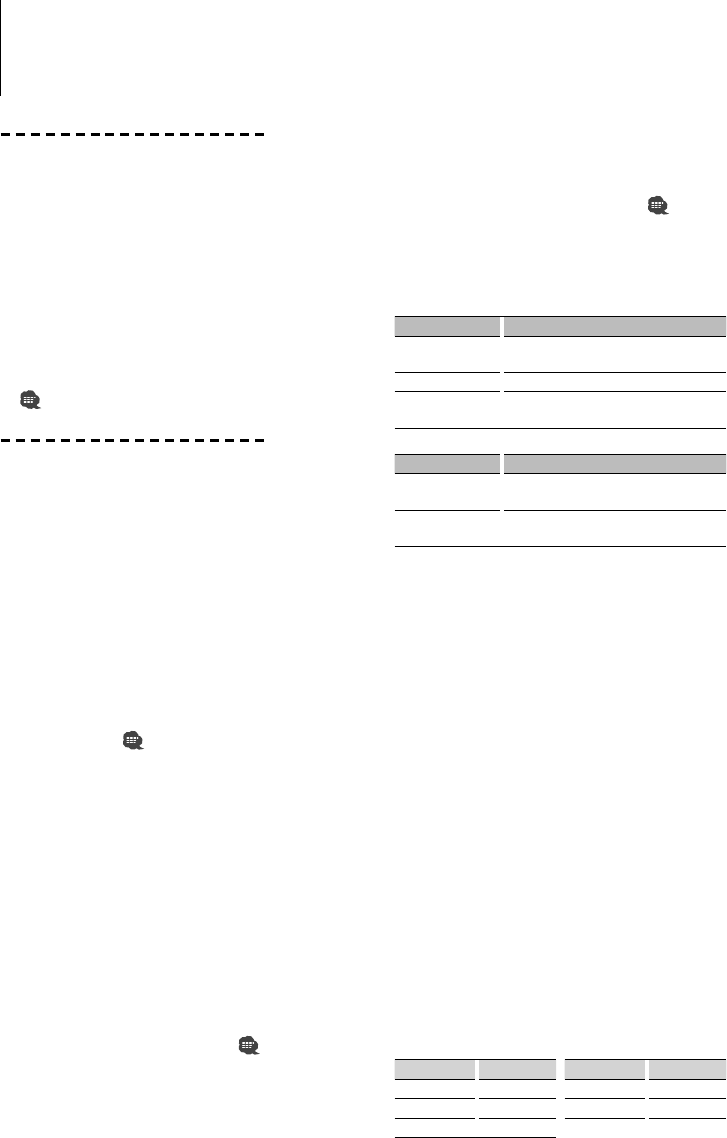
Display of phone number type (category)
Display Description Display Description
"GE"/ "GENERAL" General "OF"/ "OFFICE" Office
"HM"/ "HOME" Home "OT"/ "OTHER" Other
"MO"/ "MOBILE" Mobile
B64-4713-00_10_KCA-BT300_KE.indb 6B64-4713-00_10_KCA-BT300_KE.indb 6 10/03/12 14:5110/03/12 14:51
English | 7
Receiving a call
Answering a Phone Call
Press the [AUD] knob or one of [1] – [6] buttons
☞ Inserting a disc such as a CD will disconnect your call.
Rejecting an Incoming Call
Press the [SRC] button.
Call waiting
Answering Another Incoming Call with the
Current Call Suspended
1. Press the [AUD] knob.
2. Turn the [AUD] knob. Select the "ANSWER" display.
3. Press the [AUD] knob.
Answering another Incoming Call after
Terminating the Current Call
Press the [SRC] button.
Continuing the Current Call
1. Press the [AUD] knob.
2. Turn the [AUD] knob. Select the "REJECT" display.
3. Press the [AUD] knob.
Answering the Waiting Call after Terminating the
Current Call
Press the [SRC] button.
Switching between the Current Call and Waiting
Call
Press the [AUD] knob.
During a call
Disconnecting a Call
Press the [SRC] button.
Switching to the Private Mode ( )
Press the [AUD] knob for at least 1 second.
Switches between Private talk ("PV TALK") or Hands-
free talk ("HF TALK") when pressed.
Adjusting the Voice Volume during a Call
Turn the [AUD] knob.
Other functions
Clearing the Disconnection Message
Press the [DISP] button for at least 1 second.
Switching between Display Modes
Press the [DISP] button. You can switch between the
Phone Book and the Call List.
Registering to the Preset Dial Number List
1. Enter the phone number you wish to register
Enter the phone number with reference to the
following:
Dial a number/ Calling a number in the call log/
Calling a number in the Phone Book
2. Select the button you wish to register
Press the [1] – [6] button for at least 2 seconds.
3. Exit the dialing method selection mode
Press the [MENU] button.
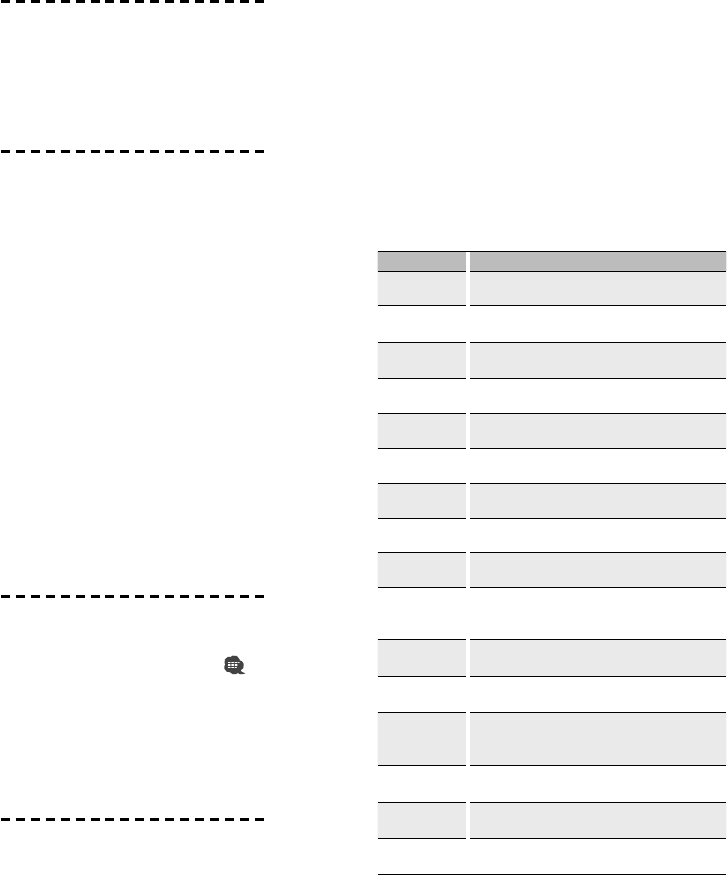
Items Set in Menu mode
* To enter the Menu mode, press the [AUD] knob for
at least 1 second.
Display Setting overview
"DVC REGIST"*/
"DVC REG"*
Register a Bluetooth device (pairing). See page 20.
"S-DVC SELECT"*/
"SDVC SEL"*
Allow registration of a special device that cannot be
registered normally. See page 21.
"PHONE SEL"*/
"PHN-SEL"*
Select a cell-phone subject to hands-free connection.
See page 22.
"AUDIO SEL"*/
"AUD-SEL"*
Select the audio player to be connected. See page 22.
"DIALING MODE"*/
"D.MODE"*
Select a dialing method. See page 6.
"SMS DOWNLOAD"*/
"SMS DL"*
Download a short message. See page 24.
"SMS INBOX"*/
"INBOX"*
Display the received short message. See page 24.
"VOICE TAG"*/
"VOICETAG"*
Register the voice tag for "voice recognize". See page 22.
"VOICE RECOG"*/
"V-RECOG"*
Make a voice dialing call. See page 6.
"DEVICE DEL"*/
"DVC-DEL"*/
"PHN-DEL"*
Cancel registration of the Bluetooth device. See page 22.
"DVC-STATUS"/
"D-STATUS"
"HF-CONNECT"/ "AD-CONNECT"/ "BAT"/ "SGNL":
Display the status of the Bluetooth device. See page 30.
"PIN EDIT"* Specify the PIN code required when registering this unit
using the Bluetooth device. See page 21.
"AUTO ANS"/
"ANS"
"OFF"/ "0" – "99": Answer a call automatically after
lapse of the preset time interval for automatic answer.
See page 30.
"SP SEL"/
"SPK"
"FRT"/ "F-R"/ "F-L": Specify the voice output speaker.
See page 30.
"CALL BEEP"/
"C-BP"
"ON"/ "OFF": Output a beep from the speaker when a
call comes in. See page 30.
"BT FW UP" For how to update the firmware, access our website.
http://www.kenwood.com/cs/ce/bt/
B64-4713-00_10_KCA-BT300_KE.indb 7B64-4713-00_10_KCA-BT300_KE.indb 7 10/03/12 14:5110/03/12 14:51
8 | KCA-BT300
Before Use
• You need to register your cell-phone before using
it with this unit. For more details, see <Registering
Bluetooth device> (page 20).
• If you have registered two or more cell-phones,
you need to select one of them. For more details,
see <Selecting the Bluetooth device You Wish to
Connect> (page 22).
• To use the Phone Book, it must be downloaded to
this unit in advance. For details, see <Downloading
the Phone Book> (page 21).
• For the method of operation in the Function control,
refer to the Instruction Manual for Control Unit.
• For more information regarding the function with
[] mark, see <Function Note> (page 30).
Making a call
Dialing Method
1. Entry dialing method mode
Press the [AUTO]/ [TI] button for at least 1 second.
2. Select a dialing method
Press the [AUD] knob.
"NUMBER DIAL" » "PHONE BOOK1" » "PHONE
BOOK2" » "OUT-CALL" » "IN-CALL" » "MISSED-CALL"
3 Methods of operations in the above modes are
described below.
3. Exit the dialing method selection mode
Press the [AUTO]/ [TI] button for at least 1 second.
3 Dial a number ( )
2-1. Select the "NUMBER DIAL" display.
2-2. Enter a phone number
Press the number ([1] – [0]), #([FM]), *([AM]), or
+([¢]) button on the remote controller.
2-3. Make a call
Press the [DIRECT] button on the remote controller.
☞ You can input max 32 digits.
3 Speed dialing (Preset dial)
2-1. Select the "NUMBER DIAL" display.
2-2. Select the preset dial number
2-2-1. Press the [SEARCH] button.
2-2-2. Select the number to recall by turning the
[AUD] knob.
2-2-3. Press the [AUD] knob.
2-3. Make a call
Press the [AUD] knob for at least 1 second.
☞ You need to register the preset dial number. (page 9)
3 Calling a number in the call log ( )
2-1. Select the "OUT-CALL" (outgoing call), "IN-CALL"
(incoming call), or "MISSED-CALL" (missed call)
display.
Basic Operation of hands-free phoning (Model-B)
2-2. Select a name or phone number
Turn the [AUD] knob or push it towards up or
down.
2-3. Make a call
Press the [AUD] knob for at least 1 second.
3 Calling a number in the Phone Book ( )
2-1. Select the "PHONE BOOK1" display, proceed to
step 2-2.
Select the "PHONE BOOK2" display, proceed to
step 2-3.
2-2. Select the initial to be searched for
Operation type Operation
Move to the next
character.
Turn the [AUD] knob or push it towards right
or left.
Move to the next row. Push the [AUD] knob towards up or down.
Determine the
selected initial.
Press the [AUD] knob for at least 1 second.
2-3. Select the name
Operation type Operation
Move to the next
phone number.
Turn the [AUD] knob or push it towards up
or down.
Move to the next
name.
Push the [AUD] knob towards right or left.
2-4. Make a call
Press the [AUD] knob for at least 1 second.
Make a voice dialing call
1. Select voice recognize item during Function
control
Select "MENU" > "VOICE RECOG".
"V-RECOG READY" is displayed.
2. Press the [AUD] knob.
"PB NAME" is displayed.
When a beep is heard, say the name within 2
seconds.
3. "PN TYPE" is displayed.
When a beep is heard, say the category within 2
seconds.
4. Make a call
This step is the same as step 3 of the procedure in
<Calling a number in the Phone Book>. You can
make a call or select a category.
☞ If your voice cannot be recognized, a message is
displayed. Pressing the [AUD] knob allows you to retry
voice input. See page 34.
☞ Both the name and category requires registration of a
voice tag. See page 22.
☞ Audio sound is not output during voice recognition.
Display of phone number type (category)
Display Description Display Description
"General" General "Office" Office
"Home" Home "Other" Other
"Mobile" Mobile
B64-4713-00_10_KCA-BT300_KE.indb 8B64-4713-00_10_KCA-BT300_KE.indb 8 10/03/12 14:5110/03/12 14:51
English | 9
Receiving a call
Answering a Phone Call
Press the [AUD] button.
☞ Inserting a disc such as a CD will disconnect your call.
Rejecting an Incoming Call
Press the [ATT] button for at least 1 second.
Call waiting
Answering Another Incoming Call with the
Current Call Suspended
1. Press the [AUD] button.
2. Turn the [AUD] knob or push it towards up or
down. Select the "ANSWER" display.
3. Press the [AUD] button.
Answering another Incoming Call after
Terminating the Current Call
Press the [SRC] button.
Continuing the Current Call
1. Press the [AUD] button.
2. Turn the [AUD] knob or push it towards up or
down. Select the "REJECT" display.
3. Press the [AUD] button.
Answering the Waiting Call after Terminating the
Current Call
Press the [ATT] button for at least 1 second.
Switching between the Current Call and Waiting
Call
Press the [AUD] button.
During a call
Disconnecting a Call
Press the [SRC] button.
Switching to the Private Mode ( )
Press the [38] button.
Switches between Private talk ("PRVT") or Hands-free
talk when pressed.
Adjusting the Voice Volume during a Call
Turn the [AUD] knob.
Other functions
Clearing the Disconnection Message
Press the [AUTO]/ [TI] button for at least 1 second.
Switching between Display Modes
Press the [38] button for at least 1 second. You can
switch between the Phone Book and the Call List.
Registering to the Preset Dial Number List
1. Enter the phone number you wish to register
Enter the phone number with reference to the
following:
Dial a number/ Calling a number in the call log/
Calling a number in the Phone Book
2. Select the button you wish to register
2-1. Press the [SEARCH] button.
2-2. Select the number to memory by turning the
[AUD] knob.
2-3. Press the [AUD] knob for at least 1 second.
3. Exit the dialing method selection mode
Press the [SEARCH] button.
Items Set in Function control
* To enter the Menu mode, press the [AUD] knob for
at least 1 second.
Display Setting overview
"DVC REGIST"* Register a Bluetooth device (pairing). See page 20.
"S-DVC SELECT"* Allow registration of a special device that cannot be
registered normally. See page 21.
"PHONE SEL"* Select a cell-phone subject to hands-free connection.
See page 22.
"AUD SEL"* Select the audio player to be connected. See page 22.
"SMS
DOWNLOAD"
Download a short message. See page 24.
"SMS INBOX" Display the received short message. See page 24.
"VOICE TAG" Register the voice tag for "voice recognize". See page 22.
"VOICE RECOG" Make a voice dialing call. See page 8.
"DEVICE DEL"* Cancel registration of the Bluetooth device. See page 22.
"DVC STATUS"* Display the status of the Bluetooth device.
"PIN EDIT"* Specify the PIN code required when registering this unit
using the Bluetooth device. See page 21.
"AUTO ANS" "OFF"/ "0s" – "99s": Answer a call automatically after
lapse of the preset time interval for automatic answer.
See page 30.
"MIC GAIN" "–2" – "0" – "+2": Adjust the sensitivity of the
microphone for a telephone call.
"NR LEVEL" "–2" – "0" – "+2": Reduce the noises generated by
the surrounding environment without changing the
microphone volume.
"SP SEL" "Front"/ "F-R"/ "F-L": Specify the voice output speaker.
See page 30.
"CALL BEEP" "ON"/ "OFF": Output a beep from the speaker when a
call comes in. See page 30.
"BT F/W UPDATE" For how to update the firmware, access our website.
http://www.kenwood.com/cs/ce/bt/
B64-4713-00_10_KCA-BT300_KE.indb 9B64-4713-00_10_KCA-BT300_KE.indb 9 10/03/12 14:5110/03/12 14:51
10 | KCA-BT300
Before Use
• You need to register your cell-phone before using
it with this unit. For more details, see <Registering
Bluetooth device> (page 20).
• If you have registered two or more cell-phones,
you need to select one of them. For more details,
see <Selecting the Bluetooth device You Wish to
Connect> (page 22).
• To use the Phone Book, it must be downloaded to
this unit in advance. For details, see <Downloading
the Phone Book> (page 21).
• For the method of operation in the Menu mode,
refer to the Instruction Manual for Control Unit.
• For more information regarding the function with
[] mark, see <Function Note> (page 30).
Making a call
Dialing Method
1. Entry dialing method mode
Press the [MUTE] button for at least 1 second.
2. Enter dialing method selection mode
Turn the [VOL] knob to select "Dialing Mode", and
then press the [ENTER] button.
3. Select a dialing method
Press the [ENTER] button.
"DIAL" » "INITIAL" » "P-BOOK" » "OUT-CALL" »
"INCALL" » "MIS-CALL"
3 Methods of operations in the above modes are
described below.
4. Exit the dialing method selection mode
Press the [MUTE] button for at least 1 second.
3 Dial a number ( )
2-1. Select the "DIAL" display.
2-2. Enter a phone number
Operation type Operation
Select the characters Turn the [VOL] knob.
Determine the characters. Press the [ ] button.
Delete the characters. Press the [ ] button.
2-3. Make a call
Press the [ENTER] button on the remote controller.
☞ You can input max 32 digits.
3 Speed dialing (Preset dial)
2-1. Select the "DIAL" display.
2-2. Select the preset dial number
Press the [1] – [6] button.
2-3. Make a call
Press the [ENTER] button for at least 1 second.
☞ You need to register the preset dial number. (page 11)
Basic Operation of hands-free phoning (Model-C)
3 Calling a number in the call log ( )
2-1. Select the "OUT-CALL" (outgoing call), "INCALL"
(incoming call), or "MIS-CALL" (missed call) display.
2-2. Select a name or phone number
Press the [u] or [d] button.
2-3. Make a call
Press the [38] button for at least 1 second.
3 Calling a number in the Phone Book ( )
2-1. Select the "INITIAL" display, proceed to step 2-2.
Select the "P-BOOK" display, proceed to step 2-3.
2-2. Select the initial to be searched for
Operation type Operation
Move to the next
character. Turn the [VOL] knob or press the [ ] or
[ ] button.
Move to the next row. Press the [u] or [d] button.
Determine the
selected initial.
Press the [ENTER] button for at least 1 second.
2-3. Select the name
Operation type Operation
Move to the next
phone number.
Turn the [VOL] knob or press the [u] or
[d] button.
Move to the next
name. Press the [ ] or [ ] button.
2-4. Make a call
Press the [ENTER] button for at least 1 second.
Make a voice dialing call
1. Enter Bluetooth menu mode
Press the [MUTE] button for at least 1 second.
2. Enter voice dialing call mode
Turn the [VOL] knob to select "Voice Recognize".
3. Press the [ENTER] button.
"Ready?" is displayed.
4. Press the [ENTER] button.
"PB Name?" is displayed.
When a beep is heard, say the name within 2
seconds.
5. Press the [1] button.
"PN Type?" is displayed.
When a beep is heard, say the category within 2
seconds.
6. Make a call
This step is the same as step 3 of the procedure in
<Calling a number in the Phone Book>. You can
make a call or select a category.
☞ If your voice cannot be recognized, a message is
displayed. Pressing the [ENTER] button allows you to
retry voice input. See page 34.
☞ Both the name and category requires registration of a
voice tag. See page 22.
☞ Audio sound is not output during voice recognition.
B64-4713-00_10_KCA-BT300_KE.indb 10B64-4713-00_10_KCA-BT300_KE.indb 10 10/03/12 14:5110/03/12 14:51
English | 11
Display of phone number type (category)
Display Description Display Description
"GE"/ "GENERAL" General "OF"/ "OFFICE" Office
"HM"/ "HOME" Home "OT"/ "OTHER" Other
"MO"/ "MOBILE" Mobile
Receiving a call
Answering a Phone Call
Press the [ENTER] button or one of [1] – [6] buttons.
☞ Inserting a disc such as a CD will disconnect your call.
Rejecting an Incoming Call
Press the [TUN], [iPod], or [AUX] button.
Call waiting
Answering Another Incoming Call with the
Current Call Suspended
1. Press the [ENTER] button.
2. Turn the [VOL] knob. Select the "ANSWER" display.
3. Press the [ENTER] button.
Answering another Incoming Call after
Terminating the Current Call
Press the [TUN], [iPod], or [AUX] button.
Answering the Waiting Call after Terminating the
Current Call
Press the [TUN], [iPod], or [AUX] button.
Switching between the Current Call and Waiting
Call
Press the [ENTER] button.
During a call
Disconnecting a Call
Press the [TUN], [iPod], or [AUX] button.
Switching to the Private Mode ( )
Press the [1] button.
Switches between Private talk ("PV TALK") or Hands-
free talk ("HF TALK") when pressed.
Adjusting the Voice Volume during a Call
Turn the [VOL] knob.
Other functions
Clearing the Disconnection Message
Press the [MUTE] button for at least 1 second.
Switching between Display Modes
Press the [DISP] button. You can switch between the
Phone Book and the Call List.
Registering to the Preset Dial Number List
1. Enter the phone number you wish to register
Enter the phone number with reference to the
following:
Dial a number/ Calling a number in the call log/
Calling a number in the Phone Book
2. Select the button you wish to register
Press the [1] – [6] button for at least 2 seconds.
3. Exit the dialing method selection mode
Press the [MUTE] button for at least 1 second.
Items Set in Menu mode
* To enter the Menu mode, press the [ENTER] button
for at least 1 second.
Display Setting overview
"DVC REG"* Register a Bluetooth device (pairing). See page 20.
"SDVC SEL"* Allow registration of a special device that cannot be
registered normally. See page 21.
"PHN-SEL"* Select a cell-phone subject to hands-free connection. See
page 22.
"AUD-SEL"* Select the audio player to be connected. See page 22.
"SMS DL"* Download a short message. See page 24.
"IN BOX"* Display the received short message. See page 24.
"VOICE TAG"* Register the voice tag for "voice recognize". See page 22.
"V-RECOG"* Make a voice dialing call. See page 10.
"DVC-DEL"* Cancel registration of the Bluetooth device. See page 22.
"D-STATUS" "HF-CON"/ "AD-CON"/ "BAT"/ "SGNL": Display the status of
the Bluetooth device. See page 30.
"PIN EDIT"* Specify the PIN code required when registering this unit
using the Bluetooth device. See page 21.
"ANS" "OFF"/ "0" – "99": Answer a call automatically after lapse
of the preset time interval for automatic answer. See page 30.
"SPK" "FRT"/ "F-R"/ "F-L": Specify the voice output speaker. See
page 30.
"C-BP" "ON"/ "OFF": Output a beep from the speaker when a call
comes in. See page 30.
"BT F/W
Update"
For how to update the firmware, access our website. http://
www.kenwood.com/cs/ce/bt/
B64-4713-00_10_KCA-BT300_KE.indb 11B64-4713-00_10_KCA-BT300_KE.indb 11 10/03/12 14:5110/03/12 14:51
12 | KCA-BT300
Before Use
• You need to register your cell-phone before using
it with this unit. For more details, see <Registering
Bluetooth device> (page 20).
• If you have registered two or more cell-phones,
you need to select one of them. For more details,
see <Selecting the Bluetooth device You Wish to
Connect> (page 22).
• To use the Phone Book, it must be downloaded to
this unit in advance. For details, see <Downloading
the Phone Book> (page 21).
• For the method of operation in the Menu mode,
refer to the Instruction Manual for Control Unit.
• For more information regarding the function with
[] mark, see <Function Note> (page 30).
Making a call
Dialing Method
1. Select dialing method item during Menu mode
Select the "DIALING MODE"/ "D.MODE" display.
2. Select a dialing method
Press the [38] button.
• "NUMBER DIAL" » "PHONE BOOK1" » "PHONE
BOOK2" » "OUT-CALL" » "IN-CALL" » "MISSED
CALLS"
• "N-DIAL" » "PH-BOOK1" » "PH-BOOK2" » "OUT-
CALL" » "IN-CALL" » "MIS-CALL"
3 Methods of operations in the above modes are
described below.
3. Exit the dialing method selection mode
Exit Menu mode.
3 Dial a number ( )
2-1. Select the "NUMBER DIAL"/ "N-DIAL" display.
2-2. Enter a phone number
Press the number ([1] – [0]), #([FM]), *([AM]), or
+([¢]) button on the remote controller.
2-3. Make a call
Press the [DIRECT] button on the remote controller.
☞ You can input max 32 digits.
3 Speed dialing (Preset dial)
2-1. Select the "NUMBER DIAL"/ "N-DIAL" display.
2-2. Select the preset dial number
Press the [1] – [6] button.
2-3. Make a call
Press the [38] button for at least 1 second.
☞ You need to register the preset dial number. (page 13)
3 Calling a number in the call log ( )
2-1. Select the "OUT-CALL" (outgoing call), "IN-CALL"
(incoming call), or "MISSED CALLS"/"MIS-CALL"
(missed call) display.
Basic Operation of hands-free phoning (Model-D)
2-2. Select a name or phone number
Push the Control knob towards up or down.
2-3. Make a call
Press the [38] button for at least 1 second.
3 Calling a number in the Phone Book ( )
2-1. Select the "PHONE BOOK1"/"PH-BOOK1" display,
proceed to step 2-2.
Select the "PHONE BOOK2"/"PH-BOOK2" display,
proceed to step 2-3.
2-2. Select the initial to be searched for
Operation type Operation
Move to the next
character.
Push the Control knob towards right or left.
Move to the next row. Push the Control knob towards up or down.
Determine the
selected initial.
Press the [38] button for at least 1 second.
2-3. Select the name
Operation type Operation
Move to the next
phone number.
Push the Control knob towards up or down.
Move to the next
name.
Push the Control knob towards right or left.
2-4. Make a call
Press the [38] button for at least 1 second.
Make a voice dialing call
1. Select voice recognize item during Menu mode
Select the "VOICE RECOG"/ "V-RECOG" display.
2. Press the [38] button for at least 1 second.
"V-RECOG READY"/ "VR READY" is displayed.
3. Press the [38] button.
"PB NAME" is displayed.
When a beep is heard, say the name within 2
seconds.
4. "PB TYPE"/ "PN type" is displayed.
When a beep is heard, say the category within 2
seconds.
5. Make a call
This step is the same as step 3 of the procedure in
<Calling a number in the Phone Book>. You can
make a call or select a category.
☞ If your voice cannot be recognized, a message is
displayed. Pressing the [38] button allows you to retry
voice input. See page 34.
☞ Both the name and category requires registration of a
voice tag. See page 22.
☞ Audio sound is not output during voice recognition.
Display of phone number type (category)
Display Description Display Description
"GE"/ "GENERAL" General "OF"/ "OFFICE" Office
"HM"/ "HOME" Home "OT"/ "OTHER" Other
"MO"/ "MOBILE" Mobile
B64-4713-00_10_KCA-BT300_KE.indb 12B64-4713-00_10_KCA-BT300_KE.indb 12 10/03/12 14:5110/03/12 14:51
English | 13
Receiving a call
Answering a Phone Call
Model-D-1: Press the Control knob or one of [1] – [6]
buttons
Model-D-2: Press the [VOL] button or one of [1] – [6]
buttons
☞ Inserting a disc such as a CD will disconnect your call.
Rejecting an Incoming Call
Press the [SRC] button.
Call waiting
Answering Another Incoming Call with the
Current Call Suspended
1. Model D-1: Press the Control knob.
Model D-2: Press the [VOL] knob.
2. Push the Control knob towards up or down. Select
the "ANSWER" display.
3. Model D-1: Press the Control knob.
Model D-2: Press the [VOL] knob.
Answering another Incoming Call after
Terminating the Current Call
Press the [SRC] button.
Continuing the Current Call
1. Model D-1: Press the Control knob.
Model D-2: Press the [VOL] knob.
2. Push the Control knob towards up or down. Select
the "REJECT" display.
3. Model D-1: Press the Control knob.
Model D-2: Press the [VOL] knob.
Answering the Waiting Call after Terminating the
Current Call
Press the [AUTO]/ [TI] button for at least 1 second.
Switching between the Current Call and Waiting
Call
Model D-1: Press the Control knob.
Model D-2: Press the [VOL] knob.
During a call
Disconnecting a Call
Press the [SRC] button.
Switching to the Private Mode ( )
Press the [38] button.
Switches between Private talk ("PV TALK") or Hands-
free talk ("HF TALK") when pressed.
Adjusting the Voice Volume during a Call
Model D-1: Turn the Control knob.
Model D-2: Turn the [VOL] knob.
Other functions
Clearing the Disconnection Message
Press the [AUTO]/ [TI] button for at least 1 second.
Switching between Display Modes
Press the [AUTO]/ [TI] button. You can switch
between the Phone Book and the Call List.
Registering to the Preset Dial Number List
1. Enter the phone number you wish to register
Enter the phone number with reference to the
following:
Dial a number/ Calling a number in the call log/
Calling a number in the Phone Book
2. Select the button you wish to register
Press the [1] – [6] button for at least 2 seconds.
3. Exit the dialing method selection mode
Press the [MENU] button.
Items Set in Menu mode
* To enter the Menu mode, press the Control knob for
at least 1 second.
Display Setting overview
"DVC REGIST"*/
"DVC REG"*
Register a Bluetooth device (pairing). See page 20.
"S-DVC SELECT"*/
"SDVC SEL"*
Allow registration of a special device that cannot be
registered normally. See page 21.
"PHONE SEL"*/
"PHN-SEL"*
Select a cell-phone subject to hands-free connection.
See page 22.
"DIALING MODE"*/
"D.MODE"*
Select a dialing method. See page 12.
"AUDIO SEL"*/
"AUD-SEL"*
Select the audio player to be connected. See page 22.
"SMS DOWNLOAD"*/
"SMS DL"*
Download a short message. See page 24.
"SMS INBOX"*/
"INBOX"*
Display the received short message. See page 24.
"VOICE TAG"*/
"VOICETAG"*
Register the voice tag for "voice recognize". See page 22.
"VOICE RECOG"*/
"V-RECOG"*
Make a voice dialing call. See page 12.
"DEVICE DEL"*/
"DVC-DEL"*
Cancel registration of the Bluetooth device. See page 22.
"DVC-STATUS"/
"D-STATUS"
"HF-CONNECT"/ "AD-CONNECT"/ "BAT"/ "SGNL":
Display the status of the Bluetooth device. See page 30.
"PIN EDIT"* Specify the PIN code required when registering this unit
using the Bluetooth device. See page 21.
"AUTO ANS"/
"ANS"
"OFF"/ "0" – "99": Answer a call automatically after
lapse of the preset time interval for automatic answer.
See page 30.
"SP SEL"/
"SPK"
"FRT"/ "F-R"/ "F-L": Specify the voice output speaker.
See page 30.
"CALL BEEP"/ "C-BP" "ON"/ "OFF": Output a beep from the speaker when a
call comes in. See page 30.
B64-4713-00_10_KCA-BT300_KE.indb 13B64-4713-00_10_KCA-BT300_KE.indb 13 10/03/12 14:5110/03/12 14:51
14 | KCA-BT300
Before Use
• You need to register your cell-phone before using
it with this unit. For more details, see <Registering
Bluetooth device> (page 20).
• If you have registered two or more cell-phones,
you need to select one of them. For more details,
see <Selecting the Bluetooth device You Wish to
Connect> (page 22).
• To use the Phone Book, it must be downloaded to
this unit in advance. For details, see <Downloading
the Phone Book> (page 21).
• For the method of operation in the Function control,
refer to the Instruction Manual for Control Unit.
• For more information regarding the function with
[] mark, see <Function Note> (page 30).
Making a call
Dialing Method
1. Entry dialing method mode
Press the [ATT] button for at least 1 second.
2. Select a dialing method
Press the Control knob ([38]).
"DIAL" » "INITIAL" » "P-BOOK" » "OUT-CALL" » "IN-
CALL" » "MIS-CALL"
3 Methods of operations in the above modes are
described below.
3. Exit the dialing method selection mode
Press the [ATT] button for at least 1 second.
3 Dial a number ( )
2-1. Select the "DIAL" display.
2-2. Enter a phone number
Press the number ([1] – [0]), #([FM]), *([AM]), or
+([¢]) button on the remote controller.
2-3. Make a call
Press the [DIRECT] button on the remote controller.
☞ You can input max 32 digits.
3 Speed dialing (Preset dial)
2-1. Select the "DIAL" display.
2-2. Select the preset dial number
Model E-1:
Press the [1] – [6] button.
Model E-2:
2-1. Press the [FNC] button.
2-2. Select the number to recall by turning the
Control knob.
2-3. Press the Control knob.
2-3. Make a call
Press the Control knob ([38]) for at least 1 second.
☞ You need to register the preset dial number. (page 15)
Basic Operation of hands-free phoning (Model-E)
3 Calling a number in the call log ( )
2-1. Select the "OUT-CALL" (outgoing call), "IN-CALL"
(incoming call), or "MIS-CALL" (missed call) display.
2-2. Select a name or phone number
Push the Control knob towards up or down.
2-3. Make a call
Press the Control knob ([38]) for at least 1 second.
3 Calling a number in the Phone Book ( )
2-1. Select the "INITIAL" display, proceed to step 2-2.
Select the "P-BOOK" display, proceed to step 2-3.
2-2. Select the initial to be searched for
Operation type Operation
Move to the next
character.
Push the Control knob towards right or left.
Move to the next row. Push the Control knob towards up or down.
Determine the
selected initial.
Press the Control knob ([38]).
2-3. Select the name
Operation type Operation
Move to the next
phone number.
Push the Control knob towards up or down.
Move to the next
name.
Push the Control knob towards right or left.
2-4. Make a call
Press the Control knob ([38]) for at least 1 second.
Make a voice dialing call
1. Select voice recognize item during Function
control
Select "BT" > "V-REC".
2. Press the Control knob ([38]).
"PB Name?" is displayed.
When a beep is heard, say the name within 2
seconds.
3. "PN Type?" is displayed.
When a beep is heard, say the category within 2
seconds.
4. Make a call
This step is the same as step 3 of the procedure in
<Calling a number in the Phone Book>. You can
make a call or select a category.
☞ If your voice cannot be recognized, a message is
displayed. Pressing the [38] button allows you to retry
voice input. See page 34.
☞ Both the name and category requires registration of a
voice tag. See page 22.
☞ Audio sound is not output during voice recognition.
Display of phone number type (category)
Display Description Display Description
"General"/ General "Office"/ Office
"Home"/ Home "Other"/ Other
"Mobile"/ Mobile
B64-4713-00_10_KCA-BT300_KE.indb 14B64-4713-00_10_KCA-BT300_KE.indb 14 10/03/12 14:5110/03/12 14:51
English | 15
Receiving a call
Answering a Phone Call
Press the [AUD] button or one of [1] – [6] buttons.
☞ Inserting a disc such as a CD will disconnect your call.
Rejecting an Incoming Call
Press the [ATT] button for at least 1 second.
Call waiting
Answering Another Incoming Call with the
Current Call Suspended
1. Press the [AUD] button.
2. Push the Control knob towards up or down. Select
the "ANSWER" display.
3. Press the [AUD] button.
Answering another Incoming Call after
Terminating the Current Call
Press the [SRC] button.
Continuing the Current Call
1. Press the [AUD] button.
2. Push the Control knob towards up or down. Select
the "REJECT" display.
3. Press the [AUD] button.
Answering the Waiting Call after Terminating the
Current Call
Press the [ATT] button for at least 1 second.
Switching between the Current Call and Waiting
Call
Press the [AUD] button.
During a call
Disconnecting a Call
Press the [SRC] button.
Switching to the Private Mode ( )
Press the Control knob ([38]).
Switches between Private talk ("PRVT") or Hands-free
talk when pressed.
Adjusting the Voice Volume during a Call
Turn the [AUD] knob.
Other functions
Clearing the Disconnection Message
Press the [ATT] button for at least 1 second.
Switching between Display Modes
Press the [AUTO]/ [TI] button. You can switch
between the Phone Book and the Call List.
Registering to the Preset Dial Number List
1. Enter the phone number you wish to register
Enter the phone number with reference to the
following:
Dial a number/ Calling a number in the call log/
Calling a number in the Phone Book
2. Select the button you wish to register
Model E-1:
Press the [1] – [6] button for at least 2 seconds.
Model E-2:
2-1. Press the [FNC] button.
2-2. Select the number to memory by turning the
Control knob.
2-3. Press the Control knob for at least 1 second.
3. Exit the dialing method selection mode
Press the [ATT] button for at least 1 second.
Items Set in Function control
* To enter the Menu mode, press the Control knob for
at least 1 second.
Item Setting overview
MENU "Device
Regist"*
Register a Bluetooth device (pairing). See page 20.
"SPCL DVC
Select"*
Allow registration of a special device that cannot be
registered normally. See page 21.
"Phone
Selection"*
Select a cell-phone subject to hands-free
connection. See page 22.
"Audio
Selection"*
Select the audio player to be connected. See page 22.
"Device
Delete"*
Cancel registration of the Bluetooth device. See
page 22.
"BT DVC
Status"*
Display the status of the Bluetooth device.
"PIN Code
Edit"*
Specify the PIN code required when registering this
unit using the Bluetooth device. See page 21.
"Auto Answer" "OFF"/ "0s" – "99s": Answer a call automatically
after lapse of the preset time interval for automatic
answer. See page 30.
"SP Select" "Front"/ "F-R"/ "F-L": Specify the voice output
speaker. See page 30.
"Call Beep" "ON"/ "OFF": Output a beep from the speaker when
a call comes in. See page 30.
"BT F/W
Update"
For how to update the firmware, access our website.
http://www.kenwood.com/cs/ce/bt/
BT > V-REC Make a voice dialing call
BT > VOICE > NAME Register a name tag for voice recognition. See
page 22.
BT > VOICE > TYPE Register a type (category) voice tag for voice
recognition. See page 22.
BT > SMS > SMSDL Download a short message. See page 24.
BT > SMS > INBOX Display the received short message. See page 24.
B64-4713-00_10_KCA-BT300_KE.indb 15B64-4713-00_10_KCA-BT300_KE.indb 15 10/03/12 14:5110/03/12 14:51
16 | KCA-BT300
Before Use
• You need to register your cell-phone before using
it with this unit. For more details, see <Registering
Bluetooth device> (page 20).
• If you have registered two or more cell-phones,
you need to select one of them. For more details,
see <Selecting the Bluetooth device You Wish to
Connect> (page 22).
• To use the Phone Book, it must be downloaded to
this unit in advance. For details, see <Downloading
the Phone Book> (page 21).
• For the method of operation in the Menu mode,
refer to the Instruction Manual for Control Unit.
• For more information regarding the function with
[] mark, see <Function Note> (page 30).
Making a call
Dialing Method
1. Entry dialing method mode
Press the [ATT] button for at least 1 second.
2. Select a dialing method
Press the [38] button.
"N-Dial" » "PH-Book1" » "PH-Book2" » "Out-Call" »
"In-Call" » "MIS-Call"
3 Methods of operations in the above modes are
described below.
3. Exit the dialing method selection mode
Press the [ATT] button for at least 1 second.
3 Dial a number ( )
2-1. Select the "N-Dial" display.
2-2. Enter a phone number
Press the number ([1] – [0]), #([FM]), *([AM]), or
+([¢]) button on the remote controller.
2-3. Make a call
Press the [DIRECT] button on the remote controller.
☞ You can input max 32 digits.
3 Speed dialing (Preset dial)
2-1. Select the "N-Dial" display.
2-2. Select the preset dial number
Press the [1] – [6] button.
2-3. Make a call
Press the [38] button for at least 1 second.
☞ You need to register the preset dial number. (page 17)
3 Calling a number in the call log ( )
2-1. Select the "Out-Call" (outgoing call), "In-Call"
(incoming call), or "MIS-Call" (missed call) display.
2-2. Select a name or phone number
Push the Control knob towards up or down.
Basic Operation of hands-free phoning (Model-F)
2-3. Make a call
Press the [38] button for at least 1 second.
3 Calling a number in the Phone Book ( )
2-1. Select the "PH-Book1" display, proceed to step 2-2.
Select the "PH-Book2" display, proceed to step 2-3.
2-2. Select the initial to be searched for
Operation type Operation
Move to the next
character.
Push the Control knob towards right or left.
Move to the next row. Push the Control knob towards up or down.
Determine the
selected initial.
Press the [38] button for at least 1 second.
2-3. Select the name
Operation type Operation
Move to the next
phone number.
Push the Control knob towards up or down.
Move to the next
name.
Push the Control knob towards right or left.
2-4. Make a call
Press the [38] button for at least 1 second.
Make a voice dialing call
1. Select voice recognize item during Menu mode
Select the "V-RECOG" display.
2. Press the [38] button for at least 1 second.
"VR Ready" is displayed.
3. Press the [38] button.
"PB NAME?" is displayed.
When a beep is heard, say the name within 2
seconds.
4. "PB TYPE?" is displayed.
When a beep is heard, say the category within 2
seconds.
5. Make a call
This step is the same as step 3 of the procedure in
<Calling a number in the Phone Book>. You can
make a call or select a category.
☞ If your voice cannot be recognized, a message is
displayed. Pressing the [38] button allows you to retry
voice input. See page 34.
☞ Both the name and category requires registration of a
voice tag. See page 22.
☞ Audio sound is not output during voice recognition.
Display of phone number type (category)
Display Description Display Description
"GE"/ "GENERAL" General "OF"/ "OFFICE" Office
"HM"/ "HOME" Home "OT"/ "OTHER" Other
"MO"/ "MOBILE" Mobile
B64-4713-00_10_KCA-BT300_KE.indb 16B64-4713-00_10_KCA-BT300_KE.indb 16 10/03/12 14:5110/03/12 14:51
English | 17
Receiving a call
Answering a Phone Call
Press the Control knob or one of [1] – [6] buttons.
☞ Inserting a disc such as a CD will disconnect your call.
Rejecting an Incoming Call
Press the [SRC] button.
Call waiting
Answering Another Incoming Call with the
Current Call Suspended
1. Press the Control knob.
2. Push the Control knob towards up or down. Select
the "ANSWER" display.
3. Press the Control knob.
Answering another Incoming Call after
Terminating the Current Call
Press the [SRC] button.
Continuing the Current Call
1. Press the Control knob.
2. Push the Control knob towards up or down. Select
the "REJECT" display.
3. Press the Control knob for at least 1 second.
Answering the Waiting Call after Terminating the
Current Call
Press the [ATT] button for at least 1 second.
Switching between the Current Call and Waiting
Call
Press the Control knob.
During a call
Disconnecting a Call
Press the [SRC] button.
Switching to the Private Mode ( )
Press the [38] button.
Switches between Private talk ("PV TALK") or Hands-
free talk ("HF TALK") when pressed.
Adjusting the Voice Volume during a Call
Turn the Control knob.
Other functions
Clearing the Disconnection Message
Press the [ATT] button for at least 1 second.
Switching between Display Modes
Press the [SE] button. You can switch between the
Phone Book and the Call List.
Registering to the Preset Dial Number List
1. Enter the phone number you wish to register
Enter the phone number with reference to the
following:
Dial a number/ Calling a number in the call log/
Calling a number in the Phone Book
2. Select the button you wish to register
Press the [1] – [6] button for at least 2 seconds.
3. Exit the dialing method selection mode
Press the [ATT] button for at least 1 second.
Items Set in Menu mode
* To enter the Menu mode, press the Control knob for
at least 1 second.
Display Setting overview
"DVC REG"* Register a Bluetooth device (pairing). See page 20.
"SDVC SEL"* Allow registration of a special device that cannot be
registered normally. See page 21.
"PHN-SEL"* Select a cell-phone subject to hands-free connection. See
page 22.
"AUD-SEL"* Select the audio player to be connected. See page 22.
"SMS DL"* Download a short message. See page 24.
"IN BOX"* Display the received short message. See page 24.
"VOICE TAG"* Register the voice tag for "voice recognize". See page 22.
"V-RECOG"* Make a voice dialing call. See page 16.
"DVC-DEL"* Cancel registration of the Bluetooth device. See page 22.
"D-STATUS" "HF-CON"/ "AD-CON"/ "BAT"/ "SGNL": Display the status of
the Bluetooth device. See page 30.
"PIN EDIT"* Specify the PIN code required when registering this unit
using the Bluetooth device. See page 21.
"ANS" "OFF"/ "0" – "99": Answer a call automatically after lapse
of the preset time interval for automatic answer. See page 30.
"SPK" "FRT"/ "F-R"/ "F-L": Specify the voice output speaker. See
page 30.
"C-BP" "ON"/ "OFF": Output a beep from the speaker when a call
comes in. See page 30.
B64-4713-00_10_KCA-BT300_KE.indb 17B64-4713-00_10_KCA-BT300_KE.indb 17 10/03/12 14:5110/03/12 14:51
18 | KCA-BT300
Before Use
• You need to register your cell-phone before using
it with this unit. For more details, see <Registering
Bluetooth device> (page 20).
• If you have registered two or more cell-phones,
you need to select one of them. For more details,
see <Selecting the Bluetooth device You Wish to
Connect> (page 22).
• To use the Phone Book, it must be downloaded to
this unit in advance. For details, see <Downloading
the Phone Book> (page 21).
• For the method of operation in the Menu mode,
refer to the Instruction Manual for Control Unit.
• For more information regarding the function with
[] mark, see <Function Note> (page 30).
Making a call
Dialing Method
1. Entry dialing method mode
Model-G-1, 2, 3:
Press the [ATT] button for at least 1 second.
Model-G-4:
Select "D.MODE" in Menu mode.
2. Select a dialing method
Model-G-1, 4:
Press the Control knob ([38] button).
"N-DIAL" » "PH-BOOK1" » "PH-BOOK2" » "OUT-CALL"
» "IN-CALL"
Model-G-2:
Press the Control knob ([38]).
"DIAL" » "INITIAL" » "PHONE BOOK"/ "PH.BOOK" »
"OUT-CALL" » "IN-CALL"
Model-G-3:
2-1-1. Press the [NEXT] button.
2-1-2. Press the [1] ("DIAL"), [2] ("PHBK"), [3] ("OUT-
C"), or [4] ("IN-C") button.
Pressing the [2] ("PHBK") button switches
between the Phone Book search methods.
3 Methods of operations in the above modes are
described below.
3. Exit the dialing method selection mode
Model-G-1, 2, 3:
Press the [ATT] button for at least 1 second.
Model-G-4:
Exit Menu mode.
3 Dial a number ( )
2-1. Select the "N-DIAL"/ "DIAL" display.
2-2. Enter a phone number
Press the number ([1] – [0]), #([FM]), *([AM]), or
+([¢]) button on the remote controller.
Basic Operation of hands-free phoning (Model-G)
2-3. Make a call
Press the [DIRECT] button on the remote controller.
☞ You can input max 32 digits.
3 Speed dialing (Preset dial)
2-1. Select the "N-DIAL"/ "DIAL" display.
2-2. Select the preset dial number
Model-G-1, 4:
Press the [1] – [6] button.
Model-G-2:
2-2-1. Press the [FNC] button.
2-2-2. Select the number to recall by turning the
Control knob.
2-2-3. Press the Control knob.
Model-G-3:
2-2-1. Press the [NEXT] button.
2-2-2. Press the [1] ("1") – [6] ("6") button.
2-3. Make a call
Press the Control knob ([38] button) for at least 1
second.
☞ You need to register the preset dial number. (page 19)
3 Calling a number in the call log ( )
2-1. Select the "OUT-CALL"/"OUT-C" (outgoing call) or
"IN-CALL"/"IN-C" (incoming call) display.
2-2. Select a name or phone number
Push the Control knob towards up or down.
2-3. Make a call
Press the Control knob ([38] button) for at least 1
second.
3 Calling a number in the Phone Book ( )
2-1. Select the "PH-BOOK1"/ "INITIAL" display, proceed
to step 2-2.
Select the "PH-BOOK2"/ "PHONE BOOK"/ "PH.
BOOK" display, proceed to step 2-3.
2-2. Select the initial to be searched for
Operation type Operation
Move to the next
character.
Push the Control knob towards right or left.
Move to the next row. Push the Control knob towards up or down.
Determine the
selected initial.
Press the Control knob ([38] button) for at
least 1 second.
2-3. Select the name
Operation type Operation
Move to the next
phone number.
Push the Control knob towards up or down.
Move to the next
name.
Push the Control knob towards right or left.
2-4. Make a call
Press the Control knob ([38] button) for at least 1
second.
B64-4713-00_10_KCA-BT300_KE.indb 18B64-4713-00_10_KCA-BT300_KE.indb 18 10/03/12 14:5110/03/12 14:51
English | 19
Receiving a call
Answering a Phone Call
Model-G-1, 2, 3:
Press the [AUDIO] button or one of [1] – [6] buttons.
Model-G-4:
Press the [VOL] button or one of [1] – [6] buttons.
☞ Inserting a disc such as a CD will disconnect your call.
Rejecting an Incoming Call
Model-G-1, 2, 3:
Press the [ATT] button for at least 1 second.
Model-G-4:
Press the [SRC] button.
During a call
Disconnecting a Call
Press the [SRC] button.
Switching to the Private Mode ( )
Press the Control knob ([38] button).
Switches between Private talk ("PV TALK"/ "PRIVATE")
or Hands-free talk ("HF TALK"/ — ) when pressed.
Adjusting the Voice Volume during a Call
Turn the [VOL] knob.
Other functions
Clearing the Disconnection Message
Model-G-1, 2, 3:
Press the [ATT] button for at least 1 second.
Model-G-4:
Press the [AUTO]/ [TI] button for at least 1 second.
Switching between Display Modes
You can switch between the Phone Book and the Call
List.
Model-G-1, 2, 4:
Press the [DISP]/ [AUTO]/ [TI] button. (If the [DISP]
button is not provided, press the [AUTO] or [TI]
button.)
Model-G-3:
Press the [AUTO]/ [TI] button.
Registering to the Preset Dial Number List
1. Enter the phone number you wish to register
Enter the phone number with reference to the
following:
Dial a number/ Calling a number in the call log/
Calling a number in the Phone Book
2. Select the button you wish to register
Model-G-1, 4:
Press the [1] – [6] button for at least 2 seconds.
Model-G-2:
2-1. Press the [FNC] button.
2-2. Select the number to memory by turning the
Control knob.
2-3. Press the Control knob.
Model-G-3:
2-1. Press the [NEXT] button.
2-2. Press the [1] ("1") – [6] ("6") button for at least 2
seconds.
3. Exit the dialing method selection mode
Model-G-1, 2, 3:
Press the [ATT] button for at least 1 second.
Model-G-4:
Press the [MENU] button.
Items Set in Menu mode
* To enter the Menu mode, press the Control knob for
at least 1 second.
*1 To enter the Menu mode, push the Control knob
towards right or left.
Display Setting overview
"PHN-SEL"*/
"Phone Selection"*
Select a cell-phone subject to hands-free connection.
See page 22.
"PHN-DEL"*/
"Phone Delete"*
Cancel registration of the Bluetooth device. See page 22.
"D.MODE"* Model-G-4: Select a dialing method. See page 18.
"P-STATUS"*/
"Phone Status"*1
"BT-CON"/ "BAT"/ "SGNL": Display the status of the
Bluetooth device. See page 30.
"ANS"/
"Auto Answer"
"OFF"/ "0" – "99": Answer a call automatically after
lapse of the preset time interval for automatic answer.
See page 30.
"SPK"/
"SP Select"
"FRT"("Front")/ "F-R"/ "F-L": Specify the voice output
speaker. See page 30.
"C-BP"/
"Call Beep"
"ON"/ "OFF": Output a beep from the speaker when a
call comes in. See page 30.
B64-4713-00_10_KCA-BT300_KE.indb 19B64-4713-00_10_KCA-BT300_KE.indb 19 10/03/12 14:5110/03/12 14:51
20 | KCA-BT300
Registering Bluetooth device
To make your Bluetooth device (cell-phone or audio
player) usable with this unit, you need to register
it (pairing). You can register up to five Bluetooth
devices to this unit.
When registering from Bluetooth devices
1 Turn on the control unit.
2 Start registering a unit by operating the
Bluetooth device.
By operating the Bluetooth device, register the
hands-free unit or audio player (pairing). Select
"KCA-BT300" from the list of connected units.
3 Enter a PIN code
Model-A, B, C, D, E, F:
Input the PIN code registered as mentioned in
<Registering PIN Code> (page 21).
PIN code is set to "0000" as the default.
Model-G:
Enter "0000" as a PIN code.
Check that registration is complete on the
Bluetooth device.
4 By operating the Bluetooth device, start hands-
free or audio connection.
When registering from this unit (Function of
Model-A, B, C, D, E, F)
1 Select the Bluetooth Device registration mode
Select the "Device Regist"/ "DVS REGIST"/ "DVS
REG"/ "DVC REG" display.
2 Press the decision button for at least 1 second.
Search for the Bluetooth device.
When search is completed, "Finished" is displayed.
3 Select the Bluetooth Device
Operation type Operation
Selects the Bluetooth
device
Push the selection button towards up
or down.
Determine the selection Press the decision button
4 "PAIRING" is displayed
If "Pairing Success"/"PAIRING OK"/"PAIR OK" is
displayed, proceed to step 7.
If "PIN Code NG"/"PAIR NG" is displayed, press the
decision button. Then enter the PIN code (steps 5
and 6).
5 Input the PIN code
Operation type Operation
Select the numbers. Push the selection button towards up
or down.
Move to the next digit. Push the selection button towards right.
Delete the last digit. Push the selection button towards left.
6 Transmit the PIN code
Press the decision button for at least 1 second.
If "Pairing Success"/"PAIRING OK"/"PAIR OK" is
displayed, registration is completed.
7 Return to the device list
Model-A, B, D, F:
Press the decision button.
Model-C:
Press the decision button for at least 1 second.
Model-E:
Press the [FNC] button.
8 End device registration
Exit Menu mode.
⁄
• You can also register from the Bluetooth device side. For
the PIN code necessary for registration, see <Registering
PIN Code> (page 21).
• This unit allows up to eight digits to be input for a PIN
code. If a PIN code cannot be input from this unit, it can
be input from the Bluetooth device.
• If there are 5 or more Bluetooth devices registered, you
cannot register a new Bluetooth device.
• If the error message appears even though the PIN code
is correct, try <Registering Special Bluetooth device>
(page 21).
• For how to operate the Bluetooth device, refer to the
Instruction Manual that comes with your Bluetooth
device.
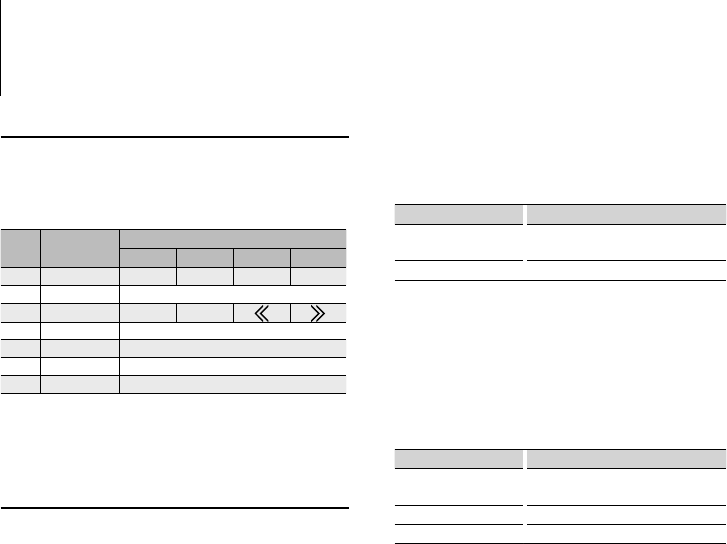
Function Operation
Operation buttons
Operation buttons are grouped and described in
common.
Operation buttons in each group are described as
follows
Group Decision
button
Selection button
Up Down Left Right
A [AUD] [FM] [AM] [
4
][
¢
]
B [AUD] [AUD] knob
C [ENTER] [u][d][][]
D[
38
] Control knob
E[
38
] Control knob
F Control knob Control knob
G[
38
] Control knob
B64-4713-00_10_KCA-BT300_KE.indb 20B64-4713-00_10_KCA-BT300_KE.indb 20 10/03/12 14:5110/03/12 14:51

English | 21
Downloading the Phone Book
Download the phone book data from the cell-
phone to this unit so that you can use the Phone
Book of this unit.
To download automatically
If the cell-phone supports a phone book
synchronization function, the phone book is
downloaded automatically after Bluetooth
connection.
☞ Setting on the cell-phone may be required.
☞ If no phone book data is found in the unit even after
the compete display, your cell-phone may not support
automatic download of phone book data. In this case,
try downloading manually.
To download from the cell-phone manually
1 By operating the cell-phone, end the hands-free
connection.
2 By operating the cell-phone, send the phone
book data to this unit
By operating the cell-phone, download the phone
book data to this unit.
During downloading:
"Downloading", "DOWNLOAD", or "Now
Downloading…" is displayed.
After completion of downloading:
"Completed" or "COMPLETE" is displayed.
3 By operating the cell-phone, start the hands-
free connection.
To clear the downloading completion message:
Press any button.
⁄
• For how to operate the cell-phone, refer to the
Instruction Manual that comes with your cell-phone.
• Up to 1000 phone numbers can be registered for each
registered cell-phone.
• Up to 32 digits can be registered for each phone number
along with up to 50* characters representing a name.
(* 50: Number of alphabetic alphabetical characters.
Fewer characters can be input depending on the type
of characters.)
• To cancel downloading of the phone book data, operate
the cell-phone.
Function of Model-A, B, C, D, E, F
Registering Special Bluetooth device
Allow registration of a special device that cannot be
registered normally (pairing).
1 Select the special device registration mode
Select the "SPCL DVC Select"/ "S-DVC SELECT"/
"SDVC SEL" display.
2 Press the decision button for at least 1 second.
3 Select a device name
Operation type Operation
Selects the device name Push the selection button towards up
or down.
Determine the selection Press the decision button
If "Completed"/"Complete" is displayed, registration
of the special device is completed.
4 Go through the procedure of <Registering
Bluetooth device> (page 20) and complete the
registration (pairing).
⁄
• If the device name is not in the list, select "Other Phone".
Function of Model-A, B, C, D, E, F
Registering PIN Code
By operating the Bluetooth device, specify the PIN
code necessary for registering this unit.
1 Select the PIN code edit mode
Select the "PIN Code Edit"/ "PIN EDIT" display.
2 Press the decision button for at least 1 second.
3 Input the PIN code
Operation type Operation
Select the numbers. Push the selection button towards up
or down.
Move to the next digit. Push the selection button towards right.
Delete the last digit. Push the selection button towards left.
4 Register a PIN code
Press the decision button for at least 1 second.
If "Completed"/"Complete" is displayed, registration
is completed.
⁄
• By default, "0000" is specified.
• A PIN code can be specified with up to 8 digits.
Next page 3
B64-4713-00_10_KCA-BT300_KE.indb 21B64-4713-00_10_KCA-BT300_KE.indb 21 10/03/12 14:5110/03/12 14:51

22 | KCA-BT300
In Standby mode
Selecting the Bluetooth device You
Wish to Connect
When two or more Bluetooth devices have already
been registered, you need to select the Bluetooth
device you wish to use.
1 Select the Bluetooth device selection mode
during Menu mode
Cell-phone
Select the "Phone Selection"/ "PHONE SEL"/ "PHN-
SEL" display.
Audio player (excluding Model-D)
Select the "Audio Selection"/ "AUD-SEL" display.
2 Enter the selected Bluetooth device selection
mode
Press the decision button for at least 1 second.
'(name)' is displayed.
3 Select the Bluetooth device
Operation type Operation
Selects the Bluetooth
device
Push the selection button towards up
or down.
Set up the Bluetooth device Push the selection button towards right
or left.
'✱(name)' or '-(name)' is displayed.
"✱" (dark color) or "✱": The selected cell-phone is
busy.
"✱" (light color) or "_": The selected cell-phone is
on standby.
" " (blank): The cell-phone is deselected.
☞ If a cell-phone is already selected, deselect it, and then
select a different one.
4 Exit the Bluetooth device selection mode
Exit Menu mode.
⁄
• For Model-D, F, and G, the firmware version "BT300 FW
***" is displayed at the end of the Bluetooth device list.
For how to update the firmware, access our website.
http://www.kenwood.com/cs/ce/bt/
• For Model-G, the audio player is displayed on the device
list after the registration. However, the audio player on
the list cannot be selected.
In Standby mode
Deleting a Registered Bluetooth
device
You can delete a registered Bluetooth device.
1 Select the Bluetooth device deletion mode
during Menu mode
Select the "Device Delete"/ "DEVICE DEL"/ "Phone
Delete"/ "PHN-DEL" display.
2 Enter the Bluetooth device deletion mode
Press the decision button for at least 1 second.
'(name)' is displayed.
3 Select the Bluetooth device you wish to delete
Push the selection button towards up or down.
4 Delete the selected Bluetooth device
Model-A, B, D, F, G-1, G-3:
Press the decision button for at least 1 second.
Model-C:
Press the decision button.
Model-E, G-2:
4-1. Press the decision button.
4-2. Push the selection button towards right to
select "YES"/"Y".
4-3. Press the decision button.
5 Exit the Bluetooth device deletion mode
Exit Menu mode.
⁄
• When a registered cell-phone is deleted, its Phone Book,
log, SMS, and voice tag are also deleted.
• For Model-D, F, and G: The firmware version "BT300 FW
***" is displayed and cannot be deleted.
Function of Model-A, B, C, D, E, F
Adding a Voice Dialing Command
Add a voice tag to the phonebook for voice dialing.
You can register up to 35 voice tags.
1 Entry the voice tag mode
Select the "NAME MEM"/ "PB Name Edit"/ "Name
EDT" display.
Model-A, B, C, D, F:
Press the decision button for at least 1 second.
Model-E:
Press the decision button.
2 Search for the name to register
Select the name to register with reference to 2-3 in
<Calling a number in the Phone Book>.
Function Operation
B64-4713-00_10_KCA-BT300_KE.indb 22B64-4713-00_10_KCA-BT300_KE.indb 22 10/03/12 14:5110/03/12 14:51

English | 23
Return to step 2.
Exit the voice tag mode
Exit Menu mode.
Function of Model-A, B, C, D, E, F
Setting a Voice Command for
Category
Add a voice tag to the phone number category
(type) for voice calling.
1 Entry the voice tag mode
Model-D:
Press the [38] button for at least 1 second.
Model-F:
Push the Control knob towards up or down.
Select the "TYPE MEM"/ "PN Type Edit"/ "Type EDT"
display.
Model-A, B, D, F:
Press the decision button for at least 1 second.
Model-C, E:
Press the decision button.
2 Select the category (type) you wish to set
Operation type Operation
Selects category Push the selection button towards up
or down.
Determine the selection Press the decision button.
3 Select a mode
Model-A, B, C, D-2, F:
Push the selection button towards up or down.
Model-B, C, D-1:
Turn the selection button.
Model-E:
Push the selection button towards right or left.
Display Operation
"T-REG"/"REGIST"/"Type REG" Register a voice tag.
"T-CHK"/"PLAY"/"Type CHK" * Play a voice tag.
"T-DEL"/"DELETE"/"Type DEL" * Delete a voice tag.
"RETURN" Return to step 2.
* Displayed only when a category (type) for which a voice
tag has been registered is selected.
4 Register the category (type) by performing
steps 4 to 6 in <Adding a Voice Dialing
Command> (page 22).
Exit the voice tag mode
Exit Menu mode.
If a voice tag has already been registered for a
name, "*" is displayed before the name.
3 Select a mode
Model-A, B, C, D-2, F:
Push the selection button towards up or down.
Model-B, C, D-1:
Turn the selection button.
Model-E:
Push the selection button towards right or left.
Display Operation
"N-REG"/"REGIST"/"Name REG" Register a voice tag.
"N-CHK"/"PLAY"/"Name CHK" * Play a voice tag.
"N-DEL"/"DELETE"/"Name DEL" * Delete a voice tag.
"RETURN" Return to step 2.
* Displayed only when a name for which a voice tag has
been registered is selected.
Select "N-REG"/"REGIST"/"Name REG"
* Audio sound is not output during voice tag registration.
4 Register a voice tag (first)
Press the decision button.
"Enter Voice 1"/ "ENTER1" is displayed.
When a beep is heard, say a voice tag within 2
seconds.
5 Confirm the voice tag (second)
Press the decision button.
"Enter Voice 2"/ "ENTER2" is displayed.
When a beep is heard, say the same voice tag as
that you said in step 4 within 2 seconds.
"COMPLETE" is displayed.
6 End registration
Press the decision button.
Return to step 2. You can register another voice tag
continuously.
☞ If your voice cannot be recognized, a message is
displayed. Pressing the [38] button allows you to retry
voice input. (page 26)
Select "N-CHK"/"PLAY"/"Name CHK"
4 Press the decision button.
Play the registered voice and return to step 2.
Select "N-DEL"/"DELETE"/"Name DEL"
4 Delete a voice tag
Model-B, D, F:
Press the decision button for at least 1 second.
Model-A, C, E:
4-1. Press the control button.
4-2. Push the selection button towards right to
select "YES"/"Y".
4-3. Press the decision button.
Next page 3
B64-4713-00_10_KCA-BT300_KE.indb 23B64-4713-00_10_KCA-BT300_KE.indb 23 10/03/12 14:5110/03/12 14:51

24 | KCA-BT300
Function Operation
Function of Model-A, B, C, D, E, F
SMS (Short Message Service)
The SMS arrived at the cell-phone is displayed on
the receiver.
A newly arrived message is displayed.
¤
• To prevent car accidents, the driver should not read the
SMS while driving.
When a new message arrives
"SMS Received"/"NEW SMS" is displayed.
The display disappears with any operations.
Displaying the SMS
1 Select the SMS Inbox mode during Menu
mode
Select the "SMS Inbox"/ "INBOX"/ "SMS" display.
2 Entry the SMS Inbox mode
Press the decision button for at least 1 second.
A message list appears.
3 Select a message
Push the selection button towards up or down.
• Select a phone number and reception date display
mode.
Model-B: Press the [
38
] button.
Model-C: Press the [DISP] button.
Model-D: Press the [AUTO]/ [TI] button.
Model-F: Press the [SE] button for at least 1 second.
• Scroll the messages.
Push the Control knob towards right or left.
Keep pressing the Control knob scrolls the messages.
4 Display the text
Press the decision button.
Pressing this button again allows you to select a
message again.
5 Exit the SMS Inbox mode
Exit Menu mode.
⁄
• The unopened message is displayed at the beginning
of the list. Other messages are displayed in the order of
reception.
• The SMS that has arrived when the cell-phone is not
linked with Bluetooth cannot be displayed. Download
the SMS.
Function of Model-A, B, C, D, E, F
Downloading the SMS
Download the short message (SMS) arrived at the
cell-phone so that it can be read on the receiver.
1 Select the SMS download item during Menu
mode
Select the "SMS Download"/ "SMS DL" display.
2 Start downloading
Press the decision button for at least 1 second.
"SMS Downloading"/ "DOWNLOAD" is displayed.
When the downloading finishes, "Completed"/
"COMPLETE" is displayed.
3 Exit the SMS download mode
Exit Menu mode.
⁄
• The cell-phone must be able to transmit the SMS using
Bluetooth. Setting on the cell-phone may be required. If
the cell-phone does not support SMS function, the SMS
download item in Menu mode is not displayed.
• When the SMS is downloaded from the cell-phone, the
unopened messages in the cell-phone are opened.
B64-4713-00_10_KCA-BT300_KE.indb 24B64-4713-00_10_KCA-BT300_KE.indb 24 10/03/12 14:5110/03/12 14:51

English | 25
Remote control
Making a call
• Enters the dialing method selection mode :
[ ] button
• Selects a dialing method : [38] button
• Number dial input:
Input a digit: [0] – [9]
Input "+": [¢]
Input "#": [FM]
Input "*": [AM]
Clear the entered phone number: [4]
☞ You can input max 32 digits.
• Makes a call : [DIRECT] button
Receiving a call
• Answers the call : [ ] button
• Switches between the private talk mode and
the hands-free talk mode : [38] button
Call waiting (Function of Model-A, B, C, D, E, F)
• Answering Another Incoming Call with the
Current Call Suspended : [] button
• Answering another Incoming Call after
Terminating the Current Call : [SRC] button
• Continuing the Current Call : [1] button
During a call
• End the call : [SRC] button
• Adjusts the voice volume : [VOL] buttons
⁄
• If your remote controller has a mode selection switch,
set it to "AUD".
• Remote controllers with the [ ] button and/or
numeric buttons are available optionally. Purchase a
remote controller with a desired function.
Bluetooth Audio
Before Use
• You need to register your Bluetooth Audio player
before using it with this unit. For more details, see
<Registering Bluetooth device> (page 20).
• The Model-A, B, C, D, E, F allows you to select the
Bluetooth audio player you wish to connect. Refer
to <Selecting the Bluetooth device You Wish to
Connect> (page 22).
• For Model-G, H, I operate the Bluetooth Audio player
for connection.
• For the Model-J, K, L, refer to the Instruction Manual
for Control Unit.
Function of Model-A, B, C, D, E, F, G, H, I
Playing Bluetooth Audio
Source select
Model-A, B, C, D, E, F, G:
Press the [SRC] button.
Select the "BT Audio EXT"/ "BT-A EXT"/ "EXT Media"/
"
*
MEDIA" display.
Model-H, I:
To select the source, select "EXT Media" with
reference to the Instruction Manual for Control
Unit.
Pause and play
Press the [38] button.
Music Search
Press the [4] or [¢] button.
⁄
• All or some of the operations above cannot be performed if
the Bluetooth audio player is not ready for remote contol.
• The information about the music played by the Bluetooth
audio player cannot be displayed. Either Bluetooth audio
player cannot be displayed, or "T- " is displayed.
• Switching between Bluetooth audio sources does not start
or stop playback automatically. Perform the operation for
starting or stopping playback.
• Some audio players cannot be controlled remotely or
reconnected after Bluetooth disconnection. Operate the
main unit of the audio player to connect Bluetooth.
• For Model-H, I: The buttons other than needed for operation
above may be appeared. However they are invalid.
B64-4713-00_10_KCA-BT300_KE.indb 25B64-4713-00_10_KCA-BT300_KE.indb 25 10/03/12 14:5110/03/12 14:51
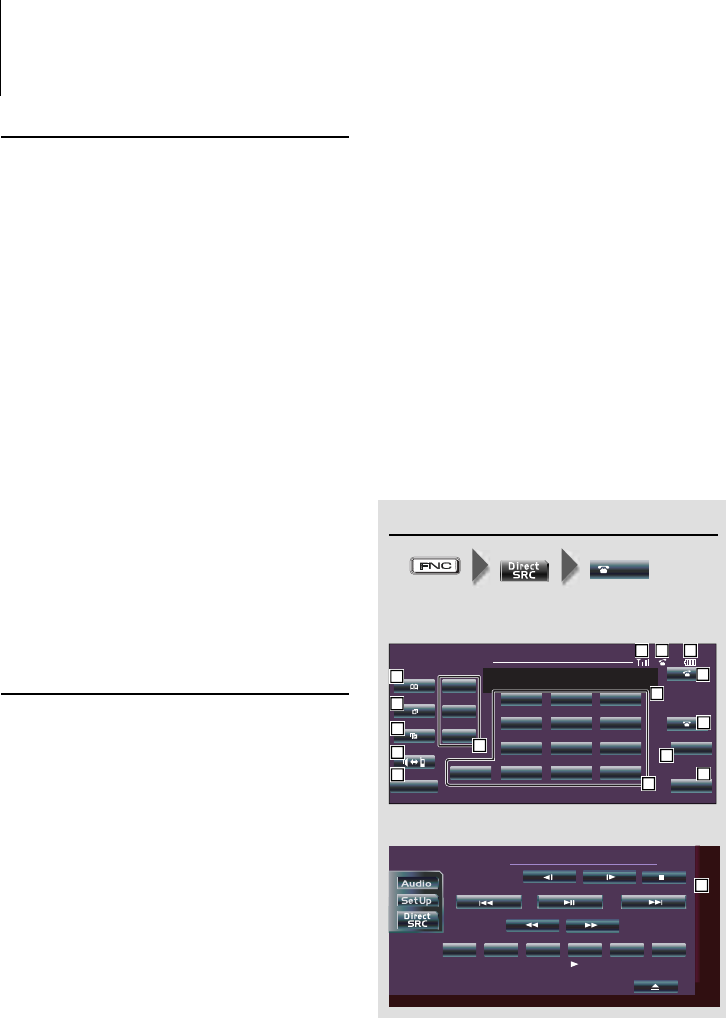
26 | KCA-BT300
Operation of hands-free phoning (Model-H)
Hands-Free Control screen
TEL
Or when a call comes in …
Hands-Free Control screen
Hands Free
P1
P2
P3
SetUp
123
456
78
0
9
#
*+
KENWOOD
0123456789
Clear
Return
AUTO
11
12
14
8910
15
1
2
3
13
5
6
7
4
Control screen
NextNext
DVD VIDEO
13:50
IN
TEL
Title 1 Chap 3 T0:05:20
KENWOOD
SCRL
TIMEREP
16
1 Displays the Search for Phone Book screen.
See <Calling a number in the Phone Book> (page
28).
2 Displays the Out Going Calls screen.
See <Calling a number in the call log> (page 28).
During downloading:
"Downloading", "DOWNLOAD", or "Now
Downloading…" is displayed.
3 By operating the cell-phone, start the hands-
free connection.
⁄
• For how to operate the cell-phone, refer to the
Instruction Manual that comes with your cell-phone.
• Up to 1000 phone numbers can be registered for each
registered cell-phone.
• Up to 32 digits can be registered for each phone number
along with up to 50* characters representing a name.
(* 50: Number of alphabetic alphabetical characters.
Fewer characters can be input depending on the type
of characters.)
• To cancel downloading of the phone book data, operate
the cell-phone.
Registering Bluetooth device
To make your Bluetooth device (cell-phone or audio
player) usable with this unit, you need to register
it (pairing). You can register up to five Bluetooth
devices to this unit.
When registering from Bluetooth devices
1 Turn on the control unit.
2 Start registering a unit by operating the
Bluetooth device.
By operating the Bluetooth device, register the
hands-free unit or audio player (pairing). Select
"KCA-BT300" from the list of connected units.
3 Enter a PIN code
Enter "0000" as a PIN code.
Check that registration is complete on the
Bluetooth device.
4 By operating the Bluetooth device, start hands-
free or audio connection.
⁄
• If there are 5 or more Bluetooth devices registered, you
cannot register a new Bluetooth device.
• For how to operate the Bluetooth device, refer to the
Instruction Manual that comes with your Bluetooth
device.
Downloading the Phone Book
Download the phone book data from the cell-
phone to this unit so that you can use the Phone
Book of this unit.
To download automatically
If the cell-phone supports a phone book
synchronization function, the phone book is
downloaded automatically after Bluetooth
connection.
☞ Setting on the cell-phone may be required.
☞ If no phone book data is found in the unit even after
the compete display, your cell-phone may not support
automatic download of phone book data. In this case,
try downloading manually.
To download from the cell-phone manually
1 By operating the cell-phone, end the hands-free
connection.
2 By operating the cell-phone, send the phone
book data to this unit
By operating the cell-phone, download the phone
book data to this unit.
B64-4713-00_10_KCA-BT300_KE.indb 26B64-4713-00_10_KCA-BT300_KE.indb 26 10/03/12 14:5110/03/12 14:51
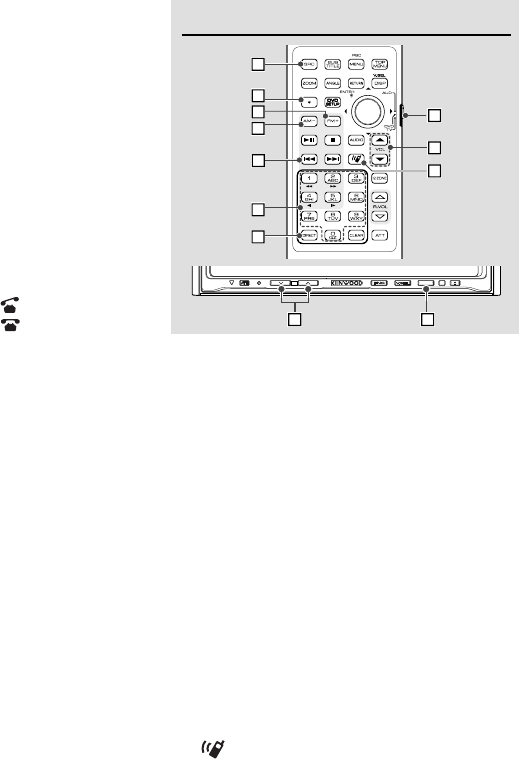
English | 27
Key Operation
18
20
22
17
19
21
23
24
25
26
SRC
27 28
3 Displays the Incoming Calls screen.
See <Calling a number in the call log> (page 28).
4 Switches between the private and hands-free
modes (only when a call in progress).
5 Displays the Hands-Free Set Up screen.
See <Setting up the Hands-Free Phone> (page 29).
6 Enter three phone numbers for quick dialing.
See <Speed dialing (Preset dial)> (page 28).
7 Enters a phone number.
See <Dial a number> (page 28).
8 Displays the signal strength.*
The more the number of bar segments, the
stronger the signal.
9 Displays the present Auto Answering status
When Auto Answering is on:
AUT
O
When Auto Answering is off:
p Displays the battery drain of the cell-phone.*
The more the number of bar segments, the higher
the battery level.
q Starts the call.
w Ends the call.
Clears the phone number being entered.
e Clears the entered phone number.
r Returns to the previous screen.
t Displays the calling and called phone numbers.
If you have registered a phone number in the
Phone Book, the destination person name is
displayed.
y Displays the status of connection with the cell-
phone.
White: The cell-phone is connected.
Orange: The cell-phone is not connected, or it is
outside the service range.
⁄
• While your car is moving, some functions are
disabled for safety’s sake. The buttons associated
with the disabled functions become ineffective if
pressed.
• When the Hands-Free Control screen appears, the
name of the connected cell-phone is displayed for 5
seconds.
• Setting the cell-phone in the private mode can
disable the hands-free function.
• * Since the number of steps of the control unit is
different from that of the cell-phone, the statuses
displayed on the control unit may discord from
those displayed on the cell-phone. No status
is displayed if information about it cannot be
obtained.
u [SRC] key
During a call: Ends the call.
i [*] key (When f is set to "AUD")
Number dial input: Inputs "+".
o [FM+] key (When f is set to "AUD")
Number dial input: Inputs "#".
; [AM-] key (When f is set to "AUD")
Number dial input: Inputs "*".
a [4] key (When f is set to "AUD")
Number dial input:
Clears the entered phone number.
s [0] – [9] key (When f is set to "AUD")
Number dial input: Inputs a phone number digit.
d [DIRECT] key (When f is set to "AUD")
Make a call.
f Remote Control Mode selector switch
Switch to "AUD" when dialing.
g [5]/ [∞] key
During a call: Adjusts the voice volume.
h [ ] key
Displays the Hands-Free Control screen.
When a call comes in: Answers the call.
j [u]/ [d] key
During a call: Adjusts the voice volume.
k [SRC] key
During a call: Ends the call.
⁄
• The voice volume level adjusted during a call will be
effective for the next and subsequent calls.
• Increasing the volume excessively is more likely
to produce echo. If echo is produced, turn down
the volume as low as possible. Echo increases in
proportion to the volume.
B64-4713-00_10_KCA-BT300_KE.indb 27B64-4713-00_10_KCA-BT300_KE.indb 27 10/03/12 14:5110/03/12 14:51
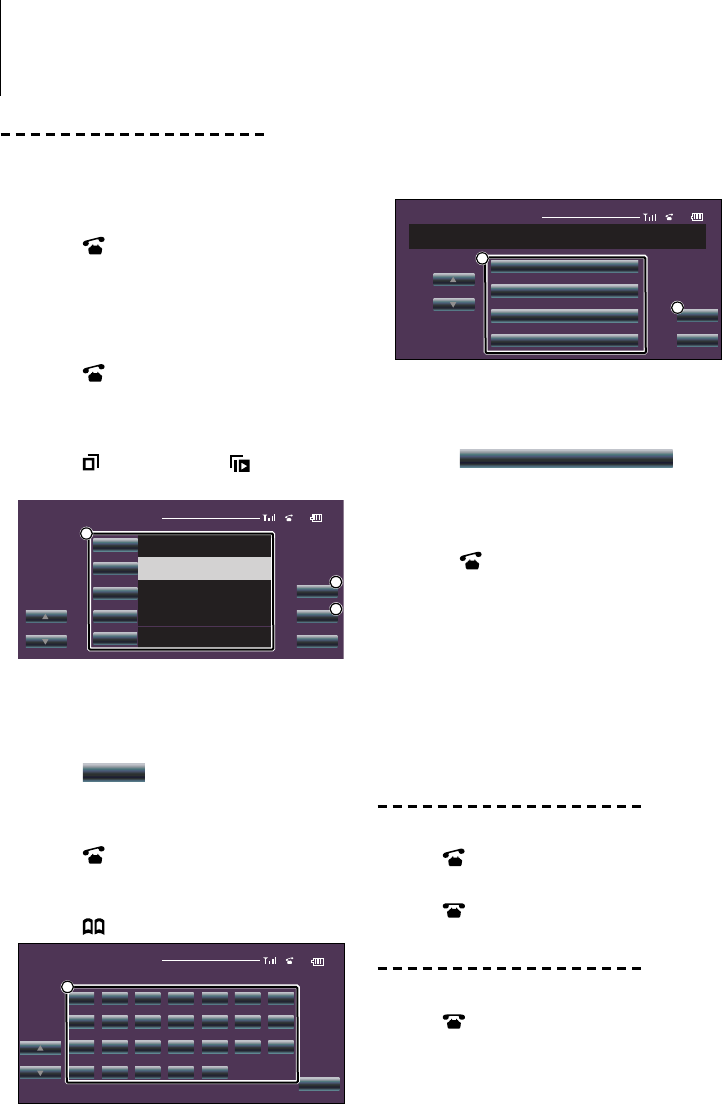
28 | KCA-BT300
Operation of hands-free phoning (Model-H)
Making a call
Dial a number
1. Enter a phone number
Press the number ([0] – [9]), [+], [#], or [*].
2. Make a call
Press the [ ] button.
☞ To clear your incorrect entry, press [Clear].
Speed dialing (Preset dial)
1. Select the preset dial number
Press the [P1] – [P3] button.
2. Make a call
Press the [ ] button.
☞ You need to register the preset dial number. (page 29)
Calling a number in the call log
1. Enter the call log mode
Press the [ ] (outgoing call) or [ ] (incoming
call) button.
Incoming Calls
Kenwood
1234567890
Kenwood
1234567890
Kenwood
1234567890
Kenwood
1234567890
Kenwood
1234567890
DISP
OK
Return
AUTO
1
2
3
1 Enters the destination name.
2 Change to record of redial list.
3 Enters the destination data and returns to the
Hands-Free Control screen.
2. Select a name or phone number
Press the [ ] button.
3. Con rm the destination
Press the [OK] button.
4. Make a call
Press the [ ] button.
Calling a number in the Phone Book
1. Enter the Phone Book mode
Press the [ ] button.
Phone Book List
bcde fg
hi jklmn
opqrstu
vwxyz
a
Return
AUTO
1
1 Displays the Phone Book beginning with the
name whose fi rst character you have touched.
2 Select the initial character of a person name in
memory
Press the character ([a] etc.) button.
Phone Book List
Name
Name
Name
Name
1234567890
OK
Return
AUTO
2
1
1 Enters the destination name.
2 Enters the destination data and returns to the
Hands-Free Control screen.
3 Select a destination you wish to call
Press the [
Name
]
button.
4. Con rm the destination
Press the [OK] button.
5. Make a call
Press the [ ] button.
☞ To use the Phone Book, it must have been downloaded
from the cell-phone. For details, see <Downloading the
Phone Book> (page 21).
⁄
• Up to 16 characters can be displayed for each name in the
Phone Book.
• Initials including no corresponding name will not be
displayed.
• During search, a non-accent character such as "u" is
searched for instead of an accent character such as "ü".
Receiving a call
Answering a Phone Call
Press the [ ] button.
Rejecting an Incoming Call
Press the [ ] button.
During a call
Disconnecting a Call
Press the [ ] button.
B64-4713-00_10_KCA-BT300_KE.indb 28B64-4713-00_10_KCA-BT300_KE.indb 28 10/03/12 14:5110/03/12 14:51
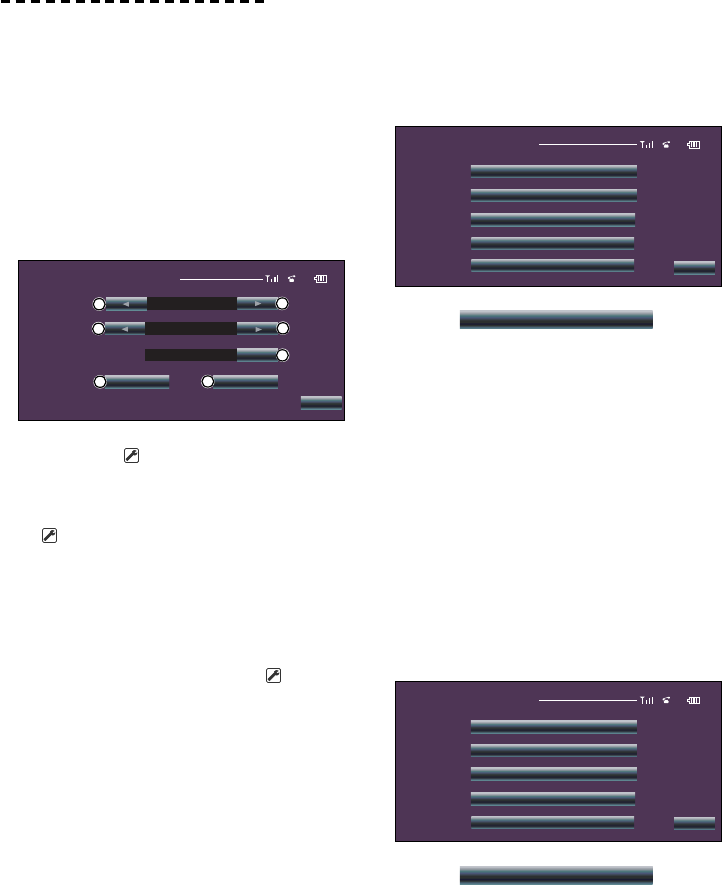
English | 29
Other functions
Registering to the Preset Dial Number List
1. Enter the phone number you wish to register
Enter the phone number with reference to the
following:
Dial a number/ Calling a number in the call log/
Calling a number in the Phone Book
2. Select the button you wish to register
Press the [P1] – [P3] button for at least 2 seconds.
Setting up the Hands-Free Phone
Press the [SetUp] button on Hands-Free Control
screen.
Hands Free Set Up
Return
Auto Answering
SelectSelect SelectDelete
Phone Voice
8
F-Right
Beep On
AUTO
1
1
2
2
5
3
4
1 Sets an automatic response time after call
termination. ( "8")
"Off ": This function can not use.
"0-99": Sets to calling ring time (second).
2 Sets a ringing tone output position.
( "F-Right")
"F-Left": Outputs the tone from the front left-
hand side speaker.
"F-Right": Outputs the tone from the front right-
hand side speaker.
"Front All": Outputs the tone from the both front
speakers.
3 Set the beep of the incoming call. ( "On")
"On": Beep is heard.
"Off ": Beep is canceled.
4 Display the Phone Select screen.
5 Display the Phone Delete screen.
⁄
• Select the speaker which is further from the microphone in
order to prevent howling or echoes.
Selecting a Hands-Free Phone
1. Display the Hands-Free Set Up screen
Press the [SetUp] button on Hands-Free Control
screen.
2. Display the Phone Select list
Press the [Select] button on Hands-Free Set Up
screen.
Phone Select
Return
Kenwood 1
Kenwood 2
Kenwood 3
Kenwood 4
Kenwood 5
AUTO
3. Select a Hands-Free phone you wish to use
Press the [
Kenwood 1
] button.
⁄
• If a cell-phone is already selected, deselect it, and then
select a different one.
• The firmware version "BT300 FW ***" is displayed at the end
of the Bluetooth device list.
For how to update the firmware, access our website.
http://www.kenwood.com/cs/ce/bt/
• The audio player is displayed on the device list after the
registration. However, the audio player on the list cannot be
selected.
Deleting the Hands-Free Phone
1. Display the Hands-Free Set Up screen
Press the [SetUp] button on Hands-Free Control
screen.
2. Display the Phone Delete list
Press the [Delete] button on Hands-Free Set Up
screen.
Phone Delete
Return
Kenwood 1
Kenwood 2
Kenwood 3
Kenwood 4
Kenwood 5
AUTO
3. Select a Hands-Free phone you wish to delete
Press the [
Kenwood 1
] button.
⁄
• The Phone Book, outgoing call list, and incoming call list are
deleted together with the deleted Hands-Free phone.
• The firmware version "BT300 FW ***" is displayed and
cannot be deleted.
B64-4713-00_10_KCA-BT300_KE.indb 29B64-4713-00_10_KCA-BT300_KE.indb 29 10/03/12 14:5110/03/12 14:51
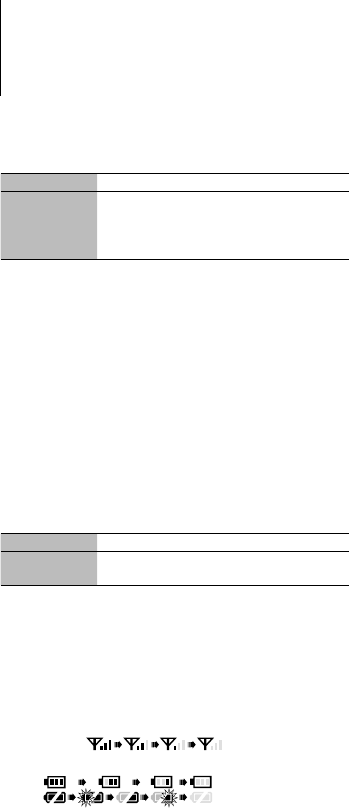
30 | KCA-BT300
Appendix
About the Cell-Phone
This unit conforms to the following Bluetooth
specifications:
Version Bluetooth Standard Ver. 2.1 + EDR
Profile HFP (Hands Free Profile)
OPP (Object Push Profile)
PBAP (Phonebook Access Profile)
SYNC (Synchronization Profile)
For the cell-phones verified for compatibility, access
the following URL:
http://www.kenwood.com/cs/ce/bt/
⁄
• The units supporting the Bluetooth function have been
certified for conformity with the Bluetooth Standard
following the procedure prescribed by Bluetooth
SIG. However, it may be impossible for such units to
communicate with your cell-phone depending on its type.
About the Bluetooth Audio player
This unit conforms to the following Bluetooth
specifications:
Version Bluetooth Standard Ver. 2.1 + EDR
Profile A2DP (Advanced Audio Distribution Profile)
AVRCP (Audio/Video Remote Control Profile)
About Bluetooth Icons
The control unit supporting the icon display function
can display the following statuses:.
• Bluetooth cell-phone connection status
BT : This indicator turns on when a cell-phone is
connected.
• Signal strength of cell-phone
Maximum Minimum
• Battery level of cell-phone
Full Nearly dead
⁄
• Icons are not displayed if information cannot be obtained
from the cell-phone.
• Since the number of steps of the control unit is different
from that of the cell-phone, the statuses displayed on the
control unit may discord from those displayed on the cell-
phone.
Menu Glossary
• "D-STATUS"/ "P-STATUS" (Displaying the
Bluetooth device Status)
You can display the connection status, signal
strength, and battery level.
"HF CONNECT"/ "BT-CON" / "HF-CON":
Bluetooth cell-phone connection status.
"AD CONNECT"/ "AD CON" :
Bluetooth Audio connection status.
"BAT" : Battery level of cell-phone.
"SGNL" : Signal strength of cell-phone.
• "ANS"/ "Auto Answer" (Setting the Time Interval
for Automatic Answer)
This function automatically answers (responds
to) a call after lapse of the preset time interval for
automatic answer.
"OFF" : Does not answer the phone call
automatically.
"0" : Automatically answers the phone call at once.
"1" – "99" : Automatically answers the phone call
after lapse of 1 – 99 seconds.
☞ If the time set in the cell-phone is shorter than that set
in the unit, the former will be used.
• "SPK"/ "SP Select" (Setting up the Voice Output
Speakers)
You can specify the voice output speakers.
"Front"/ "FRT" : Outputs voice from the front-left
and front-right speakers.
"F-R" : Outputs voice from the front-right speaker.
"F-L" : Outputs voice from the front-left speaker.
☞ Select the speaker which is further from the
microphone in order to prevent howling or echoes.
• "C-BP"/ "Call Beep"/ "Beep" (Setting the Beep of
the Incoming Call)
You can output a beep from the speaker when a
call comes in.
"ON" : Beep is heard.
"OFF" : Beep is canceled.
Function Note
• Dial a number
• Depending on the type of your control unit, "|" (all
segments are lit) is displayed for #.
• Calling a number in the call log
• The outgoing call list and the incoming call list, and the
missed call list are the lists of calls originated from and
received at this unit. They are not the ones stored in the
cell-phone memory.
• Calling a number in the Phone Book
• To use the Phone Book, it must have been downloaded
from the cell-phone. For details, see <Downloading the
Phone Book>.
• Up to 19 characters can be displayed for each name in
the Phone Book.
• During search, a non-accent character such as "u" is
searched for instead of an accent character such as "ü".
The non-alphabetical caracters such as Chinese and
Russian are classified as symbol.
• Switching to the Private Mode
• Depending on the type of your cell-phone, switching
to the private talk mode may select the source that was
used before commencing the hands-free connection.
If this happens, the source cannot be switched back to
the hands-free talk mode by operating this unit. Operate
B64-4713-00_10_KCA-BT300_KE.indb 30B64-4713-00_10_KCA-BT300_KE.indb 30 10/03/12 14:5110/03/12 14:51
English | 31
FCC Notice
This device complies with part 15 of the FCC rules.
Operation is subject to the following two conditions:
(1) this device may not cause harmful interference,
and (2) this device must accept any interference
received, including interference that may cause
undesired operation.
Information on Disposal of Old Electrical
and Electronic Equipment and Batteries
(applicable for EU countries that have
adopted separate waste collection systems)
Products and batteries with the symbol
(crossed-out wheeled bin) cannot be
disposed as household waste.
Old electrical and electronic equipment
and batteries should be recycled at a facility
capable of handling these items and their
waste byproducts.
Contact your local authority for details in
locating a recycle facility nearest to you.
Proper recycling and waste disposal will
help conserve resources whilst preventing
detrimental effects on our health and the
environment.
Notice: The sign "Pb" below the symbol for
batteries indicates that this battery
contains lead.
FCC WARNING
This equipment may generate or use radio frequency energy.
Changes or modifications to this equipment may cause
harmful interference unless the modifications are expressly
approved in the instruction manual. The user could lose
the authority to operate this equipment if an unauthorized
change or modification is made.
NOTE
This equipment has been tested and found to comply
with the limits for a Class B digital device, pursuant to Part
15 of the FCC Rules. These limits are designed to provide
reasonable protection against harmful interference in a
residential installation. This equipment may cause harmful
interference to radio communications, if it is not installed and
used in accordance with the instructions. However, there is
no guarantee that interference will not occur in a particular
installation. If this equipment does cause harmful interference
to radio or television reception, which can be determined by
turning the equipment off and on, the user is encouraged to
try to correct the interference by one or more of the following
measures:
• Reorient or relocate the receiving antenna.
• Increase the separation between the equipment and
receiver.
• Connect the equipment into an outlet on a circuit different
from that to which the receiver is connected.
• Consult the dealer or an experienced radio/TV technician
for help.
IC (Industry Canada) Notice
Operation is subject to the following two conditions:
(1) This device may not cause interference, and
(2) this device must accept any interference, including
interference that may cause undesired operation
of the device.
The term "IC: " before the certification/registration
number only signifies that the Industry Canada
technical specification were met.
• Contains Transmitter Module FCC ID : RKXCK5050NEW
• Contains Transmitter Module IC ID : 5119A-CK5050NEW
your cell-phone to return to the hands-free talk mode.
• Switching between Display Modes
• Depending on the type of your control unit, the
following restrictions are placed.
- Up to 19 characters can be displayed.
- The # letter cannot be displayed, or "|" (all segments
are lit) is displayed for #.
- You cannot switch between display modes.
B64-4713-00_10_KCA-BT300_KE.indb 31B64-4713-00_10_KCA-BT300_KE.indb 31 10/03/12 14:5110/03/12 14:51
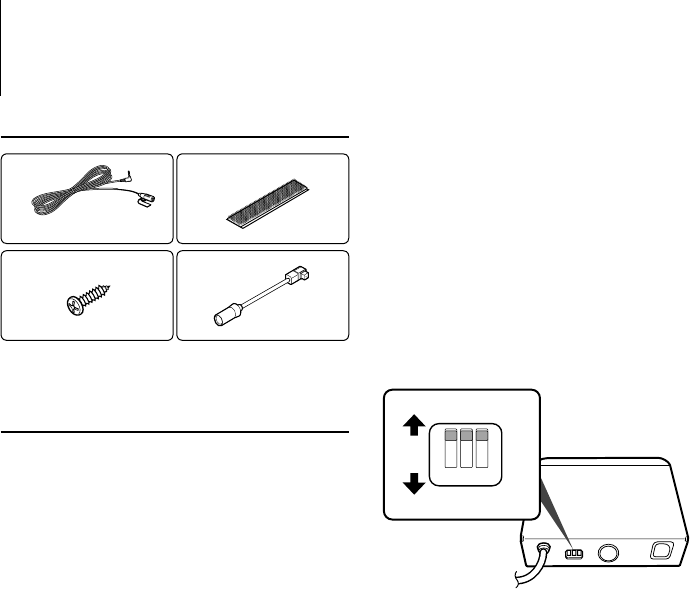
32 | KCA-BT300
Accessories/ Installation Procedure
Accessories
1
3 m (9.5 ft) ..........1
3
..........1
2
..........2
4
..........1
Installation Procedure
1. To prevent a short circuit, remove the key from the
ignition and disconnect the - battery.
2. Set the Type switch.
3. Make the proper input and output wire
connections for each unit.
4. Install the unit in your car.
5. Reconnect the - battery.
6. Press the reset button on the control unit.
¤
• Insulate unconnected wires with vinyl tape or other similar
material. To prevent a short circuit, do not remove the caps
on the ends of the unconnected wires or the terminals.
• After the unit is installed, check whether the brake lamps,
blinkers, wipers, etc. on the car are working properly.
For Good Reception
To assure good reception, note the following:
• Communicate with the cell-phone within the line-
of-sight distance of 10 m (30 ft). The communication
range becomes shorter depending on the
surrounding environment. The communication
range also becomes shorter when there is an
obstacle between this unit and the cell-phone. The
above maximum communication range (10 m) is
not always assured.
• Keep this unit away from other electric components
(AV components) as far as possible. If they are near,
call connection can fail, TV or radio noise can be
generated, or poor reception can occur.
• A broadcast station or walkie-talkie located nearby
can interfere with communication due to too strong
signal.
Setting the Type Switch
Set the Type switch according to the type of the
control unit connected. See the Type switch setting
column of the model list (page 4).
For the models released after April 2010, set the Type
switch as follows.
- For the model connected with the 5L connector
1: OFF, 2: OFF, 3: OFF
- For the model connected with the KAB connector
1: OFF, 2: ON, 3: OFF
- For more details, see the following web site. Set the
Type switch according to the web site when the
above setting is different from that of the web site.
www.kenwood.com/cs/ce/bt/
1
OFF
ON
23
1: Display Character Conversion Function
When the control unit cannot display accent characters
("u", "a", etc.), it converts these characters to upper-case
alphabetic characters.
OFF: Do not covert characters.
ON: Convert characters.
2: Specifying the Connector to Connect
Specify the type of the connector to be connected to the
control unit.
OFF: Use the 5L connector.
ON: Use the KAB connector.
3: Specifying the Control Unit Type
Specify the type of the control unit to connect to.
OFF: Set when no control unit type is specified in Model list,
or the control unit type is not in the model list.
ON: Set when the control unit type is specified in Model list.
B64-4713-00_10_KCA-BT300_KE.indb 32B64-4713-00_10_KCA-BT300_KE.indb 32 10/03/12 14:5110/03/12 14:51
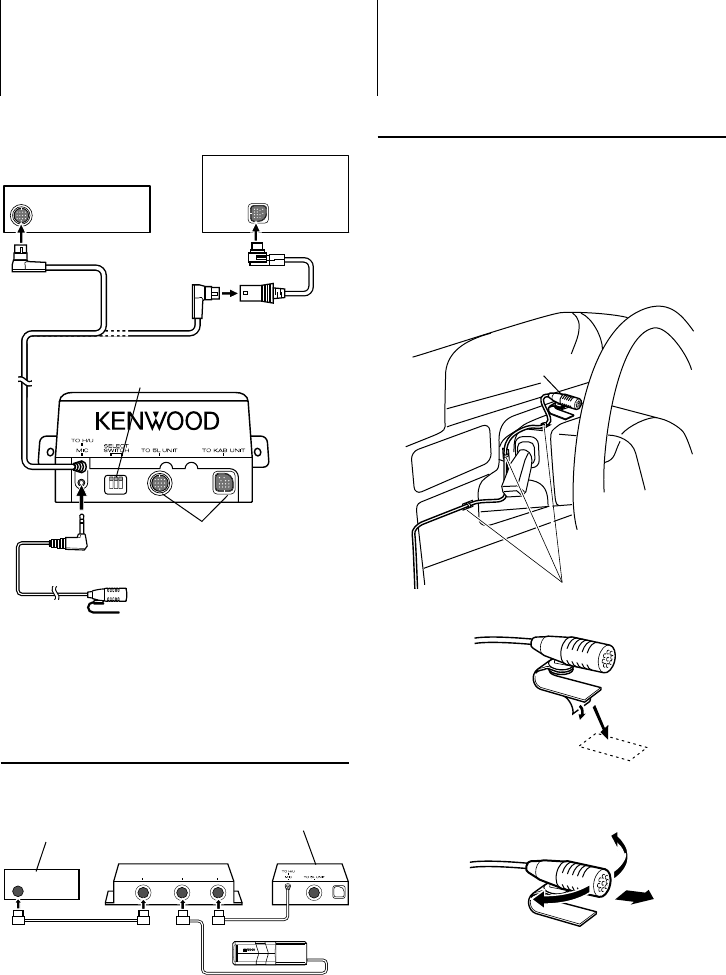
English | 33
Connection
123
Accessory 1
(3 m, 9.5 ft)
Control Unit
(5L connector)
Connector for external device
⁄
• Only the terminal which has
the same shape as that of the
connector connected to the
control unit can be used.
• Only one external device can be
connected.
Type Switch (page 4, 32)
(1.5 m, 5ft)
Control Unit
(KAB connector)
Accessory 4
TO CHANGER 2TO CHANGER 1TO HEAD UNIT
KCA-BT300
Control Unit (5L)
Disc Changer
KCA-S220A
¤
• Please keep the total extension of the control cable from
the control unit to the disc changer to 13 m (43 ft) or
less. Control cable lengths in excess of 13 m will cease to
function properly.
If You Want to Connect KCA-S220A
Connect the Hands-Free Box to the terminal labelled
TO CHANGER 2.
Installation
Installation of the Microphone Unit
1 Check the installation position of the microphone
(accessory 1).
2 Remove oil and other dirt from the installation
surface.
3 Install the microphone.
4 Wire the microphone cable up to the hands-free
box with it secured at several positions using tape
or the like.
Fix a cable with a commercial
item of tape.
Peel the release coated paper of double-face adhesive tape to
fix on the place shown above.
Adjust the direction of the microphone to the driver.
⁄
• Install the microphone as far as possible from the cell-
phone.
Accessory 1
B64-4713-00_10_KCA-BT300_KE.indb 33B64-4713-00_10_KCA-BT300_KE.indb 33 10/03/12 14:5110/03/12 14:51
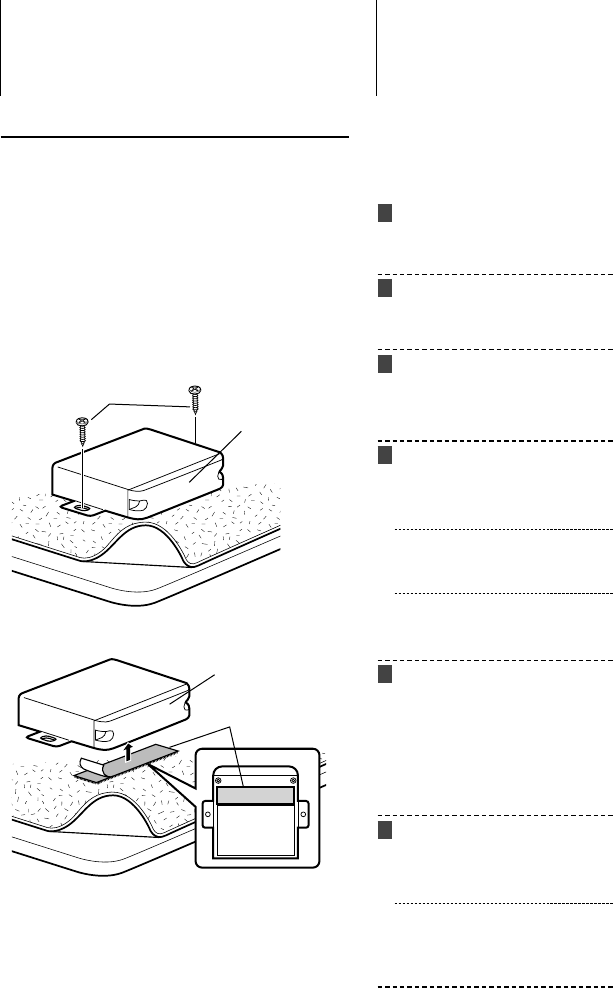
34 | KCA-BT300
Troubleshooting Guide
What might seem to be a malfunction in your unit
may just be the result of slight misoperation or
miswiring. Before calling service, first check the
following table for possible problems.
? The hands-free talk volume is low.
✔ The hands-free talk volume is set at a low level.
☞ The hands-free talk volume can be adjusted
independently. Adjust it during hands-free talk.
? No sound is heard from the rear speakers.
✔ You are talking in the hand-free talk mode.
☞ No sound is heard from the rear speakers in the
hands-free talk mode.
? No beep is heard at reception of an incoming call.
✔ No beep is heard depending on the type of your
cell-phone.
☞ The <Setting the Beep of the Incoming Call> is
set ON.
? Voice is not recognized.
✔ The vehicle window is open.
☞ If the surrounding noise is large, voice cannot be
recognized properly. Close the vehicle windows
to reduce noise.
✔ Small voice.
☞ If voice is too small, it cannot be recognized
properly. Speak into the microphone a little more
loudly and naturally.
✔ The person uttering the voice tag is not the one who
registered the it.
☞ Only the voice of the person who registered the
voice tag can be recognized.
? The Bluetooth audio player cannot be registered
(pairing).
✔ The PIN code is fixed.
☞ When a PIN code is specified in the Instruction
Manual for Bluetooth Audio Player, register it
with reference to <Registering PIN Code> to
register the Bluetooth audio player. If no PIN
code is specified in the Instruction Manual, try
“0000”.
? The sound from the Bluetooth audio player is
discontinuous.
✔ The distance between this unit and audio player is
too far.
☞ Move the audio player nearer to this unit.
✔ Another Bluetooth device is affecting the Bluetooth
communication.
☞ Turn off another Bluetooth device.
☞ Move another Bluetooth device away from this
unit.
The messages shown below display your
systems condition.
No Number/ NO-NMBER/ Incoming No Number :
• The calling party does not notify a caller ID.
• There is no phone number data.
Installation
Installation of the Bluetooth unit
¤
• Determine the installation position after making sure that
the unit can communicate with the Bluetooth device.
• Please do not install the unit near the dashboard, the rear
tray, or other important components. Doing so could lead
to injury or accident should the unit come off due to a
shock and strike a person or an important component.
Tapping screws should be used for mounting. (Attachment
with velcro strips, although easy, can come off with a
shock.)
Securing to audio board
Securing to pile carpet
Accessory 3
Antenna part
⁄
• Do not stick the velcro tape over the serial number.
• If the installation place is stepped, cut the velcro tape into
two pieces and stick them at two positions.
Antenna part
Accessory 2 (Ø4 × 16 mm)
B64-4713-00_10_KCA-BT300_KE.indb 34B64-4713-00_10_KCA-BT300_KE.indb 34 10/03/12 14:5110/03/12 14:51

English | 35
Speci cations
Bluetooth section
Technology
: Bluetooth 2.1 + EDR Certified
Frequency
: 2.402 – 2.480 GHz
Output Power
: +4dBm (MAX), 0dBm (AVE) Power Class 2
Maximum Communication range
: Line of sight approx.10m (32.1 ft)
Profiles
: HFP (Hands Free Profile)
: HSP (Headset Profile)
: OPP (Object Push Profile)
: PBAP (Phonebook Access Profile)
: SYNC (Synchronization Profile)
: SPP (Serial Port Profile)
: A2DP (Advanced Audio Distribution Profile)
: AVRCP (Audio/Video Remote Control Profile)
General
Operating voltage (10.5 – 16V allowable)
: 14.4 V
Current consumption
: 200 mA
Dimension (W x H x D)
: 95 x 30 x 105 mm
3-3/4 x 1-3/16 x 4-1/8 inch
Weight
: 0.38 kg (0.84 lbs)
Specifications subject to change without notice.
No Data/ NO DATA :
• There is no outgoing call list.
• There is no incoming call list.
No Entry/ NO ENTRY :
The cell-phone has not been registered
(pairing).
HF Disconnect/ HF DISCONCT/ HF D-CON/ Disconnect/
DISCONCT/ Non Connection/ Disconnected :
The unit cannot communicate with the cell-
phone.
Audio Disconnect/ AUD DISCONCT/ AD D-CON :
The unit cannot communicate with the audio
player.
HF Connect/ HF CONNECT/ Connect/ CONNECT :
The unit can communicate with the cell-
phone.
HF Error 07/ HF ERR07:
The memory cannot be accessed.
\ Turn off the power and on again. If this
message still appears, press the reset
button on the control unit.
HF Error 68/ HF ERR68:
The unit cannot communicate with the cell-
phone.
\ Turn off the power and on again. If this
message still appears, press the reset
button on the control unit.
Unknown: The Bluetooth device cannot be detected.
Device Full/ DVC FULL:
5 Bluetooth device have already been
registered. No more Bluetooth device cannot
be registered.
PIN Code NG/ CODE NG:
The PIN code is wrong.
Connect NG/ CONCT NG:
The unit cannot be connected to the device.
Pairing Failed/ PAIRING NG/ PAIR NG:
Pairing error.
Err No Matching/ NO MATCHING/ NO MATCH:
The voice tag is wrong. Voice cannot be
recognized because of an unregistered voice
tag, etc.
Too Soft: Voice is too small and cannot be recognized.
Too Loud: Voice is too large to be recognized.
Too Long: The word or utterance is too long to be
recognized.
No Phonebook/ NO PB:
Data is not contained in the phone book.
No Message/ NO SMS:
No short message in In Box.
This symbol mark indicates that
Kenwood manufactured this product
so as to decrease harmful infl uence on
the environment.
The Bluetooth word mark and logos are owned by
the Bluetooth SIG, Inc. and any use of such marks
by Kenwood Corporation is under license. Other
trademarks and trade names are those of their
respective owners.
B64-4713-00_10_KCA-BT300_KE.indb 35B64-4713-00_10_KCA-BT300_KE.indb 35 10/03/12 14:5110/03/12 14:51

36 | KCA-BT300
Table des matières
Avant l’utilisation 37
Liste des modèles 38
Fonctionnement de base de la téléphonie
mains libres (Modèle A) 40
Avant utilisation
Effectuer un appel
Recevoir un appel
Appel en attente
Pendant un appel
Autres fonctions
Fonctionnement de base de la téléphonie
mains libres (Modèle B) 42
Avant utilisation
Effectuer un appel
Recevoir un appel
Appel en attente
Pendant un appel
Autres fonctions
Fonctionnement de base de la téléphonie
mains libres (Modèle C) 44
Avant utilisation
Effectuer un appel
Recevoir un appel
Appel en attente
Pendant un appel
Autres fonctions
Fonctionnement de base de la téléphonie
mains libres (Modèle D) 46
Avant utilisation
Effectuer un appel
Recevoir un appel
Appel en attente
Pendant un appel
Autres fonctions
Fonctionnement de base de la téléphonie
mains libres (Modèle E) 48
Avant utilisation
Effectuer un appel
Recevoir un appel
Appel en attente
Pendant un appel
Autres fonctions
Fonctionnement de base de la téléphonie
mains libres (Modèle F) 50
Avant utilisation
Effectuer un appel
Recevoir un appel
Appel en attente
Pendant un appel
Autres fonctions
Fonctionnement de base de la téléphonie
mains libres (Modèle G) 52
Avant utilisation
Effectuer un appel
Recevoir un appel
Pendant un appel
Autres fonctions
Fonctionnement des fonctions 54
Boutons de commande
Enregistrer un appareil Bluetooth
Enregistrer un appareil Bluetooth spécial
Enregistrement du code PIN
Téléchargement du répertoire téléphonique
Sélection de l'appareil Bluetooth que vous
souhaitez connecter
Supprimer un appareil Bluetooth enregistré
Ajouter une commande de numérotation vocale
Configurer une commande vocale pour la
catégorie
Téléchargement de SMS
SMS (Service de messagerie - Short Message
Service)
Télécommande 59
Effectuer un appel
Recevoir un appel
Appel en attente
(Fonctionnement des modèles A, B, C, D, E, F)
Pendant un appel
Audio Bluetooth 59
Avant utilisation
Lecture d'audio par Bluetooth
Fonctionnement de la téléphonie mains
libres (Modèle H) 60
Enregistrer un appareil Bluetooth
Téléchargement du répertoire téléphonique
Ecran de commande mains libres
Opération des touches
Effectuer un appel
Recevoir un appel
Pendant un appel
Autres fonctions
Appendice 64
Accessoires/ Procédure d’installation 66
Connexion 67
Installation 67
Guide de dépannage 68
Caractéristiques techniques 69
B64-4713-00_10_KCA-BT300_KE.indb 36B64-4713-00_10_KCA-BT300_KE.indb 36 10/03/12 14:5110/03/12 14:51

Français | 37
Avant l’utilisation
2AVERTISSEMENT
Pour éviter toute blessure et/ou incendie,
veuillez prendre les précautions suivantes:
• Pour éviter les court-circuits, ne jamais mettre ou laisser
d’objets métalliques (comme une pièce de monnaie ou
un outil en métal) à l’intérieur de l’appareil.
• Le montage et le câblage de ce produit nécessite des
compétences et de l'expérience. Pour des raisons de
sécurité, laissez un professionnel effectuer le travail de
montage et de câblage.
2ATTENTION
• N’installez pas l’appareil dans un endroit exposé
directement à la lumière du soleil, à une chaleur
excessive ou à l’humidité. Évitez également les endroits
trop poussiéreux ou exposés aux éclaboussures.
Remarques
• Si vous rencontrez des problèmes pendant l’installation,
consultez votre revendeur Kenwood.
• Les lettres capitales et les lettres minuscules de l'écran
peuvent être inversées.
• Les illustrations de l’affichage et du panneau
apparaissant dans ce manuel sont des exemples
utilisés pour expliquer avec plus de clarté comment
les commandes sont utilisées. Il est donc possible que
les illustrations d’affichage puissent être différentes
de ce qui est réellement affiché sur l’appareil et aussi
que certaines illustrations représentent des choses
impossibles à réaliser en cours de fonctionnement.
Récepteurs Kenwood disponibles pour cet
appareil
Les modes de fonctionnement sont classés par groupes
en fonction du type de récepteur (unité de commande).
Tout d'abord, référez-vous à la <Liste des modèles>
(page 38) afin de vérifier le groupe de l'opération que vous
souhaitez exécuter.
Modèle A, B, C, D, E, F, G
Référez-vous aux pages correspondantes
(<Fonctionnement de base de la téléphonie mains
libres>). Pour utiliser un lecteur audio Bluetooth avec cet
appareil, référez-vous à la section <Audio Bluetooth>
(page 59).
Modèle H
Référez-vous aux pages correspondantes
(<Fonctionnement de la téléphonie mains libres>). Pour
utiliser un lecteur audio Bluetooth avec cet appareil,
référez-vous à la section <Audio Bluetooth> (page 59).
Modèle I
Après avoir exécuté l'opération mentionnée dans la
section <Enregistrer un appareil Bluetooth> (page 60) ou
<Téléchargement du répertoire téléphonique> (page
60), référez-vous au Manuel d'Instructions de l'Unité de
commande.
Pour utiliser un lecteur audio Bluetooth avec cet appareil,
référez-vous à la section <Audio Bluetooth> (page 59).
Remarques concernant la sélection et la suppression
d'un téléphone mains libres
• Si un téléphone portable est déjà sélectionné,
désélectionnez-le puis sélectionnez-en un autre.
• "BT300 FW***" et la version du micrologiciel apparaissent
dans la liste de sélection du téléphone portable. Bien que
les mêmes informations soient affichées dans la liste de
suppression, elles ne peuvent pas être effacées.
• Le lecteur audio est affiché dans la liste des appareils après
l'enregistrement. Cependant, le lecteur audio présent sur la
liste ne peut pas être sélectionné.
Modèle J, L
Référez-vous au Manuel d'Instructions de l'Unité de
commande.
Modèle K
Référez-vous au Manuel d'Instructions de l'Unité de
commande.
Les fonctions exigeant des opérations différentes sont
décrites ci-dessous :
• Affichage des informations de chanson des fichiers de
sources audio Bluetooth
Les informations de la chanson en cours de lecture
peuvent être affichées lorsque le lecteur audio Bluetooth
comprend le profil AVRCP 1.3.
Titre du morceau & Nom d'artiste ("Title/Artist"), Nom
d'album & Nom d'artiste ("Album/Artist")
• Affichage de "timestamp" durant la numérotation à
partir de la liste de l'historique des appels
Le nom, numéro de téléphone, et "timestamp" peuvent
être sélectionnés en commutant l'affichage entre les
éléments d'affichage.
• Enregistrer un appareil Bluetooth
Lorsqu'un appareil Bluetooth à connecter est
sélectionné dans la liste des appareils, "Pairing" s'affiche
et l'unité commence automatiquement à être associé à
l'appareil Bluetooth sélectionné
- L'enregistrement est terminé lorsque le message
"Pairing Success" est affiché. Exécutez l'opération après
avoir envoyé un code PIN.
- Saisissez un code PIN lorsque "PIN Code NG" s'affiche.
• Réglages Bluetooth
Affichage Aperçu
"MIC Gain" "–3" – "0" – "+3": Règle la sensibilité du
microphone pour un appel téléphonique. Règle la
voix de l'appelant.
"NR Level" "–3" – "0" – "+3": Réduit les bruits générés par
l'environnement ambiant sans modifier le volume
du microphone. Règle la voix de l'appelant si elle
n'est pas claire.
"Echo Cancel" "–2" – "0" – "+2": Règle le niveau d'atténuation
de l'écho.
B64-4713-00_10_KCA-BT300_KE.indb 37B64-4713-00_10_KCA-BT300_KE.indb 37 10/03/12 14:5110/03/12 14:51
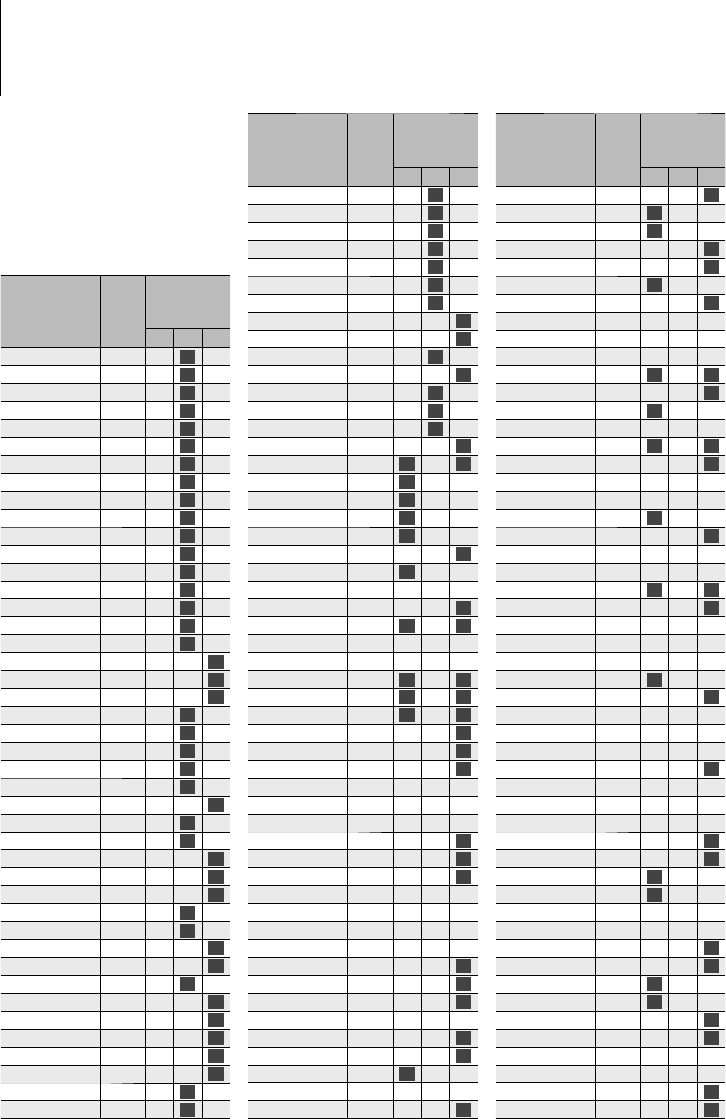
38 | KCA-BT300
Les récepteurs pouvant être réutilisés
avec le KCA-BT300 sont les suivants: (à
compter d'avril 2010)
Pour obtenir des détails sur les
récepteurs compatibles à venir,
accédez à l'URL suivante:
http://www.kenwood.com/cs/ce/bt/
Nom du modèle Groupe Réglage du
commutateur
de type
123
DDX5022 J OFF ON OFF
DDX5022Y J OFF ON OFF
DDX5024 J OFF ON OFF
DDX5026 J OFF ON OFF
DDX5032 J OFF ON OFF
DDX5032M J OFF ON OFF
DDX5034 J OFF ON OFF
DDX5034M J OFF ON OFF
DDX5036 J OFF ON OFF
DDX5036M J OFF ON OFF
DDX5054 J OFF ON OFF
DDX5056 J OFF ON OFF
DDX512 J OFF ON OFF
DDX514 J OFF ON OFF
DDX516 J OFF ON OFF
DDX52RY J OFF ON OFF
DDX54R J OFF ON OFF
DDX6019 H OFF OFF ON
DDX6029 H OFF OFF ON
DDX6029Y H OFF OFF ON
DDX6034 J OFF ON OFF
DDX6034M J OFF ON OFF
DDX6036 J OFF ON OFF
DDX6036 J OFF ON OFF
DDX6036M J OFF ON OFF
DDX6039 H OFF OFF ON
DDX6054 J OFF ON OFF
DDX630BT J OFF ON OFF
DDX7019 I OFF OFF ON
DDX7029 I OFF OFF ON
DDX7029Y I OFF OFF ON
DDX7032 J OFF ON OFF
DDX7032M J OFF ON OFF
DDX7039 I OFF OFF ON
DDX7039M I OFF OFF ON
DDX712 J OFF ON OFF
DDX8019 I OFF OFF ON
DDX8029 I OFF OFF ON
DDX8029Y I OFF OFF ON
DDX8039 I OFF OFF ON
DNX210EX G-1 OFF OFF ON
DNX5120 J OFF ON OFF
DNX512EX J OFF ON OFF
Nom du modèle Groupe Réglage du
commutateur
de type
123
DNX5140 J OFF ON OFF
DNX5160 J OFF ON OFF
DNX5220 J OFF ON OFF
DNX5240 J OFF ON OFF
DNX5360 J OFF ON OFF
DNX5360M J OFF ON OFF
DNX5560 J OFF ON OFF
DNX7100 I OFF OFF ON
DNX710EX I OFF OFF ON
DNX7120 J OFF ON OFF
DNX7200 I OFF OFF ON
DNX7220 J OFF ON OFF
DNX7320 J OFF ON OFF
DNX7320CN J OFF ON OFF
DPX-MP2090U G-1 OFF OFF ON
DPX-MP2100 G-1 ON OFF ON
DPX-MP3110 F ON OFF OFF
DPX-MP3110S F ON OFF OFF
DPX-MP4110 F ON OFF OFF
DPX-MP4110S F ON OFF OFF
DPX-MP5100U G-1 OFF OFF ON
DPX-MP5110U F ON OFF OFF
DPX-MP6110U E-1 OFF OFF OFF
DPX-MP7090U G-1 OFF OFF ON
DPX302 G-1 ON OFF ON
DPX303 E-1 OFF OFF OFF
DPX313Y E-1 OFF OFF OFF
DPX501 G-1 ON OFF ON
DPX501U G-1 ON OFF ON
DPX501UY G-1 ON OFF ON
DPX502 G-1 OFF OFF ON
DPX502U G-1 OFF OFF ON
DPX502UY G-1 OFF OFF ON
DPX503 E-1 OFF OFF OFF
DPX503U E-1 OFF OFF OFF
DPX503UY E-1 OFF OFF OFF
DPX701 G-1 OFF OFF ON
DPX701U G-1 OFF OFF ON
DPX701UY G-1 OFF OFF ON
KDC-5047U K OFF OFF OFF
KDC-6047U K OFF OFF OFF
KDC-HD545U J OFF OFF OFF
KDC-HD942U J OFF OFF OFF
KDC-MP2035 G-1 OFF OFF ON
KDC-MP235 G-1 OFF OFF ON
KDC-MP238 G-4 OFF OFF ON
KDC-MP242 A OFF OFF OFF
KDC-MP3035 G-1 OFF OFF ON
KDC-MP335 G-1 OFF OFF ON
KDC-MP338 D-1 ON OFF OFF
KDC-MP342U A OFF OFF OFF
KDC-MP4036AX G-1 OFF OFF ON
Nom du modèle Groupe Réglage du
commutateur
de type
123
KDC-MP4036U G-1 OFF OFF ON
KDC-MP4039 D-1 ON OFF OFF
KDC-MP408U D-1 ON OFF OFF
KDC-MP435U G-1 OFF OFF ON
KDC-MP436U G-1 OFF OFF ON
KDC-MP438U D-1 ON OFF OFF
KDC-MP439 G-4 OFF OFF ON
KDC-MP442U B OFF OFF OFF
KDC-MP443 A OFF OFF OFF
KDC-MP445U K OFF OFF OFF
KDC-MP5033U G-1 ON OFF ON
KDC-MP5036U G-1 OFF OFF ON
KDC-MP5039U D-1 ON OFF OFF
KDC-MP5043U A OFF OFF OFF
KDC-MP532U G-1 ON OFF ON
KDC-MP535U G-1 OFF OFF ON
KDC-MP538U E-2 OFF OFF OFF
KDC-MP543U A OFF OFF OFF
KDC-MP5539U D-1 ON OFF OFF
KDC-MP6036 G-1 OFF OFF ON
KDC-MP6039 E-2 OFF OFF OFF
KDC-MP6043U B OFF OFF OFF
KDC-MP632U G-1 ON OFF ON
KDC-MP635 G-3 OFF OFF ON
KDC-MP638U E-1 OFF OFF OFF
KDC-MP642U J OFF OFF OFF
KDC-MP6539U E-2 OFF OFF OFF
KDC-MP7090U D-1 ON OFF OFF
KDC-MP735U G-3 OFF OFF ON
KDC-MP738U E-1 OFF OFF OFF
KDC-MP745U K OFF OFF OFF
KDC-MP8090U E-1 OFF OFF OFF
KDC-MP832U G-3 OFF OFF ON
KDC-MP9090U E-1 OFF OFF OFF
KDC-U6046 K OFF OFF OFF
KDC-U6046L K OFF OFF OFF
KDC-W3537 G-1 OFF OFF ON
KDC-W3537Y G-1 OFF OFF ON
KDC-W3541 D-2 ON OFF OFF
KDC-W3541Y D-2 ON OFF OFF
KDC-W3544W A OFF OFF OFF
KDC-W3544WY A OFF OFF OFF
KDC-W4037 G-1 OFF OFF ON
KDC-W4037Y G-1 OFF OFF ON
KDC-W4041 D-1 ON OFF OFF
KDC-W4141Y D-1 ON OFF OFF
KDC-W4537U G-1 OFF OFF ON
KDC-W4537UY G-1 OFF OFF ON
KDC-W4544U A OFF OFF OFF
KDC-W4644UY A OFF OFF OFF
KDC-W4737U G-1 OFF OFF ON
KDC-W4737UY G-1 OFF OFF ON
Liste des modèles
B64-4713-00_10_KCA-BT300_KE.indb 38B64-4713-00_10_KCA-BT300_KE.indb 38 10/03/12 14:5110/03/12 14:51
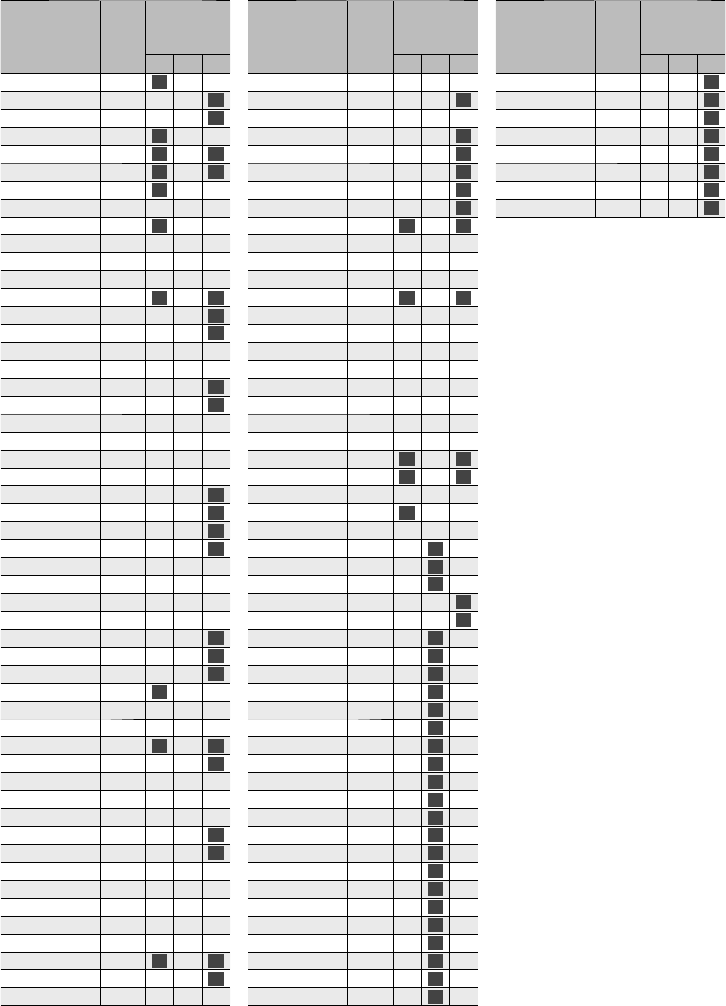
Français | 39
Nom du modèle Groupe Réglage du
commutateur
de type
123
KDC-W5041U D-1 ON OFF OFF
KDC-W5137 G-1 OFF OFF ON
KDC-W5137Y G-1 OFF OFF ON
KDC-W5141UY D-1 ON OFF OFF
KDC-W5534U G-1 ON OFF ON
KDC-W5534UY G-1 ON OFF ON
KDC-W5541U D-1 ON OFF OFF
KDC-W5544U B OFF OFF OFF
KDC-W5641UY D-1 ON OFF OFF
KDC-W5644UY B OFF OFF OFF
KDC-W6041U E-2 OFF OFF OFF
KDC-W6141UY E-2 OFF OFF OFF
KDC-W6534U G-1 ON OFF ON
KDC-W6537U G-1 OFF OFF ON
KDC-W6537UY G-1 OFF OFF ON
KDC-W6541U E-2 OFF OFF OFF
KDC-W6641UY E-2 OFF OFF OFF
KDC-W7037 G-3 OFF OFF ON
KDC-W7037Y G-3 OFF OFF ON
KDC-W7041U E-1 OFF OFF OFF
KDC-W7044U J OFF OFF OFF
KDC-W7141UY E-1 OFF OFF OFF
KDC-W7144UY J OFF OFF OFF
KDC-W7534U G-3 OFF OFF ON
KDC-W7534UY G-3 OFF OFF ON
KDC-W7537U G-3 OFF OFF ON
KDC-W7537UY G-3 OFF OFF ON
KDC-W7541U E-1 OFF OFF OFF
KDC-W7541UY E-1 OFF OFF OFF
KDC-W7544U J OFF OFF OFF
KDC-W7644UY J OFF OFF OFF
KDC-W9537U G-2 OFF OFF ON
KDC-W9537UY G-2 OFF OFF ON
KDC-X491 G-1 OFF OFF ON
KDC-X492 D-1 ON OFF OFF
KDC-X493 B OFF OFF OFF
KDC-X494 K OFF OFF OFF
KDC-X590 G-1 ON OFF ON
KDC-X591 G-1 OFF OFF ON
KDC-X592 E-2 OFF OFF OFF
KDC-X692 E-1 OFF OFF OFF
KDC-X693 J OFF OFF OFF
KDC-X7006 G-3 OFF OFF ON
KDC-X7006U G-3 OFF OFF ON
KDC-X7009U E-1 OFF OFF OFF
KDC-X7013U J OFF OFF OFF
KDC-X7013UL J OFF OFF OFF
KDC-X7016 K OFF OFF OFF
KDC-X7016L K OFF OFF OFF
KDC-X7533U G-1 ON OFF ON
KDC-X791 G-3 OFF OFF ON
KDC-X792 E-1 OFF OFF OFF
Nom du modèle Groupe Réglage du
commutateur
de type
123
KDC-X794 K OFF OFF OFF
KDC-X8006U G-2 OFF OFF ON
KDC-X8009U E-1 OFF OFF OFF
KDC-X890 G-3 OFF OFF ON
KDC-X891 G-2 OFF OFF ON
KDC-X9006U G-2 OFF OFF ON
KDC-X9533U G-3 OFF OFF ON
KDC-X991 G-2 OFF OFF ON
KDV-412 G-1 ON OFF ON
KDV-415U A OFF OFF OFF
KDV-4244 A OFF OFF OFF
KDV-4544 A OFF OFF OFF
KDV-5234 G-1 ON OFF ON
KDV-5244U A OFF OFF OFF
KDV-5544U A OFF OFF OFF
KDV-MP4343 A OFF OFF OFF
KDV-MP4343G A OFF OFF OFF
KDV-MP4443 A OFF OFF OFF
KDV-MP5042U A OFF OFF OFF
KDV-MP5343U A OFF OFF OFF
KDV-MP5443U A OFF OFF OFF
KDV-MP6333 G-1 ON OFF ON
KDV-MP6433 G-1 ON OFF ON
KIV-700 L OFF OFF OFF
KMR-330 D-1 ON OFF OFF
KMR-440U K OFF OFF OFF
KMR-700U*1C OFF ON OFF
KOS-A210 J OFF ON OFF
KOS-A300 J OFF ON OFF
KOS-V1000 I OFF OFF ON
KOS-V500 I OFF OFF ON
KVT-50DVDRY J OFF ON OFF
KVT-512 J OFF ON OFF
KVT-514 J OFF ON OFF
KVT-516 J OFF ON OFF
KVT-522DVD J OFF ON OFF
KVT-522DVDY J OFF ON OFF
KVT-524DVD J OFF ON OFF
KVT-526DVD J OFF ON OFF
KVT-532DVD J OFF ON OFF
KVT-532DVDM J OFF ON OFF
KVT-534DVD J OFF ON OFF
KVT-534DVDM J OFF ON OFF
KVT-536DVD J OFF ON OFF
KVT-536DVDM J OFF ON OFF
KVT-546DVD J OFF ON OFF
KVT-54DVDR J OFF ON OFF
KVT-554DVD J OFF ON OFF
KVT-556DVD J OFF ON OFF
KVT-614 J OFF ON OFF
KVT-636DVD J OFF ON OFF
KVT-696 J OFF ON OFF
Nom du modèle Groupe Réglage du
commutateur
de type
123
KVT-719DVD I OFF OFF ON
KVT-729DVD I OFF OFF ON
KVT-729DVDY I OFF OFF ON
KVT-739DVD I OFF OFF ON
KVT-819DVD I OFF OFF ON
KVT-829DVD I OFF OFF ON
KVT-829DVDY I OFF OFF ON
KVT-839DVD I OFF OFF ON
*1 Sauf dans les espaces de vente en Amérique
du Nord
B64-4713-00_10_KCA-BT300_KE.indb 39B64-4713-00_10_KCA-BT300_KE.indb 39 10/03/12 14:5110/03/12 14:51
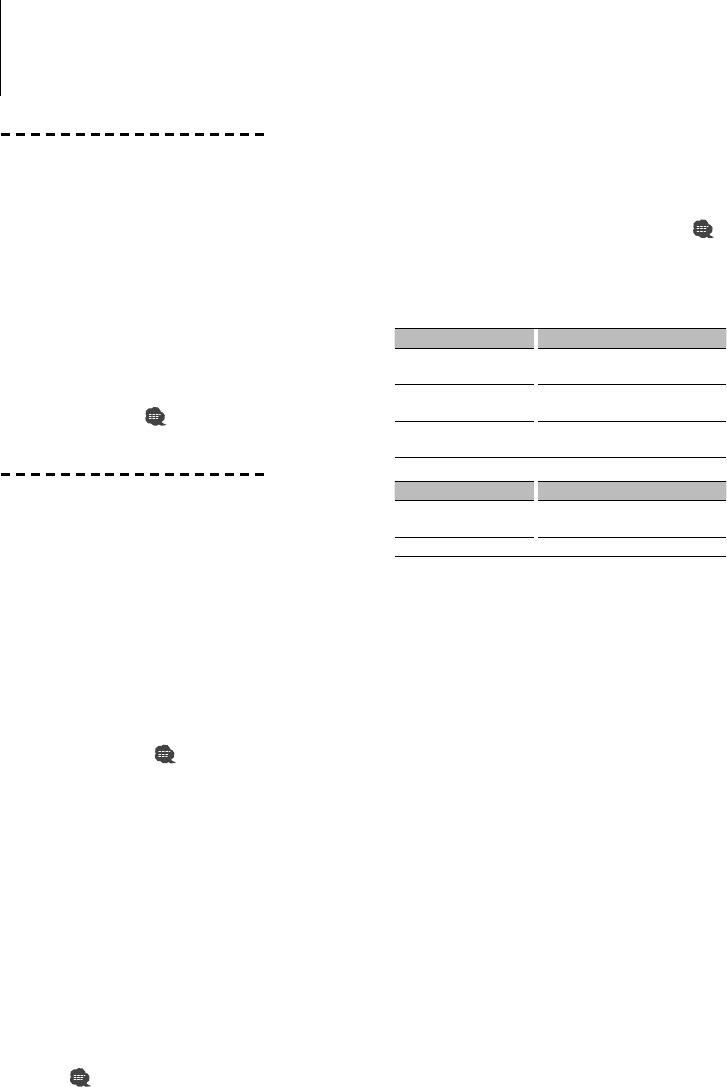
40 | KCA-BT300
Avant utilisation
• Vous devez enregistrer votre téléphone portable avant
de l'utiliser avec cet appareil. Pour plus de détails,
référez-vous à la section <Enregistrer un appareil
Bluetooth> (page 54).
• Si vous avez enregistré plusieurs téléphones portables,
vous devez en choisir un. <Sélection de l’appareil
Bluetooth que vous souhaitez connecter> (page 56).
• Pour utiliser le répertoire téléphonique, il est nécessaire
de l'avoir téléchargé auparavant sur cet appareil. Pour
plus de détails, voir <Téléchargement du répertoire
téléphonique> (page 55).
• Pour connaître le mode de fonctionnement dans le
mode Menu, référez-vous au Manuel d'Instructions de
l'Unité de commande.
• Pour plus d'informations à propos de la fonction
associée au symbole [ ], référez-vous à la section
<Note concernant le fonctionnement> (page 64).
Effectuer un appel
Méthode de numérotation
1. Sélectionnez la méthode de numérotation dans le
mode Menu
Sélectionnez l’affi chage "DIALING MODE"/ "D.MODE".
2. Sélectionnez une méthode de numérotation
Appuyez sur la molette [AUD].
• "NUMBER DIAL" » "PHONE BOOK1" » "PHONE BOOK2" »
"OUT-CALL" » "IN-CALL" » "MISSED CALLS"
• "N-DIAL" » "PH-BOOK1" » "PH-BOOK2" » "OUT-CALL" »
"IN-CALL" » "MIS-CALL"
3 Les modes de fonctionnement dans les modes ci-
dessus sont décrits ci-dessous.
3. Sortez du mode de sélection de la méthode de
numérotation
Sortir du mode menu.
3 Saisissez un numéro ( )
2-1. Sélectionnez l'affi chage "NUMBER DIAL"/ "N-DIAL".
2-2. Entrez un numéro de téléphone
Appuyez sur la touche numéro ([1] à [0]), #([FM]),
*([AM]), ou +([¢]) sur la télécommande.
2-3. E ectuer un appel
Appuyez sur la touche [DIRECT] sur la télécommande.
☞ Vous pouvez entrer 32 chiffres au maximum.
3 Numérotation rapide (Numérotation préréglée)
2-1. Sélectionnez l'affi chage "NUMBER DIAL"/ "N-DIAL".
2-2. Sélectionnez le numéro de numérotation préréglée
Appuyez sur la touche [1] à [6].
2-3. E ectuer un appel
Appuyez sur la molette [AUD] pendant au moins 1
seconde.
☞ Vous devez enregistrer le numéro de numérotation
préréglée. (page 41)
3 Appeler un numéro présent dans le journal des
appels ( )
2-1. Sélectionnez l'affi chage "OUT-CALL" (appel sortant),
"IN-CALL" (appel entrant), ou "MISSED CALLS"/"MIS-
Fonctionnement de base de la téléphonie mains libres (Modèle A)
CALL" (appel manqué).
2-2. Sélectionnez un nom ou un numéro de téléphone
Appuyez sur la touche [FM] ou [AM].
2-3. E ectuer un appel
Appuyez sur la molette [AUD] pendant au moins 1
seconde.
3 Appeler un numéro du répertoire téléphonique ( )
2-1. Sélectionnez l'affi chage "PHONE BOOK1"/"PH-BOOK1"
et passez à l'étape 2-2.
Sélectionnez l'affi chage "PHONE BOOK2"/"PH-BOOK2"
et passez à l'étape 2-3.
2-2. Sélectionnez la première lettre à rechercher
Type d’opération Opération
Déplacer vers le caractère
suivant.
Appuyez sur la touche [
4
] ou [
¢
].
Déplacer vers la rangée
suivante.
Appuyez sur la touche [FM] ou [AM].
Déterminez la première lettre
sélectionnée.
Appuyez sur la molette [AUD] pendant
au moins 1 seconde.
2-3. Sélectionnez le nom
Type d’opération Opération
Passer au numéro de
téléphone suivant.
Appuyez sur la touche [FM] ou [AM].
Passer au nom suivant. Appuyez sur la touche [
4
] ou [
¢
].
2-4. E ectuer un appel
Appuyez sur la molette [AUD] pendant au moins 1
seconde.
E ectuer un appel par numérotation vocale
1. Sélectionnez la reconnaissance vocale dans le mode
Menu
Sélectionnez l'affi chage "VOICE RECOG"/ "V-RECOG".
2. Appuyez sur la molette [AUD] pendant au moins 1
seconde.
"V-RECOG READY"/ "VR READY" est affi ché.
3. Appuyez sur la molette [AUD].
"PB NAME" est affi ché.
Lorsque vous entendez un bip, prononcez le nom dans
un délai de 2 secondes.
4. "PB TYPE"/ "PN type" est affi ché.
Lorsque vous entendez un bip, prononcez la catégorie
dans un délai de 2 secondes.
5. E ectuer un appel
Cette étape est la même que l'étape 3 de la procédure
<Appeler un numéro du répertoire téléphonique>.
Vous pouvez eff ectuer un appel ou sélectionner une
catégorie.
☞ Si l'appareil ne parvient pas à reconnaître votre voix,
un message est affiché. Vous pouvez refaire un essai en
appuyant sur la molette [AUD]. Voir page 68.
☞ Le nom et la catégorie nécessitent tous les deux
l'enregistrement d'une balise vocale. Voir page 56.
☞ Le son audio n'est pas émis pendant la reconnaissance
vocale.
B64-4713-00_10_KCA-BT300_KE.indb 40B64-4713-00_10_KCA-BT300_KE.indb 40 10/03/12 14:5110/03/12 14:51
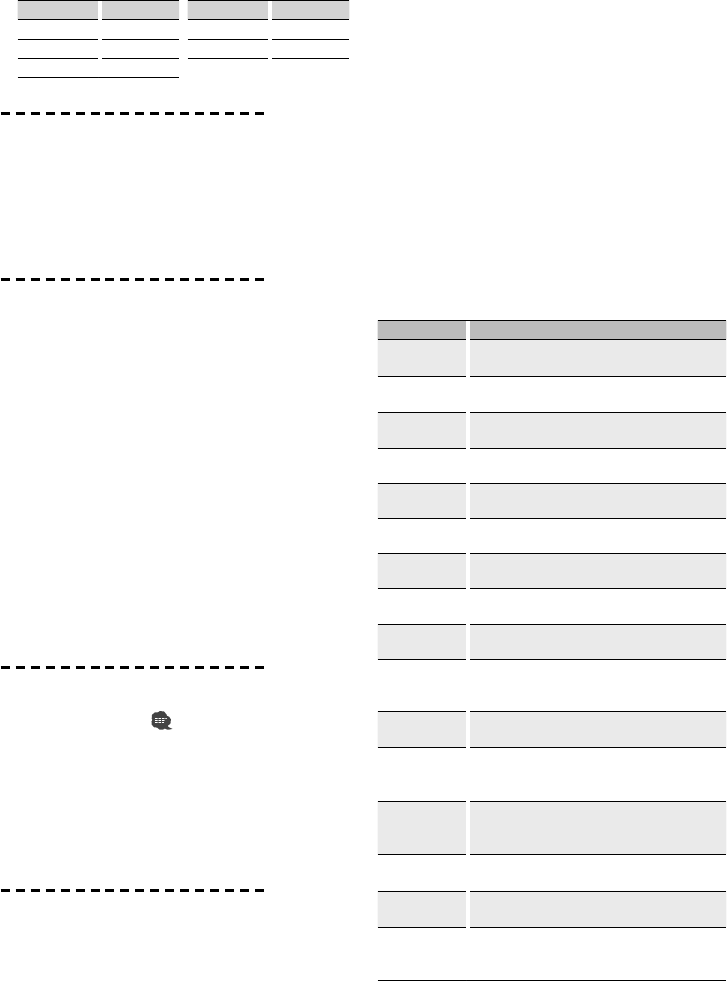
Français | 41
A chage du type de numéro de téléphone (catégorie)
Affichage Description Affichage Description
"GE"/ "GENERAL" Généralités "OF"/ "OFFICE" Bureau
"HM"/ "HOME" Domicile "OT"/ "OTHER" Autre
"MO"/ "MOBILE" Portable
Recevoir un appel
Répondre à un appel téléphonique
Appuyez sur la molette [AUD] ou sur une des touches de
[1] à [6]
☞ Insérer un disque tel qu'un CD aura pour conséquence
de couper votre appel.
Rejeter un appel entrant
Appuyez sur la touche [SRC].
Appel en attente
Répondre à un appel entrant en mettant en attente
l'appel en cours
1. Appuyez sur la molette [AUD].
2. Tournez la molette [AUD]. Sélectionnez l’affi chage
"ANSWER".
3. Appuyez sur la molette [AUD].
Répondre à un appel entrant après avoir mis n à
l'appel en cours
Appuyez sur la touche [SRC].
Poursuivre l'appel en cours
1. Appuyez sur la molette [AUD].
2. Tournez la molette [AUD]. Sélectionnez l’affi chage
"REJECT".
3. Appuyez sur la molette [AUD].
Répondre à l'appel en attente après avoir mis n à
l'appel en cours
Appuyez sur la touche [SRC].
Basculer entre l'appel en cours et l'appel en attente
Appuyez sur la molette [AUD].
Pendant un appel
Mettre n à un appel
Appuyez sur la touche [SRC].
Passer en mode privé ( )
Appuyez sur la molette [AUD] pendant au moins 1
seconde.
Cette touche permet de basculer entre le mode
conversation privée ("PV TALK") et le mode conversation
mains libres ("HF TALK").
Ajustez le volume sonore pendant un appel
Tournez la molette [AUD].
Autres fonctions
E acement du message de déconnexion
Appuyez sur la touche [DISP] pendant au moins 1 seconde.
Passage d'un mode d'a chage à un autre
Appuyez sur la touche [DISP]. Vous pouvez passer du
répertoire téléphonique à la liste d'appels.
Enregistrement sur la liste préréglée des numéros
composés
1. Entrez le numéro de téléphone que vous souhaitez
enregistrer
Entrez le numéro de téléphone en référence à ce qui
suit:
Composer un numéro/ Appeler un numéro présent
dans le journal des appels/ Appeler un numéro du
répertoire téléphonique
2. Sélectionnez la touche que vous souhaitez
enregistrer
Appuyez sur la touche [1] à [6] pendant au moins 2
secondes.
3. Sortez du mode de sélection de la méthode de
numérotation
Appuyez sur la touche [MENU].
Éléments paramétrés dans le mode Menu
* Pour passer en mode Menu, appuyez sur la molette
[AUD] pendant au moins 1 seconde.
Affichage Aperçu du réglage
"DVC REGIST"*/
"DVC REG"*
Enregistrer un appareil Bluetooth (association). Voir
page 54.
"S-DVC SELECT"*/
"S-DVC SEL"*
Permet l'enregistrement d'un appareil spécial qui ne
peut pas être enregistré normalement. Voir page 55.
"PHONE SEL"*/
"PHN-SEL"*
Sélectionner un téléphone portable pour une connexion
mains libres. Voir page 56.
"AUDIO SEL"*/
"AUD-SEL"*
Sélectionner le lecteur audio à connecter. Voir page 56.
"DIALING MODE"*/
"D.MODE"*
Sélectionnez une méthode de numérotation Voir page 40.
"SMS DOWNLOAD"*/
"SMS DL"*
Télécharger un message court. Voir page 58.
"SMS INBOX"*/
"INBOX"*
Afficher le message court reçu. Voir page 58.
"VOICE TAG"*/
"VOICETAG"*
Enregistrer la balise vocale pour la "reconnaissance
vocale". Voir page 56.
"VOICE RECOG"*/
"V-RECOG"*
Effectuer un appel par numérotation vocale Voir page 40.
"DEVICE DEL"*/
"DVC-DEL"*/
"PHN-DEL"*
Annuler l'enregistrement de l'appareil Bluetooth. Voir
page 56.
"DVC-STATUS"/
"D-STATUS"
"HF-CONNECT"/ "AD-CONNECT"/ "BAT"/ "SGNL":
Afficher le statut de l'appareil Bluetooth. Voir page 64.
"PIN EDIT"* Spécifier le code PIN nécessaire lors de l'enregistrement
de cet appareil à l'aide de l'appareil Bluetooth. Voir
page 55.
"AUTO ANS"/
"ANS"
"OFF"/ "0" – "99": Répondre automatiquement à
un appel après une période de temps préréglée pour
réponse automatique. Voir page 64.
"SP SEL"/
"SPK"
"FRT"/ "F-R"/ "F-L": Spécifier le haut-parleur de sortie
vocale. Voir page 64.
"CALL BEEP"/
"C-BP"
"ON"/ "OFF": Émettre un bip à partir du haut-parleur
lorsqu'un appel survient. Voir page 64.
"BT FW UP" Pour savoir comment mettre à jour le micrologiciel,
visitez notre site Internet. http://www.kenwood.com/
cs/ce/bt/
B64-4713-00_10_KCA-BT300_KE.indb 41B64-4713-00_10_KCA-BT300_KE.indb 41 10/03/12 14:5110/03/12 14:51
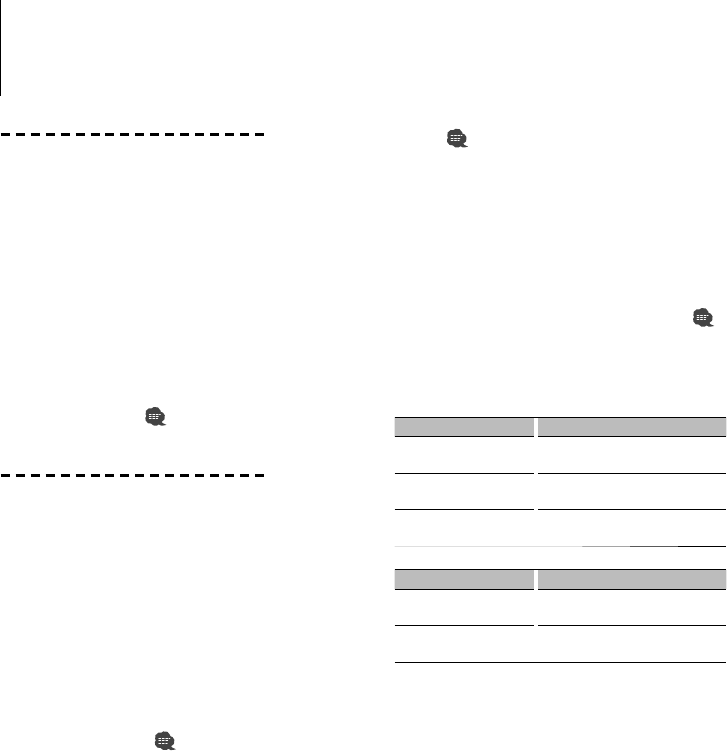
42 | KCA-BT300
Avant utilisation
• Vous devez enregistrer votre téléphone portable avant
de l'utiliser avec cet appareil. Pour plus de détails,
référez-vous à la section <Enregistrer un appareil
Bluetooth> (page 54).
• Si vous avez enregistré plusieurs téléphones portables,
vous devez en choisir un. <Sélection de l’appareil
Bluetooth que vous souhaitez connecter> (page 56).
• Pour utiliser le répertoire téléphonique, il est nécessaire
de l'avoir téléchargé auparavant sur cet appareil. Pour
plus de détails, voir <Téléchargement du répertoire
téléphonique> (page 55).
• Pour connaître le mode de fonctionnement dans le
mode Commande de fonction, référez-vous au Manuel
d'Instructions de l'Unité de commande.
• Pour plus d'informations à propos de la fonction
associée au symbole [ ], référez-vous à la section
<Note concernant le fonctionnement> (page 64).
Effectuer un appel
Méthode de numérotation
1. Entrez en mode méthode de numérotation
Appuyez sur la touche [AUTO]/ [TI] pendant au moins
1 seconde.
2. Sélectionnez une méthode de numérotation
Appuyez sur la molette [AUD].
"NUMBER DIAL" » "PHONE BOOK1" » "PHONE BOOK2" »
"OUT-CALL" » "IN-CALL" » "MISSED-CALL"
3 Les modes de fonctionnement dans les modes ci-
dessus sont décrits ci-dessous.
3. Sortez du mode de sélection de la méthode de
numérotation
Appuyez sur la touche [AUTO]/ [TI] pendant au moins
1 seconde.
3 Saisissez un numéro ( )
2-1. Sélectionnez l’affi chage "NUMBER DIAL".
2-2. Entrez un numéro de téléphone
Appuyez sur la touche numéro ([1] à [0]), #([FM]),
*([AM]), ou +([¢]) sur la télécommande.
2-3. E ectuer un appel
Appuyez sur la touche [DIRECT] sur la télécommande.
☞ Vous pouvez entrer 32 chiffres au maximum.
3 Numérotation rapide (Numérotation préréglée)
2-1. Sélectionnez l’affi chage "NUMBER DIAL".
2-2. Sélectionnez le numéro de numérotation préréglée
2-2-1. Appuyez sur la touche [SEARCH].
2-2-2. Sélectionnez le numéro à rappeler en tournant la
molette [AUD].
2-2-3. Appuyez sur la molette [AUD].
2-3. E ectuer un appel
Appuyez sur la molette [AUD] pendant au moins 1
seconde.
☞ Vous devez enregistrer le numéro de numérotation
préréglée. (page 43)
Fonctionnement de base de la téléphonie mains libres (Modèle B)
3 Appeler un numéro présent dans le journal des
appels ( )
2-1. Sélectionnez l'affi chage "OUT-CALL" (appel sortant),
"IN-CALL" (appel entrant), ou "MISSED-CALL" (appel
manqué).
2-2. Sélectionnez un nom ou un numéro de téléphone
Tournez la molette [AUD] ou poussez-la vers le haut ou
vers le bas.
2-3. E ectuer un appel
Appuyez sur la molette [AUD] pendant au moins 1
seconde.
3 Appeler un numéro du répertoire téléphonique ( )
2-1. Sélectionnez l'affi chage "PHONE BOOK1" et passez à
l'étape 2-2.
Sélectionnez l'affi chage "PHONE BOOK2" et passez à
l'étape 2-3.
2-2. Sélectionnez la première lettre à rechercher
Type d’opération Opération
Déplacer vers le caractère
suivant.
Tournez la molette [AUD] ou poussez-la
vers la droite ou vers la gauche.
Déplacer vers la rangée
suivante.
Poussez la molette [AUD] vers le haut
ou vers le bas.
Déterminez la première lettre
sélectionnée.
Appuyez sur la molette [AUD] pendant
au moins 1 seconde.
2-3. Sélectionnez le nom
Type d’opération Opération
Passer au numéro de
téléphone suivant.
Tournez la molette [AUD] ou poussez-la
vers le haut ou vers le bas.
Passer au nom suivant. Poussez la molette [AUD] vers la droite
ou vers la gauche.
2-4. E ectuer un appel
Appuyez sur la molette [AUD] pendant au moins 1
seconde.
E ectuer un appel par numérotation vocale
1. Sélectionnez la reconnaissance vocale dans le mode
Commande de fonction
Sélectionnez "MENU" > "VOICE RECOG".
"V-RECOG READY" est affi ché.
2. Appuyez sur la molette [AUD].
"PB NAME" est affi ché.
Lorsque vous entendez un bip, prononcez le nom dans
un délai de 2 secondes.
3. "PN TYPE" s'affi che.
Lorsque vous entendez un bip, prononcez la catégorie
dans un délai de 2 secondes.
4. E ectuer un appel
Cette étape est la même que l'étape 3 de la procédure
<Appeler un numéro du répertoire téléphonique>.
Vous pouvez eff ectuer un appel ou sélectionner une
catégorie.
☞ Si l'appareil ne parvient pas à reconnaître votre voix,
un message est affiché. Vous pouvez refaire un essai en
appuyant sur la molette [AUD]. Voir page 68.
☞ Le nom et la catégorie nécessitent tous les deux
l'enregistrement d'une balise vocale. Voir page 56.
☞ Le son audio n'est pas émis pendant la reconnaissance
vocale.
B64-4713-00_10_KCA-BT300_KE.indb 42B64-4713-00_10_KCA-BT300_KE.indb 42 10/03/12 14:5110/03/12 14:51
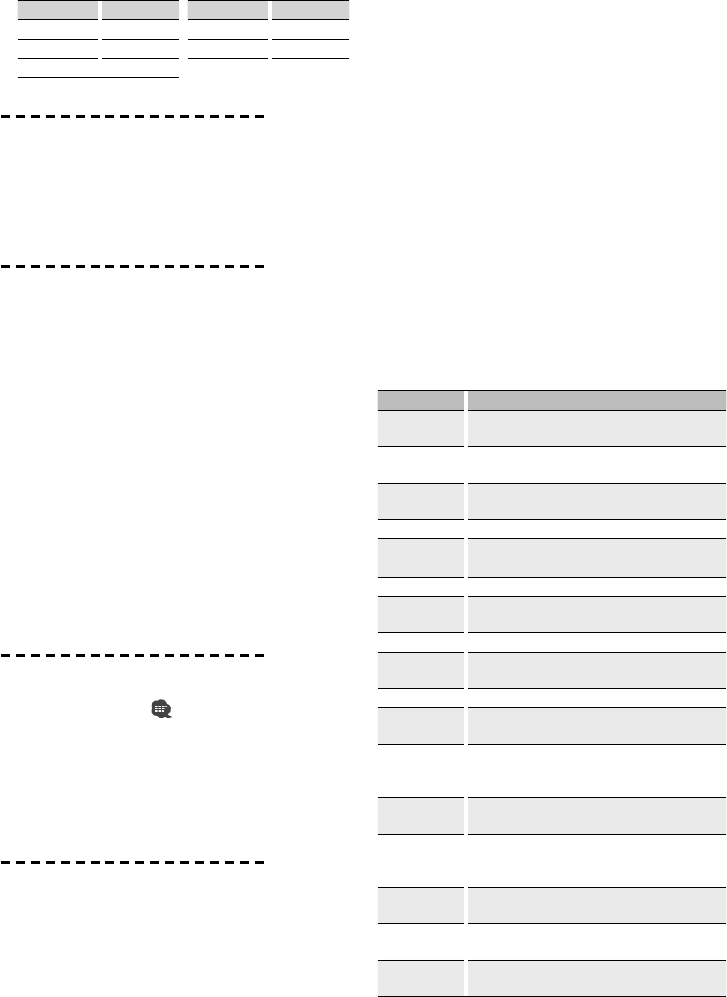
Français | 43
A chage du type de numéro de téléphone (catégorie)
Affichage Description Affichage Description
"General" Généralités "Office" Bureau
"Home" Domicile "Other" Autre
"Mobile" Portable
Recevoir un appel
Répondre à un appel téléphonique
Appuyez sur la touche [AUD].
☞ Insérer un disque tel qu'un CD aura pour conséquence
de couper votre appel.
Rejeter un appel entrant
Appuyez sur la touche [ATT] pendant au moins 1 seconde.
Appel en attente
Répondre à un appel entrant en mettant en attente
l'appel en cours
1. Appuyez sur la touche [AUD].
2. Tournez la molette [AUD] ou poussez-la vers le haut ou
vers le bas. Sélectionnez l’affi chage "ANSWER".
3. Appuyez sur la touche [AUD].
Répondre à un appel entrant après avoir mis n à
l'appel en cours
Appuyez sur la touche [SRC].
Poursuivre l'appel en cours
1. Appuyez sur la touche [AUD].
2. Tournez la molette [AUD] ou poussez-la vers le haut ou
vers le bas. Sélectionnez l’affi chage "REJECT".
3. Appuyez sur la touche [AUD].
Répondre à l'appel en attente après avoir mis n à
l'appel en cours
Appuyez sur la touche [ATT] pendant au moins 1 seconde.
Basculer entre l'appel en cours et l'appel en attente
Appuyez sur la touche [AUD].
Pendant un appel
Mettre n à un appel
Appuyez sur la touche [SRC].
Passer en mode privé ( )
Appuyez sur la touche [38].
Cette touche permet de basculer entre le mode
conversation privée ("PRVT") et le mode conversation
mains libres.
Ajustez le volume sonore pendant un appel
Tournez la molette [AUD].
Autres fonctions
E acement du message de déconnexion
Appuyez sur la touche [AUTO]/ [TI] pendant au moins 1
seconde.
Passage d'un mode d'a chage à un autre
Appuyez sur la touche [38] pendant au moins 1
seconde. Vous pouvez passer du répertoire téléphonique
à la liste d'appels.
Enregistrement sur la liste préréglée des numéros
composés
1. Entrez le numéro de téléphone que vous souhaitez
enregistrer
Entrez le numéro de téléphone en référence à ce qui
suit:
Composer un numéro/ Appeler un numéro présent
dans le journal des appels/ Appeler un numéro du
répertoire téléphonique
2. Sélectionnez la touche que vous souhaitez
enregistrer
2-1. Appuyez sur la touche [SEARCH].
2-2. Sélectionnez le numéro à mettre en mémoire en
tournant la molette [AUD].
2-3. Appuyez sur la molette [AUD] pendant au moins
1 seconde.
3. Sortez du mode de sélection de la méthode de
numérotation
Appuyez sur la touche [SEARCH].
Éléments paramétrés dans le mode Commande de
fonction
* Pour passer en mode Menu, appuyez sur la molette
[AUD] pendant au moins 1 seconde.
Affichage Aperçu du réglage
"DVC REGIST"* Enregistrer un appareil Bluetooth (association).
Voir page 54.
"S-DVC SELECT"* Permet l'enregistrement d'un appareil spécial qui ne peut
pas être enregistré normalement. Voir page 55.
"PHONE SEL"* Sélectionner un téléphone portable pour une connexion
mains libres. Voir page 56.
"AUD SEL"* Sélectionner le lecteur audio à connecter. Voir page 56.
"SMS
DOWNLOAD"
Télécharger un message court. Voir page 58.
"SMS INBOX" Afficher le message court reçu. Voir page 58.
"VOICE TAG" Enregistrer la balise vocale pour la "reconnaissance
vocale". Voir page 56.
"VOICE RECOG" Effectuer un appel par numérotation vocale Voir page 42.
"DEVICE DEL"* Annuler l'enregistrement de l'appareil Bluetooth.
Voir page 56.
"DVC STATUS"* Afficher le statut de l'appareil Bluetooth.
"PIN EDIT"* Spécifier le code PIN nécessaire lors de l'enregistrement de
cet appareil à l'aide de l'appareil Bluetooth. Voir page 55.
"AUTO ANS" "OFF"/ "0s" – "99s": Répondre automatiquement à
un appel après une période de temps préréglée pour
réponse automatique. Voir page 64.
"MIC GAIN" "–2" – "0" – "+2": Régler la sensibilité du microphone
pour un appel téléphonique.
"NR LEVEL" "–2" – "0" – "+2": Réduire les bruits générés par
l'environnement ambiant sans modifier le volume du
microphone.
"SP SEL" "Front"/ "F-R"/ "F-L": Spécifier le haut-parleur de sortie
vocale. Voir page 64.
"CALL BEEP" "ON"/ "OFF": Émettre un bip à partir du haut-parleur
lorsqu'un appel survient. Voir page 64.
"BT F/W UPDATE" Pour savoir comment mettre à jour le micrologiciel, visitez
notre site Internet. http://www.kenwood.com/cs/ce/bt/
B64-4713-00_10_KCA-BT300_KE.indb 43B64-4713-00_10_KCA-BT300_KE.indb 43 10/03/12 14:5110/03/12 14:51
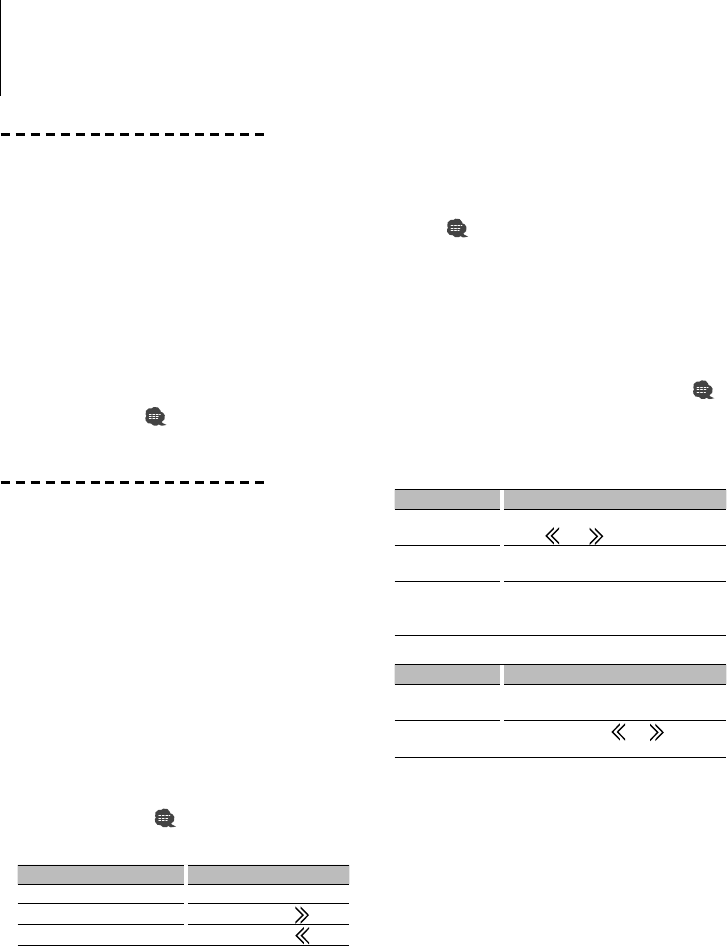
44 | KCA-BT300
Avant utilisation
• Vous devez enregistrer votre téléphone portable avant
de l'utiliser avec cet appareil. Pour plus de détails,
référez-vous à la section <Enregistrer un appareil
Bluetooth> (page 54).
• Si vous avez enregistré plusieurs téléphones portables,
vous devez en choisir un. <Sélection de l’appareil
Bluetooth que vous souhaitez connecter> (page 56).
• Pour utiliser le répertoire téléphonique, il est nécessaire
de l'avoir téléchargé auparavant sur cet appareil. Pour
plus de détails, voir <Téléchargement du répertoire
téléphonique> (page 55).
• Pour connaître le mode de fonctionnement dans le
mode Menu, référez-vous au Manuel d'Instructions de
l'Unité de commande.
• Pour plus d'informations à propos de la fonction
associée au symbole [ ], référez-vous à la section
<Note concernant le fonctionnement> (page 64).
Effectuer un appel
Méthode de numérotation
1. Entrez en mode méthode de numérotation
Appuyez sur la touche [MUTE] pendant au moins 1
seconde.
2. Entrez en mode de sélection de la méthode de
numérotation
Tournez la molette [VOL] pour sélectionner "Dialing
Mode", puis appuyez sur la touche [ENTER].
3. Sélectionnez une méthode de numérotation
Appuyez sur la touche [ENTER].
"DIAL" » "INITIAL" » "P-BOOK" » "OUT-CALL" » "INCALL" »
"MIS-CALL"
3 Les modes de fonctionnement dans les modes ci-
dessus sont décrits ci-dessous.
4. Sortez du mode de sélection de la méthode de
numérotation
Appuyez sur la touche [MUTE] pendant au moins 1
seconde.
3 Saisissez un numéro ( )
2-1. Sélectionnez l’affi chage "DIAL".
2-2. Entrez un numéro de téléphone
Type d’opération Opération
Sélectionner les caractères. Tournez la molette [VOL].
Déterminer les caractères. Appuyez sur la touche [ ].
Effacer les caractères. Appuyez sur la touche [ ].
2-3. E ectuer un appel
Appuyez sur la touche [ENTER] sur la télécommande.
☞ Vous pouvez entrer 32 chiffres au maximum.
3 Numérotation rapide (Numérotation préréglée)
2-1. Sélectionnez l’affi chage "DIAL".
2-2. Sélectionnez le numéro de numérotation préréglée
Appuyez sur la touche [1] à [6].
Fonctionnement de base de la téléphonie mains libres (Modèle C)
2-3. E ectuer un appel
Appuyez sur la touche [ENTER] pendant au moins 1
seconde.
☞ Vous devez enregistrer le numéro de numérotation
préréglée. (page 45)
3 Appeler un numéro présent dans le journal des
appels ( )
2-1. Sélectionnez l'affi chage "OUT-CALL" (appel sortant),
"INCALL" (appel entrant), ou "MIS-CALL" (appel
manqué).
2-2. Sélectionnez un nom ou un numéro de téléphone
Appuyez sur la touche [u] ou [d].
2-3. E ectuer un appel
Appuyez sur la touche [38] pendant au moins 1
seconde.
3 Appeler un numéro du répertoire téléphonique ( )
2-1. Sélectionnez l'affi chage "INITIAL" et passez à l'étape
2-2.
Sélectionnez l'affi chage "P-BOOK" et passez à l'étape
2-3.
2-2. Sélectionnez la première lettre à rechercher
Type d’opération Opération
Déplacer vers le
caractère suivant.
Tournez la molette [VOL] ou appuyez sur la
touche [ ] ou [ ].
Déplacer vers la
rangée suivante.
Appuyez sur la touche [u] ou [d].
Déterminez la
première lettre
sélectionnée.
Appuyez sur la touche [ENTER] pendant au
moins 1 seconde.
2-3. Sélectionnez le nom
Type d’opération Opération
Passer au numéro de
téléphone suivant.
Tournez la molette [VOL] ou appuyez sur la
touche [u] ou [d].
Passer au nom
suivant. Appuyez sur la touche [ ] ou [ ].
2-4. E ectuer un appel
Appuyez sur la touche [ENTER] pendant au moins 1
seconde.
E ectuer un appel par numérotation vocale
1. Entrez en mode Menu Bluetooth
Appuyez sur la touche [MUTE] pendant au moins 1
seconde.
2. Entrez en mode d'appel par numérotation vocale
Tournez la molette [VOL] pour sélectionner "Voice
Recognize".
3. Appuyez sur la touche [ENTER].
"Ready?" s'affi che.
4. Appuyez sur la touche [ENTER].
"PB Name?" est affi ché.
Lorsque vous entendez un bip, prononcez le nom dans
un délai de 2 secondes.
5. Appuyez sur la touche [1].
"PN Type?" est affi ché.
Lorsque vous entendez un bip, prononcez la catégorie
dans un délai de 2 secondes.
B64-4713-00_10_KCA-BT300_KE.indb 44B64-4713-00_10_KCA-BT300_KE.indb 44 10/03/12 14:5110/03/12 14:51
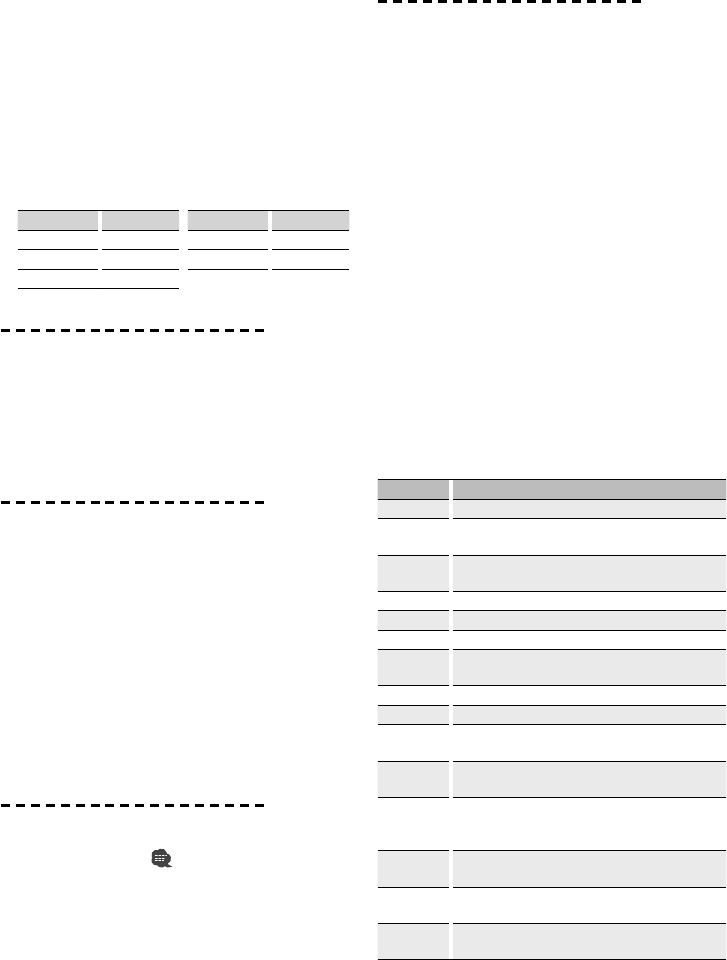
Français | 45
6. E ectuer un appel
Cette étape est la même que l'étape 3 de la procédure
<Appeler un numéro du répertoire téléphonique>.
Vous pouvez eff ectuer un appel ou sélectionner une
catégorie.
☞ Si l'appareil ne parvient pas à reconnaître votre voix, un
message est affiché. Appuyez sur la touche [ENTER] pour
faire une nouvelle tentative de saisie vocale. Voir page 68.
☞ Le nom et la catégorie nécessitent tous les deux
l'enregistrement d'une balise vocale. Voir page 56.
☞ Le son audio n'est pas émis pendant la reconnaissance
vocale.
A chage du type de numéro de téléphone (catégorie)
Affichage Description Affichage Description
"GE"/ "GENERAL" Généralités "OF"/ "OFFICE" Bureau
"HM"/ "HOME" Domicile "OT"/ "OTHER" Autre
"MO"/ "MOBILE" Portable
Recevoir un appel
Répondre à un appel téléphonique
Appuyez sur la touche [ENTER] ou sur une des touches de
[1] à [6] .
☞ Insérer un disque tel qu'un CD aura pour conséquence
de couper votre appel.
Rejeter un appel entrant
Appuyez sur la touche [TUN], [iPod] ou [AUX].
Appel en attente
Répondre à un appel entrant en mettant en attente
l'appel en cours
1. Appuyez sur la touche [ENTER].
2. Tournez la molette [VOL]. Sélectionnez l’affi chage
"ANSWER".
3. Appuyez sur la touche [ENTER].
Répondre à un appel entrant après avoir mis n à
l'appel en cours
Appuyez sur la touche [TUN], [iPod] ou [AUX].
Répondre à l'appel en attente après avoir mis n à
l'appel en cours
Appuyez sur la touche [TUN], [iPod] ou [AUX].
Basculer entre l'appel en cours et l'appel en attente
Appuyez sur la touche [ENTER].
Pendant un appel
Mettre n à un appel
Appuyez sur la touche [TUN], [iPod] ou [AUX].
Passer en mode privé ( )
Appuyez sur la touche [1].
Cette touche permet de basculer entre le mode
conversation privée ("PV TALK") et le mode conversation
mains libres ("HF TALK").
Ajustez le volume sonore pendant un appel
Tournez la molette [VOL].
Autres fonctions
E acement du message de déconnexion
Appuyez sur la touche [MUTE] pendant au moins 1
seconde.
Passage d'un mode d'a chage à un autre
Appuyez sur la touche [DISP]. Vous pouvez passer du
répertoire téléphonique à la liste d'appels.
Enregistrement sur la liste préréglée des numéros
composés
1. Entrez le numéro de téléphone que vous souhaitez
enregistrer
Entrez le numéro de téléphone en référence à ce qui
suit:
Composer un numéro/ Appeler un numéro présent
dans le journal des appels/ Appeler un numéro du
répertoire téléphonique
2. Sélectionnez la touche que vous souhaitez
enregistrer
Appuyez sur la touche [1] à [6] pendant au moins 2
secondes.
3. Sortez du mode de sélection de la méthode de
numérotation
Appuyez sur la touche [MUTE] pendant au moins 1
seconde.
Éléments paramétrés dans le mode Menu
* Pour entrer dans le mode Menu, appuyez sur la touche
[ENTER] pendant au moins 1 seconde.
Affichage Aperçu du réglage
"DVC REG"* Enregistrer un appareil Bluetooth (association). Voir page 54.
"SDVC SEL"* Permet l'enregistrement d'un appareil spécial qui ne peut
pas être enregistré normalement. Voir page 55.
"PHN-SEL"* Sélectionner un téléphone portable pour une connexion
mains libres. Voir page 56.
"AUD-SEL"* Sélectionner le lecteur audio à connecter. Voir page 56.
"SMS DL"* Télécharger un message court. Voir page 58.
"IN BOX"* Afficher le message court reçu. Voir page 58.
"VOICE TAG"* Enregistrer la balise vocale pour la "reconnaissance vocale".
Voir page 56.
"V-RECOG"* Effectuer un appel par numérotation vocale Voir page 44.
"DVC-DEL"* Annuler l'enregistrement de l'appareil Bluetooth. Voir page 56.
"D-STATUS" "HF-CON"/ "AD-CON"/ "BAT"/ "SGNL": Afficher le statut de
l'appareil Bluetooth. Voir page 64.
"PIN EDIT"* Spécifier le code PIN nécessaire lors de l'enregistrement de
cet appareil à l'aide de l'appareil Bluetooth. Voir page 55.
"ANS" "OFF"/ "0" – "99": Répondre automatiquement à un
appel après une période de temps préréglée pour réponse
automatique. Voir page 64.
"SPK" "FRT"/ "F-R"/ "F-L": Spécifier le haut-parleur de sortie
vocale. Voir page 64.
"C-BP" "ON"/ "OFF": Émettre un bip à partir du haut-parleur
lorsqu'un appel survient. Voir page 64.
"BT F/W
Update"
Pour savoir comment mettre à jour le micrologiciel, visitez
notre site Internet. http://www.kenwood.com/cs/ce/bt/
B64-4713-00_10_KCA-BT300_KE.indb 45B64-4713-00_10_KCA-BT300_KE.indb 45 10/03/12 14:5110/03/12 14:51
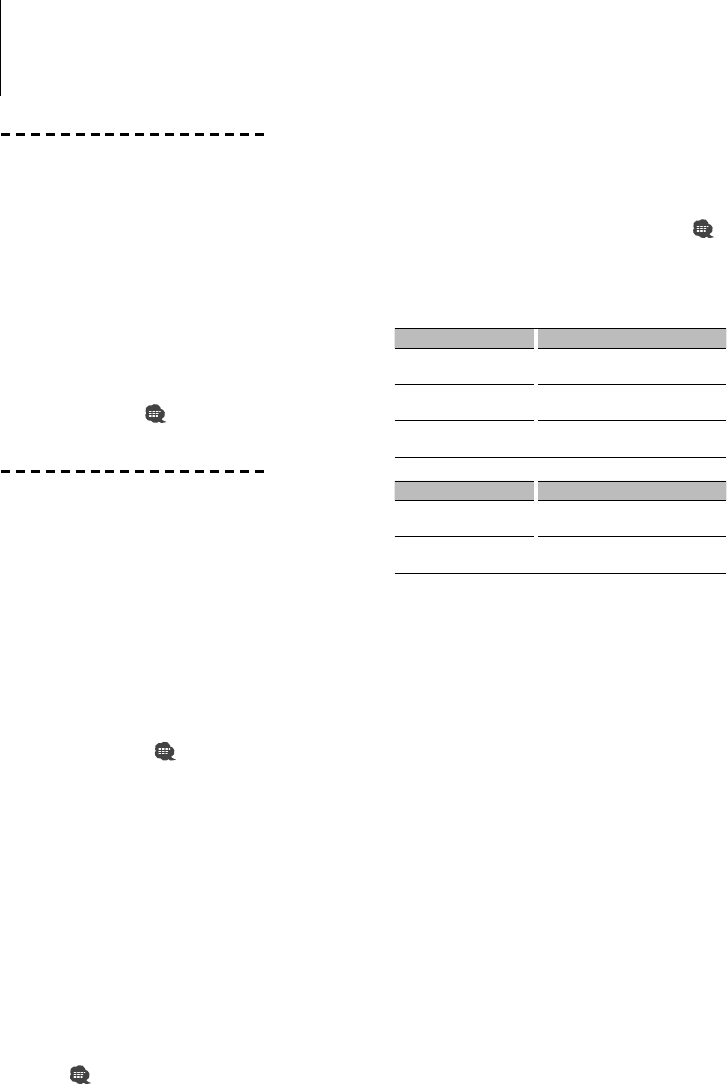
46 | KCA-BT300
Avant utilisation
• Vous devez enregistrer votre téléphone portable avant
de l'utiliser avec cet appareil. Pour plus de détails,
référez-vous à la section <Enregistrer un appareil
Bluetooth> (page 54).
• Si vous avez enregistré plusieurs téléphones portables,
vous devez en choisir un. <Sélection de l’appareil
Bluetooth que vous souhaitez connecter> (page 56).
• Pour utiliser le répertoire téléphonique, il est nécessaire
de l'avoir téléchargé auparavant sur cet appareil. Pour
plus de détails, voir <Téléchargement du répertoire
téléphonique> (page 55).
• Pour connaître le mode de fonctionnement dans le
mode Menu, référez-vous au Manuel d'Instructions de
l'Unité de commande.
• Pour plus d'informations à propos de la fonction
associée au symbole [ ], référez-vous à la section
<Note concernant le fonctionnement> (page 64).
Effectuer un appel
Méthode de numérotation
1. Sélectionnez la méthode de numérotation dans le
mode Menu
Sélectionnez l’affi chage "DIALING MODE"/ "D.MODE".
2. Sélectionnez une méthode de numérotation
Appuyez sur la touche [38].
• "NUMBER DIAL" » "PHONE BOOK1" » "PHONE BOOK2" »
"OUT-CALL" » "IN-CALL" » "MISSED CALLS"
• "N-DIAL" » "PH-BOOK1" » "PH-BOOK2" » "OUT-CALL" »
"IN-CALL" » "MIS-CALL"
3 Les modes de fonctionnement dans les modes ci-
dessus sont décrits ci-dessous.
3. Sortez du mode de sélection de la méthode de
numérotation
Sortir du mode menu.
3 Saisissez un numéro ( )
2-1. Sélectionnez l'affi chage "NUMBER DIAL"/ "N-DIAL".
2-2. Entrez un numéro de téléphone
Appuyez sur la touche numéro ([1] à [0]), #([FM]),
*([AM]), ou +([¢]) sur la télécommande.
2-3. E ectuer un appel
Appuyez sur la touche [DIRECT] sur la télécommande.
☞ Vous pouvez entrer 32 chiffres au maximum.
3 Numérotation rapide (Numérotation préréglée)
2-1. Sélectionnez l'affi chage "NUMBER DIAL"/ "N-DIAL".
2-2. Sélectionnez le numéro de numérotation préréglée
Appuyez sur la touche [1] à [6].
2-3. E ectuer un appel
Appuyez sur la touche [38] pendant au moins 1
seconde.
☞ Vous devez enregistrer le numéro de numérotation
préréglée. (page 47)
3 Appeler un numéro présent dans le journal des
appels ( )
2-1. Sélectionnez l'affi chage "OUT-CALL" (appel sortant),
"IN-CALL" (appel entrant), ou "MISSED CALLS"/"MIS-
CALL" (appel manqué).
Fonctionnement de base de la téléphonie mains libres (Modèle D)
2-2. Sélectionnez un nom ou un numéro de téléphone
Poussez la molette de commande vers le haut ou vers
le bas.
2-3. E ectuer un appel
Appuyez sur la touche [38] pendant au moins 1
seconde.
3 Appeler un numéro du répertoire téléphonique ( )
2-1. Sélectionnez l'affi chage "PHONE BOOK1"/"PH-BOOK1"
et passez à l'étape 2-2.
Sélectionnez l'affi chage "PHONE BOOK2"/"PH-BOOK2"
et passez à l'étape 2-3.
2-2. Sélectionnez la première lettre à rechercher
Type d’opération Opération
Déplacer vers le caractère
suivant.
Poussez la molette de commande vers la
droite ou vers la gauche.
Déplacer vers la rangée
suivante.
Poussez la molette de commande vers le
haut ou vers le bas.
Déterminez la première lettre
sélectionnée.
Appuyez sur la touche [38] pendant
au moins 1 seconde.
2-3. Sélectionnez le nom
Type d’opération Opération
Passer au numéro de
téléphone suivant.
Poussez la molette de commande vers le
haut ou vers le bas.
Passer au nom suivant. Poussez la molette de commande vers la
droite ou vers la gauche.
2-4. E ectuer un appel
Appuyez sur la touche [38] pendant au moins 1
seconde.
E ectuer un appel par numérotation vocale
1. Sélectionnez la reconnaissance vocale dans le mode
Menu
Sélectionnez l'affi chage "VOICE RECOG"/ "V-RECOG".
2. Appuyez sur la touche [38] pendant au moins 1
seconde.
"V-RECOG READY"/ "VR READY" est affi ché.
3. Appuyez sur la touche [38].
"PB NAME" est affi ché.
Lorsque vous entendez un bip, prononcez le nom dans
un délai de 2 secondes.
4. "PB TYPE"/ "PN type" est affi ché.
Lorsque vous entendez un bip, prononcez la catégorie
dans un délai de 2 secondes.
5. E ectuer un appel
Cette étape est la même que l'étape 3 de la procédure
<Appeler un numéro du répertoire téléphonique>.
Vous pouvez eff ectuer un appel ou sélectionner une
catégorie.
☞ Si l'appareil ne parvient pas à reconnaître votre voix, un
message est affiché. Appuyez sur la touche [38] pour
faire une nouvelle tentative de saisie vocale. Voir page 68.
☞ Le nom et la catégorie nécessitent tous les deux
l'enregistrement d'une balise vocale. Voir page 56.
☞ Le son audio n'est pas émis pendant la reconnaissance
vocale.
B64-4713-00_10_KCA-BT300_KE.indb 46B64-4713-00_10_KCA-BT300_KE.indb 46 10/03/12 14:5110/03/12 14:51
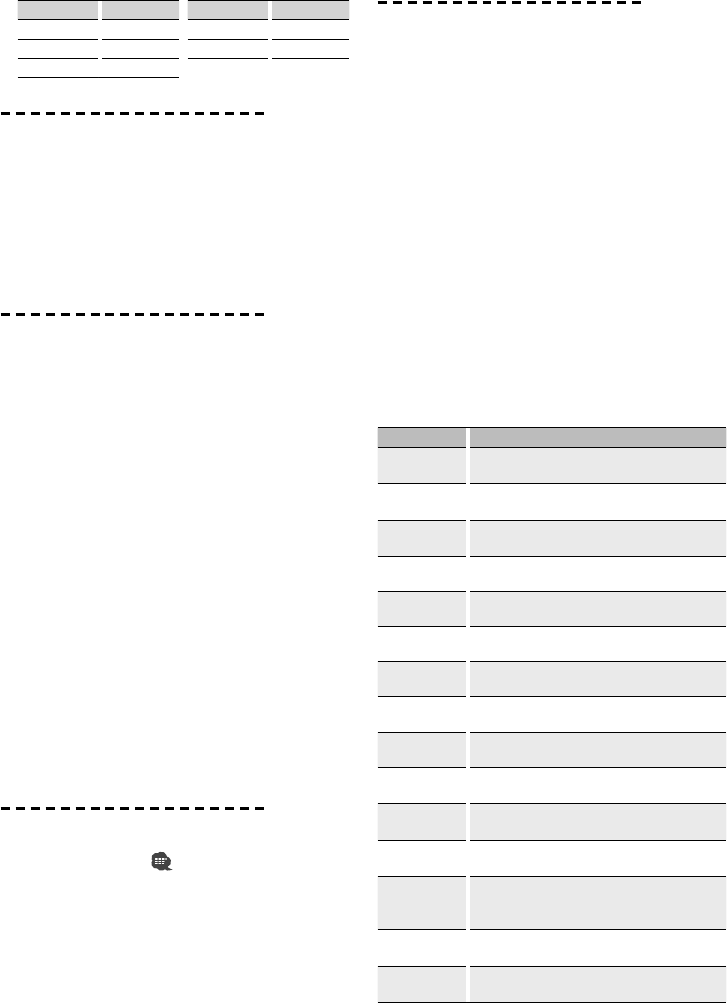
Français | 47
A chage du type de numéro de téléphone (catégorie)
Affichage Description Affichage Description
"GE"/ "GENERAL" Généralités "OF"/ "OFFICE" Bureau
"HM"/ "HOME" Domicile "OT"/ "OTHER" Autre
"MO"/ "MOBILE" Portable
Recevoir un appel
Répondre à un appel téléphonique
Modèle D-1: Appuyez sur la molette de commande ou sur
l'une des touches de [1] à [6]
Modèle D-2: Appuyez sur la touche [VOL] ou sur une des
touches de [1] à [6]
☞ Insérer un disque tel qu'un CD aura pour conséquence
de couper votre appel.
Rejeter un appel entrant
Appuyez sur la touche [SRC].
Appel en attente
Répondre à un appel entrant en mettant en attente
l'appel en cours
1. Modèle D-1: Appuyez sur la molette de commande.
Modèle D-2: Appuyez sur la molette [VOL].
2. Poussez la molette de commande vers le haut ou vers
le bas. Sélectionnez l’affi chage "ANSWER".
3. Modèle D-1: Appuyez sur la molette de commande.
Modèle D-2: Appuyez sur la molette [VOL].
Répondre à un appel entrant après avoir mis n à
l'appel en cours
Appuyez sur la touche [SRC].
Poursuivre l'appel en cours
1. Modèle D-1: Appuyez sur la molette de commande.
Modèle D-2: Appuyez sur la molette [VOL].
2. Poussez la molette de commande vers le haut ou vers
le bas. Sélectionnez l’affi chage "REJECT".
3. Modèle D-1: Appuyez sur la molette de commande.
Modèle D-2: Appuyez sur la molette [VOL].
Répondre à l'appel en attente après avoir mis n à
l'appel en cours
Appuyez sur la touche [AUTO]/ [TI] pendant au moins 1
seconde.
Basculer entre l'appel en cours et l'appel en attente
Modèle D-1: Appuyez sur la molette de commande.
Modèle D-2: Appuyez sur la molette [VOL].
Pendant un appel
Mettre n à un appel
Appuyez sur la touche [SRC].
Passer en mode privé ( )
Appuyez sur la touche [38].
Cette touche permet de basculer entre le mode
conversation privée ("PV TALK") et le mode conversation
mains libres ("HF TALK").
Ajustez le volume sonore pendant un appel
Modèle D-1: Tournez la molette de commande.
Modèle D-2: Tournez la molette [VOL].
Autres fonctions
E acement du message de déconnexion
Appuyez sur la touche [AUTO]/ [TI] pendant au moins 1
seconde.
Passage d'un mode d'a chage à un autre
Appuyez sur la touche [AUTO]/ [TI]. Vous pouvez passer
du répertoire téléphonique à la liste d'appels.
Enregistrement sur la liste préréglée des numéros
composés
1. Entrez le numéro de téléphone que vous souhaitez
enregistrer
Entrez le numéro de téléphone en référence à ce qui suit:
Composer un numéro/ Appeler un numéro présent
dans le journal des appels/ Appeler un numéro du
répertoire téléphonique
2. Sélectionnez la touche que vous souhaitez enregistrer
Appuyez sur la touche [1] à [6] pendant au moins 2
secondes.
3. Sortez du mode de sélection de la méthode de
numérotation
Appuyez sur la touche [MENU].
Éléments paramétrés dans le mode Menu
* Pour passer en mode Menu, appuyez sur la molette de
commande pendant au moins 1 seconde.
Affichage Aperçu du réglage
"DVC REGIST"*/
"DVC REG"*
Enregistrer un appareil Bluetooth (association).
Voir page 54.
"S-DVC SELECT"*/
"S-DVC SEL"*
Permet l'enregistrement d'un appareil spécial qui ne
peut pas être enregistré normalement. Voir page 55.
"PHONE SEL"*/
"PHN-SEL"*
Sélectionner un téléphone portable pour une connexion
mains libres. Voir page 56.
"DIALING MODE"*/
"D.MODE"*
Sélectionnez une méthode de numérotation Voir page 46.
"AUDIO SEL"*/
"AUD-SEL"*
Sélectionner le lecteur audio à connecter. Voir page 56.
"SMS DOWNLOAD"*/
"SMS DL"*
Télécharger un message court. Voir page 58.
"SMS INBOX"*/
"INBOX"*
Afficher le message court reçu. Voir page 58.
"VOICE TAG"*/
"VOICETAG"*
Enregistrer la balise vocale pour la "reconnaissance
vocale". Voir page 56.
"VOICE RECOG"*/
"V-RECOG"*
Effectuer un appel par numérotation vocale Voir page 46.
"DEVICE DEL"*/
"DVC-DEL"*
Annuler l'enregistrement de l'appareil Bluetooth.
Voir page 56.
"DVC-STATUS"/
"D-STATUS"
"HF-CONNECT"/ "AD-CONNECT"/ "BAT"/ "SGNL":
Afficher le statut de l'appareil Bluetooth. Voir page 64.
"PIN EDIT"* Spécifier le code PIN nécessaire lors de l'enregistrement de
cet appareil à l'aide de l'appareil Bluetooth. Voir page 55.
"AUTO ANS"/
"ANS"
"OFF"/ "0" – "99": Répondre automatiquement à
un appel après une période de temps préréglée pour
réponse automatique. Voir page 64.
"SP SEL"/
"SPK"
"FRT"/ "F-R"/ "F-L": Spécifier le haut-parleur de sortie
vocale. Voir page 64.
"CALL BEEP"/ "C-BP" "ON"/ "OFF": Émettre un bip à partir du haut-parleur
lorsqu'un appel survient. Voir page 64.
B64-4713-00_10_KCA-BT300_KE.indb 47B64-4713-00_10_KCA-BT300_KE.indb 47 10/03/12 14:5110/03/12 14:51
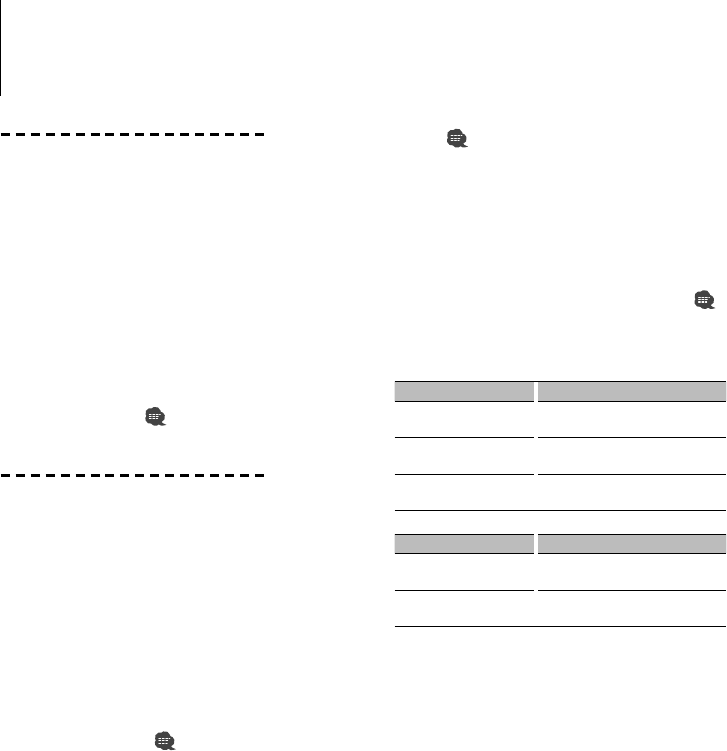
48 | KCA-BT300
Avant utilisation
• Vous devez enregistrer votre téléphone portable avant
de l'utiliser avec cet appareil. Pour plus de détails,
référez-vous à la section <Enregistrer un appareil
Bluetooth> (page 54).
• Si vous avez enregistré plusieurs téléphones portables,
vous devez en choisir un. <Sélection de l’appareil
Bluetooth que vous souhaitez connecter> (page 56).
• Pour utiliser le répertoire téléphonique, il est nécessaire
de l'avoir téléchargé auparavant sur cet appareil. Pour
plus de détails, voir <Téléchargement du répertoire
téléphonique> (page 55).
• Pour connaître le mode de fonctionnement dans le
mode Commande de fonction, référez-vous au Manuel
d'Instructions de l'Unité de commande.
• Pour plus d'informations à propos de la fonction
associée au symbole [ ], référez-vous à la section
<Note concernant le fonctionnement> (page 64).
Effectuer un appel
Méthode de numérotation
1. Entrez en mode méthode de numérotation
Appuyez sur la touche [ATT] pendant au moins 1
seconde.
2. Sélectionnez une méthode de numérotation
Appuyez sur le bouton de commande ([38]).
"DIAL" » "INITIAL" » "P-BOOK" » "OUT-CALL" » "IN-CALL"
» "MIS-CALL"
3 Les modes de fonctionnement dans les modes ci-
dessus sont décrits ci-dessous.
3. Sortez du mode de sélection de la méthode de
numérotation
Appuyez sur la touche [ATT] pendant au moins 1
seconde.
3 Saisissez un numéro ( )
2-1. Sélectionnez l’affi chage "DIAL".
2-2. Entrez un numéro de téléphone
Appuyez sur la touche numéro ([1] à [0]), #([FM]),
*([AM]), ou +([¢]) sur la télécommande.
2-3. E ectuer un appel
Appuyez sur la touche [DIRECT] sur la télécommande.
☞ Vous pouvez entrer 32 chiffres au maximum.
3 Numérotation rapide (Numérotation préréglée)
2-1. Sélectionnez l’affi chage "DIAL".
2-2. Sélectionnez le numéro de numérotation préréglée
Modèle E-1:
Appuyez sur la touche [1] à [6].
Modèle E-2:
2-1. Appuyez sur la touche [FNC].
2-2. Sélectionnez le numéro à rappeler en tournant la
molette de commande.
2-3. Appuyez sur la molette de commande.
2-3. E ectuer un appel
Appuyez sur le bouton de commande ([38]) pendant
au moins 1 seconde.
☞ Vous devez enregistrer le numéro de numérotation
préréglée. (page 49)
Fonctionnement de base de la téléphonie mains libres (Modèle E)
3 Appeler un numéro présent dans le journal des
appels ( )
2-1. Sélectionnez l'affi chage "OUT-CALL" (appel sortant), "IN-
CALL" (appel entrant), ou "MIS-CALL" (appel manqué).
2-2. Sélectionnez un nom ou un numéro de téléphone
Poussez la molette de commande vers le haut ou vers
le bas.
2-3. E ectuer un appel
Appuyez sur le bouton de commande ([38]) pendant
au moins 1 seconde.
3 Appeler un numéro du répertoire téléphonique ( )
2-1. Sélectionnez l'affi chage "INITIAL" et passez à l'étape 2-2.
Sélectionnez l'affi chage "P-BOOK" et passez à l'étape
2-3.
2-2. Sélectionnez la première lettre à rechercher
Type d’opération Opération
Déplacer vers le caractère
suivant.
Poussez la molette de commande vers la
droite ou vers la gauche.
Déplacer vers la rangée
suivante.
Poussez la molette de commande vers le
haut ou vers le bas.
Déterminez la première lettre
sélectionnée.
Appuyez sur le bouton de commande
([38]).
2-3. Sélectionnez le nom
Type d’opération Opération
Passer au numéro de
téléphone suivant.
Poussez la molette de commande vers le
haut ou vers le bas.
Passer au nom suivant. Poussez la molette de commande vers la
droite ou vers la gauche.
2-4. E ectuer un appel
Appuyez sur le bouton de commande ([38]) pendant
au moins 1 seconde.
E ectuer un appel par numérotation vocale
1. Sélectionnez la reconnaissance vocale dans le mode
Commande de fonction
Sélectionnez "BT" > "V-REC".
2. Appuyez sur le bouton de commande ([38]).
"PB Name?" est affi ché.
Lorsque vous entendez un bip, prononcez le nom dans
un délai de 2 secondes.
3. "PN Type?" est affi ché.
Lorsque vous entendez un bip, prononcez la catégorie
dans un délai de 2 secondes.
4. E ectuer un appel
Cette étape est la même que l'étape 3 de la procédure
<Appeler un numéro du répertoire téléphonique>.
Vous pouvez eff ectuer un appel ou sélectionner une
catégorie.
☞ Si l'appareil ne parvient pas à reconnaître votre voix, un
message est affiché. Appuyez sur la touche [38] pour
faire une nouvelle tentative de saisie vocale. Voir page 68.
☞ Le nom et la catégorie nécessitent tous les deux
l'enregistrement d'une balise vocale. Voir page 56.
☞ Le son audio n'est pas émis pendant la reconnaissance
vocale.
B64-4713-00_10_KCA-BT300_KE.indb 48B64-4713-00_10_KCA-BT300_KE.indb 48 10/03/12 14:5110/03/12 14:51
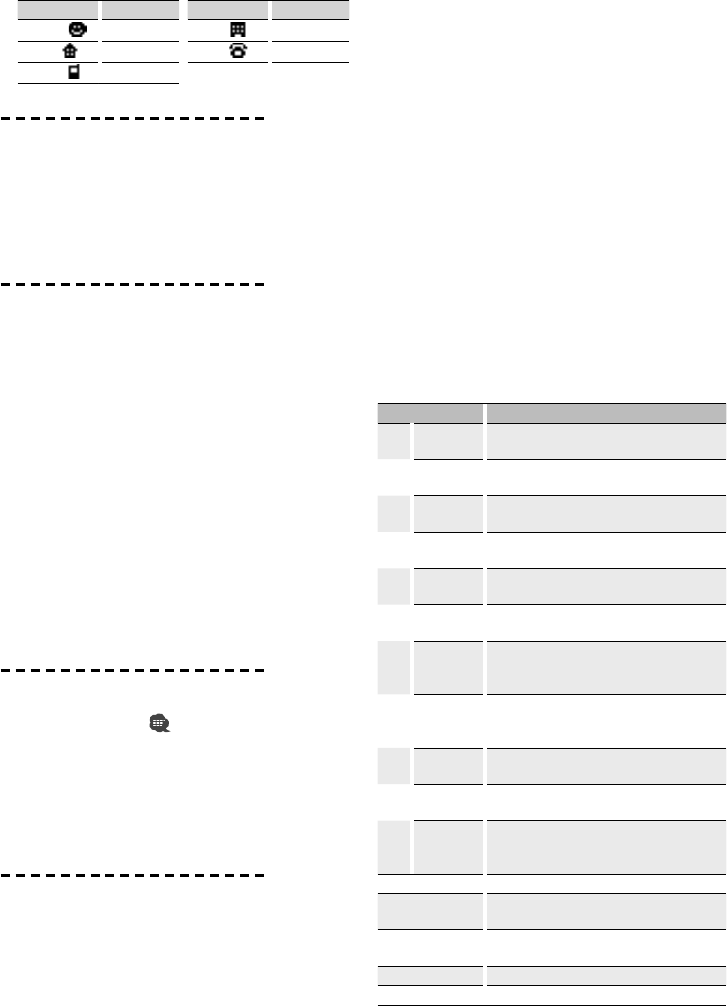
Français | 49
A chage du type de numéro de téléphone (catégorie)
Affichage Description Affichage Description
"General"/ Généralités "Office"/ Bureau
"Home"/ Domicile "Other"/ Autre
"Mobile"/ Portable
Recevoir un appel
Répondre à un appel téléphonique
Appuyez sur la touche [AUD] ou sur une des touches de
[1] à [6].
☞ Insérer un disque tel qu'un CD aura pour conséquence
de couper votre appel.
Rejeter un appel entrant
Appuyez sur la touche [ATT] pendant au moins 1 seconde.
Appel en attente
Répondre à un appel entrant en mettant en attente
l'appel en cours
1. Appuyez sur la touche [AUD].
2. Poussez la molette de commande vers le haut ou vers le
bas. Sélectionnez l’affi chage "ANSWER".
3. Appuyez sur la touche [AUD].
Répondre à un appel entrant après avoir mis n à
l'appel en cours
Appuyez sur la touche [SRC].
Poursuivre l'appel en cours
1. Appuyez sur la touche [AUD].
2. Poussez la molette de commande vers le haut ou vers le
bas. Sélectionnez l’affi chage "REJECT".
3. Appuyez sur la touche [AUD].
Répondre à l'appel en attente après avoir mis n à
l'appel en cours
Appuyez sur la touche [ATT] pendant au moins 1 seconde.
Basculer entre l'appel en cours et l'appel en attente
Appuyez sur la touche [AUD].
Pendant un appel
Mettre n à un appel
Appuyez sur la touche [SRC].
Passer en mode privé ( )
Appuyez sur le bouton de commande ([38]).
Cette touche permet de basculer entre le mode
conversation privée ("PRVT") et le mode conversation
mains libres.
Ajustez le volume sonore pendant un appel
Tournez la molette [AUD].
Autres fonctions
E acement du message de déconnexion
Appuyez sur la touche [ATT] pendant au moins 1 seconde.
Passage d'un mode d'a chage à un autre
Appuyez sur la touche [AUTO]/ [TI]. Vous pouvez passer du
répertoire téléphonique à la liste d'appels.
Enregistrement sur la liste préréglée des numéros
composés
1. Entrez le numéro de téléphone que vous souhaitez
enregistrer
Entrez le numéro de téléphone en référence à ce qui suit:
Composer un numéro/ Appeler un numéro présent
dans le journal des appels/ Appeler un numéro du
répertoire téléphonique
2. Sélectionnez la touche que vous souhaitez enregistrer
Modèle E-1:
Appuyez sur la touche [1] à [6] pendant au moins 2
secondes.
Modèle E-2:
2-1. Appuyez sur la touche [FNC].
2-2. Sélectionnez le numéro à mettre en mémoire en
tournant la molette de commande.
2-3. Appuyez sur la molette de commande pendant au
moins 1 seconde.
3. Sortez du mode de sélection de la méthode de
numérotation
Appuyez sur la touche [ATT] pendant au moins 1
seconde.
Éléments paramétrés dans le mode Commande de
fonction
* Pour passer en mode Menu, appuyez sur la molette de
commande pendant au moins 1 seconde.
Élément Aperçu du réglage
MENU "Device
Regist"*
Enregistrer un appareil Bluetooth (association).
Voir page 54.
"SPCL DVC
Select"*
Permet l'enregistrement d'un appareil spécial qui ne
peut pas être enregistré normalement. Voir page 55.
"Phone
Selection"*
Sélectionner un téléphone portable pour une
connexion mains libres. Voir page 56.
"Audio
Selection"*
Sélectionner le lecteur audio à connecter. Voir page 56.
"Device
Delete"*
Annuler l'enregistrement de l'appareil Bluetooth.
Voir page 56.
"BT DVC
Status"*
Afficher le statut de l'appareil Bluetooth.
"PIN Code
Edit"*
Spécifier le code PIN nécessaire lors de
l'enregistrement de cet appareil à l'aide de l'appareil
Bluetooth. Voir page 55.
"Auto Answer" "OFF"/ "0s" – "99s": Répondre automatiquement à
un appel après une période de temps préréglée pour
réponse automatique. Voir page 64.
"SP Select" "Front"/ "F-R"/ "F-L": Spécifier le haut-parleur de
sortie vocale. Voir page 64.
"Call Beep" "ON"/ "OFF": Émettre un bip à partir du haut-
parleur lorsqu'un appel survient. Voir page 64.
"BT F/W
Update"
Pour savoir comment mettre à jour le micrologiciel,
visitez notre site Internet. http://www.kenwood.
com/cs/ce/bt/
BT > V-REC Effectuer un appel par numérotation vocale
BT > VOICE > NAME Enregistrer une balise de nom pour la reconnaissance
vocale. Voir page 56.
BT > VOICE > TYPE Enregistrer une balise vocale de type (catégorie)
pour la reconnaissance vocale. Voir page 56.
BT > SMS > SMSDL Télécharger un message court. Voir page 58.
BT > SMS > INBOX Afficher le message court reçu. Voir page 58.
B64-4713-00_10_KCA-BT300_KE.indb 49B64-4713-00_10_KCA-BT300_KE.indb 49 10/03/12 14:5110/03/12 14:51
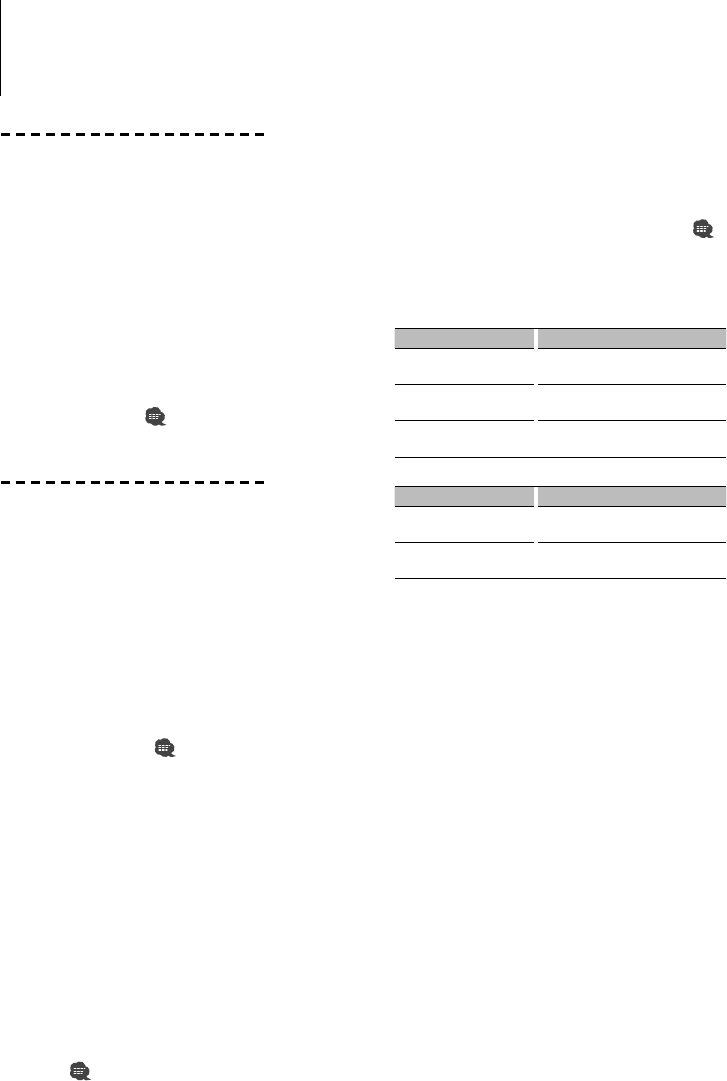
50 | KCA-BT300
Avant utilisation
• Vous devez enregistrer votre téléphone portable avant
de l'utiliser avec cet appareil. Pour plus de détails,
référez-vous à la section <Enregistrer un appareil
Bluetooth> (page 54).
• Si vous avez enregistré plusieurs téléphones portables,
vous devez en choisir un. <Sélection de l’appareil
Bluetooth que vous souhaitez connecter> (page 56).
• Pour utiliser le répertoire téléphonique, il est nécessaire
de l'avoir téléchargé auparavant sur cet appareil. Pour
plus de détails, voir <Téléchargement du répertoire
téléphonique> (page 55).
• Pour connaître le mode de fonctionnement dans le
mode Menu, référez-vous au Manuel d'Instructions de
l'Unité de commande.
• Pour plus d'informations à propos de la fonction
associée au symbole [ ], référez-vous à la section
<Note concernant le fonctionnement> (page 64).
Effectuer un appel
Méthode de numérotation
1. Entrez en mode méthode de numérotation
Appuyez sur la touche [ATT] pendant au moins 1
seconde.
2. Sélectionnez une méthode de numérotation
Appuyez sur la touche [38].
"N-Dial" » "PH-Book1" » "PH-Book2" » "Out-Call" » "In-
Call" » "MIS-Call"
3 Les modes de fonctionnement dans les modes ci-
dessus sont décrits ci-dessous.
3. Sortez du mode de sélection de la méthode de
numérotation
Appuyez sur la touche [ATT] pendant au moins 1
seconde.
3 Saisissez un numéro ( )
2-1. Sélectionnez l’affi chage "N-Dial".
2-2. Entrez un numéro de téléphone
Appuyez sur la touche numéro ([1] à [0]), #([FM]),
*([AM]), ou +([¢]) sur la télécommande.
2-3. E ectuer un appel
Appuyez sur la touche [DIRECT] sur la télécommande.
☞ Vous pouvez entrer 32 chiffres au maximum.
3 Numérotation rapide (Numérotation préréglée)
2-1. Sélectionnez l’affi chage "N-Dial".
2-2. Sélectionnez le numéro de numérotation préréglée
Appuyez sur la touche [1] à [6].
2-3. E ectuer un appel
Appuyez sur la touche [38] pendant au moins 1
seconde.
☞ Vous devez enregistrer le numéro de numérotation
préréglée. (page 51)
3 Appeler un numéro présent dans le journal des
appels ( )
2-1. Sélectionnez l'affi chage "Out-Call" (appel sortant), "In-
Call" (appel entrant), ou "MIS-Call" (appel manqué).
Fonctionnement de base de la téléphonie mains libres (Modèle F)
2-2. Sélectionnez un nom ou un numéro de téléphone
Poussez la molette de commande vers le haut ou vers
le bas.
2-3. E ectuer un appel
Appuyez sur la touche [38] pendant au moins 1
seconde.
3 Appeler un numéro du répertoire téléphonique ( )
2-1. Sélectionnez l'affi chage "PH-Book1" et passez à l'étape
2-2.
Sélectionnez l'affi chage "PH-Book2" et passez à l'étape
2-3.
2-2. Sélectionnez la première lettre à rechercher
Type d’opération Opération
Déplacer vers le caractère
suivant.
Poussez la molette de commande vers la
droite ou vers la gauche.
Déplacer vers la rangée
suivante.
Poussez la molette de commande vers le
haut ou vers le bas.
Déterminez la première lettre
sélectionnée.
Appuyez sur la touche [38] pendant
au moins 1 seconde.
2-3. Sélectionnez le nom
Type d’opération Opération
Passer au numéro de
téléphone suivant.
Poussez la molette de commande vers le
haut ou vers le bas.
Passer au nom suivant. Poussez la molette de commande vers la
droite ou vers la gauche.
2-4. E ectuer un appel
Appuyez sur la touche [38] pendant au moins 1
seconde.
E ectuer un appel par numérotation vocale
1. Sélectionnez la reconnaissance vocale dans le mode
Menu
Sélectionnez l’affi chage "V-RECOG".
2. Appuyez sur la touche [38] pendant au moins 1
seconde.
"VR Ready" est affi ché.
3. Appuyez sur la touche [38].
"PB NAME?" est affi ché.
Lorsque vous entendez un bip, prononcez le nom dans
un délai de 2 secondes.
4. "PB TYPE?" est affi ché.
Lorsque vous entendez un bip, prononcez la catégorie
dans un délai de 2 secondes.
5. E ectuer un appel
Cette étape est la même que l'étape 3 de la procédure
<Appeler un numéro du répertoire téléphonique>.
Vous pouvez eff ectuer un appel ou sélectionner une
catégorie.
☞ Si l'appareil ne parvient pas à reconnaître votre voix, un
message est affiché. Appuyez sur la touche [38] pour
faire une nouvelle tentative de saisie vocale. Voir page 68.
☞ Le nom et la catégorie nécessitent tous les deux
l'enregistrement d'une balise vocale. Voir page 56.
☞ Le son audio n'est pas émis pendant la reconnaissance
vocale.
B64-4713-00_10_KCA-BT300_KE.indb 50B64-4713-00_10_KCA-BT300_KE.indb 50 10/03/12 14:5110/03/12 14:51
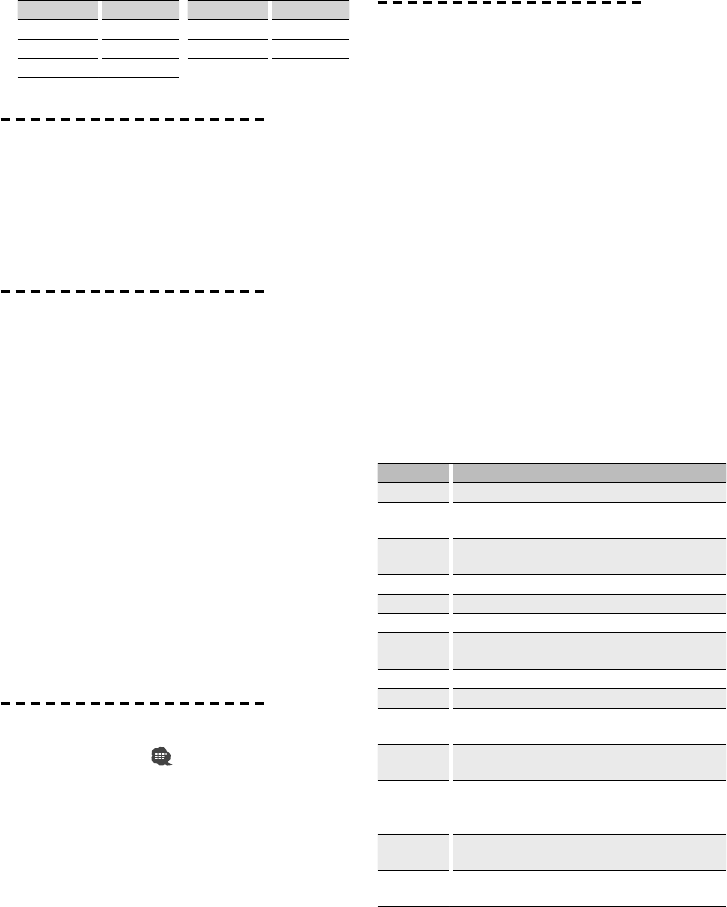
Français | 51
A chage du type de numéro de téléphone (catégorie)
Affichage Description Affichage Description
"GE"/ "GENERAL" Généralités "OF"/ "OFFICE" Bureau
"HM"/ "HOME" Domicile "OT"/ "OTHER" Autre
"MO"/ "MOBILE" Portable
Recevoir un appel
Répondre à un appel téléphonique
Appuyez sur la molette de commande ou sur l'une des
touches de [1] à [6]
☞ Insérer un disque tel qu'un CD aura pour conséquence
de couper votre appel.
Rejeter un appel entrant
Appuyez sur la touche [SRC].
Appel en attente
Répondre à un appel entrant en mettant en attente
l'appel en cours
1. Appuyez sur la molette de commande.
2. Poussez la molette de commande vers le haut ou vers
le bas. Sélectionnez l’affi chage "ANSWER".
3. Appuyez sur la molette de commande.
Répondre à un appel entrant après avoir mis n à
l'appel en cours
Appuyez sur la touche [SRC].
Poursuivre l'appel en cours
1. Appuyez sur la molette de commande.
2. Poussez la molette de commande vers le haut ou vers
le bas. Sélectionnez l’affi chage "REJECT".
3. Appuyez sur la molette de commande pendant au
moins 1 seconde.
Répondre à l'appel en attente après avoir mis n à
l'appel en cours
Appuyez sur la touche [ATT] pendant au moins 1 seconde.
Basculer entre l'appel en cours et l'appel en attente
Appuyez sur la molette de commande.
Pendant un appel
Mettre n à un appel
Appuyez sur la touche [SRC].
Passer en mode privé ( )
Appuyez sur la touche [38].
Cette touche permet de basculer entre le mode
conversation privée ("PV TALK") et le mode conversation
mains libres ("HF TALK").
Ajustez le volume sonore pendant un appel
Tournez la molette de commande.
Autres fonctions
E acement du message de déconnexion
Appuyez sur la touche [ATT] pendant au moins 1 seconde.
Passage d'un mode d'a chage à un autre
Appuyez sur la touche [SE]. Vous pouvez passer du
répertoire téléphonique à la liste d'appels.
Enregistrement sur la liste préréglée des numéros
composés
1. Entrez le numéro de téléphone que vous souhaitez
enregistrer
Entrez le numéro de téléphone en référence à ce qui
suit:
Composer un numéro/ Appeler un numéro présent
dans le journal des appels/ Appeler un numéro du
répertoire téléphonique
2. Sélectionnez la touche que vous souhaitez
enregistrer
Appuyez sur la touche [1] à [6] pendant au moins 2
secondes.
3. Sortez du mode de sélection de la méthode de
numérotation
Appuyez sur la touche [ATT] pendant au moins 1
seconde.
Éléments paramétrés dans le mode Menu
* Pour passer en mode Menu, appuyez sur la molette de
commande pendant au moins 1 seconde.
Affichage Aperçu du réglage
"DVC REG"* Enregistrer un appareil Bluetooth (association). Voir page 54.
"SDVC SEL"* Permet l'enregistrement d'un appareil spécial qui ne peut
pas être enregistré normalement. Voir page 55.
"PHN-SEL"* Sélectionner un téléphone portable pour une connexion
mains libres. Voir page 56.
"AUD-SEL"* Sélectionner le lecteur audio à connecter. Voir page 56.
"SMS DL"* Télécharger un message court. Voir page 58.
"IN BOX"* Afficher le message court reçu. Voir page 58.
"VOICE TAG"* Enregistrer la balise vocale pour la "reconnaissance vocale".
Voir page 56.
"V-RECOG"* Effectuer un appel par numérotation vocale Voir page 50.
"DVC-DEL"* Annuler l'enregistrement de l'appareil Bluetooth. Voir page 56.
"D-STATUS" "HF-CON"/ "AD-CON"/ "BAT"/ "SGNL": Afficher le statut de
l'appareil Bluetooth. Voir page 64.
"PIN EDIT"* Spécifier le code PIN nécessaire lors de l'enregistrement de
cet appareil à l'aide de l'appareil Bluetooth. Voir page 55.
"ANS" "OFF"/ "0" – "99": Répondre automatiquement à un
appel après une période de temps préréglée pour réponse
automatique. Voir page 64.
"SPK" "FRT"/ "F-R"/ "F-L": Spécifier le haut-parleur de sortie
vocale. Voir page 64.
"C-BP" "ON"/ "OFF": Émettre un bip à partir du haut-parleur
lorsqu'un appel survient. Voir page 64.
B64-4713-00_10_KCA-BT300_KE.indb 51B64-4713-00_10_KCA-BT300_KE.indb 51 10/03/12 14:5110/03/12 14:51
52 | KCA-BT300
Avant utilisation
• Vous devez enregistrer votre téléphone portable avant
de l'utiliser avec cet appareil. Pour plus de détails,
référez-vous à la section <Enregistrer un appareil
Bluetooth> (page 54).
• Si vous avez enregistré plusieurs téléphones portables,
vous devez en choisir un. <Sélection de l’appareil
Bluetooth que vous souhaitez connecter> (page 56).
• Pour utiliser le répertoire téléphonique, il est nécessaire
de l'avoir téléchargé auparavant sur cet appareil. Pour
plus de détails, voir <Téléchargement du répertoire
téléphonique> (page 55).
• Pour connaître le mode de fonctionnement dans le
mode Menu, référez-vous au Manuel d'Instructions de
l'Unité de commande.
• Pour plus d'informations à propos de la fonction
associée au symbole [ ], référez-vous à la section
<Note concernant le fonctionnement> (page 64).
Effectuer un appel
Méthode de numérotation
1. Entrez en mode méthode de numérotation
Modèle G-1, 2, 3:
Appuyez sur la touche [ATT] pendant au moins 1
seconde.
Modèle G-4:
Sélectionnez "D.MODE" dans le mode Menu.
2. Sélectionnez une méthode de numérotation
Modèle G-1, 4:
Appuyez sur le bouton de commande ([38]).
"N-DIAL" » "PH-BOOK1" » "PH-BOOK2" » "OUT-CALL" »
"IN-CALL"
Modèle G-2:
Appuyez sur le bouton de commande ([38]).
"DIAL" » "INITIAL" » "PHONE BOOK"/ "PH.BOOK" » "OUT-
CALL" » "IN-CALL"
Modèle G-3:
2-1-1. Appuyez sur la touche [NEXT].
2-1-2. Appuyez sur la touche [1] ("DIAL"), [2] ("PHBK"), [3]
("OUT-C"), ou [4] ("IN-C").
Appuyez sur la touche [2] ("PHBK") pour basculer
entre les diff érentes méthodes de recherche dans
le répertoire téléphonique.
3 Les modes de fonctionnement dans les modes ci-
dessus sont décrits ci-dessous.
3. Sortez du mode de sélection de la méthode de
numérotation
Modèle G-1, 2, 3:
Appuyez sur la touche [ATT] pendant au moins 1
seconde.
Modèle G-4:
Sortir du mode menu.
Fonctionnement de base de la téléphonie mains libres (Modèle G)
3 Saisissez un numéro ( )
2-1. Sélectionnez l'affi chage "N-DIAL"/ "DIAL".
2-2. Entrez un numéro de téléphone
Appuyez sur la touche numéro ([1] à [0]), #([FM]),
*([AM]), ou +([¢]) sur la télécommande.
2-3. E ectuer un appel
Appuyez sur la touche [DIRECT] sur la télécommande.
☞ Vous pouvez entrer 32 chiffres au maximum.
3 Numérotation rapide (Numérotation préréglée)
2-1. Sélectionnez l'affi chage "N-DIAL"/ "DIAL".
2-2. Sélectionnez le numéro de numérotation préréglée
Modèle G-1, 4:
Appuyez sur la touche [1] à [6].
Modèle G-2:
2-2-1. Appuyez sur la touche [FNC].
2-2-2. Sélectionnez le numéro à rappeler en tournant la
molette de commande.
2-2-3. Appuyez sur la molette de commande.
Modèle G-3:
2-2-1. Appuyez sur la touche [NEXT].
2-2-2. Appuyez sur la touche [1] ("1") – [6] ("6").
2-3. E ectuer un appel
Appuyez sur le bouton de commande ([38]) pendant
au moins 1 seconde.
☞ Vous devez enregistrer le numéro de numérotation
préréglée. (page 53)
3 Appeler un numéro présent dans le journal des
appels ( )
2-1. Sélectionnez l'affi chage "OUT-CALL"/"OUT-C" (appel
sortant) ou "IN-CALL"/"IN-C" (appel entrant).
2-2. Sélectionnez un nom ou un numéro de téléphone
Poussez la molette de commande vers le haut ou vers
le bas.
2-3. E ectuer un appel
Appuyez sur le bouton de commande ([38]) pendant
au moins 1 seconde.
3 Appeler un numéro du répertoire téléphonique ( )
2-1. Sélectionnez l'affi chage "PH-BOOK1"/ "INITIAL" et
passez à l'étape 2-2.
Sélectionnez l'affi chage "PH-BOOK2"/ "PHONE BOOK"/
"PH.BOOK" et passez à l'étape 2-3.
2-2. Sélectionnez la première lettre à rechercher
Type d’opération Opération
Déplacer vers le caractère
suivant.
Poussez la molette de commande vers la
droite ou vers la gauche.
Déplacer vers la rangée
suivante.
Poussez la molette de commande vers le
haut ou vers le bas.
Déterminer la première lettre
sélectionnée.
Appuyez sur le bouton de commande
([38]) pendant au moins 1 seconde.
2-3. Sélectionnez le nom
Type d’opération Opération
Passer au numéro de
téléphone suivant.
Poussez la molette de commande vers le
haut ou vers le bas.
Passer au nom suivant. Poussez la molette de commande vers la
droite ou vers la gauche.
B64-4713-00_10_KCA-BT300_KE.indb 52B64-4713-00_10_KCA-BT300_KE.indb 52 10/03/12 14:5110/03/12 14:51
Français | 53
2-4. E ectuer un appel
Appuyez sur le bouton de commande ([38]) pendant
au moins 1 seconde.
Recevoir un appel
Répondre à un appel téléphonique
Modèle G-1, 2, 3:
Appuyez sur la touche [AUDIO] ou sur une des touches
de [1] à [6].
Modèle G-4:
Appuyez sur la touche [VOL] ou sur une des touches de
[1] à [6].
☞ Insérer un disque tel qu'un CD aura pour conséquence
de couper votre appel.
Rejeter un appel entrant
Modèle G-1, 2, 3:
Appuyez sur la touche [ATT] pendant au moins 1 seconde.
Modèle G-4:
Appuyez sur la touche [SRC].
Pendant un appel
Mettre n à un appel
Appuyez sur la touche [SRC].
Passer en mode privé ( )
Appuyez sur le bouton de commande ([38]).
Cette touche permet de basculer entre le mode
conversation privée ("PV TALK"/ "PRIVATE") et le mode
conversation mains libres ("HF TALK"/ — ).
Ajustez le volume sonore pendant un appel
Tournez la molette [VOL].
Autres fonctions
E acement du message de déconnexion
Modèle G-1, 2, 3:
Appuyez sur la touche [ATT] pendant au moins 1 seconde.
Modèle G-4:
Appuyez sur la touche [AUTO]/ [TI] pendant au moins 1
seconde.
Passage d'un mode d'a chage à un autre
Vous pouvez passer du répertoire téléphonique à la liste
d'appels.
Modèle G-1, 2, 4:
Appuyez sur la touche [DISP]/ [AUTO]/ [TI]. (Si la touche
[DISP] n'est pas disponible, appuyez sur la touche [AUTO]
ou [TI].)
Modèle G-3:
Appuyez sur la touche [AUTO]/ [TI].
Enregistrement sur la liste préréglée des numéros
composés
1. Entrez le numéro de téléphone que vous souhaitez
enregistrer
Entrez le numéro de téléphone en référence à ce qui
suit:
Composer un numéro/ Appeler un numéro présent
dans le journal des appels/ Appeler un numéro du
répertoire téléphonique
2. Sélectionnez la touche que vous souhaitez
enregistrer
Modèle G-1, 4:
Appuyez sur la touche [1] à [6] pendant au moins 2
secondes.
Modèle G-2:
2-1. Appuyez sur la touche [FNC].
2-2. Sélectionnez le numéro à mettre en mémoire en
tournant la molette de commande.
2-3. Appuyez sur la molette de commande.
Modèle G-3:
2-1. Appuyez sur la touche [NEXT].
2-2. Appuyez sur la touche [1] ("1") – [6] ("6") pendant au
moins 2 secondes.
3. Sortez du mode de sélection de la méthode de
numérotation
Modèle G-1, 2, 3:
Appuyez sur la touche [ATT] pendant au moins 1
seconde.
Modèle G-4:
Appuyez sur la touche [MENU].
Éléments paramétrés dans le mode Menu
* Pour passer en mode Menu, appuyez sur la molette de
commande pendant au moins 1 seconde.
*1 Pour entrer en mode Menu, appuyez sur la molette de
commande vers la droite ou vers la gauche.
Affichage Aperçu du réglage
"PHN-SEL"*/
"Phone Selection"*
Sélectionner un téléphone portable pour une connexion
mains libres. Voir page 56.
"PHN-DEL"*/
"Phone Delete"*
Annuler l'enregistrement de l'appareil Bluetooth. Voir
page 56.
"D.MODE"* Modèle G-4: Sélectionnez une méthode de
numérotation Voir page 52.
"P-STATUS"*/
"Phone Status"*1
"BT-CON"/ "BAT"/ "SGNL": Afficher le statut de l'appareil
Bluetooth. Voir page 64.
"ANS"/
"Auto Answer"
"OFF"/ "0" – "99": Répondre automatiquement à
un appel après une période de temps préréglée pour
réponse automatique. Voir page 64.
"SPK"/
"SP Select"
"FRT"("Front")/ "F-R"/ "F-L": Spécifier le haut-parleur
de sortie vocale. Voir page 64.
"C-BP"/
"Call Beep"
"ON"/ "OFF": Émettre un bip à partir du haut-parleur
lorsqu'un appel survient. See page 64
B64-4713-00_10_KCA-BT300_KE.indb 53B64-4713-00_10_KCA-BT300_KE.indb 53 10/03/12 14:5110/03/12 14:51
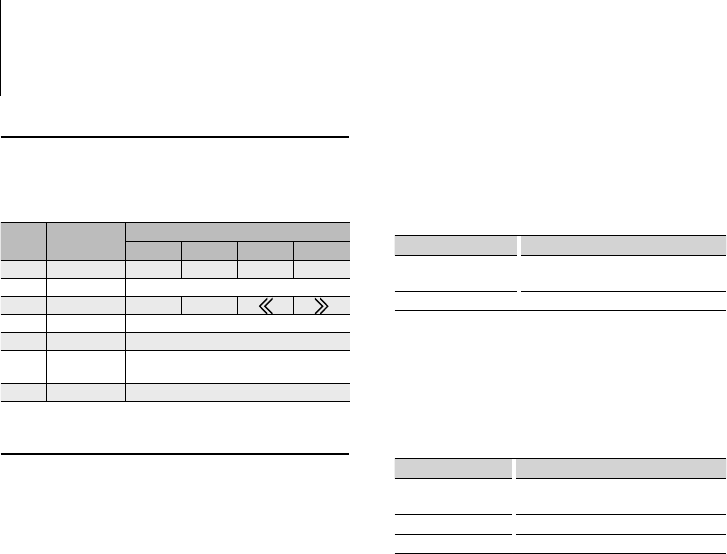
54 | KCA-BT300
Enregistrer un appareil Bluetooth
Pour rendre votre appareil Bluetooth (téléphone
portable ou lecteur audio) utilisable avec cet
appareil, vous devez l'enregistrer (association). Vous
pouvez enregistrer jusqu'à cinq appareils Bluetooth
avec cet appareil.
Lors de l'enregistrement à partir des appareils
Bluetooth
1 Activez l'appareil de commande.
2 Lancez l'enregistrement d'un appareil en
utilisant l'appareil Bluetooth.
En utilisant l'appareil Bluetooth, enregistrez l'appareil
mains libres ou le lecteur audio (association).
Sélectionnez "KCA-BT300" à partir de la liste des
appareils connectés.
3 Saisissez un code PIN
Modèle A, B, C, D, E, F:
Saisissez le code PIN enregistré tel qu'indiqué à la
section <Enregistrement du code PIN> (page 55).
Le code PIN est défini sur "0000" par défaut.
Modèle G:
Saisissez "0000" en guise de code PIN.
Vérifiez que l'enregistrement est terminé sur
l'appareil Bluetooth.
4 En utilisant l'appareil Bluetooth, lancez la
connexion mains libres ou audio.
Lorsque de l'enregistrement à partir de cet
appareil (Fonctionnement des modèles A, B, C,
D, E, F)
1 Sélectionnez le mode d'enregistrement de
l'appareil Bluetooth
Sélectionnez l'affichage "Device Regist"/ "DVS
REGIST"/ "DVS REG"/ "DVC REG".
2 Appuyez sur la molette de commande pendant
au moins 1 seconde.
Recherche de l'appareil Bluetooth.
Lorsque la recherche est terminée, le message
"Finished" est affiché.
3 Sélectionnez l'appareil Bluetooth
Type d’opération Opération
Sélectionner l'appareil
Bluetooth
Poussez le bouton de sélection vers le haut
ou vers le bas.
Déterminer la sélection Appuyez sur la molette de commande
4 "PAIRING" s'affiche
Si le message "Pairing Success"/"PAIRING OK"/"PAIR
OK" s'affiche, passez à l'étape 7.
Si le message "PIN Code NG"/"PAIR NG" s'affiche,
appuyez sur la molette de commande. Saisissez
ensuite le code PIN (étapes 5 et 6).
5 Saisissez le code PIN
Type d’opération Opération
Sélectionner les
numéros.
Poussez le bouton de sélection vers le haut
ou vers le bas.
Passer au chiffre suivant. Poussez le bouton de sélection vers la droite.
Effacer le dernier chiffre. Poussez le bouton de sélection vers la gauche.
6 Transmettez le code PIN
Appuyez sur la molette de commande pendant
au moins 1 seconde.
Si le message "Pairing Success"/"PAIRING OK"/"PAIR
OK" est affiché, l'enregistrement est terminé.
7 Retournez à la liste des appareils
Modèle A, B, D, F:
Appuyez sur la molette de commande.
Modèle C:
Appuyez sur la molette de commande pendant
au moins 1 seconde.
Modèle E:
Appuyez sur la touche [FNC].
8 Terminez l'enregistrement de l'appareil
Sortir du mode menu.
⁄
• Vous pouvez également réaliser l'enregistrement à
partir de l'appareil Bluetooth. Pour connaître le code PIN
nécessaire à l'enregistrement, référez-vous à la section
<Enregistrement du code PIN> (page 55).
• Cet appareil permet d'utiliser jusqu'à 8 chiffres pour le
code PIN. Si un code PIN ne peut pas être renseigné sur
cet appareil, il peut l'être sur l'appareil Bluetooth.
• S'il y a 5 appareils Bluetooth ou plus enregistrés, vous ne
pouvez pas enregistrer d'autre appareil Bluetooth.
• Si le message d'erreur apparaît alors que le code PIN est
correct, essayez la procédure <Enregistrer un appareil
Bluetooth spécial> (page 55).
• Pour savoir comment utiliser l'appareil Bluetooth, veuillez
vous reporter au manuel d'instructions qui accompagne
votre appareil Bluetooth.
Fonctionnement des fonctions
Boutons de commande
Les boutons de commande sont regroupés et décrits
en commun.
Les boutons de fonctionnement de chaque groupe sont
décrits de la manière suivante:
Groupe Bouton de
commande Bouton de sélection
Haut Bas Gauche Droit
A [AUD] [FM] [AM] [
4
][
¢
]
B [AUD] Molette [AUD]
C [ENTER] [u][d][][ ]
D[
38
] Molette de commande
E[
38
] Molette de commande
F Molette de
commande Molette de commande
G[
38
] Molette de commande
B64-4713-00_10_KCA-BT300_KE.indb 54B64-4713-00_10_KCA-BT300_KE.indb 54 10/03/12 14:5110/03/12 14:51

Français | 55
Téléchargement du répertoire
téléphonique
Téléchargez les données du répertoire téléphonique
du téléphone portable vers cet appareil de manière
pour pouvoir utiliser le répertoire téléphonique dans
cet appareil.
Pour réaliser un téléchargement automatique
Si le téléphone portable comprend une fonction
de synchronisation du répertoire téléphonique,
le répertoire téléphonique est téléchargé
automatiquement après la connexion Bluetooth.
☞ Il peut être nécessaire d'allumer le téléphone portable.
☞ Si vous ne trouvez aucune donnée de répertoire
téléphonique même après l'affichage complet, il se
peut que votre téléphone portable ne supporte pas le
téléchargement automatique des données de répertoire
téléphonique. Dans ce cas, essayez de réaliser un
téléchargement manuel.
Pour réaliser un téléchargement manuel à partir
du téléphone portable
1 En faisant fonctionner le téléphone portable,
terminez la connexion mains libres.
2 En faisant fonctionner le téléphone
portable, envoyez les données du répertoire
téléphonique vers cet appareil
En faisant fonctionner le téléphone portable,
téléchargez les données du répertoire téléphonique
vers cet appareil.
Pendant le téléchargement:
"Downloading", "DOWNLOAD", ou "Now
Downloading…" s'affiche.
Une fois le téléchargement terminé:
"Completed" ou "COMPLETE" s'affiche.
3 En faisant fonctionner le téléphone portable,
démarrez la connexion mains libres.
Pour effacer le message de fin de
téléchargement:
Appuyez sur n’importe quelle touche.
⁄
• Pour faire fonctionner le téléphone portable, veuillez
vous reporter au manuel d'instructions qui accompagne
votre téléphone portable.
• Chaque téléphone portable enregistré peut mettre en
mémoire jusqu'à 1000 numéros de téléphone.
• Pour chaque numéro de téléphone il est possible
d'enregistrer jusqu'à 32 chiffres et jusqu'à 50* caractères
pour un nom.
(* 50: Nombre de caractères alphabétiques. En fonction
du type de caractères, il peut ne pas être possible de
saisir autant de caractères.)
Fonctionnement des modèles A, B, C, D, E, F
Enregistrer un appareil Bluetooth
spécial
Permet l'enregistrement d'un appareil spécial qui ne
peut pas être enregistré normalement (association).
1 Sélectionnez le mode d'enregistrement
d'appareil spécial
Sélectionnez l'affichage "SPCL DVC Select"/"S-DVC
SELECT"/"SDVC SEL".
2 Appuyez sur la molette de commande pendant
au moins 1 seconde.
3 Sélectionnez un nom d'appareil
Type d’opération Opération
Sélectionner le nom de
l'appareil
Poussez le bouton de sélection vers le haut
ou vers le bas.
Déterminer la sélection Appuyez sur la molette de commande
Si le message "Completed"/"Complete" apparaît,
l'enregistrement de l'appareil spécial est terminé.
4 Suivez la procédure expliquée dans la section
<Enregistrer un appareil Bluetooth> (page 54) et
terminez l'enregistrement (association).
⁄
• Si le nom de l'appareil ne figure pas dans la liste,
sélectionnez "Other Phone".
Fonctionnement des modèles A, B, C, D, E, F
Enregistrement du code PIN
En utilisant l'appareil Bluetooth, spécifiez le code PIN
nécessaire à l'enregistrement de cet appareil.
1 Sélectionnez le mode d'édition de code PIN
Sélectionnez l’affichage "PIN Code Edit"/ "PIN EDIT".
2 Appuyez sur la molette de commande pendant
au moins 1 seconde.
3 Saisissez le code PIN
Type d’opération Opération
Sélectionner les numéros. Poussez le bouton de sélection vers le haut
ou vers le bas.
Passer au chiffre suivant. Poussez le bouton de sélection vers la droite.
Effacer le dernier chiffre. Poussez le bouton de sélection vers la
gauche.
4 Enregistrez un code PIN
Appuyez sur la molette de commande pendant
au moins 1 seconde.
Si le message "Completed"/"Complete" apparaît,
l'enregistrement est terminé.
⁄
• Par défaut, "0000" est spécifié.
• Un code PIN peut être défini par 8 chiffres au maximum.
Page suivante 3
B64-4713-00_10_KCA-BT300_KE.indb 55B64-4713-00_10_KCA-BT300_KE.indb 55 10/03/12 14:5110/03/12 14:51

56 | KCA-BT300
• Pour annuler le téléchargement des données du
répertoire téléphonique, faites fonctionner le téléphone
portable.
En mode de veille
Sélection de l'appareil Bluetooth que
vous souhaitez connecter
Lorsque deux appareils Bluetooth ou plus ont déjà
été enregistrés, vous devez sélectionner l'appareil
Bluetooth que vous souhaitez utiliser.
1 Sélectionnez le mode de sélection d'appareil
Bluetooth dans le mode Menu
Téléphone portable
Sélectionnez l'affichage "Phone Selection"/ "PHONE
SEL"/ "PHN-SEL".
Lecteur audio (sauf le Modèle D)
Sélectionnez l'affichage "Audio Selection"/ "AUD-SEL".
2 Entrez dans le mode de sélection d'appareil
Bluetooth sélectionné
Appuyez sur la molette de commande pendant
au moins 1 seconde.
'(nom)' s'affiche.
3 Sélectionnez l'appareil Bluetooth
Type d’opération Opération
Sélectionner l'appareil
Bluetooth
Poussez le bouton de sélection vers le haut
ou vers le bas.
Configurer l'appareil
Bluetooth
Poussez le bouton de sélection vers la
droite ou vers la gauche.
'✱(nom)' ou '-(nom)' s'affiche.
"✱" (couleur sombre) ou "✱": Le téléphone portable
sélectionné est occupé.
"✱" (couleur claire) ou "_": Le téléphone portable
sélectionné est en veille.
" " (blank): Le téléphone portable est désélectionné.
☞ Si un téléphone portable est déjà sélectionné,
désélectionnez-le puis sélectionnez-en un autre.
4 Quittez le mode de sélection d'appareil
Bluetooth
Sortir du mode menu.
⁄
• Pour les Modèles D, F et G, la version du micrologiciel
"BT300 FW ***" est affichée à la fin de la liste des
appareils Bluetooth.
Pour savoir comment mettre à jour le micrologiciel,
visitez notre site Internet.
http://www.kenwood.com/cs/ce/bt/
• Pour le modèle G, le lecteur audio est affiché dans la
liste des appareils après l'enregistrement. Cependant,
le lecteur audio présent sur la liste ne peut pas être
sélectionné.
En mode de veille
Supprimer un appareil Bluetooth
enregistré
Vous pouvez supprimer un appareil Bluetooth
enregistré.
1 Sélectionnez le mode de suppression d'appareil
Bluetooth dans le mode Menu
Sélectionnez l'affichage "Device Delete"/ "DEVICE
DEL"/ "Phone Delete"/ "PHN-DEL".
2 Entrez dans le mode de suppression d'appareil
Bluetooth
Appuyez sur la molette de commande pendant
au moins 1 seconde.
'(nom)' s'affiche.
3 Sélectionnez l'appareil Bluetooth que vous
souhaitez supprimer
Poussez le bouton de sélection vers le haut ou
vers le bas.
4 Supprimez l'appareil Bluetooth sélectionné
Modèle A, B, D, F, G-1, G-3:
Appuyez sur la molette de commande pendant
au moins 1 seconde.
Modèle C:
Appuyez sur la molette de commande.
Modèle E, G-2:
4-1. Appuyez sur la molette de commande.
4-2. Poussez sur le bouton de sélection vers la
droite pour sélectionner "YES"/"Y".
4-3. Appuyez sur la molette de commande.
5 Quittez le mode de suppression d'appareil
Bluetooth
Sortir du mode menu.
⁄
• Lorsqu'un téléphone portable enregistré est supprimé,
son répertoire téléphonique, son journal, ses SMS et sa
balise vocale sont également supprimés.
• Pour les Modèles D, F et G: La version du micrologiciel
"BT300 FW ***" est affichée et ne peut pas être
supprimée.
Fonctionnement des modèles A, B, C, D, E, F
Ajouter une commande de
numérotation vocale
Ajoutez une balise vocale au répertoire téléphonique
pour permettre la numérotation vocale. Vous pouvez
enregistrer jusqu'à 35 balises vocales.
1 Entrez en mode balise vocale
Sélectionnez l'affichage "NAME MEM"/ "PB Name
Edit"/ "Name EDT".
Fonctionnement des fonctions
B64-4713-00_10_KCA-BT300_KE.indb 56B64-4713-00_10_KCA-BT300_KE.indb 56 10/03/12 14:5110/03/12 14:51
Français | 57
Lance la lecture de la voix enregistrée et retourne à
l'étape 2.
Sélectionnez "N-DEL"/"DELETE"/"Name DEL"
4 Effacer une balise vocale.
Modèle B, D, F:
Appuyez sur la molette de commande pendant
au moins 1 seconde.
Modèle A, C, E:
4-1. Appuyez sur la molette de commande.
4-2. Poussez sur le bouton de sélection vers la
droite pour sélectionner "YES"/"Y".
4-3. Appuyez sur la molette de commande.
Retournez à l'étape 2.
Quittez le mode balise vocale
Sortir du mode menu.
Fonctionnement des modèles A, B, C, D, E, F
Configurer une commande vocale
pour la catégorie
Ajoutez une balise vocale à la catégorie (type) de
numéro de téléphone pour permettre les appels
vocaux.
1 Entrez en mode balise vocale
Modèle D:
Appuyez sur la touche [38] pendant au moins
1 seconde.
Modèle F:
Poussez la molette de commande vers le haut ou
vers le bas.
Sélectionnez l'affichage "TYPE MEM"/ "PN Type Edit"/
"Type EDT".
Modèle A, B, D, F:
Appuyez sur la molette de commande pendant
au moins 1 seconde.
Modèle C, E:
Appuyez sur la molette de commande.
2 Sélectionnez la catégorie (type) que vous
souhaitez configurer
Type d’opération Opération
Sélectionner une catégorie Poussez le bouton de sélection vers le haut
ou vers le bas.
Déterminer la sélection Appuyez sur la molette de commande.
3 Sélectionnez un mode
Modèle A, B, C, D-2, F:
Poussez le bouton de sélection vers le haut ou
vers le bas.
Modèle B, C, D-1:
Tournez le bouton de sélection.
Modèle A, B, C, D, F:
Appuyez sur la molette de commande pendant
au moins 1 seconde.
Modèle E:
Appuyez sur la molette de commande.
2 Cherchez le nom à enregistrer
Sélectionnez le nom à enregistrer en vous référant
aux points 2-3 de la section <Appeler un numéro du
répertoire téléphonique>.
Si une balise vocale a déjà été enregistrée pour un
nom, "*" s'affiche avant le nom.
3 Sélectionnez un mode
Modèle A, B, C, D-2, F:
Poussez le bouton de sélection vers le haut ou
vers le bas.
Modèle B, C, D-1:
Tournez le bouton de sélection.
Modèle E:
Poussez le bouton de sélection vers la droite ou
vers la gauche.
Affichage Opération
"N-REG"/"REGIST"/"Name REG" Enregistrer une balise vocale.
"N-CHK"/"PLAY"/"Name CHK" * Lire une balise vocale.
"N-DEL"/"DELETE"/"Name DEL" * Effacer une balise vocale.
"RETURN" Retourner à l'étape 2.
* Affiché uniquement lorsque vous sélectionnez un nom
pour lequel une balise vocale a déjà été enregistrée.
Sélectionnez "N-REG"/"REGIST"/"Name REG"
* Le son audio n'est pas généré pendant l'enregistrement
de balises vocales.
4 Enregistrez une balise vocale (en premier)
Appuyez sur la molette de commande.
"Enter Voice 1"/ "ENTER1" est affiché.
Lorsque vous entendez un bip, prononcez la balise
vocale dans un délai de 2 secondes.
5 Confirmez la balise vocale (en deuxième)
Appuyez sur la molette de commande.
"Enter Voice 2"/ "ENTER2" est affiché.
Lorsque vous entendez un bip, répétez la même
valise vocale que celle que vous avez dite à l'étape 4
dans un délai de 2 secondes.
"COMPLETE" est affiché.
6 Terminez l'enregistrement
Appuyez sur la molette de commande.
Retournez à l'étape 2. Vous pouvez enregistrer une
autre balise vocale juste après.
☞ Si l'appareil ne parvient pas à reconnaître votre voix, un
message est affiché. Appuyez sur la touche [38] pour
faire une nouvelle tentative de saisie vocale. (page 60)
Sélectionnez "N-CHK"/"PLAY"/"Name CHK"
4 Appuyez sur la molette de commande.
Page suivante 3
B64-4713-00_10_KCA-BT300_KE.indb 57B64-4713-00_10_KCA-BT300_KE.indb 57 10/03/12 14:5110/03/12 14:51
58 | KCA-BT300
Fonctionnement des fonctions
Fonctionnement des modèles A, B, C, D, E, F
SMS (Service de messagerie - Short
Message Service)
Le SMS qui est arrivé sur votre téléphone portable est
affiché sur le récepteur.
Un message qui vient d'arriver est affiché.
¤
• Pour éviter les accidents de voiture, le conducteur ne
doit pas lire les SMS pendant qu'il conduit.
Lorsqu'un nouveau message arrive
"SMS Received"/"NEW SMS" est affiché.
L'affichage disparaît dès que l'on exécute une
opération.
Afficher le SMS
1 Sélectionnez l'élément Boîte de réception SMS
dans le mode Menu
Sélectionnez l’affichage "SMS Inbox"/ "INBOX"/ "SMS".
2 Entrez en mode Boîte de réception SMS
Appuyez sur la molette de commande pendant
au moins 1 seconde.
Une liste des messages apparaît.
3 Sélectionnez un message
Poussez le bouton de sélection vers le haut ou
vers le bas.
• Sélectionnez un mode d'affichage du numéro de
téléphone et de la date de réception.
Modèle B: Appuyez sur la touche [
38
].
Modèle C: Appuyez sur la touche [DISP].
Modèle D: Appuyez sur la touche [AUTO]/ [TI].
Modèle F: Appuyez sur la touche [SE] pendant au moins
1 seconde.
• Faire défiler les messages.
Poussez la molette de commande vers la droite ou vers
la gauche.
Maintenez la molette de commande enfoncée pour faire
défiler les messages.
4 Affichez le texte
Appuyez sur la molette de commande.
Appuyez de nouveau sur cette touche pour
sélectionner un autre message.
5 Quittez le mode Boîte de réception SMS
Sortir du mode menu.
⁄
• Le message non ouvert est affiché au début de la
liste. Les autres messages sont affichés dans l'ordre de
réception.
• Un SMS qui est arrivé alors que le téléphone portable
n'était pas connecté en Bluetooth ne peut pas être
affiché. Téléchargez le SMS.
Modèle E:
Poussez le bouton de sélection vers la droite ou
vers la gauche.
Affichage Opération
"T-REG"/"REGIST"/"Type REG" Enregistrer une balise vocale.
"T-CHK"/"PLAY"/"Type CHK" * Lire une balise vocale.
"T-DEL"/"DELETE"/"Type DEL" * Effacer une balise vocale.
"RETURN" Retournez à l'étape 2.
* Affiché uniquement lorsque vous sélectionnez une
catégorie (type) pour laquelle une balise vocale a déjà
été enregistrée.
4 Enregistrez la catégorie (type) en suivant
les étapes 4 à 6 de la section <Ajouter une
commande de numérotation vocale> (page 56).
Quittez le mode balise vocale
Sortir du mode menu.
Fonctionnement des modèles A, B, C, D, E, F
Téléchargement de SMS
Téléchargez les messages de texte (SMS) arrivés sur
votre téléphone portable afin de pouvoir les lire sur
le récepteur.
1 Sélectionnez l'élément téléchargement de SMS
dans le mode Menu
Sélectionnez l’affichage "SMS Download"/ "SMS DL".
2 Commencer le téléchargement
Appuyez sur la molette de commande pendant
au moins 1 seconde.
"SMS Downloading"/ "DOWNLOAD" est affiché.
Lorsque le téléchargement prend fin, l’indication
"Completed"/ "COMPLETE" s’affiche.
3 Quittez le mode téléchargement de SMS
Sortir du mode menu.
⁄
• Le téléphone portable doit être capable de transmettre
les SMS en utilisant le Bluetooth. Il peut être nécessaire
d'allumer le téléphone portable. Si le téléphone
portable ne supporte pas la fonction SMS, l'élément
téléchargement de SMS dans le mode Menu n'est pas
affiché.
• Lorsque le SMS est téléchargé depuis le téléphone
portable, les messages non ouverts dans le téléphone
portable sont ouverts.
B64-4713-00_10_KCA-BT300_KE.indb 58B64-4713-00_10_KCA-BT300_KE.indb 58 10/03/12 14:5110/03/12 14:51

Français | 59
Télécommande
Effectuer un appel
• Entrer en mode de sélection de méthode de
numérotation : Touche [ ]
• Sélectionner une méthode de numérotation :
Touche [38]
• Entrée de numérotation:
Saisir un chiffre: [0] – [9]
Saisir "+": [¢]
Saisir "#": [FM]
Saisir "*": [AM]
Effacer le numéro de téléphone composé: [4]
☞ Vous pouvez entrer 32 chiffres au maximum.
• E ectuer un appel : Touche [DIRECT]
Recevoir un appel
• Recevoir un appel : Touche [ ]
• Basculer entre le mode de conversation privée et le
mode mains libres : Touche [38]
Appel en attente
(Fonctionnement des modèles A, B, C, D, E, F)
• Répondre à un appel entrant en mettant en attente
l'appel en cours : Touche [ ]
• Répondre à un appel entrant après avoir mis n à
l'appel en cours : Touche [SRC]
• Poursuivre l'appel en cours : Touche [1]
Pendant un appel
• Mettre n à l'appel : Touche [SRC]
• Ajuster le volume sonore : Touches [VOL]
⁄
• Si votre télécommande possède un interrupteur de
sélection de mode, réglez-le sur "AUD".
• Les télécommandes avec la touche [ ] et/ou les
touches numériques sont disponibles en option. Achetez
une télécommande ayant une fonction spécifique.
Audio Bluetooth
Avant utilisation
• Vous devez enregistrer votre lecteur audio Bluetooth
avant de l'utiliser avec cet appareil. Pour plus de détails,
référez-vous à la section <Enregistrer un appareil
Bluetooth> (page 54).
• Les modèles A, B, C, D, E, F vous permettent de
sélectionner le lecteur audio Bluetooth que vous
souhaitez connecter. Référez-vous à la section
<Sélection de l’appareil Bluetooth que vous souhaitez
connecter> (page 56).
• Pour les modèles G, H, et I utilisez le lecteur audio
Bluetooth pour la connexion.
• Pour les modèles J, K, et L, référez-vous au Manuel
d'Instructions de l'Unité de commande.
Fonctionnement des modèles A, B, C, D, E, F, G, H, I
Lecture d'audio par Bluetooth
Sélection de la source
Modèles A, B, C, D, E, F, G:
Appuyez sur la touche [SRC].
Sélectionnez l'affichage "BT Audio EXT"/ "BT-A EXT"/
"EXT Media"/ "
*
MEDIA".
Modèles H et I:
Pour sélectionner la source, sélectionnez "EXT Media"
en vous référant au Manuel d'instructions de l'Unité
de commande.
Pause et lecture
Appuyez sur la touche [38].
Rechercher un morceau
Appuyez sur la touche [4] ou [¢].
⁄
• Si le lecteur audio Bluetooth n'est pas prêt pour fonctionner
avec la télécommande, il peut être impossible d'exécuter la
totalité ou certaines des opérations ci-dessus.
• Les informations concernant la musique lue par le lecteur
audio Bluetooth ne peuvent pas être affichées. Soit le
lecteur audio Bluetooth ne peut pas être affiché, soit "T- "
est affiché.
• Lorsque l'on bascule entre différentes sources audio
Bluetooth, la lecture ne commence pas ou ne s'arrête
pas automatiquement. Vous devez exécutez l'opération
permettant de lancer ou d'arrêter la lecture.
• Certains lecteurs audio ne peuvent pas être commandés à
distance ou reconnectés après une déconnexion du mode
Bluetooth. Utilisez l'unité principale du lecteur audio pour
réaliser la connexion Bluetooth.
• Pour les modèles H et I : Il se peut que d'autres touches
que celles nécessaires au fonctionnement apparaissent.
Néanmoins, elles ne sont pas valides.
B64-4713-00_10_KCA-BT300_KE.indb 59B64-4713-00_10_KCA-BT300_KE.indb 59 10/03/12 14:5110/03/12 14:51
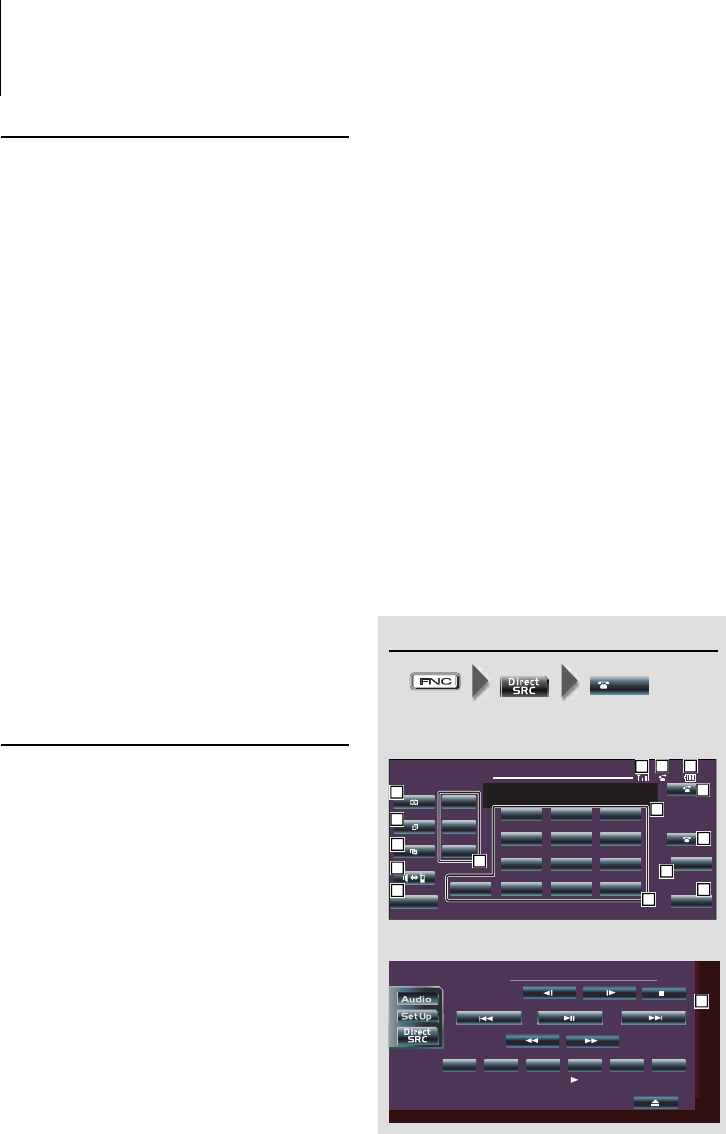
60 | KCA-BT300
Fonctionnement de la téléphonie mains libres (Modèle H)
Ecran de commande mains libres
TEL
Ou lorsqu'un appel survient ...
Ecran de commande mains libres
Hands Free
P1
P2
P3
SetUp
123
456
78
0
9
#
*+
KENWOOD
0123456789
Clear
Return
AUTO
11
12
14
8910
15
1
2
3
13
5
6
7
4
Ecran de contrôle
NextNext
DVD VIDEO
13:50
IN
TEL
Title 1 Chap 3 T0:05:20
KENWOOD
SCRL
TIMEREP
16
2 En faisant fonctionner le téléphone
portable, envoyez les données du répertoire
téléphonique vers cet appareil
En faisant fonctionner le téléphone portable,
téléchargez les données du répertoire téléphonique
vers cet appareil.
Pendant le téléchargement:
"Downloading", "DOWNLOAD", ou "Now
Downloading…" s'affiche.
3 En faisant fonctionner le téléphone portable,
démarrez la connexion mains libres.
⁄
• Pour faire fonctionner le téléphone portable, veuillez
vous reporter au manuel d'instructions qui accompagne
votre téléphone portable.
• Chaque téléphone portable enregistré peut mettre en
mémoire jusqu'à 1000 numéros de téléphone.
• Pour chaque numéro de téléphone il est possible
d'enregistrer jusqu'à 32 chiffres et jusqu'à 50* caractères
pour un nom.
(* 50: Nombre de caractères alphabétiques. En fonction
du type de caractères, il peut ne pas être possible de
saisir autant de caractères.)
• Pour annuler le téléchargement des données du
répertoire téléphonique, faites fonctionner le téléphone
portable.
Enregistrer un appareil Bluetooth
Pour rendre votre appareil Bluetooth (téléphone
portable ou lecteur audio) utilisable avec cet
appareil, vous devez l'enregistrer (association). Vous
pouvez enregistrer jusqu'à cinq appareils Bluetooth
avec cet appareil.
Lors de l'enregistrement à partir des appareils
Bluetooth
1 Activez l'appareil de commande.
2 Lancez l'enregistrement d'un appareil en
utilisant l'appareil Bluetooth.
En utilisant l'appareil Bluetooth, enregistrez l'appareil
mains libres ou le lecteur audio (association).
Sélectionnez "KCA-BT300" à partir de la liste des
appareils connectés.
3 Saisissez un code PIN
Saisissez "0000" en guise de code PIN.
Vérifiez que l'enregistrement est terminé sur
l'appareil Bluetooth.
4 En utilisant l'appareil Bluetooth, lancez la
connexion mains libres ou audio.
⁄
• S'il y a 5 appareils Bluetooth ou plus enregistrés, vous ne
pouvez pas enregistrer d'autre appareil Bluetooth.
• Pour savoir comment utiliser l'appareil Bluetooth, veuillez
vous reporter au manuel d'instructions qui accompagne
votre appareil Bluetooth.
Téléchargement du répertoire
téléphonique
Téléchargez les données du répertoire téléphonique
du téléphone portable vers cet appareil de manière
pour pouvoir utiliser le répertoire téléphonique dans
cet appareil.
Pour réaliser un téléchargement automatique
Si le téléphone portable comprend une fonction
de synchronisation du répertoire téléphonique,
le répertoire téléphonique est téléchargé
automatiquement après la connexion Bluetooth.
☞ Il peut être nécessaire d'allumer le téléphone portable.
☞ Si vous ne trouvez aucune donnée de répertoire
téléphonique même après l'affichage complet, il se
peut que votre téléphone portable ne supporte pas le
téléchargement automatique des données de répertoire
téléphonique. Dans ce cas, essayez de réaliser un
téléchargement manuel.
Pour réaliser un téléchargement manuel à partir
du téléphone portable
1 En faisant fonctionner le téléphone portable,
terminez la connexion mains libres.
B64-4713-00_10_KCA-BT300_KE.indb 60B64-4713-00_10_KCA-BT300_KE.indb 60 10/03/12 14:5110/03/12 14:51
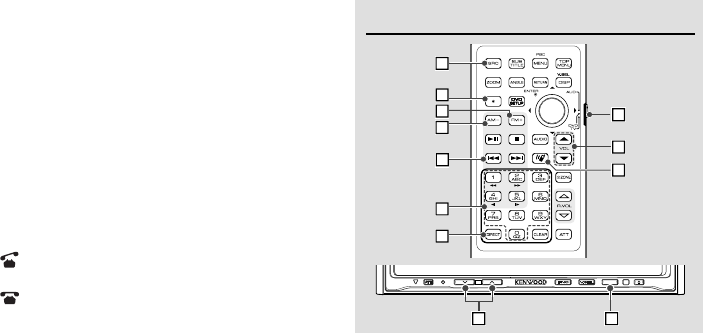
Français | 61
Opération des touches
18
20
22
17
19
21
23
24
25
26
SRC
27 28
1 Affiche l'écran de recherche du répertoire
téléphonique.
Voir la section <Appeler un numéro du répertoire
téléphonique> (page 62).
2 Affiche l'écran des appels sortants.
Voir la section <Appeler un numéro présent dans le
journal des appels> (page 62).
3 Affiche l'écran des appels entrants.
Voir la section <Appeler un numéro présent dans le
journal des appels> (page 62).
4 Contact entre les modes privé et mains libres
(seulement quand un appel est en cours).
5 Affiche l'écran de réglage de la fonction mains libres.
Voir la section <Configuration du téléphone mains
libres> (page 63).
6 Entrez trois numéros de téléphone pour une
numérotation rapide.
Voir la section <Numérotation rapide (Numérotation
préréglée)> (page 62).
7 Entre un numéro de téléphone.
Voir la section <Composer un numéro> (page 62).
8 Affiche la force du signal.*
Plus le nombre des segments de barres est élevé,
plus le signal est fort.
9 Affiche l'état actuel du répondeur automatique
Lorsque le répondeur automatique est en marche:
AUT
O
Lorsque le répondeur automatique est débranché:
p Affiche le niveau de la batterie du téléphone
portable.*
Plus le nombre des segments de barres est élevé,
plus le niveau de la batterie est élevé.
q Effectue l'appel.
w Met fin à l'appel.
Efface le numéro de téléphone qui est composé.
e Efface le numéro de téléphone composé.
r Revient à l'écran précédent.
t Affiche les numéros de téléphone appelés et reçus.
Si vous avez enregistré le numéro de téléphone
dans le répertoire téléphonique, le nom du
correspondant appelé s'affiche.
y Affiche l'état de la connexion avec le téléphone
portable.
Blanc: Le téléphone portable est connecté.
Orange: Le téléphone portable n'est pas connecté,
ou il se trouve hors de portée du service.
⁄
• Pour des raisons de sécurité, certaines fonctions
sont désactivées lorsque votre véhicule est en
mouvement. Les touches associées aux fonctions
désactivées deviennent inefficaces si on les presse.
• Lorsque l'écran de commande mains libres apparaît,
le nom du téléphone portable connecté s'affiche
pendant 5 secondes.
• Régler le téléphone portable en mode privé peut
désactiver la fonction mains libres.
• * Comme le nombre d'étapes de l'unité de
commande est différent de celui du téléphone
portable, les états affichés sur l'unité de
commande peuvent varier de ceux affichés sur le
téléphone portable. Aucun état ne s'affiche si les
informations sont inaccessibles.
u Touche [SRC]
Pendant un appel: Met fin à l'appel.
i Touche [*] (Quand f est réglé sur "AUD")
Entrée de numérotation: Entre "+".
o Touche [FM+] (Quand f est réglé sur "AUD")
Entrée de numérotation: Entre "#".
; Touche [AM-] (Quand f est réglé sur "AUD")
Entrée de numérotation: Entre "*".
a Touche [4] (Quand f est réglé sur "AUD")
Entrée de numérotation:
Efface le numéro de téléphone composé.
s Touches [0] à [9] (Quand f est réglé sur "AUD")
Entrée de numérotation: Entre un chiffre du
numéro de téléphone.
d Touche [DIRECT] (Quand f est réglé sur "AUD")
Effectuer un appel.
f Sélecteur de la télécommande
Basculer avec "AUD" durant la numérotation.
Page suivante 3
B64-4713-00_10_KCA-BT300_KE.indb 61B64-4713-00_10_KCA-BT300_KE.indb 61 10/03/12 14:5110/03/12 14:51
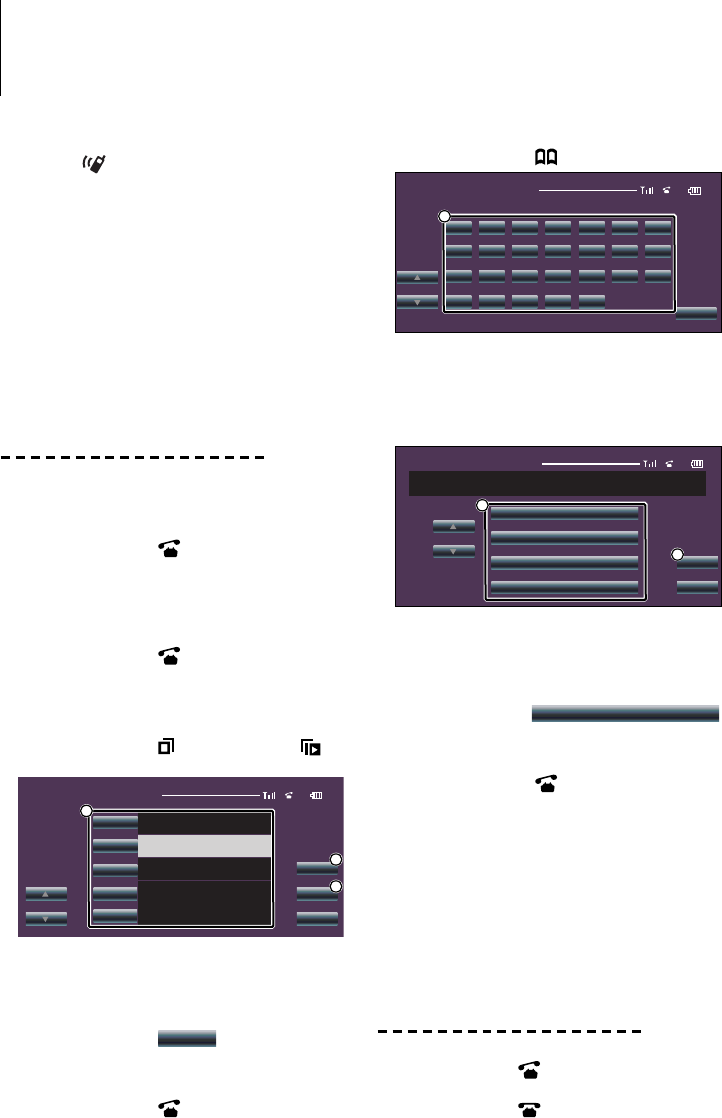
62 | KCA-BT300
Fonctionnement de la téléphonie mains libres (Modèle H)
g Touche [5]/ [∞]
Pendant un appel: Ajuste le volume sonore.
h Touche [ ]
Affiche l'écran de commande mains libres.
Lorsqu'un appel survient: Répond à l'appel.
j Touche [u]/ [d]
Pendant un appel: Ajuste le volume sonore.
k Touche [SRC]
Pendant un appel: Met fin à l'appel.
⁄
• Le niveau de volume sonore ajusté pendant un
appel prendra effet à partir de l'appel suivant.
• Un volume excessif risque de créer un écho. Si un
écho survient, baissez le volume le plus bas possible.
L'écho augmente proportionnellement au volume.
Effectuer un appel
Composer un numéro
1. Entrez un numéro de téléphone
Appuyez sur le numéro ([0] – [9]), [+], [#], ou [*].
2. E ectuer un appel
Appuyez sur la touche [ ].
☞ Pour effacer une saisie incorrecte, appuyez sur [Clear].
Numérotation rapide (Numérotation préréglée)
1. Sélectionnez le numéro de numérotation préréglée
Appuyez sur la touche [P1] à [P3].
2. E ectuer un appel
Appuyez sur la touche [ ].
☞ Vous devez enregistrer le numéro de numérotation
préréglée. (page 63)
Appeler un numéro présent dans le journal des appels
1. Entrez en mode journal des appels
Appuyez sur la touche [ ] (appel sortant) ou [ ]
(appel entrant).
Incoming Calls
Kenwood
1234567890
Kenwood
1234567890
Kenwood
1234567890
Kenwood
1234567890
Kenwood
1234567890
DISP
OK
Return
AUTO
1
2
3
1 Entrez le nom du destinataire.
2 Changez pour enregistrer une liste de rappels.
3 Entrez les données du destinataire et revenez à
l'écran de commande mains libres.
2. Sélectionnez un nom ou un numéro de téléphone
Appuyez sur la touche [ ].
3. Con rmer le destinataire
Appuyez sur la touche [OK].
4. E ectuer un appel
Appuyez sur la touche [ ].
Appeler un numéro du répertoire téléphonique
1. Entrez en mode de répertoire téléphonique
Appuyez sur la touche [ ].
Phone Book List
bcde fg
hi jklmn
opqrstu
vwxyz
a
Return
AUTO
1
1 Affi chez le répertoire téléphonique en commençant
par le nom dont vous avez introduit la première
lettre.
2. Sélectionner dans la mémoire le caractère de début
correspondant à un nom de personne
Appuyez sur la touche de caractère ([a] etc.).
Phone Book List
Name
Name
Name
Name
1234567890
OK
Return
AUTO
2
1
1 Entrez le nom du destinataire.
2 Entrez les données du destinataire et revenez à
l'écran de commande mains libres.
3. Sélectionner le destinataire que vous souhaitez
appeler
Appuyez sur la touche [
Name
].
4. Con rmer le destinataire
Appuyez sur la touche [OK].
5. E ectuer un appel
Appuyez sur la touche [ ].
☞ Pour utiliser le répertoire téléphonique, celui-ci doit
avoir été téléchargé à partir du téléphone portable.
Pour plus de détails, voir <Téléchargement du
répertoire téléphonique> (page 55).
⁄
• Jusqu'à 16 caractères peuvent être affichés pour chaque
nom dans le répertoire téléphonique.
• Les premières lettres qui ne correspondent pas au nom ne
seront pas affichées.
• Pendant la recherche, un caractère non accentué tel que "u"
est recherché plutôt qu'un caractère accentué tel que "ü".
Recevoir un appel
Répondre à un appel téléphonique
Appuyez sur la touche [ ].
Rejeter un appel entrant
Appuyez sur la touche [ ].
B64-4713-00_10_KCA-BT300_KE.indb 62B64-4713-00_10_KCA-BT300_KE.indb 62 10/03/12 14:5110/03/12 14:51
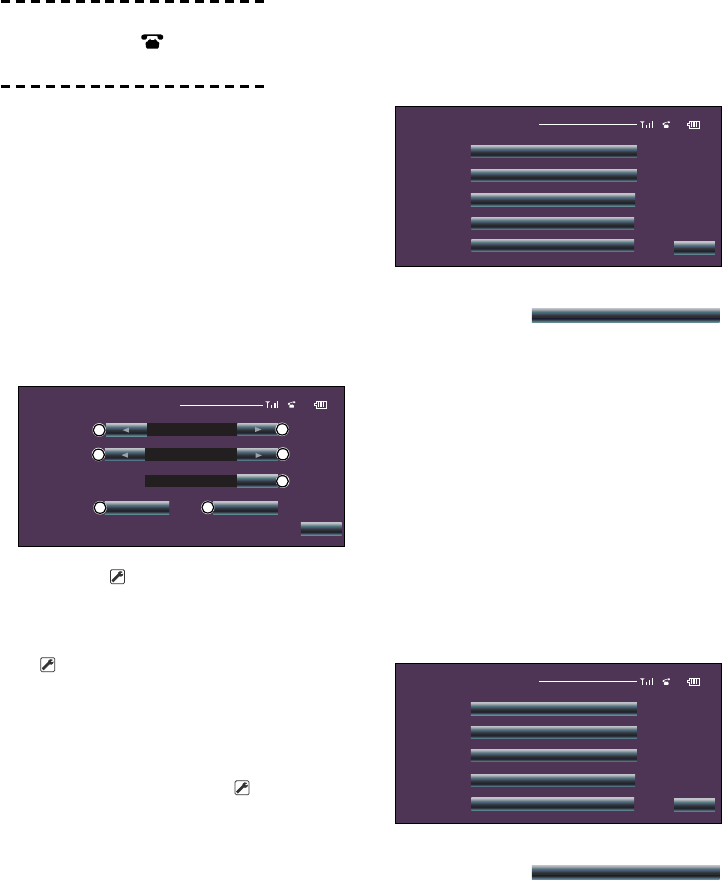
Français | 63
Pendant un appel
Mettre n à un appel
Appuyez sur la touche [ ].
Autres fonctions
Enregistrement sur la liste préréglée des numéros
composés
1. Entrez le numéro de téléphone que vous souhaitez
enregistrer
Entrez le numéro de téléphone en référence à ce qui
suit:
Composer un numéro/ Appeler un numéro présent
dans le journal des appels/ Appeler un numéro du
répertoire téléphonique
2. Sélectionnez la touche que vous souhaitez
enregistrer
Appuyez sur la touche [P1] à [P3] pendant au moins 2
secondes.
Con guration du téléphone mains libres
Appuyez sur la touche [SetUp] sur l'écran de
commande mains libres.
Hands Free Set Up
Return
Auto Answering
SelectSelect SelectDelete
Phone Voice
8
F-Right
Beep On
AUTO
1
1
2
2
5
3
4
1 Règle le temps de réponse automatique après la fi n
d'un appel. ( "8")
"Off ": Cette fonction ne marche pas.
"0-99": Réglez un temps de sonnerie d'appel (en
secondes).
2 Réglez une position de sortie de tonalité d'appel.
( "F-Right")
"F-Left": La tonalité sort du haut-parleur avant
gauche.
"F-Right": La tonalité sort du haut-parleur avant
droit.
"Front All": La tonalité sort des deux haut-parleurs
frontaux.
3 Réglez le bip de l'appel entrant. ( "On")
"On": Le bip est entendu.
"Off ": Le bip est annulé.
4 Affi chez l'écran de sélection du téléphone.
5 Affi chez l'écran d'eff acement du téléphone.
⁄
• Sélectionnez le haut-parleur le plus éloigné du microphone
pour éviter les ronronnements acoustiques ou échos.
Sélection d'un téléphone mains libres
1. A cher l'écran de con guration mains libres
Appuyez sur la touche [SetUp] sur l'écran de
commande mains libres.
2. A cher la liste de sélection de téléphone
Appuyez sur la touche [Select] sur l'écran de
confi guration de la fonction mains libres.
Phone Select
Return
Kenwood 1
Kenwood 2
Kenwood 3
Kenwood 4
Kenwood 5
AUTO
3. Sélectionner le téléphone mains libres que vous
souhaitez utiliser
Appuyez sur la touche [
Kenwood 1
].
⁄
• Si un téléphone portable est déjà sélectionné,
désélectionnez-le puis sélectionnez-en un autre.
• La version du micrologiciel "BT300 FW ***" est affichée à la
fin de la liste des appareils Bluetooth.
Pour savoir comment mettre à jour le micrologiciel, visitez
notre site Internet.
http://www.kenwood.com/cs/ce/bt/
• Le lecteur audio est affiché dans la liste des appareils après
l'enregistrement. Cependant, le lecteur audio présent sur la
liste ne peut pas être sélectionné.
E acement du téléphone mains libres
1. A cher l'écran de con guration mains libres
Appuyez sur la touche [SetUp] sur l'écran de
commande mains libres.
2. A cher la liste d'e acement de téléphone
Appuyez sur la touche [Delete] sur l'écran de
confi guration de la fonction mains libres.
Phone Delete
Return
Kenwood 1
Kenwood 2
Kenwood 3
Kenwood 4
Kenwood 5
AUTO
3. Sélectionner un téléphone mains libres que vous
souhaitez e acer
Appuyez sur la touche [
Kenwood 1
].
⁄
• Le répertoire téléphonique, la liste des appels sortants, et la
liste des appels entrants sont effacés en même temps que
le téléphone mains libres effacé.
• La version du micrologiciel "BT300 FW ***" est affichée et ne
peut pas être supprimée.
B64-4713-00_10_KCA-BT300_KE.indb 63B64-4713-00_10_KCA-BT300_KE.indb 63 10/03/12 14:5110/03/12 14:51
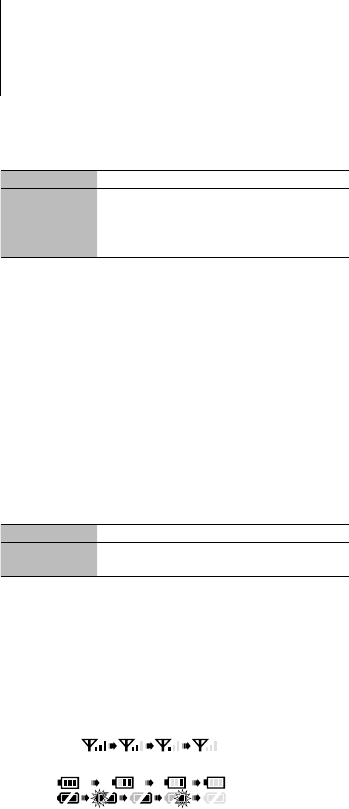
64 | KCA-BT300
Appendice
À propos du téléphone portable
Cette unité est conforme aux spécifications de Bluetooth
suivantes:
Version Bluetooth Standard Ver. 2.1 + EDR
Profil HFP (profil mains libres)
OPP (profil d'envoi de fichiers)
PBAP (profil d'accès au répertoire téléphonique)
SYNC (profil de synchronisation)
Pour les téléphones portables dont la compatibilité est
vérifiée, accédez à l'URL suivante:
http://www.kenwood.com/cs/ce/bt/
⁄
• Les unités supportant la fonction Bluetooth ont été
certifiées conformes à la norme Bluetooth selon la
procédure prescrite par Bluetooth SIG. Cependant, il est
possible que ces appareils ne puissent pas communiquer
avec certains types de téléphones portables.
À propos du lecteur audio Bluetooth
Cette unité est conforme aux spécifications de Bluetooth
suivantes:
Version Bluetooth Standard Ver. 2.1 + EDR
Profil A2DP (profil de distribution audio avancé)
AVRCP (profil de commande à distance audio-vidéo)
À propos des icônes Bluetooth
Si l'unité de commande supporte la fonction d'affichage
d'icônes, elle peut afficher les statuts suivants:
• Statut de connexion du téléphone portable
Bluetooth
BT : Ce témoin s'allume lorsqu'un téléphone portable
est connecté.
• Force du signal du téléphone portable
Maximum Minimum
• Niveau de batterie du téléphone portable
Pleine Presque épuisée
⁄
• Les icônes ne sont pas affichées s'il est impossible
d'obtenir les informations correspondantes depuis le
téléphone portable.
• Comme le nombre d'étapes de l'unité de commande est
différent de celui du téléphone portable, les états affichés
sur l'unité de commande peuvent varier de ceux affichés
sur le téléphone portable.
Glossaire du menu
• "D-STATUS"/ "P-STATUS" (Afficher le statut de
l'appareil Bluetooth)
Vous pouvez afficher l'état de connexion, la force du
signal, et le niveau de la batterie.
"HF CONNECT"/ "BT-CON" / "HF-CON":
Statut de connexion du téléphone portable Bluetooth
"AD CONNECT"/ "AD CON" :
Statut de connexion du lecteur audio Bluetooth
"BAT" : Niveau de batterie du téléphone portable
"SGNL" : Force du signal du téléphone portable
• "ANS"/ "Auto Answer" (Configuration de
l'intervalle de temps pour réponse automatique)
Cette fonction répond automatiquement à un appel
après une période de temps préréglée pour réponse
automatique.
"OFF" : Ne répond pas aux appels téléphoniques
automatiquement.
"0" : Répond aux appels téléphoniques
automatiquement immédiatement.
"1" – "99" : Répond automatiquement aux appels
téléphoniques dans un délai de 1 à 99
secondes.
☞ Si le réglage du temps du téléphone portable est plus
court que le réglage de l'unité, c'est le premier qui sera
utilisé.
• "SPK"/ "SP Select" (Configuration des haut-
parleurs de sortie vocale)
Vous pouvez régler les haut-parleurs de sortie vocale.
"Front"/ "FRT" : Le son sort des haut-parleurs avant-
gauche et avant-droit.
"F-R" : Le son sort du haut-parleur avant-droit.
"F-L" : Le son sort du haut-parleur avant-gauche.
☞ Sélectionnez le haut-parleur le plus éloigné du
microphone pour éviter les ronronnements acoustiques
ou échos.
• "C-BP"/ "Call Beep"/ "Beep" (Réglage du bip
d'appel entrant)
Vous pouvez émettre un bip à partir du haut-parleur
lorsqu'un appel survient.
"ON" : Le bip est entendu.
"OFF" : Le bip est annulé.
Note concernant le fonctionnement
• Composer un numéro
• Selon le type de votre appareil de commande, "|" (tous
les segments sont éclairés) s'affiche pour #.
• Appeler un numéro présent dans le journal des
appels
• La liste des appels sortants, la liste des appels entrants
et la liste des appels manqués sont des listes d'appels
effectués depuis et reçus par cet appareil. Ce ne sont
pas les appels stockés dans la mémoire du téléphone
portable.
• Appeler un numéro du répertoire téléphonique
• Pour utiliser le répertoire téléphonique, celui-ci doit
avoir été téléchargé à partir du téléphone portable.
Pour plus de détails, voir <Téléchargement du répertoire
téléphonique>.
• Jusqu'à 19 caractères peuvent être affichés pour chaque
nom dans le répertoire téléphonique.
• Pendant la recherche, un caractère non accentué tel que
"u" est recherché plutôt qu'un caractère accentué tel que
"ü".
Les caractères non alphabétiques tels que les caractères
chinois et russes sont classés comme des symboles.
B64-4713-00_10_KCA-BT300_KE.indb 64B64-4713-00_10_KCA-BT300_KE.indb 64 10/03/12 14:5110/03/12 14:51
Français | 65
Information sur l'élimination des anciens
équipements électriques et électroniques
(applicable dans les pays de l'Union
Européenne qui ont adopté des systèmes
de collecte sélective)
Les produits et piles sur lesquels le
pictogramme (poubelle barrée) est apposé
ne peuvent pas être éliminés comme ordures
ménagères.
Les anciens équipements (et piles) électriques
et électroniques doivent être recyclés sur des
sites capables de traiter ces produits et leurs
déchets.
Contactez les autorités locales pour connaître
le site de recyclage le plus proche.
Un recyclage adapté et l'élimination des
déchets aideront à conserver les ressources et
à nous préserver de leurs effets nocifs sur notre
santé et sur l'environnement.
Remarque : Le signe "Pb" signalé au-dessous
du symbole des piles indique que
cette batterie contient du plomb.
Note de 'IC (Industrie Canada)
L'utilisation de ce dispositif est autorisée seulement
aux conditions suivantes :
(1) Il ne doit pas causer d'interférence, et
(2) l'utilisateur doit accepter tout brouillage, y compris
les interférences pouvant compromettre le
fonctionnement de cet appareil.
L'expression "IC: " avant le numéro d'homologation/
enregistrement signifie seulement que les
spécifications techniques d'Industry Canada ont été
respectées.
• Contient un module émetteur FCC ID : RKXCK5050NEW
• Contient un module émetteur IC ID : 5119A-CK5050NEW
• Passer en mode privé
• Selon le type de votre téléphone portable, se brancher
en mode de conversation privée peut sélectionner
la source utilisée avant la connexion mains libres. Si
cela arrive, la source ne peut pas revenir au mode de
conversation mains libres avec cet appareil. Utilisez
votre téléphone portable pour revenir au mode de
conversation mains libres.
• Passage d'un mode d'affichage à un autre
• Selon le type de votre appareil de commande, les
restrictions suivantes sont apportées.
- Jusqu'à 19 caractères peuvent s'afficher.
- La lettre # ne peut pas être affichée, ou "|" (tous les
segments sont éclairés) s'affiche pour #.
- Vous ne pouvez pas passer d'un mode d'affichage à
l'autre.
B64-4713-00_10_KCA-BT300_KE.indb 65B64-4713-00_10_KCA-BT300_KE.indb 65 10/03/12 14:5110/03/12 14:51
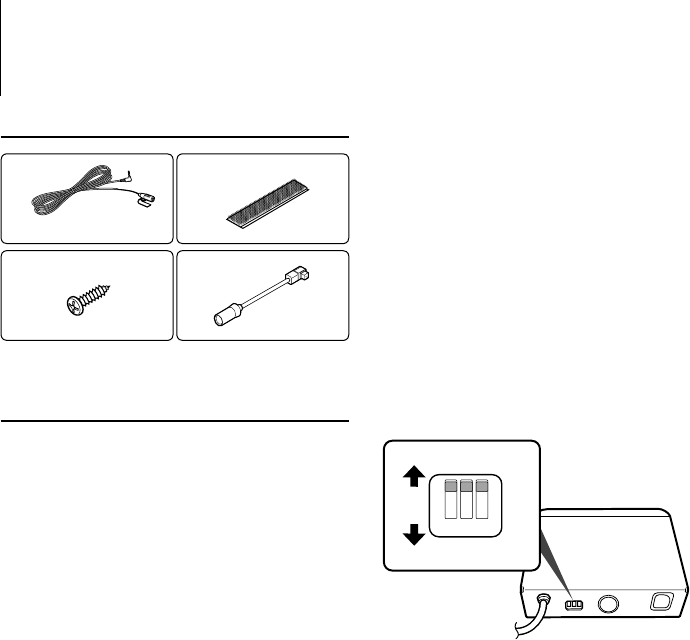
66 | KCA-BT300
Accessoires/ Procédure d’installation
Accessoires
1
3 m (9,5 ft) ..........1
3
..........1
2
..........2
4
..........1
Procédure d’installation
1. Pour éviter les courts-circuits, retirez la clef de contact
et déconnectez la borne - de la batterie.
2. Réglez le commutateur de type.
3. Effectuez correctement la connexion des câbles de
sortie et d'entrée de chaque appareil.
4. Installez l’appareil dans votre voiture.
5. Reconnectez la borne - de la batterie.
6. Appuyez sur la touche de réinitialisation sur l'unité
de commande.
¤
• Isolez les câbles non-connectés avec un ruban de vinyle ou
d'un autre matériel similaire. Pour éviter les courts-circuits,
ne retirez pas non plus les capuchons à l’extrémité des
câbles non-connectés ou des prises.
• Après avoir installé l’appareil, vérifiez si les lampes de
frein, les indicateurs, les clignotants, etc. de la voiture
fonctionnent correctement.
Pour une bonne réception
Pour assurer une bonne réception, prenez note de ce qui
suit:
• Communiquer avec le téléphone portable dans un
rayon de 10 m (30 ft). La portée de communication
devient plus courte selon l'environnement ambiant. La
portée de communication se réduit aussi quand il existe
un obstacle entre cet appareil et le téléphone portable.
La portée de communication maximum ci-dessus (10 m)
n'est pas toujours assurée.
• Gardez cet appareil à l'écart d'autres composants
électriques (composants audio-vidéo) aussi loin que
possible. S'ils sont à proximité, la connexion d'appel peut
échouer, le bruit TV ou de la radio peut être produit, ou
une mauvaise réception peut survenir.
• Une station de diffusion ou un talkie-walkie situé à
proximité peut interférer avec les communications
(signal trop fort).
Régler le commutateur de type
Réglez le commutateur de type en fonction de l'unité
de commande connectée. Référez-vous à la colonne de
configuration du type de commutation dans la liste du
modèle (page 38).
Pour les modèles mis en service après avril 2010,
configurez le commutateur de type de la manière
suivante:
- Pour le modèle connecté avec le connecteur 5L
1: OFF, 2: OFF, 3: OFF
- Pour le modèle connecté avec le connecteur KAB
1: OFF, 2: ON, 3: OFF
- Pour plus d'informations, consultez le site Internet
suivant. Configurez le commutateur de type
conformément au commutateur de type lorsque la
configuration indiquée ci-dessus est différente de celle
du site Internet.
www.kenwood.com/cs/ce/bt/
1
OFF
ON
23
1: Affichage de la fonction de conversion de caractères
Lorsque l'unité de commande ne peut pas afficher les
caractères accentués ("u", "a", etc.), elle les convertit en
caractères alphabétiques en majuscule.
OFF: Ne convertit pas les caractères.
ON: Convertit les caractères.
2: Spécifier le connecteur à connecter
Spécifiez le type de connecteur à connecter à l'unité de
commande.
OFF: Utilise le connecteur 5L.
ON: Utilise le connecteur KAB.
3: Spécifier le type d'unité de commande
Spécifiez le type d'unité de commande pour la connexion.
OFF: Lorsqu'aucun type d'unité de commande n'est spécifié
dans la liste des modèles ou lorsque le type d'unité de
commande n'est pas dans la liste des modèles.
ON: Lorsque le type d'unité de commande est spécifié dans
la liste des modèles.
B64-4713-00_10_KCA-BT300_KE.indb 66B64-4713-00_10_KCA-BT300_KE.indb 66 10/03/12 14:5110/03/12 14:51
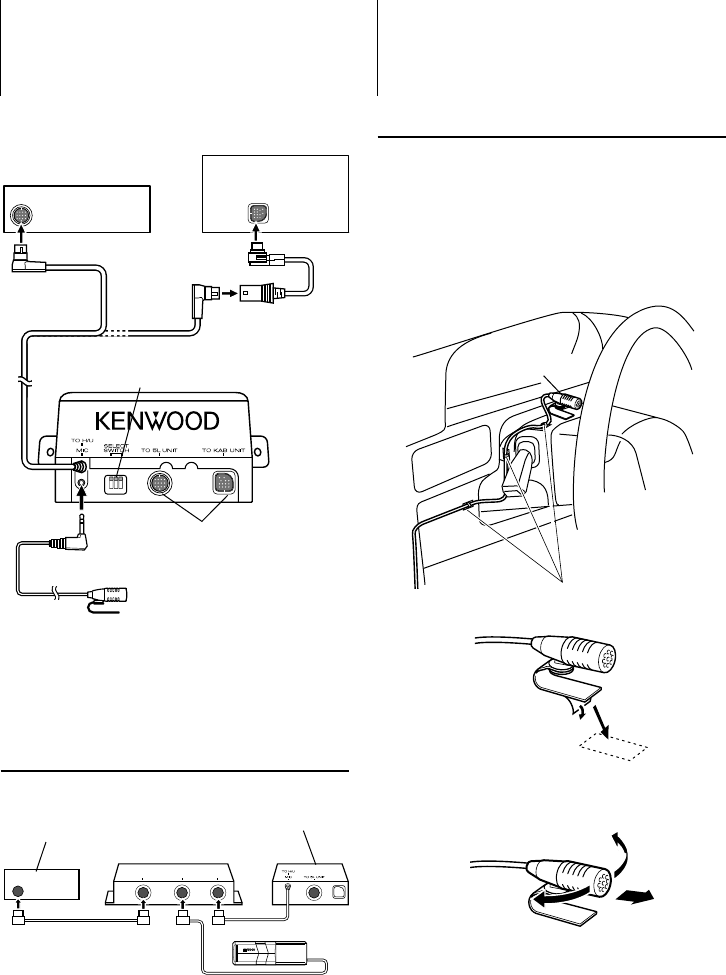
Français | 67
Connexion
123
Accessoire 1
(3 m, 9,5 ft)
Unité de commande
(Connecteur 5L)
Prise du dispositif externe
⁄
• Vous ne pouvez utiliser que la
borne qui a la même forme que
celle du connecteur connecté à
l'unité de commande.
• Vous ne pouvez connecter qu'un
seul périphérique extérieur.
Type de commutateur
(page 38, 66)
(1,5 m, 5 ft)
Unité de commande
(Connecteur KAB)
Accessoire 4
TO CHANGER 2TO CHANGER 1TO HEAD UNIT
KCA-BT300
Unité de commande (5L)
Changeur de disque
KCA-S220A
¤
• Veuillez conserver à une longueur de 13 m (43 ft) ou
moins l'extension du câble de commande de l'appareil
de commande vers le changeur de disque. Les câbles de
commande dépassant une longueur de 13 m cesseront de
fonctionner correctement.
Si vous voulez raccorder le KCA-
S220A
Raccordez le boîtier mains libres au terminal portant la
mention TO CHANGER 2.
Installation
Installation of the Microphone Unit
1 Vérifiez de l'emplacement de l'installation du
microphone (accessoire 1).
2 Retirez la graisse et autres saletés de la surface
d'installation.
3 Installez le microphone.
4 Reliez le câble du microphone au boîtier mains libres
en le fixant en plusieurs points à l'aide d'adhésifs ou
autres.
Fixez un câble avec un élément adhésif courant.
Retirez le papier couché antiadhésif du scotch double face
pour le coller à l'endroit représenté ci-dessus.
Ajustez l'orientation du microphone vers le chauffeur.
⁄
• Installez le microphone le plus loin possible du téléphone
portable.
Accessoire 1
B64-4713-00_10_KCA-BT300_KE.indb 67B64-4713-00_10_KCA-BT300_KE.indb 67 10/03/12 14:5110/03/12 14:51
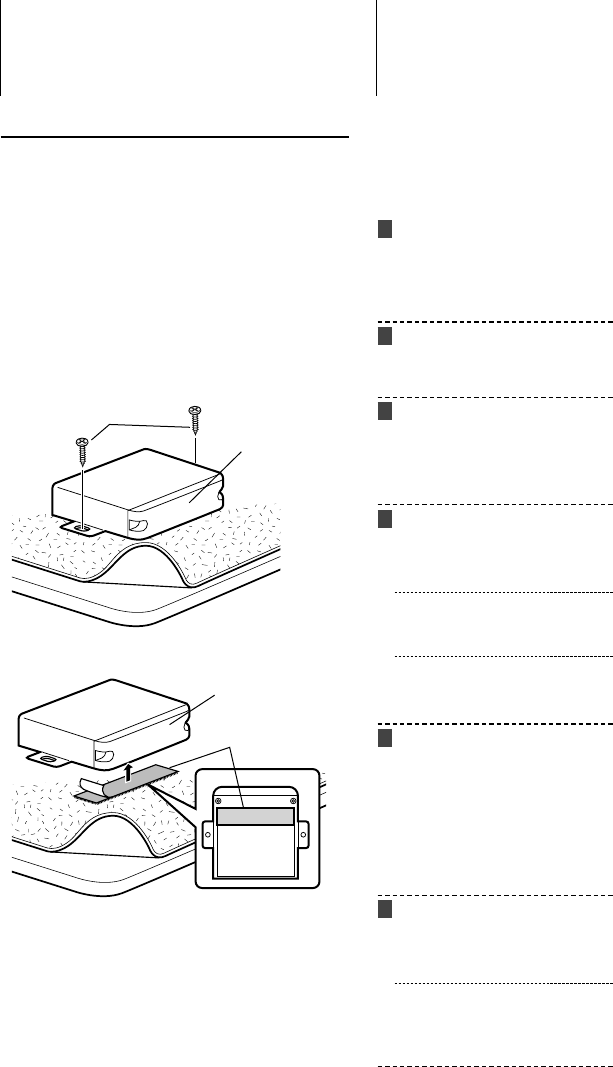
68 | KCA-BT300
Guide de dépannage
Ce qui peut ressembler à un dysfonctionnement
de votre appareil peut n'être que le résultat d'une
mauvaise opération ou d'un mauvais câblage. Avant
d’appeler un centre de service, vérifiez d’abord dans
le tableau suivant les problèmes possibles.
? Le volume de la conversation est bas.
✔ Le volume de la conversation mains libres est réglé
sur un niveau bas.
☞ Le volume de la conversation mains libres peut
être ajusté indépendamment. Ajustez-le pendant
la conversation mains libres.
? Aucun son ne sort des haut-parleurs arrière.
✔ Vous parlez en mode de conversation mains libres.
☞ Aucun son ne sort des haut-parleurs arrières en
mode de conversation mains libres.
? On n'entend aucun bip à l'arrivée d'un appel
entrant.
✔ On entend le bip selon le type de votre téléphone
portable.
☞ Le paramètre <Réglage du bip d'appel entrant>
est réglé sur ON.
? La voix n'est pas reconnue.
✔ La vitre du véhicule est ouverte.
☞ Si le bruit environnant est fort, la voix ne peut
pas être reconnue correctement. Fermez les
vitres du véhicule.
✔ Voix faible.
☞ Si la voix est trop faible, elle ne peut pas être
reconnue correctement. Parlez dans le micro un
peu plus fort et naturellement.
✔ La personne qui prononce la balise vocale n'est pas
celle qui l'a enregistrée.
☞ Seule la voix de la personne qui a enregistré la
balise vocale peut être reconnue.
? Le lecteur audio Bluetooth ne peut pas être
enregistré (association).
✔ Le code PIN a été paramétré.
☞ Lorsqu'un code PIN est spécifié dans le Manuel
d'instructions du lecteur audio Bluetooth,
enregistrez-le en vous référant à la section
<Enregistrement du code PIN> afin d'enregistrer
le lecteur audio Bluetooth. Si aucun code PIN
n'est indiqué dans le Manuel d'instructions,
essayez "0000".
? Le son provenant du lecteur audio Bluetooth est
discontinu.
✔ La distance entre cet appareil et le lecteur audio est
trop grande.
☞ Rapprochez le lecteur audio de l'appareil.
✔ Un autre appareil Bluetooth affecte la
communication Bluetooth.
☞ Éteignez l'autre appareil Bluetooth.
☞ Éloignez l'autre appareil Bluetooth de cet
appareil.
Installation
Installation of the Bluetooth unit
¤
• Déterminez la position d'installation après vous être assuré
que l'unité pouvait communiquer avec l'appareil Bluetooth.
• Veuillez ne pas installer l'appareil près du tableau de bord,
de la plage arrière, ou d'autres composants importants.
Ceci peut engendrer des blessures ou accidents si l'appareil
s'arrête à cause d'un choc et frappe une personne ou un
composant important. Des vis autotaraudeuses doivent être
utilisées pour l'installation. (Une fixation avec des bandes
velcro, bien que facile à installer, peut se détacher suite à
une choc.)
Fixation à l'appareil audio
Fixation sur la moquette
Accessoire 3
Partie de l'antenne
⁄
• Ne collez pas la bande velcro sur le numéro de série.
• Si le lieu d'installation présente des épaulements, coupez
la bande velcro en deux morceaux et collez-les à deux
endroits différents.
Partie de l'antenne
Accessoire 2 (Ø4 × 16 mm)
B64-4713-00_10_KCA-BT300_KE.indb 68B64-4713-00_10_KCA-BT300_KE.indb 68 10/03/12 14:5110/03/12 14:51

Français | 69
Caractéristiques techniques
Section Bluetooth
Technologie
: Bluetooth 2.1 + EDR Certified
Fréquence
: 2,402 – 2,480 GHz
Puissance de sortie
: +4dBm (MAX), 0dBm (AVE) Classe d'énergie 2
Portée de communication maximale
: Ligne de vue environ 10m (32,1 ft)
Profils
: HFP (profil mains libres)
: HSP (profil casque)
: OPP (profil d'envoi de fichiers)
: PBAP (profil d'accès au répertoire téléphonique)
: SYNC (profil de synchronisation)
: SPP (profil port série)
: A2DP (profil de distribution audio avancé)
: AVRCP (profil de commande à distance audio-
vidéo)
Généralités
Tension de fonctionnement (entre 10,5 et 16V)
: 14,4 V
Courant absorbé
: 200 mA
Dimensions (W x H x D)
: 95 x 30 x 105 mm
3-3/4 x 1-3/16 x 4-1/8 pouces
Poids
: 0,38 kg (0,84 lbs)
Les spécifications sont sujettes à changements sans
notification.
Les messages ci-dessous indiquent l’état
de votre système.
No Number/ NO-NMBER/ Incoming No Number :
• L'appelant ne précise pas d'identification.
• Il n'y a pas de données de numéros de téléphone.
No Data/ NO DATA :
• Il n'y a pas de liste des appels sortants.
• Il n'y a pas de liste des appels entrants.
No Entry/ NO ENTRY :
Le téléphone portable n'a pas été enregistré
(pairage).
HF Disconnect/ HF DISCONCT/ HF D-CON/ Disconnect/
DISCONCT/ Non Connection/ Disconnected :
L'appareil ne peut pas communiquer avec le
téléphone portable.
Audio Disconnect/ AUD DISCONCT/ AD D-CON :
L'appareil ne peut pas communiquer avec le
lecteur audio.
HF Connect/ HF CONNECT/ Connect/ CONNECT :
L'appareil peut communiquer avec le téléphone
portable.
HF Error 07/ HF ERR07:
On ne peut pas ouvrir la mémoire.
\ Désactivez et activez à nouveau l'alimentation.
Si ce message continue d'apparaître, appuyez
sur la touche de réinitialisation de l'appareil de
commande.
HF Error 68/ HF ERR68:
L'appareil ne peut pas communiquer avec le
téléphone portable.
\ Désactivez et activez à nouveau l'alimentation.
Si ce message continue d'apparaître, appuyez
sur la touche de réinitialisation de l'appareil de
commande.
Unknown: L'appareil Bluetooth ne peut pas être détecté.
Device Full/ DVC FULL:
5 appareils Bluetooth ont déjà été enregistrés.
Vous ne pouvez pas enregistrer d'autre appareil
Bluetooth.
PIN Code NG/ CODE NG:
Le code PIN est erroné.
Connect NG/ CONCT NG:
L'unité ne peut pas être connectée à l'appareil.
Pairing Failed/ PAIRING NG/ PAIR NG:
Erreur d'association.
Err No Matching/ NO MATCHING/ NO MATCH:
La balise vocale est erronée. La voix ne peut pas
être reconnue car la balise vocale n'a pas été
enregistrée, etc.
Too Soft: La voix est trop faible et ne peut pas être
reconnue correctement.
Too Loud: La voix est trop forte pour être reconnue.
Too Long: Le mot ou la manière de le prononcer sont trop
longs pour être reconnus.
No Phonebook/ NO PB:
Les données ne sont pas présentes dans le
répertoire téléphonique.
No Message/ NO SMS:
Il n'y a pas de message dans la boîte de réception.
Ce symbole indique que Kenwood
a fabriqué ce produit de manière
à limiter son infl uence nocive sur
l'environnement.
La marque et logos Bluetooth appartiennent à
Bluetooth SIG, Inc. et toute utilisation de ces marques
par Kenwood Corporation est sous licence. Les autres
marques et appellations commerciales appartiennent
à leurs propriétaires respectifs.
B64-4713-00_10_KCA-BT300_KE.indb 69B64-4713-00_10_KCA-BT300_KE.indb 69 10/03/12 14:5110/03/12 14:51

70 | KCA-BT300
Índice
Antes de usar 71
Lista de modelos 72
Funcionamiento básico para llamar por
teléfono con manos libres (Modelo-A) 74
Antes de usar
Realizar una llamada
Recepción de una llamada
Llamada en espera
Durante una llamada
Otras funciones
Funcionamiento básico para llamar por
teléfono con manos libres (Modelo-B) 76
Antes de usar
Realizar una llamada
Recepción de una llamada
Llamada en espera
Durante una llamada
Otras funciones
Funcionamiento básico para llamar por
teléfono con manos libres (Modelo-C) 78
Antes de usar
Realizar una llamada
Recepción de una llamada
Llamada en espera
Durante una llamada
Otras funciones
Funcionamiento básico para llamar por
teléfono con manos libres (Modelo-D) 80
Antes de usar
Realizar una llamada
Recepción de una llamada
Llamada en espera
Durante una llamada
Otras funciones
Funcionamiento básico para llamar por
teléfono con manos libres (Modelo-E) 82
Antes de usar
Realizar una llamada
Recepción de una llamada
Llamada en espera
Durante una llamada
Otras funciones
Funcionamiento básico para llamar por
teléfono con manos libres (Modelo-F) 84
Antes de usar
Realizar una llamada
Recepción de una llamada
Llamada en espera
Durante una llamada
Otras funciones
Funcionamiento básico para llamar por
teléfono con manos libres (Modelo-G) 86
Antes de usar
Realizar una llamada
Recepción de una llamada
Durante una llamada
Otras funciones
Operación de función 88
Botones de funcionamiento
Registro del dispositivo Bluetooth
Registro de un dispositivo Bluetooth especial
Registro del código PIN
Descarga de la agenda
Selección del dispositivo Bluetooth que desea
conectar
Borrar un dispositivo Bluetooth registrado
Añadir un comando de marcación por voz
Ajuste de un comando de voz para categoría
Descarga de SMS
SMS (Servicio de mensajes cortos)
Mando a distancia 93
Realizar una llamada
Recepción de una llamada
Espera de llamada
(Función del modelo-A, B, C, D, E, F)
Durante una llamada
Audio Bluetooth 93
Antes de usar
Reproducción de audio Bluetooth
Funcionamiento de los teléfonos con
manos libres (Modelo H) 94
Registro del dispositivo Bluetooth
Descarga de la agenda
Pantalla de control manos libres
Funcionamiento de teclas
Realizar una llamada
Recepción de una llamada
Durante una llamada
Otras funciones
Apéndice 98
Accesorios/
Procedimiento de instalación 100
Conexión 101
Instalación 101
Guía sobre localización de averías 102
Especificaciones 103
B64-4713-00_10_KCA-BT300_KE.indb 70B64-4713-00_10_KCA-BT300_KE.indb 70 10/03/12 14:5110/03/12 14:51

Español | 71
Antes de usar
2ADVERTENCIA
Para evitar el riesgo de lesiones y/o fuego,
observe las siguientes precauciones:
• Para evitar cortocircuitos, nunca coloque ni deje objetos
metálicos (por ejemplo, monedas o herramientas
metálicas) dentro de la unidad.
• La instalación y cableado de este producto requiere
de habilidad y experiencia. Por motivos de seguridad,
deja la labor de instalación y montaje en manos de
profesionales.
2 PRECAUCIÓN
• No instale la unidad en un sitio expuesto a la luz directa
del sol, o excesivamente húmedo o caluroso. Además
deberá evitar sitios con mucho polvo o la posibilidad de
que se derrame agua sobre ella.
Notas
• Si tiene problemas durante la instalación, consulte con
su distribuidor Kenwood.
• Las letras mayúsculas y las minúsculas de la pantalla
pueden invertirse.
• Las ilustraciones de la pantalla y el panel que aparecen
en este manual son ejemplos utilizados para explicar
mejor cómo se utilizan los mandos. Por lo tanto, las
ilustraciones de la pantalla que aparecen pueden ser
distintas a las que aparecen realmente en la pantalla
del equipo, y algunas de las ilustraciones de la pantalla
puede que representen algo imposible durante el
funcionamiento actual.
Receptores Kenwood disponibles para esta
unidad
Los métodos de funcionamiento se clasifican en grupos
por el tipo de receptor (unidad de control).
En primer lugar, consulte la <Lista de modelos> (página
72) para confirmar el grupo de la operación que desea
realizar.
Modelo-A, B, C, D, E, F, G
Consulte las páginas relevantes (<Funcionamiento básico
para llamar por teléfono con manos libres>). Para utilizar
el reproductor de audio Bluetooth con esta unidad,
consulte <Audio Bluetooth> (página 93).
Modelo-H
Consulte las páginas relevantes (<Funcionamiento para
llamar por teléfono con manos libres>). Para utilizar el
reproductor de audio Bluetooth con esta unidad, consulte
<Audio Bluetooth> (página 93).
Modelo-I
Después de realizar la operación llamada <Registro del
dispositivo Bluetooth> (página 94) o <Descarga de la
agenda> (página 94), consulte el manual de instrucciones
de la unidad de control.
Para utilizar el reproductor de audio Bluetooth con esta
unidad, consulte <Audio Bluetooth> (página 93).
Notas sobre la selección y eliminación de un teléfono
manos libres
• Si ya se ha seleccionado un teléfono móvil, anule su
selección y seleccione otro distinto.
• "BT300 FW***" y la versión de firmware se muestran en
la lista de selección del teléfono móvil. A pesar de que se
muestra el mismo contenido en la lista de borrar, no se
pueden borrar.
• El reproductor de audio se mostrará en la lista de
dispositivos después del registro. Sin embargo, el
reproductor de audio de la lista no podrá seleccionarse.
Modelo-J, L
Consulte el manual de instrucciones para la unidad de
control.
Modelo-K
Consulte el manual de instrucciones para la unidad de
control.
A continuación se describen las funciones que requieren
un funcionamiento distinto:
• Cómo mostrar información de una canción de los
archivos de fuente de audio Bluetooth
La información sobre la canción que se está
reproduciendo actualmente puede mostrarse si el
reproductor de audio Bluetooth admite el perfil AVRCP
1.3.
Título y Artista ("Title/Artist"), Álbum y artista ("Album/
Artist")
• Mostrar el sello de tiempo cuando se marca desde la
lista de historial de llamadas
El nombre, el número de teléfono y el sello de tiempo
pueden seleccionarse alternando entre los elementos
de visualización.
• Registro del dispositivo Bluetooth
Cuando un dispositivo Bluetooth que debe conectarse
se selecciona en la lista de dispositivos, aparecerá el
mensaje "Pairing", y esta unidad empezará a conectarse
automáticamente con el dispositivo Bluetooth
seleccionado.
- El registro habrá finalizado cuando aparezca el
mensaje "Pairing Success". Realice la operación
después de enviar un código PIN.
- Introduzca un código PIN cuando aparezca el mensaje
"PIN Code NG".
• Configuración del Bluetooth
Visualización Descripción general
"MIC Gain" "–3" – "0" – "+3": Ajuste la sensibilidad del
micrófono para una llamada telefónica. Ajuste la voz
de la persona que llama.
"NR Level" "–3" – "0" – "+3": Reduce los ruidos generados
por el entorno sin modificar el volumen del
micrófono. Ajuste la voz de la persona que llama
cuando no esté clara.
"Echo Cancel" "–2" – "0" – "+2": Ajuste el nivel de cancelación
del eco.
B64-4713-00_10_KCA-BT300_KE.indb 71B64-4713-00_10_KCA-BT300_KE.indb 71 10/03/12 14:5110/03/12 14:51
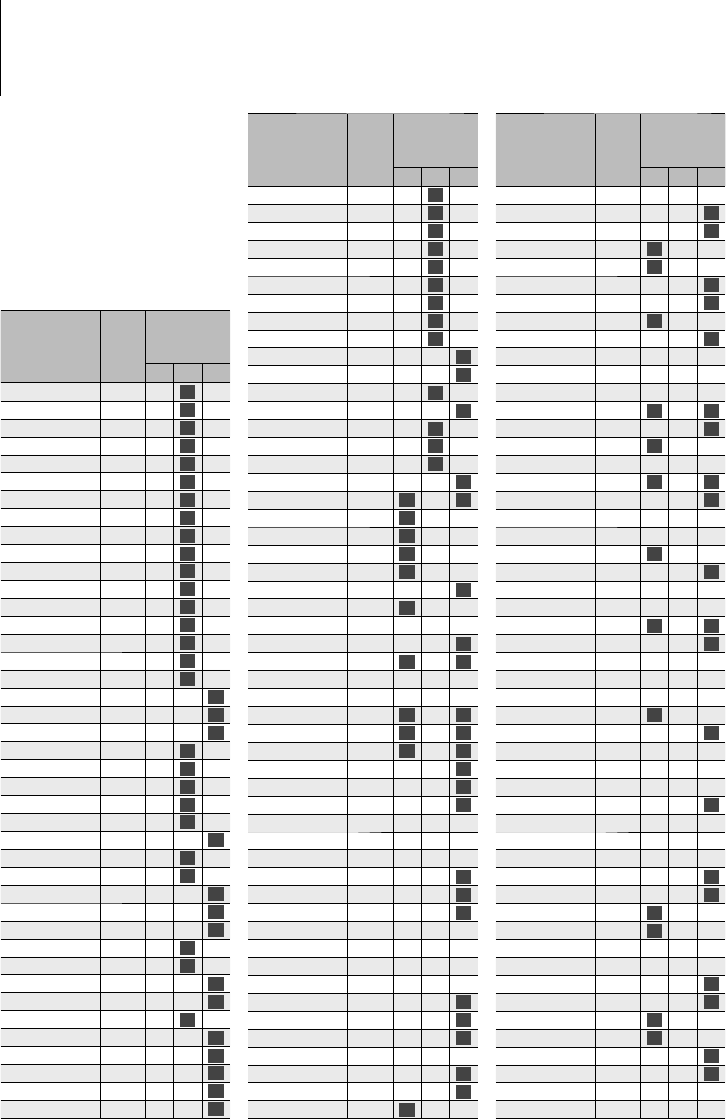
72 | KCA-BT300
Las unidades del receptor que se
pueden utilizar con el KCA-BT300
son las siguientes: (a partir de abril
de 2010)
Para obtener detalles sobre los
receptores compatibles que se
lanzarán en el futuro, acceda a la
siguiente URL:
http://www.kenwood.com/cs/ce/bt/
Nombre de
modelo
Grupo Escriba el
ajuste de
conmutación
123
DDX5022 J OFF ON OFF
DDX5022Y J OFF ON OFF
DDX5024 J OFF ON OFF
DDX5026 J OFF ON OFF
DDX5032 J OFF ON OFF
DDX5032M J OFF ON OFF
DDX5034 J OFF ON OFF
DDX5034M J OFF ON OFF
DDX5036 J OFF ON OFF
DDX5036M J OFF ON OFF
DDX5054 J OFF ON OFF
DDX5056 J OFF ON OFF
DDX512 J OFF ON OFF
DDX514 J OFF ON OFF
DDX516 J OFF ON OFF
DDX52RY J OFF ON OFF
DDX54R J OFF ON OFF
DDX6019 H OFF OFF ON
DDX6029 H OFF OFF ON
DDX6029Y H OFF OFF ON
DDX6034 J OFF ON OFF
DDX6034M J OFF ON OFF
DDX6036 J OFF ON OFF
DDX6036 J OFF ON OFF
DDX6036M J OFF ON OFF
DDX6039 H OFF OFF ON
DDX6054 J OFF ON OFF
DDX630BT J OFF ON OFF
DDX7019 I OFF OFF ON
DDX7029 I OFF OFF ON
DDX7029Y I OFF OFF ON
DDX7032 J OFF ON OFF
DDX7032M J OFF ON OFF
DDX7039 I OFF OFF ON
DDX7039M I OFF OFF ON
DDX712 J OFF ON OFF
DDX8019 I OFF OFF ON
DDX8029 I OFF OFF ON
DDX8029Y I OFF OFF ON
DDX8039 I OFF OFF ON
DNX210EX G-1 OFF OFF ON
Nombre de
modelo
Grupo Escriba el
ajuste de
conmutación
123
DNX5120 J OFF ON OFF
DNX512EX J OFF ON OFF
DNX5140 J OFF ON OFF
DNX5160 J OFF ON OFF
DNX5220 J OFF ON OFF
DNX5240 J OFF ON OFF
DNX5360 J OFF ON OFF
DNX5360M J OFF ON OFF
DNX5560 J OFF ON OFF
DNX7100 I OFF OFF ON
DNX710EX I OFF OFF ON
DNX7120 J OFF ON OFF
DNX7200 I OFF OFF ON
DNX7220 J OFF ON OFF
DNX7320 J OFF ON OFF
DNX7320CN J OFF ON OFF
DPX-MP2090U G-1 OFF OFF ON
DPX-MP2100 G-1 ON OFF ON
DPX-MP3110 F ON OFF OFF
DPX-MP3110S F ON OFF OFF
DPX-MP4110 F ON OFF OFF
DPX-MP4110S F ON OFF OFF
DPX-MP5100U G-1 OFF OFF ON
DPX-MP5110U F ON OFF OFF
DPX-MP6110U E-1 OFF OFF OFF
DPX-MP7090U G-1 OFF OFF ON
DPX302 G-1 ON OFF ON
DPX303 E-1 OFF OFF OFF
DPX313Y E-1 OFF OFF OFF
DPX501 G-1 ON OFF ON
DPX501U G-1 ON OFF ON
DPX501UY G-1 ON OFF ON
DPX502 G-1 OFF OFF ON
DPX502U G-1 OFF OFF ON
DPX502UY G-1 OFF OFF ON
DPX503 E-1 OFF OFF OFF
DPX503U E-1 OFF OFF OFF
DPX503UY E-1 OFF OFF OFF
DPX701 G-1 OFF OFF ON
DPX701U G-1 OFF OFF ON
DPX701UY G-1 OFF OFF ON
KDC-5047U K OFF OFF OFF
KDC-6047U K OFF OFF OFF
KDC-HD545U J OFF OFF OFF
KDC-HD942U J OFF OFF OFF
KDC-MP2035 G-1 OFF OFF ON
KDC-MP235 G-1 OFF OFF ON
KDC-MP238 G-4 OFF OFF ON
KDC-MP242 A OFF OFF OFF
KDC-MP3035 G-1 OFF OFF ON
KDC-MP335 G-1 OFF OFF ON
KDC-MP338 D-1 ON OFF OFF
Nombre de
modelo
Grupo Escriba el
ajuste de
conmutación
123
KDC-MP342U A OFF OFF OFF
KDC-MP4036AX G-1 OFF OFF ON
KDC-MP4036U G-1 OFF OFF ON
KDC-MP4039 D-1 ON OFF OFF
KDC-MP408U D-1 ON OFF OFF
KDC-MP435U G-1 OFF OFF ON
KDC-MP436U G-1 OFF OFF ON
KDC-MP438U D-1 ON OFF OFF
KDC-MP439 G-4 OFF OFF ON
KDC-MP442U B OFF OFF OFF
KDC-MP443 A OFF OFF OFF
KDC-MP445U K OFF OFF OFF
KDC-MP5033U G-1 ON OFF ON
KDC-MP5036U G-1 OFF OFF ON
KDC-MP5039U D-1 ON OFF OFF
KDC-MP5043U A OFF OFF OFF
KDC-MP532U G-1 ON OFF ON
KDC-MP535U G-1 OFF OFF ON
KDC-MP538U E-2 OFF OFF OFF
KDC-MP543U A OFF OFF OFF
KDC-MP5539U D-1 ON OFF OFF
KDC-MP6036 G-1 OFF OFF ON
KDC-MP6039 E-2 OFF OFF OFF
KDC-MP6043U B OFF OFF OFF
KDC-MP632U G-1 ON OFF ON
KDC-MP635 G-3 OFF OFF ON
KDC-MP638U E-1 OFF OFF OFF
KDC-MP642U J OFF OFF OFF
KDC-MP6539U E-2 OFF OFF OFF
KDC-MP7090U D-1 ON OFF OFF
KDC-MP735U G-3 OFF OFF ON
KDC-MP738U E-1 OFF OFF OFF
KDC-MP745U K OFF OFF OFF
KDC-MP8090U E-1 OFF OFF OFF
KDC-MP832U G-3 OFF OFF ON
KDC-MP9090U E-1 OFF OFF OFF
KDC-U6046 K OFF OFF OFF
KDC-U6046L K OFF OFF OFF
KDC-W3537 G-1 OFF OFF ON
KDC-W3537Y G-1 OFF OFF ON
KDC-W3541 D-2 ON OFF OFF
KDC-W3541Y D-2 ON OFF OFF
KDC-W3544W A OFF OFF OFF
KDC-W3544WY A OFF OFF OFF
KDC-W4037 G-1 OFF OFF ON
KDC-W4037Y G-1 OFF OFF ON
KDC-W4041 D-1 ON OFF OFF
KDC-W4141Y D-1 ON OFF OFF
KDC-W4537U G-1 OFF OFF ON
KDC-W4537UY G-1 OFF OFF ON
KDC-W4544U A OFF OFF OFF
KDC-W4644UY A OFF OFF OFF
Lista de modelos
B64-4713-00_10_KCA-BT300_KE.indb 72B64-4713-00_10_KCA-BT300_KE.indb 72 10/03/12 14:5110/03/12 14:51
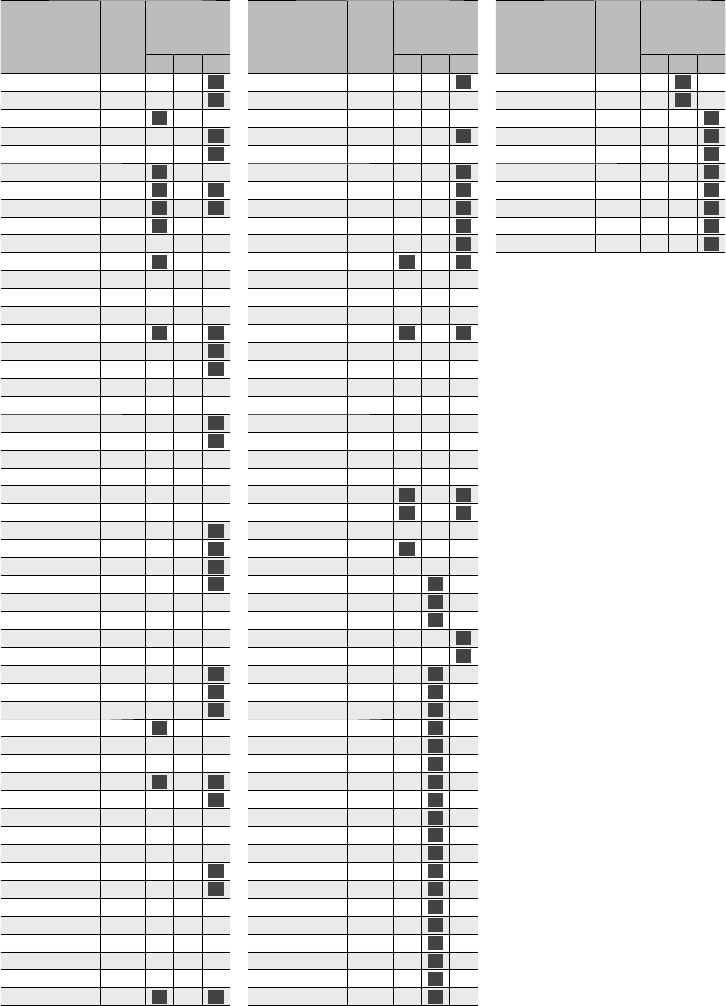
Español | 73
Nombre de
modelo
Grupo Escriba el
ajuste de
conmutación
123
KDC-W4737U G-1 OFF OFF ON
KDC-W4737UY G-1 OFF OFF ON
KDC-W5041U D-1 ON OFF OFF
KDC-W5137 G-1 OFF OFF ON
KDC-W5137Y G-1 OFF OFF ON
KDC-W5141UY D-1 ON OFF OFF
KDC-W5534U G-1 ON OFF ON
KDC-W5534UY G-1 ON OFF ON
KDC-W5541U D-1 ON OFF OFF
KDC-W5544U B OFF OFF OFF
KDC-W5641UY D-1 ON OFF OFF
KDC-W5644UY B OFF OFF OFF
KDC-W6041U E-2 OFF OFF OFF
KDC-W6141UY E-2 OFF OFF OFF
KDC-W6534U G-1 ON OFF ON
KDC-W6537U G-1 OFF OFF ON
KDC-W6537UY G-1 OFF OFF ON
KDC-W6541U E-2 OFF OFF OFF
KDC-W6641UY E-2 OFF OFF OFF
KDC-W7037 G-3 OFF OFF ON
KDC-W7037Y G-3 OFF OFF ON
KDC-W7041U E-1 OFF OFF OFF
KDC-W7044U J OFF OFF OFF
KDC-W7141UY E-1 OFF OFF OFF
KDC-W7144UY J OFF OFF OFF
KDC-W7534U G-3 OFF OFF ON
KDC-W7534UY G-3 OFF OFF ON
KDC-W7537U G-3 OFF OFF ON
KDC-W7537UY G-3 OFF OFF ON
KDC-W7541U E-1 OFF OFF OFF
KDC-W7541UY E-1 OFF OFF OFF
KDC-W7544U J OFF OFF OFF
KDC-W7644UY J OFF OFF OFF
KDC-W9537U G-2 OFF OFF ON
KDC-W9537UY G-2 OFF OFF ON
KDC-X491 G-1 OFF OFF ON
KDC-X492 D-1 ON OFF OFF
KDC-X493 B OFF OFF OFF
KDC-X494 K OFF OFF OFF
KDC-X590 G-1 ON OFF ON
KDC-X591 G-1 OFF OFF ON
KDC-X592 E-2 OFF OFF OFF
KDC-X692 E-1 OFF OFF OFF
KDC-X693 J OFF OFF OFF
KDC-X7006 G-3 OFF OFF ON
KDC-X7006U G-3 OFF OFF ON
KDC-X7009U E-1 OFF OFF OFF
KDC-X7013U J OFF OFF OFF
KDC-X7013UL J OFF OFF OFF
KDC-X7016 K OFF OFF OFF
KDC-X7016L K OFF OFF OFF
KDC-X7533U G-1 ON OFF ON
Nombre de
modelo
Grupo Escriba el
ajuste de
conmutación
123
KDC-X791 G-3 OFF OFF ON
KDC-X792 E-1 OFF OFF OFF
KDC-X794 K OFF OFF OFF
KDC-X8006U G-2 OFF OFF ON
KDC-X8009U E-1 OFF OFF OFF
KDC-X890 G-3 OFF OFF ON
KDC-X891 G-2 OFF OFF ON
KDC-X9006U G-2 OFF OFF ON
KDC-X9533U G-3 OFF OFF ON
KDC-X991 G-2 OFF OFF ON
KDV-412 G-1 ON OFF ON
KDV-415U A OFF OFF OFF
KDV-4244 A OFF OFF OFF
KDV-4544 A OFF OFF OFF
KDV-5234 G-1 ON OFF ON
KDV-5244U A OFF OFF OFF
KDV-5544U A OFF OFF OFF
KDV-MP4343 A OFF OFF OFF
KDV-MP4343G A OFF OFF OFF
KDV-MP4443 A OFF OFF OFF
KDV-MP5042U A OFF OFF OFF
KDV-MP5343U A OFF OFF OFF
KDV-MP5443U A OFF OFF OFF
KDV-MP6333 G-1 ON OFF ON
KDV-MP6433 G-1 ON OFF ON
KIV-700 L OFF OFF OFF
KMR-330 D-1 ON OFF OFF
KMR-440U K OFF OFF OFF
KMR-700U*1C OFF ON OFF
KOS-A210 J OFF ON OFF
KOS-A300 J OFF ON OFF
KOS-V1000 I OFF OFF ON
KOS-V500 I OFF OFF ON
KVT-50DVDRY J OFF ON OFF
KVT-512 J OFF ON OFF
KVT-514 J OFF ON OFF
KVT-516 J OFF ON OFF
KVT-522DVD J OFF ON OFF
KVT-522DVDY J OFF ON OFF
KVT-524DVD J OFF ON OFF
KVT-526DVD J OFF ON OFF
KVT-532DVD J OFF ON OFF
KVT-532DVDM J OFF ON OFF
KVT-534DVD J OFF ON OFF
KVT-534DVDM J OFF ON OFF
KVT-536DVD J OFF ON OFF
KVT-536DVDM J OFF ON OFF
KVT-546DVD J OFF ON OFF
KVT-54DVDR J OFF ON OFF
KVT-554DVD J OFF ON OFF
KVT-556DVD J OFF ON OFF
KVT-614 J OFF ON OFF
Nombre de
modelo
Grupo Escriba el
ajuste de
conmutación
123
KVT-636DVD J OFF ON OFF
KVT-696 J OFF ON OFF
KVT-719DVD I OFF OFF ON
KVT-729DVD I OFF OFF ON
KVT-729DVDY I OFF OFF ON
KVT-739DVD I OFF OFF ON
KVT-819DVD I OFF OFF ON
KVT-829DVD I OFF OFF ON
KVT-829DVDY I OFF OFF ON
KVT-839DVD I OFF OFF ON
*1 Excepto la zona de ventas de Norteamérica
B64-4713-00_10_KCA-BT300_KE.indb 73B64-4713-00_10_KCA-BT300_KE.indb 73 10/03/12 14:5110/03/12 14:51
74 | KCA-BT300
Antes de usar
• Debe registrar el teléfono móvil antes de utilizarlo con
esta unidad. Para más detalles, consulte <Registro del
dispositivo Bluetooth> (página 88).
• Si ha registrado dos o más teléfonos móviles, debe
seleccionar uno de ellos. Para más detalles, consulte
<Selección del dispositivo Bluetooth que desea
conectar> (página 90).
• Para utilizar la agenda, debe descargarse con antelación
en esta unidad. Para obtener detalles, consulte
<Descarga de la agenda> (página 89).
• Para el método de funcionamiento en el modo de
Menú, consulte el manual de instrucciones para la
unidad de control.
• Para más información concerniente a la función con la
marca [ ], consulte <Nota de función> (página 98).
Realizar una llamada
Método de marcación
1. Seleccione el elemento del método de marcación
durante el modo de menú
Seleccione la visualización "DIALING MODE"/
"D.MODE".
2. Seleccione un método de marcación
Pulse el mando [AUD].
• "NUMBER DIAL" » "PHONE BOOK1" » "PHONE BOOK2"
» "OUT-CALL" » "IN-CALL" » "MISSED CALLS"
• "N-DIAL" » "PH-BOOK1" » "PH-BOOK2" » "OUT-CALL" »
"IN-CALL" » "MIS-CALL"
3 Los métodos de funcionamiento en los modos
arriba mencionados se describen abajo.
3. Salga del modo de selección del método de
marcación
Salga del modo de menú.
3 Marcación de un número ( )
2-1. Seleccione la visualización "NUMBER DIAL"/ "N-DIAL".
2-2. Introduzca un número de teléfono
Pulse el número ([1] – [0]), el botón #([FM]), *([AM]) o
+([¢]) en el mando a distancia.
2-3. Realice una llamada
Pulse el botón [DIRECT] en el mando a distancia.
☞ Puede introducir un máximo de 32 dígitos.
3 Marcación rápida (Marcación preestablecida)
2-1. Seleccione la visualización "NUMBER DIAL"/ "N-DIAL".
2-2. Seleccione el número de marcación preestablecido
Pulse el botón [1] – [6].
2-3. Realice una llamada
Pulse el mando [AUD] durante al menos 1 segundo.
☞ Necesita registrar el número de marcación
preestablecido. (página 75)
3 Llamar a un número en el registro de llamadas
( )
2-1. Seleccione la visualización "OUT-CALL" (llamadas
salientes), "IN-CALL" (llamadas entrantes), o "MISSED
CALLS"/"MIS-CALL" (llamadas perdidas).
Funcionamiento básico para llamar por teléfono con manos libres
(Modelo-A)
2-2. Seleccione un nombre o número de teléfono
Pulse el botón [FM] o [AM].
2-3. Realice una llamada
Pulse el mando [AUD] durante al menos 1 segundo.
3 Llamar a un número en la agenda telefónica ( )
2-1. Seleccione la visualización "PHONE BOOK1"/"PH-
BOOK1", proceda al paso 2-2.
Seleccione la visualización "PHONE BOOK2"/"PH-
BOOK2", proceda al paso 2-3.
2-2. Seleccione la inicial para realizar la búsqueda
Tipo de operación Operación
Desplazarse al siguiente
carácter.
Pulse el botón [
4
] o [
¢
].
Desplazarse a la siguiente fila. Pulse el botón [FM] o [AM].
Determine la inicial
seleccionada.
Pulse el mando [AUD] durante al
menos 1 segundo.
2-3. Seleccione el nombre
Tipo de operación Operación
Pase al siguiente número de
teléfono.
Pulse el botón [FM] o [AM].
Pase al siguiente nombre. Pulse el botón [
4
] o [
¢
].
2-4. Realice una llamada
Pulse el mando [AUD] durante al menos 1 segundo.
Realización de una llamada con marcación por voz
1. Seleccione el elemento de reconocimiento de voz
cuando se encuentre en el modo de menú
Seleccione la visualización "VOICE RECOG"/ "V-RECOG".
2. Pulse el mando [AUD] durante al menos 1 segundo.
Seleccione la visualización "V-RECOG READY"/ "VR
READY".
3. Pulse el mando [AUD].
Se visualiza "PB NAME".
Al escucharse un pitido, articule el nombre dentro de
2 segundos.
4. Se muestra "PB TYPE"/ "PN type".
Al escucharse un pitido, articule la categoría dentro de
2 segundos.
5. Realice una llamada
Este paso es el mismo que el paso 3 del procedimiento
establecido en <Llamar a un número en la agenda
telefónica>. Puede realizar una llamada o seleccionar
una categoría.
☞ Si no se puede reconocer su voz, se muestra un mensaje.
Al pulsar el mando [AUD] podrá volver a intentar
introducir la voz. Consulte la página 102.
☞ Tanto el nombre como la categoría requieren el registro
de una etiqueta de voz. Consulte la página 91.
☞ El sonido de audio no se emite durante el
reconocimiento de voz.
Visualización del tipo de número telefónico (categoría)
Visualización Descripción Visualización Descripción
"GE"/ "GENERAL" General "OF"/ "OFFICE" Oficina
"HM"/ "HOME" Casa "OT"/ "OTHER" Otro
"MO"/ "MOBILE" Móvil
B64-4713-00_10_KCA-BT300_KE.indb 74B64-4713-00_10_KCA-BT300_KE.indb 74 10/03/12 14:5110/03/12 14:51
Español | 75
Recepción de una llamada
Respuesta a una llamada
Pulse el botón [AUD] o uno de los botones [1] – [6].
☞ Si introduce un disco como un CD, su llamada se
desconectará.
Rechazo de una llamada entrante
Pulse el botón [SRC].
Llamada en espera
Contestar otra llamada entrante suspendiendo la
llamada actual
1. Pulse el mando [AUD].
2. Gire el mando [AUD]. Seleccione la visualización
"ANSWER".
3. Pulse el mando [AUD].
Contestar otra llamada entrante después de nalizar
la llamada actual
Pulse el botón [SRC].
Continuación de la llamada actual
1. Pulse el mando [AUD].
2. Gire el mando [AUD]. Seleccione la visualización
"REJECT".
3. Pulse el mando [AUD].
Contestar una llamada en espera después de
nalizar la llamada actual
Pulse el botón [SRC].
Alternar entre la llamada actual y la llamada en
espera
Pulse el mando [AUD].
Durante una llamada
Desconexión de una llamada
Pulse el botón [SRC].
Cambio al modo privado ( )
Pulse el mando [AUD] durante al menos 1 segundo.
Al pulsarse cambia entre una charla privada ("PV TALK") o
una llamada con manos libres ("HF TALK").
Ajuste del volumen de voz durante una llamada
Gire el mando [AUD].
Otras funciones
Borrado del mensaje de desconexión
Pulse el botón [DISP] durante al menos 1 segundo.
Cambio entre modos de visualización
Pulse el botón [DISP]. Puede alternar entre la agenda y la
lista de llamadas.
Registro de la lista de números de marcación
preajustada
1. Introduzca el número de teléfono que desea
registrar
Introduzca el número de teléfono en relación con lo
siguiente:
Marcación de un número/ Llamar a un número en
el registro de llamadas/ Llamar a un número en la
agenda telefónica
2. Seleccione el botón que desea registrar
Pulse el botón [1] – [6] durante al menos 2 segundos.
3. Salga del modo de selección del método de
marcación
Pulse el botón [MENU].
Ajuste de elementos en el modo de menú
* Para entrar en el modo Menú, pulse el mando [AUD]
durante al menos 1 segundo.
Visualización Vista general de ajustes
"DVC REGIST"*/
"DVC REG"*
Registro de un dispositivo Bluetooth (conexión).
Consulte la página 88.
"S-DVC SELECT"*/
"S-DVC SEL"*
Permite el registro de un dispositivo especial que no
puede registrarse normalmente. Consulte la página 89.
"PHONE SEL"*/
"PHN-SEL"*
Selecciona un sujeto del teléfono móvil en una conexión
de manos libres. Consulte la página 90.
"AUDIO SEL"*/
"AUD-SEL"*
Selecciona el reproductor de audio que se va a conectar.
Consulte la página 90.
"DIALING MODE"*/
"D.MODE"*
Selecciona un método de marcación. Consulte la
página 74.
"SMS DOWNLOAD"*/
"SMS DL"*
Descarga un mensaje corto. Consulte la página 92.
"SMS INBOX"*/
"INBOX"*
Visualiza el mensaje corto recibido. Consulte la página 92.
"VOICE TAG"*/
"VOICETAG"*
Registra la etiqueta de voz para "reconocimiento de voz".
Consulte la página 91.
"VOICE RECOG"*/
"V-RECOG"*
Realización de una llamada por marcación con voz.
Consulte la página 74.
"DEVICE DEL"*/
"DVC-DEL"*/
"PHN-DEL"*
Cancelación del registro del dispositivo Bluetooth.
Consulte la página 90.
"DVC-STATUS"/
"D-STATUS"
"HF-CONNECT"/ "AD-CONNECT"/ "BAT"/ "SGNL":
Visualiza el estado del dispositivo Bluetooth.
Consulte la página 98.
"PIN EDIT"* Especifica el código PIN que se requiere al registrar esta
unidad utilizando el dispositivo Bluetooth. Consulte la
página 89.
"AUTO ANS"/
"ANS"
"OFF"/ "0" – "99": Contestar una llamada
automáticamente después de un lapso de tiempo
preestablecido para la contestación automática.
Consulte la página 98.
"SP SEL"/
"SPK"
"FRT"/ "F-R"/ "F-L": Especifica el altavoz de emisión de
voz. Consulte la página 98.
"CALL BEEP"/
"C-BP"
"ON"/ "OFF": Emite un pitido proveniente del altavoz al
entrar una llamada. Consulte la página 98.
"BT FW UP" Para saber como actualizar el firmware, visite nuestro
sitio web. http://www.kenwood.com/cs/ce/bt/
B64-4713-00_10_KCA-BT300_KE.indb 75B64-4713-00_10_KCA-BT300_KE.indb 75 10/03/12 14:5110/03/12 14:51
76 | KCA-BT300
Antes de usar
• Debe registrar el teléfono móvil antes de utilizarlo con
esta unidad. Para más detalles, consulte <Registro del
dispositivo Bluetooth> (página 88).
• Si ha registrado dos o más teléfonos móviles, debe
seleccionar uno de ellos. Para más detalles, consulte
<Selección del dispositivo Bluetooth que desea
conectar> (página 90).
• Para utilizar la agenda, debe descargarse con antelación
en esta unidad. Para obtener detalles, consulte
<Descarga de la agenda> (página 89).
• Para el método de funcionamiento en el control de
función, consulte el manual de instrucciones para la
unidad de control.
• Para más información concerniente a la función con la
marca [ ], consulte <Nota de función> (página 98).
Realizar una llamada
Método de marcación
1. Ingrese al modo del método de marcación
Pulse el botón [AUTO]/ [TI] por al menos 1 segundo.
2. Seleccione un método de marcación
Pulse el mando [AUD].
"NUMBER DIAL" » "PHONE BOOK1" » "PHONE BOOK2" »
"OUT-CALL" » "IN-CALL" » "MISSED-CALL"
3 Los métodos de funcionamiento en los modos
arriba mencionados se describen abajo.
3. Salga del modo de selección del método de
marcación
Pulse el botón [AUTO]/ [TI] por al menos 1 segundo.
3 Marcación de un número ( )
2-1. Seleccione la visualización "NUMBER DIAL".
2-2. Introduzca un número de teléfono
Pulse el número ([1] – [0]), el botón #([FM]), *([AM]) o
+([¢]) en el mando a distancia.
2-3. Realice una llamada
Pulse el botón [DIRECT] en el mando a distancia.
☞ Puede introducir un máximo de 32 dígitos.
3 Marcación rápida (Marcación preestablecida)
2-1. Seleccione la visualización "NUMBER DIAL".
2-2. Seleccione el número de marcación preestablecido
2-2-1. Pulse el botón [SEARCH].
2-2-2. Seleccione el número a recuperar girando el
mando [AUD].
2-2-3. Pulse el mando [AUD].
2-3. Realice una llamada
Pulse el mando [AUD] durante al menos 1 segundo.
☞ Necesita registrar el número de marcación
preestablecido. (página 77)
3 Llamar a un número en el registro de llamadas
( )
2-1. Seleccione la visualización "OUT-CALL" (llamada
saliente), "IN-CALL" (llamada entrante), o "MISSED-
CALL" (llamada perdida).
Funcionamiento básico para llamar por teléfono con manos libres
(Modelo-B)
2-2. Seleccione un nombre o número de teléfono
Gire el mando [AUD] o empújelo hacia arriba o hacia
abajo.
2-3. Realice una llamada
Pulse el mando [AUD] durante al menos 1 segundo.
3 Llamar a un número en la agenda telefónica ( )
2-1. Seleccione la visualización "PHONE BOOK1", proceda
al paso 2-2.
Seleccione la visualización "PHONE BOOK2", proceda
al paso 2-3.
2-2. Seleccione la inicial para realizar la búsqueda
Tipo de operación Operación
Desplazarse al siguiente
carácter.
Gire el mando [AUD] o empújelo hacia la
izquierda o hacia la derecha.
Desplazarse a la siguiente
fila.
Presione el mando [AUD] hacia arriba o
hacia abajo.
Determine la inicial
seleccionada.
Pulse el mando [AUD] durante al menos
1 segundo.
2-3. Seleccione el nombre
Tipo de operación Operación
Pase al siguiente número
de teléfono.
Gire el mando [AUD] o empújelo hacia
arriba o hacia abajo.
Pase al siguiente nombre. Presione el mando [AUD] hacia la derecha o
hacia la izquierda.
2-4. Realice una llamada
Pulse el mando [AUD] durante al menos 1 segundo.
Realización de una llamada con marcación por voz
1. Seleccione el elemento de reconocimiento de voz
en control de función
Seleccione "MENU" > "VOICE RECOG".
Se visualiza "V-RECOG READY".
2. Pulse el mando [AUD].
Se visualiza "PB NAME".
Al escucharse un pitido, articule el nombre dentro de
2 segundos.
3. Se visualiza "PN TYPE".
Al escucharse un pitido, articule la categoría dentro de
2 segundos.
4. Realice una llamada
Este paso es el mismo que el paso 3 del procedimiento
establecido en <Llamar a un número en la agenda
telefónica>. Puede realizar una llamada o seleccionar
una categoría.
☞ Si no se puede reconocer su voz, se muestra un
mensaje. Si pulsa el mando [AUD] podrá volver a intentar
introducir la voz. Consulte la página 102.
☞ Tanto el nombre como la categoría requieren el registro
de una etiqueta de voz. Consulte la página 91.
☞ El sonido de audio no se emite durante el
reconocimiento de voz.
Visualización del tipo de número telefónico (categoría)
Visualización Descripción Visualización Descripción
"General" General "Office" Oficina
"Home" Casa "Other" Otro
"Mobile" Móvil
B64-4713-00_10_KCA-BT300_KE.indb 76B64-4713-00_10_KCA-BT300_KE.indb 76 10/03/12 14:5110/03/12 14:51
Español | 77
Recepción de una llamada
Respuesta a una llamada
Pulse el botón [AUD].
☞ Si inserta un disco, como un CD, su llamada se
desconectará.
Rechazo de una llamada entrante
Pulse el botón [ATT] durante al menos 1 segundo.
Llamada en espera
Contestar otra llamada entrante suspendiendo la
llamada actual
1. Pulse el botón [AUD].
2. Gire el mando [AUD] o empújelo hacia arriba o hacia
abajo. Seleccione la visualización "ANSWER".
3. Pulse el botón [AUD].
Contestar otra llamada entrante después de nalizar
la llamada actual
Pulse el botón [SRC].
Continuación de la llamada actual
1. Pulse el botón [AUD].
2. Gire el mando [AUD] o empújelo hacia arriba o hacia
abajo. Seleccione la visualización "REJECT".
3. Pulse el botón [AUD].
Contestar una llamada en espera después de
nalizar la llamada actual
Pulse el botón [ATT] durante al menos 1 segundo.
Alternar entre la llamada actual y la llamada en
espera
Pulse el botón [AUD].
Durante una llamada
Desconexión de una llamada
Pulse el botón [SRC].
Cambio al modo privado ( )
Pulse el botón [38].
Al pulsarse cambia entre charla privada ("PRVT") o charla
con manos libres.
Ajuste del volumen de voz durante una llamada
Gire el mando [AUD].
Otras funciones
Borrado del mensaje de desconexión
Pulse el botón [AUTO]/ [TI] por al menos 1 segundo.
Cambio entre modos de visualización
Pulse el botón [38] por al menos 1 segundo. Puede
alternar entre la agenda y la lista de llamadas.
Registro de la lista de números de marcación
preajustada
1. Introduzca el número de teléfono que desea
registrar
Introduzca el número de teléfono en relación con lo
siguiente:
Marcación de un número/ Llamar a un número en
el registro de llamadas/ Llamar a un número en la
agenda telefónica
2. Seleccione el botón que desea registrar
2-1. Pulse el botón [SEARCH].
2-2. Seleccione el número de la memoria girando el
mando [AUD].
2-3. Pulse el mando [AUD] durante al menos 1
segundo.
3. Salga del modo de selección del método de
marcación
Pulse el botón [SEARCH].
Ajuste de elementos en el control de función
* Para entrar en el modo Menú, pulse el mando [AUD]
durante al menos 1 segundo.
Visualización Vista general de ajustes
"DVC REGIST"* Registro de un dispositivo Bluetooth (conexión).
Consulte la página 88.
"S-DVC SELECT"* Permite el registro de un dispositivo especial que no
puede registrarse normalmente. Consulte la página 89.
"PHONE SEL"* Selecciona un sujeto del teléfono móvil en una conexión
de manos libres. Consulte la página 90.
"AUD SEL"* Selecciona el reproductor de audio que se va a conectar.
Consulte la página 90.
"SMS
DOWNLOAD"
Descarga un mensaje corto. Consulte la página 92.
"SMS INBOX" Visualiza el mensaje corto recibido. Consulte la página 92.
"VOICE TAG" Registra la etiqueta de voz para "reconocimiento de voz".
Consulte la página 91.
"VOICE RECOG" Realización de una llamada por marcación con voz.
Consulte la página 76.
"DEVICE DEL"* Cancelación del registro del dispositivo Bluetooth.
Consulte la página 90.
"DVC STATUS"* Visualiza el estado del dispositivo Bluetooth.
"PIN EDIT"* Especifica el código PIN que se requiere al registrar esta
unidad utilizando el dispositivo Bluetooth. Consulte la
página 89.
"AUTO ANS" "OFF"/ "0s" – "99s": Contestar una llamada
automáticamente después de un lapso de tiempo
preestablecido para la contestación automática.
Consulte la página 98.
"MIC GAIN" "–2" – "0" – "+2": Ajuste la sensibilidad del micrófono
para una llamada telefónica.
"NR LEVEL" "–2" – "0" – "+2": Reduzca los ruidos generados por
el entorno sin modificar el volumen del micrófono.
"SP SEL" "Front"/ "F-R"/ "F-L": Especifica el altavoz de emisión
de voz. Consulte la página 98.
"CALL BEEP" "ON"/ "OFF": Emite un pitido proveniente del altavoz al
entrar una llamada. Consulte la página 98.
"BT F/W UPDATE" Para saber cómo actualizar el firmware, visite nuestro
sitio web. http://www.kenwood.com/cs/ce/bt/
B64-4713-00_10_KCA-BT300_KE.indb 77B64-4713-00_10_KCA-BT300_KE.indb 77 10/03/12 14:5110/03/12 14:51
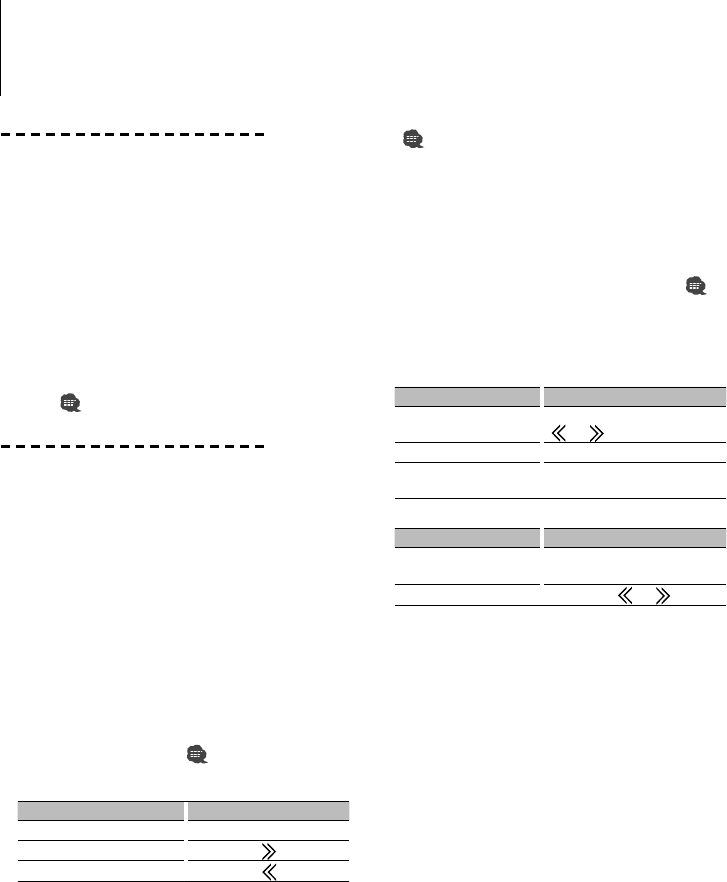
78 | KCA-BT300
Antes de usar
• Debe registrar el teléfono móvil antes de utilizarlo con
esta unidad. Para más detalles, consulte <Registro del
dispositivo Bluetooth> (página 88).
• Si ha registrado dos o más teléfonos móviles, debe
seleccionar uno de ellos. Para más detalles, consulte
<Selección del dispositivo Bluetooth que desea
conectar> (página 90).
• Para utilizar la agenda, debe descargarse con antelación
en esta unidad. Para obtener detalles, consulte
<Descarga de la agenda> (página 89).
• Para el método de funcionamiento en el modo de
Menú, consulte el manual de instrucciones para la
unidad de control.
• Para más información concerniente a la función con la
marca [ ], consulte <Nota de función> (página 98).
Realizar una llamada
Método de marcación
1. Ingrese al modo del método de marcación
Pulse el botón [MUTE] durante al menos 1 segundo.
2. Entre en el modo de selección del método de
marcación
Gire el mando [VOL] para seleccionar "Dialing Mode" y,
a continuación, pulse el botón [ENTER].
3. Seleccione un método de marcación
Pulse el botón [ENTER].
"DIAL" » "INITIAL" » "P-BOOK" » "OUT-CALL" » "INCALL"
» "MIS-CALL"
3 Los métodos de funcionamiento en los modos
arriba mencionados se describen abajo.
4. Salga del modo de selección del método de
marcación
Pulse el botón [MUTE] durante al menos 1 segundo.
3 Marcación de un número ( )
2-1. Seleccione la visualización "DIAL".
2-2. Introduzca un número de teléfono
Tipo de operación Operación
Seleccione los caracteres. Gire el mando [VOL].
Determine los caracteres. Pulse el botón [ ].
Borre los caracteres. Pulse el botón [ ].
2-3. Realice una llamada
Pulse el botón [ENTER] del controlador remoto.
☞ Puede introducir un máximo de 32 dígitos.
3 Marcación rápida (Marcación preestablecida)
2-1. Seleccione la visualización "DIAL".
2-2. Seleccione el número de marcación preestablecido
Pulse el botón [1] – [6].
2-3. Realice una llamada
Pulse el botón [ENTER] durante al menos 1 segundo.
☞ Necesita registrar el número de marcación
preestablecido. (página 79)
Funcionamiento básico para llamar por teléfono con manos libres
(Modelo-C)
3 Llamar a un número en el registro de llamadas
( )
2-1. Seleccione la visualización "OUT-CALL" (llamada
saliente), "INCALL" (llamada entrante), o "MIS-CALL"
(llamada perdida).
2-2. Seleccione un nombre o número de teléfono
Pulse el botón [u] o [d].
2-3. Realice una llamada
Pulse el botón [38] por al menos 1 segundo.
3 Llamar a un número en la agenda telefónica ( )
2-1. Seleccione la visualización "INITIAL", proceda al paso
2-2.
Seleccione la visualización "P-BOOK", proceda al paso
2-3.
2-2. Seleccione la inicial para realizar la búsqueda
Tipo de operación Operación
Desplazarse al siguiente
carácter.
Gire el mando [VOL] o pulse el botón
[ ] o [ ].
Desplazarse a la siguiente fila. Pulse el botón [u] o [d].
Determine la inicial
seleccionada.
Pulse el botón [ENTER] durante al
menos 1 segundo.
2-3. Seleccione el nombre
Tipo de operación Operación
Pase al siguiente número de
teléfono.
Gire el mando [VOL] o pulse el botón
[u] o [d].
Pase al siguiente nombre. Pulse el botón [ ] o [ ].
2-4. Realice una llamada
Pulse el botón [ENTER] durante al menos 1 segundo.
Realización de una llamada con marcación por voz
1. Entre en el modo de menú de Bluetooth
Pulse el botón [MUTE] durante al menos 1 segundo.
2. Entre en el modo de llamada por marcación de voz
Gire el mando [VOL] para seleccionar "Voice
Recognize".
3. Pulse el botón [ENTER].
Se visualiza "Ready?".
4. Pulse el botón [ENTER].
Se visualiza "PB Name?".
Al escucharse un pitido, articule el nombre dentro de
2 segundos.
5. Pulse el botón [1].
Se visualiza "PN Type?".
Al escucharse un pitido, articule la categoría dentro de
2 segundos.
6. Realice una llamada
Este paso es el mismo que el paso 3 del procedimiento
establecido en <Llamar a un número en la agenda
telefónica>. Puede realizar una llamada o seleccionar
una categoría.
☞ Si no se puede reconocer su voz, se muestra un mensaje.
Al pulsar el botón [ENTER] le permite volver a intentar la
entrada de voz. Consulte la página 102.
☞ Tanto el nombre como la categoría requieren el registro
de una etiqueta de voz. Consulte la página 91.
B64-4713-00_10_KCA-BT300_KE.indb 78B64-4713-00_10_KCA-BT300_KE.indb 78 10/03/12 14:5110/03/12 14:51
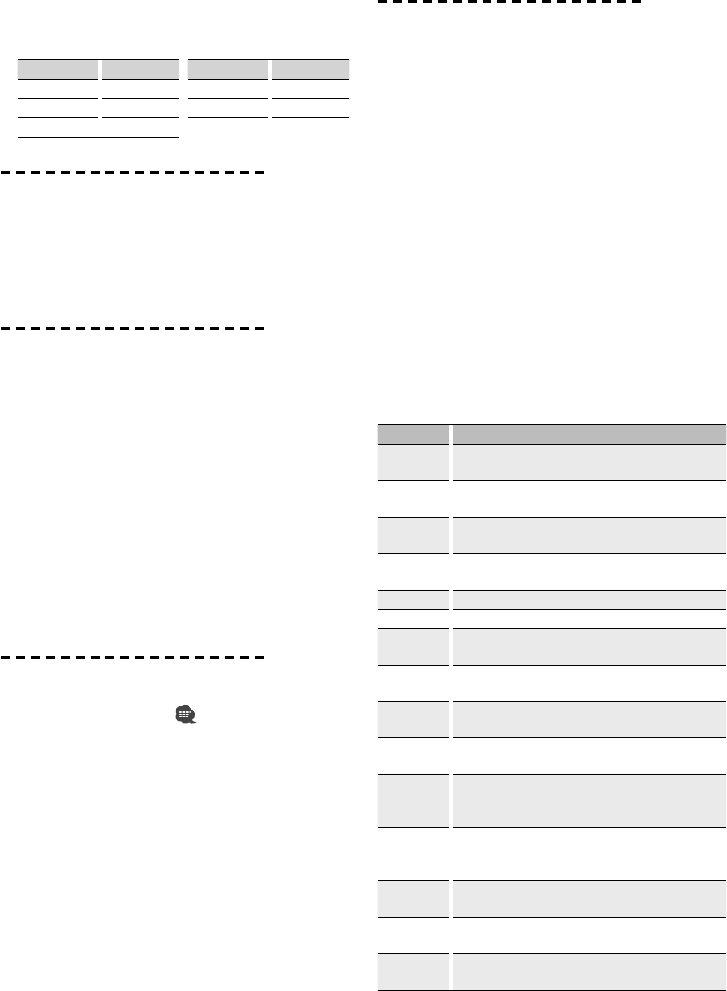
Español | 79
☞ El sonido de audio no se emite durante el
reconocimiento de voz.
Visualización del tipo de número telefónico
(categoría)
Visualización Descripción Visualización Descripción
"GE"/ "GENERAL" General "OF"/ "OFFICE" Oficina
"HM"/ "HOME" Casa "OT"/ "OTHER" Otro
"MO"/ "MOBILE" Móvil
Recepción de una llamada
Respuesta a una llamada
Pulse el botón [ENTER] o uno de los botones [1] – [6].
☞ Si introduce un disco como un CD su llamada se
desconectará.
Rechazo de una llamada entrante
Pulse el botón [TUN], [iPod] o [AUX].
Llamada en espera
Contestar otra llamada entrante suspendiendo la
llamada actual
1. Pulse el botón [ENTER].
2. Gire el mando [VOL]. Seleccione la visualización
"ANSWER".
3. Pulse el botón [ENTER].
Contestar otra llamada entrante después de nalizar
la llamada actual
Pulse el botón [TUN], [iPod] o [AUX].
Contestar una llamada en espera después de
nalizar la llamada actual
Pulse el botón [TUN], [iPod] o [AUX].
Alternar entre la llamada actual y la llamada en
espera
Pulse el botón [ENTER].
Durante una llamada
Desconexión de una llamada
Pulse el botón [TUN], [iPod] o [AUX].
Cambio al modo privado ( )
Pulse el botón [1].
Al pulsarse cambia entre una charla privada ("PV TALK") o
una llamada con manos libres ("HF TALK").
Ajuste del volumen de voz durante una llamada
Gire el mando [VOL].
Otras funciones
Borrado del mensaje de desconexión
Pulse el botón [MUTE] durante al menos 1 segundo.
Cambio entre modos de visualización
Pulse el botón [DISP]. Puede alternar entre la agenda y la
lista de llamadas.
Registro de la lista de números de marcación
preajustada
1. Introduzca el número de teléfono que desea
registrar
Introduzca el número de teléfono en relación con lo
siguiente:
Marcación de un número/ Llamar a un número en
el registro de llamadas/ Llamar a un número en la
agenda telefónica
2. Seleccione el botón que desea registrar
Pulse el botón [1] – [6] durante al menos 2 segundos.
3. Salga del modo de selección del método de
marcación
Pulse el botón [MUTE] durante al menos 1 segundo.
Ajuste de elementos en el modo de menú
* Para entrar en el modo de Menú, pulse el botón [ENTER]
durante al menos 1 segundo.
Visualización Vista general de ajustes
"DVC REG"* Registro de un dispositivo Bluetooth (conexión).
Consulte la página 88.
"SDVC SEL"* Permite el registro de un dispositivo especial que no puede
registrarse normalmente. Consulte la página 89.
"PHN-SEL"* Selecciona un sujeto del teléfono móvil en una conexión de
manos libres. Consulte la página 90.
"AUD-SEL"* Selecciona el reproductor de audio que se va a conectar.
Consulte la página 90.
"SMS DL"* Descarga un mensaje corto. Consulte la página 92.
"IN BOX"* Visualiza el mensaje corto recibido. Consulte la página 92.
"VOICE TAG"* Registra la etiqueta de voz para "reconocimiento de voz".
Consulte la página 91.
"V-RECOG"* Realización de una llamada por marcación con voz.
Consulte la página 78.
"DVC-DEL"* Cancelación del registro del dispositivo Bluetooth. Consulte
la página 90.
"D-STATUS" "HF-CON"/ "AD-CON"/ "BAT"/ "SGNL": Visualiza el estado
del dispositivo Bluetooth. Consulte la página 98.
"PIN EDIT"* Especifica el código PIN que se requiere al registrar esta
unidad utilizando el dispositivo Bluetooth. Consulte la
página 89.
"ANS" "OFF"/ "0" – "99": Contestar una llamada automáticamente
después de un lapso de tiempo preestablecido para la
contestación automática. Consulte la página 98.
"SPK" "FRT"/ "F-R"/ "F-L": Especifica el altavoz de emisión de voz.
Consulte la página 98.
"C-BP" "ON"/ "OFF": Emite un pitido proveniente del altavoz al
entrar una llamada. Consulte la página 98.
"BT F/W
Update"
Para saber como actualizar el firmware, visite nuestro sitio
web. http://www.kenwood.com/cs/ce/bt/
B64-4713-00_10_KCA-BT300_KE.indb 79B64-4713-00_10_KCA-BT300_KE.indb 79 10/03/12 14:5110/03/12 14:51
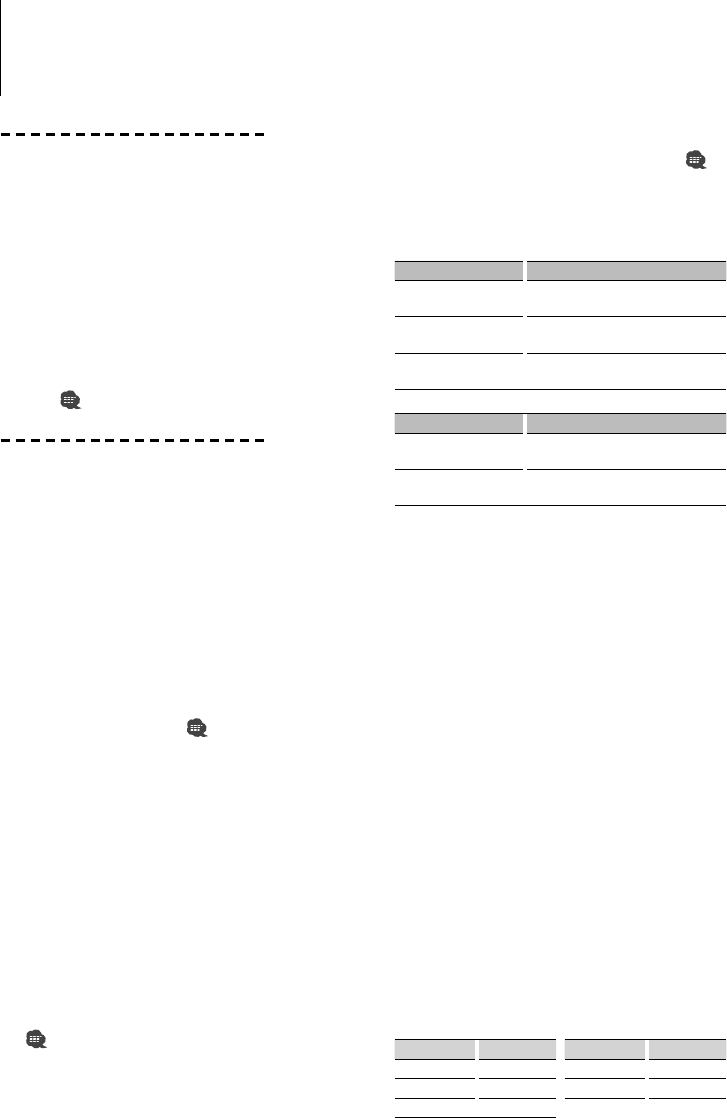
80 | KCA-BT300
Antes de usar
• Debe registrar el teléfono móvil antes de utilizarlo con
esta unidad. Para más detalles, consulte <Registro del
dispositivo Bluetooth> (página 88).
• Si ha registrado dos o más teléfonos móviles, debe
seleccionar uno de ellos. Para más detalles, consulte
<Selección del dispositivo Bluetooth que desea
conectar> (página 90).
• Para utilizar la agenda, debe descargarse con antelación
en esta unidad. Para obtener detalles, consulte
<Descarga de la agenda> (página 89).
• Para el método de funcionamiento en el modo de
Menú, consulte el manual de instrucciones para la
unidad de control.
• Para más información concerniente a la función con la
marca [ ], consulte <Nota de función> (página 98).
Realizar una llamada
Método de marcación
1. Seleccione el elemento del método de marcación
durante el modo de menú
Seleccione la visualización "DIALING MODE"/
"D.MODE".
2. Seleccione un método de marcación
Pulse el botón [38].
• "NUMBER DIAL" » "PHONE BOOK1" » "PHONE BOOK2"
» "OUT-CALL" » "IN-CALL" » "MISSED CALLS"
• "N-DIAL" » "PH-BOOK1" » "PH-BOOK2" » "OUT-CALL" »
"IN-CALL" » "MIS-CALL"
3 Los métodos de funcionamiento en los modos
arriba mencionados se describen abajo.
3. Salga del modo de selección del método de marcación
Salga del modo de menú.
3 Marcación de un número ( )
2-1. Seleccione la visualización "NUMBER DIAL"/ "N-DIAL".
2-2. Introduzca un número de teléfono
Pulse el número ([1] – [0]), el botón #([FM]), *([AM]) o
+([¢]) en el mando a distancia.
2-3. Realice una llamada
Pulse el botón [DIRECT] en el mando a distancia.
☞ Puede introducir un máximo de 32 dígitos.
3 Marcación rápida (Marcación preestablecida)
2-1. Seleccione la visualización "NUMBER DIAL"/ "N-DIAL".
2-2. Seleccione el número de marcación preestablecido
Pulse el botón [1] – [6].
2-3. Realice una llamada
Pulse el botón [38] por al menos 1 segundo.
☞ Necesita registrar el número de marcación
preestablecido. (página 81)
3 Llamar a un número en el registro de llamadas
( )
2-1. Seleccione la visualización "OUT-CALL" (llamadas
salientes), "IN-CALL" (llamadas entrantes), o "MISSED
CALLS"/"MIS-CALL" (llamadas perdidas).
2-2. Seleccione un nombre o número de teléfono
Pulse el mando de control hacia arriba o hacia abajo.
Funcionamiento básico para llamar por teléfono con manos libres
(Modelo-D)
2-3. Realice una llamada
Pulse el botón [38] por al menos 1 segundo.
3 Llamar a un número en la agenda telefónica ( )
2-1. Seleccione la visualización "PHONE BOOK1"/"PH-
BOOK1", proceda al paso 2-2.
Seleccione la visualización "PHONE BOOK2"/"PH-
BOOK2", proceda al paso 2-3.
2-2. Seleccione la inicial para realizar la búsqueda
Tipo de operación Operación
Desplazarse al siguiente
carácter.
Pulse el mando de control hacia la derecha
o la izquierda.
Desplazarse a la siguiente
fila.
Pulse el mando de control hacia arriba o
hacia abajo.
Determine la inicial
seleccionada.
Pulse el botón [38] por al menos 1
segundo.
2-3. Seleccione el nombre
Tipo de operación Operación
Pase al siguiente número
de teléfono.
Pulse el mando de control hacia arriba o
hacia abajo.
Pase al siguiente nombre. Pulse el mando de control hacia la derecha
o la izquierda.
2-4. Realice una llamada
Pulse el botón [38] por al menos 1 segundo.
Realización de una llamada con marcación por voz
1. Seleccione el elemento de reconocimiento de voz
cuando se encuentre en el modo de menú
Seleccione la visualización "VOICE RECOG"/ "V-RECOG".
2. Pulse el botón [38] por al menos 1 segundo.
Seleccione la visualización "V-RECOG READY"/ "VR
READY".
3. Pulse el botón [38].
Se visualiza "PB NAME".
Al escucharse un pitido, articule el nombre dentro de
2 segundos.
4. Se muestra "PB TYPE"/ "PN type".
Al escucharse un pitido, articule la categoría dentro de
2 segundos.
5. Realice una llamada
Este paso es el mismo que el paso 3 del procedimiento
establecido en <Llamar a un número en la agenda
telefónica>. Puede realizar una llamada o seleccionar
una categoría.
☞ Si no se puede reconocer su voz, se muestra un mensaje.
Al pulsar el botón [38] le permite volver a intentar la
entrada de voz. Consulte la página 102.
☞ Tanto el nombre como la categoría requieren el registro
de una etiqueta de voz. Consulte la página 91.
☞ El sonido de audio no se emite durante el
reconocimiento de voz.
Visualización del tipo de número telefónico (categoría)
Visualización Descripción Visualización Descripción
"GE"/ "GENERAL" General "OF"/ "OFFICE" Oficina
"HM"/ "HOME" Casa "OT"/ "OTHER" Otro
"MO"/ "MOBILE" Móvil
B64-4713-00_10_KCA-BT300_KE.indb 80B64-4713-00_10_KCA-BT300_KE.indb 80 10/03/12 14:5110/03/12 14:51
Español | 81
Recepción de una llamada
Respuesta a una llamada
Modelo-D-1: Pulse el mando de control o uno de los
botones [1] – [6]
Modelo-D-2: Pulse el botón [VOL] o uno de los botones
[1] – [6]
☞ Si introduce un disco como un CD su llamada se
desconectará.
Rechazo de una llamada entrante
Pulse el botón [SRC].
Llamada en espera
Contestar otra llamada entrante suspendiendo la
llamada actual
1. Modelo-D-1: Pulse el mando de control.
Modelo-D-2: Pulse el mando [VOL].
2. Pulse el mando de control hacia arriba o hacia abajo.
Seleccione la visualización "ANSWER".
3. Modelo-D-1: Pulse el mando de control.
Modelo-D-2: Pulse el mando [VOL].
Contestar otra llamada entrante después de nalizar
la llamada actual
Pulse el botón [SRC].
Continuación de la llamada actual
1. Modelo-D-1: Pulse el mando de control.
Modelo-D-2: Pulse el mando [VOL].
2. Pulse el mando de control hacia arriba o hacia abajo.
Seleccione la visualización "REJECT".
3. Modelo-D-1: Pulse el mando de control.
Modelo-D-2: Pulse el mando [VOL].
Contestar una llamada en espera después de
nalizar la llamada actual
Pulse el botón [AUTO]/ [TI] por al menos 1 segundo.
Alternar entre la llamada actual y la llamada en
espera
Modelo-D-1: Pulse el mando de control.
Modelo-D-2: Pulse el mando [VOL].
Durante una llamada
Desconexión de una llamada
Pulse el botón [SRC].
Cambio al modo privado ( )
Pulse el botón [38].
Al pulsarse cambia entre una charla privada ("PV TALK") o
una llamada con manos libres ("HF TALK").
Ajuste del volumen de voz durante una llamada
Modelo-D-1: Gire el mando de control.
Modelo-D-2: Gire el mando [VOL].
Otras funciones
Borrado del mensaje de desconexión
Pulse el botón [AUTO]/ [TI] por al menos 1 segundo.
Cambio entre modos de visualización
Pulse el botón [AUTO]/ [TI]. Puede alternar entre la
agenda y la lista de llamadas.
Registro de la lista de números de marcación
preajustada
1. Introduzca el número de teléfono que desea
registrar
Introduzca el número de teléfono en relación con lo
siguiente:
Marcación de un número/ Llamar a un número en
el registro de llamadas/ Llamar a un número en la
agenda telefónica
2. Seleccione el botón que desea registrar
Pulse el botón [1] – [6] durante al menos 2 segundos.
3. Salga del modo de selección del método de
marcación
Pulse el botón [MENU].
Ajuste de elementos en el modo de menú
* Para ingresar el modo de menú, pulse el mando de
control por al menos 1 segundo.
Visualización Vista general de ajustes
"DVC REGIST"*/
"DVC REG"*
Registro de un dispositivo Bluetooth (conexión).
Consulte la página 88.
"S-DVC SELECT"*/
"S-DVC SEL"*
Permite el registro de un dispositivo especial que no
puede registrarse normalmente. Consulte la página 89.
"PHONE SEL"*/
"PHN-SEL"*
Selecciona un sujeto del teléfono móvil en una conexión
de manos libres. Consulte la página 90.
"DIALING MODE"*/
"D.MODE"*
Selecciona un método de marcación. Consulte la
página 80.
"AUDIO SEL"*/
"AUD-SEL"*
Selecciona el reproductor de audio que se va a conectar.
Consulte la página 90.
"SMS DOWNLOAD"*/
"SMS DL"*
Descarga un mensaje corto. Consulte la página 92.
"SMS INBOX"*/
"INBOX"*
Visualiza el mensaje corto recibido. Consulte la página 92.
"VOICE TAG"*/
"VOICETAG"*
Registra la etiqueta de voz para "reconocimiento de voz".
Consulte la página 91.
"VOICE RECOG"*/
"V-RECOG"*
Realización de una llamada por marcación con voz.
Consulte la página 80.
"DEVICE DEL"*/
"DVC-DEL"*
Cancelación del registro del dispositivo Bluetooth.
Consulte la página 90.
"DVC-STATUS"/
"D-STATUS"
"HF-CONNECT"/ "AD-CONNECT"/ "BAT"/ "SGNL":
Visualiza el estado del dispositivo Bluetooth.
Consulte la página 98.
"PIN EDIT"* Especifica el código PIN que se requiere al registrar esta
unidad utilizando el dispositivo Bluetooth. Consulte la
página 89.
"AUTO ANS"/
"ANS"
"OFF"/ "0" – "99": Contestar una llamada
automáticamente después de un lapso de tiempo
preestablecido para la contestación automática.
Consulte la página 98.
"SP SEL"/
"SPK"
"FRT"/ "F-R"/ "F-L": Especifica el altavoz de emisión de
voz. Consulte la página 98.
"CALL BEEP"/ "C-BP" "ON"/ "OFF": Emite un pitido proveniente del altavoz al
entrar una llamada. Consulte la página 98.
B64-4713-00_10_KCA-BT300_KE.indb 81B64-4713-00_10_KCA-BT300_KE.indb 81 10/03/12 14:5110/03/12 14:51
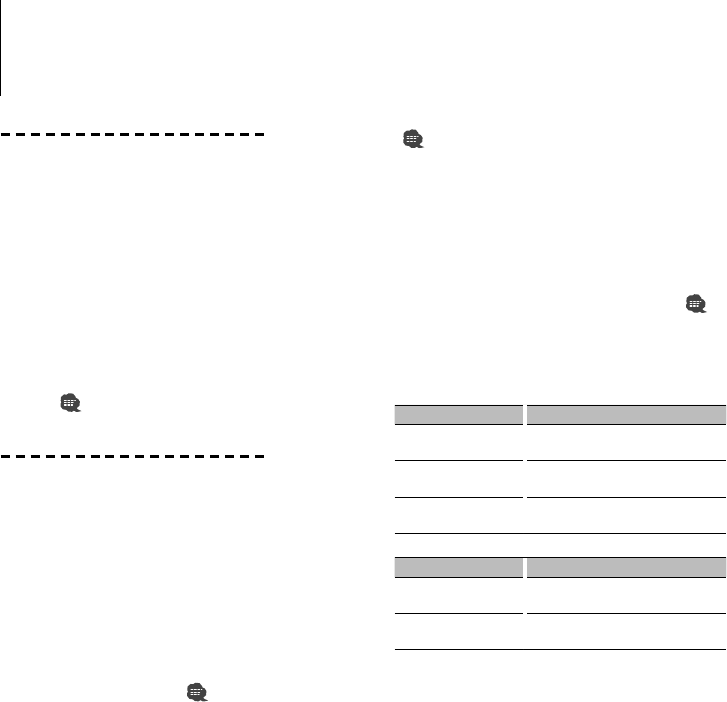
82 | KCA-BT300
Antes de usar
• Debe registrar el teléfono móvil antes de utilizarlo con
esta unidad. Para más detalles, consulte <Registro del
dispositivo Bluetooth> (página 88).
• Si ha registrado dos o más teléfonos móviles, debe
seleccionar uno de ellos. Para más detalles, consulte
<Selección del dispositivo Bluetooth que desea
conectar> (página 90).
• Para utilizar la agenda, debe descargarse con antelación
en esta unidad. Para obtener detalles, consulte
<Descarga de la agenda> (página 89).
• Para el método de funcionamiento en el control de
función, consulte el manual de instrucciones para la
unidad de control.
• Para más información concerniente a la función con la
marca [ ], consulte <Nota de función> (página 98).
Realizar una llamada
Método de marcación
1. Ingrese al modo del método de marcación
Pulse el botón [ATT] durante al menos 1 segundo.
2. Seleccione un método de marcación
Presione el mando de control ([38]).
"DIAL" » "INITIAL" » "P-BOOK" » "OUT-CALL" » "IN-CALL"
» "MIS-CALL"
3 Los métodos de funcionamiento en los modos
arriba mencionados se describen abajo.
3. Salga del modo de selección del método de
marcación
Pulse el botón [ATT] durante al menos 1 segundo.
3 Marcación de un número ( )
2-1. Seleccione la visualización "DIAL".
2-2. Introduzca un número de teléfono
Pulse el número ([1] – [0]), el botón #([FM]), *([AM]) o
+([¢]) en el mando a distancia.
2-3. Realice una llamada
Pulse el botón [DIRECT] en el mando a distancia.
☞ Puede introducir un máximo de 32 dígitos.
3 Marcación rápida (Marcación preestablecida)
2-1. Seleccione la visualización "DIAL".
2-2. Seleccione el número de marcación preestablecido
Modelo-E-1:
Pulse el botón [1] – [6].
Modelo-E-2:
2-1. Pulse el botón [FNC].
2-2. Seleccione el número que desea recuperar
girando el mando de control.
2-3. Pulse el mando de control.
2-3. Realice una llamada
Presione el mando de control ([38]) durante al
menos 1 segundo.
☞ Necesita registrar el número de marcación
preestablecido. (página 83)
Funcionamiento básico para llamar por teléfono con manos libres
(Modelo-E)
3 Llamar a un número en el registro de llamadas
( )
2-1. Seleccione la visualización "OUT-CALL" (llamada
saliente), "IN-CALL" (llamada entrante), o "MIS-CALL"
(llamada perdida).
2-2. Seleccione un nombre o número de teléfono
Pulse el mando de control hacia arriba o hacia abajo.
2-3. Realice una llamada
Presione el mando de control ([38]) durante al
menos 1 segundo.
3 Llamar a un número en la agenda telefónica ( )
2-1. Seleccione la visualización "INITIAL", proceda al paso
2-2.
Seleccione la visualización "P-BOOK", proceda al paso
2-3.
2-2. Seleccione la inicial para realizar la búsqueda
Tipo de operación Operación
Desplazarse al siguiente
carácter.
Pulse el mando de control hacia la derecha
o la izquierda.
Desplazarse a la siguiente
fila.
Pulse el mando de control hacia arriba o
hacia abajo.
Determine la inicial
seleccionada.
Presione el mando de control ([38]).
2-3. Seleccione el nombre
Tipo de operación Operación
Pase al siguiente número
de teléfono.
Pulse el mando de control hacia arriba o
hacia abajo.
Pase al siguiente nombre. Pulse el mando de control hacia la derecha
o la izquierda.
2-4. Realice una llamada
Presione el mando de control ([38]) durante al
menos 1 segundo.
Realización de una llamada con marcación por voz
1. Seleccione el elemento de reconocimiento de voz
en control de función
Seleccione "BT" > "V-REC".
2. Presione el mando de control ([38]).
Se visualiza "PB Name?".
Al escucharse un pitido, articule el nombre dentro de
2 segundos.
3. Se visualiza "PN Type?".
Al escucharse un pitido, articule la categoría dentro de
2 segundos.
4. Realice una llamada
Este paso es el mismo que el paso 3 del procedimiento
establecido en <Llamar a un número en la agenda
telefónica>. Puede realizar una llamada o seleccionar
una categoría.
☞ Si no se puede reconocer su voz, se muestra un mensaje.
Al pulsar el botón [38] le permite volver a intentar la
entrada de voz. Consulte la página 102.
☞ Tanto el nombre como la categoría requieren el registro
de una etiqueta de voz. Consulte la página 91.
☞ El sonido de audio no se emite durante el
reconocimiento de voz.
B64-4713-00_10_KCA-BT300_KE.indb 82B64-4713-00_10_KCA-BT300_KE.indb 82 10/03/12 14:5110/03/12 14:51
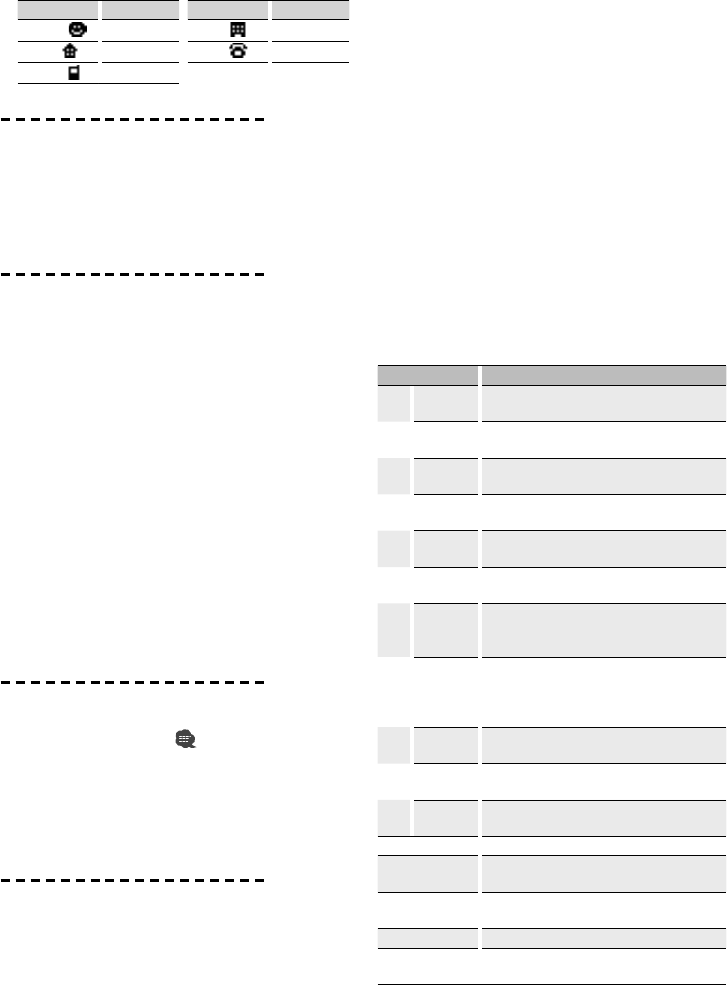
Español | 83
Visualización del tipo de número telefónico
(categoría)
Visualización Descripción Visualización Descripción
"General"/ General "Office"/ Oficina
"Home"/ Casa "Other"/ Otro
"Mobile"/ Móvil
Recepción de una llamada
Respuesta a una llamada
Pulse el botón [AUD] o uno de los botones [1] – [6].
☞ Si introduce un disco como un CD su llamada se
desconectará.
Rechazo de una llamada entrante
Pulse el botón [ATT] durante al menos 1 segundo.
Llamada en espera
Contestar otra llamada entrante suspendiendo la
llamada actual
1. Pulse el botón [AUD].
2. Pulse el mando de control hacia arriba o hacia abajo.
Seleccione la visualización "ANSWER".
3. Pulse el botón [AUD].
Contestar otra llamada entrante después de nalizar
la llamada actual
Pulse el botón [SRC].
Continuación de la llamada actual
1. Pulse el botón [AUD].
2. Pulse el mando de control hacia arriba o hacia abajo.
Seleccione la visualización "REJECT".
3. Pulse el botón [AUD].
Contestar una llamada en espera después de
nalizar la llamada actual
Pulse el botón [ATT] durante al menos 1 segundo.
Alternar entre la llamada actual y la llamada en espera
Pulse el botón [AUD].
Durante una llamada
Desconexión de una llamada
Pulse el botón [SRC].
Cambio al modo privado ( )
Presione el mando de control ([38]).
Al pulsarse cambia entre charla privada ("PRVT") o charla
con manos libres.
Ajuste del volumen de voz durante una llamada
Gire el mando [AUD].
Otras funciones
Borrado del mensaje de desconexión
Pulse el botón [ATT] durante al menos 1 segundo.
Cambio entre modos de visualización
Pulse el botón [AUTO]/ [TI]. Puede alternar entre la
agenda y la lista de llamadas.
Registro de la lista de números de marcación
preajustada
1. Introduzca el número de teléfono que desea registrar
Introduzca el número de teléfono en relación con lo
siguiente:
Marcación de un número/ Llamar a un número en
el registro de llamadas/ Llamar a un número en la
agenda telefónica
2. Seleccione el botón que desea registrar
Modelo-E-1:
Pulse el botón [1] – [6] durante al menos 2 segundos.
Modelo-E-2:
2-1. Pulse el botón [FNC].
2-2. Seleccione el número que desea memorizar
girando el mando de control.
2-3. Pulse el mando de control por al menos 1 segundo.
3. Salga del modo de selección del método de
marcación
Pulse el botón [ATT] durante al menos 1 segundo.
Ajuste de elementos en el control de función
* Para ingresar el modo de menú, pulse el mando de
control por al menos 1 segundo.
Elemento Vista general de ajustes
MENU "Device
Regist"*
Registro de un dispositivo Bluetooth (conexión).
Consulte la página 88.
"SPCL DVC
Select"*
Permite el registro de un dispositivo especial que no
puede registrarse normalmente. Consulte la página 89.
"Phone
Selection"*
Selecciona un sujeto del teléfono móvil en una
conexión de manos libres. Consulte la página 90.
"Audio
Selection"*
Selecciona el reproductor de audio que se va a
conectar. Consulte la página 90.
"Device
Delete"*
Cancelación del registro del dispositivo Bluetooth.
Consulte la página 90.
"BT DVC
Status"*
Visualiza el estado del dispositivo Bluetooth.
"PIN Code
Edit"*
Especifica el código PIN que se requiere al registrar
esta unidad utilizando el dispositivo Bluetooth.
Consulte la página 89.
"Auto
Answer"
"OFF"/ "0s" – "99s": Contestar una llamada
automáticamente después de un lapso de tiempo
preestablecido para la contestación automática.
Consulte la página 98.
"SP Select" "Front"/ "F-R"/ "F-L": Especifica el altavoz de emisión
de voz. Consulte la página 98.
"Call Beep" "ON"/ "OFF": Emite un pitido proveniente del altavoz
al entrar una llamada. Consulte la página 98.
"BT F/W
Update"
Para saber como actualizar el firmware, visite nuestro
sitio web. http://www.kenwood.com/cs/ce/bt/
BT > V-REC Realización de una llamada con marcación por voz
BT > VOICE > NAME Registra una etiqueta de nombre para el
reconocimiento de voz. Consulte la página 91.
BT > VOICE > TYPE Registra un tipo (categoría) de etiqueta de voz para el
reconocimiento de voz. Consulte la página 91.
BT > SMS > SMSDL Descarga un mensaje corto. Consulte la página 92.
BT > SMS > INBOX Visualiza el mensaje corto recibido. Consulte la
página 92.
B64-4713-00_10_KCA-BT300_KE.indb 83B64-4713-00_10_KCA-BT300_KE.indb 83 10/03/12 14:5110/03/12 14:51
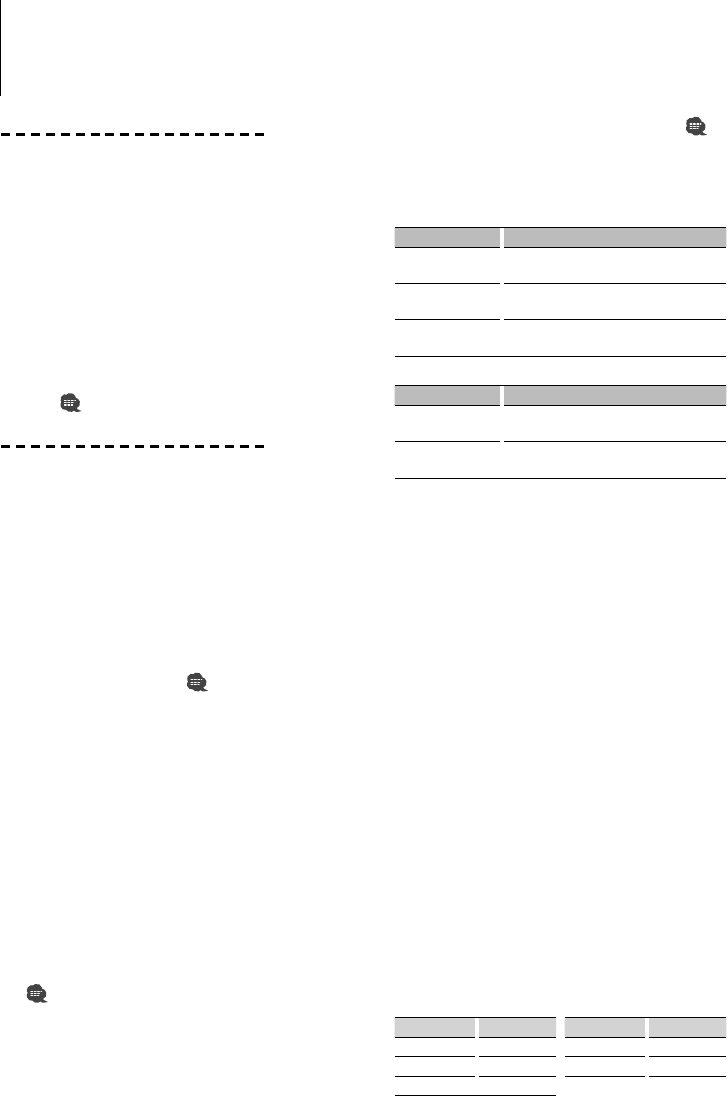
84 | KCA-BT300
Antes de usar
• Debe registrar el teléfono móvil antes de utilizarlo con
esta unidad. Para más detalles, consulte <Registro del
dispositivo Bluetooth> (página 88).
• Si ha registrado dos o más teléfonos móviles, debe
seleccionar uno de ellos. Para más detalles, consulte
<Selección del dispositivo Bluetooth que desea
conectar> (página 90).
• Para utilizar la agenda, debe descargarse con antelación
en esta unidad. Para obtener detalles, consulte
<Descarga de la agenda> (página 89).
• Para el método de funcionamiento en el modo de
Menú, consulte el manual de instrucciones para la
unidad de control.
• Para más información concerniente a la función con la
marca [ ], consulte <Nota de función> (página 98).
Realizar una llamada
Método de marcación
1. Ingrese al modo del método de marcación
Pulse el botón [ATT] durante al menos 1 segundo.
2. Seleccione un método de marcación
Pulse el botón [38].
"N-Dial" » "PH-Book1" » "PH-Book2" » "Out-Call" » "In-
Call" » "MIS-Call"
3 Los métodos de funcionamiento en los modos
arriba mencionados se describen abajo.
3. Salga del modo de selección del método de
marcación
Pulse el botón [ATT] durante al menos 1 segundo.
3 Marcación de un número ( )
2-1. Seleccione la visualización "N-Dial".
2-2. Introduzca un número de teléfono
Pulse el número ([1] – [0]), el botón #([FM]), *([AM]) o
+([¢]) en el mando a distancia.
2-3. Realice una llamada
Pulse el botón [DIRECT] en el mando a distancia.
☞ Puede introducir un máximo de 32 dígitos.
3 Marcación rápida (Marcación preestablecida)
2-1. Seleccione la visualización "N-Dial".
2-2. Seleccione el número de marcación preestablecido
Pulse el botón [1] – [6].
2-3. Realice una llamada
Pulse el botón [38] por al menos 1 segundo.
☞ Necesita registrar el número de marcación
preestablecido. (página 85)
3 Llamar a un número en el registro de llamadas
( )
2-1. Seleccione la visualización "Out-Call" (llamada
saliente), "In-Call" (llamada entrante), o "MIS-Call"
(llamada perdida).
2-2. Seleccione un nombre o número de teléfono
Pulse el mando de control hacia arriba o hacia abajo.
2-3. Realice una llamada
Pulse el botón [38] por al menos 1 segundo.
Funcionamiento básico para llamar por teléfono con manos libres
(Modelo-F)
3 Llamar a un número en la agenda telefónica ( )
2-1. Seleccione la visualización "PH-Book1", proceda al
paso 2-2.
Seleccione la visualización "PH-Book2", proceda al
paso 2-3.
2-2. Seleccione la inicial para realizar la búsqueda
Tipo de operación Operación
Desplazarse al
siguiente carácter.
Pulse el mando de control hacia la derecha o
la izquierda.
Desplazarse a la
siguiente fila.
Pulse el mando de control hacia arriba o hacia
abajo.
Determine la inicial
seleccionada.
Pulse el botón [38] por al menos 1 segundo.
2-3. Seleccione el nombre
Tipo de operación Operación
Pase al siguiente
número de teléfono.
Pulse el mando de control hacia arriba o hacia
abajo.
Pase al siguiente
nombre.
Pulse el mando de control hacia la derecha o
la izquierda.
2-4. Realice una llamada
Pulse el botón [38] por al menos 1 segundo.
Realización de una llamada con marcación por voz
1. Seleccione el elemento de reconocimiento de voz
cuando se encuentre en el modo de menú
Seleccione la visualización "V-RECOG".
2. Pulse el botón [38] por al menos 1 segundo.
Se visualiza "VR Ready".
3. Pulse el botón [38].
Se visualiza "PB NAME?".
Al escucharse un pitido, articule el nombre dentro de
2 segundos.
4. Se visualiza "PB TYPE?".
Al escucharse un pitido, articule la categoría dentro de
2 segundos.
5. Realice una llamada
Este paso es el mismo que el paso 3 del procedimiento
establecido en <Llamar a un número en la agenda
telefónica>. Puede realizar una llamada o seleccionar
una categoría.
☞ Si no se puede reconocer su voz, se muestra un mensaje.
Al pulsar el botón [38] le permite volver a intentar la
entrada de voz. Consulte la página 102.
☞ Tanto el nombre como la categoría requieren el registro
de una etiqueta de voz. Consulte la página 91.
☞ El sonido de audio no se emite durante el
reconocimiento de voz.
Visualización del tipo de número telefónico
(categoría)
Visualización Descripción Visualización Descripción
"GE"/ "GENERAL" General "OF"/ "OFFICE" Oficina
"HM"/ "HOME" Casa "OT"/ "OTHER" Otro
"MO"/ "MOBILE" Móvil
B64-4713-00_10_KCA-BT300_KE.indb 84B64-4713-00_10_KCA-BT300_KE.indb 84 10/03/12 14:5110/03/12 14:51
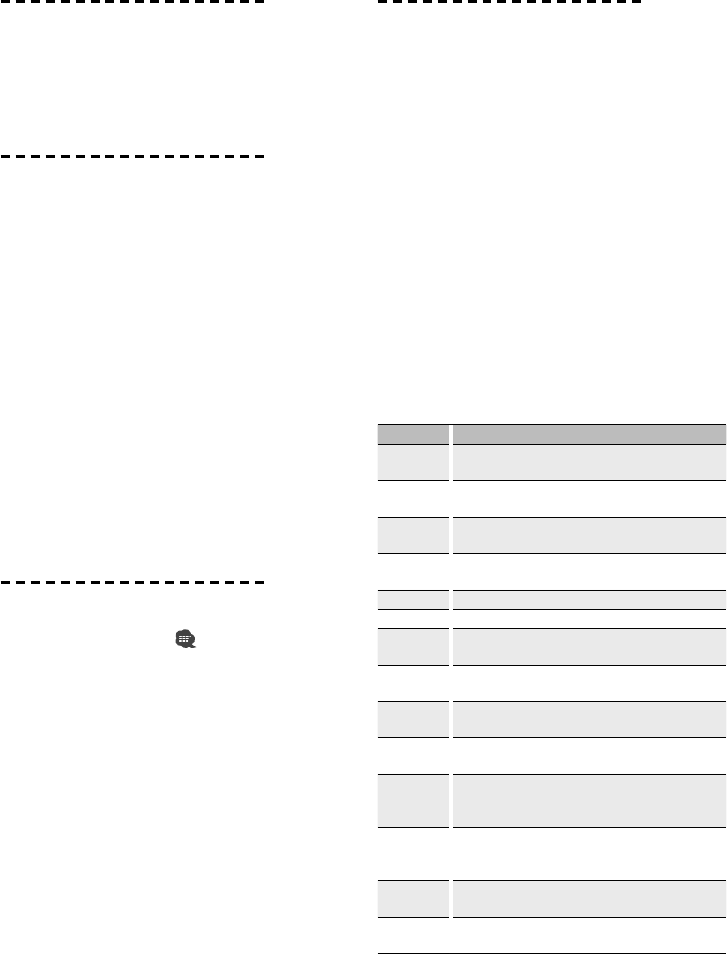
Español | 85
Recepción de una llamada
Respuesta a una llamada
Pulse el mando de control o uno de los botones [1] – [6].
☞ Si introduce un disco como un CD su llamada se
desconectará.
Rechazo de una llamada entrante
Pulse el botón [SRC].
Llamada en espera
Contestar otra llamada entrante suspendiendo la
llamada actual
1. Pulse el mando de control.
2. Pulse el mando de control hacia arriba o hacia abajo.
Seleccione la visualización "ANSWER".
3. Pulse el mando de control.
Contestar otra llamada entrante después de nalizar
la llamada actual
Pulse el botón [SRC].
Continuación de la llamada actual
1. Pulse el mando de control.
2. Pulse el mando de control hacia arriba o hacia abajo.
Seleccione la visualización "REJECT".
3. Pulse el mando de control por al menos 1 segundo.
Contestar una llamada en espera después de
nalizar la llamada actual
Pulse el botón [ATT] durante al menos 1 segundo.
Alternar entre la llamada actual y la llamada en
espera
Pulse el mando de control.
Durante una llamada
Desconexión de una llamada
Pulse el botón [SRC].
Cambio al modo privado ( )
Pulse el botón [38].
Al pulsarse cambia entre una charla privada ("PV TALK") o
una llamada con manos libres ("HF TALK").
Ajuste del volumen de voz durante una llamada
Gire el mando de control.
Otras funciones
Borrado del mensaje de desconexión
Pulse el botón [ATT] durante al menos 1 segundo.
Cambio entre modos de visualización
Pulse el botón [SE]. Puede alternar entre la agenda y la
lista de llamadas.
Registro de la lista de números de marcación
preajustada
1. Introduzca el número de teléfono que desea
registrar
Introduzca el número de teléfono en relación con lo
siguiente:
Marcación de un número/ Llamar a un número en
el registro de llamadas/ Llamar a un número en la
agenda telefónica
2. Seleccione el botón que desea registrar
Pulse el botón [1] – [6] durante al menos 2 segundos.
3. Salga del modo de selección del método de
marcación
Pulse el botón [ATT] durante al menos 1 segundo.
Ajuste de elementos en el modo de menú
* Para ingresar el modo de menú, pulse el mando de
control por al menos 1 segundo.
Visualización Vista general de ajustes
"DVC REG"* Registro de un dispositivo Bluetooth (conexión). Consulte
la página 88.
"SDVC SEL"* Permite el registro de un dispositivo especial que no puede
registrarse normalmente. Consulte la página 89.
"PHN-SEL"* Selecciona un sujeto del teléfono móvil en una conexión de
manos libres. Consulte la página 90.
"AUD-SEL"* Selecciona el reproductor de audio que se va a conectar.
Consulte la página 90.
"SMS DL"* Descarga un mensaje corto. Consulte la página 92.
"IN BOX"* Visualiza el mensaje corto recibido. Consulte la página 92.
"VOICE TAG"* Registra la etiqueta de voz para "reconocimiento de voz".
Consulte la página 91.
"V-RECOG"* Realización de una llamada por marcación con voz. Consulte
la página 84.
"DVC-DEL"* Cancelación del registro del dispositivo Bluetooth. Consulte
la página 90.
"D-STATUS" "HF-CON"/ "AD-CON"/ "BAT"/ "SGNL": Visualiza el estado
del dispositivo Bluetooth. Consulte la página 98.
"PIN EDIT"* Especifica el código PIN que se requiere al registrar esta
unidad utilizando el dispositivo Bluetooth. Consulte la
página 89.
"ANS" "OFF"/ "0" – "99": Contestar una llamada automáticamente
después de un lapso de tiempo preestablecido para la
contestación automática. Consulte la página 98.
"SPK" "FRT"/ "F-R"/ "F-L": Especifica el altavoz de emisión de voz.
Consulte la página 98.
"C-BP" "ON"/ "OFF": Emite un pitido proveniente del altavoz al
entrar una llamada. Consulte la página 98.
B64-4713-00_10_KCA-BT300_KE.indb 85B64-4713-00_10_KCA-BT300_KE.indb 85 10/03/12 14:5110/03/12 14:51
86 | KCA-BT300
Antes de usar
• Debe registrar el teléfono móvil antes de utilizarlo con
esta unidad. Para más detalles, consulte <Registro del
dispositivo Bluetooth> (página 88).
• Si ha registrado dos o más teléfonos móviles, debe
seleccionar uno de ellos. Para más detalles, consulte
<Selección del dispositivo Bluetooth que desea
conectar> (página 90).
• Para utilizar la agenda, debe descargarse con antelación
en esta unidad. Para obtener detalles, consulte
<Descarga de la agenda> (página 89).
• Para el método de funcionamiento en el modo de
Menú, consulte el manual de instrucciones para la
unidad de control.
• Para más información concerniente a la función con la
marca [ ], consulte <Nota de función> (página 98).
Realizar una llamada
Método de marcación
1. Ingrese al modo del método de marcación
Modelo-G-1, 2, 3:
Pulse el botón [ATT] durante al menos 1 segundo.
Modelo-G-4:
Seleccione "D.MODE" en el modo de menú.
2. Seleccione un método de marcación
Modelo-G-1, 4:
Pulse el mando de control (botón [38]).
"N-DIAL" » "PH-BOOK1" » "PH-BOOK2" » "OUT-CALL" »
"IN-CALL"
Modelo-G-2:
Presione el mando de control ([38]).
"DIAL" » "INITIAL" » "PHONE BOOK"/ "PH.BOOK" » "OUT-
CALL" » "IN-CALL"
Modelo-G-3:
2-1-1. Pulse el botón [NEXT].
2-1-2. Pulse el botón [1] ("DIAL"), [2] ("PHBK"), [3]
("OUT-C"), o [4] ("IN-C").
Al pulsar el botón [2] ("PHBK") cambia entre los
distintos métodos de búsqueda de la agenda
telefónica.
3 Los métodos de funcionamiento en los modos
arriba mencionados se describen abajo.
3. Salga del modo de selección del método de
marcación
Modelo-G-1, 2, 3:
Pulse el botón [ATT] durante al menos 1 segundo.
Modelo-G-4:
Salga del modo de menú.
3 Marcación de un número ( )
2-1. Seleccione la visualización "N-DIAL"/ "DIAL".
2-2. Introduzca un número de teléfono
Pulse el número ([1] – [0]), el botón #([FM]), *([AM]) o
+([¢]) en el mando a distancia.
2-3. Realice una llamada
Pulse el botón [DIRECT] en el mando a distancia.
☞ Puede introducir un máximo de 32 dígitos.
Funcionamiento básico para llamar por teléfono con manos libres
(Modelo-G)
3 Marcación rápida (Marcación preestablecida)
2-1. Seleccione la visualización "N-DIAL"/ "DIAL".
2-2. Seleccione el número de marcación preestablecido
Modelo-G-1, 4:
Pulse el botón [1] – [6].
Modelo-G-2:
2-2-1. Pulse el botón [FNC].
2-2-2. Seleccione el número que desea recuperar
girando el mando de control.
2-2-3. Pulse el mando de control.
Modelo-G-3:
2-2-1. Pulse el botón [NEXT].
2-2-2. Pulse el botón [1] ("1") – [6] ("6").
2-3. Realice una llamada
Pulse el mando de control (botón [38]) por al menos
1 segundo.
☞ Necesita registrar el número de marcación
preestablecido. (página 87)
3 Llamar a un número en el registro de llamadas
( )
2-1. Seleccione la visualización "OUT-CALL"/"OUT-C"
(llamada saliente) o "IN-CALL"/"IN-C" (llamada
entrante).
2-2. Seleccione un nombre o número de teléfono
Pulse el mando de control hacia arriba o hacia abajo.
2-3. Realice una llamada
Pulse el mando de control (botón [38]) por al menos
1 segundo.
3 Llamar a un número en la agenda telefónica ( )
2-1. Seleccione la visualización "PH-BOOK1"/ "INITIAL",
proceda al paso 2-2.
Seleccione la visualización "PH-BOOK2"/ "PHONE
BOOK"/ "PH.BOOK", proceda al paso 2-3.
2-2. Seleccione la inicial para realizar la búsqueda
Tipo de operación Operación
Desplazarse al siguiente
carácter.
Pulse el mando de control hacia la derecha
o la izquierda.
Desplazarse a la siguiente
fila.
Pulse el mando de control hacia arriba o
hacia abajo.
Determine la inicial
seleccionada.
Pulse el mando de control (botón [38])
por al menos 1 segundo.
2-3. Seleccione el nombre
Tipo de operación Operación
Pase al siguiente número
de teléfono.
Pulse el mando de control hacia arriba o
hacia abajo.
Pase al siguiente nombre. Pulse el mando de control hacia la derecha
o la izquierda.
2-4. Realice una llamada
Pulse el mando de control (botón [38]) por al menos
1 segundo.
B64-4713-00_10_KCA-BT300_KE.indb 86B64-4713-00_10_KCA-BT300_KE.indb 86 10/03/12 14:5110/03/12 14:51
Español | 87
Recepción de una llamada
Respuesta a una llamada
Modelo-G-1, 2, 3:
Pulse el botón [AUDIO] o uno de los botones [1] – [6].
Modelo-G-4:
Pulse el botón [VOL] o uno de los botones [1] – [6].
☞ Si introduce un disco como un CD su llamada se
desconectará.
Rechazo de una llamada entrante
Modelo-G-1, 2, 3:
Pulse el botón [ATT] durante al menos 1 segundo.
Modelo-G-4:
Pulse el botón [SRC].
Durante una llamada
Desconexión de una llamada
Pulse el botón [SRC].
Cambio al modo privado ( )
Pulse el mando de control (botón [38]).
Al pulsarse cambia entre charla privada ("PV TALK"/
"PRIVATE") o charla con manos libres ("HF TALK"/ — ).
Ajuste del volumen de voz durante una llamada
Gire el mando [VOL].
Otras funciones
Borrado del mensaje de desconexión
Modelo-G-1, 2, 3:
Pulse el botón [ATT] durante al menos 1 segundo.
Modelo-G-4:
Pulse el botón [AUTO]/ [TI] por al menos 1 segundo.
Cambio entre modos de visualización
Puede alternar entre la agenda y la lista de llamadas.
Modelo-G-1, 2, 4:
Pulse el botón [DISP]/ [AUTO]/ [TI]. (Si no fi gura el botón
[DISP], pulse el botón [AUTO] o [TI].)
Modelo-G-3:
Pulse el botón [AUTO]/ [TI].
Registro de la lista de números de marcación
preajustada
1. Introduzca el número de teléfono que desea
registrar
Introduzca el número de teléfono en relación con lo
siguiente:
Marcación de un número/ Llamar a un número en
el registro de llamadas/ Llamar a un número en la
agenda telefónica
2. Seleccione el botón que desea registrar
Modelo-G-1, 4:
Pulse el botón [1] – [6] durante al menos 2 segundos.
Modelo-G-2:
2-1. Pulse el botón [FNC].
2-2. Seleccione el número que desea memorizar
girando el mando de control.
2-3. Pulse el mando de control.
Modelo-G-3:
2-1. Pulse el botón [NEXT].
2-2. Pulse el botón [1] ("1") – [6] ("6") durante al menos
2 segundos.
3. Salga del modo de selección del método de
marcación
Modelo-G-1, 2, 3:
Pulse el botón [ATT] durante al menos 1 segundo.
Modelo-G-4:
Pulse el botón [MENU].
Ajuste de elementos en el modo de menú
* Para ingresar el modo de menú, pulse el mando de
control por al menos 1 segundo.
*1 Para entrar en el modo de Menú, presione el mando de
control hacia la derecha o hacia la izquierda.
Visualización Vista general de ajustes
"PHN-SEL"*/
"Phone Selection"*
Selecciona un sujeto del teléfono móvil en una conexión
de manos libres. Consulte la página 90.
"PHN-DEL"*/
"Phone Delete"*
Cancelación del registro del dispositivo Bluetooth.
Consulte la página 90.
"D.MODE"* Modelo-G-4: Selecciona un método de marcación.
Consulte la página 86.
"P-STATUS"*/
"Phone Status"*1
"BT-CON"/ "BAT"/ "SGNL": Visualiza el estado del
dispositivo Bluetooth. Consulte la página 98.
"ANS"/
"Auto Answer"
"OFF"/ "0" – "99": Contestar una llamada
automáticamente después de un lapso de tiempo
preestablecido para la contestación automática. Consulte
la página 98.
"SPK"/
"SP Select"
"FRT"("Front")/ "F-R"/ "F-L": Especifica el altavoz de
emisión de voz. Consulte la página 98.
"C-BP"/
"Call Beep"
"ON"/ "OFF": Emite un pitido proveniente del altavoz al
entrar una llamada. Consulte la página 98
B64-4713-00_10_KCA-BT300_KE.indb 87B64-4713-00_10_KCA-BT300_KE.indb 87 10/03/12 14:5110/03/12 14:51
88 | KCA-BT300
Registro del dispositivo Bluetooth
Para que pueda utilizar su dispositivo Bluetooth
(teléfono móvil o reproductor de audio) con esta
unidad, necesita registrarla (conexión). Puede
registrar hasta cinco dispositivos Bluetooth en esta
unidad.
Al registrarse desde los dispositivos Bluetooth
1 Encienda la unidad de control.
2 Inicie el registro de una unidad operando el
dispositivo Bluetooth.
Operando el dispositivo Bluetooth, registre la
unidad de manos libres o el reproductor de audio
(conexión). Seleccione "KCA-BT300" en la lista de
unidades conectadas.
3 Introduzca un código PIN
Modelo-A, B, C, D, E, F:
Introduzca el código PIN registrado de acuerdo
a lo mencionado en <Registro del código PIN>
(página 89).
El código PIN está configurado a "0000" de forma
predeterminada.
Modelo-G:
Introduzca "0000" como código PIN.
Verifique que haya finalizado el registro en el
dispositivo Bluetooth.
4 Al operar el dispositivo Bluetooth, inicie el
manos libres o la conexión de audio.
Al registrarse desde esta unidad (función del
modelo A, B, C, D, E, F)
1 Seleccione el modo de registro del dispositivo
Bluetooth
Seleccione la visualización "Device Regist"/ "DVS
REGIST"/ "DVS REG"/ "DVC REG".
2 Pulse el botón de decisión durante al menos un
segundo.
Busque el dispositivo Bluetooth.
Al finalizar la búsqueda, se muestra "Finished".
3 Seleccione el dispositivo Bluetooth
Tipo de operación Operación
Selecciona el dispositivo
Bluetooth
Pulse el botón de selección hacia arriba o
hacia abajo.
Determine la selección Pulse el botón de decisión
4 Se visualiza "PAIRING".
Si se muestra el mensaje "Pairing Success"/"PAIRING
OK"/"PAIR OK", vaya al paso 7.
Si aparece el mensaje "PIN Code NG"/"PAIR NG",
pulse el botón de decisión. Introduzca el código PIN
(pasos 5 y 6).
5 Introduzca el código PIN
Tipo de operación Operación
Seleccionar números. Pulse el botón de selección hacia arriba o
hacia abajo.
Desplazarse al siguiente
dígito.
Presione el botón de selección hacia la
derecha.
Borrar el último dígito. Presione el botón de selección hacia la
izquierda.
6 Transmita el código PIN
Pulse el botón de decisión durante al menos un
segundo.
Si se visualiza "Pairing Success"/"PAIRING OK"/"PAIR
OK", ha finalizado el registro.
7 Regrese a la lista de dispositivos
Modelo-A, B, D, F:
Pulse el botón de decisión.
Modelo-C:
Pulse el botón de decisión durante al menos un
segundo.
Modelo-E:
Pulse el botón [FNC].
8 Finalice el registro del dispositivo
Salga del modo de menú.
⁄
• Puede registrarse también desde el dispositivo
Bluetooth. Para el código PIN necesario para el registro,
consulte <Registro del código PIN> (página 89).
• Esta unidad le permite introducir hasta ocho dígitos
para un código PIN. Si no se puede introducir un código
PIN desde esta unidad, se puede introducir desde el
dispositivo Bluetooth.
• Si existen 5 o más dispositivos Bluetooth registrados, no
puede registrar un nuevo dispositivo Bluetooth.
• Si aparece el mensaje de error incluso cuando el código
PIN sea correcto, intente <Registro de un dispositivo
Bluetooth especial> (página 89).
Operación de función
Botones de funcionamiento
Los botones de funcionamiento se agrupan y se
describen en común.
Los botones de funcionamiento de cada grupo se
describen del siguiente modo
Grupo Botón de
decisión
Botón de selección
Arriba Abajo Izquierda Derecha
A [AUD] [FM] [AM] [
4
][
¢
]
B [AUD] Mando [AUD]
C [ENTER] [u][d][][]
D[
38
] Mando de control
E[
38
] Mando de control
F Mando de control Mando de control
G[
38
] Mando de control
B64-4713-00_10_KCA-BT300_KE.indb 88B64-4713-00_10_KCA-BT300_KE.indb 88 10/03/12 14:5110/03/12 14:51

Español | 89
4 Registre un código PIN
Pulse el botón de decisión durante al menos un
segundo.
Si aparece "Completed"/"Complete", el registro ha
finalizado.
⁄
• De forma predeterminada, se encuentra especificado
"0000".
• Puede especificarse un código PIN de hasta 8 dígitos.
Descarga de la agenda
Descargue los datos de la agenda desde el teléfono
móvil a esta unidad para poder utilizar la agenda en
la misma.
Para descargas automáticas
Si el teléfono móvil es compatible con la función de
sincronización de la agenda telefónica, la agenda se
descarga automáticamente después de la conexión
Bluetooth.
☞ Pueden requerirse ajustes en el teléfono móvil.
☞ Si no se encuentran datos de la agenda telefónica en la
unidad incluso después de la visualización de finalizar,
su teléfono móvil podría no ser compatible con las
descargas automáticas de datos de la agenda telefónica.
En este caso, intente descargar los datos manualmente.
Para descargar manualmente desde el teléfono
móvil
1 Utilizando el teléfono móvil, finalice la conexión
manos libres.
2 Utilizando el teléfono móvil, envíe los datos de
la agenda a esta unidad
Utilizando el teléfono móvil, descargue los datos de
la agenda en esta unidad.
Durante la descarga:
Se muestra "Downloading", "DOWNLOAD" o "Now
Downloading…".
Una vez finalizada la descarga:
Se muestra "Completed" o "COMPLETE".
3 Utilizando el teléfono móvil, inicie la conexión
manos libres.
Para borrar el mensaje de descarga finalizada:
Pulse cualquier botón.
⁄
• Para obtener información sobre cómo utilizar el teléfono
móvil, consulte el manual de instrucciones que se
incluye con el teléfono.
• Se puede registrar un máximo de 1000 números de
teléfono para cada teléfono móvil registrado.
• Para saber cómo operar el dispositivo Bluetooth,
consulte el manual de instrucciones que viene con su
dispositivo Bluetooth.
Función del Modelo A, B, C, D, E, F
Registro de un dispositivo Bluetooth
especial
Permite el registro de un dispositivo especial que no
puede registrarse normalmente (conexión).
1 Seleccione el modo de registro del dispositivo
especial
Seleccione la visualización "SPCL DVC Select"/"S-DVC
SELECT"/"SDVC SEL".
2 Pulse el botón de decisión durante al menos un
segundo.
3 Seleccione un nombre de dispositivo
Tipo de operación Operación
Selecciona el nombre del
dispositivo
Pulse el botón de selección hacia arriba o
hacia abajo.
Determine la selección Pulse el botón de decisión
Si se visualiza "Completed"/"Complete", ha finalizado
el registro del dispositivo especial.
4 Lleve a cabo el procedimiento de <Registro del
dispositivo Bluetooth> (página 88) y finalice el
registro (conexión).
⁄
• Si no se encuentra el nombre del dispositivo en la lista,
seleccione "Other Phone".
Función del modelo-A, B, C, D, E, F
Registro del código PIN
Al operar el dispositivo Bluetooth, especifique el
código PIN necesario para el registro de esta unidad.
1 Seleccione el modo de edición del código PIN
Seleccione la visualización "PIN Code Edit"/ "PIN
EDIT".
2 Pulse el botón de decisión durante al menos un
segundo.
3 Introduzca el código PIN
Tipo de operación Operación
Seleccionar números. Pulse el botón de selección hacia arriba o
hacia abajo.
Desplazarse al siguiente
dígito.
Presione el botón de selección hacia la
derecha.
Borrar el último dígito. Presione el botón de selección hacia la
izquierda.
Página siguiente 3
B64-4713-00_10_KCA-BT300_KE.indb 89B64-4713-00_10_KCA-BT300_KE.indb 89 10/03/12 14:5110/03/12 14:51

90 | KCA-BT300
• Pueden registrarse hasta 32 dígitos para cada número
de teléfono, junto con un máximo de 50* caracteres que
representen un nombre.
(* 50: Número de caracteres alfabéticos. Se pueden
introducir menos caracteres dependiendo del tipo de
caracteres).
• Para cancelar la descarga de los datos de la agenda
telefónica, opere el teléfono móvil.
En modo de espera
Selección del dispositivo Bluetooth
que desea conectar
Cuando ya se encuentran registradas dos o más
dispositivos Bluetooth, necesita seleccionar el
dispositivo Bluetooth que desea utilizar.
1 Seleccione el modo de selección de dispositivo
Bluetooth en el modo de menú
Teléfono móvil
Seleccione la visualización "Phone Selection"/
"PHONE SEL"/ "PHN-SEL".
Reproductor de audio (excluyendo el
Modelo-D)
Seleccione la visualización "Audio Selection"/ "AUD-
SEL".
2 Entre en el modo de selección de dispositivo
Bluetooth seleccionado
Pulse el botón de decisión durante al menos un
segundo.
Se muestra '(nombre)'.
3 Seleccione el dispositivo Bluetooth
Tipo de operación Operación
Selecciona el dispositivo
Bluetooth
Pulse el botón de selección hacia arriba o
hacia abajo.
Configure el dispositivo
Bluetooth
Presione el botón de selección hacia la
derecha o hacia la izquierda.
Se muestra '✱(nombre)' o '-(nombre)'.
"✱" (color oscuro) o "✱": El teléfono móvil esta
ocupado.
"✱" (color claro) o "_": El teléfono móvil seleccionado
se encuentra en modo de espera.
" " (en blanco): El teléfono móvil no se ha
seleccionado.
☞ Si ya se ha seleccionado un teléfono móvil, anule su
selección y seleccione otro.
4 Salga del modo de selección del dispositivo
Bluetooth
Salga del modo de menú.
⁄
• Para el Modelo-D, F y G, se visualiza la versión de
firmware "BT300 FW ***" al final de la lista de dispositivos
Bluetooth.
Para saber cómo actualizar el firmware, entre en nuestro
sitio web.
http://www.kenwood.com/cs/ce/bt/
• En el modelo G, el reproductor de audio aparece en la
lista de dispositivos después del registro. Sin embargo,
no es posible seleccionar el reproductor de audio de la
lista.
En modo de espera
Borrar un dispositivo Bluetooth
registrado
Puede borrar un dispositivo Bluetooth registrado.
1 Seleccione el modo de eliminación del
dispositivo Bluetooth en el modo de menú
Seleccione la visualización "Device Delete"/ "DEVICE
DEL"/ "Phone Delete"/ "PHN-DEL".
2 Ingrese al modo de eliminación del dispositivo
Bluetooth
Pulse el botón de decisión durante al menos un
segundo.
Se muestra '(nombre)'.
3 Seleccione el dispositivo Bluetooth que desea
eliminar
Pulse el botón de selección hacia arriba o hacia
abajo.
4 Elimine el dispositivo Bluetooth seleccionado
Modelo-A, B, D, F, G-1, G-3:
Pulse el botón de decisión durante al menos un
segundo.
Modelo-C:
Pulse el botón de decisión.
Modelo-E, G-2:
4-1. Pulse el botón de decisión.
4-2. Presione el botón de selección hacia la
derecha para seleccionar "YES"/"Y".
4-3. Pulse el botón de decisión.
5 Salga del modo de eliminación del dispositivo
Bluetooth
Salga del modo de menú.
⁄
• Al eliminar un teléfono móvil registrado, se elimina
también la agenda telefónica, registro, SMS y la etiqueta
de voz.
• Para el Modelo-D, F y G: Se visualiza la versión del
firmware "BT300 FW ***" y no puede eliminarse.
Operación de función
B64-4713-00_10_KCA-BT300_KE.indb 90B64-4713-00_10_KCA-BT300_KE.indb 90 10/03/12 14:5110/03/12 14:51

Español | 91
6 Finalice el registro
Pulse el botón de decisión.
Regresa al paso 2. Puede registrar otra etiqueta de
voz continuamente.
☞ Si no se puede reconocer su voz, se muestra un mensaje.
Al pulsar el botón [38] le permite volver a intentar la
entrada de voz. (página 94)
Seleccione "N-CHK"/"PLAY"/"Name CHK"
4 Pulse el botón de decisión.
Reproduzca la voz registrada y regrese al paso 2.
Seleccione "N-DEL"/"DELETE"/"Name DEL"
4 Elimine una etiqueta de voz
Modelo-B, D, F:
Pulse el botón de decisión durante al menos un
segundo.
Modelo-A, C, E:
4-1. Pulse el botón de control.
4-2. Presione el botón de selección hacia la
derecha para seleccionar "YES"/"Y".
4-3. Pulse el botón de decisión.
Regresa al paso 2.
Salga del modo de etiqueta de voz
Salga del modo de menú.
Función del modelo-A, B, C, D, E, F
Ajuste de un comando de voz para
categoría
Agregar una etiqueta de voz a la categoría (tipo) de
número telefónico para llamar por voz.
1 Ingrese al modo de etiqueta de voz
Modelo-D:
Pulse el botón [38] por al menos 1 segundo.
Modelo-F:
Pulse el mando de control hacia arriba o hacia
abajo.
Seleccione la visualización "TYPE MEM"/ "PN Type
Edit"/ "Type EDT".
Modelo-A, B, D, F:
Pulse el botón de decisión durante al menos un
segundo.
Modelo-C, E:
Pulse el botón de decisión.
2 Seleccione la categoría (tipo) que desea ajustar
Tipo de operación Operación
Selecciona la categoría Pulse el botón de selección hacia arriba o
hacia abajo.
Determine la selección Pulse el botón de decisión.
Función del modelo-A, B, C, D, E, F
Añadir un comando de marcación por
voz
Agregue una etiqueta de voz en la agenda telefónica
para la marcación de voz. Puede registrar hasta 35
etiquetas de voz.
1 Ingrese al modo de etiqueta de voz
Seleccione la visualización "NAME MEM"/ "PB Name
Edit"/ "Name EDT".
Modelo-A, B, C, D, F:
Pulse el botón de decisión durante al menos un
segundo.
Modelo-E:
Pulse el botón de decisión.
2 Busque el nombre que desea registrar
Seleccione el nombre que desea registrar
consultando los puntos 2-3 en <Llamar a un número
en la agenda telefónica>.
Si ya se ha registrado una etiqueta de voz para un
nombre, aparecerá "*" antes del nombre.
3 Seleccione un modo
Modelo-A, B, C, D-2, F:
Pulse el botón de selección hacia arriba o hacia
abajo.
Modelo-B, C, D-1:
Gire el botón de selección.
Modelo-E:
Presione el botón de selección hacia la derecha o
hacia la izquierda.
Visualización Operación
"N-REG"/"REGIST"/"Name REG" Registra una etiqueta de voz.
"N-CHK"/"PLAY"/"Name CHK" * Reproduce una etiqueta de voz.
"N-DEL"/"DELETE"/"Name DEL" * Elimina una etiqueta de voz.
"RETURN" Regresa al paso 2.
* Solo se muestra cuando se selecciona un nombre para el
que se ha registrado una etiqueta de voz.
Seleccione "N-REG"/"REGIST"/"Name REG"
* El sonido del audio no se emite durante el registro de las
etiquetas de voz.
4 Registre una etiqueta de voz (primero)
Pulse el botón de decisión.
Se muestra "Enter Voice 1"/ "ENTER1".
Al escucharse un pitido, articule una etiqueta de voz
dentro de 2 segundos.
5 Confirme la etiqueta de voz (segundo)
Pulse el botón de decisión.
Se muestra "Enter Voice 2"/ "ENTER2".
Al escucharse un pitido, articule la misma etiqueta
de voz que articuló en el paso 4 dentro de 2
segundos.
Se visualiza "COMPLETE".
Página siguiente 3
B64-4713-00_10_KCA-BT300_KE.indb 91B64-4713-00_10_KCA-BT300_KE.indb 91 10/03/12 14:5110/03/12 14:51
92 | KCA-BT300
Operación de función
Función del modelo-A, B, C, D, E, F
SMS (Servicio de mensajes cortos)
El SMS que se ha recibido en el teléfono móvil se
visualiza en el receptor.
Se visualiza un mensaje recién recibido.
¤
• Para prevenir accidentes automovilísticos, el conductor
no debe leer el SMS mientras se encuentre conduciendo.
Al recibir un nuevo mensaje
Se mostrará "SMS Received"/"NEW SMS".
La visualización desaparece con cualquier operación.
Visualización del SMS
1 Seleccione el modo de bandeja de entrada de
SMS en el modo de menú
Seleccione la visualización "SMS Inbox"/ "INBOX"/
"SMS".
2 Ingrese al modo de bandeja de entrada de SMS
Pulse el botón de decisión durante al menos un
segundo.
Aparece una lista de mensajes.
3 Seleccione un mensaje
Pulse el botón de selección hacia arriba o hacia
abajo.
• Seleccione un número telefónico y el modo de
visualización por fecha de recepción.
Modelo-B: Pulse el botón [
38
].
Modelo-C: Pulse el botón [DISP].
Modelo-D: Pulse el botón [AUTO]/ [TI].
Modelo-F: Pulse el botón [SE] durante al menos 1
segundo.
• Se desplaza por los mensajes.
Pulse el mando de control hacia la derecha o la
izquierda.
Mantenga pulsando el mando de control para
desplazarse por los mensajes.
4 Visualice el texto
Pulse el botón de decisión.
Al pulsar otra vez este botón le permite seleccionar
un mensaje otra vez.
5 Salga del modo de bandeja de entrada de SMS
Salga del modo de menú.
⁄
• El mensaje que no ha sido abierto se visualiza al inicio de
la lista. Se visualizan otros mensajes en el orden en que
se han recibido.
• No se puede visualizar el SMS que se ha recibido cuando
el teléfono móvil no estaba ligado con Bluetooth.
Descargue el SMS.
3 Seleccione un modo.
Modelo-A, B, C, D-2, F:
Pulse el botón de selección hacia arriba o hacia
abajo.
Modelo-B, C, D-1:
Gire el botón de selección.
Modelo-E:
Presione el botón de selección hacia la derecha o
hacia la izquierda.
Visualización Operación
"T-REG"/"REGIST"/"Type REG" Registra una etiqueta de voz.
"T-CHK"/"PLAY"/"Type CHK" * Reproduce una etiqueta de voz.
"T-DEL"/"DELETE"/"Type DEL" * Elimina una etiqueta de voz.
"RETURN" Regresa al paso 2.
* Solo se muestra cuando se selecciona una categoría
(tipo) para la que se ha registrado una etiqueta de voz.
4 Registre la categoría (tipo) realizando los pasos
4 a 6 en <Añadir un comando de marcación por
voz> (página 91).
Salga del modo de etiqueta de voz
Salga del modo de menú.
Función del modelo-A, B, C, D, E, F
Descarga de SMS
Descargue el mensaje corto (SMS) que ha recibido el
teléfono móvil para que pueda leerse en el receptor.
1 Seleccione el elemento de descarga de SMS en
el modo de menú
Seleccione la visualización "SMS Download"/ "SMS
DL".
2 Comience la descarga
Pulse el botón de decisión durante al menos un
segundo.
Se muestra "SMS Downloading"/ "DOWNLOAD".
Cuando finalice la descarga, aparecerá el mensaje
"Completed"/ "COMPLETE".
3 Salga del modo de descarga de SMS
Salga del modo de menú.
⁄
• El teléfono móvil debe ser compatible con la transmisión
de SMS utilizando Bluetooth. Pueden requerirse
ajustes en el teléfono móvil. Si el teléfono móvil no
es compatible con la función SMS, no se visualizará el
elemento de descarga de SMS en el modo de menú.
• Al descargar SMS del teléfono móvil, se abrirán los
mensajes del teléfono móvil que no han sido abiertos.
B64-4713-00_10_KCA-BT300_KE.indb 92B64-4713-00_10_KCA-BT300_KE.indb 92 10/03/12 14:5110/03/12 14:51

Español | 93
Mando a distancia
Realizar una llamada
• Entra en el modo de selección del método de
marcación : Botón [ ]
• Selecciona un método de marcación : Botón [38]
• Entrada de marcación de números:
Introduzca un dígito: [0] – [9]
Introduzca "+": [¢]
Introduzca "#": [FM]
Introduzca "*": [AM]
Borre el número de teléfono introducido: [4]
☞ Puede introducir un máximo de 32 dígitos.
• Realiza una llamada: Botón [DIRECT]
Recepción de una llamada
• Responde a la llamada : Botón [ ]
• Alterna entre el modo de conversación privada y el
modo de conversación con manos libres :
Botón [38]
Espera de llamada
(Función del modelo-A, B, C, D, E, F)
• Responde a otra llamada entrante con la llamada
actual suspendida : Botón [ ]
• Responder a otra llamada entrante después de
nalizar la llamada actual : Botón [SRC]
• Continuar con la llamada actual : Botón [1]
Durante una llamada
• Finalizar la llamada : Botón [SRC]
• Ajusta el volumen de voz : Botones [VOL]
⁄
• Si el mando a distancia tiene un interruptor de selección
de modo, ajústelo en "AUD".
• Los mandos a distancia con el botón [ ] y/o los
botones numéricos se encuentran disponibles de forma
opcional. Adquiera un mando a distancia con la función
deseada.
Audio Bluetooth
Antes de usar
• Necesita registrar su reproductor de audio Bluetooth
antes de utilizarlo con esta unidad. Para más detalles,
consulte <Registro del dispositivo Bluetooth> (página 88).
• Los modelos A, B, C, D, E, F le permiten seleccionar el
reproductor de audio Bluetooth que desee conectar.
Consulte <Selección del dispositivo Bluetooth que
desea conectar> (página 90).
• En los modelos G, H, I utilice el reproductor de audio de
Bluetooth para la conexión.
• En los modelos J, K, L, consulte el manual de
instrucciones de la unidad de control.
Función del modelo A, B, C, D, E, F, G, H, I
Reproducción de audio Bluetooth
Selección de fuente
Modelo A, B, C, D, E, F, G:
Pulse el botón [SRC].
Seleccione la visualización "BT Audio EXT"/ "BT-A
EXT"/ "EXT Media"/ "
*
MEDIA".
Modelo H, I:
Para seleccionar la fuente, seleccione "EXT Media"
consultando el manual de instrucciones para la
unidad de control.
Pausa y reproducción
Pulse el botón [38].
Búsqueda de música
Pulse el botón [4] o [¢].
⁄
• Todas o algunas de las operaciones arriba mencionadas no
pueden llevarse a cabo si el reproductor de audio Bluetooth
no se encuentra preparado para el mando a distancia.
• No se puede visualizar la información sobre la música
reproducida por el reproductor de audio Bluetooth. Ya sea
que no se visualice el reproductor de audio Bluetooth, o
que se visualice "T- ".
• Cambiar entre las fuentes de audio Bluetooth no se inicia o
se detiene automáticamente la reproducción. Lleve a cabo
la operación de inicio o parada de reproducción.
• Algunos reproductores de audio no pueden controlarse
a distancia o volverse a conectar después de haberse
desconectado de Bluetooth. Opere la unidad principal del
reproductor de audio para conectarse a Bluetooth.
• para los modelos H, I: Podrían aparecer los botones que
son diferentes a los que se necesitan para la operación de
arriba. Sin embargo, se encuentran invalidados.
B64-4713-00_10_KCA-BT300_KE.indb 93B64-4713-00_10_KCA-BT300_KE.indb 93 10/03/12 14:5110/03/12 14:51
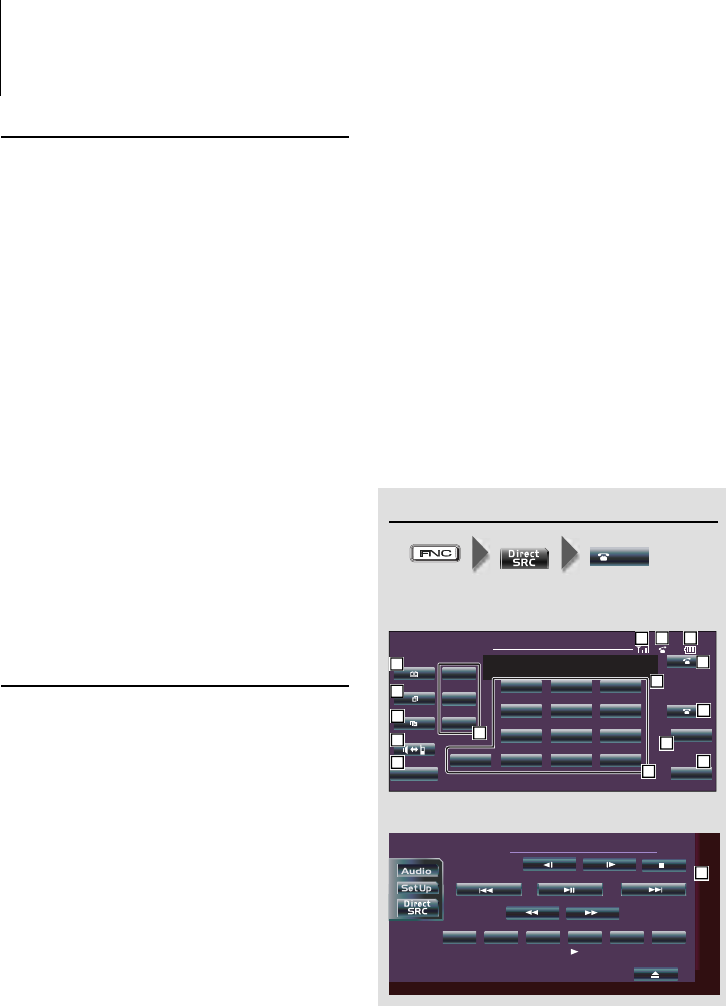
94 | KCA-BT300
Funcionamiento de los teléfonos con manos libres (Modelo H)
Pantalla de control manos libres
TEL
O cuando se recibe una llamada...
Pantalla de control manos libres
Hands Free
P1
P2
P3
SetUp
123
456
78
0
9
#
*+
KENWOOD
0123456789
Clear
Return
AUTO
11
12
14
8910
15
1
2
3
13
5
6
7
4
Pantalla de control
NextNext
DVD VIDEO
13:50
IN
TEL
Title 1 Chap 3 T0:05:20
KENWOOD
SCRL
TIMEREP
16
1 Muestra la pantalla de búsqueda de agenda.
Consulte <Llamar a un número en la agenda
telefónica> (página 96).
2 Muestra la pantalla de llamadas salientes.
Consulte <Llamar a un número en el registro de
llamadas> (página 96).
Durante la descarga:
Se muestra "Downloading", "DOWNLOAD" o "Now
Downloading…".
3 Utilizando el teléfono móvil, inicie la conexión
manos libres.
⁄
• Para obtener información sobre cómo utilizar el teléfono
móvil, consulte el manual de instrucciones que se
incluye con el teléfono.
• Se puede registrar un máximo de 1000 números de
teléfono para cada teléfono móvil registrado.
• Para cada número de teléfono pueden registrarse hasta
32 dígitos, además de 50* caracteres que representen un
nombre.
(* 50: Número de caracteres alfabéticos. Se pueden
introducir menos caracteres dependiendo del tipo de
caracteres.)
• Para cancelar la descarga de los datos de la agenda
telefónica, opere el teléfono móvil.
Registro del dispositivo Bluetooth
Para que pueda utilizar su dispositivo Bluetooth
(teléfono móvil o reproductor de audio) con esta
unidad, necesita registrarla (conexión). Puede registrar
hasta cinco dispositivos Bluetooth en esta unidad.
Al registrarse desde los dispositivos Bluetooth
1 Encienda la unidad de control.
2 Inicie el registro de una unidad operando el
dispositivo Bluetooth.
Operando el dispositivo Bluetooth, registre la
unidad de manos libres o el reproductor de audio
(conexión). Seleccione "KCA-BT300" en la lista de
unidades conectadas.
3 Introduzca un código PIN
Introduzca "0000" como código PIN.
Verifique que haya finalizado el registro en el
dispositivo Bluetooth.
4 Al operar el dispositivo Bluetooth, inicie el
manos libres o la conexión de audio.
⁄
• Si existen 5 o más dispositivos Bluetooth registrados, no
puede registrar un nuevo dispositivo Bluetooth.
• Para saber cómo operar el dispositivo Bluetooth,
consulte el manual de instrucciones que viene con su
dispositivo Bluetooth.
Descarga de la agenda
Descargue los datos de la agenda desde el teléfono
móvil a esta unidad para poder utilizar la agenda en
la misma.
Para descargas automáticas
Si el teléfono móvil es compatible con la función de
sincronización de la agenda telefónica, la agenda se
descarga automáticamente después de la conexión
Bluetooth.
☞ Pueden requerirse ajustes en el teléfono móvil.
☞ Si no se encuentran datos de la agenda telefónica en la
unidad incluso después de la visualización de finalizar,
su teléfono móvil podría no ser compatible con las
descargas automáticas de datos de la agenda telefónica.
En este caso, intente descargar los datos manualmente.
Para descargar manualmente desde el teléfono
móvil
1 Utilizando el teléfono móvil, finalice la conexión
manos libres.
2 Utilizando el teléfono móvil, envíe los datos de
la agenda a esta unidad
Utilizando el teléfono móvil, descargue los datos de
la agenda en esta unidad.
B64-4713-00_10_KCA-BT300_KE.indb 94B64-4713-00_10_KCA-BT300_KE.indb 94 10/03/12 14:5110/03/12 14:51
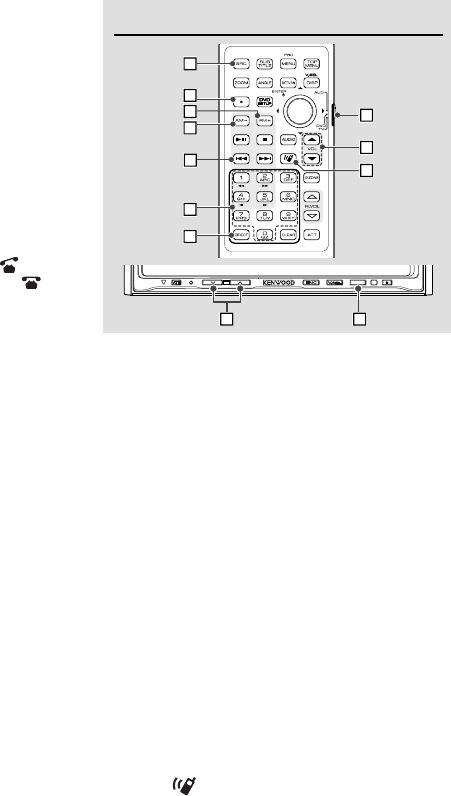
Español | 95
3 Muestra la pantalla de llamadas entrantes.
Consulte <Llamar a un número en el registro de
llamadas> (página 96).
4 Alterna entre los modos privado y manos libres
(sólo cuando hay una llamada en curso).
5 Muestra la pantalla de configuración de manos
libres.
Consulte <Configuración del teléfono manos libres>
(página 97).
6 Introduzca tres números de teléfono para la
marcación rápida.
Consulte <Marcación rápida (Marcación
preestablecida)> (página 96).
7 Introduce un número de teléfono.
Consulte <Marcación de un número> (página 96).
8 Muestra la fuerza de la señal.*
Cuanto mayor sea el número de segmentos de
barra, más fuerte será la señal.
9 Muestra el estado actual de respuesta automática
Si la respuesta automática está activada:
AUT
O
Si la respuesta automática está desactivada:
p Muestra la purga de la batería del teléfono móvil.*
Cuanto mayor sea el número de segmentos de
barra, más alto será el nivel de la batería.
q Inicia la llamada.
w Finaliza la llamada.
Borra el número de teléfono que se está
introduciendo.
e Borra el número de teléfono introducido.
r Vuelve a la pantalla anterior.
t Muestra los números de teléfono de envío y
recepción de llamadas.
Si ha registrado un número de teléfono en la
agenda, se muestra el nombre de la persona de
destino.
y Muestra el estado de conexión con el teléfono
móvil.
Blanco: El teléfono móvil está conectado.
Naranja: El teléfono móvil no está conectado o está
fuera del intervalo de servicio.
⁄
• Cuando el vehículo está en movimiento, algunas
funciones se desactivan por motivos de seguridad.
Los botones asociados con las funciones
desactivadas no están operativos si se presionan.
• Cuando aparece la pantalla de control manos libres,
el nombre del teléfono móvil conectado se muestra
durante 5 segundos.
• Si se ajusta el teléfono móvil en el modo privado,
puede que se desactive la función manos libres.
• * Debido a que el número de pasos de la unidad de
control es distinto al del teléfono móvil, los estados
mostrados en la unidad de control pueden variar
de los mostrados en el teléfono. No se muestra
ningún estado si no se puede obtener información
sobre el mismo.
u Tecla [SRC]
Durante una llamada: Finaliza la llamada.
i Tecla [*] (Cuando f se ajusta en "AUD")
Entrada de marcación de números: Introduce "+".
o Tecla [FM+] (Cuando f se ajusta en "AUD")
Entrada de marcación de números: Introduce "#".
; Tecla [AM-] (cuando f está configurado a "AUD")
Entrada de marcación de números: Introduce "*".
a Tecla [4] (Cuando f se ajusta en "AUD")
Entrada de marcación de números:
borra el número de teléfono introducido.
s Tecla [0] – [9] (Cuando f se ajusta en "AUD")
Entrada de marcación de números: Introduce un
dígito del número de teléfono.
d Tecla [DIRECT] (Cuando f se ajusta en "AUD")
Realice una llamada.
f Interruptor de selección del modo de mando
a distancia
Cambie a "AUD" al marcar.
g Tecla [5]/ [∞]
Durante una llamada: Ajusta el volumen de la voz.
h Tecla [ ]
Muestra la pantalla de control manos libres.
Cuando se recibe una llamada: Responde la llamada.
Página siguiente 3
Funcionamiento de teclas
18
20
22
17
19
21
23
24
25
26
SRC
27 28
B64-4713-00_10_KCA-BT300_KE.indb 95B64-4713-00_10_KCA-BT300_KE.indb 95 10/03/12 14:5110/03/12 14:51
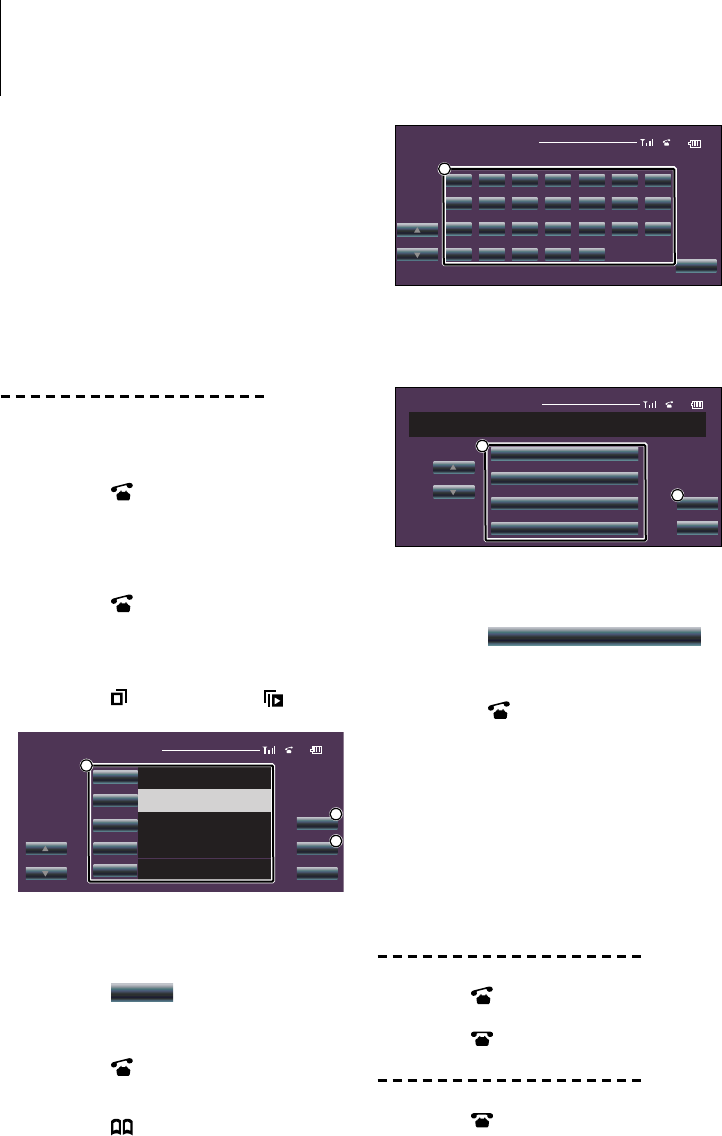
96 | KCA-BT300
Funcionamiento del teléfono manos libres (Modelo-H)
j Tecla [u]/ [d]
Durante una llamada: Ajusta el volumen de la voz.
k Tecla [SRC]
Durante una llamada: Finaliza la llamada.
⁄
• El nivel de volumen de voz ajustado durante
una llamada entrará en vigor para la siguiente y
posteriores llamadas.
• Un aumento excesivo del volumen puede producir
eco. Si se produce eco, baje el volumen tanto como
sea posible. El eco aumenta de forma proporcional
al volumen.
Realizar una llamada
Marcación de un número
1. Introduzca un número de teléfono
Pulse el número ([0] – [9]), [+], [#], o [*].
2. Realice una llamada
Pulse el botón [ ].
☞ Para borrar una entrada incorrecta, pulse [Clear].
Marcación rápida (Marcación preestablecida)
1. Seleccione el número de marcación preestablecido
Pulse el botón [P1] – [P3].
2. Realice una llamada
Pulse el botón [ ].
☞ Necesita registrar el número de marcación preestablecido.
(página 97)
Llamar a un número en el registro de llamadas
1. Ingrese al modo de registro de llamadas
Pulse el botón [ ] (llamada saliente) o [ ] (llamada
entrante).
Incoming Calls
Kenwood
1234567890
Kenwood
1234567890
Kenwood
1234567890
Kenwood
1234567890
Kenwood
1234567890
DISP
OK
Return
AUTO
1
2
3
1 Introduce el nombre de destino.
2 Cambio para el registro de la lista de remarcación.
3 Introduce los datos de destino y vuelve a la pantalla
de control manos libres.
2. Seleccione un nombre o número de teléfono
Pulse el botón [ ].
3. Con rme el destino.
Pulse el botón [OK].
4. Realice una llamada
Pulse el botón [ ].
Llamar a un número en la agenda telefónica
1. Acceda al modo de agenda
Pulse el botón [ ].
Phone Book List
bcde fg
hi jklmn
opqrstu
vwxyz
a
Return
AUTO
1
1 Muestra la agenda comenzando por el nombre
cuyo primer carácter ha tocado.
2. Seleccione el carácter inicial del nombre de una
persona en la memoria
Pulse el botón de carácter ([a] etc.).
Phone Book List
Name
Name
Name
Name
1234567890
OK
Return
AUTO
2
1
1 Introduce el nombre de destino.
2 Introduce los datos de destino y vuelve a la pantalla
de control manos libres.
3. Seleccione un destino al que desee llamar
Pulse el botón [
Name
].
4. Con rme el destino
Pulse el botón [OK].
5. Realice una llamada
Pulse el botón [ ].
☞ Para utilizar la agenda, se debe haber descargado
desde el teléfono móvil. Para obtener detalles, consulte
<Descarga de la agenda> (página 89).
⁄
• Se puede visualizar un máximo de 16 caracteres para cada
nombre en la agenda.
• Las iniciales que no correspondan a ningún nombre no se
mostrarán.
• Durante la búsqueda, se busca un carácter sin acento, como
por ejemplo "u", en lugar de buscar un carácter acentuado,
como "ü".
Recepción de una llamada
Respuesta a una llamada
Pulse el botón [ ].
Rechazo de una llamada entrante
Pulse el botón [ ].
Durante una llamada
Desconexión de una llamada
Pulse el botón [ ].
B64-4713-00_10_KCA-BT300_KE.indb 96B64-4713-00_10_KCA-BT300_KE.indb 96 10/03/12 14:5110/03/12 14:51
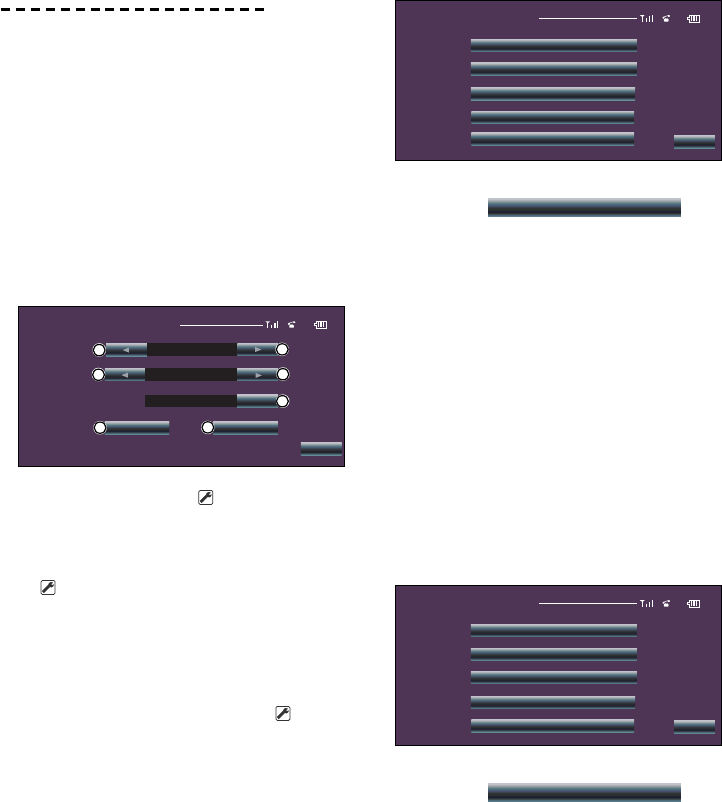
Español | 97
Otras funciones
Registro de la lista de números de marcación
preajustada
1. Introduzca el número de teléfono que desea
registrar
Introduzca el número de teléfono en relación con lo
siguiente:
Marcación de un número/ Llamar a un número en
el registro de llamadas/ Llamar a un número en la
agenda telefónica
2. Seleccione el botón que desea registrar
Pulse el botón [P1] – [P3] durante al menos 2
segundos.
Con guración del teléfono manos libres
Pulse el botón [SetUp] en la pantalla de control de
manos libres.
Hands Free Set Up
Return
Auto Answering
SelectSelect SelectDelete
Phone Voice
8
F-Right
Beep On
AUTO
1
1
2
2
5
3
4
1 Ajusta un tiempo de respuesta automática tras la
fi nalización de la llamada. ( "8")
"Off ": No se puede utilizar esta función.
"0-99": Se ajusta al tiempo de timbre de llamada
(segundo).
2 Ajusta una posición de salida de tono de timbre.
( "F-Right")
"F-Left": Proporciona salida del tono desde el
altavoz delantero izquierdo.
"F-Right": Proporciona salida del tono desde el
altavoz delantero derecho.
"Front All": Proporciona salida del tono desde
ambos altavoces delanteros.
3 Ajuste el pitido de la llamada entrante. ( "On")
"On": Se escucha un bip.
"Off ": Se cancela el pitido.
4 Visualice la pantalla de selección de teléfono.
5 Visualice la pantalla de eliminación de teléfono.
⁄
• Seleccione el altavoz que está más lejos del micrófono para
evitar pitidos o ecos.
Selección de un teléfono manos libres
1. Visualice la pantalla de con guración de manos
libres
Pulse el botón [SetUp] en la pantalla de control de
manos libres.
2. Visualice la lista de selección de teléfono.
Pulse el botón [Select] en la pantalla de confi guración
de manos libres.
Phone Select
Return
Kenwood 1
Kenwood 2
Kenwood 3
Kenwood 4
Kenwood 5
AUTO
3. Seleccione el teléfono manos libres que desee
utilizar.
Pulse el botón [
Kenwood 1
].
⁄
• Si ya hay un teléfono móvil seleccionado, anule su
selección, y seleccione otro.
• Se visualiza la versión de firmware "BT300 FW ***" al final de
la lista de dispositivos Bluetooth.
Para saber cómo actualizar el firmware, entre en nuestro
sitio web.
http://www.kenwood.com/cs/ce/bt/
• El reproductor de audio se mostrará en la lista del
dispositivo después del registro. Sin embargo, no es posible
seleccionar el reproductor de audio de la lista.
Eliminación del teléfono manos libres
1. Visualice la pantalla de con guración de manos
libres
Pulse el botón [SetUp] en la pantalla de control de
manos libres.
2. Visualice la lista de eliminación de teléfono.
Pulse el botón [Delete] en la pantalla de confi guración
de manos libres.
Phone Delete
Return
Kenwood 1
Kenwood 2
Kenwood 3
Kenwood 4
Kenwood 5
AUTO
3. Seleccione el teléfono manos libres que desee
eliminar.
Pulse el botón [
Kenwood 1
].
⁄
• Se elimina la agenda telefónica, la lista de llamadas
salientes, la lista de llamadas entrantes junto con el teléfono
manos libres que se ha eliminado.
• Se visualiza la versión del firmware "BT300 FW ***" y no
puede eliminarse.
B64-4713-00_10_KCA-BT300_KE.indb 97B64-4713-00_10_KCA-BT300_KE.indb 97 10/03/12 14:5110/03/12 14:51
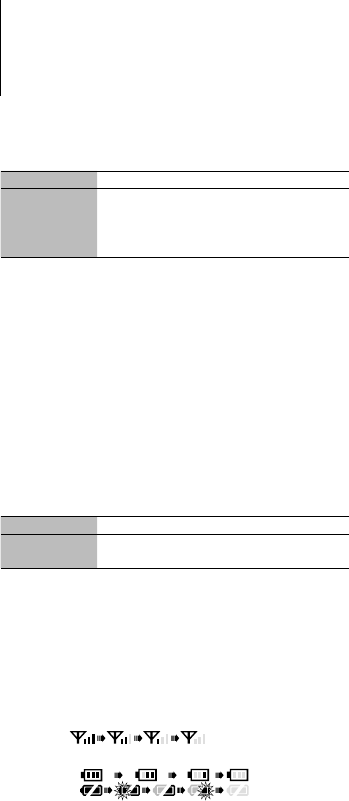
98 | KCA-BT300
Apéndice
Acerca del teléfono móvil
Esta unidad cumple con las siguientes especificaciones
de Bluetooth:
Versión Bluetooth estándar ver. 2.1 + EDR
Perfil HFP (Perfil de manos libres)
OPP (Perfil de introducción de objetos)
PBAP (Perfil de acceso a la agenda telefónica)
SYNC (Perfil de sincronización)
Para verificar la compatibilidad de los teléfonos móviles,
acceda a la siguiente URL:
http://www.kenwood.com/cs/ce/bt/
⁄
• Las unidades que admiten la función Bluetooth han
certificado su conformidad con el estándar Bluetooth
siguiendo el procedimiento descrito por Bluetooth SIG. Sin
embargo, puede que resulte imposible que dichas unidades
se comuniquen con el teléfono móvil en función del tipo.
Acerca del reproductor de audio Bluetooth
Esta unidad cumple con las siguientes especificaciones
de Bluetooth:
Versión Bluetooth estándar Ver. 2.1 + EDR
Perfil A2DP (Perfil de distribución de audio avanzado)
AVRCP (Perfil de mando a distancia de audio/video)
Acerca de los iconos de Bluetooth
La unidad de control compatible con la función de
visualización del icono puede mostrar los siguientes
estados:
• Estado de conexión del teléfono móvil Bluetooth
BT : Este indicador se enciende al conectar un teléfono
móvil.
• Fuerza de la señal del teléfono móvil
Máximo Mínimo
• Nivel de la batería del teléfono móvil
Completa Casi agotada
⁄
• No se visualizan los iconos si no se puede obtener
información del teléfono móvil.
• Debido a que el número de pasos de la unidad de control
es distinto al del teléfono móvil, los estados mostrados en
la unidad de control pueden variar de los mostrados en el
teléfono.
Glosario del menú
• "D-STATUS"/ "P-STATUS" (Visualización del
estado del dispositivo Bluetooth)
Puede visualizar el estado de conexión, la fuerza de la
señal y el nivel de la batería.
"HF CONNECT"/ "BT-CON" / "HF-CON":
Estado de conexión del teléfono móvil Bluetooth.
"AD CONNECT"/ "AD CON" :
Estado de conexión del audio Bluetooth.
"BAT" : Nivel de la batería del teléfono móvil.
"SGNL" : Fuerza de la señal del teléfono móvil.
• "ANS"/ "Auto Answer" (Ajuste del intervalo de
tiempo para respuesta automática)
Esta función contesta automáticamente (responde)
una llamada una vez transcurrido el intervalo de
tiempo preajustado para respuesta automática.
"OFF" : No responde la llamada telefónica
automáticamente.
"0" : Responde la llamada telefónica automáticamente
de inmediato.
"1" – "99" : Contesta automáticamente el teléfono móvil
después de un lapso de 1 – 99 segundos.
☞ Si el ajuste de tiempo en el teléfono móvil es más breve
que el de la unidad, se utilizará el primero.
• "SPK"/ "SP Select" (Configuración de los altavoces
de salida de voz)
Puede especificar los altavoces de salida de voz.
"Front"/ "FRT" : Proporciona salida de voz de los
altavoces delanteros izquierdo y
derecho.
"F-R" : Proporciona salida de voz del altavoz delantero
derecho.
"F-L" : Proporciona salida de voz del altavoz delantero
izquierdo.
☞ Seleccione el altavoz que está más lejos del micrófono
para evitar pitidos o ecos.
• "C-BP"/ "Call Beep"/ "Beep" (Ajuste del pitido de
la llamada entrante)
Puede proporcionar salida para un pitido desde el
altavoz cuando se recibe una llamada.
"ON" : Se escucha un bip.
"OFF" : Se cancela el pitido.
Nota de función
• Marcación de un número
• Dependiendo del tipo de su unidad de control, se
visualiza "|" (se iluminan todos los segmentos) para #.
• Llamar a un número en el registro de llamadas
• La lista de llamadas salientes, llamadas entrantes y
llamadas perdidas, son listas de llamadas originadas
desde y recibidas en esta unidad. No son las
almacenadas en la memoria del teléfono móvil.
• Llamar a un número en la agenda telefónica
• Para utilizar la agenda, se debe haber descargado desde
el teléfono móvil. Para más detalles, consulte <Descarga
de la agenda>.
• Se puede visualizar un máximo de 19 caracteres para
cada nombre en la agenda.
• Durante la búsqueda, se busca un carácter sin acento,
como por ejemplo "u", en lugar de buscar un carácter
acentuado, como "ü".
Los caracteres no alfabéticos tales como los del Chino y
Ruso se clasifican como símbolos.
• Cambio al modo privado
• Dependiendo del tipo de su teléfono móvil, al cambiar
al modo de charla privada podría seleccionar la fuente
que se utilizó antes de comenzar la conexión de
manos libres. Si esto ocurre, la fuente no puede volver
B64-4713-00_10_KCA-BT300_KE.indb 98B64-4713-00_10_KCA-BT300_KE.indb 98 10/03/12 14:5110/03/12 14:51

Español | 99
Información sobre cómo desechar equipos
y baterías eléctricos y electrónicos usados
(aplicable a países de la UE que han
adoptado sistemas de recogida de residuos
separados)
Los productos y baterías con el símbolo (un
cubo con ruedas tachado con una cruz)
no pueden desecharse como un residuo
doméstico.
Los equipos y baterías eléctricos y electrónicos
deberán reciclarse en un centro capaz de
manipular dichos elementos y sus desechos
derivados.
Póngase en contacto con su autoridad local
para obtener más información sobre cómo
localizar el centro de reciclaje más cercano.
Un reciclaje y una eliminación correctos de los
residuos ayudarán a conservar los recursos y
a la vez, evitan los efectos perjudiciales sobre
nuestra salud y sobre el medio ambiente.
Aviso: El siguiente símbolo, "Pb", debajo del
símbolo de las baterías indica que esta
batería contiene plomo.
al modo de conversación manos libres utilizando esta
unidad. Utilice el teléfono móvil para volver al modo de
conversación manos libres.
• Cambio entre modos de visualización
• Dependiendo del tipo de su unidad de control, se tienen
las siguientes restricciones.
- Se puede visualizar un máximo de 19 caracteres.
- No se puede visualizar la letra # o bien "|" (todos los
segmentos están encendidos) se muestra para #.
- No puede alternar entre los modos de visualización.
B64-4713-00_10_KCA-BT300_KE.indb 99B64-4713-00_10_KCA-BT300_KE.indb 99 10/03/12 14:5110/03/12 14:51
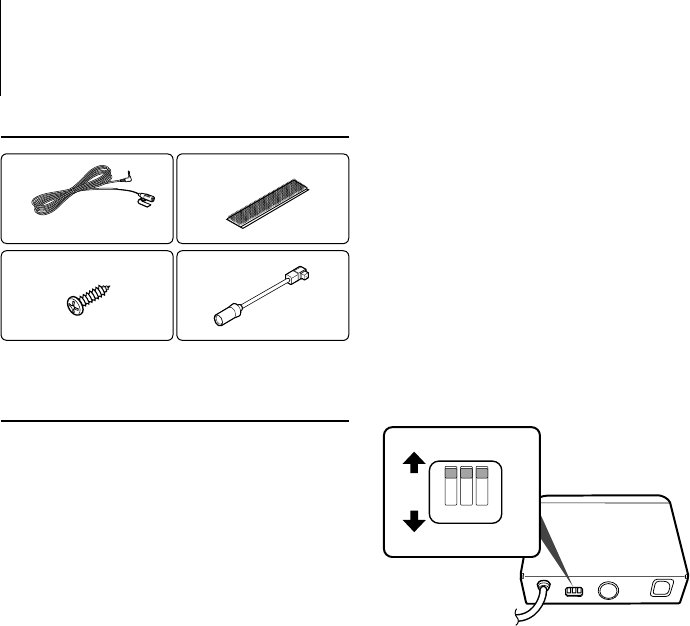
100 | KCA-BT300
Accesorios/ Procedimiento de instalación
Accesorios
1
3 m (9,5 pies) ..........1
3
..........1
2
..........2
4
..........1
Procedimiento de instalación
1. Para evitar cortocircuitos, retire la llave del encendido y
desconecte el terminal - de la batería.
2. Ajuste el interruptor de tipo.
3. Realice las conexiones de los cables de entrada y salida
adecuadas para cada unidad.
4. Instale la unidad en su automóvil.
5. Vuelva a conectar el terminal - de la batería.
6. Pulse el botón de reposición en la unidad de control.
¤
• Enrolle los cables no conectados con una cinta de vinilo u
otro material similar para que queden aislados. Para evitar
cortocircuitos, no retire las tapas de los extremos de los
cables o terminales no conectados.
• Después de instalar la unidad, compruebe que las lámparas
de freno, las luces intermitentes, el limpiaparabrisas, etc.
funcionen satisfactoriamente.
Recepción correcta
Para garantizar una recepción correcta, tenga en cuenta
lo siguiente:
• Comuníquese con el teléfono móvil dentro de la
distancia de línea de visión de 10 m (30 pies). El
intervalo de comunicación puede acortarse en función
del entorno de la zona. El intervalo de comunicación
también puede acortarse cuando hay un obstáculo
entre esta unidad y el teléfono móvil. El intervalo de
comunicación máximo mencionado anteriormente (10
m) no siempre está garantizado.
• Mantenga esta unidad lejos de otros componentes
eléctricos (componentes AV) lo más lejos que se pueda.
Si hay componentes cercanos de este tipo, la conexión
de llamada puede fallar, se puede generar ruido de TV o
radio o bien producirse una recepción defectuosa.
• Una estación emisora o un radio portátil ubicado en
los alrededores puede interferir con la comunicación
debido a una señal demasiado fuerte.
Ajuste del interruptor de tipo
Ajuste el interruptor de tipo de acuerdo al tipo de la
unidad de control que se encuentra conectada. Consulte
la columna de ajustes de conmutación de tipo de la lista
de modelos (página 72).
Para los modelos comercializados después de abril de
2010, configure la conmutación de tipo del siguiente
modo.
- Para el modelo conectado con el conector 5L
1: OFF, 2: OFF, 3: OFF
- Para el modelo conectado con el conector KAB
1: OFF, 2: ON, 3: OFF
- Para obtener más información, consulte el siguiente
sitio web. Configure la conmutación de tipo conforme
al sitio Web cuando el ajuste anterior sea distinto al del
sitio web.
www.kenwood.com/cs/ce/bt/
1
OFF
ON
23
1: Función de visualización de conversión de caracteres
Cuando la unidad de control no puede mostrar acentos ("u",
"a", etc.), convierte estos caracteres en caracteres alfabéticos
en mayúsculas.
OFF: No convertir caracteres.
ON: Convertir caracteres.
2: Especificación del conector que se va a conectar
Especifica el tipo de conector que se va a conectar en la
unidad de control.
OFF: Utilice el conector 5L.
ON: Utilice el conector KAB.
3: Especificación del tipo de unidad de control
Especifica el tipo de unidad de control que se va a conectar.
OFF: Ajustar cuando no se especifique ningún tipo de
unidad de control en la lista de modelos, o el tipo
de unidad de control no se encuentra en la lista de
modelos.
ON: Ajustar cuando se especifique el tipo de unidad de
control en la lista de modelos.
B64-4713-00_10_KCA-BT300_KE.indb 100B64-4713-00_10_KCA-BT300_KE.indb 100 10/03/12 14:5110/03/12 14:51
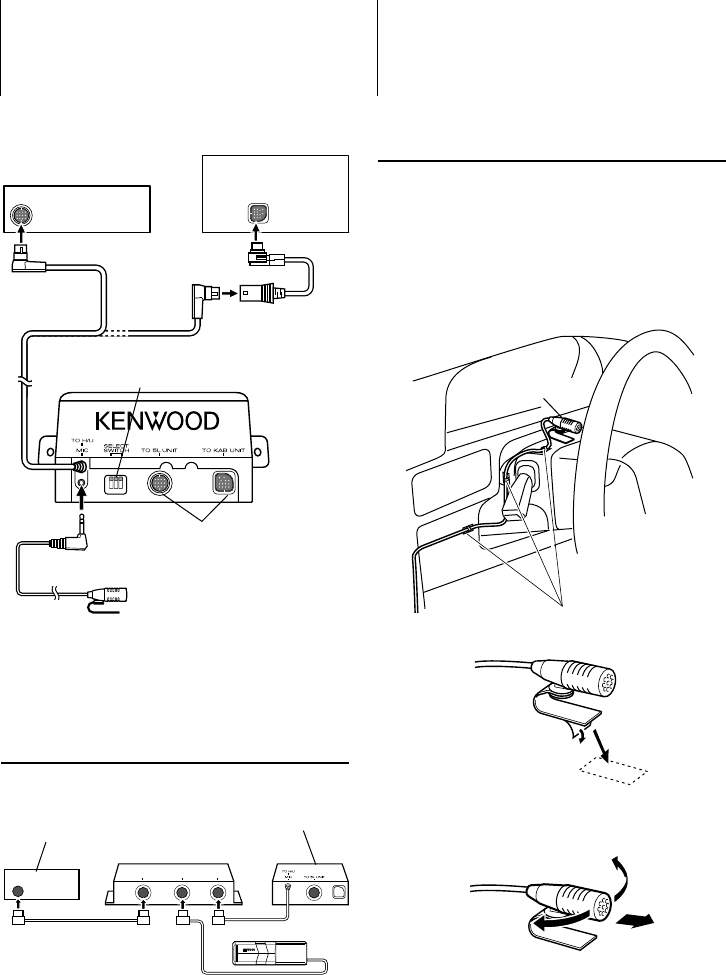
Español | 101
Conexión
123
Accesorio 1
(3 m, 9,5 pies)
Unidad de control
(Conector 5L)
Conector para dispositivo
externo
⁄
• Solamente se puede utilizar el
terminal que tiene la misma
forma que la del conector
conectado en la unidad de
control.
• Solamente se puede conectar un
dispositivo externo.
Conmutación de tipo
(página 72, 100)
(1,5 m, 5 pies)
Unidad de control
(Conector KAB)
Accesorio 4
TO CHANGER 2TO CHANGER 1TO HEAD UNIT
KCA-BT300
Unidad de control (5L)
Cambiador de discos
KCA-S220A
¤
• Evite que la extensión total del cable de control desde la
unidad de control al cambiador de discos supere 13 m (43
pies). Los cables de control con una extensión superior a 13
m dejarán de funcionar correctamente.
Si desea conectar KCA-S220A
Conecte la caja de manos libres al terminal con la
etiqueta TO CHANGER 2.
Instalación
Instalación de la unidad del
micrófono
1 Compruebe la posición de instalación del micrófono
(accesorio 1).
2 Elimine el aceite y los restos de suciedad de la
superficie de instalación.
3 Instale el micrófono.
4 Conecte el cable del micrófono a la caja de manos
libres asegurando el mismo en varias posiciones con
cinta adhesiva o similar.
Fije un cable con una cinta adhesiva de
uso comercial.
Despegue el papel adhesivo de liberación de cinta adhesiva
en ambos lados para fijar en el lugar mostrado arriba.
Ajuste la dirección del micrófono hacia el conductor.
⁄
• Instale el micrófono lo más lejos que se pueda del teléfono
móvil.
Accesorio 1
B64-4713-00_10_KCA-BT300_KE.indb 101B64-4713-00_10_KCA-BT300_KE.indb 101 10/03/12 14:5110/03/12 14:51
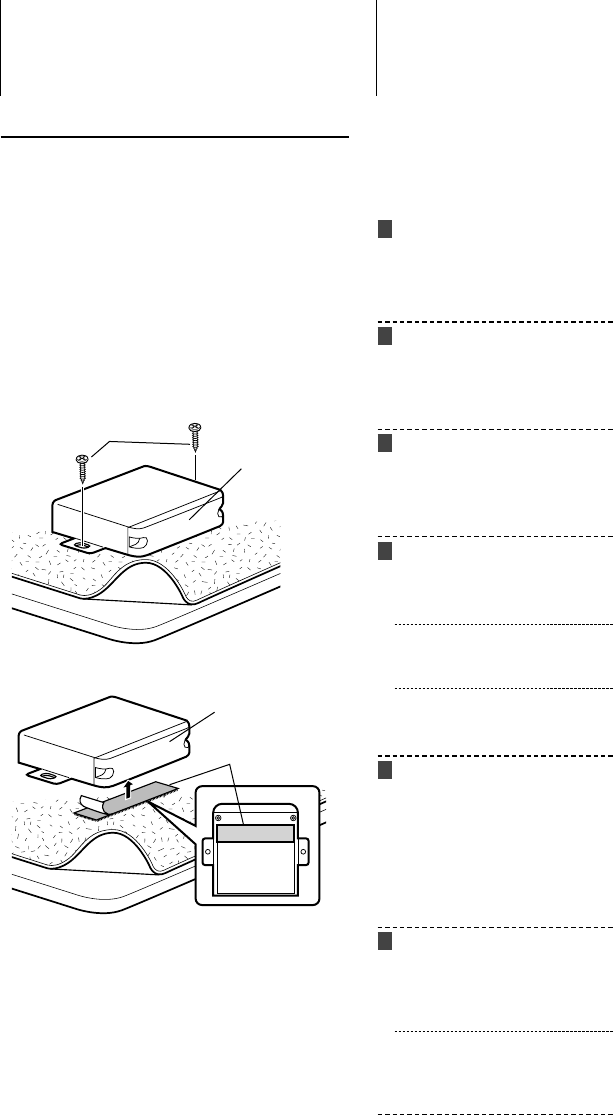
102 | KCA-BT300
Guía sobre localización de
averías
Lo que podría parecer un funcionamiento incorrecto
en la unidad puede ser simplemente el resultado de
un pequeño fallo de uso o de cableado. Antes de
acudir al servicio, verifique primero el siguiente cuadro
sobre los problemas que se podrían presentar.
? El volumen de conversación manos libres es bajo.
✔ El volumen de conversación manos libres se ajusta a
un nivel bajo.
☞ El volumen de conversación manos libres se
puede ajustar de forma independiente. Ajústelo
durante la conversación manos libres.
? No se oye ningún sonido de los altavoces traseros.
✔ Está hablando en el modo de conversación manos
libres.
☞ No se oye ningún sonido de los altavoces
traseros en el modo de conversación manos
libres.
? No se oye ningún pitido al recibir una llamada
entrante.
✔ No se oye ningún pitido en función del tipo de
teléfono móvil.
☞ El <Ajuste del pitido de la llamada entrante> se
establece en ON.
? No se reconoce la voz.
✔ La ventana del vehículo se encuentra abierta.
☞ Si el ruido envolvente es mucho, no se puede
reconocer la voz correctamente. Cierre las
ventanas del vehículo para reducir el ruido.
✔ Voz baja.
☞ Si la voz es muy baja, no puede reconocerse
correctamente. Hable cerca del micrófono un
poco más fuerte y de forma natural.
✔ La persona que articula la etiqueta de voz no es la
misma que la registrada.
☞ Solamente se puede reconocer la voz de la
persona que registró la etiqueta de voz.
? No se puede registrar el reproductor de audio
Bluetooth (conexión).
✔ El código PIN está fijo.
☞ Al especificar un código PIN en el manual de
instrucciones para el reproductor de audio
Bluetooth, regístrelo consultando <Registro del
código PIN> para registrar el reproductor de
audio Bluetooth. Si no se especifica un código
PIN en el manual de instrucciones, intente con
"0000".
? Se interrumpe el sonido del reproductor de audio
Bluetooth.
✔ La distancia entre esta unidad y el reproductor de
audio es muy grande.
☞ Mueva el reproductor de audio más cerca a esta
unidad.
✔ Otro dispositivo Bluetooth se encuentra afectando la
comunicación Bluetooth.
☞ Apague el otro dispositivo Bluetooth.
☞ Mueva el otro dispositivo Bluetooth lejos de esta
unidad.
Instalación
Instalación de la unidad Bluetooth
¤
• Determine la posición de instalación después de asegurarse
de que la unidad se puede comunicar con el dispositivo
Bluetooth.
• No instale la unidad cerca del tablero de mandos, la
bandeja trasera u otros componentes importantes. Si lo
hace podría provocar lesiones o accidentes en caso de que
la unidad se suelte debido a un impacto y golpee a una
persona o un componente importante. Se deben utilizar
tornillos autorroscables para el montaje. (La fijación con
tiras de velcro, aunque sea más sencilla, puede soltarse a
causa de un impacto.)
Fijación del módulo de audio
Fijación a la moqueta
Accesorio 3
Parte de la antena
⁄
• No pegue la cinta de velcro sobre el número de serie.
• Si el lugar de instalación se encuentra a desnivel, corte
la cinta de velcro en dos piezas y péguelas en las dos
posiciones.
Parte de la antena
Accesorio 2 (Ø4 × 16 mm)
B64-4713-00_10_KCA-BT300_KE.indb 102B64-4713-00_10_KCA-BT300_KE.indb 102 10/03/12 14:5110/03/12 14:51

Español | 103
Especi caciones
Sección de Bluetooth
Tecnología
: Con certificación Bluetooth 2.1 + EDR
Frecuencia
: 2,402 – 2,480 GHz
Potencia de salida
: +4 dBm (MAX), 0d Bm (AVE) Alimentación de
Clase 2
Rango de comunicación máximo
: Línea de visión aprox. de 10 m (32,1 pies)
Perfiles
: HFP (Perfil de manos libres)
: HSP (Perfil Auriculares)
: OPP (Perfil de introducción de objetos)
: PBAP (Perfil de acceso a la agenda telefónica)
: SYNC (Perfil de sincronización)
: SPP (Perfil de puerto serial)
: A2DP (Perfil de distribución de audio avanzado)
: AVRCP (Perfil de mando a distancia de audio/
vídeo)
General
Voltaje de funcionamiento (10,5 – 16 V admisibles)
: 14,4 V
Consumo
: 200 mA
Dimensiones (An x A x P)
: 95 x 30 x 105 mm
3-3/4 x 1-3/16 x 4-1/8 pulgadas
Peso
: 0,38 kg (0,84 lbs)
Las especificaciones se encuentran sujetas a cambios sin
previo aviso.
Los mensajes mostrados a continuación
presentan las condiciones de su sistema.
No Number/ NO-NMBER/ Incoming No Number:
• El interlocutor no notifica una identificación de
llamada.
• No hay datos del número de teléfono.
No Data/ NO DATA :
• No hay lista de llamadas salientes.
• No hay lista de llamadas entrantes.
No Entry/ NO ENTRY:
El teléfono móvil no se ha registrado (conexión).
HF Disconnect/ HF DISCONCT/ HF D-CON/ Disconnect/
DISCONCT/ Non Connection/ Disconnected :
La unidad no se puede comunicar con el teléfono
móvil.
Audio Disconnect/ AUD DISCONCT/ AD D-CON:
La unidad no puede comunicarse con el
reproductor de audio.
HF Connect/ HF CONNECT/ Connect/ CONNECT:
La unidad puede comunicarse con el teléfono
móvil.
HF Error 07/ HF ERR07:
No puede accederse a la memoria.
\ Apague la alimentación y enciéndala de nuevo.
Si el mensaje sigue apareciendo, pulse el botón
de reposición en la unidad de control.
HF Error 68/ HF ERR68:
La unidad no puede comunicarse con el teléfono
móvil.
\ Apague la alimentación y enciéndala de nuevo.
Si el mensaje sigue apareciendo, pulse el botón
de reposición en la unidad de control.
Unknown: El dispositivo Bluetooth no puede detectarse.
Device Full/ DVC FULL:
Ya se han registrado 5 dispositivos Bluetooth. No
se pueden registrar más dispositivos Bluetooth.
PIN Code NG/ CODE NG:
El código PIN es incorrecto.
Connect NG/ CONCT NG:
La unidad no puede conectarse al dispositivo.
Pairing Failed/ PAIRING NG/ PAIR NG:
Error de conexión.
Err No Matching/ NO MATCHING/ NO MATCH:
La etiqueta de voz es incorrecta. No se puede
reconocer la voz debido a una etiqueta de voz no
registrada, etc.
Too Soft: La voz es muy baja y no puede reconocerse.
Too Loud: La voz es muy alta para reconocerse.
Too Long: La palabra o la articulación es demasiado larga
para reconocerse.
No Phonebook/ NO PB:
Los datos no están contenidos en la agenda
telefónica.
No Message/ NO SMS:
No hay mensajes cortos en el buzón.
La marca de este símbolo indica que
Kenwood fabricó este producto para
reducir la infl uencia nociva en el
medio ambiente.
La marca denominativa y los logos de Bluetooth
son propiedad de Bluetooth SIG, Inc. y cualquier uso
de dichas marcas por Kenwood Corporation está
sujeto a los términos de licencia. El resto de marcas
comerciales y nombres comerciales corresponden a
sus respectivos propietarios.
B64-4713-00_10_KCA-BT300_KE.indb 103B64-4713-00_10_KCA-BT300_KE.indb 103 10/03/12 14:5110/03/12 14:51

Declaration of Conformity with regard to the EMC Directive 2004/108/EC
Declaration of Conformity with regard to the R&TTE Directive 1999/5/EC
Manufacturer:
Kenwood Corporation
2967-3 Ishikawa-machi, Hachioji-shi, Tokyo, 192-8525 Japan
EU Representative's:
Kenwood Electronics Europe BV
Amsterdamseweg 37, 1422 AC UITHOORN, The Netherlands
English
Hereby, Kenwood declares that this unit KCA-BT300 is in compliance with the
essential requirements and other relevant provisions of Directive 1999/5/EC.
Français
Par la présente Kenwood déclare que l’appareil KCA-BT300 est conforme aux
exigences essentielles et aux autres dispositions pertinentes de la directive 1999/5/
CE.
Par la présente, Kenwood déclare que ce KCA-BT300 est conforme aux exigences
essentielles et aux autres dispositions de la directive 1999/5/CE qui lui sont
applicables.
Deutsch
Hiermit erklärt Kenwood, dass sich dieser KCA-BT300 in Übereinstimmung mit
den grundlegenden Anforderungen und den anderen relevanten Vorschriften der
Richtlinie 1999/5/EG befindet. (BMWi)
Hiermit erklärt Kenwood die Übereinstimmung des Gerätes KCA-BT300 mit den
grundlegenden Anforderungen und den anderen relevanten Festlegungen der
Richitlinie 1999/5/EG. (Wien)
Nederlands
Hierbij verklaart Kenwood dat het toestel KCA-BT300 in overeenstemming is met de
essentiële eisen en de andere relevante bepalingen van richtlijn 1999/5/EG.
Bij deze verklaat Kenwood dat deze KCA-BT300 voldoet aan de essentiële eisen en
aan de overige relevante bepalingen van Richtlijn 1999/5/EC.
Italiano
Con la presente Kenwood dichiara che questo KCA-BT300 è conforme ai requisiti
essenziali ed alle altre disposizioni pertinenti stabilite dalla direttiva 1999/5/CE.
Español
Por medio de la presente Kenwood declara que el KCA-BT300 cumple con los
requisitos esenciales y cualesquiera otras disposiciones aplicables o exigibles de la
Directiva 1999/5/CE.
Português
Kenwood declara que este KCA-BT300 está conforme com os requisitos essenciais e
outras disposições da Directiva 1999/5/CE.
Polska
Kenwood niniejszym oświadcza, że KCA-BT300 spełnia zasadnicze wymogi oraz inne
istotne postanowienia dyrektywy 1999/5/EC.
Český
Kenwood timto prohlasuje, ze KCA-BT300 je ve shode se zakladnimi pozadavky a s
dalsimi prislusnymi ustanoveni Narizeni vlady c. 426/2000 Sb.
Magyar
Alulírott, Kenwood, kijelenti, hogy a jelen KCA-BT300 megfelel az 1999/5/
EC irányelvben meghatározott alapvető követelményeknek és egyéb vonatkozó
előírásoknak.
Svenska
Härmed intygar Kenwood att denna KCA-BT300 stär l överensstämelse med de
väsentliga egenskapskrav och övriga relevanta bestämmelser som framgår av direktiv
1999/5/EG.
Suomi
Kenwood vakuuttaa täten että KCA-BT300 tyyppinen laite on direktiivin 1999/5/EY
oleellisten vaatimusten ja sitä koskevien direktiivin muiden ehtojen mukainen.
Slovensko
S tem Kenwood izjavlja, da je ta KCA-BT300 v skladu z osnovnimi zahtevami in
ostalimi ustreznimi predpisi Direktive 1999/5/EC.
Slovensky
Spoločnosť Kenwood týmto vyhlasuje, že KCA-BT300 spĺňa zákldné požiadavky a
ďalšie prislušné ustanovenia Direktĺvy 1999/5/EC.
Dansk
Undertegnede Kenwood erklærer harved, at følgende udstyr KCA-BT300 overholder
de væsentlige krav og øvrige relevante krav i direktiv 1999/5/EF.
Ελληνικά
ΜΕ ΤΗΝ ΠΑΡΟΥΣΑ Kenwood ΔΗΛΩΝΕΙ ΟΤΙ KCA-BT300 ΣΥΜΜΟΡΦΩΝΕΤΑΙ ΠΡΟΣ ΤΙΣ
ΟΥΣΙΩΔΕΙΣ ΑΠΑΙΤΗΣΕΙΣ ΚΑΙ ΤΙΣ ΛΟΙΠΕΣ ΣΧΕΤΙΚΕΣ ΔΙΑΤΑΞΕΙΣ ΤΗΣ ΟΔΗΓΙΑΣ 1999/5/
EK.
Eesti
Sellega kinnitab Kenwood, et see KCA-BT300 vastab direktiivi 1999/5/EC põhilistele
nõudmistele ja muudele asjakohastele määrustele.
Latviešu
Ar šo, Kenwood, apstiprina, ka KCA-BT300 atbilst Direktīvas 1999/5/EK galvenajām
prasībām un citiem tās nosacījumiem.
Lietuviškai
Šiuo, Kenwood, pareiškia, kad šis KCA-BT300 atitinka pagrindinius Direktyvos 1999/5/
EB reikalavimus ir kitas svarbias nuostatas.
Malti
Hawnhekk, Kenwood, jiddikjara li dan KCA-BT300 jikkonforma mal-ħtiġijiet essenzjali
u ma provvedimenti oħrajn relevanti li hemm fid-Dirrettiva 1999/5/EC.
Українська
Компанія Kenwood заявляє, що цей виріб KCA-BT300 відповідає ключовим
вимогам та іншим пов’язаним положенням Директиви 1999/5/EC.
B64-4713-00_10_KCA-BT300_KE.indb 104B64-4713-00_10_KCA-BT300_KE.indb 104 10/03/12 14:5110/03/12 14:51
