Kingwave Technology 6900 2.4GHz Long Range Wireless LAN Access Point/Bridge User Manual

Kingwave Technology Co., Ltd. 2.4GHz Long Range Wireless LAN Access Point/Bridge Users Manual

Users Manual

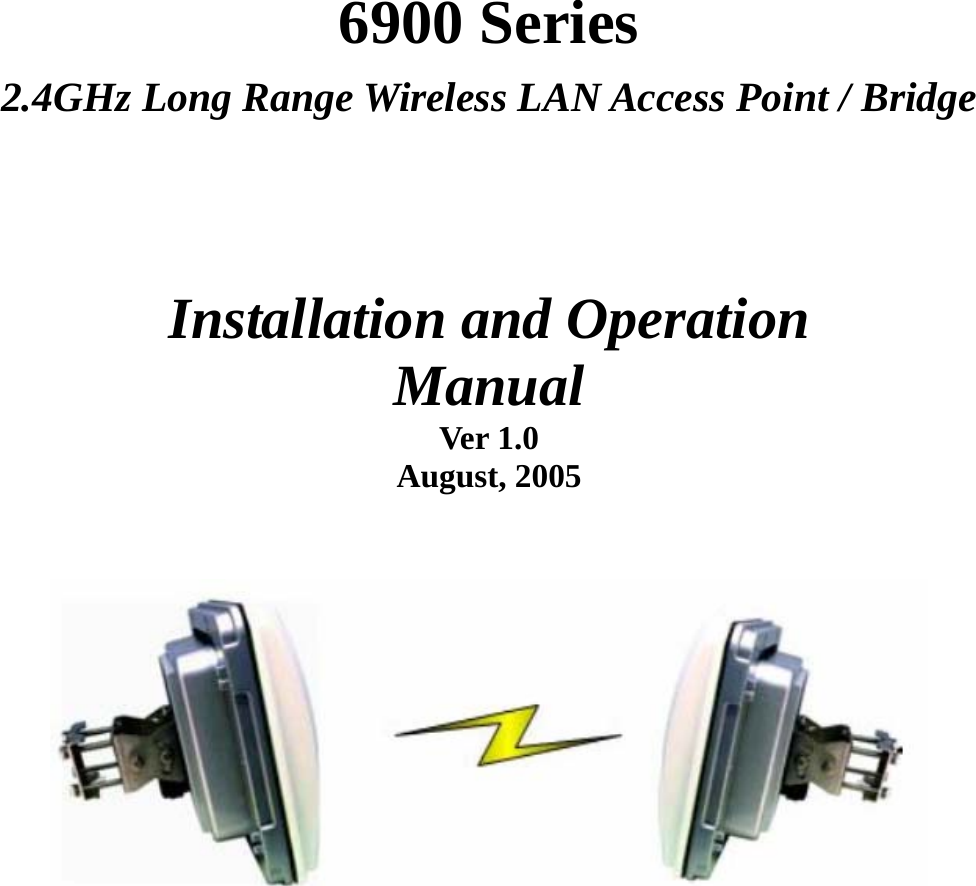
  6900 Series 2.4GHz Long Range Wireless LAN Access Point / Bridge     Installation and Operation   Manual Ver 1.0 August, 2005
 1PROFESSIONAL INSTALLATION REQUIRED  The 6900 Series must be installed as a system by experienced antenna installation professionals who are familiar with Radio Frequency (RF) issues such as gains and losses, as well as local building and safety codes. Failure to do so will void the product warranty and may expose the end user to excessive RF hazard. Regulations regarding maximum antenna gains, power output and maximum permissible exposure vary from country to country. It is the responsibility of the end user to operate within the limits of these regulations and to ensure that the professional installers who install this device are aware of these regulations. All antennas are intended to be installed outdoors.  MICROWAVE RADIO RADIATION WARNING When installed properly, the 6900 Series radio equipment complies with the limits for human exposure to radio frequency (RF) fields adopted by the Federal Communications Commission (FCC). All KINGWAVE microwave radio equipment is designed so that under normal working conditions, microwave radiation directly from the radio is negligible when compared with the permissible limit of continuous daily exposure recommended in the United States by ANSI/IEEE C95.1-1991 (R1997), Safety Levels with Respect to Human Exposure to Radio Frequency Electromagnetic Fields, 3 kHz to 300 GHz.  Microwave signal levels that give rise to hazardous radiation levels can exist within transmitter power amplifiers, associated RF multiplexers, and antenna systems. Do not disconnect RF coaxial connectors, open microwave units, or break down any microwave screening while the radio equipment is operating.  Federal Communication Commission Interference Statement   This equipment has been tested and found to comply with the limits for a Class B digital device, pursuant to Part 15 of FCC Rules. These limits are designed to provide reasonable protection against harmful interference in a residential installation. This equipment generates, uses, and can radiate radio frequency energy and, if not installed and used in accordance with the instructions, may cause harmful interference to radio communications. However, there is no guarantee that interference will not occur in a particular installation. If this equipment does cause harmful interference to radio or television reception, which can be determined by turning the equipment off and on, the user is encouraged to try to correct the interference by one or more of the following measures:   1. Reorient or relocate the receiving antenna.  2. Increase the separation between the equipment and receiver.  3. Connect the equipment into an outlet on a circuit different from that to which the receiver is connected.  4. Consult the dealer or an experienced radio technician for help.
 2FCC Caution  This device and its antenna must not be co-located or operating in conjunction with any other antenna or transmitter.  This device complies with Part 15 of the FCC Rules. Operation is subject to the following two conditions: (1) this device may not cause harmful interference, and (2) this device must accept any interference received, including interference that may cause undesired operation.  Any changes or modifications not expressly approved by the party responsible for compliance could void the authority to operate equipment.   Federal Communications Commission (FCC) Radiation Exposure Statement  This equipment complies with FCC radiation exposure limits set forth for an uncontrolled environment. This equipment should be installed and operated with minimum distance 20cm between the radiator & your body. Federal Communications Commission (FCC) RF Exposure Requirements  SAR compliance has been established in the laptop computer(s) configurations with PCMCIA slot on the side near the center, as tested in the application for Certification, and can be used in laptop computer(s) with substantially similar physical dimensions, construction, and electrical and RF characteristics. Use in other devices such a PDAs or lappads is not authorized. This transmitter is restricted for use with the specific antenna(s) tested in the application for Certification. The antenna(s) used for this transmitter must not be co-located or operating in conjunction with any other antenna or transmitter. These products are labeled with one of the following FCC ID numbers FCC ID:TJI-6900
 3Table of Contents   PROFESSIONAL INSTALLATION REQUIRED........................................................ 1 MICROWAVE RADIO RADIATION WARNING ........................................................ 1 Federal Communications Commission (FCC) Interference Statement ............... 1 Table of Contents..................................................................................................... 3 Chapter 1 Overview .................................................................................................. 4 1.1  Introduction to the 6900 Series.................................................................................................... 4  1.2 Features & Benefits.................................................................................................................... 4 1.3  Applications of the 6900 Series................................................................................................... 5 1.4  The 6900 series product types...................................................................................................... 8 1.5  The 6900 series Package Contents............................................................................................... 9 Chapter 2 Hardware Installation ............................................................................. 10 2.1     Hardware Description ................................................................................................................. 10 2.2     Outdoor Unit Installation............................................................................................................. 11 2.3    Mounting Bracket on Mast with /U-bolts..................................................................................... 13 2.4     Indoor Unit Installation..............................................................................................................  14 Chapter 3 Quick Start-First time use.......................................................................14 3.1  Typical Deployment of 6900 Series in a Point-to-Point Configuration.......................................14    3.2    To set the Base station unit (BU) ...............................................................................................15 3.3     To set the Remote unit (RU) ............................................... ......................................................18 3.4   Running Test................................................................................................................................ 22 Chapter 4 Choosing a Mounting Location.............................................................. 24 4.1     Antenna Polarization.................................................................................................................... 24 4.2     Antenna Radiation Angle............................................................................................................. 25     4.3     Signal Path Clearance (Fresnel zone) .........................................................................................25 4.4     Multi-Path Fading........................................................................................................................ 26 4.5     Relationship between data rate and distance............................................................................... 26   Appendix A –6900 Series Technical Specifications………………………………….27 Appendix B –6900 Series Access Point /Bridge Configuration……………………28
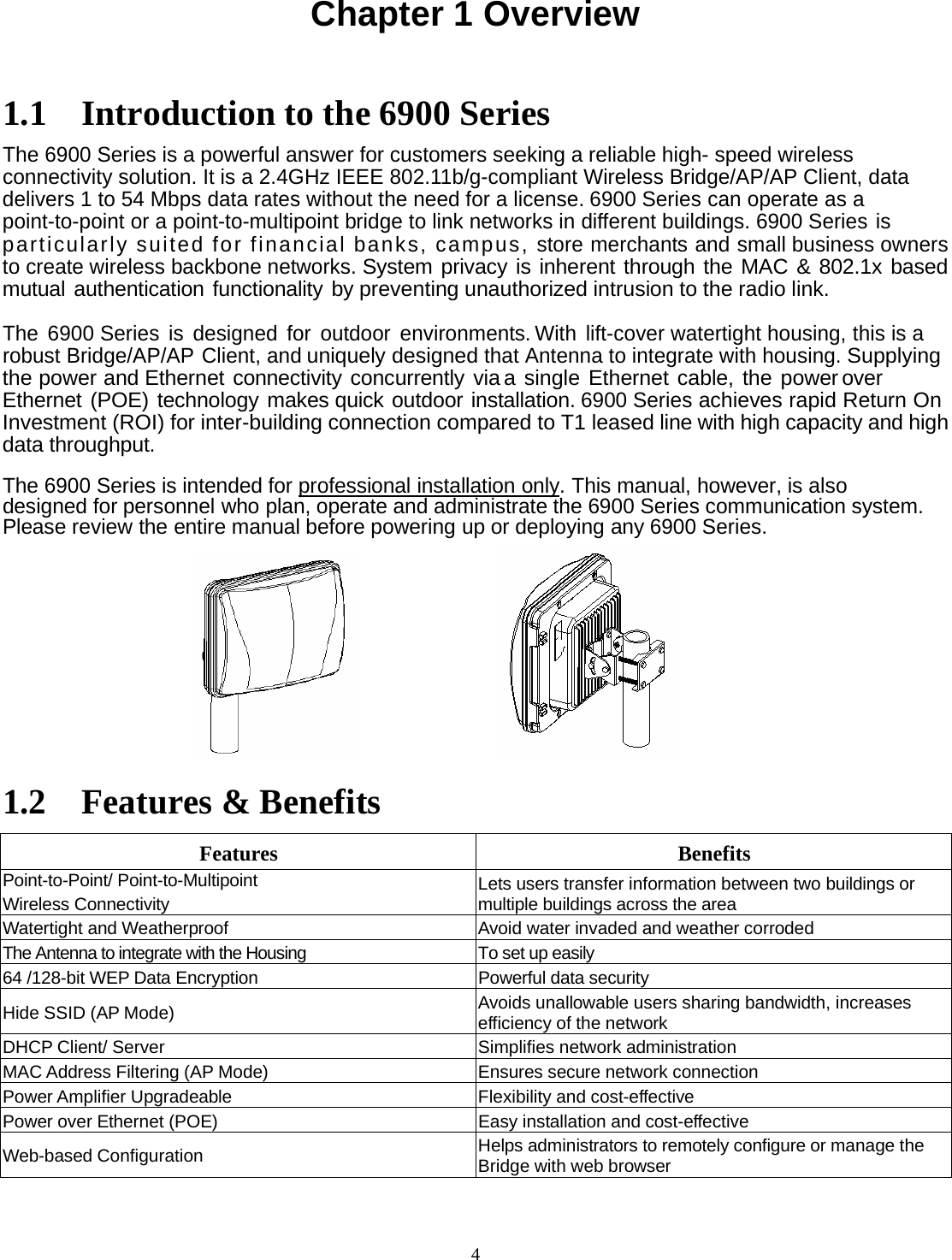
 4Chapter 1 Overview  1.1 Introduction to the 6900 Series The 6900 Series is a powerful answer for customers seeking a reliable high- speed wireless connectivity solution. It is a 2.4GHz IEEE 802.11b/g-compliant Wireless Bridge/AP/AP Client, data delivers 1 to 54 Mbps data rates without the need for a license. 6900 Series can operate as a point-to-point or a point-to-multipoint bridge to link networks in different buildings. 6900 Series is particularly suited for financial banks, campus, store merchants and small business owners to create wireless backbone networks. System privacy is inherent through the MAC & 802.1x based mutual authentication functionality by preventing unauthorized intrusion to the radio link.  The 6900 Series is designed for outdoor environments. With lift-cover watertight housing, this is a robust Bridge/AP/AP Client, and uniquely designed that Antenna to integrate with housing. Supplying the power and Ethernet connectivity concurrently via a single Ethernet cable, the power over Ethernet (POE) technology makes quick outdoor installation. 6900 Series achieves rapid Return On Investment (ROI) for inter-building connection compared to T1 leased line with high capacity and high data throughput.  The 6900 Series is intended for professional installation only. This manual, however, is also designed for personnel who plan, operate and administrate the 6900 Series communication system. Please review the entire manual before powering up or deploying any 6900 Series.                                  1.2 Features & Benefits Features Benefits Point-to-Point/ Point-to-Multipoint Wireless Connectivity Lets users transfer information between two buildings or multiple buildings across the area Watertight and Weatherproof Avoid water invaded and weather corroded The Antenna to integrate with the Housing  To set up easily 64 /128-bit WEP Data Encryption Powerful data security Hide SSID (AP Mode) Avoids unallowable users sharing bandwidth, increases efficiency of the network DHCP Client/ Server Simplifies network administration MAC Address Filtering (AP Mode) Ensures secure network connection Power Amplifier Upgradeable Flexibility and cost-effective Power over Ethernet (POE) Easy installation and cost-effective Web-based Configuration Helps administrators to remotely configure or manage the Bridge with web browser
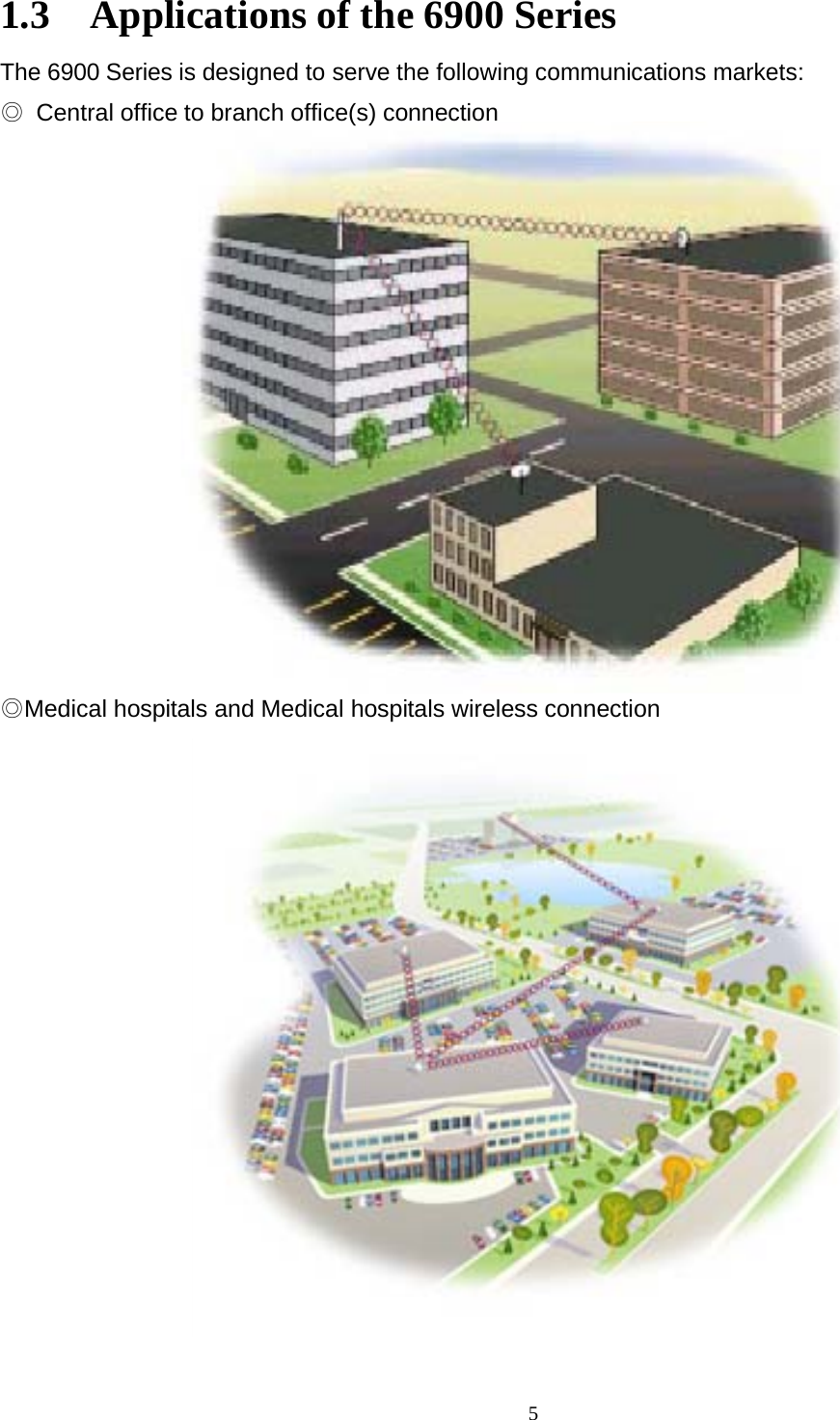
 51.3  Applications of the 6900 Series The 6900 Series is designed to serve the following communications markets: ◎ Central office to branch office(s) connection                  ◎Medical hospitals and Medical hospitals wireless connection
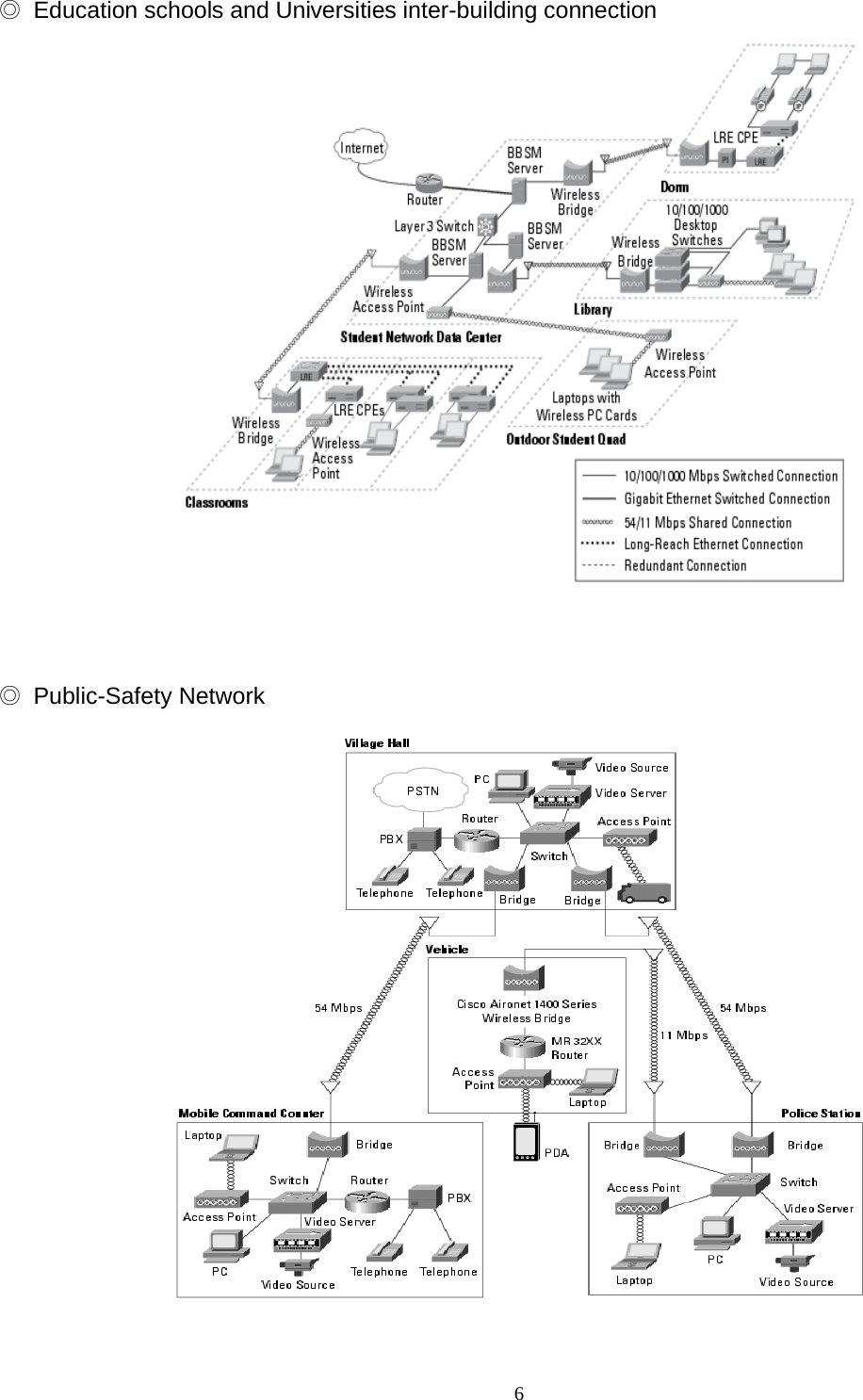
 6◎ Education schools and Universities inter-building connection    ◎ Public-Safety Network
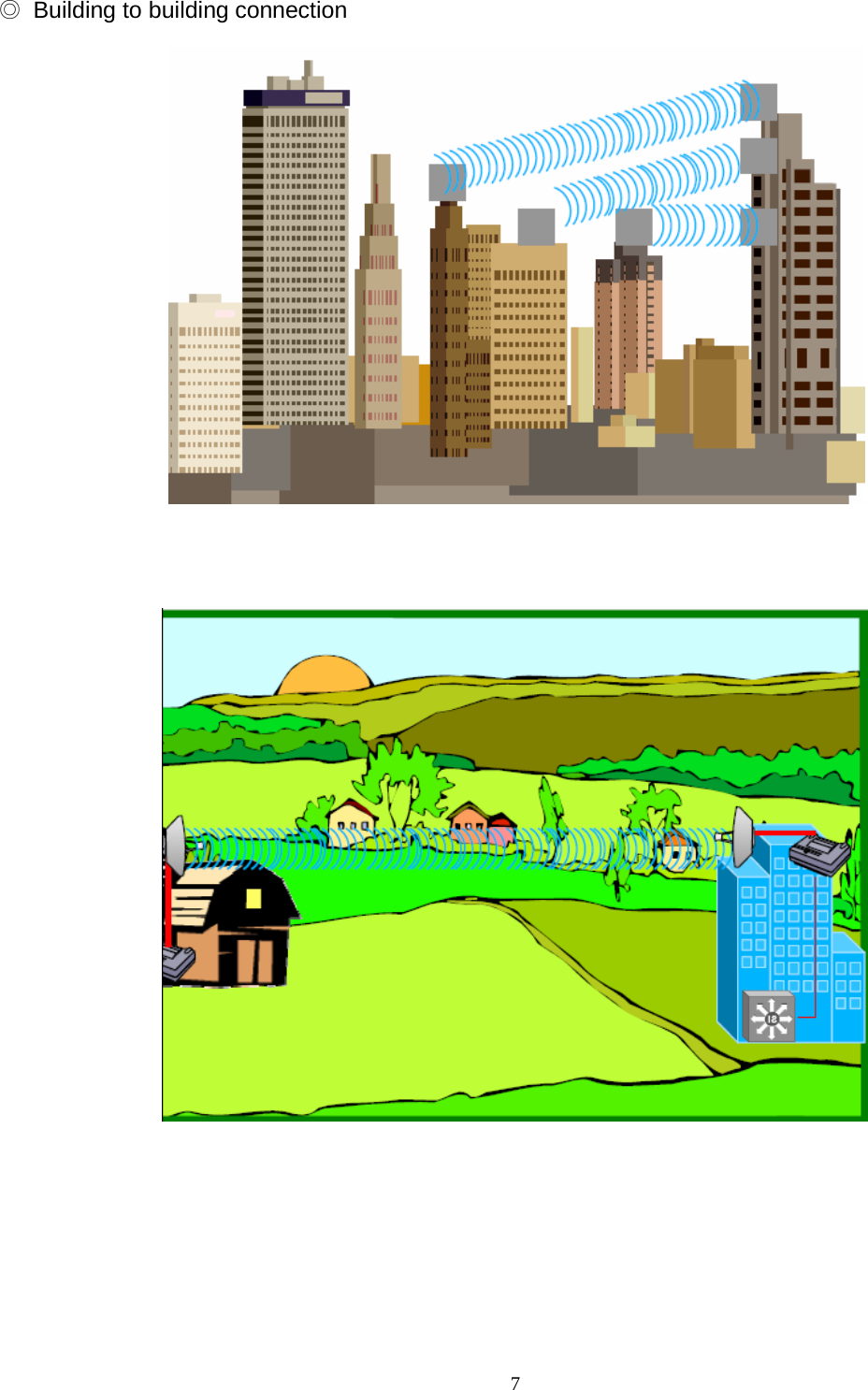
 7◎ Building to building connection
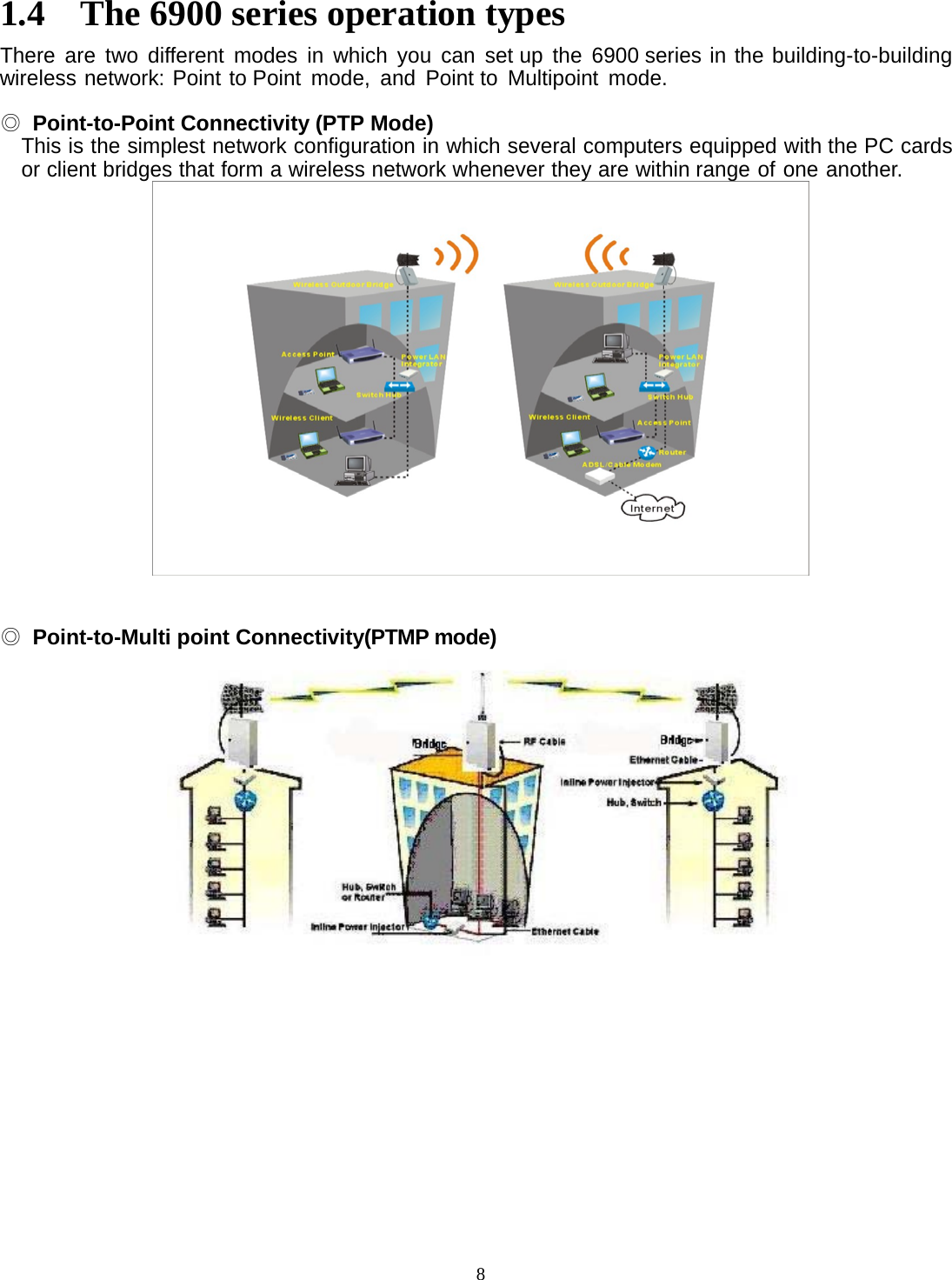
 81.4    The 6900 series operation types There are two different modes in which you can set up the 6900 series in the building-to-building wireless network: Point to Point mode, and Point to Multipoint mode.    ◎ Point-to-Point Connectivity (PTP Mode) This is the simplest network configuration in which several computers equipped with the PC cards or client bridges that form a wireless network whenever they are within range of one another.    ◎ Point-to-Multi point Connectivity(PTMP mode)
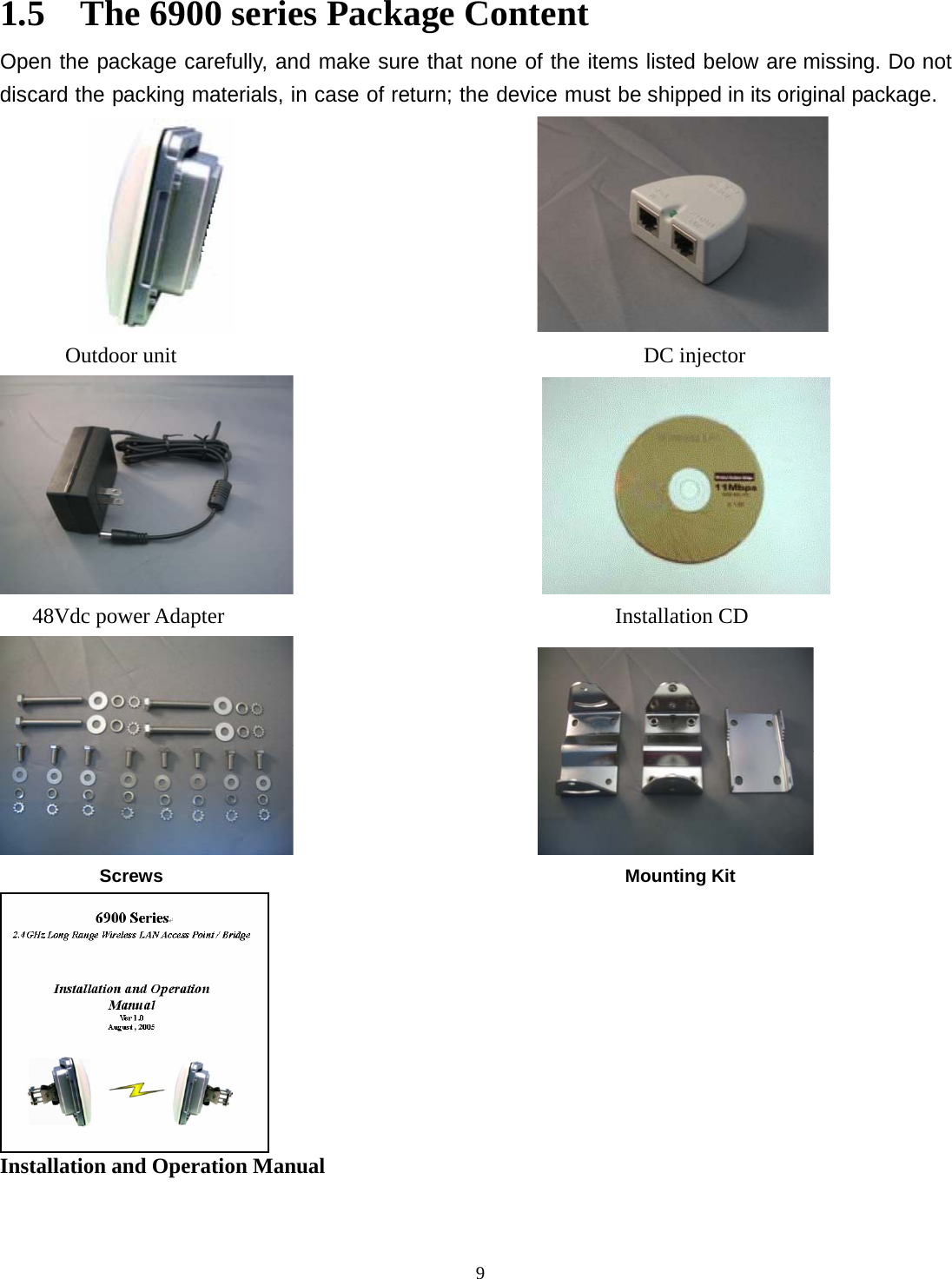
 91.5    The 6900 series Package Content Open the package carefully, and make sure that none of the items listed below are missing. Do not discard the packing materials, in case of return; the device must be shipped in its original package.                               Outdoor unit                                           DC injector                          48Vdc power Adapter                                    Installation CD                              Screws                                                   Mounting Kit                         Installation and Operation Manual
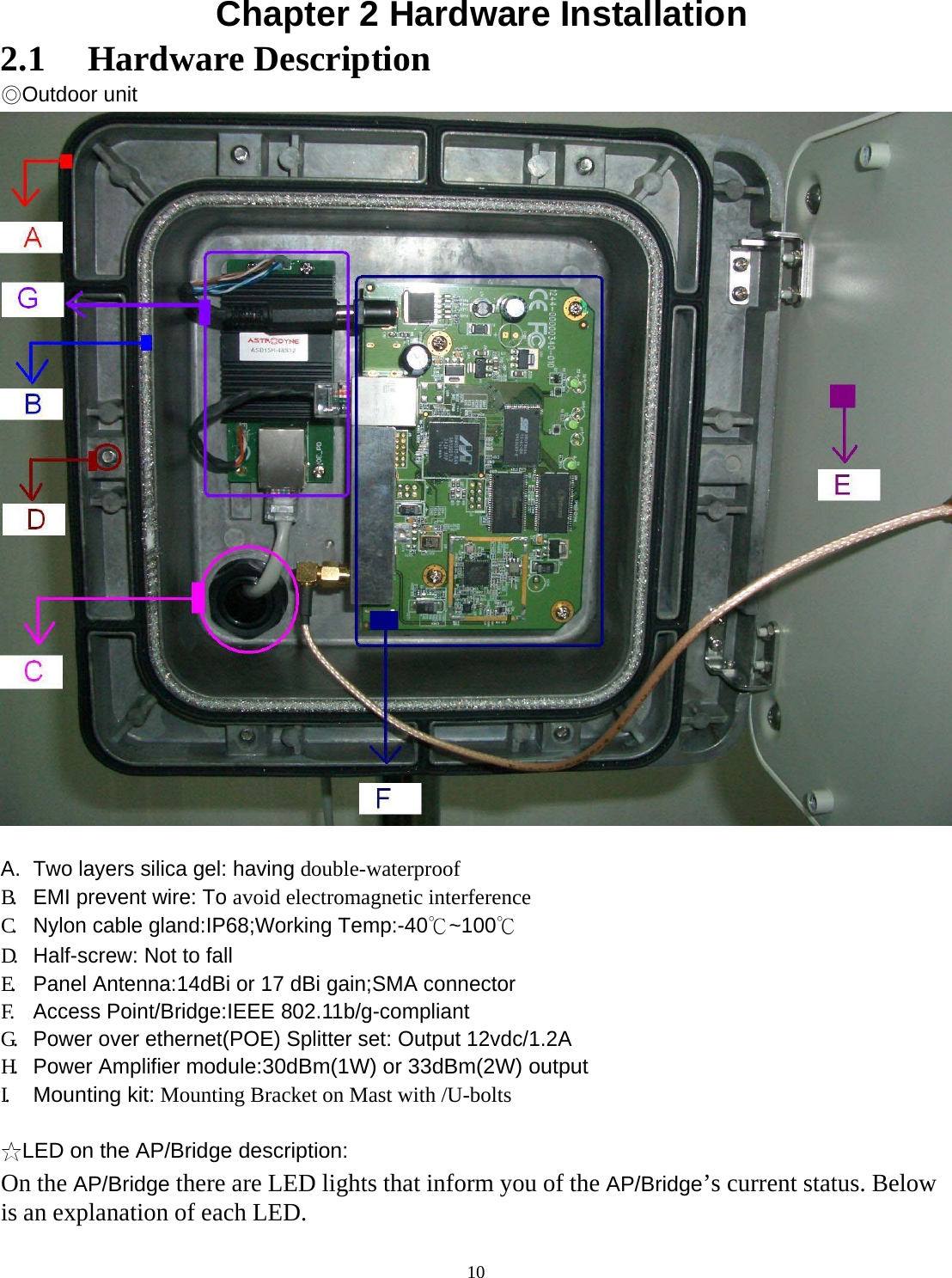
 10Chapter 2 Hardware Installation  2.1  Hardware Description  ◎Outdoor unit   A.  Two layers silica gel: having double-waterproof B. EMI prevent wire: To avoid electromagnetic interference  C. Nylon cable gland:IP68;Working Temp:-40℃~100℃ D. Half-screw: Not to fall E. Panel Antenna:14dBi or 17 dBi gain;SMA connector F. Access Point/Bridge:IEEE 802.11b/g-compliant  G. Power over ethernet(POE) Splitter set: Output 12vdc/1.2A H. Power Amplifier module:30dBm(1W) or 33dBm(2W) output I. Mounting kit: Mounting Bracket on Mast with /U-bolts  ☆LED on the AP/Bridge description: On the AP/Bridge there are LED lights that inform you of the AP/Bridge’s current status. Below is an explanation of each LED.
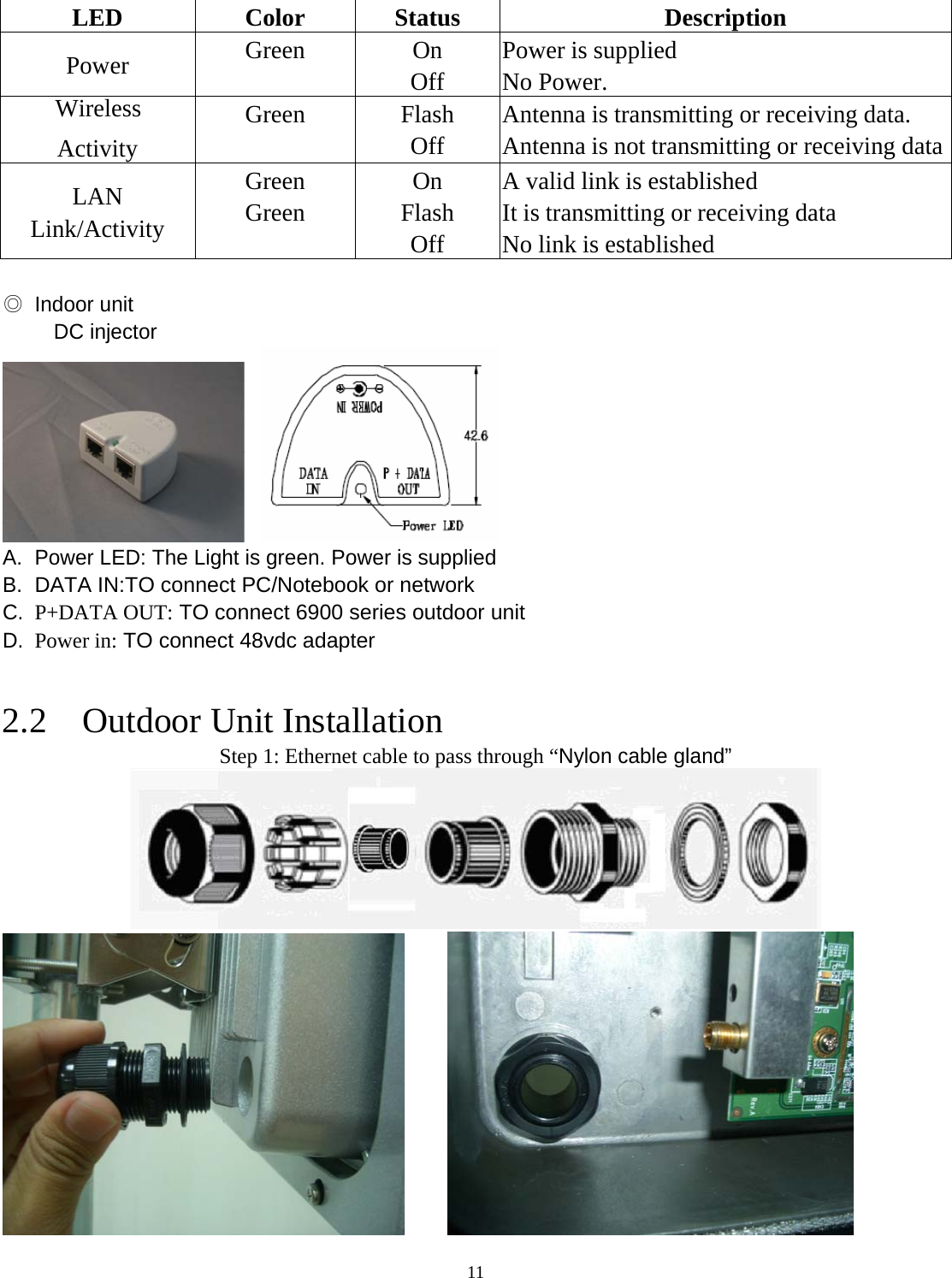
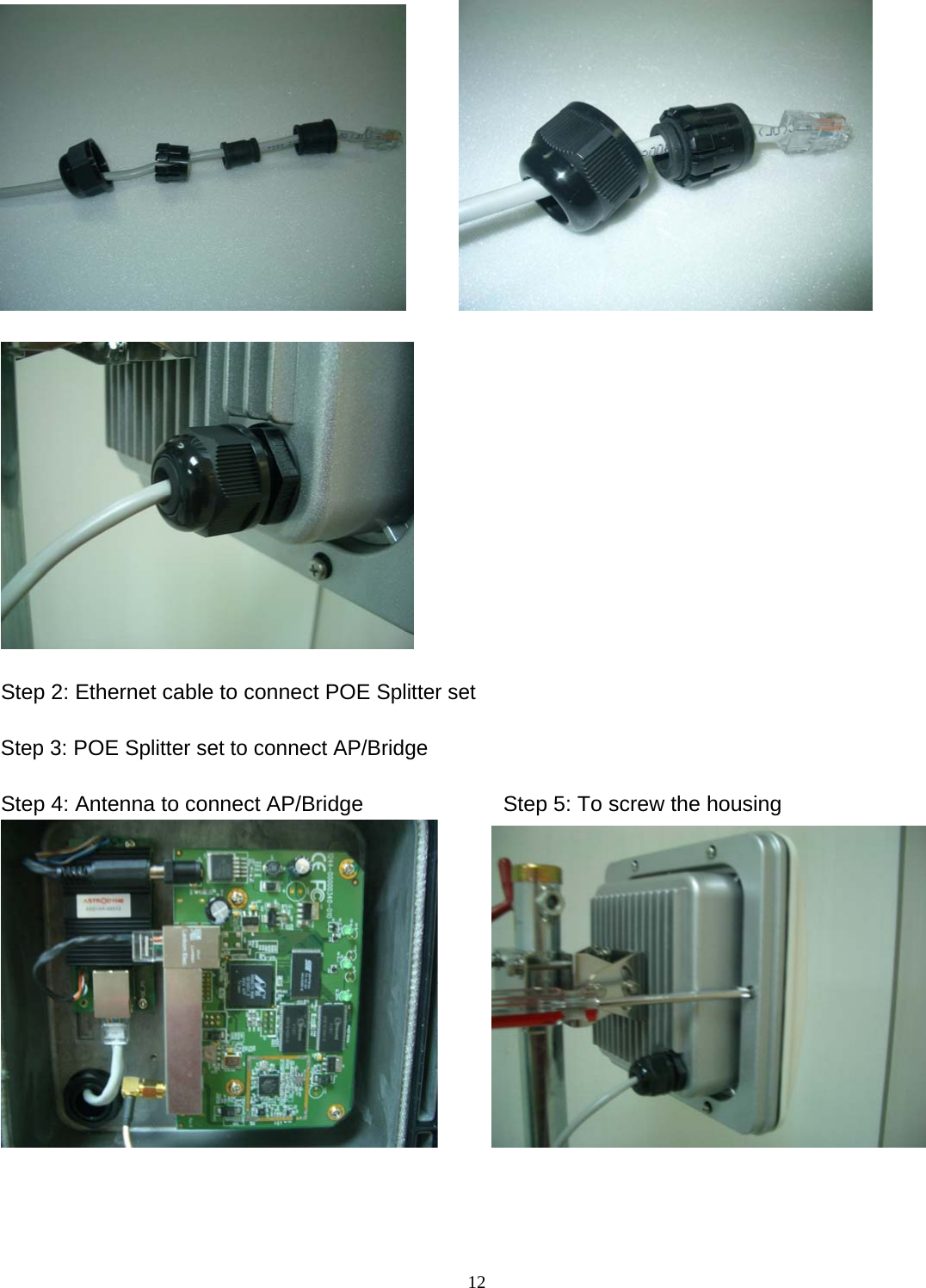
 11LED Color Status Description Power Green  On Off Power is supplied No Power. Wireless  Activity Green Flash Off Antenna is transmitting or receiving data. Antenna is not transmitting or receiving dataLAN Link/Activity Green Green  On Flash Off A valid link is established It is transmitting or receiving data No link is established  ◎ Indoor unit DC injector       A.  Power LED: The Light is green. Power is supplied B. DATA IN:TO connect PC/Notebook or network C. P+DATA OUT: TO connect 6900 series outdoor unit D. Power in: TO connect 48vdc adapter  2.2  Outdoor Unit Installation Step 1: Ethernet cable to pass through “Nylon cable gland”
 12          Step 2: Ethernet cable to connect POE Splitter set  Step 3: POE Splitter set to connect AP/Bridge  Step 4: Antenna to connect AP/Bridge                   Step 5: To screw the housing
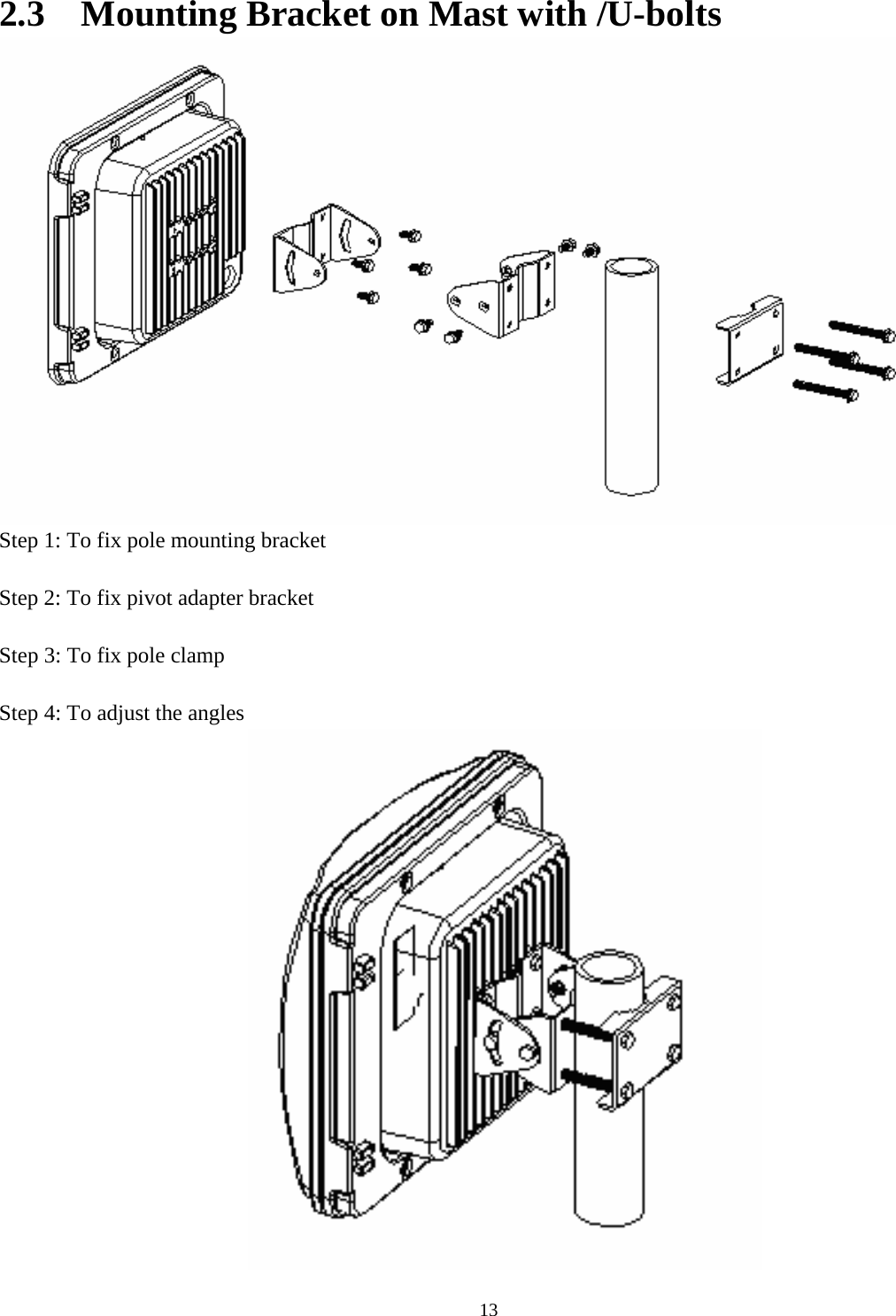
 132.3    Mounting Bracket on Mast with /U-bolts  Step 1: To fix pole mounting bracket                Step 2: To fix pivot adapter bracket  Step 3: To fix pole clamp                    Step 4: To adjust the angles
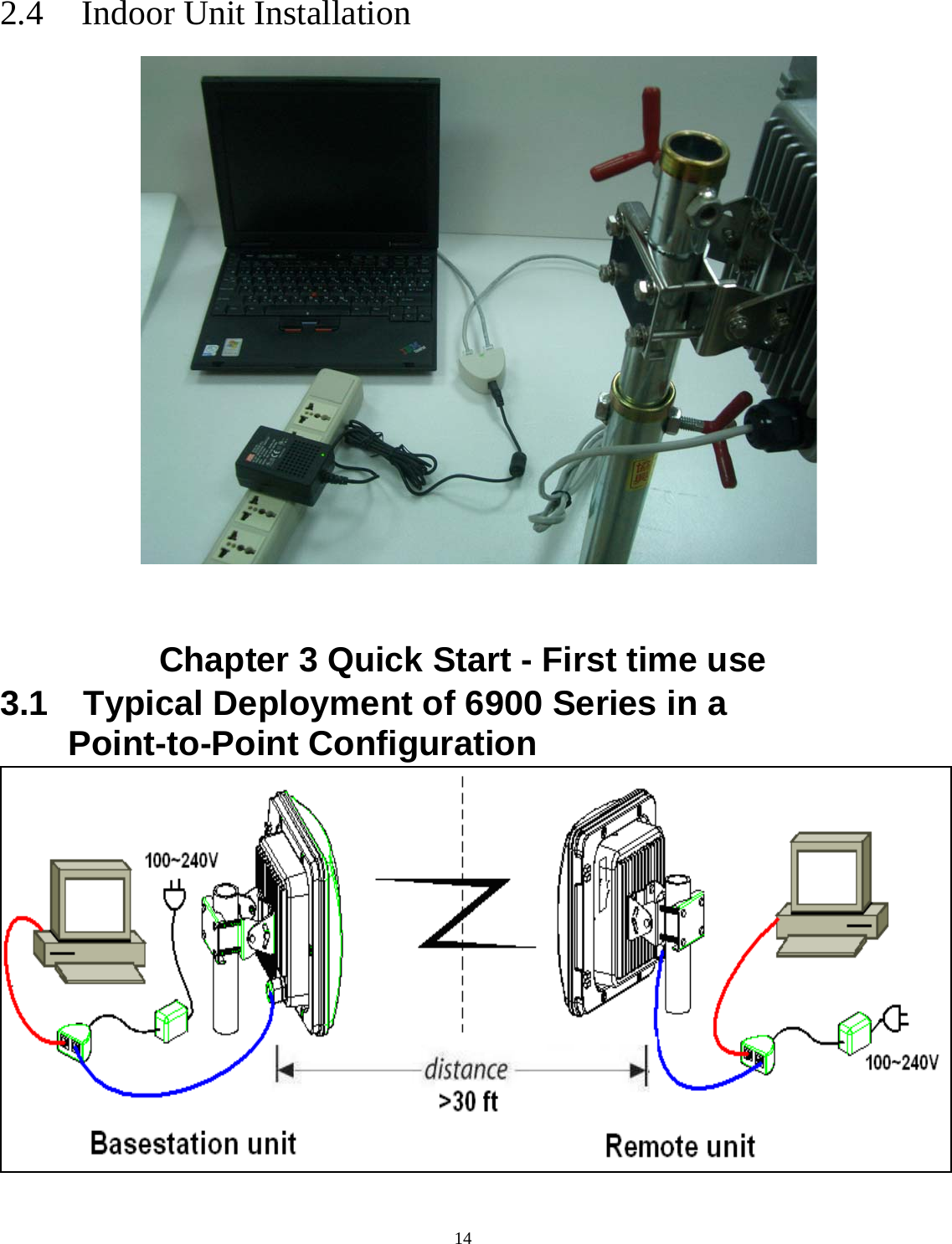
 142.4  Indoor Unit Installation          Chapter 3 Quick Start - First time use 3.1  Typical Deployment of 6900 Series in a Point-to-Point Configuration
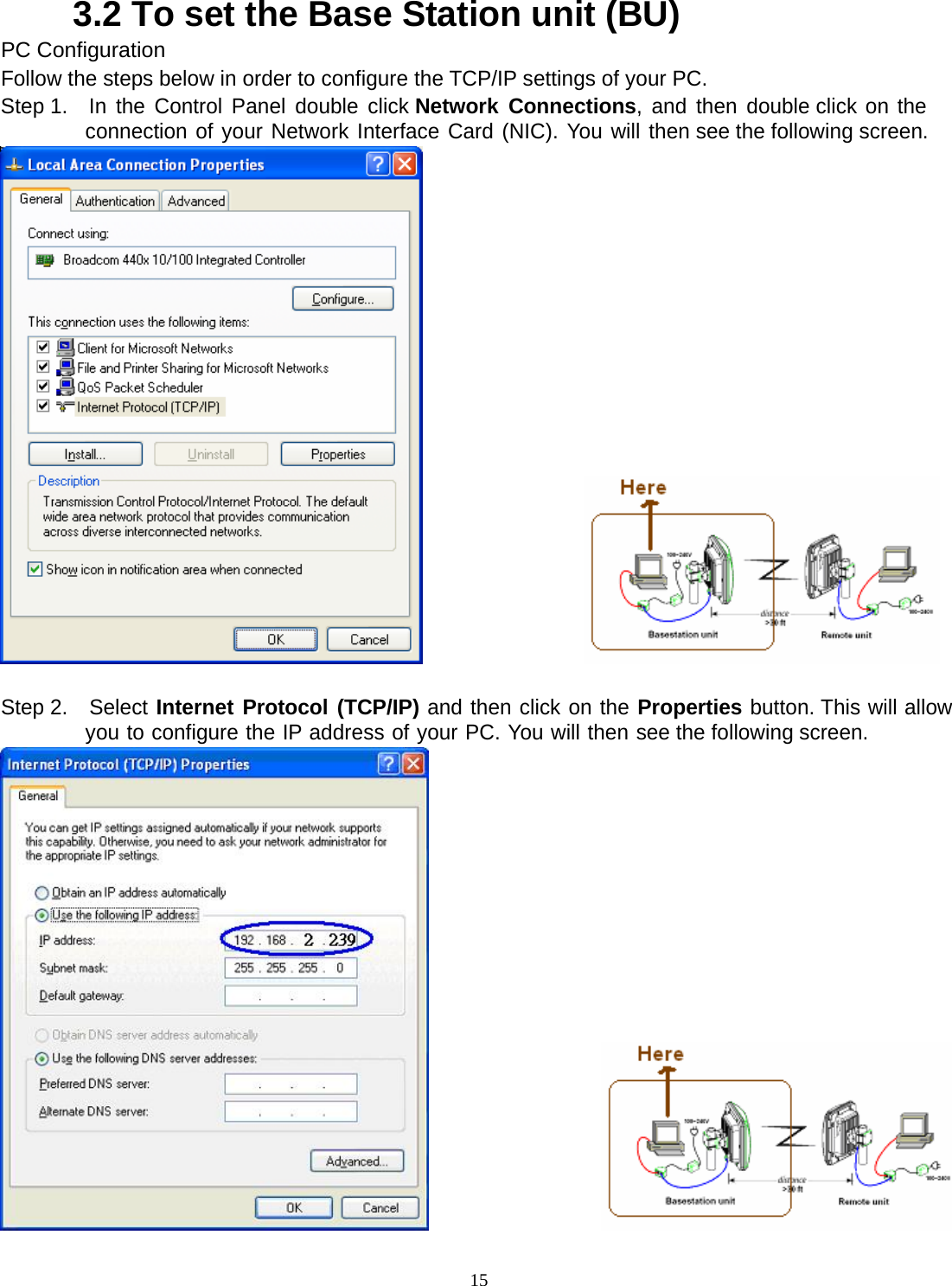
 153.2 To set the Base Station unit (BU) PC Configuration Follow the steps below in order to configure the TCP/IP settings of your PC. Step 1.  In the Control Panel double click Network Connections, and then double click on the connection of your Network Interface Card (NIC). You will then see the following screen.                   Step 2.  Select Internet Protocol (TCP/IP) and then click on the Properties button. This will allow you to configure the IP address of your PC. You will then see the following screen.
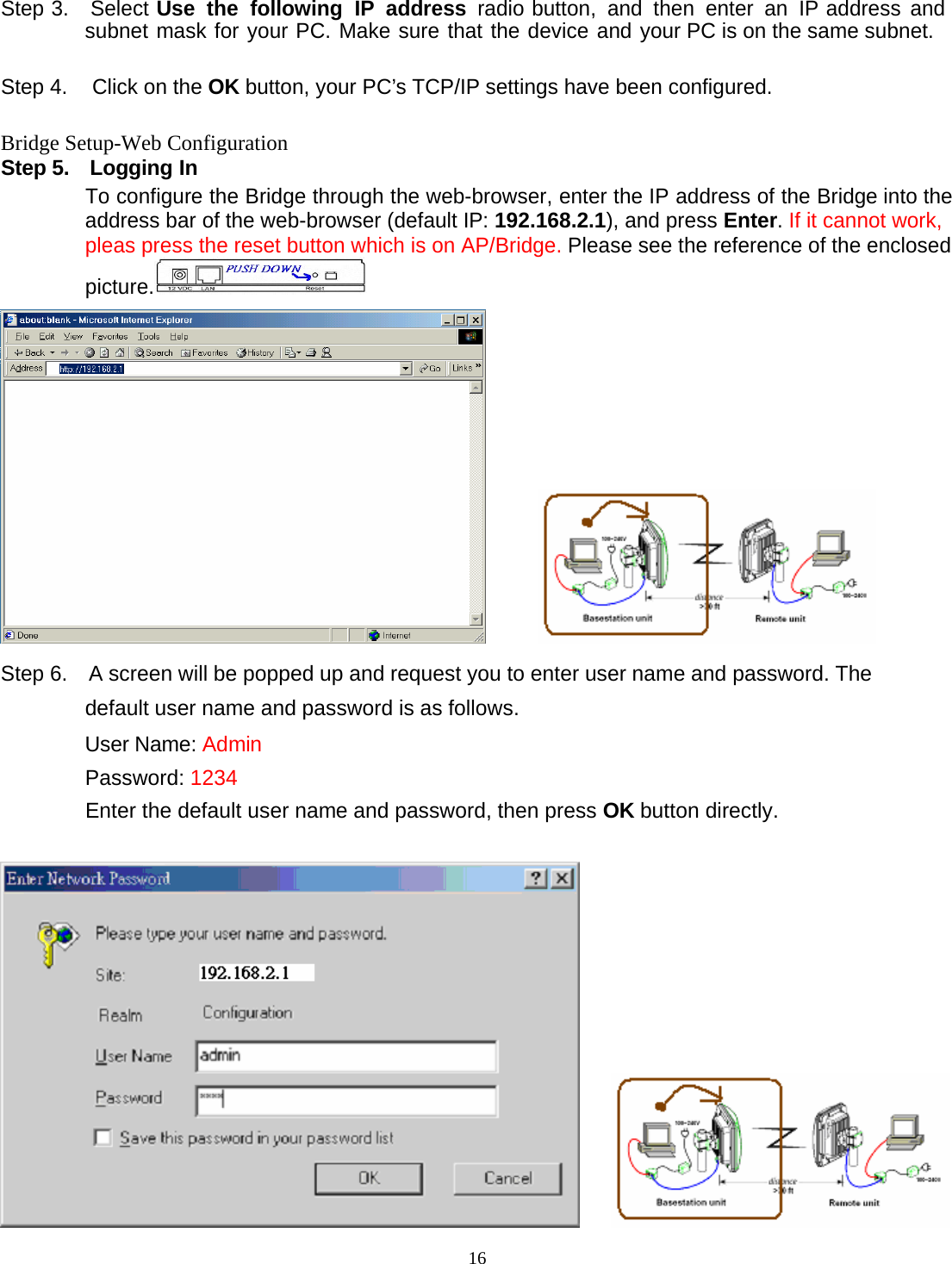
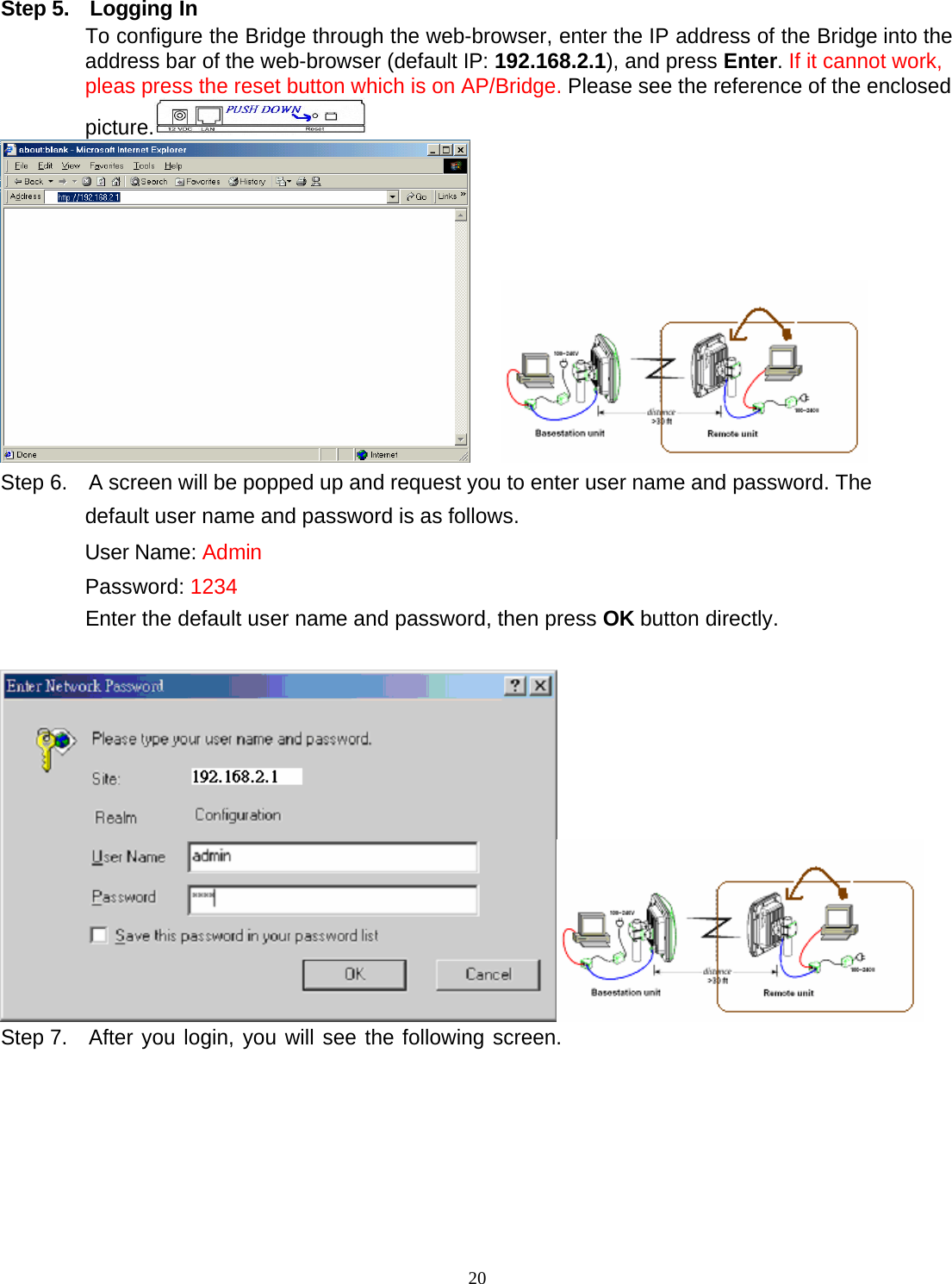
 16 Step 3.  Select Use the following IP address radio button, and then enter an IP address and subnet mask for your PC. Make sure that the device and your PC is on the same subnet.  Step 4.  Click on the OK button, your PC’s TCP/IP settings have been configured.  Bridge Setup-Web Configuration Step 5.    Logging In To configure the Bridge through the web-browser, enter the IP address of the Bridge into the address bar of the web-browser (default IP: 192.168.2.1), and press Enter. If it cannot work, pleas press the reset button which is on AP/Bridge. Please see the reference of the enclosed picture.         Step 6.   A screen will be popped up and request you to enter user name and password. The default user name and password is as follows.  User Name: Admin  Password: 1234 Enter the default user name and password, then press OK button directly.
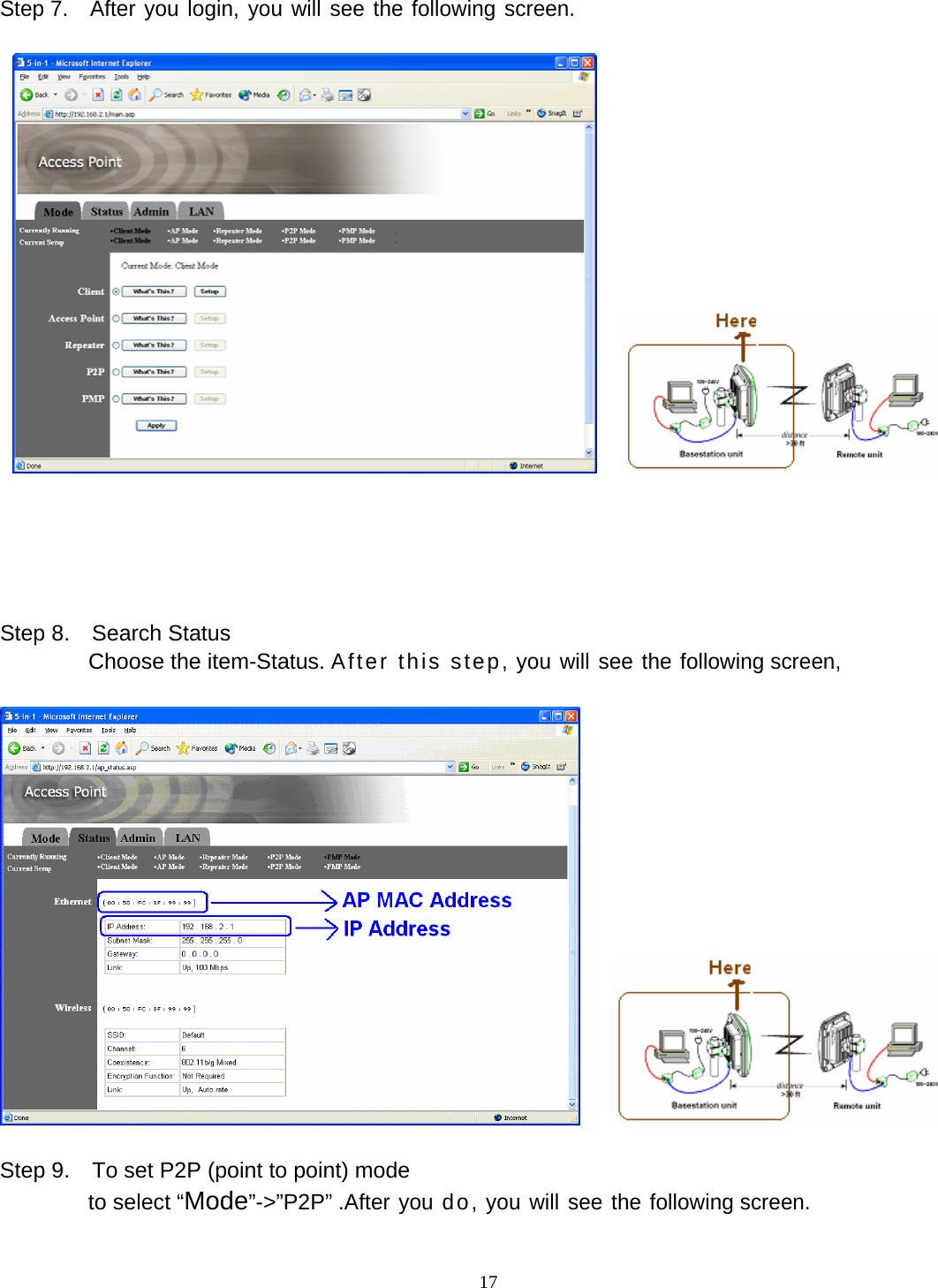
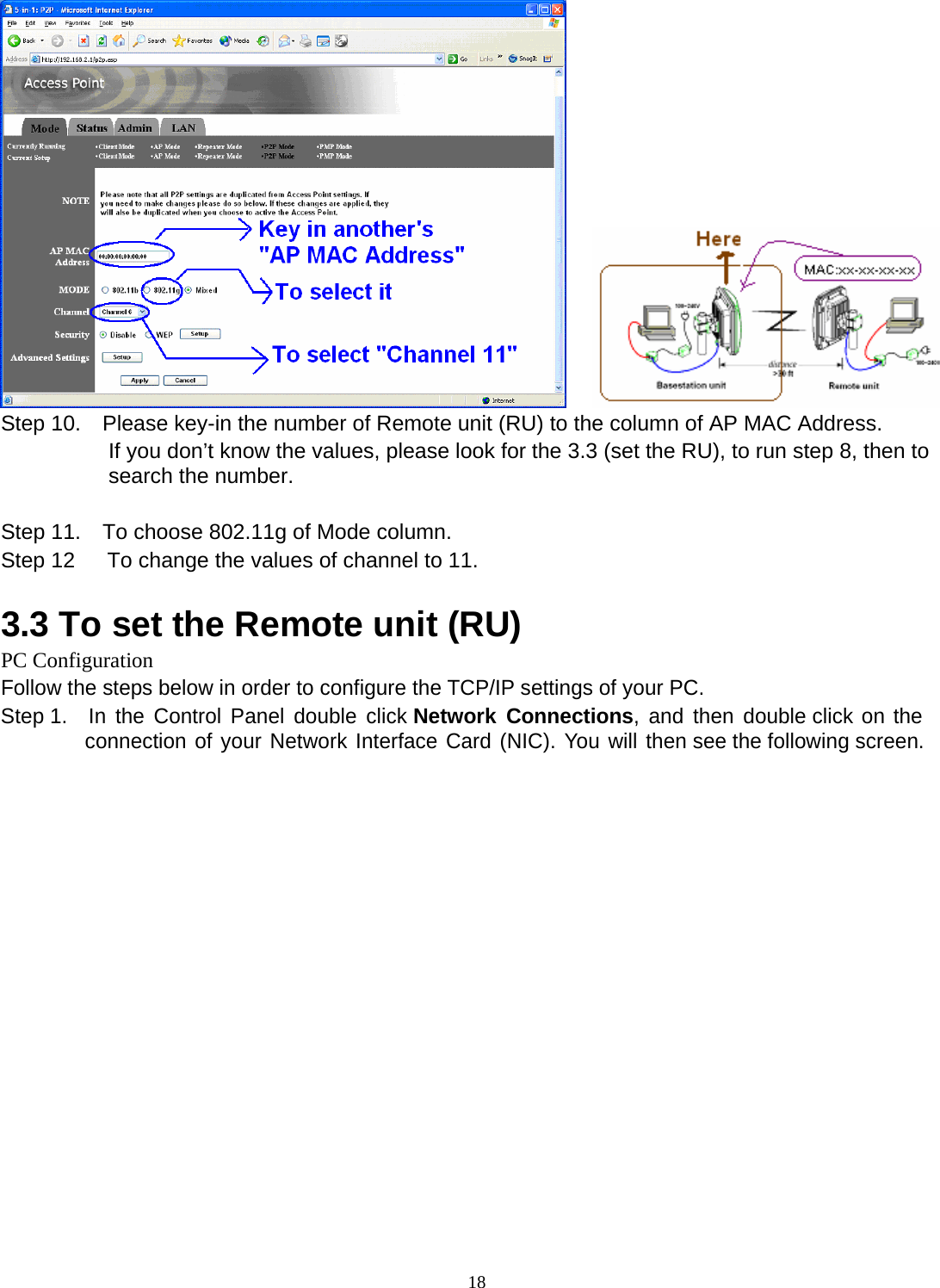
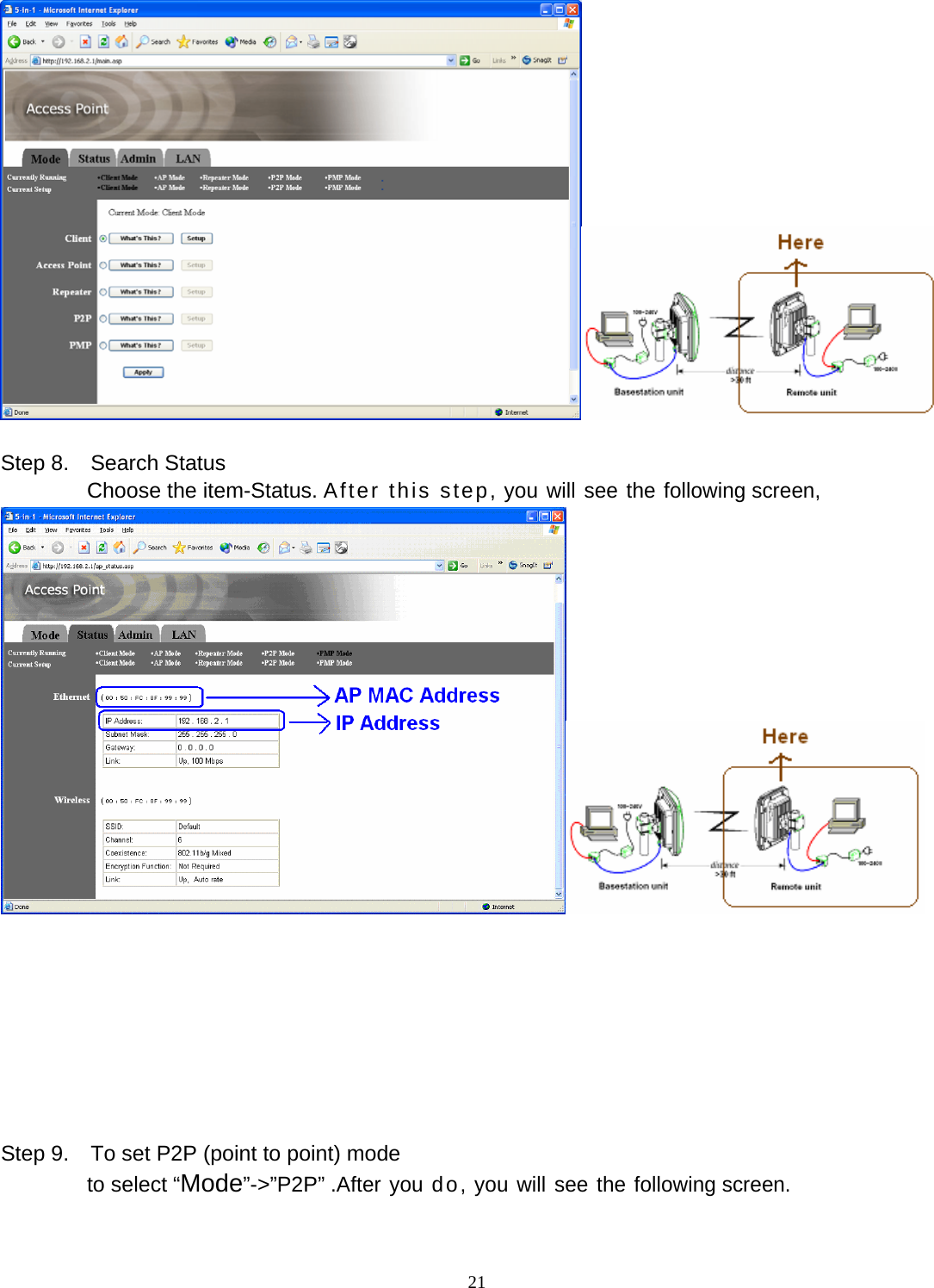
 17 Step 7.  After you login, you will see the following screen.            Step 8.  Search Status         Choose the item-Status. After this step, you will see the following screen,               Step 9.    To set P2P (point to point) mode to select “Mode”->”P2P” .After you do, you will see the following screen.
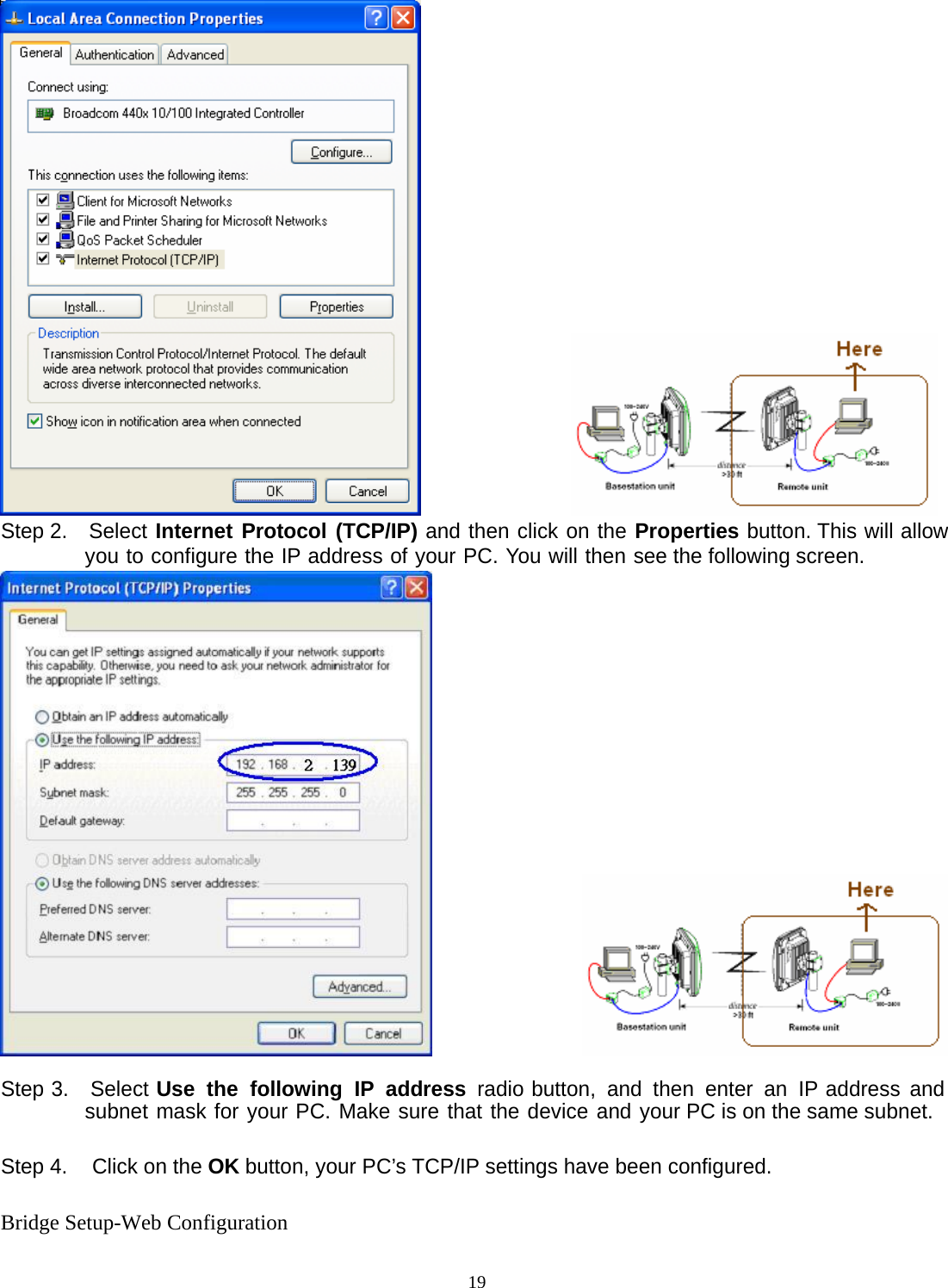
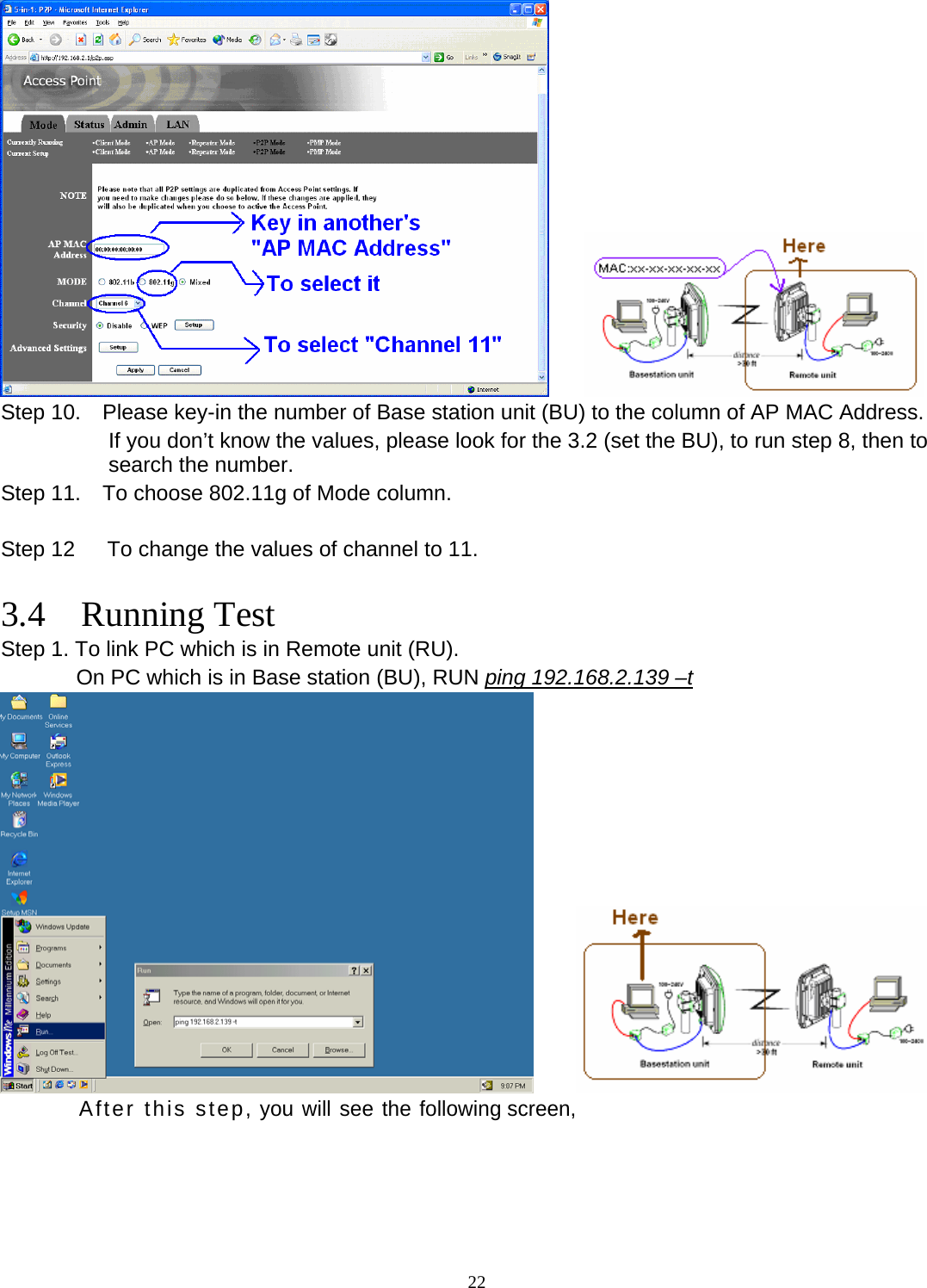
 18     Step 10.    Please key-in the number of Remote unit (RU) to the column of AP MAC Address. If you don’t know the values, please look for the 3.3 (set the RU), to run step 8, then to search the number.  Step 11.    To choose 802.11g of Mode column. Step 12      To change the values of channel to 11.  3.3 To set the Remote unit (RU) PC Configuration Follow the steps below in order to configure the TCP/IP settings of your PC. Step 1.  In the Control Panel double click Network Connections, and then double click on the connection of your Network Interface Card (NIC). You will then see the following screen.
 19                Step 2.  Select Internet Protocol (TCP/IP) and then click on the Properties button. This will allow you to configure the IP address of your PC. You will then see the following screen.                  Step 3.  Select Use the following IP address radio button, and then enter an IP address and subnet mask for your PC. Make sure that the device and your PC is on the same subnet.  Step 4.  Click on the OK button, your PC’s TCP/IP settings have been configured.  Bridge Setup-Web Configuration
 20Step 5.    Logging In To configure the Bridge through the web-browser, enter the IP address of the Bridge into the address bar of the web-browser (default IP: 192.168.2.1), and press Enter. If it cannot work, pleas press the reset button which is on AP/Bridge. Please see the reference of the enclosed picture.       Step 6.   A screen will be popped up and request you to enter user name and password. The default user name and password is as follows.  User Name: Admin  Password: 1234 Enter the default user name and password, then press OK button directly.   Step 7.  After you login, you will see the following screen.
 21  Step 8.  Search Status          Choose the item-Status. After this step, you will see the following screen,          Step 9.    To set P2P (point to point) mode to select “Mode”->”P2P” .After you do, you will see the following screen.
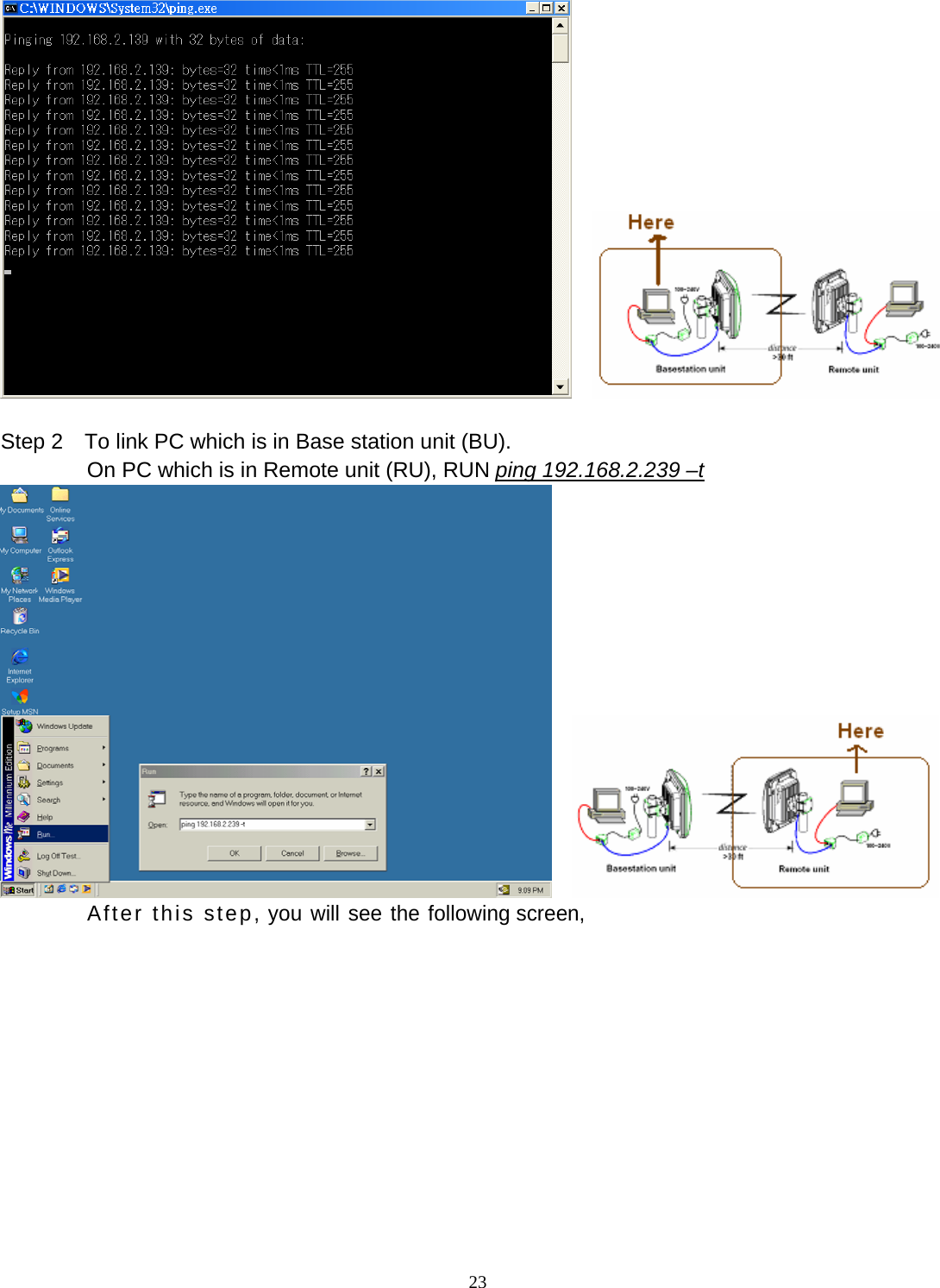
 22      Step 10.    Please key-in the number of Base station unit (BU) to the column of AP MAC Address. If you don’t know the values, please look for the 3.2 (set the BU), to run step 8, then to search the number. Step 11.    To choose 802.11g of Mode column.  Step 12      To change the values of channel to 11.  3.4  Running Test Step 1. To link PC which is in Remote unit (RU).        On PC which is in Base station (BU), RUN ping 192.168.2.139 –t       After this step, you will see the following screen,
 23    Step 2    To link PC which is in Base station unit (BU). On PC which is in Remote unit (RU), RUN ping 192.168.2.239 –t             After this step, you will see the following screen,
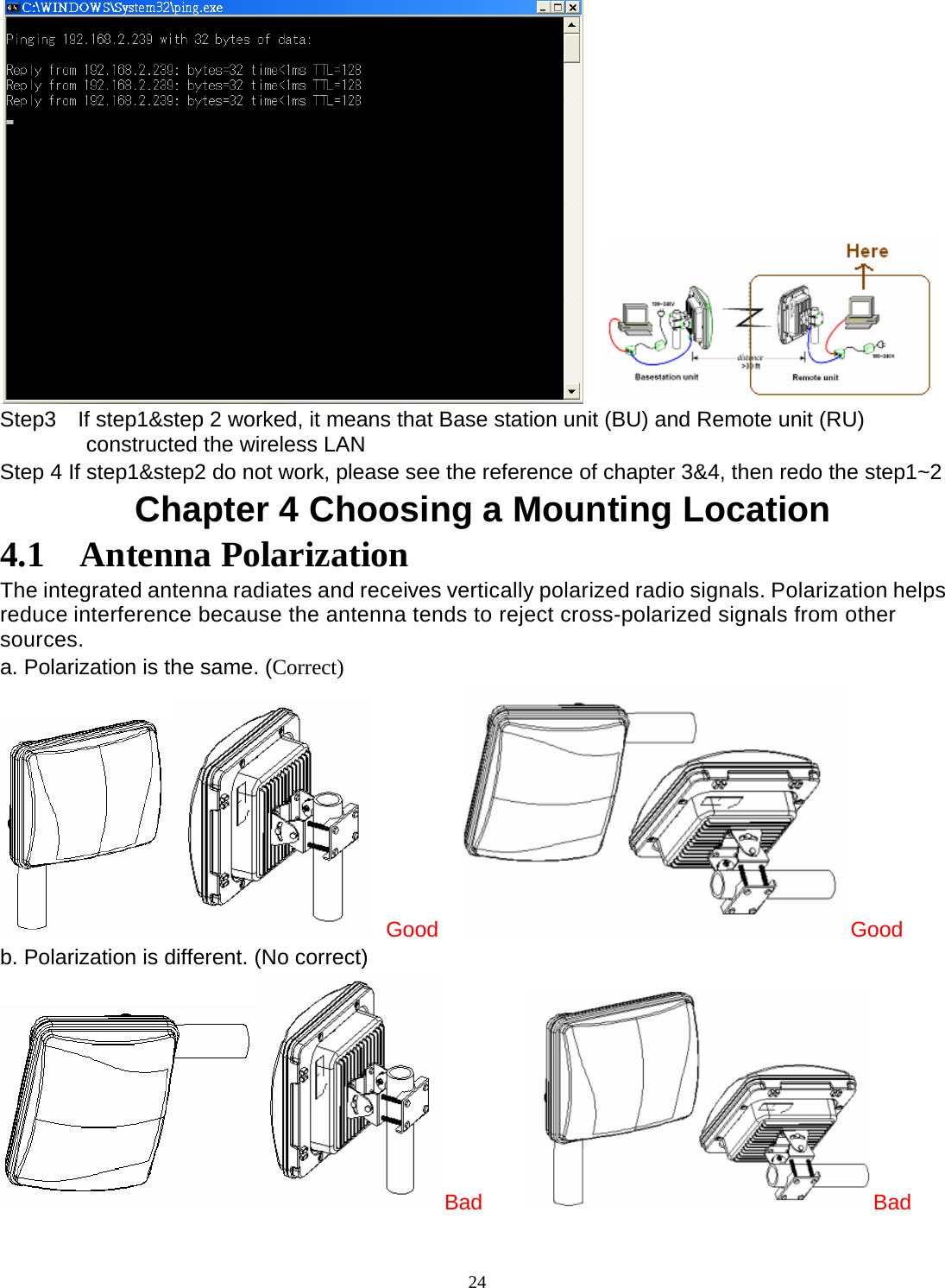
 24   Step3    If step1&step 2 worked, it means that Base station unit (BU) and Remote unit (RU) constructed the wireless LAN Step 4 If step1&step2 do not work, please see the reference of chapter 3&4, then redo the step1~2   Chapter 4 Choosing a Mounting Location 4.1  Antenna Polarization The integrated antenna radiates and receives vertically polarized radio signals. Polarization helps reduce interference because the antenna tends to reject cross-polarized signals from other sources. a. Polarization is the same. (Correct)  Good   Good b. Polarization is different. (No correct) Bad     Bad
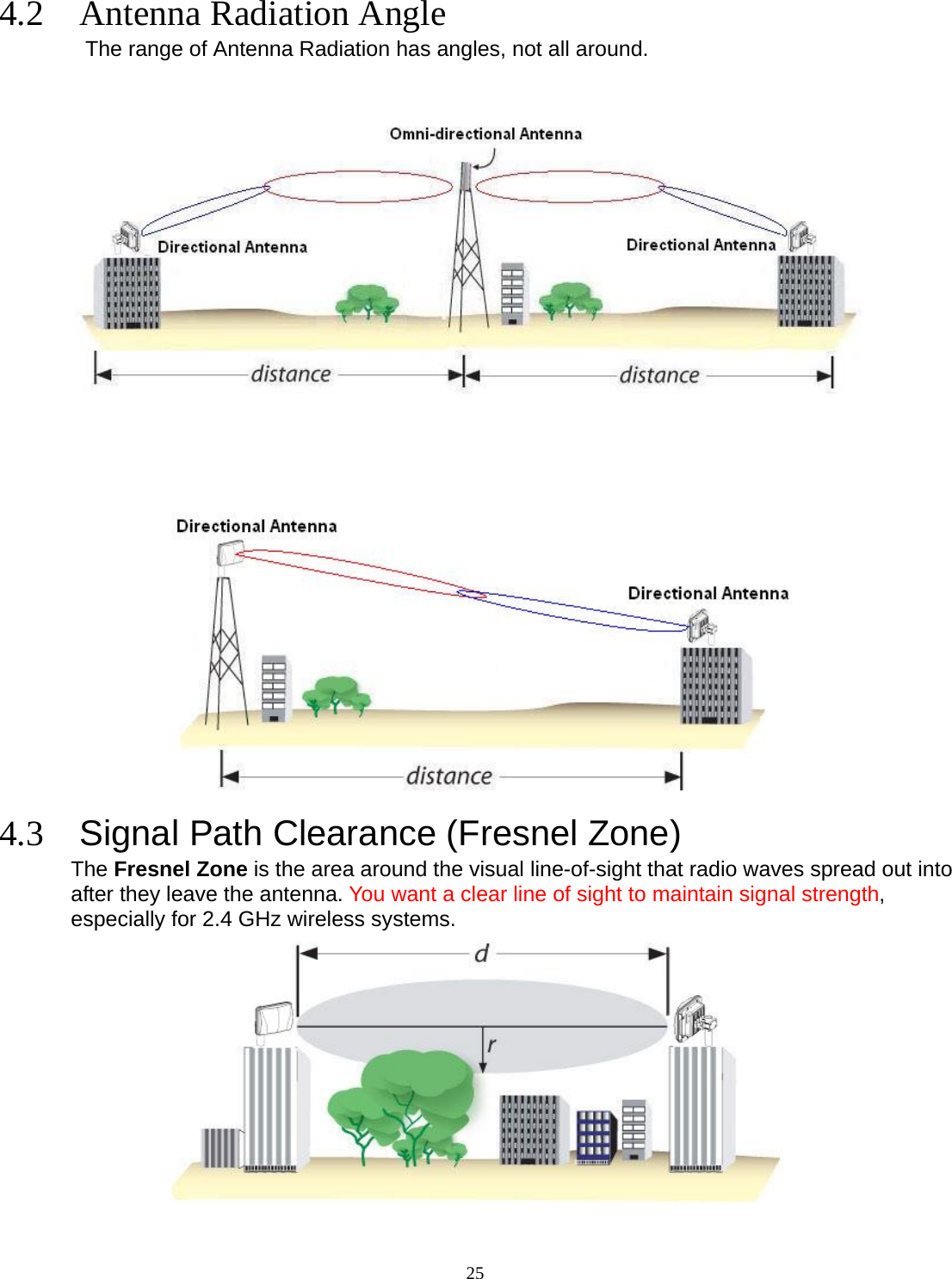
 254.2    Antenna Radiation Angle The range of Antenna Radiation has angles, not all around.       4.3  Signal Path Clearance (Fresnel Zone)     The Fresnel Zone is the area around the visual line-of-sight that radio waves spread out into after they leave the antenna. You want a clear line of sight to maintain signal strength, especially for 2.4 GHz wireless systems.
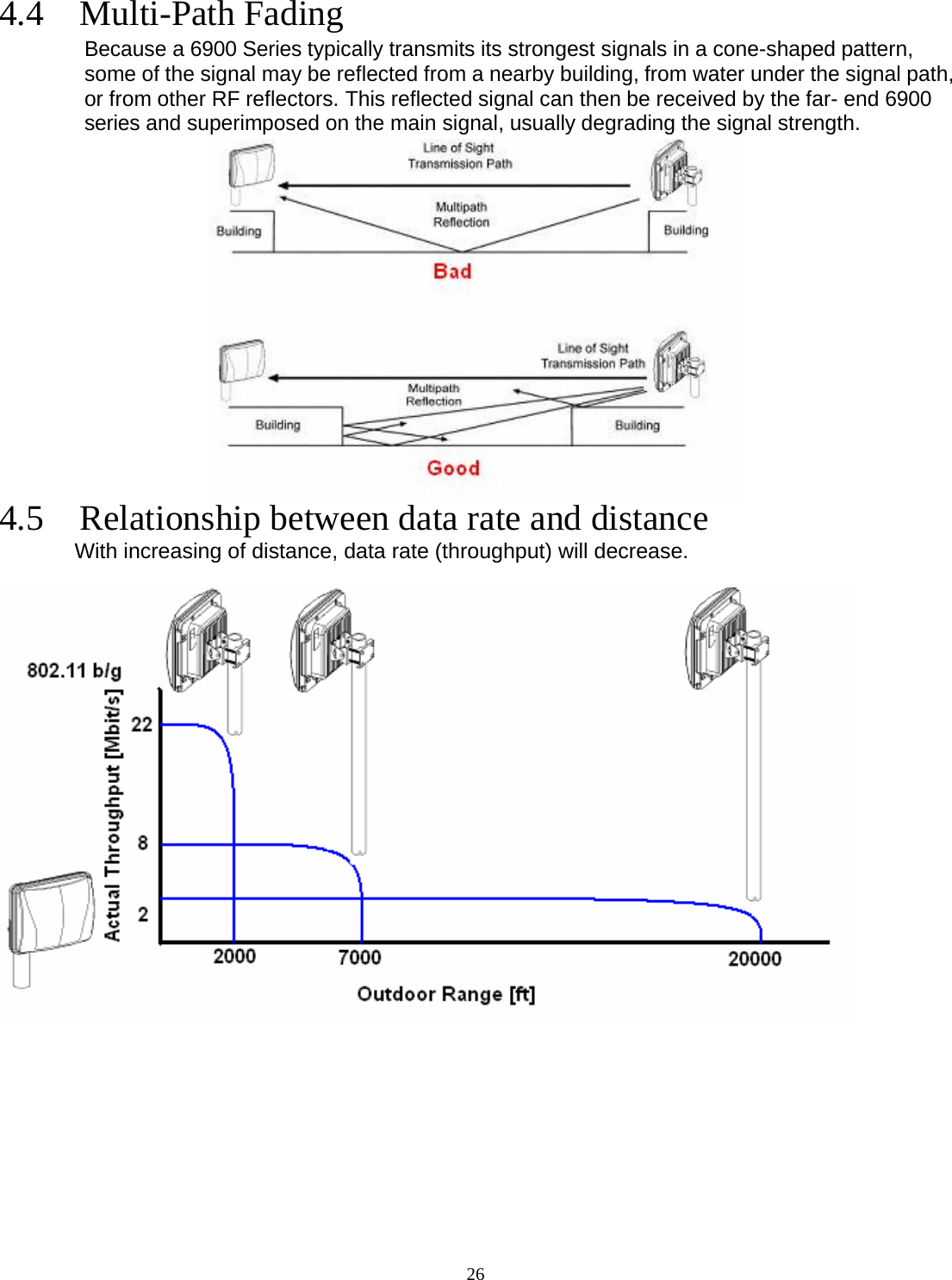
 264.4  Multi-Path Fading Because a 6900 Series typically transmits its strongest signals in a cone-shaped pattern, some of the signal may be reflected from a nearby building, from water under the signal path, or from other RF reflectors. This reflected signal can then be received by the far- end 6900 series and superimposed on the main signal, usually degrading the signal strength.  4.5    Relationship between data rate and distance        With increasing of distance, data rate (throughput) will decrease.
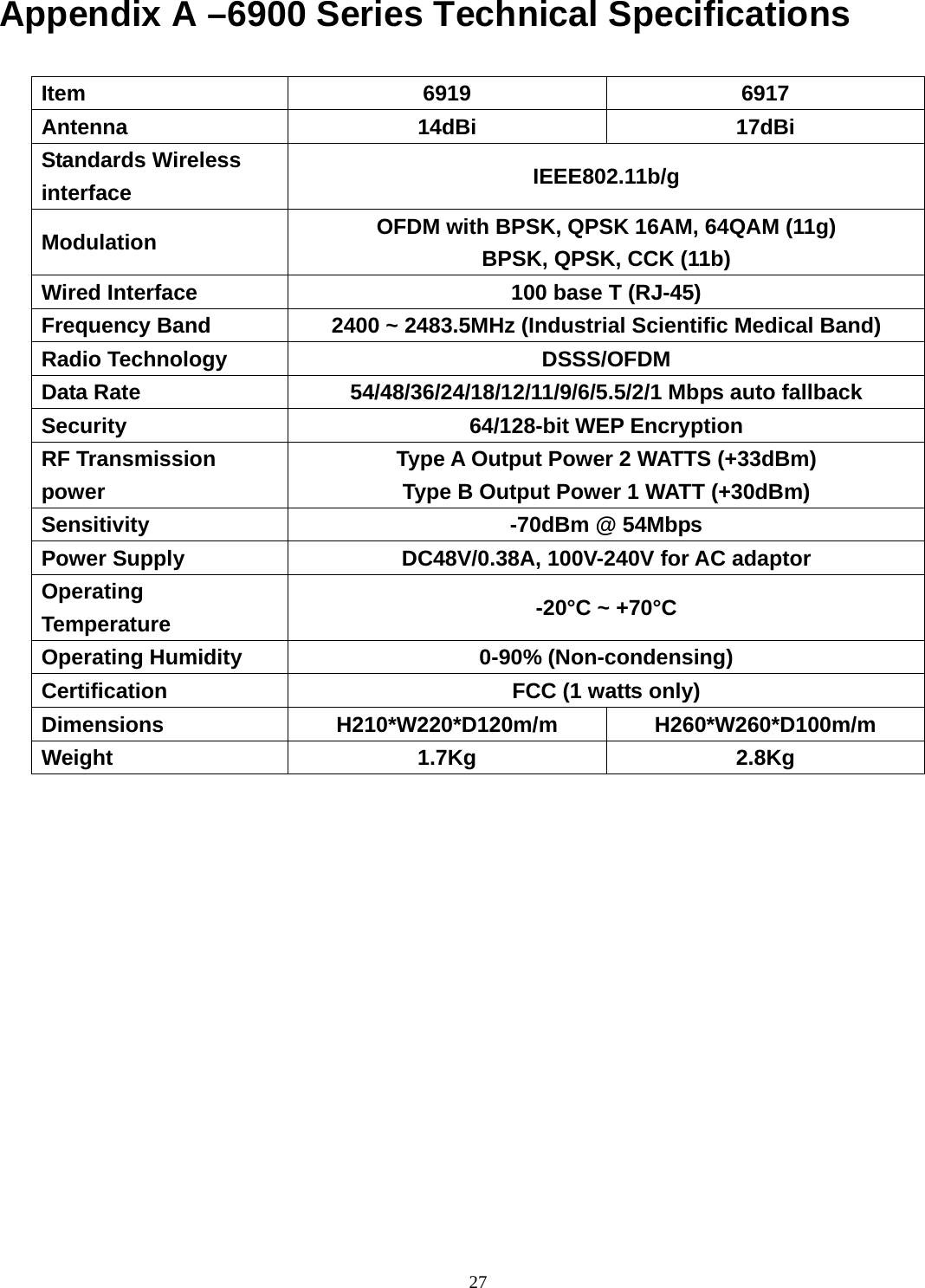
 27Appendix A –6900 Series Technical Specifications  Item   6919  6917 Antenna 14dBi 17dBi Standards Wireless interface  IEEE802.11b/g Modulation  OFDM with BPSK, QPSK 16AM, 64QAM (11g) BPSK, QPSK, CCK (11b) Wired Interface  100 base T (RJ-45) Frequency Band  2400 ~ 2483.5MHz (Industrial Scientific Medical Band) Radio Technology  DSSS/OFDM Data Rate  54/48/36/24/18/12/11/9/6/5.5/2/1 Mbps auto fallback Security 64/128-bit WEP Encryption RF Transmission power Type A Output Power 2 WATTS (+33dBm)   Type B Output Power 1 WATT (+30dBm)   Sensitivity  -70dBm @ 54Mbps Power Supply    DC48V/0.38A, 100V-240V for AC adaptor Operating Temperature  -20°C ~ +70°C Operating Humidity  0-90% (Non-condensing) Certification  FCC (1 watts only) Dimensions H210*W220*D120m/m H260*W260*D100m/m Weight 1.7Kg 2.8Kg
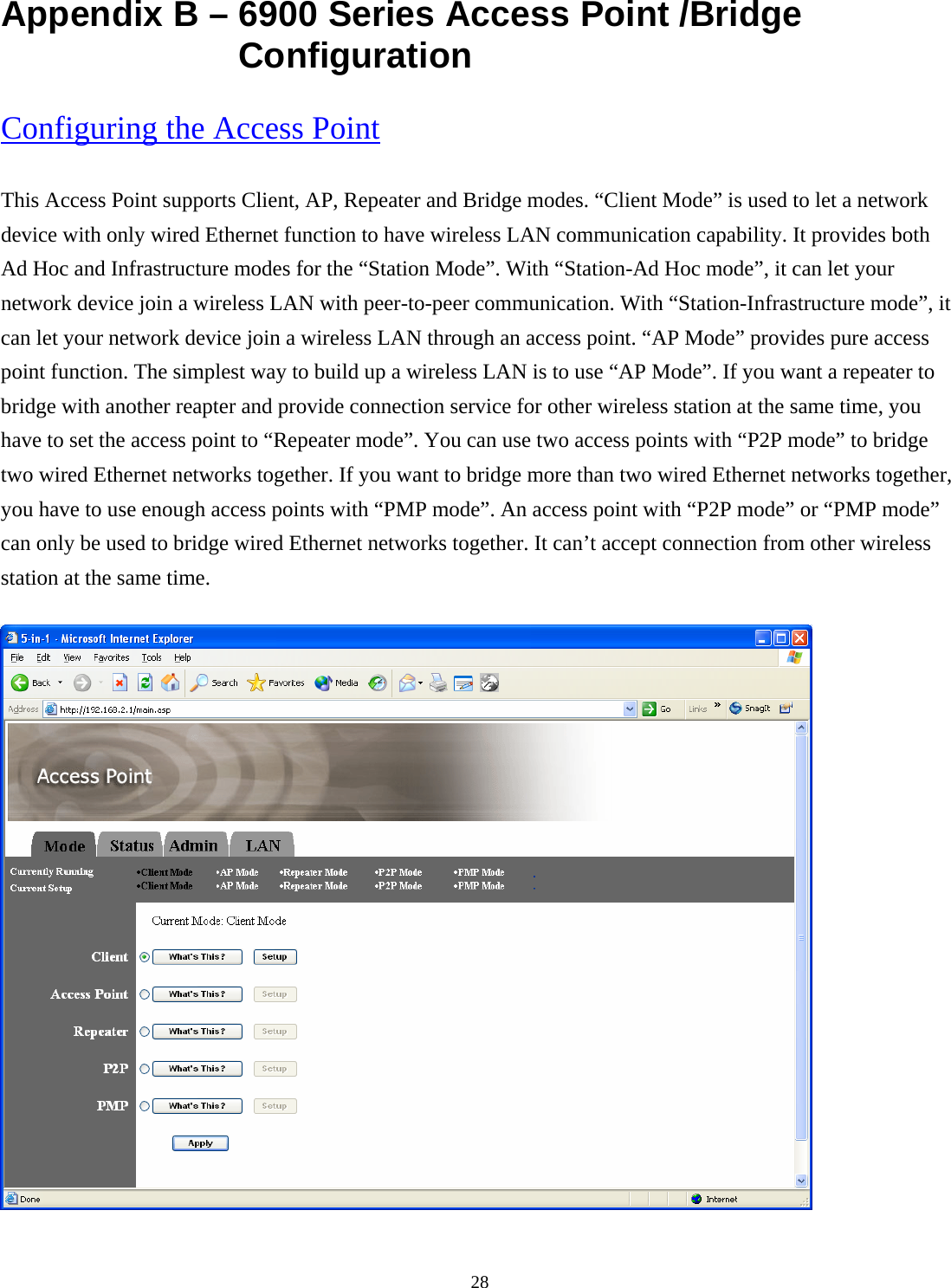
 28Appendix B – 6900 Series Access Point /Bridge Configuration Configuring the Access Point This Access Point supports Client, AP, Repeater and Bridge modes. “Client Mode” is used to let a network device with only wired Ethernet function to have wireless LAN communication capability. It provides both Ad Hoc and Infrastructure modes for the “Station Mode”. With “Station-Ad Hoc mode”, it can let your network device join a wireless LAN with peer-to-peer communication. With “Station-Infrastructure mode”, it can let your network device join a wireless LAN through an access point. “AP Mode” provides pure access point function. The simplest way to build up a wireless LAN is to use “AP Mode”. If you want a repeater to bridge with another reapter and provide connection service for other wireless station at the same time, you have to set the access point to “Repeater mode”. You can use two access points with “P2P mode” to bridge two wired Ethernet networks together. If you want to bridge more than two wired Ethernet networks together, you have to use enough access points with “PMP mode”. An access point with “P2P mode” or “PMP mode” can only be used to bridge wired Ethernet networks together. It can’t accept connection from other wireless station at the same time.
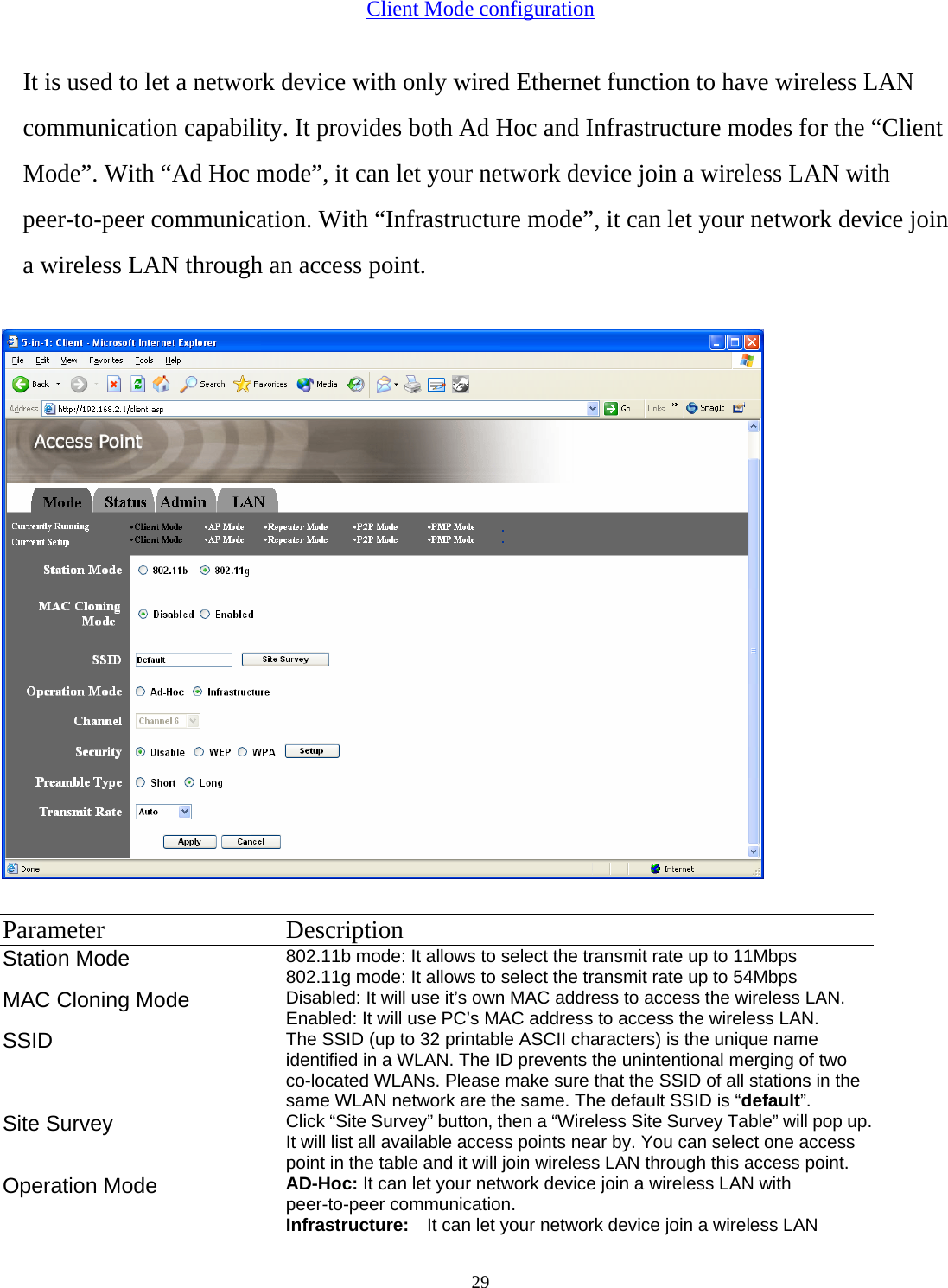
 29Client Mode configuration It is used to let a network device with only wired Ethernet function to have wireless LAN communication capability. It provides both Ad Hoc and Infrastructure modes for the “Client Mode”. With “Ad Hoc mode”, it can let your network device join a wireless LAN with peer-to-peer communication. With “Infrastructure mode”, it can let your network device join a wireless LAN through an access point.   Parameter Description Station Mode 802.11b mode: It allows to select the transmit rate up to 11Mbps   802.11g mode: It allows to select the transmit rate up to 54Mbps   MAC Cloning Mode  Disabled: It will use it’s own MAC address to access the wireless LAN. Enabled: It will use PC’s MAC address to access the wireless LAN. SSID  The SSID (up to 32 printable ASCII characters) is the unique name identified in a WLAN. The ID prevents the unintentional merging of two co-located WLANs. Please make sure that the SSID of all stations in the same WLAN network are the same. The default SSID is “default”. Site Survey  Click “Site Survey” button, then a “Wireless Site Survey Table” will pop up. It will list all available access points near by. You can select one access point in the table and it will join wireless LAN through this access point. Operation Mode  AD-Hoc: It can let your network device join a wireless LAN with peer-to-peer communication. Infrastructure:  It can let your network device join a wireless LAN
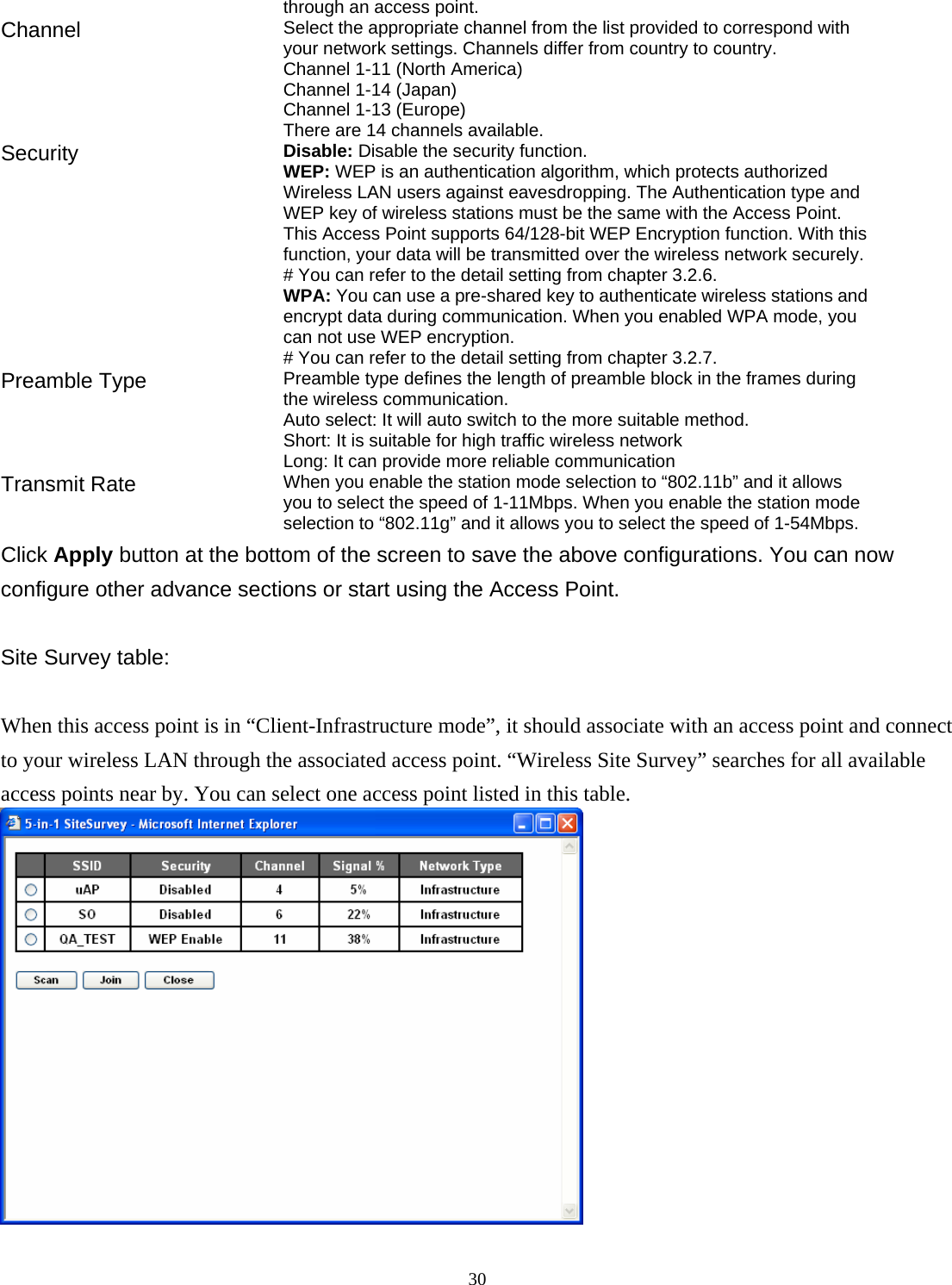
 30through an access point. Channel  Select the appropriate channel from the list provided to correspond with your network settings. Channels differ from country to country. Channel 1-11 (North America) Channel 1-14 (Japan) Channel 1-13 (Europe) There are 14 channels available.     Security   Disable: Disable the security function. WEP: WEP is an authentication algorithm, which protects authorized         Wireless LAN users against eavesdropping. The Authentication type and WEP key of wireless stations must be the same with the Access Point. This Access Point supports 64/128-bit WEP Encryption function. With this function, your data will be transmitted over the wireless network securely. # You can refer to the detail setting from chapter 3.2.6. WPA: You can use a pre-shared key to authenticate wireless stations and encrypt data during communication. When you enabled WPA mode, you can not use WEP encryption.   # You can refer to the detail setting from chapter 3.2.7. Preamble Type  Preamble type defines the length of preamble block in the frames during the wireless communication. Auto select: It will auto switch to the more suitable method. Short: It is suitable for high traffic wireless network Long: It can provide more reliable communication   Transmit Rate  When you enable the station mode selection to “802.11b” and it allows you to select the speed of 1-11Mbps. When you enable the station mode selection to “802.11g” and it allows you to select the speed of 1-54Mbps. Click Apply button at the bottom of the screen to save the above configurations. You can now configure other advance sections or start using the Access Point.  Site Survey table:  When this access point is in “Client-Infrastructure mode”, it should associate with an access point and connect to your wireless LAN through the associated access point. “Wireless Site Survey” searches for all available access points near by. You can select one access point listed in this table.
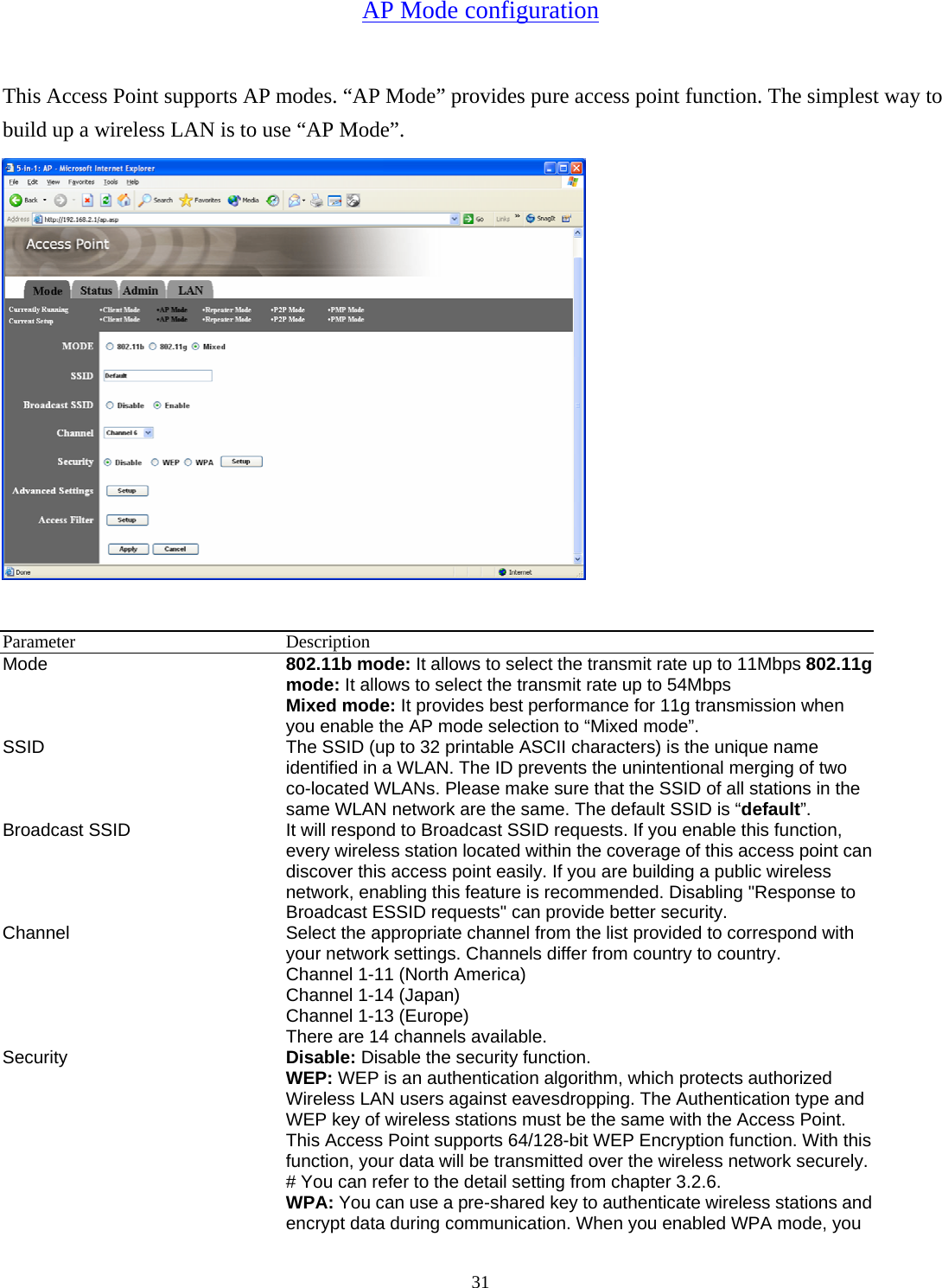
 31AP Mode configuration  This Access Point supports AP modes. “AP Mode” provides pure access point function. The simplest way to build up a wireless LAN is to use “AP Mode”.   Parameter Description Mode 802.11b mode: It allows to select the transmit rate up to 11Mbps 802.11g mode: It allows to select the transmit rate up to 54Mbps Mixed mode: It provides best performance for 11g transmission when you enable the AP mode selection to “Mixed mode”. SSID  The SSID (up to 32 printable ASCII characters) is the unique name identified in a WLAN. The ID prevents the unintentional merging of two co-located WLANs. Please make sure that the SSID of all stations in the same WLAN network are the same. The default SSID is “default”.   Broadcast SSID  It will respond to Broadcast SSID requests. If you enable this function, every wireless station located within the coverage of this access point can discover this access point easily. If you are building a public wireless network, enabling this feature is recommended. Disabling "Response to Broadcast ESSID requests" can provide better security. Channel  Select the appropriate channel from the list provided to correspond with your network settings. Channels differ from country to country. Channel 1-11 (North America) Channel 1-14 (Japan) Channel 1-13 (Europe) There are 14 channels available.     Security   Disable: Disable the security function. WEP: WEP is an authentication algorithm, which protects authorized         Wireless LAN users against eavesdropping. The Authentication type and WEP key of wireless stations must be the same with the Access Point. This Access Point supports 64/128-bit WEP Encryption function. With this function, your data will be transmitted over the wireless network securely.# You can refer to the detail setting from chapter 3.2.6. WPA: You can use a pre-shared key to authenticate wireless stations and encrypt data during communication. When you enabled WPA mode, you
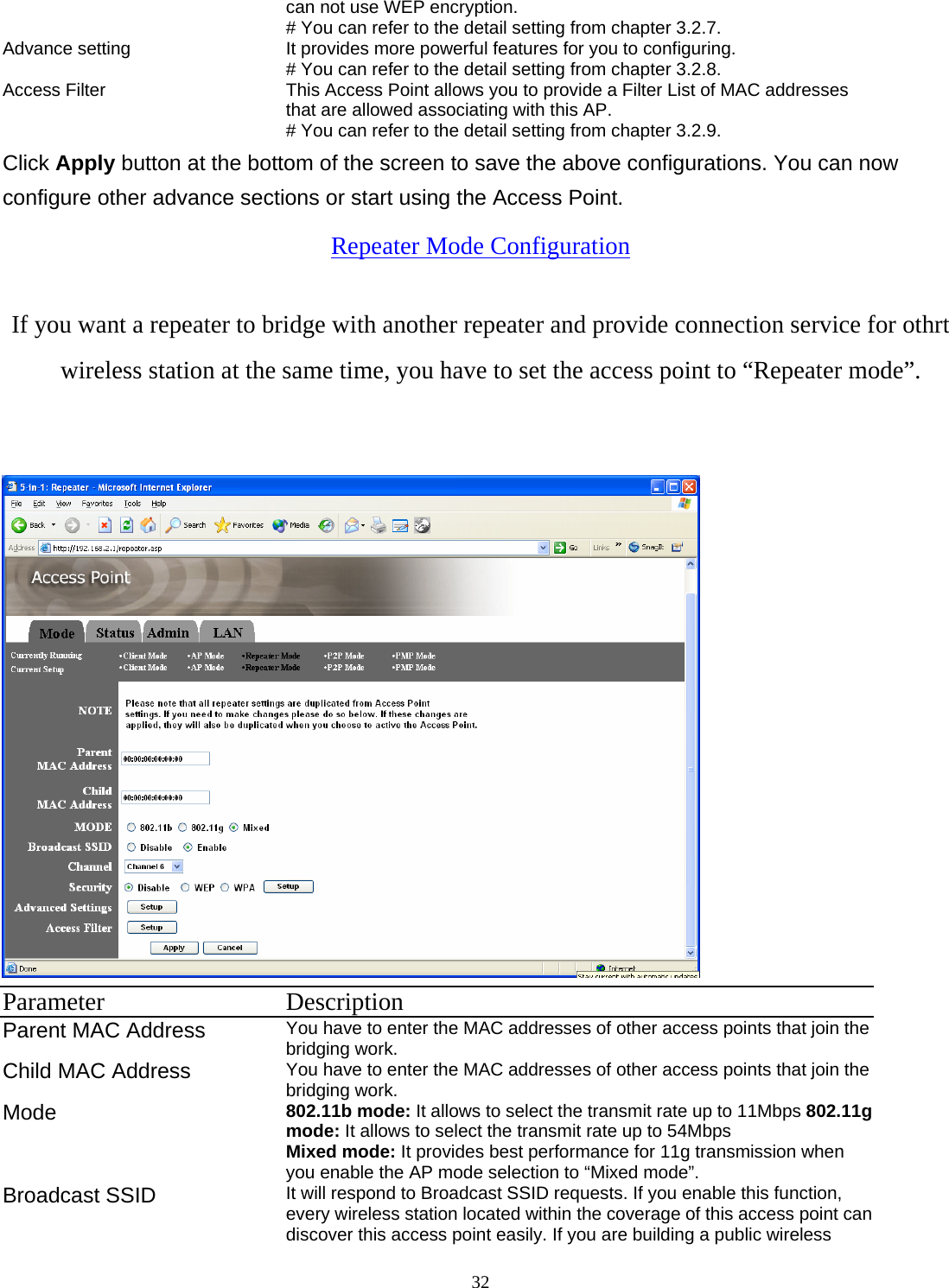
 32can not use WEP encryption.   # You can refer to the detail setting from chapter 3.2.7. Advance setting  It provides more powerful features for you to configuring. # You can refer to the detail setting from chapter 3.2.8. Access Filter  This Access Point allows you to provide a Filter List of MAC addresses that are allowed associating with this AP. # You can refer to the detail setting from chapter 3.2.9. Click Apply button at the bottom of the screen to save the above configurations. You can now configure other advance sections or start using the Access Point. Repeater Mode Configuration If you want a repeater to bridge with another repeater and provide connection service for othrt wireless station at the same time, you have to set the access point to “Repeater mode”.   Parameter Description Parent MAC Address You have to enter the MAC addresses of other access points that join the bridging work. Child MAC Address  You have to enter the MAC addresses of other access points that join the bridging work. Mode 802.11b mode: It allows to select the transmit rate up to 11Mbps 802.11g mode: It allows to select the transmit rate up to 54Mbps Mixed mode: It provides best performance for 11g transmission when you enable the AP mode selection to “Mixed mode”. Broadcast SSID  It will respond to Broadcast SSID requests. If you enable this function, every wireless station located within the coverage of this access point can discover this access point easily. If you are building a public wireless
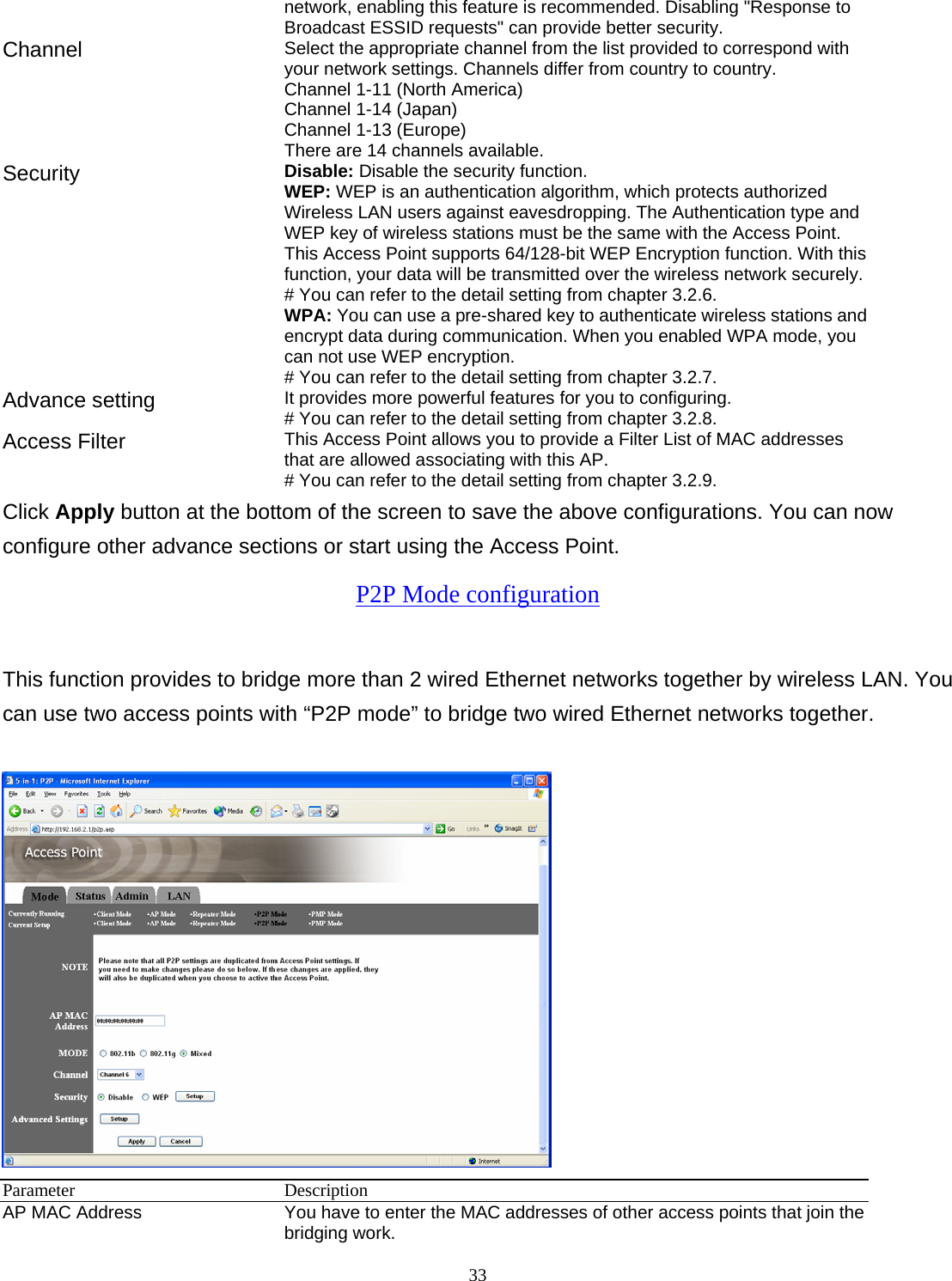
 33network, enabling this feature is recommended. Disabling "Response to Broadcast ESSID requests" can provide better security. Channel  Select the appropriate channel from the list provided to correspond with your network settings. Channels differ from country to country. Channel 1-11 (North America) Channel 1-14 (Japan) Channel 1-13 (Europe) There are 14 channels available.     Security   Disable: Disable the security function. WEP: WEP is an authentication algorithm, which protects authorized         Wireless LAN users against eavesdropping. The Authentication type and WEP key of wireless stations must be the same with the Access Point. This Access Point supports 64/128-bit WEP Encryption function. With this function, your data will be transmitted over the wireless network securely.# You can refer to the detail setting from chapter 3.2.6. WPA: You can use a pre-shared key to authenticate wireless stations and encrypt data during communication. When you enabled WPA mode, you can not use WEP encryption.   # You can refer to the detail setting from chapter 3.2.7. Advance setting  It provides more powerful features for you to configuring. # You can refer to the detail setting from chapter 3.2.8. Access Filter  This Access Point allows you to provide a Filter List of MAC addresses that are allowed associating with this AP. # You can refer to the detail setting from chapter 3.2.9. Click Apply button at the bottom of the screen to save the above configurations. You can now configure other advance sections or start using the Access Point. P2P Mode configuration This function provides to bridge more than 2 wired Ethernet networks together by wireless LAN. You can use two access points with “P2P mode” to bridge two wired Ethernet networks together.   Parameter Description AP MAC Address  You have to enter the MAC addresses of other access points that join the bridging work.
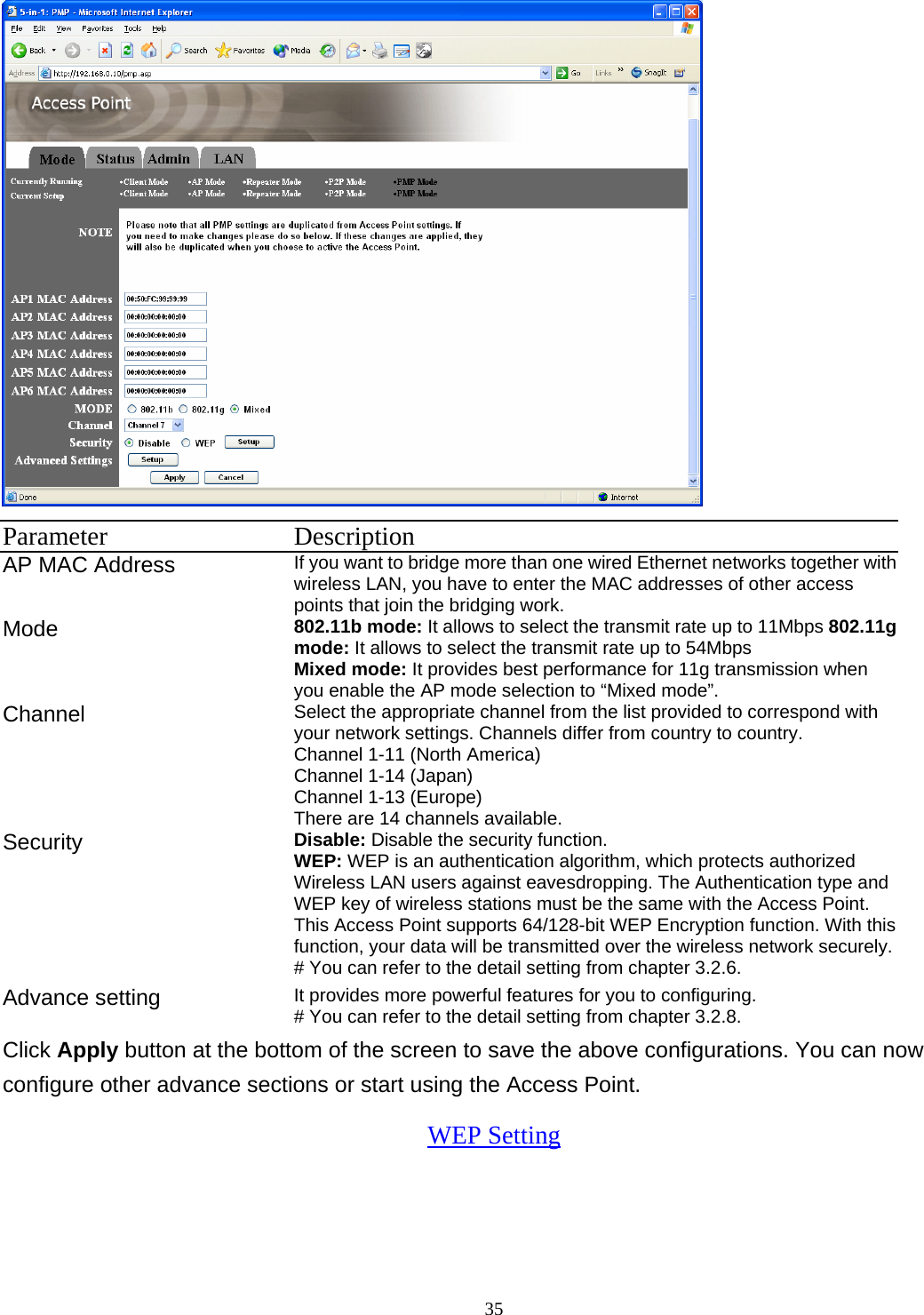
 34Mode 802.11b mode: It allows to select the transmit rate up to 11Mbps 802.11g mode: It allows to select the transmit rate up to 54Mbps Mixed mode: It provides best performance for 11g transmission when you enable the AP mode selection to “Mixed mode”. Channel  Select the appropriate channel from the list provided to correspond with your network settings. Channels differ from country to country. Channel 1-11 (North America) Channel 1-14 (Japan) Channel 1-13 (Europe) There are 14 channels available.     Security   Disable: Disable the security function. WEP: WEP is an authentication algorithm, which protects authorized         Wireless LAN users against eavesdropping. The Authentication type and WEP key of wireless stations must be the same with the Access Point. This Access Point supports 64/128-bit WEP Encryption function. With this function, your data will be transmitted over the wireless network securely.# You can refer to the detail setting from chapter 3.2.6. Advance setting  It provides more powerful features for you to configuring. # You can refer to the detail setting from chapter 3.2.8. Click Apply button at the bottom of the screen to save the above configurations. You can now configure other advance sections or start using the Access Point.    PMP Mode Configuration This function provides to bridge more than 2 wired Ethernet networks together by wireless LAN. You can use two access points with “P2P mode” to bridge two wired Ethernet networks together.
 35 Parameter Description AP MAC Address  If you want to bridge more than one wired Ethernet networks together with wireless LAN, you have to enter the MAC addresses of other access points that join the bridging work.   Mode 802.11b mode: It allows to select the transmit rate up to 11Mbps 802.11g mode: It allows to select the transmit rate up to 54Mbps Mixed mode: It provides best performance for 11g transmission when you enable the AP mode selection to “Mixed mode”. Channel  Select the appropriate channel from the list provided to correspond with your network settings. Channels differ from country to country. Channel 1-11 (North America) Channel 1-14 (Japan) Channel 1-13 (Europe) There are 14 channels available.     Security   Disable: Disable the security function. WEP: WEP is an authentication algorithm, which protects authorized         Wireless LAN users against eavesdropping. The Authentication type and WEP key of wireless stations must be the same with the Access Point. This Access Point supports 64/128-bit WEP Encryption function. With this function, your data will be transmitted over the wireless network securely.# You can refer to the detail setting from chapter 3.2.6. Advance setting  It provides more powerful features for you to configuring. # You can refer to the detail setting from chapter 3.2.8. Click Apply button at the bottom of the screen to save the above configurations. You can now configure other advance sections or start using the Access Point. WEP Setting
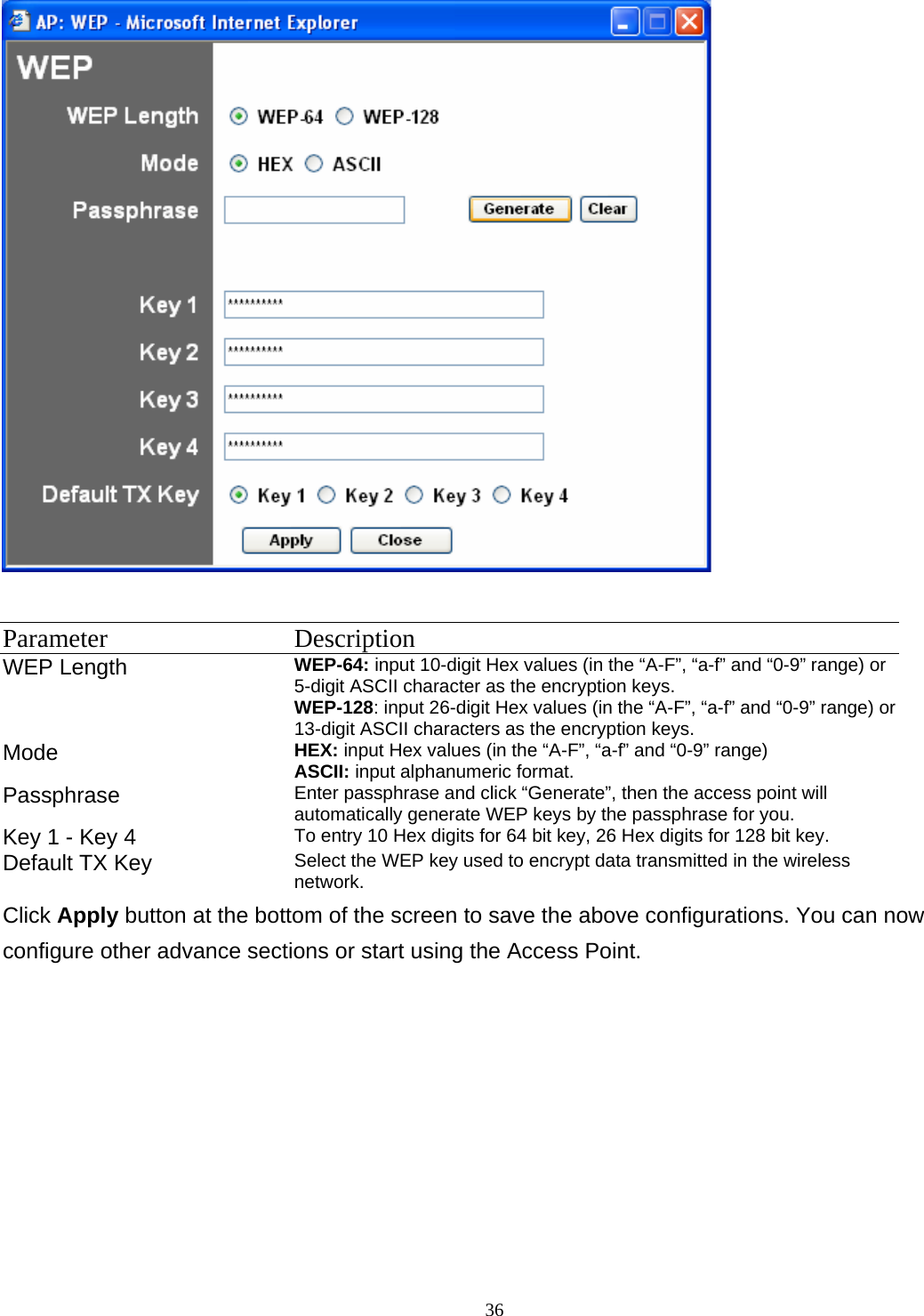
 36  Parameter Description WEP Length  WEP-64: input 10-digit Hex values (in the “A-F”, “a-f” and “0-9” range) or 5-digit ASCII character as the encryption keys. WEP-128: input 26-digit Hex values (in the “A-F”, “a-f” and “0-9” range) or 13-digit ASCII characters as the encryption keys.   Mode  HEX: input Hex values (in the “A-F”, “a-f” and “0-9” range) ASCII: input alphanumeric format.   Passphrase  Enter passphrase and click “Generate”, then the access point will automatically generate WEP keys by the passphrase for you. Key 1 - Key 4  To entry 10 Hex digits for 64 bit key, 26 Hex digits for 128 bit key.   Default TX Key  Select the WEP key used to encrypt data transmitted in the wireless network. Click Apply button at the bottom of the screen to save the above configurations. You can now configure other advance sections or start using the Access Point.
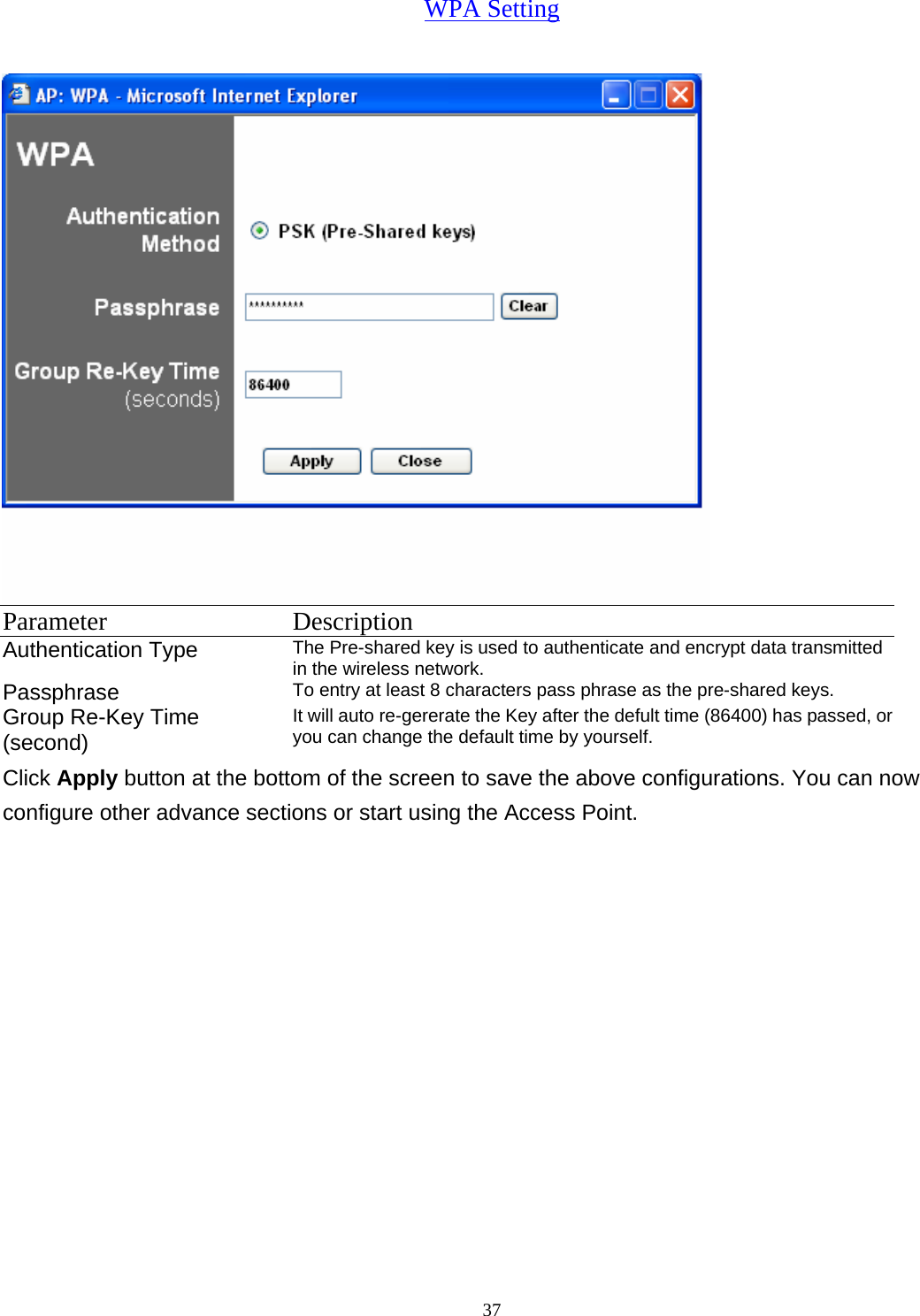
 37WPA Setting  Parameter Description Authentication Type  The Pre-shared key is used to authenticate and encrypt data transmitted in the wireless network.   Passphrase  To entry at least 8 characters pass phrase as the pre-shared keys. Group Re-Key Time (second) It will auto re-gererate the Key after the defult time (86400) has passed, or you can change the default time by yourself.   Click Apply button at the bottom of the screen to save the above configurations. You can now configure other advance sections or start using the Access Point.
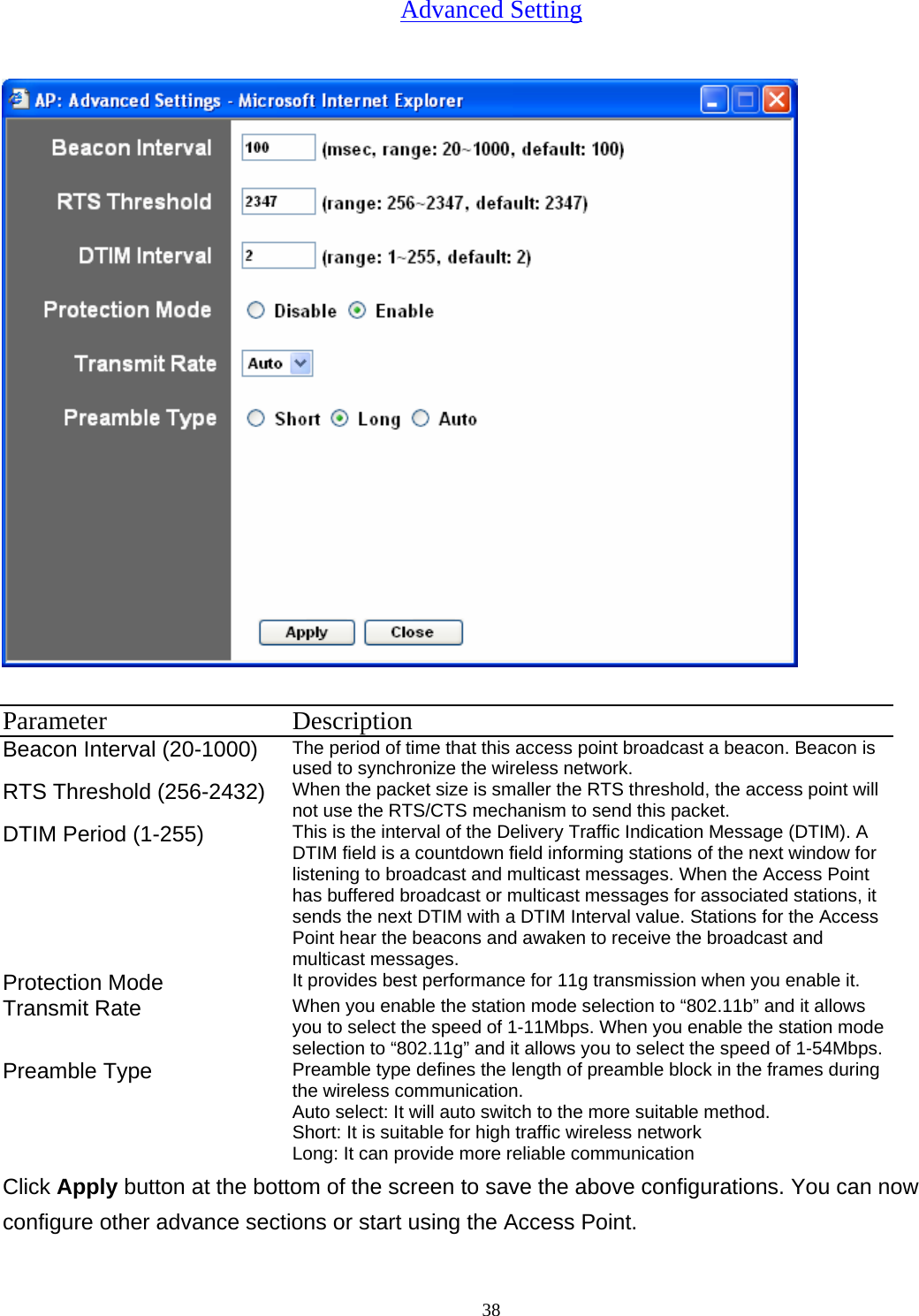
 38Advanced Setting  Parameter Description Beacon Interval (20-1000)  The period of time that this access point broadcast a beacon. Beacon is used to synchronize the wireless network.   RTS Threshold (256-2432)  When the packet size is smaller the RTS threshold, the access point will not use the RTS/CTS mechanism to send this packet.   DTIM Period (1-255)  This is the interval of the Delivery Traffic Indication Message (DTIM). A DTIM field is a countdown field informing stations of the next window for listening to broadcast and multicast messages. When the Access Point has buffered broadcast or multicast messages for associated stations, it sends the next DTIM with a DTIM Interval value. Stations for the Access Point hear the beacons and awaken to receive the broadcast and multicast messages.   Protection Mode  It provides best performance for 11g transmission when you enable it. Transmit Rate  When you enable the station mode selection to “802.11b” and it allows you to select the speed of 1-11Mbps. When you enable the station mode selection to “802.11g” and it allows you to select the speed of 1-54Mbps. Preamble Type  Preamble type defines the length of preamble block in the frames during the wireless communication. Auto select: It will auto switch to the more suitable method. Short: It is suitable for high traffic wireless network Long: It can provide more reliable communication   Click Apply button at the bottom of the screen to save the above configurations. You can now configure other advance sections or start using the Access Point.
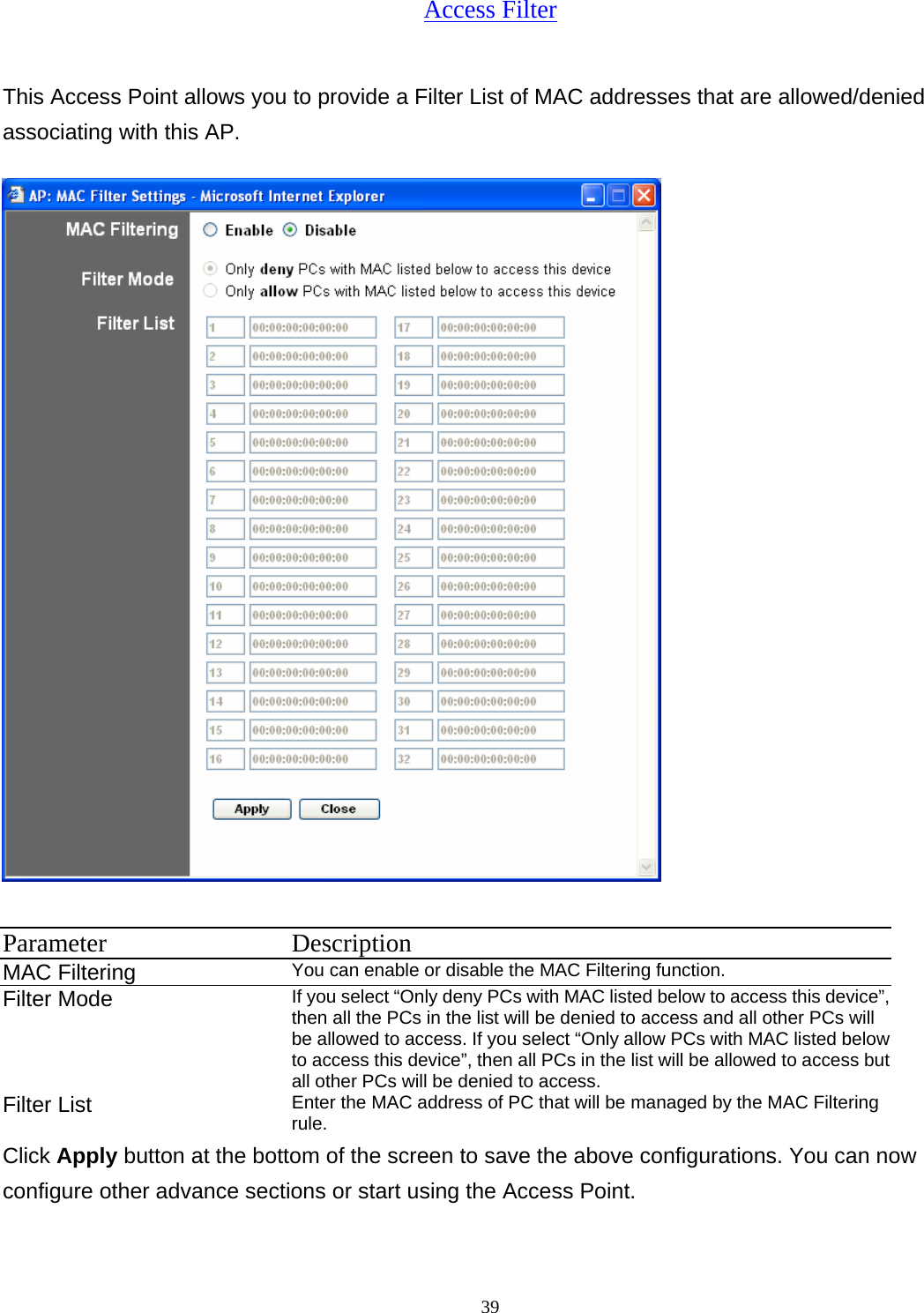
 39Access Filter This Access Point allows you to provide a Filter List of MAC addresses that are allowed/denied associating with this AP.  Parameter Description MAC Filtering   You can enable or disable the MAC Filtering function. Filter Mode   If you select “Only deny PCs with MAC listed below to access this device”, then all the PCs in the list will be denied to access and all other PCs will be allowed to access. If you select “Only allow PCs with MAC listed below to access this device”, then all PCs in the list will be allowed to access but all other PCs will be denied to access. Filter List  Enter the MAC address of PC that will be managed by the MAC Filtering rule. Click Apply button at the bottom of the screen to save the above configurations. You can now configure other advance sections or start using the Access Point.
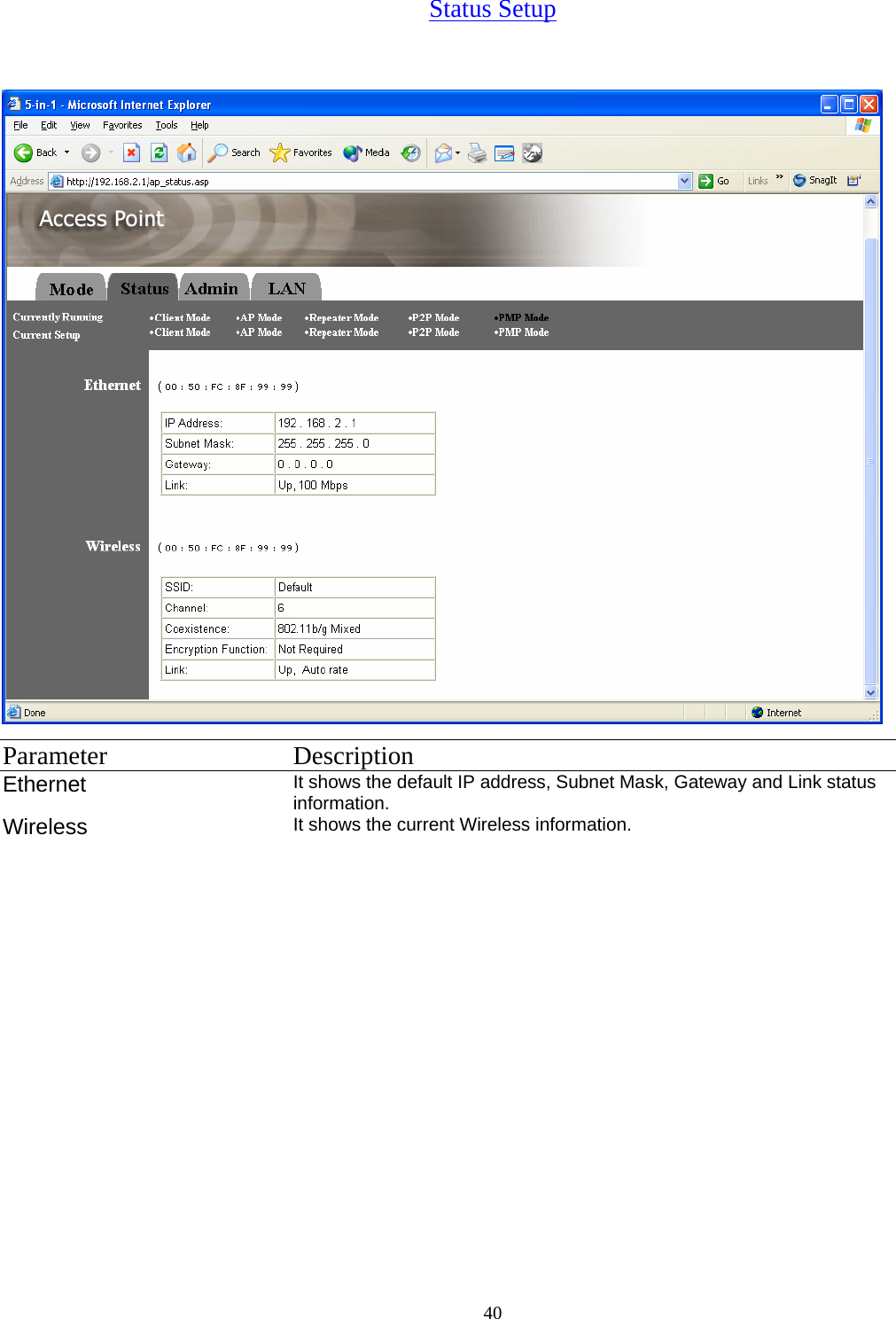
 40Status Setup  Parameter Description Ethernet It shows the default IP address, Subnet Mask, Gateway and Link status information. Wireless  It shows the current Wireless information.
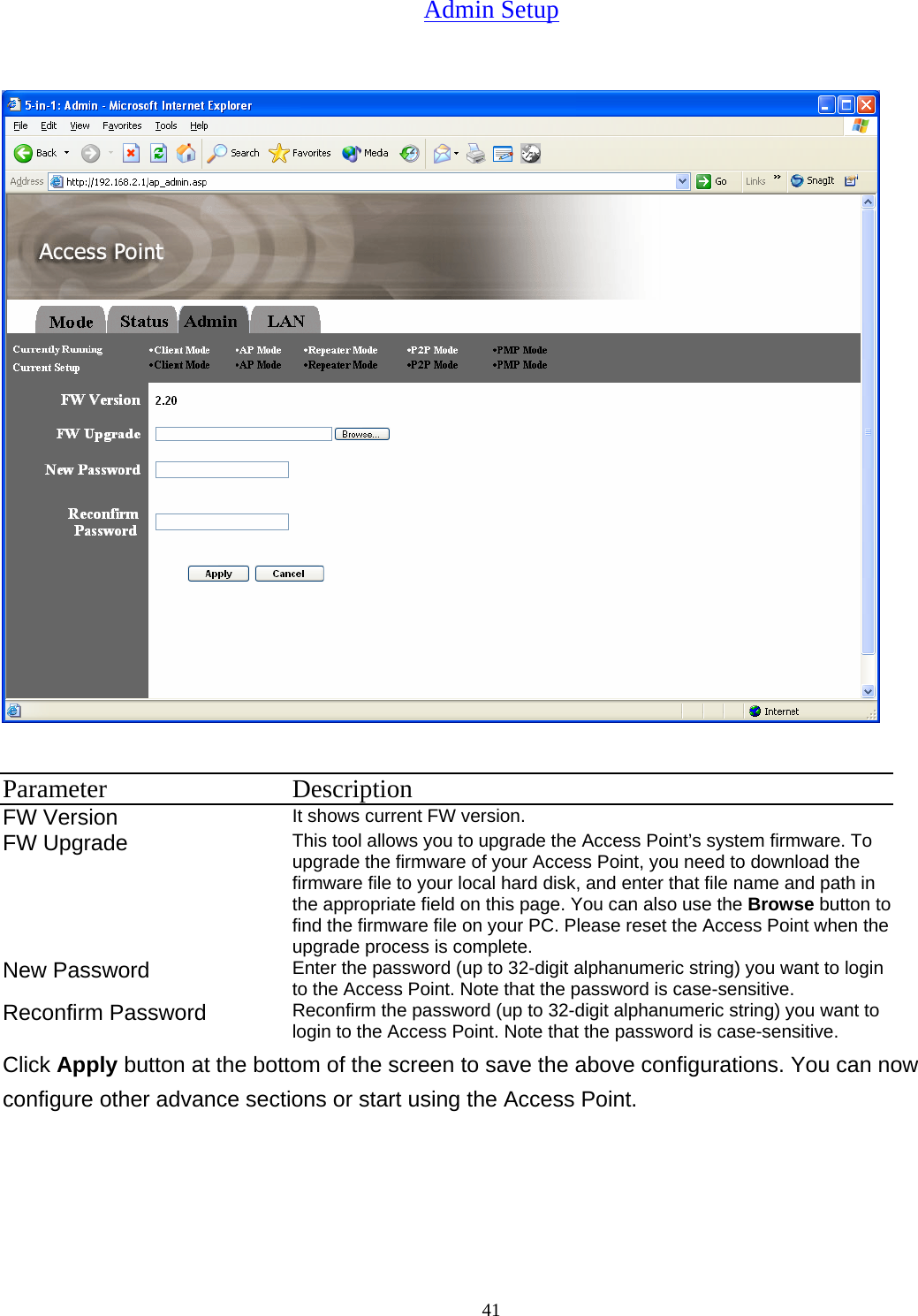
 41Admin Setup   Parameter Description FW Version It shows current FW version. FW Upgrade  This tool allows you to upgrade the Access Point’s system firmware. To upgrade the firmware of your Access Point, you need to download the firmware file to your local hard disk, and enter that file name and path in the appropriate field on this page. You can also use the Browse button to find the firmware file on your PC. Please reset the Access Point when the upgrade process is complete. New Password  Enter the password (up to 32-digit alphanumeric string) you want to login to the Access Point. Note that the password is case-sensitive. Reconfirm Password  Reconfirm the password (up to 32-digit alphanumeric string) you want to login to the Access Point. Note that the password is case-sensitive. Click Apply button at the bottom of the screen to save the above configurations. You can now configure other advance sections or start using the Access Point.
 42LAN Setup   Parameter Description Device Name It shows current FW version. Automatic IP  Selecting this option is not advised unless you have direct access to the device that provides the IP address. Fixed IP  Specify IP: Designate the Access Point’s IP Address. This IP Address should be unique in your network. The default IP Address is 192.168.2.1.Subnet Mask: Specify a Subnet Mask for your LAN segment.  Gateway: Specify the default gateway IP of this Access Point.  Click Apply button at the bottom of the screen to save the above configurations. You can now configure other advance sections or start using the Access Point.

Navigation menu