LANYA ELECTRONIC BH17 BLUETOOTH HEADSET User Manual

LANYA ELECTRONIC CO., Ltd. BLUETOOTH HEADSET Users Manual

Users Manual

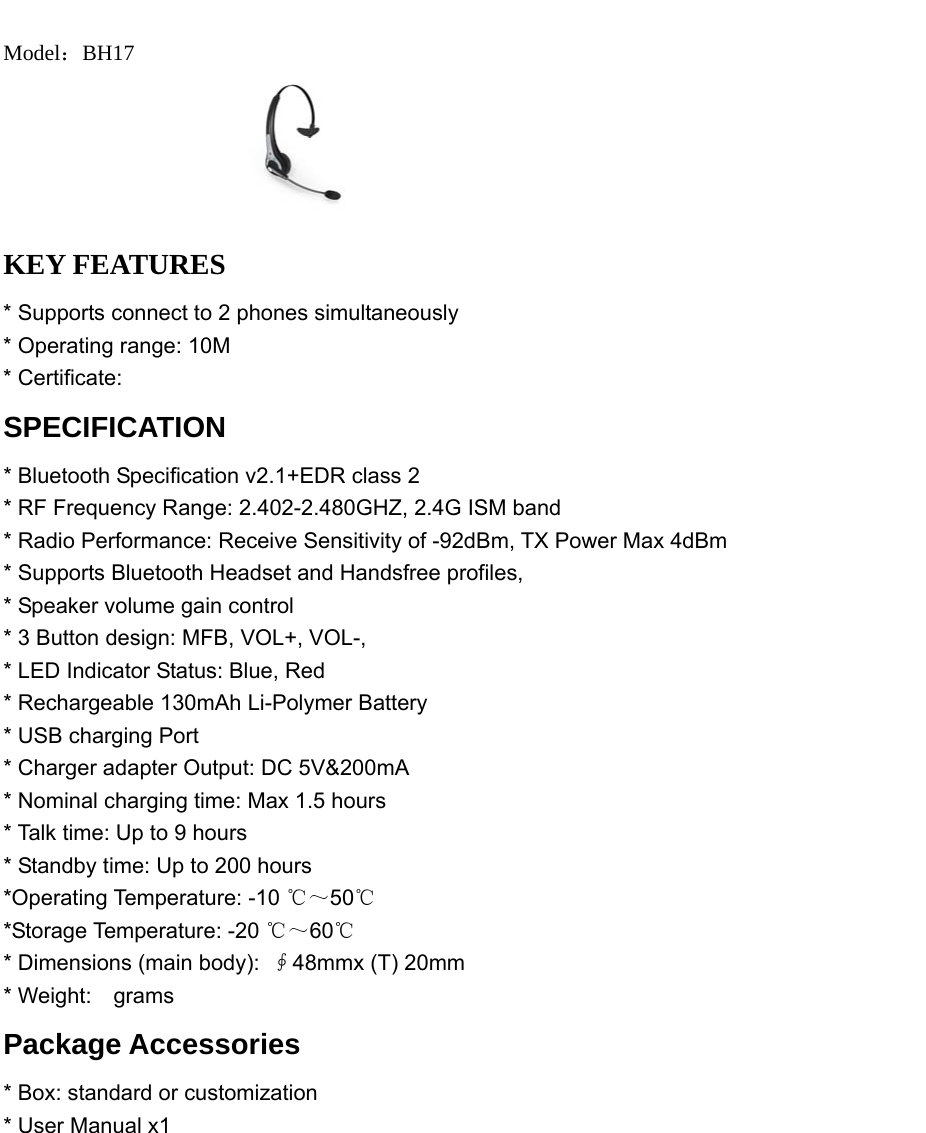
  Model:BH17  KEY FEATURES * Supports connect to 2 phones simultaneously * Operating range: 10M * Certificate: SPECIFICATION * Bluetooth Specification v2.1+EDR class 2   * RF Frequency Range: 2.402-2.480GHZ, 2.4G ISM band * Radio Performance: Receive Sensitivity of -92dBm, TX Power Max 4dBm * Supports Bluetooth Headset and Handsfree profiles,   * Speaker volume gain control * 3 Button design: MFB, VOL+, VOL-, * LED Indicator Status: Blue, Red * Rechargeable 130mAh Li-Polymer Battery   * USB charging Port * Charger adapter Output: DC 5V&200mA * Nominal charging time: Max 1.5 hours   * Talk time: Up to 9 hours * Standby time: Up to 200 hours   *Operating Temperature: -10 ℃~50℃ *Storage Temperature: -20 ℃~60℃ * Dimensions (main body): ∮48mmx (T) 20mm * Weight:  grams  Package Accessories * Box: standard or customization   * User Manual x1
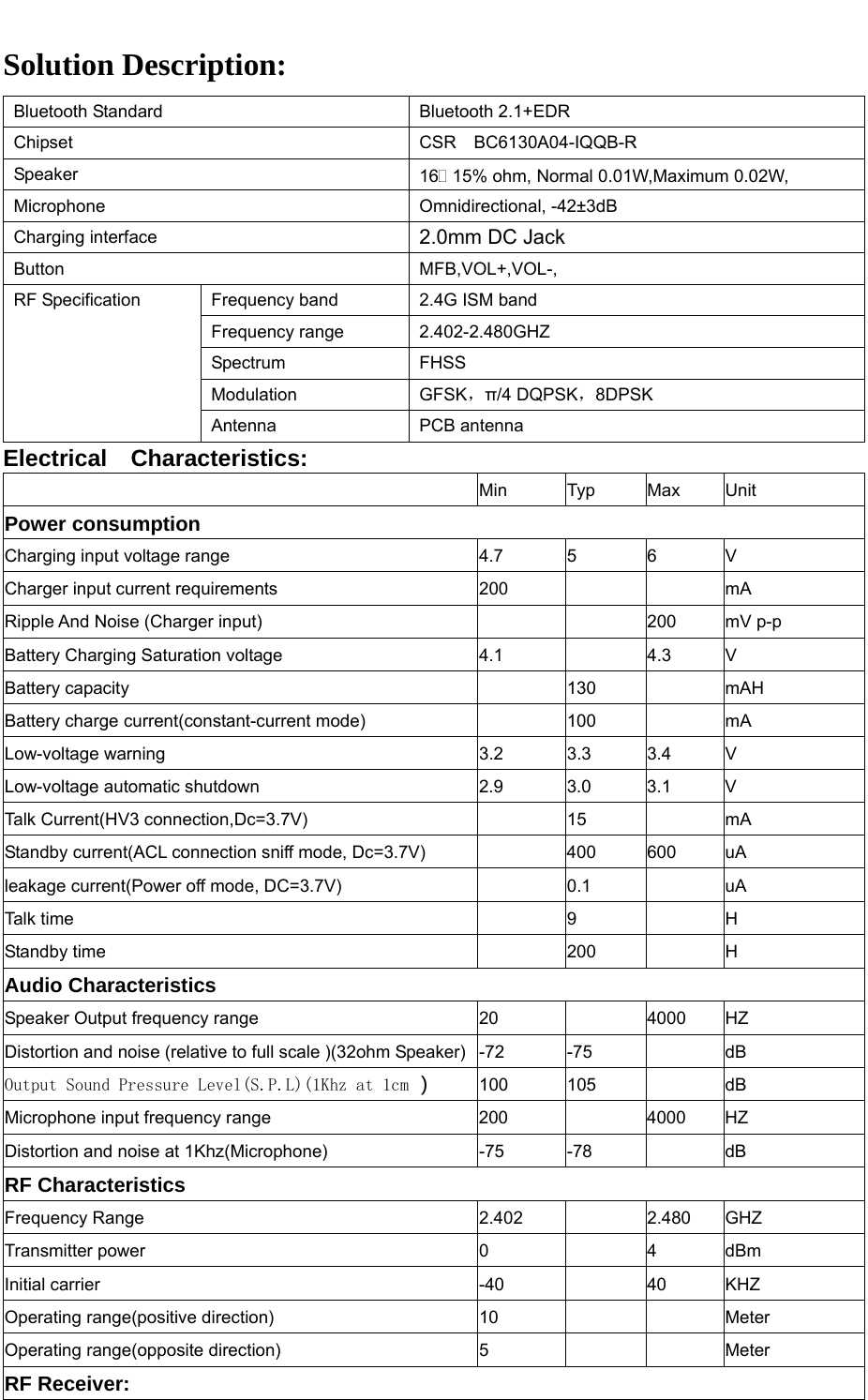
  Solution Description: Bluetooth Standard  Bluetooth 2.1+EDR Chipset  CSR  BC6130A04-IQQB-R Speaker  16 15% ohm, Normal 0.01W,Maximum 0.02W, Microphone Omnidirectional, -42±3dB Charging interface  2.0mm DC Jack Button MFB,VOL+,VOL-, Frequency band  2.4G ISM band Frequency range  2.402-2.480GHZ Spectrum FHSS Modulation  GFSK,π/4 DQPSK,8DPSK RF Specification   Antenna PCB antenna Electrical  Characteristics:   Min Typ Max Unit Power consumption Charging input voltage range  4.7  5  6  V Charger input current requirements  200      mA Ripple And Noise (Charger input)      200  mV p-p Battery Charging Saturation voltage  4.1    4.3  V Battery capacity    130    mAH Battery charge current(constant-current mode)    100    mA Low-voltage warning  3.2  3.3  3.4  V Low-voltage automatic shutdown  2.9  3.0  3.1  V Talk Current(HV3 connection,Dc=3.7V)    15    mA Standby current(ACL connection sniff mode, Dc=3.7V)      400  600  uA leakage current(Power off mode, DC=3.7V)    0.1    uA Talk time    9    H Standby time    200    H Audio Characteristics Speaker Output frequency range  20    4000  HZ Distortion and noise (relative to full scale )(32ohm Speaker) -72  -75    dB Output Sound Pressure Level(S.P.L)(1Khz at 1cm ) 100 105   dB Microphone input frequency range  200    4000  HZ Distortion and noise at 1Khz(Microphone) -75 -78  dB RF Characteristics Frequency Range  2.402    2.480  GHZ Transmitter power  0    4  dBm Initial carrier  -40    40  KHZ Operating range(positive direction)  10      Meter Operating range(opposite direction)  5      Meter RF Receiver:
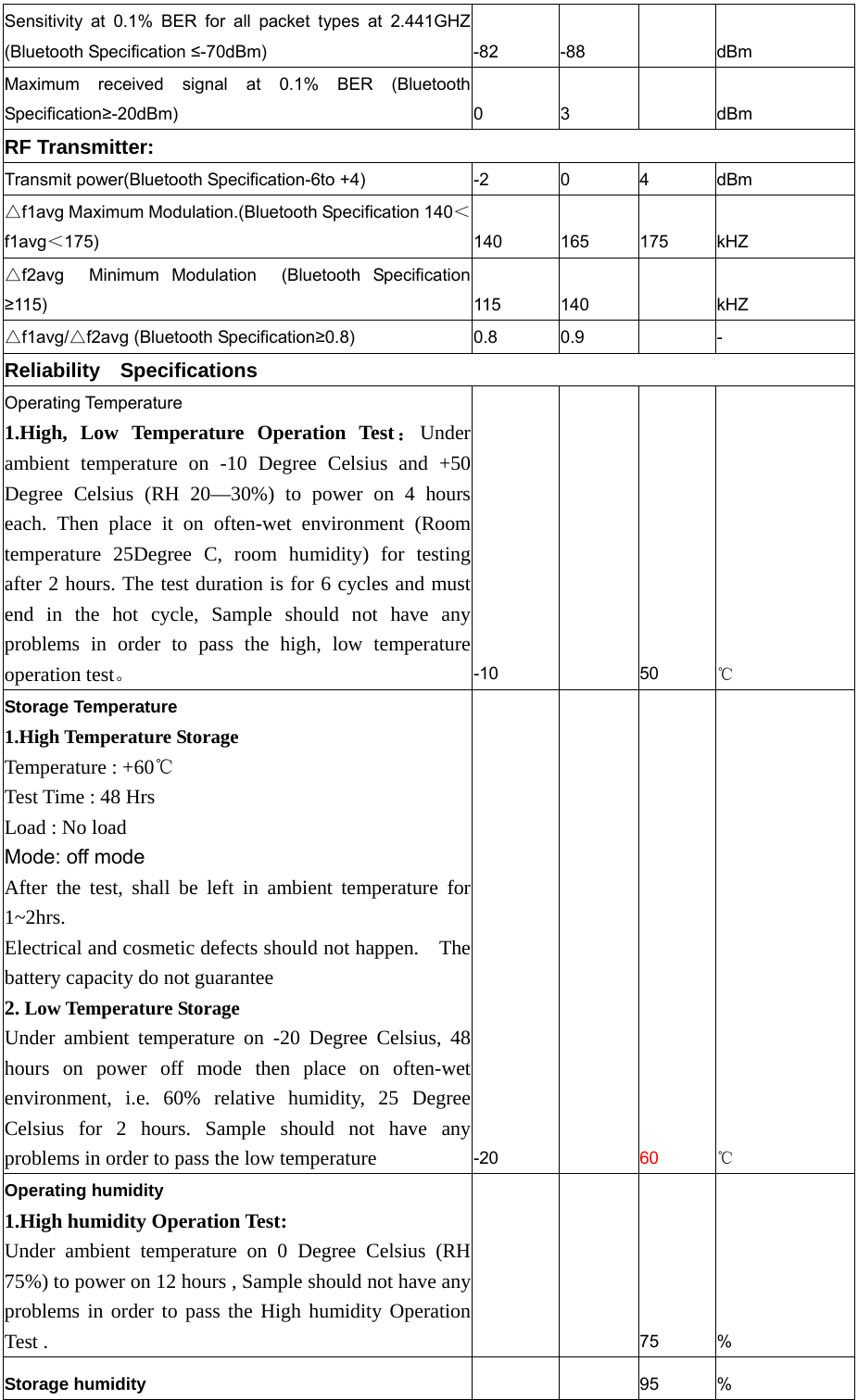
 Sensitivity at 0.1% BER for all packet types at 2.441GHZ (Bluetooth Specification ≤-70dBm) -82 -88  dBm Maximum received signal at 0.1% BER (Bluetooth Specification≥-20dBm) 0 3  dBm RF Transmitter: Transmit power(Bluetooth Specification-6to +4)  -2  0  4  dBm △f1avg Maximum Modulation.(Bluetooth Specification 140<f1avg<175)  140 165 175 kHZ △f2avg  Minimum Modulation  (Bluetooth Specification ≥115) 115 140  kHZ △f1avg/△f2avg (Bluetooth Specification≥0.8)  0.8 0.9   - Reliability  Specifications Operating Temperature 1.High, Low Temperature Operation Test:Under ambient temperature on -10 Degree Celsius and +50 Degree Celsius (RH 20—30%) to power on 4 hours each. Then place it on often-wet environment (Room temperature 25Degree C, room humidity) for testing after 2 hours. The test duration is for 6 cycles and must end in the hot cycle, Sample should not have any problems in order to pass the high, low temperature operation test。 -10   50 ℃ Storage Temperature 1.High Temperature Storage Temperature : +60℃ Test Time : 48 Hrs Load : No load Mode: off mode After the test, shall be left in ambient temperature for 1~2hrs. Electrical and cosmetic defects should not happen.   The battery capacity do not guarantee 2. Low Temperature Storage Under ambient temperature on -20 Degree Celsius, 48 hours on power off mode then place on often-wet environment, i.e. 60% relative humidity, 25 Degree Celsius for 2 hours. Sample should not have any problems in order to pass the low temperature -20   60  ℃ Operating humidity 1.High humidity Operation Test: Under ambient temperature on 0 Degree Celsius (RH 75%) to power on 12 hours , Sample should not have any problems in order to pass the High humidity Operation Test .      75 % Storage humidity    95 %
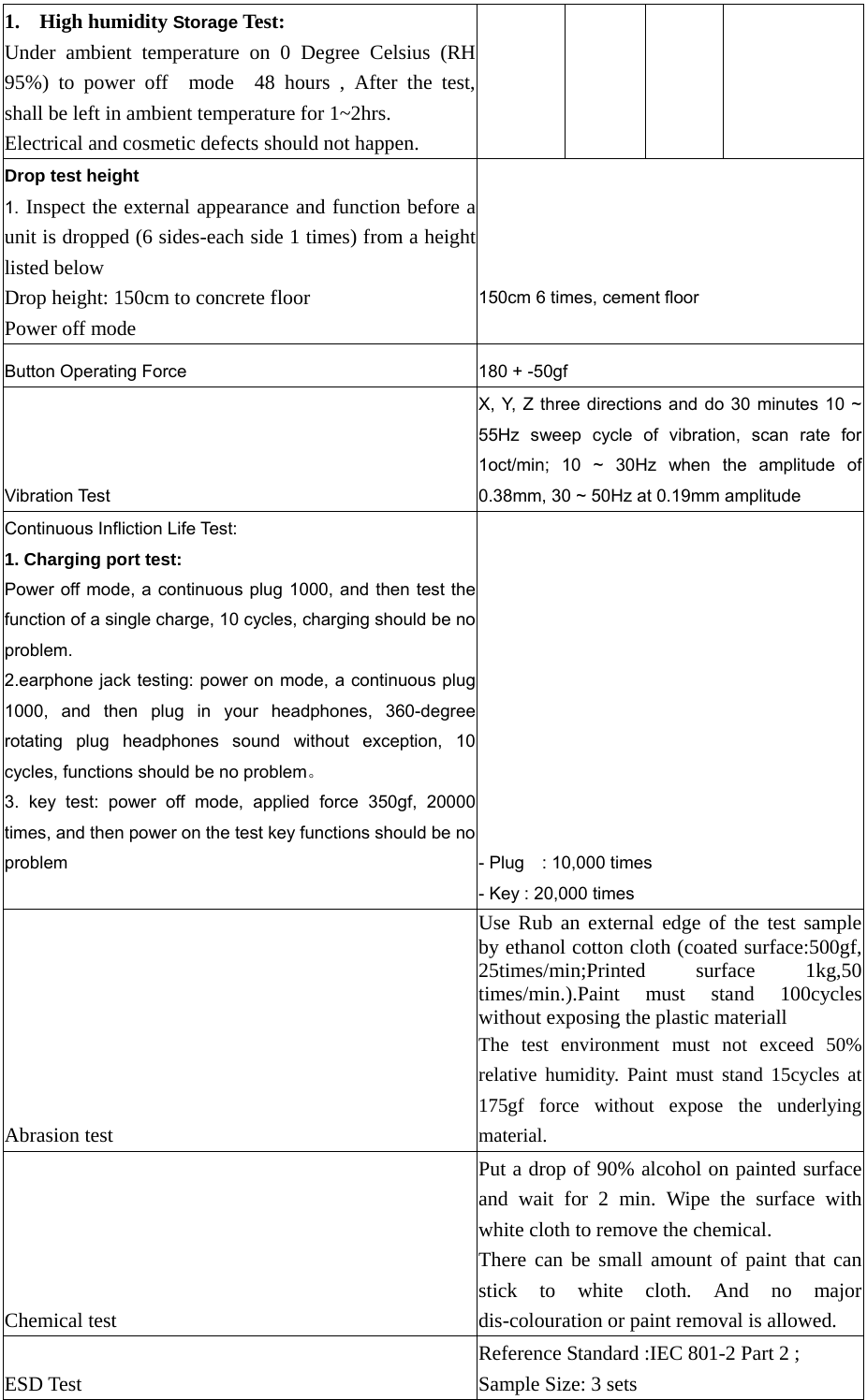
 1. High humidity Storage Test: Under ambient temperature on 0 Degree Celsius (RH 95%) to power off  mode  48 hours , After the test, shall be left in ambient temperature for 1~2hrs. Electrical and cosmetic defects should not happen. Drop test height   1. Inspect the external appearance and function before a unit is dropped (6 sides-each side 1 times) from a height listed below Drop height: 150cm to concrete floor Power off mode 150cm 6 times, cement floor  Button Operating Force  180 + -50gf Vibration Test X, Y, Z three directions and do 30 minutes 10 ~ 55Hz sweep cycle of vibration, scan rate for 1oct/min; 10 ~ 30Hz when the amplitude of 0.38mm, 30 ~ 50Hz at 0.19mm amplitude Continuous Infliction Life Test: 1. Charging port test:   Power off mode, a continuous plug 1000, and then test the function of a single charge, 10 cycles, charging should be no problem. 2.earphone jack testing: power on mode, a continuous plug 1000, and then plug in your headphones, 360-degree rotating plug headphones sound without exception, 10 cycles, functions should be no problem。 3. key test: power off mode, applied force 350gf, 20000 times, and then power on the test key functions should be no problem  - Plug    : 10,000 times - Key : 20,000 times Abrasion test Use Rub an external edge of the test sample by ethanol cotton cloth (coated surface:500gf, 25times/min;Printed surface 1kg,50 times/min.).Paint must stand 100cycles without exposing the plastic materiall The test environment must not exceed 50% relative humidity. Paint must stand 15cycles at 175gf force without expose the underlying material. Chemical test Put a drop of 90% alcohol on painted surface and wait for 2 min. Wipe the surface with white cloth to remove the chemical. There can be small amount of paint that can stick to white cloth. And no majordis-colouration or paint removal is allowed.    ESD Test   Reference Standard :IEC 801-2 Part 2 ;   Sample Size: 3 sets
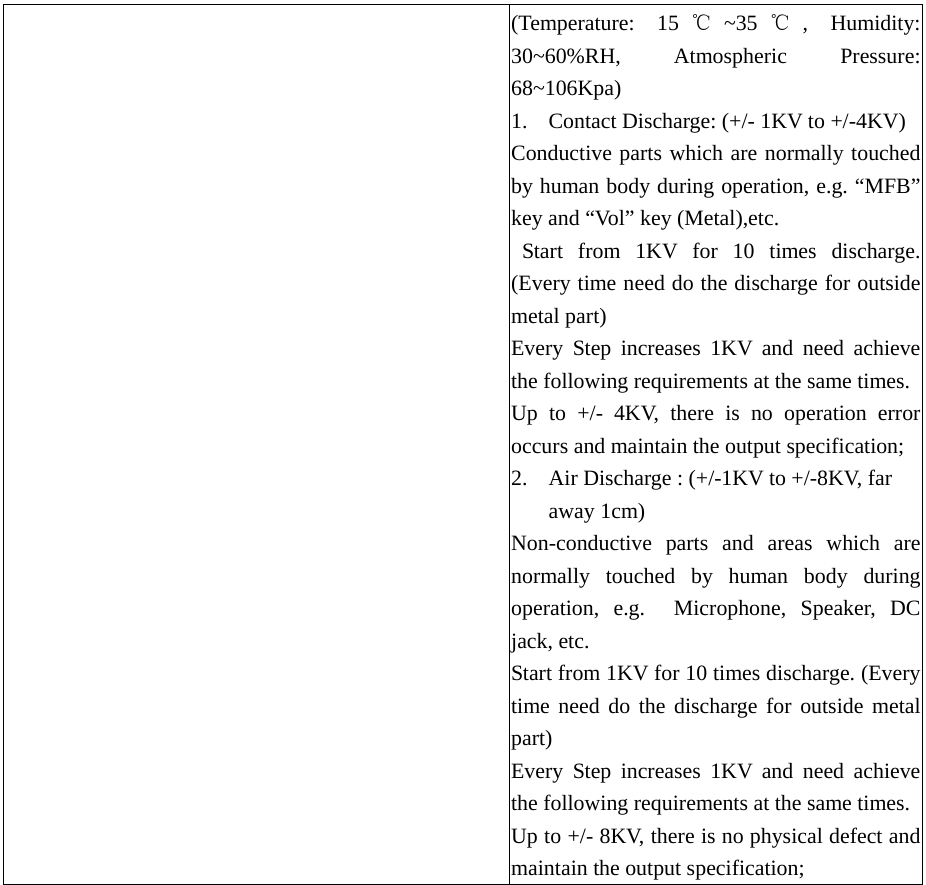
 (Temperature: 15 ℃~35 ℃, Humidity: 30~60%RH, Atmospheric Pressure: 68~106Kpa) 1. Contact Discharge: (+/- 1KV to +/-4KV)Conductive parts which are normally touched by human body during operation, e.g. “MFB”key and “Vol” key (Metal),etc. Start from 1KV for 10 times discharge. (Every time need do the discharge for outside metal part)   Every Step increases 1KV and need achieve the following requirements at the same times. Up to +/- 4KV, there is no operation error occurs and maintain the output specification;2. Air Discharge : (+/-1KV to +/-8KV, far away 1cm) Non-conductive parts and areas which are normally touched by human body during operation, e.g.  Microphone, Speaker, DC jack, etc. Start from 1KV for 10 times discharge. (Every time need do the discharge for outside metal part)  Every Step increases 1KV and need achieve the following requirements at the same times.Up to +/- 8KV, there is no physical defect and maintain the output specification;
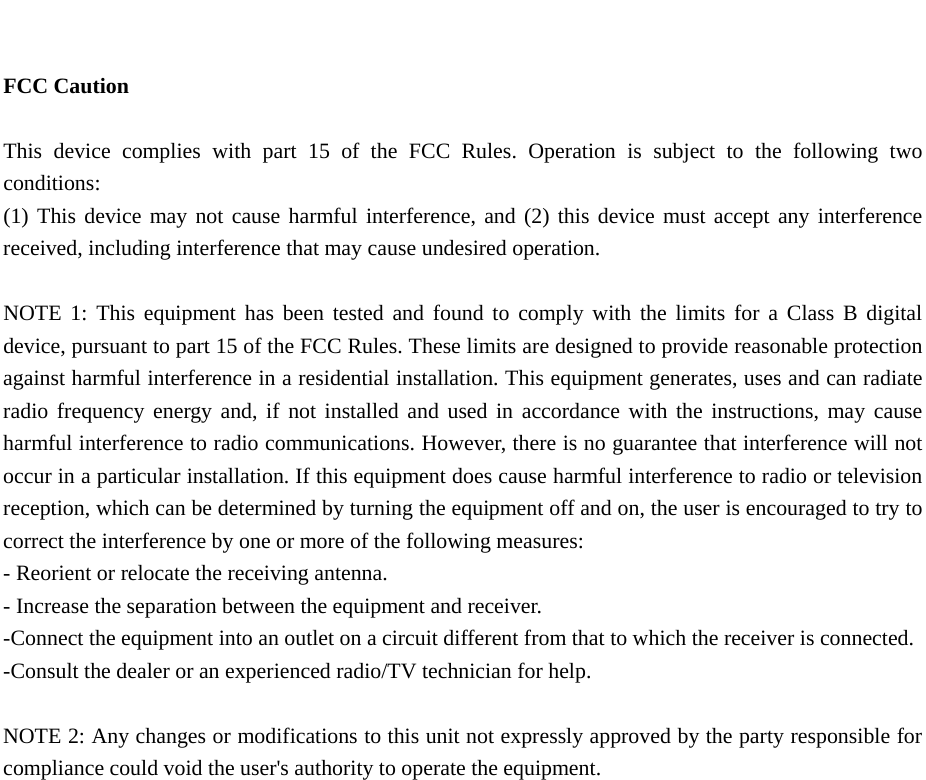
   FCC Caution  This device complies with part 15 of the FCC Rules. Operation is subject to the following two conditions:  (1) This device may not cause harmful interference, and (2) this device must accept any interference received, including interference that may cause undesired operation.  NOTE 1: This equipment has been tested and found to comply with the limits for a Class B digital device, pursuant to part 15 of the FCC Rules. These limits are designed to provide reasonable protection against harmful interference in a residential installation. This equipment generates, uses and can radiate radio frequency energy and, if not installed and used in accordance with the instructions, may cause harmful interference to radio communications. However, there is no guarantee that interference will not occur in a particular installation. If this equipment does cause harmful interference to radio or television reception, which can be determined by turning the equipment off and on, the user is encouraged to try to correct the interference by one or more of the following measures: - Reorient or relocate the receiving antenna. - Increase the separation between the equipment and receiver. -Connect the equipment into an outlet on a circuit different from that to which the receiver is connected. -Consult the dealer or an experienced radio/TV technician for help.  NOTE 2: Any changes or modifications to this unit not expressly approved by the party responsible for compliance could void the user's authority to operate the equipment.

Navigation menu