Lenbrook C658 BluOS STREAMING DAC User Manual

Lenbrook Industries Limited BluOS STREAMING DAC Users Manual

Users Manual

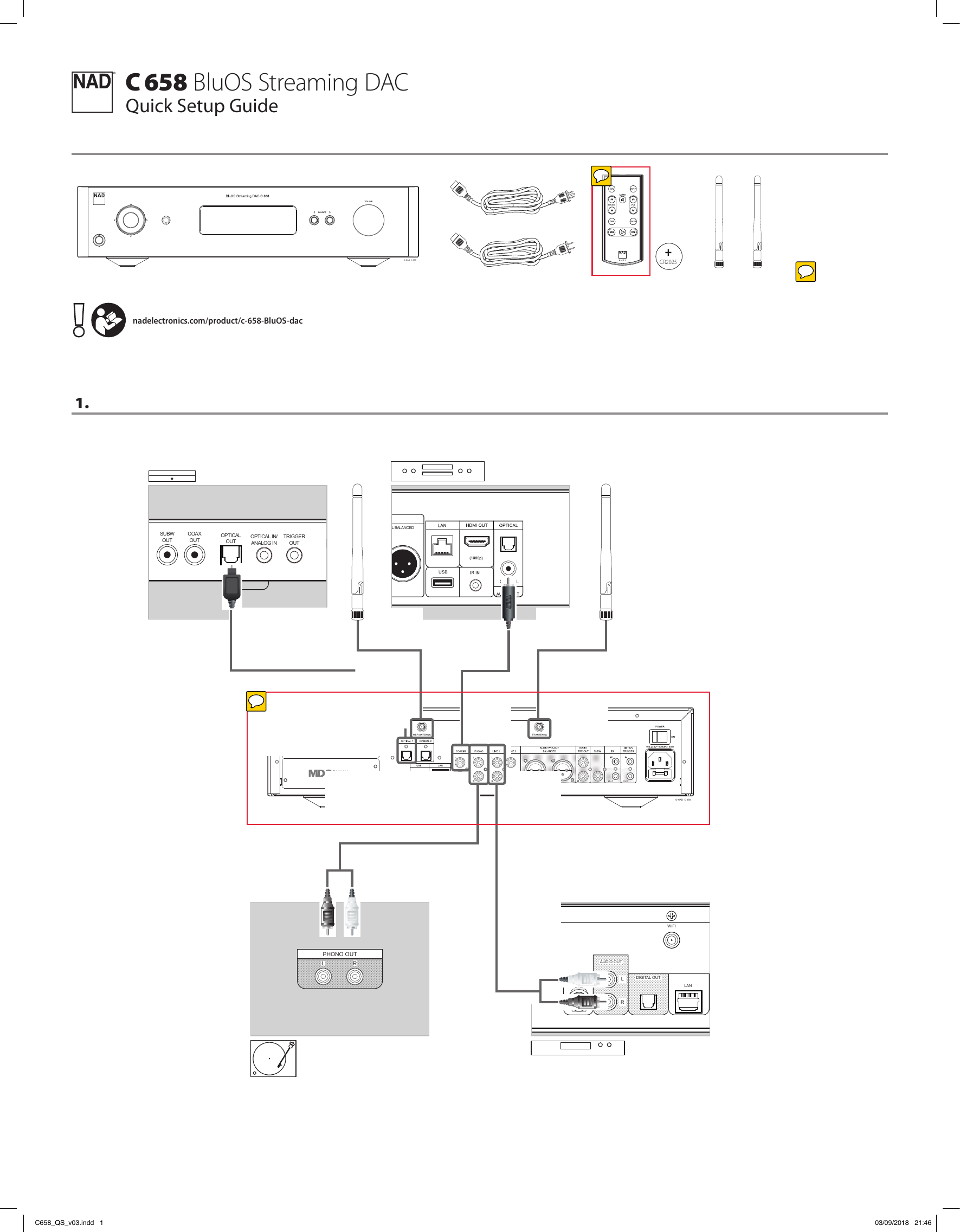
© NAD  C 658®C 658 BluOS Streaming DACQuick Setup Guide 2 CHANNEL AUDIO OUTUNBALANCEDR BALANCEDDIGITAL AUDIO OUTPUTAES/EBUS-VIDEO OUTL BALANCEDLRPOWERONAUDIO OUTL RHDMI OUT1 HDMI OUT2 HDMI OUT1 HDMI OUT212V IN12V OUTDIGITAL AUDIO OUTOPTICAL COAXIAL12V IN12V OUTDIGITAL AUDIO OUTOPTICAL COAXIALPOWERON100-240V ~ 50/60HzDVI OUT DISPLAY USB USB LAN DISPLAY USB LANFIREWIREFIREWIRE USB HEADPHONES MICAUDIO OUTSUBWOUTCOAXOUTOPTICALOUTOPTICAL IN/ANALOG INTRIGGEROUTL R© NAD  C 6581. AMP  3BAS SDIM+CR2025nadelectronics.com/product/c-658-BluOS-dacPHONO OUTLR© NAD C 446FMANTENNAGND AMDABAUDIO OUTDIGITAL OUTLANRS232MP DOCK+12VTRIGGERINPOWER100~240V – 50/60HzONIR INDATA PORTLRWIFI© NAD  C 658© NAD  C 658© NAD  C 658© NAD  C 658© NAD  C 658© NAD  C 658C658_QS_v03.indd   1 03/09/2018   21:46
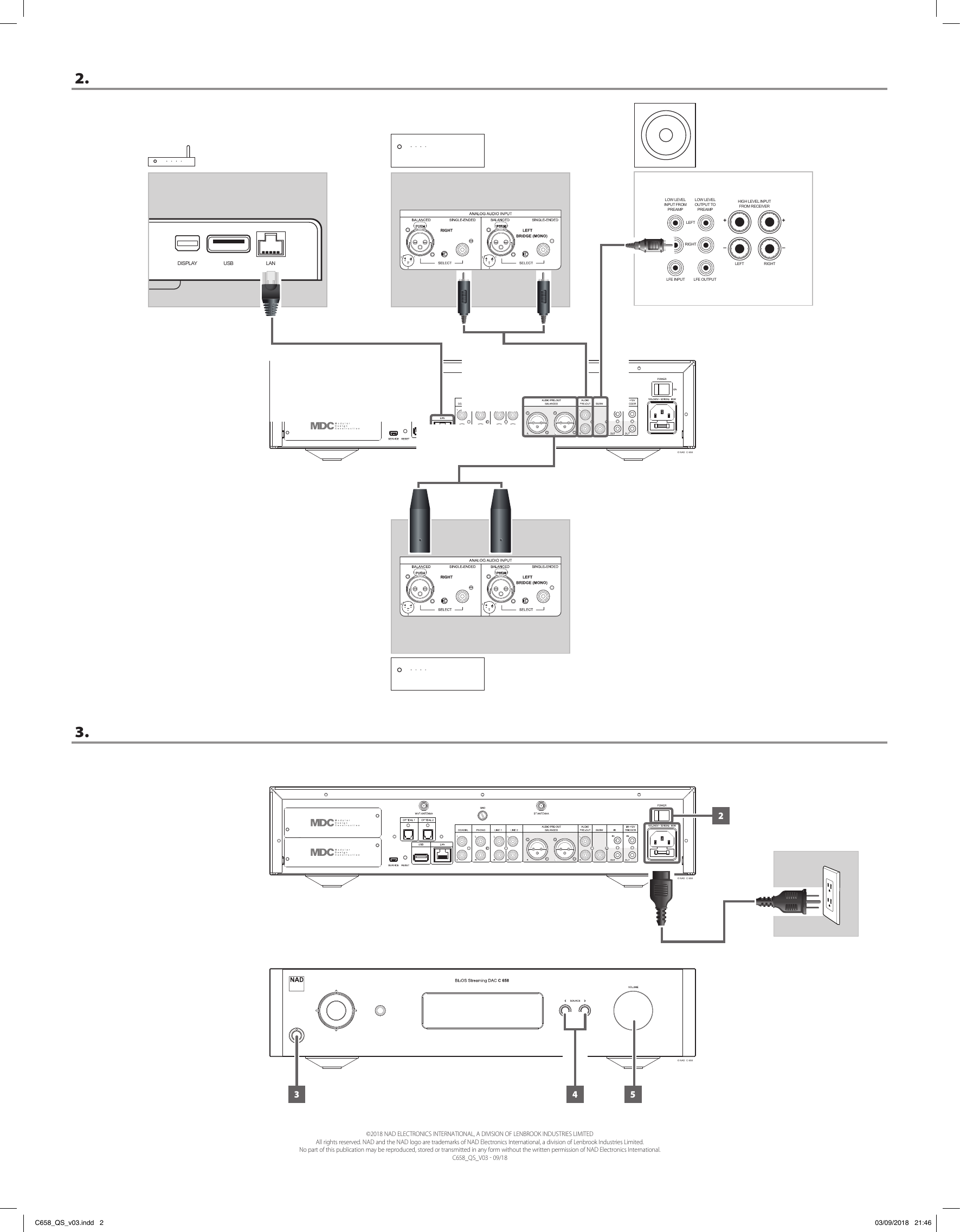
©2018 NAD ELECTRONICS INTERNATIONAL, A DIVISION OF LENBROOK INDUSTRIES LIMITEDAll rights reserved. NAD and the NAD logo are trademarks of NAD Electronics International, a division of Lenbrook Industries Limited.No part of this publication may be reproduced, stored or transmitted in any form without the written permission of NAD Electronics International.C658_QS_V03 - 09/18© NAD  C 658© NAD  C 658© NAD  C 6582. 3. 2 CHANNEL AUDIO OUTUNBALANCEDR BALANCED L BALANCEDLRPOWERONPOWERON100-240V ~ 50/60HzAUDIO OUTL RLOW LEVELINPUT FROMPREAMPHIGH LEVEL INPUTFROM RECEIVERLOW LEVELOUTPUT TOPREAMPLEFTLEFT+–+–RIGHTRIGHT+–LFE INPUT LFE OUTPUTDVI OUT DISPLAY USB USB LANDISPLAY USB LANFIREWIREFIREWIRE USB HEADPHONES MICAUDIO OUT SUBWOUTCOAXOUTOPTICALOUTOPTICAL IN/ANALOG INTRIGGEROUTL R© NAD  C 658© NAD  C 658© NAD  C 658© NAD  C 658© NAD  C 65812© NAD  C 6583 54C658_QS_v03.indd   2 03/09/2018   21:46
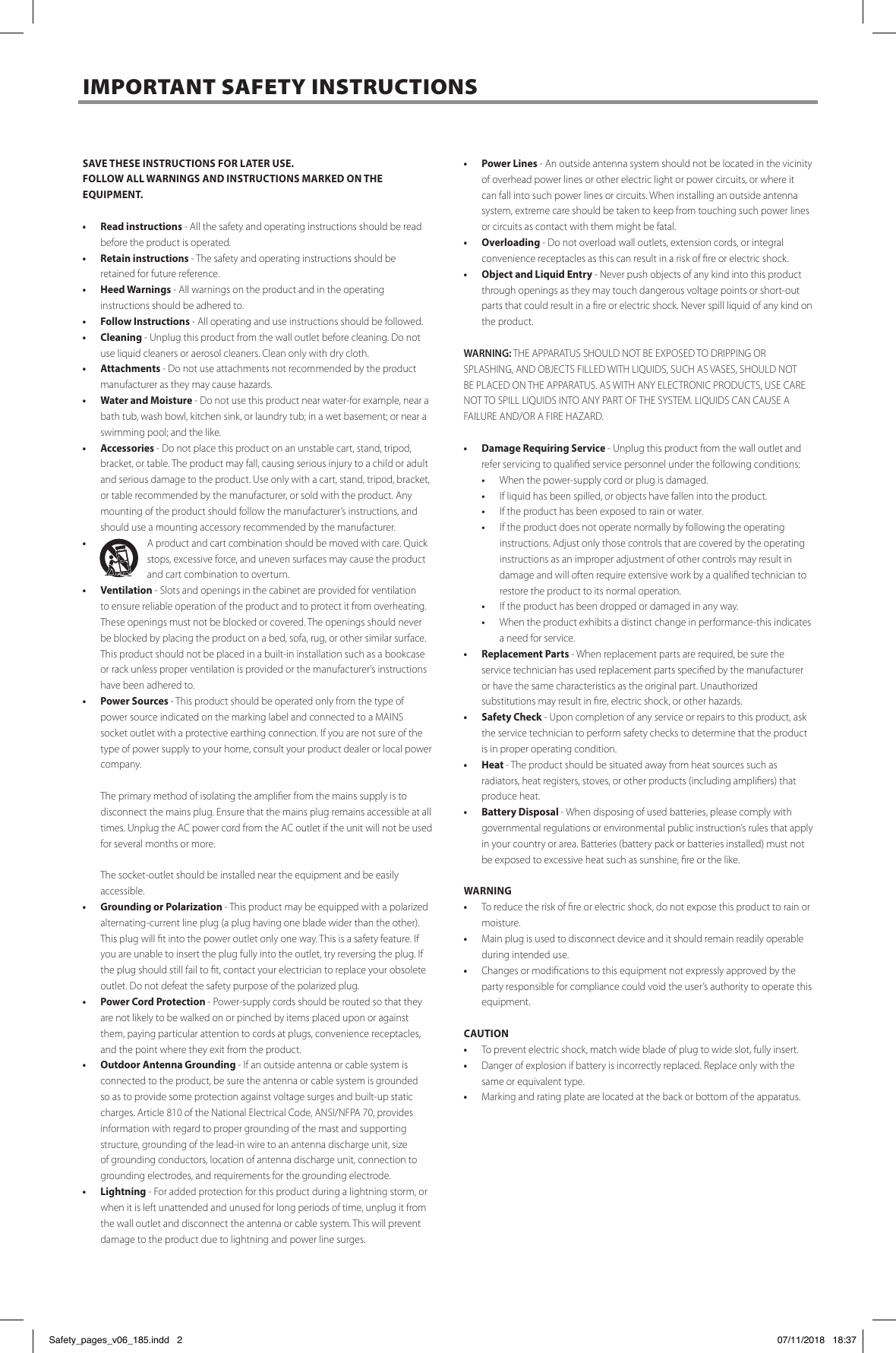
SAVE THESE INSTRUCTIONS FOR LATER USE. FOLLOW ALL WARNINGS AND INSTRUCTIONS MARKED ON THE EQUIPMENT.•  Read instructions - All the safety and operating instructions should be read before the product is operated.•  Retain instructions - The safety and operating instructions should be retained for future reference.•  Heed Warnings - All warnings on the product and in the operating instructions should be adhered to. •  Follow Instructions - All operating and use instructions should be followed.• Cleaning - Unplug this product from the wall outlet before cleaning. Do not use liquid cleaners or aerosol cleaners. Clean only with dry cloth.• Attachments - Do not use attachments not recommended by the product manufacturer as they may cause hazards. •  Water and Moisture - Do not use this product near water-for example, near a bath tub, wash bowl, kitchen sink, or laundry tub; in a wet basement; or near a swimming pool; and the like. • Accessories - Do not place this product on an unstable cart, stand, tripod, bracket, or table. The product may fall, causing serious injury to a child or adult and serious damage to the product. Use only with a cart, stand, tripod, bracket, or table recommended by the manufacturer, or sold with the product. Any mounting of the product should follow the manufacturer’s instructions, and should use a mounting accessory recommended by the manufacturer. •  A product and cart combination should be moved with care. Quick stops, excessive force, and uneven surfaces may cause the product and cart combination to overturn.• Ventilation - Slots and openings in the cabinet are provided for ventilation to ensure reliable operation of the product and to protect it from overheating. These openings must not be blocked or covered. The openings should never be blocked by placing the product on a bed, sofa, rug, or other similar surface. This product should not be placed in a built-in installation such as a bookcase or rack unless proper ventilation is provided or the manufacturer’s instructions have been adhered to.•  Power Sources - This product should be operated only from the type of power source indicated on the marking label and connected to a MAINS socket outlet with a protective earthing connection. If you are not sure of the type of power supply to your home, consult your product dealer or local power company.  The primary method of isolating the amplier from the mains supply is to disconnect the mains plug. Ensure that the mains plug remains accessible at all times. Unplug the AC power cord from the AC outlet if the unit will not be used for several months or more.  The socket-outlet should be installed near the equipment and be easily accessible.•  Grounding or Polarization - This product may be equipped with a polarized alternating-current line plug (a plug having one blade wider than the other). This plug will t into the power outlet only one way. This is a safety feature. If you are unable to insert the plug fully into the outlet, try reversing the plug. If the plug should still fail to t, contact your electrician to replace your obsolete outlet. Do not defeat the safety purpose of the polarized plug.•  Power Cord Protection - Power-supply cords should be routed so that they are not likely to be walked on or pinched by items placed upon or against them, paying particular attention to cords at plugs, convenience receptacles, and the point where they exit from the product.•  Outdoor Antenna Grounding - If an outside antenna or cable system is connected to the product, be sure the antenna or cable system is grounded so as to provide some protection against voltage surges and built-up static charges. Article 810 of the National Electrical Code, ANSI/NFPA 70, provides information with regard to proper grounding of the mast and supporting structure, grounding of the lead-in wire to an antenna discharge unit, size of grounding conductors, location of antenna discharge unit, connection to grounding electrodes, and requirements for the grounding electrode. • Lightning - For added protection for this product during a lightning storm, or when it is left unattended and unused for long periods of time, unplug it from the wall outlet and disconnect the antenna or cable system. This will prevent damage to the product due to lightning and power line surges.•  Power Lines - An outside antenna system should not be located in the vicinity of overhead power lines or other electric light or power circuits, or where it can fall into such power lines or circuits. When installing an outside antenna system, extreme care should be taken to keep from touching such power lines or circuits as contact with them might be fatal. • Overloading - Do not overload wall outlets, extension cords, or integral convenience receptacles as this can result in a risk of re or electric shock.•  Object and Liquid Entry - Never push objects of any kind into this product through openings as they may touch dangerous voltage points or short-out parts that could result in a re or electric shock. Never spill liquid of any kind on the product. WARNING: THE APPARATUS SHOULD NOT BE EXPOSED TO DRIPPING OR SPLASHING, AND OBJECTS FILLED WITH LIQUIDS, SUCH AS VASES, SHOULD NOT BE PLACED ON THE APPARATUS. AS WITH ANY ELECTRONIC PRODUCTS, USE CARE NOT TO SPILL LIQUIDS INTO ANY PART OF THE SYSTEM. LIQUIDS CAN CAUSE A FAILURE AND/OR A FIRE HAZARD.•  Damage Requiring Service - Unplug this product from the wall outlet and refer servicing to qualied service personnel under the following conditions: •  When the power-supply cord or plug is damaged. •  If liquid has been spilled, or objects have fallen into the product. •  If the product has been exposed to rain or water. •  If the product does not operate normally by following the operating instructions. Adjust only those controls that are covered by the operating instructions as an improper adjustment of other controls may result in damage and will often require extensive work by a qualied technician to restore the product to its normal operation. •  If the product has been dropped or damaged in any way. •  When the product exhibits a distinct change in performance-this indicates a need for service. •  Replacement Parts - When replacement parts are required, be sure the service technician has used replacement parts specied by the manufacturer or have the same characteristics as the original part. Unauthorized substitutions may result in re, electric shock, or other hazards. •  Safety Check - Upon completion of any service or repairs to this product, ask the service technician to perform safety checks to determine that the product is in proper operating condition. • Heat - The product should be situated away from heat sources such as radiators, heat registers, stoves, or other products (including ampliers) that produce heat.•  Battery Disposal - When disposing of used batteries, please comply with governmental regulations or environmental public instruction’s rules that apply in your country or area. Batteries (battery pack or batteries installed) must not be exposed to excessive heat such as sunshine, re or the like.  WARNING•  To reduce the risk of re or electric shock, do not expose this product to rain or moisture.•  Main plug is used to disconnect device and it should remain readily operable during intended use.•  Changes or modications to this equipment not expressly approved by the party responsible for compliance could void the user’s authority to operate this equipment.CAUTION•  To prevent electric shock, match wide blade of plug to wide slot, fully insert. •  Danger of explosion if battery is incorrectly replaced. Replace only with the same or equivalent type.•  Marking and rating plate are located at the back or bottom of the apparatus.IMPORTANT SAFETY INSTRUCTIONSSafety_pages_v06_185.indd   2 07/11/2018   18:37
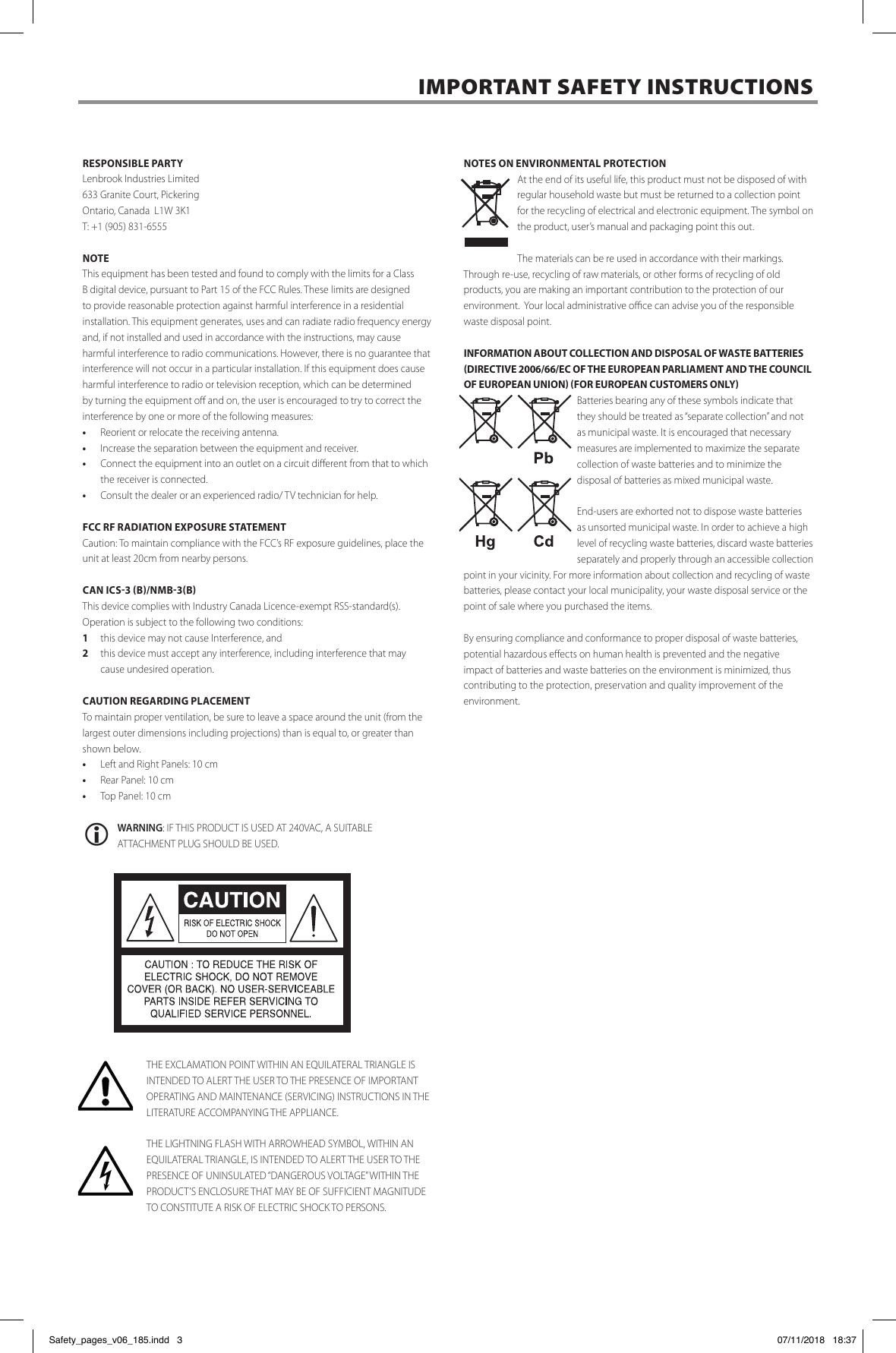
RESPONSIBLE PARTYLenbrook Industries Limited  633 Granite Court, PickeringOntario, Canada  L1W 3K1 T: +1 (905) 831-6555NOTEThis equipment has been tested and found to comply with the limits for a Class B digital device, pursuant to Part 15 of the FCC Rules. These limits are designed to provide reasonable protection against harmful interference in a residential installation. This equipment generates, uses and can radiate radio frequency energy and, if not installed and used in accordance with the instructions, may cause harmful interference to radio communications. However, there is no guarantee that interference will not occur in a particular installation. If this equipment does cause harmful interference to radio or television reception, which can be determined by turning the equipment o and on, the user is encouraged to try to correct the interference by one or more of the following measures:•  Reorient or relocate the receiving antenna.•  Increase the separation between the equipment and receiver.•  Connect the equipment into an outlet on a circuit dierent from that to which the receiver is connected.•  Consult the dealer or an experienced radio/ TV technician for help.FCC RF RADIATION EXPOSURE STATEMENTCaution: To maintain compliance with the FCC’s RF exposure guidelines, place the unit at least 20cm from nearby persons.CAN ICS-3 (B)/NMB-3(B)This device complies with Industry Canada Licence-exempt RSS-standard(s). Operation is subject to the following two conditions:1  this device may not cause Interference, and2  this device must accept any interference, including interference that may cause undesired operation.CAUTION REGARDING PLACEMENT To maintain proper ventilation, be sure to leave a space around the unit (from the largest outer dimensions including projections) than is equal to, or greater than shown below. •  Left and Right Panels: 10 cm •  Rear Panel: 10 cm •  Top Panel: 10 cm WARNING: IF THIS PRODUCT IS USED AT 240VAC, A SUITABLE ATTACHMENT PLUG SHOULD BE USED.THE EXCLAMATION POINT WITHIN AN EQUILATERAL TRIANGLE IS INTENDED TO ALERT THE USER TO THE PRESENCE OF IMPORTANT OPERATING AND MAINTENANCE (SERVICING) INSTRUCTIONS IN THE LITERATURE ACCOMPANYING THE APPLIANCE.THE LIGHTNING FLASH WITH ARROWHEAD SYMBOL, WITHIN AN EQUILATERAL TRIANGLE, IS INTENDED TO ALERT THE USER TO THE PRESENCE OF UNINSULATED “DANGEROUS VOLTAGE” WITHIN THE PRODUCT’S ENCLOSURE THAT MAY BE OF SUFFICIENT MAGNITUDE TO CONSTITUTE A RISK OF ELECTRIC SHOCK TO PERSONS.NOTES ON ENVIRONMENTAL PROTECTIONAt the end of its useful life, this product must not be disposed of with regular household waste but must be returned to a collection point for the recycling of electrical and electronic equipment. The symbol on the product, user’s manual and packaging point this out. The materials can be re used in accordance with their markings. Through re-use, recycling of raw materials, or other forms of recycling of old products, you are making an important contribution to the protection of our environment.  Your local administrative oce can advise you of the responsible waste disposal point. INFORMATION ABOUT COLLECTION AND DISPOSAL OF WASTE BATTERIES (DIRECTIVE 2006/66/EC OF THE EUROPEAN PARLIAMENT AND THE COUNCIL OF EUROPEAN UNION) (FOR EUROPEAN CUSTOMERS ONLY)Batteries bearing any of these symbols indicate that they should be treated as “separate collection” and not as municipal waste. It is encouraged that necessary measures are implemented to maximize the separate collection of waste batteries and to minimize the disposal of batteries as mixed municipal waste. End-users are exhorted not to dispose waste batteries as unsorted municipal waste. In order to achieve a high level of recycling waste batteries, discard waste batteries separately and properly through an accessible collection point in your vicinity. For more information about collection and recycling of waste batteries, please contact your local municipality, your waste disposal service or the point of sale where you purchased the items.By ensuring compliance and conformance to proper disposal of waste batteries, potential hazardous eects on human health is prevented and the negative impact of batteries and waste batteries on the environment is minimized, thus contributing to the protection, preservation and quality improvement of the environment.  IMPORTANT SAFETY INSTRUCTIONS  Safety_pages_v06_185.indd   3 07/11/2018   18:37
CONSERVER CES INSTRUCTIONS POUR UN USAGE ULTÉRIEUR. SUIVRE TOUS LES AVERTISSEMENTS ET TOUTES LES INSTRUCTIONS MARQUÉS SUR L’ÉQUIPEMENT.·  Lire les instructions - Toutes les consignes de sécurité et les instructions d’utilisation doivent être lues avant de faire fonctionner le produit.·  Conserver les instructions - Les consignes de sécurité et les instructions d’utilisation doivent être conservées pour un usage ultérieur.·  Respecter les avertissements - Tous les avertissements portés sur les pro-duits et dans les instructions d’utilisation doivent être respectées. ·  Suivre les instructions - Toutes les instructions opérationnelles et d’utilisation doivent être suivies.· Nettoyage - Débrancher ce produit de la prise de courant mural avant tout nettoyage. N’utilisez aucun nettoyant liquide ou aérosol. Utilisez uniquement un chion sec pour le nettoyer.· Fixations - Ne pas utiliser de dispositifs de xation non recommandés par le fabricant du produit car ils pourraient engendrer des risques. ·  Eau et humidité - Ne pas utiliser ce produit en présence d’eau ; par exemple, à proximité d’une baignoire, d’un lavabo, d’un évier ou d’une bassine ; dans un endroit humide ; ou près d’une piscine ou d’un bassin apparenté. · Accessoires - Ne pas poser ce produit sur un chariot, un support, un trépied, une console ou une table instable. L’appareil risquerait de tomber, provoquant des blessures graves chez un enfant ou un adulte et pourrait lui-même subir de sérieux dommages. Utilisez exclusivement un chariot, un support, un trépied, une console ou une table préconisés par le fabricant ou vendus avec l’appareil. Toute xation du produit doit être réalisée selon les instructions du fabricant, et à l’aide d’un accessoire de xation recommandé par ce fabricant. ·  L’ensemble d’un produit posé sur un chariot doit être déplacé avec précautions. Des arrêts brutaux, une force excessive et des surfaces irrégulières peuvent provoquer le renversement de l’ensemble pro-duit-chariot.· Ventilation - Les fentes et ouvertures du boîtier sont prévues pour la venti-lation, pour assurer un fonctionnement able du produit et pour le protéger contre la surchaue. Il ne faut pas les bloquer ou les couvrir. Ces ouvertures ne doivent donc pas être obstruées ou couvertes. Elles ne doivent jamais être obstruées en posant le produit sur un lit, un canapé, sur de la moquette ou sur toute autre surface similaire. Ce produit ne doit pas être installé dans un sys-tème intégré comme dans une étagère de bibliothèque sauf si une ventilation adéquate est assurée ou si les instructions du fabricant ont été respectées.·  Sources d’alimentation - Ce produit doit obligatoirement être alimenté par une source du type indiqué sur l’étiquette et connecté à une prise de terre SECTEUR. Si le type d’alimentation du domicile n’est pas certain, consulter le revendeur ou la compagnie distributrice d’électricité.  La méthode la plus radicale pour isoler le préamplicateur de sa source d’alimentation secteur est de le débrancher de la prise murale. . S’assurer que cette prise est accessible à tout moment. Débrancher le cordon d’alimentation secteur de la prise murale si l’appareil ne doit pas être utilisé pendant une longue période de temps (plusieurs mois et plus).  La prise d’alimentation secteur doit se situer près de l’appareil et doit être facilement accessible.·  Mise à la terre ou polarisation - Ce produit peut être équipé d’une che d’alimentation en courant alternatif polarisée (une che ayant une broche plus large que l’autre). Dans ce cas, cette che ne se branchera à la prise murale que dans un seul sens. Il s’agit d’une mesure de sécurité. Si la che ne peut s’insérer à fond dans la prise murale, essayé de la retourner. Si la che ne s’insère tou-jours pas, contacter un électricien pour remplacer l’ancienne prise murale. Ne jamais contrarier la fonction de sécurité de la che polarisée.·  Protection du cordon d’alimentation secteur - Les cordons d’alimentation sec-teur doivent être acheminés de telle sorte qu’ils ne soient pas piétinés ou pincés par des éléments posés dessus ou contre eux, en faisant particulièrement attention aux cordons aux niveaux des ches, des prises murales et du point de sortie du produit.·  Mise à la terre des antennes extérieures - Si une antenne ou un système de câble extérieur est connecté au produit, s’assurer que l’antenne et le système de câble est relié à la terre an d’assurer une protection contre les surtensions et les charges électrostatiques. L’Article 810 du National Electrical Code (NEC), ANSI/NFPA 70, contient des informations concernant la mise à la terre correcte du mât et de la structure porteuse, la mise à la terre du câble d’amenée sur un dispositif de décharge d’antenne, le calibre des câbles de mise à la terre, l’emplacement du dispositif de décharge d’antenne, le branchement aux électrodes de mise à la terre et les exigences concernant les électrodes de mise à la terre. ·  Protection contre la foudre - An d’ajouter une protection supplémentaire de ce produit pendant un orage, ou lorsque ce produit est laissé sans attention et inutilisé pendant une longue période de temps, il est recommandé de le débrancher de la prise murale et de débrancher l’antenne ou le système de câble. Cela évitera d’en-dommager le produit en cas d’orage ou de surtensions sur l’alimentation secteur.·  Lignes d’alimentation secteur - Une antenne ne doit en aucun cas être située au voisinage de lignes d’alimentation aériennes ou autres circuits d’éclai-rage ou d’alimentation électrique, ou en des endroits où elle peut tomber sur ces lignes ou ces circuits. Lors de l’installation d’un système d’antenne exté-rieure, les plus grandes précautions doivent être observées an que l’antenne n’entre pas en contact avec ces lignes ou ces circuits d’alimentation, car ce contact serait fatal. · Surcharge - Ne pas surcharger les prises murales, les cordons prolongateurs ou les boîtiers à prises multiples car il pourrait en résulter un risque d’incendie ou d’électrocution.·  Introduction d’objets et de liquides - Ne jamais introduire d’objets d’aucune sorte dans ce produit à travers ses ouvertures car ils peuvent entrer en contact avec des points sous tension dangereuse ou court-circuiter diverses parties, ce qui pourrait provoquer un incendie ou présenter un risque d’électrocution. Ne jamais répandre de liquide d’aucune sorte sur le produit. ATTENTION : L’APPAREIL NE DOIT PAS ETRE EXPOSE AU RUISSELLEMENT DE LIQUIDES OU AUX L’ECLABOUSSURES PAR CEUX-CI ; NE PLACEZ JAMAIS DE RECI-PIENT (VASE, ETC ...) CONTENANT UN LIQUIDE SUR L’APPAREIL. COMME POUR TOUT APPAREIL ELECTRONIQUE, FAITES ATTENTION DE NE PAS RENVERSER DE LIQUIDE SUR UNE PARTIE QUELCONQUE DU SYSTEME. LES LIQUIDES PEUVENT PROVOQUER UNE PANNE ET/OU REPRÉSENTER UN RISQUE D’INCENDIE.·  Dommages nécessitant une intervention - Débrancher ce produit de la prise murale et consulter un personnel de maintenance qualié dans les cas suivants : ·  Lorsque le cordon d’alimentation secteur ou sa che est endommagé. ·  Si un liquide s’est répandu, ou si des objets sont tombés dans l’appareil. ·  Si l’appareil a été exposé à la pluie ou à l’eau. ·  Si l’appareil ne fonctionne pas normalement en suivant les instruc-tions d’utilisation. Ne régler que les commandes mentionnées par les instructions d’utilisation. Un réglage incorrect des autres commandes peut provoquer des dommages et nécessitera souvent un travail intensif d’un technicien qualié pour restaurer l’état normal du produit. ·  Si l’appareil est tombé ou a été endommagé d’une manière ou d’une autre. ·  Lorsque l’appareil présente un changement distinctif de ses performances indiquant qu’une intervention est nécessaire. ·  Pièces de rechange - Lorsque des pièces de rechanges sont requises, s’assurer que le technicien de maintenance a utilisé des pièces de rechange autorisées par le fabricant ou ayant les mêmes caractéristiques que les pièces d’origine. Les remplacements non autorisés peuvent produire un incendie, des chocs électriques ou d’autres risques. ·  Contrôle de sécurité - Après achèvement de toute opération de mainte-nance ou de réparation sur cet appareil, demander au technicien de mainte-nance d’eectuer des contrôles de sécurité an de déterminer si le produit est dans des conditions d’utilisation adéquates. · Chaleur- Ne l’installez pas à proximité de sources de chaleur comme des radiateurs, des bouches de chaleur, des poêles ou autre appareil (amplicateurs compris) produisant de la chaleur.·  Élimination des piles usagées - Lorsque vous vous débarrassez des piles usagées, veuillez-vous conformer aux règles gouvernementales ou aux règles dénies par les instructions publiques relatives à l’environnement applicables à votre pays ou à votre région. Les piles ne doivent pas être exposées à de forte chaleur, tel qu’à la lumière du soleil, au feu ou autres choses de semblable. AVERTISSEMENT·  Pour réduire le risque d’incendie ou d’électrocution, n’exposez pas cet appareil à la pluie ou à l’humidité.·  La che d’alimentation secteur sert à déconnecter le dispositif et doit demeu-rer utilisable durant l’usage prévu.·  Les changements ou les modications apportées à cet équipement qui ne sont pas approuvés explicitement pourraient invalider le droit de l’utilisateur d’utiliser cet équipement.CONSIGNES DE SÉCURITÉ IMPORTANTESSafety_pages_v06_185.indd   4 07/11/2018   18:37
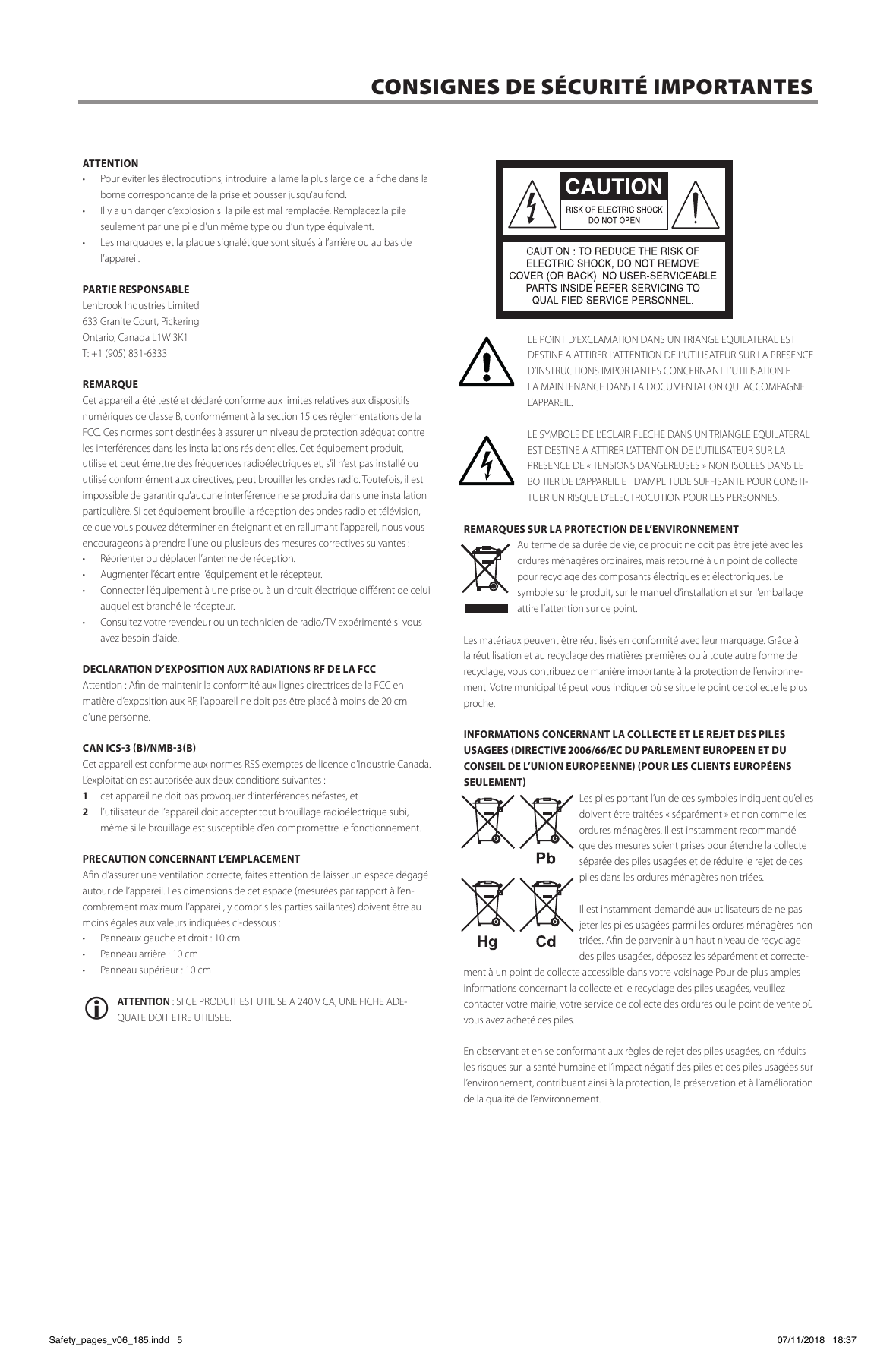
ATTENTION·  Pour éviter les électrocutions, introduire la lame la plus large de la che dans la borne correspondante de la prise et pousser jusqu’au fond. ·  Il y a un danger d’explosion si la pile est mal remplacée. Remplacez la pile seulement par une pile d’un même type ou d’un type équivalent.·  Les marquages et la plaquesignalétiquesont situés à l’arrière ou au bas de l’appareil.PARTIE RESPONSABLELenbrook Industries Limited 633 Granite Court, PickeringOntario, Canada L1W 3K1 T: +1 (905) 831-6333REMARQUECet appareil a été testé et déclaré conforme aux limites relatives aux dispositifs numériques de classe B, conformément à la section 15 des réglementations de la FCC. Ces normes sont destinées à assurer un niveau de protection adéquat contre les interférences dans les installations résidentielles. Cet équipement produit, utilise et peut émettre des fréquences radioélectriques et, s’il n’est pas installé ou utilisé conformément aux directives, peut brouiller les ondes radio. Toutefois, il est impossible de garantir qu’aucune interférence ne se produira dans une installation particulière. Si cet équipement brouille la réception des ondes radio et télévision, ce que vous pouvez déterminer en éteignant et en rallumant l’appareil, nous vous encourageons à prendre l’une ou plusieurs des mesures correctives suivantes :·  Réorienter ou déplacer l’antenne de réception.·  Augmenter l’écart entre l’équipement et le récepteur.·  Connecter l’équipement à une prise ou à un circuit électrique diérent de celui auquel est branché le récepteur.·  Consultez votre revendeur ou un technicien de radio/TV expérimenté si vous avez besoin d’aide.DECLARATION D’EXPOSITION AUX RADIATIONS RF DE LA FCCAttention: An de maintenir la conformité aux lignes directrices de la FCC en matière d’exposition aux RF, l’appareil ne doit pas être placé à moins de 20 cm d’une personne.CAN ICS-3 (B)/NMB-3(B)Cet appareil est conforme aux normes RSS exemptes de licence d’Industrie Canada. L’exploitation est autorisée aux deux conditions suivantes :1  cet appareil ne doit pas provoquer d’interférences néfastes, et2  l’utilisateur de l’appareil doit accepter tout brouillage radioélectrique subi, même si le brouillage est susceptible d’en compromettre le fonctionnement.PRECAUTION CONCERNANT L’EMPLACEMENT An d’assurer une ventilation correcte, faites attention de laisser un espace dégagé autour de l’appareil. Les dimensions de cet espace (mesurées par rapport à l’en-combrement maximum l’appareil, y compris les parties saillantes) doivent être au moins égales aux valeurs indiquées ci-dessous : ·  Panneaux gauche et droit : 10 cm ·  Panneau arrière: 10 cm ·  Panneau supérieur: 10 cm ATTENTION : SI CE PRODUIT EST UTILISE A 240 V CA, UNE FICHE ADE-QUATE DOIT ETRE UTILISEE.LE POINT D’EXCLAMATION DANS UN TRIANGE EQUILATERAL EST DESTINE A ATTIRER L’ATTENTION DE L’UTILISATEUR SUR LA PRESENCE D’INSTRUCTIONS IMPORTANTES CONCERNANT L’UTILISATION ET LA MAINTENANCE DANS LA DOCUMENTATION QUI ACCOMPAGNE L’APPAREIL.LE SYMBOLE DE L’ECLAIR FLECHE DANS UN TRIANGLE EQUILATERAL EST DESTINE A ATTIRER L’ATTENTION DE L’UTILISATEUR SUR LA PRESENCE DE «TENSIONS DANGEREUSES» NON ISOLEES DANS LE BOITIER DE L’APPAREIL ET D’AMPLITUDE SUFFISANTE POUR CONSTI-TUER UN RISQUE D’ELECTROCUTION POUR LES PERSONNES.REMARQUES SUR LA PROTECTION DE L’ENVIRONNEMENTAu terme de sa durée de vie, ce produit ne doit pas être jeté avec les ordures ménagères ordinaires, mais retourné à un point de collecte pour recyclage des composants électriques et électroniques. Le symbole sur le produit, sur le manuel d’installation et sur l’emballage attire l’attention sur ce point. Les matériaux peuvent être réutilisés en conformité avec leur marquage. Grâce à la réutilisation et au recyclage des matières premières ou à toute autre forme de recyclage, vous contribuez de manière importante à la protection de l’environne-ment. Votre municipalité peut vous indiquer où se situe le point de collecte le plus proche. INFORMATIONS CONCERNANT LA COLLECTE ET LE REJET DES PILES USAGEES (DIRECTIVE 2006/66/EC DU PARLEMENT EUROPEEN ET DU CONSEIL DE L’UNION EUROPEENNE) (POUR LES CLIENTS EUROPÉENS SEULEMENT)Les piles portant l’un de ces symboles indiquent qu’elles doivent être traitées «séparément» et non comme les ordures ménagères. Il est instamment recommandé que des mesures soient prises pour étendre la collecte séparée des piles usagées et de réduire le rejet de ces piles dans les ordures ménagères non triées. Il est instamment demandé aux utilisateurs de ne pas jeter les piles usagées parmi les ordures ménagères non triées. An de parvenir à un haut niveau de recyclage des piles usagées, déposez les séparément et correcte-ment à un point de collecte accessible dans votre voisinage Pour de plus amples informations concernant la collecte et le recyclage des piles usagées, veuillez contacter votre mairie, votre service de collecte des ordures ou le point de vente où vous avez acheté ces piles.En observant et en se conformant aux règles de rejet des piles usagées, on réduits les risques sur la santé humaine et l’impact négatif des piles et des piles usagées sur l’environnement, contribuant ainsi à la protection, la préservation et à l’amélioration de la qualité de l’environnement. CONSIGNES DE SÉCURITÉ IMPORTANTES  Safety_pages_v06_185.indd   5 07/11/2018   18:37
 This device complies with Part 15 of the FCC Rules. Operation is subject to the following two conditions:  (1) This device may not cause harmful interference, and  (2) This device must accept any interference received, including interference that may cause undesired operation.   Note: This product has been tested and found to comply with the limits for a Class B digital device, pursuant to Part 15 of the FCC Rules. These limits are designed to provide reasonable protection against harmful interference in a residential installation. This product generates, uses, and can radiate radio frequency energy and, if not installed and used in accordance with the instructions, may cause harmful interference to radio communications. However, there is no guarantee that interference will not occur in a particular installation. If this product does cause harmful interference to radio or television reception, which can be determined by turning the equipment off and on, the user is encouraged to try to correct the interference by one or more of the following measures:  —Reorient or relocate the receiving antenna.  —Increase the separation between the equipment and receiver.  —Connect the equipment into an outlet on a circuit different from that to which the receiver is connected.  —Consult the dealer or an experienced radio/TV technician for help.  Please take attention that changes or modification not expressly approved by the party responsible for compliance could void the user’s authority to operate the equipment.  This equipment should be installed and operated with a minimum distance 20cm between the radiator and your body
  This device complies with Industry Canada licence-exempt RSS standard(s). Operation is subject to the following two conditions:  (1) this device may not cause interference, and (2) this device must accept any interference, including interference that may cause undesired operation of the device. Le présent appareil est conforme aux CNR d'Industrie Canada applicables aux appareils radioexempts de licence. L'exploitation est autorisée aux deux conditions suivantes : (1) l'appareil ne doit pas produire de brouillage, et (2) l'utilisateur de l'appareil doit accepter tout brouillage radioélectrique subi, même si le brouillage est susceptible d'en compromettre le fonctionnement.    Under Industry Canada regulations, this radio transmitter may only operate using an antenna of a type and maximum (or lesser) gain approved for the transmitter by Industry Canada. To reduce potential radio interference to other users, the antenna type and its gain should be so chosen that the equivalent isotropically radiated power (e.i.r.p.) is not more than that necessary for successful communication.  Conformément à la réglementation d'Industrie Canada, le présent émetteur radio peut fonctionner avec une antenne d'un type et d'un gain maximal (ou inférieur) approuvé pour l'émetteur par Industrie Canada. Dans le but de réduire les risques de brouillage radioélectrique à l'intention des autres utilisateurs, il faut choisir le type d'antenne et son gain de sorte que la puissance isotrope rayonnée équivalente (p.i.r.e.) ne dépasse pas l'intensité nécessaire à l'établissement d'une communication satisfaisante.
 The user manual for local area network devices shall contain instructions related to the restrictions mentioned in the above sections, namely that: (i) the device for operation in the band 5150-5250 MHz is only for indoor use to reduce the potential for harmful interference to co-channel mobile satellite systems; (ii) the maximum antenna gain permitted for devices in the bands 5250-5350 MHz and 5470-5725 MHz shall comply with the e.i.r.p. limit; and (iii) the maximum antenna gain permitted for devices in the band 5725-5825 MHz shall comply with the e.i.r.p. limits specified for point-to-point and non point-to-point operation as appropriate.  (i)Les dispositifs fonctionnant dans la bande 5150-5250 MHz sont réservés uniquement pour une utilisation à l'intérieur afin de réduire les risques de brouillage préjudiciable aux systèmes de satellites mobiles utilisant les mêmes canaux. (ii) le gain d'antenne maximal autorisé pour les appareils dans les bandes 5250-5350 MHz et 5470-5725 MHz doivent respecter le pire limiter; et (iii) le gain d'antenne maximal autorisé pour les appareils dans la bande 5725-5825 MHz doivent respecter le pire limites spécifiées pour le point-à-point et l'exploitation non point à point, le cas échéant.  Users should also be advised that high-power radars are allocated as primary users (i.e. priority users) of the bands 5250-5350 MHz and 5650-5850 MHz and that these radars could cause interference and/or damage to LE-LAN devices.  Les utilisateurs de radars de haute puissance sont désignés utilisateurs principaux (c.-à-d., qu'ils ont la priorité) pour les bandes 5250-5350 MHz et 5650-5850 MHz et que ces radars pourraient causer du brouillage et/ou des dommages aux dispositifs LAN-EL.

Navigation menu