Lester Electrical of Nebraska 28170 Bluetooth Low-Energy Module for Digital Communication User Manual Focus Lab prototype software interface

Lester Electrical of Nebraska Inc Bluetooth Low-Energy Module for Digital Communication Focus Lab prototype software interface

Users Manual Rev 2
Document:   User's Manual  Title:          Last Saved: 28170 Bluetooth® LE Module        8/19/2016 5:22:00 PM      Page 1 of 10 28170 Bluetooth® LE Module  User's Manual Rev A
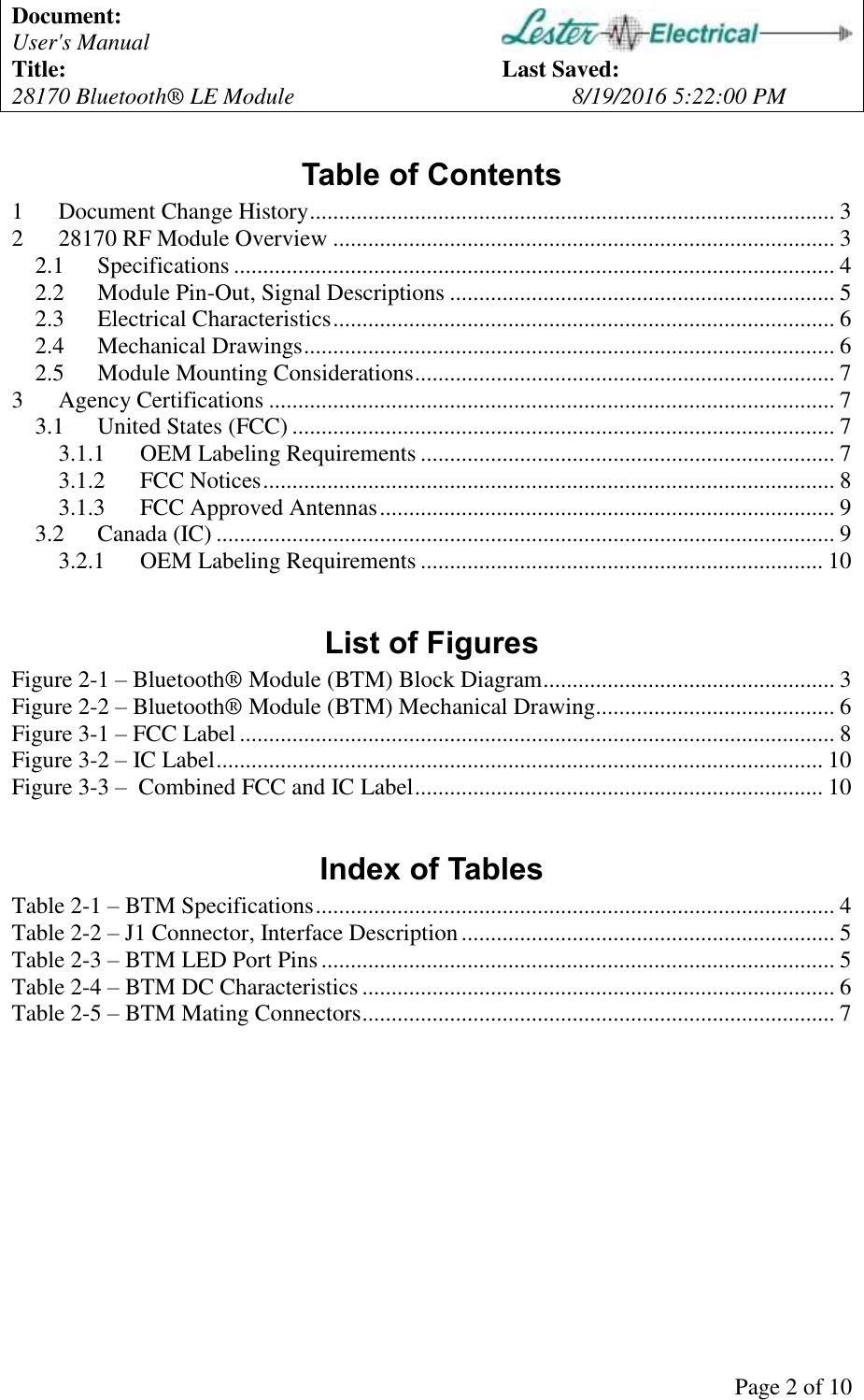
Document:   User's Manual  Title:          Last Saved: 28170 Bluetooth® LE Module        8/19/2016 5:22:00 PM      Page 2 of 10 Table of Contents 1 Document Change History .......................................................................................... 3 2 28170 RF Module Overview ...................................................................................... 3 2.1 Specifications ....................................................................................................... 4 2.2 Module Pin-Out, Signal Descriptions .................................................................. 5 2.3 Electrical Characteristics ...................................................................................... 6 2.4 Mechanical Drawings ........................................................................................... 6 2.5 Module Mounting Considerations ........................................................................ 7 3 Agency Certifications ................................................................................................. 7 3.1 United States (FCC) ............................................................................................. 7 3.1.1 OEM Labeling Requirements ....................................................................... 7 3.1.2 FCC Notices .................................................................................................. 8 3.1.3 FCC Approved Antennas .............................................................................. 9 3.2 Canada (IC) .......................................................................................................... 9 3.2.1 OEM Labeling Requirements ..................................................................... 10  List of Figures Figure 2-1 – Bluetooth® Module (BTM) Block Diagram .................................................. 3 Figure 2-2 – Bluetooth® Module (BTM) Mechanical Drawing......................................... 6 Figure 3-1 – FCC Label ...................................................................................................... 8 Figure 3-2 – IC Label ........................................................................................................ 10 Figure 3-3 –  Combined FCC and IC Label ...................................................................... 10  Index of Tables Table 2-1 – BTM Specifications ......................................................................................... 4 Table 2-2 – J1 Connector, Interface Description ................................................................ 5 Table 2-3 – BTM LED Port Pins ........................................................................................ 5 Table 2-4 – BTM DC Characteristics ................................................................................. 6 Table 2-5 – BTM Mating Connectors ................................................................................. 7
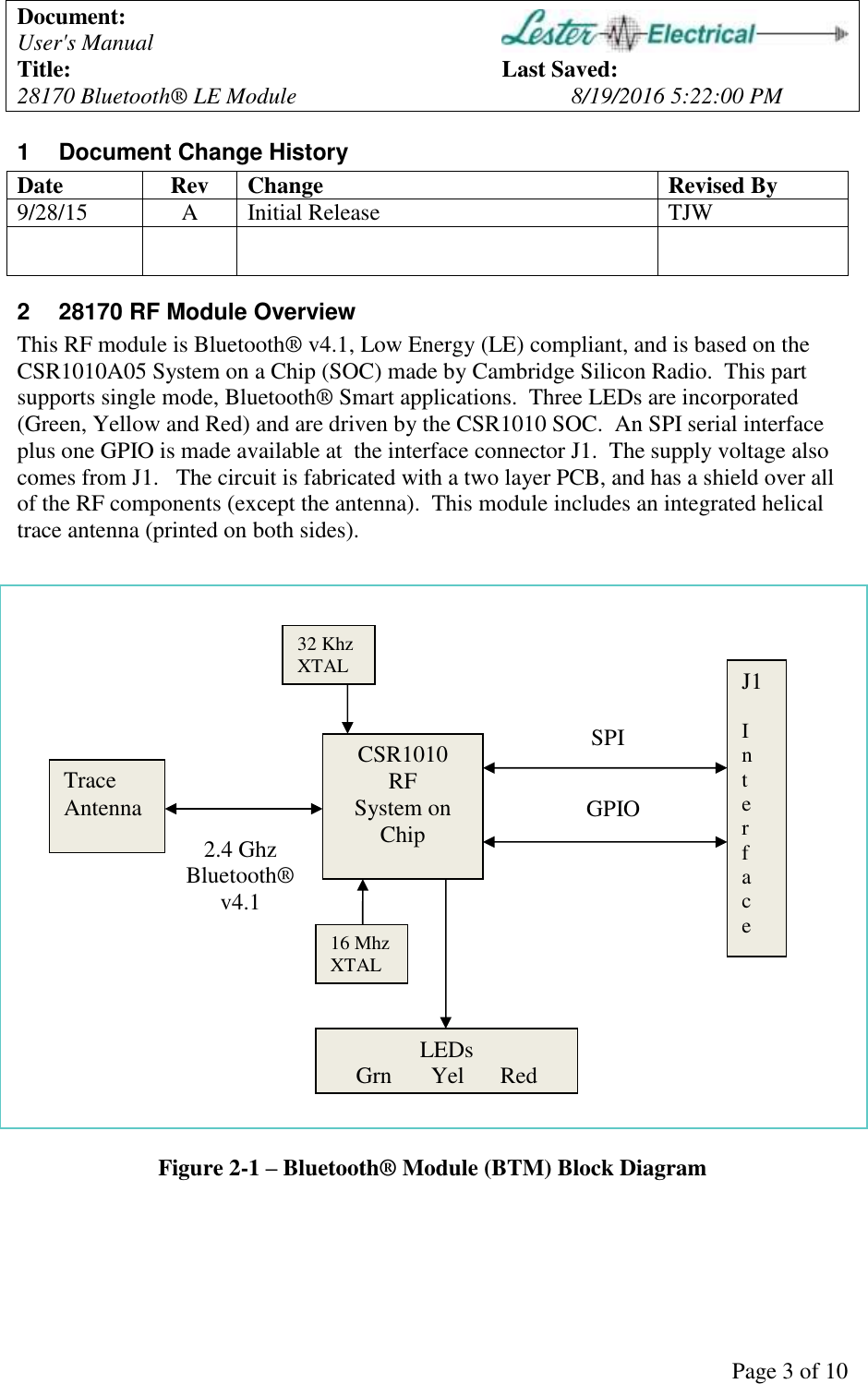
Document:   User's Manual  Title:          Last Saved: 28170 Bluetooth® LE Module        8/19/2016 5:22:00 PM      Page 3 of 10 1  Document Change History Date Rev Change Revised By 9/28/15 A Initial Release TJW     2  28170 RF Module Overview This RF module is Bluetooth® v4.1, Low Energy (LE) compliant, and is based on the CSR1010A05 System on a Chip (SOC) made by Cambridge Silicon Radio.  This part supports single mode, Bluetooth® Smart applications.  Three LEDs are incorporated (Green, Yellow and Red) and are driven by the CSR1010 SOC.  An SPI serial interface plus one GPIO is made available at  the interface connector J1.  The supply voltage also comes from J1.   The circuit is fabricated with a two layer PCB, and has a shield over all of the RF components (except the antenna).  This module includes an integrated helical trace antenna (printed on both sides).                        Figure 2-1 – Bluetooth® Module (BTM) Block Diagram    CSR1010 RF System on Chip J1  I n t e r f a c e 32 Khz XTAL 16 Mhz XTAL LEDs Grn   Yel   Red SPI GPIO Trace Antenna 2.4 Ghz Bluetooth® v4.1
Document:   User's Manual  Title:          Last Saved: 28170 Bluetooth® LE Module        8/19/2016 5:22:00 PM      Page 4 of 10 2.1 Specifications   Table 2-1 – BTM Specifications General Frequency ISM 2.4 Ghz Number of Channels (3 used for advertising) 40 Spreading Method Frequency hopping, pseudo-random, adaptive Modulation GFSK Bluetooth® Smart V4.1 Antenna Trace, Helix 2 sided Dimensions 2.086[52.98] x 1.810[45.97] Inches[mm] x 0.492[12.50] Operating Temperature -30 to 85 °C Storage Temperature -40 to 85 °C Power Requirements Supply Voltage  (Switching Regulator Input) 1.8 to 3.6 V Transmit Current 1 (TX level = 4, 0 dBm) 18mA peak at 3.0V  Receive Current 1 20mA peak at 3.0V Idle Current 1 1 mA at 3.0V Available I/O SPI Serial Port 4, including chip select Additional GPIO 1 Performance Transmit Output Power, Conducted -16 to +9 dBm Receiver Sensitivity -93 dBm RF Data Rate 1 Mbps Agency Approvals FCC Parts 15.209, 15.247 FCC ID:  OBH-28170 Industry Canada (IC) IC:  nnnnn-28170  1  Currents listed are with all LEDs off.  40mA is the maximum expected peak current, at       max transit power with all LEDs on.
Document:   User's Manual  Title:          Last Saved: 28170 Bluetooth® LE Module        8/19/2016 5:22:00 PM      Page 5 of 10 2.2 Module Pin-Out, Signal Descriptions   Table 2-2 – J1 Connector, Interface Description J1 Pin Signal Name Description Direction 1 VCC_3.3 Positive Power Supply Voltage, Normally 3.3V Power 2 SPI_MOSI (SPI SIMO) SPI Bus, Master Output / Slave Input Input/Output 3 GND Ground Pin Power 4 SPI_CLK (SPI CLK) SPI Bus, Master Clock Output Input/Output 5 SPI_CCSL (SPI /SS) SPI Bus, Chip Select Active Low (/Slave Select) Input/Output 6 LED_Notify (BTM GPIO) General Purpose GPIO  Input/Output 7 GND Ground Pin Power 8 SPI_MISO (SPI SOMI) SPI Bus, Master Input / Slave Output Input/Output   Table 2-3 – BTM LED Port Pins CSR1010 Port I/O Signal Name Description Direction PIO[0] Grn_LED Green LED, Active Low - On  1 Output PIO[1] Yel_LED Yellow LED, Active Low - On  1 Output PIO[6] Red_LED Red LED, Active Low - On  2 Output  1  The Green and Yellow LEDs are shared with the CSR UART debug Pins on PIO[0] and PIO[1].  Avoid I/O contention by not using the debug UART. 2  The Red LED is shared with the CSR Chip Select on PIO[6].  A buffer with open-drain output is recommended (for the programming I/F) to avoid I/O contention.
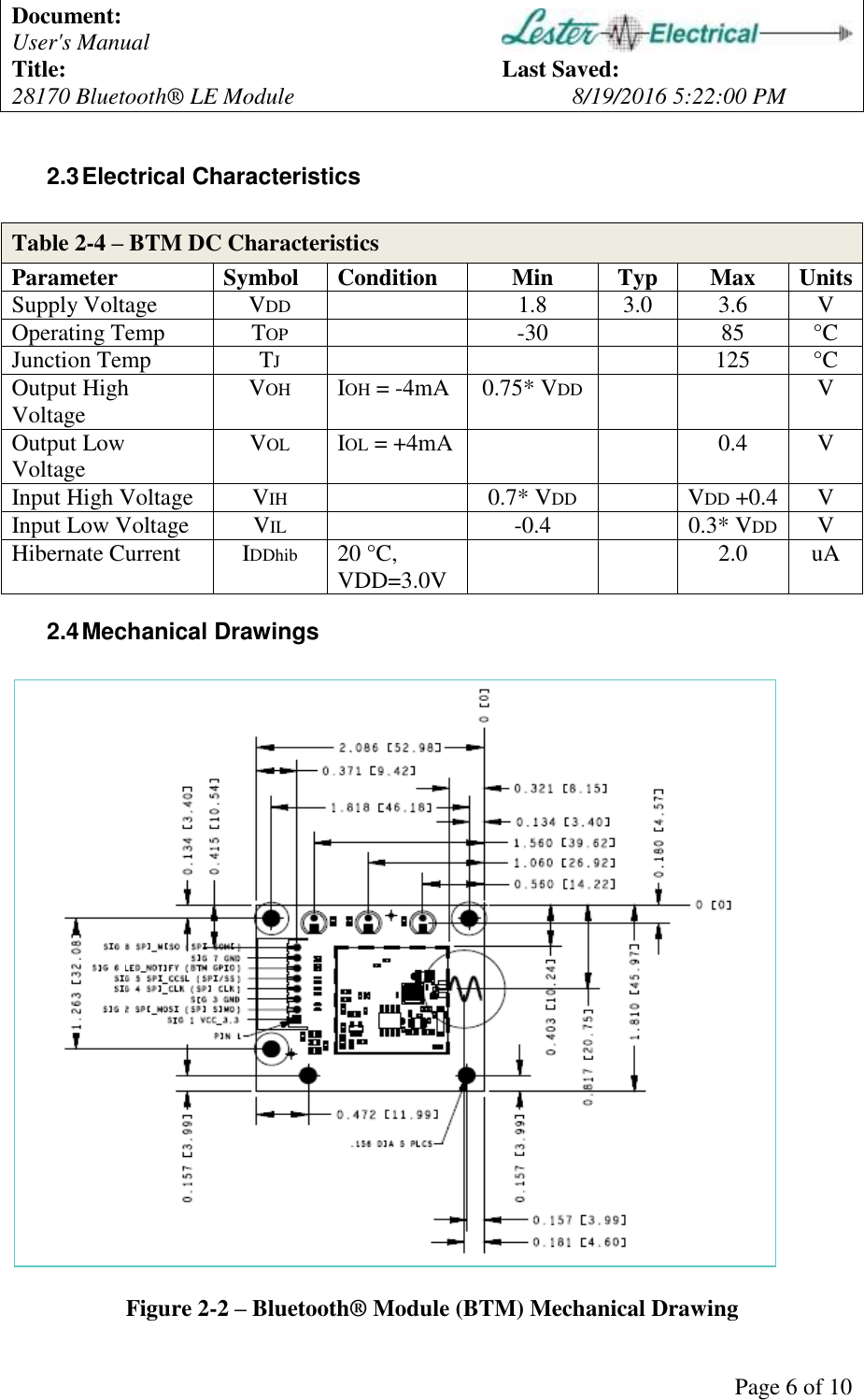
Document:   User's Manual  Title:          Last Saved: 28170 Bluetooth® LE Module        8/19/2016 5:22:00 PM      Page 6 of 10 2.3 Electrical Characteristics  Table 2-4 – BTM DC Characteristics Parameter Symbol Condition Min Typ Max Units Supply Voltage VDD  1.8 3.0 3.6 V Operating Temp TOP  -30  85 °C Junction Temp TJ    125 °C Output High Voltage VOH IOH = -4mA 0.75* VDD   V Output Low Voltage VOL IOL = +4mA   0.4 V Input High Voltage VIH  0.7* VDD  VDD +0.4 V Input Low Voltage VIL  -0.4  0.3* VDD V Hibernate Current IDDhib 20 °C, VDD=3.0V    2.0 uA 2.4 Mechanical Drawings    Figure 2-2 – Bluetooth® Module (BTM) Mechanical Drawing
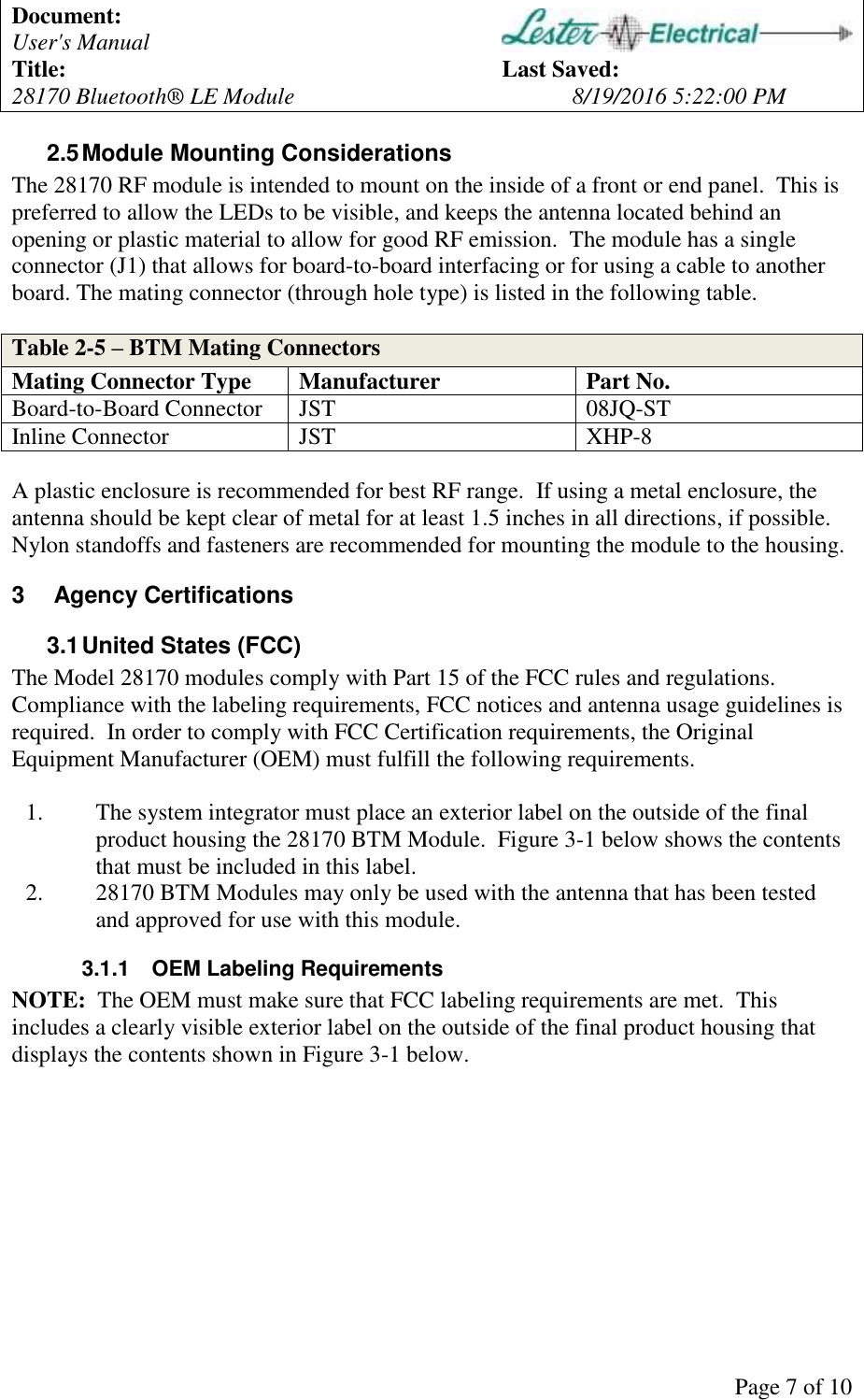
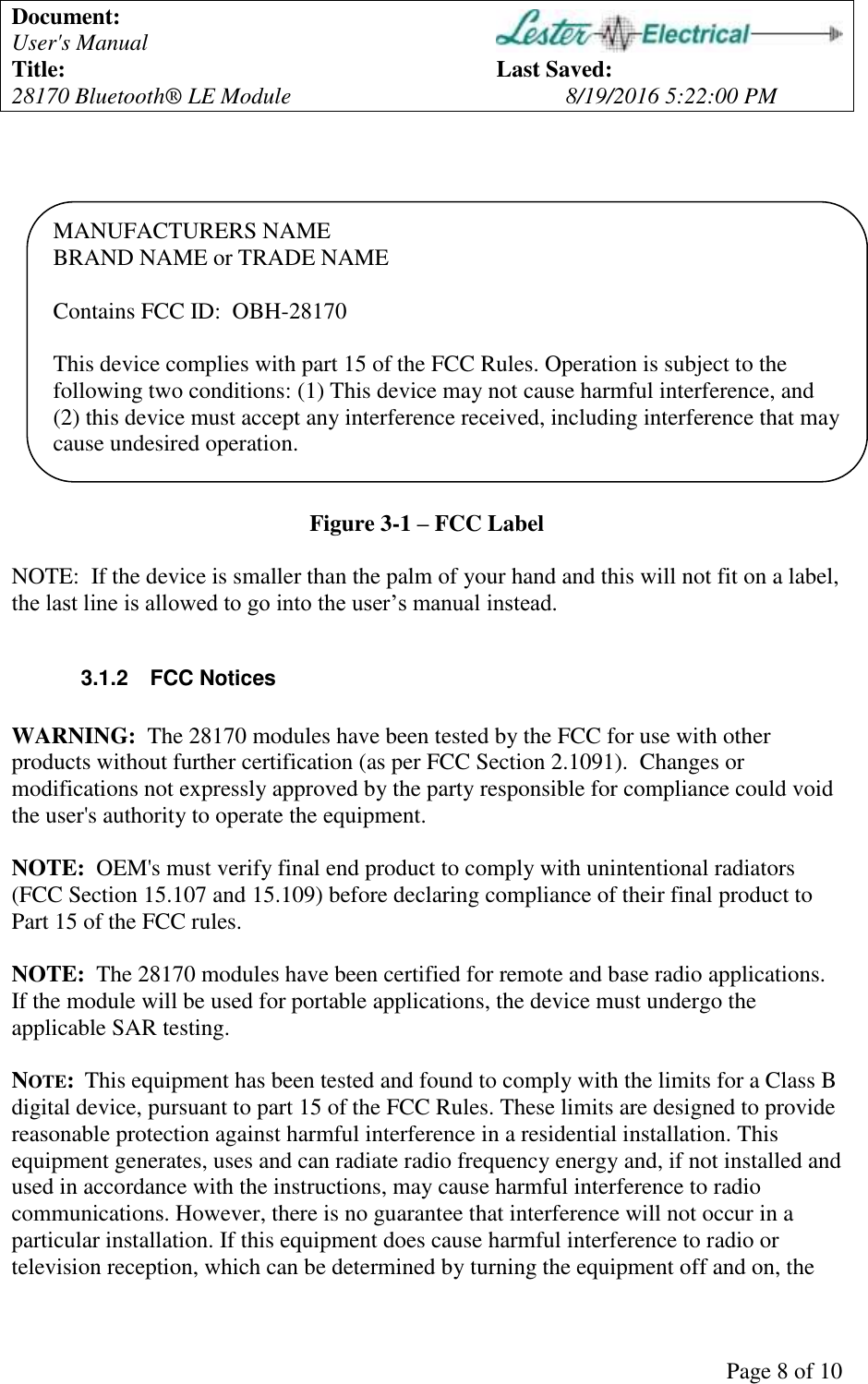
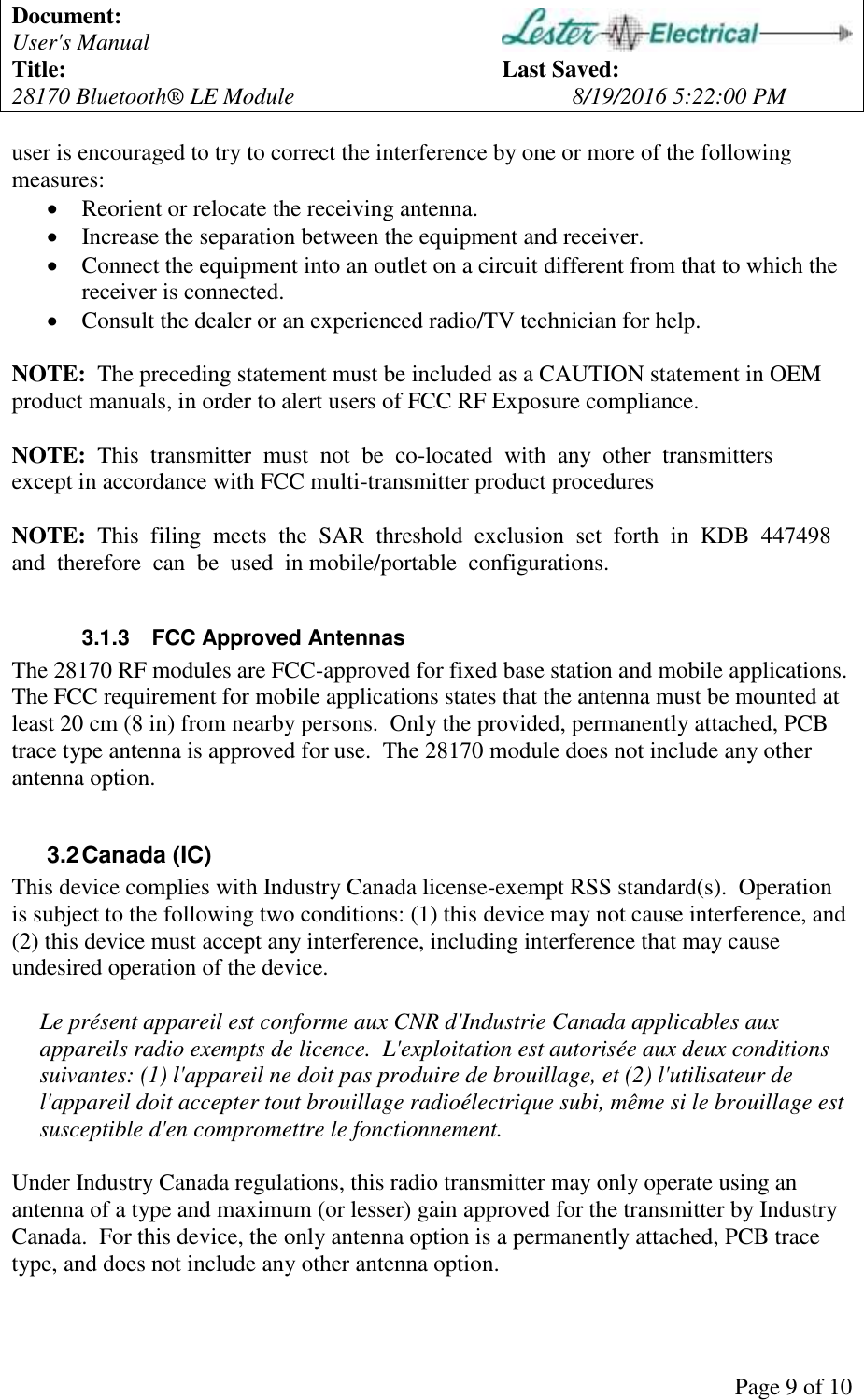
Document:   User's Manual  Title:          Last Saved: 28170 Bluetooth® LE Module        8/19/2016 5:22:00 PM      Page 7 of 10 2.5 Module Mounting Considerations The 28170 RF module is intended to mount on the inside of a front or end panel.  This is preferred to allow the LEDs to be visible, and keeps the antenna located behind an opening or plastic material to allow for good RF emission.  The module has a single connector (J1) that allows for board-to-board interfacing or for using a cable to another board. The mating connector (through hole type) is listed in the following table.    Table 2-5 – BTM Mating Connectors Mating Connector Type Manufacturer Part No. Board-to-Board Connector  JST 08JQ-ST Inline Connector JST XHP-8  A plastic enclosure is recommended for best RF range.  If using a metal enclosure, the antenna should be kept clear of metal for at least 1.5 inches in all directions, if possible.  Nylon standoffs and fasteners are recommended for mounting the module to the housing.   3  Agency Certifications 3.1 United States (FCC) The Model 28170 modules comply with Part 15 of the FCC rules and regulations. Compliance with the labeling requirements, FCC notices and antenna usage guidelines is required.  In order to comply with FCC Certification requirements, the Original Equipment Manufacturer (OEM) must fulfill the following requirements.  1.         The system integrator must place an exterior label on the outside of the final product housing the 28170 BTM Module.  Figure 3-1 below shows the contents that must be included in this label. 2.         28170 BTM Modules may only be used with the antenna that has been tested and approved for use with this module. 3.1.1  OEM Labeling Requirements NOTE:  The OEM must make sure that FCC labeling requirements are met.  This includes a clearly visible exterior label on the outside of the final product housing that displays the contents shown in Figure 3-1 below.
Document:   User's Manual  Title:          Last Saved: 28170 Bluetooth® LE Module        8/19/2016 5:22:00 PM      Page 8 of 10    MANUFACTURERS NAME BRAND NAME or TRADE NAME  Contains FCC ID:  OBH-28170  This device complies with part 15 of the FCC Rules. Operation is subject to the following two conditions: (1) This device may not cause harmful interference, and (2) this device must accept any interference received, including interference that may cause undesired operation.   Figure 3-1 – FCC Label  NOTE:  If the device is smaller than the palm of your hand and this will not fit on a label, the last line is allowed to go into the user’s manual instead.  3.1.2  FCC Notices  WARNING:  The 28170 modules have been tested by the FCC for use with other products without further certification (as per FCC Section 2.1091).  Changes or modifications not expressly approved by the party responsible for compliance could void the user's authority to operate the equipment.  NOTE:  OEM's must verify final end product to comply with unintentional radiators (FCC Section 15.107 and 15.109) before declaring compliance of their final product to Part 15 of the FCC rules.  NOTE:  The 28170 modules have been certified for remote and base radio applications.  If the module will be used for portable applications, the device must undergo the applicable SAR testing.  NOTE:  This equipment has been tested and found to comply with the limits for a Class B digital device, pursuant to part 15 of the FCC Rules. These limits are designed to provide reasonable protection against harmful interference in a residential installation. This equipment generates, uses and can radiate radio frequency energy and, if not installed and used in accordance with the instructions, may cause harmful interference to radio communications. However, there is no guarantee that interference will not occur in a particular installation. If this equipment does cause harmful interference to radio or television reception, which can be determined by turning the equipment off and on, the
Document:   User's Manual  Title:          Last Saved: 28170 Bluetooth® LE Module        8/19/2016 5:22:00 PM      Page 9 of 10 user is encouraged to try to correct the interference by one or more of the following measures:  Reorient or relocate the receiving antenna.  Increase the separation between the equipment and receiver.  Connect the equipment into an outlet on a circuit different from that to which the receiver is connected.  Consult the dealer or an experienced radio/TV technician for help.  NOTE:  The preceding statement must be included as a CAUTION statement in OEM product manuals, in order to alert users of FCC RF Exposure compliance.  NOTE:  This  transmitter  must  not  be  co-located  with  any  other  transmitters  except in accordance with FCC multi-transmitter product procedures  NOTE:  This  filing  meets  the  SAR  threshold  exclusion  set  forth  in  KDB  447498  and  therefore  can  be  used  in mobile/portable  configurations.  3.1.3  FCC Approved Antennas The 28170 RF modules are FCC-approved for fixed base station and mobile applications.  The FCC requirement for mobile applications states that the antenna must be mounted at least 20 cm (8 in) from nearby persons.  Only the provided, permanently attached, PCB trace type antenna is approved for use.  The 28170 module does not include any other antenna option.  3.2 Canada (IC) This device complies with Industry Canada license-exempt RSS standard(s).  Operation is subject to the following two conditions: (1) this device may not cause interference, and (2) this device must accept any interference, including interference that may cause undesired operation of the device.  Le présent appareil est conforme aux CNR d'Industrie Canada applicables aux appareils radio exempts de licence.  L'exploitation est autorisée aux deux conditions suivantes: (1) l'appareil ne doit pas produire de brouillage, et (2) l'utilisateur de l'appareil doit accepter tout brouillage radioélectrique subi, même si le brouillage est susceptible d'en compromettre le fonctionnement.  Under Industry Canada regulations, this radio transmitter may only operate using an antenna of a type and maximum (or lesser) gain approved for the transmitter by Industry Canada.  For this device, the only antenna option is a permanently attached, PCB trace type, and does not include any other antenna option.
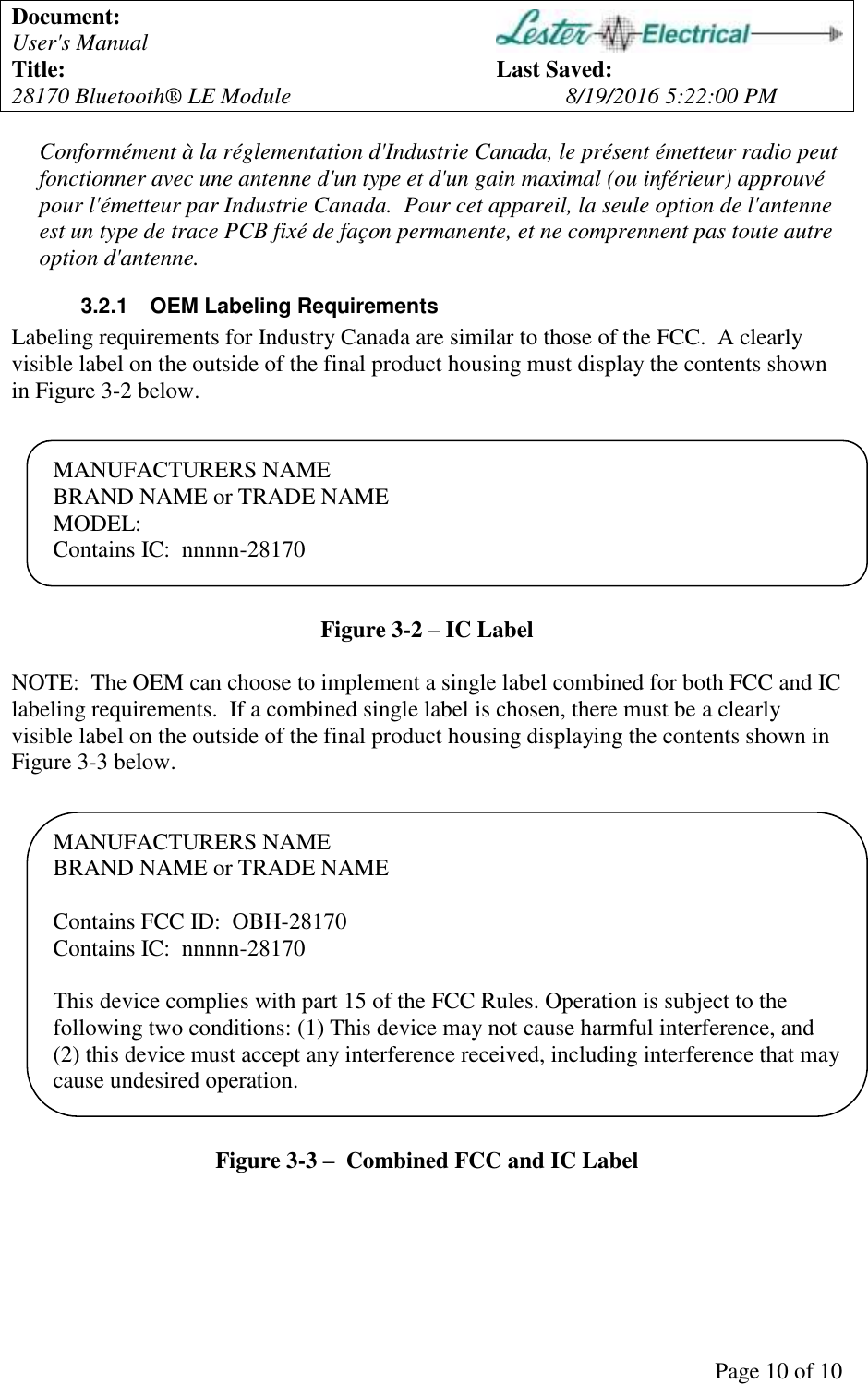
Document:   User's Manual  Title:          Last Saved: 28170 Bluetooth® LE Module        8/19/2016 5:22:00 PM      Page 10 of 10 Conformément à la réglementation d'Industrie Canada, le présent émetteur radio peut fonctionner avec une antenne d'un type et d'un gain maximal (ou inférieur) approuvé pour l'émetteur par Industrie Canada.  Pour cet appareil, la seule option de l'antenne est un type de trace PCB fixé de façon permanente, et ne comprennent pas toute autre option d'antenne. 3.2.1  OEM Labeling Requirements Labeling requirements for Industry Canada are similar to those of the FCC.  A clearly visible label on the outside of the final product housing must display the contents shown in Figure 3-2 below.   MANUFACTURERS NAME BRAND NAME or TRADE NAME MODEL: Contains IC:  nnnnn-28170   Figure 3-2 – IC Label  NOTE:  The OEM can choose to implement a single label combined for both FCC and IC labeling requirements.  If a combined single label is chosen, there must be a clearly visible label on the outside of the final product housing displaying the contents shown in Figure 3-3 below.   MANUFACTURERS NAME BRAND NAME or TRADE NAME  Contains FCC ID:  OBH-28170 Contains IC:  nnnnn-28170  This device complies with part 15 of the FCC Rules. Operation is subject to the following two conditions: (1) This device may not cause harmful interference, and (2) this device must accept any interference received, including interference that may cause undesired operation.   Figure 3-3 –  Combined FCC and IC Label

Navigation menu