Libre Wireless Technologies LS5B-N11S Wireless Audio Module User Manual Copyright 2014 by Libre Wireless Technologies

Libre Wireless Technologies Inc. Wireless Audio Module Copyright 2014 by Libre Wireless Technologies

User Manual

Libre Wireless Technologies © 2015  Libre Confidential                User Manual Module : LS5B  Rev: 1.0
    LS5B User Manual Libre Wireless Technologies                           User Manual: LS5B, Ver. 1.0                                               Page 2 of 89  Libre Confidential Libre Wireless Technologies Private Limited librewireless.com Copyright © 2015 Libre Wireless Technologies. All rights reserved.  Circuit  diagrams  and  other  information  relating  to  Libre  Wireless  Technologies  products  are  included  as  a means  of  illustrating  typical  applications.  Consequently,  complete  information  sufficient  for  construction purposes is not necessarily given. Although the information has been checked and is believed to be accurate, no responsibility is assumed for inaccuracies. Libre Wireless Technologies reserves the right to make changes to specifications  and  product  descriptions  at  any  time  without  notice.  Contact  your  local  Libre  Wireless Technologies sales office to obtain the latest specifications before placing your product order. The provision of this information does not convey to the purchaser of the described semiconductor devices any licenses under any  patent  rights  or  other intellectual  property  rights  of Libre  Wireless  Technologies or  others.  All  sales  are expressly conditional on your agreement to the terms and conditions of the most recently dated version of Libre Wireless Technologies standard Terms of Sale Agreement dated before the date of your order (the "Terms of Sale Agreement"). The product may contain design defects or errors known as anomalies which may cause the product's functions to deviate from published specifications. Anomaly sheets are available upon request. Libre Wireless Technologies products are not designed, intended, authorized or warranted for use in any life support or  other  application  where  product  failure  could  cause  or  contribute  to  personal  injury  or  severe  property damage. Any and all such uses without prior written approval of an Officer of Libre Wireless Technologies and further testing and/or modification will be fully at the risk of the customer. Copies of this document or  other Libre  Wireless  Technologies  literature,  as  well  as  the  Terms  of  Sale  Agreement,  may  be  obtained  by  visiting Libre Wireless Technologies website.  LIBRE  WIRELESS  TECHNOLOGIES  DISCLAIMS  AND  EXCLUDES  ANY  AND  ALL  WARRANTIES,  INCLUDING WITHOUT  LIMITATION  ANY  AND  ALL  IMPLIED  WARRANTIES  OF  MERCHANTABILITY,  FITNESS  FOR  A PARTICULAR  PURPOSE,  TITLE,  AND  AGAINST  INFRINGEMENT  AND  THE  LIKE,  AND  ANY  AND  ALL WARRANTIES ARISING FROM ANY COURSE OF DEALING OR USAGE OF TRADE. IN NO EVENT SHALL LIBRE WIRELESS TECHNOLOGIES BE LIABLE FOR ANY DIRECT, INCIDENTAL, INDIRECT, SPECIAL, PUNITIVE, OR CONSEQUENTIAL  DAMAGES;  OR  FOR  LOST  DATA,  PROFITS,  SAVINGS  OR  REVENUES  OF  ANY  KIND; REGARDLESS OF THE FORM OF ACTION, WHETHER BASED ON CONTRACT; TORT; NEGLIGENCE OF LIBRE WIRELESS  TECHNOLOGIES    OR  OTHERS;  STRICT  LIABILITY;  BREACH  OF  WARRANTY;  OR  OTHERWISE; WHETHER OR NOT ANY REMEDY OF BUYER IS HELD TO HAVE FAILED OF ITS ESSENTIAL PURPOSE, AND WHETHER OR NOT LIBRE WIRELESS TECHNOLOGIES  HAS BEEN ADVISED OF THE POSSIBILITY OF SUCH DAMAGES
    LS5B User Manual Libre Wireless Technologies                           User Manual: LS5B, Ver. 1.0                                               Page 3 of 89  Libre Confidential  FCC Statement: This device complies with part 15 of the FCC Rules. Operation is subject to the following two  conditions:  (1)  This  device  may  not  cause  harmful  interference,  and  (2)  this  device must  accept  any  interference  received,  including  interference  that  may  cause  undesired operation. Changes or modifications not expressly approved by the party responsible for compliance could void the user's authority to operate the equipment. NOTE: This equipment has been tested and found to comply with the limits for a Class B digital device, pursuant to Part 15 of the FCC Rules. These limits are designed to provide reasonable  protection  against  harmful  interference  in  a  residential  installation.  This equipment generates, uses and can radiate radio frequency energy and, if not installed and used  in  accordance  with  the  instructions,  may  cause  harmful  interference  to  radio communications.  However,  there  is  no  guarantee  that  interference  will  not  occur  in  a particular  installation.  If  this  equipment  does  cause  harmful  interference  to  radio  or television  reception,  which  can  be  determined by  turning  the  equipment  off  and  on, the user is encouraged to try to correct the interference by one or more of the following measures: -- Reorient or relocate the receiving antenna. -- Increase the separation between the equipment and receiver. --  Connect  the  equipment  into  an  outlet  on  a  circuit  different  from  that  to  which  the receiver is connected. -- Consult the dealer or an experienced radio/TV technician for help.  FCC Radiation Exposure Statement The  modular  can  be  installed  or  integrated  in  mobile  or  fix  devices  only.  This  modular cannot  be  installed  in  any  portable  device,  for  example,  USB  dongle  like  transmitters  is forbidden.
    LS5B User Manual Libre Wireless Technologies                           User Manual: LS5B, Ver. 1.0                                               Page 4 of 89  Libre Confidential  This modular complies with FCC RF radiation exposure limits set forth for an uncontrolled environment. This transmitter must not be co-located or operating in conjunction with any other  antenna  or  transmitter.  This  modular  must  be  installed  and  operated  with  a minimum distance of 20 cm between the radiator and user body.  If the FCC identification number is not visible when the module is installed inside another device, then the outside of the device into which the module is installed must also display a label  referring  to  the  enclosed  module.  This  exterior  label  can  use  wording  such  as  the following: Contains Transmitter Module FCC ID: 2ADBM-LS5B-N11S. when the  module  is installed inside  another device, the  user manual of  this  device must contain below warning statements; 1. This device complies with Part 15 of the FCC Rules. Operation is subject to the following two conditions: (1) This device may not cause harmful interference. (2)  This  device  must  accept  any  interference  received,  including  interference  that  may cause undesired operation. 2.  Changes  or  modifications  not  expressly  approved  by  the  party  responsible  for compliance could void the user's authority to operate the equipment. The  devices  must  be  installed  and  used  in  strict  accordance  with  the  manufacturer's instructions as described in the user documentation that comes with the product.     Any company of the host device which install this modular with limit modular approvalshould perform the test of radiated emission a nd spurious emission according to FCC part 15C:15.247  and 15.209 requirement, Only  if  the test result comply with FCC part15C:15.247  and 15.209 requirement, then the host can be sold legally.
    LS5B User Manual Libre Wireless Technologies                           User Manual: LS5B, Ver. 1.0                                               Page 5 of 89  Libre Confidential   IC Statement  This device complies with Industry Canada’s licence-exempt RSSs. Operation is subject to the following two conditions:  (1) This device may not cause interference; and  (2)  This  device  must  accept  any  interference,  including  interference  that  may  cause undesired operation of the device.  Cet  appareil  est  conforme  aux  CNR  exemptes  de  licence  d'Industrie  Canada  .  Son fonctionnement est soumis aux deux conditions suivantes : ( 1 ) Ce dispositif ne peut causer d'interférences ; et ( 2 ) Ce dispositif doit accepter toute interférence , y compris les interférences qui peuvent causer un mauvais fonctionnement de l'appareil.   This modular complies with IC RF radiation exposure limits set forth for  an uncontrolled environment. This transmitter must not be co-located or operating in conjunction with any other antenna or transmitter  If the IC number is not visible when the module is installed inside another device, then the outside of the device into which the module is installed must also display a label referring to  the  enclosed  module.  This  exterior  label  can  use  wording  such  as  the  following: “Contains IC: 20276-LS5B-N11S”   when the  module  is installed inside  another device, the  user manual of  this  device must contain below warning statements; 1. This device complies with Industry Canada’s licence-exempt RSSs. Operation is subject to the following two conditions:
    LS5B User Manual Libre Wireless Technologies                           User Manual: LS5B, Ver. 1.0                                               Page 6 of 89  Libre Confidential (1) This device may not cause interference; and  (2)  This  device  must  accept  any  interference,  including  interference  that  may  cause undesired operation of the device.   2.  Cet  appareil  est  conforme  aux  CNR  exemptes  de  licence  d'Industrie  Canada  .  Son fonctionnement est soumis aux deux conditions suivantes : ( 1 ) Ce dispositif ne peut causer d'interférences ; et ( 2 ) Ce dispositif doit accepter toute interférence , y compris les interférences qui peuvent causer un mauvais fonctionnement de l'appareil.  The  devices  must  be  installed  and  used  in  strict  accordance  with  the  manufacturer's instructions as described in the user documentation that comes with the product
    LS5B User Manual Libre Wireless Technologies                           User Manual: LS5B, Ver. 1.0                                               Page 7 of 89  Libre Confidential Table of Contents 1. Introduction ............................................................................................................................... 13 1.1. User Manual Insight ....................................................................................................................... 13 2. Libre Wireless Technologies’ EVK ...................................................................................... 14 2.1. LS5B EVK Setup ............................................................................................................................... 14 3. Firmware Update ..................................................................................................................... 15 3.1. Single-Image Update ...................................................................................................................... 15 3.1.1. USB Method .................................................................................................................................. 15 3.2. Application Update ......................................................................................................................... 17 3.2.1. Network Method ......................................................................................................................... 17 3.2.2. USB Method .................................................................................................................................. 19 3.2.3. Internet Method .......................................................................................................................... 21 3.3. BSL Update ........................................................................................................................................ 23 3.3.1. TFTP Method ................................................................................................................................ 23 3.4. U-Boot Update .................................................................................................................................. 25 3.4.1. TFTP Method ................................................................................................................................ 25 4. Configuring Non-Volatile-Item ............................................................................................ 27 4.1. Host Communication Over UART ............................................................................................. 28 4.2. Network Interface ........................................................................................................................... 29 4.2.1. Ethernet ......................................................................................................................................... 29 4.2.2. Wi-Fi ................................................................................................................................................ 29 4.2.3. Auto ................................................................................................................................................. 29 4.3. SSID of DDMS-Zone in SA-Mode ................................................................................................ 29 4.4. DDMS-Zone Password ................................................................................................................... 30 4.5. I2S LR-Clock ...................................................................................................................................... 30 4.6. I2S M-Clock ........................................................................................................................................ 30 4.7. ACP ........................................................................................................................................................ 31 4.8. Model Name ...................................................................................................................................... 31 4.9. Manufacturer Name ....................................................................................................................... 31 4.10. Current Volume ............................................................................................................................... 32 4.11. WAC SSID ........................................................................................................................................... 32 4.12. X-MODEM Packet Size ................................................................................................................... 33 4.13. I2S Clock from Bluetooth Module ............................................................................................. 33 4.14. ACP Sharing ....................................................................................................................................... 33
    LS5B User Manual Libre Wireless Technologies                           User Manual: LS5B, Ver. 1.0                                               Page 8 of 89  Libre Confidential 4.15. HOST BAUDRATE ............................................................................................................................ 34 4.16. DLNA Connection Close ................................................................................................................ 34 4.17. Country ............................................................................................................................................... 35 4.18. Serial Number................................................................................................................................... 35 4.19. Model Number ................................................................................................................................. 36 4.20. Hardware Version ........................................................................................................................... 36 4.21. Firmware Version ........................................................................................................................... 36 4.22. Firmware Update Link .................................................................................................................. 37 4.23. Firmware Download XML ............................................................................................................ 37 4.24. Album Art Size .................................................................................................................................. 37 4.25. Spotify APP Key ............................................................................................................................... 38 5. Key Button Functionality ....................................................................................................... 39 5.1. Setup Button (WAC / SAC / DDMS) ......................................................................................... 39 5.2. WPS / Factory Reset Key Button .............................................................................................. 39 6. Network Configuration ........................................................................................................... 40 6.1. Wireless Network Setup Using WAC and SAC ..................................................................... 40 6.1.1. Wireless Network Setup Using WAC .................................................................................. 40 6.1.2. Wireless Network Setup Using SAC (Speaker Android Configuration) Method 41 6.1.3. WAC / SAC Trigger Behaviour in DDMS Mode and Non-DDMS Mode ................... 45 6.2. Wireless Network Setup Using Webserver ........................................................................... 47 6.2.1. Webpage Method........................................................................................................................ 47 6.2.2. LS-Connect Method ................................................................................................................... 49 6.2.3. Manual Configuration Method .............................................................................................. 50 6.3. Wireless Network Setup Using WPS Push-Button Method ............................................ 51 6.3.1. WPS Trigger from Command Line ....................................................................................... 51 6.3.2. WPS Trigger from LUCI ............................................................................................................ 51 6.3.3. WPS Trigger from Key Button ............................................................................................... 52 6.4. I-Device Wi-Fi Settings Sharing ................................................................................................. 52 7. Features ....................................................................................................................................... 53 7.1. Libre APP for Android ................................................................................................................... 53 7.2. DDMS ................................................................................................................................................... 53 7.3. Software Security ............................................................................................................................ 54 7.4. Source Switching ............................................................................................................................. 54 7.5. Autosense of Audio CODEC ......................................................................................................... 54 7.6. AUX-In Support ................................................................................................................................ 54 7.7. Airplay® .............................................................................................................................................. 54 7.7.1. Password for Airplay Playback ............................................................................................. 55
    LS5B User Manual Libre Wireless Technologies                           User Manual: LS5B, Ver. 1.0                                               Page 9 of 89  Libre Confidential 7.8. DLNA ® / DMR .................................................................................................................................. 58 7.9. i-Device playback over USB ........................................................................................................ 59 7.10. USB Playback .................................................................................................................................... 60 7.11. TCP / IP Tunneling ......................................................................................................................... 60 7.12. Device Name Configuration ........................................................................................................ 61 7.13. Wi-Fi Scan Result ............................................................................................................................ 62 7.14. Switch between Wired and wireless modes ......................................................................... 62 7.14.1. Switching to Wired Mode ........................................................................................................ 62 7.14.2. Switching to Wireless Mode ................................................................................................... 63 7.15. Music Services .................................................................................................................................. 64 7.15.1. vTuner ............................................................................................................................................ 64 7.15.2. TuneIn............................................................................................................................................. 64 7.15.3. QQ Music ........................................................................................................................................ 65 7.15.4. Spotify Connect ........................................................................................................................... 67 7.15.5. Deezer ............................................................................................................................................. 70 8. Data Sheet ................................................................................................................................... 71
    LS5B User Manual Libre Wireless Technologies                           User Manual: LS5B, Ver. 1.0                                               Page 10 of 89  Libre Confidential Table of Figures Figure 2-1: LS5B Module Peripherals .......................................................................................... 14 Figure 3-1: Firmware Upgrade Method Selection .................................................................... 18 Figure 3-2: Firmware Update Webpage ...................................................................................... 18 Figure 3-2: Firmware Update Confirmation webpage ........................................................... 19 Figure 3-3: Firmware Update Progress Page ............................................................................ 19 Figure 3-3: Firmware Update Status ............................................................................................ 19 Figure 3-4: Firmware Upgrade Method Selection .................................................................... 20 Figure 3-5: BSL Update Terminal Warning Message Prompt .............................................. 24 Figure 3-6: BSL Default IP Address ............................................................................................... 24 Figure 3-7:  U-Boot Update Terminal Warning Message Prompt ....................................... 26 Figure 3-8: U-Boot Default IP address ......................................................................................... 26 Figure 6-1: WAC Speaker Listed ..................................................................................................... 40 Figure 6-5: Libre App ......................................................................................................................... 41 Figure 6-6: Libre APP, Main view ................................................................................................... 42 Figure 6-7: SAC Device List............................................................................................................... 42 Figure 6-8: SSID List ........................................................................................................................... 43 Figure 6-9: Libre APP Custom Dialog ........................................................................................... 43 Figure 6-10: Configuring the Speaker .......................................................................................... 44 Figure 6-11: Successful Configuration ......................................................................................... 44 Figure 6-12: Network Status ........................................................................................................... 47 Figure 6-13: Network Configuration ............................................................................................ 48 Figure 6-14: Network Configuration using Static IP ............................................................... 49 Figure 6-15: Network  Status in Webpage .................................................................................. 50 Figure 6-16: Configure Network Manually ................................................................................. 51 Figure 6-17: Wi-Fi settings sharing ............................................................................................... 52 Figure 7-1: DDMS Setup in webpage ............................................................................................. 53 Figure 7-2: AirPlay Stream ............................................................................................................... 55 Figure 7-3: Password for Airplay ................................................................................................... 56
    LS5B User Manual Libre Wireless Technologies                           User Manual: LS5B, Ver. 1.0                                               Page 11 of 89  Libre Confidential Figure 7-4: Enter Password for Streaming ................................................................................. 57 Figure 7-5: Disable Airplay Password.......................................................................................... 58 Figure 7-6: Media Player Stream Menu ....................................................................................... 58 Figure 7-7: Media Streaming Options .......................................................................................... 59 Figure 7-9: Device Name Section ................................................................................................... 61 Figure 7-10: Switch to Wired Mode .............................................................................................. 63 Figure 7-11: Switch to Wi-Fi Mode ................................................................................................ 64 Figure 7-12: QQ Music APP .............................................................................................................. 65 Figure 7-13: Login Screen ................................................................................................................. 66 Figure 7-14: Device Selection Option ........................................................................................... 66 Figure 7-15: Device List .................................................................................................................... 67 Figure 7-16: Spotify APP ................................................................................................................... 68 Figure 7-17: Spotify Login Screen .................................................................................................. 69 Figure 7-18: Device Selection .......................................................................................................... 69 Figure 7-19: Device List .................................................................................................................... 70
    LS5B User Manual Libre Wireless Technologies                           User Manual: LS5B, Ver. 1.0                                               Page 12 of 89  Libre Confidential Document Revision History Revision Date Description of change 1.0 September 21, 2015
    LS5B User Manual Libre Wireless Technologies                           User Manual: LS5B, Ver. 1.0                                               Page 13 of 89  Libre Confidential 1. Introduction Libre  Wireless  provides  evaluation  kits  (EVK)  for  users  to  gain  familiarity  with  our products  and  expedite  their  own  design  and  development.  User  can  connect  to  LS5B module through RS232 UART, SD card, USB, or wireless interface to configure the module, manage the on board device on the module, and perform functional test.  1.1. User Manual Insight This  document  provides  information  on  the  procedures  to  be  followed  while  using LibreSync for various purpose such as  Firmware update  Configuring NV-item  Key Button Functionality  Network Configuration  Streaming Airplay® / DLNA® / DMR  Libre APP  DDMS  Source Switching  Aux-In Support  TCP / IP Tunneling  Device Name Configuration  Music Services (Spotify Connect, QQ Music, Vtuner, TuneIn, Melon, Deezer)
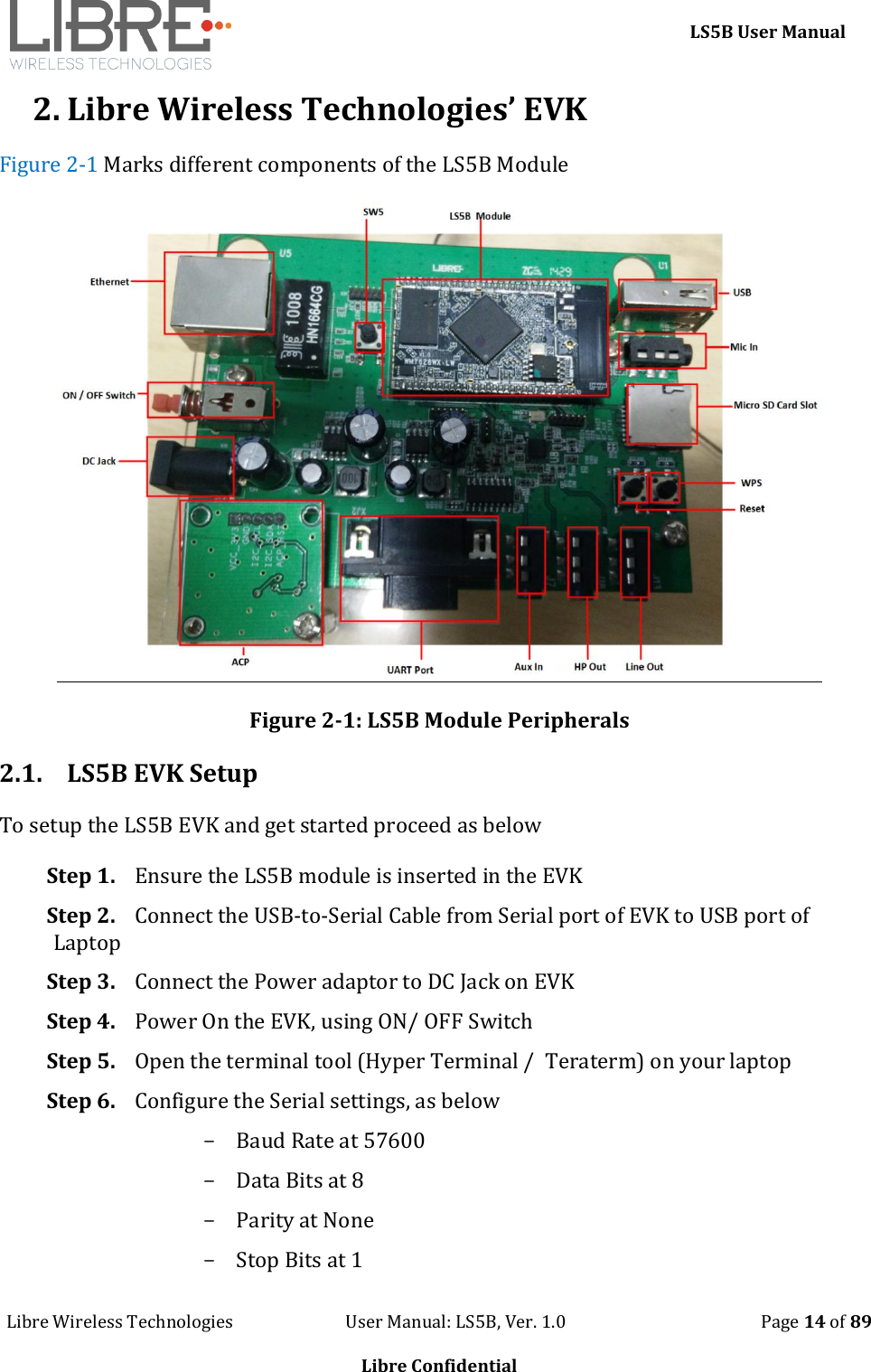
    LS5B User Manual Libre Wireless Technologies                           User Manual: LS5B, Ver. 1.0                                               Page 14 of 89  Libre Confidential 2. Libre Wireless Technologies’ EVK Figure 2-1 Marks different components of the LS5B Module  Figure 2-1: LS5B Module Peripherals 2.1. LS5B EVK Setup To setup the LS5B EVK and get started proceed as below Step 1. Ensure the LS5B module is inserted in the EVK Step 2. Connect the USB-to-Serial Cable from Serial port of EVK to USB port of Laptop Step 3. Connect the Power adaptor to DC Jack on EVK Step 4. Power On the EVK, using ON/ OFF Switch Step 5. Open the terminal tool (Hyper Terminal /  Teraterm) on your laptop Step 6. Configure the Serial settings, as below            - Baud Rate at 57600 - Data Bits at 8  - Parity at None  - Stop Bits at 1
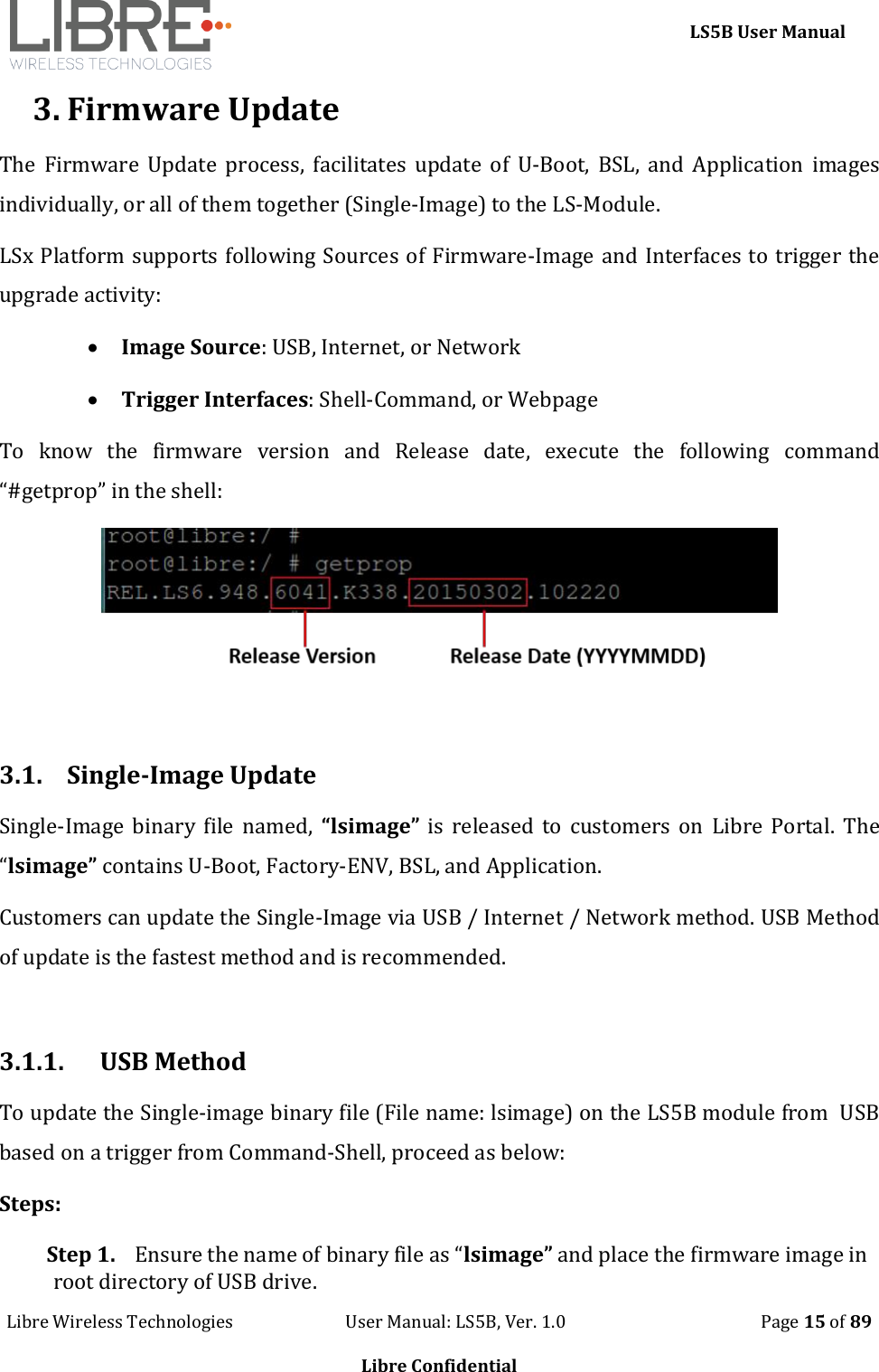
    LS5B User Manual Libre Wireless Technologies                           User Manual: LS5B, Ver. 1.0                                               Page 15 of 89  Libre Confidential 3. Firmware Update The  Firmware  Update  process,  facilitates  update  of  U-Boot,  BSL,  and  Application  images individually, or all of them together (Single-Image) to the LS-Module.  LSx Platform supports following Sources of Firmware-Image and Interfaces to trigger the upgrade activity:  Image Source: USB, Internet, or Network  Trigger Interfaces: Shell-Command, or Webpage To  know  the  firmware  version  and  Release  date,  execute  the  following  command “#getprop” in the shell:   3.1. Single-Image Update  Single-Image  binary  file  named,  “lsimage”  is  released  to  customers on  Libre  Portal.  The “lsimage” contains U-Boot, Factory-ENV, BSL, and Application. Customers can update the Single-Image via USB / Internet / Network method. USB Method of update is the fastest method and is recommended.  3.1.1.  USB Method To update the Single-image binary file (File name: lsimage) on the LS5B module from  USB based on a trigger from Command-Shell, proceed as below: Steps: Step 1. Ensure the name of binary file as “lsimage” and place the firmware image in root directory of USB drive.
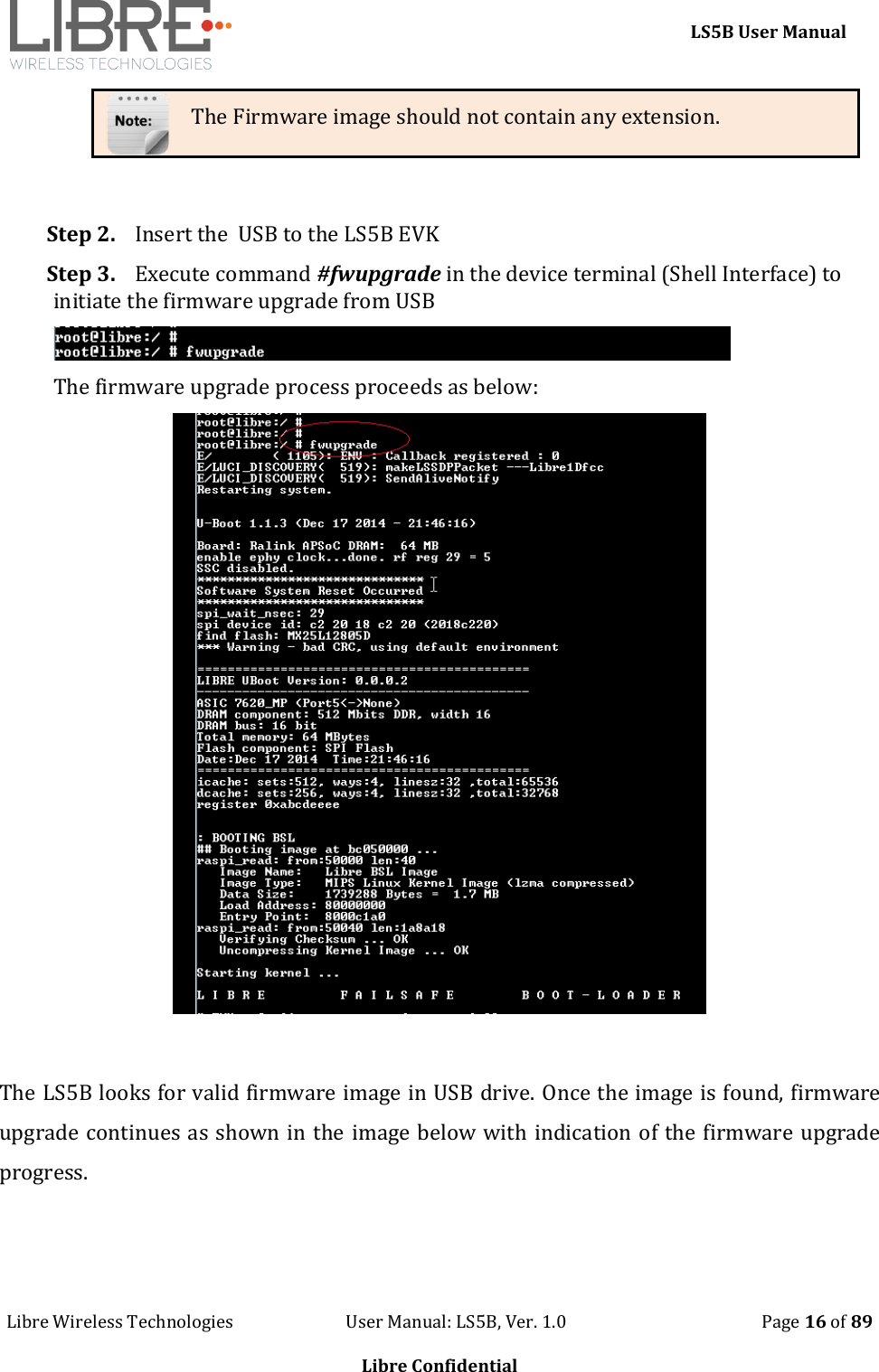
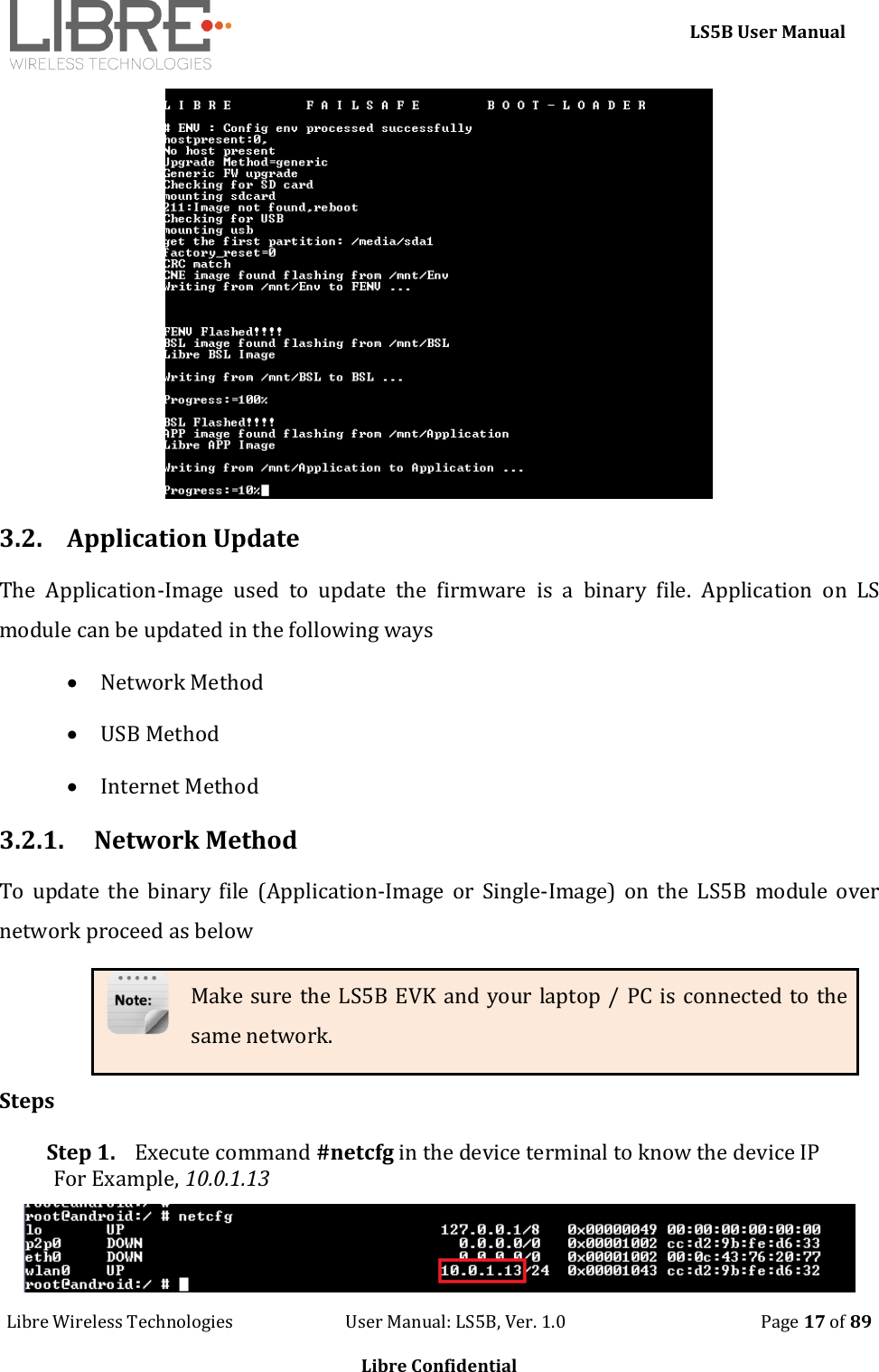
    LS5B User Manual Libre Wireless Technologies                           User Manual: LS5B, Ver. 1.0                                               Page 16 of 89  Libre Confidential The Firmware image should not contain any extension.  Step 2. Insert the  USB to the LS5B EVK Step 3. Execute command #fwupgrade in the device terminal (Shell Interface) to initiate the firmware upgrade from USB  The firmware upgrade process proceeds as below:   The LS5B looks for valid firmware image in USB drive. Once the image is found, firmware upgrade continues as shown in the image below with indication of the firmware upgrade progress.
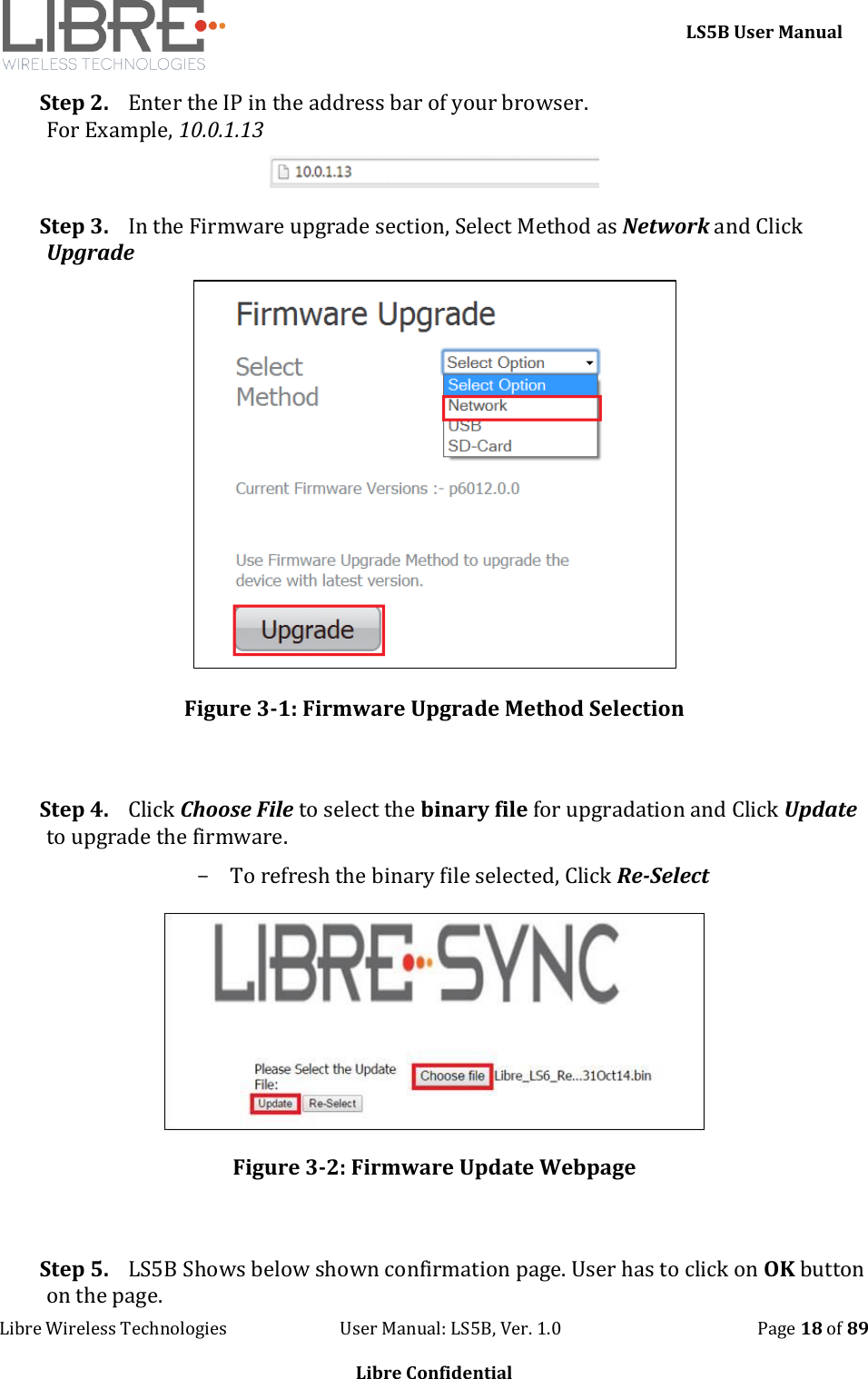
    LS5B User Manual Libre Wireless Technologies                           User Manual: LS5B, Ver. 1.0                                               Page 17 of 89  Libre Confidential  3.2. Application Update The  Application-Image  used  to  update  the  firmware  is  a  binary  file.  Application  on  LS module can be updated in the following ways  Network Method  USB Method  Internet Method 3.2.1. Network Method To  update  the  binary  file  (Application-Image  or  Single-Image) on  the  LS5B  module  over network proceed as below Make sure the LS5B EVK and your laptop / PC is connected to the same network. Steps Step 1. Execute command #netcfg in the device terminal to know the device IP For Example, 10.0.1.13
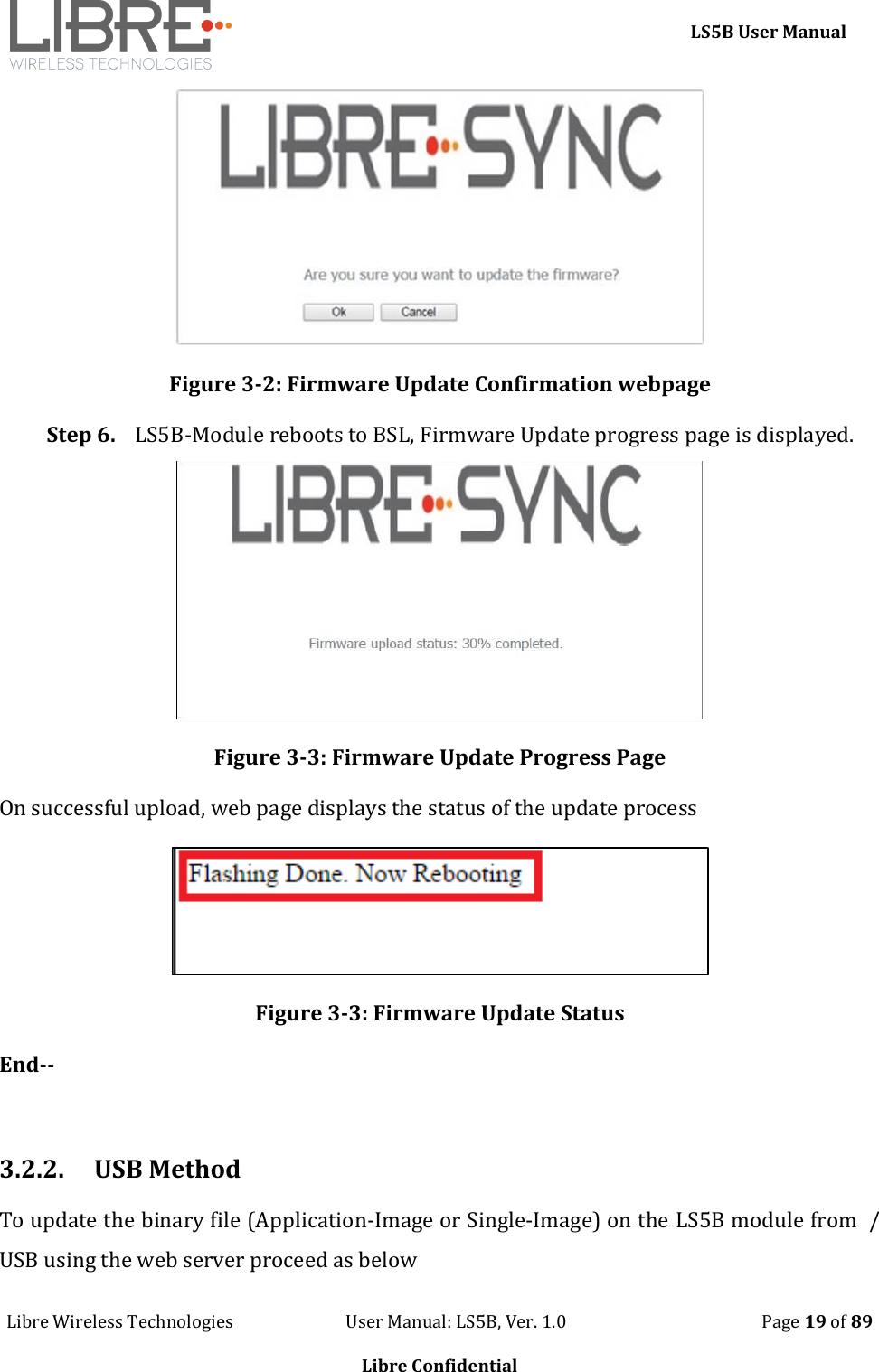
    LS5B User Manual Libre Wireless Technologies                           User Manual: LS5B, Ver. 1.0                                               Page 18 of 89  Libre Confidential Step 2. Enter the IP in the address bar of your browser. For Example, 10.0.1.13  Step 3. In the Firmware upgrade section, Select Method as Network and Click Upgrade  Figure 3-1: Firmware Upgrade Method Selection  Step 4. Click Choose File to select the binary file for upgradation and Click Update to upgrade the firmware. - To refresh the binary file selected, Click Re-Select  Figure 3-2: Firmware Update Webpage  Step 5. LS5B Shows below shown confirmation page. User has to click on OK button on the page.
    LS5B User Manual Libre Wireless Technologies                           User Manual: LS5B, Ver. 1.0                                               Page 19 of 89  Libre Confidential  Figure 3-2: Firmware Update Confirmation webpage Step 6. LS5B-Module reboots to BSL, Firmware Update progress page is displayed.  Figure 3-3: Firmware Update Progress Page On successful upload, web page displays the status of the update process  Figure 3-3: Firmware Update Status End--  3.2.2. USB Method To update the binary file (Application-Image or Single-Image) on the LS5B module from  / USB using the web server proceed as below
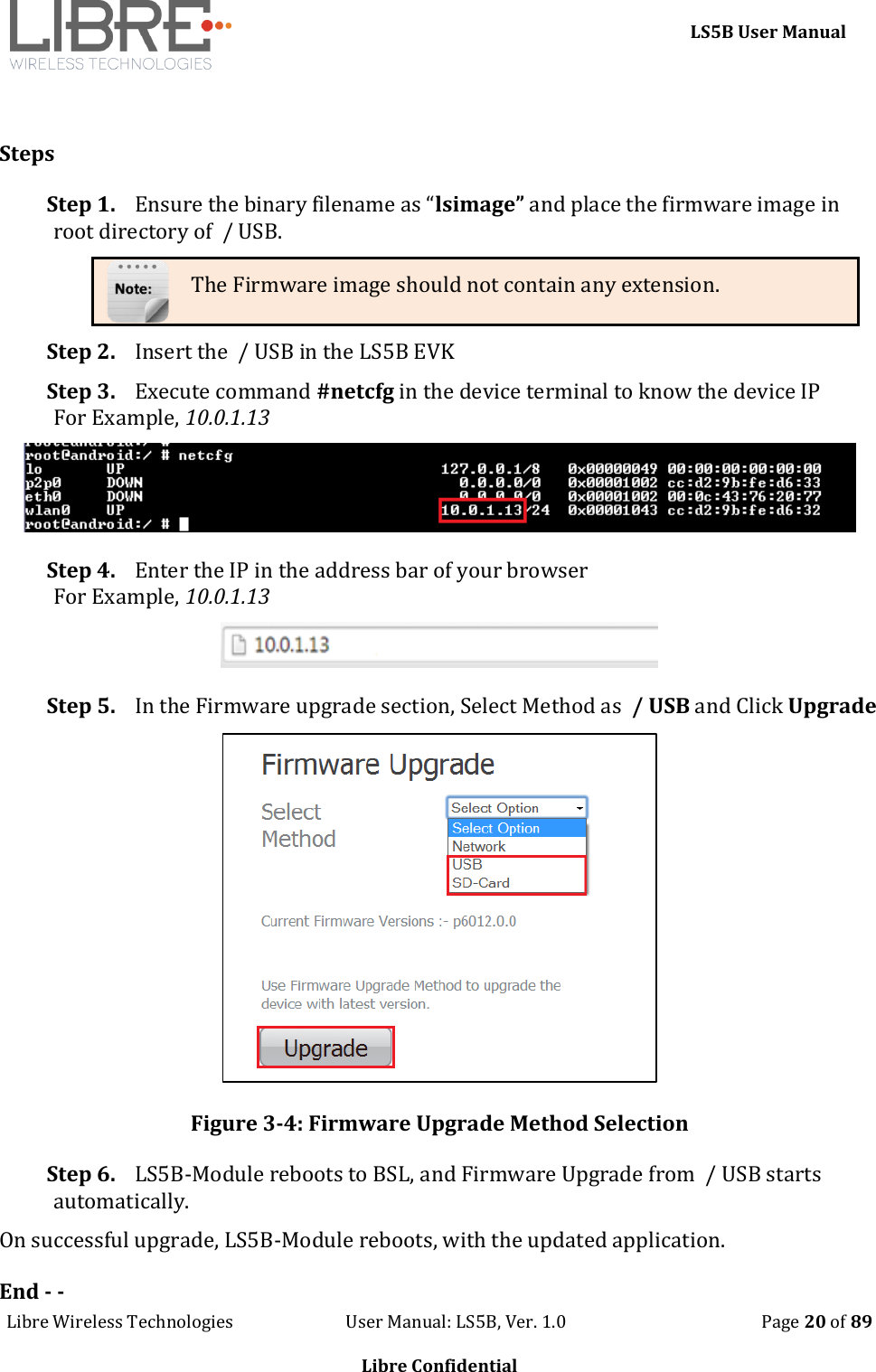
    LS5B User Manual Libre Wireless Technologies                           User Manual: LS5B, Ver. 1.0                                               Page 20 of 89  Libre Confidential  Steps Step 1. Ensure the binary filename as “lsimage” and place the firmware image in root directory of  / USB. The Firmware image should not contain any extension. Step 2. Insert the  / USB in the LS5B EVK Step 3. Execute command #netcfg in the device terminal to know the device IP For Example, 10.0.1.13  Step 4. Enter the IP in the address bar of your browser For Example, 10.0.1.13  Step 5. In the Firmware upgrade section, Select Method as  / USB and Click Upgrade  Figure 3-4: Firmware Upgrade Method Selection Step 6. LS5B-Module reboots to BSL, and Firmware Upgrade from  / USB starts automatically. On successful upgrade, LS5B-Module reboots, with the updated application. End - -
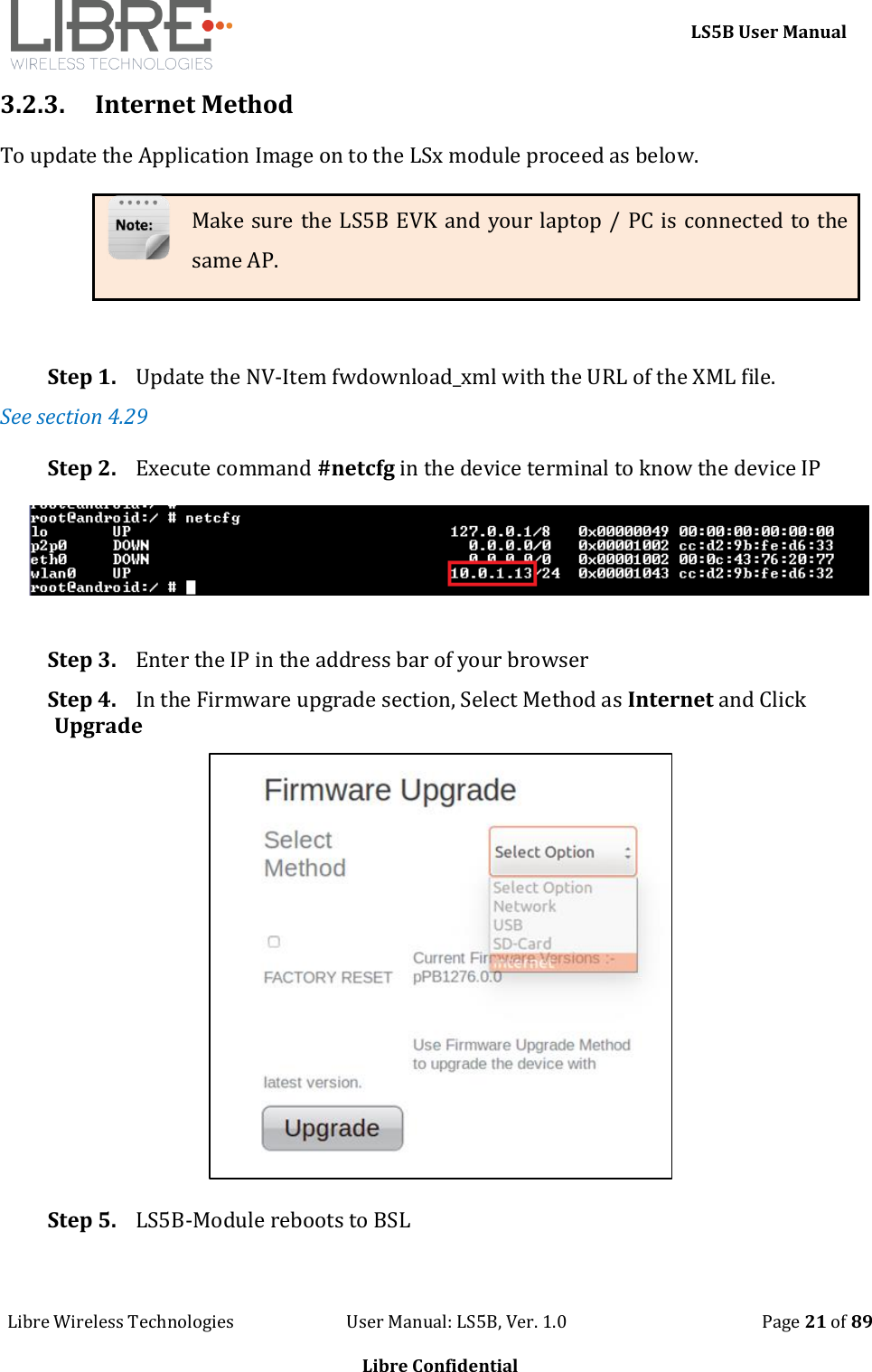
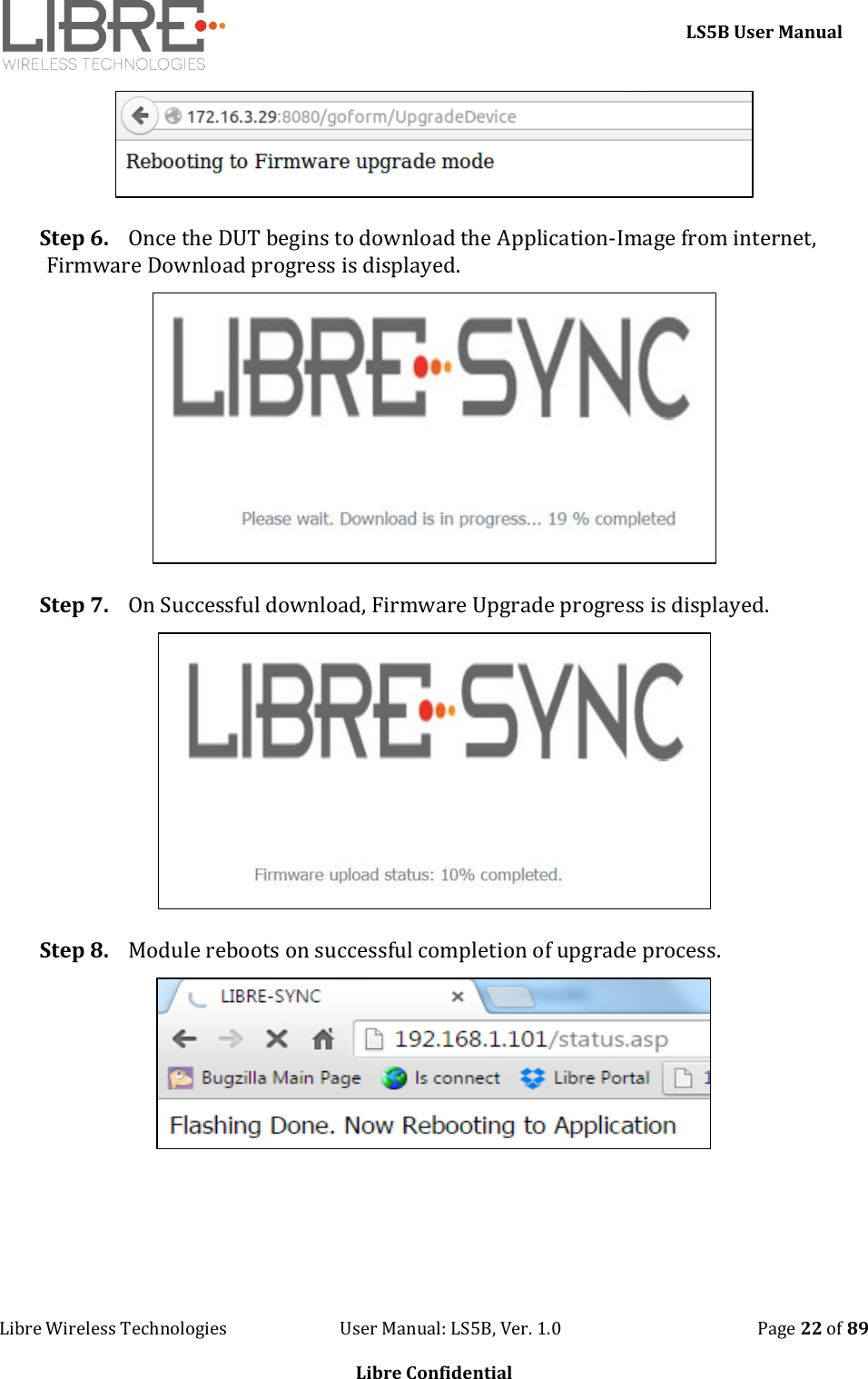
    LS5B User Manual Libre Wireless Technologies                           User Manual: LS5B, Ver. 1.0                                               Page 21 of 89  Libre Confidential 3.2.3. Internet Method To update the Application Image on to the LSx module proceed as below. Make sure the LS5B EVK and your laptop / PC is connected to the same AP.  Step 1. Update the NV-Item fwdownload_xml with the URL of the XML file.  See section 4.29 Step 2. Execute command #netcfg in the device terminal to know the device IP  Step 3. Enter the IP in the address bar of your browser Step 4. In the Firmware upgrade section, Select Method as Internet and Click Upgrade  Step 5. LS5B-Module reboots to BSL
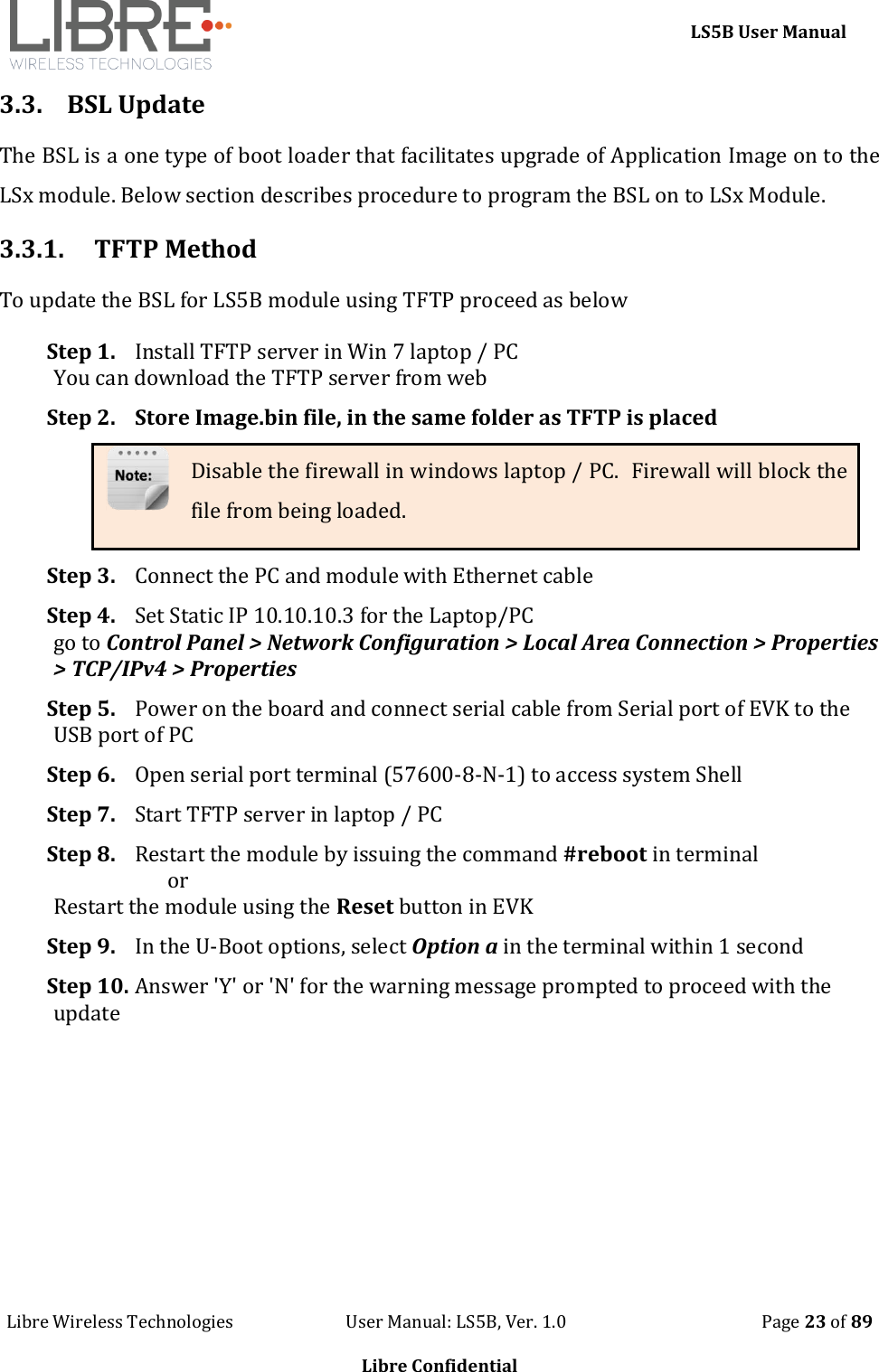
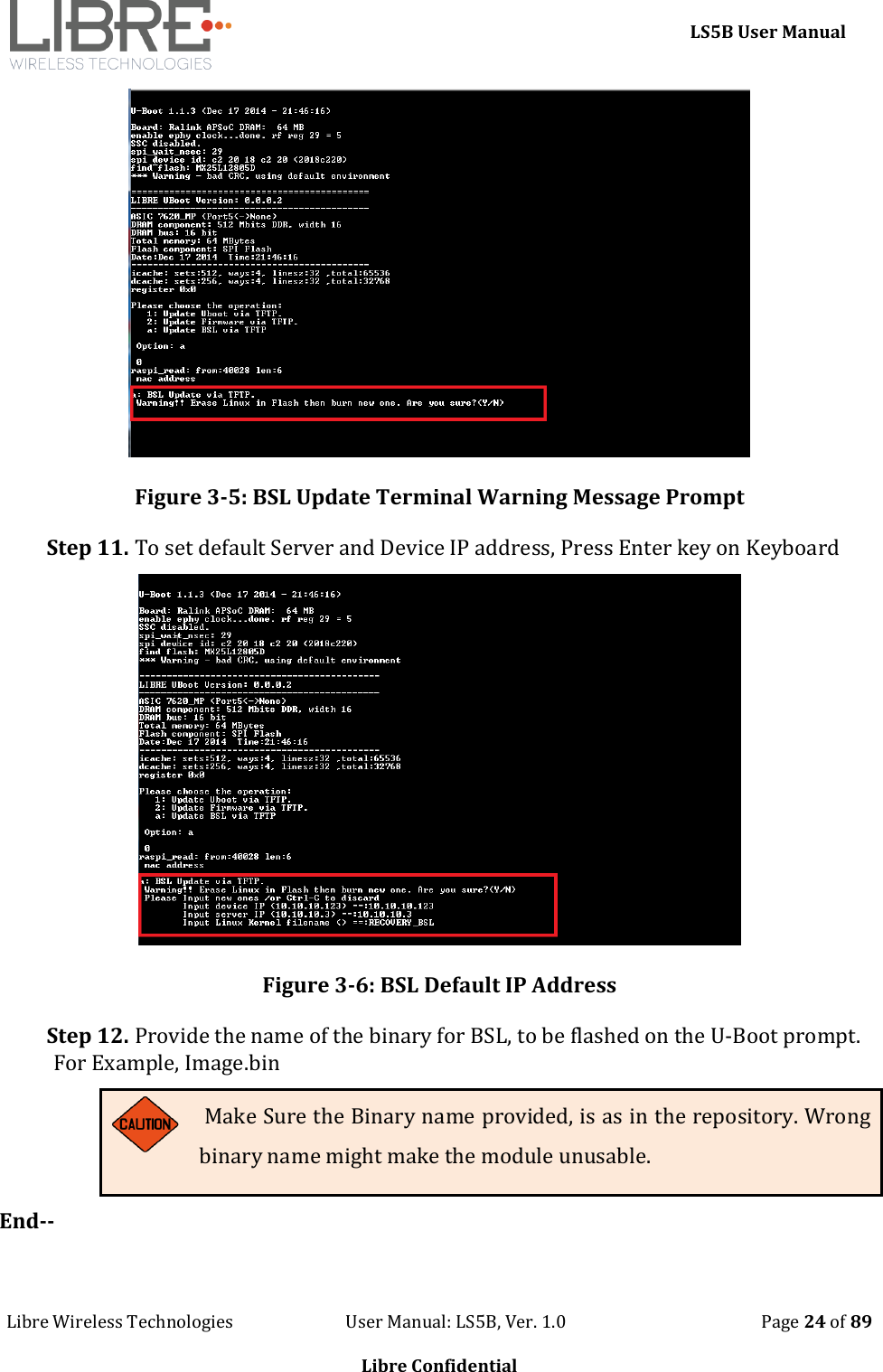
    LS5B User Manual Libre Wireless Technologies                           User Manual: LS5B, Ver. 1.0                                               Page 22 of 89  Libre Confidential  Step 6. Once the DUT begins to download the Application-Image from internet, Firmware Download progress is displayed.  Step 7. On Successful download, Firmware Upgrade progress is displayed.  Step 8. Module reboots on successful completion of upgrade process.
    LS5B User Manual Libre Wireless Technologies                           User Manual: LS5B, Ver. 1.0                                               Page 23 of 89  Libre Confidential 3.3. BSL Update The BSL is a one type of boot loader that facilitates upgrade of Application Image on to the LSx module. Below section describes procedure to program the BSL on to LSx Module. 3.3.1. TFTP Method To update the BSL for LS5B module using TFTP proceed as below Step 1. Install TFTP server in Win 7 laptop / PC You can download the TFTP server from web Step 2. Store Image.bin file, in the same folder as TFTP is placed Disable the firewall in windows laptop / PC.  Firewall will block the file from being loaded. Step 3. Connect the PC and module with Ethernet cable Step 4. Set Static IP 10.10.10.3 for the Laptop/PC go to Control Panel > Network Configuration > Local Area Connection > Properties > TCP/IPv4 > Properties Step 5. Power on the board and connect serial cable from Serial port of EVK to the USB port of PC Step 6. Open serial port terminal (57600-8-N-1) to access system Shell  Step 7. Start TFTP server in laptop / PC Step 8. Restart the module by issuing the command #reboot in terminal                        or  Restart the module using the Reset button in EVK Step 9. In the U-Boot options, select Option a in the terminal within 1 second Step 10. Answer 'Y' or 'N' for the warning message prompted to proceed with the update
    LS5B User Manual Libre Wireless Technologies                           User Manual: LS5B, Ver. 1.0                                               Page 24 of 89  Libre Confidential  Figure 3-5: BSL Update Terminal Warning Message Prompt Step 11. To set default Server and Device IP address, Press Enter key on Keyboard  Figure 3-6: BSL Default IP Address Step 12. Provide the name of the binary for BSL, to be flashed on the U-Boot prompt. For Example, Image.bin  Make Sure the Binary name provided, is as in the repository. Wrong binary name might make the module unusable. End--
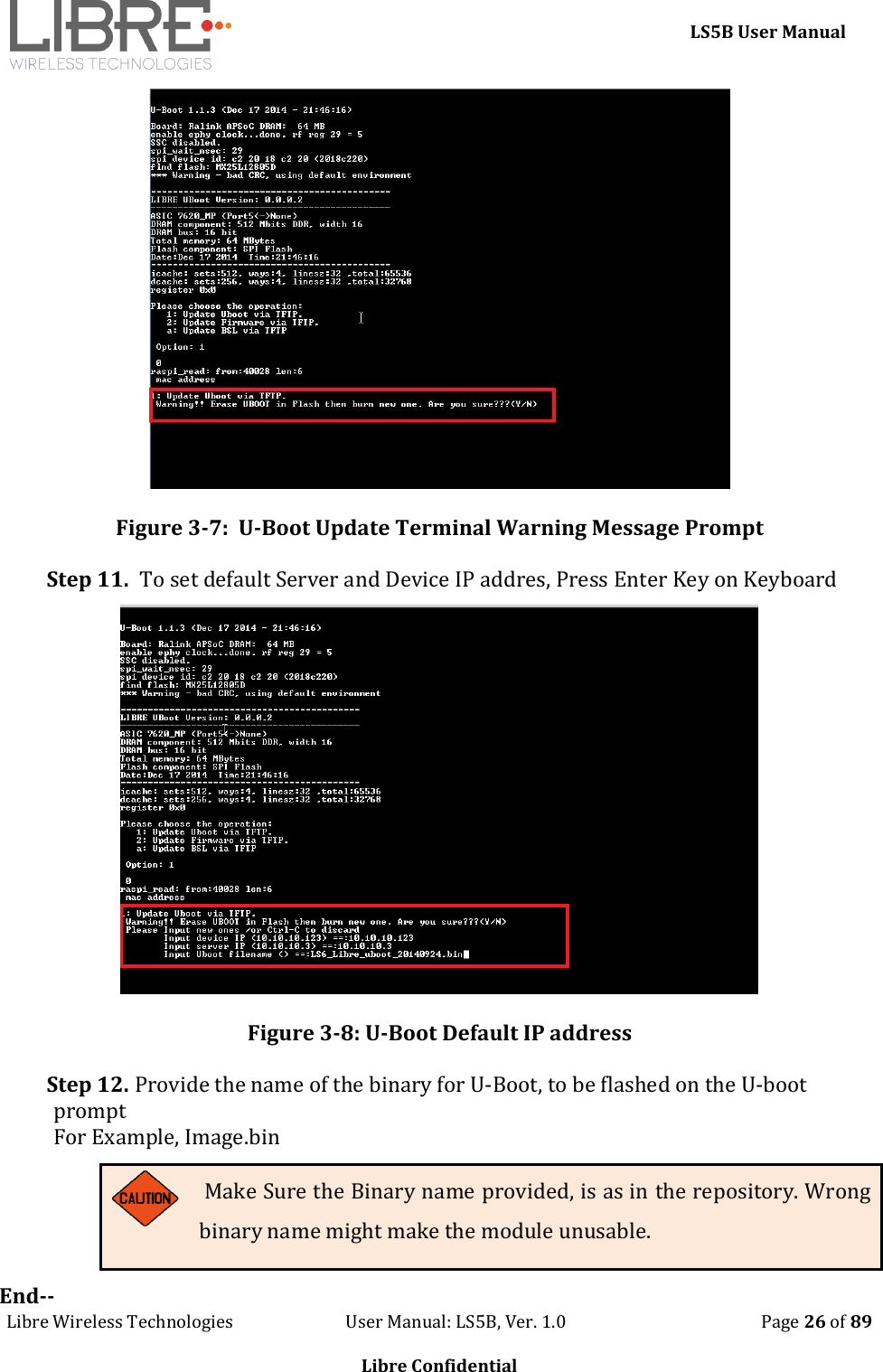
    LS5B User Manual Libre Wireless Technologies                           User Manual: LS5B, Ver. 1.0                                               Page 25 of 89  Libre Confidential 3.4. U-Boot Update 3.4.1. TFTP Method To update the U-Boot for LS5B module using TFTP proceed as below Step 1. Install TFTP server in Win 7 laptop / PC You can download the TFTP server from web Step 2. Store Image.bin file, in the same folder as TFTP is placed Disable the firewall in windows laptop / PC.  Firewall will block the file from being loaded. Step 3. Connect the PC and module with Ethernet cable Step 4. Set Static IP 10.10.10.3 for the Laptop/PC go to Control Panel > Network Configuration > Local Area Connection > Properties > TCP/IPv4 > Properties  Step 5. Power on the board and connect the EVK to the USB port of PC Step 6. Open serial port terminal (57600-8-N-1) to access system Shell  Step 7. Start TFTP server in laptop / PC Step 8. Restart the module by issuing the command #reboot in terminal                        or  Restart the module using the Reset button in EVK Step 9. In the U-Boot options, select option 1 in the terminal within 1 second Step 10. Answer 'Y' or 'N' for the warning message prompted to proceed with the update
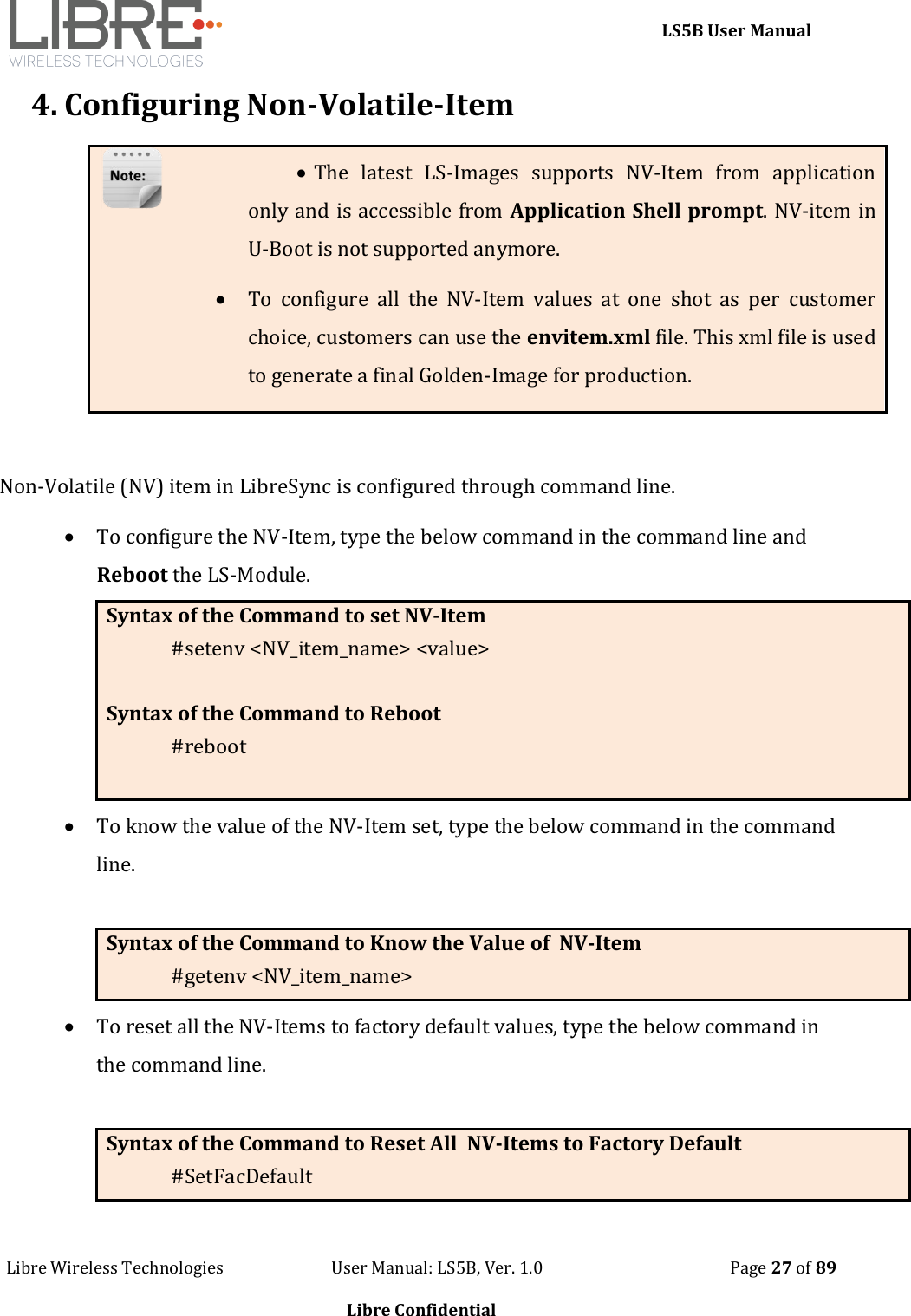
    LS5B User Manual Libre Wireless Technologies                           User Manual: LS5B, Ver. 1.0                                               Page 26 of 89  Libre Confidential  Figure 3-7:  U-Boot Update Terminal Warning Message Prompt Step 11.  To set default Server and Device IP addres, Press Enter Key on Keyboard  Figure 3-8: U-Boot Default IP address Step 12. Provide the name of the binary for U-Boot, to be flashed on the U-boot prompt For Example, Image.bin  Make Sure the Binary name provided, is as in the repository. Wrong binary name might make the module unusable. End--
    LS5B User Manual Libre Wireless Technologies                           User Manual: LS5B, Ver. 1.0                                               Page 27 of 89  Libre Confidential 4. Configuring Non-Volatile-Item   The  latest  LS-Images  supports  NV-Item  from  application only and is accessible from Application Shell prompt. NV-item in U-Boot is not supported anymore.  To  configure  all  the  NV-Item  values  at  one  shot  as  per  customer choice, customers can use the envitem.xml file. This xml file is used to generate a final Golden-Image for production.  Non-Volatile (NV) item in LibreSync is configured through command line.    To configure the NV-Item, type the below command in the command line and Reboot the LS-Module. Syntax of the Command to set NV-Item #setenv <NV_item_name> <value>    Syntax of the Command to Reboot #reboot   To know the value of the NV-Item set, type the below command in the command line.  Syntax of the Command to Know the Value of  NV-Item #getenv <NV_item_name>   To reset all the NV-Items to factory default values, type the below command in the command line.  Syntax of the Command to Reset All  NV-Items to Factory Default #SetFacDefault
    LS5B User Manual Libre Wireless Technologies                           User Manual: LS5B, Ver. 1.0                                               Page 28 of 89  Libre Confidential  To know all the NV-items set, type the below command in the command line. Syntax of the Command to Know All  NV-Items set #GetAllENV   There should be space between  setenv  and  <NV_item_name>  and between the <NV_item_name> and <value>. After  configuring  NV-Item,  to  apply  the  NV-Item  settings,  Reboot the LS-Module. For example,  To Configure NV-Item  hostpresent #setenv hostpresent <<1>>  To Know the value of the NV-item, hostpresent set #getenv hostpresent    4.1. Host Communication Over UART Host  Communication  NV-item  avoids  Junk  data/false  triggers,  in  case  of  EVK's  where UART1 communication is typically not required.  The Host  communication  NV-item should be  set  as  1, to  enable  the  Host communication over UART1.  The syntax below provides the commands to enable and disable the Host Communication over UART1 Enable  #setenv hostpresent <<1>> Disable #setenv hostpresent <<0>>
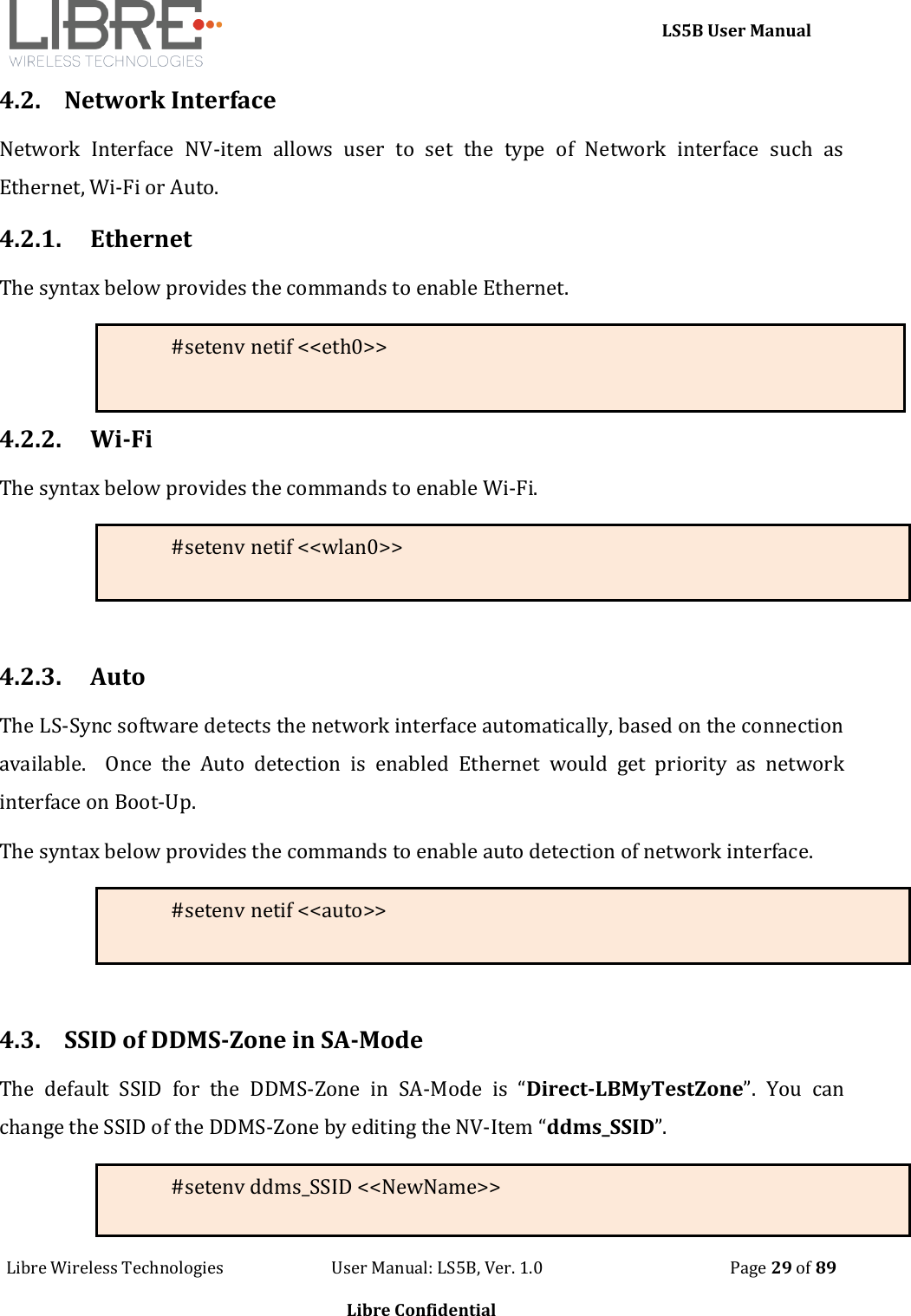
    LS5B User Manual Libre Wireless Technologies                           User Manual: LS5B, Ver. 1.0                                               Page 29 of 89  Libre Confidential 4.2. Network Interface Network  Interface  NV-item  allows  user  to  set  the  type  of  Network  interface  such  as Ethernet, Wi-Fi or Auto. 4.2.1. Ethernet The syntax below provides the commands to enable Ethernet. #setenv netif <<eth0>>  4.2.2. Wi-Fi The syntax below provides the commands to enable Wi-Fi. #setenv netif <<wlan0>>   4.2.3. Auto The LS-Sync software detects the network interface automatically, based on the connection available.    Once  the  Auto  detection  is  enabled  Ethernet  would  get  priority  as  network interface on Boot-Up. The syntax below provides the commands to enable auto detection of network interface. #setenv netif <<auto>>   4.3. SSID of DDMS-Zone in SA-Mode The  default  SSID  for  the  DDMS-Zone  in  SA-Mode  is  “Direct-LBMyTestZone”.  You  can change the SSID of the DDMS-Zone by editing the NV-Item “ddms_SSID”.   #setenv ddms_SSID <<NewName>>
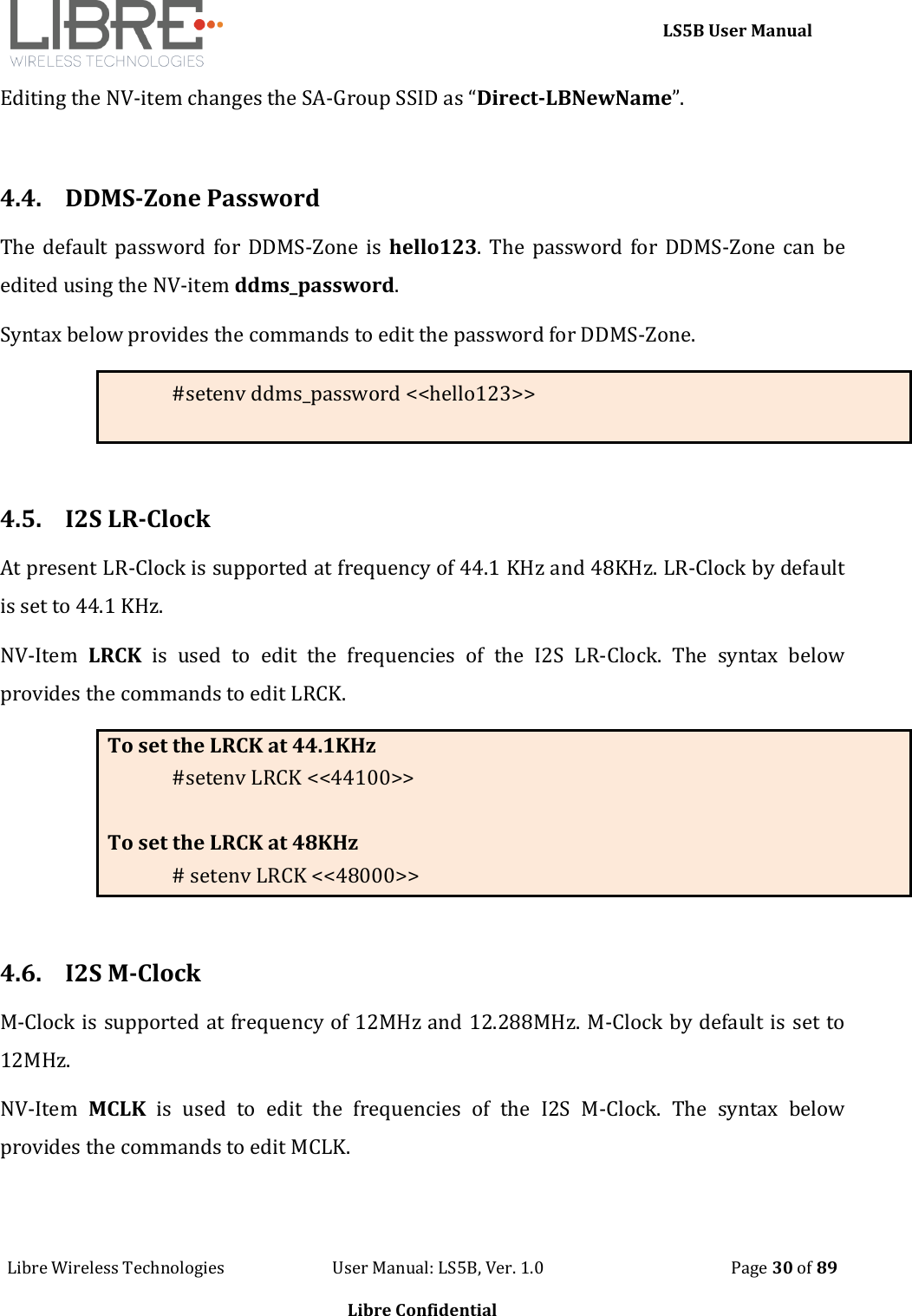
    LS5B User Manual Libre Wireless Technologies                           User Manual: LS5B, Ver. 1.0                                               Page 30 of 89  Libre Confidential Editing the NV-item changes the SA-Group SSID as “Direct-LBNewName”.  4.4. DDMS-Zone Password The default  password for DDMS-Zone is  hello123.  The password  for DDMS-Zone  can be edited using the NV-item ddms_password. Syntax below provides the commands to edit the password for DDMS-Zone. #setenv ddms_password <<hello123>>  4.5. I2S LR-Clock  At present LR-Clock is supported at frequency of 44.1 KHz and 48KHz. LR-Clock by default is set to 44.1 KHz. NV-Item  LRCK  is  used  to  edit  the  frequencies  of  the  I2S  LR-Clock.  The  syntax  below provides the commands to edit LRCK. To set the LRCK at 44.1KHz #setenv LRCK <<44100>>  To set the LRCK at 48KHz # setenv LRCK <<48000>>  4.6. I2S M-Clock M-Clock is supported at frequency of 12MHz and 12.288MHz. M-Clock by default is set to 12MHz. NV-Item  MCLK  is  used  to  edit  the  frequencies  of  the  I2S  M-Clock.  The  syntax  below provides the commands to edit MCLK.
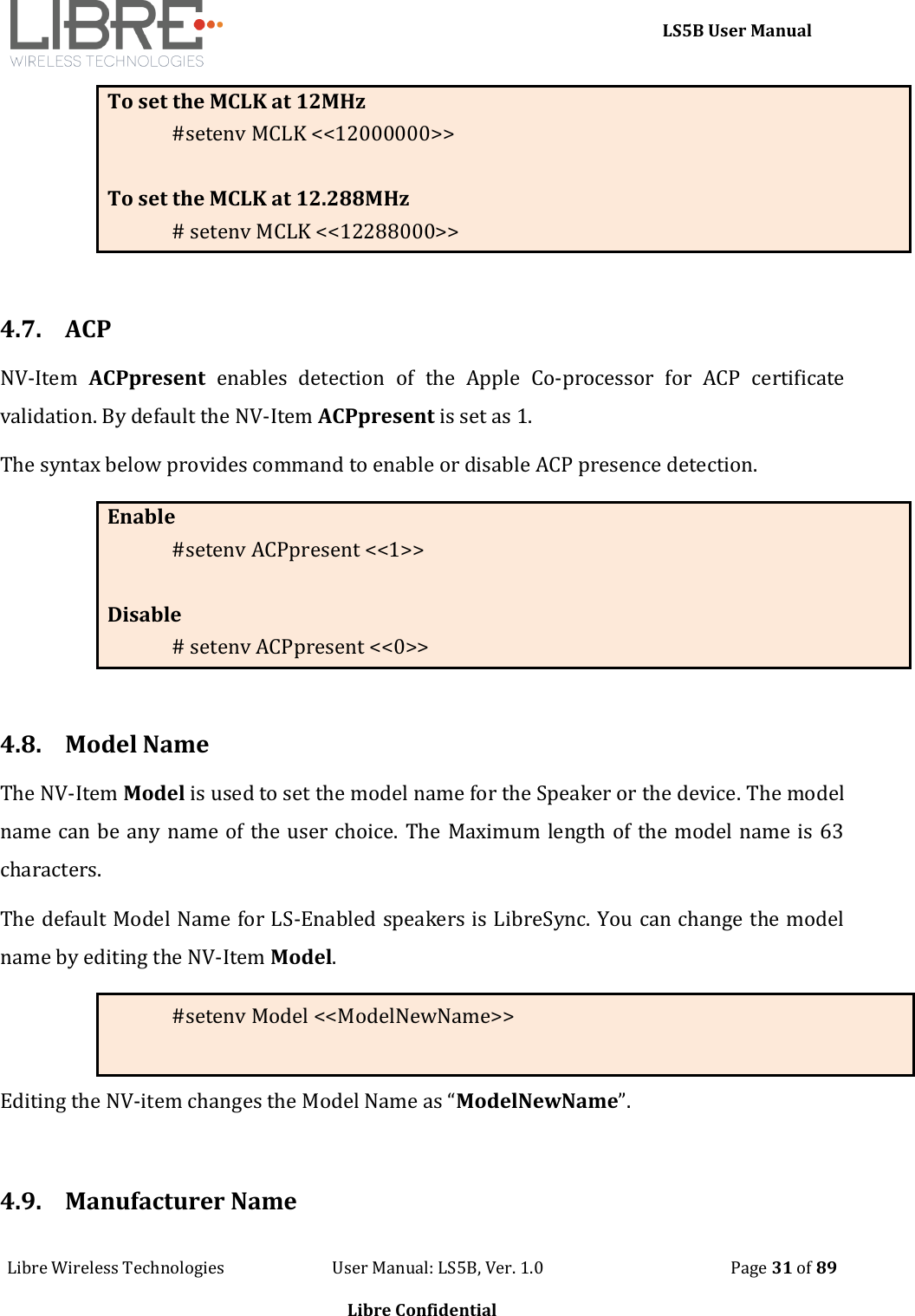
    LS5B User Manual Libre Wireless Technologies                           User Manual: LS5B, Ver. 1.0                                               Page 31 of 89  Libre Confidential To set the MCLK at 12MHz #setenv MCLK <<12000000>>  To set the MCLK at 12.288MHz # setenv MCLK <<12288000>>  4.7. ACP  NV-Item  ACPpresent  enables  detection  of  the  Apple  Co-processor  for  ACP  certificate validation. By default the NV-Item ACPpresent is set as 1. The syntax below provides command to enable or disable ACP presence detection. Enable  #setenv ACPpresent <<1>>  Disable # setenv ACPpresent <<0>>  4.8. Model Name The NV-Item Model is used to set the model name for the Speaker or the device. The model name can be any name of the user choice. The Maximum length of the model name is 63 characters.   The default Model Name for LS-Enabled speakers is LibreSync. You can change the model name by editing the NV-Item Model. #setenv Model <<ModelNewName>> Editing the NV-item changes the Model Name as “ModelNewName”.  4.9. Manufacturer Name
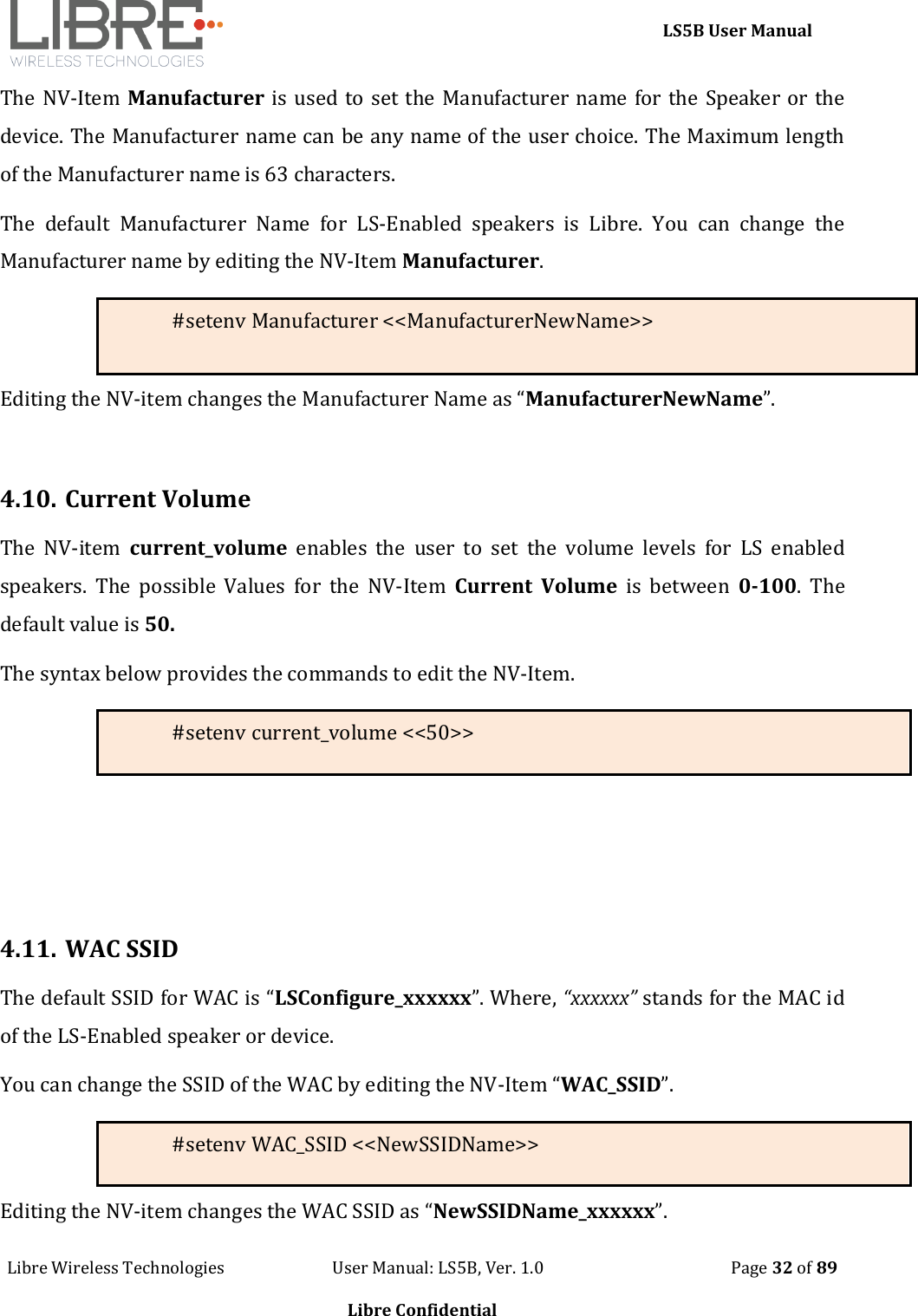
    LS5B User Manual Libre Wireless Technologies                           User Manual: LS5B, Ver. 1.0                                               Page 32 of 89  Libre Confidential The NV-Item Manufacturer is used to set the Manufacturer name for the Speaker or the device. The Manufacturer name can be any name of the user choice. The Maximum length of the Manufacturer name is 63 characters.   The  default  Manufacturer  Name  for  LS-Enabled  speakers  is  Libre.  You  can  change  the Manufacturer name by editing the NV-Item Manufacturer. #setenv Manufacturer <<ManufacturerNewName>>  Editing the NV-item changes the Manufacturer Name as “ManufacturerNewName”.  4.10. Current Volume The  NV-item  current_volume  enables  the  user  to  set  the  volume  levels  for  LS  enabled speakers.  The  possible  Values  for  the  NV-Item  Current  Volume  is  between  0-100.  The default value is 50. The syntax below provides the commands to edit the NV-Item. #setenv current_volume <<50>>    4.11. WAC SSID The default SSID for WAC is “LSConfigure_xxxxxx”. Where, “xxxxxx” stands for the MAC id of the LS-Enabled speaker or device. You can change the SSID of the WAC by editing the NV-Item “WAC_SSID”.   #setenv WAC_SSID <<NewSSIDName>> Editing the NV-item changes the WAC SSID as “NewSSIDName_xxxxxx”.
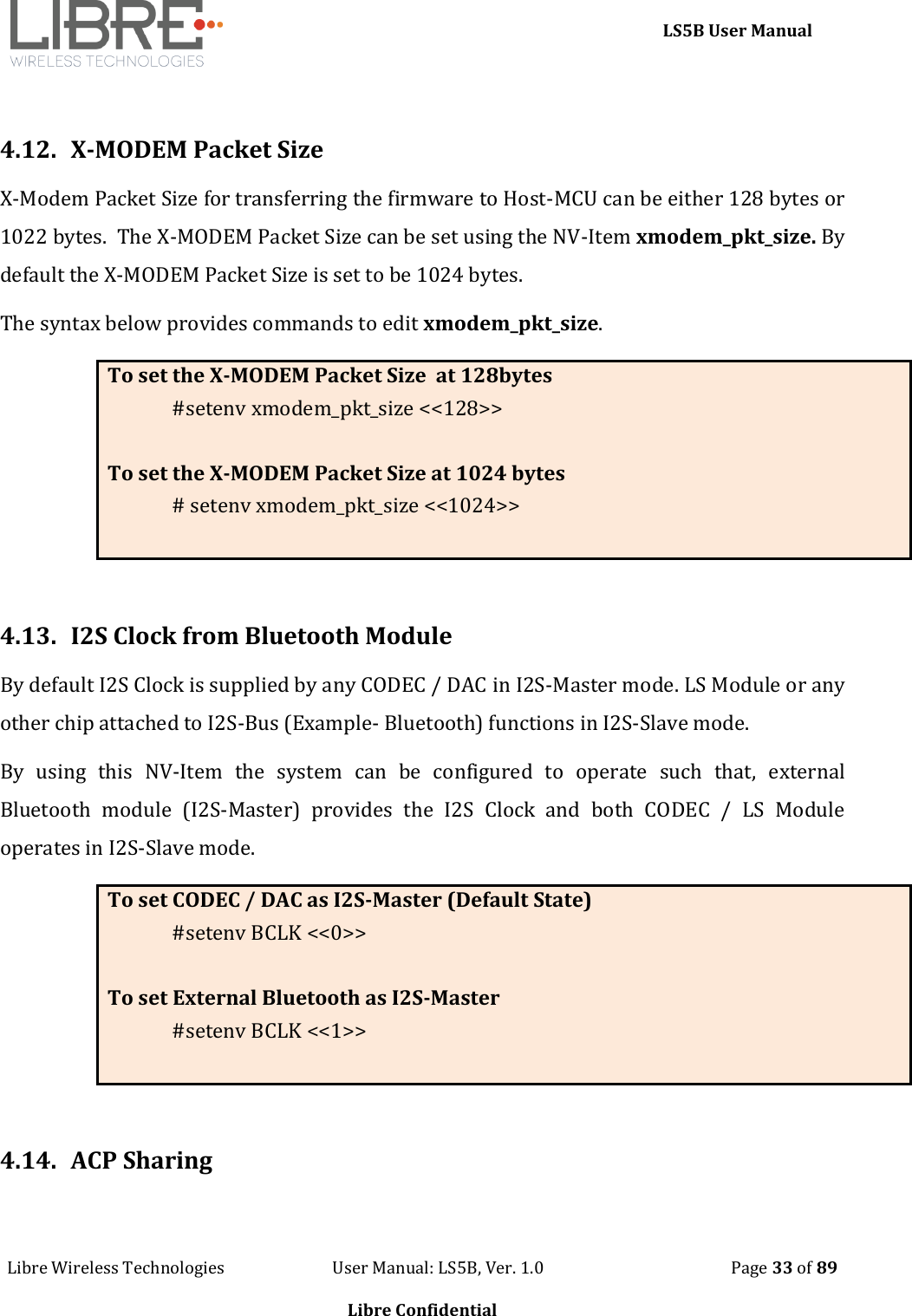
    LS5B User Manual Libre Wireless Technologies                           User Manual: LS5B, Ver. 1.0                                               Page 33 of 89  Libre Confidential  4.12.  X-MODEM Packet Size X-Modem Packet Size for transferring the firmware to Host-MCU can be either 128 bytes or 1022 bytes.  The X-MODEM Packet Size can be set using the NV-Item xmodem_pkt_size. By default the X-MODEM Packet Size is set to be 1024 bytes. The syntax below provides commands to edit xmodem_pkt_size. To set the X-MODEM Packet Size  at 128bytes #setenv xmodem_pkt_size <<128>>  To set the X-MODEM Packet Size at 1024 bytes # setenv xmodem_pkt_size <<1024>>   4.13.  I2S Clock from Bluetooth Module By default I2S Clock is supplied by any CODEC / DAC in I2S-Master mode. LS Module or any other chip attached to I2S-Bus (Example- Bluetooth) functions in I2S-Slave mode. By  using  this  NV-Item  the  system  can  be  configured  to  operate  such  that,  external Bluetooth  module  (I2S-Master)  provides  the  I2S  Clock  and  both  CODEC  /  LS  Module operates in I2S-Slave mode. To set CODEC / DAC as I2S-Master (Default State) #setenv BCLK <<0>>  To set External Bluetooth as I2S-Master #setenv BCLK <<1>>   4.14.  ACP Sharing
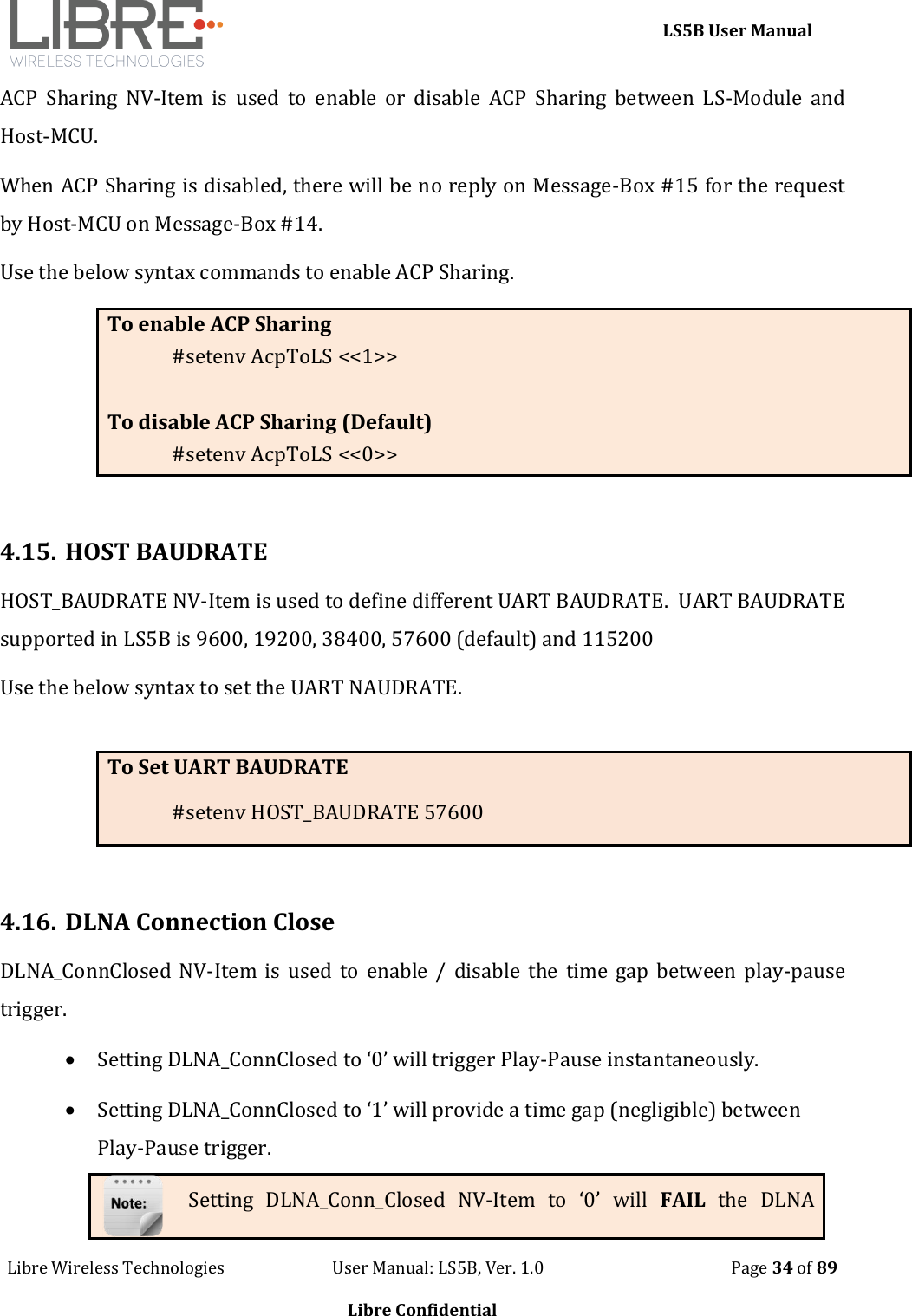
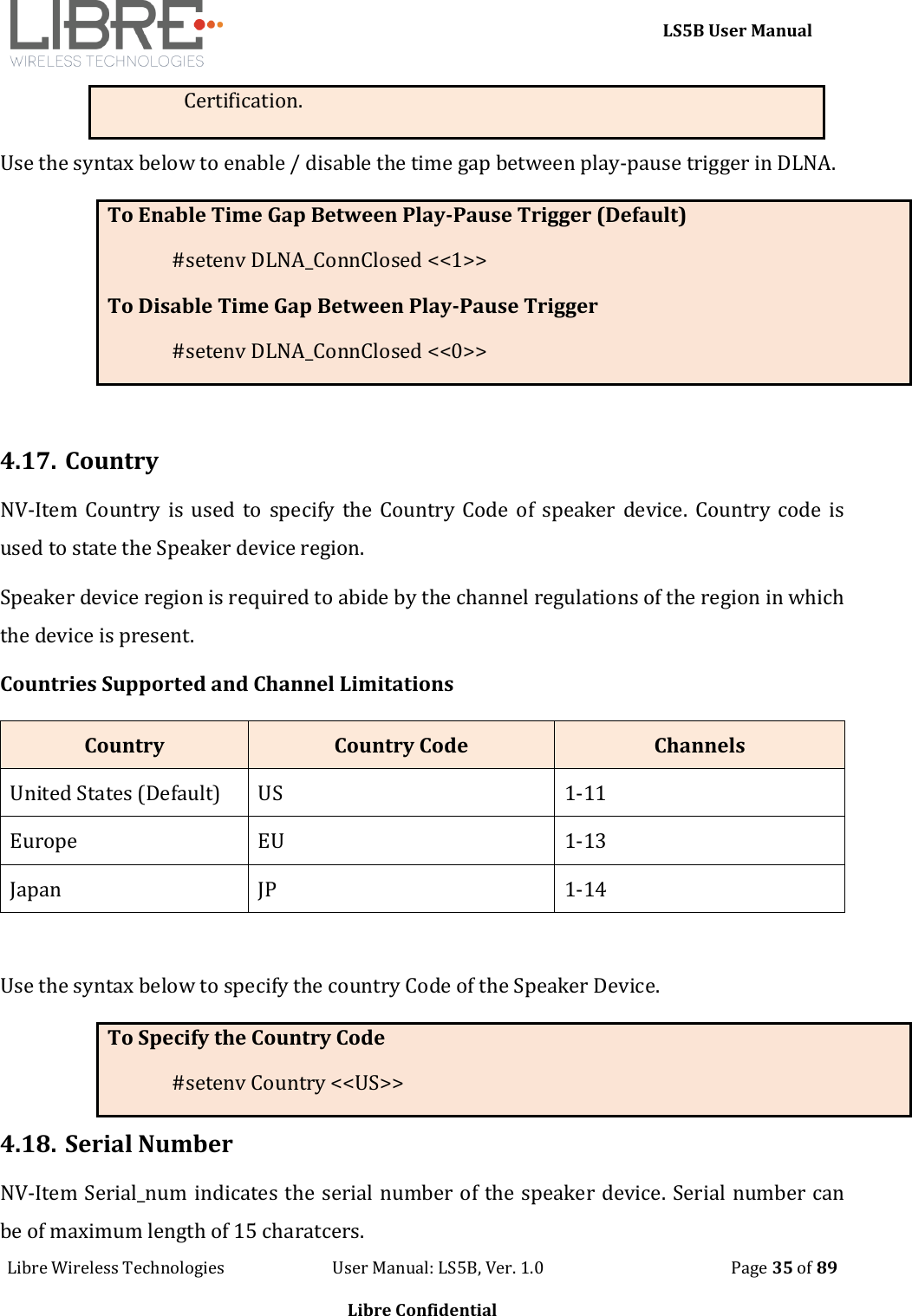
    LS5B User Manual Libre Wireless Technologies                           User Manual: LS5B, Ver. 1.0                                               Page 34 of 89  Libre Confidential ACP  Sharing  NV-Item  is  used  to  enable  or  disable  ACP  Sharing  between  LS-Module  and Host-MCU.  When ACP Sharing is disabled, there will be no reply on Message-Box #15 for the request by Host-MCU on Message-Box #14. Use the below syntax commands to enable ACP Sharing. To enable ACP Sharing #setenv AcpToLS <<1>>  To disable ACP Sharing (Default) #setenv AcpToLS <<0>>  4.15. HOST BAUDRATE HOST_BAUDRATE NV-Item is used to define different UART BAUDRATE.  UART BAUDRATE supported in LS5B is 9600, 19200, 38400, 57600 (default) and 115200 Use the below syntax to set the UART NAUDRATE.  To Set UART BAUDRATE #setenv HOST_BAUDRATE 57600  4.16. DLNA Connection Close DLNA_ConnClosed NV-Item  is  used to  enable / disable  the  time  gap between play-pause trigger.   Setting DLNA_ConnClosed to ‘0’ will trigger Play-Pause instantaneously.  Setting DLNA_ConnClosed to ‘1’ will provide a time gap (negligible) between Play-Pause trigger.  Setting  DLNA_Conn_Closed  NV-Item  to  ‘0’  will  FAIL  the  DLNA
    LS5B User Manual Libre Wireless Technologies                           User Manual: LS5B, Ver. 1.0                                               Page 35 of 89  Libre Confidential Certification. Use the syntax below to enable / disable the time gap between play-pause trigger in DLNA. To Enable Time Gap Between Play-Pause Trigger (Default) #setenv DLNA_ConnClosed <<1>> To Disable Time Gap Between Play-Pause Trigger #setenv DLNA_ConnClosed <<0>>  4.17. Country NV-Item Country is used to  specify the  Country  Code of speaker device.  Country code  is used to state the Speaker device region.  Speaker device region is required to abide by the channel regulations of the region in which the device is present. Countries Supported and Channel Limitations Country Country Code Channels United States (Default) US 1-11 Europe EU 1-13 Japan JP 1-14  Use the syntax below to specify the country Code of the Speaker Device. To Specify the Country Code #setenv Country <<US>> 4.18. Serial Number NV-Item Serial_num indicates the serial number of the speaker device. Serial number can be of maximum length of 15 charatcers.
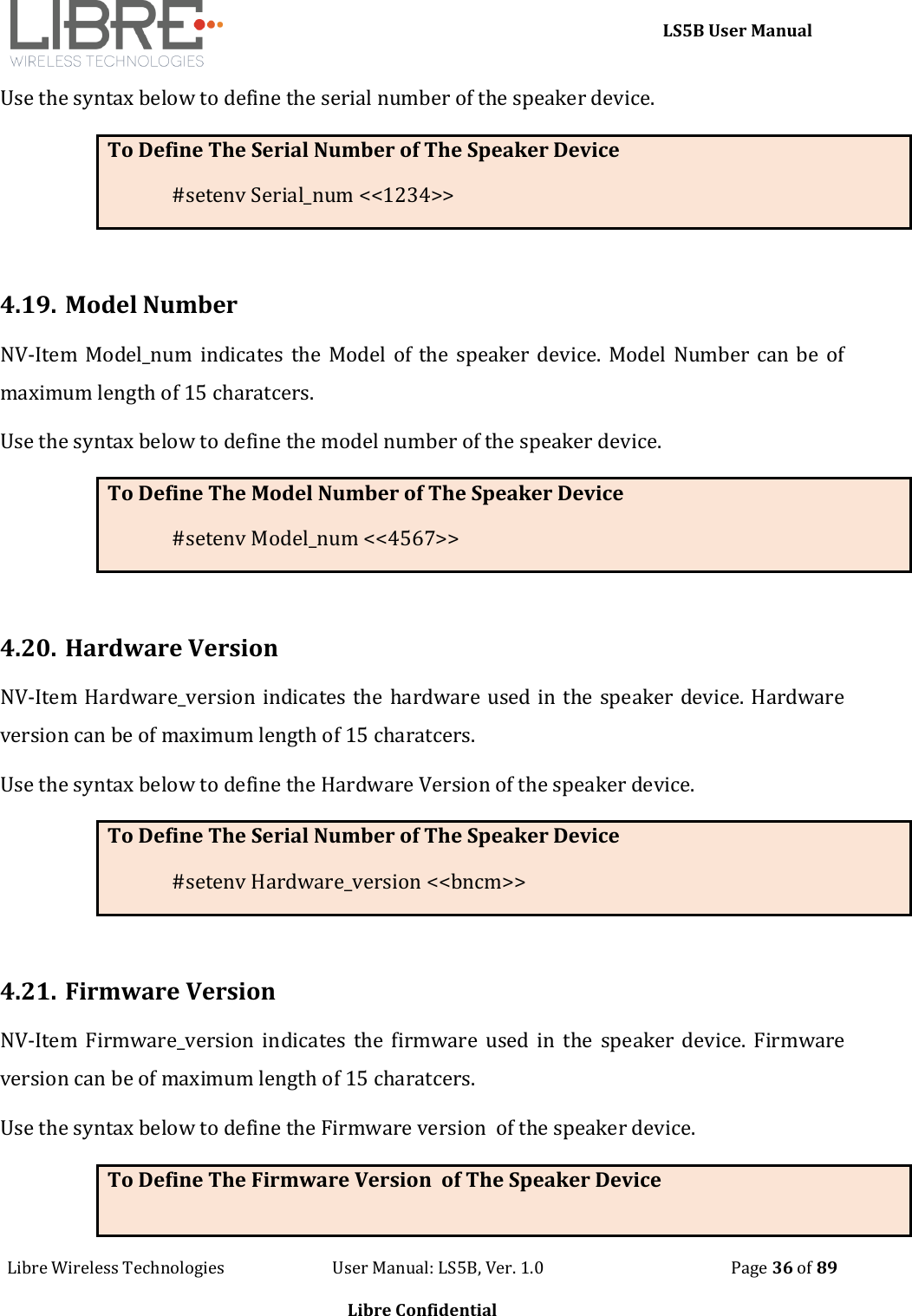
    LS5B User Manual Libre Wireless Technologies                           User Manual: LS5B, Ver. 1.0                                               Page 36 of 89  Libre Confidential Use the syntax below to define the serial number of the speaker device. To Define The Serial Number of The Speaker Device #setenv Serial_num <<1234>>  4.19. Model Number NV-Item Model_num indicates  the Model of the speaker device. Model Number can be of maximum length of 15 charatcers. Use the syntax below to define the model number of the speaker device. To Define The Model Number of The Speaker Device #setenv Model_num <<4567>>  4.20. Hardware Version NV-Item Hardware_version indicates the hardware used in the speaker device. Hardware version can be of maximum length of 15 charatcers. Use the syntax below to define the Hardware Version of the speaker device. To Define The Serial Number of The Speaker Device #setenv Hardware_version <<bncm>>  4.21. Firmware Version NV-Item Firmware_version  indicates  the  firmware used in  the  speaker device.  Firmware version can be of maximum length of 15 charatcers. Use the syntax below to define the Firmware version  of the speaker device. To Define The Firmware Version  of The Speaker Device
    LS5B User Manual Libre Wireless Technologies                           User Manual: LS5B, Ver. 1.0                                               Page 37 of 89  Libre Confidential #setenv Firmware_version <<tyio>>  4.22. Firmware Update Link NV-Item fwupdate_link is used to provide the URL for the firmware update over internet.  Use the syntax below to provide the URL for firmware update.  To Provide the URL for Firmware Update over Internet #setenv fwupdate_link << www.librewireless.com >>  4.23. Firmware Download XML NV-Item  fwdownload_xml  is  used  to  provide  the  URL  for  the  XML  file  that  contains  the information  about  Firmware  version,  HOST-MCU  version  and  the  link  to  download  the firmware. Use the syntax below to provide the URL for firmware update.  To Provide the URL for Firmware Update over Internet #setenv fwdownload_xml << http://172.16.2.103/share/firmware/LS5B/firmware_download.xml</value >> For  information  on  Firmware  Download  XML  file  and  its  structure  refer  to LibreWirelessTechNote_Failsafe-Firmware_Upgrade document available in Libre Portal.  4.24. Album Art Size NV-Item AlbumArtMaxSizeKB defines the size of the album art. The maximum album art size supported in LibreSync is 2048 KB. Use the syntax below to provide the URL for firmware update.
    LS5B User Manual Libre Wireless Technologies                           User Manual: LS5B, Ver. 1.0                                               Page 38 of 89  Libre Confidential To Provide the URL for Firmware Update over Internet #setenv AlbumArtMaxSizeKB << 2048 >>  4.25. Spotify APP Key NV-Item SpotifyAppKey is  used to store the  unique  application  key to access  the Spotify Library.  LS-enabled  speaker  device  has  the  Libre’s  application  key  as  the  default  value. Replace the Application key with your own application key provided by Spotify.  The maximum size of the application key is 1024 characters. Use the syntax below to store the Spotify Application Key. To Store The Spotify Application Key #setenv SpotifyAppKey << 0147A183DEFC792085C3D545471BEF4127D2F23F12619CFDA11DAB7E1E6A86C8.... >>
    LS5B User Manual Libre Wireless Technologies                           User Manual: LS5B, Ver. 1.0                                               Page 39 of 89  Libre Confidential 5. Key Button Functionality 5.1. Setup Button (WAC / SAC / DDMS)  The SW5 button in LS5B-EVK is configured to trigger WAC / SAC and DDMS after the LS module boots up as below.  Single press, the setup button on the LS EVK, to configure the speaker as DDMS Zone-Master in Stand-Alone mode. - This state would be stored in non-volatile memory so that even after boot-up, the state is retained.  Double press the setup button on the LS EVK, to put back the speaker to DDMS Zone-Station in Stand-Alone mode. - This state would be stored in non-volatile memory so that even after boot-up, the state is retained. - This state would be maintained until user changes to WAC mode or to Zone-Master mode on this specific speaker.  Press and Hold the setup button on the LS EVK for 3 seconds, to come out of the DDMS mode. - LS EVK connects to the AP or the SSID configured earlier. - To connect the LS EVK to different AP or SSID, Press and Hold the setup button on the LS EVK for 3 seconds again, to trigger WAC. - If the LS EVK was not configured to any AP, Press and Hold of setup button triggers WAC. - This state is stored in non-volatile memory and even after boot-up, the state is retained. For  more  information  on  DDMS  Stand-Alone  mode  and  Home-Network  mode  refer  to DDMS Usability guide (Android / iOS) available in LibreSync Document Portal. 5.2. WPS / Factory Reset Key Button (TBG)
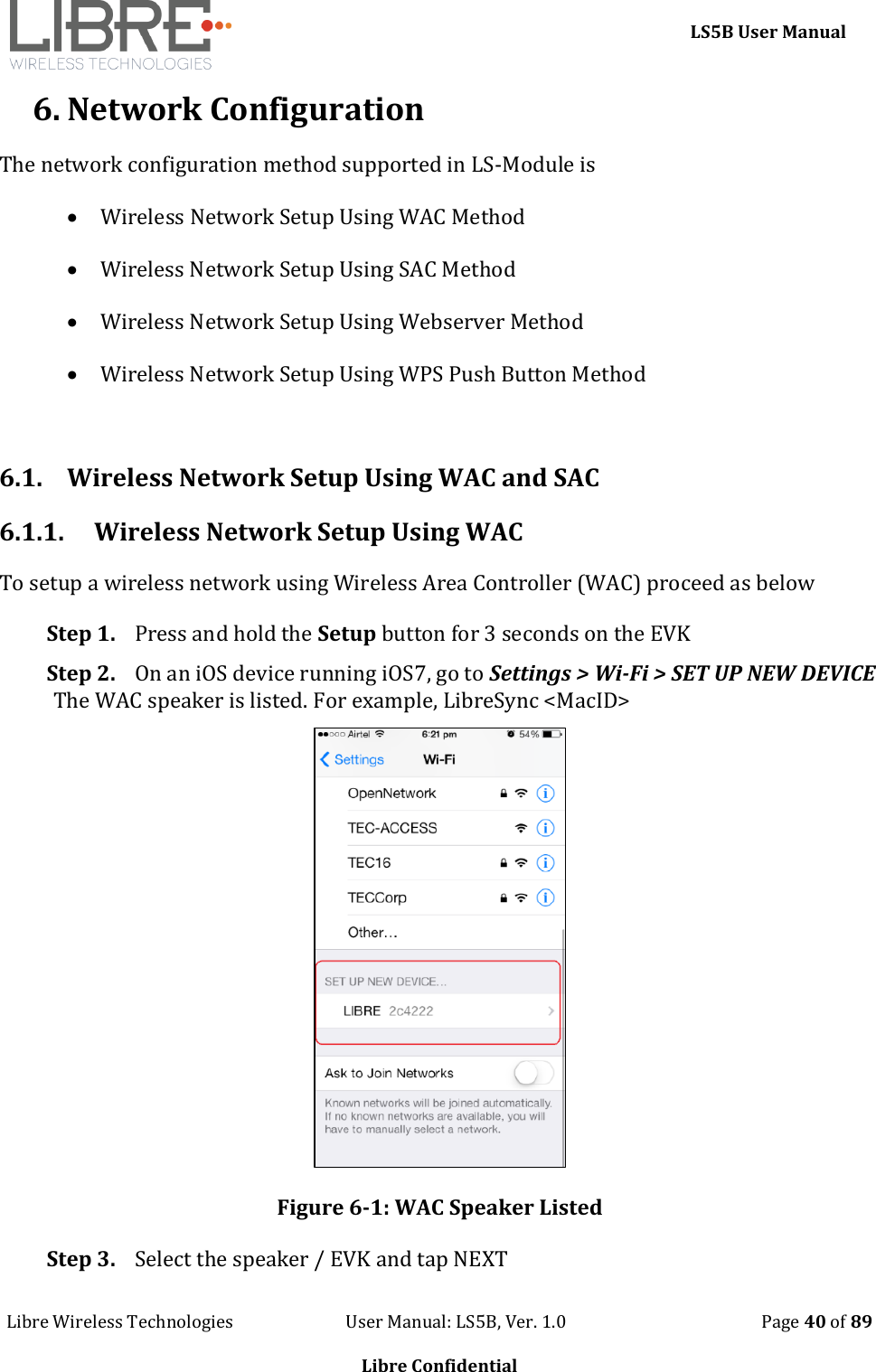
    LS5B User Manual Libre Wireless Technologies                           User Manual: LS5B, Ver. 1.0                                               Page 40 of 89  Libre Confidential 6. Network Configuration The network configuration method supported in LS-Module is   Wireless Network Setup Using WAC Method  Wireless Network Setup Using SAC Method   Wireless Network Setup Using Webserver Method  Wireless Network Setup Using WPS Push Button Method   6.1. Wireless Network Setup Using WAC and SAC 6.1.1. Wireless Network Setup Using WAC To setup a wireless network using Wireless Area Controller (WAC) proceed as below Step 1. Press and hold the Setup button for 3 seconds on the EVK  Step 2. On an iOS device running iOS7, go to Settings > Wi-Fi > SET UP NEW DEVICE The WAC speaker is listed. For example, LibreSync <MacID>  Figure 6-1: WAC Speaker Listed Step 3. Select the speaker / EVK and tap NEXT
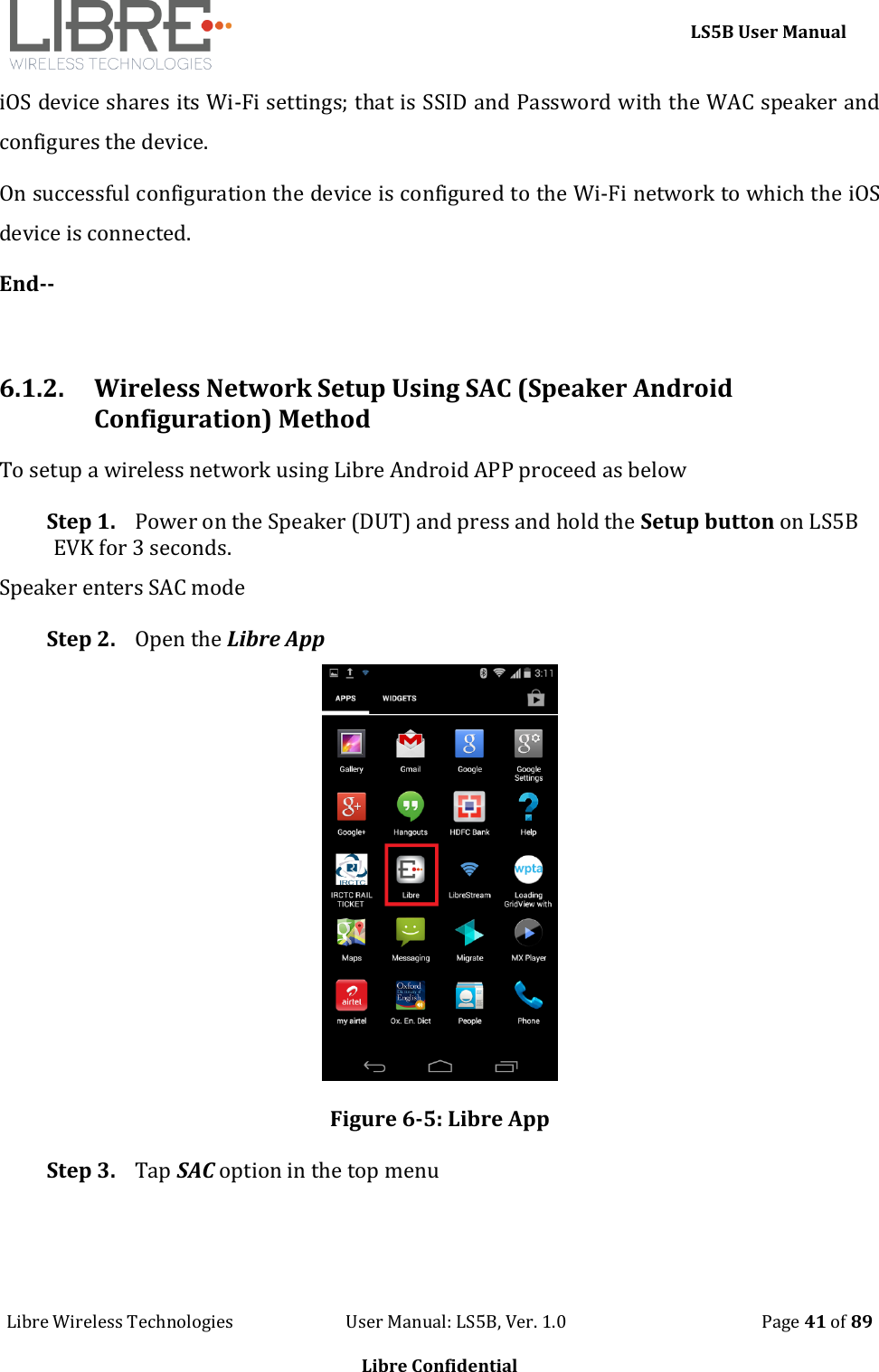
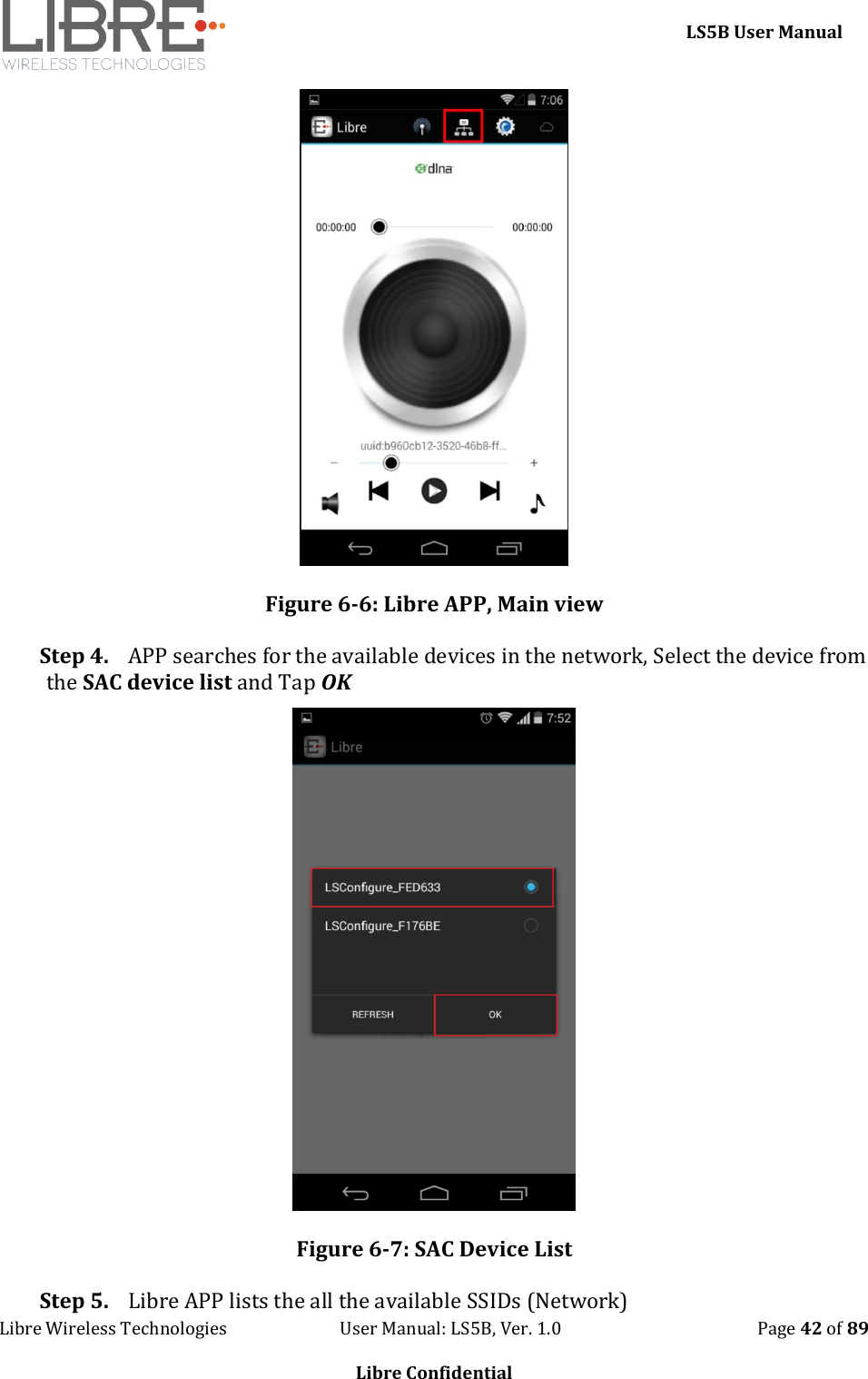
    LS5B User Manual Libre Wireless Technologies                           User Manual: LS5B, Ver. 1.0                                               Page 41 of 89  Libre Confidential iOS device shares its Wi-Fi settings; that is SSID and Password with the WAC speaker and configures the device. On successful configuration the device is configured to the Wi-Fi network to which the iOS device is connected. End--  6.1.2. Wireless Network Setup Using SAC (Speaker Android Configuration) Method To setup a wireless network using Libre Android APP proceed as below Step 1. Power on the Speaker (DUT) and press and hold the Setup button on LS5B EVK for 3 seconds. Speaker enters SAC mode Step 2. Open the Libre App  Figure 6-5: Libre App  Step 3. Tap SAC option in the top menu
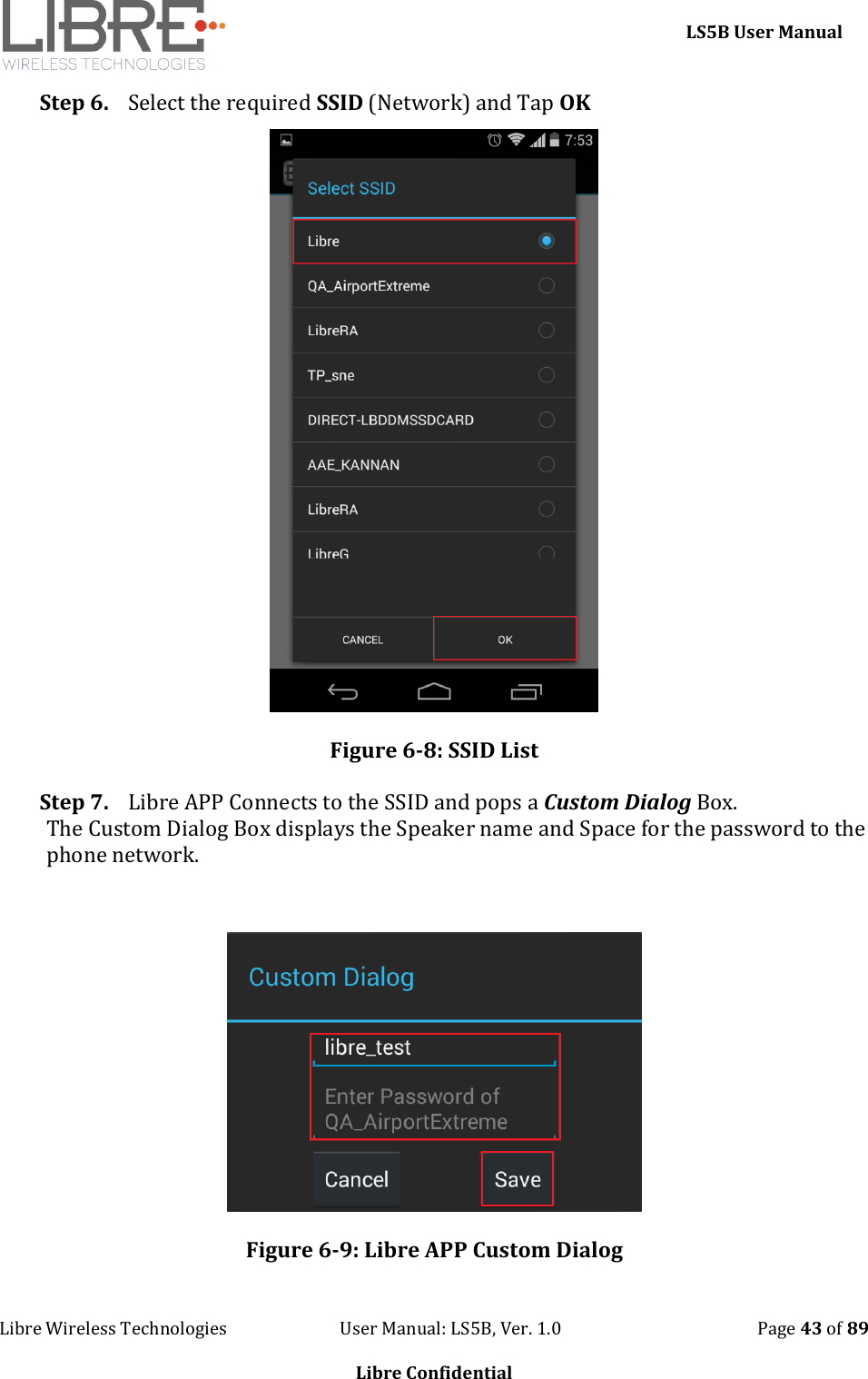
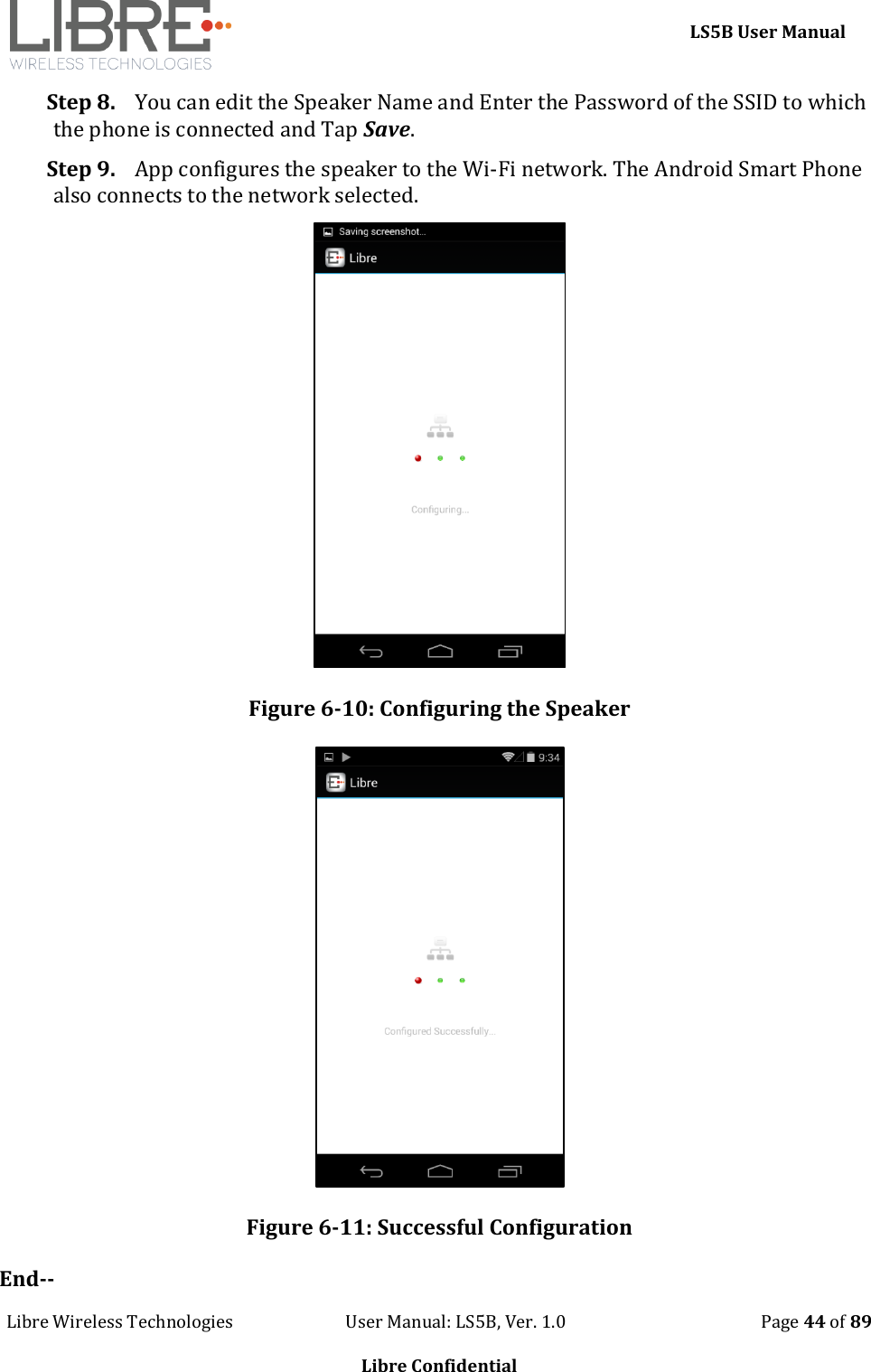
    LS5B User Manual Libre Wireless Technologies                           User Manual: LS5B, Ver. 1.0                                               Page 42 of 89  Libre Confidential  Figure 6-6: Libre APP, Main view   Step 4. APP searches for the available devices in the network, Select the device from the SAC device list and Tap OK  Figure 6-7: SAC Device List Step 5. Libre APP lists the all the available SSIDs (Network)
    LS5B User Manual Libre Wireless Technologies                           User Manual: LS5B, Ver. 1.0                                               Page 43 of 89  Libre Confidential Step 6. Select the required SSID (Network) and Tap OK  Figure 6-8: SSID List Step 7. Libre APP Connects to the SSID and pops a Custom Dialog Box. The Custom Dialog Box displays the Speaker name and Space for the password to the phone network.   Figure 6-9: Libre APP Custom Dialog
    LS5B User Manual Libre Wireless Technologies                           User Manual: LS5B, Ver. 1.0                                               Page 44 of 89  Libre Confidential Step 8. You can edit the Speaker Name and Enter the Password of the SSID to which the phone is connected and Tap Save. Step 9. App configures the speaker to the Wi-Fi network. The Android Smart Phone also connects to the network selected.  Figure 6-10: Configuring the Speaker  Figure 6-11: Successful Configuration End--
    LS5B User Manual Libre Wireless Technologies                           User Manual: LS5B, Ver. 1.0                                               Page 45 of 89  Libre Confidential 6.1.3. WAC / SAC Trigger Behaviour in DDMS Mode and Non-DDMS Mode This sections explains different behaviours of the speaker for network configuration when WAC / SAC is triggered.  For details on the network configuration using WAC / SAC refer Section 6.1 and Section 6.2. Scenario 1 Precondition  LS-Enabled speaker  is in  Non-DDMS Mode and is not connected to AP. Action WAC / SAC is triggered using the Setup Button (Press and Hold for three seconds) in LS EVK or through Message-Box 142. Result LS-Enabled Speaker enters WAC / SAC mode for Network Configuration.  Scenario 2 Precondition  LS-Enabled speaker  is in  Non-DDMS Mode and is connected to AP. Action WAC / SAC is triggered using the Setup Button (Press and Hold for three seconds) in LS EVK or through Message-Box 142. Result LS-Enabled Speaker enters WAC / SAC mode for Network Configuration.  Scenario 3 Precondition  LS-Enabled speaker  is in  Non-DDMS Mode and is not connected to AP. Action 1. Reboot the Speaker. Currently the speaker is in Non-DDMS Mode. 2. Configure the speakers to DDMS-Mode i.e. either in SA Mode/HN Mode (refer to DDMS usability guide).
    LS5B User Manual Libre Wireless Technologies                           User Manual: LS5B, Ver. 1.0                                               Page 46 of 89  Libre Confidential 3. Trigger WAC / SAC using the Setup Button (Press and Hold for three seconds) in LS EVK or through Message-Box 142. Result LS-Enabled Speaker switches from DDMS Mode to Non-DDMS Mode and enters WAC / SAC mode for Network Configuration.  Scenario 4 Precondition  LS-Enabled speaker  is in  Non-DDMS Mode and is connected to AP. Action 1. Reboot the Speaker. Currently the speaker is in Non-DDMS Mode. 2. Configure the speakers to DDMS-Mode i.e. either in SA Mode/HN Mode (refer to DDMS usability guide). 3. Trigger WAC / SAC using the Setup Button (Press and Hold for three seconds) in LS EVK or through Message-Box 142. Result LS-Enabled Speaker switches from DDMS Mode to Non-DDMS Mode and connects to the AP configured earlier.  Scenario 5 Precondition  LS-Enabled speaker is in DDMS Mode and was not connected to AP earlier. Action 1. Reboot the Speaker and  2. Trigger WAC / SAC using the Setup Button (Press and Hold for three seconds) in LS EVK or through Message-Box 142. Result LS-Enabled Speaker switches from DDMS Mode to Non-DDMS Mode and enters WAC / SAC mode for Network Configuration.  Scenario 6 Precondition  LS-Enabled speaker is in DDMS Mode and was connected to AP earlier.
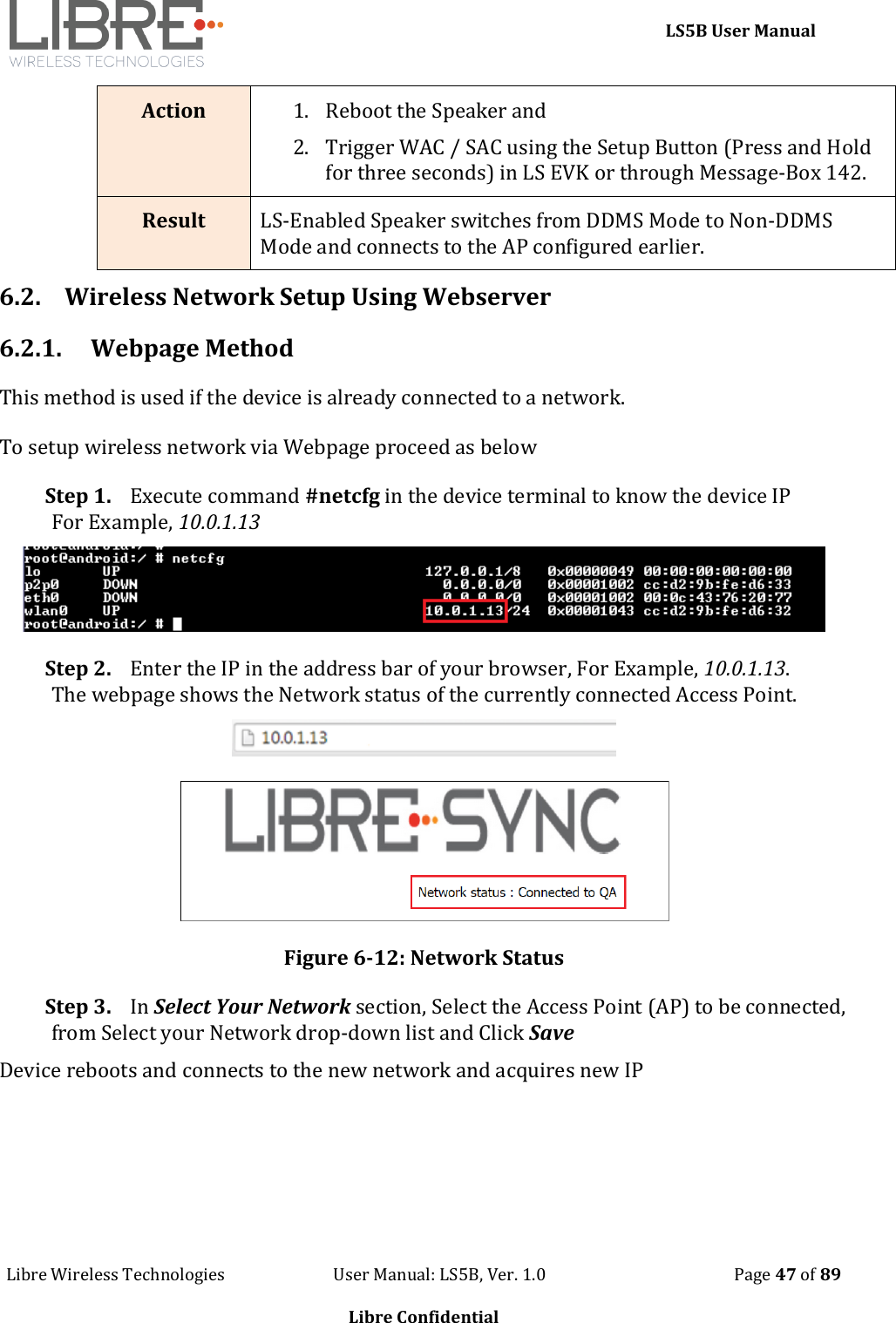
    LS5B User Manual Libre Wireless Technologies                           User Manual: LS5B, Ver. 1.0                                               Page 47 of 89  Libre Confidential Action 1. Reboot the Speaker and  2. Trigger WAC / SAC using the Setup Button (Press and Hold for three seconds) in LS EVK or through Message-Box 142. Result LS-Enabled Speaker switches from DDMS Mode to Non-DDMS Mode and connects to the AP configured earlier. 6.2. Wireless Network Setup Using Webserver 6.2.1. Webpage Method  This method is used if the device is already connected to a network. To setup wireless network via Webpage proceed as below Step 1. Execute command #netcfg in the device terminal to know the device IP For Example, 10.0.1.13  Step 2. Enter the IP in the address bar of your browser, For Example, 10.0.1.13. The webpage shows the Network status of the currently connected Access Point.   Figure 6-12: Network Status  Step 3. In Select Your Network section, Select the Access Point (AP) to be connected, from Select your Network drop-down list and Click Save Device reboots and connects to the new network and acquires new IP
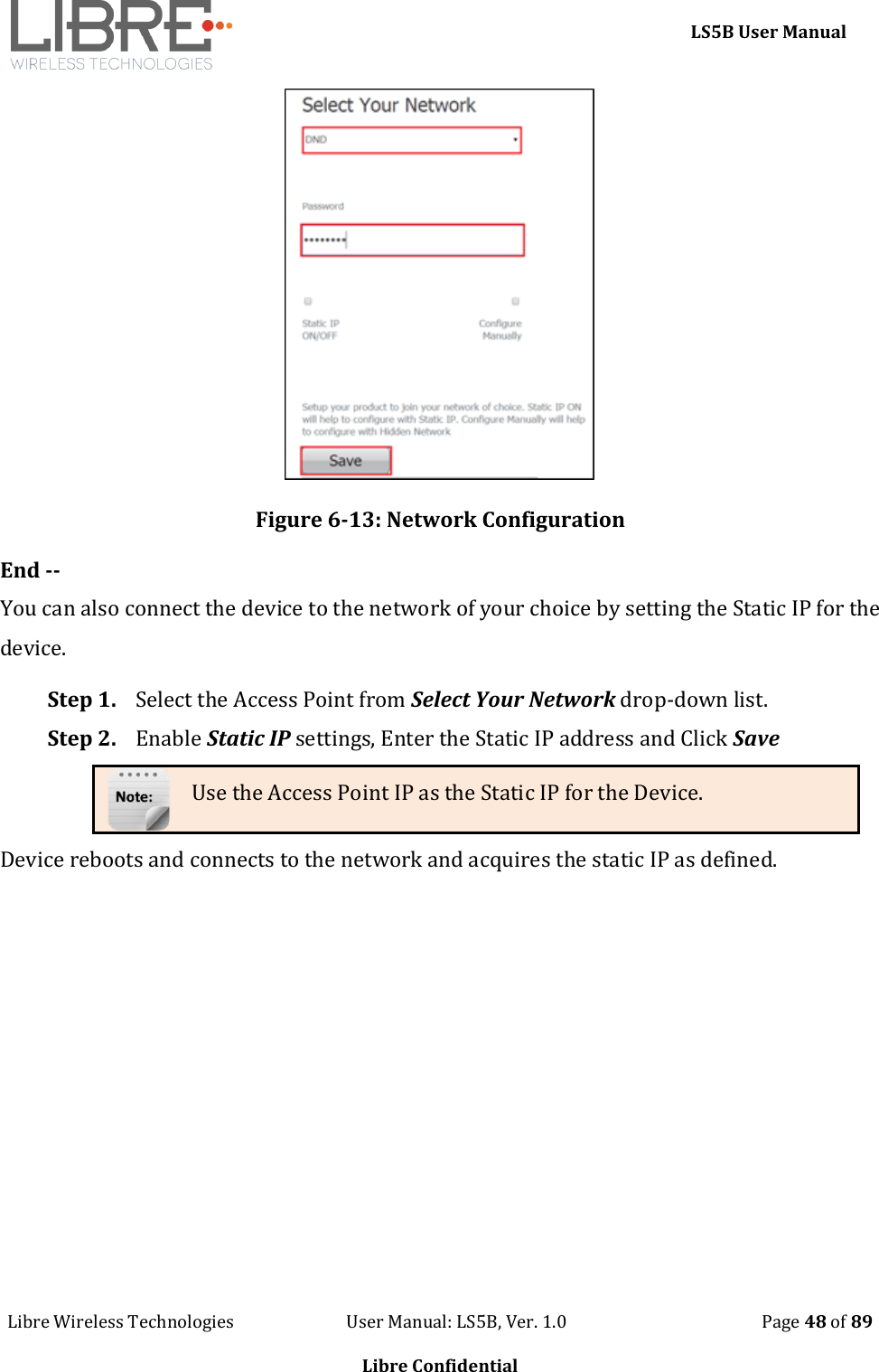
    LS5B User Manual Libre Wireless Technologies                           User Manual: LS5B, Ver. 1.0                                               Page 48 of 89  Libre Confidential  Figure 6-13: Network Configuration End -- You can also connect the device to the network of your choice by setting the Static IP for the device. Step 1. Select the Access Point from Select Your Network drop-down list.  Step 2. Enable Static IP settings, Enter the Static IP address and Click Save Use the Access Point IP as the Static IP for the Device. Device reboots and connects to the network and acquires the static IP as defined.
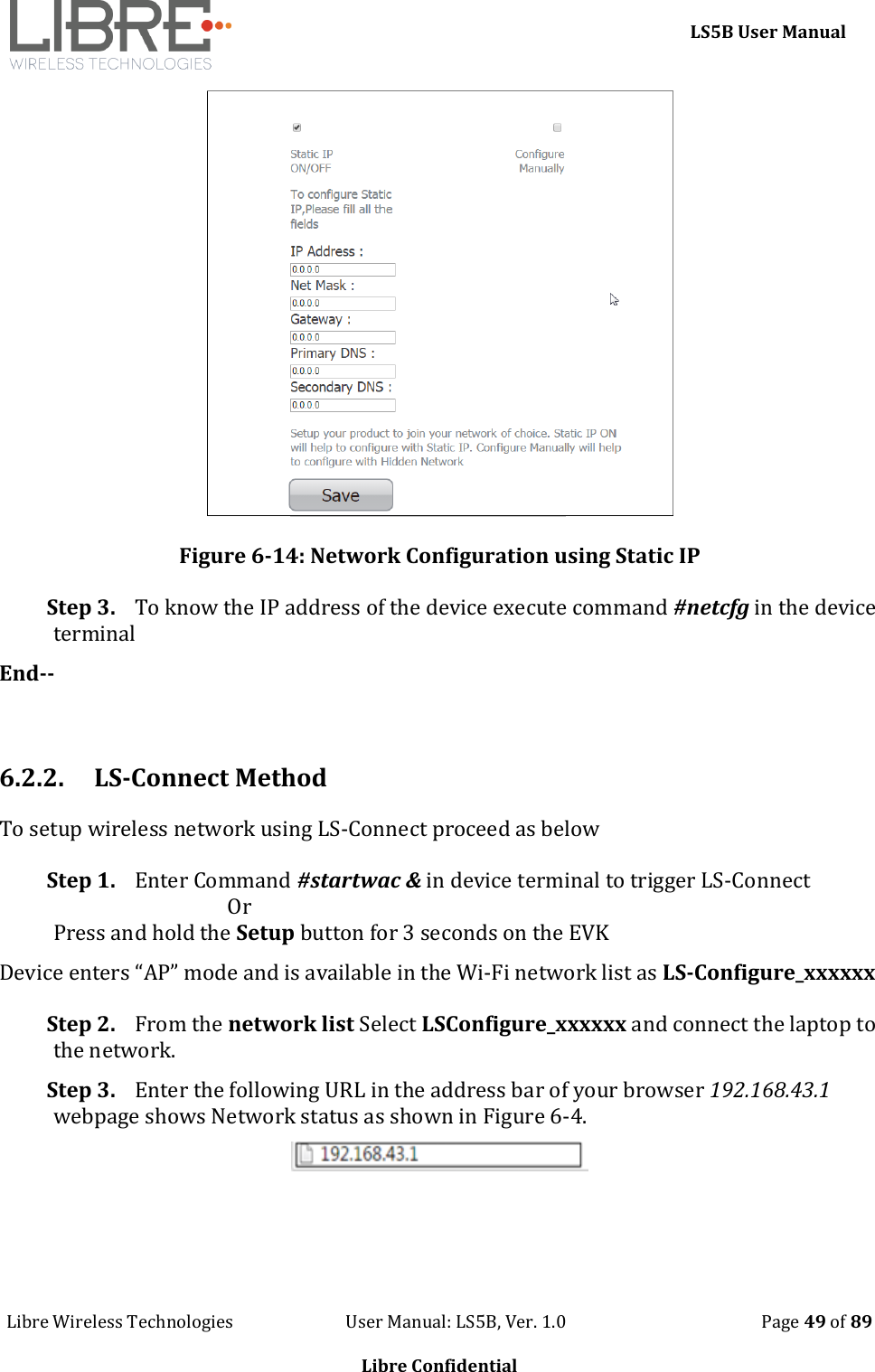
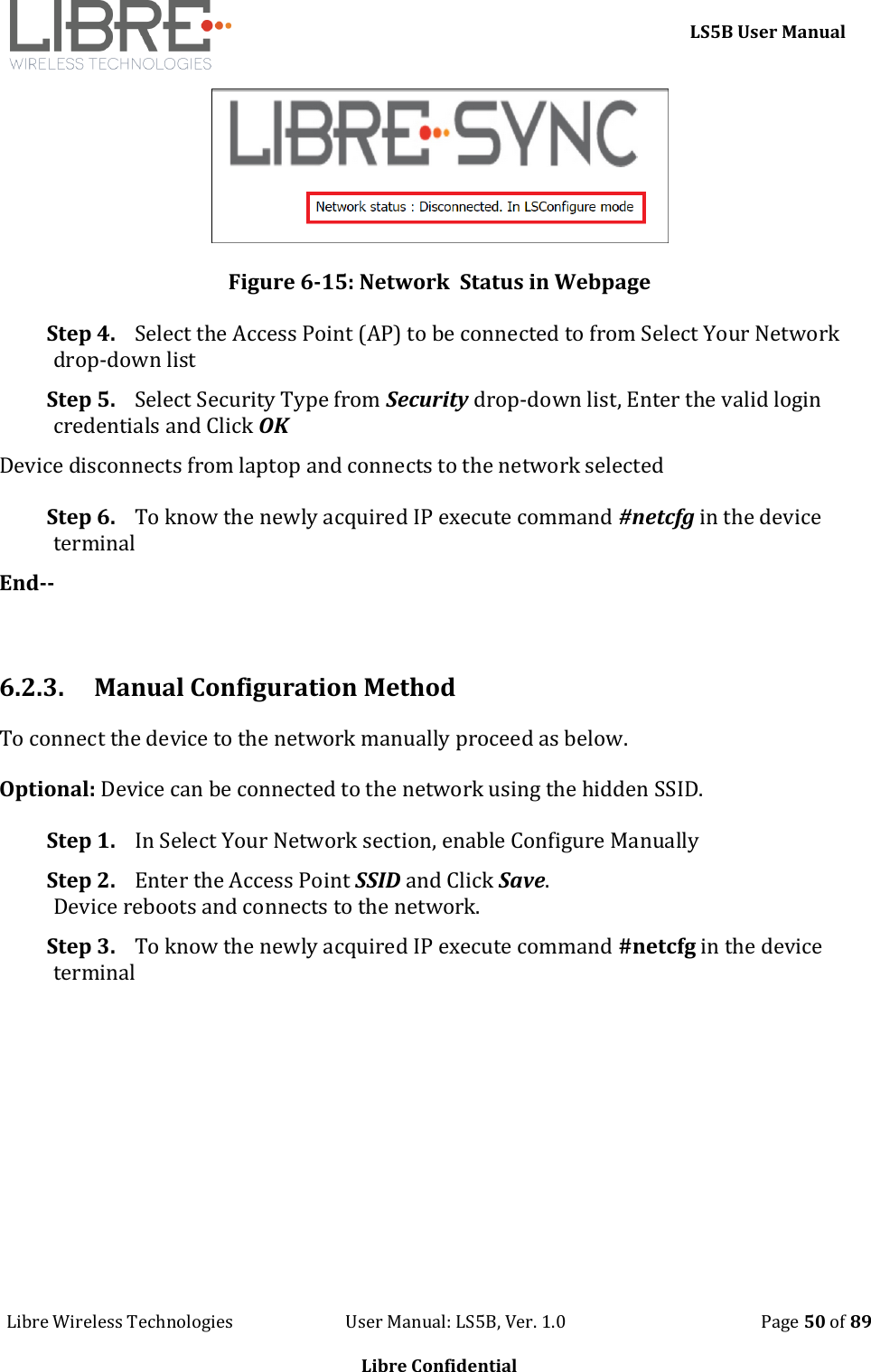
    LS5B User Manual Libre Wireless Technologies                           User Manual: LS5B, Ver. 1.0                                               Page 49 of 89  Libre Confidential  Figure 6-14: Network Configuration using Static IP Step 3. To know the IP address of the device execute command #netcfg in the device terminal End--  6.2.2. LS-Connect Method To setup wireless network using LS-Connect proceed as below Step 1. Enter Command #startwac & in device terminal to trigger LS-Connect                                    Or Press and hold the Setup button for 3 seconds on the EVK  Device enters “AP” mode and is available in the Wi-Fi network list as LS-Configure_xxxxxx Step 2. From the network list Select LSConfigure_xxxxxx and connect the laptop to the network. Step 3. Enter the following URL in the address bar of your browser 192.168.43.1 webpage shows Network status as shown in Figure 6-4.
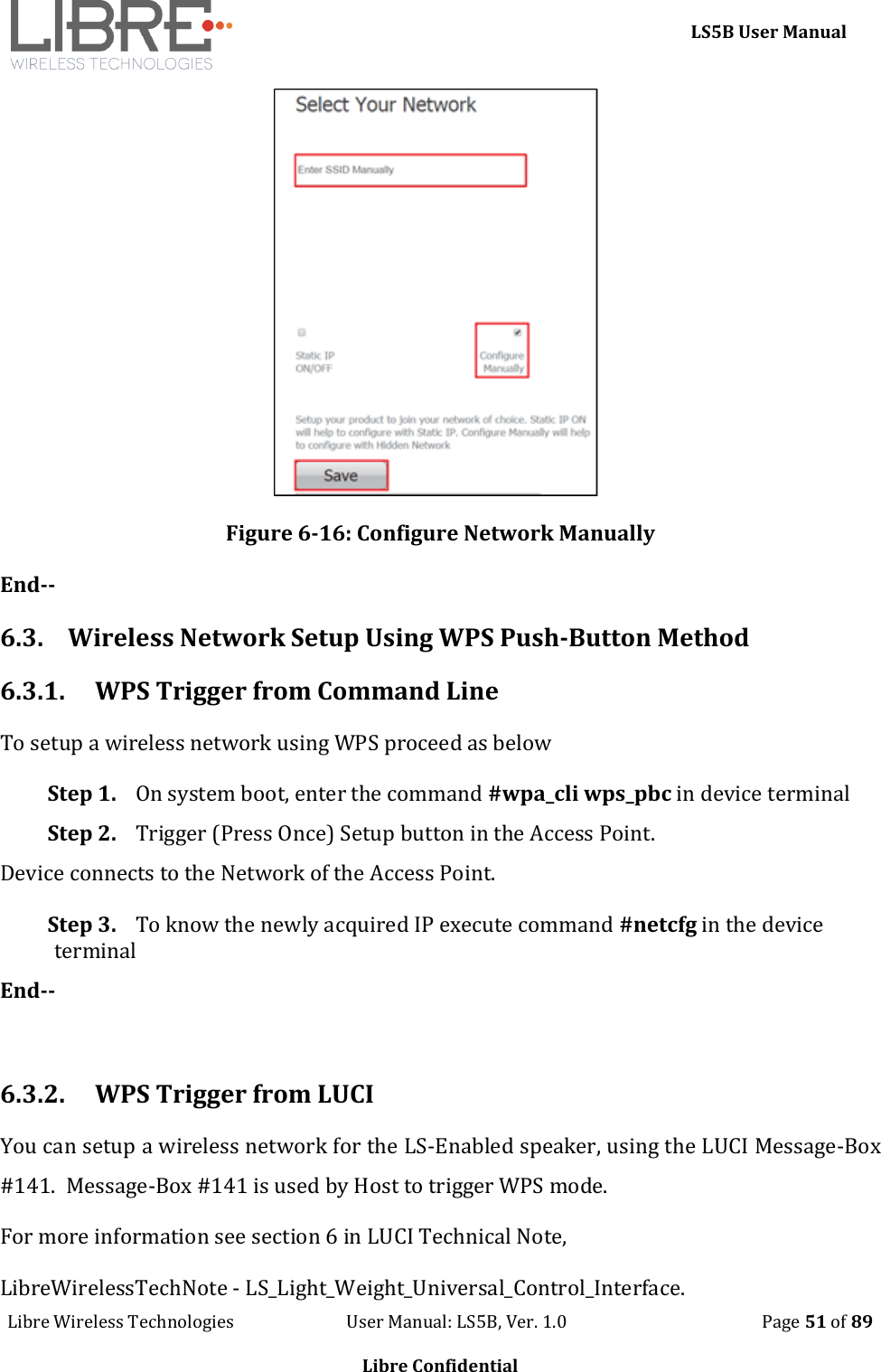
    LS5B User Manual Libre Wireless Technologies                           User Manual: LS5B, Ver. 1.0                                               Page 50 of 89  Libre Confidential  Figure 6-15: Network  Status in Webpage Step 4. Select the Access Point (AP) to be connected to from Select Your Network drop-down list Step 5. Select Security Type from Security drop-down list, Enter the valid login credentials and Click OK Device disconnects from laptop and connects to the network selected Step 6. To know the newly acquired IP execute command #netcfg in the device terminal End--  6.2.3. Manual Configuration Method To connect the device to the network manually proceed as below.  Optional: Device can be connected to the network using the hidden SSID. Step 1. In Select Your Network section, enable Configure Manually  Step 2. Enter the Access Point SSID and Click Save. Device reboots and connects to the network. Step 3. To know the newly acquired IP execute command #netcfg in the device terminal
    LS5B User Manual Libre Wireless Technologies                           User Manual: LS5B, Ver. 1.0                                               Page 51 of 89  Libre Confidential  Figure 6-16: Configure Network Manually End-- 6.3. Wireless Network Setup Using WPS Push-Button Method 6.3.1. WPS Trigger from Command Line  To setup a wireless network using WPS proceed as below Step 1. On system boot, enter the command #wpa_cli wps_pbc in device terminal Step 2. Trigger (Press Once) Setup button in the Access Point. Device connects to the Network of the Access Point. Step 3. To know the newly acquired IP execute command #netcfg in the device terminal End--  6.3.2. WPS Trigger from LUCI You can setup a wireless network for the LS-Enabled speaker, using the LUCI Message-Box #141.  Message-Box #141 is used by Host to trigger WPS mode. For more information see section 6 in LUCI Technical Note,  LibreWirelessTechNote - LS_Light_Weight_Universal_Control_Interface.
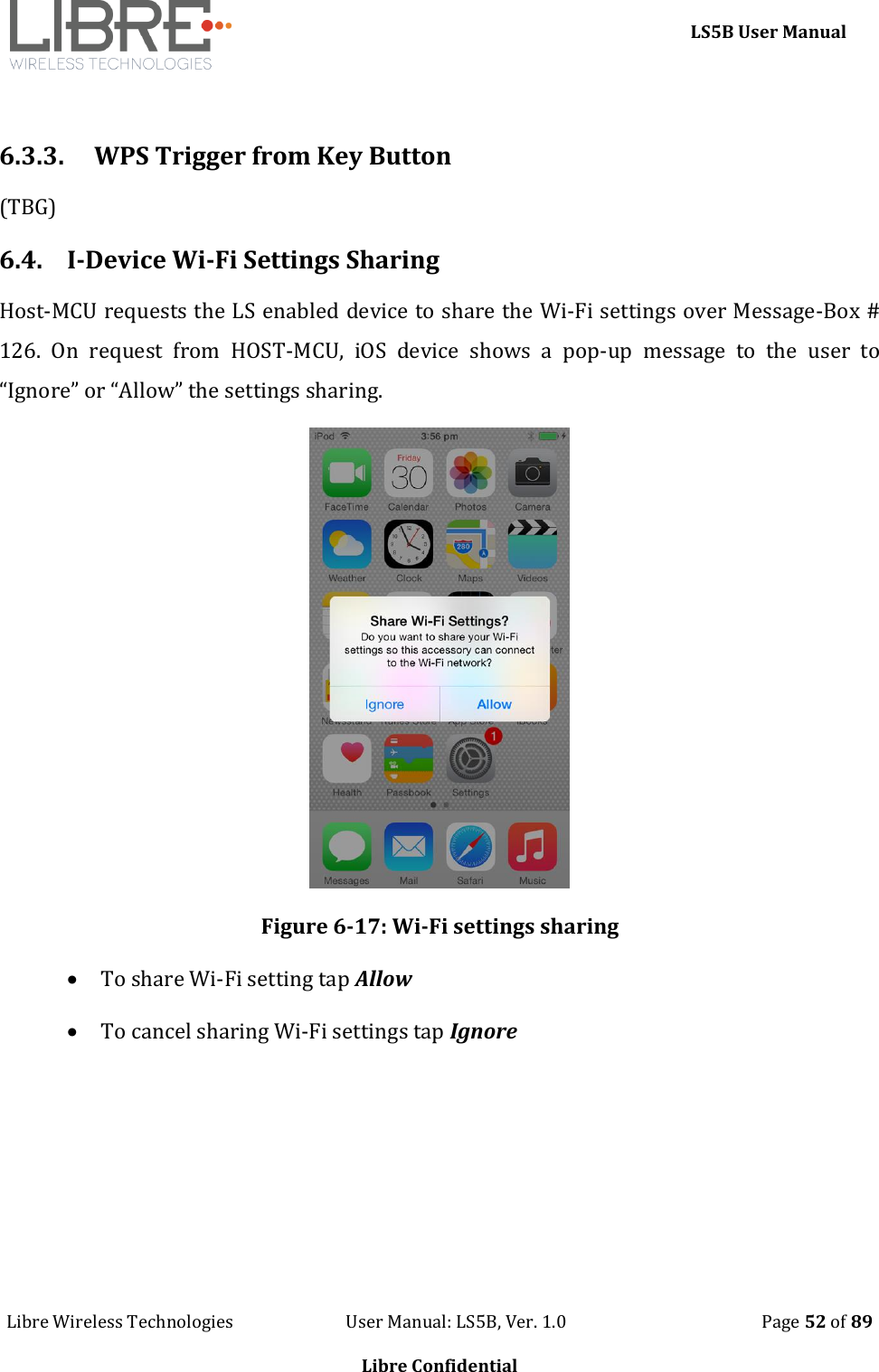
    LS5B User Manual Libre Wireless Technologies                           User Manual: LS5B, Ver. 1.0                                               Page 52 of 89  Libre Confidential  6.3.3. WPS Trigger from Key Button (TBG) 6.4. I-Device Wi-Fi Settings Sharing Host-MCU requests the LS enabled device to share the Wi-Fi settings over Message-Box # 126.  On  request  from  HOST-MCU,  iOS  device  shows  a  pop-up  message  to  the  user  to “Ignore” or “Allow” the settings sharing.  Figure 6-17: Wi-Fi settings sharing  To share Wi-Fi setting tap Allow  To cancel sharing Wi-Fi settings tap Ignore
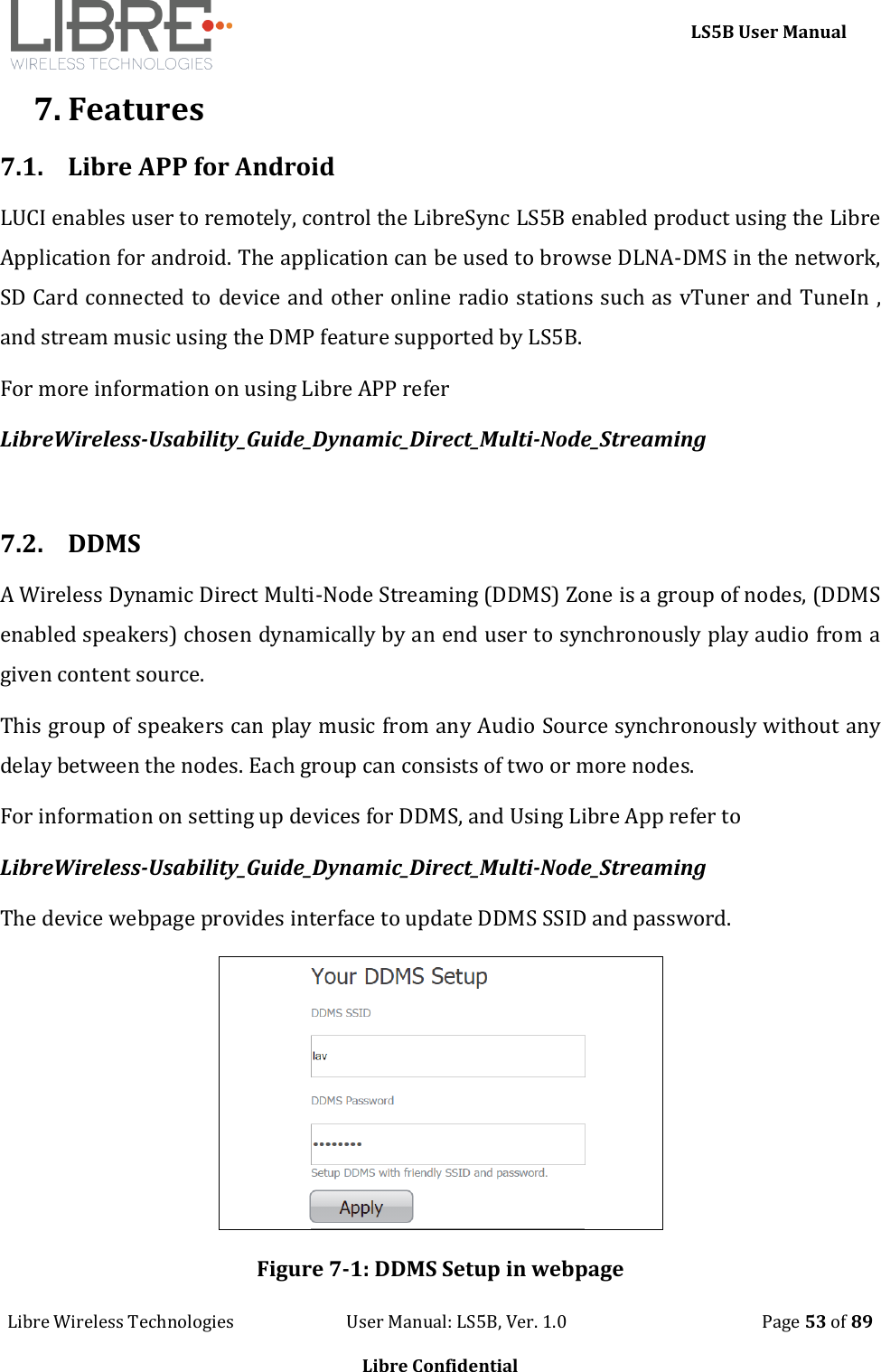
    LS5B User Manual Libre Wireless Technologies                           User Manual: LS5B, Ver. 1.0                                               Page 53 of 89  Libre Confidential 7. Features 7.1. Libre APP for Android LUCI enables user to remotely, control the LibreSync LS5B enabled product using the Libre Application for android. The application can be used to browse DLNA-DMS in the network, SD Card connected to device and other online radio stations such as vTuner and TuneIn , and stream music using the DMP feature supported by LS5B. For more information on using Libre APP refer   LibreWireless-Usability_Guide_Dynamic_Direct_Multi-Node_Streaming  7.2. DDMS A Wireless Dynamic Direct Multi-Node Streaming (DDMS) Zone is a group of nodes, (DDMS enabled speakers) chosen dynamically by an end user to synchronously play audio from a given content source.  This group of speakers can play music from any Audio Source synchronously without any delay between the nodes. Each group can consists of two or more nodes.   For information on setting up devices for DDMS, and Using Libre App refer to  LibreWireless-Usability_Guide_Dynamic_Direct_Multi-Node_Streaming The device webpage provides interface to update DDMS SSID and password.  Figure 7-1: DDMS Setup in webpage
    LS5B User Manual Libre Wireless Technologies                           User Manual: LS5B, Ver. 1.0                                               Page 54 of 89  Libre Confidential 7.3. Software Security LibreSync software is secured using Crypto IC. Crypto IC is embedded either in the LS5B module or the ACP. Crypto IC authenticates and allows only the valid LS5B software to boot on the LS5B modules.  7.4. Source Switching LibreSync  enables  user  to  switch  the  playback  sources  without  any  hitches.  User  can choose to stream music either from AirPlay or UPnP server and the music streams on the selected device from the source. For  example,  A  LS  Device  streaming  AirPlay,  starts  streaming  music  from  DLNA  /  DMR when, the user selects music from Win 7 -Media Player to be played on the device.  7.5. Autosense of Audio CODEC The  new  LS  Firmware  will  automatically  detect  the  presence  of  Audio  CODEC  in  the firmware.   If LS-SoC detects Wolfson CODEC (WN8904) on LS-I2C bus, then LS-Module takes care of controlling the Audio CODEC and is applicable to LS5B EVK.   If Wolfson  CODEC  is not detected, LS-SoC does not  control the  Audio  CODEC. Host MCU must take care of handling AUDIO DAC / CODEC.  7.6. AUX-In Support Users can connect Audio Source to AUX-In jack of EVK and select the source from Libre-APP. 7.7. Airplay® After the speaker or device is configured to the network, it is discovered by the iOS device and iTunes, and is available for AirPlay streaming.
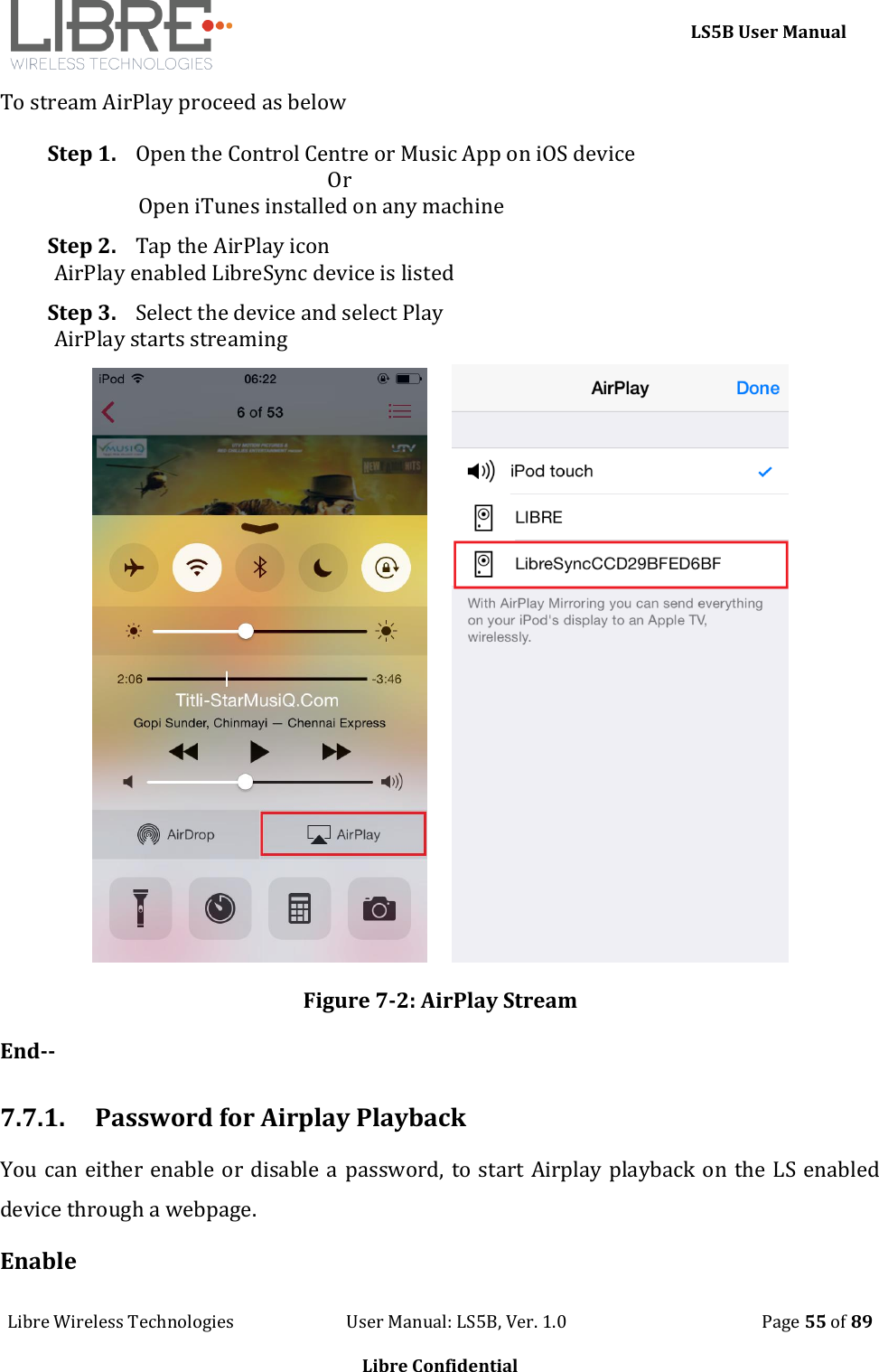
    LS5B User Manual Libre Wireless Technologies                           User Manual: LS5B, Ver. 1.0                                               Page 55 of 89  Libre Confidential To stream AirPlay proceed as below Step 1. Open the Control Centre or Music App on iOS device                                                        Or                  Open iTunes installed on any machine Step 2. Tap the AirPlay icon AirPlay enabled LibreSync device is listed Step 3. Select the device and select Play AirPlay starts streaming          Figure 7-2: AirPlay Stream End--  7.7.1. Password for Airplay Playback You can either enable or disable a password, to start Airplay playback on the LS enabled device through a webpage. Enable
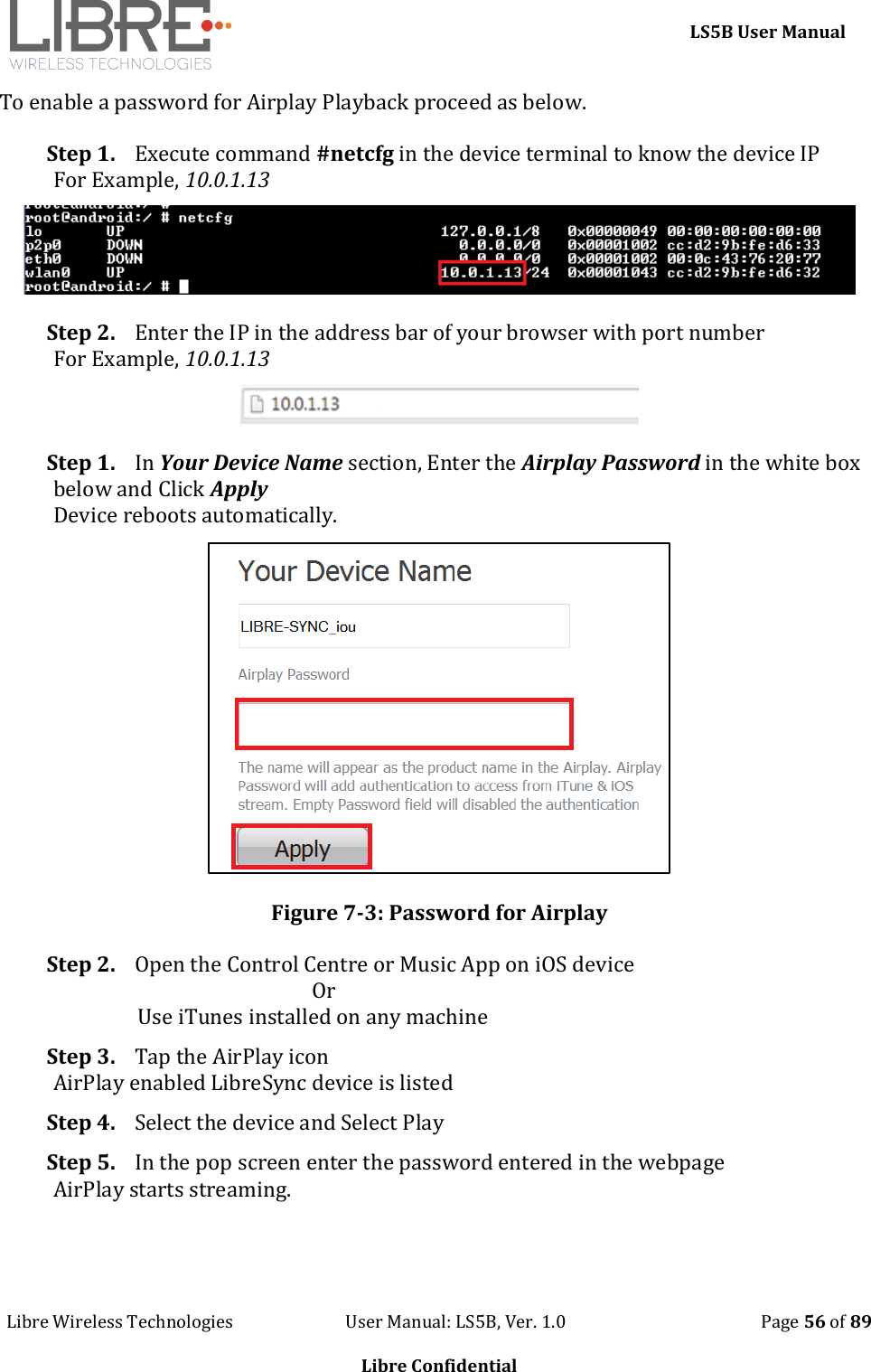
    LS5B User Manual Libre Wireless Technologies                           User Manual: LS5B, Ver. 1.0                                               Page 56 of 89  Libre Confidential To enable a password for Airplay Playback proceed as below. Step 1. Execute command #netcfg in the device terminal to know the device IP For Example, 10.0.1.13  Step 2. Enter the IP in the address bar of your browser with port number For Example, 10.0.1.13  Step 1. In Your Device Name section, Enter the Airplay Password in the white box below and Click Apply Device reboots automatically.  Figure 7-3: Password for Airplay Step 2. Open the Control Centre or Music App on iOS device                                                     Or                  Use iTunes installed on any machine Step 3. Tap the AirPlay icon AirPlay enabled LibreSync device is listed Step 4. Select the device and Select Play Step 5. In the pop screen enter the password entered in the webpage AirPlay starts streaming.
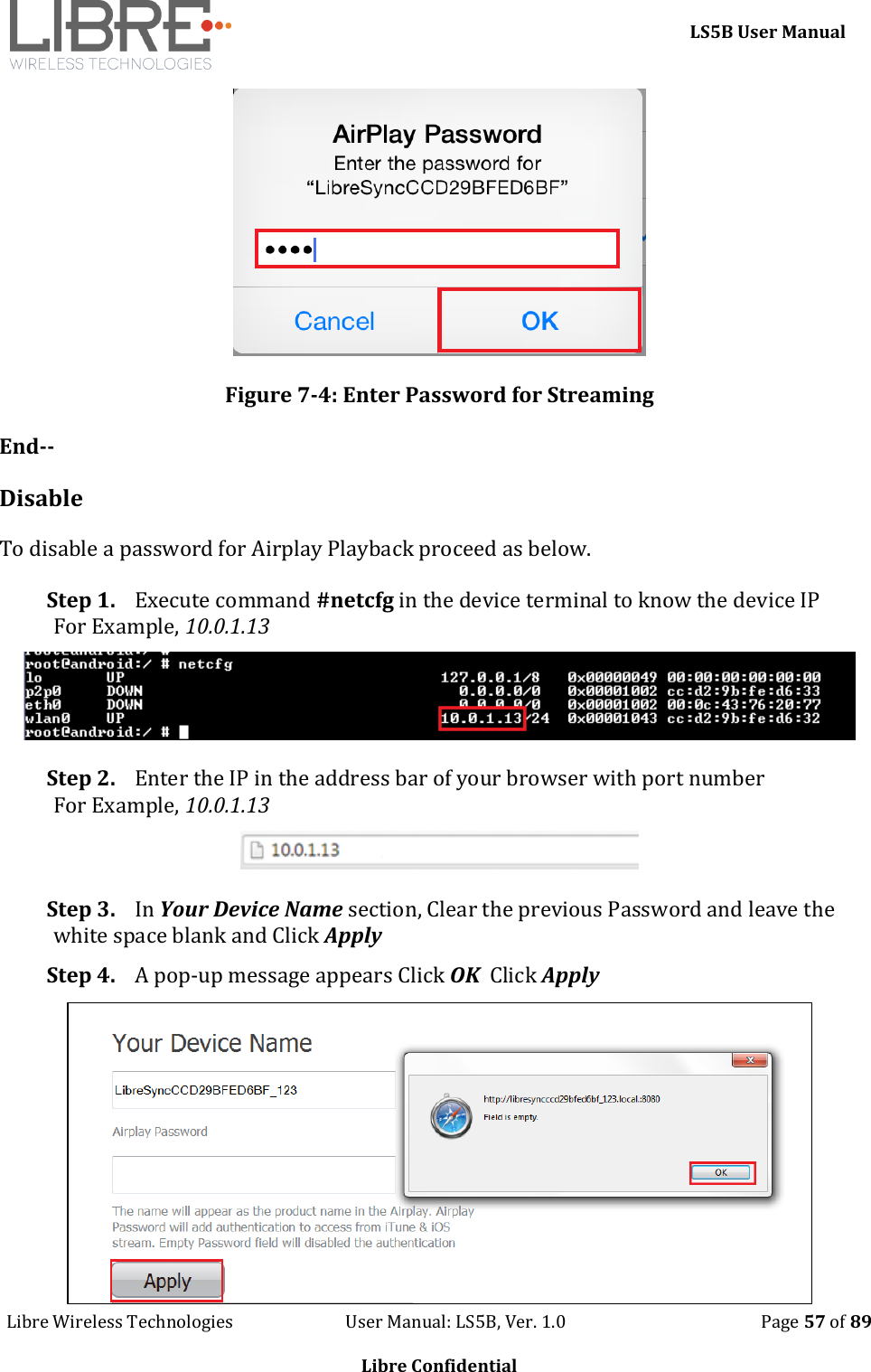
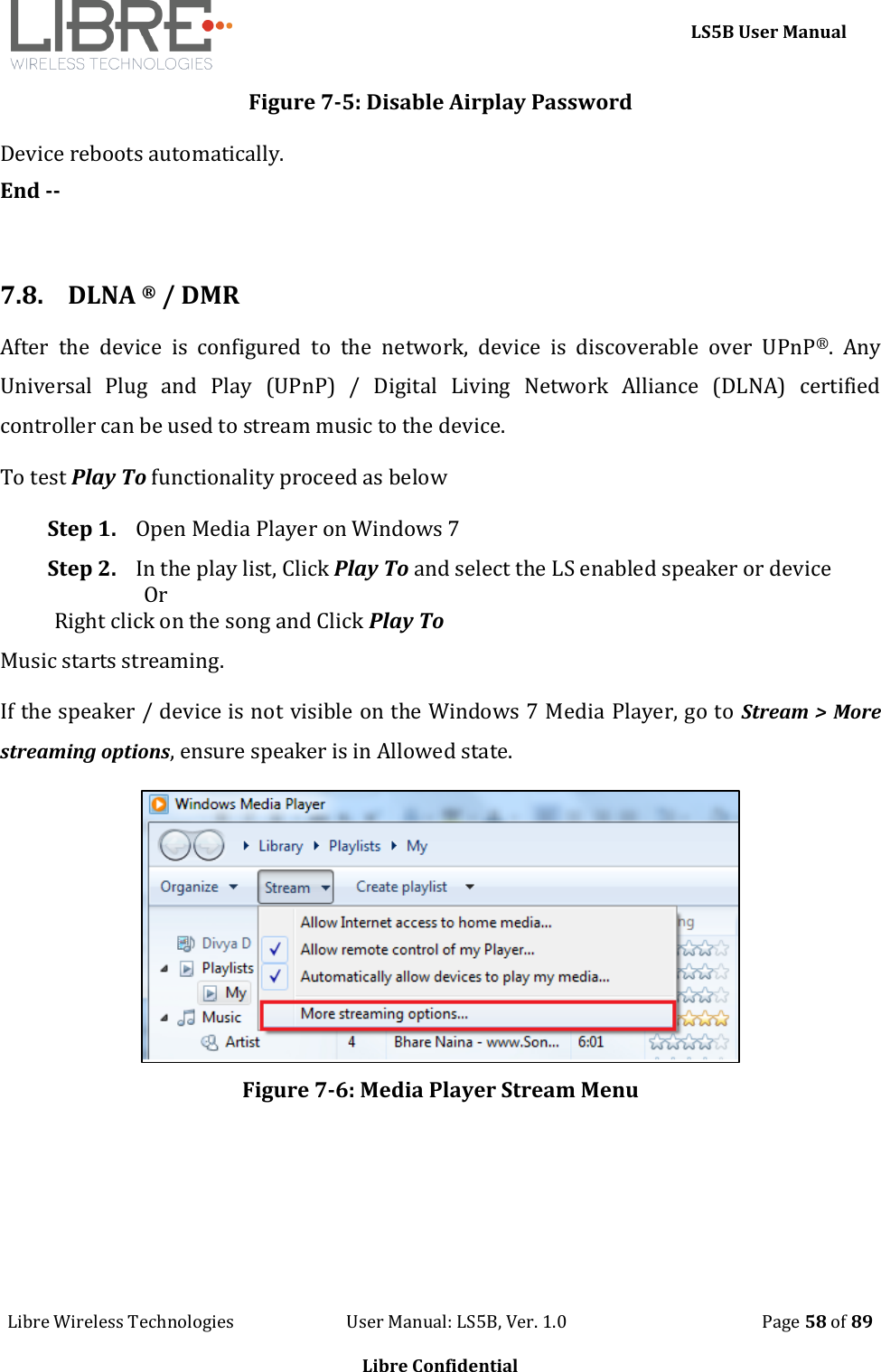
    LS5B User Manual Libre Wireless Technologies                           User Manual: LS5B, Ver. 1.0                                               Page 57 of 89  Libre Confidential  Figure 7-4: Enter Password for Streaming End-- Disable To disable a password for Airplay Playback proceed as below. Step 1. Execute command #netcfg in the device terminal to know the device IP For Example, 10.0.1.13  Step 2. Enter the IP in the address bar of your browser with port number For Example, 10.0.1.13  Step 3. In Your Device Name section, Clear the previous Password and leave the white space blank and Click Apply Step 4. A pop-up message appears Click OK  Click Apply
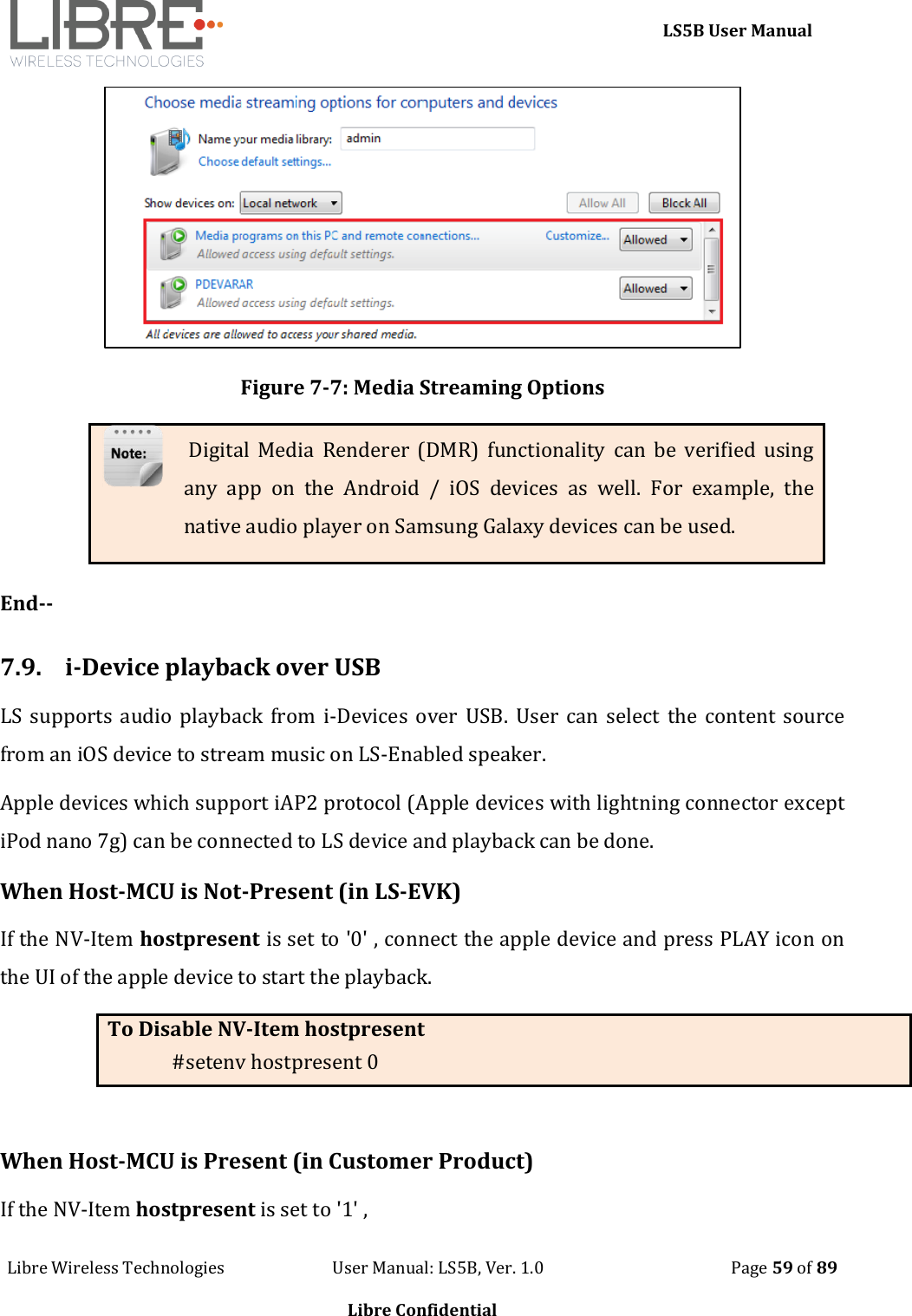
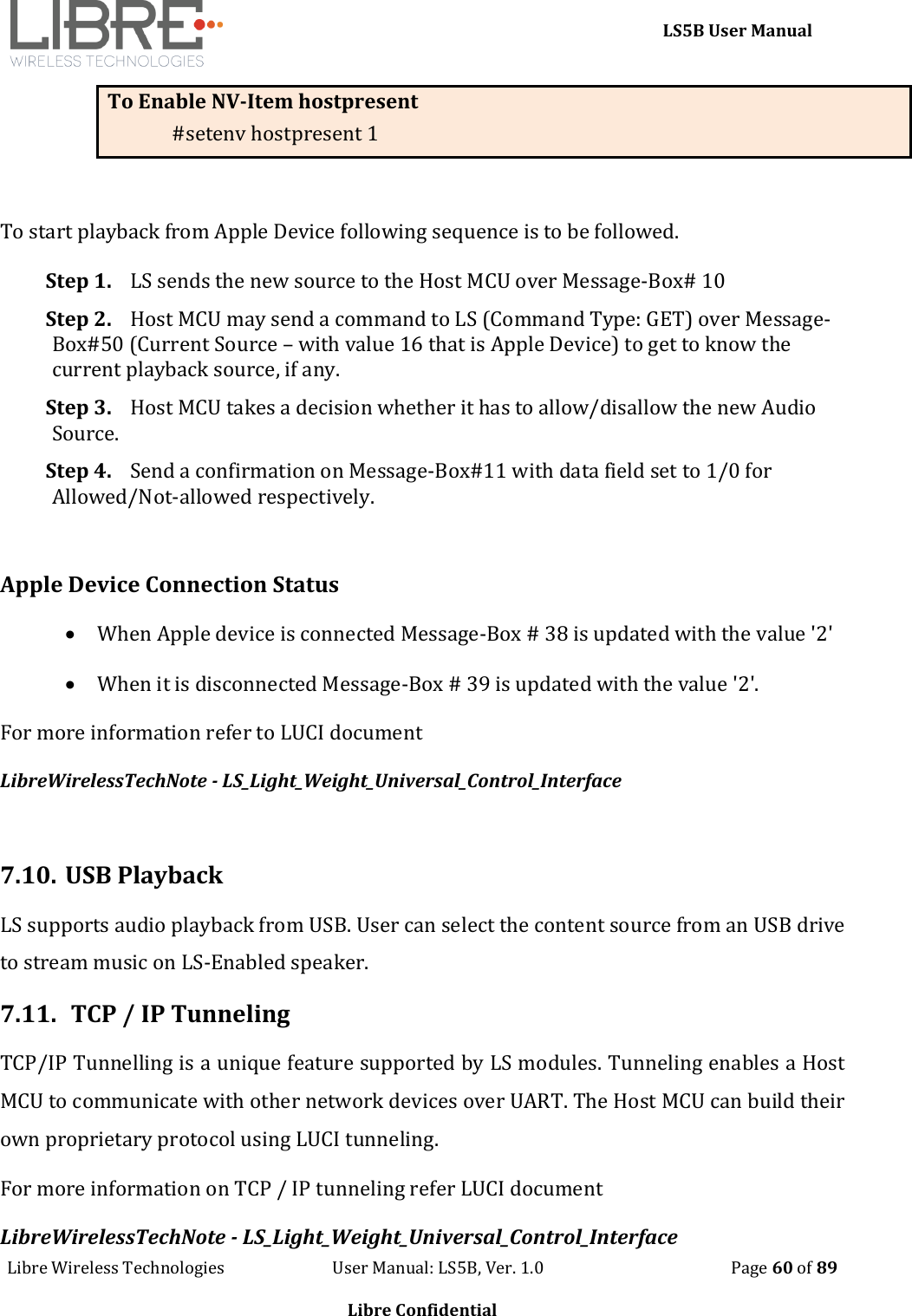
    LS5B User Manual Libre Wireless Technologies                           User Manual: LS5B, Ver. 1.0                                               Page 58 of 89  Libre Confidential Figure 7-5: Disable Airplay Password Device reboots automatically. End --  7.8. DLNA ® / DMR After  the  device  is  configured  to  the  network,  device  is  discoverable  over  UPnP®.  Any Universal  Plug  and  Play  (UPnP)  /  Digital  Living  Network  Alliance  (DLNA)  certified controller can be used to stream music to the device. To test Play To functionality proceed as below Step 1. Open Media Player on Windows 7 Step 2. In the play list, Click Play To and select the LS enabled speaker or device                   Or  Right click on the song and Click Play To Music starts streaming. If the speaker / device is not visible on the Windows 7 Media Player, go to Stream > More streaming options, ensure speaker is in Allowed state.   Figure 7-6: Media Player Stream Menu
    LS5B User Manual Libre Wireless Technologies                           User Manual: LS5B, Ver. 1.0                                               Page 59 of 89  Libre Confidential  Figure 7-7: Media Streaming Options  Digital  Media  Renderer (DMR)  functionality  can  be  verified  using any  app  on  the  Android  /  iOS  devices  as  well.  For  example,  the native audio player on Samsung Galaxy devices can be used.  End--  7.9. i-Device playback over USB LS  supports audio playback from i-Devices over USB.  User can select the  content source from an iOS device to stream music on LS-Enabled speaker. Apple devices which support iAP2 protocol (Apple devices with lightning connector except iPod nano 7g) can be connected to LS device and playback can be done.  When Host-MCU is Not-Present (in LS-EVK) If the NV-Item hostpresent is set to '0' , connect the apple device and press PLAY icon on the UI of the apple device to start the playback.  To Disable NV-Item hostpresent #setenv hostpresent 0  When Host-MCU is Present (in Customer Product) If the NV-Item hostpresent is set to '1' ,
    LS5B User Manual Libre Wireless Technologies                           User Manual: LS5B, Ver. 1.0                                               Page 60 of 89  Libre Confidential To Enable NV-Item hostpresent #setenv hostpresent 1  To start playback from Apple Device following sequence is to be followed. Step 1. LS sends the new source to the Host MCU over Message-Box# 10 Step 2. Host MCU may send a command to LS (Command Type: GET) over Message-Box#50 (Current Source – with value 16 that is Apple Device) to get to know the current playback source, if any. Step 3. Host MCU takes a decision whether it has to allow/disallow the new Audio Source. Step 4. Send a confirmation on Message-Box#11 with data field set to 1/0 for Allowed/Not-allowed respectively.  Apple Device Connection Status  When Apple device is connected Message-Box # 38 is updated with the value '2'  When it is disconnected Message-Box # 39 is updated with the value '2'.  For more information refer to LUCI document  LibreWirelessTechNote - LS_Light_Weight_Universal_Control_Interface  7.10. USB Playback LS supports audio playback from USB. User can select the content source from an USB drive to stream music on LS-Enabled speaker. 7.11.  TCP / IP Tunneling  TCP/IP Tunnelling is a unique feature supported by LS modules. Tunneling enables a Host MCU to communicate with other network devices over UART. The Host MCU can build their own proprietary protocol using LUCI tunneling. For more information on TCP / IP tunneling refer LUCI document  LibreWirelessTechNote - LS_Light_Weight_Universal_Control_Interface
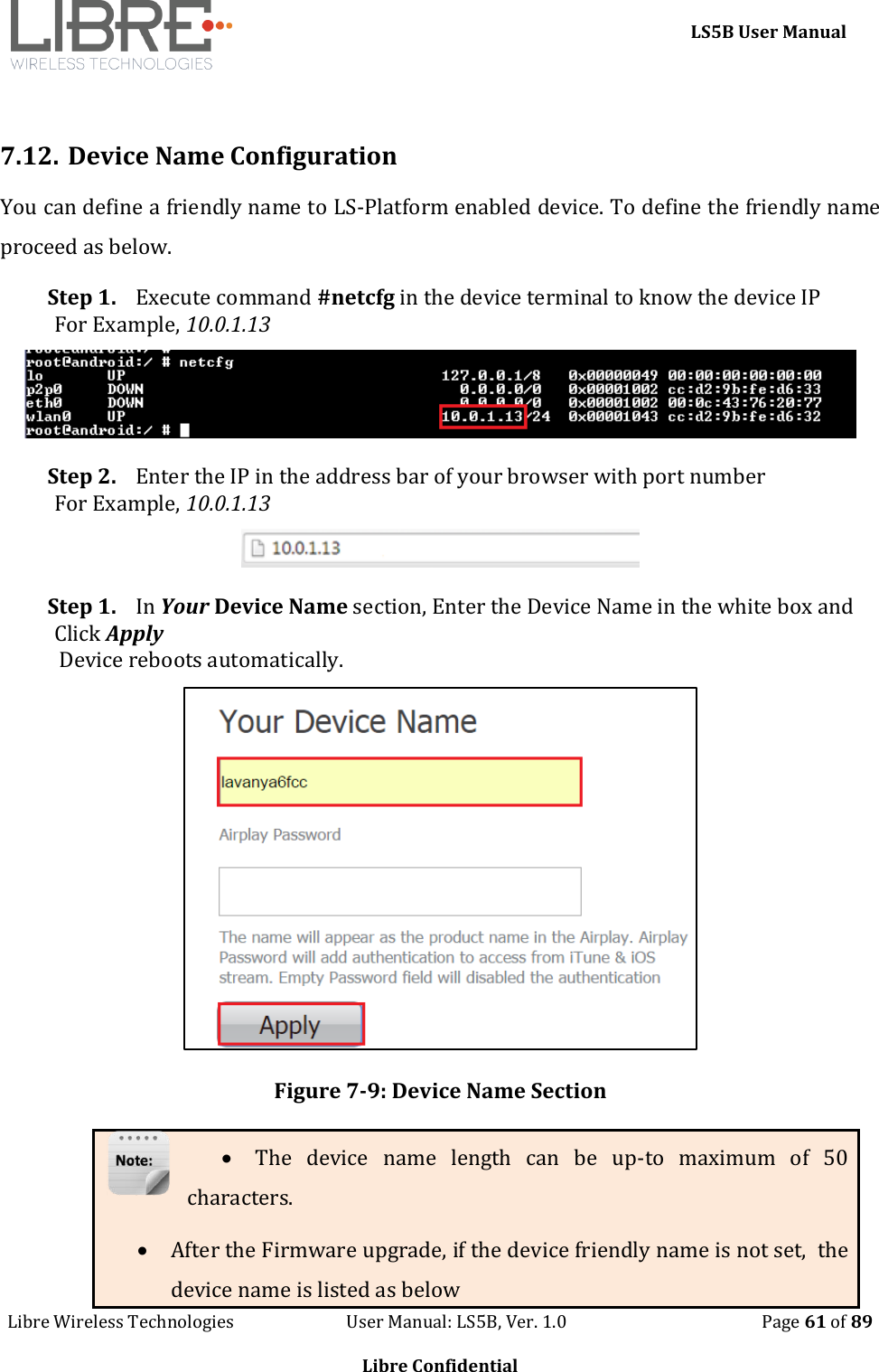
    LS5B User Manual Libre Wireless Technologies                           User Manual: LS5B, Ver. 1.0                                               Page 61 of 89  Libre Confidential  7.12. Device Name Configuration You can define a friendly name to LS-Platform enabled device. To define the friendly name proceed as below. Step 1. Execute command #netcfg in the device terminal to know the device IP For Example, 10.0.1.13  Step 2. Enter the IP in the address bar of your browser with port number For Example, 10.0.1.13  Step 1. In Your Device Name section, Enter the Device Name in the white box and Click Apply  Device reboots automatically.  Figure 7-9: Device Name Section  The  device  name  length  can  be  up-to  maximum  of  50 characters.  After the Firmware upgrade, if the device friendly name is not set,  the device name is listed as below
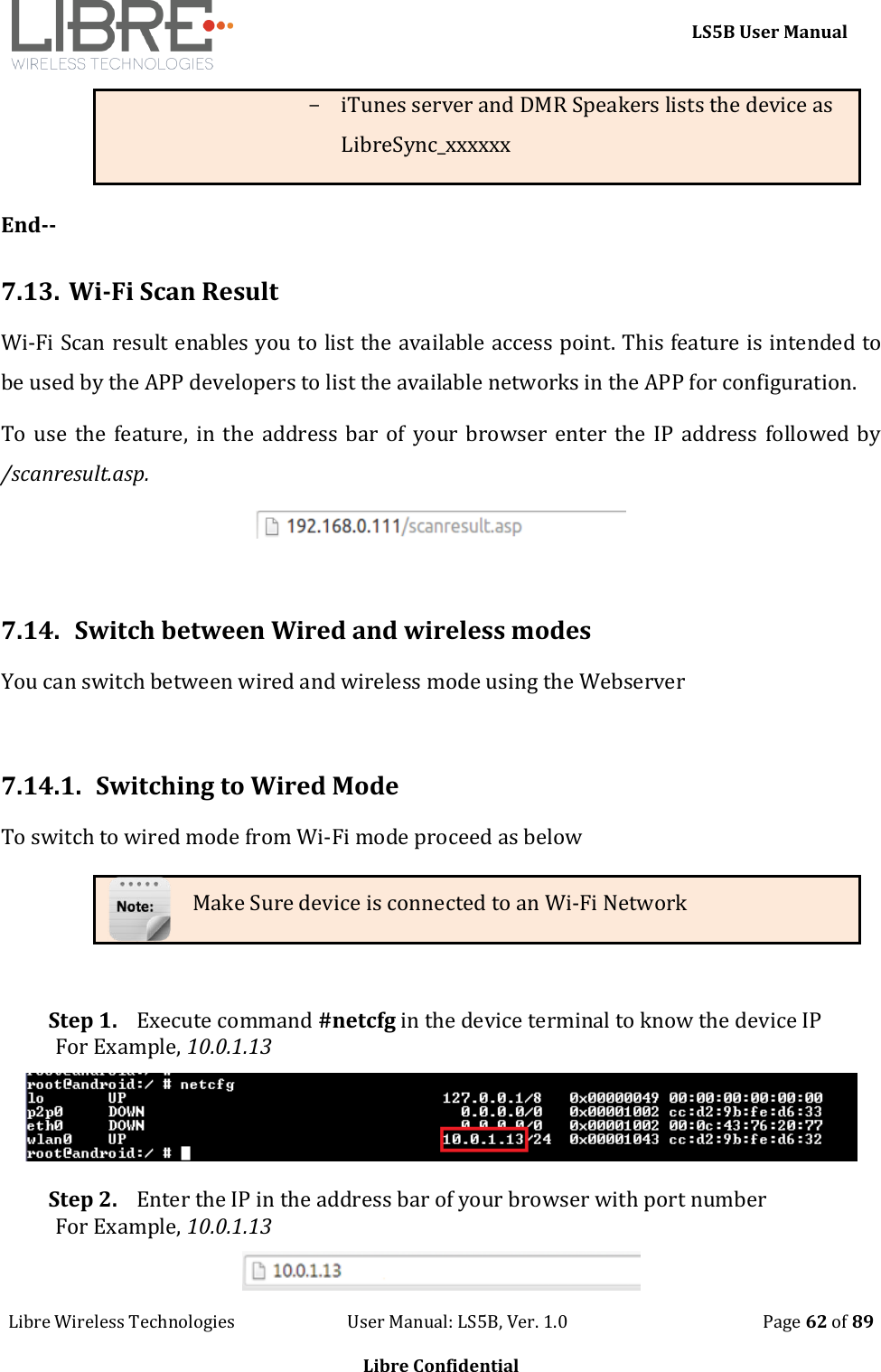
    LS5B User Manual Libre Wireless Technologies                           User Manual: LS5B, Ver. 1.0                                               Page 62 of 89  Libre Confidential - iTunes server and DMR Speakers lists the device as LibreSync_xxxxxx  End--  7.13. Wi-Fi Scan Result Wi-Fi Scan result enables you to list the available access point. This feature is intended to be used by the APP developers to list the available networks in the APP for configuration.  To use  the feature, in  the  address bar  of your browser enter the  IP  address followed  by /scanresult.asp.   7.14.  Switch between Wired and wireless modes  You can switch between wired and wireless mode using the Webserver  7.14.1. Switching to Wired Mode To switch to wired mode from Wi-Fi mode proceed as below Make Sure device is connected to an Wi-Fi Network  Step 1. Execute command #netcfg in the device terminal to know the device IP For Example, 10.0.1.13  Step 2. Enter the IP in the address bar of your browser with port number For Example, 10.0.1.13
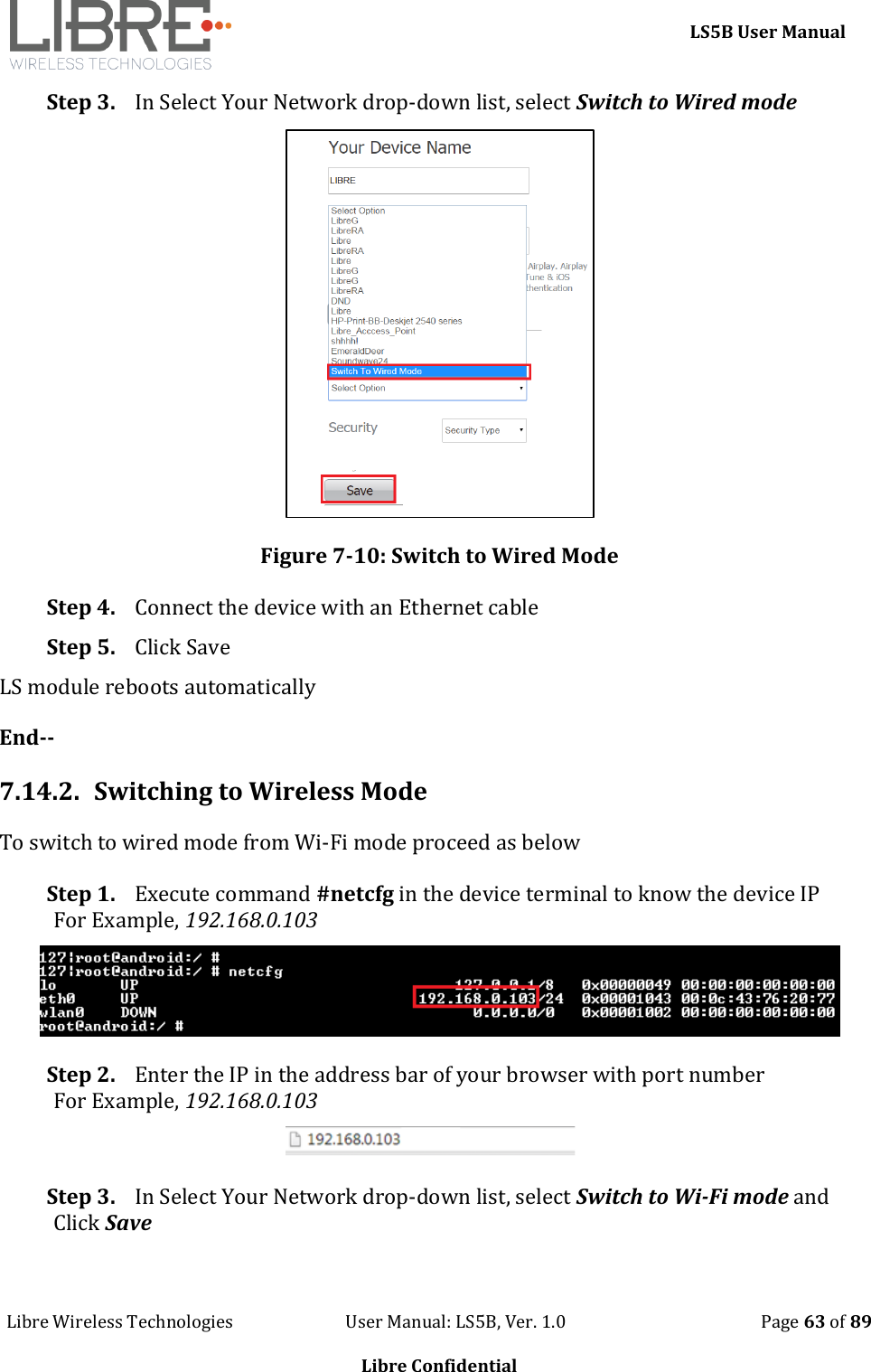
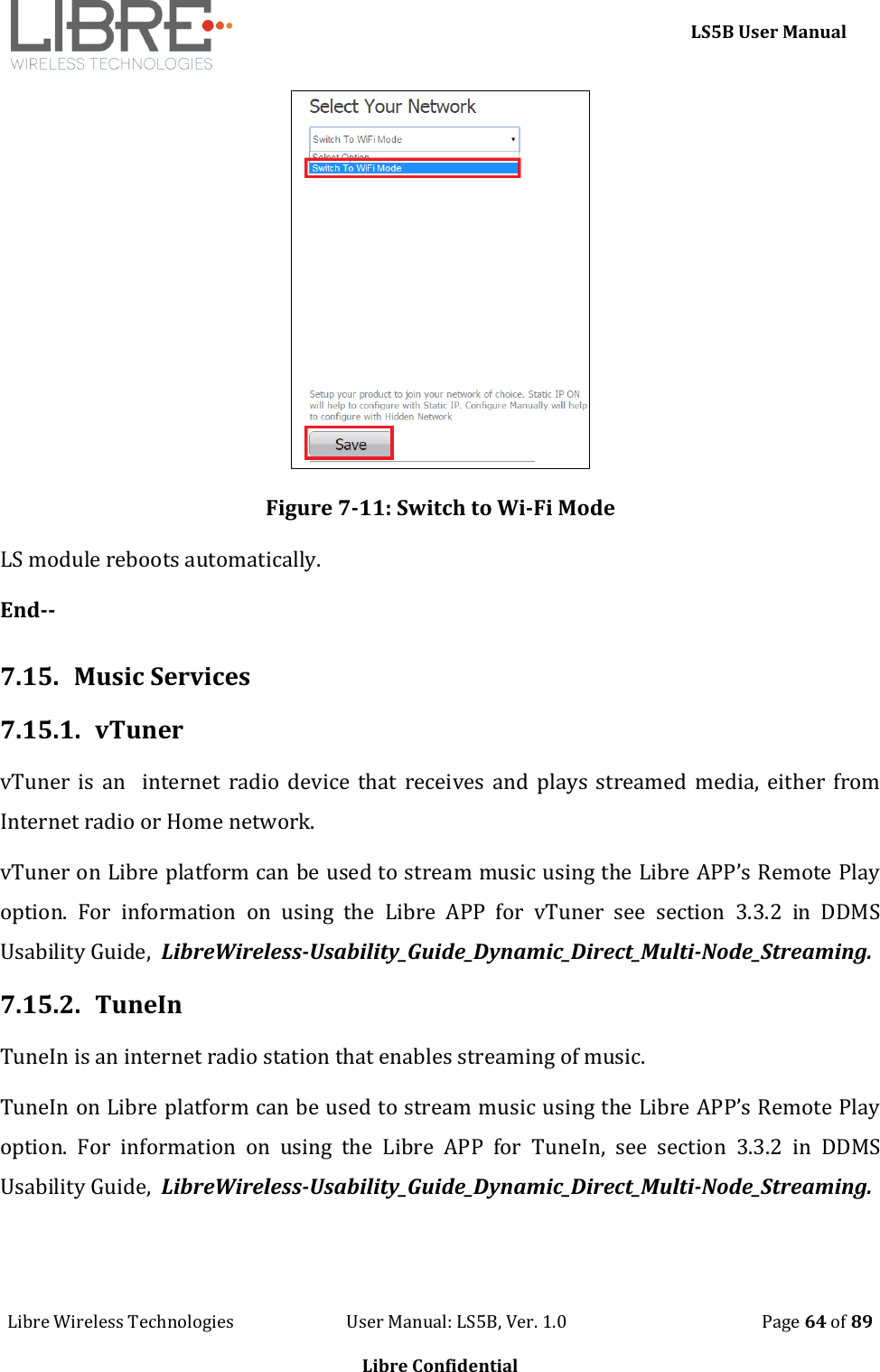
    LS5B User Manual Libre Wireless Technologies                           User Manual: LS5B, Ver. 1.0                                               Page 63 of 89  Libre Confidential Step 3. In Select Your Network drop-down list, select Switch to Wired mode   Figure 7-10: Switch to Wired Mode Step 4. Connect the device with an Ethernet cable Step 5. Click Save LS module reboots automatically End-- 7.14.2. Switching to Wireless Mode To switch to wired mode from Wi-Fi mode proceed as below Step 1. Execute command #netcfg in the device terminal to know the device IP For Example, 192.168.0.103  Step 2. Enter the IP in the address bar of your browser with port number For Example, 192.168.0.103  Step 3. In Select Your Network drop-down list, select Switch to Wi-Fi mode and Click Save
    LS5B User Manual Libre Wireless Technologies                           User Manual: LS5B, Ver. 1.0                                               Page 64 of 89  Libre Confidential  Figure 7-11: Switch to Wi-Fi Mode LS module reboots automatically. End--  7.15.  Music Services 7.15.1. vTuner vTuner is  an   internet  radio device that  receives  and  plays  streamed media, either from Internet radio or Home network. vTuner on Libre platform can be used to stream music using the Libre APP’s Remote Play option.  For  information  on  using  the  Libre  APP  for  vTuner  see  section  3.3.2  in  DDMS Usability Guide,  LibreWireless-Usability_Guide_Dynamic_Direct_Multi-Node_Streaming. 7.15.2. TuneIn TuneIn is an internet radio station that enables streaming of music. TuneIn on Libre platform can be used to stream music using the Libre APP’s Remote Play option.  For  information  on  using  the  Libre  APP  for  TuneIn,  see  section  3.3.2  in  DDMS Usability Guide,  LibreWireless-Usability_Guide_Dynamic_Direct_Multi-Node_Streaming.
    LS5B User Manual Libre Wireless Technologies                           User Manual: LS5B, Ver. 1.0                                               Page 65 of 89  Libre Confidential 7.15.3. QQ Music LibreSync enable you to stream music via QQ music service.  To use the QQ music service Step 1. Register for QQ Music account and get the Username and Password for the account Step 2. Download the QQ Music app from the Play Store. To stream music from QQ Music proceed as below. Step 1. Reboot the LS enabled device and connect to the network. Step 2. Connect Smartphone to the same network. Step 3. Open the QQ Music APP  Figure 7-12: QQ Music APP Step 4. Login to QQ Music, using the Username and Password received, during registration.
    LS5B User Manual Libre Wireless Technologies                           User Manual: LS5B, Ver. 1.0                                               Page 66 of 89  Libre Confidential  Figure 7-13: Login Screen Step 5. Browse for songs in the QQ Music Server Step 6. In Now playing screen, select ‘Q’ symbol  Figure 7-14: Device Selection Option Step 7. Select the LS enabled device
    LS5B User Manual Libre Wireless Technologies                           User Manual: LS5B, Ver. 1.0                                               Page 67 of 89  Libre Confidential  Figure 7-15: Device List Playback from QQ music on the LS enabled device starts. End - -  7.15.4.  Spotify Connect LibreSync enables you to stream music via Spotify connect.  Spotify  on  LS-Enabled  speakers  supports  to  Save  /  Play/  Delete  presets,  for  more information on Spotify Preset Actions refer to Message-Box # 75 in LUCI Document  (LibreWirelessTechNote-LS_Light_Weight_Universal_Control_Interface)  available  in LibreSync Document Portal.  To use the Spotify connect APP proceed as below. Step 1. Register for Spotify premium account and get the Username and Password for the account  Step 2. Download the Spotify app from the App store/Play Store.
    LS5B User Manual Libre Wireless Technologies                           User Manual: LS5B, Ver. 1.0                                               Page 68 of 89  Libre Confidential   The device name is listed as, LibreSync_xxxxxx  In Spotify free account, LS Device will not be listed in the Spotify speaker list. To stream music from Spotify connect proceed as below. Step 1. Reboot the LS enabled device and connect to the network. Step 2. Connect iOS device/Android phone to the same network. Step 3. Open the Spotify APP  Figure 7-16: Spotify APP Step 4. Login to Spotify, using the Username and Password received, during registration.
    LS5B User Manual Libre Wireless Technologies                           User Manual: LS5B, Ver. 1.0                                               Page 69 of 89  Libre Confidential  Figure 7-17: Spotify Login Screen Step 5. Browse for songs in the Spotify Server Step 6. In Now playing screen, select Speaker symbol in right bottom  Figure 7-18: Device Selection Step 7. Select the LS enabled device
    LS5B User Manual Libre Wireless Technologies                           User Manual: LS5B, Ver. 1.0                                               Page 70 of 89  Libre Confidential  Figure 7-19: Device List LS enabled device starts streaming music from Spotify Connect  End --  7.15.5. Deezer Deezer on Libre platform can be used to stream music using the Libre APP’s Remote Play option.  For  information  on  using  the  Libre  APP  for  Deezer  see  section  3.3.2  in  DDMS Usability Guide, LibreWireless-Usability_Guide_Dynamic_Direct_Multi-Node_Streaming.
    LS5B User Manual Libre Wireless Technologies                           User Manual: LS5B, Ver. 1.0                                               Page 71 of 89  Libre Confidential 8. Data Sheet           580MHz MIPS® Core IEEE 802.11 b/g/n 1x1 Wi-Fi  20/40MHz, 150 Mbps  Network Media Module       Product Data Sheet Module : LS5B-N11S  Rev: 1.2
    LS5B User Manual Libre Wireless Technologies                           User Manual: LS5B, Ver. 1.0                                               Page 72 of 89  Libre Confidential   9. Introduction Libre Wireless, LS5B-N11S is a module which includes a 580 MHz MIPS24K CPU core, 64MB of DDR2 DRAM memory and 16MB of Serial Flash, an 802.11n draft compliant 1T1R MAC/BBP/PA/RF, single port 10/100 Ethernet MDI interface, and a USB Host.  The LS5B-N11S, has very few external components required for 2.4GHz 11n wireless products. The LS5B-N11S employs Libre Wireless’s 2nd generation 11n technologies for longer range and better throughput. The embedded high performance CPU can process advanced applications effortlessly, such as WIFI data processing without overloading the host processor. In addition, the LS5B-N11S has rich hardware interfaces (SPI/ I2S/ I2C/ UART/ USB) to enable many possible applications.  10. Module Feature Summary Key Features 1. LS5B-N11S is the small size and low power module for IEEE 802.11b/g/n wireless LAN. 2. Embedded 1T1R 2.4G CMOS RF 3. Embedded 802.11n 1T1R MAC/BBP w/MLD enhancement 4. Support for both PCB connector and Notched SMT pad option 5. 150Mbps PHY data rate 6. 20Mhz/40Mhz channel width 7. Legacy and high throughout modes 8. Compressed block ACK 9. WEP64/128, WPA, WPA2, WAPI engines 10. QOS - WMM, WMM Power Save 11. Hardware frame aggregation 12. Supports   802.11h TPC 13. MIPS 24KEc 580 MHz with 64 KB I-cache/32 KB D-cache
    LS5B User Manual Libre Wireless Technologies                           User Manual: LS5B, Ver. 1.0                                               Page 73 of 89  Libre Confidential 14. 16-bit  DDR2 64Mbytes   15. Serial Flash 16Mbytes  16. 3x UART  17. 1x USB 2.0 HOST 18. SD-XC (Class 10) 19. Single port 10/100 Mbps Fast Ethernet MDI interface 20. Slow speed I/O : GPIO, SPI, I2C, I2S, UART, and JTAG 21. I2S interface supports 24-bit/192kHz (slave mode) 22. I/O: 3.3 V   11. LibreSync Features LibreSync modules have extensive software features for connected media streaming and control applications. These include system level control and interface features as well as networking features.   Please refer to the full “LibreSync Feature List” for details of supported features.    Platform features can vary based on module configuration/derivatives and commercial engagement details.
    LS5B User Manual Libre Wireless Technologies                           User Manual: LS5B, Ver. 1.0                                               Page 74 of 89  Libre Confidential   12. Block Diagram   Figure 4-1: LS5B-N11S Block Diagram
    LS5B User Manual Libre Wireless Technologies                           User Manual: LS5B, Ver. 1.0                                               Page 75 of 89  Libre Confidential  13. Specifications 13.1. General Specification Parameter Description / Values Model LS5B-N11S-A Product Name LibreSync LS5B Network Media Module Chipset MT7688A Standard IEEE802.11b / g /n Data Transfer Rate 1, 2, 5.5, 6, 11, 12, 18, 22, 24, 30, 48, 54, and maximum Physical Layer rate of 150Mbps Frequency Band 2412-2462 MHz  Power 3.3 V ± 5 %   I/O supply voltage Operating Temperature -20˚C to +55˚C Dimensions  47mm X 26.00mm X 5.1mm (L x W x H) ± 0.2mm  13.2. Module Current Consumption Description Typical (mA) Maximum (mA) Idle 180 190 Network Standby TBD TBD Deep Sleep TBD TBD Normal Operating Mode(AirPlay) 200  240 Normal Operating Mode (DDMS) 340 360  The values mentioned in the table is measured at 3.3V rail.
    LS5B User Manual Libre Wireless Technologies                           User Manual: LS5B, Ver. 1.0                                               Page 76 of 89  Libre Confidential 13.3. RF Characteristics   Items IEEE802.11b (11 Mbps mode unless otherwise specified) IEEE802.11g (54 Mbps mode unless otherwise specified) IEEE802.11n (MCS7 mode unless otherwise specified) Mode DSSS / CCK 11 Mbps OFDM 54 Mbps OFDM 135 Mbps Channel Frequency 2412 ~ 2462MHz  2412 ~ 2462MHz  2412 ~ 2462MHz  RX -83dbm -70dbm -65dbm TX Power Level 17.5dbm 15.5dbm 14dbm TX EVM  -27db -30db -31db Normal Conditions Temperature: 25˚C VDD: 3.3 V Temperature: 25˚C VDD: 3.3 V  Temperature: 25˚C VDD: 3.3 V  13.4. Standard Test Conditions The Test for electrical specification shall be performed under the following condition unless otherwise specified.  Ambient Condition  Temperature: 25˚C, ± 5˚C  Humidity: 65 % ± 5% R.H  Power Supply Voltage  3.3V input power at the module.  Current consumption over recommended range of supply voltage and operating conditions is as specified in the Table 5.2. When it is tested, it must be supplied at more than 2 times of maximal current.
    LS5B User Manual Libre Wireless Technologies                           User Manual: LS5B, Ver. 1.0                                               Page 77 of 89  Libre Confidential 14. Mechanical, Connectors and Interfaces 14.1. Physical Module Module Dimension is 47mm x 26.0mm x 5.1mm  Figure 6-1: Physical Dimensions   Figure 6-2: Physical Dimensions  Dimensions are in millimeters  Dimensional tolerance are as shown  Design for 5mm physical Z height clearance (space for shields/clearance)   Bottom shield is not part of standard build option (population option only)
    LS5B User Manual Libre Wireless Technologies                           User Manual: LS5B, Ver. 1.0                                               Page 78 of 89  Libre Confidential 14.2. Connector Layout  TBG Figure 6-5: LS5B-N11S, Connector Layout  14.3. Module Pin Descriptions Description  Function  Module Pin  3.3VD  3.3VD  1 Ground  GND  2 I2C_Clock  I2C_SCK 3 I2C_Data  I2C_SDA 4 WPS GPIO0 5 POWER ON RESET I/P PORST_N 6 UART1_TXD UART_TXD1 7 UART1_RXD UART_RXD1 8 UART2_TXD/GPIO20 UART_TXD2 9 UART2_RXD/GPIO21 UART_RXD2 10 DEBUG-UART TXD UART_TXD0 11 DEBUG-UART RXD UART_RXD0 12 Ground  GND  13 REFCLK_OUT REFLCK_OUT 14 I2S_RXD I2SDI  15 I2S_TXD I2SWDO  16
    LS5B User Manual Libre Wireless Technologies                           User Manual: LS5B, Ver. 1.0                                               Page 79 of 89  Libre Confidential I2S_LRCLK I2SWS  17 I2S BIT CLOCK I2SCLK  18 Ground  GND  19 GPIO GPIO42 20 WLAN ACTIVITY LED/GPIO WLAN_LED 21 GPIO GPIO41 22 GPIO GPIO40 23 Ground  GND  24 USB_DM  USB_D-  25 USB_DP  USB_D+  26 Ground  GND  27 GPIO GPIO6 28 GPIO GPIO39 29 OPTIONAL GPIO/NC GPIO36 30 3.3VD  3.3VD  31 3.3VD  3.3VD  32 Ground GND  33 SPCK SPIS_SPCK/GPIO15 34 MOSI SPIS_MOSI/GPIO17 35 MISO SPIS_MISO/GPIO16 36 SPI-CS (SLAVE CHIPSELECT) SPIS_CS/GPIO14 37 HOST_REQ/GPIO GPIO18 38 Ground GND  39
    LS5B User Manual Libre Wireless Technologies                           User Manual: LS5B, Ver. 1.0                                               Page 80 of 89  Libre Confidential ETH PORT0 RX+ ETH_MDI_RP0 40 ETH PORT0 RX- ETH_MDI_RN0 41 ETH PORT0 TX+ ETH_MDI_TP0 42 ETH PORT0 TX- ETH_MDI_TN0 43 Ground GND  44 SD_WP  SD_WP/GPIO22 45 SD_CD  SD_CD/GPIO23 46 SD_D3  SD_D3/GPIO28 47 SD_D2 SD_D2/GPIO29 48 SD_D1  SD_D1/GPIO24 49 SD_D0  SD_D0/GPIO25 50 SD_CMD  SD_CMD/GPIO27 51 SD_CLK  SD_CLK/GPIO26 52 Ground GND  53 WAC/FACTORY RESTORE GPIO38 54 ETHERNET ACTIVITY LED/GPIO ETH_ACT_LED 55 NO CONNECT NC 56 IR INPUT GPIO19 57 NO CONNECT NC 58 Ground GND  59 NO CONNECT NC 60
    LS5B User Manual Libre Wireless Technologies                           User Manual: LS5B, Ver. 1.0                                               Page 81 of 89  Libre Confidential 15. Design Requirement  Boot strap signals as mentioned in the Table 7-1, should not be driven by external devices until the module (SoC) comes out of reset.  This mandates implementation of appropriate power sequencing mechanism on base-board. That is, there has to be 150ms delay between Supplying power to LS module (SoC) and power to any other device on the base-board.   Table 7-1: Boot Strap Signal Requirement Typically 150 ms is the time taken to come out of the reset after power on of the module (SoC).  Boot Strap Signal Description UART_TXD0 Can be driven logic low but should not be driven logic high. UART_TXD1 Can be driven logic high but should not be driven logic low. GPIO36 Can be driven logic high but should not be driven logic low. I2S_TXD Can be driven logic low but should not be driven logic high.
    LS5B User Manual Libre Wireless Technologies                           User Manual: LS5B, Ver. 1.0                                               Page 82 of 89  Libre Confidential  Figure 7-1: External Reset  Figure 7-2: Power ON Sequence.
    LS5B User Manual Libre Wireless Technologies                           User Manual: LS5B, Ver. 1.0                                               Page 83 of 89  Libre Confidential 16. Ordering Guide Product Number Description LS5B-N11S External antenna, pin header LS5B-N11S-A PCB antenna, pin header LS5B-N11S-S External antenna, SMT LS5B-N11S-AS PCB antenna, SMT  17. Environmental  17.1. Operational Environment 23. Temperature Range  Operation: -20˚C to +55˚C  Storage: 0˚C to +40˚C 24. Humidity  Operation: 10% to 90% (Non Condensing)  Storage: 5% to 95% (Non Condensing) Operating at absolute maximum conditions for extend periods can adversely affect the long-term reliability of the device.  17.2. Storage Conditions 25. Do not use or store modules in the corrosive atmosphere, especially where chloride gas, sulfide gas, acid, alkali, salt or the like are contained. Also, avoid exposure to moisture. 26. Assemble the modules within 6 months. Check the soldering ability in case of longer than 6 months.
    LS5B User Manual Libre Wireless Technologies                           User Manual: LS5B, Ver. 1.0                                               Page 84 of 89  Libre Confidential 18. Reference Schematics 18.1. SD Interface  Figure9-1: SD Card       18.2. Reset and WPS  Figure 9-2: WPS
    LS5B User Manual Libre Wireless Technologies                           User Manual: LS5B, Ver. 1.0                                               Page 85 of 89  Libre Confidential  Figure 9-3: Reset 18.3. UART Interface  Figure 9-4: UART 1   Figure 9-5: UART 2  18.4. USB Interface
    LS5B User Manual Libre Wireless Technologies                           User Manual: LS5B, Ver. 1.0                                               Page 86 of 89  Libre Confidential  Figure 9-6: USB                 18.5. Ethernet Interface
    LS5B User Manual Libre Wireless Technologies                           User Manual: LS5B, Ver. 1.0                                               Page 87 of 89  Libre Confidential Figure 9-7: Ethernet  18.6. Power Supply  Figure 9-8: 9V DC Input  Figure 9-9: 1.8V DC Converter
    LS5B User Manual Libre Wireless Technologies                           User Manual: LS5B, Ver. 1.0                                               Page 88 of 89  Libre Confidential Figure 9-10: 3.3V DC Converter  Figure 9-11: 5V DC Converter       18.7. MFI 2.0C Authentication Circuit
    LS5B User Manual Libre Wireless Technologies                           User Manual: LS5B, Ver. 1.0                                               Page 89 of 89  Libre Confidential Figure 9-12: MFI 2.0C Authentication   19. Disclaimer THE MATERIALS AND INFORMATION ARE PROVIDED “AS IS” WITHOUT WARRANTY OF ANY KIND, EITHER EXPRESS OR IMPLIED, INCLUDING BUT NOT LIMITED TO, THE IMPLIED WARRANTIES OF MERCHANTABILITY, FITNESS FOR A Pas RTICULAR PURPOSE OR NON-INFRINGEMENT. We use reasonable efforts to include accurate and up-to-date information in this document. It does not however, make any representations as its accuracy or completeness of information. Use of this document is at your own risk. Libre Wireless Technologies, its suppliers, and other parties involved in creating and delivering this document’s contents shall not be liable for any special, indirect, incidental, or consequential damages, including without limitation, lost revenues or lost profits.

Navigation menu