MOBINTEL KPAU03 Smart Phone User Manual

MOBINTEL PTY LTD Smart Phone

User manual

 1      User Manual
 2Directory 1 Install......................................................................................................................................... 2 1.1 Battery charging ............................................................................................................ 2 2 Use and Maintenance ................................................................................................................ 3  Thank you for using the mobilephone; it’s the world's premiere, Provide you the high quality of mobile communication and entertainment enjoy.               This  user  guilds  specially  used  to  guide  you  understand  the  mobilephone  function  and characteristic.  Please read the instruction file first Before you use this mobilephone, please read all the safety cautions in the instructions in detail, to ensure safety and correct use.  The descriptions are based on the default settings   The pictures and screen shots may different from the actual product.  Receive and send message, upload and download, automatic synchronism or GPRS service may cause other kinds of fee. If you want to avoid the extra fee, choose the probable charging plan. Any relevant information, please contact the service supplier.  To the unknown software, be careful when install, the strange website pop up when browsing the internet, you can click but better to avoid the operation or the mobilephone will be poisoned.  Please properly keep this instruction book for the future reference.  Mobile phone parts diagram   1 Install 1.1  Battery charging  When using the mobilephone at the first time, need to charge for the mobilephone, can use charger or connect the phone with the computer via data cable.  The  mobilephone  will issue  warning tone and display  electricity shortage  information when low battery, the battery icon will turn red, moreover, the mobilephone will turn off automatically  when  electricity  is  too  low.  Need  to  charge  then  you  can  use  the mobilephone.  If  the  battery  is  power  off,  can't  turn  on  the  phone  immediately  even  connect  to  the charger, before you turn on the phone, please charge for several minutes.
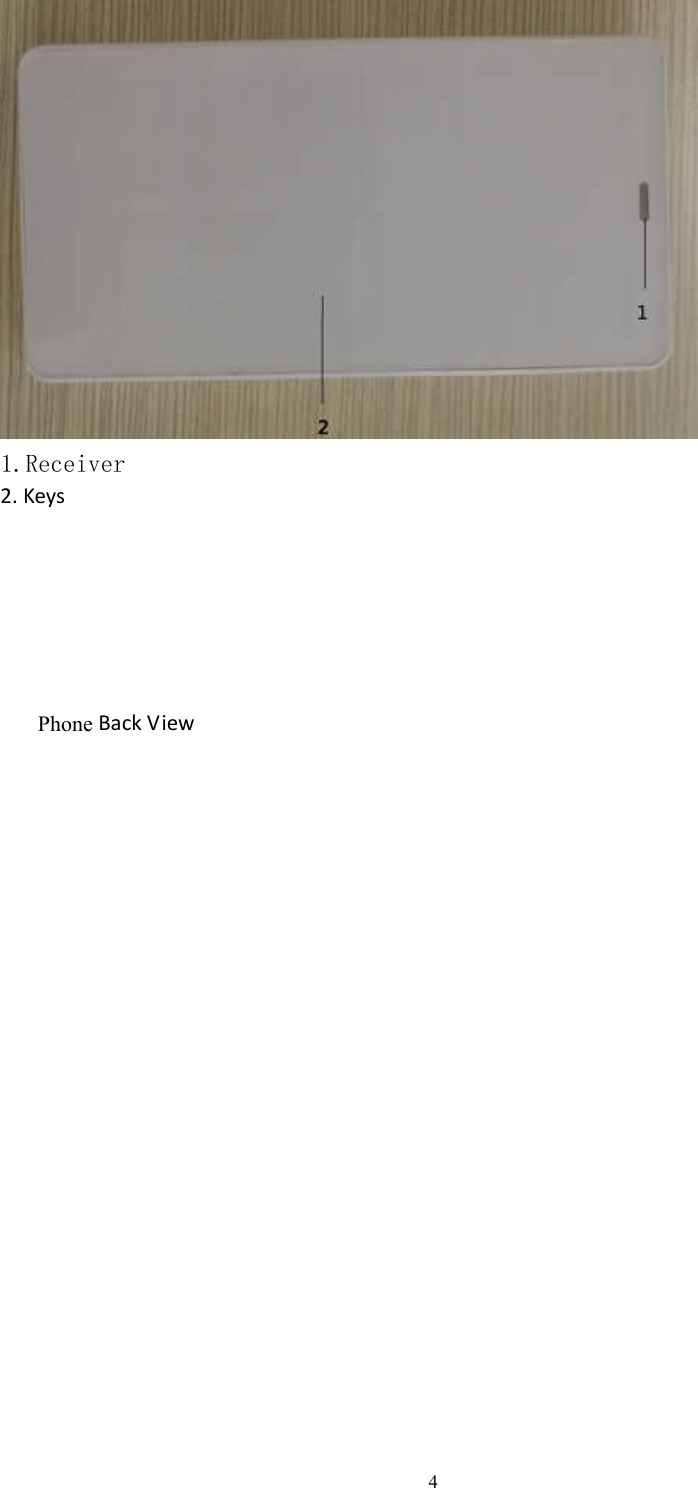
 3 When charging with the charger,  Please put the small end plug of the charger into the mobilephone in the multi-function socket, put the big end into the standard power socket, be  attention  the  improper  charger  connection  will  lead  to  serious  damage  to  the mobilephone, to the damage caused by misoperation, will not guarantee to repair.  Can use the mobilephone when charging, but thus will influence the charging time of the mobilephone, the phone may get hot when charging, this is normal phenomenon, do not affect the using life and performance.  When the batteries get full electricity (battery icon doesn’t move), please disconnect the charger and the mobilephone, and take down the charger from the socket. Do not take off the battery when charging, this might damage the mobilephone.    Reduce battery loss If  launched  automatic  synchronization,  bluetooth  functon  in  the  background,  the  battery  will consumes faster. If  you want  to  save  electricity,  please  shut  down  unnecessary  application.  You can also reduce background light time and the brightness of the display screen, or press the power off key to switch over to sleep patterns.        Other functions 1, SIM card application: this will be differ per your operators 2, Search: shortcut of search engine 2 Use and Maintenance  Far from any liquid, do not put your mobilephone    in water, raining or expose in any wet places.  Far from extreme cold or hot,  avoid expose the mobilephone in below 10℃  or above 45  ℃.  Far  from  dust  and  dirt,  do  not  put  mobilephone  in  dust,  dirt,  sandy,  food  and  other improper physical environment.  Please  use  dry  and  soft  cloth  to  clear  mobile,  do  not  use  alcohol  or  other  kinds  of cleanser  Use carefully and prevent mobile from falling.     Phone Front View:
 4 1.Receiver 2. Keys       Phone Back View
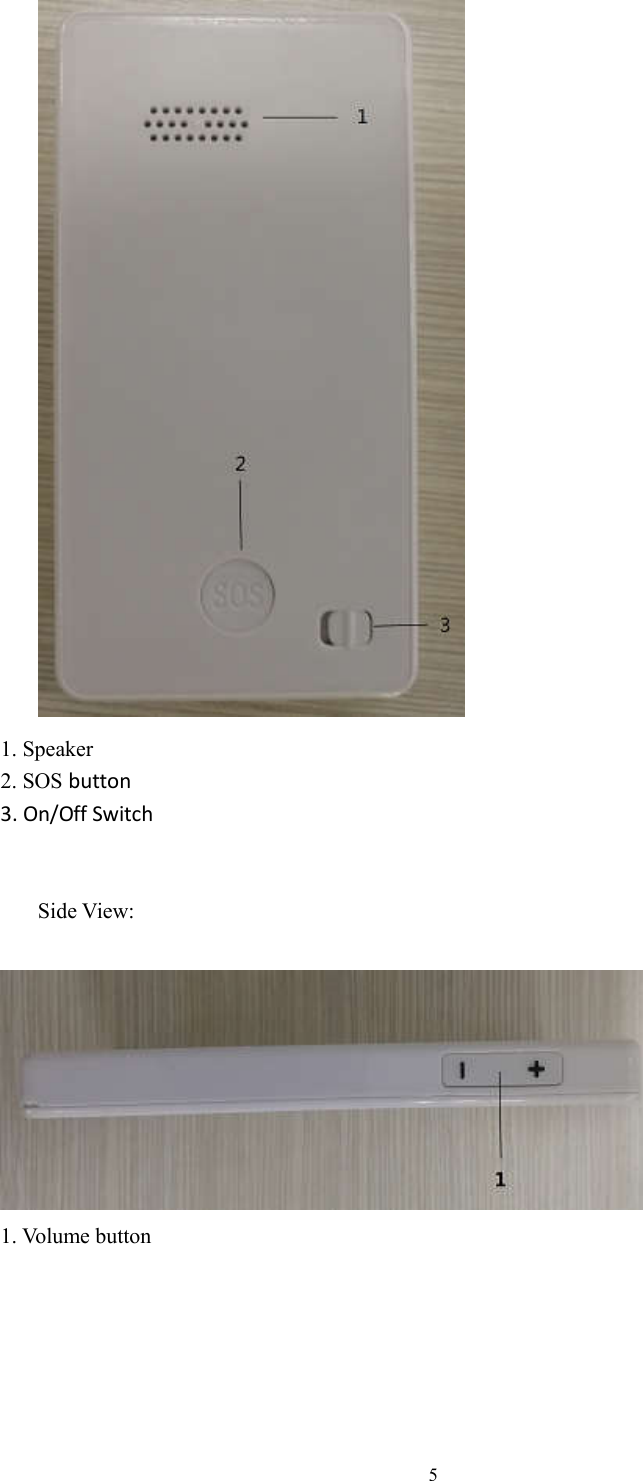
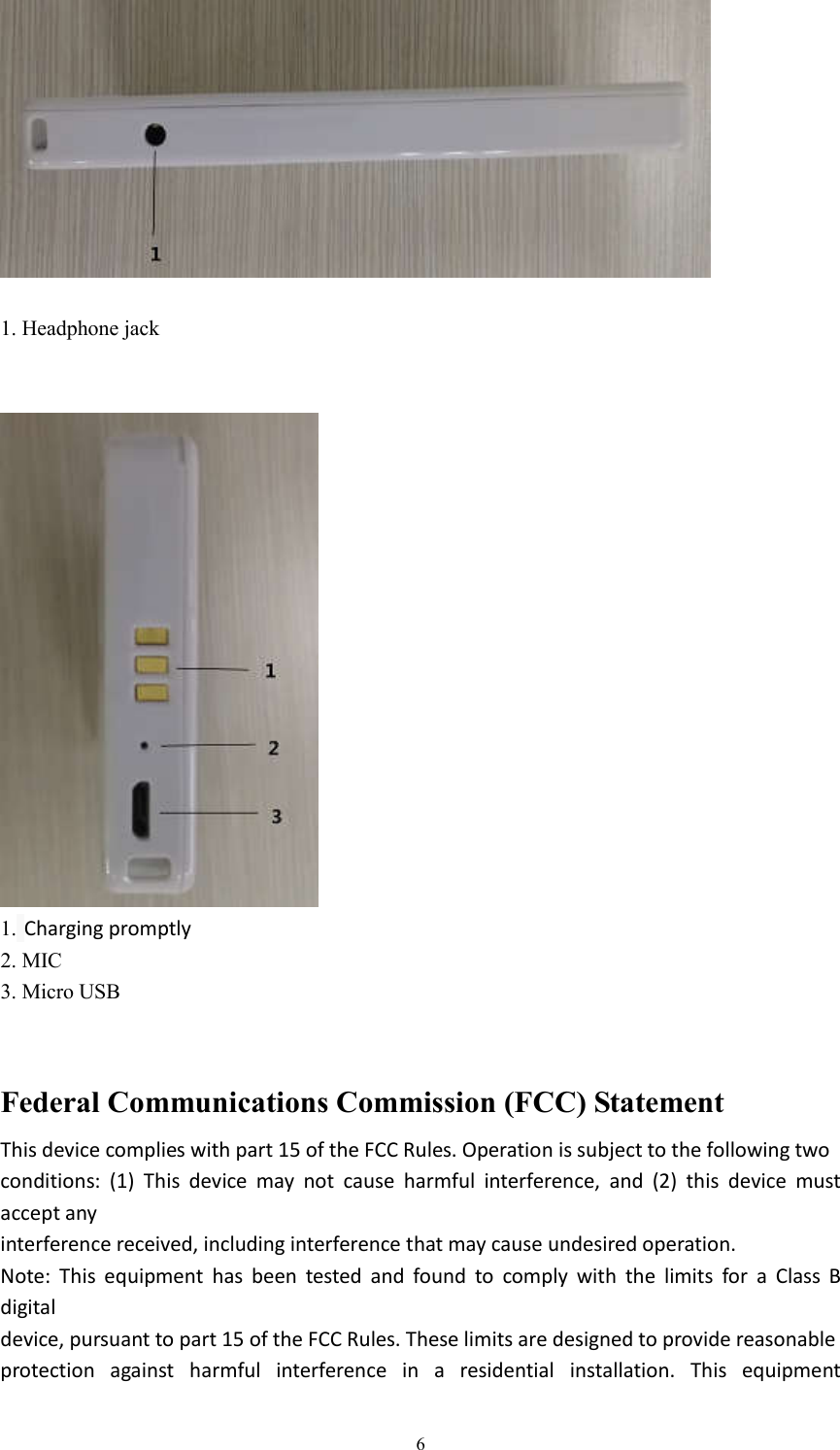
 5 1. Speaker 2. SOS button 3. On/Off Switch   Side View:   1. Volume button
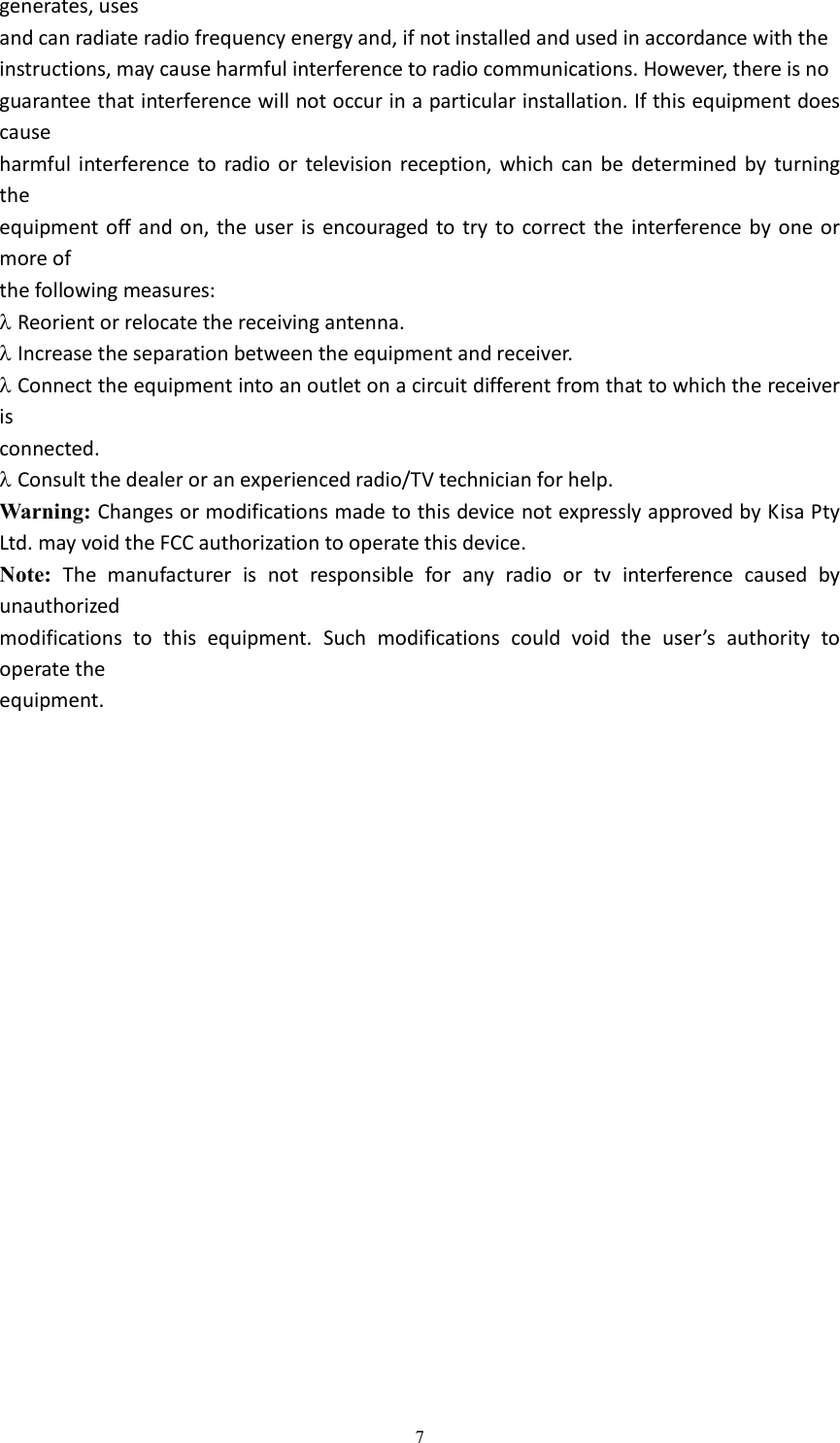
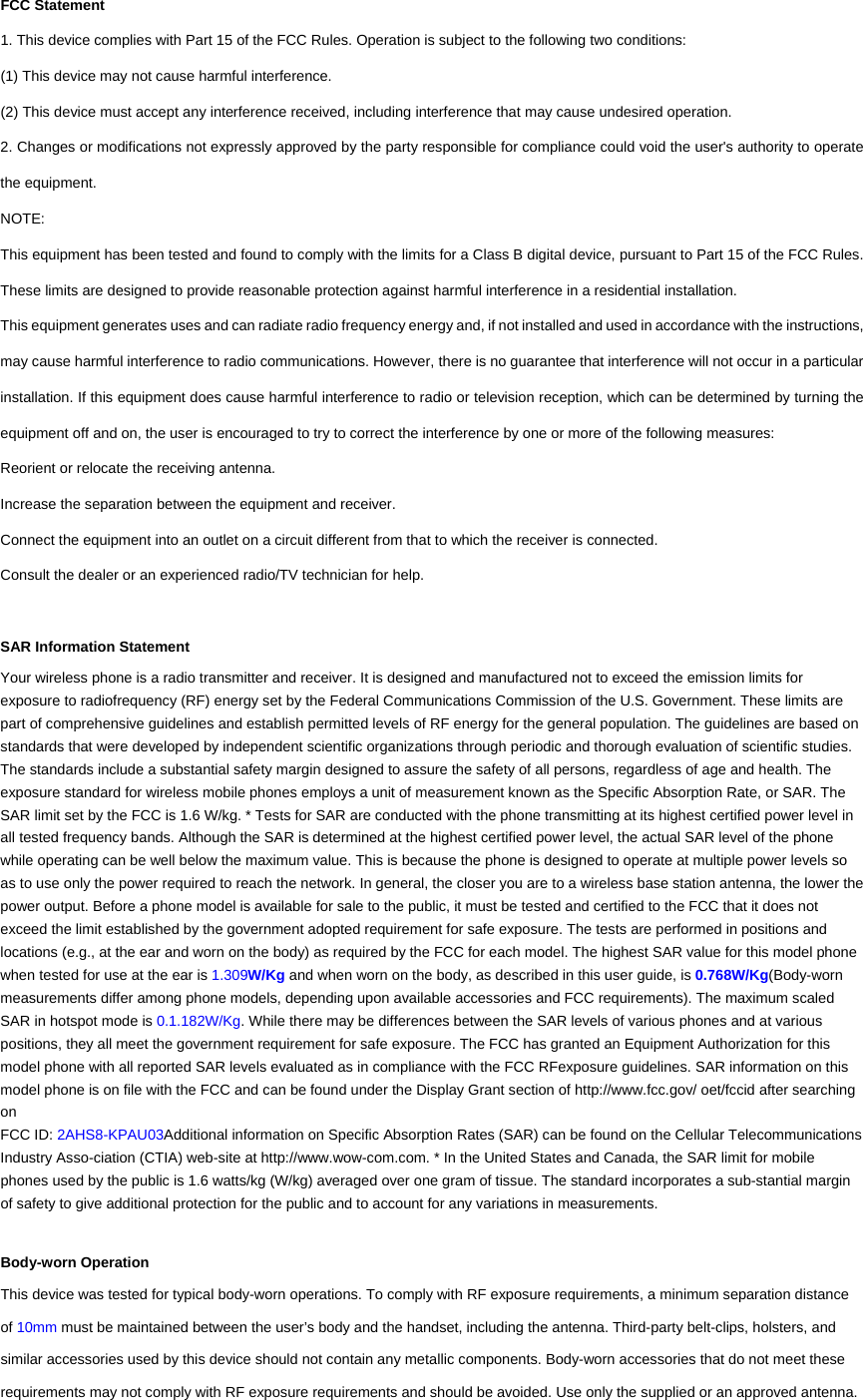
 6  1. Headphone jack    1. Charging promptly 2. MIC 3. Micro USB   Federal Communications Commission (FCC) Statement This device complies with part 15 of the FCC Rules. Operation is subject to the following two conditions:  (1)  This  device  may  not  cause  harmful  interference,  and  (2)  this  device  must accept any interference received, including interference that may cause undesired operation. Note:  This  equipment  has  been  tested  and  found  to  comply  with  the  limits  for  a  Class  B digital device, pursuant to part 15 of the FCC Rules. These limits are designed to provide reasonable protection  against  harmful  interference  in  a  residential  installation.  This  equipment
 7generates, uses and can radiate radio frequency energy and, if not installed and used in accordance with the instructions, may cause harmful interference to radio communications. However, there is no guarantee that interference will not occur in a particular installation. If this equipment does cause harmful interference  to  radio or  television reception,  which  can be  determined  by  turning the equipment off  and  on, the user  is encouraged to  try to  correct the interference by one  or more of the following measures:  Reorient or relocate the receiving antenna.  Increase the separation between the equipment and receiver.  Connect the equipment into an outlet on a circuit different from that to which the receiver is connected.  Consult the dealer or an experienced radio/TV technician for help. Warning: Changes or modifications made to this device not expressly approved by Kisa Pty Ltd. may void the FCC authorization to operate this device. Note:  The  manufacturer  is  not  responsible  for  any  radio  or  tv  interference  caused  by unauthorized modifications  to  this  equipment.  Such  modifications  could  void  the  user’s  authority  to operate the equipment.
FCC Statement 1. This device complies with Part 15 of the FCC Rules. Operation is subject to the following two conditions: (1) This device may not cause harmful interference. (2) This device must accept any interference received, including interference that may cause undesired operation. 2. Changes or modifications not expressly approved by the party responsible for compliance could void the user's authority to operate the equipment. NOTE:  This equipment has been tested and found to comply with the limits for a Class B digital device, pursuant to Part 15 of the FCC Rules. These limits are designed to provide reasonable protection against harmful interference in a residential installation. This equipment generates uses and can radiate radio frequency energy and, if not installed and used in accordance with the instructions, may cause harmful interference to radio communications. However, there is no guarantee that interference will not occur in a particular installation. If this equipment does cause harmful interference to radio or television reception, which can be determined by turning the equipment off and on, the user is encouraged to try to correct the interference by one or more of the following measures: Reorient or relocate the receiving antenna. Increase the separation between the equipment and receiver. Connect the equipment into an outlet on a circuit different from that to which the receiver is connected.   Consult the dealer or an experienced radio/TV technician for help.  SAR Information Statement Your wireless phone is a radio transmitter and receiver. It is designed and manufactured not to exceed the emission limits for exposure to radiofrequency (RF) energy set by the Federal Communications Commission of the U.S. Government. These limits are part of comprehensive guidelines and establish permitted levels of RF energy for the general population. The guidelines are based on standards that were developed by independent scientific organizations through periodic and thorough evaluation of scientific studies. The standards include a substantial safety margin designed to assure the safety of all persons, regardless of age and health. The exposure standard for wireless mobile phones employs a unit of measurement known as the Specific Absorption Rate, or SAR. The SAR limit set by the FCC is 1.6 W/kg. * Tests for SAR are conducted with the phone transmitting at its highest certified power level in all tested frequency bands. Although the SAR is determined at the highest certified power level, the actual SAR level of the phone while operating can be well below the maximum value. This is because the phone is designed to operate at multiple power levels so as to use only the power required to reach the network. In general, the closer you are to a wireless base station antenna, the lower the power output. Before a phone model is available for sale to the public, it must be tested and certified to the FCC that it does not exceed the limit established by the government adopted requirement for safe exposure. The tests are performed in positions and locations (e.g., at the ear and worn on the body) as required by the FCC for each model. The highest SAR value for this model phone when tested for use at the ear is 1.309W/Kg and when worn on the body, as described in this user guide, is 0.768W/Kg(Body-worn measurements differ among phone models, depending upon available accessories and FCC requirements). The maximum scaled SAR in hotspot mode is 0.1.182W/Kg. While there may be differences between the SAR levels of various phones and at various positions, they all meet the government requirement for safe exposure. The FCC has granted an Equipment Authorization for this model phone with all reported SAR levels evaluated as in compliance with the FCC RFexposure guidelines. SAR information on this model phone is on file with the FCC and can be found under the Display Grant section of http://www.fcc.gov/ oet/fccid after searching on  FCC ID: 2AHS8-KPAU03Additional information on Specific Absorption Rates (SAR) can be found on the Cellular Telecommunications Industry Asso-ciation (CTIA) web-site at http://www.wow-com.com. * In the United States and Canada, the SAR limit for mobile phones used by the public is 1.6 watts/kg (W/kg) averaged over one gram of tissue. The standard incorporates a sub-stantial margin of safety to give additional protection for the public and to account for any variations in measurements.  Body-worn Operation This device was tested for typical body-worn operations. To comply with RF exposure requirements, a minimum separation distance of 10mm must be maintained between the user’s body and the handset, including the antenna. Third-party belt-clips, holsters, and similar accessories used by this device should not contain any metallic components. Body-worn accessories that do not meet these requirements may not comply with RF exposure requirements and should be avoided. Use only the supplied or an approved antenna.

Navigation menu