MicroRidge Systems RM2 2.4GHz Radio Module User Manual Micro RM24 Users Guide Ver 1 2 4

MicroRidge Systems, Inc. 2.4GHz Radio Module Micro RM24 Users Guide Ver 1 2 4

Users Manual

All rights reserved. No parts of this work may be reproduced in any form or by any means - graphic, electronic, ormechanical, including photocopying, recording, taping, or information storage and retrieval systems - without the writtenpermission of the publisher.Products that are referred to in this document may be either trademarks and/or registered trademarks of the respectiveowners. The publisher and the author make no claim to these trademarks.While every precaution has been taken in the preparation of this document, the publisher and the author assume noresponsibility for errors or omissions, or for damages resulting from the use of information contained in this document orfrom the use of programs and source code that may accompany it. In no event shall the publisher and the author be liablefor any loss of profit or any other commercial damage caused or alleged to have been caused directly or indirectly by thisdocument.Version: 1.2.4Printed: Friday, October 31, 2014 at 10:02 AM in Sunriver, Oregon.MicroRidge 2.4 GHz Radio ModuleCopyright © 2014 MicroRidge Systems, Inc.
IContentsCopyright © 2014 MicroRidge Systems, Inc.MicroRidge 2.4 GHz Radio ModuleVersion 1.2.4Table of ContentsChapter 1 1...................................................................................................................................IntroductionChapter 2 3...................................................................................................................................FeaturesChapter 3 4...................................................................................................................................Releated DocumentsChapter 4 5...................................................................................................................................Specifications...................................................................................................................................Atmel Documentation 5...................................................................................................................................Dimensions 7...................................................................................................................................Pin Configuration 10...................................................................................................................................Soldering 12Chapter 5 13...................................................................................................................................Application Board DesignChapter 6 15...................................................................................................................................Ordering InformationChapter 7 16...................................................................................................................................Radio CertificationChapter 8 18...................................................................................................................................Contact MicroRidgeChapter 9 19...................................................................................................................................Revision History
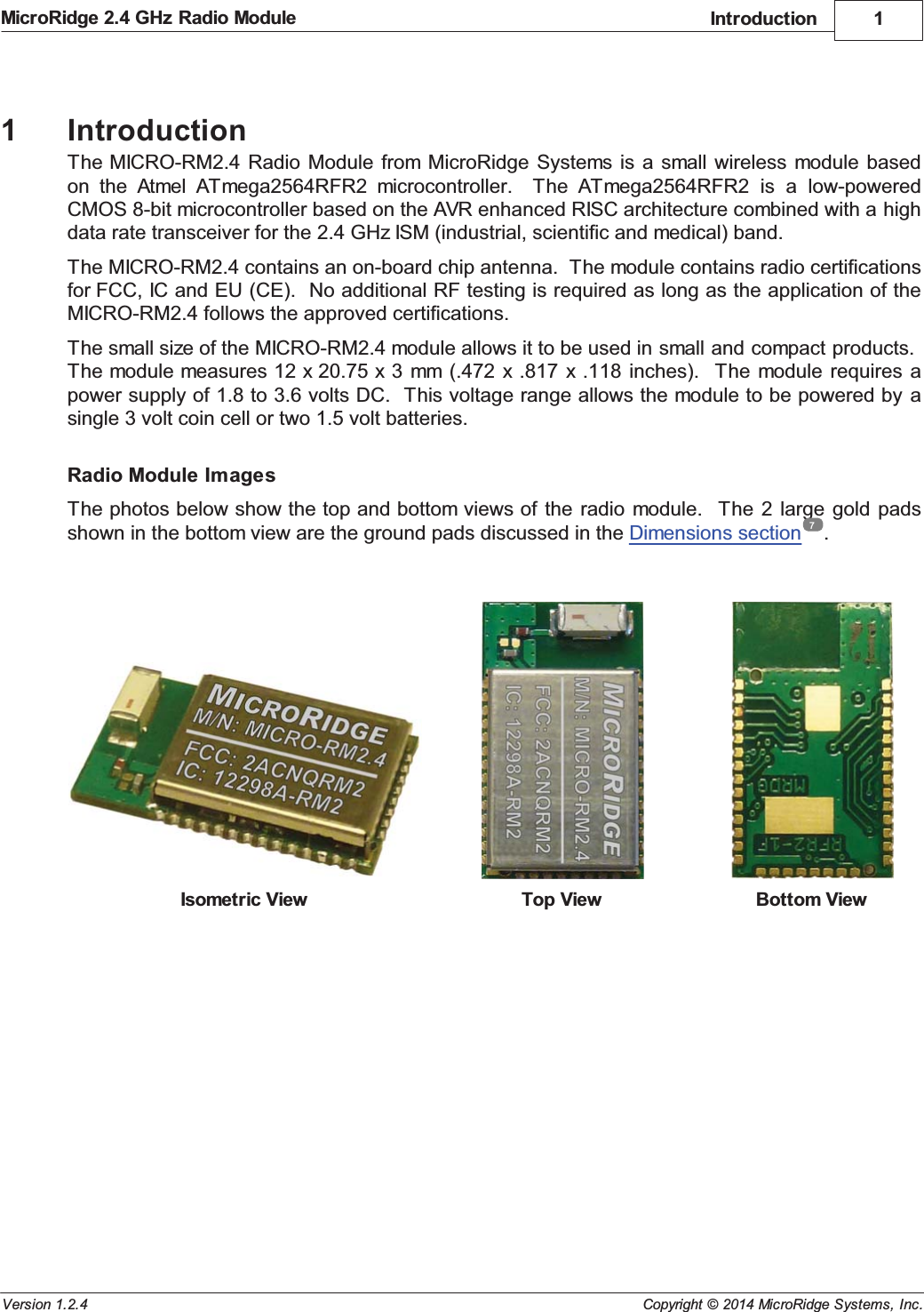
Introduction 1Copyright © 2014 MicroRidge Systems, Inc.MicroRidge 2.4 GHz Radio ModuleVersion 1.2.41IntroductionThe MICRO-RM2.4  Radio Module  from MicroRidge Systems is  a  small wireless  module  basedon  the  Atmel  ATmega2564RFR2  microcontroller.    The  ATmega2564RFR2  is  a  low-poweredCMOS 8-bit microcontroller based on the AVR enhanced RISC architecture combined with a highdata rate transceiver for the 2.4 GHz ISM (industrial, scientific and medical) band.The MICRO-RM2.4 contains an on-board chip antenna.  The module contains radio certificationsfor FCC, IC and EU (CE).  No additional RF testing is required as long as the application of theMICRO-RM2.4 follows the approved certifications.The small size of the MICRO-RM2.4 module allows it to be used in small and compact products. The module measures 12 x 20.75 x 3 mm (.472 x .817  x .118  inches).   The module requires  apower supply of 1.8 to 3.6 volts DC.  This voltage range allows the module to be powered by  asingle 3 volt coin cell or two 1.5 volt batteries.Radio Module ImagesThe photos below show the top and bottom views of  the radio  module.   The  2  large gold  padsshown in the bottom view are the ground pads discussed in the Dimensions section .Isometric View Top View Bottom View7
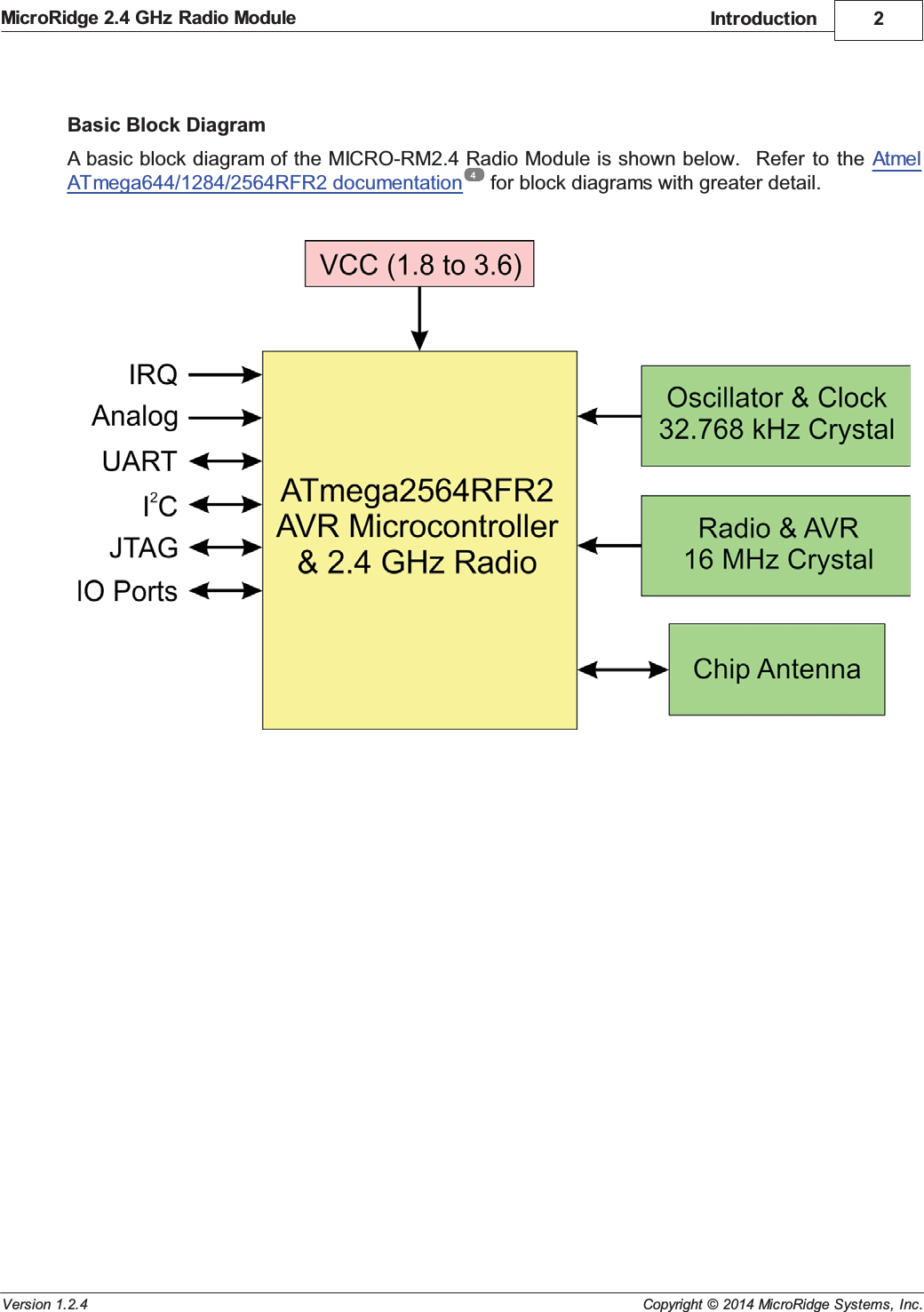
Introduction 2Copyright © 2014 MicroRidge Systems, Inc.MicroRidge 2.4 GHz Radio ModuleVersion 1.2.4Basic Block DiagramA basic block diagram of the MICRO-RM2.4 Radio Module is shown below.    Refer to  the AtmelATmega644/1284/2564RFR2 documentation  for block diagrams with greater detail.4
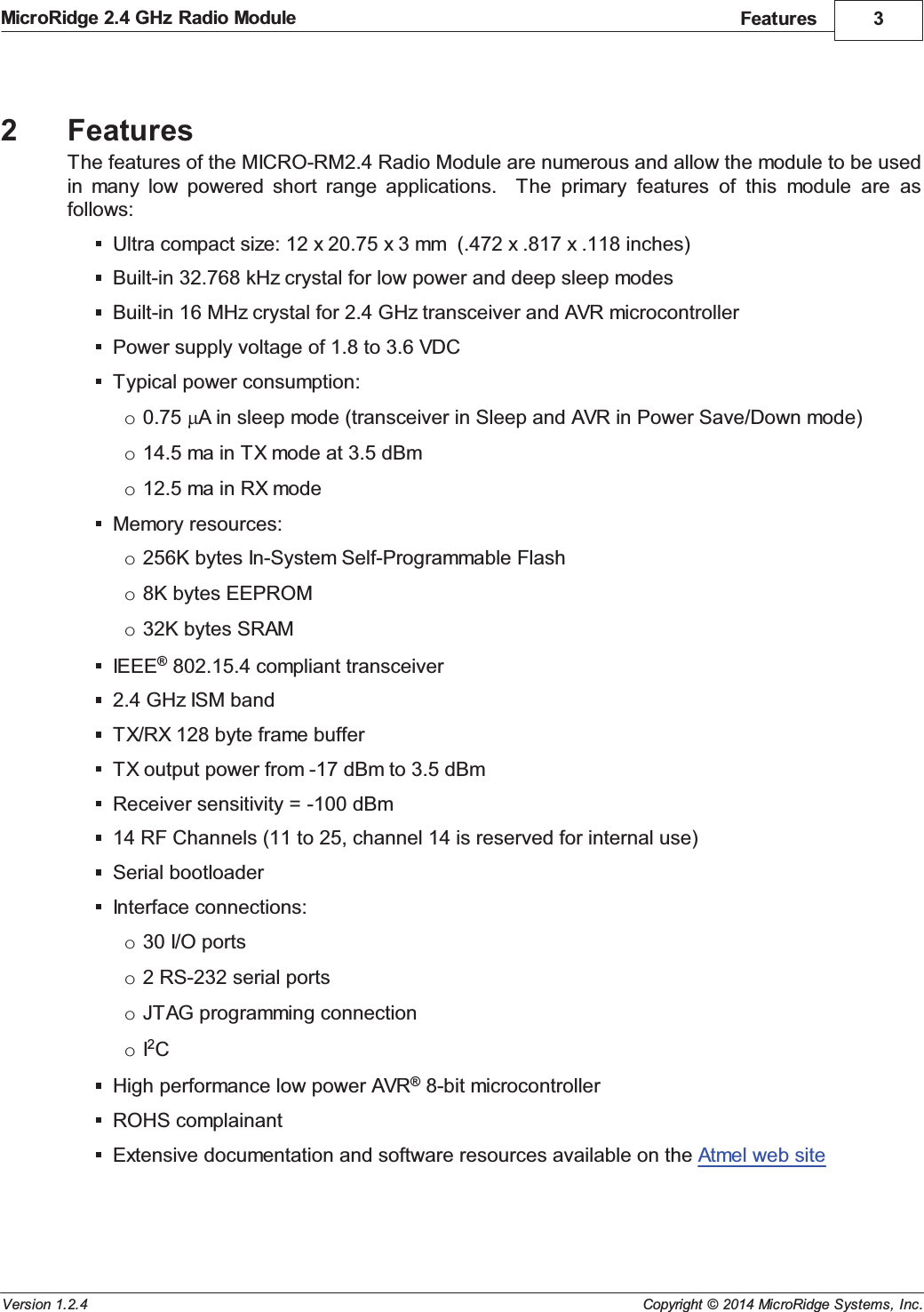
Features 3Copyright © 2014 MicroRidge Systems, Inc.MicroRidge 2.4 GHz Radio ModuleVersion 1.2.42FeaturesThe features of the MICRO-RM2.4 Radio Module are numerous and allow the module to be usedin  many  low  powered  short  range  applications.    The  primary  features  of  this  module  are  asfollows:Ultra compact size: 12 x 20.75 x 3 mm  (.472 x .817 x .118 inches)Built-in 32.768 kHz crystal for low power and deep sleep modesBuilt-in 16 MHz crystal for 2.4 GHz transceiver and AVR microcontrollerPower supply voltage of 1.8 to 3.6 VDCTypical power consumption:o0.75  A in sleep mode (transceiver in Sleep and AVR in Power Save/Down mode)o14.5 ma in TX mode at 3.5 dBmo12.5 ma in RX modeMemory resources:o256K bytes In-System Self-Programmable Flasho8K bytes EEPROMo32K bytes SRAMIEEE® 802.15.4 compliant transceiver2.4 GHz ISM bandTX/RX 128 byte frame bufferTX output power from -17 dBm to 3.5 dBmReceiver sensitivity = -100 dBm14 RF Channels (11 to 25, channel 14 is reserved for internal use)Serial bootloaderInterface connections:o30 I/O portso2 RS-232 serial portsoJTAG programming connectionoI2CHigh performance low power AVR® 8-bit microcontrollerROHS complainantExtensive documentation and software resources available on the Atmel web site
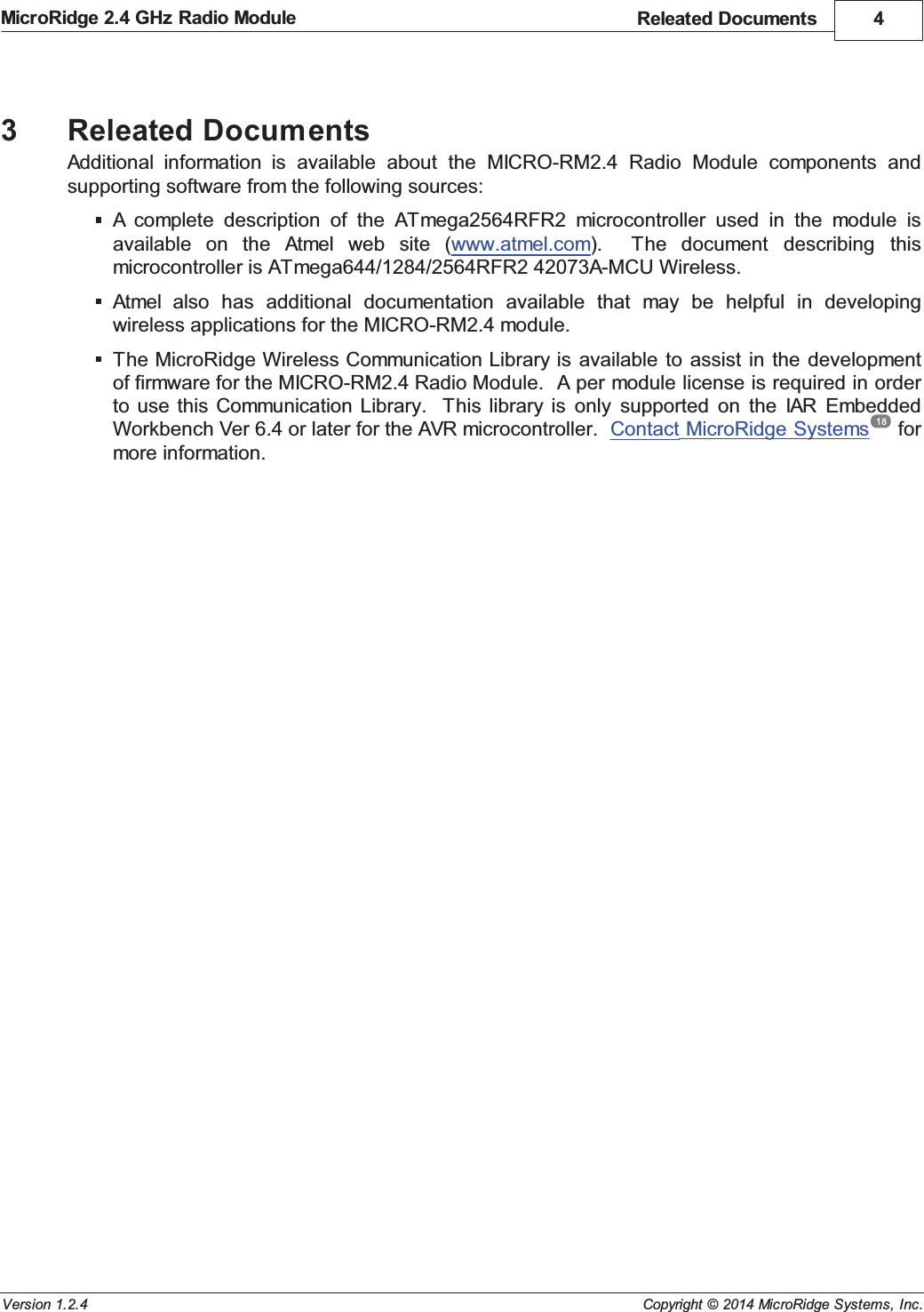
Releated Documents 4Copyright © 2014 MicroRidge Systems, Inc.MicroRidge 2.4 GHz Radio ModuleVersion 1.2.43Releated DocumentsAdditional  information  is  available  about  the  MICRO-RM2.4  Radio  Module  components  andsupporting software from the following sources:A complete  description  of  the  ATmega2564RFR2  microcontroller  used  in  the  module  isavailable  on  the  Atmel  web  site  (www.atmel.com).    The  document  describing  thismicrocontroller is ATmega644/1284/2564RFR2 42073A-MCU Wireless.Atmel  also  has  additional  documentation  available  that  may  be  helpful  in  developingwireless applications for the MICRO-RM2.4 module.The MicroRidge Wireless Communication Library is available  to assist  in  the developmentof firmware for the MICRO-RM2.4 Radio Module.  A per module license is required in orderto use  this Communication  Library.   This library  is  only  supported  on  the  IAR  EmbeddedWorkbench Ver 6.4 or later for the AVR microcontroller.  Contact MicroRidge Systems  formore information.18
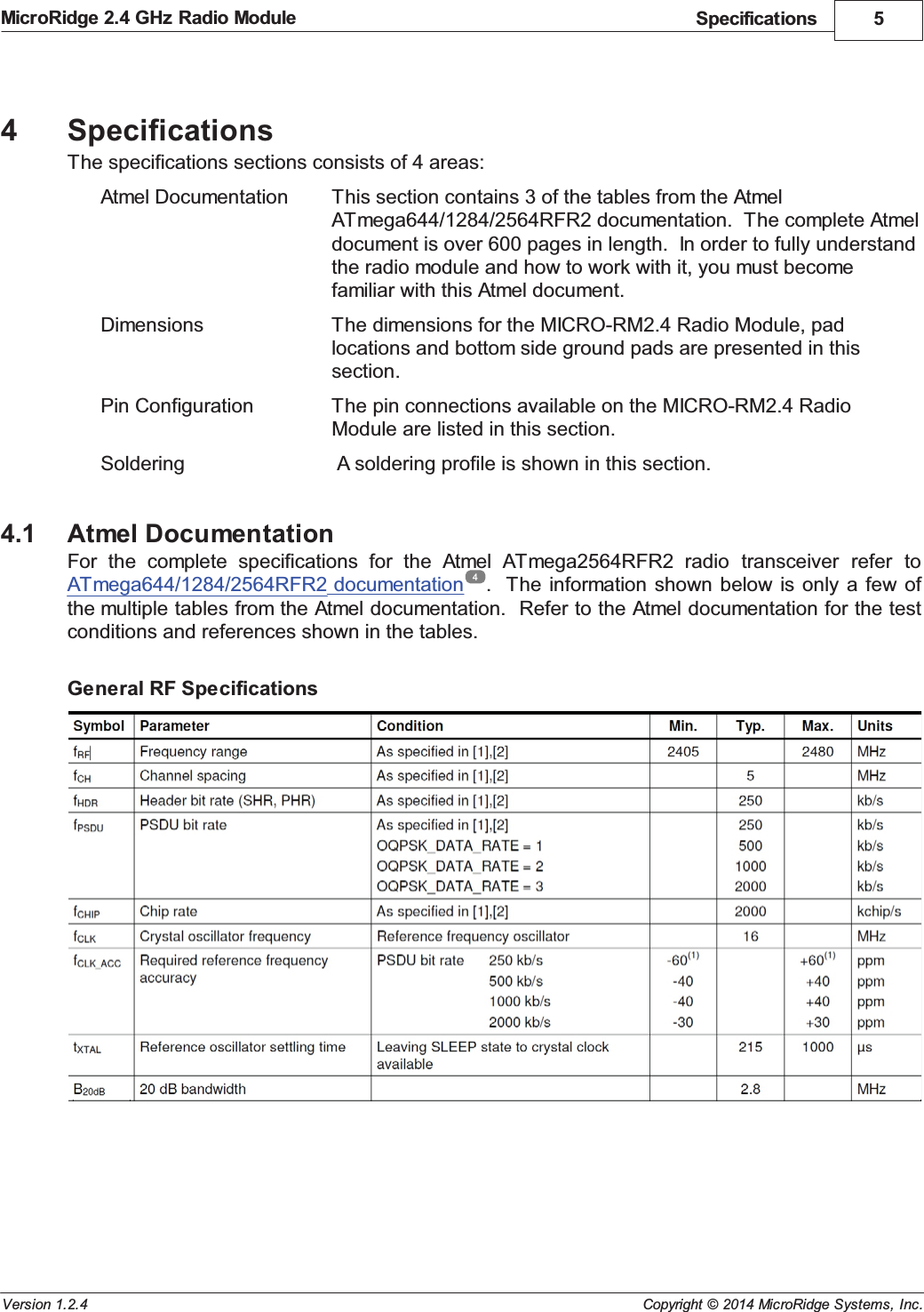
Specifications 5Copyright © 2014 MicroRidge Systems, Inc.MicroRidge 2.4 GHz Radio ModuleVersion 1.2.44SpecificationsThe specifications sections consists of 4 areas:Atmel Documentation This section contains 3 of the tables from the AtmelATmega644/1284/2564RFR2 documentation.  The complete Atmeldocument is over 600 pages in length.  In order to fully understandthe radio module and how to work with it, you must becomefamiliar with this Atmel document.Dimensions The dimensions for the MICRO-RM2.4 Radio Module, padlocations and bottom side ground pads are presented in thissection.Pin Configuration The pin connections available on the MICRO-RM2.4 RadioModule are listed in this section.Soldering  A soldering profile is shown in this section.4.1 Atmel DocumentationFor  the  complete  specifications  for  the  Atmel  ATmega2564RFR2  radio  transceiver  refer  toATmega644/1284/2564RFR2 documentation .  The  information  shown below  is  only a  few ofthe multiple tables from the Atmel documentation.  Refer to the Atmel documentation for the testconditions and references shown in the tables.General RF Specifications4
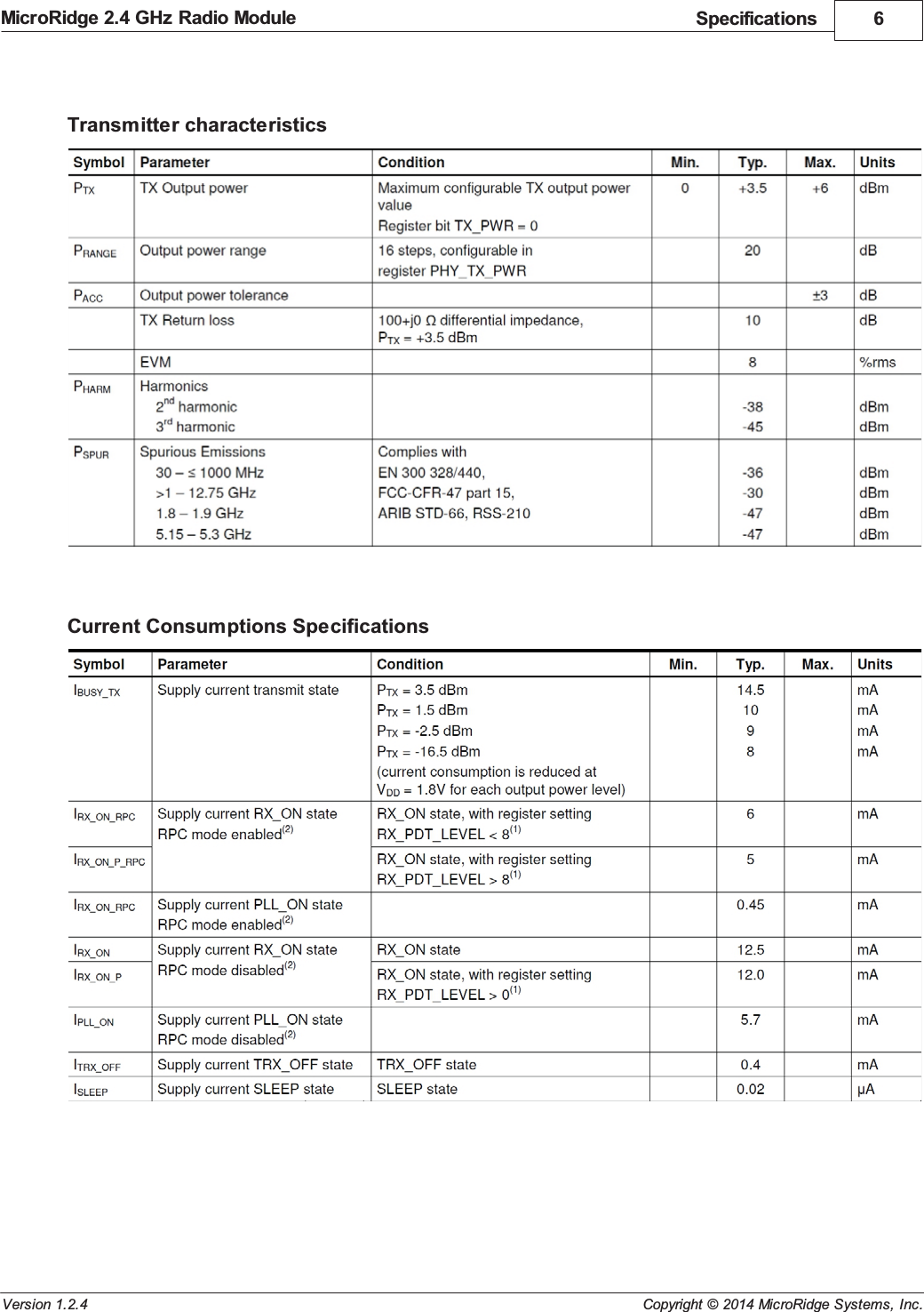
Specifications 6Copyright © 2014 MicroRidge Systems, Inc.MicroRidge 2.4 GHz Radio ModuleVersion 1.2.4Transmitter characteristicsCurrent Consumptions Specifications
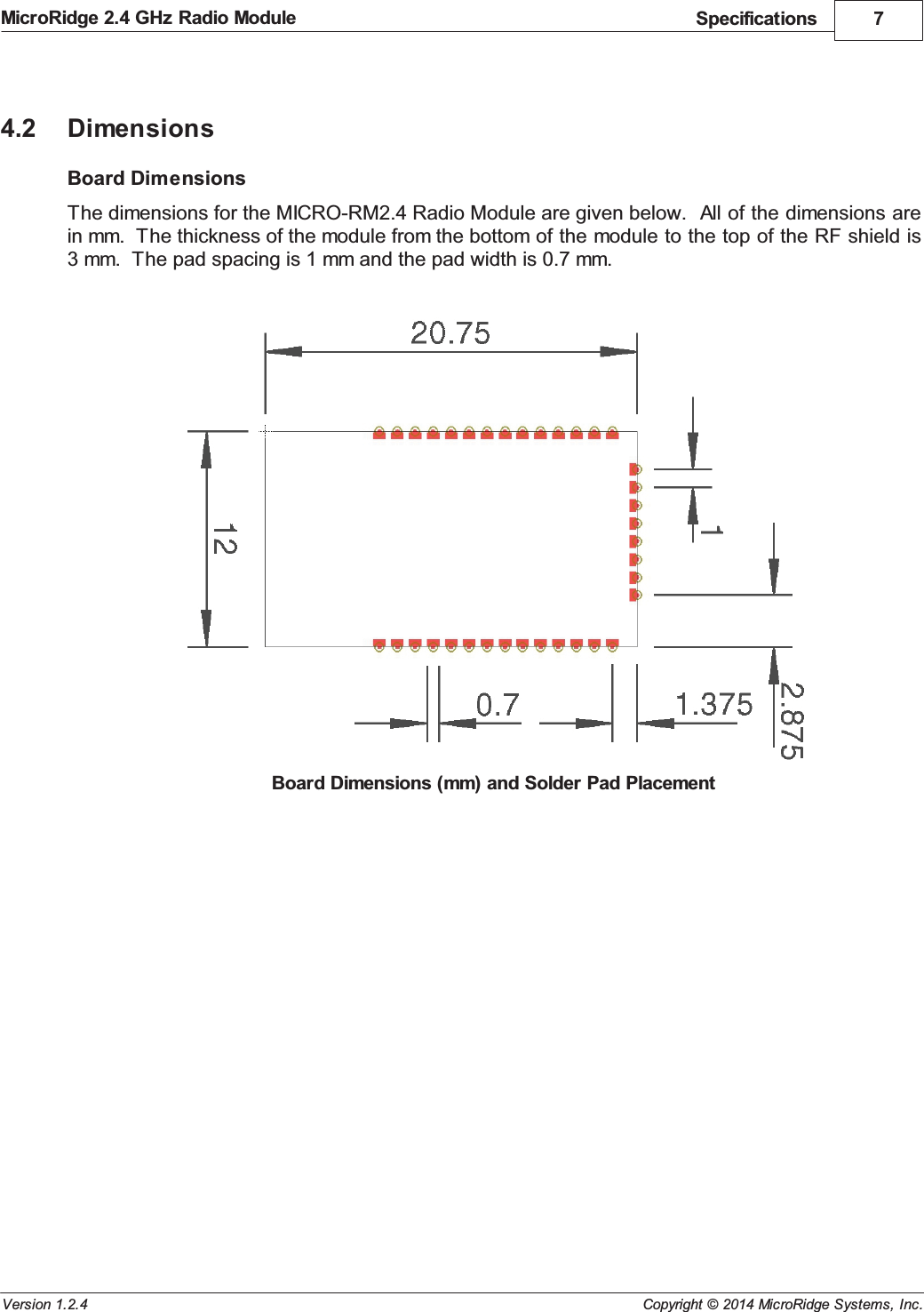
Specifications 7Copyright © 2014 MicroRidge Systems, Inc.MicroRidge 2.4 GHz Radio ModuleVersion 1.2.44.2 DimensionsBoard DimensionsThe dimensions for the MICRO-RM2.4 Radio Module are given below.  All of the dimensions arein mm.  The thickness of the module from the bottom of the module to the top of the RF shield is3 mm.  The pad spacing is 1 mm and the pad width is 0.7 mm.Board Dimensions (mm) and Solder Pad Placement
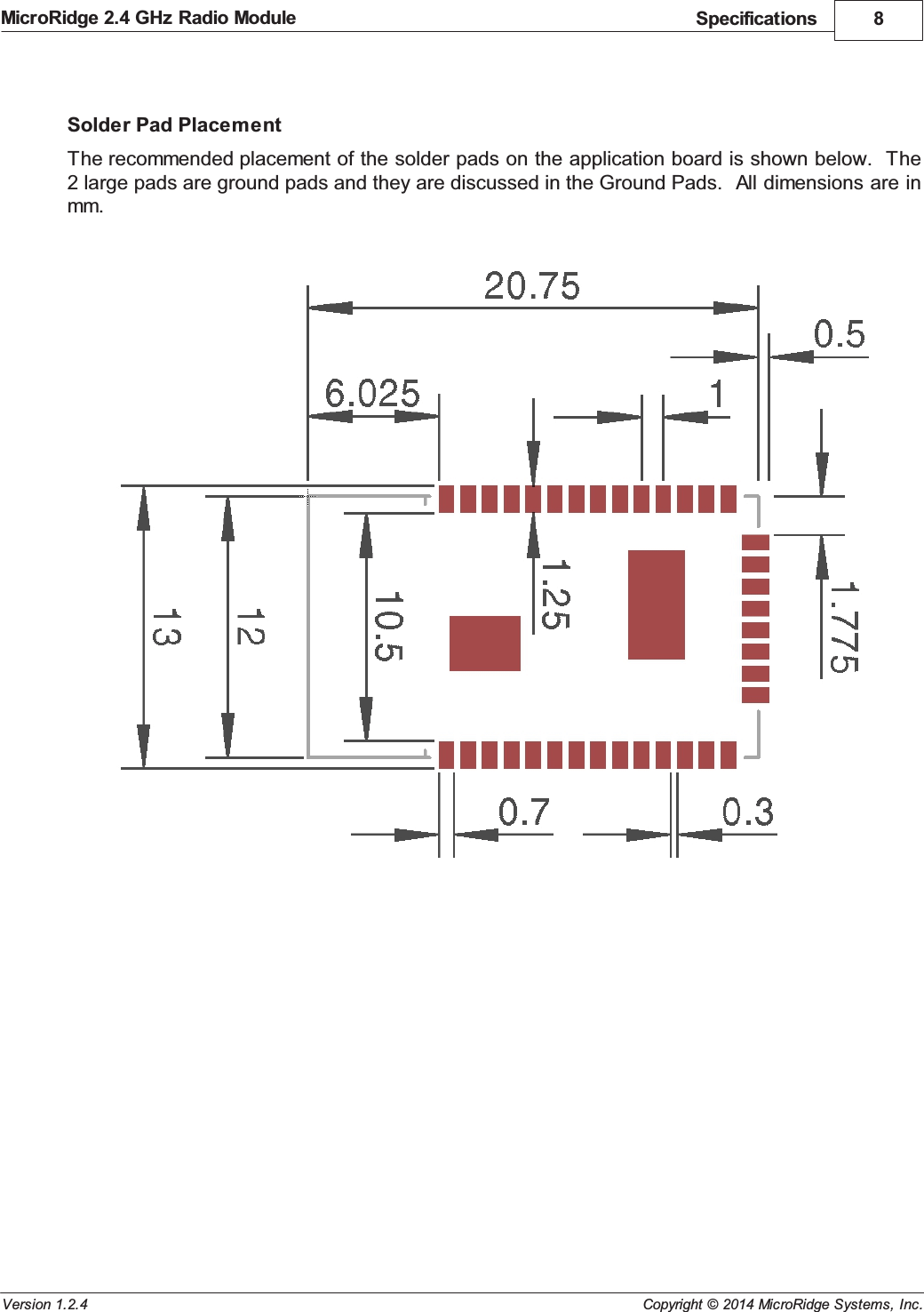
Specifications 8Copyright © 2014 MicroRidge Systems, Inc.MicroRidge 2.4 GHz Radio ModuleVersion 1.2.4Solder Pad PlacementThe recommended placement of the solder pads on the application board is shown below.  The2 large pads are ground pads and they are discussed in the Ground Pads.  All dimensions are inmm.
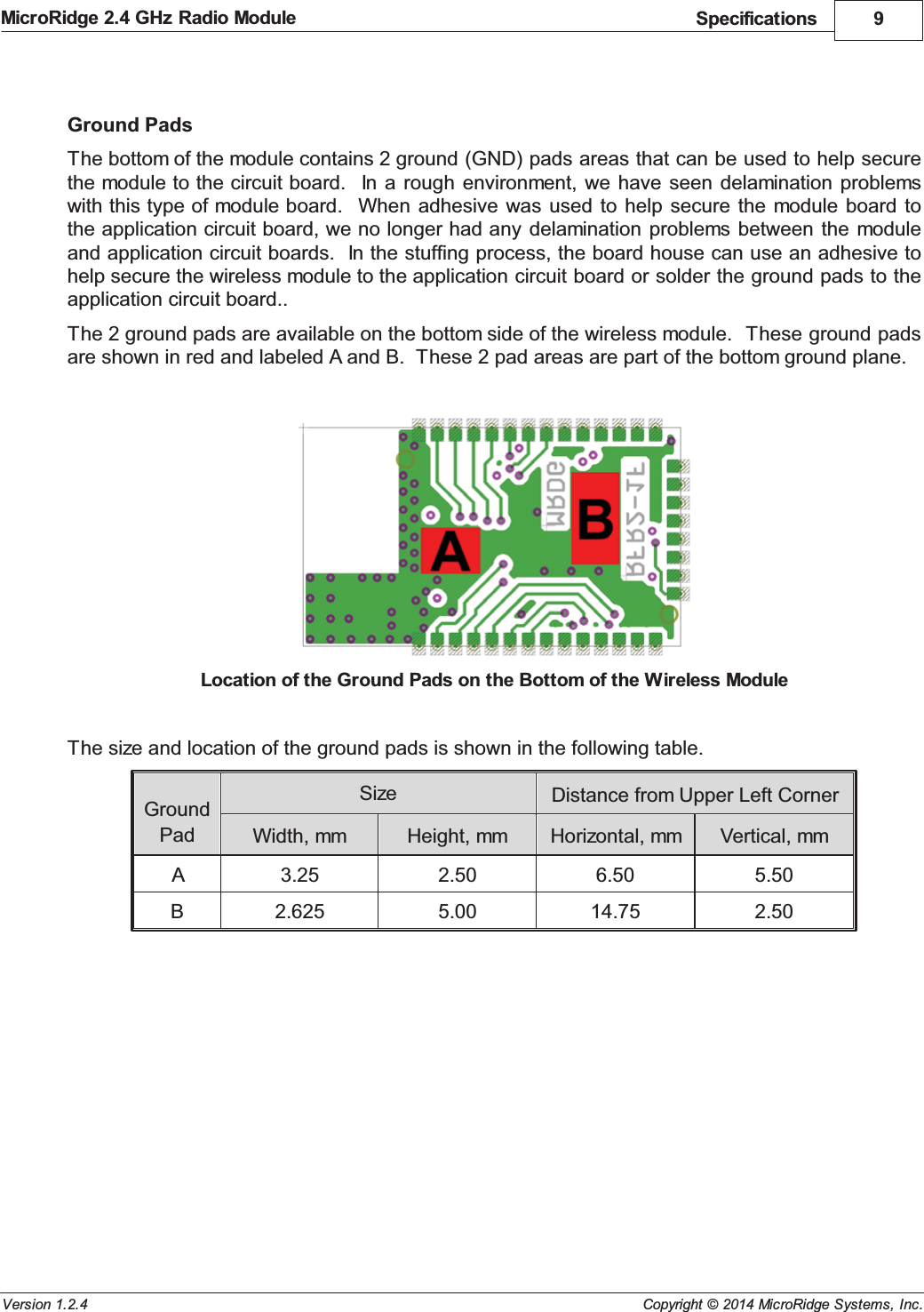
Specifications 9Copyright © 2014 MicroRidge Systems, Inc.MicroRidge 2.4 GHz Radio ModuleVersion 1.2.4Ground PadsThe bottom of the module contains 2 ground (GND) pads areas that can be used to help securethe module to the circuit board.   In a  rough environment, we  have  seen delamination  problemswith this type of module board.   When  adhesive  was used  to help  secure the  module  board tothe application circuit board, we no longer had any  delamination  problems  between the  moduleand application circuit boards.  In the stuffing process, the board house can use an adhesive tohelp secure the wireless module to the application circuit board or solder the ground pads to theapplication circuit board..The 2 ground pads are available on the bottom side of the wireless module.  These ground padsare shown in red and labeled A and B.  These 2 pad areas are part of the bottom ground plane.Location of the Ground Pads on the Bottom of the Wireless ModuleThe size and location of the ground pads is shown in the following table.GroundPadSize Distance from Upper Left CornerWidth, mm Height, mm Horizontal, mm Vertical, mmA3.25 2.50 6.50 5.50B2.625 5.00 14.75 2.50
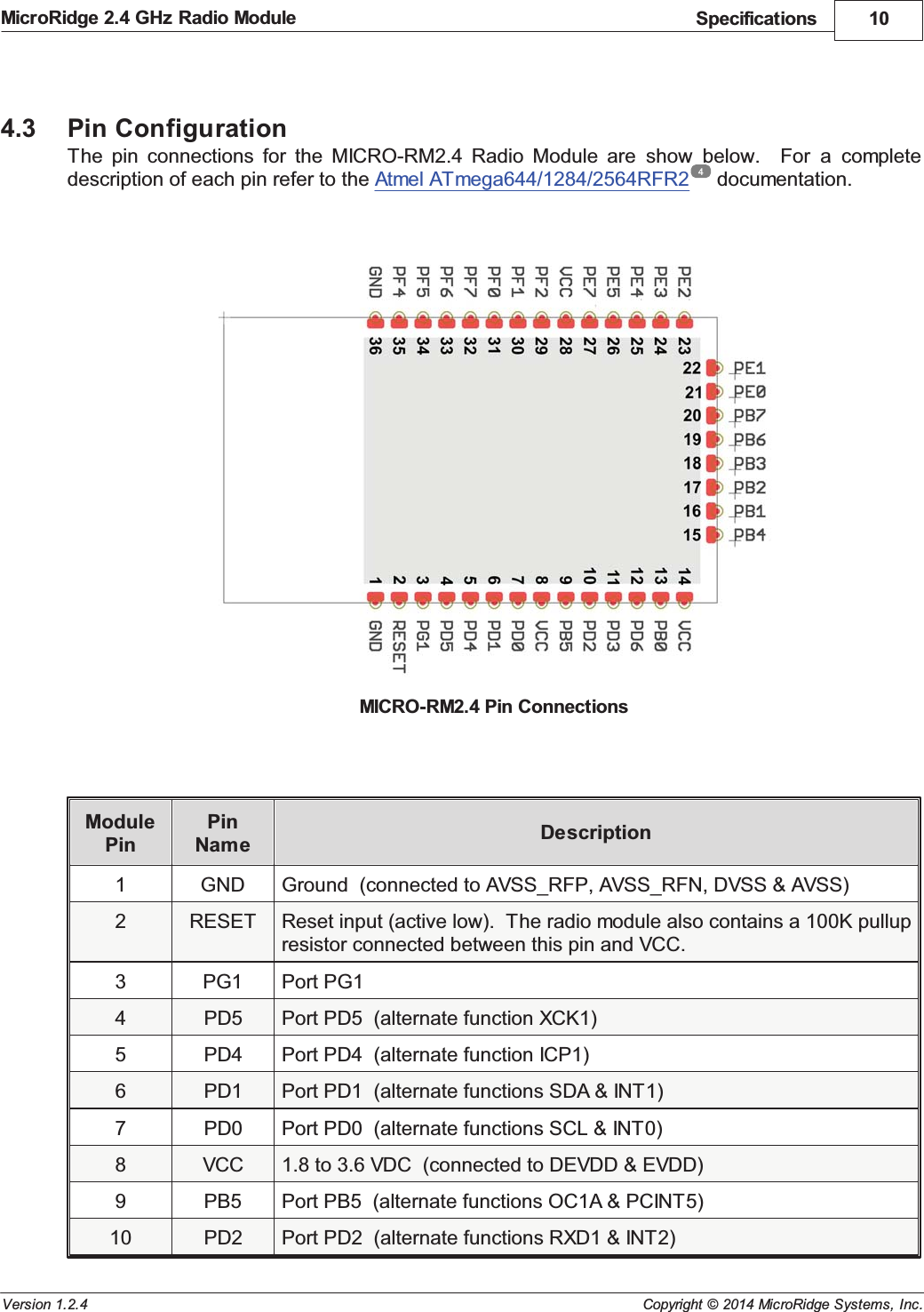
Specifications 10Copyright © 2014 MicroRidge Systems, Inc.MicroRidge 2.4 GHz Radio ModuleVersion 1.2.44.3 Pin ConfigurationThe  pin  connections  for  the  MICRO-RM2.4  Radio  Module  are  show  below.    For  a  completedescription of each pin refer to the Atmel ATmega644/1284/2564RFR2  documentation.MICRO-RM2.4 Pin ConnectionsModulePinPinName Description1 GND Ground  (connected to AVSS_RFP, AVSS_RFN, DVSS & AVSS)2RESET Reset input (active low).  The radio module also contains a 100K pullupresistor connected between this pin and VCC.3PG1 Port PG14PD5 Port PD5  (alternate function XCK1)5PD4 Port PD4  (alternate function ICP1)6PD1 Port PD1  (alternate functions SDA & INT1)7PD0 Port PD0  (alternate functions SCL & INT0)8VCC 1.8 to 3.6 VDC  (connected to DEVDD & EVDD)9PB5 Port PB5  (alternate functions OC1A & PCINT5)10 PD2 Port PD2  (alternate functions RXD1 & INT2)4
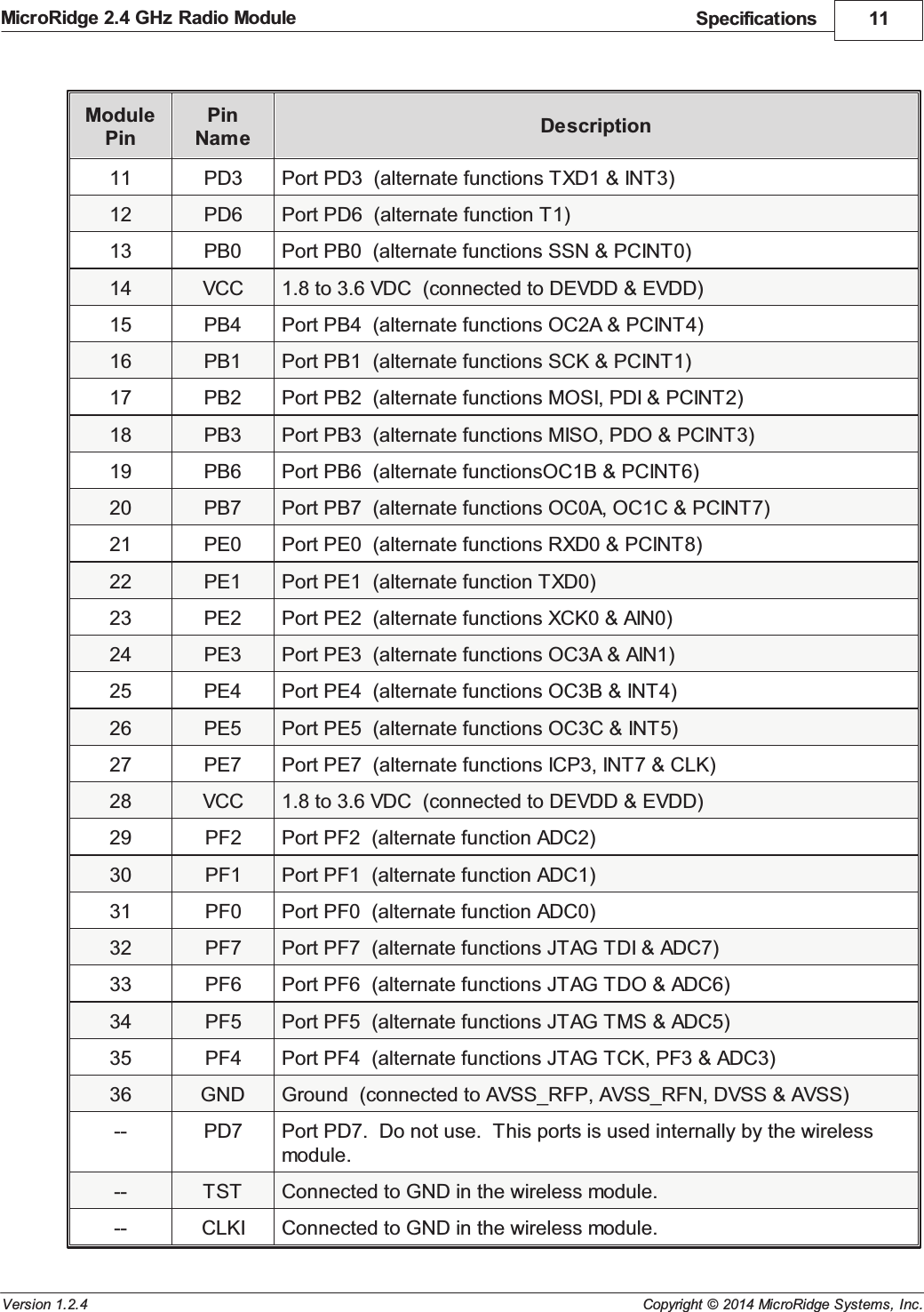
Specifications 11Copyright © 2014 MicroRidge Systems, Inc.MicroRidge 2.4 GHz Radio ModuleVersion 1.2.4ModulePinPinName Description11 PD3 Port PD3  (alternate functions TXD1 & INT3)12 PD6 Port PD6  (alternate function T1)13 PB0 Port PB0  (alternate functions SSN & PCINT0)14 VCC 1.8 to 3.6 VDC  (connected to DEVDD & EVDD)15 PB4 Port PB4  (alternate functions OC2A & PCINT4)16 PB1 Port PB1  (alternate functions SCK & PCINT1)17 PB2 Port PB2  (alternate functions MOSI, PDI & PCINT2)18 PB3 Port PB3  (alternate functions MISO, PDO & PCINT3)19 PB6 Port PB6  (alternate functionsOC1B & PCINT6)20 PB7 Port PB7  (alternate functions OC0A, OC1C & PCINT7)21 PE0 Port PE0  (alternate functions RXD0 & PCINT8)22 PE1 Port PE1  (alternate function TXD0)23 PE2 Port PE2  (alternate functions XCK0 & AIN0)24 PE3 Port PE3  (alternate functions OC3A & AIN1)25 PE4 Port PE4  (alternate functions OC3B & INT4)26 PE5 Port PE5  (alternate functions OC3C & INT5)27 PE7 Port PE7  (alternate functions ICP3, INT7 & CLK)28 VCC 1.8 to 3.6 VDC  (connected to DEVDD & EVDD)29 PF2 Port PF2  (alternate function ADC2)30 PF1 Port PF1  (alternate function ADC1)31 PF0 Port PF0  (alternate function ADC0)32 PF7 Port PF7  (alternate functions JTAG TDI & ADC7)33 PF6 Port PF6  (alternate functions JTAG TDO & ADC6)34 PF5 Port PF5  (alternate functions JTAG TMS & ADC5)35 PF4 Port PF4  (alternate functions JTAG TCK, PF3 & ADC3)36 GND Ground  (connected to AVSS_RFP, AVSS_RFN, DVSS & AVSS)-- PD7 Port PD7.  Do not use.  This ports is used internally by the wirelessmodule.-- TST Connected to GND in the wireless module.-- CLKI Connected to GND in the wireless module.
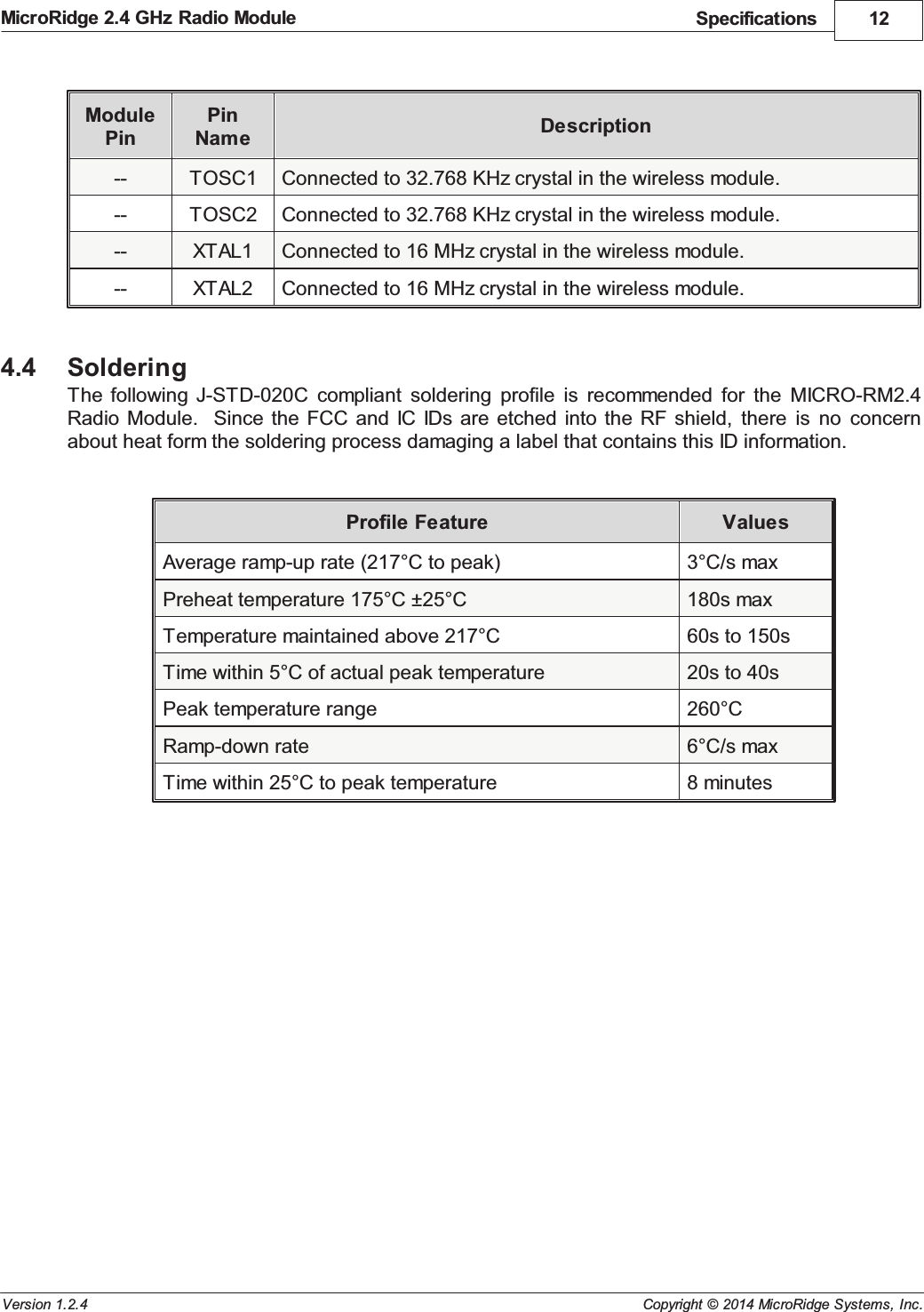
Specifications 12Copyright © 2014 MicroRidge Systems, Inc.MicroRidge 2.4 GHz Radio ModuleVersion 1.2.4ModulePinPinName Description-- TOSC1 Connected to 32.768 KHz crystal in the wireless module.-- TOSC2 Connected to 32.768 KHz crystal in the wireless module.-- XTAL1 Connected to 16 MHz crystal in the wireless module.-- XTAL2 Connected to 16 MHz crystal in the wireless module.4.4 SolderingThe following  J-STD-020C  compliant  soldering  profile  is  recommended  for  the  MICRO-RM2.4Radio Module.   Since  the  FCC and  IC  IDs  are etched  into the  RF shield,  there  is  no  concernabout heat form the soldering process damaging a label that contains this ID information.Profile Feature ValuesAverage ramp-up rate (217°C to peak) 3°C/s maxPreheat temperature 175°C ±25°C 180s maxTemperature maintained above 217°C 60s to 150sTime within 5°C of actual peak temperature 20s to 40sPeak temperature range 260°CRamp-down rate 6°C/s maxTime within 25°C to peak temperature 8 minutes
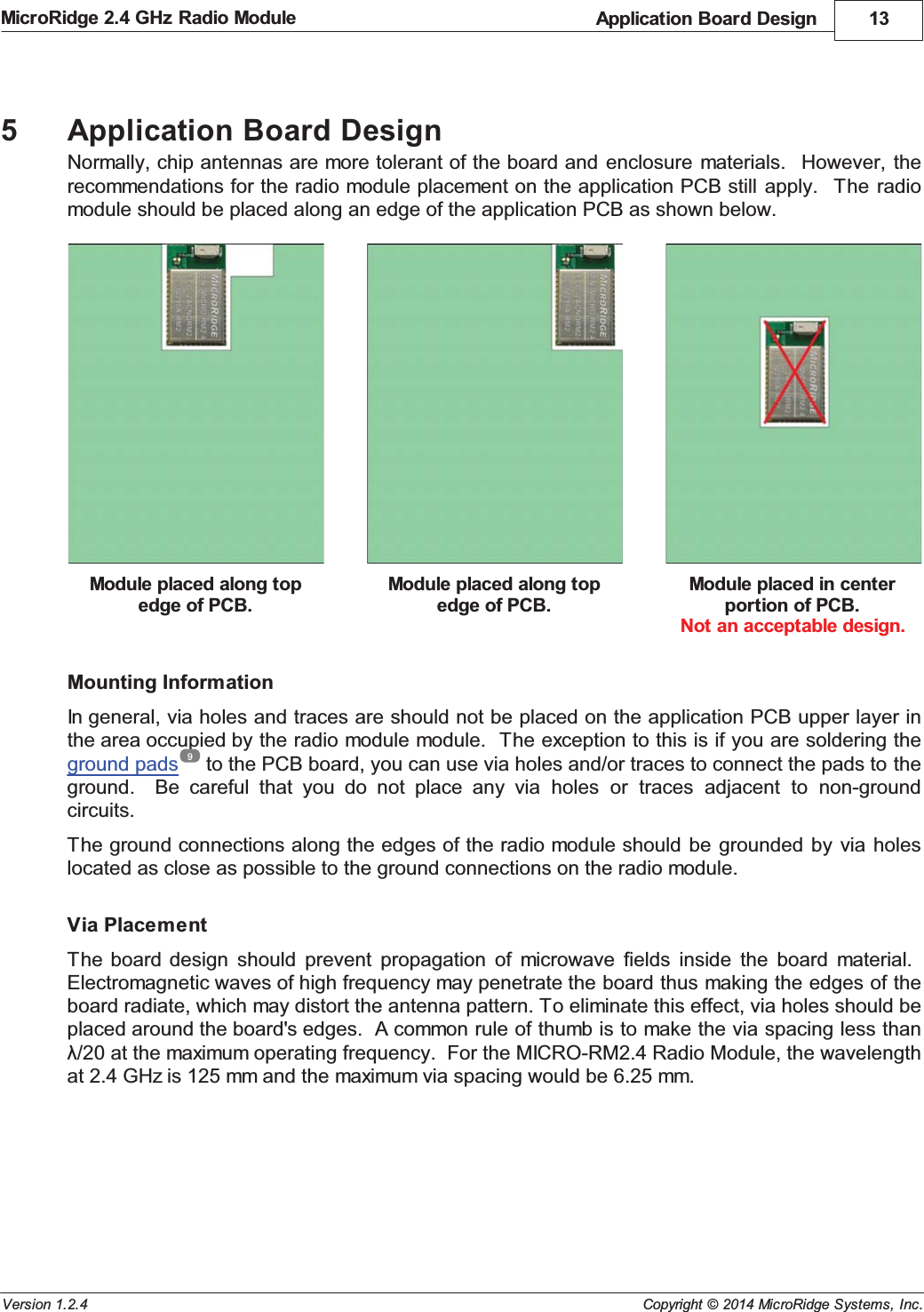
Application Board Design 13Copyright © 2014 MicroRidge Systems, Inc.MicroRidge 2.4 GHz Radio ModuleVersion 1.2.45Application Board DesignNormally, chip antennas are more tolerant of the board and enclosure  materials.   However,  therecommendations for the radio module placement on the application PCB still  apply.   The radiomodule should be placed along an edge of the application PCB as shown below.Module placed along topedge of PCB.Module placed along topedge of PCB.Module placed in centerportion of PCB.Not an acceptable design.Mounting InformationIn general, via holes and traces are should not be placed on the application PCB upper layer inthe area occupied by the radio module module.  The exception to this is if you are soldering theground pads  to the PCB board, you can use via holes and/or traces to connect the pads to theground.    Be  careful  that  you  do  not  place  any  via  holes  or  traces  adjacent  to  non-groundcircuits. The ground connections along the edges of the radio module should  be  grounded by  via holeslocated as close as possible to the ground connections on the radio module.Via PlacementThe board  design  should  prevent  propagation  of  microwave  fields  inside  the  board  material.  Electromagnetic waves of high frequency may penetrate the board thus making the edges of theboard radiate, which may distort the antenna pattern. To eliminate this effect, via holes should beplaced around the board's edges.  A common rule of thumb is to make the via spacing less thanλ/20 at the maximum operating frequency.  For the MICRO-RM2.4 Radio Module, the wavelengthat 2.4 GHz is 125 mm and the maximum via spacing would be 6.25 mm.9
Application Board Design 14Copyright © 2014 MicroRidge Systems, Inc.MicroRidge 2.4 GHz Radio ModuleVersion 1.2.4Other RecommendationsMetal enclosure should not be used.Low profile enclosures might affect antenna antenna performance.Avoid placing high profile components next to antenna.Radio module should not be placed next to other electronics which might interfere with  the2.4 GHz frequency band.
Ordering Information 15Copyright © 2014 MicroRidge Systems, Inc.MicroRidge 2.4 GHz Radio ModuleVersion 1.2.46Ordering InformationContact MicroRidge Systems  to order MICRO-RM2.4 Radio Modules.  The packaging optionsof tray, and tape and reel are still being evaluated.  There are also software options available forthe radio modules.18
Radio Certification 16Copyright © 2014 MicroRidge Systems, Inc.MicroRidge 2.4 GHz Radio ModuleVersion 1.2.47Radio CertificationUnited States (FCC)This device  complies  with part  15  of  the  FCC  rules.  Operation  is  subject  to  the  following  twoconditions: (1) This device may not cause harmful interference, and (2) this device  must  acceptany  interference  received,  including  interference  that  may  cause  undesired  operation.  Anychanges or modifications not expressly approved by manufacturer could void the user’s authorityto operate the equipment. IMPORTANT! Any changes or modifications not expressly approved by the party responsible forcompliance could void the user’s authority to operate this equipment. 47 CFR 15.505For a Class B digital device or peripheral, the instructions furnished the user shall  include  thefollowing or similar statement, placed in a prominent location in the text of the manual:NOTE: This equipment has been tested and found to comply with the limits for a Class B digitaldevice, pursuant to part 15 of the FCC Rules. These limits are designed to provide reasonableprotection against harmful interference in a  residential installation.  This  equipment  generates,uses and can radiate radio frequency energy and, if not installed and used in accordance withthe instructions, may cause harmful interference to radio communications. However, there is noguarantee  that  interference  will  not  occur  in  a  particular  installation.  If  this  equipment  doescause harmful interference to radio or television reception, which can be determined by turningthe equipment off and on, the  user is  encouraged  to try  to correct  the interference  by  one ormore of the following measures:Reorient or relocate the receiving antenna.Increase the separation between the equipment and receiver.Connect the equipment into an outlet on a circuit different from that to which the receiver isconnected.Consult the dealer or an experienced radio/ TV technician for help.The modular transmitter must be labeled with its own FCC ID number, and, if the FCC ID is  notvisible when  the module is  installed inside  another  device, then  the  outside  of  the  device  intowhich the  module  is installed  must  also display  a  label  referring  to  the  enclosed  module.  Thisexterior label can use wording such as the following:Contains FCC ID: 2ACNQRM2The MICRO-RN2.4 Radio Module has a Modular approval and does not need separate approvalfor this module when used on an application board.Industry Canada (IC)This  device  complies  with  Industry  Canada  licence-exempt  RSS  standard(s).  Operation  issubject to the following two conditions: (1)  this  device may not  cause interference,  and (2)  thisdevice must accept any interference, including interference that may cause undesired operationof the device.
Radio Certification 17Copyright © 2014 MicroRidge Systems, Inc.MicroRidge 2.4 GHz Radio ModuleVersion 1.2.4Le présent  appareil est  conforme  aux CNR  d’Industrie Canada  applicables  aux appareils radioexempts de licence. L’exploitation est autorisée aux deux conditions  suivantes: (1)  l’appareil nedoit  pas  produire  de  brouillage,  et  (2)  l’utilisateur  de  l’appareil  doit  accepter  tout  brouillageradioélectrique subi, meme si le brouillage est susceptible d’en compromettre le fonctionnement. IMPORTANT!  Tous  les  changements  ou  modifications  pas  expressément  approuvés  par  lapartie  responsable  de  la  conformité  ont  pu  vider  l’autorité  de  l’utilisateur  pour  actioner  cetéquipment.This Class [B] digital apparatus complies with Canadian ICES-003.Cet appareil numérique de la classe [B] est conforme à la norme NMB-003 du CanadaThis modular transmitter must be labeled with its own IC ID.  If  the IC  ID  Certification  Number  isnot visible  while installed  inside  another  device,  then the  device should  display  the  label  on  itreferring the  enclosed module. In that  case, the  final  end  product  must  be  labeled  in  a  visiblearea with the following:Contains IC: 12298A-RM2The MICRO-RN2.4 Radio Module has a Modular approval and does not need separate approvalfor this module when used on an application board.European Union (ETSI)The  MICRO-RN2.4  module  has  been  certified  for  use  in  European  Union  countries.  If  thismodule  is  incorporated  into  a  product,  the  manufacturer  must  ensure  compliance  of  the  finalproduct to  the European  harmonized EMC  and  low  voltage/safety  standards.  A Declaration  ofConformity must be issued for each of these standards and kept on file as described in Annex IIof the R&TTE Directive.Furthermore, the manufacturer must maintain a copy of the modules' documentation and ensurethe  final  product  does  not  exceed  the  specified  power  ratings,  antenna  specifications,  and/orinstallation  requirements  as  specified  in  the  user  manual.  If  any  of  these  specifications  areexceeded  in  the  final  product,  a  submission  must  be  made  to  a  notified  body  for  compliancetesting to all required standards.The 'CE' marking must be affixed to a  visible location  on  the OEM  product. The  CE mark shallconsist of the initials "CE" taking the following form:The CE  marking  must  have a  height of  at  least 5  mm except where  this  is  not  possible  onaccount of the nature of the apparatus.The CE marking must be affixed visibly, legibly, and indelibly.More detailed information about CE marking requirements  you can  find at  "DIRECTIVE  1999/5/EC OF THE EUROPEAN PARLIAMENT  AND OF  THE  COUNCIL" on 9  March  1999 at  section12.
Contact MicroRidge 18Copyright © 2014 MicroRidge Systems, Inc.MicroRidge 2.4 GHz Radio ModuleVersion 1.2.48Contact MicroRidgeEmail:Support: support@microridge.comSales: sales@microridge.comInformation: info@microridge.comPhone:Support: 541.593.1656Sales: 541.593.3500Main office: 541.593.1656Fax: 541.593.5652Mailing Address:MicroRidge Systems, Inc.PO Box 3249Sunriver, OR  97707-0249Shipping Address:MicroRidge Systems, Inc.56888 Enterprise DriveSunriver, OR  97707Note:    There  is  no  mail  delivery  to  this  address.    This  address  should  only  be  used  forpackage delivery services such as UPS, FedEx, etc.Web:  www.MicroRidge-RM.com
Revision History 19Copyright © 2014 MicroRidge Systems, Inc.MicroRidge 2.4 GHz Radio ModuleVersion 1.2.49Revision HistoryDate Version Comments9-3-2014 1.0.1 Preliminary release of MICRO-RM2.4 User Manual9-12-2014 1.1.2 Minor revisions to preliminary manual.10-30-2014 1.2.3 Changed  radio  module  images  to  reflect  final  FCC  &  ICcertification numbers.Revised text for FCC and IC in Radio Certification section.10-31-2014 1.2.4 Minor word additions to Radio Certification section.

Navigation menu