Mini Mitter AWR1 ACTIREADER User Manual USERES MANUAL 2

Mini Mitter Co. Inc. ACTIREADER USERES MANUAL 2

Contents

USERES MANUAL 2

    5015 B.U. Bowman Drive  Buford, GA 30518 USA Voice: 770-831-8048 Fax: 770-831-8598   Certification Exhibit     FCC ID:  JIAAWR1 IC: 6041A-AWR1  FCC Rule Part: 15.209 IC Radio Standards Specification: RSS-210  ACS Report Number 08-0085 - 15C   Manufacturer: Mini Mitter Company, Inc. Model(s): ActiReader     Manual (Part 2 of 3)
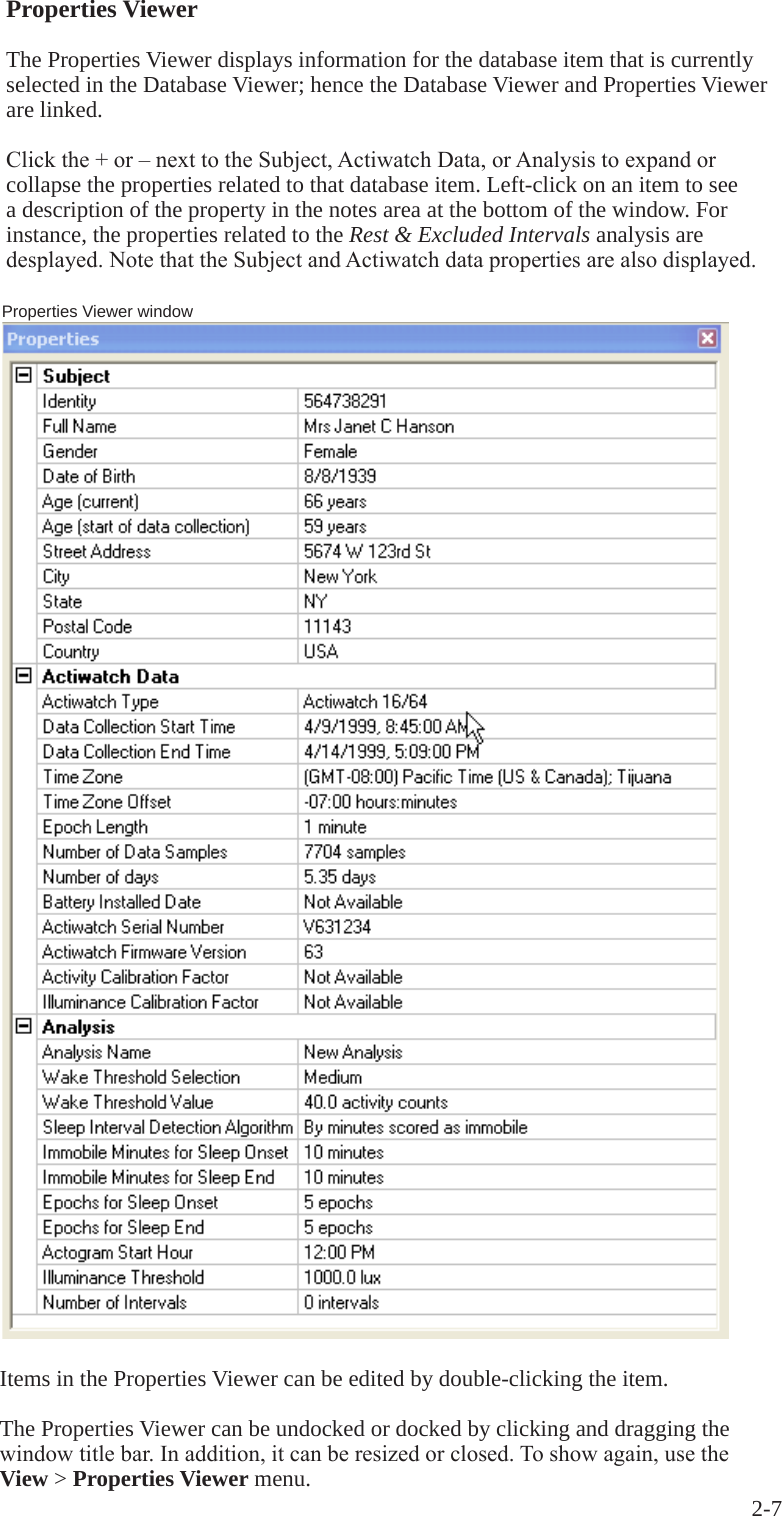
2-1 SECTION2WARNING! Actiware / Actiware-CT is for use only in a clinical, research, or home care provider setting.GETTING STARTED  The workspace of the Actiware program is similar to many software applications. Dockable windows give the user direct access to the Actiwatch or subjectdatastored in the selected database. They also provide control over analysis viewing and exports.The Database Viewer and the Properties Viewer are docked at the left side of the main Actiware window by default. The Actogram View toolbar is shown on the right side of the main Actiware window.Actiwaredatabasesareorganizedinahierarchicalfashion.Thetoplevelisthesubjectlevel.ThesecondlevelistheActiwatchdataforthatsubject.Thethirdlevel is for saved analyses of the Actiwatch data. You can navigate through this hierarchy by clicking on the + (plus sign) or – (minus sign) buttons to the left of thesubjectorActiwatchdataicons.  •SubjectsaresortedbysubjectID.  •  Actiwatch Data entries are sorted by data collection start time.  •  Analyses are sorted by saved name.
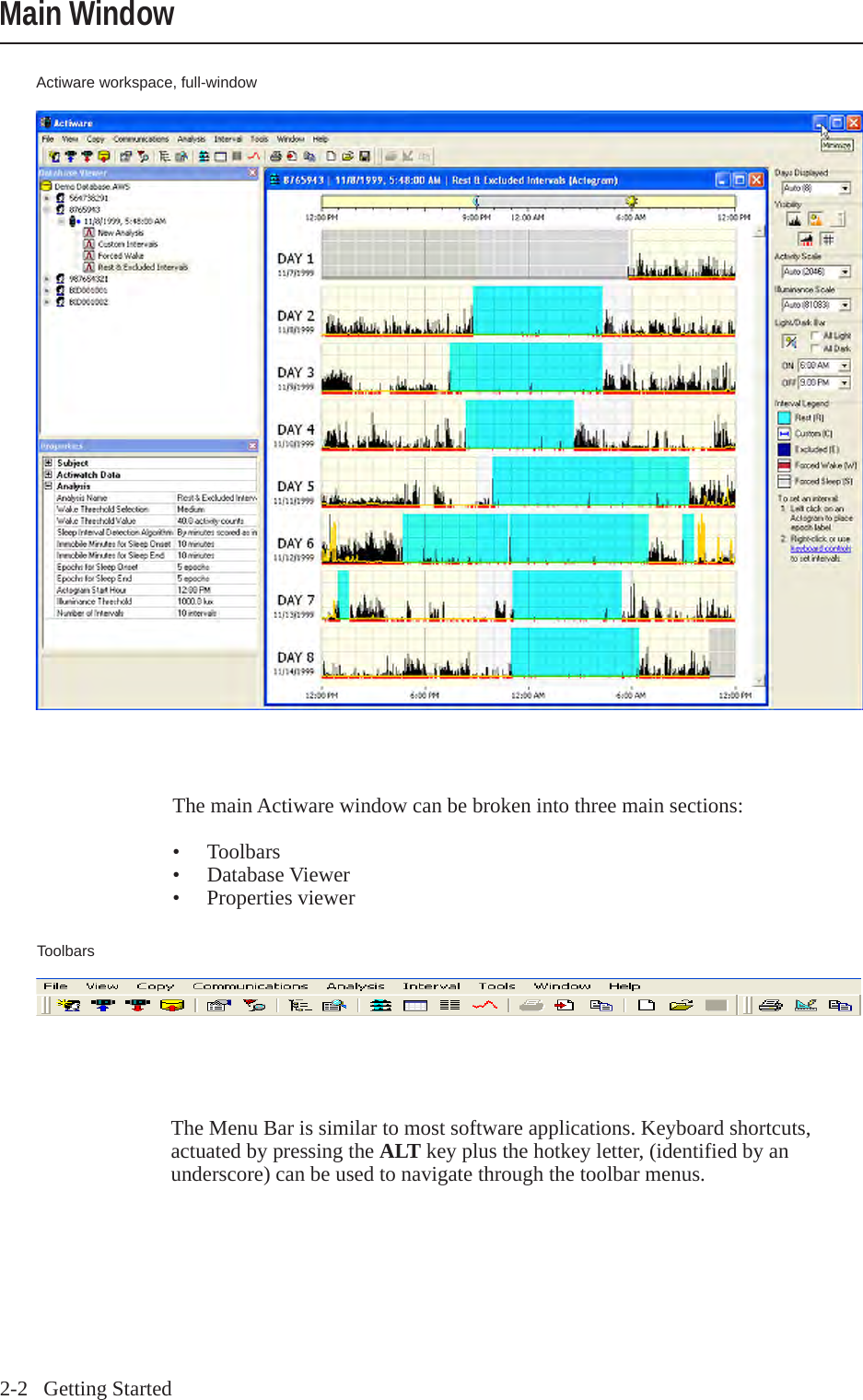
2-2   Getting StartedMain WindowActiware workspace, full-windowThe main Actiware window can be broken into three main sections:•  Toolbars•  Database Viewer•  Properties viewerToolbarsThe Menu Bar is similar to most software applications. Keyboard shortcuts, actuated by pressing the ALT key plus the hotkey letter, (identified by an underscore) can be used to navigate through the toolbar menus.
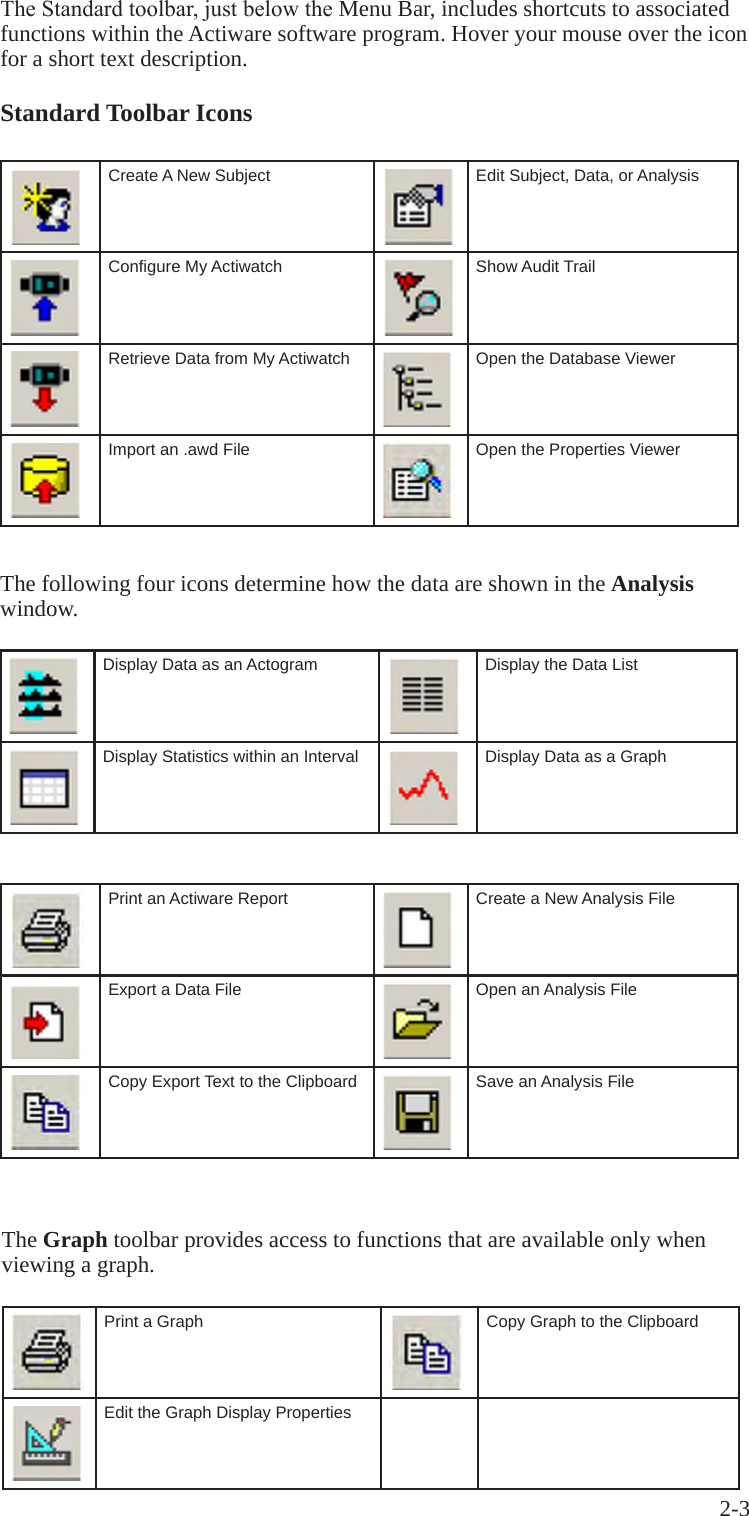
2-3 TheStandardtoolbar,justbelowtheMenu Bar, includes shortcuts to associated functions within the Actiware software program. Hover your mouse over the icon for a short text description.Standard Toolbar IconsCreate A New Subject Edit Subject, Data, or AnalysisConfigure My Actiwatch Show Audit TrailRetrieve Data from My Actiwatch Open the Database ViewerImport an .awd File Open the Properties ViewerThe following four icons determine how the data are shown in the Analysis window.Display Data as an Actogram Display the Data ListDisplay Statistics within an Interval Display Data as a GraphPrint an Actiware Report Create a New Analysis FileExport a Data File Open an Analysis FileCopy Export Text to the Clipboard Save an Analysis FileThe Graph toolbar provides access to functions that are available only when viewing a graph.Print a Graph Copy Graph to the ClipboardEdit the Graph Display Properties
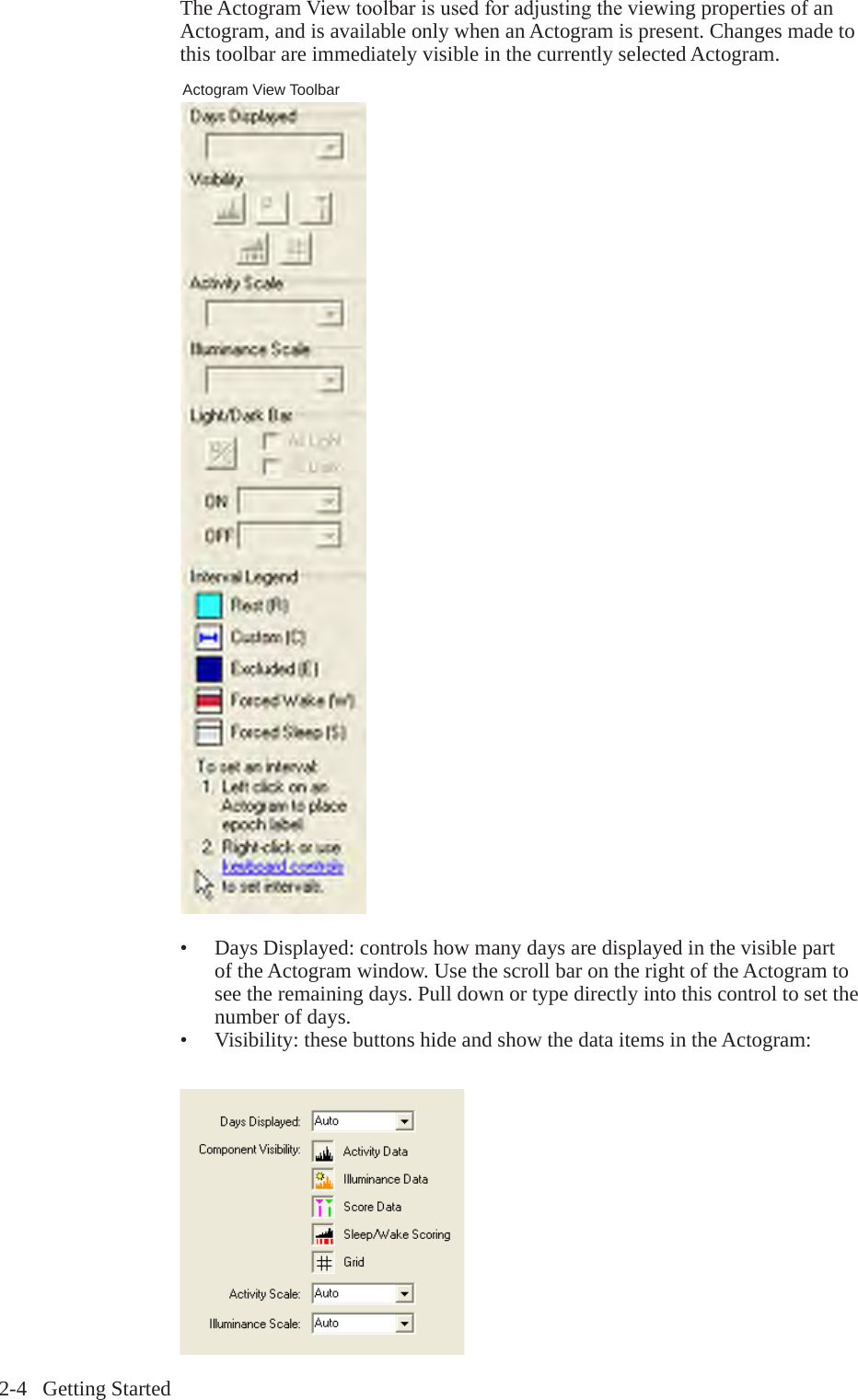
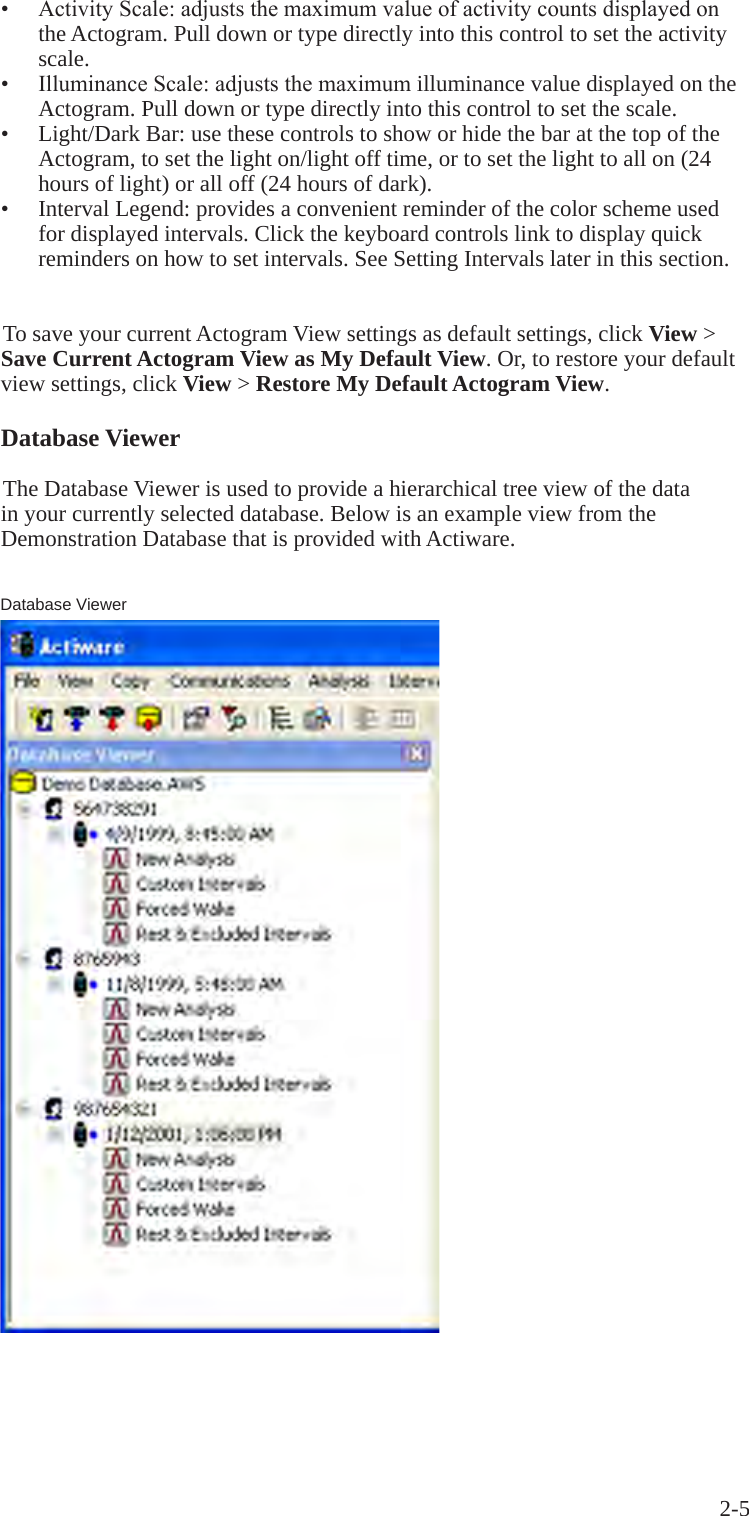
2-4   Getting StartedThe Actogram Viewtoolbarisusedforadjustingtheviewing properties of an Actogram, and is available only when an Actogram is present. Changes made to this toolbar are immediately visible in the currently selected Actogram.•  Days Displayed: controls how many days are displayed in the visible part of the Actogram window. Use the scroll bar on the right of the Actogram to see the remaining days. Pull down or type directly into this control to set the number of days.•  Visibility: these buttons hide and show the data items in the Actogram:Actogram View Toolbar
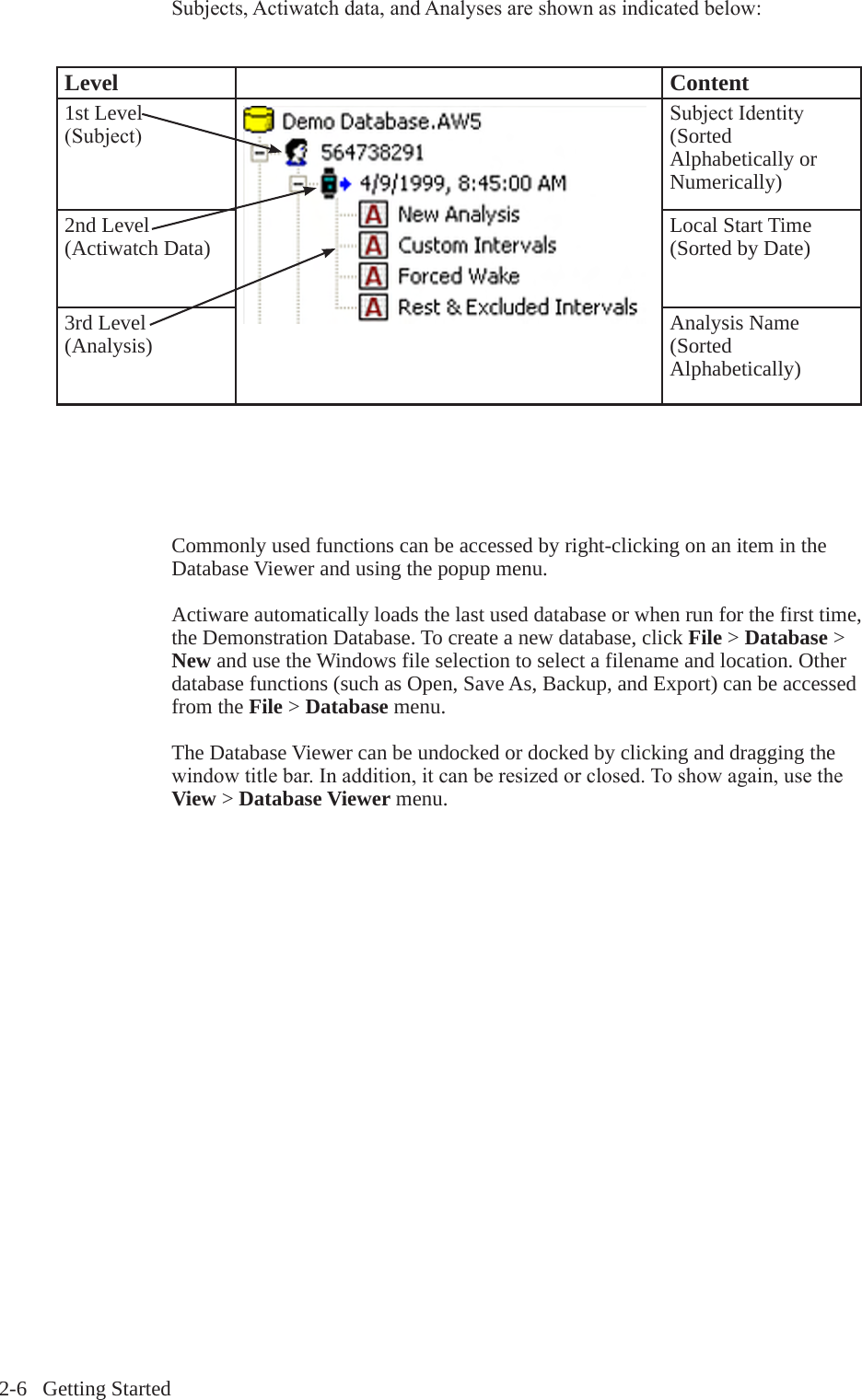
2-5 •  ActivityScale:adjuststhemaximumvalueofactivitycountsdisplayedonthe Actogram. Pull down or type directly into this control to set the activity scale.•  IlluminanceScale:adjuststhemaximumilluminance value displayed on the Actogram. Pull down or type directly into this control to set the scale.•  Light/Dark Bar: use these controls to show or hide the bar at the top of the Actogram, to set the light on/light off time, or to set the light to all on (24 hours of light) or all off (24 hours of dark).•  Interval Legend: provides a convenient reminder of the color scheme used for displayed intervals. Click the keyboard controls link to display quick reminders on how to set intervals. See Setting Intervals later in this section.To save your current Actogram View settings as default settings, click View > Save Current Actogram View as My Default View. Or, to restore your default view settings, click View > Restore My Default Actogram View.Database ViewerThe Database Viewer is used to provide a hierarchical tree view of the data in your currently selected database. Below is an example view from the Demonstration Database that is provided with Actiware.Database Viewer
2-6   Getting StartedSubjects,Actiwatchdata,andAnalysesareshownasindicatedbelow:Commonly used functions can be accessed by right-clicking on an item in the Database Viewer and using the popup menu.Actiware automatically loads the last used database or when run for the first time, the Demonstration Database. To create a new database, click File > Database > New and use the Windows file selection to select a filename and location. Other database functions (such as Open, Save As, Backup, and Export) can be accessed from the File > Database menu.The Database Viewer can be undocked or docked by clicking and dragging the windowtitlebar.Inaddition,itcanberesizedorclosed.Toshowagain,usetheView > Database Viewer menu.Level Content1st Level(Subject)SubjectIdentity(Sorted Alphabetically orNumerically)2nd Level(Actiwatch Data) Local Start Time(Sorted by Date)3rd Level(Analysis) Analysis Name(Sorted Alphabetically)
2-7 Properties Viewer windowItems in the Properties Viewer can be edited by double-clicking the item.The Properties Viewer can be undocked or docked by clicking and dragging the windowtitlebar.Inaddition,itcanberesizedorclosed.Toshowagain,usetheView > Properties Viewer menu.Properties ViewerThe Properties Viewer displays information for the database item that is currently selected in the Database Viewer; hence the Database Viewer and Properties Viewer are linked.Clickthe+or–nexttotheSubject,ActiwatchData,orAnalysistoexpandorcollapse the properties related to that database item. Left-click on an item to see a description of the property in the notes area at the bottom of the window. For instance, the properties related to the Rest & Excluded Intervals analysis are desplayed.NotethattheSubjectandActiwatchdatapropertiesarealsodisplayed.
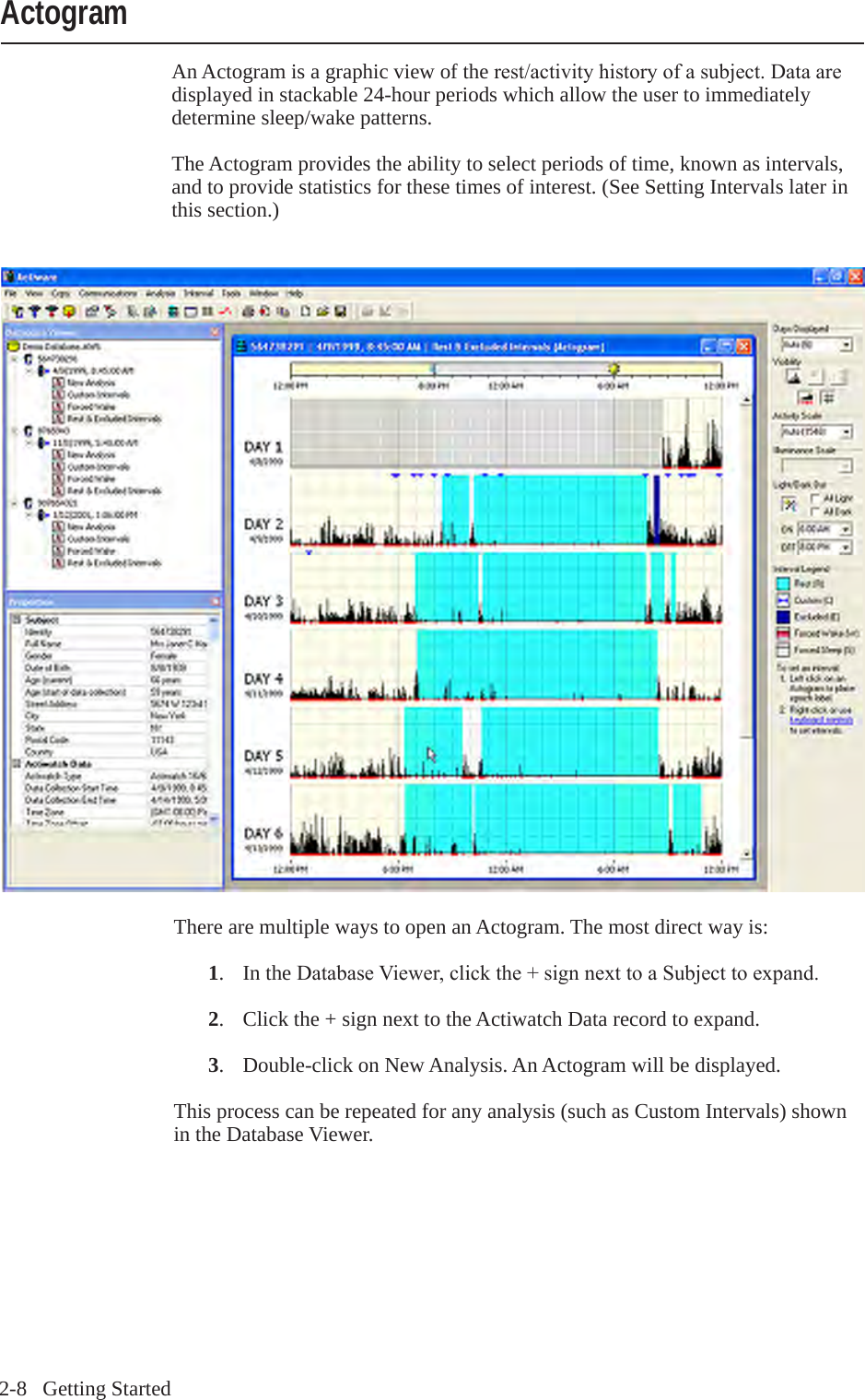
2-8   Getting StartedAn Actogram is a graphic view of the rest/activityhistoryofasubject.Dataaredisplayed in stackable 24-hour periods which allow the user to immediately determine sleep/wake patterns.The Actogram provides the ability to select periods of time, known as intervals, and to provide statistics for these times of interest. (See Setting Intervals later in this section.)ActogramThere are multiple ways to open an Actogram. The most direct way is: 1.  In the DatabaseViewer,clickthe+signnexttoaSubjecttoexpand. 2.  Click the + sign next to the Actiwatch Data record to expand. 3.  Double-click on New Analysis. An Actogram will be displayed.This process can be repeated for any analysis (such as Custom Intervals) shown in the Database Viewer.
2-9 You can also open an Actogram by clicking the View > Actogram menu, or by clicking the icon on  the Standard toolbar at the top of the window.UsetheActogramViewtoolbar(displayedontherightsideofthewindow)toadjusttheview settings for the Actogram.Note: The sleep/wake scoring algorithm is applied automatically to the activity in the entire data set. Epochs scored as wake are indicated by a red mark below the X axis, whereas epochs scored as sleep have no mark below the X axis.
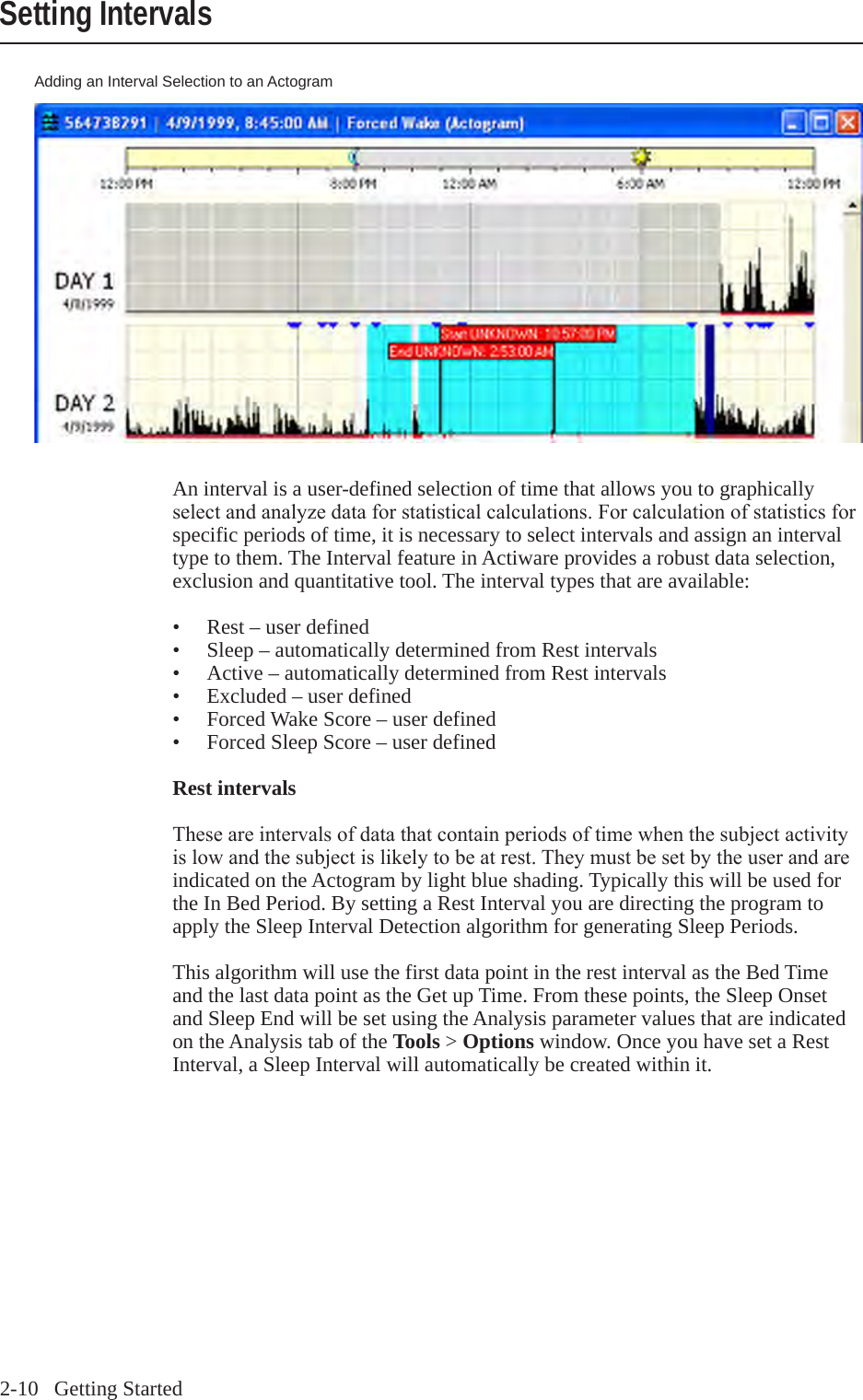
2-10   Getting StartedSetting IntervalsAdding an Interval Selection to an ActogramAn interval is a user-defined selection of time that allows you to graphically selectandanalyzedataforstatisticalcalculations.Forcalculationofstatisticsforspecific periods of time, it is necessary to select intervals and assign an interval type to them. The Interval feature in Actiware provides a robust data selection, exclusion and quantitative tool. The interval types that are available:•  Rest – user defined•  Sleep – automatically determined from Rest intervals•  Active – automatically determined from Rest intervals•  Excluded – user defined•  Forced Wake Score – user defined•  Forced Sleep Score – user definedRest intervalsTheseareintervalsofdatathatcontainperiodsoftimewhenthesubjectactivityislowandthesubjectislikelytobeatrest.Theymustbesetbytheuserandareindicated on the Actogram by light blue shading. Typically this will be used for the In Bed Period. By setting a Rest Interval you are directing the program to apply the Sleep Interval Detection algorithm for generating Sleep Periods. This algorithm will use the first data point in the rest interval as the Bed Time and the last data point as the Get up Time. From these points, the Sleep Onset and Sleep End will be set using the Analysis parameter values that are indicated on the Analysis tab of the Tools > Options window. Once you have set a Rest Interval, a Sleep Interval will automatically be created within it.
2-11 Sleep Intervals Data in these intervalsrepresentperiodsoftimeinwhichthesubjectislikelytobe asleep. These intervals are created automatically by the program once a Rest Interval has been set. They represent the period of time between Sleep Onset and Sleep End but are not indicated by any shading.Active IntervalsDataintheseintervalsrepresentperiodsoftimeinwhichsubjectactivityindicates that they are alert and engaged in physical activity. These intervals contain all those data that are outside of Rest Intervals. Active Intervals are created automatically when Rest Intervals are set. No shading is used to indicate these intervals.Excluded IntervalsData in these intervals are excluded from all analytical calculations. These intervalsaredesignedforusewhensubjectsremovetheActiwatchorforotherinvalid periods of data. These must be set by the user and are indicated by dark blue shading.Custom IntervalsThese are intervals of data that are of some interest for any reason. Typically these are used for illuminance calculations when using an Actiwatch-L or numerical rating scale values when using the Actiwatch Score. They may also be used for assessing activity during specific periods of the day. They are indicated on the Actogram by a blue bar above the activity data, and must be set by the user.Forced WakeThese intervals are periods of time for which the Sleep/Wake score has been forcedbytheusertoWake.Thisistypicallyusedifthesubjectisknowntobeawake, but very inactive, or as an alternative to excluding data. Epochs included in this type of interval are indicated by a magenta mark below the X axis of the Actogram.Forced SleepThese intervals are periods of time for which the Sleep/Wake score has been forcedbytheusertoSleep.Thistypicallyisusedifthesubjectisknowntobe sleeping but there is significant movement. Epochs included in this type of interval are indicated by a gray mark below the X axis of the Actogram.Note: Custom, Excluded, Forced Wake and Forced Sleep intervals can be overlapped. However, due to the automatic creation of Sleep intervals, Rest intervals cannot be overlapped. If you attempt to overlap Rest intervals, they will be combined into one interval.
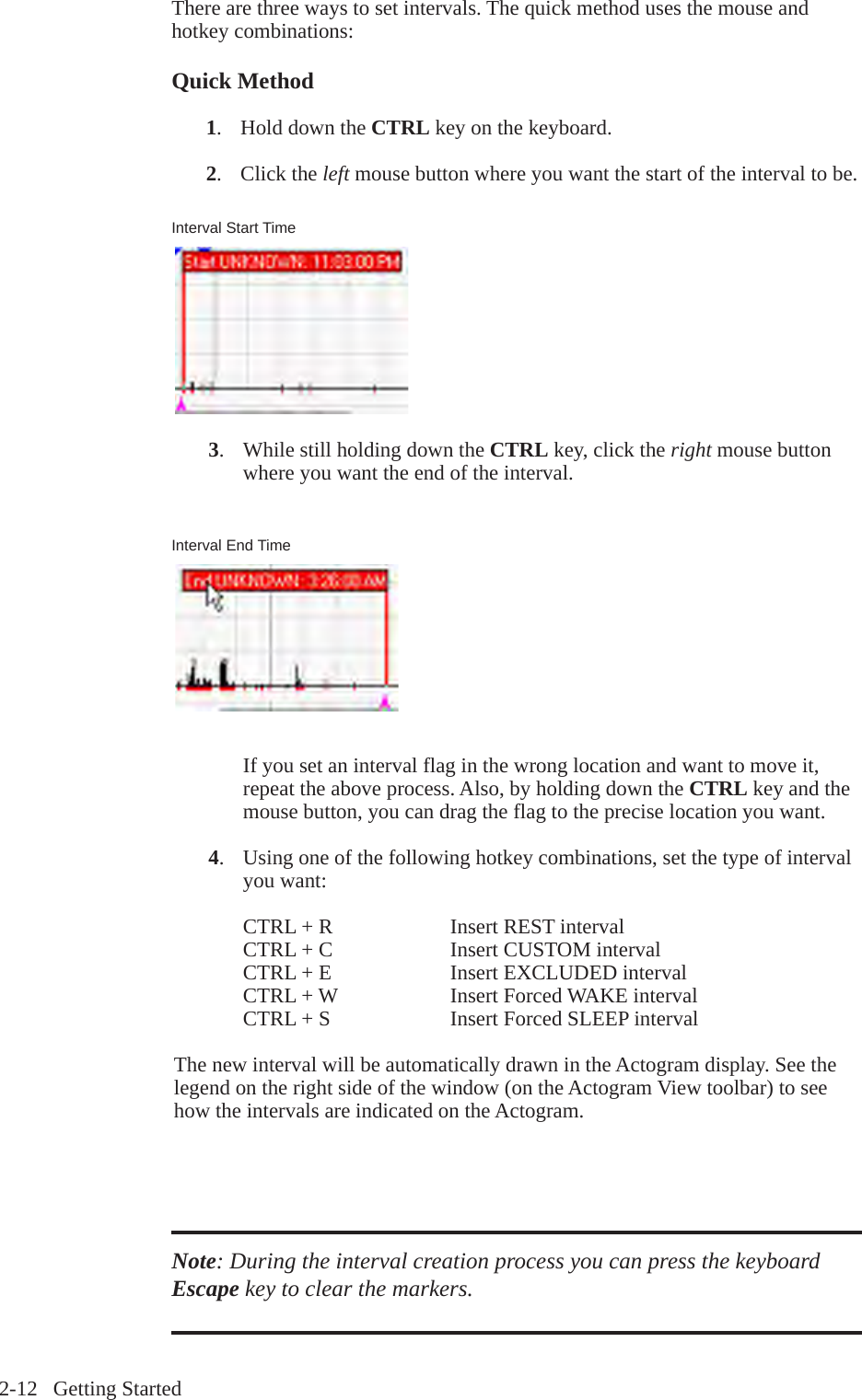
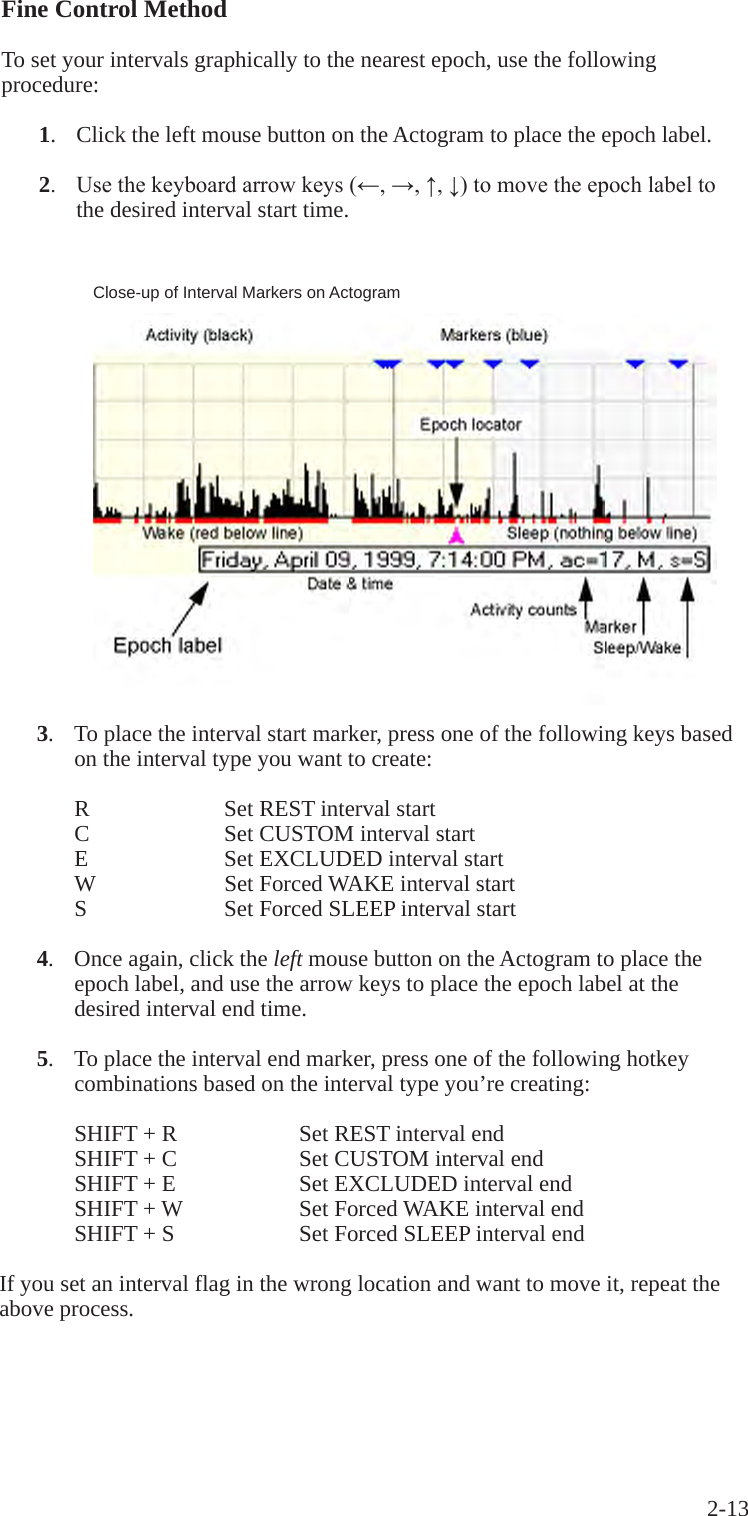
2-12   Getting StartedThere are three ways to set intervals. The quick method uses the mouse and hotkey combinations:Quick Method 1.   Hold down the CTRL key on the keyboard. 2.  Click the left mouse button where you want the start of the interval to be.Interval Start TimeIf you set an interval flag in the wrong location and want to move it, repeat the above process. Also, by holding down the CTRL key and the mouse button, you can drag the flag to the precise location you want. 4.  Using one of the following hotkey combinations, set the type of interval     you want:CTRL + R    Insert REST intervalCTRL + C    Insert CUSTOM intervalCTRL + E    Insert EXCLUDED intervalCTRL + W    Insert Forced WAKE intervalCTRL + S    Insert Forced SLEEP intervalThe new interval will be automatically drawn in the Actogram display. See the legend on the right side of the window (on the Actogram View toolbar) to see how the intervals are indicated on the Actogram.Interval End Time 3.  While still holding down the CTRL key, click the right mouse button     where you want the end of the interval.Note: During the interval creation process you can press the keyboard Escape key to clear the markers.
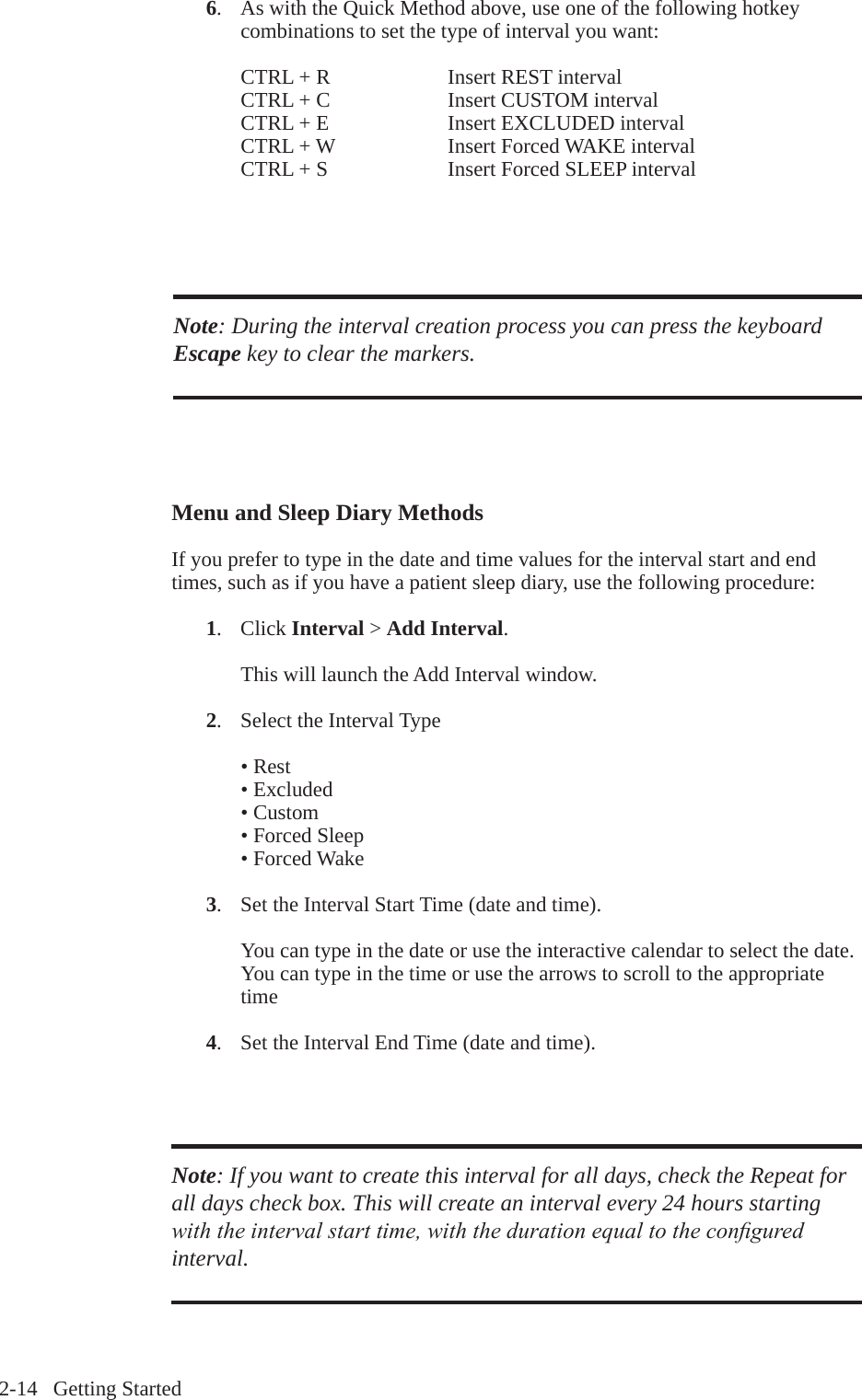
2-13 Fine Control MethodTo set your intervals graphically to the nearest epoch, use the following procedure: 1.   Click the left mouse button on the Actogram to place the epoch label. 2. Usethekeyboardarrowkeys(←,→,↑,↓)tomovetheepochlabelto     the desired interval start time.Close-up of Interval Markers on Actogram 3.  To place the interval start marker, press one of the following keys based     on the interval type you want to create:R    Set REST interval startC    Set CUSTOM interval startE    Set EXCLUDED interval startW    Set Forced WAKE interval startS    Set Forced SLEEP interval start 4.  Once again, click the left mouse button on the Actogram to place the     epoch label, and use the arrow keys to place the epoch label at the     desired interval end time. 5.  To place the interval end marker, press one of the following hotkey     combinations based on the interval type you’re creating:SHIFT + R    Set REST interval endSHIFT + C    Set CUSTOM interval endSHIFT + E    Set EXCLUDED interval endSHIFT + W    Set Forced WAKE interval endSHIFT + S    Set Forced SLEEP interval endIf you set an interval flag in the wrong location and want to move it, repeat the above process.
2-14   Getting Started 6.  As with the Quick Method above, use one of the following hotkey     combinations to set the type of interval you want:CTRL + R    Insert REST intervalCTRL + C    Insert CUSTOM intervalCTRL + E    Insert EXCLUDED intervalCTRL + W    Insert Forced WAKE intervalCTRL + S    Insert Forced SLEEP intervalNote: During the interval creation process you can press the keyboard Escape key to clear the markers. Menu and Sleep Diary MethodsIf you prefer to type in the date and time values for the interval start and end times, such as if you have a patient sleep diary, use the following procedure: 1.  Click Interval > Add Interval.    This will launch the Add Interval window. 2.  Select the Interval Type• Rest• Excluded• Custom• Forced Sleep• Forced Wake 3.  Set the Interval Start Time (date and time).You can type in the date or use the interactive calendar to select the date. You can type in the time or use the arrows to scroll to the appropriate time 4.  Set the Interval End Time (date and time).Note: If you want to create this interval for all days, check the Repeat for all days check box. This will create an interval every 24 hours starting with the interval start time, with the duration equal to the congured interval.
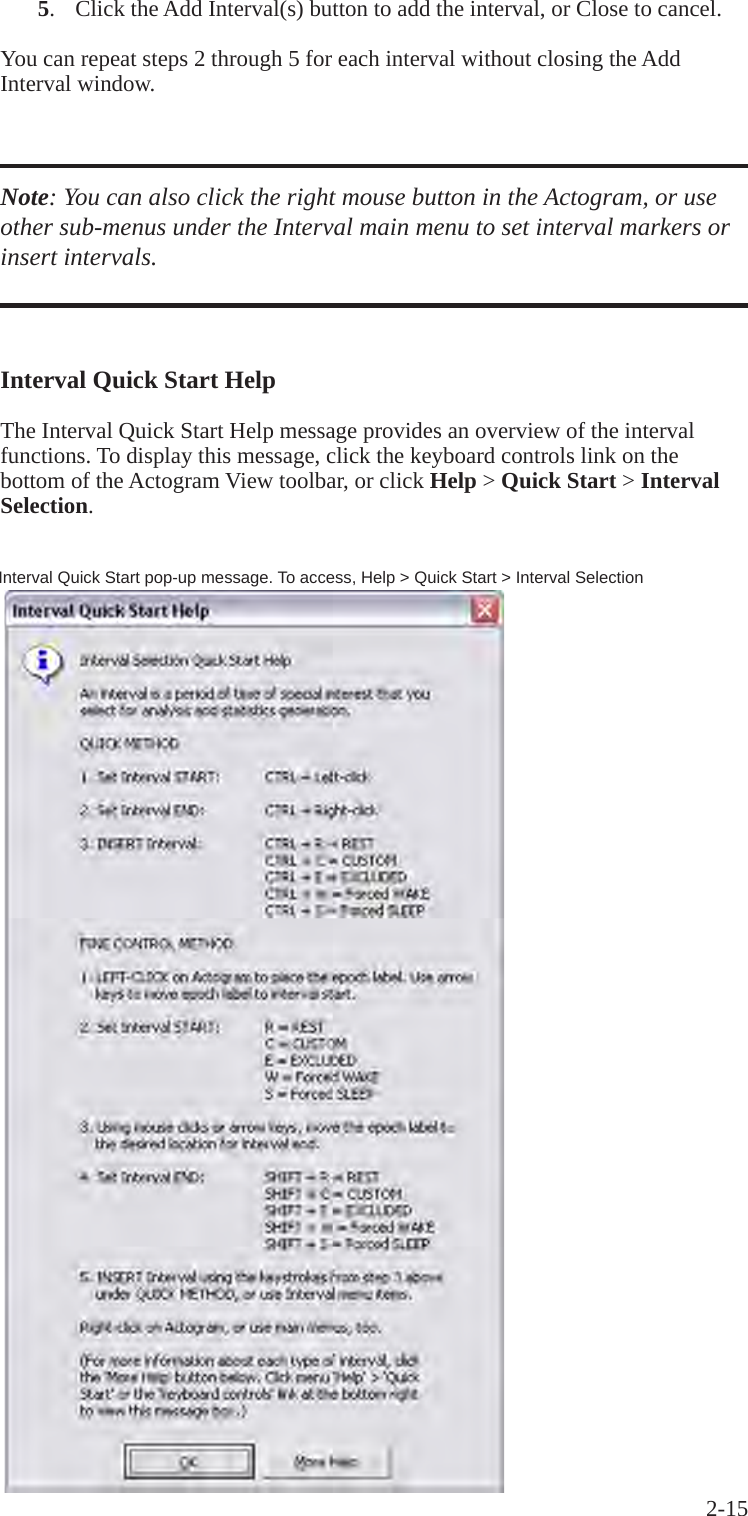
2-15  5.  Click the Add Interval(s) button to add the interval, or Close to cancel.You can repeat steps 2 through 5 for each interval without closing the Add Interval window.Note: You can also click the right mouse button in the Actogram, or use other sub-menus under the Interval main menu to set interval markers or insert intervals. Interval Quick Start HelpThe Interval Quick Start Help message provides an overview of the interval functions. To display this message, click the keyboard controls link on the bottom of the Actogram View toolbar, or click Help > Quick Start > Interval Selection.Interval Quick Start pop-up message. To access, Help > Quick Start > Interval Selection
2-16   Getting StartedRemoving IntervalsTo remove a single interval simply click the left mouse button in the interval you want to delete, then press the Delete key.To remove all intervals, right click on the Actogram and select Clear All Intervals (also accessible from the Interval menu)To remove all intervals of a specific interval type, use the Interval menu, or the corresponding keyboard shortcuts (such as CTRL + ALT + C to clear all custom intervals).
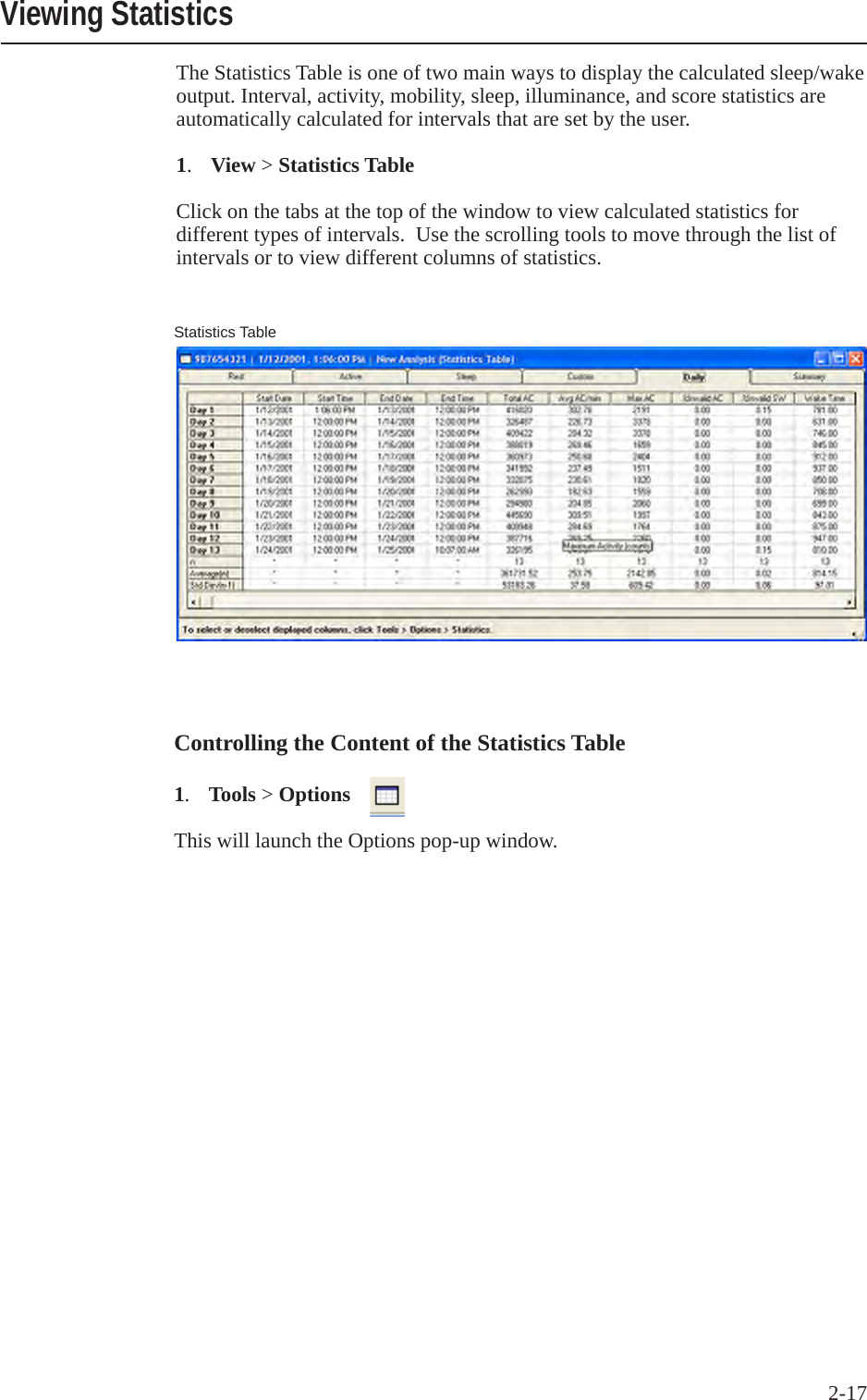
2-17 Controlling the Content of the Statistics Table1.  Tools > Options This will launch the Options pop-up window.Viewing StatisticsStatistics TableThe Statistics Table is one of two main ways to display the calculated sleep/wake output. Interval, activity, mobility, sleep, illuminance, and score statistics are automatically calculated for intervals that are set by the user. 1.  View > Statistics TableClick on the tabs at the top of the window to view calculated statistics for different types of intervals.  Use the scrolling tools to move through the list of intervals or to view different columns of statistics.
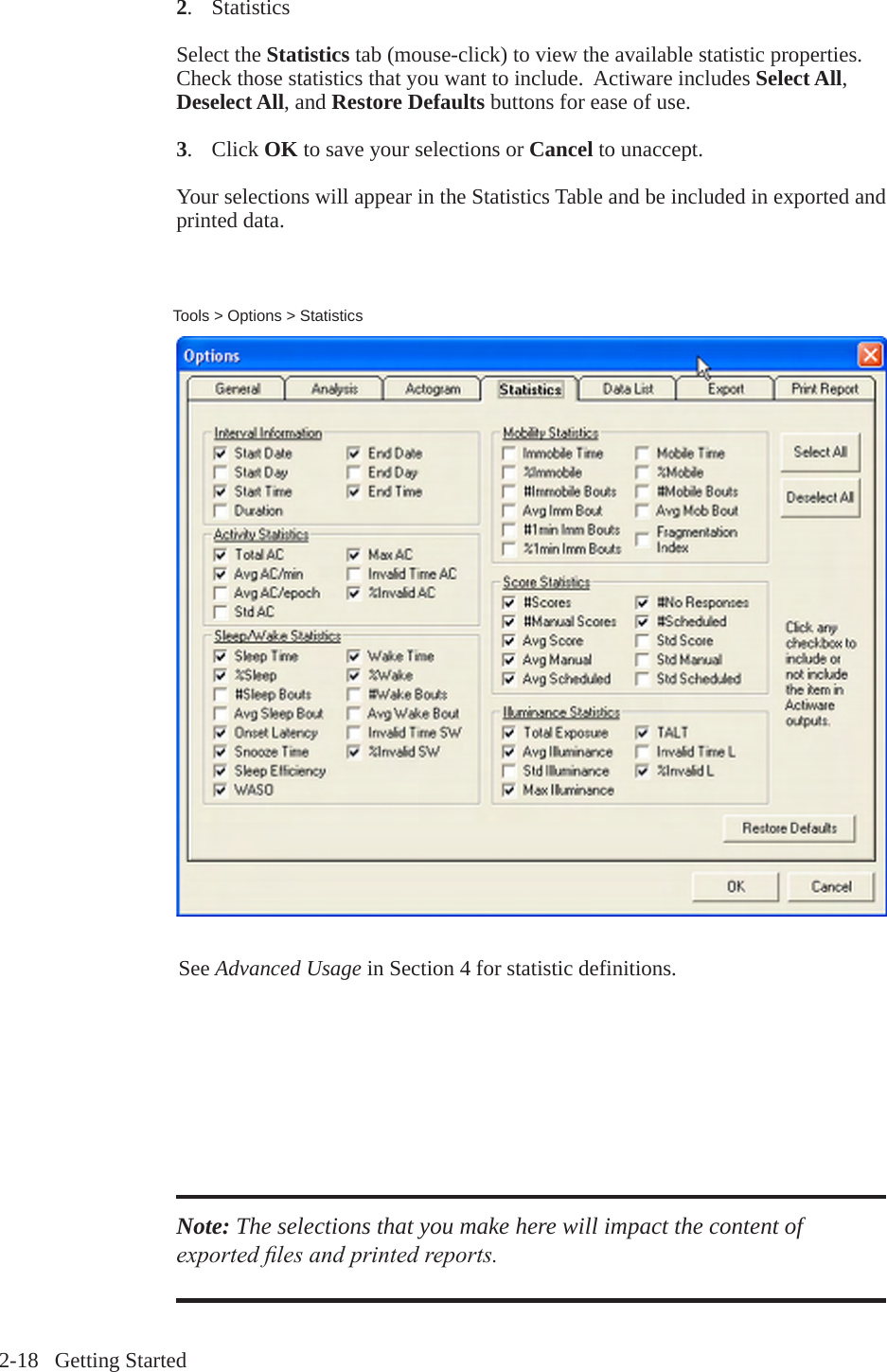
2-18   Getting Started2.   StatisticsSelect the Statistics tab (mouse-click) to view the available statistic properties. Check those statistics that you want to include.  Actiware includes Select All, Deselect All, and Restore Defaults buttons for ease of use.3.  Click OK to save your selections or Cancel to unaccept.Your selections will appear in the Statistics Table and be included in exported and printed data.Tools > Options > StatisticsSee Advanced Usage in Section 4 for statistic definitions.Note: The selections that you make here will impact the content of exported les and printed reports.
2-19 Exporting DataOnce you have added intervalsandanalyzedyourdata,youcanexporttheretrieved raw data or statistical results to a text file that can be easily loaded into Microsoft Excel, FAST, or a database program of your choice. There are three types of export files that can be created using Actiware:Standard Individual Export FileThis is a comma delimited ASCII text file (.csv) that can be opened directly by Microsoft Excel. It contains the data and analysis results for one analysis. To create this file, click File > Export menu or click the   button on the Standard toolbar. You will be prompted for a file name using the standard Windows dialog box.Note: The contents of the export le can be customized using the Tools > Options window. Use the Statistics, Data List and Export tabs to select what content you would like in the export le.Instead of creating a file, you can copy the file contents directly to the Windows clipboard by clicking Copy > Export Text. Then paste into your program of choice using the Clipboard paste function (commonly CTRL + V keyboard hotkey).FAST™ Export File1This is a tab delimited ASCII text file (.txt) designed specifically for importing into the Fatigue Avoidance Scheduling Tool™ Software. A short header, sleep/wake scores, and per epoch time stamps for the currently selected analysis are included in this export file.To create this file, click File > FAST Export. You will be prompted for a file name using the standard Windows dialog box.1  FAST™ is a trademark of NTI, Inc.
2-20   Getting StartedCombined Export File This is a comma delimited ASCII text file (.csv) that can be opened directly by Microsoft Excel. It contains the data and analysis results for intervals from  multipleanalyses.TheseanalysescanbefromanynumberofsubjectsorActiwatch data records in the currently opened database.UsetheTextFileExportBatchWizard,accessiblefromtheTools > Text File Export Batch menu to create this file (or many Standard Individual Export Files).See Batch Export in Advanced Usage, Section 4, for details.Note: Actiware-CT does not allow Copy > Export Text or File > FAST Export because these are unsecured outputs that do not contain an electronic or digital signature.
2-21 Print ReportYou can generate a printed report of your Actogram and statistical results for the currently selected analysis. To generate the report, click File > Print Report, or click the   button on the Standard toolbar. You will be presented with a Windows printer dialog where you can select the printer, number of copies, and paper orientation (such as Portrait or Landscape).Note: The contents of the printed report can be customized using the Tools > Options window. Use the Statistics and Print Report tabs to select what content you would like for the printed report.
2-22   Getting StartedNew SubjectOnce a databaseexistsitcanbepopulatedwithsubjectsandsubjectcollecteddata.Toaddoreditasubject,firstopenthedatabase.Select File > Database > Open, as described on the previous page.Toaddanewsubjecttoadatabase,dothefollowing:1.  Click File > New Subject.ThiswillopenaNewSubjectwindowtoallowforthecaptureofdemographic data.2.  Fill in the three required fields: Identity, Date of Birth and GenderForIdentity,wesuggestusingablinddescriptorornicknameofthesubject.Notice that Age is automatically computed.Important! Because you can import subjects from other databases, Actiware allows more than one subject with the same ID. Therefore, you need to be sure you choose a subject ID that does not already exist in the currently open database.3.  If you desire, fill in the remaining fields.For HIPAA considerations, these fields are optional.When USA or Canada is entered into the Country field, a dropdown list for the State/Province area will become available. Additionally, the Phone field will be optimizedforthe(###)###-####format.Toenteranon-USornon-Canadianstate code or phone number, enter the Country first.
2-23 Deleting/Hiding SubjectsForpurposesofdatatracking,youcannotdeletesubjectsfromadatabase.Youcan hide them by checking the Hide Subjectbox.Oncehidden,asubjectwillnotappear in the DatabaseViewer.Hiddensubjectsmayberevealedbyrightclickingin the Database Viewer and selecting View Hidden Subjects.
2-24   Getting Started
3-1SECTION3The Actiware software is used to configure the Actiwatch device and retrieve data from the Actiwatch through the use of the ActiReader.To set up the ActiReader, see Installation and Setup in Section 1 of this manual.COMMUNICATIONS  OverviewThiswizardwillconfigureanActiwatchfordatacollection.Thiswizardassumesthat the ActiReader or Actiwatch Reader is connected to the computer and the appropriate COM port is selected.  Please refer to Section 1 of this manual for setting up the ActiReader and selecting a COM port.The Configure Actiwatch Wizard will guide you through several windows.  As withotherActiwarewizards,youcanmakechangesateachwindow.Youcanalso travel between windows using the Back and Next buttons, or Cancel to closethewizard.Use the Show/Hide Actiwatch Details button to view additional information associated with the watch.Congure ActiwatchCAUTION! The Congure Actiwatch wizard will delete all setup information  and data stored in the Actiwatch. To stop this wizard, select the Cancel button.  To retrieve data, proceed to Retrieve Data from Actiwatch later in this section.
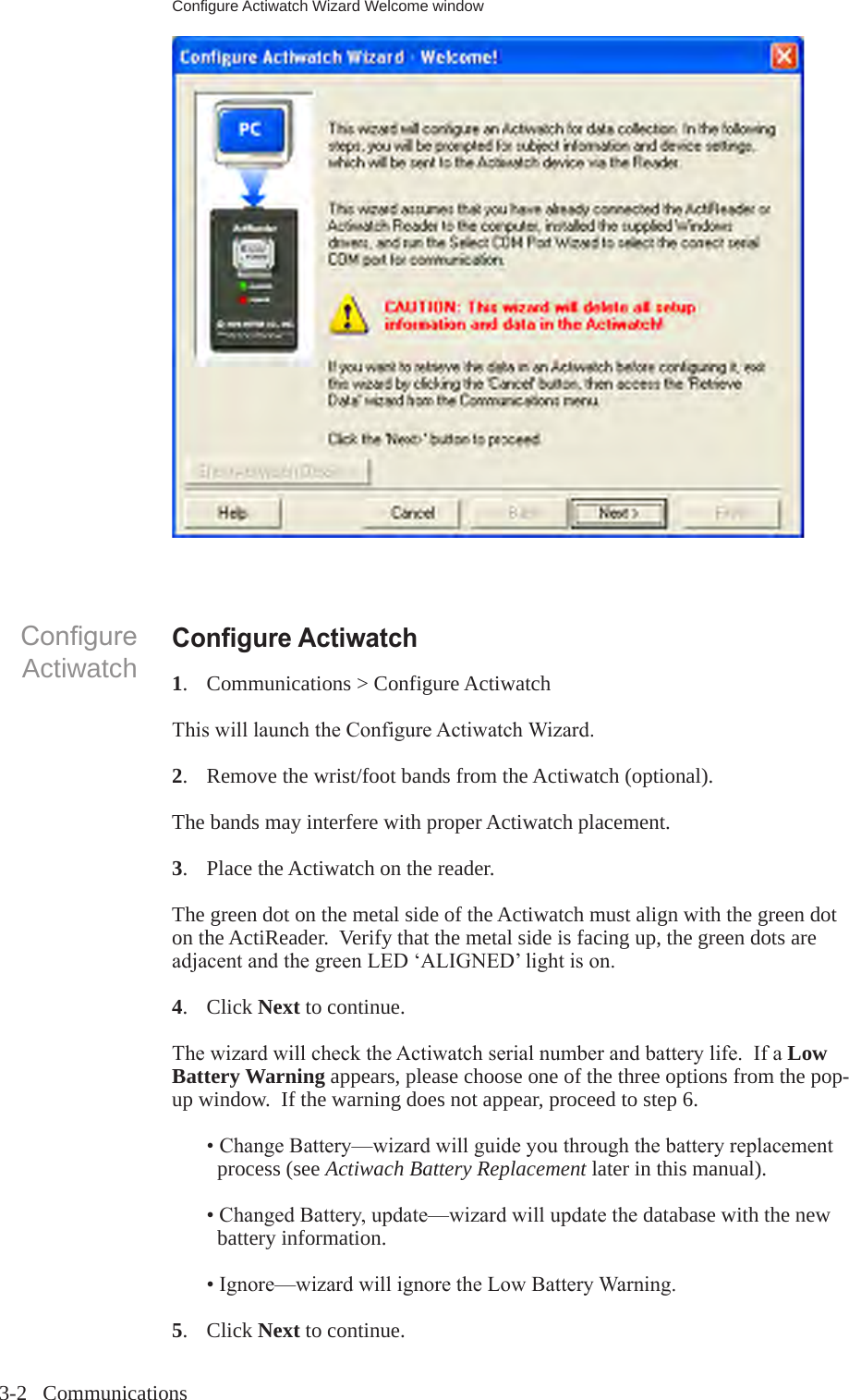
3-2   CommunicationsCongure ActiwatchCongure Actiwatch1.  Communications > Configure ActiwatchThiswilllaunchtheConfigureActiwatchWizard.2.   Remove the wrist/foot bands from the Actiwatch (optional).The bands may interfere with proper Actiwatch placement.3.  Place the Actiwatch on the reader.The green dot on the metal side of the Actiwatch must align with the green dot on the ActiReader.  Verify that the metal side is facing up, the green dots are adjacentandthegreenLED‘ALIGNED’lightison.4.  Click Next to continue.ThewizardwillchecktheActiwatchserialnumberandbatterylife.IfaLow Battery Warning appears, please choose one of the three options from the pop-up window.  If the warning does not appear, proceed to step 6.  • ChangeBattery—wizardwillguideyouthroughthebatteryreplacement     process (see Actiwach Battery Replacement later in this manual). •ChangedBattery,update—wizardwillupdatethedatabase with the new     battery information. •Ignore—wizardwillignoretheLowBatteryWarning.5.  Click Next to continue.Configure Actiwatch Wizard Welcome window
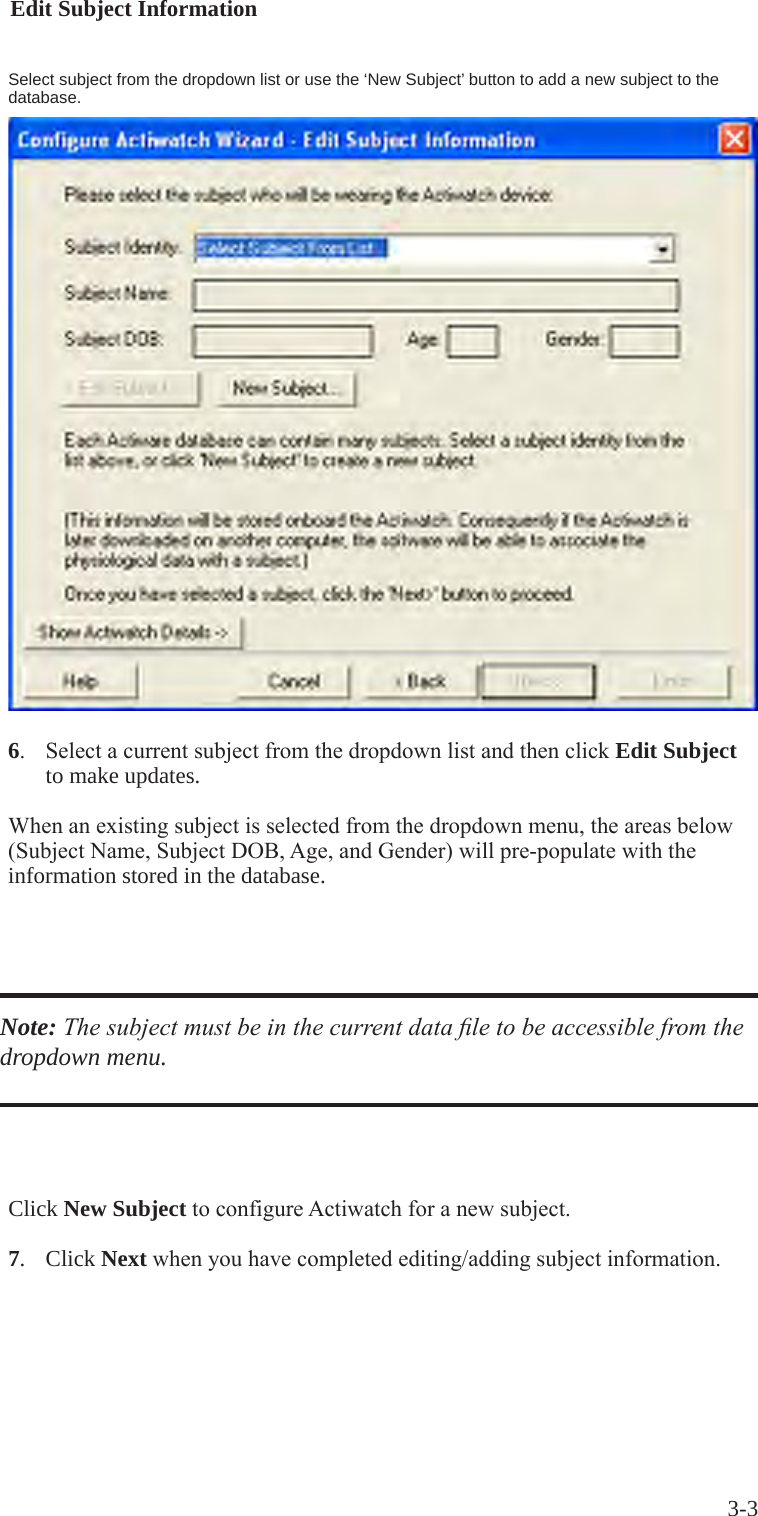
3-36. SelectacurrentsubjectfromthedropdownlistandthenclickEdit Subject   to make updates. Whenanexistingsubjectisselectedfromthedropdownmenu,theareasbelow(SubjectName,SubjectDOB,Age,andGender)willpre-populatewiththeinformation stored in the database.Note: The subject must be in the current data le to be accessible from the dropdown menu.Select subject from the dropdown list or use the ‘New Subject’ button to add a new subject to the database.Click New SubjecttoconfigureActiwatchforanewsubject.7.   Click Nextwhenyouhavecompletedediting/addingsubjectinformation.Edit Subject Information
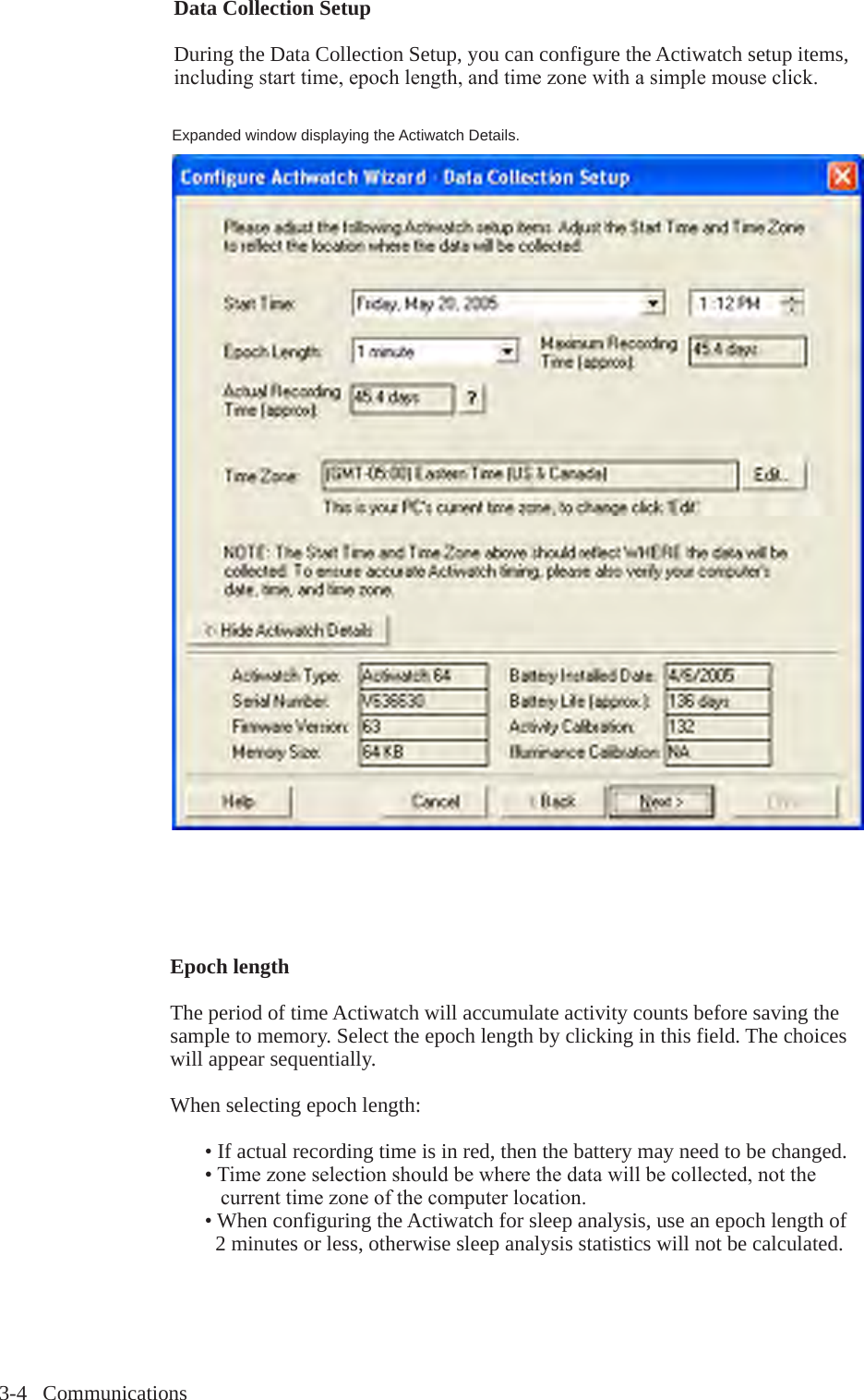
3-4   CommunicationsExpanded window displaying the Actiwatch Details.Epoch length The period of time Actiwatch will accumulate activity counts before saving the sample to memory. Select the epoch length by clicking in this field. The choices will appear sequentially.When selecting epoch length:  • If actual recording time is in red, then the battery may need to be changed. •Timezoneselectionshouldbewherethedatawillbecollected,notthe  currenttimezoneofthecomputerlocation.  • When configuring the Actiwatch for sleep analysis, use an epoch length of     2 minutes or less, otherwise sleep analysis statistics will not be calculated.Data Collection SetupDuring the Data Collection Setup, you can configure the Actiwatch setup items, includingstarttime,epochlength,andtimezonewithasimplemouseclick.
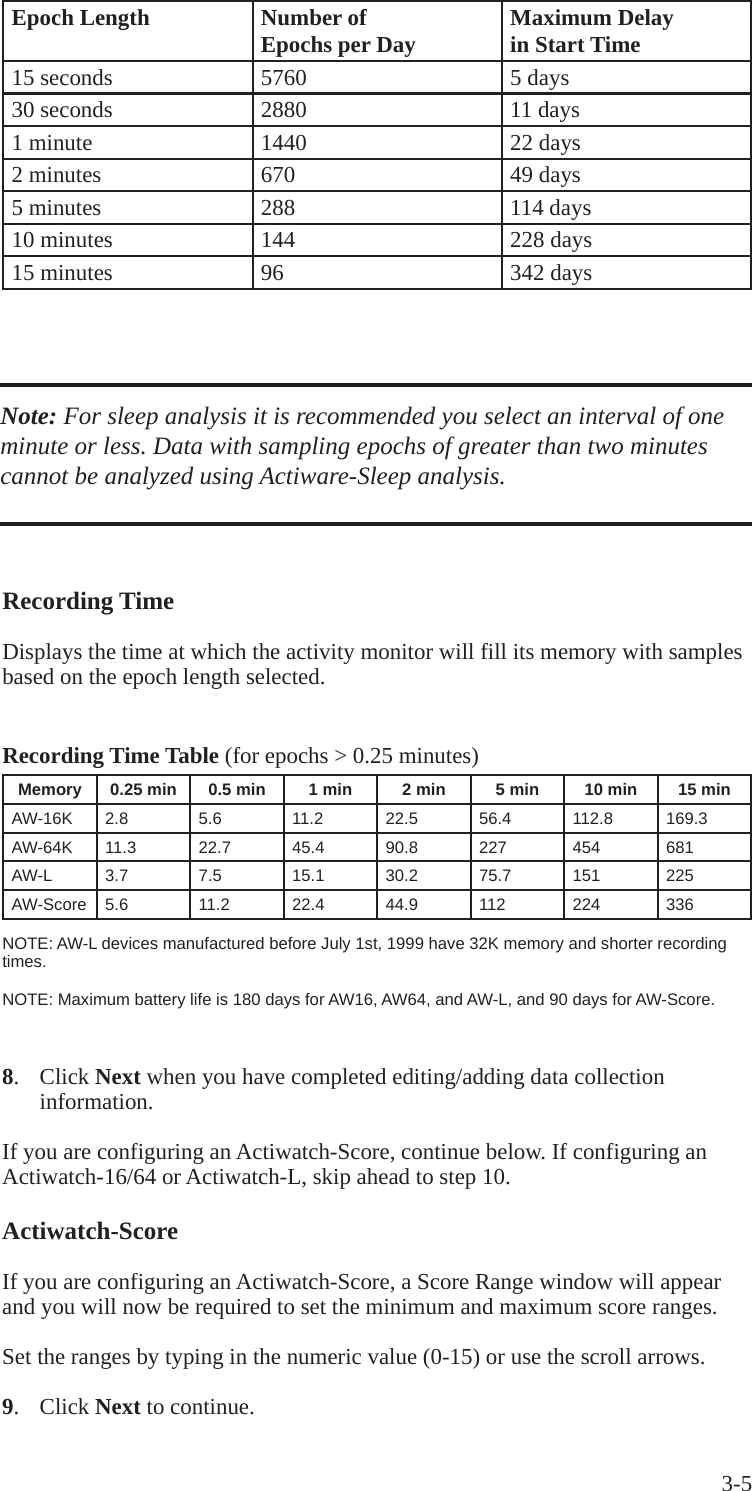
3-5Recording Time Displays the time at which the activity monitor will fill its memory with samples based on the epoch length selected. Recording Time Table (for epochs > 0.25 minutes) Memory  0.25 min 0.5 min 1 min 2 min 5 min 10 min 15 minAW-16K  2.8 5.6  11.2  22.5  56.4  112.8  169.3 AW-64K  11.3 22.7  45.4  90.8  227  454  681 AW-L  3.7  7.5  15.1  30.2  75.7  151  225 AW-Score  5.6 11.2  22.4  44.9  112  224  336 NOTE: AW-L devices manufactured before July 1st, 1999 have 32K memory and shorter recording times. NOTE: Maximum battery life is 180 days for AW16, AW64, and AW-L, and 90 days for AW-Score. Epoch Length  Number of  Epochs per Day  Maximum Delay in Start Time 15 seconds 5760  5 days30 seconds  2880  11 days 1 minute  1440  22 days 2 minutes  670  49 days 5 minutes  288  114 days 10 minutes  144  228 days 15 minutes  96  342 days Note: For sleep analysis it is recommended you select an interval of one minute or less. Data with sampling epochs of greater than two minutes cannot be analyzed using Actiware-Sleep analysis. 8.  Click Next when you have completed editing/adding data collection   information.  If you are configuring an Actiwatch-Score, continue below. If configuring an Actiwatch-16/64 or Actiwatch-L, skip ahead to step 10.Actiwatch-ScoreIf you are configuring an Actiwatch-Score, a Score Range window will appear and you will now be required to set the minimum and maximum score ranges.  Set the ranges by typing in the numeric value (0-15) or use the scroll arrows.9.  Click Next to continue.
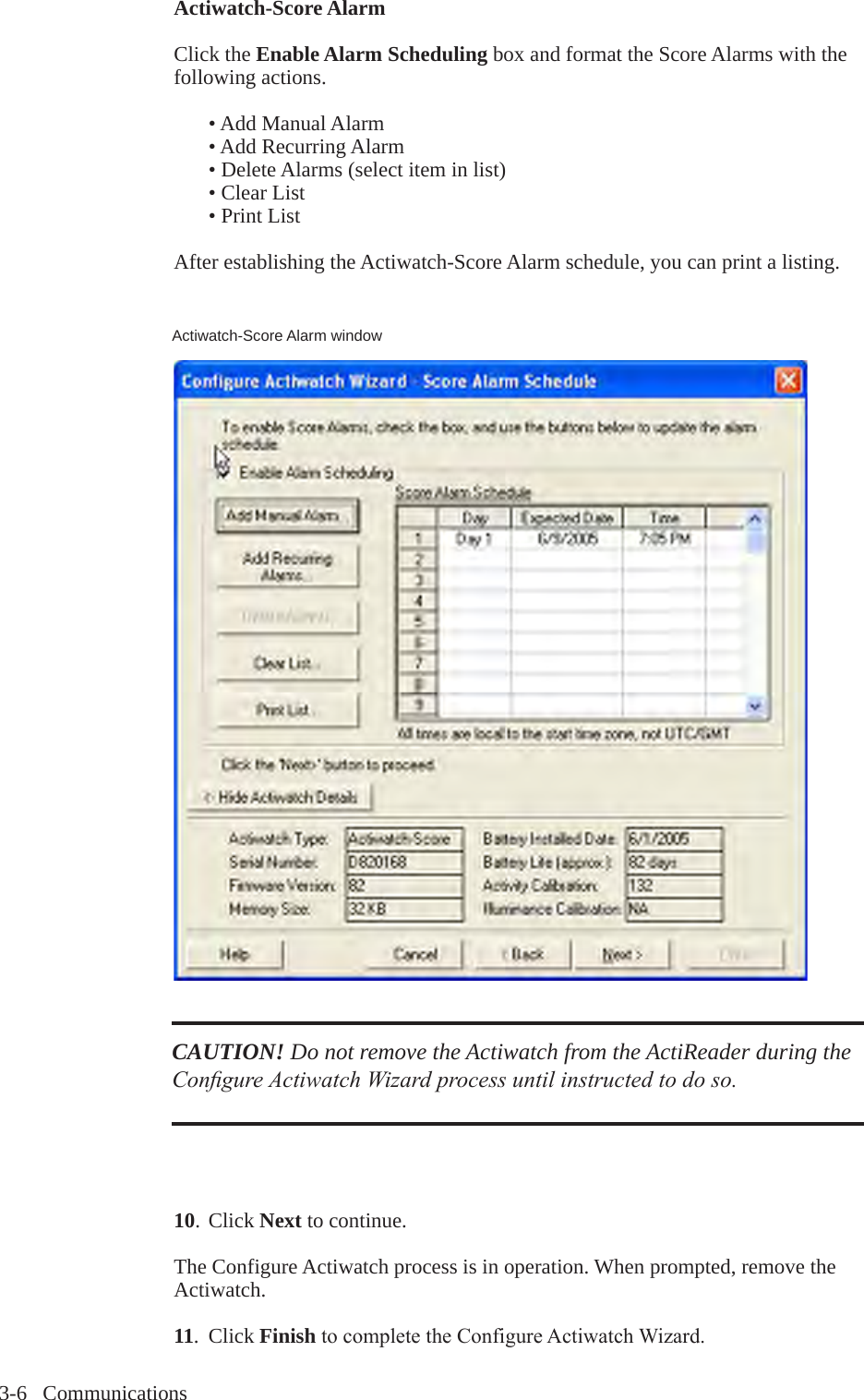
3-6   CommunicationsActiwatch-Score AlarmClick the Enable Alarm Scheduling box and format the Score Alarms with the following actions.  • Add Manual Alarm  • Add Recurring Alarm  • Delete Alarms (select item in list)  • Clear List  • Print ListAfter establishing the Actiwatch-Score Alarm schedule, you can print a listing.10. Click Next to continue.The Configure Actiwatch process is in operation. When prompted, remove the Actiwatch.11.  Click FinishtocompletetheConfigureActiwatchWizard.CAUTION! Do not remove the Actiwatch from the ActiReader during the Congure Actiwatch Wizard process until instructed to do so.Actiwatch-Score Alarm window
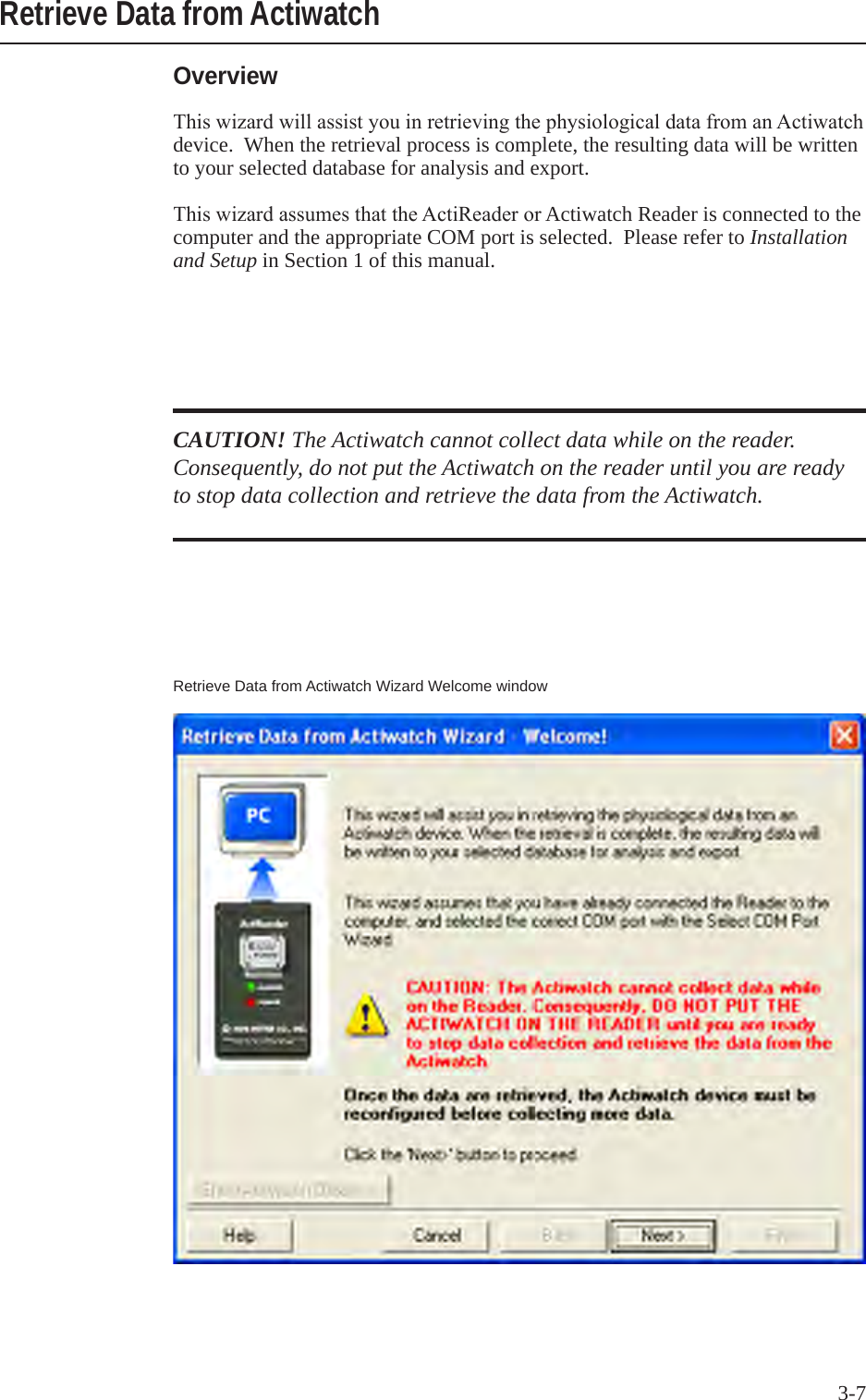
3-7OverviewThiswizardwillassistyouinretrievingthephysiologicaldatafromanActiwatchdevice.  When the retrieval process is complete, the resulting data will be written to your selected database for analysis and export.ThiswizardassumesthattheActiReaderorActiwatch Reader is connected to the computer and the appropriate COM port is selected.  Please refer to Installation and Setup in Section 1 of this manual.Retrieve Data from ActiwatchCAUTION! The Actiwatch cannot collect data while on the reader. Consequently, do not put the Actiwatch on the reader until you are ready to stop data collection and retrieve the data from the Actiwatch.Retrieve Data from Actiwatch Wizard Welcome window
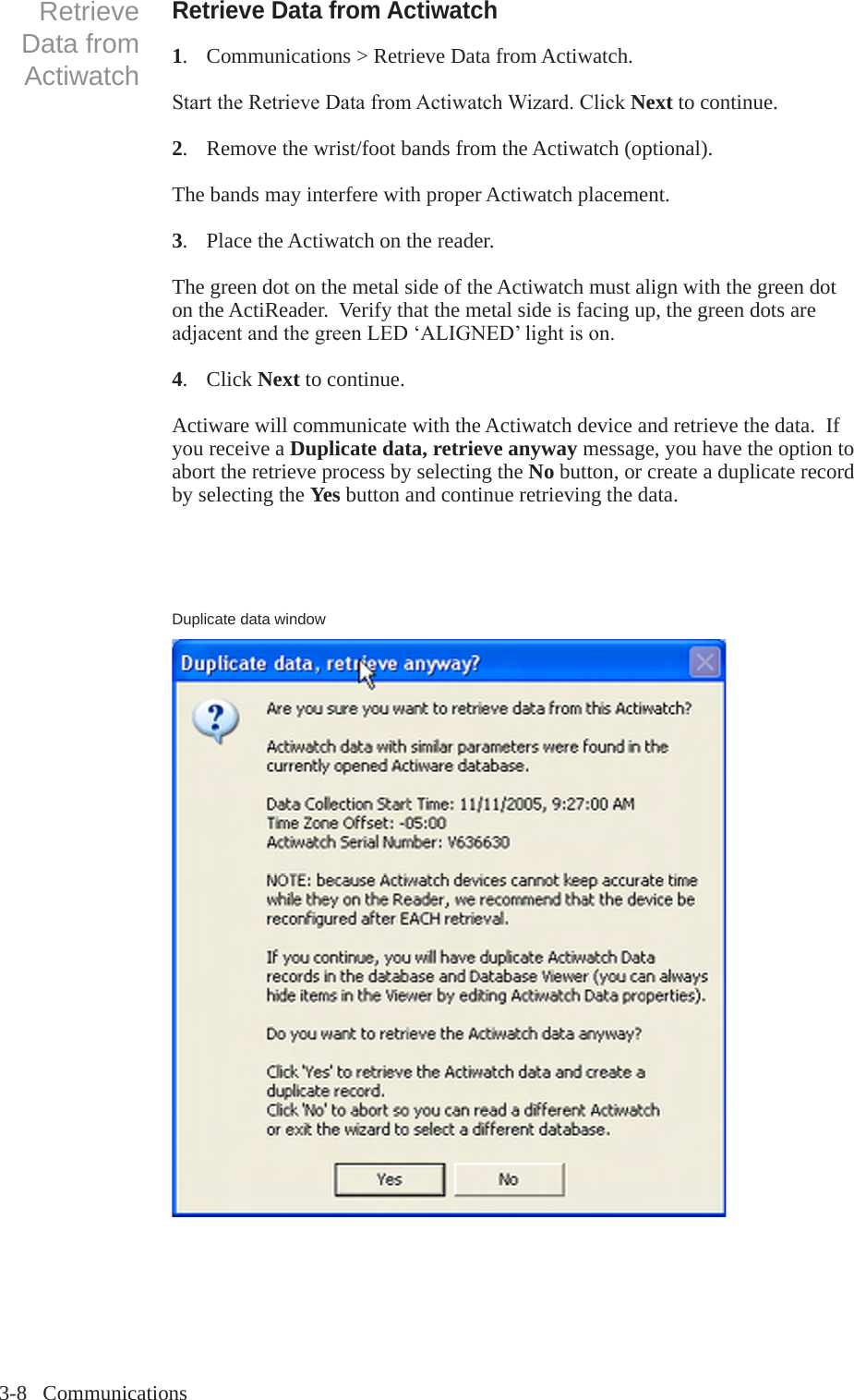
3-8   CommunicationsRetrieve Data from Actiwatch1.  Communications > Retrieve Data from Actiwatch.StarttheRetrieveDatafromActiwatchWizard.ClickNext to continue.2.   Remove the wrist/foot bands from the Actiwatch (optional).The bands may interfere with proper Actiwatch placement.3.  Place the Actiwatch on the reader.The green dot on the metal side of the Actiwatch must align with the green dot on the ActiReader.  Verify that the metal side is facing up, the green dots are adjacentandthegreenLED‘ALIGNED’lightison.4.  Click Next to continue.Actiware will communicate with the Actiwatch device and retrieve the data.  If you receive a Duplicate data, retrieve anyway message, you have the option to abort the retrieve process by selecting the No button, or create a duplicate record by selecting the Yes button and continue retrieving the data.Retrieve Data from ActiwatchDuplicate data window
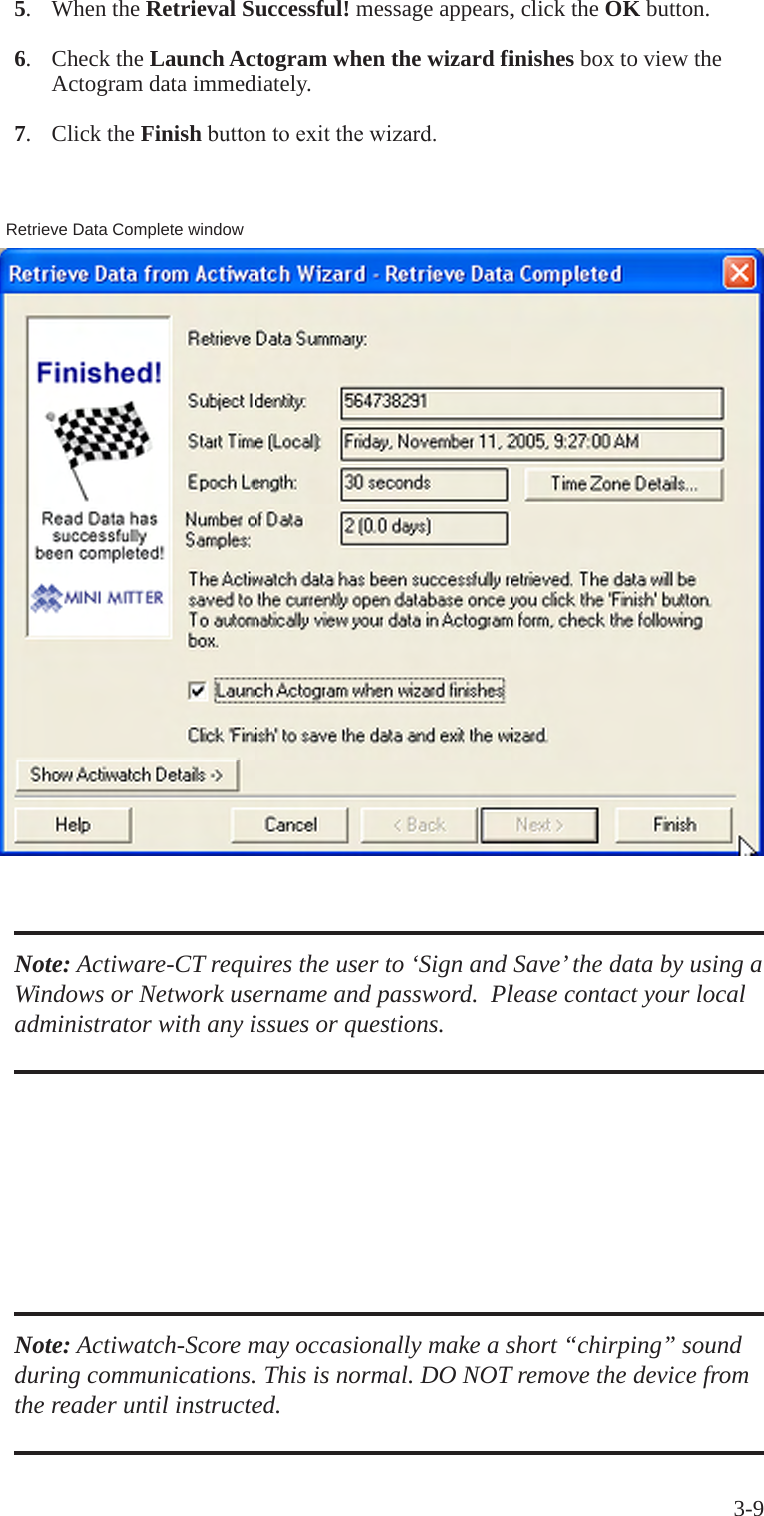
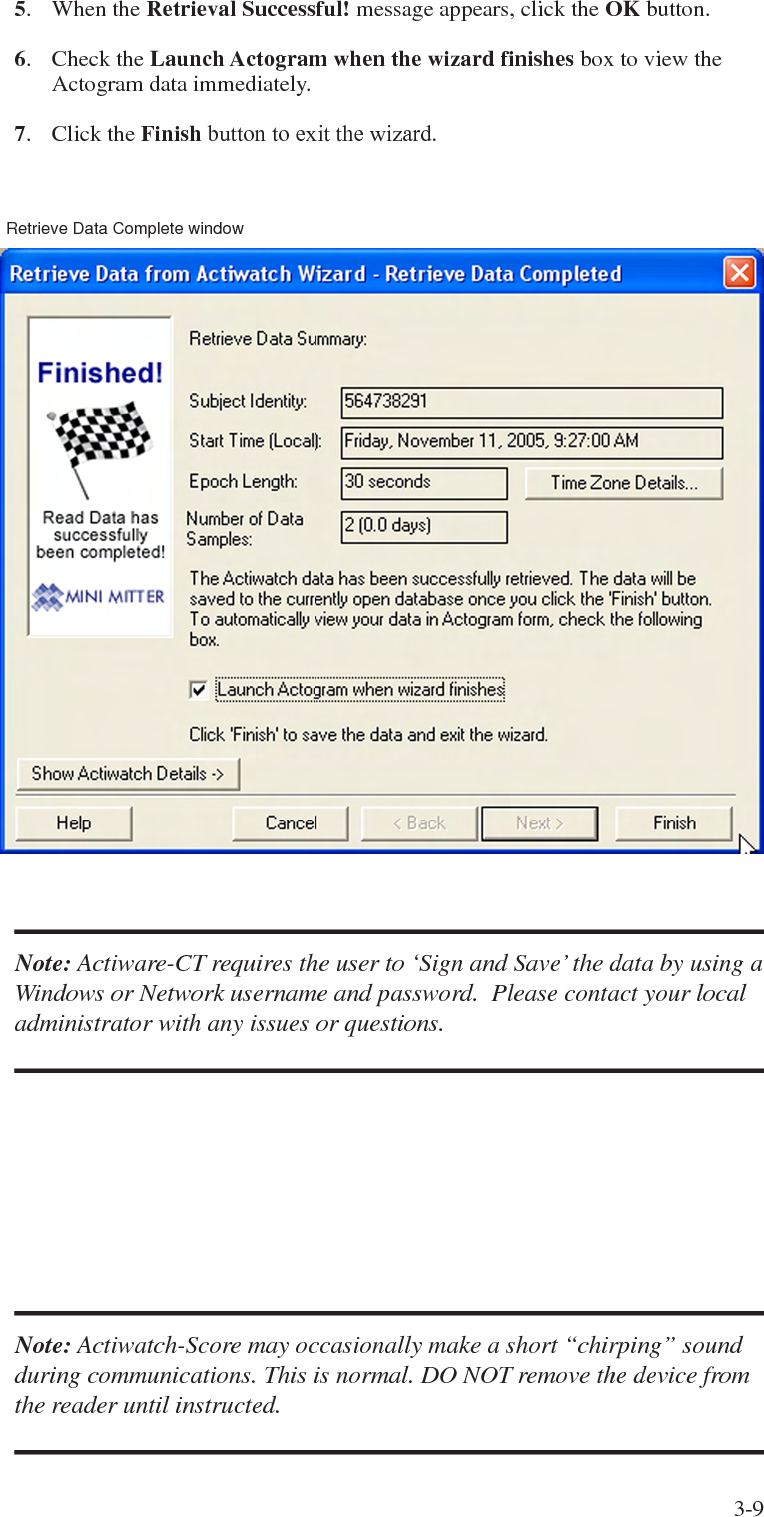
3-9Note: Actiware-CT requires the user to ‘Sign and Save’ the data by using a Windows or Network username and password.  Please contact your local administrator with any issues or questions.5.  When the Retrieval Successful! message appears, click the OK button.6.  Check the Launch Actogram when the wizard finishes box to view the   Actogram data immediately. 7.  Click the Finishbuttontoexitthewizard.Note: Actiwatch-Score may occasionally make a short “chirping” sound during communications. This is normal. DO NOT remove the device from the reader until instructed.Retrieve Data Complete window
3-10   Communications
4-1SECTION4ADVANCED USAGE  Actiware provides greater flexibility to researchers and clinicians when viewing andanalyzingdata.AdvanceduserscantakeadvantageoftheActiwareToolbars   to manipulate how the data is viewed and exported.Items covered in this section:  • Program Options (Tools > Options)  • Data List  • Batch Export  • Import AWD files  • GraphYour input is vital to us. Please explore the program fully and give us your feedback. Please feel free to contact us with any questions or comments on this software.
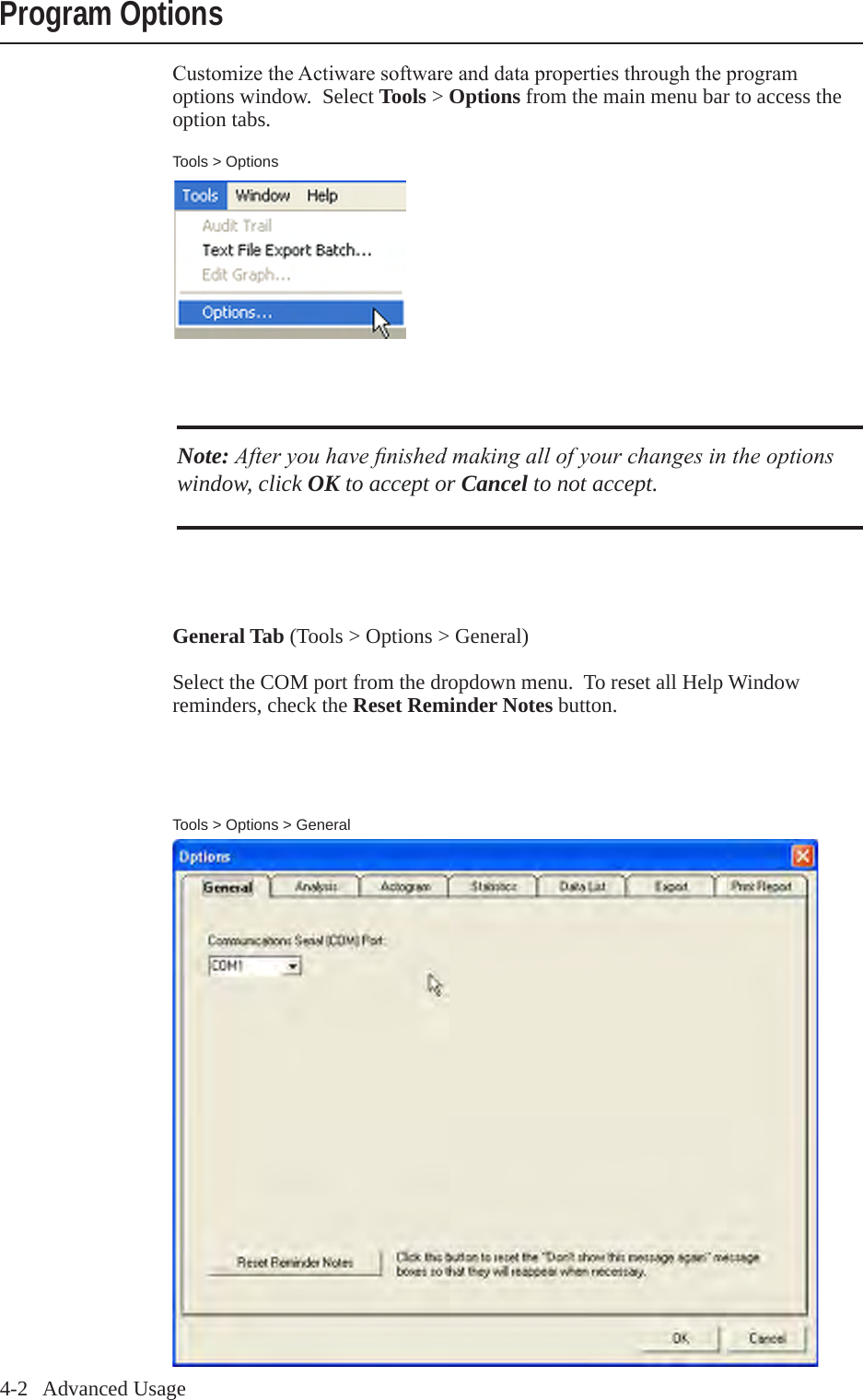
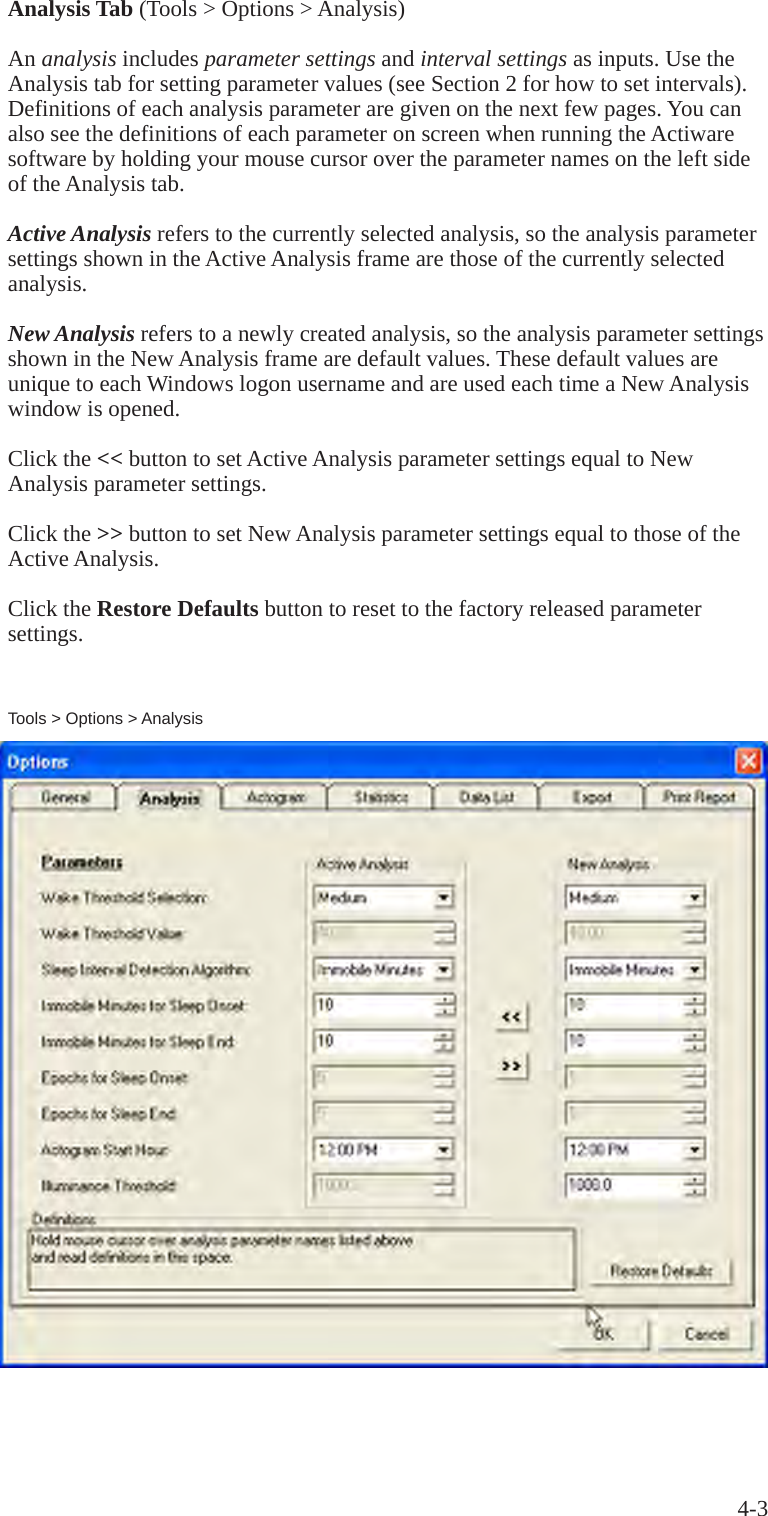
4-2   Advanced UsageProgram OptionsTools > OptionsGeneral Tab (Tools > Options > General)Select the COM port from the dropdown menu.  To reset all Help Window reminders, check the Reset Reminder Notes button.CustomizetheActiwaresoftwareanddatapropertiesthroughtheprogramoptions window.  Select Tools > Options from the main menu bar to access the option tabs.Note: After you have nished making all of your changes in the options window, click OK to accept or Cancel to not accept.Tools > Options > General
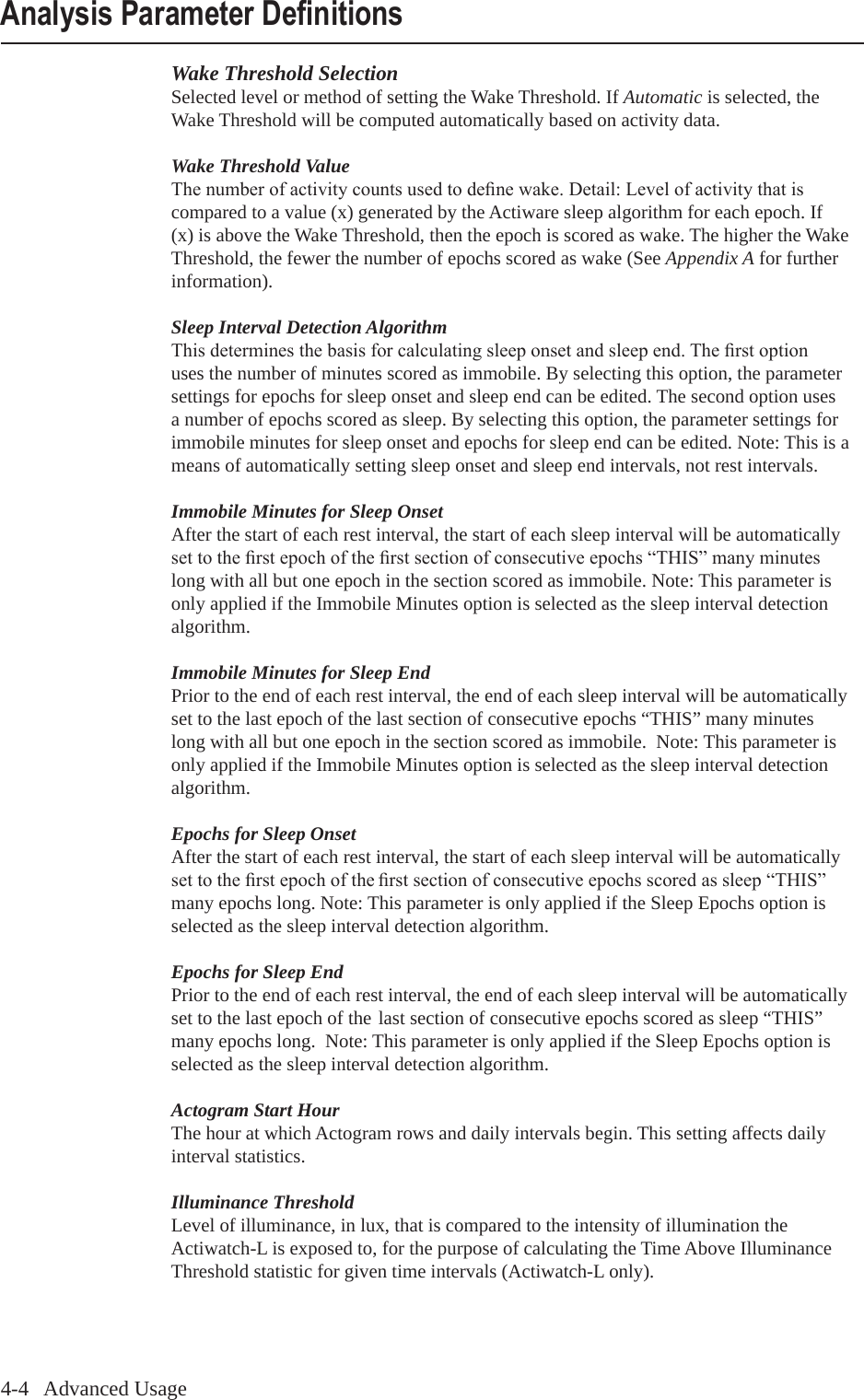
4-3Analysis Tab (Tools > Options > Analysis)An analysis includes parameter settings and interval settings as inputs. Use the Analysis tab for setting parameter values (see Section 2 for how to set intervals). Definitions of each analysis parameter are given on the next few pages. You can also see the definitions of each parameter on screen when running the Actiware software by holding your mouse cursor over the parameter names on the left side of the Analysis tab.Active Analysis refers to the currently selected analysis, so the analysis parameter settings shown in the Active Analysis frame are those of the currently selected analysis.New Analysis refers to a newly created analysis, so the analysis parameter settings shown in the New Analysis frame are default values. These default values are unique to each Windows logon username and are used each time a New Analysis window is opened.Click the << button to set Active Analysis parameter settings equal to New Analysis parameter settings.Click the >> button to set New Analysis parameter settings equal to those of the Active Analysis.Click the Restore Defaults button to reset to the factory released parameter settings.Tools > Options > Analysis
4-4   Advanced UsageWake Threshold SelectionSelected level or method of setting the Wake Threshold. If Automatic is selected, the Wake Threshold will be computed automatically based on activity data.Wake Threshold ValueThenumberofactivitycountsusedtodenewake.Detail:Levelofactivitythatiscompared to a value (x) generated by the Actiware sleep algorithm for each epoch. If (x) is above the Wake Threshold, then the epoch is scored as wake. The higher the Wake Threshold, the fewer the number of epochs scored as wake (See Appendix A for further information).Sleep Interval Detection AlgorithmThisdeterminesthebasisforcalculatingsleeponsetandsleepend.Therstoptionuses the number of minutes scored as immobile. By selecting this option, the parameter settings for epochs for sleep onset and sleep end can be edited. The second option uses a number of epochs scored as sleep. By selecting this option, the parameter settings for immobile minutes for sleep onset and epochs for sleep end can be edited. Note: This is a means of automatically setting sleep onset and sleep end intervals, not rest intervals.Immobile Minutes for Sleep OnsetAfter the start of each rest interval, the start of each sleep interval will be automatically settotherstepochoftherstsectionofconsecutiveepochs“THIS”manyminuteslong with all but one epoch in the section scored as immobile. Note: This parameter is only applied if the Immobile Minutes option is selected as the sleep interval detection algorithm.Immobile Minutes for Sleep EndPrior to the end of each rest interval, the end of each sleep interval will be automatically set to the last epoch of the last section of consecutive epochs “THIS” many minutes long with all but one epoch in the section scored as immobile.  Note: This parameter is only applied if the Immobile Minutes option is selected as the sleep interval detection algorithm.Epochs for Sleep OnsetAfter the start of each rest interval, the start of each sleep interval will be automatically settotherstepochoftherstsectionofconsecutiveepochsscoredassleep“THIS”many epochs long. Note: This parameter is only applied if the Sleep Epochs option is selected as the sleep interval detection algorithm.Epochs for Sleep EndPrior to the end of each rest interval, the end of each sleep interval will be automatically set to the last epoch of the last section of consecutive epochs scored as sleep “THIS” many epochs long.  Note: This parameter is only applied if the Sleep Epochs option is selected as the sleep interval detection algorithm.Actogram Start HourThe hour at which Actogram rows and daily intervals begin. This setting affects daily interval statistics.Illuminance ThresholdLevel of illuminance, in lux, that is compared to the intensity of illumination the Actiwatch-L is exposed to, for the purpose of calculating the Time Above Illuminance Threshold statistic for given time intervals (Actiwatch-L only).Analysis Parameter Denitions
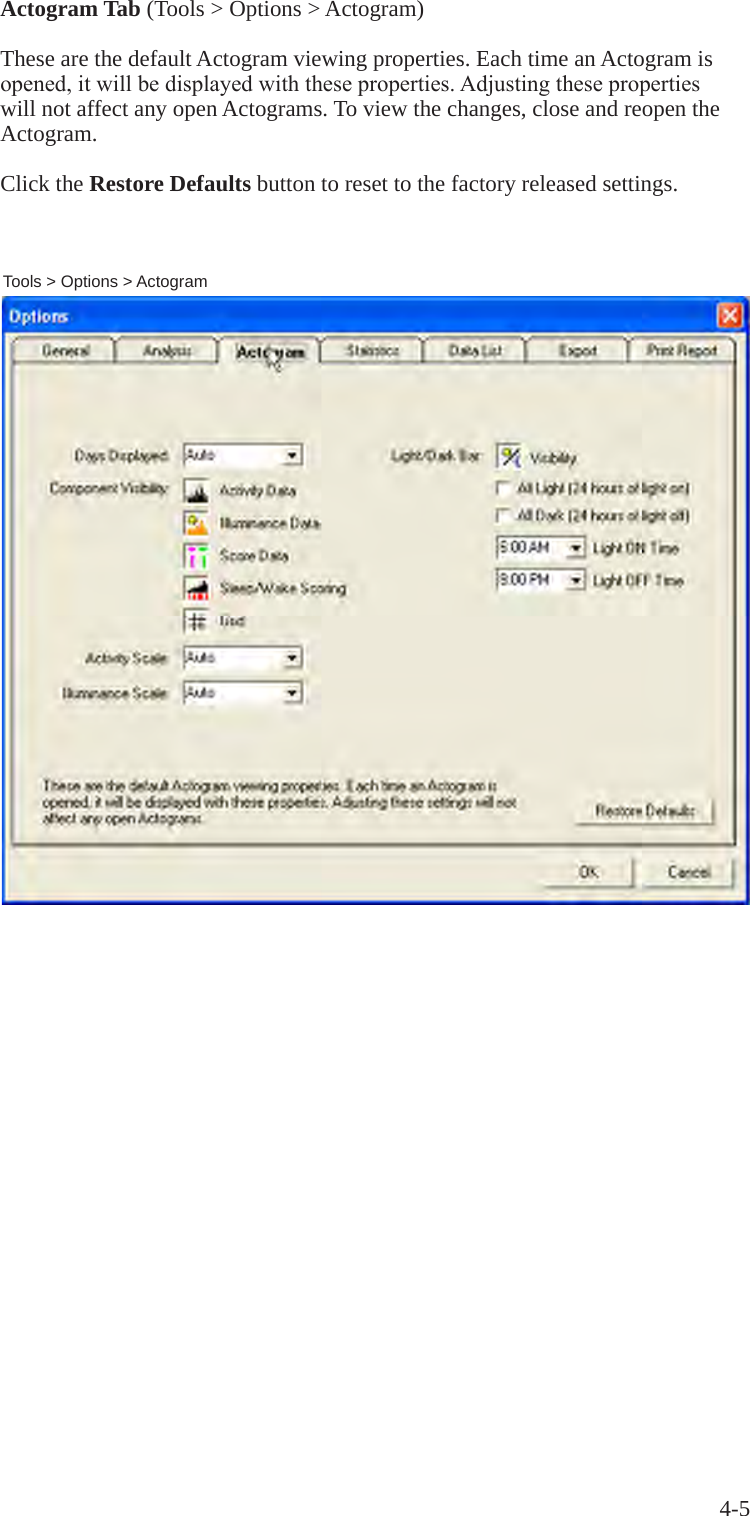
4-5Actogram Tab (Tools > Options > Actogram)These are the default Actogram viewing properties. Each time an Actogram is opened,itwillbedisplayedwiththeseproperties.Adjustingthesepropertieswill not affect any open Actograms. To view the changes, close and reopen the Actogram.Click the Restore Defaults button to reset to the factory released settings.Tools > Options > Actogram
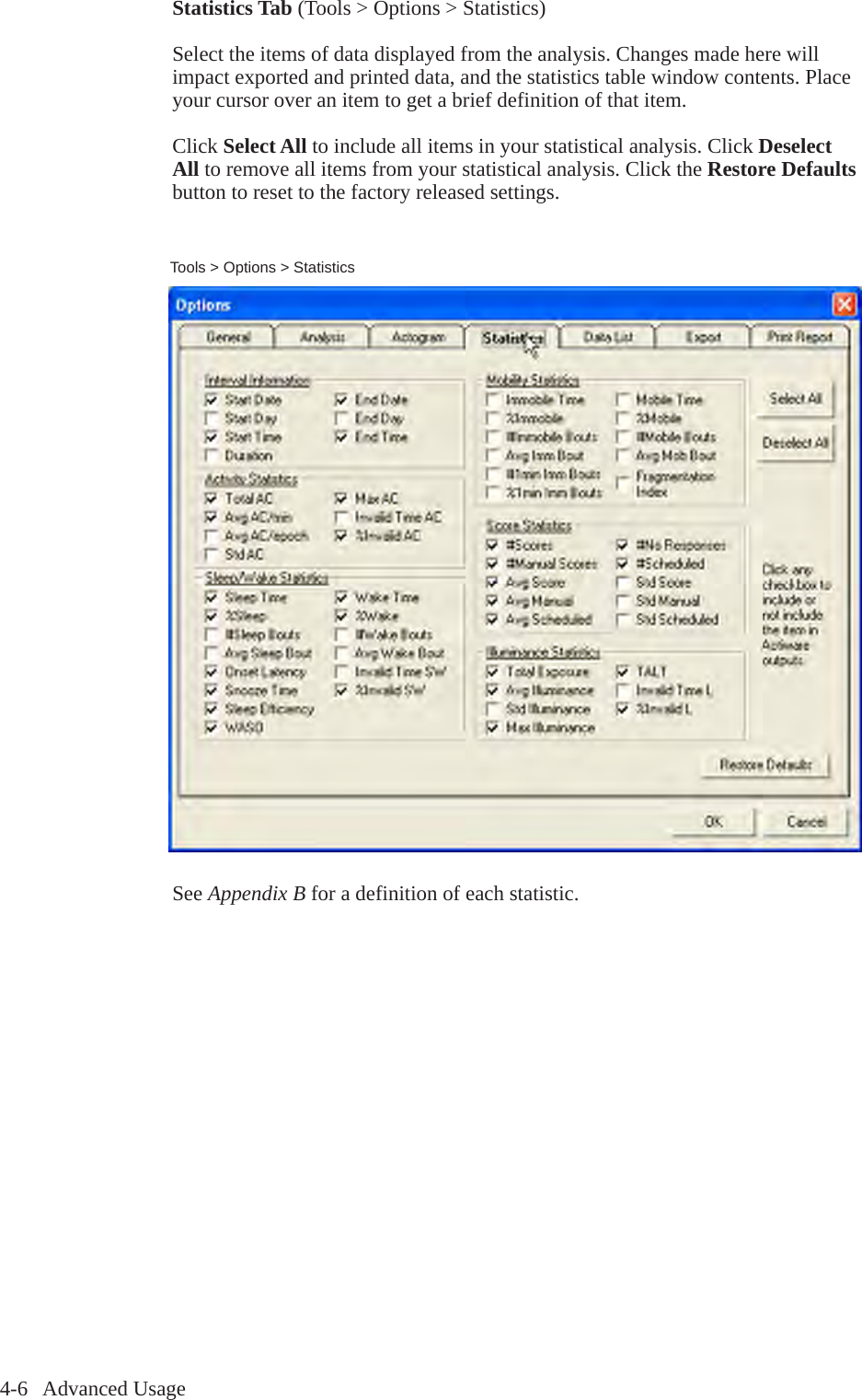
4-6   Advanced UsageTools > Options > StatisticsStatistics Tab (Tools > Options > Statistics)Select the items of data displayed from the analysis. Changes made here will impact exported and printed data, and the statistics table window contents. Place your cursor over an item to get a brief definition of that item.Click Select All to include all items in your statistical analysis. Click Deselect All to remove all items from your statistical analysis. Click the Restore Defaults button to reset to the factory released settings.See Appendix B for a definition of each statistic.
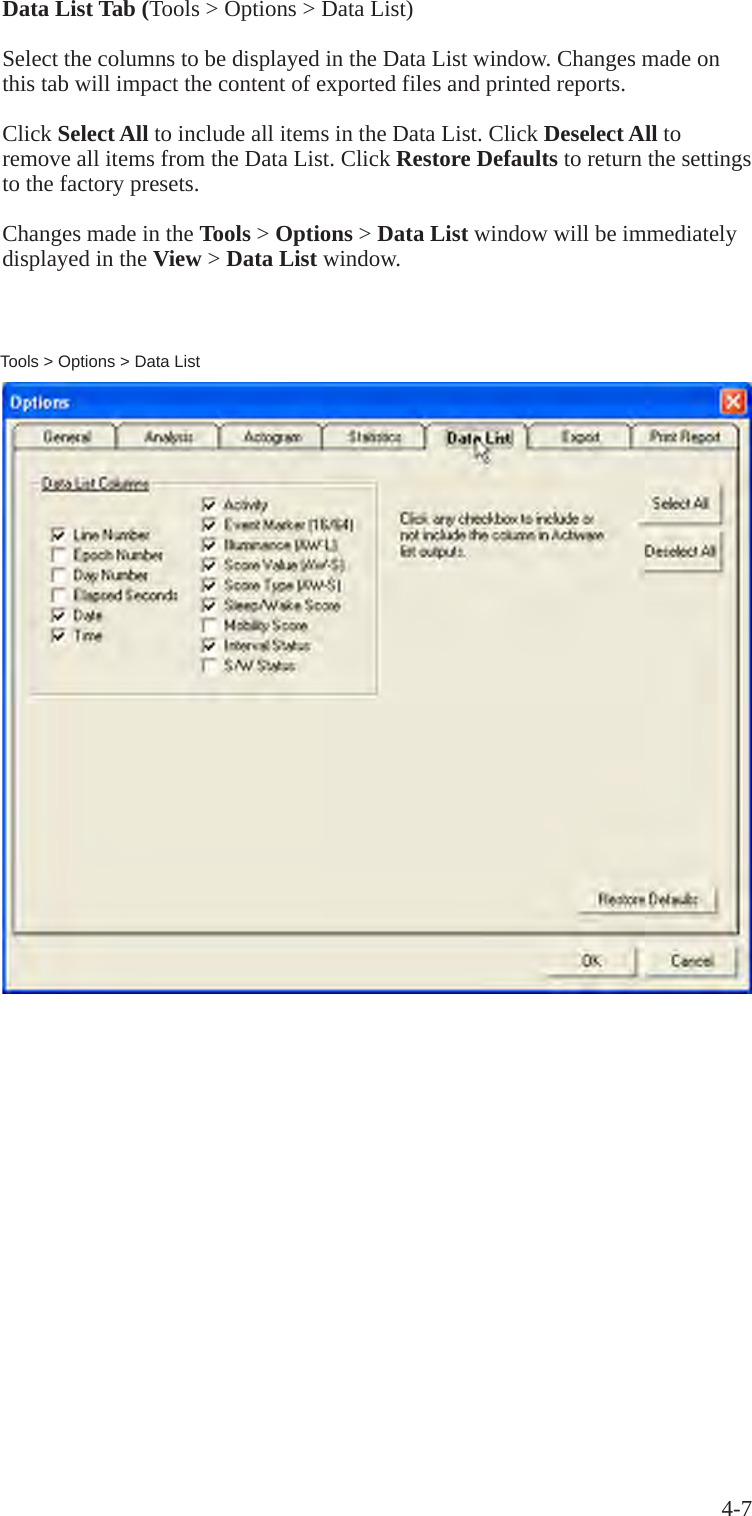
4-7Data List Tab (Tools > Options > Data List)Select the columns to be displayed in the Data List window. Changes made on this tab will impact the content of exported files and printed reports.Click Select All to include all items in the Data List. Click Deselect All to remove all items from the Data List. Click Restore Defaults to return the settings to the factory presets.Changes made in the Tools > Options > Data List window will be immediately displayed in the View > Data List window.Tools > Options > Data List
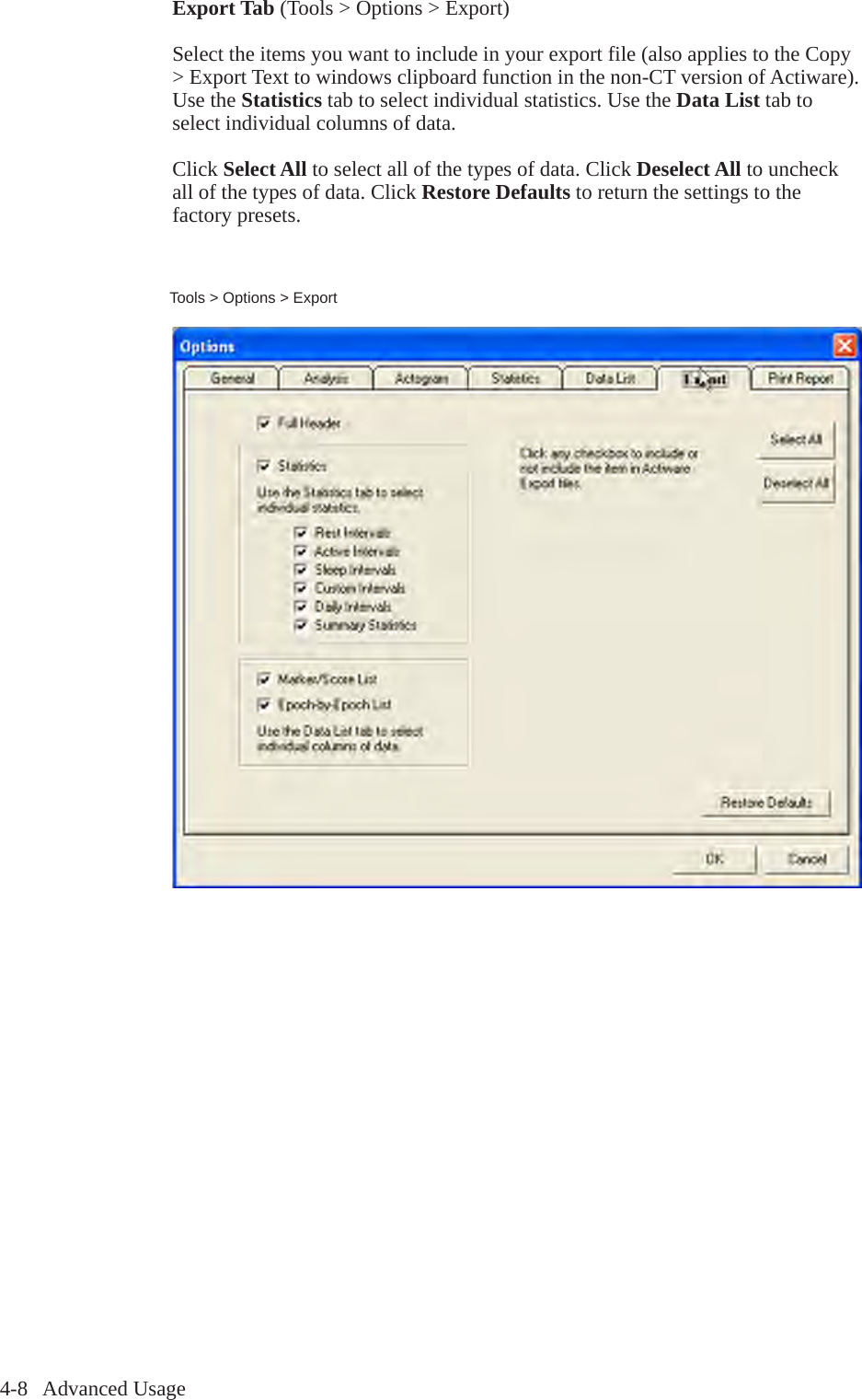
4-8   Advanced UsageTools > Options > ExportExport Tab (Tools > Options > Export)Select the items you want to include in your export file (also applies to the Copy > Export Text to windows clipboard function in the non-CT version of Actiware). Use the Statistics tab to select individual statistics. Use the Data List tab to select individual columns of data.Click Select All to select all of the types of data. Click Deselect All to uncheck all of the types of data. Click Restore Defaults to return the settings to the factory presets.
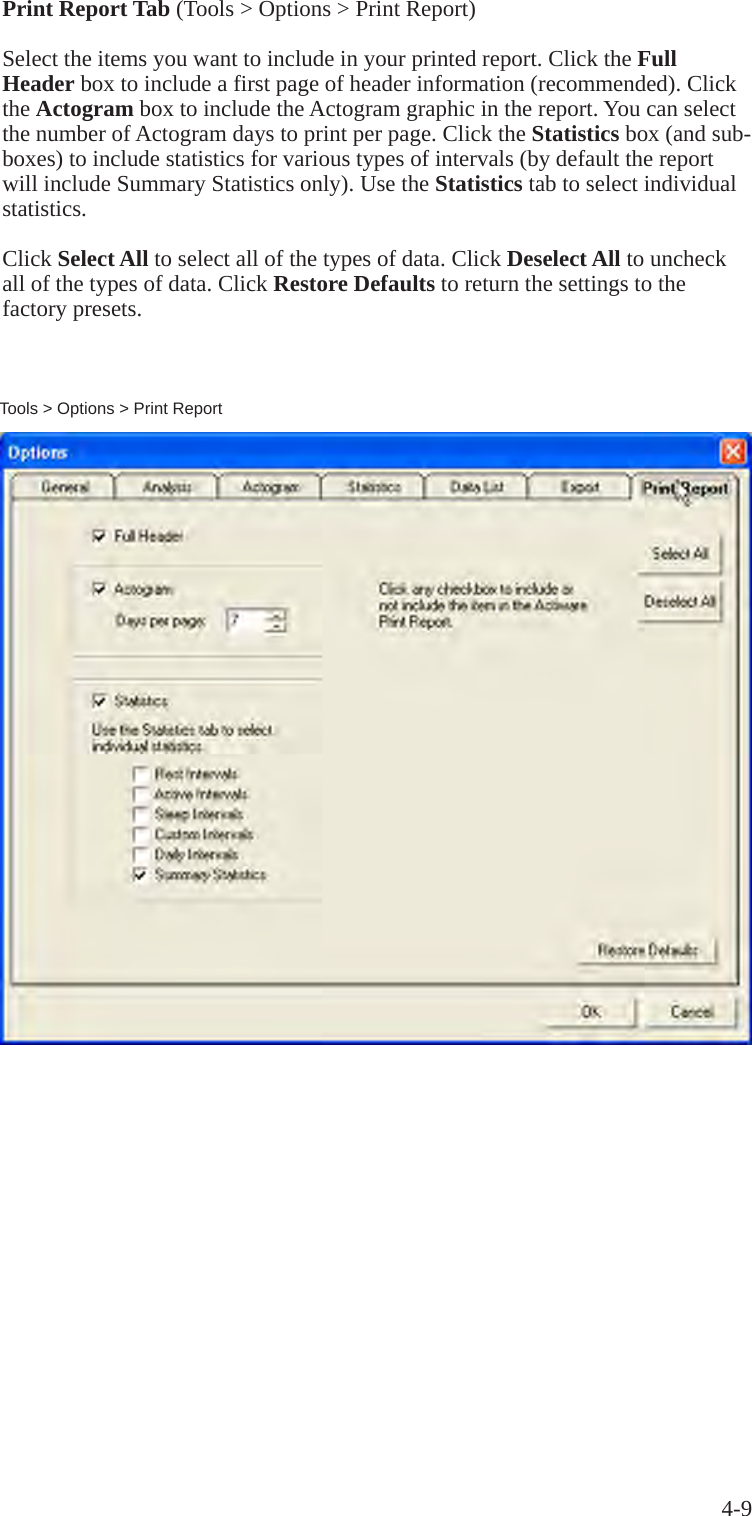
4-9Tools > Options > Print ReportPrint Report Tab (Tools > Options > Print Report)Select the items you want to include in your printed report. Click the Full Header box to include a first page of header information (recommended). Click the Actogram box to include the Actogram graphic in the report. You can select the number of Actogram days to print per page. Click the Statistics box (and sub-boxes) to include statistics for various types of intervals (by default the report will include Summary Statistics only). Use the Statistics tab to select individual statistics.Click Select All to select all of the types of data. Click Deselect All to uncheck all of the types of data. Click Restore Defaults to return the settings to the factory presets.
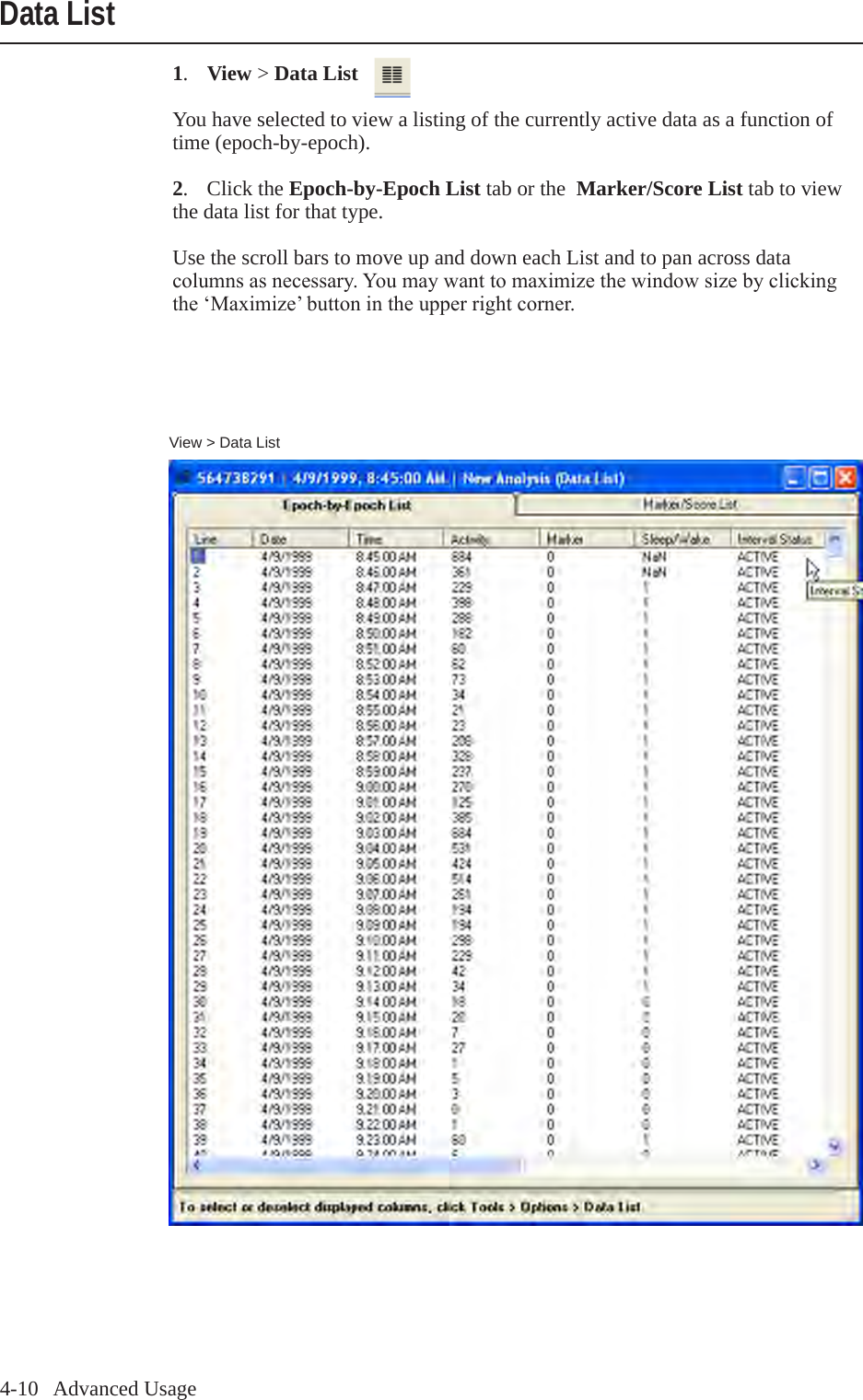
4-10   Advanced UsageView > Data List1.  View > Data ListYou have selected to view a listing of the currently active data as a function of time (epoch-by-epoch).2.  Click the Epoch-by-Epoch List tab or the  Marker/Score List tab to view the data list for that type.Use the scroll bars to move up and down each List and to pan across data columnsasnecessary.Youmaywanttomaximizethewindowsizebyclickingthe‘Maximize’buttonintheupperrightcorner.Data List
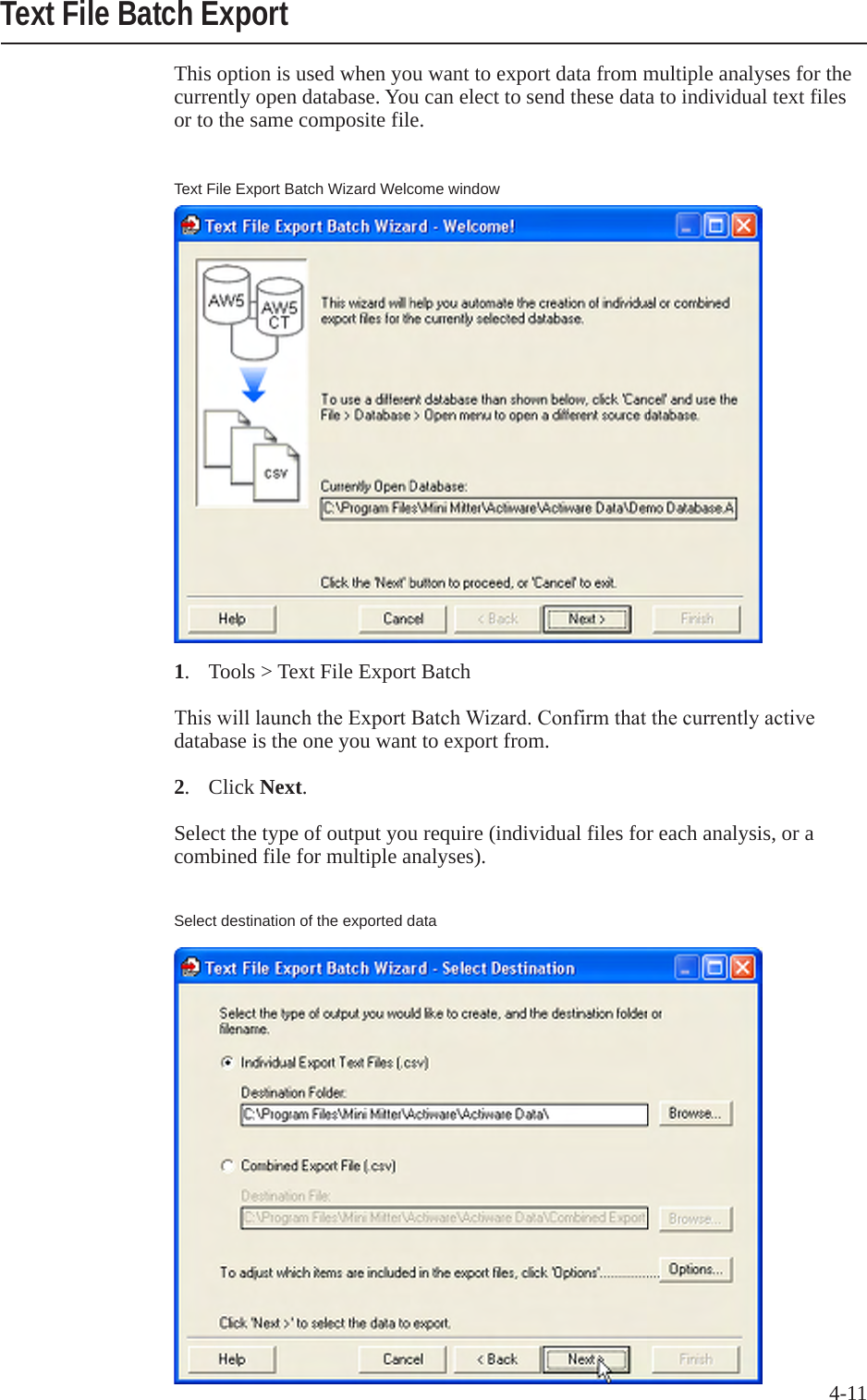
4-11This option is used when you want to export data from multiple analyses for the currently open database. You can elect to send these data to individual text files or to the same composite file.1.  Tools > Text File Export BatchThiswilllaunchtheExportBatchWizard.Confirmthatthecurrentlyactivedatabase is the one you want to export from.2.   Click Next.Select the type of output you require (individual files for each analysis, or a combined file for multiple analyses).Text File Batch ExportText File Export Batch Wizard Welcome windowSelect destination of the exported data
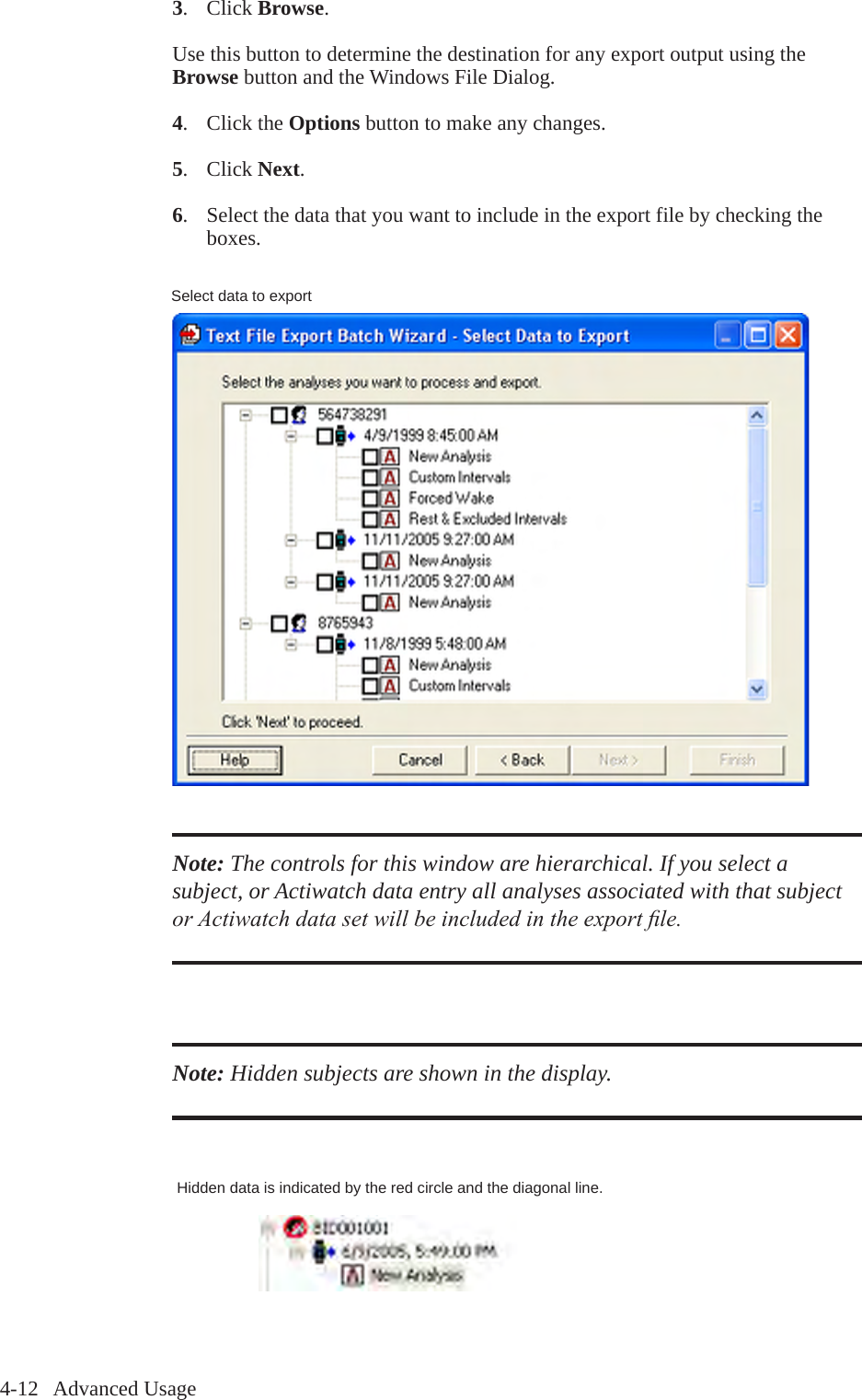
4-12   Advanced Usage3.  Click Browse.Use this button to determine the destination for any export output using the Browse button and the Windows File Dialog.4.  Click the Options button to make any changes.5.  Click Next.6.  Select the data that you want to include in the export file by checking the   boxes. Note: The controls for this window are hierarchical. If you select a subject, or Actiwatch data entry all analyses associated with that subject or Actiwatch data set will be included in the export le.Note: Hidden subjects are shown in the display.Hidden data is indicated by the red circle and the diagonal line.Select data to export
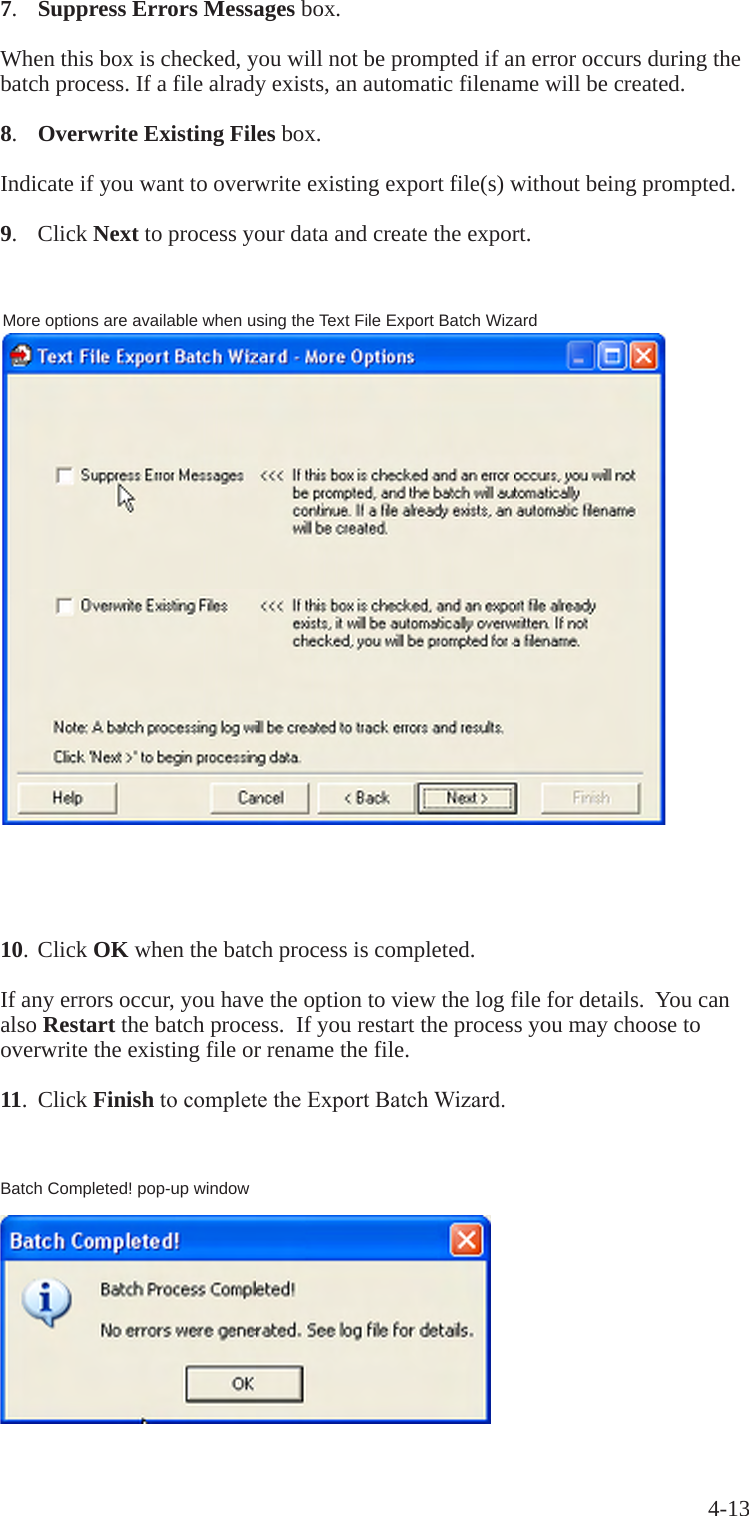
4-1310. Click OK when the batch process is completed.If any errors occur, you have the option to view the log file for details.  You can also Restart the batch process.  If you restart the process you may choose to overwrite the existing file or rename the file.11.  Click FinishtocompletetheExportBatchWizard.Batch Completed! pop-up window7.  Suppress Errors Messages box.When this box is checked, you will not be prompted if an error occurs during the batch process. If a file alrady exists, an automatic filename will be created.8.  Overwrite Existing Files box.Indicate if you want to overwrite existing export file(s) without being prompted.9.  Click Next to process your data and create the export.More options are available when using the Text File Export Batch Wizard
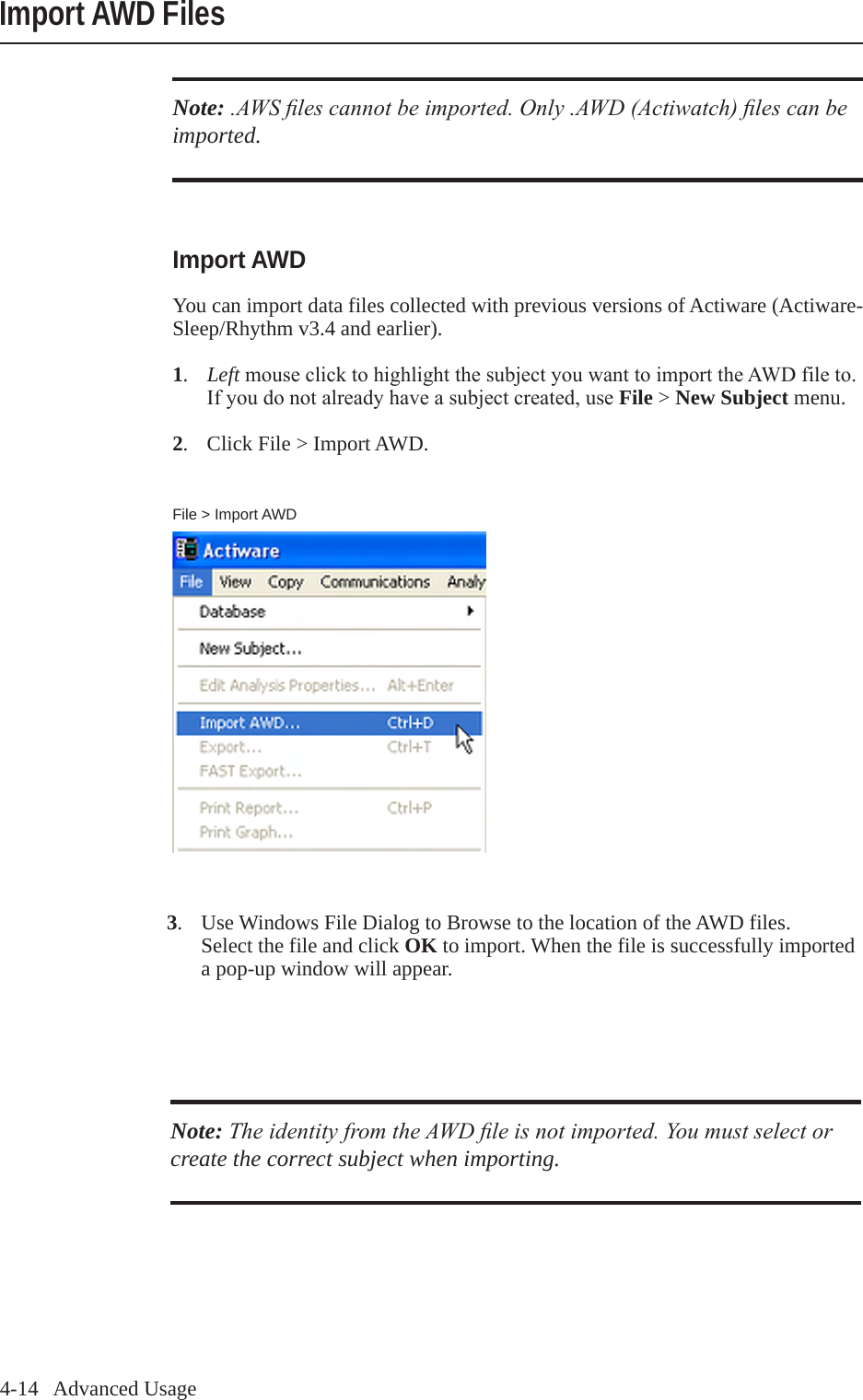
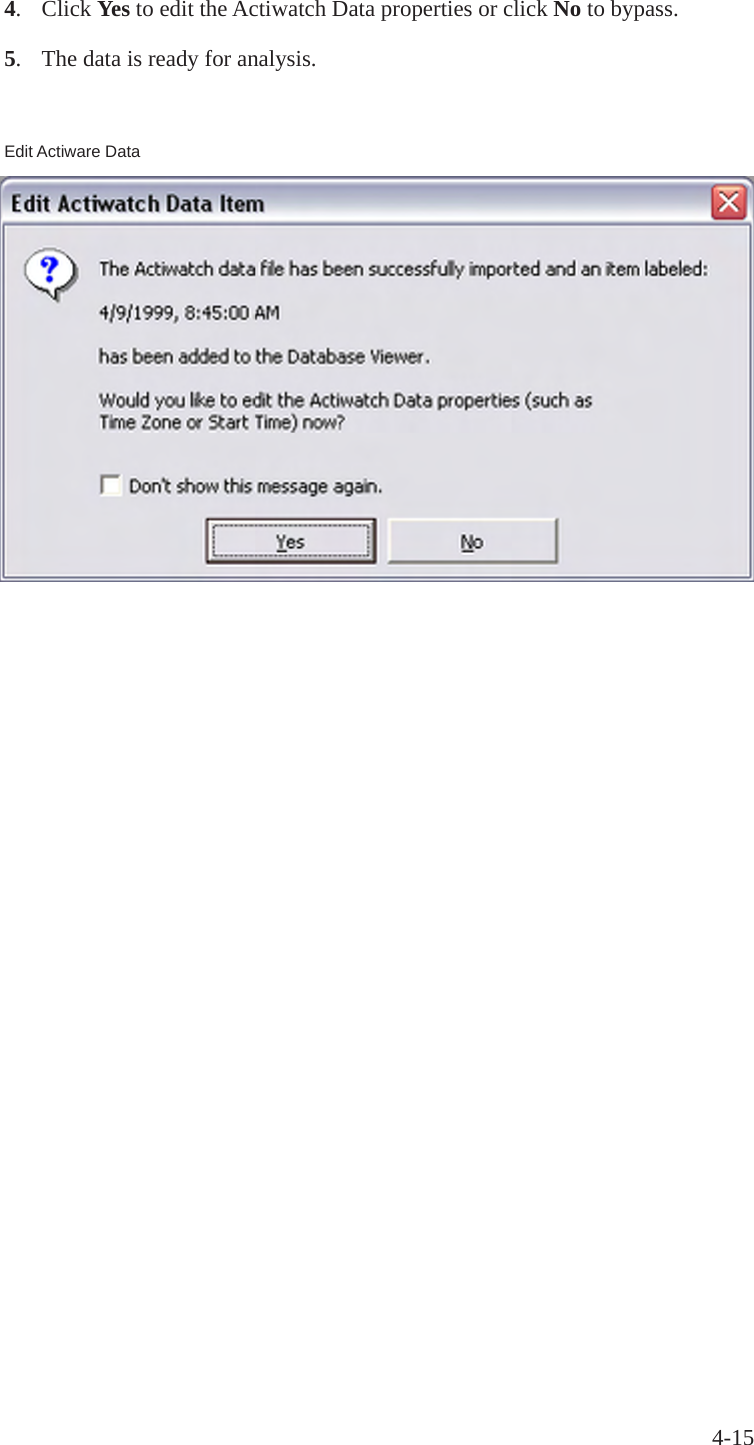
4-14   Advanced UsageImport AWD FilesFile > Import AWDImport AWDYou can import data files collected with previous versions of Actiware (Actiware-Sleep/Rhythm v3.4 and earlier). 1.  LeftmouseclicktohighlightthesubjectyouwanttoimporttheAWDfileto.  Ifyoudonotalreadyhaveasubjectcreated,useFile > New Subject menu.2.  Click File > Import AWD.Note: .AWS les cannot be imported. Only .AWD (Actiwatch) les can be imported.Note: The identity from the AWD le is not imported. You must select or create the correct subject when importing.3.  Use Windows File Dialog to Browse to the location of the AWD files.  Select the file and click OK to import. When the file is successfully imported   a pop-up window will appear.
4-154.  Click Yes to edit the Actiwatch Data properties or click No to bypass.5.  The data is ready for analysis.Edit Actiware Data
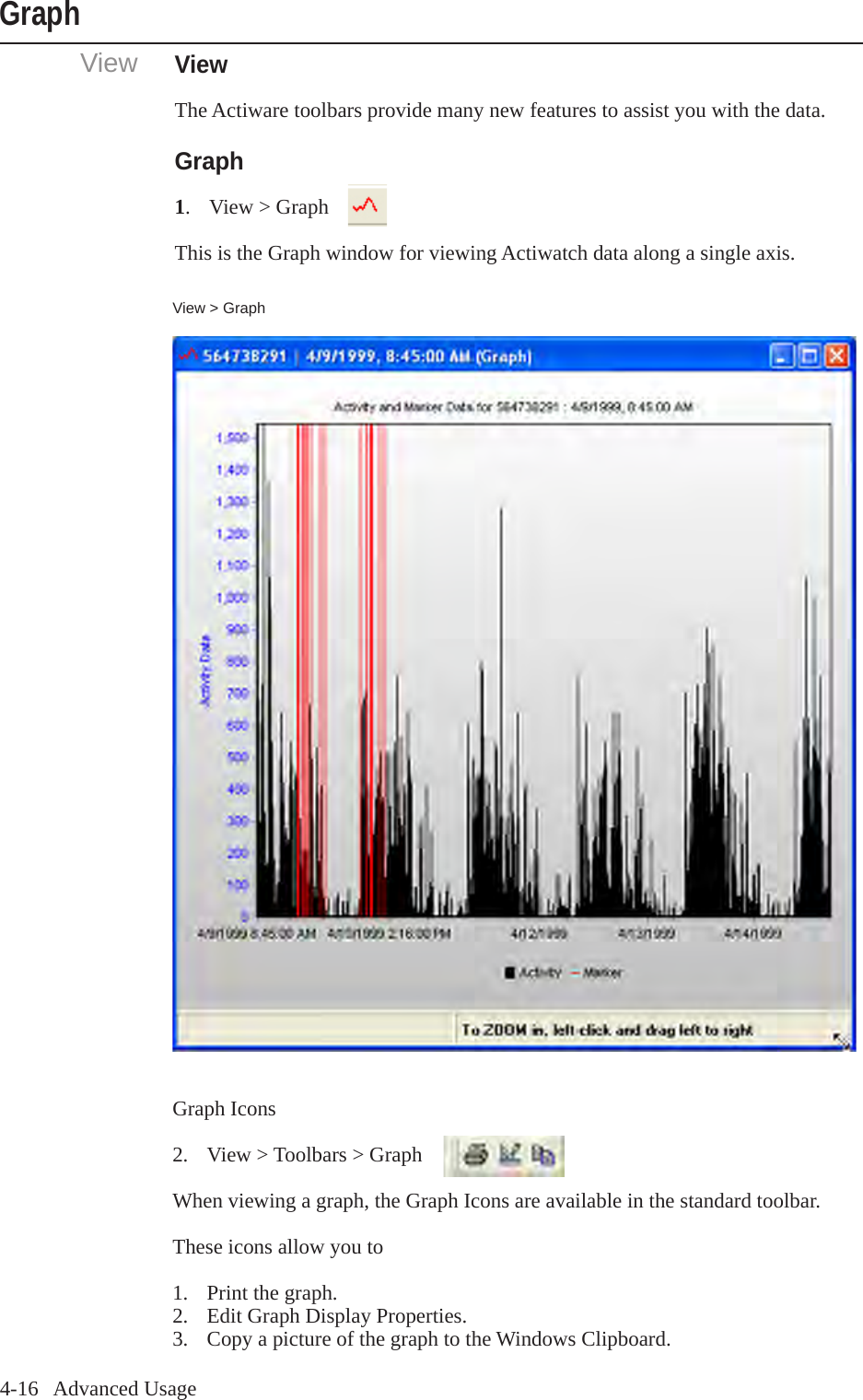
4-16   Advanced UsageViewGraphViewThe Actiware toolbars provide many new features to assist you with the data.Graph1.  View > GraphThis is the Graph window for viewing Actiwatch data along a single axis. View > GraphGraph Icons2.  View > Toolbars > GraphWhen viewing a graph, the Graph Icons are available in the standard toolbar.These icons allow you to1.  Print the graph.2.  Edit Graph Display Properties.3.  Copy a picture of the graph to the Windows Clipboard.
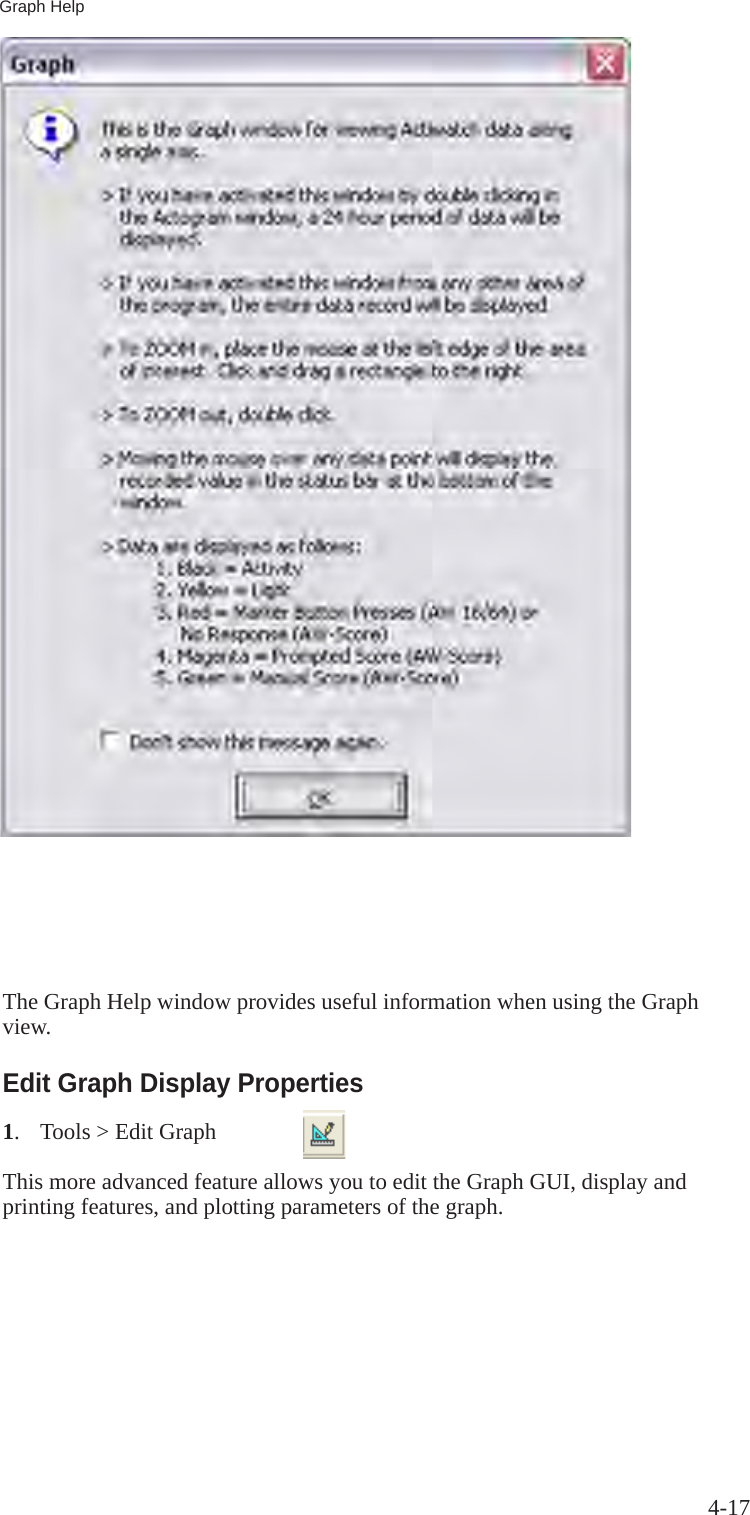
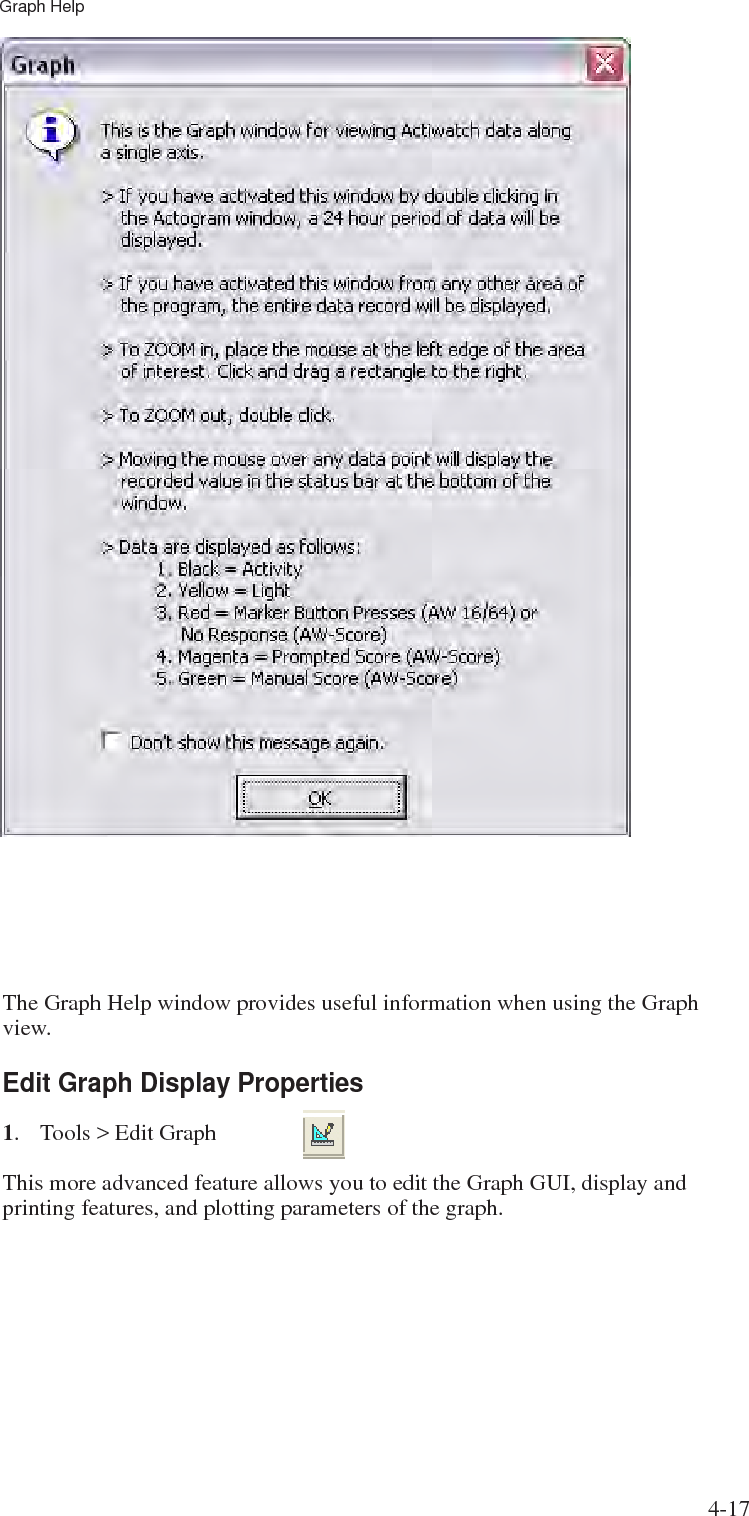
4-17The Graph Help window provides useful information when using the Graph view.Edit Graph Display Properties1.  Tools > Edit GraphThis more advanced feature allows you to edit the Graph GUI, display and printing features, and plotting parameters of the graph.Graph Help
4-18   Advanced Usage

Navigation menu