Mobiletron Electronics NXP002 TPMS User Manual

Mobiletron Electronics Co., Ltd. TPMS Users Manual

Users Manual

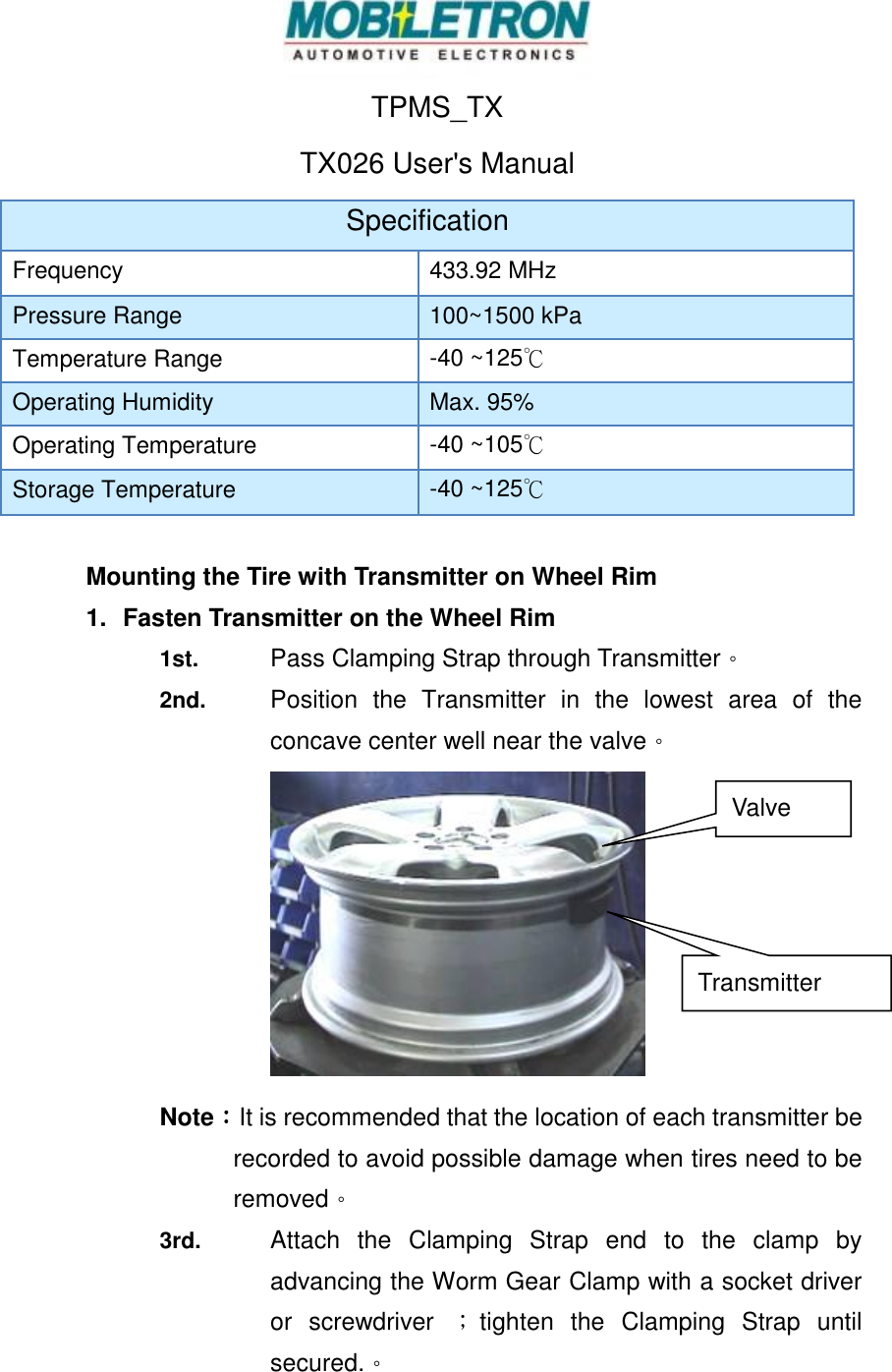
 TPMS_TX   TX026 User's Manual Specification Frequency 433.92 MHz Pressure Range 100~1500 kPa Temperature Range -40 ~125℃ Operating Humidity Max. 95% Operating Temperature -40 ~105℃ Storage Temperature -40 ~125℃  Mounting the Tire with Transmitter on Wheel Rim 1.  Fasten Transmitter on the Wheel Rim 1st.  Pass Clamping Strap through Transmitter。 2nd. Position  the  Transmitter  in  the  lowest  area  of  the concave center well near the valve。            Note:It is recommended that the location of each transmitter be recorded to avoid possible damage when tires need to be removed。 3rd.  Attach  the  Clamping  Strap  end  to  the  clamp  by advancing the Worm Gear Clamp with a socket driver or  screwdriver  ;tighten  the  Clamping  Strap  until secured.。 Transmitter  Valve
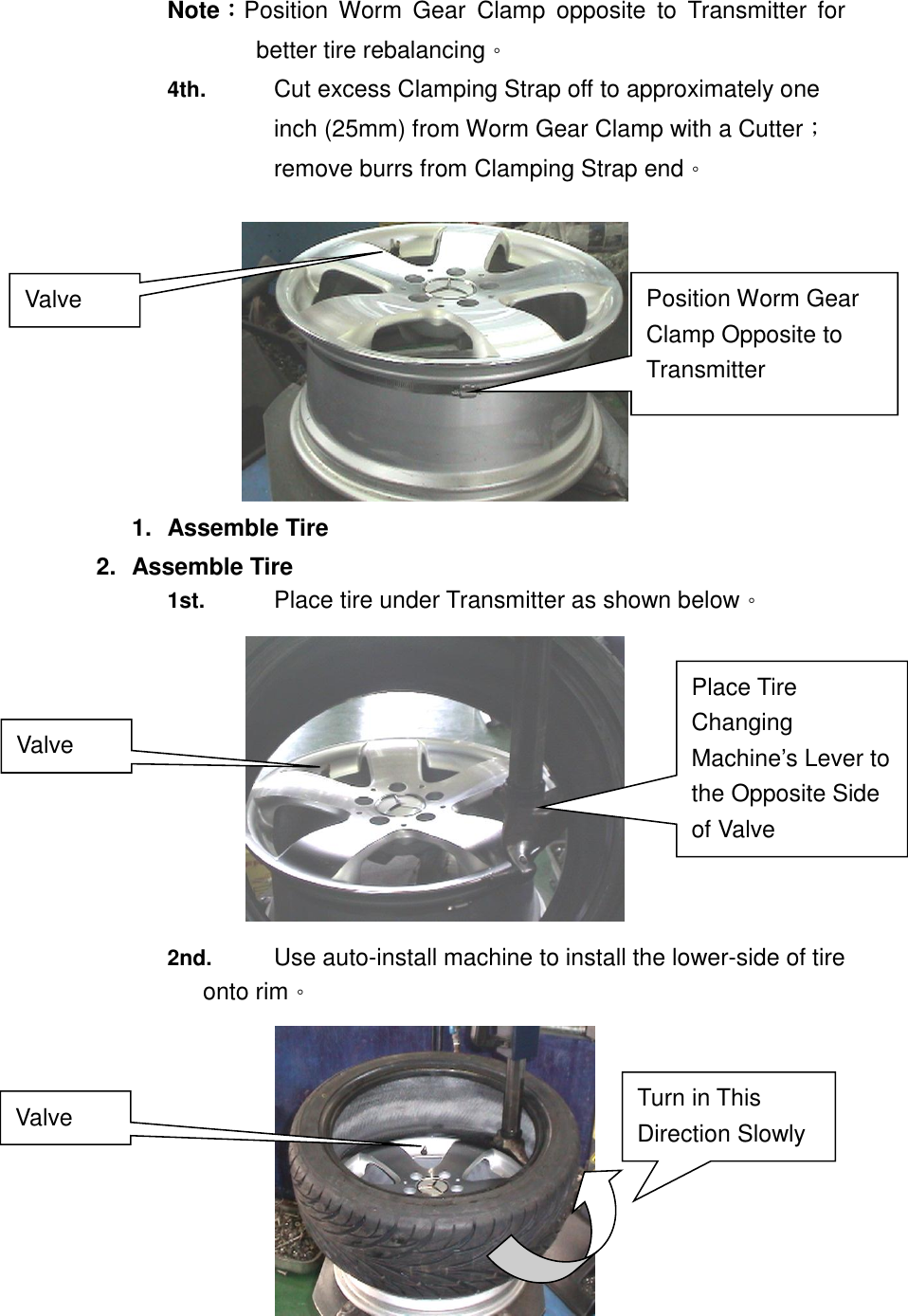
Note:Position  Worm  Gear  Clamp  opposite  to  Transmitter  for better tire rebalancing。 4th.  Cut excess Clamping Strap off to approximately one inch (25mm) from Worm Gear Clamp with a Cutter;remove burrs from Clamping Strap end。   1.  Assemble Tire 2.  Assemble Tire 1st.  Place tire under Transmitter as shown below。  2nd. Use auto-install machine to install the lower-side of tire onto rim。  Position Worm Gear Clamp Opposite to Transmitter Valve Valve Place Tire Changing Machine’s Lever to the Opposite Side of Valve   Turn in This Direction Slowly  Valve
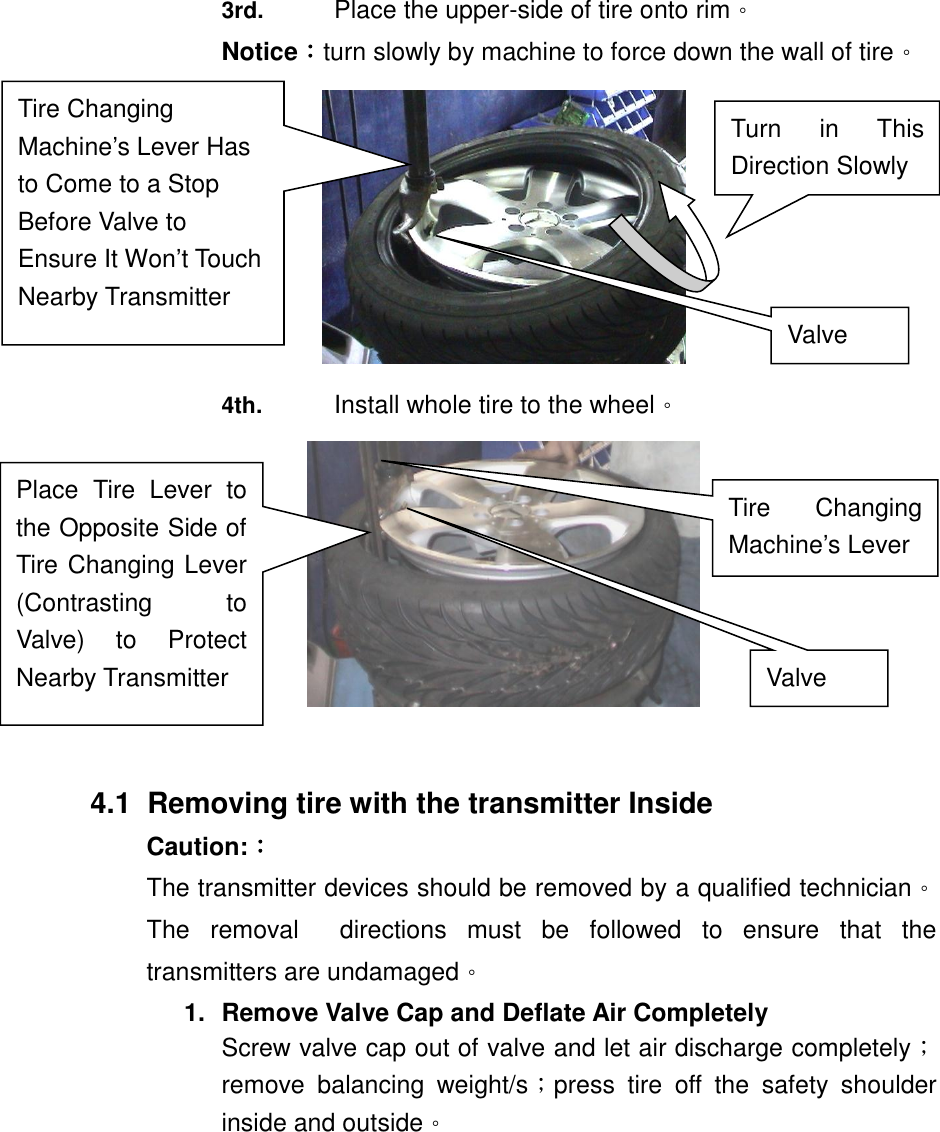
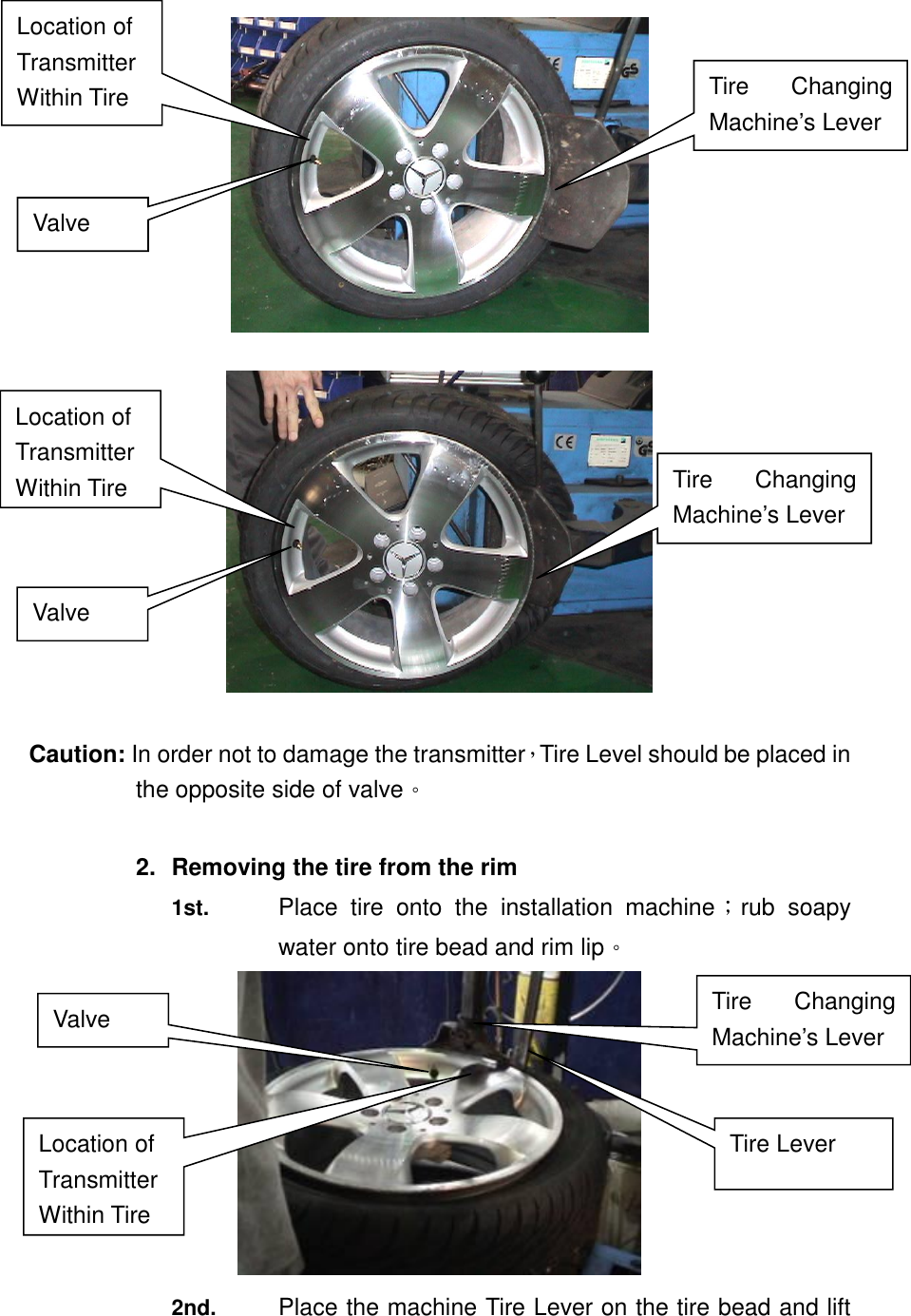
3rd.  Place the upper-side of tire onto rim。 Notice:turn slowly by machine to force down the wall of tire。  4th.  Install whole tire to the wheel。   4.1   Removing tire with the transmitter Inside Caution:: The transmitter devices should be removed by a qualified technician。The  removal    directions  must  be  followed  to  ensure  that  the transmitters are undamaged。 1.  Remove Valve Cap and Deflate Air Completely Screw valve cap out of valve and let air discharge completely;remove  balancing  weight/s;press  tire  off  the  safety  shoulder inside and outside。 Tire Changing Machine’s Lever Has to Come to a Stop Before Valve to Ensure It Won’t Touch Nearby Transmitter Valve Turn  in  This Direction Slowly  Valve Tire  Changing Machine’s Lever Place  Tire  Lever  to the Opposite Side of Tire Changing Lever (Contrasting  to Valve)  to  Protect Nearby Transmitter
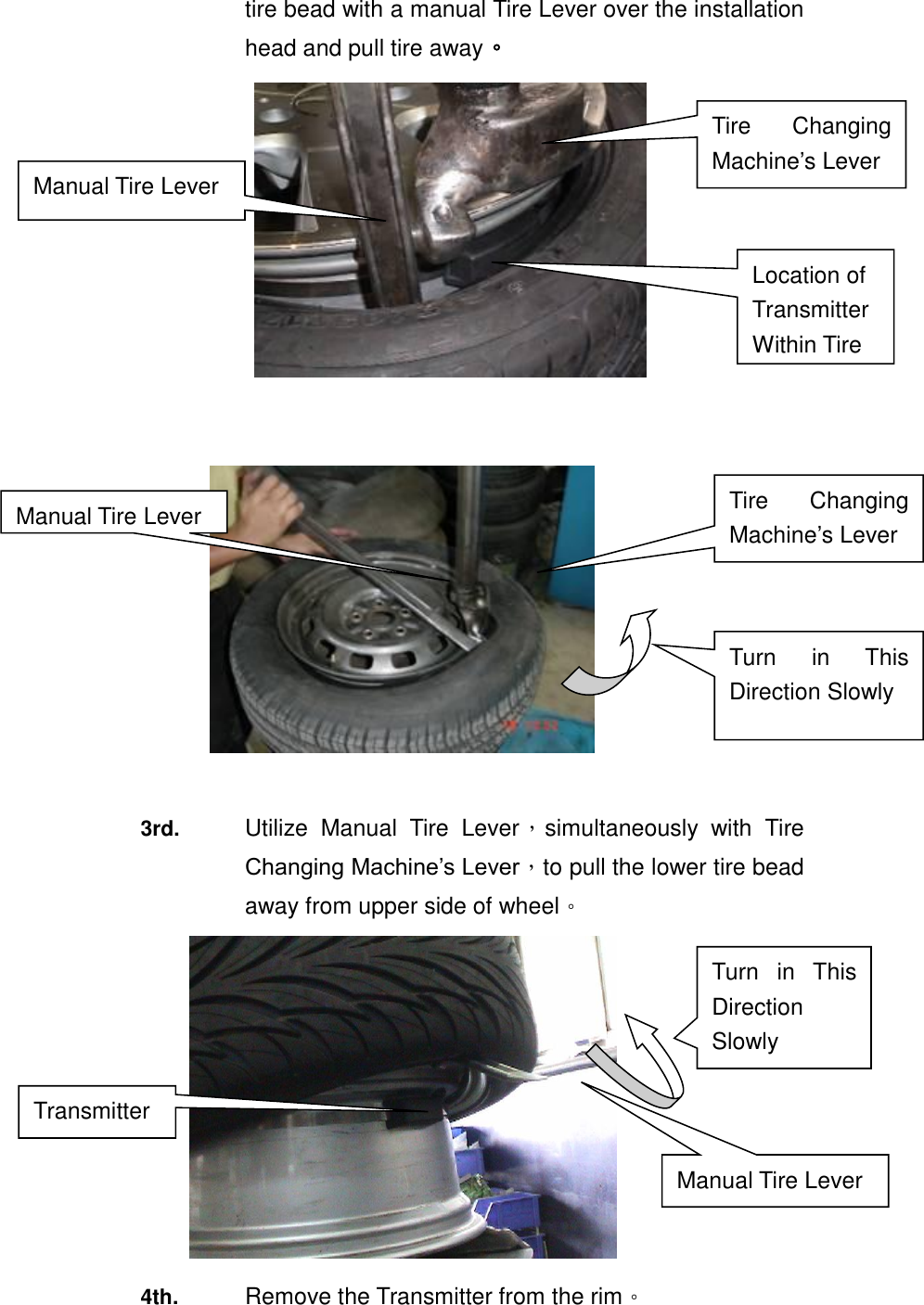
    Caution: In order not to damage the transmitter,Tire Level should be placed in the opposite side of valve。  2.  Removing the tire from the rim 1st.  Place  tire  onto  the  installation  machine;rub  soapy water onto tire bead and rim lip。  2nd. Place the machine Tire Lever on the tire bead and lift Location of Transmitter Within Tire   Location of Transmitter Within Tire Valve Tire  Changing Machine’s Lever Valve Tire  Changing Machine’s Lever Location of Transmitter Within Tire   Valve Tire  Changing Machine’s Lever Tire Lever
tire bead with a manual Tire Lever over the installation head and pull tire away。             3rd.  Utilize  Manual  Tire  Lever,simultaneously  with  Tire Changing Machine’s Lever,to pull the lower tire bead away from upper side of wheel。  4th.  Remove the Transmitter from the rim。 Turn  in  This Direction Slowly Manual Tire Lever   Transmitter Turn  in  This Direction Slowly Manual Tire Lever Tire  Changing Machine’s Lever Tire  Changing Machine’s Lever Manual Tire Lever Location of Transmitter Within Tire
FCC Notices This device complies with Part 15 of the FCC Rules. Operation is subject to the following two conditions: (1) this device may not cause harmful interference, and (2) this device must accept any interference received, including interference that may cause undesired operation. This equipment has been tested and found to comply with the limits for a Class B digital device, pursuant  to  Part  15  of  the  FCC  Rules.  These  limits  are  designed  to  provide  reasonable protection against harmful interference in a residential installation. This equipment generates, uses and can radiate radio frequency energy and, if not installed and used in accordance with the instructions, may cause harmful interference to radio communications. However, there is no guarantee that interference will not occur in a particular installation. If this equipment does cause harmful interference to radio or television reception, which can be determined by turning the equipment off and on, the user is encouraged to try to correct the interference by one or more of the following measures: --Reorient or relocate the receiving antenna. --Increase the separation between the equipment and receiver. --Connect the equipment into an outlet on a circuit different from that to which the receiver is connected. --Consult the dealer or an experienced radio/TV technician for help. CAUTION: Any changes or modifications not expressly approved by the grantee of this device could void the user's authority to operate the equipment. RF exposure warning: The  equipment  complies  with  FCC  RF  exposure  limits  set  forth  for  an  uncontrolled environment. The equipment must not be co-located or operating in conjunction with any other antenna or transmitter. This equipment should be installed and operated with minimum distance 20cm between the radiator and your body. It could be removed.

Navigation menu