Mobilicom MSH-10 Point-to-Point and Point-to-Multipoint communication unit enabling broadband connectivity of data. User Manual Mobilicom s
Mobilicom ltd. Point-to-Point and Point-to-Multipoint communication unit enabling broadband connectivity of data. Mobilicom s
User manual

User Manual

User Manual
Page : 2 / 31
SkyHopper Pro
www.skyhopper.biz
support@skyhopper.biz
Confidential

User Manual
Page : 3 / 31
Notice
This manual contains information that is proprietary to Mobilicom Ltd.
No part of this publication may be reproduced in any form whatsoever without prior
written approval by Mobilicom.
License Terms
Mobilicom hereby grants a non-exclusive, nontransferable worldwide license to the
licensee of this software product to use the SkyHopper Pro Graphical User Interface (GUI),
in object code only for the sole and internal purpose of configuring, monitoring and
managing Mobilicom's SkyHopper Pro.
Warranty
Mobilicom does not warrant that this software product is free from errors and/or will run
properly on all computer hardware and/or operating systems. Mobilicom does not warrant
that this software will operate in the combinations that may be selected for use by end
users or that the operation of this software product will be uninterrupted or error free.
Limitation of Liability
Mobilicom’s cumulative liability to you or any other party for any loss or damage resulting
from any claims, demands, or actions arising out of, or relating to, this agreement and the
Web GUI shall not exceed the sum paid to Mobilicom for the purchase of the Web GUI. In
no event shall Mobilicom be liable for any indirect, incidental, consequential, special or
exemplary damages or lost profits, even if Mobilicom has been advised of the possibility of
such damages.
This agreement shall be construed and governed in accordance with the laws of the State
of Israel.

User Manual
Page : 4 / 31
Federal Communications Commission (FCC) Statement
Labelling requirement for small device statement (FCC15.19(3))
This device complies with part 15 of the FCC Rules. Operation is subject to the following two conditions: (1) This
device may not cause harmful interference, and (2) this device must accept any interference received, including
interference that may cause undesired operation.
Radio Frequency Interference (RFI) (FCC 15.105)
This equipment has been tested and found to comply with the limits for Class B digital devices pursuant to Part
15 of the FCC Rules. These limits are designed to provide reasonable protection against harmful interference in
a residential environment. This equipment generates, uses, and can radiate radio frequency energy, and if not
installed and used in accordance with the instruction manual, may cause harmful interference to radio
communications. However, there is no guarantee that interference will not occur in a particular installation. If
this equipment does cause harmful interference to radio or television reception, which can be determined by
turning the equipment off and on, the user is encouraged to try and correct the interference by one or more of
the following measures:
Reorient or relocate the receiving antenna.
Increase the separation between the equipment and the receiver.
Connect the equipment into an outlet on a circuit different from that to which the receiver is connected.
Consult the dealer or an experienced radio/TV technician for help.
Labeling Requirements (FCC 15.19)
This device complies with Part 15 of FCC rules. Operation is subject to the following two conditions: (1) this
device may not cause harmful interference, and (2) this device must accept any interference received, including
interference that may cause undesired operation.
Modifications (FCC 15.21)
Changes or modifications to this equipment not expressly approved by Mobilicom Ltd. may void the user’s
authority to operate this equipment.
RF Exposure info ( FCC 2.1093)-for module radio
This equipment has been approved for mobile applications where the equipment should be used at distances
greater than 20cm from the human body (with the Exception of hands, wrists, feet and ankles). Operation at
distances less than 20 cm is strictly prohibited.

User Manual
Page : 5 / 31
Contents
1 ABBREVIATION LIST ............................................................................................... 8
2 OVERVIEW .......................................................................................................... 10
2.1 NETWORK TOPOLOGIES AND APPLICATIONS ............................................................... 10
2.1.1 Point-to-Point (PTP) ................................................................................... 10
2.2 SKYHOPPER PRO MAIN FEATURES .......................................................................... 11
2.3 PACKETS SUPPORTED BY THE SKYHOPPER PRO NETWORK ................................................ 11
3 PHYSICAL DESCRIPTION ....................................................................................... 13
3.1 FRONT VIEW CONNECTORS ................................................................................... 13
3.2 UNIT CABLES: TYPE & USAGE ................................................................................ 13
4 MECHANICAL SPECIFICATIONS ............................................................................. 14
5 TECHNICAL SPECIFICATIONS ................................................................................. 14
5.1 RADIO AND MODEM SPECIFICATIONS ....................................................................... 14
5.1.1 Frequency bands available: ........................................................................ 14
5.1.2 Antennas .................................................................................................. 14
5.1.3 RF Characteristics ...................................................................................... 15
5.2 POWER SPECIFICATIONS ...................................................................................... 16
5.3 ENVIRONMENTAL SPECIFICATIONS ........................................................................... 16
5.4 EMBEDDED GPS CHARACTERISTICS ......................................................................... 16
6 TDMA ................................................................................................................. 17
7 PTP (POINT-TO-POINT)......................................................................................... 18
7.1 PTP LINK STEP-BY-STEP CONFIGURATION ................................................................. 19
7.2 SKYHOPPER PRO LED INDICATOR ........................................................................... 21
9 INSTALLATION AND SETUP ................................................................................... 22
9.1 PACKAGE CONTENTS .......................................................................................... 22
9.2 CONNECTING THE ANTENNAS ................................................................................ 22
9.3 CONNECTING THE POWER .................................................................................... 22
APPENDIX A - SPECIFICATIONS ................................................................................. 23
APPENDIX B - MECHANICAL DRAWINGS ....................................................................... 25
APPENDIX C – CONNECTORS’ PINOUT .......................................................................... 26
1. RS-232/1PPS .................................................................................................... 26
2. POWER CABLE ..................................................................................................... 27
APPENDIX D – SETTING UP A PIXHAWK BASED SYSTEM ................................................. 28

User Manual
Page : 6 / 31
1. SKYHOPPER SETUP ................................................................................................ 28
2. PHYSICAL CONNECTION ........................................................................................... 28
3. UART TO ETHERNET .............................................................................................. 29
APPENDIX E –TROUBLESHOOTING ............................................................................... 30

User Manual
Page : 7 / 31
List of Figures
Figure 1: SkyHopper Pro .......................................................................................... 10
Figure 2: Asymmetric Link Configuration .................................................................. 11
Figure 3: SkyHopper Pro Front View ........................................................................ 13
Figure 4: SkyHopper Pro Connector Side view ........................................................ 14
Figure 5: Transmit frames of the remote unit and controller unit from Power Up...... 18
Figure 6: Web GUI main screen ............................................................................... 19
Figure 7: Web GUI “Advanced configuration” screen ............................................... 20
List of Tables
Table 1: Abbreviation List........................................................................................... 9
Table 2: SkyHopper Pro Mechanical Specifications ................................................. 14
Table 3: SkyHopper Pro Power Specifications ......................................................... 16
Table 4: SkyHopper Pro Environmental Specifications ............................................ 16
Table 5: Embedded GPS Characteristics of SkyHopper Pro ................................... 17

User Manual
Page : 8 / 31
1 Abbreviation List
Abbreviation
Syntax
BPS
Bits Per Second
BW
Bandwidth
CEP
Circular Error Probable (Accuracy)
CINR
Carrier to Interference and Noise Ratio (Signal to Noise Ratio)
CPLD
Complex Programmable Logic Device
CRC
Cyclic Redundancy Code
dB
Decibel
dBm
Power ratio in decibels of the measured power referenced to one milliwatt
CDD
Cyclic Delay Diversity
Controller Unit
A SkyHopper Pro Unit, In PTP setup, which acts as an endpoint communication
unit. Typically a Ground Unit.
CTC
Convolutional Turbo Code
DC
Direct Current
EMI
Electromagnetic Interference
ETH
Ethernet
ETSI
European Telecommunication Standard Institute
FAE
Field Application Engineer
FCC
Federal Communications Commission
FEC
Forward Error Correction
FFT
Fast Fourier Transform
Freq.
Frequency
FW
Firmware
GHz
Gigahertz
GPS
Global Positioning System
HD
High Definition (Video)
HW
Hardware
ID
Identification (Number)
IP
Internet Protocol
LAN
Local Area Network
LAT
Latitude
LED
Light Emitting Diode

User Manual
Page : 9 / 31
LON
Longitude
LOS
Line-Of-Sight
mW
Milliwatt
MHz
Mega Hertz
MIMO
Multiple-In-Multiple-Out
MRC
Maximal Ratio Combining
N.C.
Not Connected
OEM
Original Equipment Manufacturer
OFDM
Orthogonal Frequency Division Modulation
OS
Operating System
PC
Personal Computer
PPS
Pulse Per Second
PTP
Point-To-Point
PTMP
Point-To-Multipoint
QAM
Quadrature Amplitude Modulation
QPSK
Quadrature Phase Shift Keying (modulation)
Remote Unit
A SkyHopper Pro unit, in PTP setup, which acts as an end point communication
unit that distributes clocks in the system. Typically the Aerial Unit.
RF
Radio Frequency
RMS
Root Mean Square (Average)
RSSI
Receiver Signal Strength Indication
Rx
Receive
SBAS
Satellite Based Augmentation System
SDR
Software Defined Radio
SW
Software
TDD
Time Division Duplexing
TDMA
Time Division Multiple Access
Tx
Transmit
UAV
Unmanned Aerial Vehicle
UGV
Unmanned Ground Vehicle
VLAN
Virtual LAN
VPN
Virtual Private Network
Table 1: Abbreviation List
User Manual
Page : 10 / 31
2 Overview
The SkyHopper PRO offers a bi-directional Data Link specifically designed for commercial and
industrial drones, and provides the best solution for fleet management and autonomous UAV
systems. By employing leading wireless technologies, SkyHopper PRO delivers long range and Non-
Line of Sight (N-LOS) communication that supports broadcast, multicast and unicast transmission
modes.
SkyHopper PRO supports Point-to-Point and Point-to-Multipoint communication, thereby enabling
various modes of operation such as communication for multi-drone operations and drone
communication to multiple ground units and viewers (receivers).
An additional benefit of your SkyHopper Pro is that it offers Control, Telemetry and Payload all in one
RF channel. No need for separate solutions for each, no need for excess items to weigh down your
drone.
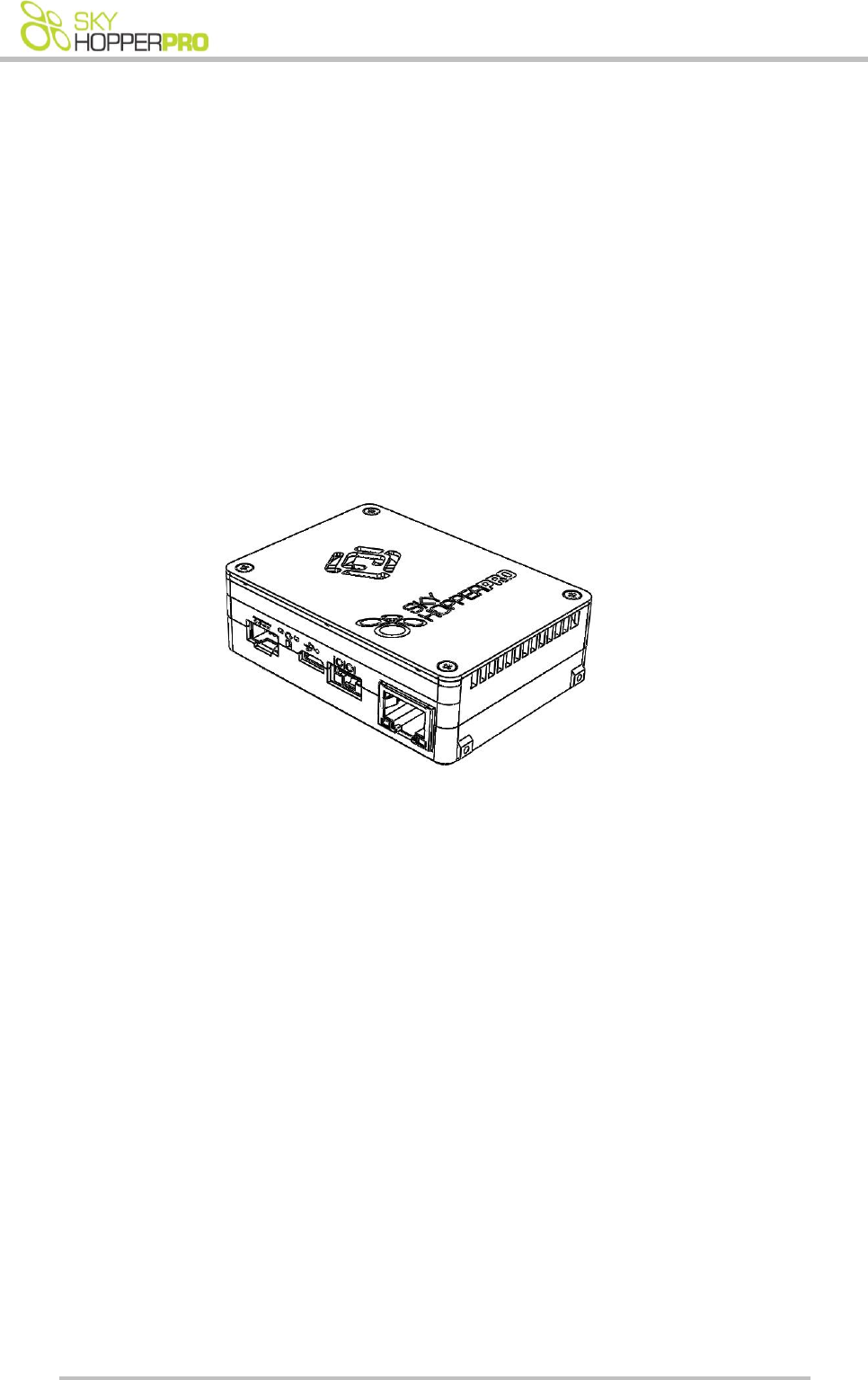
Figure 1: SkyHopper Pro
2.1 Network Topologies and Applications
2.1.1 Point-to-Point (PTP)
A Point-to-Point system includes 2 units, with the bandwidth ratio between the two units
configurable according to the application. It can be symmetric when a full duplex communication is
required (50% to each unit) or asymmetric up to 10% to one unit (Controller or Remote Unit) and
90% to the other unit (i.e. drone/robot that transmits video to the ground/controller unit and that
controls the camera).
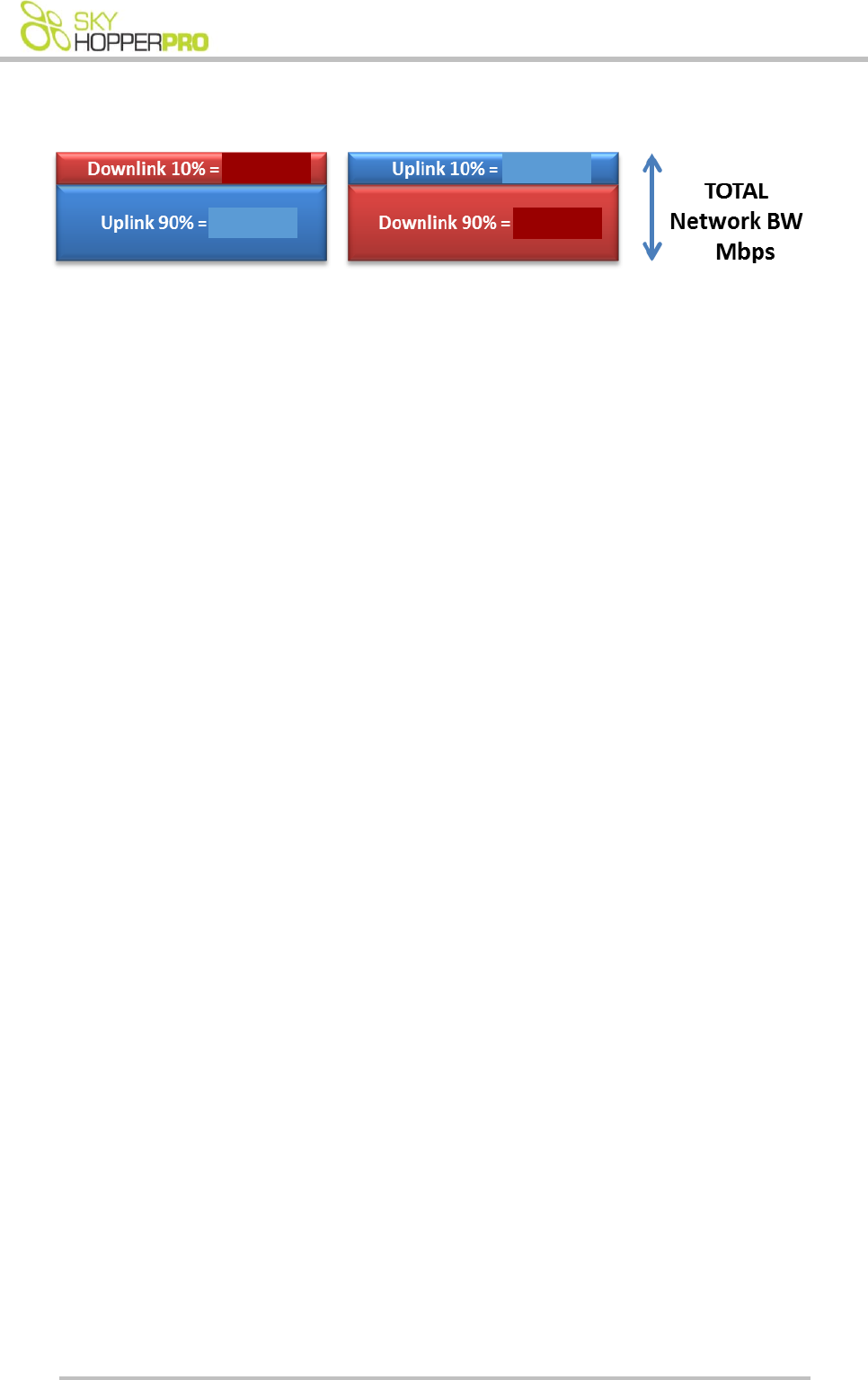
Example for an asymmetric link: 6Mbps configuration, where 10% of available BW is allocated for
uplink and 90% is allocated for downlink.
User Manual
Page : 11 / 31
Figure 2: Asymmetric Link Configuration
2.2 SkyHopper Pro Main Features
SkyHopper Pro offers the following features to take your drone to new levels:
Tremendous transmission range that exceeds 5km line-of-sight
Relay operation for extending long range line-of-sight and overcoming dead spots in urban or
industrial areas
Non-line-of-sight (NLOS) communication by using a proprietary technology to provide a
robust and clear radio signal
Allows for a number of control stations with the same functionality to control the same
drone simultaneously with seamless handover between control stations
Supports drone communication to multiple control stations and an unlimited number of
viewers (receivers)
Real-time full HD wirelessly over the air at a Glass-to-Glass low latency via an IP camera
through an Ethernet connection
Robust security and encryption mechanisms to protect your data from potential cyberattacks
Software Defined Radio (SDR) mobile technology
MIMO antenna processing technologies
Scalable solution from a Point-to-Point to a Point-to-Multipoint network with relays
High mobility with continuous transmissions up to 800km/h
Mobile broadband network
Small physical dimensions and very lightweight (105 gr) (portable device)
Low power consumption (less than 10W)
Plug-and-play installation
Battery operated
2.3 Packets supported by the SkyHopper Pro network
The SkyHopper Pro physical link supports Ethernet (IEEE 802.3) which includes:
1. Ethernet, VLAN Services, VPN and any other Protocol over IP.
2. Real-time applications using RT Protocols such as: Voice, Video, Data
3. Broadcast, Multicast, Unicast
Any Ethernet packet received by the unit’s Ethernet port is encapsulated internally with a standard
frame for transmitting via the Data Link to the remote unit. The remote unit recovers the original
Ethernet packet and forwards it to the Ethernet port.
6
0.6mbps
5.4mbps
0.6mbps
5.4mbps
Aerial Unit
Ground Unit

User Manual
Page : 12 / 31
NOTE – The unit is similar to Ethernet layer 1 (physical layer), which makes
integration with your equipment nothing more than connecting the Ethernet
cable.
User Manual
Page : 13 / 31
3 Physical Description
3.1 Front View Connectors
RF1: Antenna 1 Connector, MMCX/F 50 Ohm
RF2: Antenna 2 Connector, MMCX/F 50 Ohm
GPS: GPS Antenna Connector, MMCX/F
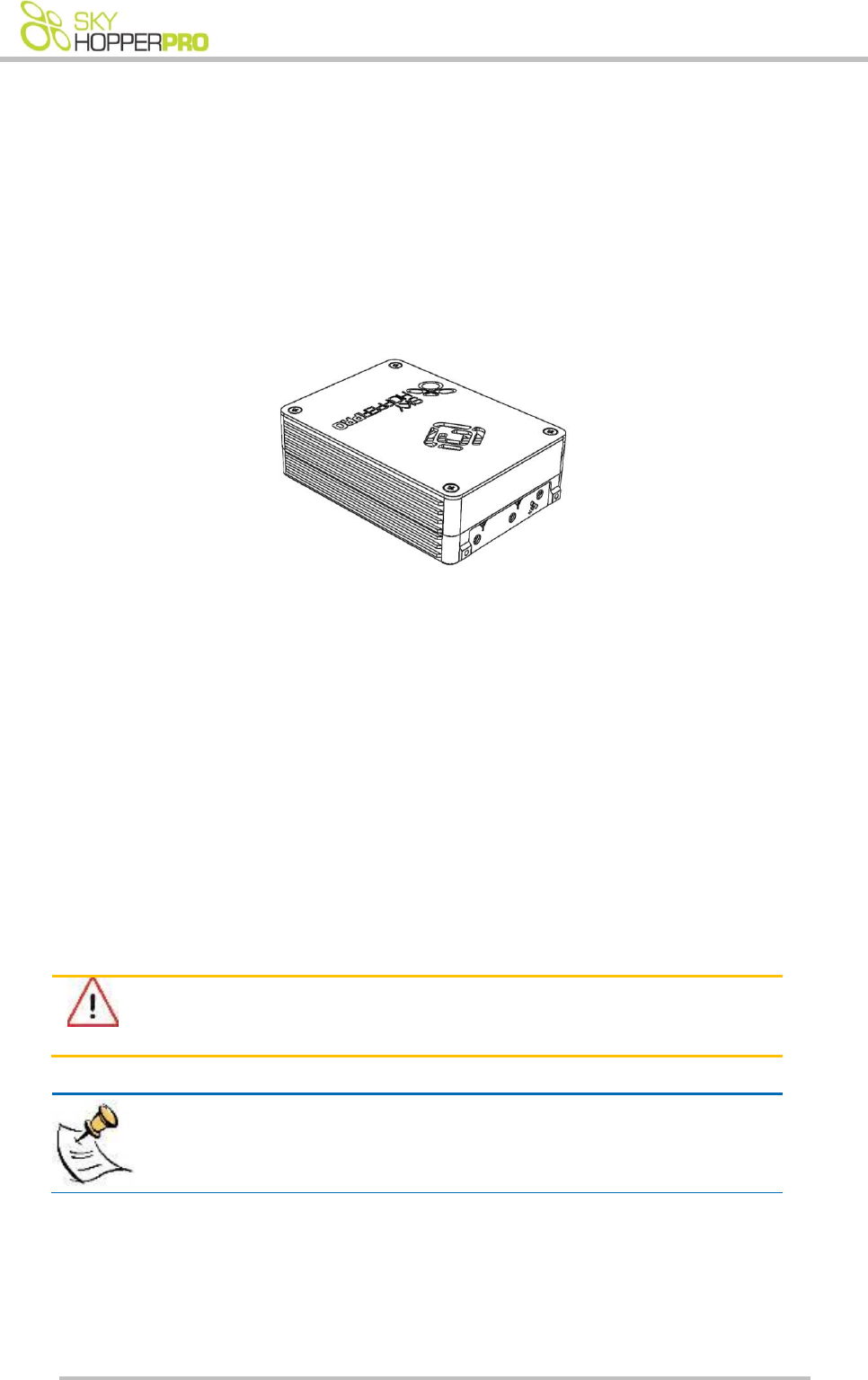
Figure 3: SkyHopper Pro Front View
3.2 Unit Cables: Type & Usage
Ethernet: Standard RJ45 connector
Serial (IOIOI):
Molex - 502380-0600
RS232 / 1PPS connector
Power:
ZE - ZER-04V-S
Power connectors utilizing 7-14.5VDC
CAUTION – When SkyHopper Pro is carried by a person, environment
temperature should not exceed 45°C (113°F)
NOTE – Information about the connectors’ pin assignments are available in
Appendix C – Connectors Pinout
LED: SkyHopper Pro’s LEDs indicate power on, data transmission and link status.
User Manual
Page : 14 / 31
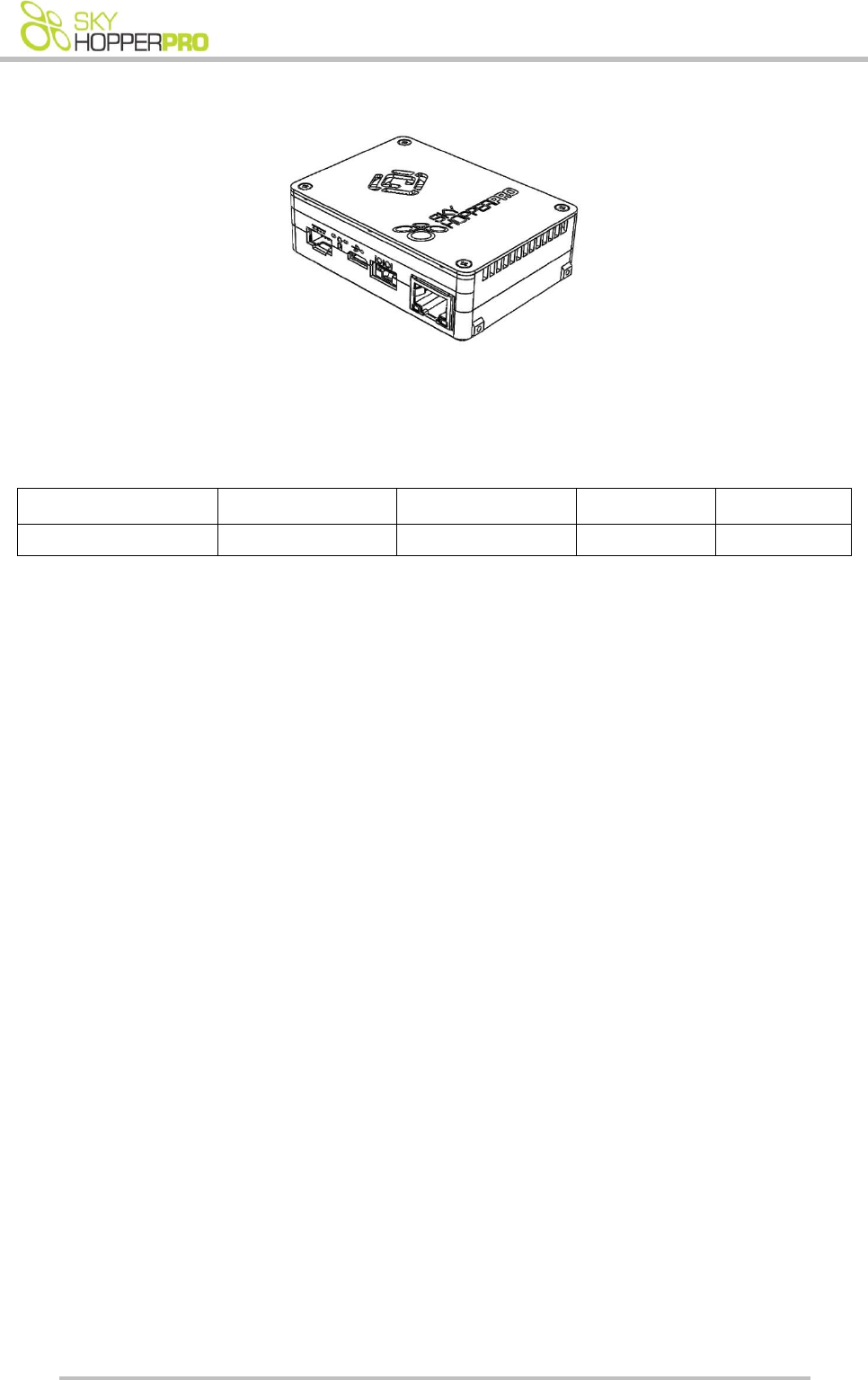
Figure 4: SkyHopper Pro Connector Side view
4 Mechanical Specifications
The SkyHopper Pro unit is lightweight and has small form-factor.
Dimensions
[HxWxD] (mm)
[HxWxD] (inch)
Weight (gr)
Weight (oz.)
26 x 54 x 74
1.0 x 2.1 x 2.9
105
3.7
Table 2: SkyHopper Pro Mechanical Specifications
5 Technical Specifications
5.1 Radio and Modem Specifications
5.1.1 Frequency bands available:
2.4GHz unlicensed band
Note: This product is configured to operate within the FCC or CE limitations based on the
country of ordering. It is configured within the 2.4 ISM frequency band. Mobilicom takes
no responsibility should you choose to take and/or operate this product outside of FCC or
CE limits and/or in a country that does not comply with FCC or CE regulations. Please note
that SkyHopper specifications vary based on FCC or CE regulations.
5.1.2 Antennas
Various standard antennas can be supported using an MMCX/M connector. Some antennas with a
different connector (such as SMA) can be used with an adaptor or adaptor cable. The Ground Unit
has a mounting kit supplied with an MMCX to SMA connecting cable and SMA/M antennas.

User Manual
Page : 15 / 31
5.1.3 RF Characteristics
Peak output power: 2 x 0.5W per channel
Average output power: 2 x 100mW per channel (23dBm)
Noise Figure: 5dBm
Transmission Power Control Range: 50dB in 1dB steps
Radio Access Method: OFDM - TDMA
Configuration & Diversity Support: 2X2 MIMO with MRC(RX) and CDD(TX)
Frequency Resolution: 0.25MHz
Channel bandwidth: Configurable 4.2/8.4MHz
FFT Supported: 512
Guard band: 64 sub-carries on each side
Total subcarriers used per symbol: 384
Data carriers used: 336
Pilot carriers used: 48
Sub carrier spacing: 13KHz for 5MHz bandwidth with 5msec frame
Modulations: QPSK
FEC methods: CTC
FEC Ratios: ¾ , ½ , ¼
Error Detection: CRC32
Full TDD asymmetrical duplexing
Flexible ratio from 1:1 to 1:9 in PTP
Resolution of 1% between all units in multi-unit networks.
NOTE – The wide configurable power control range enables transmitting in low
Tx power when not needed, thereby reducing power consumption.
User Manual
Page : 16 / 31
5.2 Power Specifications
SkyHopper Pro is designed to be battery operated (DC) with low power consumption. Its design
allows for multiple battery cell configurations (different voltages).
Power - LF10WBRB-4P
DC Voltage (Battery Operated)
7-14.5VDC
Power Consumption
8 Watts average use
Up to 12 Watts depending on the operational scenario (TX:RX Ratio)
Table 3: SkyHopper Pro Power Specifications
5.3 Environmental Specifications
SkyHopper Pro is designed to meet international EMI, Radio & Environmental Standards, such as
wireless ETSI & FCC etc.
Environmental
Temperature Range
Operating
Storage
-10°C to 40°C
-50°C to 85°C
Humidity
5 to 95%
Table 4: SkyHopper Pro Environmental Specifications
5.4 Embedded GPS Characteristics
SkyHopper Pro has a built-in GPS receiver. In a PTP network configuration it is used for location
information only (which can be operated by the customer via the SkyHopper API). In a Multi-Unit
network, it is used for synchronization and can also be used by the customer for location purposes.
SkyHopper Pro uses active GPS antennas. The power for the active antenna is provided by the unit
via the regular GPS MMCX connector.
User Manual
Page : 17 / 31
Item
Description
Receiver Type
GPS L1 C/A code
Accuracy
Position 2.5 m CEP
SBAS 2.0 m CEP
Acquisition
Cold start: 27 s
Aided start: < 3 s
Hot start: 1 s
Sensitivity
Tracking: –161 dBm
Cold start: –147 dBm
Hit start: –156 dBm
Timing Accuracy
RMS 30 ns
99% < 60 ns
Granularity 21 ns
Table 5: Embedded GPS Characteristics of SkyHopper Pro
6 TDMA
Time Division Multiple Access (TDMA) is a channel access method for shared medium networks. It
allows several units to share the same frequency channel by dividing the signal into different time
slots. The units transmit and receive on the same frequency in a synchronized manner. Every unit
transmits in its own dedicated time slots. On the other time slots said unit receives the transmission
sent by the other units that are members of the same network (which are also transmitting on their
own dedicated slots).
TDMA requires a synchronization system. The system is synchronized internally, externally or via GPS
(synchronization varies between topologies and method used).
The SkyHopper Pro unit uses TDMA regardless of the application type, PTP or PTMP.
User Manual
Page : 18 / 31
7 PTP (Point-to-Point)
A PTP network is a radio link between 2 SkyHopper Pro units. The configuration (frequency and
profile) of both units must be the same with only one difference - one unit is configured as a Remote
Unit while the other unit is configured as a Controller Unit.
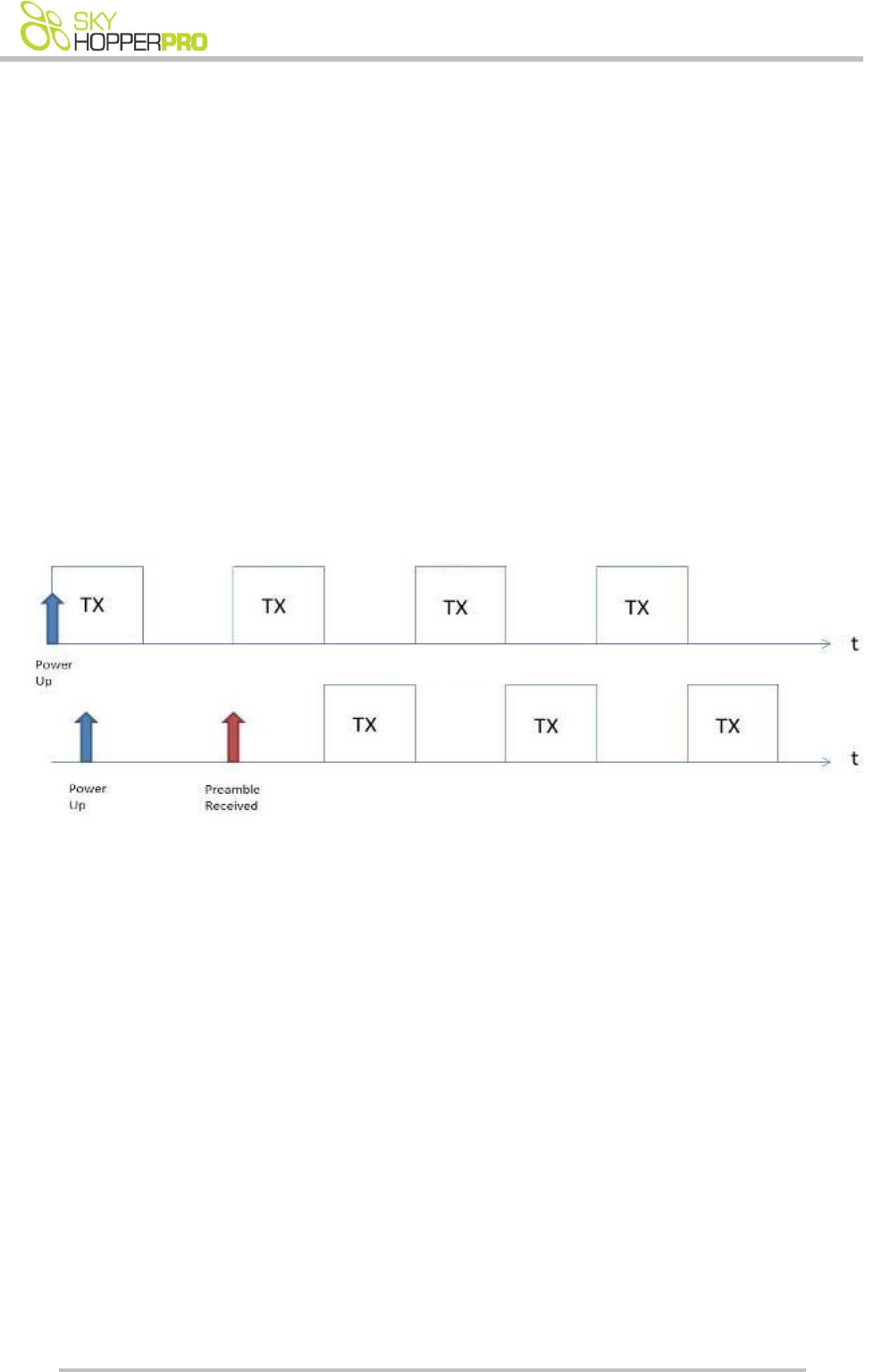
The Remote Unit works with its internal clock and synchronizes the Controller Unit. After power-up,
the Remote Unit starts transmitting regardless of link status. The Controller Unit however, does not
transmit and stays in Rx mode, trying to acquire synchronization by finding a preamble
(synchronization pattern). As soon as the Controller Unit recognizes the pattern, it starts to transmit
according to its allocated time slot.
The transmission bandwidth ratio is predefined as part of the profile configuration. It can be
symmetric when full duplex communications are required (50% to each unit) or asymmetric up to
10% to one unit (remote or controller) and 90% to the other unit.
Figure 5: Transmit frames of the remote unit and controller unit from Power Up
Note: A viewer unit acts like a Controller unit but with one major change, it does not transmit and
only receives.
Remote Unit
Controller Unit
User Manual
Page : 19 / 31
7.1 PTP Link Step-by-Step Configuration
In order to build a PTP link, two SkyHopper Pro units are required. One unit acts as a remote unit,
while the other as a controller unit.
1. Connect antennas to RF1 and RF2 connectors, and power up the unit.
CAUTION – Powering up a unit without connecting the antennas can
cause irreparable damage to the unit.
2. Connect the unit to a PC using a standard Ethernet Cat 5 cable.
3. Set static IP in the 192.168.131.xxx subnet (For more information, see the Web GUI
Instructional Manual).
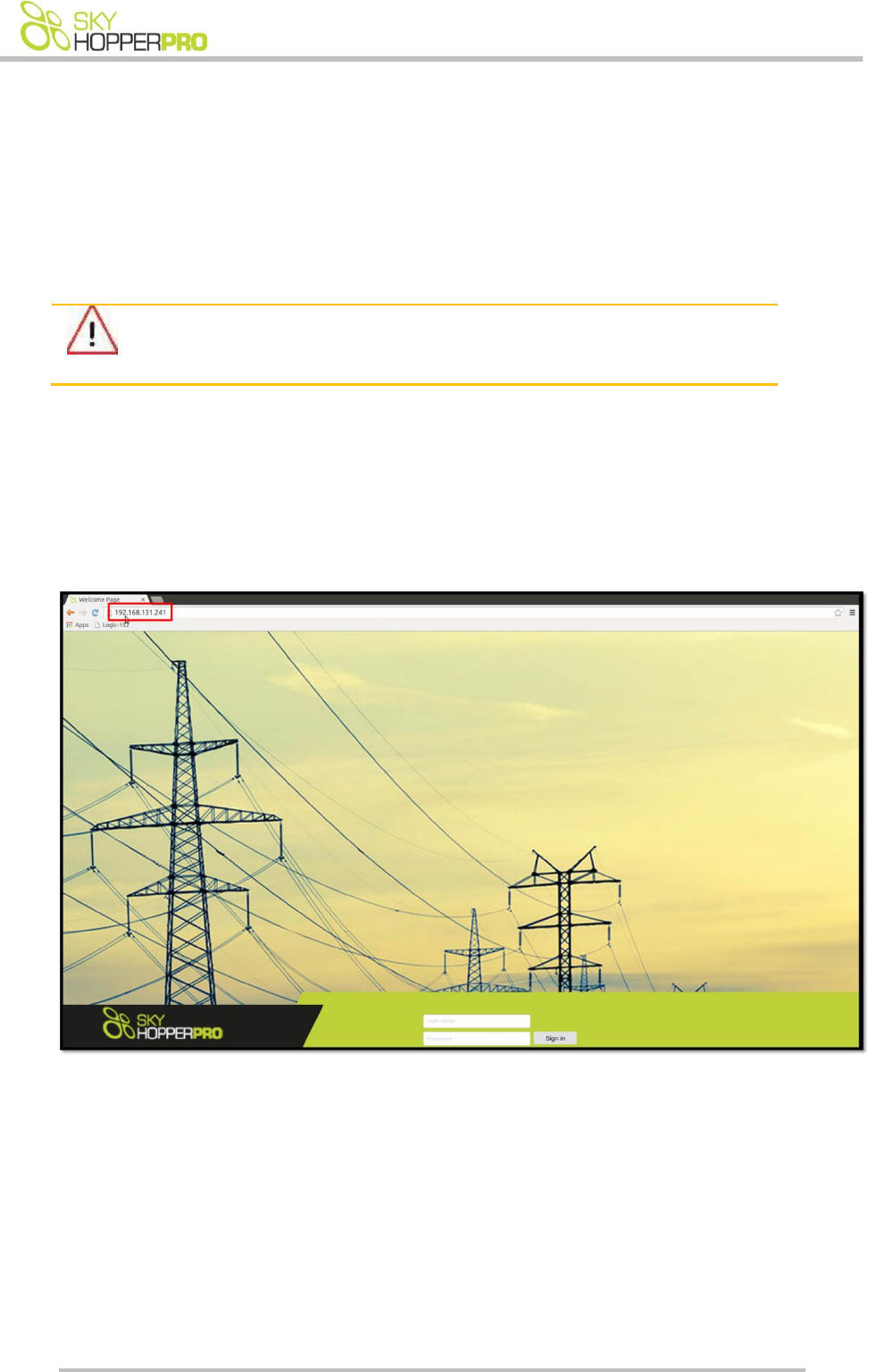
4. Using the Web GUI: Open a web browser installed on your PC / laptop (Chrome, Firefox,
Internet Explorer, etc.) and input in the address line: 192.168.131.241. That should connect
you to the Web GUI interface, as shown on Figure 6:
Figure 6: Web GUI main screen
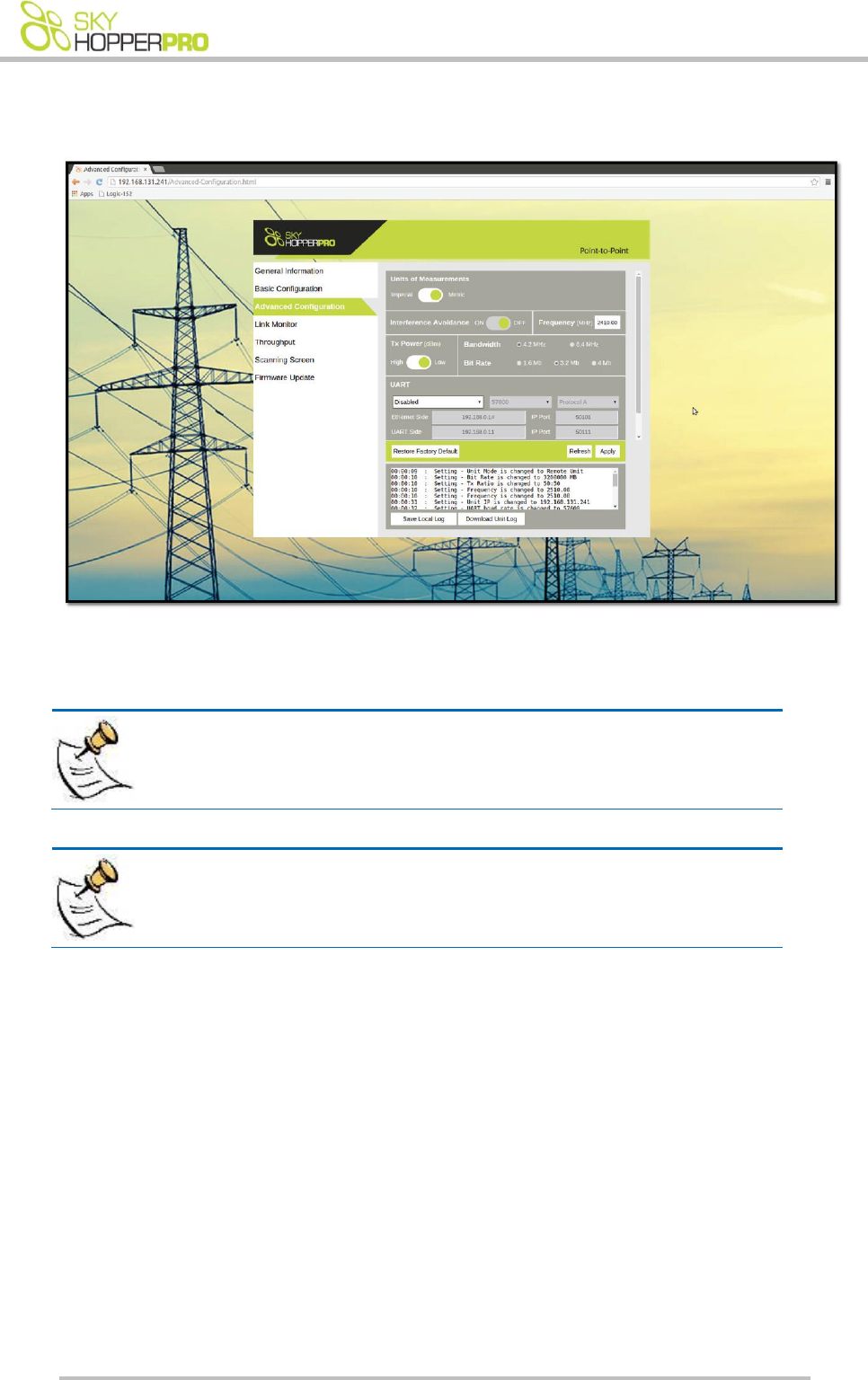
5. To change the frequency to the required frequency, click on “Advanced Configuration” (third
tab on the left corner) and on the “Frequency” line and write the desired frequency within
the frequency range set in your unit.
6. Set the profile as required (RF bandwidth, bitrate and ratio) and click on the “Apply” button
as shown on Figure 7. The unit will reboot.
7. Repeat stages 1-4 with the 2nd unit.
User Manual
Page : 20 / 31
Figure 7: Web GUI “Advanced configuration” screen
NOTE – A PTP setup requires 2 SkyHopper Pro units configured with same
frequency and profile.
NOTE – Frequency Hopping is currently not supported and has been disabled
from the Web GUI.

User Manual
Page : 21 / 31
7.2 SkyHopper Pro LED indicator
By following the LED on the unit, the power and link status can be monitored. It is described as
follows:
1) ACTV LED:
a) Off – Power Down
b) On - Booting Up
c) Slow Blinking – Remote unit is transmitting, controller unit receiving (P2P search)
d) Fast Blinking – Air Link is up
2) DATA LED
a) Off – No Ethernet detected
b) On – Ethernet Cable is connected to a working device on host – No Data
c) Slow Blink – Error (synced to ACTV LED)
d) Fast Blink – Tx & Rx Air Traffic active
Should there be an error in your SkyHopper Pro unit, both the ACTV and DATA LEDs will be
simultaneously slow blinking.
Link status, CINR, RSSI, throughput and unit log information is available in the Web GUI, which can be
found online at www.skyhopper.biz/prosupport.

User Manual
Page : 22 / 31
9 Installation and Setup
9.1 Package Contents
Aerial Unit
Item
Quantity
SkyHopper Pro Aerial Unit
1
2dBi Antenna MMCX
2
Power Cable
1
Telemetry Serial Data Cable
1
Ethernet Cable
1
Ground Unit
Item
Quantity
SkyHopper Pro Ground Unit
1
2dBi Antenna SMA
2
Power Cable
1
Telemetry Serial Data Cable
1
Ethernet Cable
1
SMA to MMCX RF Cable
2
Bracket Mount
1
Bracket Screws
3
Tripod Knob
1
9.2 Connecting the Antennas
Antennas for installation vary in size, shape, requirements and mounting methods. The antennas
should be as close to the SkyHopper Pro as possible and can be connected to it directly.
Cables should be chosen according to their attenuation (lower attenuation gives better results)
and flexibility (according to the path they pass through). Each cable should have an MMCX Male
connector on the SkyHopper Pro end, and a connector matching the antenna’s connector on the
other.
9.3 Connecting the Power
SkyHopper Pro has a dual power feed enabling hot-swap battery replacement during operation.
CAUTION – Powering up a SkyHopper Pro without connecting the
antennas can cause irreparable damage to the unit.

User Manual
Page : 23 / 31
Appendix A - Specifications
Radio and Modem
Frequency
2.4GHz (ISM)
900MHz (ISM) - Optional
5.8GHz (ISM) - Optional
Antenna's Connectors
MMCX (X2)
TX Power Control
50dB
RX Dynamic Range
70dB
Sensitivity
Max –101dBm
Radio Access Method
OFDM - TDMA
Duplexing
TDD
Configuration
MIMO 2X2
Channel BW
4.2MHz / 8.4MHz
Frequency Resolution
0.25MHz
Diversity Support
TX & RX Diversity
FFT Supported
512
32 – 2048 upon request
FEC method
Turbo Code
Modulations
QPSK
Throughput
Configurable up to 6 Mbps
Synchronization
1PPS sync input
Encryption
AES-128 bit

User Manual
Page : 24 / 31
Environmental
Temperature Range
Operating
Storage
-10°C to 40°C
-50°C to 85°C
Humidity
5 to 95%
Interfaces
Data
Ethernet, RS232
Full Ethernet Protocol Transparency
IP,TCP,UDP, RTP, HTTP
Broadcast, Multicast, Unicast
Ethernet, VLAN, VPN
Serial Data
RS232
USB
Optional
Dimensions
[HxWxD] mm
[HxWxD] inch
Embedded Package
26 x 54 x 74
1.0 x 2.1 x 2.9
Weight
Grams
Ounce
Embedded Package
105 gr.
3.7 oz.
Power
DC Voltage (Battery Operated)
7-14.5V DC
Power Consumption
Up to 12 Watt
8W Average
Configuration and Management
Unit Monitoring Application
Web-Based Application
Program Interface
API, Code Lib. (Optional)
Integrated Options
Video Encoder/Decoder
H.264 very low latency HD/SD
Video Formats up to: 1920x1080p
Video Inputs / Outputs
Micro HDMI (Input/Output)
Analog (Input)
Audio Inputs / Outputs
Embedded Audio over HDMI, Analog
User Manual
Page : 25 / 31
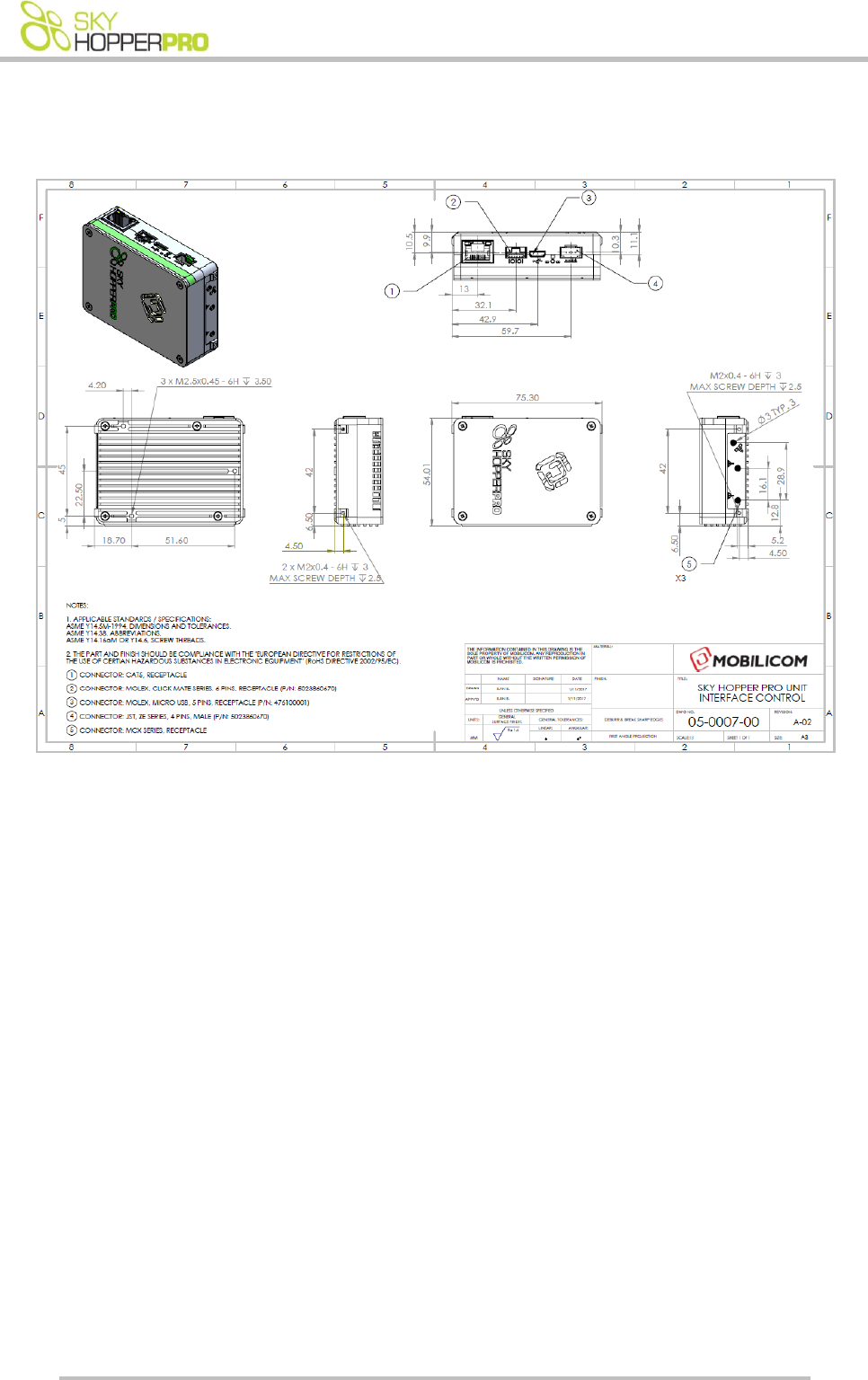
Appendix B - Mechanical Drawings
User Manual
Page : 26 / 31
Appendix C – Connectors’ Pinout
1. RS-232/1PPS
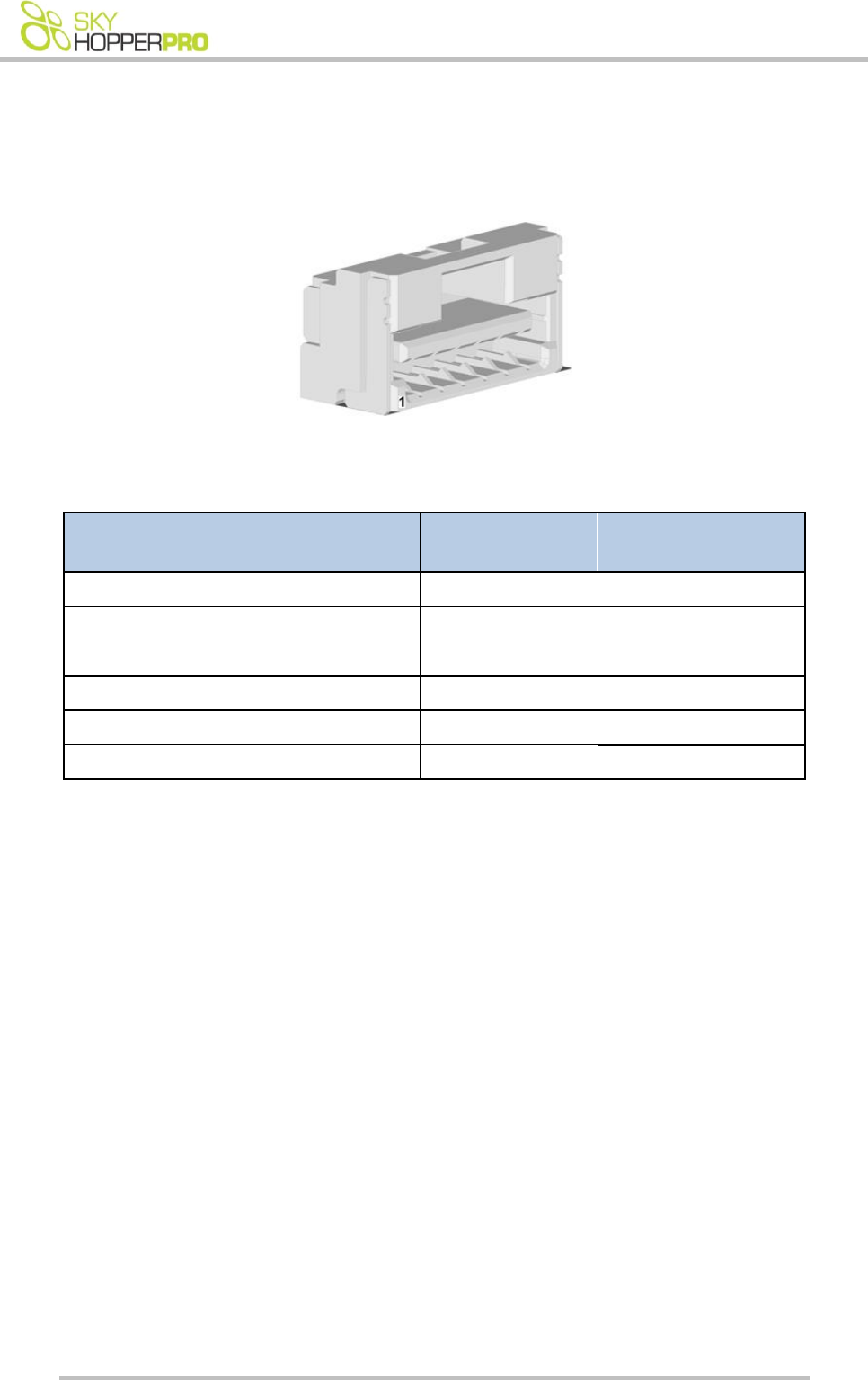
Figure 8: RS232/1PPS connector (IOIOI) (SkyHopper Pro side)
SkyHopper Pro
Housing P/N: 502380-0600Pins P/N: 502381-0000
Name
Description
1
N/A
2
RS232 out
D9 Pin 2
3
N/A
4
RS232 in
D9 Pin 3
5
GND
6
1PPS In
Table 6: RS232/1PPS connector pinout (IOIOI)
User Manual
Page : 27 / 31
2. Power Cable
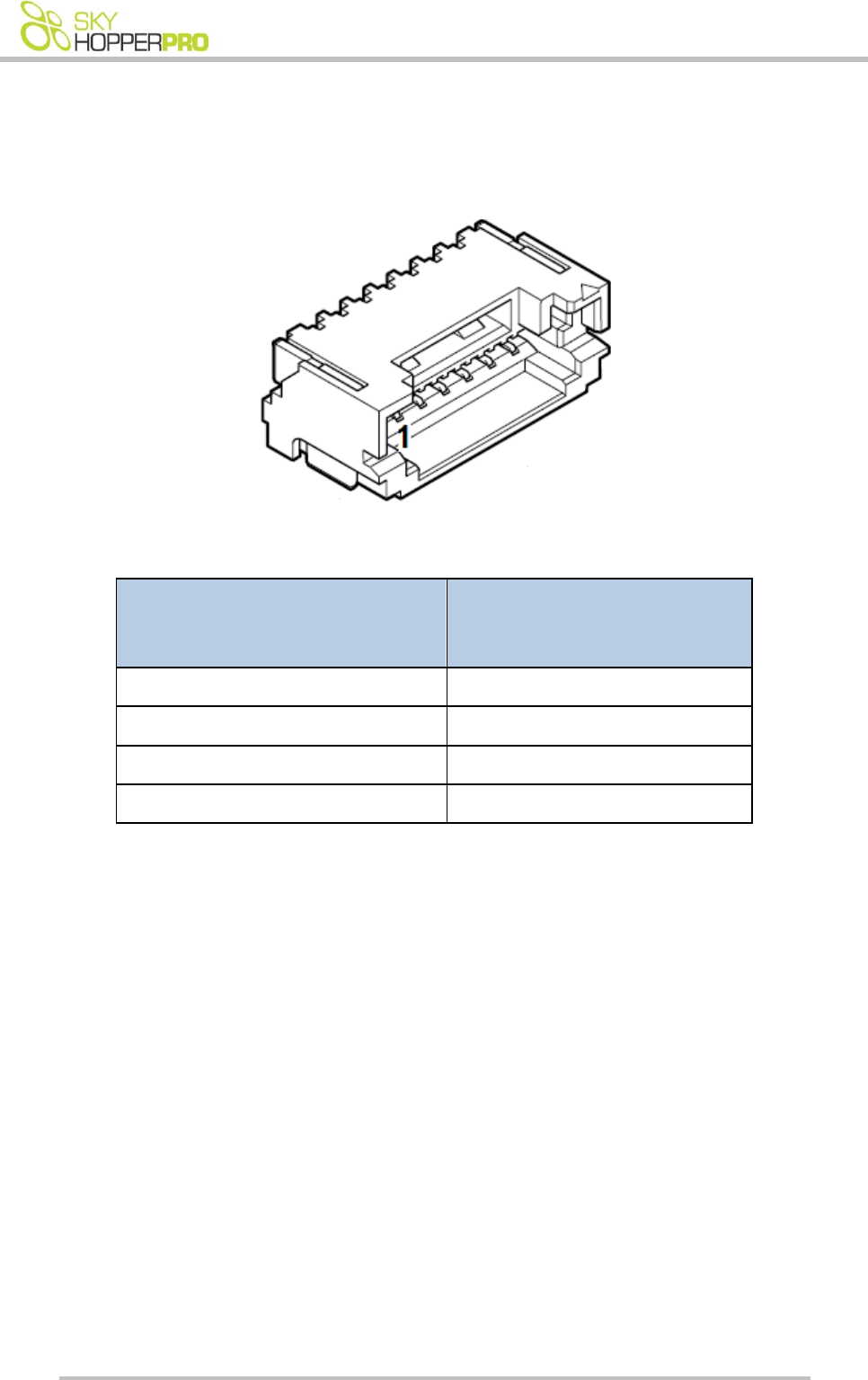
Figure 9: Power connector (SkyHopper Pro side)
SkyHopper Pro
Housing P/N: ZER-04V-S, Pins P/N: SZE-002T-
P0.3
Description
1
GND (-VDC)
2
GND (-VDC )
3
Vin+ (+VDC)
4
Vin+ (+VDC)
Table 7: PWR Connector Type and Pin Mapping
User Manual
Page : 28 / 31
Appendix D – Setting up a Pixhawk based system
In this section we will describe how to setup a network for a drone using a Pixhawk flight controller.
The Pixhawk flight controller uses a UART interface and runs the MAVlink protocol over it. SkyHopper
Pro has an RS232 interface which is similar in its word structure to RS232 but there is a difference in
the voltage levels.
1. SkyHopper Setup
The first stage is to setup the SkyHopper link to enable the UART interface on the link. The
configuration should be setup on both units (Remote/Aerial and Controller/Ground).
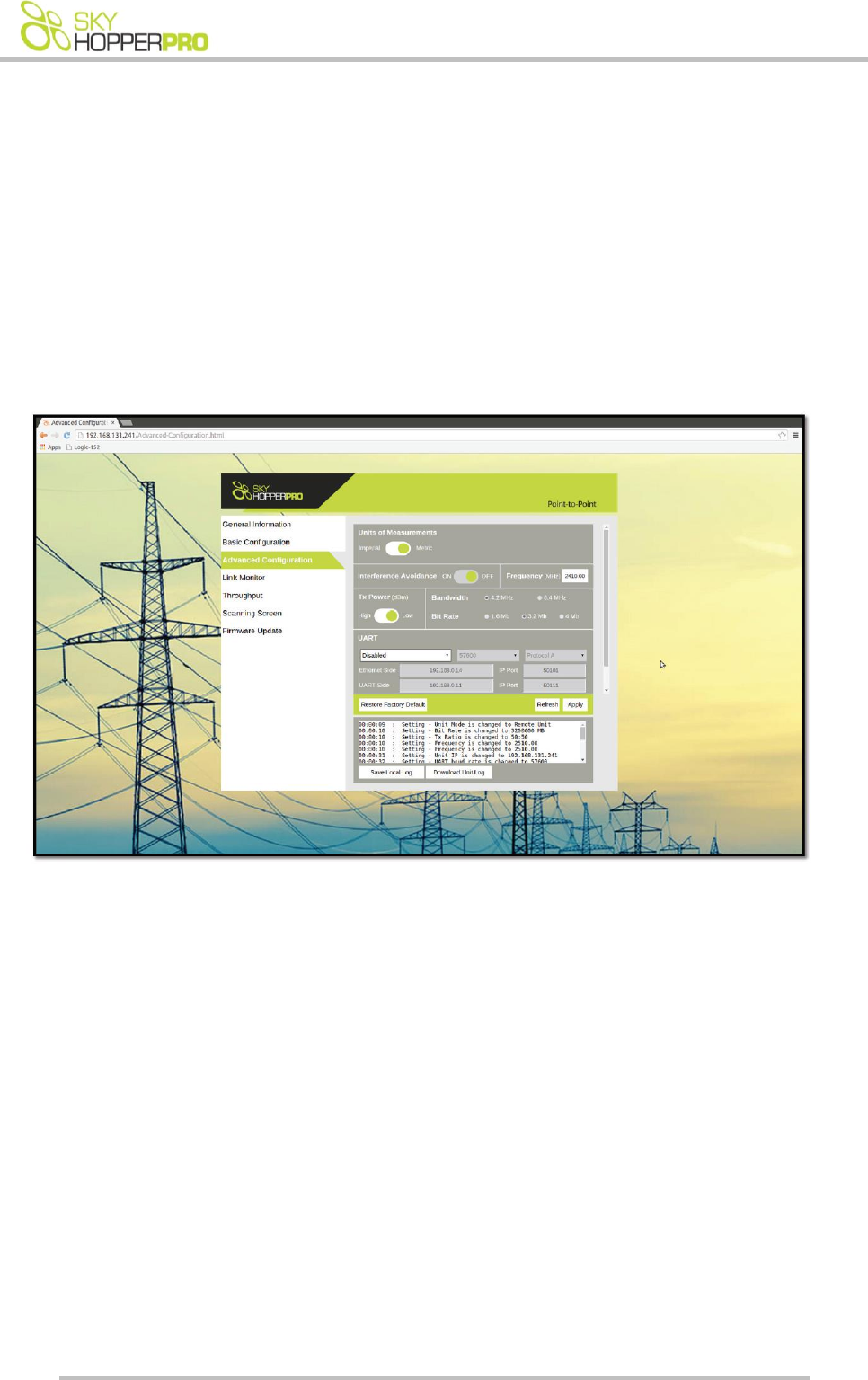
Figure 10: Web GUI advanced configuration
In the advanced configuration screen:
1. Go to the UART section
2. Enable the UART and choose UART-to-UART
3. Setup the Baud rate to 57600
4. Choose protocol C
5. Reboot the unit
6. Repeat on both Remote and Controller units
2. Physical connection
After the units are configured, the Pixhawk flight controller should be connected to the unit.
On the remote (Aerial) unit Use the Pixhawk adapter accessory which can be purchased on our
website and connect it to the serial cable provided with the SkyHopper Pro unit. Connect the adapter
to the Pixhawk flight controller and the serial cable to the unit.

User Manual
Page : 29 / 31
On the controller (Ground) unit, connect the D-Type/9-pin accessory adapter to the serial cable
supplied and connect the cable to the unit. If the Tablet/PC has a serial port, connect it directly, if
not, a USB-RS232 adapter should be used.
3. UART to Ethernet
There is an option to configure the system to work with a UART-to-Ethernet configuration, which
eliminates the use of the serial cable on the Ground Unit.
Please refer to the UART-to-Ethernet Connection Guide online at www.skyhopper.biz/prosupport.

User Manual
Page : 30 / 31
Appendix E –Troubleshooting
Symptom
Possible Cause
Action Needed
LED is off
Not connected to power source
or battery is empty
1. Verify power cable properly connected
to the SkyHopper Pro PWR connector.
2. Verify that the battery or power supply
is connected to the SkyHopper Pro
power cable and to a power outlet.
3. Replace the battery or check the outlet.
4. Replace the power cable.
LED light is always on
PTP – Unit is in boot mode
PTP
1. Check the power source
2. Reboot the SkyHopper Pro.
Cannot connect to
SkyHopper Pro using Web
GUI
1. The PC isn’t configured with a
correct static IP
2. Unit isn’t powered up
3. Ethernet cable isn’t
connected or data cable is
damaged
4. Firewall is blocking traffic
5. ETH port set to “auto
negotiation off” with 1GE
6. Trying to connect to remote
unit when link is down.
1. Verify your PC is set with a static IP in
the subnet of 192.168.131.xxx.
2. Check that the ETH port is set to “auto
negotiation on”.
3. Verify the unit is powered up.
4. Verify that the PC ETH port status isn’t
unplugged or disabled.
5. Disable the PC firewall.
6. Verify ETH cable is connected to the
PCs ETH port and to the SkyHopper Pro
MAIN connector.
If needed: replace cables.
7. Ping the unit.
8. Try to connect to the local unit and
verify link is up.
No link between
SkyHopper Pro units
1. Configuration isn’t the
same on all of the
SkyHopper Pro units.
2. PTP – both units set as
VC or both as Node.
3. The units aren’t within
reception range.
1. Connect to each unit and verify they
have the same configuration.
2. PTP -Verify 1 unit is set as a VC and the
other as a Node. MPTMP - verify each
transmitting unit has a different unit ID.
3. Verify that TX power is set to the
maximum.
4. Verify the antennas fit the Frequency
used (antenna spec).
Data with high delay and
disconnecting data
Trying to send a higher amount of
data than the allocated
bandwidth sent to the unit.
1. Verify that the data bandwidth sent to
the unit from the connected device(s)
does not exceed the allocated
bandwidth (in its configuration).
2. Decrease the data received by the data
source or change the allocated
bandwidth via the Web GUI.

User Manual
Page : 31 / 31
Technical Support Inquiries
For technical support for SkyHopper PRO, please contact:
Support@skyhopper.biz
Telephone: +972 777 10 30 60